

The DOT and FAA are requiring airlines to certify that pilot hiring is merit-based in accordance with new federal policy.
US Transportation Secretary Sean P. Duffy on Friday announced that the Federal Aviation Administration (FAA) is issuing a new mandatory Operations Specification (OpSpec) requiring commercial airlines to formally certify that pilot hiring is based exclusively on merit. The directive applies to all certificate holders operating under 14 CFR Part 121, which includes US airlines conducting scheduled passenger and cargo operations.
The new mandate, designated OpSpec A134, is titled “Merit-Based Pilot Hiring.” According to FAA Notice N 8900.767, published 13 February 2026, “The certificate holder shall ensure pilot hiring is exclusively merit-based to fulfill its duty to provide the highest possible degree of safety in the public interest.” The FAA is relying on its authority under 49 U.S.C. § 44701(b) and (d), federal law that allows the agency to establish safety standards for commercial carriers.
What the New OpSpec Requires
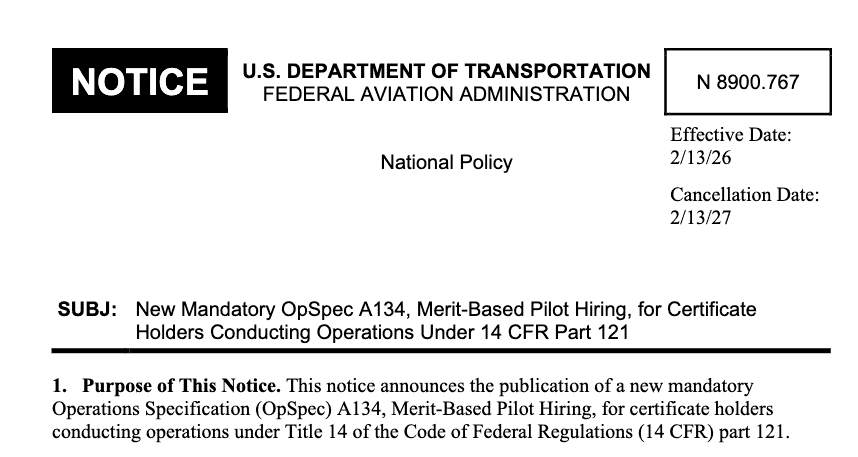
Under the notice, Principal Operations Inspectors must notify Part 121 carriers within two business days of publication. Airlines may submit written information within seven days. The FAA will then determine whether to adopt, partially adopt, or withdraw the amendment, with OpSpec A134 to be issued no later than 30 days after that determination.
The FAA states in the notice that “operational safety of 14 CFR part 121 air carriers is fundamentally dependent upon the knowledge and proficiency of its flight crewmembers.” It further notes that existing training standards under Part 121 subparts N, O, Y, and appendices E and F establish rigorous qualification requirements, and that effectiveness is enhanced when new hires enter training with a verified baseline of technical knowledge, cognitive skills, and piloting experience aligned with the carrier’s operating environment.
The agency also ties the hiring requirement to Safety Management Systems, stating that merit-based hiring can provide proactive inputs to an operator’s SMS and strengthen risk management processes.
Statements from DOT and FAA Leadership

Secretary Duffy framed the announcement around passenger confidence and safety.
“When families board their aircraft, they should fly with confidence knowing the pilot behind the controls is the best of the best,” Duffy said. “The American people don’t care what their pilot looks like or their gender—they just care that they are [the] most qualified man or woman for the job. Safety drives everything we do, and this commonsense measure will increase transparency between passengers and airlines.”
FAA Administrator Bryan Bedford echoed Secretary Duffy’s statement.
“At the FAA, the safety of passengers is our number one priority,” said Bedford. “It is a bare minimum expectation for airlines to hire the most qualified individual when making someone responsible for hundreds of lives at a time. Someone’s race, sex, or creed has nothing to do with their ability to fly and land aircraft safely.”
Someone’s race, sex, or creed has nothing to do with their ability to fly and land aircraft safely.
Bryan Bedford | FAA Administrator
According to the DOT announcement, the action is in accordance with President Donald J. Trump’s Executive Order 14173, titled “Ending Illegal Discrimination and Restoring Merit-Based Opportunity,” as well as a related Presidential Action titled “Keeping Americans Safe in Aviation,” both issued 21 January 2025.
Scope and Context of the Mandate
The OpSpec applies specifically to 14 CFR Part 121 certificate holders, which, in practical terms, covers U.S. carriers operating regularly scheduled commercial passenger and cargo flights. The DOT stated that while the FAA has previously raised performance standards and revised prior directives, “allegations of airlines hiring based on race and sex remain,” prompting the new certification requirement. The department did not cite specific evidence of current non-compliance in its announcement.
Pilot hiring standards have been part of an intense – and sometimes contentious – industry conversation in recent years. As airlines work to address pilot shortages and long-term workforce development, many carriers and aviation organizations have launched programs aimed at expanding access to aviation careers for underrepresented groups. At the same time, some critics have questioned whether diversity-focused initiatives could influence hiring decisions beyond traditional qualification metrics.
That debate has played out across industry conferences, recruiting campaigns, union discussions, and social media, placing pilot hiring squarely in the spotlight well before this latest FAA directive.
For operators and the public, the notice is available through the FAA’s website and the Dynamic Regulatory System. Questions regarding the notice may be directed to the FAA’s Air Transportation Division, according to the publication.
As with all FAA Operations Specifications, OpSpec A134 becomes part of the regulatory framework governing airline operations. The focus, according to both DOT and FAA leadership, remains on safety, qualifications, and maintaining what the agency describes as “the highest possible degree of safety in the public interest.”