

“It was a miracle” were the only words a Pan Am Boeing 707 pilot could find to describe landing his plane safely after a wing fell off and the plane caught fire in mid-air.
The mishap occurred on 27 June 1965, during the Vietnam War. The plane, named Clipper Friendship and operating as Flight 843, was en route from San Francisco International Airport (SFO) to Honolulu International Airport (HNL) in Hawaii.
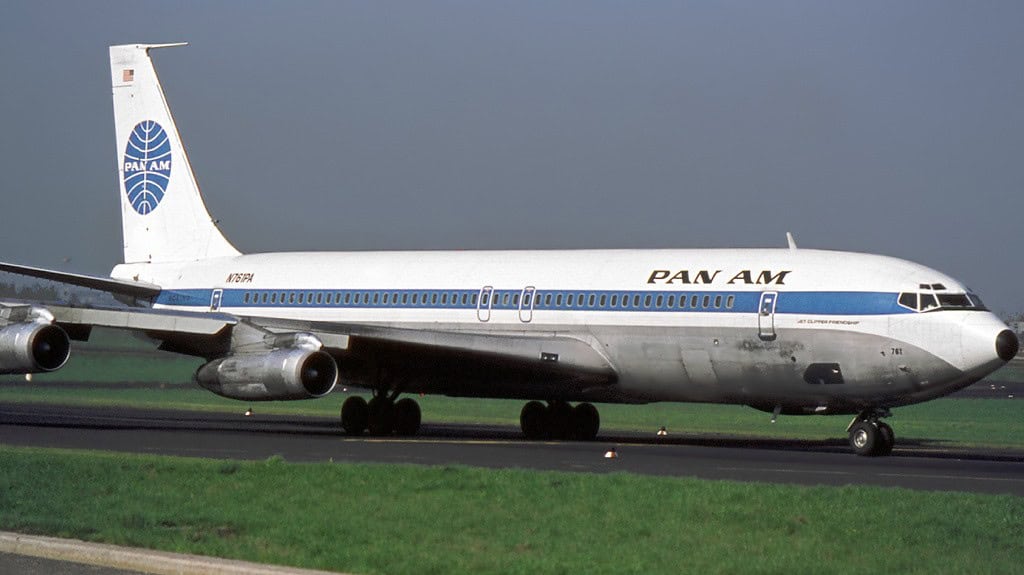
It had only been in flight for a minute or two when an apparent engine fire and explosion caused the engine to separate from the wing. The aircraft spewed debris over South San Francisco before lumbering in the air long enough to make a shallow turn towards a divert field.
By the grace of God and some miraculous flying by the crew, the severely damaged plane somehow managed to land safely at Travis Air Force Base, about 50 miles northeast of San Francisco.
As roughly 25 feet of wing blew off and the plane caught fire, Captain Charles Kimes came over the loudspeaker and said:
“Ladies and gentlemen, this is your Captain speaking. We are experiencing some minor difficulties… well, perhaps not so minor.”
Captain’s address to the passengers
The passengers laughed nervously as the Captain explained that they would be landing at Travis.
Minutes later, the Captain kept his promise, lowered the landing gear manually, and touched down at Travis AFB. All 143 passengers and ten crew members on the plane were safely evacuated. These were the days before cell phones made it so easy to take pictures. Still, two of the plane’s passengers happened to have an 8mm camera with them and were able to take amazing footage of the scene.
Captain Kimes said he had no idea what caused the problem. It could have been a bird flying into the wing, or it could have been engine failure.
Investigators determined that an unfortunate cascade of events led up to the near-tragedy. Just three days before the accident, the No. 4 engine had been overhauled and went on to rack up 39 uneventful flight hours, giving no hint of what was coming. Investigators later determined that the explosion was caused by a third-stage turbine disc failure, which was rooted in poor clearances resulting from improper installation, the use of incorrect tools, worn parts, and a critical lapse in oversight. The Civil Aeronautics Board (CAB) noted that the work was signed off without being fully checked.
The day wasn’t finished, though. Pan Am sent a second 707 to pick up the passengers from the first flight and take them to Hawaii. On landing, the nose gear of the second jet collapsed, leading to the second emergency of the day for Travis AFB! Finally, a third 707 was sent to the Air Force Base.
That plane landed safely at Travis AFB and continued on to Hawaii without any further issues.
8.14.16
