SHAW AFB, S.C. — The U.S. Air Force F-16 Viper Demonstration Team announced on Thursday their new commander and pilot for the 2019 and 2020 air show seasons.
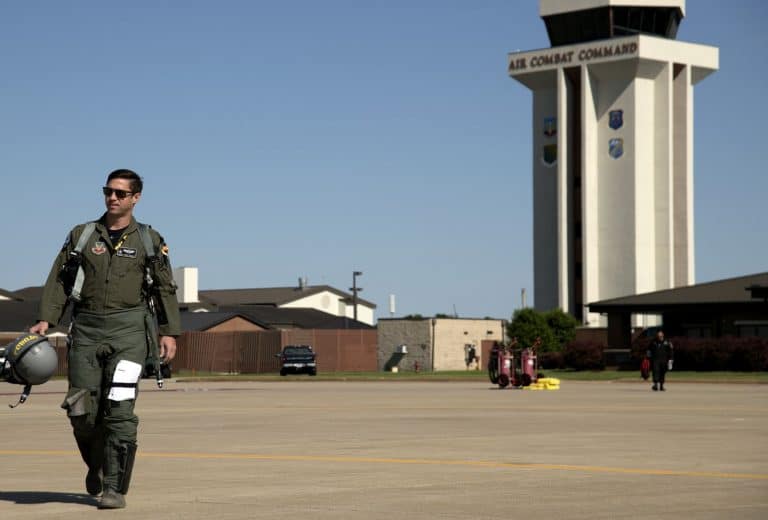
Major Garret “Toro” Schmitz will both lead the team and pilot the F-16 Viper jet at select air show across the United States for the next two seasons. His first public performance is scheduled for the Westmoreland County Air Show in Latrobe, Penn. next weekend.
New F-16 Viper Demo pilot Major Garret Schmitz will perform in Latrobe, Pa. in two weeks. (USAF)
“After 22 training flights and more than 45 hours of study, Maj. Garret Schmitz has completed his fourth certification and earned the privilege of leading us as we inspire the next generation of pilots, maintainers, and Airmen,” JB Langley spokesperson Kathryn Reaves said.
The Utah native and the demo team arrived at JB Langley, Virginia, on Wednesday for Maj. Schmitz final certification flight. Each Air Combat Command pilot has to complete a rigorous training course to receive the high certification from the four levels of leadership within the Air Force, Reaves confirmed.
Maj. Schmitz is scheduled to perform at about 39 shows during the next two seasons. Following Latrobe, his team will travel to Tinker, AFB in Oklahoma, followed by Smyrna, Tennessee in June.
The updated 2019 F-16 Viper Demo Team Schedule. (USAF)
The Lockheed-Martin F-16C is a multi-role fighter aircraft — highly maneuverable and mission proven in over 30 years of operations including air-to-air combat and air-to-surface attack. It provides a relatively low-cost, high-performance weapon system for the United States and 25 friendly nations, the Air Force said in a recent statement.
Outgoing Viper Demo pilot Major John “Rain” Waters, who has led the team for over two years, will perform one final flight on May 26. Waters will perform a flyover of the 103rd running of the Indianapolis 500 race prior to the drop of the green flag.
(Charles A Atkeison reports on aerospace and technology. Follow his updates via social media @Military_Flight.)
SMYRNA, Tenn. — The largest air show in the middle south will see the return of the Navy’s Blue Angels, as civilian aerobatic pilots and military aircraft perform in June at the Great Tennessee Air Show.
Tennessee’s highest-rated air show returns the weekend of June 8 and 9 to the Smyrna Airport. The family-friendly event will include static aircraft displays and a special Kids Zone jump area.
“Once again, we are privileged and honored to be hosting the U.S. Navy Blue Angels at this premier Middle Tennessee event,” John Black, Executive Director of the Smyrna/Rutherford County Airport Authority, said on Friday. “With this year’s stellar lineup, the Great Tennessee Air Show is poised to present one of the strongest airshow lineups anywhere in North America.”
The GEICO Skytypers six Navy SNJ-2 aircraft are beautiful and dynamic in flight. (Skytypers)
The Air Force F-16 Viper Demo Team and the World War II-era flying of the GEICO Skytypers Airshow Team will co-headline the event. Each, an air show favorite, will perform a 15-minute demonstration both days.
The Blue Angels Return to Smyrna
The Blue Angels only appearance in the middle south will occur three years to the week of their last visit to Smyrna. A shortened visit which saw the Blue Angels loose their opposing solo Capt. Jeff Kuss in a jet crash as he began a practice flight with the team.
The city of Smyrna dedicated a beautiful memorial to the fallen pilot last June near the runway he last flew from. As the air show community and local residents reflect upon his legacy, this season’s show will move forward without looking back — and that is the wish of Kuss’ family.
“The best tribute to Jeff Kuss was building the memorial on Sam Ridley Parkway,” Black said. “That offered closure for the family and the team. It is their wish that the show celebrate the 2019 team, so there will not be any tribute at the air show.”
Capt. Jeff Kuss USMC Memorial in Smyrna honors the late-Blue Angels pilot. (Charles Atkeison)
Black added that the community can honor his legacy during the inaugural Capt. Jeff Kuss Memorial 6K Top Gun Run on May 31. The 3.7 mile course from the airport to the golf course will then finish at the memorial.
Top Civilian Aerobatic Pilots to Perform
Aerobatic champion pilots Patty Wagstaff, Rob Holland, and Mike Wiskus will perform their dizzying displays of flight. Aerobatic pilots Sean D. Tucker and Jesse Panzer will fly together in tandem as Team Oracle’s Two Ship Act.
The World War II-era P-51D Mustang “Quicksilver” will fly each afternoon piloted by Scott “Scooter” Yoak in a celebration to America’s armed forces. The aircraft is decorated with black and white stripes on her wings to honor the 75th anniversary of the Allied D-Day invasion at Normandy, France.
The beauty of the the military jet teams and the civilian pilots are best appreciated from around air show center along the show’s crowd line. To witness and photograph these precision aircraft at the closest point inside the gates is the heartbeat of every air show guest.
Air Force F-16 Viper Demo Team’s new pilot Maj. Garret Schmitz will perform each day at Smyrna. (USAF)
Air show tickets and VIP parking passes, including group ticket packages, are available online only. Black added that general parking is free to the public and will be available both days on a first come, first served basis.
(Charles A Atkeison reports on aerospace and technology. Follow his updates via social media @Military_Flight.)
BILOXI, Miss. — Keesler Air Force Base and the city of Biloxi will host a rare two-stage air show event this weekend as they work together for the Thunder Over the Sound Air & Space Show.
The joint-event air show will begin with gates opening at 7:30 a.m. on Saturday and Sunday, followed by on-base aerial demonstrations one hour later. Guests can enjoy breakfast as they watch Aeroshell Aerobatic Team, Trojan Thunder, and popular warbirds perform all morning.
As Smoke-n-Thunder Jet Truck concludes about noon, the air show will then move to the sugar beaches of the Mississippi Gulf Coast. Exact air show center is located at Beach Blvd. and White Ave.
Aeroshell Aerobatic Team will perform over Keesler AFB and Biloxi beach. (Charles Atkeison)
“We’re really excited to bring the Thunderbirds back to the Gulf Coast, and are happy to partner with the city of Biloxi to bring what will hopefully be an outstanding show to one and all,” Col. Lance Burnett, vice commander of the 81st Training Wing, said on Thursday. “This is the first air show of its kind to involve a joint effort between a city and a military base — taking place in two different locations.”
The beach show opens at 1 p.m. with the re-flights of the performers who flew a few hours earlier. The excitement of the day will increase as the Air Force Thunderbirds take to the skies beginning about 4 p.m.
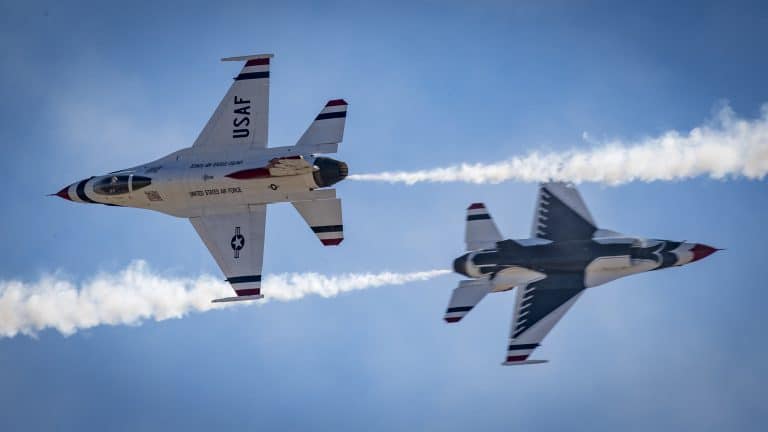
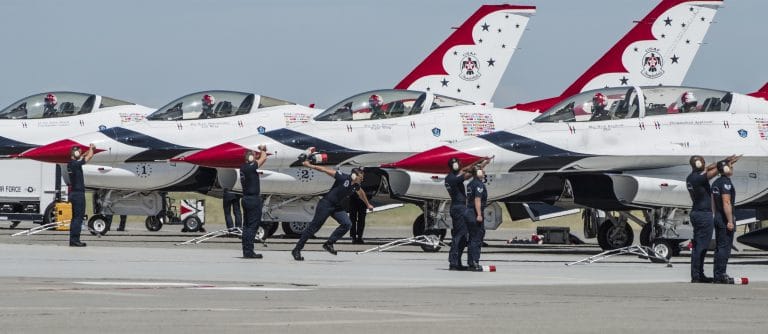
The Thunderbirds are scheduled to perform a nearly 45-minute flight demonstration showcasing the power and beauty of the F-16 Fighting Falcon. Their four-aircraft diamond formations plus the high speed passes by the two solo ships will bring chills to visitors on the warm beach.
“We are really just getting started for our show season, and we are super excited to begin at a unique over-the-water beach show here on the Gulf Coast,” Thunderbird 6 opposing solo Capt. Michelle “Mace” Curran said following her team’s arrival on Thursday. “This show allows our crowd to see various unique perspectives of the performance that our crowds don’t normally see when they are confined to an airfield. This is a great air show to come out and see over the weekend.”
Keesler AFB notes that only handicap guests and those carrying a DoD-ID will be allowed to park on the base. There will be several locations outside of Keesler for public parking on both days. A public shuttle service will run all day from the parking lots to both the air base and the beach.
(Charles A Atkeison reports on aerospace and technology. Follow his updates via social media @Military_Flight.)
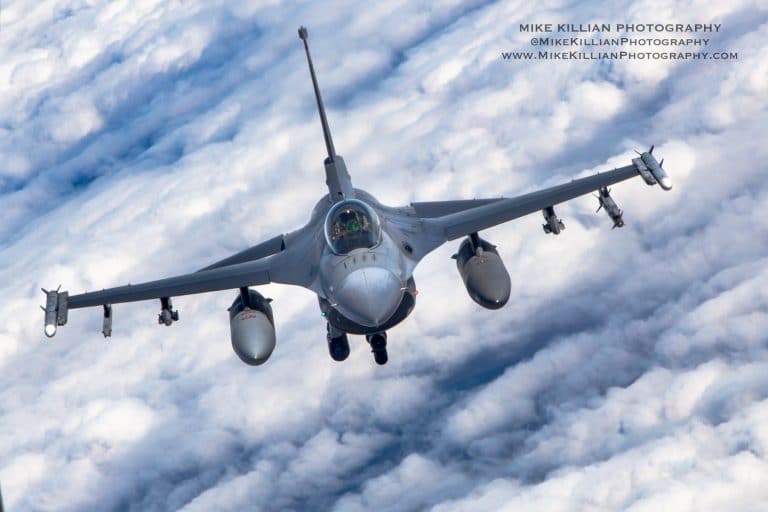
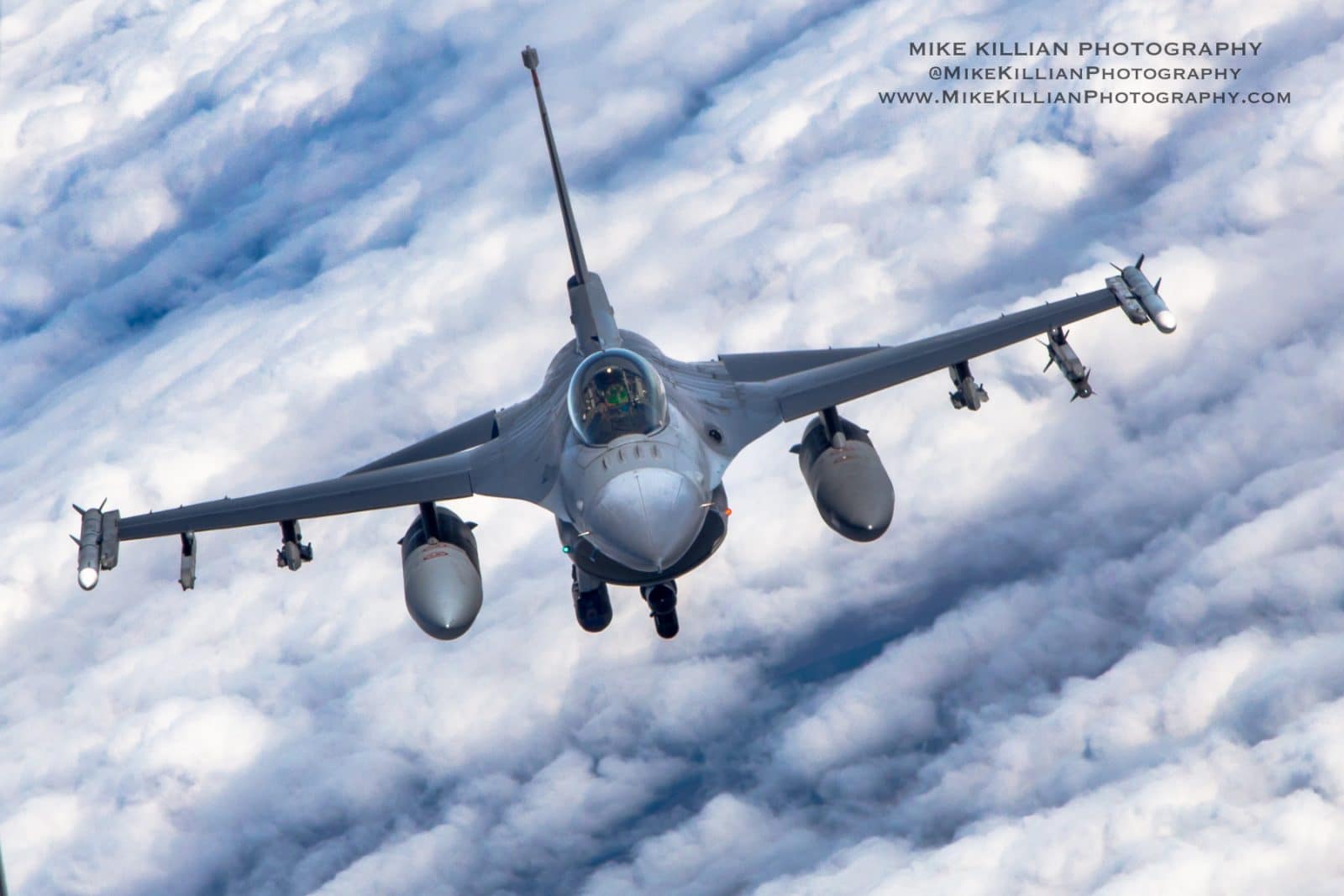
Staring down a Tulsa Viper F-16 from the 138th Fighter Wing’s 125th Fighter Squadron / Oklahoma Air National Guard, somewhere over Kansas on April 25, 2019, as they topped off their fuel thanks to the 507th ARW OKIES KC-135 crew from Oklahoma City. Photo: Mike Killian
U.S. global air superiority comes thanks, in large part, to aerial refuelers, such as KC-135 Stratotankers and their crews at the Oklahoma Air National Guard’s 507th Air Refueling Wing. Everything from fighters to bombers and reconnaissance aircraft, to the Blue Angels and Thunderbirds being able to get around America to perform in front of millions of people, all rely on the KC-135 and their crews.
Based in Oklahoma City and the heart of Tornado Alley, the ‘OKIES’ of Tinker Air Force Base are the largest Air Force Reserve Command flying unit in Oklahoma. They are responsible for organizing, fully training and equipping Combat-Ready Citizen Airmen to provide strategic deterrence and global capabilities, all while empowering, inspiring and developing them to shape the future.
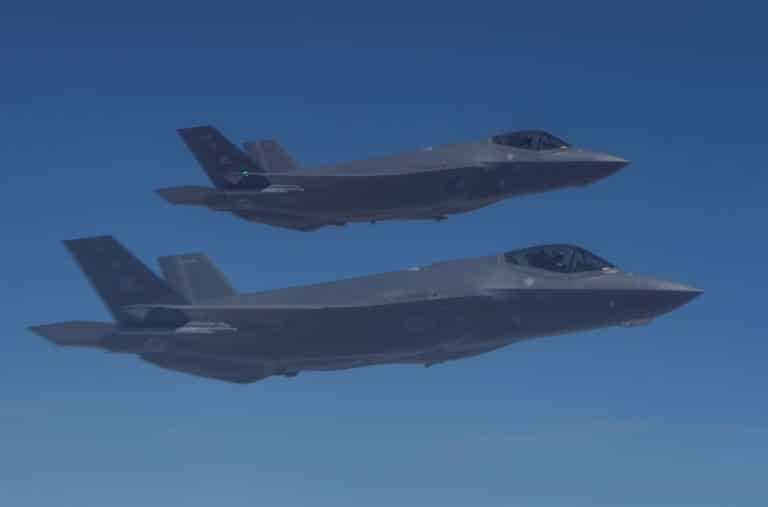
Two U.S. Air Force F-35A Lightning II jets performed an air strike over Iraq on Tuesday marking the first use of an F-35A in a combat mission.
Based at Hill Air Force Base, Utah, the twin F-35As performed a munition strike at an entrenched tunnel network which supported a large weapons cache in the Hamrin Mountains. The Air Force’s fifth generation multi-role fighters arrived in Al Dhafra Air Base, UAE on April 15 for its first deployment in the Middle East.
Tuesday’s display is one step closer for the Air Force in replacing their aging fleet of F-16 Fighting Falcons and the A-10 Thunderbolt II. The Marines (F-35B) and the Navy (F-35C) also look to the jet to replace their aircraft, including the F/A-18 Hornet and AV-8B Harriers.
An Air Force KC-10 Extender refuels an F-35A Lightning II on April 30, prior to the F-35As first air interdiction. (USAF)
“The F-35A provides our nation air dominance in any threat,” Gen. David L. Goldfein, Chief of Staff of the Air Force, said. “When it comes to having a ‘quarterback’ for the coalition joint force, the inter-operable F-35A is clearly the aircraft for the leadership role.”
The F-35As air interdiction was in support of Combined Joint Task Force’s Operation Inherent Resolve. The newly arrived F-35As are working with U.S. aircraft stationed at Al Dhafra.
“The F-35A has sensors everywhere, it has advanced radar, and it is gathering and fusing all this information from the battlespace in real time,” Lt. Col. Yosef Morris, an F-35A pilot and commander of the 4th Fighter Squadron, said on Tuesday. “Now it has the ability to take that information and share it with other F-35s or even other fourth generation aircraft in the same package that can also see the integrated picture.”
A U.S. Air Force F-35A begins its first air combat mission to Iraq on April 30, 2019. (USAF)
In the United States, the Air Force’s F-35A Demonstration Team isperforming at air shows this year through November. Capt. Andrew “Dojo” Olson will pilot the aircraft through top maneuvers during a fifteen minute display.
(Charles A Atkeison reports on aerospace and technology. Follow his updates via social media @Military_Flight.)
ATLANTA — Huge crowds enjoyed the sights and sounds of World War II during the weekend as historic aircraft flew and two popular jump teams dropped from the skies to highlight the WWII Heritage Days.
The popular weekend turnout allowed guests to witness living history. Re-enactments of Allied and Axis soldiers around encampments as popular Big Band music added to the sound of aircraft thunder.
U.S. Army Golden Knights pause on Saturday during WWII Heritage Days. (Charles Atkeison)
The U.S. Army Golden Knights followed by the Liberty Jump Team flew each day. Each precisely flew over the jump zone at Falcon Field and gave the go for their paratroopers to jump.
“World War II Heritage Days is a great event not only for our city but our country,” Peachtree City Mayor Vanessa Fleisch said on Sunday. “We are excited to have these veterans and the crew of That’s all Brother at our airfield today. Peachtree City is honored to be a part of this 75th anniversary commemoration of D-Day.”
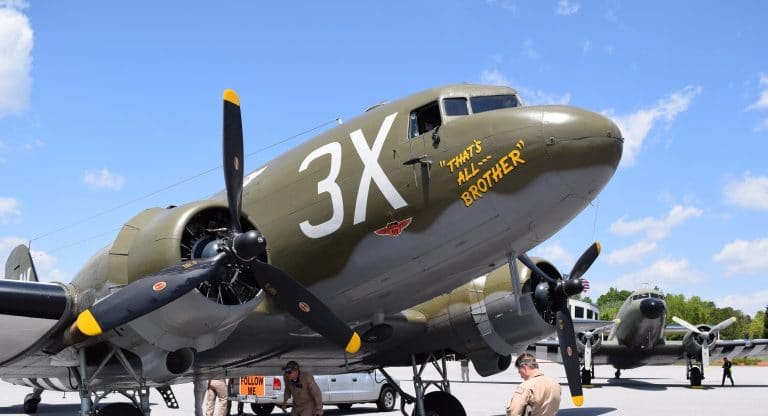
Liberty Jump Team paratroopers depart “That’s All – Brother!” on Saturday, to commemorate the 75th anniversary of D-Day. (Charles Atkeison)
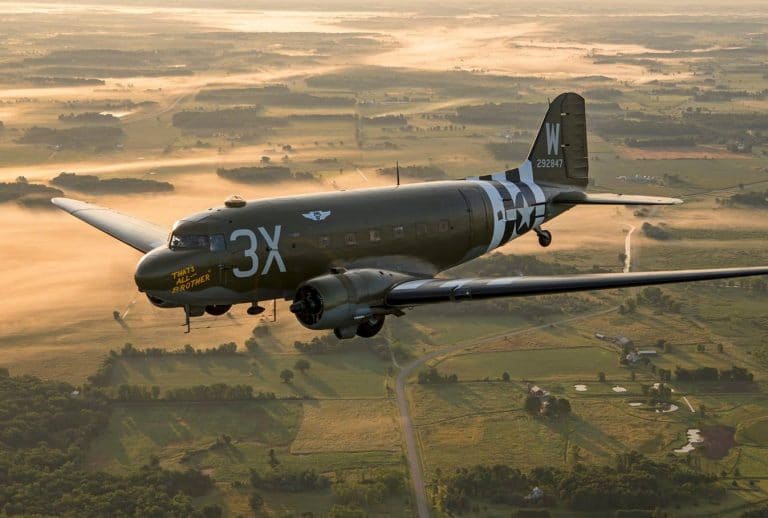
Three Douglas C-47A Skytrain aircraft, which flew missions during the Allied invasion of Normandy Beach, France in 1944, stood static on display. One C-47 which led the main aerial invasion was That’s All — Brother!, and guests had the opportunity to watch her fly and fly aboard.
Known as D-Day, the C-47s were an unsung hero on June 6, 1944, as nearly 800 from the United States and Europe carried paratroopers and supplies for the amphibious landing. That’s All — Brother! will join over 20 other C-47s to commemorate the 75th anniversary of D-Day in June.
“It’s a privilege to be able to fly this airplane,” Joe Enzminger, Wing Leader pilot of the Central Texas Wing for the Commemorative Air Force, said on Sunday. “That’s All – Brother! lead the main invasion force, and when the order came to go, they launched and dropped their paratroopers in France.”
Douglas C-47s “That’s All Brother!” and one unnamed, during WWII Heritage Days. (Charles Atkeison)
Enzminger and his crew will pilot the aircraft to the UK in May via the north Atlantic route. The sister C-47 Placid Lassie also attended WWII Heritage Days, and will make the journey to honor the Allied forces. Both aircraft will join nearly 30 other C-47s for the June 6 flight over Normandy.
“Everytime we fly this airplane — everytime I stand in it — it’s hard not to think about what happened here,” “And the guys sitting inside that in the dead of night they got up, stepped out that door and jumped into France. It’s always in the back of our mind.”
(Charles A Atkeison reports on aerospace and technology. Follow his updates via social media @Military_Flight.)
BEAUFORT, S.C. — Top military and civilian aircraft, including the Navy’s Blue Angels, will thunder over Marine Corps. Air Station Beaufort this weekend during the base’s popular Open House and Airshow.
Fightertown U.S.A. East will host an incredible military line-up as the U.S. Navy Blue Angels, and the Air Force’s F-22 Raptor and the F-35 Lightning II, perform during a five hour window on April 27 and 28. Top civilian aerobatic pilots are scheduled to the skies each day including Jim Tobul, Julie Clark, Gary Ward, and Rob Holland.
The Beaufort Air Show will provide a rare treat as they allow guests an up close static view, and the chance to witness a rare flight demonstration of the Marines F-35B Lightning II aircraft. The United States military’s latest defense support fighter carries unique features such a rear stealth mode and can hover prior to landing on land or an aircraft carrier.
Beaufort is the home to day-to-day training of new F-35 pilots and ground maintainers. The base’s VMFAT 501 continues to add to the growing number of qualified Navy and Marine pilots.
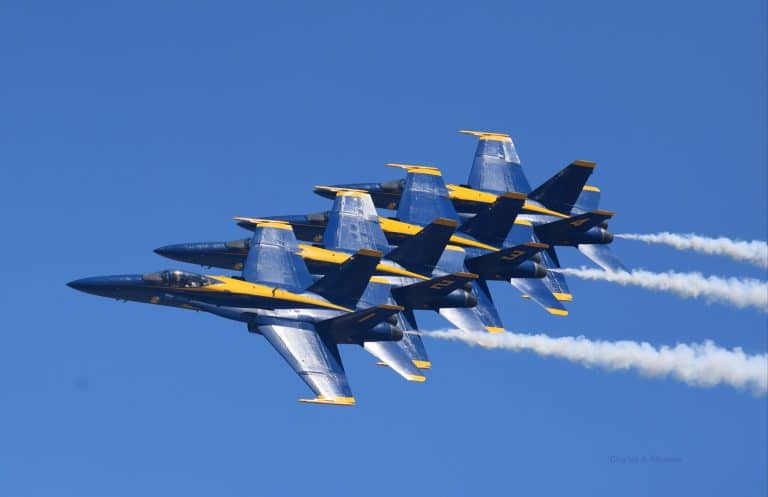
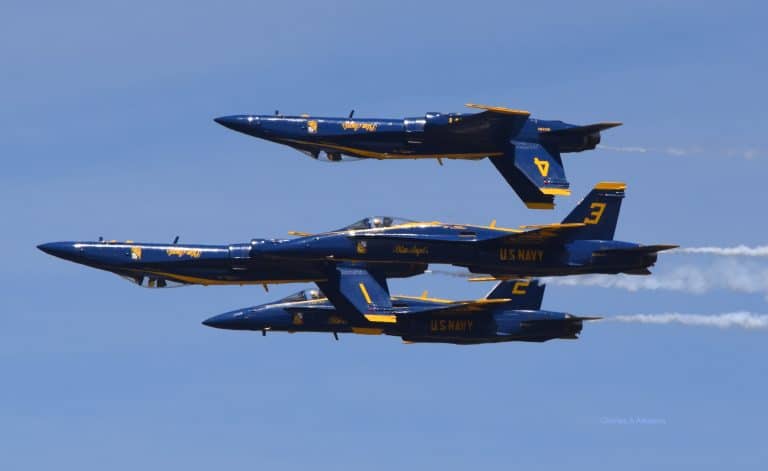
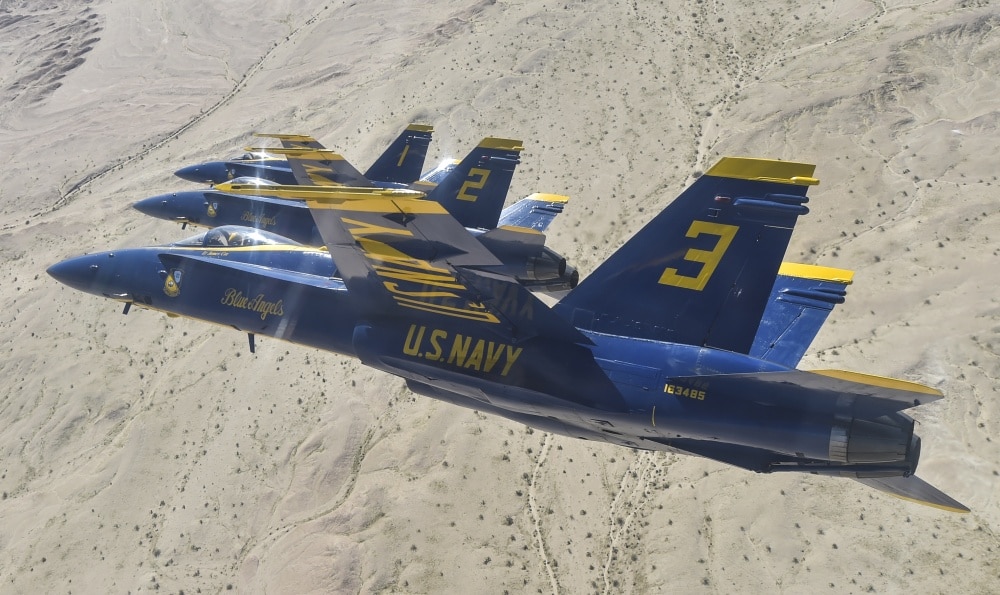
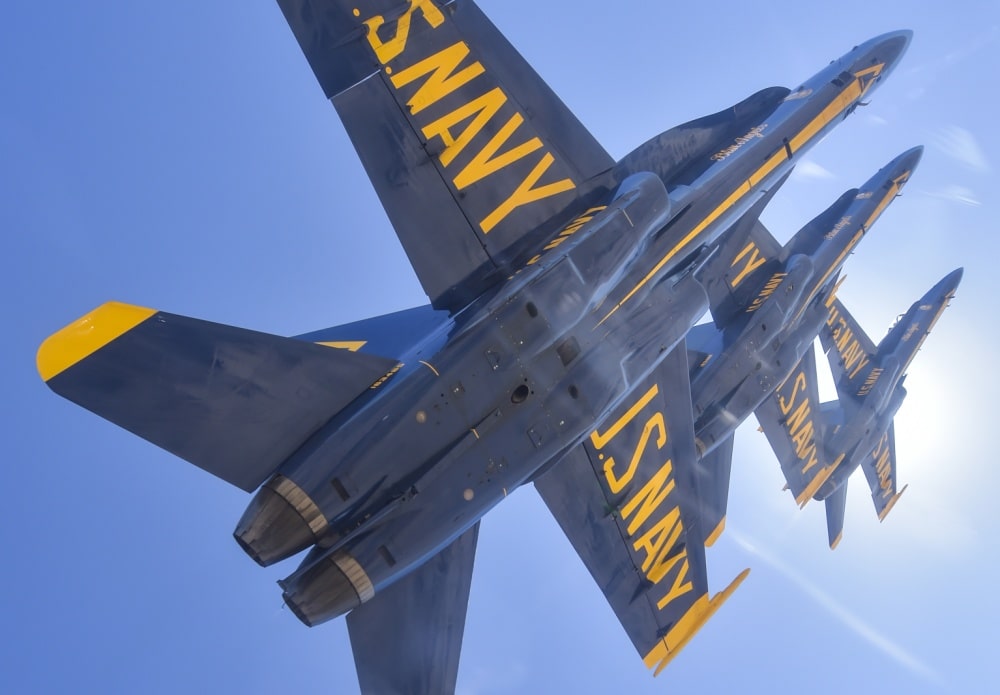
The Blue Angels six blue and gold F/A-18 Hornets command a crowd-favorite performance as the airshow headliner. Their nearly 42-minute flight demonstration each will see the four-jet diamond team perform several slow passes defying maneuvers. The high performance low passes by the two solo jets will come screaming across the runway’s center point at speeds of nearly 400 m.p.h. once the diamond had cleared.
Air Force F-22 Raptor Demo Team pilot Major Paul “Loco” Lopez will perform this weekend over MCAS Beaufort, S.C. This is Loco’s second season with the team. (Charles Atkeison)
The Air Force’s popular F-22 Raptor will demonstrate high thrust maneuvers and tight turns each day. Pilot Major Paul “Loco” Lopez will perform a nearly 15-minute flight demonstration before joining up with a P-51 Mustang for the Heritage Flight.
“The Heritage Flight is a living memorial pairing up a modern fighter with a World War II or Korean-era airplane flying in formation,” Maj. Lopez said to this aerospace journalist. “Paired with great narration and great music, it captures that feeling of how import the Air Force legacy is in the military.”
Six World War II-era aircraft of the GEICO Skytypers Airshow Team’s Navy SNJ-2 planes will give visitors the same thrills and gasps as the military jets. Their silver single prop aircraft will simulate actual aerial combat maneuvers used during the second World War.
The GEICO Skytypers Airshow Team will demonstrate World War II aircraft maneuvers aboard their Navy SNJ-2 aircraft over MCAS Beaufort. (Charles Atkeison)
Popular civilian aerobatic aircraft also highlighted the Beaufort airshow. Tobul and his F-4U Corsair, nicknamed “The Korean War Hero”, will perform. Pilot Scott Yoak’s P-51D Mustang Quicksilver is a shining example of another warbird of the Korean War turned aerobatic.
Air show admission and parking are free to the public. Gates open at 9 a.m. and the opening ceremony is set for 11:30 a.m.
(Charles A Atkeison reports on aerospace and technology. Follow his updates via social media @Military_Flight.)
ATLANTA — The 75th anniversary of the D-Day invasion of Europe will be commemorated next weekend as historic warbirds, including three D-Day veteran aircraft highlight the WWII Heritage Days in Peachtree City.
The Commemorative Air Force Dixie Wing will host the 16th annual event on April 27 and 28. Warbird aircraft (the public can purchase to fly aboard), vintage cars, and live music from the Big Band era will pay tribute to the heroes of D-Day.
One of the unsung heroes of the Allied invasion of Normandy Beach was the Douglas C-47 Skytrain, which carried in paratroopers and supplies in the early morning hours of June 6, 1944. Two C-47s affectionately named Placid Lassie and That’s All — Brother! will join an unnamed third C-47A during Heritage Days.
Allied paratroopers depart a C-47 Skytrain over northern France on June 6, 1944. (US Army)
All three aircraft have been refurbished to their 1944 configuration. Heritage Days will mark the largest collection in the United States of flying C-47s prior to June.
“D-Day invasion really was the massive push to the liberation of Europe,” Chief Pilot of the D-Day Squadron recreation Eric Zipkin said from the flight line. “It was one of the first large scale airborne invasion efforts.”
This June, Zipkin will pilot Placid Lassie as the aircraft leads over 20 fellow C-47s from the United States loaded with dozens of paratroopers. The morning of the 75th anniversary, these aircraft will join many European C-47s as they fly from England to France to replicate D-Day.
C-47 Placid Lassie flew several missions with cargo and paratroopers during D-Day. (John Willhoff)
Known as Daks Over Normandy, the massive squadron formation of aircraft will honor the nearly 800 C-47s which carried about 24,000 paratroopers over the English Channel and into France. “The C-47 formed the backbone of the D-Day invasion, the initial waves, preparing the area for those brave soldiers who stormed the beaches,” Zipkin added.
“WWII Heritage Days is an immersion experience, and these aircraft, combined with the appearance of the Liberty Jump Team, will inspire people of all ages and walks of life to connect with the legacy of The Greatest Generation,” Dixie Wing Education Officer Rick Ector said on Wednesday.
The Liberty Jump Team, a group of veteran and current service members, will honor all veterans as they don historic army uniforms to commemorate the early airborne operations. Weather permitting, they will perform a jump each day just as they will do over Normandy in June.
Located at Falcon Field just south of Atlanta, the event is free to the public. Parking is $20 and will be available at Eaton’s Cooper Lighting. World War II veterans and the handicapped can be dropped off at the gate.
(Charles A Atkeison reports on aerospace and technology. Follow his updates via social media @Military_Flight.)
I’m getting to the end of my airline career. Oh, I’m not quite there yet, but I am close to the final turn and the PAPIs will soon be in sight. The FAA mandated retirement age is currently 65, and I’ll be turning 60 next year. The retirement age was adjusted from 60 to 65 in 2007 and there are rumors that as the pilot shortage worsens, industry lobbyists will push to have the age adjusted to something like 67. Either way, I don’t see myself schlepping my roll-aboard through the south-side ‘hood to the crash pad into my dotage. 65 will be it for me assuming I pass a medical until then.
People often ask why I don’t retire now. These are usually pilots junior to me, but it’s a fair question. The reason I give is that the airline is a great part-time job. I generally fly only three days a week and rarely pick up flying. And if I wasn’t flying, I’d probably just find a local cigar bar or doctor’s waiting room to spend time chatting up other retirees on how good the old days were or how the darn kids are screwing everything up.
So with (much) more of my flying career behind rather than in front of me, I am able to look back and assess how things have turned out, and perhaps to give some perspective or advice to those who might be just starting out.
Without a doubt, I have had a blessed and charmed flying career. Starting in 1982 as a second lieutenant in the Air Force, and having never touched an airplane, I’ve spent every year since then at the controls of a jet aircraft. Hired by my airline at age 30, I found myself in the left seat of a 737 four years to the month of being hired. I now find myself close to the top ten in the seniority list in my domicile. With about 600 captains below me, this means I usually get the schedule I want assuming the company publishes it and Charlie C. doesn’t take the line I want. C’mon Charlie, retire already!
There are some things, though, that I won’t get to do. I won’t ever be a wide-body captain because my airline doesn’t fly them. That means that I won’t get to enjoy the over-water wide-body lifestyle of 30 hour layovers touring in some exotic foreign locale or on a white sand beach. I also won’t get the downside of back side of the clock flying nor the several day recovery period adjusting back to local time. (I did spend over a decade flying jumbos for Uncle Sam so I have that t-shirt.) Trade off? That depends on what you’re looking for.
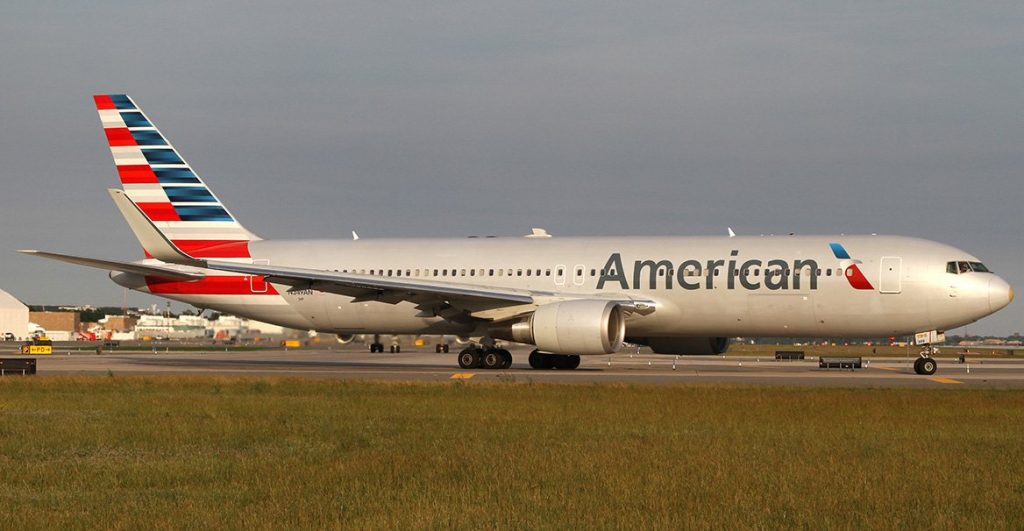
Photo: American Airlines
Which is the Best Airline to Work For?
This question gets asked quite often, and I’ve always maintained that the best airline is the one that hires you. But beyond that pithy answer, the best airline will be the one that gives you the things you value the most; the things you want out of a flying career. That answer will necessarily be different for just about everyone.
Do you want to upgrade to captain quickly? At all? Is wide-body flying on your list? Where will you make the most money? Does money matter, or is job security more important? If your spouse is a surgeon or other professional, maybe job security isn’t as much of a concern. If you are the sole breadwinner, perhaps it’s higher on the list. Where do you want to live? Does your chosen airline have a domicile there or are you willing to commute? Do you want to be home when your kids are awake? How about being able to bid vacation when they’re on summer break?
All these are questions that you have to ask yourself, and many times you may not get a choice, but end up taking what is offered. If another offer comes along you’ll then have a choice. Leaving an airline that hired you for another is a tough call, but it only gets tougher as you gain seniority. I’ve flown with profoundly unhappy pilots who wish that they’d jumped early on in their career but are not willing to give up the seniority they have to start again. This is a bit of the “sunk costs” fallacy, but you are only issued one life and have to make the most of it.
Keep Your Priorities in Order
I also flew with a young pilot some years ago who, at the end of our month together, announced that he was quitting to go to another carrier. He was a senior first officer looking at a captain class in a few months. He didn’t dislike where he was, but rather was entranced by the thought of flying wide-bodies for another airline. In fact, he said that the toughest part about leaving was he really did like the people where he was.
That was in the spring of 2001. After 9/11 he was quickly furloughed by his new airline and probably spent years getting back into a cockpit. Was it worth it for him? We lost contact, so I don’t know. Perhaps. Will there be another lost decade like the one that followed 9/11? Which airlines are best positioned to weather another storm like that?
A Perspective
I started looking for an airline job after leaving the active duty Air Force with just north of 2500 total hours, all of it in jet aircraft. I applied to all the major passenger and cargo airlines and a few of the minor ones. I got a job offer from only one, a minor regional airline, and the one with which I’m still employed nearly 30 years later.
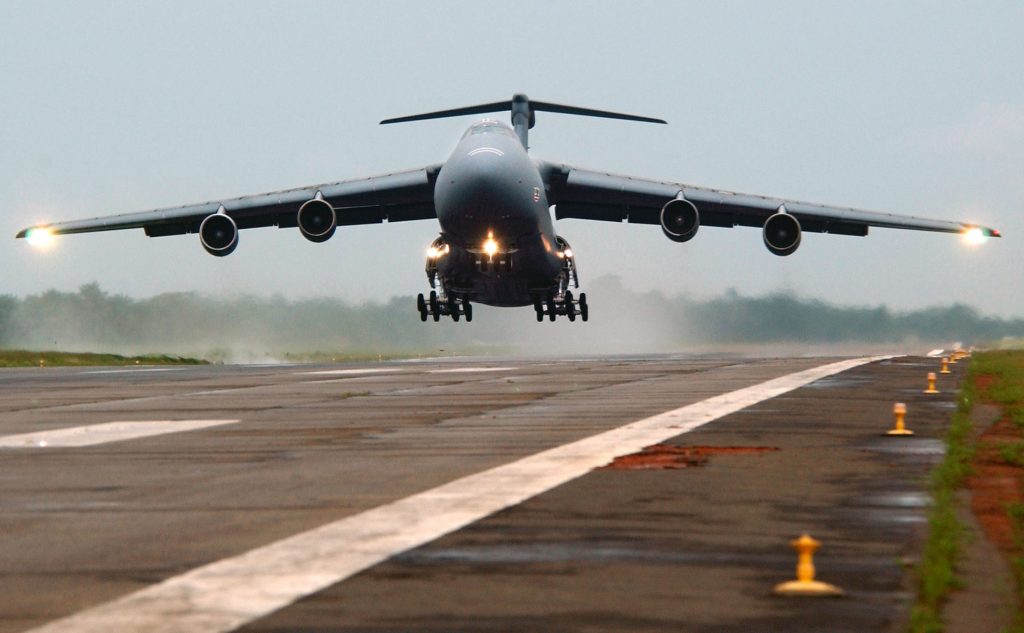
A C-5 Galaxy departs.
Shortly after being hired in the early 90s, there was a Mideast war and a bit of a recession. Most of the airlines with which I’d interviewed quickly started furloughing pilots, including many pilots I knew. Taking a job with a guard or reserve unit was considered furlough insurance so that’s what I did as well. I never had to use that insurance policy, but knew many who did.
The quickest way to gain seniority is to find an airline with either lots of upcoming retirements, or lots of growth. My airline had virtually none of the former but lots of the latter. This allowed for a very fast four year upgrade to captain. It was, though, the last formal schoolhouse course I would take.
Even though my pay rate was not quite as good at times as some other major airlines, the time value of making that money for longer more than made up the gap. As a general rule, wide-body first officer pay is roughly equivalent to narrow body captain pay, so when comparing airlines, look at your time to either wide-body first officer or narrow body captain.
Consider also in your choice schedule flexibility and the ability to pick up flying. This varies greatly between airlines, but can significantly enhance your quality of life and pay. I don’t pick up much flying, but we have some enterprising pilots who can routinely top 150 hours of monthly pay by working their schedules and taking advantage of premium pay rules.
The Lost Decade
It is difficult to convey the disaster in the commercial aviation community in the years following 9/11, unless, of course, you lived through it. Then you know all too well of the furloughs, bankruptcies, career stagnation and reversals that were emblematic of that dark time. It was also the time when mainline contract loopholes were exploited allowing an explosion of regional jet flying with pay so low that some pilots qualified for food stamp programs.
My airline was relatively unscathed by the carnage of that time, so while job security wasn’t a huge concern, there were no significant raises coming either. A comparison with my wife’s career is instructive here. She took a job with a major airline shortly after I got hired at my airline.
A Career Comparison
For a short while prior to 9/11, she out earned me in the right seat of a 75/767 by a significant amount. That didn’t last. A few short years later, while she was in the right seat of a 747, I out earned not only her, but also the captains with which she was flying. Her line guarantee had also been slashed to the low 60s after the bankruptcy while my guarantee was at 85 hours, but my line flying was almost always above that number.
The tear in the fabric of universe has mostly healed since then, and our pay is roughly equivalent again with her holding down a senior 777 F/O seat. She’ll lap me in pay once she takes a wide-body left seat which is almost attainable for her, but it will be back to working weekends and holidays for awhile albeit for a lot more money. It will be her first left seat job after 25+ years of commercial flying.
Who won? That’s a tough call. I’m jealous of her 30 hr HKG layovers and license with type ratings of all the Boeings save for the 717 and 787. We sure were thankful, though, to not have to worry about a furlough or bankruptcy after 9/11. I’ve also never flown a red-eye from SFO to EWR for an eight hour layover, or any red-eye for that matter. Twenty five years in the left seat of a Boeing has to count for something as well. Judging by the 401s (she lost her pension with the bankruptcy of her airline) the money will probably end up being close to equal.
In Conclusion
As I mentioned at the start of this essay, I’ve had a charmed aviation career. I’d like to say I was smart about it all, but plain dumb luck probably played a larger part than I’d like to admit. That said, if you’re just starting out, take a few moments of serious reflection to decide what is most important to you, and then make your decision of how to structure your career. Good luck! I’m here for you.
Captain Rob Graves is a veteran airline pilot and retired Air Force officer. He currently flies a Boeing 737 for a major American airline where he has over 25 years of experience. His Air Force career included instructing future USAF pilots in the T-37 primary jet trainer, aerial refueling in the KC-135 Stratotanker, and conducting worldwide logistics in the C-5 Galaxy cargo aircraft. He is the author of This is Your Captain Speaking, an aviation blog. It can be found at robertgraves.com. He also writes for Avgeekery.com.
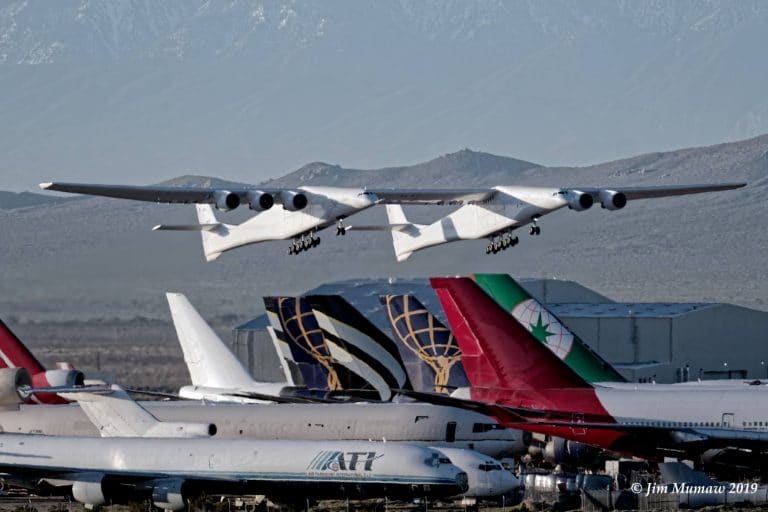
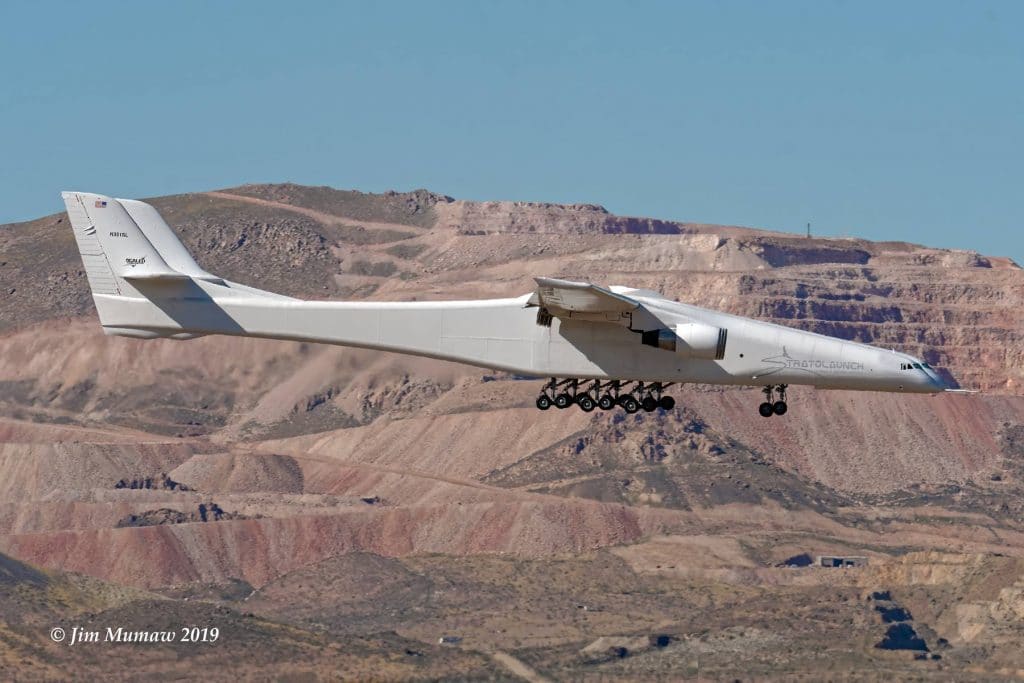
The United States once again holds the crown for the largest aircraft that has flown. Earlier today, the Stratolaunch, a jet with a massive 385ft wingspan took flight and dethroned the Antanov AN-225 Mriya. Launching from Mohave Air and Space Port in California, the jet somewhat gracefully left terra firma just after 10am today.
Photo by Jim Mumaw.
What makes the Stratolaunch unique?
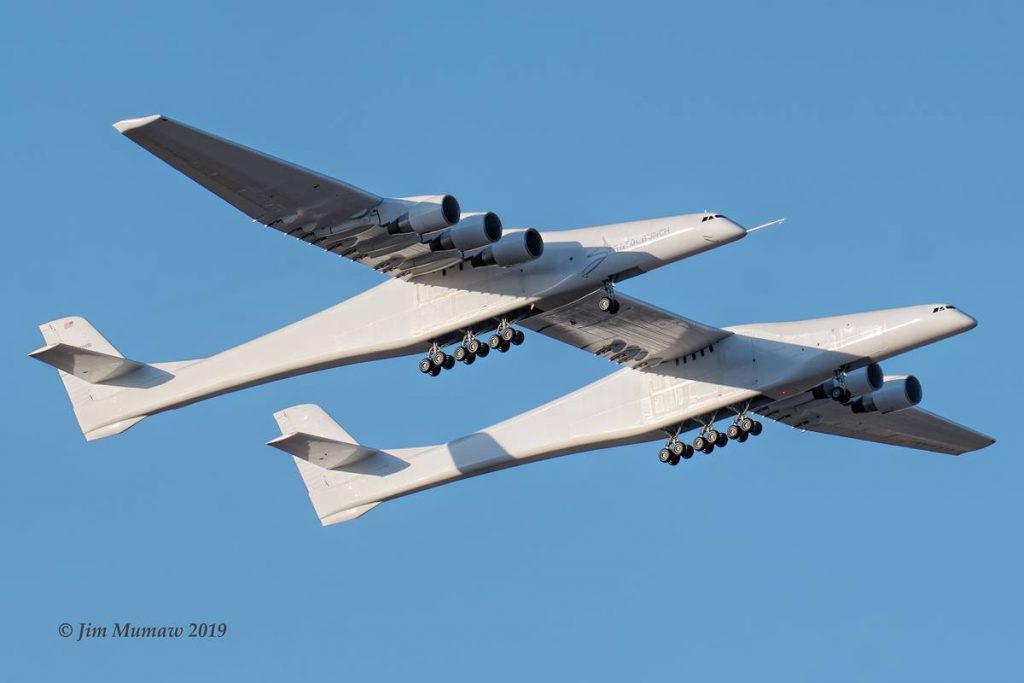
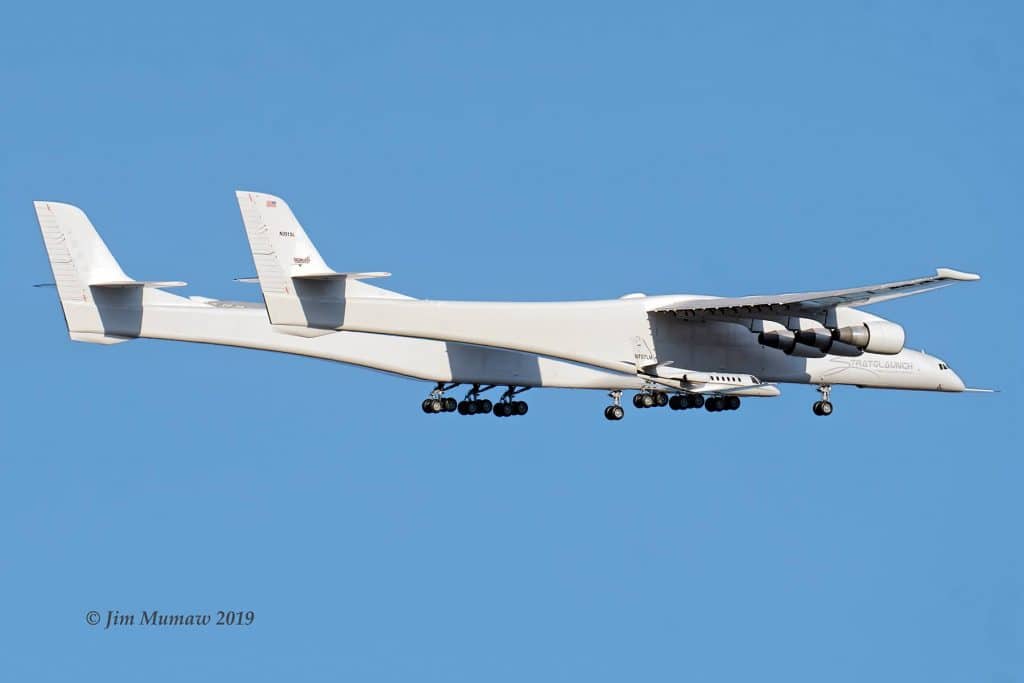
The jet is a unique design with a very specific mission. The Stratolaunch is designed to carry and launch a rocket. Designed by Scaled Composites, the aircraft features six Pratt and Whitney PW4056 engines, similar to the engines used on the Boeing 747-400. The jet is also one of the few dual fuselage aircraft ever built (the twin mustang is a notable exception along with another Scaled Composite aircraft known as White Knight Two). The aircraft features dual cockpits and twin tails, enabling a rocket to be carried in the space between the two fuselages.
The massive size of the Stratolaunch is evident with the Cessna Citation chase ship in the foreground.
A successful first flight
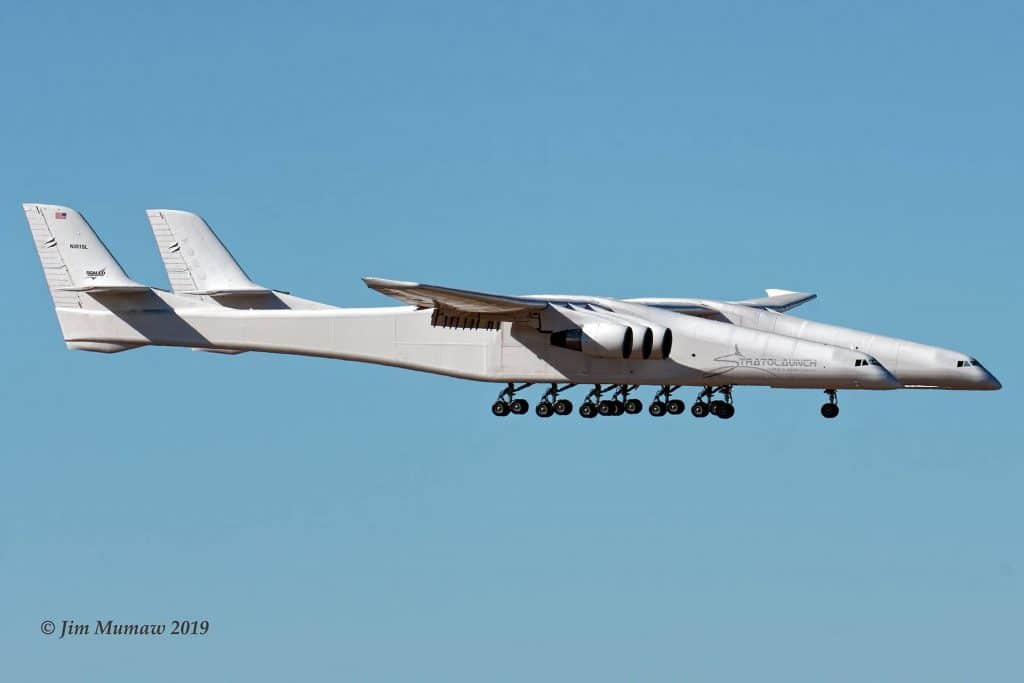
The initial flight today was scheduled for just over two hours. The giant six engined jet landed at just over two and a half hours after takeoff. During the inaugural flight, the jet performed a series of basic maneuvers up to an altitude of 15,000 feet. Videos of the departure and arrival have popped up all over YouTube. One fan, under the username HechtSpeed, posted a very passionate video of both the departure and the arrival.
Photo by Jim Mumaw.
Assuming that no major issues were discovered, it is expected that the aircraft will fly again soon as the flight test program continues and expands the performance envelope. There is no known public schedule of testing and no statement has yet been made on when we can expect the first rocket launch assisted by the Stratolaunch system.
Shortly after the conclusion of the first flight, the Stratolaunch team released a short video commemorating the event:
The Stratolaunch returns after a successful first flight. Photo by Jim Mumaw.
Editors note: Thanks to our friend Jim Mumaw for the beautiful photos of the event.
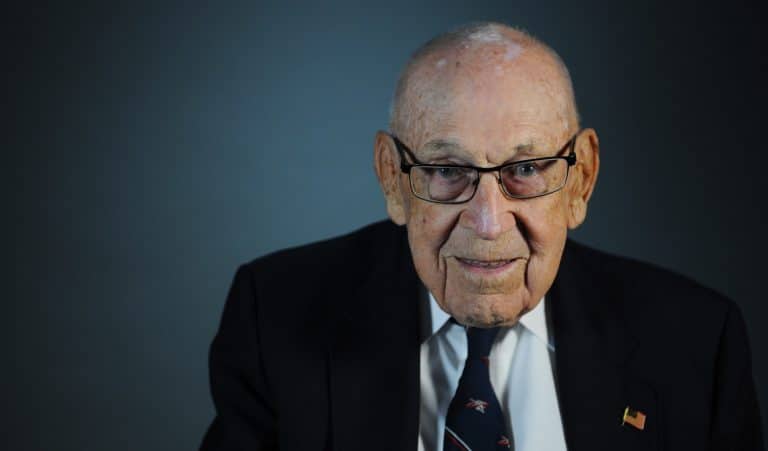
Retired Air Force Lt. Col. Richard E. Cole, the last surviving member of the famed Doolittle Raiders of World War II, passed away on Monday at age 103.
Cole served as Lt. Col. Jimmy Doolittle’s co-pilot in the lead aircraft of the 16 B-25B Mitchell bombers which led a bombing run on Tokyo, Japan on April 18, 1942. Launched from the deck of the U.S.S. Hornet in the Pacific Ocean, Doolittle’s Raiders gave America an emotional lift only four months following the Japanese attack on Pearl Harbor in Hawaii.
Lt. Dick Cole (second from right) in Spring 1942 with his crew, including Col. Jimmy Doolittle (second from left). (USAF)
Born in September 1915, Dick Cole, as he preferred friends to call him, went on to serve during the Korean War. He remained very active through 2018, attending air shows and public events.
“Being like the rest of the crew, we were just hoping to keep Col. Doolittle happy,” Cole remarked during an Air Force interview in 2017. “He was a very nice person. He didn’t expect problems to crop up. He had that much confidence in us.”
Dick Cole was a 26-year-old aviator at the time. Seventy-five years later, he could still recall the events of that day.
Retired Lt. Col. Dick Cole, Doolittle Raider co-pilot, sits in the cockpit of a B-25 “Special Delivery” reliving the day of the Doolittle Raid, in April 2013. (USAF)
“(Doolittle) told us all that it was a dangerous mission,” Cole added as he reflected on the historic secret mission. “That if we volunteered and changed our minds later, that there would be no repercussions. But that’s all I can tell you.”
(Charles A. Atkeison reports on aerospace and science. Follow his updates on social media via @Military_Flight.)
LAKELAND, Fla. — One of North America’s largest air shows will host the Navy’s Flight Demonstration Squadron and top civilian aerobatic pilots this weekend as they perform at Sun ‘n Fun Fly-in and Expo.
The U.S. Navy Blue Angels headline Sun-n-Fun’s 45th annual air show. Guests can also huddle in aviation-related classroom sessions and meet with vendors to pick-up the newest in aircraft gadgets prior to the show.
“We’re extremely excited to attend Sun ‘n Fun,” Blue Angels lead solo LCDR Brandon Hempler said during an interview with this aerospace journalist. “We’re gonna put on a great show. Not just the flying, but the maintainers who are out there, as we perform the walk down of the jets. They’re an important part of the team as well.”
The Blues will take to the skies each afternoon performing a nearly 45-minute routine. Crowds will gasp and applaud as the blue and gold F/A-18 Hornets perform tight wingtip-to-wingtip maneuvers and high speed passes.
The Blue Angels will perform on April 6 and 7 during Sun ‘n Fun 2019. (Charles Atkeison)
Blue Angels spokesperson LCDR David Gardner is very excited to attend his first Sun ‘n Fun. “It’s awesome to be at Sun ‘n Fun; and it’s great to travel all around this great country and to represent the Navy and Marine corps.to all airshow fans,” LCDR Gardner said from the flight line on Thursday. “We are really glad to be here in Lakeland this weekend.”
The central Florida event will showcase the largest collection of warbirds on display, including AT-6 Texan/ SNJ-2, P-51 Mustang, and F-4U Corsair. The B-25 Mitchell Panchito will perform on Sunday only.
The aircraft known as the Pilot Maker will be well represented at Sun-N-Fun this week as the World Famous GEICO Skytypers Airshow Team performs on Saturday and Sunday. The GEICO Skytypers six SNJ-2 aircraft perform the aerial demonstrations used by the pilots of America’s Greatest Generation during World War II and Korea.
The pilots of AeroShell Aerobatic Team — Mark Henley, Steve Gustafson, Jimmy Fordham, and Bryan Regan — will perform Saturday at twilight above the Lakeland airport aboard the Army’s version of the Navy’s SNJ-2 — the AT-6 Texan. AeroShell’s four aircraft will perform several aerobatic maneuvers used by the Army Air Corps. over 70 years ago.
Classroom workshops teaching the latest in aircraft design and mechanics will highlight the expo side of the week long event. Private aircraft owners will use events to network with fellow pilots and buy or sell their aircraft.
Sun ‘n Fun Fly in began 45 years ago and continues to grow each year. (Charles Atkeison)
A small group of aviation enthusiasts laid the ground work for the aeronautical event in 1974, and since that moment it has grown into the second largest airshow and aviation gathering in North America. Today, the annual six-day event covers over 2,000 acres just east of Tampa.
“The Fly-In is our largest fundraiser of the year,” President and CEO of Sun ‘n Fun John Leenhouts said this week. “Proceeds from all events on the SUN ‘n FUN Convention Campus throughout the year support Aerospace Center for Excellence STEM education programs, including over $430,000 annually in scholarships for students pursuing aerospace and aviation careers.”
Tickets to the family friendly event are available online or at the gate. Gates open each day at 8:00 a.m. EDT through Sunday, and the air show begins at 1:00 p.m.
(Charles A. Atkeison reports on aerospace and science. Follow his updates on social media via @Military_Flight.)
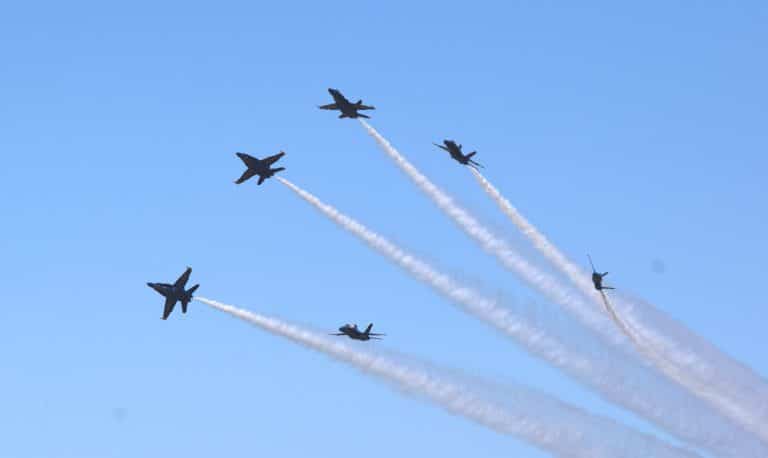
PENSACOLA, Fla. — The U.S. Navy Blue Angels have launched into their new air show season and with it comes the sights and sounds of six blue and gold jets practicing high speed maneuvers and tight formations over their home base at NAS Pensacola.
These practice flights are an air show preview each week for the public visiting the Emerald Coast. During most of the weeks between April and November, the Blues practice from their base located next door to the popular National Naval Aviation Museum.
“It is such a wonderful treat to have this close affiliation with the Blue Angels,” Museum Director and retired Navy Capt. Sterling Gilliam said on Wednesday. “To host them here in the Naval Aviation Museum atrium for an autograph session after having performed a superlative practice show Tuesday and today.”
The Blue Angels Diamond formation soars above NAS Pensacola on Tuesday. (Charles Atkeison)
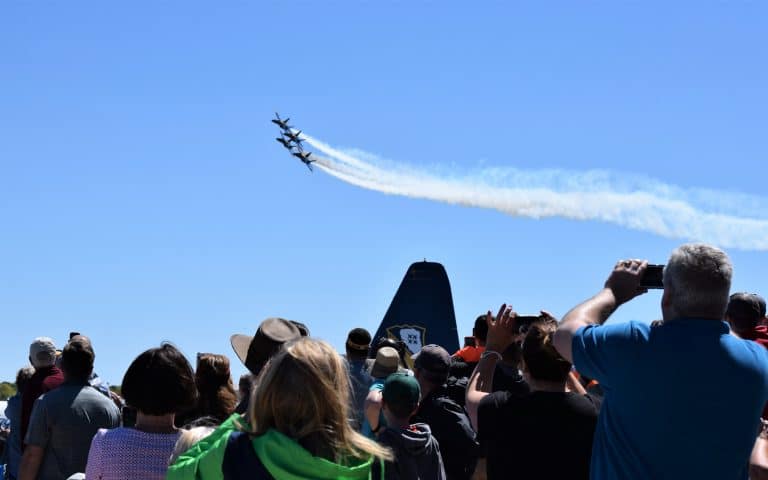
The public is invited to arrive early to watch the Navy’s Flight Demonstration Squadron practice from the flight line located at the Naval Museum. During most weeks of the air show season, guests arrive at the museum before 10 a.m. to avoid the traffic to get an up close view of the Blues demonstration.
“There are a lot of great museums in the world — no museum has the opportunity to have this relationship with such as phenomenal organization as the Navy Flight Demonstration Squadron,” Capt. Gilliam added. “We love this relationship, we love the Navy, and we love our patrons that come here to the museum.”
A typical Blue Angels practice begins at 11:30 a.m. on Tuesday and Wednesday, and is subject to change due to weather or air show schedule demands. A typical flight lasts around 45 minutes and viewing is free to the public.
Rows of chairs and open bleacher seating are available to seat one-thousand people. Concession stands loaded with drinks, snacks, and Blue Angels souvenirs are located near the seating areas.
The pilots of the Blue Angels greet Naval Aviation Museum guests on Wednesday. (Charles Atkeison)
A special treat occurs during most Wednesday’s following their flight. The Blue Angels’ pilots will head straight to the museum after parking their jets for a special meet-n-greet with the public. Guests file in from the airfield to the museum’s large atrium to meet the Blue Angels pilots.
“As locals, we’re blessed to be able to hear the sound of freedom on a weekly basis,” Naval Museum official photographer Courtney Sweeden said following Wednesday’s practice. “Having the Blue Angels’ practice demos here not only helps the museum thrive with vacationers, but it also helps local businesses thrive as well.”
If you do not possess a military or DoD ID, you must enter through the West Gate located on 1878 South Blue Angel Parkway, Pensacola. A government issued ID, such as a drivers license or passport, will be needed to access the military base.
(Charles A. Atkeison reports on aerospace and science. Follow his updates on social media via @Military_Flight.)
CAPE CANAVERAL, Fla. — Exploring space with top simulators and witnessing the thundering launch of a rocket into Earth orbit and beyond are a few of the highlights designed to educate and excite the public at the Kennedy Space Center’s Visitor Complex.
As families look toward America’s Space Coast for its sugar beaches and great seafood, the excitement of the Kennedy Space Center is also tops on their list. The next generation of space explorers and engineers are leaving their princess dresses and superhero outfits behind for flight suits and NASA caps, and interacting with STEAM (Science, Technology, Engineering, Arts, and Math) core values not provided in most schools.
The Rocket Garden is a popular attaction displaying rockets of yesteryear. (Atkeison)
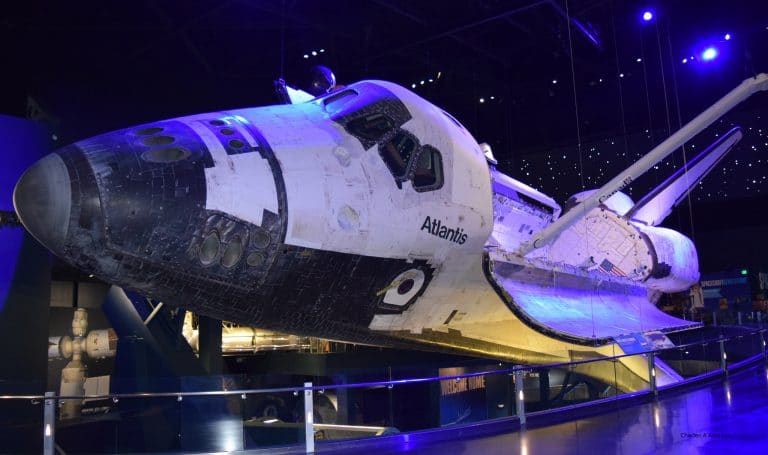
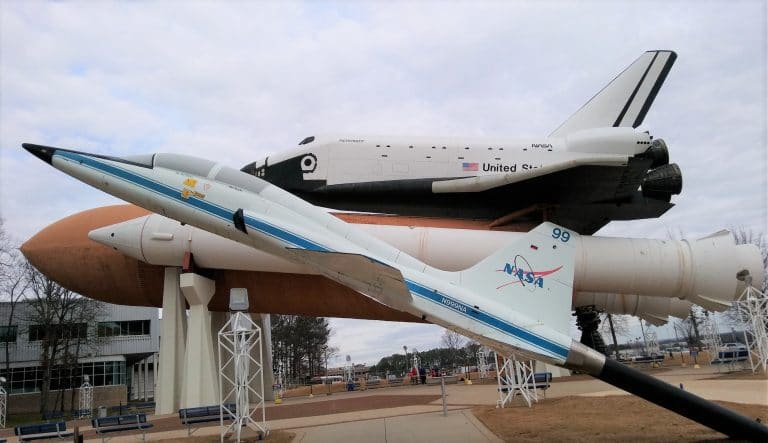
One of many jewels located on the Merritt Island wildlife refuge is NASA’s fourth space shuttle orbiter Atlantis, on display with a 43.21 degree tilt to allow guests the only unique opportunity to view the inside of a payload bay. Atlantis helped deliver supplies and hardware to assist in the construction of the International Space Station, and she served as a platform in space as astronauts made the final servicing call to the Hubble Space Telescope.
A Journey Through Space Flight History
The Visitor Complex is also host to updated exhibits featuring artifacts from both the early days of the space program and the space shuttle, and today includes a high quality mission to Mars simulation aboard a future Orion spacecraft. The newly added Cosmic Quest allows visitors to take a realistic mission to Mars, the space station, ride a rocket launch, or test your steady hand as you capture an asteroid.
“Never before have we been able to offer our younger guests the opportunity to engage directly with NASA designed missions in this way,” KSC Visitor Complex chief operating officer Therrin Protze said. “By introducing Cosmic Quest, guests discover firsthand how to launch a rocket, redirect an asteroid, and build a habitat on Mars – all based on real NASA missions. This game play experience is designed to inspire and educate young people about STEM.”
As you move from the historic rocket garden toward the Orbit Cafe, you will likely meet up with a former astronaut during your tour. Astronauts from the Apollo and shuttle programs provide both insight and behind-the-scenes details of their space flight and what it took for him or her to earn a space flight.
The Apollo – Saturn V building is home to space flown hardware and a moon rock. (Charles Atkeison)
“I always enjoy coming back to the Kennedy Space Center as it brings back a flood of memories from my days launching on the space shuttle,” said former NASA astronaut Dr. Don Thomas who flew four times aboard the space shuttle. Thomas is one of a handful of astronauts who visits the space center to speak with children, both young and old, about what it is like to travel in space.
“It’s great fun participating in Dine With an Astronaut,” Thomas noted as we stood near shuttle Atlantis on Sunday. “Besides a discussion of what space food is like and how we prepared our meals in space, it is a great opportunity to share some personal stories from my four missions in a more informal setting. I think the astronauts enjoy it as much as the visitors.”
Thomas discusses in length about one of his favorite shuttle missions in his bookOrbit of Discovery. A popular book located in the Visitor Complex gift shop, it expands upon his own discussion and a personal question and answer session with the guests.
Experience the Thrill of a Launch
Adjacent to Atlantis at Kennedy Space Center is the Shuttle Launch Experience and the ability to simulate the feel of a real shuttle launch. The astronaut engineered and test-flown flight simulator rotates into a launch position and provides a rumble and G-forces during lift-off. You’ll likely hear the clanging of loose change and keys from pockets following the 45-degree rotation prior to flight so be warned.
“To get my launch fix these days I enjoy the Shuttle Launch Experience which does a great job simulating what a launch aboard the space shuttle was like,” Dr. Thomas explained. “All the vibrations, rattling, and rolling takes me back to launch days when I was all strapped in and ready to go.”
One longtime NASA engineer who rose to chief of the processing of the space shuttle orbiters for flight appreciates what the center has accomplished in sharing the whole story of the shuttle program. He later notes that the newly added Challenger and Columbia exhibit is an added value to the Visitor Complex.
“It’s pretty amazing to have Atlantis right here, and I tell guests we never had this view while we were working on it,” said Terry R. White, former shuttle processing chief who today serves as a NASA docent near shuttle Atlantis. “It was in a hanger all surrounded by steel. So the only one who had this view — until this display was set up — was an astronaut on a spacewalk, or an astronaut aboard the space station.”
Space shuttle engineers are nearby to explain the inner-workings of the spacecraft. (Charles Atkeison)
“It’s a little bit heartbreaking to see it in this state, but now it serves a whole new role as to educate people,” White explained. “Hopefully we can educate in the needs to continue flying in space, and get everybody around the world to fund it because we receive so many benefits from space.”
White adds he prepared Atlantis for each of her 33 space flights in one way or another. He also worked to process space shuttle Challenger for flight, including her ill fated final flight in 1986. He recognizes the benefits of the Visitor Complex newly opened memorial to Challenger and Columbia.
“Recently they opened a nice memorial to both crews and the vehicles — they did a nice presentation,” White said as he gave a nod of appreciation. Fourteen windows peer into the life of each astronaut lost aboard Challenger and Columbia in 2003. From the music they performed, sports they played, and the hobbies they enjoyed, the Visitor Complex pays tribute to the two crews.
The astronauts of Challenger and Columbia are remembered at the space center. (Charles Atkeison)
As you pass from the crew remembrance you next embark upon a dark room highlighted by two blue illuminated large windows each framing a section of debris from each of the lost orbiters. A section of Challenger’s left fuselage and the burned window frame from Columbia’s cockpit are on permanent display several meters from their sister ship.
I asked Terry White if placing the orbiter debris on public display felt right with him, “From my point of view, let people see it, understand it, and maybe that will make them make different choices in the future. Let people analyze what we need to do to make things safer.”
As White spoke to admirers of Atlantis, this aerospace journalist watched as his friendly manner and motivated discussions brought visitors together to lean in and learn more about the storied spacecraft. In 2011 and after 30 years of processing space shuttles, Terry White was named a Kennedy Space Center Living Legend by his peers and NASA management.
Bus tours of the business side of the Kennedy Space Center will take you to historic areas such as the space shuttle runway, a real Saturn 5 moon rocket, and the massive Vehicle Assembly Building. The 526-foot tall building, featuring a huge United States flag and the NASA logo on one side, is one of the largest single story buildings in the world by volume.
The VAB provided NASA a place for the precise stacking both the Saturn V and 1B stages, and later, the stacking of the shuttle’s solid rocket boosters and subsequent mating of the space shuttle’s three key components, orbiter, external tank, and boosters. Shuttle pilots called it the “sugar cube” as its small white box shape was the first space center landmark returning crews saw on approach to its three-mile long runway.
The Hall of Fame for Space Heroes
Heroes and Legends featuring the U.S. Astronaut Hall of Fame is an exciting new exhibit designed to inspire future space explorers and open their minds. Simulated holograms and virtual reality will allow you to soar with astronauts as they detail the story of a selected mission.
The newly upgraded Astronaut Hall of Fame is also located in the new building following its move from its former location at the main gate of the space center. In April, two former shuttle astronauts, James Buchli and Janet Kavandi, will be inducted into the Hall during a public ceremony beneath Atlantis — only Kavandi flew aboard this orbiter.
Historic Kennedy Space Center is short drive east from Orlando along highway 50 with a right onto the 405 at Titusville and into the space center. Travel north or south on I-95 will also make travel easy as you take exit 215 and stay east.
Gates open at 9:00 a.m. EDT, and the multiple ticket options will allow guests to explore different regions of the space center based on your schedule. Tickets are available online via KennedySpaceCenter.com or at the entrance to the space center.
(Charles A. Atkeison reports on aerospace and technology. Follow his updates via social media @Military_Flight.)
CAPE CANAVERAL, Fla. — NASA is engineering an all-electric aircraft capable of flying people and cargo great distances as a futuristic, clean-energy concept becomes a reality during the coming decade.
NASA’s first piloted X-plane in two decades, the X-57 Maxwell will push the boundaries of aeronautics by creating a clean-air, low noise aircraft. Using a modified Italian Tecnam P2006T high-winged aircraft, NASA has removed its propellers will install an experimental wing with a reduced surface area.
When testing is completed in 2020, the nearly 3,000-pound X-57 may be able to fly at a maximum altitude of 14,000-feet. Its fastest air speed is expected at about 172 m.p.h. during a cruising altitude of 8,000-feet.
A modified Italian Tecnam P2006T wil become NASA’s first electric powered aircraft. (NASA)
Test pilots and engineers are now preparing for those first flights this autumn by working with an X-57 simulator. Pilots are learning how the unflown aircraft may react in flight and understanding possible failure modes.
“Two of our test pilots have been flying it actively, and the controls group here at Armstrong is critical in getting the simulator working in this interactive way,” X-57 Principle Investigator Sean Clarke said. “The chief engineer, Matt Redifer, and I are down here regularly, looking at the performance and making sure that the fidelity is high enough that we’re getting good data from it.”
It was Clarke who suggested the aircraft’s nickname Maxwell, after the 19th century Scottish physicist James Clerk Maxwell. He pioneered the theory of electromagnetism.
Powered by lithium-ion batteries located in two 410-pound cases, the Maxwell’s design is unique with 14 electric motors powering seven propellers on each wing. Once a take-off speed of 67 m.p.h. is reached, the aircraft climbs to a planned cruising altitude. The pilot will then shut down the 12 smaller engines along the wing’s edge.
It is the heat generated by the electric motors which have caused engineers to redesign each of the motors housing. To solve the heat build-up, NASA engineers at Glenn Research Center created a special skin around the aircraft’s motors to cool them without altering the design.
The new skin design was validated during a February wind tunnel test where engineers subjected one of the motors to various flight conditions. Those test results will soon be incorporated into the design.
NASA test pilots are learning how to fly the X-57 with the aide of a simulator in California. (NASA)
“The X-57 designation was assigned by the U.S. Air Force, which manages the history-making process, following a request from NASA,” The agency noted in a release. “The first X-plane was the X-1, which in 1947 became the first airplane to fly faster than the speed of sound.”
This X-aircraft is only a test bed for new technologies and will not be used for commercial purposes. NASA hopes aerospace companies will develop their own aircraft designs based on the Maxwell’s end results.
“I don’t expect anyone to go out and copy one of these and build it and fly it,” NASA Langley Research Center X-57 engineer Dr. Nicholas Borer said. “They might use the technology and the data from this to be able to enable new electric aircraft to fly using this technology.”
(Charles A Atkeison reports on aerospace and technology. Follow his updates via social media @Military_Flight.)
UPDATE: The Soyuz MS-12 craft successfully docked to the space station at 9:01 p.m. EDT.
CAPE CANAVERAL, Fla. — Two Americans and their Russian spacecraft commander launched a top a Soyuz rocket on Thursday to begin a four-orbit voyage to catch-up with and dock to the International Space Station.
NASA astronauts Nick Hague and Christina Koch, and cosmonaut Alexey Ovchinin will spend six-months living and working aboard the orbiting laboratory 255 miles up. Once the crew docks on Thursday evening, the station will return to a full compliment of six crew members.
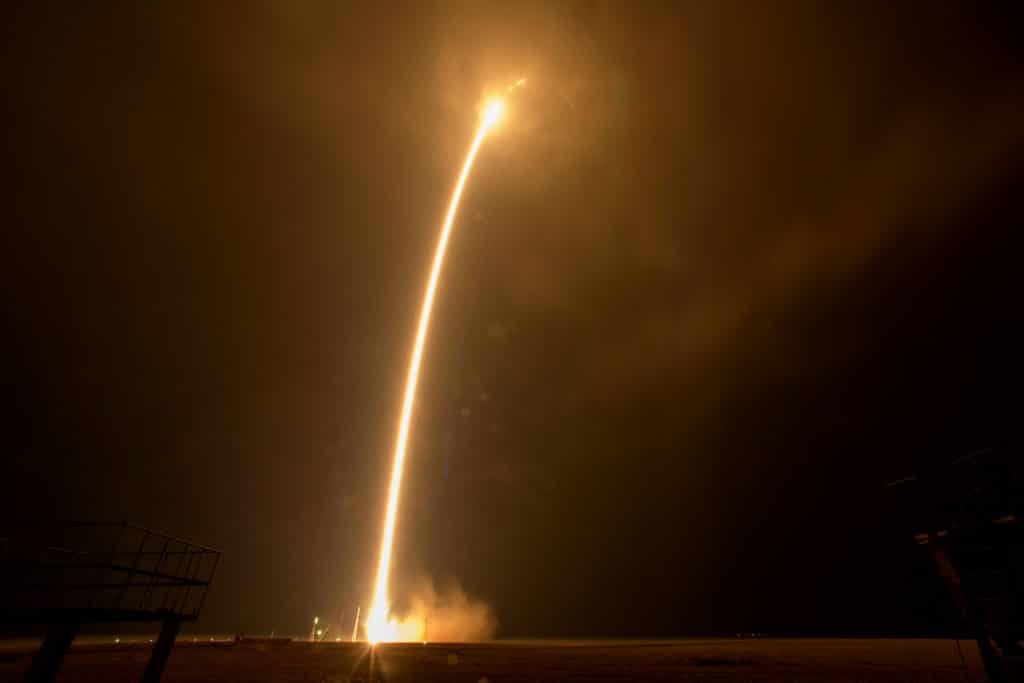
A Russian Soyuz FG rocket lifted-off on March 14 — Pi Day — at 3:14:08 p.m. EDT (12:14 a.m. on Friday, local time) from Baikonur Cosmodrome in Kazakhstan. The crew’s Soyuz MS-12 spacecraft is scheduled to dock at 9:06 p.m. to the space station’s Rassvet module. (NASA-TV will air these events live.)
Lift-off! Russia’s Soyuz leaps from the same launch pad on March 14 that the first human to journey into space, Yuri Gagarin, launched from in April 1961. (NASA)
Ninety-minutes later, the hatches between the two spacecraft will open beginning the 59th crew expedition aboard the outpost. The crew’s arrival will hold a special meaning for two of its crew members.
Thursday’s launch occured exactly five months following Hague and Ovchinin’s dramatic launch abort. Last October, their Soyuz rocket’s first stage collided with the second stage at separation causing the bottom of the second stage to break apart.
Their Soyuz craft immediately ejected from the rocket’s upper stage and began a ballistic flight which saw G-forces reach nearly eight times that of Earth’s gravity. The duo landed safely nearly 20 minutes after launch about 246 miles east of Baikonur.
“Psychological preparation is part of our overall preparation for any flight,” Nick Hague told reporters on February 21. “During the preparation for the (October) flight, we also worked with psychologists. We have a great team of psychologists working at NASA.”
NASA astronauts Nick Hague and Christina Koch, and cosmonaut Alexey Ovchinin wave as the trio prepares to enter their Soyuz spacecraft on March 14, 2019. (NASA)
Both Hague and Ovchinin feel great and are anxious to return to flight. “One of the most interesting works for me will be a spacewalk,” Ovchinin said. “We have quite a lot of tasks that we have to perform in the process of extravehicular activity.”
This Russian launch will be one of the last to fly Americans on board a Soyuz. Three commercial companies are set to launch their crew-rated spacecraft into space this year.
In July, commercial rocket company SpaceX plans to launch two Americans from the Kennedy Space Center to fly up to and dock with the space station. This launch — known as Crew Dragon Demo-2 — will mark the first crewed launch from the United States into Earth orbit in eight years.
(Charles A Atkeison reports on aerospace and technology. Follow his updates via social media @Military_Flight.)
Editor’s note: Earlier today, President Trump mandated that the FAA ground all Boeing 737-MAX aircraft. Captain Graves’ post was written before the grounding. The FAA statement on the grounding is below. Captain Grave’s insightful article follows.
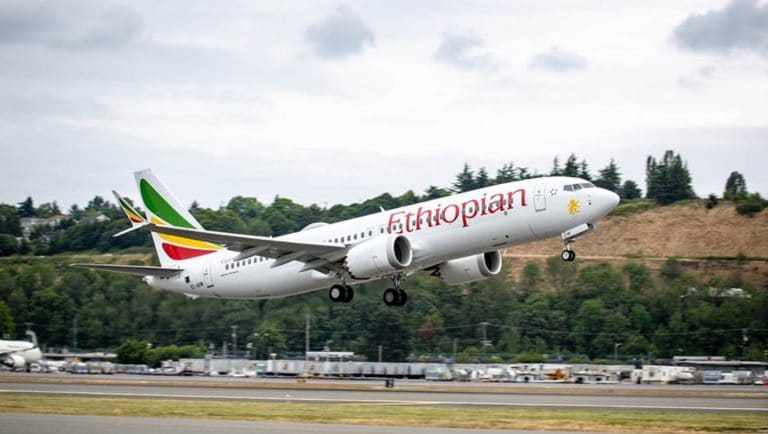
This past Sunday, an Ethiopian Boeing 737 Max 8 aircraft crashed shortly after takeoff from Addis Ababa to Nairobi with 157 passengers and crew. There were no survivors. This is the second crash of a Max 8 variant of the 737 in five months after the crash of a Lion Air Max 8 last October.
An undocumented system was brought under scrutiny in the Lion Air crash and now questions are being raised as to whether this same system, known as maneuvering characteristics augmentation system (MCAS), might have played a roll in this latest crash. If that is found to be the case, the safety of the aircraft itself will be called into question.
What We Know
At the current time, the cause of both accidents is unknown as the accident investigation is still underway on the Lion Air crash and the Ethiopian Air crash investigation is just getting under way. The flight data recorders and cockpit voice recorders have been recovered from both accidents and are being analyzed.
The flight recorder data from the Lion Air crash suggests that the pilots were having control difficulty due to erroneous inputs from the aircraft’s MCAS system which itself received faulty inputs from a malfunctioning angle of attack (AOA) sensor. It is this errant sensor and its maintenance history that investigators are focusing on.
Initial reports from the Ethiopian Air crash suggest that the aircraft experienced control difficulties shortly after takeoff. Data from a flight tracking and reporting system known as ADS-B show highly unstable vertical velocity and airspeed readouts which were similar to the airspeed and altitude excursions of the Lion Air mishap aircraft.
Unconfirmed reports from listeners on the frequency reported that the Ethiopian pilots stated that they had unreliable airspeed indications and were declaring an emergency. And right now, that’s it. There are similarities, but no confirmation that the same system brought down both aircraft.
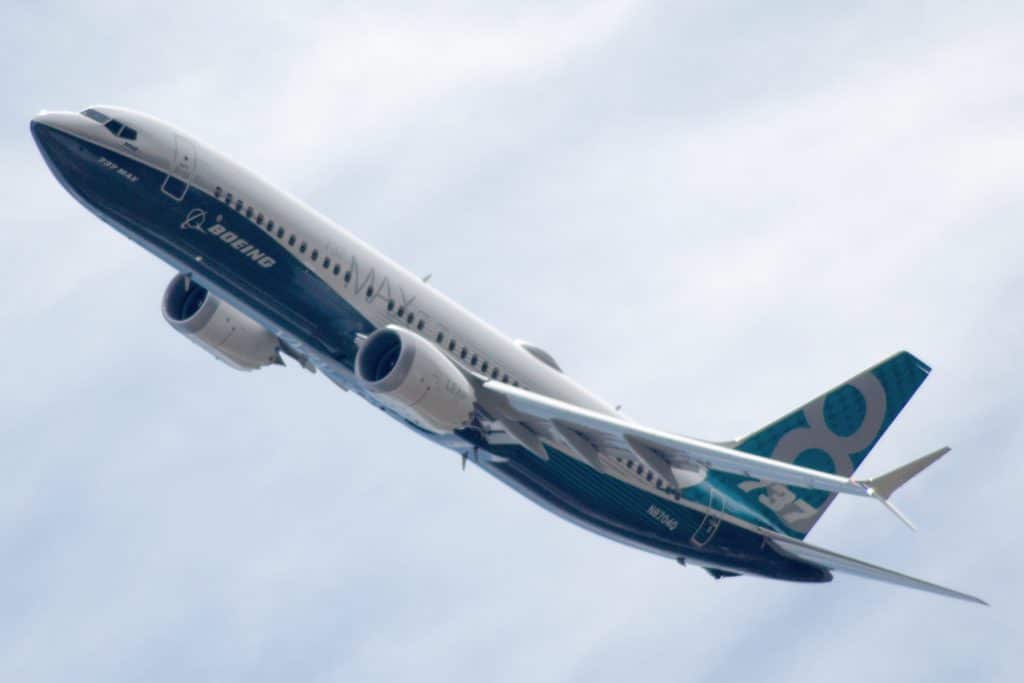
By pjs2005 from Hampshire, UK, rotated by the uploader – This file has been extracted from another file: Boeing 737-8 MAX N8704Q (27946580010).jpg, CC BY-SA 2.0, https://commons.wikimedia.org/w/index.php?curid=58846566
Is It Safe?
Given that we know little about the cause of the first accident and nothing about the cause of the second, a grounding of this model aircraft is premature. I am qualified and current in this model aircraft and am confident that it is as safe as any aircraft flying. Airplanes sometimes crash. It is always a tragedy when they do, but barring a definitive indictment of the design, there is no reason to overreact. Even should the MCAS system be found primarily at fault, the system can be completely deactivated by two easily reached switches on the center console of the cockpit. Why the Lion Air pilots didn’t take this action is unknown, but the investigation should eventually reveal the cause. A similar malfunction occurred on a previous flight of the mishap aircraft, and those pilots took the correct action and landed uneventfully. Questions as to why the aircraft flew again without being properly repaired should be asked.
In the event of unreliable airspeed, which can happen to any aircraft independent of model, routine practice of this malfunction in the simulator should make it a non-event. I recently underwent this training myself, but the basics of pitch and power date back to Wilbur and Orville. Recognition is the toughest part, but after that, known pitch and power settings will keep the aircraft from stalling and in control. I don’t mention these questions to cast blame, but rather to answer critics who don’t understand aviation or engage in magical thinking. The Max is still a 737 at heart and flies nearly identically to the other four models of the aircraft that I have flown. So yes, it is safe, and I’d gladly put my family on one and fly it myself with no reservations.
Captain Rob Graves is a veteran airline pilot and retired Air Force officer. He currently flies a Boeing 737 for a major American airline where he has over 25 years of experience. His Air Force career included instructing future USAF pilots in the T-37 primary jet trainer, aerial refueling in the KC-135 Stratotanker, and conducting worldwide logistics in the C-5 Galaxy cargo aircraft. He is the author of This is Your Captain Speaking, an aviation blog. It can be found at robertgraves.com. He also writes for Avgeekery.com.
SACRAMENTO, Calif. — The sounds of air power will echo across central California this month as the Air Force’s top demonstration team, the Thunderbirds, and civilian aerobatic pilots gather to perform during the Travis Air Force Base air show.
“Thunder over the Bay” air show will bring together top military aircraft of today and popular warbirds from yesteryear. The air show will honor local hometown heroes during the two-day event on March 30 and 31. Tucked between San Francisco and Sacramento, Travis AFB’s 60th Air Mobility Wing will host the region’s largest family-friendly event planned for 2019.
“Travis AFB will have one of the best lineups in the nation, to include the Air Force Thunderbirds, U.S. Army Golden Knights, and the Patriots Jet Team,” Travis AFB Airshow Deputy Director Maj. Marie Barrett said. “And if that isn’t enough, we will also have demonstrations by the F-22 Raptor, A-10 Warthog, C-17, C-130J, U-2, and much more!”
The Thunderbirds return to Travis AFB on March 30/31 for Thunder Over the Bay. (USAF)
The Thunderbirds’ six F-16 Fighting Falcons will take to the skies each afternoon to showcase the pride and precision of the 660,000 Airmen they represent. Their nearly 45-minute demonstration will highlight the handling of the F-16, including slow passes by their diamond formation, and high speed passes by their two solos.
F-22 pilot Major Paul “Loco” Lopez will perform a nearly 15-minute flight demonstration before joining up with two popular aircraft. After the Raptor concludes its demonstration, it will move into a close formation flight with a P-51 Mustang and an A-10 Warthog for the crowd favorite Heritage Flight.
“The Heritage Flight is a living memorial pairing up a modern fighter with a World War II or Korean-era airplane flying in formation,” Maj. Lopez explained to this aerospace journalist. “Paired with great narration and great music, it captures that feeling of how import the Air Force legacy is in the military.”
Air Force Major Paul “Loco” Lopez pilots the F-22 Raptor during a recent flight. (Atkeison)
Civilian aerobatic performers, including the T-33 Acemaker, Matt Chapman’s Extra 330LX, Jeff Boerboon’s Yak-110 will also perform during the two-day event.
“We look forward to a weekend displaying our gratitude the best way we know how: with a little bit of air power,” 60th Air Mobility Wing commander Col. Jeff Nelson said on Friday.
Travis AFB will lift their local firefighters, police, teachers, and community leaders upon their shoulders with the air show theme, ‘Honoring our Hometown Heroes’. Air show organizers will showcase American citizens who have performed amazing contributions to the local region and who have put forth efforts to advance the local community.
“We are thankful our country looks to the military as heroes of hope and security,” 60th Air Mobility Wing commander Col. Jeff Nelson said on Monday. “Yet, it’s important for Team Travis not to overlook the heroes in our local community who, like us, work every day to keep us safe.
A Kids Zone area will allow children to play and jump on aviation-themed bounces and take part in educational activities. Travis AFB gates open to the public at 9 a.m. each day and admission is free.
(Charles A Atkeison reports on aerospace and technology. Follow his updates via social media @Military_Flight.)
Integrity. Strength. Parent and child bonding. Excitement.
Not just words, they describe personal life experiences for those who pass through the gates of Aviation Challenge at the U.S. Space and Rocket Center in Huntsville, Alabama.
Aviation Challenge is a program designed as a Top Gun-styled camp course teaching kids of all ages the fundamentals of outdoor survival and fighter pilot training. As summer approaches across America, children and adults alike can discover an exciting “summer camp” experience with real adventures and personal growth.
Surrounded by the green mountains of northern Alabama, the U.S. Space and Rocket Center is a NASA visitor’s center for the Marshall Space Flight Center. The facility houses two museums and dozens of attractions, and is home to the popular Space Camp and Aviation Challenge programs.
This aerospace journalist went through the exciting three-day program with instructors Chris Edwards, call sign “Cheapshot”, and Sami DeWeese, call sign “Mule”. Both have aviation backgrounds and carry with them a strong interest in the program.
Call signs are given on the day you arrive at Aviation Challenge, and usually reflect something about you as a person — much like Tom Cruise’s risk taking character “Maverick” in the movie Top Gun. Just like real fighter pilots, you will use your call sign instead of your own name during your three-to-seven day career as an aviator trainee. My call sign as a trainee, “Dash”.
Teamwork is high on the instructor’s mind as both Cheapshot and Mule bring a group of children ages 7 thru 12 — strangers to one another — together as a squadron team.
“In Aviation Challenge, they have to work together,” Cheapshot explained his own views of the program. “I have to be their leader, that role model, and show them I’m in charge much like a military instructor would for his or her unit.”
Building a camp fire and outdoor survival lessons are taught at Aviation Challenge. (Charles Atkeison)
In our session, the opening hours allowed for the children and their parents to learn more about what is expected of them and just what lies ahead for them. Our living quarters were assigned. We dropped off our gear and met back up to begin our flight training.
“We also try to get everyone talking and to become go getter’s,” Cheapshot added as he stood in his green flight suit next to a NASA T-38A aircraft.
The first day included walking tours around the space and military museums; incredible rides or what the instructors call “simulators”; and a hearty dinner before boarding a private bus and heading out for the first of several training sessions upon a private field. Several static military aircraft are positioned around the training facility, including a real F-14 Tomcat flown in Top Gun.
At a secure location one mile from the space center is a five acre field in which the actual training is held. Flight simulations combined with classroom sessions introduce the parents and their children to the career of a military aviator.
Lessons on building a camp fire safely; using a compass to navigate an unknown wooded terrain; and learning how to recognize and find fresh water are just a few of the activities during Aviation Challenge. Adjacent to the exercise field are two special buildings which house flight training operations.
A retired Air Force F-16B Fighting Falcon honors Alabama’s own Tuskegee Airmen located near the training facility at Aviation Challenge. (Charles Atkeison)
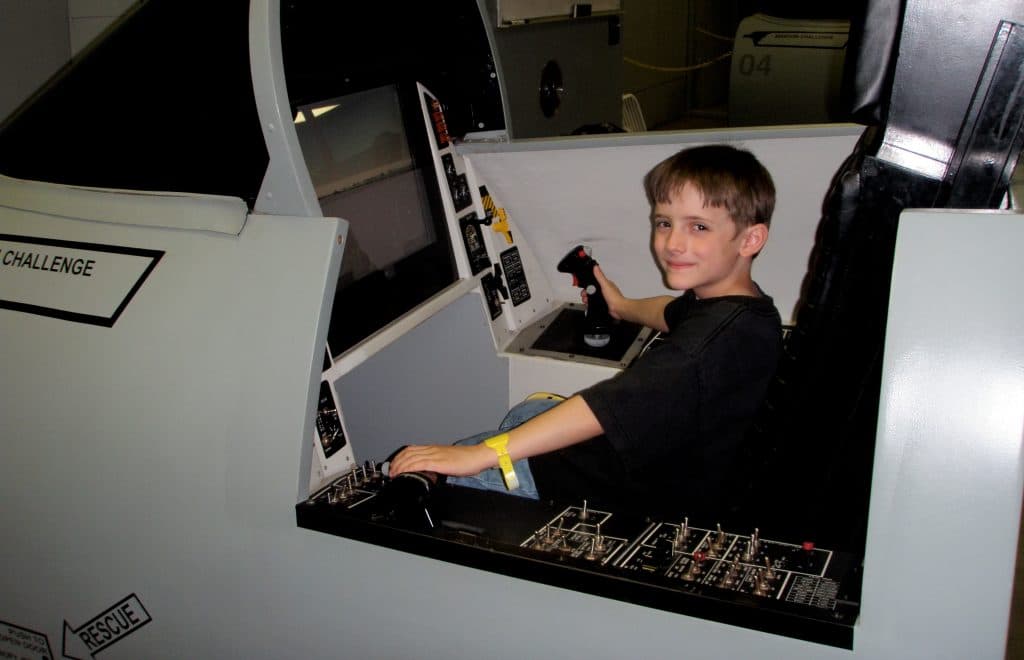
Inside trainees are taught how to fly one of the current jets used by the U.S. Navy, the F/A 18E Super Hornet. Led by Cheapshot and Mule, trainees learn how to perform preflight checks of their powerful jet, such as setting the wing flaps in the ready position and how to taxi the aircraft toward the runway.
Several control levers and a large video screen inside a cockpit mock-up provide a realistic approach to the flight session as one begins to practice take offs and build towards a flight to a designated airport.
Training Director Kim “Spud” Thornton helps supervise the flight sessions from an air traffic control station near the flight simulators. Several will crash and burn on their first attempt, while some will fly like an ace behind the stick of their Super Hornet.
For those who crash after take-off, Spud becomes your wing-man as she resets your aircraft back onto the tarmac for another training exercise. Following one session, I witnessed an emotional bond as father and son exchanged hand slaps and laughter upon learning how to fly their jet successfully and land at the right military base.
“You learn by doing,” Mule says firmly, eyes focused on her own flight simulation screen. “And when you succeed your confidence soars.”
Aviation Challenge instructor Mule demonstrates how to navigate using a compass. (Charles Atkeison)
Jet flight simulations are taken to a higher level later in the day as the group of trainees, dressed in military camouflage fatigues, head to one of the highlights of the training, the Centrifuge. Built and used by NASA, the Centrifuge is how test pilots and astronauts alike train to ensure they can handle the stresses of high “G” loads on the body.
A “G” is one-gravity, and for pilots making a sweeping turn, they may encounter nearly four times their body’s weight, known as four G’s. Those trainees interested in the Centrifuge were allowed to ride it only twice, their bodies experiencing up to 3.2 G’s as their secured module traveled at nearly fifty m.p.h. in a circle thus creating the G loads.
As the sun began to set, the camouflaged trainees were led out to a wooded region of the training field by Mule and Cheapshot and briefed on their next “mission”. As they concluded, these young adults soon discover their own personal strengths as these aviator trainees worked hard to meet objectives under the blackness of the star-draped night.
Following the exercise, the tired squadron gathered together to shake hands and celebrate the recent accomplishment with treats over an open fire. Sharing smores together, a parent’s smile gave further encouragement to their child upon the completion of a full day.
Aviation Challenge student Chewie trains with the F/A-18 flight simulator. (Charles Atkeison)
Training requires rest times and enjoyment, and at the Space and Rocket Center will you find an IMAX theater with a gigantic 180-degree field of view movie screen. The high definition IMAX movie Hubble, the prehistoric Sea Rex 3D, and an aviator’s choice Legends of Flight are now showing at the Space and Rocket Center’s two theaters.
As summer nears, make plans now to attend a fulfilling summer camp experience. For moms and dads, it may be one of the most rewarding gifts one can give — time shared with their child and memories which last a lifetime.
Aviation Challenge manager confirm openings are available in May and into the summer months for most ages. Visit Aviation Challenge‘s web site for detailed information and to check on availability dates for your planned visit. The current Program Guide is available for download here.
Parents soon discover how important Aviation Challenge is upon graduation, as they grow closer with their children and reconnect in this busy world we all share.
(Charles A Atkeison reports on aerospace and technology. Follow his updates via social media @Military_Flight.)
PENSACOLA, Fla. — The U.S. Navy Blue Angels are closing out winter training and turning their focus this week to an air show schedule which will cover over thirty locations across the United States and Nova Scotia.
The Navy’s Flight Demonstration Squadron are in the final days of an exhaustive winter training season in preparation for their 73rd anniversary year. The demonstration pilots have been performing two-to-three practice flights a day, while the maintenance and logistics personnel keep the aircraft and the 32 air show sites on schedule.
“Our success is truly a testament to our commitment to excellence in everything we do,” Blue Angels Boss Capt. Eric Doyle said recently. “Our Sailors and Marines have taken everything they’ve learned in the Fleet, expanded upon that, and applied it to our unique mission.”
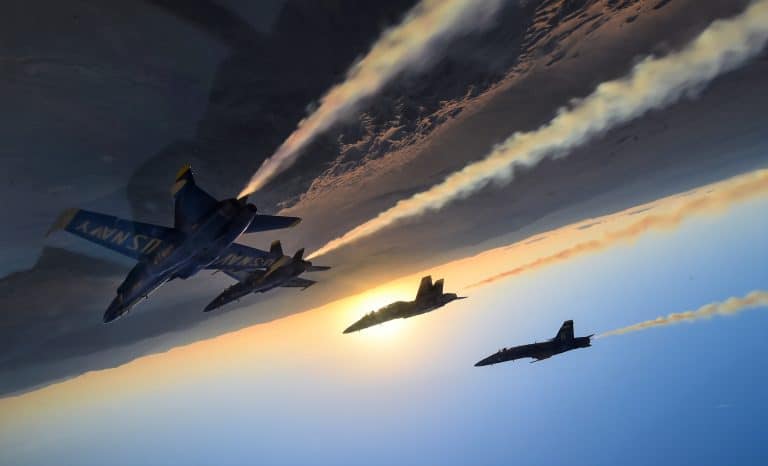
The Blue Angels diamond practices in February above El Centro. This image was photographed from Angel 4 (a two-seat F/A-18 Hornet) by Navy PO2C Tim Schumaker.
Their first air show is Saturday, March 16, at NAF El Centro — their winter home in the southern California desert. This annual air show is held to say a special “thank-you” to the Imperial Valley community.
“We couldn’t train like we do without NAF El Centro and the surrounding community,” said Capt. Doyle last week. “This base is always a great host to us, and other operational Fleet squadrons, and the community here makes us feel like family.”
They will then embark upon a season filled with high speed precision flying and sweeping formation flights across the airfield, as show crowds yell out, “Did you just see that!” Following their second show at Salinas, Calif., the entire squadron will spend Monday, March 25 making the cross-country trip home to Pensacola, Florida.
The 2019 Blue Angels practice above NAF El Centro, Calif. in February. (USN)
A historic highlight of the season will take place during the Joint Base Andrews Air Show in May. The Blue Angels and the Air Force Thunderbirds will perform each afternoon one hour apart. An air show with both demonstration teams is very rare.
JB Andrews will become the first air show featuring the United States top two military flight teams in over a decade. The Thunderbirds will perform first on Saturday, and the Blues will perform first on Sunday. Last August, the two demonstration teams met up over Lake Erie for a photo opportunity.
An emotional highlight will follow as the Blue Angels return to Smyrna, Tenn. for the first time since the tragic loss of their opposing solo pilot seconds after take-off in 2016. The city of Smyrna dedicated a beautiful memorial to the fallen pilot, Capt. Jeff Kuss, last June — located between the runway he last flew from and the crash site.
Each air show the Blue Angels visit will include top military and civilian aerobatic pilots performing in the preceding hours. Many of their shows will include performance by the Air Force with the F-22 Raptor, the F-16 Viper, or an A-10C Warthog.
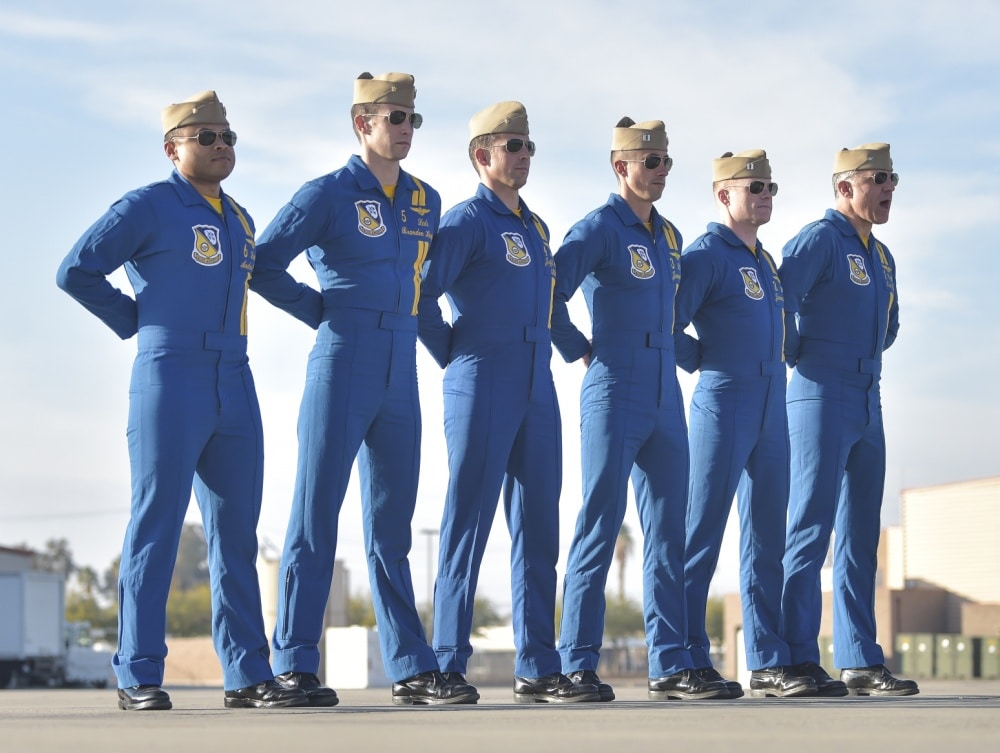
The six pilots of the U.S. Navy Blue Angels, with Boss Doyle at right, prepare for flight. (USN)
The Blue Angels is lead by second year squadron “Boss” Capt. Eric “Popeye” Doyle. The Diamond Team includes LT James Haley, LT James Cox, and Maj. Jeff Mullins. The two solo pilots, LCDR Brandon Hempler and LCDR Andre Webb, will have both young and old in awe as the solos perform dynamic, high speed maneuvers including speed past each other at over 500 m.p.h.
These pilots are apart of an elite group of only 267 who have performed as a Blue Angel demonstration pilot during the squadron’s 73-year history. Capt. Doyle is the squadron’s 37th commanding officer.
Updated Blue Angels 2019 Air Show Schedule:
March 16 | NAF El Centro, CA | NAF El Centro Annual Air Show
March 23/24 | Salinas, CA | California International Air Show Salinas
March 30/31 | NAS Key West, FL | Southernmost Air Spectacular
April 6/7 | Lakeland, FL | Sun ‘n Fun Air Show
April 13/14 | NAS Corpus Christi, TX | Wings Over South Texas
April 20/21 | Bye Weekend
April 27/28 | MCAS Beaufort, SC | MCAS Beaufort Air Show
May 4/5 | Fort Lauderdale, FL | Ford Lauderdale Air Show
May 10/12 | Joint Base Andrews, MD Air Show
May 18/19 | Cape Girardeau, MO Regional Air Festival
May 22 | Annapolis, MD | U.S. Naval Academy Air Show
May 25/26 | Miami Beach Air and Sea Show
June 1/2 | Oklahoma City, OK | Star Spangled Salute Air Show
June 8/9 | Smyrna, TN | Great Tennessee Air Show
June 15/16 | Ocean City, MD | OC Air Show
June 29/30 | Davenport, IA | Quad City Air Show
July 6/7 | Kansas City, MO | KC Downtown Air Show
July 13 | Pensacola Beach, FL Air Show
July 20/21 | Duluth, MN Air and Aviation Expo
July 27/28 | Grand Junction, CO Air Show
August 3/4 | Seattle, WA | Boeing Seafair Air Show
August 17/18 | Chicago, IL Air and Water Show
August 24/25 | New Windsor, NY | New York Air Show
Aug. 31-Sep. 1 | Greenwood, Nova Scotia, Canada | Air Show Atlantic
Sept. 7/8 | Chesterfield, MO | Spirit of St. Louis Air Show
Sept. 14/15 | Bye Weekend
Sept. 21/22 | NAS Lemoore, CA | Central Valley Air Show
Sept. 28/29 | MCAS Miramar, CA | MCAS Miramar Air Show
Oct 5/6 | Sacramento, CA | California Capital Air Show
Oct 12/13 | San Francisco, CA | San Francisco Fleet Week
Oct 19/20 | Fort Worth, TX | Fort Worth Alliance Air Show
Oct 26/27 | Jacksonville Beach, FL | Jacksonville Sea and Sky Air Show
Nov 2/3 | Moody AFB, GA | Thunder over South Georgia
Nov 8/9 | NAS Pensacola, FL | Blue Angels Homecoming Air Show
(Charles A Atkeison reports on aerospace and technology. Follow his updates via social media @Military_Flight.)