Next year, NASA hopes to launch Artemis-3 alongside two commercial contractors Blue Origin, owned by billionaire Jeff Bezos, and SpaceX, owned by billionaire Elon Musk. However, neither company is anywhere close to ready, and after last night’s explosion of Blue Origin’s New Glenn rocket, both rockets to launch the landers next year are currently grounded by the FAA.
The impact of last night’s explosion, combined with other Starship mishaps, could be significant for NASA’s near term Artemis plans to land on the moon again before China.
Blue Origin’s New Glenn rocket exploded on Cape Canaveral LC-36 last night, doing a test fire ahead of the rocket type’s 4th mission.
More pressure is on SpaceX Starship now to get operational for Artemis-3
Starship just recently flew its 12th test, with a new beefed-up version of the previous design. The mammoth booster is supposed to return to Earth on a controlled power descent, but on flight 12 the engines conked out, leaving the booster to crash into the ocean instead of a controlled soft-landing on the waves. So it is currently grounded until they find the cause and solution.
The Starship itself did well, and did its own soft-landing before exploding as expected.
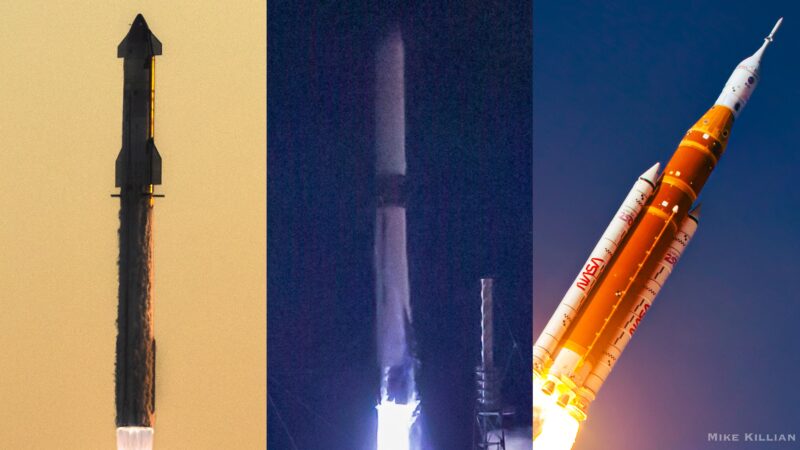
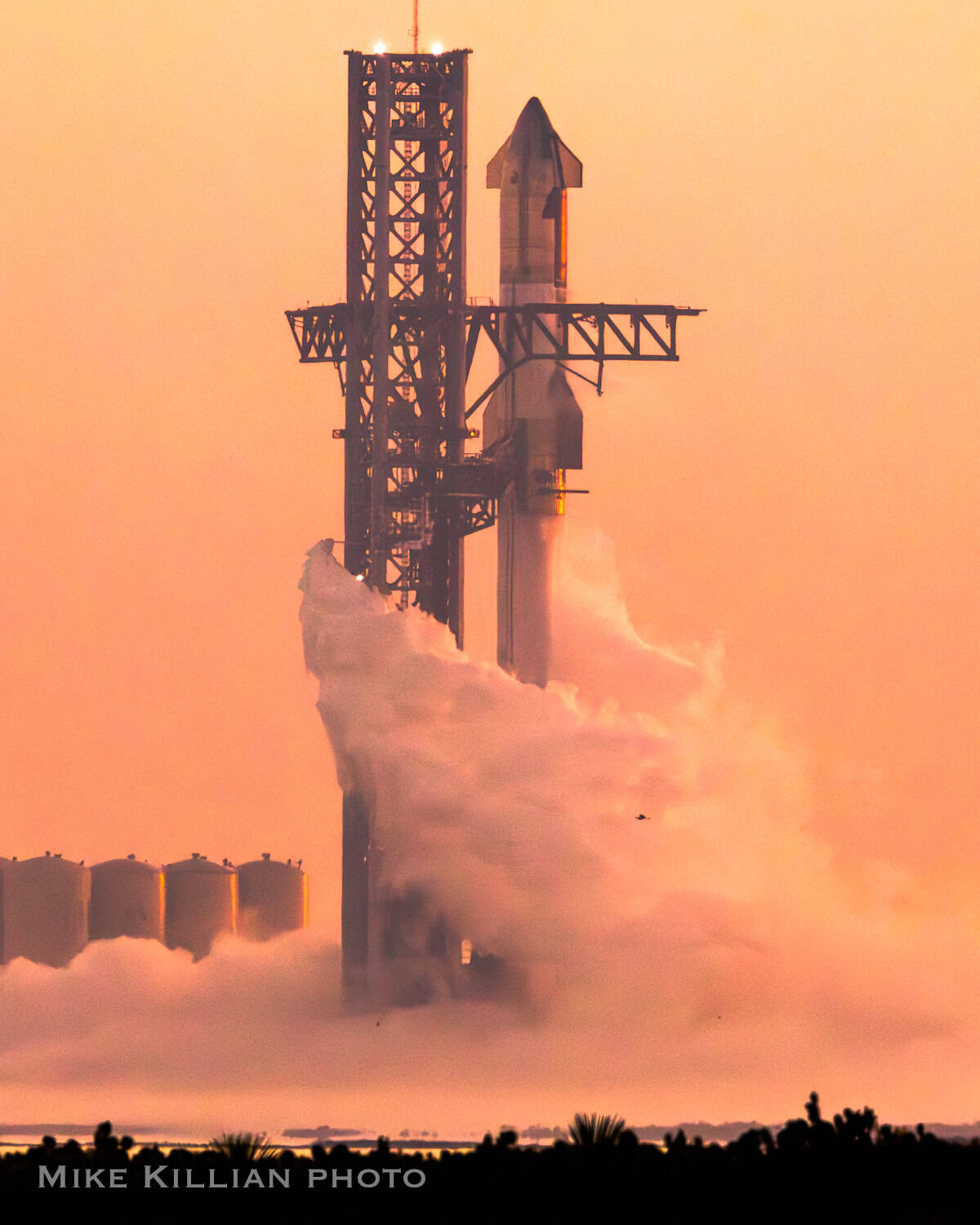
Fully fueled SpaceX Super-Heavy rocket and Starship
With the loss of Blue Origin’s New Glenn rocket, there is even more pressure on SpaceX now to get Starship operational. NASA also gave Blue Origin a contract to develop a moon lander for Artemis missions. It is called Blue Moon, and is to launch on New Glenn.
With last night’s explosion taking out half the launch complex, it is safe to assume that repair work at LC-36 will take 6-12 months before the pad is operational again.
New Glenn on LC-36 before exploding (Mike Killian photo)
Add to that, New Glenn has only flown 3x, and the 3rd launch actually failed to deliver the payload to the proper orbit. So, even once the pad is repaired, they still don’t have a safe and consistent flight rate enough for NASA to realistically trust it yet. So, is Artemis-3 still realistic for 2027?
A cargo version of Blue Moon is currently undergoing testing in Houston, but now it has no rocket to launch to the moon on. It was supposed to launch this year, on an uncrewed lunar landing to show NASA it works and deliver the first payloads supporting future crews.
NASA illustrations, Blue Moon lander on left, Starship lander on right
Blue’s lander can however fit on NASA’s Artemis SLS rocket, used to launch the crew on Orion.
Blue Origin was to start launching Artemis infrastructure and payloads to the moon this year, now that won’t happen
NASA also awarded Blue Origin a contract to deliver payloads and Lunar Terrain Vehicles to the Moon for the Artemis program using New Glenn beginning later this year. With last night’s explosion, those plans are now gone.
NASA’s SLS rocket and Orion spacecraft launch with the first Artemis crew around the moon, mission Artemis-2 April 1, 2026 (Mike Killian photo)
NASA has proven their SLS rocket and Orion spacecraft for Artemis works, twice. Now it’s on Blue Origin and SpaceX to step up with their promises.
Artemis-3 is scheduled to launch next year, as a test in Earth orbit with NASA’s crew on the Orion spacecraft doing docking and rendezvous tests with the landers. But if the landers and their rockets are not ready, there is no mission. Which would mean no moon landing in 2028 either. Everything will continue delaying further.
Blue Origin Explosion, Starship Mishaps May Delay NASA’s Artemis Moon Plans 7
For now, both Blue Origin and SpaceX have shifted priorities more to development of the landers, to stay within the timetable expectations of the President and NASA Administrator Jared Isaacman. Both companies will no doubt figure things out. But will they do it before China?
Boeing is moving toward higher 737 MAX production as CEO Kelly Ortberg says 787 output is rising and MAX 7 certification is nearing.
Boeing CEO Kelly Ortberg | IMAGE: Boeing
Boeing CEO Kelly Ortberg used his appearance at the Bernstein Strategic Decisions Conference in New York on 27 May 2026 to lay out what may be one of the clearest snapshots yet of Boeing’s near-term commercial airplane recovery plan: push the 737 MAX line from 42 to 47 aircraft per month, move the 787 Dreamliner from eight toward 10 per month, and finally close out long-delayed certification work on the 737 MAX 7 and MAX 10.
For Boeing, all three are deeply connected. Higher production rates mean more deliveries. More deliveries mean more cash. But after years of scrutiny over manufacturing quality, certification delays, supply chain strain, and the lingering impact of the 2024 Alaska Airlines 737 MAX 9 door-plug incident, Ortberg’s message was not simply that Boeing wants to build more airplanes.
It was that Boeing believes it is ready to do so more carefully.
737 MAX Production Is Moving Toward 47 Per Month
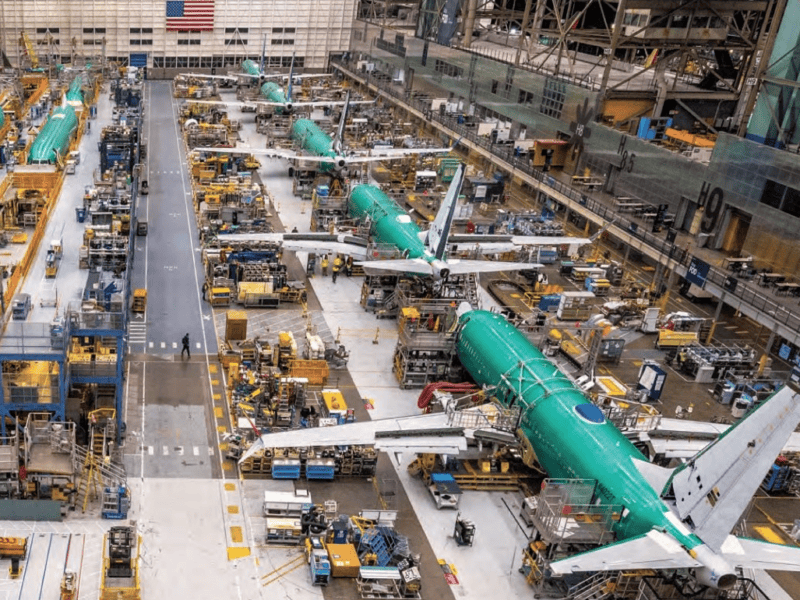
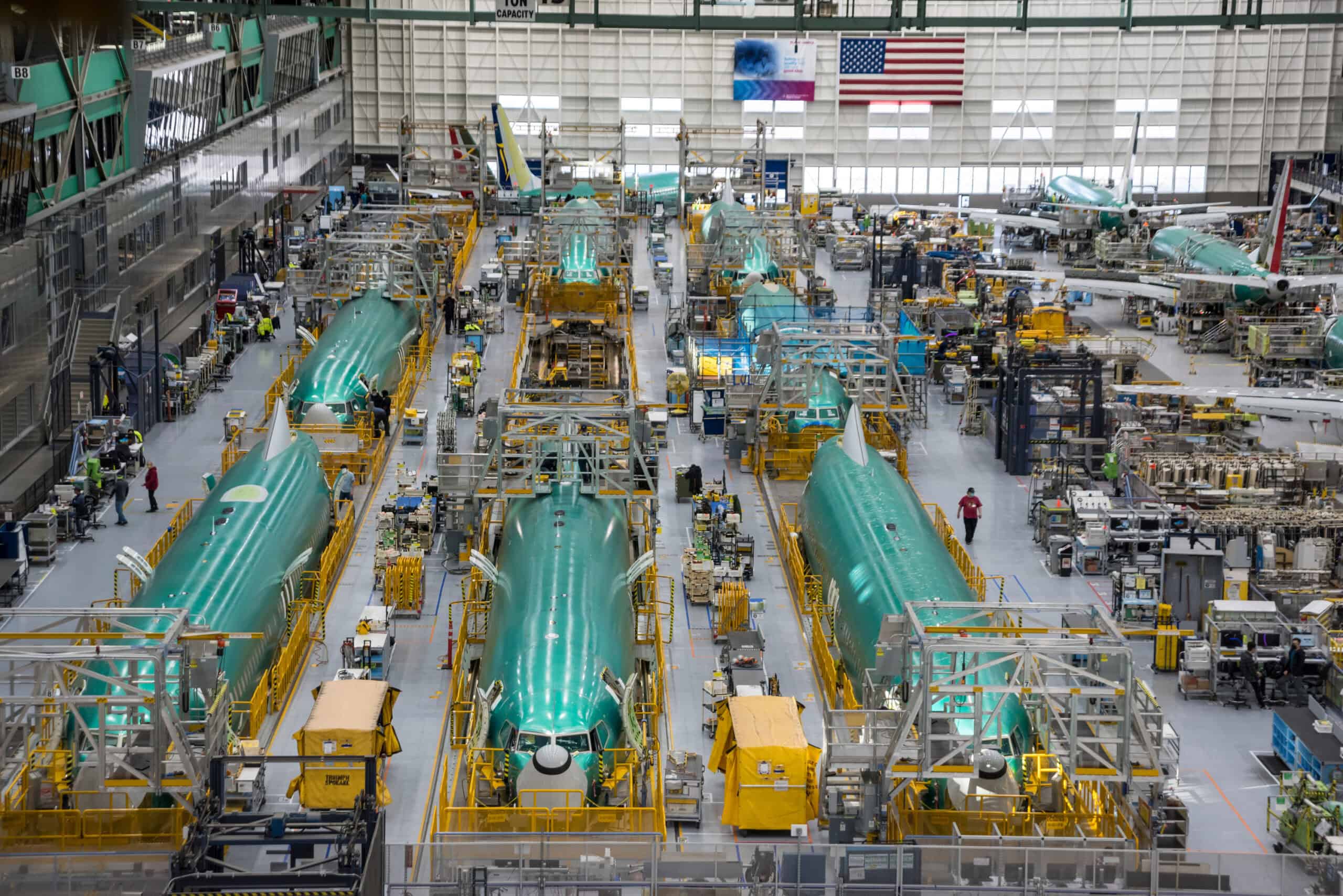
Renton Factory Interior View | IMAGE: Boeing
The most immediate update came on the 737 program, where Ortberg said Boeing has completed what he called the FAA’s capstone review for a move to 47 aircraft per month.
“We’ve passed the capstone review for rate 47,” Ortberg said. “So, we are now in the process of running the line at the 47 a month rate.”
That is a meaningful step for Boeing’s most important commercial airplane program. The company had moved to 42 per month last fall, and Ortberg said the ramp to that level had gone well, with key performance indicators remaining positive. The next step, he said, is to stabilize the production system at the higher rate.
“It’ll probably take us a few months of stabilization there,” Ortberg said, adding that Boeing “should be there in the next couple of months.”
Reuters also reported Wednesday that FAA Administrator Bryan Bedford said the agency had endorsed Boeing’s move from 42 to 47 aircraft per month and was “absolutely comfortable” with that increase. The FAA imposed a 38-aircraft-per-month cap in January 2024 after the Alaska Airlines door-plug incident, later allowing Boeing to resume upward production as it demonstrated quality improvements.
Ortberg described Boeing’s rate-increase process as deliberately cautious. Before the capstone review, Boeing had already tested the system at 47 per month and placed “blanks” in the production flow. Those blank positions give the line room to recover if a commodity or supplier area falls behind.
In other words, the company is not simply shoving more airplanes through Renton and hoping the system catches up.
“We’re highly confident that we pulse the system to make sure we’re ready to go to that rate,” Ortberg said.
Everett’s “North Line” Will Matter More at 52 and Beyond
Boeing’s Everett, WA facility, which will become the “North Line” as 737 MAX Production ramps up | IMAGE: By Jeremy Elson – Own work, CC BY-SA 3.0, https://commons.wikimedia.org/w/index.php?curid=16996754
The next major target is 52 aircraft per month, but Ortberg was careful not to put an aggressive date on it. He said Boeing historically has talked about waiting at least six months between rate increases, but he also made clear that the company will move only when the production system and supply chain are ready.
That is where Boeing’s new 737 production line in Everett, Washington, comes in.
Ortberg said the fourth 737 line, which Boeing calls the North Line, is already in place. The company plans to run an airplane through it to qualify the production system. Employees are being hired and trained in Renton before moving to Everett.
The Everett line is not needed for the move to 47 per month, Ortberg said. It becomes important for 52 and beyond.
“We need the Everett line active to move 52 and beyond, not for 47,” he said.
The long-term ambition remains even higher. Ortberg said Boeing would eventually like to get to 63 aircraft per month, but he acknowledged that the industry will be watching the company closely before that happens.
I think the whole world is watching to make sure we make 47 and 52.
Kelly Ortberg | Boeing CEO
“I think the whole world is watching to make sure we make 47 and 52,” he said.
That line may be the most honest summary of where Boeing stands. The demand is there. The backlog is there. But after years of operational and quality crises, Boeing has to earn confidence one production step at a time.
MAX 7 and MAX 10 Certification Near the Final Stages
The Boeing 737 MAX Family | IMAGE: Boeing
Certification also remains one of Boeing’s biggest commercial airplane priorities for 2026. Ortberg said the 737 MAX 7 and MAX 10 certification programs are “clearly getting to the final stages,” and that the two variants are now a little more than 80 percent through certification flight testing.
He also said Boeing now has FAA authority for the full remaining flight-test regime, meaning the company does not need additional FAA TIA approvals for those tests.
“So, it’s just a matter of getting through that flight test program,” Ortberg said.
The MAX 7 is expected to receive its type certificate before the MAX 10, though Ortberg said the two should be relatively close together. He acknowledged that the MAX 10 certification package is larger than the MAX 7 package, but said the work is being handled concurrently.
The engine anti-ice system, which has been one of the major issues tied to the delayed certifications, appears to be largely behind Boeing from a testing standpoint. Ortberg said that work has been completed and will first be cut into the 737-8 program.
“We’re through all the testing of the engine anti-ice, and that’s all kind of behind us,” Ortberg said. “We’re pretty confident that we’re not going to see any hiccups here in the remaining regime of flight testing.”
Separately, Reuters reported that FAA Administrator Bryan Bedford said the FAA anticipates the 737 MAX 7 will be certified this summer and the MAX 10 before the end of 2026.
The long-awaited certification update is music to the ears of airlines waiting on the smaller and larger ends of the MAX family. Southwest Airlines has long been the key customer tied to the MAX 7, while the MAX 10 is important to carriers such as United Airlines, which has been waiting for the highest-capacity version of the 737 MAX family.
787 Output Is Back to Eight Per Month, But Seats and Engines Remain Watch Items
Boeing 787 final assembly at its North Charleston facility | IMAGE: Boeing
On the 787 Dreamliner, Ortberg said Boeing has moved to a rate of eight aircraft per month, with a goal of reaching 10 per month by the end of the year. But he also made clear that the path to 10 is not free of friction.
The biggest near-term challenge is not the basic production of the aircraft. It is getting completed aircraft delivered.
Ortberg said complex seating configurations, particularly in higher-end cabins, have created certification delays. In some cases, airplanes are finished but cannot be handed over to customers because the seat certification paperwork is incomplete.
“We have airplanes sitting for customers completely done waiting for seat certifications,” Ortberg said.
Boeing 787 Dreamliner family | IMAGE: Boeing
He said Boeing is working with the FAA, EASA, and seat manufacturers to improve the process, but expects the company will be “fighting seats throughout the year.” The issue is not typically the supply of the seats themselves, he explained. The seats are installed. The airplanes are built. The paperwork is the bottleneck.
Boeing is also watching engine deliveries. Ortberg said the company fell behind on engines in the first quarter and is working with GE on a recovery plan. That recovery, he said, will be needed before Boeing can raise the 787’s production rate.
The good news for Boeing is that Ortberg does not expect the seat issue to force a production slowdown. The more realistic impact is timing.
“I don’t think we’re going to do anything to slow production down,” he said. “But we may not go to the rate 10 as early as we could have had we not had the challenges.”
For Boeing, the message from Bernstein was one of progress, but not victory laps. The 737 is moving higher. The 787 is building momentum. The MAX 7 and MAX 10 are finally approaching the end of certification. But each milestone still depends on execution, and Ortberg seemed to know that better than anyone.
“This is an execution story,” he said. “So, just focus on execution.”
A full transcript of Ortberg’s comments is available here.
American Airlines Flight 191 and UPS Flight 2976 were not identical accidents, but their similarities have drawn serious attention from investigators and aviation safety experts.
On 25 May 1979, American Airlines Flight 191 began what should have been a routine mid-afternoon departure from Chicago O’Hare International Airport (ORD).
American Airlines Flight 191 seconds before impact on 25 May 1979 at ORD | IMAGE: All Things Chicago via Facebook
The aircraft, a McDonnell Douglas DC-10-10 bound for Los Angeles International (LAX), was carrying 258 passengers and 13 crew members. As it accelerated down Runway 32R and rotated into the air, the unthinkable happened. The left engine and pylon broke away from the wing, ripping off a section of the leading edge as it separated. The engine fell onto the runway while the aircraft continued climbing, briefly reaching about 325 feet.
What followed happened in seconds.
With the engine gone, the left wing’s leading-edge slats retracted unevenly. That left wing stalled without warning, and the DC-10 rolled sharply to the left (its maximum bank was recorded as 112º). Just 31 seconds after takeoff, it crashed into an open field near a trailer park, roughly 4,600 feet from the runway. All 271 people aboard were killed, along with two people on the ground.
The moment of impact when American Airlines Flight 191 crashed on 25 May 1979 | IMAGE: American Airlines Flight 191 seconds before impact on 25 May 1979 at ORD | IMAGE: All Things Chicago via Facebook
The NTSB later determined that the disaster was caused as a result of an asymmetrical stall and the resulting roll, caused by the uncommanded retraction of the left wing’s outboard leading-edge slats. The failure was traced back to maintenance-induced damage that led to the separation of the No. 1 engine and pylon assembly.
Investigators found that American Airlines’ maintenance procedure, which included the use of a forklift to support the engine and pylon during removal and reinstallation, had caused hidden structural damage to the pylon’s upper flange. In the aftermath, the FAA grounded the DC-10 fleet for 37 days while inspections and repairs were carried out.
More than four decades later, Flight 191 remains the deadliest single-aircraft crash in United States history.
Aviation safety expert Steve Forness, managing director of Air Flight Technical, later pointed to the design vulnerability exposed that day. In both the DC-10 crash and the later UPS accident, he noted, the engine appeared to rotate around the forward bulkhead before leaving the wing entirely.
A Reputation the DC-10 Never Fully Recovered From
The crash site of American Airlines Flight 191 | IMAGE: NTSB/Public Domain
The crash did more than destroy one aircraft. It severely (and permanently) damaged the DC-10’s reputation.
In the days that followed, the FAA temporarily revoked the aircraft’s type certificate, grounding all US-registered DC-10s and banning foreign DC-10s from American airspace. Even after fixes were made to the slats, warning systems, and power supplies, public confidence never fully returned.
Following Flight 191, the DC-10 became a symbol of risk for the flying public – whether that reputation was entirely fair or not. Sales suffered. McDonnell Douglas lost roughly $200 million in market value, and production of the DC-10 ended in 1989 after 386 aircraft had been built.
Aviation has always had aircraft that were technically improved after tragedy. But public perception can be harder to repair than metal.
Louisville: UPS Flight 2976
The stories of American Airlines Flight 191 and UPS Flight 2976 are linked by the same root cause: the separation of the No. 1 engine during departure | IMAGE: Public Domain/NTSB
On 4 November 2025, another McDonnell Douglas trijet was rolling down a runway when history seemed to echo in a chilling way.
UPS Airlines Flight 2976, an MD-11F freighter, was departing Louisville Muhammad Ali International Airport (SDF) for Honolulu (HNL). The aircraft had been built in 1991 and had accumulated nearly 93,000 flight hours and more than 21,000 cycles. Three crew members were on board.
Shortly after V1 on Runway 17R, the left engine and pylon separated from the aircraft.
The MD-11 climbed only about 30 feet before losing control. It crashed into an industrial area south of the airport, striking several buildings and erupting in flames. All three crew members were killed, along with 12 people on the ground. One of those victims died from injuries 51 days later, bringing the final death toll to 15. Another 23 people on the ground were injured.
NTSB footage of the debris field caused by the crash of UPS Flight 2976 | IMAGE: NTSB
It was the deadliest accident in UPS Airlines history.
The NTSB’s preliminary report and later hearings identified fatigue cracks in the left pylon’s aft mount, particularly in the aft and forward lugs of the spherical bearing assembly. Investigators found that metal fatigue and overstress led to the failure.
The similarities to American Airlines Flight 191 were impossible to ignore. Both aircraft came from the same McDonnell Douglas wide-body trijet lineage. Both lost the left No. 1 engine and pylon during takeoff. Both aircraft became uncontrollable almost immediately. Both crashes ended in fire, fatalities, and loss of life on the ground.
In response, the FAA temporarily grounded the MD-11 fleet. This represented a fairly significant portion of the UPS fleet (about 9% of its total fleet). In the weeks following Flight 2976, the airline announced the accelerated retirement of its remaining MD-11s, completing the phaseout in early 2026.
Former NTSB major accident investigator Stephen Carbone raised concerns about oversight of heavy maintenance, warning that airlines can lose control when major maintenance work is outsourced. He pointed to the need for stronger FAA and airline oversight of third-party maintenance, repair, and overhaul providers.
The Parallels, the Differences, and the Lesson
UPS Flight 2976 moments before impact | IMAGE: NTSB
The similarities between American Airlines Flight 191 and UPS Flight 2976 are striking, but the accidents were not identical.
The 1979 crash happened because of maintenance damage during engine removal and reinstallation. The 2025 crash, based on the NTSB’s findings so far, was caused by long-term metal fatigue in a key bearing assembly. One accident was due to a harmful maintenance procedure. The other involved an old structural part that failed after many years of use.
Still, both accidents point to the same uncomfortable truth: the engine-pylon structure on these aircraft was a critical area where failure could quickly become catastrophic.
During NTSB hearings, FAA technical expert Dr. Melanie Violette explained that the severity of a bearing failure had been misunderstood decades earlier. It was not believed, at the time, to be critical to the aircraft’s integrity or safety.
That detail may become one of the most important lessons from Louisville.
First responders comb the scene of the crash of American Airlines Flight 191 on 25 May 1979 | IMAGE: Public Domain
Commercial aviation is vastly safer today than it was in 1979. Maintenance practices, inspection technology, crew training, certification standards, and oversight have all improved dramatically. But Flight 2976 shows that even mature aircraft designs can still hold hidden risks, especially as fleets age and airframes remain in demanding cargo service long after their passenger careers have ended.
The DC-10 and MD-11 are now largely gone from the skies, with only a few exceptions still flying. But the lessons from Chicago and Louisville will likely remain part of the safety conversation for years to come.
Commercial aviation is much safer now than in 1979, but Flight 2976 showed how quickly an older, proven design can become dangerous if a hidden structural problem is missed. This is especially true for cargo planes, which often continue flying long after their passenger service ends and undergo many demanding flight cycles.
The DC-10 and MD-11 are mostly gone from regular service, but the issues raised by the Chicago and Louisville crashes will not be forgotten soon. Now, investigators, airlines, regulators, and maintenance teams are focused on finding what was missed, understanding why, and making sure this kind of failure does not happen again.
The final NTSB report for Flight 2976 will be released this November.
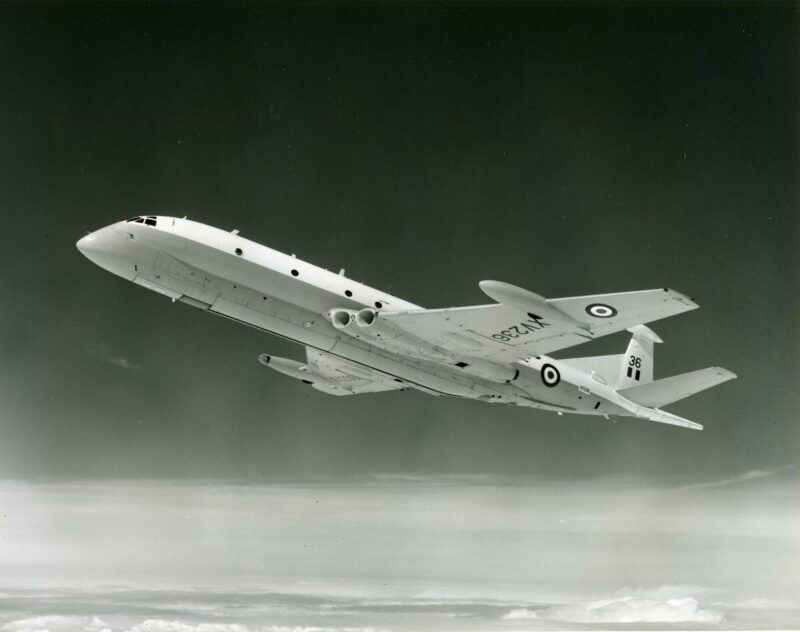
The Hawker Siddeley Nimrod was one of those aircraft that should not have worked as well as it did, at least not on paper.
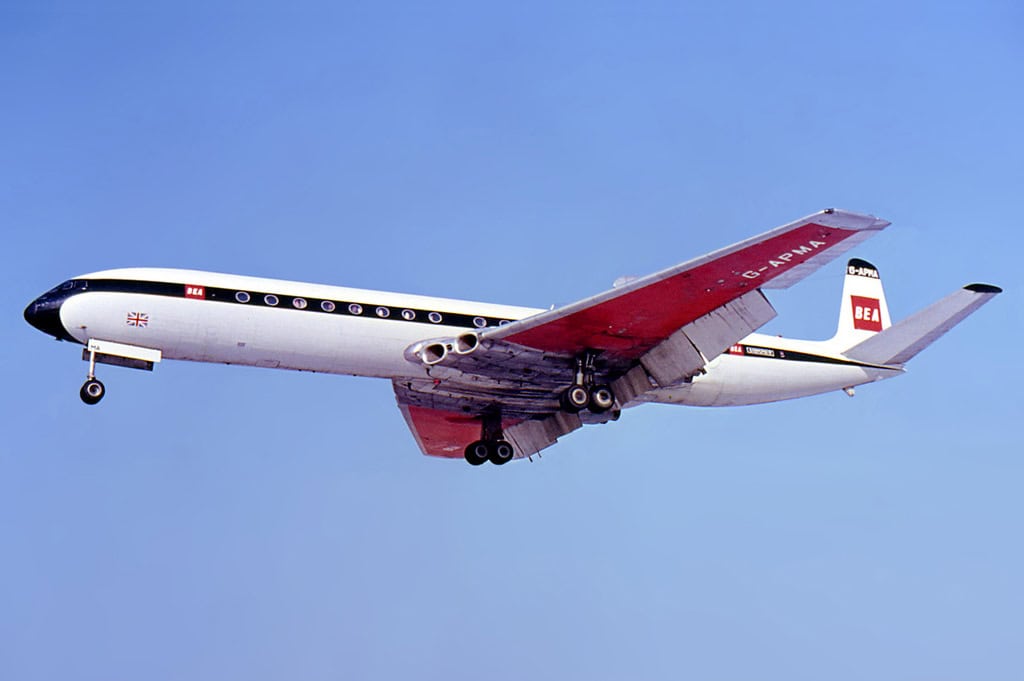
The civilian version of the Hawker Siddeley Nimrod was the Comet 4, seen here in British European Airways (BEA) colors arriving at Berlin Tempelhof Airport in 1969 | IMAGE: By Altair78 (talk) – BEA_De_Havilland_DH-106_Comet_4B_Manteufel.jpg, GFDL 1.2, https://commons.wikimedia.org/w/index.php?curid=17868134
The Nimrod didn’t start out as a purpose-built submarine hunter. Instead, it was a heavily modified version of the de Havilland Comet 4, which was the world’s first operational jet airliner. By the mid-1960s, the Royal Air Force (RAF) needed to replace its aging Avro Shackleton maritime patrol aircraft, which were piston-powered and nearing the end of their service life. On 4 June 1964, the British Government issued Air Staff Requirement 381, beginning the search for a new long-range maritime patrol aircraft.
The government considered several options, including the Lockheed P-3 Orion and the Breguet Atlantic. But on 2 February 1965, they chose Hawker Siddeley’s HS.801, a maritime patrol version of the Comet. It was an unusual decision, but a classic British move: take a jet airliner, make major changes, and turn it into a plane built to hunt submarines across the North Atlantic.
The changes to the Comet were significant. Its original Rolls-Royce Avon turbojets were swapped for more efficient Rolls-Royce Spey turbofans. The fuselage was fitted with an internal weapons bay, a longer nose for radar, electronic support gear in the tail, and a magnetic anomaly detector boom. Two prototype Nimrods, XV148 and XV147, were built from unfinished Comet 4C airframes. The first Nimrod flew on 23 May 1967, and the first production model, XV230, joined the RAF on 2 October 1969.
A Jet-Powered Submarine Hunter
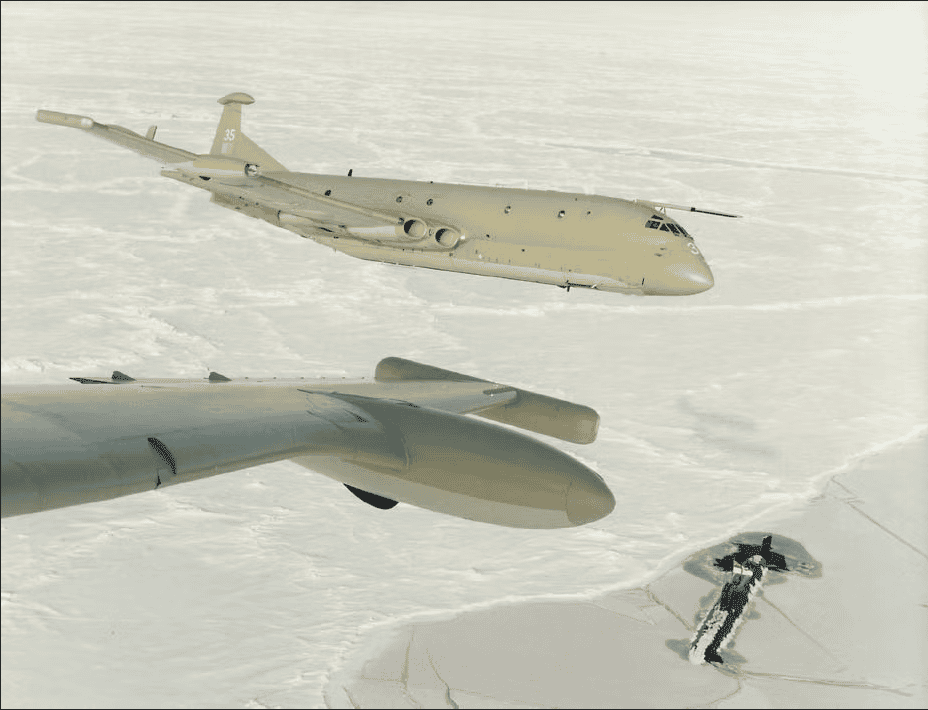
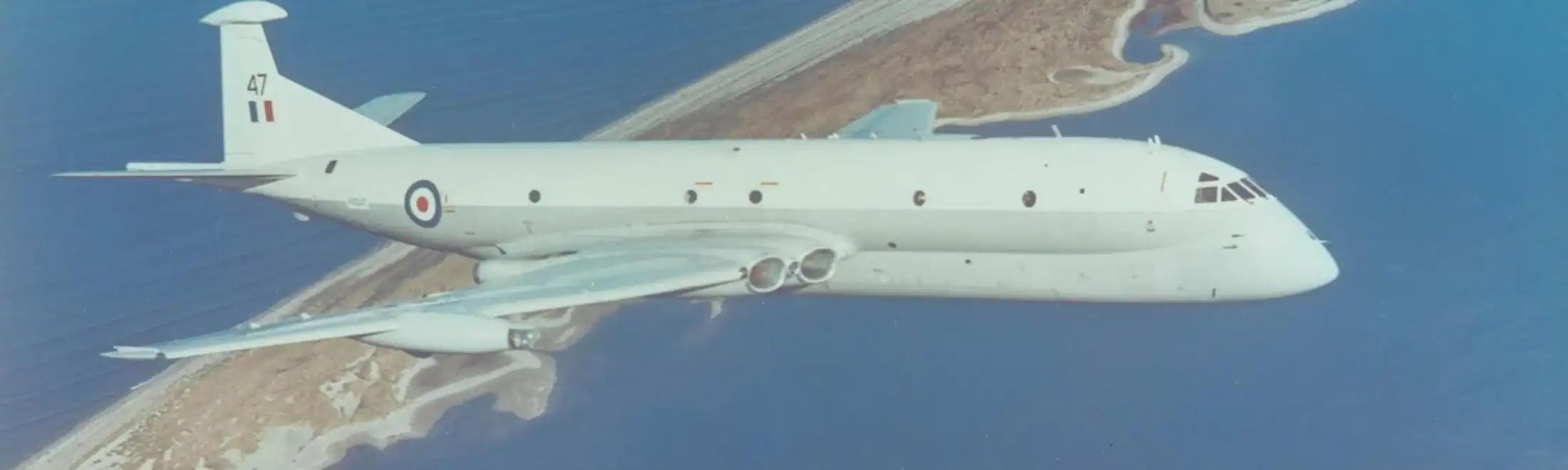
Hawker Siddeley Nimrod MR2 XV235 conducting a mission over the North Pole | IMAGE: Avro Heritage Museum UK
The Nimrod was the first jet-powered maritime patrol aircraft to enter service. Before this, most patrol planes used piston or turboprop engines for their long endurance and efficiency. The Nimrod’s turbofans gave it more speed, higher altitude, and greater range, so crews could reach their patrol areas quickly and cover huge stretches of ocean.
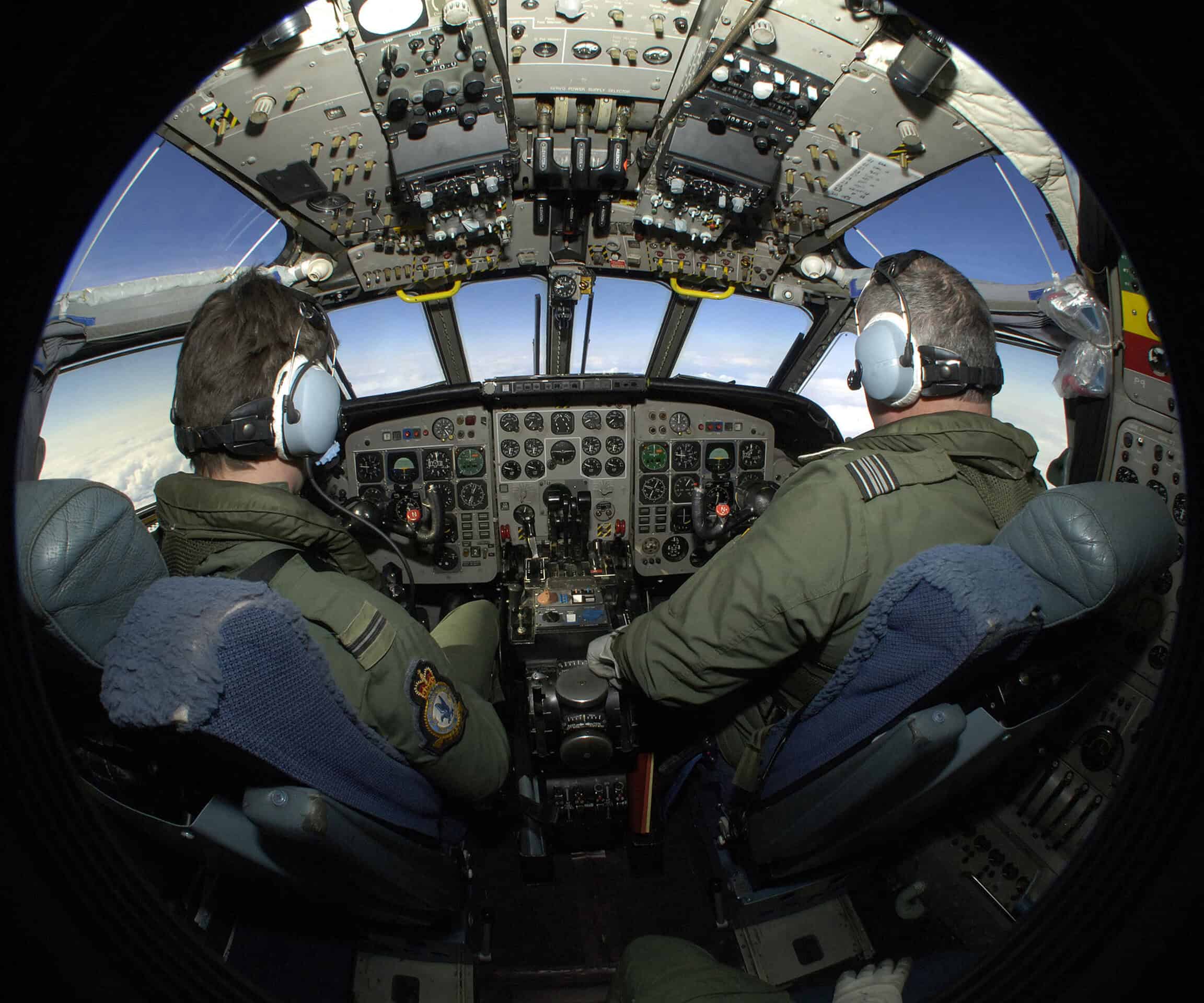
A fisheye view of the cockpit of a Nimrod aircraft during a pilot training sortie. The Nimrod is operated by 201 Squadron Royal Air Force flying from RAF Kinloss in Scotland. | IMAGE: By Photo: SAC Brown RAF/MOD, OGL v1.0, https://commons.wikimedia.org/w/index.php?curid=26896428
Its primary job was anti-submarine warfare, especially during the Cold War, when tracking Soviet submarines in the North Atlantic was a constant and highly sensitive mission. Nimrods operated from RAF Kinloss in Scotland and RAF St Mawgan in Cornwall, keeping watch over the seas north of Iceland and deep into the Western Atlantic. In wartime, the information gathered by Nimrod crews would have been passed to Royal Navy and NATO forces to help track and, if necessary, prosecute submarine contacts.
The MR1 gave the RAF a modern jet platform, but the MR2 became the definitive maritime reconnaissance variant. Beginning in 1975, 35 aircraft were upgraded to the MR2 standard and redelivered starting in August 1979. The upgrade included new electronics, such as EMI Searchwater radar, a new acoustic processor capable of handling more modern sonobuoys, a mission data recorder, and improved electronic support systems.
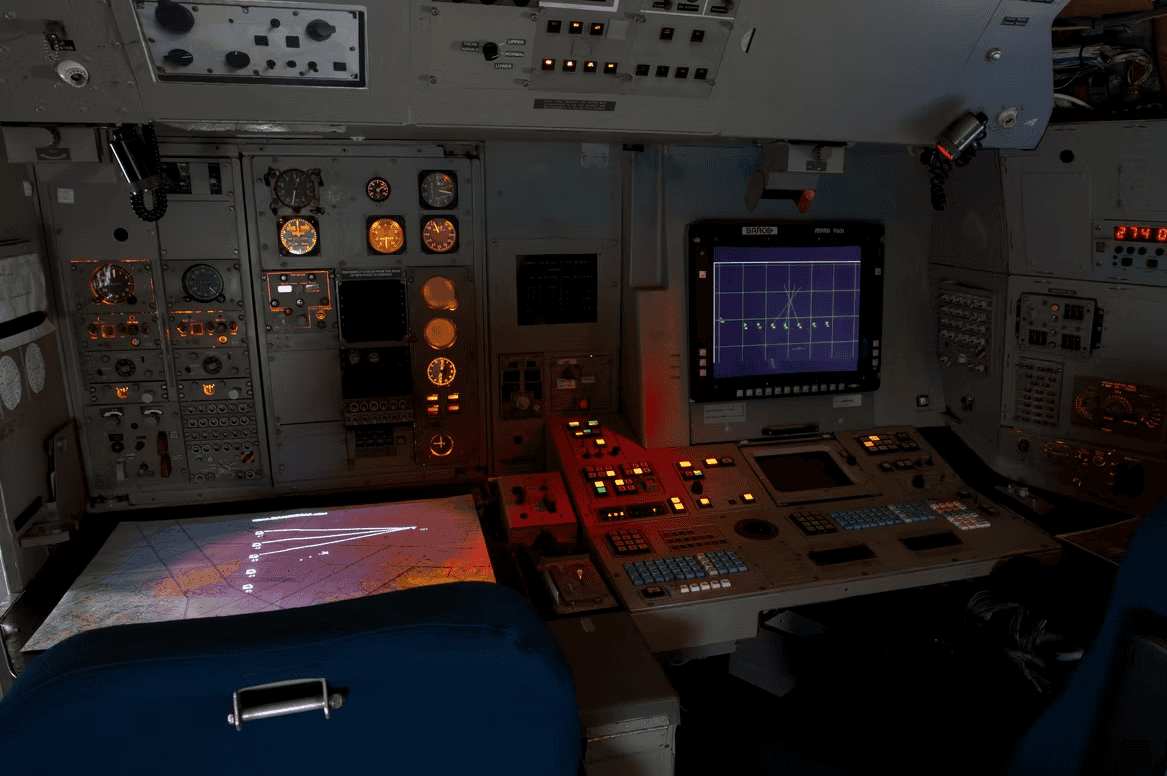
Routine navigator and Tactical Navigator Station on Hawker Siddeley Nimrod MR2 XV235 | IMAGE: Avro Heritage Museum UK/Mike Batty
Inside, the Nimrod served as both a sensor platform and an airborne command post. A typical MR2 crew had about 12 or 13 people, including pilots, a flight engineer, navigators, an Air Electronics Officer, and several weapons systems operators who managed the acoustic and electronic warfare equipment. The plane could carry torpedoes, mines, bombs, Harpoon missiles, Sting Ray torpedoes, sonobuoys, and search-and-rescue gear in its weapons bay. In some configurations, it could hold as many as 150 sonobuoys.
The Nimrod wasn’t glamorous like a fighter jet, but for those who know maritime aviation, it was a serious piece of equipment. It was made for long missions over cold oceans, tracking quiet targets, and crews spending hours watching screens and scopes.
From the Falklands to the Gulf
IMAGE: BAE Systems
The Nimrod’s most dramatic moment came during the Falklands War in 1982. Flying from Wideawake Airfield on Ascension Island, Nimrods carried out 111 missions to support British forces. Their jobs included maritime patrol, search and rescue, relaying communications, escorting other aircraft, and helping with the Vulcan Black Buck raids.
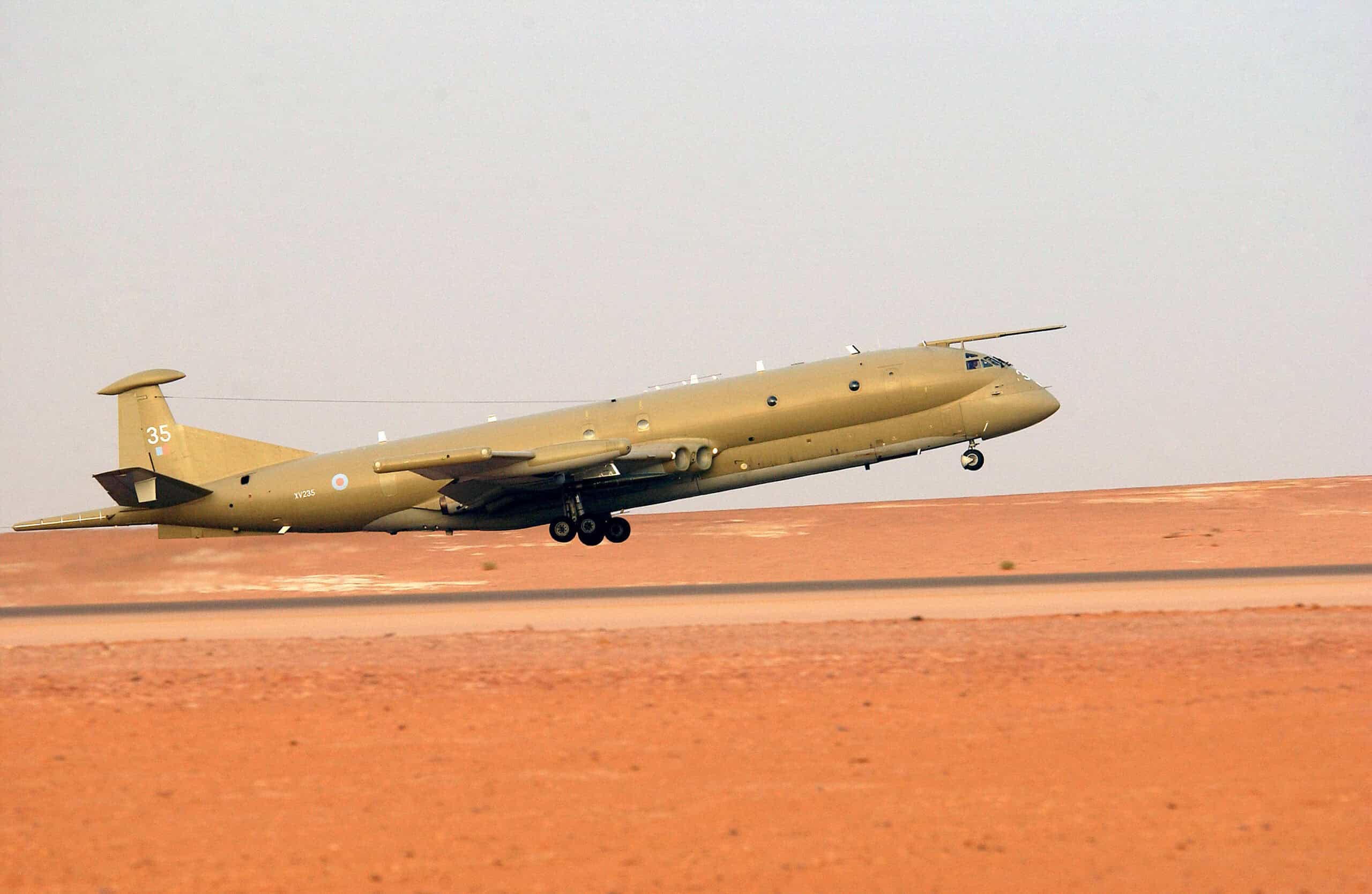
The Falklands War also led to some unusual changes for the Nimrod. MR2s were fitted with air-to-air refueling probes to fly farther and were even armed with AIM-9 Sidewinder missiles for self-defense against Argentine surveillance aircraft. This earned the Nimrod one of its best-known nicknames: the RAF’s biggest fighter.
A Royal Air Force (RAF) Nimrod MR2 Maritime Patrol aircraft takes off for a mission in support of Operation IRAQI FREEDOM in 2003 | IMAGE: Public Domain
These long-range missions were demanding. One patrol lasted 19 hours and 5 minutes, and it came within 60 miles of the Argentine coast. Another flight covered about 8,453 miles, making it the longest flight of the Falklands War.
The Nimrod continued to evolve after the Cold War. During the 1991 Gulf War, MR2s were sent to Oman and flew patrols over the Gulf of Oman and the Persian Gulf. Some planes got better communications, electronic countermeasures, and towed decoys. Later, Nimrods were used over land in places like the Balkans, Iraq, and Afghanistan, where their sensors and long endurance made them valuable for gathering intelligence, far beyond their original maritime mission.
The RAF also operated the Nimrod R1, a variant designed for signals and electronic intelligence, flown by No. 51 Squadron. The R1 was easy to spot because it did not have a MAD boom. It carries special antennas and could have up to 25 SIGINT operators, along with the flight crew. The R1 remained in service until June 2011, outlasting the MR2.
A Difficult Ending
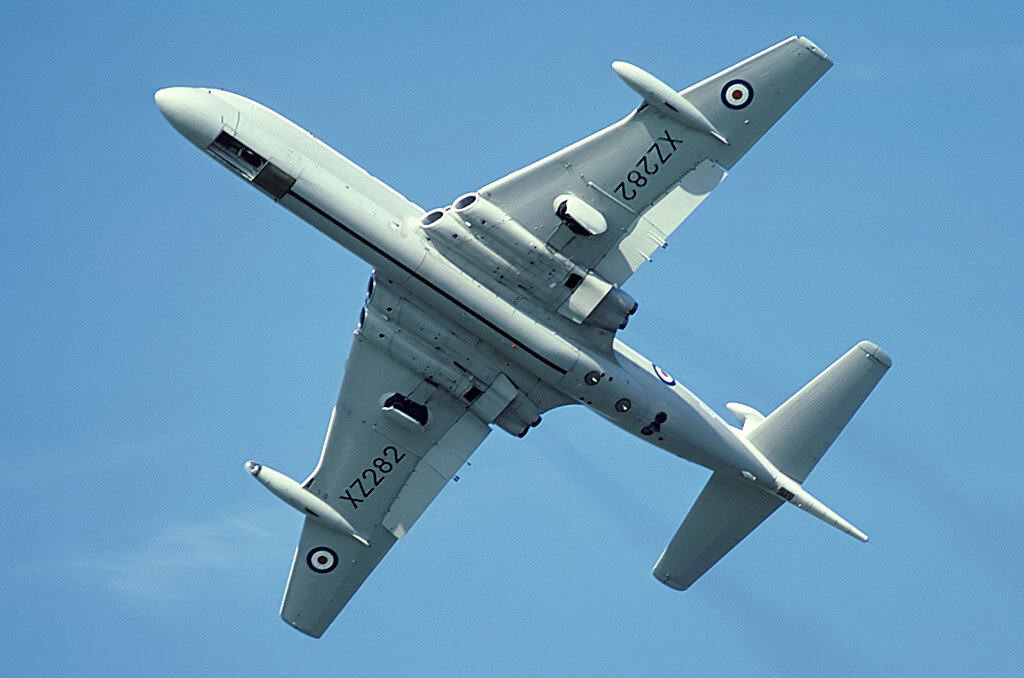
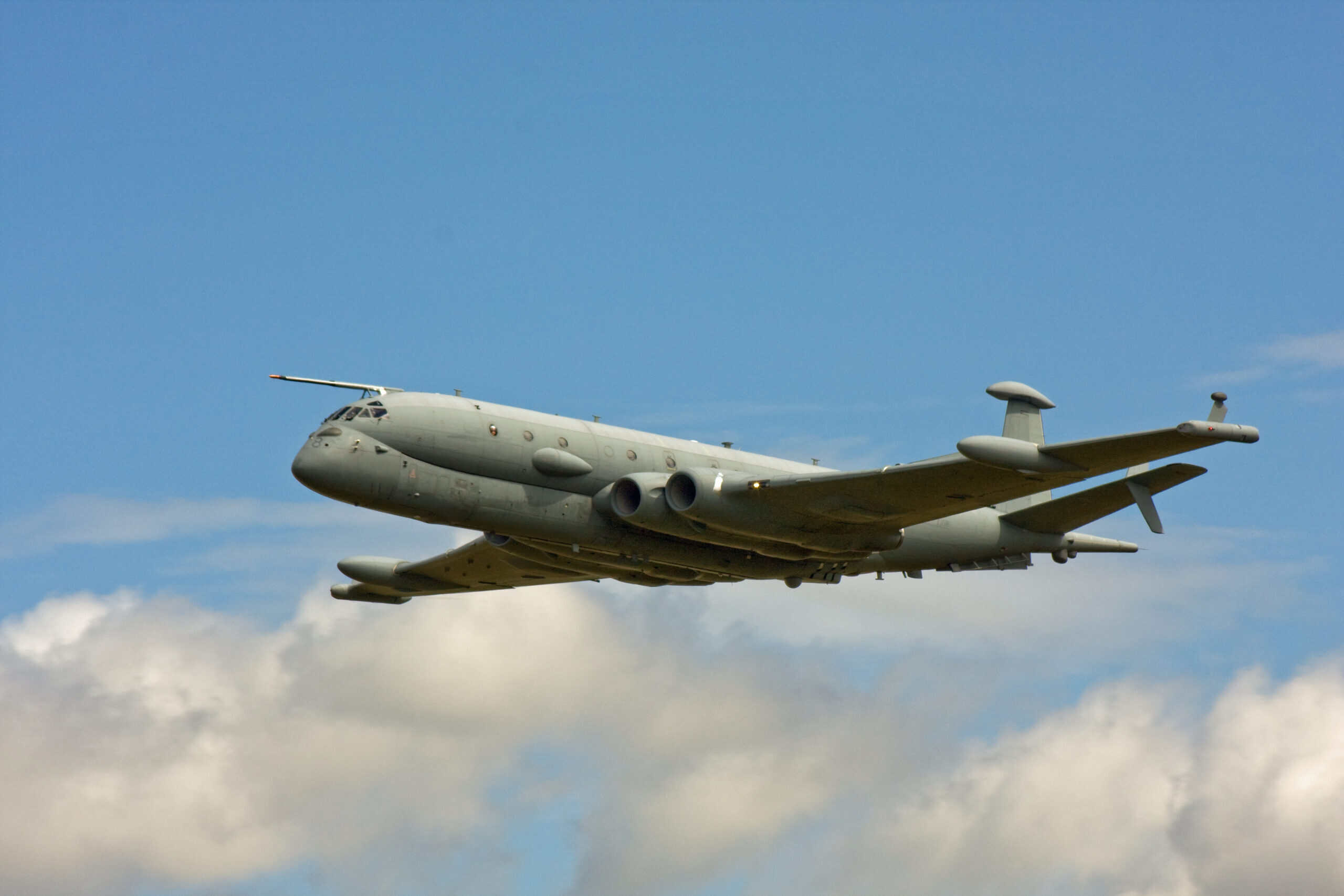
Nimrod MR1 XZ282 inflight (1978) | IMAGE: Mike Freer – Touchdown-aviation (GFDL 1.2 or GFDL 1.2 ), via Wikimedia Commons
Despite all it could do, the Nimrod’s story ended with frustration, loss, and a long gap in capability.
The most tragic moment came on 2 September 2006, when Nimrod MR2 XV230 was lost over Afghanistan after an in-flight fire. All 14 personnel on board were killed. It was the largest single loss of UK military personnel in Afghanistan and cast a long shadow over the type’s final years.
A Hawker Siddeley Nimrod MR4 in flight | IMAGE: By Ronnie Macdonald – Flickr: Nimrod MRA4 1, CC BY 2.0, https://commons.wikimedia.org/w/index.php?curid=14539448
The planned replacement, the Nimrod MRA4, was supposed to bring the aircraft into a new era. In reality, it was more of a complete redesign than just an upgrade. The MRA4 used rebuilt MR2 fuselages, new Rolls-Royce BR710 engines, a bigger wing, modern avionics, and a glass cockpit. But the project faced long delays and went over budget.
The MRA4 first flew in 2004, but it never entered service. In 2010, the project was canceled during the Strategic Defense and Security Review, leaving the UK without a dedicated long-range maritime patrol aircraft until the Boeing P-8 Poseidon arrived.
The MR2 was retired on 31 March 2010, with its last official flight in May that year. The R1 was retired in 2011. By then, a plane that started as the world’s first jetliner had spent over forty years as one of Britain’s key maritime patrol aircraft.
The Nimrod was never sleek in the traditional sense. It looked like an airliner that had been asked to do a submarine hunter’s job and somehow made it work. But that was part of its character. It was strange, capable, deeply British, and quietly essential.
Breeze Airways has plans to more than double its footprint by the end of the decade.
On 3 April 2025, at the CAPA (Centre for Aviation) Airline Leader Summit in Dublin, Ireland, Breeze Airways CEO David Neeleman took the stage as a keynote speaker for a candid conversation with APEX (Airline Passenger Experience Association) Global CEO Dr. Joe Leader. Their conversation explored innovation, strategic shifts, and the reorientation of the airline industry toward traveler priorities. Neeleman’s insights offered a deep look into Breeze’s founding philosophy and its path forward as a five-year-old, Utah-based carrier. Here’s how Neeleman is steering Breeze to connect underserved communities with a modern, passenger-focused approach.
A Mission to Serve the Underserved
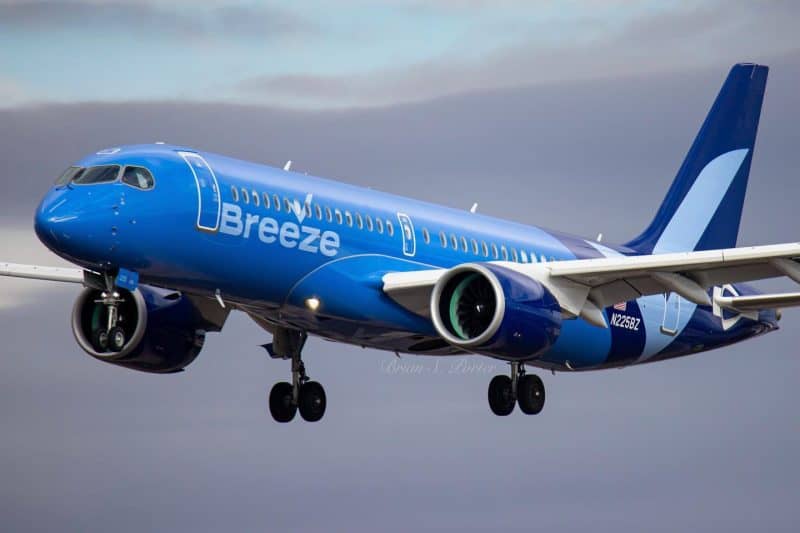
A Breeze Airways Airbus A220-300 receives a water cannon salute at CMH | IMAGE: Breeze Airways
Neeleman, the serial airline founder behind JetBlue, Azul, WestJet, and Morris Air, has built Breeze on lessons learned from his past ventures. He has shaped Breeze Airways to serve travelers in markets others bypass.
“I’ve spent my whole career trying to make flying better for people who don’t live in the biggest cities,” Neeleman said. “Breeze finally lets us connect those dots with nonstop service, great aircraft, and a simple, affordable experience.”
Breeze sets itself apart from legacy and most low-cost carriers (Avelo Airlines’ model is very similar) by targeting unserved and underserved routes.
“From day one, we knew we didn’t want to be just another airline trying to squeeze into the same crowded markets,” Neeleman stressed. “We wanted to go where the need existed, where people had been ignored—cities where the only options involved long drives to bigger airports or hours of connecting flights through hubs.”
Routes like Erie, PA (ERI) to Tampa (TPA), Ogdensburg, NY (OGS) to Washington Dulles (IAD), or Charleston, SC (CHS) to Los Angeles (LAX) exemplify this approach. By focusing on point-to-point flights, Breeze spares passengers the hassle of layovers and packed terminals, bringing convenience to communities long underserved.
The Airbus A220: The Heart of the Breeze Airways Fleet
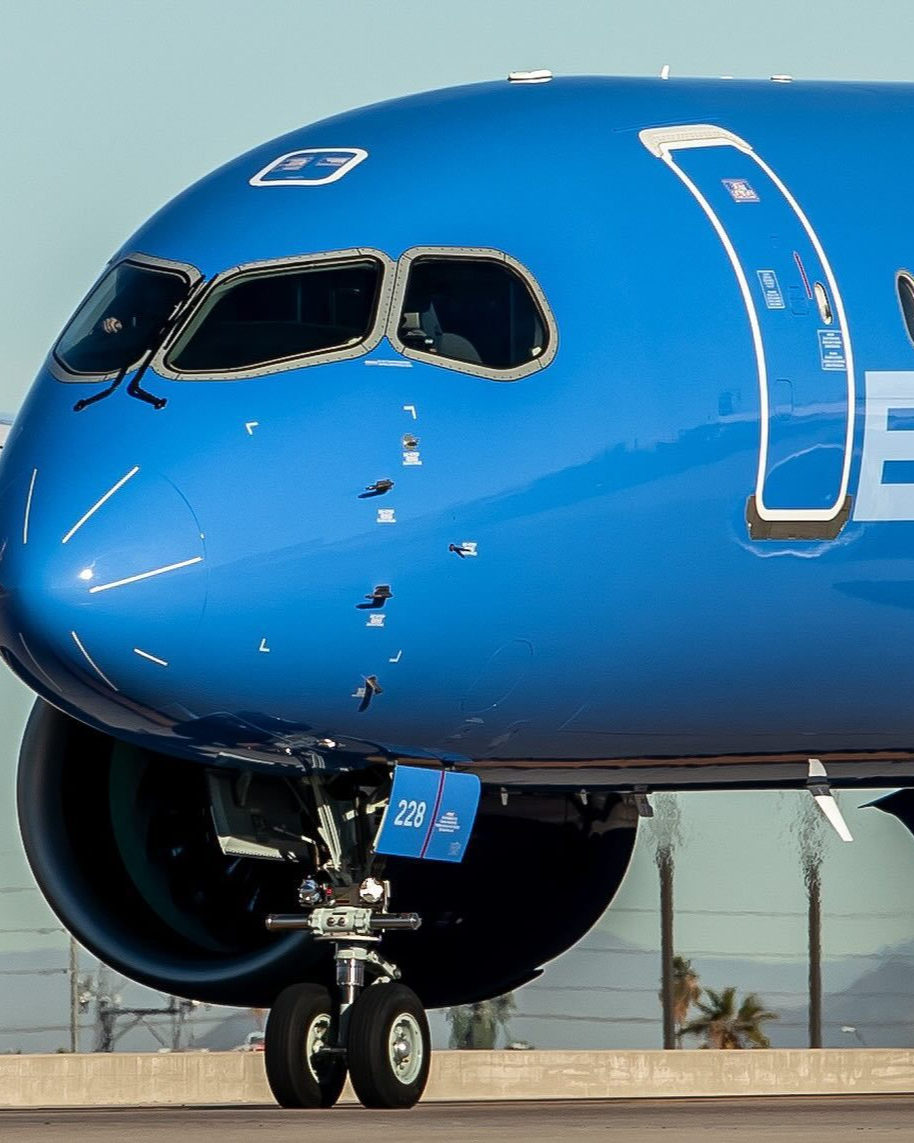
A Breeze Airways A220-300 taxies to the gate at Orlando International Airport (MCO) | IMAGE: Orlando International Airport via Facebook
Central to Breeze’s strategy is its fleet, dominated by the Airbus A220-300. As of May 2026, Breeze operates 66 aircraft, primarily A220-300s, with the Embraer 190s largely transitioned out of scheduled service (retained mainly for charters or backup).
Breeze’s A220-300 fleet features two different layouts. The standard carries 137 passengers in a 2-3 configuration, with 12 premium “Ascent” seats in a 2-2 layout at the front. The more premium-heavy version features 36 Ascent seats and a total capacity of 126 passengers.
Neeleman remains unequivocal about the A220’s role. “The A220 allows us to fly coast-to-coast efficiently with a better onboard experience than any other aircraft in its class,” he said. “It’s quiet, fuel-efficient, and passengers love the cabin layout.”
The Ascent seats reduce capacity by just one seat per row, enabling Breeze to offer a first-class-like product on an ultra-low-cost carrier (ULCC) budget. With dozens more A220s on order and steady deliveries continuing, Neeleman sees endless possibilities.
“Every time we put one into service, we expand the map of where we can fly nonstop,” he noted.
The shift to an all-A220 scheduled fleet has streamlined operations for long-haul routes like transcontinental flights while keeping costs low and comfort high.
Digital Innovation: A Mobile-First Airline
IMAGE: Breeze Airways
Breeze strikes a balance between low fares and a superior experience through its from-scratch design and “mobile-first infrastructure.” As Neeleman put it, “We built the airline around the idea that your phone is your boarding pass, your check-in agent, and your help desk. We didn’t want long lines, printed itineraries, or call center wait times.” The Breeze app is the hub for booking, checking in, managing flights, and accessing support, streamlining every step for passengers. By eliminating call centers and paper-based processes, Breeze empowers its team to prioritize meaningful interactions with travelers.
Smart automation further enhances efficiency. “We use automation to solve what machines can handle, so our people can focus on what matters,” Neeleman explained.
Breeze’s systems proactively spot and resolve issues before they disrupt passengers. Coupled with gate-to-gate Viasat Wi-Fi on its A220s, this digital foundation keeps travelers connected and comfortable. It’s how Breeze delivers a high-end feel at ULCC prices—a defining feature of its approach.
Thoughtful Growth and Employee Ownership
A Breeze Airways Airbus A220-300 | IMAGE: Breeze Airways
Neeleman stressed that Breeze has scaled deliberately to “protect reliability and employee morale.” He described the airline’s growth as “thoughtful,” fostering a culture where employees feel like owners. “That sense of ownership makes a huge difference,” he said. By keeping operations lean and proactive, Breeze aims to resolve issues before they escalate, maintaining both passenger satisfaction and staff morale.
Looking ahead, Neeleman envisions Breeze serving 150 cities by 2030, sticking to its steady, measured approach. “There are still so many places in the US that don’t have nonstop service—and that’s just the beginning,” he said.
Breeze has since expanded internationally, launching service to destinations in Mexico (e.g., Cancún), the Caribbean (including Punta Cana and Montego Bay), the Bahamas (Nassau), and Costa Rica (San José), among others. The interline partnership with Azul Brazilian Airlines continues to connect Breeze’s domestic routes with Azul’s Brazilian network, making travel to secondary cities in both countries easier. “It’s a natural fit,” Neeleman said. “We’re connecting the dots between two airlines that share the same DNA—great service, great people, and nonstop routes where others don’t fly.”
More of the Same, Done Better
David Neeleman, founder of Breeze Airways | IMAGE: Breeze Airways
When Leader asked what Breeze would look like by 2030, Neeleman’s answer was simple: more of the same, done better. Breeze will expand its US network, using the Airbus A220 to serve more underserved markets with unmet demand. International growth is now underway and accelerating, but the core focus remains on removing travel hassles for passengers.
“We’ve built Breeze to remove the hassles, reduce the connections, and let people fly the way they’ve always wanted to,” Neeleman concluded. “That mission won’t change—it will only grow.”
In an era when the phrase “budget airline” can feel a bit…questionable…Breeze’s journey showcases strategic innovation at its best.
Innovation doesn’t always mean flashy new tech or crowded hubs. In Breeze’s case, it’s simply about connecting the dots where others haven’t looked and treating guests like humans, not numbers.
EDITOR’S NOTE: This story was originally published on 14 April 2025, and was updated in May 2026 with the most recent fleet, route, and network information.
There are aviation bucket list items, and then there is Maho Beach.
For decades, this tiny stretch of sand beside Runway 10 at Princess Juliana International Airport (SXM) has become almost mythical among aviation enthusiasts. The idea of standing beneath arriving aircraft while Caribbean waves roll onto the beach sounds almost too ridiculous to be real until you actually experience it yourself.
And now, after wanting to visit for years, I finally did.
I arrived in Sint Maarten, a small eastern Caribbean island that is half Dutch and half French, by cruise ship on a Thursday, with our ship docked from 0800 to 1630. That gave us plenty of time to explore the island, grab lunch, and spend a good chunk of the afternoon at Maho Beach.
We were also lucky. We were the only cruise ship in port that day, which helped keep the island from feeling completely overrun. Word on the street is that 6-7 ships can be in port at any given time, and I don’t think I ever want to experience that.
Still, Maho Beach is Maho Beach. Even on a quieter day, it is part beach, part aviation circus, part bucket-list spectacle, and part reminder that the internet tends to make everything look a little more glamorous than it really is.
And yet, if you love airplanes, you absolutely must go.
Flexibility is Worth It!
Maho Beach from above | IMAGE: SXM Airport
There are a lot of ways to get to Maho Beach.
You can book a cruise line excursion, take a shared island tour, hire a private tour operator, grab a taxi, or rent your own car for the day. Each option has pros and cons, but for my family, we decided to book a private tour through Bernard’s Tours.
I promise this is not an ad. Nobody is paying me to say this. But when, not if, I return to Sint Maarten, I will 100% use Bernard’s again.
I was genuinely impressed.
Bernard’s offers several different types of excursions, including shared island tours, private tours, and packages specifically built around Maho Beach planespotting. In our case, we booked a private tour that gave us the freedom to go where we wanted, when we wanted.
That flexibility was huge.
If you want to grab lunch in Marigot, the capital of the French side of the island, then head to Maho Beach on the Dutch side of the island for the afternoon – you can. Pro Tip: Definitely try the French pastries and treats at Chez Fernand la French Bakery inMarigot. If you want to stay longer because something interesting is inbound, you can. If you want to skip something because your kid is tired or the beach is calling, you can do that, too.
For cruise passengers, especially, that flexibility is worth a lot.
Know the Flight Schedule Before You Go
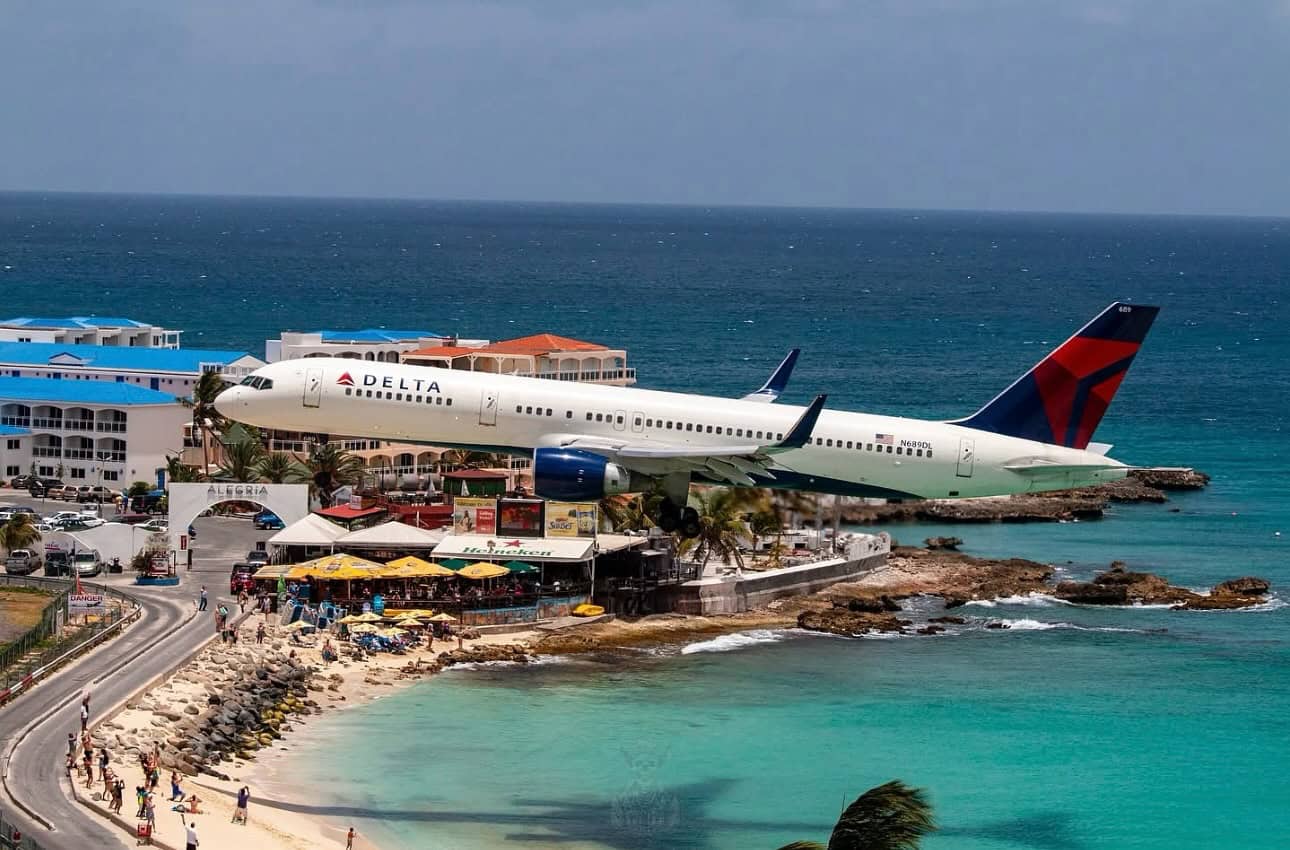
A Delta Airlines Boeing 757 passes over Maho Beach before touching down on SXM’s Runway 10 | IMAGE: SXM Airport
If you are going to Maho Beach specifically for airplanes, do not just show up and hope for the best.
Do your homework.
I did not have internet access while I was there because I am cheap and did not want to pay for an international data plan. That meant I could not rely on flight tracking apps in real time. Fortunately, I had already researched the SXM schedule before leaving home, especially the larger aircraft arrivals.
At the time of this writing in mid-May 2026, the larger aircraft serving SXM are concentrated in the early afternoon, which is actually very convenient for cruise passengers.
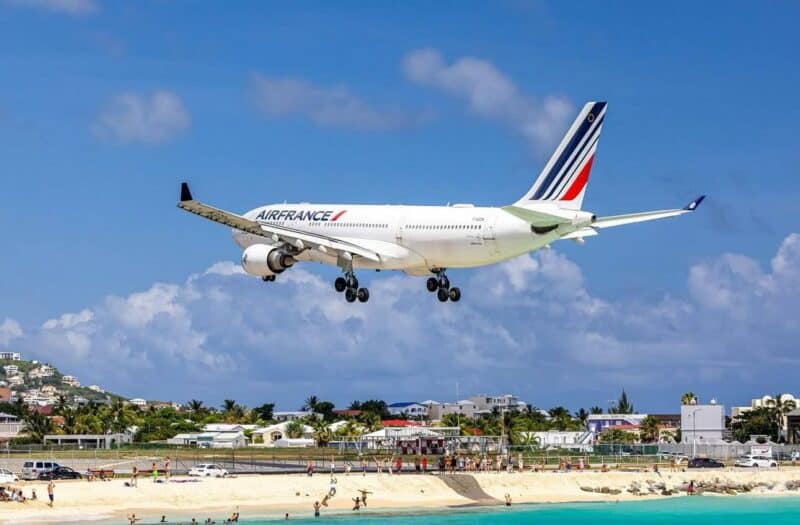
Air France operates five weekly flights from Paris Charles de Gaulle Airport (CDG) on Sunday, Monday, Tuesday, Thursday, and Saturday. Flight 498 is scheduled to arrive at 1325 local time, with the outbound Flight 499 departing at 1530. The aircraft is an Airbus A330-200.
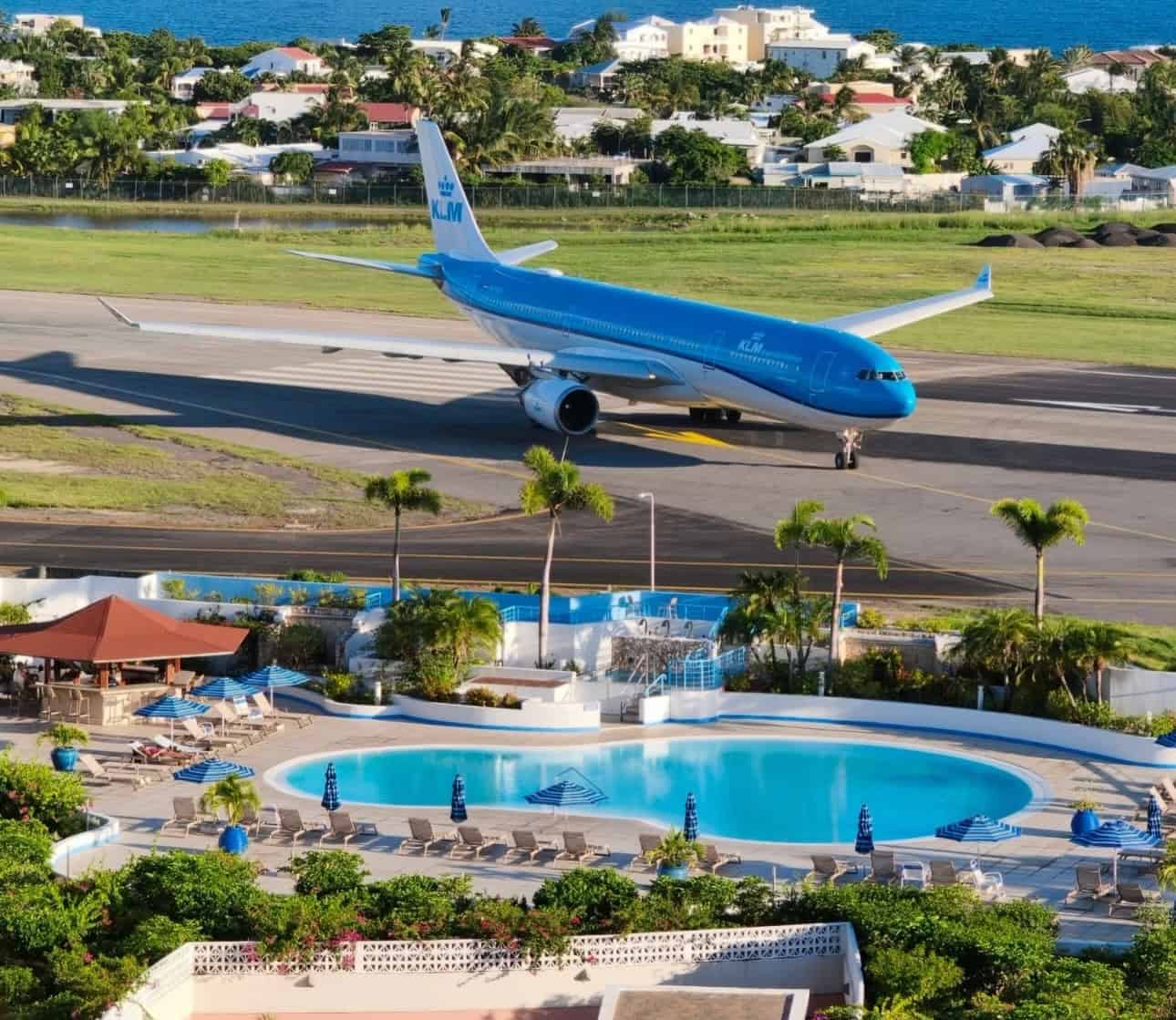
KLM Airbus A330 at SXM | IMAGE: SXM Airport
KLM also operates five weekly flights from Amsterdam Schiphol (AMS) on Sunday, Tuesday, Wednesday, Friday, and Saturday. The Sunday, Tuesday, and Friday flights use the Airbus A330-200, while the Wednesday and Saturday flights use the Boeing 787-9 Dreamliner. Flight 777, operated by the A330, is scheduled to arrive at 1300 and depart at 1420. Flight 789, operated by the 787-9, is scheduled to arrive at 1240 and depart at 1410.
One interesting detail is that KLM’s inbound flights are direct from Amsterdam, but the outbound flights make an intermediate stop before continuing on to AMS. Flight 777 stops at Port of Spain, Trinidad, while Flight 789 continues to Georgetown, Guyana.
Delta Air Lines also brings in some larger narrowbody action. The daily Atlanta flight arrives from Hartsfield-Jackson Atlanta International Airport (ATL) at 1345 using the Boeing 757. Delta’s JFK service arrives at 1357 on Saturdays from May through September, and daily during the rest of the year. Departure times are 1520 for the Atlanta flight and 1535 for the JFK flight.
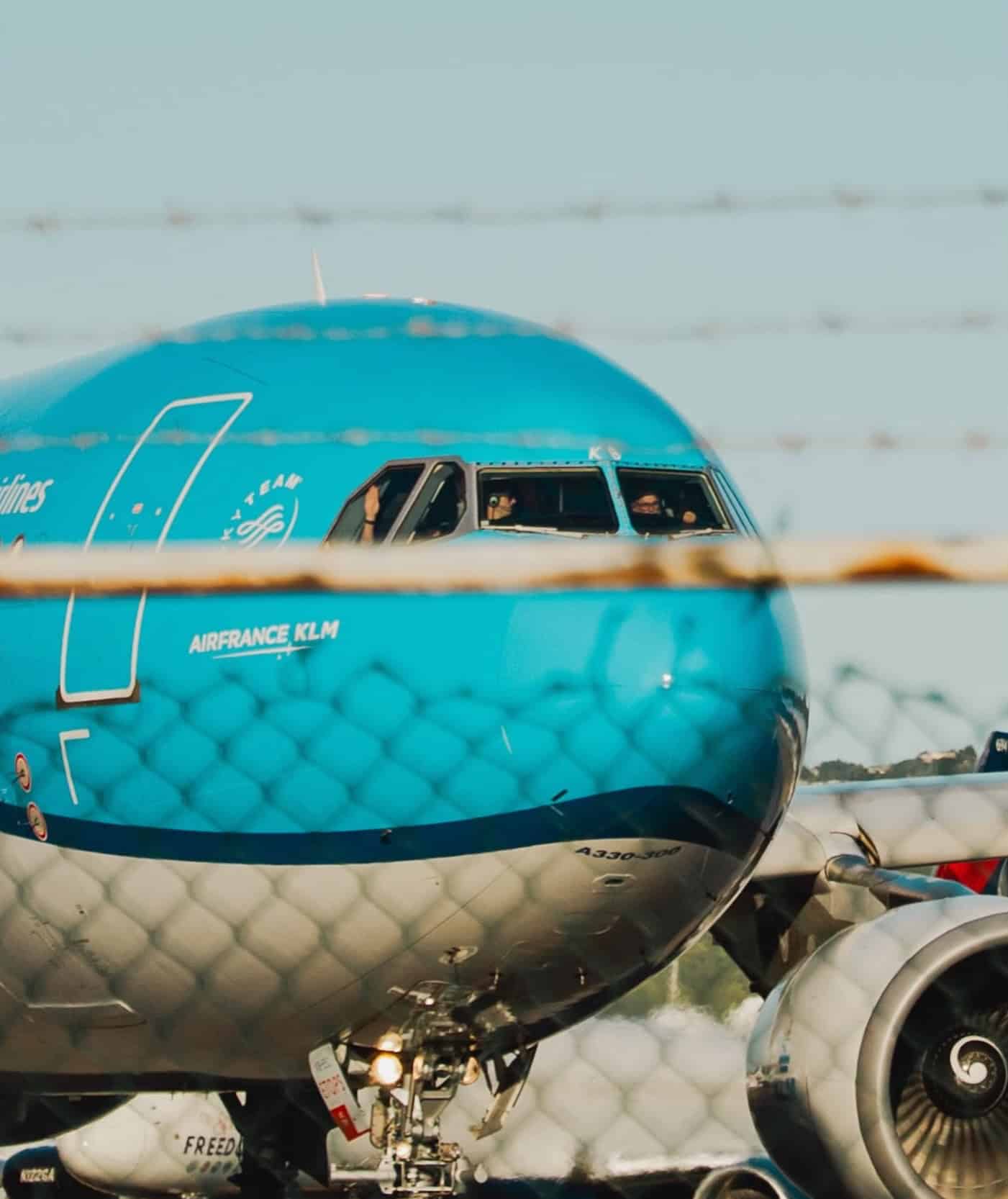
Up close and personal with a KLM A330 at Maho Beach | IMAGE: SXM Airport
So, if you want to see the larger birds, early afternoon is your friend.
That also works well for cruisers, as the drive from Maho Beach back to the cruise terminals can take 45 to 60 minutes, depending on traffic, and many cruise ships depart Sint Maarten between 1600 and 1700.
In other words, you can catch the good stuff and still make it back to the ship, as long as you are not reckless with your timing.
A quick note about Sint Maarten’s time zone: The island operates on Atlantic Standard Time (AST) year-round and does not observe Daylight Saving Time. That means during the summer months it shares the same time as the US East Coast, but during the winter it is one hour ahead.
Use the Sunset Bar Screens If You Do Not Have Data
A KLM Airbus A330 passes over Maho Beach before landing at SXM. View from Sunset Bar | IMAGE: Sunset Bar and Grill
The open-air Sunset Bar and Grill has TV screens showing arrivals and departures at SXM.
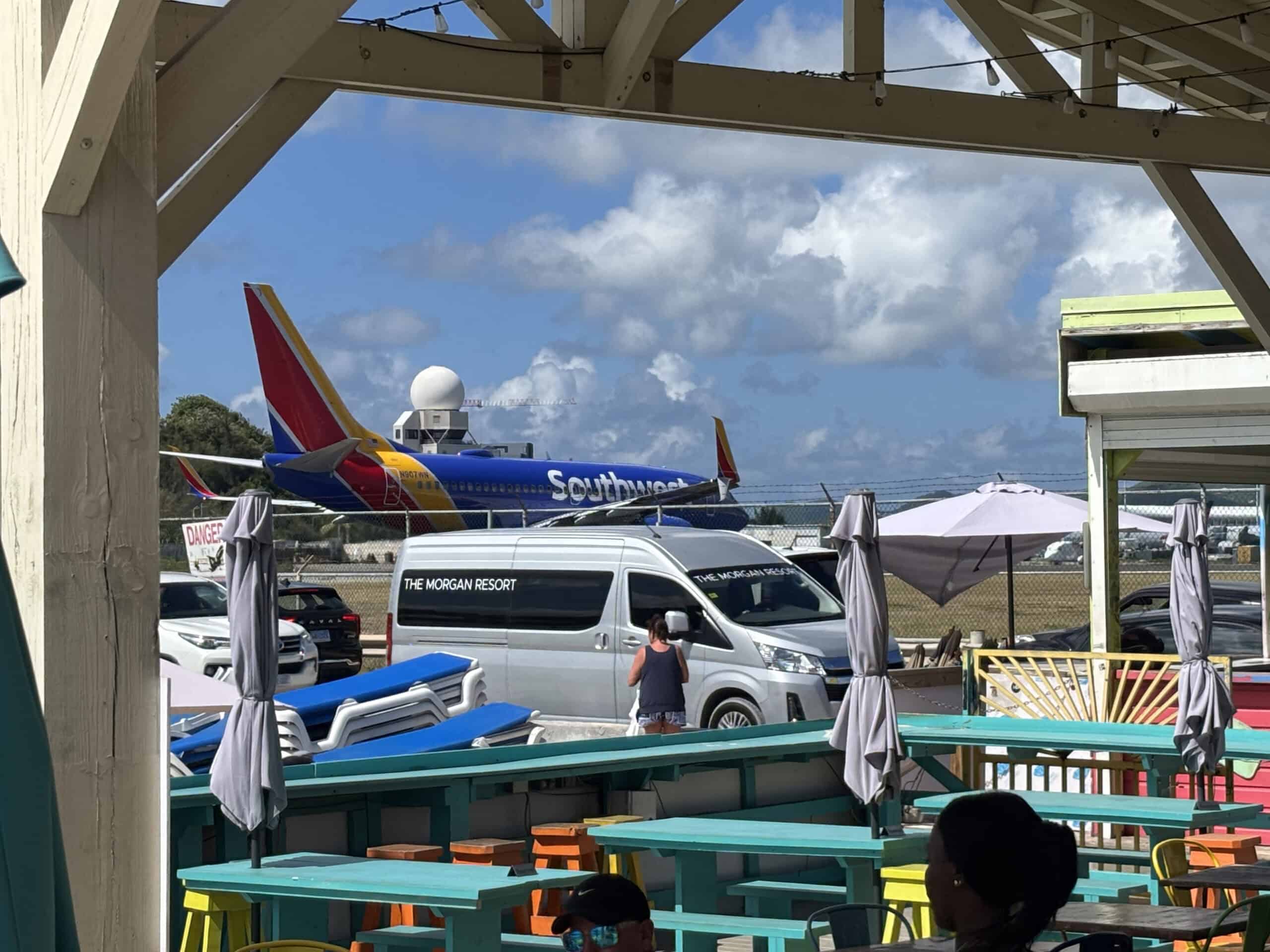
A Southwest 737 lines up for a Runway 10 departure from SXM. This photo shows the proximity of the Sunset Bar and Grill to the runway | IMAGE: Dave Hartland
This was extremely helpful for me since I was operating without mobile data. Instead of constantly guessing what was coming next, I could check the screens, watch the flow of arrivals and departures, and plan whether to stay in the water, move to the fence line, or grab a drink.
Would flight tracking apps have been nice? Absolutely.
Did I survive without them? Also yes.
Still, if you are serious about catching specific arrivals, research the schedule before you go. Flight tracking apps are great, but schedules, even imperfect ones, give you a solid game plan before you ever step onto the beach.
Bring a Change of Clothes
An Air France Airbus A330 from CDG passes over Maho Beach | IMAGE: SXM Airport
We toured the island in regular clothes, but we also wanted to swim at Maho Beach while planespotting.
Because honestly, how often do you get to float in warm Caribbean water while airliners pass over your head on short final?
If you want to do the same, bring a change of clothes.
One thing to know: Sunset Bar charges $1 to use the restroom, whether you are changing or using it for other reasons. The good news is that they give you a $1 voucher toward your bill at Sunset Bar, so it is not quite as annoying as it sounds.
And let’s be honest, you are probably going to buy something there anyway. I did. And $1 is $1, after all (remember how I said earlier that I was cheap?)
A WestJet Boeing 737 from Toronto Pearson Airport (YYZ) passes over Maho Beach | IMAGE: Dave Hartland
Understand What Maho Is Today
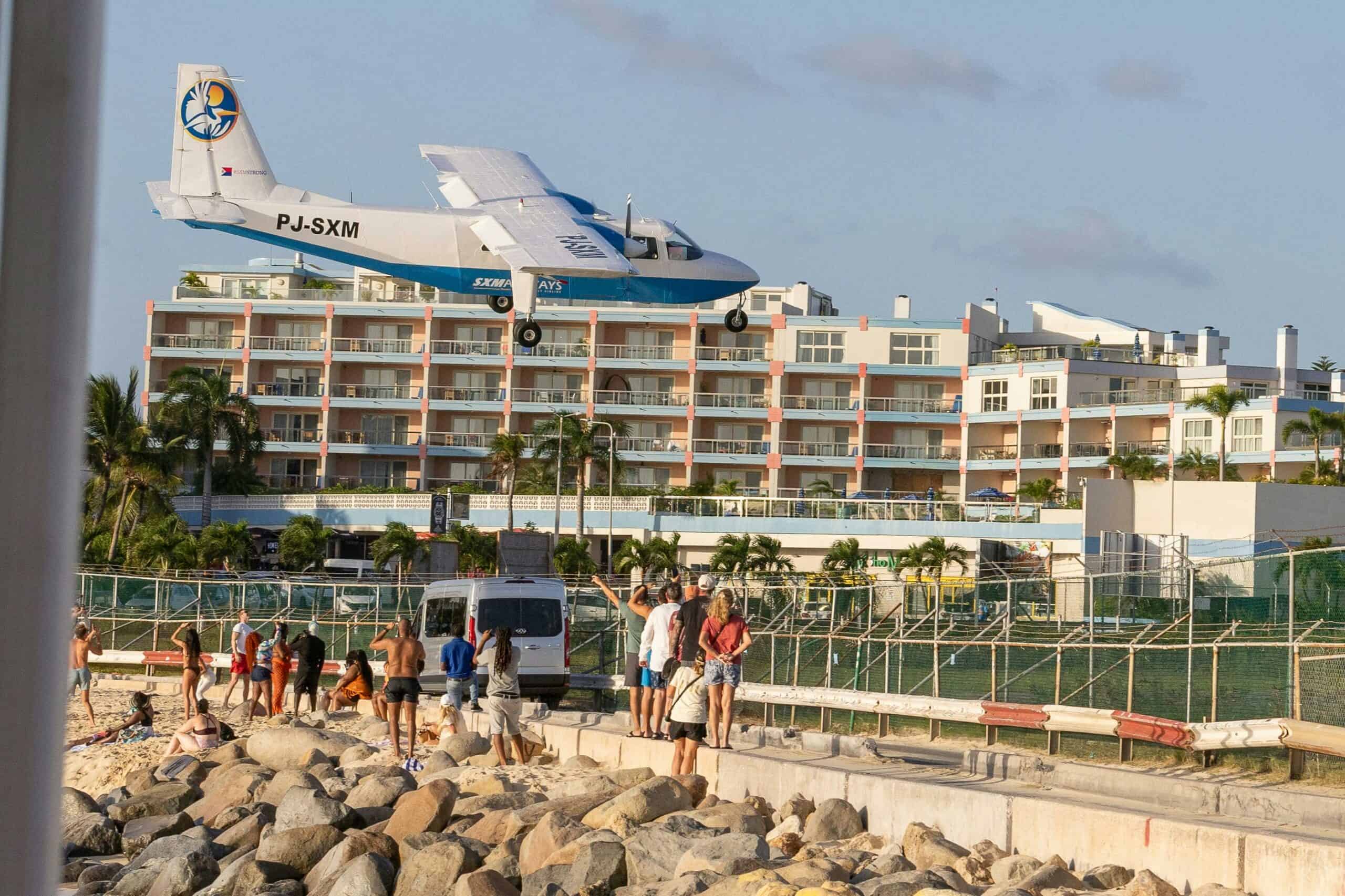
SXM Airways Britten-Norman BN-2B-26 Islander landing at SXM | IMAGE: Photo by Jermaine Lewis/pexels.com
Here is where I want to be very honest.
I am so glad I went. As a lifelong avgeek, Maho Beach was a bucket list experience I had wanted to check off for years. Finally standing there, watching aircraft drop over the beach at SXM, was genuinely special. Getting to share that moment with my 8-year-old son made it even better.
But I also think the experience has been romanticized, especially in recent years, as social media and influencer culture have made Maho look like some flawless aviation fantasyland.
It is not.
It is hot. It is crowded. The beach is smaller than many people expect. The road is busy. The bar is touristy. People are everywhere with phones in the air. And depending on the day, you may spend a lot more time watching ATRs, A320s, 737s, Twin Otters, and bizjets than widebodies.
That is not a bad thing. In fact, the variety is part of the fun. I saw airlines land that I didn’t even know existed.
But if you are expecting the glory days of KLM 747s and Air France jumbos roaring over the beach, that era is gone.
The days of seeing quadjets at SXM are, sadly, most likely gone forever | IMAGE: SXM Airport
Today, the biggest scheduled aircraft you are likely to see are the Air France A330-200, KLM A330-200, the occasional KLM 787-9 Dreamliner, and Delta’s 757s. Large cargo aircraft can appear, but I did not have the privilege of seeing any during my visit.
And while an A330 or 787 is certainly not small, standing at the fence line during departure just does not hit the same way it did when four-engine heavies were common.
The quadjets of yesteryear helped build the legend. Today’s Maho is still awesome, but it is different.
The Jet Blast Is Not A Joke
My son and I are somewhere in the middle of that jet blast-induced sandstorm. And yes, the sand REALLY hurts. | IMAGE: Dave Hartland
One word of warning: the sand hurts.
A lot.
After several departures, both my son and I felt like we had been blasted with thousands of tiny nails traveling at Mach 4.
No lies detected
Which, honestly, makes complete sense when you remember that sand is basically microscopic shards of glass.
The videos make it look hilarious. And yes, it kind of is. But when you are actually standing there, and the blast hits, it very quickly stops feeling like a cute little aviation-themed breeze.
Use your head.
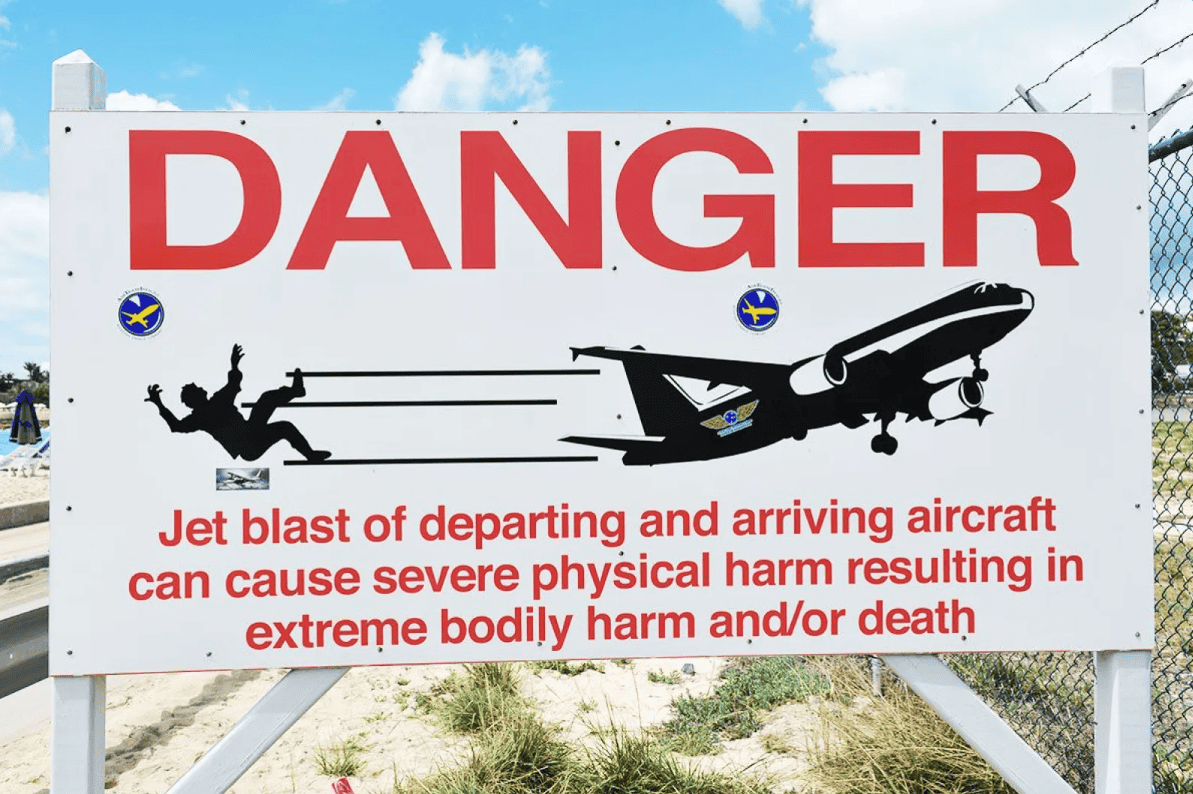
The jet blast warnings are not decoration. People have been injured — and worse — at Maho Beach, and while the whole fence-line experience is part of the lore, there is a big difference between enjoying the power of aviation and volunteering to become a human tumbleweed.
I mean, just on the day we were there, we saw multiple shoes, bags, hats, and other items blown into the ocean.
Watch. Laugh. Take photos. But respect the engines.
Do Not Forget To Just Enjoy It
IMAGE: SXM Airport
This may sound strange, but one of my biggest tips is to not spend the entire time trying to document the experience.
Yes, take photos. Yes, shoot video. Yes, get the shot of the aircraft coming in low over the beach.
But also put the phone down for a few minutes.
Listen to the spool-up. Watch the approach lights. Feel the entire beach turn toward the same aircraft at the same time. Look around at the mix of hardcore aviation nerds, curious tourists, kids, pilots, cruise passengers, and first-timers all reacting to the same absurdly wonderful thing.
That is the magic of Maho.
It is not just that the airplanes are low. It is that everyone there knows something unusual is happening.
For a few seconds, an airport approach becomes a public event.
So…is Maho Beach Worth It?
A Delta Air Lines Boeing 757 passing over visitors at Maho Beach | IMAGE: Sunset Bar & Grill
Absolutely.
Without question.
As a lifelong avgeek, visiting Maho Beach was a bucket list experience I had dreamed about for years. And finally standing there, hearing the roar of arriving aircraft over the beach, smelling jet fuel mixing with salty Caribbean air, and watching airplanes descend impossibly low over the water was genuinely special.
But it is also okay to acknowledge reality.
Maho Beach in 2026 is not perfect.
It is not as glamorous as it looks online. It is not the same place it was during the 747 era. It is hot, crowded, commercialized, and shaped by social media more than many avgeeks probably want to admit.
But it is still Maho Beach.
And if you find yourself on Sint Maarten, whether you love airplanes or not, it is something you have to experience at least once. For avgeeks, it’s basically a rite of passage.
And even now, after the social media hype, after the influencers, after the endless TikTok clips and dramatic YouTube thumbnails, a jet’s arrival still makes people stop what they are doing. The departures still rattle the beach. The engines still send sand flying. The crowd still cheers when something big rolls in. And for a few seconds at a time, the whole place feels like it belongs to the airplane overhead.
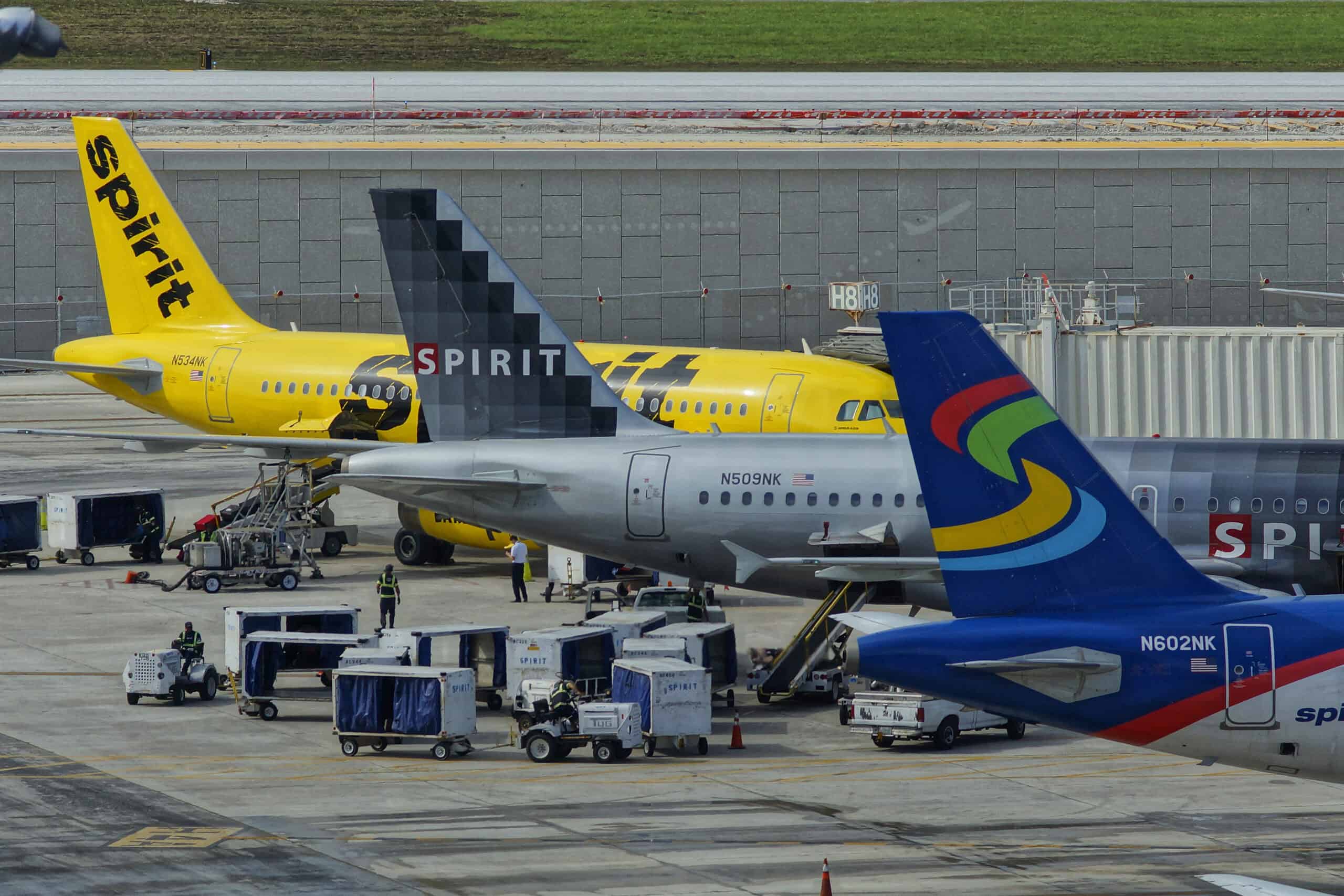
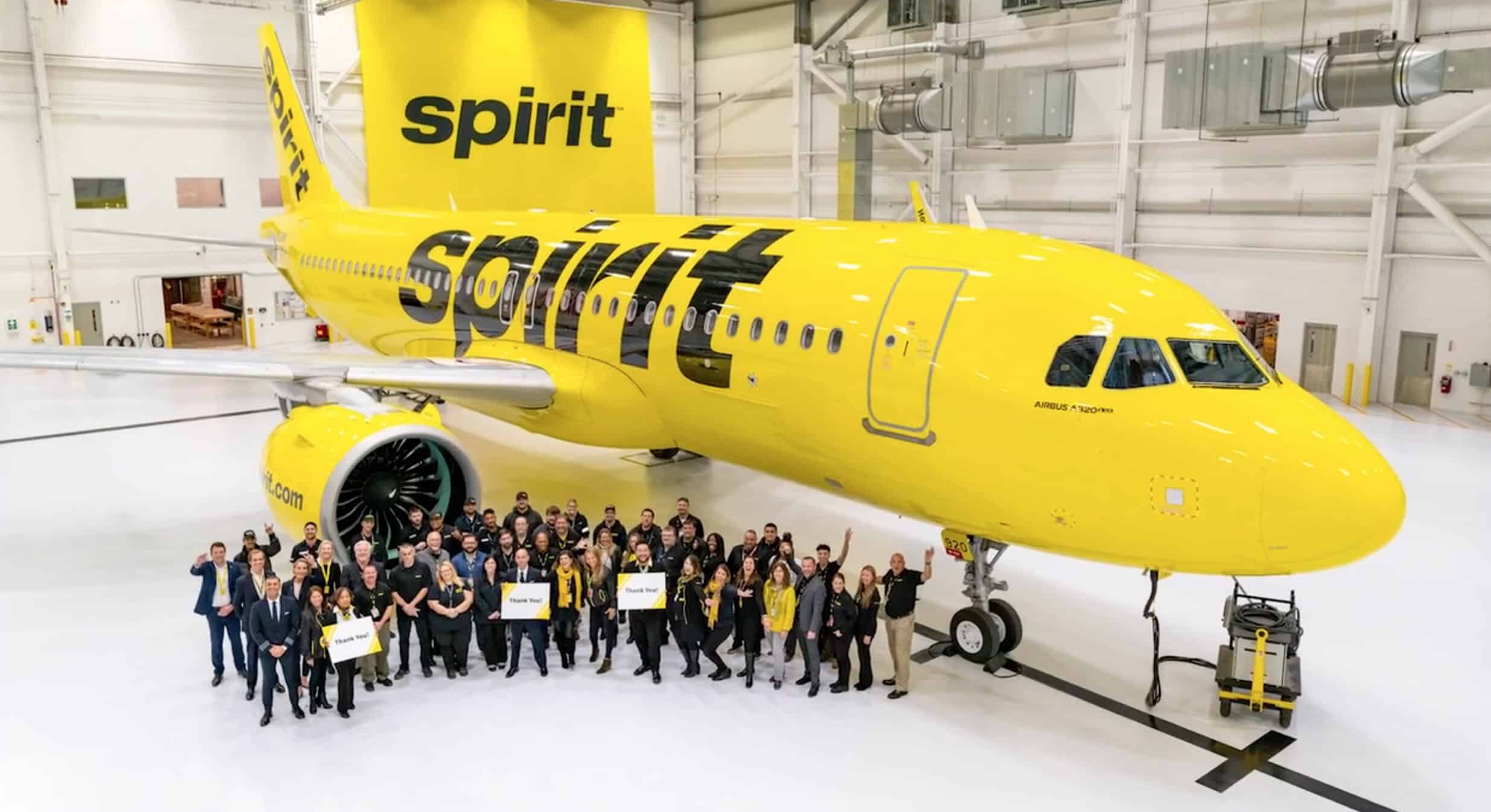
Spirit Airlines planes repo’d after its collapse became more than an aircraft recovery operation. It became a final goodbye to the yellow jets and the people who loved them.
When an airline shuts down, the airplanes do not simply vanish.
They sit at gates, cargo ramps, outstations, and maintenance areas, still wearing the colors of the company that once flew them. The seats are still installed. The galley carts may still be stocked. The logbooks still matter. The banks and leasing companies still own assets that need to be protected, moved, inspected, and eventually placed somewhere safe.
That is where the so-called “repo men” come in.
In a new video from Nomadic Aviation (we have included the link to the video at the end of this story), the company takes viewers behind the scenes of the effort to move former Spirit Airlines aircraft into storage after the airline ceased operations on 2 May 2026. The term “repo men” is technically close enough, as the narrator admits, but the video makes clear that the reality is far more complicated, and far more human, than that nickname suggests.
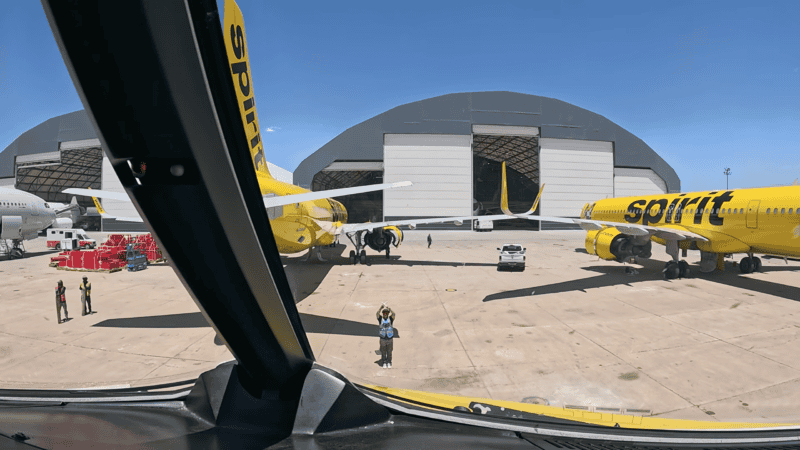
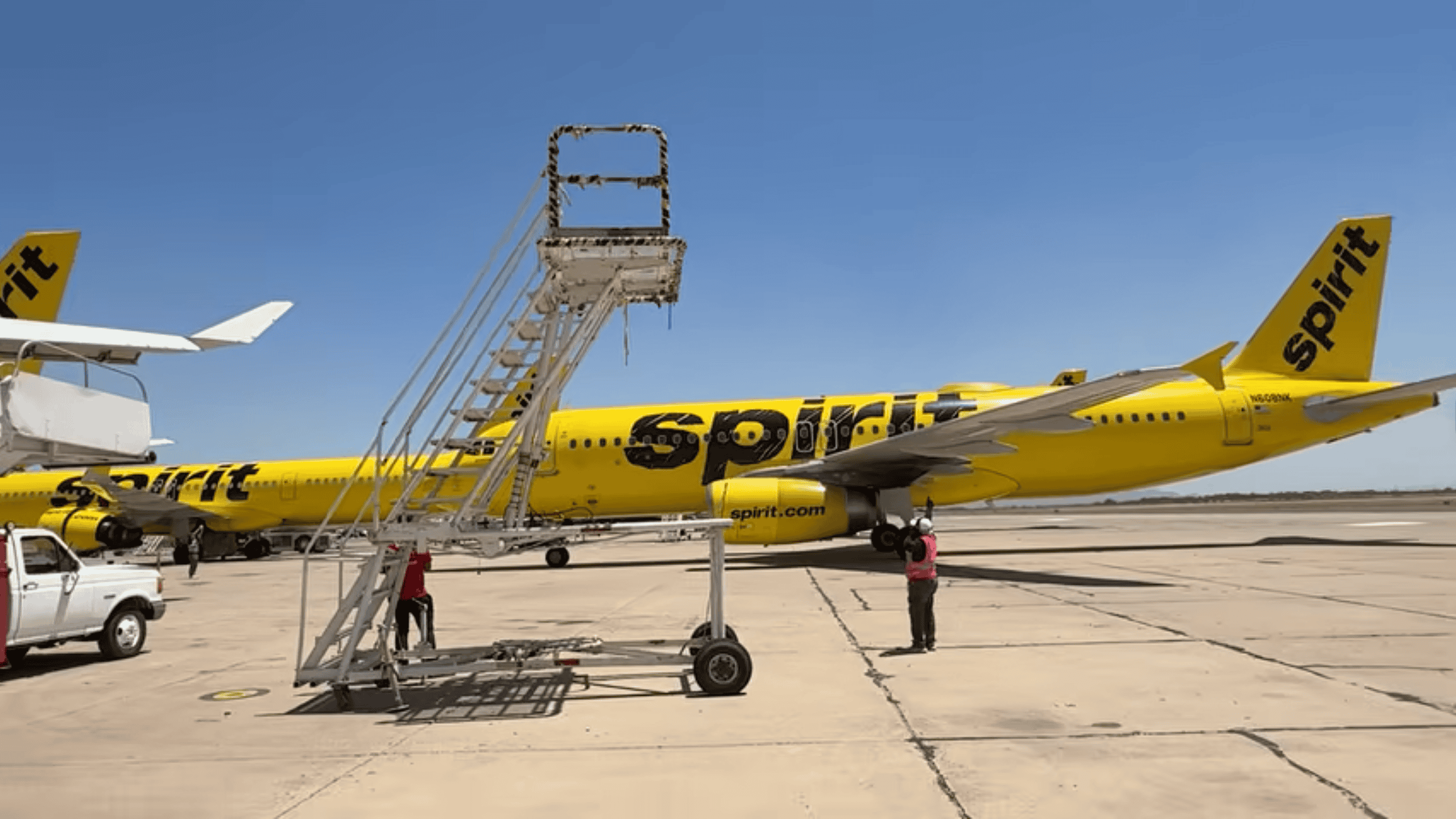
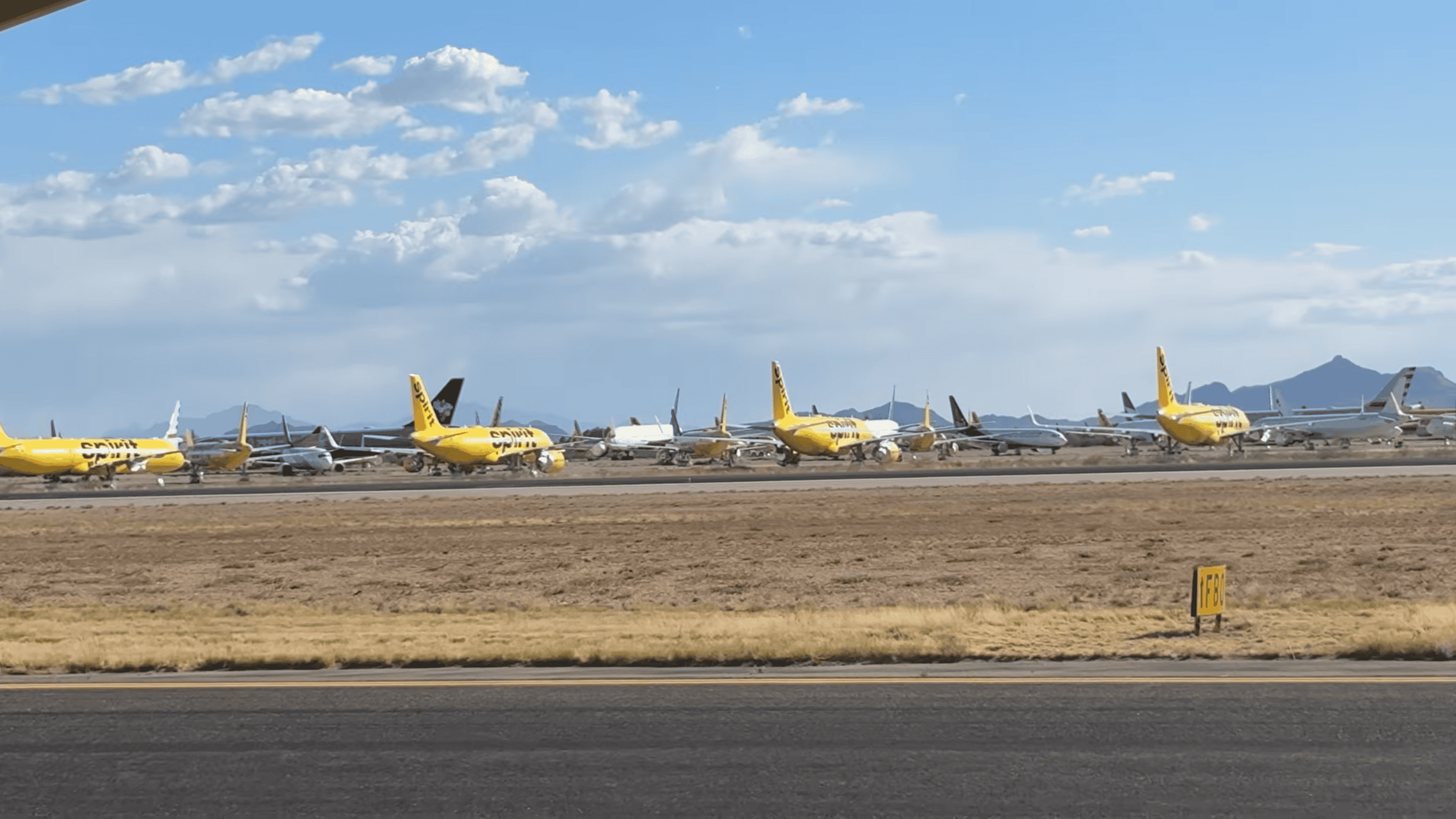
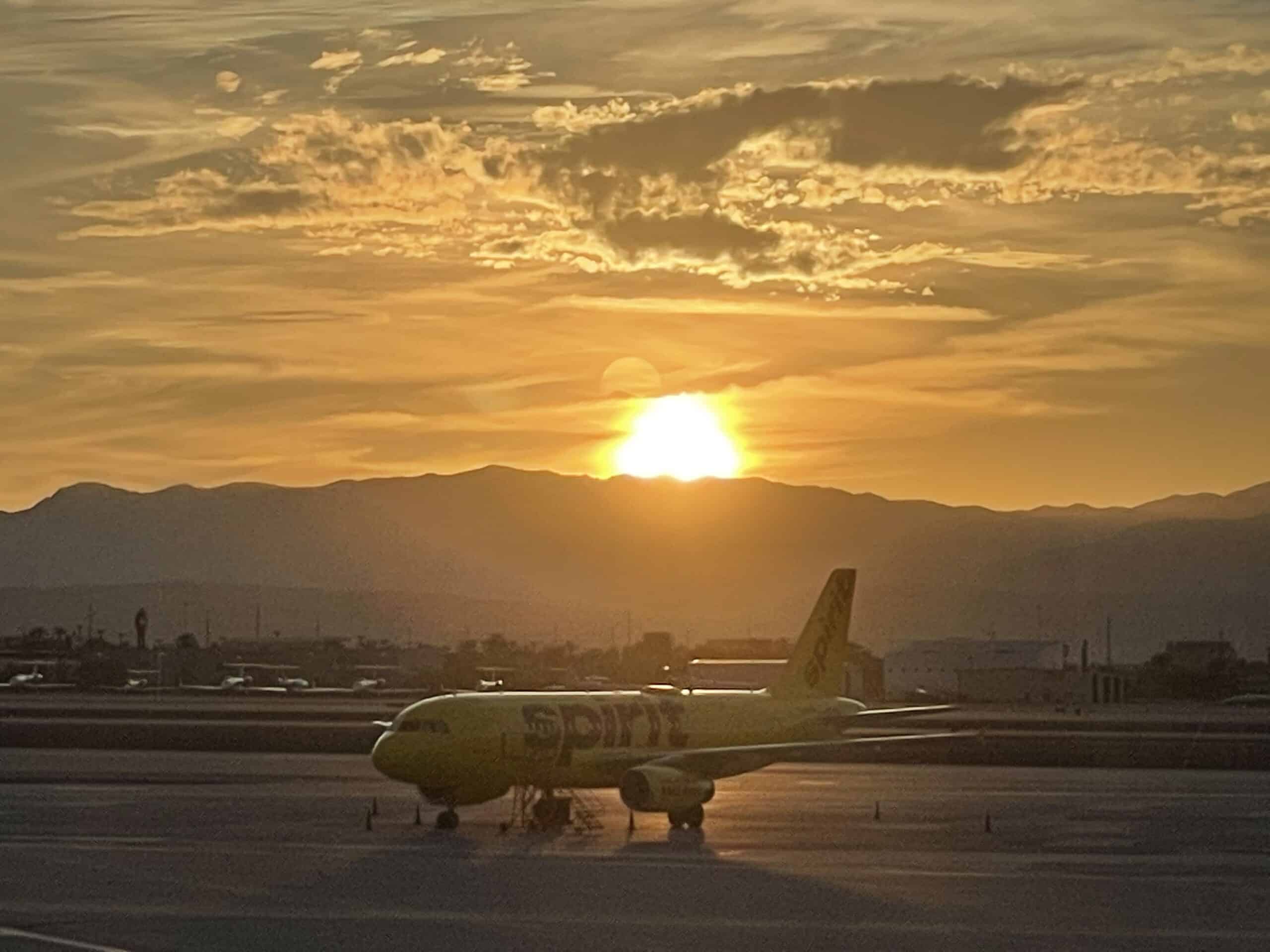
Nomadic says it moved 23 Spirit aircraft to the Sonoran Desert during the first week of May, working on behalf of banks and leasing companies that owned the jets and had leased them to Spirit. Most of the airplanes, the narrator explains, will likely fly again someday for another airline, in another paint scheme, somewhere else in the world. But they will never fly again for Spirit.
That is the emotional center of the video. This is not a story about people celebrating a repossession. It is a story about aviation professionals doing a difficult job in the middle of a very sad week.
A Massive Logistical Puzzle With No Room for Guesswork
The operation started before Spirit’s final shutdown became official. According to the video, Nomadic had first been contacted months earlier by a major aircraft lessor that saw the writing on the wall and wanted basic quotes prepared for the possible recovery of 10 Airbus A321neos. Twice earlier in the year, the company had received “get ready” calls, only to be told to stand down when Spirit managed to buy more time.
This time was different.
On Friday, 1 May, the calls began again. Lessors wanted crews staged at airports where their aircraft were expected to end up that night. Some of those airplanes had not even landed yet. Spirit had not officially closed. But the machinery of aircraft ownership, bankruptcy, leasing, maintenance, dispatch, and ferry operations was already moving.
The video captures the controlled chaos of that moment. Crews were needed in Fort Lauderdale, Miami, Charlotte, Columbus, Houston, Atlantic City, Detroit, Philadelphia, Orlando, Dallas, Chicago, and Los Angeles. What began as one batch of airplanes quickly expanded as more lessors joined the operation.
The original plan was to move the jets quickly while they were still under Spirit’s continuing airworthiness program. The aircraft had been flying passengers only hours earlier. But Spirit’s management pilot team did not want to accept the liability of allowing those ferry flights to proceed under its program. From an operational standpoint, that decision slowed things down. From a human standpoint, it was understandable. There was no real upside for the remaining Spirit team to take on more risk after the airline had already collapsed.
So Nomadic pivoted. The company brought in Designated Airworthiness Representatives, known as DARs, who could inspect the aircraft and issue special flight permits for one-time ferry flights into storage. That changed the pace of the operation, because the DARs had to physically move from city to city and inspect each airplane. But it also gave everyone a clean and safe path forward.
That is one of the best parts of the video. It shows the aviation industry’s unglamorous machinery at work. Fuel contracts. Tow bars. Pushback crews. Dispatch. Flight plans. Crew rest. Airport access. Special flight permits. Hotel rooms. Group chats. All of it had to come together quickly, often with only hours of notice.
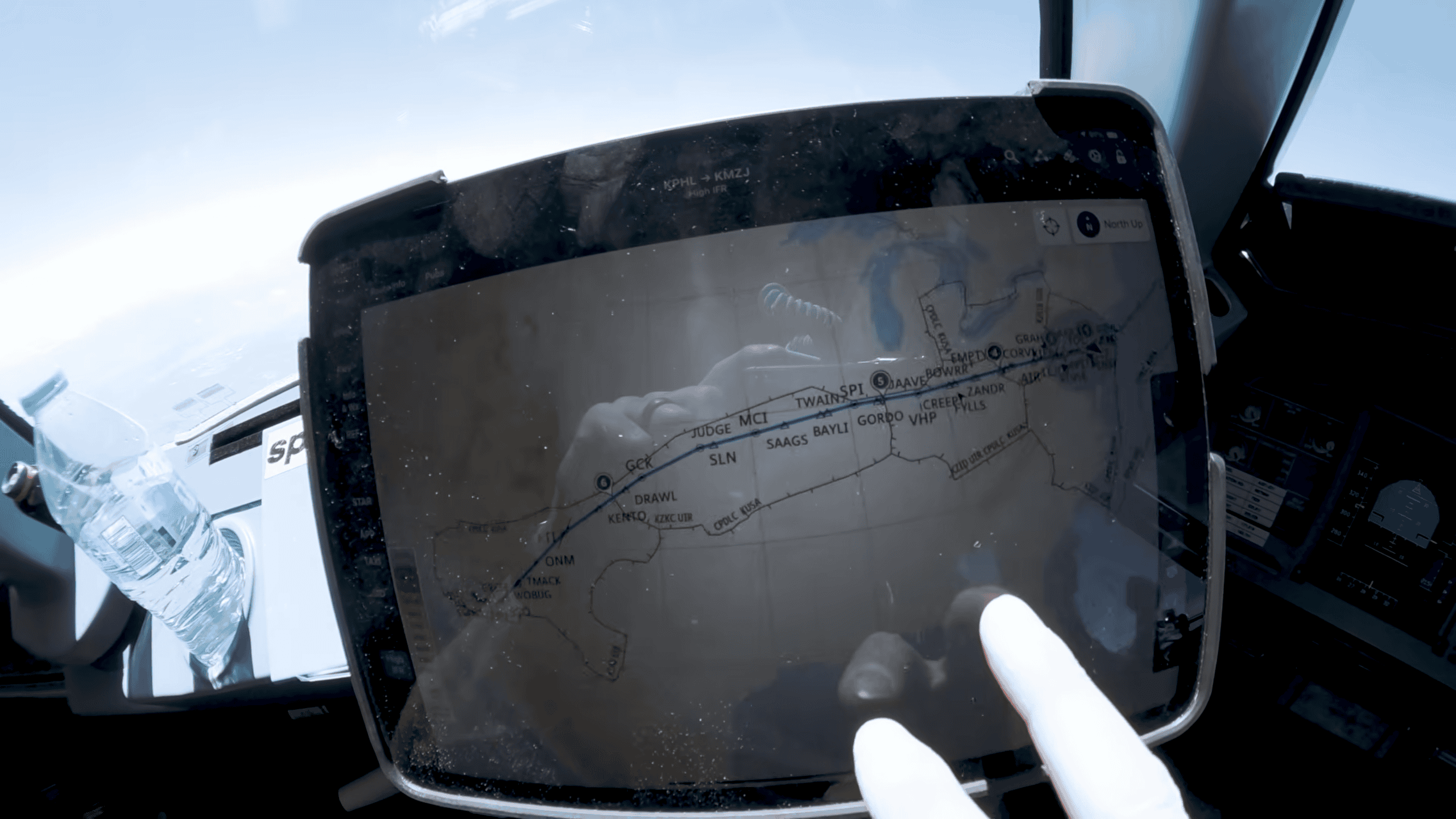
In Philadelphia, the narrator describes trying to move one former Spirit aircraft out of his home airport. The flight required about 3,500 gallons of Jet-A to bring the aircraft up to 31,000 pounds of fuel for a 5-hour, 15-minute trip into strong headwinds toward Arizona. Even something as basic as getting a tug, tow bar, and driver became part of the day’s puzzle.
What makes the video land emotionally is not just the aircraft movement. It is the people.
Nomadic made a deliberate choice to bring Spirit pilots into the operation. Many of them had just lost their jobs. Some were still in the middle of trips when the calls came. They were hearing from people they did not know, in WhatsApp groups they had just joined, while trying to process the end of their airline.
And yet, according to the video, they showed up.
The flight plan west | IMAGE: Nomadic Aviation Group/CockpitCasual (YouTube)
The narrator says the Nomadic team kept hearing the same thing from Spirit employees. Not bitterness. Not complaining. Nostalgia. A sense that Spirit, for all the jokes and baggage fees and tight seats, had been a family.
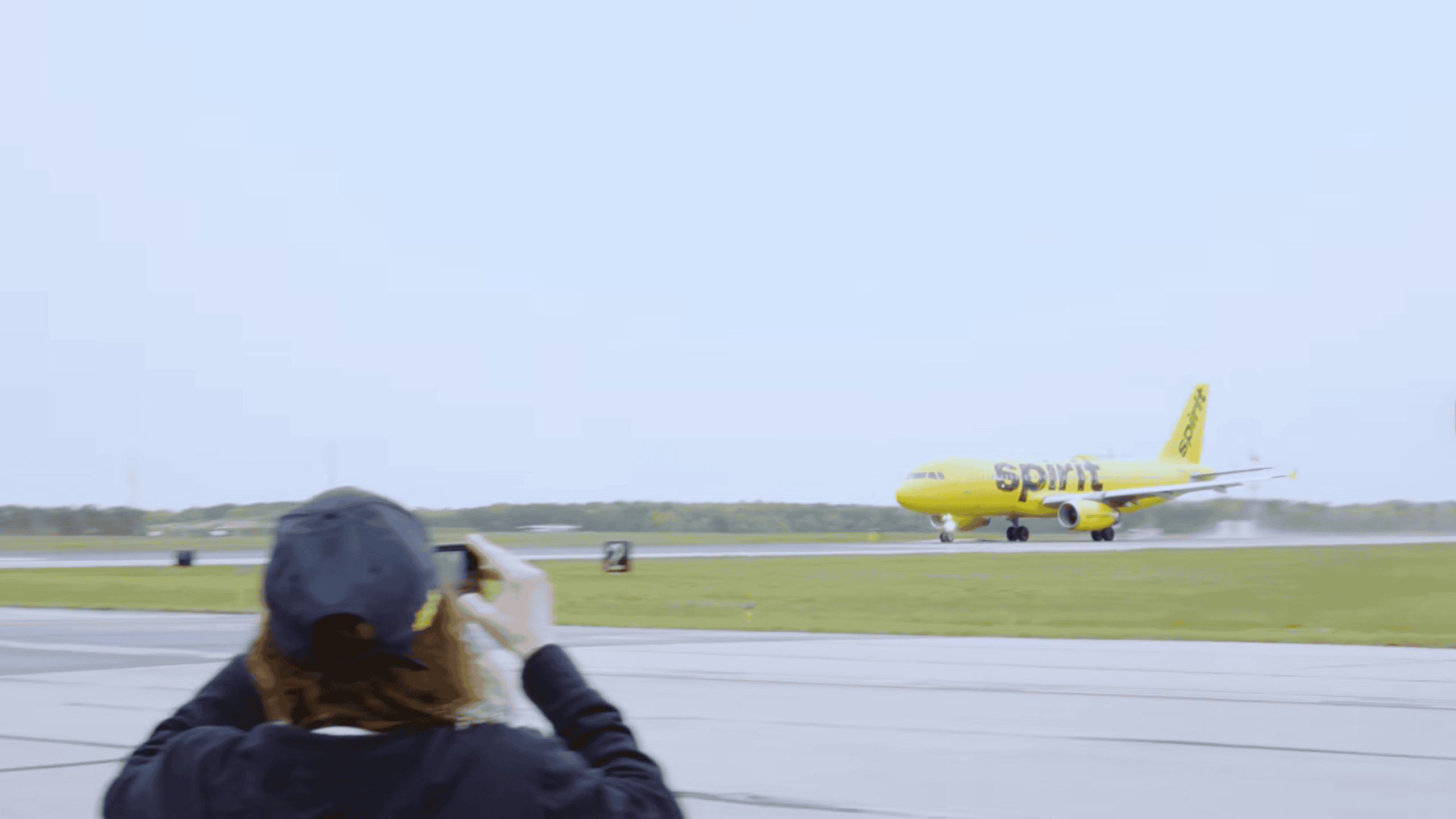
That becomes especially clear in Atlantic City, where the last Spirit airplane moved by Nomadic departed on a rainy Monday, 11 May. Atlantic City was one of Spirit’s early gateway cities and crew bases. The video notes that Spirit’s first scheduled flight from Atlantic City took place on 1 June 1992.
There, viewers meet Suzanne Makino, described as Spirit’s first flight attendant. She was hired by Charter One, Spirit’s predecessor, in 1990 and stayed with the company for 36 years. She came to the airport when she heard the last Spirit flight was leaving, and airport staff helped her out to the ramp, then near the runway, to say goodbye.
Spirit’s first flight attendant, Suzanne Makino, and 36-year company veteran, watches the final Spirit Airbus lift off from Atlantic City International Airport (ACY), where it would head west for desert storage | IMAGE: Nomadic Aviation Group/CockpitCasual (YouTube)
It is hard to watch that moment and think of these as just airplanes being repositioned.
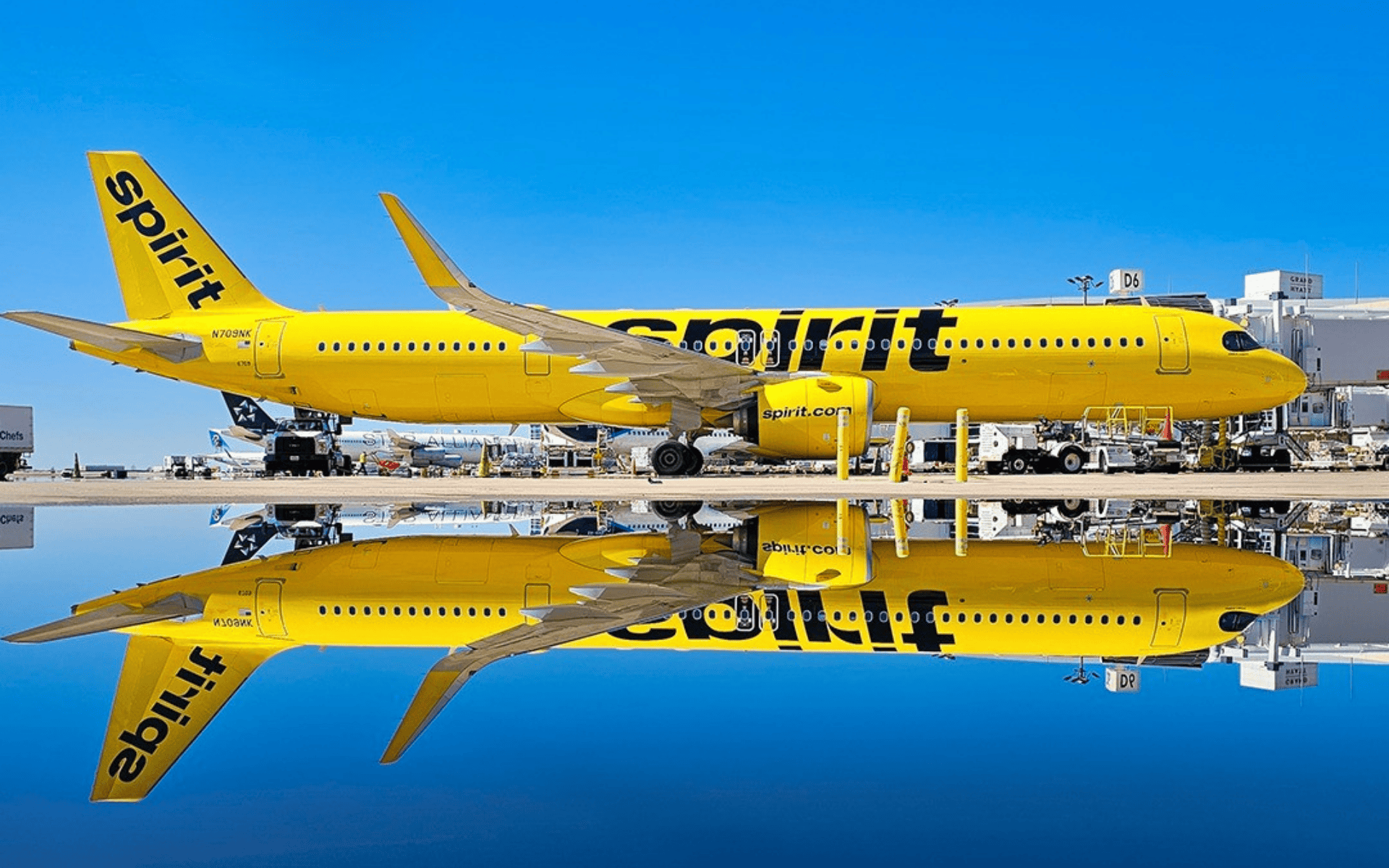
The sight of bright yellow Airbuses heading for desert storage is striking on its own, but those airplanes represent far more than fleet numbers and tail registrations. They carried vacations, first flights, commuting crews, tired families, delayed passengers, frustrated passengers, loyal passengers, and the employees who kept showing up through all of it.
Near the end of the video, the narrator says many of the former Spirit jets are young and will likely return to service in new colors. That is probably true. The desert is not always a graveyard. Sometimes it is a waiting room.
But for Spirit, this was the end.
The yellow jets may fly again. The people will move on. The industry always does.
Still, watching this video, it is impossible to miss what was left behind: an iconic livery, a pilot group, a crew family, and one more airline story that ended with engines spooling up for a final departure into the desert.
This weekend in north Georgia is all about warbirds. The Flying Legends of Victory Tour stop at PDK offers Atlanta-area aviation fans a rare opportunity to see World War II bombers, fighters, and trainers up close.
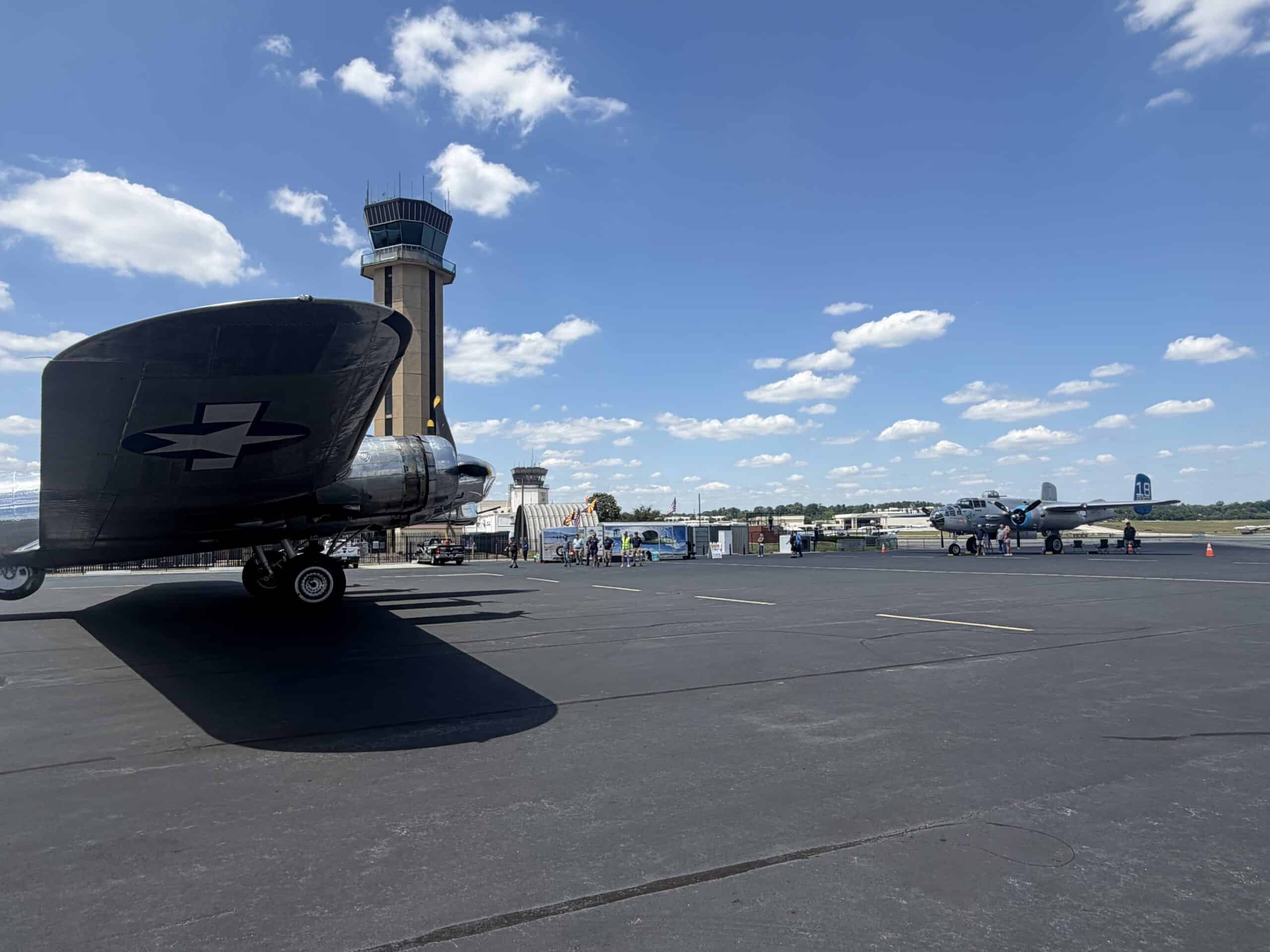
This weekend, DeKalb-Peachtree Airport (PDK) will come alive with activity you don’t often see today. The arrival of a four-engine B-17 Flying Fortress, a twin-engine B-25 Mitchell, and other CAF warbirds will turn the airport into a living history flightline.
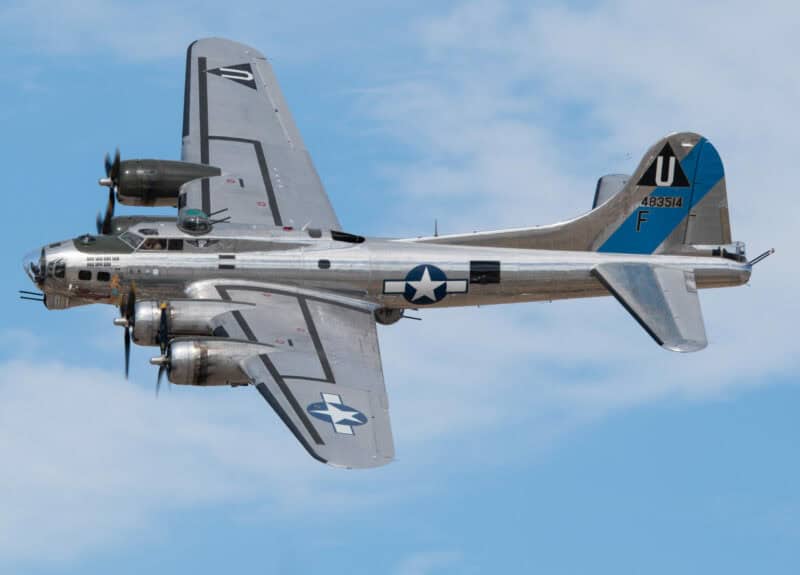
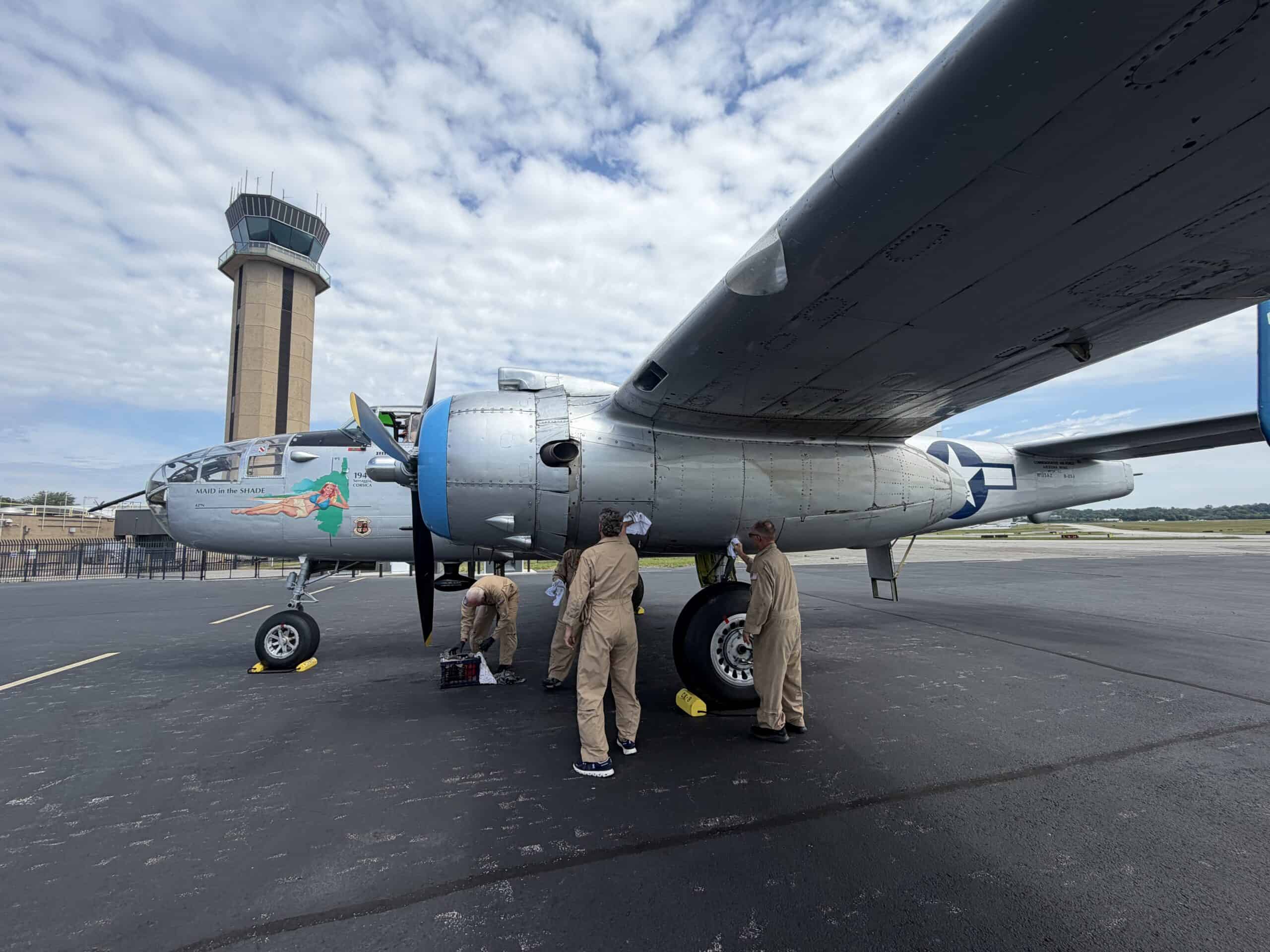
The Flying Legends of Victory Tour returns to PDK this week with two of the Commemorative Air Force’s most famous bombers: the B-17G Sentimental Journey and the B-25 Mitchell Maid in the Shade. Both planes, operated by CAF Airbase Arizona, will be in Atlanta from 12–17 May, offering ground tours and flight experiences.
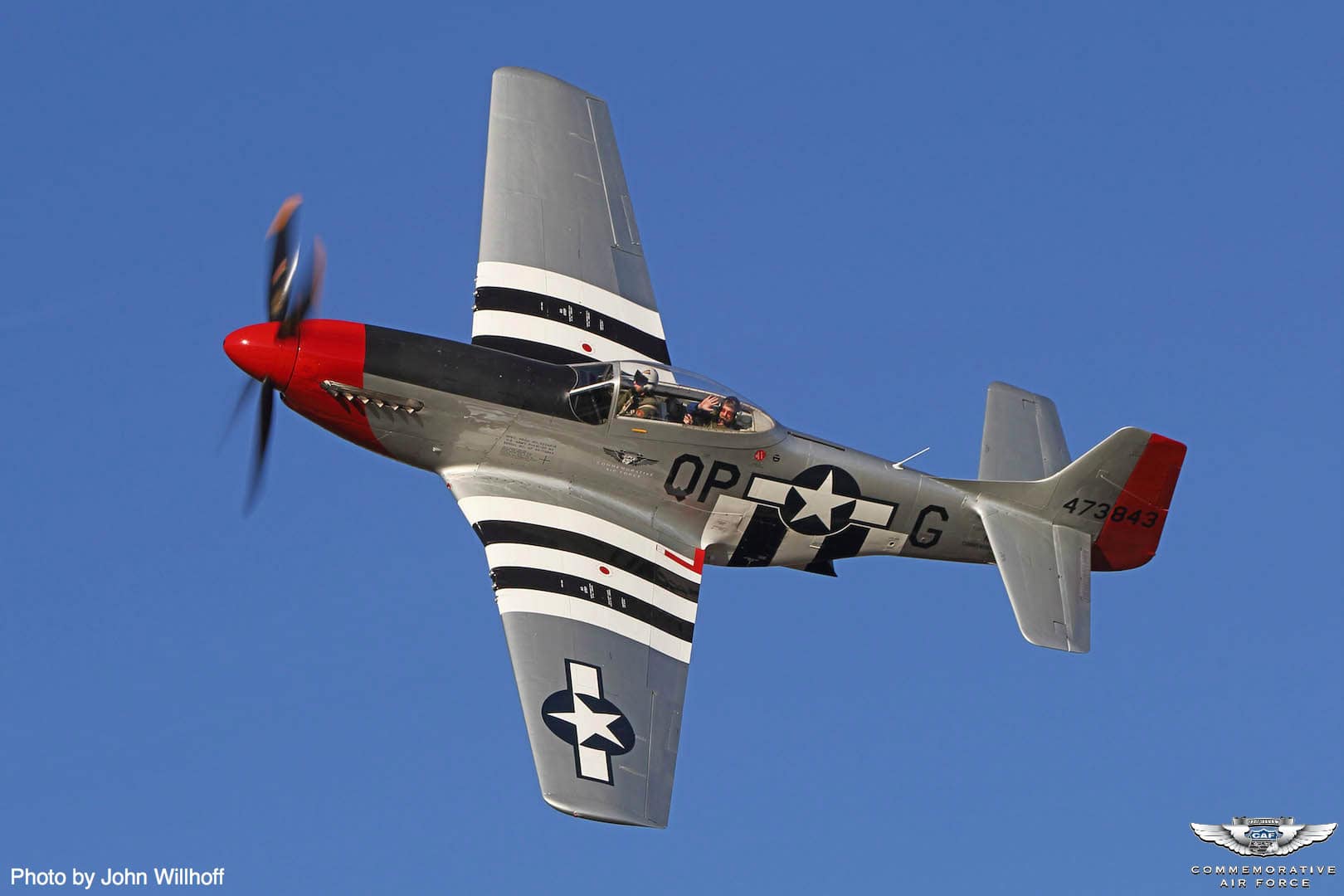
The main event takes place this Saturday and Sunday, 16-17 May, when CAF Airbase Georgia brings five of its own aircraft. Visitors will see a P-51 Mustang, SBD-5 Dauntless, LT-6 Mosquito, PT-19A Fairchild, and T-34 Mentor. This lineup offers a rare look at various aspects of military aviation, from trainers to frontline fighters and bombers.
Aviation fans and history lovers will have a great chance to get close to these planes, hear their engines, smell the oil, and imagine what it was like for crews to fly and maintain them.
From Heavy Bombers to Trainers
IMAGE: CAF Airbase Georgia
The two main attractions will be hard to miss.
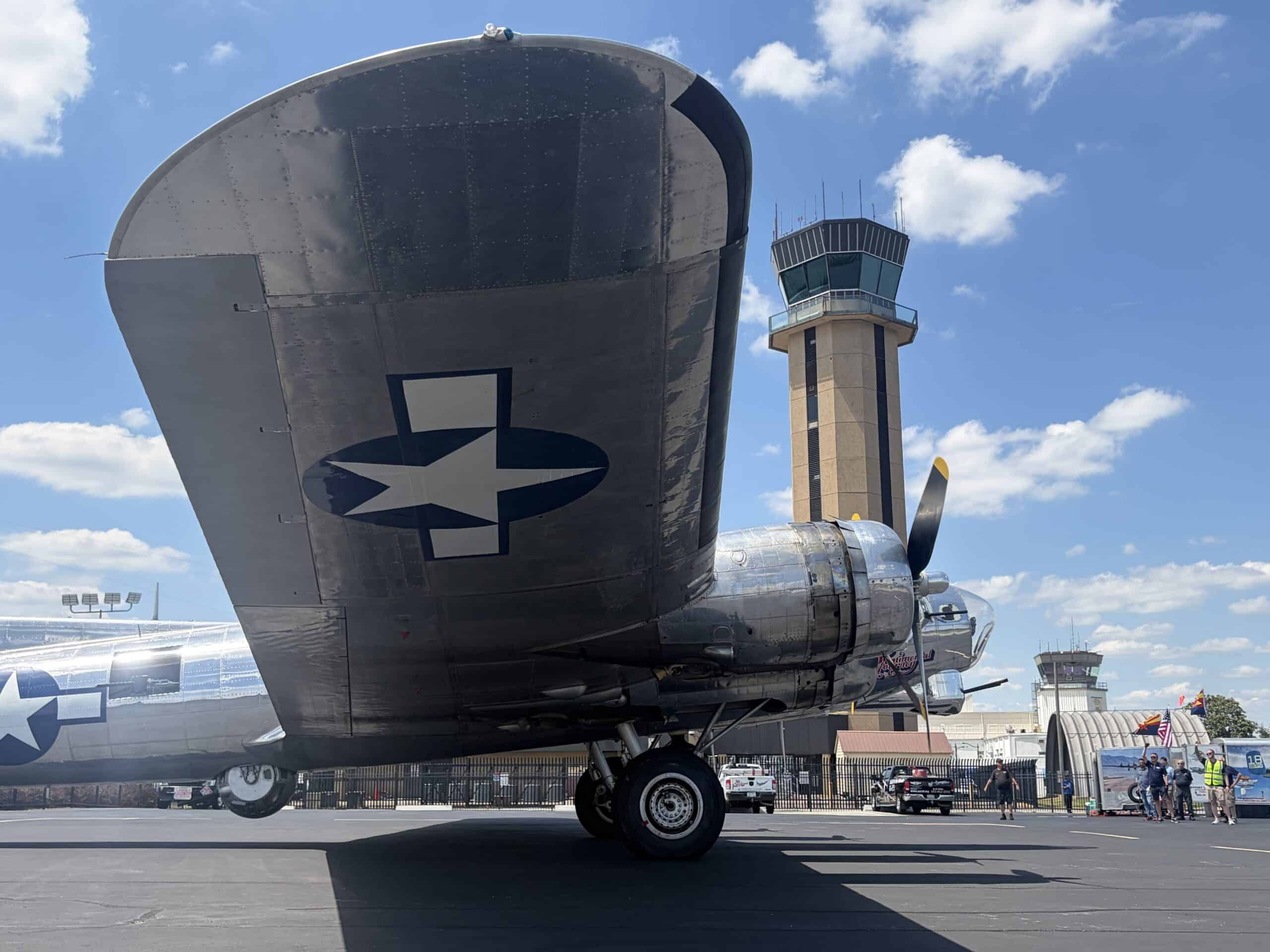
The B-17 Sentimental Journey is one of the most recognizable American bombers from World War II. Its wide wings, tall tail, glass nose, and many gun positions bring to mind the daylight bombing missions over Europe. Even when parked, the Flying Fortress stands out. It looks big, powerful, and somehow delicate all at once.
The B-25 Maid in the Shade has a different character. While the B-17 was built for high-altitude bombing, the B-25 became known as a tough and versatile medium bomber. It served in many places and was used for both level bombing and low-level attacks. It’s smaller than the B-17, but its twin engines and unique look always draw attention.
North American P-51D Mustang “Red Nose” | IMAGE: CAF Airbase Georgia
The planes from Georgia add even more variety. The P-51 Mustang is sure to attract a crowd, and it’s easy to see why. Few planes are as closely tied to American airpower in World War II as the P-51. The SBD-5 Dauntless brings Navy and Marine Corps history to life, famous for its dive-bombing missions in the Pacific.
The PT-19A, LT-6, and T-34 highlight another side of history: how pilots learned, advanced, and prepared before flying in combat. Warbird events often focus on the largest or most famous planes, but trainers are important too. Every combat pilot started with planes like these, which helped turn students into aviators.
Living History, Not Just Static History
B-17 “Sentimental Journey” arrives for the Flying Legends of Victory Tour at PDK | IMAGE: CAF Airbase Georgia
CAF Airbase Georgia, based at Atlanta Regional Airport-Falcon Field (FFC) in Peachtree City, was founded in 1987 and is one of the largest Commemorative Air Force units. The group maintains and flies vintage military planes, helps restore them, and is part of the Georgia World War II Heritage Trail. Volunteers play a key role in keeping these aircraft flying and sharing them with the public.
This is important because flying warbirds in 2026 is not easy. These planes are old, rare, and need a lot of care. Every flight, from starting the engines to landing, depends on volunteers, skilled mechanics, finding parts, raising money, and making careful choices.
One of the best parts of the Flying Legends of Victory Tour is the access it offers. Visitors can walk through the bombers, talk to the people who keep them flying, and, if seats are available, even ride inside while the planes are still in action.
Of course, flying historic aircraft is never as simple as following a schedule. Weather, maintenance, and other needs can always change plans. But that’s part of what makes weekends like this special. These planes aren’t just museum pieces. They are cared for, flown, shared, and remembered while in action.
For aviation and history fans in Atlanta metro and across north Georgia, the PDK stop is a chance to see history up close, with rivets, exhaust stains, spinning propellers, and real people keeping these stories alive. It’s the kind of weekend to share with kids, family, or friends. These planes were once flown by young crews during wartime. Even now, hearing their engines brings those stories to life right in front of us. If you’re in the area, please support this worthwhile cause!
IMAGE: CAF Airbase Arizona
IF YOU GO:
LOCATION Doc Manget Memorial Aviation Park 2000 Airport Rd Atlanta, GA 30341
The MD-11 return to service begins after months of grounding, inspections, and repairs following the fatal 2025 crash of UPS Flight 2976.
For the first time since early November 2025, the McDonnell Douglas MD-11 is operating commercial cargo routes again.
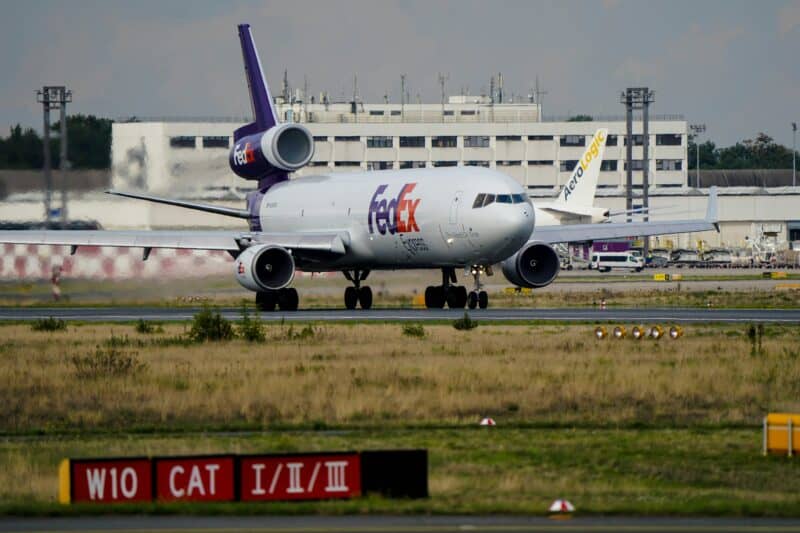
FedEx began returning its MD-11F fleet to revenue operations this week after the Federal Aviation Administration (FAA) approved Boeing’s return-to-service plan for the type. This ends the months-long grounding that followed the fatal crash of UPS Airlines Flight 2976 at Louisville Muhammad Ali International Airport (SDF) on 4 November 2025. Reuters reported that FedEx resumed MD-11 operations after the FAA lifted the ban, with the agency stating that Boeing’s plan includes all necessary maintenance and inspections before aircraft can return to service.
It’s a bittersweet moment for avgeeks. The MD-11 is no longer common, and its days are clearly numbered. But this isn’t just about nostalgia. It’s also about safety, operations, and the important role the aging widebody still plays in global cargo. The return is also a solemn reminder of the tragedy that led to this moment.
— Turbine Traveller (@Turbinetraveler) May 10, 2026
A Return Overshadowed by Louisville
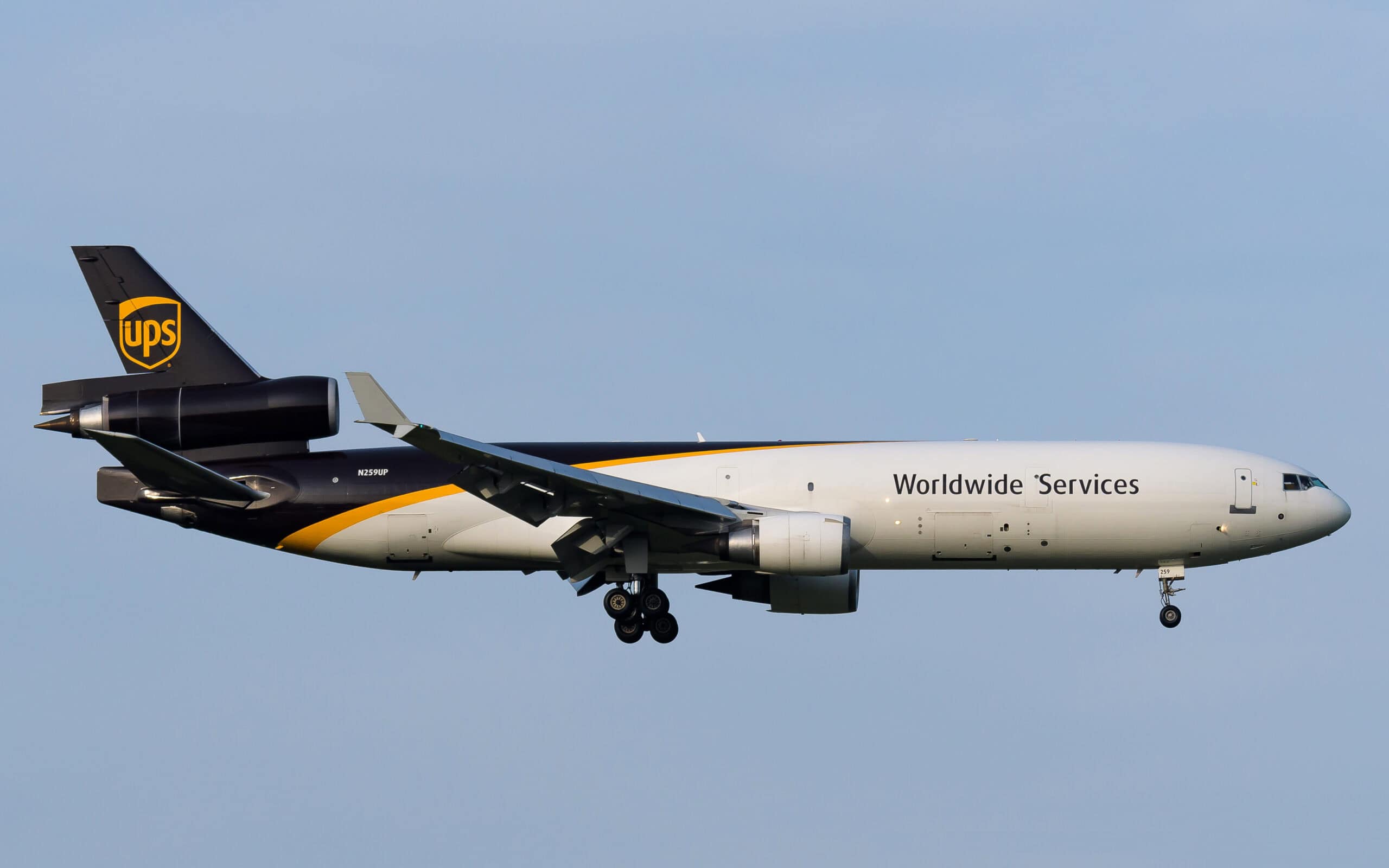
N259UP, the UPS MD-11 involved in the Louisville disaster on 4 November 2026 | IMAGE: By Sunil Gupta – https://www.flickr.com/photos/lockonaviation/54489730352/, CC BY-SA 4.0, https://commons.wikimedia.org/w/index.php?curid=178272226
The grounding traces back to UPS Flight 2976, an MD-11F registered N259UP, which crashed shortly after takeoff from runway 17R at SDF on 4 November 2025. The NTSB said the aircraft was destroyed after it impacted buildings and terrain shortly after departure. Three crewmembers aboard the aircraft and 11 people on the ground were fatally injured, while others on the ground were seriously or minorly injured. The NTSB later noted that one seriously injured person on the ground died 51 days after the accident, bringing the total number of fatalities to 15.
The early focus of the investigation quickly centered on the aircraft’s left engine and pylon. SDF airport surveillance video showed the No. 1 engine and pylon separating from the wing shortly after rotation, followed by fire near the left pylon attachment area. Investigators also documented fractured components in the pylon aft mount bulkhead and examined the spherical bearing assembly tied to that structure.
As such, the return-to-service fix is aimed directly at the area identified in the investigation. The NTSB said the bearing race showed evidence of fatigue cracking around the interior surface, with cracking extending through much of the fracture surface. The Associated Press reported that Boeing’s plan includes replacing a key spherical bearing and increasing inspections of the engine mounting parts.
After the crash, the FAA grounded MD-11 aircraft over safety concerns. UPS later chose to retire its MD-11 fleet entirely, accelerating the type’s end within its own operation. FedEx took a different path. While the aircraft is old, it remains useful, especially in a cargo network built around heavy lift, long sectors, and flexible widebody capacity. From the early days of the grounding, FedEx remained committed to returning the MD-11 to service, even though the type accounts for only a small portion of its overall fleet.
The Work Behind the Comeback
FedEx’s main hub at Memphis International Airport (MEM) | IMAGE: FedEx
Bringing the MD-11s back isn’t as simple as taking them out of storage and putting them back to work. The process will be gradual and require significant maintenance.
Reuters reported that FedEx worked with Boeing and the FAA to validate that required inspections and maintenance actions had been completed on two of its 29 MD-11s before the initial return. The FAA said it approved Boeing’s protocol after an extensive review, and that protocol required specific maintenance and inspection work before aircraft could fly again.
According to FreightWaves, FedEx operated a short test flight in and out of Memphis International Airport (MEM) on Saturday evening (9 May) before returning the aircraft to commercial service. On Sunday, 10 May, FedEx operated MD-11 revenue flights from MEM to Los Angeles (LAX) and from MEM to Miami (MIA), marking the type’s first commercial FedEx operations since the grounding.
The two MD-11s returned to service thus far are N621FE and N521FE.
FedEx’s own statement framed the work as a coordinated effort in safety, engineering, and maintenance. “Safety is our highest priority,” the company said, adding that its airline safety, engineering, and maintenance teams had spent months conducting inspections, maintenance, and planning to prepare the fleet’s return. The company also said aircraft began returning to service after the FAA approved Boeing’s means of compliance and validated completion of required repairs and inspections.
Bringing the MD-11 back also means maintenance staff and crew need refresher training. Pilots must complete a three-day program that includes flight management system drills, simulator sessions, and scenario training before they can operate the MD-11 again.
Because the fleet is spread worldwide, this process is an enormous logistical challenge. FedEx technicians were dispatched to multiple global locations to remove pylons from grounded aircraft and send them to heavy maintenance facilities in Memphis and Indianapolis for bearing replacement and inspection work. Each aircraft also requires a post-repair test flight before returning to revenue service. Planespotters.net data shows FedEx MD-11s spread out across the world, having been grounded since November at airports stretching from Houston (IAH), Anchorage (ANC), and Honolulu (HNL) to Taipei (TPE), Singapore (SIN), and Tokyo Narita (NRT).
The MD-11 might be old, but it still has a place at FedEx
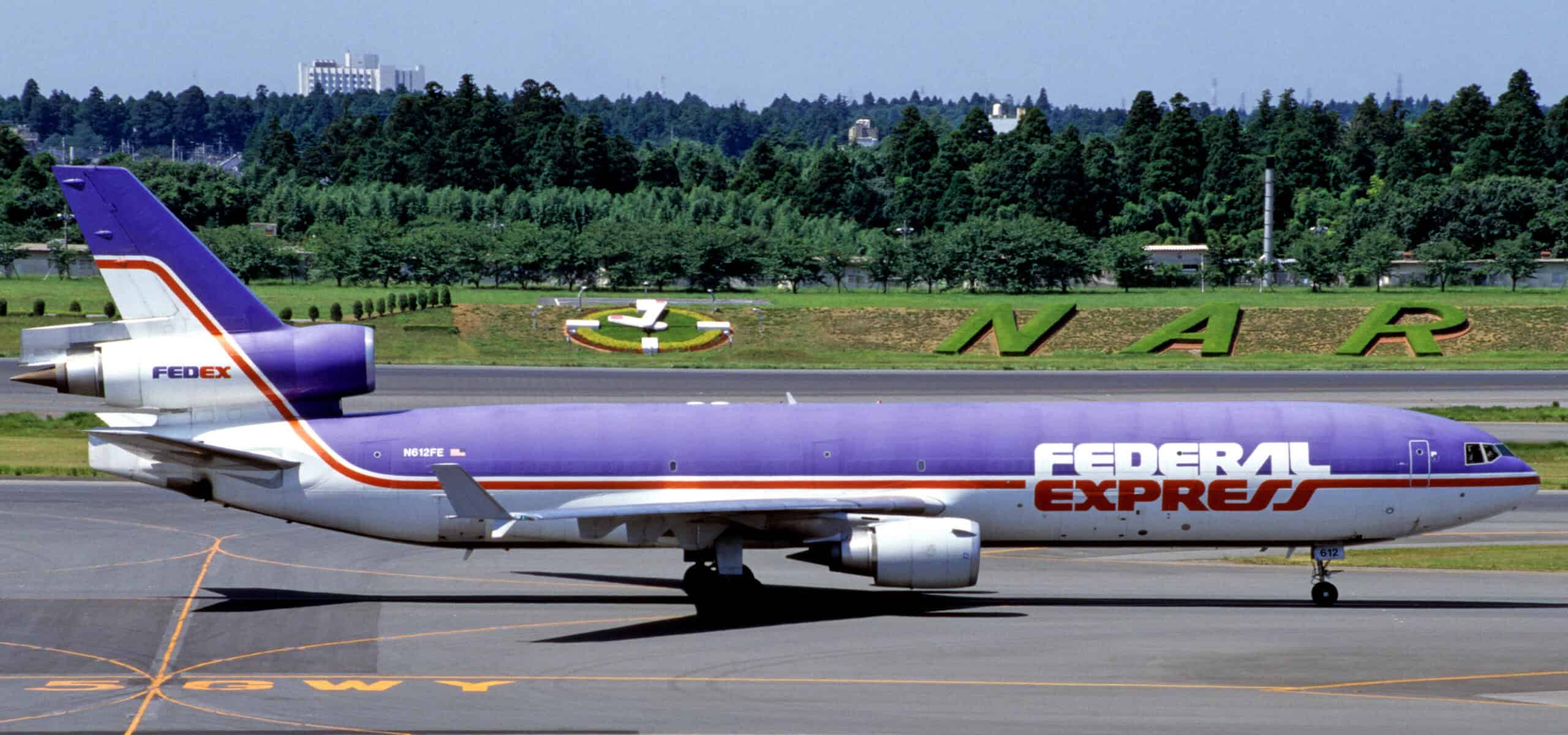
A FedEx MD-11 in the company’s iconic purple livery in 1994 | IMAGE: By contri – originally posted to Flickr as FEDEX MD-11F(AF) (N612FE/48605/555), CC BY-SA 2.0, https://commons.wikimedia.org/w/index.php?curid=8495265
The MD-11 is an older aircraft. Most of the remaining freighters were built in the 1990s, and airlines stopped using them for passengers years ago. Even in cargo, the MD-11 has become extremely rare as companies switch to more efficient twin-engine planes. However, the MD-11 offers important capabilities.
In freighter form, the MD-11F offers large main-deck cargo volume, a payload of roughly 200,000 pounds, and room for 26 pallets. That makes it a vital asset for a company like FedEx, especially when cargo demand rises, and widebody lift becomes harder to replace quickly. Reuters reported that FedEx previously said the grounding could cost the company up to $175 million. This is a significant number for FedEx to reckon with, even if its MD-11 fleet represents a relatively small share of FedEx’s total operation.
FedEx has also said it intends to keep operating the MD-11 until 2032. This contrasts with UPS, which retired its MD-11 fleet after Flight 2976. FedEx still plans to eventually retire the MD-11 and replace it with more efficient aircraft, but for now, the tri-jet remains part of the company’s short-term plans.
Practicality and Symbolism
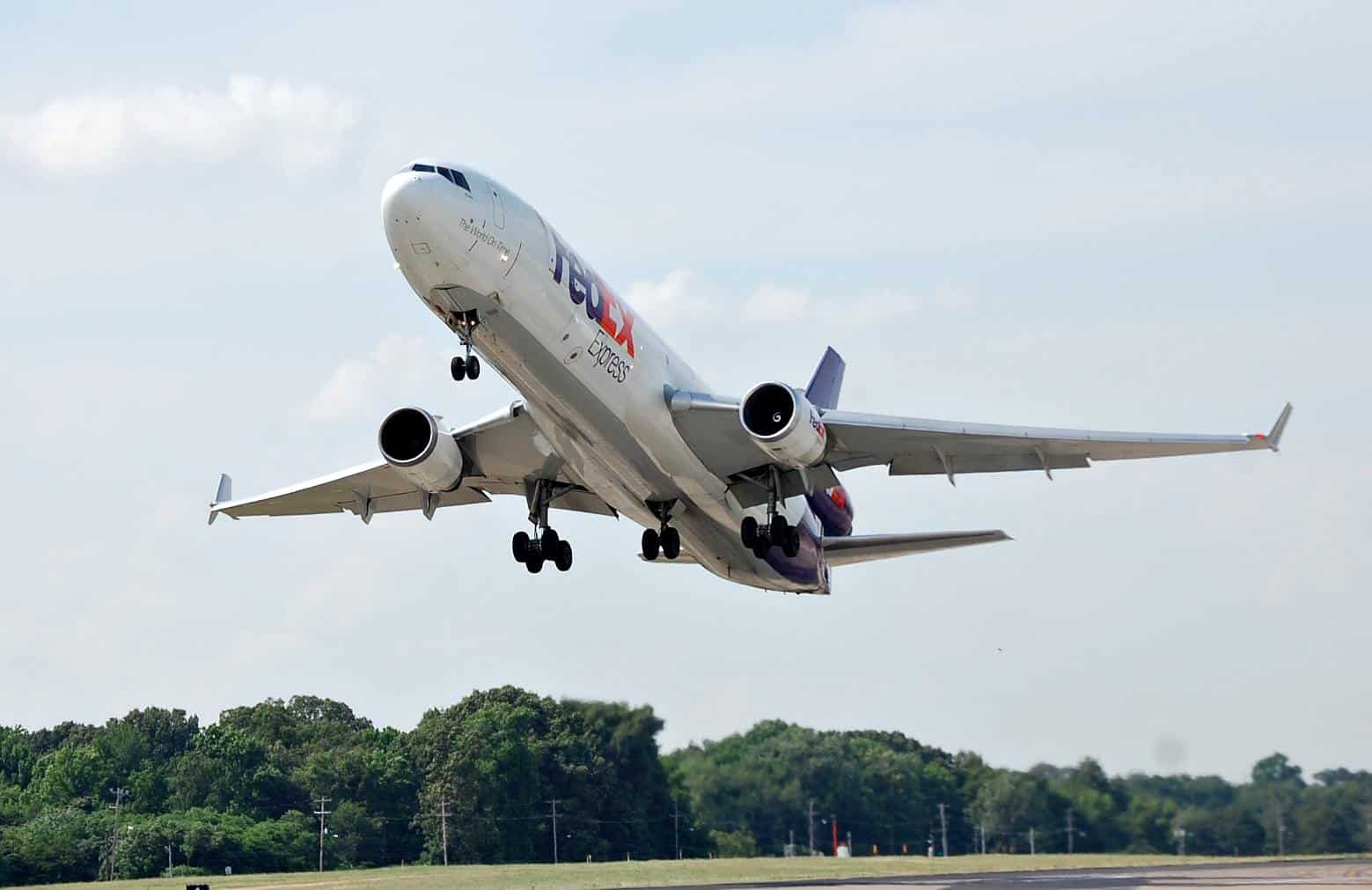
A FedEx MD-11 departs MEM | IMAGE: Memphis International Airport
The MD-11’s return is practical and also symbolic. For FedEx, it means getting back needed cargo space after months of relying on other planes, spares, and charters. It also means that one of the last great tri-jets is flying again, but now with more scrutiny than ever.
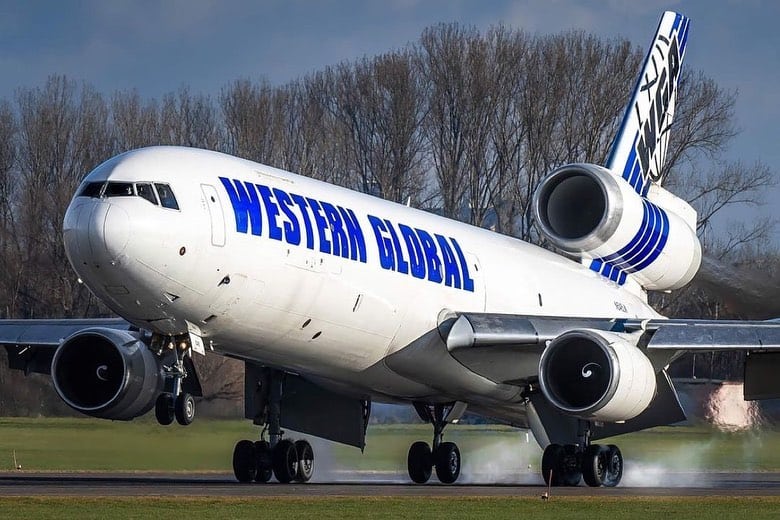
Western Global MD-11 | IMAGE: Western Global Airlines
The MD-11’s return is not a full fleet comeback all at once. So far, only two aircraft are back in service, and the rest will follow slowly as maintenance, inspections, test flights, and pilot training are finished. Western Global Airlines also operates the MD-11, but its post-grounding plans for its 15 MD-11s have not been publicly shared. According to AP, Western Global had not commented on the FAA decision at the time of their report.
So, the iconic MD-11 is not finished yet, after all. It is older, rarer, and now operating under new scrutiny, but it still fills a role FedEx is not ready to give up. After one of the darkest chapters in the aircraft’s history, the tri-jet is back in the air. And while that is definitely good to see, it also comes with a vivid and solemn remembrance of the Louisville tragedy and the souls lost that November day.
Many airline pilots these days have never served in the military. But did you know that in the event of a crisis, they could be called upon to fly in direct support of U.S. military operations? Enter CRAF.
With the conflict involving Iran on everyone’s minds and the President requesting 1.5 trillion dollars for the next budget cycle, many civilian pilots and military personnel alike are wondering what that could mean for the future of commercial aviation. It’s the sort of plot twist your career doesn’t exactly advertise during the hiring interview.
CRAF: On-call support for contingencies
There is one fascinating and little-known program that could rapidly turn U.S. commercial airliners into troop and cargo movers. It is called the Civil Reserve Air Fleet, or CRAF. It is a voluntary partnership between the Department of War and commercial airlines that has been in place since 1951. U.S. Transportation Command runs the program from Scott Air Force Base in Illinois.
CRAF organizes aircraft into segments based on the type of work they can perform. The international segment includes long-range aircraft capable of transoceanic operations to move troops and heavy cargo. It also includes short-range aircraft that handle medium-haul trips for near-offshore and select intra-theater missions.
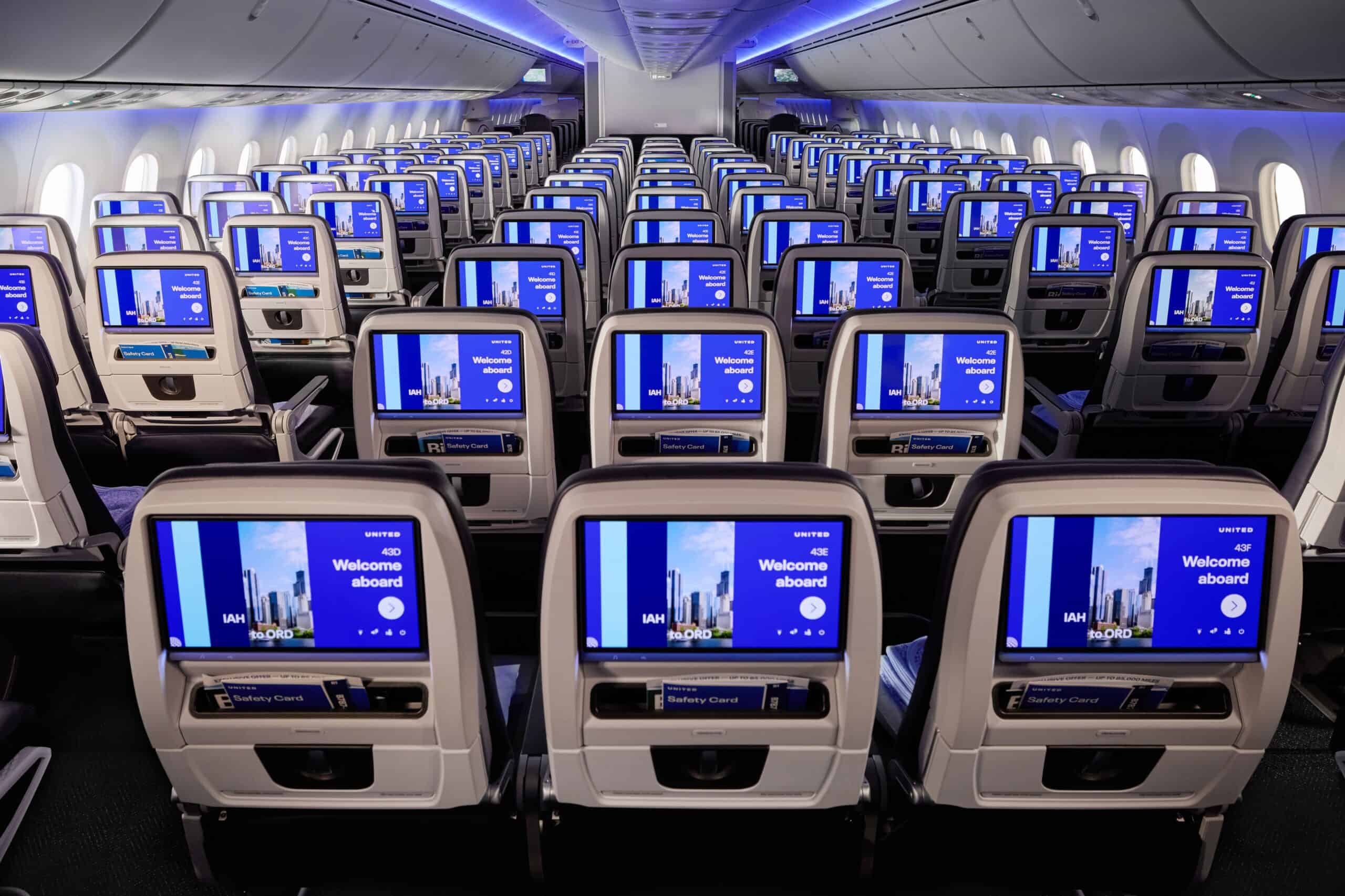
United’s Boeing 787 Elevated interior | IMAGE: United Airlines
The national segment covers domestic movements inside the United States. This structure gives the military flexible airlift options without overusing its own heavy-lift C-5s and C-17s. After all, even the Air Force appreciates a little help staying on schedule.
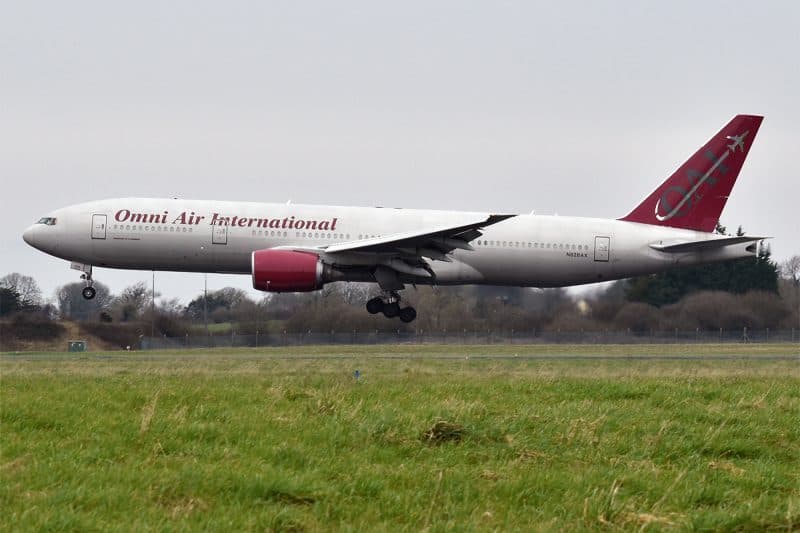
Roughly two dozen U.S. airlines participate. They include American, Delta, United, Atlas, FedEx, UPS, Kalitta, Omni, Polar, Alaska, JetBlue, Sun Country, Southwest, Allegiant, and others. The total committed fleet usually numbers around 450 aircraft, though the exact mix changes from month to month. And the best part? Chili Mac MREs! Just kidding!
How CRAF Works
An American Airlines Boeing 787-9 from London Heathrow on short final for Runway 24R at LAX | IMAGE: Dave Hartland
The benefit to CRAF is that airlines are offered preferential DoW contracts even in peacetime. During conflicts (which can affect airline profitability significantly), CRAF offers a guaranteed revenue pipeline while supporting the nation when required.
Activation happens in three stages approved by the Secretary of War.
Stage I covers smaller regional crises or humanitarian and disaster relief needs. Stage II supports a major theater war. Stage III applies during full national mobilization. When activated, airlines have between 24 and 72 hours to prepare the assigned aircraft and qualified crews. The planes remain under civilian registration and Federal Aviation Administration oversight. You’d remain an airline employee and The Department of War just pays your company for the actual flight hours. Just go easy on the “there I was” stories at your next family reunion. You’re still a POG, albeit a highly paid one.
CRAF Activation Stages
Stage I (minor regional crises or humanitarian needs): Used in 2021 for the Afghanistan evacuation to move evacuees from safe staging bases.
Stage II (major theater war): Activated during the 1990-1991 Gulf War for large-scale troop and cargo transport to the Middle East.
Stage III (full national mobilization): Would apply in a large-scale global conflict on the scale of a potential World War III scenario to provide maximum commercial airlift capacity.
CRAF Has Been Used Before
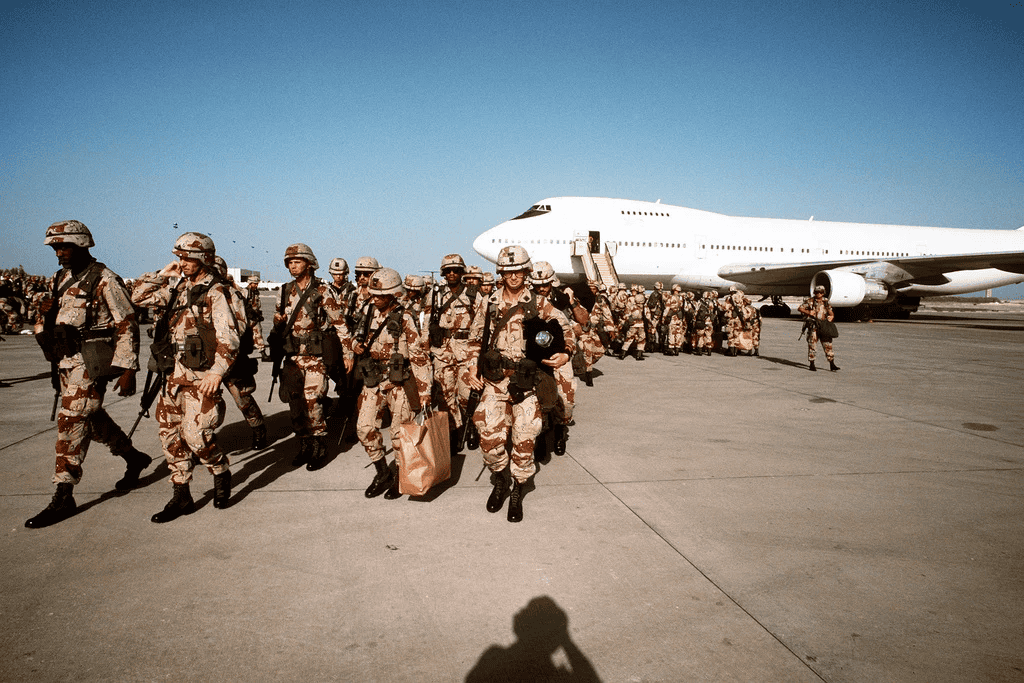
Troops disembark on the tarmac after a CRAF flight supporting Operation Desert Storm, Image: DoD
The program has been activated exactly three times in its history. During Operations Desert Shield and Desert Storm in 1990 and 1991, CRAF aircraft flew more than 5,460 missions, transported about 726,000 passengers, and moved about 230,000 tons of cargo. In 2003, it supported Operation Iraqi Freedom with Stage I passenger missions.
In 2021, Stage I helped with the Afghanistan evacuation. About 18 aircraft carried people from safe havens and staging bases, allowing military planes to focus on the most critical legs. Not a bad track record for a system that dates back to the Truman administration.
For pilots, especially younger ones, the rules are straightforward. CRAF missions are flown by the airline’s current crews under normal employment contracts. No pilot is drafted or conscripted through this program, but that doesn’t mean that some of you can’t break ranks and join up. For those who want to go to full military power after snagging the three wire, we salute you!
Crew assignments follow each carrier’s procedures and union agreements, and the airline meets its contractual commitment to supply planes and people. Any future military draft, if one were ever reinstated, would be handled separately by the Selective Service System, with no direct tie to, or exemption via, CRAF participation.
Official Department of War and Air Mobility Command requirements also state that all flight-deck crewmembers on activated CRAF missions must be U.S. citizens. Even if a pilot holds permanent resident status and flies for a participating airline, they cannot be assigned to CRAF missions.
Brief Examples of CRAF Segments
Long-range international: Wide-body passenger and cargo jets flying troops and supplies on transoceanic routes from the continental United States to major overseas bases.
Short-range international: Medium-sized aircraft performing medium-haul support flights for near-offshore or select intra-theater needs.
National/domestic: Aircraft handling personnel and cargo movements entirely inside the United States.
So, as the world watches the Middle East with growing concern, and pilots nervously discuss outcomes, the fact is that commercial aviation is itself a national asset and one that can be and has been used to great effect during previous conflicts and is always an option. Trust me. It’s one mission you’ll never forget!
The Spirit Airlines shutdown leaves behind more than empty gates. It’s a story of people, purpose, and a lasting impact on aviation.
Today is a sad day in aviation.
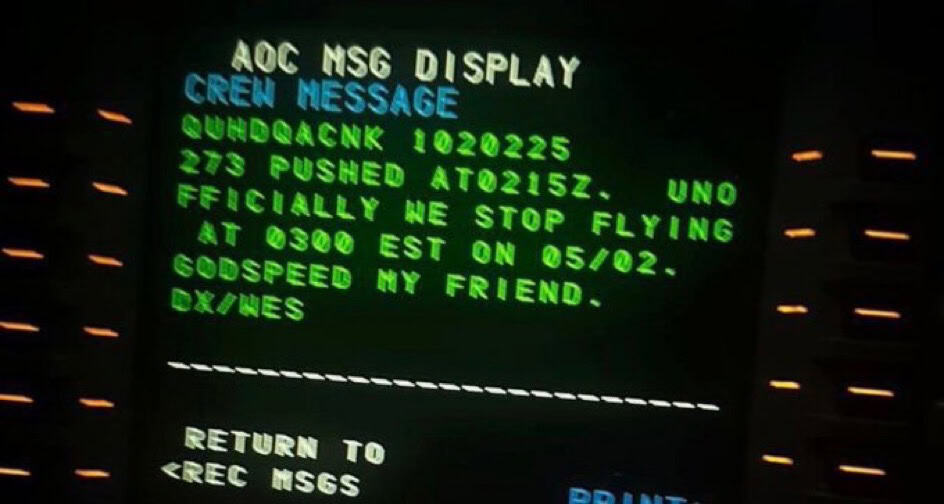
After years of uncertainty, close calls, and one final fight to stay airborne, Spirit Airlines has ceased operations.
The Dania Beach, Florida-based ultra-low-cost carrier shut down on 2 May 2026 at 0300 local time after a last-ditch attempt to secure a US government lifeline fell through.
🚨#BREAKING: The final Spirit Airlines flight has touched down in Dallas at 1:08 a.m. EST, marking the definitive end of active operations ahead of the airline’s expected systemwide shutdown at 3:00 a.m.
Just under two hours earlier, the final Spirit flight touched down at Dallas-Fort Worth International Airport (DFW). Flight 1833 departed Detroit Metropolitan Wayne County Airport (DTW) at 2212 local time and arrived at DFW at 0017 CDT.
And when that bright yellow Airbus A320 eased up to Gate E32, the moment became real. The engines wound down. The flight deck went quiet. The cabin emptied one last time.
And just like that, it was over.
After 34 years, the Spirit Airlines era has come to a close.
Some airlines are celebrated. Others are criticized. Then there are airlines like Spirit. The ones people talked about, joked about, debated, defended, mocked, and misunderstood. The ones that became part of the background noise of American air travel until, suddenly, that noise was gone.
Spirit was never just another airline. It changed the fare structure. It challenged the legacy carriers. It made flying possible for people who otherwise might not have gone at all. Love it or hate it, Spirit occupied real space in modern aviation.
Now that space is empty.
This is not just the end of a company. It is the loss of a chapter in American aviation, and above all, it is a human story. Nearly 14,000 people who showed up every day to dispatch the flights, turn the wrenches, work the gates, load the bags, staff the cabins, fly the airplanes, and keep those bright yellow jets moving are now facing what comes next.
In aviation, we compete hard. We argue. We compare liveries, legroom, fares, service, strategy, and everything in between.
But when an airline disappears, we do not celebrate.
We mourn.
FlightAware screenshot showing no more Spirit Airlines aircraft in the air as of 0100 EDT on 2 May 2026Spirit.com announces the airline’s closure on 2 May 2026
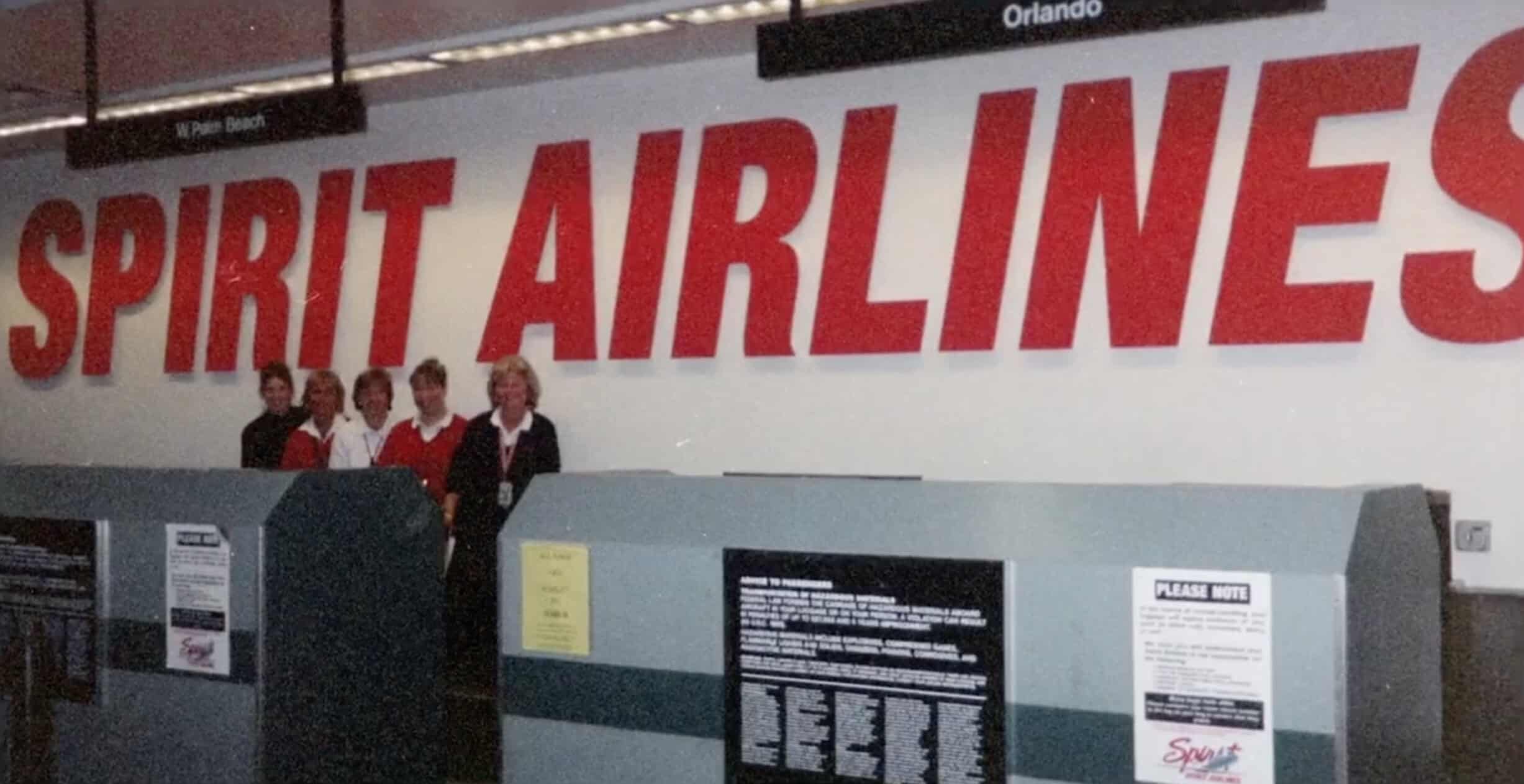
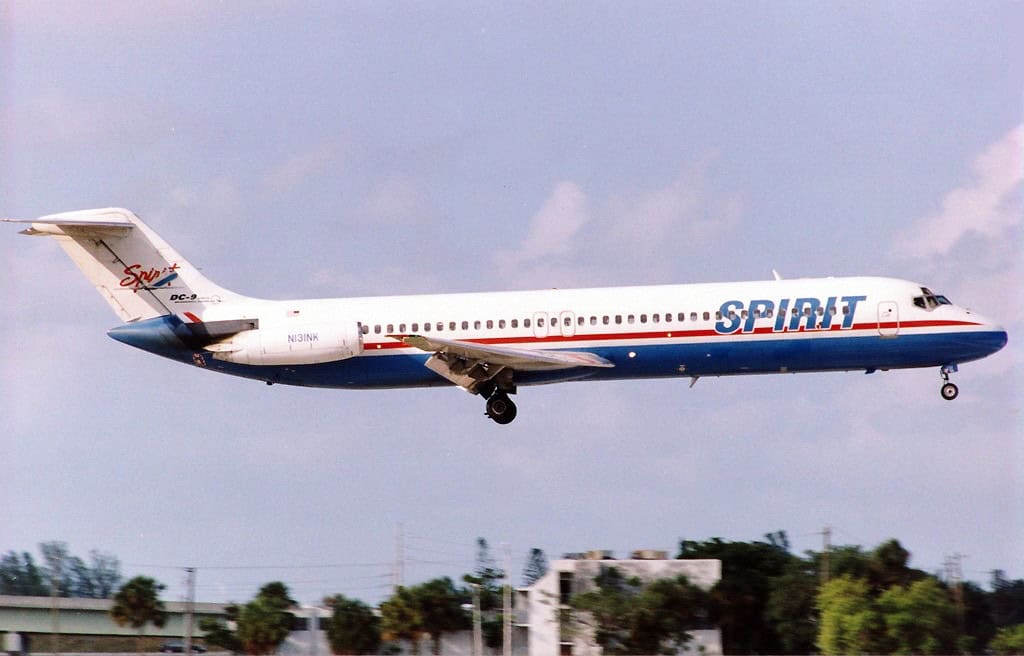
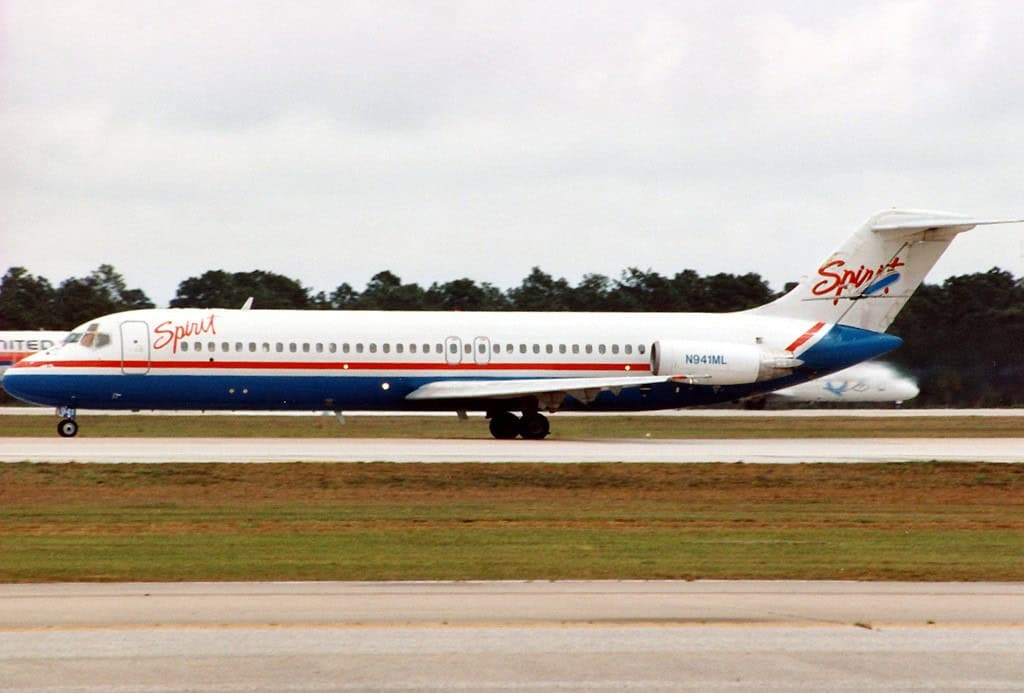
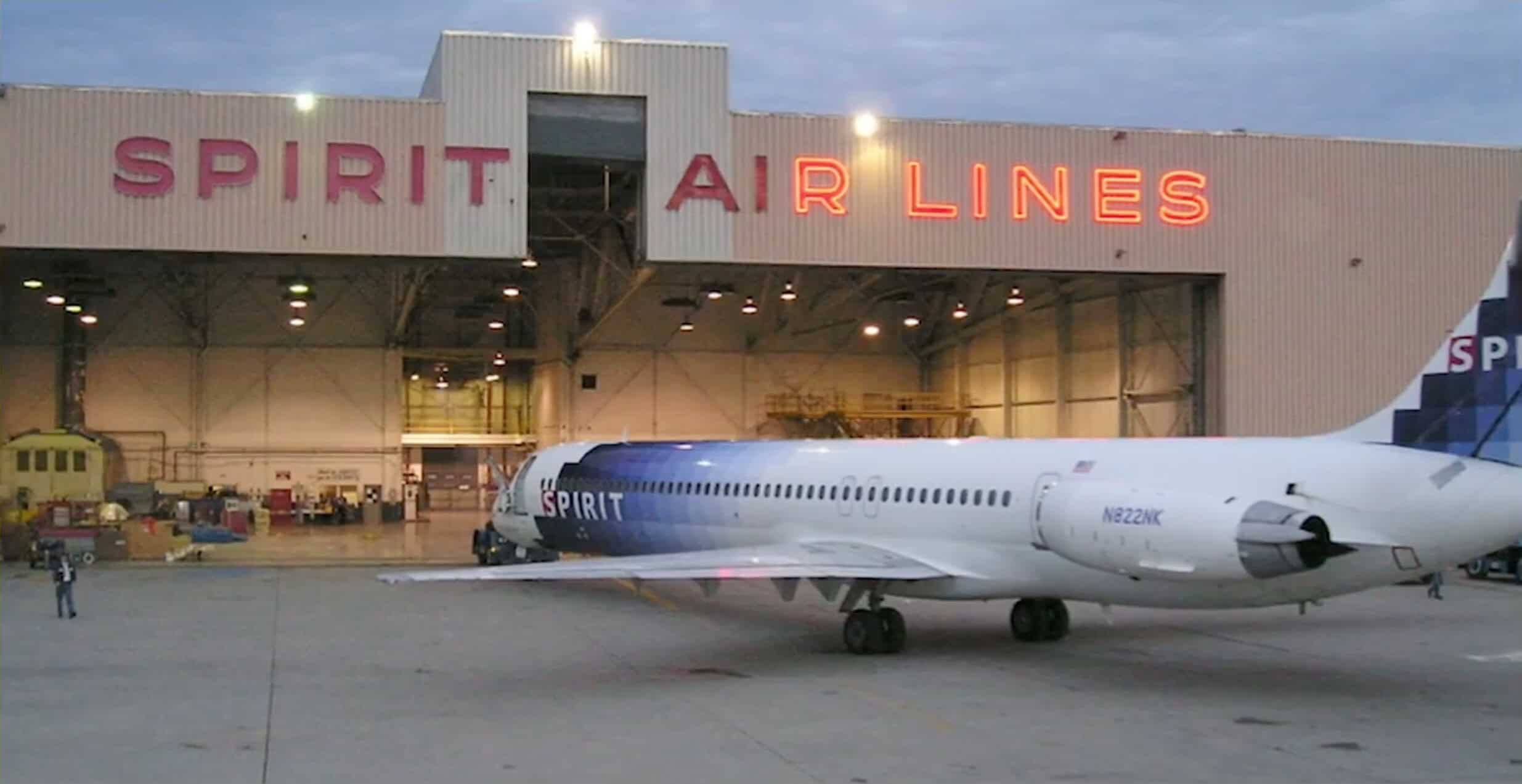
From Humble Beginnings to Industry Disruptor
Before Spirit, there was Charter One Airlines. Founder Ned Homfeld stands with his employees outside of a Charter One Convair 580 in the early 1980s | IMAGE: Spirit Airlines
Spirit’s story did not begin with Airbus jets or bold yellow branding.
It began in 1964 as a trucking company. Then, in the 1980s, Charter One operated charter flights to destinations like Atlantic City and Las Vegas. The airline was founded by Ned Homfeld and, in 1992, adopted a new identity. Spirit Airlines was born, launching scheduled service out of Detroit with a small fleet and an even smaller margin for error.
A Spirit employee marshals a Spirit DC-9 to the gate at ACY | IMAGE: Spirit Airlines
The name “Spirit” was not chosen in a boardroom. It came from employees, reflecting the energy and attitude that would define the airline for decades.
Even the aircraft carried a piece of that story. The “NK” at the end of Spirit’s tail numbers stood for “Ned’s kids,” a tribute to its early days as a family-run business.
From there, it grew the only way it knew how. Scrappy. Resourceful. Relentless.
Spirit Airlines timetable dated 1 October 1993 | IMAGE: airtimes.comThe Spirit Airlines ticket counter and employees at Atlantic City International Airport (ACY) in the early 1990s | IMAGE: Spirit AirlinesA Spirit Airlines commercial from the early 1990s | IMAGE: Spirit Airlines
A Spirit Airlines DC-9-41 on short final at Fort Lauderdale-Hollywood International (FLL) in 1998 | IMAGE: JetPix (GFDL 1.2 or GFDL 1.2 ), via Wikimedia Commons Spirit Airlines McDonnell Douglas DC-9-32 at Orlando International Airport (MCO) in 1995 | IMAGE: JetPix (GFDL 1.2 or GFDL 1.2 ), via Wikimedia CommonsA Spirit Airlines MD-83 entering a hangar at Detroit Metropolitan Wayne County Airport (DTW) featuring the carrier’s “pixel” or “brick” livery, which was introduced in 2002 | IMAGE: Spirit AirlinesA Spirit Airlines McDonnell Douglas MD-82 departs Los Angeles International Airport (LAX) in 2003 | IMAGE: Konstantin von Wedelstaedt (GFDL 1.2 or GFDL 1.2 ), via Wikimedia Commons
DC-9s gave way to MD-80s. MD-80s gave way to the Airbus A320 family. A steady evolution built on survival, not luxury.
And then came the shift that would forever define its legacy.
Unbundled fares. The $9 Fare Club (9FC). Pay only for what you use. Buy-on-board service that turned even a bottle of water into part of the business model. Charging for carry-ons long before it became the industry standard.
The “Big Front Seat” was another unique idea. It offered a premium experience without the usual high price. This was just one example of how Spirit kept experimenting with its own business model.
At the time, these ideas were controversial.
Today, they are everywhere.
The Airline Everyone Had an Opinion About
A Spirit Airbus A319 moments from touchdown at Harry Reid International Airport (LAS) in 2011 | IMAGE: Tomás Del Coro from Fabulous Las Vegas, Nevada, USA, CC BY-SA 4.0 , via Wikimedia Commons
Spirit was never invisible.
Spirit’s bright yellow airplanes and irreverent branding stood out. Its business model challenged what people thought they knew about airline pricing. It was impossible to ignore, even if you tried.
And yes, it often became the punchline. The airline people loved to criticize. The one compared to the “Walmart of the skies.”
Some of that reputation was earned. The fees. The policies. The moments that made headlines for the wrong reasons.
But that was never the full picture.
Because behind the jokes was an airline that forced the industry to rethink what flying could cost. One that proved there was a massive group of travelers who simply wanted one thing: an affordable way to get from point A to point B.
And Spirit gave them that.
Sometimes for less than the price of dinner.
The Flights That Mattered Most
A pair of Spirit Airbus aircraft – an A319 (front) and an A320 (back) – on the ramp at Fort Lauderdale – Hollywood International Airport (FLL) in 2018 | IMAGE: JTOcchialini, CC BY-SA 2.0 , via Wikimedia Commons
This author is living proof of the access to travel that Spirit provided. For me, Spirit was never just a headline.
It was a way to go. A way to say yes to a trip without hesitation. It made it possible for me to visit my dad more often as he got older. Trips that might not have happened otherwise.
That is the part that rarely gets talked about.
Behind every ultra-low fare was a real reason someone was flying. A family visit. A moment that mattered. A chance to be there when it counted.
Spirit made those moments possible.
And when you look at it that way, the conversation changes.
It stops being about fees and policies.
Instead, it becomes about access.
A Record That Deserves Recognition
Three Spirit Airbus aircraft – A319 reg.N534NK (rear), A319 reg. N509NK (middle), and A320 reg. N602NK (front) – on the ramp at FLL in 2014 | IMAGE: JTOcchialini, CC BY-SA 2.0 , via Wikimedia Commons
Despite all the criticism Spirit Airlines received over the years, there is one area where its record is clear.
Safety.
From the time it began operations in the early 1980s to the moment it ceased operations, Spirit never experienced a fatal crash or passenger fatality. In an industry where the margin for error is zero, that is an impressive track record.
It is easy to focus on the things that made headlines. The fees. The policies. The viral moments.
But behind every departure was a crew that took that responsibility seriously. Pilots, flight attendants, mechanics, dispatchers. Professionals who ensured that every flight operated safely, every single day.
That does not happen by accident.
It happens because of people who care deeply about what they do.
And that part of Spirit’s legacy deserves to be remembered just as much as anything else.
The People Behind the Yellow Jets
A Spirit Airbus A320neo and a group of employees | IMAGE: Spirit Airlines
None of this happened because of a pricing strategy alone.
It happened because of people.
Pilots who flew tight, demanding schedules. Flight attendants who brought personality and energy into cabins that could have felt purely transactional. Ramp agents who turned aircraft faster than seemed possible. Gate agents who navigated tough situations with limited flexibility. Corporate teams that tried to keep everything moving on razor-thin margins.
That was the real Spirit.
A culture built on hustle. Efficiency. And doing more with less every single day.
Now, that workforce is left to pick up the pieces. Nearly 14,000 people are suddenly without the careers they built, the routines they knew, and the stability they relied on.
These are real people.
People with mortgages. With kids in school. With lives built around an airline that asked everything of them and, in many ways, defined them.
That is what makes this moment so heavy.
A Complicated, Lasting Legacy
Spirit Airlines Airbus A320-271N | IMAGE: Spirit Airlines via Facebook
Spirit Airlines will not be remembered in simple terms.
It will be remembered as controversial. As disruptive. As frustrating at times.
But also as innovative. As bold. As necessary.
It forced the industry to adapt. It opened the skies to travelers who had been priced out. It introduced ideas that competitors eventually adopted, whether they acknowledged it or not.
It proved that there was more than one way to run an airline.
And in doing so, it became something rare in this industry.
Different.
One Industry, One Family
IMAGE: Spirit Airlines
Now that the airplanes have stopped flying, the noise fades.
What remains is perspective.
In aviation, we often focus on airlines, brands, and competition. But moments like this remind us of something more important.
This is a family.
Pilots. Flight attendants. Mechanics. Dispatchers. Gate agents. Writers. Photographers. Enthusiasts. All of us, in one way or another, connected by a shared love of flight.
And when one part of that family hurts, we all feel it.
At AvGeekery, we feel it.
We mourn with the Spirit team. We stand with the thousands of employees and families now facing an uncertain road ahead. And we hope, sincerely, that the next chapter for each of them brings stability, opportunity, and a chance to keep doing what they love.
Because behind every airline are people.
And those people matter far more than any fare, any policy, or any headline ever could.
Rest easy, Spirit.
You were never boring. You were never insignificant.
And you will not be forgotten.
The sun sets on Spirit Airlines | IMAGE: Avgeekery
There are strange aircraft, and then there is the Sud-Est Grognard.
At first, the French prototype didn’t look like a sleek jet-age attack plane. Instead, it seemed like the result of a clash between aerodynamic ideas and practical needs. The cockpit was set far forward in the nose, and the fuselage rose into a noticeable hump behind the pilot. A single intake on top fed two turbojets stacked one above the other inside the body. The plane looked awkward, almost cartoonish, but it had a clear purpose: to give postwar France a fast, jet-powered aircraft for low-altitude attacks.
The name Grognard suited the plane perfectly. “Grognard” means “grumbler” and was used for soldiers in Napoleon’s Old Guard. It was a fitting name for such an unusual airplane. Officially, it was called the Sud-Est SE.2410 Grognard, developed by the French company Sud-Est/SNCASE after World War II. The first prototype, F-ZWRJ, first flew on 30 April 1950. Only two prototypes were ever built.
France Was Rebuilding More Than an Airplane
The Sud-Est Grognard Looked Awkward, But It Was Built to Hit Hard 93
The Grognard came from a very specific moment in French aviation history. After World War II, France was trying to rebuild an aviation industry that had been badly disrupted by occupation, destroyed factories, and scattered design teams. In jet propulsion, France also lagged behind countries such as the United States and the United Kingdom, which had moved quickly into the jet age during and immediately after the war.
This background is important because the Grognard wasn’t just unusual for the sake of it. It was part of France’s push to rebuild its aerospace industry and create its own jet-powered military planes. The Rolls-Royce Nene turbojet played a big role in this effort. Hispano-Suiza made the Nene in France under license, and many early French jets used it while the country developed its own engines.
In 1946, the French Air Force asked for a new ground-attack aircraft. Sud-Est answered the call with the SE.2410, a small, rounded, single-seat plane powered by two Nene turbojets. The French obviously didn’t care what it looked like, but in terms of speed, firepower, and the ability to attack at low altitude, it was actually a pretty futuristic machine at a time when jet combat planes were still a new idea.
The Hunchback Had a Purpose
Mockup of the SE-2400 used for experiments in the wind tunnel of the ONERA (Chalais-Meudon), circa 1950 | IMAGE: Fondudaviation, CC0, via Wikimedia Commons
The Grognard looked the way it did for a reason. Early designs were shaped by wind tunnel tests with scale models at ONERA’s Chalais-Meudon facility. The end result was a compact fuselage, sharply swept wings, and the distinctive top intake that fed two engines stacked inside.
The intake on top was what made the plane look so unusual. Air entered the fuselage from the top, just behind the cockpit, and fed the two engines, stacked one above the other. This gave the Grognard its “hunchback” look and its memorable nickname.
The cockpit was also set far forward in the nose, which made sense for a low-flying attack plane. Pilots need good visibility when flying low and aiming at targets. The planned weapons matched this mission: the Grognard was supposed to carry two 30 mm DEFA cannons, bombs, and rockets, with some rocket ideas stored in a retractable bay under the fuselage.
Looks aside, the Grognard had legitimate performance to back it up. The SE.2410 reportedly reached about 645 mph, climbed to roughly 38,000 feet, and had a range of about 530 miles. It was unconventional, certainly, but it was not underpowered.
The Grognard II Tried to Civilize the Beast
The Sud-Est Grognard Looked Awkward, But It Was Built to Hit Hard 94
Sud-Est kept going after the first prototype. In 1951, they built a second version called the SE.2415 Grognard II. This one was longer, had two seats, a raised cockpit with a bubble canopy, and wings swept back at 32 degrees instead of the original 47. The second prototype, F-ZWRK, first flew on 14 February 1951.
The Grognard II looked a bit more polished, but it still had the same family traits. It was still humped, compact, and unconventional…a clear example of early jet-age experimentation.
The program also reached an important milestone. During weapons tests, the Grognard reportedly became the first French plane to fire an air-to-air missile, the Matra T-10. This gives it a special place in French aviation history. Even though it’s mostly remembered for its odd looks, the Grognard helped pave the way for the missile-armed jets that would come later.
The Problem Was Not Just the Airplane
IMAGE: Public Domain
Like many prototypes from that time, the Grognard had its share of technical issues. Test flights led to changes to the tail and ailerons, and the SE.2415 experienced tailplane flutter. The second prototype was badly damaged in a belly landing after a false fire warning, but the airframe was saved and later used as a target for firing tests.
But the bigger problem for the Grognard was that things changed too fast around it.
While the Grognard was being tested, the French Air Force revised its fighter and bomber requirements so much that the attack aircraft category was almost dropped. This left the Grognard in a tough spot. It was built for low-level attacks, and its unpressurized body made it hard to use for other roles.
Sud-Est did consider future versions. The SE.2418 was planned as a production attack model with Rolls-Royce Tay engines, and the SE.2421 was studied as a two-seat all-weather fighter with radar. The SE.2418 would have used the original Grognard I’s wing with the longer body and improvements from the Grognard II. At one point, Sud-Est was even getting ready to produce the SE.2418 in larger numbers.
So, the Grognard’s story feels less like a dead end and more like a prototype overtaken by new ideas, competition, and changing times.
Beaten by a Better Future
Sud-Est Grognard with dummy bomb load | IMAGE: Public Domain
The Grognard program ended in 1952. In the end, French officials chose the Sud-Ouest Vautour II instead. The Vautour was bigger, more versatile, and could be used as a fighter-bomber, interceptor, or attack plane. Compared to the specialized and unusual Grognard, the Vautour was a more obvious choice for the future.
The original SE.2410 was taken out of service and reportedly scrapped by 1954. The Grognard II, which was damaged and reused, didn’t do much better. No production models were built, no squadrons ever flew it in regular service, and it never had the chance to become well-known.
Still, the Grognard is hard to forget.
Strange, Ambitious, and Very Much of Its Time
IMAGE: By source, Fair use, https://en.wikipedia.org/w/index.php?curid=27456968
It’s easy to make fun of the Sud-Est Grognard. The nickname “Hunchback” almost encourages it. But this plane deserves more than just a quick look or a joke about its appearance.
The Grognard showed France’s effort to catch up in the jet age. It tested out swept wings, compact twin engines, heavy weapons, missile trials, and low-level jet flying when all these ideas were still new and unproven. The plane may have looked awkward, but the ideas behind it were ambitious.
Some aircraft become famous because they set the direction for the future. Others are important because they show the experiments engineers tried before the future was clear. The Grognard is definitely in that second group.
It was a grumbling, hunchbacked French jet made for a mission that vanished almost as soon as it appeared. It never went into production, never entered service, and never became the attack plane France had hoped for.
A United Airlines drone strike report is under FAA investigation after Flight 1980 landed safely in San Diego with no injuries or aircraft damage reported.
A United Airlines flight landed safely in San Diego on Wednesday morning after its crew reported a possible drone strike during approach, according to the airline and several local news reports.
United Flight 1980, a Boeing 737-800, was operating from San Francisco International Airport (SFO) to San Diego International Airport (SAN) on 29 April 2026 when the crew reported the encounter shortly before landing. The aircraft was carrying 48 passengers and six crew members, United said. The flight landed safely at San Diego International Airport around 0830 local time, and passengers deplaned normally at the gate.
United reported that after landing, the plane was inspected and no damage was found.
“United Flight 1980 reported a possible drone strike just prior to arriving in San Diego. The flight landed safely, and customers deplaned normally at the gate. Our maintenance team found no damage after thoroughly inspecting the aircraft,” the airline said in a statement reported by NBC 7 San Diego and other outlets.
A Red, Shiny Object At About 3,000 Feet
A possible United Airlines drone strike on 29 April 2026 involved a United Boeing 737-800 | IMAGE: 4300streetcar, CC BY 4.0 , via Wikimedia Commons
The incident reportedly took place while the Boeing 737 was on final approach to San Diego. In air traffic control audio shared online and mentioned by several news outlets, the crew described the object as small, red, shiny, and slow-moving. The pilot is heard saying the plane hit a drone “probably at around 3,000 feet,” according to SFGate and the San Francisco Chronicle.
The FAA’s first account, as reported by CBS News, was slightly different. According to that report, the aircraft was at about 4,000 feet when the crew told air traffic control they believed they had seen a drone roughly 1,000 feet below them. Air traffic control alerted other pilots, but no additional drone sightings were reported.
At this point, the information suggests there was a reported possible drone strike, but not a confirmed collision. United found no damage after checking the plane, and no drone wreckage has been reported so far.
Even so, the crew’s report was taken seriously. And rightfully so. A drone at that altitude, near a major international airport in Class B airspace, is an egregious violation. The FAA said it is investigating.
Why The Altitude Raises Concern
If the object was a drone, its reported altitude would be well above normal limits for recreational drones. FAA rules usually require small drones to stay below 400 feet unless the operator has special permission, and drone pilots must avoid restricted airspace and airports.
That is what makes this report so concerning. A drone near an airliner at 3,000 feet would not simply be in the wrong place. It would be operating in airspace where flight crews are busy configuring, communicating, descending, and preparing to land.
SAN is already known for its unique approach, with its city location, nearby terrain, and tight landing area. Adding an unidentified object to the mix creates a situation no crew wants to face while landing.
Safe Landing, No Injuries, Investigation Ongoing
A United Airlines jet on short final at San Diego International Airport (SAN) | IMAGE: San Diego International Airport
The good news is that Flight 1980 landed without incident. No injuries were reported. The passengers got off normally. The airplane was inspected, and United said no damage was found.
Right now, there are still only a few confirmed facts: the crew’s report, United’s statement, the safe landing, no damage to the plane, and the FAA investigation. It’s still unclear if the object was a drone, if there was contact, or who might have been flying it.
But even with those caveats, it is worth reiterating how dangerous this could have been. For an airline crew on approach, even a “small” red object at a few thousand feet is not small at all. It is a hazard, a distraction, and potentially an extraordinarily serious breach of the airspace system that keeps airplanes moving safely in and out of busy airports every day.
Southwest Independence One celebrates America’s 250th with a patriotic 1776 livery, special details, and a first flight from Dallas to Philadelphia.
Southwest Airlines has never been shy about putting a little personality on its airplanes.
As the United States gets ready to celebrate 250 years since the Declaration of Independence, the Dallas-based airline is introducing another patriotic plane. Independence One is a new special livery made in partnership with America250, the national group honoring the country’s Semiquincentennial.
And honestly, it’s one of the most beautiful liveries we’ve ever seen.
The aircraft will officially join Southwest’s fleet on 29 April 2026, with an absolutely fitting first scheduled flight from Dallas Love Field (DAL), Southwest’s hometown, to Philadelphia International Airport (PHL), the birthplace of both the Declaration of Independence and the US Constitution.
That is not exactly subtle. But then again, neither is painting “1776” in giant quill script on the side of a Boeing 737.
A Flying Tribute To 1776
Southwest Airlines unveils its newest specialty livery, Independence One, celebrating America 250. // Photo Credit Stephen M. Keller 2026
Independence One is designed to be more than a red, white, and blue paint job, although it certainly has plenty of that.
Southwest says the livery incorporates several design details connected to the nation’s founding. The livery shows “1776” in big quill-style script, marking the year the Declaration of Independence was signed. It also features the phrase “life, liberty, and the pursuit of happiness,” one of the Declaration’s most famous lines.
IMAGE: Southwest Airlines
Thirteen stars on the fuselage represent the original thirteen colonies. Each engine cowling has a circle of stars inspired by the Betsy Ross flag. The aircraft will also have America250 decals on its nose and winglets.
And yes, because avgeeks notice these things immediately, the aircraft will carry a special 1776 tail number.
Southwest says Independence One will join two other patriotic-themed aircraft in its fleet: Freedom One, which has been flying since 2021, and Liberty One, another newly introduced aircraft painted in an American flag theme. Together, the three aircraft will carry the America250 logo throughout the year.
Southwest says Independence One will join two other patriotic-themed aircraft in its fleet: Freedom One, which has been flying since 2021, and Liberty One, another newly introduced aircraft painted in an American flag theme. Together, the three aircraft will carry the America250 logo throughout the year. | IMAGE: Southwest Airlines
The Freedom To Fly, Southwest Style
Southwest Independence One features the phrase from the Declaration of Independence, “Life, liberty, and the pursuit of happiness.” | IMAGE: Southwest Airlines
For Southwest, the symbolism fits neatly into the airline’s own origin story.
The carrier has long leaned into the idea that it helped democratize air travel, making flying more accessible to millions of Americans. In its announcement, Southwest connected the new aircraft to its 55-year history of carrying families, service members, entrepreneurs, and communities across the country.
That is where the livery works best. Special paint schemes can easily become marketing wallpaper, but this one has a little more meaning. Southwest built its brand around the idea that air travel should feel possible for more people, not just the polished few at the front of the cabin.
So when Southwest talks about the freedom to fly, there is real history behind those words.
Of course, avgeeks also enjoy spotting patriotic special liveries. They turn a normal gate arrival into a small event, make ramp workers pause, get passengers pointing through the windows, and give photographers something new to capture.
And with a tail number like 1776, this one probably will not be hard to remember.
More Than A Paint Job
IMAGE: Southwest Airlines
Southwest’s America250 partnership also includes a volunteerism component.
The airline has been named the official airline of America Gives, a nationwide effort connected to America250 that aims to make 2026 the largest year of volunteerism in the country’s history. As part of that effort, Southwest is introducing the We Serve Together grant, which will invest up to $250,000 to support nonprofits served by Southwest employees.
The company said the new grant builds on more than 180,000 hours of volunteer service from Southwest employees in 2025.
Rosie Rios, Chair of America250, said Southwest’s role in connecting people and communities reflects the “spirit of freedom and opportunity” behind the national celebration.
It is an interesting pairing: a major U.S. airline, a national anniversary, three patriotic aircraft, and a volunteer initiative that brings it all back down to earth. Because as much as avgeeks love the metal, liveries are usually strongest when they point to something larger than paint.
Watch For 1776
IMAGE: Southwest Airlines
Independence One is scheduled to begin flying on 29 April 2026, starting with that Dallas-to-Philadelphia trip. After that, Southwest says to watch for tail number 1776 throughout the year as the aircraft makes special stops tied to the nation’s 250th anniversary.
For some passengers who are unaware of the plane they’ll be flying, it will be a fun surprise at the gate. For avgeeks, it will be one more aircraft to track, photograph, and casually point out to everyone nearby.
Because that is what we do.
And with a tail number like 1776, Southwest clearly knew exactly how to get our attention.
The Royal British Airbus A321neo made a high-profile arrival at Joint Base Andrews on Monday for King Charles III’s America 250 state visit.
When King Charles III and Queen Camilla arrived in Washington, D.C. today, the occasion was bound to make headlines. Their state visit will undoubtedly be a historic event, celebrating America’s 250th year of independence and the America 250 festivities. For avgeeks, though, the real highlight was the United Kingdom government’s VIP Airbus A321neo parked at Joint Base Andrews.
The aircraft, registered as G-GBNI, is one of the most recognizable narrowbody VIP planes used by any government. Titan Airways operates it for the UK government, and it often appears on important ministerial and royal trips. On this transatlantic journey, the King and Queen flew from RAF Brize Norton to Washington, D.C., using a royal flight callsign.
Flight tracking shows G-GBNI left RAF Brize Norton (BZZ) at 1147 local time and landed at Joint Base Andrews (ADW) at 1432 local, making the trip in about 7 hours and 45 minutes. This flight is notable not just for its passengers, but also for what it reveals about the use of long-range narrowbody jets in VIP travel today.
King Charles and Queen Camilla have departed for their State Visit to the United States. They'll be meeting with President Trump and the First Lady at the White House later today.
The royals flew from RAF Brize Norton aboard the UK government jet 'G-GBNI', typically used by the… pic.twitter.com/NhYWNffjbw
IMAGE: Anna Zvereva, CC BY-SA 2.0 , via Wikimedia Commons
G-GBNI is an Airbus A321-251NX from the A321neo family, set up for long-range VIP missions. Public records show it is MSN 8830 and has two CFM International LEAP-1A32 engines. The plane first flew in 2019 and joined the UK government’s VIP fleet after serving with other operators.
Most people think of the A321neo as a regular commercial jet, but it is now playing a bigger role in long-range premium travel. Its longer range, lower costs compared to larger jets, and ability to use many airports make it an attractive choice for government and VIP flights.
This was clear during today’s flight, when the plane flew nonstop from the UK to Washington, covering about 4,500 nautical miles depending on routing. For a single-aisle jet, this is exactly the kind of trip the long-range A321neo was built for.
This A321neo is set up differently from standard models. Public sources say G-GBNI has a low-density VIP layout with lie-flat seats, meeting areas, high-speed internet, secure communications, and other features needed for official trips. The exact interior is not shared for security reasons, but it is used by the Prime Minister, Cabinet ministers, senior officials, and the Royal Family.
From Airliner to Government Transport
Stunning Royal British Airbus A321neo Arrives in Washington for Historic State Visit 110
The current G-GBNI has a more complex past than its VIP role suggests. It was first delivered to Arkia Israeli Airlines in 2019, then stored and re-registered. Titan Airways received it in 2022 as G-POWT and re-registered it as G-GBNI in 2023.
An Arkia Israeli Airlines Airbus A321LR neo. The current Royal British Airbus A321neo began its life at Arkia Airlines | IMAGE: Airbus
This is important because G-GBNI is not just a new plane with a new registration. According to records, this is the second airframe to use the G-GBNI registration. The previous A321neo with this registration became G-OATW, and the current plane took over the registration, livery, and VIP duties.
This history makes the plane especially interesting for planespotters. It serves as a government aircraft, is operated by a civilian company, and was originally an airline jet. This mix shows how modern VIP transport is more complex than the old idea of a military jet with a flag on the tail.
Titan Airways, a British charter and ACMI company with experience in special flights, operates the aircraft. When used by the government, G-GBNI uses royal and official callsigns, such as KRH/Sparrowhawk for royal trips and AWC/Zap for government flights.
A fun bit of aviation trivia: the registration G-GBNI is a nod to the country’s official name, the United Kingdom of Great Britain and Northern Ireland. In other words, GBNI. And now you know.
The “Global Britain” Look
G-GBNI landing at Prestwick, Scotland in 2025 | IMAGE: By Jonathan Payne from Ayr, United Kingdom – G-GBNI A321, CC BY-SA 4.0, https://commons.wikimedia.org/w/index.php?curid=178251847
G-GBNI stands out thanks to its bold look. It features the UK government’s Global Britain livery, with Union Flag colors on the fuselage and tail. This design is also used on the RAF Voyager KC3 VIP jet, giving the UK’s transport fleet a more unified and visible identity.
On a normal commercial A321neo, the fuselage is often a clean canvas for airline branding. On G-GBNI, the aircraft’s livery turns the narrowbody into a flying diplomatic symbol. That is especially fitting for a mission like this, where the aircraft was transporting the King and Queen to the United States during a major anniversary year.
The aircraft’s arrival at Joint Base Andrews also put it in rare company. This is the kind of ramp more often associated with presidential aircraft, military transports, and high-level diplomatic arrivals. So for avgeeks, seeing a single-aisle Airbus in that setting was part of the fun. It was also a reminder of just how far the A321neo has stretched the role of the narrowbody. With the right cabin and range, an aircraft many travelers associate with airline service can also carry heads of state, royalty, and senior officials across the Atlantic.
A Royal Flight During America 250
BBC coverage of the arrival of His Majesty King Charles III to Joint Base Andrews in Washington, DC on 27 April 2026 | IMAGE: BBC
The visit itself carries major historical significance. The White House said President Donald Trump and First Lady Melania Trump would welcome King Charles III and Queen Camilla for a state visit from 27 April through 30 April 2026, coinciding with commemorations marking the 250th anniversary of American independence.
Most people will pay attention to the ceremonies, meetings, and symbolism surrounding a British monarch’s visit to the United States during America 250. But the flight itself also shows the important role of aircraft in state visits. Before the motorcades and photo ops, it all starts with the plane.
This time, the aircraft was not a jumbo jet or military plane. Instead, it was a VIP Airbus A321neo, a model many travelers know from regular airline service. G-GBNI’s arrival showed how this type of plane can be turned into a long-range government jet fit for royalty.
Why This Flight Stood Out
Airbus A321-253NX (c/n 10238, G-GBNI) of the Government of the United Kingdom / Titan Airways | IMAGE: https://upload.wikimedia.org/wikipedia/commons/e/e0/Airbus_A321-253NX_%28cn_10238%2C_G-GBNI%29_2024-07-14_Andre_Gerwing_Collection_ID_021118.jpg
There is something especially avgeek-worthy about a state visit carried out aboard a narrowbody Airbus. The A321neo family has already changed airline route planning by making thinner long-haul routes more practical. VIP service offers many of the same advantages: range, efficiency, airport flexibility, and enough cabin space for a specialized interior.
G-GBNI’s arrival in Washington showed all these qualities at once. It was a royal flight, a diplomatic event, and a great example of how much single-aisle planes have advanced.
For aviation fans, the main point is clear. While the King and Queen’s visit made the news, the plane that brought them is worth attention too. G-GBNI is more than just a way to travel—it is a modern government flagship, and this was one of its biggest missions so far.
New information from the NTSB explains how the March 2026 LaGuardia runway collision between an Air Canada CRJ-900 and a fire truck happened.
On the night of 22 March 2026, something went very wrong at New York’s LaGuardia Airport (LGA).
A routine arrival from Montréal–Trudeau International Airport (YUL) ended in a deadly runway collision between an Air Canada Express regional jet and an airport fire truck. The National Transportation Safety Board’s preliminary report now provides the first detailed account of what happened in those final moments.
Although many questions remain, the initial findings are already prompting difficult questions.
A Landing That Never Finished
IMAGE: NTSB
Jazz Aviation flight 646, operating as Air Canada Flight 8646, was on final approach to LGA’s Runway 4 just before midnight. The CRJ-900 had 76 people on board and was nearing the end of what had otherwise been a normal flight from YUL.
At 23:35:07 (all times local), the aircraft was cleared to land.
R35 (Truck 1) and Air Canada Flight 8646 positions at 23:37:04 | IMAGE: NTSB
At the same time, multiple airport rescue vehicles were responding to a separate emergency near Terminal B. Seven ground vehicles began moving across the airfield, planning to cross Runway 4 via Taxiway D.
What happened next took place over the course of just a few seconds.
At 23:37:04, with the aircraft just a quarter mile from touchdown and about 130 feet above the ground, the lead fire truck, identified as Rescue 35, was cleared to cross the runway.
Three seconds later, the truck began moving.
Four seconds after that, the aircraft crossed the runway threshold.
The gap between them was closing fast.
“Stop! Stop! Stop!”
IMAGE: NTSB
As the aircraft touched down, controllers took immediate action.
At 23:37:12, the tower instructed the fire truck to stop. Then again at 23:37:20.
Inside the truck, the crew sensed the urgency in the radio call but did not immediately understand what it meant.
One crew member later recalled hearing “stop stop stop” on the frequency, but not realizing right away that it was directed at them. Only after hearing “Truck 1 stop stop stop” did it fully register.
By then, the truck had already crossed the hold short line and was entering the runway at roughly 30 mph.
At the same moment, the aircraft was decelerating through about 100 knots, less than 400 feet from the intersection.
Two seconds later, they collided.
A System That Stayed Silent
LaGuardia is equipped with multiple layers of safety designed to prevent exactly this kind of scenario.
But in this case, several of them didn’t provide the protection you might expect.
The airport’s ASDE-X surface detection system, which is designed to track aircraft and vehicles and warn of potential conflicts, did not generate any alert in the tower.
Investigators say one key reason is that none of the responding ground vehicles were equipped with transponders. That meant the system could not reliably distinguish or track each vehicle, especially as they moved close together.
Instead of seven distinct vehicles, controllers saw only intermittent and merged radar targets.
Without a clear track for the fire truck, the system never recognized the developing conflict.
REL Lights Were On
Runway Status Lights (RWSL) illuminated at runway intersection | IMAGE: FAA
Another layer of protection, however, did activate.
Runway Entrance Lights (RELs), designed to warn vehicles not to enter an active runway, illuminated as the aircraft approached.
Surveillance video shows the red lights were clearly on while the fire trucks were holding short, about 300 feet from the runway.
But those lights are designed to turn off as an aircraft passes an intersection.
In this case, they went dark about three seconds before the collision—just as the truck reached the runway edge.
That timing, by design, may have removed a final visual warning at the worst possible moment.
The Outcome Could Have Been Much Worse
The day after the fatal incident shows catastrophic damage to the cockpit of the CRJ-900 | IMAGE: NTSB
The collision caused catastrophic damage to the forward section of the aircraft.
The cockpit area was destroyed, and both pilots were killed.
However, for passengers seated further back in the cabin, the outcome could have been much worse.
Passenger seats remained largely intact, and many occupants were able to evacuate through overwing exits. In total, 39 people were taken to hospitals, including six with serious injuries.
The aft flight attendant said the landing seemed normal until a sudden impact, followed by confusion and darkness, before passengers began evacuating.
Even with the confusion, most people evacuated in an orderly way.
The Investigation Continues
The Air Canada CRJ-900 involved in the fatal LaGuardia runway collision in March 2026 rests in a hangar at LGA | IMAGE: NTSB
It’s important to remember that this is only a preliminary report. The NTSB has not yet determined a probable cause, and many details are still being analyzed.
But even at this early stage, some key issues are already becoming clear:
A high workload environment, with controllers managing both arriving aircraft and a ground emergency
Communication challenges, including blocked transmissions and delayed recognition of instructions
Limitations in surface detection systems when ground vehicles are not fully equipped
Safety systems that worked as designed, but may not have been enough in combination
None of these factors alone tells the full story.
But taken together, these factors help explain how a routine landing and a routine runway crossing ended up overlapping with tragic results.
As the investigation into Air Canada Flight 8646 continues, the focus will shift from understanding what happened to understanding why it happened. And perhaps, most importantly, preventing it from ever happening again.
The bright yellow jets may get yet another chance. Spirit Airlines is in advanced talks for a bailout. Here’s what we know.
After weeks of uncertainty, Spirit Airlines may finally have a path forward.
The Wall Street Journal first reported, and other outlets have confirmed, that Spirit Airlines is in advanced talks with the US government about a possible rescue package worth up to $500 million. The deal is not final, but it could give the government a large equity stake in the airline, which might put it ahead of other stakeholders depending on the final terms.
Talks are ongoing and moving forward as officials work out the final terms. There is no official agreement yet, and details could still change. Even so, this progress is a significant development after days of uncertainty about possible support.
The Spirit Airlines story plot twists keep coming. After multiple rounds of merger speculation, two bankruptcies in a year, and other challenges, the Dania Beach, Fla.-based carrier announced in February that it was aiming to emerge from bankruptcy by this summer.
And then fuel prices skyrocketed as the US and Israel launched military operations in Iran.
This was not good news for Spirit, which was barely hanging on as it was. Just last week, it was reported that the carrier’s closure was imminent, barring an eleventh-hour rescue.
It appears that rescue may have arrived.
What the Deal Could Mean
A Spirit Airlines A320-271N lands at Harry Reid International Airport (LAS) | IMAGE: Spirit Airlines via Facebook
If the deal goes through, Spirit would get quick access to cash as it restructures and seeks to emerge from bankruptcy later this year. The deal could also change the airline’s ownership, since the government might end up with a large stake depending on the terms.
This possibility has brought mixed reactions. President Donald Trump said he is open to helping, pointing to the 14,000 jobs at risk and the need for competition in the U.S. airline market. On the other hand, Transportation Secretary Sean Duffy questioned whether a bailout would help, warning against using taxpayer money for a company that has not been consistently profitable. Duffy also asked whether giving taxpayer money to the airline would really change its long-term trajectory or just delay an outcome markets already expect.
Industry experts are also divided. Some analysts warn that rescuing one airline with government support could set a precedent for others.
Past government interventions, like those after the September 11 attacks and during the COVID-19 pandemic, were meant to support the whole industry. Directly rescuing just one airline would be different and could lead other struggling carriers to ask for help too.
For Now, Operations Continue as Normal
IMAGE: Spirit Airlines
As talks go on, Spirit says its daily operations remain the same. Passengers can still book flights and use tickets, credits, and loyalty points as usual, with no immediate disruptions reported.
For crews and frequent flyers, who know how quickly things can change in this industry, the main question is what happens next. If a deal is reached, it could help stabilize Spirit and give it a better chance to exit bankruptcy. If talks fall through, the situation could become urgent again.
Either way, the Spirit Airlines story isn’t over.
For now, though, the bright yellow jets are still flying.
And in an industry that has seen more than its share of goodbyes, that still matters.
Either way, this moment stands out. It is not just that Spirit is facing challenges, but for the first time in a while, there is a real plan being discussed to keep the airline operating.
The 2026 airport coffee rankings break down the best and worst coffee across major U.S. airports. See who made the list.
There are a few universal truths about flying.
Boarding will probably start late. Someone always tries to cram way too much into the overhead bin. And at some point, you’ll be looking for coffee.
Not necessarily good coffee. Not even great coffee.
You just want something that tastes enough like coffee to get you through the flight without questioning life choices.
For flight crews, searching for coffee isn’t just a once-in-a-while thing. It’s part of the job. Early mornings, long days, and quick turnarounds make coffee a daily must-have. It’s simply part of flying.
And every now and then, an airport gets it right.
A new 2026 study from Upgraded Points looked into this, analyzing nearly 500 coffee spots in 50 major US airports based on Google reviews, availability, and the number of shops.
The results turned up some hidden gems, a few unexpected winners, and some airports that might be better off serving tea.
The Airports That Actually Get It Right
Raleigh-Durham’s own Black & White Coffee Roasters serves travelers at RDU, making RDU one of America’s top airports in 2026 for coffee | IMAGE: RDU Airport on Facebook
Let’s begin with the high rankers.
William P. Hobby Airport (HOU) tops the 2026 list, managing something rare in aviation: consistently good airport coffee.
It earned an average rating of 4.03, which is impressive considering airport coffee usually rates as just ‘acceptable-ish.’
Right behind it:
Kahului Airport (OGG) – 4.00
Pittsburgh International Airport (PIT) – 3.83
Miami International Airport (MIA) – 3.56
Raleigh-Durham International Airport (RDU) – 3.53
A few things stand out here.
First, PIT quietly landing in third place matches its reputation. No drama, no hype—just solid execution. Good coffee, easy access, and straightforward service. It’s the kind of place crews trust without much talk.
Second, Texas really stands out in the rankings. With Houston, Dallas-area airports, and San Antonio all in the top 10, it’s clear that Texas is the place to go for a good preflight cup.
For crews flying multiple legs through the same hubs, that kind of consistency is crucial. You quickly figure out which stops are worth it and which to skip.
The Not-So-Great (a.k.a. “Maybe Skip It”)
Cincinnati/Northern Kentucky International Airport (CVG) has been ranked the worst airport in the US in the 2026 airport coffee rankings | IMAGE: CVG via Facebook
Now let’s look at the other end of the spectrum.
For every great airport coffee experience, there’s another that makes you wonder if the machine has been cleaned since the days of the Wright brothers.
At the bottom of the rankings:
Cincinnati/Northern Kentucky International Airport (CVG) – 2.00
LaGuardia Airport (LGA) – 2.08
St. Louis Lambert International Airport (STL) – 2.13
Fort Lauderdale-Hollywood International Airport (FLL) – 2.23
Chicago Midway International Airport (MDW) – 2.32
Here’s something interesting.
Some of these airports actually offer plenty of coffee options.
That leads to one of the study’s biggest takeaways: Having more coffee choices doesn’t always mean better coffee.
Take LaGuardia, for example. You’re never far from caffeine, but overall quality still falls short.
It’s the same story at Chicago Midway and Fort Lauderdale. There are lots of choices, but not many you’ll remember.
For flight crews, that inconsistency stands out even more. When you travel through different airports every day, you start to keep a mental list: the good stops, the reliable ones, and the places you would skip even if it was the only place open in the middle of the night during the blizzard of the century.
It’s not just about having coffee available. It’s about whether it’s actually worth stopping for.
IMAGE: Upgraded Points
Where Coffee Is Easiest to Find (When You’re Sprinting to the Gate)
Of course, quality only matters if you can actually grab a coffee before boarding closes.
Or before your next flight starts boarding.
That’s where accessibility matters, and a few airports really stand out.
Leading the pack:
Cleveland Hopkins International Airport (CLE) – highest coffee shops per passenger
Raleigh-Durham (RDU) – strong balance of quality and availability
Newark Liberty International Airport (EWR) – lots of options, easy to find
Boston Logan International Airport (BOS) – solid accessibility
Kansas City International Airport (MCI) – surprisingly strong showing
This is where airports like RDU and Pittsburgh really shine.
They’re good and reliable.
When you’re running on four hours of sleep, facing a tight connection, or rushing to your next flight, reliability might matter most.
The Bigger Picture: Why This Actually Matters
It’s easy to laugh this off. Airport coffee rankings? Seriously?
But think about it for a second.
Coffee is one of the first experiences most travelers have inside a terminal. For crews, it’s one of the few small constants in a job where almost everything else changes from day to day.
It’s part ritual. Part routine. Part survival strategy.
And according to the data, the average airport coffee rating in the U.S. is just 2.94 out of 5.
That’s… well, not great. Actually, it’s pretty bad.
In fact, less than half of major airports even reach a 3.0 rating.
So when an airport does get it right, it stands out more than you might expect.
Great Airport Coffee is the Exception, Not the Rule
Here’s the bottom line.
Great airport coffee is still rare. It’s the exception, not the rule.
But it’s getting better.
Airports like Houston Hobby, Pittsburgh, and Raleigh-Durham show that you don’t have to settle for a forgettable cup just because you’re traveling.
And maybe that’s the real takeaway.
In an industry focused on movement, tight schedules, and constant change, it’s the small things that make a difference.
A reliable gate. A smooth boarding process.
Or a genuinely good cup of coffee… five minutes before pushback.
View the full 2026 Airport Coffee Rankings from UpgradedPoints.com here.
If you’ve followed the story of the legendary A-10 Thunderbolt for any length of time, this latest development probably feels less like a surprise and more like déjà vu.
On 20 April 2026, Secretary of the Air Force Dr. Troy E. Meink announced on X that the Air Force will keep the A-10 “Warthog” in service until 2030. Not long ago, it seemed the aircraft was close to retirement. Meink wrote, “In consultation with @SecWar, we will EXTEND the A-10 ‘Warthog’ platform to 2030,” and said this decision “preserves combat power” while the defense industry works to build more planes. He ended the message with, “More to come.”
The announcement was surprisingly low-key. As of this writing, there has been no official Department of War press release, no detailed explanation, and no clear information yet about how the extension will be funded or managed. Still, the main point was clear, and the decision has been made: the A-10 will keep flying.
In consultation with @SecWar, we will EXTEND the A-10 “Warthog” platform to 2030. This preserves combat power as the Defense Industrial Base works to increase combat aircraft production.
— Office of the Secretary of the Air Force (@SecAFOfficial) April 20, 2026
A Retirement That Never Quite Happened
U.S. Air Force Maj. Cody “ShIV” Wilton, the A-10 Warthog Demonstration Team commander and pilot, releases flares at the 2020 Fort Lauderdale Air Show Nov. 21, 2020, Fort Lauderdale, Florida. This airshow was Maj. Wilton’s last public demonstration performance of his career in the U.S. Air Force. (U.S. Air Force photo by Capt. Kip Sumner)
Until recently, the A-10’s retirement seemed certain.
The Air Force had a plan to retire the A-10 by the end of 2026, with some estimates pushing that date to 2029. This time, the plan seemed to be moving forward. The last A-10 pilot training class graduated at Davis-Monthan Air Force Base earlier this month, and in February 2026, the 571st Aircraft Maintenance Squadron at Hill Air Force Base was deactivated after finishing the final scheduled maintenance on the jet.
Meanwhile, the fleet had shrunk to about 103 aircraft, much leaner than it used to be.
Normally, these changes would signal that an aircraft’s service is ending. But now, the Air Force has changed direction. Under the new plan, three squadrons will keep flying the A-10 past the original retirement date. One active-duty squadron and one reserve unit will stay in service until 2030, and another active-duty squadron is expected to continue until 2029.
So, the Warthog’s retirement has been delayed once more.
Why the Warthog Keeps Getting Called Back
OVER THE MEDITERRANEAN SEA — An A-10 Thunderbolt II from the 104th Fighter Wing, Barnes Municipal Airport, Westfield Mass., Massachusetts Air National Guard, banks while flying across the Mediterranean Sea en route to a forward operating base. (U.S. Air Force photo by Master Sgt. Mark Bucher)
This keeps happening for a simple reason: the A-10’s mission is still needed.
The A-10 is still used often in US operations in the Middle East, including missions for Operation Epic Fury. In these situations, its strengths stand out. The A-10’s 30 mm GAU-8 Avenger cannon is still one of the best close air support weapons, and its ability to stay over the battlefield gives ground troops more time and flexibility than faster jets can offer.
Survivability is just as important. The A-10 was built to take damage and keep flying, thanks to backup systems and armor. This makes it effective not only for close air support, but also for maritime strike missions, such as targeting Iranian boats in the Strait of Hormuz.
Even though newer aircraft have many features, none match the A-10’s unique mix of abilities. As long as this gap remains, the A-10 proves its value in real missions, not just in discussions.
A Bridge to What Comes Next
An A-10 Thunderbolt II from Selfridge Air National Guard Base, Michigan, prepares to land on a public highway in Alpena, Michigan, August 5, 2021. The highway landing was a part of Exercise Northern Strike 21-2, a multi-component, multinational exercise hosted by the Michigan National Guard designed to build readiness and enhance interoperability with coalition forces to fight and win. The highway landing afforded the Michigan Air National Guard an opportunity to demonstrate the ability of their aircraft to land in an austere environment. (U.S. Air National Guard photo by Master Sgt. Scott Thompson)
This decision is not only about keeping the A-10 in service. It is also about giving the Air Force more time.
The Air Force is moving to newer aircraft, such as the F-35 Lightning II. However, building enough of these planes and fully preparing them for missions takes years. Until then, the Air Force still needs a dependable way to provide close air support where it is needed.
Keeping the A-10 in service fills this gap. It keeps a proven tool available while new aircraft are introduced. This also avoids rushing the transition before replacements are fully ready.
Still, this extension brings up some practical questions. The A-10 fleet is smaller now, and some of its support systems have been closed. It is unclear whether pilot training will resume, how funding will work, or what maintenance plan will keep the jets flying through the decade. Even Meink said more details are coming.
Still in the Fight
A-10, 1975. (U.S. Air Force photo)
The A-10 has always had a special role in American airpower. It is not the fastest, most advanced, or most versatile plane. But it has always been reliable at what it was designed to do.
That reliability is why the A-10 keeps surviving decisions that should have retired it years ago. Whenever real-world needs clash with long-term plans, the A-10 manages to stay useful.
This new extension is another example of that trend. The A-10 was supposed to retire soon, but now it is back in the spotlight—not because of nostalgia, but because its mission is still important. Operation Epic Fury has proven that to be true. (Okay, maybe a little nostalgia.)
So, for now, at least, the Warthog remains exactly where it has spent most of its life: in the fight. And we’d be willing to bet that the men and women on the ground being protected by these iconic machines are not the least bit upset.
From the Hempstead Plains to the Moon, explore the story of flight at the Cradle of Aviation Museum.
The Cradle of Aviation Museum, located on Museum Row in Garden City near the Coliseum, Nassau Community College, and Hofstra University, tells most of Long Island’s aerospace story.
Tracing its origin to 1979, when then-County Executive Francis T. Purcell designated funds to restore two aircraft hangars at former Mitchel Field, it displayed several dozen aircraft until it closed for renovation in 1995.
The 130,000-square-foot, $40 million facility, opening on the 75th anniversary of Lindbergh’s transatlantic flight in 2002, showcases more than 70 air- and spacecraft, 11 of which are one-of-a-kind designs, associated with or constructed on Long Island and uncovered during a 20-year search that stretched from the bottom of Lake Michigan to Guadalcanal.
They were then restored and preserved by volunteers from the retired airline and defense aircraft manufacturing industry, who collectively contributed some 650,000 man-hours to the project. The result was Long Island’s largest, year-round, educational, recreational, and cultural institution.
According to New York State Governor George E. Pataki, museum visitors “can see the brief span of years that brought Long Island from hosting the fragile biplanes of 1911 to building the Lunar Module that took mankind to the moon in the sixties. Through these displays, the Cradle becomes a powerful mirror that reflects our own skills, intellect, and ability to conquer time and space and pays tribute to American innovation and pioneering spirit.”
Notable Aircraft and Exhibits
The F-14D Tomcat on display outside the museum, “Felix 101” (BuNo 164603), made the final U.S. Navy F-14 flight in 2006. Restored by Northrop Grumman volunteers, it was installed at the entrance in 2023 | IMAGE: Cradle of Aviation Museum
Its outdoor exhibits include three significant Grumman designs: an OV-1B Mohawk, an E-2C Hawkeye, and an F-14 Tomcat, one of its latest additions.
“F-14D Tomcat BuNo 164603 is number 711 of the 712 Tomcats built, and the last Navy Tomcat to ever fly,” according to Moreno Aguiari in his article, “Last F-14 Tomcat in US Navy Service Now on Display at The Cradle of Aviation Museum” (Vintage Aviation News, September 20, 2023). “Delivered to the Navy on May 29, 1992, it completed its 14 years of service with VF-31, the last F-14 squadron. This proud aircraft was returned ‘home’ to Long Island on October 4, 2006, to become an enduring symbol of the spirit of innovation and teamwork, and to serve as a lasting reminder of the importance of what Northrop Grumman employees do every day to provide for our men and women in uniform. Felix 101 has been parked at 600 Grumman Rd. West since 2008, when Grumman’s successor, Northrop Grumman Corp., and the Grumman Retiree Club, a former employee’s group, created a monument.”
It was relocated to the museum in 2023.
This Grumman F-11 Tiger, now on display at the museum, was obtained from the Naval Test Center at Patuxent River and restored by Grumman retirees. It carries the markings of Captain Norm Gandia, a Long Island native who flew with the Blue Angels | IMAGE: Cradle of Aviation Museum
The Cradle of Aviation Museum itself, dominated by its impressive, four-story, glass atrium Reckson Center, greets visitors with a ceiling-suspended Grumman F-11A Tiger supersonic fighter in Blue Angels livery and a 1929 Fleet 2 biplane trainer, symbolically representing the soaring ascent of Long Island’s aviation heritage.
Its second-level mezzanine features a Sperry Messenger on one side and a Bellanca Monoplane on the other. The latter, a high-wing, fabric-covered design powered by a single, three-cylinder, 30-hp Anzani engine, was built by Italian emigre Giuseppe Bellanca in the back of a Brooklyn bakery, and then trucked to the Mineola Flying Field, where it served its first purpose–namely, to teach Bellanca himself how to fly.
It became one of five to encompass the school’s training fleet on the Hempstead Plains between 1912 and 1916, which introduced many budding pilots to flight, including Fiorello La Guardia, New York City’s future mayor.
During the 1920s, Bellanca built many record-setting airplanes. The Bellanca CF, for instance, which Charles Lindbergh initially eyed for his transatlantic crossing to Paris, was a high-wing, four-passenger, enclosed-cabin monoplane with the pilot positioned in an open cockpit behind.
Another floor higher, on the third-level mezzanine, airliner development is featured, including displays such as “The Boeing 314: An Extraordinary Story,” “The Boeing 377: A Luxury Story,” and “The Boeing 707: A Fast Story.”
The ground floor Jet Gallery emphasizes speed with exhibits such as a Grumman A-6 Intruder, a second Grumman F-14 Tomcat, a Grumman F-14A forward fuselage section, a Northrop-Grumman E-2D Hawkeye Simulator, a Republic A-10 Thunderbolt II Ordnance Class Air Support Aircraft, a Grumman Gulfstream G-II business jet cabin, and the nose section of a Boeing 707, the US’s first commercial jetliner. Separated from El Al’s first 707 and registered 4X-ATA, it flew for 23 years as a complete airplane, establishing two records between New York and Tel Aviv—a distance of 5,760 miles and a speed of 9.33 hours—in the process.
This early production A-10A (s/n 76-0535), now on display at the museum, served with USAF units from 1977 to 1992 and is on loan from the National Museum of the United States Air Force. It is painted in the Gulf War markings of Captain Michael Baltzer, including the distinctive “Live to fly, Fly to kill” insignia | IMAGE: Cradle of Aviation Museum
Historical Galleries and Aviation Evolution
1911, Hempstead Plains. The “Vin Fiz” and a Blériot XI share the field as Cal Rodgers and Harriet Quimby make history | IMAGE: Cradle of Aviation Museum
The museum’s main exhibits, located in eight galleries in the two restored Army Air Corps Hangars 3 and 4, which still bear the words “Mitchel Field. Elev 90 Feet” on their facades, and now designated the Donald Everett Axinn Air and Space Hall, are accessed by a second-floor skywalk.
According to the skywalk’s plaque, “Long Island has been at the forefront of America’s aviation and space adventure for the past one hundred years…It all started here on Long Island’s Hempstead Plains.”
From kites to wings, 19th-century experimentation helped turn the dream of flight into reality | IMAGE: Cradle of Aviation Museum
A one-flight descent leads to the first of the museum’s galleries, “Dream of Wings.” Depicting the triumph of flight with lighter-than-air craft, it demonstrates how balloon, kite, glider, and airship experimentations turned the dream of flight into reality and led to its heavier-than-air successors, displaying aerostatic lift generation, Alexander Graham Bell’s tetrahedral kite, an Otto Lilienthal glider, and a 1906 Timmons kite built in Queens, the museum’s oldest flying exhibit. A 20-hp Glenn Curtiss airship engine, designed two years later, and a Mineola Bike Shop, demonstrating, in the Wright Brothers’ vein, the technology transfer from the bicycle to the aircraft with propellers and wings, round out the exhibits.
The “Hempstead Plains” gallery, the next encountered, represents a 1910 air meet. Amid recordings of turning propellers and accelerating aircraft, a collection of early designs graces the grass-carpeted field and includes a spruce-and-bamboo replica of Glenn Curtiss’s Golden Flyer, the first heavier-than-air airplane to fly over Long Island; a replica of a Wright Brothers’ Model B EX Vin Fiz; a Hanriot monoplane; a Farman biplane, a Herring-Curtiss No 1 Golden Flyer; a 1911 Anzani engine; and a 1913 Studebaker “motor car.”
An original Bleriot XI of 1909, the world’s fourth-oldest, still-operational airframe, completes the visitor’s “return to the early days.” As the first type imported to the United States and the first manufactured on Long Island, it is one of the world’s oldest, having flown over the Hempstead Plains in 1911. It was used to train pilots at Mineola’s Moisant Aviation School.
During World War I, as evidenced by the succeeding gallery, the triumph of flight was turned to destruction, as the airplane assumed the reciprocal role of a weapon, and Long Island became the center of military aircraft design, testing, and production. On display is the first airplane acquired by Charles Lindbergh, a Curtiss JN-4 Jenny purchased in 1923 for $500; along with a 1918 Breese Penguin trainer, the only one of the 250 originally produced remaining; an airworthy Thomas-Morse S4C Scout biplane with its original Marlin machine gun; and the F. Trubee Davison World War One wooden hangar. It houses the ribbed, uncovered airframe of a Curtiss Jenny with its engine, propeller, and fuel tank, and a 160-hp 1916 Gnome Monosoupape engine from France.
The Golden Age of Aviation
On display in the museum’s Golden Age Gallery, this 1928 Ryan Brougham is a sister ship to Lindbergh’s Spirit of St. Louis. It was used in the 1955 film and honors the historic 1927 flight that began just miles away at Roosevelt Field | IMAGE: Cradle of Aviation Museum
During the Golden Age of Aviation, spanning 1919 to 1938, aviation matured, evolving from a dangerous sport into a viable commercial industry. The motley collection of aircraft in this gallery includes the sister ship to the original Ryan NYP “Spirit of St. Louis” and used during the filming of the epic tale; an Aircraft Engineering Corporation “Ace,” which became America’s first sport plane; a replica of a Curtiss/Sperry Aerial Torpedo; a 1932 Grumman F3F-2 Navy Scout fighter; a Brunner Winkle Model A Byrd biplane built in Glendale, Queens; an American Aeronautical Corporation/Savoia Marchetti S-56 amphibian made in Port Washington; and a Grumman G-21 Goose in blue, Pan American Airways System livery.
The museum’s 1929 New Standard D-27, also located in this gallery and a slightly updated version of the D-25 flown at Old Rhinebeck Aerodrome, was a large, five-seat biplane for its day.
The type, built between 1928 and 1930 and powered by a 200-hp Wright Whirlwind engine, had numerous applications—from carrying four passengers in two forward cockpits to transporting mail in enclosed compartments that replaced the passenger seats, a configuration the museum’s example represents. The pilot, in either case, sat in an open cockpit behind.
The D-27 on display flew the Cleveland-Pittsburgh airmail route in 1931.
This Breese “Penguin,” on display at the museum, is the only surviving example of a 1917 ground trainer used to prepare pilots for flight. With no brakes, no steering, and no ability to lift off, it was designed to be just as difficult to handle as the real thing | IMAGE: Cradle of Aviation Museum
From War to the Jet Age
This TBM-3E Avenger (BuNo. 91586), on display at the museum and on loan from Friends for Long Island’s Heritage, was first shown publicly on December 7, 1941. The events of that day gave rise to the name “Avenger” | IMAGE: Cradle of Aviation Museum
During World War II, as reflected in its gallery, the aircraft produced by Republic and Grumman were crucial to the US victory, and within the six-year period from 1939 to 1945 depicted, some 45,000 airframes rolled off the production line. On display are a Grumman F6F Hellcat, an earlier Grumman F4F-3 Wildcat, a Brewster F2A-2 Buffalo, a Douglas C-47 cockpit and nose section, and the Sperry Type A-2 lower gun turret, which had protected the undersides of B-17 and B-24 long-range bombers.
One of its most interesting representations is as a powerless CG-4 Glider. Usually towed by the Douglas DC-3 in large formations, it was used to transport soldiers, vehicles, and cargo behind enemy lines during World War II. Of the 20 firms that built the type, two were selected from Long Island: the Dade Brothers of Mineola, which constructed the wings and the tail, and General Aircraft of Queens, which built the fuselage.
After final assembly, the engineless aircraft were shipped from Roosevelt Field.
The Grumman TBM-3E Avenger, powered by a 1,700-hp Wright R-2600 engine, is also on display. Principally a carrier-borne aircraft, it was the standard Navy torpedo bomber throughout the Second World War.
Featuring a Grumman-designed gun turret, it struck decisive blows against land and naval targets with a variety of weaponry that included bombs, depth charges, and rockets over and above the torpedoes themselves.
This Republic P-47N Thunderbolt, on display at the museum, showcases the size, strength, and firepower that defined one of World War II’s greatest fighters. Built locally on Long Island, it played a key role in both air superiority and ground attack missions | IMAGE: Cradle of Aviation Museum
The Republic P-47N Thunderbolt, the last in the series built for long-range Pacific missions during World War II, and also available for inspection, was designed around the 2,300-hp R-2600 engine, whose turbo-supercharger improved its high-altitude performance. The 10,700-pound aircraft carried more firepower than any other of the era.
The pure-jet engine, as evidenced by the Jet Age Gallery, revolutionized military aviation by endowing aircraft with unprecedented speed, range, maneuverability, and attack capability, and Grumman Aircraft Corporation was instrumental in this development, having designed more than 40 civilian and military types which totaled some 33,000 airframes and provided employment for 200,000 Long Island residents. Its military aircraft, particularly, played crucial roles in numerous conflicts, including those in Korea, Vietnam, the Gulf War, the Balkans, Afghanistan, and Iraq.
The F9F Cougar on display at the museum evolved from the straight-wing Panther into the Navy’s first swept-wing jet. Built for speed and combat in the Korean War era, it was armed with 20mm cannons and rockets for both air and ground attack | IMAGE: Cradle of Aviation Museum
On display are several Grumman designs, including an E-2 Hawkeye airborne early warning/command-and-control aircraft, an F9F-7 Cougar, the forward fuselage of yet another F-14 Tomcat, and an A-6 Intruder cockpit simulator. Republic Aviation is represented by an F-84B Thunderjet, an F-105B supersonic fighter, and an A-10A Thunderbolt cockpit section. A Boeing 727 nose and cockpit section and a Westinghouse J-34 turbine engine round out the exhibits.
The straight-wing Republic P-84B Thunderjet, the first American fighter to fly after World War II, was designed to counter jets over Europe. Powered by a 1,400-thrust-pound Allison J-35 turbojet, it immediately set speed records when it first flew as the XP-84 prototype in 1946.
The F-84G, with 3,025 built, was the most-produced variant and was extensively employed as a fighter-bomber during the Korean conflict. The museum’s example, the eighth to roll off the production line, is one of the oldest surviving Long Island jets.
The almost 4,500 built served with the US and 12 foreign air forces.
Contemporary Aviation and Space Exploration
The Lunar Module LM-13 on display at the museum was built for a planned Apollo mission that never flew. Identical in design to the LM “Eagle” that landed on the Moon in 1969, it represents the spacecraft that carried 12 astronauts to the lunar surface | IMAGE: Cradle of Aviation Museum
The “Contemporary Aviation” gallery features air traffic control radar screens which emphasize the congested JFK, La Guardia, and Newark airport triplex, along with their secondary airports of Long Island MacArthur and White Plains’ Westchester County, and Farmingdale’s Republic Airport, the state’s busiest general aviation/reliever field.
The “Exploring Space” gallery, the last of the eight, depicts the dramatic transition from atmospheric flight to vacuum-less space and emphasizes Long Island’s rich contribution to this aerospace sector. Its exhibits include a Goddard A-series rocket; a Grumman orbiting astronomical observatory; a Grumman echo adapter; a life-size model of the Sputnik satellite which was presented by the Soviet Union and whose original hardware launched the Space Race; a Grumman Rigel ramjet missile from 1953; a Grumman Lunar Module simulator; and a Rockwell Command Module which was used during a 25,000-mph earth reentry test in 1966 prior to the manned Apollo flights.
A “Clean Room,” representing the environment in which all Lunar Modules were hand-made, leads to the gallery’s—and the museum’s—most precious exhibit, an actual, 22.9-foot-high, gold foil-covered LM-13, the thirteenth and last Lunar Module built, dramatically lit with its legs nestled on a simulated moonscape. Designated an historic mechanical landmark, the Lunar Module was the first—and, to date, only—spacecraft to have ever transported human beings from Earth to another planet or its moons.
Numerous films bring the depicted eras to life and include, just to name a few, “Modern Aero-Planes of Today,” “Flying the Airmail to Mineola,” “Daring Aviators and their Machines,” “Louis Bleriot Flies the English Channel,” “A Thrilling Day at the Air Meet,” “American Aviation in the Great War,” “The Golden Age of Flight,” “Mitchel Field, New York,” “Lindbergh: The Epic American Trans-Atlantic Flight,” “The Flying Boats: The Pan American Clippers,” “Grumman Aircraft in Action,” “Airliner Operations,” “The Republic A-10 Thunderbolt II,” and “From Long Island to the Moon.”
An IMAX theater with planetarium shows, the Red Planet Café, and an extensive gift shop round out the experience in The Cradle of Aviation Museum, a world-class facility that preserves, showcases, and interprets Long Island’s rich aerospace heritage.
IF YOU GO:
LOCATION: Cradle of Aviation Museum | Charles Lindbergh Blvd. | Garden City, NY 11530