

A look back at MetroJet, the US Airways low-cost brand that launched in 1998 and became one of the era’s most memorable airline experiments.
On 1 June 1998, a bright red Boeing 737-200 pushed back from the gate at Baltimore/Washington International (BWI) and carried US Airways into a fight it could no longer avoid.
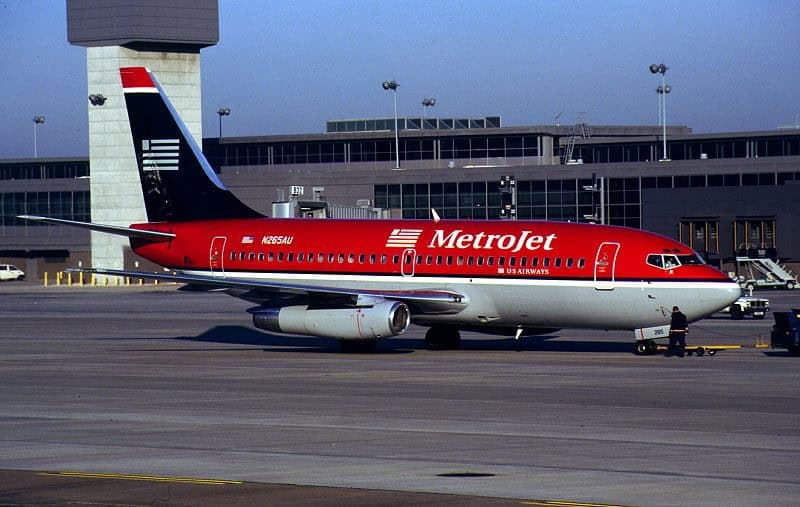
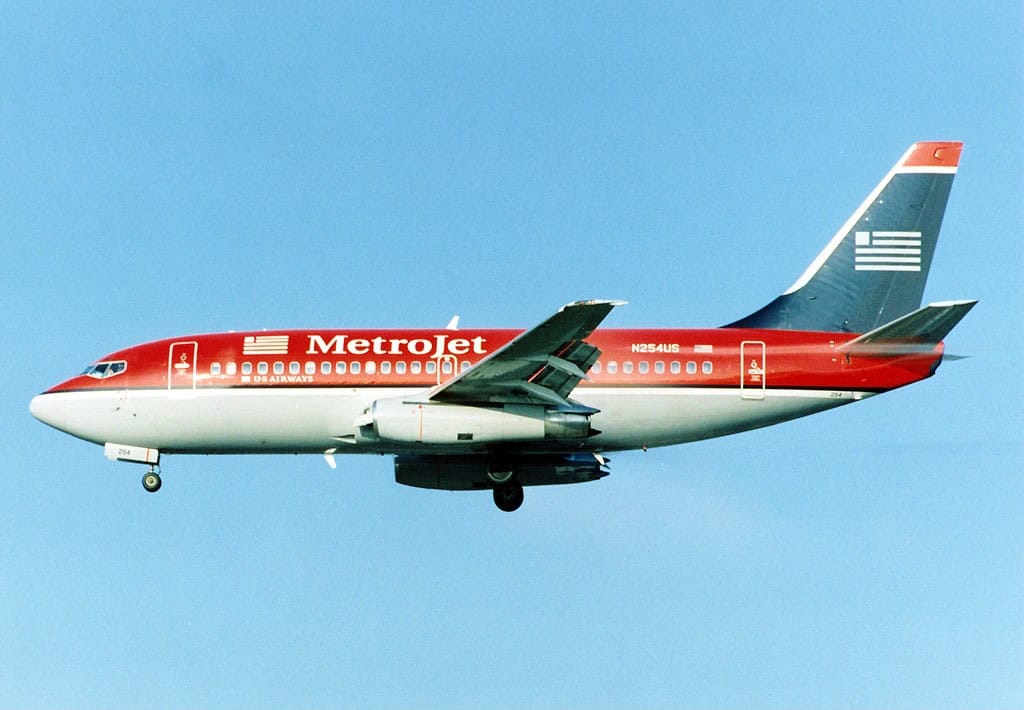
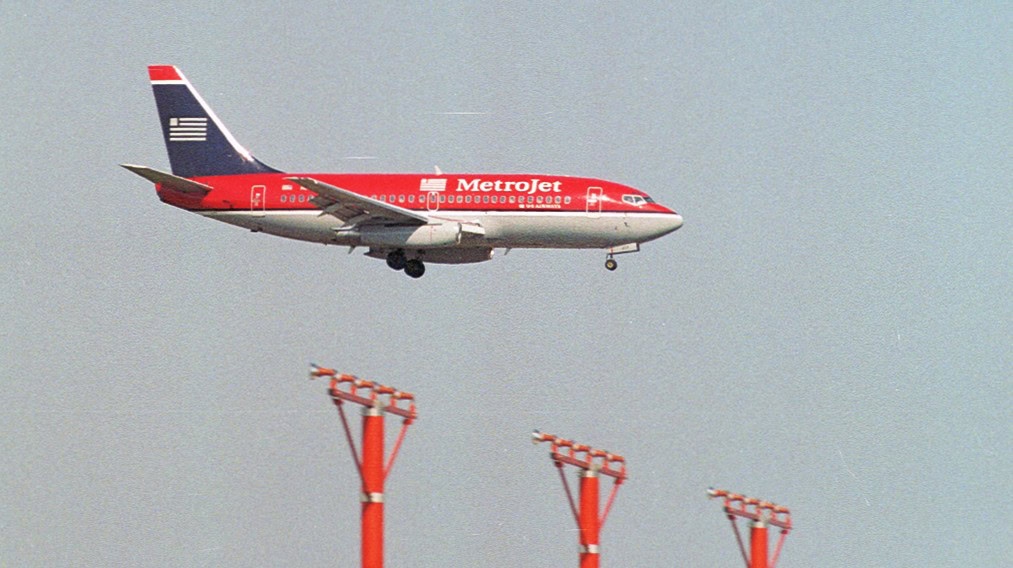
The airplane said MetroJet on the side. The fuselage was red. The belly was gray. The tail still carried the familiar US Airways flag, but the message was clear: this was supposed to be something different.
MetroJet was US Airways’ answer to the low-cost carrier revolution that was reshaping the US airline industry in the 1990s. Southwest Airlines was no longer some quirky Texas upstart with a clever boarding process and funny flight attendants. By the late 1990s, Southwest was a national force, and it was pushing hard into the East.

For US Airways, that wasn’t a minor annoyance. This meant war.
At BWI, Southwest had started service in 1993 with just eight daily flights. Within a few years, it had grown to more than 70 daily departures, many of them aimed at markets US Airways cared deeply about. Low fares were no longer something happening somewhere else. They were happening in US Airways’ backyard.
So US Airways responded with MetroJet, a low-fare brand designed to compete head-to-head with Southwest, Delta Express, AirTran, and the other carriers putting pressure on legacy airline pricing. Like other “airline-within-an-airline” experiments of the era, MetroJet promised simplicity: one aircraft type, one class of service, low fares, and a focused route network built around leisure-heavy flying.
But MetroJet was also a contradiction from the start.
It was meant to feel like a low-cost carrier. But it was still very much a US Airways product.
Built by Task Force, Not by Accident
One thing that tends to get lost in the history of MetroJet is that it was not simply thrown together in a panic.
Inside US Airways, the company presented MetroJet as the result of extensive internal planning. In late 1997, US Airways formed what it called the US-2 Task Force, a 25-member group representing nearly every major part of the airline. The team was asked to build a complete operating plan for a low-cost carrier within US Airways.
That meant more than choosing a paint scheme and lowering fares.
The task force benchmarked competitors. It held employee focus groups. It conducted consumer research. It surveyed Dividend Miles members. It studied outside research. It even evaluated more than 100 flights on low-cost competitors, including Southwest, Delta Express, and Shuttle by United, looking at the entire customer experience from ticket purchase to boarding to inflight service.
The team also tested operational procedures on actual mainline flights. Boarding procedures were studied. Reservation calls were timed down to the second. Policies were evaluated through the lens of whether they saved time, reduced complexity, or made the operation more consistent.
That detail adds texture to MetroJet’s story. This was not an airline that failed because nobody understood the threat. US Airways absolutely understood the threat. It studied the low-cost model carefully.
The harder problem was whether a high-cost legacy airline could truly build a low-cost competitor inside itself.
A Different Product With Familiar DNA
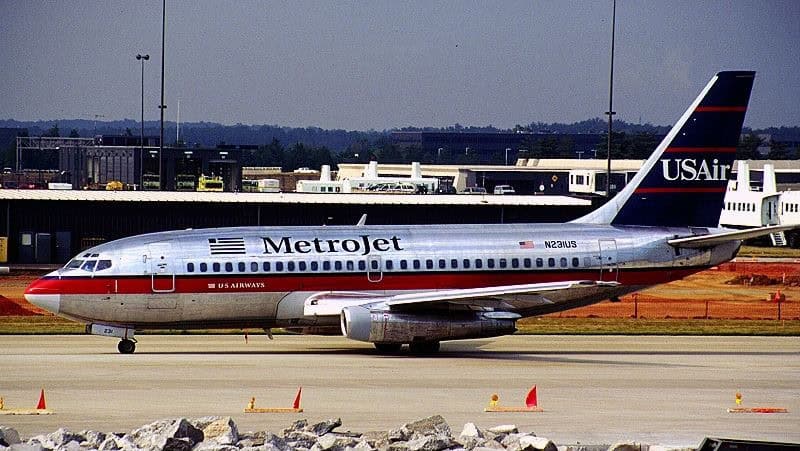
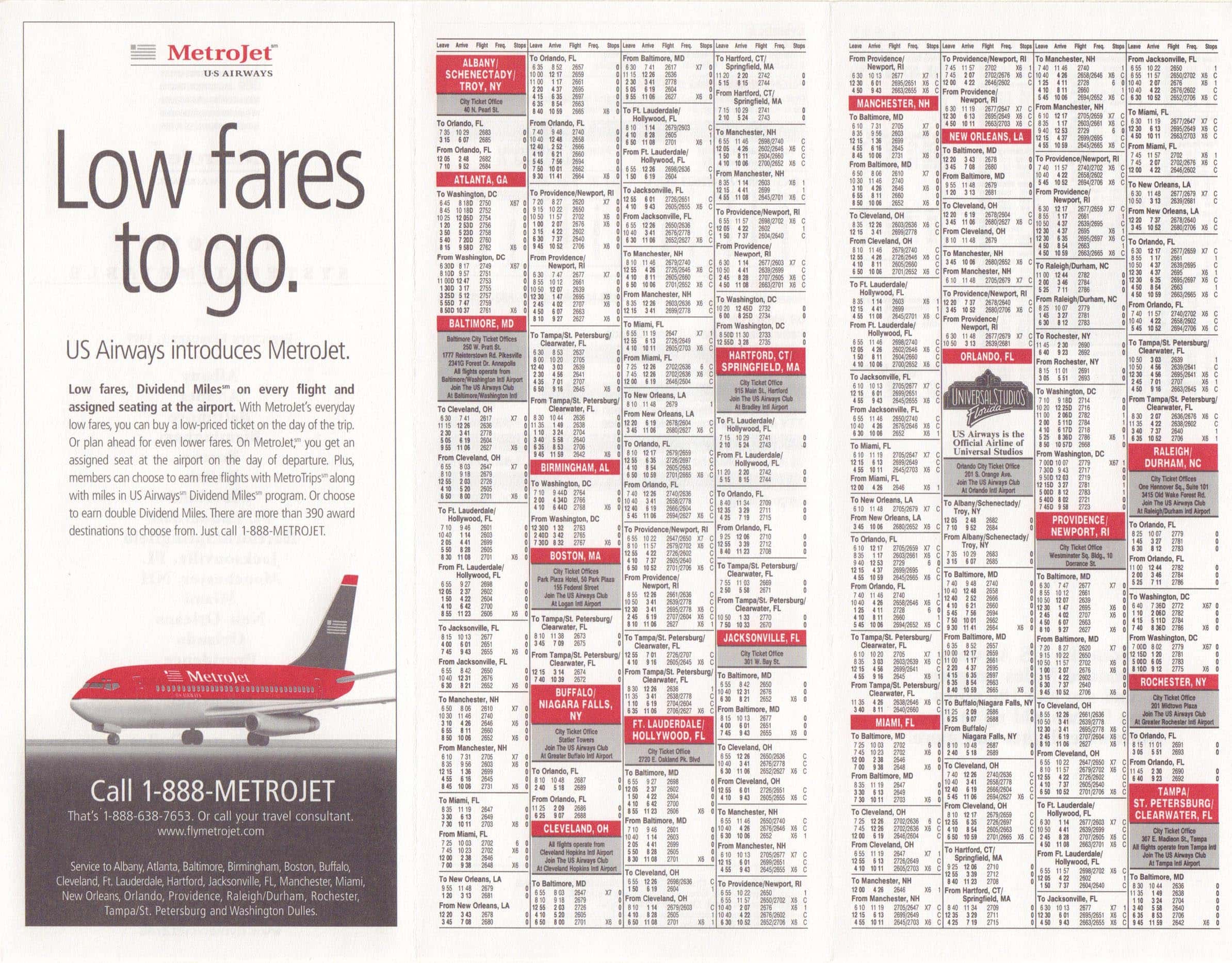
MetroJet launched from BWI with five Boeing 737-200s transferred from US Airways. The first routes connected Baltimore with Cleveland (CLE), Providence (PVD), Fort Lauderdale (FLL), and Manchester, New Hampshire (MHT). Service expanded quickly, with Jacksonville (JAX), Miami (MIA), Tampa (TPA), Washington Dulles (IAD), and other destinations joining the network.
Florida was a natural fit. MetroJet was aimed heavily at leisure traffic, especially passengers moving between the Northeast and the Sun Belt. At its peak, the operation served roughly two dozen destinations, including cities such as Boston (BOS), Buffalo (BUF), Hartford (BDL), Orlando (MCO), Fort Myers (RSW), Raleigh/Durham (RDU), Syracuse (SYR), West Palm Beach (PBI), and others.
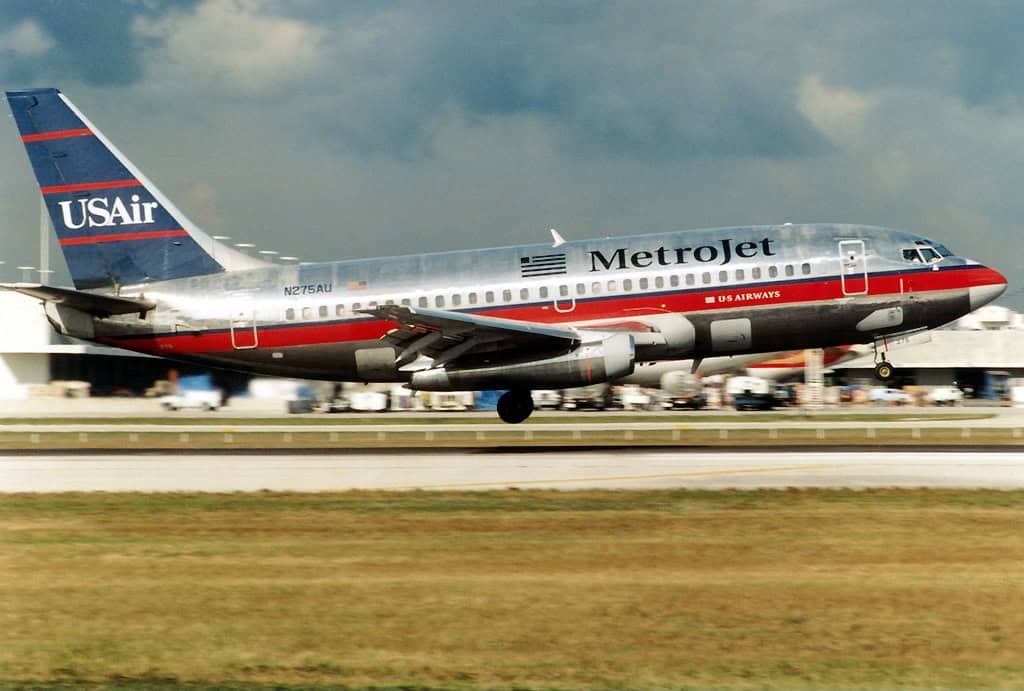
The 737-200 was the only aircraft type in the fleet. From an operational simplicity standpoint, that made sense. From a fuel-burn standpoint, it was less ideal. These were older airplanes, many of them already veterans of Piedmont or USAir mainline service. They were loud, classic, and full of character, but they were not exactly the perfect weapon against Southwest’s increasingly efficient low-cost machine.

Still, MetroJet had some genuinely passenger-friendly touches. The aircraft were configured in a single-class layout with 118 seats, and the seat pitch was generous by today’s standards. MetroJet was low-fare, but it was not trying to be miserable.
The branding was also carefully considered. The red fuselage created a clear visual break from mainline US Airways. But the blue tail and stylized flag remained, reminding customers that MetroJet wasn’t a chintzy startup carrier but one backed by a well-known, established legacy airline.
That may have been smart from a marketing standpoint. It was also a perfect symbol of MetroJet’s larger challenge.
US Airways wanted MetroJet to be separate enough to compete differently, but connected enough to benefit from the parent company’s credibility, systems, employees, and Dividend Miles frequent flyer program. The result was a brand that looked independent from the terminal window but was still tied tightly to the legacy structure behind it.
The Low-Cost Battle Was Measured in Minutes
One of the most interesting parts of MetroJet was the operational choreography.
US Airways knew that if MetroJet was going to compete in the low-fare world, it had to save time on the ground. Time at the gate meant lower aircraft utilization. Lower utilization meant higher costs. And higher costs meant trouble when the competition was Southwest.
The internal MetroJet process reflected that obsession with minutes.

Seat assignments were available at the airport on the day of departure. Boarding passes were issued at the gate, so all customers had to interact with the gate agent. Tickets were collected during check-in. Customers with checked bags had a 20-minute cutoff. Passengers requiring assistance were pre-staged near the jetway. Fleet service agents were positioned to move the jet bridge as soon as the aircraft arrived, freeing customer service agents to focus on the gate process.
Even the cabin service was built around efficiency. Flight attendants took drink orders by zone using special MetroJet order forms. Snacks were served, then drinks followed. Before arrival, flight attendants collected trash and newspapers to reduce cleaning time after landing. Boarding was handled three rows at a time, with employees positioned to help customers stow bags and keep the process moving.
It wasn’t glamorous, but it got the airplanes back in the air quicker. And in the low-cost world, that was the whole game.
Early Optimism, Hard Economics
At least early on, US Airways had reason to feel encouraged.
In a corporate video from the period, the airline said MetroJet’s first day of operation was flawless, with a load factor in the 70s and 100 percent on-time performance. The same video said MetroJet was exceeding its operational objectives and traffic projections, citing a recent day with a load factor above 90 percent and on-time performance above 90 percent.
That was the optimistic version of the story. MetroJet was employee-designed. Customers were responding well. The airline was proud of the operation. US Airways even projected aggressive growth, with plans for MetroJet to become a significant – and “permanent” – part of the company’s family of products.
But the business reality was more complicated.
MetroJet did lower costs compared with US Airways mainline, but not enough. Its reported cost per available seat mile was around 8 cents, compared with roughly 10 cents at mainline US Airways. That was progress. Unfortunately, Southwest was reportedly around 6 cents.
In airline economics, that gap made a huge difference.
MetroJet also had a cannibalization problem. Some of the passengers it attracted were not necessarily being stolen from Southwest or AirTran. They were coming from US Airways itself. Instead of simply protecting the parent airline’s markets, MetroJet could undercut mainline US Airways flying, including from airports such as Washington National (DCA).
As a poor college student in Florida in the late 90s, I was one of those passengers. A loyal US Airways customer at the time, I was drawn to MetroJet’s low fares and happily booked its bright red 737s during school breaks and trips back north to visit home. Little did I know, in my own tiny way, I was helping prove one of MetroJet’s biggest problems: some of its customers weren’t being won from competitors. They were already US Airways customers.
That is the trap many airline-within-an-airline projects fell into. Legacy carriers wanted the economics and flexibility of a low-cost airline without fully abandoning the structures, contracts, and complexity of a legacy airline.
MetroJet looked like a low-cost carrier, but it certainly didn’t fully operate with the cost base of one.
A Short Life in a Brutal Era
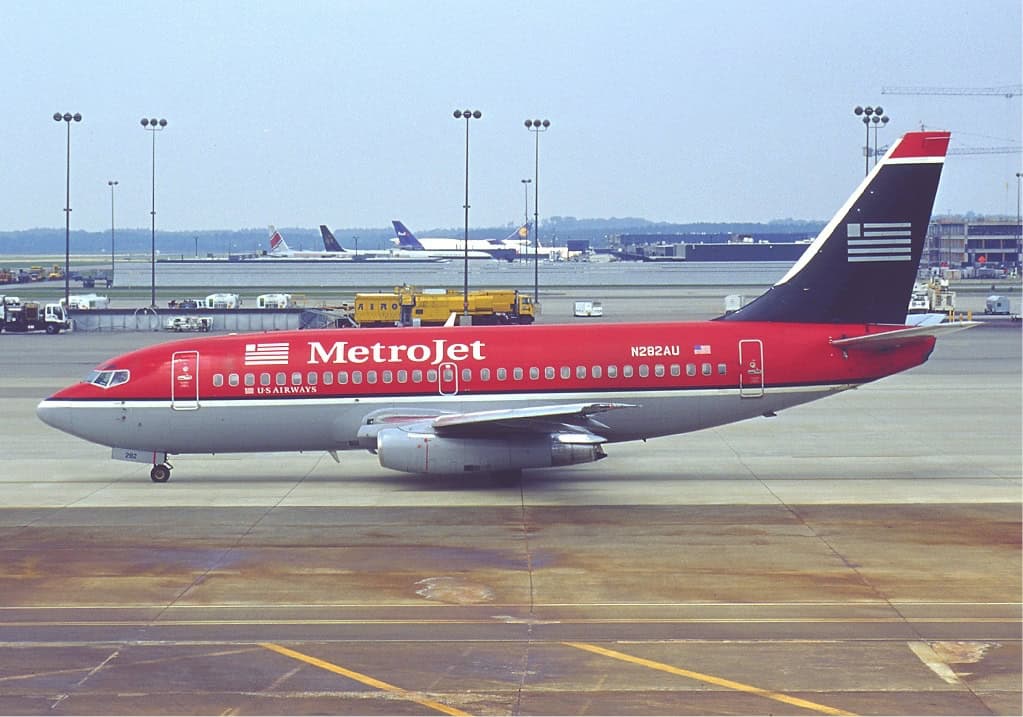
MetroJet grew quickly. By 1999, it was operating dozens of aircraft and serving a broad East Coast network. At BWI, it became one of the most visible parts of the US Airways presence, with bright red 737-200s flying to Florida, the Northeast, and beyond.
Then came 11 September 2001.
US Airways was hit especially hard by the aftermath of the attacks. The extended closure of DCA was devastating for a carrier with such a heavy presence in the Washington, D.C. market. Traffic dropped. Security requirements changed. The entire industry entered crisis mode.
On 24 September 2001, US Airways announced that MetroJet would be shut down. By December, the operation was gone. The 737-200s were retired from US Airways service, the MetroJet brand disappeared, and the airline’s BWI hub was largely dismantled.
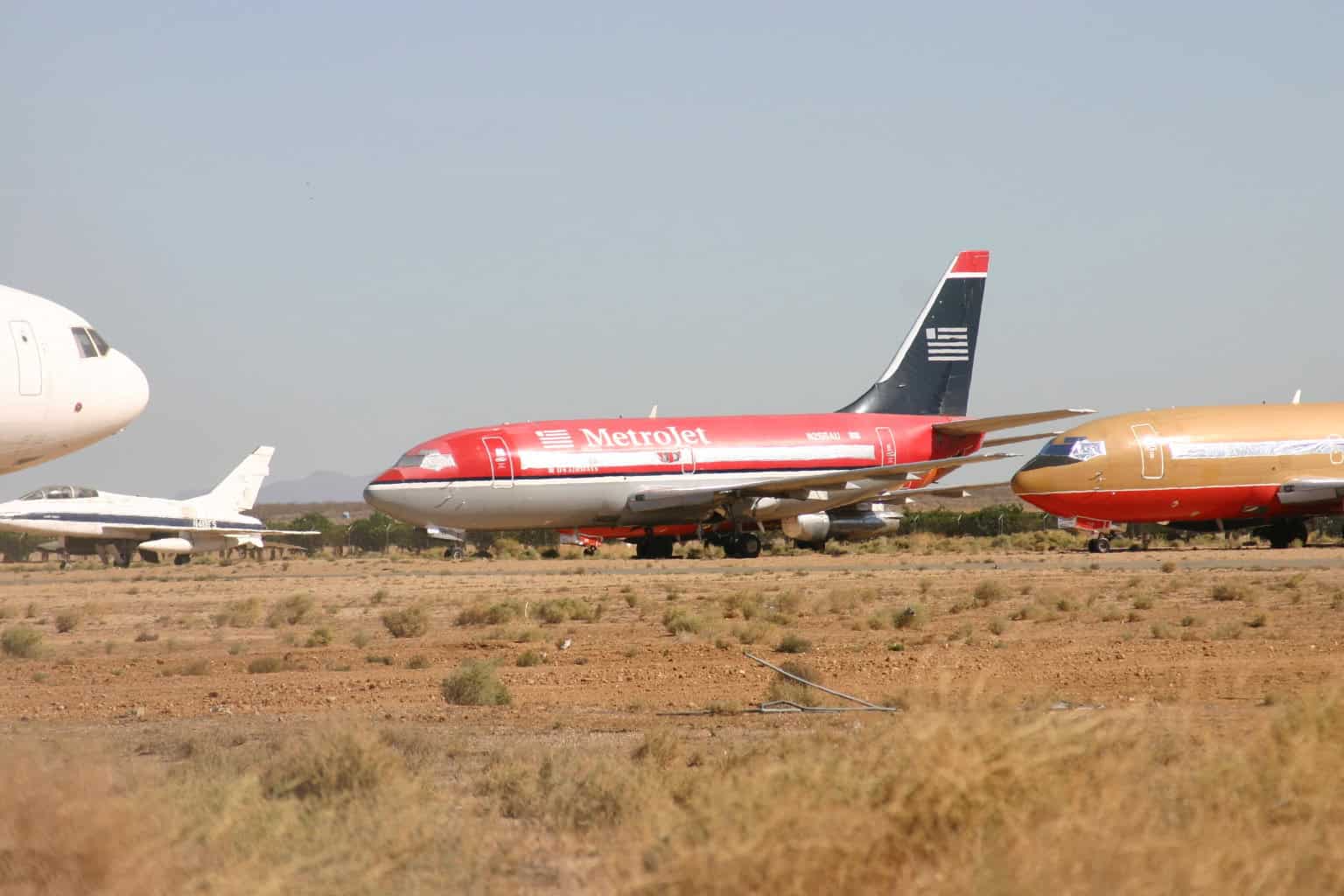
MetroJet lasted roughly three and a half years.
That short life makes it tempting to call the airline a failure and move on. In strict business terms, it did fail. It did not stop Southwest’s rise at BWI. It did not solve US Airways’ structural cost problems. It did not become a permanent low-cost platform inside the company.
But MetroJet remains one of the more fascinating experiments of its era because it showed just how difficult the low-cost revolution was for legacy carriers to answer.
US Airways understood the threat. It studied the competitors. It built a task force. It tested procedures. It painted the airplanes red. It choreographed the turns. It tried to shave minutes from the operation and create a product that could fight on price.
But the airline could not fully escape itself.
That is the real story of MetroJet. It was not merely a failed low-fare brand. It was a snapshot of an industry in transition, when legacy carriers were trying to defend old territory against a new kind of competitor with a different cost structure, different culture, and different rules.
For a few years, MetroJet gave US Airways a bright red answer to Southwest.
And for avgeeks who remember those 737-200s at BWI, in Florida, or scattered across the East Coast, it remains a wonderfully specific artifact of late-1990s airline history: loud, red, ambitious, imperfect, and gone almost as quickly as it arrived.
Watch this deliciously nostalgic corporate video announcing MetroJet’s vision: