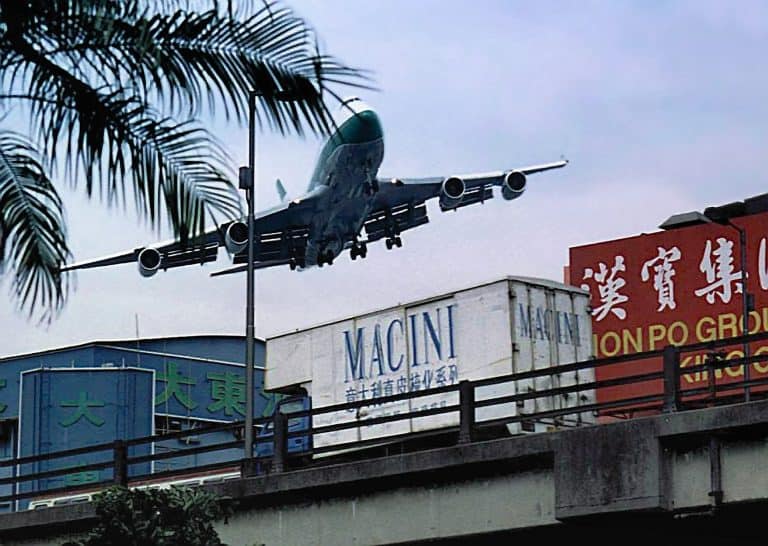
Kai Tak was an innovative approach to Hong Kong that led to 24 years of fantastic spotting of heavy jet airliners.
Hong Kong’s former International Airport was nestled in a mountainous region of the city. First built in the 1920s, the airport was mainly used to train aviators. The infamous airport was only four nautical miles from a ridge of mountains with peaks over 2000ft. During the early days of flight, this wasn’t a big deal, as most small radial or piston-powered aircraft could turn final within a small radius.
Conditions and Heavy Jets Made Kai Tak a One-Trick Pony
After World War II, the airport slowly rose in prominence to become the international airport for the city. In the 1950s, Kai Tak featured two runways: runway 13/31 and a shorter runway 07/25. Runway 13 was extended to accommodate larger aircraft.
As jet aircraft became the norm, the airport faced a dilemma. Jets flew at higher speeds, even on approach. The surrounding terrain was too high for a typical straight-in approach to runway 13 during instrument conditions. Even non-precision approaches would still provide inadequate terrain clearance.
Even after extending the runway to over 11,000 feet long, Kai Tak would never realize its full potential. It simply could not sustain the region’s explosive population growth.
Along Comes an Innovative Solution in the 1970s
IGS and DME for Precision Approaches
In 1974, the airport installed an Instrument Guidance System. It was a creative way to provide instrument guidance for approaches. Aircraft would fly a precision approach to a checkerboard built on the side of a hill. At a predetermined DME (and once the checkerboard was in sight), the aircraft would then make a 90-degree turn to final. At night, approach lighting would guide the way. Check out these two videos by JTWPilot and AirBoyd detailing the famous approach.
A Plethora of Sketchy Landings
While this made instrument approaches possible, they were still incredibly challenging at Hong Kong’s KaiTak. All pilots had to fly the approach to standards in the simulator to become certified to fly it in real life. The prevailing winds were typically a still cross-wind. Every pilot had to bring their A-game. Some didn’t, and their poor approaches remain etched in the collective memory of avgeeks and memorialized in viral YouTube videos.
The Party Couldn’t Last Forever
By the late 1980s, it was becoming clear that Kai Tak would need to be replaced. The infrastructure and footprint were too small for such a large city that relied heavily on air transportation.
The challenging approach and land-locked location limited options for further expansion. Kai Tak closed on 6 July 1998, and with it, the world-famous checkerboard approach became a memory. The new Chep Lap Kok International Airport opened a day later. It remains Hong Kong’s International Airport to this day.
If you are looking for other videos, be sure to search YouTube. AirBoyd has several other great videos from that era.
To our American readers, Happy Independence Day! Tonight, the skies above Washington, D.C., will reverberate with the roar of America’s military might as B-2 Spirit stealth bombers, joined by F-22 Raptors and F-35 Lightning IIs, conduct a ceremonial flyover to commemorate the 249th anniversary of the signing of the Declaration of Independence and celebrate the signing of the One Big Beautiful Bill.
However, according to White House Press Secretary Karoline Leavitt, today’s precision flyover carries added significance by honoring those who take part in the overwhelming success of last month’s Operation Midnight Hammer.
“The might of America’s Air Force will conduct a flyover featuring our state-of-the-art F-22s, B-2s, and F-35s–the same air capabilities used for the decisive and successful strikes on Iran’s nuclear facilities,” Leavitt said.
President Trump has also invited the B-2 pilots who led the Midnight Hammer strike to join today’s Independence Day celebrations at the White House.
The flyover is expected to take place at 1700 local time–the exact time President Donald Trump is expected to sign the One Big Beautiful Bill into law.
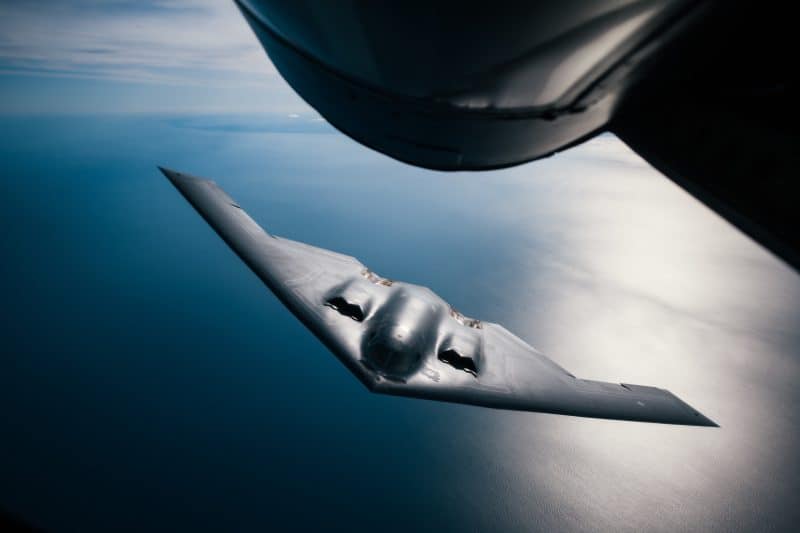
The B-2 Will Lead the Precision Flyover
The B-2 Spirit will lead a precision flyover in Washington, D.C. on 4 July 2025 | IMAGE: Photo by Steve Harvey on Unsplash
Leading the charge are B-2 Spirit stealth aircraft from the 509th Bomb Wing out of Whiteman Air Force Base, Missouri. These flying-wing bombers are the heroes of last month’s successful attack on Iran’s nuclear facilities. The B-2 is the only aircraft in the world capable of carrying the monstrous 30,000-pound GBU-57 Massive Ordinance Penetrator (MOP), a deep-strike “bunker buster” designed to destroy hardened, deeply buried targets.
During Midnight Hammer on 21 June, seven B-2s launched from Whiteman and executed a grueling 37-hour global strike mission targeting Iranian nuclear facilities at Fordow and Natanz. Each bomber delivered a pair of MOPs in the weapon’s first-ever combat use. The mission required multiple aerial refuelings from KC-135s and KC-46s across the globe. As part of an intentional misdirection, seven additional B-2s were deployed to Guam as decoys, drawing international attention while the real strike aircraft crossed into contested airspace undetected.
A B-2 Spirit rests after returning to Whiteman AFB, Missouri, following Operation Midnight Hammer on 21 June 2025 | IMAGE: USAF
It is worth noting that the B-2’s role in Operation Midnight Hammer stands out as its largest strike mission to date. The 36-hour round-trip flights from Missouri to Iran were the second-longest ever flown by the stealth bomber, surpassed only by the extended sorties conducted in the immediate aftermath of the 9/11 attacks.
The F-22 and F-35 Will Also Take Part in the Flyover
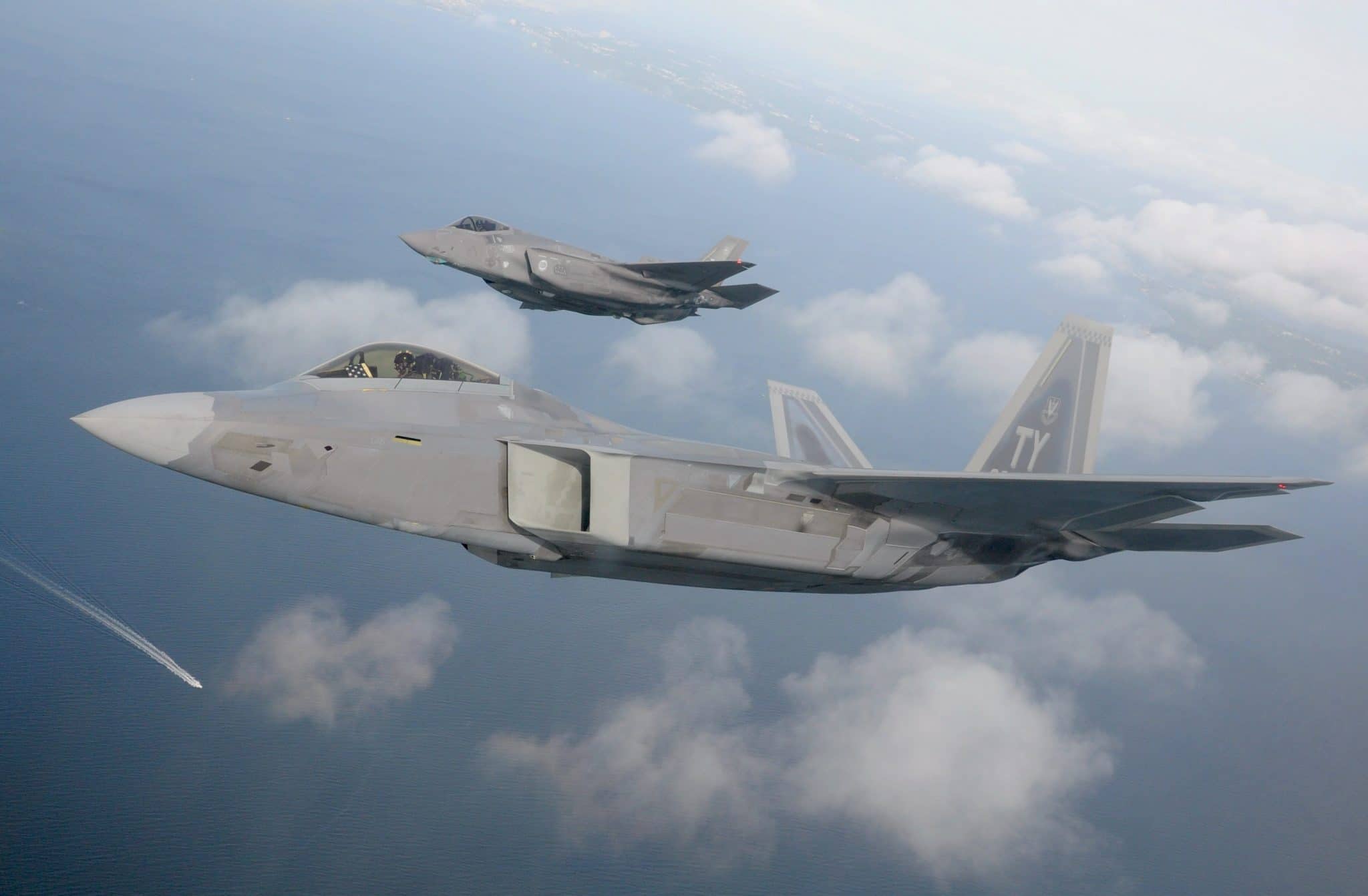
The F-22A Raptor and F-35A Lightning II (USAF)
More than 125 additional aircraft supported this historic operation, including the F-22 Raptor, the Air Force’s premier air superiority fighter. The F-22 will also take part in today’s flyover in Washington. The F-22, with its fifth-generation stealth, supercruise capability, and advanced sensor fusion, played a critical role in Midnight Hammer by escorting the B-2s and sweeping Iranian airspace for threats. Its ability to maintain speeds exceeding Mach 1.5 without afterburners and its thrust-vectoring engines provide unmatched agility. The Raptor remains the Air Force’s go-to asset for penetrating defended airspace and clearing hostile skies. The F-22’s AN/APG-77 radar and sensor fusion capabilities allow it to detect and engage targets at long ranges, giving its pilots unmatched situational awareness and clearing threats from Iranian airspace to protect the B-2s.
The F-35 Lightning, which contributed to the Midnight Hammer strike package, will also join today’s precision flyover. While exact details remain classified, F-35s likely supported the B-2s with electronic warfare and intelligence, surveillance, and reconnaissance (ISR) capabilities.
To Those Who Serve: Thank You
Thank you to all who serve | IMAGE: Photo by Ryuno on Unsplash
Today’s flyover is a tribute to the men and women of the United States Air Force. As we celebrate our nation’s independence today, we recognize the skill, dedication, and sacrifice of the men and women who make global airpower possible. From maintainers on the flight line to mission planners and pilots, every individual plays a vital role in keeping these aircraft ready to answer the call–anytime, anywhere.
If you find yourself on the National Mall at 1700 today, take a moment. Look up. And salute the heroes behind the wing.
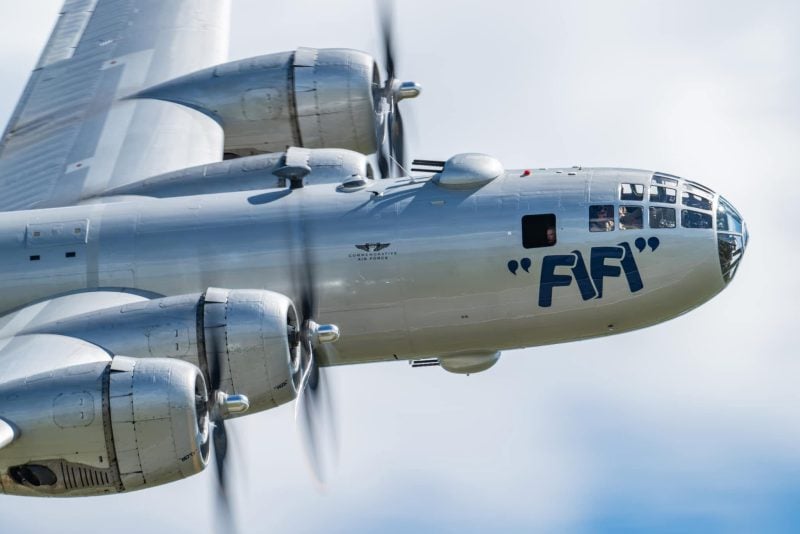
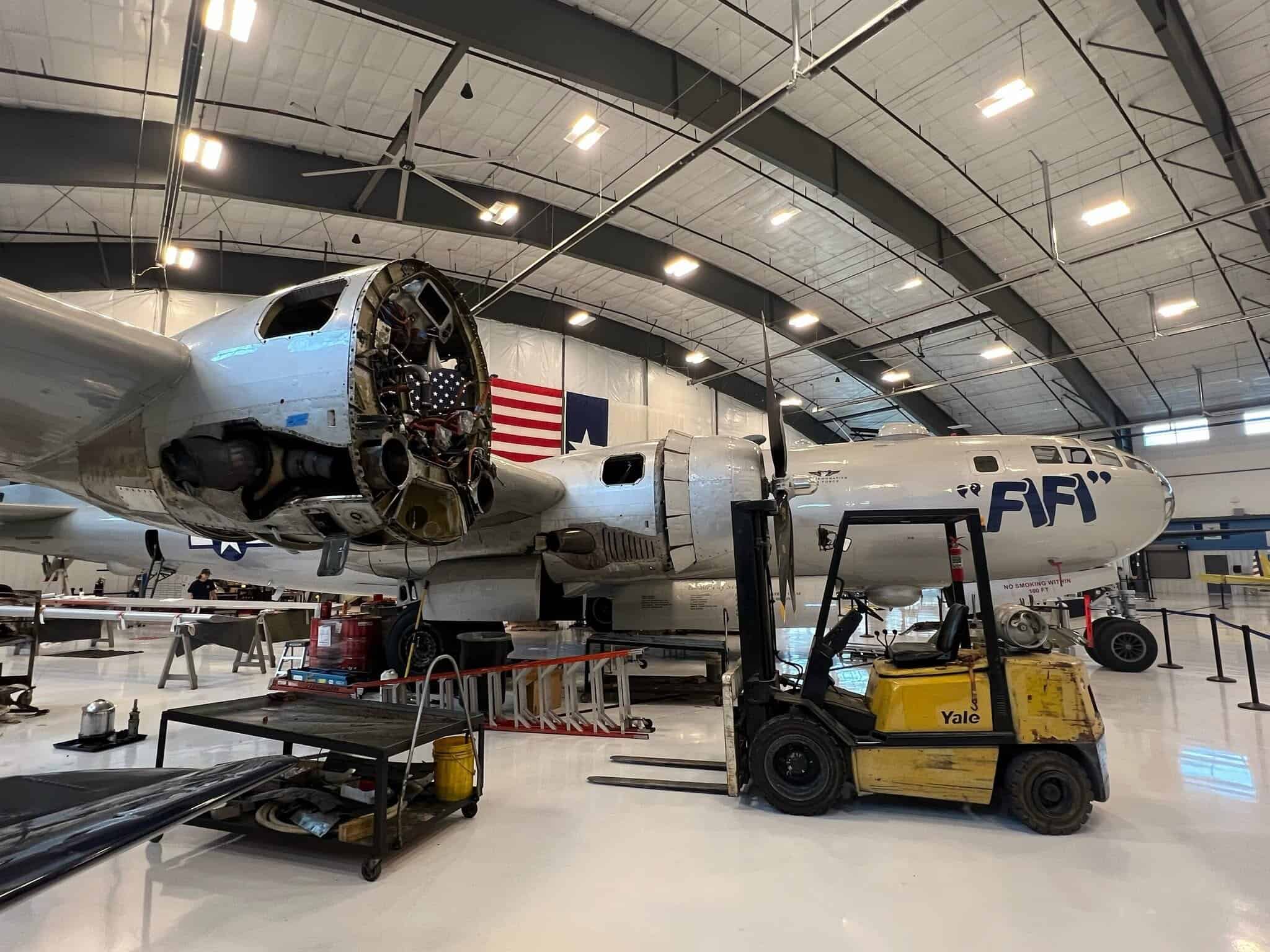
The CAF’s B-29 FiFi is flying again, after major engine repairs this spring. The historic WWII aircraft is 1 of only 2 B-29 Superfortress bombers still flying in the world. The other, DOC, is based in Wichita, KS.
The B-29 of course was cemented into history 80 years ago, when the Enola Gay dropped the atomic bomb on Hiroshima.
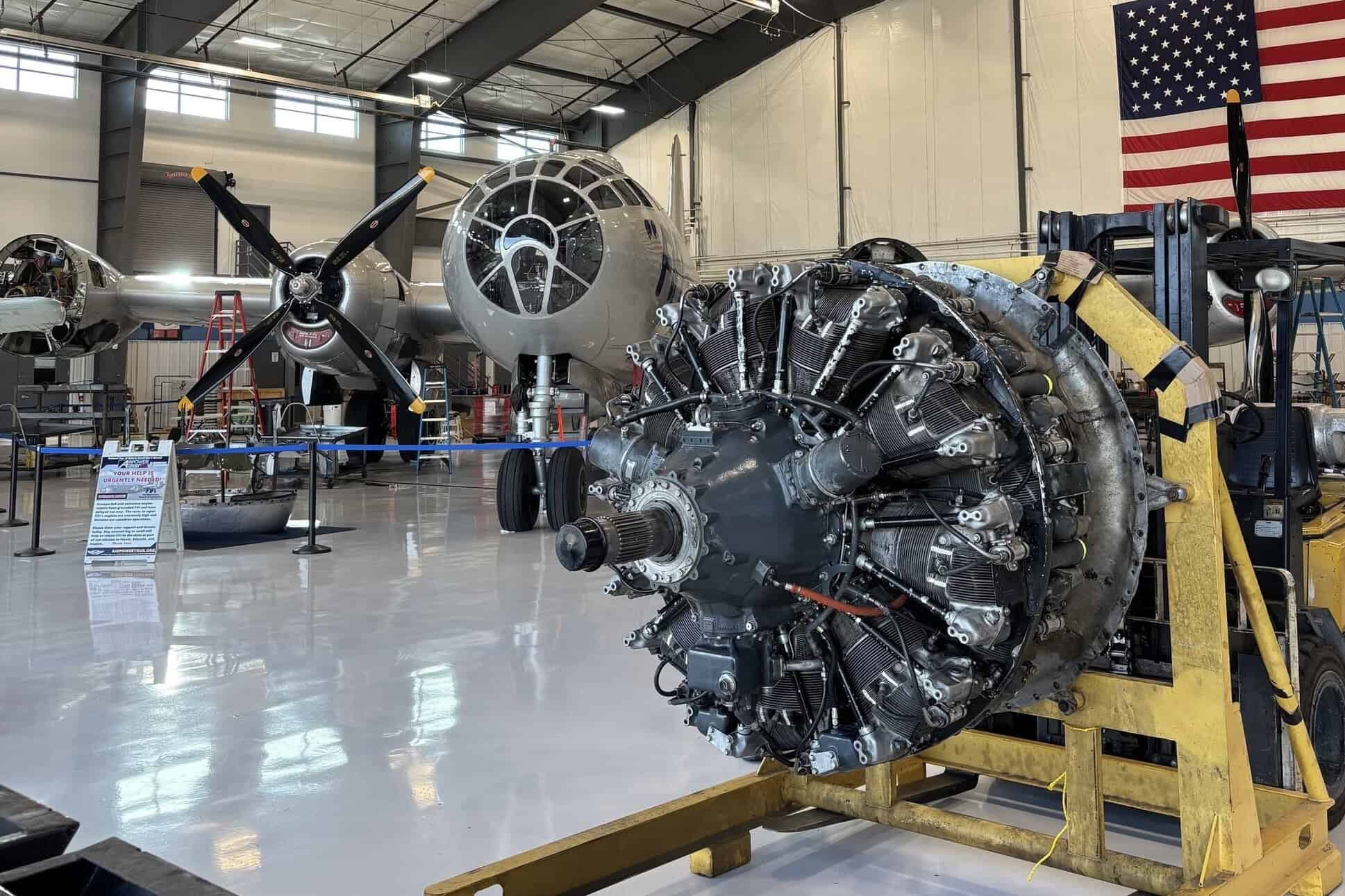
One of the 2 engines repaired for FiFi (CAF photo, B-29/B-24 squadron)
FiFi was kept grounded back in April, following winter maintenance, and just before the squadron was scheduled to kickoff their 2025 tour. The plane flies around the country every year as the flagship of the AirPower History Tour, visiting select air shows and events and selling rides.
Pre-flight engine runs revealed a critical part not working correctly
Back in April, during a routine pre-flight engine run, the crew discovered the impeller spinner discharge valve was not working correctly. It’s a critical part of the supercharger system on the bomber’s Curtiss-Wright R-3350 engines, and helps regulate fuel-air pressure when operating the engines.
B-29 FiFi is Flying Again After Major Engine Repairs 8
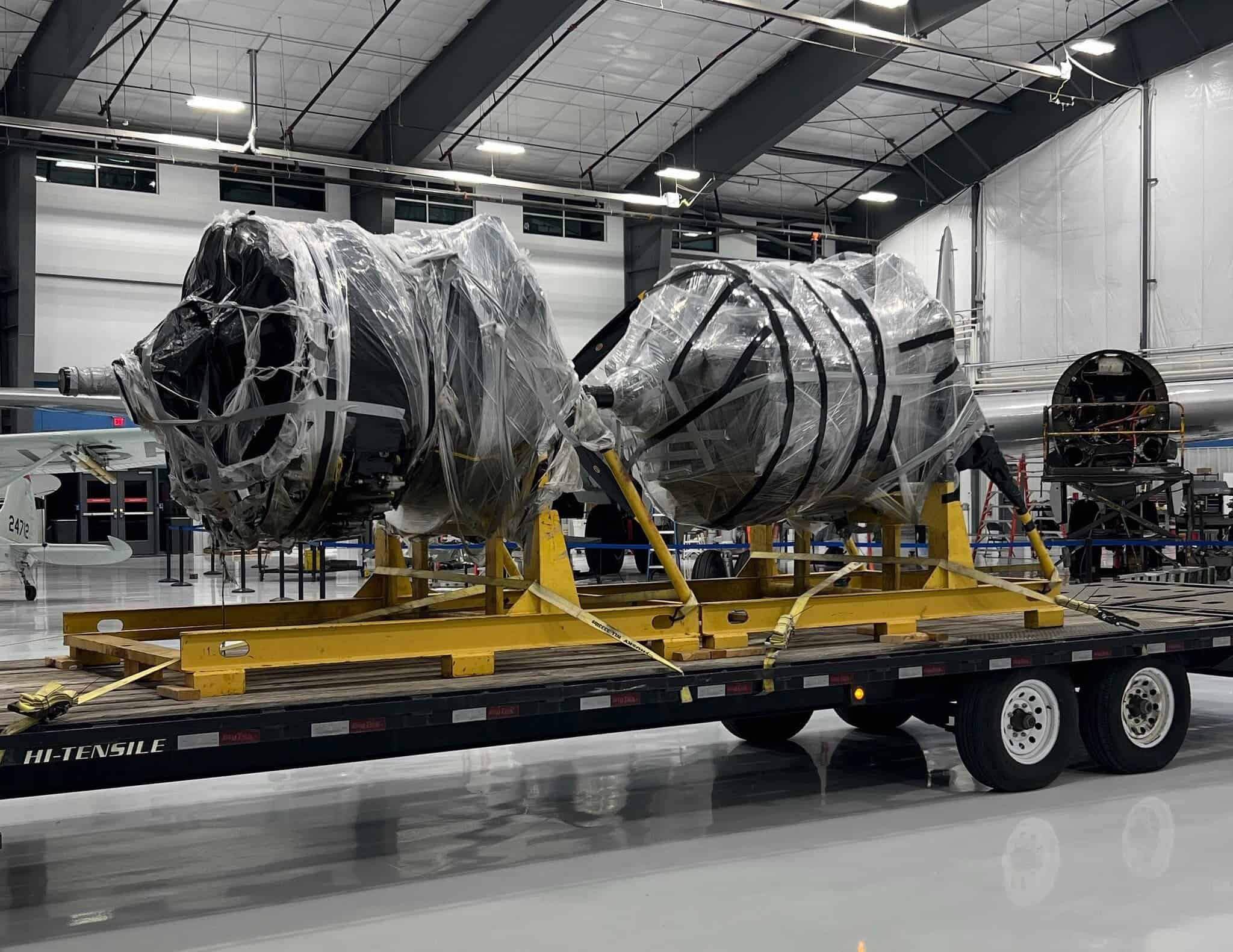
It was quickly determined that 2 of the plane’s 4 complex radial engines would have to be removed, repaired, and put back on FiFi. Engines #2 and #4, affectionately named Mitzi and Betty, were carefully removed and shipped to Vintage Aircraft Radial in CA.
The bill is over $350,000. As a non-profit, they rely heavily on donations, sponsorships and ride sales at events and air shows. With the plane grounded, not only did they have a very expensive job, but they were losing revenue too, since they had to cancel the beginning of their 2025 tour.
Mitzi and Betty on the truck to CA for critical repairs
A donation site was setup, and thus far they have raised over $75,000. There is still a long way to go. We encourage our readers and supporters to donate to the cause HERE.
The faulty valves were tested and calibrated to original manufacturer specifications using a flow bench, says the CAF on the fundraising page.
Once repaired and reassembled the engines were put through rigorous testing. With confidence in the repairs, the engines were then sent on a 18-hour drive back to CAF in Dallas to rejoin FiFi.
Engines installed in record time
The freshly repaired engines arrived at the plane June 16. The crew installed them in record time, says the CAF.
With all four engines back in action, all that was left was to run her up. On June 21, that’s what they did. The crew reported a few adjustments needed, but no big deal.
All that was left, was to fly. A few days later, they did, and FiFi soared again.
With the historic warbird now back in action, the tour is on, with a planned first appearance soon in Ohio. Visit their website here and book your visit with FiFi!
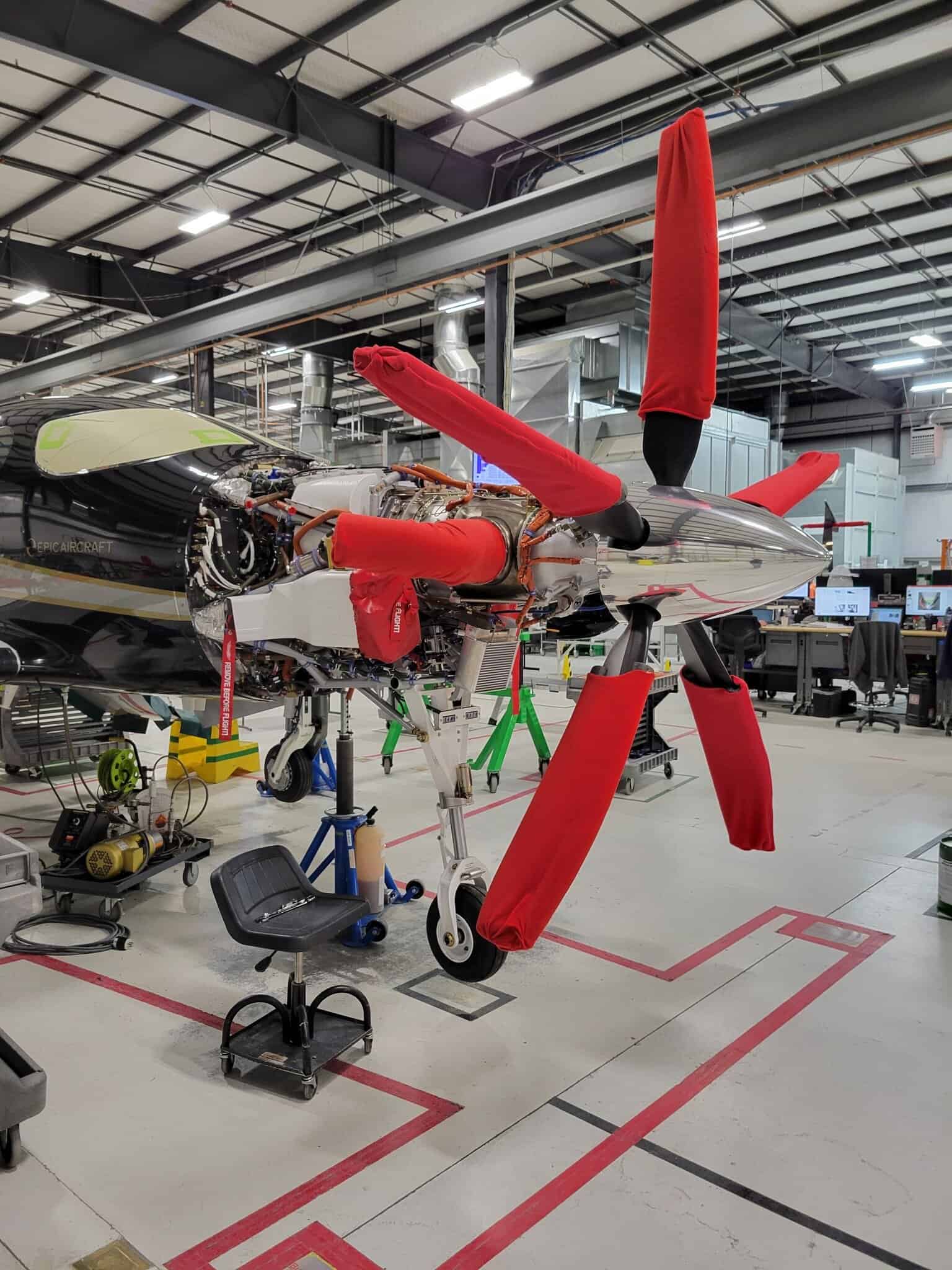
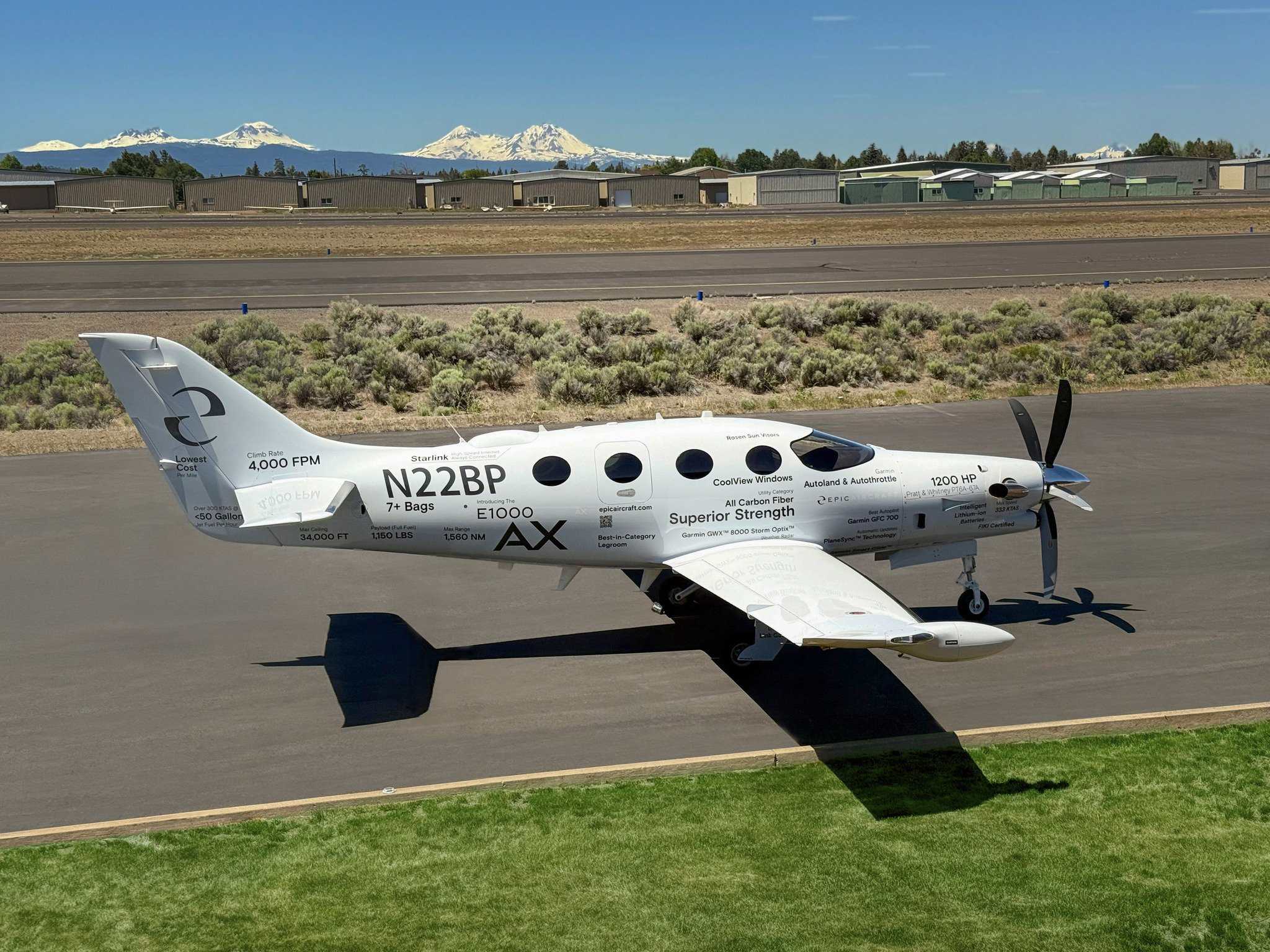
When you think of high-performance, single-engine aircraft, Cirrus often comes to mind. Models like the SR22T or Vision Jet have long set the standard for personal and business aviation. But this past April, at Sun ‘n Fun in Lakeland, Fla., Epic Aircraft rolled out the Epic E1000 AX, and boy, does it have people talking.
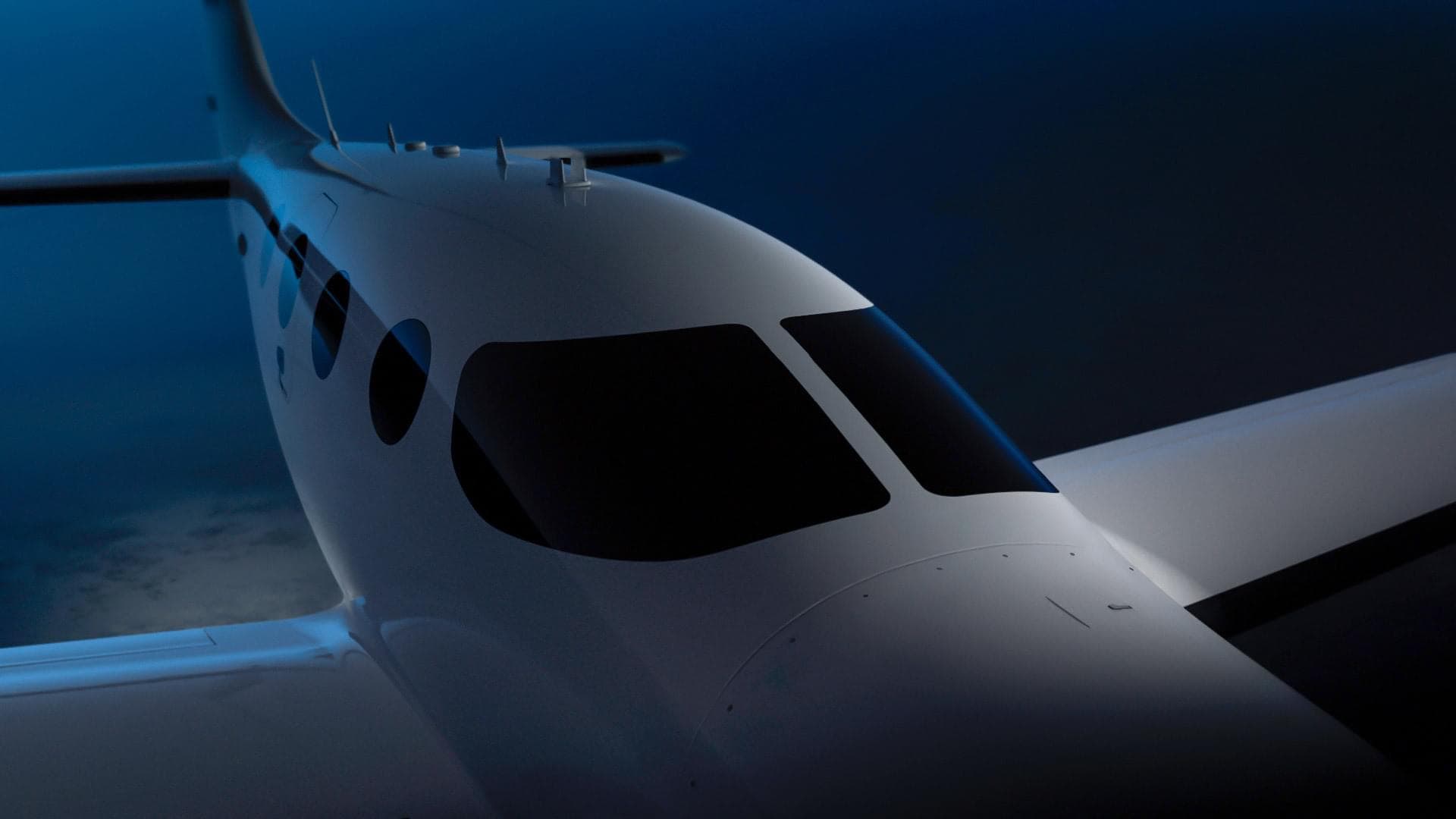
This turbine-powered aircraft features a sleek carbon fiber design, advanced avionics, and a suite of 25 new features. Based on the standout features alone, the E1000 AX is positioning itself as a potential challenger to Cirrus’s dominance in the market.
So, is the Epic E1000 AX really a serious contender? We examine that question in this story.
Performance to Impress
The Epic E1000 AX powerplant: a Pratt & Whitney PT6-67A turbine at 1200 horsepower | IMAGE: Epic
The Epic E1000 AX is powered by a Pratt & Whitney PT6-67A engine, delivering an impressive 1,200 horsepower. It boasts a max cruise speed of 333 KTAS, a climb rate of 4,000 feet per minute, and a max ceiling of 34,000 feet. Flying cross-country with the E1000 AX is no problem, as it boasts a range of 1,560 nautical miles when fully loaded with 1,177 pounds of passengers and luggage. Compared to the previous E1000 model (the GX), it offers 50 additional pounds for payload, with a useful load of 2,956 pounds and a fuel capacity of 264 gallons.
Its takeoff distance is 2,254 feet, landing distance is 2,399 feet, and stall speed is a forgiving 68 KIAS. The aircraft measures 35 feet 10 inches long, 12 feet 6 inches tall, and has a 43-foot wingspan. Its 15-foot cabin comfortably seats six passengers. The cockpit also can accommodate pilots up to 6’8″ tall, which this 6’1″ author certainly appreciates.
One of the standout features of the E1000 AX is its carbon fiber construction. Unlike traditional metal aircraft, it uses fewer parts, streamlining production and reducing operating costs. This design will likely give Epic a pricing edge, with AOPA reporting that the starting price for the E1000 AX will start at $4.7 million and go up to $4.85 million with customization. By comparison, a brand-new Cirrus SF50 Vision Jet has a base price of about $3 million.
Cirrus, which also uses composite designs, keeps costs competitive. However, the E1000 AX’s approach could appeal to buyers looking for efficiency without sacrificing strength.
Avionics and Safety: A Step Ahead?
The avionics suite on the Epic E1000 AX are impressive to say the least | IMAGE: Epic
The Epic E1000 AX comes equipped with the Garmin G1000 NXi avionics suite, featuring synthetic vision, GPS, traffic, weather, terrain, and engine monitoring systems. Among its 25 new features are the Garmin Autothrottle and Autoland.
Autothrottle manages engine power from takeoff to landing, adjusting for optimal settings and protecting it against issues like throttle rollback, overtorque, or overtemperature. It even responds to overspeed, underspeed, or engine failure scenarios, factoring in flap and gear positions. These auto responses could reduce pilot workload, especially on long flights, but it’s worth noting that Cirrus’s Perspective+ avionics also offers advanced automation.
Now, Garmin Autoland is where things get intriguing. If a pilot becomes incapacitated, passengers can activate it with the press of a button. It can also engage automatically if no one acts. Autoland selects the best airport for landing based on runway length, fuel range, distance, and weather, then navigates around obstacles, communicates with air traffic control, lands the plane, and shuts down the engine.
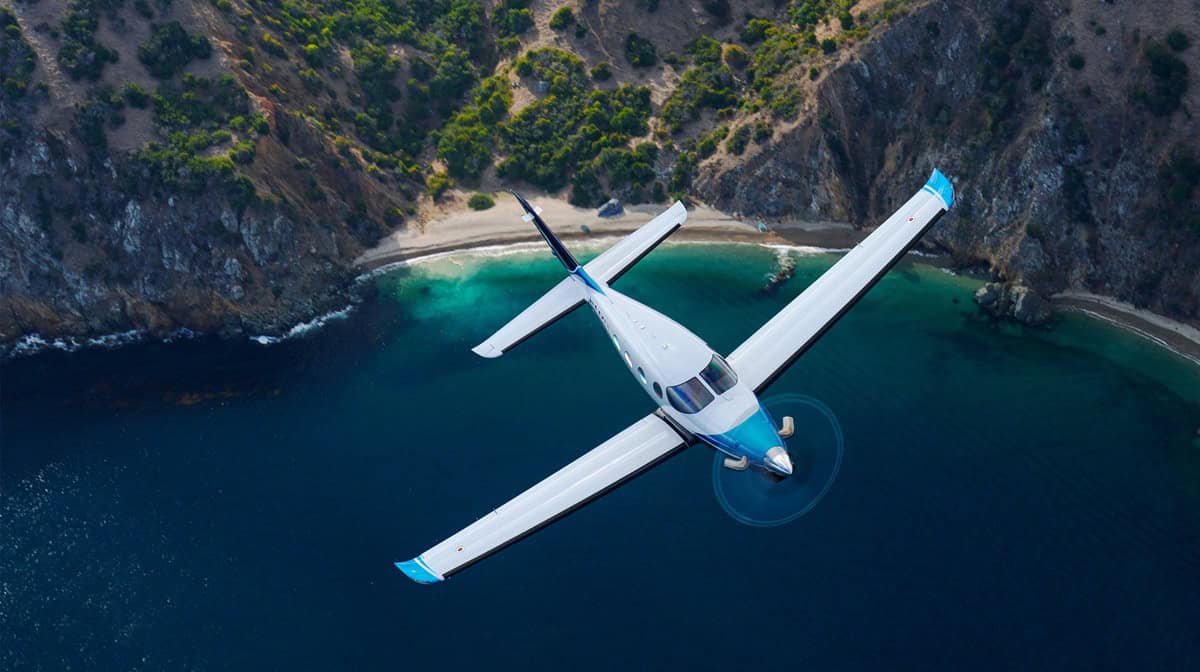
Epic E1000 AX in flight | IMAGE: Epic
Autoland is absolutely an incredible safety feature, but how does it compare to Cirrus’s CAPS (Cirrus Airframe Parachute System) feature? CAPS is proven and simple: deploying a parachute to lower the entire aircraft to the ground in an emergency. Autoland, while innovative, relies on complex automation and a suitable runway, which might not always be available in remote areas. Both systems aim to save lives, but they cater to different scenarios.
Other features of the Epic E1000 AX include:
Automatic Yaw Damper: Engages post-takeoff and pre-landing for smoother rudder coordination.
Electronic Brake Hold: Prevents movement on the ground and simplifies operations.
CoolView Windows: This technology blocks over 73% of infrared heat and UV rays, improving comfort and visibility for both the flight crew and the passengers.
GDL 60 Datalink with PlaneSync Technology: Automates database updates and enables remote aircraft monitoring.
GRA 5500 Radar Altimeter: Enhances above-ground-level awareness.
3D SafeTaxi & Taxiway Routing: Improves ground navigation.
True Blue Power Lithium-Ion Batteries: Offer long life and lower maintenance. Also reduces overall aircraft weight.
The Epic E1000 AX features a sleek, carbon fiber design | IMAGE: Epic
There’s no doubt that these features make the E1000 AX a tech-forward aircraft. (I am definitely aging myself here, but I remember being a student at Embry-Riddle, and GPS navigation was introduced to our ancient Tampico trainers. We 100% thought the future had arrived. Little did we know how incredible 2025 technology would be. Anyway, I digress.) While Epic’s tech is impressive, Cirrus avionics are nothing to sneeze at. Features like Envelope Protection and integrated weather systems stand out with Cirrus.
The question is whether Epic’s tech feels like a leap forward or just a different flavor of advanced.
Comfort and Practicality in the Cabin
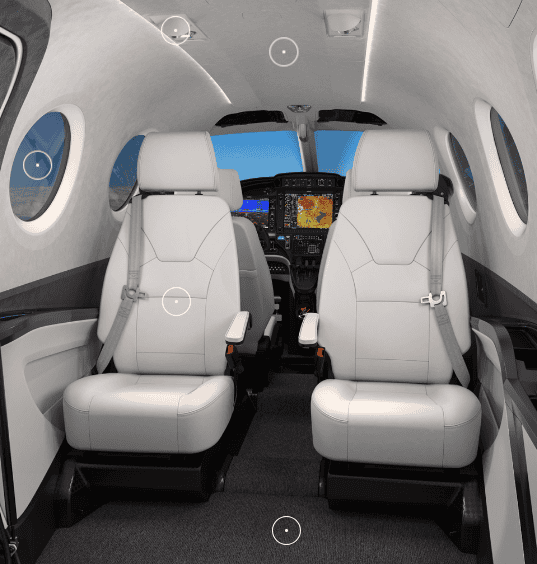
The interior of the Epic E1000 AX features seating for up to six passengers | IMAGE: Epic
The Epic E1000 AX offers a spacious 15-foot cabin and an expansive windscreen with CoolView windows, which enhance visibility and keep the interior comfortable by blocking heat and UV rays. With a full fuel payload of 1,150 pounds and a useful load of 2,956 pounds, it’s practical for carrying passengers and luggage on long trips. The inclusion of Starlink Internet is undoubtedly a selling point. Despite becoming more common, staying connected at altitude still feels like a luxury.
Cirrus has long been known for its plush, car-like interiors, and pilot-friendly cockpits, and the E1000 AX seems to aim for a similar vibe. Its carbon fiber build and efficient batteries could lower maintenance costs. Still, without public pricing data at this point in time, it’s hard to say how it compares to Cirrus’s operating expenses. Both aircraft prioritize comfort, but Epic’s taller cockpit clearance and internet connectivity might sway pilots who value those extras.
The Epic E1000 AX features the Skyline Collection of paint schemes, which come in eight different designs and over 200 color options from paint supplier PPG | IMAGE: Epic
Epic is Emerging as a Strong Player in the General Aviation Market
An Epic E1000 AX demo aircraft | IMAGE: Epic
Bend, Oregon-based Epic Aircraft, founded in 2004 under CEO Doug King, has been steadily climbing the aviation ladder. It started with the experimental Epic LT in 2004, followed by the E1000 in 2019 and the FAA-certified E1000 GX in 2021. The Epic E1000AX, now in its final certification stages (it should be certified any day now), builds on that legacy. Epic is hedging its bets on this model to compete with industry leaders like Cirrus, Cessna, Honda, Piper, Pilatus, Beechcraft, and others.
A map of the Epic E1000 AX Summer 2025 demo tour | IMAGE: Epic
To showcase the E1000 AX, Epic is hosting a demo tour this summer. While some stops have already taken place, additional stops yet to take place include:
Southern California | Jul 7-11
Camarillo, CA (CMA) | Jul 7
Van Nuys, CA (VNY) | Jul 8
Long Beach, CA (LGB) | Jul 9
San Diego, CA (MYF) | Jul 11
Oshkosh, WI (OSH) | EAA AirVenture | Jul 21-27
Wisconsin & Illinois | Jul 29-31
Palo Alto, CA (PAO) | US Aircraft Expo | Aug 8-9
Northern California | Aug 11-15
Northeast Region (CT, MA, VT, ME, NH, RI, VT) | Aug 26-28
Tri-State Region (NY, NJ, PA) | Sep 2-5
San Diego, CA (CRQ) | US Aircraft Expo | Oct 10-11
The Epic E1000 AX features CoolView windows, which reduce heat in the cabin and flight deck | IMAGE: Epic
So, does the Epic E1000 AX have what it takes to rival Cirrus? We think Cirrus loyalists will be interested in the E1000 AX because it matches or surpasses Cirrus in several key areas, including faster cruise speed, higher climb rate, and comparable range. Its carbon fiber design could offer cost advantages.
The avionics suite is state-of-the-art with Autothrottle and Autoland, though Cirrus’s proven systems and CAPS parachute remain a high bar. The E1000 AX’s spacious cabin, internet connectivity, and pilot-friendly features make it appealing. While the price tag for the E1000 AX will reportedly begin at $4.5 million, it’s hard to gauge its true value proposition without knowing actual operating costs.
Cirrus has built a loyal following with its performance, safety, and luxury blend, but the E1000 AX brings a fresh perspective. Its autonomous landing system is a futuristic feature for sure, though it’s untested in real-world emergencies compared to CAPS (Cirrus Airframe Parachute System). Epic’s focus on efficiency and modern technology could attract buyers, but Cirrus’s established reputation and dealer network are tough to beat. The Epic E1000 AX is a worthy alternative, but whether it can truly challenge Cirrus depends on how it performs in the hands of pilots and how Epic positions it in the market.
For now, we will keep an eye on the final certification process. And for those of you in any of the regions of the country featured on the demo tour, we would say it’s definitely worth a closer look––and maybe even a test flight.
In 2006, Boeing began using chevrons, or scalloped edges, on turbofans mainly for noise reduction. They added the chevrons to engines on the fan ducts on the 737 MAX, B787 Dreamliner, and 747-800. Airbus, Boeing’s main competitor, did not install chevrons and focused on other methods to make their engines quieter. Boeing has since abandoned the chevrons on new aircraft after testing and flight data revealed some problems in the design.
Noise Reduction: A Key Focus for the 737 MAX and B787
When Boeing was initially developing the 737 MAX and the 787, reducing engine noise was a top priority. The 737 MAX would use the CFM International LEAP engine, while the 787 offered two choices: the General Electric GEnX-1B and the Rolls-Royce Trent 1000. These engines were large and powerful—and very loud. To address this, Boeing started designing features specifically to quiet them down.
Chevrons for noise reduction and efficiency are clearly visible on the exhaust of the Boeing 737 MAX. | IMAGE: Boeing
NASA teamed up with Boeing to tackle the noise issue and helped develop a promising solution: chevrons on engine exhausts. They found that the scalloped edges of this design create narrow air channels from the exhaust. These channels reduced the mixing of temperatures and helped make the engines noticeably quieter.
At first, despite hopes that the chevrons would work, NASA found it difficult to develop designs that actually worked.
Early design component for chevrons. | Image: NASA
“Early on, we didn’t have the advanced diagnostics, instrumentation, and insight to know what we had done to make it worse instead of better,” said James Bridges, the associate principal investigator responsible for coordinating aircraft noise research at NASA. “You have an idea, and then you cut out a piece of metal and try it. Sometimes, the kernel of the idea might have worked out, but the way you did it wound up causing more noise.”
Advanced Testing Proves Effectiveness of Chevrons for Noise Reduction and Efficiency
NASA eventually began using advanced testing methods in wind tunnels with lasers and high-speed photography to prove the effectiveness of their designs. Following successful testing, Boeing added chevrons to the 747-800, 737 MAX, and B787.
This effort by Boeing and NASA served some specific purposes. The primary objective was to reduce engine noise during takeoff and landing–not only to make flights quieter and more comfortable for passengers. It was also because many areas worldwide have issued stricter noise reduction policies. This has forced manufacturers to create new designs.
Boeing also anticipated even tighter restrictions in the future and wanted to stay ahead of the curve.
Close-up of chevrons on engine exhaust duct. | Image: Aircraftnerds.com
Another benefit of this technology is that it allows manufacturers to reduce weight. The chevrons allowed Boeing to remove some sound insulation from the aircraft, making them lighter and more fuel-efficient. For example, Boeing was able to remove about 600 pounds of sound insulation from the 787 Dreamliner while reducing the noise by 15 decibels.
Boeing Finds that Chevrons Reduce Thrust
While Boeing saw significant advantages of using chevrons for noise reduction and fuel efficiency, the corporation also discovered some problems. They found that the chevrons caused a slight reduction in thrust.
Petter Hörnfeldt, a 737 MAX pilot, explained this, stating, “Anytime a vortex is being created, it takes away energy from the object that’s creating the vortex. Since you’re adding these chevrons, and they are creating vortexes, they’re actually reducing the amount of thrust that the engine could take out … about 0.5% of the thrust.”
This may not be much, and with the added benefit of reduced engine weight, the impact of reduced thrust is even less. However, based on this and other flight data, Boeing abandoned its use of chevrons in aircraft models. It has not included chevrons on its newer 777X wide body.
Boeing 777X with different engine exhaust design. | Image: Boeing
Terry Beezhold, 777X chief project engineer and vice president at Boeing, explained, “We are replacing the chevrons with a new nozzle design technology. It provides equivalent levels of noise for the cabin and community but is lighter in weight and has lower drag.”
Airbus Develops Different Noise Reduction Designs
Boeing’s main rival, Airbus, has taken a different approach to engine noise reduction. While Boeing adopted chevrons–a technology it held patents for–Airbus has not used them on its aircraft. Instead, Airbus pursued its own noise-reduction strategies.
While the flying car might be within civilization’s grasp today, some crafty California engineers in 1973 attempted to bring the future of personal flying closer.
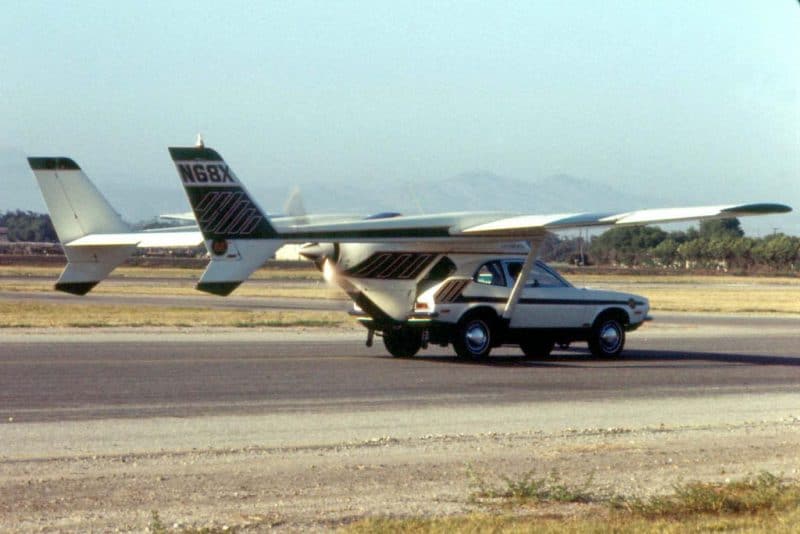
The AVE Mizar was literally a Ford Pinto with wings and additional flying features. The project had early aspirations until a test flight brought about the inventors’ untimely deaths.
‘The Flying Pinto’
The AVE Mizar “Flying Pinto”
Ohio-based project engineer Henry Smolinski made a career in engine and aircraft design for Rocketdyne. In 1971, Smolinski left Rocketdyne to start a new venture with his friend Harold ‘Hal’ Blake. The twosome formed Advanced Vehicle Engineers (AVE) with the mission of taking a roadworthy car to the skies.
Smolinski and Blake came up with the ‘Mizar.’ The word is derived from the Mizar star, known as a ‘double star’ that gives off the illusion of a bright, singular star. The aircraft itself wasn’t assembled from scratch but was rather just a Ford Pinto with the rear of a Cessna Skymaster.
The duo, however, recognized the Skymaster’s clever design, which featured two engines with the same thrust line, front and back. While keeping the Skymaster’s engine power, the front was replaced with the entire Pinto.
Of course, the Mizar was considerably heavier thanks to the car in place of the plane’s front. Smolinski and Blake knew this and upgraded the Skymaster’s rear engine from a 220-horsepower unit to a 300-horsepower variant.
AVE made two prototypes of the Mizar, while up to three additional were in the works at one point in Oxnard, California. Although the Mizar was just two vehicles fused together, the Federal Aviation Administration (FAA) was planning to see the car fly in person for certification testing.
The Mizar was slated to be available in 1974, and a Ford dealer in Sepulveda (present-day North Hills), California, was eager to sell it. The car was projected to cost up to $30,000 ($214,000 in 2025).
A Bitter End for Henry and Hal
The first test flight of the Mizar Flying Pinto occurred on 26 August 1973 at Camarillo Airport. Pilot Charles Janisse managed to fly the vehicle 120 feet in the air before landing it in a bean field. During the flight, the right wing strut’s mounting attachment failed, and Janisse called an audible to land prematurely, as stress on the wing would likely lead to catastrophe.
Regardless, another test flight happened on 11 September 1973 at Van Nuys Airport. With Janisse unavailable for the test, Smolinski opted to pilot the Mizar with Blake in the passenger seat.
During the test flight, AVE didn’t seem to have fixed the right wing strut. Unfortunately, this time, the wing folded and detached from the body, causing the vehicle to fall apart in the air before brushing a treetop and landing on a parked pickup truck. The crash caused an explosion, and both Smolinski and Blake died instantly.
The National Transportation Safety Board (NTSB) issued a crash report that revealed the vehicle was over gross weight thanks to the Pinto. The report also cited shoddy welding as the primary cause of the bad strut.
The Mizar Flying Pinto project and AVE ceased immediately following the crash, though Smolinski and Blake at the time held the elusive honor of getting their flying car off the ground when others before them couldn’t.
Legacy of the AVE Mizar “Flying Pinto”
Despite the tragic deaths of the AVE’s engineers, the 1973 flying car got the attention of Albert R. Broccoli and Harold Saltzman, the producers of the following year’s James Bond film The Man with the Golden Gun. In the movie, the main antagonist, Francisco Scaramanga, played by Christopher Lee, escapes in a similar car with wings. The actual vehicle, however, was small and remote-controlled.
In 2010, TIME Magazine selected the AVE Mizar as one of ‘The 50 Worst Inventions’. The blurb concluded, ‘Some things are better left to the movies.’ Coincidentally, the Ford Pinto itself ended up on the list for ‘the nasty tendency to literally explode’ upon a collision.
With its unique slip-wing design, the Hillson FH.40 Hurricane transformed during flight by jettisoning its upper wing and changing from a biplane to a monoplane. The FH.40 slip-wing fighter was experimental, but it did reach prototype stage. Later aircraft went beyond this and jettisoned entire aircraft.
Slip-Wing Design Had Better Takeoff and Lift Than Monoplanes
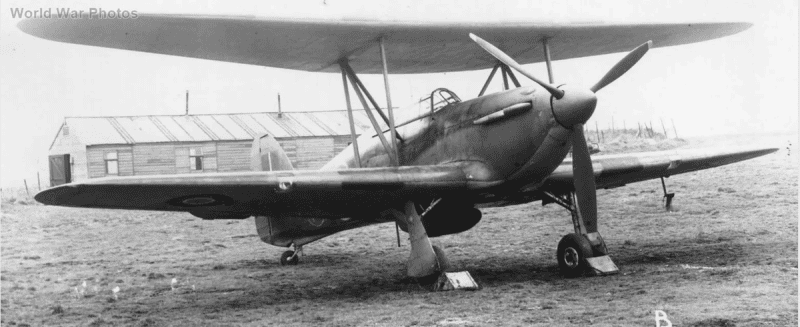
During World War II, during the Battle of Britain, aircraft manufacturer F. Hills and Son Ltd (usually called Hillson) became interested in developing a slip-wing fighter. A slip-wing design is basically a monoplane carrying an upper wing that it can jettison during flight. The upper wing makes the aircraft a biplane, and it has several advantages over its single-wing configuration.
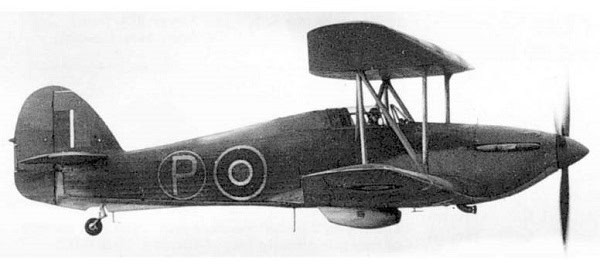
Side view of the Hillson FH.40 Hurricane slip-wing fighter. | Image: Planehistoria
The key advantage of the slip-wing is that the additional wing produces more lift, giving the aircraft the better short takeoff and faster climb ability of a biplane. This advantage was critical during the war as aircraft carried increasingly heavier payloads. Also, planes often had to operate from airfields that had been shortened and damaged due to enemy fire.
Hillson proposed their design for their slip-wing fighter as a model they could easily mass produce and fly from a medley of airfields. In 1940, the British Air Ministry agreed to allow Hillson to move ahead with the project and gave them a used Hurricane Mk 1 fighter to test with the slip-wing concept.
Aircraft Would Jettison Upper Wing After Takeoff
The upper wing of the Hillson slip-wing fighter was the same size and airfoil shape as the lower wing. A key difference was that the upper wing had no control surfaces, as is typical on biplanes.
Hillson attached the upper wing to the lower fuselage with five struts: one on top of the canopy and four on each wing. The wing and struts added 340 pounds to the aircraft. The design concept was for the Hillson FH.40 to take off and then mechanically jettison the upper wing and struts. The initial plan was to drop the wing over water to avoid it striking people or buildings.
Advantages of Monoplane Configuration
The FH.40 operated differently in its two configurations while flying. It was faster as a monoplane than as a biplane. Also, once it jettisoned the wing, it experienced a sudden loss of lift and would drop several hundred feet. Designers discovered that its max speed as a biplane was less than its stall speed as a monoplane.
The monoplane was faster because it produced less drag than the biplane configuration. The thickness of the lower wing also allowed it to have retractable landing gear, which fit inside the wing, reducing drag even more.
The Hillson FH.40 Hurricane never made it into production. By the time testing proved the concept could work, it was 1944, the Battle of Britain was over, and the Air Ministry scrapped the project.
Following the Second World War, the concept of having aircraft jettison items did not go away, even though the slip-wing design did not come back. Several designs appeared that had larger aircraft carrying and then jettisoning smaller aircraft.
Slip-Wing Concept Followed by Other Designs With Jettison Features
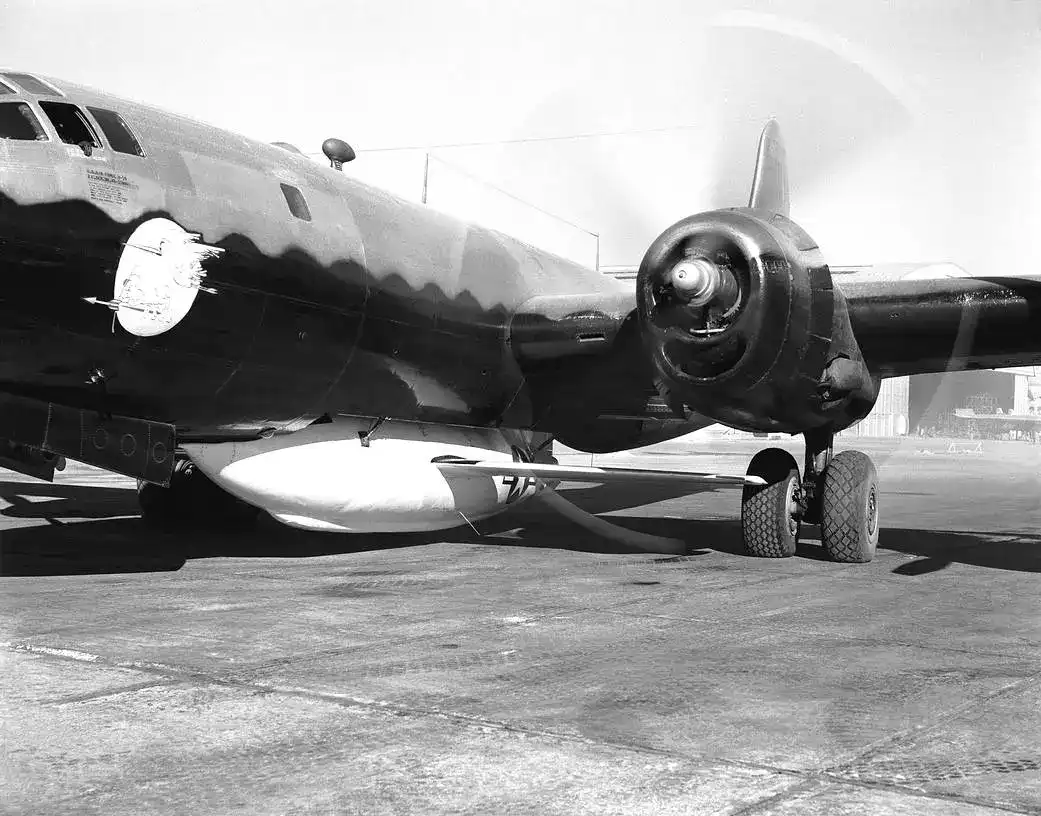
One of these ideas was that the B-29 Superfortress would carry a smaller Bell X-1-2 jet, resulting in one of the most well-known missions ever flown. On 14 October 1947, a B-29 carried and dropped the Bell X-1 with Captain Chuck Yeager at the controls. Yeager famously piloted the X-1 past the speed of sound.
Boeing B-29 Superfortress with Bell X-1-2 mounted under the fuselage. | Image: National Air and Space Museum
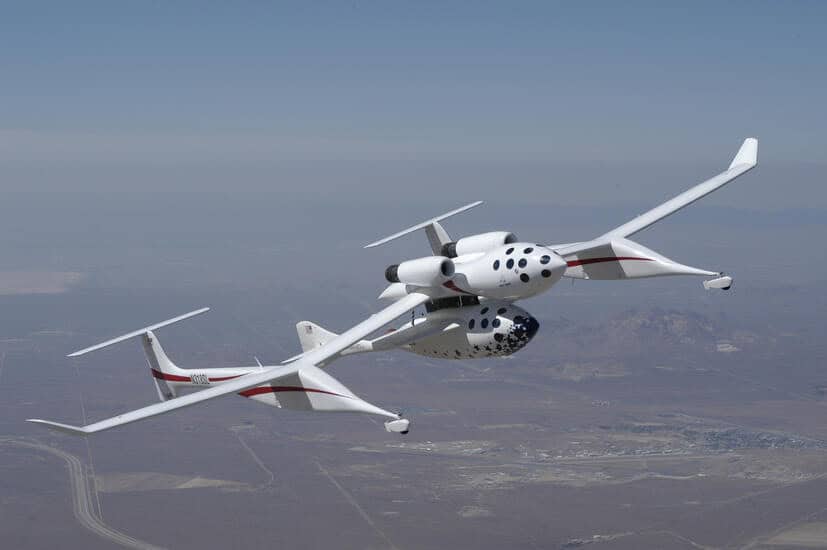
Another design involving two separate aircraft was the SpaceShipOne (SS1) suborbital spacecraft. Scaled Composites designed it to take off and launch from the White Knight high-altitude carrier aircraft.
Following Detachment from Other Aircraft, SpaceShipOne Soared To 62 Miles
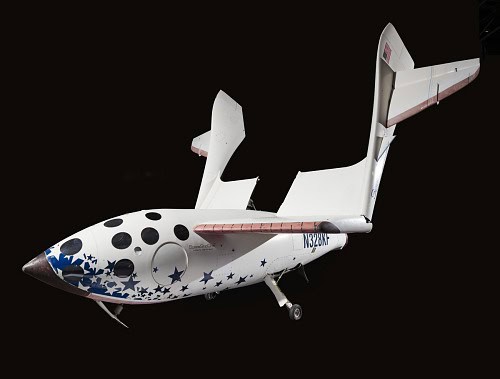
SS1 had a nitrous-oxide hybrid rocket powerplant that could carry the three-passenger aircraft up to an altitude of 62 miles. It reached Mach 2 on its first powered flight. When descending, its twin tails folded upwards, but they extended out in a conventional position for landing.
SpaceShipOne while being carried under the White Knight high altitude carrier. | Image: Space.skyrocket
Following successful flights in September and October 2004, the SS1 won the Ansari X-Prize. This prize was a $10 million award for the first privately funded spacecraft to carry three passengers up to 62 miles, land safely, and repeat the mission within two weeks. The SS1 was designed to be an experimental aircraft and never went into production.
SpaceShipOne with landing gear extended. | Image: Space.skyrocket
Starting in the 1950s, the United States began focusing on developing nuclear propulsion as an effective way to power space exploration. Several programs made significant progress in this effort. Years of planning and testing proved the feasibility and potential of these systems. However, many problems have thrown serious doubts about future development.
Cold War plans to go to Space
During the Cold War, the United States focused on using nuclear energy for more than just weapons. Scientists and politicians started thinking about going to space and exploring other planets. They knew they had to develop engines powerful enough to launch rockets into space, and some wondered if the engines could be nuclear.
Early image of a nuclear rocket engine based on designs from atomic propulsion programs. | Image: Nuclear Newswire
Projects Rover and NERVA Focused on Nuclear Propulsion Designs
There was even some talk about this as early as 1945, but the first serious program, Project Rover, started in 1955. The U.S. Atomic Energy Commission managed Rover intending to use nuclear thermal propulsion on rockets. Their mission was to design a nuclear reactor that could power a rocket engine, develop an appropriate propellant, and conduct design testing. Scientists at Los Alamos National Laboratory did the early work on the project.
Scientists from NASA’s Lewis Research Center prepare a nozzle for testing. | Image: NASA
Advantages of Nuclear Propulsion
Together, Projects Rover and NERVA proved that nuclear propulsion was feasible in rockets and had some significant advantages over the chemical engines powering rockets at the time.
One of the main advantages nuclear engines had over chemical engines was in efficiency. Scientists measure rocket engine efficiency based on seconds of specific impulse. With this method, nuclear engines proved to be at least twice as efficient as chemical engines. Nuclear engines also provided high thrust.
Testing of a NERVA engine design. | Image: Los Alamos National Laboratory
Another significant advantage of nuclear engines is that they were lighter and smaller than chemical engines. Because of this, the rockets could trade propellant weight for more payload capacity. Nuclear engines could also give rockets greater range. All of this, combined with their higher efficiency and thrust, made nuclear engines an attractive option for powering rockets in the early space program.
Problems Add Doubts on Programs that Use Nuclear Power in Rockets
While scientists and engineers working on Rover and NERVA saw many advantages in using nuclear propulsion, they encountered many, if not more, problems with the technology. From the start, they had to develop new complex designs and processes for reactors, materials, radiation, structures, and control systems.
An example of this complexity was in the temperatures they had to deal with. The liquid hydrogen propellant was at minus 400 degrees Fahrenheit, while the exhaust temperatures from the engines were at least 4000 degrees. Scientists felt that most metals and alloys could not handle more than 4500 degrees. They reported that this was so serious that one out of every three people working at Los Alamos spent their time focusing on temperatures.
An article in the ANS Nuclear Newswire on Project Rover makes a similar point: “Transferring liquid hydrogen at minus 400 degrees Fahrenheit is about as easy a handling problem as causing water to move smoothly through a white-hot furnace.”
Another problem was in the testing methods. They initially tested the engines with the nozzles pointed up. When they wanted to test the engines pointing down, they had to make sure oxygen would not be sucked into the nozzle and cause an explosion when the oxygen and hydrogen came together.
Kiwi Nuclear engine installed on a test stand. | Image: NASA
Scientists Surprised by Test Results
The people working on Rover and NERVA sometimes used language that made them feel unsure or lacking confidence in the projects. As a result, they were unable to accurately predict their test results.
One example is in an article in the ACTININD Research Quarterly from Los Alamos. Scientist Richard Malenfant wrote, “This article summarizes the lessons learned in the development of this technology, illustrating that surprises are certain to be encountered when undertaking such advanced programs.”
Inconsistent Language from Scientists on Nuclear Programs
Malenfant added that “experimental results were reported only in informal progress reports” and that “heating was inconsistent.” He later referred to the design and test issues as “just a sampling of the unknowns that were to be addressed.”
Cover of 2021 issue of journal on nuclear propulsion program from Los Alamos National Laboratory | Image: Los Alamos National Laboratory
It is difficult to imagine the public would support a nuclear program with so many uncertainties. However, it is hard to deny the advantages of nuclear propulsion.
In the end, the cost of these programs may have become their primary obstacle. The government reduced funding to NERVA in the late 1960s and canceled the program in 1973.
The hope of using nuclear propulsion in rockets did not end there. In 1983, when there were discussions about developing the Strategic Defense Initiative (Star Wars) program, there was talk of using nuclear engines more powerful than chemical rockets. Also that year, the government started a new program, “Project Timber Wind,” that became part of the Space Nuclear Thermal Propulsion program. It ran from 1987 until 1991. At that point, NASA canceled it after deciding it had made no improvements over the designs of the Rover program
Many enthusiasts include various iconic cars in movies in their ‘all-time favorite cars’ lists. When it comes to aircraft, however, not many planes in movies come to mind, except for the Austin Powers 747 jumbo jet. Rather than other spies who preferred the speed and elusiveness that come with private jets, Powers flew with style, boldness, and flamboyancy.
Here’s everything you need to know about the Austin Powers 747 and its impact on culture today.
About the Austin Powers 747
The zany livery of the fictitious Austin Powers 747
The Austin Powers 747 was a fictitious plane with a color scheme of yellow, green, orange, and pink streaks. An ‘AP’ logo is also located on the tail of the aircraft.
The Boeing 747 inspired the Powers jet. While the first Austin Powers movie was set in 1967, the actual 747 didn’t enter service until 1970. Though this fact can be forgiven due to the humorous and time-bending nature of the Austin Powers universe.
Truth be told, the psychedelic jet never had a physical form. Each of the three Austin powers movies had budgets of $63 million and below, which didn’t allow for pricey planes. Instead, artists computer-generated the plane to establish when Powers and his colleagues were in the air or arriving at destinations.
However, New Line Cinema didn’t design the interior quite like a real commercial jet with seats. Riddled with flashy 60s patterns and decor, the interior featured at least a bar, dining area, and private quarters. The Mike Myers character had his own personal staff to serve drinks to Powers and his guests.
The ‘Austin Powered’ Jet Beyond the Movies
To coincide with the 1999 release of The Spy Who Shagged Me sequel, Virgin Atlantic teamed up with New Line Cinema for a special ‘Austin Powered’ livery. Previously, the airline had a ‘Spice One’ livery featuring fellow British music group the Spice Girls. These liveries, however, only featured a simple design on the jet’s nose rather than an overhaul like Powers’ own jet.
In 2020, then-U.K. Prime Minister Boris Johnson gave orders to overhaul the Royal Air Force (RAF) Voyager aircraft from an all-gray design into a white plane with strong red and blue accents.
The Union Jack is also present on the tail. The new livery reportedly cost around $1,250,000 (£1 million). Many considered the design ‘sounding like something from Austin Powers‘ before Johnson revealed it to the public.
Around the same time as the Austin Powers movie releases, Qantas had been growing a collection of artistic livery aircraft for its ‘Flying Art Series.’ Qantas released the first three aircraft in this collection from 1994 to 2002.
While the Austin Powers 747 was made for comedic effect, aircraft like ‘Wunala Dreaming’ and ‘Yananyi Dreaming’ were painted to highlight Australia’s old-world artistic culture. Both movements in the late 90s and early 2000s, however, helped make bold, colorful liveries on commercial aircraft more publicly acceptable. While airlines still feature clean designs, certain companies like Southwest have adopted a far bolder livery design to make their aircraft stand out proudly over others at airports.
Navy aircraft carriers were forever changed by a simple but revolutionary invention. Learn how one design shift reshaped flight deck operations and carrier aviation history.
The advent of the angled deck revolutionized United States Navy (USN) aircraft carrier operations. Invented by Royal Navy Captain (later Rear Admiral) Dennis Cambell, the angled deck began as a way to land heavier and faster jet-powered aircraft in a direction offset from the rest of the flight deck so that if a recovering aircraft were unable to engage a cross-deck arresting pendant, it would be able to accelerate and make another pass.
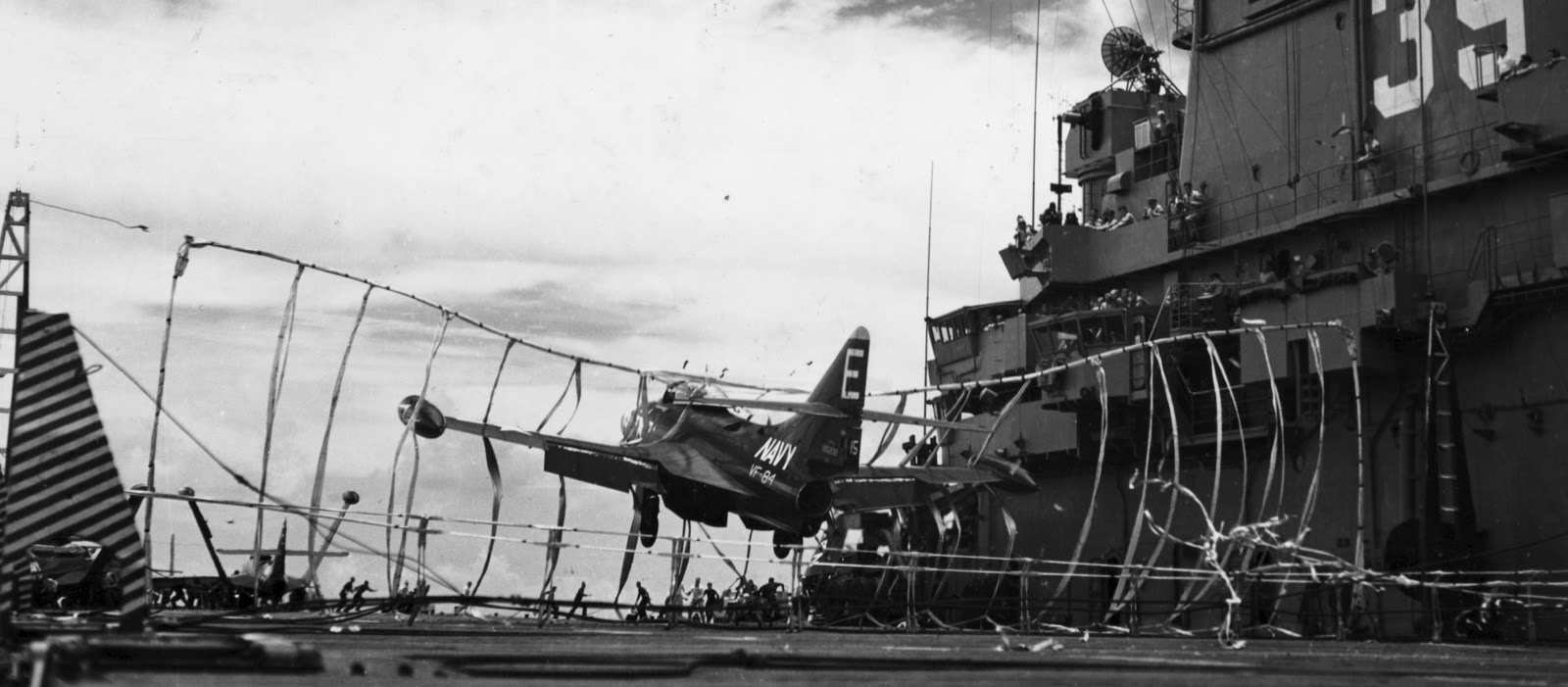
On the axial deck carriers, such a missed recovery, referred to as a bolter, would usually result in the recovering aircraft being damaged in a barrier or barricade engagement. Or worse, the recovering aircraft could end up missing the barricade and plowing into parked aircraft on the forward portion of the flight deck.
As US Navy Captain, naval aviator, and astronaut Wally Schirra said, “In those days, you either had an arrested landing or a major accident.”
Grumman F9F Panther experiencing a barrier crash landing on the flight deck of the USS Lake Champlain (CV-39) | Official US Navy Photograph
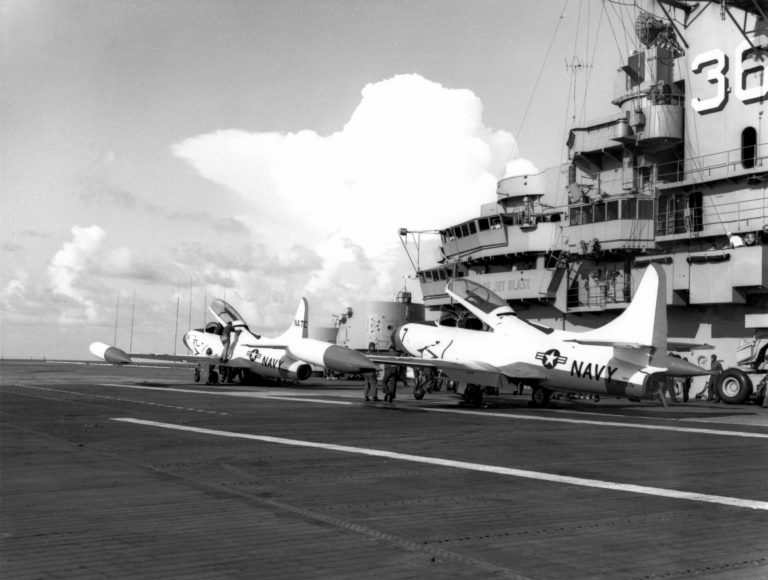
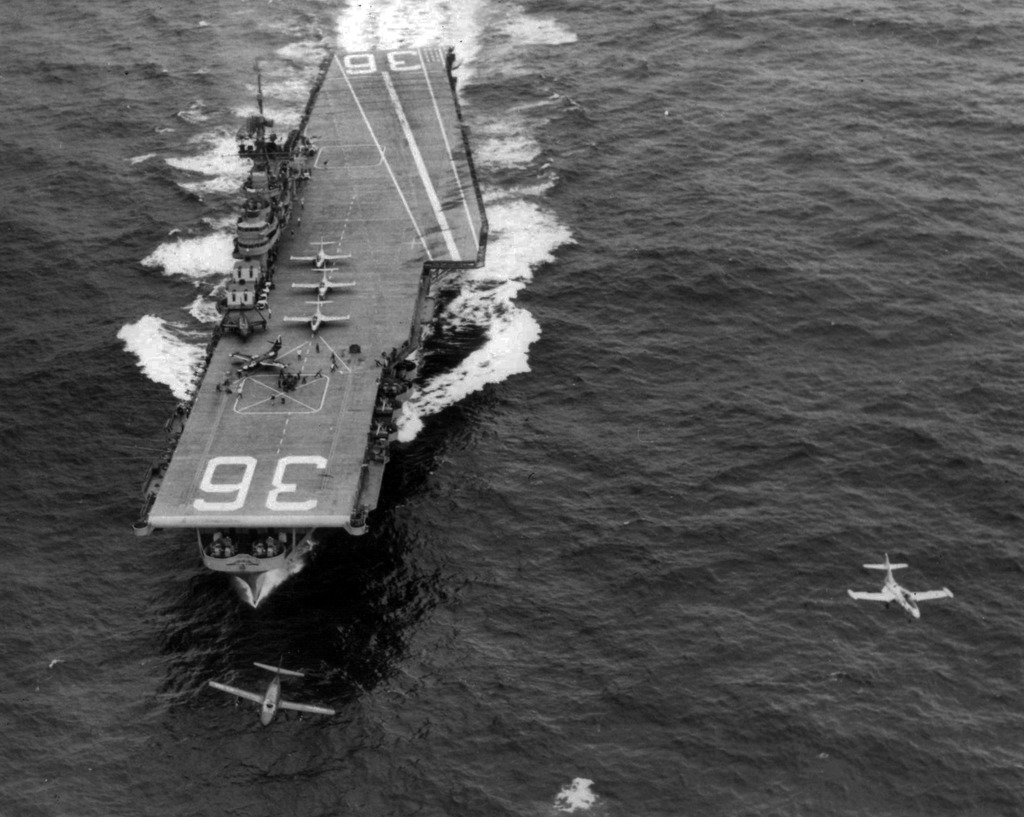
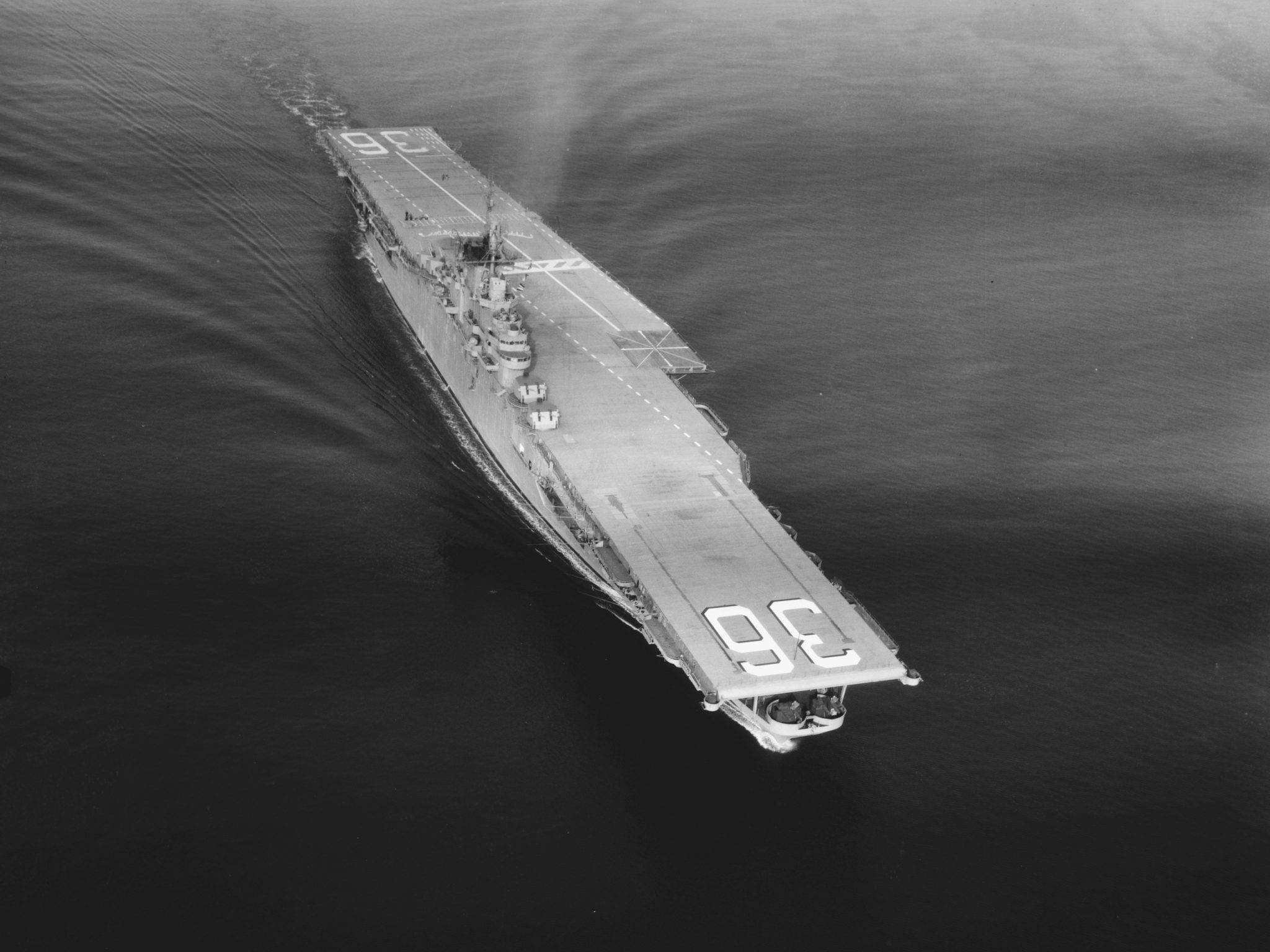
After a modification program performed at the Brooklyn Navy Yard, completed in December of 1952, the Essex-class aircraft carrier USS Antietam (CV-36) was the first carrier to conduct true angled deck testing, including full arrested landings.
In early January 1953, the angled deck proved its mettle to US Navy aviators and to the British later that year. The preliminary testing consisted of a total of 350 day and 26 night approaches using several different carrier-based aircraft flown by Naval Air Test Center pilots out of Naval Air Station (NAS) Patuxent River.
The USS Antietam was the first Navy aircraft carrier to utilize an angled flight deck | Official US Navy Photograph
With the newly formed Carrier Air Group Eight (CAG-8) embarked, some of whose pilots were new to their aircraft with less than 50 hours of jet time, the Antietam left for Cuban waters to see how inexperienced pilots handled the Navy’s new carrier flight deck geometry.
Although the CAG-8 aviators experienced a few minor mishaps, there were no aircraft losses. Overall, the “nuggets” handled the angled deck much better than expected and far better than their inexperience would likely have enabled them to handle an axial deck configuration.
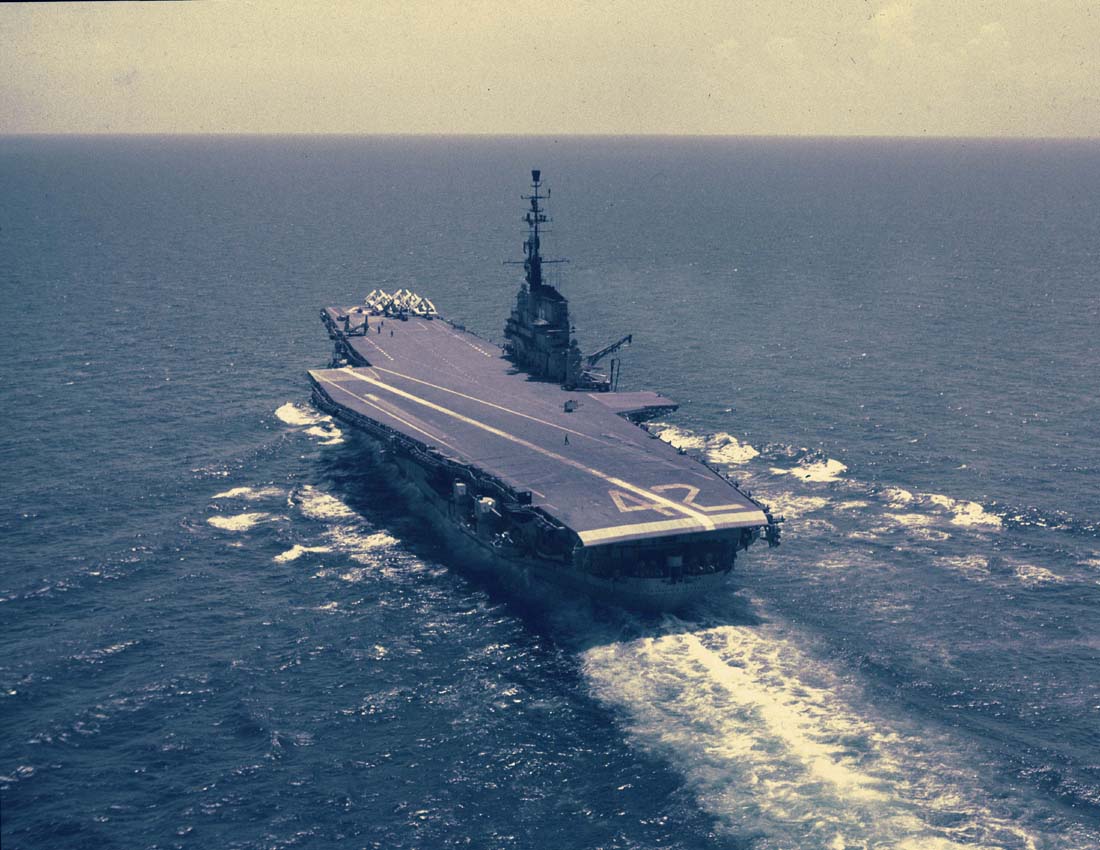
Midway-class carrier USS Franklin D Roosevelt with an angled deck. Official US Navy Photograph
Fourteen Essex-class carriers were modernized to include angled decks along with mirror landing systems, improved arresting gear, and enclosed bows, among other modifications, under the Ship Control Board 125 (SCB-125) upgrade program.
The Midway-class aircraft carriers received angled decks and similar improvements under the SCB-110 and SCB-110A upgrade programs.
The Forrestal-class and all subsequent American aircraft carriers operating fixed-wing naval aircraft came equipped with angled decks and other improvements. Oh sure, the landing area foul lines look different now, but the angled deck has proven to be far more than a cosmetic change. It fundamentally altered how aircraft are recovered at sea, dramatically improving safety, efficiency, and sortie generation.
More than seven decades later, carrier pilots still fly the same basic angled approach pioneered in the early jet age. Technologies have evolved, aircraft have grown faster and heavier, and flight decks have become more complex, but the core concept remains unchanged. For more than 72 years, the angled deck has quietly done its job, every day, on every modern carrier, shaping naval aviation in ways few inventions ever have.
USS Antietam | Official US Navy Photograph
The 1955 film “The Angled Deck Carrier” includes extensive footage of approaches to and recoveries aboard the modified Essex-class carrier USS Antietam (CV-36) as well as mishap footage from other carriers.
Artificial intelligence is proving to be just as capable, and perhaps much more so, than human pilots in fighter aircraft. The US Air Force and other government and industry partners are testing ways to use AI effectively for dogfights and other missions.
X-62A VISTA Aircraft Tests AI Capabilities Versus Air Force Pilots
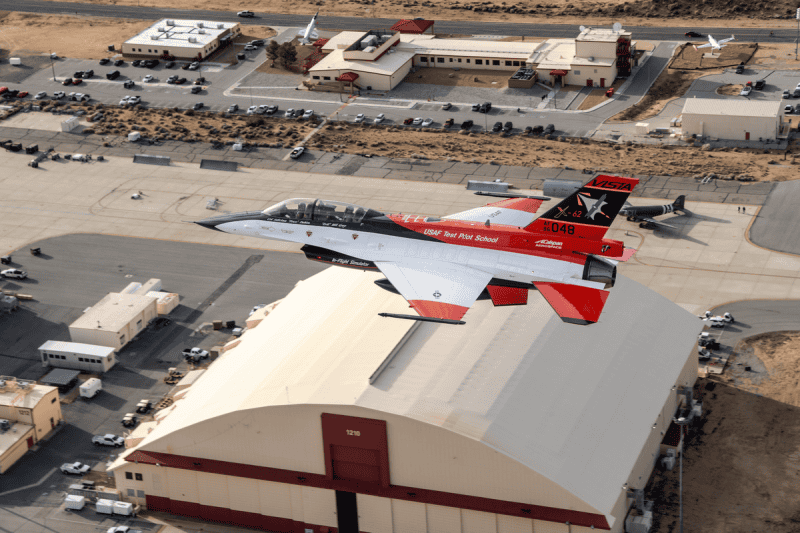
In 2023, the Air Force began testing AI capabilities with a modified F-16, the X-62A VISTA (Variable In-flight Simulator Test Aircraft). The AI-controlled X-62A flew 21 test dogfight missions against F-16s with human pilots.
The artificial intelligence controlled X-62A VISTA flew mock air combat missions against an F-16. | Image: USAF
During these flights, the X-62A performed defensive and then offensive maneuvers. These included nose-to-nose engagements where the aircraft got as close as 2000 feet of each other at 1200 miles per hour. They flew with human pilots as a safety measure; however, the pilots did not need to take control during the flights.
While the Air Force has not announced who won the dogfights, the missions demonstrated that aircraft controlled by artificial intelligence can operate safely in complex combat environments. This includes writing code that defines flight parameters to help avoid collisions in the air and on the ground. It also can prevent the deployment of weapons in unauthorized areas.
X-62A VISTA Demonstrates Effectiveness and Flexibility of AI
X-62A VISTA (Variable In-flight Simulator Test Aircraft) is a modified F-16 airframe. | Image: USAF
The X-62A VISTA is a modified F-16. It was designed to simulate different aircraft features to test AI abilities in real-world scenarios. It contains sensors and other systems that allow it to perform complex maneuvers. One of its key advantages over human pilots is its ability to analyze the combat situation and make faster decisions. If AI consistently outperforms human pilots, it will change tactics for aerial combat and all aspects of military aviation.
Virtual Dogfight Competition Pits AI Systems Against Each Other
Before testing the X-62A against a real aircraft, the Air Force and DARPA held a virtual mock combat simulation competition in 2020. Aurora Flight Sciences, EpiSys Science, Georgia Tech Research Institute, Lockheed Martin, Perspecta Labs, PhysicsAI, and SoarTech all entered the competition to determine which had the most capable AI systems.
On the first day, each company’s AI flew virtual missions against unmanned vehicles similar to cruise missiles or large drones. On the second day, the programs flew simulated dogfights against each other. After the first two days, Heron Systems was the overall winner. Heron, with just 30 employees, defeated Lockheed Martin in the final round.
Artificial Intelligence Undefeated Against Skilled Air Force Pilot
On the final day, Heron Systems competed, again virtually, against an actual F-16 pilot. This pilot, from the District of Columbia Air National Guard, with the codename “Banger,” was a graduate of the Air Force Weapons School’s F-16 Weapons Instructor Course.
Artist illustration of a future Next Generation Air Dominance (NGAD) mission. | Image: airandspaceforces.com
The initial plans are to use large numbers of autonomous unmanned aircraft with fifth or sixth-generation fighters. This will be part of plans for the broader Next Generation Air Dominance (NGAD) program. NGAD will use next-generation fighters, weapons, sensors, and network systems together in the future.
Future Plans Must Account for AI Surpassing Human Capabilities
AI-controlled aircraft have the potential to far exceed the performance of those with human pilots. One of the companies involved in developing artificial intelligence for military aircraft is Shield AI. Company President and co-founder Brandon Tseng spoke about AI’s potential.
“You always have the best AI pilot on an aircraft at any given time,” said Tseng. “We win 99.9% of engagements with our fighter jet AI pilot, and that’s the worst that it will ever be, which is superhuman. So when you talk about fleet learning, that will be on every single aircraft, you will always have the best quadcopter pilot, you’ll always have the best V-BAT pilot, you’ll always have the best CCA pilot, you name it. It’ll be dominant.”
X-62A VISTA (Variable In-flight Simulator Test Aircraft) | Image: USAF
In the future, the Air Force will have to make decisions concerning the role of artificial intelligence and the continued use of human pilots.
Before it lit up the big screen in a fiery explosion, a now-famous Boeing 727 movie prop had a much more patriotic purpose.
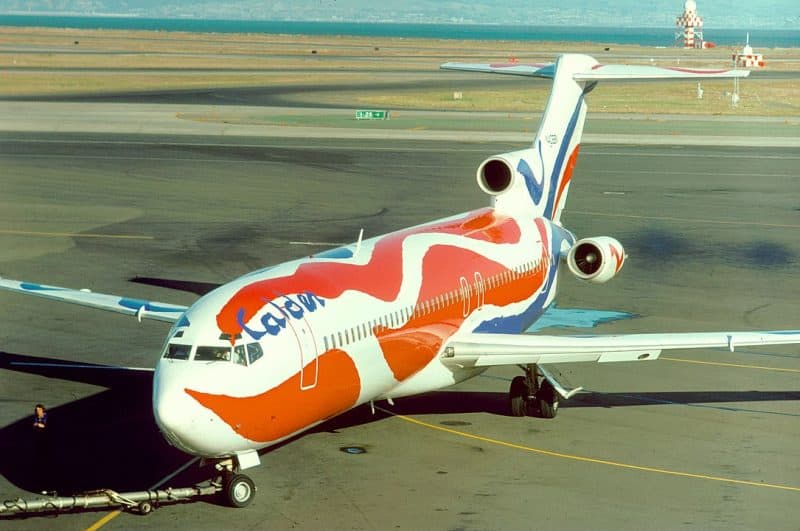
Originally painted by American artist Alexander Calder to celebrate the United States Bicentennial in 1976, this aircraft—registered as N408BN—was once a flying piece of art for Braniff International Airways.
Its transformation from an airborne tribute to a Hollywood icon is one of aviation’s most unexpected plot twists.
Here’s a brief history of Calder’s special-edition aircraft.
Braniff’s Artistic Aspirations
Braniff International Airways (BIA) was an airline founded in Dallas, Texas, that served travelers worldwide for over five decades. The airline even leased a Concorde briefly for domestic operations before closing its doors in 1982.
During the 1970s, Braniff introduced a more modern fleet and embraced eye-catching design. Aircraft donned striking two-tone schemes using vivid blues, greens, and oranges, paired with yellow or light-blue underbellies.
The dramatic style shift was driven by Chairman Harding Lawrence and Mary Wells, an advertising executive who later became his wife.
Braniff’s ‘Flying Colors of South America’ Douglas DC-8 | Image: Wikimedia Commons
But the carrier’s creative vision didn’t stop there. In 1973, advertising executive George Stanley Gordon elevated the idea further by commissioning artist Alexander Calder to create an entirely hand-painted livery. The result was Flying Colors of South America, a vibrant Douglas DC-8 featuring streaks, waves, and other accents in bold primary colors.
The aircraft commemorated Braniff’s 25 years of service to South American cities and was used exclusively on routes between North and South America.
A Star-Spangled Boeing
In 1975, two years after his first airline collaboration, Alexander Calder was again commissioned by George Stanley Gordon—this time to celebrate America’s upcoming 1976 Bicentennial. The result was Flying Colors of the United States, a striking red, white, and blue design hand-painted onto a Boeing 727-200.
The aircraft was delivered new to Frontier in 1968 and later sold to Braniff in 1972. Prior to Calder’s work, it wore a solid blue Braniff livery. Calder’s patriotic version featured flowing ribbons and swirls in red and blue on a predominantly white background.
The aircraft debuted its new livery during a company event at Dallas Love Field and was later used primarily for routes between the United States and Mexico.
Unfortunately, the special edition livery was short-lived. Once the Bicentennial festivities concluded, Braniff repainted N408BN in a solid color once again — this time, in ‘chocolate brown.’
Flying Colors of the United States was the last special-edition livery commissioned from Braniff. Calder unfortunately died from a heart attack on 12 November 1976 in his daughter’s home in New York City. He was 78.
Life After Braniff and the Journey to an Iconic Boeing 727 Movie Prop
N408BN remained in Braniff’s fleet until the airline ceased operations in May 1982. The aircraft sat in storage until the launch of Braniff II in 1984 when it was repainted in the new airline’s white and blue livery.
In 1985, N408BN was sold to Pride Air and eventually passed through the hands of several smaller domestic and international carriers. Its flying career came to an end in June 1990, when it was retired in Opa-locka, Florida. The aircraft was dismantled, and its parts were sold by International Air Leases.
But N408BN had one last moment in the spotlight.
In 1993, the aircraft was sold to Columbia Pictures for the climactic final scene of Bad Boys, starring Will Smith and Martin Lawrence.
The film’s villain, Fouchet (played by Tchéky Karyo), attempts to flee aboard the jet until the film’s heroes blow up the hangar (and the aircraft). N408BN’s registration is clearly visible throughout the scene, which was filmed at Miami-Opa Locka Executive Airport (OPF).
Australian photographer Frank Schaefer took the last known photo of N408BN in March 1993, shortly before production of Bad Boys began:
‘Sad end, but at least with a bit of fame,’ Schaefer wrote.
On 5 January 2024, Alaska Airlines Flight 1282, a Boeing 737-9 MAX (reg. N704AL), suffered a terrifying midair incident when its left mid-exit door (MED) plug blew out at 14,830 feet, leaving a gaping hole in the fuselage.
The National Transportation Safety Board (NTSB) on 24 June 2025 released a synopsis of its forthcoming final report on the Flight 1282 incident. The agency pins the blame on Boeing’s failure to provide adequate training, guidance, and oversight to its factory workers while also criticizing the Federal Aviation Administration (FAA) for ineffective oversight.
A Harrowing Turn of Events Six Minutes After Departure from Portland
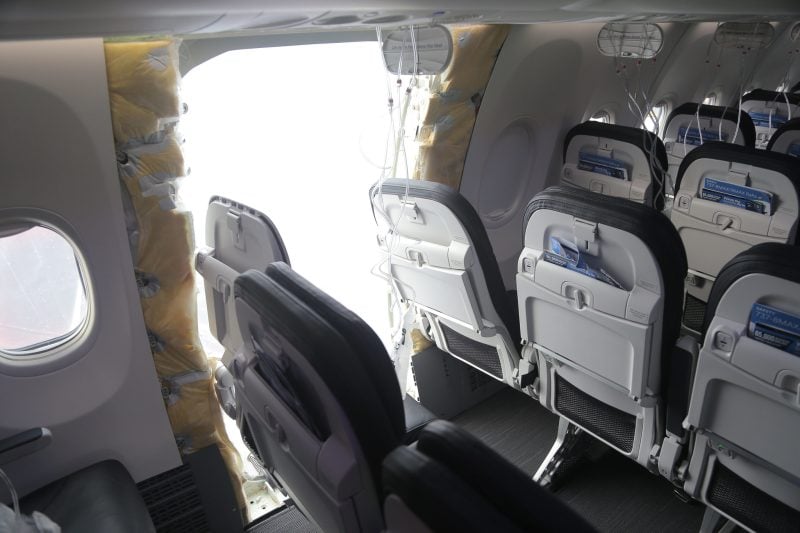
The hole created by the mid-air blowout of the mid-exit door aboard Alaska Airlines Flight 1282 on 5 January 2024 | IMAGE: Kelly Bartlett via AP
Just six minutes after departing Portland International Airport (PDX) for Ontario International Airport (ONT) in California, Flight 1282’s left MED plug—a 29-by-59-inch rectangular structure sealing an unused door space—separated from the airframe. The rapid depressurization was harrowing: passenger belongings were sucked out through the hole, oxygen masks deployed, and the flight deck door swung open, injuring a flight attendant. Seven of the 171 passengers sustained minor injuries, but the quick actions of the two pilots and four flight attendants ensured the remaining 164 passengers were unharmed. The crew executed emergency procedures flawlessly, descending and safely landing back at PDX.
The MED plug was recovered two days later in a Portland neighborhood, offering a critical clue: the four bolts meant to secure it vertically were missing. Alaska Airlines hadn’t performed any maintenance on the plug since taking delivery three months earlier, pointing investigators straight to Boeing’s Renton, Washington, factory. The incident raised immediate questions about production quality and oversight, setting the stage for a damning NTSB report.
Probable Cause: Boeing’s Manufacturing Breakdown
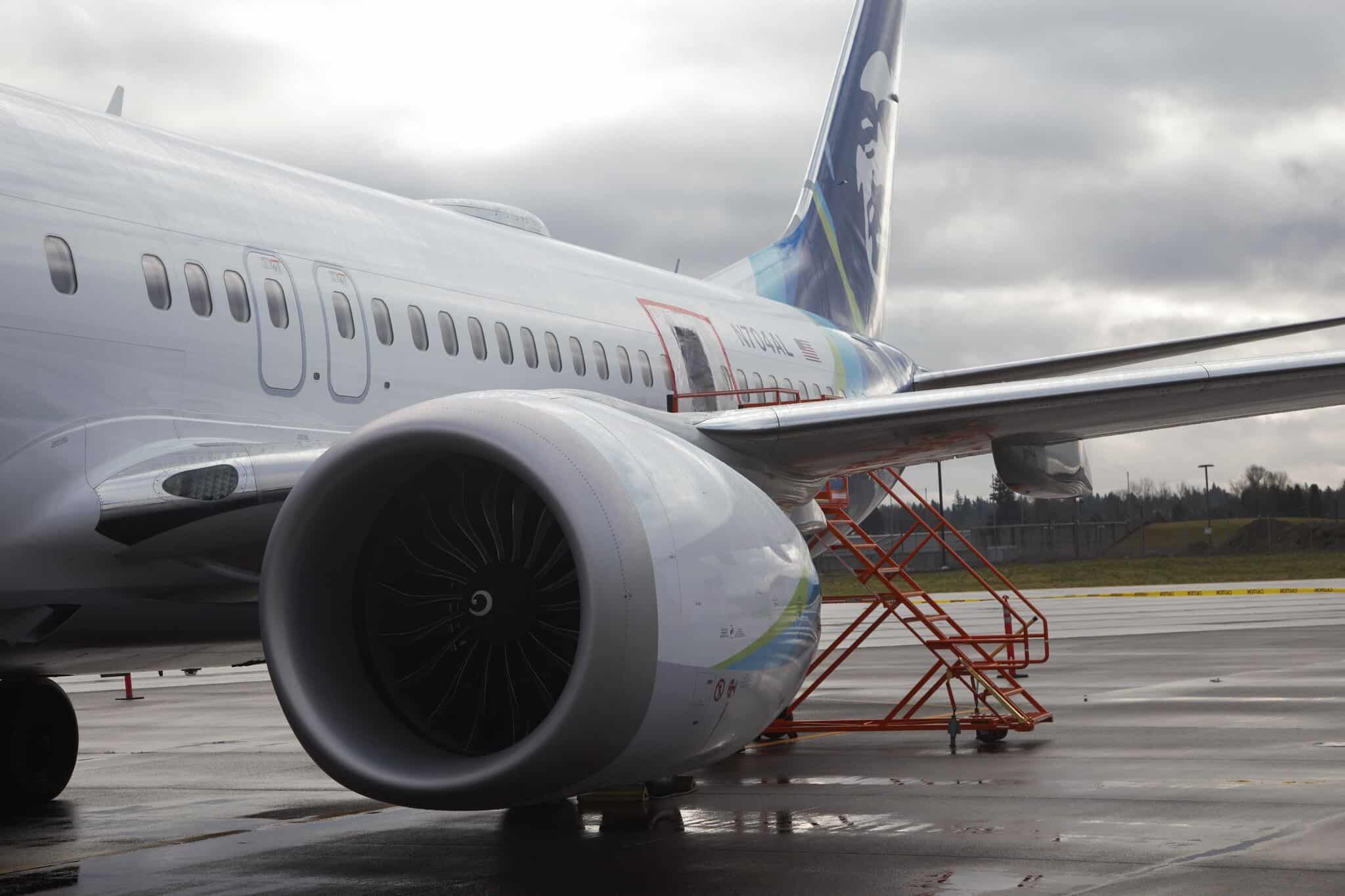
The exterior of N704AL, which was the aircraft involved with Alaska Airlines Flight 1282 | IMAGE: NTSB
The NTSB’s probable cause is unequivocal: the in-flight separation resulted from Boeing’s failure to provide adequate training, guidance, and oversight to ensure compliance with its parts removal process.
On 18 September 2023, Boeing workers opened the MED plug on N704AL to repair rivets on the fuselage, a non-routine task requiring the removal of the four securing bolts. The plug was closed the next day, but no removal record was generated, violating Boeing’s Business Process Instruction (BPI). Without documentation, no quality assurance (QA) inspection occurred, and the bolts were never reinstalled.
The investigation uncovered systemic issues. Boeing’s BPI for parts removal was convoluted, lacking the clarity and usability needed for workers to follow it consistently. The NTSB noted a decade-long history of compliance issues with the BPI, yet Boeing’s corrective actions—accepted by the FAA—failed to resolve these persistent deficiencies. On-the-job training was equally problematic. It was described as unstructured and focused on routine tasks, leaving workers ill-prepared for non-routine procedures like opening MED plugs.
Compounding the error, none of Boeing’s specialized “door team” technicians were on duty when the plug was closed, leaving the task to less experienced personnel. The absence of bolts allowed the plug to shift upward incrementally over multiple flight cycles, undetectable during routine preflight inspections, until it catastrophically separated on 5 January.
NTSB Chairwoman Jennifer Homendy underscored the gravity of the incident at the NTSB Board Meeting on 24 June.
“The safety deficiencies that led to this accident should have been evident to Boeing and to the FAA,” Homendy said. “The same safety deficiencies that led to this accident could just as easily have led to other manufacturing quality escapes and, perhaps, other accidents.”
FAA’s Oversight Failures
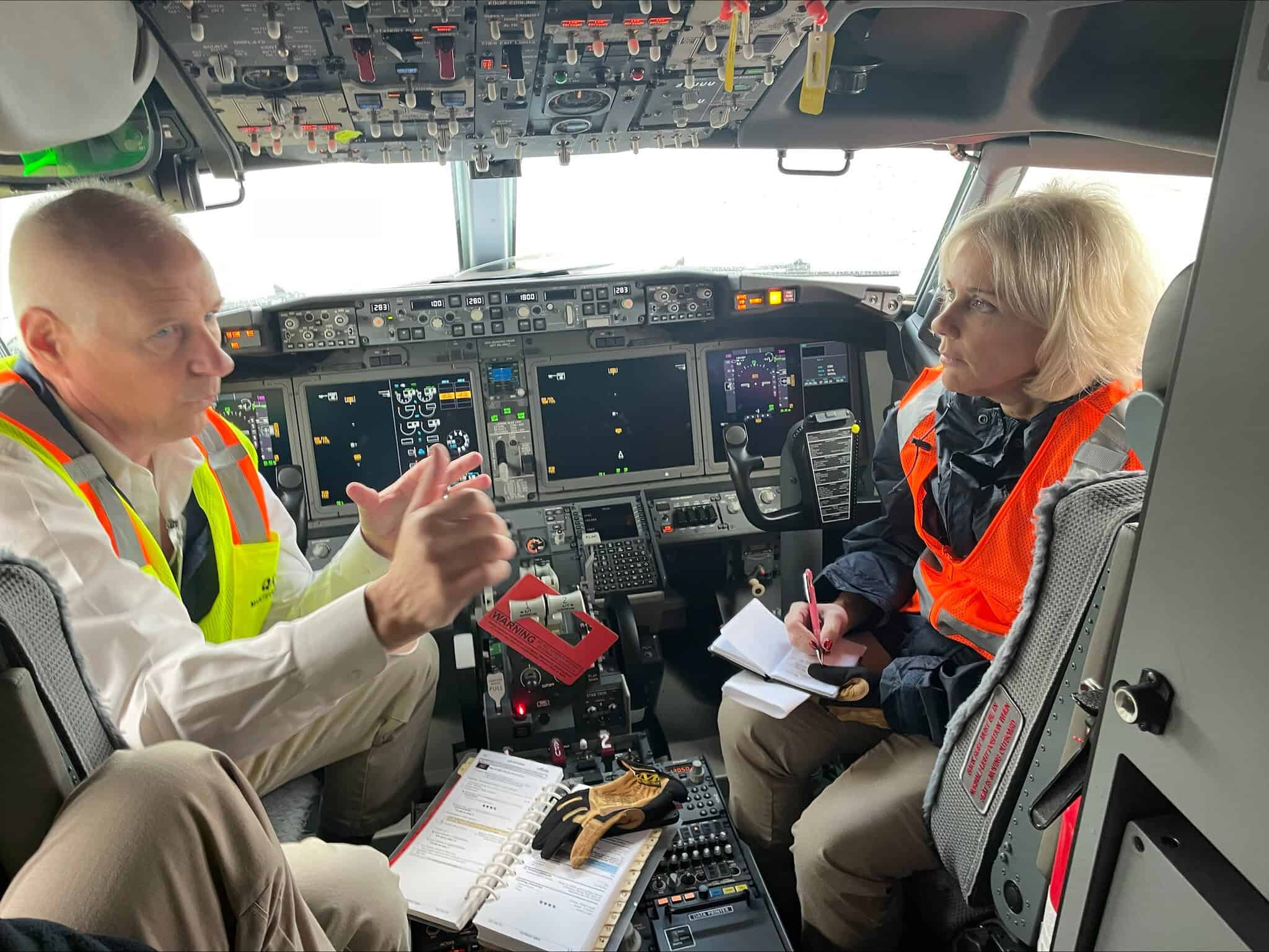
NTSB Chairwoman Jennifer Homendy in the cockpit of Alaska Airlines Flight 1282 aircraft N704AL | IMAGE: NTSB
The FAA came under fire for its “ineffective compliance enforcement surveillance and audit planning,” which failed to identify Boeing’s “repetitive and systemic” nonconformance issues. The agency’s systems lacked the functionality to track persistent problems, and its five-year record retention policy hindered inspectors’ ability to spot long-term trends, such as the BPI’s decade of noncompliance. The NTSB also criticized the FAA for accepting Boeing’s ineffective corrective actions, allowing known issues to fester.
Boeing’s voluntary safety management system (SMS), still in development during the incident, was deemed immature and lacking formal FAA oversight. The NTSB emphasized that a robust SMS, fully integrated into Boeing’s quality management system (QMS), requires accurate, ongoing data on safety culture. However, a prolonged work stoppage at Boeing limited the NTSB’s ability to conduct a comprehensive safety culture survey, leaving gaps in understanding whether production line pressures contributed to the error.
Operational and Design Shortcomings
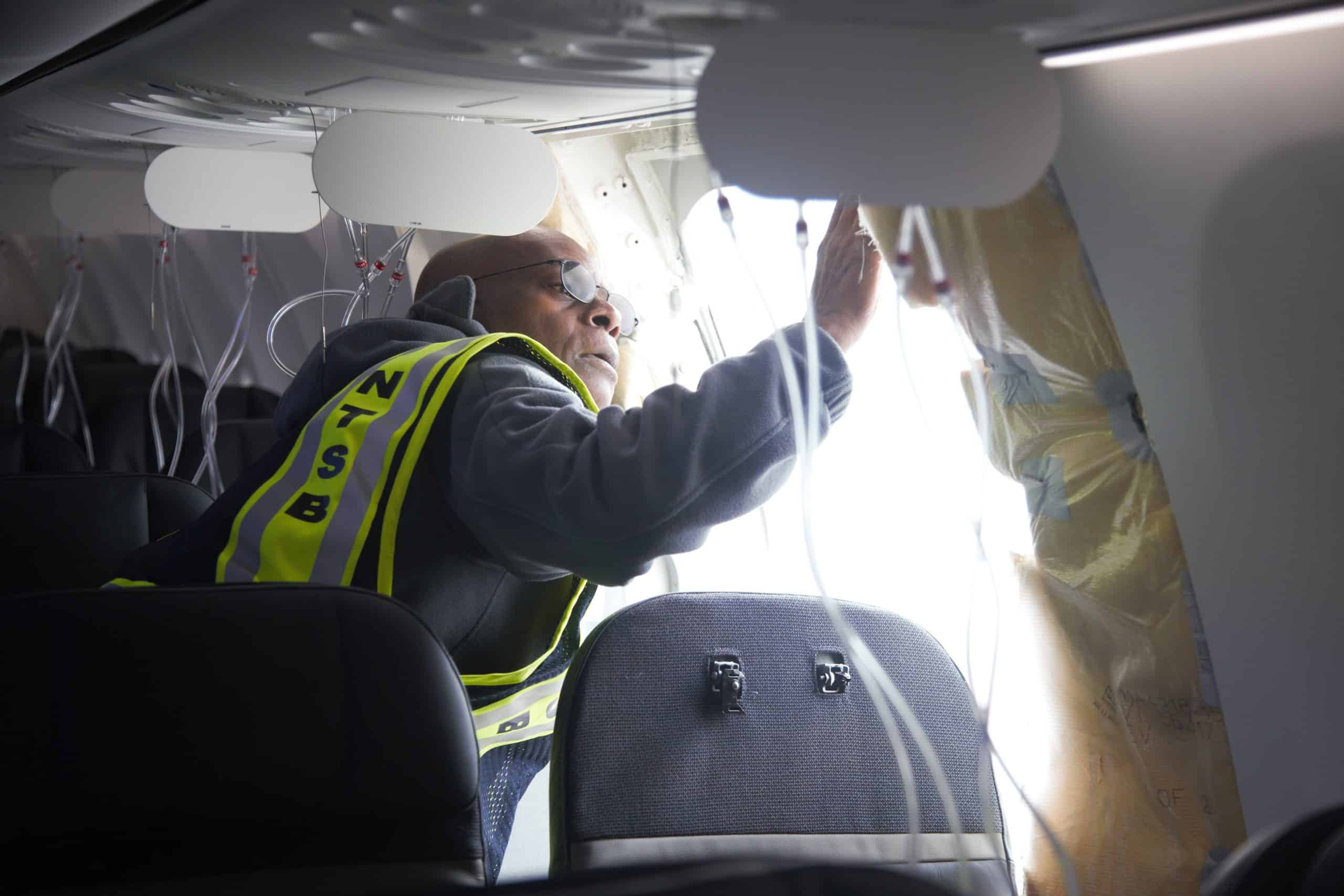
An investigator with the NTSB examines the interior of Alaska Airlines Flight 1282 | IMAGE: NTSB
Beyond manufacturing, the incident exposed operational and design vulnerabilities. The flight crew’s response was exemplary, but their oxygen mask training lacked realistic, scenario-based exercises, leading to communication challenges after donning masks. Flight attendant A faced difficulties communicating with the cockpit and other crew members, though this didn’t compromise passenger safety. The NTSB recommended hands-on, aircraft-specific training for oxygen systems and a review of portable oxygen bottle design standards, noting that flight attendants struggled to access masks, even improvising tools to open packaging.
The cockpit voice recorder (CVR) was another sore point. Alaska Airlines’ procedures failed to preserve CVR data, which was overwritten after the two-hour recording limit. The NTSB reiterated its long-standing call for 25-hour CVRs to prevent the loss of critical investigative data, a recommendation that continues to go unheeded.
Child safety also drew scrutiny. Three lap-held children under two were unharmed, but the NTSB highlighted the potential for severe injury or death in such events. The board reiterated its push for increased voluntary use of child restraint systems (CRSs), urging the FAA to study barriers to CRS adoption and encouraging industry groups like Airlines for America to promote their use through data-driven programs.
Recommendations Following the Alaska Airlines Flight 1282 Incident
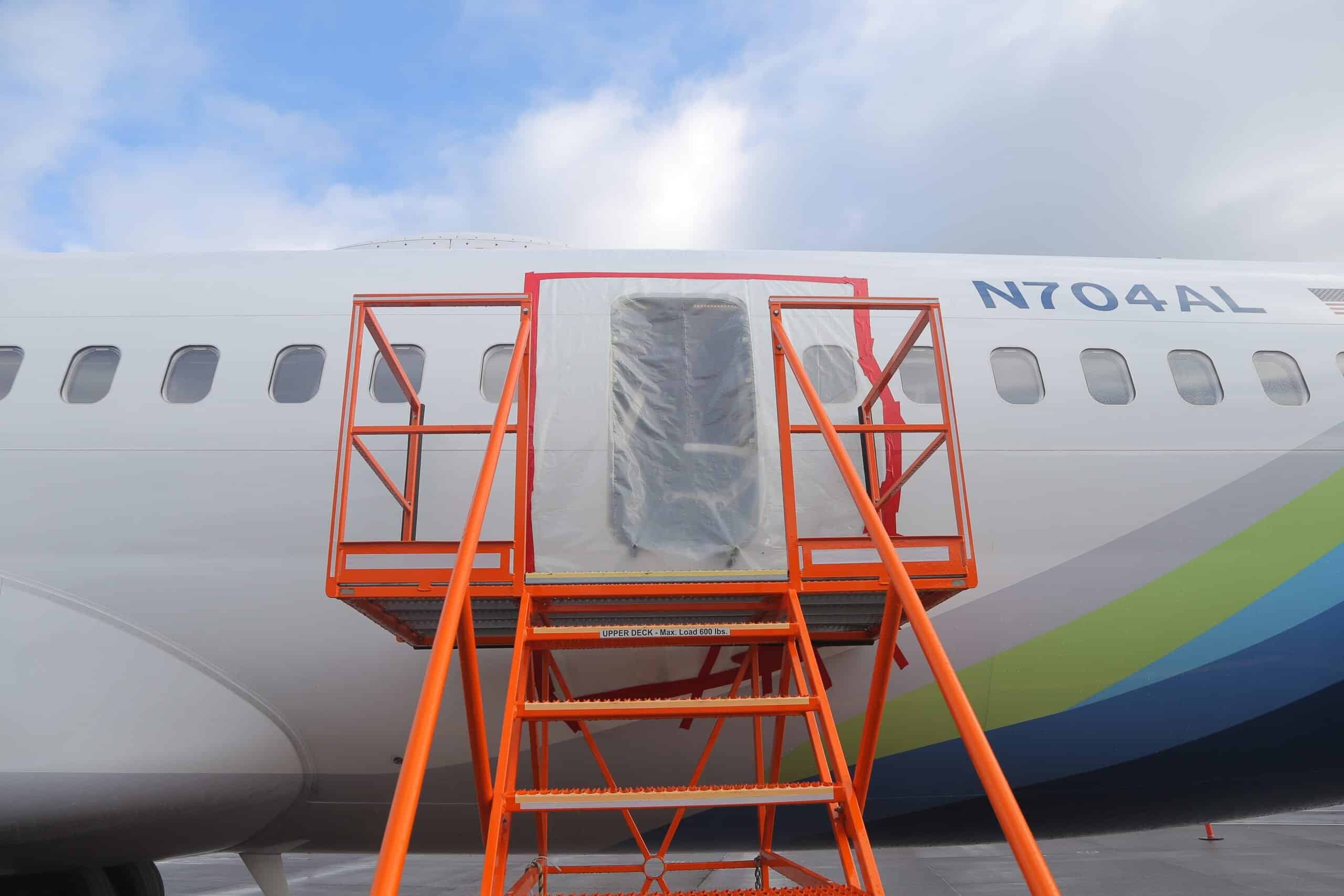
The covered door plug of Alaska Airlines Flight 1282 during the investigation | IMAGE: NTSB
The NTSB issued a comprehensive set of safety recommendations to address the incident’s multifaceted failures:
To Boeing: Revise the BPI for parts removal to ensure clarity and usability, develop structured on-the-job training with a grading system to track competence, and enhance SMS to identify and mitigate human error. Boeing was also tasked with certifying a design enhancement for MED plugs to ensure complete closure and issuing a service bulletin for retrofitting in-service aircraft.
To the FAA: Overhaul compliance surveillance, audit planning, and record systems to better track systemic issues, retain records beyond five years, and provide recurrent training for inspectors. The agency was urged to convene an independent panel to review Boeing’s safety culture, issue an airworthiness directive (AD) for MED plug retrofits, and improve oxygen system training and CVR preservation protocols.
These recommendations aim to close critical gaps, but their success hinges on sustained commitment from both Boeing and the FAA.
Industry Implications and a Call to Action
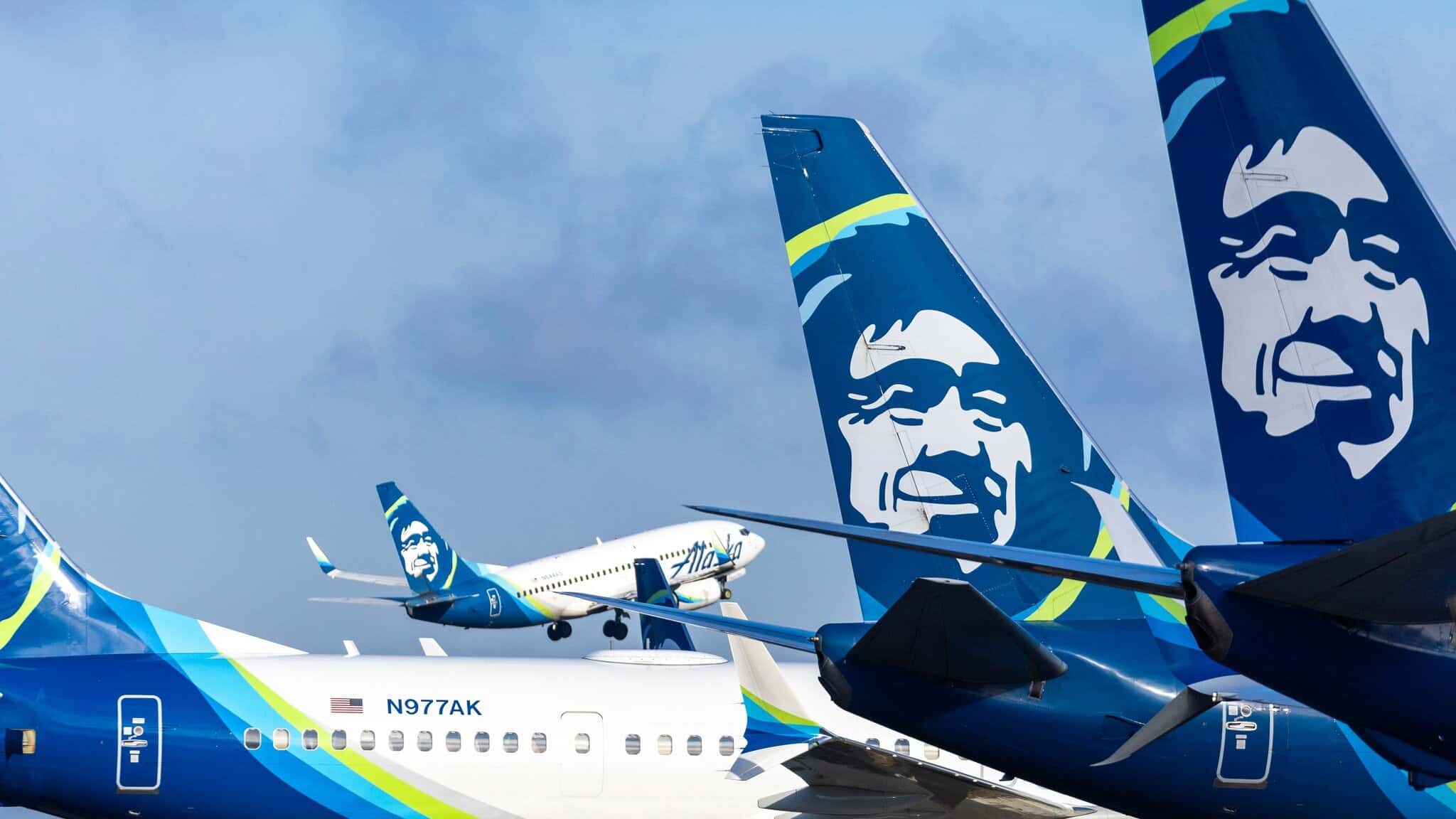
An Alaska Airlines 737-700 takes off from Seattle-Tacoma International Airport (SEA) on 30 March 2024 | IMAGE: Alaska Airlines
The Flight 1282 incident was a near miss that narrowly avoided disaster. The NTSB’s report highlights a critical breakdown in the chain linking manufacturing discipline, regulator oversight, and operational preparedness. Boeing’s quality control lapses, coupled with the FAA’s inadequate monitoring, exposed vulnerabilities in the 737 MAX production line that demand immediate attention.
As Boeing works to certify MED plug enhancements and the FAA revises its oversight processes, the industry must stay focused on its processes. The final report, expected soon on NTSB.gov, will provide further details, but the message is clear: preventable deficiencies must be addressed before they lead to another close call—or worse.
Flight 1282 serves as a case study in the consequences of systemic failures and a rallying cry for stronger standards across manufacturing, oversight, and safety culture.
Will Boeing and the FAA rise to the challenge? The stakes couldn’t be higher.
The full 24 June 2025 NTSB board meeting synopsis is available below.
Throughout aviation history, many aircraft have featured a push-pull engine configuration.
Propeller-driven planes often rely on forward-mounted engines to pull them through the air. Some have engines mounted in the rear of the fuselage, which operate as pushers.
The push-pull concept offers some of the advantages of both designs. Although not ideal for all aircraft, the push-pull structure provides some significant improvements over other designs.
Different Versions of Push-Pull Engine Configuration
There are multiple ways push-pull configurations are used on aircraft. A common concept has two propellers, one forward and one aft, aligned along the fuselage centerline. Some of these designs have multiple engines working in tandem to turn the propellers. Other models feature a combination of standard puller-type engines and others in different locations that operate as pulling powerplants.
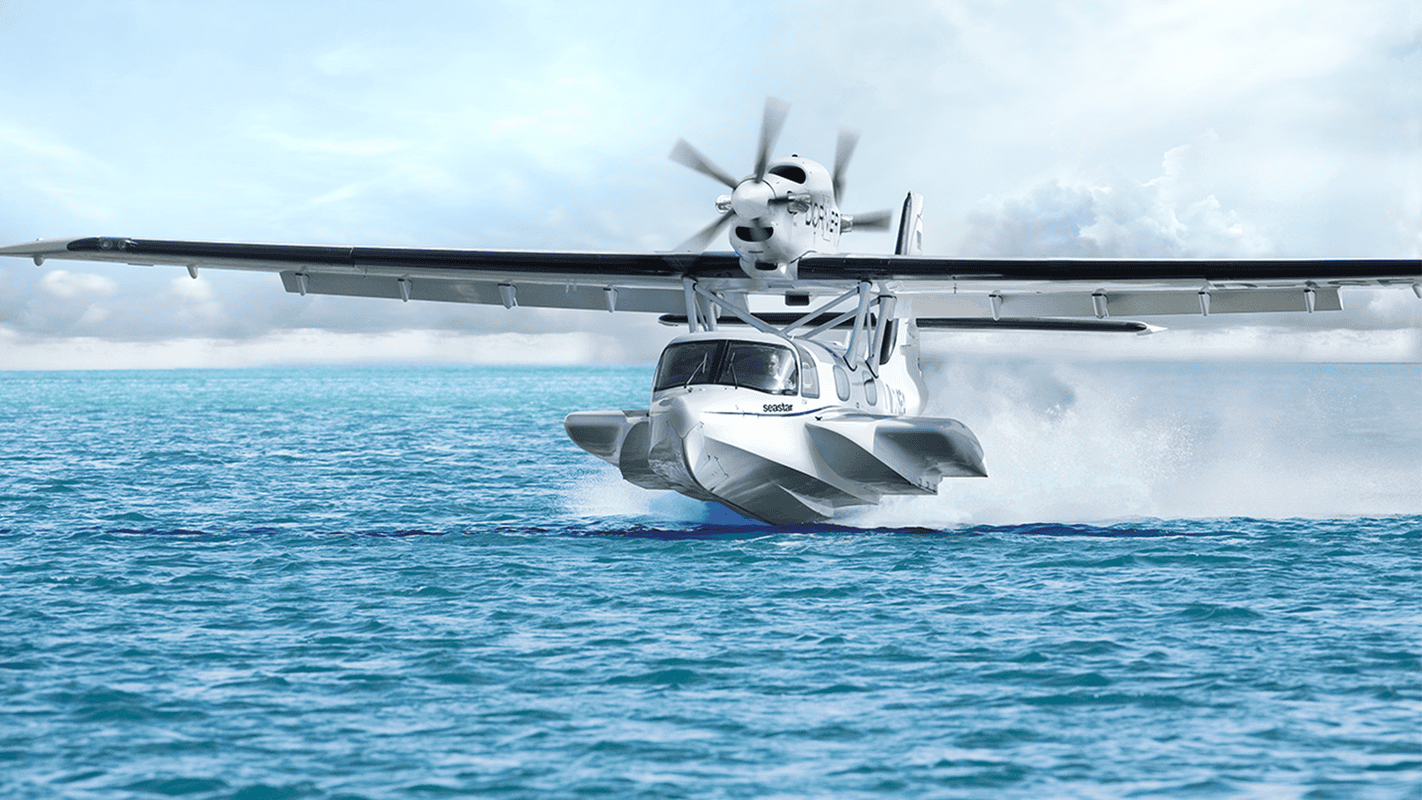
The Dornier Seawings Seastar has a push-pull engine configuration with 2 Pratt and Whitney PT6A-135A engines rated at 650 horsepower each. | Image: Dornierseawings.com
The push-pull engine configuration offers several key advantages. By placing both propellers along the aircraft’s centerline, the design maintains the aerodynamic balance and symmetry of a single-engine aircraft. This setup also reduces drag compared to wing-mounted engines, improving overall efficiency.
Another significant benefit is enhanced safety. In the event of an engine failure, push-pull aircraft are easier to control. Push-pull designs remain more stable than conventional twin-engine aircraft with wing-mounted engines, which tend to yaw sharply toward the inoperative engine. This feature helps pilots maintain control, even at lower speeds where conventional twins can become uncontrollable due to a condition known as Minimum Controllable Airspeed (Vmc).
Military Applications for Push-Pull Designs
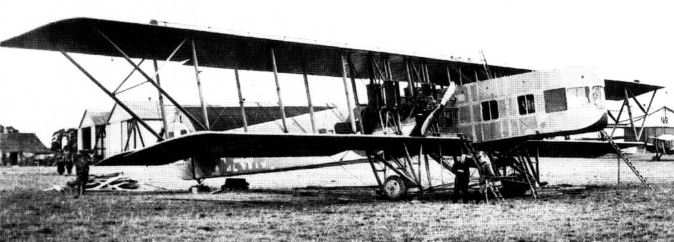
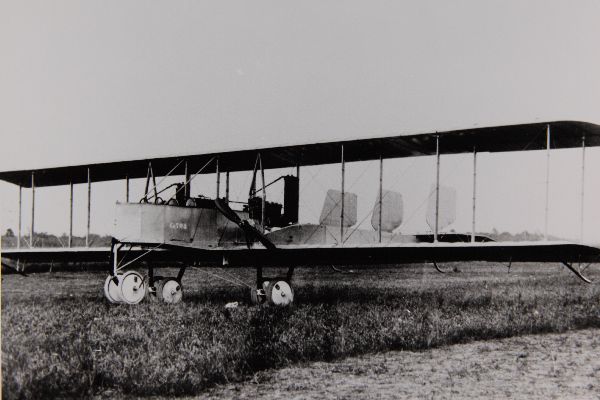
Push-pull engine configurations have been a feature on some military aircraft since the First World War. One of the earliest examples was the Kennedy Giant, an experimental British heavy bomber prototype. It had four Canton-Unne Salmson Z9 engines–two in a pulling configuration and two as pushers.
The Kennedy Giant prototype WWI heavy bomber had four engines. | Image: flyingmachines.ru
The aircraft was built by C.J.H. Mackenzie-Kennedy’s company, which he founded in 1909. However, the project faced challenges from the start. During construction, the team discovered the aircraft was too large to fit through the hangar doors.
When the Kennedy Giant finally made its only test flight in 1917, it managed little more than a brief hop—the engines simply couldn’t generate enough power to lift the nearly 19,000-pound bomber effectively.
After the war, aircraft designers grew wary of push-pull configurations for most military planes. They found that during crash landings, the crew risked being crushed between the two engines if they were mounted fore and aft in the center of the fuselage. And in the event of a bailout, there was the added danger of striking the rear propeller. These safety concerns ultimately limited the push-pull layout’s use in combat aircraft.
Licensing Limitations for Push-Pull Aircraft Pilots
Another interesting complication with push-pull aircraft is how they affect pilot certification.
Pilots who earn a multi-engine rating in aircraft with centerline thrust–a defining feature of push-pull configurations–are limited to flying that specific type. Their license does not authorize them to fly conventional multi-engine aircraft with wing-mounted engines. In contrast, pilots trained on wing-mounted engine aircraft can legally operate both types without restriction.
Caproni Ca. 1 Had Three Engines: Two Pulling and One Pushing
Multiple aircraft designs have used push-pull engine configurations over the years. One of the more unusual early designs was the Caproni Ca.1, introduced in 1914. This Italian bomber featured three engines: two 80-horsepower Gnome et Rhône rotary engines mounted on the tail booms operating as pullers or tractor propellers, while a third 100-horsepower engine positioned behind the central fuselage functioned as a pusher.
The Caproni Ca.1 aircraft flew in 1914. | Image: San Diego Air & Space Museum
Bellanca “Blue Streak”: A Tragic End to an Ambitious Design
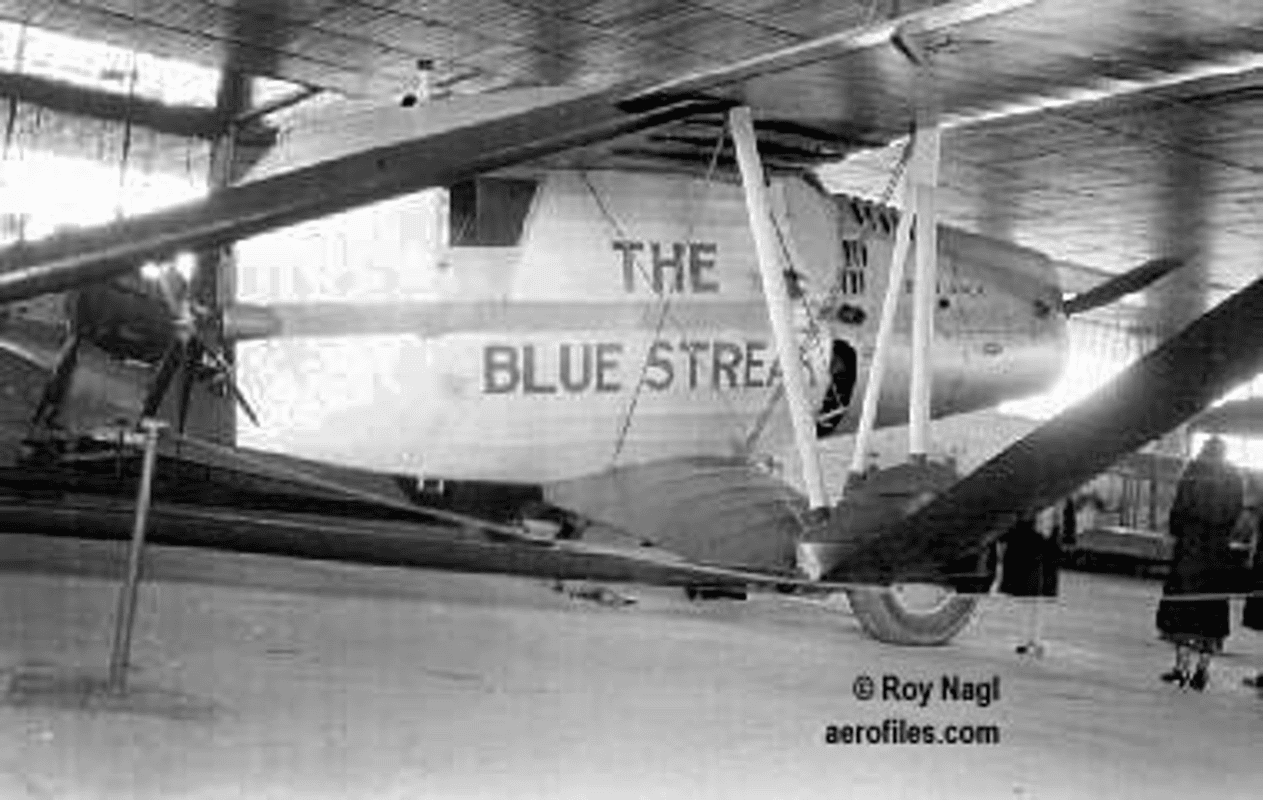
Another unique push-pull aircraft was the 1929 Bellanca TES X-855e “Blue Streak.” Equipped with two 450-horsepower Pratt & Whitney Wasp engines–one mounted in front of the cabin nacelle (or passenger compartment) and the other behind–it featured dual three-bladed propellers. In 1930, engineers replaced the engines with more powerful 600-horsepower Curtis Conquerors.
However, tragedy struck during a cargo flight that same year. Loaded with cargo, the aircraft experienced severe vibrations in the rear propeller’s drive shaft. This tore the plane apart mid-flight, killing its three-man crew.
View of both propellers on the Bellanca Blue Streak. | Image: earlyaviators.com
Fokker F-32 Designed for Luxury Travel
The Fokker F-32, built in 1929, was one of the first push-pull aircraft designed specifically for commercial service and the first four-engine airliner. Powered by Pratt & Whitney Wasp radial powerplants, it could carry up to 32 passengers. Its Dutch manufacturer, GKN Fokker, designed it to be a comfortable, luxurious way to travel.
Fokker F-32 with four Pratt & Whitney radial engines could carry 32 passengers. | Image: planehistoria
Two engines were mounted in two nacelles under each wing, each with propellers fore and aft. Fokker hoped the F-32 would increase range compared to other airliners of that time. However, the aircraft was notorious for high fuel consumption and excessive maintenance needs. Eventually, due to economic conditions during the Great Depression, Fokker ended the project.
Eight Engine ANT-20 Largest Aircraft in The World in 1930s
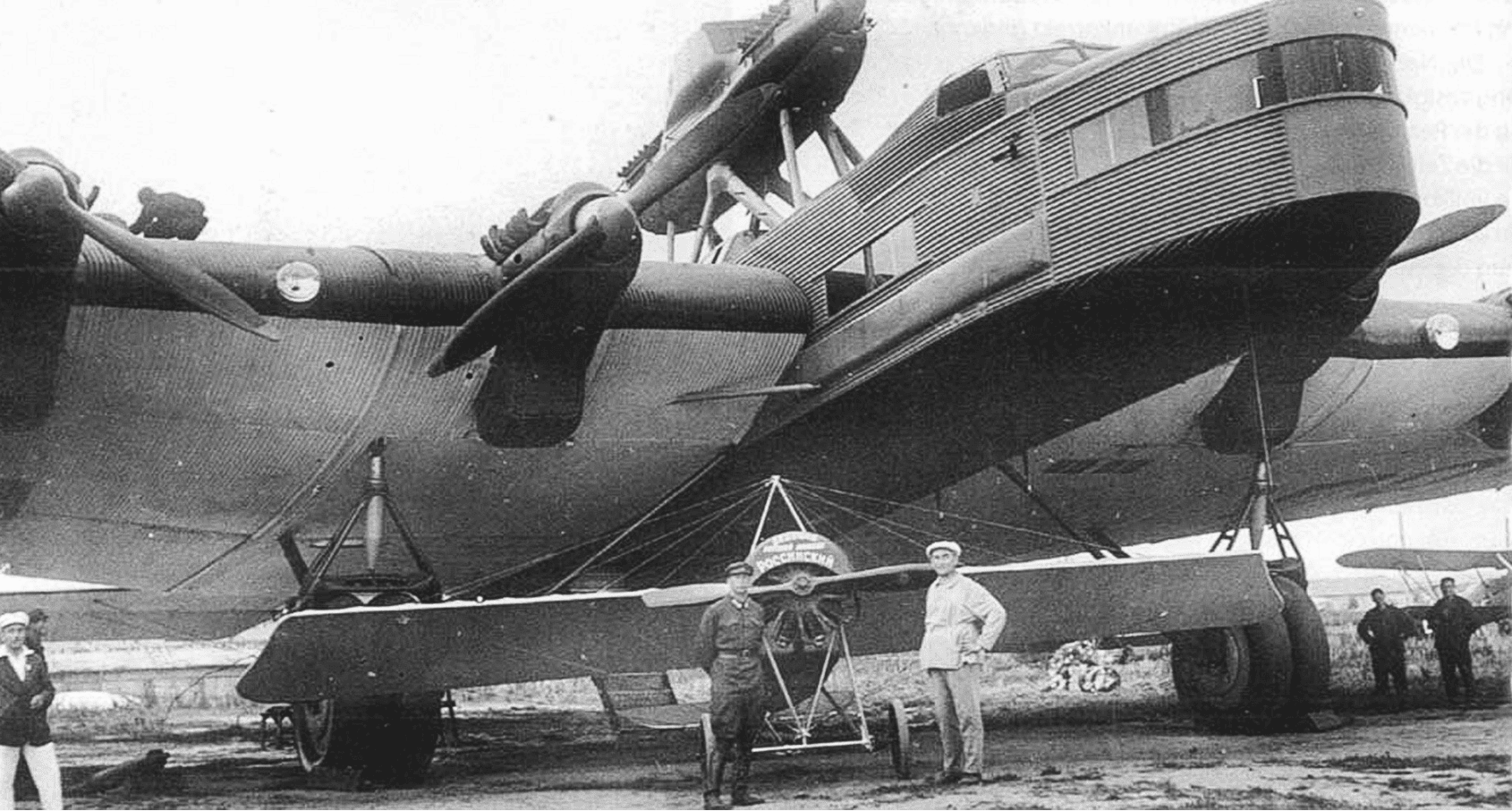
The Soviet Tupolev ANT-20 “Maxim Gorky” was designed and built in the 1930s. They created it to be the largest aircraft in the world at the time. It had a wingspan of 206 feet, wider than that of a B-52, and a length of 107 feet. The ANT-20 was powered by eight Mikulin AM-34FRN V-12 liquid-cooled piston engines. They were rated at 1200 horsepower each, but the plane cruised at a relatively modest top speed of 140 miles per hour.
Image of ANT-20 shows its size relative to a smaller aircraft and several men. | Image: Public Domain
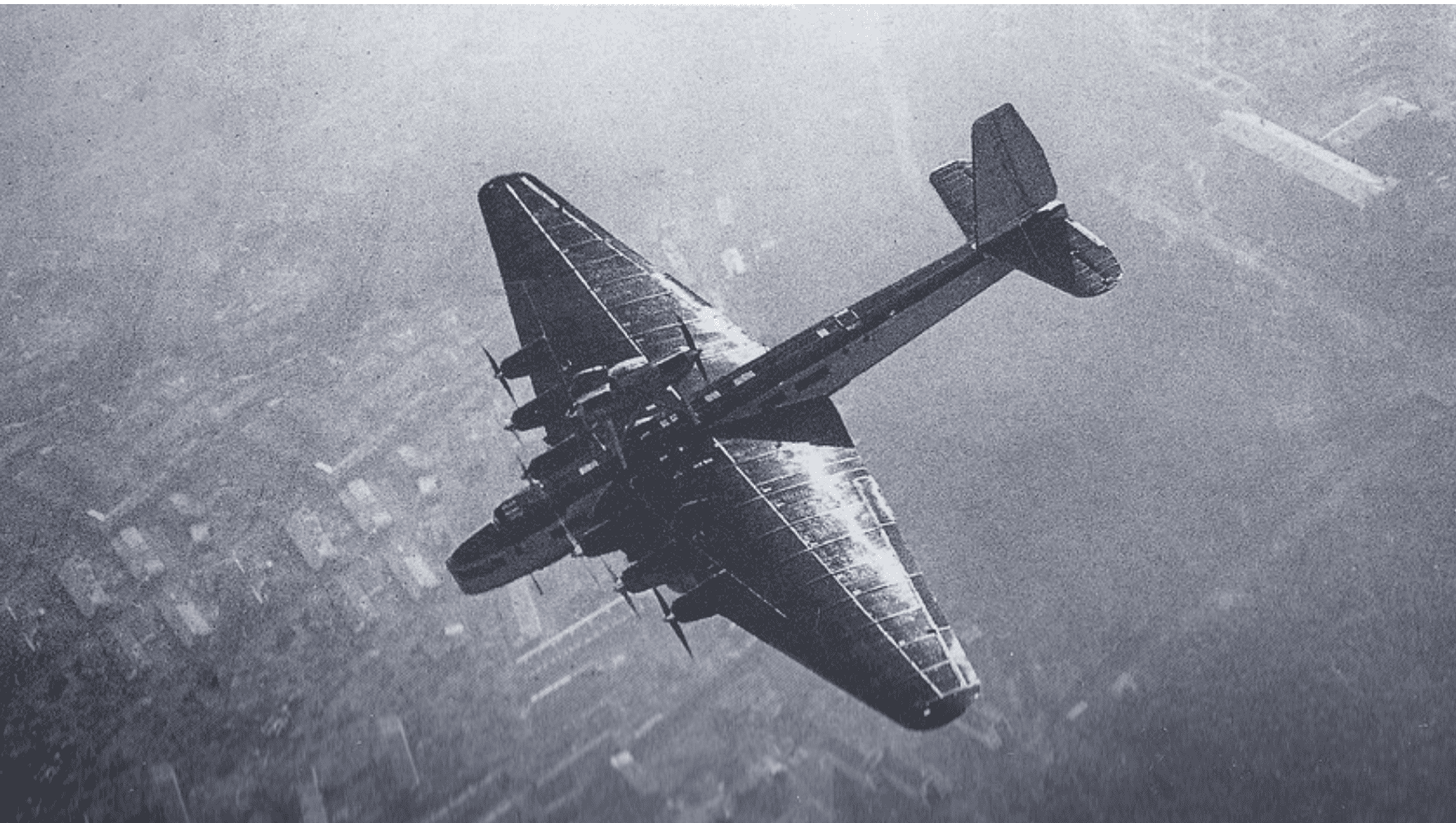
The engine layout was unconventional: three engines mounted under each wing operated as pullers. In contrast, an additional engine mounted atop each wing featured a rear-facing propeller at the rear of the nacelles that functioned as a pusher.
The Tupolev ANT-20 in flight with a view of its push-pull engine configuration. | Image: Public Domain
Cessna Skymaster a Modern Version of Push-Pull Engine Configuration
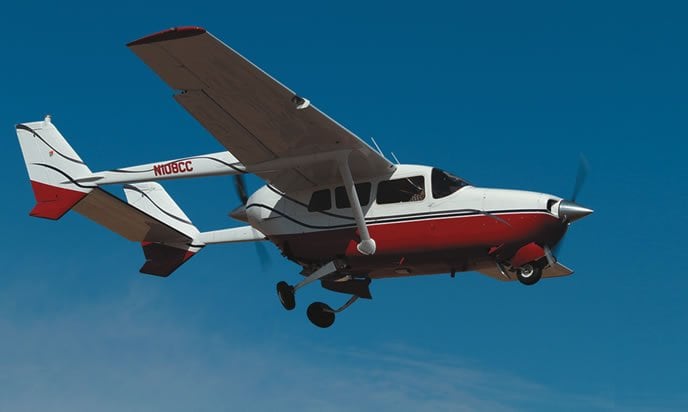
Decades later, the Cessna 337 Skymaster brought push-pull design into the modern era. First introduced in 1969, Cessna produced 2,993 of the type, making it one of the most recognizable aircraft with a push-pull engine configuration.
The Skymaster featured two 201-horsepower air-cooled Continental engines—one mounted in the nose (puller) and the other behind the passenger cabin, just ahead of the tail (pusher). This layout offered better visibility and eliminated asymmetric thrust issues during engine failure, a key selling point for general aviation pilots.
Cessna 337 Skymaster with push-pull engine configuration and forward and aft propellers visible. | Image: aviationconsumer.com
Despite its popularity, the Skymaster wasn’t without flaws. The rear engine often suffered from cooling problems, and the aircraft was notoriously loud. The turbulent airflow from the front propeller interfered with the rear propeller, amplifying noise and reducing efficiency.
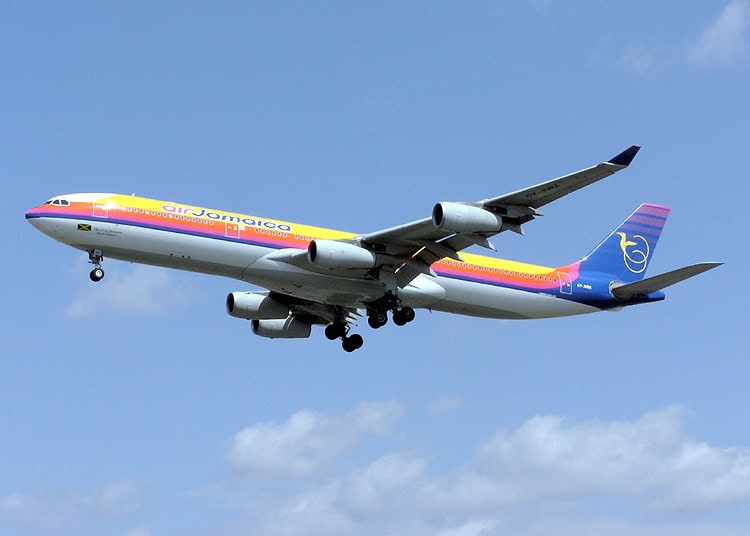
Once a beloved symbol of Caribbean travel, Air Jamaica was known for its colorful liveries, vibrant in-flight culture, and award-winning service. But behind the Caribbean airline’s cheerful image was a turbulent financial story that spanned decades.
Air Jamaica rose quickly—but unsustainably. After years of expansion, privatization, and mounting losses, it was ultimately absorbed by another tropical airline. Here’s what happened to Air Jamaica.
Air Jamaica’s British Beginnings
Though Jamaica gained independence from the United Kingdom in 1962, it still leaned on British aviation expertise in the years that followed.
In 1963, British Overseas Airways Corporation (BOAC) and British West Indian Airways (BWIA) formed an international airline for the Jamaican government. It was called ‘Jamaica Air Service Limited’ and launched routes from Jamaica to New York and Miami.
Five years later, however, the Jamaican government changed its mind and wanted to run an airline independently. At 51%, it was the majority owner of Jamaica Air Service Limited, so it dissolved its original airline and formed a fully national flag carrier: Air Jamaica.
Formed in October 1968, Air Jamaica was partly backed by Air Canada, which held a 40% stake and supplied four aircraft to help the airline get off the ground.
On 1 April 1969, Air Jamaica launched its first flights, connecting Kingston, Montego Bay, New York, and Miami.
1970s and 1980s Expansions
Air Jamaica quickly expanded to Toronto and Montreal thanks to its partnership with Air Canada. Throughout the early 1970s, the Caribbean airline also launched service to Philadelphia, San Juan, Puerto Rico, and other Caribbean destinations. Its fleet included Douglas DC-8s and DC-9s.
By 1974, Air Jamaica had extended its reach across the Atlantic, launching service to London, followed by Frankfurt in 1975. Air Jamaica was now a serious contender in international travel. Towards the end of the 1970s, the carrier added the Boeing 727-200 to its fleet.
According to airline historian R.E.G. Davies, the airline left a great impression on travelers by hiring attractive female flight attendants and offering free rum on flights.
Still, the airline was bleeding money. Despite its popularity, it was operating at a loss, a reality the Jamaican government hoped would eventually turn around. Growth slowed in the 1980s, but Air Jamaica pressed on, launching service to Los Angeles (LAX), Baltimore (BWI), and Atlanta (ATL) and leasing newer aircraft like the Boeing 747 and Airbus A300 to replace its aging jets.
In 1989, the government chose to privatize the carrier. A group of investors, the Air Jamaica Acquisition Group (AJAG), took a 70% stake in the airline, while the government retained 25% and employees held the remaining 5%.
1990s and 2000s Declines
The 1990s saw continued expansion. Air Jamaica added new international destinations to the Bahamas, Santo Domingo, Manchester, Fort Lauderdale, and Phoenix. Some of these new destinations were possible due to codeshare agreements with Delta Air Lines.
The airline also continued to upgrade its fleet with new Airbus aircraft, such as the A310, A320, and A340. While these changes took place, the airline discussed merging with other Caribbean carriers, including Guyana Airways and Trinidad and Tobago Airways.
But by 2004, AJAG had exited the partnership, and the Jamaican government once again took full ownership of the airline.
In the next few years, the airline began axing routes and laying off employees to cut costs. Destinations like Phoenix, Los Angeles, Miami, and Atlanta were removed from its network.
Air Jamaica CEO Bruce Nobles called it the airline’s ‘most challenging time.’ Losses had piled up to around $1 billion, and the government was desperate to find a buyer.
It was reported that Air Jamaica reported losses in 40 of its 42 years of existence.
Acquisition and Closure
In 2010, the Jamaican government sold Air Jamaica to Caribbean Airlines, making it the largest airline in the region. Jamaica retained a 16% stake in the newly merged carrier, while Caribbean Airlines took over operations.
Though the Air Jamaica brand would linger for five more years, it was officially folded into Caribbean Airlines in 2015.
Caribbean Airlines is now the flag carrier of both Jamaica and Trinidad and Tobago. The government of Trinidad and Tobago owns an 88.1% stake, while Jamaica’s stake was reduced to 11.9%. After years of financial strain, the airline finally reported its first profit in 2019 of a modest $4 million.
Fred Smith passed away last week at the age 80. He leaves behind legacy of innovation but also a company that faces many challenges ahead.
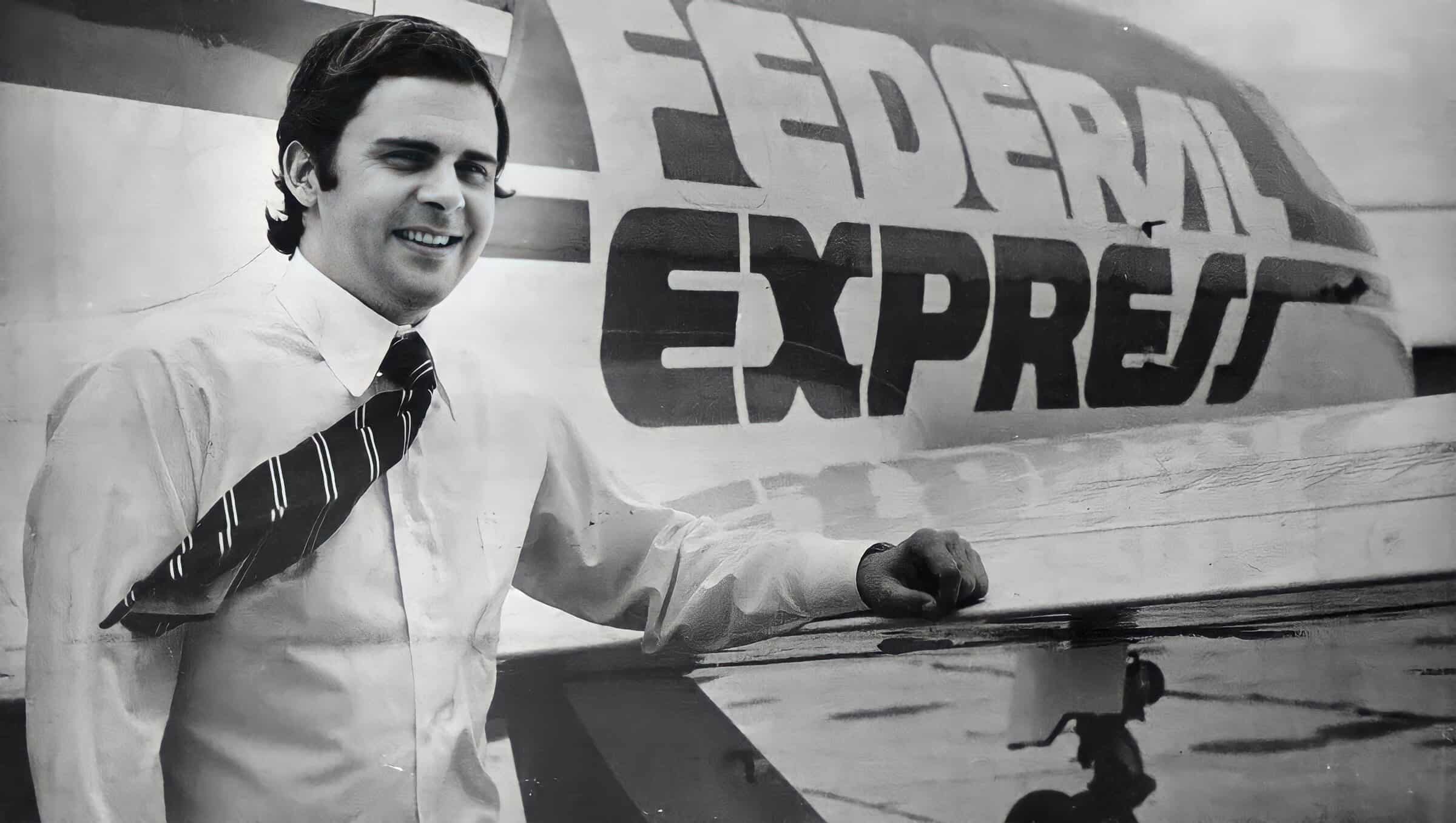
When Frederick Smith, founder of FedEx, died this week, the giant shipping corporation lost more than a chief executive. It lost a man with many titles and descriptions, including combat veteran, risk taker, renegade, and zealot.
Many adjectives also apply to Smith, including determined, confident, adaptable, and, according to Smith himself, crazy. Now FedEx must face an uncertain and challenging future without its leader.
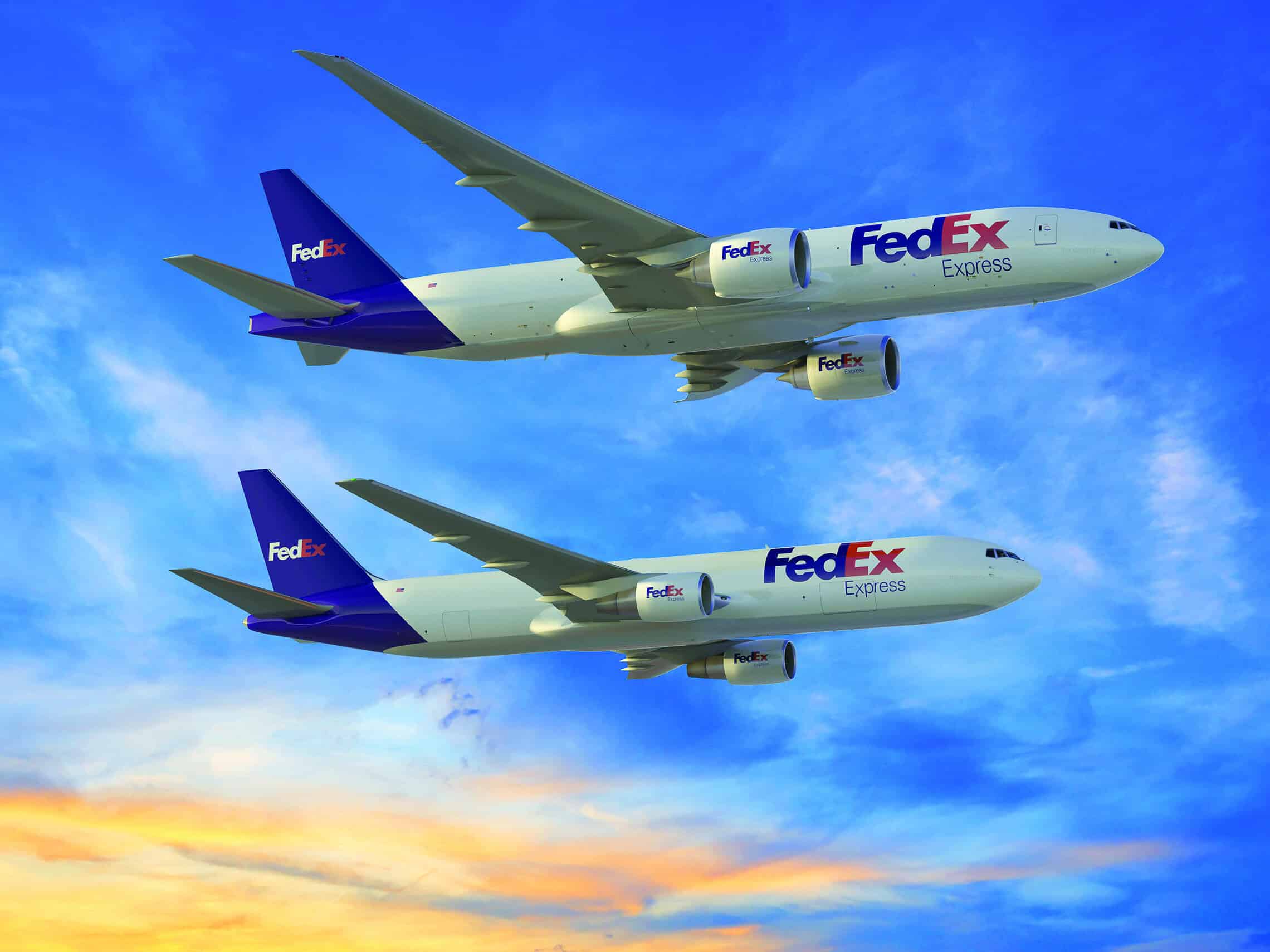
FedEx 777-F aircraft. | Image: FedEx
Fred Smith Overcame Challenges His Whole Life, Still Achieved Success
Fred Smith faced many challenges while very young. His father died when he was just four years old. Then at eight years old, he was afflicted by Calvá-Perthes, a disease that interrupted blood blow to his right thigh bone. This affected the leg’s development, and he was on crutches for the next two-and one-half years. He overcame this and later played football, learned to fly at age fifteen, and became a Marine Corps infantry officer.
Prior to becoming a Marine, Smith entered Yale University in 1962. While taking an economics class, he demonstrated he had a clear eye for future business opportunities. He wrote a paper outlining overnight delivery service in a computer information age, an original concept that would later become his idea for FedEx. His professor felt Smith’s idea was “improbable” and gave him a C for the paper.
Smith Joined U.S. Marine Corp as a 2nd Lieutenant and Served Two Tours in Vietnam
After graduating from Yale in 1966, Smith joined the U.S. Marine Corps as a second lieutenant. He served two tours in Vietnam and received decorations for bravery and wounds received in combat. While in the Marines, Smith gained experience that he would directly apply when he started FedEx.
Smith later said he had, “the opportunity to observe the military’s logistic system first hand,” and “carefully observed the procurement and delivery procedures,” experience that fine-tuned his “dream for an overnight delivery service.”
Decades later, during a 2023 interview with the Associated Press, Smith said that everything he did running FedEx came from his experience in the Marines, and not from what he learned at Yale. Smith served for four years and left as a captain.
Smith Used Trust Funds to Start First Business
Smith wanted to create a business and started to develop a reputation as a risk taker. He returned to the U.S. and used a family trust distribution to $750,000 to partner with a friend and purchase Arkansas Aviation Sales at Little Rock Municipal Airport.
Smith led the small company to success, earning $9 million in revenue in the first two years. He also became frustrated by late air freight shipments of spare parts, which his business desperately needed. This only made him more determined to start an overnight delivery service.
Frederick Smith in the 1970s. | Image: FedEx
In the following years, Frederick Smith got the idea for FedEx and raised $80 million to get started. He received some of the funds from investors and some from his brothers and sisters. The new company began with 14 aircraft carrying just 186 packages the first day.
As the company began to grow, rising fuel costs took its profits. In the first two years, it lost $27 million and neared bankruptcy. Things got so bad, that the company only had $5000 left. During a trip to California where he tried, and failed, to receive funding from General Dynamics, Smith was on his way home and made a detour to Las Vegas.
Smith Bet Company’s Last $5,000 in Las Vegas
He used the $5000 to play Blackjack and won $27,000, which he immediately wired back to FedEx. “The $27,000 wasn’t decisive, but it was an omen that things would get better,” said Smith.
It was not in Smith’s nature to give up, and he was eventually able to renegotiate his bank loans and raised an additional $11 million to keep the business open.
“I was very committed to the people that had signed on with me, and if we were going to go down, we were going to go down with a fight,” he said. “It wasn’t going to be because I checked out and didn’t finish.”
Fred Smith did not show any regret for gambling the company’s last $5,000. “No business school graduate would recommend gambling as a financial strategy, but sometimes it pays to be a little crazy early in your career,” he said.
FedEx Becomes World Shipping Leader
In the following decades, FedEx became, by every measure, a massive success. Under Smith’s leadership and vision, it turned into an $87.7 billion global corporation with more than 500,000 employees, 705 aircraft, and 5,000 operating facilities. FedEx also handles approximately 17 million shipments each day.
Frederick Smith | Image: FedEx
Smith Faced Tragedy and Even Possible Prison Sentence
Despite all his success in growing FedEx into one of the worlds leading corporations, Fred Smith also dealt with some dark times, and his ability to overcome them may say the most about his determination. He was thirty years old, and FedEx was struggling to survive, when the FBI accused him of forging papers to get a $2 million bank loan. He was facing the loss of his company and going to prison. According to some accounts, he was considering suicide.
On the same day that he was indicted, while driving home he struck and killed a 54-year-old man. Even worse, Smith continued driving, unaware that he had hit the man. Luckly, an off-duty police officer happened to be driving directly behind Smith and witnessed the accident.
He verified that Smith had not known about the accident, and the hit-and-run charge was later dismissed. He was also found not guilty of the bank loan charge. Smith overcame these challenges and continued to move FedEx forward.
Smith Calls FedEx an Information Business
Fred Smith showed his adaptability, or his ability to innovate, with his approach to organizing FedEx. From its earliest days, Smith said it was in the information business, not just the shipping business. He was one of the first corporate heads to recognize how having current, accurate information about package origin, present whereabouts, destination, price, and shipment costs was as important as prompt deliveries.
Smith always pushed for continuous improvement at FedEx and recognized the potential of the Internet and digital systems. In the 1990s, the corporation installed computer terminals in offices of 100,000 customers and gave its proprietary software to more than 500,000 others. Smith also led FedEx through purchases of Kinkos, and TNT Express, and entered a deal with the U.S. Postal Service.
Fred Smith Passes Away
Fred Smith grew FedEx into a multibillion dollar business that achieved success wildly beyond expectations. Smith stepped back from FedEx in 2022 but retained the executive chairman title.
He passed away on Saturday at the age of 80, leaving behind a legacy of a successful multi-billion dollar business that employs over a half million people worldwide.
FedEx Still Faces Numerous Challenges Now Without its Founder
Anytime a strong leader passes away or leaves, the unit or organization left behind must adapt. FedEx is facing some significant decisions and challenges, and for the first time, they must manage without their visionary leader.
1.) FedEx Cancels Contract With USPS
FedEx lost its contract with the U.S. Postal Service in 2024. While this will result in many less shipments, it could become something positive. In recent years, FedEx’s revenue from its USPS contract has dropped. In 2022, went down by $236 million.
Eliminating this contract will allow FedEx to cut costs for its daytime operations, which could save the company $1.5 billion each year.
2.) Major Competition From Amazon
Another issue for FedEx is its competition from Amazon. While FedEx has a much longer history of providing shipping, Amazon is focusing on developing its shipping capability. While the two corporations were partners for years, in 2019 FedEx they announced they were not renewing their $850 million contract with Amazon.
FedEx reported they wanted to focus more on new e-commerce opportunities and form partnerships with other companies like Dollar General and Walgreen’s. While this is occurring, Amazon is trying to position itself as a competitor to FedEx instead of a partner.
3.) Tariffs Pose a Risk For FedEx
The recent tariffs from the U.S. Government are yet another concern for FedEx. The corporation does business with over 87 countries, including China. With Tariffs approaching 145% on imports from China, shipments from that country are dropping, resulting is less revenue for FedEx. This could be especially difficult for small businesses that can’t afford to pay higher shipping costs.
4.) Strained FedEx Pilot Negotiations Ongoing With No End In Sight
FedEx Pilots Picketing Outside Corporate Headquarters | Image: WREG
Finally, FedEx is still facing a possible strike by its pilots as negotations remain stalled. FedEx pilots state they are “overworked, undervalued, and fighting for a fair contract.” FedEx Pilots have been picketing outside FedEx Corporate Headquarters in Memphis, Tennessee.
Their current pilot contract was signed in 2015, but the pilots have been negotiating for a new contract since 2021 with little progress on either side, although they are working with a mediator. They had reached an agreement in 2023, but the pilots ultimately rejected it citing that the agreement did not go far enough to protect their careers or keep pace with industry standards.
In January 2023, a database problem forced the Federal Aviation Administration (FAA) to pause thousands of flights and issue a nationwide stoppage. The FAA is currently responsible for the 45,000 plus flights that take place daily in the United States, and that number is expected to increase.
The FAA is facing significant challenges in upgrading and modernizing the system.
NextGen Focused on Modernizing Air Traffic Control Systems
The Next Generation Air Transportation System (NextGen) is a sweeping FAA initiative launched in 2004 to modernize the US National Airspace System (NAS). One of its core components is Trajectory Based Operations (TBO), a transformative approach to managing air traffic.
TBO aims to streamline air travel between airports by giving controllers better knowledge of each aircraft’s flight path. This shift allows for more precise coordination and potentially more efficient routes. While TBO marks a significant evolution in ATC, FAA communications about it often make ambitious but vague claims, leaving questions about its practical impact and implementation.
Image from FAA Video Showing Complexity of Trajectory Based Operations (TBO) and Air Traffic Control Systems. | Image: FAA
For example, one FAA message includes the phrases, “revamped air traffic control infrastructure, airport infrastructure improvements, new air traffic technologies and procedures, and safety and security enhancements.”
Another message provided only a bit more detail: “to improve air traffic management and decrease aviation congestion by strategically planning, managing, and optimizing flights from departure gate through arrival gate.”
Billions Already Spent on ATC Upgrades, but More is Needed
The FAA first recognized the need to modernize the ATC system in 1982, releasing a comprehensive plan for the future and beginning substantial financial investment in the effort. It also started investing considerable funds in the effort. Over time, this initiative evolved into what is now known as NextGen. Between 2007 and 2022, the FAA spent more than $14 billion on the program, with projected spending expected to exceed $35 billion by 2030.
Many ATC Facilities Still Use Floppy Disks and Windows 95
One striking example of the system’s age is that many control towers still rely on floppy disks and the Windows 95 operating system. In some facilities, air traffic controllers continue to use paper flight strips, jotting down call signs, aircraft types, and altitudes by hand.
Some Air Traffic Control Centers Are Still Using Paper Strips Instead of Digital Tools. | Image: FAA
The most common justification for maintaining these outdated tools is that they’ve been “safety certified” and simply can’t be shut down without risking disruptions. Any upgrades must be done cautiously and carefully considering cost, security, and safety implications. It wasn’t until June 2025 that the FAA formally requested information, inviting companies to propose solutions for modernizing the system.
GAO Finds FAA to be Slow in Making Necessary Upgrades
The need to modernize the ATC system has become so urgent that the Government Accountability Office (GAO) conducted a study highlighting the issue. The report found an “urgent” need to modernize ATC systems, that the FAA has been slow to implement improvements, and that full modernization could still be 6 to 10 years away.
While upgrading the ATC system is difficult, there is also broad support for doing so. In May 2025, a coalition of aviation industry unions, trade groups, manufacturers, and other stakeholders launched an alliance called “Modern Skies” to advocate for change. As part of their campaign, they released a TV ad reflecting on outdated 1980s trends–pointing out, with irony, that floppy disks are still in use at some ATC facilities four decades later.
Modern Control Tower | Image: FAA
Responding to questions about the 2023 ATC stoppage, the FAA announced that it has developed a contingency system to deal with potential similar problems in the future. However, there appears to be much more to do.
Focus on Common Goal to Improve ATC System
On 8 June 2025, Transportation Secretary Sean Duffy spoke about NextGen, stating, “This is the most important infrastructure project that we’ve had in this country for decades. Everyone agrees this is non-partisan. Everyone knows we have to do it.“
The B-2 Iran Strike was significantly bigger than initially reported. USAF dropped fourteen 30,000lb MOP bombs on nuclear plant targets
The B-2s sent to Guam recently were just decoys, as others flew the opposite direction to Iran for the actual attack. The Pentagon has released details about the bomber-attacks on several Iranian underground nuclear facilities last night, named Operation Midnight Hammer.
All 19 of the U.S Air Force B-2 bombers are based at Whiteman AFB in Missouri. With the support of aerial refueling tankers, the B-2 can fly anywhere in the world, hit their target, and be back home in Missouri in time for dinner. This mission never landed outside of Missouri.
Numerous B-2s took-off from the U.S. Friday night into early Saturday morning. Word spread quickly across media about the bombers arriving in Guam, but nobody knew 7 other B-2s (each with 2 crew members) were quietly en-route 18 hours to Iran.
Waiting for them across the ocean were more than 125 other aircraft, with more of our warfighters ready to support the attack. Fighter jets would lead and escort the strike, flying as a “protection package” to ensure safe passage of the B-2s with their 30,000 pound MOP bunker-busters. Numerous aerial refueling tankers were flying in support – from the U.S. to the Middle East and back.
Pentagon handout of Operation Midnight Hammer (DoD image)
As the planes approached Iranian airspace, a U.S. Navy Ohio-class submarine launched 30 tomahawk land-attack cruise missiles at key Iranian surface targets at Esfahan – 400 miles away.
Entering Iran in the middle of the night (local time), fighter jets pushed out in front of the B-2s. Flying at high altitude and high speed, they swept the sky in front of the bombers for enemy fighters and surface-to-air missile threats.
Approaching the targets of Fordow and Natanz, the jets employed preemptive suppressing fire to any potential surface-to-air threats.
The jets and bombers encountered no resistance from Iran
Iran never fired a single shot as aircrews penetrated deep into the country, and not one Iranian fighter jet took off. Israel already softened and drastically degraded Iran’s Air Force and defenses over the past week, overwhelming them at a rapid pace. The work done by Israel alone in just over a week of conflict was impressive, and will be studied by military strategists for decades to come.
The lead B-2 bomber dropped its 2 MOPs at 2:10am local time, hitting the first of several “aim points” in Fordow. The other bombers proceeded to hit their targets with 2 MOPS each as well, dropping a total of 14 GBU-75 bombs and marking the first operational use of the bunker-busting weapons.
Pentagon releases details on massive B-2 Iran strike 76
Iranian surface-to-air missile sites appeared unable to even see the jets and bombers. If they did, nothing was fired. The crews left Iran without resistance, with their mission accomplished.
Midnight Hammer was the B-2 Bomber’s largest attack ever
Midnight Hammer is the B-2 bomber’s largest attack in history. Their 36-hour round-trip flights are the second-longest flown missions by any B-2 (exceeded only by B-2 missions in the days following 9/11). Midnight Hammer utilized 36% of the B-2 fleet for this one mission. Pentagon officials say the mission delivered extreme destruction to all three target sites.
B-2 bombers (USAF photo)
It’s too early to say whether Iran’s nuclear capability is now completely annihilated, says the Pentagon.
U.S. forces across the region are on high alert, ready for any retaliatory attacks from Iran in the coming hours, days and weeks ahead. Iran’s proxies across the Middle East have been silent ever since Israel started their attack on Iran, but that does not mean they are not planning something.
The Design Concept of the Flying Wing Eventually Led to Modern-Day Aircraft.
The B-2 Stealth Bomber is a modern marvel of technology — a military aircraft that is as graceful as it is lethal. The world witnessed it in action in June 2025 as part of Operation Midnight Hammer.
While there is no direct lineage, the B-2 had a predecessor. The Northrop Flying Wing was conceived before World War II but was scrapped after the defeat of the Axis powers.
The Northrop Mind at Work
If Jack Northrop’s company and production line had been as big as his imagination and talent, his Flying Wing might have become part of the Air Force’s fleet. Northrop believed that a flying wing design would minimize drag and maximize lift.
His concept first took to the skies when the X216H in 1929. It was a combination of conventional and imagination. In 1940, Northrop’s N-1M was the first all-wing aircraft that proved such a design could maintain stable and controlled flight. (It is now on display at the National Air and Space Museum.)
Early Examples of the Flying Wing
In October 1941, the U.S. Government submitted a preliminary order to develop the B-35 Flying Wing bomber. The N-9M, a scaled-down test version, was the first model built. In total, four test aircraft were built.
While the Flying Wing could fly, developing a reliable aircraft for battle faced enormous difficulties. One of the biggest challenges was the complex propulsion system, which involved pushing and counter-rotating propellers. Another was simply building the aircraft. Northrop’s factory could only build and house one plane at a time; it was far from an assembly line.
Northrop YB-35 Flying Wing | Image via National Archives
A Novel But Impractical Design
Before the project gained any momentum, the Second World War ended. However, the Air Force was still intrigued by the concept. With the rapidly evolving development of jet engines, the Air Force requested that two B-35s under construction be modified from four-engine propeller planes to eight-jet aircraft. They were designated as YB-49s. While a single-wing bomber was possible, it wasn’t practical. Even with the change to jet engines, the YB-49 lacked the payload and the range of other planes that were in development by Convair and Boeing.
Northrop YB-49 Flying Wing | Image via national archives
Replaced By a Couple of Legends
With defense spending being curtailed during peacetime, the YB-49 never entered production. Convair’s B-36 Peacemaker and then the venerable and still operational Boeing B-52 Stratofortress eventually became the Air Force’s long-range bombers. The scrapping of the program also led Northrop to scrap the N-9 test aircraft that had been built. But Northrop’s Flying Wing design concept lives on in the most recent American strategic bomber- the Northrop-Grumman B-2 Spirit.
U.S. Air Force B-2 bombers have struck multiple nuclear sites in Iran. President Donald Trump confirmed the attacks earlier this evening on his social media, called Operation Midnight Hammer.
It’s the longest B-2 strike mission flown since 2001.
U.S. Air Force photo of a B-2 bomber dropping a GBU-57
The news comes after days of anxious anticipation of his decision; to take-out Iran’s underground nuclear sites, or avoid getting directly involved and let Israel continue doing the work.
President takes to social media to confirm strikes
“We have completed our very successful attack on the three Nuclear sites in Iran, including Fordow, Natanz, and Esfahan,” Trump wrote on social media.
“All planes are now outside of Iran airspace. A full payload of BOMBS was dropped on the primary site, Fordow,” wrote Trump.
“All planes are safely on their way home. Congratulations to our great American warriors. There is not another military in the world that could have done this. NOW IS THE TIME FOR PEACE!” added the president.
B-2 used massive 30,000 pound bunker-buster bombs
B-2 Bombers Strike Multiple Nuclear Sites in Iran 83
The stealth bombers used 30,000 pound GBU-57 Massive Ordnance Penetrator (MOP) ground-penetrating bombs, to destroy the underground Iranian sites. It’s the first time the MOP has ever been used in combat.
Israel already softened up the airspace over the past week, overwhelming the Iranian Air Force quickly. Many old American F-14 Tomcats, given to Iran long ago by the United States, were obliterated by Israeli attacks as they sat parked.
It’s unclear right now what-all assets were involved. One thing however is clear, the United States is again involved in a Middle-East war. To what extent, time will tell.