In the 1960s, the USAF operated two XB-70 Valkyries. The Valkyrie remains the world’s fastest bomber to ever fly. Each surpassed Mach 3, conducting research to test aerodynamics, propulsion, and other characteristics of large supersonic aircraft.
Each test vehicle flew many times. One of the XB-70 Valkyries tragically crashed later in the program. Before that incident, there were other challenges. Here’s the story of how one of the XB-70s avoided what could have been a disaster thanks to a team of engineers and a pilot with a paperclip.
Background of the XB-70 Valkyrie: A program that never was
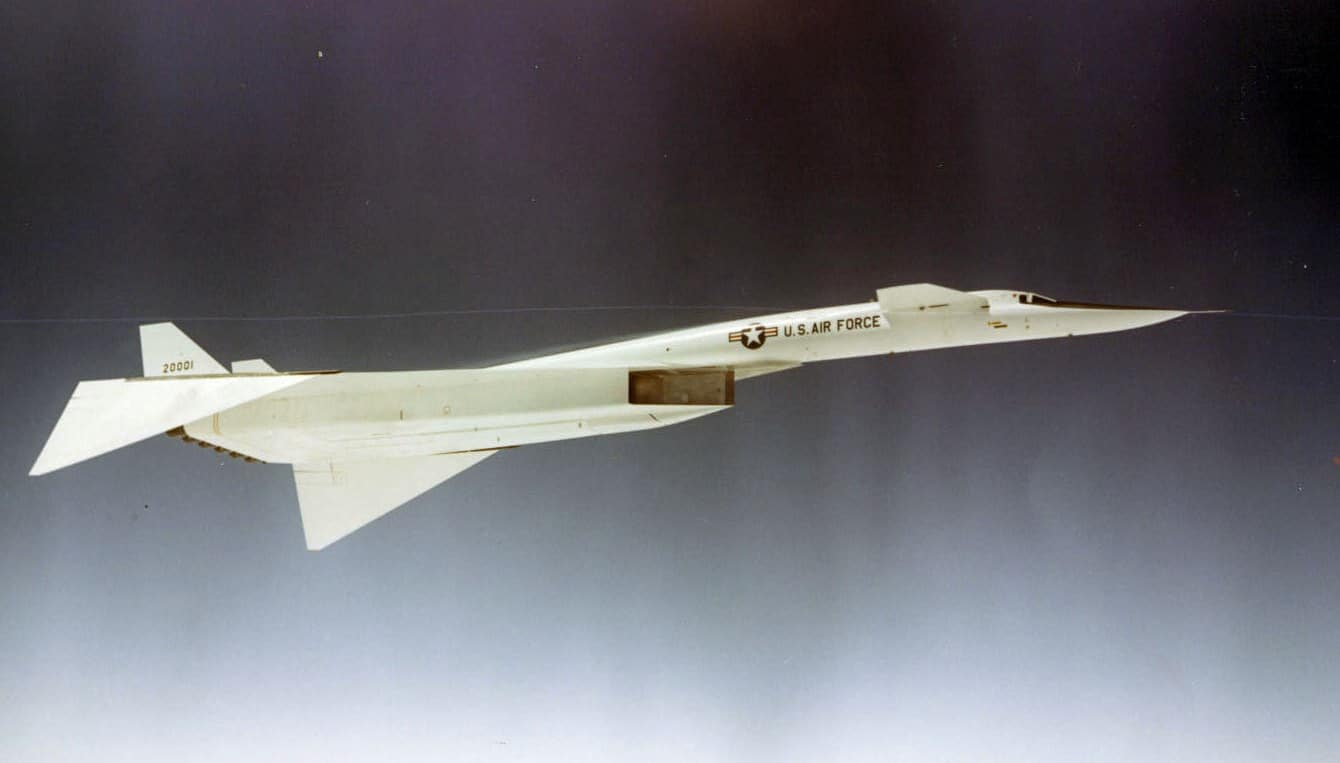
North American XB-70A Valkyrie. Image via USAF
The idea for the XB-70 Valkyrie was conceived in the 1950s. At the time, the US Air Force wanted a Mach 3 high-altitude bomber with a nuclear strike capability. Within a few years after conception though, the invention of Surface-to-Air Missiles (SAMs) and nuclear-armed ICBMs convinced the USAF to cancel the XB-70 Valkyrie program. No production craft were completed or flown.
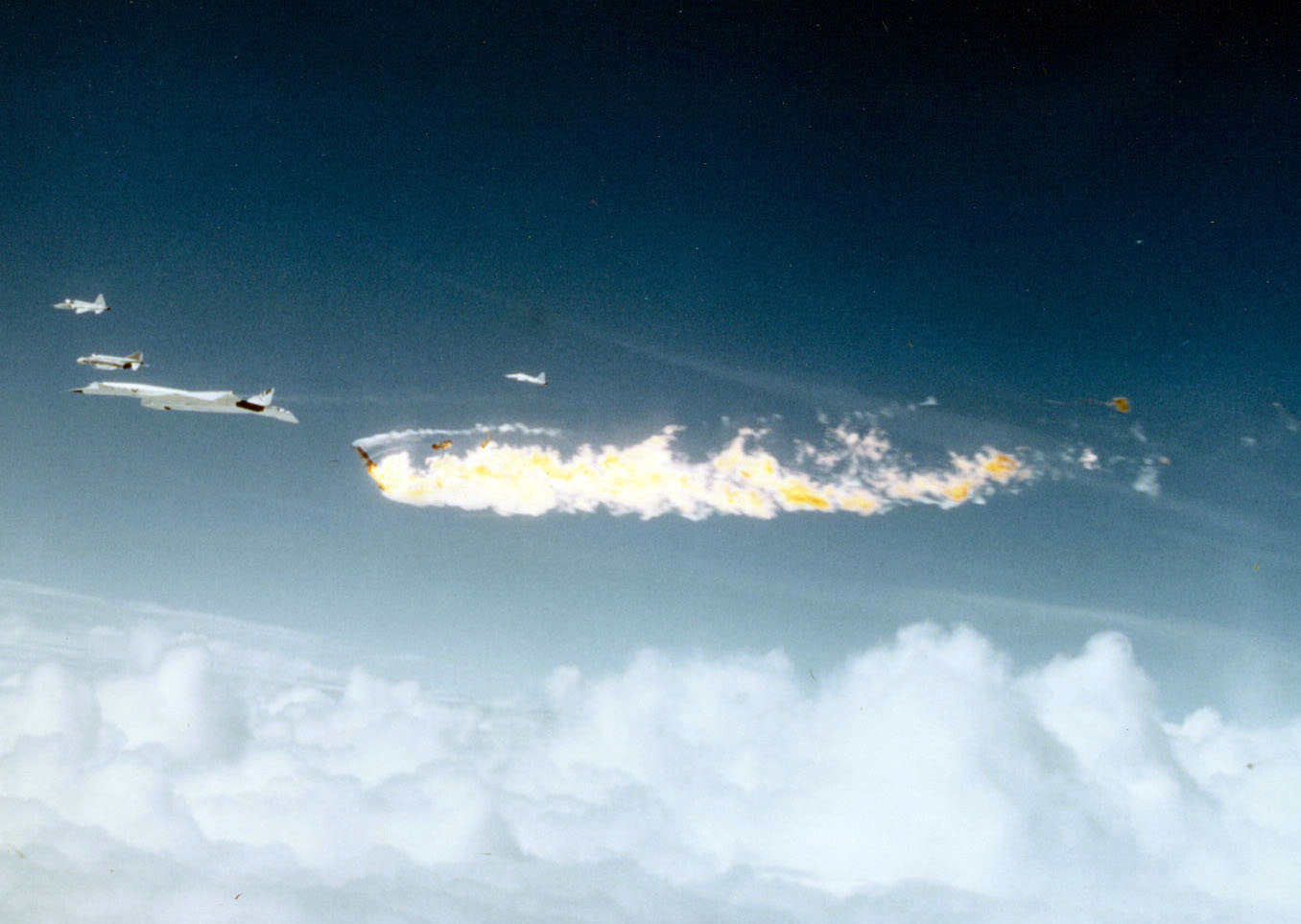
However, the USAF ordered two jets from North American as test platforms for research purposes. The first XB-70 Valkyrie (AV-1) flew in Oct 1964, followed by the second (AV-2) in July 1965. Sadly, the second test vehicle was lost in a mid-air collision a year later with an F-104.
North American XB-70A Valkyrie just after collision. Note the F-104 is at the forward edge of the fireball and most of both XB-70A vertical stabilizers are gone. (U.S. Air Force photo)
AV-1 continued flying research, but was transferred to NASA in 1967 to support the National Supersonic Transport Program. NASA handed the remaining XB-70 Valkyrie over to the National Museum of the USAF in 1969, where it is on display today in Dayton, OH.
XB-70 Valkyrie Problem Occurred Immediately on Takeoff
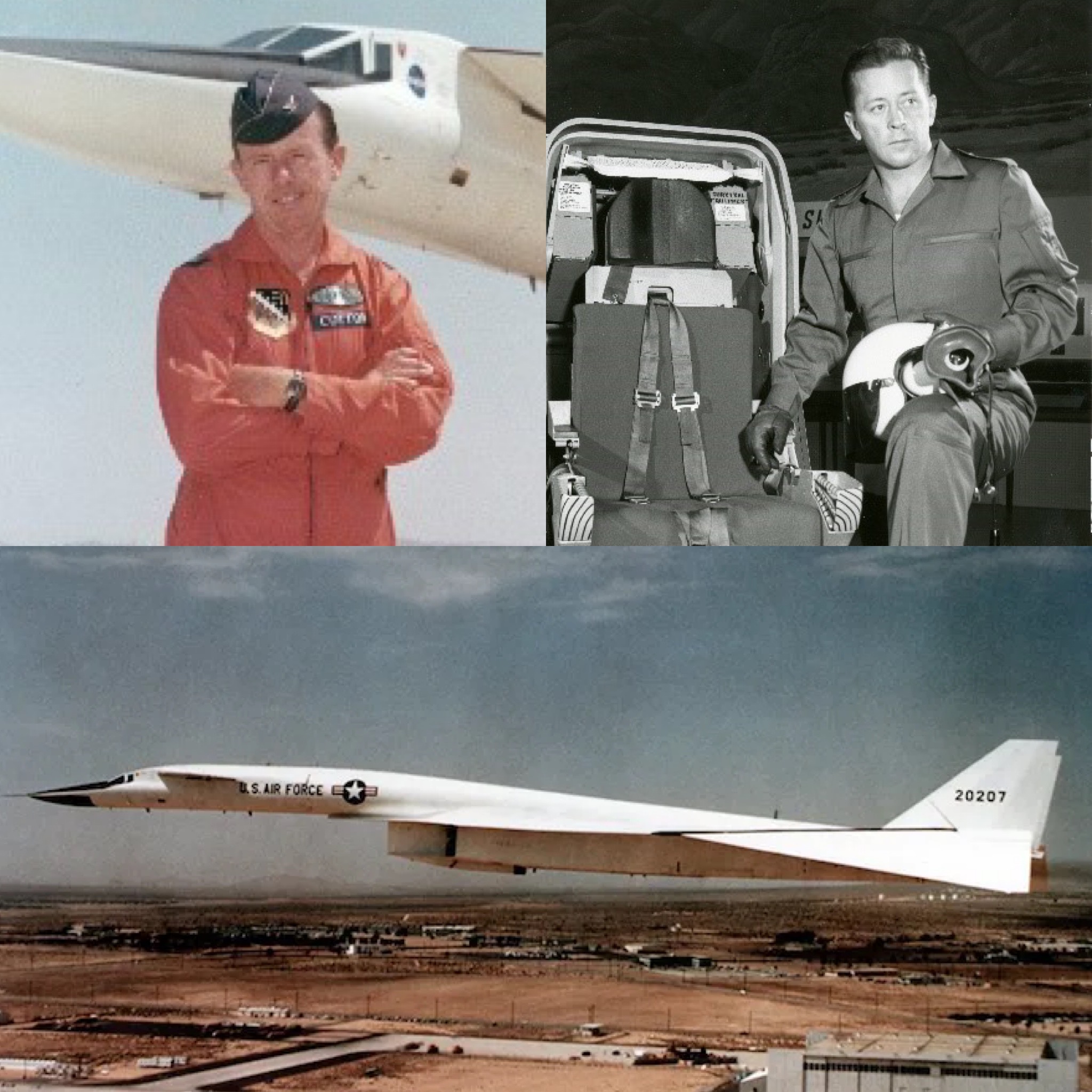
Before the tragic accident in the summer of 1966, AV-2 had another potentially catastrophic issue. On 30 April 1966, USAF Col Joe Cotton and North American test pilot Al White took off in AV-2 from Edwards Air Force Base. Their mission was to hit Mach 3 for 30 minutes.
With 6 engines and 168,000 pounds of thrust, they roared down the runway for departure, but it wasn’t long before a problem popped up. The nose gear was jammed. They had a short-circuit in the landing gear retraction system.
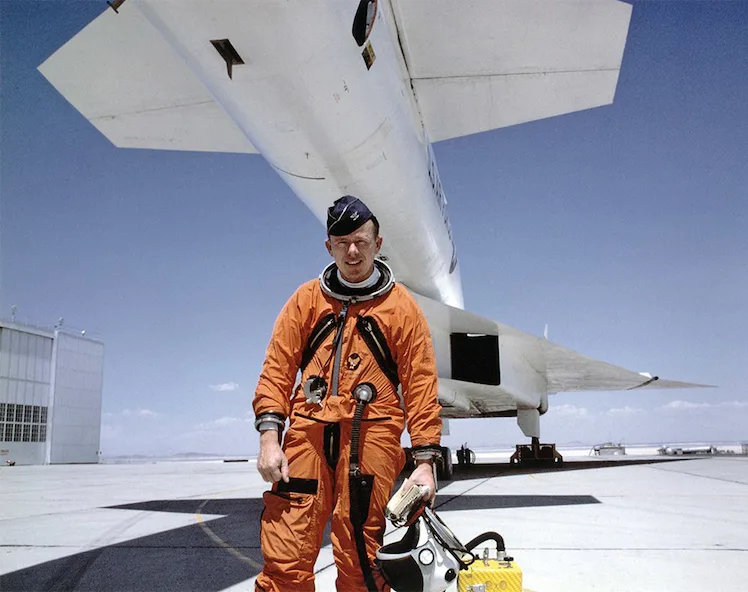
Cotton (top left) and white (top rifht). Usaf photos
The 500,000-pound plane’s nose gear was blown back into the half-retracted gear well door, and the tires were also slashed. When they tried to lower the gear, they couldn’t because the hydraulic system failed. Even the backup electrical system for the gear was useless.
Landing a Cessna or Bonanza without nose gear is one thing. You’ll probably walk away from that. But doing it in a Valkyrie would likely be suicide. Without nose gear, the crew would be unlikely to survive due to the plane’s nose-up attitude and underbelly structure.
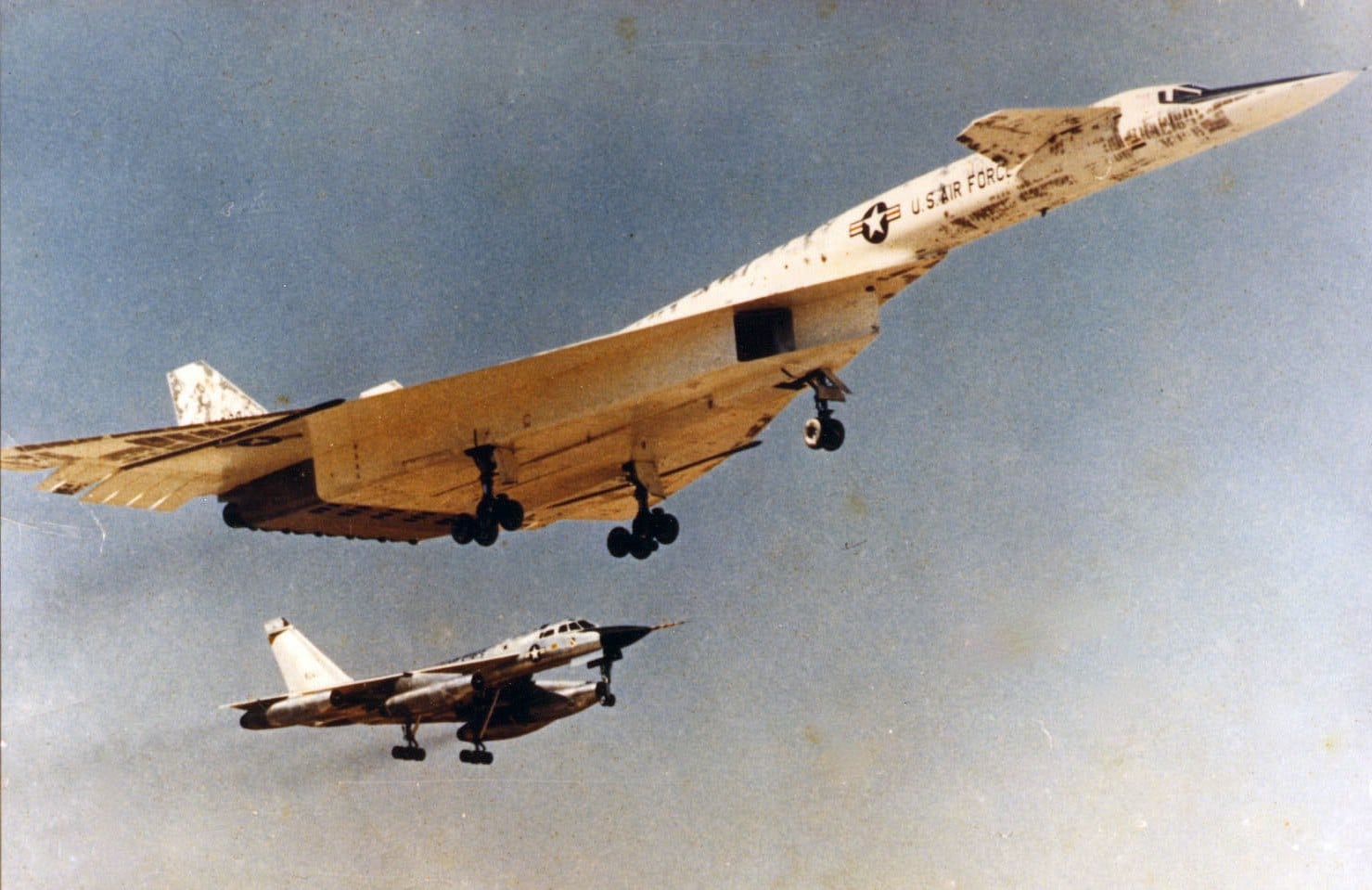
North American XB-70A Valkyrie with Convair TB-58A chase aircraft. Note singed paint from sustained supersonic speeds. Image via USAF
Conventional attempts to fix it didn’t help, time for Plan B
They decided to try some hard touch-and-gos, hoping to knock the tire back into its locked position so they could land safely. It didn’t work. They were flying for an hour trying to find a solution, and they were running out of options other than to bail out and lose the plane and possibly their lives.
Fortunately, engineers on the ground determined the problem and advised the crew to short-circuit the electrical system. So Cotton reached into his briefcase and pulled out a paperclip. He simply used it to reach in and short-circuit the breaker.
The problems weren’t over yet for the XB-70 Valkyrie
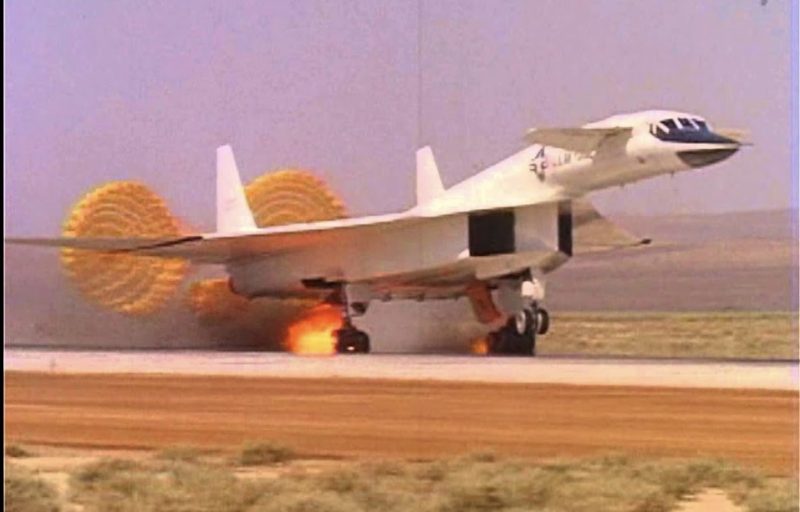
With the nose gear down and locked, Cotton and White brought AV-2 in for landing. On touchdown, 3 of the 4 main landing gear locked up, igniting in flames under the belly of the plane as it deployed its drag chutes. The jet came to a stop in spectacular fashion, but the crew and the plane survived to fly another day. Here’s the kicker… a paperclip saved a $750 million aircraft. Eat your heart out, MacGyver.
A paperclip saved a $750 million aircraft. Eat your heart out MacGyver.
“I am convinced we would have broken the plane to pieces if we had tried to land without the nose gear locked into position,” said White.
Cotton with av-2 (usaf)
Cotton too recalled the day. “I’m sure anybody could have gimmicked up something to short across between the terminals, if they had the motivation I had.”
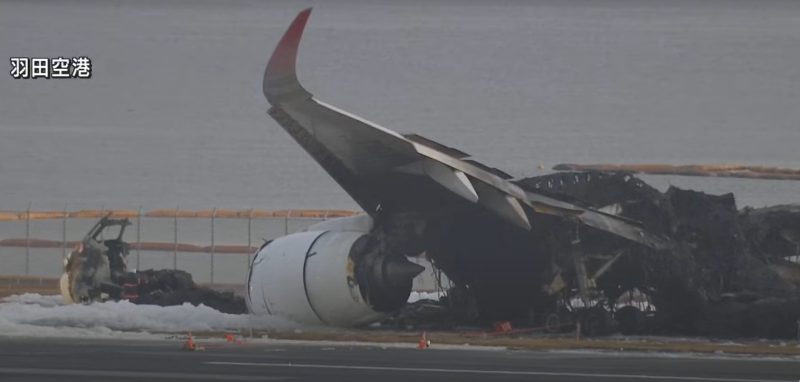
The accident that took place in Haneda, Japan between a Japan Airlines Airbus A350-900 and a Japanese Coast Guard Dash-8 was tragic. Five coast guard crew members lost their lives in the accident. In the coming days, we’ll likely learn more about the incident, what went wrong, and how to prevent such incident from happening again. Amidst the rubble of two burnt out jets, there is something to celebrate. 379 people onboard the Japan Airlines jet are alive today and they can thank their professional crew of flight attendants, pilots, solid engineering, and their own individual discipline during the evacuation for this blessing.
It starts at the safety briefing
Really glad that all of the Japan Airlines pax and crew seem to have survived the crash.
But I'm not surprised to hear that it was an orderly evacuation. JAL is able to board widebody aircraft in 10-15 mins as pax are so considerate.
If you’ve flown in the past 70 years, you’ve seen the safety briefing. Flight attendants will ask for your attention for a few moments. They might make a joke about how to fasten your seat belt and then point to where the emergency exits are in case of an evacuation. Most people feign attention or zone out. After all, air travel is one of the safest modes of transportation ever devised. Yet the information they share there is valuable.
In an emergency, leave your belongings behind. Even the most expensive MacBook or Gucci bag can be replaced. Human lives can’t.
One of the things they state is that in the event of an evacuation, leave all your belongings behind. In emergency after emergency, we’ve seen people bring their bags and belongings. In the 2019, Aeroflot Superjet crash people lost their lives because of this selfish action. Passengers were more concerned with grabbing their belongings instead of expediting their exit. 41 people lost their lives because of that delay.
Why The Japan Airlines Flight Attendants Deserve Significant Credit
The Japan Airlines crash showed us what ‘good’ looks like. Everyone on that jet emerged from the scene alive and relatively unscathed. While we’ll undoubtedly learn more about what went right in the evacuation on Jan 2, 2024, we already know some of the best practices that appeared to be followed. The numbers don’t lie. The flight attendants deserve credit for ensuring every passenger and crew successfully escaped. Evacuating 379 startled and scared people in seconds is no small feat.
1.) The Passengers Stayed Calm
In cabin video of the crash shows that passengers remained calm in the initial seconds after the jet impacted the Dash-8. There was relatively little screaming and no shoving or moving about the cabin unnecessarily. Passengers remained calm and ready to listen for further instructions.
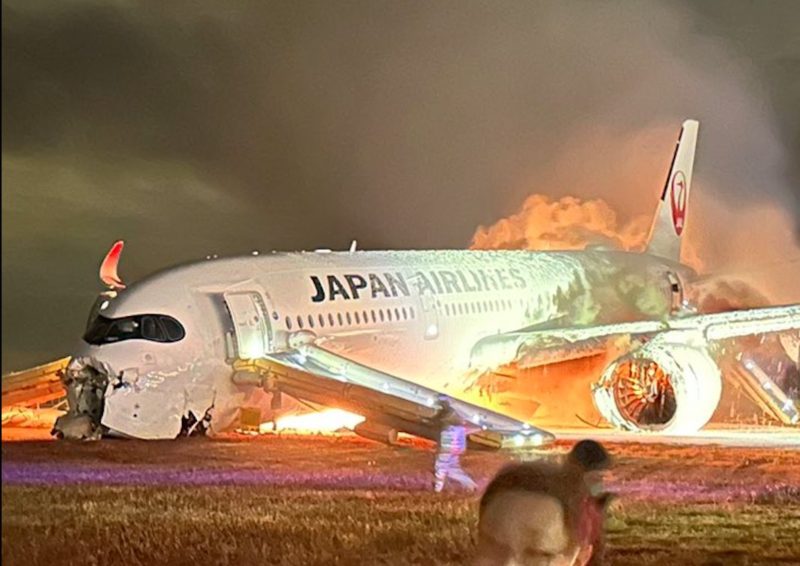
After an accident, it is important that anyone near an emergency exit analyzes the situation and environment before opening a door. If someone mistakenly opens the wrong door, it can lead to catastrophic consequences. In this incident, it appears that the right engine was still sparking with a growing fuel fire outside the aft right fuselage. With fire on the wings and the right aft fuselage, the flight attendants (and/or passengers assisting) made the correct decision to only open the front exits and the left rear door.
3.) Passengers left their belongings behind and followed flight attendants’ commands
This can’t be emphasized enough. In an emergency, leave your belongings behind. Even the most expensive MacBook or Gucci bag can be replaced. Human lives can’t. In this latest Japan Airlines incident, you don’t see any video of passengers lugging their carryons or heavy bags. While I’m sure that they are a bit sad that they lost their belongings, they are alive to ponder what they will purchase when they are reimbursed for their loss. While Japanese society is known for rule following, it is likely that commands by flight attendants ensured that no one was tempted to grab their bags and delay the evacuation.
4.) Passengers assisted each other
In video from the scene, you can see passengers assisting each other off the emergency slides. This is humanity at its best. While a few photos of the scene were taken by passengers, they were mostly safely away from the crash site. In an event like this, do not prioritize becoming a TikTok star over helping your fellow passenger! It’s the time to be a real life hero and assist others.
Conclusion
The bottom line is that flight attendants are there for both your comfort and safety. They are way more than just a server in the sky. They are there to keep you and your fellow passengers safe. They are highly trained individuals with skills they hope to never have to use. The passengers aboard Japan Airlines 516 are undoubtedly grateful for their skillset and professionalism. Next time you fly, take a moment to appreciate these men and women in the skies.
A Japan Airlines A350-900 collided with a Japanese Coast Guard Dash-8 on the runway at Tokyo’s Haneda International Airport. Footage shows a large fireball from the collision on the runway. Miraculously, all 379 passengers on the A350 escaped after the collision. Unfortunately, 5 personnel on the Dash-8 are unaccounted for. The Dash-8 was on a mission to find survivors from the 7.6 magnitude earthquake that hit Japan on New Years Day.
Images and video have emerged of the crash including photos on X from some of the passengers who escaped. In the first video, you can see the impact between the A350 and the Dash-8. Additional videos show inside the cabin and the resulting fire. The A350, a composite aircraft, continued to burn after it came to a stop. The aircraft was fully engulfed in flames before being extinguished by rescue personnel.
In the first video, you can see the Dash-8 on the runway at about 2:20 into the video. The explosion then occurs right before the 3:00 mark.
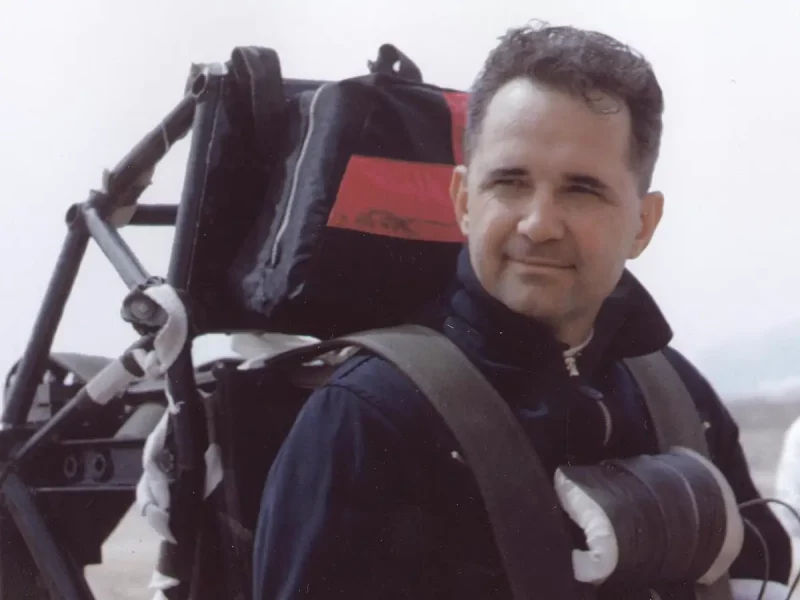
Col Stapp was a real human crash test dummy who advanced aerospace safety. He then went on to advocate for seatbelts. Oh, and he coined the term “Murphy’s Law”!
Over the decades, a lot of research has been conducted by the USAF to understand the affects and limits of G-forces on aircrews. Not just the flying itself, but also understanding how extreme Gs during an ejection affects the person(s) ejecting. What’s the point if they will die on ejection anyway?
To get the data, someone had to become a real-life test dummy. And the man who stepped up to the plate not only withstood more Gs than any human being (voluntarily) in history, but also became the fastest man on Earth.
Col Stapp. Image: USAF
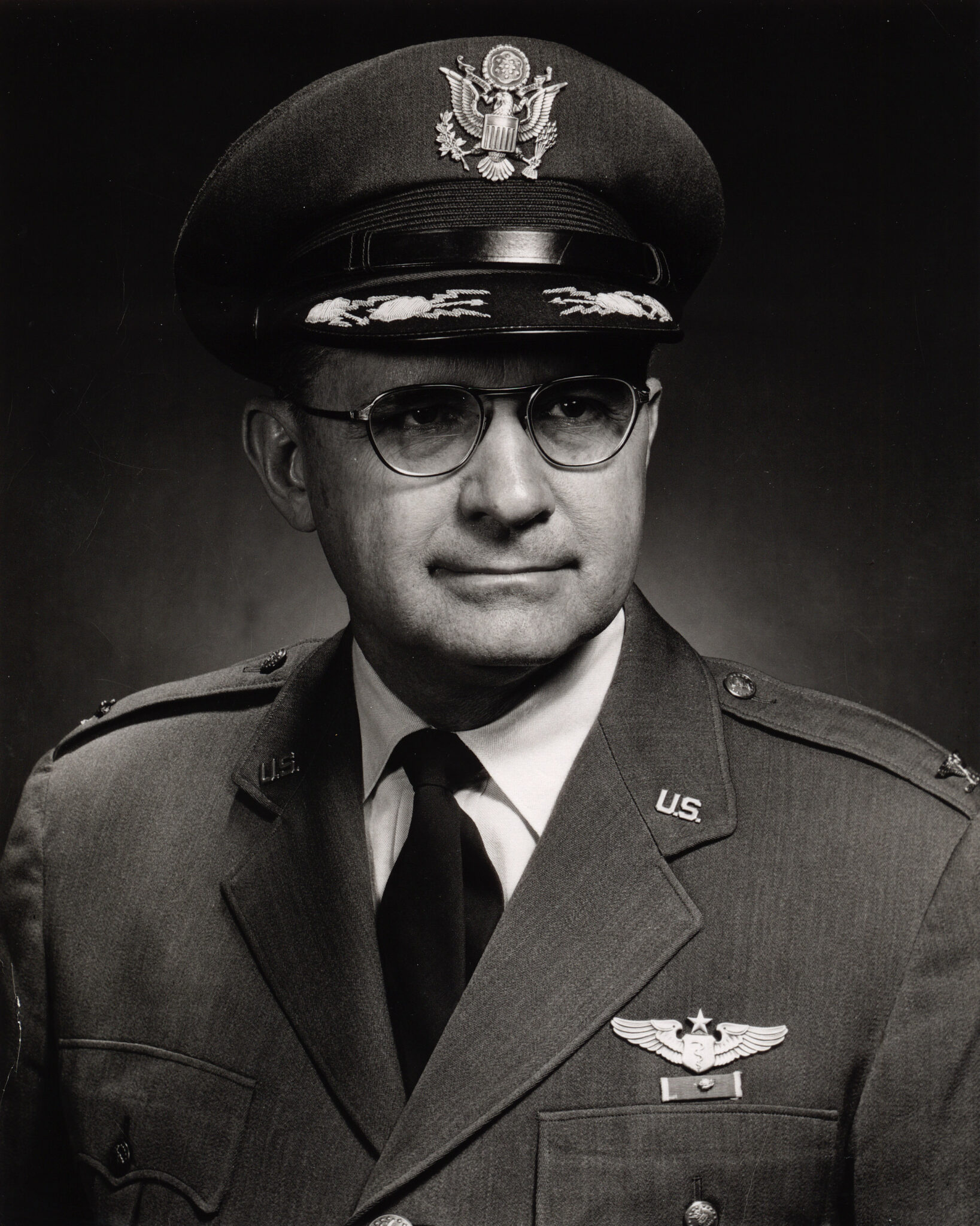
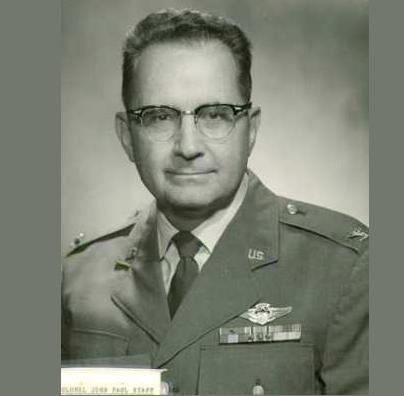
Meet USAF Col and Dr, John Stapp
Col Stapp Endured The Highest G-Forces Ever To Advance Safety 15
Retired USAF Col and Dr John Stapp joined the service in 1944. After completing Medical Field Service School and medical residency, he became a General duty medical officer and received his Aviation Medical Examiner designation. He became a project officer and medical consultant in Bio-Physics at the Aero Medical Laboratory, Wright Air Development Center in Dayton, Ohio.
Col Stapp was a risk taker. One of his first jobs was flying in un-pressurized aircraft to 40,000 ft with new proposed oxygen systems. He stepped in to fly the mission himself. If something went wrong, he didn’t want anyone else to get hurt. Stapp was also studying altitude and decompression sickness (“the bends”), flying a bare bones B-17 with an open cockpit and unpressurized cabin at 45,000 feet for 65 hours. A solid guy for sure! This somewhat extreme experience was just a warmup for what was to come.
Col Stapp. Image: USAF
The need for Gs, but not looking forward to it
Col Stapp Endured The Highest G-Forces Ever To Advance Safety 16
His next assignment was a bit more extreme. Col Stapp was tasked with studying the ability to withstand extreme Gs during extreme de-acceleration. Stapp went to Edwards AFB to conduct the research, again volunteering to be the test subject. Strapping onto the rocket sled named “G-Whiz” for the first time, he said “I assure you, I am not looking forward to this.”
Strapping onto the rocket sled named “G-Whiz” for the first time, he said “I assure you, I am not looking forward to this.”
Col John Stapp
He was launched on 16 tests from 1947 – 1948, taking a punishing beating from up to 35Gs and suffering numerous injuries. But, he was still just warming up.
Col Stapp Endured The Highest G-Forces Ever To Advance Safety 17
Stapp conducted additional sled tests, was promoted to USAF Major, and was sent to Holloman Air Force Base, New Mexico in 1953, to continue leading further research on extreme deceleration and G-forces. It was there, in 1954, that he would solidify his place in the history of aviation, speed and basically all things cool.
The Fastest Man on Earth
The USAF had many unknowns about ejection in flight: at what speed a pilot could safely eject? How much force can someone take when they are slapped by supersonic wind and slow from 700 mph to an immediate full stop? These were all questions that needed to be answered as jet aircraft evolved into machines that could fly faster and higher than previous aircraft.
Col Stapp Endured The Highest G-Forces Ever To Advance Safety 18
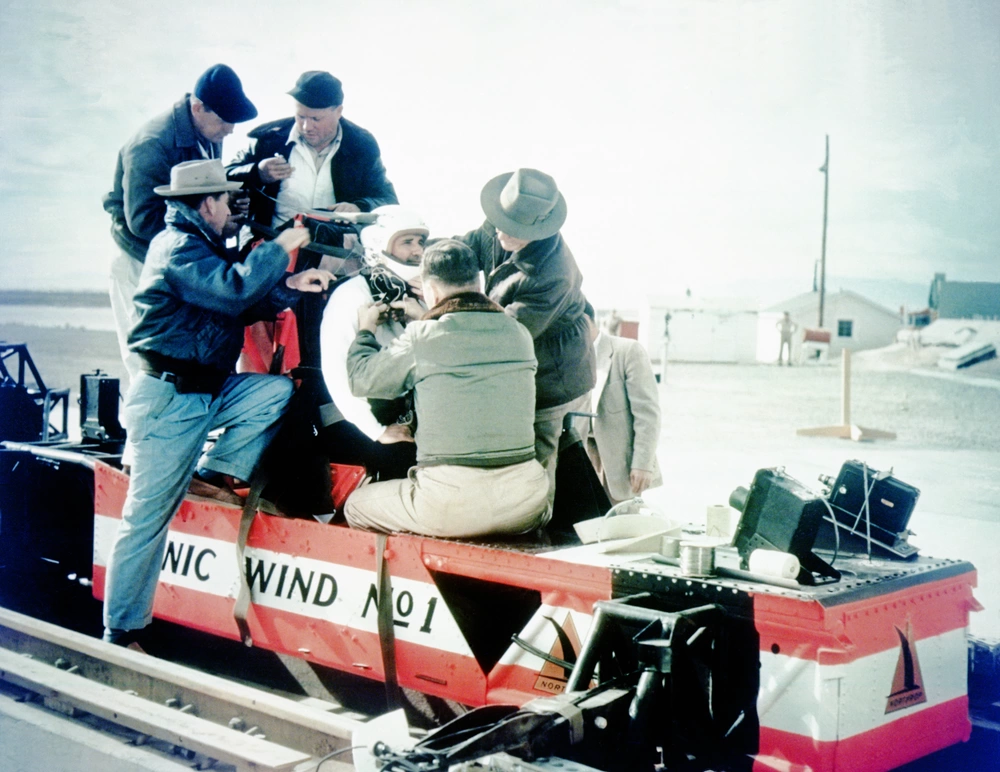
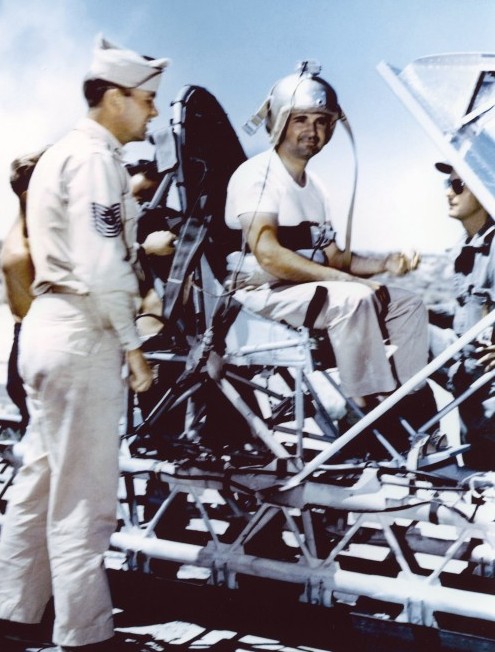
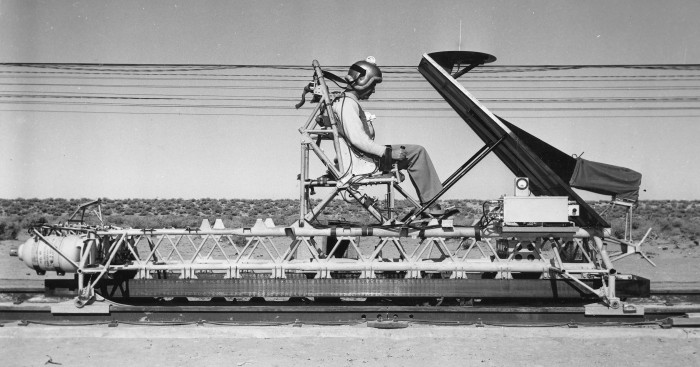
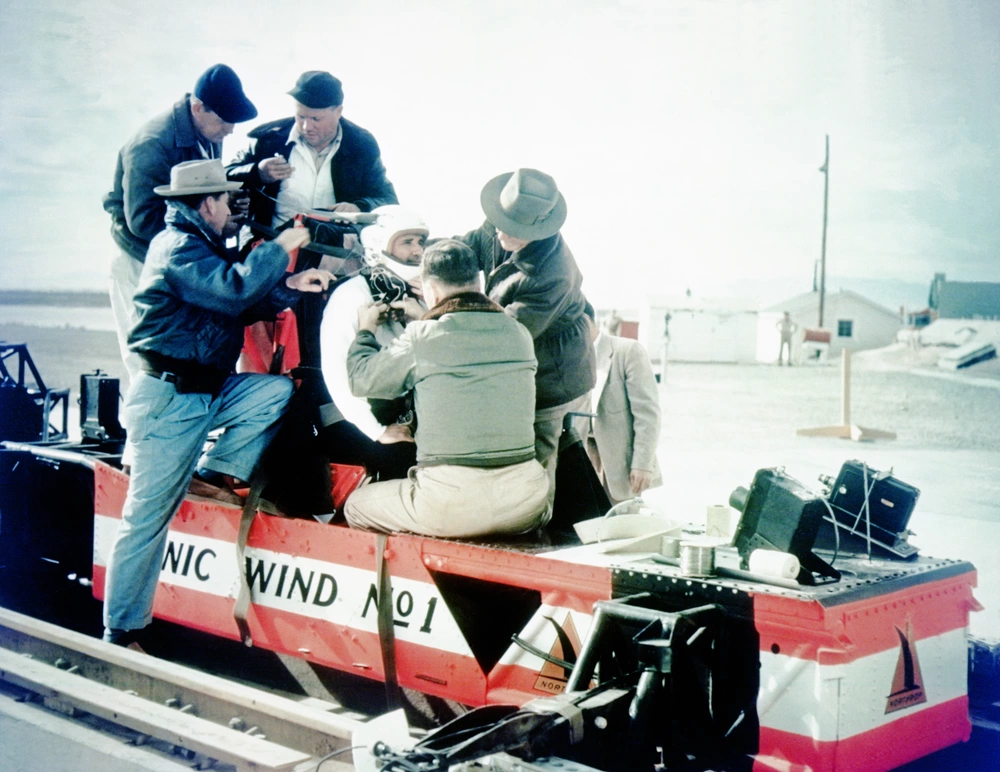
Stapp’s rocket sled was named Sonic Wind No. 1. It was equipped with 9 solid fuel rockets. Combined, they produced 40,000 pounds of thrust for 5 seconds. Plenty of time to get the data needed and, hopefully, he wouldn’t die in the process.
On Dec 10, 1954, Stapp boarded his 2,000 pound sled, which was mounted on rails set in concrete. After an hour of preparation, he was launched 3,000 feet, accelerating from 0 to 632 mph in just 5 seconds, as fast as the acceleration of a 45 caliber bullet from a pistol.
He shot past a T-33 that was flying alongside the track, hitting 20 Gs! This alone gave him the land speed record and title as the fastest man on Earth.
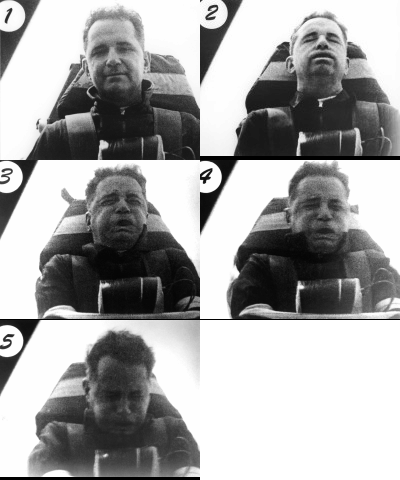
Once the rockets burned out, the water brakes kicked in and Stapp came to a sudden stop in just 1.4 seconds. Such force is equivalent to hitting a brick wall at 50 mph. Stapp withstood over 46 Gs in the stop, which is a force equivalent of about 4 tons exerted on the human body.
Beaten up, but alive and well
Incredibly, Stapp walked away without any permanent injuries. He suffered temporary blindness for about an hour and was bruised all over. He suffered broken ribs and burns from dust hitting his skin at 600 mph, and his eyes were bleeding a bit. And somehow this man of steel still had a smile on his face.
“I felt a sensation in the eyes, somewhat like the extraction of a molar without anesthetic,” said Stapp after the test. “The effects of that run were relatively negligible, but the data obtained was invaluable.”
– Col Stapp on his 46G deceleration from the rocket sled test
Once the his medical exam was over, he ate a sandwich and got to work analyzing the data his test collected. Yes, really! Just another day for Dr Stapp.
Col Stapp Endured The Highest G-Forces Ever To Advance Safety 19
He still wanted to go further in a future test. Stepp wanted to break 1,000 mph. His superiors saw it as suicide and denied his request.
Stapp’s research opened up more possibilities in aviation and other industries
Stapp proved that a pilot flying at 35,000 feet at twice the speed of sound could survive the wind blast if they had to eject based on extrapolated data. Further research by Stapp also proved it was safe to build faster fighter jets without worrying about aircrews being killed by the deceleration, Gs and wind during ejection.
Some of his other research led to him inventing a new harness for paratroopers, so they could survive crash impacts if their planes went down. He also developed a better harness for combat pilots, which surely saved lives.
His contribution to the wider public, is perhaps his greatest legacy. His insane tests proved how much a person could withstand if properly restrained. He went on to conduct similar research with car crashes, strapping into test vehicles and slamming into objects himself to prove his theories.
Col Stapp Endured The Highest G-Forces Ever To Advance Safety 20
He became an advocate for seatbelts in cars. Manufacturers could care less back then, it was just an added expense to their bottom line. In 1966, Stapp was key in convincing President Lyndon B. Johnson to sign a law forcing auto makers to include seat belts in every car. Millions of lives have been saved since, on a daily basis, even today. Perhaps, his work even saved your life at one time or another?
Stapp invented Murphy’s Law…really!
Stapp even invented the now household term “Murphy’s Law”, the idea that anything that can go wrong, will. Murphy was a Captain that Stapp worked with on the rocket sled tests. Poor Murphy kept having bad things happen to him, and so Stapp called it “Murphy’s Law”. It stuck.
Pulled over for speeding
Col Stapp Endured The Highest G-Forces Ever To Advance Safety 21
Stapp was a bit of a local hero after all of his research. One day, Stapp was pulled over by a police officer for speeding, doing 40 in a 25. At court, the judge recognized Stapp, then dismissed the charge against him. He issued a new ticket to a fictitious police “captain” and the judge paid the fine himself.
Stapp retired from the USAF in 1970 as a colonel. He passed away in 1999 at his home in New Mexico from natural causes. His history-making sled, Sonic Wind No. 1, is on display at the in Nation of Speed at the National Air and Space Museum in Washington, DC.
Legend Joe Kittinger once said, “I hope St. Peter has his seat belt on when Dr. Stapp shows up.”
As the world gets ready to ring in the new year, the aerospace and airline industry is facing five major unknowns in this upcoming year. Let’s take a look at five big stories that we will likely see in the new year.
1. SpaceX’s To Orbit Finally?
Five Big Aerospace Industry Unknowns As We Fly Into 2024 26
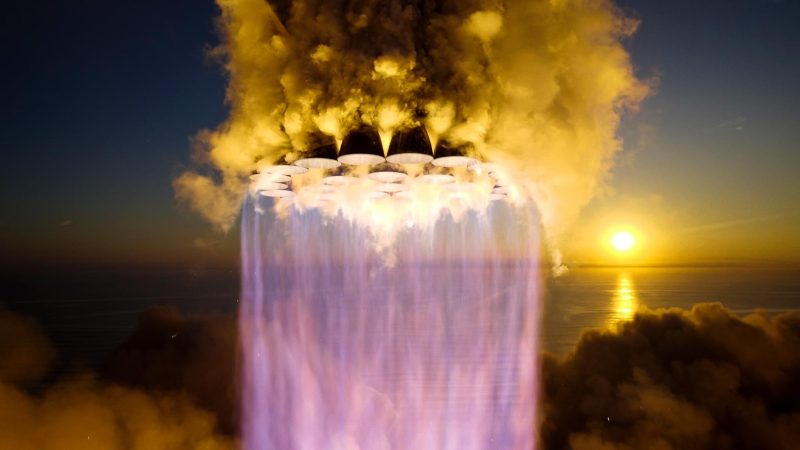
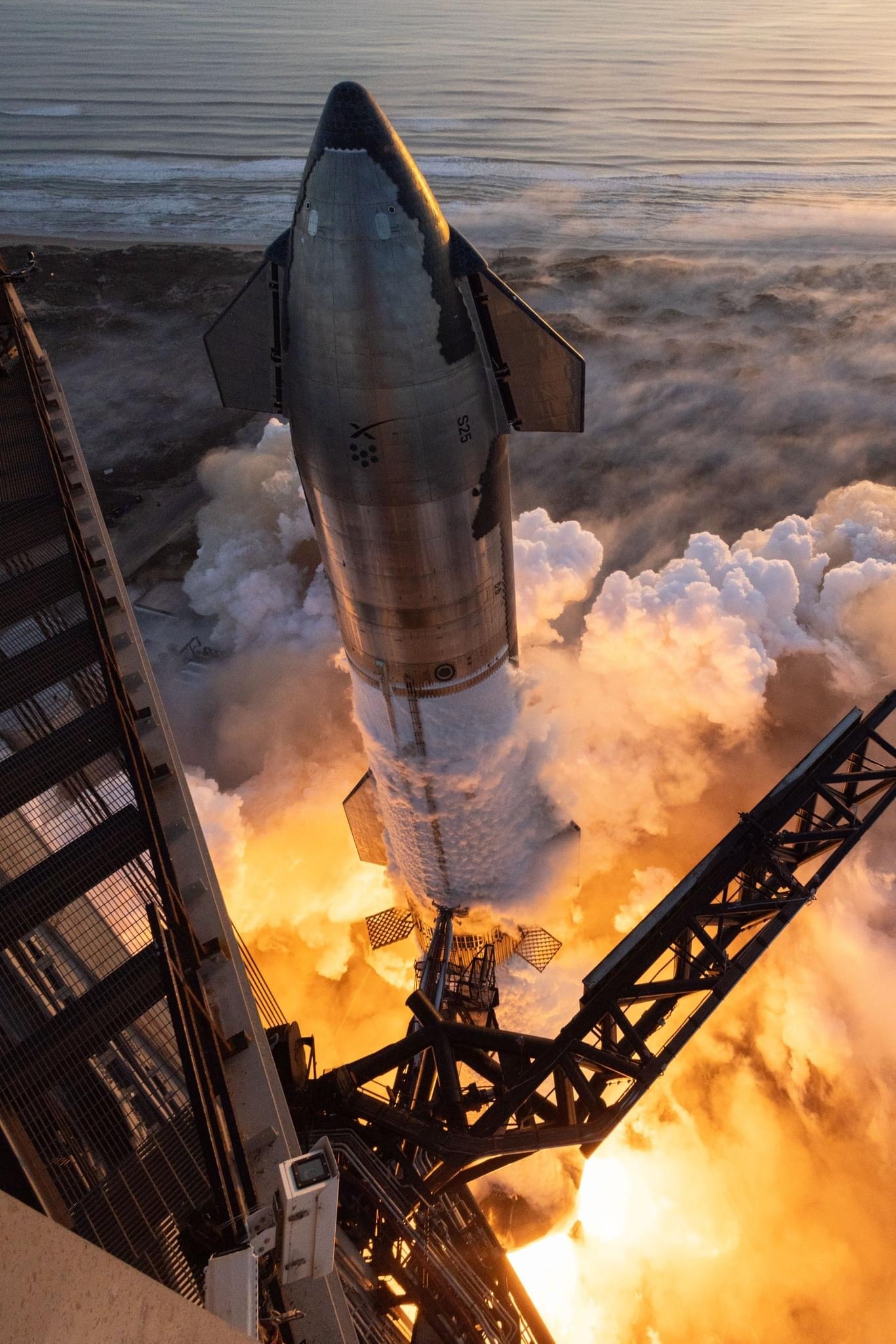
SpaceX, led by eccentric entrepreneur Elon Musk, has become a commercial success. Its Falcon9 rocket has launched this year more than any other spacecraft. His ambitions are larger though. His Starship spacecraft has experienced two spectacular launches thus far. Both have ended in progress but ultimately failure. As 2024 unfolds, the big question is whether SpaceX will achieve its ambitious goal of reaching orbit with its Starship spacecraft. The Starship, designed to be a fully reusable spacecraft capable of landing on the moon and carrying humans to Mars, is pivotal to our nation’s return to the moon ambitions.
The success or delay of SpaceX’s orbital mission could impact not only the company but also America’s ambitious plans for the moon and beyond. On the other hand, a breakthrough will be an amazing technical accomplishment for the industry.
2. Pilot Hiring Trends: A Plateau, Dip or Continuation of 2023 trends?
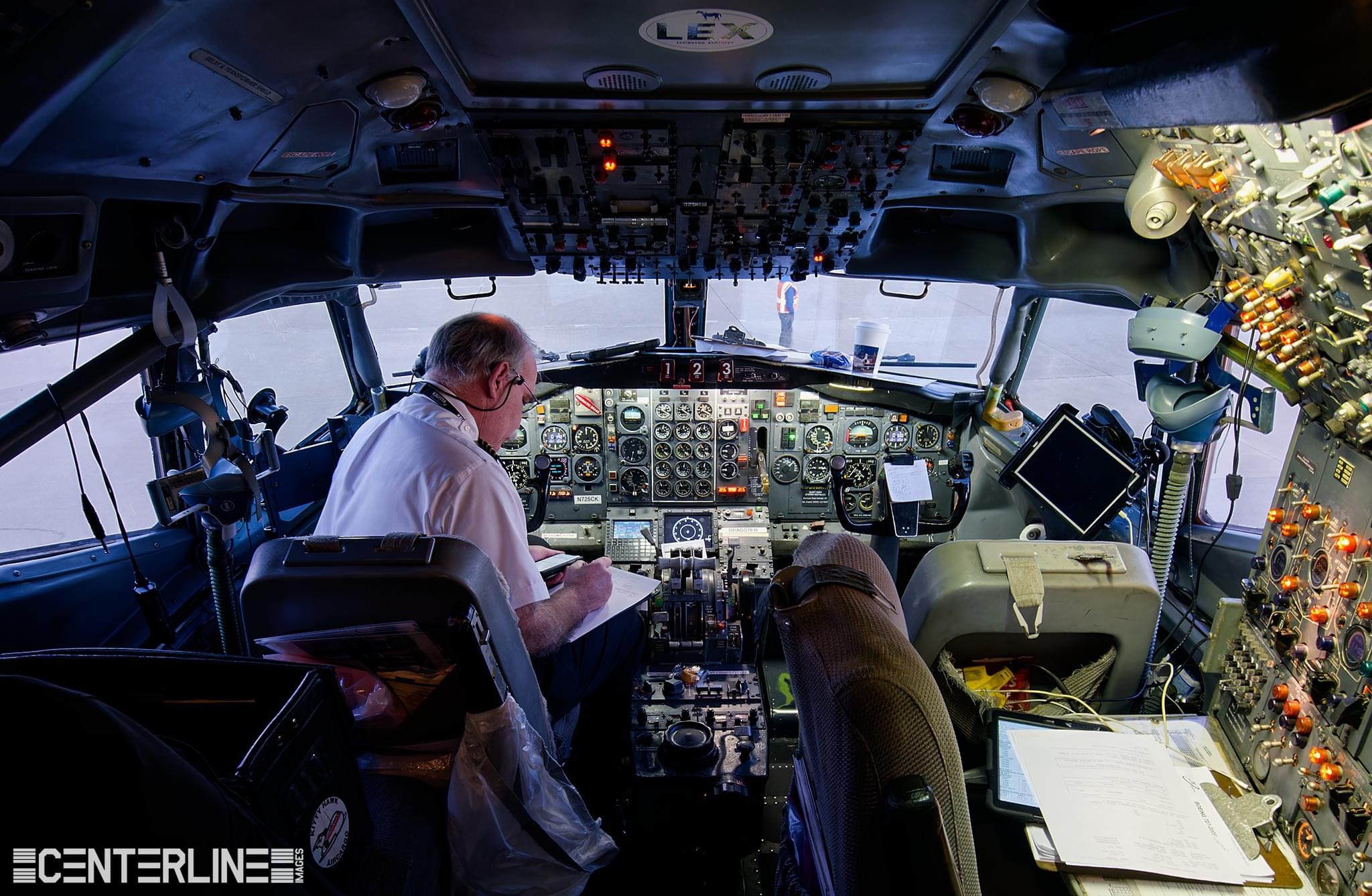
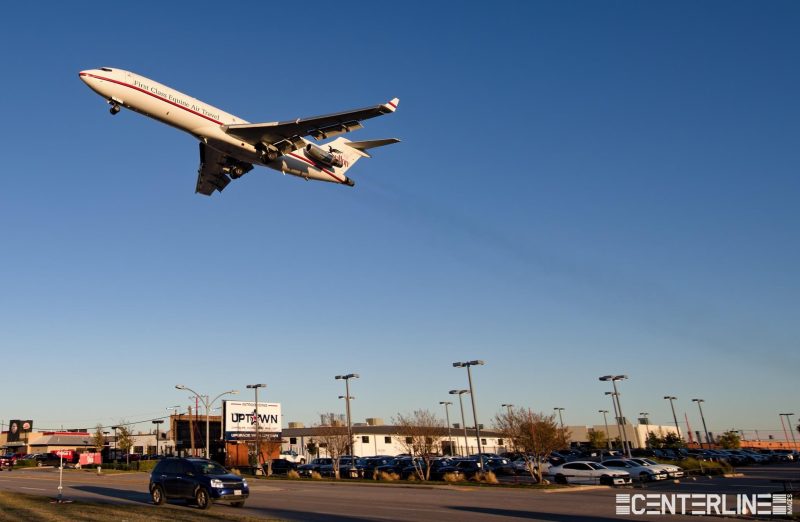
Kallita will retire their 727s next year. Image: Dylan Phelps, Centerline Images
The aviation industry has experienced a significant pilot shortage in recent years, leading to aggressive hiring, expanded training program/industry, and reduction of minimums to be hired. However, as we step into 2024, there are speculations about whether this trend will continue or if we will see a slowdown in pilot hiring. There are warning signs on the horizon: stubborn inflation, a spending hangover after COVID-19, slow return of business travelers, and an aging aviation and persistent economic concerns are just some of the factors at play.
Some airlines have already floated that they will reduce hiring targets in 2024. Others plan to continue at their previously announced levels. This is a great unknown headed into 2024. The need for more pilots is definitely there but demand could soften. This is one to watch.
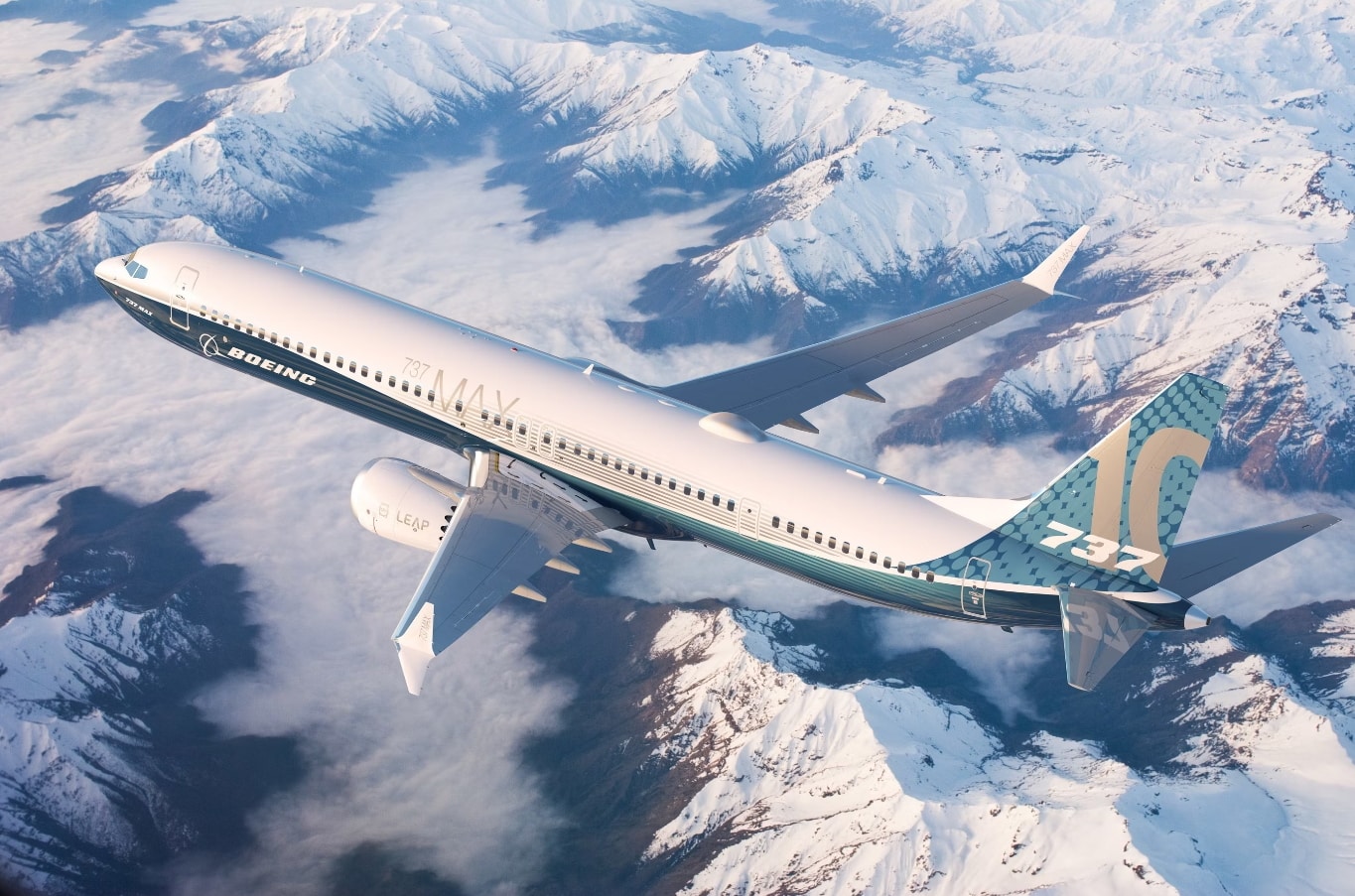
3. The Fate of Boeing’s MAX 7 and 10 Deliveries
Five Big Aerospace Industry Unknowns As We Fly Into 2024 27
Boeing’s 737 MAX series, particularly the MAX 7 and 10 models, have been under intense scrutiny after the grounding of the MAX in 2019 after two fatal crashes. The MAX number 7 and 10 have languished for years without certification. There are many jets ready for delivery but lack authorization to fly. The MAX 7 and 10 are crucial for Boeing’s long-term health and airlines’ continued growth.
The repeated delays are concerning and there is not yet a clear indication of when they will be certified. Previously mentioned target dates have repeatedly gone by without a change in status. This is a critical issue for Boeing. Their hope is that 2024 is a better year for the smallest and largest MAX fleets.
4. Boom Supersonic’s XB-1 Test Flight: Boom or Bust?
Boom Supersonic, with its ambitious Overture supersonic airliner project, aims to revive supersonic passenger travel. The key milestone to watch in 2024 is the first flight of Boom’s XB-1 demonstrator, a crucial step towards realizing the Overture. The XB-1’s performance will offer insights into their approach to the technology that they eventually want to field.
Boom’s success on their XB-1 is not really game changing. The jet looks more like a T-38 and Eurofighter were combined into a gangly, new fighter jet. It’s likely to fly. The lessons learned though could demonstrate that Boom is on the right path, albeit a long one. A failure though could spell doom for the long-desired, but rarely successful hope for commercial supersonic transport.
5. America’s Return To The Moon: A Shaky Timeline
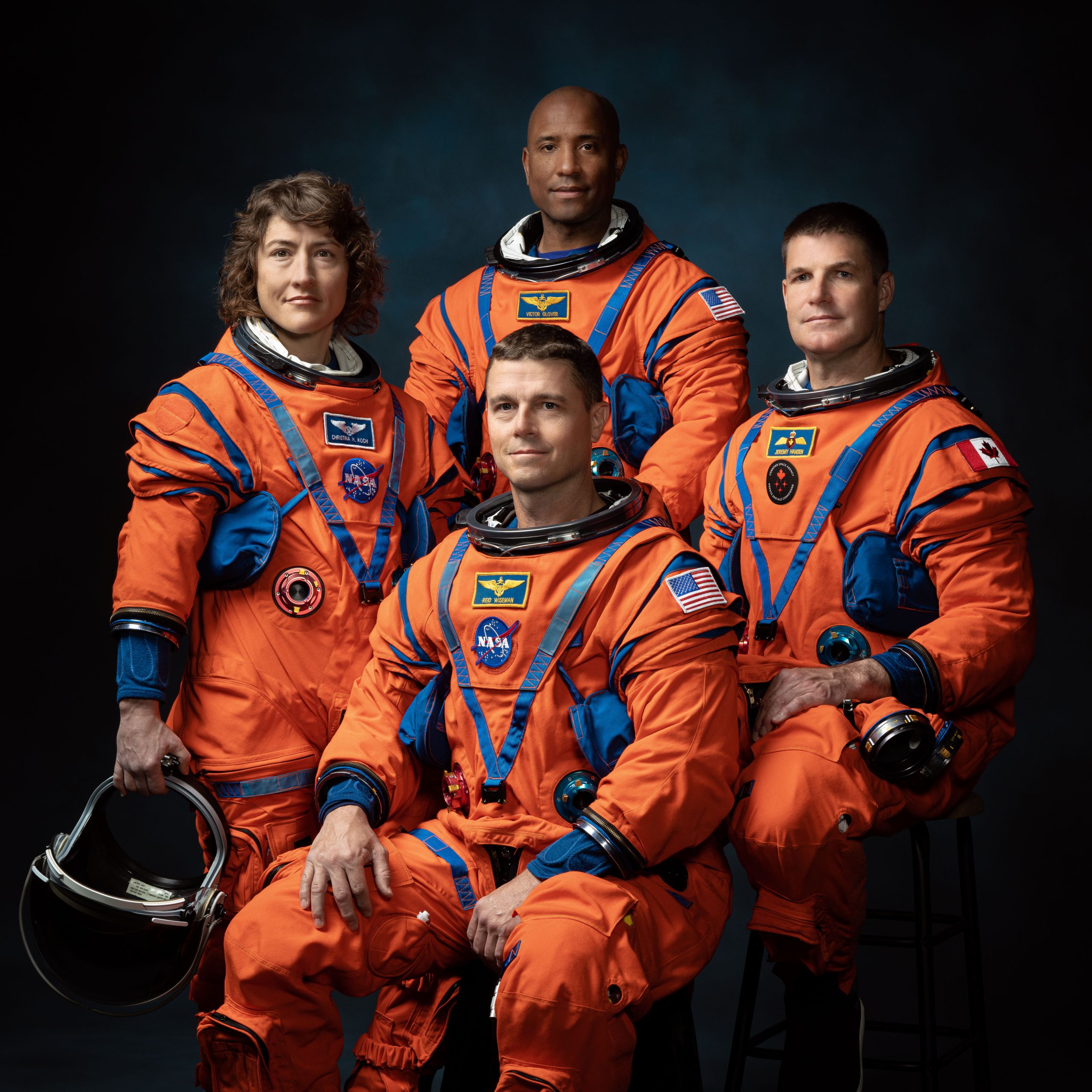
PHOTO DATE: March 29, 2023. LOCATION: Bldg. 8, Room 183 – Photo Studio. SUBJECT: Official crew portrait for Artemis II, from left: NASA Astronauts Christina Koch, Victor Glover, Reid Wiseman, Canadian Space Agency Astronaut Jeremy Hansen. PHOTOGRAPHER: Josh Valcarcel
The United States Artemis program is the nation’s ambitious plan to return to the moon. The timeline is tight with many risks and unknowns, including the SpaceX Starship that we mentioned above. As 2024 begins, NASA is on the clock to launch Artemis II. The success of the Artemis missions is critical for US. The cost is so great that any failure or large setback would likely doom the program.
In 2024, we’re likely to see the first crew to orbit the moon in over 50 years, including the first woman and african american ever to orbit the moon. It will be a big story and we’ll be here to cover it.
What other big aviation and space stories are you watching in 2024? Let us know in the comments below.
Headset said to utilize synthetic vision to improve visibility in low visibility situations
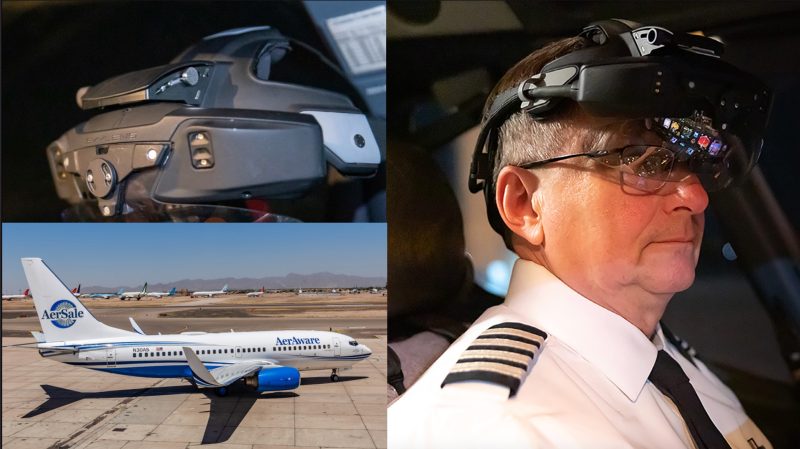
The FAA recently approved an STC authorizing the use of the AerAware headset device called the SKYLENS (HWD) head wearable display as part of a comprehenvive enhance flight vision system. This mixed reality headset allows transport pilots better situational awareness, particularly in low visibility situations.
According to AerSale (makers of the AerAware system), the Enhanced Flight Vision System “recently received approval by the Federal Aviation Administration (FAA) for the Boeing B737NG product line. This achievement marks the world’s first commercial EFVS system to achieve a 50% visual advantage and the first large transport aircraft to be certified with a complete dual-pilot EFVS solution featuring a Head-Wearable Display.”
Device is similar to a HUD
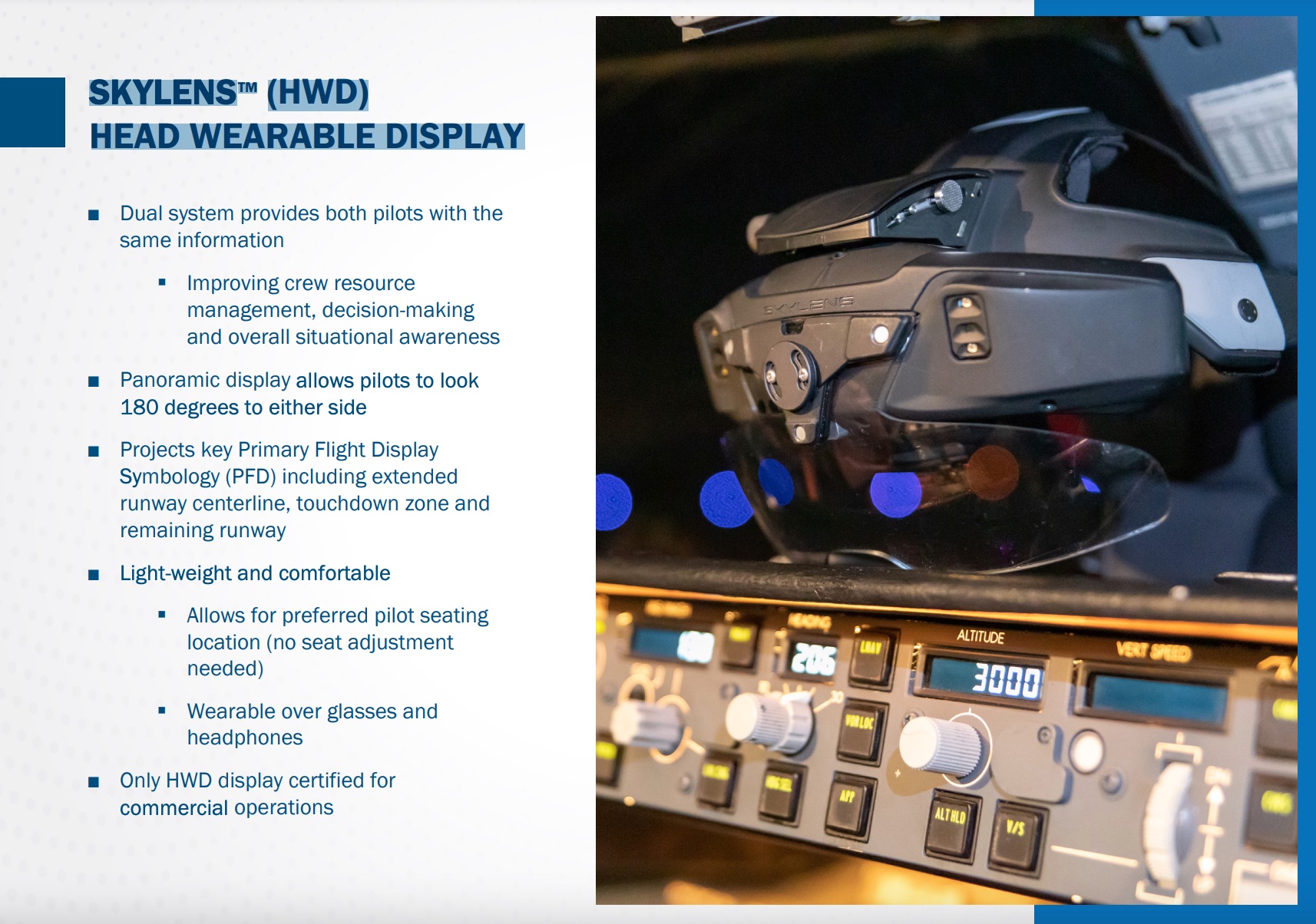
Information about the device from the AerSale brochure.
The device is similar to a HUD (heads up display). It displays aircraft performance information without having to look down at the instruments. What makes this device unique is that it also superimposes synthetic terrain into the pilot’s line of sight. Much like advanced helmets for fighter pilots, the terrain information displayed matches the pilot’s head movement showing relevant terrain display with a 180 degree field of view. In theory, this means that you get the benefits of the HUD without the limiting field of view.
The device requires installation of the Universal Avionics/Elbit Systems EVS–5000 multispectral cameras. To operate the system, it requires a total of 4 internal cameras and 6 internal sensors according to the product’s brochure.
The Benefits of the Device
While the company’s website is relatively vague on the specific benefits, it does state that the device enhances safety through improved situational awareness and results in improved efficiency for the operator since it reduces the likelihood of diversions and go-arounds in low visibility environments.
While the concept appears promising, devices like this are still in its infancy. The company states that pilots have a 50% visual advantage to the naked eye. It also “reduces published visibility in low visibility conditions minimums by 50%.” The sales brochure does say it can be comfortably worn with glasses and headsets. It will be interesting to see if there is any information released on how long you can comfortably wear the device in flight as mixed reality devices and helmets are typically fatigue inducing over time.
The installation is said to take 3-5 days per aircraft plus training for pilots. The device is currently certified for the Boeing 737NG only, likely making the devices targeted for existing and new Boeing Business Jet customers.
You can view the video by clicking on this link (will take you to the AerSale website).
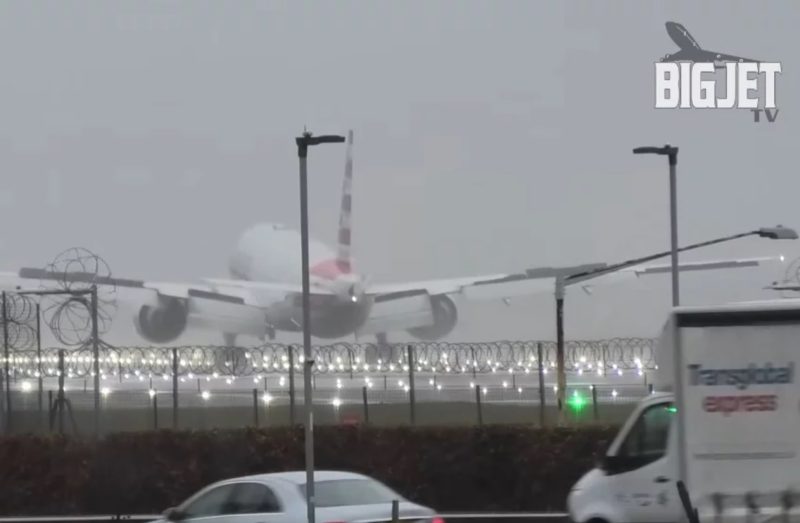
On November 16th, an Air Canada Boeing 777 was caught on tape flailing in the flare. The landing made international news. Then today, BigJetTV, an aviation enthusiast website caught another Boeing 777, this time American Airlines Boeing 777-300ER struggling to land again in similar conditions. Both incidents didn’t seem to result in any immediate danger, but the similarities were noticeable.
First, What about the Air Canada 777 Hard Landing?
In the case of the Air Canada Boeing 777-300ER (tail C-FIUV), the jet appeared to be stable until it was about 30 feet in the air. Then it abruptly rolled left before the pilot quickly corrected, then the jet touched down hard on its right main gear before it eventually settled. At the time, the winds at YYC were gusty, but manageable by most standards. The Boeing 777 was removed from service after the hard landing for a few days for an inspection. It was then returned to service without further issue.
Then What Happened At Heathrow With The American 777-300ER?
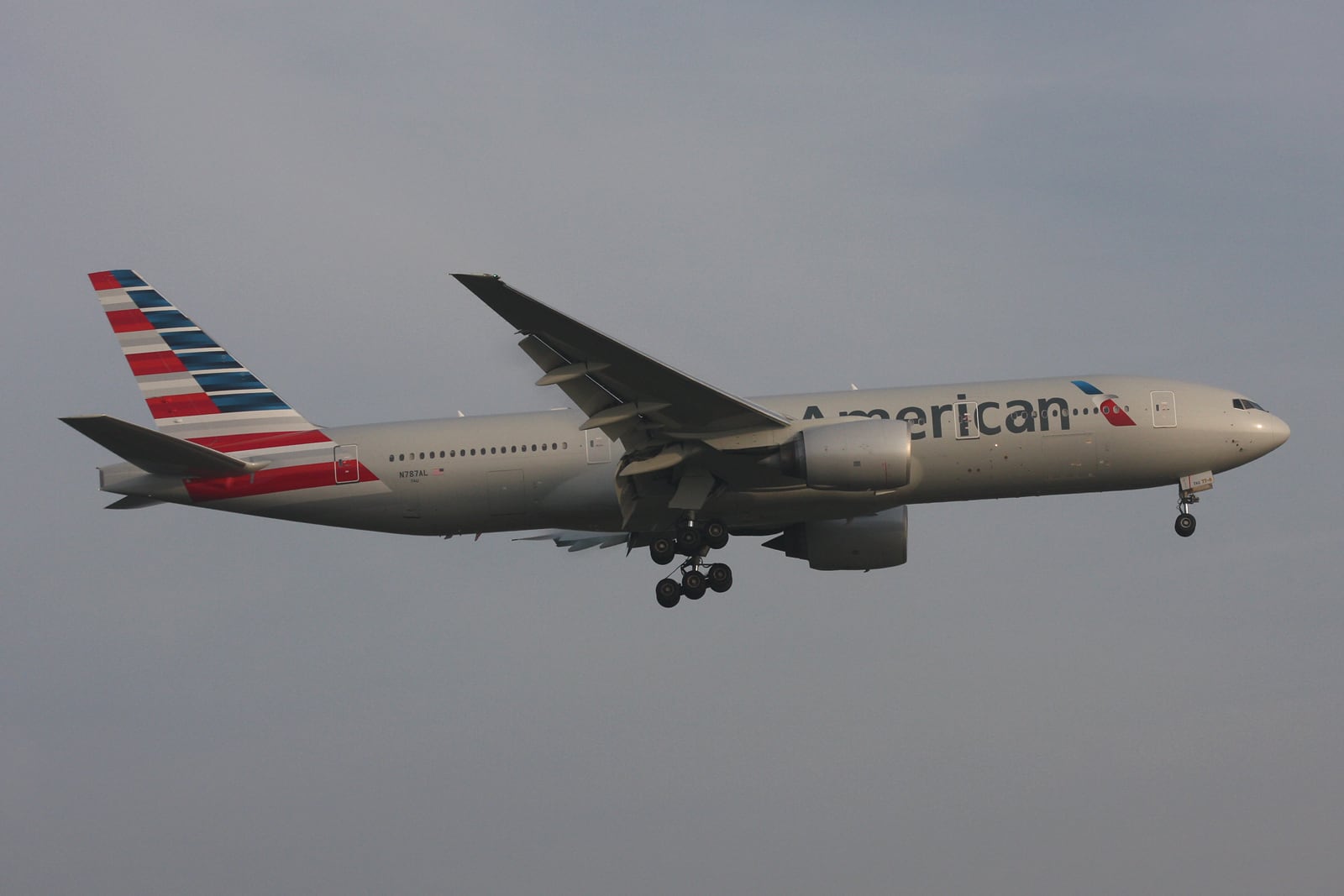
Then just yesterday, an American Airlines Boeing 777-300ER flying flight AA134 was also filmed landing in gusty winds by BigJetTV. Once again, the jet appeared stable for the final seconds of the approach before rolling abruptly just feet above the ground. The jet hit very hard on the upwind gear before porpoising a bit to where the main gear bounced and the nose gear touched the runway once again by itself briefly. The jet recovered fairly quickly and completed the landing rollout without further incident. The weather at the time at Heathrow wasn’t great with gusty winds and low level turbulence. The aircraft, N719AN, later flew back to Dallas/Fort Worth International Airport without incident.
What Happened?
In both cases, the Boeing 777s were landing in gusty crosswinds and it’s highly likely that wind shear played heavily into both incidents. While both landings were far from good, the recent American 777 landing appears to be worse because the aircraft momentarily touched down nose gear first. From the video, it appears that the pilot overcorrected for the gusty crosswind, then released the back pressure pushing the nose forward abruptly before correcting to salvage the landing.
Photo Credit: Kambui
Some may ask why the pilots in both incidents didn’t go around. While an early go around in such an incident is always preferred to landing an unstable aircraft, trying to go around after dissipating so much energy after such a firm touchdown might actually be worse due to the aircraft and the pilot initiating the post-touchdown sequence of thrust reverses, spoilers and brakes.
Still, there are many factors that we don’t know yet about each incident. Was there wake turbulence from a preceeding landing (unlikely in those conditions)? Did the sensitivity of the Boeing’s 777 fly by wire controls play a factor (probably not as thousands of 777 flights land safely every day)? And finally, in both cases, were the pilots rusty or inexperienced (possible)? The last one is always a possibility as its a well known fact that larger airliners have pilots who only get a few landings each quarter.
Regardless, we’re just glad everyone in both cases were safe. If you are a Boeing 777 pilot or have additional information, we’d love to hear your thoughts. Post them in the comments below or on our Facebook page.
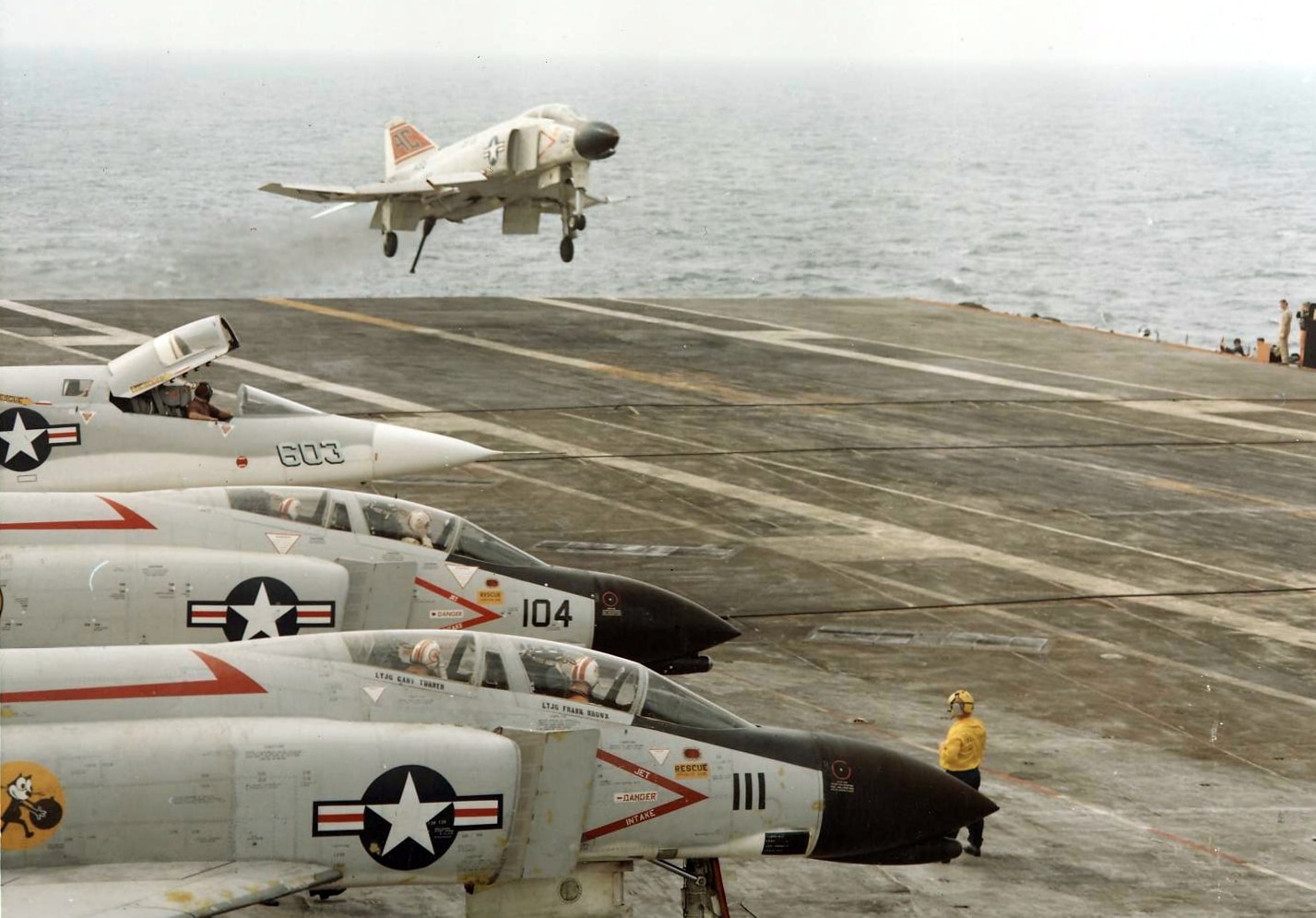
Watch This Timeless Color Film from the Saratoga! So many F-4s, F-8s and A-1H Skyraiders!
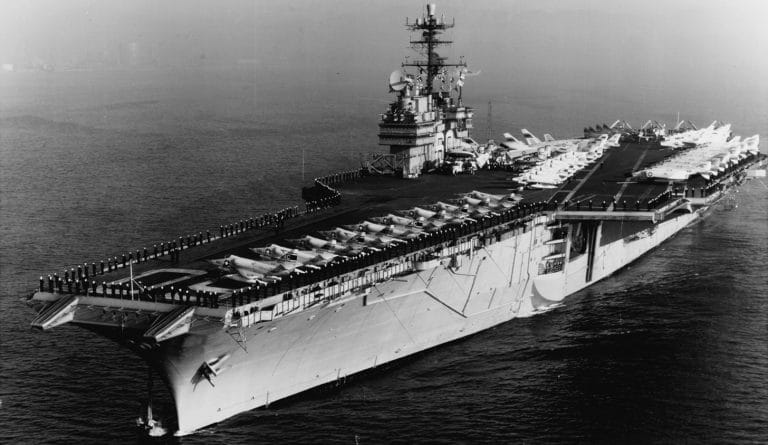
Some time ago, we wrote a piece about a British film by the name of “Operation Saratoga” which was shot aboard the aircraft carrier USS Saratoga (CVA-60) during her Mediterranean Sea (Med) cruise that took place between 28 November 1964, and 12 July 1965. Carrier Air Wing THREE (CVW-3) was embarked aboard Super Sara for this deployment.
This video features additional footage of the action filmed aboard CVA-60 during the same period. There is no sound, but the visuals are outstanding and consist almost entirely of CVW-3 flight ops. This footage was also uploaded to YouTube by British Pathé.
Official US Navy photograph
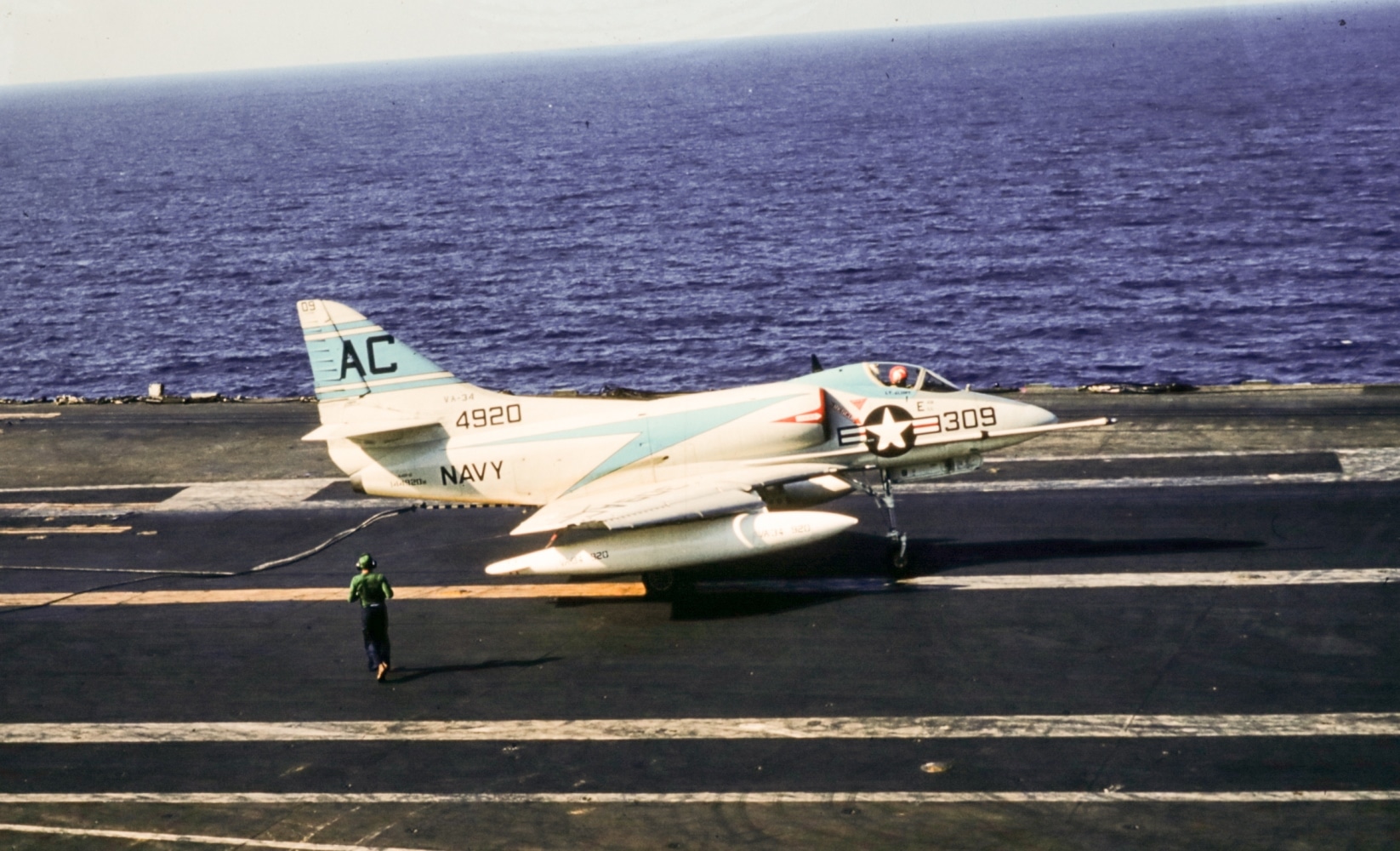
During the time the film was shot CVW-3 consisted of VF-31 Tomcatters flying the Phabulous McDonnell Douglas F-4B Phantom II, VF-32 Swordsmen flying the Vought F-8D Crusader, VA-34 Blue Blasters and VA-36 Roadrunners both flying the Douglas A-4C Skyhawk, VA-35 Black Panthers flying the Douglas A-1H Skyraider, RVAH-9 Hoot Owls flying the North American RA-5C Vigilante, Detachment 60 of VAW-12 Bats flying the Grumman E-1B Tracer, and Detachment 60 of HC-2 Fleet Angels flying the Kaman UH-2A Seasprite. After this cruise, VA-35 detached from CVW-3 and began its transition to the new Grumman A-6A Intruder all-weather attack bomber.
Over the last decade, SpaceX has earned their way to the top of the commercial aerospace industry through innovative engineering and taking risks. They used billions of NASA / taxpayer seed money to develop their workhorse Falcon 9 rocket, Dragon spacecrafts and the various support architecture that such systems required. Elon nearly went broke building SpaceX, before NASA stepped in to save them with big contracts.
In doing so they’ve produced a reusable system that brings the cost of spaceflight down dramatically, while also facilitating a more rapid cadence of flights. This allows more customers access to space as launch costs have dropped dramatically. With additional customers and the use of reusable technology their rockets fly often and are reused frequently, one booster has even been used 19 times already!
SpaceX Flew This Rocket a Record 19 Times Before It Sunk Today Due To Weather 34
Nature called ballgame on the most used booster today.
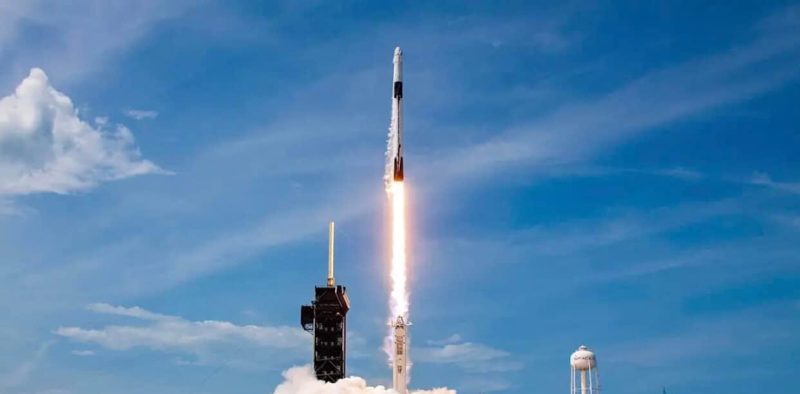
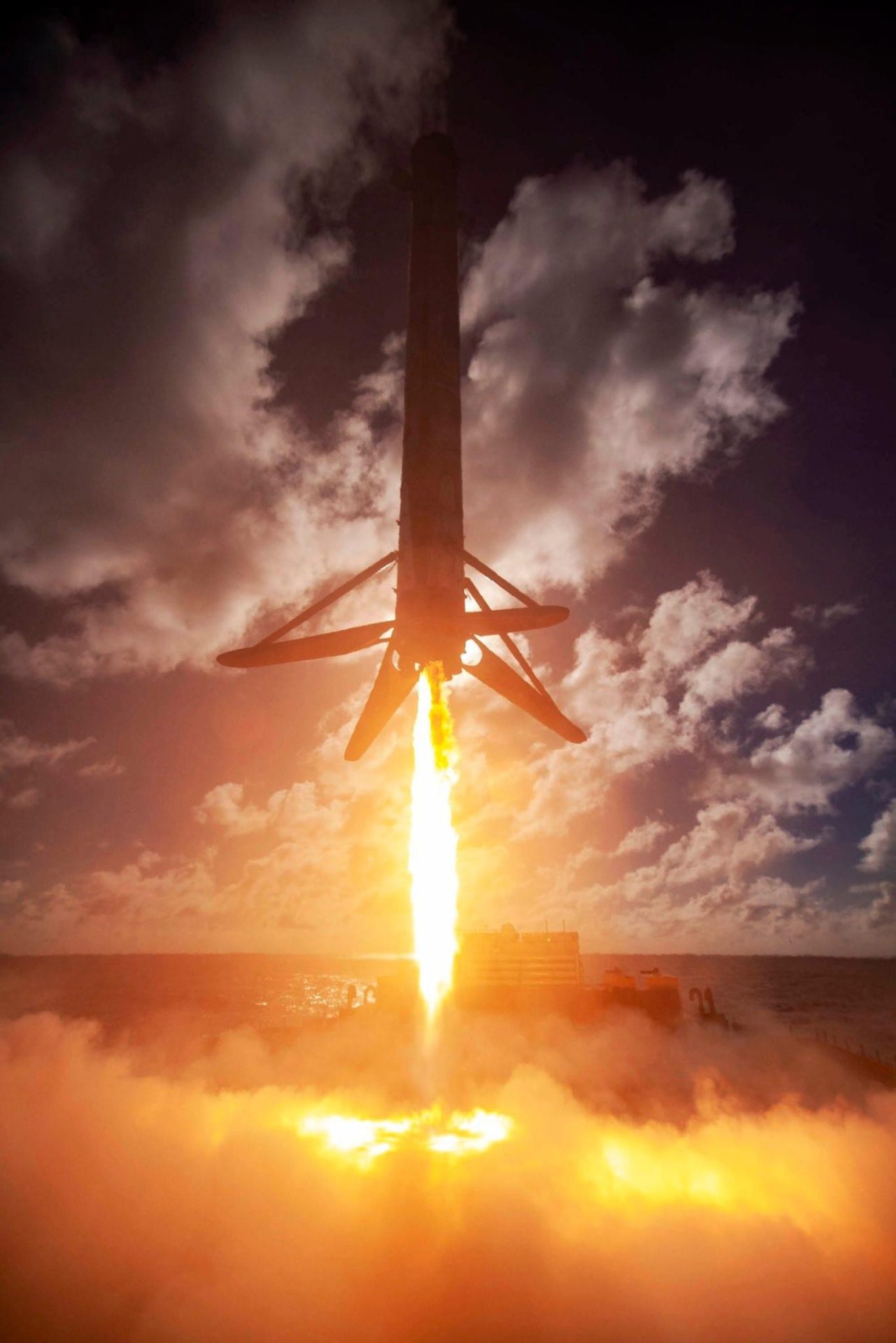
All good things must end, and that’s no different for their flight-leading 19 mission booster. The rocket just launched another batch of SpaceX Starlink satellites on Dec 23 from Cape Canaveral, before landing on a company “drone ship” off the coast of FL.
Typically, SpaceX secured the booster and sets sails with it for Port Canaveral, where it is retrieved and transported back to SpaceX for refurbishment before its next flight.
SpaceX Flew This Rocket a Record 19 Times Before It Sunk Today Due To Weather 35
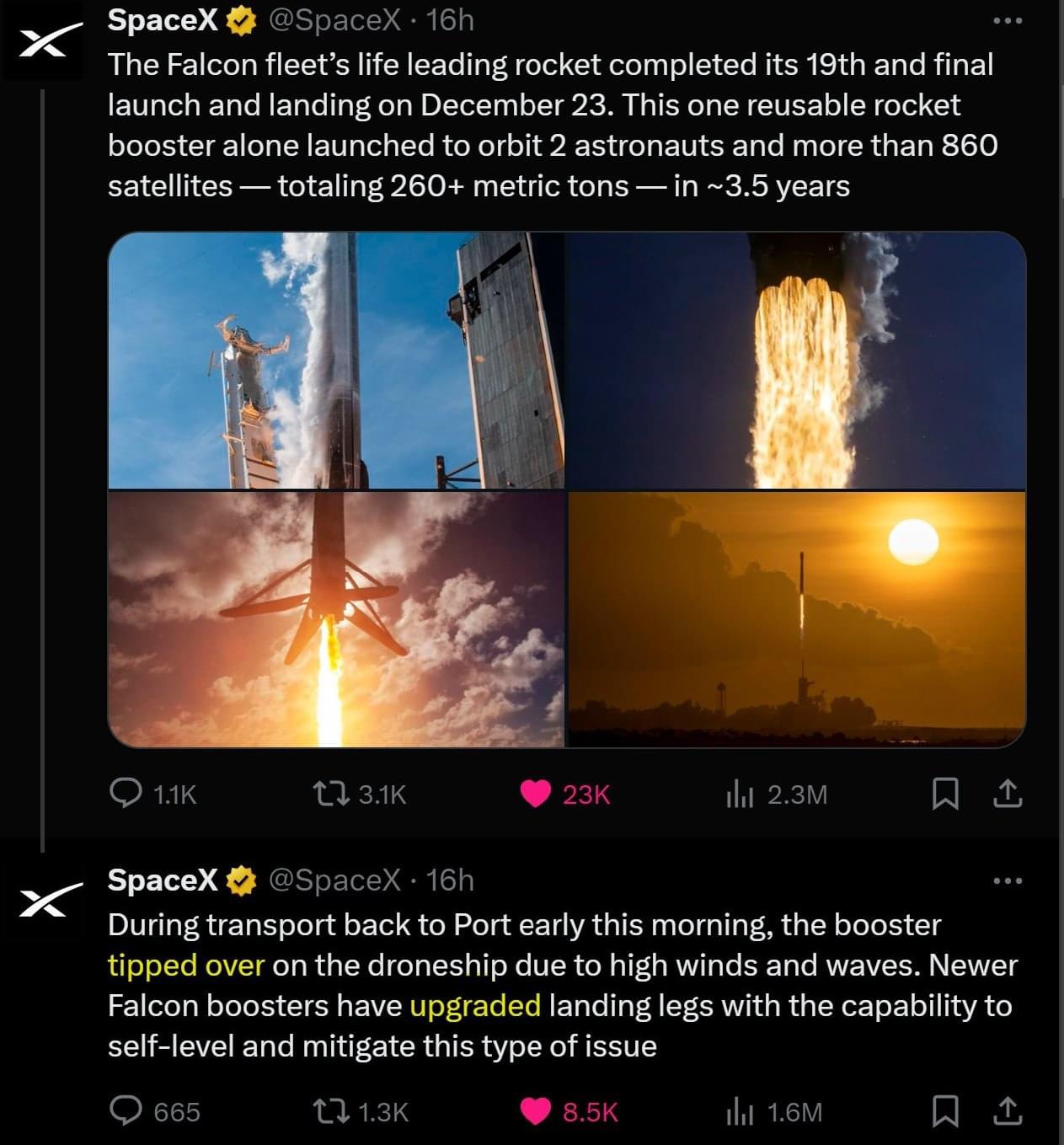
The landing zone experienced high winds and waves which played havoc on the drone pad today. The rockets are typically secured to the deck with a giant “grabber” after landing, but nature overpowered it today. After landing, empty booster tipped over and broke in half, with its top half sinking to the bottom of the Atlantic.
How many times can a rocket fly?
No one knows yet. A few years ago, SpaceX was aiming for 10 flights per booster before needing replacement. This booster that was destroyed today flew successfully 19 times. Had it not been for the wind and waves, who knows how many more missions it could have flown.
Falcon 9 B1058 🫡🇺🇸🚀🪱
A portion of the record-setting Falcon 9 booster remains on board the Just Read the Instructions droneship. After its 19th launch and landing, the vehicle tipped over in rough seas during the transit back to Port Canaveral, and its top portion broke off.… pic.twitter.com/TaYhgmHL9R
Aerial images of the drone ship and rocket returning to Port today appear to show that one of the rocket’s landing legs caved in, causing the booster to tip over.
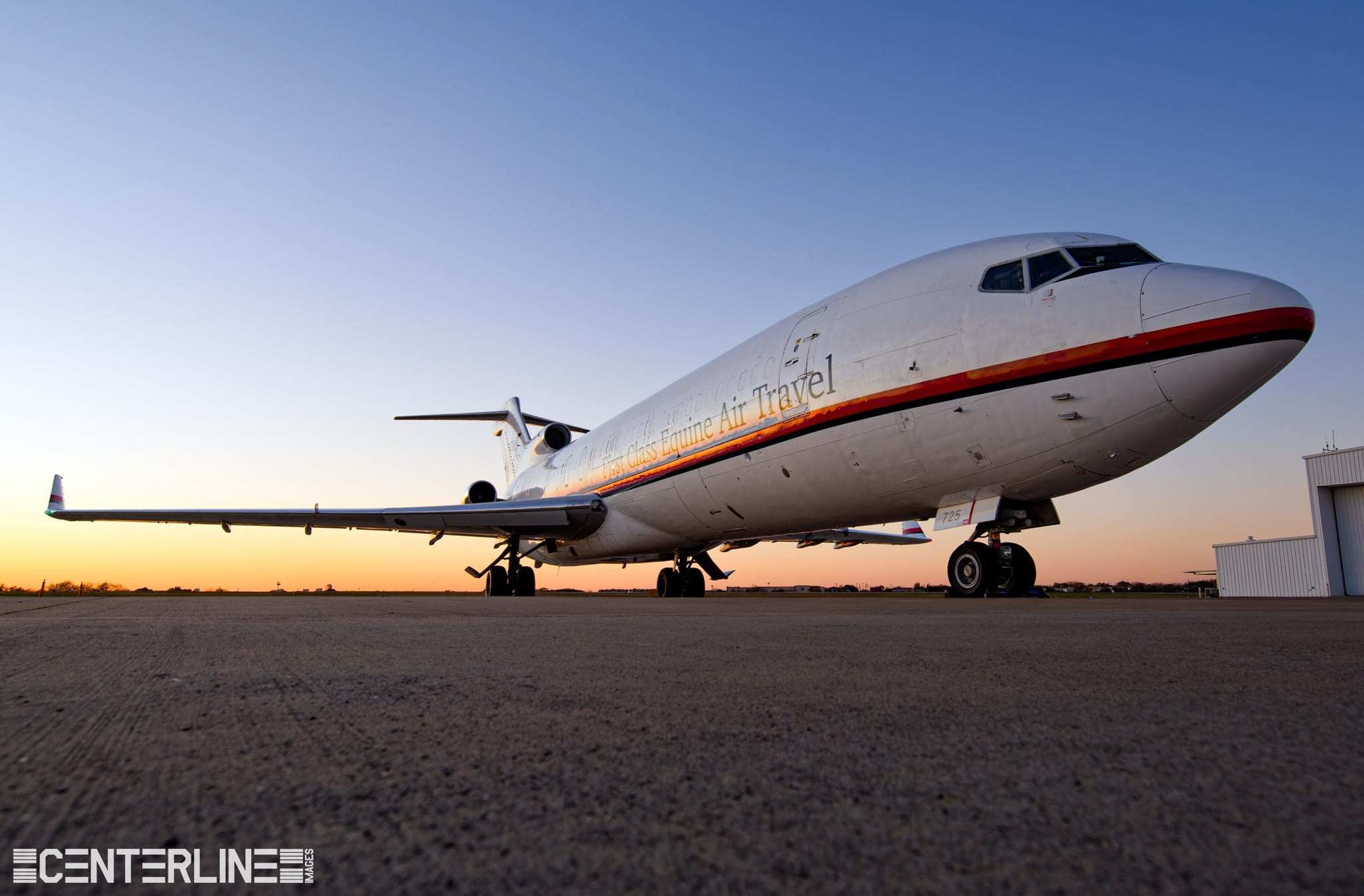
Kalitta Charters II has announced they will retire their last 2 operational Boeing 727-200(f)s in 2024. Planes N726CK (MSN 21951) and N729CK (MSN 22982) are currently still flying out of the company’s base in Detroit, MI.
They retired their DC-9 fleet in 2019, and are following suit now with the 727 to transition operations to an all-737 fleet of freighters.
“The B727 has proven to be a workhorse in the cargo industry and remains unmatched in its self-stainability in the field,” said the company in a statement.
The company owned 9 of the 727s, dating back to the year 2000. The 7 no longer flying are parked in Oscada, MI. The last 2 still flying are both over 40 years old.
Kalitta Charters II Will Retire Their Last 727s in 2024 38
The iconic plane with its T-shaped tail and trio of rear-mounted engines first rolled off the assembly line in 1962. Its history is a storied one, flying for airlines and spending their elder years as cargo freighters.
How many 727s still operate in the U.S. and overseas?
A number of other companies actually still operate a handful of 727s in the United States and across North America. Some are flown for cargo. Others are used for VIP and private charters, and others are used for parabolic research flights, such as those conducted by Zero-G. Their 727 has a slick paint job, and is named “G-Force One”.
On a more global scale, the website aviationish has concluded that 23 of the 727s are still flying, out of the over 1,800 that Boeing produced from 1962 – 1984.
Kalitta Charters II Will Retire Their Last 727s in 2024 39
Signs of the times
The last 727 passenger flight landed in 2019, signaling the slow beginning of the end of the plane. And it is highly unlikely that any airline or operator will ever restart passenger or even charter service on a 727, as there are now more modern, safer, more comfortable, cost-effective and efficient options to choose from.
The 727 will live on though in our heart and the slight hearing loss by who have experienced its rumble on departure.
It’s hard to imagine a world without the movie Top Gun. AvGeeks watch it at least once a year despite the 80s corniness, because the flying scenes are as cool now as they were 30+ years ago. Top talent was hired to ensure a successful production, but the star of the movie needed convincing from the Blue Angels to finally decide to become Maverick.
In another fantastic interview by Ryan Notthaft at Blue Angel Phantoms on YouTube, the Blue Angel pilot who flew Tom Cruise, Curt “Griz” Watson, talks about his experience.
A thin script with no story, yet
Reading the script alone Cruise was not amused. He was a serious actor still making a name for himself, and there was a lot of apprehension about how the public would receive an aviation movie. Because the truth is no aviation movie was ever truly a big time blockbuster before Top Gun.
But the producers knew they had a winner. They considered Top Gun like “Star Wars on Earth”, inspired by a story years earlier in California Magazine. But Cruise didn’t initially share their vision, and neither did many production companies before Paramount. They had no real characters or story, just cool flying jets.
How the Blue Angels Convinced Tom Cruise to do Top Gun 43
“When I first read it I thought they had a very thin story and script,” recalled Cruise in a old Behind the Scenes feature on the making of the movie, which you can watch here. “I thought yea, I don’t know about this.”
Help us Admiral
In a last desperate attempt to convince Cruise to join, producer Jerry Bruckheimer put in a call to Navy Admiral Peter Garrow, requesting the Navy fly Cruise to convince him to do the movie. Garrow, naturally, called the Blues with the orders.
How the Blue Angels Convinced Tom Cruise to do Top Gun 44
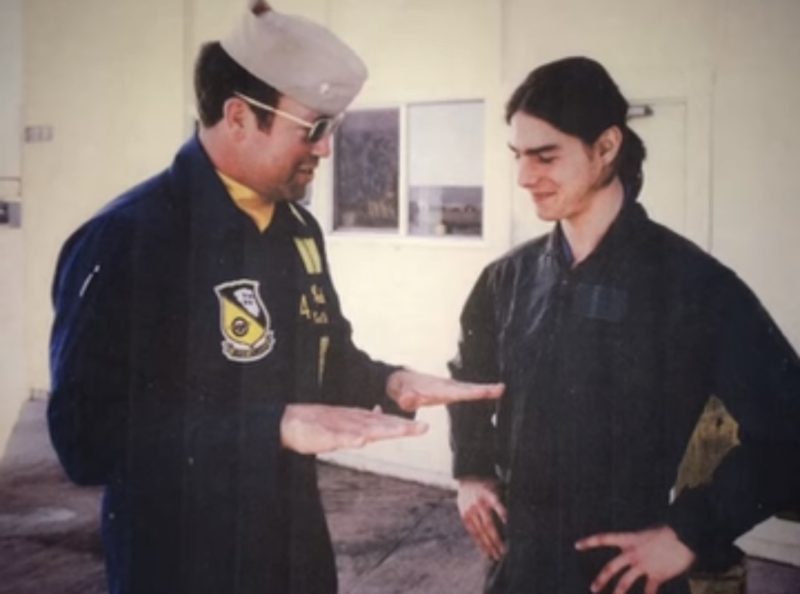
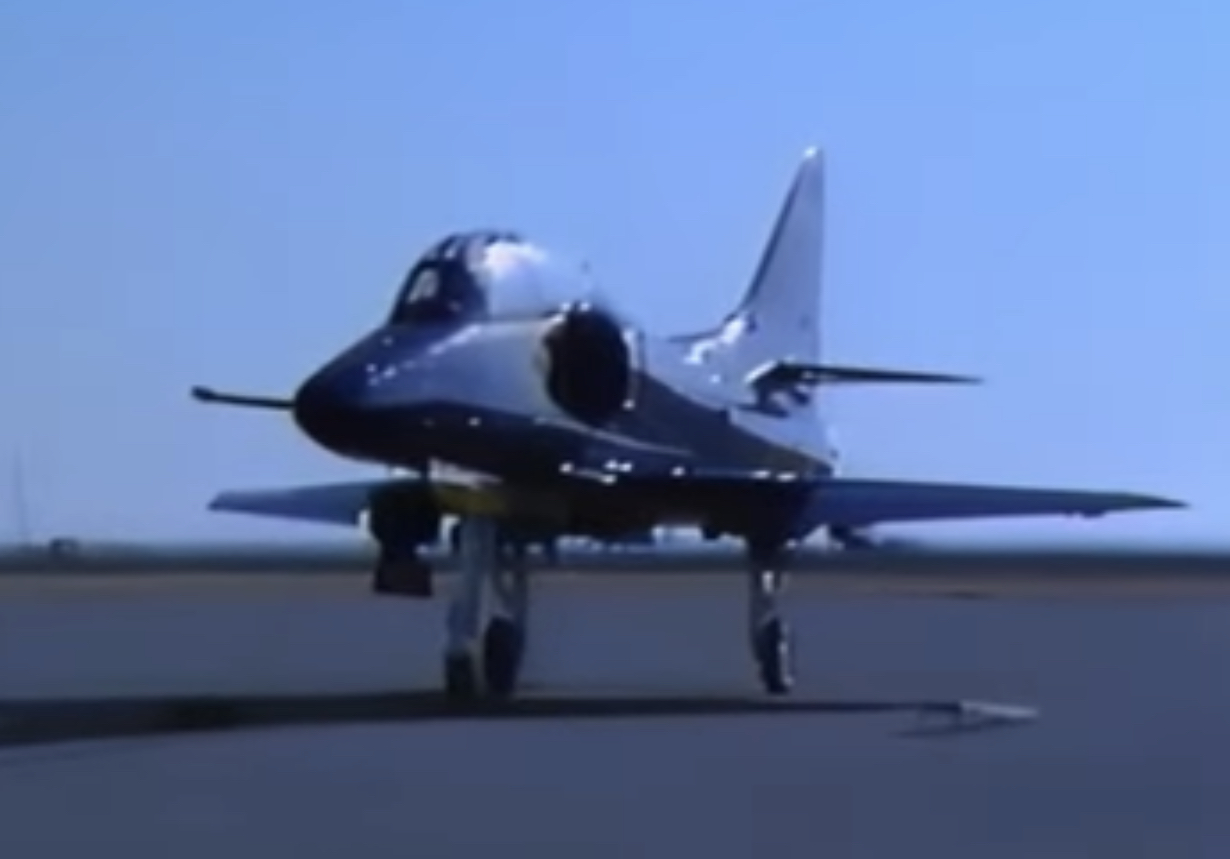
Grizz rung out Cruise pretty good in the team’s #7 jet, an A-4 Skyhawk. With a bag full of vomit Cruise was hooked, and his love affair with aviation began. Upon landing he walked to the closest payphone, called Bruckheimer and said “I’ll do it”.
But he wasn’t satisfied with just the Blue Angels A-4 ride. After all, Mav is an F-14 Tomcat pilot. So Cruise requested flight time in the F-14 as part of his character development. Which made perfect sense. Cruise even put it in his contract. The producers and Navy happily accommodated.
His first F-14 flight kicked his butt good too. His pilot, call sign Bozo, put him through the wringer. You can watch the interview above about some of that flying, or better yet, watch this video where both Cruise and Bozo talk about it.
He loved flying the F-14 so much, that he even told his pilots “let’s get these scenes shot and then go rip it up. I’m gonna rate you on who is the best pilot.” Each pilot wanted to know how his other pilots did, and would then compete to see who could kick Tom’s butt in the sky the hardest.
How the Blue Angels Convinced Tom Cruise to do Top Gun 45
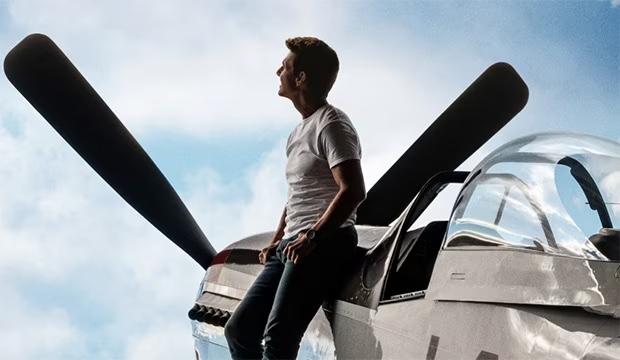
Cruise has been in love with flying ever since. He’s now an accomplished pilot himself, rated for numerous airframes. He even owns a WWII P-51 Mustang fighter.
WestJet’s Annual Christmas Miracle Celebrates Airport Workers, This Year We Do Too As We Thank Commercial Aviation Workers
Every year, Westjet releases their annual Christmas Miracle video where they surprise passengers with exquisite gifts they requested or meetups with long lost friends. This year, they decided to celebrate the many airport workers.
It’s a great video. Probably not as touching as years past. It feels a bit like they mailed it in this year, to be honest. Maybe inflation is affecting them too. Still, the video is worth a watch.
That got us thinking…We Should Be Thankful
For those in the transportation industry, there really never is a holiday. People expect that travel is available to any place and at any time. It’s a great service for our society that flying from New York to LA is sometimes easier than a trip to the mall around a holiday. However, that means the people in and near the airport have to work this holiday season. Here’s our special holiday toast to them. (If we left you off the list, send us a message and we’ll be sure to add your role!)
1.) Pilots: Let’s start with the obvious. Pilots safely fly you to your destination. While there are many perks to being a pilot (great pay, days off, travel), getting holidays off often isn’t one of them. When you board the plane, be sure to look to your left and say thanks for their skill and dedication.
2.) Flight Attendants: Much like pilots, they work most often when you want to go on vacation. Flight attendants serve you drinks and snacks but also keep you safe in the skies. They are the front line customer service in the skies. They deal with so much and experience the best and the worst of the flying public for hours at a time. They deserve a hearty thanks for their unyielding professionalism while being away from who they love this holiday season.
3.) Customer Service Agents: Imagine being away from your family and friends this holiday season knowing that your job is to be the front line of defense when something goes wrong. Their entire job is to help people to get to where they need to go. Sometimes it’s easy, other times, they are standing in the gap for bad weather, or a crew or maintenance issue. Be nice and thank them this holiday season as you check in or ask a question at the gate.
This Holiday Season, We Celebrate Airport Workers 51
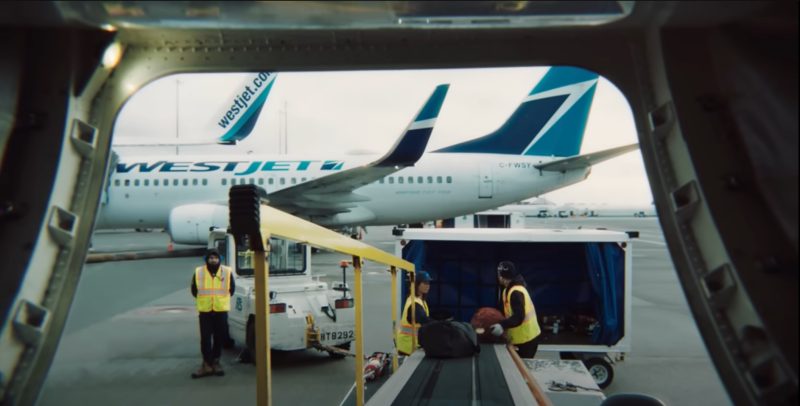
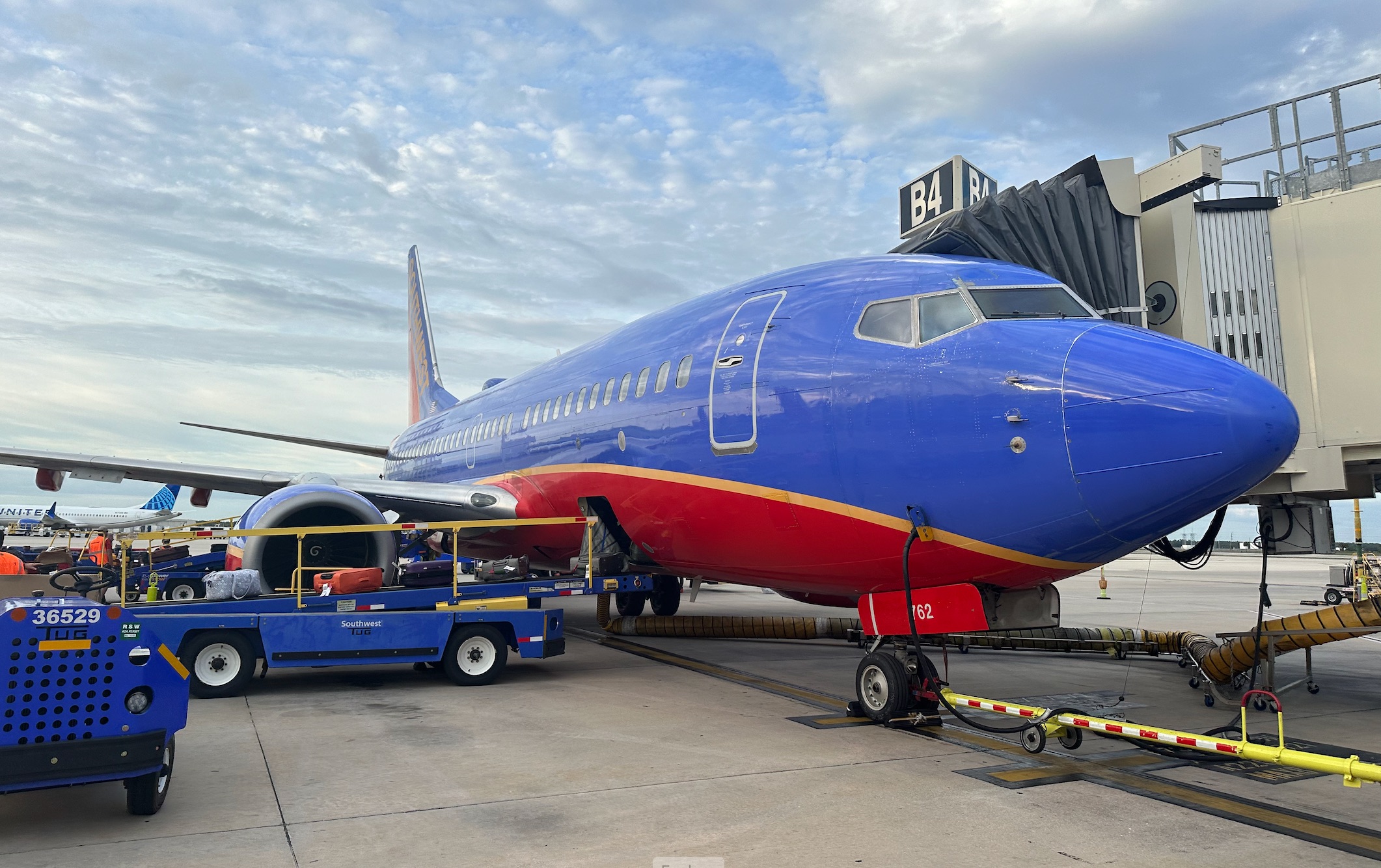
4.) Baggage Handlers and below the wing staff: Although you rarely interact with them, they are the ones who prepare each flight for pushback. From the time the plane arrives, they are pulling up the baggage loaders and hopping in the cargo bays to offload and load your bags. It doesn’t matter if it’s 5 degrees or 105 degrees outside, they show up. Each load is carefully balanced to keep you safe in the air. Then they expertly connect the tow bar and prepare your jet for pushback. While it might be difficult to say thanks, a wave out the window will suffice to let them know you are grateful.
5.) Aircraft Fuelers: Much like the baggage handlers, their job is largely transparent to passengers. Yet those mighty fine jets don’t fly without ‘go-juice’. In minutes, they fill the jet to precise levels, ensuring you arrive safely with enough fuel but not too much.
This Holiday Season, We Celebrate Airport Workers 52
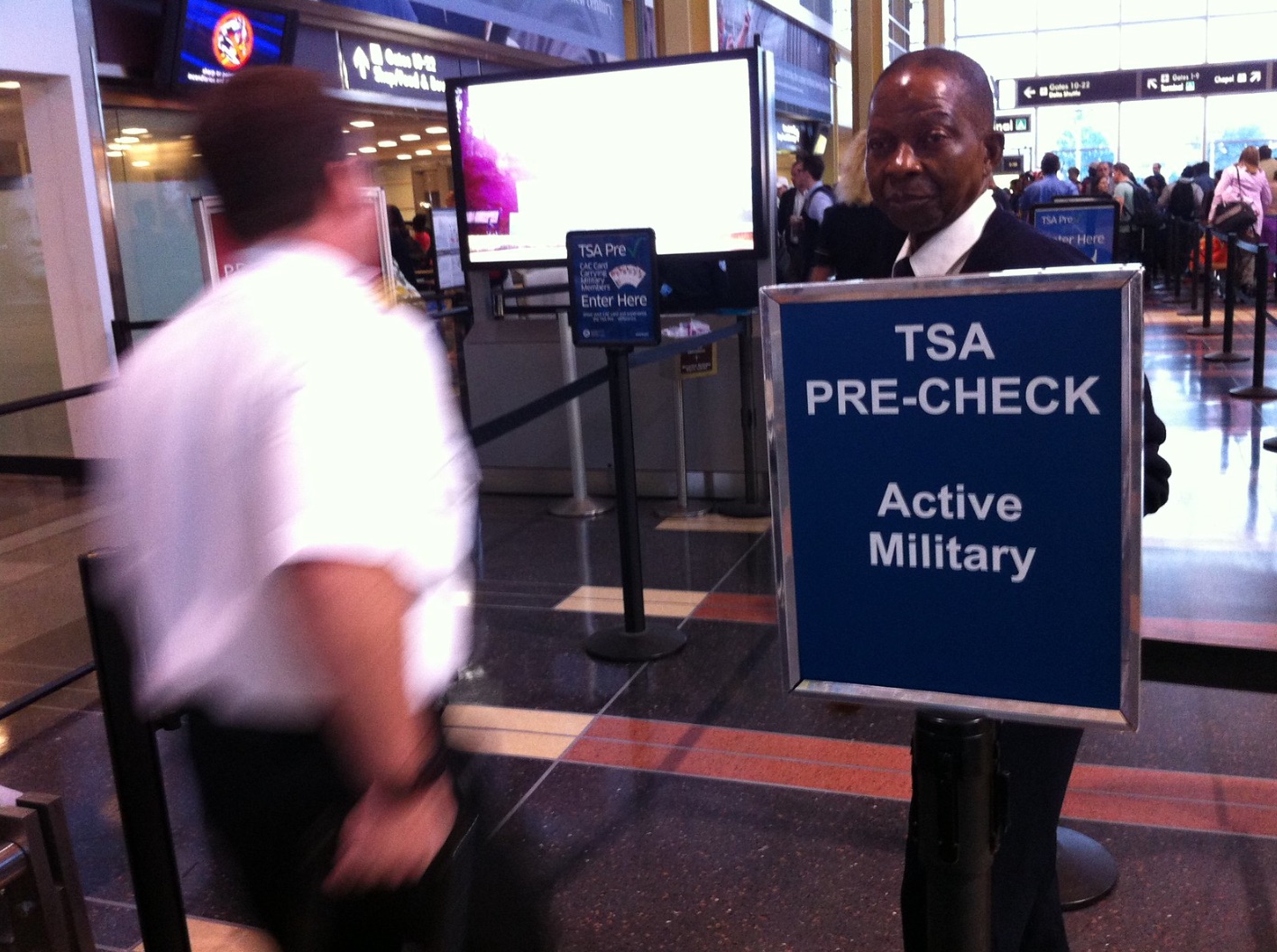
6.) TSA: Sure they catch a lot of flack when people bring 3.5 oz of fluid through the security checkpoint. They are just enforcing the policies from above. TSA is perennially understaffed and quite honestly, under-appreciated. Sure there is a rare grump on a power trip but the vast, vast majority of agents are people who work under challenging conditions to keep us safe on our journeys. Take a moment to appreciate them and say thanks for being there this holiday season.
7.) Maintenance Professionals: Aircraft are complex mechanical machines. Day in and day out, they keep us safe by keeping the fluids topped off and stepping in to fix any part in the aircraft that breaks. You rarely see them, but they are one of the main reasons behind each and every passenger arriving safely to grandmas.
8.) Airport and Airplane Custodians: Humans make a mess. When you go to an airport bathroom or throw out trash in the terminal or grind a pretzel into the airplane’s carpet, someone is cleaning up after you and making it sparkle. You barely notice them most of the time, but you definitely notice if they aren’t around. This Christmas, take a moment to say thanks to the men and women who do the dirty work to make your holiday shine.
This Holiday Season, We Celebrate Airport Workers 53
9.) Air Traffic Controllers: They work 24/7 to keep your plane going where they need to go. They are understaffed and overworked. You might not see them as they chatter on the radio. But without them, you’re grounded.
Still more to keep us flying…
10.) Police Officers and security: When passengers create a disruption, they are there. When bad guys try to disrupt the greatest mode of transportation even devised, they are there. Police officers sign a blank check up to and including their life to keep us safe. Give thanks this holiday season for their dedication and being there for you.
11.) Airport retail and restaurant workers: When you are hungry on Christmas or need a $5 water bottle, they are there for you. They get up earlier than you and stay long after you depart to keep passengers well fed. Give thanks and a little extra tip this Christmas for them.
This Holiday Season, We Celebrate Airport Workers 54
12.) Parking, Hotel Shuttle, Taxi, and Uber Drivers: These hard workers drive you to and from the airport. You probably don’t interact much with them but they are there, keeping you safe on the journey.
This Holiday Season, We Celebrate Airport Workers 55
13.) Aircraft provisioning and kitchen workers: These men and women ensure that your flight is stocked with drinks, snacks, and lobster for the rich folks. They take time away from their families so your belly is full for the journey.
14.) Airport Staff and Managers: It takes people to operate an airport. The city airport managers and staff ensure the operation keeps running. They are the busiest during high travel season. The lost and found doesn’t run without staff. The runways don’t stay plowed during a snowstorm without their efforts. Recognize their hard work and say thank you too!
15.) Skycaps: Are you running late? They sit out in the cold in front of the terminal so that you can speed through checkin. They run on tips but the money doesn’t make up for the fact that they too are missing Christmas so that you can get to yours!
Did we miss anyone? Let us know in the comments and we’ll be sure to add them! Merry Christmas to all from your staff at Avgeekery.
Back when I fell victim to one of the oldest tricks in the books!
During my T-38 flight training one of my instructors was a former A-10 fighter pilot that had flown the Warthog with my uncle up in Eielson AFB, Alaska. He was a big, bald-headed captain with the last name of Maddox, so his call sign was Mad Dog Maddox.
Mad Dog was my instructor during the acrobatic phase early in my T-38 training. This was during the hot summer of 1988. On our first flight together, after I completed about 45 minutes of high-G maneuvers over the western Oklahoma plains, Mad Dog asked if I brought a water bottle. I said no, I had forgotten mine that day.
T-38 IP: "Did You Bring Your Water Bottle?" 57
It was for ‘hydration’ in flight
We had been issued a large, white plastic flask that could be slipped into the leg pocket of our flightsuit down by our calf. Mad Dog said, “Well, you need to stay hydrated so don’t forget it next time.” On our second ride together the same conversation took place. “Did you bring your water bottle?” “No, I forgot it again.” I said.
We completed our hour and a half training flight before walking back into the squadron to debrief.
Finally, on our third flight together I remembered to tuck the full water bottle into my leg pocket, down by my right calf. Mad Dog and I enjoyed an afternoon of loops, Cuban 8s, cloverleafs, and he showed me the 8-point roll that the Thunderbirds use during air shows. That roll consisted of quick jerky side motions of the control stick to point the wings at eight points around a 360 degree circle, abruptly stopping at each point so my head was slamming back and forth inside the cockpit. After our maneuvers were complete Mad Dog asked, “Did you bring your water bottle?” “Yes I did!” Mad Dog said, “Okay, I have the aircraft. You can grab a drink.”
I finally remembered my water bottle
The T-38 cockpit had two small rear view mirrors mounted inside the cockpit so that the pilot could check for aircraft approaching behind it. Those same mirrors allowed Mad Dog in the back seat to see what I was doing in the front seat. As I raised the water flask to my lips Mad Dog abruptly pushed forward on the stick creating a lot of negative G forces and spraying water all over my face. He let out a huge laugh, “I’ve been waiting all week to do that to you!”
He wasn’t concerned about my hydration after all. We had a good laugh and returned to the base for the debrief session. As I was unzipping my G-suit to stow it in the hallway locker, my training mate Jeff Hoyt was donning his G-suit for his next training ride with Mad Dog. They sauntered down the hallway towards the awaiting blue bus and I heard Mad Dog ask Jeff, “Did you bring your water bottle?”
Qatar Airways is under fire after allegedly firing crew members involved in a video shot by popular YouTube aviation vlogger and airline critic Josh Cahill.
Cahill, a Czech-Australian based in Colombo, Sri Lanka, filmed the video at the center of the controversy in August 2023. Cahill was traveling between Colombo’s Bandaranaike International Airport (CMB) and Hamad International Airport (DOH) in Doha, Qatar. DOH is the primary hub for Qatar’s flag carrier, Qatar Airways.
The video, which Cahill titled “The Shocking Decline of Qatar Airways,” was published on YouTube on 26 August 2023 and has since been viewed over 620,000 times on YouTube. You can watch both the original video and Cahill’s subsequent response on the fallout below.
The Flight from Cahill’s Perspective
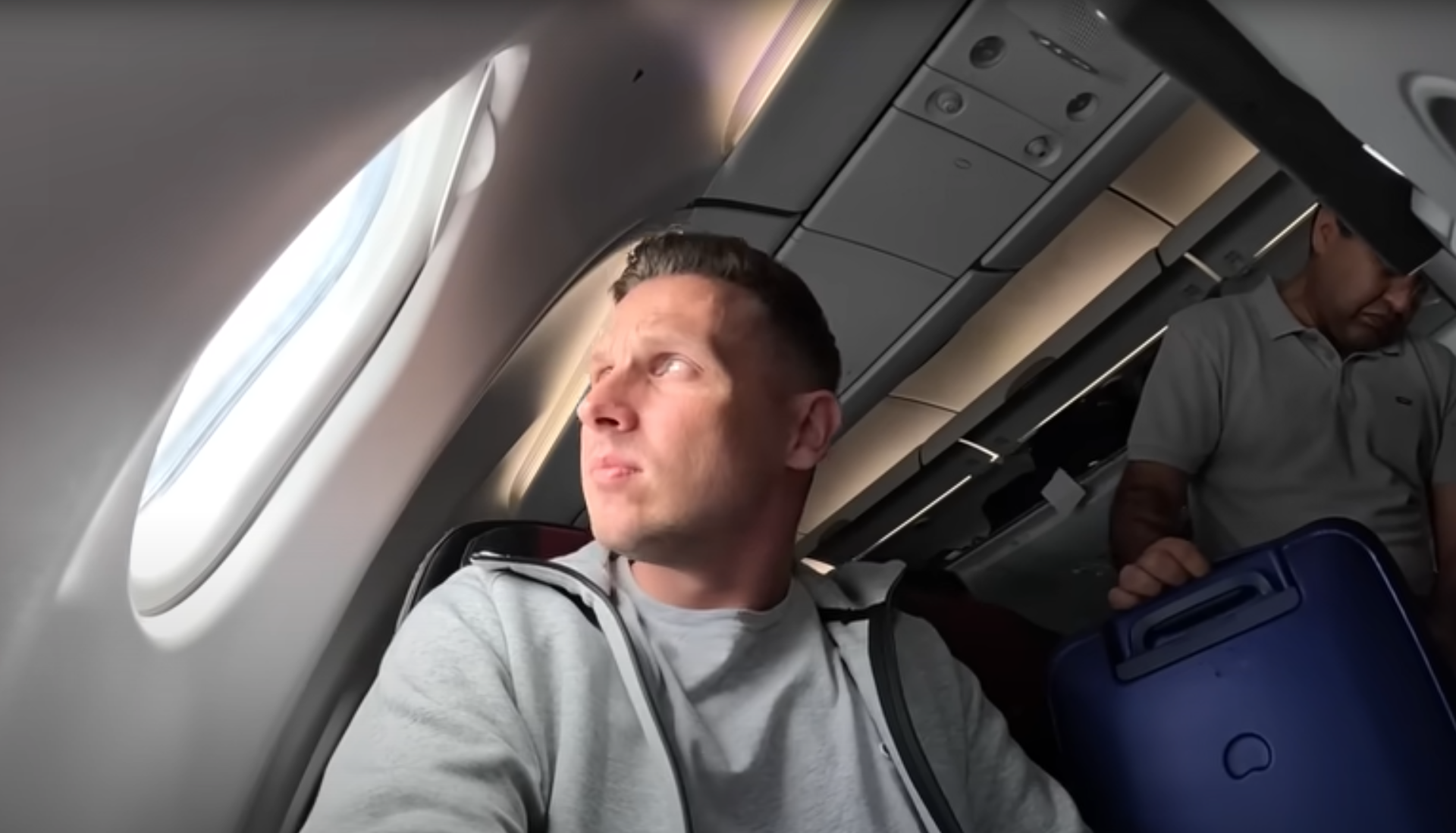
YouTuber and aviation critic Josh Cahill on board a Qatar Airways Airbus A330-300 | IMAGE: YouTube
Cahill began his critique by expressing dissatisfaction with Qatar’s fleet management, highlighting the use of 15 outdated Airbus A330s – including the one on which he was flying. Reflecting on a prior meeting with former Qatar CEO Akbar Al Baker, who emphasized an expectation of a “world-class performance” from the crew, Cahill experienced a stark contrast upon boarding. He encountered a lackluster reception from the crew, including flight attendants with their backs to passengers during boarding, a departure from Qatar’s typically warm and friendly service.
Cahill’s critique worsened as he discovered that the in-flight entertainment (IFE) box encroached on the legroom at his window seat (and every window seat). He also noted outdated and underwhelming IFE screens. Additionally, the in-flight lunch service was marred by running out of specific menu options, raising questions about Qatar’s catering standards or potential cost-cutting measures.
It was now time for Cahill’s infamous “loo review,” a standard part of each one of his videos. This particular loo review exposed shocking hygiene issues, with urine covering the lavatory floor. Requests for cleanliness were allegedly ignored by the crew, leaving passengers dismayed.
While the second segment of his journey – Doha to London Heathrow (LHR) – fared better than the CMB-DOH leg, the 5.8-year-old Boeing 777 still had issues, particularly with lavatory cleanliness.
Summing up the two flights, Cahill said he was disappointed.
“The first flight was definitely below average and nowhere near international standards,” Cahill said in the video. “In fact, everything was a letdown. It was quite shocking to see such a poor performance from the airline. So was the second flight. While it wasn’t as bad as the first one, you can see a clear pattern of quality decline. Whether it comes through crew, hygiene, or food choices, something isn’t quite right. And it’s definitely not the Qatar Airways that I used to know.”
He questioned whether internal strife at Qatar could be affecting the airline’s overall performance. Despite Qatar’s self-promotion as an industry leader, Cahill asserted that the airline would not even make a top ten global airline in its current state.
Corporate Response and Fallout
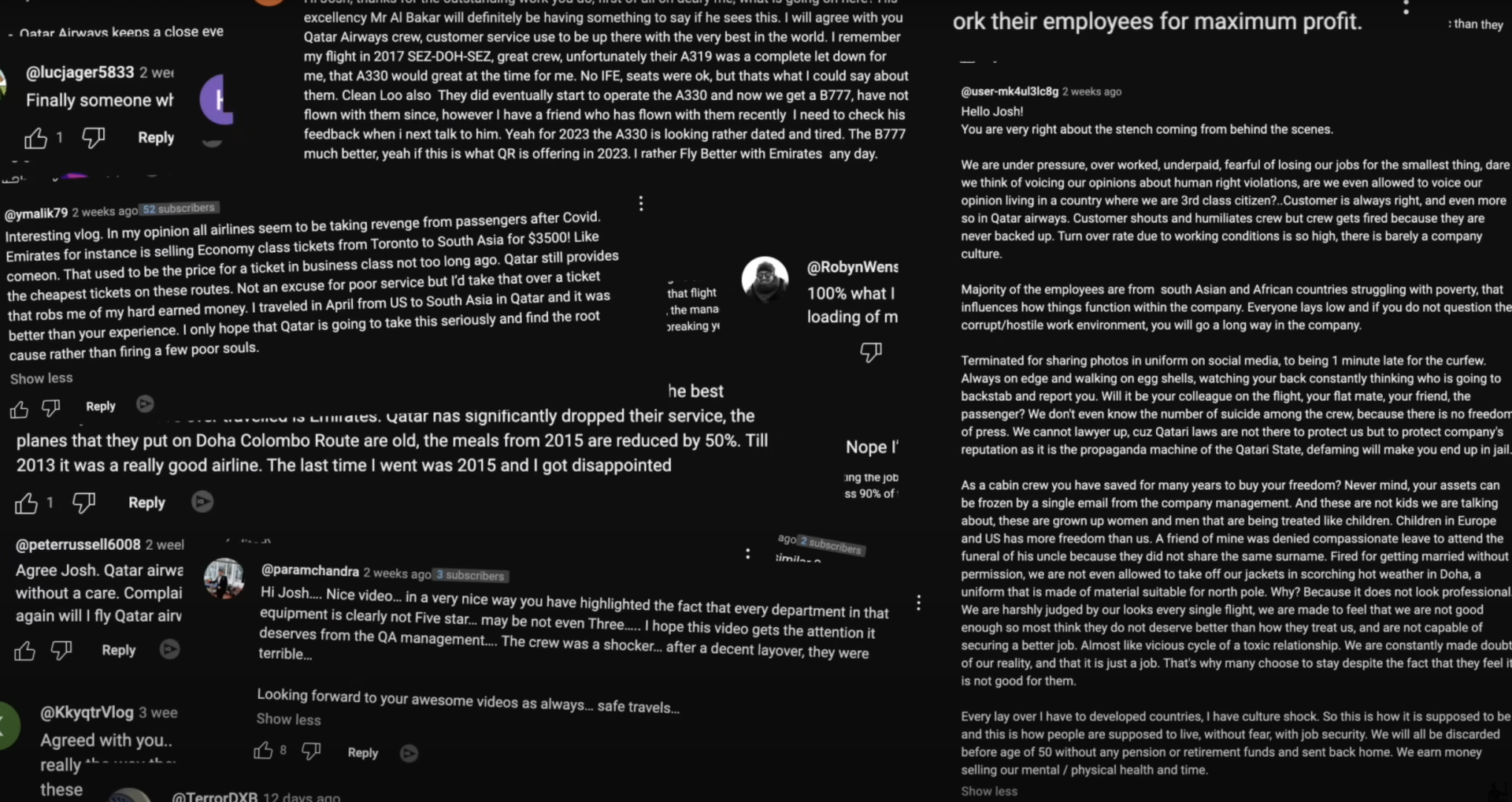
Comments of support received on Josh Cahill’s video review of Qatar Airways | IMAGE: YouTube
In a follow-up video, Cahill revealed widespread agreement from other frequent flyers and even Qatar Airways crew members. This uprising prompted a call from Qatar’s PR/marketing department, leading to a revealing communication with the corporate communication team.
Rather than expressing remorse and apologizing for Cahill’s experience, the Qatar team allegedly requested an off-the-record discussion. Cahill, uneasy about the request, recorded the conversation. The team expressed displeasure with the video, citing a disinterest in negative publicity. They offered Cahill a free flight in exchange for removing the critical content, which he deemed a bribe.
When Cahill refused, the team brought up negative comments from cabin crew under his video on YouTube, highlighting issues such as bad working conditions, curfews, minimum rest, and delays in pay. Qatar allegedly asked him to remove those comments. Again, Cahill stood his ground and refused. He offered Qatar officials a chance to explain their side of the story with a new video, but they did not accept the offer.
That would be the last Cahill heard from Qatar for one week. That’s when the fallout intensified even further.
Banning, Suppression, and Qatar’s Shocking Response
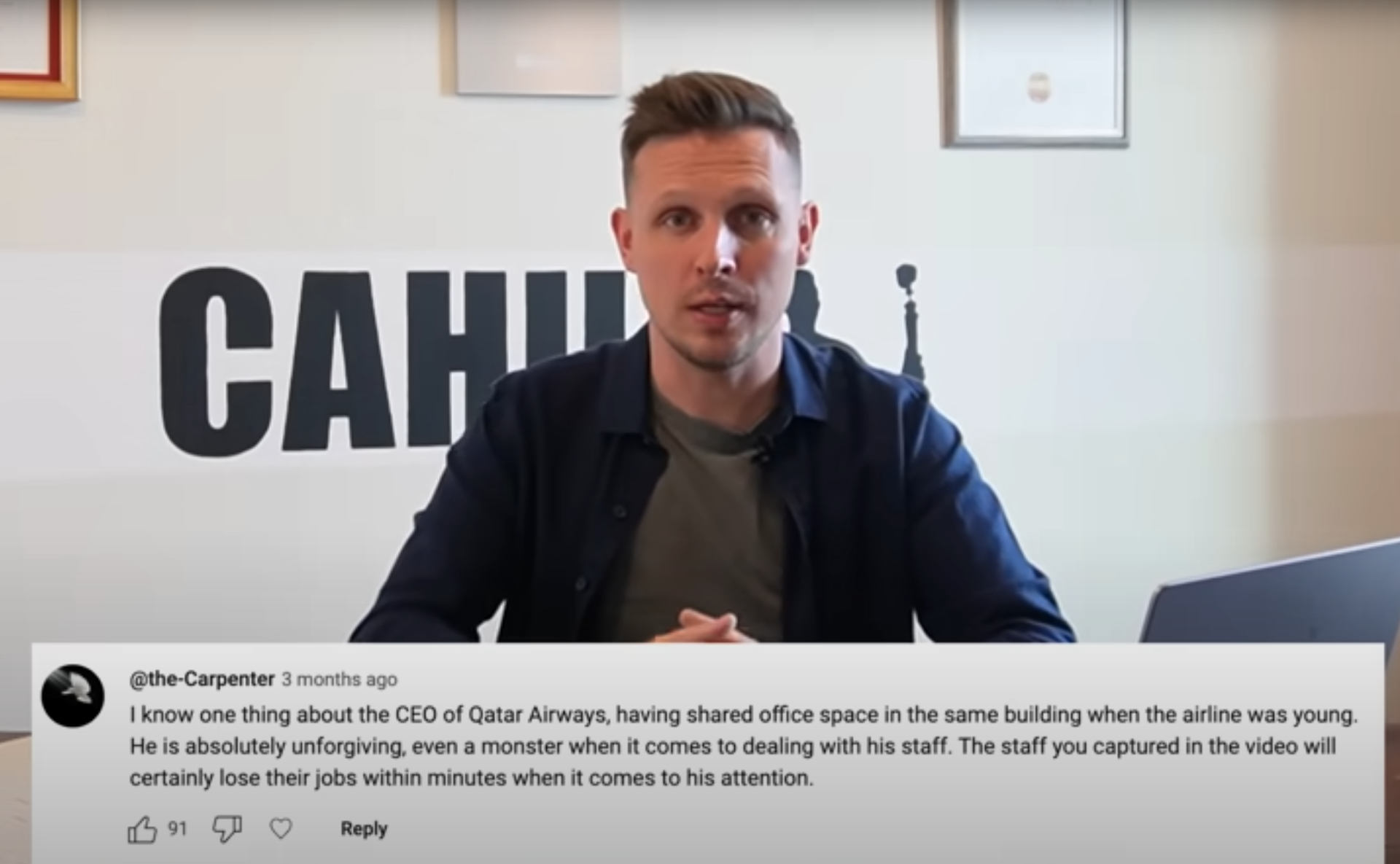
A screenshot from Josh Cahill’s video response to Qatar Airways’ response to a negative flight review | IMAGE: YouTube
The following week, Cahill was preparing to check in for another Qatar review flight – this time, to review their new Boeing 737 MAX service from Abu Dhabi International Airport (AUH) to Doha. However, on the day of his scheduled departure, he received an email from Qatar Airways saying the airline had canceled his reservation. The email went on to say that Cahill would also no longer be able to fly with Qatar, citing that he hadn’t obtained permission from the flight crew to record, a claim Cahill refuted.
In desperate attempts to remove the video, Qatar had the crew from the flight email Cahill, denying consent to appear on film. They also filed a complaint with YouTube, requesting the video’s removal. YouTube denied Qatar’s request but did ask that Cahill blur the images of the flight crew, to which he agreed.
Despite these efforts, the video remains online, banned only in Qatar.
The story culminates with a final – and very controversial – act of retaliation by Qatar Airways. Unable to scrub negative press about their company off the internet, the company has allegedly fired the flight crew who worked the flight involved in Cahill’s video.
Qatar Airways Needs to Do the Right Thing
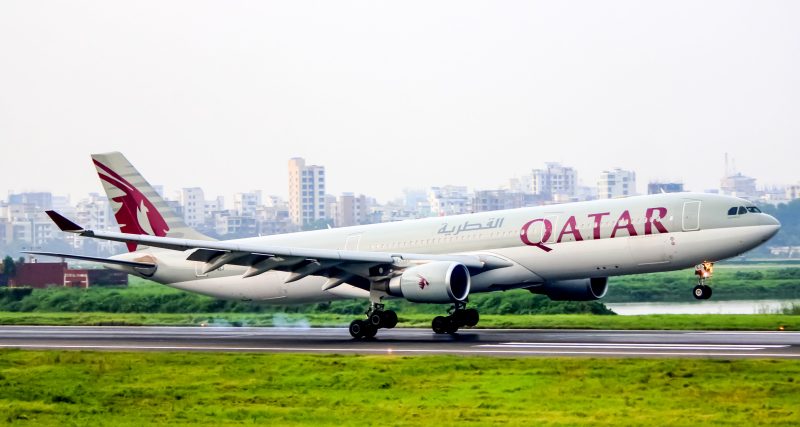
A Qatar Airways Boeing 777-300 departs Adelaide Airport on 15 January 2023 | IMAGE: Mitch Coad via Wikimedia Commons
As is the case for any business, this incident serves as a cautionary tale for airlines navigating the delicate balance between reputation management and customer satisfaction. This is especially true in regions of the world where perfect public image is even more important than truth.
We can argue all day about whether Josh Cahill posts fair and balanced airline reviews for the world to see. Admittedly, I am an avid viewer of Cahill’s videos. In my opinion, his reviews are candid, but fair, albeit a bit dramatic at times. However, I absolutely believe he is doing a good thing for the flying public. Any business – regardless of where in the world they operate – should be fair game for critique. And companies ought to welcome it. After all, how else can they address issues, improve, and grow?
Further, Cahill’s experience with Qatar Airways sheds light on potential issues within the airline. It also raises broader questions about airlines’ transparency, accountability, and responsiveness to honest customer feedback in the digital age.
The aftermath of this incident suggests that the company’s response has almost certainly exacerbated any damage to Qatar Airways’ reputation. Let’s hope that the leadership, including the new CEO Badr Mohammed Al Meer, will take the appropriate steps, such as #UnbanJoshCahill, and – more importantly – extend reconciliation to the dismissed crewmembers by reinstating their positions. This approach would demonstrate a commitment to accountability and contribute to rebuilding Qatar Airways’ trust and credibility in the eyes of the flying public.
Have you seen the videos? If not, watch the original video and Cahill’s update video below. What do you think? Do you think Qatar Airways reacted inappropriately? Or do you think Cahill should have taken the video down? Let us know in the comments.
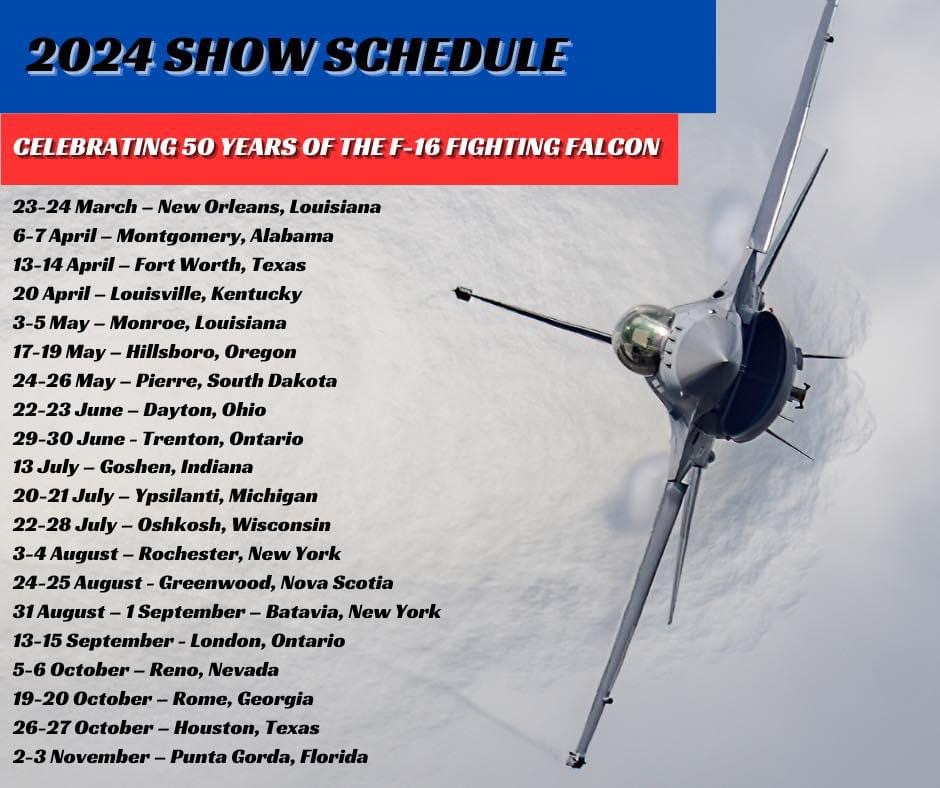
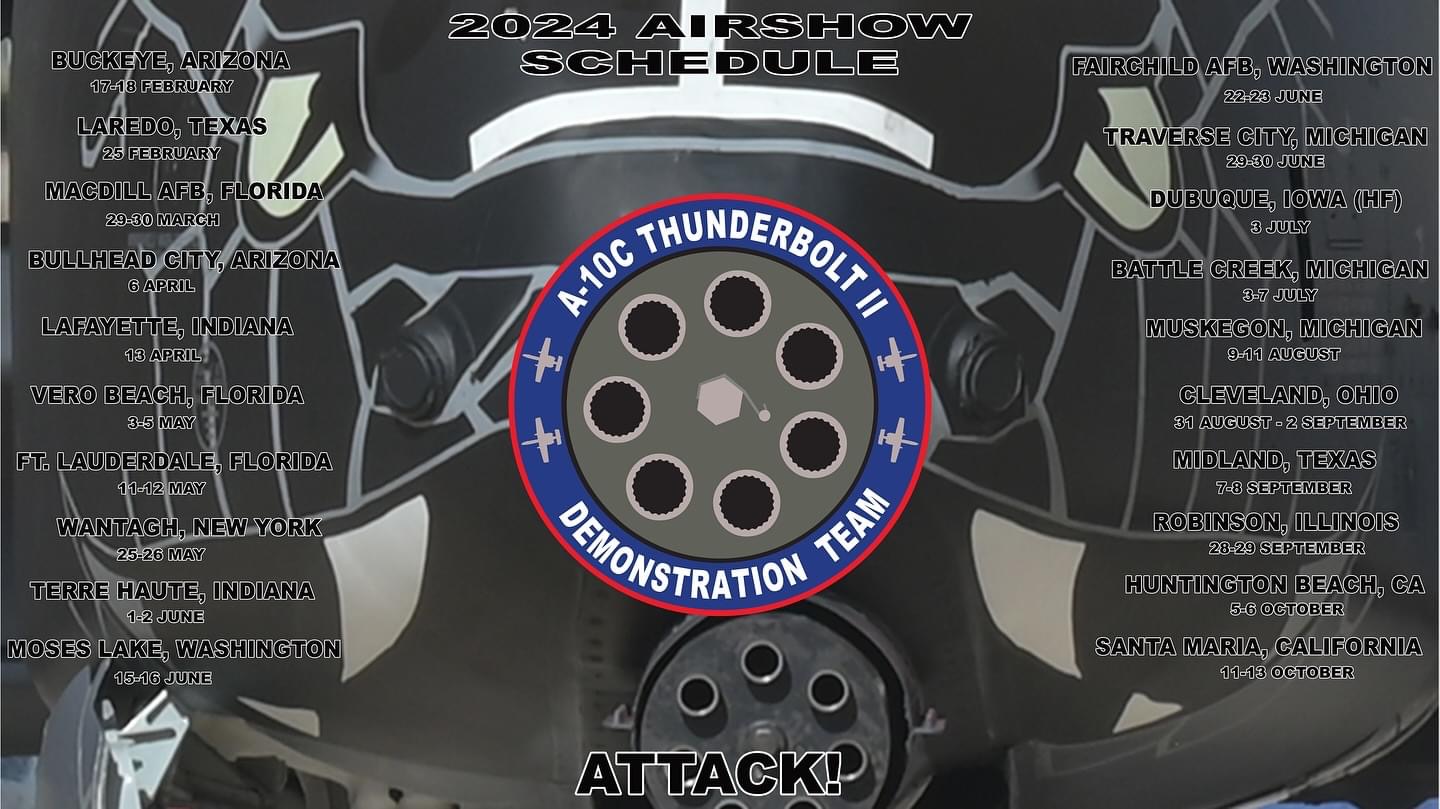
Blue Angels, Thunderbirds and other demo teams announce 2024 Schedule
By far one of the biggest impacts the U.S. military has on positive public engagement and support is by participating in air shows. Hundreds of shows occur annually nationwide, from small rural shows and fly-ins to big-city skyscrapers and waterfronts with 1 million spectators. Those who fly such shows, particularly the military participants, travel week after week doing so for up to 9 months a year.
Right now everyone is settling in for the Christmas holiday and new year, following the recent ICAS convention in Las Vegas (International Council of Air Shows). That’s where the wheeling and dealing is done for the next year, schedules etc.
Are The Blue Angels or Thunderbirds Coming To Your Town Next Year? 73
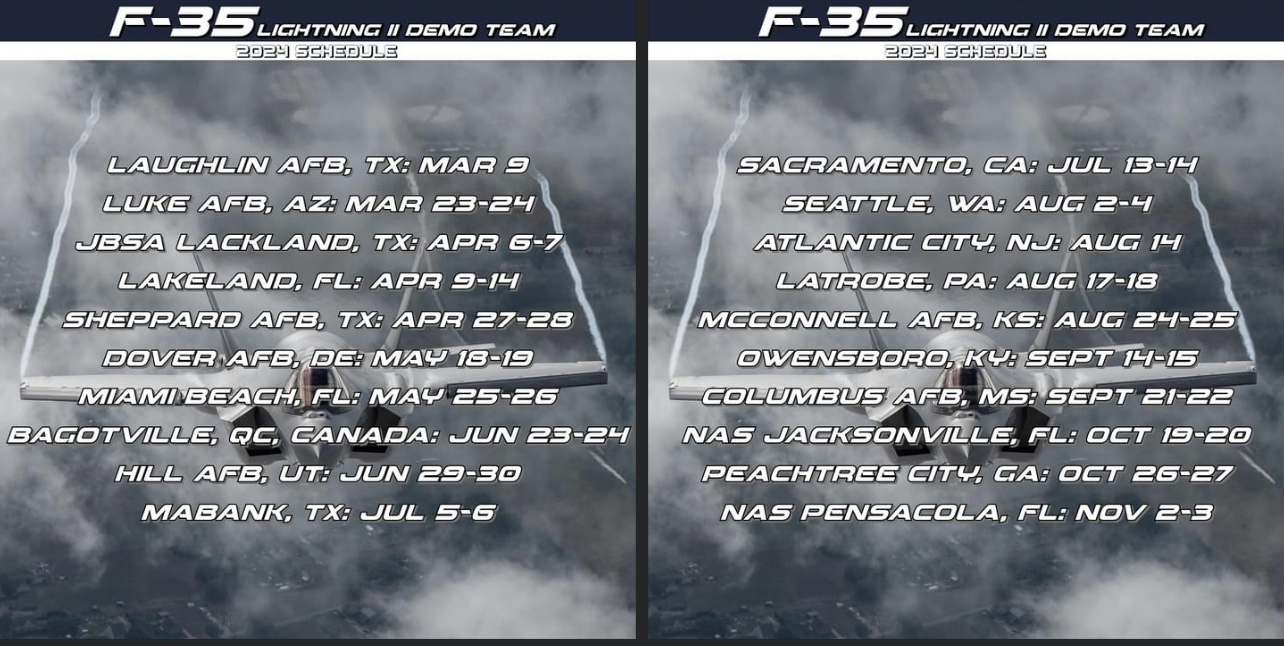
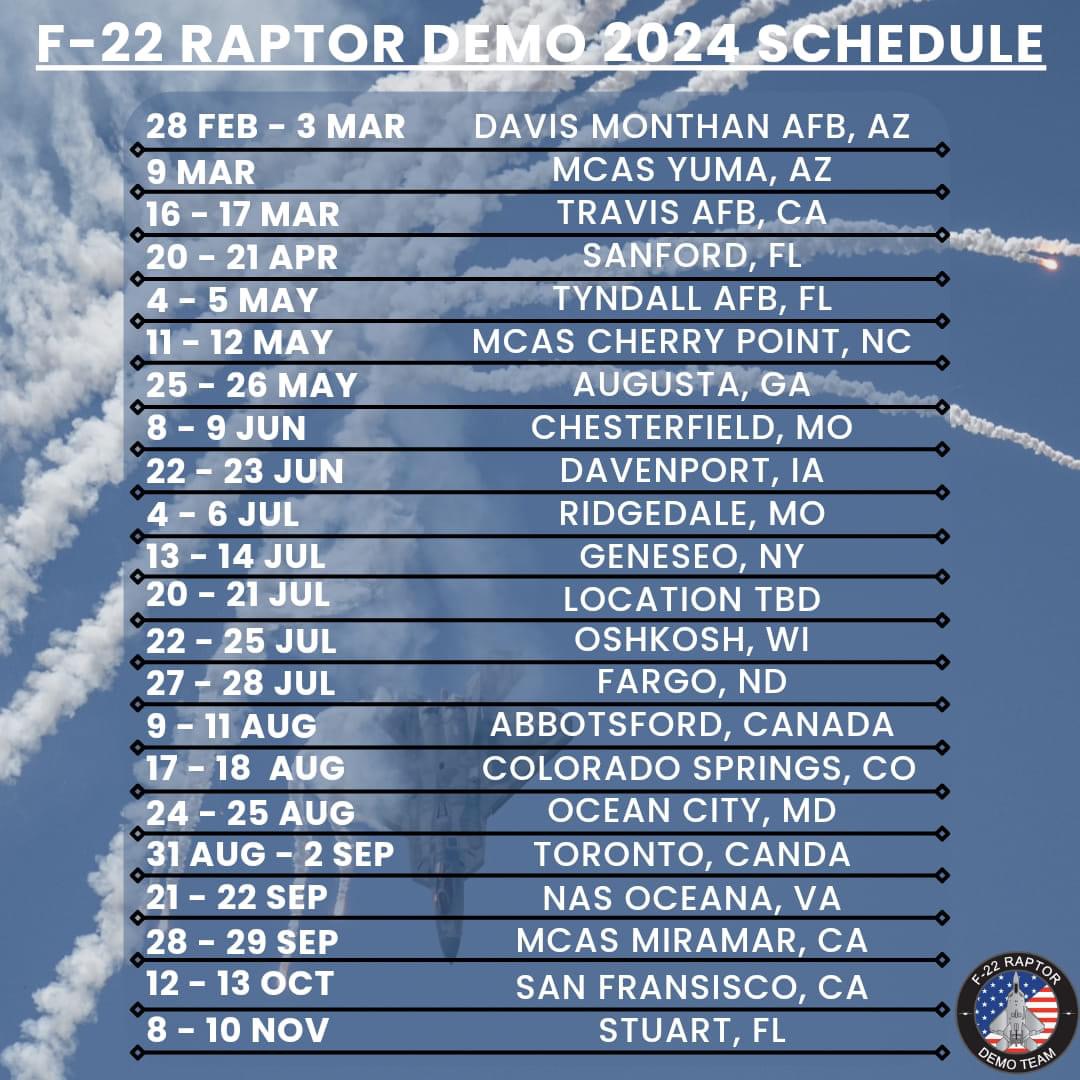
With 2023 now winding down, the various military jet demonstration teams have announced their air show schedules for 2024. They are outlined below:
Let’s start with the big 2, the Navy Blue Angels & USAF Thunderbirds
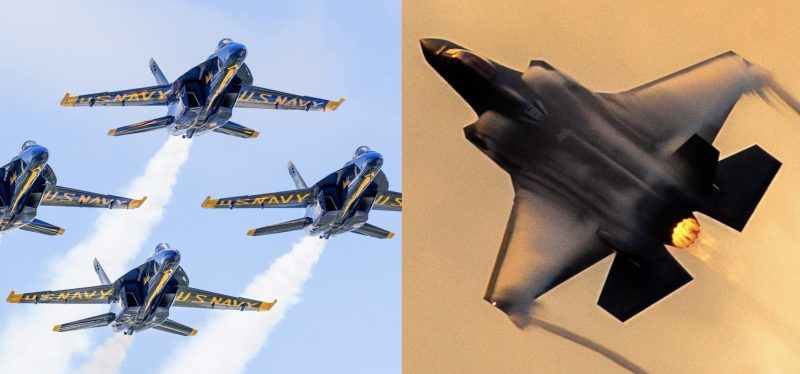
The Air Force Thunderbirds and Navy Blue Angels fly the “Super Delta” formation. (U.S. Navy/Cody Hendrix)Are The Blue Angels or Thunderbirds Coming To Your Town Next Year? 74
Both the Navy’s Blue Angels and U.S. Air Force Thunderbirds have a full year of flying air shows scheduled for 2024. Some changes are likely over the coming months, but overall these are the appearances that can be expected.
USAF F-35A Demo Team
Are The Blue Angels or Thunderbirds Coming To Your Town Next Year? 75
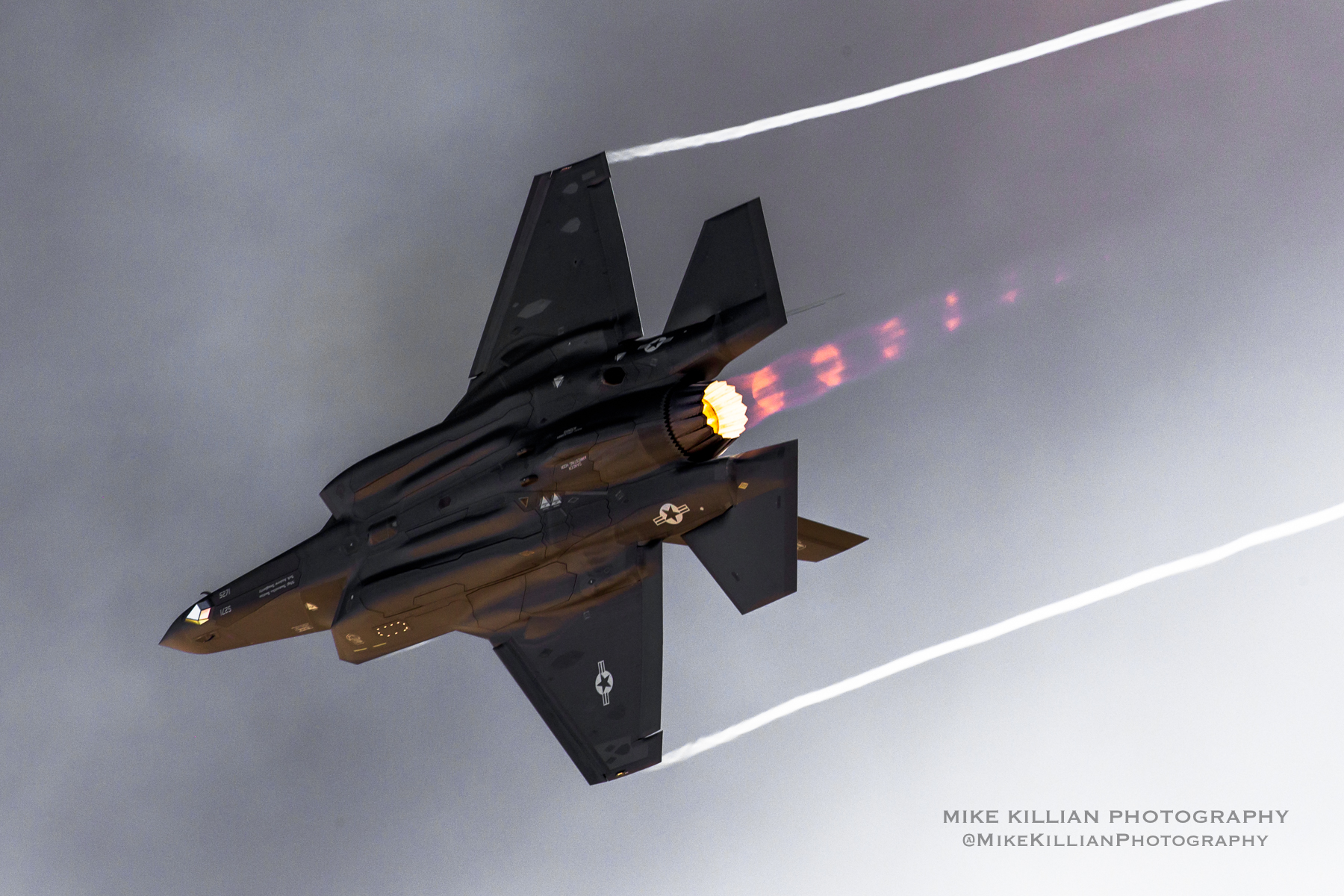
The USAF F-35A Lightning II will again be thundering across air shows nationwide next year. And with a new, still to-be-announced demo pilot / commander. The team is from the 388th Fighter Wing at Hill Air Force Base, Utah, responsible for showing off the Air Force’s most advanced 5th generation multi-role stealth fighter. They also honor the history of the Air Force through heritage formation flights with older fighters (such as WWII P-51 Mustangs).
USAF F-22 Raptor Demo Team
Are The Blue Angels or Thunderbirds Coming To Your Town Next Year? 76
The 14-member F-22 Raptor Demo team comes from the USAF 1st Fighter Wing, based at Joint Base Langley-Eustis, Virginia. Led by Commander and demo pilot Capt. Samuel “RazZ” Larson in his second year as the demo pilot, showcasing the Raptor to millions of spectators nationwide. Unlike the F-35, the F-22 is not an allied fighter. It belongs to America and America alone, making it uniquely capable compared to any other fighter in existence.
USAF F-16 Viper Demo Team
Are The Blue Angels or Thunderbirds Coming To Your Town Next Year? 77
The USAF F-16 Viper demo team will once again be raging across select American air shows in 2024. They will have a new pilot and commander too, but who that is has yet to be announced. Their demo jet wears a sleek snakeskin paint scheme, nicknamed Venom. Based at the 20th Fighter Wing from Shaw Air force Base in Sumter, S.C.
USAF A-10 Demo Team
Are The Blue Angels or Thunderbirds Coming To Your Town Next Year? 78
The USAF A-10 demo team has also released their 2024 schedule. Based at Davis-Monthan AFB, Arizona and led by Major Lindsay “Mad” Johnson, the team’s Pilot and Commander.
Other teams that are TBD
The Navy flies single-ship demos too, mostly at air shows where the Blue Angels are not scheduled. That ensures the Navy / USMC still has a presence to engage the public, even if the Blues are not there. Those teams usually announce their schedules in the spring.
Are The Blue Angels or Thunderbirds Coming To Your Town Next Year? 79
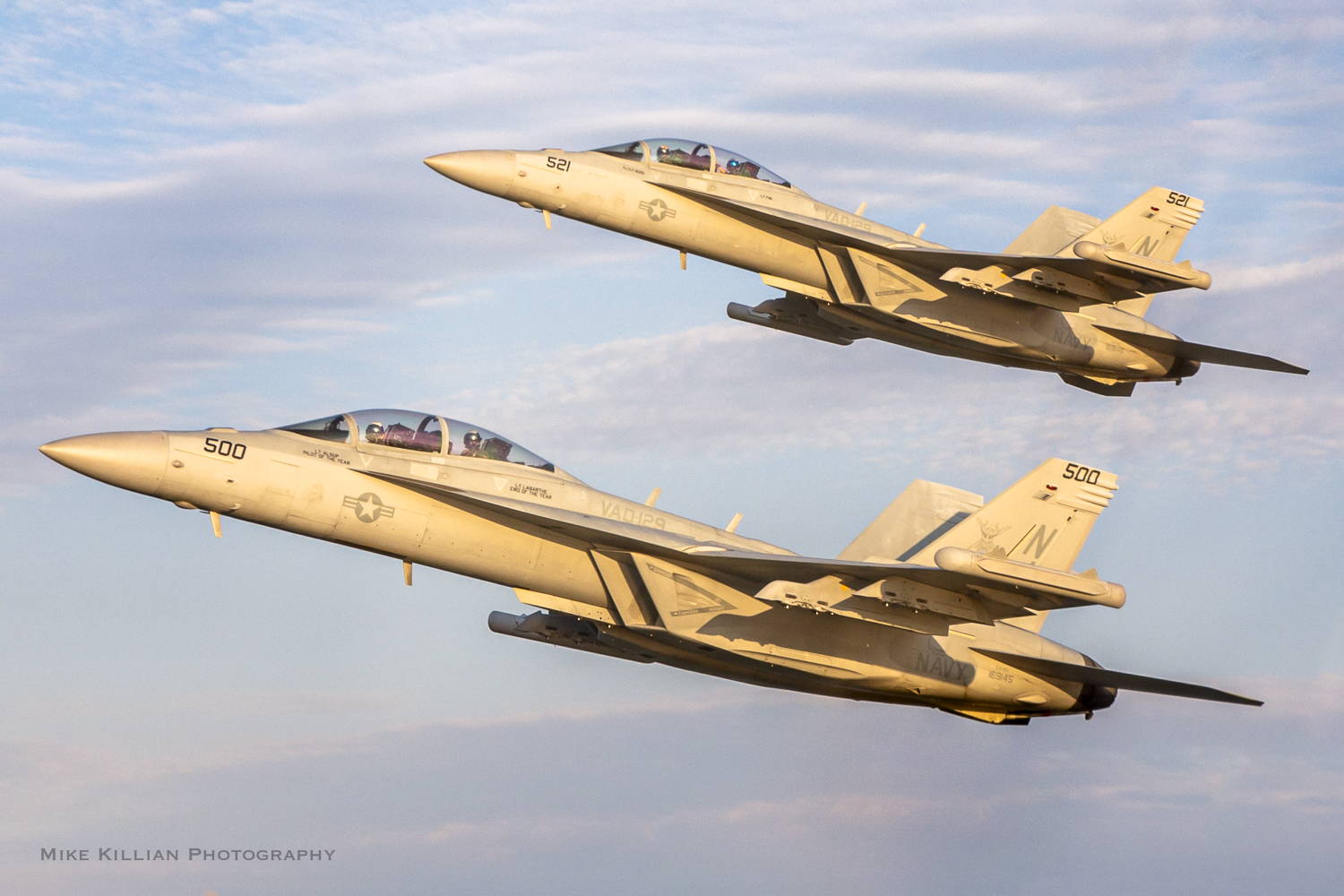
That said, Navy single-jet teams you can expect at select shows next year include the EA-18G Growler team from VAQ-129 in Washington, and F-18 Hornet teams from VFA-106 and VFA-122 (based in Virginia and California). The Navy also flies a F-35C demo, but only at a few shows per year. Their 2024 schedule too is still TBD.
It’s important to note that active duty USAF and Navy units also participate in shows. Squadrons from far and wide may appear, or may be hosting the show itself.
Are The Blue Angels or Thunderbirds Coming To Your Town Next Year? 80
For example, Navy test squadron VX-9 sent their special-painted heritage jet (above) to select shows in 2023 as a static display. The Army, USMC, USCG and various USAF units do the same. Just go to Sun N Fun or any base show, you’ll see plenty of tax-payer toys on static displays but not actually flying.
USAF Heritage & Navy Legacy Demos
Both the USAF and Navy participate in Heritage and Legacy flight programs, bringing past and present together at air shows as a tribute to those who came before. Military demo pilots will join formation with their civilian counterparts, flying a variety of old fighters from different eras (WWII, Korea, Vietnam etc).
Are The Blue Angels or Thunderbirds Coming To Your Town Next Year? 81
Other jet teams from other countries will be visiting select American shows in 2024. We all know the Canadian Snowbirds still flying those old Tutors. They have a single-jet CF-18 demo too, with a special paint scheme. Click the hyperlinks for more info.
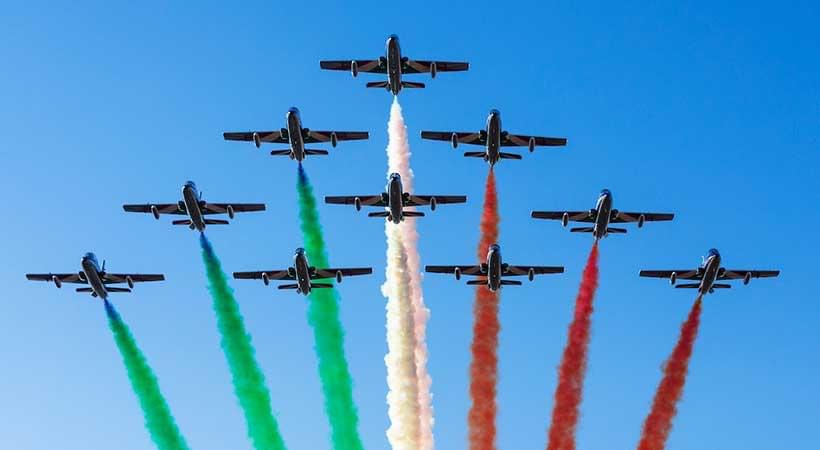
The Italian Frecce Tricolori demonstration team will be visiting America next year. It will be the first time since 1992 that their signature red, white and green smoke will be seen across North America.
Are The Blue Angels or Thunderbirds Coming To Your Town Next Year? 82
They will visit Canada to commemorate the 100th anniversary of the RCAF. While in the states they will perform a flyover of the Italian Navy tall ship Amerigo Vespucci as it visits Los Angeles, California. They will visit select shows and various iconic U.S. landmarks next summer, to commemorate the 500th anniversary of Giovanni da Verrazzano’s expedition to America in 1524.
The exact schedule still has not been announced, but select shows who have secured the team are already informing their followers. A couple known shows they will appear at between June and August include Rochester, NY and Cold Lake, Alberta.
Every avgeek has a favorite: the Navy Blue Angels or USAF Thunderbirds. It’s aviation equivalent of the baseball rivalry between the Yankees and the Red Sox with a few differences. Both demonstration teams execute their missions with exceptional dedication year after year to millions of people. And while each team represents different military branches, they ultimately play for the same team, and sometimes join together for cross-team training and familiarization.
On very rare occasions, both teams will actually perform at the same air show. They even fly a joint-formation together, called the Super Delta. It’s been performed numerous times, most recently this spring.
The Air Force Thunderbirds and Navy Blue Angels debut the “Super Delta” flight formation in March. (U.S. Navy/Cody Hendrix)
The Ultimate Prank
Over the decades both teams have shared many jokes and pranks on each other, and have kept the friendly competitive spirit alive between them, always trying to show-off or outdo the other.
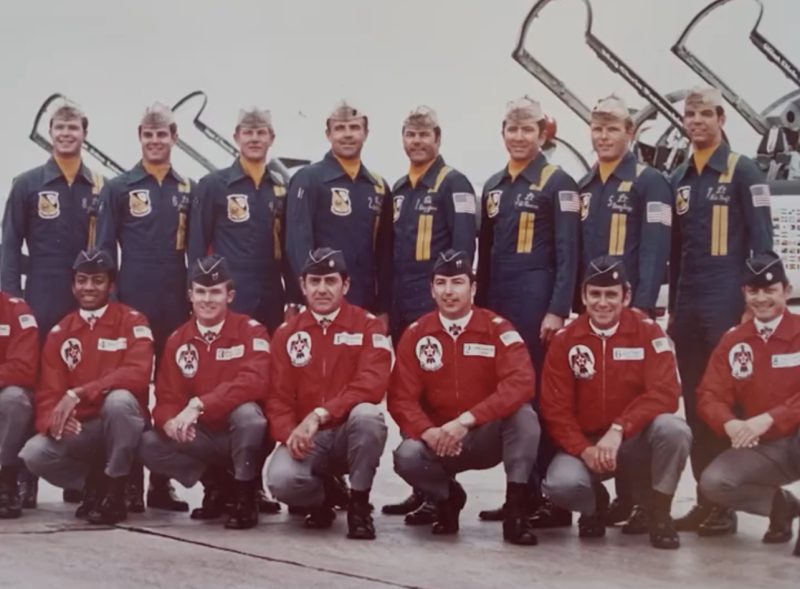
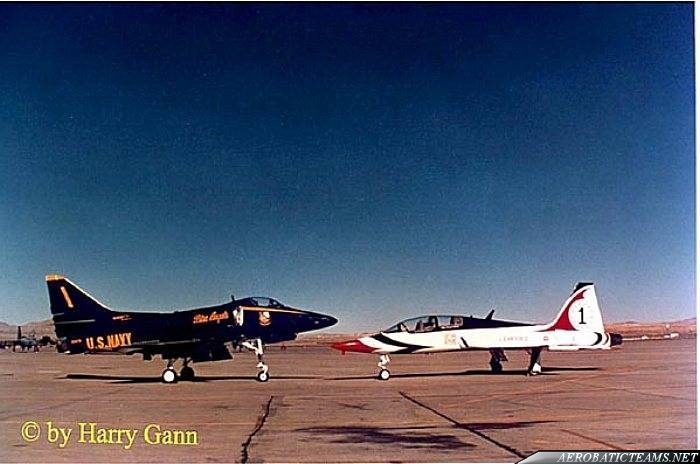
In 1976 both teams got together. The Blues were flying A-4s and the Thunderbirds were flying T-38s. But the Blues were not satisfied with just showing off what their Navy jet could do. So they sent the Thunderbirds to the aircraft carrier USS Lexington for a day of real Navy flight ops.
One of those Thunderbird pilots, Stephen Mish, recalled the visit in the interview above.
”The training film they showed us was 30 minutes of just carrier accidents,” said Mish, as he smiled remembering the day. “Then we went out, trapped on the ship, spent the day on the Lexington and catapulted off in the afternoon.”
Photo credit harry gann / www.aerobaticteams.net
The best part though? Once they arrived, the Thunderbirds realized that they were alone. The Blues didn’t even join the trip! They stayed on land and sent the Thunderbirds to the ship without them.
“We got back onshore and they were giggling, asking us “how was the day” and “how’d you like the landing?” It was great. We had a great relationship with those guys.
You can watch the full interview above, and check out the other amazing videos on Blue Angels and Thunderbirds history on Blue Angel Phantoms.
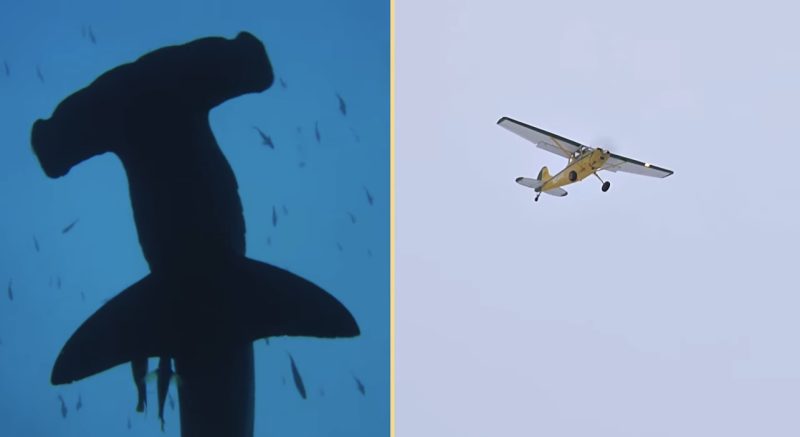
It’s no secret that the aerospace industry has always taken hints from nature, for designs of new aircraft. As amazing as our modern engineering and material sciences are, it still can’t hold a candle to millions of years of wild evolution. One can only wish to fly as good as a Peregrine Falcon.
Sharks however are not creatures that comes to mind when thinking about the physics of flight. But, the iconic head of the Hammerhead Shark seems to serve the same purpose as the wing of an airplane. At least, that’s the leading theory about why they evolved such a bizarre head.
Photo credit: www.bigfishexpeditions.com
Lift or maneuverability?
The increased drag of its giant head means the Hammerhead has to work much harder and use more energy to swim, compared to other streamlined sharks and dolphins. They don’t have a swim bladder either, so they HAVE to keep swimming to avoid sinking. So it made sense to believe that the giant head acted as a wing, to help the Hammerhead stay vertically positioned in the water column. Same as a plane’s wing provides lift in the air.
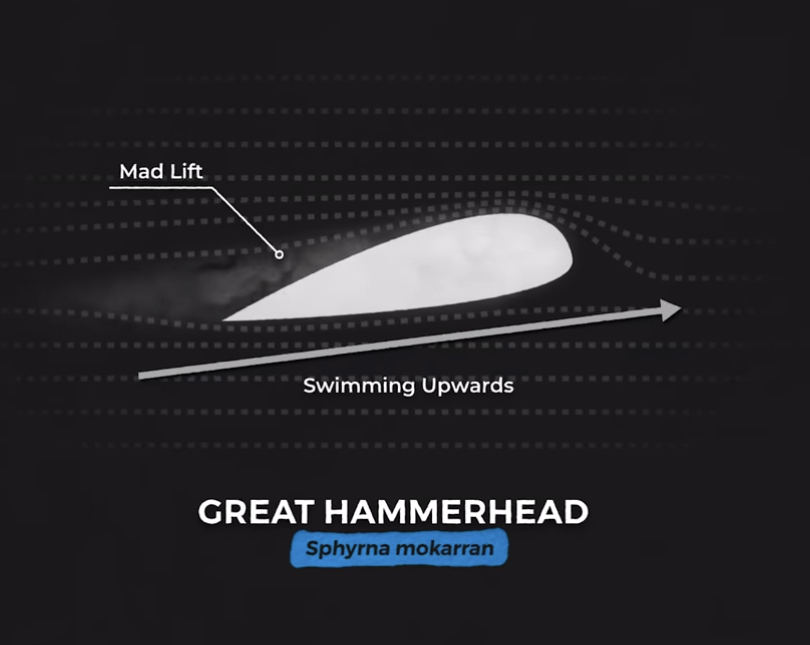
It makes sense. The name of the shark’s hammerhead, called a cephalofoil, even means “head-wing”. But, in studies, the flow of water over the head does not behave like air over a wing. No more lift is created by the head, when compared to other sharks. So if the head ISN’T a wing to provide lift, what’s it for?
Airplane’s Hints From Nature: How a Hammerhead Shark’s Head is like an Airplane Wing 88
Survival of the fittest
When the shark’s angle of attack changes (AOA), is where the answer lies. The hammer is not for lift, it’s for maneuverability, and it makes them more maneuverable than any other shark in existence. That means they can tap an ecological niche of food that other sharks can’t get, like prey who dwell on the sea floor.
Such creatures make erratic escape attempts when chased by a threat, darting in all directions at the blink of an eye. The unique wing-shape of a Hammerhead’s head means they can maneuver fast enough to catch those food sources.
Airplane’s Hints From Nature: How a Hammerhead Shark’s Head is like an Airplane Wing 89
We thought it was interesting. Nature always knows best.
Back in 1930, the airport was state of the art. The runways were plenty long for the aircraft of the day and the airport was a perfect location for the growing LA basin. Fast forward 93 years and the current terminal location and facility is woefully deficient. The gates are mere feet from the runway, forcing non-standard operations with the constant threat of a runway incursion by both taxiing aircraft and ground personnel. The terminal itself is seismically deficient, lacks modern amenities, and falls short of requirements for disabled passengers. The food and drink options that exist are laughably expensive. It’s more than time to replace one of the dankest terminals in the nation–Hollywood Burbank Airport.
Historical Context and Necessity for Change
Burbank Airport, officially known as Hollywood Burbank Airport, has long been a key player in Southern California’s aviation scene. The original terminal complex opened in 1930. It has been expanded since then to accommodate modern airliner operations in a somewhat haphazard design influenced by its landlocked location.
Burbank Airport Overhaul: Getting a Hollywood-Style Makeover 94
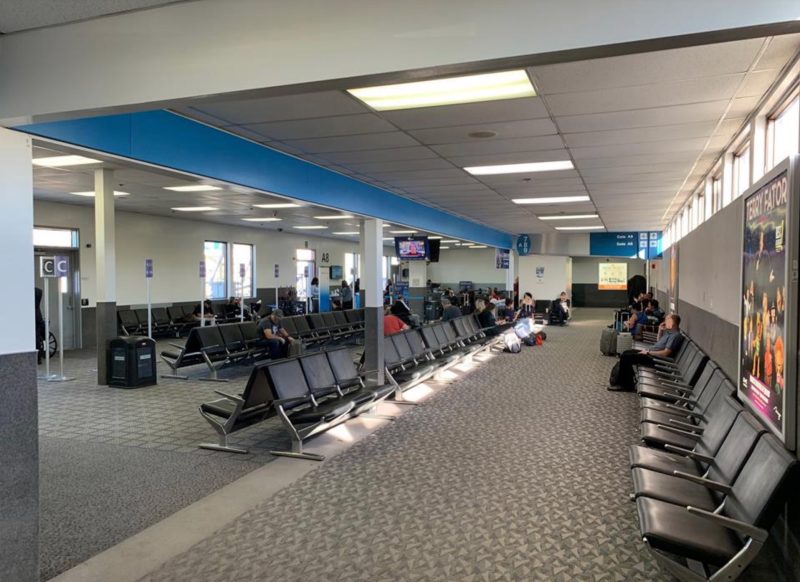
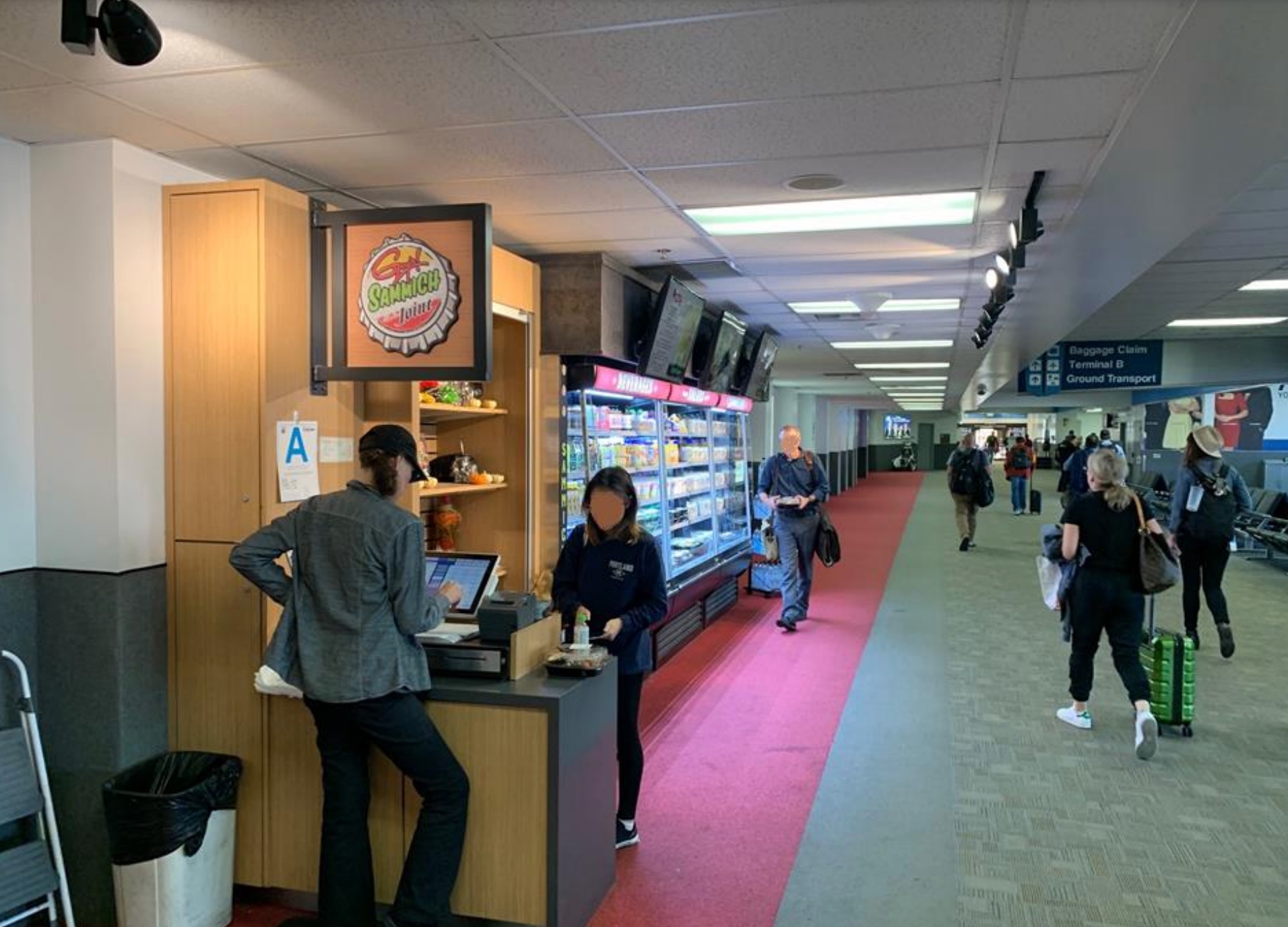
Today, the outdated terminal handles 6 million passengers a year. The facility is showing its age though with crowded gates, ragged carpet, shoddy bathrooms, and overpriced concession stands that look more like a flea market than a modern airport facility.
The new terminal, proposed with 14 gates, is not just an upgrade; it’s a necessity. This project is envisioned to bring the airport into the 21st century, aligning with the current needs and expectations of travelers and airlines alike.
A Long Process–The California Way
In 2016, voters gave the green light to a project that would significantly alter the landscape of Burbank Airport – the construction of a new replacement terminal. . Set to be situated on the northeast side of the airfield, the new terminal is poised to usher in a modern era for the airport. However, this development is not without its challenges.
Over the past 6+ years, the facility has worked to build out the design of the new terminal, gain local support for the development, and secure the necessary permits. On 14 December 2023, the permits were finally approved for construction. According to documents from Burbank Airport, construction will begin in early 2024. The new terminal should finally open in 2026, nearly 10 years after initial approval by voters.
The Plan for the New Hollywood Burbank Airport Terminal
Burbank Airport Overhaul: Getting a Hollywood-Style Makeover 95
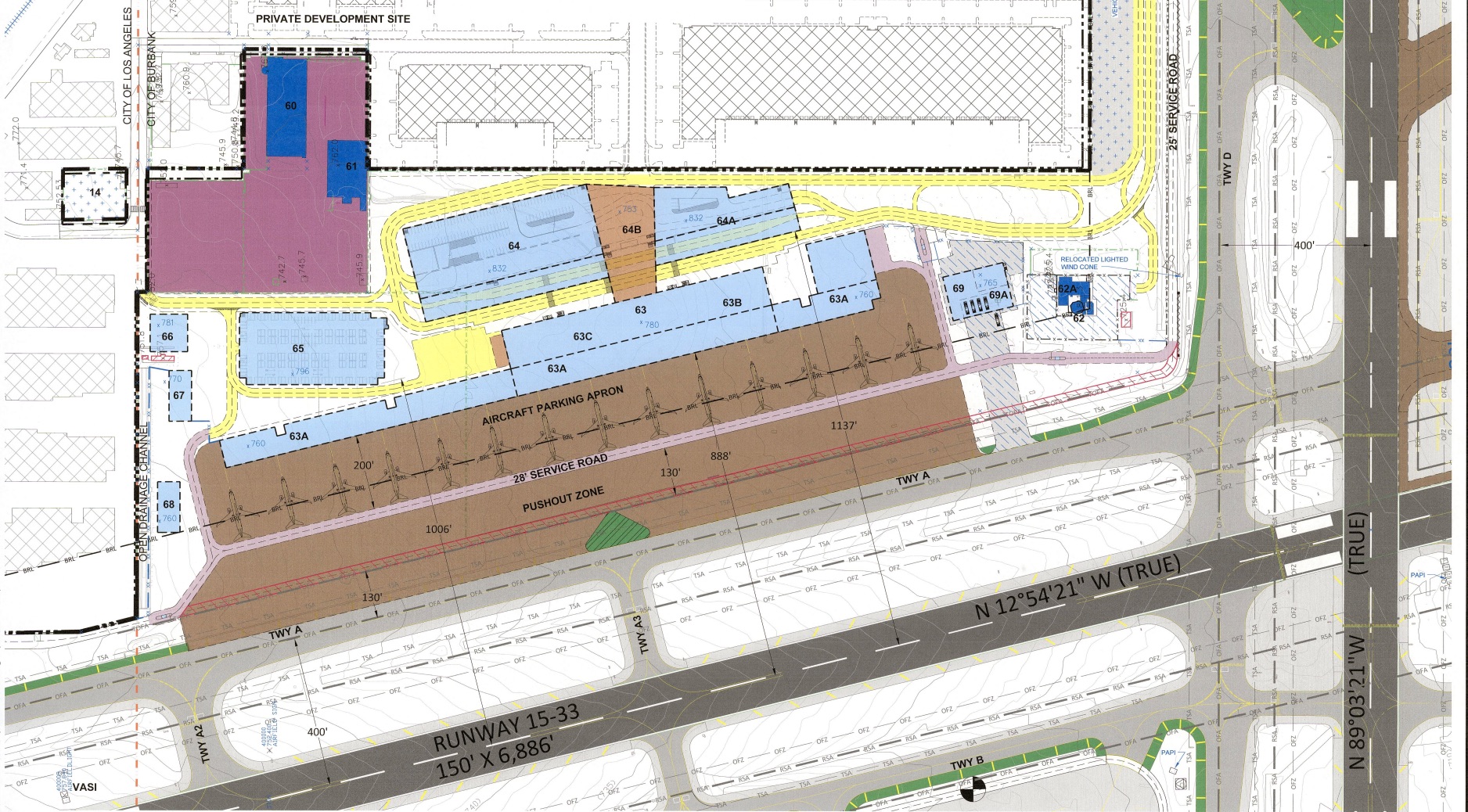
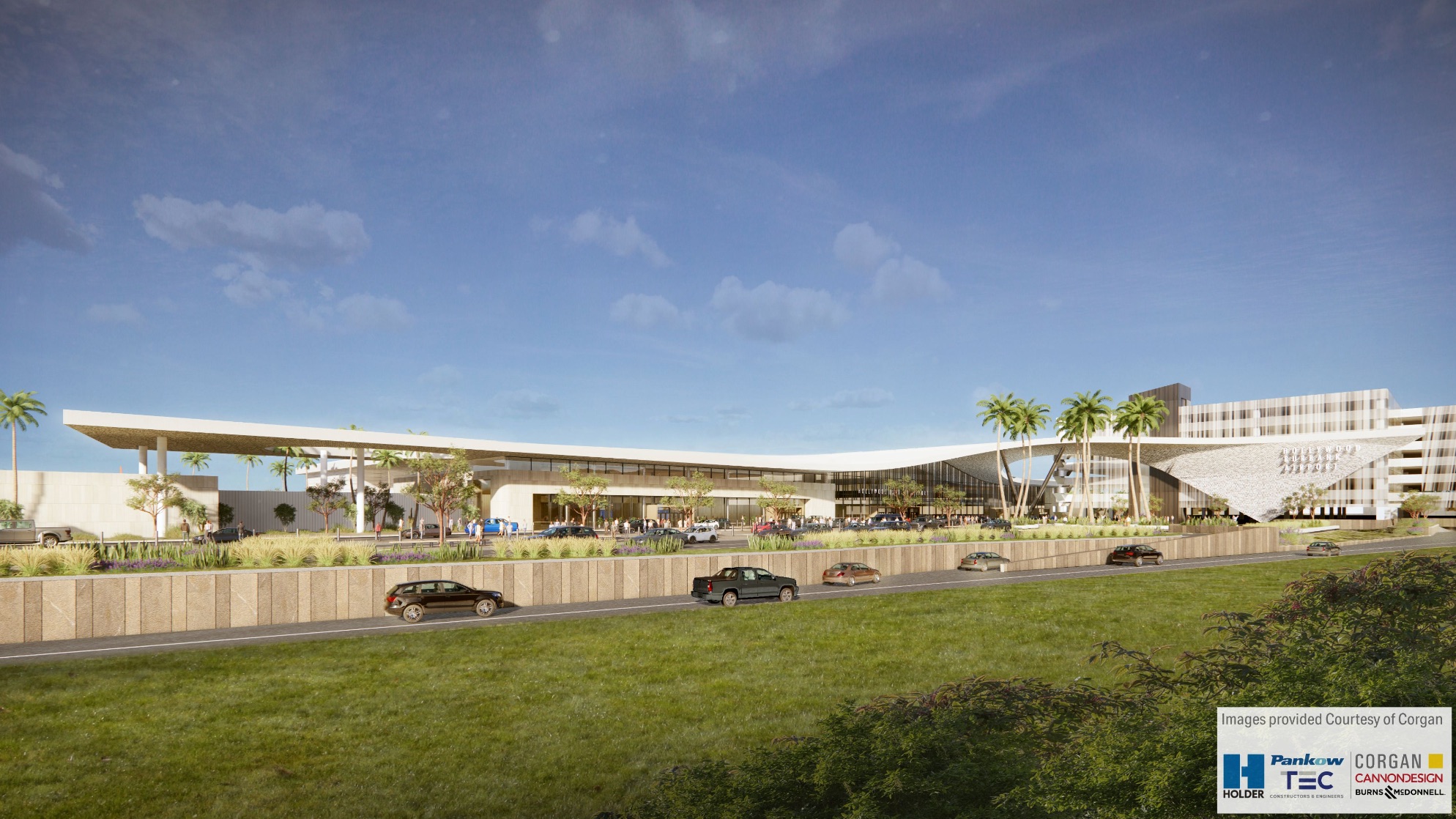
The construction of the new terminal on the northeast side of the airfield represents a significant investment in infrastructure. This strategic location was chosen to enhance operational efficiency and passenger convenience. The design promises a more spacious, comfortable, and technologically advanced facility, aiming to elevate the overall travel experience.
Burbank Airport Overhaul: Getting a Hollywood-Style Makeover 96
One of the critical improvements of the new terminal is the increased distance between the gates and taxiways, enhancing safety for both aircraft operations and ground personnel. The new terminal’s layout and modern amenities are expected to streamline passenger flow, reduce congestion, and offer a more relaxed and enjoyable travel environment. It will eliminate the very non-standard taxiing procedures that airlines must obey to depart the airport, reducing the risk of a runway incursion.
Burbank Airport Overhaul: Getting a Hollywood-Style Makeover 97
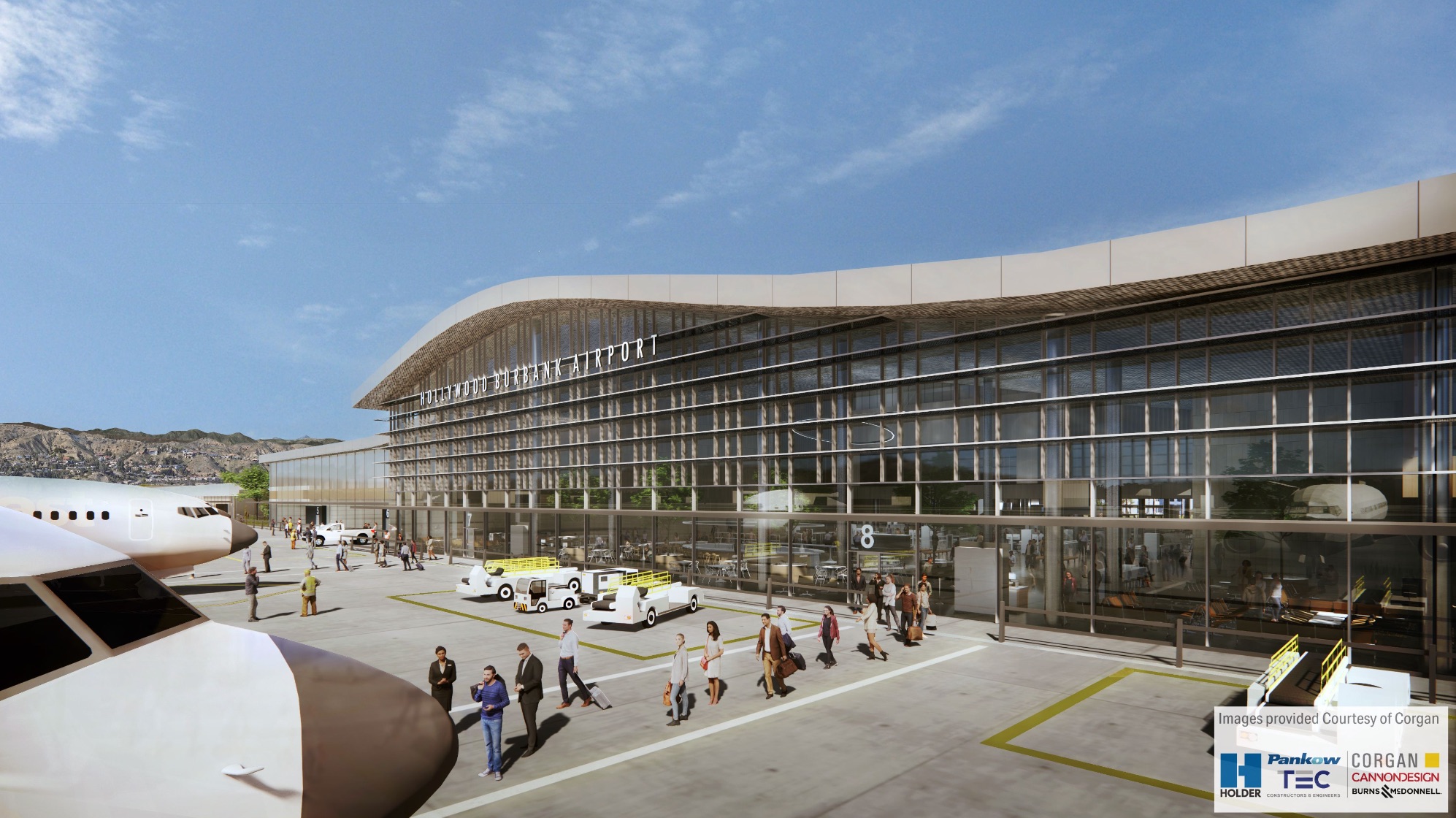
One interesting note, the final design does appear to show that boarding will still be conducted airside without gates allowing for passengers to experience the California sun (or rain) one last time before flying back home or to work.
Persistent Challenges and Limitations at Hollywood Burbank airport
Despite these advancements, the new terminal is not a panacea for all of Burbank Airport’s problems. One of the enduring issues is the short primary approach runway. Due to the landlocked location of the airfield, it will remain without any extension. The east/west runway is one of the shortest frequently-used runways for jet operations in the nation.
The airport has also faced a growing number of complaints from those who live nearby the airport. More efficient arrivals for aircraft as part of the FAA’s airspace modernization program have resulted in increased air traffic over neighborhoods near the airport. Additionally, the airport’s private jet operations have grown significantly over the past few years. Burbank’s convenient location makes it attractive for wealthy residents to utilize.
Still Likely Home To Amazingly Expensive Concessions
Adding another layer of complexity to the airport’s future is the economic environment in California. Although the new terminal will be a welcome sight to most travelers, it is likely that the airport will still be home to $8 lattes and $20 burgers. California Governor Gavin Newsom’s move to institute a $20 minimum wage for service workers, effective April 2024. This will ensure that prices for food and beverages will remain comically high. Even with expensive food and drinks, a terminal that prioritizes safety and passenger comfort will be a welcome change for most.
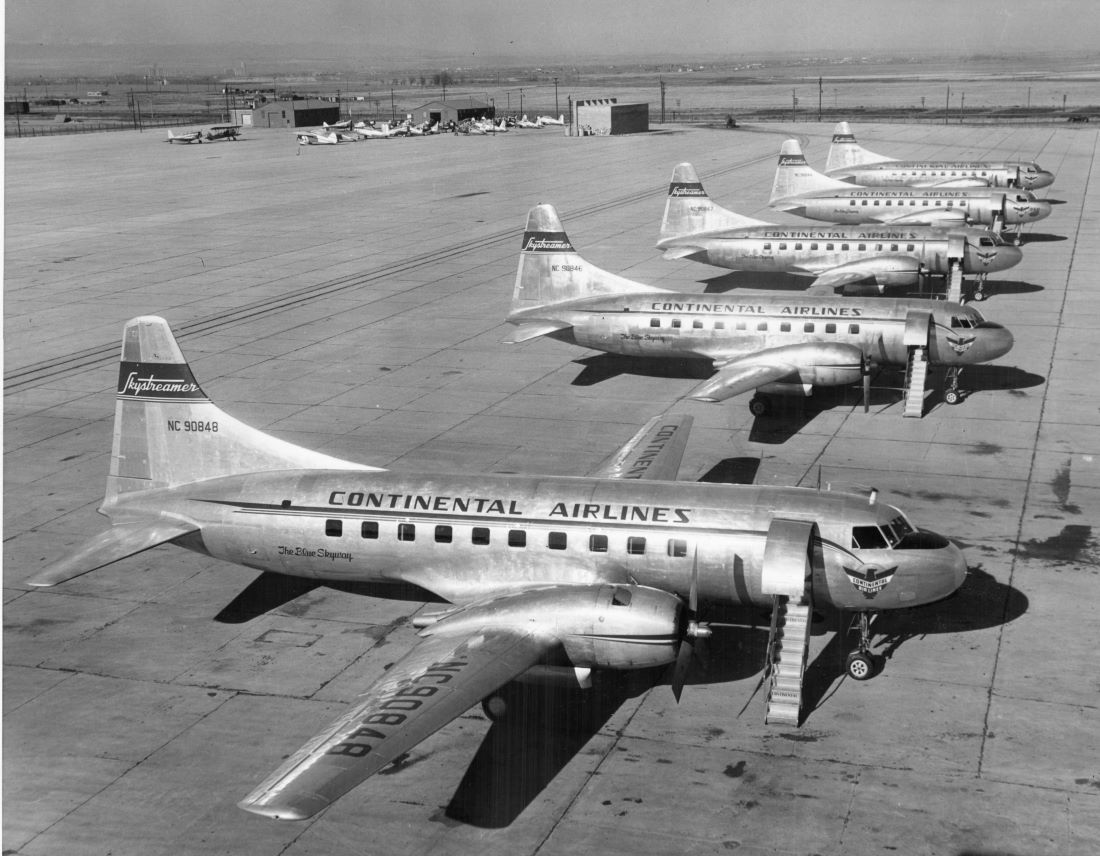
On January 1, 1950, Continental Airlines was little more than a glorified local airline. The backbone of the fleet was made up of 12 dependable Douglas DC-3s, while five twin-engine, pressurized Convair 240s, dubbed ‘Skystreamers’, were the company’s ‘heavy metal’ airliners.
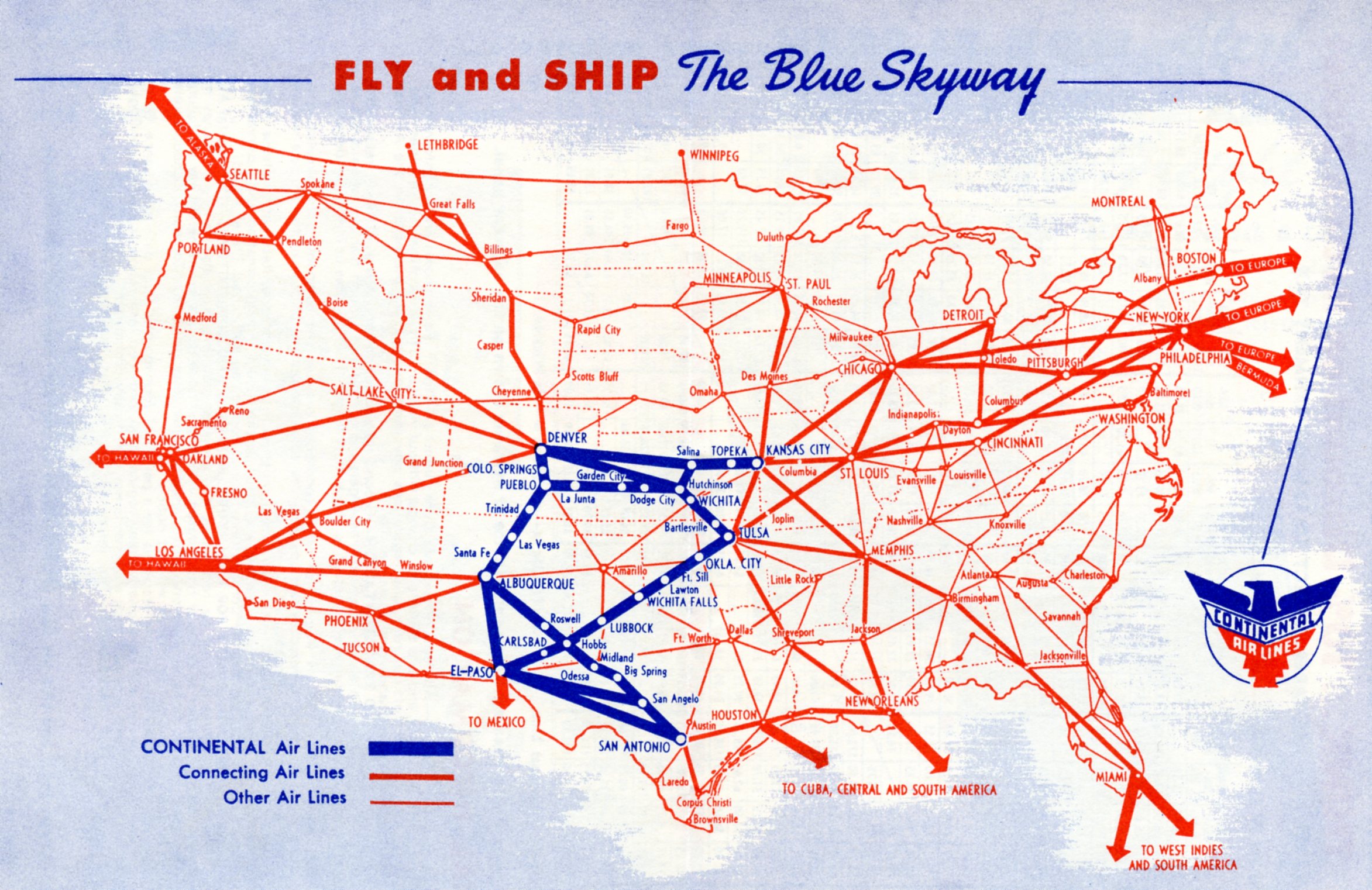
Continental was considered a trunk air carrier, but its route map gave a different impression. Instead of flying long-haul routes between major cities with 4-engine airliners like its contemporaries, Continental’s DC-3 ‘Gooney Birds’ hopped their way across Colorado, New Mexico, Kansas, Oklahoma, and Texas, serving places like La Junta, Dodge City, Hobbs, and Big Spring. The Las Vegas on Continental’s network was the one in New Mexico, not Las Vegas, Nevada.
CONTINENTAL AIRLINES ROUTES IN 1950
Continental’s route map – shown in blue – at the beginning of the 1950s resembled that of a local service airline rather than the trunk carrier it was classified as. David H. Stringer Collection
The Civil Aeronautics Board (CAB), which oversaw every facet of a certificated airline’s operation, had not been very generous with Continental. The airline’s premier route was its non-stop between Denver and Kansas City, a 539–mile segment flown with Convairs.
Continental’s ‘heavy metal’ aircraft in 1950 were 40-passenger Convair 240s, which the airline referred to as ‘Skystreamers’. United Airlines Archives
By the end of the decade, all of that would change. Still under the strict supervision of the CAB, Continental ended 1959 as the envy of the industry – one of the nation’s proudest airlines, flying Boeing 707s from Chicago to Los Angeles and giving the other carriers in the market (American, TWA and United) a run for their money. This transformation came about through determination, planning, and a perfectionist’s ideas about good service.
MEET BOB SIX
The man responsible for the airline’s metamorphosis was a big guy named Robert (Bob) Forman Six from Stockton, California.
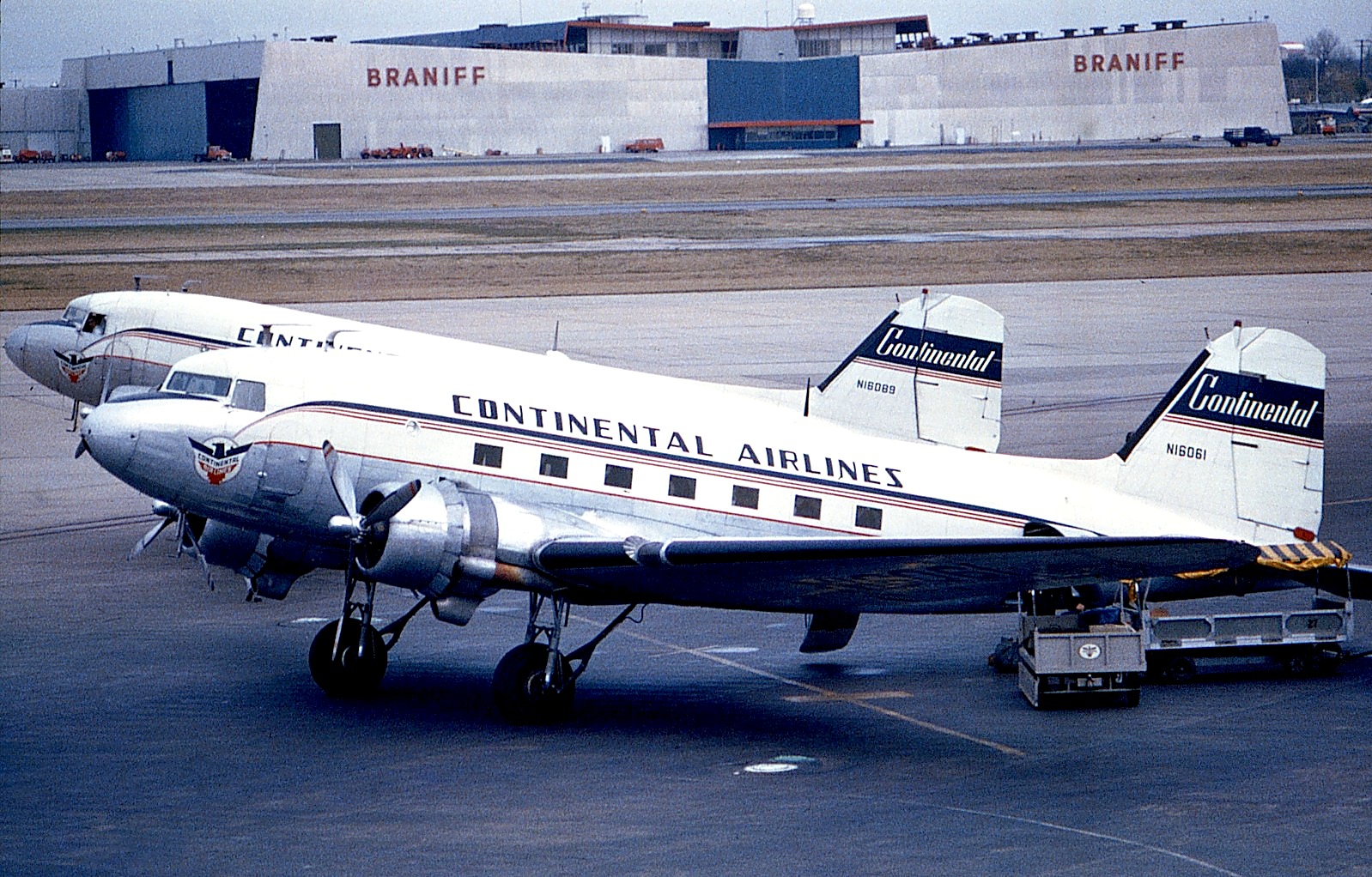
Continental DC-3s in updated livery, photographed at Dallas Love Field. Terry Waddington photo via Tom Livesey.
A SOUTHWEST PUDDLE JUMPER
With its 1950 advertising slogan, “Fly the Blue Skyway”, the company’s scheduled flights landed at 28 airports, most of them serving small and medium-sized cities. Its headquarters were located in Denver. A recent award from the CAB had given Continental Airlines permission to serve Las Cruces, Raton, Socorro, and Hot Springs in New Mexico. This was hardly the big time. The citizens of Hot Springs voted to change the town’s name to Truth or Consequences as the result of a television game show contest.
Despite its size, Continental was a consistent profit-maker. Bob Six was a perfectionist who demanded professionalism and the highest standard of service from his employees. He knew that his primary tool for winning customers was to offer them the best service they had ever received. With the company’s good reputation, he began his series of strategic moves to truly push Continental up into the ranks of the major carriers.
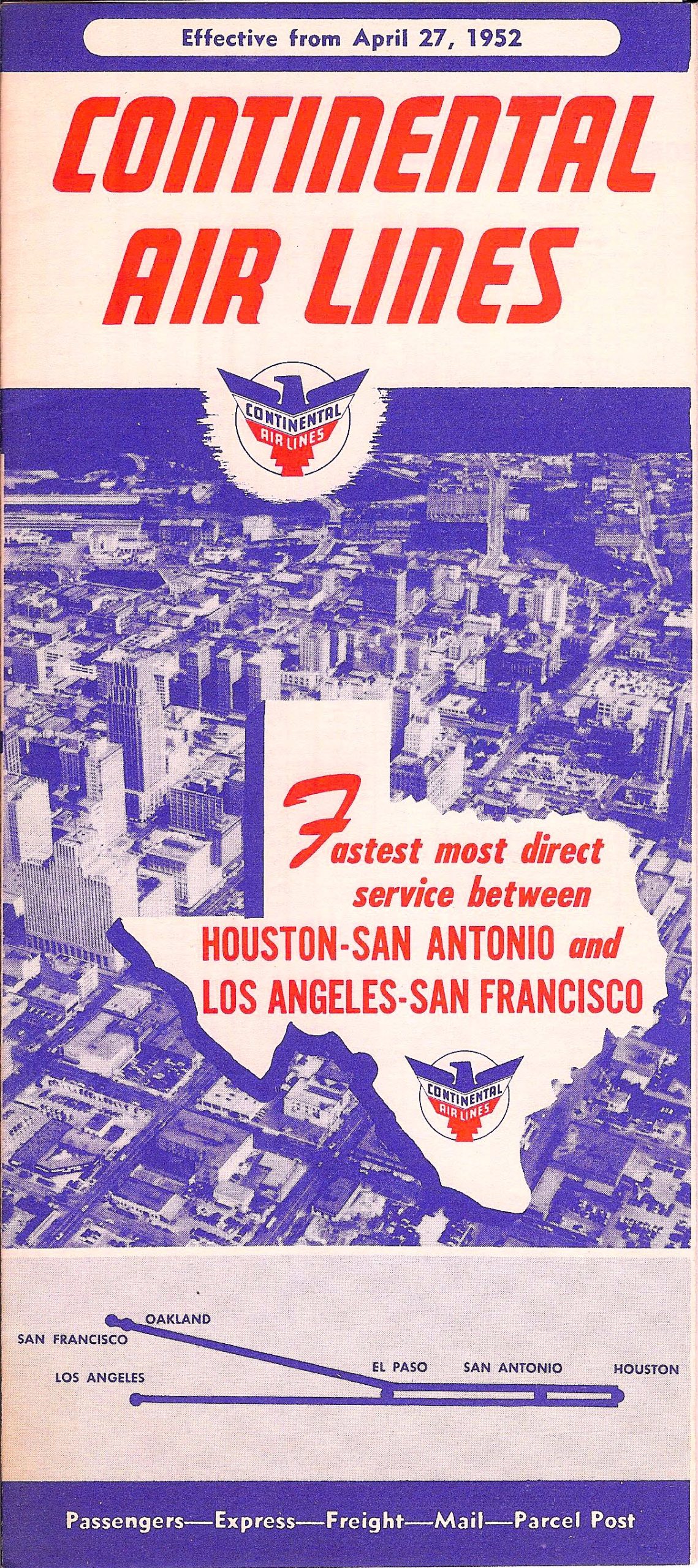
Continental’s April 27, 1952 timetable advertises interchange service to the West Coast in conjunction with American Airlines. David H. Stringer Collection
EXPANSION THROUGH INTERCHANGE
Continental Airlines’ first step toward becoming a major player involved the cooperation of other airlines. With the CAB’s approval, on May 20, 1951, the first single-plane service between Houston and Los Angeles was offered with a DC-6 operating over the routes of Braniff (Houston – San Antonio), Continental (San Antonio – El Paso), and American (El Paso – Los Angeles). The crews of each carrier operated the DC-6 over their respective segment. Referred to as the ABC Service (American-Braniff-Continental), Continental leased two DC-6s from American as part of its contribution to the interchange.
In an unexpected boost for Continental, Braniff soon pulled out of the three-way agreement. The CAB responded by authorizing Continental to extend its own system from San Antonio to Houston to fill in the gap left by Braniff’s exit.
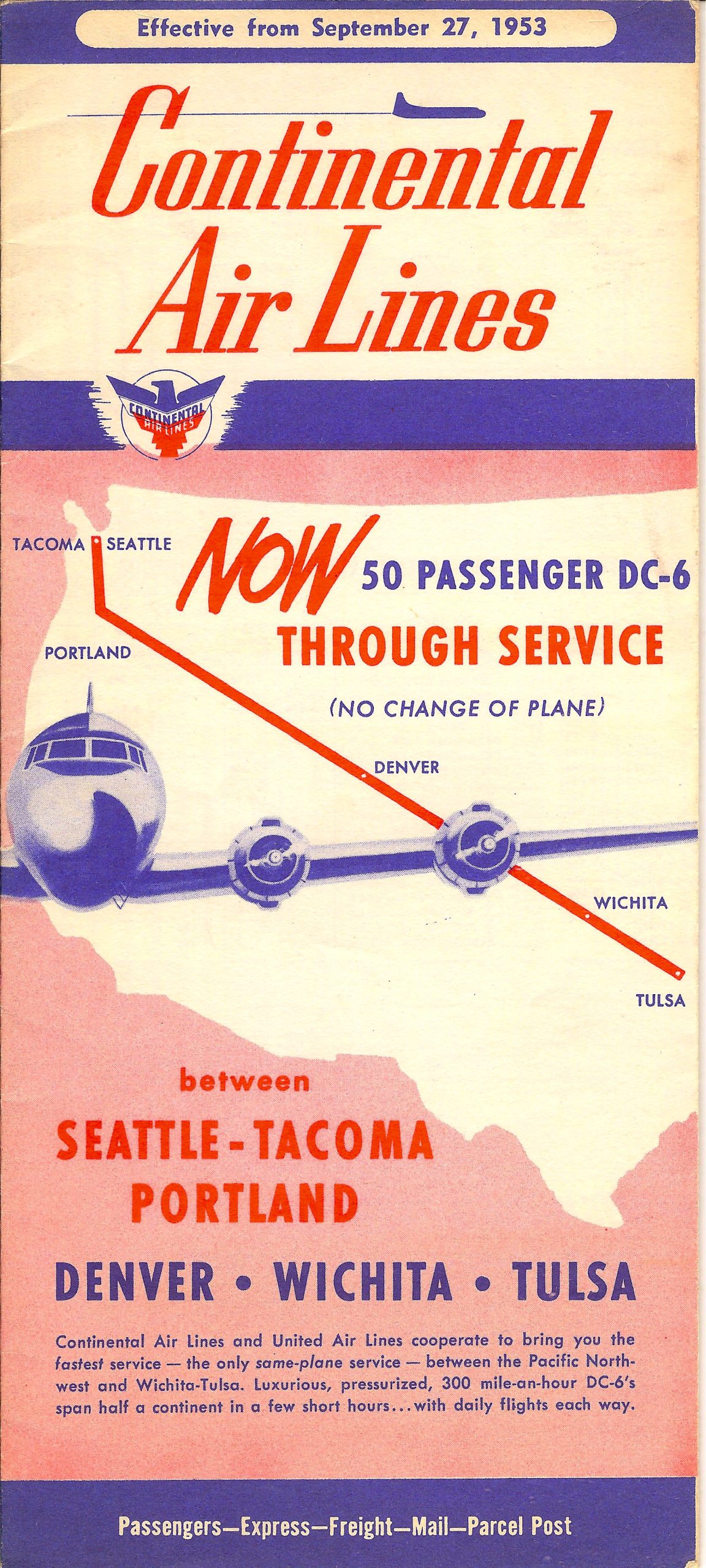
In 1953, Continental entered into an interchange agreement with United Air Lines, which brought DC-6s bearing the company’s name to the Pacific Northwest. David H. Stringer Collection
INTERCHANGE WITH UNITED
In 1953 – in another shot at a wider market through the interchange program – Continental Airlines teamed up with United Air Lines to offer through service from Tulsa and Wichita (on Continental’s network) to Portland and Seattle (on United’s), via the junction point of Denver.
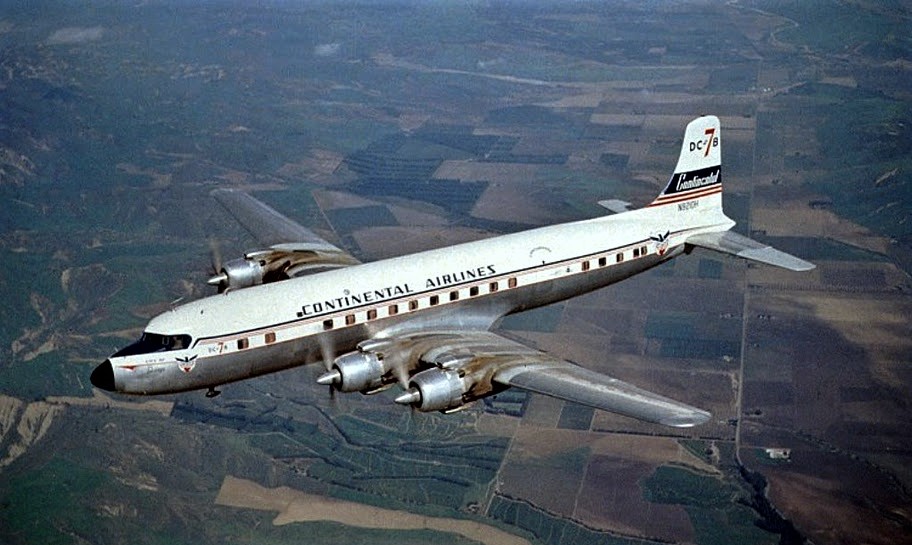
Two of the aircraft carrying Continental’s colors westward were brand-new 50-passenger Douglas DC-6Bs, ordered in 1951 for the interchange services.
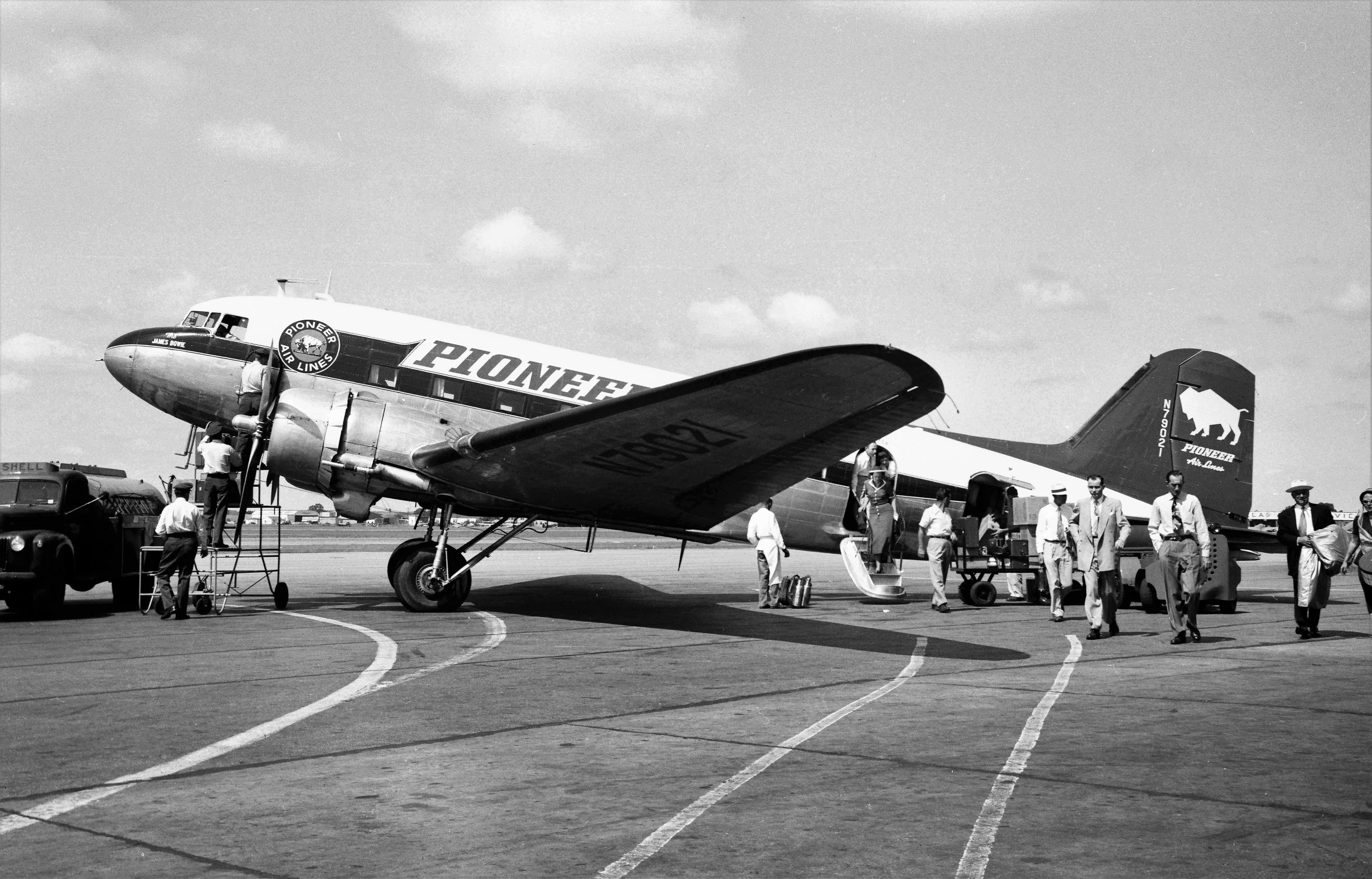
Continental absorbed local service carrier Pioneer Air Lines through merger in 1955. Passengers deplane a Pioneer DC-3 in this Bill Proctor photo via the Proctor-Livesey-Thomas Collection
THE PIONEER MERGER
Pioneer Air Lines was a local service carrier operating in Texas and New Mexico. The airline had gotten into financial trouble when it replaced its DC-3 fleet with larger Martin 2-0-2s. The CAB refused to increase the subsidy it paid to Pioneer for serving small cities just because the company had purchased larger airplanes. Pioneer then scrambled to find DC-3s once again to replace the Martins. All of this maneuvering had sunk the airline into debt, and a merger with another carrier seemed the only way out. Continental offered to be the merger partner.
Taking on the route system, the debt, and the DC-3s of a feeder airline would not seem like a logical move for a trunk carrier hoping to expand into busier markets. But Bob Six saw the potential in adding Pioneer’s routes to Continental’s system. It would give Continental entry into Dallas, Ft. Worth, and Austin, Texas – all of which were stations on Pioneer’s system. Six guaranteed that he would take every Pioneer employee into Continental’s ranks.
On April 1, 1955, the effective date of the Pioneer merger, Continental added 15 airports to its network along with a bunch of DC-3 Gooney Birds.
A BROADWAY STAR
Broadway and film star Ethel Merman, Bob Six’s second wife.
Bob Six was fascinated with show business. His good friend, Leland Hayward, was a theatrical agent in Hollywood and New York and a producer of Broadway plays.
In September 1951, Hayward invited Six to dinner in New York on the occasion of the first anniversary of the long-running Broadway play, Call Me Madam, which Hayward had produced. At that dinner, Bob Six met Ethel Merman, the star of the show. They were married in March 1953 in Mexicali, Mexico.
Six brought his bride home to Denver, where the local society mavens were thrilled to have a Broadway star in their midst, married to the president of one of their two hometown airlines (the other was local service carrier, Frontier). As if Six himself, who was referred to as a “character”, did not generate enough publicity for the company, his new wife, known for her feisty personality, brought added attention to Continental Air Lines.
But Continental Airlines was about to get even more attention as Bob Six’s wish to make his airline a significant player in the U.S. air transport industry was about to come true.
A brand new Continental DC-7B is captured in this Douglas Aircraft Company photo. Proctor-Livesey-Thomas Collection
THE DENVER SERVICE CASE
The Denver Service Case, which the CAB had initiated in 1952, would determine not only which airlines could fly from Denver to Los Angeles, Chicago, and San Francisco in competition with United, but also other issues, such as non-stop rights from Chicago to the West Coast.
When the Board handed down its decision on November 14, 1955, the industry was stunned. Not only was Continental Airlines given permission to fly from Denver to Los Angeles and to Chicago, but also to operate non-stop from Chicago to L.A.! With this single announcement, Continental Airlines was transformed from a regional carrier into a true trunk airline.
Continental Airlines Viscount 812. The turboprop airliners were very popular with passengers due to their large windows and their vibration-free ride. Tom Livesey Collection
NEW ROUTES, NEW AIRCRAFT
The first aircraft type ordered for the new routes was the Douglas DC-7B. Five of the big propliners would be delivered in 1957. In what must have seemed an unusual move to observers, the DC-7Bs would be outfitted in an all-coach configuration.
Continental referred to its Viscount 812, which incorporated advancements over its predecessors – the Viscount 700 model – as the Viscount II. David H. Stringer Collection
Continental’s next choice was the British-built, turboprop Vickers Viscount. Six’s evaluation team selected the advanced model 812, with more powerful engines and greater seating capacity than the 700 series. Continental’s Viscounts would be outfitted in a 52-passenger, all-First Class configuration with deliveries slated for 1958.
Finally, for an aircraft to operate the nonstop service between Chicago and Los Angeles, the company selected Boeing’s 707, the first of the US-built turbojet airliners to take to the sky—an aircraft type that most in the industry thought Continental was too small to operate. The 707s, with both First Class and Coach cabins, were scheduled to come online in 1959.
Gold stanchions and carpet welcome passengers boarding a Continental Viscount II. United Airlines Archives
GOLD CARPET SERVICE FOR CONTINENTAL AIRLINES
Beginning in the fall of 1956, Continental Airlines’ marketing team started advertising the new ‘Gold Carpet Service’ that passengers would receive aboard Continental’s DC-7B ‘Club Coach’ flights.
Gold Carpet service, introduced aboard Continental Airlines’ coach-class DC-7Bs, was improved upon and then offered aboard the company’s First Class Viscounts. David H. Stringer Collection
To quote Continental’s 1956 annual report: “On April 28, 1957, Continental will inaugurate the finest and most luxurious ‘Club Coach’ service available between Chicago, Denver and Los Angeles. The service will be extended to Kansas City early in July 1957. All flights will be operated with the world’s finest and fastest airliner, the Douglas DC-7B, equipped with RCA Electronic Weather Avoidance Radar for the comfort of the passengers. The cabins of these Continental Club Coaches will be compartmentalized and have stag smoker lounges in addition to spacious five-seat lounges. The cabin interiors will be fabulously finished and upholstered in soft, warm colors. The new low cost fare service will feature reserved seats and, at the option of the passenger, refreshing cocktails and hot ‘Country Club’ meals, with choice of four entrees, served at moderate extra cost.”
TREAT COACH PASSENGERS BETTER THAN EVER
Continental’s DC-7B’s offered reserved seating for Coach Class passengers – a novelty at the time. United Airlines Archives
The idea was to treat Coach passengers better than they had ever been treated before so that they would fill up the new planes and the company would make money on a high volume of low fares.
Continental’s route map (Continental routes are in blue) as it appeared in April 1957. David H. Stringer Collection
According to American Aviation magazine, passengers boarding one of the new DC-7Bs at Chicago-Midway would “walk on a gold carpet bordered by gold stanchions and use steps of anodized gold under a canopy of blue fiberglass.” Arriving passengers would see carpet-lined baggage carts attended by ramp crews wearing white kid gloves. “Two hand-set clock faces [are] installed on the baggage carts, one showing the airplane’s arrival time, the other showing the time the baggage was delivered.” The goal was to deliver bags in 10 minutes or less.
Gold Carpet Service is offered aboard a Continental Airlines Viscount II. Note the large oval windows that the type was famous for. United Airlines Archives
VISCOUNTS FOR FIRST CLASS
Next came the Viscounts, ready to introduce Continental’s version of ‘Gold Carpet’ First Class service to those traveling between Chicago, Kansas City, Denver, and Los Angeles. With interiors designed by Charles Butler and Associates, Continental advertised their new turboprop aircraft as the ‘Viscount II’.
An advertisement for Continental’s Gold Carpet Service aboard all-First Class Viscount II’s. David H. Stringer Collection
On May 28, 1958, Ethel Merman christened the first Viscount, and Continental’s British birds took to the sky. The airline now advertised that it was “First in the West with Jet-Power Flights”. Continental’s marketing and its growing reputation for excellent in-flight service drew the crowds so well that, after four months of Viscount operations, the airline had captured more than 43% of the First Class market on flights out of Denver to both L.A. and Chicago, and about 30% of the First Class passengers traveling between Kansas City and L.A.
Continental Airlines Boeing 707-124 N70773. Boeing Company photo via the Proctor-Livesey-Thomas Collection
FROM GOONEY BIRDS TO GOLDEN JETS
On June 8, 1959, Continental Airlines became the third U.S. domestic carrier to operate its own jets in scheduled service, after American and TWA, both of which had also ordered the 707 (National Airlines had actually operated the first domestic jet service, but it was with a 707 leased from Pan American).
Timetable advertising Continental Airlines’ initial jet services. David H. Stringer Collection
When Bob Six placed his order for 707s, he knew that he would be able to beat United Air Lines inaugurating jet service in the Chicago – Los Angeles, Chicago – Denver, and Denver – Los Angeles markets because United had ordered Douglas DC-8s, which would not be available until September.
The Gold Carpet theme was extended to Continental Airlines Boeing 707s, which the company referred to as Golden Jets. A group of flight attendants stands under the tail of a new 707. Continental would eventually adopt the advertising slogan “The Proud Bird With the Golden Tail”.
By the time 1959 ended, Continental had truly become the gold standard against which other carriers had to compete. The company’s new advertising campaign carried the theme: “The Most Experienced Jetline in the West.” That was a far cry from “The Blue Skyway”, an airline which operated only DC-3s and Convair 240s. Bob Six had done an amazing job in the course of a single decade.
This photo, taken aboard a Continental Airlines DC-10 in the 1970s, shows Bob Six (left) and his third wife, actress Audrey Meadows, along with John Brizendine. Meadows was the true love of Bob Six’s life. The couple stayed together until Six’s death in 1986. United Airlines Archives
EPILOGUE
Bob Six divorced Ethel Merman in 1960 and, the following year, married actress Audrey Meadows, star of Jackie Gleason’s television show, The Honeymooners. Everyone seemed to agree that Meadows was a much better match for Six. They seemed to be the perfect couple and stayed together until his death in 1986.
When Grumman produced the film “The Navy’s Blue Angels” in cooperation with the US Navy precision flight demonstration team in 1966, the Blues were flying Grumman’s F11F-1 (later F-11A) Tiger jet fighter. Tigers were not a long-serving frontline Navy jet though. Far from it.
However, the Blue Angels flew them for ten show seasons- longer than any previous aircraft flown by the Blues. This film, uploaded to YouTube by sdasmarchives, gives us a look at the Blue Angels when they were flying their very first supersonic jet aircraft.
Lineup of Blue Angels Grumman F-11A Tigers | Official US Navy photograph
A New Jet For A New Season
Changes were afoot for the Blue Angels in 1957. The team transitioned from the swept-wing Grumman F9F-8 Cougar (their jets for only a couple of seasons) to the Tiger that year. The Blues had previously trained during the winter season at Naval Air Facility (NAF) El Centro in California.
Over their time flying Tigers the team spent their winter seasons at Naval Air Station (NAS) Key West in Florida. Not bad duty if you can get it!
Official US Navy photograph
The Grumman F-11A Tiger Was Near Show Ready
The Blues required minimal modifications to fly the F11F-1/F-11A. The shell chute fairings and chutes for the internally mounted 20-millimeter cannons were removed.
An external smoke oil line was added on the port side from the oil tank in the gun bay to the jet’s exhaust. The Blues flew the “short nose” F11F-1 for the 1957 and 1958 show seasons, after which they flew the later production “long nose” variant.
Official US Navy photograph
In this bonus silent color air-to-air footage, also uploaded by sdasmarchives, we see the Blue Angels flying their Tigers over the Gulf of Mexico and Key West. Watch for the Naval Reserve Lockheed P2V-5F Neptune from NAS Jacksonville that photobombs the shoot. More gorgeous footage of the Blues flying Tigers!