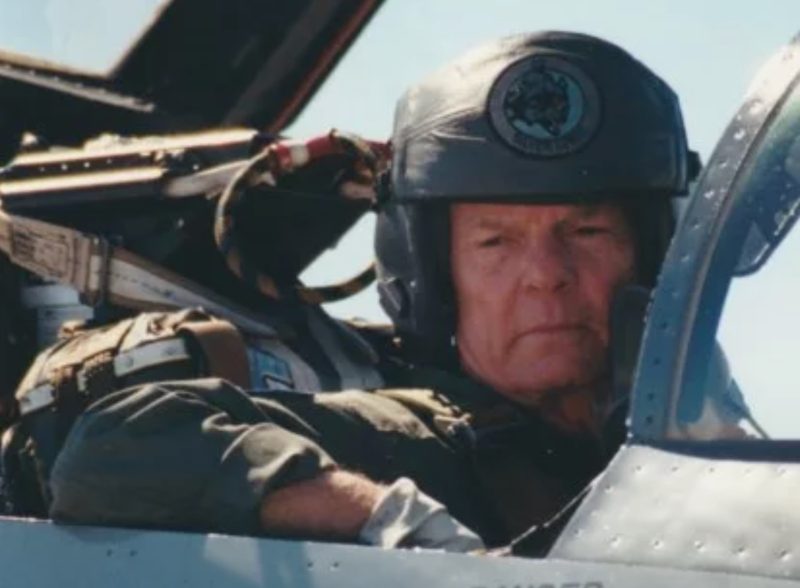
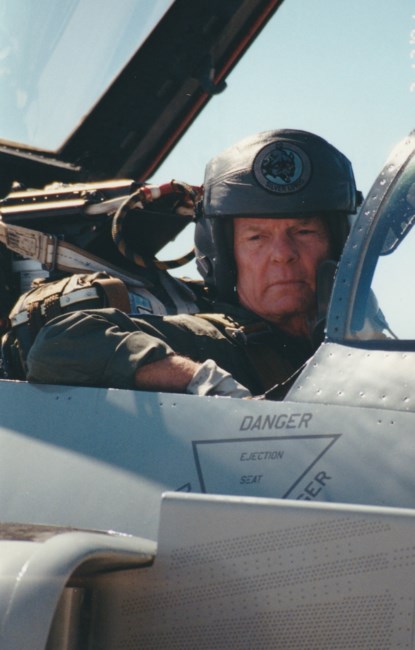
Throughout military aviation history, there are stories of men and women rising to the occasion to display heroism that resonates for generations. Few stories are as spectacular as “Pardo’s Push,” named after Captain John Robert “Bob” Pardo’s heroic actions during the Vietnam War. It is a testament to his ingenuity and just one distinguished event in his career of service.
A Career Of Service
Farewell Bob Pardo, Hero of 'Pardo's Push' in Vietnam War 2
Bob Pardo was born and raised in Texas. He graduated from Hearne High School in 1952 and enlisted in the Air Force two years later. He was commissioned as a 2nd Lieutenant and awarded his wings in 1955 at Bryan Air Force Base, Texas. During his 20-year career, Pardo served in Vietnam with distinction, earning the Purple Heart and the Distinguished Flying Cross. He was later awarded the Silver Star for his extraordinary act of heroism.
The Extraordinary Airmanship of Pardo’s Push
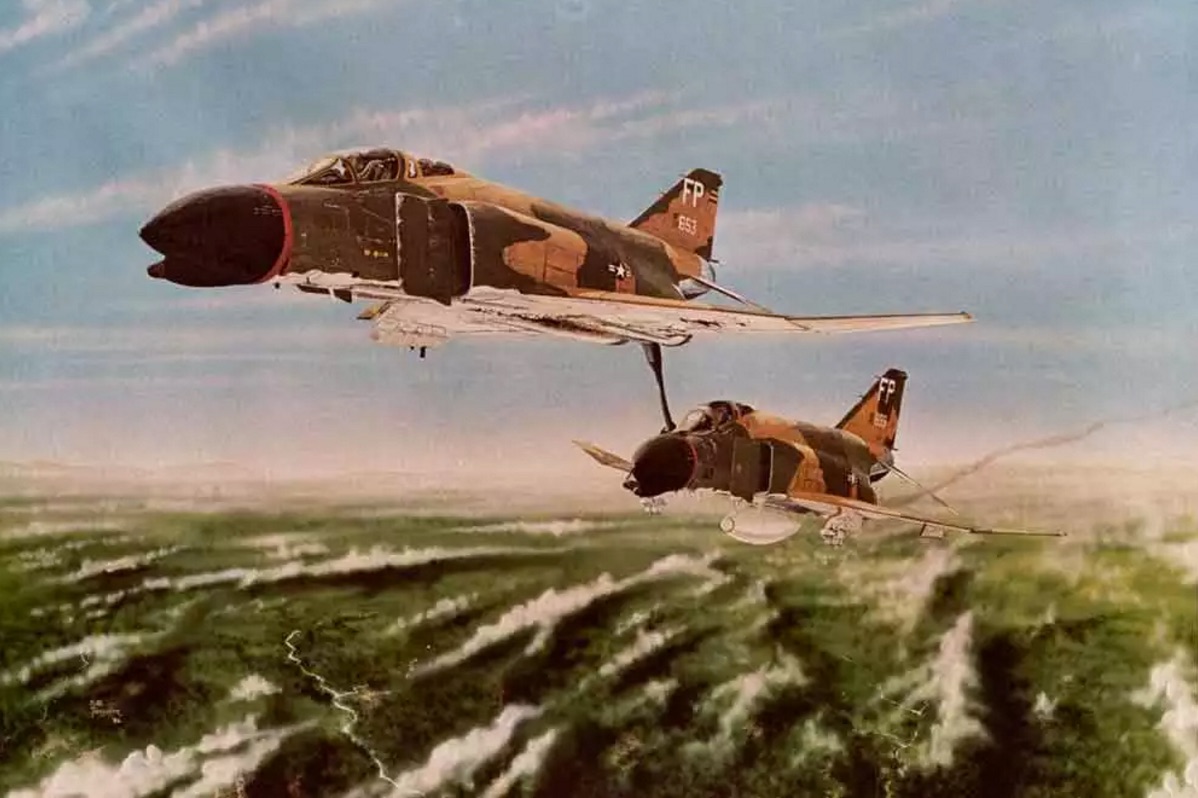
“Pardo’s Push” by S.W. Ferguson
On March 10, 1967, during the Vietnam War, Captain Pardo did something extraordinary. We captured his full story in an article in Avgeekery years back. Pardo and his wingman, Captain Earl Aman, were on a bombing mission over North Vietnam when both aircraft took enemy fire. Aman’s aircraft was hit by enemy fire and began leaking significant fuel. Without enough fuel to make it back to a safety, Aman would likely have to bail out over enemy territory.
In a split second decision, Pardo decided to do something brave that saved the life of his wingmen. First he tried nuzzling his aircraft up to Aman’s dragchute compartment but the downwash and buffeting killed that idea.
Pardo’s Push Made Possible By A Sturdy Tailhook and Steely Pilot
Fortunately though, the Phantom was also designed to serve in the US Navy where a carrier’s 1000-foot, floating runway was far too short for the prolonged niceties of a fluffy dragchute. As a result, all F4 Phantoms, both Navy and Air Force, sported very sturdy tail hooks to snatch the aircraft to a stop in feet, not miles.
So Pardo backed off. Aman dropped his hook shutting down his engines. Then Pardo closed in to push, using his cockpit canopy to nudge Aman’s lowered tailhook.
And this worked – sort of.
Pardo had already shut down one of his engines due to the fire so he could only slow, not arrest, the rate of descent for both aircraft making it a race against time between the border or the ground. And on top of this, every 30 seconds or so, Aman’s tailhook would slide off Pardo’s polished plexiglass.
Despite all that, after 88 miles of precise pushing, both safely aircraft limped into friendly airspace, but at an altitude of only 6000 feet which meant, at their rate of descent, just 2 more minutes in the air. Pardo was running low on fuel himself, so all four airmen ejected to safety.
Incredibly, Pardo was scolded for not saving his Phantom. Over twenty years later, Pardo finally received the recognition he deserved. Pardo and Aman eventually received the Silver Star for their heroism. (See below for Maj. Pardo’s citation.)
This act of heroism became known as “Pardo’s Push.”
Legacy and Retirement
After retiring from the Air Force in 1974 as a Lieutenant Colonel, Pardo continued his aviation career in the corporate sector, including a role as Chief Pilot for the Adolph Coors Companies. He eventually retired from private aviation in 2002.
Pardo’s legacy extended beyond his military service. He frequently engaged as a guest speaker at Air Force events and was actively involved with the River Rats, a Vietnam combat pilots’ association. In recognition of his heroism, Pardo was honored at The River Rats Museum at Aviation Heritage Park in Bowling Green, Kentucky, during its grand opening weekend in October 2023.
In Memory
Bob Pardo’s story, especially the episode of Pardo’s Push, remains an inspiring chapter in military aviation history. It not only showcases the extraordinary capabilities of pilots in combat but also underscores the profound bonds of trust and camaraderie that exist among those who serve. Pardo’s Push will forever be remembered as a remarkable act of aerial heroism and a poignant reminder of the unwavering spirit of those who take to the skies in defense of their country. The hero flew west on 5 December 2023. He is survived by his wife Kathryn, 5 children and 10 grandchildren. His heroism will live on in a story and aviation career that made him a legend.
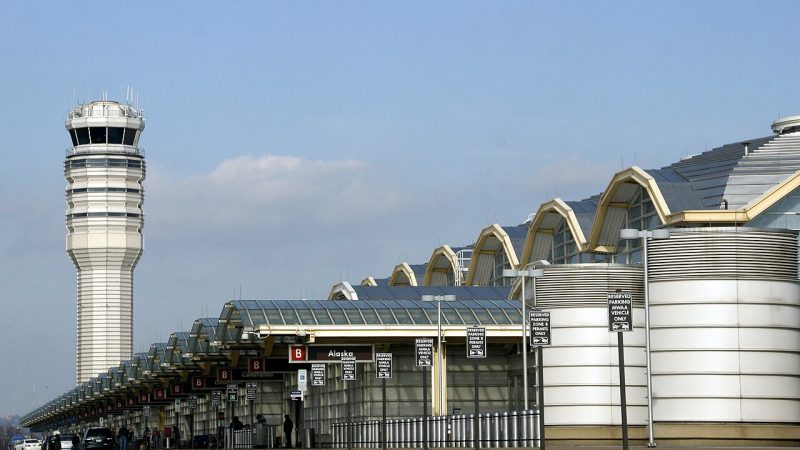
Robert L. Johnson, better known as Bob Johnson, the founder and CEO of BET, was at the forefront of a potentially historic aviation endeavor. His vision: to launch DC Air through a merger between United Airlines and US Airways, marking the first Washington-Reagan based airline and the first African-American-owned airline in the United States.
Background – US Airways Was Struggling
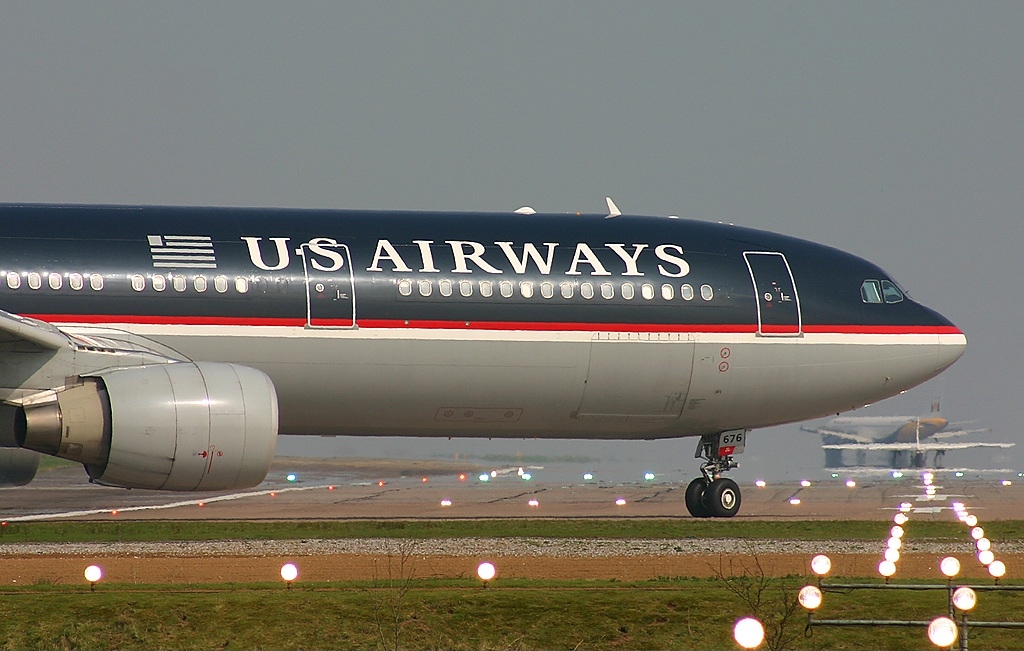
US Airways Airbus A330-323X preparing for departure from Manchester Ringway International Airport (MAN) – EGCC, United Kingdom | IMAGE: Dale Coleman via Wikimedia Commons
Fierce competition on the east coast combined with an unfortunate series of incidents led to US Airways struggling to survive. Like many companies that encountered serious financial difficulties, US Airways sought a merger deal that would ensure their survival in the aviation industry. The solution appeared to be a deal with United Airlines, accompanied by a side agreement with Johnson, aiming to alleviate antitrust concerns and pave the way for DC Air.
DC Air Emerges From The Negotiation
The merger between US Airways and United contained a unique proposal. United and US Airways would guarantee a lease of facilities at DCA (Reagan National Airport) to a newly-formed carrier called DC Air. American Airlines would then partner with the airline to provide aircraft and crews. The proposed airline would serve up to 44 cities from its DC hub with over 120 flights a day. Johnson’s venture promised not only to introduce his innovative approaches that he honed in the entertainment industry but also to symbolize a milestone in minority-owned business ventures in aviation.
Bob Johnson–Founder of BET and DC Air
Johnson announced in May 2000, that DC Air would form as part of the merger between United Airlines and US Airways. The two large merging carriers were going to part with a portion of their assets in order to ensure regulatory approval and avoid any antitrust concerns. The airline, which would have been called “DC Air” was intended to be a regional airline with its operations in the Ronald Reagan National Airport in Washington DC, serving a total of forty-four cities with a hundred and twenty-two daily departures. Aside from the innovations that would have been introduced to the airline by the legendary entrepreneur Bob Johnson, both politicians and the common people looked forward to the merger deal and the emergence of DC Air.
American Airlines Joins The Fray
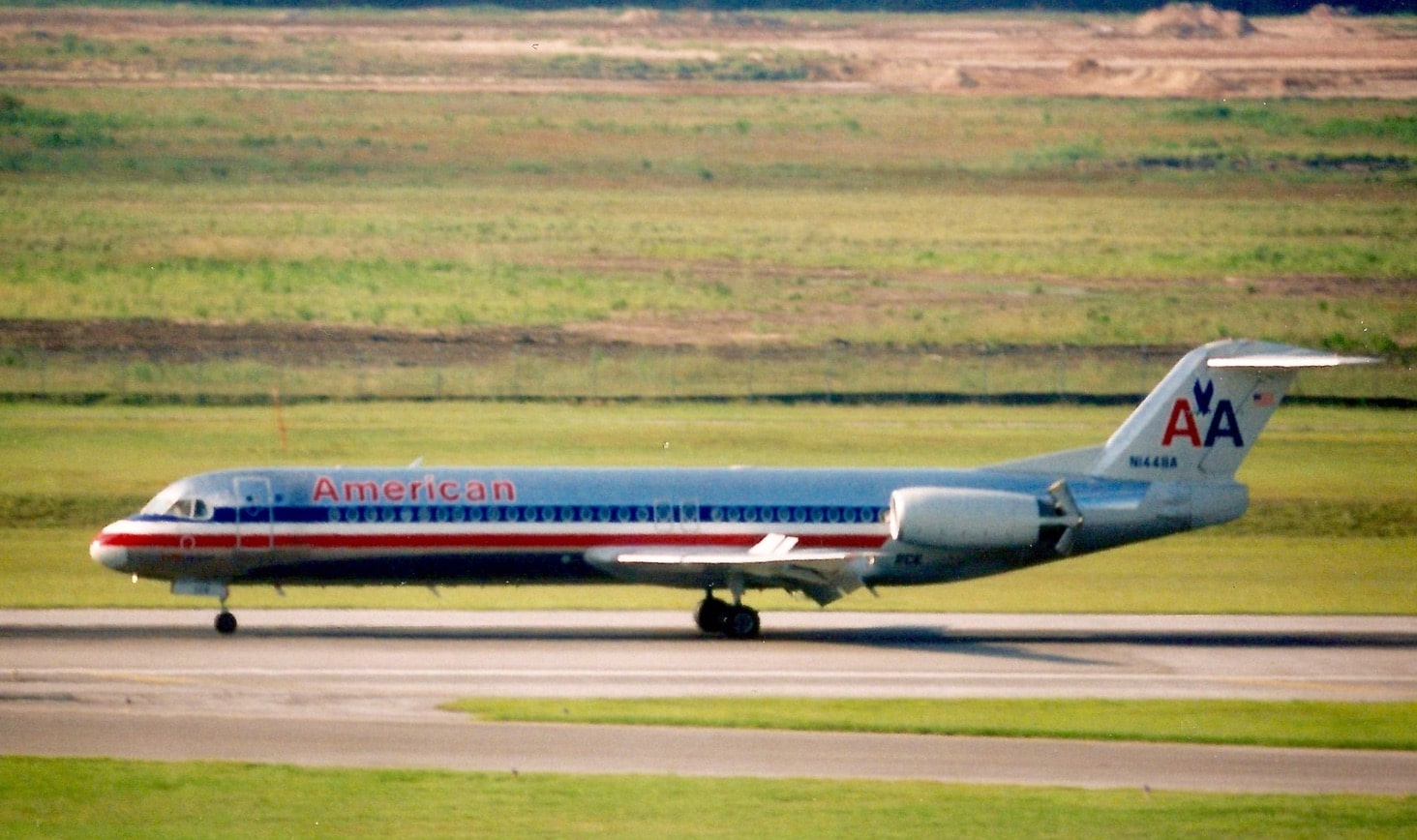
Photo by Bill Abbott (Flickr, CC 2.0)
As part of the deal, American Airlines was going to ‘wet lease’ 11 Fokker F100s to DC Air and take a significant minority stake in the new airline. In a 2001 filing, American stated:
American has agreed to acquire a 49 percent stake in, and to enter into an exclusive marketing agreement with, D.C. Air, LLC (DC Air). American has agreed to pay $82 million in cash for its ownership stake. The Airline will have a right of first refusal on the acquisition of the remaining 51 percent stake in DC Air. American will also lease to DC Air a certain number of Fokker 100 aircraft with necessary crews (known in the industry as a “wet lease”). These wet leased aircraft will be used by DC Air in its operations. DC Air is the first significant new entrant at Ronald Reagan Washington National Airport (DCA) in over a decade. DC Air will acquire the assets needed to begin its DCA operations from United/US Airways upon the consummation of the merger between the two carriers. American’s investment in DC Air and the other arrangements described above are contingent upon the consummation of the merger between United and US Airways and upon execution of definitive documentation between DC Air and United (which has not yet occurred).
The Deal Faced Skepticism But Johnson Was Confident
Bob Johnson was, at the time and remains to this day, a renowned entrepreneur. Even before he decided to be involved in a merger deal with two airlines and form a new one, he founded Black Entertainment Television, which was an entertainment television that was focused on appealing to African American audiences in America. Not only did he spearhead and found BET, but he also succeeded in making it a huge success and later selling the entertainment company for over $3 billion dollars. While he was successful in entertainment, many were skeptical of his ability to replicate that success in the airline industry.
Problems From The Start That Were Larger Than The DC Air Startup
The exact details of the reason why the deal fell through were complicated and much bigger than just DC Air. From the onset, the United and US Airways tie up faced challenges. There were many concerns about the size of the merged airline. Politicians voiced their opposition to the plan stating on numerous occasions that it would not be beneficial to the consumer. Unions worried about possible job cuts from the merger. Shareholders and analysts also expressed concern as they cited poor performance by US Airways and the state of their operation at the time. The US Airways and United merger drama played out in the media and in DC. It was eventually scuttled, thus DC Air which was mostly contingent on the success of the tie up, never happened. There was other skepticism about the deal though according to a Washington Post article from the time.
The Washington Post reported in 2001 that an unnamed member of the US Airways board of directors and Johnson never convinced decision-makers that the BET-founder was prepared to run an airline with such a complicated founding.
It was also rumored that regulators were also skeptical of the merger deal because they had concerns that DC Air would be unable to maintain its independence and stand on its own as an airline. The merger agreement involved DC Air leasing facilities and maintenance services from United Airlines for a period along . American would purchase minority ownership and lease aircraft to the startup Critics maintained that the dependencies inherit in the airline’s makeup would keep DC Air at the mercy of its competitors well after the proposed merger between United and US Airways.
Aftermath of the deal falling through
After the merger failed, the financial problems of US Airways persisted and got worse. In August 2002, following the attacks on September 11th, they filed for bankruptcy. Then the struggling airline filed for bankruptcy again in 2003, earning quite a reputation by filing for bankruptcy twice in just two years.
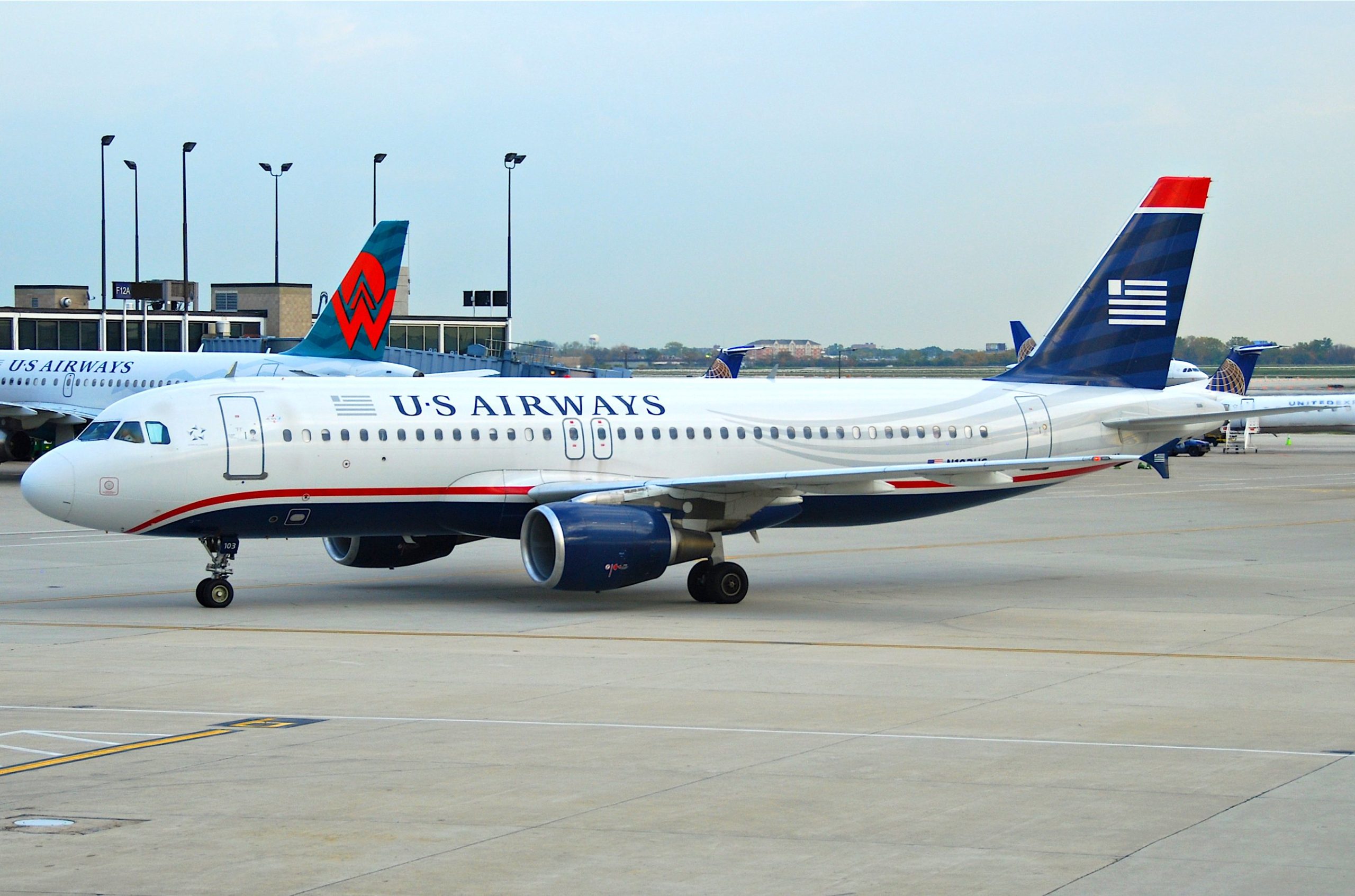
US Airways Airbus A320-214 (N103US) at Chicago O’Hare International Airport (ORD) on 12 Oct 2011. IMAGE: Aero Icarus via Wikimedia Commons
US Airways eventually reorganized, recovered, and went on to merge with America West. With a strengthened balance sheet from that merger, the airline then later joined forces with American Airlines. United chose Continental as their merger partner.
Bob Johnson sold BET but remained as the company’s CEO for years before passing the baton on to Debra Lee. Today, Bob Johnson owns an asset management company called RLJ. He never became an airline CEO. DC Air was never to be.
From historic firsts to complex mergers, the airlines of Hawaii continue to tell the story of a rich aviation legacy that links the islands to the world and the world to America’s 50th state.
Among all the airlines of Hawaii that have served the state, only one has truly endured: Hawaiian Airlines, proudly owned and operated in the islands. Others have come and gone, some barely making it into the annals of Hawaiian aviation history. Mokulele Airlines, though much smaller, has weathered change over the years and might just earn an honorable mention for its staying power.
Today, many airlines fly to Hawaii, but let’s take a trip down memory lane and revisit 11 airlines of Hawaii that no longer grace the skies of paradise.
1. Air Hawaii
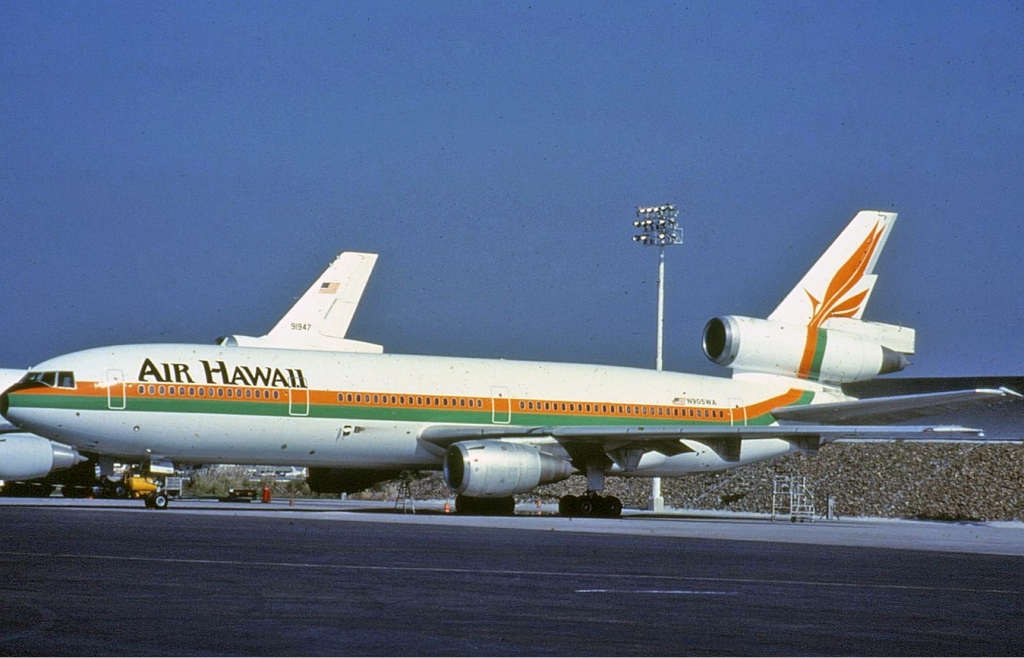
Forgotten airlines of Hawaii: Air Hawaii | One of two Air Hawaii McDonnell Douglas DC-10-10s on the ramp at Oakland International Airport (OAK) in September 1983 | IMAGE: Clinton Groves via Wikimedia Commons
One of the lesser-known chapters of Hawaiian aviation history is that of Air Hawaii. Although the name Air Hawaii had been used at least two times before, this iteration of the name was not related to either.
Founded by entrepreneur Michael Hartley (who would later co-found CheapTickets.com), this quirky carrier lasted less than three months.
Air Hawaii began operations in November 1985. Based at Honolulu’s Daniel K. Inouye International Airport (HNL), the carrier utilized two McDonnell Douglas DC-10-10s for service to the mainland. Air Hawaii operated flights between Honolulu and just two other cities – Los Angeles (LAX) and San Francisco (SFO).
Finding itself in almost immediate financial trouble, Air Hawaii abruptly shut down in February 1986.
Hartley also founded The Hawaii Express, another airline with a similar fate, which we will read about below (see #11). Interestingly, the two DC-10s operated by Air Hawaii were the two Hartley had used for The Hawaii Express.
2. Aloha Airlines
Planes of Paradise: 11 Forgotten Airlines of Hawaii that Shaped its Skies 25
From one of the lesser-known chapters of Hawaiian aviation history to one of the most well-known: Aloha Airlines.
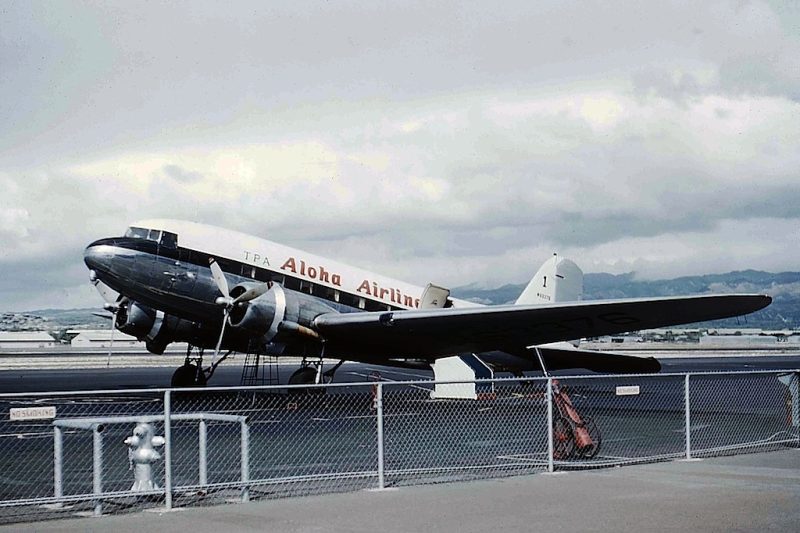
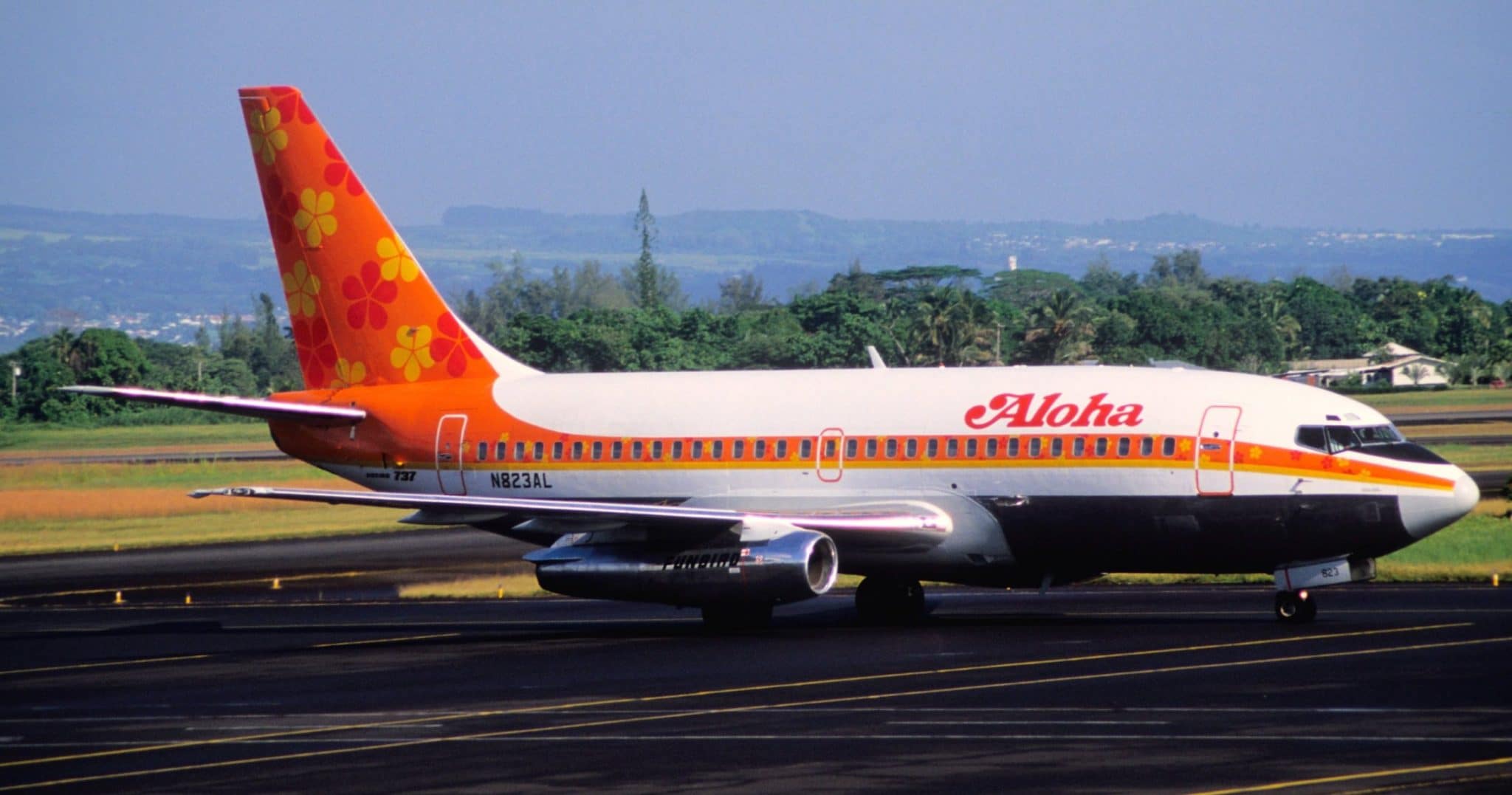
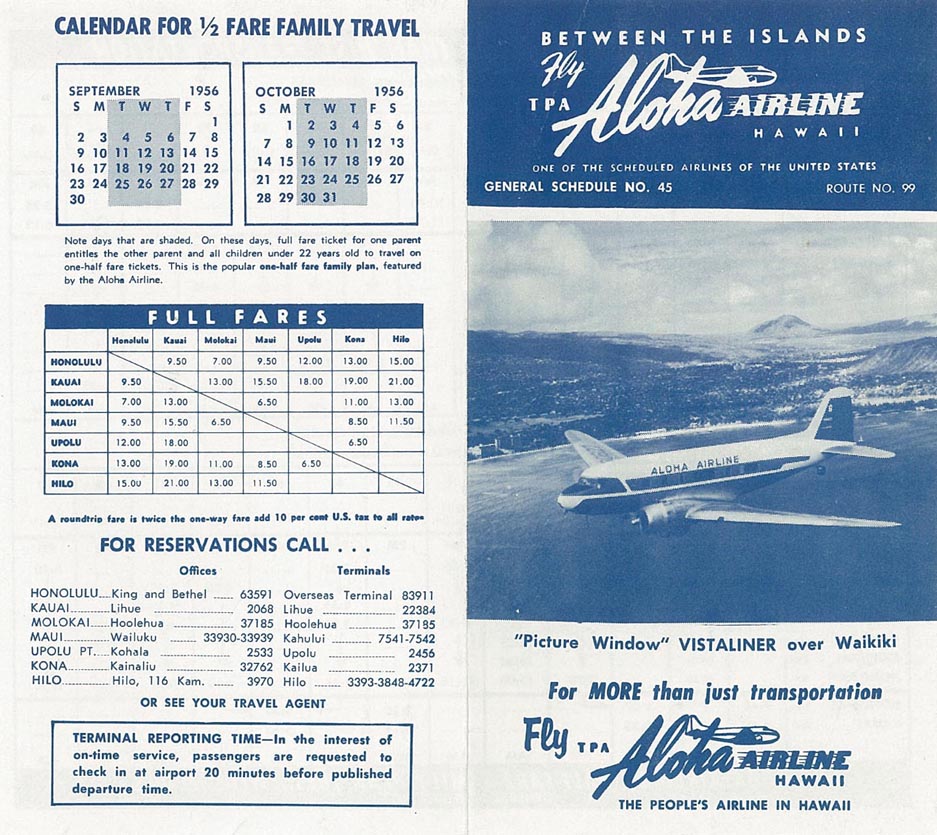
Founded in 1946, Aloha enjoyed a journey that spanned over six decades. Originally established as Trans-Pacific Airlines, the Honolulu-based carrier initially operated a fleet of nine Douglas DC-3 aircraft. The DC-3 was the backbone of the Aloha fleet through 1965.
An Aloha Airlines timetable from September 1956 | IMAGE: From the collections of Björn Larsson via timetableimages.com
Over the years, Aloha underwent several fleet transitions, experimenting with various aircraft types. During the 1960s, the carrier introduced six Fairchild F-27s and four Vickers Viscount 745Ds into the fleet. In the late 1960s, the jet age arrived at Aloha with the introduction of the BAC 1-11. However, it was the Boeing 737-200 that became synonymous with Aloha’s identity, earning the moniker “Funbird.” Operating interisland flights with the 737-200s and extending its reach to the mainland and trans-Pacific destinations with 737-700s, Aloha also operated 737-300/400s and, eventually, even a 737-800 in the late 2000s.
Aloha also operated one McDonnell Douglas DC-10-30 for less than a year in the mid-1980s, opening the carrier up to routes such as Guam International Airport (GUM) and Taipei Taoyuan International Airport (TPE) in Taiwan.
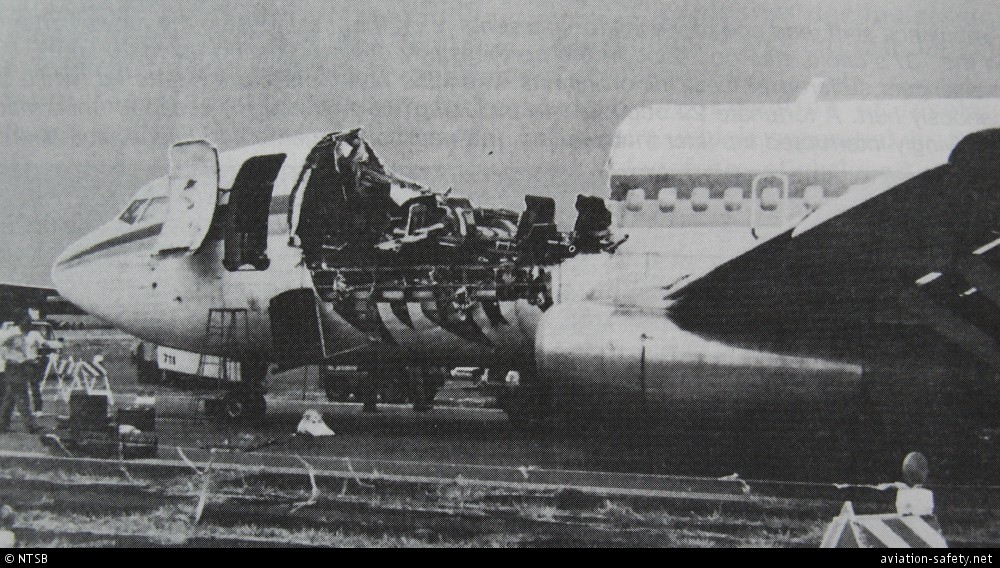
Despite its successes, Aloha Airlines faced a tragic incident on 28 April 1988 when a Boeing 737-200, operating from Hilo International Airport (ITO) to Honolulu (HNL), experienced an explosive decompression at FL240. Miraculously, the skilled crew managed to land the aircraft safely on Maui, but the incident claimed the life of one flight attendant.
Damage inflicted by a massive decompression of an Aloha 737-200 | IMAGE: National Transportation Safety Board (NTSB)
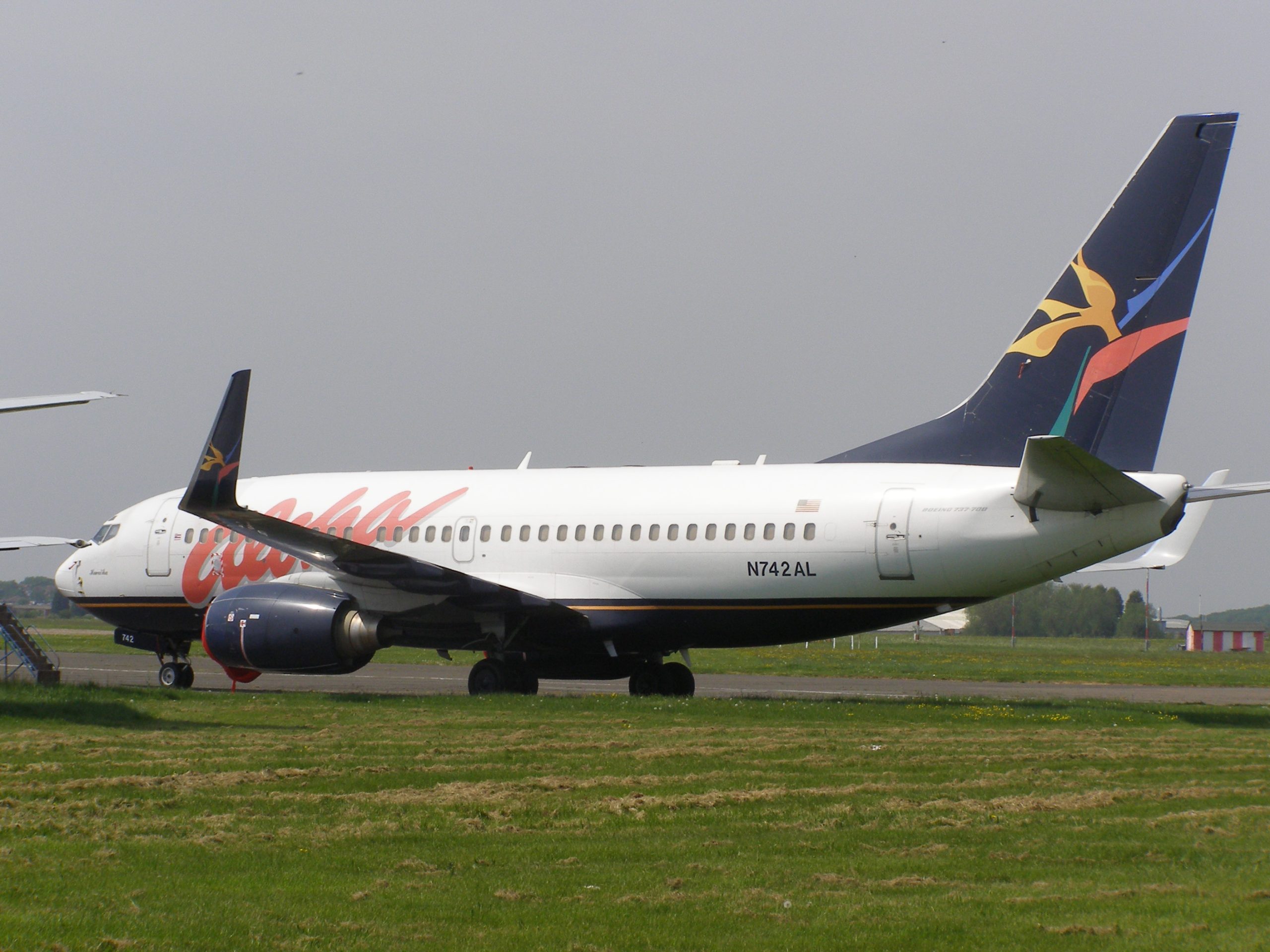
The 2000s saw a series of events that ultimately led to the demise of the once-storied airline. In March 2008, after more than six decades in the skies, Aloha Airlines ceased operations. At the time of shutdown, it operated a fleet of 22 aircraft to 20 destinations.
A former Aloha Boeing 737-700WL in storage in Southend Airport, England, after the airline’s 2008 demise | IMAGE: MilborneOne via Wikimedia Commons
3. Discovery Airways
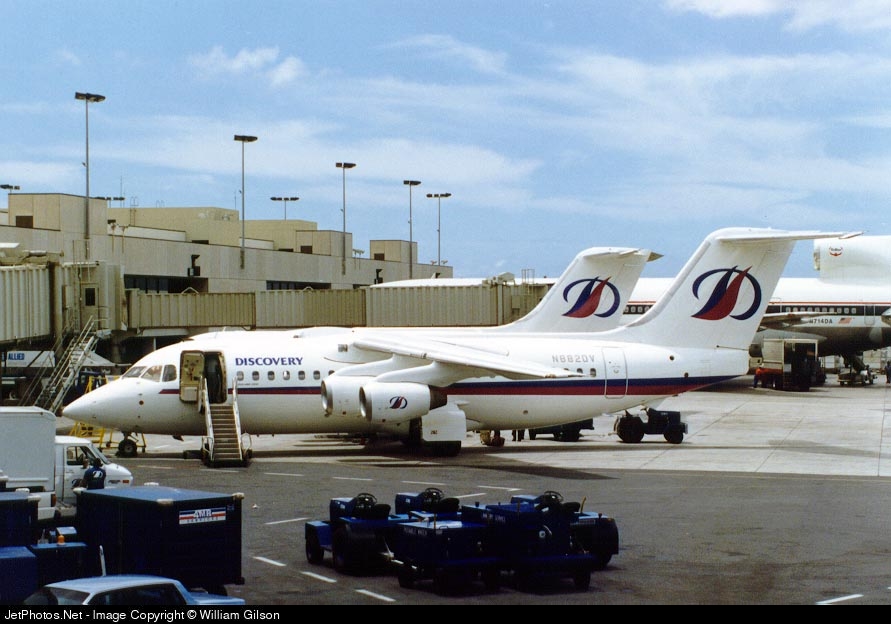
Forgotten airlines of Hawaii: Discovery Airways | A pair of Discovery Airways British Aerospace BAe 146-200 at Honolulu International Airport (HNL) in April 1990 | IMAGE: William Gilson via JetPhotos.net
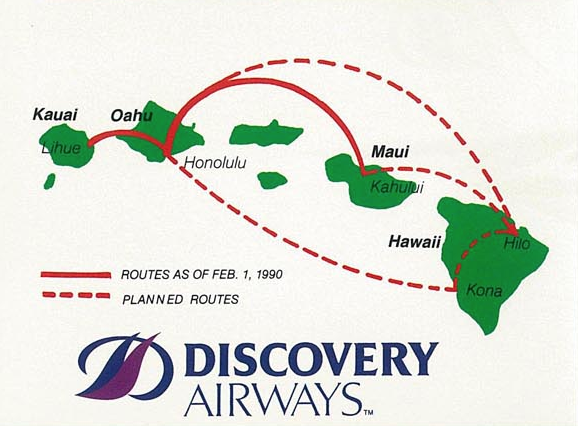
Discovery Airways was another short-lived airline that provided interisland service within Hawaii. The Honolulu-based carrier launched in 1990 with service between HNL and Kahului Airport (OGG), Lihue Airport (LIH), and Kona International Airport (KOA).
Discovery operated a fleet of five 96-seat British Aerospace BAe 146-200s. However, just four months after its launch, the Department of Transportation ordered the carrier to shut down. This directive arose when the owner, Phillip Ho, failed to provide proof of American citizenship amidst an investigation, thereby violating a federal law governing airline ownership.
A Discovery Airways route map from February 1990 | IMAGE: From the collection of Don Henchel via timetableimages.com
4. Go! Airlines
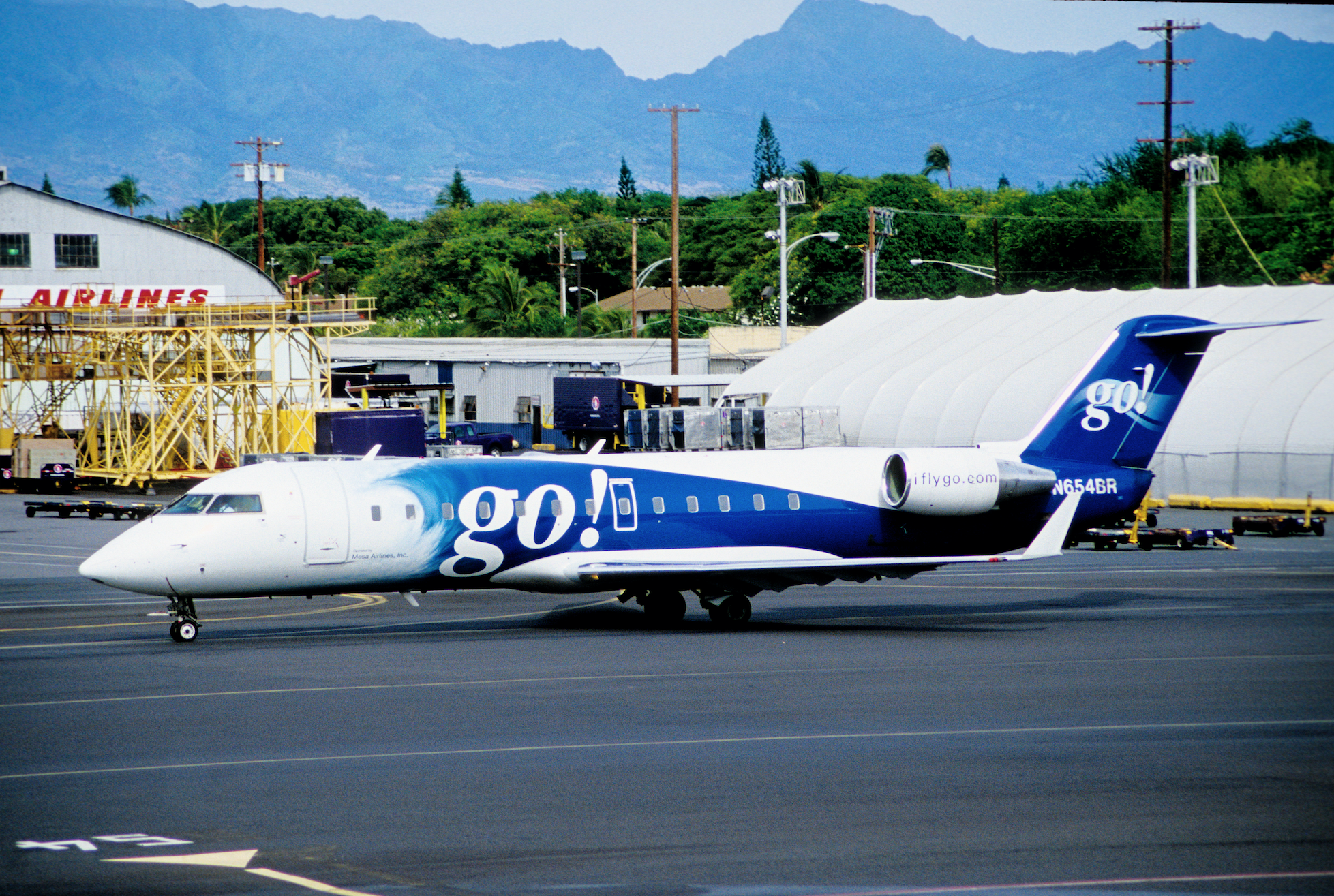
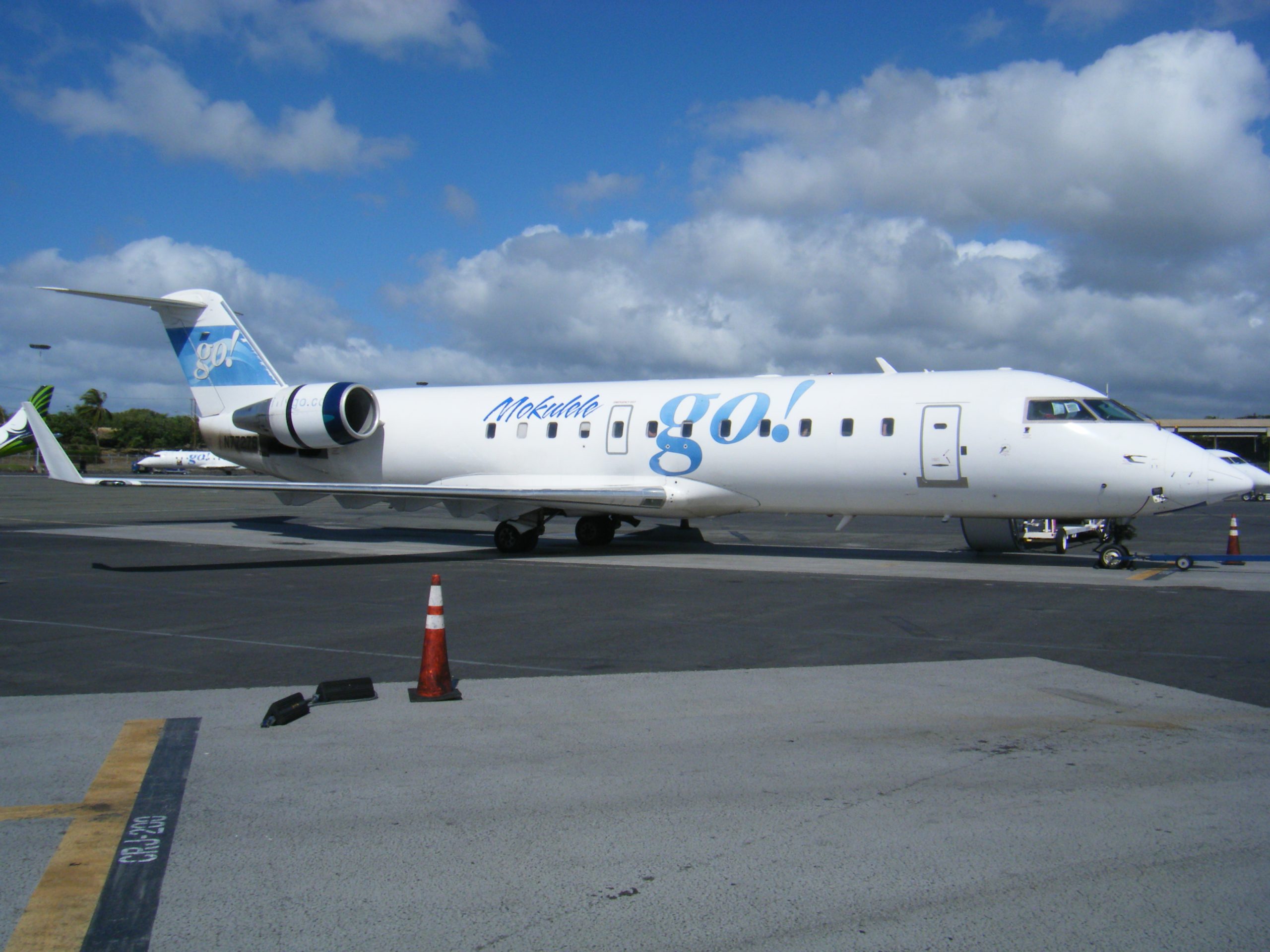
Forgotten airlines of Hawaii: Go! | A Go! CRJ-200 in original livery | IMAGE: Aero Icarus via Wikimedia Commons
With a fleet of 12 CRJ-200s, Go! was a regional interisland airline that began operations in June 2006. It was owned by Phoenix-based Mesa Air Group and operated a base at HNL.
Go! provided service to four airports from its HNL hub, including Hilo (ITO), Kahului (OGG), Kona (KOA), and Lihue (LIH).
The carrier’s reputation took a hit in February 2008 when both pilots fell asleep on a flight from Honolulu to Hilo. The CRJ-200 overshot its destination by 18 minutes before the pilots woke up and landed the plane safely at its intended destination.
Go! rebranded as Go! Mokulele (see #5 below) for three years between 2009-2012. However, the carrier shed the Mokulele name in 2012. It operated for two more years before financial difficulties led to Mesa’s decision to reallocate assets to the mainland, permanently ending the Go! brand.
5. Go! Mokulele
Forgotten airlines of Hawaii: Go! Mokulele.| A Mesa Airlines CRJ-200 Regional Jet in the go! Mokulele branding of its two parent companies, Republic Airways Holdings and Mesa Air Group, at Honolulu International Airport (HNL) | IMAGE: Travis Thurston via Wikimedia Commons
Go! Mokulele was an interisland airline that operated as a joint venture between Mesa Airlines and Mokulele Flight Services. The Honolulu-based carrier operated from 2009 to 2012 and served seven cities: Hilo (ITO), Kona (KOA), Lihue (LIH), Lanai City (LNY), Kahului (OGG), Molokai (MKK), and Honolulu (HNL).
Go! Mokulele utilized a fleet of six CRJ-200s (operated by Go!/Mesa) and four Cessna 208B Grand Caravans (operated by Mokulele Airlines).
Following the divestiture of its ownership stake in Mokulele Airlines in late 2011, the brand was discontinued a short time later.
6. Island Air
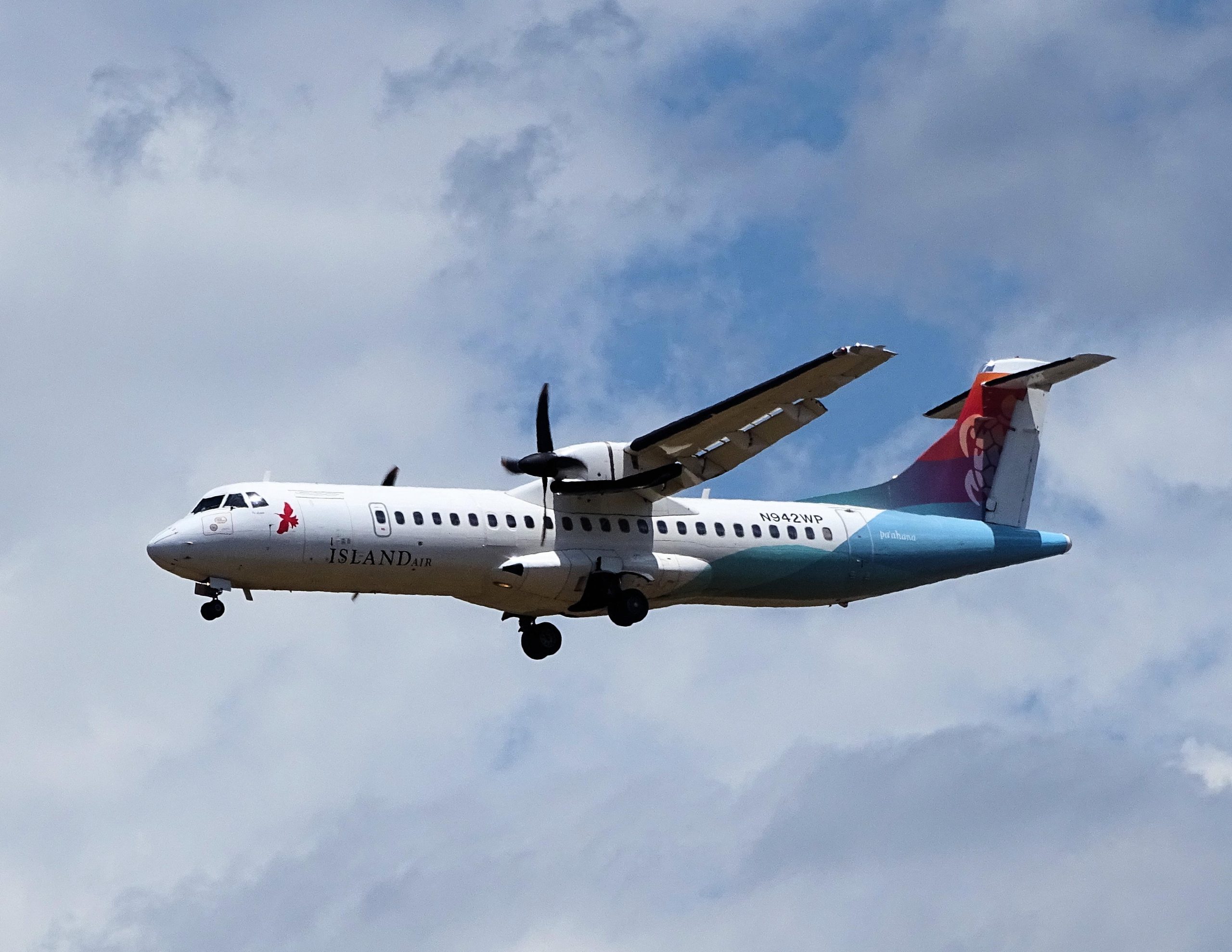
Forgotten airlines of Hawaii: Island Air | An Island Air ATR 72 N942WP | IMAGE: James Brennan via Flickr
Established in 1980 as Princeville Airways, Island Air provided essential connections between the Hawaiian Islands. In 1987, after being acquired by the Aloha Air Group, the parent company of Aloha Airlines, it was renamed Aloha Island Air. The Honolulu-based carrier operated on routes that could not accommodate the larger Aloha 737-200 jets. Another rebranding took place in 1995 when it became Island Air.
Throughout its 37-year history, Island Air operated a fleet of 64-seat ATR 72s, 19-seat De Havilland Canada DHC-6 Twin Otters, 37-seat De Havilland Canada DHC-8-100/200s, and 78-seat Q400s.
Despite its initial success, Island Air faced persistent financial challenges. It changed hands several times, with billionaire Larry Ellison’s ownership through Ohana Airline Holdings LLC in 2013 and subsequent sale to PacificCap LLC in 2016.
These challenges led to a reduction in its route map and services. Cities like Molokai (MKK), Kapalua/West Maui (JHM), Lihue (LIH), Lanai (LNY), and Hilo (ITO) were among those cut from its operations. Despite promises of expansion and efforts to restore service to previously-served airports, Island Air ultimately succumbed to financial pressures and ceased operations in November 2017.
At the time of its closure, Island Air was operating a fleet that included Bombardier Q400 turboprops, serving only four cities – Kona (KOA), Lihue (LIH), Kahului (OGG), and HNL.
7. Mahalo Air
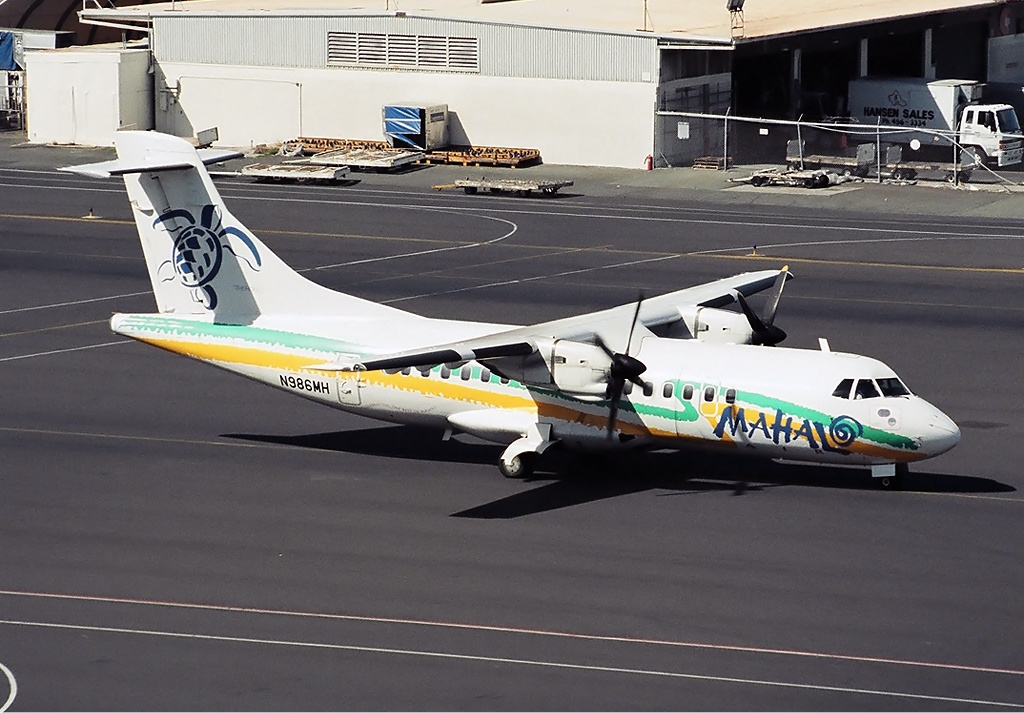
Forgotten airlines of Hawaii: Mahalo Air | A Mahalo Air ATR ATR-42-320 at Honolulu (HNL) on 25 May 1995 | IMAGE: Paul Spijkers via Wikimedia Commons
Beginning operations in 1993, interisland carrier Mahalo Air initially relied on Fokker F27 Friendship turboprops operated by Empire Airlines while awaiting certification. However, the agreement with Empire ended in May 1994, leading to the temporary shutdown of Mahalo Air.
The brand experienced a swift revival in October 1994, subsequently establishing a fleet of thirteen 48-passenger ATR-42 turboprops. However, like many other carriers, Mahalo Air ran into financial challenges, culminating in the Honolulu-based carrier filing for bankruptcy during the summer of 1997. The carrier officially went out of business in September 1997.
Mahalo’s brief existence included a network of seven destinations connecting principal Hawaiian airports such as Honolulu (HNL), Kahului (OGG), Kapalua (JHM), Molokai (MKK), Kona (KOA), Lanai (LNY), and Lihue (LIH).
8. Mid Pacific Air
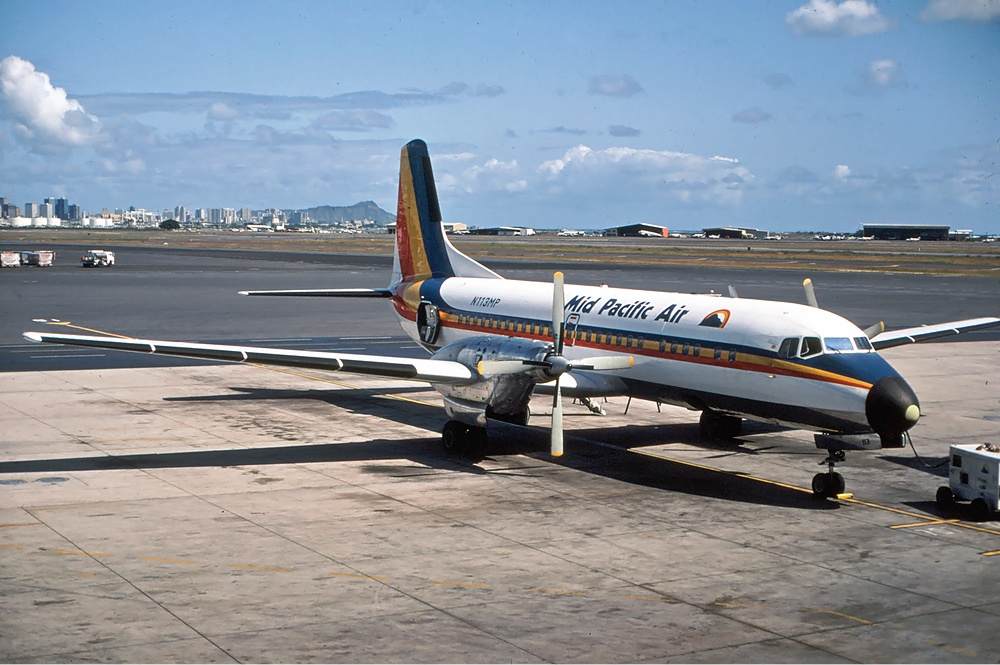
Forgotten airlines of Hawaii: Mid Pacific Air | A Mid Pacific Air NAMC YS-11A-659 at Honolulu (HNL) on 1 September 1982 | IMAGE: Richard Silagi via Wikimedia Commons
The peculiar history of Mid Pacific Air began in 1981 as a low-cost airline that carved its niche with a fleet of Japan-built NAMC YS-11 turboprops. The Honolulu-based carrier would later add Fokker F28 Fellowship jets in 1985.
Mid Pacific eventually expanded its reach beyond the Hawaiian Islands, establishing a separate mainland operation in 1985 with routes from Las Vegas (LAS) to Grand Canyon (GCN), Burbank/Bob Hope (BUR), Orange County/John Wayne (SNA), and Fresno (FAT). Ultimately, the carrier struggled to compete with the dominant players, Aloha and Hawaiian, and ended operations in early 1988.
However, the brand experienced a resurrection with a cargo-focused venture based in Lafayette, Ind. (LAF), employing the previously used YS-11s. Additionally, Mid Pacific Air took on a new identity as a commuter carrier named Reno Air Express. It would operate British Aerospace BAe Jetstream 31s out of San Jose International Airport (SJC). This chapter of Mid Pacific Air’s story would be its last, though, as the company shut down in 1995.
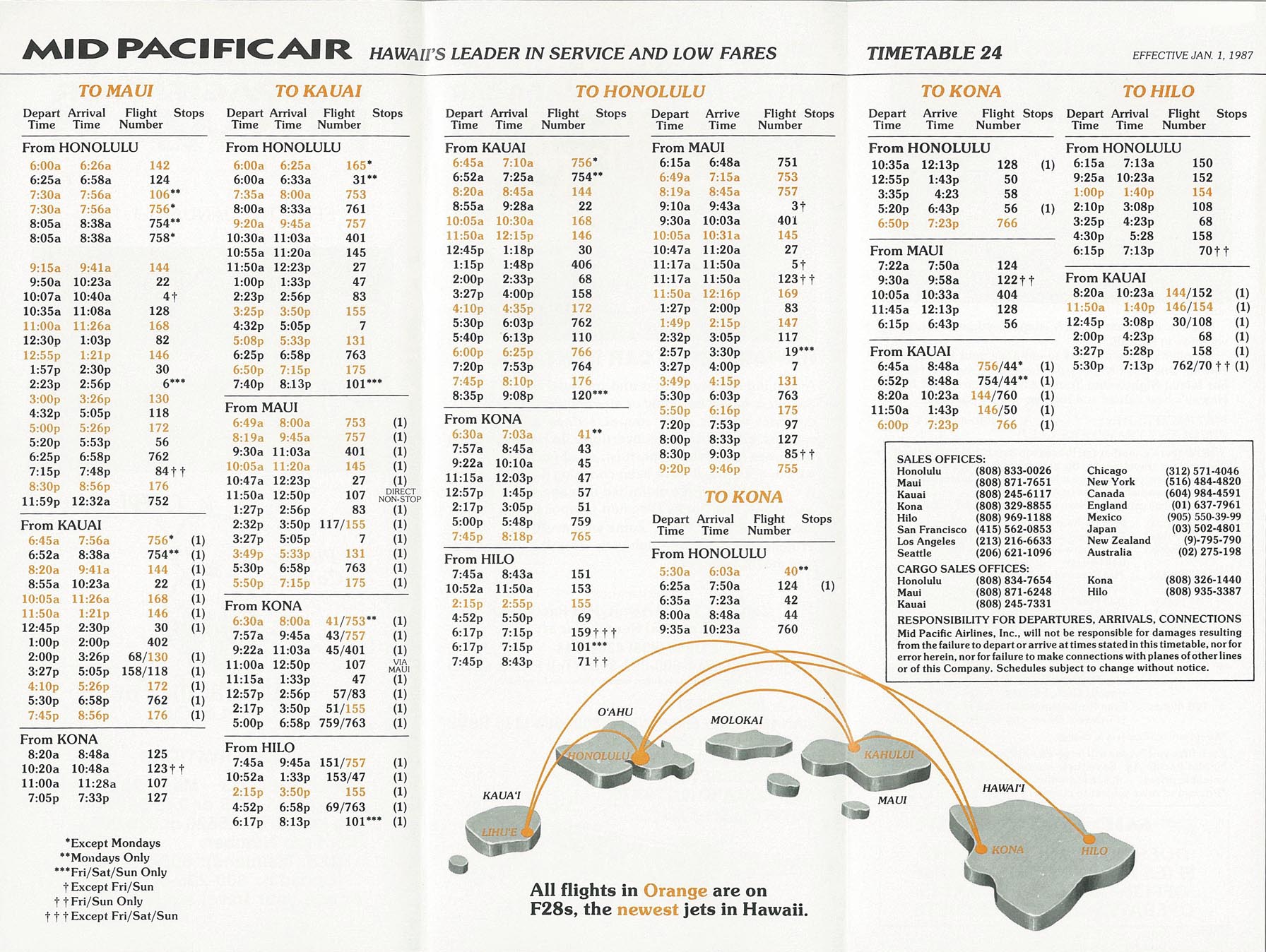
A Mid Pacific Air timetable from 1 January 1987 | IMAGE: From the collection of Björn Larsson via timetableimages.com
In its prime, Mid Pacific Air’s Hawaiian destinations included Hilo (ITO), Honolulu (HNL), Kahului (OGG), Kona (KOA), and Lihue (LIH). The fleet consisted of 22 NAMC YS-11s, two F28s, and even a wet-leased Boeing 707 operated by Mid Pacific Arrow for a route connecting Honolulu to Pago Pago, American Samoa (PPG).
9. ‘Ohana by Hawaiian
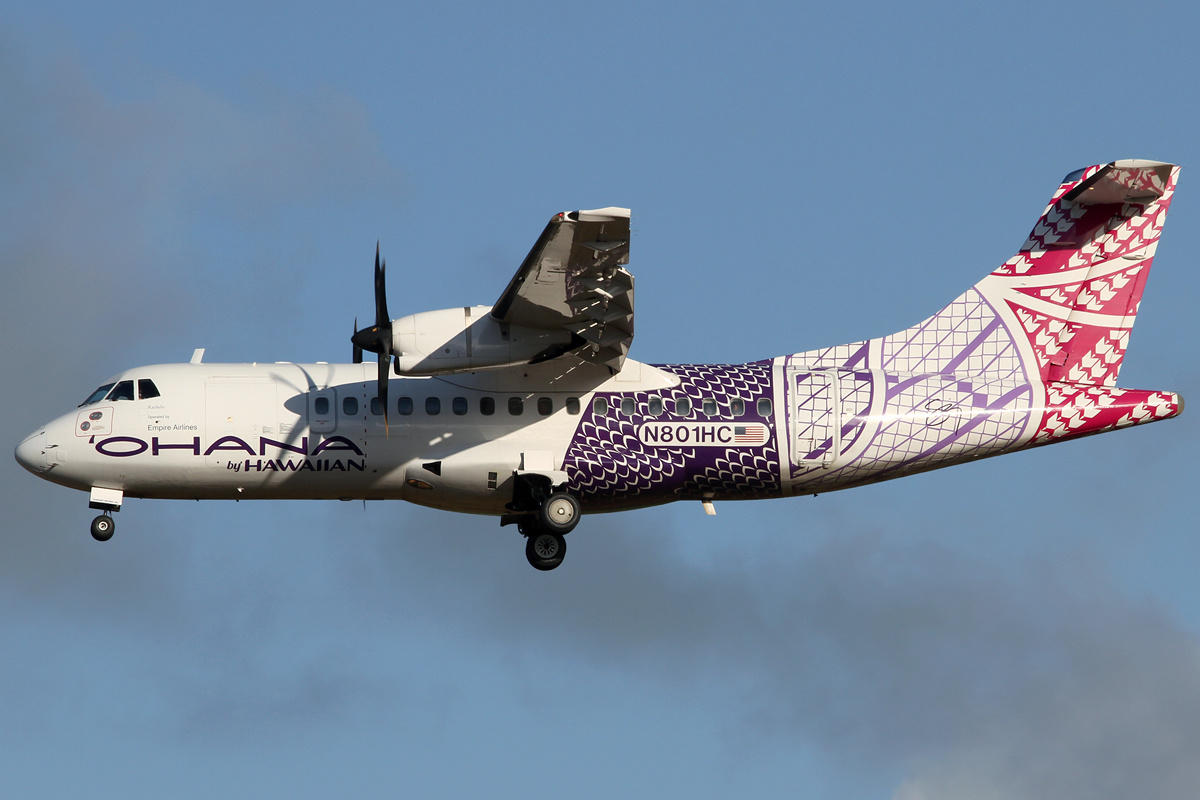
Forgotten airlines of Hawaii: ‘Ohana by Hawaiian | An ATR 42-500, operated by ‘OHANA BY HAWAIIAN, on final at Kahului Airport (OGG) on 16 August 2015 | IMAGE: Konstantin von Wedelstaedt via Wikimedia Commons
‘Ohana by Hawaiian, a regional subsidiary of Hawaiian Airlines, began operations in 2014 with a fleet that included four ATR 42s owned by Hawaiian and operated under contract by Empire Airlines. These aircraft, configured to accommodate 48 passengers, formed the backbone of ‘Ohana’s operations. The carrier also operated three ATR-72 cargo aircraft.
Serving eight destinations, ‘Ohana connected principal communities across Hawaii, including Honolulu (HNL), Kapalua (JHM), Lanai (LNY), Molokai (MKK), Lihue (LIH), Kona (KOA), Kahului (OGG), and Hilo (ITO). Unfortunately, the airline faced an untimely end in 2021, as the disruptions caused by the COVID-19 pandemic severely impacted island travel, leading to its shutdown.
10. Pacific Wings
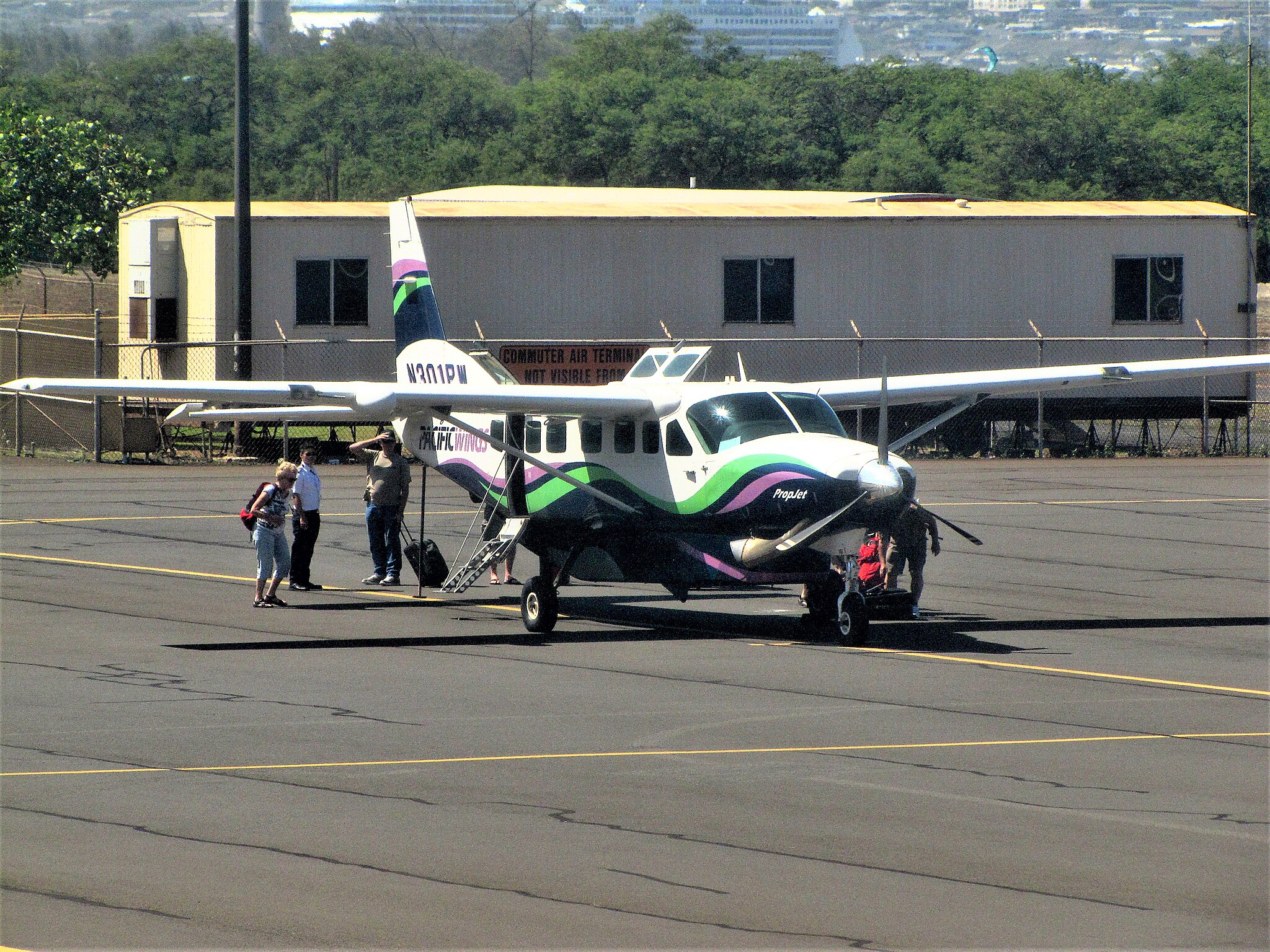
Forgotten airlines of Hawaii: Pacific Wings | Passengers board a Pacific Wings Cessna 208B Grand Caravan at Kahului Airport (OGG) on 20 February 2012 | IMAGE: redlegsfan21 via Wikimedia Commons
Pacific Wings can trace its roots back to 1974 when it began operations as an on-demand charter operator named Air Nevada. The airline transitioned to scheduled service in 1978, connecting Las Vegas (LAS) and Grand Canyon (GCN). However, Air Nevada’s operations came to an end in 1998.
The brand soon returned to life when it resurfaced as Kahului-based Pacific Wings, focusing on scheduled service within Hawaii. In 2007, the carrier rebranded as PW Express. It offered $49 flights between Honolulu (HNL) and Molokai (MKK), Lanai (LNY), and Kahului (OGG). PW Express operated a fleet of Cessna 402s and 208B Grand Caravans.
Pacific Wings closed down PW Express in 2009 following a security incident in Kahului. Shortly after, the carrier eliminated all but three routes and ultimately ended all Hawaii flights by 2013.
11. The Hawaii Express
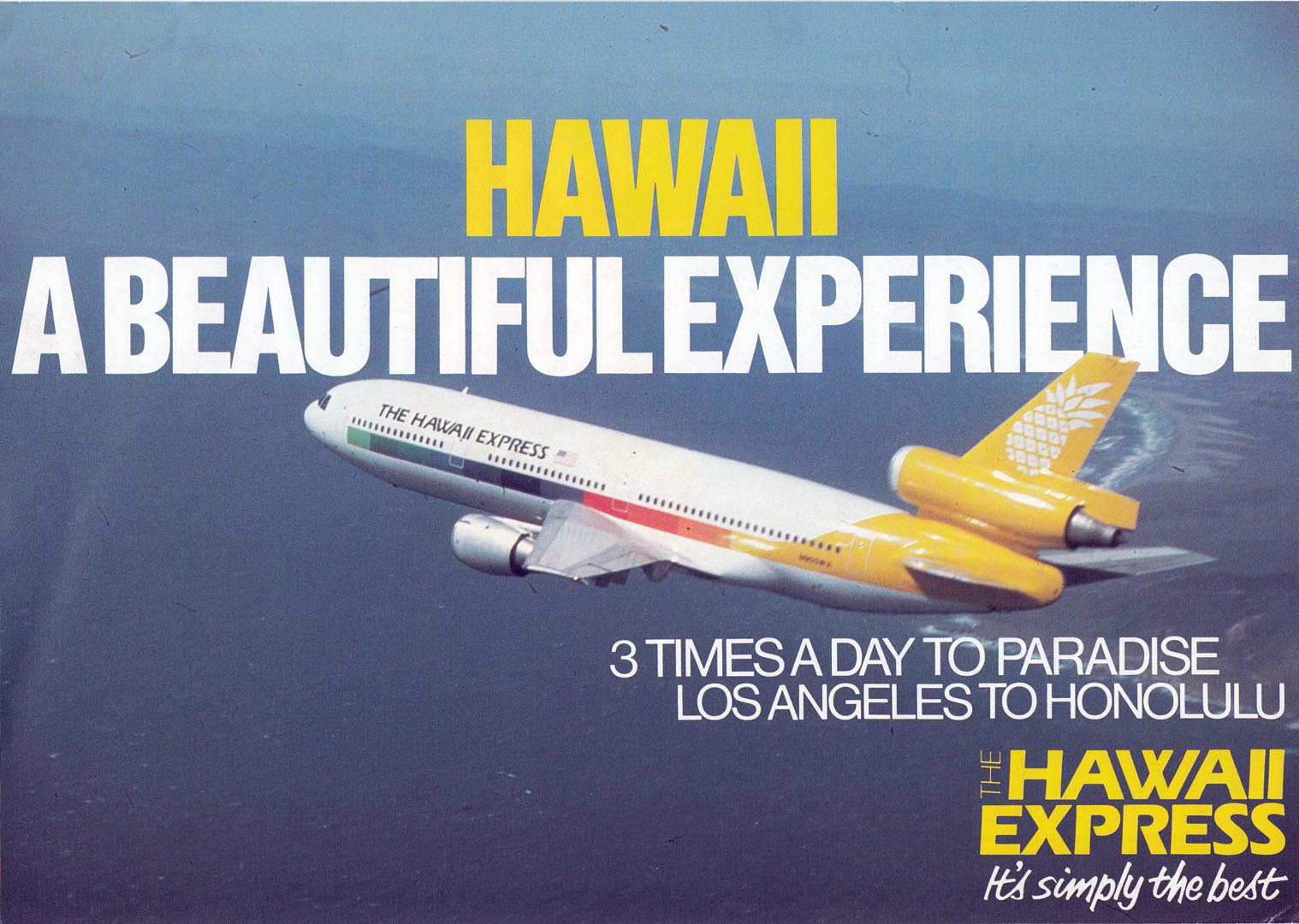
A page from the August 1983 timetable for The Hawaiian Express | IMAGE: From the collection of David Zekria via timetableimages.com
Although not technically Hawaiian-owned (its headquarters was in Los Angeles), we decided to include this interesting piece of aviation history in this story.
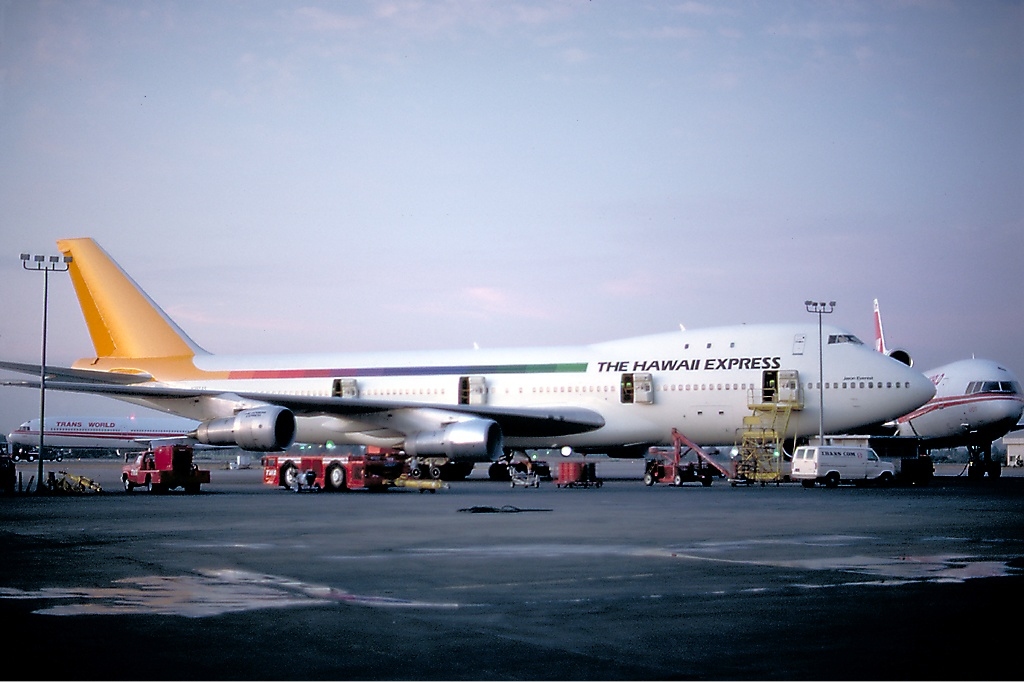
Before Air Hawaii’s (see #1) failure, there was The Hawaii Express. With Michael Hartley (the visionary behind Air Hawaii) at the helm, the carrier began operations in August 1982 with a single Boeing 747-100.
Forgotten airlines of Hawaii: The Hawaii Express– A Boeing 747-143 at Los Angeles (LAX) on 6 August 1982 | IMAGE: Ted Quackenbush via Wikimedia Commons
Affectionately nicknamed “The Big Pineapple,” the airline sought to carve a niche in the competitive Hawaii-US Mainland market. Hartley assembled his initial crew by hiring 15 pilots from the recently bankrupted Braniff Airlines. Additionally, he hired 50 flight attendants recently let go from various carriers across the United States.
In May 1983, the carrier acquired two McDonnell Douglas DC-10-10s. Originally intended to replace the aging Boeing 747, all three aircraft operated simultaneously for a brief period. At its peak, The Hawaii Express operated multiple daily trips between LAX and HNL.
However, The Hawaii Express’s journey ended abruptly on 20 December 1983 (due to – you guessed it! – financial woes) with the suspension of all flights. The airline filed for bankruptcy the following day.
The DC-10s, with tail numbers N904WA and N905WA, would later find a new home with Hartley’s Air Hawaii . Following Air Hawaii’s demise, they would serve with American Airlines and FedEx before being stored at Victorville Airport (VCV) as of December 2019. The 747, bearing registration N355AS, had a subsequent career with People Express, Continental, and TWA.
Hawaii’s Aviation History: As Rich as Its Beautiful Landscape
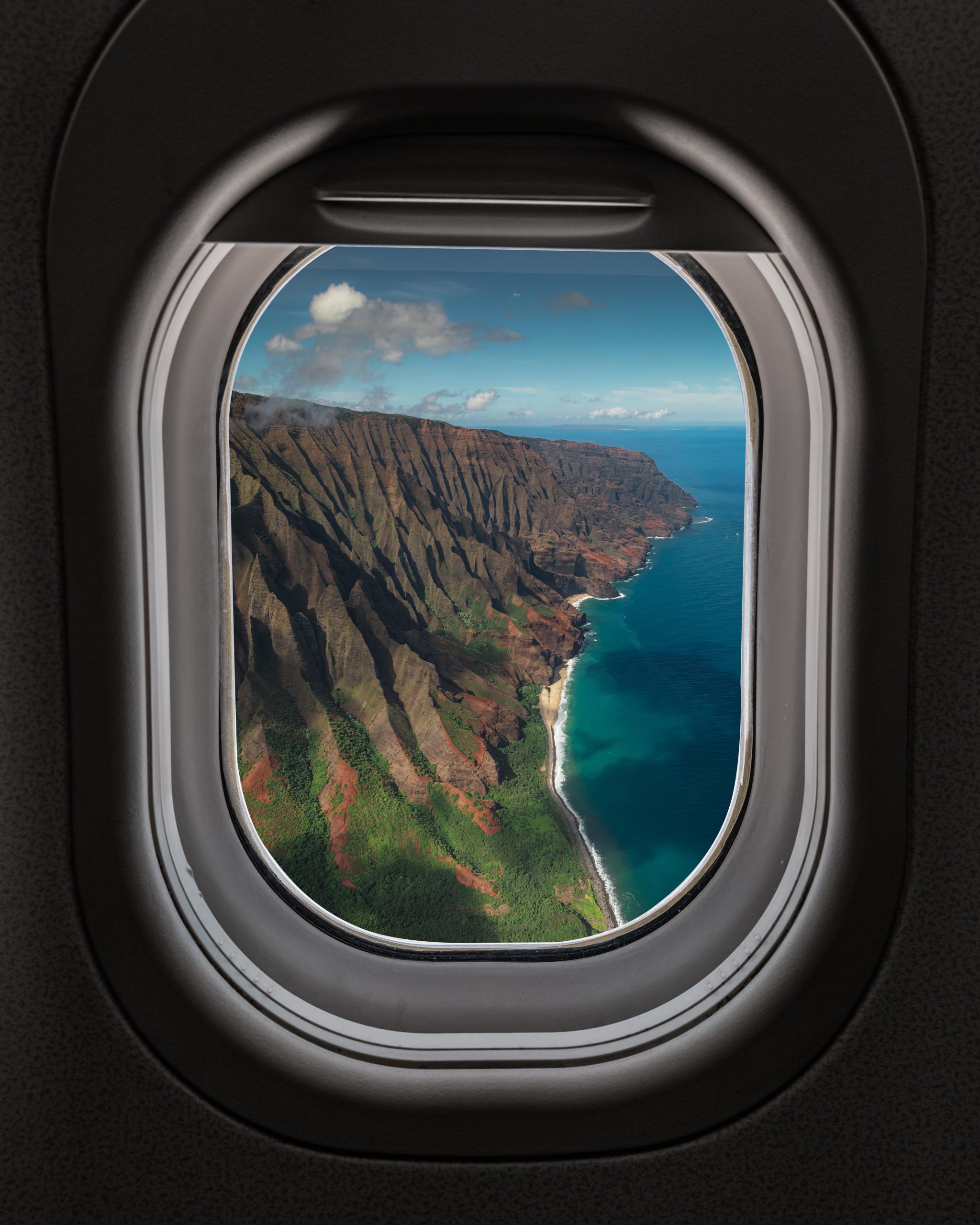
Flying above the Nā Pali Coast on the Hawaiian island of Kauai | IMAGE: Leon Macapagal via Unsplash
With their stunning geography and paradisiacal allure, the Hawaiian Islands have long been a sought-after destination for travelers worldwide.
While just two principal carriers dominate today, many have graced the skies of paradise through the years. And each has a unique story. The story of these 11 airlines of Hawaii is just a small glimpse into Hawaii’s rich (and colorful!) aviation history.
May we honor their legacy and appreciate their role in connecting Hawaii’s beautiful islands to the mainland and the world.
Retired Air Force pilot David Dale recently wrote a book called “Aviation Therapy”. We at Avgeekery are proud to share an excerpt from his new book that features a collection of stories from his time flying in the Air Force. You can purchase his book here.
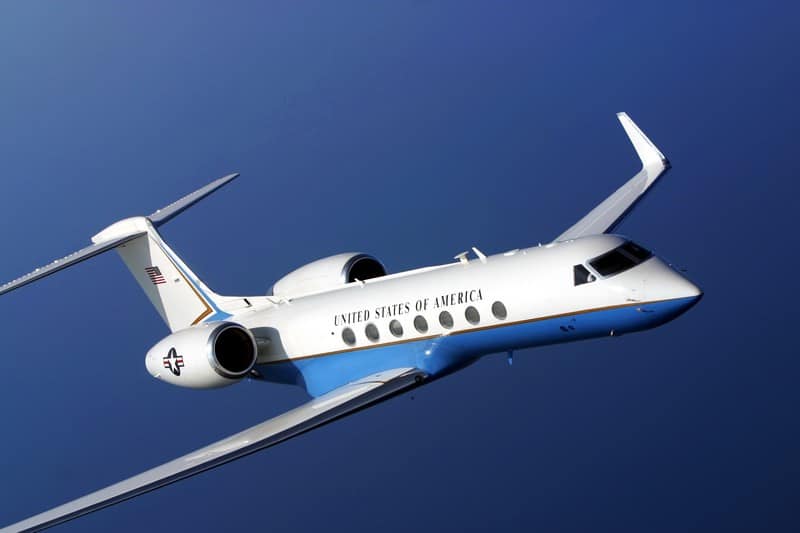
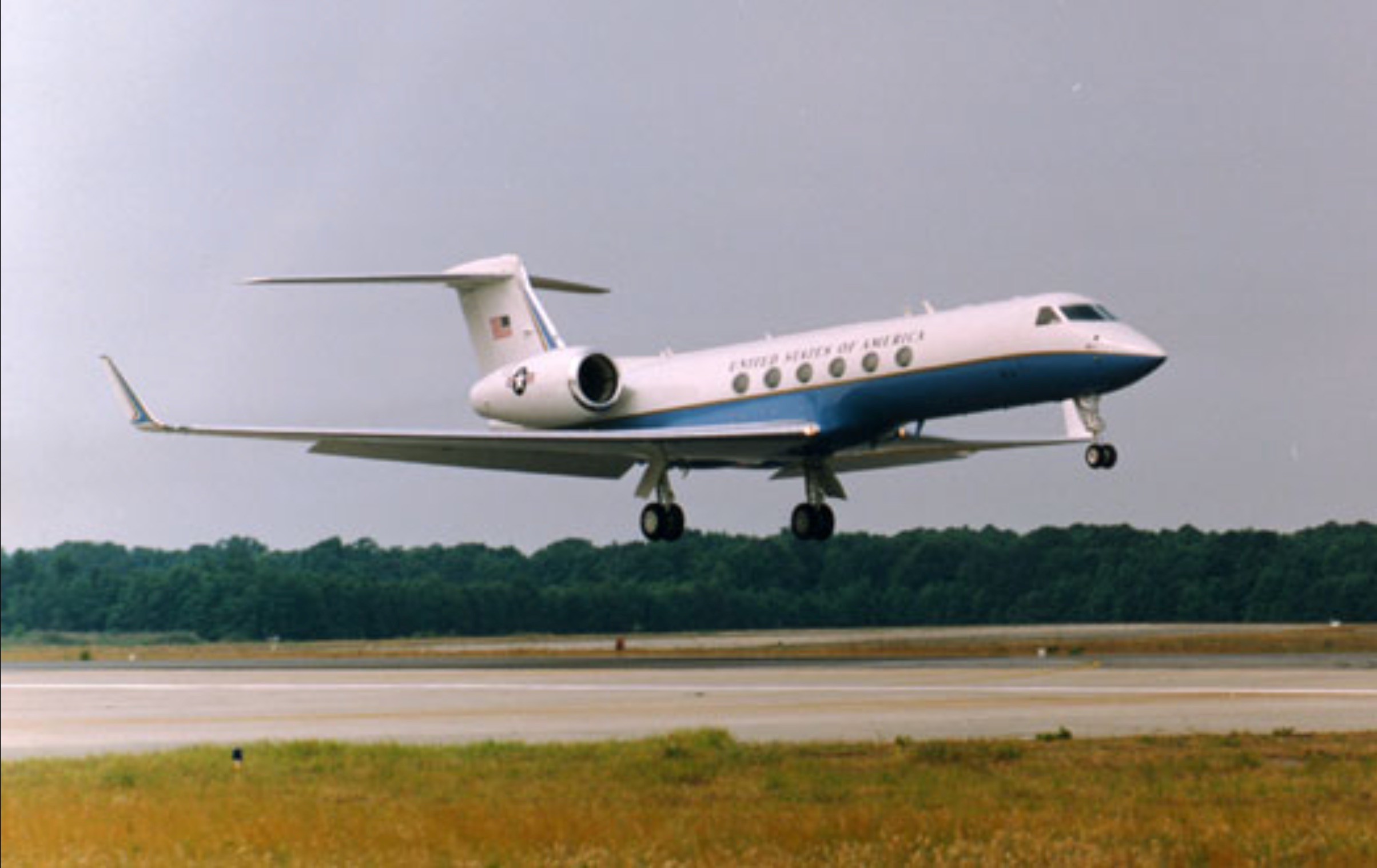
On a snowy December morning our C-37, callsign SPAR 29, was more than 30 minutes late as I began the approach to Runway 19L, the left of two parallel southbound runways at Andrews AFB. In the cabin not far from our cockpit sat CENTCOM’s commander, General Tommy Franks, and a Marine Corps major, an F-18 fighter pilot, who served as the general’s aide.
The right-side runway at Andrews was closed, perhaps for snow removal, so we could not fly a Category II Instrument Landing System precision approach down to 100 feet above the ground. Because of the less precise instrumentation on the left-side runway, we were instead restricted to using the approach to Runway 19L, which could only be flown to 200 feet above the ground. That 100-foot difference was important on this white winter morning.
According to our C-37 policies, I flew the approach using the Heads-Up Display (HUD) while my copilot peered through the clouds, hoping to spot the runway lights by the time we reached the 200-foot Decision Altitude. My copilot, Don Axlund, an excellent officer and pilot, had just completed his check out in the C-37 the day before. This was his first operational VIP mission, which he got to fly with me, his squadron commander. No pressure, Don.
Flying The General Through A Snowstorm 28
Into the soup and back around
I briefed the ILS approach and lined up for the approach. I emphasized to Don, “If you don’t see the runway, it’s okay. Just call the ‘Go Around’ and we’ll try it again.”
As we approached 300 feet AGL, Don announced, “Approaching Minimums.” At 200 feet, with nothing but white in front of us, Don commanded, “Go Around.” I applied full power and our C-37 rose quickly through the dense white clouds.
Trusted with an important passenger
Two hours earlier, Captain Don Axlund and I had departed Tampa International Airport with General Tommy Franks onboard, bound for Andrews AFB. It was time for him to present another Operation Enduring Freedom update to the President and the Secretary of Defense.
During this timeframe, our MacDill AFB runway had been closed for repair. We were forced to operate out of Tampa International Airport, which was a 30-minute drive north of our air base. This mission got off to a poor start with a delayed takeoff after the general and his party arrived at our C-37 well past the planned takeoff time.
The flight north to Washington, D.C. took two hours but we knew we were flying into a major snowstorm. There is a tendency in Distinguished Visitor Airlift to do anything to please the customer. This led to some crews pressing the corners of the safety envelope to accomplish their mission on-time.
The challenge of DV airlift
On April 3, 1996, US Secretary of Commerce Ron Brown, and 34 other passengers had died in an Air Force CT-43 crash into a mountainside near Dubrovnik, Croatia. The crew had departed five minutes early but due to the wartime routing into Croatia, they were assigned a route that took fifteen minutes longer than planned. In their attempt to provide an on-time arrival, the crew flew faster than normal on their approach to the airfield.
Additionally, they were flying a primitive Non-Directional Beacon instrument approach into a cloud deck that was only 400 feet above the ground. The combination of a non-precision approach flown in bad weather while trying to make up time resulted in a tragic accident. The crew strayed off course in low visibility and impacted the side of a hill, killing all onboard.
At the time of the accident, I was flying NATO troops into Split, Croatia in the Netherlands Air Force KDC-10. Now, as a commander of a DV Airlift squadron, I was constantly aware of the pressures our crews faced to press the limits of safety in an effort to please our customers. As I had learned during my two years at Andrews AFB, it’s okay to say no.
Takeaways from DV flight
Two important safety lessons I brought with me to this new Florida squadron were 1) If the VIP gets mad because you didn’t think it was safe to land, just let it flow like water off a duck’s back. They’ll get over it, but you will all still be alive. 2) Don’t bend over backwards to set a precedent that your fellow squadron pilots can’t meet. In other words, don’t be the reason that the general or his staff could say, “Well, the last guy did it.”
Unable to see the Andrews runway, I applied Go-Around thrust and the powerful C-37 pitched up and climbed quickly to 2,000 feet. Just seconds before the go around, we could see snow covered trees directly below us, so the vertical visibility was almost 200 feet, but the forward visibility in front of us was still low. That restricted forward visibility kept us from seeing the runway or even the bright white approach lights once we reached the Decision Altitude.
Let’s try it one more time…safely.
Knowing we were so close to breaking out, Don requested vectors for a second approach attempt. Ten minutes later, we were on final approach and descending again into the blowing snow. Nothing improved on this second attempt, so rather than “ducking under” the clouds in the hope of seeing the runway, Don again correctly called for the go around, which I performed.
Part of the thrill of instrument flying is intense concentration while flying an approach. Pilots are not concerned with the people riding along in back. We are focused solely on our instruments, the runway, and Mother Nature. Whenever I jockey the throttles to maintain airspeed during gusty winds, I am constantly reminded of my teenage days with Mr. Lovell barking, “Stay on speed!” Or during buffeting crosswinds, he commanded “Fight for centerline!” then commented if I was one or two feet off centerline after I touched down
Pilots take on Mother Nature’s challenges but strive to keep everything within safe limits. If it’s not safe to land, we can always go into a holding pattern and wait, or divert to a better location. Safety, then Comfort, then Reliability. Keeping those priorities in that order is a life-saver.
“Runway in sight”
The winds were very light that particular day, only blowing five miles per hour out of the south. Most airplanes can handle landing with a 10-knot tailwind, so I asked Don to request an opposite direction approach from the south to the north. There were no other planes in the area to create a conflict, so permission was granted, and we lined up for the northbound right-side runway. Fortunately, the weather south of Andrews was clearing.
As I approached 300 feet, the bright white approach lights and the runway came into view through the low clouds. At 200 feet, Don announced, “Runway in sight.” Staring through the HUD, I transitioned my focus from the green instruments on the glass to a visual aimpoint 1,000 feet down the runway.
On this gloomy winter day, Don and I safely delivered General Franks to Washington D.C. … but 45 minutes behind schedule. President Bush and Secretary of Defense Rumsfeld were kept waiting for their warfighting general.
How would General Franks react? Some uppity VIPs are known to not give a hoot about excuses and only want to remain on schedule at all costs. Several of those ranting celebrities or businessmen have paid for that attitude with their lives.
We parked the jet on the red-painted cement “carpet” near Base Operations and our flight engineer opened the door, allowing the brisk winter breeze to blow through the cabin. General Franks and his aide, the Marine F-18 pilot, prepared to exit. Having a fellow aviator onboard turned out to be a Godsend. Although he and his fellow passengers could see the white snow-covered pine trees directly below us on approach, the Marine pilot explained to the other passengers that forward “slant-range” vision is often restricted and considerably less than looking straight down.
People that knew I flew General Tommy Franks often asked me, “What is he like?”
My reply: “Loud! He can be really happy or really pissed off, but he’s always loud!”
As General Franks departed our Gulfstream on that white winter day in Washington D.C., he stepped into our cockpit, popped me on my right shoulder with his large fist and in his deep baritone Texan voice boomed, “Thanks for keeping me safe!” I could not have asked for a better aviation lesson than that for my new copilot.
New Service Features Modern Cabin, Self-Serve Snack Bar, and More. Here’s My Review…
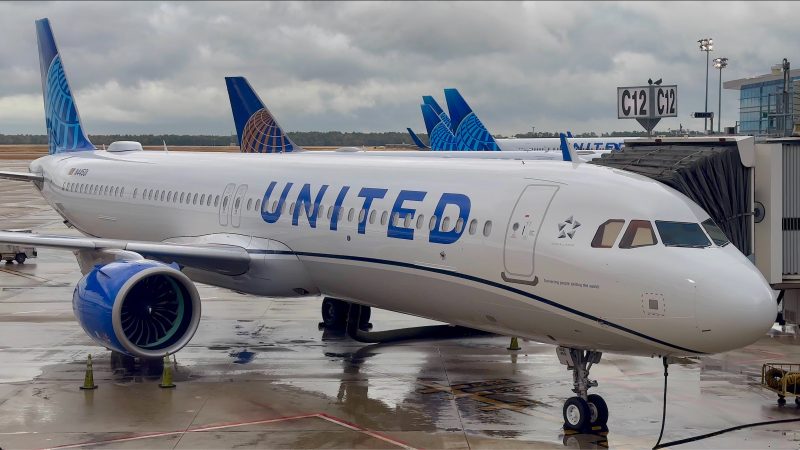
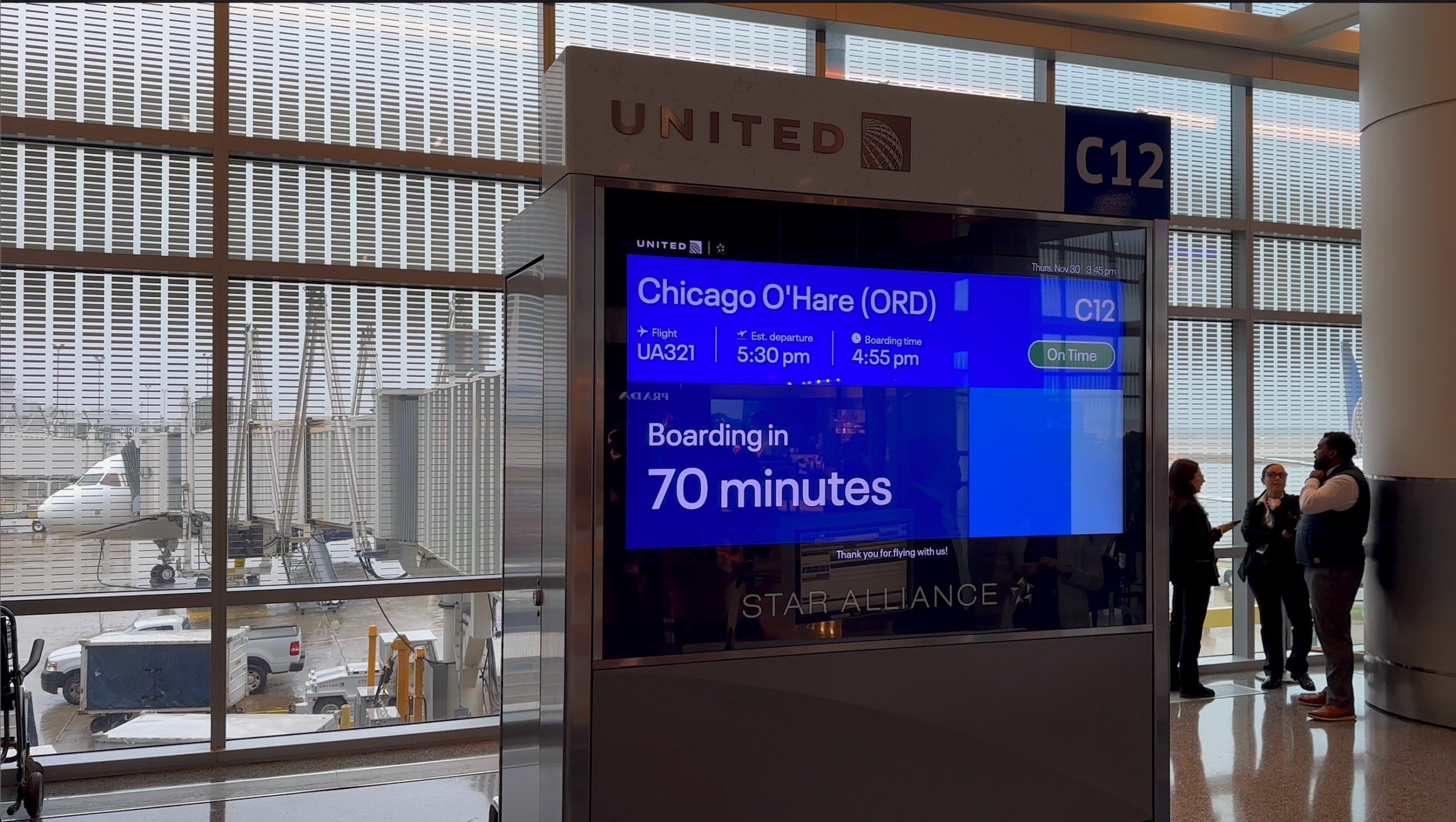
On Thursday, November 30th, United Airlines introduced their first Airbus A321-200NEO to their active fleet. The aircraft, N44501, an Airbus A321-271NX operated the inaugural flight from Houston’s George Bush Intercontinental Airport to Chicago’s O’Hare International Airport. Fittingly, the flight number 321 was assigned to the flight. I took that inaugural flight, as well as the aircraft’s second and third flights from Chicago to Phoenix and back. In total, I spent around 12 hours on the aircraft in various seats so I could get a good sense of whether this really is a game changing aircraft like United claims, or if it’s all smoke and mirrors. United has billed the A321NEO as the future of what passengers can expect on all domestic United flights, and a game changer in passenger comfort in all cabins. So, does United’s new plane live up to the hype? Or is it more of the same old stuff?
United Adds The Largest of the 320 series to their Airbus Fleet
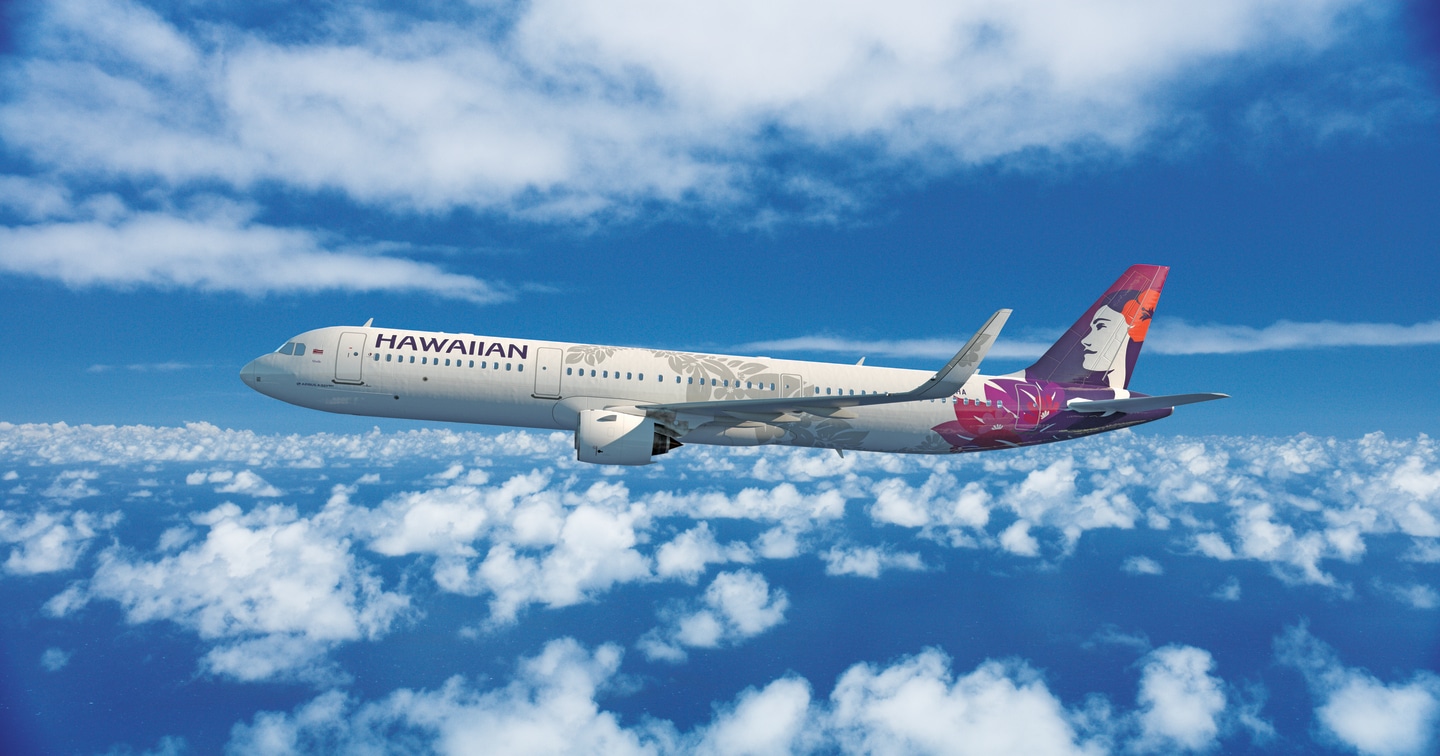
Before I answer that question, let’s get some of the facts out of the way. United already operates a fleet of Airbus A320 series aircraft, however, they are aging Airbus A319’s and A320’s, all of which are over 20 years old at this point. Which means the introduction of this brand new A321NEO marks the first time in over two decades that Untied has taken delivery of a brand-new Airbus. United has 129 further Airbus A321-200NX aircraft on order, as well as another 50 Airbus A321-200XLR aircraft. The NX variant is the high density exit configuration option of the NEO, which replaces the full-size exit doors ahead and aft of the wings with four window plug exits. American and Delta also operate the NX variant and for comparison, Hawaiian Airlines operates the regular A321-200N, where the full-size exits are kept.
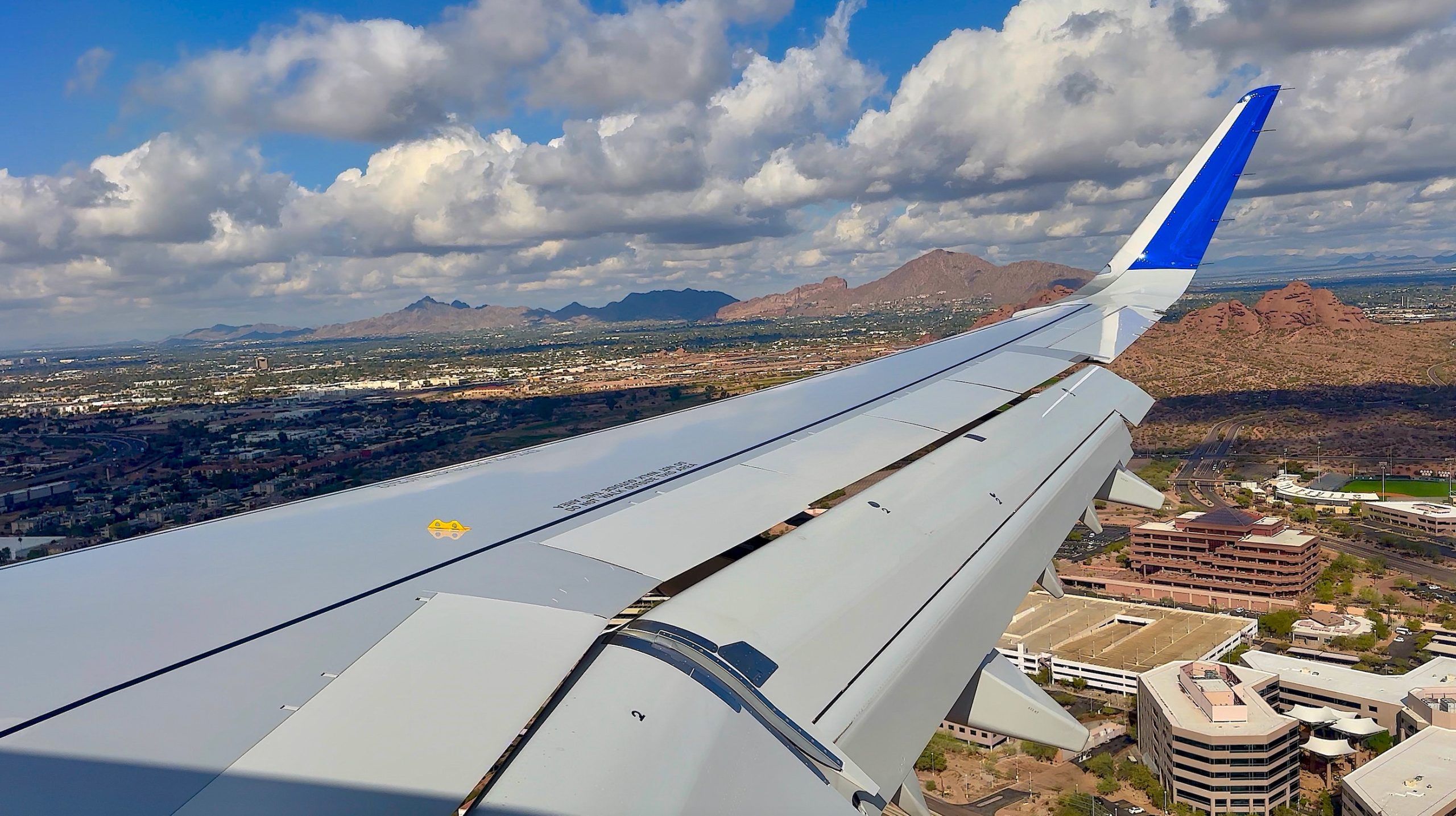
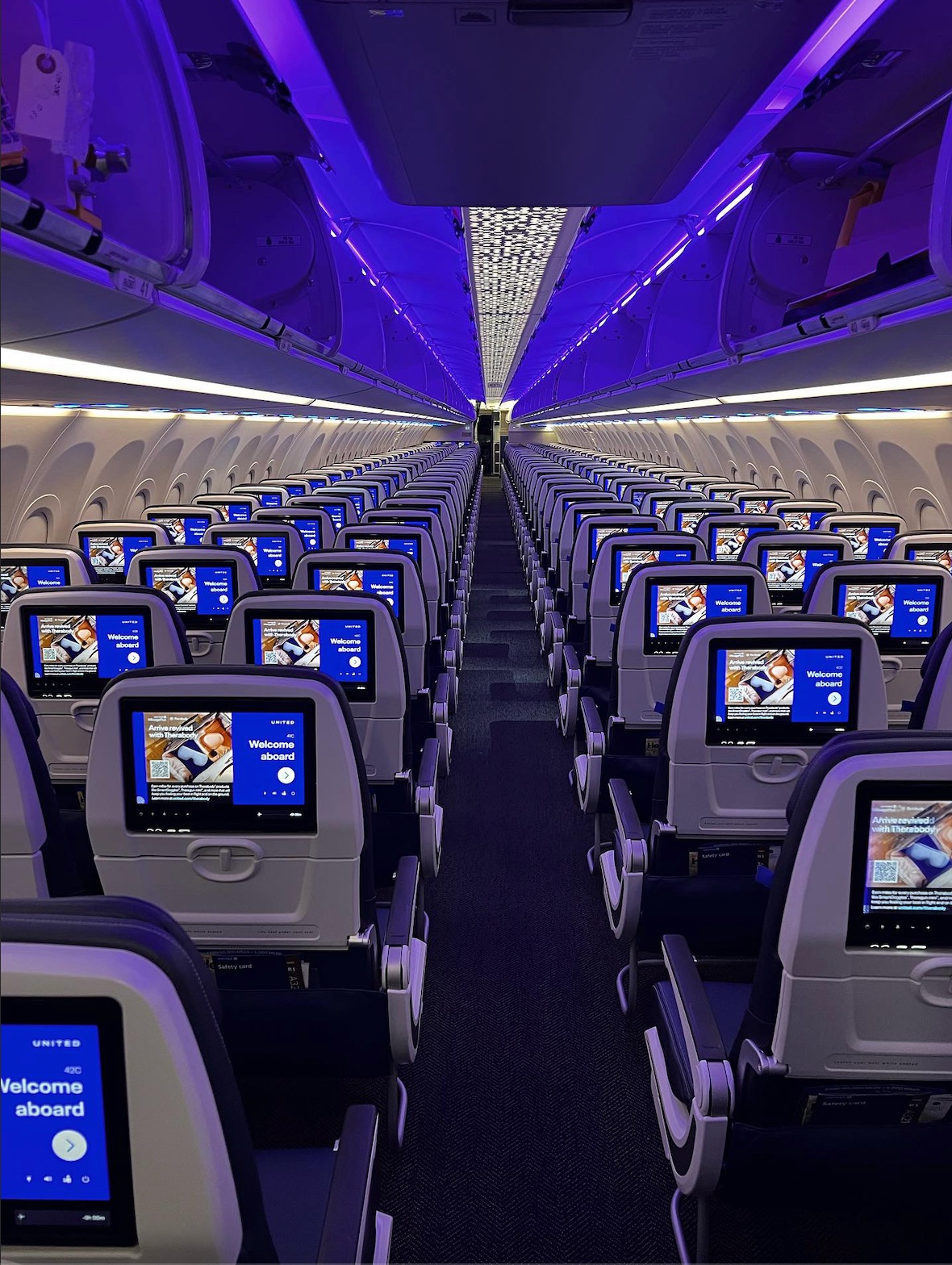
United’s A321NEO features 200 seats which include 20 United First seats, 57 United Economy Plus seats, and 123 United Economy seats. The aircraft also features four restrooms for those 200 seats. Three in the economy class section and one in the first-class section. United plans to use the aircraft initially out of Chicago’s O’Hare International Airport to Phoenix, Las Vegas, Orlando, Fort Lauderdale, and Fort Myers. Currently, with only one aircraft in active service, it is only being utilized on the Chicago to Phoenix route.
How was the experience?
United Improves Passenger Experience with Airbus A321NEO Launch 34
So, what was the aircraft like to fly on? Does it deserve the hype that United placed on it? The bottom line is that… It was very nice to fly on, and if you’re lucky enough to fly on one soon, you are in for a great onboard experience. It is easily one of the best aircraft flying domestically in the US where passenger experience is concerned.
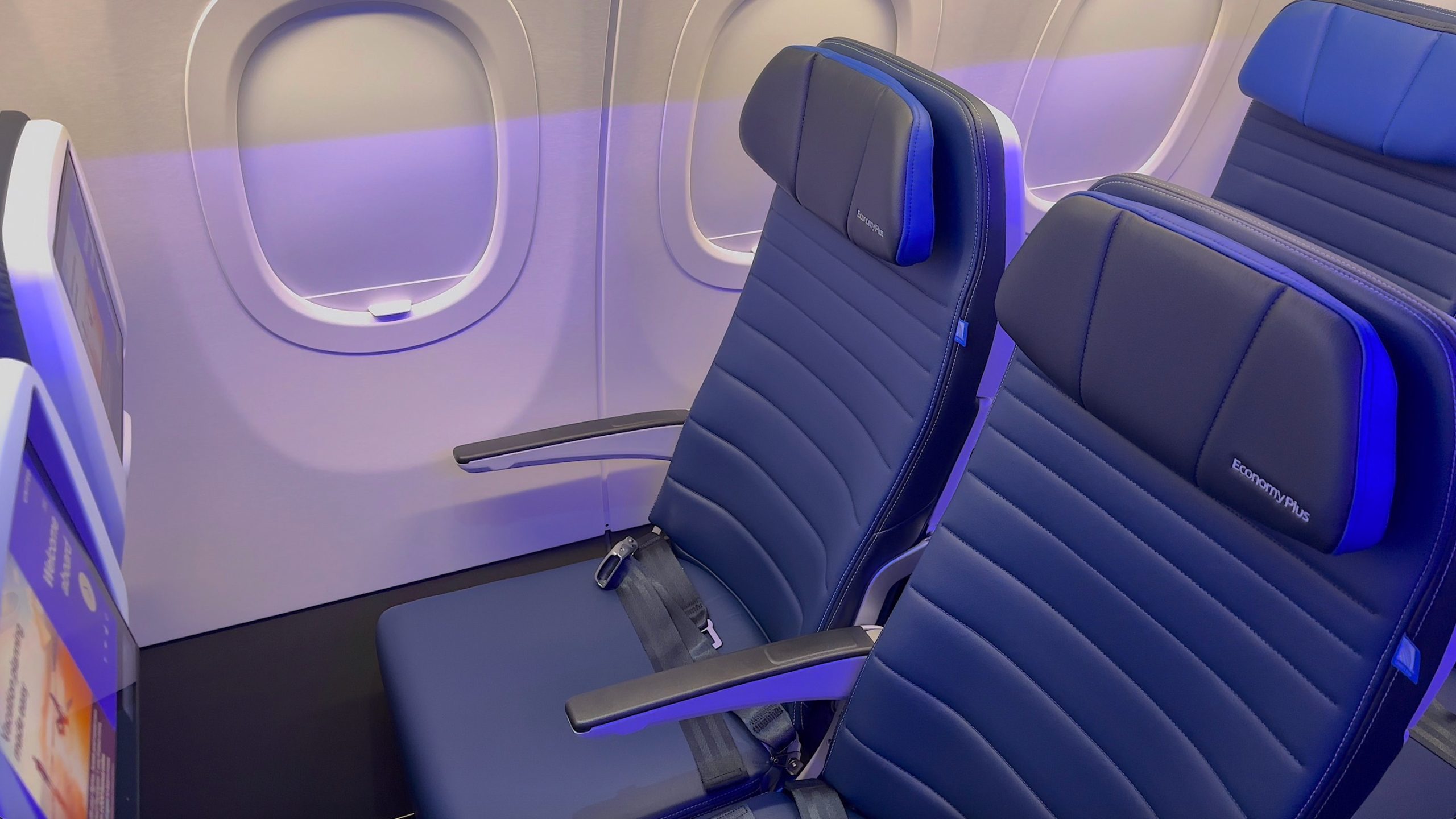
As I mentioned, I took the aircraft’s first three revenue flights. I did not have the pleasure of flying in first class on any of the legs, but I did get a chance to try the seat. On the three flights I flew in United Economy Plus twice, and once in United Economy. My seats for the three flights were 11A, 26F, and 14A. 14A being the one standard economy seat. United does have their A321NEO configured with more seats than both Delta and American have on theirs, but in my opinion, the seat features make up for the 4-6 extra passengers United is cramming on. Even in economy, passengers get a large 13” touch-controlled entertainment screen, power ports, high speed wifi, and even Bluetooth audio connectivity on the entertainment system. That’s right, you can pair your own Bluetooth headphones to the entertainment screen and no longer must give up your nice wireless headphones for a cheap airline pair because yours doesn’t have a cord to plug in.
United Improves Passenger Experience with Airbus A321NEO Launch 35
I found all three seats to be very comfortable, and on two of the flights I was in them for over 4 hours at a time. There are those good old hour-long Chicago taxi times for you… The legroom in first class and economy plus was excellent, and it was average in economy. At 6’ 2” tall, my knees basically rested against the seat back pocket in front of me when in regular economy. Which is not good, but also isn’t anything different than American’s A321NEO and you don’t get most of the extra passenger comforts like an inflight entertainment screen on American.
United Improves Passenger Experience with Airbus A321NEO Launch 36
The cabin of the aircraft also features mood lighting, easily making it be most visually appealing United domestic aircraft and a snack bar that economy class passengers use any time during the flight if they’re feeling hungry or thirsty. And just because that snack bar is available, doesn’t mean there were any less services done during the flights. On all three flights I took there was a main service done, as well as a second full drink service. So, don’t think this is United’s way of getting out of doing services. It really is just an extra option for passengers.
United Improves Passenger Experience with Airbus A321NEO Launch 37
Summarizing my A321-NEO Experience
In the end, this is a great addition to the United fleet, and it is a very passenger friendly aircraft. The fact that Untied is moving most of their fleet towards this type of passenger experience is very nice when so many other airlines are removing more and more amentias. Even though United has a slightly denser configuration compared to American or Delta, I think the seats re very comfortable, easy to fly in for 4-5 hours, and the aircraft offers a much better than usual onboard experience. Ultimately, I believe this aircraft does live up to most of the hype!
Full video of flight:
Enjoy all two plus hours of United’s A321NEO first flight.
This merger connects Hawaiian directly to a larger partner and enters them into the OneWorld Alliance as well. Still, there are a number of open issues about the surprising announcement. It’s fun to speculate.
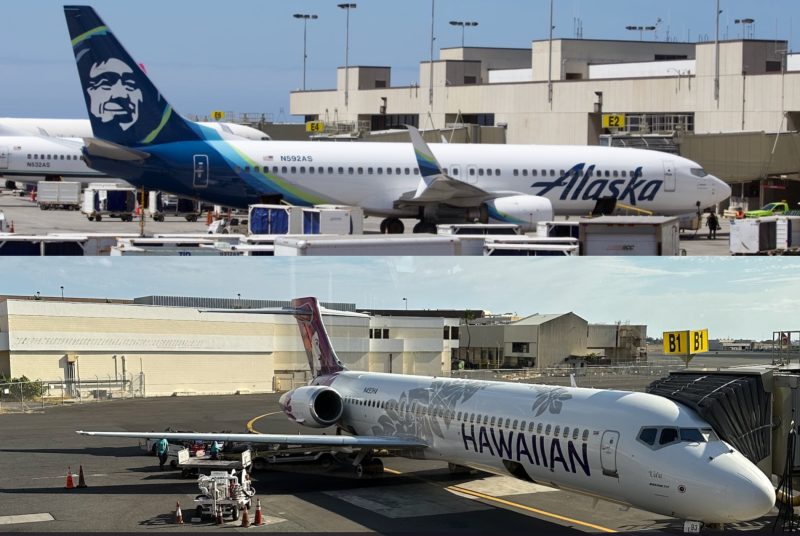
1.) Brand Perception of Two Airlines Under One Brand
Ten Open Questions About The Alaska/Hawaiian Merger 45
Alaska Airlines’ decision to retain both its own brand and that of Hawaiian Airlines post-merger raises questions about customer perception. Historically, in the airline industry, such dual-brand strategies have had mixed results, as exemplified by the Frontier/Midwest/Republic merger, which ultimately led to the consolidation under the Frontier Airlines brand. While it might work in the car rental industry, there are very few examples of this strategy working well in the airline industry.
2.) Local Reaction in Hawaii
Ten Open Questions About The Alaska/Hawaiian Merger 46
The merger’s impact on Hawaiian locals is uncertain. There may be concerns about potential changes in service quality, pricing, and the preservation of a distinctly Hawaiian travel experience, which has been a hallmark of Hawaiian Airlines. Hawaiians are very proud of their hometown airline. This issue could be nothing or it could blow up into a larger issue that hinders integration at the regulatory level.
3.) Fleet Strategy for the 717
Photo FRED (CC BY-SA 3.0)
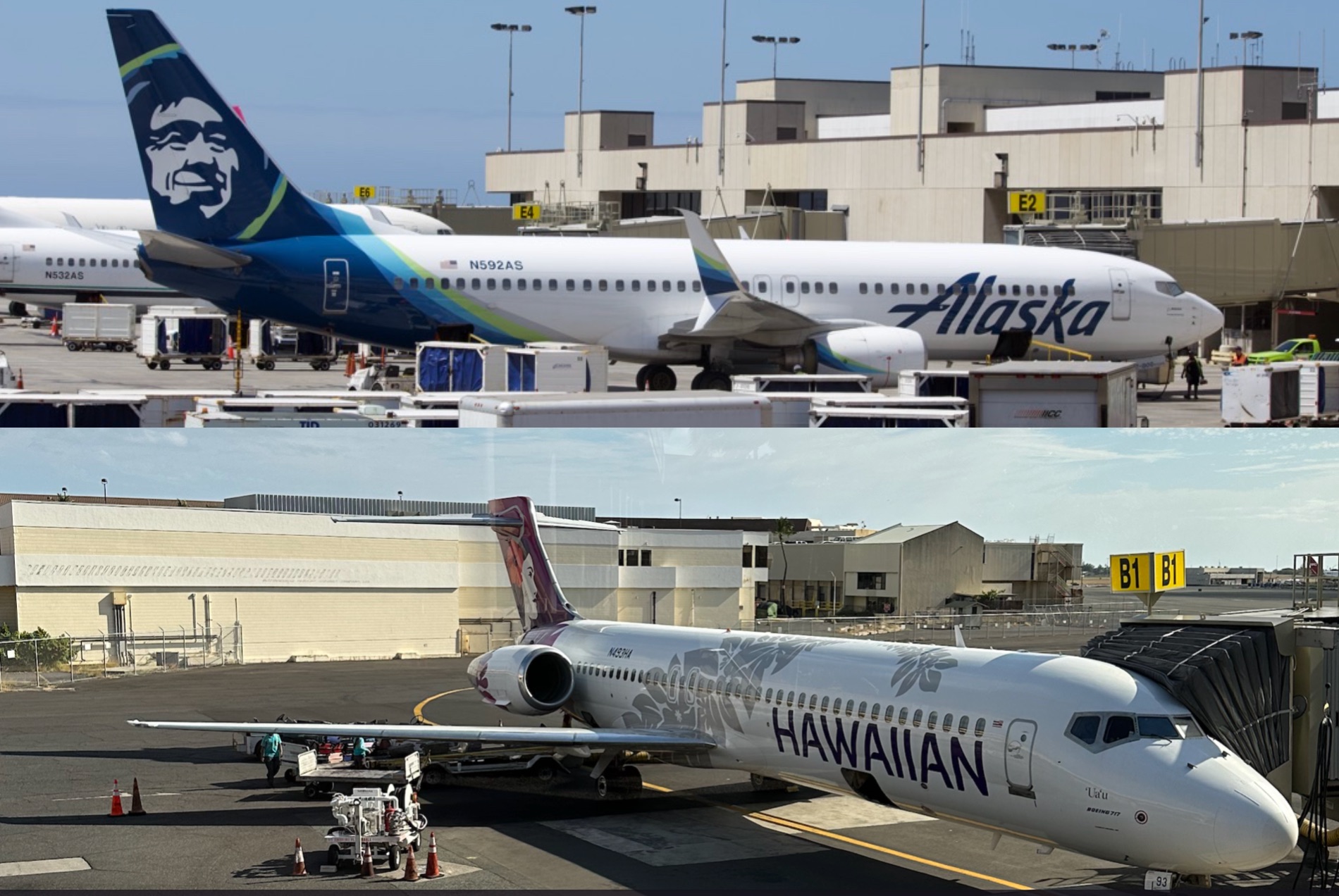
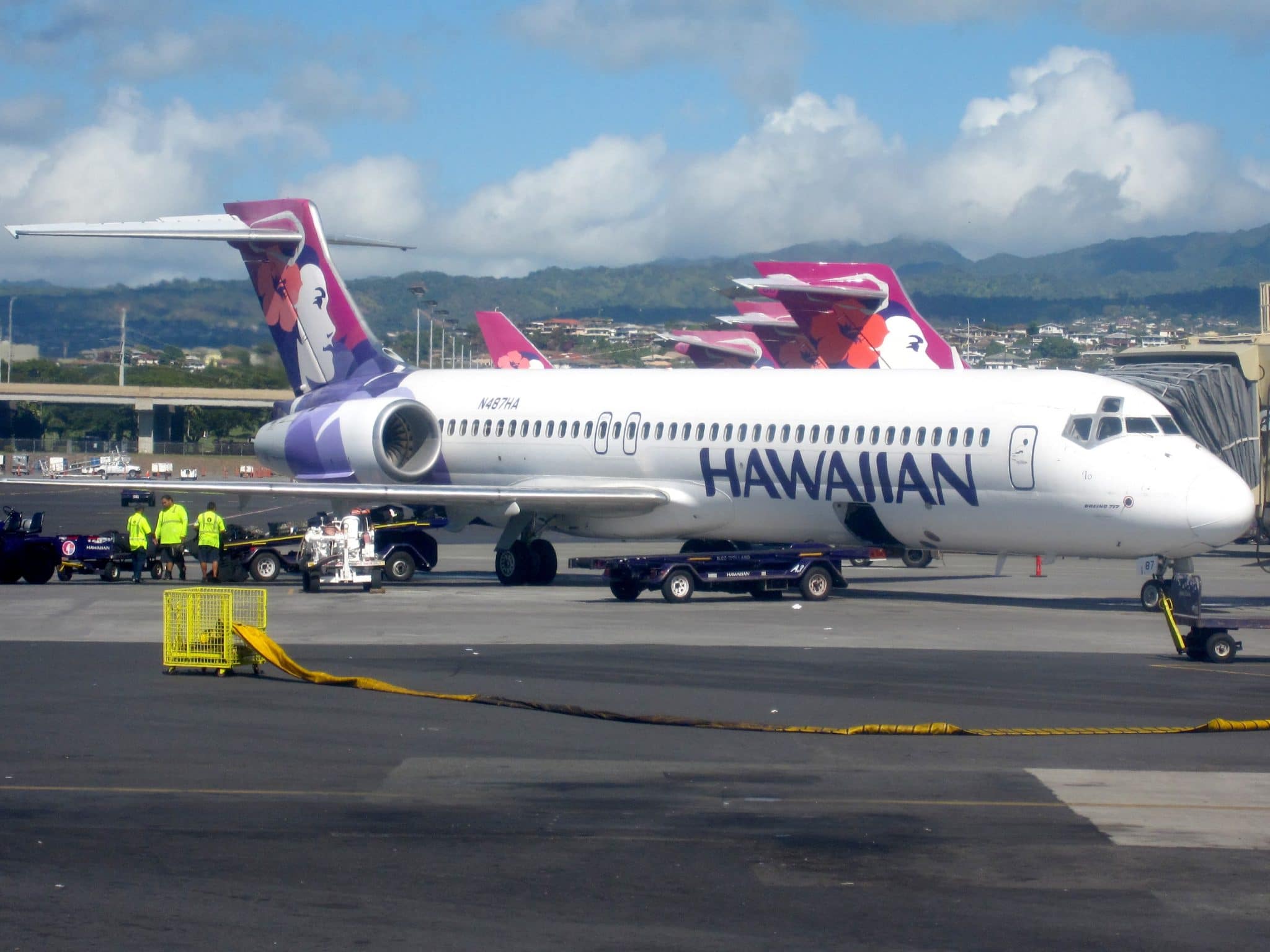
The fate of Hawaiian’s Boeing 717s is an interesting issue here. Earlier this year, Hawaiian floated the issue that they are already thinking about replacing the 717 sometime in the not so distant future. Alaska Airlines might consider transitioning these routes to Horizon Air or integrating Boeing 737s for inter-island services, similar to Southwest’s approach. This could lead to brand confusion as Alaska jets fly more inter-island routes (see #7). The potential sale of 717s to other airlines like Delta could also be a possibility although it is likely that the Hawaiian fleet has too many cycles to be attractive for Delta.
4.) The Future of A321 NEOs
For Hawaiian, the merger with Alaska offers a solution for the A321NEO engine inspections issue. It will be able to take advantage of Alaska’s capacity during this painful inspection period without drawing down service. However, this looming inspection process and merger raises questions about their long-term role of the A321NEO fleet in the merged airline. Alaska Airlines’ past decision to divest Virgin’s aircraft post-merger could indicate a similar fate for the A321 NEOs.
5.) A330s and Fleet Homogenization
Ten Open Questions About The Alaska/Hawaiian Merger 47
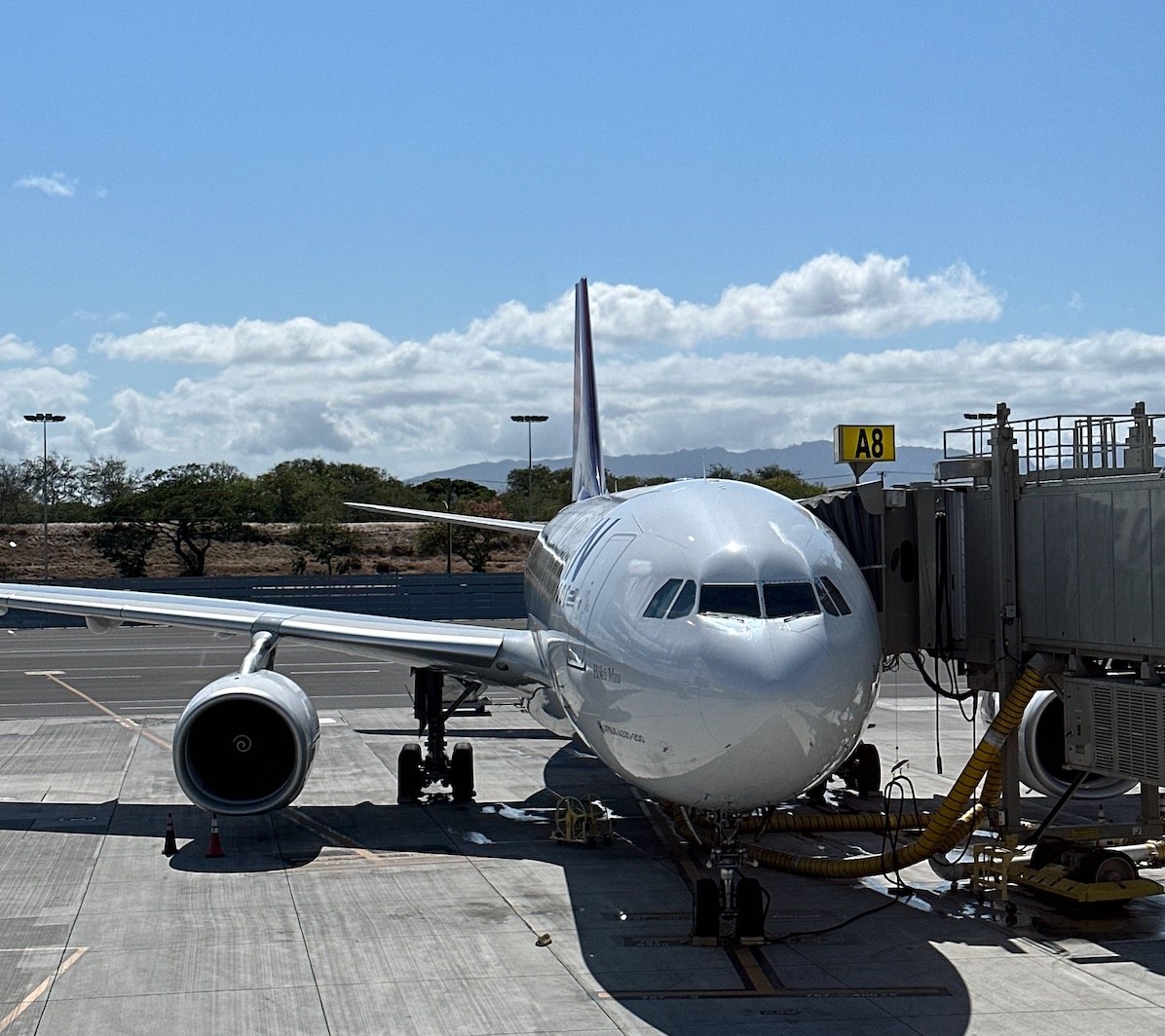
Alaska’s prior preference for Boeing aircraft prompts speculation about the future of Hawaiian’s Airbus A330s. Could there be a shift towards a Boeing-dominated fleet, perhaps incorporating the 787 Dreamliner, in line with Alaska’s fleet past preferences? It wouldn’t be a short term shift as the A330 was planned to make up the bulk of Hawaiian’s wide-body fleet for years to come.
6.) Implications for Amazon A330F Operations
Ten Open Questions About The Alaska/Hawaiian Merger 48
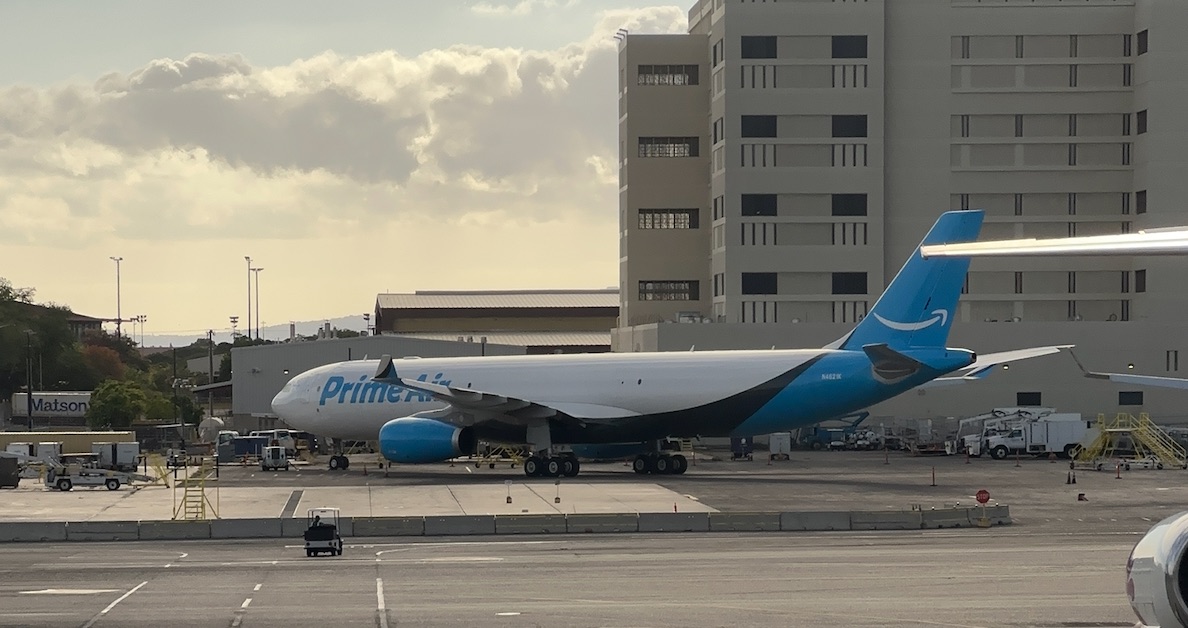
The merger could affect Alaska’s cargo operations, specifically Hawaiian’s new Amazon A330F flights. There’s potential for expanded collaboration with Amazon which would give Amazon access to Alaska’s 737 fleet as well. Or Amazon could pull the plug on the partnership. Way too early to tell. However, it is an important question and unknown about this merger.
7.) Alaska’s Mainland Expansion Using Hawaiian Widebody Aircraft
With access to Hawaiian’s widebody fleet, Alaska could potentially introduce mainland Hawaiian flights to take advantage of additional capacity on trunk routes. This would mark a significant expansion, though the presence of Hawaiian branding on these flights might create confusion for years to come.
8.) Employee Response and Integration Challenges
Employee reactions, particularly among pilots, will be crucial to the merger’s success. Alaska Airlines has just settled into its post-Virgin merger phase, including adjustments to pilot contracts to make the airline more competitive in the limited marketplace for pilots. Integrating seniority lists and maintaining positive morale and retention will be a significant challenge. Alaska has experience from the Virgin America merger. However, this portion of integrating two airlines is always a challenge.
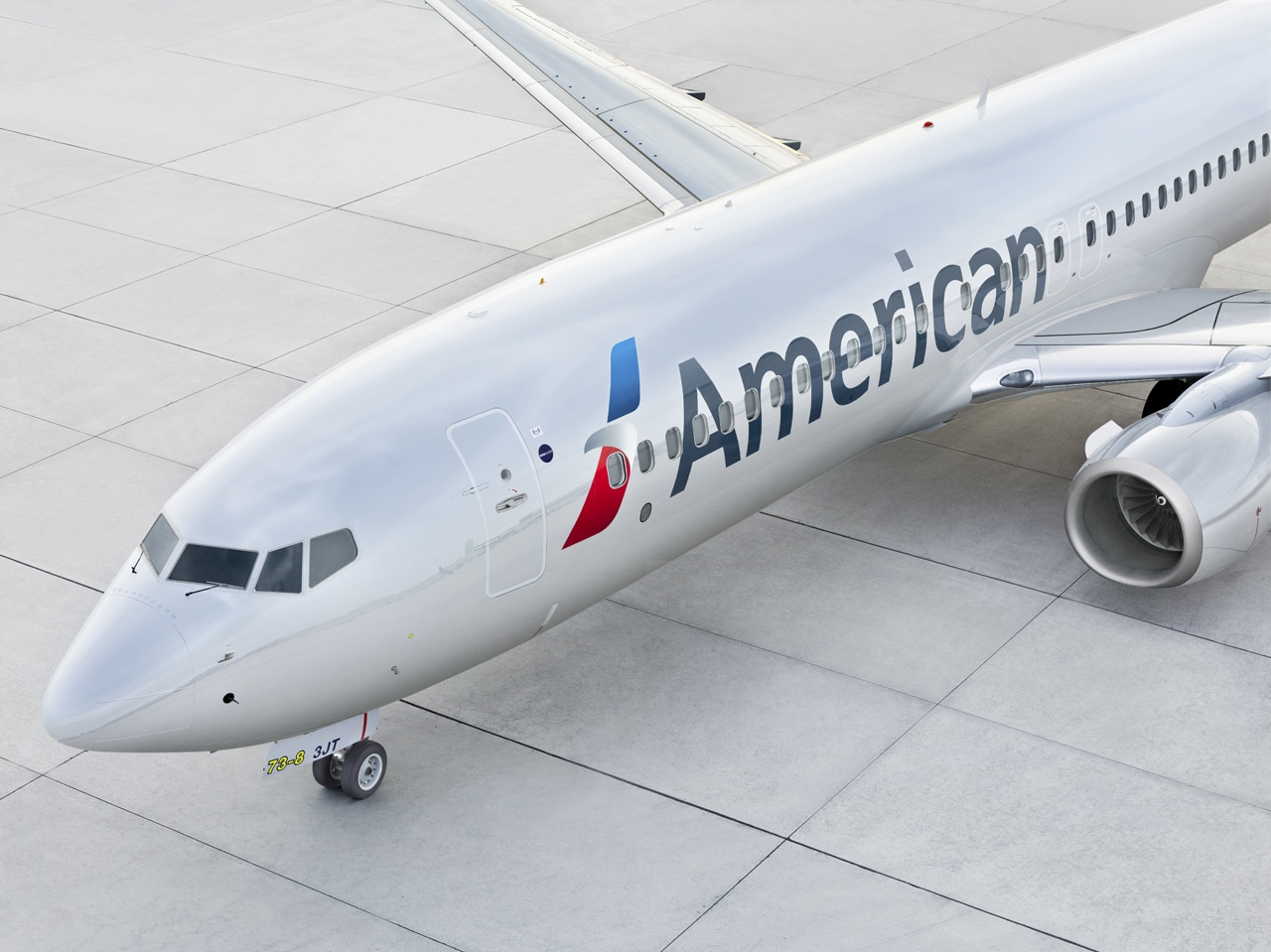
9.) OneWorld Alliance and American Airlines
Photo: American Airlines
The merger’s impact on the OneWorld alliance, of which Alaska Airlines is a member will be interesting. The integration of Hawaiian’s network and operations into OneWorld’s framework will be closely watched by industry experts. This could be a big win for frequent flyers, opening up more seats.
However, it could also spell trouble for American Airlines. Alaska already has a west-coast partnership with Alaska. Given that American had to pull down its east coast alliance with JetBlue after JetBlue announced their merger with Spirit, American could lose out again with this latest announcement.
10.) Long-Haul Network Strategies
Ten Open Questions About The Alaska/Hawaiian Merger 49
Whether Alaska Airlines will retain Hawaiian’s Asian and Australian routes is a major unanswered question that we won’t know the answer to for few years. The merger’s rationale appears to be market expansion, but Alaska’s history of streamlining post-merger (as seen with Virgin America’s JFK and Dallas routes) raises concerns about the potential reduction in Hawaiian’s long-haul services once the merger is complete..
This merger between Alaska Airlines and Hawaiian Airlines is poised to reshape the landscape of air travel, particularly in the Pacific region. The integration’s success will depend on strategic decisions regarding brand identity, fleet management, employee relations, and network expansion, all while navigating the complexities of customer expectations and alliance commitments. It won’t be easy.
Alaska Airlines announced today that it has acquired Hawaiian Airlines. The combined airline will maintain Alaska Airlines’ and Hawaiian Airlines’ individual brands, supported by a single loyalty offering to tie the brands together.
In a statement released by Alaska Airlines, they said, “Alaska Air Group, Inc. (NYSE: ALK), and Hawaiian Holdings, Inc. (NASDAQ: HA) today announced that they have entered into a definitive agreement under which Alaska Airlines will acquire Hawaiian Airlines for $18.00 per share in cash, for a transaction value of approximately $1.9 billion, inclusive of $0.9 billion of Hawaiian Airlines net debt. The combined company will unlock more destinations for consumers and expand choice of critical air service options and access throughout the Pacific region, Continental United States and globally. The transaction is expected to enable a stronger platform for growth and competition in the U.S., as well as long-term job opportunities for employees, continued investment in local communities and environmental stewardship.”
An Alaska Airlines Boeing 737 MAX | IMAGE: Wikipedia
Alaska Airlines continued, “This combination is an exciting next step in our collective journey to provide a better travel experience for our guests and expand options for West Coast and Hawai‘i travelers,” said Ben Minicucci, Alaska Airlines CEO. “We have a longstanding and deep respect for Hawaiian Airlines, for their role as a top employer in Hawai‘i, and for how their brand and people carry the warm culture of aloha around the globe. “
“Our two airlines are powered by incredible employees, with 90+ year legacies and values grounded in caring for the special places and people that we serve. I am grateful to the more than 23,000 Alaska Airlines employees who are proud to have served Hawai‘i for over 16 years, and we are fully committed to investing in the communities of Hawai‘i and maintaining robust Neighbor Island service that Hawaiian Airlines travelers have come to expect. We look forward to deepening this stewardship as our airlines come together, while providing unmatched value to customers, employees, communities and owners.”
“Since 1929, Hawaiian Airlines has been an integral part of life in Hawai‘i, and together with Alaska Airlines we will be able to deliver more for our guests, employees and the communities that we serve,” said Peter Ingram, Hawaiian Airlines President and CEO. “In Alaska Airlines, we are joining an airline that has long served Hawai‘i, and has a complementary network and a shared culture of service. With the additional scale and resources that this transaction with Alaska Airlines brings, we will be able to accelerate investments in our guest experience and technology, while maintaining the Hawaiian Airlines brand. We are also pleased to deliver significant, immediate and compelling value to our shareholders through this all-cash transaction. Together, Hawaiian Airlines and Alaska Airlines can bring our authentic brands of hospitality to more of the world while continuing to serve our valued local communities.”
About the combined airline
The combined airline currently operates the 737NG and 737-MAX along with A321NEOs, A330s (both passenger and cargo versions) and the venerable 717. Hawaiian will also begin 787 service in 2024.
Image via Hawaiian Airlines
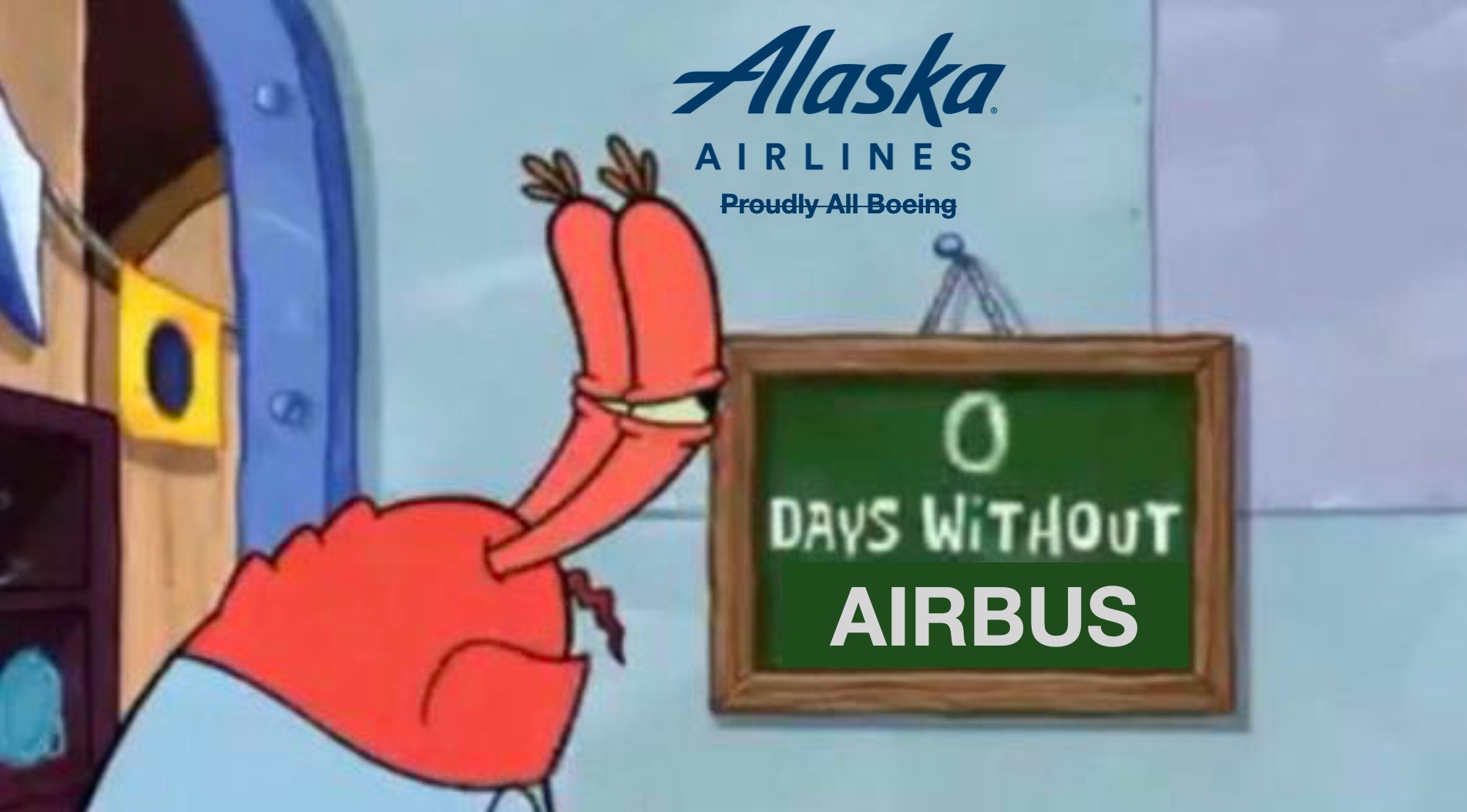
Hawaiian Airlines has struggled lately, posting a loss last quarter, typically one of their most profitable quarters. They also recently noted the impact that the ongoing A321-NEO engine inspection issues would have on their schedule. One interesting note, Alaska Airlines just retired their fleet of Airbus A320s this past October. Now they are about to begin a second journey with Airbus Aircraft. Their “Proudly All Boeing” stint only lasted about a month!
Alaska Airlines Acquires Hawaiian, Will Retain Individual Identities 54
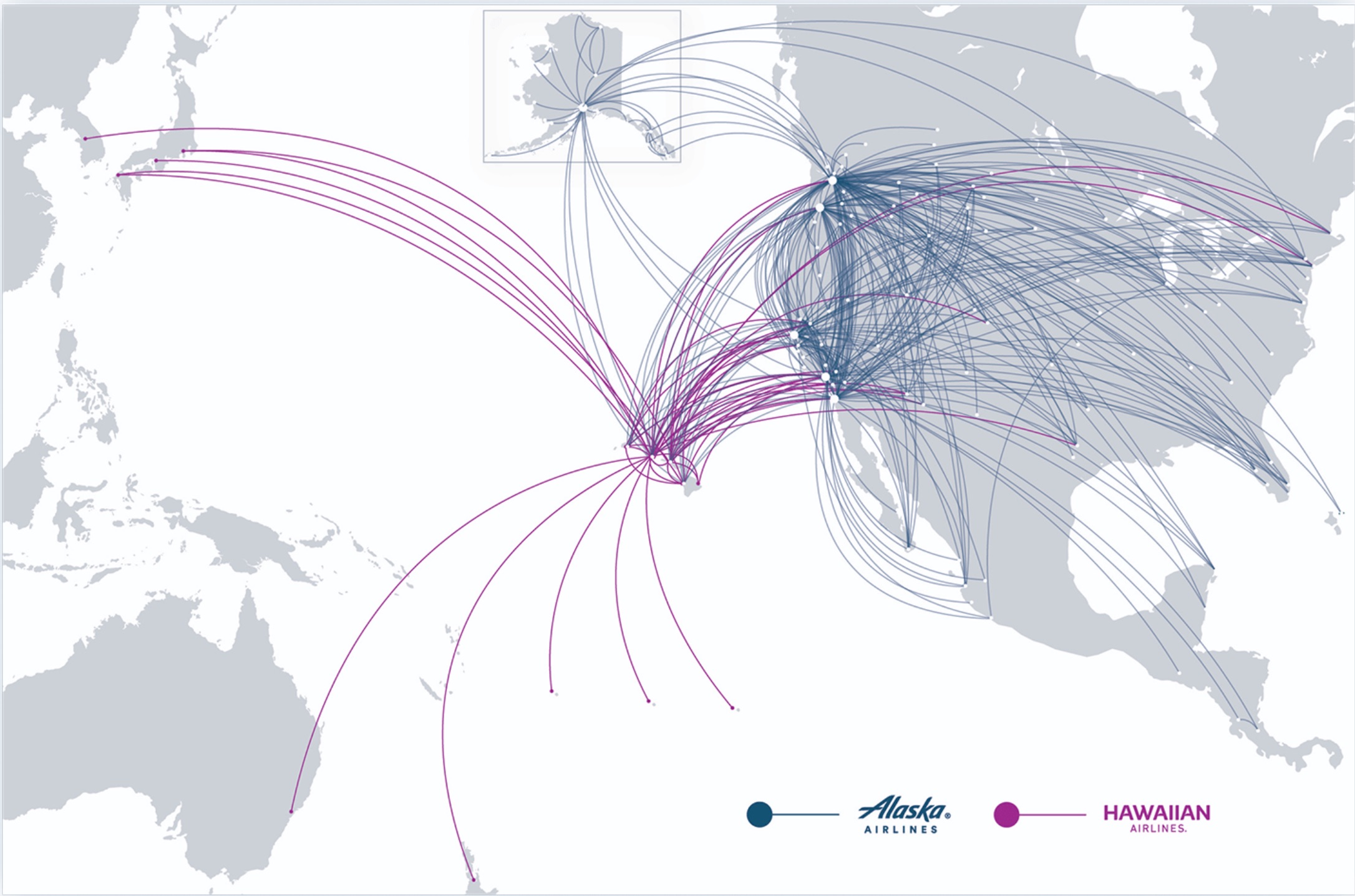
The Combined Route Map of Hawaiian and Alaska
Below is the combined route map of the two airlines provided by Alaska Airlines.
Alaska Airlines Acquires Hawaiian, Will Retain Individual Identities 55
As a people, we like to think that we’re living in the most advanced society. Today you can carry on a conversation with your computer via ChatGPT. Taxis sometimes drive you around without a driver. And you can access nearly any video or movie ever made with just a simple search. Yet there is one area where we truly have regressed. That is supersonic flight.
Supersonic Flight Used To Be Common For Some
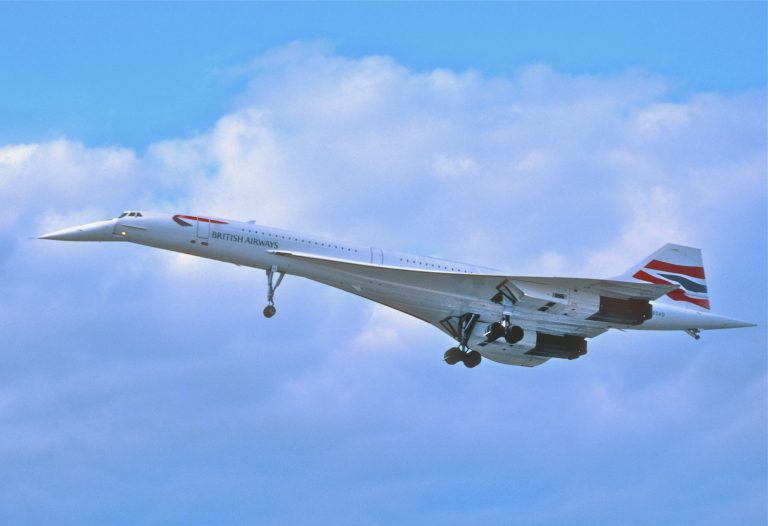
From 1976 through 2003 (with the exception of 2000-2001 after the Concorde crash), well heeled passengers regularly flew at Mach 2+ across the ocean with a crew of professionals in both the cockpit and serving passengers. Lunch in the UK could be followed up with a nightcap in New York. A weekend shopping trip in Paris took less time than flying from New York to Los Angeles in a conventional airliner. Supersonic travel was never cheap, sometimes costing over $10,000 one way, but it was possible. That possibility ended 20 years ago as the final revenue flight occurred on a British Airways flight from New York’s JFK to London Heathrow on 26 November 2003.
And Then It Ended
Great video by Youtube user: ConcordeSST showing the final Concorde takeoff from JFK
The final flight of the Concorde was a bit unusual in that no new aircraft with similar or greater capabilities were ready to replace it. This final journey was an emotional moment for both the crew and the passengers, many of whom were aviation enthusiasts and celebrities, marking the end of supersonic passenger travel. Shortly after the final flight, the remaining Concordes were shuttled around the US, UK, and Europe to be displayed in museums. The era of supersonic passenger travel was over.
So What’s Next?
No one is really sure. There have been a few failed attempts to build a supersonic business jet, most notably Aerion Supersonic which shut down back in 2021. NASA has a promising research project called the X-59 that is focused on the mitigation of sonic booms. That aircraft is currently in final testing before its first flight.
Boom is probably the best hope
Twenty Years Since The Last Supersonic Passenger Flight, What's Next? 56
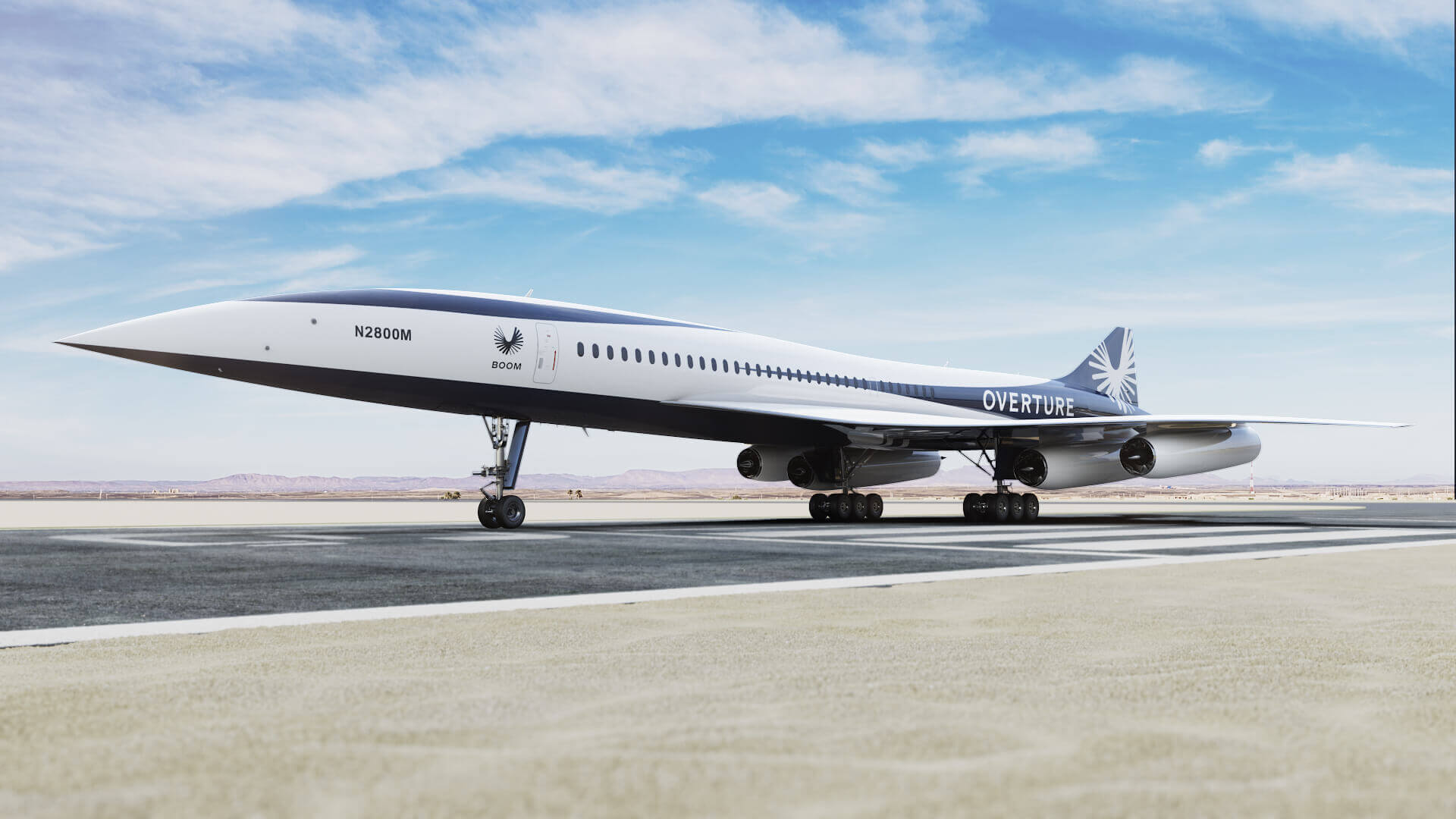
Probably the most promising supersonic program is being developed by Boom Supersonic. Their Overture jet is designed to fly at Mach 1.7 and carry between 64-80 passengers in an all business configuration. While the aircraft has received commitments from United Airlines, Japan Airlines, and American Airlines, the program is still in its relative infancy.
Their first proof of concept aircraft, known as the XB-1, is in its final testing before its first flight. That aircraft though is only meant to test technologies that are required for the final and larger Overture jet. The program still faces large hurdles, most notably, the jet’s engines. Potentially experienced engine developers have backed away from the program, leaving less experienced companies trying to fill the gap of developing a new supersonic capable engine called Symphony on a very tight timeline. First flight is supposed to be sometime in 2026. So possibly, maybe, hopefully, we’ll see a regular return of supersonic passenger flights by the end of this decade. Here’s hoping!
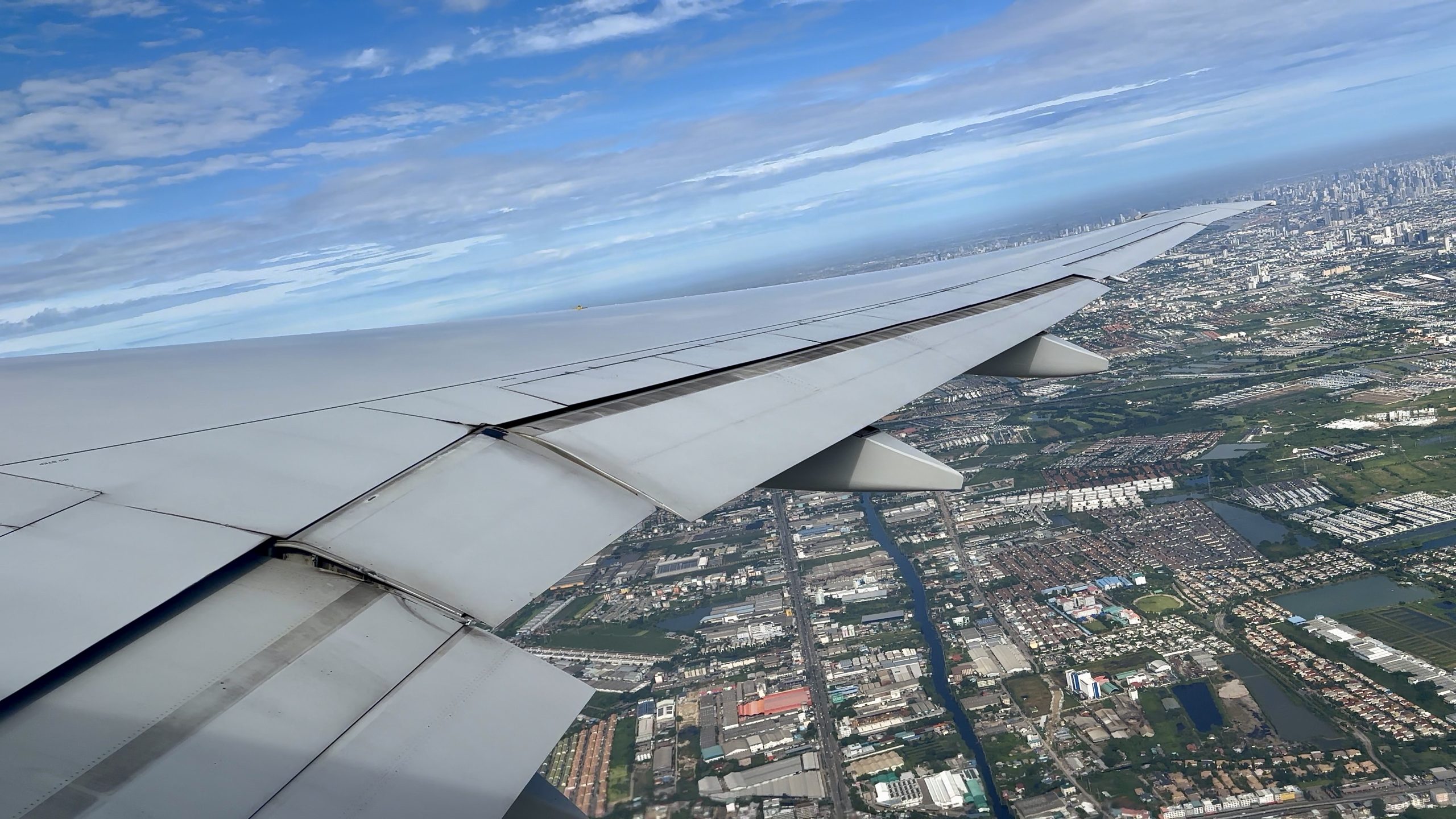
In October, in the middle of completing an around the world trip for Skylite Productions, I had the pleasure of flying Qatar Airways from Bangkok, Thailand to Doha, Qatar. What was it like? Did Qatar live up their excellent reputation? Is Qatar Airways worth flying on for your next long-haul trip? Let’s find out!
Flight Information
Flight Date – October 1, 2023
Aircraft Operator – Qatar Airways
Flight Number – 831
City Pair – Bangkok, Thailand (BKK) – Doha, Qatar (DOH)
Equipment – Boeing 777-3DZ/ER
Equipment Tail Number – A7-BAU
Equipment Age – 9 Years 8 Months
Livery – Qatar Airways (2008 Livery)
Flight Schedule – 8:45am-11:45am
Flight Block Time – 7 Hours 00 Minutes
Actual Flight Time – 6 Hours 41 Minutes
Seat – 40K
Seat Class – Economy
I was ready for a rejuvenating experience
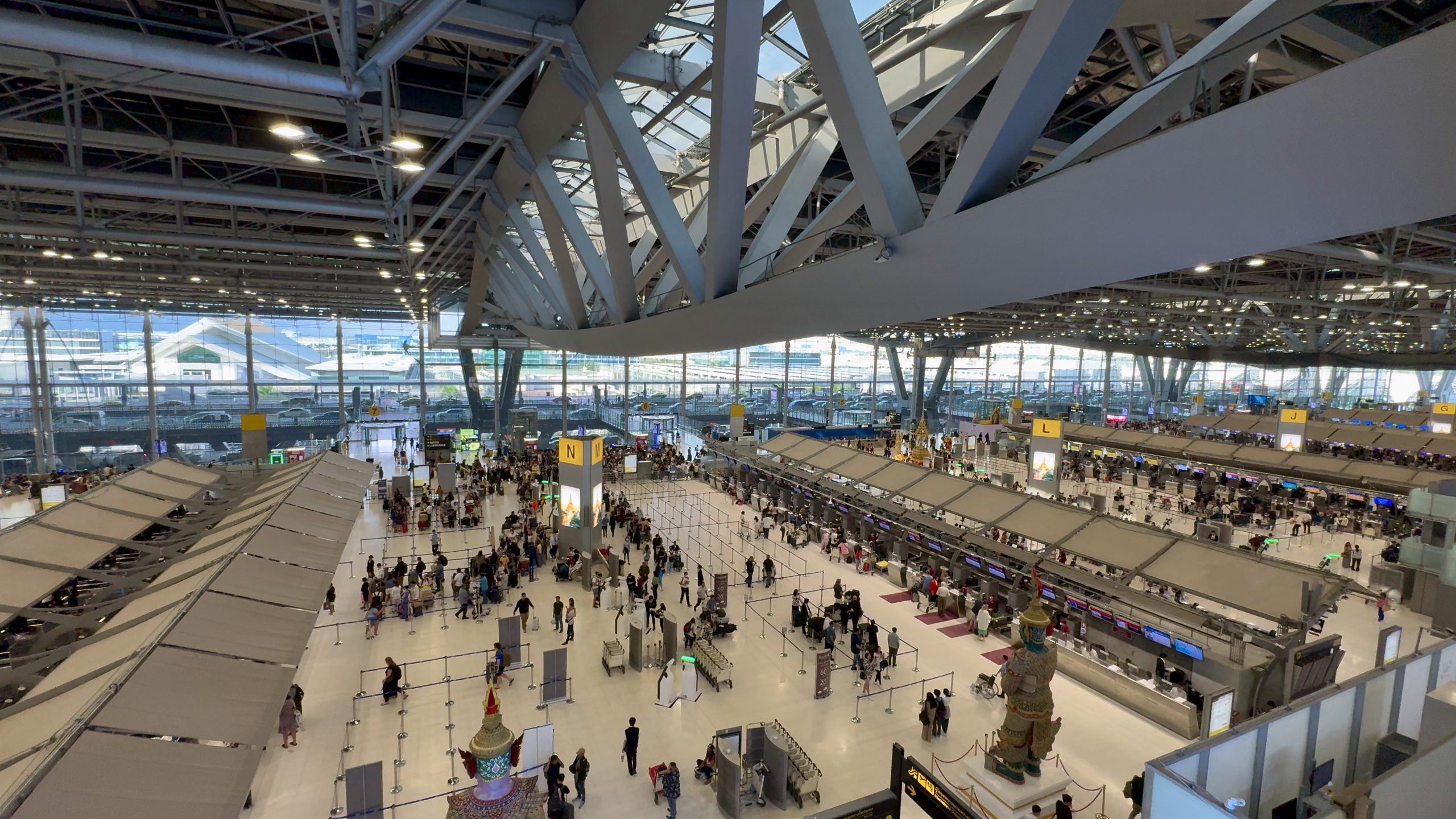
After sleeping in a capsule hotel in the basement of Suvarnabhumi Airport (a story for another time perhaps) I arrived at the check in desks three hours before departure, to an already long line of people waiting to check-in. Thankfully, my Oneworld Sapphire status allowed me to check in via the business class line, despite me being an economy passenger on this flight. This saved me a lot of time. Qatar even offered me complimentary access to their business class lounge before the flight. That’s a great start in my book!
A Journey On Qatar’s Boeing 777-300/ER:
Flying On Qatar Airways’ Boeing 777-300ER 64
After enjoying the lounge for a couple hours, I headed to the gate, where boarding started on time. Once again, my Oneworld Sapphire status allowed me to board with business class, despite being ticketed in economy, which doesn’t apply to everyone, but for those of you who do have Oneworld status, it’s nice to know that Qatar honors and values your Oneworld status, even if you’ve never flown a single mile with them before.
Enjoying Qatar’s Economy Class In Seat 40K:
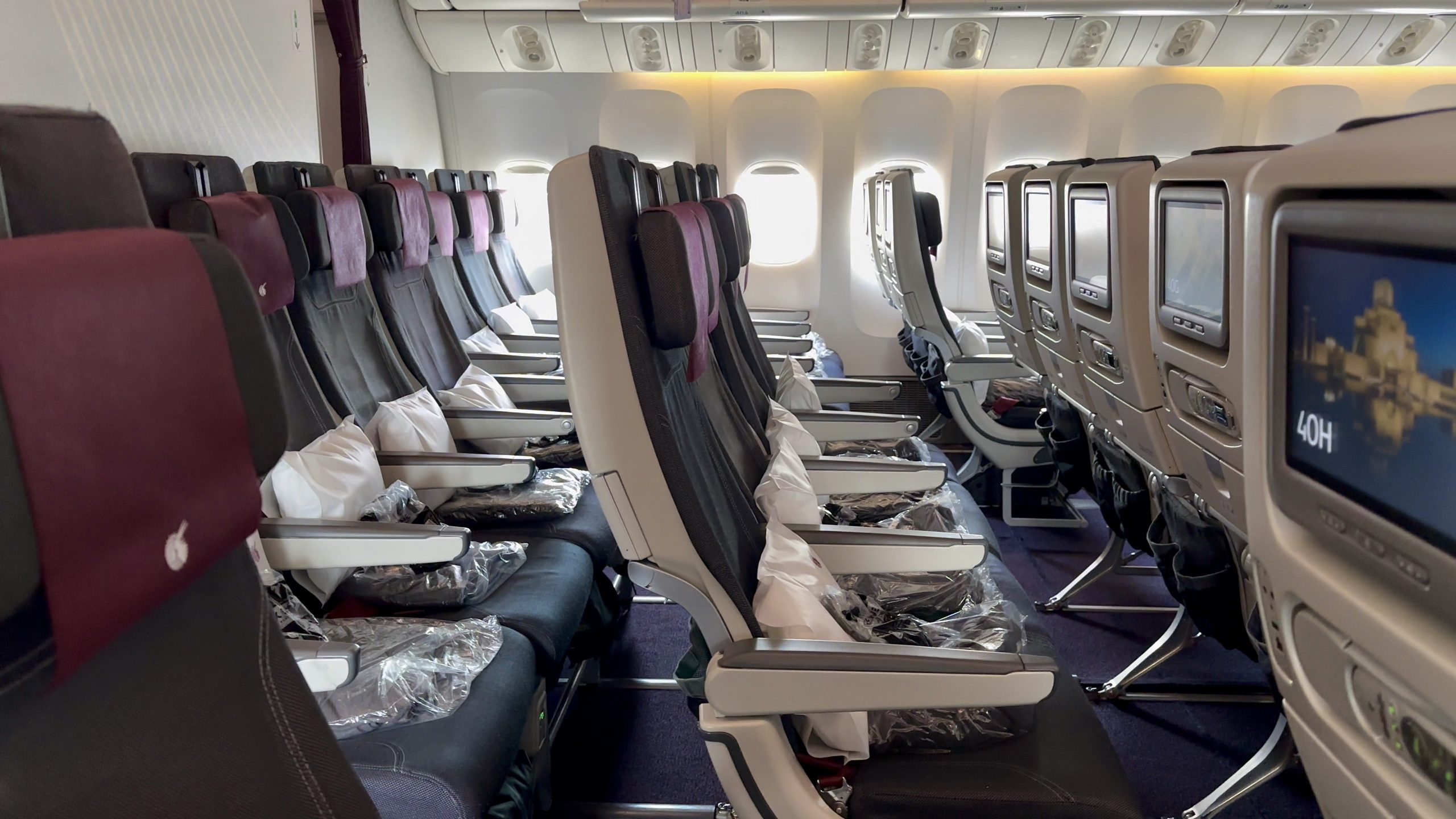
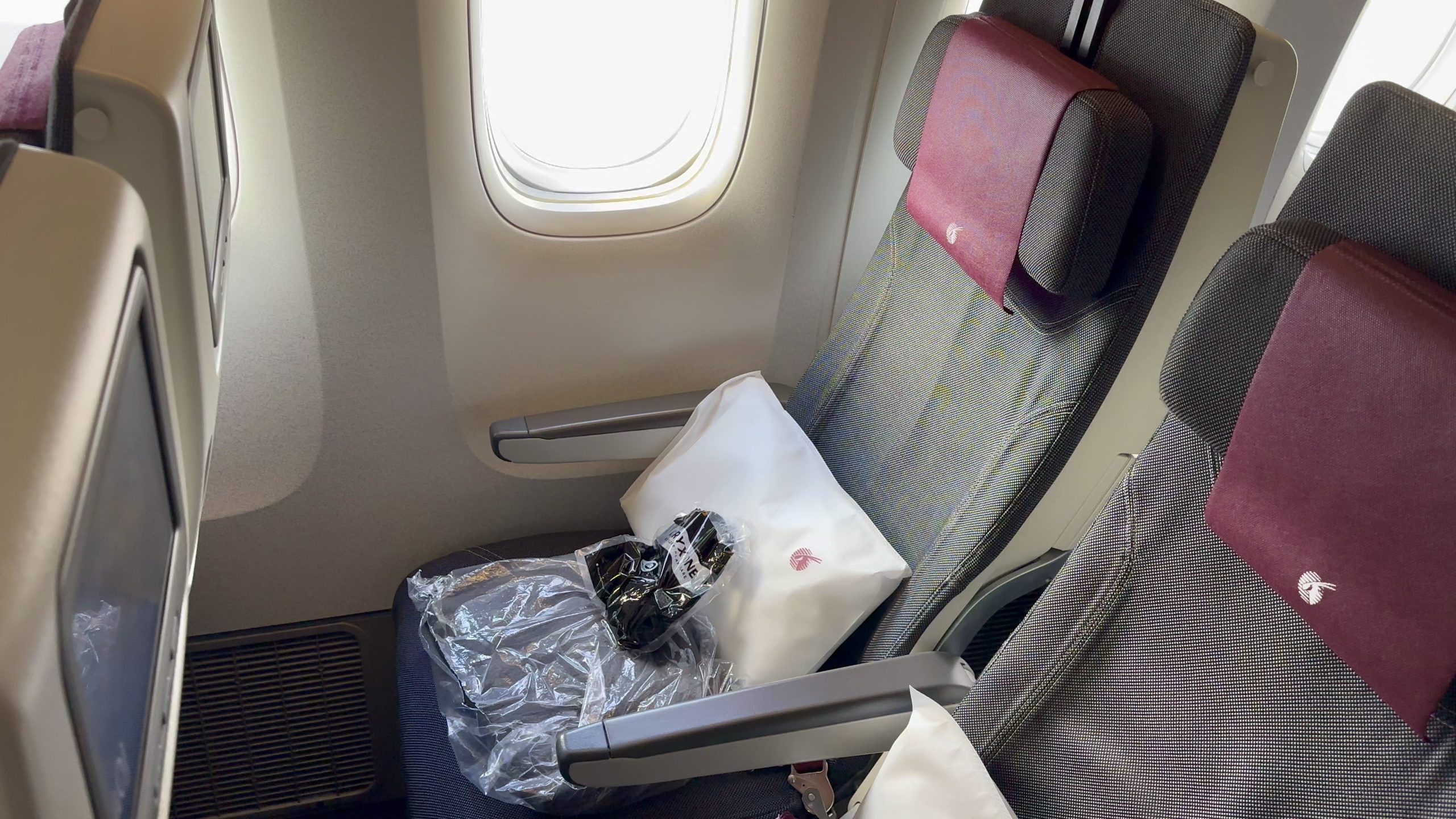
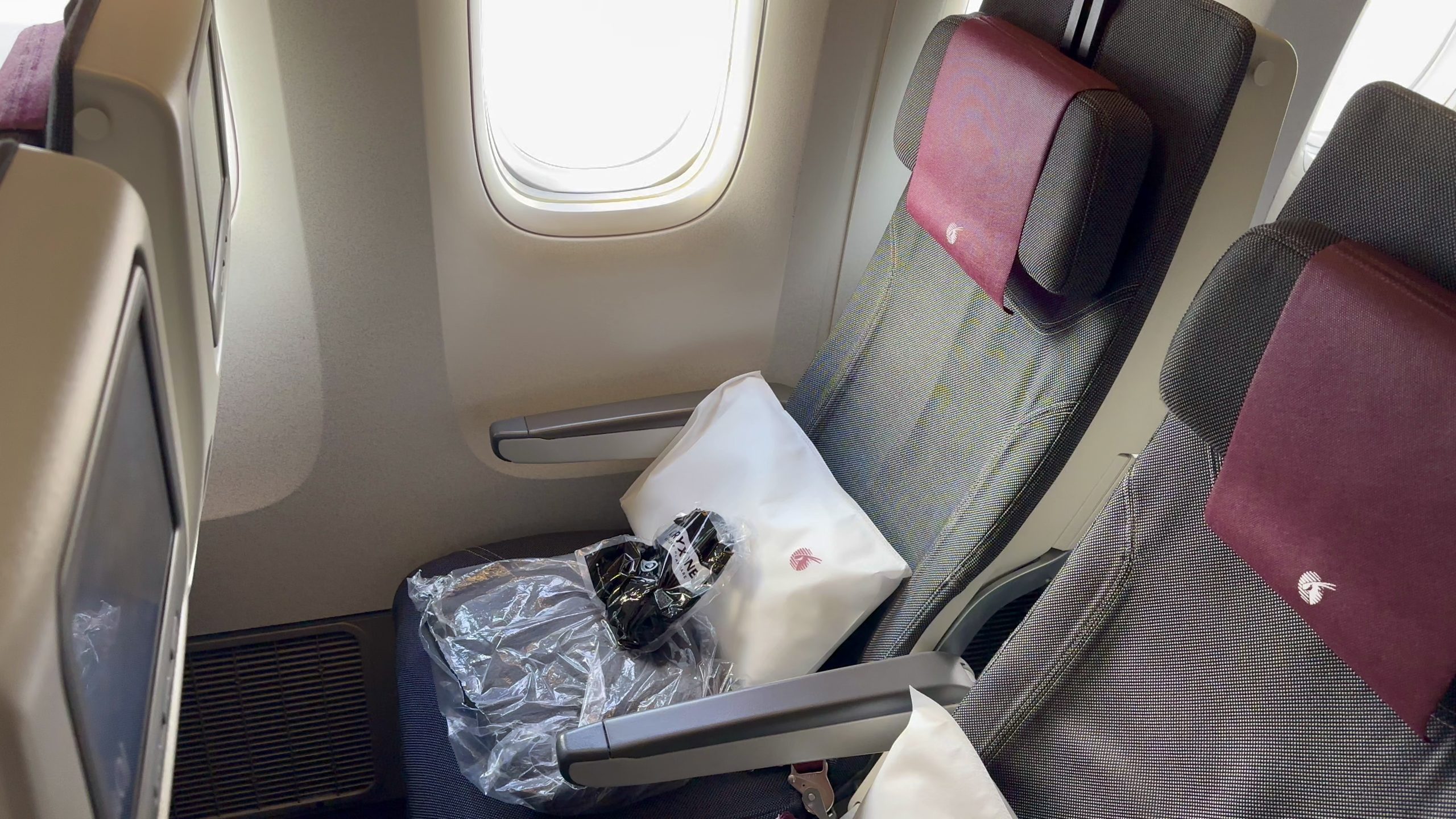
Boarding brought me to my seat, which on this flight was 40K. With 32 inches of pitch, it is pretty standard for long-haul international economy. For reference, American Airlines, who is also a member of Oneworld, only offers 31 inches of pitch on their Boeing 777-300/ER economy seats. Qatar also provided a pillow and blanket, as well as a pair of headphones for the flight.
Flying On Qatar Airways’ Boeing 777-300ER 65
The legroom was decent for economy and for reference I’m 6 feet 2 inches tall. Every seat also had a built-in inflight entertainment system that could be operated by touch, or by remote. The seat also provided a USB charging port below the IFE screen, as well as a conventional plug underneath the seat.
Flying On Qatar Airways’ Boeing 777-300ER 66
Unfortunately, this is the end of the good things I have to say about the seat, as I found it to be very uncomfortable. I fly a lot, and it’s normally no issue for me to stay seated in economy for long periods of time. However, this seat kept causing my lower body to fall asleep and I had to stand up every 45 minutes to keep my legs from completely going numb. I don’t think it’s a stretch for me to say that this was the most uncomfortable international economy seat I’ve ever flown in. So, keep that in mind if you are looking to fly long haul on one of Qatar’s 777-300/ERs. This flight was only 7 hours long and I was over this seat by the time we landed in Doha. I cannot imagine spending 12 or more hours in it.
Flying On Qatar Airways’ Boeing 777-300ER 67
Enjoying Qatar’s World Class Service:
Flying On Qatar Airways’ Boeing 777-300ER 68
The flight departed on time and what the seat lacked in comfort was made up for by the excellent crew that provided amazing service to every passenger throughout the flight. There were two hot meal services, as well as multiple other drink services. All on a flight that was only blocked for 7 hours.
Flying On Qatar Airways’ Boeing 777-300ER 69
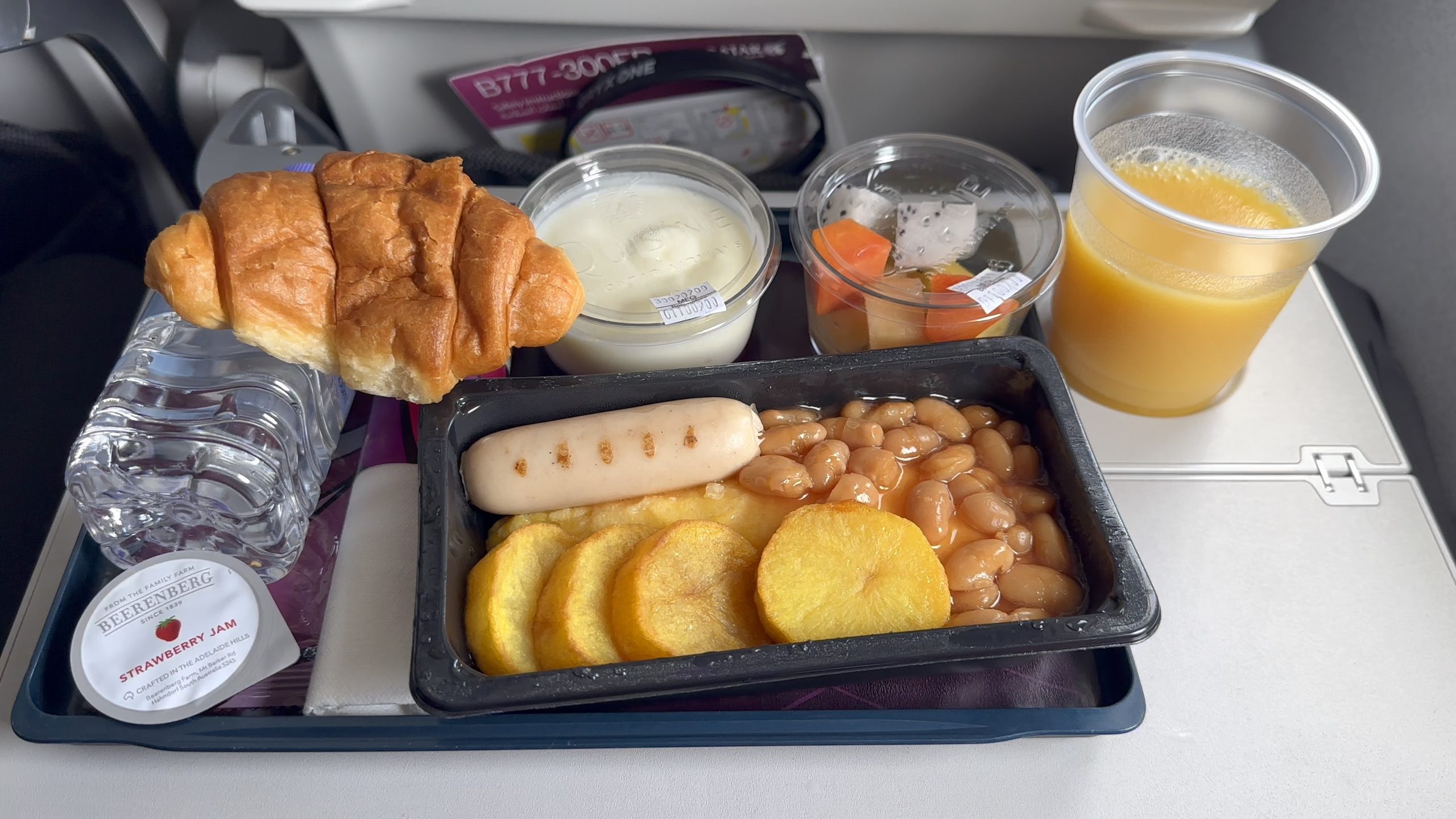
For breakfast I selected the omelet with beans and chicken sausage. It was also served with yogurt, diced fruit, a croissant, jelly, water, and another drink of your choice. It was very good, served piping hot, had great flavors. It was one of the better breakfast’s I’ve had on a flight in economy.
Flying On Qatar Airways’ Boeing 777-300ER 70
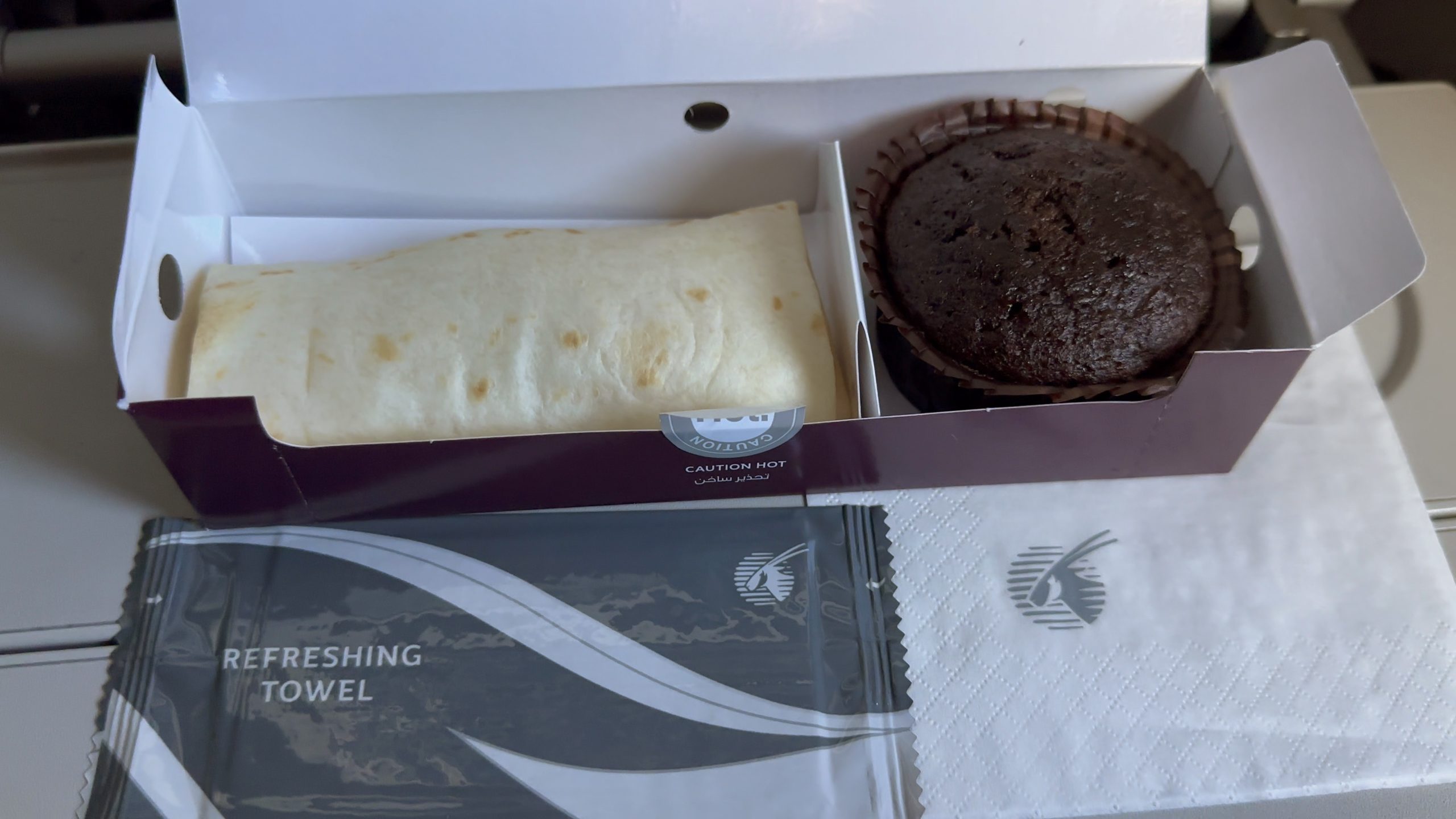
A second, light meal was served about an hour before landing. It consisted of a hot chicken wrap and a chocolate muffin. A drink of your choice was also served again. Like the breakfast before it, it was a decent meal with good flavors, and it prevented me from having to buy food at the airport once we’d landed in Doha.
Want To See More From This Flight?
If you’d like to see more from this flight, feel free to check out this Skylite Producitons/Avgeekery.com exclusive video detailing the entire flight in a condensed 4-minute video.
Should You Consider Qatar? & Final Thoughts:
Overall, Qatar Airways definitely lived up to their reputation where level of service was concerned. The only bad mark I can give was for the very uncomfortable seat. You may be willing to overlook a slightly uncomfortable seat if the service is good though. In the end, this was a good flight. It operated on time, I made my connection in Doha, and the service from the flight attendants was excellent. I still don’t know if I’d want to be in that seat for more than 7 hours though.
Qatar Airways Boeing 777-300/ER Flight Review Video Title/Description
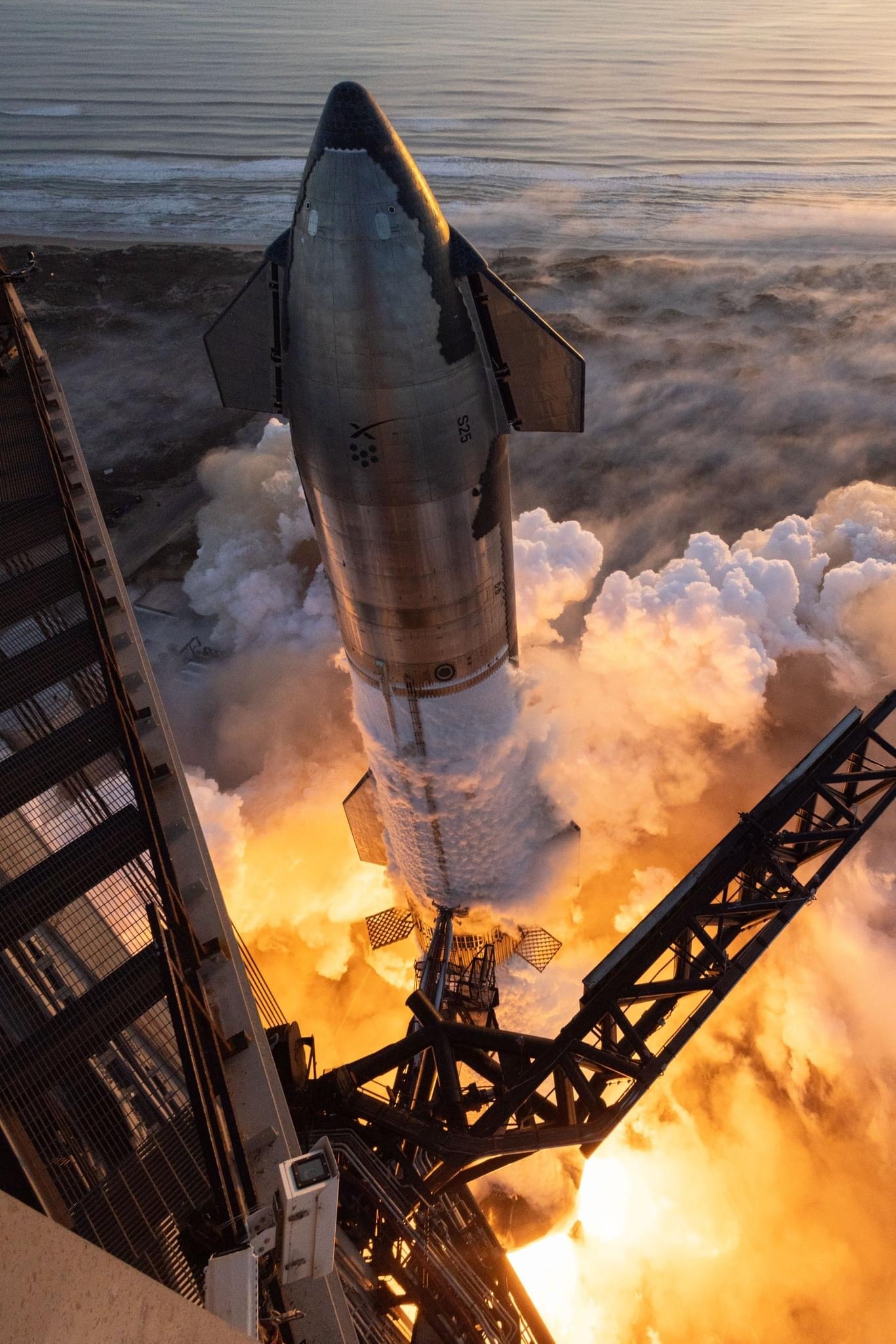
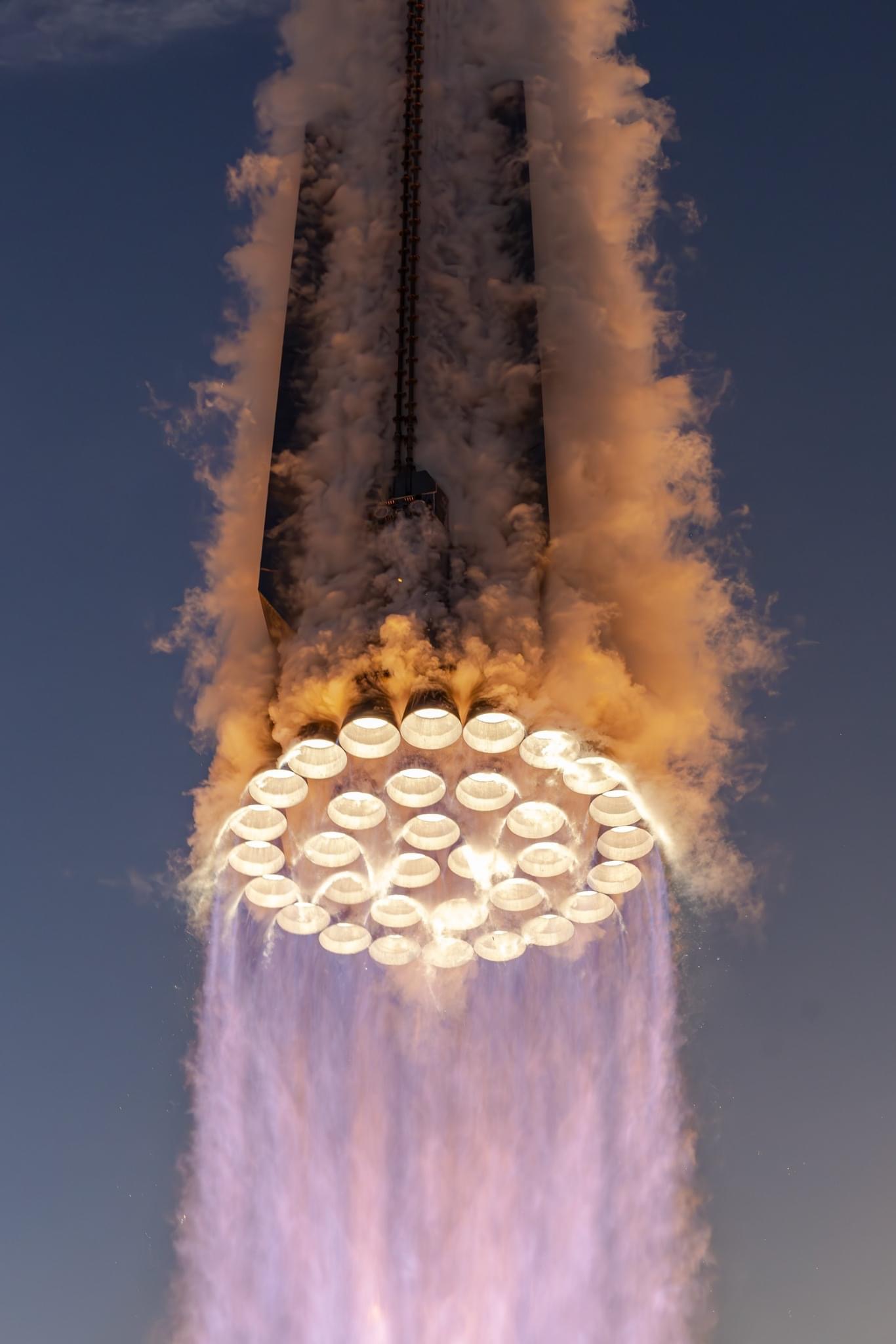
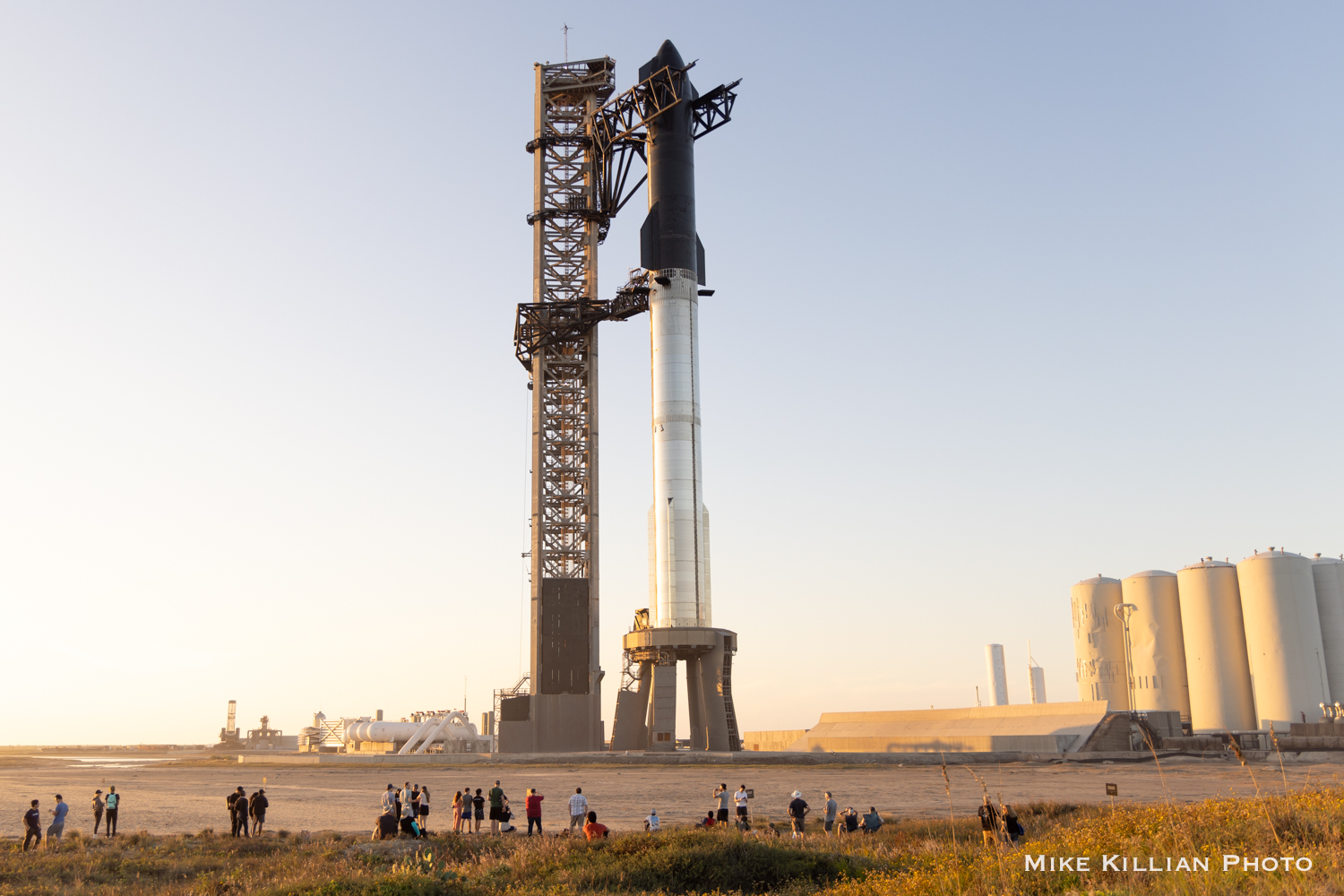
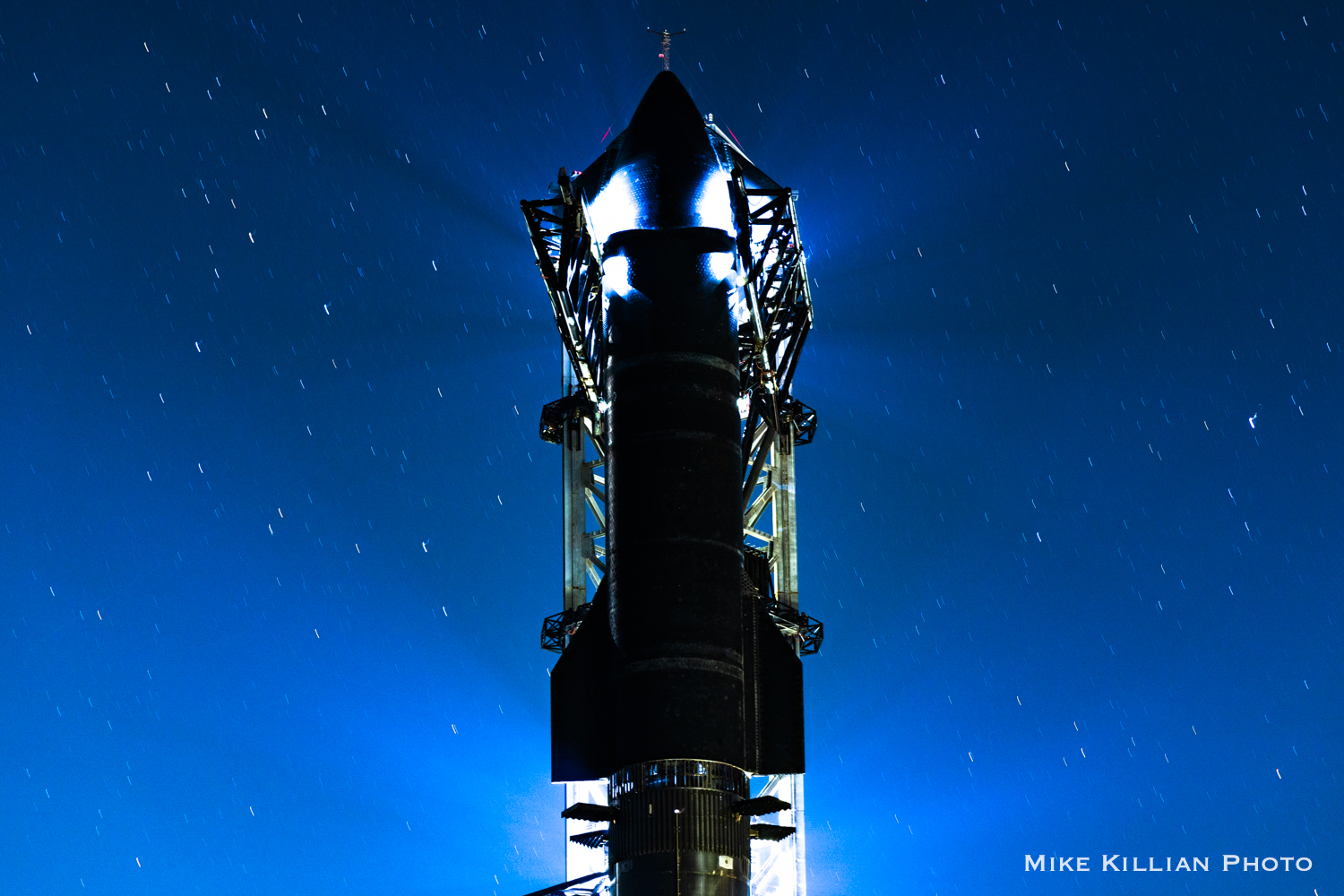
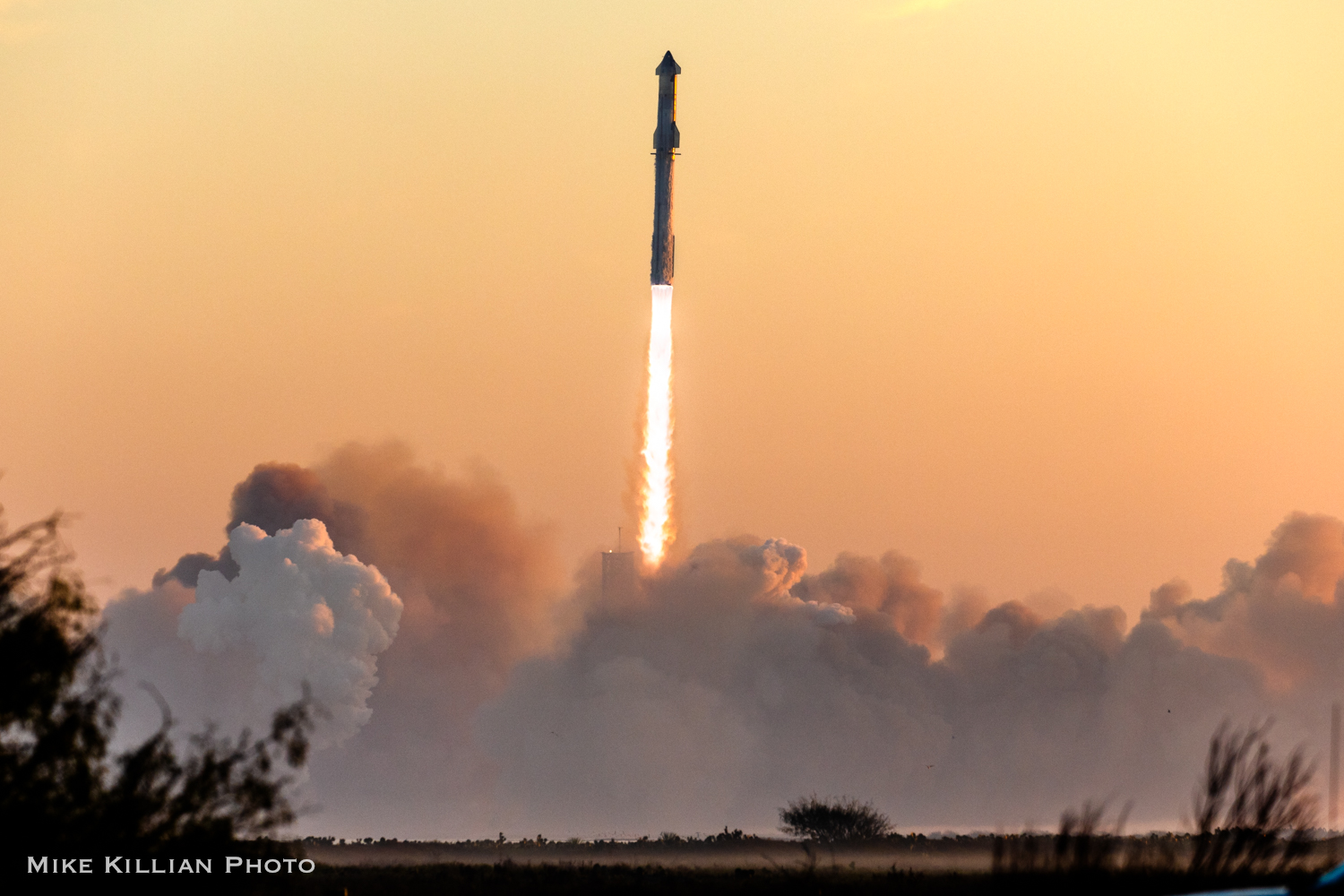
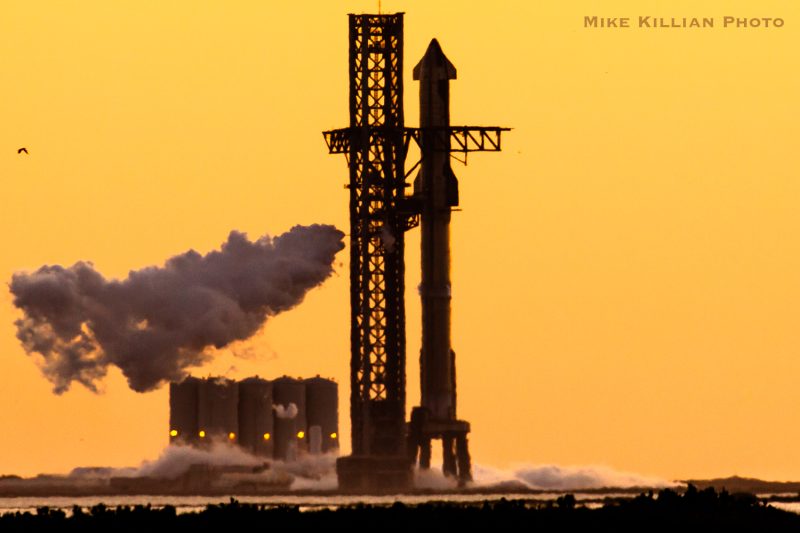
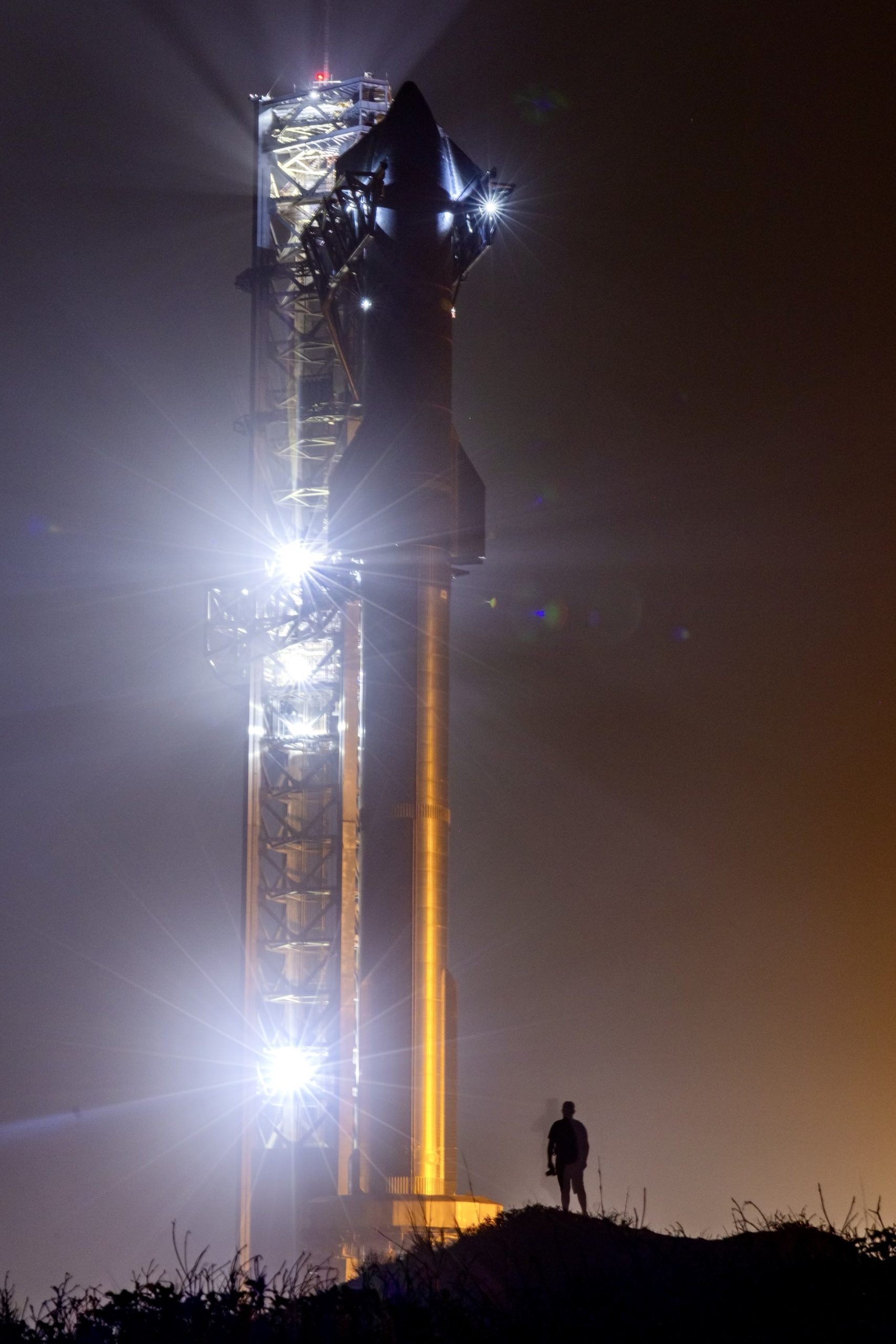
SpaceX recently launched their second Starship flight test, and it produced some spectacular photos and videos. The enormous new heavy-lift booster and spacecraft are early in development, with plenty more flight tests to come.
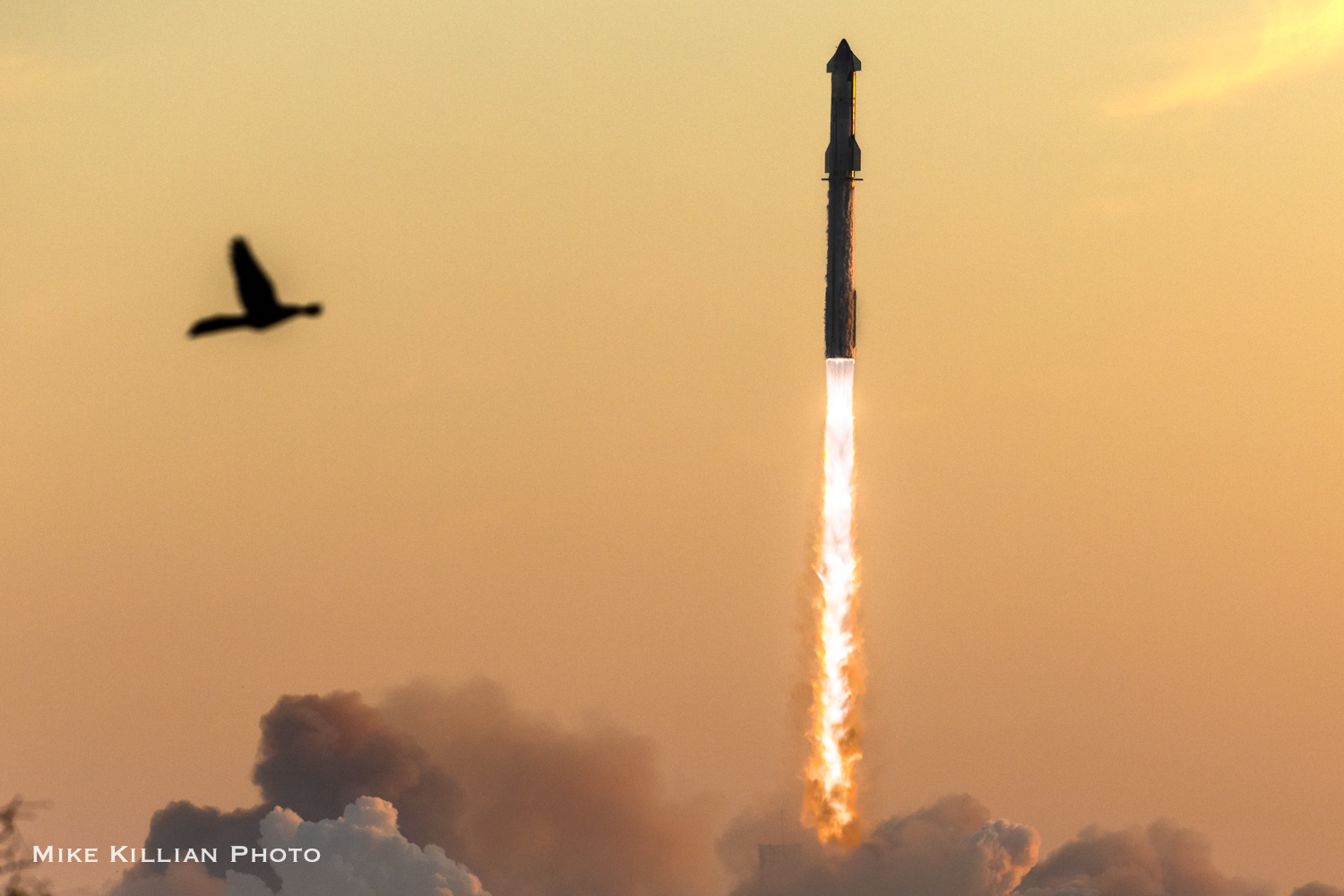
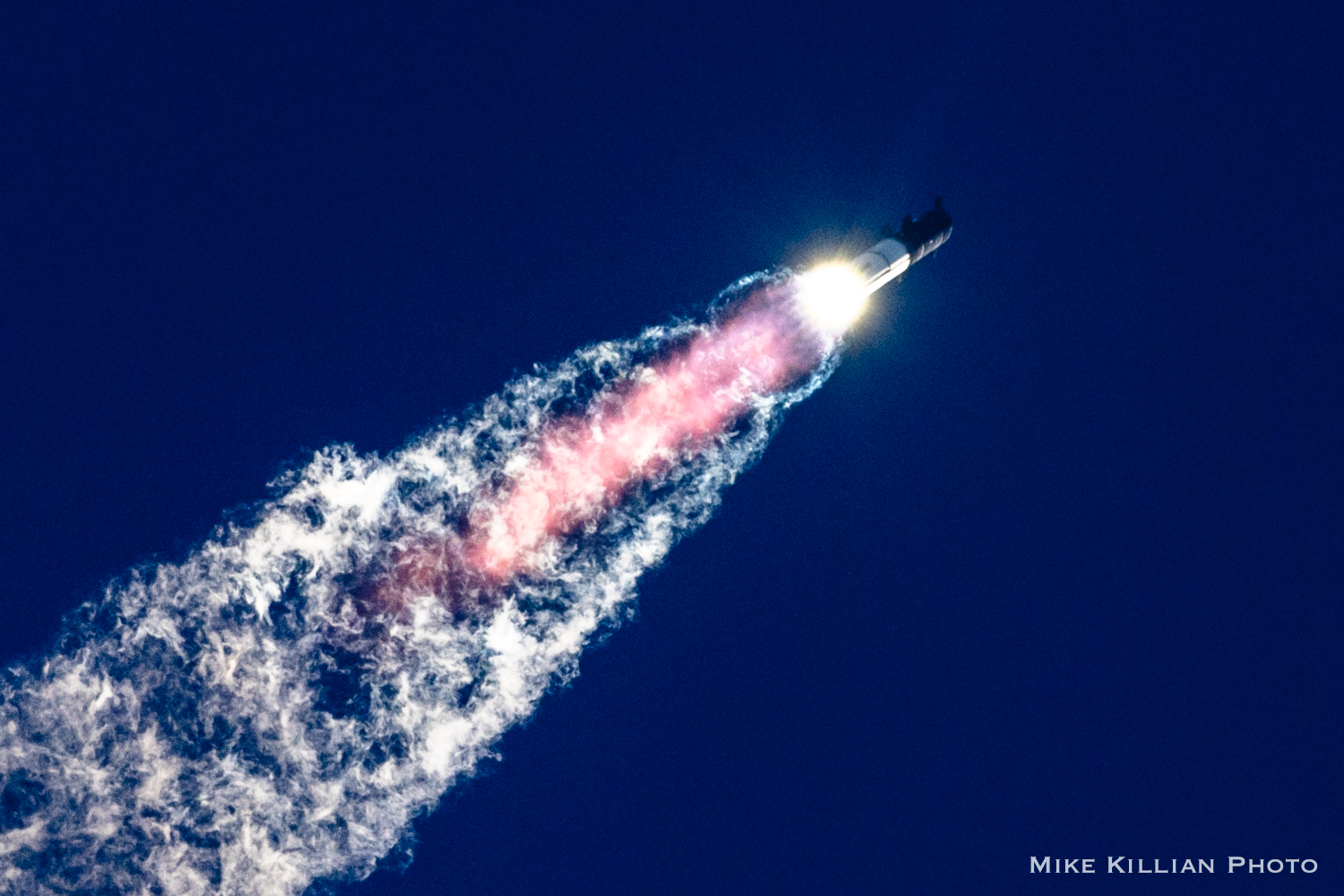
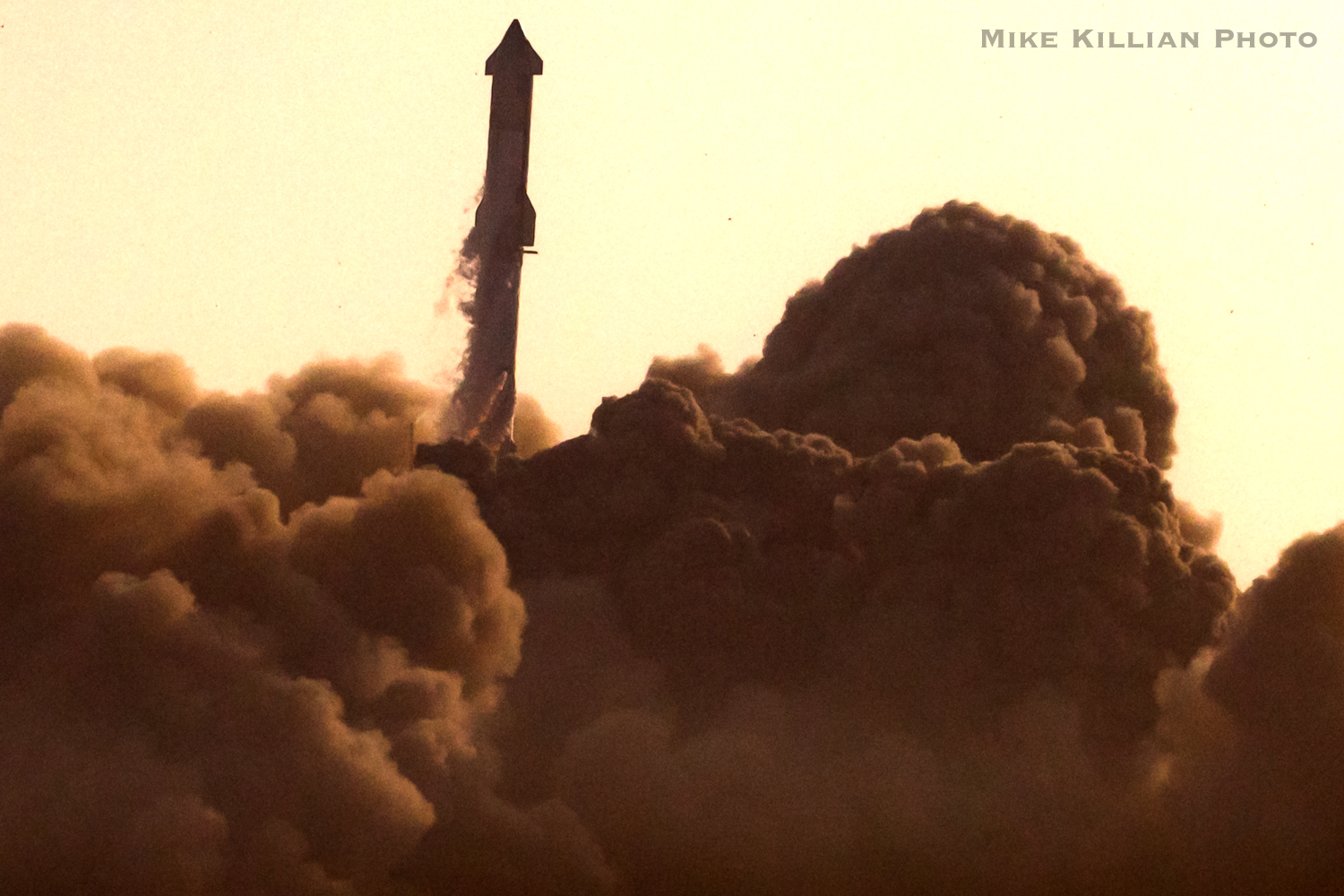
The nearly 400 ft tall Starship lifted off on close to 17 million pounds of thrust, powered by 33 of the company’s Raptor engines. The rocket’s ascent appeared nominal, with all engines firing and on-target trajectory up until the booster and spacecraft performed staging separation.
Check Out These Incredible Views of Starship’s 2nd Launch 81Check Out These Incredible Views of Starship’s 2nd Launch 82
“This is another chance to put Starship in a true flight environment, maximizing how much we learn,” said SpaceX. “Rapid iterative development is essential as we work to build a fully reusable launch system capable of carrying satellites, payloads, crew and cargo to a variety of orbits and Earth, lunar and Martian landing sites.”
Check Out These Incredible Views of Starship’s 2nd Launch 83
The booster was attempting to conduct a controlled vertical splashdown [simulated]“landing” in the Gulf of Mexico, but instead it quickly left controlled descent and was blown up by SpaceX.
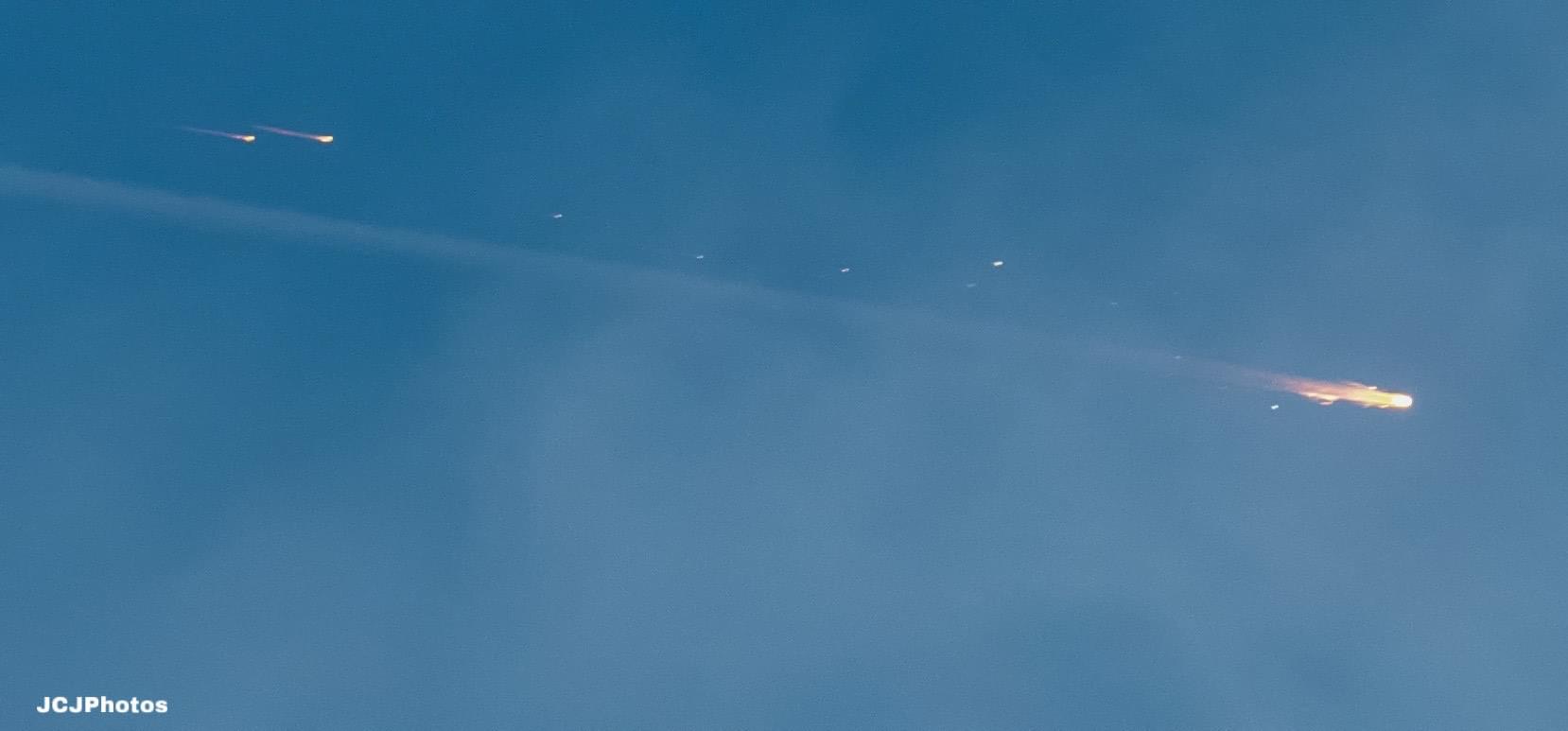
The prototype spacecraft meanwhile conducted its own engine burn for several minutes, climbing higher and faster than any Starship before it. But sadly, it too was lost shortly after, as it coasted over near Puerto Rico. The cause has not yet been released by SpaceX.
Check Out These Incredible Views of Starship’s 2nd Launch 84
As is standard, the FAA is currently investigating the accident. The FAA oversees all commercial launch sites, and noted that the surrounding environment and communities were unharmed, so it is not expected to be a long investigation (which will be led by SpaceX).
SpaceX outlined the flight tests achievements below:
Check Out These Incredible Views of Starship’s 2nd Launch 85
Elon Musk says the next Starship test could be ready to fly in 3-4 weeks. Whether the FAA grants than another launch license that soon, however, time will tell.
A reusable heavy-lift rocket and spacecraft to reach the Moon and Mars
Check Out These Incredible Views of Starship’s 2nd Launch 86
Starship will become a fully reusable rocket and spacecraft, able to conduct heavy-lift missions with crew or cargos to orbit, the moon, and beyond – eventually Mars. SpaceX even envisions Starships flying point-to-point around Earth, landing vertically on rocket engines, before being hoisted atop another booster for the next launch.
Why fly a plane 20 hours, when Starship can get you there in 1 hour? SpaceX has already proven it can be done, they do it every week now with their Falcon-9 rockets. Their less-used Falcon Heavy also does the same. Starship is intended to replace both.
Check Out These Incredible Views of Starship’s 2nd Launch 87Check Out These Incredible Views of Starship’s 2nd Launch 88
The giant boosters themselves, the most powerful ever flown, will land back on their launch pads.
Starships would also land / launch on and off other worlds the same way. NASA is counting on it, as the space agency has contracted Starship to be the lander for their first Artemis crews on the moon later this decade.
Check Out These Incredible Views of Starship’s 2nd Launch 89Check Out These Incredible Views of Starship’s 2nd Launch 90
NASA has a timetable for returning to the moon. And they want to stay at the moon this time. They’ve developed the Space Launch System (SLS) rocket and Orion spacecraft to do it. The SLS flew a flawless uncrewed lunar flight test in 2022.
A crewed flight test on Artemis-2 is scheduled for late 2023, with the first landing on Artemis-3 scheduled for possibly 2026. That crew would need to dock with a Starship, which will provide the vehicle needed to land on and launch off the lunar surface. While the latest launch offers progress, it is clear to see that much work is left to be done if this approach will ultimately be successful.
NASA wants to see many safe and successful Starship missions flown by SpaceX—as many as 20–before NASA puts their astronauts onboard for the moon.
We remember Western Airlines, one of America’s iconic air carriers that offered innovative in-flight service.
It is Tuesday, 7 May 1957, and you are a passenger aboard Western Airlines Flight 70, a Douglas DC-6B that has just leveled off at its cruising altitude after an 0825 departure from San Francisco. The flight is bound for Salt Lake City and Denver. You are settled in with your newspaper and book.
Suddenly, you hear a bugle call and the sound of hoofbeats. The strange inflight noises emanate from a tape recorder attached to the serving cart, which is maneuvered down the aisle by two flight attendants dressed in English hunting attire. Eggs, steaks, sausage, ham, and Danish pastries are displayed on the cart. You are about to enjoy Western’s Hunt Breakfast, certainly the most elaborate morning meal service offered by a domestic US airline at the time.
While carriers back East also entertained their passengers with elaborate meal services during that era, the West’s own airline had developed a reputation for particularly fine inflight service.
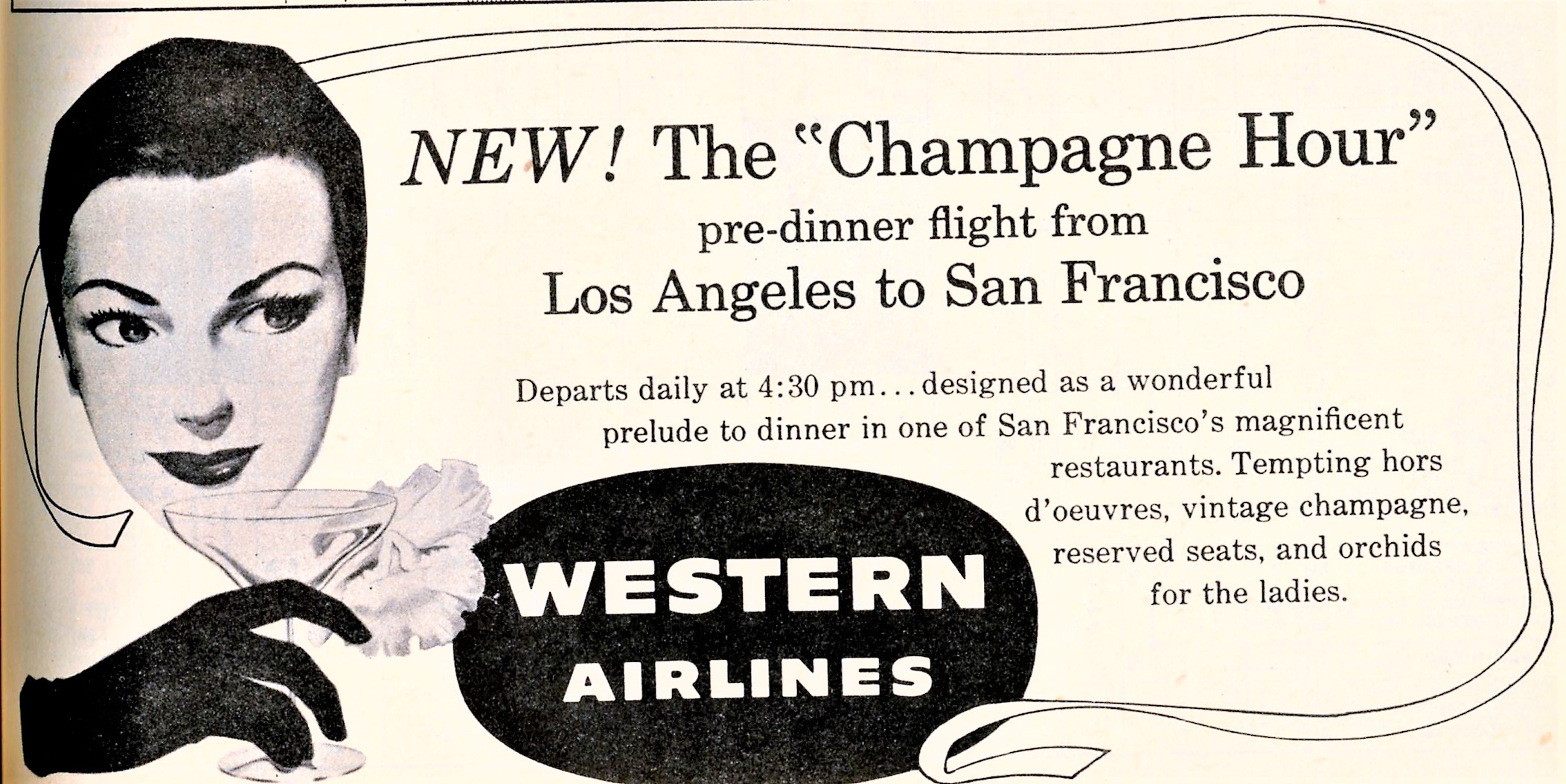
Western Airlines was innovative when it came to serving its customers. The company’s Champagne Flights were famous throughout the industry, and gifts of small bottles of perfume or orchids for the ladies were touches of hospitality that the airline was known for.
Remembering Western Airlines: The Only Way to Fly! 105
IT HAD NOT ALWAYS BEEN STEAK AND EGGS
But things had not always been so rosy at Western. In 1949, the company eliminated meal service altogether while reducing fares by 5% in an experiment to see if such a move would attract more customers. At the time, the airline was desperate to cut costs and increase revenues after three unprofitable years in which net losses totaled $1.6 million, a staggering amount of money in the 1940s. The no-food experiment was a flop, and meal service resumed after six months.
By the end of 1949, Western was able to post a small profit. The company would continue to post profits every year during the next decade.
Terrell C. Drinkwater, the company’s president, instituted all of the above innovations and turned the airline around. He became famous among airline executives for Western’s dramatic transformation.
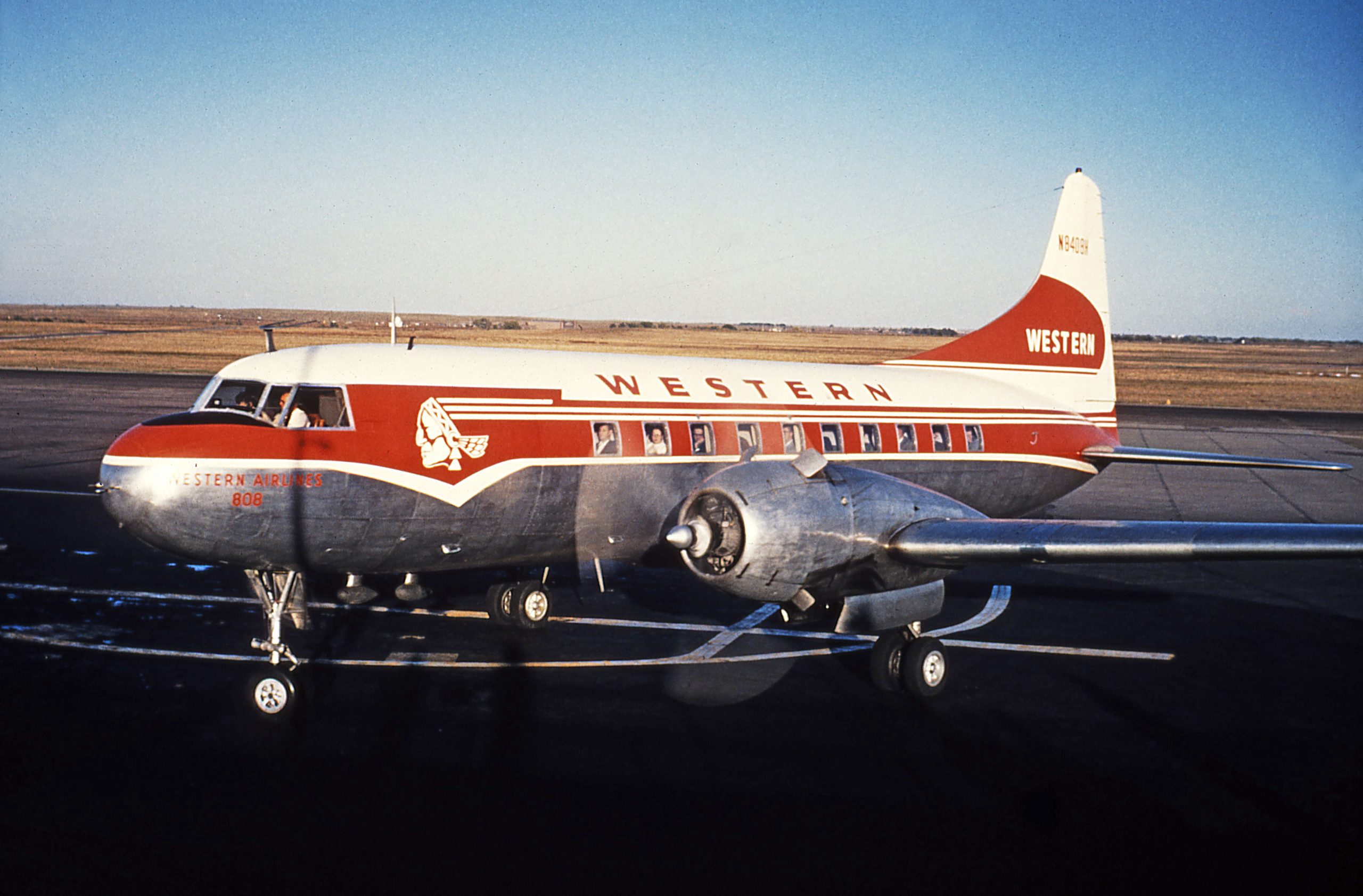
TWIN-ENGINE CONVAIR 240s served most of Western’s short-haul routes in the 1950s. Photo from the Jon Proctor Collection.
CHAMPAGNE FLIGHTS AND ONE IMPORTANT BIRD
Western’s first major innovation in inflight service took place in 1954, and it was a game-changer. The airline contracted with the owners of the Italian Swiss Colony brand to carry the winery’s champagne onboard its flights. The champagne was a complimentary offering, initially served as an accompaniment to meals aboard flights marketed as “The Californian.” The free champagne quickly became an enticement for passengers to book their travel on Western as opposed to the competition.
The flights that offered a snack or meal accompanied by the complimentary bubbly were eventually branded as “Champagne Flights,” and they became a hallmark of Western’s service.
Remembering Western Airlines: The Only Way to Fly! 106
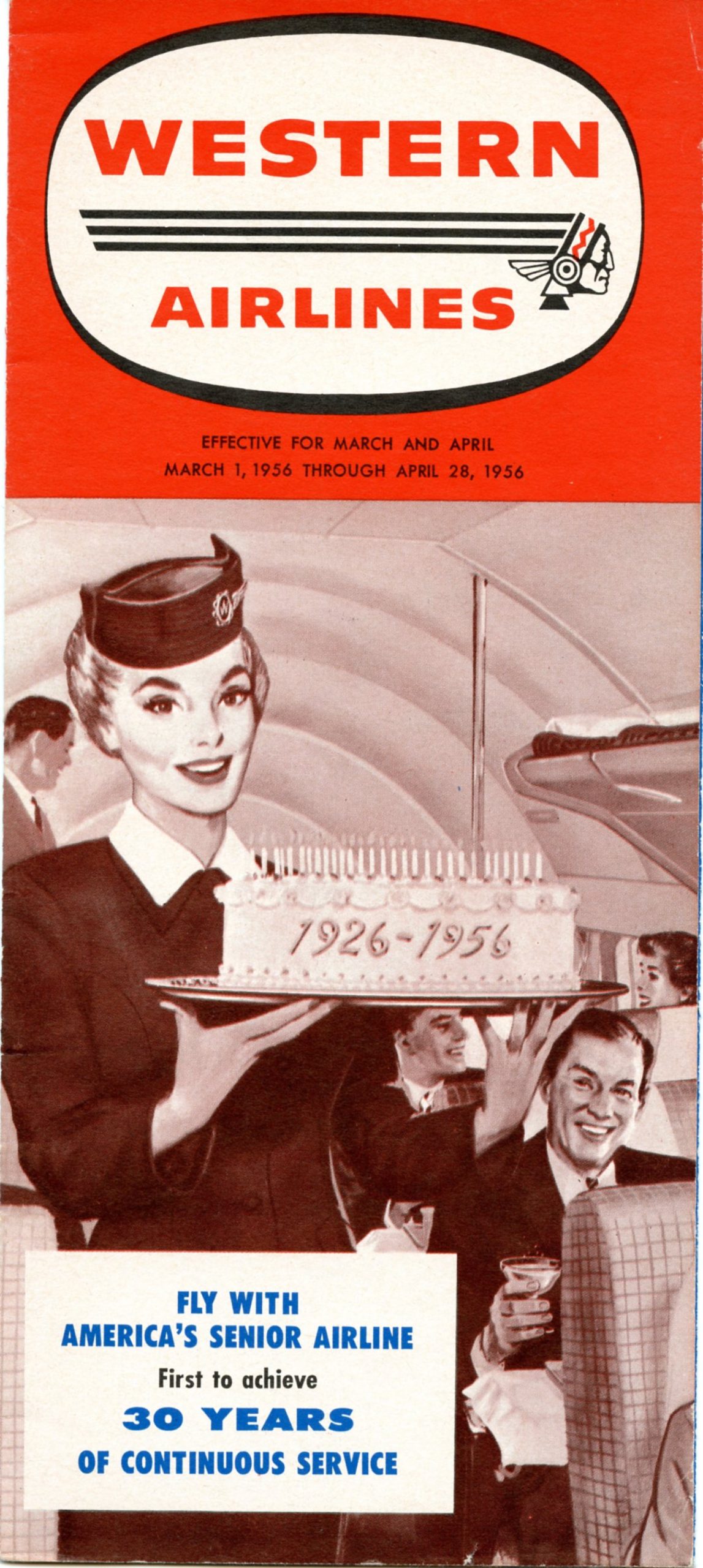
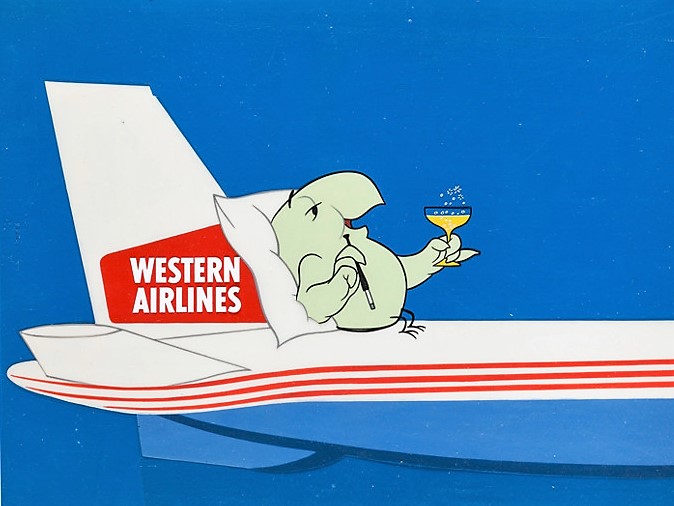
In 1956, the airline celebrated its 30th birthday, and at about the same time, the company introduced an animated character to its television advertising campaign. The cartoon figure was a bird, somewhat resembling a parrot, resting atop a Western DC-6B with a cigarette holder in one hand and a glass of champagne in the other.
In the commercials, the bird would inform viewers that Western was “the ooonly way to fly!” The animated avian was christened “Relaxed Bird,” then VIB (Very Important Bird) by the company, but the public quickly dubbed the little character “Wally Bird.”
From his perch atop a DC-6B, Wally Bird would proclaim that Western Airlines was “the ooonly way to fly!”
WESTERN AIRLINES FIESTA FLIGHTS
When Western inaugurated service to Mexico City in 1957, it did so with its usual champagne meal service. The following year, the company branded its non-stop First Class flights between Los Angeles and Mexico City “Fiesta Flights,” which featured lavish meals, a “Fiesta dessert cart,” and, of course, champagne.
The airline that at one time had eliminated all meal service in an effort to save money was now famous for some of the most innovative cabin service in the industry, from Fiesta Flights to Hunt Breakfasts.
In 1959, the company’s profit surpassed $5 million.
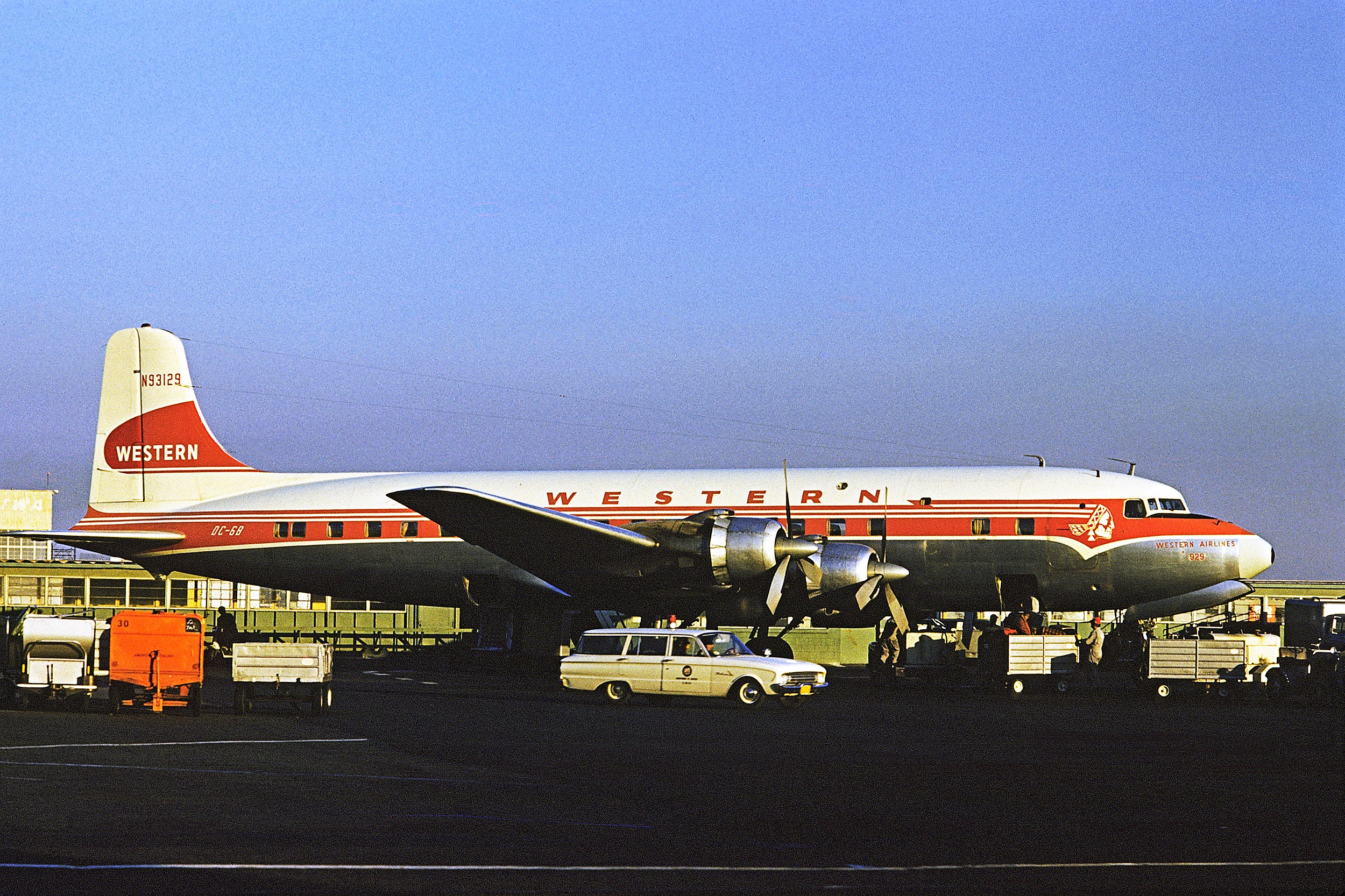
Western DC-6B photographed at Los Angeles (LAX). Mel Lawrence photo.
GOONEY BIRDS
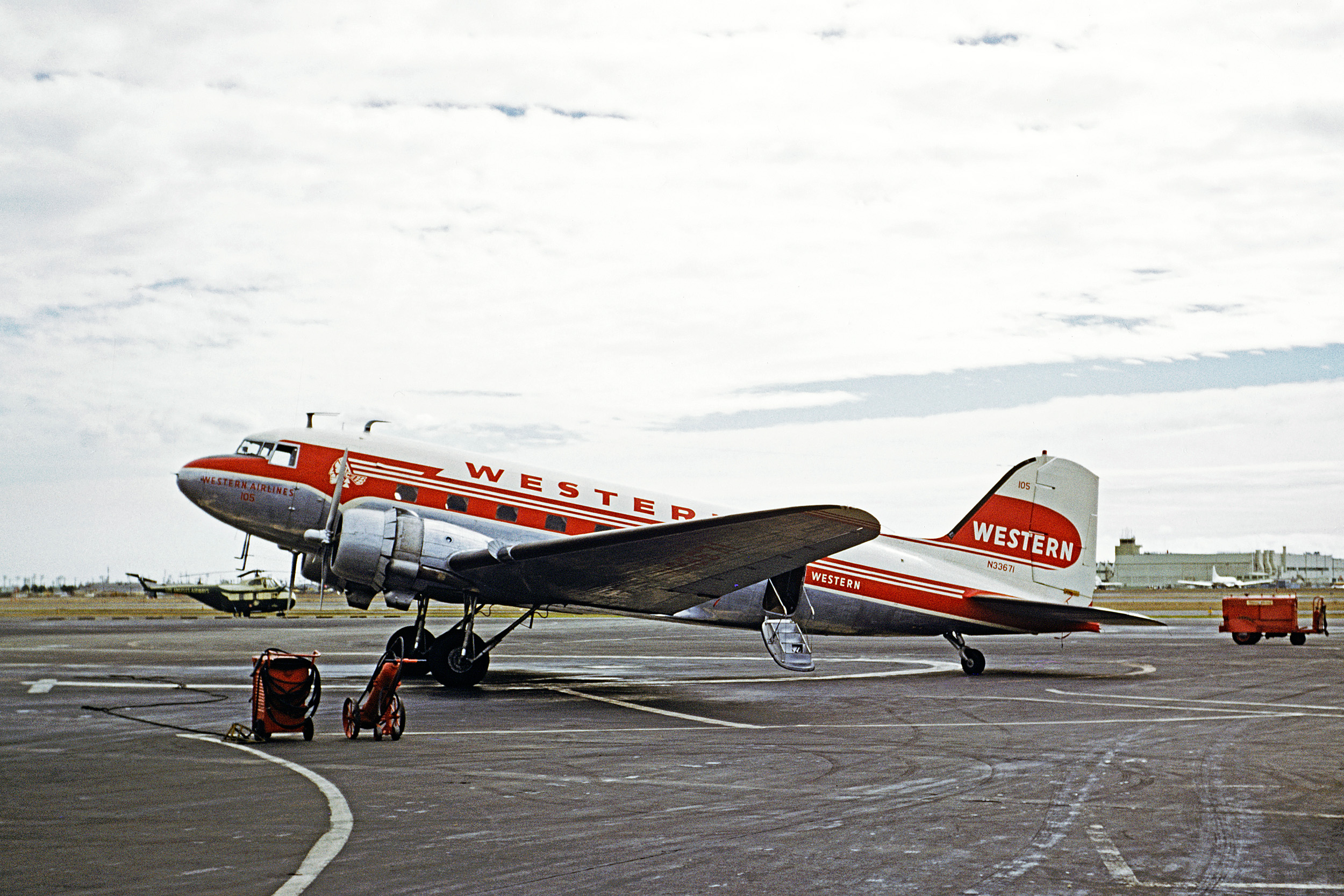
Western’s final DC-3 service hopped across the Great Plains from Denver to Minneapolis/St. Paul with 11 scheduled enroute stops. Mel Lawrence photo.
Along with its fleet of DC-6Bs and Convair 240s serving cities throughout the West, the airline continued to be saddled with service to several small cities across the Great Plains that required Western to keep Douglas DC-3s in its fleet. By December 1958, the DC-3 operation had been reduced to one flight per day in each direction between Denver and the Twin Cities with eleven landings enroute, several of them on a flag stop basis. Most of these communities were eventually transferred to local service airlines, which were better prepared to offer service to such small cities.
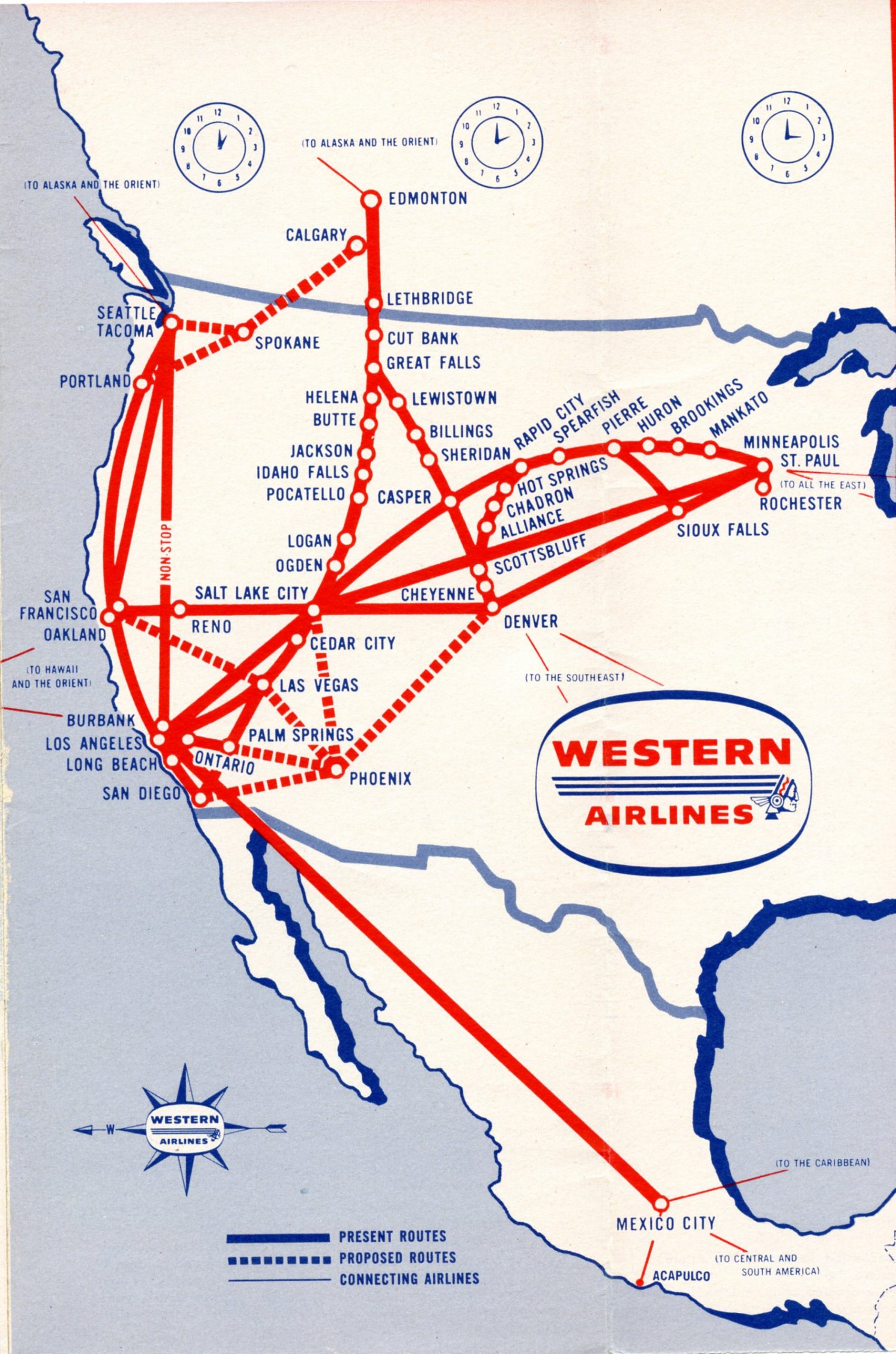
Western’s route map effective 1 June 1957. The Civil Aeronautics Board (CAB) would transfer many of the smaller cities on the system to local service airlines. David H. Stringer Collection.
Western could finally retire the last of its reliable old DC-3s, and the company’s system was now more streamlined and ready for the next step forward in commercial aviation.
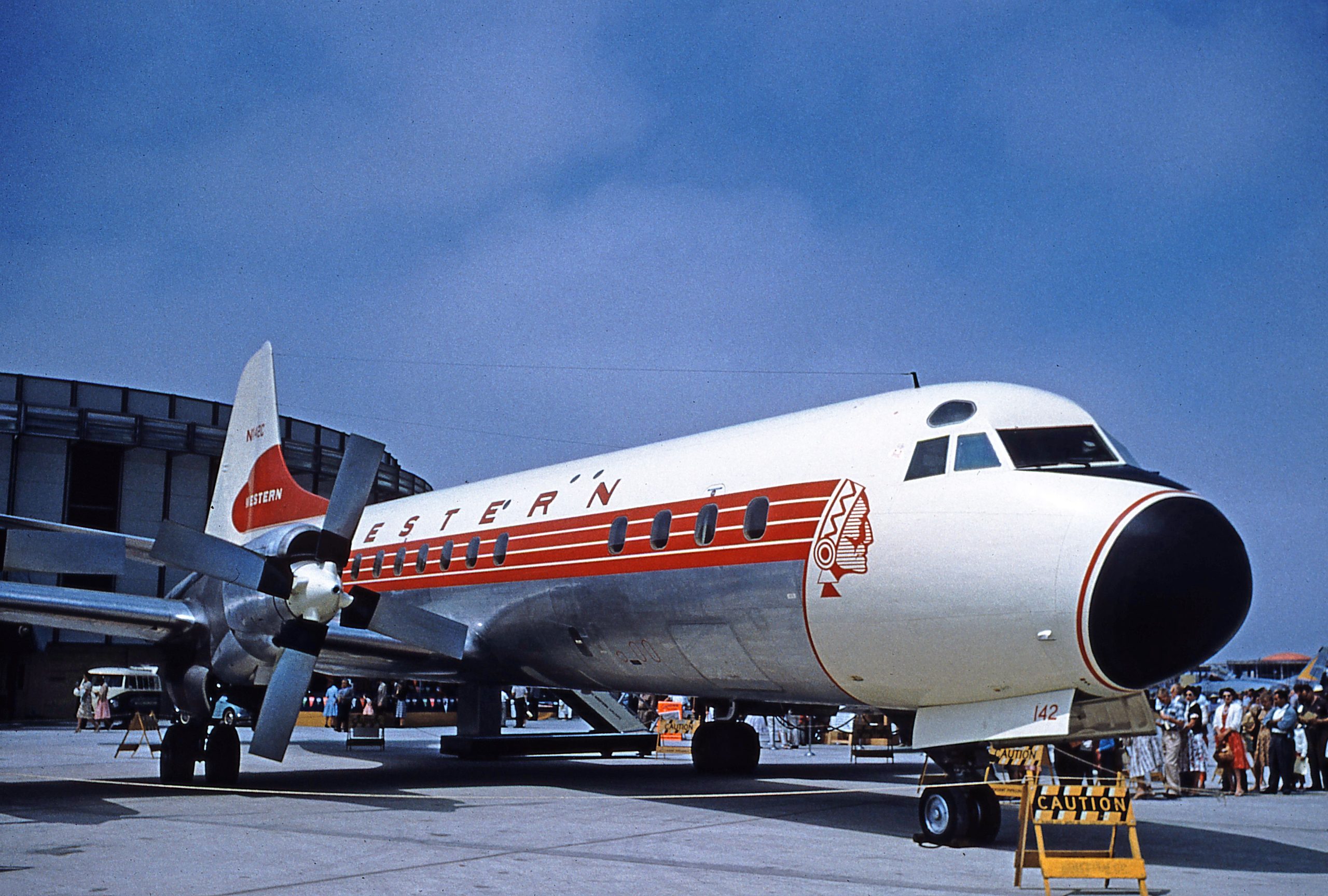
Western Airlines chose the turboprop Lockheed L-188A Electra as a replacement type for the company’s DC-6Bs and remaining Convair 240s. Bob Archer photo.
INTO THE JET AGE
Before entering the 1960s, Western had selected the turboprop Lockheed L-188A Electra to supplement service operated with its reliable Douglas DC-6Bs, which would gradually be retired. But Drinkwater and his staff had not rushed into a deal to purchase the very first round of turbojets. Instead, Western took a deliberate, methodical approach, carefully evaluating the new generation of jets in development. That caution paid off: by waiting, Western was ultimately offered the ideal aircraft for its needs.
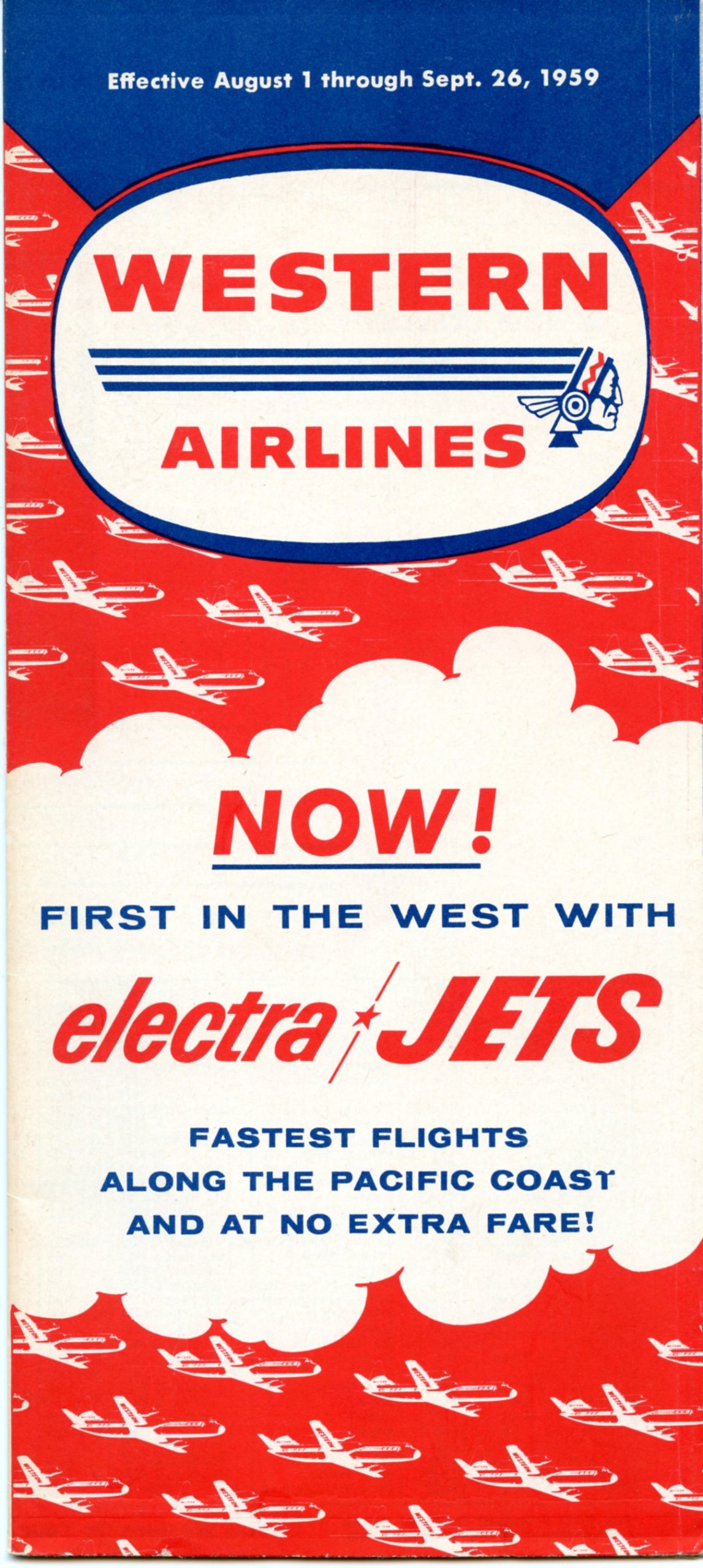
Although fitted with propellers, Lockheed L-188A Electras were equipped with turbine-powered engines, classifying them as turboprops or “jet-props.” Western Airlines took a bit of liberty by advertising them as “Electra Jets.” David H. Stringer Collection.
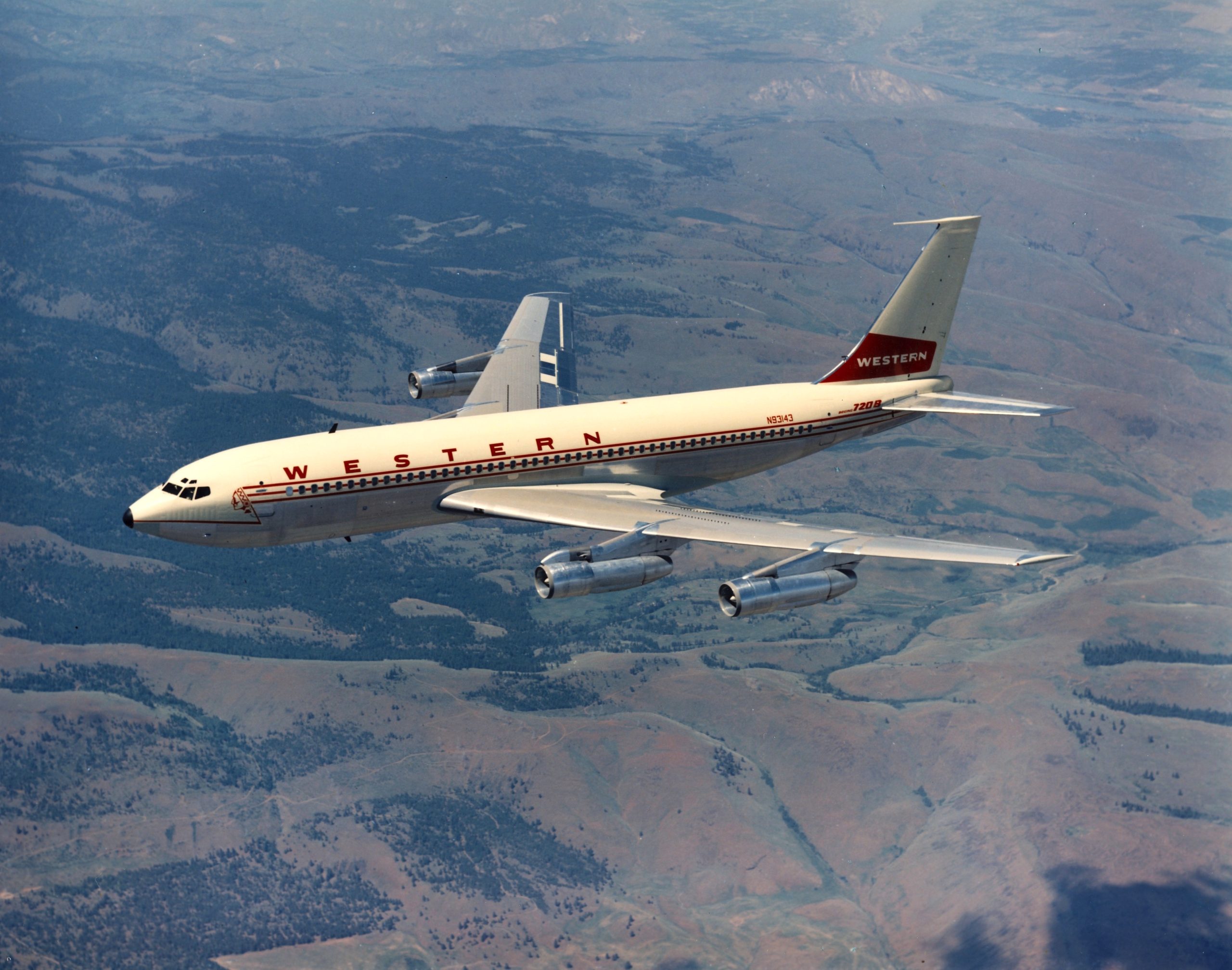
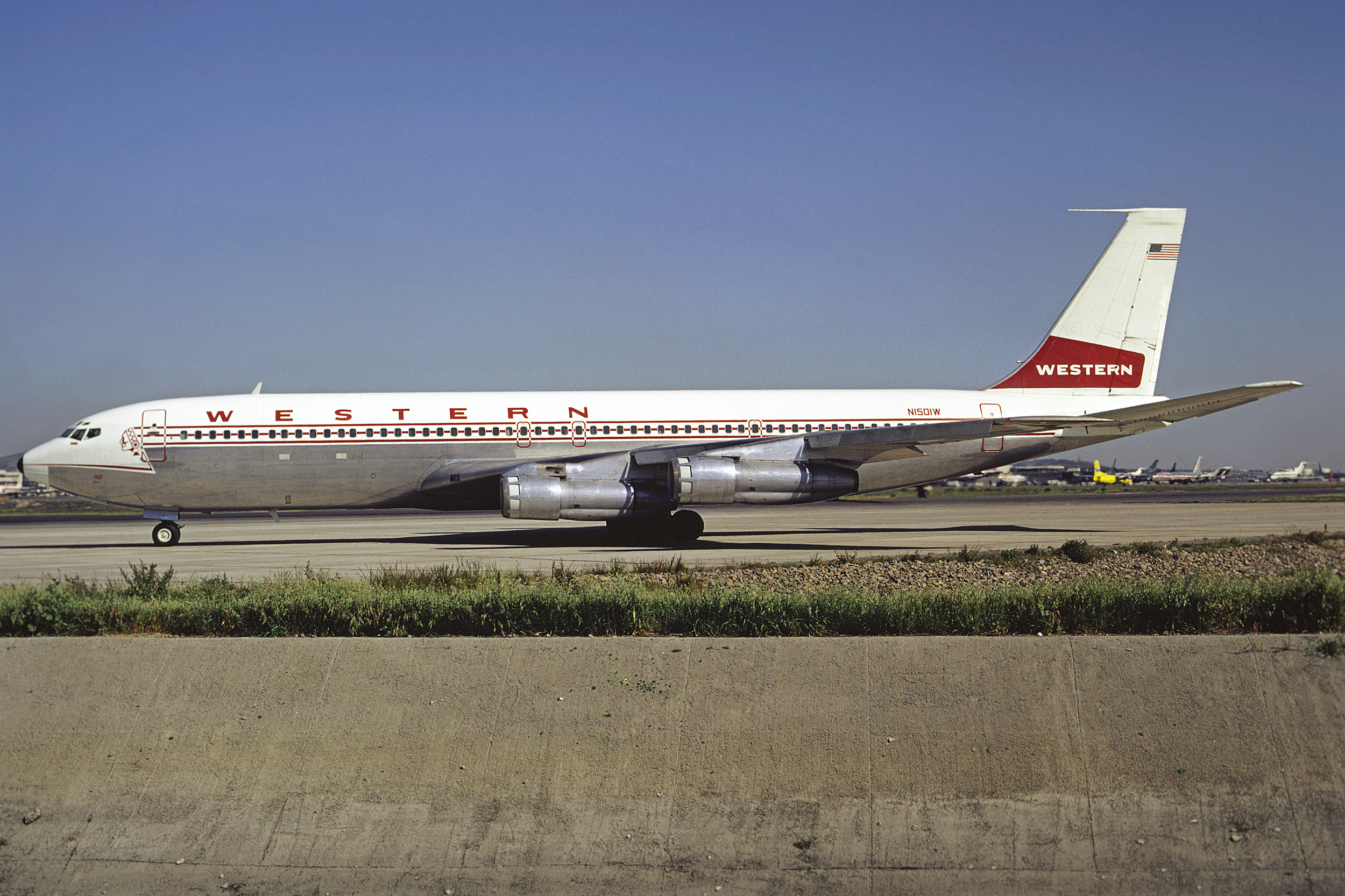
A slightly smaller version of the 707, the Boeing 720, was designed to offer a choice for airlines that wanted a jet for medium-length stages. Modifications of the original 707 design endowed the 720 with better field performance and a faster cruising speed. As airlines began ordering the 720, Boeing improved the design yet again by installing more powerful Pratt & Whitney JT3D fan engines, creating the Boeing 720B Fanjet. This is the aircraft that Western settled on, outfitted to carry 122 passengers in a mixed-class configuration.
This Boeing Company photo features the Boeing 720B N93143. Western Airlines found the 720B to be the right aircraft for the company’s initial jetliner purchase.
While awaiting delivery of the 720Bs, Western leased two Boeing 707s from the manufacturer and introduced its first pure jet service on 1 June 1960 to Los Angeles, San Francisco, Portland, and Seattle/Tacoma.
Boeing 720B service was finally inaugurated on 15 May 1961 between Los Angeles and Mexico City, followed shortly by service to the aforementioned Pacific Coast stations. Western’s satisfaction with Boeing’s Fanjet was demonstrated by the company’s acquisition of 27 720Bs between 1961 and 1968.
An updated version of Wally Bird rests atop a Western Airlines Boeing 720B. David H. Stringer Collection.
WESTERN’S BOEING 737
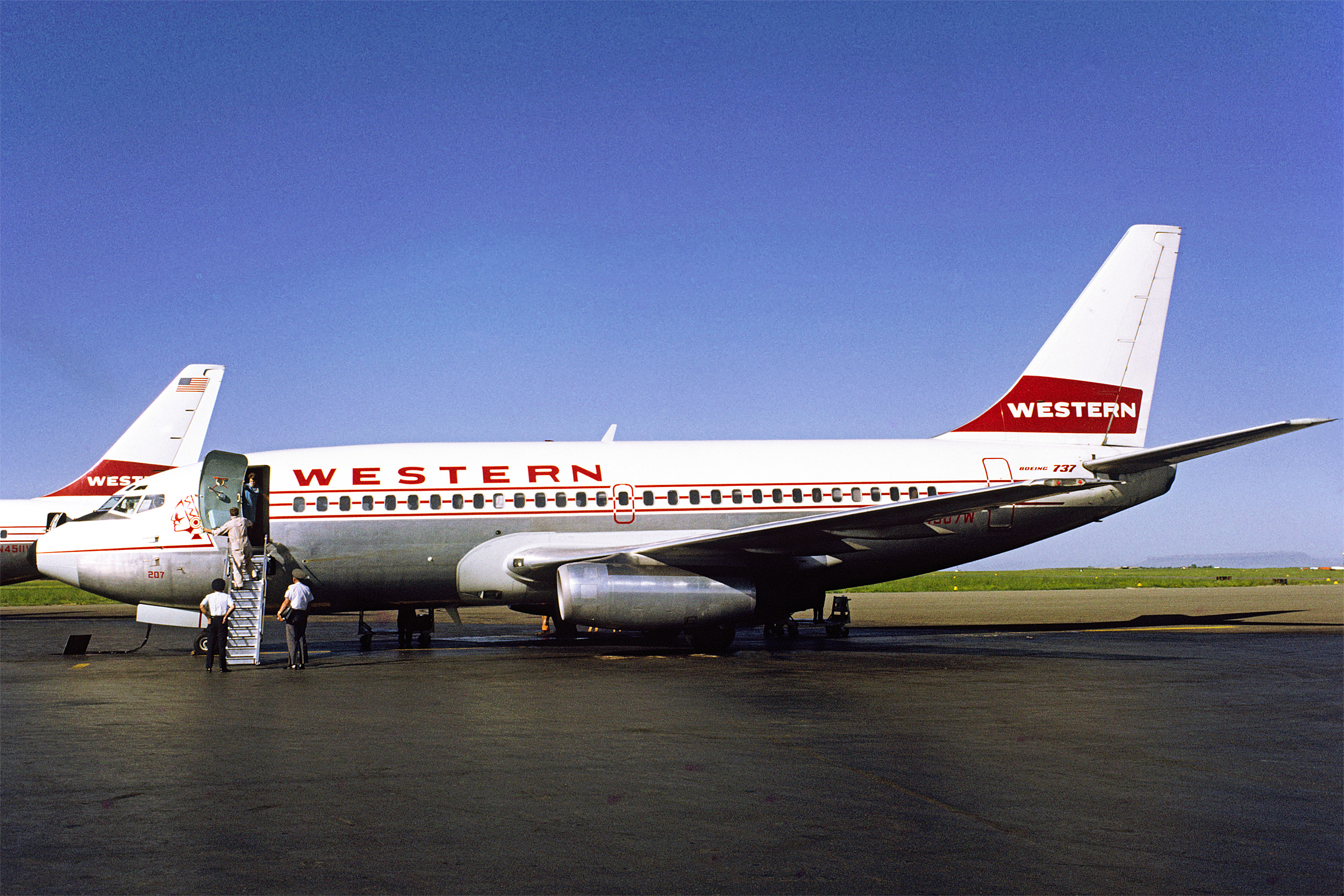
Western’s short and medium-haul routes were served well by the company’s turboprop Electras and aging piston-engined DC-6Bs. But more modern equipment, suitable for frequent take-offs and landings on flights making several stops, would have to be procured eventually. It was Boeing’s 737 that management decided would fit perfectly into Western’s fleet, even though the 737 design and production process was lagging behind the similar projects of Douglas and British Aircraft Corporation (BAC).
In 1965, Western signed a contract with Boeing Aircraft to purchase 20 737s, plus options for an additional 10. The options were exercised, and the first of Western’s 30 factory-fresh 737s entered service in 1968.
Western Airlines ordered 30 Boeing 737s to take over the medium—and short-haul duties previously handled by the Electras. Mel Lawrence photographed these 737s on the ramp at Great Falls, Montana.
WESTERN AIRLINES TO ALASKA AND HAWAII
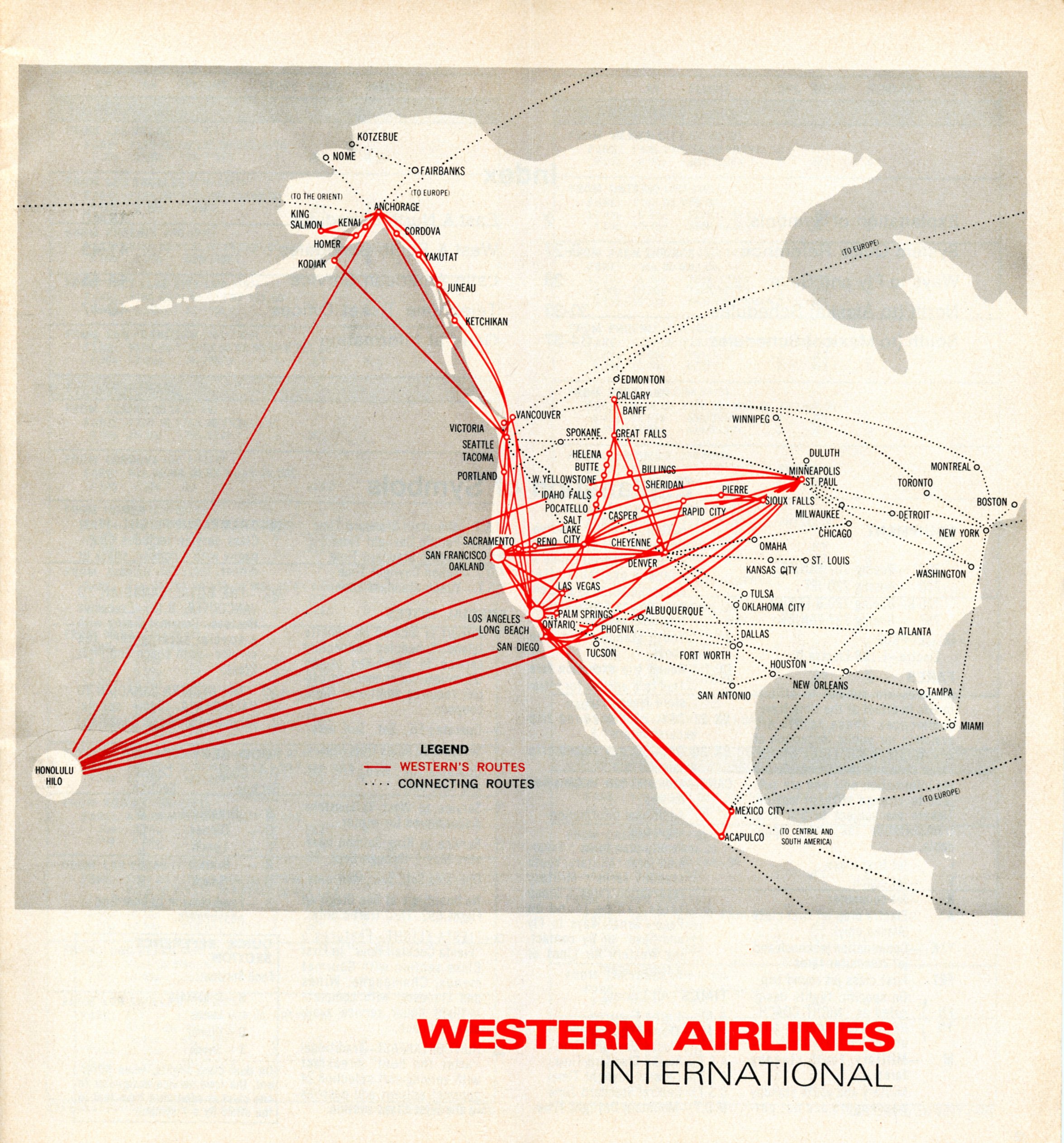
On 1 July 1967, Western absorbed Pacific Northern Airlines (PNA) through a merger, giving Western access to Ketchikan, Juneau, Anchorage, and other destinations in the 49th state.
In 1969, after perhaps the most convoluted and drawn-out case ever resolved by the Civil Aeronautics Board (CAB), Western was granted permission to serve Hawaii from San Francisco, Los Angeles, San Diego, several other mainland cities, and Anchorage.
Western Airlines route map, effective 1 February 1969, shows the company’s routes extending to Alaska and Hawaii. David H. Stringer Collection.
In anticipation of the Hawaii award, Western purchased five Intercontinental models of the Boeing 707, which entered service in 1968. The 707-347Cs initially operated the company’s few long-haul services, from Los Angeles to Mexico City and from Los Angeles and San Francisco to the Twin Cities, before being deployed on the newly awarded Hawaii routes in the spring of 1969.
In addition to the intercontinental 707s and 30 new Boeing 737s, Drinkwater ordered six Boeing 727-200s and three Boeing 747 jumbo jets and was negotiating to buy more 727s and intercontinental 707s.
A Western Airlines Boeing 707-347C Intercontinental jet, photographed at San Francisco (SFO). George Hamlin Collection.
THE 1970s, ‘80s, AND THE END OF WESTERN AIRLINES
There was at least one observer who thought that the company was ‘in over its head’ and saw the potential for a takeover. Kirk Kerkorian was a developer, investor, and the former head of a supplemental air carrier, Trans International Airlines (TIA). He began acquiring shares of Western’s stock until he had accumulated enough to insist on placing his own people on Western’s Board of Directors.
The first thing Kerkorian wanted to do was cancel the 747 order. Drinkwater, who had guided Western since the 1940s, was forced out of the company in less than a year.
Western’s management settled on the McDonnell-Douglas DC-10 as its widebody aircraft of choice, and the company expanded operations to several destinations in the eastern US and, for a short time, to London’s Gatwick Airport (LGW).
During Western’s final years, the fleet consisted of Boeing 727-200s, Boeing 737s, and McDonnell Douglas DC-10s, while the company’s flight hubs were located at Salt Lake City and Los Angeles. In the post-deregulation era, the carrier became an attractive takeover target, and in 1987, Delta Air Lines acquired Western through a merger.
The air carrier that once proclaimed itself “the ooonly way to fly” was now relegated to history.
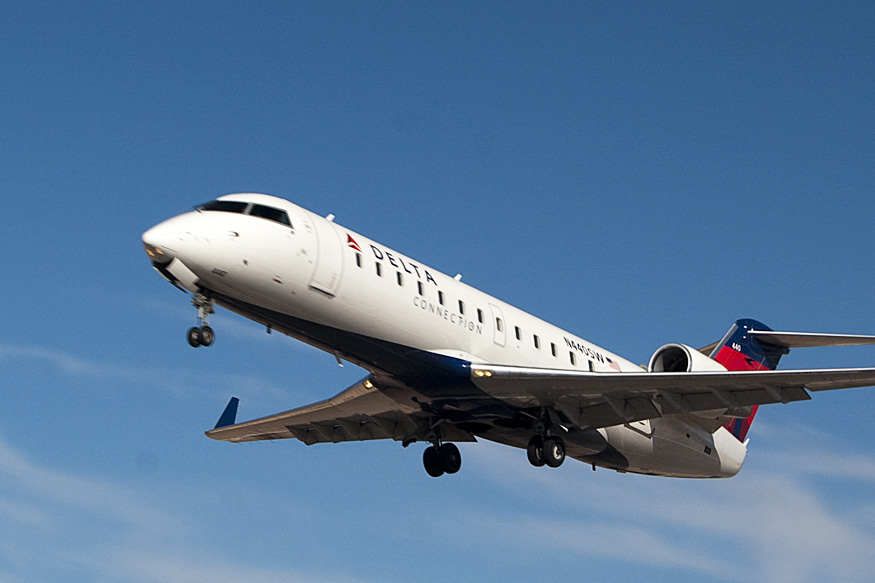
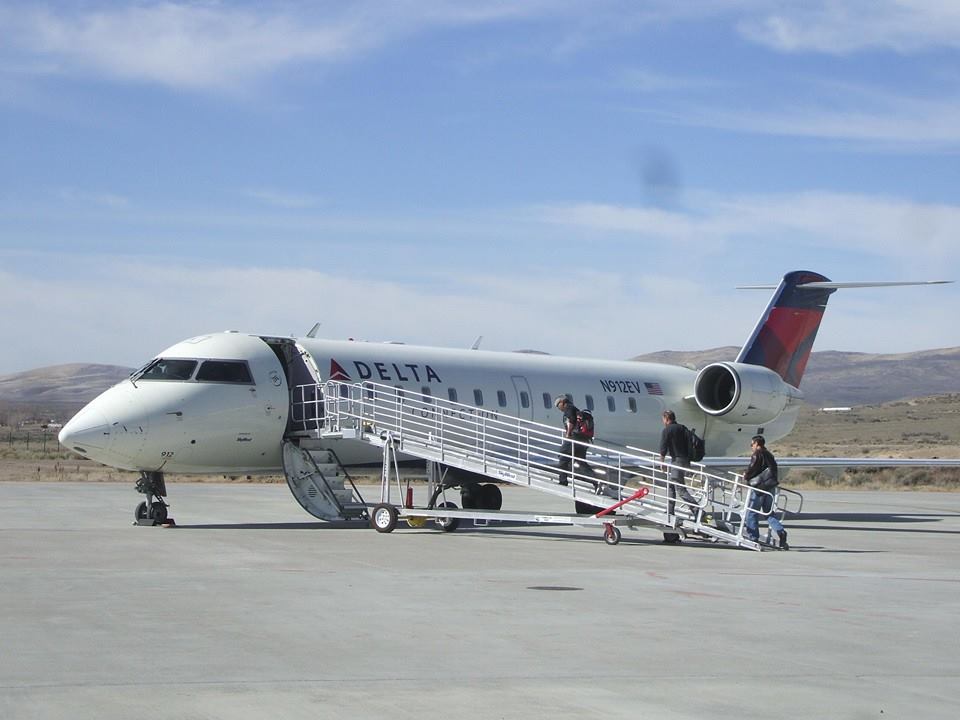
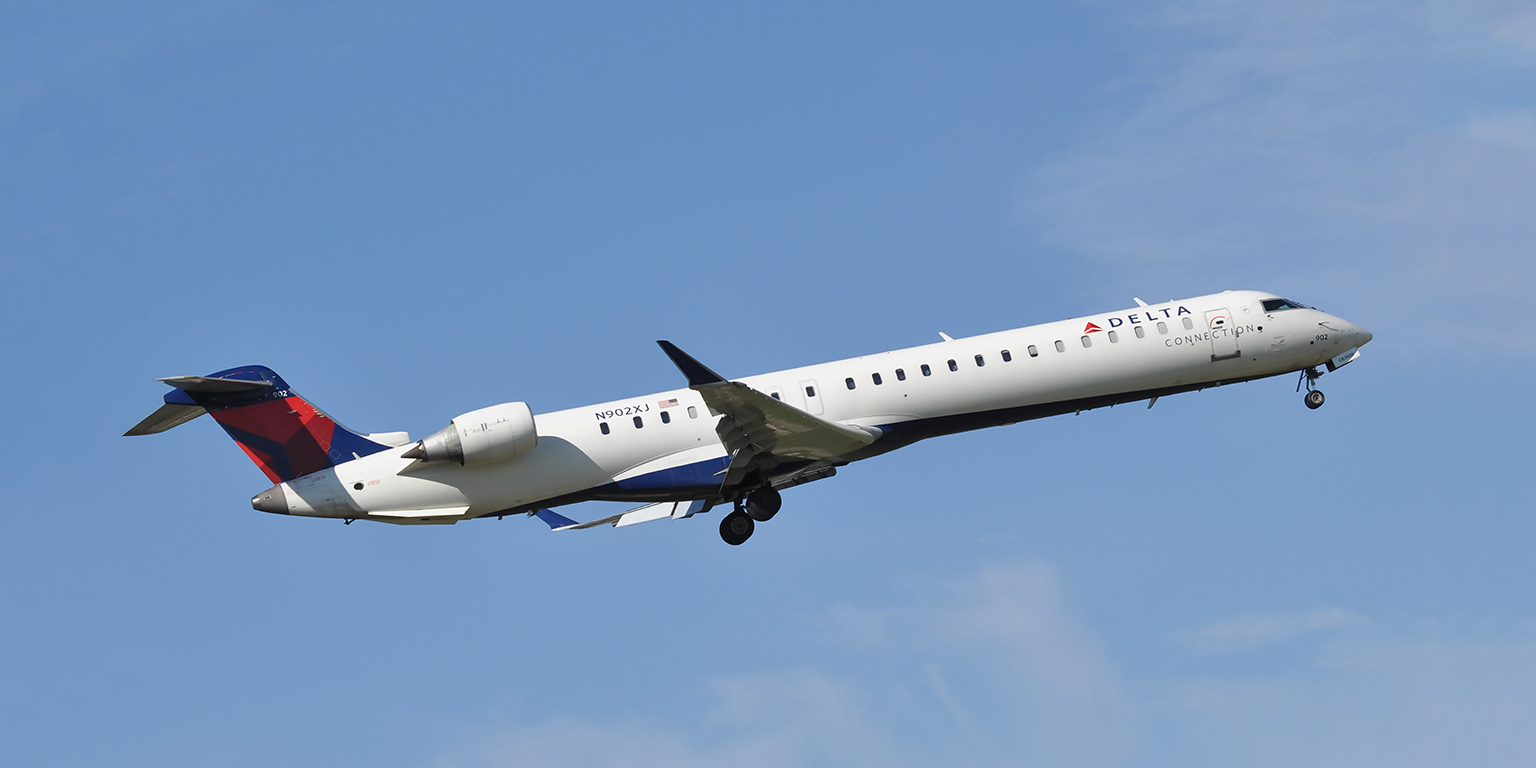
Breaking up is hard to do, but the end is finally near. Delta Air Lines will end operations on its once-massive fleet of CRJ-200s on 30 November.
That means beginning in December, not a single Delta Air Lines passenger will set foot on a CRJ-200 (CR2) for the first time in over three decades. However, for CR2 die-hards (do any exist?), not all is lost: Delta scheduling continues to indicate the possibility that at least three cities will again see CR2 service in spring 2024 (even if it is probably just be a scheduling error).
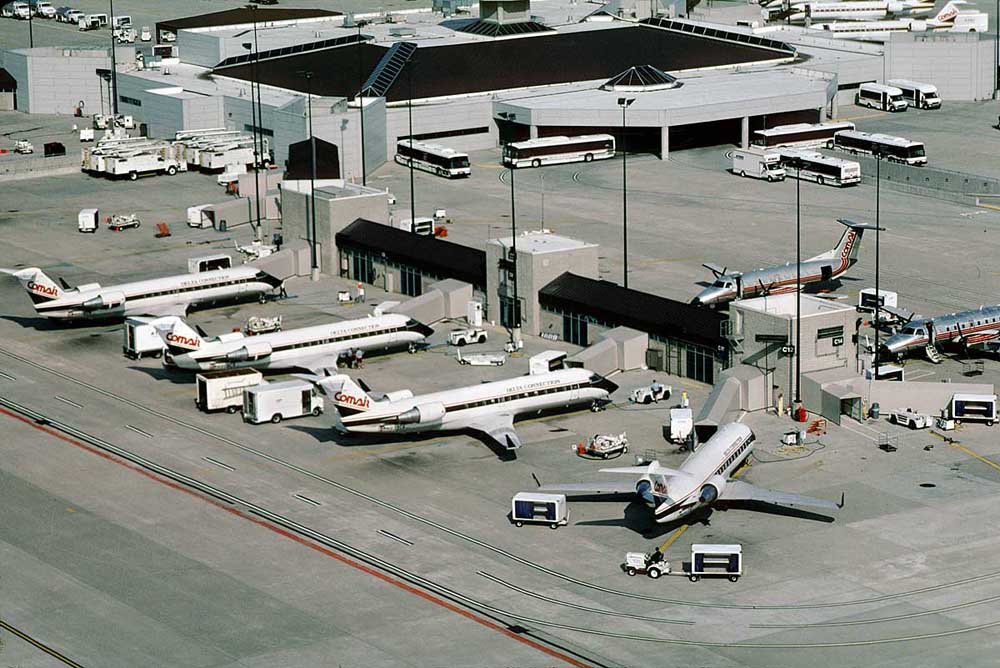
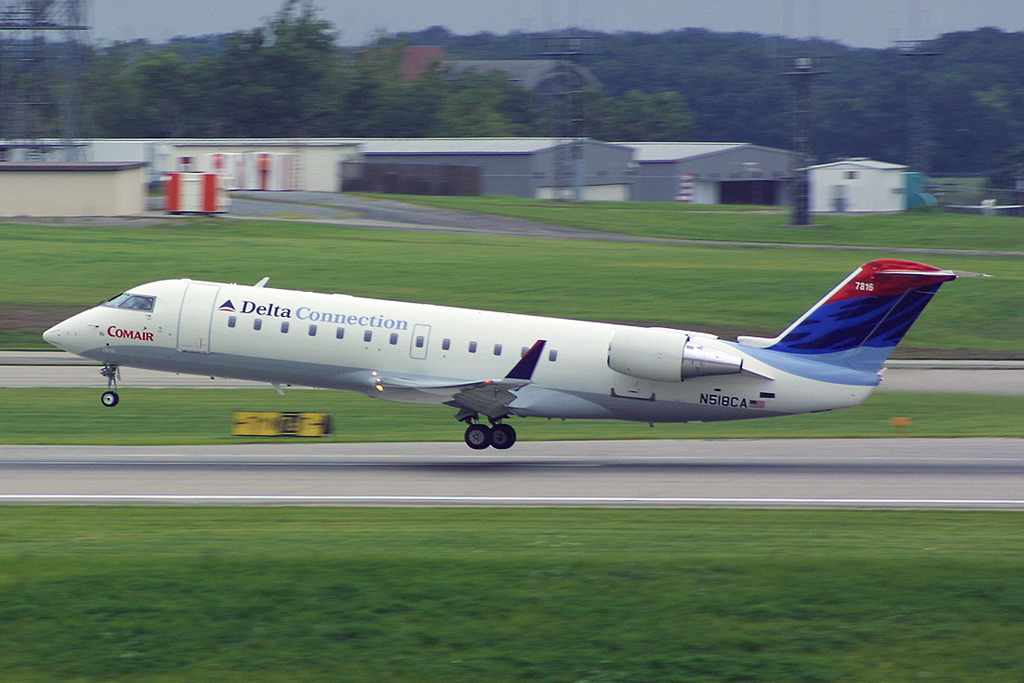
Delta Connection Carrier Comair Introduced the CRJ-200 to North America in 1993
Comair CRJ-100s and EMB-120s on the ramp at Cincinnati Northern Kentucky International Airport (CVG) in the early 1990s | IMAGE: Vern Krutein on flickr
The Canadair Regional Jet program traces its roots back to the early 1970s when William Lear, the creator of the Learjet, spearheaded a project to launch a new business jet called the Challenger 600.
Canadian aerospace manufacturer Canadair took over the project prior to the type’s certification in 1980. However, despite its certification, sales never took off. In 1986, Bombardier acquired Canadair and initiated a comprehensive program overhaul, resulting in the development of the CRJ-100.
The maiden flight of the CRJ-100 took place on 10 May 1991. Following certification in October 1992, Lufthansa subsidiary CityLine became the launch customer for the new regional jet. Meanwhile, in North America, Comair (a Delta Connection carrier that would later become a wholly-owned subsidiary of Delta Air Lines) was the launch customer for the CRJ-100. Comair initiated CRJ service between Cincinnati/Northern Kentucky International Airport (CVG) and Toronto Pearson International Airport (YYZ) in Canada on 1 June 1993.
A newer, more efficient model, the -200, was introduced shortly after that. In all, 1021 CRJ-100/200s were manufactured between 1991 and 2006.
Today, just 122 remain in service in North America. Among them, 81 are operated by Skywest (Delta Connection, United Express), 36 by Air Wisconsin (American Eagle), and seven with Canadian carrier Jazz Aviation (Air Canada Express).
Interestingly, Air Wisconsin resumed flying the CRJ-200 again earlier this year after parking them during the pandemic. The carrier operates a small number of regional routes using the CR2 out of Chicago O’Hare International Airport (ORD) on behalf of American Eagle.
An 11 or Three-Year Process, Depending on Who You Ask
A Delta Connection CRJ-200 lifting off | IMAGE: Delta Air Lines
Rumblings of an impending end to CR2 flying for Delta have been swirling since at least 2012. However, it wasn’t until 2020 that airline leadership officially set a plan in motion to permanently retire the CRJ-200s from Delta’s fleet.
It’s not hard to understand why. The CR2 is Delta’s smallest aircraft (Delta Connection no longer operates any ERJ135/145s). Although its impact on revolutionizing regional air travel cannot be understated, the CR2 is almost universally hated by passengers and crew. Offering minimal amenities, the CR2 doesn’t fit in with Delta Air Lines’ evolving business model. The company aims to “simplify, modernize, and streamline” its fleet and enhance the customer experience, all while slashing operating costs.
These changes will make Delta the first U.S. carrier to offer first class on every flight.
The tiny CR2 features just one class of service. The aircraft is notorious for its tight seating configuration and (very) limited overhead storage. Despite featuring Delta’s premium seat product Comfort Plus, the added legroom on the CR2 is negligible. Taller passengers often contort into uncomfortable positions, while overhead “bins” fill up quickly, leading to delays during boarding and disembarkation. Further, the CR2 does not feature in-seat power, unlike the CRJ-700/900.
Delta also plans to roll out Wi-Fi capabilities to every aircraft in its fleet (with the exception of any remaining CR2s) by the end of 2024.
Of course, the pandemic and the ongoing pilot shortage crisis have further contributed to sealing the fate of the CR2.
In its 2020 announcement, Delta committed to completely phasing out the CR2 by summer 2023. Despite minor adjustments to the timeline, Delta has remained largely consistent with its goal.
The Beginning of the End
Delta Connection CRJ-200 | IMAGE: Delta Air Lines
Delta Connection carrier Endeavor Air ended CR2 operations out of Atlanta Hartsfield Jackson International Airport (ATL) in May 2023. This left St. George, Utah-based Skywest Airlines as Delta’s sole operator of the type out of Detroit Metropolitan Wayne County Airport (DTW), Minneapolis–Saint Paul International Airport (MSP), and Salt Lake City International Airport (SLC).
However, Skywest has been phasing out CR2 operations in recent weeks. In mid-October 2023, Skywest ended CR2 ops out of Detroit and Minneapolis.
That left Salt Lake City as the only remaining Delta hub with CRJ-200 flights.
Where Delta CRJ-200s Still Fly Today
A Delta Connection CRJ-200, operated by Skywest Airlines, on the ramp at Elko Regional Airport (EKO) | IMAGE: Elko Regional Airport on Facebook
But even at SLC, Delta is preparing to end CR2 ops.
As of the time of this writing (mid-November 2023), Skywest is deploying the CRJ-200 on routes to just three cities out of SLC, which are:
CNY: Moab, Utah (Canyonlands Regional Airport)
EKO: Elko, Nev. (Elko Regional Airport)
CDC: Cedar City, Utah (Cedar City Regional Airport)
Aside from these cities, Skywest previously operated the CR2 on seasonal flights to Yellowstone Airport (WYS) in West Yellowstone, Mont. However, this service concluded for the winter months in mid-October.
Similarly, service to Moab, Elko, and Cedar City will end for the winter months on 30 November.
So, is that the end of Delta’s CRJ-200 story? The short answer is: Probably, yes.
According to delta.com, the potential resumption of service to at least two of those locations – West Yellowstone (WYS) and Moab (CNY) – still shows the CR2 next spring, but that was probably just a placeholder aircraft for the schedule. It is more than likely going to be with the larger CRJ700 or CRJ900.
At the same time, local media in Moab is reporting that Skywest, which also provides United Express service to CNY from Denver International Airport (DEN), will pull out of CNY for good by the end of 2023. In its place, federally subsidized flights to Phoenix Sky Harbor International Airport (PHX) aboard Smyrna, Tenn.-based Contour Airlines will begin in February 2024.
More Modern and Comfortable Regional Jets Are Replacing the CRJ-200
The Bombardier CRJ-900, operated by Delta Connection Carrier Endeavor Air or SkyWest Airlines, takes off | IMAGE: Delta Air Lines
For travelers in Elko (EKO) and Cedar City (CDC), Skywest will introduce 76-seat CRJ-900s when service resumes next spring.
This trend extends to smaller markets throughout the Delta network. Alternatives such as the CRJ-700 and the Embraer 170/175, operated by regional carriers Republic Airways, Endeavor Air, and Skywest, will replace outgoing CR2s.
Some small-to-mid-size cities have lost Delta service altogether, including Lincoln, Neb. (LNK), and the Pennsylvania cities of Erie (ERI) and Wilkes Barre/Scranton (AVP). However, these instances are not isolated, with more than 70 U.S. cities experiencing a reduction or elimination in air service due to various factors, including the contraction of regional airline fleets.
Once Lauded, the CRJ-200 Evolved into the Airplane Everyone Loved to Hate
A Delta Connection (Comair) CRJ-200 lifts off from Cincinnati Northern Kentucky International Airport (CVG) on 3 Aug 2003 | IMAGE: Bruce Leibowitz on flickr
As of this writing, just eight CR2s remain in Delta’s fleet of CRJ-100/200s that once numbered in the hundreds.
While most of the jets are living out their remaining days in desert boneyards, some have found new life operating federally subsidized air service routes for other carriers. But even those carriers will see an end to CR2 service in the next few years, with United Airlines committing to a 2026 end date.
Delta’s decision to retire the CRJ-200 is part of a broader trend in the aviation industry towards more efficient, environmentally friendly, and passenger-centric aircraft. Newer regional jets and smaller full-size jets like the Airbus A220 are equipped with state-of-the-art technology and improved cabin configurations.
As we bid farewell to the CRJ-200, we’d be remiss not to acknowledge its role in connecting communities and supporting regional air travel. Despite its flaws, this aircraft served as a vital link between smaller airports and major hubs, facilitating economic growth and fostering connections between people.
The imminent retirement of the CRJ-200 signifies the conclusion of an era spanning over three decades for Delta Air Lines and Delta Connection. And while we doubt many tears will be shed over its retirement, Delta (and other legacy carriers) would do well to consider the many smaller communities the CRJ-200 connected to the world.
In the meantime, flyers rejoice! Each day that passes is one day closer to never having to set foot in the airplane we all love to hate. As we once called it, the Nickleback of the skies days are numbered at Delta Air Lines.
UPDATE: Starship 25 (the second full test launch) launched today shortly after 7am Central Time. The first stage separated successfully but then encountered an anomaly and was destroyed. The second stage continued until 148km over the Gulf of Mexico where it also encountered a RUD (rapid unscheduled disassembly). The video below has the full launch sequence.
Original Story:
SpaceX is set to launch their second flight test of the Starship and Super Heavy rocket on Saturday morning, Nov 18. Liftoff is scheduled for 7:00am Central from Starbase, TX.
Watch it here:
You can watch the launch LIVE above on Saturday morning, beginning at 6:30am Central. You can watch SpaceX’s official webcast on their website or on X.
Second test follows explosive flight last April
Saturday’s flight test follows their first test launch earlier this year in April. That Starship was able to lift-off, but it destroyed its launch pad in doing so, and experienced multiple engine failures on ascent.
The Starship was remotely destroyed shortly after launch, at an altitude of about 24 miles by the Autonomous Flight Safety System (self destruct). After review, it was determined that the system took too long to execute, as there was quite a delay between the command and actual destruction. The explosion occurred near sensitive and populated areas. Local communities and protected environmental areas were impacted with debris and clouds of dust, even sparking a small wildfire.
A subsequent FAA investigation took seven months to complete. It involved other government agencies including the U.S. Fish and Wildlife Service (FWS), because Starbase is located on a federally protected wildlife refuge.
Watch SpaceX Launch Their 2nd Starship Test 116
Launch is an important step toward lunar spaceflight and beyond.
The company’s new mammoth rocket and spacecraft stand nearly 400 ft tall when stacked. The first stage Super Heavy is equipped with 33 of the company’s own Raptor engines, which will produce nearly 17 million pounds of thrust on launch. By far the most powerful rocket ever.
NASA is helping fund Starship development to land Artemis on the Moon
Ultimately, SpaceX wants Starship flying heavy-lift crew and cargo missions to the moon and Mars. And they want a fully reusable system, even landing the rocket back on its launch pad. SpaceX already has paying customers for those future missions too, including NASA. NASA wants to land their Artemis crews on the moon using the Starship. The first moon landing on Artemis-3 is slated for possibly 3 years from now if SpaceX can successfully launch and keep a very tight timeline.
Watch SpaceX Launch Their 2nd Starship Test 117
That said, the U.S. government has a high interest in Starship’s development. There can’t be a moon landing until Starship is ready. SpaceX had to consistently launch safe missions on the Falcon9 system before NASA ever put their astronauts onboard, and it will be no different for Starship. NASA wants to see around 20 Starship flights, from both Starbase and Kennedy Space Center, before they will trust the systm enough to put their crews on the Artemis-3 lander.
A look at Saturday’s flight test
Saturday’s scheduled Integrated Orbital Flight Test-2 won’t be going to the moon. Starship will launch, then perform staging separation a little after 2 minutes in flight. The massive rocket will then fly back and attempt a vertical landing splashdown about 20 miles off the coast of TX.
Watch SpaceX Launch Their 2nd Starship Test 118
The Starship spacecraft meanwhile will ignite its own Raptor engines for 6 minutes, continuing on in flight for an hour before splashing down in the Pacific Ocean about 60 miles northwest of Kauai, Hawaii.
Neither the rocket or Starship for this test will be recovered or reused. SpaceX is constantly developing more test articles, in what they call a rapid iterative development approach. If this launch is successful, future iterations will attempt a landing.
Talk about the Ultimate Flex! Couple flies family and friends from Fort Worth, Texas to Paris for a Wedding.
Last night, I witnessed an incredible charter operation taking place at Fort Worth’s Alliance Airport. During the evening hours, an impressive VIP-configured AirX Airbus A340-300, equipped with over 100 lie-flat seats, made its grand entrance, accompanied by a pair of La Compagnie A321neos, both configured with all-business class seating.
Chartered A321NEO arrives at Alliance Airport in Fort Worth, Texas. Image: Centerline Images
This Wasn’t Just A Typical Charter
The word on the street suggests that these three aircraft were chartered to transport a sizable wedding entourage from the North Texas airport to Paris, France.
Couple Charters Airbus A340 and Two A321Neos For Paris Wedding 123
Interestingly, it seems that the individuals responsible for this operation effectively took La Compagnie out of its normal regularly scheduled service for the day. A quick examination of La Compagnie’s website revealed that the 15th, the date of the charters, was conspicuously unavailable for booking, making it one of the only greyed-out dates on the calendar for the entire month.
Couple Charters Airbus A340 and Two A321Neos For Paris Wedding 124
Pure Luxury for every guest
Following a few hours on the ground, and amid a seemingly endless stream of luxurious vehicles that are currently far beyond my own financial reach, the three aircraft departed the North Texas airport to start the journey east. The A340, with its much better range capabilities, embarked on a direct flight to Paris, while the “less fortunate” ones on the pair of A321Neos had to make a pit stop in Newark before joining the rest of the entourage in the French capital.
What a tough life! Cheers to the lucky couple!
Couple Charters Airbus A340 and Two A321Neos For Paris Wedding 125
It was a very good week for Boeing as two major Middle Eastern carriers, Emirates and flydubai, placed orders worth a staggering $63 billion on the opening day of the 2023 Dubai Airshow.
The deals solidify the post-pandemic success that Boeing continues to enjoy. After years of trouble, it appears the American OEM may finally be on a winning trajectory.
The World’s Largest Widebody Operator Will Get Even Bigger
Emirates Boeing 777-300ER photographed on August 17, 2015 from Wolfe Air Aviation’s Lear 25B | IMAGE: Emirates
Emirates, already holding the title of the world’s largest widebody aircraft operator, reinforced its dominance with a massive $52 billion order. The airline’s commitment comprises a firm order for 95 aircraft, featuring 55 777-9s and 35 777-8s, bringing the total count of 777s on order to an impressive 205. Additionally, Emirates upgraded its existing order for 30 Boeing 787-9s, increasing the Dreamliner commitment to 35, including 15 787-10s and 20 787-8s.
Emirates also signed an agreement for 202 GE9X engines to power the newly ordered 777s, bringing their total GE9X order to 460 units.
The first 777-9 is due to join the Emirates fleet in 2025, with continuous additions until at least 2035. Notably, Emirates will be one of the launch customers for the 777-8, with deliveries slated to begin in 2030.
Emirates’ chairman and chief executive Sheikh Ahmed bin Saeed Al Maktoum says Monday’s announcement cements his airline’s position as the world’s largest Boeing 777 operator.
“The 777 has been central to Emirates’ fleet and network strategy of connecting cities on all continents non-stop to Dubai,” said Al Maktoum. “We are pleased to extend our relationship with Boeing and look forward to the first 777-9 joining our fleet in 2025.”
Emirates has 295 Aircraft on Order
The Emirates fleet at Dubai International Airport (DXB) | IMAGE: Emirates
With 295 aircraft now on order, Emirates continues to position itself as a global aviation leader for decades to come. The carrier boasts an all-widebody fleet of 116 Airbus A380s and 144 Boeing 777s, including 10 Boeing 777-200LRs, 123 777-300ERs, and 11 777 freighters.
Emirates also placed an order for 50 Airbus A350-900s at the 2019 Dubai Airshow. These aircraft are due to enter the fleet sometime in late 2024, although that date keeps getting pushed back.
Emirates flies to 140 cities on six continents and will celebrate its 40th year of operation in 2025.
flydubai Stays Loyal to Boeing with Historic Widebody Order
An artist rendering of a flydubai Boeing 787-9 Dreamliner | IMAGE: flydubai
Flydubai, a Dubai-based budget airline, made history on Monday by placing its first-ever widebody aircraft order. The $11 billion deal includes 30 Boeing 787-9 Dreamliners, marking a strategic expansion of flydubai’s all-Boeing fleet, which currently includes 30 737-800s, 47 737 MAX 8s, and 30 737 MAX 9s.
“The 787-9 is perfectly suited for the needs of flydubai as it looks to open up new, longer-range routes and add capacity across its network,” said Boeing Commercial Airplanes president and CEO Stan Deal. “We are proud of the confidence that flydubai continues to place in our products with an all-Boeing fleet.”
With deliveries to begin in 2026, the 787-9 Dreamliners will play a central role in flydubai’s strategic expansion plans.
Operating a fleet of 79 aircraft, flydubai’s network spans across three continents, 54 countries, and more than 115 cities. The carrier, which began operations in June 2009, currently has over 130 Boeing 737 MAX aircraft on order, with deliveries scheduled through at least 2035.
Boeing’s Broader Success on Day One of the 2023 Dubai Airshow
Artist rendering of a flydubai Boeing 787-9 Dreamliner | IMAGE: flydubai
While the Emirates and flydubai orders stole the spotlight, Boeing’s success in Dubai didn’t stop there. Other significant orders include:
SunExpress: The Antalya, Turkey (AYT)-based carrier committed to up to 90 Boeing 737s, including 28 737-8s and 17 737-10s. The deal includes options for up to 45 more 737 MAX aircraft.
Egyptair: The Cairo, Egypt (CAI)-based carrier signed a contract to lease 18 Boeing 737-800 MAXs.
Royal Jordanian: The Amman, Jordan (AMM)-based carrier ordered four 787-9 Dreamliners and reconfirmed a previous order of two.
Royal Air Maroc: The Casablanca, Morocco (CMN)-based carrier ordered two 787-9s.
Boeing may get yet another massive boost at the Dubai Airshow this week. An announcement is reportedly very close for Saudi Arabia’s second official flag carrier, Riyadh Air. While not confirmed, the order is said to be upwards of up to 100 Boeing 737 MAX jets with a similar number of options. If confirmed, the 737s would join the previously announced order of 72 Boeing 787s for the Riyadh-based airline. The carrier, founded in March 2023, has not yet begun revenue operations.
Airbus also received some love on Day 1 of the Dubai Airshow with Riga, Latvia (RIX)-based airBaltic’s order for 30 A220-300s.
As day two kicked off on Tuesday morning, Airbus and Egyptair announced an order for 10 Airbus A350-900s. Later in the day, Ethiopian inked a deal with Boeing for up to 67 jets, including 11 787s and 20 737 MAXs, with options for 36 additional aircraft.
Boeing also received an order for seven 737 MAX 8s for Kazakhstani carrier SCAT Airlines.
Another announcement that could come this week is a potential “mega order deal” between Airbus and Turkish Airlines.
Dubai Airshow 2023: A Global Aviation Extravaganza
The 2023 Dubai Airshow | IMAGE: Emirates
The Dubai Airshow, renowned as the world’s largest aviation exhibition and conference, will host over 100,000 visitors from more than 150 countries this year. The program will feature over 1,400 exhibitors from 95 countries and more than 180 aircraft.
The biennial event, now in its 37th year, is a platform for industry leaders to showcase cutting-edge technology and innovations.
The airshow continues through Friday, 17 November.
JETRAIL Service aimed to revolutionize the terminal experience. It worked, but never took off.
In 1970, The New York Times ran a story on the Braniff International Airways gondolas at Love Field. As one might imagine, in 1970, a $2 million “jet rail” system (aka, a monorail) that whisked passengers from airport parking nearly a mile away from the airport to the main terminal in approximately four minutes was the height of technology. In fact, it was the world’s first fully automated monorail transit system — it was a big deal and deserved some nationwide press.
If you’ve been to Dallas Love Field recently, you can probably attest to the airport’s resurgence. You’ll see the efforts to accommodate increased passenger numbers with a fresh terminal, great restaurants, and innovative signage. The same can be said for the airport back in the early 70s. The gondola system was an initial attempt to alleviate some of the crowds around the main terminal. It was also designed to lessen backed-up traffic due to cars unloading passengers there, as well as provide shelter and convenience for those who parked their vehicles and then walked the nearly mile trek to and from the airport.
The gondola system was planned in conjunction with a new terminal, which opened in 1968 to accommodate Braniff International Airways’ brand-new Boeing 747 aircraft that would be arriving and departing from the airport. (Braniff International Airways, which operated from 1928 through 1982, used Dallas Love Field as one of its hubs, and called its new terminal the “Terminal of the Future.”)
A Braniff International Boeing 747 in the 1980s. This 747 began service for Braniff in the early 1970s with most of the 747 service originating from dallas Love Field.. (Photo: Tim Rees)
The Braniff JETRAIL Passenger Experience Was Pretty Epic
According to The Times, the gondola system, when it first opened, worked like this:
A passenger pulls into the parking facility and receives their parking ticket. Their baggage is placed on either a baggage gondola or a truck (it’ll be taken straight to the aircraft). Then, the passenger gets into the passenger gondola and heads to the terminal. When a passenger arrived back at the airport, their luggage was similarly taken to the parking facility via the gondolas, so the passenger didn’t need to spend unnecessary time waiting around the baggage claim.
The gondolas, which were air-conditioned and heated, traveled at 15 miles per hour, 17 feet up in the air, and were outfitted with buttons similar to what you’d find on an elevator today. Each gondola held 10 passengers (with seating for six) and had room for their personal items. Ten gondolas were running when the system opened in 1970.
At that time, Bill B. Grimes, vice president for properties and facilities, Braniff, told The Times that he suspected every airport in the world would have a similar gondola system by 1975. However, Grimes would be very, very wrong — the Braniff gondolas would cease operations by the fall of 1974.
Braniff Abandons Its Terminal of the Future
In January 1974, Braniff moved its hub from Dallas Love Field to the newly opened DFW. Braniff played a significant role in DFW’s planning and was able to test more of its futuristic travel technology there. Braniff still operated intrastate service out of Love Field, but then abandoned that service in September 1974. At that time, the gondolas ceased operations for good, having traveled 500,000 vehicle miles per year and carried more than 10 million passengers over their lifetime, with a 99.9% reliability rate.
The Braniff Jetrail Fastpark System was a suspended monorail system that operated at Dallas Love Field from 1970 until 1974#travelpic.twitter.com/BEPvCbdtgp
What happened to the gondolas and the JETRAIL system afterward? For a brief period, the JETRAIL parking facilities were turned into a ’70s disco. Yes, really! There was talk of converting the system into an urban project or a hotel, but neither idea came to fruition. Finally, in 1978, the entire JETRAIL system was dismantled.
The F-16XL Was A Bigger, Better F-16 That Was Improved But Not Approved
General Dynamics (GD) entered one of their designs in the Enhanced Tactical Fighter (ETF) competition to replace the F-111 but lost out to what became the McDonnell Douglas F-15E Strike Eagle. Of course, the United States Air Force (USAF) still operates hundreds of F-15Es and numerous General Dynamics F-16 Fighting Falcons (also known asVipers) today.
The design that GD submitted to the ETF competition is one of the most easily recognizable prototype aircraft ever built. Only two were created, initially using production F-16A numbers 3 and 5. Those airframes were transformed into the world’s only two F-16XL.
Official US Air Force photograph
Cranking the Arrow for SCAMP
But the F-16XL actually began as the F-16 Supersonic Cruise and Maneuver Prototype (SCAMP). Originally intended to demonstrate that supersonic transport (SST) aerodynamics had potential applications in military aircraft, the research spanned two years but was largely theoretical and model-based. It was found that a cranked-arrow wing shape would provide vastly increased lift without the usual limitations of a delta wing when paired with an F-16A fuselage. GD invested heavily in research and development, partnering with NASA to test more than 150 different configurations for 3,600 hours in wind tunnels at NASA Langley.
Official US Air Force photograph
That Magical Wing
The most distinctive feature of the F-16XL was its cranked-arrow delta wing. The wing was swept back at a lower angle (50 degrees) near the root (for supersonic performance) and at a higher angle (70 degrees) outboard (for subsonic stability and handling). The surface area of the wings, 633 square feet, was more than double the wing surface area of a standard F-16A, but drag was reduced. As one result, the aft-mounted ventral fins on standard F-16As were absent on the F-16XL.
Official US Air Force photograph
More Than Just a Bigger Set of Wings
GD and the USAF agreed to utilize the third full-scale development (FSD) F-16A airframe (A-3, serial 75-0747) and the fifth FSD airframe (A-5, serial 75-0749) for the F-16XL conversion. Modifications included the cranked-arrow wings and the addition of two fuselage sections, one forward and one aft, totaling 56 inches. The wing skins were 600 pounds lighter thanks to carbon fiber construction, but the aircraft weighed almost 3,000 pounds more than the standard F-16A. The wing contained fuel, allowing both an 82 percent increase in internal fuel capacity and the ability to attach up to 27 stores stations.
Official US Air Force photograph
So That’s Why 0747 is a Two-Seater
The first F-16XL to fly was 75-0749. Powered by a Pratt & Whitney F100-PW-200 turbofan, she flew for the first time on 3 July 1982. 75-0747, powered by a substantially more powerful General Electric F110-GE-100 turbofan, was badly damaged in a mishap before conversion. Rather than modify another airframe, 0747 received a new-build F-16B type two-seat forward fuselage at GD in Fort Worth. 0747 flew for the first time on 29 October 1982.
Official US Air Force photograph
For the Rest of the Cranked Arrow Story Bang NEXT PAGE Below
Nicknames bring personality to machines. If an airplane really great airplane or a really crappy one, it’ll get a great nickname. If you are a pilot, you probably remember that the first plane you soloed was a Piper Cherokee, or a T-37 Tweet, or a T-34 Mentor. It’s not uncommon for old pilots to say, “I remember the first time I took that Tweet up solo. It was a fantastic day!”
Then some nicknames are so iconic that ‘next generation’ of planes adopt them as their own. The T-6 is named ‘Texan II’ after the original Texan that trained a whole generation of pilots, the F-35 is named ‘Lightning II’ after the original P-38 Lightning, and the C-17 takes on a third generation moniker, the ‘Globemaster III’.
But then there is a third category of nicknames. Ones that are odd, weird, or even really snarky. These nicknames for planes are a mix of cutting, a bit snide, and a large dose of humor mixed in… Here are our top 5 snarky nicknames:
Number 5: Boeing B-52, Nickname ‘BUFF’
Official US Air Force photograph
The Boeing B-52 is legendary. Behind the stealthy B-2, it is probably the most recognized bomber in the world. The jet has a lengthy history. The first demonstration jet flew way back in 1952. It is now on it’s ‘H’ iteration with a whole host of modifications since its introduction. There is even a possibility of upgrading the engines on the venerable bomber in the next couple of years.
So why in the world is the B-52 ‘Strotobomber nicknamed the “BUFF”? The B-52 owes its infamous moniker to a bad paint job from back in Vietnam. The B-52 originally had a bright and shiny bare metal paint job. But the beautiful buffed metal would stick out like a sore thumb over the jungles of Vietnam. So instead, they painted it in a camouflage color scheme. Officers who flew the jet weren’t impressed with how it looked.
The B-52 earned the nickname ‘BUFF’ standing for ‘Big Ugly Fat F*ck’. It might have not been the most PC name, but it stuck. And the B-52 has stuck around too. Some say that the B-52 will become the first military aircraft to fly for at least 100 years.
In an open hanger decorated with aged aviation artwork and maintenance tools sits an Extra 330SC aircraft poised to perform its next air show demonstration at the hands of the new first lady of aerobatics.
Dressed in a black jumper, her blond hair pulled back as she wipes the sweat from her forehead, its pilot steps back to admire her new aircraft. Satisfied, she completes one last preflight check before the upcoming performance.
Patty Rosalie Wagstaff is the world’s top aerobatic pilot whose career includes three U.S. National Championships, and numerous awards of recognition, including the Charlie Hillard Trophy for becoming the top scoring American pilot during the 1996 World Aerobatic Championships. Following a 30-year career, she continues to stay in a throttle-up mode both in the air and in the classroom.
Standing in the Rome Airport hanger during the Wings Over North Georgia Airshow, this aerospace journalist spoke with Patty about her storied career. And, her new role in educating pilots how to manage an in-flight emergency.
U.S. National Aerobatic Champion and air show pilot Patty Wagstaff soars into the record books. (Atkeison)
Patty and her sister Toni were raised around aviation. They grew into their teen years while their father flew as a pilot for Japan Airlines. Toni became a pilot for United Airlines while Patty flew with a different attitude in mind.
Patty Wagstaff Becomes a Trailblazer for Women
“I guess I did set out to be a trail blazer when I decided I would go for winning the U.S. National Championships,” Patty confessed as she reflected upon her early years. “Everybody told me a woman couldn’t do it when I first started saying women aren’t aggressive enough.”
Shaking her head with a grin, Patty said she answered those statements by saying, “I guess you never went to high school.” She feels the lack of women in aviation sports is due to family reasons and that many women are unaware it is available to them.
“Being a women in this field is a kind of responsibility,” she said. “You want to show other people what is available to them, even if they don’t do this there is other careers in aviation.”
In 1994, the Smithsonian Air and Space Museum honored her championships by placing her one of a kind Extra 260 aircraft on display next to her heroine Amelia Earhart’s Lockheed Vega. She still feels excited to have this honor.
Patty Wagstaff’s 1993 Extra hangs on permanent display in the Smithsonian Museum. (Wagstaff)
“It’s awesome – it’s kinda surreal still, actually,” Patty proudly said. “The (Smithsonian) hung that airplane (Extra 260) as it was a prototype, a unique airplane; and the first woman (national champion) was important.”
Her awards and accolades are plentiful. In 1997, Patty was inducted into the International Women’s Aviation Hall of Fame, and in 2004, was inducted into the National Aviation Hall of Fame.
The World’s Top Air Show Aerobatic Performer
Patty’s current air show performances last about 14 minutes and is unlike many of her fellow performers. She has been flying her Extra 330SC for nearly two years.
“It’s kind of a monster – its called a beast,” Wagstaff said looking over her shoulder. “It’s got a lot of power and it just wants to go up. The hardest thing in this airplane is pulling the power back and slowing it down sometimes. It’s amazing.”
Performing low and fast, Wagstaff soars past the Air Force Thunderbirds in 2016. (Atkeison)
Patty keeps the audience in mind as she designs the layout of her air show maneuvers. She states she wants to provide an intimate experience for the guests.
“I like to do barnstormer type aerobatics as I like to keep it low and close to the crowd,” the aerobatic champion said. “I think if you keep it moving, keep it in front of the crowd, keep the smoke on, I think that you can keep the attention.”
Aerobatic and In Flight Emergency Instructor
Today, Patty keeps a busy pace as she performs six to eight air shows each year, and is a flight instructor at the Patty Wagstaff Aerobatic School in St. Augustine, Florida. She and her staff not only specializes in training new pilots, but they also teach all pilots how to avoid loss of control while in-flight. She refers to it as Upset Training.
“What keeps me really busy is our aerobatic school, which includes Upset Training which is teaching people to stay out of trouble,” Patty explained. “We go to corporate flight departments and we train their pilots, or they can come to see us.”
Patty opened the school in 2014, and she has built a world-class flight instructional school. “It’s a lot more fun than I even thought it would be. We get really great students who really want to be there.”
Editor’s Note: This article originally appeared on AvGeekery.com in 2017. Now 73 (as of 2025), Patty Wagstaff continues to soar—performing at airshows, instructing pilots, and running her aerobatic flight school in St. Augustine, Florida. Though retired from competition, she remains a dynamic force in aviation, mentoring the next generation while staying hands-on in the cockpit and the community.
(Charles A Atkeison reports on aerospace and technology. Follow his updates via social media @Military_Flight.)
Pilatus has taken something great and made it even greater, with the release of their new and improved PC-24 business jets. And to celebrate, they decided to land one on a highway in the Australian Outback, something the jet will have do in an Ambulance Service role.
The new jets have an outstanding short runway capability, able to takeoff in 3,090 ft. And they are certificated for operations on grass, gravel, dirt, and snow. No other business jet can operate from unpaved and paved surfaces that short.
Better performance, range & payload for the world’s “first and only Super Versatile Jet”
The new jets can fly 2,000 nautical miles, and carry up to 11 passengers + 1 pilot (yes, it can be flown by a single pilot). They have a cargo capacity of 3,100 lbs., and are powered by Williams International FJ-44-4A engines. Max operating altitude is 40,000 ft.
They come in several interior options and designs too. It just deoends on the customer’s needs. The new PC-24s also feature what Pilatus calls an Advanced Cockpit Environment (ACE).
Watch Pilatus Land its New PC-24 in the Australian Outback 146
“ACE is so capable and offers such a wealth of functionality. In its most basic configuration it boasts the most intuitive and user-friendly cockpit concepts ever in business aviation,” says Pilatus.
“Four 12-inch screens ensure that all relevant information is displayed in the right place and with no delay. The Inertial Reference System (IRS) guarantees excellent reliability and accuracy of altitude and navigation data. ACE also includes a Synthetic Vision System, Autothrottle, Graphical Flight Planning, Traffic Collision Avoidance System (TCAS II), and Localiser Performance with Vertical (LPV) guidance capability.”
Multiple roles for multiple needs
Watch Pilatus Land its New PC-24 in the Australian Outback 147
The new PC-24s will serve well for the business people and folks just looking to jet away for fun and games. But the aircraft may best serve as air ambulances. Their interiors are basically intensive care units. The jets can reach remote emergencies and hospitals quickly, virtually anywhere. Patients can be easily moved on and off the aircraft.
Several organizations worldwide use PC-24s as jet ambulances already. They include the Royal Flying Doctor Service of Australia, KSA Swedish Air Ambulance, Alaska’s North Slope Borough, New South Wales Air Ambulance and more.
Watch Pilatus Land its New PC-24 in the Australian Outback 148Watch Pilatus Land its New PC-24 in the Australian Outback 149
You can see plenty more images of the cockpit and various interiors on the Pilatus website, as well as more information about the new jets.
First orders will start being delivered to customers in 2024.