Damaged Blades Doesn’t Take Away From Mission’s Amazing Accomplishments
The first aircraft to ever fly on another world has wrapped up its historic mission on Mars. NASA’s Ingenuity helicopter exceeded expectations, operating for nearly 3 years on what was originally just a 30 day flight test campaign.
It carried with it a swatch from the original Wright Flyer, following in its footsteps as the first aircraft to prove flight is possible on another world.
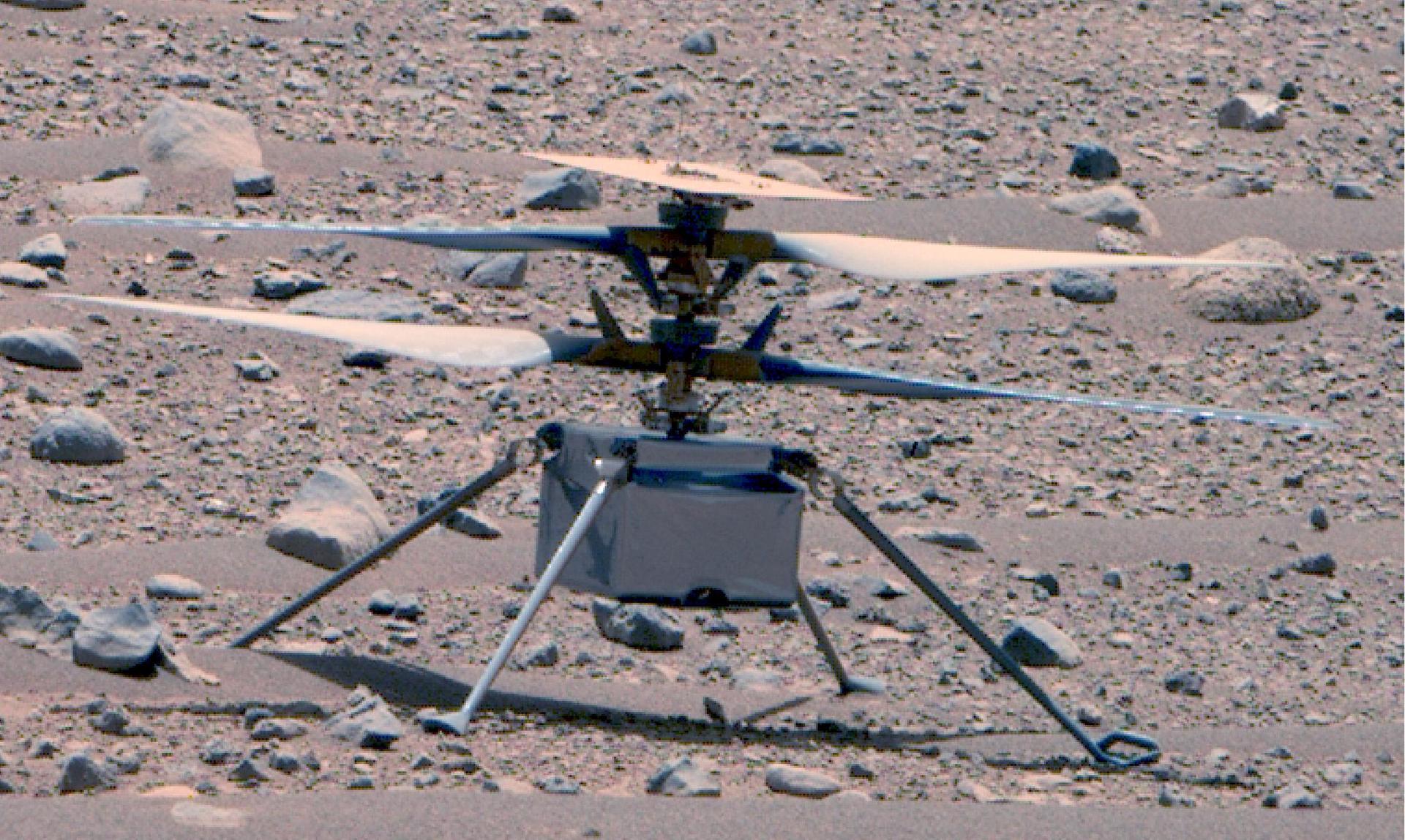
photo from INGENUITY showing the shadow of the broken rotor blade
It could have flown for even longer too, but it recently damaged its rotor upon landing from its 72nd and now final flight.
Unfortunately, there are no mechanics on the Red Planet… yet! Ingenuity is, however, still able to communicate with Earth and is standing upright.
Photo of ingenuity captured by nasa’s rover “PERSEVERANCE”
“That remarkable helicopter flew higher and farther than we ever imagined and helped NASA do what we do best – make the impossible, possible,” said NASA Administrator Bill Nelson.
“Through missions like Ingenuity, NASA is paving the way for future flight in our solar system and smarter, safer human exploration to Mars and beyond.”
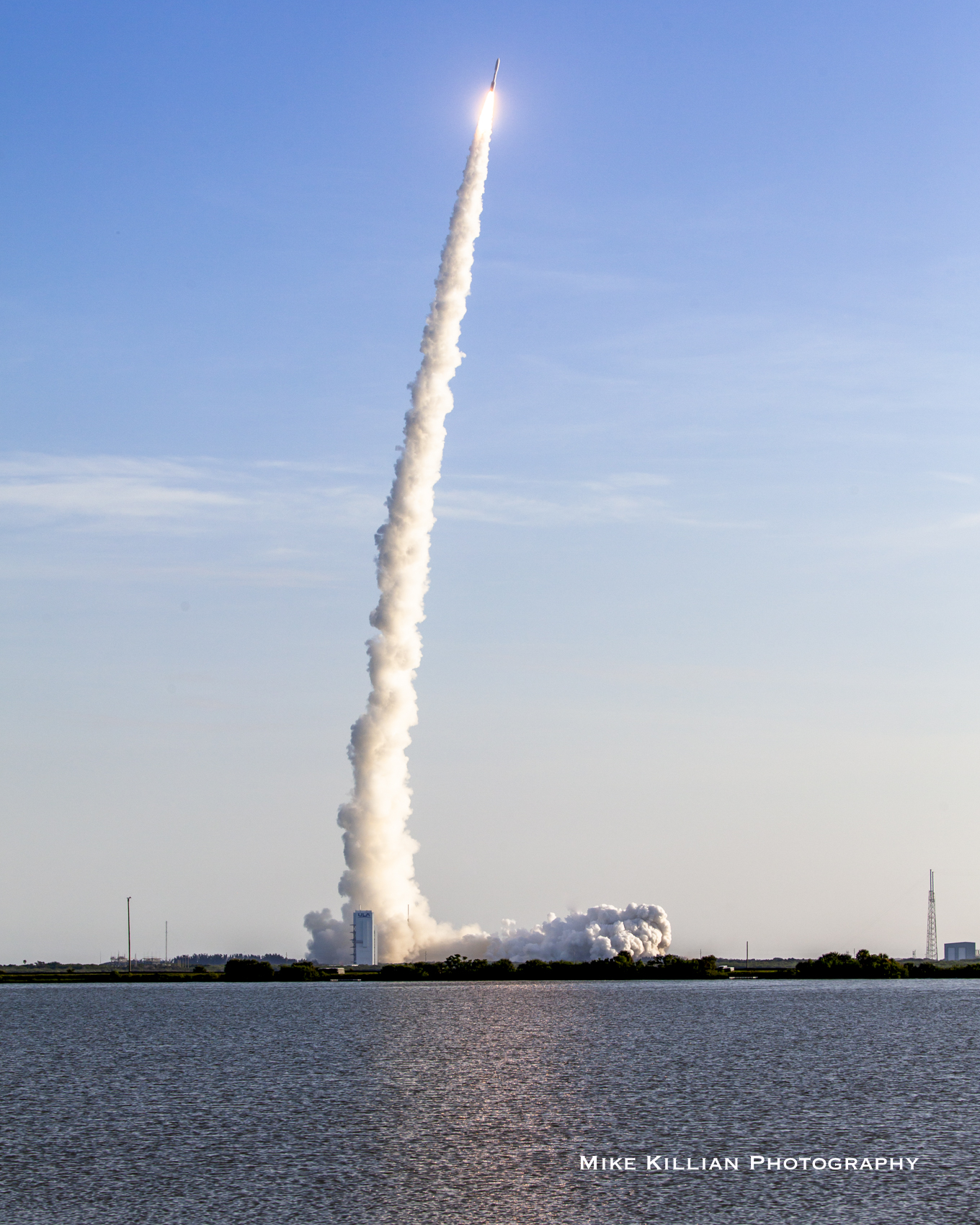
The 4-pound chopper was launched with NASA’s Perseverance rover on July 20, 2020 from Cape Canaveral. They landed on the floor of Mars’ Jezero Crater the following February.
On its last sortie, Ingenuity lost communication with Perseverance as it was landing. When communication was re-established, Ingenuity was on the ground, but damaged. NASA is trying to understand why the communication blacked out.
Ingenuity and perseverance
Ingenuity accomplished far more than NASA expected
The little helicopter was a technology demonstrator. Its original mission called for 5 experimental test flights over 30 days. NASA, however, is known for over-engineering spacecraft to operate for as long as possible, years beyond their design.
The little helicopter not only flew 72 flights, but it flew more than 14 times farther than planned. In total it flew about 11 miles, and logged more than 2 hours of total flight time.
According to NASA, Ingenuity was able to autonomously choose landing sites in treacherous terrain, deal with dead sensors, and clean itself after dust storms. It operated from 48 different airfields too, and conducted 3 emergency landings.
Aircraft on other worlds will be a normal occurrence in the future
Either way, the chopper far exceeded what was expected of it. NASA is already working on the next aircraft too, and such vehicles will no doubt become a part of future mission to not only Mars, but potentially other missions planned within the solar system.
Ingenuity on mars (nasa)
Other worlds present new flight challenges. Each world has different weather, air density, solar intensity, and many other variables and unknowns. Flying in the vacuum of space is one thing, but doing so in different atmospheres is another, demanding new technology and engineering.
Whatever the future holds for flight on other worlds, Ingenuity was the foundation to pave the way, just like the Wright Flyer did for Earth.
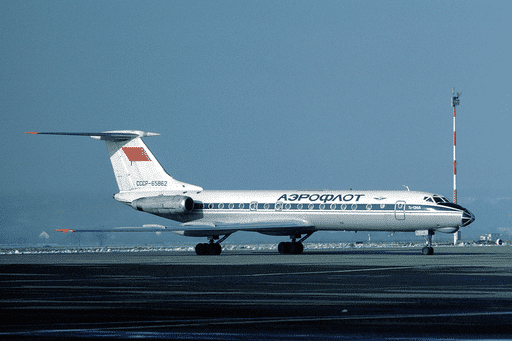
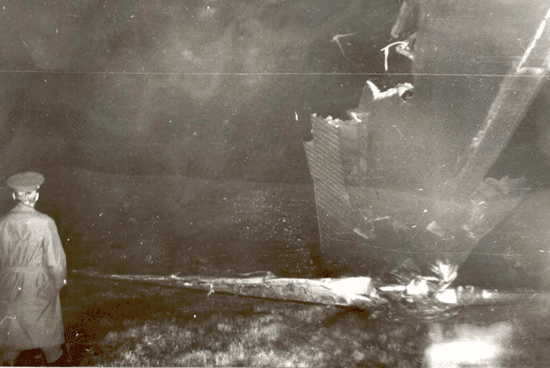
There are a few cases in which pilot error is the sole reason for a fatal plane crash. One such example is Russian carrier Aeroflot Flight 6502, which ended in a fiery crash landing, killing 70 people in Soviet Russia. At the time, the KGB strictly controlled media images and photos of the crash were withheld from public view.
Fire Department Chief Colonel AK Karpov met with KGB officers who arrived on the scene within minutes of the crash. Karpov then smuggled these photos out of the area, and the pictures resurfaced in the public realm many years later.
The crash of Aeroflot Flight 6502Rescue efforts after the crash of Aeroflot Flight 6502
On 20 October 1986, 87 passengers and seven crew members took off from Yekaterinburg headed to Grozny via Samara (which was called Kuybyshev at the time). When coming in for a landing, Captain Alexander Kliuyev made a deadly bet with the First Officer, insisting that he planned to land the Tu-134-A aircraft with no visual contact with the ground. Two minutes before landing at 1548 local time at an altitude of 1,300 feet, Kliuyev ordered the flight engineer to pull the curtains over the cockpit windscreen, boasting that he would have no problem landing the plane using instruments only.
A dumb and deadly decision to continue the approach
Alarms were going off, but the pilot ignored them. The air traffic controller suggested he utilize an NDB approach, which is a non-precision approach that lacks vertical guidance. A proximity warning was issued at an altitude of around 200 feet, and ATC suggested that he go around. But Kliuyev disagreed and continued his fateful approach. The plane was grossly unstable and touched down way too fast. The aircraft flipped upside down after overrunning the runway and burst into flames.
Rescuers searching the wreckage of Aeroflot Flight 6502
Because of the captain’s overconfidence and petulant refusal to listen to others’ suggestions, 63 people died at the time of the accident, and seven more died in the hospital later. Kliuyev was sentenced to 15 years in prison but was released after only 6 years. Co-pilot Gennady Zhirnov did his best to save the passengers but wound up dying of a heart attack on the way to the hospital.
Soviet officials discovered at the trial that Klyuyev tried to make the blind landing to test his ability as a pilot and win a bet. He appeared cool and composed during the trial, even though the Soviet media blamed the tragic crash on his overblown sense of self-assurance. A report issued at the time found that Klyuyev broke every rule on his blind landing. The chain of events that led to the crash of Aeroflot Flight 6502 could have been broken, but no one spoke up, leading to the tragic deaths of so many innocent lives.
My Epic Two Year Journey To Fly On The Dying Breed of Airbus A340-600 Widebodies
October 2021 – Initial Plans:
In October of 2021, Covid seemed to be in its waning moments. Many countries had begun to re-open their borders, albeit many with strict mandatory testing requirements, but open, nonetheless. Being the travel loving, wanderlust filled person I am, I was itching to get back to international travel. So, after making sure I understood current Covid restrictions, I decided to book flights on Lufthansa, from New York’s John F. Kennedy International Airport to Frankfurt, Germany and back for February 2022.
Flying The Rare Lufthansa Airbus A340-600 14
The point of this trip was to fly on Lufthansa’s Airbus A340-600, as I’d long wanted to, but had never had things work out. And having seen what Covid had done to the aviation industry, I didn’t want to wait much longer as four engine aircraft like the A340 were the first on the chopping block when Covid caused travel to all but disappear.
Unfortunately, this was all done about two weeks before the Omicron variant was announced to the world, which once again, changed many things where travel was concerned. This new variant brought on a whole new host of travel restrictions and because demand once again plummeted, Lufthansa downgraded my planned flights to Airbus A330-300’s.
January 2022 – Plans Change:
After waiting awhile to see how things played out, in January of 2022, I decided to move my flights back to May of 2022, as the A340-600 was still scheduled to operate JFK-FRA at that point. Since the main point of this trip was to fly on The A340-600, I didn’t see much benefit to spending $1,100 for two A330-300 flights. Plus, while I was in Europe, I planned to take several other flights that were on my bucket list, including Air France’s A318-100, Swiss’s A220-300, and Helvetic’s E-190-E2. Plus, Europe was still a patchwork disaster of different travel restrictions and rules… It just didn’t make sense to go in February.
May 2022 – It Just Didn’t Work Out:
Flying The Rare Lufthansa Airbus A340-600 15
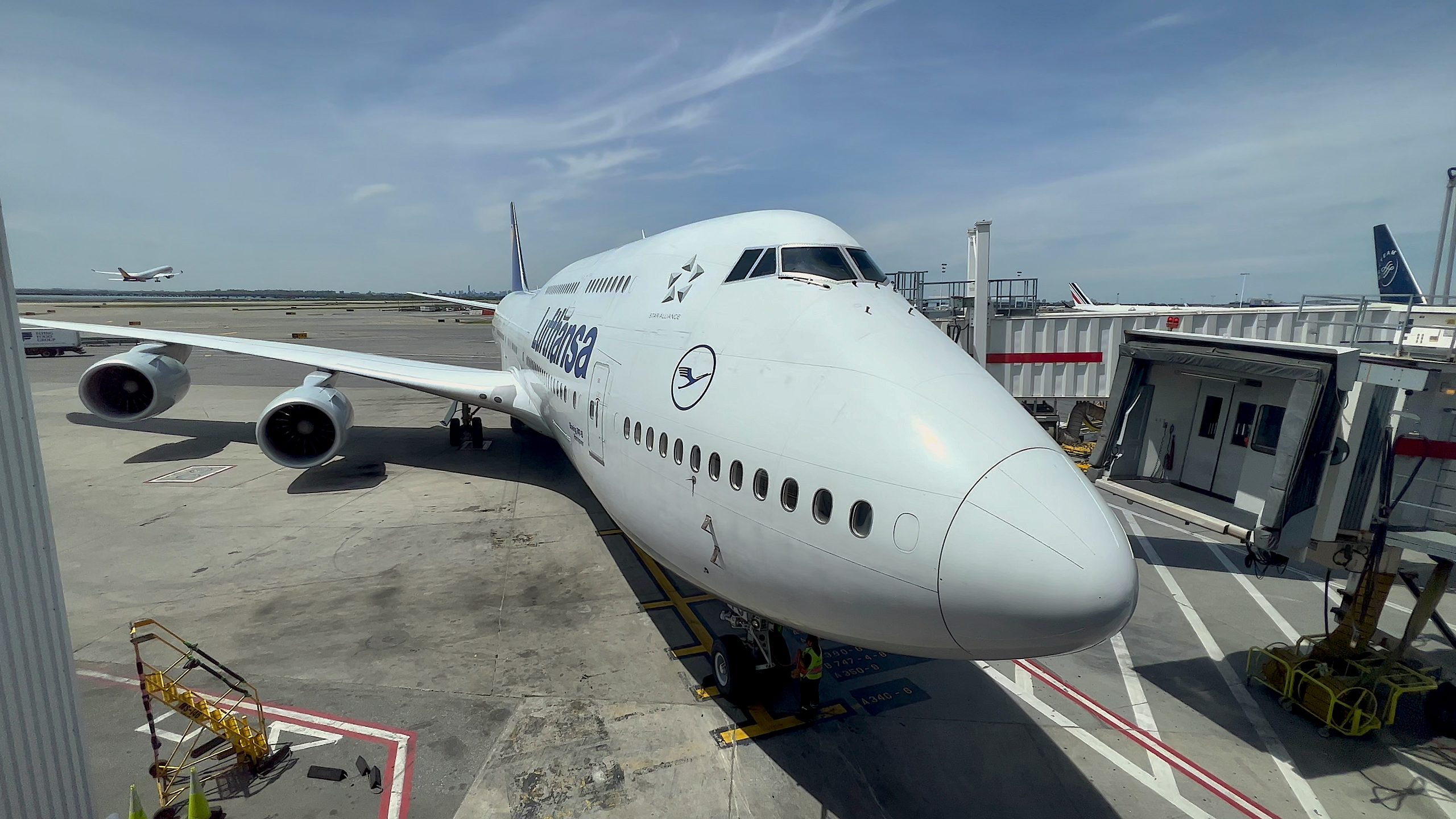
In the end, the Omicron wave was relatively short lived and by May travel demand has roared back. Unfortunately for me, this had the opposite effect as before. Lufthansa had now upgraded my flights to Boeing 747-8’s. By this time, there were also no longer any waivers or credits for Covid when changing flights. Had I changed my flights again, I would’ve had to pay a hefty fee.
So, although I was disappointed to miss the A340-600, I was excited to fly the 747-8 for the first time. I took the trip in May, marking off the 747-8 & A318-100 from my list. Equipment swaps on Swiss and Helvetic caused me to miss the others. In the end, it was a great trip, but the A340-600 remained at large!
Flying The Rare Lufthansa Airbus A340-600 16
July 2023 – Let’s Plan Again:
Over a year later, I was planning a large “around the world” trip for fall of 2023, and I was determined to fit the Lufthansa A340-600 into the trip. I was not letting it get away again! Lufthansa had now been utilizing their A340-600’s out of their Munich hub for quite some time, so I incorporated a flight from Munich to Newark as part of the 24,500-mile journey. And I’m happy to report that this time, there were no equipment changes!
October 2023 – Success!:
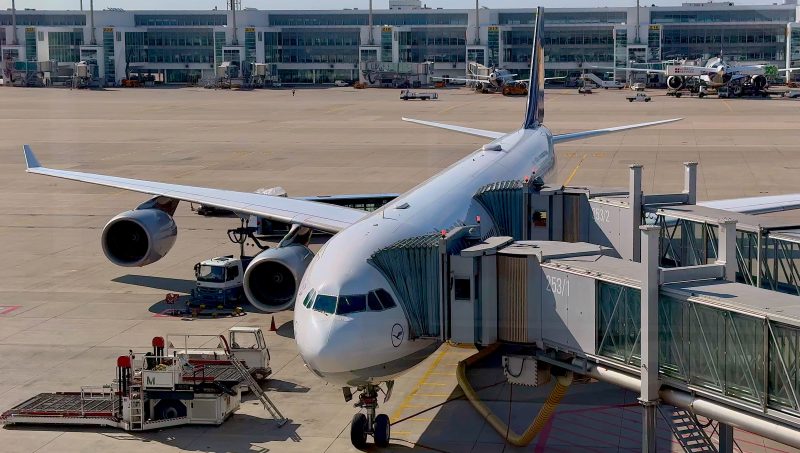
Almost exactly two years to the day from when I booked the first trip from New York to Frankfurt, I flew on Lufthansa flight 412. Airbus A340-600 service from Munich, Germany to Newark, New Jersey.
Flight Date – October 3, 2023
Aircraft Operator – Lufthansa
Flight Number – 412
City Pair – Munich, Germany (MUC) – Newark, New Jersey (EWR)
Seat – 36K
Seat Class – Economy
Flight Schedule – 3:45pm-6:45pm
Flight Block Time – 9 Hours 00 Minutes
Actual Flight Time – 8 Hours 23 Minutes
Equipment – Airbus A340-642
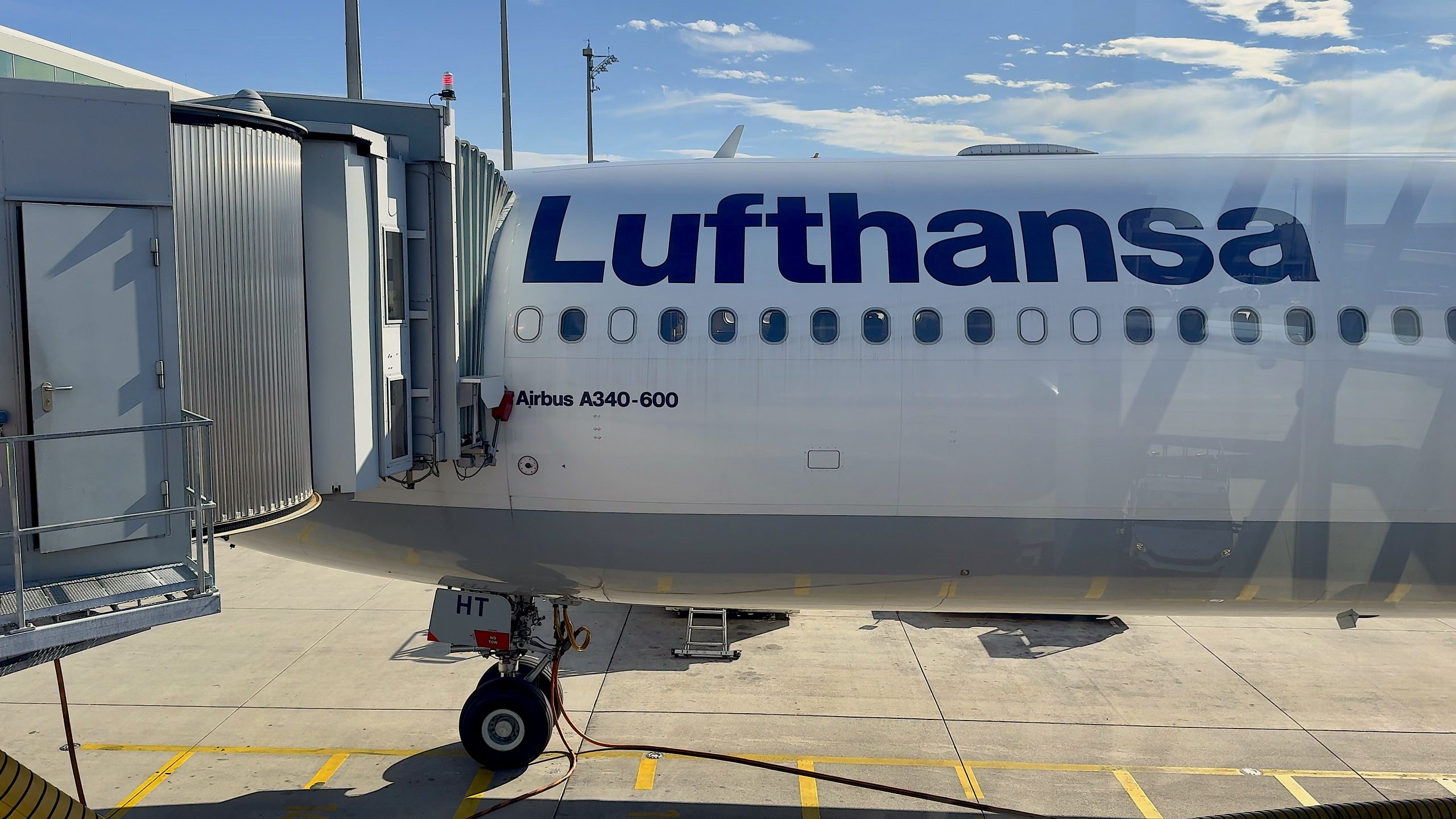
Tail Number – D-AIHT
Equipment Age – 15 Years 5 Months
Livery – Lufthansa (1990 Livery)
Flying Lufthansa’s Airbus A340-600 In 2023:
Once in Munich, I’ll admit that I stood at the window looking at the A340-600 parked at gate L23 for quite some time. Personally, I think the A340-600 is one of the best-looking aircraft ever built. That long skinny fuselage, with those four large engines. Plus, the realization of something I’d been attempting to do for two years, was finally happening. D-AIHT, a 15-year-old Airbus A340-642, still wearing Lufthansa’s old livery would be the aircraft taking me to Newark.
Flying The Rare Lufthansa Airbus A340-600 17
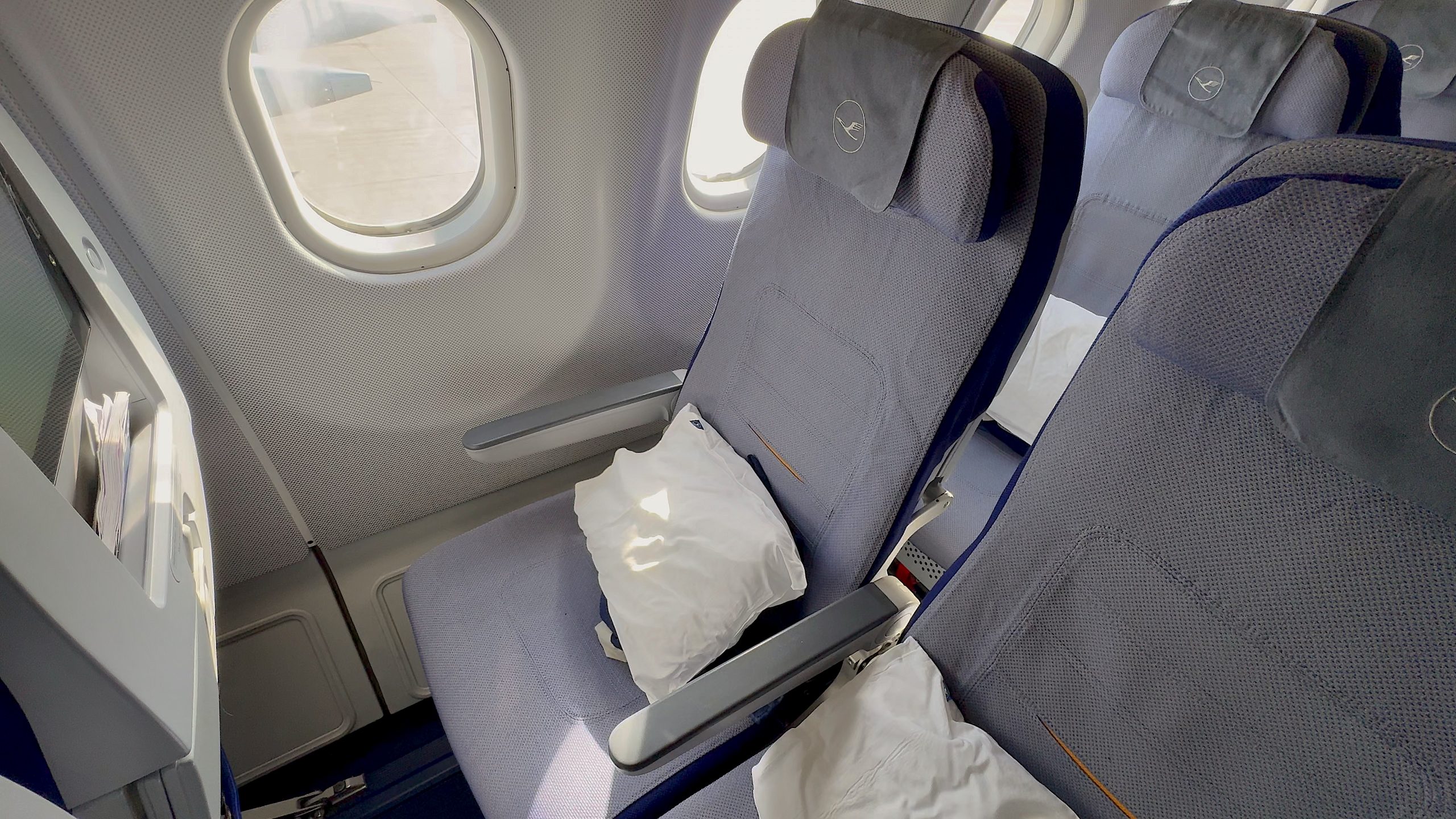
Boarding started late, and I found my seat in economy. I’d be taking the 9-hour flight in 36K, directly behind the wing. The dated looking seat was actually very comfortable, and the A340 features 2-4-2. Something I as a usually solo traveler, much prefer over 3-3-3 or 3-4-3 seating layouts. With 31 inches of pitch, it is standard for long-haul international economy. For reference, British Airways also offers 31 inches of pitch on their brand-new Airbus A350-1000 economy seats. Lufthansa also provided a pillow and blanket. Every seat also had a built-in inflight entertainment system that could be operated by touch. The seat also provided a USB charging port next to the IFE screen, as well as a conventional plug underneath the seat.
Flying The Rare Lufthansa Airbus A340-600 18
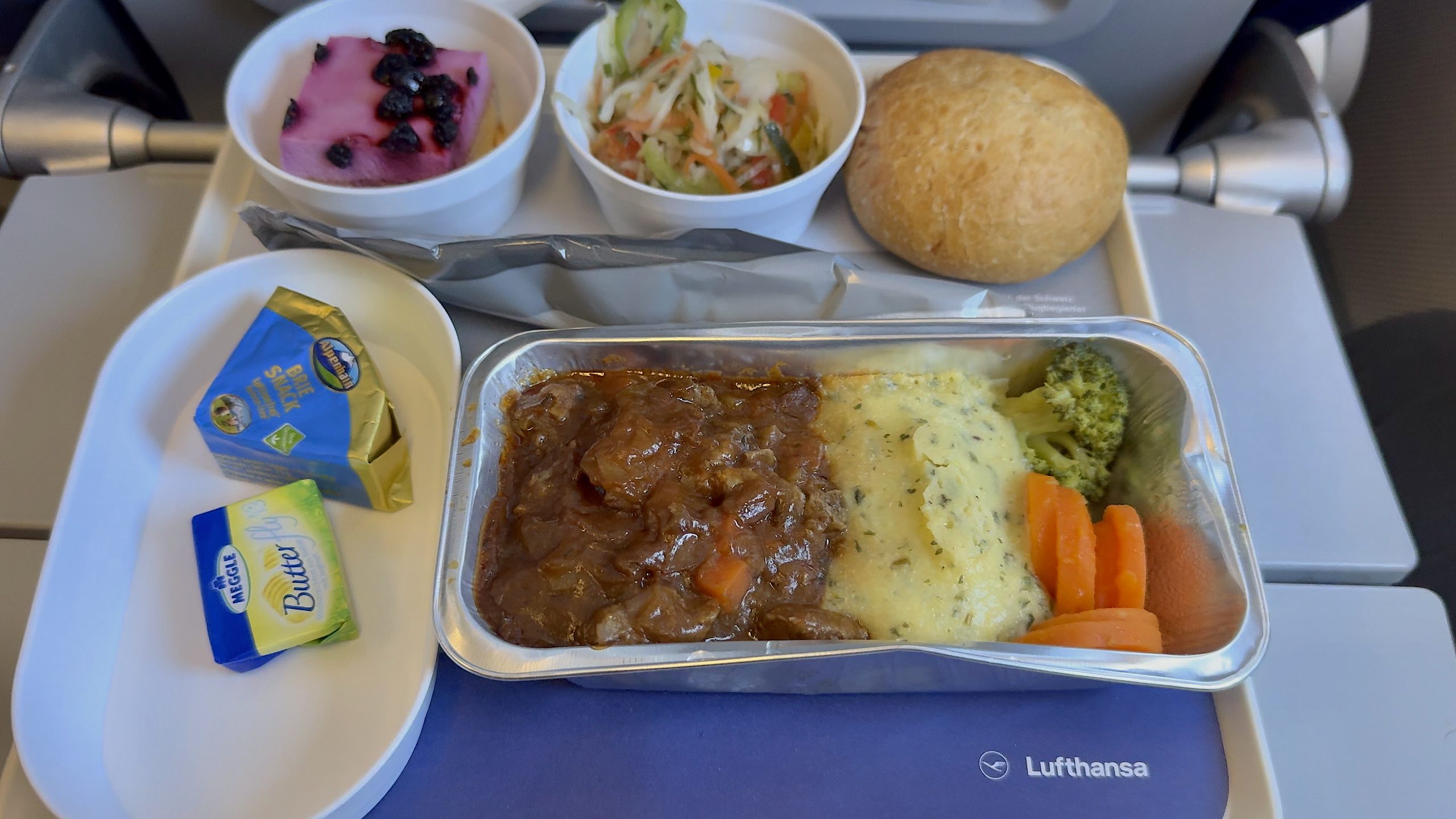
The flight departed about 45 minutes late, but the captain informed us that we should still arrive on time, as the headwinds were not bad over the Atlantic on this day. About an hour into the flight dinner was served. I chose the beef and potatoes option, and I have to say… It wasn’t one of the better airline meals I’ve had. It was bland and overall lackluster. The pasta & mushroom dish I had on my previous Lufthansa 747 flights was much better. That didn’t spoil my attitude though! The next 8.5-hours flew by, and this was truly one of those moments where I wasn’t ready for the flight to be over.
The Only Reliable Way To Fly the A340-600
In 2024, Lufthansa is really the only “reliable/easily bookable” A340-600 operator left, and even with travel booming, the old four engine gas guzzlers time is short. It likely won’t be long before they are gone from the skies forever. And although that will be good in terms of efficiency, it will be sad to see the beautiful aircraft fade into history. I’m glad I was finally able to mark it off my list, and the full flight from Munich to Newark will be posted in 4K 60fps to Skylite Productions on December 16, 2023, if you want to see the flight in video form.
The Story of One Pilot’s Incredible Mission During the Corsair II’s Last War.
Carrier aviation is rife with stories about perilously anomalous events. Cold cat shots. Cross deck pendants parting. Busted tailhooks. Sliding around on slick flight decks coming far too close to the edge (or other aircraft) for comfort. You’ve probably heard a few. Many start with, “Back when I was on Ranger with the Freelancers during that ’79 WestPac” or “Remember that A-6 crew that punched out down toward the water as the jet stalled and rolled past 90 degrees?” Well here’s a story that begins with one of those perilously anomalous events. It also ends with one.
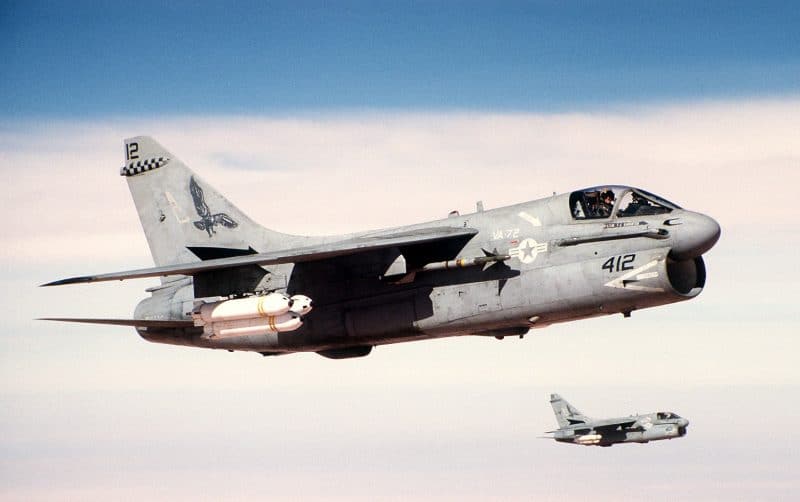
VA-72 A-7Es (image via US Navy)
The SLUF at War. Again. For the Last Time.
In January 1991, aboard the carrier USS John F. Kennedy (CVA-67), two attack squadrons assigned to Carrier Air Wing THREE (CVW-3) flew the last combat missions for the Ling-Temco-Vought (LTV) A-7E Corsair II.
Their SLUFs were long in the tooth, but getting the job done and done well. Attack Squadron FOUR SIX (VA-46) Clansmen and VA-72 Blue Hawks had been operating A-7s since 1968 and 1970, respectively. But they were absolutely crushing it during Operation Desert Storm. In fact, they would end up flying 725 sorties totaling more than 3,000 combat flight hours at a 99.7% mission completion rate.
Every Naval Aviator flying from carrier decks has at least one of those days they’ll never forget. One of the VA-72 SLUF drivers was Navy Lieutenant Thomas N. Dostie. One of those 725 sorties was going to be one of his very own those days.
A-7E hooking up (image via US Navy)
Steamer’s Tale
“Steamer” Dostie was scheduled to fly mission 12.41- a strike against a target in western Iraq flying VA-72 side number 403 (BuNo 158830) as Decoy 403 on 24 January 1991. AC 403 wasn’t the high-time jet in the squadron but it had nearly 8,000 hours on the clock after serving with four squadrons since 1976.
Unlike you and me, one thing age doesn’t (usually) affect is a jet’s takeoff weight. Unfortunately for this go the takeoff weight for Steamer’s SLUF was somehow miscalculated. As a result, Cat 1 (starboard side bow catapult) was set for too weak a stroke for AC 403’s weight when Steamer’s cat shot commenced.
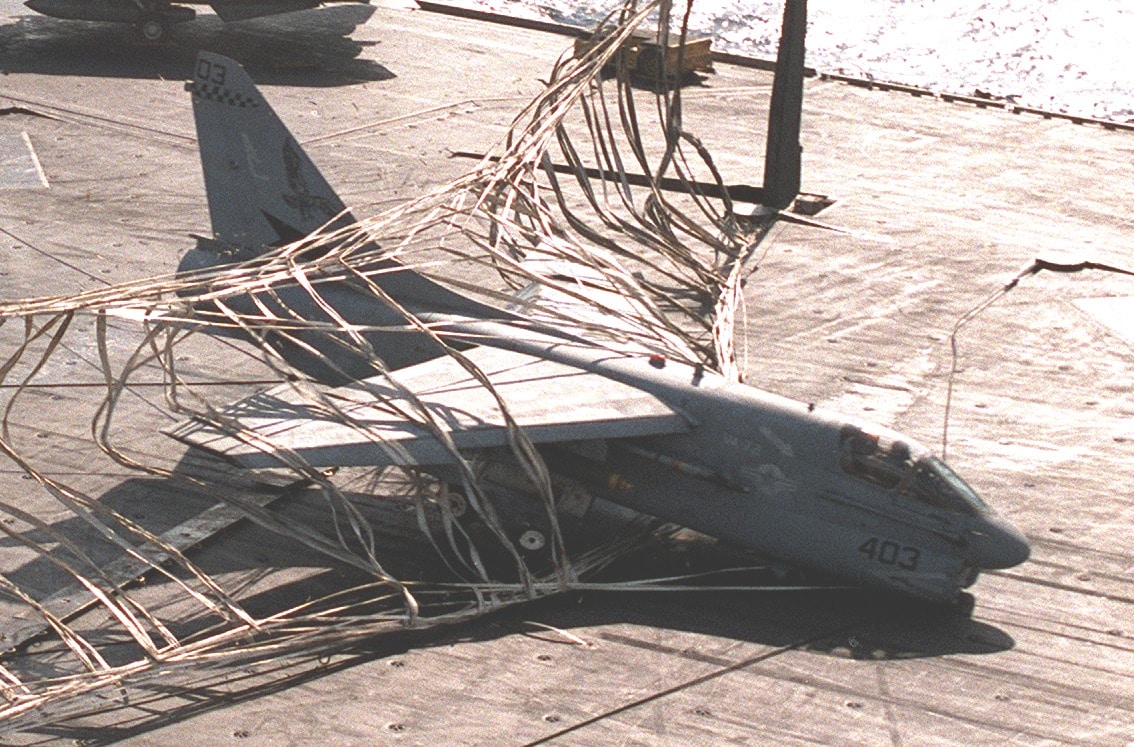
Instead of getting pulled all the way down the catapult, the jet received a shove and at first actually outran the shuttle. But when the shuttle caught up near the bow of the ship, it impacted AC 403’s nose gear and broke off the port nose wheel. Thankfully, the jet initially received enough assistance to get airborne instead of dribbling off the deck and into the water right in front of the 81,000-ton carrier.
Rigged Barricade (image via US Navy)
There I Was…
There Steamer was…flying but with damaged nose gear and very few options. The absence of the port nose wheel was confirmed as Dostie made several gear-down (of course he didn’t raise the gear) low-speed passes close aboard the boat. Having Decoy 403 divert to an airfield was discussed but rejected as an option.
While Steamer circled the boat it was decided to take him aboard using the barricade. The jet was still armed with a Mark 84 2,000-pound general purpose bomb on station 6 (starboard side closest to the fuselage) and an AIM-9M-4 Sidewinder heat seeker on station 5 (starboard side cheek rail). Not to mention the full load of 20 millimeter cannon rounds in the drum behind Steamer’s ejection seat. All that was left to do was take a deep breath and come aboard.
AC 403 in the barricade (image via US Navy)
Barricade Blues
Now when listing the bottom three things Naval Aviators like to do, an arrestment in the barricade has to be right down there near the bottom (with night approaches and rolling pitching decks- or worse both at the same time). In any case, Steamer was going to have to play the hand he’d been dealt. At least it was a day trap! His approach was a “rails pass” if ever there was one.
His touchdown was flawless.
He snagged the 1 wire and even managed to fight his instincts and NOT firewall the throttle when he contacted the deck, as he had been trained to do since Day One as a Naval Aviator. As he came to a stop in the safe embrace of the barricade the nose gear collapsed as the remaining nose wheel detached and rocketed forward down the angle and over the side.
Cropped/enhanced Image showing ordnance on AC 403 (image via US NAvy)
The End of an Era and a Fitting Tribute
Steamer was now back aboard. He was extricated from AC 403 and checked out fine but the jet was considerably worse for wear. The live ordnance was safed and carefully downloaded. But a quandary remained.
The venerable SLUF was on its final deployment- indeed, the last two squadrons flying them were VA-46 and VA-72. AC 403 sustained heavy damage, making it economically unsound to send her back to some NADEP somewhere Stateside for rework.
So VA-72 CO CDR John R. Sanders had the jet stripped of everything salvageable or usable (to the tune of more than $3 million worth of parts). It was decided that the jet would be buried at sea—with full military honors. By this time, 158830 was liberally covered with graffiti; Sanders had her repainted with special “End of an Era” squadron markings for the occasion.
AC 403 being secured on the deck of JFK (image via US Navy)
Click here to see how the SLUF’s burial at sea didn’t go as planned (video included).
As we strolled through Albuquerque International Sunport (KABQ) this week my copilot asked, “Have you ever attended the famous balloon festival in Albuquerque?”
I hadn’t, but I told her that I crewed for a champion balloonist in Houston back in the late 1970s. I was a teenager and member of the Aviation Explorer Post, a coed group, (now Adventure Scouting) with a mutual interest in aviation.
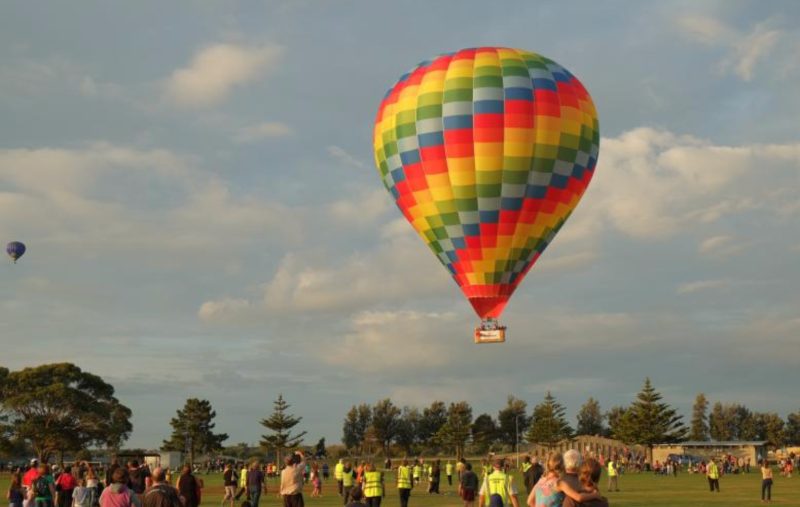
Early on Labor Day, September 2, 1979, we all gathered outside of Houston, near Katy, to help the master balloonists fill their balloons for a race that day. My group just happened to be paired with a national champion balloonist, Mr. Barnes. In the early dawn hours, the dew coating the fields and soaking our tennis shoes, we spread out his balloon.
Up, Up, And Away
Pilots then loudly fired their propane burners to fill the envelopes with hot air, raising them vertically. Beneath each towering multicolor balloon was a heavy wicker basket, serving as the gondola for the balloonist. Several of us held down the gondola as this master balloonist checked over his equipment. Barnes was not much of a people-person, and looking directly at me, his only invitation was a question, “Well, are you getting in or not?”
That was my clue to scramble over the side and into his thick wicker “cockpit” before he lifted off. On his command, everyone anchoring us to Mother Earth let go of the basket, and his 1977 Balloon Works Firefly (N2027H) rose into the air on that very still, moist September morning.
The competition for the day was a Fox and Hounds race. A leader had departed earlier, flying out to the west side of Houston, using the wind currents at various altitudes to change direction. When he got to the field of his choice, he released a red plastic streamer that floated to the ground and marked the target for others to aim for.
First Sound of Silence On a Flight
"Are You Getting In Or Not?" 26
The Champion Balloonist and I rose over the quiet countryside of what is certainly now crowded rooftop to rooftop suburbs. We heard dogs barking and cows mooing as we glided over the silent countryside. The only sound was the burners igniting from surrounding competitors, similar to the sound of Darth Vader breathing.
Read More From David Dale:
I was struck by how well the sound traveled vertically on that quiet morning as the sun rose. I remember seeing a Houstonian step out on his front sidewalk, retrieving the morning paper. We yelled a “Good Morning!” as he looked up and waved in surprise. Finally, we spied the red streamer lying in a field and Barnes did his best to position his gondola near the target. At the correct time, like a WWI pilot hand-delivering a bomb, he dropped a bag of flour that landed very close to the red streamer. Mission accomplished!
Prepare For Landing
Now it was time to find a place to land. As the Balloonist picked his field, we slid through the tops of large oak tree, the gondola scraping the high branches and we swayed violently back-and-forth. I held on tightly to the sides of our protective wicker basket. If you have ever wondered about the landing of a hot air balloon, let me just say there are no soft landings and it is indeed a controlled crash.
A vent at the top of the envelope was opened by Barnes pulling a rope dangling in the gondola, allowing the hot air to escape from the balloon. My pilot ignited his burner to slow our decent rate, but eventually there is no stopping the crash landing as the gondola made contact with Terra Firma. We held on tightly and struck the Earth at rate of around 500 foot per minute. The gondola dragged across the farmer’s field, finally slowing to a stop as the balloon collapsed.
The stillness of the morning, and the scraping and creaking of the wicker contacting the Earth are the sensations I remember most about that quiet dewy morning outside of Houston. Mr. Barnes added an entry to my fledgling pilot logbook: Orientation to balloons and racing techniques. 1 Landing and 0.5 Total time.
We’ve heard of touch-and-goes, but touch-and-roll? Really? This is impressive!
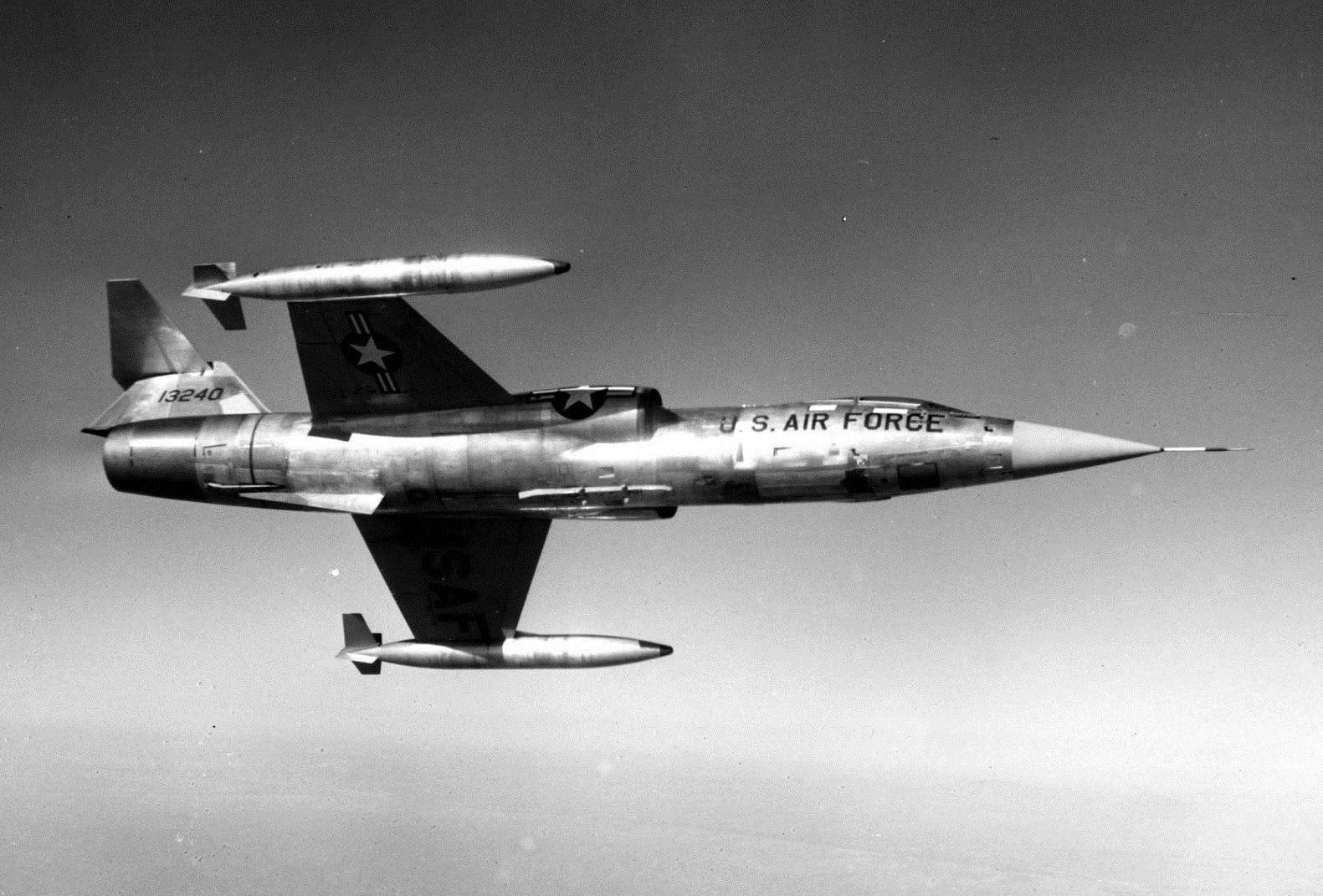
The F-104 Starfighter was a century jet with a big engine and a very thin, stubby wing. The jet sacrificed maneuverability for speed and power. Built by Lockheed, the aircraft was originally built to battle the MiG-15, but its thin wing was notoriously finicky at low speeds, unforgiving at higher speeds, and featured high takeoff and landing speeds of 170+kts.
Flying a touch-and-roll in any plane is a very difficult and dangerous stunt. It requires a pilot to perform a role very close to the ground, with landing gear extended, all while remaining at a low enough speed to descend and enter a landing flare just seconds later.
Belgian fighter pilot Bill Ongena performed a touch-and-roll maneuver in the F-104 Starfighter. The maneuver highlighted in this video was made even more impressive by the fact that it was considered so dangerous that not even experienced Lockheed test pilots would attempt it.
F-104 Starfighter Evolved For a Lengthy Career
IMAGE: USAF
Although the F-104 had its shortcomings, Lockheed still enjoyed a successful run of Starfighter production. The F-104 was built by Lockheed and its licensed partners for over 30 years. The key to the model’s longevity was its incremental approach to improvement and its success in export to Western Allied air forces. The F-104 started out as a very limited daytime supersonic fighter that evolved over time through upgrades to engines, radar, armament, and techniques.
While the first F-104 was built in 1956, the last F-104 in the Italian Air Force was retired in 2004. Nearly fifty years of operational flight for a Century Series fighter jet is unmatched by any other model of the era. If you are interested in learning more about the F-104, check out this video that originally aired on the Discovery Channel, back when they actually featured aviation programming.
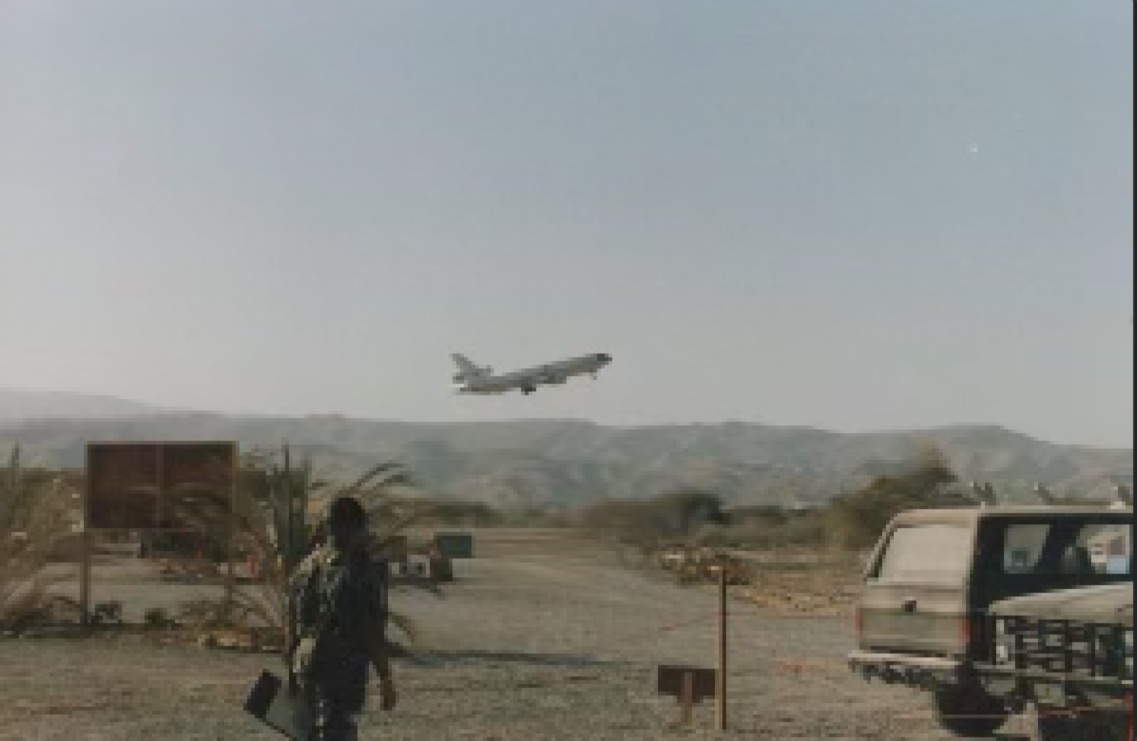
Our time in the desert took place before cell phones, the internet, or email. I wrote and received a lot of letters, most to and from friends and family in the States, but others were exchanged with kind-hearted Americans writing letters addressed “To Any Serviceman.” These were pen pal-type letters written by school kids, military veterans and even another David Dale that I wasn’t related to.
Time For One More Phone Call
Camp Nacirema had one telephone tent with phones placed in wooden cubicle-style booths. A camp member could sign up for a 10-minute time slot and call home collect. The trick to holding down the cost was to call my family, give them my international phone number in Oman and have them call me back quickly at the cheaper rate.
I spoke to my mom in Houston on January 15 and called my dad in Denver at 9:30 p.m. Oman time (10:30 a.m. Mountain Time) on January 16. I spoke briefly to him, relaying my number and hung up, then waited for the callback. I sat by the quiet phone for my allotted ten minutes but it never rang.
Once my time slot closed, I headed back to my cot and off to sleep. Meanwhile back in the U.S., my dad couldn’t get the call to go through, so he called Karin in Louisiana. What they discovered is that he was dialing 001 followed by the phone number, but 001 is for calls going to the States.
He needed to dial 011 followed by my number in Oman. This was all figured out once I was in bed. Two hours later the telephone tent was shut down for what would turn out to be two weeks.
My First Night Of Desert Storm 30
Sometime after midnight, Major Jan Swickard, our DO, stepped quietly into our tent of eight sleeping crewmembers and gently woke up Randy, Eric, Mike, and me. We were chosen to fly our camp’s first mission of Desert Storm. We slipped on our flightsuits, pulled on our boots, and I quickly wrote out what might have been a last letter home to my wife and stuck it in my deployment bag.
Last Letter Home: January 16, 1991 (fortunately, never mailed)
My Dearest Karin, This is it. Randy & I were just notified that we will be flying the first real mission in support of the offensive. Everyone has studied, and our crew is one of the best prepared here. Randy has read and asked a lot of questions about tactics.
Mike has been a real positive influence on the crew with his “let’s do it” attitude. Eric is a good boom operator who takes his job seriously in the air. Randy and I proofed the flight plans for the operations folks and pointed out pretty useful corrections.
Except for our wedding day and the birth of Daniel, this has been one of the most important times of my life. I’ve been able to make real contributions at a time when they really count. I’m so sorry we’re not together. I honestly have not had a single day in the last 49 days when I have not thought of you and our great son Daniel.
No matter how mad I’ve ever gotten at you in the last 6 years, you have always been one of the most beautiful women I’ve ever met. I thank you for the fantastic support you’ve given me, especially in the tough times. Our year at UPT seemed to be our best. I hope Daniel continues to grow big and strong. He is the pride of our lives. Tell him I LOVE HIM more than anything in the world. Take care always.
Love Forever, David PS: Mom, Dad, Lucy, Hannah, and Jack – I LOVE YOU ALL
Suited Up And Ready To Go
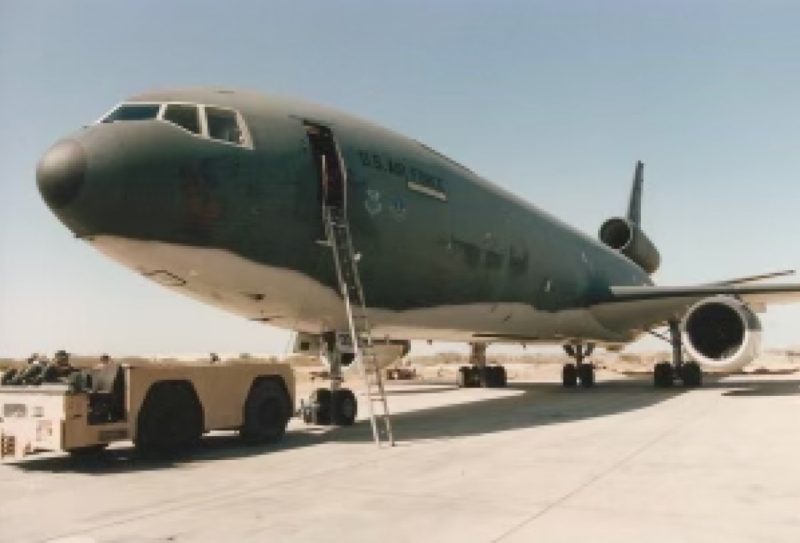
We gathered in the operations tent for the mission briefing and signed out the necessary communications gear, enabling our KC-10 radios to make and receive encrypted radio calls undetectable to the Iraqis.
We piled into the blue Air Force pick-up truck and drove out to our waiting KC-10 to begin the preflight. In our haste to get moving, we forgot our bag of protective chemical gear. We needed it if we returned to a base that had received a chemical attack while we were gone, which was a real possibility. The Supervisor of Flying, or SOF, quickly brought us the large green canvas bag of gasmasks, large black rubber gloves, and green rubber boots.
This story and more in David Dale’s Book on Amazon and Amazon Kindle
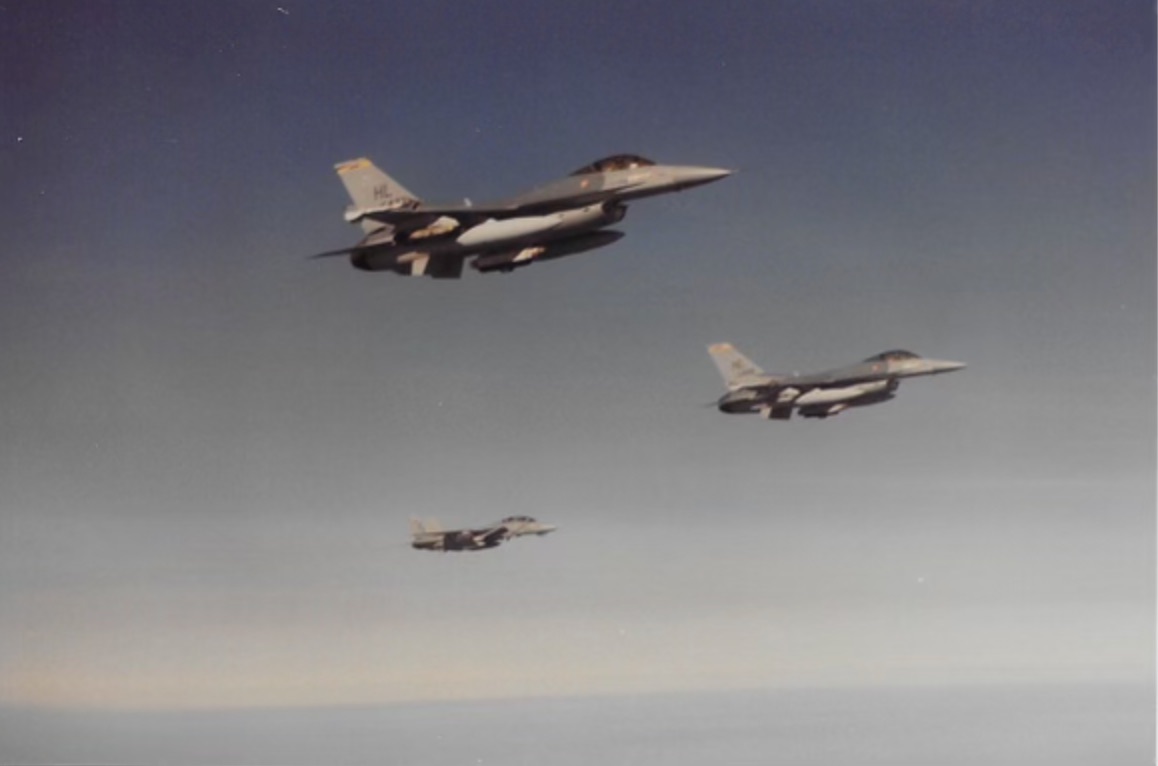
We took off in the dead of night and headed northwest to refuel F-15s from the 1st Fighter Wing, deployed from Langley AFB, Virginia. Our mission that night lasted seven and a half hours and was all accomplished in radio silence. Other than checking in with the E-3A AWACS providing air traffic control in the sky that night, it was pretty quiet on the radios.
The F-15s provided a Combat Air Patrol, or CAP — a protective air cover to the warfighters in the desert below. Like hummingbirds returning to a feeder, the four fighter jets came to us two at a time throughout our mission as we orbited in a left-hand 30-mile racetrack over northern Saudi Arabia.
My First Night Of Desert Storm 31
By the time we landed at sunrise in Oman, we weren’t really certain that the war had actually begun. We completed our mission debrief and turned in our classified communications gear, then headed to the TV Tent to watch the CNN coverage of the beginning of Operation Desert Storm.
Like everyone in the U.S., we watched the reports from Bernard Shaw and Wolf Blitzer showing the snaking green anti-aircraft tracers arcing over Baghdad, something we would eventually see ourselves. For now, it was time for breakfast and sleep.
Saba, a Dutch Caribbean island 28 miles southwest of Sint Maarten in the Lesser Antilles, has several claims to fame. Its towering volcanic peak, Mt. Scenery, which juts 2,910 feet out of the ocean, is the tallest point in the Kingdom of the Netherlands.
It offers some of the best diving anywhere in the world, and its silhouette was that of Skull Island in the original 1933 movie King Kong. It’s also home to a rather famous road. Called “The Road,” the 8-mile-long windy piece of pavement is the only road on the island.
It begins at the Saba airport, runs up and over the dormant volcano’s peak, and back down the other side of the island. But, back in 2019, I was not interested in visiting the tiny island for any of these reasons. Saba is also home to the shortest commercial airport runway in the world.
Juancho E. Yrausquin Airport – The World’s Shortest Commercial Runway
Fly To Saba Airport – Home Of The World’s Shortest Commercial Runway 39
At just 1,312 feet long, Juancho E. Yrausquin Airport holds the title for the shortest commercial runway in regular use anywhere in the world. For comparison, the runway at nearby Princess Juliana International Airport on Sint Maarten—famous in its own right for being short—measures 7,546 feet. Even the deck of the USS Enterprise, one of the largest aircraft carriers ever built, is only 1,101 feet long—making Saba’s runway just 189 feet longer than a floating airstrip.
Your Journey To Saba Airport Starts at Sint Maarten
Fly To Saba Airport – Home Of The World’s Shortest Commercial Runway 40
Anyone wanting to visit Saba Airport first needs to visit Sint Maarten. Shared by two nations, one-half of the Caribbean island is French (Saint Martin), while the other half is Dutch (Sint Maarten).
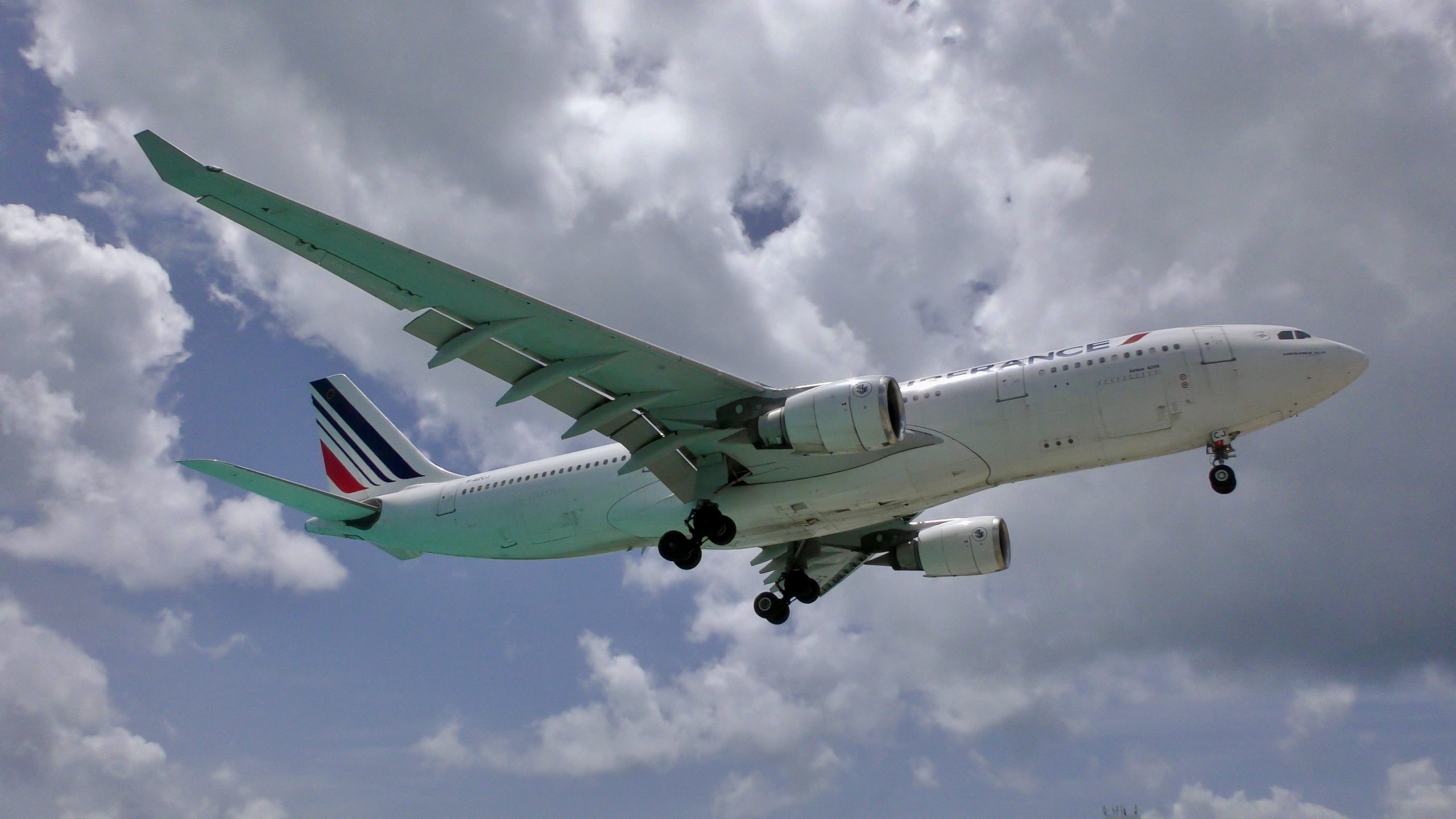
The island is well-known in the aviation community as the home of Princess Juliana International Airport (SXM), arguably the most famous planespotting location in the world. Just beyond the runway lies Maho Beach–better known as “airplane beach”– where aviation enthusiasts, spotters, and thrill seekers gather to watch jets land just overhead.
Even if you’ve never heard of Saba, chances are you’ve heard of Saint Martin/Sint Maarten. Thanks to its size and infrastructure, Sint Maarten and Princess Juliana International Airport serve as the primary hub for nearby islands. Every day, aircraft like Twin Otters, Grand Caravans, and Islanders take off from SXM, connecting smaller islands like Saba and Saint Barthélemy to the rest of the Caribbean.
Winair Is The Carrier To Get There
Fly To Saba Airport – Home Of The World’s Shortest Commercial Runway 41
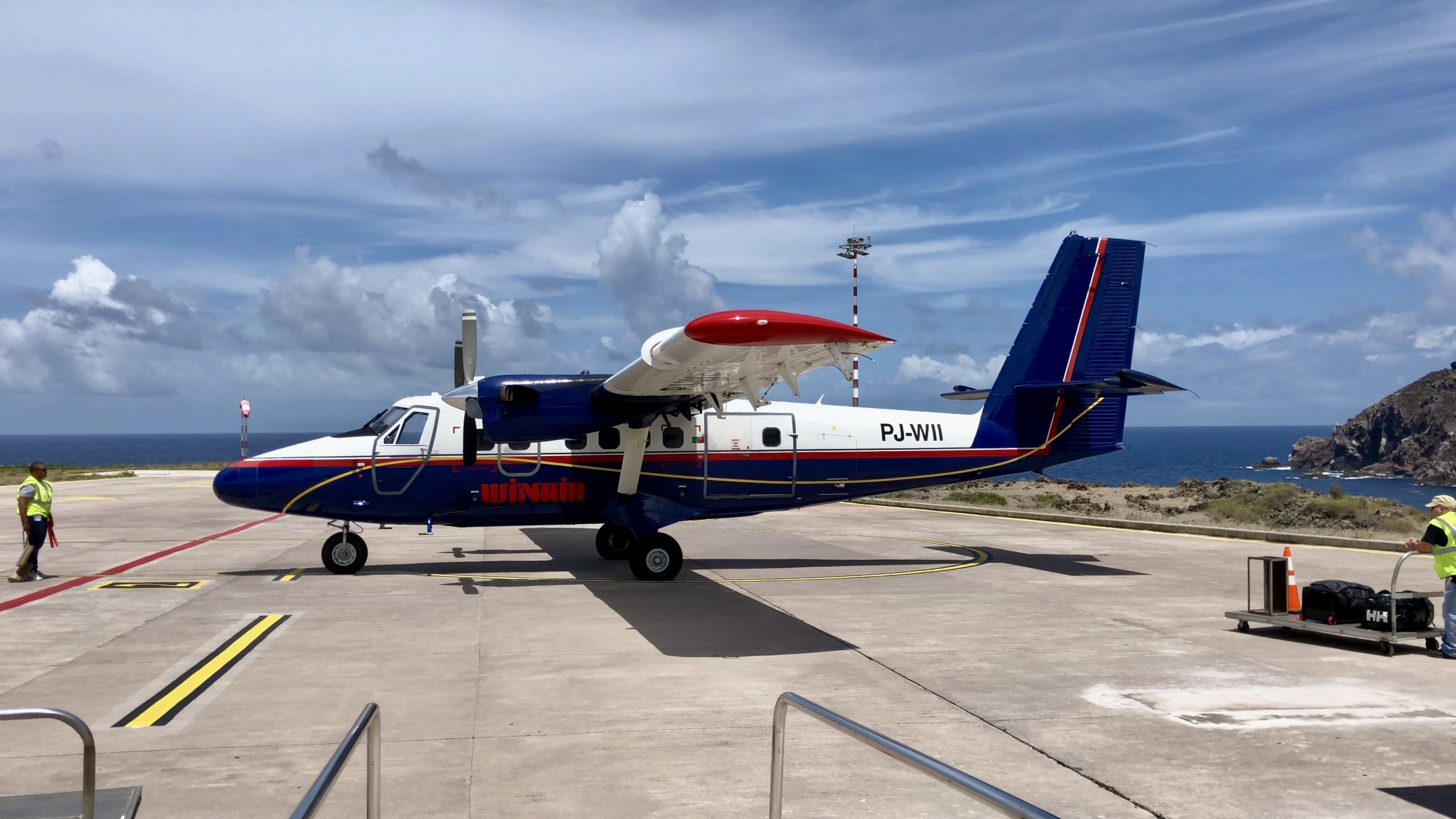
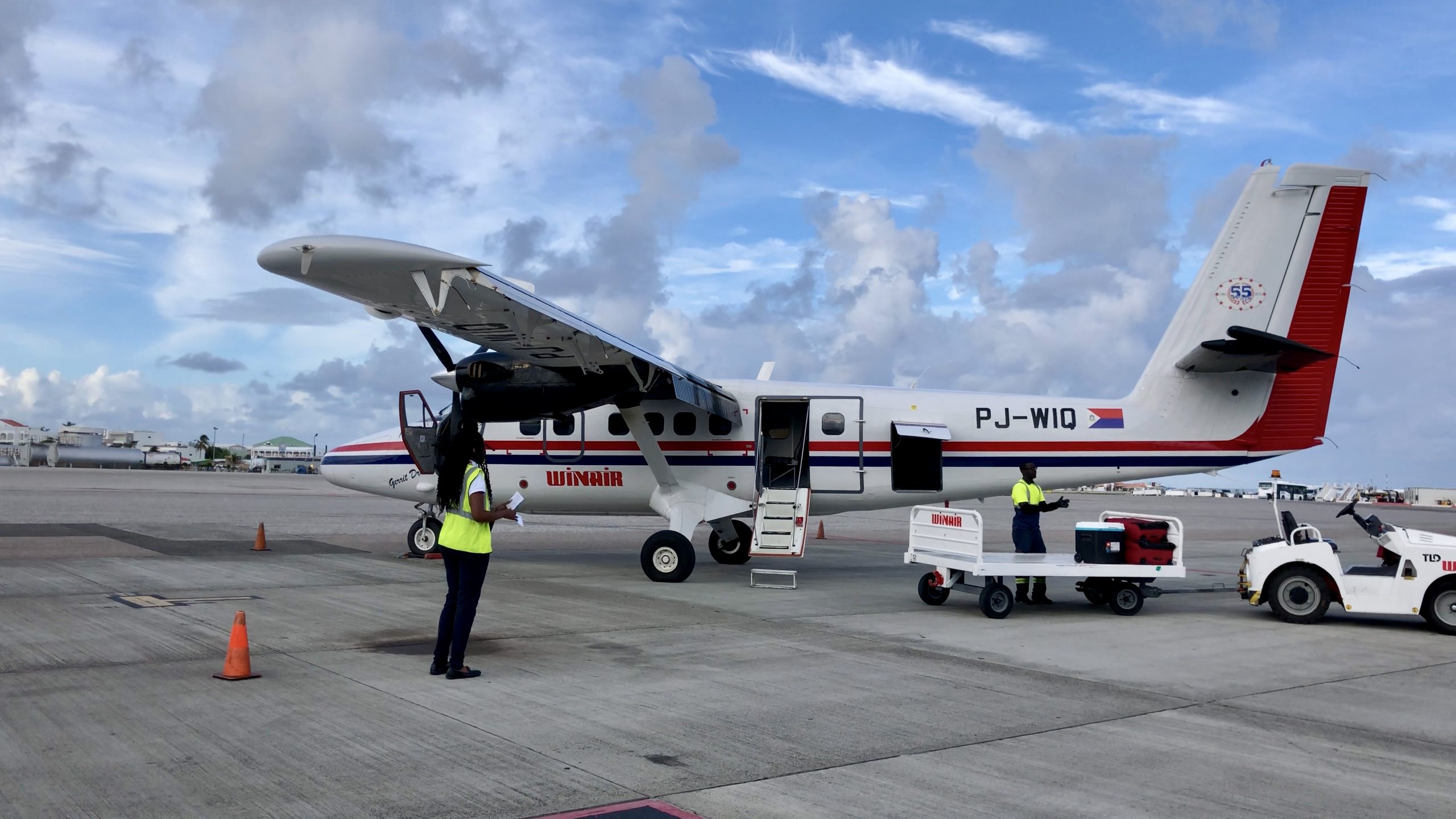
If you’re heading to Saba, you’re flying with Winair, short for Windward Islands Airways. This government-owned Dutch airline operates daily flights from Sint Maarten to Saba and other nearby islands, using a fleet of rugged De Havilland Canada DHC-6-300 Twin Otters.
These aircraft are perfect for this kind of flying. The Twin Otter is legendary for its STOL (short takeoff and landing) performance. It is one of the few planes capable of handling the challenging approach into Saba’s ultra-short runway.
I Traveled on PJ-WIQ
Fly To Saba Airport – Home Of The World’s Shortest Commercial Runway 42
I flew to Saba in 2019 aboard PJ-WIQ, one of Winair’s Twin Otters. At the time, the aircraft was already 43 years old—and more than five years later, it’s still in service (2025 update: the aircraft is still in service). Talk about a workhorse.
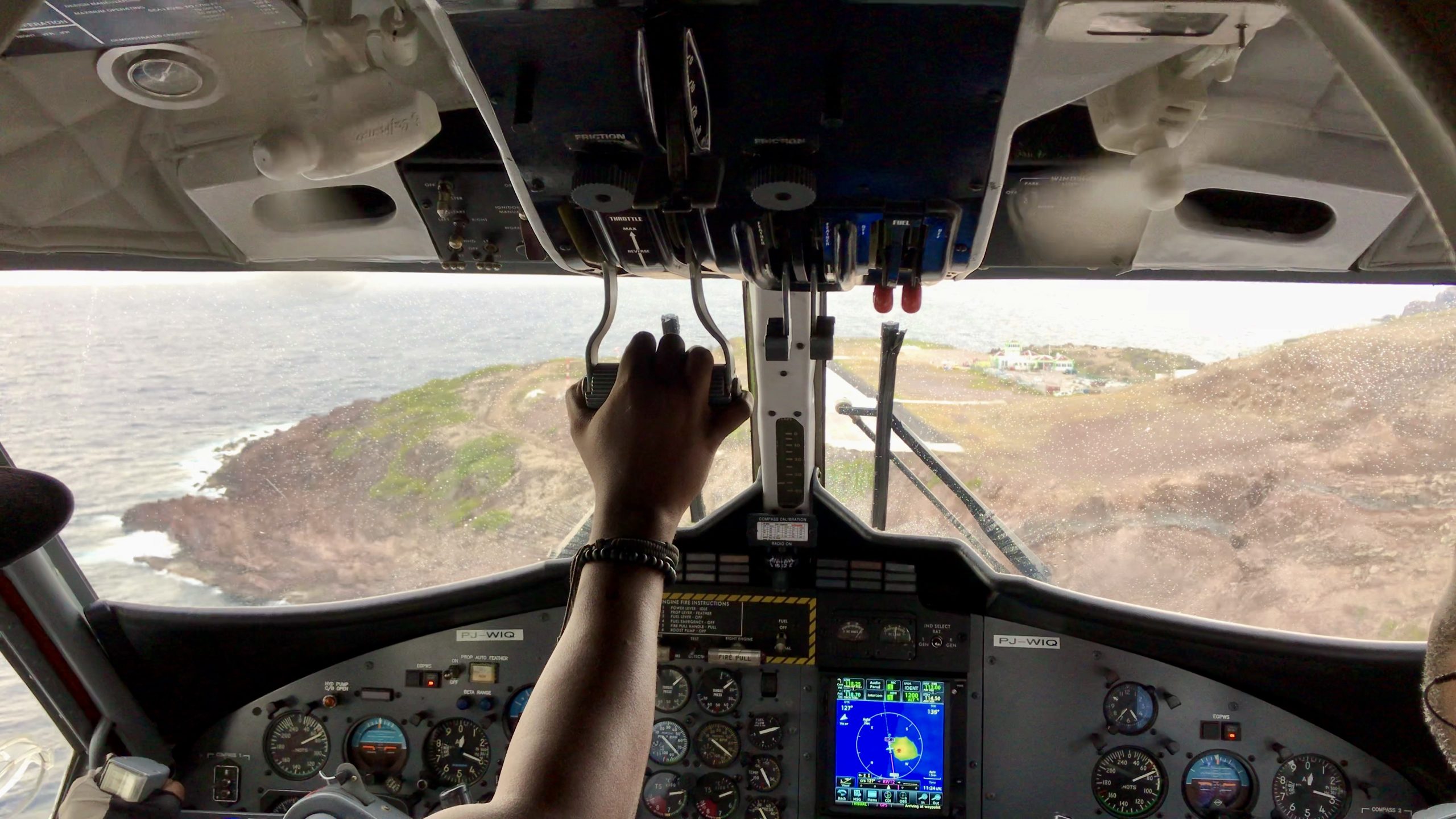
The seating on Winair’s Twin Otters is first come, first served, so if you find yourself taking this flight and you want the best seat in the house, just be sure to board first. Row 1 on the Twin Otter is only two feet behind the completely open cockpit, and sitting in row 1 gives you incredible views directly out of the cockpit windows.
Flying to Saba Airport
Fly To Saba Airport – Home Of The World’s Shortest Commercial Runway 43
The flight from Sint Maarten to Saba is very short, taking only 12 minutes from wheels up to wheels down. SXM’s 7,546-foot runway feels enormous compared to the 1,312 feet you’ll land on at Juancho E. Yrausquin Airport.
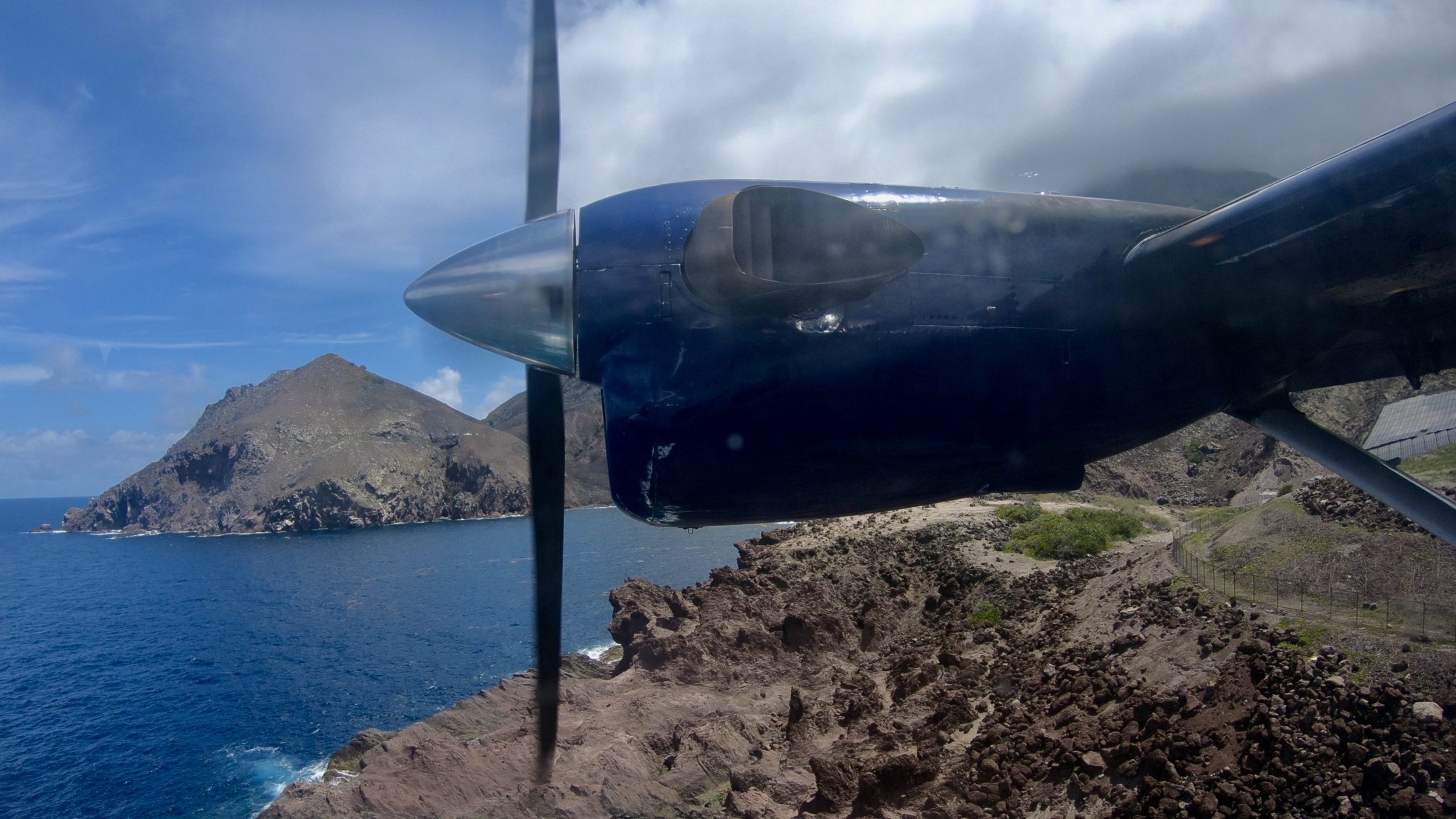
Saba Airport is located on the only flat surface the island offers. The runway is flanked by sheer drop-offs on each side, so there is no room for error when operating here. As such, Winair’s pilots are required to have a special endorsement on their license before they are allowed to operate flights in or out of the airport.
Once the island’s unmissable silhouette fills the cockpit windows, you turn east to line up with the runway, and the pilots carefully approach, touching down as close to the threshold as possible.
Reverse thrust is immediately applied to the Twin Otter’s powerful engines, and the pilots slam the brakes hard. It is truly amazing how little space the Twin Otter needs to slow down and stop. The crew then performs a 180 on the narrow runway and back taxis to the small terminal building, which has just enough room for two aircraft at a time.
Departing Saba Airport – An Epic Ride
Fly To Saba Airport – Home Of The World’s Shortest Commercial Runway 44
Departures are just as thrilling. The crew uses every inch of runway. As the plane turns to face the wind, you’ll see sheer drop-offs on both sides. Brakes on. Full power. Then, the release—and in less than 20 seconds, you’re airborne and watching the island disappear behind you.
There is very little time to abort the takeoff at Saba, as the end of the runway will be under the main gear in less than 20 seconds.
Take The Same Flight I did
There’s very little I can do to convey the thrill of flying in and out of Saba using words. So, I invite you to watch the 10-minute video I’ve put together, which is attached to this article. In the video, I show parts of Saba, but more importantly, I show the arrival and departure footage I captured in 2019. Both are shown from the cockpit view and the passenger cabin view.
Why You Should Visit Saba
Fly To Saba Airport – Home Of The World’s Shortest Commercial Runway 45
Visiting Saba ended up being one of the most memorable places I’ve ever visited—and not just because I’m an aviation enthusiast who wanted to fly to the world’s shortest commercial airport runway. I spent that whole day there, and it was truly a wonderful place.
The locals were incredibly friendly and welcoming and truly loved sharing information about their little island. Still to this day, it is one of my favorite places that I’ve ever visited.
If you ever have a chance to visit Sint Maarten, carve out at least a day to fly to Saba. Once you land, simply ask any of the taxi drivers to give you the grand tour, and they’ll happily show you every corner of their island.
The F-105 ‘Thud’ had quite an amazing career of dropping bombs and breaking cadet windows.
The best-laid military plans… often get changed!
Consider the B-52, built as a strategic nuclear weapons carrier, adapted to carpet bombing with conventional bombs. Similarly, the Air Force’s Republic F-105 Thunderchief was originally designed as a single-seat, supersonic fighter-bomber designed to deliver a single, internally mounted, nuclear weapon—a role, fortunately, for which it was never used.
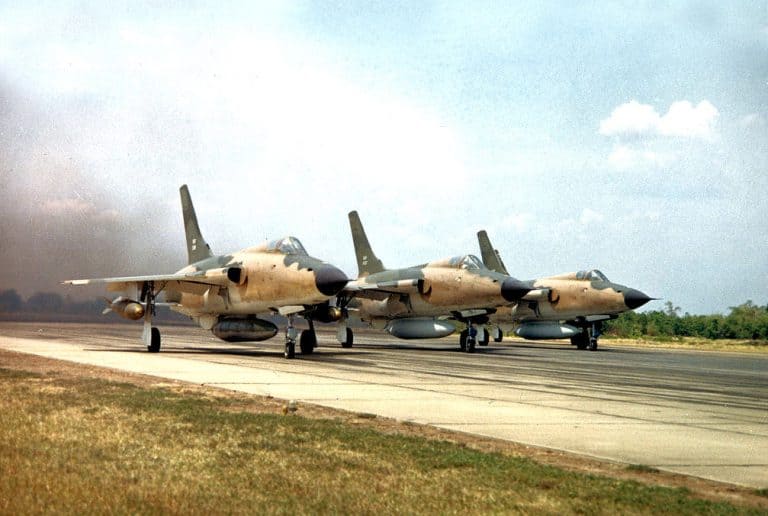
The F-105, also known as the “Thud,” was a fighter-bomber capable of speeds up to Mach 2. While it never served in its intended nuclear role, it carried out the majority of strike bombing missions during the early years of the war in Vietnam. The “Thud” could deliver a heavier bomb load than the World War II Boeing B-17 Flying Fortress. Like other early Century Series fighters, such as the F-100, it was also armed with missiles and a cannon.
A fully armed F-105 enroute to a target (USAF Photo)
More than 20,000 Thunderchief sorties were flown over Vietnam. It was also the only combat aircraft pulled from combat due to high losses. Some 382 aircraft out of 833 were produced. As a low-altitude attack aircraft, it was not intended to be a fighter, and, although less agile than smaller MiG fighters, USAF F-105s were credited with 27.5 kills. Of these, 24.5 were shot down with cannon fire (one victory was shared with an F-4), and three with AIM-9 Sidewinder missiles. One F-105F is unofficially credited with downing three MiGs—one by air-to-air missile, the second by cannon fire, and the third by jettisoning the centerline rack full of bombs directly into the path of a surprised MiG.
Air-to-Air refueling was just part of the routine in Southeast Asia (USAF Photo).
A typical mission involved refueling at least once before reaching the target area and possible another refueling to make it back to base.
The F-105D/F variants were the first aircraft to be converted to a two-seat Wild Weasel configuration. The Wild Weasel specialized in electronic suppression of enemy air defenses, flying with and protecting F-4 fighter-bombers on strike missions. F-105 Wild Weasels remained in service until 1984, when they were replaced by F-5G Wild Weasels.
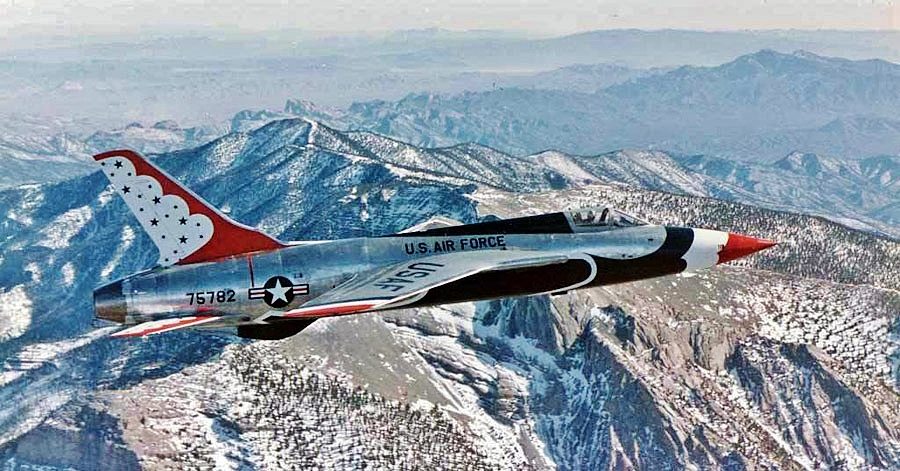
Note: The USAF used the F-105 for the Thunderbirds’ six airshows in 1964. After a structural failure of an F-105 during a practice session, the team switched back to the F-100.
The USAF briefly used the F-105 for the Thunderbirds (USAF Photo)
Every good airplane deserves a good story. On 31 May 1968, a dedication ceremony took place at the United States Air Force Academy to honor graduates who had served in Vietnam. The ceremony included the entire cadet wing, the superintendent and commandant of cadets of the USAFA, a representative of Republic Aircraft, members of the press, among others. To conclude the ceremony, a flight of four F-105s were to fly over in formation at 1,000 feet and then fly over singly at 250 feet.
The formation portion was flown as planned. But the flight leader, Lt Col James “Black Matt” Matthews, came back for the single-file pass and exceeded the speed of sound at less than 100 feet. The ensuing sonic boom broke hundreds of windows. (Herts, Ray (1 June 1968). “Sonic Boom in Fly-Over Damages Academy Buildings” (scan). Colorado Springs Gazette-Telegraph. pp. 1,16.)
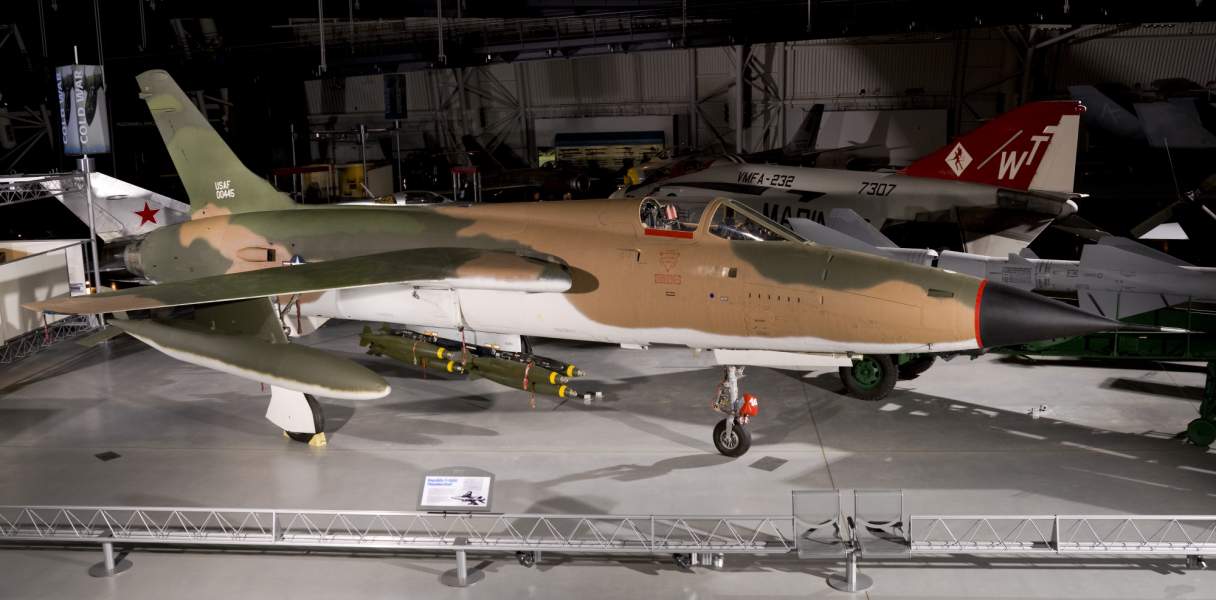
More than 100 F-105s are on display across the country in museums or parked or mounted on display. The National Museum of the United States Air Force at Wright-Patterson AFB has a beautiful example on display.
F-105 “Thud” at the Udvar Hazy Center of the National Air and Space Museum (Jeff Richmond)
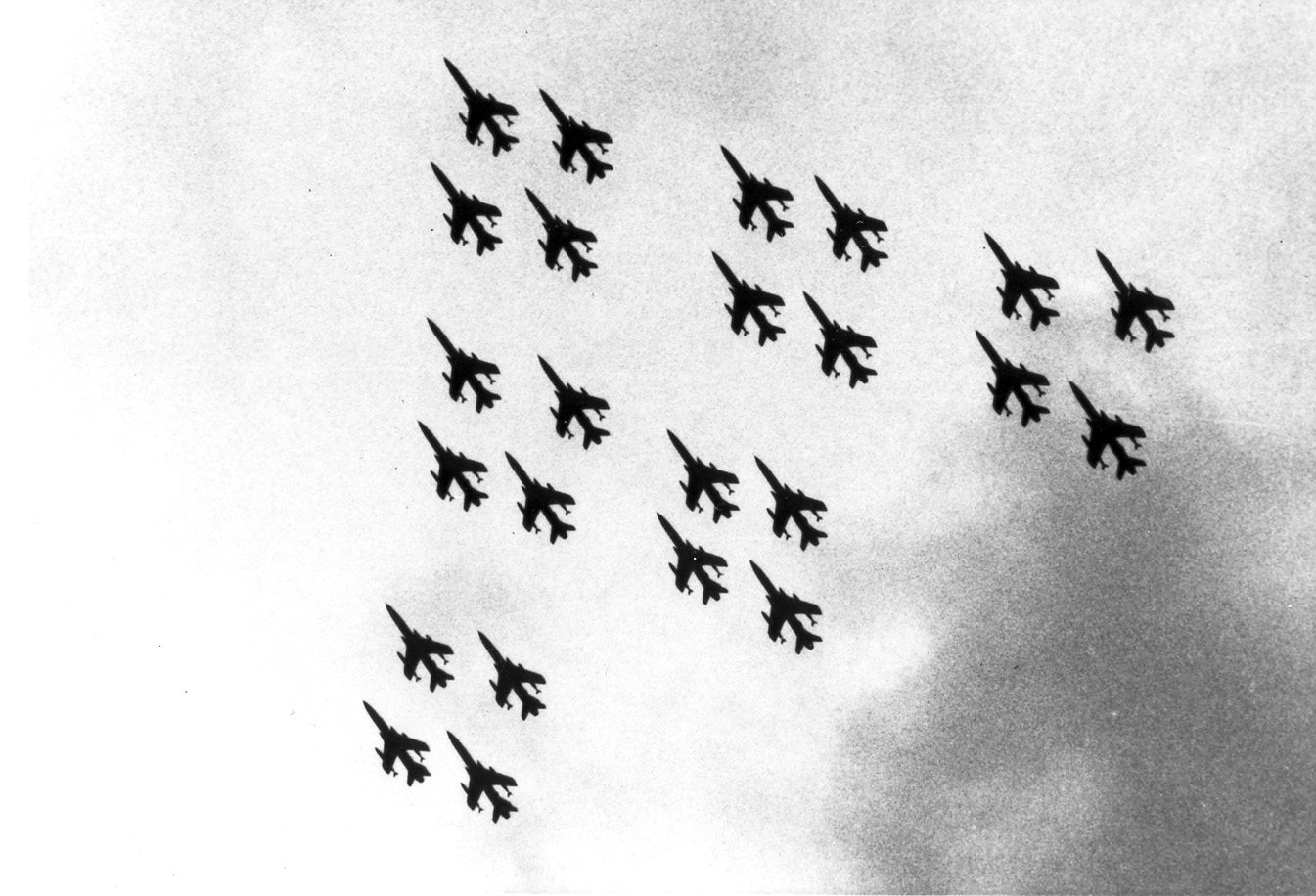
The F-105 was officially retired on 4 June 1983, accompanied by a flight of 24 aircraft flying over Hill AFB, Utah, in a Diamonds-on-Diamonds formation.
Flyover of F-105s during the aircraft’s retirement ceremony at Hill AFB, Utah.
Former Boeing Mgr Ed Pierson continues to call out Boeing leadership following a recent incident with an Alaska Airlines 737 Max 9 where a door-sized section of the plane came off in-flight.
He’s not backing down on his ongoing whistleblowing about problems with the 737 MAX, or systemic issues within Boeing’s leadership and aircraft manufacturing that he witnessed first-hand.
In the video above, Pierson discusses his views and experiences with Seattle’s KIRO 7 News Station. He also notes what he would do if he were in charge, to turn the company around and rebuild confidence within the public and aviation community.
Lots of unanswered questions
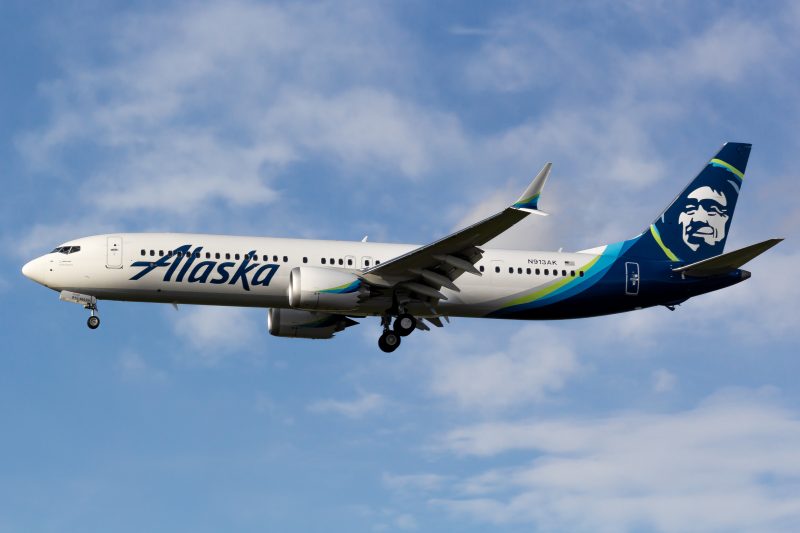
Alaska and United Airlines are the only two operators of Boeing’s 737 Max9s in the US. The FAA grounded all Max9s for inspections following the incident, where the door plug came off at around 16,000 feet, leaving a gaping hole in the jet, depressurizing the cabin and forcing an emergency return to Portland, Oregon. While there were some minor injuries, nobody was seriously hurt or killed, but it could have been much worse.
the door plug hole on an Alaska Airlines Boeing 737 MAX 9 (Courtesy Elizabeth Le via Instagram)
The blown-off door plug on Flight 1282 was found in a residents backyard, without any of its 4 bolts attached. Perhaps they are laying in a field somewhere. Or, perhaps, they were never installed in the first place.
Since then, Alaska says they found “loose hardware” while inspecting other Max9s in their fleet. United also found “installation issues” with door plugs on their own Max9s. United also said they found bolts that needed tightening.
Perhaps even more worrisome, Alaska knew that exact plane was having issues, but it’s unclear if it’s related to the incident on Flight 1282. Other crews had reported pressurization warning lights on 3 prior flights, according to the NTSB. The plane wasn’t allowed to make long-hauls over open water, for fear of not having a runway nearby in case of an emergency.
Credit ntsb
The FAA has given checklists to operators to follow in their inspections. Max9s across the nation are grounded until operators “complete enhanced inspections which include both left and right cabin door exit plugs, door components, and fasteners”. The FAA has not yet signed off on a return to service plan.
Passengers describe terrifying incident
In an exclusive interview with Seattle Times, a mother who was seated near the blow-out discussed the terrifying incident.
Her teenage son was sitting at the front of the blow-out, herself in the middle seat next to him. A stranger had the aisle seat. The decompression sucked his shirt off and turned his seat. She and the other passenger both held onto him literally for dear life.
Alaska has since issued full refunds to all the passengers, as well as $1,500.00. They are also offering to pay for any therapy needed for the traumatic experience.
Whether that is enough to avoid a class-action lawsuit? Only time will tell.
NASA has pushed their first crewed Artemis moon mission to late 2025. The space agency announced the decision this week, citing numerous internal and external issues that will delay both Artemis-II and the first lunar landing on Artemis-III to late 2026.
NASA’s ambitions are more ambitious but still tech and funding limited
It’s important to understand Artemis isn’t a Cold War-era, trillion-dollar Apollo flex to plant flags on the high ground. NASA wants a permanent human presence in lunar orbit and on the surface at the moon’s South Pole.
NASA can’t send humans to Mars or elsewhere, without knowing how to live and work on the moon first. In order to do that with the agency’s sadly small budget, they have partnered with private industry.
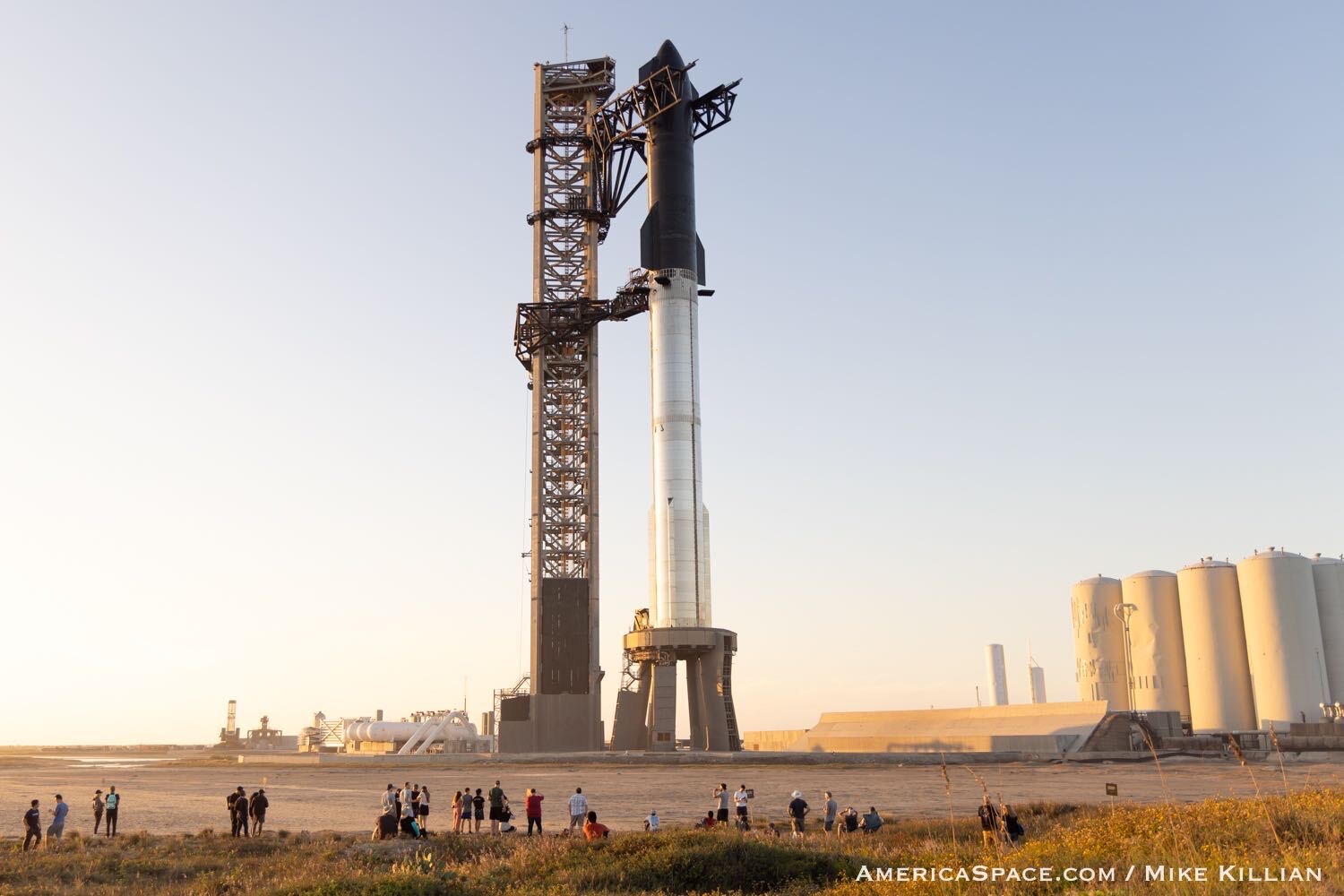
spacex starship test vehicle atop the company’s “super heavy” rocket, which itself is also still early in development. Photo: mike killian / americaspace.com and avgeekery.com
SpaceX’s Starship lander isn’t even close to ready for Artemis-III
One big driver for the new schedule is SpaceX. NASA awarded them a $4.2 billion contract to provide the lander for Artemis-III and IV. But they’ve only launched their Starship prototype twice, and it has yet to achieve orbit. As early flight tests, nobody expects a flawless success, it’s just how aerospace development goes. However, every setback will only delay the first Artemis landing further. The development of Starship is not far enough along to support an Artemis-III landing by 2025.
NASA however is not driven by schedule, it is driven by crew safety. Simply put, NASA will not launch Artemis crews to the moon, until they are absolutely confident that everything has been tested to their satisfaction, proven repeatedly in-flight, and ready to carry astronauts.
In-Orbit Ballet or Logistical Nightmare?
ABOVE: Watch Elon discuss Starship as a fundamental part of Artemis
BELOW: Elon’s full update this week on SpaceX, including Starship development & next flight tests
Elon’s vision for Starship support of Artemis is complex. In addition to launching the largest crewed vehicles ever, it will also require a logistical ballet in space. The current plan includes on-orbit refueling for Starship to both land on the moon and launch back off it.
A “tanker” Starship would launch to low-Earth orbit (LEO) first. There it would park while waiting for the lander vehicle to launch on a separate launch.
Illustration of starship orbital refueling (spacex)
Once the lander launches, it would then dock with the orbiting tanker to refuel. It’s known as cryogenic propellant transfer, and it has never been done in microgravity before.
SpaceX will actually begin testing such fuel transfer on their next Starship flight test, IFT-3 (Integrated Flight Test 3), which could launch as soon as Feb. Their goal on IFT-3 is achieve orbit, and demonstrate transfer of 11 tons of cryogenic propellant between tanks in Starship.
This week Elon also said they hope to “soft land” an un-crewed Starship on the moon in 2025.
Credit spacex
Earlier this month, NASA said SpaceX is “making tremendous progress,” but added that “it’s extremely challenging to make that propellant transfer and Earth departure sequence work for us.”
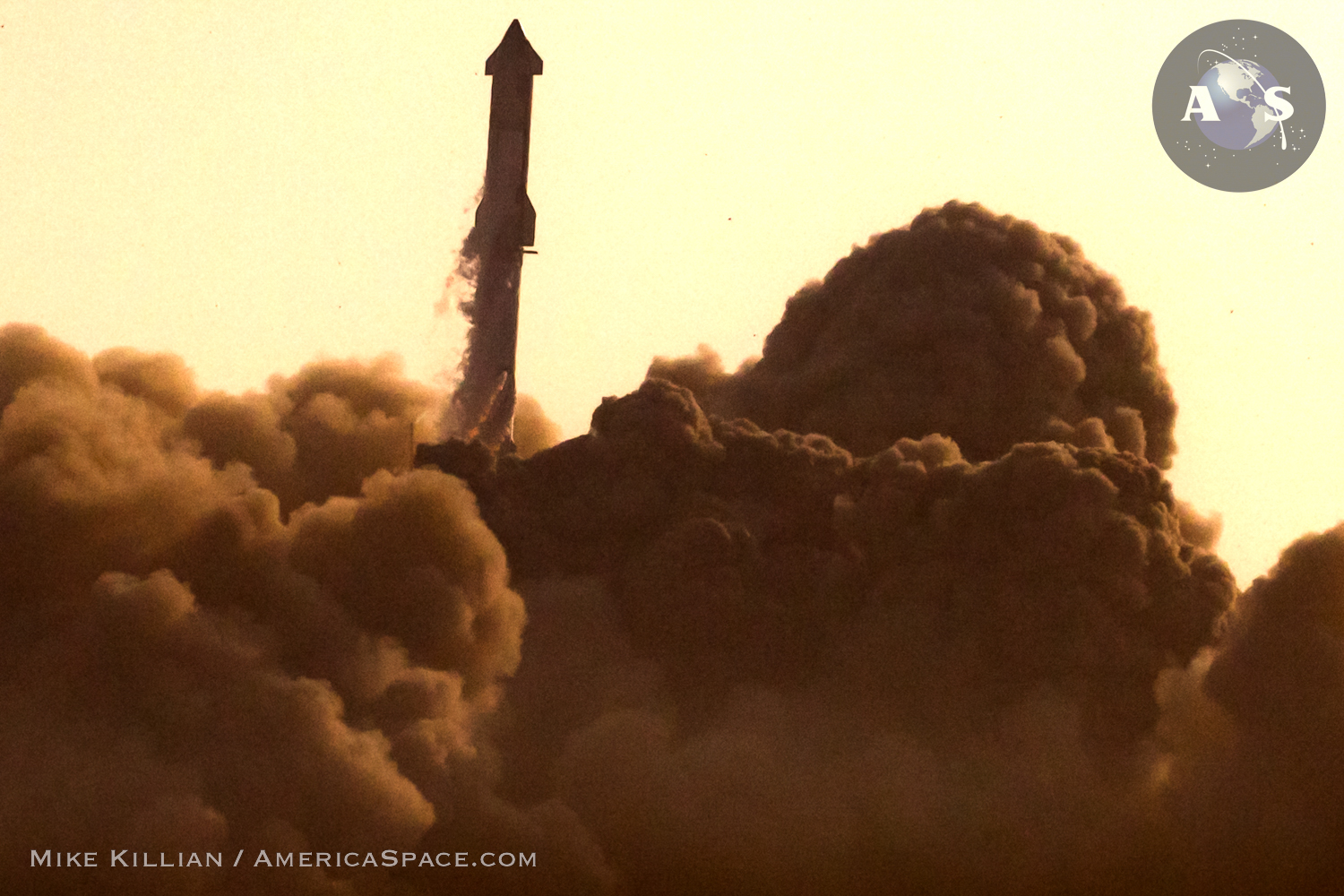
The first launch of super heavy and starship (mike killian / americaspace.com / avgeekery.com)
After refueling in LEO, the Starship would undock, and then light its engines to break away from Earth’s gravitation pull and enter translunar injection.
The Artemis crew will then launch on the SLS from Kennedy pad 39B in Florida, and dock with the fully-fueled Starship in lunar orbit, and use it to land on the moon. When ready to leave, they will board Starship again and launch back to lunar orbit to rejoin Orion.
Orion and starship docking in lunar orbit (Render by Tony Bela via x, with permission)
NASA wants to see 20 successful Starship flights, before trusting it with their crews to land on the moon
The plan is extremely complex with many technical challenges that have never been strung together in a single mission. SpaceX has two years to have Starship ready Artemis-III, or the mission will just slip further.
A few successful missions won’t convince NASA that Starship is ready for human spaceflight either. The space agency wants to see roughly 20 successful flights before they will be confident in Starship as a lunar lander.
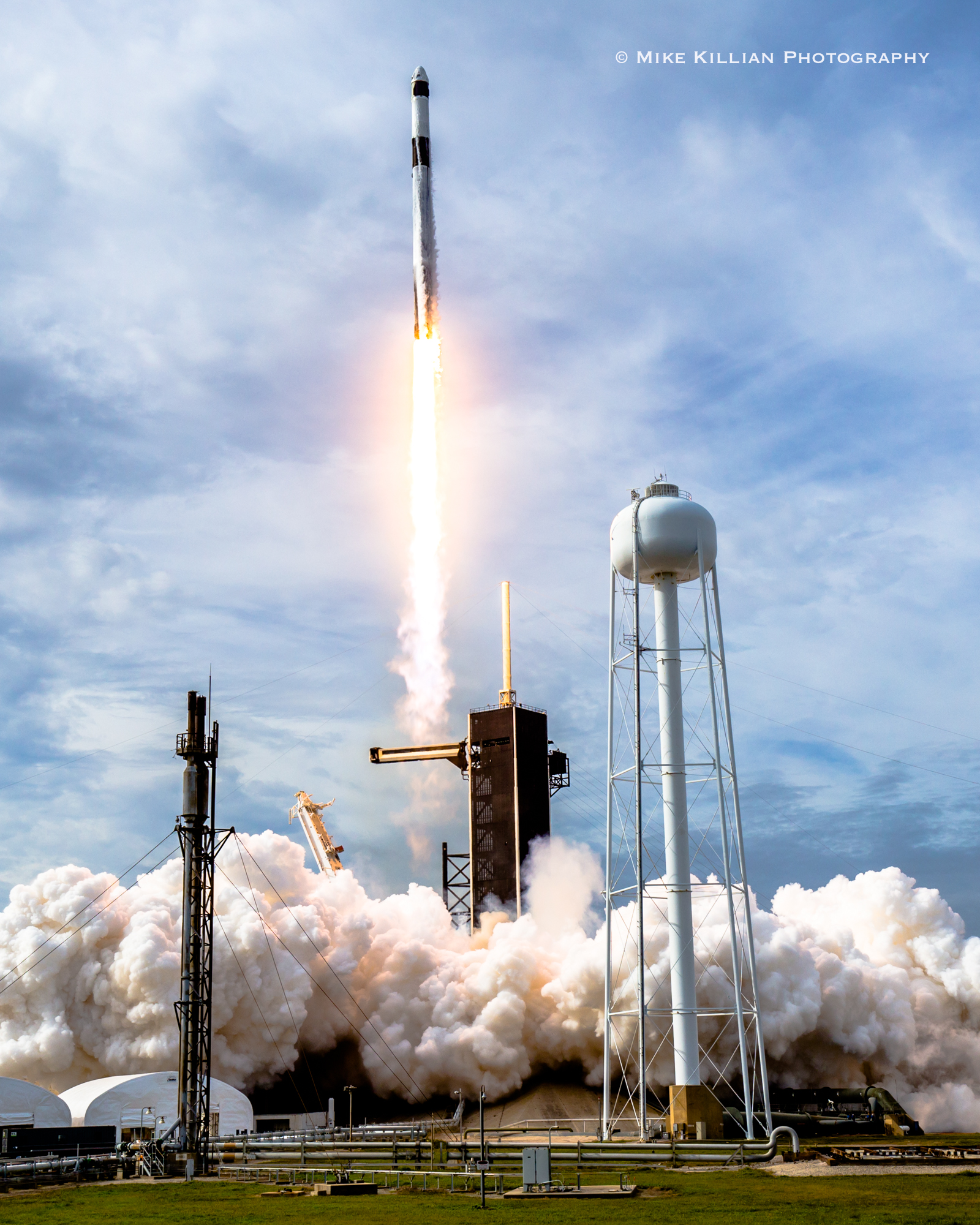
Falcon-9 / dragon launch for nasa (mike killian / americaspace.com)
SpaceX has succeeded over the last decade in proving their other vehicles are human-ready. NASA demanded similar requirements for their Falcon-9 rocket and Dragon spacecraft, before ever putting their astronauts onboard for trips to and from the International Space Station (ISS). It took SpaceX a number of years, before any crew ever stepped onboard.
Starship’s launch rocket isn’t ready yet either
Adding to the difficulty is the fact that SpaceX is still developing the new Super Heavy rocket for Starship. It’s not just the Starship that needs to prove itself before landing Artemis. It is also the rocket necessary to launch it to space.
Both the rocket and Starship are an intertwined system that are dependent on each other. Even with these challenges, SpaceX continues to build the required infrastructure necessary for the Starship system to support Artemis.
The second flight test of starship and super heavy (mike killian / americaspace.com / avgeekery.com)
Development, testing and flight tests continue in south Texas. SpaceX is also building the operational Starship/Super Heavy launch pad at Kennedy Space Center’s historic launch complex 39A in parallel. They are also building a second launch pad / tower in south Texas.
While the strategy is risky, SpaceX has proven itself capable even if it takes more time than promised. So far, SpaceX has flown NASA’s crews many times to the ISS safely and returned them to Earth without issue. Starship will likely get there too, but the company’s timelines are unrealistic. Analysts call it “Elon time” for a reason.
Artemis-1 flew a near-flawless mission, but engineers have to fix a few issues
NASA’s First Crewed Artemis Moon Mission Slips to Late 2025 64
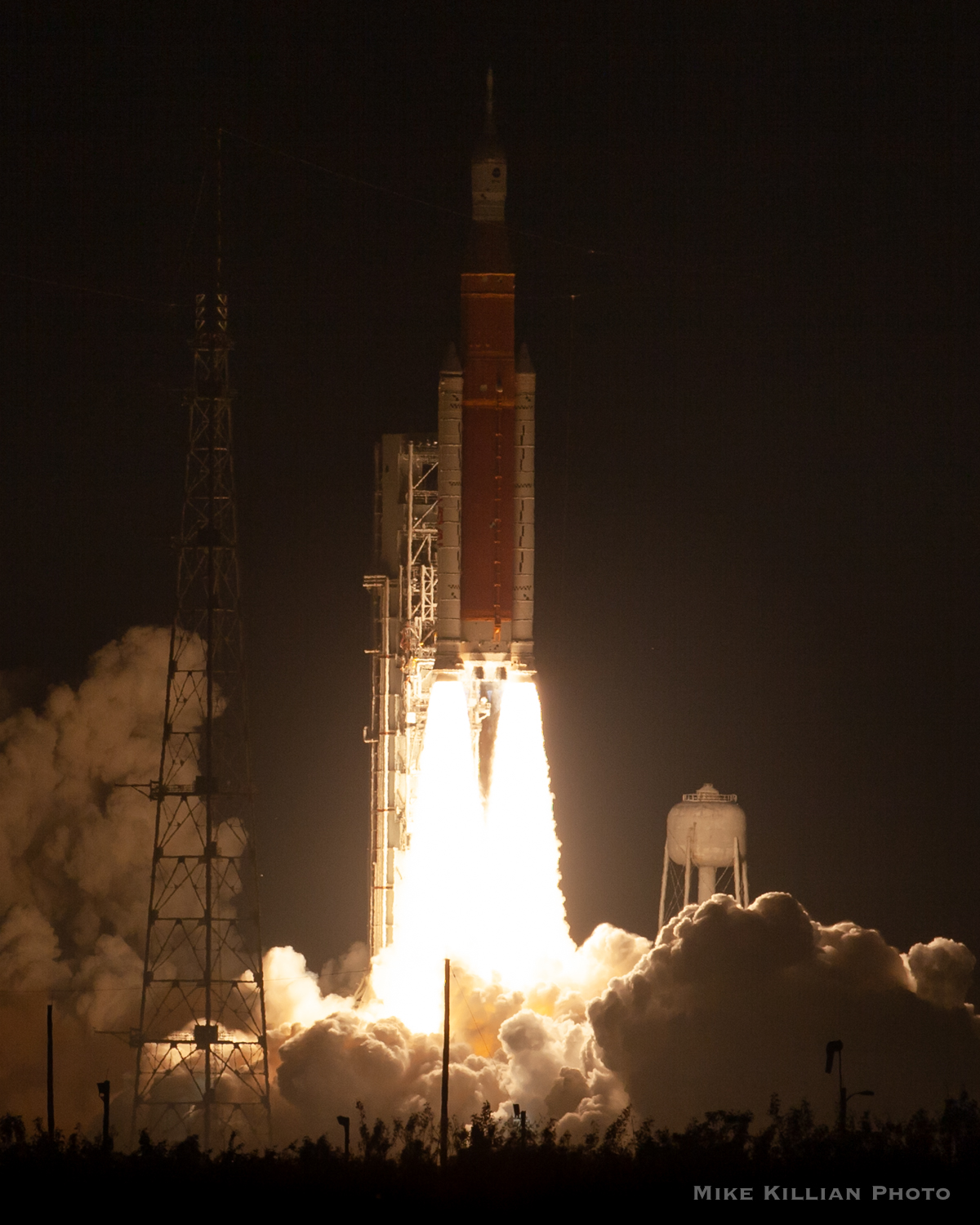
Artemis-1 launched in late 2022 on an un-crewed flight test to lunar orbit and back. The new Space Launch System (SLS) rocket worked like a charm, exceeding performance expectations and delivering a near flawless launch and mission around the moon.
The SLS lifted off on almost 9 million pounds of thrust, hammering the launch pad and ground support infrastructure with a violent beating. Doors and panels were blown away, along with welds for hoses and several elevators and blast shields. You can read more about some of the damage and repairs in detail here.
see some of launch pad aftermath following artemis-1
NASA says repairs and modifications to the SLS mobile launcher and pad support infrastructure are underway and on track.
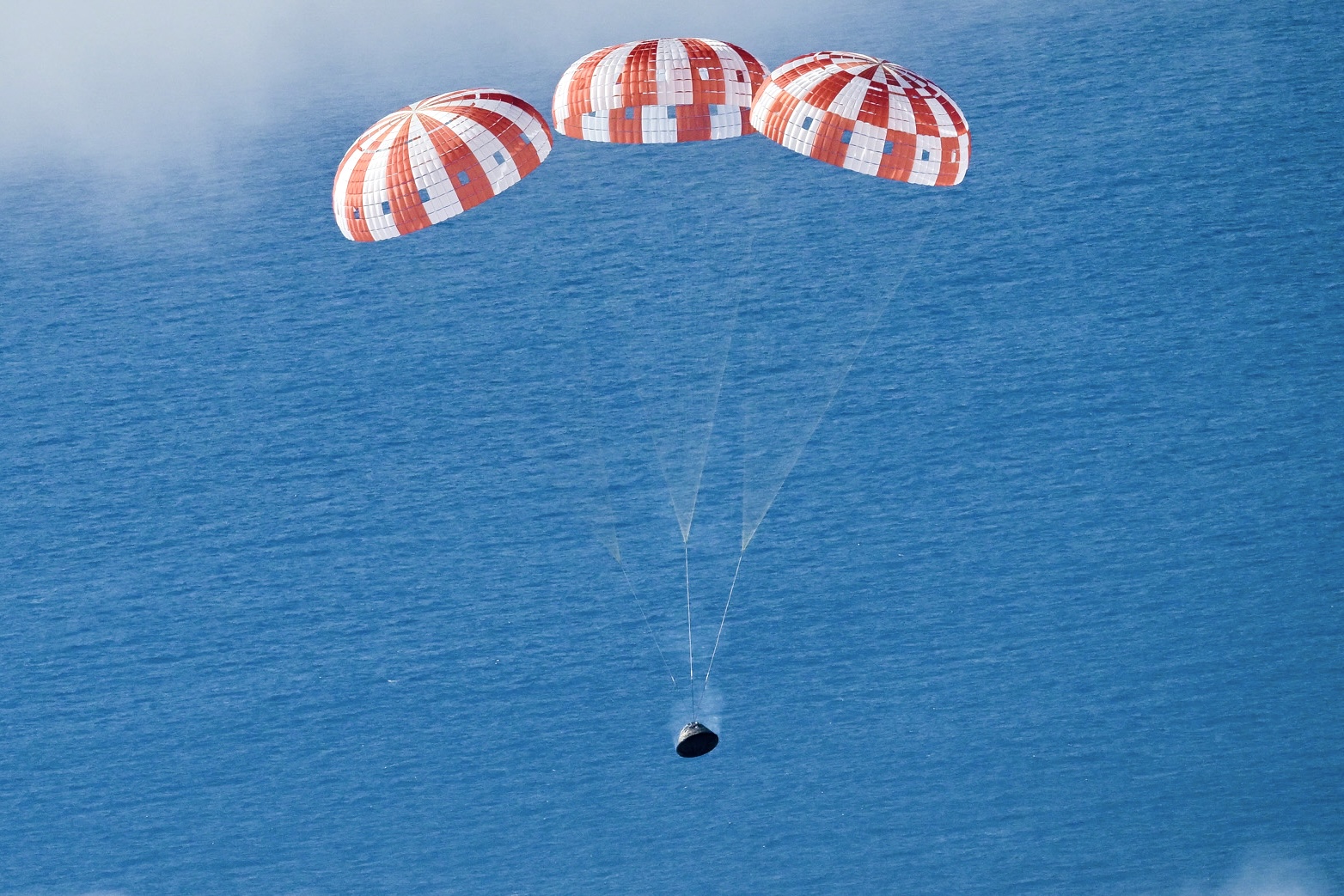
The Orion spacecraft performed almost perfectly on Artemis-1, accomplishing 161 test objectives (including 20 added mid-flight). Its service module generated 20% more power than NASA expected, and even used 25% less power than expected. Separation events such as jettison of the launch abort system and parachute deployment for splashdown occurred without issue. Orion landed within 2.4 miles of its targeted bullseye.
At 12:40 p.m. EST, Dec. 11, 2022, NASA’s Orion spacecraft for the Artemis I mission splashed down in the Pacific Ocean after a 25.5 day mission to the Moon. Orion will be recovered by NASA’s Landing and Recovery team, U.S. Navy and Department of Defense partners aboard the USS Portland.
There were a few vitally important issues…
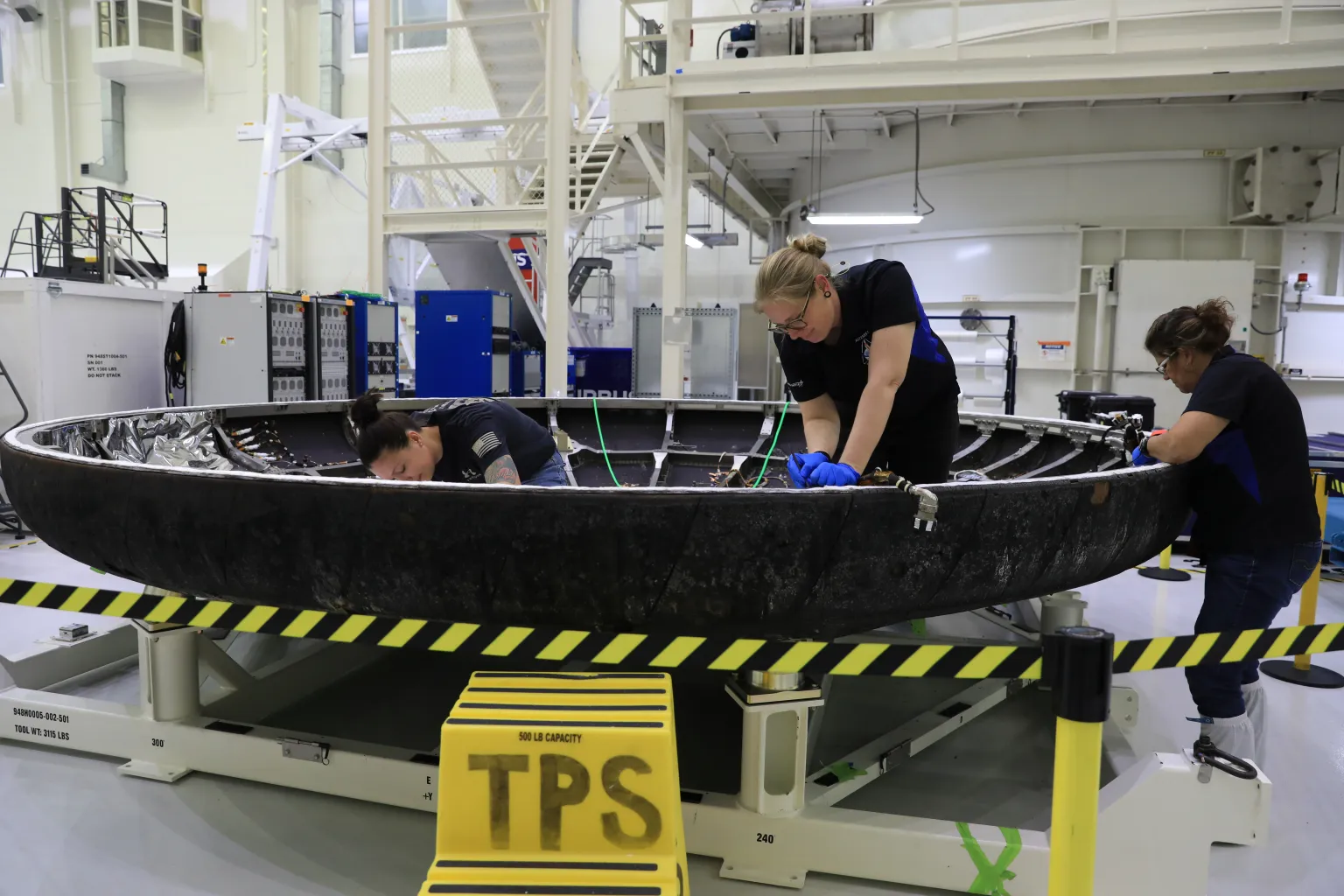
However, a small part of Orion’s heat shield was unexpectedly liberated. While the vehicle was safe, the ablation was much more severe than expected in a few areas. Engineers are working to understand why.
The heat shield is a critical element that protects the crew from 5,000 degree F temperatures on re-entry. The capsule becomes like a fireball as it slams into the upper atmosphere. NASA says ablative material to help protect Orion on re-entry wore away differently than they had predicted.
Technicians working on orion’s heat shield (nasa photo)
Engineers are also assessing an, “issue where latching current limiters switched open without commanding several times throughout the mission. Engineers are reviewing flight data to understand the source of the issue and plan to conduct testing in a flight-like configuration.”
Artemis-1 validated the system can fly to the moon and back, but Artemis-II will validate critical environmental control and life support systems for crews. Testing since Artemis-1 has uncovered issues that NASA says require additional time to fix.
Artemis-II
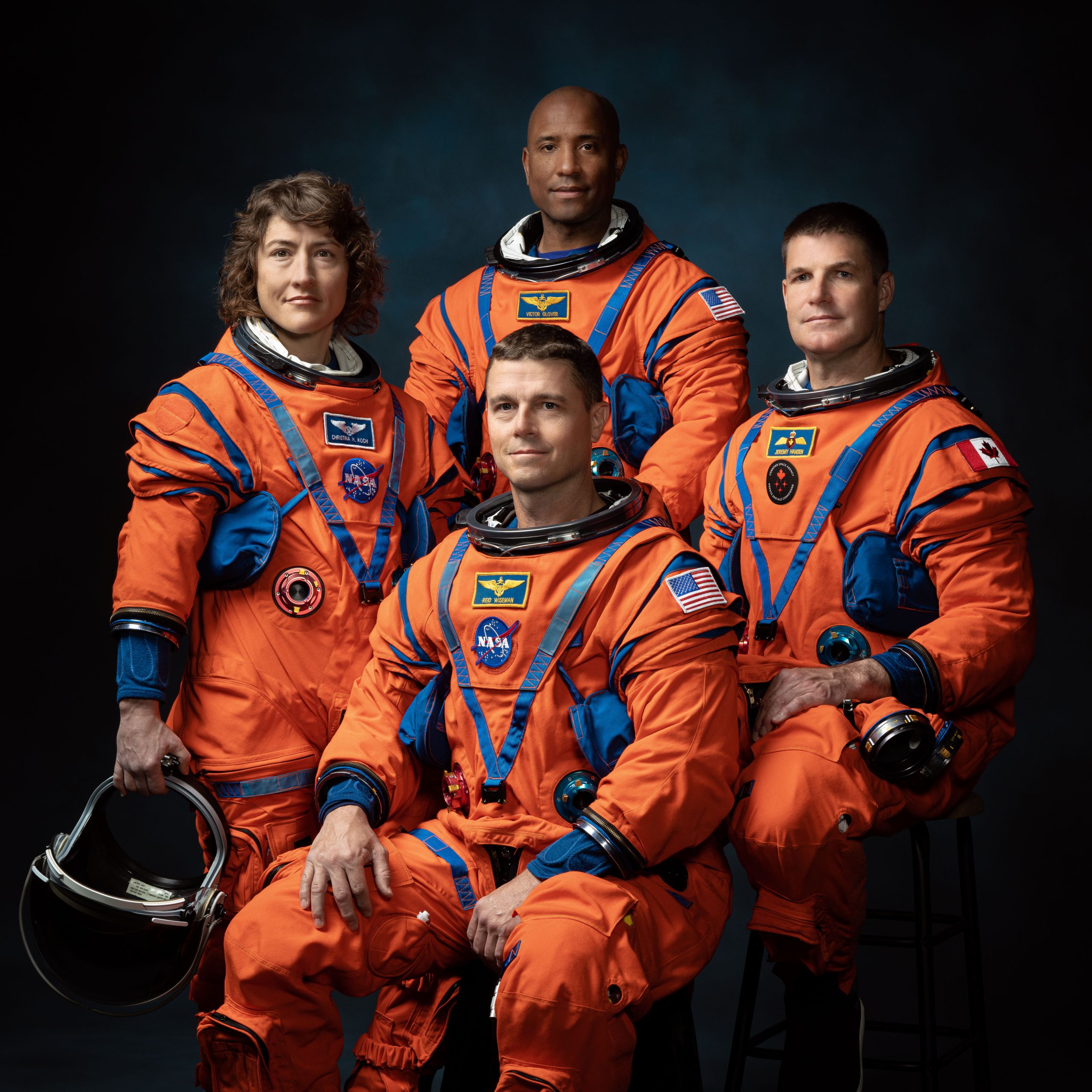
Official crew portrait for Artemis II, from left: NASA Astronauts Christina Koch, Victor Glover, Reid Wiseman, Canadian Space Agency Astronaut Jeremy Hansen. Photo: nasa
“We are letting the hardware talk to us so that crew safety drives our decision-making. We will use the Artemis II flight test, and each flight that follows, to reduce risk for future Moon missions,” said Catherine Koerner, associate administrator, Exploration Systems Development Mission Directorate at NASA HQ.
The SLS core stage for Artemis-II has its 4 engines installed and will be transported to Florida this year. Same with the solid rocket booster segments. Orion’s heat shield will be applied to the spacecraft this spring. The Orion will then be connected to its service module for integrated testing.
watch the crew of artemis-2 conduct various training
“Artemis is a long-term exploration campaign to conduct science at the Moon with astronauts and prepare for future human missions to Mars. That means we must get it right as we develop and fly our foundational systems so that we can safely carry out these missions,” said Amit Kshatriya, deputy associate administrator of Exploration Systems Development, and manager of NASA’s Moon to Mars Program Office at headquarters. “Crew safety is and will remain our number one priority.”
Millions of people vacation at Walt Disney World Resort every year. But very few of them realize that when the park was first built, it had its very own airport – the happiest airport on Earth.
A quite infamous Disney World map from 1971 shows Disney airfield and its one northwest and southeast-bound runway. Passengers could catch a flight on Shawnee Airlines on a 19-seat DeHavilland DHC-6 Twin Otter. Shawnee Airlines flew directly into Disney’s STOLport from McCoy Airport in Orlando. It was a very short flight, just a few minutes in duration.
In October 1971, both Shawnee and Executive Airlines started flying regular routes to Disney on Twin Otters. Nonstop service to Orlando Herndon, Tampa, West Palm Beach, and Fort Lauderdale was offered by Shawnee. Executive operated two nonstop flights, to Orlando Herndon and Tampa.
The service to the happiest airport on Earth didn’t last long
Unfortunately, Executive Airlines did not last long and ceased operations in December 1971. By the summer of the next year, Shawnee started offering connections with major carriers after moving all operations to Orlando. A timetable from September 1972 lists six daily roundtrips between Disney and McCoy, along with connections to other cities. Shawnee’s nonstop flights from the resort to other cities were discontinued earlier that year.
Shawnee also shut down on 28 December 1972 due to a lack of passenger interest and rising debt. That was the end of the commercial airlines operating out of the STOLport. At the time Disney was built, management apparently thought the airport was a good idea, but alas, it was a failed experiment in the long run. In fact, Disney officials told the Sarasota Herald-Tribune that its shutdown would have little or no effect on the park’s operations.
By the early ’80s, a monorail extension to EPCOT Center had an elevated track on the west end of the runway that blocked larger planes from landing at the STOLport. Mickey Mouse One, Walt Disney’s own private plane, could not even touch down at the private landing field. Instead, World Drive was shut down to traffic so the corporate aircraft could land there and be towed back to the park so it could be displayed in the MGM boneyard.
Runway is used today, just not for airplanes
In 2006, the airstrip was in use again but not for traffic. WDW parked tractor trailers, buses and crates on the runway. A helicopter carrying a preparation team for then-President Bush landed on the airstrip and the monorail did not pose a problem. There are reports of company executives using the airstrip occasionally as well.
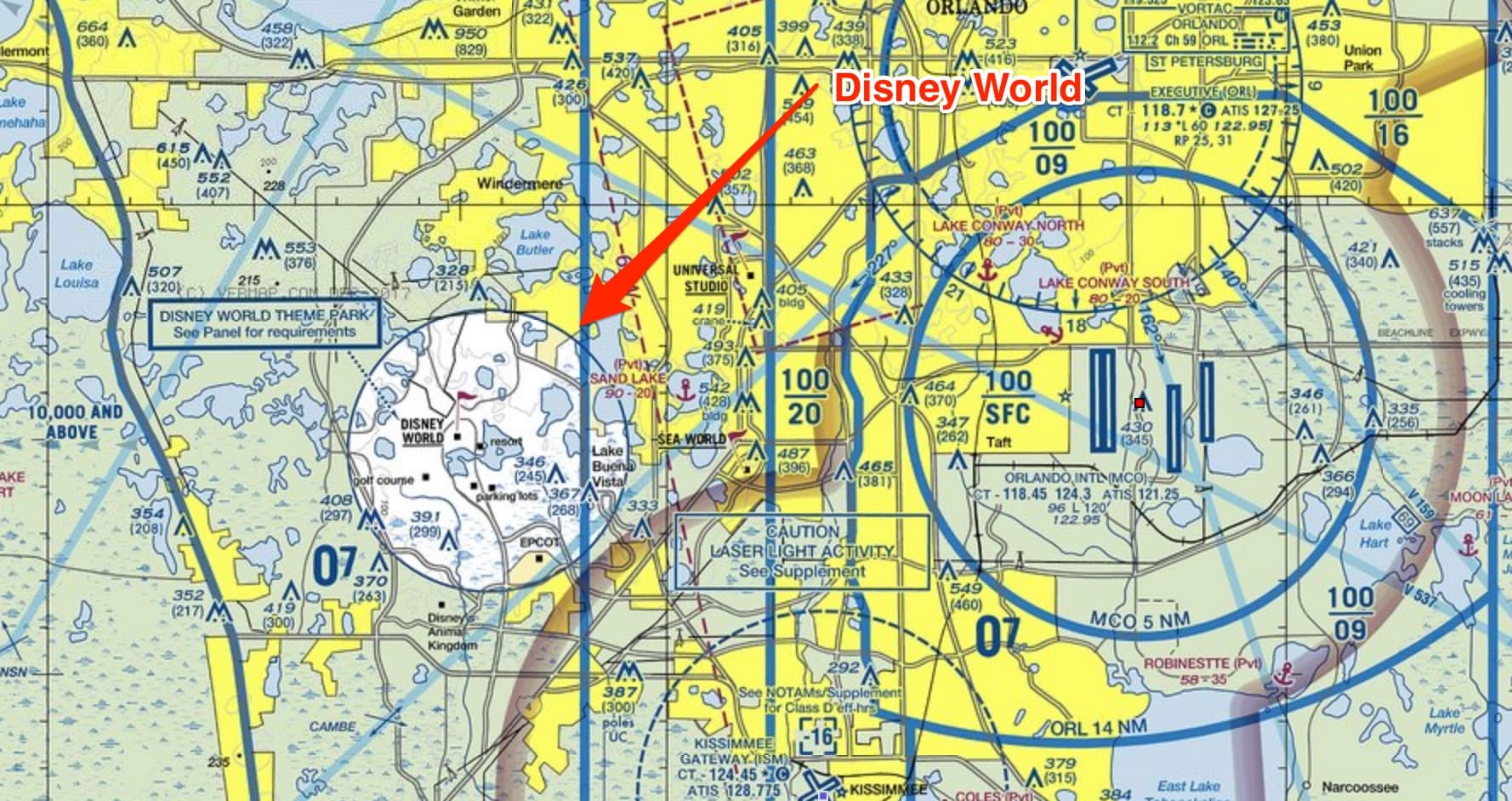
Sadly, the Walt Disney World airport is now defunct. After the attacks of 11 September 2001, the airspace over the resort became a protected no-fly zone. It is only a “temporary” flight restriction, but it has been in place for years. It is still fun to recall the early days of Disney when there was air traffic to and from the park, bringing wide-eyed children and their families to the Happiest Place on Earth.
NASA and Skunk Works Unveils Experimental Vehicle That Turns Sonic Booms Into Sonic Thumps
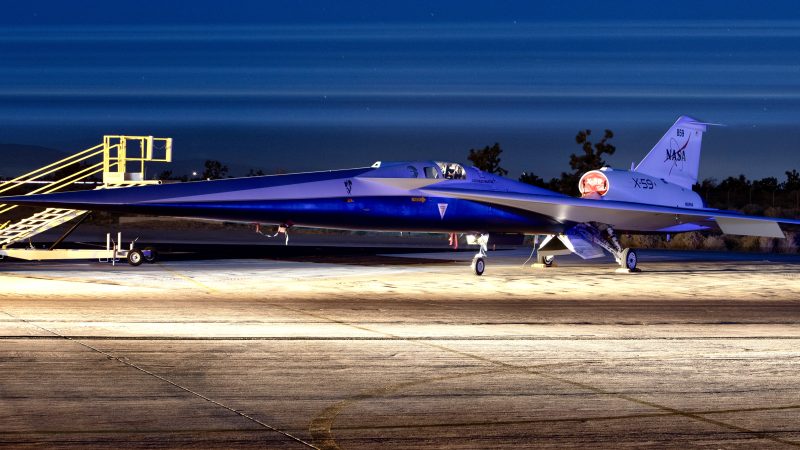
Are we on the verge of a commercial supersonic comeback? America’s space agency is determined to make it so by turning sonic booms into a mere whisper. Meet NASA’s X-59.
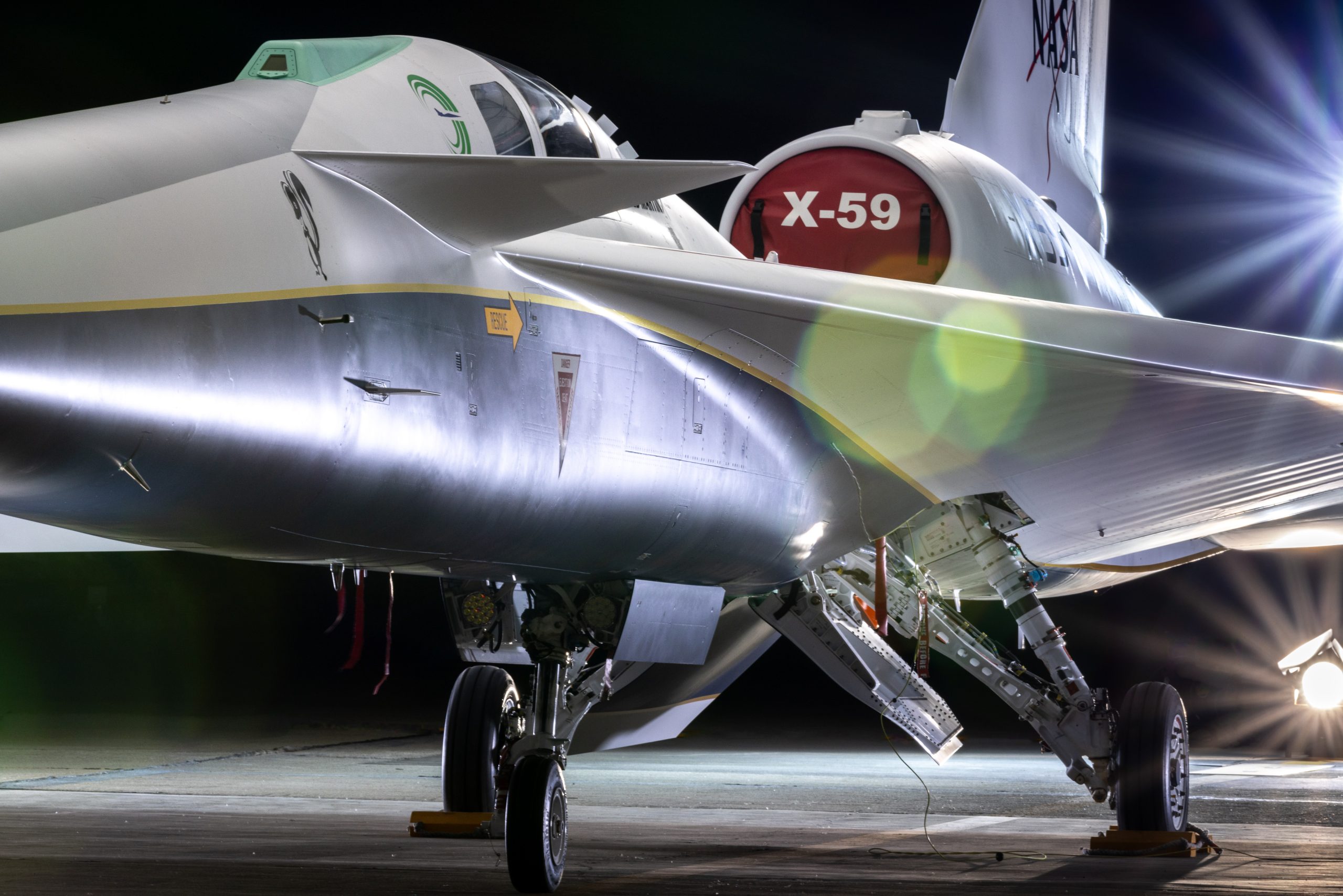
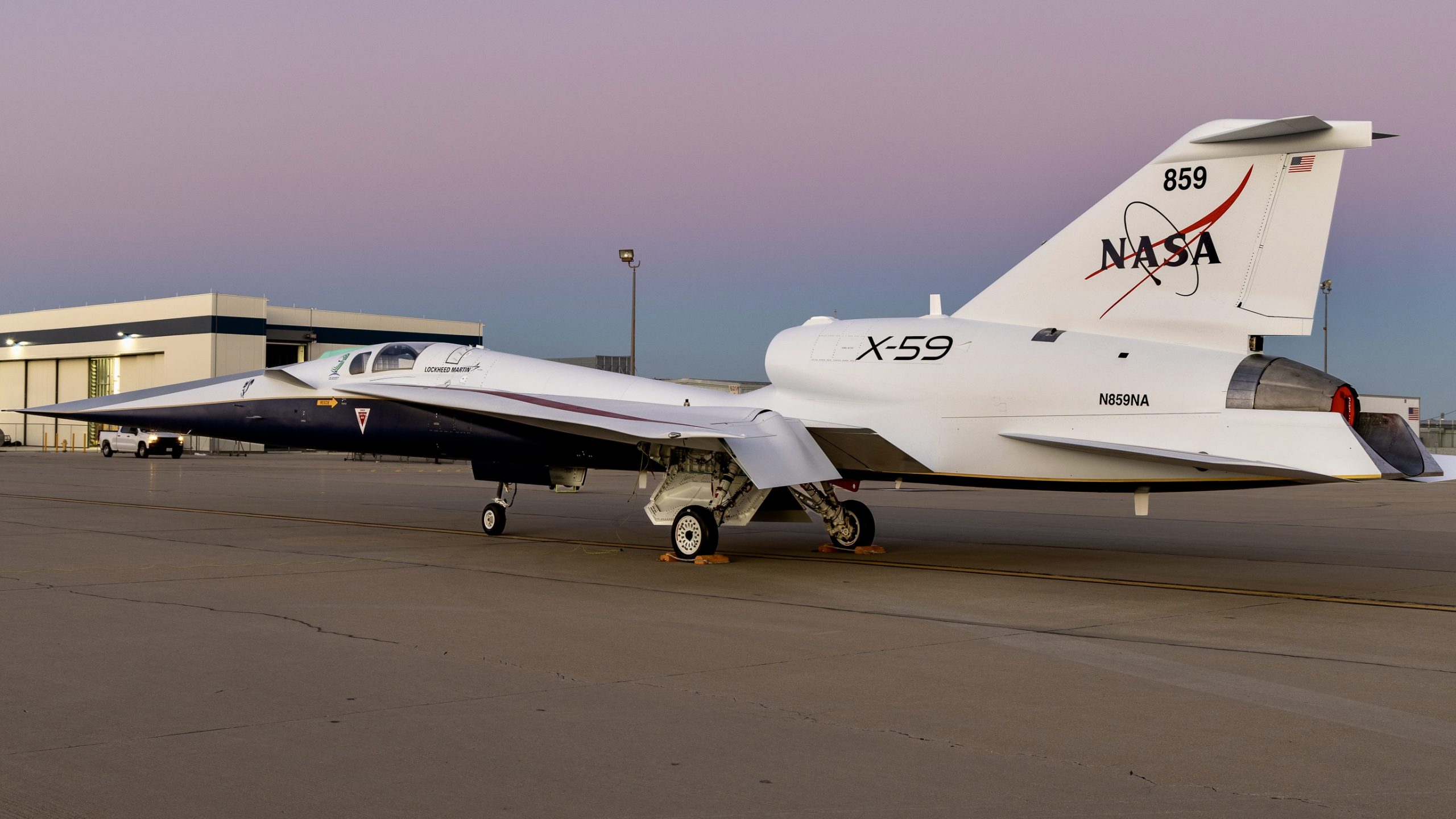
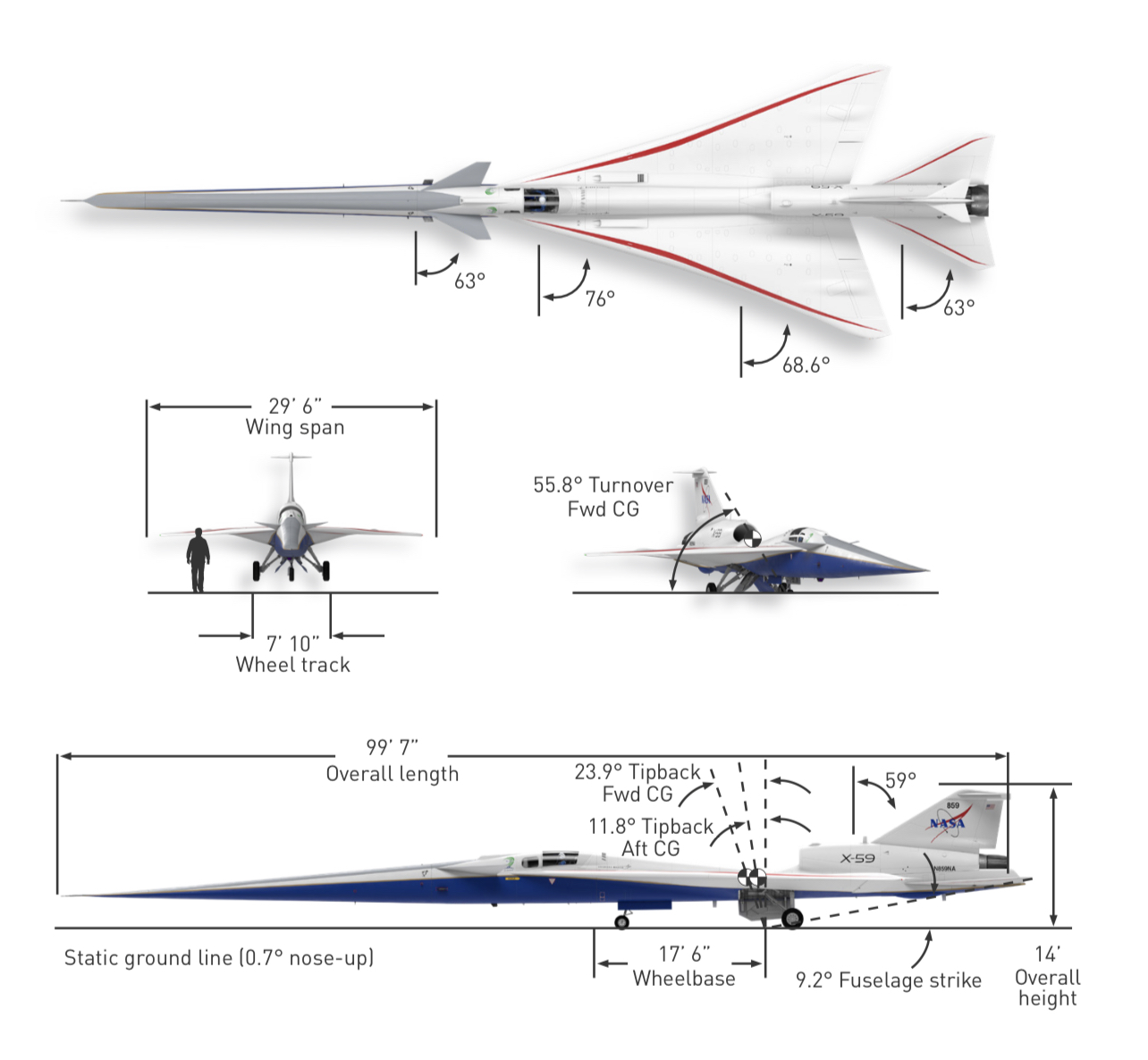
The 99 ft long purpose-built technology-demonstrator jet was rolled out today and formally introduced to the world. It could help change the future of supersonic aviation forever.
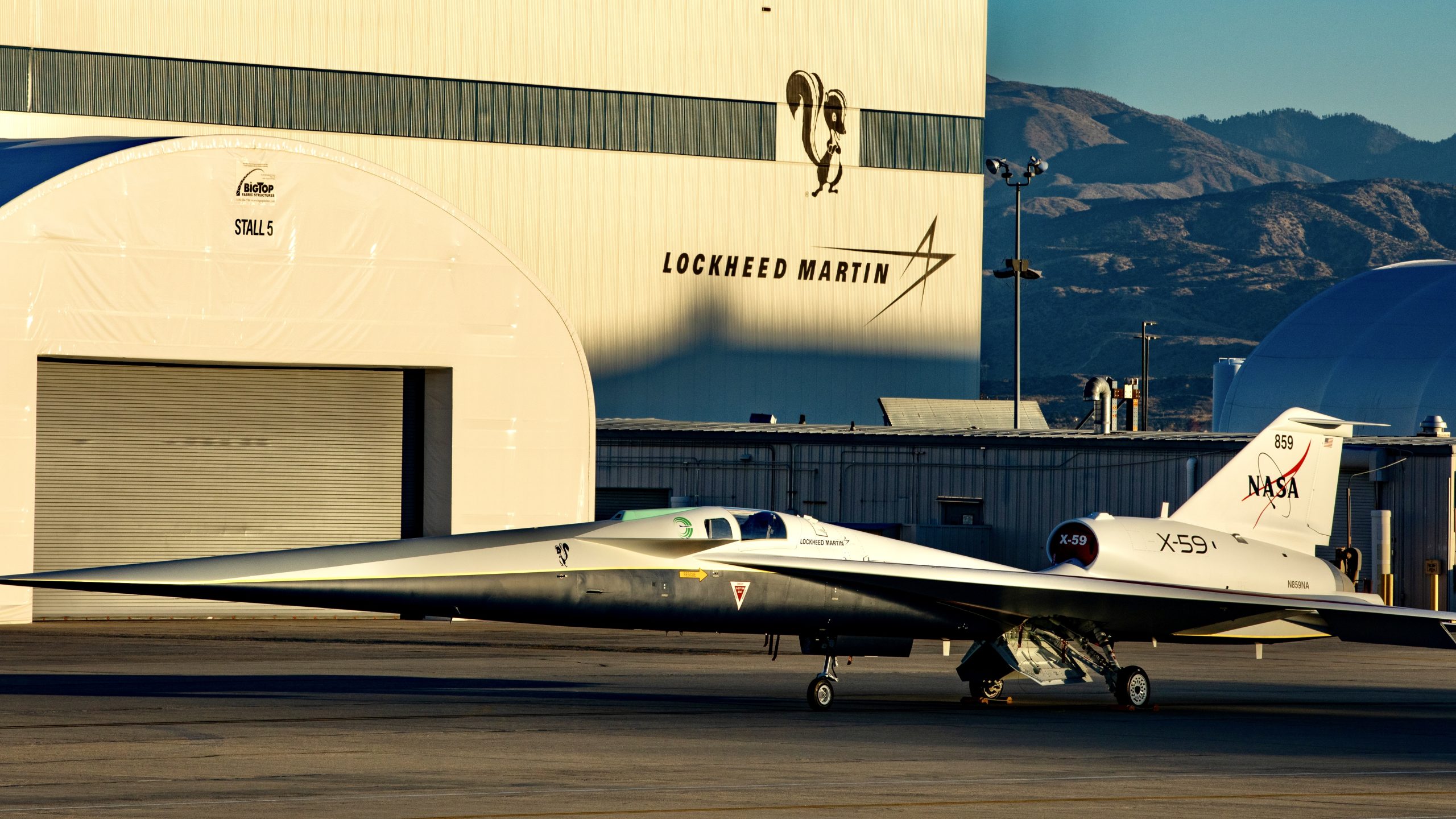
X-59 (Lockheed Martin / Garry Tice)
Five years of development with Skunk Works
The aircraft has been in development now for about 5 years. It was designed and built by Lockheed Martin at its famed Skunk Works in Palmdale, CA. NASA awarded LM a nearly $250 million contract for its development in 2018.
To understand why the technology in the X-59 is so important, it is important to understand some of the limitations and regulations around supersonic flight. Supersonic flight creates loud sonic booms. These booms not only sound like an explosion, they can damage windows and even buildings in some cases.
Nasa illustration of a future supersonic airliner, based on the research x-59 will do
Due to the potential hazards and annoyances, the federal government banned commercial flight over land over 50 years ago. The ban was strongly influenced by public opinion in cities where supersonic military jets were flown.
Simply put, residents didn’t like being startled or having their windows and walls rattling anytime a supersonic aircraft passed by.
Above, watch NASA and Skunk Works unveil the X-59
This limitation had an outsized impact on the evolution of commercial supersonic flight. Concorde gambled on supersonic travel being allowed over land, but was doomed as a profitable enterprise because of the ban. That’s also why we haven’t seen any supersonic commercial travel since the Concorde retired in 2003.
Turning sonic booms into sonic thumps
X-59 is the centerpiece of NASA’s bigger ‘Quesst’ mission, which again aims to turn sonic booms into barely noticeable thumps. The program’s goal envisions to make a giant sonic boom more like the sound of a car door closing from across a parking lot, equivalent to approximately 75 Perceived Level decibel (PLdB).
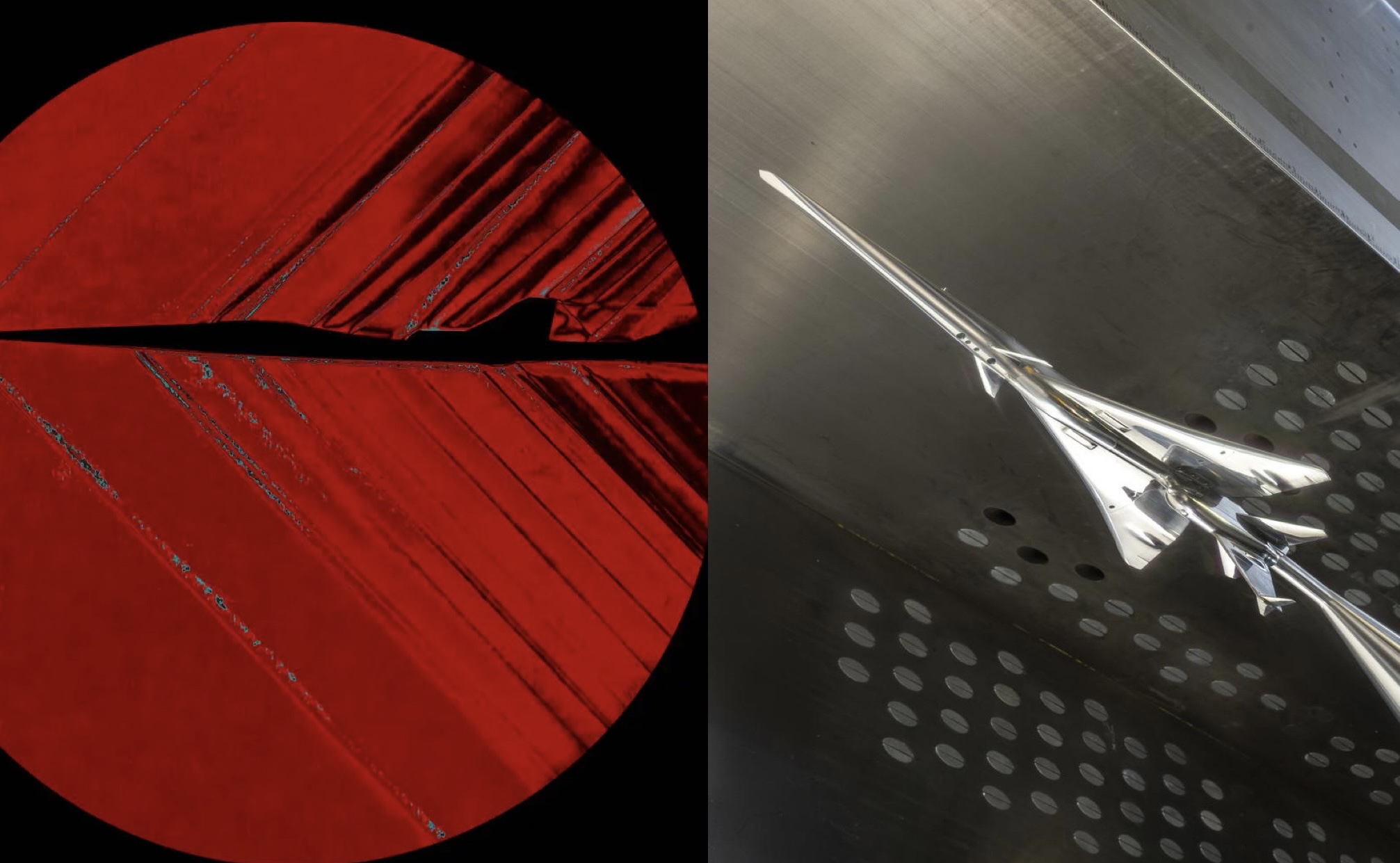
colorized schlieren image of a small-scale model of NASA’s X-59 Quiet SuperSonic Technology (QueSST) airplane taken inside NASA Glenn Research Center’s 8- by- 6-foot Supersonic Wind Tunnel during tests (photos nasa)
The jet’s unique shape spreads out the supersonic shockwaves. In wind tunnel tests, Schlieren images were taken of a X-59 model to give engineers visuals of the shock waves and their positions as air moved around it.
The model was put through several weeks of wind tunnel tests, producing encouraging results that matched computer models. All that was left was to build it.
Lockheed Martin Photo
The aircraft is powered by a single F414-100 GE engine. It’s mounted on top of the airframe, so that any shockwaves coming off it are directed away from the ground. It’s capable of reaching around 950 mph, with an anticipated cruising altitude of 55,000 ft.
X-59’s max gross weight is 25,000 lbs. it can carry 8,700 lbs of fuel and 600 lbs of payload. Skunk Works says it is capable of Mach 1.4.
Forward-facing Windows Prevent Quiet Supersonic Flight… So They Fixed That
Lockheed martin image
The X-59’s long skinny nose alone is almost 1/3 of the plane’s length. There’s no forward-facing window for the pilot either. That was one of the big design changes to reduce sonic booms, eliminating front-facing windows entirely. So how will they see where they are going?
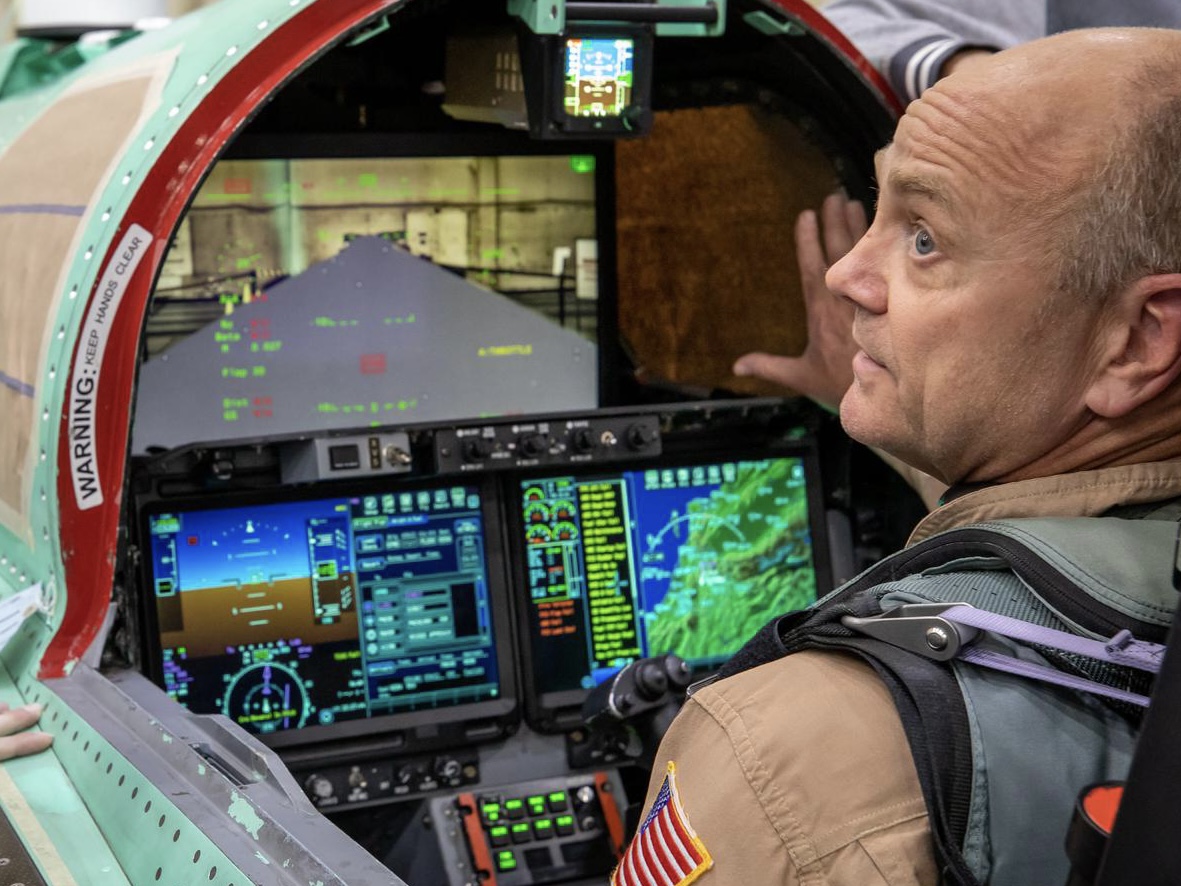
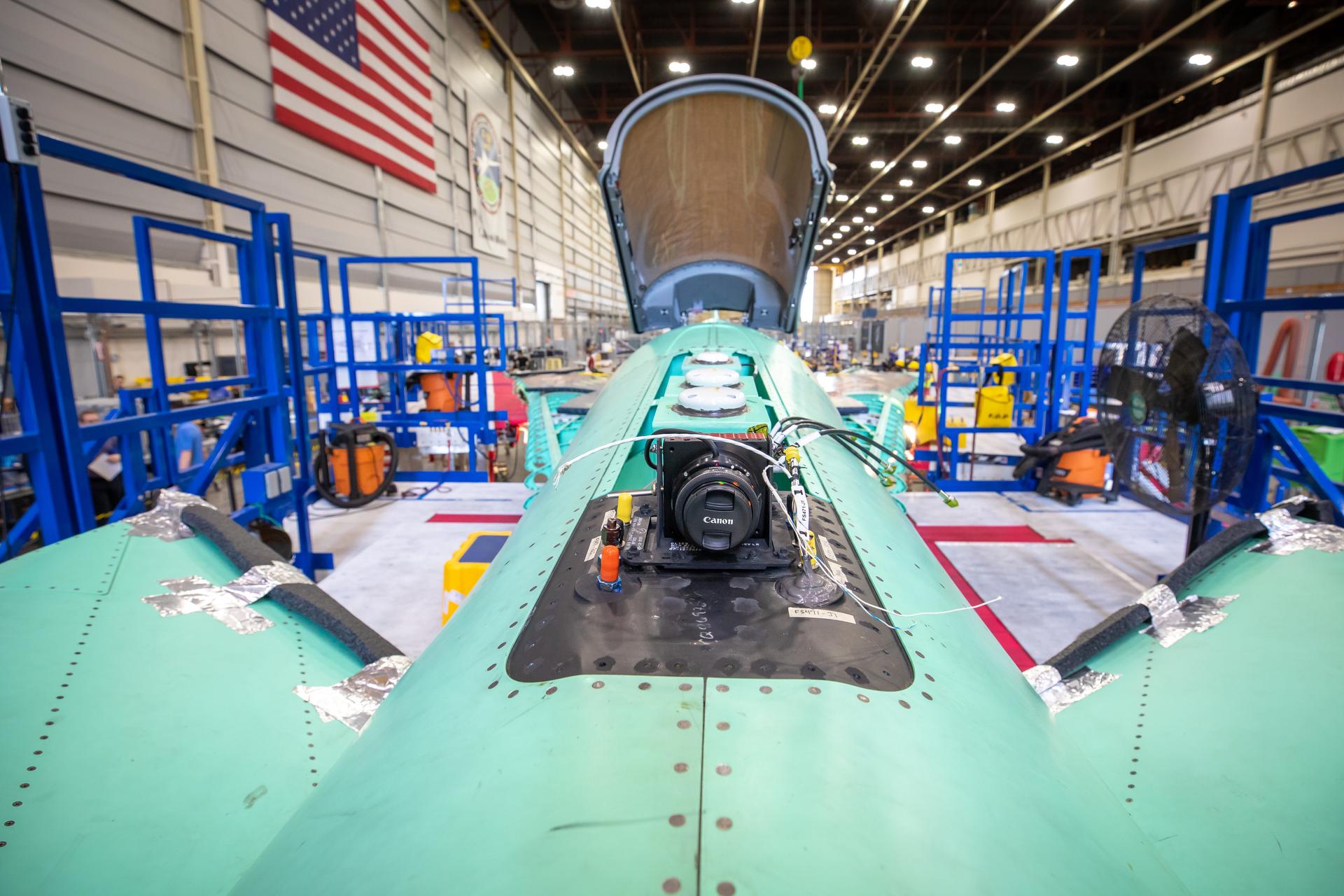
The cockpit displays and lighting system includes a new NASA-developed External Vision System (XVS), displayed on the top screen. It gives the pilot a virtual window.
NASA test pilot, Nils Larson, inspects the X-59 cockpit displays and lighting system during system checkouts. nasa photo
A 4K monitor displays complex computer-processed imagery from two cameras mounted above and below the X-59’s nose.
The avionics flight displays, which show navigation information and status of the aircraft, are displayed on 2 screens below the XVS.
A close up of the camera from the X-59’s eXternal Vision System. This camera is on the top of the X-59, but there will also be one on the belly of the aircraft. (Nasa photo)
The jet’s 29.5-foot-wide wing holds the aircraft’s fuel systems and most of its control systems.
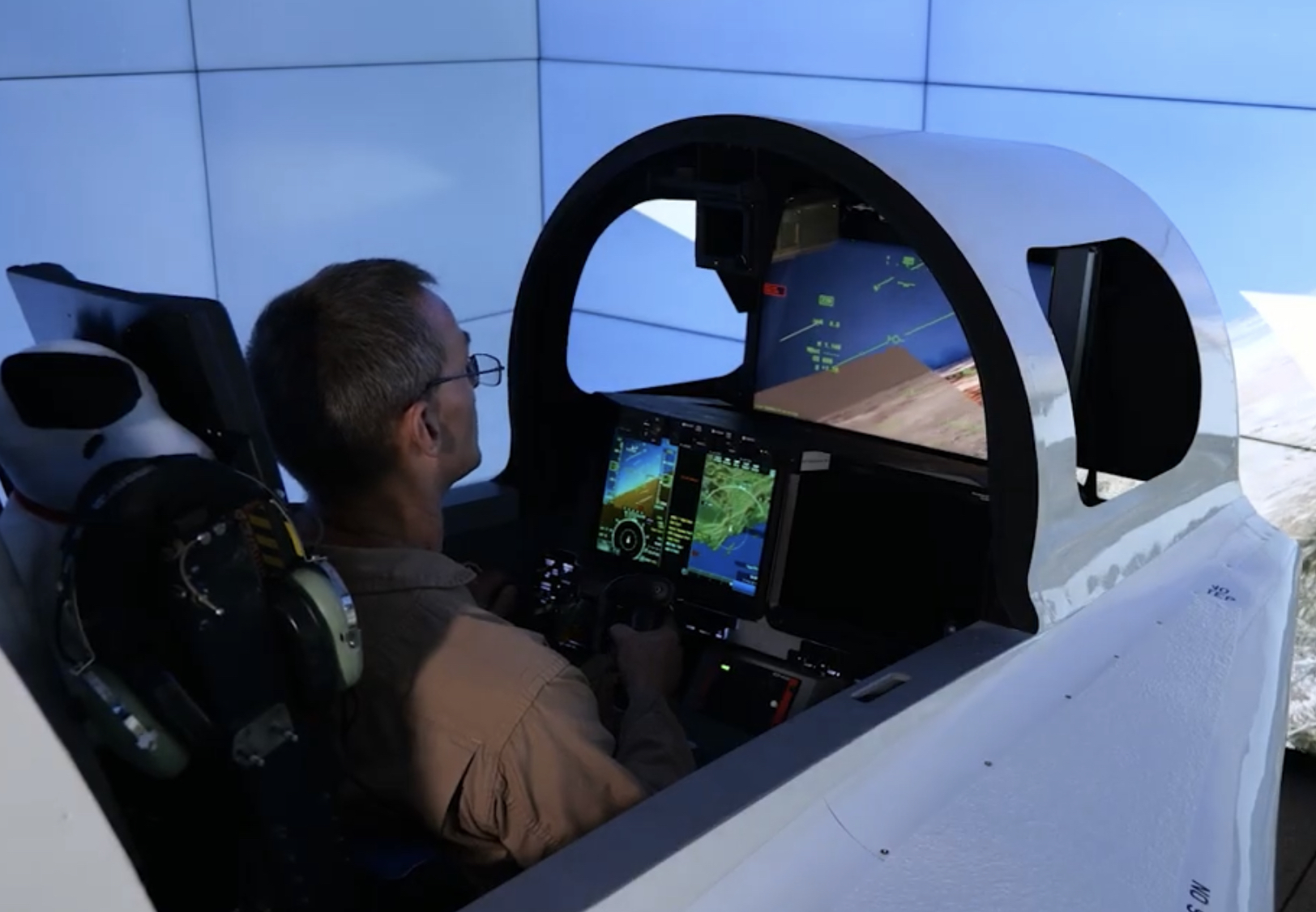
Test pilots have been using simulators at NASA’s Armstrong Flight Research Center to train for the X-59.
Supersonic Comeback? Meet NASA’s X-59 Quesst 76
Lifting the ban for supersonic commercial flight over land
Throughout 2024, NASA will fly the X-59 supersonic over the test range at Armstrong Flight Research Center, to prove it can produce a quieter sonic thump and is safe to fly in the National Airspace System. More than 175 ground recording systems will measure the sound generated.
Starting in 2025, NASA will fly the X-59 over several large communities, to get their feedback. The space agency wants to survey what the public hears as it flies overhead. They will then share the data and reaction with law makers and regulators.
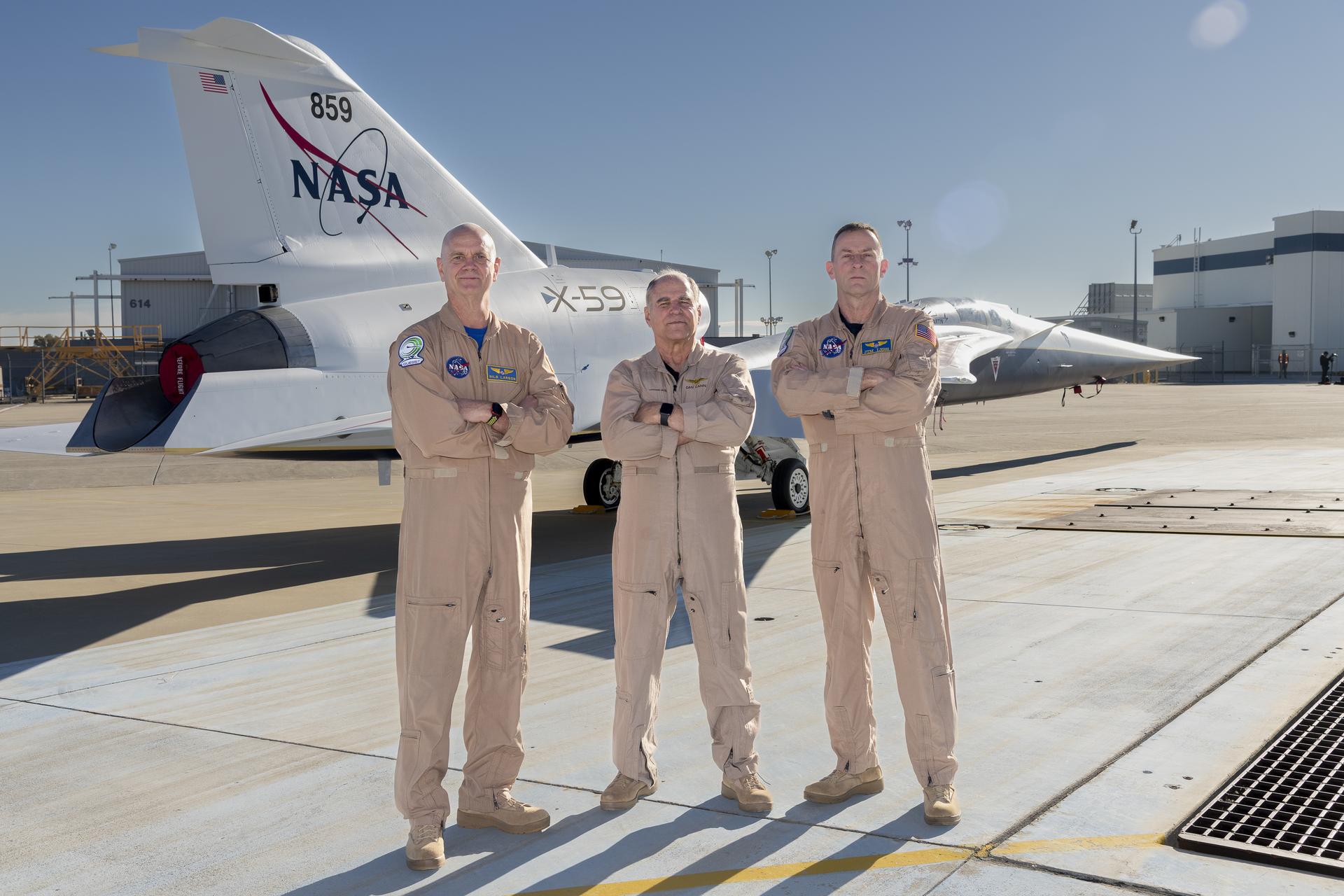
NASA test pilots Nils Larson (left) and Jim “Clue” Less (right), and Lockheed Martin test pilot Dan “Dog” Canin pose with the newly-painted X-59 (Nasa photo)
The hope is that the ban on supersonic commercial flight over land will be lifted, or at least establish acceptable commercial supersonic noise standards. Doing so would open a whole new market for air travel, and cut travel times in half. Projects like Boom Supersonic could become more commercially viable based on NASA’s efforts.
“It’s thrilling to consider the level of ambition behind Quesst and its potential benefits,” said Bob Pearce, associate administrator for aeronautics research at NASA HQ. “NASA will share the data and technology we generate from this one-of-a-kind mission with regulators and with industry. By demonstrating the possibility of quiet commercial supersonic travel over land, we seek to open new commercial markets for U.S. companies and benefit travelers around the world.”
You can be part of the first test flight
x-59 (lockheed photo)
NASA is inviting the public to sign up to get their own virtual boarding pass for the X-59’s first flight. Via NASA’s Flight Log experience, names will be put on a storage device that will be carried personally by the test pilot.
Participants will also receive a printable boarding pass, and the flight will be entered into their logbooks.
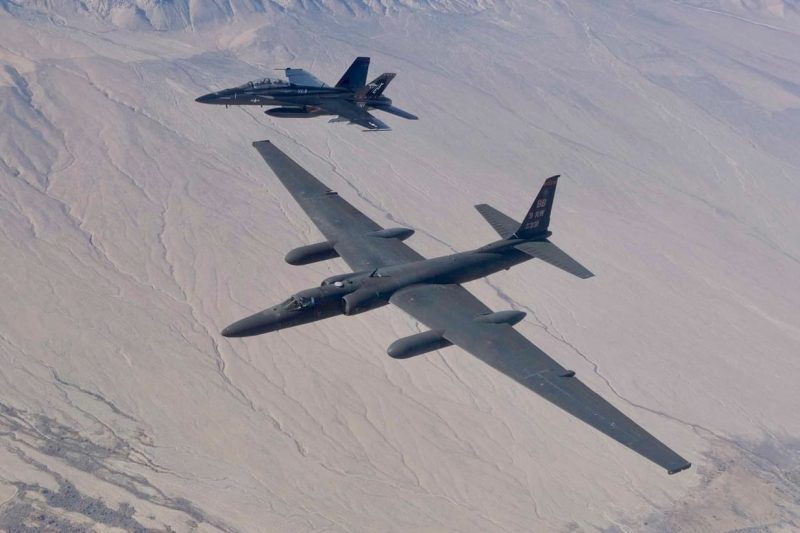
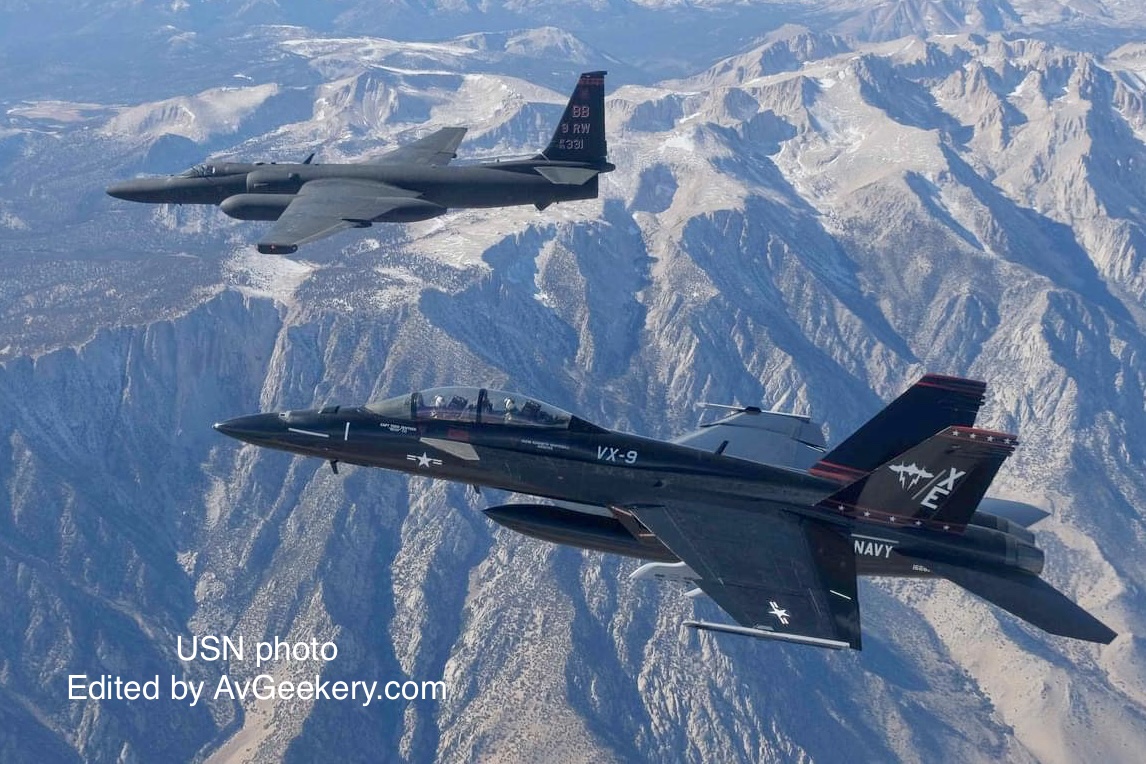
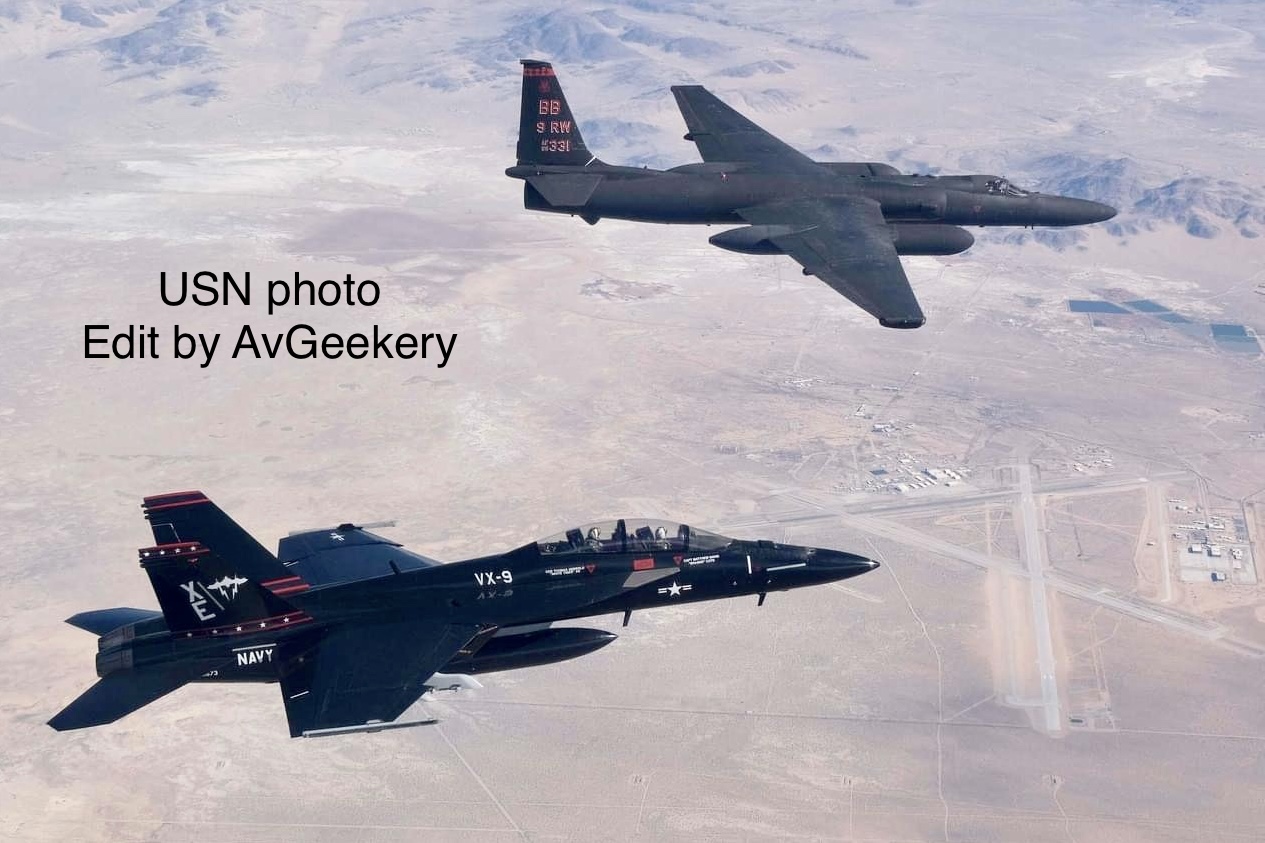
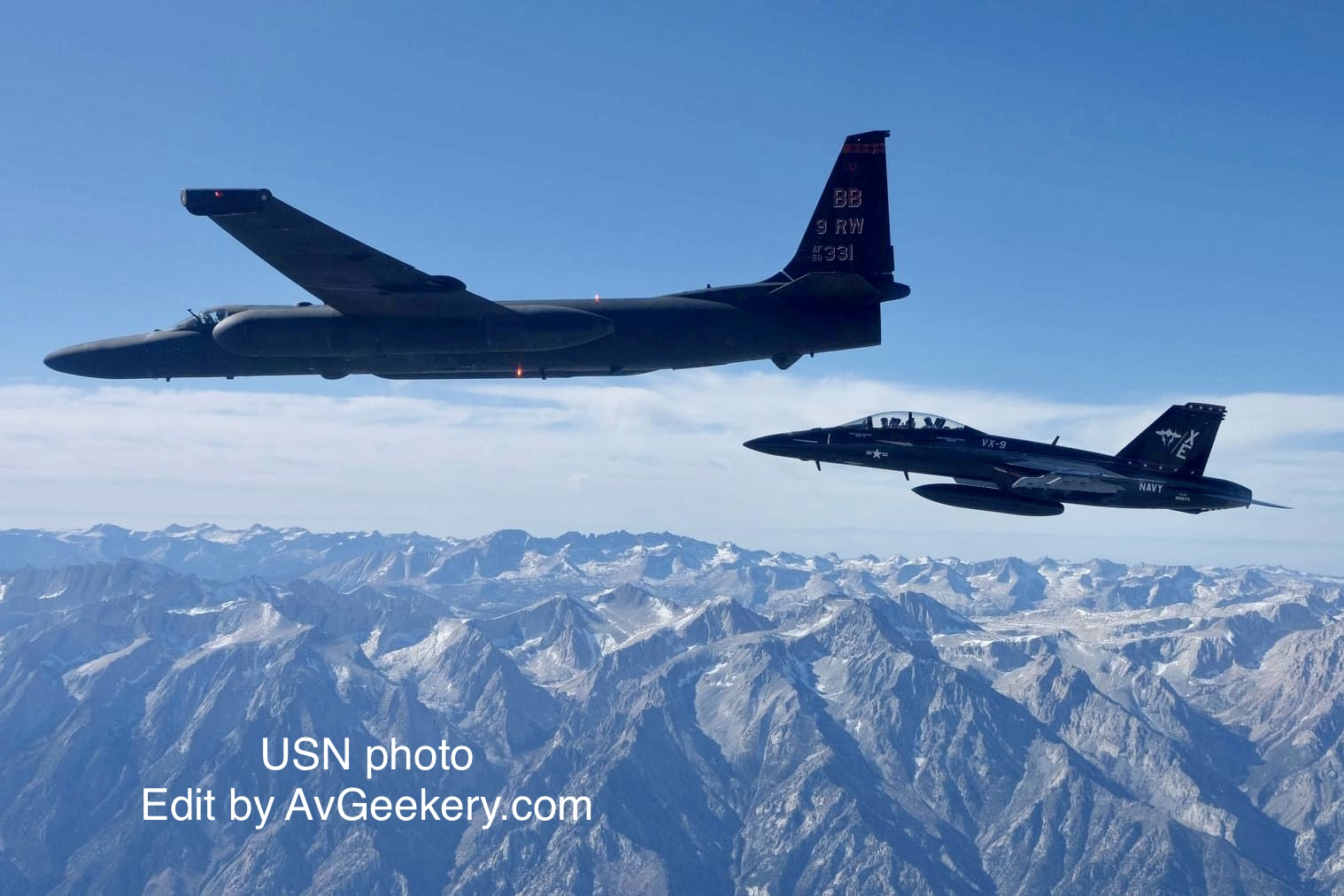
The best looking jet in the U.S. Navy recently joined a USAF U-2 spy plane over China Lake, making for a rare and very cool sight to behold. Check out these shots of Vandy-1 with a U-2!
Vandy-1 Recreates Iconic Shot With U-2 Spyplane 86
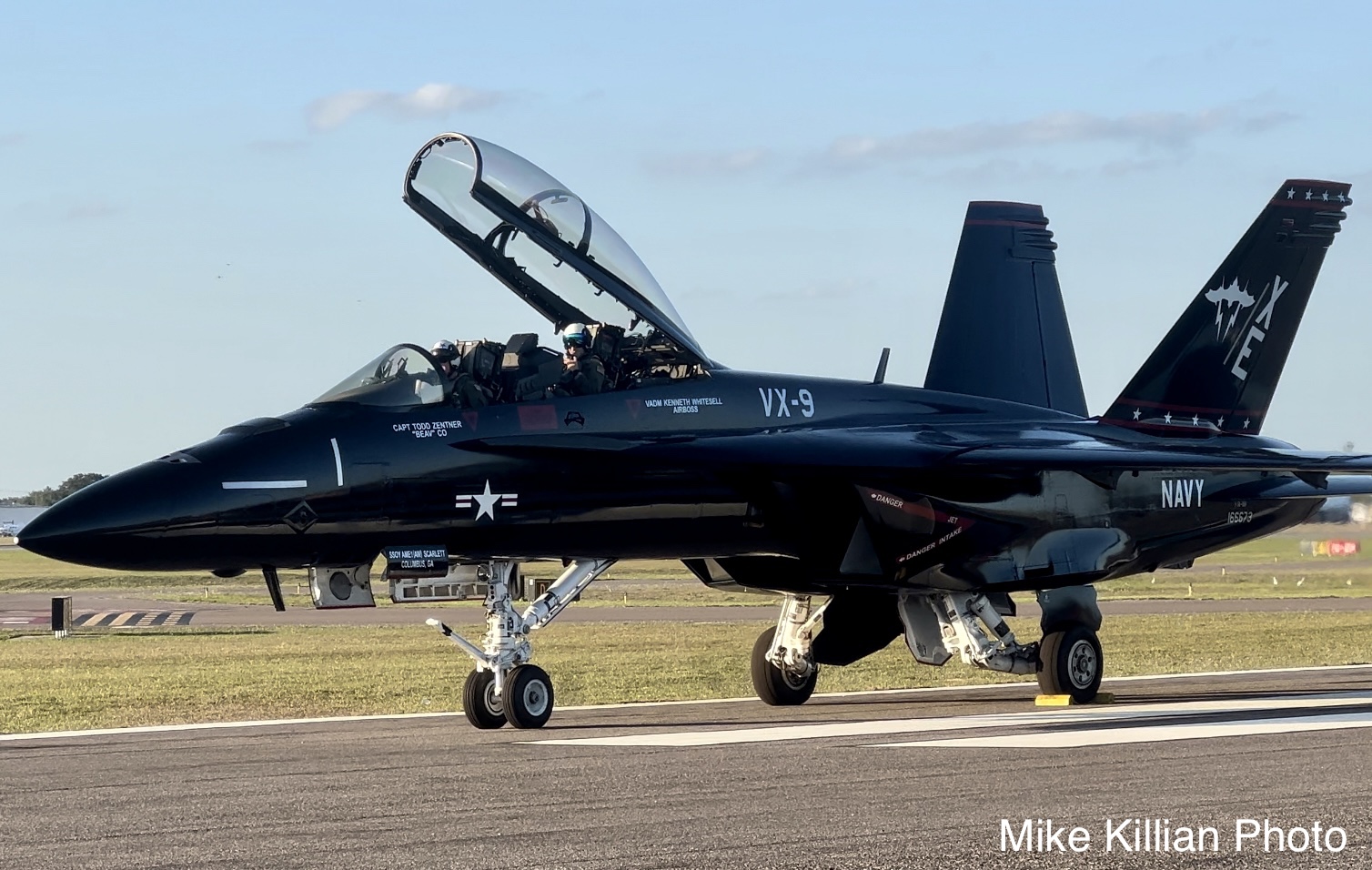
The flagship F/A-18 Super Hornet of Air Test and Evaluation Squadron Nine (VX-9 Vampires) was unveiled to the world last year. It is painted in an all black retro scheme to honor the storied past of VX test squadrons and VX-9’s 30th anniversary.
Harkens Back to a Different Era
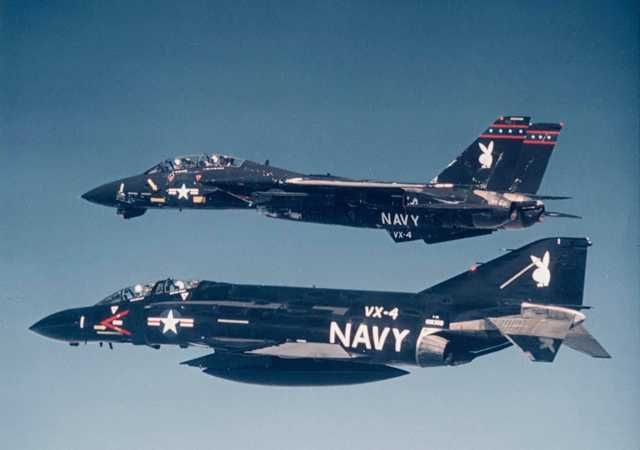
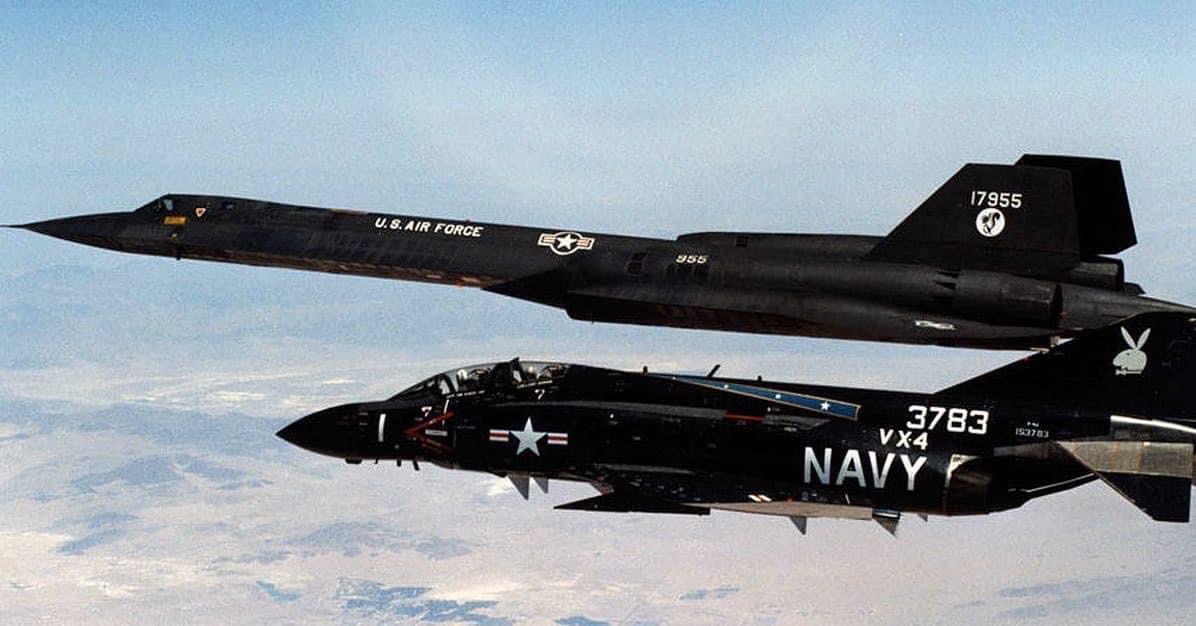
Some might recall the old Vandy F-14s and F-4s with the slick black paint and Playboy bunnies on their tails.
Usn photo
Times back then were much less politically correct. The images of those old jets operating with VX-4 became some of the most iconic jet photos to ever hit press.
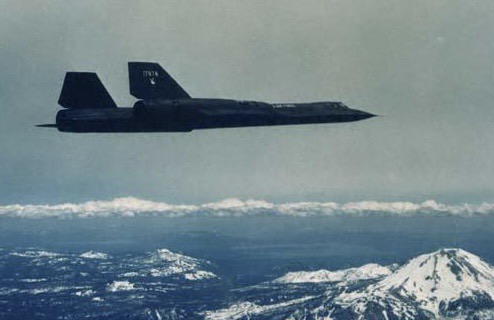
The USAF even once painted the infamous bunny logo on a Blackbird they designated the “Rapid Rabbit”.
Rapid rabbit. Photo: Lockheed Martin
The black bunny scheme originated in Pt Mugu, where VX-4 was based. Their call sign was “Vanderbilt”, and so all their jets were called Vandy. Vandy-1 was the commander’s jet and squadron flagship.
They put the logo on a few other non-black jets too. However, the black bunny versions were by far the most popular with the public and most widely seen.
usn photo
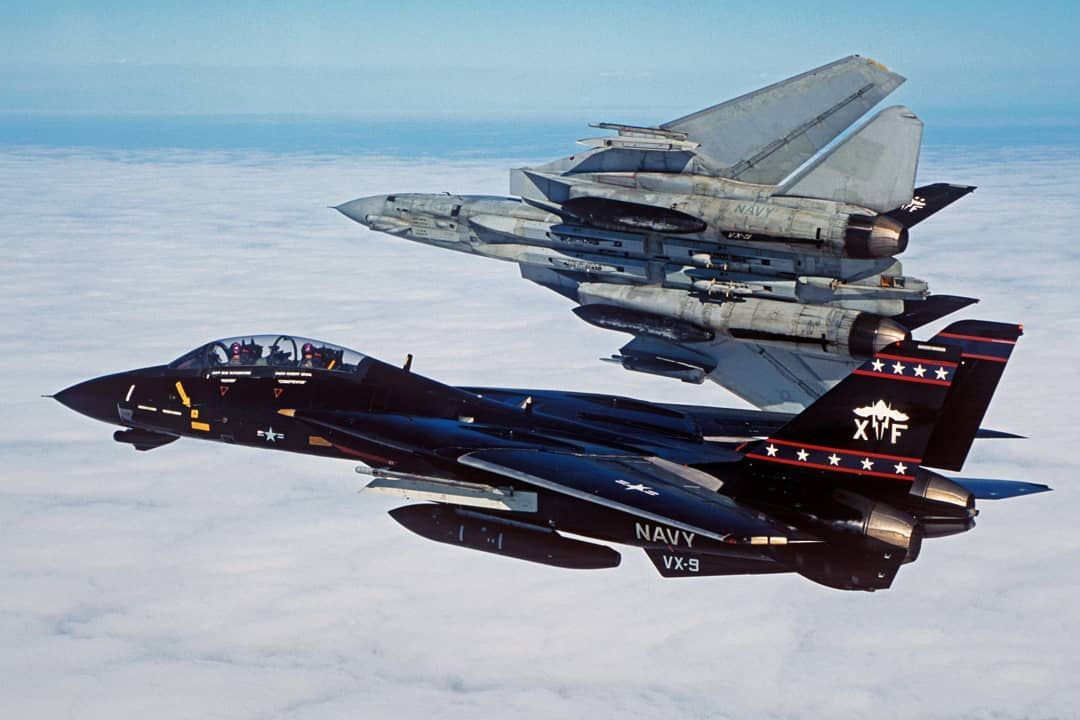
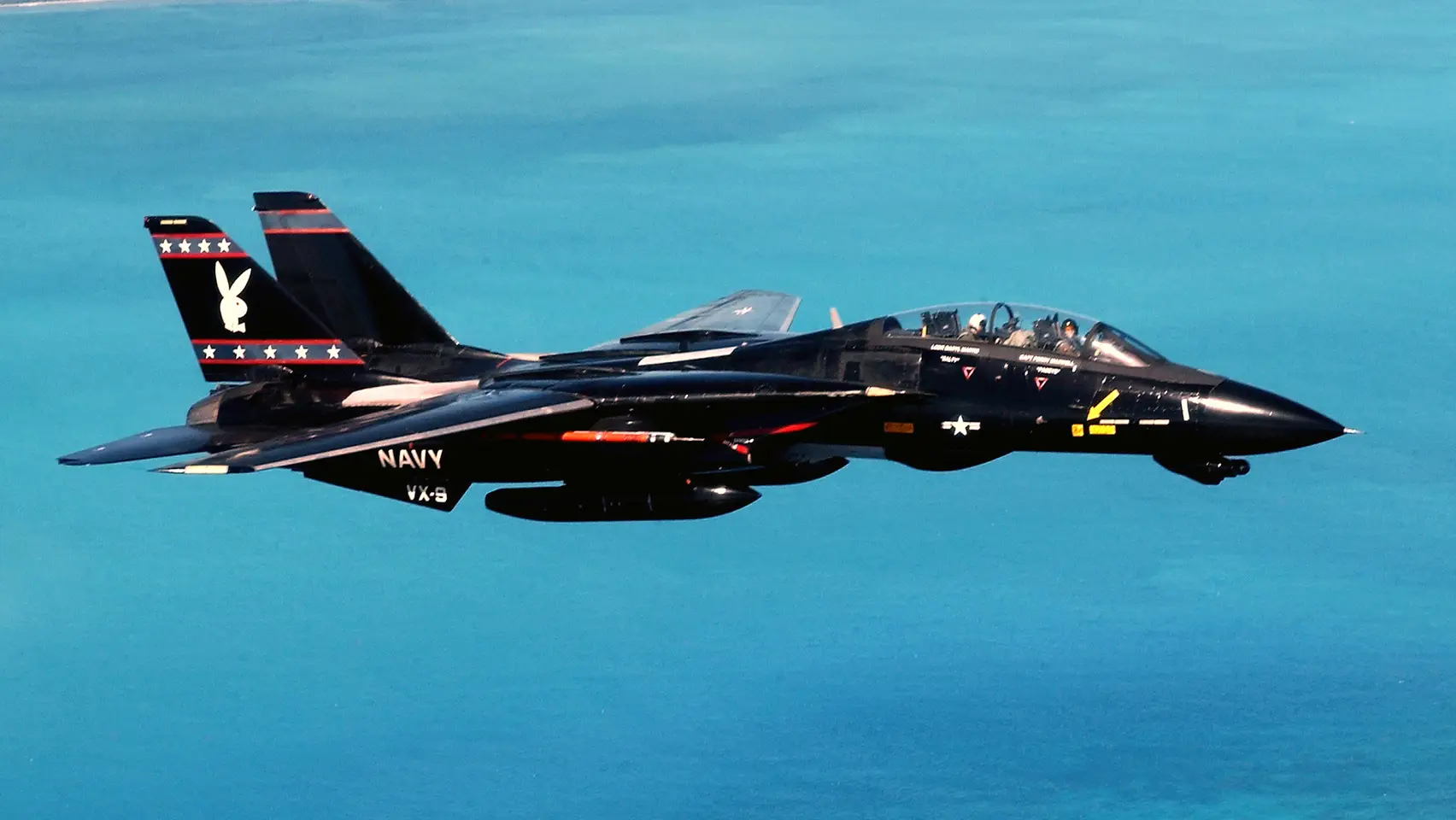
VX-4 was extinguished in the mid 90s and combined with VX-5 from China Lake, forming a new squadron VX-9 Vampires.
For a while, the jets swapped the bunny logo for test squadron markings. VX-9 had the logo for a short time on a standard grey Hornet, but the iconic bunny scheme soon vanished. The Navy put it back on the last F-14 ever produced, as a tribute on its final flights before retiring it in 2004.
Dod photo
The Vampires
The Vampires of VX-9 are responsible for a critical mission. They test and evaluate weapons and their related systems. Doing so ensures such capabilities are ready to integrate into the larger fleet.
The Vampires are based at Naval Air Weapons Station China Lake, CA (NAWS), which encompasses over 1 million acres. VX-9 crews hold a broad-range of expertise, and are known for their ability to adapt to difficult and dynamic testing environments.
Photo credit avgeekery / mike killian
Recreating an old Vandy-1 formation with modern aircraft
Both the Air Force and Navy use airspace in southern CA and Nevada. They recently decided to pay tribute to an old formation of an F-4 Vandy-1 with a Blackbird. The difference now being modern aircraft.
Vandy-1 Recreates Iconic Shot With U-2 Spyplane 87
The new Vandy-1 joined an Air Force U-2 from the 412th Test Wing, based at Plant 42’s Air Force Life Cycle Management Center.
USN Lt Jonathan Newberry was assigned as the photographer, executing the sortie over NAWS.
Vandy-1 Recreates Iconic Shot With U-2 Spyplane 88
“This formation demonstrates the commitment to safe air range operations, while further reinforcing positive test partnerships for the warfighter,” noted the USAF release.
Vandy-1 Recreates Iconic Shot With U-2 Spyplane 89
VX-9 sent Vandy-1 to several air shows in 2023, and we expect the same for 2024. If you want to see Vandy-1 for yourself, follow AvGeekery on Facebook where we will share its travel plans.
Living in a Crash Pad is a Love / Hate Relationship
Everybody needs a place to crash, even pilots. It’s a terrible pun, but the crash pad lifestyle has removed much of the glamour that used to surround the flying profession.
Most pilots I discuss crash pads with behind the flight deck door view them as a necessary evil. Significant percentages of pilots and cabin crew members in the majors and regional airlines choose to live away from their bases.
Many factors drive this decision, but the one factor that comes up repeatedly on the flight deck is, “It’s the economy, stupid.”
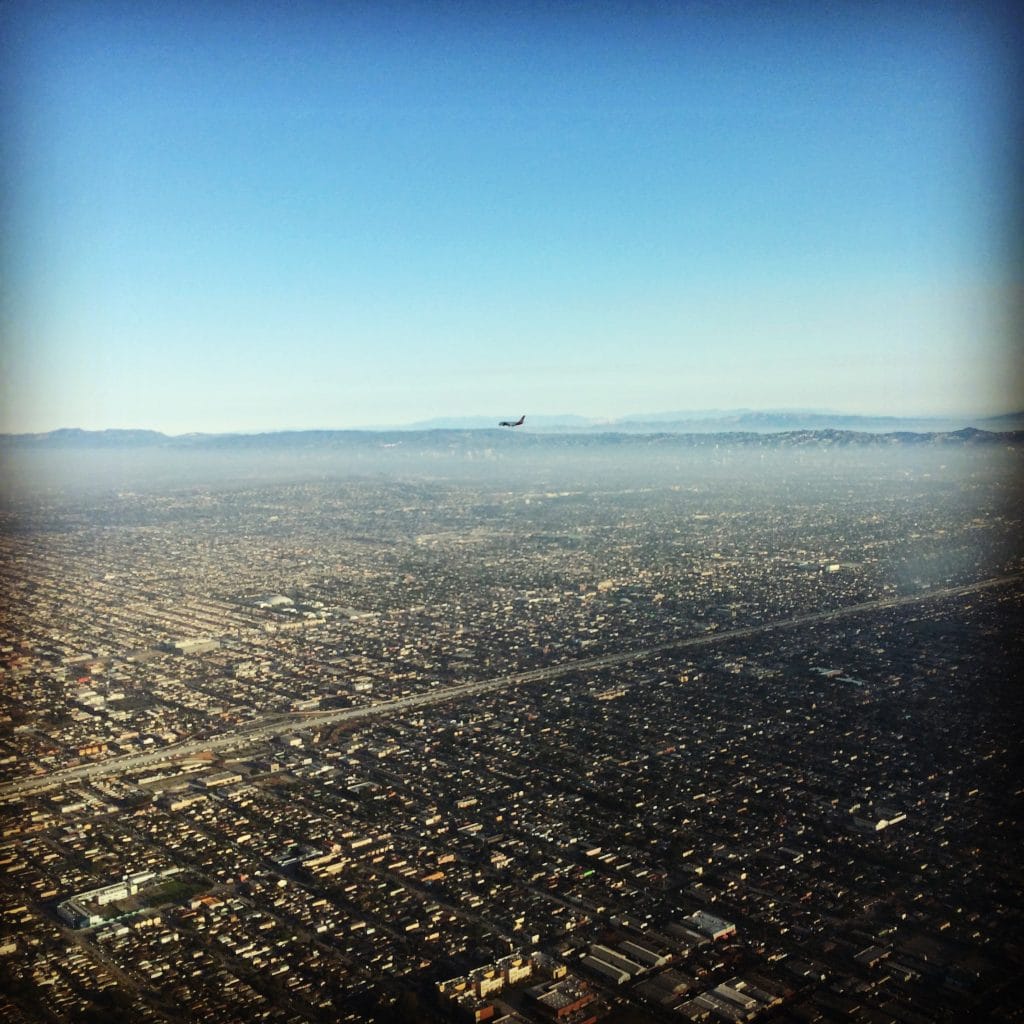
Aircraft on Approach to LAX 24R
Life, Liberty, and the Pursuit of QOL
Right or wrong, the cost of living in the places where most airlines (major/regional) have established crew bases is one of the costliest places in America to work. New York City (DAL, UAL, AAL, JBL), San Francisco (UA/AAL), the list goes on SEA, FLL, BOS, LAX, DEN, ORD, etc, etc, etc.
Living near a large metropolitan area is always costlier, and just about every airline domicile is in one. Commute times, rent prices, taxes, and the amount of land or square feet in a home you can purchase are also significantly affected by living in these areas.
And let’s not forget that pilot pay and flight attendant pay have been subjected to numerous concessions since 9/11, until very recently. Many aircrew members lost significant percentages of their income in the recession, some lost their homes, and many have been impacted, especially at the regional level, where an entry-level First Officer was paid less to fly a jet aircraft than a worker flipping burgers at the same Seattle airport (due to local minimum wage laws – that did not apply to contract workers).
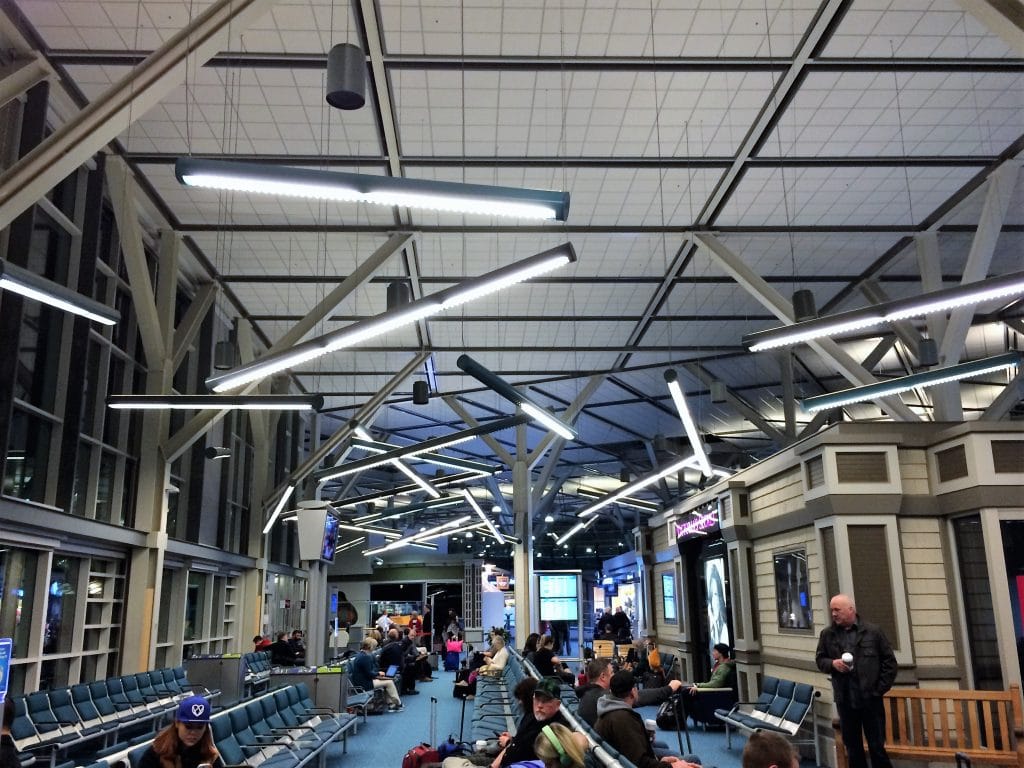
Departure Lounge in CYVR Vancouver, BC
The situation produced a significant income disparity between crew members at different levels. Regional crew members still had to subsist, pay rent, and operate out of expensive locations, while many crew members at the majors have decided to venture far afield from their domicile to find the best “QOL” quality of life for their families.
Most major companies have contractually adjusted their schedules to include a certain percentage of “commutable pairings,” which means that the start of a crew member’s trip is during the later morning or afternoon hours to allow a commute into domicile and that the trip concludes in domicile prior to the last flights leaving in the evening.
As you might imagine, most of these trips go to more senior crew members, and when it comes to commuting, “seniority really is everything.”
Enter the Crash Pad Mafia
Crash pads are the chosen way for airline crew members who want to or need to live “out of base” to have a cost-effective location to spend a night before or after a trip. Subsequently, the airline’s junior members will also spend 4-6 days at a time sitting reserve at their crash pad to make sure that your flight operates when a crew member calls in sick or can’t make it to the airport.
Reserve crew members spend the most time at the crash pad because getting a hotel room for 18-20 days out of the month is cost-prohibitive. The crash pad offers a ‘sensible’ alternative.
Exterior View of a SEA Airline Crew Crashpad
Crash pads typically come in two different flavors: Hot or Cold bunks. I know all you Navy avgeeks got a kick out of that phrase. The hot bunk style, as you may have guessed, allows any crew member who pays the monthly fee to select an open bunk (routinely lit by cell phone screen lighting in the middle of the night).
The cold bunk style is usually more costly and affords each crew mate the bed that they choose and pay for—some companies and proprietors have this down to a science. They even price-discriminate based on top/bottom bunks and the number of bunks in a room.
Part Animal House, Part MTV’s The Real World
It is strange to picture an apartment or large house teeming with adults of varying ages. No, there are no crazy party nights at the crashpads. If you want to listen to loud music, you’d better have your own earbuds.
Most social hours are spent in the living room or around the TV, discussing the latest contract dispute, TSA shenanigans, or emergency landing over takeout at the kitchen table.
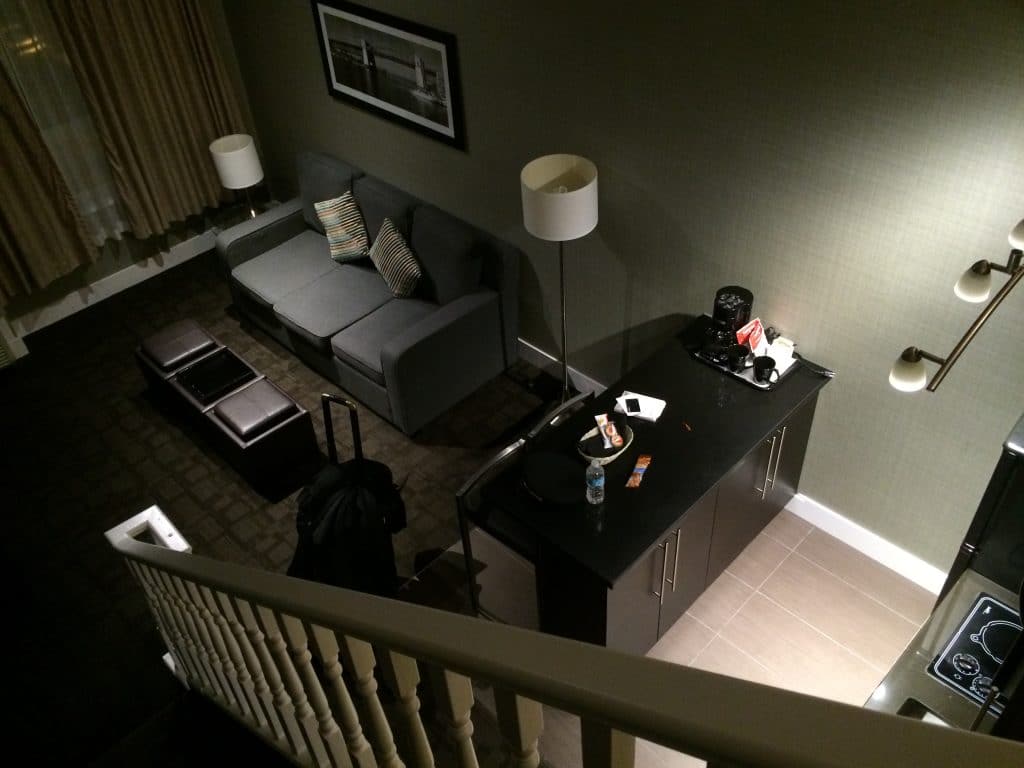
Pad Common Area
As a crash padder, beware of the ‘spoiler alert’—there is always the risk of walking in on a padmate who is watching your favorite Netflix show but has fallen a few episodes behind on your seasonal binge.
You run screaming out of the house so you don’t hear or see anything. The next moment, you are back on the street with your luggage in tow, and you forgot it was raining. Yeah, it’s happened…and to me.
Most pads have rules catering to the rest and relaxation of fellow crew members, and in my experience, the best ones have more rules about etiquette, quiet hours (24/7), washing the dishes, limiting items in the fridge, and requiring squeegeeing the bathroom shower.
In some pads, cleaning and maintenance are the responsibility of the padmates. You even have to take your turn dusting or taking out the trash.
View from New York City’s Central Park East
Finding a shred of personal space eventually becomes a necessity. This summer, during my days at the crashpad, I spent hours exploring Lower Manhattan.
As my reserve shift neared its end, I took the Subway into the city and strolled through Central Park or the MET—the New York Metropolitan Museum of Art. Sometimes, a crew member invited me to the local gym, and other times, I just read a book. I needed that peace and quiet.
The best crash pads offer transportation options or are within walking distance of the airport. Some airlines require crew members to cover multiple airports in a major city, such as New York City, where pilots and flight attendants can typically be dispatched from Newark, Kennedy, or LaGuardia.
And when a pilot or flight attendant does have some downtime, the best pads are close to amenities like grocery stores, gyms, restaurants, a library, maybe the beach, a park, or, if you are really lucky, a laundromat.
Flying is a pretty awesome job. But it’s not always glamorous. If you need a crash pad, be smart and do your research. You’ll be glad you did.
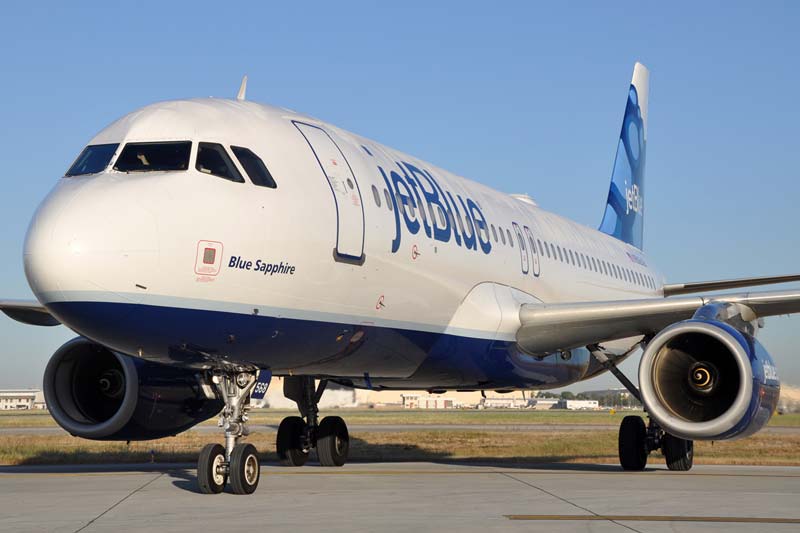
A new CEO is taking over JetBlue and she will be the first woman in the country to lead a major U.S. airline.
Company President & COO Joanna Geraghty is taking over. Current CEO Robin Hayes is stepping down next month due to health reasons and after consultations with his family.
A New CEO is Taking Over JetBlue 98
“The extraordinary challenges and pressure of this job have taken their toll,” says Hayes. “On the advice of my doctor and after talking to my wife, it’s time I put more focus on my health and well-being.”
Hayes has led JetBlue since 2015. He’s worked to make America’s 6th largest airline (by revenue), through expanded partnerships and by setting in motion a plan to merge with Spirit Airlines.
The justice department shot down the existing North East partnership with American Airlines last year. The DOJ is also trying to tank the big merger that Hayes orchestrated to buy Spirit Airlines for nearly $4 billion.
Merger could reshape the airline industry
In 2022, JetBlue beat Frontier in a bidding war for Spirit. The Justice Dept, however, has their doubts if that’s good for the consumer. A trial was held last month in federal court to decide if the merger can move forward or not, but the judge has yet to issue his ruling.
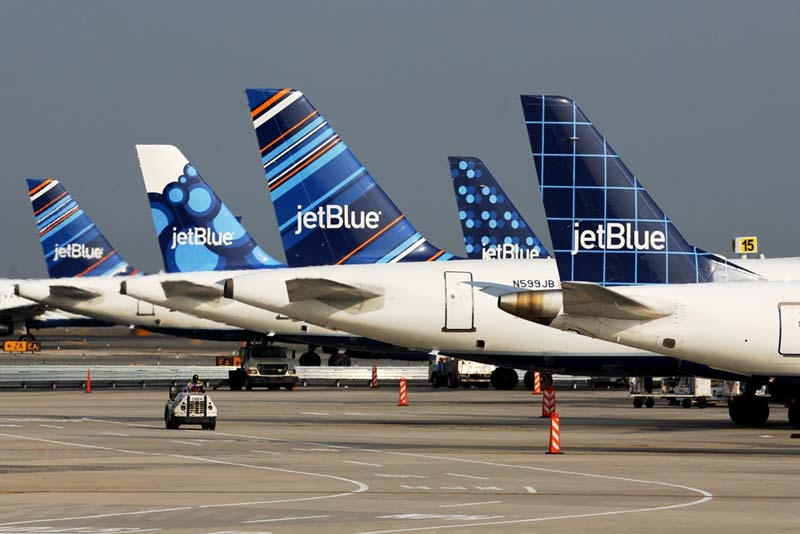
If the deal is approved, JetBlue’s fleet will grow to 458 aircraft. The company will service more than 125 destinations in 30 countries. The merger would give them a stronger foothold in key markets like Orlando and Fort Lauderdale, where they will retain a support center.
Image: Avgeekery
The Spirit branding would disappear. JetBlue HQ would remain in New York. The combined carrier would grow to become America’s 5th-largest airline behind only American, Delta, United and Southwest. Those airlines control 80% of the domestic market. Frontier would then take Spirit’s place as the nation’s biggest ultra low cost carrier.
Change of Command
Geraghty has been President and COO of New York-based JetBlue since 2018. She will take over as CEO on Feb 12.
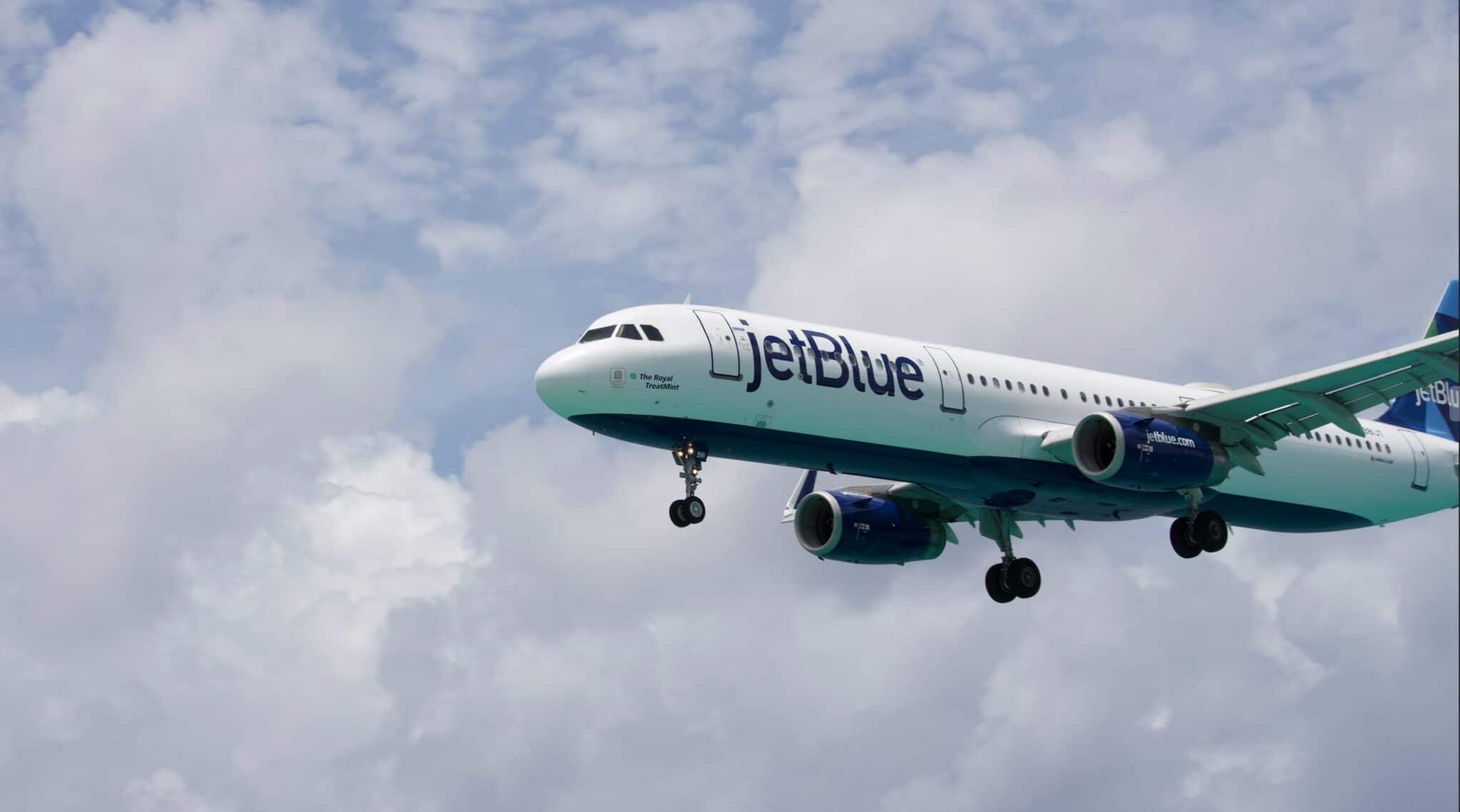
Photo: jetblue
Geraghty says she is “looking forward as we execute on our strategic initiatives, return to profitable growth, and generate sustainable value for shareholders.”
Current CEO’s parting thoughts
“I am deeply grateful for these many exciting years. I feel very lucky to have worked at an airline with a brand, culture and team that are simply unlike any other in the world,” added Hayes.
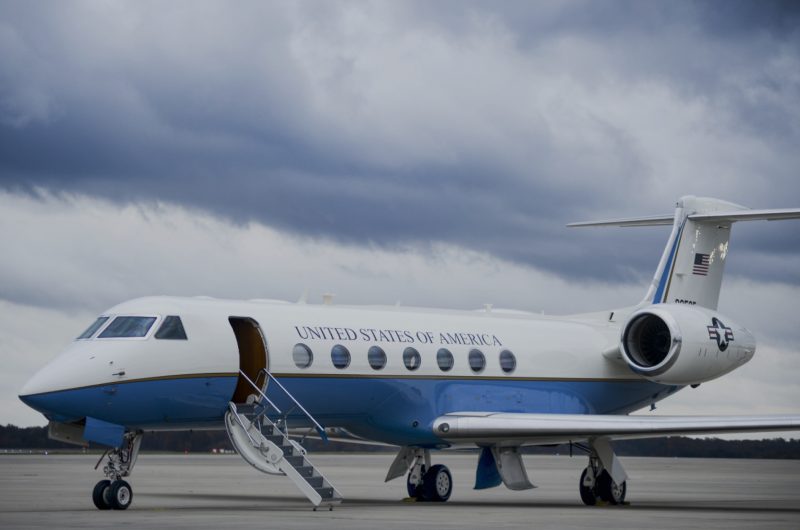
On April 14, 2004, I set out for my final overseas trip of my Air Force career in a C-37, a gleaming Gulfstream V. I had interviewed with Southwest Airlines one month earlier and was hoping to hear some results any day. Our eight-day trip retraced a lot of the same cities and bases I had flown to in October of 2001, the first trip after the 9/11 attacks. This time our customer was the new Special Operations (SOCOM) commander, Army General Doug Brown.
We made stops in Doha, Qatar, and Bishkek, Kyrgyzstan, before flying over the mountain range into Bagram Air Base, 45 miles north of Kabul, Afghanistan. Employing a combat arrival technique at the time, we overflew the air base at 20,000 feet, then spiraled down, staying within the confines of the airfield in order to limit our potential exposure to shoulder-fired missiles or anti-aircraft gunfire. The base was a major installation for our Air Force and numerous coalition forces, with American F-16s and A-10s flying daily combat missions. After spending the night at Bagram Air Base, we departed the next day heading south towards Pakistan, before turning west towards Muscat, Oman, where I had flown KC-10 missions during Operation Desert Storm in 1991.
I got a job offer During My flight
As we flew over Pakistan, a datalink message arrived from our squadron duty officer telling me that someone from Southwest Airlines had called looking for me. I knew that had to be a good sign! With our satellite air phone on the aircraft, I called the squadron.
“Hey Dave. I thought you’d like to know that a lady named Mary called for you and asked you to call her back,” he said, passing along her Dallas office phone number. I thanked him for the message and told him that I’d return the call as soon as possible.
After hanging up, I told my copilot the news. He grinned and goaded me, “You should call her back right now.”
“You really think so?” I asked.
“Sure!” he replied.
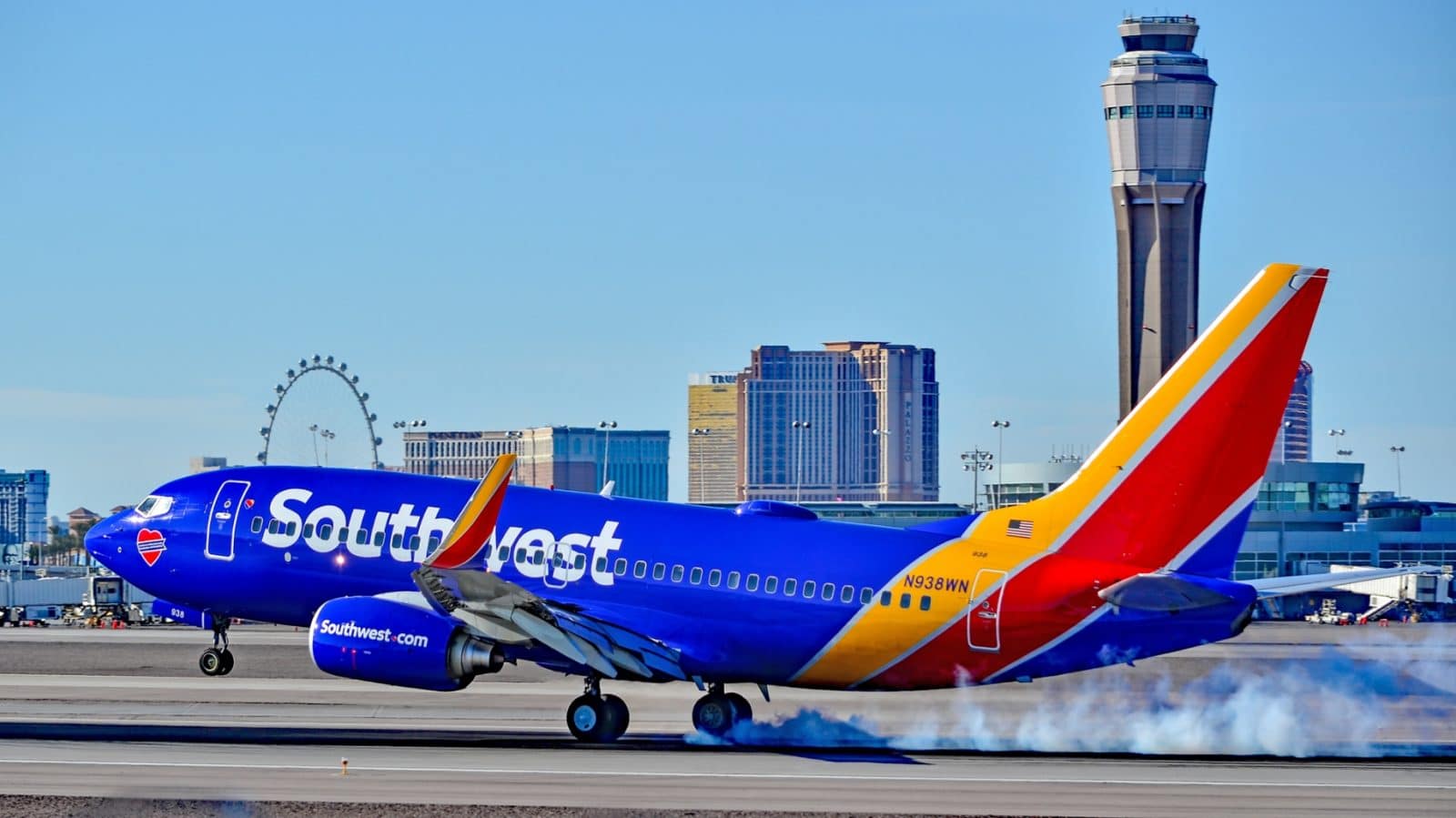
Image by Tomás Del Coro via Wikipedia
I picked up the satellite-phone and dialed the 214-area code number. A lady from the Southwest People Department answered and said it was time for me to schedule a drug test. She couldn’t commit to the fact that I was hired, but this was the next step and meant that I had passed the interview process. Southwest was now wrapping up the final details before they could offer me a job.
I told her, “I’m currently out of the country, but I’ll take care of that as soon as I get back home.”
She asked, “Where are you right now?”
“Well, I’m currently flying over Pakistan,” I told her. Yes, I was showing off.
“Oh, that’s so cool!” she replied.
That was the end of a very happy but short conversation.
This was fulfilling the second part of my teenage dream. I told myself as a high school senior that I wanted to serve 20 years as an Air Force pilot and then fly for Southwest, my home-state airline.
An hour later, we landed at Seeb Airport, Muscat, Oman, for a night’s stay. The base had come a long way since the tent city of 1990 to 1991. The desert military installation now had hard-sided buildings, a vast collection of tan, rectangular single-story portable shelters, each with window air conditioners and generators humming away.
The next day, as our crew strolled around the crunchy gray gravel paths of the small base, I told an enlisted crew member that when she was nine I had lived for three months in one of fifty canvas tents alongside the runway.
High to a Low
That afternoon, on April 22, we departed for the westbound trip back to Florida. A few hours into the trip, in the dark skies over the Atlantic the general’s aide, an Army major, came back up into the cockpit, yelling, “Son of a bitch!”
I turned around, asking, “What’s wrong?”
“Pat Tillman has just been killed.” he answered.
Pat Tillman, NFL Player and Army hero killed by friendly fire in Afghanistan. Image: DoD
This was the night a firefight took the life of Pat Tillman, the Arizona Cardinal’s National Football League player who walked away from millions of dollars to become an Army Ranger immediately after the 9/11 attack. The unfortunate deadly shooting later turned out to be from our own troops, but on this still night over the ocean nobody knew the details of his death. Everyone thought it was an enemy ambush on our forces.
This was a somber, low point of a roller-coaster two-day period. What had started with the excitement of my potential hiring with Southwest Airlines now concluded with the death of a true American hero. Our cockpit was very quiet as we flew westward over the dark ocean.
This is the story of pioneering aviator Jackie Cochran’s record-setting flight in 1961.
On 22 April 1961, a sleek Lockheed L-1329 JetStar lifted off from New Orleans on a bold mission across the Atlantic. By the time it landed in Bonn, Germany, the jet had shattered 18 world records.
Jackie Cochran, circa 1943 | IMAGE: Public Domain
The Fédération Aéronautique Internationale (FAI) signed off on the achievements, and the US Centennial of Flight Commission later summed it up simply: the flight “set more speed and altitude records than any other pilot.” And the pilot? None other than Jacqueline “Jackie” Cochran, one of the most remarkable aviators of the 20th century.
Cochran was no stranger to firsts. In 1953, she became the first woman to break the sound barrier, flying a Canadair F-86 Sabre high above the California desert. That moment put her in the history books, right alongside her friend Chuck Yeager, who had done the same just six years earlier. A well-known photo captures the two of them together, two legends sharing a laugh. But Jackie’s story goes much deeper than one headline-grabbing flight. She was a racing champion, a record-setter, and later the first woman honored with a permanent display at the US Air Force Academy.
More Than Just Records
Jackie Cochran and Chuck Yeager being presented with the Harmon International Trophies by President Dwight D. Eisenhower. (Photo courtesy Air Force Flight Test Center History Office)
Jackie Cochran (center) with WASP trainees | IMAGE: Public Domain
Her influence wasn’t limited to records in the sky. During World War II, Cochran played a key role in organizing women to support the war effort from the cockpit. She pushed for the creation of the Women’s Auxiliary Army Corps (WAAC) and, more famously, the Women Airforce Service Pilots (WASP). These women ferried airplanes, trained male pilots, and took on vital behind-the-scenes flying jobs that freed men for combat. While they didn’t fly in battle, their contributions proved that women had a rightful place in aviation—a point Jackie fought for her entire career.
After the war, Cochran stayed connected to the military. She joined the US Air Force Reserve in 1948 as a lieutenant colonel and eventually rose to full colonel before retiring in 1970. She passed away a decade later, but her trailblazing work continues to inspire generations of aviators.
The airplane she used for her 1961 record run carried a fitting name: The Scarlett O’Hara. On the way to Bonn, the JetStar made stops in Gander, Newfoundland, and Shannon, Ireland, before completing its 4,300-mile journey. At the time, the idea of a business jet handling that kind of mission was revolutionary. And that’s where the JetStar program itself comes into the picture.
The JetStar Program Takes Off
Lockheed developed the JetStar in the mid-1950s to fill a gap in the market. Companies and military units needed something smaller than a commercial jet but faster and more capable than a prop-driven aircraft. The JetStar first flew in 1957, and its four rear-mounted engines gave it both power and style. It could cruise at over 500 mph—similar to a Boeing 707—but carried only eight to ten passengers in a roomy, executive cabin. For business leaders, military officials, and even a few celebrities, the JetStar was the perfect mix of speed, range, and comfort.
The program was a success. Between 1957 and 1978, Lockheed built more than 200 JetStars. Some went to the US Air Force, where they served as transport and utility aircraft. Others found their way into private hands. Elvis Presley, for example, owned two of them, further boosting the JetStar’s image as the jet of choice for those who wanted both power and glamour.
Still, Jackie Cochran’s flight in The Scarlett O’Hara stands out as one of the JetStar’s defining moments. Her record-setting trip showcased exactly what this new class of business jet could do. Later, that very aircraft was acquired by NASA for research and testing before being retired to the Joe Davies Heritage Airpark in Palmdale, California. Today, visitors can walk up to the jet and imagine what it must have been like for Jackie to push it across the Atlantic at record speeds.
A Legacy That Still Inspires
In the end, Cochran’s 1961 JetStar flight wasn’t just about numbers on a chart. It marked the beginning of a new era in aviation—an era where business jets could cross oceans, where women could lead from the cockpit, and where pushing boundaries was part of the job. Jackie Cochran’s courage and vision made her one of aviation’s great pioneers.
The JetStar flown by Cochran on her record setting flight in 1961 was acquired by NASA and is now on static display at the Joe Davies Heritage Airpark, in Palmdale, Calif.
One of the best aviation videographers out there, Spencer Hughes, caught the Navy’s Blue Angels arriving in the Mojave desert yesterday to begin winter training. Watch the Blue Angels arrive at El Centro below.
video shot and edited by Spencer hughes
Flying inches apart at several hundred mph in combat fighters is no easy feat. It may look that way from the ground, but that’s because the crews practice and fly daily. During Winter Training, it’s not uncommon to see them fly multiple sorties a day.
A busy 10 weeks ahead
Team at nas pensacola (photo via blue angels)
The precision flying team departed their home base at NAS Pensacola, FL on Jan 4. El Centro is the ideal training location for them, due to the desert’s dry air and predictably calm sunny weather. For the next 10 weeks, they will practice their formations and demo, and slowly bring the formations in closer as the winter progresses.
The 4-ship diamond will do their practices, followed by the two solos. Each will be flying 6 days a week practicing over the desert, flying multiple sorties daily as they build their air show demonstration for millions of spectators nationwide in the year ahead.
Team over el centro (photo via blue angels)
“We travel to 32 air show sites a year putting on air shows and executing outreach events in the hopes that we can showcase what the Navy and Marine Corps represents, and hopefully inspire some folks to potentially join us,” said BOSS, the Commanding Officer of the team Alex Armatas, who is flying as #1 for his second year.
Trust is not just a word or an idea for the team, it is literally their life. Over the next 3 months they will build that bond which helps them execute such impressive flying. In some maneuvers they can’t even see each other, relying purely on radio calls and trust that each pilots does what they are supposed to.
Team arriving on jan 4 (navy photo)
Their first air show is scheduled to occur at El Centro in March. You can see their 2024 air show schedule here.
A B-1 Lancer crew is safe on the ground tonight, following ejection from their bomber at Ellsworth AFB in South Dakota.
Details are few, Air Force officials confirmed the crash occurred shortly before 6:00pm local. The bomber was attempting to land on the base after conducting a training mission.
USAF photo
“A board of officers will investigate the accident,” noted the base on social media. “Additional details will be provided as they become available. For questions regarding this incident, contact the 28th Bomb Wing Public Affairs Office at (605) 385-5056, or by e-mail at 28bw.public.affairs@us.af.mil.”
We’ll update as details come out.
Not the first B-1 to crash from Ellsworth
Two squadrons of B-1s operate out of Ellsworth. A number of their giant bombers, affectionately known as the BONE, have crashed since the 1980s, or had serious incident. One crash in 1988 also saw that crew eject safely while landing.
Usaf photo
Other Ellsworth BONE crews have not been as lucky. One crew crashed in 1997 over Montana. All were lost.
In both instances, pilot error was to blame. Another incident occurred over Montana again in 2013, but the crew ejected safely. Another Ellsworth B-1 was lost in 2001 after taking off from the Indian Ocean for a combat mission in Afghanistan. They too ejected safely and were rescued by the U.S. Navy.
An Ellsworth BONE had a mid-air collision with a refueling tanker in the early 90s (both planes made it back to base). Another burst into flames in Guam in 2005 while taxiing. In both instances the crew were ok.
Sun is setting on the B-1
The sun is setting on the B-1 Lancer. The USAF is bringing online their next generation stealth bomber to replace it, the B-21 Raider, which you can read about here.
AMERICA’S FIRST B-21 STEALTH BOMBER UNVEILED ON DEC 2 (PHOTO: USAF)
Northrop Grumman has been developing the new bomber now for years. Six aircraft are currently in various stages of production and testing, and flight testing is currently underway in Southern California. Development has been highly classified.