Home Blog Page 59

Exclusive Interview: Space Shuttle Discovery’s Last Pilot Col. Eric Boe

CAPE CANAVERAL, Fla. — NASA astronaut Col. Eric A. Boe, who piloted the final flight of space shuttle Discovery ten years ago this week, recalls the exciting 13-day mission to service the International Space Station.

The 133rd space shuttle flight delivered tons of supplies, including water and oxygen, to the orbital laboratory in February and March 2011. Discovery’s six-person crew also left the Leonardo multi-purpose module docked to the station.

5513154884 71c10018f5 k
STS-133 Commander Steve Lindsey, Pilot Eric Boe and Mission Specialists Alvin Drew, Steve Bowen, Michael Barratt, and Nicole Stott pose post-landing with Discovery on March 9, 2011. (NASA)

On March 9, 2011, Boe and mission commander Steven Lindsay piloted Discovery to a safe landing at the Kennedy Space Center. In total, Discovery spent a combined 365 days in space; orbited the Earth 5,830 times, and traveled a distance of 148,221,675 miles during 39 flights.

In an exclusive interview with this aerospace journalist, the former U.S. Air Force fighter and test pilot discusses his feelings related to the space flight. From the emotions of the mission to his piloting time around the space station.

Eric A. Boe: From a CAP Student to NASA Astronaut

Eric Boe’s career in aviation began as he joined the Civil Air Patrol which is an auxiliary of the Air Force. This took Eric toward earning his pilot’s license and his first solo at age 16.

Col. Eric Boe: “For me I was always interested in aviation. I’m the person when I’m out there and I hear some noise in the sky whether it’s a bird or an airplane I’m looking up there checking it out,” Boe explained with a smile as we began.

“I was very interested in the military and wanted to be a military pilot and Civil Air Patrol was a chance to see those things. I decided to go to the Air Force academy, and CAP was a good place to start.”

5711298991 0a24d00250 k
NASA ASTRONAUT ERIC A. BOE DISCUSSES SPACE AND AVIATION WITH AEROSPACE JOURNALIST CHARLES A. ATKEISON.

Charles A Atkeison: Moments before boarding Discovery all of us smiled during your crew huddle at the base of the launch pad just hours before lift-off.

Col. Boe: “We had a huddle as a team, we just said a quick prayer, and just said looking forward to the mission, and let us do well. It was a good way to get ready for the mission and to give us some focus before we get on the rocket to go.”

The Role of a Space Shuttle Pilot

Charles: During the launch, discuss what the pilot is doing during the ascent.

Col. Boe: “The pilot is basically operating all the major systems that are on the shuttle. The main engines. I have the switches for shutdown the engines, starting the engines; (switches) for any type of leaks or any other thing. I monitor the systems for the main engines as we go up hill. Also, all the electrical power switches that we have on one side. Auxiliary power units actually provide all the hydraulic power to basically move the engines bells on ascent.

We actually move the flight control surfaces to do what we call load relief, but as you’re going through the atmosphere, because the wings of the shuttle are producing lift because the wind forces blowing on them, we actually move the flight control surfaces as we’re going uphill.”

Charles: Share with me your feeling of the Cupola node (aboard the space station). I’m a big fan of the Cupola, you have a big 360-degree field of space… Is it a man-cave? How would you describe it?

Col. Boe: “Yes, that’s a good way to describe it. It’s an awesome facility to see. The 360-degree field of view, you can’t say enough good things about it. One of the things it really helps us do is we do a lot of robotics and spacewalks, and we can set it up to watch through a window.

522708main s133e007740 hires
Eric Boe and space station resident Cady Coleman work controls in the Destiny laboratory of the International Space Station during Discovery’s visit in 2011. (NASA)

One of the things that great view gives us is the ability to move that (station’s) arm around and grab things. And, then a secondary benefit of that is when you have some free time, we have a gym there that’s right below it and when no one is in front of you you can actually work out and be looking out and see the planet — it’s such an amazing view.”

Charles: What types of music did you bring on board?

Col. Boe: “I brought up a wide selection, I have a a whole bunch of varied songs… I guess, I probably grew up in the 80’s, so I have a lot of 80’s kind of rock, I have some newer stuff as well. Just a wide variety of different kinds of music. It’s very nice at the end of the day. You get a little bit of wind-down time as you’re getting ready to sleep. So a lot of people as they’re winding down in their sleeping bag usually put their ear phones in and listen to a little bit of music.”

Charles: Now after undocking from space station, you had your chance to fly Discovery around the outpost before heading home. What was on your mind as you navigate what I like to call the ‘White Dove’ on the ocean of space?

Col. Boe: (Laughs) “I haven’t heard that term, the White Dove, that’s good, well put. The (station) is amazingly big. We were actually — when we were docked — probably the biggest the space station was going to be in the near future. We had the space shuttle up there, and we had the ATV European vehicle, we had the Japanese HTV which we reached out and grapple with. And, we attached the last module that’s going on the space station in the near future.


And, we also had the Russian vehicles. And, as we’re flying around we take the vehicle out. Discovery flies just a dream, she’s a dream ship — the dream machine is the way I like to say. (She) flies very well, very responsive when you put in the controls.

The one thing you can’t really reproduce on the ground is the ‘boom’ of the reaction control system jets, it’s such a deep bass… It’s a good chance to also survey the vehicle.”

5512333441 3a3c53f817 k
Space shuttle Discovery lands at the Kennedy Space Center for the final time in March 2011. (NASA/KSC)

Charles: Was the fly around one of your toughest challenges as a pilot?

Col. Boe: “We train over and over again so by the time you do it you feel very comfortable doing it. There’s some work involved like most of the tasks on board there very do able… There’s the challenge you want to do the best you can do… it’s a task you can do it in your sleep is how I like to say it.”

Charles: Thank-you.

Today, Discovery remains on public display at the Smithsonian’s Steven F. Udvar-Hazy Center in Dulles, Virginia. Eric Boe remains a critical part of the astronaut corps based at the Johnson Space Center near Houston.

(Charles A Atkeison reports on aerospace and technology. Follow his updates via social media @Military_Flight.)

Blue Angels to Headline Saturday’s ‘Festival of Flight’ Airshow

PENSACOLA, Fla. — The U.S. Navy Blue Angels will launch into their 75th anniversary season on Saturday with a single day air show from Southern California.

The inaugural Festival of Flight air show is scheduled for March 13, from the home of the Blue Angels winter training grounds at NAF El Centro. High-flying performances by a variety of military aircraft are also scheduled to perform from 12:30 p.m. to 4:30 p.m. PST.

The military jet performances for the Festival of Flight will be closed to the public due to Covid-19 concerns. Only a live radio broadcast will be available.

6537269
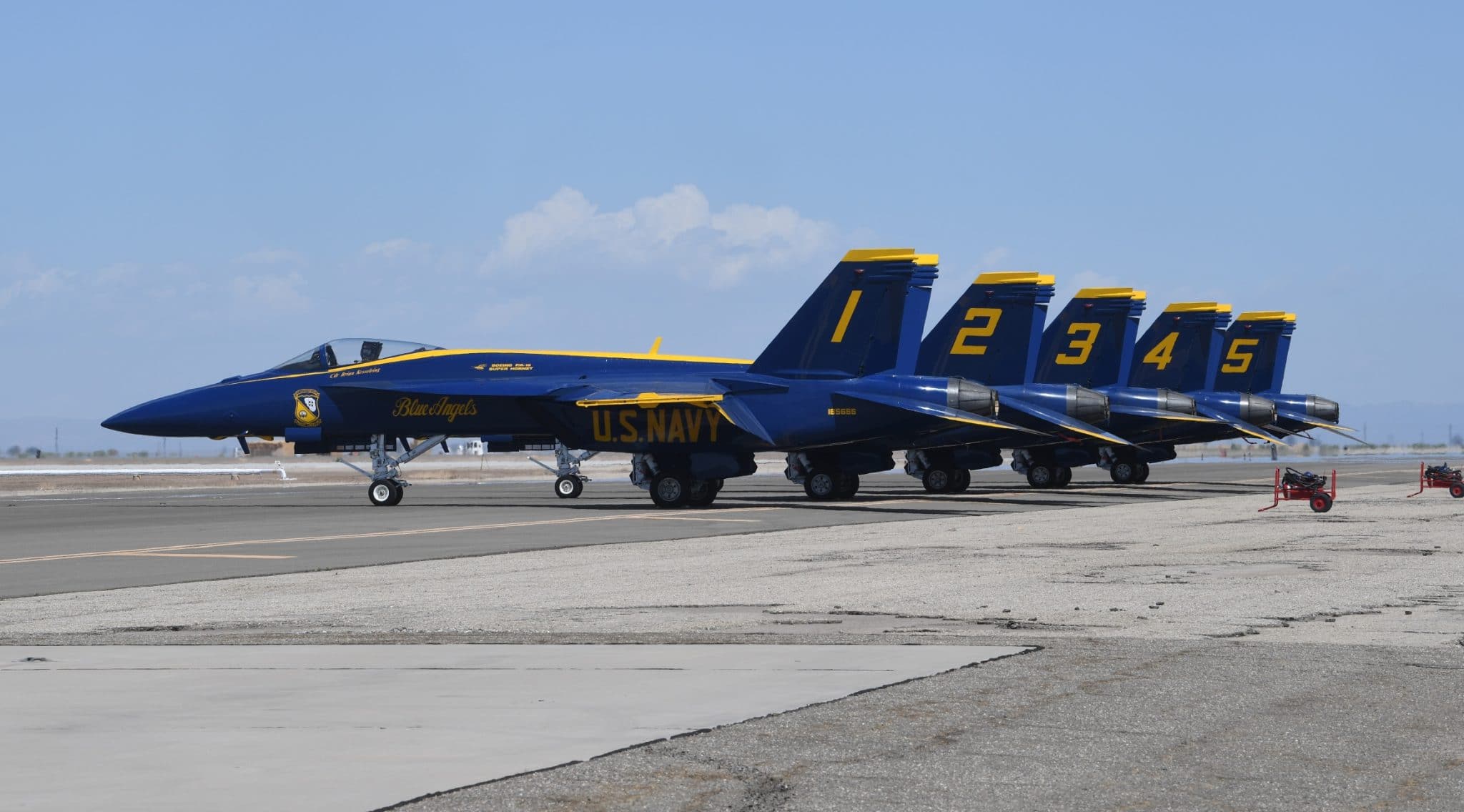
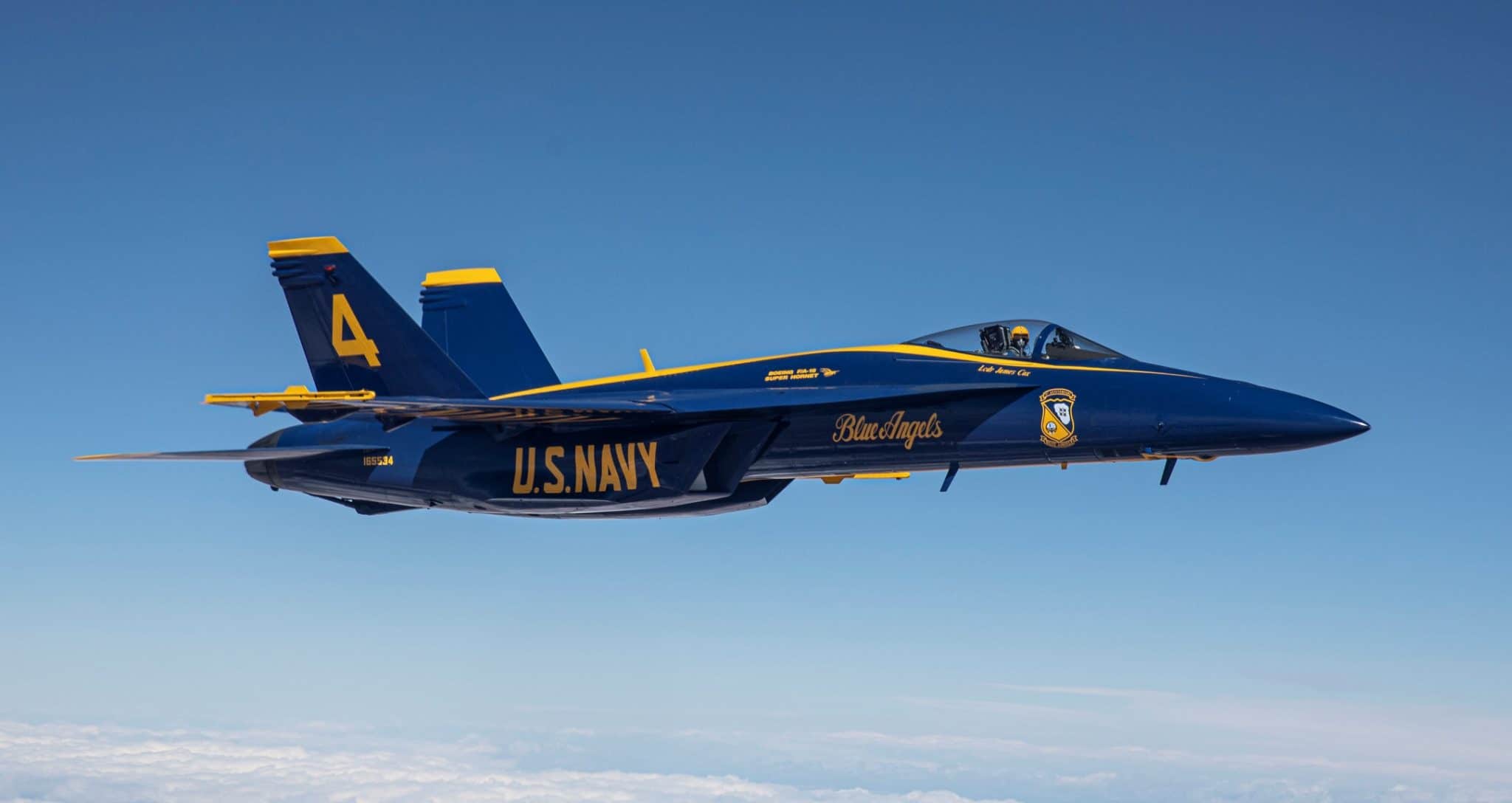
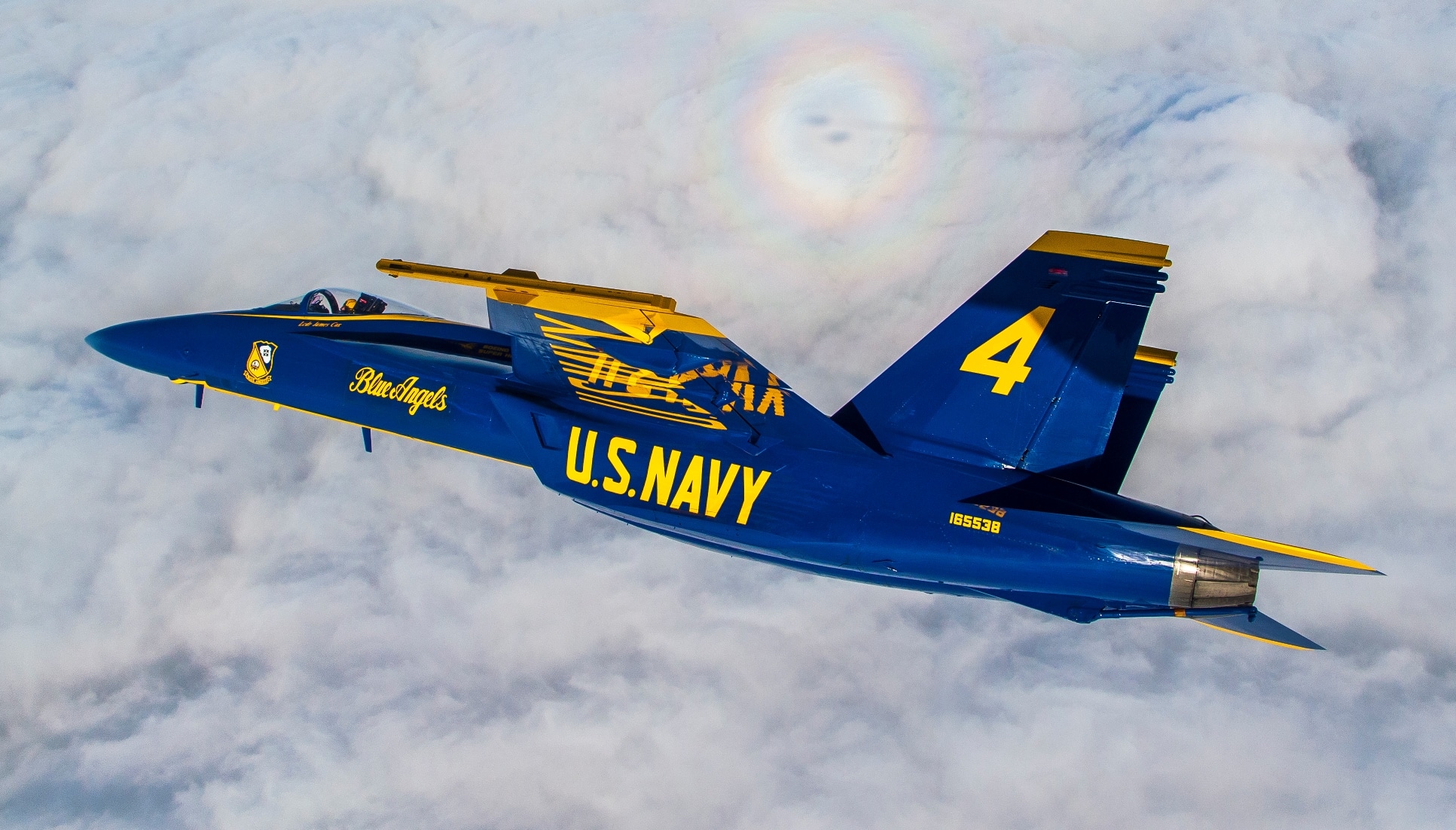
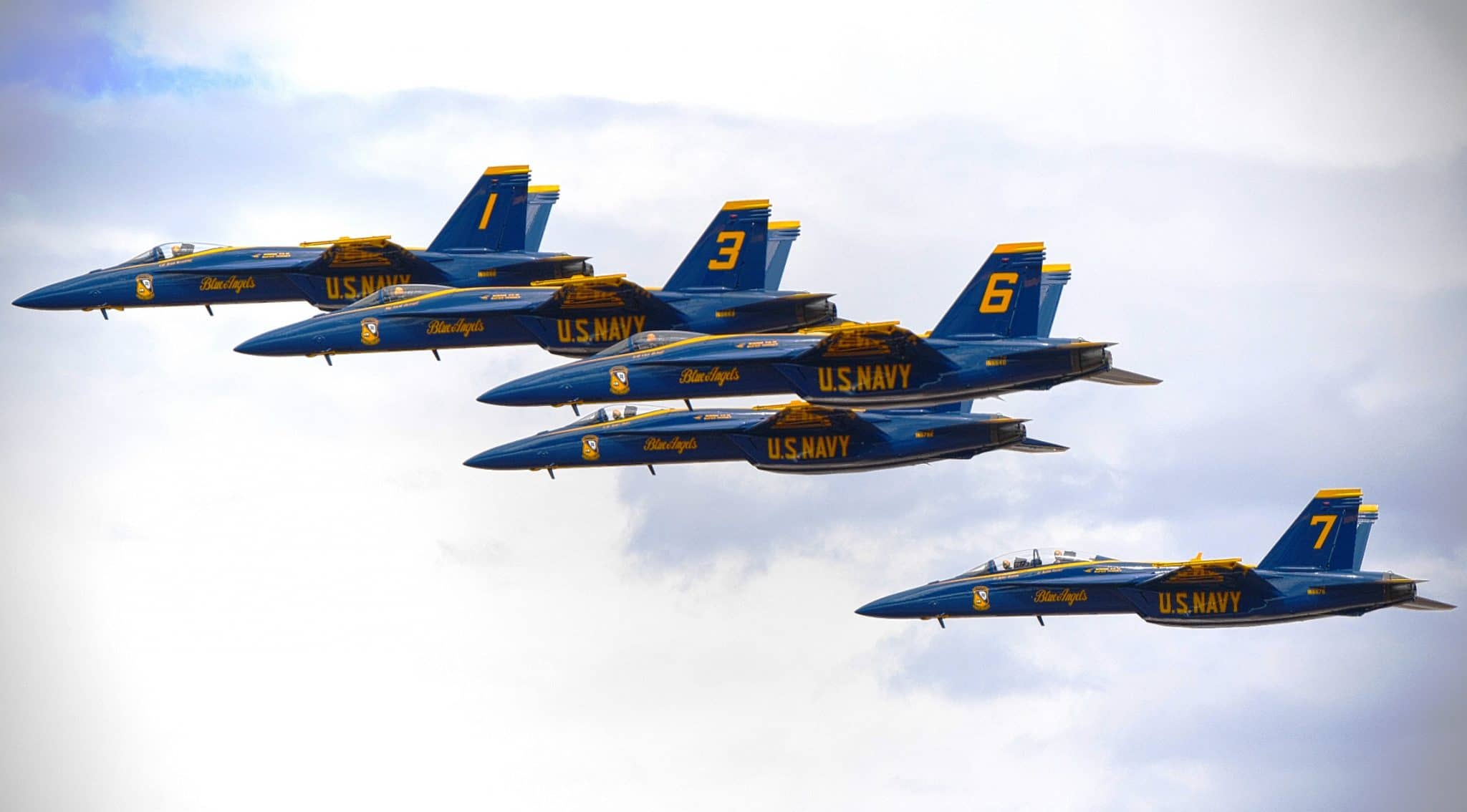
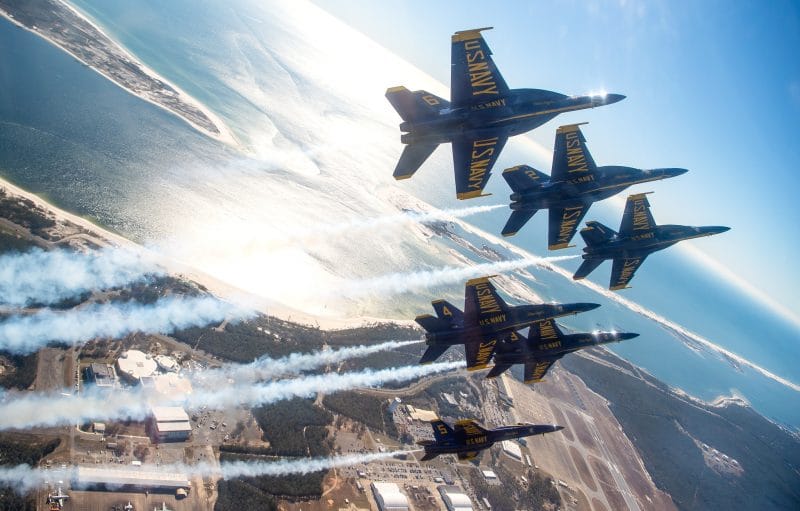
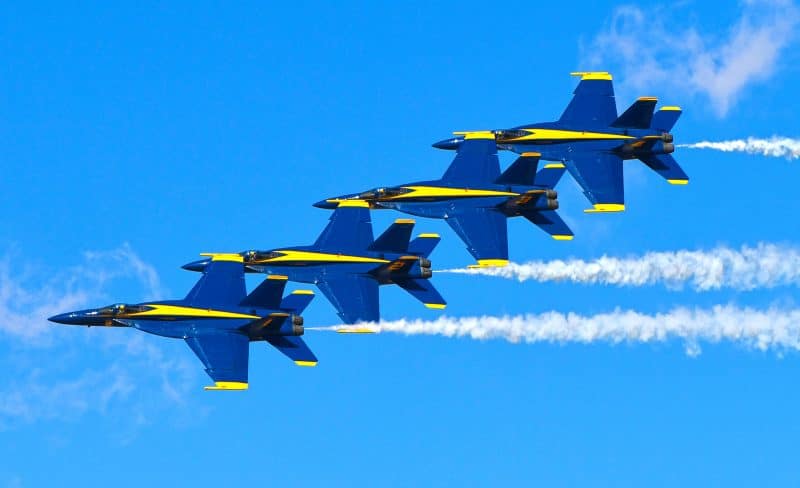
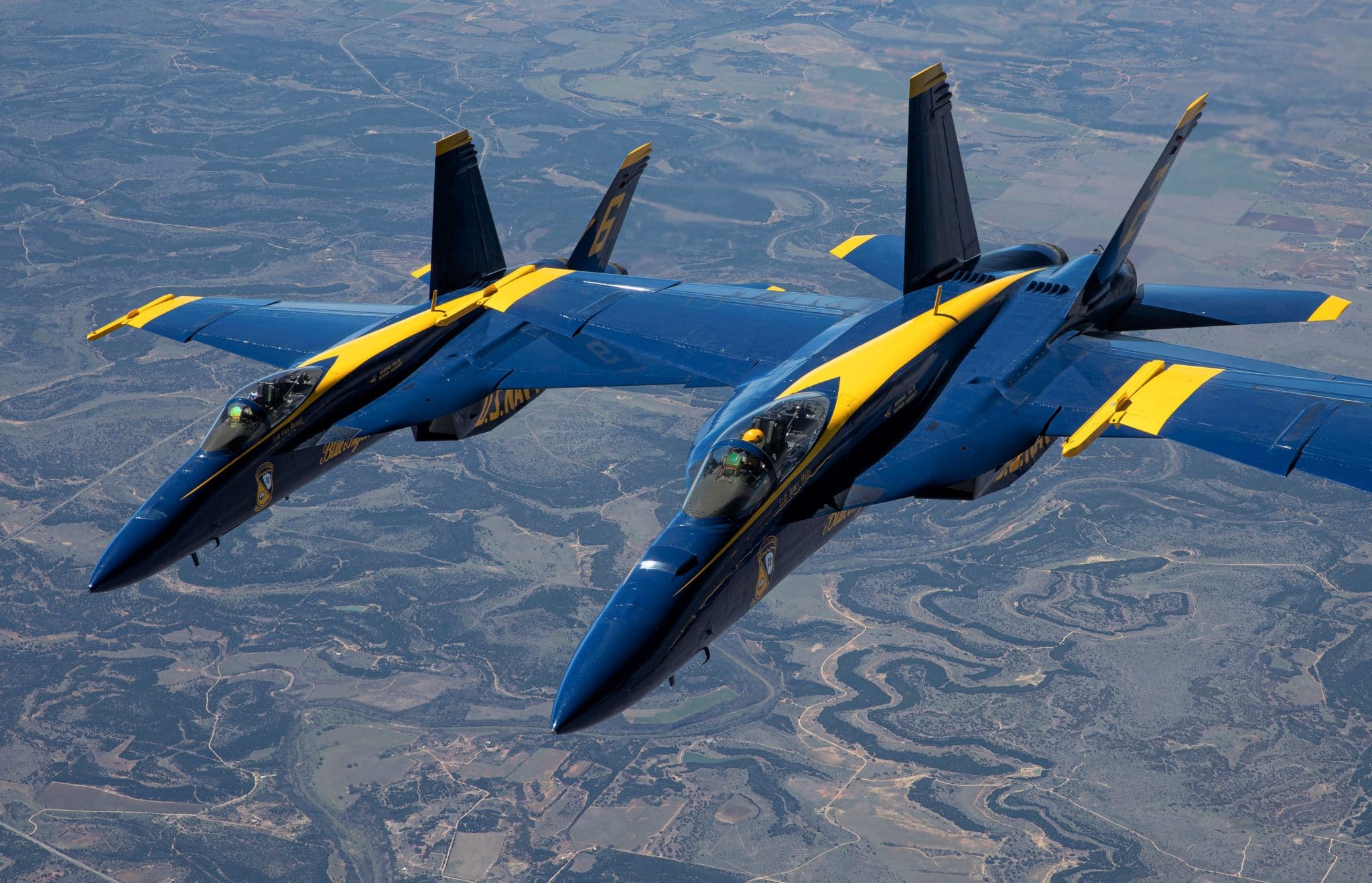
the Blue Angels perform the Line Abreast Loop maneuver during a February training flight over NAF El Centro. The 2021 season will be the Blues’ first year flying the Super Hornet. (U.S. Navy MCS2 Cody Hendrix)

“We want everyone to enjoy the festival and the aviation demonstration teams which will be performing and broadcast in a virtual space,” NAF El Centro commanding officer Capt. William Perkins said. “Although we cannot accommodate a public viewing on or near the base, we will be providing the experience through live radio broadcast and following up the festival with short videos highlights which enable a safe, virtual, contactless experience.”

Residents in the Imperial Valley can tune to radio stations 107.5 FM or 1230 AM for live air show commentary. The stations presently do not stream via the Internet.

The Imperial Valley show will mark the Blue Angels first full show featuring their F/A-18E/F Super Hornets. The squadron upgraded from the smaller legacy hornets last November.

“We deeply appreciate the expertise and operational knowledge Blue Angels past and present have brought to the team,” Blue Angels commanding officer Cmdr. Brian Kesselring said. “We look forward to enhancing our operations as we fully transition to flying the Super Hornet.”

Performances will also include the Air Force’s A-10C Thunderbolt II and the Navy’s F/A-18F TACDEMO from NAS Lemoore. The Navy Leapfrogs jump team and the Marine Corps’ MV-22 Osprey are also scheduled to perform.

12:30 p.m. U.S. Navy Parachute Team – The Leapfrogs
12:45 p.m. VFA-122 F/A-18F TACDEMO
13:05 p.m. VMM-163 MV-22 (Osprey) Demo
13:20 p.m. USAF A-10 Thunderbolt II Demo
13:45 p.m. VFA-122 F/A-18F TACDEMO
14:30 p.m. U.S. Navy Blue Angels

The Blue Angels are scheduled to perform 53 flight demonstrations at 28 locations across the United States and Canada during 2021.

(Charles A Atkeison reports on aerospace and technology. Follow his updates via social media @Military_Flight.)

WATCH: Incredible Air-to-Air Imagery of the New Blue Angels Super Hornets

Tasty Stuff Shot From the Back Seat of #7

During December of 2020, the United States Navy Flight Demonstration Team, the Blue Angels, completed their transition to their new Boeing F/A-18E and F/A-18F Super Hornet aircraft. The team took the opportunity to use one of their “legacy” #7 F/A-18D two-seater Hornets to shoot some truly magnificent air-to-air video and still photography. In the back seat of the photo jet was none other than MC2(SW) Cody Hendrix. Hendrix captured some beautiful imagery and some of the video and stills were uploaded to YouTube by AirshowStuffVideos. Enjoy!

[youtube id=”lP1YrS2JrHc” width=”800″ height=”454″ position=”left”]

The Blues Never Seem to Get the Pick of the Litter

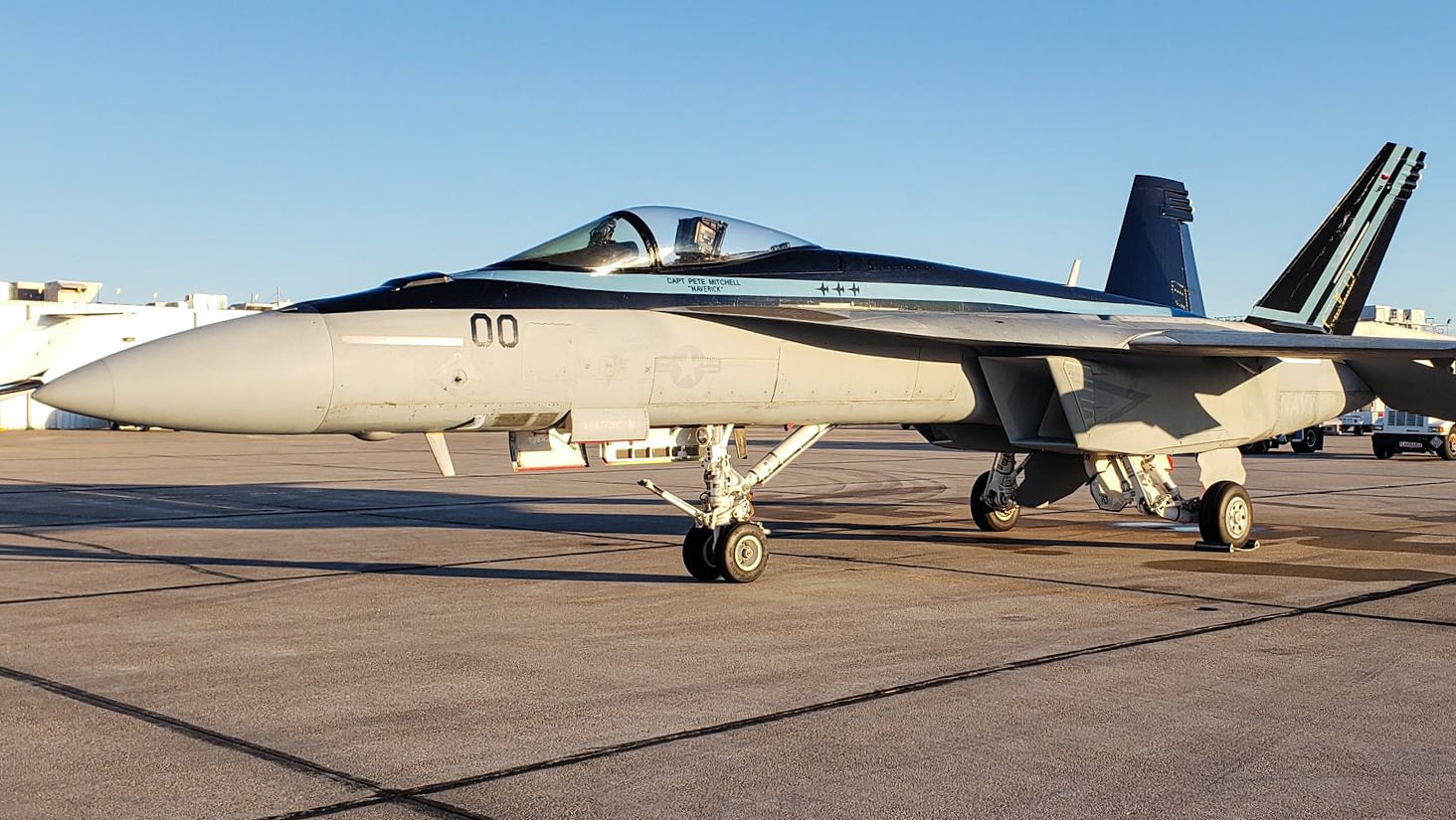
It’s not widely publicized but the Blue Angels, going back to the A-4F Skyhawk era, flew some of the most “experienced” airframes in the service. The Super Hornet era will be no different. There are no new-build or even recent-build airframes wearing those striking blue and gold colors. All 11 team jets (nine F/A-18Es and 2 F/A-18Fs) are either early production aircraft used primarily as test aircraft and/or have been in long-term storage at one time or another. At least one of the jets was used for the aerial sequences in TOP GUN: Maverick.

6534968a
US Navy image by MC2(SW) Cody Hendrix

Blue Angels 2021 Team Officers and Key Enlisted Men

#1 Commander BRIAN C. KESSELRING USN- Flight Leader / Commanding Officer

#2 Lieutenant Commander JAMES HALEY USN- Right Wing

#3 Major FRANK ZASTOUPIL USMC- Left Wing

#4 Lieutenant Commander JAMES COX USN- Slot

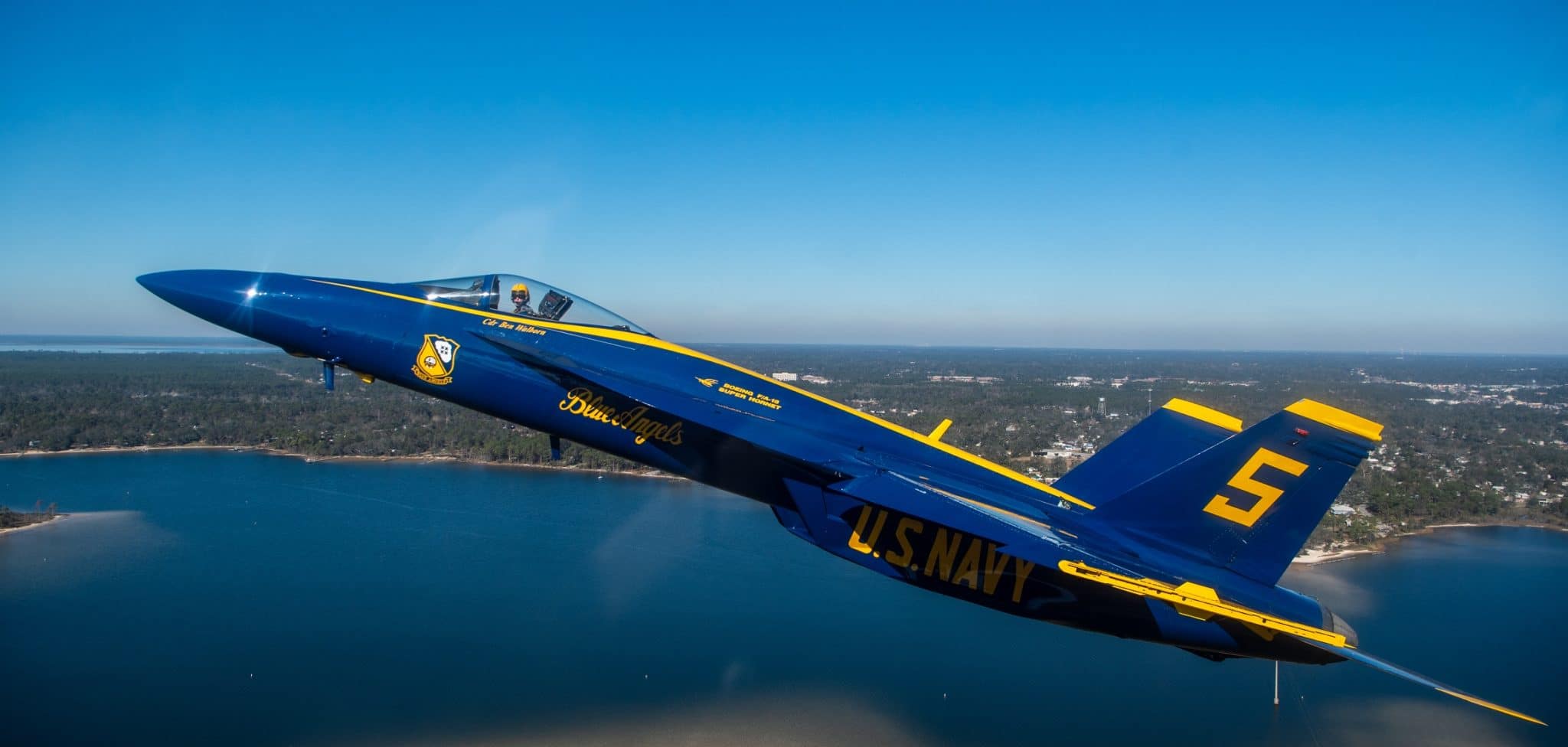
#5 Commander BEN WALBORN USN- Lead Solo

#6 Lieutenant Commander CARY RICKOFF USN- Opposing Solo

6534969a
US Navy image by MC2(SW) Cody Hendrix

#7 Lieutenant JULIUS BRATTON USN- Narrator

#8 Lieutenant KATLIN FORSTER USN- Events Coordinator

Commander TODD ROYLES USN- Executive Officer

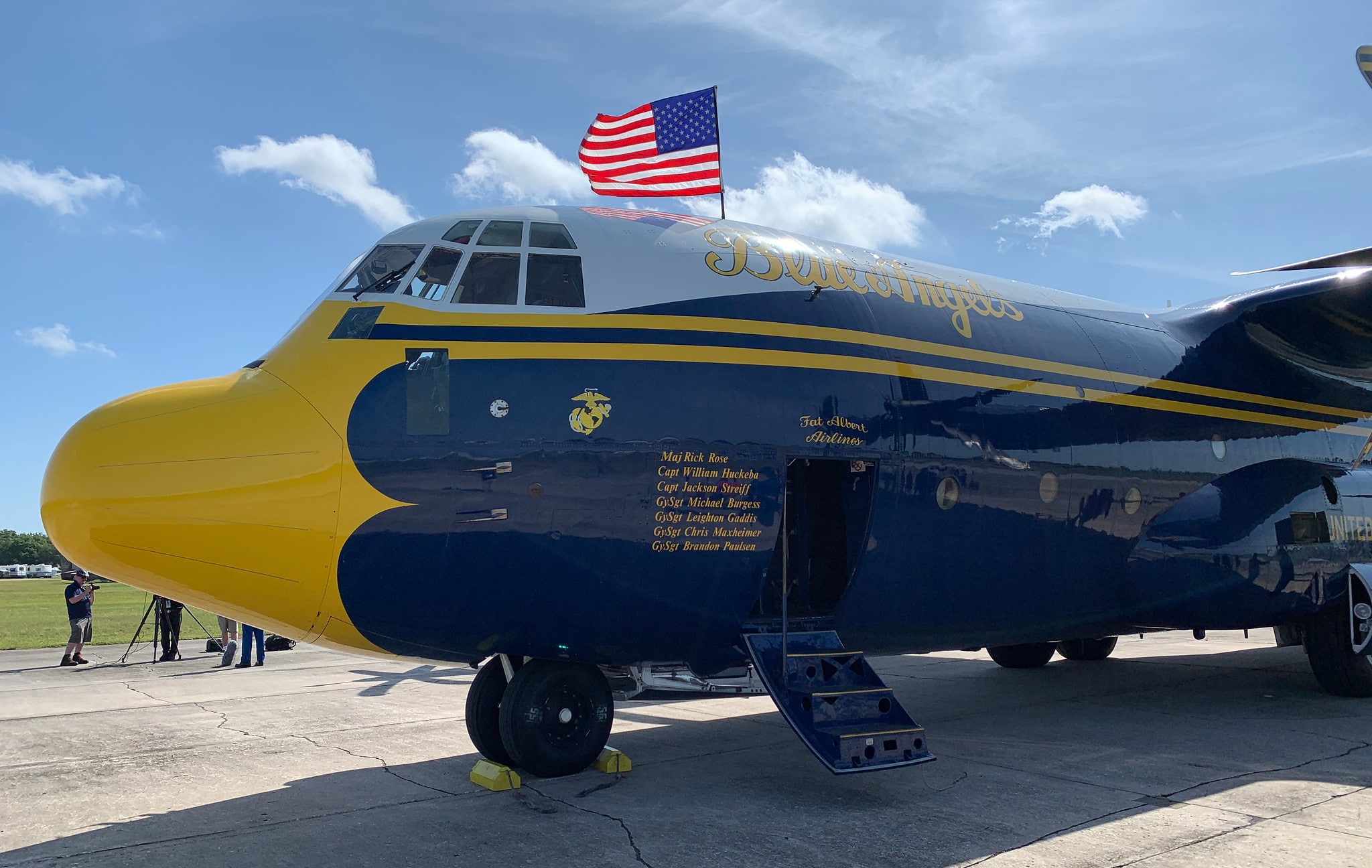
Captain RICK ROSE USMC- C-130J “Fat Albert” Pilot

Captain WILLIAM HUCKEBA USMC- C-130J “Fat Albert” Pilot

Captain JACKSON STREIFF USMC- C-130J “Fat Albert” Pilot

6534970a
US Navy image by MC2(SW) Cody Hendrix

Lieutenant BRIAN ABE USN- Maintenance Officer

Lieutenant HENRY CEDEÑO USN- Assistant Maintenance Officer

Lieutenant MONICA L. BORZA USN- Flight Surgeon

Lieutenant KRISTIN A. TOLAND USN- Supply Officer

Lieutenant CHELSEA DIETLIN USN- Public Affairs Officer

CMDCM(AW/SW) Eric McDermott USN- Command Master Chief

AVCM(AW/SW) James Hernandez USN- Maintenance Master Chief

6435695a
US Navy image by MC2(SW) Cody Hendrix

NASA’s Martian Helicopter ‘Ingenuity’ Nears First Flight

CAPE CANAVERAL, Fla. — A small helicopter attached to the NASA rover Perseverance will soon take off to conduct the first flight of an aircraft on another world.

The drone-style helicopter known as Ingenuity will provide the Red Planet with a first of its kind air show as soon as early April. During a 30-day window, engineers hope to perform up to five flight tests, each building on the previous flight.

At $85 million, the Ingenuity program is an investment in understanding aviation in the very thin Martian atmosphere. The planet’s surface pressure is only .088% that of Earth’s, and this may make it difficult to provide the necessary lift in order to fly.

NASA animation simulates how Ingenuity will operate on the surface of Mars.

“When the Wright Brothers flew for the first time, they flew an experimental aircraft,” Ingenuity’s chief pilot Håvard Grip explained. “In the same way, the Mars helicopter is designed to show we can fly a powered helicopter flight in the Martian atmosphere.”

NASA to Conduct the First Martian Air Show

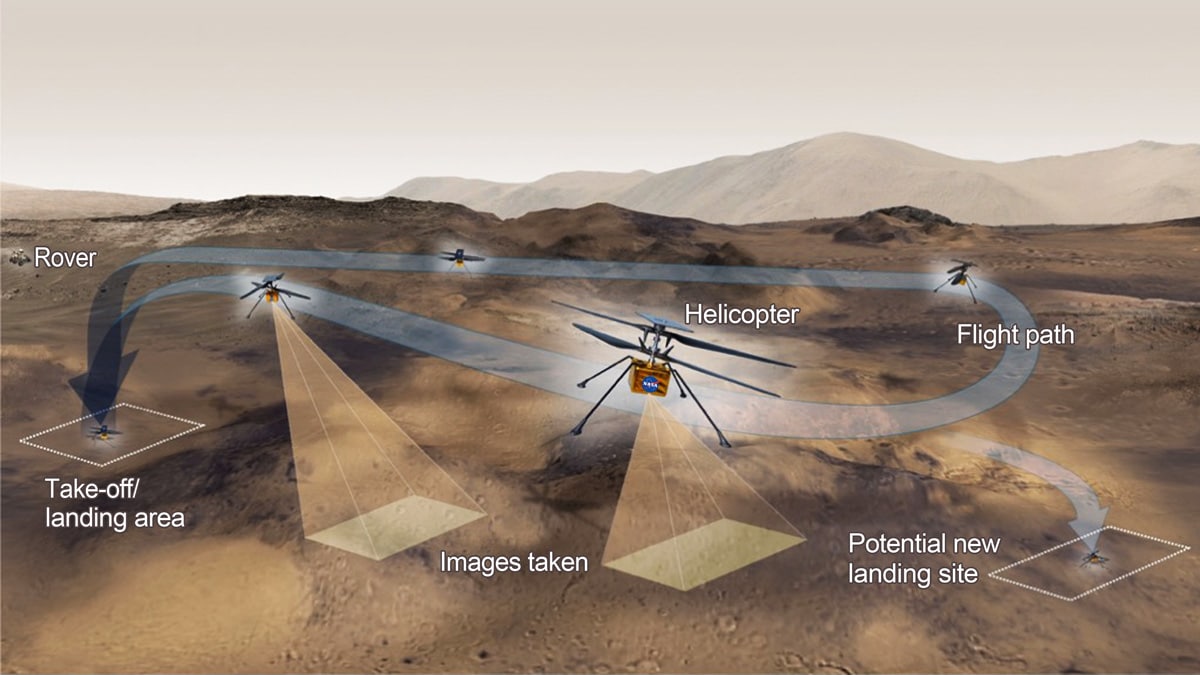
Controlled from NASA Jet Propulsion Laboratory in California, Ingenuity will be lowered from the belly of Perseverance. Signals from Earth will then detach the copter and it will drop a few inches to the Martian surface and land on its four legs.

Perseverance will roll away exposing the copter to direct Sun light to charge its six lithium-ion batteries. The rover will travel to an area 330-feet north of the copter’s flight zone known as Twitcher’s Point.

“The helicopter will then have a 30-Martian-day (31-Earth-day) experimental flight test window,” NASA JPL spokesperson DC Agle said. “If Ingenuity survives its first bone-chilling Martian nights – where temperatures dip as low as minus 130 degrees Fahrenheit – the team will proceed with the first flight of an aircraft on another world.”

25287 Helicopter landing composite web
Ingenuity hovers over the air field while Perseverance records the flight from Twitcher’s point.

Ingenuity is autonomous and will not be controlled by a joystick on Earth due to the 130 million miles between the two planets. The aerial vehicle is designed to fly, land, communicate, manage its energy, and keep warm autonomously.

According to DC Agle, innovative mathematical algorithms will allow flight in the thin atmosphere and track the helicopter’s flight path.

The twin rotor blade rotorcraft has a fuselage about the size of a tissue box. It weighs four pounds on Earth, however on Mars its weight is just 1.5 pounds.

Each flight test will launch from a 30×30-foot airfield near Jezero Crater. JPL engineers will fly Ingenuity up to an altitude of 10-15 feet, and about 160-feet down range. Each of the five flights will last up to 90 seconds.

Two cameras are built-in to the craft to record images during flight. One color for capturing views of the nearby terrain, and one black and white for navigation.

There will be no real time video of the flights. JPL estimates it will take two days to receive the three color and four black-and-white images from Ingenuity first flight.

Meanwhile, Perseverance is expected to capture the flight with images, video, and audio of the first powered flight on Mars.

(Charles A Atkeison reports on aerospace and technology. Follow his updates via social media @Military_Flight.)

TOP GUN: Maverick Lego Trailer You Have to See to Believe

Gaze Awestruck at the Product of One Man’s Dedication to His Favorite (Unreleased) Film

As of this moment, the official release date for TOP GUN: Maverick is (still a moving target). It was 2 July 2021 at one point, but now they’re talking about a November 2021 release date. It’s fair to say that among Avgeeks the supersonic sequel is the most anticipated movie release since, well, since the last time a great aviation film was released.

When was that exactly? Anyway, you’ve probably seen the trailers for TOP GUN: Maverick (they’re linked in the piece below) but we have a unique and highly entertaining take on Official Trailer 2 for you. Take a look at this awesome version done completely in LEGO!

The video was created by and uploaded to YouTube by Augustus Danko (Onbeatman). Danko said that he created the entire project, one frame at a time, using only a Canon t6i camera, a 2017 iMac, and a 2011 MacBook Pro. The project took Danko several months to complete (no surprise there!) and was not supported in any way by the studio or the producers.

That’s dedication. Augustus will probably be one of the first in line when the film is released. Below are Danko’s LEGO trailer and the trailer on which it was based for direct comparison. Remarkable!

Check out all our latest content. Here are our most recent posts:

Even though the sequel doesn’t feature the beloved Grumman F-14 Tomcat Maverick (and Goose) flew in the first TOP GUN film (or does it?) we did some digging and wrote a piece about what we consider to be one of the stars of the movie (and we’re not talking about Tom Cruise) here.

2021 02 28 23 48 12 348 Top Gun Maverick Official Trailer IN LEGO YouTube
Screenshot captured from featured video

The original Trailer 1 for the film is featured here. Trailer 2 is featured here. And an absolutely hilarious spoof of Trailer 1 (uploaded to YouTube by StSanders) is linked below. Enjoy!

TOP GUN: Maverick Darkstar in LEGO.
Screenshot captured from featured video

F-35A Demo Team ‘Excited’ for 2021 Airshow Season

ATLANTA — The Air Force’s newest stealth fighter will return to air shows across North America this spring demonstrating precision maneuvers and educating the public of its combat capabilities.

The F-35A Lightning II Demonstration Team are rehearsing on the ground and in the air for their first show in May. Pilot Capt. Kristin “BEO” Wolfe will showcase the jet’s handling characteristics and high speed maneuvers.

F-35A to Showcase Top Precision Maneuvers

Capt. “Beo” Wolfe is the Air Force’s only single-ship female squadron commander and pilot. She continues to train to stay combat ready at her home base near Salt Lake City.

201205 F PG806 1118
U.S. Air Force SSgt. Roberto Tejada-Najera of the F-35A Demo Team prepares to launch out Capt. Kristin “BEO” Wolfe for a Heritage Flight performance in December 2020. (U.S.A.F. photo by SSgt. Codie Trimble)

“When I’m flying the demonstration, I’m trying to show people just a small example of what the jet is capable of doing,” Capt. Wolfe discussed on Tuesday. “We designed the routine specifically to showcase the maximum maneuvering capabilities of the F-35.”

The aircraft’s air show performance highlights only a few of its precision maneuvers. Several other capabilities by the F-35 are classified, including a basic surface attack and dropping weapons.

“Our jets come straight off the flight line from the combat-ready squadrons at Hill Air Force Base,” Capt. Wolfe said. “The aircraft we bring to air shows could either have been to or just recently come back from an operation overseas.”

AFPIMS 2021 Schedule 17 Feb v2

The F-35A Demo Team’s first public air show is scheduled for May 30 – 31, near Atlanta. This will be their only show in the southeast.

Other show sites include Washington state, Illinois, Michigan, Alaska, California, and Toronto, Canada.

In addition to performing solo, Capt. Wolfe will also perform a close formation flight with an Air Force warbird. Known as the Heritage Flight, the F-35A will fly alongside an aircraft from yesteryear and possibly fly with a current jet aircraft.

The team’s dedicated crew chief Staff Sgt. Roberto Tejada-Najera oversees the maintenance and inspections on the F-35 aircraft. He is looking forward to the start of the air show season and meeting with guests in attendance.

“I’m not the most outgoing person, but I love getting to talk to the public and explaining to them what it’s like being a maintainer and showing them around the jet,” he said. “I wanted to join the Air Force and be on a demonstration team, so this is kind of my way of paying it forward.”

(Charles A Atkeison reports on aerospace and technology. Follow his updates via social media @Military_Flight.)

United Grounds 777 Subfleet After Engine Failure

0

United Airlines grounded 24 Boeing 777-200 aircraft today in response to an FAA emergency airworthiness directive that requires immediate inspection of all PW4000 engines. The inspection mandate is in response to yesterday’s catastrophic engine failure aboard United Flight 328 bound to Honolulu, Hawaii from Denver International Airport. That flight made an emergency return to the airport. All 231 passengers onboard were unharmed.

The Pratt & Whitney PW4000 was designed for the Boeing 777. With over 90,000 lbs of thrust, it was one of the largest jet engines ever placed on an airliner when it first entered service. The United jets affected are some of the oldest 777s in their fleet, largely flying domestic trunk routes.

In a statement, United Airlines stated that they are removing the aircraft from their schedule. They will “work closely with regulators to determine any additional steps and expect only a small number of customers to be inconvenienced.

In a parallel move, Japan also grounded all Boeing 777s powered by the PW4000 engine. A check of flight schedules showed that both ANA and Japan Airlines have removed the affected Boeing 777-200s from their schedule.

United 777 Pilots Calmly Landed Jet After Catastrophic Engine Failure

0

United Airlines flight 328 took off this afternoon for Denver bound for Honolulu with 231 passengers and crew onboard. Shortly after takeoff, the right #2 engine failed. It showered debris over Broomfield, Colorado.

Video taken from inside the jet showed the right engine missing its cowling and engine cover. Flames were visible in the video. The jet safely landed a few minutes later. No injuries were reported. News reports showed that the cowling landed in a front yard with engine debris spread over a wide area.

https://twitter.com/michaelagiulia/status/1363241125495136267

The aircraft involved was N772UA. This particular 777-200 was the 5th Boeing 777 off the production line back in 1995. It entered service in September of 1995 just months after United introduced the two-engined long haul jet into the fleet.

Below are relevant tweets with photos posted to twitter along with an ATC recording of the incident.

FHnPow Q
United 328 heavy, a Boeing 777-200 suffered an engine failure over the Denver metro area. Photo by Hayden Smith (@speedbird5280 on Instagram). Used with permission.
etCoawXc
United 328 heavy, a Boeing 777-200 suffered an engine failure over the Denver metro area. Photo by Hayden Smith (@speedbird5280 on Instagram). Used with permission.

Below is the recording of flight 328’s departure and emergency return recorded by LiveATC.net and visualized by VASA Aviation on Youtube. You’ll note in the video that the pilots were tremendously calm throughout the emergency.

We’ll keep this story updated as we learn more.

Not the first United 777 uncontained engine incident

A similar but unrelated incident to another United Airlines 777-200 occurred back in 2018. That incident occurred over the Pacific Ocean in cruise. The #2 engine failed as well. The cause was determined to be metal fatigue on a fan blade. The aircraft landed safely at Honolulu International Airport with no injuries as well.

Close Air Support: It’s All About Serving Others

Lessons learned from an A-10 Pilot

Close Air Support, or CAS as it’s known throughout the military and contractor circles that support it, is defined as “air action by aircraft against hostile targets that are in close proximity to friendly forces and that require detailed integration of each air mission with the fire and movement of those forces.” Joint Publication 3-09.3 Close Air Support, June 10, 2019, xi.

See the source image
23STS Combat controllers working with an a-10 (source: air force official photo)

So, what does that really mean to those who aren’t knee deep in CAS as a way of life?

CAS means strapping into your airplane, pushing up your sleeves, and moving in close for a knife fight. Sometimes, it means you need to get low and slow and right down in the midst of the fight so you can break out the bad guys from the good guys. Sometimes it means you hang it all on the line because if you don’t someone else is going to die. Sometimes it means you may not make it back because your sacrifice was worth saving another. But every time, ever sortie, and every mission CAS means you think of others before thinking of yourself.

Close Air Support…It’s a Calling for Some Pilots

Back in the Fall of 1997, twenty-eight young Lieutenants and a couple of Captains were days away from completing Euro-NATO Joint Jet Pilot Training (ENJJPT) at Sheppard AFB in Wichita Falls, Texas. It had been a long and demanding year and these young officers from the United States, Germany, Denmark, and the Netherlands were chomping at the bit to receive their aircraft assignments. Most would earn a fighter as Sheppard predominantly tracked pilots towards fighters at the completion of training. A few would earn a bomber, and a couple would remain as ENJJPT instructor cadre for three to four year before progressing on to a follow-on aircraft assignment.

The Europeans knew what they were going to get as they had been tracked for their assignments before starting pilot training. The Danish and Dutch pilots were going to go fly F-16s. Most of the Germans were going to GR-1 Tornados and one was going to go fly a F-4 Phantom. But the Americans had to compete for their assignments. Checkride performance, academic scores, and professional standing were all taken into account to rack and stack the student pilots. The pilot who graduated top of the class got to pick from the list of available aircraft first, the second from the top picked next, and so on and so forth until all 30 pilots knew what they would be flying for the rest of their careers.

Close Air Support is a Choice

The Gulf War was in the distant pass. 9-11 had not occurred and the world was experiencing a stretch of calm. Pilots were frothing at the mouth for the new F-22 Raptor and wanted to dive head first into the Air Superiority mission. The F-15C Eagle and F-15E Strike Eagle were still pretty sexy and the F-16C Fighting Falcon was considered more of a jack-of-all trades fighter.

These 30 young pilots spent hours after flying formation and mastering instrument approaches talking about what fighter they were going to fly. There was a lot of smack talk, some legitimate discussion every once in a while, but mostly a lot of boisterous dreaming.

Some wanted to dogfight. They wanted to scream through the air at 40,000 feet and launch missiles beyond visual range at targets they would never see. These pilots took F-15Cs. Others wanted a mix of mission sets. They wanted to turn and burn with another fighter in a dogfight and then get tasked to drop bombs…they wanted to “do it all”. These pilots usually took an F-16. And then there were the pilots that wanted to play in the mud. They wanted to fly low, fly old school clock-to map-to ground navigation, get shot at, shoot back, and help the grunts on the ground bring pay back to the enemy. They wanted to fly the CAS mission. These pilots selected A-10s and from that day on proudly called themselves Hog drivers.

a 10jim mumaw
Close Air Support: It’s All About Serving Others 23

Hog Drivers Live for Close Air Support

To Hog drivers, CAS is a way of life. They live it, breathe it, eat it, dream about it, and never stop talking about it. Everything at some point finds a way to relate to CAS. It’s what they do and who they are and they’re really good at it.

However, there are other great CAS pilots besides Hog drivers. Marine F/A-18 Super Hornet drivers are exceptional. Why? Because every Marine is an infantryman first and a pilot second. They’ve been schooled in CAS from basic training on and bring that perspective to the fight from the air. So, they take CAS seriously. Army AH-64 Apache pilots are outstanding because they’re right there are the front lines with their brethren in the midst of the fight. AC-130 Gunships own the night in a CAS battle and their aircrew can lay down a pounding within meters of friendly forces. They bring several sensors, two Gatling guns, and a 105mm howitzer to the fight. They’re unbelievably impressive to watch in action.

See the source image
USMC F/A-18D from vmat-101 (source: wikimedia)
See the source image
AH-64 Apaches (source: wordpress.com)
See the source image
ac-130 firing the 105mm howitzer (source: wikimedia)

Regardless, in any given room of Air Force pilots you can always pick out the “CAS guys and gals”. It only takes a few minutes after initial introductions as most of these folks are a bit more reserved than other pilots. They possess a stoic sense of “mission first” in everything they do. They’ve been schooled in Joint Fires doctrine and many have served on the ground with their sister Army or Marine services as Battalion Air Liaison Officers (BALOs) or Joint Terminal Air Controllers (JTACs). So, they speak “grunt” well and usually choose to draw a picture in the dirt with a stick to describe a ground scheme of maneuver over shooting down a bandit with their hands while spinning an exaggerated tale.

Close Air Support = Job Satisfaction

As a CAS pilot, there is nothing more rewarding than knowing you did your job well that day. Because what that really meant is you helped some kid on the battlefield get back home to his or her family. The day wasn’t about you. It wasn’t about putting another notch on your rifle butt or mission mark on the nose of your aircraft. It was about making sure a bad guy was never able to be a bad guy again so your brothers and sisters could live to fight another day.

JTACs wave to A 10 170719 F YM181 010
A-10 Supporting JTACs (SOURCE: Official USAF Photo)

Close Air Support is a Mentality

You’ll find Hog drivers don’t call themselves fighter pilots but instead prefer to be called “Attack Pilots”. There is a difference in their minds and Brig Gen Mike “Johnny Bravo” Drowley does a great job explaining such in his TEDx talks “There Are Some Fates Worse Than Death” presentation. He talks to the empathy Attack Pilots have for those they support and how they personally identify with the Marine Rifleman, Army Infantryman, or Navy SEAL. He talks to how the battlefield soldiers’ survival is more important than the Attack Pilot’s safety. And that in itself, is the identifying force behind CAS.

It is simply all about others…  ATTACK!

AT-802 Fire Boss: Flying The Fire Fighting Crop Duster on Floats

The Birth of the Fire Boss

You have to love ingenuity…especially in aviation. But who would have ever thought taking a crop duster and putting it on floats would end up producing one of the most effective aerial fire-fighting platforms in existence today? How did the AT-802 come about?

Well, John Schwenk, owner of Aero Spray Inc., located in Appleton, Minnesota did back in 2007. He had been operating a small fleet of Single Engine Air Tanker (SEAT) AT-802s for several years in Minnesota and after running the math one day quickly came to the conclusion an AT-802 on floats would be a very cost-efficient and profitable aerial fire-fighting machine if employed in locations close to suitable water sources.

John gathered his Aero Spray team, contacted Wipaire Inc. who had designed and certified their 10000 Amphibious Floats for the AT-802 a few years earlier, and then put together a plan to field the amphibious AT-802 two years later in 2009. And there you have it…the Fire Boss was born.

So…What is it Like to Fly an AT-802 Fire Boss?

Pilots will tell you “once you go float plane, you’ll never want to go back.” Well, in the SEAT world, once you transition from a wheeled SEAT to the Fire Boss most will argue you will never want to go back either. Not only is the Fire Boss a lot of fun to fly, but its mission of direct attack is very different and more challenging than the indirect attack strategy of simply building a line around a wildfire with retardant.

Envision taking off from a small uncontrolled airfield somewhere in the middle of no-where with a set of coordinates, a couple of frequencies, and a map. The mission is to fly as fast as you can direct to the fire, find a scoopable lake or river enroute, grab a load of water, and then proceed direct to the fire with load after load after load for the next three and a half hours. Hopefully the water source is close enough so you can fly two- or three-minute scooping/dropping circuits which means you’ll do that 20 to 30 times before needing to head back for fuel. Chances are you’re scooping on a mountain lake which means the density altitude is fairly high and your scoop site is surrounded my hazardous terrain.

Birds of a feather flock together

You’re also most likely flying as a flight of two, three, four, or even eight Fire Bosses which means there is close formation flying, detailed flight tactics, and congested airspace over the fire. There is probably smoke…a lot of smoke…so the visibility is low making it difficult to keep track of each other as well as the helicopters, see the terrain, avoid the towers and wires, and even find your way back to the fire at times

fireboss2
Fire Boss 241 (SOURCE: MIKE YOUNG)

Scooping the AT-802…Mr. Toad’s Wild Ride

As stated earlier, once you go float plane you’ll never want to go back. Why? Because it is so much fun. The challenge of taking an airplane, flying with lots of stick and rudder, assessing the water and wind conditions, making every touchdown a spot landing on a lake, river, or even the ocean is unbelievably rewarding and satisfying. No two water landings are ever the same and each is extremely memorable for its own reasons.

And then there is scooping on top of that. Scooping is a blast. It takes everything described above and melds that with taking on a load of 500–800-gallon (4,165 – 6,664 pounds) load of water all while skimming across the water at 60 knots.

The First Scoop in the AT-802 Fire Boss

The first scoop in a Fire Boss is harrowing, wild, and usually a bit violent. The actual scoops are two three-inch pipes that hydraulically extend into the water from the bottom of each pontoon. If power, aircraft pitch, and water speed is not managed properly, the initial deployment feels like you’ve hit a brick wall. The drag is immense causing the nose of the aircraft to pitch aggressively forward. It takes 10-20 scoop attempts to finally get the hang of managing the first scoop induced porpoise with a smooth and steady power increase while gently pumping the stick aft in counter-harmony with nose porpoising. It is truly an art and all Fire Boss pilot eventually develop their own individual technique

How it Works: The Fire Boss scooping mechanism – YouTube

So, there you are…all four gear are up with blue cockpit indications and the prop pitch is set to 1700 RPM. The scoops have been cycled with no lingering asymmetric warning light which tells you if a scoop is stuck down. If it is, the aircraft will take a hard left or right on touchdown depending on which scoop is extended. The ignition has been set to continuous as a “just in case” mitigation measure and the flaps are set to 20 degrees for max post scoop lift. Lastly the rudder trim has been pre-loaded heavy right in preparation for the tremendous pedal forces that will occur once water starts pumping into the hopper during the upcoming scoop. Final approach airspeed is captured at 75 knots followed by one last pre-scoop checklist ramble to ensure nothing traumatic will occur on the water.

Landing Checklist Complete

Touch down! The stick is checked back into the lap while throttling up a bit to dampen aircraft porpoise. The hopper fills quickly…usually within 20-30 seconds. A brief scan ahead is accomplished to ensure the remaining water lane is clear and then a few seconds later scooping is complete. The power comes up to max available torque followed by a sharp but controlled pull on the stick aft and right to rock the right float out of the water. Once safely airborne it is now a demanding exercise in airspeed management while gingerly climbing away from the water enroute to the fire.

Putting Out Fires in the AT-802

Scoop to fire circuits can be fast and furious. If the water source is nearby you can be on the water to over the fire about every three minutes. There is also a lot to consider prior to the first bomb run which in reality can be minutes after climbing away from the water low and slow.Are there any hazards – snags, power lines, or ridges hidden in the shadows between enroute from scoop to the fire? Where is the helicopter’s dip site? Is it a factor or will their dip to fire route conflict with the Fire Boss run-in line? What is the bomb run objective – to cut off the head of the fire, attack a flank, tie into a dozer line, or spike the load in on a spot fire as it erupts from stray embers?

Regardless, airspeed and altitude control are essential to ensure that once released, the water column falls properly with the correct density to smother the fire.

A-T 802 WATER BOMBERS IN ACTION AKA THE FIRE BOSS’s – YouTube

Approaching the Fire in the mighty AT-802

AT-802 Fire Bosses drop at approximately 80 feet above the terrain and usually provide best effects when the final approach airspeed is hovering at 105 knots. That means 20-degree flaps are rolled to provide max lift while helping to slow the aircraft. If the slope downhill on final is steeper than 30 degrees, then maximum flap setting of 30 degrees is used to keep the airspeed from running away from you. Anything above 120 knots will cause the aircraft to pitch up violently as soon as the load is let loose which can be very disorienting and possible deadly if the pilot doesn’t react immediately to right the aircraft and bring her back to straight and level. Final approach. Airspeed-checks. Attitude-checks.

The bombing computer has been set for proper gallons per square foot and total amount to be dropped. The line looks good. Confirmation with the Air Attack or Lead Plane that all ground fire fighters are clear of the line and it’s safe to drop has occurred. Target aimpoint is off the nose. You may need to offset a wingspan or two into the wind to counter the wind drift on the falling water column. The target runs under the nose and just as it passes beneath an imaginary line drawn between the engine smoke stacks – pickle! Load away!

Max allowable torque is selected as the aircraft is steered to the briefed exit. Without even thinking about it, the left-hand slides back from the throttle to gently nudge the flaps up in small 5-degree increments as the aircraft climbs out 4,000-6,500 pounds lighter enroute back to the scoop site to do it all again!

Determined Engineer Showed NASA How to Land on the Moon

CAPE CANAVERAL, Fla. — In the months leading up to America’s first manned space flight, NASA leaders met for a round table discussion of how to land a man on the moon.

In February 1961, members of the Space Task Group met in Washington, D.C. with engineers to discuss solutions. The group was headed by Robert Gilruth and lead Mercury spacecraft designer Maxime Faget. Wernher von Braun, the father of American rocketry, also attended the meeting.

As the discussion progressed past the midway point, an unknown engineer stood up in the smoke-filled room. He then explained his theory for how America should send astronauts to the moon.

A NASA Engineer’s Cost Efficient, Time Saving Plan For Moon Landing

NASA Langley Research Center engineer John C. Houbolt began to explain an unheard of theory known as Lunar Orbit Rendezvous. His plan would send two spacecraft into lunar orbit, land one on the Moon, and later have the two redock and return to Earth.

3 john c. houbolt gpn 2000 001274b
NASA engineer John C. Houbolt explains his Lunar Orbit Rendezvous plan in 1961. (NASA)

Houbolt served as Chief of the Theoretical Mechanics Division at Langley, and now he was up to bat in the biggest game of his life.

Lunar Orbit Rendezvous (LOR) was an unknown theory Houbolt had designed five months earlier. He was one of six members of a committee to study problems associated with rendezvous while constructing a space station platform.

In August 1960, the committee began associating the rendezvous of a space station with the rendezvous and landing on the moon. Houbolt used the blackboard to chalk out several designs involving rendezvous for a flight to the moon.

The practical engineer loved the simplest, most cost-efficient method—LOR. As Houbolt spoke of his LOR theory to von Braun and the Space Task Group, it began to fall on deaf ears.

Shouts of “misleading information” from Faget and a head-shaking “no” from von Braun concluded the then 41-year-old engineer’s address to his peers.

Lunar landing flight techniques for moon landing

Von Braun and several others agreed with a plan known as Earth Orbit Rendezvous, which would see two Saturn rockets launch. One would carry a spacecraft and the other a fuel supply craft into Earth orbit.

The pair would then rendezvous. The Apollo craft would travel to the moon, land, and return as a single craft. Another plan that was being accepted was the direct ascent to the moon.

“The plan was to send a vehicle the size of Atlas to the moon with absolutely zero help and land it backwards,” Houbolt told NASA’s Langley years later, “It can not be done.”

A large rocket, mightier than the Saturn 5, would launch an Apollo craft to the moon. Apollo would then separate in lunar orbit from the rocket and land.

Several weeks after President Kennedy challenged America to land a man on the moon before 1970, NASA administrator James Webb let it be known that NASA was steering Apollo as an EOR mission to the moon, with the direct ascent as a backup choice for landing.

The LOR plan was swept under the rug by a few key NASA managers throughout 1961, except for Max Faget. He began to realize LRO as a better option. Houbolt continued to lobby for his proposal.

Houbolt wrote two letters to NASA associate administrator Robert Seamans asking for support of his plan. By Thanksgiving of 1961, Gilruth and Langley, along with NASA headquarters, approved it as a time—and money-saving option.

A few months later, Von Braun and Marshall approved Houbolt’s idea. Plans were drawn up to build a secondary spacecraft that would land on the moon—the lunar excursion module.

Houbolt single-handedly saved American taxpayers billions of dollars in fuel and rocket costs. He also trimmed the time needed to build the multiple rockets required by EOR by two years.

Kennedy’s challenge survived his presidency. Not just one, but two crewed lunar landings occurred during 1969.

History Also Supported Houbolt’s Plan

Little did Houbolt know that one year earlier, engineers at the Vought Astronautics Division near Dallas discussed their LOR theory with NASA. NASA had also ignored Vought’s engineers.

A few years later, Houbolt learned of Russian mechanic Yuri Kondratyuk, who formulated ideas related to space flight and LOR. Kondratyuk’s designs and notes were made while he was a soldier during World War I. They never reached Russian scientists following the Second World War.

As Houbolt watched Apollo 9 lift off in 1969 with the first lunar module, he felt emotion. His thoughts raced through his own journey and his contribution to America’s space flight.

AS11 44 6581HR
The Apollo 11 lunar module “Eagle” descends to the Moon’s surface with two astronauts aboard. (NASA)

Two months later, the now-former NASA engineer sat in the visitors’ section of Houston’s Mission Control. Apollo 11 lunar module Eagle had just left lunar orbit to perform the first landing by Neil Armstrong and Edwin Aldrin.

“When the landing took place and the touchdown was made, all of us stood up and started clapping,” Houbolt recalled during a NASA interview. “But at the same time, we were shh, shh, because we didn’t want to miss a fraction of a second of history being made.”

Houbolt added, “Von Braun sat in front of me, and he made the OK sign and said, ‘Thank you, John.’ That was one of the biggest rewards I’ve ever had.”

(Charles A. Atkeison reports on aerospace and technology. Follow his updates via social media @Military_Flight.)

WATCH: A KC-130F Hercules Operates From an Aircraft Carrier Flight Deck

You Don’t See This Every Day!

Back in 1963, a Lockheed KC-130F Hercules tanker conducted a series of test landings and takeoffs from the deck of the USS Forrestal (CVA-59).  The crew made 29 touch-and-go landings, 21 full-stop landings (Look Ma- No Hook!), and 21 unassisted takeoffs (deck-run takeoffs without catapult assist) while weighing from 85,000 pounds all the way up to 121,000 pounds.

The only modifications made to the airlifter were to the nose landing gear bay, removal of the underwing refueling pods, and beefed-up anti-lock brakes. Even though operating Herks from carrier decks proved to be impractical and somewhat dangerous, the fact that the mighty Herk could even accomplish such a feat (multiple times) is a testament to the ruggedness of the C-130.

The Incredible Versatile Herk

wMWbP1NP Y URBwEjilR5T76Tl xhJxjY9kryhvPRMI
WATCH: A KC-130F Hercules Operates From an Aircraft Carrier Flight Deck 30

Herks have flown into hurricanes and typhoons to gather storm data, controlled all manner of aerial drones, flown airborne early warning and control, electronic eavesdropping, and jamming missions, and inserted and supported personnel behind borders and enemy lines by flying we-were-never-there, nap-of-the-earth ingress and egress routes.

Sign up to receive a weekly summary of Avgeekery’s stories.

C-130s do aerial firefighting, recover spy satellites and their “take”- there are even Hercules tankers that can be converted to gunships on the spot and back again after mission completion. C-130s have been flying for the United States Air Force, Navy, Marines, and Coast Guard for more than 60 years and they’re still going strong.

tumblr nco4fnoVUO1txx6x7o4 1280
WATCH: A KC-130F Hercules Operates From an Aircraft Carrier Flight Deck 31

Want to read more about the C-130?

The MD-80 That Hit Trees And Kept Trucking, Saving All Aboard

0

American Airlines Flight 1572 could have ended in disaster

Can you imagine wondering if the next minute of your life is your last? Well, 73 passengers and the 5-person flight crew of American Airlines Flight 1572 got to ask themselves that very question the night of November 12, 1995 during one of the most miraculous airline crashes in aviation history.

Flight 1572 was a regularly scheduled redeye flying out of Chicago O’Hare International Airport for Bradley International Airport, located just outside of Hartford, Connecticut. The aircraft in use was a McDonnell Douglas MD-83, narrow-body twin engine jet with over 27,000 hours of flight time under its belt. It was crewed by two pilots, a captain and first officer, and three flight attendants, all of which were seasoned professionals.

Flight 1572 Departed Late Into Challenging Weather

Flight 1572 departed late out of O’Hare at 11:05pm for a relatively short and hopefully uneventful flight to Bradley. However, the weather at Bradley was less than stellar. The field was being pounded by heavy thunderstorms and rocked by gusty winds. Wind shear warnings were in effect and the pressure altitude was changing rapidly.

Enroute, the pilots received an Aircraft Communication and Reporting System (ACARS) weather brief stating the weather at Bradley was quickly deteriorating and the pressure was dropping fast. The ACARS brief also included a barometric pressure setting of 29.40 inches of mercury. This information was important as it would help the pilots make decisions regarding continuing on to Bradley or diverting. Usually, when an updated altimeter setting is received, the pilots update the aircraft altimeter with such.  But in this case, for unknown reason, instead of entering the advised pressure setting, the first officer entered an erroneous 29.47 setting into the altimeter.

A Primer On The Importance Of Barometric Pressure

Now…there is nothing sexy about barometric pressure. But, ensuring the aircraft altimeter is set with a current and correct barometric pressure altimeter setting is unbelievably important in aviation. Barometric pressure, or otherwise known as atmospheric pressure, is defined as the pressure of the atmosphere at any point on the earth. It will raise or lower as the outside air temperature changes or when an aircraft makes a significant change in altitude. Barometric pressure is measured in inches of mercury (Hg) and is usually given for a prescribed area. In the aviation world, changes in the barometric pressure affect what altitude is displayed on an aircraft altimeter and is set by the pilots as a deviation from the standard pressure of 29.92 inches Hg. It is important to set the current barometric pressure altimeter setting for an area when flying. Because, if not, the aircraft will in reality be closer to the ground than the altimeter indicates.

Flight 1572 continued on with the pilots prepping for the enroute descent and non-precision localizer approach to runway 15 at Bradley. Enroute descent checks were completed, passengers were directed to take their seats and buckle up, and the flight attendants were directed to prepare the cabin for landing.  The weather at Bradley was still terrible, but it was above approach minimums and good enough to continue on to land so the captain reduced power, gently lowered the nose of the aircraft, and commenced the fateful approach to runway 15 at Bradley.

Flight 1572’s approach was more complex than typical but well-within an airline pilot’s capabilities

So…you may be asking, “What is a non-precision approach?” and “How does that play into this story?”

A non-precision instrument approach is designed to allow an aircraft to descend in a controlled fashion from an enroute altitude to a Minimum Descent Altitude (MDA) above known obstacles on axis with the runway so the pilots can hopefully see the runway environment prior to the Visual Descent Point (VDP) which is usually located about one mile from the runway threshold. If the pilots are visual with the runway prior to the VDP, they can descend below the MDA and continue the approach to land. If they aren’t visual with the runway by the VDP then they should execute a missed approach. Non-precision approaches are called just that, as the pilots only have lateral guidance vice lateral and vertical guidance until touchdown. Because, vertical guidance is not provided, the pilots must fly a flat approach until the VDP.  At this point the runway is hopefully in sight so they can continue on and descend on a normal 3-degree final approach glide path to touchdown.

These approaches are usually flown with more “hands on” (manual) control rather than auto-pilot or auto-land control and require full attention to maintain aircraft altitude above the MDA. One of the golden rules in aviation is “descent below the MDA is not allowed unless the runway environment is in sight”. Why? Because, it’s unsafe. MDAs are designed to keep an aircraft safely above known obstacles such as terrain, trees, power lines, and towers on final approach so it is imperative pilots fly the aircraft to always stay above the MDA until visual the runway and in a safe position to land.

About five miles from the airport, Flight 1572 encountered heavy rain and turbulence and the captain reported having trouble maintaining altitude and heading with the autopilot engaged. The pilots had also just received communications from the airport tower that it was temporarily closing due to a structural malfunction but would leave one person behind in the tower to monitor communications and the flight during its approach.

ntsb1572
The MD-80 That Hit Trees And Kept Trucking, Saving All Aboard 34

Flight 1572 continued its approach and while the pilots peered through the heavy rain for the airport the aircraft inadvertently descended below the MDA and continued on that vector. According to the data captured on the flight recorder, the first officer attempted to inform the captain on several occasions the aircraft was descending below the MDA, and for some reason his altitude callouts weren’t heard, processed, or understood.

Rapidly falling pressure meant aircraft was lower than the altimeter showed

Additionally, the barometric pressure at Bradley had dropped significantly. The tower never passed on any updates and the pilots didn’t ask for any either.  Remember, how the first officer set 29.47 before beginning the descent into Bradley? Well, that mistake was seconds from coming full circle as the altimeter had decreased to 29.35 and was falling fast. All indications to the pilots were the aircraft was 120 feet higher than it really was!

At approximately 12:55am, six minutes after beginning its final approach, the aircraft sink alarm blared, warning the pilots of an unsafe descent profile. Seconds later a loud thud was felt and heard as the aircraft impacted a 270-foot swath of tall pine trees along the Peak Mountain Ridge and sheared off the top thirteen feet of tree tops.

NTSB1572 2
The MD-80 That Hit Trees And Kept Trucking, Saving All Aboard 35

“Go, Go Around!”

The captain immediately fire-walled the throttles, but the effect was minimal as tree branches and debris had been ingested into both engines causing them to flame out and fail seconds later. In a last-ditch effort not in accordance with any prescribed procedure, the captain selected 40-degree flaps in attempt to increase lift and gain some altitude. This unorthodox action provided some relief and bought Flight 1572 the few extra seconds needed to fly a bit further so it could crash on the runway rather than in a dense forest of trees just short of the approach end.

However, the heart stopping roller coaster wasn’t over.  Both wings were mangled, a gear door had been ripped from beneath one of the wings, and the engines were spewing flames rearward. Just prior to reaching the runway, the aircraft was out of energy and falling like a rock. The pilots were unable to make any fight path corrections leaving the aircraft with only one way to go – straight through the lone tree just shy of the runway and then on further to crash into the runway 33 Instrument Landing System antenna equipment located at the approach end of runway 15. Flight 1572 finally rolled to a stop a short distance down the runway.

The MD-80 Hit Trees But Everyone Survived

Miraculously, all aboard Flight 1572 survived. One passenger sustained a minor injury, while all other 72 passengers and the five crewmembers egressed without harm. The aircraft sustained $9-million in damage and unbelievably was repairable and returned to service a few years later. The National Transportation Safety Board cited the pilot’s failure to level off prior to the MDA as the primary cause for the crash while also faulting the FAA for designing an approach to runway 15 at Bradley that did not take into consideration the terrain on final approach. In the end, a horrific snow-ball scenario that should have culminated in utter disaster, instead was deemed an absolute miracle.

Chad Hennings: A-10 Pilot Who Became A Super Bowl Champion

Well, it’s that time of the year again AvGeeks. Whether you are in it for the love of the game, the Xs and Os, because the team of your local metropolitan sprawl happens to be in it, or, speaking for this crew, because of the pre-game flyover (the trifecta of USAF strike bombers this year), it is Super Bowl time. Here’s the story of a pilot turned NFL Pro, Chad Hennings.

Maybe you are inspired by Tom Brady making it to his tenth Super Bowl appearance (like him or not, he is undisputedly the GOAT) or elated by my hometown Kansas City Chiefs’ electrifying performance with their phenom wunderkind Pat Mahomes and his supporting cast. Maybe you’re in it for the beer and chicken wings, which is utterly commendable. 

However, we are taking a different angle on the Super Bowl, looking at famous sports crossovers. Perhaps the very most renowned crossover was baseball hall of famer Ted Williams who flew for the Marines in both World War II and the Korean War, which took around five years out of his tremendous playing career. But that is baseball; this is the ultimate day for football.

Famous Football Stars-turned-Soldiers

During the wartime era of the 1940s U.S. Military Academy (West Point) was an incredible winning machine under Red Blaik. Among his crowning achievements were back-to-back Heisman Trophy winners Doc Blanchard and Glenn Davis. Now, Glenn Davis did become a pilot in the Air Force, so he mostly qualifies except he did not play professional athletics.  

Glenn Davis 1947 Howitzer Photo
Photo: US Army

However, I do recall the 1995 Super Bowl quite vividly (Leon Lett should never be able to live down getting his touchdown stripped by Don Beebe). And on that roster was a former A-10 driver. 

Chad Hennings: A-10 Pilot Turned Dallas Cowboys Star

While I have always abstained from being a Cowboys fan (Chiefs Kingdom, Baby), as an Av Geek I was very interested in the individual who filled in for Leon while he was doing time on a suspension. Chad Hennings, a 6’6” defensive tackle who was taken relatively late in the 1988 draft by the Dallas Cowboys out of the Air Force Academy (USAFA).  

Growing up in rural Eastern Iowa, Hennings was a multi-sport star at Benton Community High School. While he did have several offers, he attended the Air Force Academy, where he initially played tight end. He would later transition to the ball’s defensive side, winning the Outland Trophy in the process, which is no small potatoes. 

Upon graduation from the USAFA, Hennings was commissioned as a 2nd lieutenant, where he proceeded to the 80th Flying Training Wing at Sheppard AFB in Wichita Falls, Texas. All of the geeks out there are probably aware that this is home to Euro-NATO Joint Jet Pilot Training (ENJJPT), a highly competitive program. 

Back to football. You are probably wondering how Hennings would pull this off, playing in the NFL and flying in the Air Force? Well, he didn’t do it simultaneously. The Air Force was stingy in the late 80’s and denied his request to be released from his service commitment. So he had to settle for merely being a fighter pilot in the meantime.

All jokes aside, this was a serious deal for a good athlete with a career on the gridiron on the line. Football skills are perishable, and he had to focus all of his energy on flying while in UPT. 

Hennings Was Too Tall For Most Fighters

Hennings had limited airframe options due to his robust stature (I imagine the T-38 was cramped) and ended up in the Hawg, flying for the 81st Tactical Fighter Wing at RAF Bentwaters, United Kingdom. 

44152000175 dab3a8599f k
Photo: Charles AtKeison

He did not spend all that much time in the seat, although he flew long enough to participate in the original Persian Gulf war. Thankfully for his future career in the NFL, the Air Force began a substantial drawdown after the Persian Gulf conflict ended, and Hennings was able to separate early from his commitment to his commission as a pilot. The rest, as they say, is history. 

He went back to the Air Force reserve for a few more years while on the Cowboys’ active roster, but he hung up his wings for good after his stint at Bentwaters. He served in the capacity of liaison to the USAFA until he entered the inactive ready reserve.

Back on the field, he would play sparingly on special teams during his first handful of years but broke out and earned a starting role in the 1996 season. During his time with the team, of which he played his entire NFL career, he won three Super Bowl rings. I’d say no matter how you slice it; he had a pretty successful career.  

A 2015 ESPN Sportscenter shared his story in honor of Veterans Day. It’s worth a watch.

Preview The Super Bomber Super Bowl Flyover Before It Happens

0

UPDATE: Here is video of the official flyover from Super Bowl 55 from the Super Bowl. Next, we share an external video posted by Channel 10 in Tampa Bay. We also included footage from Mike Killian, an Avgeekery contributor below.

Original Story

The Super Bowl is the big game. And each year there is a big flyover before the game at the National Anthem to kickoff the big event. In past years, the Thunderbirds and Blue Angels have impressed the roaring crowds below. We’ve shared videos of the flyovers on our site and even put together a list of the craziest flyovers in the past. Even one where a C-5 saved us from a terrible rendition of the National Anthem. Nothing though compares to this first-ever flyover planned for Super Bowl LV. An ultra-rare dissimilar formation of B-1, B-2, and B-52 will kick off the game this year. What’s even more impressive is that the designation of the aircraft add up to 55 (B-52+B-1+B-2)!

Simulate the big game and the flyover before it happens

The news coverage of the game is notoriously intense. Players are relentlessly hounded for insights and predictions are made. Each year, the Madden Football game also predicts the score of the game. It’s a simulation that is sometimes scarily accurate.

Fast forward to 2021, Avgeeks now have their own high quality simulation tool. They are using it to simulate the flyover for the big game. Just like Madden Football, the quality of the simulation has increased significantly in recent years. Microsoft Flight Simulator 2020 has photo realistic scenery, upgraded flight mechanics, and graphically intense clouds and flight models.

The flyover posted by FlyFS is pretty amazing. They even added timed music to the event. While the real thing will be better, this video serves as a great preview for one of the rarest formations flown by the US Air Force. Check it out and let us know your thoughts.

Not the first time this formation has flown in real life.

Back in 2017, this rare dissimilar formation of B-52, B-1, and B-2 flew for a photo shoot. Our friend, Sagar Pathak captured the unique formation that will be repeated for this year’s Super Bowl.

What’s Up With a Winglet

0

Sure, for us AvGeeks, these funny things on the wingtips make something cool (a wing) look more cool. For what purpose – and how long have these been around?

Winglets
Types of Winglets: (Wikicommons)

Surprisingly, two aircraft that I am intimately familiar with participated in the development and use of the Winglets, the KC-135 and MD-11.

KC Winglet
KC135 Used at Dryden for winglet test: (Source: nasa)
MD11 Winglet
installation of winglets on DC-10-10: (source: nasa)

EUREKA!

NASA engineer, Dr. Richard T. Whitcomb, made three critical discoveries during his career. 

Whitcomb 1955
dr richard t. whitcomb, 1955, testing area rule properties: (source: nasa)

As a 30 year old working at National Advisory Committee for Aeronautics (NASA predecessor), Dr. Whitcomb pondered a recent lecture on transonic airflow delivered by Dr. Adolph Busemann.  Dr. Whitcomb, with feet on desk, visualized airplane structures and had the Eureka moment that to minimize drag, the length of aircraft body should be smooth creating the Area Rule.

Chronologically second, Whitcomb’s development of the Supercritical Wing delayed drag onset at high subsonic speeds.  This created a more efficient wing eventually reducing fuel costs.

Lastly, and the topic for today, Whitcomb studied the airflow of wing tips for soaring birds.  He observed that birds’ wingtips curled upwards during flight.  This generated an improvement to the end of wing design that he called Winglets.

PURPOSE

During the Oil Crisis of the 1970’s, Oil prices raised considerably.  In 2013 dollars from the following chart, oil went from under $20 to over $100 per gallon. 

Oil Prices
oil price chart in 2013 dollars: (source: treasury)

Dr. Whitcomb developed the winglet concept to increase fuel efficiency by reducing overall drag. Consider the lift equation below. 

Lift Equation
Lift equation

Decreasing induced drag at the wingtips increases lift and makes a more efficient wing, thereby saving fuel.  Dr. Whitcomb knew that as air moves across and outward along the wingtip, high pressure below the wing seeks low pressure above the wingtip, creating the the wingtip vortices. The installation of a winglet interrupts and decreases the vortices at the wingtip.

Winglet Impact
What's Up With a Winglet 47

TESTING

Testing began in 1979 on KC-135s at Dryden Test Facilities at Edwards AFB and engineers validated fuel mileage rate increased by 6.5%.

Close up Winglet
What's Up With a Winglet 48

In the early 1980’s, McDonnell Douglas used a Continental Airlines DC-10-10 to test the performance improvements using winglets. The range and efficiencies increase by 5% and led to full usage within the production of the follow-on MD-11.

Cont MD 10
MD 10-10 during testing at dryden: (source: nasa)

Nearly all commercial aircraft and some military aircraft use the winglet technology developed by Dr. Whitcomb. As we AvGeeks traverse the skies using inventions developed by seriously smart people, we truly appreciate any extra fuel available due to winglets.

We Interview A Flight Attendant Who Flew With The Mexican Air Force

1

At Avgeekery, we love meeting people who hold unique roles in aviation. We’ve interviewed aviation photographers, pilots, authors, and even people who are restoring unique aircraft like an American Airlines 727.

We recently had the honor of talking with Rebeca Palacios Cruz. She is a 31 year old who was a former soldier in the Mexican Air Force. Originally from Veracruz, Mexico, she served as both a Flight Attendant and Air Security Personnel in the Air Force. She recently left the Air Force to continue her aviation career as a pilot.

image8
We Interview A Flight Attendant Who Flew With The Mexican Air Force 57

Studying aviation was my dream, but my most honest answer is because I love the feeling of being literally in the air. I like to be in control of the situation and feel capable of doing it correctly. That is how I overcome my fear of flight. I like the quote:

“Aviation saved my life, now I know who I am and what my purpose is in this world.”

I have many reason why a chose a life in the military. I come from a family with a military tradition. My most important reason though is because I felt the duty to defend the society of my country through the Mexican Air Force. The most gratifying and honorable thing is being able to serve and help through my greatest passion, which is aviation.

image4
We Interview A Flight Attendant Who Flew With The Mexican Air Force 58

I have been a licensed Flight attendant for eleven years, my career began in commercial aviation. I originally flew for ”Magnicharters”, “Interjet” and “Fly Across”, Mexican airlines.

The flight attendant career does not officially exist in the Mexican Air Force, but the function is carried out by airmen. First you are a soldier and then you fulfill the functions of a flight attendant.

image5
We Interview A Flight Attendant Who Flew With The Mexican Air Force 59

The selection is made according to the psychological, cultural, and physical profile as in any armed force. Having the knowledge, license and vocation as a flight attendant is helpful to be selected for the role.

I am qualified in teams: Teams flown in the Mexican Air Force, Mexican Navy, Interjet, Magnicharters and Fly Across.

  • Boeing 737-200, 300, 500 and 800.

    • Boeing 787.

    • Airbus 320.

    • Sukhoi Superjet100.

    • Embraer 145.

    • Learjet 145.

    • King Air i350.

    • Challenger 605.

    • Gulfstream 550.

    • Phenom 300.

    • Citation Sovereign

    • Citation CJ3.

    • Legacy 500.

    • Casa C295W.

image9
We Interview A Flight Attendant Who Flew With The Mexican Air Force 60

Civil aviation is regulated by the Mexican aeronautical authority (AFAC), where compliance with safety procedures is the most important thing for the flight. As a civil flight attendant, you are in charge of passengers’ comfort with a set schedule.

image7
We Interview A Flight Attendant Who Flew With The Mexican Air Force 61

In military aviation, the completing the mission is the most important thing. The operations are subject to the needs of the service, so most of the time they are not subject to a set schedule.

That’s right, both in civil aviation and military aviation.

On commercial flights, you usually fly to all the scheduled destinations. On military flights, you fly wherever necessary. With the current pandemic, you’ll fly to support health personnel, transportation of other nationals and returnees along with a host of other operations.

image6
We Interview A Flight Attendant Who Flew With The Mexican Air Force 62

The most challenging part personally is to be able to identify and develop the skills required to carry out air operations. You have a desire to do the best you can while also knowing that the easiest day was yesterday.

In the Air Force, it’s knowing that it’s not about you or oneself, but about something greater than yourself: the welfare of a country—both self-denial and loyalty.

Speaking professionally, it is the constant drive to do my duty with as professionally as possible. That goal drives me to always do well with professional excellence.

image0
We Interview A Flight Attendant Who Flew With The Mexican Air Force 63

I’m not finished with aviation yet. The world of aviation is as big as the sky. I’m working on becoming a pilot in the civilian world. Finishing my pilot training and being able to fly for some humanitarian aid organization and getting into the area of ​​aviation safety are what I want to do next.

I would say don’t hesitate to do it! To be an airman (or air soldier in the Mexican Air Force) you have to take into account that military aviation is an arduous path. It is a system based on discipline, and the values of “honor, courage and loyalty”, made up of by honorable men and women of war.

It is also very rewarding because you will be part of the development and history of a nation. My favorite quote is: “Military aviation is the demonstration of love for the country in aviation.”

image3
We Interview A Flight Attendant Who Flew With The Mexican Air Force 64

Pilot Report: My 737 MAX Simulator Ride

4

It has been nearly two years since the 737 MAX was grounded in the aftermath of several crashes. After the redesign of a flight control system, the aircraft has been re-certified by the US FAA and EU EASA and is returning to the skies. Several US and international airlines have already returned their MAX aircraft to scheduled service with others to quickly follow.

One of the requirements for the return to service of this aircraft is that pilots undergo a training session in a simulator. The purpose of the sim ride is to familiarize pilots with the behavior and possible failure modes of various flight control and indication systems. The ride included demonstrations of the normal function of the speed trim system (STS) and Maneuvering Characteristics Augmentation System (MCAS) during a stall and failure scenarios of angle of attack (AOA) and airspeed indicators. Runaway stabilizer trim malfunctions and flight with manual trim were also included. Failures of the MCAS subsystem, which is unique to the MAX, were implicated as contributing causes in two crashes prior to the aircraft being grounded.

Preparation for the ride included an extensive computer based refresher course on MAX systems and procedures and a detailed pre-brief on the planned simulator training events. Flight in high fidelity flight simulators is considered equivalent to flight in an actual aircraft, but superior as a training device as many maneuvers and failure scenarios can not be safely accomplished in an aircraft. That said, the devices cost tens of millions of dollars and training time is scarce and valuable. My airline has procured nine MAX simulators for the purpose of re-qualifying all their pilots in as short a time as possible.

1024px N8704Q Southwest Airlines Boeing 737 8 MAX s n 36988 25859981728
Southwest Airlines plans to return their Boeing 737 MAX aircraft to the skies in Q2 2021.Tomás Del Coro from Las Vegas, Nevada, USA, CC BY-SA 2.0 , via Wikimedia Commons

Stabilizer Trim: What Is It?

The events surrounding the grounding of the MAX center on the stabilizer trim system. I am going to attempt to keep my explanations in reach of a general audience with some basic understanding of the dynamics of flight. There are many online resources available for those who wish for a more in depth explanation of aerodynamics.

The horizontal wing on the tail of a conventional aircraft is known as the horizontal stabilizer (stab). The elevator is attached to the back of the horizontal stabilizer and is a primary flight control. It moves to change the pitch of the aircraft. The horizontal stabilizer itself also moves a bit to “trim” the aircraft for a particular airspeed. Change the speed of the aircraft, and the trim will need to be changed to prevent the pilot (or autopilot) from having to hold constant force on the controls. A pilot can release the controls of a well-trimmed aircraft without it wanting to climb or descend. This condition is also the most aerodynamically efficient configuration resulting in a smaller fuel burn.

On the 737, stab trim is normally controlled electrically by switches on the control column which are activated with the thumb. The switches (two for redundancy) control an electric motor which spins a large wheel next to the pilot’s knee on the center stand. This wheel is mechanically connected to a jack screw which physically moves the stab. The motor has two speeds determined by flap position. The slow speed is used for flaps up and the fast speed activates when the flaps are extended. This wheel also serves as a manual crank to be used if the electric motor fails. Accidentally leaving the crank handle extended is a self-critiquing error as the handle hurts like heck when it hits your knee (so I’ve been told).

It is impossible to miss this wheel turning as it has stripes painted on it. While flying manually (without the autopilot), the pilot will use the thumb switches to activate the electric trim, but when the autopilot is engaged, the autopilot keeps the aircraft in trim using the same system. Therefore, the trim wheel will be seen moving on occasion in automatic flight as the autopilot adjusts the trim.

Starting in the 80s on the “Classic” version of the 737 (models 300 through 500), Boeing introduced a trim subsystem known as “speed trim”. Speed trim would operate in manual flight under certain conditions should the aircraft deviate from the trimmed airspeed. As mentioned above, trim correlates to airspeed. This system would make trim inputs in opposition to any speed deviation to encourage a return to the originally trimmed airspeed. The important thing to note here is that the trim wheel might now be seen moving in manual flight un-commanded by the pilot.

Boeing 737 MAX. Image: Boeing

737 MAX MCAS: What Is It?

MCAS or Maneuvering Characteristics Augmentation System, is another trim subsystem which was introduced on the MAX aircraft. It was found during certification of the MAX that the aircraft had some unwanted handling characteristics when approaching a stall. Specifically, just before stall entry, and well below any normally encountered airspeed, control column pitch forces became lighter when they are required by certification rules to become heavier. MCAS was designed to run the trim forward under these specific conditions to counter this tendency. It uses the high speed rate of the trim motor regardless of flap position. 

Why did the MAX handle differently than its predecessors? The aerodynamics is complex, but the larger engines on the MAX had to be placed further forward on the wing to ensure ground clearance. This and other design factors likely caused the handling differences. This is the source of some controversy about whether the MAX should have been given a separate type certificate, but reviewing that subject is not the purpose of this report.

One point I’d like to make about flight control augmentation systems in general is that they are ubiquitous and date back to the 1950s. The existence of an augmentation system does not ipso facto indict the underlying design, but rather is an engineering solution that enhances the flight characteristics of nearly all modern high performance aircraft. I have experience flying aircraft which were virtually un-flyable without augmentation. Even fly-by-wire aircraft flight control systems, which are common today, can be thought of as augmentation systems with 100% control authority.

Lastly, the most important part of the entire electric stab trim system is that it can be deactivated at any time through the use of two stab trim cutout switches located on the center stand directly behind the throttles. These switches remove power from the electric trim system and all subsystems including speed trim, autopilot trim, and MCAS. Following deactivation, the aircraft can still be trimmed by manually cranking the trim wheel.

The MAX Return to Service (RTS) Simulator Ride

CAEAir Canada MAX
Most Airlines now have a dedicated 737 MAX simulator. Photo: CAE

The simulator session was scheduled for a two hour training event preceded by a one hour pre-brief. The session was designed to cover both normal and non-normal flight profiles. The normal profile included a demonstration of the speed trim system on a routine departure and the expected annunciations and flight control behavior during an approach to stall. 

The non-normal profiles demonstrated trim system failures and angle of attack (AOA) and airspeed indicator failures. The trim system failures included the use of the Runaway Stabilizer non-normal checklist and immediate action items, and subsequent flight using only manual trim. The AOA and airspeed failure profiles were designed to replicate the startle effect and confusion that can manifest from multiple annunciations and aural warnings during this type of malfunction. Subsequent use of the Airspeed Unreliable non-normal checklist and known pitch and power settings were required.

The simulator used was a CAE 7000XR series high fidelity simulator with full motion and daylight wrap-around visuals. All of the training events were flown from SeaTac airport in VFR conditions. The sim was initialized for takeoff on RWY 16L with all preflight items having been accomplished. I was paired with a line first officer for the training event.

Speed Trim Demonstration

A normal takeoff and RNAV departure to 10,000 ft were accomplished. During the climb in manual flight, deviations from trimmed flight were purposely introduced through the use of increased or decreased pitch inputs on the control column. The speed trim system was then observed to make trim inputs opposite of the speed deviations to encourage the aircraft to return to its originally trimmed airspeed. Once the originally trimmed airspeed was re-achieved, the speed trim inputs were automatically removed by the system.

The speed trim inputs were accomplished by the slow rate of the trim motor as the flaps were already up. The effect of these inputs was subtle and easily overridden if needed. 

Approach to Stall/Stall Demonstration

After level off, we each were directed to pull the power to idle but to maintain altitude in manual flight through pitch control to observe the annunciations and flight control behavior during a stall. The approach to stall maneuver has been a staple of airline training for many years, but typically the maneuver would terminate with the activation of the stick shaker stall warning followed by a recovery. It was felt that exploring actual stall characteristics was unneeded and possibly negative training as this situation would never theoretically materialize in actual line operations. A recovery would always be made upon the activation of the stick shaker.

In the aftermath of the Colgan and some other crashes which served to highlight concern about deficiencies in manual flight skills, the FAA introduced extended envelope training (EET). This training went beyond traditional airline flight training to explore flight handling characteristics in areas of the flight envelope that would never be expected to be seen in line flying. The new thinking was that having some experience in these unusual situations might be of use in case one ever developed.

We were asked to make nose up trim inputs down to the lowest flaps up maneuver speed and afterward to continue to maintain altitude through control column pressure alone. A number of visual and aural alerts displayed and sounded as airspeed continued to decrease. The aural “Airspeed Low” alert sounded followed by the “Buffet Alert” FMC advisory message. The pitch limit indication appeared showing that we were within 5 degrees angle of attack to stick shaker activation. The stick shaker activated upon reaching the airspeed where natural stall warning buffet is computed to commence by the stall warning yaw damper (SWYD) computer.

During this demonstration, rearward control column forces continued to increase. As airspeed decreased below minimum maneuver speed, the speed trim High AOA mode activated thereby adding nose down trim at the slow rate of speed (because the flaps were retracted). This served to increase the necessary force to maintain altitude. Note that the high AOA speed trim feature is not unique to the MAX, but is included on older 737 models.

Eventually, the trim wheel made an abrupt twitch forward at the high rate, but only for a fraction of a turn. This, our instructor told us, was the MCAS system becoming active or “waking up”. What was happening behind the scene was the MCAS logic took a “snapshot” of the existing trim position when its threshold AOA was reached. It then calculated a maximum amount of trim that could be added. Should the trim ever meet this computed limit, the speed trim and MCAS system becomes inhibited for the remainder of the flight. A short time later, MCAS activated adding additional nose down trim at the high rate of trim motor speed. The control forces were now heavier, but still manageable. 

Finally, the Elevator Feel Shift (EFS) module increased the system ‘A’ hydraulic pressure to the elevator feel and centering unit as the AOA approached its stall value. The elevator feel and centering unit is how any elevator force is transmitted to the pilots through the control column. Changes in trim go through this unit before they are felt by the pilot. This hydraulic pressure increase dramatically increases forward pressure on the controls and felt like someone was trying to jerk the controls out of my hands. Again, it should be noted that the EFS module is not unique to the MAX but is also included on earlier 737 models.

Full Stall

At this point the aircraft was in a full stall with strong buffet being felt. The controls could still be held aft, but only with two hands on the yoke and significant effort. We were then instructed to release back pressure and to let the aircraft recover and accelerate. The aircraft recovered quickly. The inputs previously made by MCAS and speed trim were automatically removed as airspeed increased and AOA decreased.

This was the end of the demonstration. Both of us ran through this event several times so that we were familiar with the sequence of alerts and flight control inputs. 737 stall behavior is benign with no significant roll or wing drop being noted. Recovery was prompt with back pressure release and flying airspeed was quickly reestablished.

Runaway Trim Demonstration on the MAX

preview
Southwest Airlines 737-8MAX. Photo: Southwest Airlines

All aircraft with a powered trim system are subject to a condition known as runaway trim. Recall that elevator trim repositions the horizontal stabilizer in order to “trim” the aircraft to a particular airspeed. When properly trimmed, elevator stick forces are minimized. “Trim to relieve stick pressure” was the mantra when I was in USAF pilot training in 1982. It is still true.

The converse that a badly untrimmed aircraft is difficult or impossible to fly is also true. An inoperative trim system is sub-optimal, but one that continues to trim after the trim switch is released, or trims on its own can quickly create a dangerous situation. Stick forces will quickly become so unmanageable that continued controlled flight is not possible. This may manifest as either nose down or nose up trim. Neither is good.

Fortunately, Boeing has always included a non-normal checklist (NNC) to address runaway trim. If correctly followed, this checklist will result in the runaway trim malfunction being corrected, or the electric trim system being deactivated. Recall that the electric system, including speed trim, autopilot trim, and MCAS, has always been able to be deactivated through the use of the stab trim cutout switches located on the center stand.

Our demonstration started with the instructor introducing a runaway nose down rapid rate trim malfunction. The most important step of any non-normal event in an aircraft is identifying the malfunction correctly and then applying the correct non-normal checklist. Many an accident has been the result of a wrong assessment of the problem or the application of the wrong checklist. 

Recall that it is now normal for the trim wheel to spin un-commanded by the pilot in manual flight due to inputs by either the speed trim system or MCAS. Since the flaps were up and the aircraft was not in a stall situation, the fast rate trim activation immediately telegraphed a malfunction.This is how an MCAS malfunction might present along with some nuisance alerts. At this point, accomplishing the immediate action items (IAIs) of the Runaway Trim checklist on the Quick Reference Card (QRC) followed by the remaining steps listed in the Quick Reference Handbook (QRH) left us in a situation with the aircraft in manual flight with the electric trim disconnected by the stab trim cutout switches.

Immediate action items are steps on a non-normal checklist that must be performed from memory due to their urgent nature. The Runaway Trim checklist contains several of these steps which include disengaging the autopilot and autothrottles, controlling aircraft pitch and airspeed, and disconnecting the stab trim cutout switches if necessary. This checklist has remained largely unchanged over the many different models of the 737.

At this point, the aircraft had to be flown and trimmed manually using the trim wheel. There is a note in the checklist which emphasizes that reducing airspeed helps to relieve the air loads on the stabilizer which reduces the efforts needed to manually trim. Our malfunction was introduced at about 250 knots. Manual trim at this speed took some effort, but was easily achieved. Slowing to 210 kts allowed the flying pilot to easily fly and trim without assistance from the non-flying pilot.

Close crew coordination is of course required to split the duties of trimming and flying depending upon the situation. Flight in instrument conditions might require the flying pilot to direct the non-flying pilot to manipulate the trim. Instructive to me was the ease with which trim changes through the configuration process were able to be made. We were directed to go around on short final to see the trim changes needed for that maneuver. Using less than full power for the go-around made the maneuver very smooth and controllable.

Unreliable Airspeed Demonstration

One of the most disconcerting and dangerous malfunctions any pilot can face is the loss of reliable airspeed. Airspeed is the oxygen of controlled flight, and loss of reliable airspeed must be quickly recognized and corrected or ameliorated for a successful outcome. The importance of this instrument is why there is a lot of redundancy built in. The 737 has two primary and one auxiliary pitot probes used to measure dynamic air pressure which is then converted to airspeed measurement for the pilot’s primary airspeed indicators along with an auxiliary airspeed indicator.

In addition to the direct measurement of airspeed, the 737 has displays of groundspeed derived from the air data inertial reference unit (ADIRU). While airspeed and groundspeed are not the same, at low altitudes, they are close enough to be useful.

Our demonstration simulated a bird strike or similar damage on takeoff which disabled the captain’s alpha vane AOA transmitter though we were not informed of this beforehand. Immediately after rotation, a cacophony of alerts sounded accompanied by numerous messages on the displays. The indications included AOA Disagree, ALT Disagree, IAS Disagree, Speed Trim Fail, Feel Diff Press, along with erroneous airspeed, altitude, and flight director indications. The stick shaker sounded and did not cease for the entire demonstration.

As I mentioned above, the most important thing in any non-normal situation is to recognize what has failed and more importantly, what has not failed. A quick scan of the first officer’s and auxiliary airspeed indicators told us that it was my instruments that had failed as the other two instruments were in agreement. I transferred control of the aircraft to the first officer who continued the climbout as I then referenced the Unreliable Airspeed checklist.

This checklist is fairly straightforward directing the autopilot and autothrottles to be disengaged if engaged. The flight directors are not to be used as they may also give erroneous information, and lastly for complete airspeed failure, some known pitch and power settings are given which are calculated to keep the aircraft from stalling or overspeeding.

We explored setting these values to see the performance of the aircraft with flaps both retracted and extended. The checklist values will keep the aircraft safe until a more detailed chart in the quick reference handbook, which uses aircraft weight, altitude, and phase of flight to set pitch and power, can be referenced.

Since our situation resulted in useable airspeed indications for the first officer, returning the aircraft to the airport was a matter of accounting for the nuisance stick shaker and other alerts, accomplishing the appropriate checklists and landing. We had been advised to bring ear protection for this segment, and it was worthwhile advice.

Changes Made to the MAX

The changes made to the MAX center around added redundancy to the Speed Trim System (including MCAS), and the Flight Control Computer. Input is now used from both AOA vanes and compared before being routed to the MCAS system. Previously, MCAS received input from only one AOA vane. A difference between input values from the two sensors will inhibit the system. New logic has been added which limits the amount of trim that the MCAS system can add. An exceedance of this limit also inhibits the system. 

Additional safeguards, redundancies and self monitors have been added to the flight control computers themselves to prevent erroneous stabilizer trim commands. The odds of a runaway trim scenario are now effectively nil, but the runaway trim procedures and checklists will remain as immediate action items on the quick reference cards and handbooks.

Conclusion

I published my impressions of flying the MAX back in 2018Thoughts on the Boeing 737-MAX 8 By A Captain Who Flies One after I first flew the aircraft. I thought it was a great flying machine back then and I think it will be better than ever after its return. Was the aircraft as well designed as it could have been? Perhaps not, but then in no human endeavor is perfection ever achieved. I do not mean to denigrate the seriousness of the accidents that occurred nor the memory of those lost. Airline crashes are nightmares for all involved.

That said, underlying causes of any accident are complex and many differing narratives develop, some with agendas of their own. Causal chains behind any accident must be considered in total. A focus upon one aspect of an accident in isolation will inevitably lead to a missed or wrong conclusion. 

Having now flown both the old and newer versions of the MAX, I am more convinced than ever that this aircraft is rock solid, whatever discrepancies there were have been corrected, and that it has a bright future as the preeminent narrow body airliner.
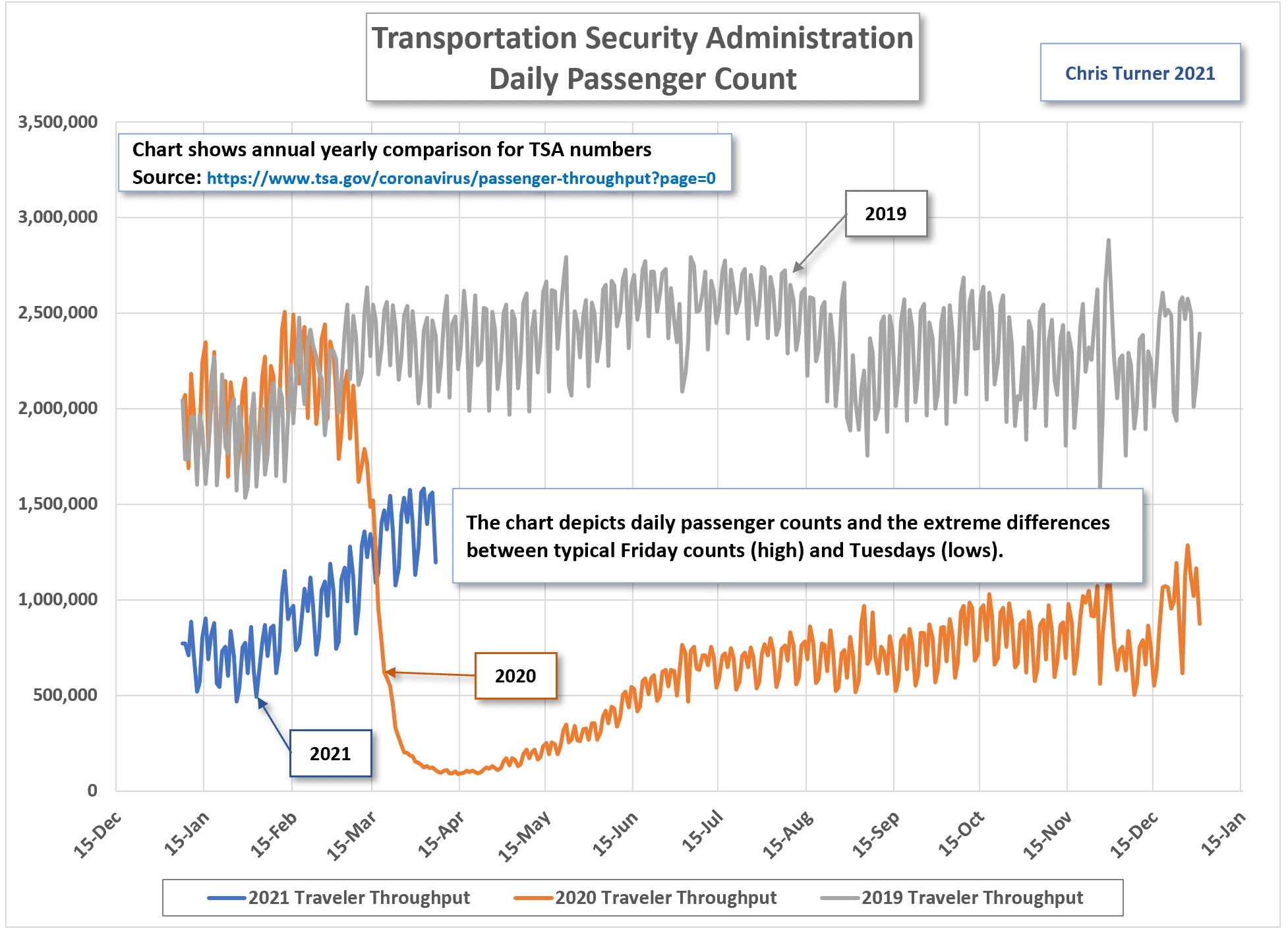
“Props” for McDonnell Douglas: Unducted Fans (UDF) Never Took Off

2

Airliner technology continues to evolve year-after-year, in the pursuit of better fuel economy which leads to better financial yields for operators.  There’s been a number of initiatives over the years from all aircraft manufacturers, but in the 1980s unducted fan (UDF) technology was showing promise for reducing fuel consumption substantially on new model aircraft for the 1990s. 

McDonnell Douglas was one of the manufacturers that pursued this new technology for nearly a decade before abandoning it as a future airline powerplant.

6
Image: McDonnell Douglas

An Attempt To Push Beyond The Turbofan with UDF

Modern jetliners operate on turbofan engines, which quite simply have a ducted fan attached in front of a turbojet engine.  Going into detail on turbofan construction and operation would require a separate article; but the turbine creates the bulk of the thrust, the ducted fan creates additional thrust and lowers the overall noise footprint of the engine, and this is what modern jetliners use to operate their aircraft.  

In 1973 when OPEC engaged in an oil embargo with nations that were perceived to support Israel during the Yom Kippur War, oil prices shot up overnight resulting in an increase from .36 cents a gallon to .53 cents a gallon. 

By 1974, a barrel of oil had quadrupled versus the previous years.  The embargo ended six months later, but the price of oil and subsequently gas prices continued to climb. A gallon of gas reached an average of $1.19 a gallon just six years later, a substantial climb in price, nearly four times higher than 1973.  But it didn’t stop in 1980, gas just continued to climb in price leading to a serious effort to find and update powerplants to be more fuel efficient.

An Opportunity To Improve Fuel Efficiency

NASA actually led the way to look for new technology and concepts to reduce fuel burn, by working with manufacturers and providing NASA funded research grants.  Manufacturers looked at ways to make their aircraft more fuel efficient in light of the overnight fuel crisis which led to increased fuel prices. 

Suddenly aircraft that burned massive amounts of fuel were a pain point for airlines.  One of the key powerplants that showed promise was Unducted Fan (UDF) technology.  Two key powerplant producers, Pratt & Whitney and General Electric invested in this technology with prototype engines, and Boeing and McDonnell Douglas provided aircraft test beds and perceived new aircraft models to present to airline customers. 

Additionally, other manufacturers such as Fokker, British Aerospace, and Tupolev all invested in testing out alternative prop-based powerplants to varying degrees over the years.  

UDF: The Unducted Fan Emerges As An Option

While little information is available, McDonnell Douglas was looking at UDF technology for the newly launched MD-80 series as an option.  Interestingly enough, the early rendition in the form of a 1/100 scale model differs considerably from the powerplants that did eventually take flight, featuring forward facing prop fans. 

It was a close rendition of the eight bladed Allison 501-M78 and a Hamilton Standard propeller, used in a NASA propfan test.    These early units were modified turbofan engines with the fan placed outside the engine nacelle on the same axis as the compressor blades, and assumed this was an early design study from 1981.  

1
“Props” for McDonnell Douglas: Unducted Fans (UDF) Never Took Off 77

NASA had released their internal studies on propfan technology to engine makers who were interested in pursuing the technology.  By 1984 NASA had awarded a contract for $20m to further study and pursue the concept of an open rotor powerplant to General Electric (GE).  GE was working closely with Boeing on the UDF as a possible new short haul aircraft powerplant, dubbed the 7J7 for a market introduction in 1991.  

The 7J7 was a widebody short haul aircraft with a range of up to 2700 nautical miles initially.  But Boeing ended up pitching a hybrid-narrowbody concept at 155 inches to airlines as the final configuration, with a 2-2-2 seating configuration ensuring there was no middle seat.  That was depending on the airline customer you talked to, as it was said Boeing kept changing their minds as to what the aircraft was and would be.  

UDFs Became All The Rage

2
Image: NASA

GE unveiled their engine concept at the 1984 Farnborough Air Show, promising up to 30% reduction in fuel burn without decreasing inflight cruise speeds.  Two key points for GE’s proposal was twin contra-rotating fans which kept fan blade length to a reasonable size (12 feet) vs. a single prop at nearly 20 feet in diameter. 
The second selling point was the lack of a gearbox, which transfers power from the turbine to the propeller.  Beginning in 1986, the GE36 flew a considerable number of test flights, achieving a cruise speed of Mach .84 at an altitude of 39,000 feet on Boeing’s test 727 aircraft.  

3

There was significant interest from British Airways as a replacement for its 737-200s, SAS, and American Airlines.  However, British Airways selected the Boeing 737-300 instead.  American Airlines had concern if the 7J7 could be stretched further using the same powerplant.  Internally at Boeing, the 7J7 was viewed as a political football: a possible new line of fuel-efficient aircraft, or the grim reaper for the 737 line.  In the end American Airlines went with the Fokker 100 aircraft based on availability. 

The engine technology while progressing, wasn’t going fast enough to guarantee a launch of the 7J7 by 1991.  With competition brewing from McDonnell Douglas not to mention the newly introduced Airbus A320, Boeing ended up postponing and subsequently canceling an UDF powered aircraft.  But McDonnell Douglas pressed on.

4
Image: NASA

McDonnell Douglas Kept On Developing UDF Concept

Allison Engine Company which already had a head start on a similar concept, partnered with Pratt & Whitney in 1987 to produce a prototype UDF for a test run on an McDonnell Douglas airliner.  While Allison had produced a smaller prototype and tested in conjunction with NASA back in 1981, it was playing catch up to the GE36 in 1985, which flew first. 

Pratt & Whitney would not be able to develop and certify an original engine design to meet the aircraft launch dates, and thus partnered with Allison to speed up development.  The engine was proposed in two sizes, with the smaller variant a 10k shaft horsepower and 23:1 compression ratio, with a three stage boost compressor and power turbine for 100 passenger aircraft; and a larger 15k shaft horsepower aircraft for up to 160 passengers. 

The engine was dubbed the 578-DX, but unlike the GE36, the 578-DX would in fact have a reduction gearbox, and claim an additional 7% fuel savings as a result.  But having a gearbox meant more maintenance and reliability headaches and airlines were wary.  Allison claimed that the gearbox would need an overhaul after 30,000 hours, and was in fact reliable (although this would never be proven).

McDonnell Douglas Goes All In On UDFs

McDonnell Douglas was already planning its next range of airliners based on the successful MD-80 series.  The first of these next generation airliners was the MD-90, an updated version of the MD-80 with all new engines and a glass cockpit, better range and less fuel consumption. 

It would also address noise by having a lower noise profile than the current JT8D engines.  But this was expected to be a stop-gap measure until UDF technology matured and eventually replaced jet powered MD-80 and 90 aircraft.  Subsequently, McDonnell Douglas began marketing the MD-91 and MD-92 aircraft as early as 1985, all powered by UDF engines by GE or P&W.  

5
The MD-91 was a copy of the MD-87 with UDF engines. Photo: McDonnell Douglas

Mutiple MD-9X Varients

The MD-91 would have been the smallest capacity of the offerings, at 114 passengers (2 class) or 130 passengers (all economy) and just under 129 feet in length.  It would utilize the MD-87 fuselage, but with the wing shifted 3 feet further back.  The MD-90 (traditionally powered) would carry 153 passengers (2-class), or up to 172 passengers in all economy configuration, with a fuselage length of 152 feet. 

Finally, the MD-92 was slightly larger at 157 feet in length, utilizing the MD-88 fuselage (lengthened 133 inches forward of the wing), and 165 passengers (2 class) or 173 passengers in all economy.  All aircraft would feature a composite horizontal stabilizer, with split powered elevator and rudders and a full glass digital cockpit.  There were subsequent other aircraft marketed like the MD-94, but this was proposed to be a clean sheet design to compete with Boeing’s 7J7.  

The Jet Is Too Dang Loud!

There was the perception an open rotor aircraft suggests interior noise to passengers.  McDonnell Douglas claimed that the interior cabin noise levels of the MD-91/92 would be 80dB, which would make it up to 6dB quieter than the jet powered aircraft. 

McDonnell Douglas claimed that the demonstrator registered 82dB during testing, and that airline executives who flew on marketing flights made statements like “very quiet, better than expected” or “airplane very quiet, particularly in the last row.” 

This conflicted with reports of other members of the travel industry who said it was very noisy inside, a different type of prop sound, but certainly noticeable and generating some cabin vibration (that would be addressed later on).  The marketing test flights were carried out of Long Beach, and flew airline personnel, media, military, and other industries (181 people carried total).  The aircraft would fly out of LGB and out over the Pacific Ocean, directly over Catalina Island, then it would turn left and south where it would make a U-turn over San Clemente island and descend back to LGB.  

8
“Props” for McDonnell Douglas: Unducted Fans (UDF) Never Took Off 78

McDonnell Douglas UDF: Ultra-Loud and Ultra Efficient

The GE36 was also tested on the McDonnell Douglas MD-80 testbed for a future MD-9x series of aircraft a year later in 1987.  It was modified from an 8×8 blade set up (8 blades on each counter-rotating prop) to an 10×8 with the rear prop containing 8 blades versus the forward props 10 blades.

This configuration resulted in quieter operation, and that a commercial production version would have different blade counts on each prop to achieve the desired noise profile and best performance.  Most of the test flights with the McDonnell Douglas MD-80 test bed were performed with the GE36, as the P&W option was way behind schedule.

Most testing on the MD-80 testbed was with the GE36, which achieved a maximum speed of Mach .865 at 37,000 feet.  This powerplant would accomplish 165 hours over 93 flight tests, substantially more than the 578-DX. 

McDonnell Douglas began to refer to the UDF with another acronym: UHB – Ultra High Bypass, and came up with further variations and aircraft types utilizing the UHB acronym.  They were marketed with up to 40% less fuel burn, but ignoring the substantial cost increase to acquire these new powerplants.  McDonnell Douglas was even discussing offering powerplant retrofits on existing MD-80 series aircraft. 

McDonnell Douglas, Exclusive Purveyor of UDFs (On Paper)

Once Boeing cancelled the 7J7, McDonnell Douglas in marketing materials to airlines began saying you can’t get UDF technology from anyone but McDonnell Douglas.  This was all based on the GE36, because up to this point the 578-DX had not flown on an McDonnell Douglas airframe having missed numerous milestones in the schedule due to a variety of issues.

McDonnell Douglas Offers a Military UDF

McDonnell Douglas was so confident in what the UDF offered that it entered a military variant when the Navy began a search for a new patrol aircraft, specifically the Long-Range Anti-Submarine Warfare Capable Aircraft (LRAACA) competition launched in January 1987. 

This competition was seeking replacements for the ageing P-3 Orion aircraft.  No other manufacturer other than Lockheed had interest in building a derivative to the P-3.  But the Navy wasn’t going to just hand Lockheed a contract without bidding it out, and thus expanded the scope to include commercial aircraft derivatives in March of 1987.  

McDonnell Douglas submitted an MD-91 derivative, ironic given the MD-91 hadn’t officially flown yet.  The designation for the derivative was P-9D, and it was the UDF powered MD-91 but with additional equipment.  McDonnell Douglas was offering either engine (P&W or GE) as a choice to the Navy, even though the 578-DX hadn’t flown on the MD-80 test bed. 

The P-9D was presented as having a 45%+ lower fuel burn than the current P-3 Orion.  The P-9D would have carried the latest electronics and sensors, along with AGM-84 Harpoon Missiles and operating with a crew of 11.  Nonetheless, in October of 1988, the Navy selected the Lockheed proposal (P-7) which was significantly lower in cost than the McDonnell Douglas proposal, while also being judged technically superior with less technical risk. 

Progress Continued

McDonnell Douglas soldiered on with the commercial MD-91 and MD-92, flying the UDF prototype to the Farnborough Airshow in 1988 equipped with the GE36 engine in hopes of drumming up sales.

The 578-DX would undergo ground testing from late 1987, with scheduled in-flight testing (installed on an MD-80 test bed) planned for early 1988.  Due to repeated mechanical and engineering issues encountered on the ground, the 578-DX didn’t take to the air until April of 1989, nearly two years late.  But when it did, it reportedly flew without issue at a speed of up to Mach .77 at an altitude of 30,000 feet.  

McDonnell Douglas Even Toyed With a DC-10 UDF

McDonnell Douglas was even experimenting with the idea of replacing the turbofans on the DC-10 with UDF powerplants, with one example being given the conceptual designation “UHB-270”, but never appeared outside of model form.

After years of delay, McDonnell Douglas killed off the UDF variants of its new MD-9x airliners in May of 1989, one month after successful testing of the 578-DX.  It was clear that the engine delays would further push the MD-9x series of aircraft further into the mid-late 1990s before airline customers could take delivery.  And GE wasn’t interested in moving forward with their UDF unless McDonnell Douglas had firm orders for at least 150 aircraft.  

Caught in chicken-and-egg scenario, airlines were generally reluctant to order a brand new type without the manufacturer fully committing to the type. But McDonnell Douglas wasn’t going to commit to anything, from guaranteeing performance data to manufacturing the aircraft without orders.  

The End of the Road For The UDF

What killed the UDF concept?  Price, price and price.  The price of fuel when the UDF concept kicked off was at the top of the market, and climbing by the day.  But when the UDF concepts finally flew, the price of gas had begun to drop.  From a high of $1.31 a gallon in 1981, by 1986 gas was averaging .86 a gallon. 

Gas was no longer perceived as a financial gating issue compared to the early 1980s.  The second problem was the price of the powerplant.  Pratt & Whitney’s 578-DX was forecast to be 40% higher in cost to purchase than a turbofan that was currently available for Boeing and McDonnell Douglas aircraft.  The economics just didn’t quite work the way they expected.  Finally, no airline customer put in a firm order for the prop-fan powered airliners.  All three of these issues killed the UDF concept.

9
A proposed DC-10 derivative with UDF Engines. Photo: McDonnell Douglas

But all was not lost, and a lot was learned from the UDF exercise.  The technology to build the UDF’s fan blades was used to develop the fan blades for the GE90, one of the engines that powers the Boeing 777 aircraft.  The technology using composite materials is now used in many aircraft parts.  And there are still companies, GE included, who continue to look at UDF technology.

A Look Back To The Turbojet Era at Los Angeles’ LAX Airport

Remember the good ole days at Los Angeles International Airport? It was filled with four engined domestic flights on widebodies like the Boeing 747-100 and L-1011.

Times have definitely changed at LAX. Today, it is dominated by the Boeing 737 and Airbus A320 series jet along with a host of 787 and 777 flying the international routes. While there are a number of 747 cargo flights, most passenger 747s are now a thing of the past. Even a A380 is becoming rare these days.

In the video, you’ll see a United Boeing 747-100 probably arriving from either Honolulu or Chicago O’hare along with an Eastern Airlines L-1011 preparing to depart to Atlanta. You’ll also see a host of Western Airlines 727s and a TWA 707 at the gate. This two minute video also features international 747 arrivals from Lufthansa and Air France. It’s worth a watch…and makes us pine for the days long gone where both variety, prestige, and size mattered more than efficiency.

The video was posted on YouTube by SDMullis. Check it out!