Home Blog Page 66

Movie Props: Those ‘Thirteen Days’ RF-8A Crusaders

Accuracy in the Film ‘Thirteen Days’ Was Better Than Average, But…

In the 2000 Beacon Pictures/New Line Cinema film ‘Thirteen Days’ there are great pains taken to make the dramatic events of the Cuban Missile Crisis look and feel as realistic as possible. To the credit of all concerned, the Department of Defense allowed filming on several bases as well as the aircraft carrier USS Enterprise (CVN-65). Museum ships like the USS Joseph P Kennedy (DD-850) were also used for filming of the maritime blockade shipboard scenes. However, we found a few holes in the visuals. First, take a look at the Light Photographic Squadron SIX TWO (VFP-62) Gray Ghosts/Fighting Photos Vought RF-8A Crusader photo reconnaissance mission sequence of 23 October 1962 from the film as uploaded to YouTube by Colt cat.

[youtube id=”oSNLeC-eMUQ” width=”800″ height=”454″ position=”left”]

When You See It

The first thing that jumps out is that GY tailcode for those Fighting Squadron TWO FOUR (VF-24) Fighting Renegades Vought F-8C Crusaders on the flightline at Naval Air Station (NAS) Key West. VF-24 was deployed in the Western Pacific (WestPac) with Carrier Air Wing TWO (CVW-2- tail code NE) aboard the aircraft carrier USS Midway (CVA-41) between 6 April and 20 October 1962. Therefore it is unlikely that VF-24 would have been seen wearing GY codes or hanging around at NAS Key West within a week of returning from WestPac. But the presence of all those Gunfighters on the flightline does make an impression. We know that VFP-62, along with a detachment of four Marine Composite Reconnaissance Squadron TWO (VMCJ-2) Playboys (tailcode CY) RF-8As and pilots were based at NAS Key West at the time.

download 1
Image via YouTube screen grab from embedded video

Location Location Location

The shooting location for the RF-8A mission sequence was the former Clark Air Force Base (AFB) in the Philippines. In 1988, after flying from Cesar Basa Air Base since 1977, the Philippine Air Force grounded and open-stored their remaining operational former US Navy and Marine Corps F-8H jets. They did not operate any RF-8As or RF-8Gs. When Mount Pinatubo erupted just 15 miles from Basa the entire area was covered with volcanic ash, rendering the Philippine Air Force Crusaders entirely inoperable. But that didn’t stop the film crew from using the jets as props for the film. With new coats of paint and semi-realistic markings you have to look closely to spot the gotchas. We did.

F 8H Crusader of the Philippine Air Force in flight c1978a
Philippine Air Force F-8H in flight circa 1977. Image via US Navy

Consistency is Key

Tailcode GY never assigned to VF-24. VF-24 wore G on their tails while flying FJ-3Ms and NG (usually) while flying F8Us, F-4s, and F-14s. VFP-63 wore PP. VFP-62 wore GA and of course Air Wing codes when detached. Tailcodes beginning with G were used primarily for Heavy Photographic (VAP), Heavy Attack (VAH) and Heavy Attack/Photographic (RVAH) squadrons. The tailcodes on the supposed RF-8As is correct for VFP-62 (GA) though, as are the Bureau Numbers (BuNos). Both 146871/GA910 and 146886/GA906 were assigned to VFP-62 during 1962 and were flown on the mission depicted in the film by the pilots shown. For this writer the final word on the events during October and November 1962 is William B Ecker’s book Blue Moon Over Cuba. Ecker was not only there, he was the CO of VFP-62 at the time. It’s a great book.

download 2
Image via YouTube screen grab from embedded video

Stand Ins Not Quite Standing Up

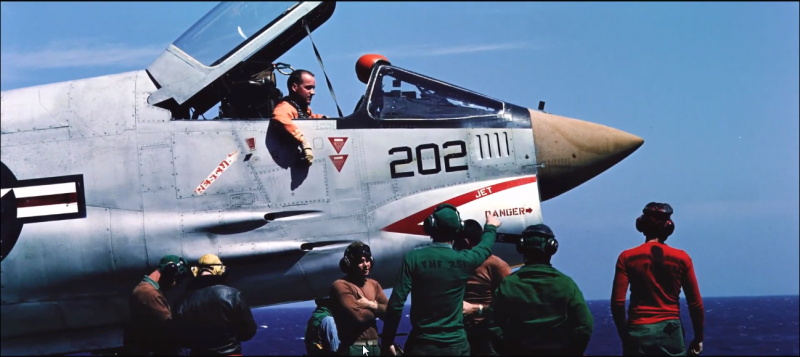
Some other inconsistencies surface when one researches the timing of events. The F-8Hs playing the role of RF-8As in the film were dressed up to look like RF-8As but the grafted on flat panels for the camera bays are obvious- especially when the jets taxi in after returning from Cuba. The RF-8A also lacks the prominent nose-mounted infrared seeker head (IRST) and the ventral strakes seen on the jets in the film. The camera bay where the Photographers Mate (PH) is working isn’t very realistic and we’re not convinced about those film canisters either.  So the F-8Hs did a decent if not quite believable job as RF-8As in the film. Another inconsistency is that CDR Ecker actually recovered at NAS Cecil Field in Jacksonville, hot refueled, and then flew directly to Washington to deliver the film he shot on the mission dramatized in the film- not back to Boca Chica for a cold one. He deserved to, but he didn’t.

download 3
Image via YouTube screen grab from embedded video

Giving It Away

The shooting location was given away when mountains appeared in the distance during the takeoff. The Philippines have mountainous terrain visible from runways. The only towering mountains near Key West are made of Cumulus clouds! In several cases the ground equipment (yellow gear) shown in the film is either period-inaccurate or wasn’t used at Naval Air Stations at all. We could get into the other inconsistencies in the film (there are a few more) but suffice it to say that VFP-62 did a great job, deserving and receiving a Navy Unit Commendation (the first in peacetime) from President John F Kennedy himself on 26 November 1962.

AR 310149990
Image via NAtional Naval Aviation Museum

Trivia Alert

Ironically both of the jets flown on that 23 October 1962 mission were operational losses after being upgraded to RF-8G standard while flying with VFP-63 Eyes of the Fleet later in their service lives. 146871 entered service with VFP-62 in 1960 and later served with VFP-63, was stored at the Boneyard in 1975 and returned to service with VFP-63 before she was lost to a bad cat shot on 2 December 1976. 146886 entered service in 1961 with VFP-62 and served with both VMCJ-3 and VFP-63 before she was shot down over Vietnam near Vinh on 22 May 1968.

13 Days
Image via YouTube screen grab from embedded video

The actor who played CDR William B. Ecker (pilot of 146871/GA910) in the film is Christopher Lawford- the son of Patricia Kennedy Lawford and the nephew of President John F “Jack” Kennedy and brother Robert “Bobby” Kennedy. Ecker retired as a Captain and passed away on 5 November 2009.

The actor who played LT Christopher Bruce Wilhelmy III (pilot of 146886/GA906) is David O’Donnell- the grandson of Kenneth “Kenny” O’Donnell. Wilhelmy’s name is often misspelled as ‘Wilhemy’ but not in the film. Wilhelmy perished when the North American T-28B Trojan he was flying shed its wings on 17 February 1966.

There was much more to the story of the RF-8A photographic reconnaissance mission over Cuba. More than 70 sorties were flown by VFP-62 and VMCJ-2 pilots between 23 October 1962 and 13 November 1962. All 16 of the pilots who flew the Operation Blue Moon missions received the Distinguished Flying Cross.

DSC09527
Former VFP-62 RF-8A crusader at USS Alabama museum. image via author

Air Force Thunderbirds Poised to Begin 2020 Season

NELLIS AFB, NV — The high speed passes and precision flight of the Air Force Thunderbirds begins in three weeks as they headline top air show locations across America.

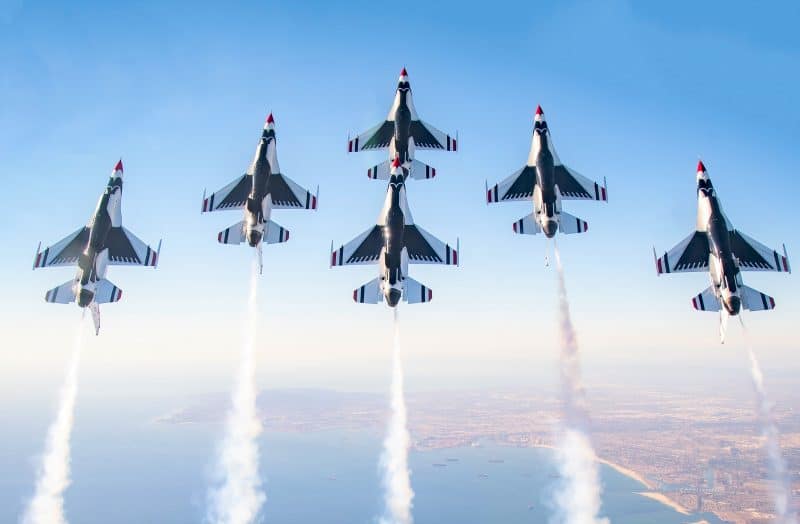
The Thunderbirds kicked-off their 2020 season last weekend with a flyover of the Daytona 500 race. The six-jet team will spend the remaining weeks practicing six-days a week before traveling to their first air show.

America’s Ambassadors in Blue are scheduled to perform at 35 locations across the United States, including one stop in Canada. The team’s first public flight demonstration will take place over Del Rio, Texas, at Laughlin AFB on March 14.

190323 F VJ293 1002
The U.s. Air Force Thunderbirds prepare for the start of their 67th anniversary season. (USAF SSgt Cory Bush)

“I can feel the excitement right now,” Thunderbirds advance pilot Maj. Jason Markzon said. “We’re going to kick it up a notch, maybe ten notches, when we get to Laughlin in March.”

Last summer, the Thunderbirds selected three new demonstration pilots for the next two seasons. Maj. Trevor Aldridge will fly as the new left wing pilot, Capt. Zane Taylor will fly as the slot pilot, and Capt. Kyle Oliver has been selected as the new opposing solo pilot.

The three will join second season pilots, leader Lt. Col. John Caldwell, right wing pilot Capt. Michael Brewer, and lead solo Maj. Michelle Curran. A demonstration pilot typically serves two seasons with the Thunderbirds.

[youtube id=”dyzil7Z1Yzw” width=”800″ height=”454″ position=”left”]

“Growing up, the Thunderbirds inspired me to become a pilot,” Capt. Taylor expressed. “I am hoping to inspire the next generation of boys and girls to do the same.” Taylor added as a youngster, he hung a Thunderbirds poster on his bedroom wall.

As the pilots practice their tight formation flights, the Thunderbirds maintainers and logistics personnel have been busy, too. The teams are working from sunrise to sunset during winter training in order to begin their 67th anniversary season on time.

The backbone of the Thunderbirds is the team’s nearly 120 enlisted airmen, each trained to handle aircraft maintenance, flight equipment, and logistics. Each enlisted Thunderbird serves three to four years with the squadron.

“Our mission is to recruit, retain and inspire,” Maj. Markzon explained. “Our job is to just go and really focus on the kids and talk to them about the opportunities that the Air Force has to offer and try to inspire the next generation.”

Air Force Thunderbirds 2020 Air Show Schedule:

Mar 14: Laughlin AFB, Del Rio, Texas – Fiesta Of Flight

Mar 21-22: Luke AFB, Arizona – Luke Days Air and Space Expo

Mar 28-29: March AFB (Calif.) Field Air and Space Expo: Thunder Over the Empire

April 4-5: Lakeland, Florida – Sun-N-Fun Fly In and Expo

April 18-19: Maxwell AFB, Alabama – Beyond the Horizon Air and Space Show

April 25-26: Columbus AFB, Mississippi – Wings Over Columbus

May 2-3: Fort Lauderdale, Florida Fort Lauderdale Air Show

May 9-10: Beale AFB, Calif. – Wings Over Recce Town, USA

May 16-17: Shaw AFB, South Carolina – Shaw Air and Space Expo

May 23-24: Miami Beach, Florida – Miami Beach Air and Sea Show

May 28: Colorado Springs, Colorado – USAFA Graduation Fly Over

June 6-7: Salinas, Calif. – California International Airshow

June 13-14: Ocean City, Maryland – OC Air Show

June 20-21: North Kingstown, Rhode Island RI ANG Open House and Airshow

June 27-28: Hill AFB, Utah – Warriors Over Wasatch Air and Space Show

July 4-5: Battle Creek, Michigan – Field of Flight Air Show and Balloon Festival

July 11-12: JB Elmendorf-Richardson, Alaska – Arctic Thunder Open House

July 18-19: Duluth, Minnisota – Duluth Air and Aviation Expo

July 22: F.E Warren AFB, Wyoming – Cheyenne Frontier Days

July 25-26: Ellsworth AFB, South Dakota – Ellsworth Air and Space Show

August 1-2: Grand Forks AFB, North Dakota Air Show

August 15-16: Chicago, Illinois – Chicago Air and Water Show

August 22-23: Avoca, PA – Wilkes-Barre/Scranton Armed Forces Airshow

August 26: Atlantic City, New Jersey – Thunder Over The Boardwalk

August 29-30: New Windsor, New York – New York Air Show

September 5-6: Gardner, Kansas – Kansas City Air Show

September 12-13: London (Ontario), Canada – Airshow London

September 19-20: Huntington Beach, Calif. – Pacific Airshow

October 3-4: Minden, Nevada – Aviation Roundup Airshow

October 10-11: Edwards AFB, Calif. – Aerospace Valley Air and Space Show

October 17-18: Fort Worth, Texas – Bell Fort Worth Alliance Air Show

October 24-25: Rome, Georgia – Wings Over North Georgia

October 31-November 1: Sanford, Fla – Central Florida Air and Space Show

November 7-8: New Orleans, Louisiana – NASJRB New Orleans Air Show

November 14-15: San Antonio, Texas – JBSA Air and Space Show

(Charles A. Atkeison reports on aerospace and technology. Follow his updates via social media @Military_Flight.)

Upclose: Two Engineers Discuss Servicing Space Shuttle Atlantis

CAPE CANAVERAL, Fla. — NASA’s space shuttle fleet served as an orbiting workshop for thirty years — a space truck which delivered a variety of spacecraft and segments of the International Space Station into orbit.

Five space-worthy orbiters were built to allow astronauts to live and work in space. Behind the pressurized living quarters, a massive 60-foot cargo bay housed commercial and scientific satellites, or a pressurized module, which extended the volume of the crew’s work space.

Each orbiter named to honor a sailing vessel — Columbia, Challenger, Discovery, Atlantis, and Endeavour. Each was structurally built the same, however there were differences to those who knew them on an intimate basis.

Between 1981 through 2011, NASA launched 135 space shuttle missions from the Kennedy Space Center. Of those, two orbiters — Columbia and Challenger — did not return home after launch due to failures.

At the Kennedy Space Center’s Visitor Complex, one shuttle is on display following her retirement. Atlantis, a veteran of 33 space flights, rests inside a multi-level building built especially for the spacecraft.

The orbiter is on public view with her payload bay doors open and a Canadian-built 50-foot robotic arm extended out. The docking port used to dock with the International Space Station is also located inside an otherwise empty bay.

Today, former space shuttle processing employees work as docents near Atlantis to educate the public about the winged spacecraft. Jean L. Wright sewed the thermal blankets which protected the shuttle’s exterior.

Columbia and Challenger were constructed using thermal tiles to protect the shuttles from extreme heating during re-entry. Later, the introduction of thermal blankets were used on later shuttles where reentry temperatures reached up to 1,200° F.

“We made 11 classes of blankets as we didn’t use the term thickness in our world,” Wright noted as we moved around Atlantis. “They ranged from 1/4″- 2″ thick. The class was decided by what surface on the orbiter it was being bonded to.”

49345264611 68a7dfa324 k
Jean Wright and her team stitched up the orbiter’s protective thermal blankets. (Charles Atkeison)

Wright highlighted the difference between the traditional heat absorbing tiles and the white blankets. Using a massive 30 needle sewing machine, each thermal blanket was quilted for a select area of the orbiter. It would take the machine nearly four minutes to quilt the blanket one way.

“Here at the OMS, since the frame was made of composites, we had to use our two-inch thick blankets,” Wright pointed as we gazed up at one of Atlantis’ two orbital maneuvering system pods. “NASA required that in areas made of composites, the skin of the orbiter couldn’t be exposed to temps over 250-degrees, thus thicker blankets were needed there.”

Challenger was flown with a small section of thermal blankets to test their effectiveness in 1983. They were located on her OMS pods and later added to her sides.

“After each blanket was quilted, they under went a process known as heat cleaning,” Wright continued. “They were baked in a blue pizza oven at 650-degrees for four hours. Then baked for two more hours at 850-degrees.”

[youtube id=”zsJpUCWfyPE” width=”800″ height=”454″ position=”left”]
Atlantis is poised just as she was while in space with her port side tilted downward 43.21-degrees. The great tilt allowed for us to have a birdseye view of the entire open payload bay.

Brad Byron worked to configure the payload bay with its cargo and keep it free of contamination. Each orbiter was prepared for her next flight in the Orbiter Processing Facility. It was here that the hardware or payloads were installed inside the massive bay.

“It was always a challenge working in the orbiter cargo bays,” Byron began as he reflected on a job he enjoyed so much. “But when the launch was successful and the mission went as planned it was worth it.”

One of Brad’s favorite payloads was the Hubble Space Telescope. The shuttle completed five servicing visits to upgrade the great observatory located about 420 miles above the planet.

“Hubble servicing flights always required extraordinary cleanliness beyond the already high standards we always worked to,” he added. Atlantis flew the final servicing mission in 2009.

The Spacelab was a pressurized module fitted inside the cargo bay. The reuseable module gave astronauts more room to conduct science experiments in microgravity.

“Installing a Spacelab module in the cargo bay would take maybe 6 to 8 hours if everything went according to plan,” Byron said standing only two meters from Atlantis’ bay. “Every one was always different depending on what OPF bay the orbiter was in.”

Brad noted that anything which went into the payload bay was recorded. He and his crew ensured that foreign objetcs not designed for that space flight would be seen floating out of the bay once on orbit.

“Everything that was going into the cargo bay had to be logged in – tools, chemicals, cleaning materials, flight hardware for accountability,” he added. “When we left the cargo bay everything was logged back out.”

The years of dedication in preparing the space shuttle’s for flight has transitioned over to NASA’s new Artemis Program. From the protective outer skin to spacecraft processing, today’s Artemis engineers stand proudly on the shoulder’s of the space shuttle’s engineers.

(Charles A. Atkeison reports on aerospace and technology. Follow his updates via social media @Military_Flight.)

COMBI Jets: The Rarest 757 In The Skies

5

The Boeing 757 is a beast of an airliner. The single-aisle jet is overpowered, robustly engineered with a super-critical wing that balances both short takeoffs and landing distances with transatlantic range. It is a rare that a type is still prevalent in the airline industry almost 40 years after its first flight without any major upgrades or revisions. Still today, hundreds of 757s ply the skies even though the assembly line was closed way back in November of 2005.

While the 757 is a unique jet, there is an even more exclusive subset of 757s. That is the Combi 757-200M. A combi jet is an airliner that has both cargo positions and a passenger cabin. This type of aircraft used to be more common in the industry (along with the QC or Quick Change jets that could be rapidly converted between a passenger jet and a cargo aircraft). The Boeing 737, 747s and Douglas DC-8s all were either offered as combi options on delivery or were later converted in the aftermarket for niche purposes. After a couple of notable cargo aircraft fires in the 1980s, the FAA made it more difficult to certify a combi aircraft. The FAA had concerns with a fire on the jet due to the contents of the cargo. Without expensive fire detection, extinguishing systems, and robust restraints, a new Combi aircraft would not be certified.

Enter the Mighty 757-200M

Before the change in regulations, Boeing built a single factory combi 757 as part of a deal with Nepal Airlines. The airline was supposed to take delivery of two aircraft but only ended up taking one combi aircraft. It was the only combi passenger 757 built at the factory. The type never really caught on as no other airlines purchased the type.

nepal airline 757 200M
Nepal Airlines operated the only factory built Boeing 757-200M. Photo: Nepal_Airlines_B757_Combi.JPG: NA2359derivative work: Altair78 / CC BY (https://creativecommons.org/licenses/by/3.0)

Today, the 757M is still a very rare aircraft. At one time Pemco World Air Services, Vision Techology Systems and Precision Conversions all offered the 757. The conversion has not proved very popular though as the only current operators of the 757-200M are ATI and the Royal New Zealand Air Force.

ATI and Royal New Zealand Air Force Operate the Boeing 757-200M today

The ATI story is pretty unique. ATI once offered Douglas DC-8 combi service, primarily for military customers. It flew both cargo and people to a number of niche routes to remote destinations in the Pacific and Atlantic. As the DC-8 fleet was reaching the end of its service life, the company purchased 4 757-200Ms from National Airlines. National Airlines themselves converted the 757 jets in anticipation of a contract with the government. When this contract didn’t materialize, they sold their combi jets to ATI. ATI took delivery of three of the four aircraft. They operate the fleet regularly today.

By our count (and we could be wrong here as some conversions seem to have been announced but never delivered), there were only 7 757-200M aircraft ever built or converted. While there are plenty of 757 cargo aircraft, the 757-200M is one of the rarest sub-fleets of 757s still flying today.

On YouTube, there is a cool video showing the inside of an ATI 757-200M Combi aircraft by Jetblast141aviation. It holds 10 pallets and up to 42 passengers. The pallet positions are in the front of the aircraft with the 42 seats in the rear, separated by a partition.

WATCH: A Day in WestPac Aboard the Mighty Oriskany

This 1971 Film Depicted a Mark 1, Mod 0 Day in the Tonkin Gulf

When the Essex-class aircraft carrier USS Oriskany (CVA-34) hosted the Pacific Fleet Combat Camera Group to shoot the film ‘A Day in WestPac’ in 1971, the “Big O” was on her 14th deployment.  She was a member of the Tonkin Gulf Yacht Club several times over by then, having already deployed off Vietnam five times. Carrier Air Wing ONE NINE (CVW-19) was embarked aboard “Tico” for the 5th time. The film depicts a Mark One-Mod Zero day aboard an Essex-class carrier deployed to Vietnam. If you were there you know what a good job the camera crews did. The film was uploaded to YouTube by Periscope Film.

 [youtube id=”CuznRX9Pa9k” width=”800″ height=”454″ position=”left”]

The Ship

Named after a Revolutionary War battle, the Oriskany was one of the few Essex-class carriers completed after World War II concluded in 1945. Work on the ship was actually suspended when the war ended. It wasn’t until 1950 that the ship was completed and commissioned as the final Essex-class carrier to be placed in service. The Oriskany went into service as a straight-deck Essex-class ship. In 1956 the ship went back to the yard for conversion and was decommissioned, there to receive a new angled flight deck, aft deck edge elevator, enlarged forward elevator, enclosed ‘hurricane’ bow, steam catapults, and aluminum deck surface. Oriskany was recommissioned in 1959.

A 7B Corsairs VA 215 in flight in 1971a
VA-215 A-7Bs. image via national naval aviation museum

The Air Wing

 During her 1971 WestPac deployment aboard Oriskany, CVW-19 consisted of VF-191 ‘Satan’s Kittens’ and VF-194 ‘Red Flashes’ flying the Vought F-8J Crusader, VA-153 ‘BlueTail Flies’ flying the Ling-Temco-Vought (LTV) A-7A Corsair II, VA-215 ‘Barn Owls’ and VA-155 ‘Silver Foxes’ flying the A-7B Corsair II, VAQ-130 ‘Zappers’ Detachment 3 flying the Douglas EKA-3B Skywarrior, VFP-63 ‘Eyes of the Fleet’ Detachment 34 flying the Vought RF-8G Crusader, VAW-111 ‘Early Elevens’ Detachment 1 flying the Grumman E-1B Tracer, HC-1 ‘Pacific Fleet Angels’ Detachment 5 flying the Kaman UH-2C Seasprite, and VQ-1 ‘World Watchers’ Detachment 34 flying the Douglas EA-3B Skywarrior.

26840901 10209793679350581 5610542120274067615 oa
CVW-19 EKA-3B. image via national naval aviation museum

The Movie Star and a Plot Twist

The Big O starred in several films. The shipboard scenes for the 1954 Paramount film ‘The Bridges at Toko-Ri’ starring William Holden, Grace Kelly, Fredric March, and Mickey Rooney were filmed aboard, as were similar shots for the 1954 MGM feature ‘Men of the Fighting Lady’ starring Van Johnson, Walter Pidgeon, and Keenan Wynn. Much later in 1997 when the ship was laid up prior to scrapping, scenes from the 1998 Universal film ‘What Dreams May Come’ starring Robin Williams, Cuba Gooding Jr., and Max Von Sydow were filmed aboard. Talk about plot twists- Oriskany was not scrapped. In 2006 she was intentionally sunk off Pensacola , Florida in the Gulf of Mexico as an artificial reef.

a starboard bow view showing the decommissioned us navy usn intrepid class bbe178 1600
Oriskany becoming a gulf coast reef. image via national archives

WATCH: This is How You Restore a DH.98 Mosquito

2

The Owner of This Beautifully Restored ‘Mossie’ Shares Both Mosquito History and His Story

Mosquito FB Mk.VI serial number PZ474 (reg N474PZ) left the factory in 1945. The aircraft entered service with a Royal Air Force (RAF) operational training unit (OTU) and was then sold to the Royal New Zealand Air Force (RNZAF). The airplane spent neglected decades in California before going back to New Zealand in 2014 for a four-year restoration by Avspecs in Auckland. Warbird collector Rod Davis (EAA Lifetime 498155) brought his Magnificent Mossie to EAA AirVenture 2019 where it drew quite a crowd. Enjoy as Rod tells the story of this beautiful restoration along with some great Mosquito history, uploaded to YouTube by EAA.

[youtube id=”SkQURW-E3yI” width=”800″ height=”454″ position=”left”]

“We’re not saving the world by doing it but we’re kind of honoring the people that did.” How’s that for a quote? The DH.98 Mosquito, AKA the ‘Wooden Wonder’ or ‘Mossie,’ was adapted into the photo-reconnaissance, medium bomber, fighter, fighter-bomber, night fighter, high-altitude interceptor, torpedo bomber, trainer, and target tug roles. Produced from 1940 to 1950, Mosquitos rolled out of six different UK plants along with plants at Toronto in Canada and Sydney in Australia. These flexible aircraft were adapted into more than 40 different variants.

2020 02 13 21 00 49 131 Rod Lewis de Havilland Mosquito YouTube
image capture from video

During their service, Mosquitos underwent refinement and development as the war progressed. Uprated Rolls-Royce Merlin liquid-cooled piston engines turning 3-bladed constant-speed propellers propelled all Mosquito variants. Uprated engines and engine superchargers, exhaust manifold designs, fuel capacities, armor protection, wing and empennage spans and sizes, ordnance payload and delivery systems, radar systems, pressurization systems, camera configurations, and bomb bay configurations drove those version number changes.

2020 02 13 21 01 11 131 Rod Lewis de Havilland Mosquito YouTube
Image capture from video

Mosquitos served with the Royal Australian Air Force, Belgium, Royal Canadian Air Force, Republic of China Air Force, People’s Liberation Army Air Force, Czechoslovak Air Force, Dominican Air Force, French Air Force, Haitian Air Force, Israeli Air Force, Royal New Zealand Air Force, Royal Norwegian Navy Air Service, Royal Norwegian Air Force, Polish Air Forces (in exile in Great Britain), South African Air Force, Soviet Air Force, Royal Swedish Air Force, Swiss Air Force, Turkish Air Force, Royal Air Force, Royal Navy (Fleet Air Arm), United States Army Air Forces, and SFR Yugoslav Air Force. In May of 1963 No. 3 Civilian Anti-Aircraft Co-Operation Unit (CAACU) retired the last operational RAF Mosquitos.

De Havilland Mosquito 19963002805 wallycacsabrea
image via wallycacsabre

Alaska Takes Swipe At Delta in Seattle With American Codeshare and International Partnership

0

American and Alaska Airlines made significant announcements this week to counter the growth of Delta Air Lines in the Seattle market. The airlines took a two prong strategy to counter Delta’s recent international and domestic growth in the Pacific Northwest.

If you recall, Alaska Airlines used to have limited codeshares with both American and Delta Air Lines. Alaska leveraged the strength of its Seattle hub and Alaskan routes to play nice with both airlines. Alaska even fed Delta’s international service from Seattle, a remnant of Northwest Airlines international network focused on routes to Asia. Back in 2017 things started to change. Delta strategically pulled out of the codeshare with Alaska. Shortly after the Delta-led divorce, Delta introduced a host of routes that competed directly against Alaska. American largely stood silent…until now.

Alaska joins One World Alliance

On Thursday, Alaska Airlines announced that they intend to join the One World alliance. Beginning immediately, Alaska will allow members of their frequent flyer program to book reward travel on American Airlines, the principle airline of One World. Over the next 18 months, the airline will gradually become more entrenched in the alliance until they achieve full membership into One World in mid-2021. For Alaska, this is a definitive shot across the bow against Delta. Many had expected Alaska to make sure a move sooner but the merger with Virgin America was an impediment.

Alaska joining the One World alliance is also a clear win for both American and all of the other member airlines of One World. It will greatly expand Alaska’s access to international destinations and will give its frequent flyers access to one of the largest network of lounges in the world.

alaska plan
Alaska Airlines released a timeline outlining the steps to fully integrate into the One World Alliance. (Image: Alaska Airlines)

American Announces International Service From Seattle

As part of the announcement, American also announced its intentions to serve Bangalore, India non-stop from Seattle utilizing its Boeing 787-9 jets beginning in the fall of this year. American also announced intentions to serve London Heathrow non-stop from Seattle in 2021. Both routes will have Alaskan codeshare on the flights. While American isn’t matching Delta’s international presence, it is a clear shot across the bow to Delta that American and Alaska won’t allow Delta to grow unchecked in the region.

In addition to American’s new service, Alaskan flyers will be able to earn MVP miles on American’s domestic and international flights later this spring.

The announcement is good news for Alaska and American. It is also a well overdue step by both airlines to confront Delta’s growing Pacific Northwest network. The combined offering of American and Alaska will make them the largest presence in the region. The codeshare and routes are pending approval by regulators but aren’t expected to be denied in this more permissive regulatory environment.

Alaska Airlines Codeshare
Alaska Airlines announced a codeshare with American Airlines and that they are joining the One World Alliance. (Photo: Avgeekery)

WATCH: JASDF F-4 Phantoms Phlying Japanese Skies

Taking a Look Back at the Last Phew Phantoms Phlying with the JASDF

The Nihon Koku Jietai (or) Japanese Air Self Defense Force (JASDF) has been operating Phabulous Phantoms since 1972. They still operate F-4EJ and RF-4EJ Phantom IIs from Hyakuri Air Base at Omitama, in Ibaraki Prefecture, Japan. We’ve got some great Phantom Phootage here, so turn it up to 11 and enjoy the show(s), all uploaded to YouTube by 1-300B.

[youtube id=”0cklIyJ9Zm8″ width=”800″ height=”454″ position=”left”]

Japan replaced their Lockheed F-104 Starfighter interceptors with F-4EJ Phantom IIs license-built by Mitsubishi Heavy Industries beginning in 1972. McDonnell Douglas built two F-4EJ prototypes which began flying during January of 1971. The remaining 125 F-4EJs were all assembled or entirely built in Japan. Japanese F-4EJs were not equipped with the AN/AJB-7 bombing computer system or inflight refueling equipment. Production of the F-4EJ ended in 1981 with the last F-4 variant built anywhere in the world.

[youtube id=”YCJW48bD1bI” width=”800″ height=”454″ position=”left”]

The 14 JASDF RF-4EJs were all built by McDonnell-Douglas between November of 1974 and June of 1975. These examples were based on the United States Air Force (USAF) RF-4C variant. However, export restrictions on certain sensitive equipment resulted in Japanese-built radar warning receivers and other equipment being installed in place of the American black boxes normally installed in RF-4Cs. The JASDF 8th, 301st, 302nd, 303rd, 304th, 305th, and 306th Hikōtai (squadron[s]) have all operated the F-4EJ. The 501st Hikōtai operates the RF-4EJ.

[youtube id=”_iVdCvf832Y” width=”800″ height=”454″ position=”left”]

The F-4EJ and RF-4EJ fleets were upgraded to improve their capabilities during the late 1980s and 1990s. F-4EJs received the more advanced APG-66 radar, improved defensive avionics, and the ability to deliver both ground attack and anti-shipping weapons. F-4EJs so upgraded were designated F-4EJ Kai. RF-4EJ Kai upgrades included an improved Japanese-engineered and built AN/APQ-172 radar system and radar warning receiver system. A total of 17 F-4EJs were also converted to RF-4EJ specifications but without internal camera systems, employing pod-mounted optical and electronic reconnaissance equipment.[youtube id=”RV1QT_rbvuQ” width=”800″ height=”454″ position=”left”]

WATCH: C-133 Cargomasters Hauled it All Longer and Faster

0

These Record-Setting First-of-Their-Kind Strategic Airlifters Circled the Globe

Anyone who frequents Avgeekery.com knows we’re big Douglas C-133 Cargomaster fans. We’ve featured the big strategic airlifter in stories before, but this recently-discovered film deserves attention from Avgeekery Nation too. The film ‘The Long Right Arm’ features MATS at its finest and most critically important time. And not only is the viewer treated to an eyeful of C-133 footage, but there is quite a bit of screen time devoted to the Douglas C-124 Globemaster II as well. So enjoy the film, which was uploaded to YouTube by Periscope Film.

 [youtube id=”m_VyZaxJhQY” width=”800″ height=”454″ position=”left”]

C-133s Went Everywhere With Everything

While the film chronicles airlift efforts going back to the Berlin Airlift and the Korean War, C-133s carried what needed to be carried wherever it needed to be. The film features then-current missile systems such as the Nike missile system, Thor intermediate-range ballistic missile (IRBM), as well as other strategic cargo including turbojet engines for the McDonnell Douglas F-4 Phantom II. When it came to supporting construction of the Distant Early Warning (DEW) radar systems, many of them located above the Arctic Circle, the C-133 was there.

Unloading Atlas Launch Vehicle GPN 2003 00041a
Image via National Museum of the US Air Force

When 50 Seemed Like Many More

Only 50 C-133s (35 C-133As and 15 C-133Bs) were built by Douglas starting in 1956. The innovative airlifters went from drawing board straight to production; no prototypes were built. Although C-133s ranged all over the planet and carried critically important cargo to nearly every allied country on Earth, they were based at only two Air Force Bases:  Travis AFB in California and Dover AFB in Delaware. C-133s set world speed and payload records early on, and their distinctive droning engine/propeller sound was instantly recognized everywhere they went.

71907264 10216240208223511 1918535970995568640 oa
Image via National Museum of the US Air Force

Uniquely Capable Until…

C-133s went right on hauling and droning after the Air Force reorganized commands, redesignating MATS as Military Airlift Command (MAC) in 1966. By then Cargomasters were providing critical support to Tactical Air Command squadrons in a faraway land called Vietnam. Lockheed’s C-141 Starlifter would shoulder a respectable portion of the airlift mission to WestPac, but with a larger and longer cargo bay, the C-133 still contributed. But the C-133s were well past their prime and simply worn out. It was only when the Lockheed C-5 Galaxy began serving in 1971 that C-133s were able to take a breather. Once the C-5 was found to be a viable replacement, the C-133 fleet began those sad last flights to the boneyard that same year.

55518349 10214885541117680 909314210867970048 oa
Image via national museum of the us air force

Air Force Thunderbirds Encountered a ‘Scary Moment’ Last Summer

NELLIS AFB, NV — An Air Force Thunderbirds jet was struck by a massive bird last summer, punching multiple holes in the fuselage and forcing the pilot to terminate a flight demonstration.

Major Michelle “Mace” Curran opened up on Monday about what she calls her scariest flight. A former F-16 Viper instructor pilot, her skills behind the stick helped her handle the jet in an emergency situation and land safely.

The Thunderbirds were performing a practice flight demonstration in Colombia, South America on July 12, 2019, when a bird hit her F-16C Fighting Falcon. Two fist-size holes punctured the port side of the aircraft.

49526128843 3bffc6431c k
Air Force Major Michelle Curran discussed on February 10 about her scariest flight. (Charles Atkeison)

“Last year during our Friday practice in Colombia, I had a fairly major bird strike,” Curran, who at the time served as the opposing solo pilot, began to discuss in a post on social media. “There was no chance for me to see and avoid this bird.”

As Mace piloted her Thunderbird 6 jet behind the air show crowd, she caught a quick glimpse of the dark bird. She was about 2,000-feet high and traveling 450 knots when the strike occurred that afternoon.

Screenshot 88
The pilot’s view camera shows the black bird prior to impact with Capt. Curran’s F-16 jet. (USAF)

“I saw a big flash of black go under my nose and heard and felt the impact.” she continued. “I immediately requested to terminate the practice and land. The jet handled normally and the engine didn’t falter.”

The jet touchdown back at its origination point and site of the air show in Rio Negro. Known as F-AIR Colombia Trade and Air Show, the Thunderbirds had arrived two days earlier as guests and the headline performers.

Once the jet was parked and the engine shut down, Mace described her shock when her crew chief climbed up the ladder to greet her. In his own shock and disbelief, her crew chief SSgt. Dylan Stefani broke the news that she had “two giant holes” in her jet.

Screenshot 87
Last July’s bird strike created two fist-size holes above the nose gear on the F-16’s port side. (USAF)

Both Curran and Stefani then walked around the jet surveying every inch.

“We were all in disbelief that a bird could punch holes clean out of the aircraft,” Maj. Curran added. “The metal pieces were actually later found inside the jet.”

Later that afternoon, the Thunderbirds maintainers went to work with local Colombian military support to patch the holes using sheet metal. The maintainers later discovered feathers in the jet’s single engine prompting them to replace it.

Screenshot 89
The twin holes were patched and the jet was flown back to the United States a few days later. (USAF)

“Everyone burned the midnight oil and I flew two shows in a spare jet,” she said. “(The pilots) might get all the attention, but the team behind us works miracles to make the shows happen.”

Today, Curran is an Air Force Major and will serve her second year with the Thunderbirds. She is also the team’s second female lead solo pilot in the team’s 66 year history.

(Charles A. Atkeison reports on aerospace and technology. He has flown with the Thunderbirds, and has interviewed Maj. Curran on two occasions. Follow his updates via social media @Military_Flight.)

WATCH: Naval Reserve P2V Neptunes On the Move

Peep Some Classic 1960s Maritime Patrol Action

Lockheed’s P2V Neptune was the nation’s long-range maritime patrol aircraft until well after the Lockheed P-3 Orion entered service. Naval Air Reserve squadrons operated the P2V/P-2 until 1984. Naval Air Reserve maritime patrol squadrons operated from the majority of Naval Air Stations (and many Air Force Bases when deployed) during the Cold War. The footage shot in this video is not of VP-8 ‘Tigers’ aircraft, nor does it depict Naval Air Station (NAS) Quonset Point in Rhode Island though. The Air Station locations are actually NAS Brunswick in Maine and Kindley Field Air Force Base (AFB) in Bermuda. We’ll present our compelling evidence after you enjoy this silent but magnificent film of P2V-5Fs in action uploaded to YouTube by Periscope Film.

 [youtube id=”QsC0xL17c6k” width=”800″ height=”454″ position=”left”]

Based at Anacostia and Andrews

The inflight footage of the P2V-5F firing rockets, practicing drops, and rigging the merchant shipping traffic (and the Lightship Portland off the coast of Maine) is of a VP-661 P2V-5F BuNo 128379. The tail code LV belonged to VP-661 at that time. VP-661 (later VP-66) was part of a Naval Air Reserve Training Unit (NARTU) along with VP-662. VP-663 was functioning as a Replacement Air Group (RAG) for VP-661 and VP-662. All were split-based at NAS Anacostia and Naval Air Facility (NAF) Andrews.

128371 P2V 5F LV2 1962 08 29 1000
VP-661 P2V-5F Neptune. Image via baldur sveinsson

Reading Code

NAS Anacostia’s station tail code was 6A- seen on the tail of the Neptune (side number 204) being prepared for flight in the film. VP-661 remained a Naval Reserve squadron and eventually became VP-66 ‘Boxcars’ (1970-1971), ‘Flying Sixes’ (1971-1974), ‘Dicemen’ (1975-1980) and ‘Liberty Bells’ (1981-2006). VP-66 retained the LV tail code while flying from NAS Willow Grove in Pennsylvania. VP-662 and VP-663 were rolled into VP-66.

128330 LV6 VP 661 1962 08 10 1000
VP-661 P2V-5F Neptune. Image via Baldur Sveinsson

Who and Where

Also seen on the ground while the VP-661 P2V-5Fs are preparing for their flights are P2V-5Fs assigned to VP-10 ‘Red Lancers’ (tail code LD) and VP-11 ‘Proud Pegasus’ (tail code LE), both active-duty squadrons based at NAS Brunswick. On the first approach to land in the footage, NAS Brunswick runway 1L is the assigned runway (now Brunswick Executive Airport). On the second approach to land, Kindley AFB runway 12 is the assigned runway (NAS Bermuda between 1970 and 1995- now LF Wade International Airport). If you’re a VP alum you can recognize them easily enough.

0
NAS Brunswick in Maine. image via us navy

Those Reservists Got Around

The most likely scenario for the footage is a couple of VP-661 crews on their active duty rotations fly from NAS Anacostia to NAS Brunswick, refuel and maybe remain overnight (RON), and then fly on to Kindley in Bermuda. This was a fairly commonplace occurrence for Reserve crews during the early 1960s. VP-661 P2V-5F BuNo 128345 is depicted after arrival at Kindley AFB. The sharp-eyed among you will recognize the C-124 Globemaster II airlifter landing at Kindley AFB along with the WB-50D Superfortress, C-119 Flying Boxcar, T-33 Shooting Star, C-54 Skymaster, and C-47 Skytrain sitting on the ramp near the end of runway 12. The Kindley Theater is also seen in the footage.

NAS Bermuda aerial view02 1993
Kindley Field AFB in bermuda. image via Us navy

Some Very Rare Approaches Happened at SFO today

0

Spotters were thrilled at the prospect of rare 01R arrivals

San Francisco International Airport is a spotters paradise. On most days, the wind blows from the northeast. Due to the runway configuration, jets arrive in close parallel on the ’28s’–both runway 28L and 28R while aircraft depart on a mix of the 28’s and runway 01L and 01R. Even on a typical day, the configuration makes for some exciting spotting and beautiful photos from Bayfront Park.

SFO
An overview of SFO.

Occasionally when a weather system passes through the area, the flow is reversed where aircraft arrive on the 10’s with some departures from runway 19L and 19R. This means that large aircraft depart directly towards the hills just to the west of the airport. Departures on 19L and 19R only happen a few times a year. It is a rare treat. If you look on YouTube, you’ll see some exciting departure videos from the ’19’s’ including this one by WColby below.

The Holy Grail of Spotting at SFO Happened Today

One of the more rare events in all of aviation spotting happened again on Feb 9, 2020. Due to a strong storm that passed through the Bay area, winds were gusting out of the north (010 heading) at 30 knots gusting to 36 knots around 10am Pacific time today. With no ceiling and great visibility, that meant that the airport switched to arrivals on 01R.

For a period of about two hours, all arrivals took place on the rarely used arrival runway. Later aircraft used a mix of 01R and the 28’s for arrival as the winds shifted slightly and slowly subsided. Arrivals to this runway are challenging. Aircraft on approach align for a visual with the terrain from the hills sloping downward towards the runway. While it makes for great spotting, it is a pain for travelers. Since only a single arrival runway was in use for arrivals, it meant that the FAA implemented a flow control program that led to delays. Delays this afternoon were averaging over an hour on average. While we haven’t seen any videos posted yet from today’s arrivals (we’ll update this story when we do), here are a couple of videos from the last time that a significant number of aircraft arrived on 01R, way back in late 2014.

Night spotting of arrivals on 01R, thanks to our friend HorizontalRain

Awesome 30 minute compilation from 2014 by bayViation yay

Bonus: Low Swiss A340 evening arrival back in 2014 by bayViation yay

Incredible F4U Corsair Helmet Cam Footage

0

The First Video We’ve Seen Of Helmet Cam Footage

One of our favorite videographer, Greg Jacek from Unique Photo and Video, returns to share F4U Corsair helmet cam footage. We love the 4k HD footage taken from the historic aircraft. Fly along with the 10th Corsair in formation at Thunder Over Michigan 2019.

This year’s airshow brought eleven F4U Corsairs from around the country to one location. Special Thanks to the Pilot and Wings of the North Museum for taking the camera along for a ride. Climb aboard and enjoy the ride in this exclusive F4U Corsair Helmet Cam footage.

About the F4U Corsair

The F4U Corsair began service in 1943 as a carrier based fighter/bomber for the United States Navy and Marines. Corsairs were deployed during World War II and later served in the Korean War. Chance Vought manufactured several variations of the Corsair, including the F4U-4 showcased in the video.

F4U Helmet Cam Footage
This was the second to last built at the Stratford, CT plant (prior to Vought-Sikorsky moving to Dallas, TX). It was flown frequently by the late Gerald Beck of Wahpeton, North Dakota (Mr. Beck died in summer 2007, current ownership is not known). The plane, formerly a Honduran fighter (FAH 610), was salvaged from the country by Earl Ware in 1981 and later sold to Mr. Beck who restored if over approximately a decade’s time. See above for F4U Corsair Helmet Cam footage.

The F4U-4 was an upgraded aircraft providing a more powerful 2,450 Horsepower Pratt & Whitney R-2800-18W Engine. The Corsair’s distinctive design traits include a substantial 13-foot propeller and angled folding wings for storage on aircraft carriers. The Wings of the North Air Museum, has complied a detailed history of the aircraft, be sure to check out their link below (wotn.org).

JetBlue Founder Has A New Airline Coming Soon. Where Will They Fly?

0

The founder of JetBlue and Azul Airlines is back with another airline. David Neeleman is an airline start-up king. Over the course of his career, he has successfully started five successful airlines. Back in the early 1990s, Neeleman founded Morris Air. The airline was an improved copy of Southwest Airlines low cost model based out of Salt Lake City. The airline was so successful that Southwest purchased the airline in 1993, enabling significant Southwest to rapidly expand into the Rocky mountain market. As part of the transaction, Neeleman was contractually obligated to not work for a US competitor for 5 years. He went north to found WestJet in Canada. At the end of that expiration, he founded JetBlue in 2000. Neeleman then moved on to start Azul, connecting small Brazilian cities with quality low-cost service. Almost every concept he has tried has turned into a successful airline.
I wouldn’t bet against the Airline Startup King

1280px Neeleman 2015
Breeze Airways founder David Neeleman

Now, Neeleman is headed back to the US to start a new airline. Although the odds of starting a successful airline in the US are stacked against him, one would be crazy to bet against the ‘airline startup king’. Working under the code-name “Moxy”, the airline was first rumored in 2018 as it placed an order for 60 Airbus A220-300s. This week, we learned more about the new airline. It will officially be called Breeze Airways. The airline will initially take delivery of former Azul Embraer 195s on lease to begin service. Over the next few years, the airline will convert to the A220-300, formerly known as the Bombardier C-Series jet.

No cities are official yet for Breeze Airways

Breeze Airways is still shrouded in mystery. We’ve heard tidbits that the airline will offer point to point service with a focus on high-quality service in a low cost offering. High quality service appears to be pat of the differentiator. The Associated Press has reported some intriguing facts about the airline. The airline has established a headquarters in Cottonwood Heights, Utah. The AP reports that tickets and a host of other services will be purchased via an app. We’ve also seen mentions that wifi will be free onboard and seat pitch will be generous, but the airline will still have ancillary fees like its low cost competitors.

The airline will offer direct service between underserved markets primarily from secondary cities and airports (sounds a little like a combination between Southwest and Allegiant). With its corporate headquarters near Salt Lake City, that opens up the possibility of an airport in the Utah region being the starting place for a hub.

With airline consolidation over the past decade, there has been tremendous consolidation in air service at formerly major hub airports. Former hub airports like Kansas City, St. Louis, Pittsburg, Cincinnati, San Antonio, New Orleans, Milwaukee, Colorado Springs, San Diego, and Cleveland all have gaps where Breeze could fly non-stop to markets currently only served through connections. Growing markets like northwest Arkansas, northeast Florida, Idaho, Teterboro (as an airline destination), Oklahoma City, and Raleigh-Durham also offer ripe opportunities for new non-stop service. Plus, there is even the possibility that Breeze could open up service to airports that currently have no airline service like Fort Worth’s Meacham airport or one of Chicago’s tertiary airports. It’s fun to speculate but we don’t have anything official yet. We’ll be sure to let you know when we hear an update.

100 Year-Old Tuskegee Airman Just Had One Amazing Week

1

Colonel, now Brigadier General, Charles McGee is one of the last living Tuskegee Airmen. At 100 years old, he is a living legend of aviation and a national hero.

Charles McGee was born in Cleveland, Ohio in 1919. When World War II kicked off, the United States realized that it would take the entire nation to push back Hitler and Imperial Japan. At the time, our nation’s military was segregated. After intense pressure, the US Army decided to train a small group of black men as aviators. McGee was one of the African American aviators trained by the US Army during World War II. He joined the 302nd Fighter Squadron in Italy in 1944. McGee flew the P-39Q Airacobra, P-47D Thunderbolt, and the P-51 Mustang.

McGee’s bravery shown through during the war. He flew 137 combat missions and scored an aerial victory against a Luftwaffe Fw-190. After the war, he continued to serve in the US Air Force. He served in the Korean War and Vietnam, eventually flying the F-4 Phantom. McGee retired as a Colonel in 1973 after amassing 409 combat sorties. Throughout his career, he earned the Distinguished Flying Cross, Legion of Merit, and the Bronze Star.

McGee’s Best Week Ever Begins

At the youthful age of 100, McGee commenced a week of festivities that celebrated his century of service, his dedication to our nation and his humble and honorable impact on busting racial difficulties in our nation. He joyfully held a travel schedule that many people 50 years younger would have found challenging. In one week, he traveled to Miami, Florida for the Super Bowl, then he flew to DC for a flurry of activities.

1.) Colonel McGee Leads The Coin Toss at Super Bowl 54

On Feb 2, 2020, Charles McGee was honored in Miami as he was one of 4 World War II veterans who were all 100 years old. His age coincided with the NFL celebrating their hundredth season.

2.) President Trump Promotes McGee To Brigadier General

On Tuesday, Feb 4, 2020, President Trump officially promoted Col Charles McGee to the rank of Brigadier General. He was the first living centurion to receive a promotion to a one-star general. The ceremony was held in the Oval Office at the White House. It was officiated by President Trump.

3.) General McGee Honored At State Of The Union

In front of a national audience, now General McGee was honored with a standing ovation at the President’s State of the Union address. President Trump began with the story of McGee’s 13 year old great grandson who has dreams of attending the US Air Force Academy and then joining the newly-formed Space Force. He then stated that the young man wanted to follow in the foot steps of his great grandfather, none other than Brigadier General Charles McGee.

It was a touching moment of unity for our nation as one of the last surviving Tuskegee Airmen received a standing ovation with thunderous applause in the house chamber.

4.) NASA Honors General McGee

The next day, NASA hosted Gen McGee as they thanked him for his service and invited him to a Black History Month event. There he shared his wisdom from his time in service during a question and answer session. McGee provided fascinating stories of his service in World War II and his post-war career. The video is well worth the watch. It is posted below for you to see.

Hill AFB Airshow to Host Thunderbirds, F-35 Demo Team

OGDEN, UTAH — One of the largest air shows in the United States will host the Air Force Thunderbirds and the F-35A Lightning II this summer at Hill Air Force Base.

The Warriors Over the Wasatch Air and Space Show is scheduled for June 27-28, 2020. The air show is free and open to public.

“We’re excited to host the Thunderbirds, the F-35 Demonstration Team, and all of the other military and civilian performers,” Col. Jon Eberlan, 75th Air Base Wing Commander at Hill AFB, said on Monday. “These events are important for our service’s recruiting efforts and affords us the opportunity to showcase the capabilities of our military.”

5915549 scaled
The Air Force Thunderbirds conduct a practice performance in November 2019 at Nellis AFB. (USAF)

The Air Force Thunderbirds perform aerial maneuvers aboard six F-16C Fighting Falcon jets. They demonstrate tight precision flying by the diamond team, and the high-speed passes of the two solo jets.

The F-35A Demo Team will demonstrate the handling characteristics of America’s newest fifth-generation fighter. The team recently moved their home base to Hill’s 388th Fighter Wing.

“As the first Airmen to fly the F-35A operationally every day, we know what it can do,” Col. Steven Behmer, commander of the 388th Fighter Wing, added on Monday. “We’re excited to show off its power, speed, and maneuverability to audiences.”

The Army’s Golden Knights parachute team, and top civilian aerobatic pilots will also headline the popular air show. Rob Holland, Matt Younkin, Gary Rower, and more will perform a dizzying array of aerobatics each afternoon.

Hill AFB will use the two-day event to celebrate their 80th anniversary. Col. Eberlan noted the base’s rich history dating back to the weeks prior to America’s entrance into World War II.

“It’s an opportunity to say ‘thank-you’ to our community and the state of Utah for their loyal and continued support of our Airmen, our installation, and our mission.”

(Charles A. Atkeison reports on aerospace and technology. Follow his updates via social media @Military_Flight.)

What’s Really New with the 777x?

0

Boeing recently completed its first test flight of the new 777X aircraft. The aircraft took off in Everett, Washington, and then made a four-hour journey around Washington State before landing in Seattle.

The largest twin engine airliner in the world, the aircraft is reportedly “awesome,” according to the test pilot. But what’s really new with the 777x ? And can it possibly save Boeing from its continuing troubles surrounding the MAX 737? 

New Wings (And Foldable Wingtips) 

777xfoldedwingtips
The 777-9 features foldable wingtips to increase the span of the wings while still fitting in existing 777-sized gates. Photo: Boeing

One of the highlighted features of the 777x, which is expected to be delivered to airlines next year, is the foldable wingtips. These make up for the new, carbon wings’ massive width. The wingtips fold while the aircraft is on the ground. Then, the pilot extends them before takeoff, increasing the wingspan from 212 feet (similar to what you see on previous 777 aircraft) to 235 feet. The increased wing size in flight improves aerodynamics, but the folding wingtips mean that the aircraft can still park easily in airlines’ current gates. 

New Engines

The 777x’s GE9X engines are the largest jet engines ever built. However, despite the huge size, the 777x will use 10 percent less fuel, produce 10 percent less emissions and offer 10 percent lower operating costs for airlines. The GE9X engines are the most fuel-efficient jet engine ever produced by GE Aviation on a per-pounds-of-thrust basis. Additionally, the engine is the quietest ever produced by GE. The aircraft will have a range of 8,383 nautical miles.

Cabin Updates and a New Passenger Experience

The twin-aisle cabins on the 777x will be based off the previous cabins seen in Boeing 777 and 787 Dreamliner aircraft, but four inches wider in size (due to reduced wall thickness) and with 16 percent larger windows. Windows will also be higher up by several inches, to allow for more light in the cabins. Business-class cabins come with the option for mechanical window shades and dimmable windows. Those features, though, will be up to the individual airlines purchasing the aircraft, of course.

Concave overhead bins allow for more headspace. Boeing also created the overhead bins to be easier to close, requiring, according to the manufacturer, 40 percent less effort. Boeing and GE also report the aircraft will deliver a quieter flying experience.

There are going to be two 777X variants, a 777-8X and 777-9X. The former will be able to fit approximately 375 travelers, while the latter will be able to fit approximately 425 passengers. 

Where Can You See the 777X in the Future?

Current 777X customers include All Nippon Airways, British Airways, Cathay Pacific, Emirates, Etihad Airways, Lufthansa, Qatar Airways and Singapore Airlines. Emirates will receive the very first 777X. There are more than 300 total orders for the aircraft thus far, with the majority of those being from the Middle East-based airlines in the list above. But, orders have declined over the last year, with no new orders placed for the aircraft since March 2019.  It is important to note that no US airlines have signaled an intent to purchase the massive jet yet either.

Experts expect the buyers will introduce new first- and business-class products on the aircraft, including Lufthansa, Singapore Airlines and Cathay Pacific.

Of course, Boeing will likely be under intense scrutiny as it tests and pushes out the 777X, to ensure there’s no repeat of the 737 MAX tragedies, particularly in light of leaked Boeing communications revealing less than stellar conduct. Additionally, Boeing did have some testing issues with the 777X, including a failed stress test and issues with GE’s new, largest-ever engine; Boeing partially hid details of the failed stress test.

However, for airlines looking for large jets, the 777X will soon be in a class of its own. Airbus is winding down the A380 program and not taking any additional orders. Boeing only builds the 747 in a freighter variant. And while the Airbus A350xwb is an option, it is similar in size to the 787-10 and 777-200 aircraft. When it finally rolls out, the 777-9X will be the largest commercial jet available. 

Five Perfect Football Flyovers To Get Ready For The Big Game

0

America is getting ready for the Super Bowl. Flyovers before football games are becoming part of our nation’s past time.

We’ve posted before about some of the craziest flyovers that we’ve seen. A few of the flyovers we highlighted in the past were so low and so crazy that a few military pilots lost their wings. That’s not good or safe either! Since then though, there have been a number of flyovers that have been equally unique and awe inspiring. And the best part is that none of them were potentially unsafe or callous. A win for all. Check out our latest list of 5 Kick ass football flyovers as we celebrate Super Bowl 54 weekend.

The Largest NFL Flyover Ever

We’ve posted some amazing videos of flyovers. The Thunderbirds flying over the Super Bowl is always a treat. And back in 2016, we posted a story about the Blue Angels flying over Super Bowl 50 that was down right impressive. As amazing as fast jets flying over a game can be, this particular video is downright amazing.

Back in 2013, the Chiefs hosted a civilian aircraft flyover in support of the cure for Breast Cancer. The flyover was an attempt to break the world record for most aircraft to flyover over a stadium.

In the end, 42 aircraft flew over at precisely the end of the Star Spangled Banner. According to an article at Fox 4 Kansas City, aircraft from 17 states and the District of Columbia participated. It’s an unbelievable sight. You have to see it. Our only regret is that we wish we saw it live.

Rockin’ Guitar Solo and a Huge C-17 equals America

Football and flyovers. There’s nothing better to symbolize America, right? Well, this flyover is an attempt to one-up perfection. Guitar soloist Aidan Fisher is a 17 year old and one amazing guitar player. He played the national anthem solo in front of over 60,000 cheering fans at Cleveland Browns’ First Energy Stadium.

Precisely at the end of his unique rendition of the National Anthem, the massive C-17 flew over playing a perfect symphony to his final notes. If this doesn’t get you psyched for football…nothing will.

Unfortunately, Aidan’s killer riff didn’t result in a Browns victory. They lost to the Seahawks 32-28 in front of their home crowd..

We still have 3 more killer flyovers. This next one is the best timing of a flyover that we’ve ever seen.

Corona Scared? Man Kicked Off Flight For Wearing Gas Mask

0

You can put this one in the ‘very weird’ file. A passenger on an American Airlines flight was removed on Thursday after boarding his flight with a military style gas mask.

American Airlines later tweeted that they “worked with local officials to address the issue.” We’re guessing that it probably means that they removed the man from the flight.

Corona Virus is no joke

Beyond poor choices in safety gear, the flu-like Corona virus is leading to some unprecedented ripple effects in the aviation industry. American Airlines, Delta Airlines, and United are all suspending flights to mainland China in response the growing crisis. Outside of war or governmental instability, there has never been a suspension of service to an entire nation on this scale.

In addition, the United States government has banned any foreign national from entering the US if they have traveled within China over the previous 14 days. In addition, any US citizen who traveled within China will face a health inspection upon return and be asked to self-quarantine for 14 days after arrival. The State Department has advised citizens to avoid all travel to China based on the risk of contracting the Corona virus.

While US carriers have suspended air service to/from China due to safety concerns but foreign carriers are still allowed to fly into the US from China. Beginning Sunday Feb 2nd, carriers will be restricted to just 7 US airports who will have additional screening technology available. They include Seattle, New York’s Kennedy, Chicago O’Hare, San Francisco, Los Angeles, Atlanta, and Honolulu. While we don’t have confirmation yet, it is assumed that flights to secondary US cities like San Jose, California or Boston from China will either be suspended or diverted.

Military Aircraft to Provide Security During Super Bowl LIV

MIAMI, Fla. — A pair of Air National Guard units will work with NORAD and Homeland Security on Sunday as they keep a watchful eye on the sky during Super Bowl LIV

Two Florida Air National Guard 125th Fighter Wing F-15C Eagles based at Tyndall AFB will patrol the region during Super Sunday. Meanwhile, it will be the job of a KC-135R Stratotanker from McGhee Tyson Air National Guard Base in Tennessee to keep the two jets fueled.

6051848
A F-15D EAGle participates in Super Bowl LIV Air Defender Media Day at Homestead ARB, Fla. (ANG)

A pair of UH-60 Black Hawk helicopters assigned to the Customs and Border Protection are already on patrol. The Black Hawks are patrolling the area around Hard Rock Stadium in Miami Gardens and the nearby coastline, including Bayfront Park.

“While there is no specific or credible threat to the Super Bowl, it is an extremely high risk and iconic American event,” Acting Secretary of Homeland Security Chad Wolf said on Wednesday. “Not only does an event of this nature lend itself as a possible target for violent actors and potential terrorists, but it’s also an attractive destination for human trafficking activity and the sell of counterfeit goods.”

Homeland Security also reminded the public of the no-drone policy around the Super Bowl region. The FAA has issued several NOTAM‘s for the region effective January 31 to February 2, for aircraft pilots.

“We ask the public respect the no-drone zone and temporary flight restrictions this weekend,” Wolf added. “Those who knowingly use drones unlawfully will be prosecuted.”

83523584 2974081922603488 2947161899445256192 n
A KC-135R Stratotanker from McGhee Tyson ANGB refuels a Tyndall AFB F-15C Eagle on Wednesday. (ANG)

The Navy and Marines will be well represented during the traditional pregame flyover as the National Anthem concludes. Four jets are scheduled to fly in close formation above Hard Rock Stadium.

MCAS Beaufort pilot Maj. Adam Wellington will fly a F-35B Lightning II in the fourth position. He will join a Navy F-35C, a Navy F/A-18E Super Hornet; and Navy pilot Lt. Taylor Burgart Jr of Washington’s VAQ-129 will fly a EA-18G Growler during the Super Bowl flyover at about 6:26 p.m. EST.

Super Bowl LIV is set to kick-off on Sunday at 6:33 p.m. EST. The San Francisco 49ers and the Kansas City Chiefs will play for the Vince Lombardi Trophy.

(Charles A. Atkeison reports on aerospace and technology. Follow his updates via social media @Military_Flight.)