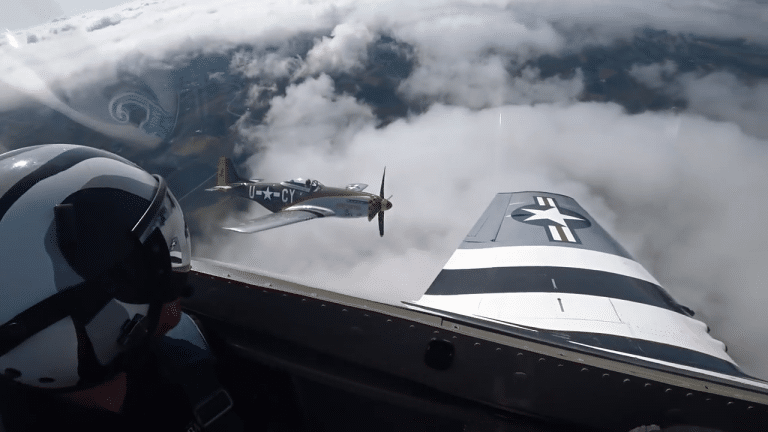
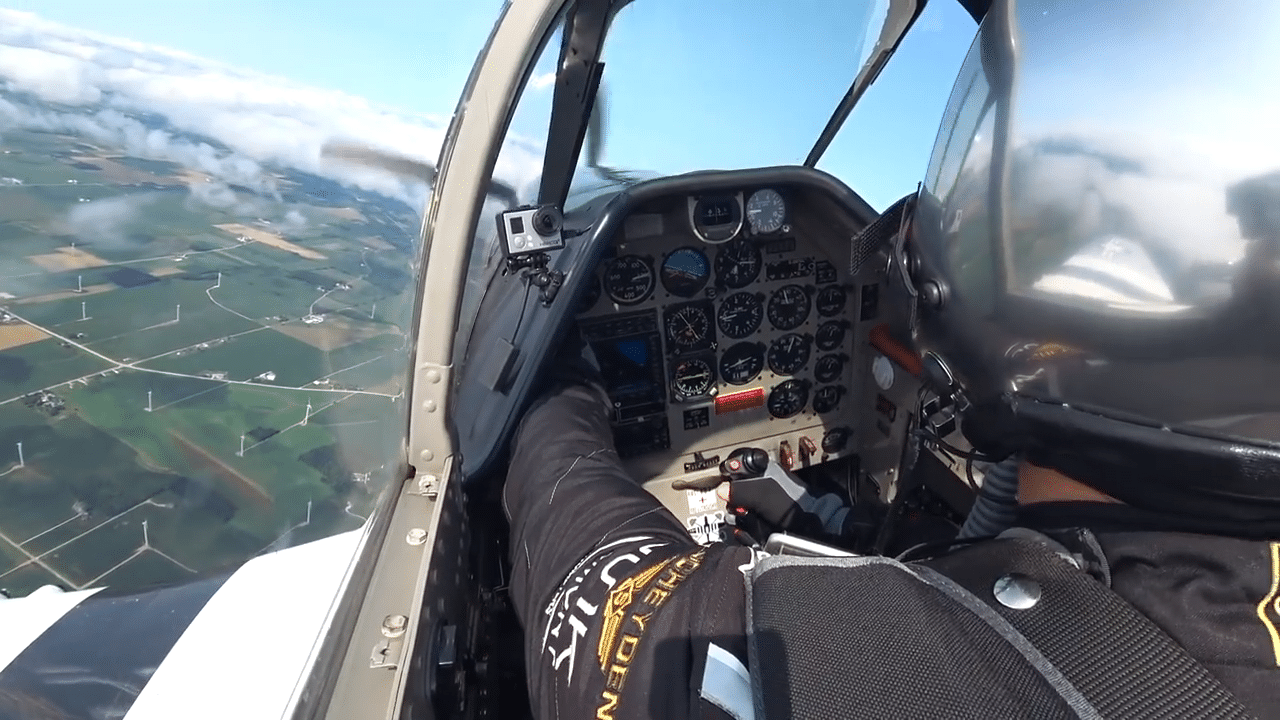
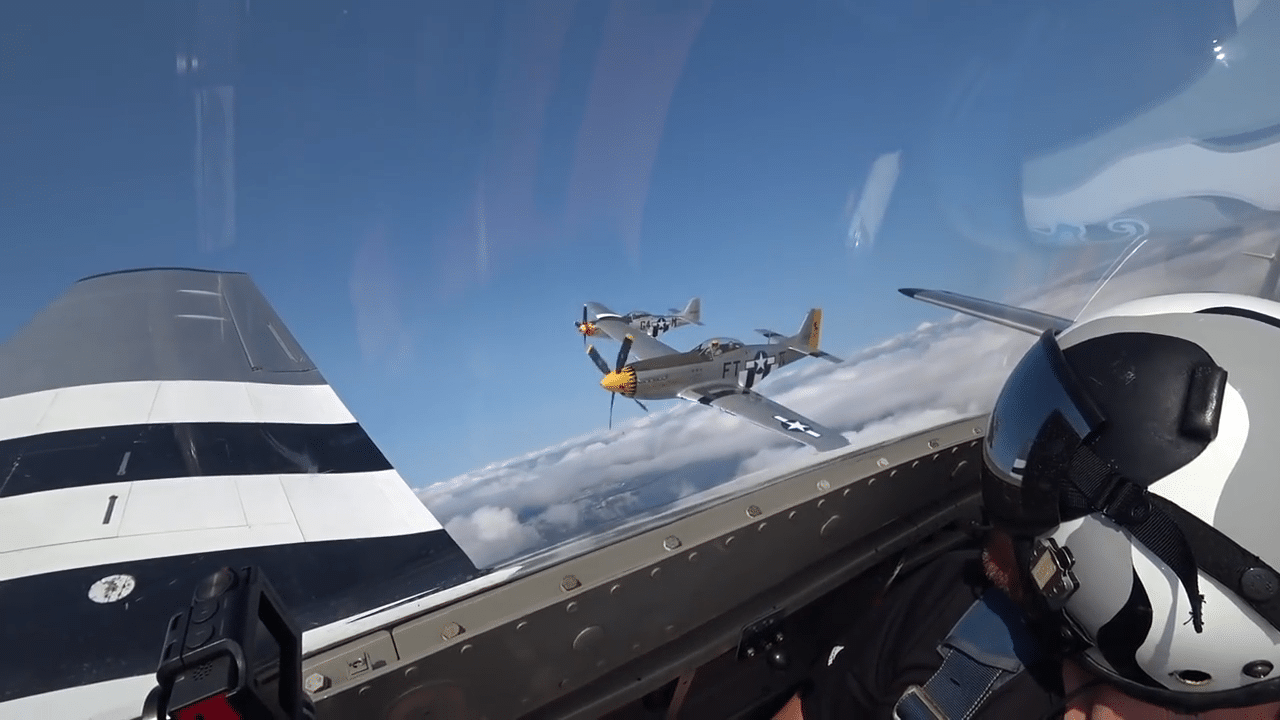
Warbird formation flights are a highlight of the festivities at EAA AirVenture every year. During the 2018 version of the Fly-In, a North American P-51D Mustang four-ship formation flight was captured in HD video with ICS audio. The pilot of the Mustang from which the video was captured, Scott “Scooter” Yoak, provided some great inside Mustang information and explained a great deal about formation flight and the discipline it takes to pull it off. We guarantee you’ll learn something from this video. The video was uploaded to YouTube by the creator steveo1kinevo.
The Mustangs in the video are the camera ship, North American P-51D-30-NT Mustang serial number 45-11439 named Quicksilver, P-51D-25-NA serial number 44-73264 coded CY-U named Gunfighter, P-51D-30-NA serial number 44-74977 (marked as 44-63747 coded FT-pi) named Charlotte’s Chariot II, and P-51D-25-NA serial number 44-74009 (marked as 44-15267 coded G4-M) named Ain’t Misbehavin’. The four P-51Ds are all actively flown. Two of them (Quicksilver and Gunfighter) have been completely rebuilt after crashes.
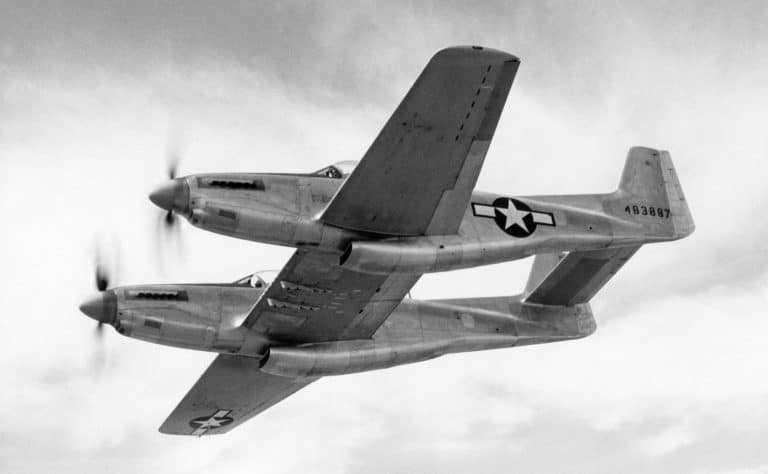
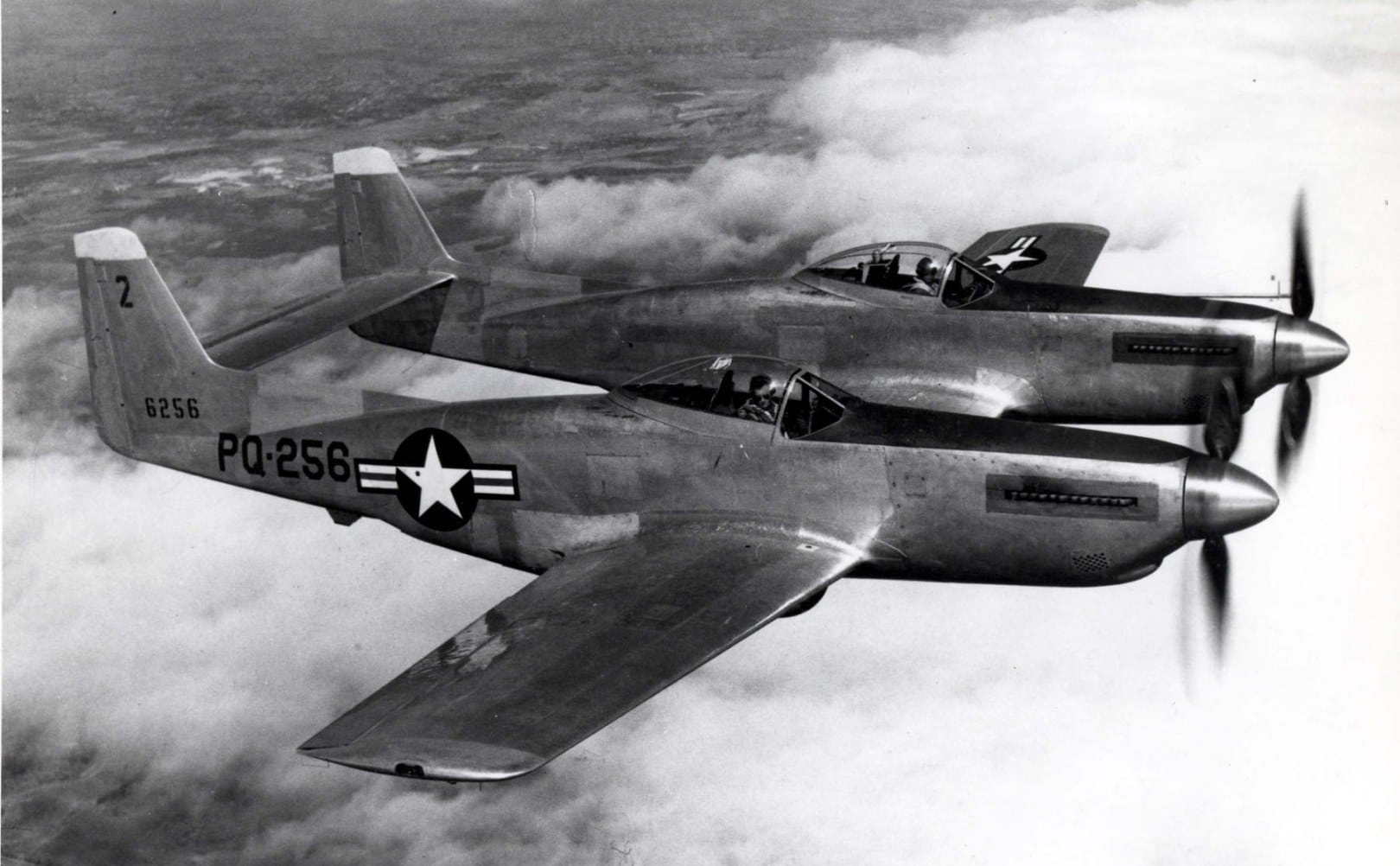
The Experimental Aircraft Association (EAA) produced the video entitled “XP-82 – Fate, Circumstance, & Necessity” to chronicle the story of the prototype North American P-82 Twin Mustang. The history of both the Twin Mustang and the XP-82, the prototype Twin Mustang aircraft itself, are told by Tom Reilly, who has invested ten years and more than 200,000 man-hours of work in the return to flight of one exquisitely rare flying machine. The effort Reilly and team have invested in the return to flight of the North American XP-82 Twin Mustang is featured in the August issue of EAA Sport Aviation magazine. The video was uploaded to YouTube by EAA.
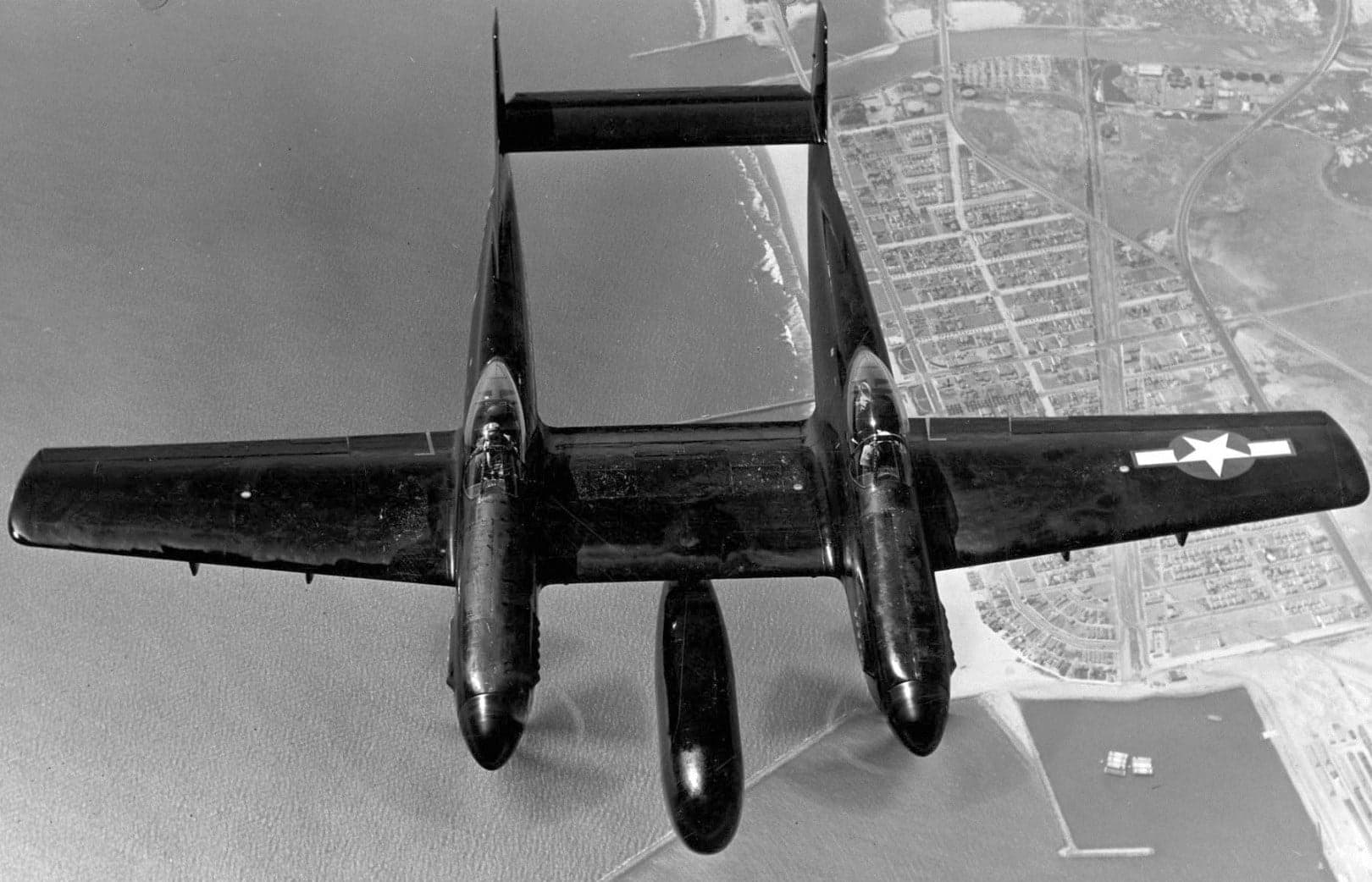
Born during World War II from a need to provide better escort for Boeing B-29 Superfortress bombers flying those unprecedented long-range missions to Japan from the Marianas, the Twin Mustang was another aircraft developed during the war that didn’t make it to combat before the war ended. P-82s (later redesignated as F-82s) did serve as replacements for Northrop P-61 Black Widows in the role of air defense interceptors and as night fighters during the Korean war.
F-82C in flight. Image via USAF
In addition to the XP-82, there are four surviving F-82s held captive in museums today. The best known of these is the F-82B Betty Jo displayed at the National Museum of the US Air Force (NMUSAF). This aircraft once flew nonstop from Hawaii to New York. The NMUSAF has a second F-82 on display, this one dressed up as a F-82G night fighter. There was a second F-82 at the Soplata farm which is reported to be under restoration in Minnesota. The fifth F-82 airframe is displayed as part of an outdoor museum at Lackland Air Force Base (AFB) in Texas.
John Sidney McCain III was born on 29 August 1926 at Coco Solo Naval Air Station (NAS) in the Panama Canal Zone. His parents, John S. “Jack” McCain Jr. and Roberta Wright McCain had two other children- John’s older sister Sandy and his younger brother Joe. Being the child and grandchild of naval officers, John attended more than 20 different schools before he graduated in 1954 from Episcopal High School in Alexandria, Virginia.
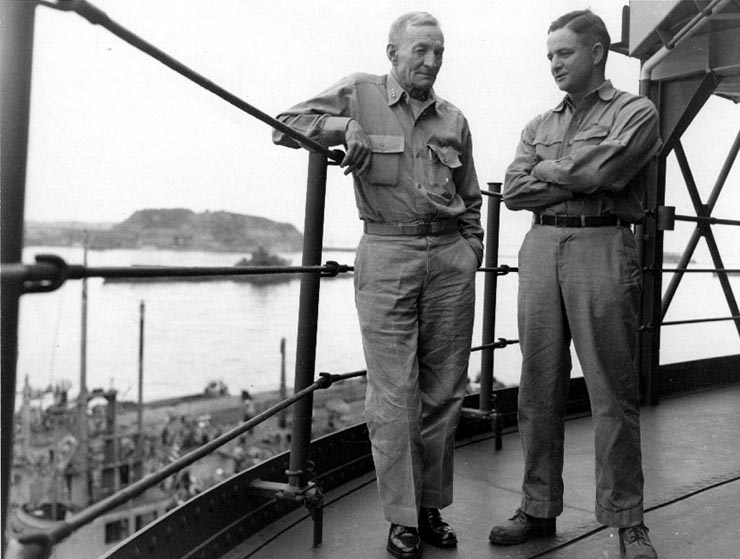
“Slew” McCain (left) and “Jack” McCain (right). Image via US Navy
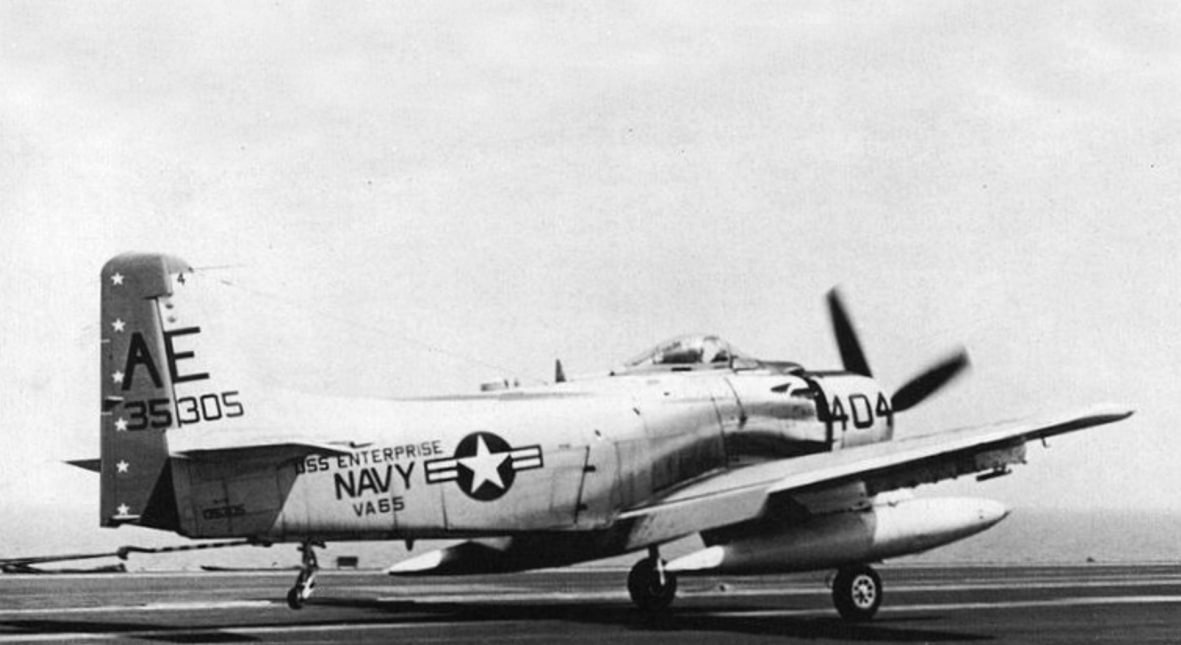
McCain followed his father and grandfather, John S. “Slew” McCain Sr., to the United States Naval Academy at Annapolis. After McCain III graduated in 1958, he was commissioned as an Ensign in the Navy and made his way to the Cradle of Naval Aviation, NAS Pensacola, later that year. McCain began training as a student Naval Aviator and pinned on his Wings of Gold in 1960. McCain’s first assignment was to Attack Squadron SIX FIVE (VA-65) World Famous Fighting Tigers flying Douglas AD Skyraiders.
VA-65 Skyraider. Image via US Navy
McCain bent a few birds during his first few years flying Naval aircraft. Even before he graduated flight training he was forced to ditch an AD-6 Skyraider in Corpus Christi Bay after the engine died while he was in the landing pattern. During his first deployment with VA-65 and Carrier Air Wing SIX (CVW-6) aboard the Essex-class carrier USS Intrepid (CVA-11) in the Mediterranean during 1961, McCain knocked down power lines in Southern Spain, leaving both powerless Spaniards and a damaged AD.
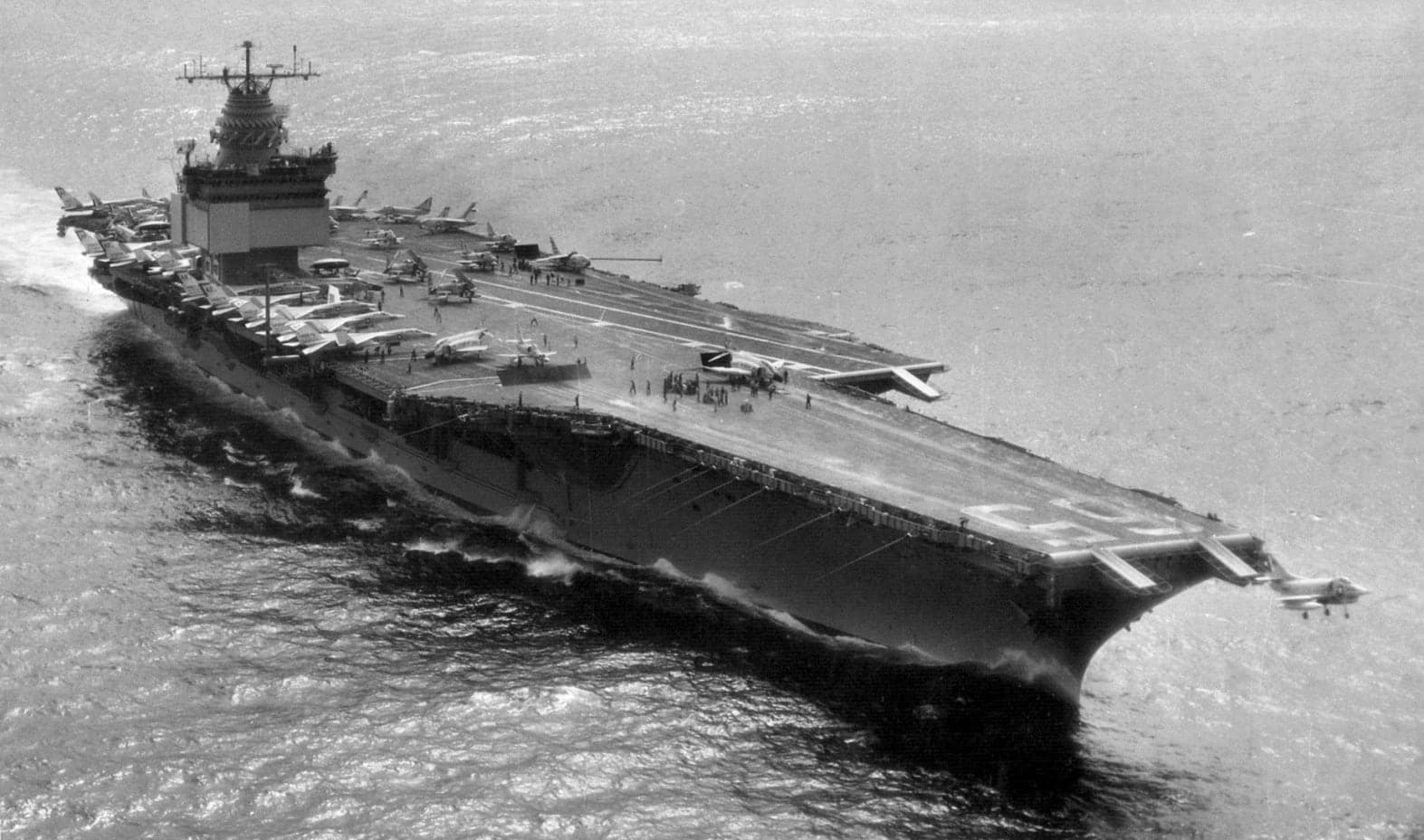
USS Enterprise (CVAN-65). Image via US Navy
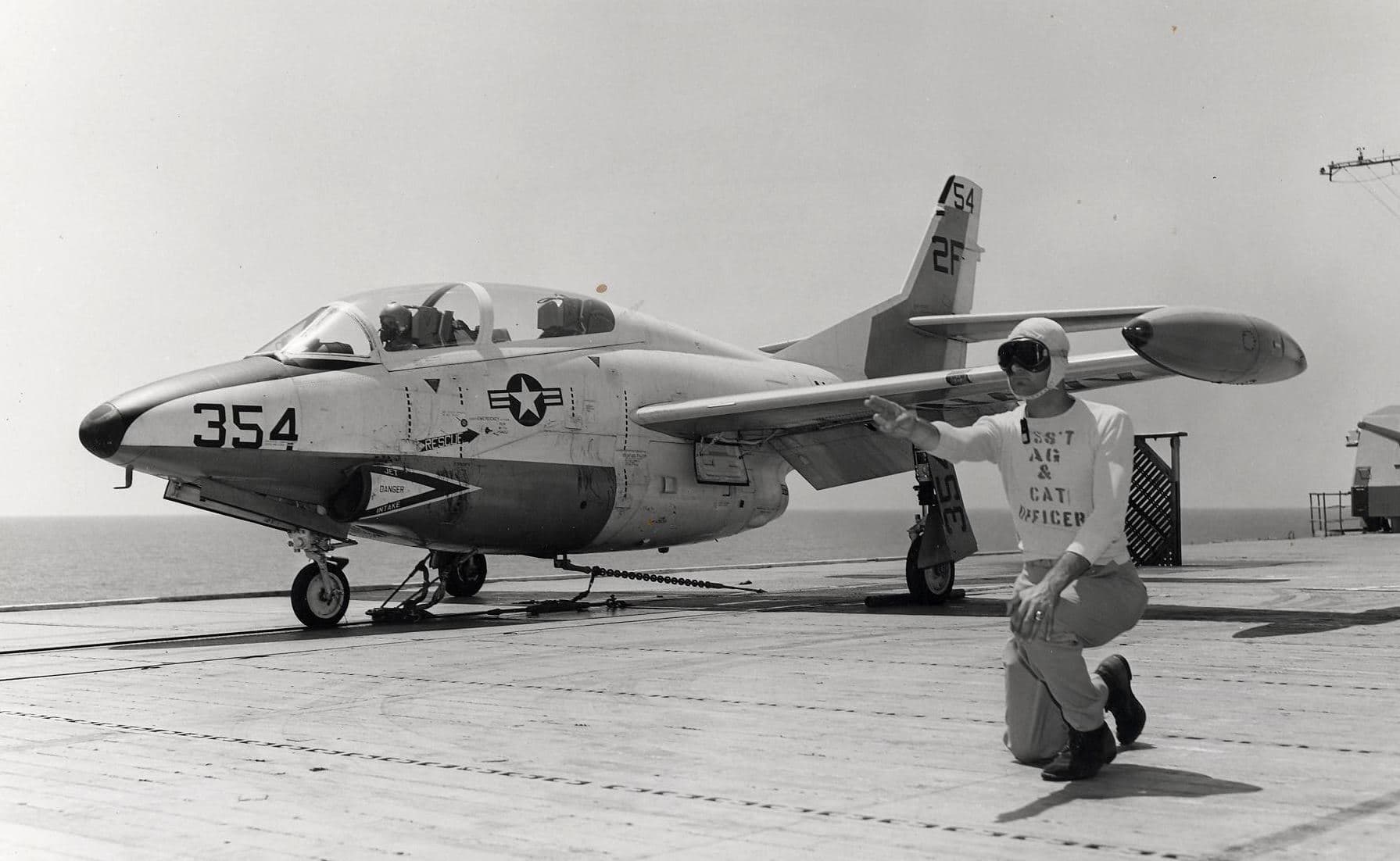
CVW-6 was cross-decked to the spanking new nuclear-powered aircraft carrier USS Enterprise (CVAN-65) and was aboard the Big E for her first deployment to the Med and later to the Caribbean Sea during the Cuban Missile Crisis. When CVW-6 and VA-65 returned to the States at the end of 1962, McCain was transferred to Training Squadron SEVEN (VT-7) Eagles as an instructor pilot flying the North American T-2A Buckeye at Naval Auxiliary Air Station (NAAS) Meridian in Mississippi.
T2J-1 (T-2A) Buckeye. Image via US Navy
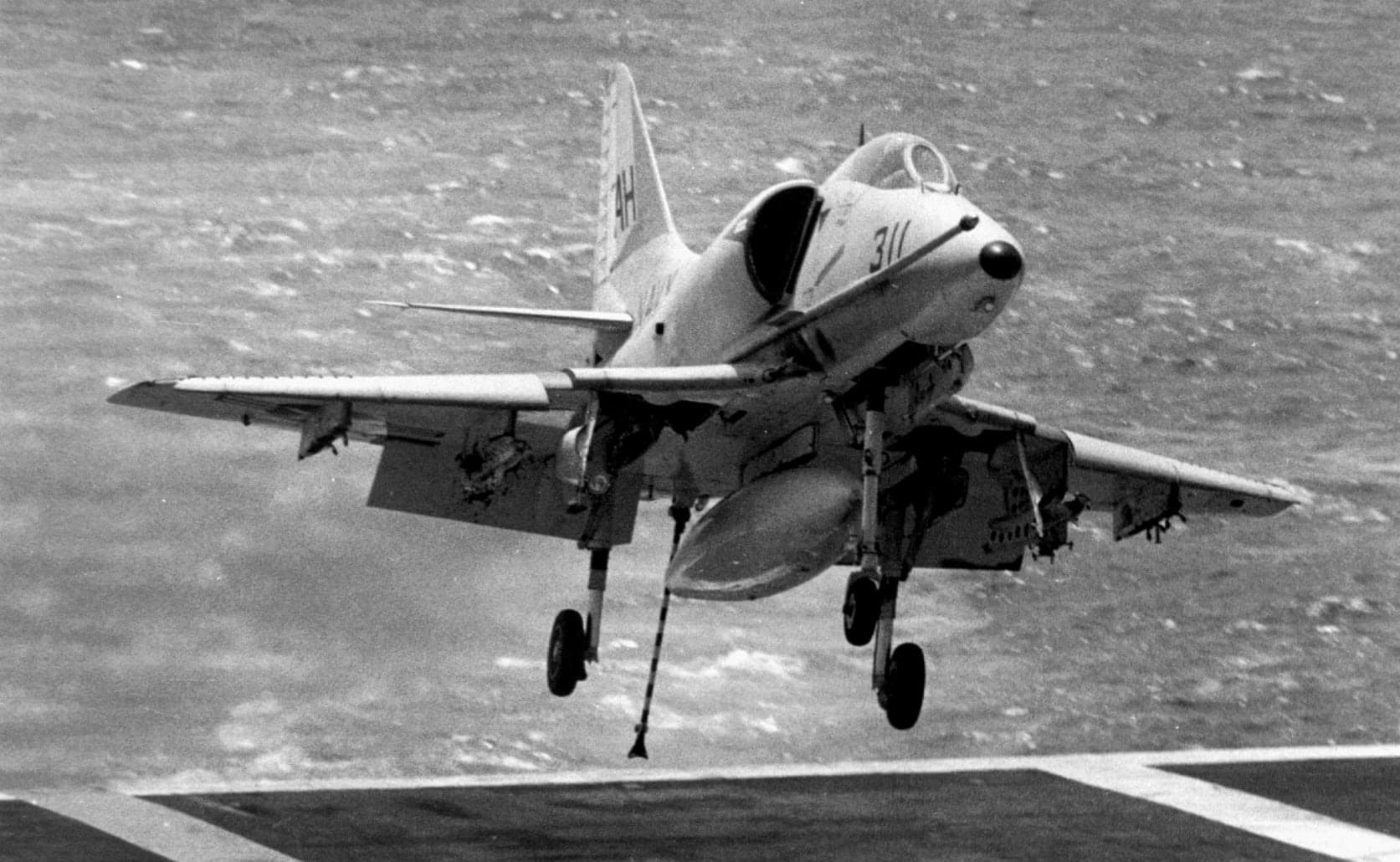
It was while he was stationed at Meridian during November of 1965 that McCain was forced to eject from another aircraft when the jet’s engine flamed out and would not re-light. McCain then transferred to VA-44 Hornets for type transition training for the Douglas A-4E Skyhawk. After learning to fly Scooters, McCain was assigned to VA-46 Clansmen flying Douglas A-4E Skyhawks. The Clansmen, part of CVW-17, deployed aboard the aircraft carrier USS Forrestal (CVA-59) for her first deployment to Southeast Asia in 1967.
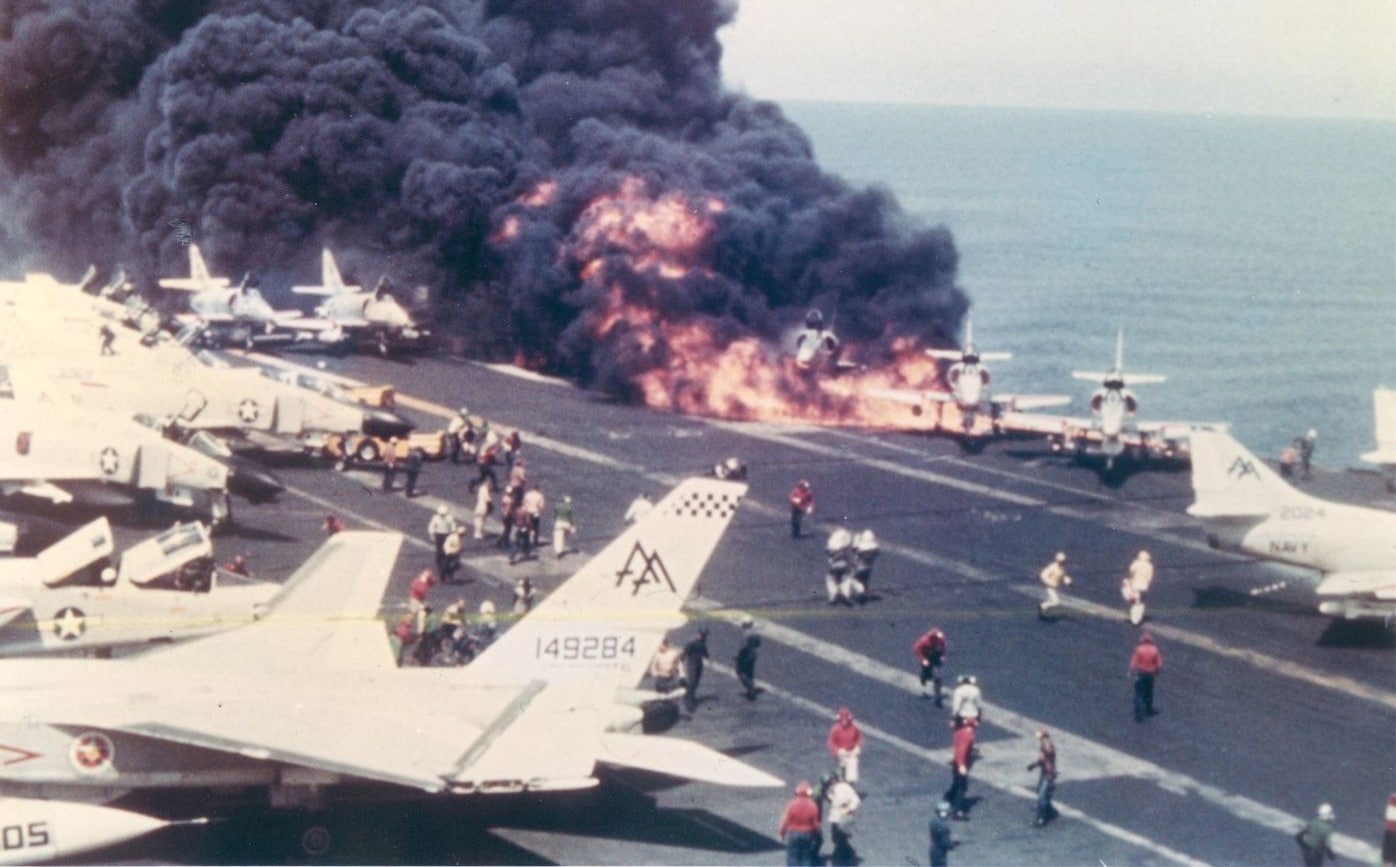
US Navy photograph
After only a few days on the line, Forrestal suffered a flight deck fire that killed 132 of her crew. Lieutenant Commander McCain narrowly escaped with his life when a 5 inch Zuni rocket misfired and struck the centerline drop tank on McCain’s Scooter waiting to launch on what would have been his sixth combat mission. McCain, burned by jet fuel and wounded by shrapnel from bombs exploding on the flight deck, was able to recover from his wounds.
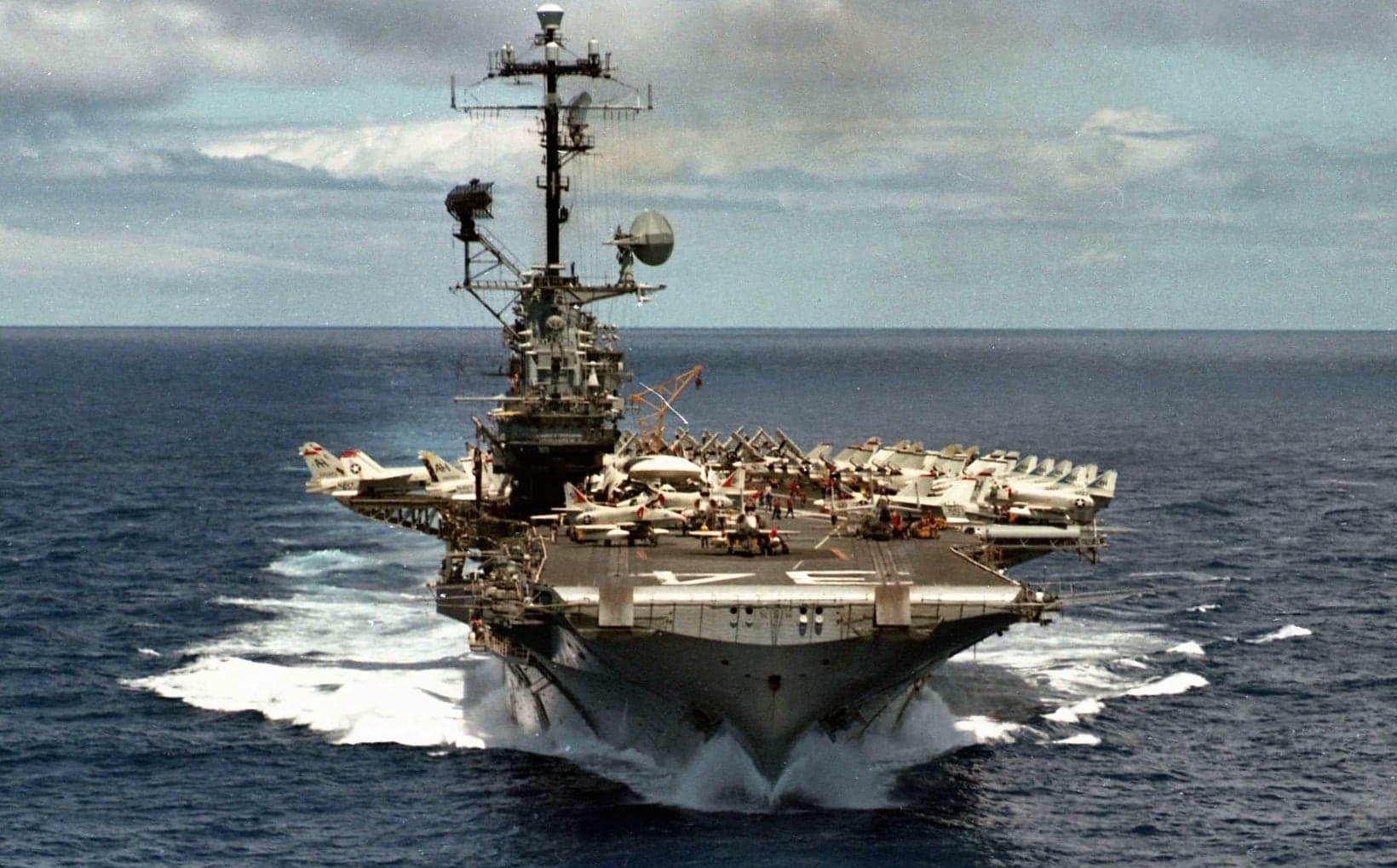
USS Oriskany (CVA-34). Image Via US Navy
McCain transferred to the Essex-class aircraft carrier USS Oriskany (CVA-34) to fly with VA-163 Saints and the rest of CVW-16 embarked to continue his combat tour. Just short of three months after the fire on the Forrestal (and ironically a year to the day after Oriskany herself suffered a major fire), John S. McCain III was flying his 23rd mission and his first against the heavily-defended Hanoi thermal power plant. McCain’s A-4E Skyhawk was hit by an SA-2 Guideline surface-to-air missile and he was forced to eject. McCain suffered a broken leg and both arms were also broken during his ejection. He was quickly taken prisoner by the North Vietnamese after being fished out of the lake used by the power plant.
VA-163 A-4E. Image via US Navy
McCain was taken to the infamous Hỏa Lò prison in Hanoi, AKA the “Hanoi Hilton”, where he was beaten and refused treatment for his injuries. McCain spent time in several North Vietnamese prisons, enduring repeated beatings and torture, including several years in solitary confinement. McCain was released on 14 March 1973 after five and a half years in captivity. While undergoing treatment for his injuries suffered years before, McCain attended the National War College at Fort McNair in Washington, D.C. McCain was rehabilitated by late 1974 and his flight status was reinstated.
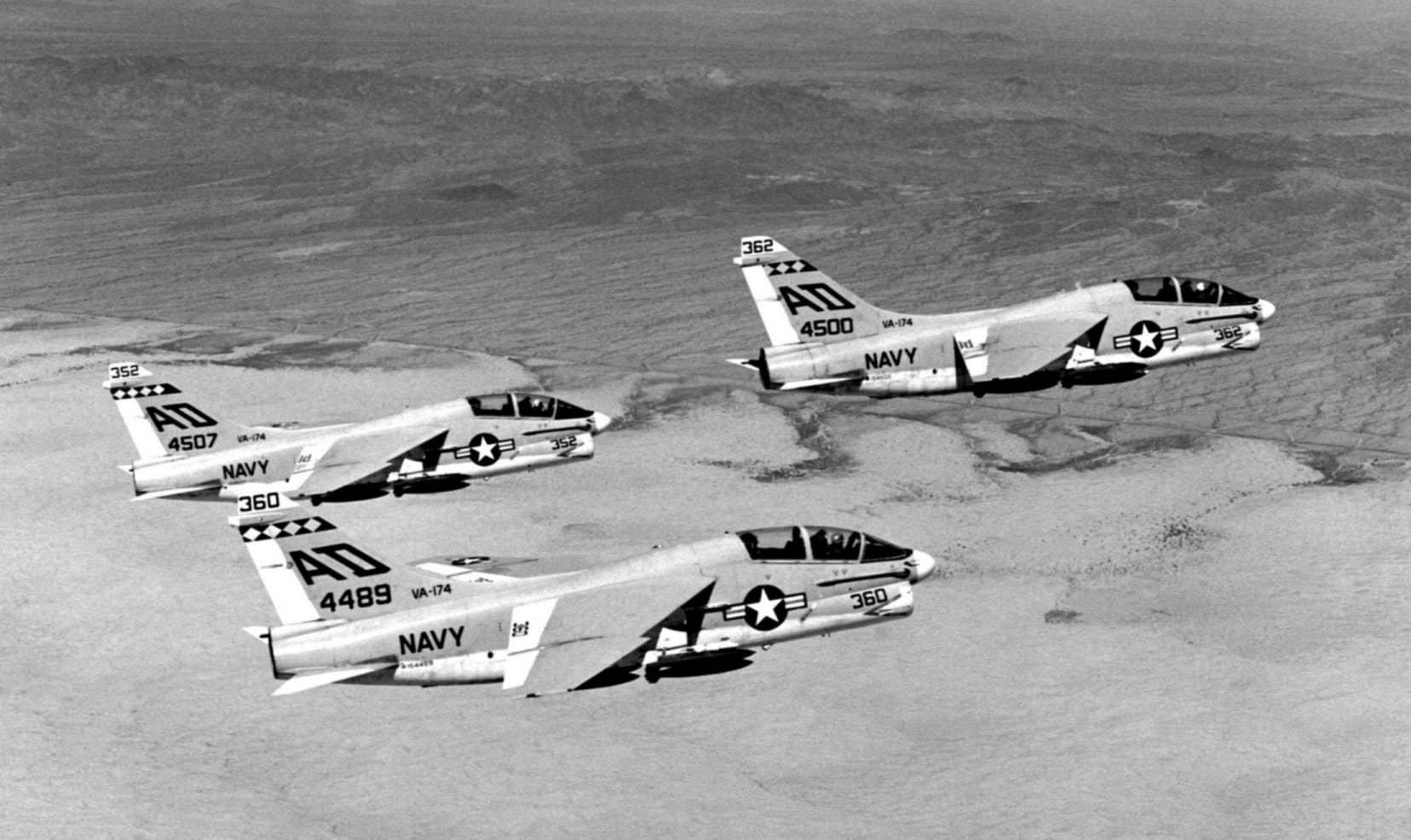
VA-174 TA-7Cs. Image via US Navy
Commander McCain was then assigned to command VA-174 Hellrazors, a Vought A-7 Corsair II replacement training squadron. VA-174 received their first Meritorious Unit Commendation under his leadership. After serving as a liaison to the US Senate for a few years, John S. McCain retired from Naval service as a Captain in 1981. His numerous military decorations and awards include the Silver Star, two Legions of Merits, Distinguished Flying Cross, three Bronze Star Medals, two Purple Hearts, two Navy and Marine Corps Commendation Medals, and Prisoner of War Medal. His political career lasted from 1981 until his death on August 25th 2018.
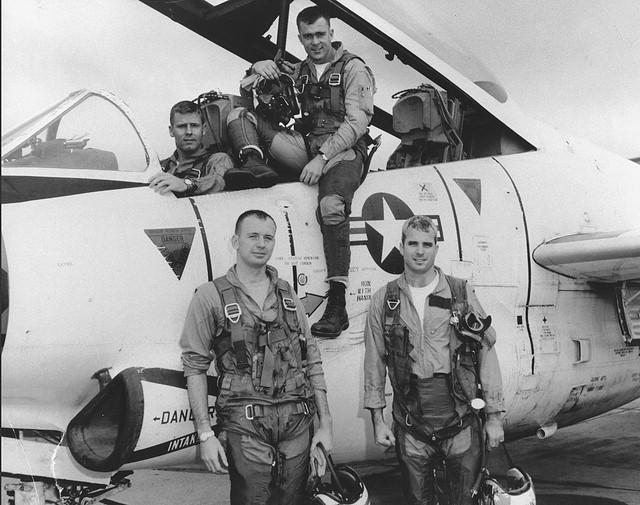
McCain (lower right) with other instructors at VT-7. Image via US Navy
PENSACOLA, Fla. — As the sunshine and blue sky lay above the warm waves on Pensacola Beach, a pair of high performance jets soar over the northern gulf waters in a aerobatic display capturing the attention of the sunbathers below.
The twin U.S. Navy jets quickly break away in a planned maneuver and begin to soar higher into the cloudless sky. Suddenly, the jets ignite a white smoke trail which begins to trace their aerobatic flight path of twin circles.
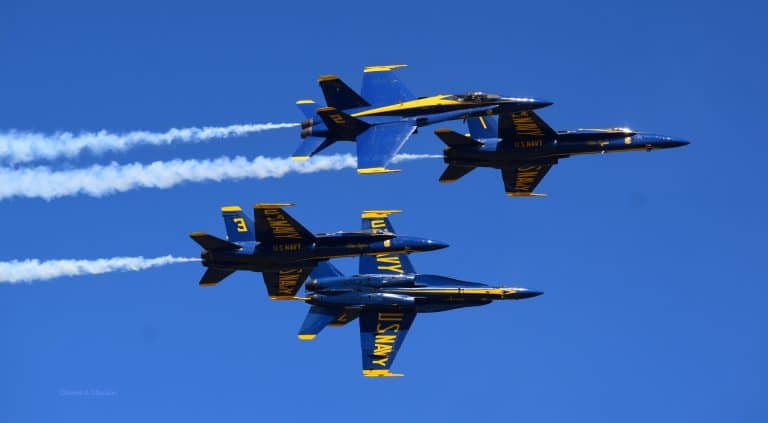
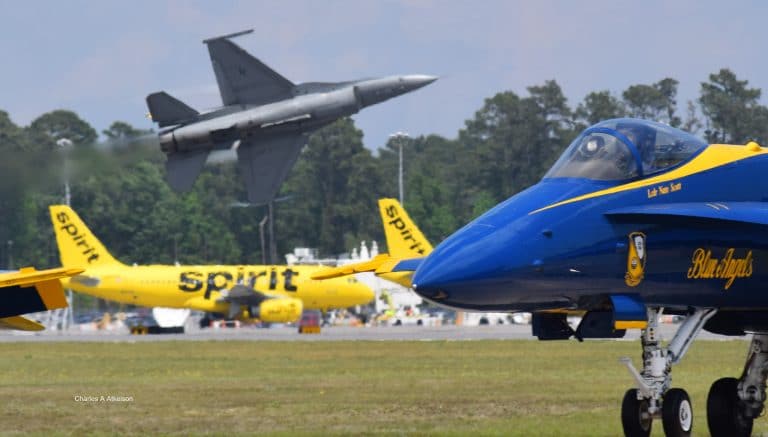
The United States Navy’s elite Flight Demonstration Squadron is famously known to the public as the Blue Angels. The team’s blue and gold jets are a familiar sight and sound along the sugar sand beaches along the northern Gulf Coast just a few miles from their home at the Naval Air Station Pensacola.
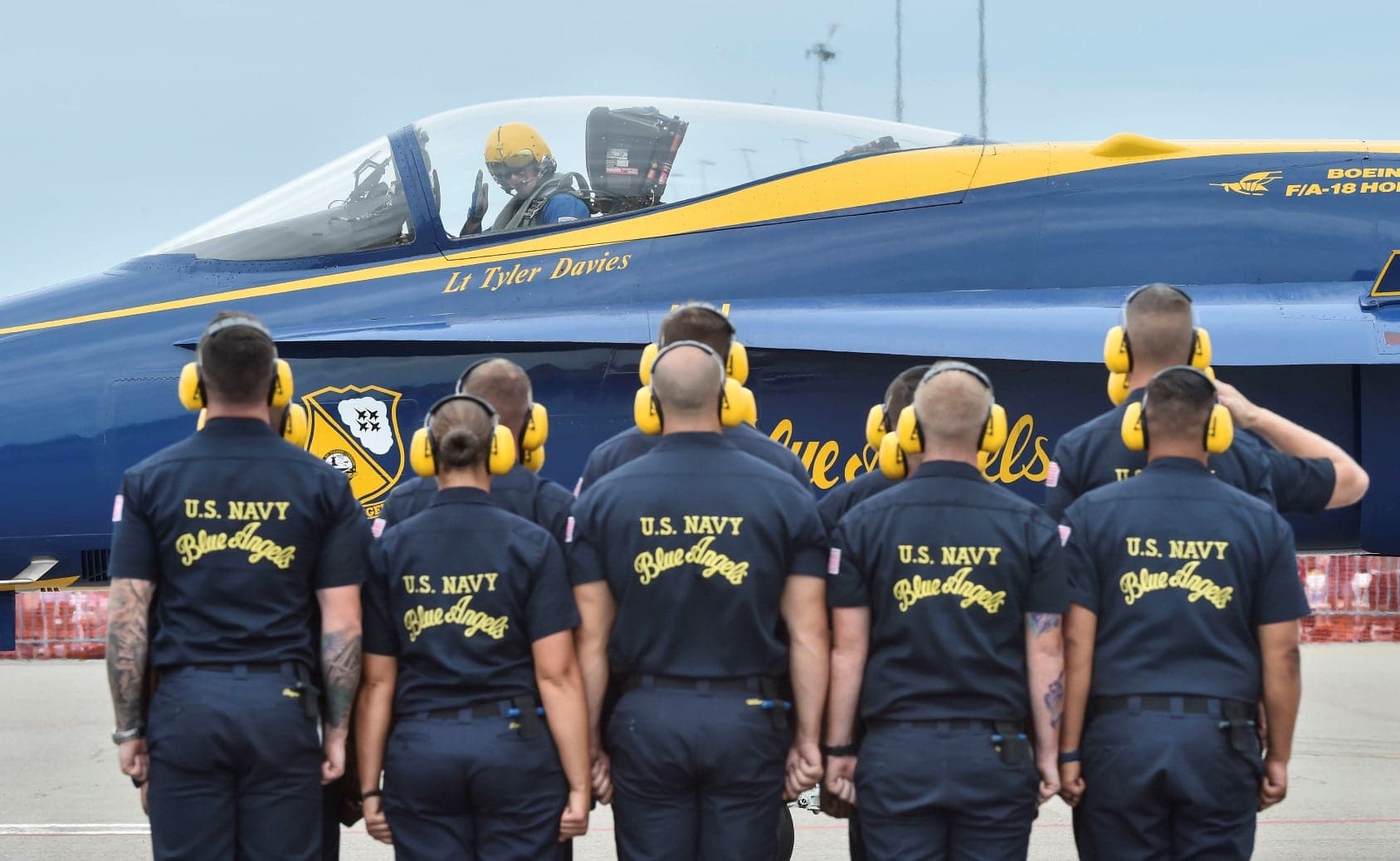
The maintainers of the Blue Angels support each air show performance. (U.S Navy)
The team’s public demonstration flight is the Navy’s most popular recruiting tool to attract interested young adults into a career with the military. The Blues also engage in promoting Science, Technology, Engineering, and Math at schools across America.
Students at high schools and colleges across the nation working on technical degrees may look to the military to advance their professional skills during a brief period of service. Unlike most civilian jobs, the military’s job placement is larger, and those entering technical training will work with the newest technologies not yet available in a commercial career.
“The best way to begin the road to a successful career is to work hard in school, stay physically active, and refrain from illegal drug use,” said Blue Angels spokesperson LT David Gardner. “Additionally, it is helpful to serve in leadership roles and extracurricular activities. These principles apply in attaining a successful career both inside and outside the military.”
These words are not just for future aviators, but the for the men and women interested in all careers within aviation.
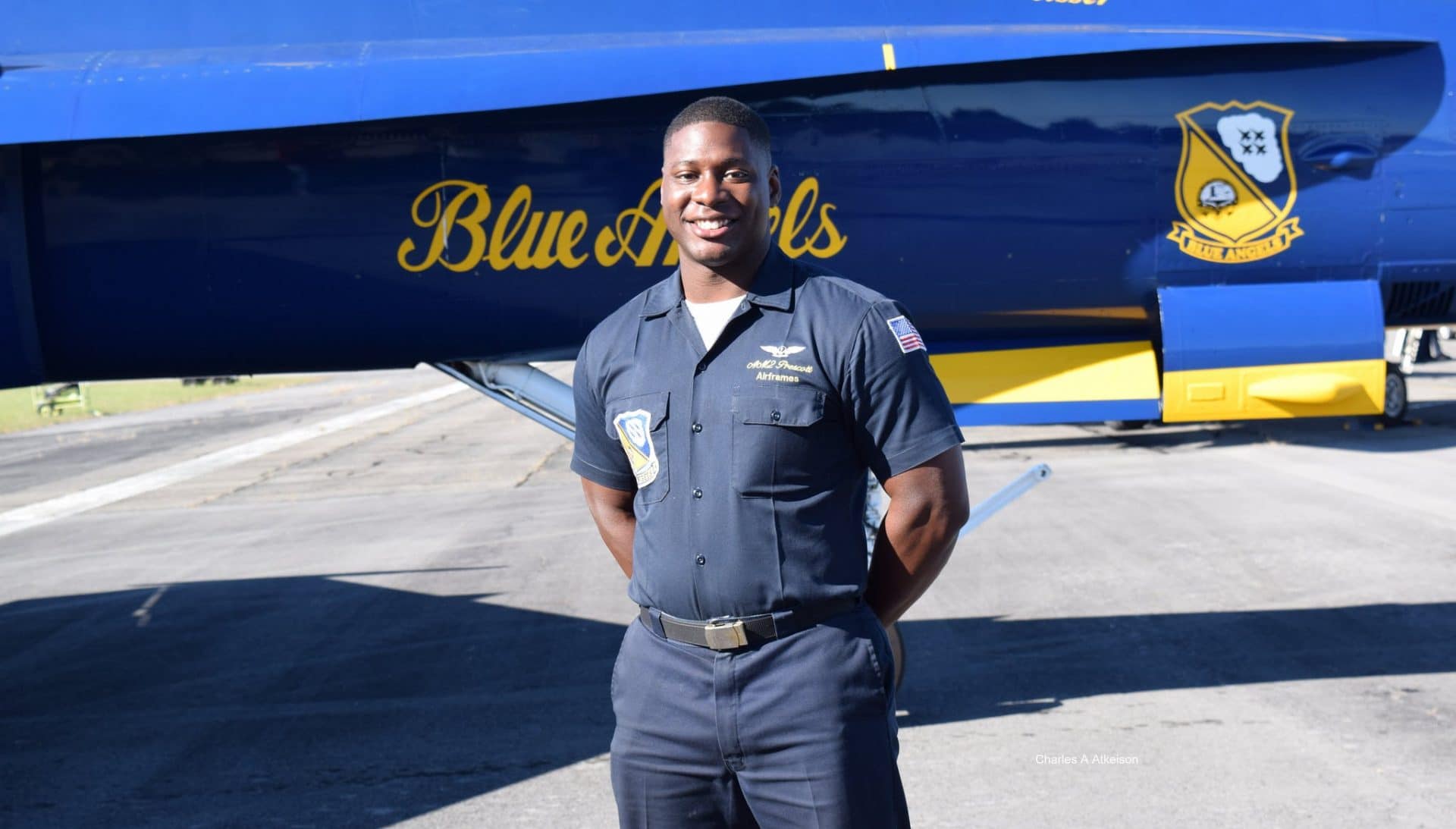
Demaude Prescott specializes on the F/A-18 Hornet’s air frames and hydraulics. (Charles Atkeison)
“When we come out and we open the jets and get them ready to fly, our number one thing is to have an awesome aircraft ready for the pilot when he gets in,” said AM2 Demaude Prescott, who maintains the jet’s air frames and hydraulics. “We have a great relationship with our pilots. We talk to them and we know where they’re from.”
The Navy is always looking for new achievers to grow in a specialized field. As the naval pilots prepare to fly, it is the sole job of the Blue Angels maintenance team to prepare the jets for flight each morning.
Prescott, who was raised in Atlanta, is an aircraft airframe mechanic whose job is to maintain the aircraft’s structure including the hydraulics. He and his team of twelve mechanics also verify the working conditions of the flight controls and the landing gear; and they also are ready to step up to perform structural repairs of their F/A-18 Hornets prior to the pilots’ arrival to climb aboard.
“We shake hands every time they go up and every time they come back down,” Prescott added. “That — right there — is what gets me up every day.”
(Charles A. Atkeison reports on aerospace and science. Follow his updates on social media via @Military_Flight.)
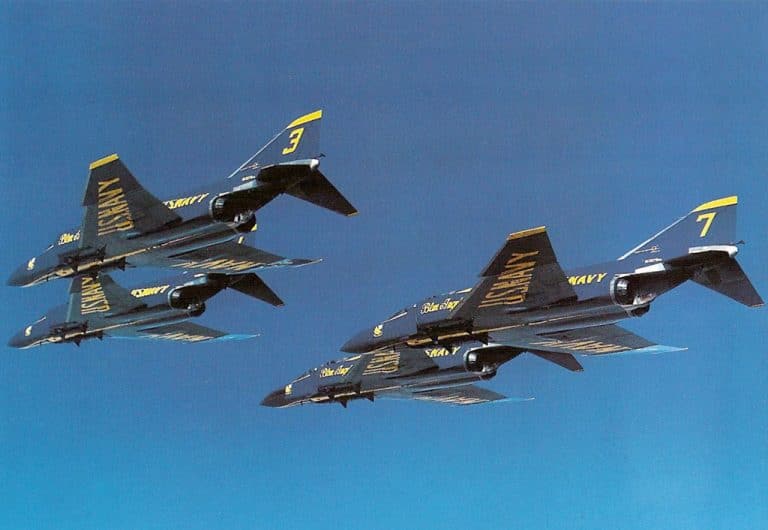
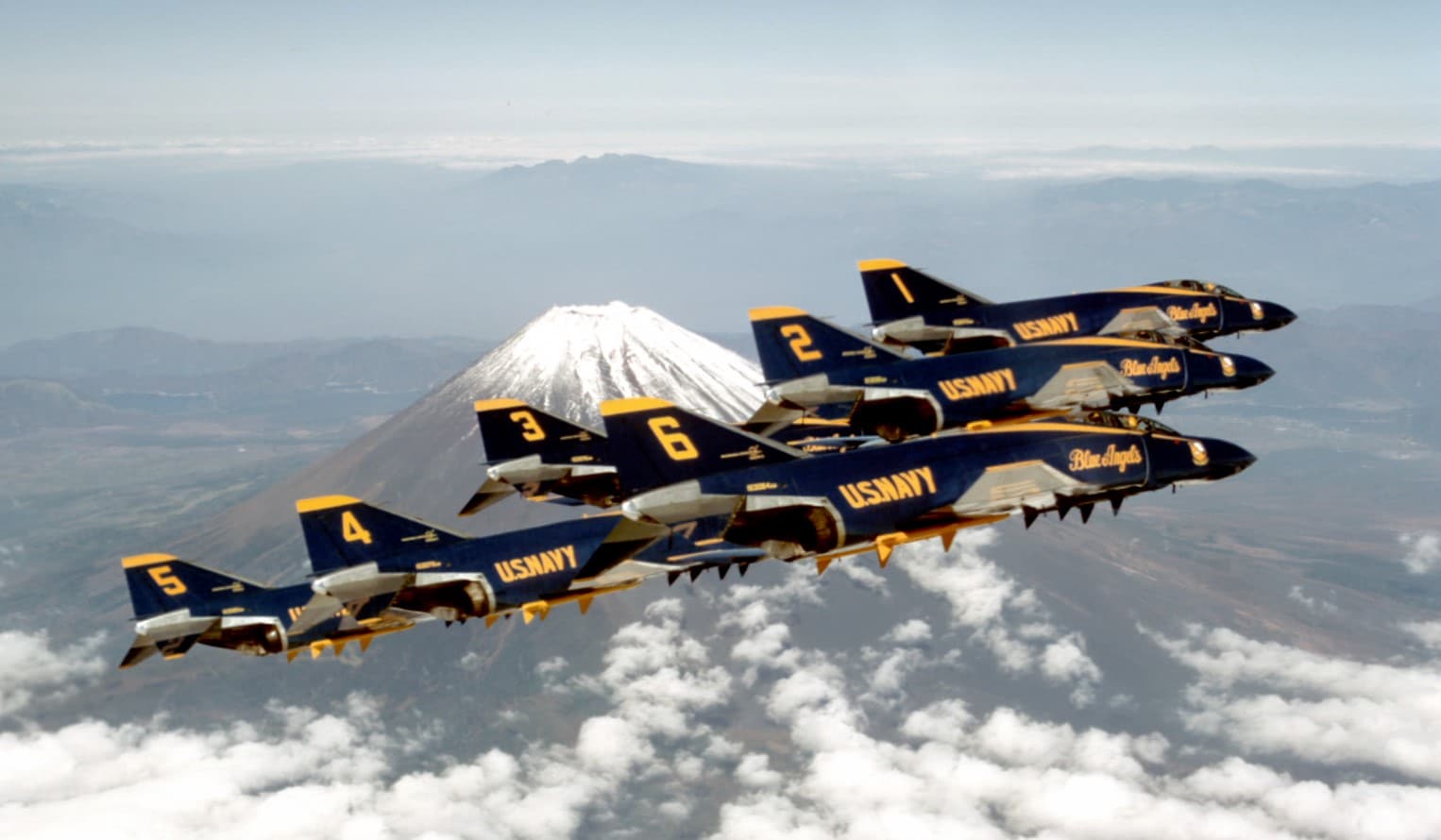
Threshold: The Blue Angels Experience was produced during the Blue Angels F-4J Phantom II era. Widely recognized as the best Blue Angels film, it portrays not only the all-business jet pilot Blues, but also the relaxed on-their-own-downtime Blue Angels. Directed by Paul Marlow and narrated by Leslie Nielsen, Threshold paints the Blue Angels as the extraordinary human beings they are, but not as super-humans. The film, shot during the 1972 and abbreviated 1973 show seasons and released in 1975, was uploaded to YouTube by dearkoroberry.
The film also portrays the Blue Angels elite ground crews and maintainers working on the team’s jets. In 1972, the Blue Angels were awarded the Navy’s Meritorious Unit Commendation for the two-year period from 1 March 1970 through 31 December 1971. The team’s F-4Js were replaced by the Douglas A-4F Skyhawk for the 1974 show season- somewhat ironically before the release of the film to the public. The Blue Angels also went from being a flight demonstration team to a flight demonstration squadron in 1974. The team went on to fly their A-4F Skyhawks for twelve years before their transition to the McDonnell Douglas (Boeing) F/A-18A/B/C/D Hornet strike fighter- their current jets.
image via ron rentfrow
BONUS- Behind the Scenes of Threshold The Blue Angels Experience uploaded to YouTube by Blue Angel Phantoms.
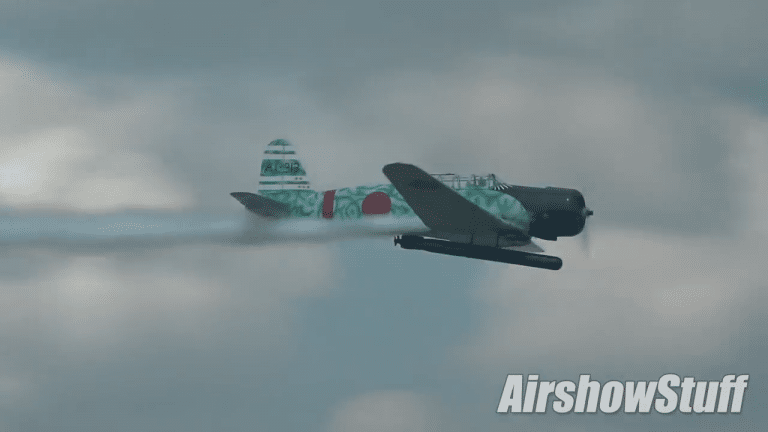
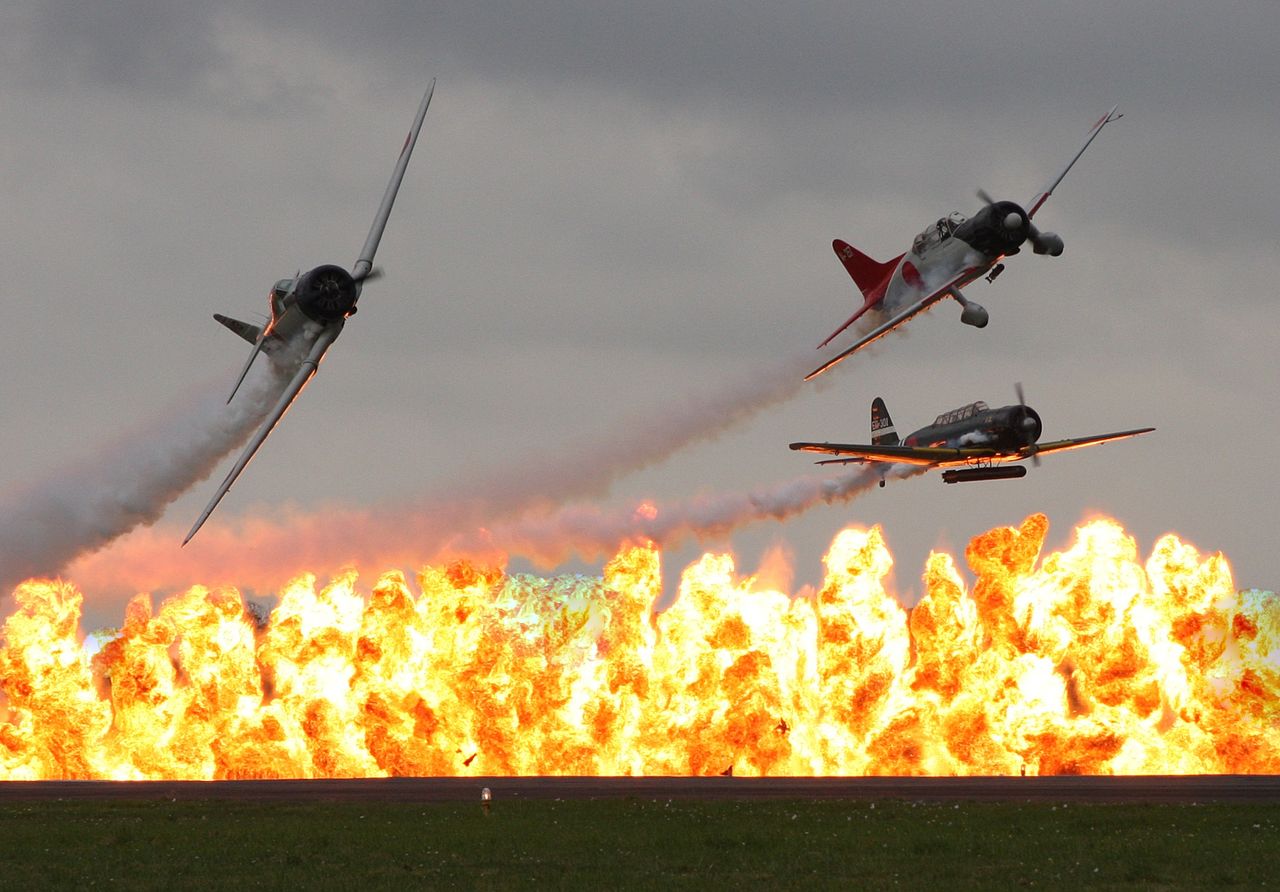
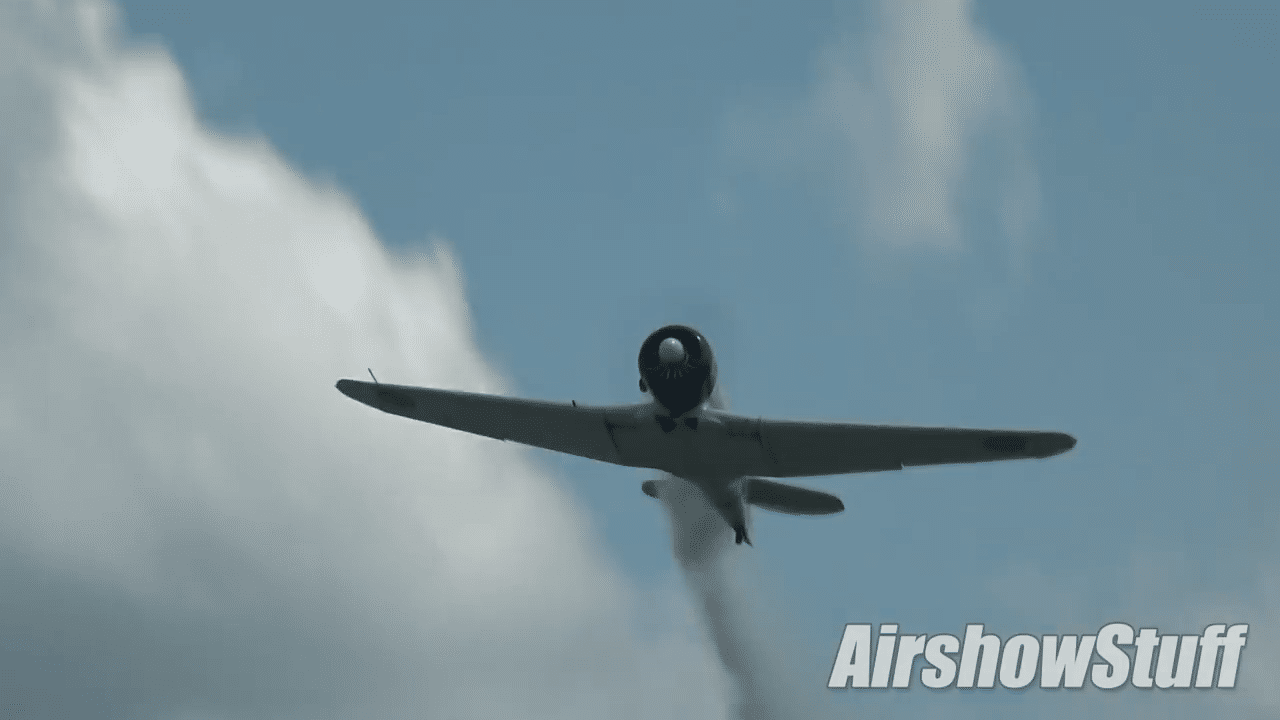
The Commemorative Air Force (CAF) is world renowned for their advocacy of warbird aircraft. When the CAF reenacts scenes from the 1970 Twentieth Century Fox film “Tora Tora Tora!” using some of the same aircraft used in the filming of the movie, it’s always a feast for the eyes and ears. The aircraft are of course not the actual Nakajima B5N Kates, Aichi D3A Vals, and Mitsubishi A6M Zeros used to attack Pearl Harbor on that infamous day, but they do provide plenty of smoky noisy fun when they perform their act. This video was uploaded to YouTube by AirshowStuffVideos. Enjoy!
The performance was shot during at the 2018 Terra Haute Airshow from a unique perspective. The sharper-eyed Avgeeks among you will notice that some of the replica Zeros have modified wingtips to make their appearance truer to the actual Zeros flown by Imperial Japanese navy pilots during the actual attack on Pearl Harbor. The majority of the aircraft used in the making of the film and the reenactments today are based on the North American T-6/SNJ/Harvard trainer. Some of the others are modified Vultee BT-13 Valiants. All are fun to watch.
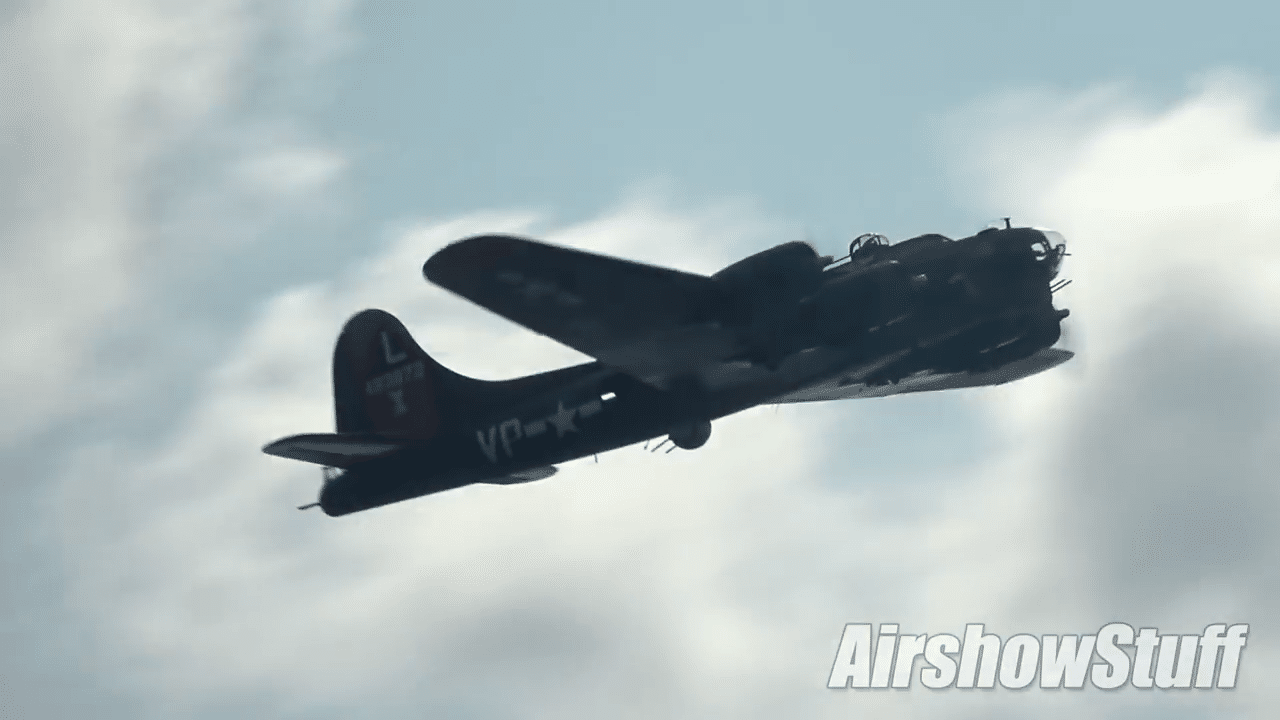
By Ebdon [CC BY 3.0 (https://creativecommons.org/licenses/by/3.0)], from Wikimedia CommonsThe reason the CAF B-17G Texas Raiders appears in the reenactments is worthy of mention. During the filming of the movie, one of the five B-17s used for the film was unable to lower its starboard landing gear. The Flying Fortress flew around burning off fuel while the crew prepared to shoot the landing sequence. During the editing of the film it was decided to include the mishap. The crew went back and choreographed establishing shots of a B-17 on approach with its starboard gear up- including single-wheel touch and gos.
Image via AirshowStuff YouTube channel video capture
The CAF began performing their Tora Tora Tora! reenactments in 1972 at Galveston’s Scholes Field. Back in those days Texas Raiders would approach the field with smoke trailing from the number 3 engine and with only one wheel down to “simulate” one of the eleven B-17Es that arrived in Hawaii during the Japanese attack. For many years, CAF “Colonel” Van Skiles would actually touch the one extended wheel down on the runway and fly the length of the runway as had been done in the movie. For many years the CAF reenacted that one-wheel approach.
Image via AirshowStuff YouTube channel video capture
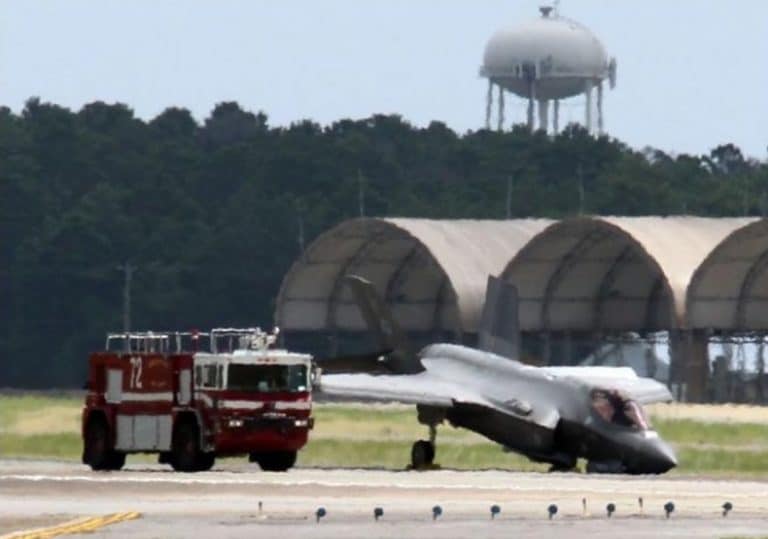
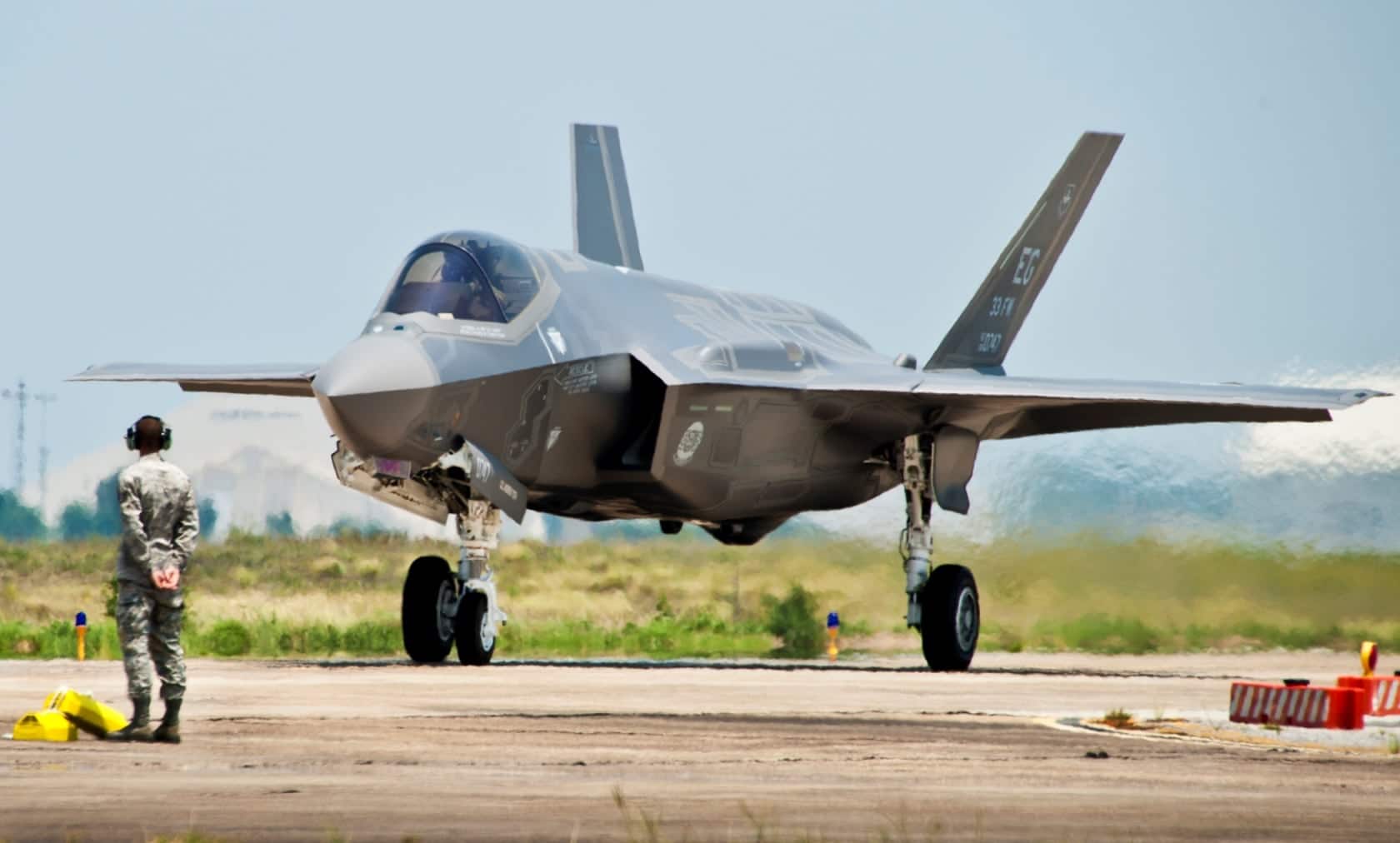
On August 22nd 2018 a Lockheed Martin F-35A Lightning II was damaged when its nose gear collapsed after returning to Eglin Air Force Base (AFB) due to an inflight emergency. According to the United States Air Force 33rd Fighter Wing (FW) Nomads based at Eglin, “An F-35A Lightning II, assigned to the 58th Fighter Squadron, experienced a ground mishap at approximately 1250 today on the flightline here.”
USAF F-35A. Image via USAF
The Air Force statement continues, “The F-35A experienced an in-flight emergency and returned to base. The aircraft landed safely and parked when the front nose gear collapsed. There was one person on board. Fire crews responded immediately and the pilot suffered no injuries as a result of the incident. An investigation into the circumstances surrounding the mishap is underway.” The exact nature of the inflight emergency and the extent of the damage to the jet are unknown at this time. We’ll update this story as events warrant.
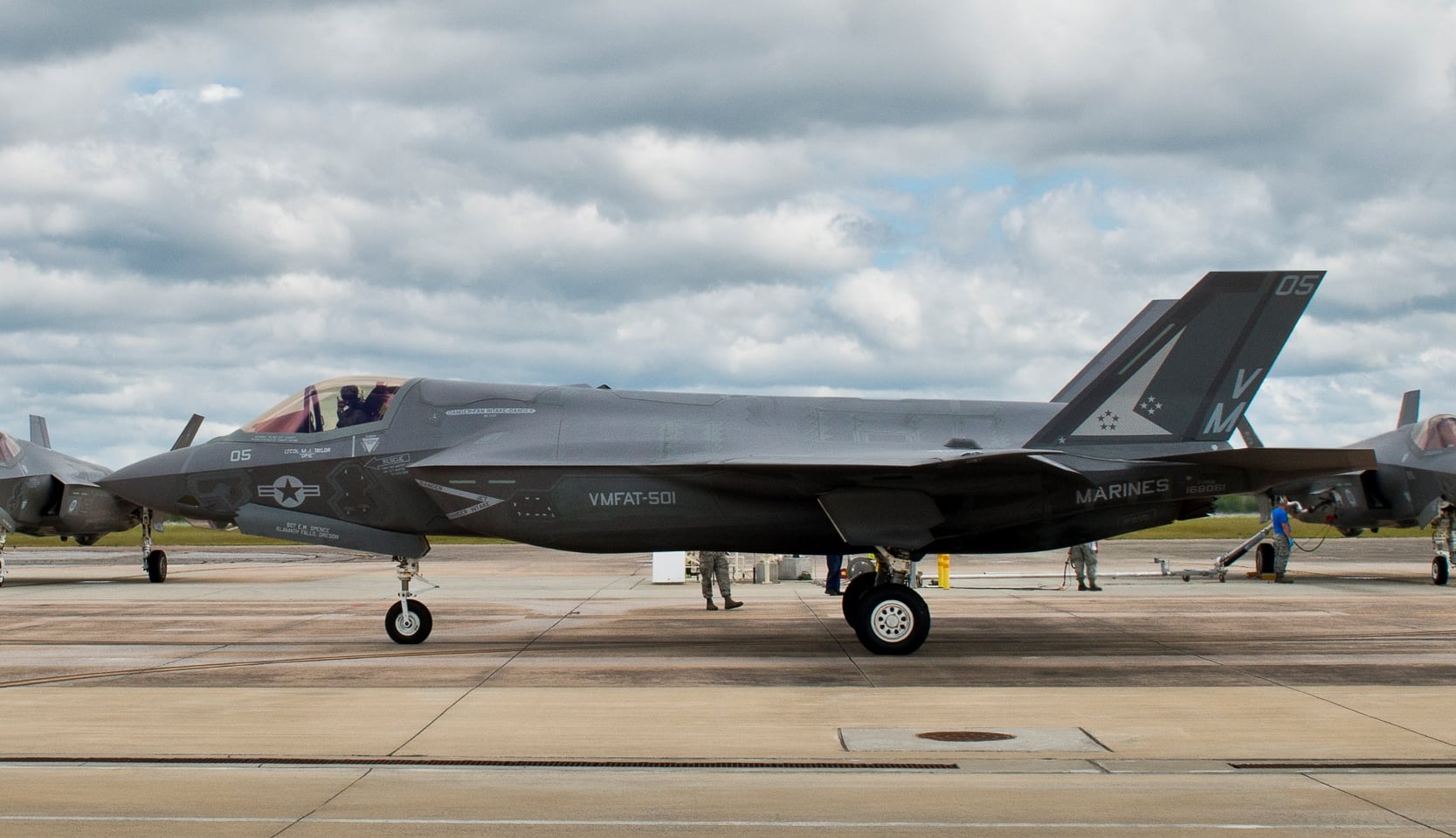
USMC F-35B. Image via US Navy
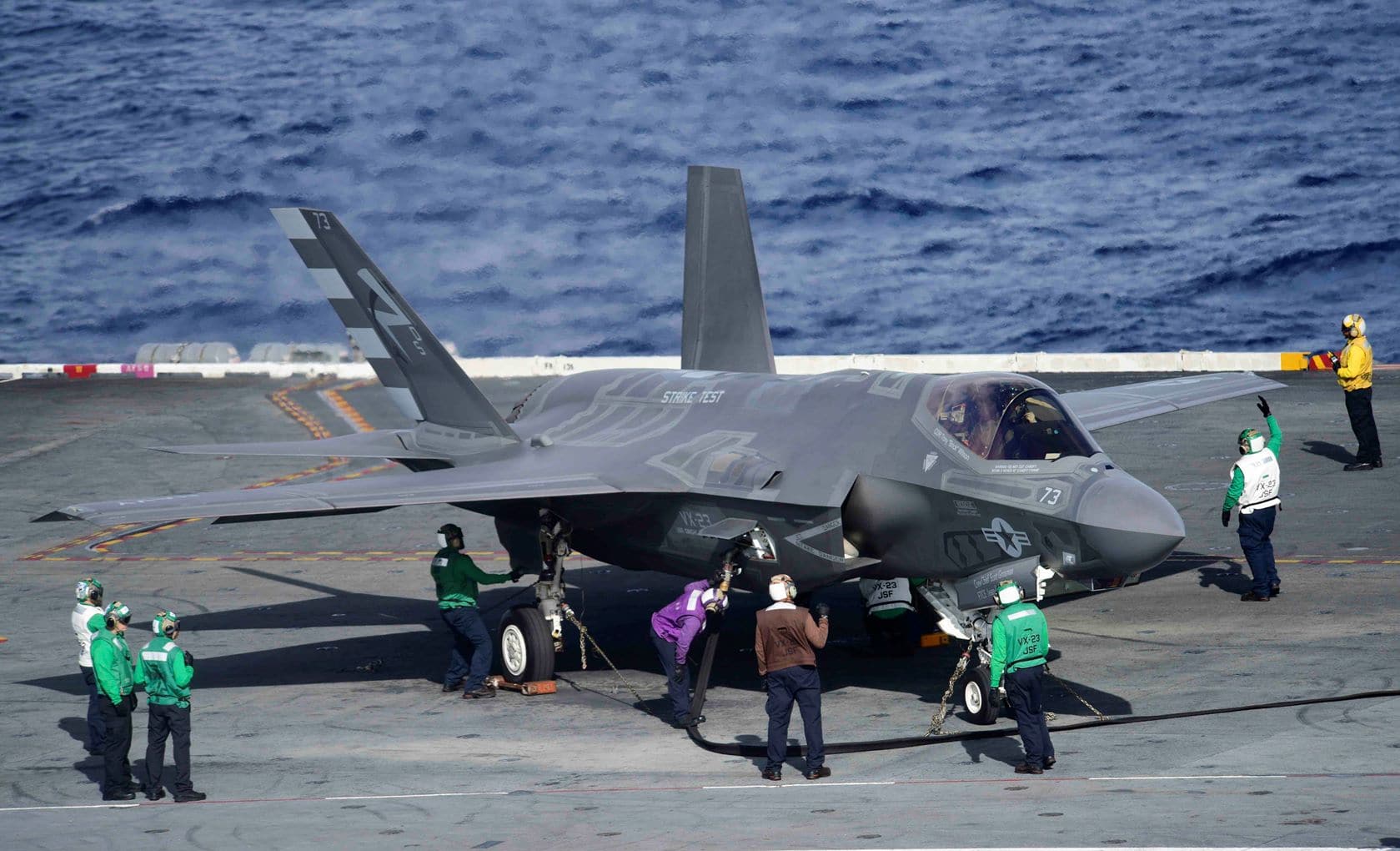
The 33rd FW is a flying and maintenance training wing for the Lockheed Martin F-35 Lightning II. The Wing is organized under 19th Air Force and is part of Air Education and Training Command (AETC) The Wing flies 59 Air Force F-35As, short takeoff and vertical landing (STOVL) F-35Bs, and carrier-based F-35C Lightning IIs spread between Eglin AFB, Tyndall AFB, and Hurlburt Field, all in the Florida panhandle. The 58th FS, known as the Mighty Gorillas, is a flying training unit for the F-35A. Other 33rd FW/ 33rd Operations Group counts nearly a thousand U.S. military, government civilian, and contract personnel in its command structure.
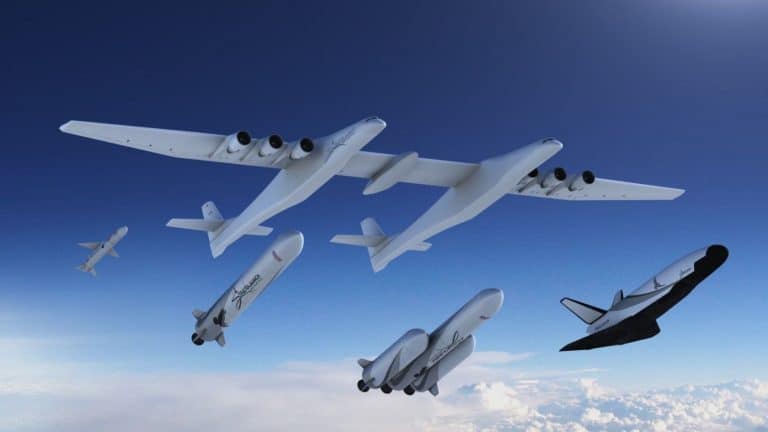
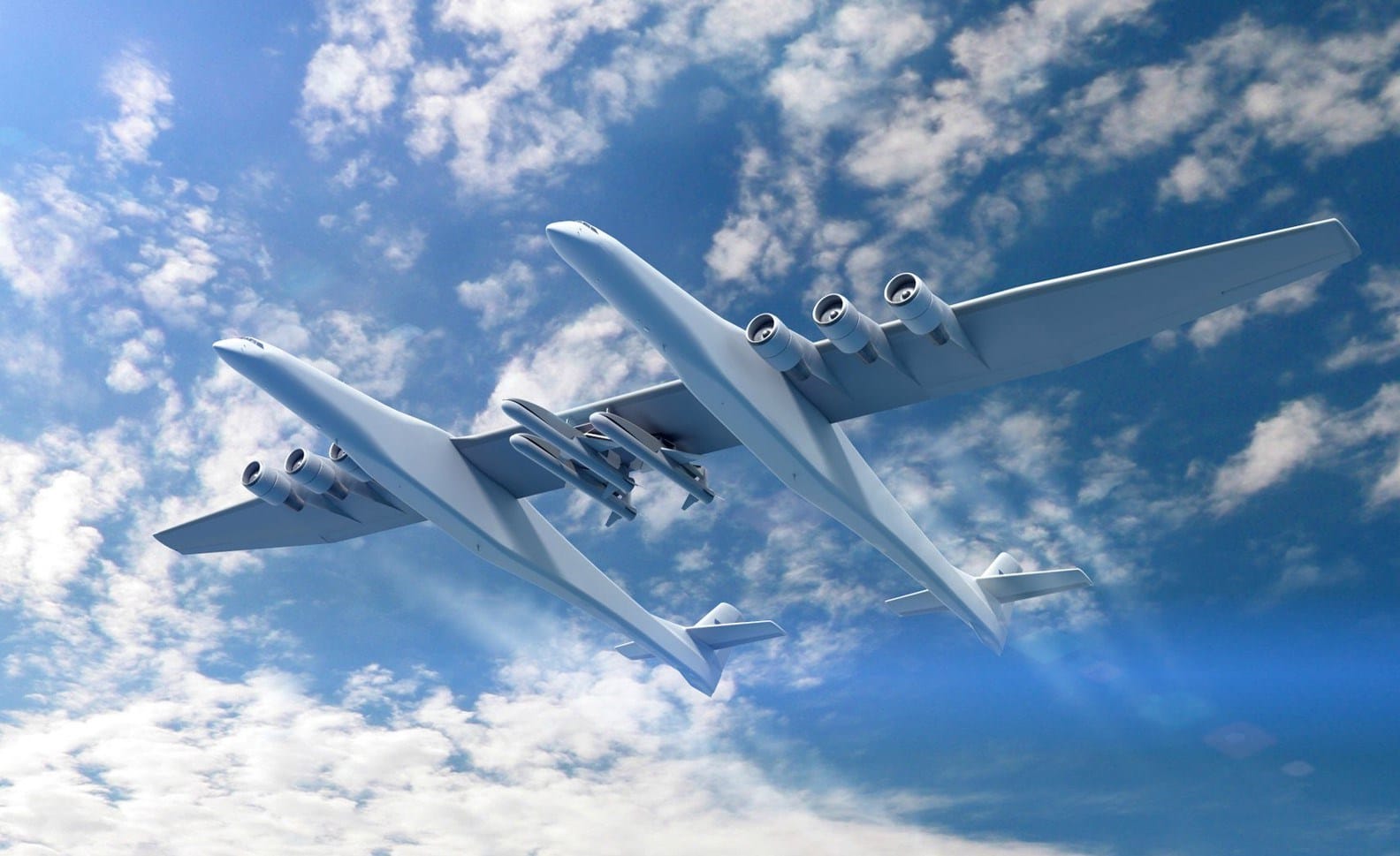
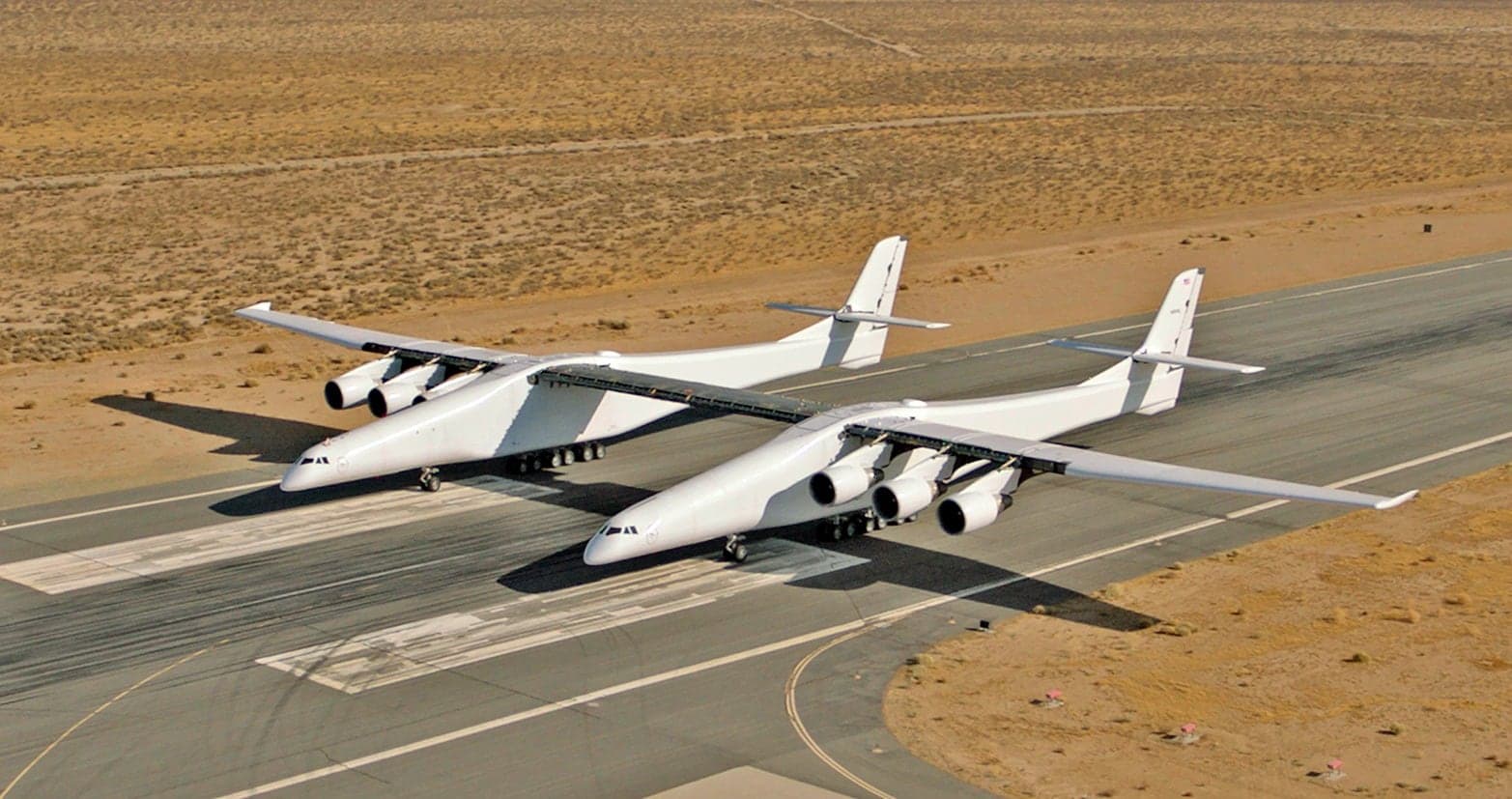
The world’s largest airplane, the Scaled Composites Model 351 Stratoalunch, is in the news again. The ginormous aircraft hasn’t really changed or done anything especially noteworthy since its successful low-speed taxi tests back in December of 2017. But Stratolaunch is now saying they hope to fly the aircraft for the first time “this fall.” Stratolaunch has also announced the family of launch vehicles the company hopes will enter service beginning in 2020.
Stratolaunch carrier vehicle with three Pegasus launch vehicles. Image via Stratolaunch
Jean Floyd, Chief Executive Officer of Stratolaunch, remarked, “We are excited to share for the first time some details about the development of our own, proprietary Stratolaunch launch vehicles, with which we will offer a flexible launch capability unlike any other. Whatever the payload, whatever the orbit, getting your satellite into space will soon be as easy as booking an airline flight.”
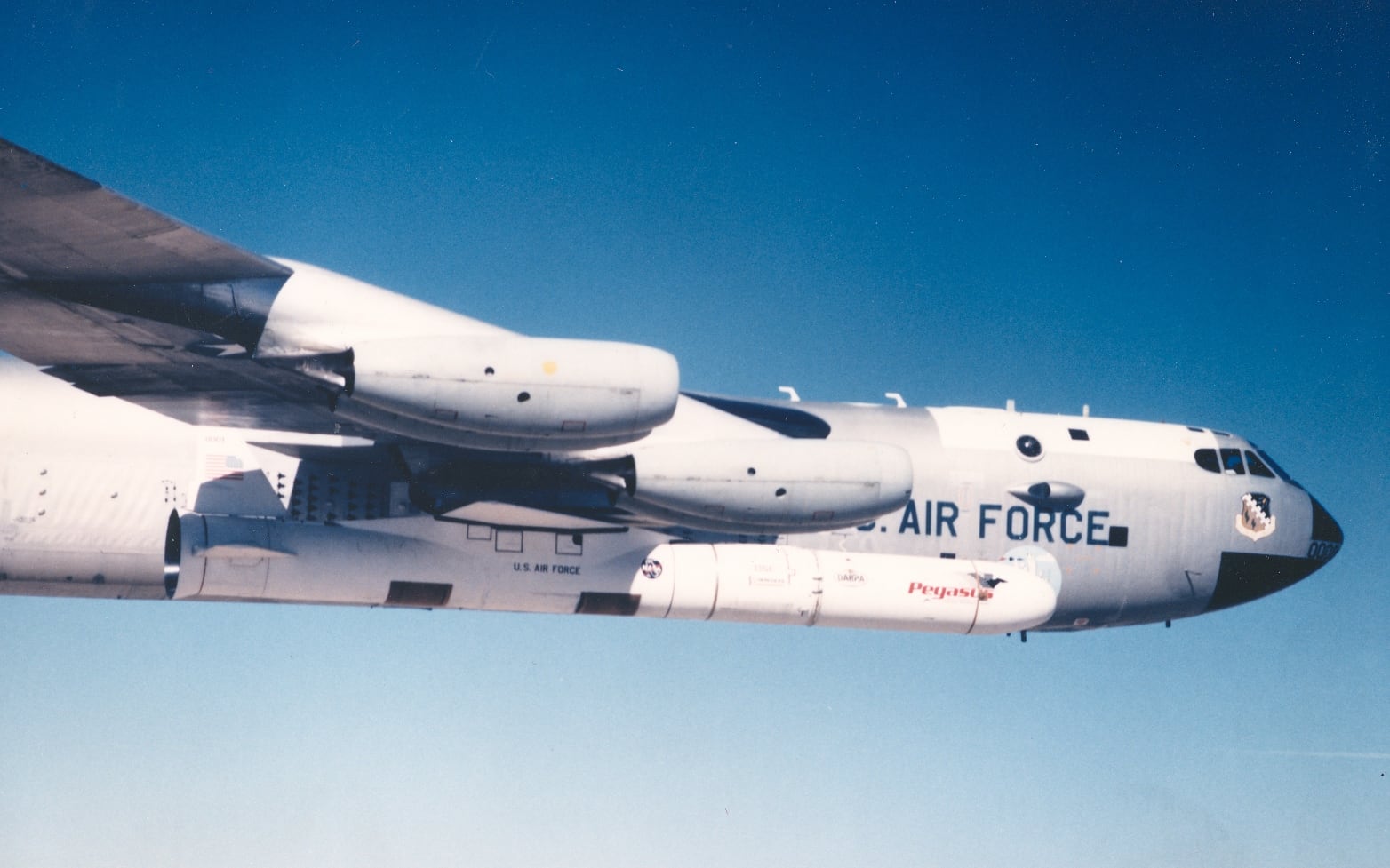
Pegasus carried by NB-52BG Balls Eight. Image via NASA
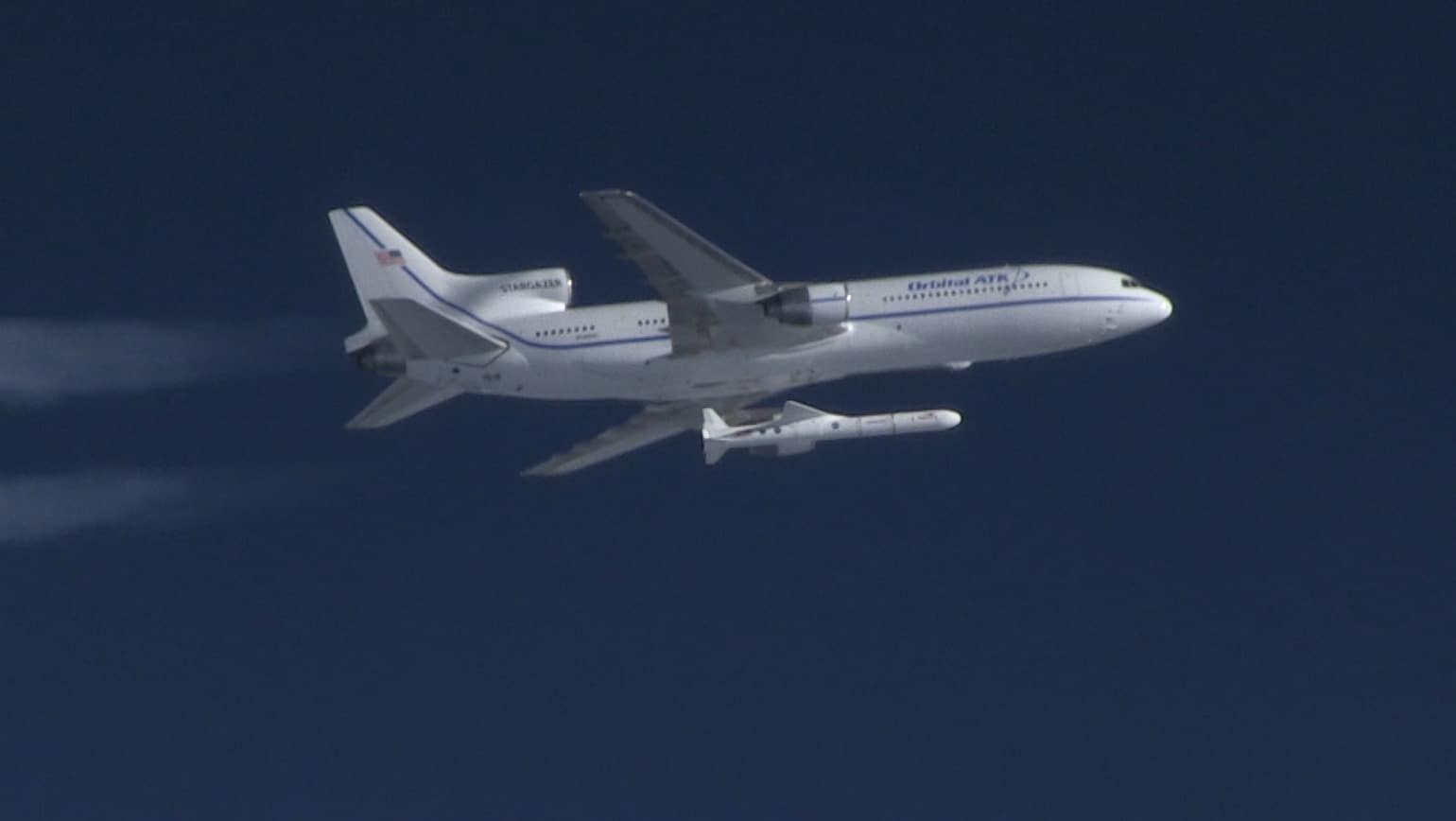
The first launch vehicle is the Pegasus, which has already been successfully launched more than 35 times. The company is touting the reliability and sustainability of the Pegasus. Initially, a NASA-owned Boeing NB-52B Stratofortress Balls Eight (52-008) served as the Pegasus carrier aircraft. In 1994 Orbital began using a former Air Canada Lockheed L-1011 Tristar named Stargazer as the launch aircraft. Stratolaunch will be the third launch solution for Pegasus.
Pegasus carried by L-1011 Stargazer. Image via Orbital
Stratolaunch also announced the Medium Launch Vehicle (MLV), which is a new medium-class air-launch vehicle optimized for short satellite integration timelines, flexible launch profiles, and affordable launches. The MLV will be able to carry a 7,496 pound payload and is expected to fly for the first time in 2022. A version of the MLV, the MLV-Heavy with three rocket engine cores that will be capable of carrying a 13,228 pound payload, is in development.
351 carrier aircraft during taxi tests. Image via Stratolaunch
The other launch vehicle in development is the Stratolaunch Space Plane, a fully reusable medium-class payload vehicle that enables advanced in-orbit capabilities and cargo return. As of now the design of the Space Plane is optimized for cargo launch. A variant capable of carrying humans into space will follow. Should development and testing proceed successfully, the Stratolaunch fleet of launch vehicles will bring space travel closer to reliability and affordability than ever before.
BIRMINGHAM, Ala. — The adventure of flight and its history across the 20th century through today is on display at the Southern Museum of Flight nestled in a state rich in aviation history.
Located two blocks east of the Birmingham-Shuttlesworth International Airport, this museum of flight features top military and civilian aircraft, historic artifacts from world wars, and remains a top educational location for schools and scouting programs.
On Saturday, August 25, the museum will host a special family fun day between 10 a.m. and 2 p.m. Admission is free and children are encouraged to attend to participate in several engaging activities such as aircraft building, a scavenger hunt, and much more.
Executive Director Dr. Brian Barsanti is proud of the the Southern Museum of Flight’s collection of 101 aircraft. (Charles Atkeison)
Historic Rare Aircraft Fills the Museum
Established in 1966, the museum’s collection of rare aircraft and historic novelties from the early days of aviation makes this a true destination stop for the aviation geek. The museum site is also home to the Alabama Aviation Hall of Fame.
“It’s quite an aviation collection for a small organization but we have one of the largest collections in the south,” Southern Museum of Flight’s Executive Director Dr. Brian J. Barsanti said during a tour. “What separates us from other museums and what really gives us our unique identity is the collection — both military and general aviation.”
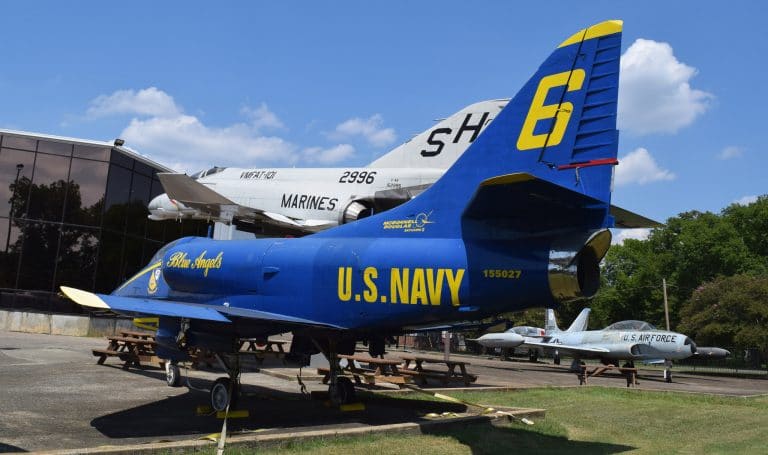
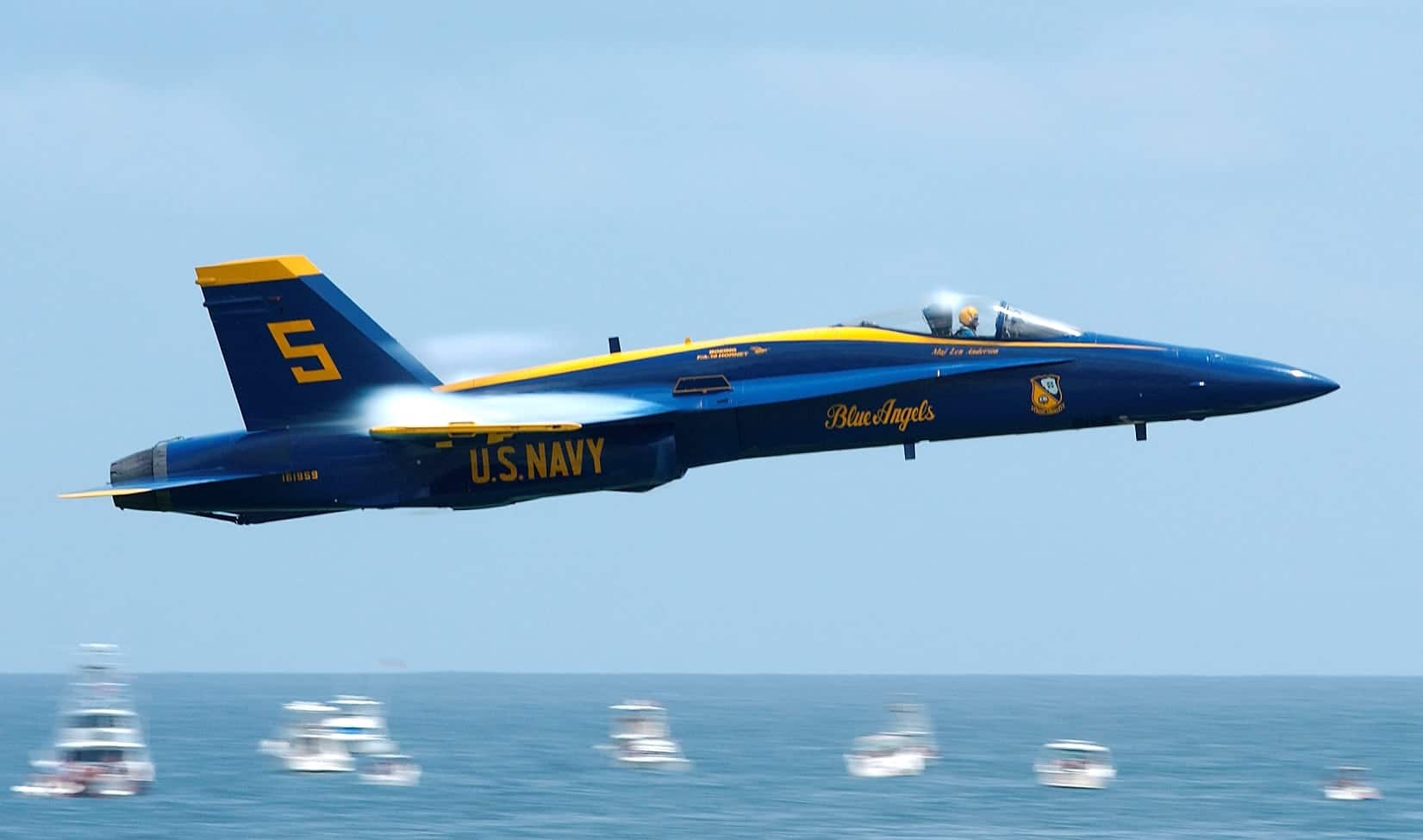
A few stand out aircraft include a McDonnell Douglas A-4F Skyhawk II dressed as the U.S. Navy Blue Angels. This A-4F honors former Blues solo pilot LCDR Mike Gershon who perished during a midair crash during the Niagara Falls air show in July 1985. The Navy’s flight demonstration team piloted the Skyhawks between 1974 until the end of 1986.
The Soviet Mi-24 Hind attack helicopter is a center piece as visitors begin their tour of the multi-wing museum. At nearly 60-feet long, the massive gun ship and troop transport was active during the Soviet-Afghanistan War.
The museum’s top displays also include the Korean War Jets exhibit, Tuskegee Airmen exhibit, and the Vietnam War Helicopters exhibit. One special collection centers around the flight of one B-25 Mitchell bomber and its place in history.
One display centers on the ill-fated flight of a B-25 Mitchell and its place in history. (Charles Atkeison)
B-25 Mitchell Display Recalls Storied Past
In April 1943, this U.S. Army Air Force B-25C departed the Army Air Base near Columbia, SC, to practice a bombing run over Lake Murray. While in flight, an issue arose as the left engine lost power and the crew guided the bomber down. The five crew members left the aircraft before it sunk in nearly 150-feet of water.
“Part of the museum’s mission is to tell the rich story of southern aviation, and alot of B-25 guys trained in South Carolina,” Dr. Barsanti said as he discussed its history. “A number of B-25s went down in Lake Murrary during the 1940’s, and it is important for us to tell the story. It will never be restored, but it will be preserved just as it was sitting at the bottom of the lake.”
In September 2005, the bomber was raised from the lake and was cleaned up, however the damage from the lake impact was not repaired. Today, the forward section of the B-25 rests upon a bed of dirt much as it did for 62 years.
In November, the museum will launch a Cold War exhibit showcasing aviation from the end of World War II thru the collapse of the Soviet Union called When the Cold War Got Hot. The multi-dimensional display will include artifacts, the Soviet Mi-24 helicopter and a new aircraft which will be unveiled.
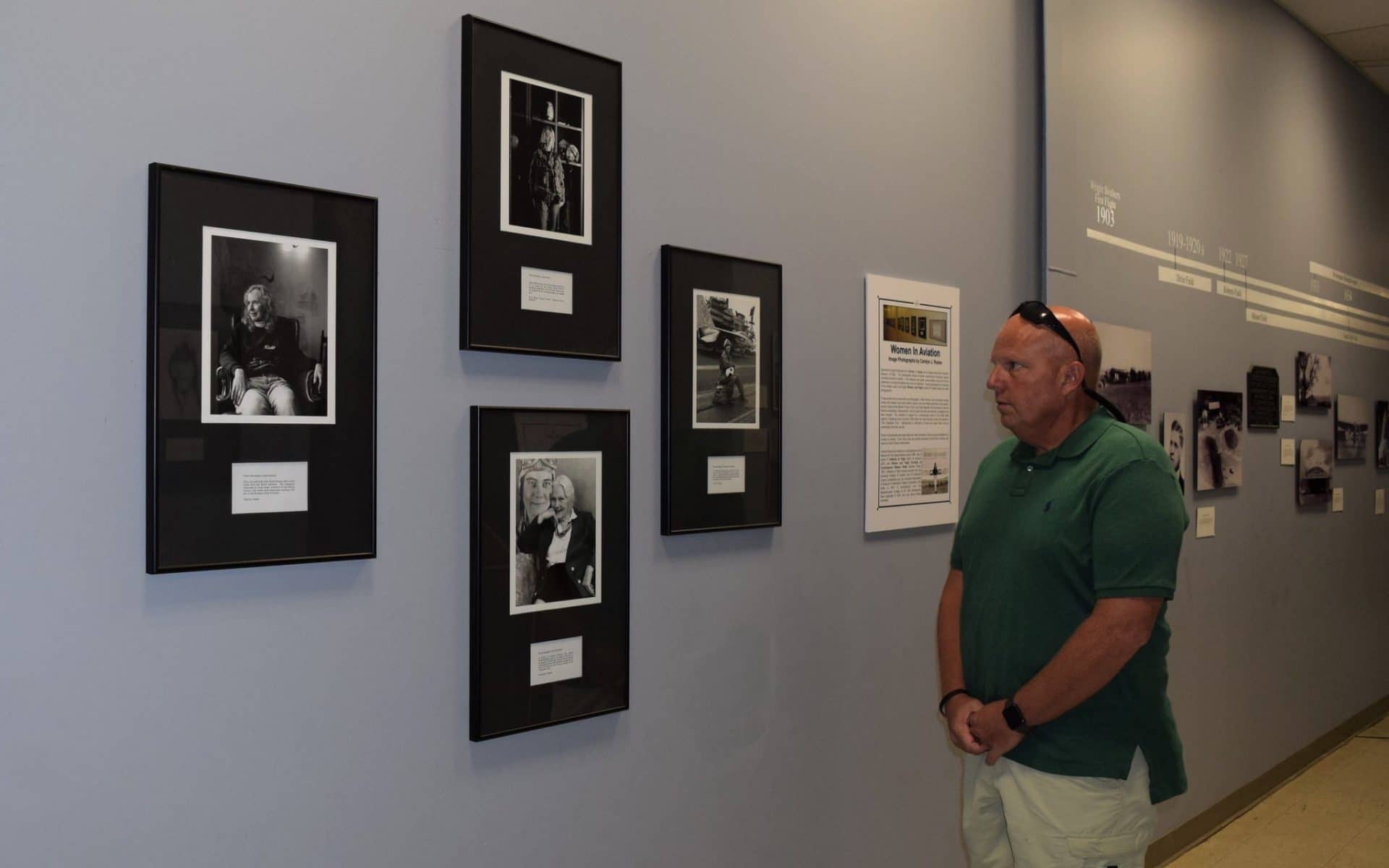
Historic photographs and memorabilia decorate the walls across the museum. (Charles Atkeison)
The flight museum is open Tuesday thru Saturday from 9:30 a.m. until 4:30 p.m., and closed for major holidays. Admission prices range from a family membership package to general admission on the day you arrive. The museum also honors active military and their families with free admission. Donations to help expand the museum’s collection are also welcomed.
The Southern Museum of Flight is located at 4343 73rd Street North in Birmingham, and, as Dr. Barsanti points out, follow the green and white tourist signs as you drive down Aviation Ave.
(Charles A Atkeison reports on aerospace and technology. Follow his updates via social media @Military_Flight.)
The Crew of Cherry 6 Was the Most Decorated Helicopter Crew in Vietnam
Highlights from Major Stephen Pless Heroic Career:
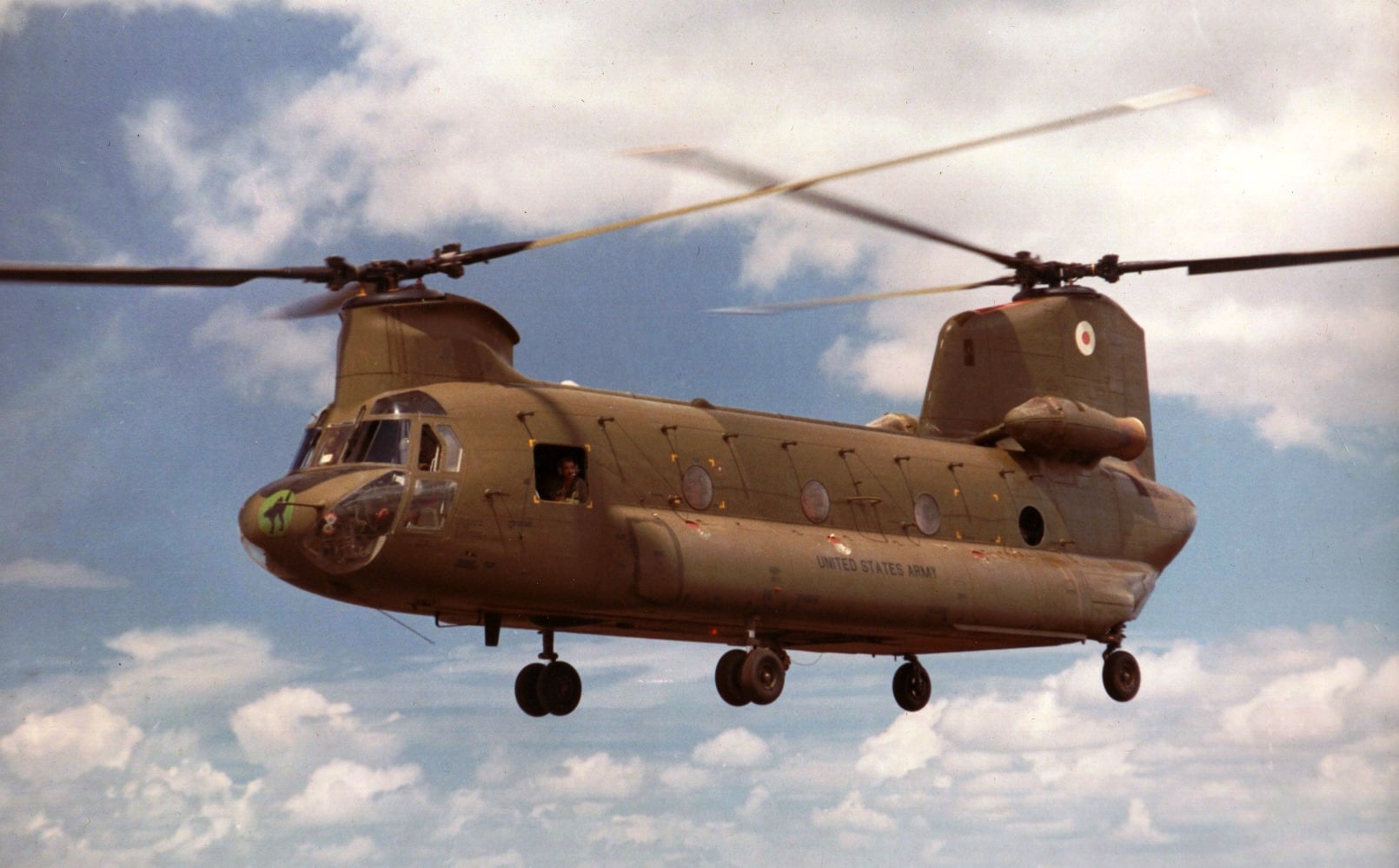
On 19 August 1967, a US Army Boeing CH-47 Chinook helicopter with wounded men aboard was struck by ground fire and forced down on the beach south of Chu Lai in South Vietnam. Four of the crew, including Marine Officer Stephen Pless, left the helo to evaluate the damage to the rotorcraft.
Suddenly a grenade exploded near the nose of the helo. The pilot lifted the big bird off, leaving the four men on the beach in close contact with a large number of Viet Cong. The pilot radioed immediately on guard that his aircraft was all shot up and he was trying to make for a safer location adding “I still have four men on the ground, the VC are trying to take them prisoner or kill them; God, can somebody help them?” The four men quickly ran out of ammunition and were surrounded.
The VC moved in, intent on making the men prisoners. What happened next made Marine Corps history.
CH-47 Chinook. Image via USAF
Earning Wings of Gold
Stephen Wesley Pless was born on 6 September 1939 in Newnan, Georgia. He attended Decatur High School and then Georgia Military Academy in College Park, graduating in 1957. While attending GMA Pless enlisted in the US Marine Corps Reserve on his 17th birthday.
After graduation Pless served as an artillery spotter before attending flight training at Naval Air Station (NAS) Pensacola in Florida. Pless was commissioned as a Second Lieutenant on 16 September 1959. When Pless graduated from flight training on 20 April 1960 and pinned on his Wings of Gold he was promoted to First Lieutenant and designated a Naval Aviator.
UH-1Es. Image via USMC
A Born Rotorhead
Stephen Pless then served with several Marine Corps Light Helicopter Transport squadrons including HMR(L)-262 and HMR(L)-264. He also served as Squadron Adjutant at HMM-162. His first tour in Vietnam was with HMM-162 from 1962 to 1963, after which he went back to Pensacola as an instructor with Training Squadron ONE (VT-1) and was Officer in Charge of the Aviation Officer Candidate School (AOCS).
After his promotion to Captain in 1964, Pless spent some time at Marine Corps Air Station (MCAS) Kaneohe Bay in Hawaii before serving as Officer in Charge of and Brigade Air Officer of a Korean Marine Corps unit. On 20 March 1967, Pless became a member of Marine Corps Observation Squadron SIX (VMO-6).
UH-1E. Image via USMC
No Other Options But Bravery
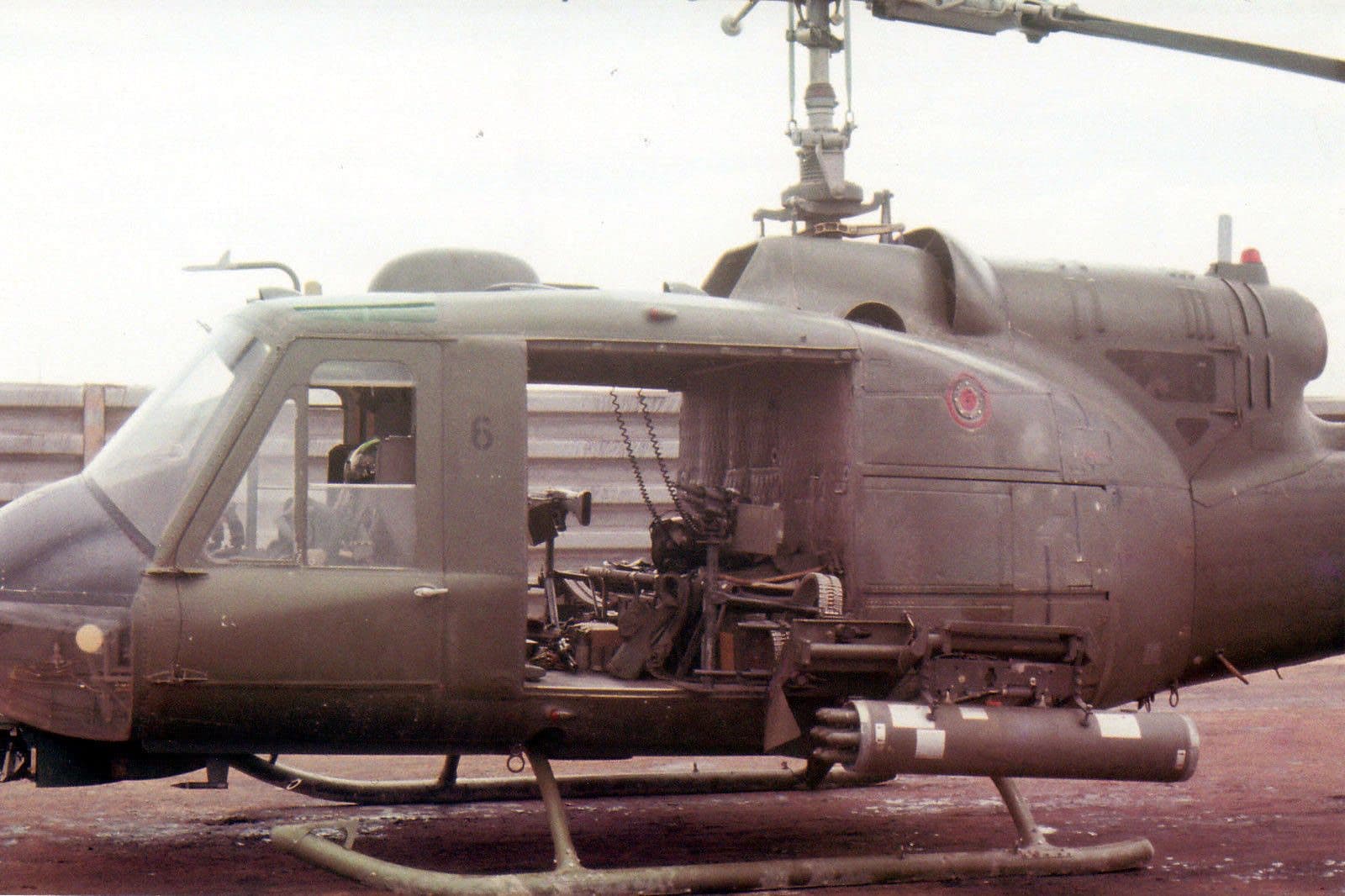
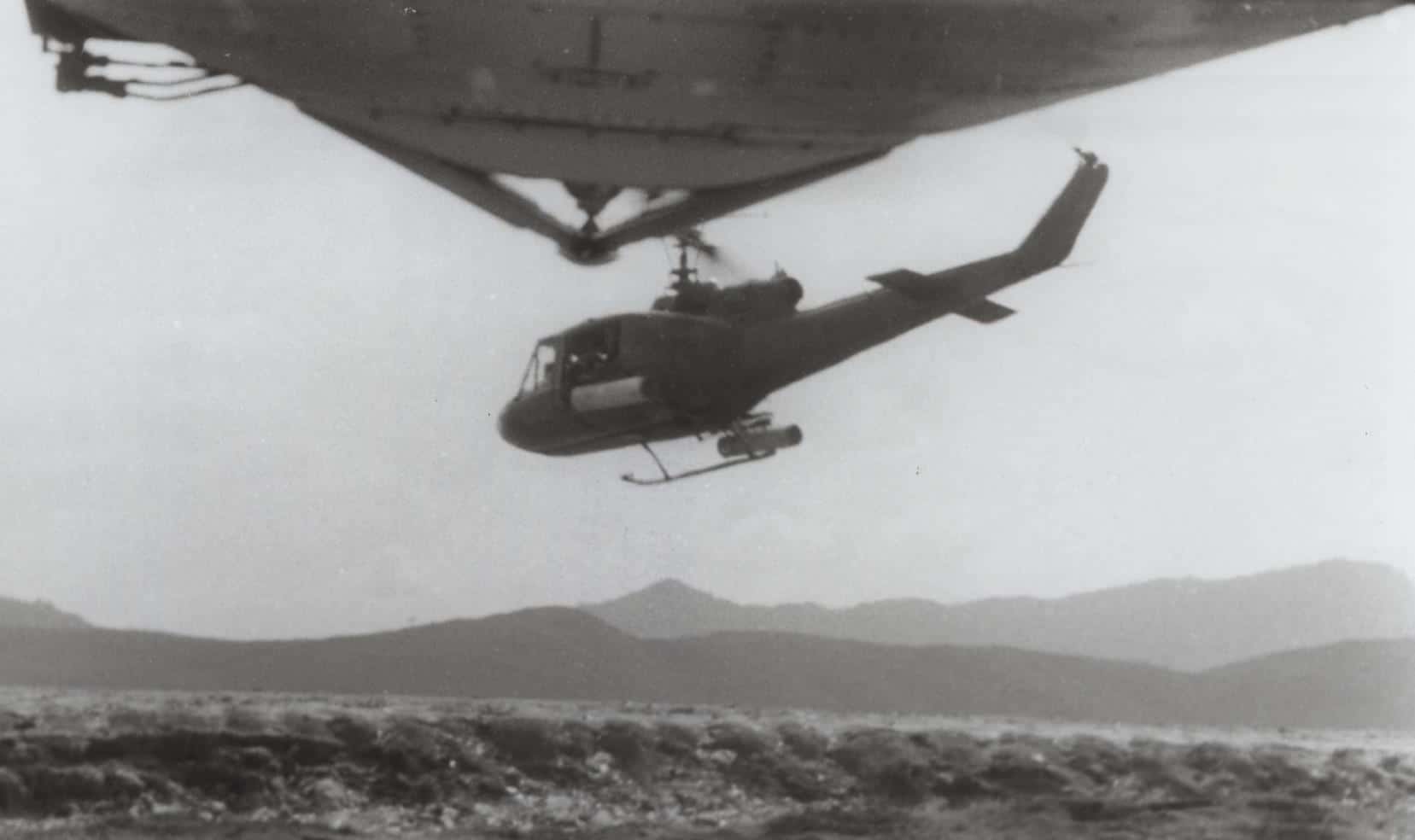
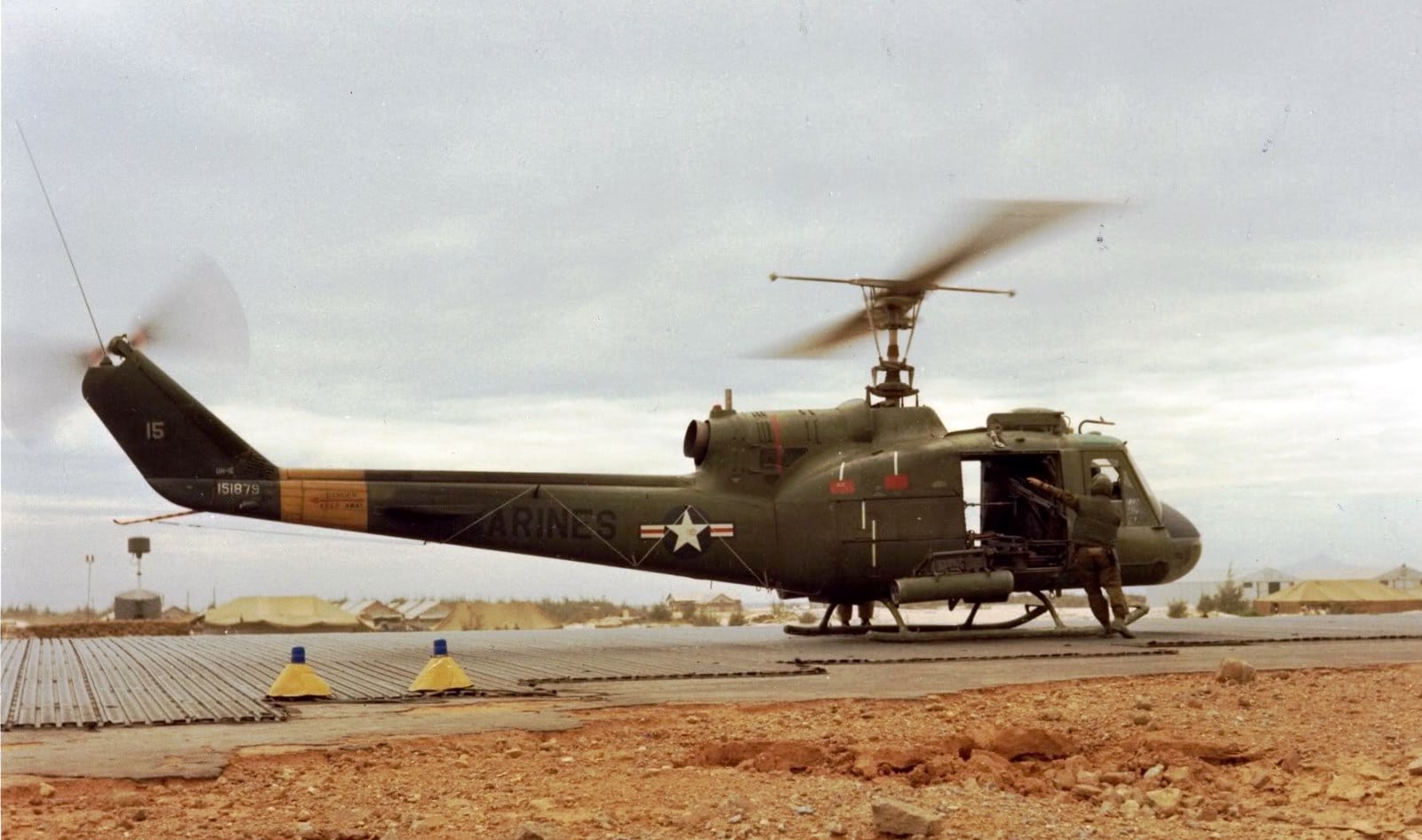
When Pless first heard the frantic calls for help from the Army Chinook pilot he was flying a VMO-6 Bell UH-1E Iroquois helicopter gunship (callsign Cherry 6) with four men aboard: Captain Pless, co-pilot Captain Rupert E. Fairfield, gunner Gunnery Sergeant Leroy N. Poulson, and crew chief Lance Corporal John G. Phelps.
Their assigned mission was medical evacuation escort of several UH-34D Seahorse helicopters. After locating the Army personnel on the beach and observing how many enemy were in the vicinity, Pless began making firing runs on the area, driving the VC back from the wounded men. With no other options available, after checking with his crew and getting a unanimous “Go”, Pless decided to land and retrieve the guys on the beach.
UH-1E. Image via USMC
Fighting Their Way In and Back Out Again
Pless landed his Huey between the VC positions and the first wounded man he could see. While the UH-1E took heavy incoming fire, Gunny Poulson retrieved the first man. Then Pless lifted off and kept using the helo as a shield between the enemy and the Army wounded, landing near a second wounded man.
It took Gunny Poulson, Corporal Phelps, and Captain Fairfield to retrieve him. The first wounded man, Army Staff Sergeant Lawrence H. Allen, was by then firing an M-60 machine gun at the VC who were trying to rush the helo. The crew retrieved a third man and by then one of the Army UH-1Es in the area was making strafing runs around the VMO-6 Huey. Captain Fairfield informed Pless that the fourth man was dead. At that point a South Vietnamese UH-34 landed near Stephen Pless to pick up the fourth man on the beach. It was past time for Pless to get going.
USMC UH-1E. Image via USMC
Skipping Like a Rock Across Land and Sea
A Huey gunship is loaded down with quite a bit of weight to begin with. With a total of seven men in his UH-1E, Pless was overloaded by a fair margin. Knowing that the Huey must have sustained damage but unable to see any obvious signs of serious damage via his gauges, Pless tried to lift off but could not.
Hueys are tough birds, and Pless literally bet the farm that the UH-1E he was flying would bring them back. After the Huey dragged across the beach for about a mile and then tried to settle in the water, bouncing off about four moderate-sized waves, it looked like it was still touch and go. The crew tossed everything that wasn’t bolted down overboard. That did the trick.
Poulson and Phelps rendered first aid to the wounded men on their way to the 1st Hospital Company. Pless was later informed that a round had severed the tail rotor drive shaft and an engine oil line, which should have caused the aircraft to crash during the trip back.
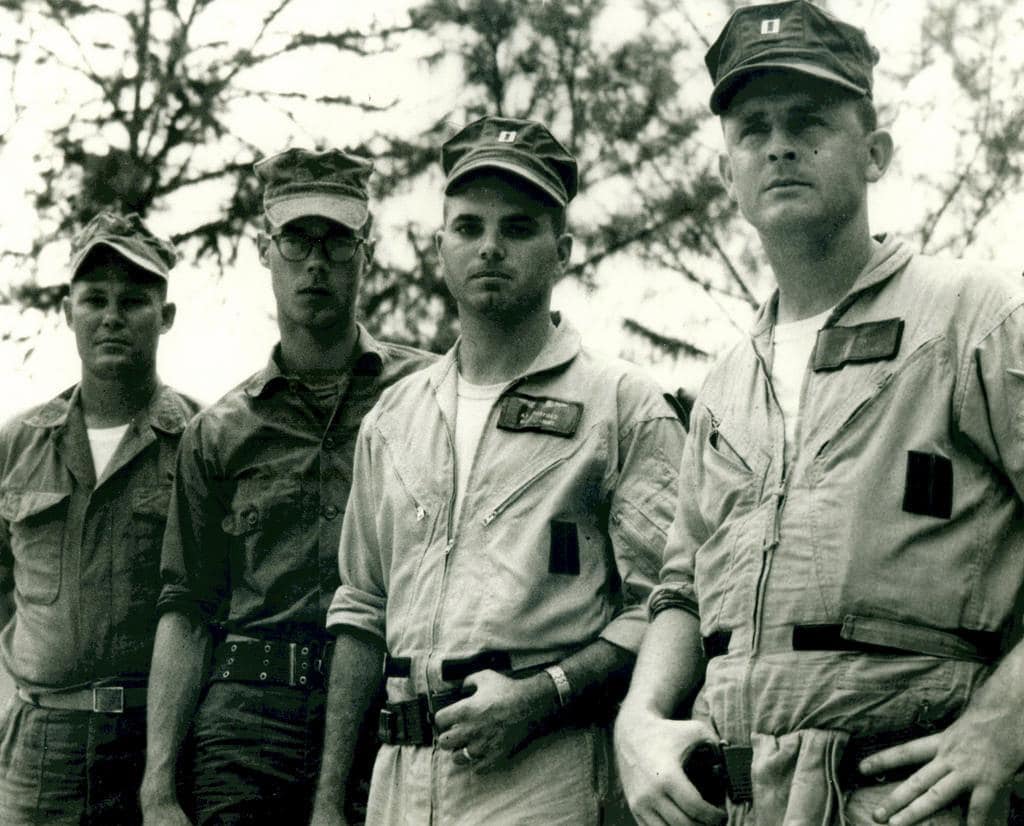
L to R- Gunny Poulson, Lance Corporal Phelps, Captain Fairfield, Captain Pless. Image via USMC
A Tragic End to a Selfless Warrior
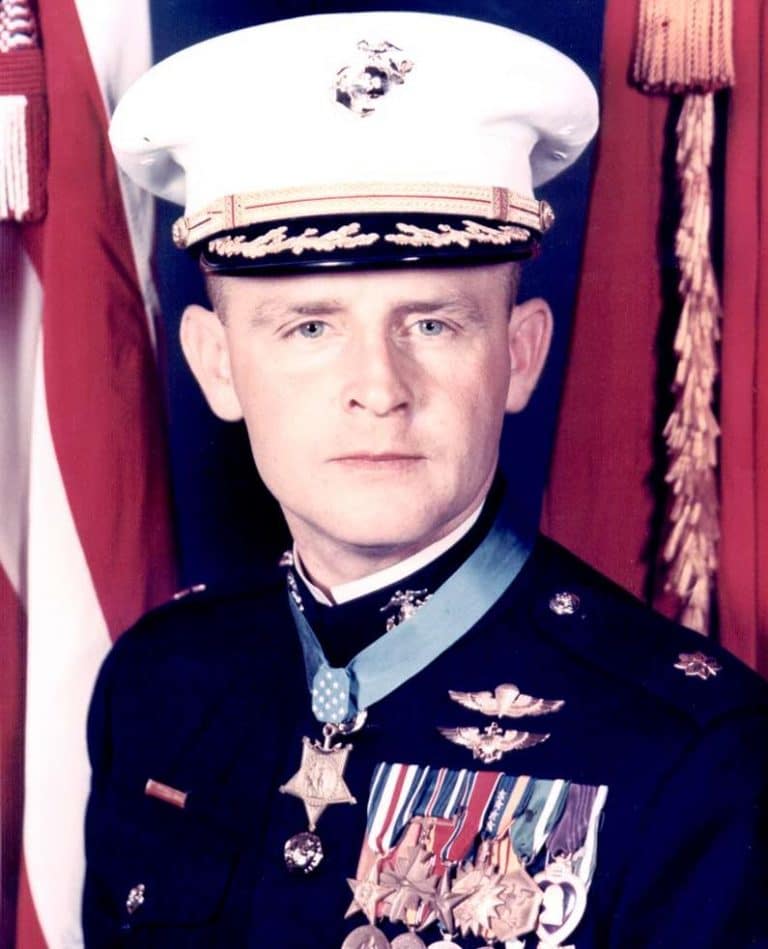
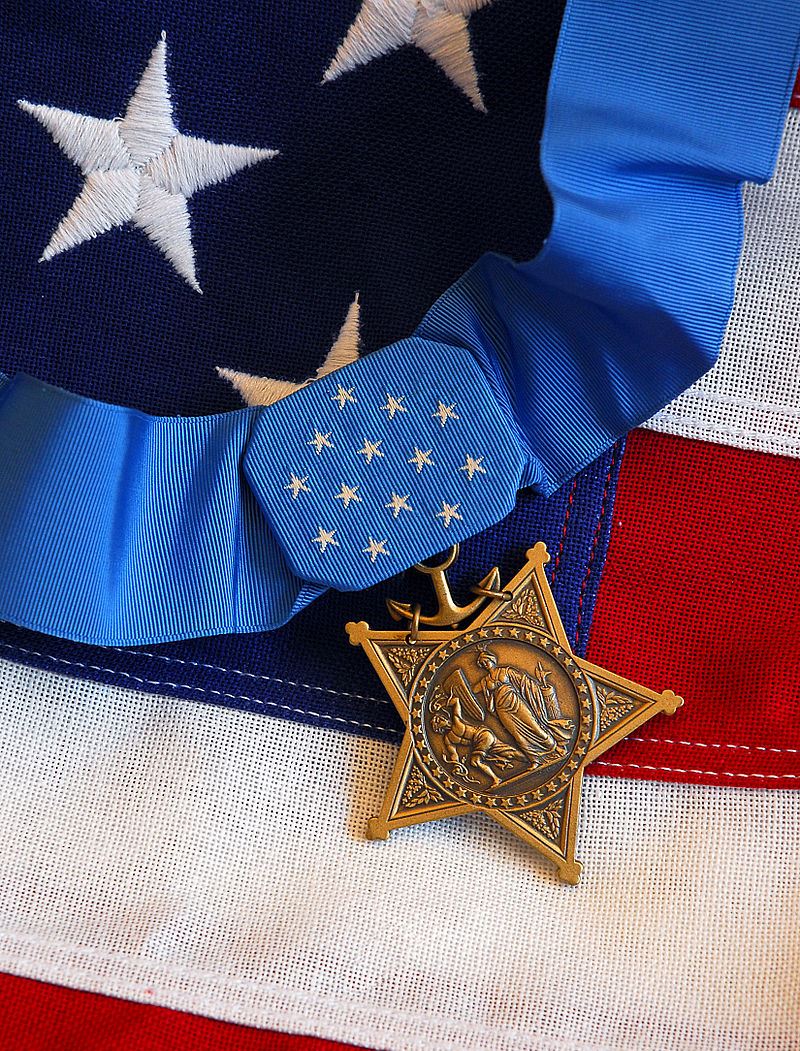
The crew of Cherry 6 were all decorated for their bravery and selfless actions that day on the beach. Captain Pless was presented with the Medal of Honor on 16 January 1969. Captain Fairfield, Gunny Poulson, and Lance Corporal Phelps all received the Navy Cross- making the crew of Cherry 6 the most decorated helicopter crew to serve in Vietnam.
Army Sergeant Allen received the Silver Star. After his return from Vietnam in 1967, Captain Pless became the youngest Major in the Marine Corps and went back to Pensacola again as an administrator at AOCS. On 20 July 1969, Major Pless, survivor of 780 combat helicopter missions in Vietnam, died when his motorcycle plunged off the drawbridge portion of the Pensacola Bay Bridge into Pensacola Bay.
News of the death of Major Stephen Pless, the only Marine Corps Aviator presented with the Medal of Honor for actions in Vietnam, was overshadowed by another event that July day- the landing of Apollo 11 on the surface of the moon.
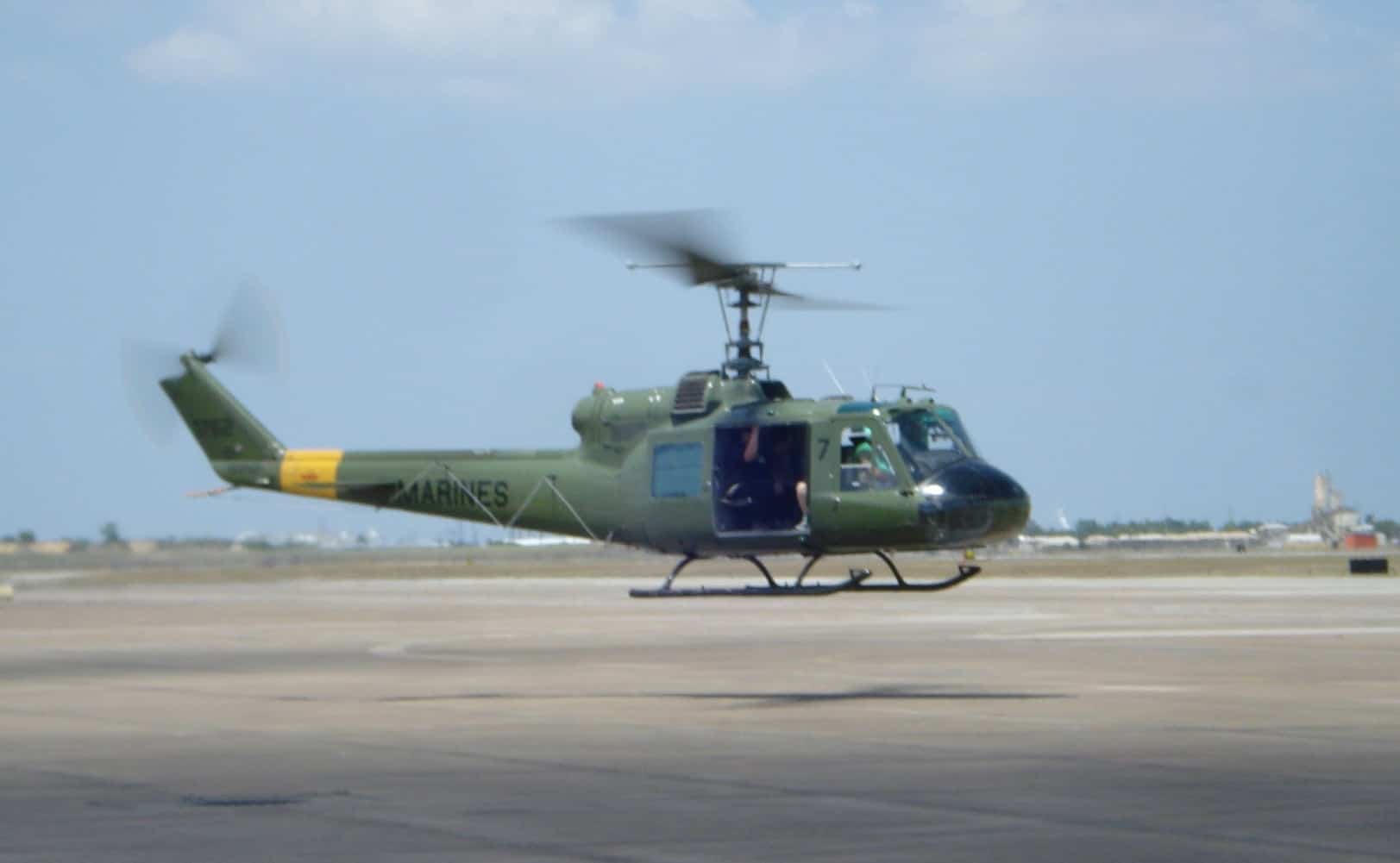
Collings Foundation UH-1E flown by Pless in combat. Image via author.
A Hero Remembered and Revered
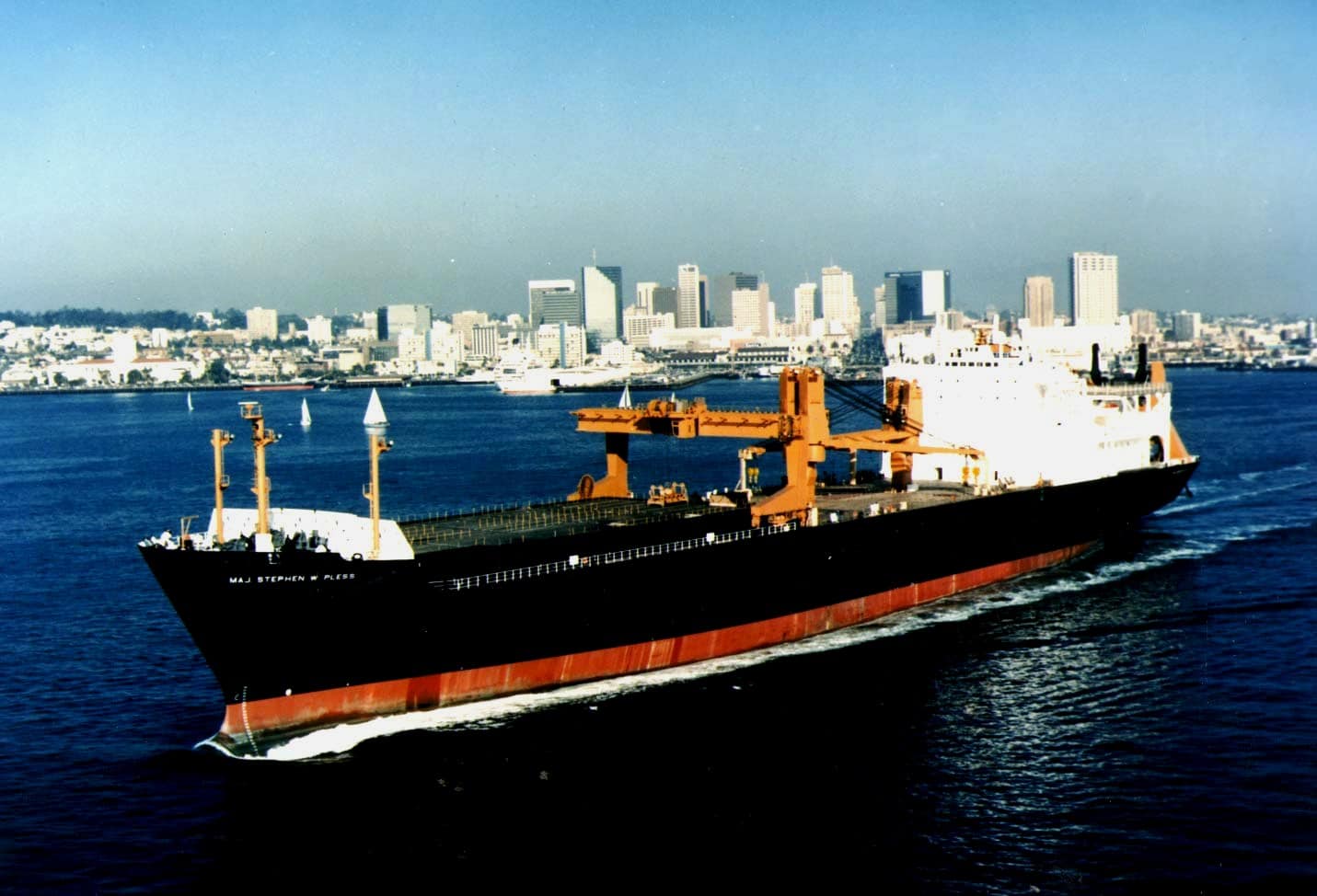
The United States Navy honored Major Stephen Pless by naming a Maritime Prepositioning ship after him- the SS Maj. Stephen W. Pless (T-AK 3007). The Marine Corps honored Major Pless by naming the Headquarters Building at MCAS Camp Pendleton in California after him.
The Jackson-Pless National Guard Armory in Newnan, Georgia honors both of the town’s Medal of Honor recipients- US Air Force Lieutenant Colonel (later Colonel) Joe M. Jackson and US Marine Corps Captain (later Major) Stephen W. Pless. Today, the UH-1E Huey helo flown by Stephen Pless and crew as Cherry 6 on their 19 August 1967 mission is displayed at the National Museum of the Marine Corps in Quantico, Virginia. The Collings Foundation currently operates a former VMO-6 UH-1E Huey in which Pless logged combat time.
SS Maj. Stephen W. Pless (T-AK 3007). Image via Maritime Sealift Command
Awards and Decorations : Stephen Wesley Pless
A complete list of Major Stephen Pless medals and decorations include the Medal of Honor, the Silver Star, the Distinguished Flying Cross, the Bronze Star, the Purple Heart, 38 Air Medals, the Navy Commendation Medal with valor device, the National Defense Service Medal, the Marine Corps Expeditionary Medal, the Armed Forces Expeditionary Medal, the Korean Order of Military Merit, the Vietnam Service Medal, and the Vietnam Campaign Medal.
Medal of Honor Citation:
For conspicuous gallantry and intrepidity at the risk of his life above and beyond the call of duty while serving as a helicopter gunship pilot attached to Marine Observation Squadron Six in action against enemy forces near Quang Ngai, Republic of Vietnam, on 19 August 1967. During an escort mission Major (then Captain ) Pless monitored an emergency call that four American soldiers stranded on a nearby beach, were being overwhelmed by a large Viet Cong force.
Major Stephen Pless flew to the scene and found 30 to 50 enemy soldiers in the open. Some of the enemy were bayoneting and beating the downed Americans. Major Pless displayed exceptional airmanship as he launched a devastating attack against the enemy force, killing or wounding many of the enemy and driving the remainder back into a treeline. His rocket and machine gun attacks were made at such low levels the the aircraft flew through debris created by explosions from its rockets. Seeing one of the wounded soldiers gesture for assistance, he maneuvered his helicopter into a position between the wounded men and the enemy, providing a shield which permitted his crew to retrieve the wounded.
During the rescue the enemy directed intense fire at the helicopter and rushed the aircraft again and again, closing to within a few feet before being beaten back. When the wounded men were aboard, Major Stephen Pless maneuvered the helicopter out to sea. Before it became safely airborne, the overloaded aircraft settled four times into the water.
Displaying superb airmanship, he finally got the helicopter aloft. Major Pless’s extraordinary heroism coupled with his outstanding flying skill prevented the annihilation of the tiny force. His courageous actions reflect great credit upon himself and uphold the highest traditions of the Marine Corps and the United States Naval Service.
The P-8 Has Largely Replaced the P-3, But It’s Unlikely to Match the P-3 Orion Historic Resume
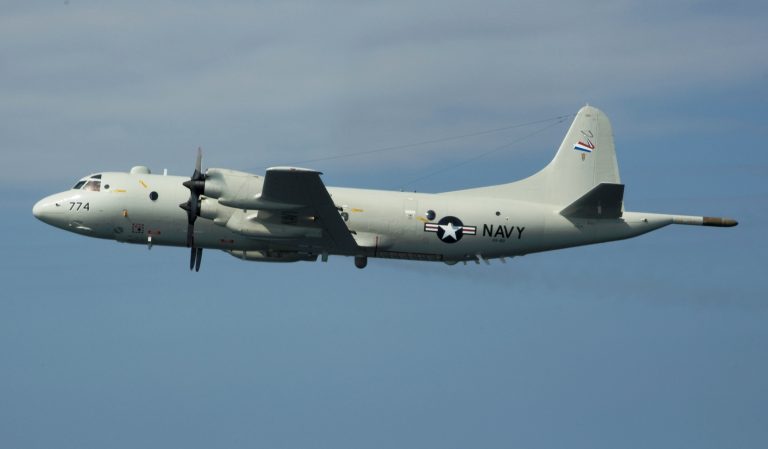
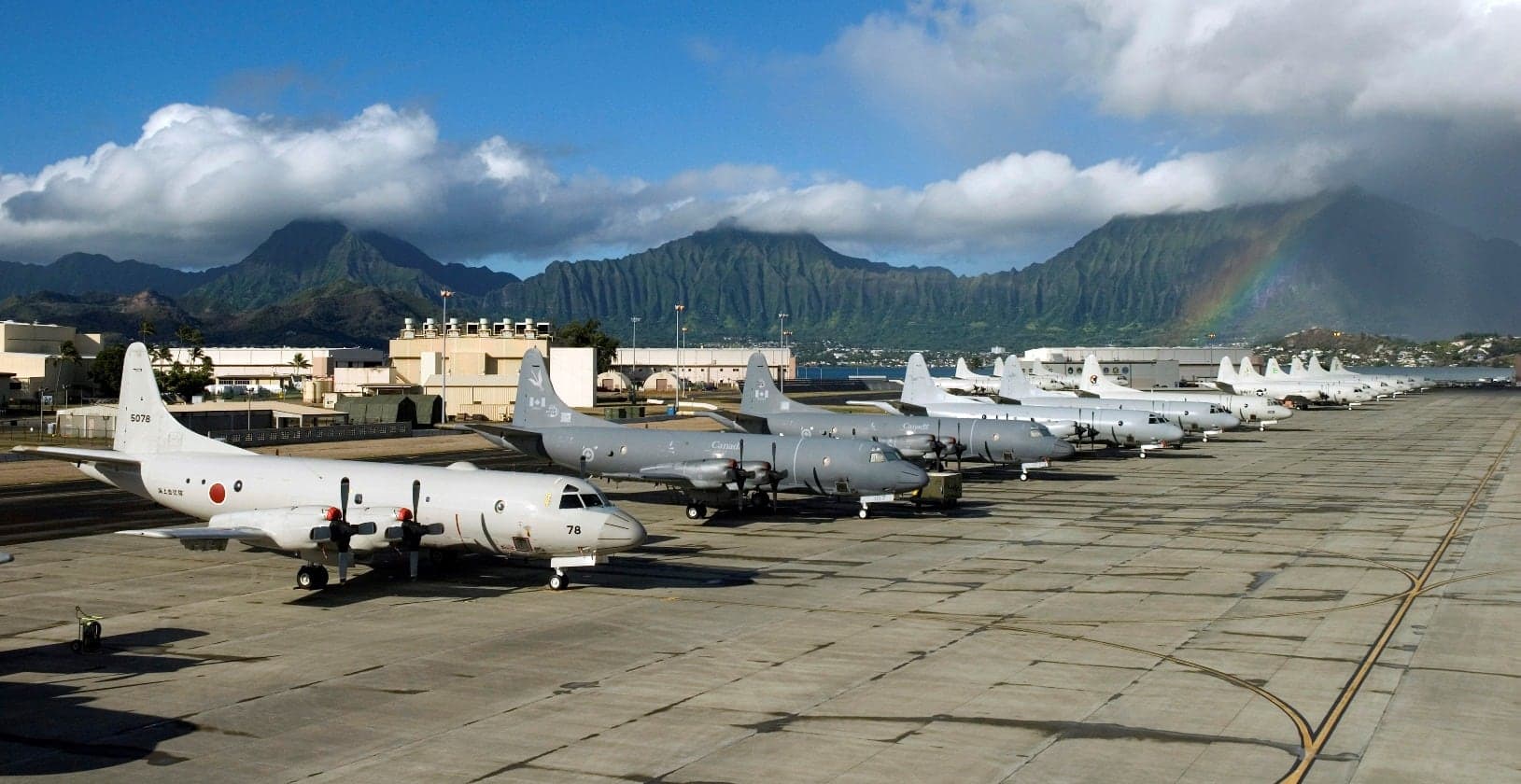
On 19 August 1958 a new Lockheed aircraft flew for the first time. It looked a little bit weird, with a long boom protruding from the tail and wings that seemed too short to support its bulbous fuselage. Powered by four Allison T56 turboprop engines (a winning formula for Lockheed) turning Hamilton Standard 54H60-77 four bladed propellers, the aircraft was derived from a new propliner Lockheed was also developing.
The aircraft was intended to replace both the Lockheed P2V Neptune maritime patrol aircraft and the Martin P5M Marlin patrol flying boat. The propliner would go on to become the L-188 Electra. The patrol aircraft became the P3V-1 Orion.
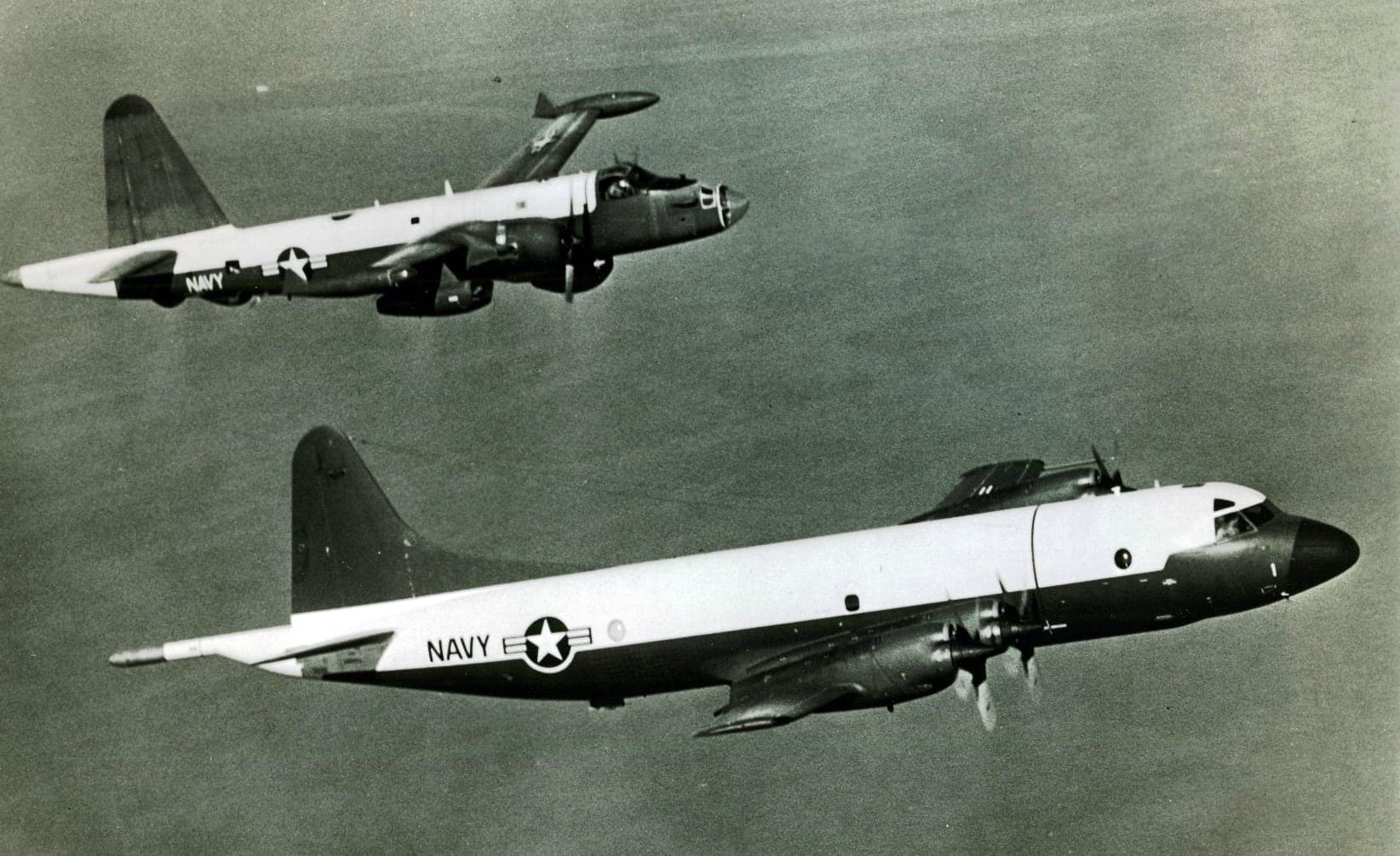
Lockheed P-3A Orion (foreground) and SP-2H Neptune (background) circa 1963. Image via US Navy
Building a Better Sub Killer
The first YP3V-1 was actually the third L-188 Electra built by Lockheed. Though clearly based on the Electra, the Orion was quite different structurally when the first fully modified prototype flew on 25 November 1959. A shortened forward fuselage with internal bomb bay and underwing pylons for additional weapons were some of the visual cues.
Internally the Orion was beefed up and built to withstand the different stresses of low altitude maneuvering associated with anti-submarine warfare (ASW). The slippery shape of the Orion, along with those powerful T56 engines, helped the Orion to be either one of the, or the outright fastest turboprop aircraft of the day- capable of 411 knots (473 miles per hour). Later in life the P-3C set a few records too.
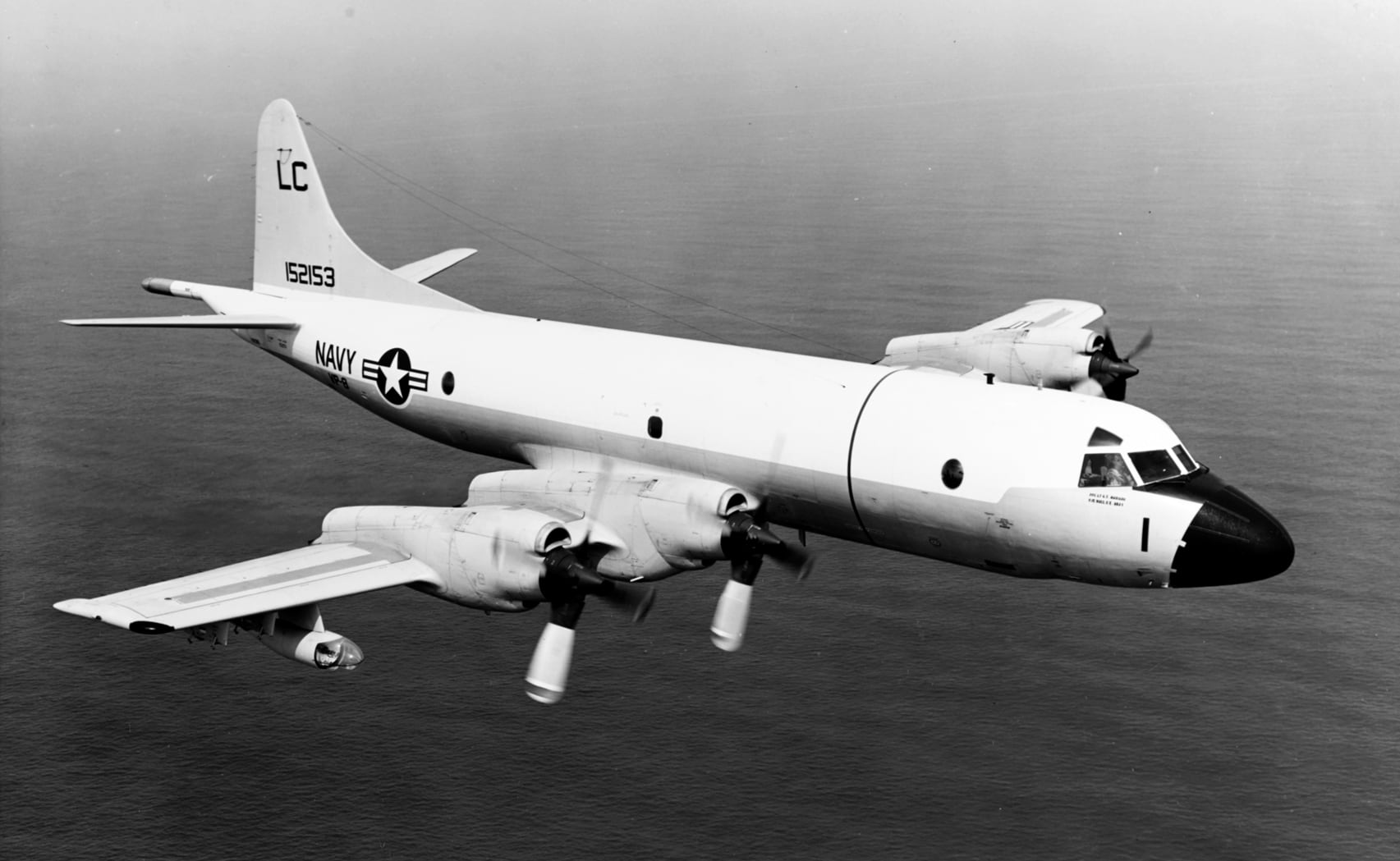
VP-8 P-3A. Image via US Navy
First PATRONs on the Bus
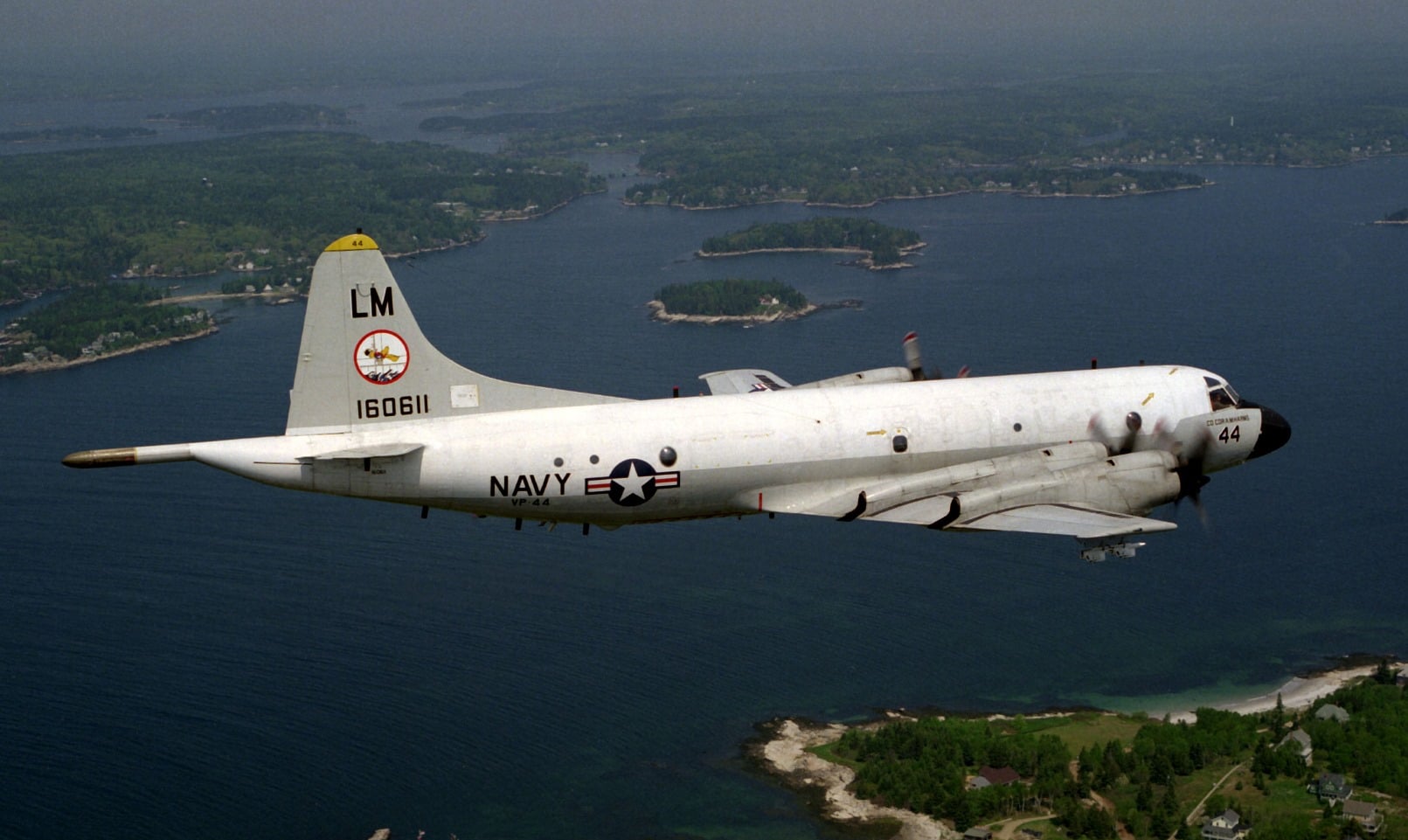
For a short time the P-3 Orion was designated P3V-1. The first production Orion flew on 15 April 1961. During August of 1962, the first squadrons to receive the new patrol aircraft, Patrol Squadron (PATRON) EIGHT (VP-8) Tigers and VP-44 Golden Pelicans, began flying them from Naval Air Station (NAS) Patuxent River where they were based in those days.
When in 1962 the aircraft designation system was overhauled, P3V-1s became P-3As. Some of the first of many missions Orions flew took place during October of 1962 during the Cuban Missile Crisis. VP-8 P-3A Orions flew low-level high-speed blockade patrols over the shipping lanes to and from Cuba. Right from the beginning and still to this day, a major part of the P-3s job was “rigging”, or photographing targets and contacts.
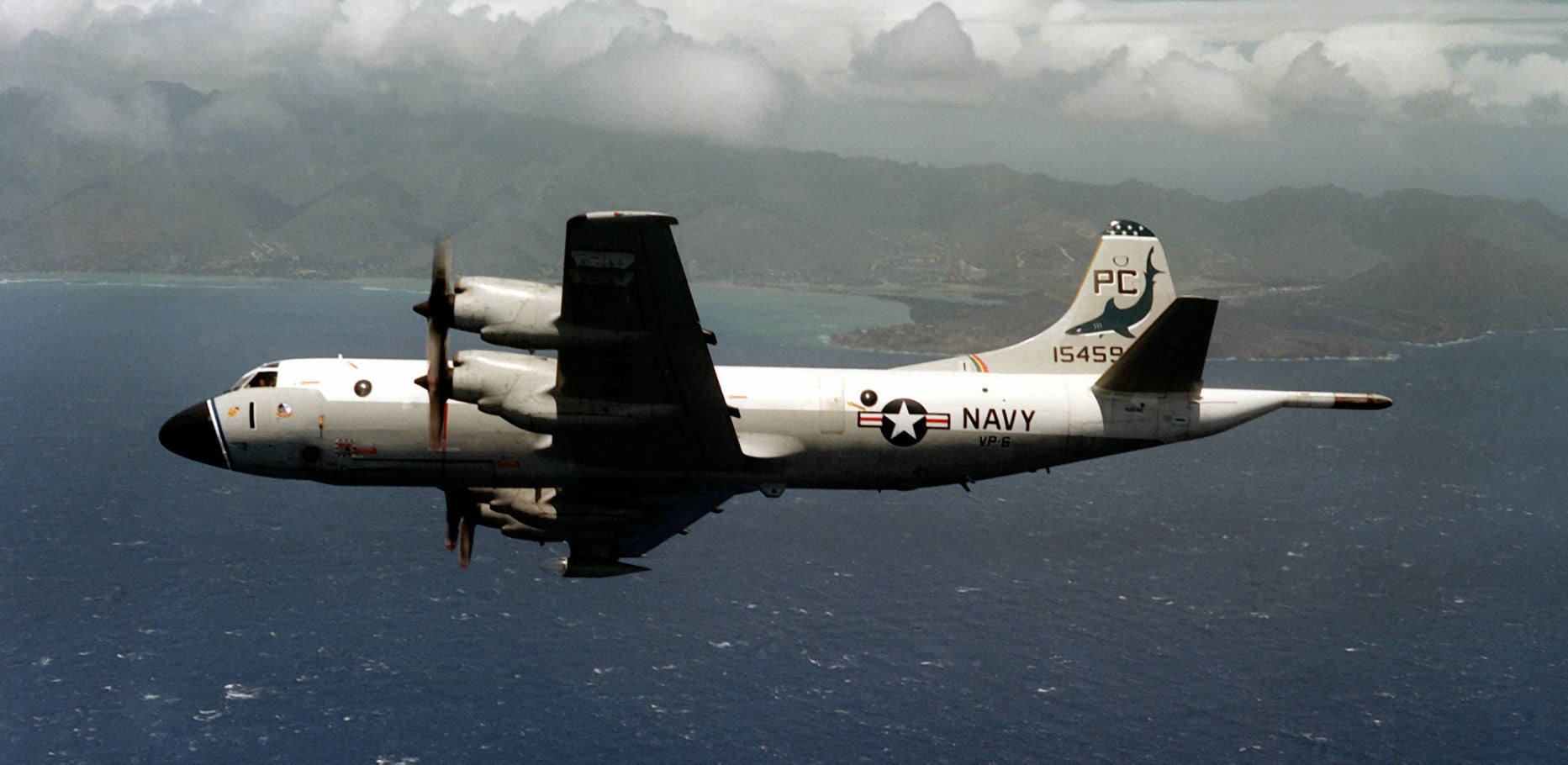
VP-6 P-3B. Image via US Navy
The P-3 Orion: You Call We Haul–Warts and All
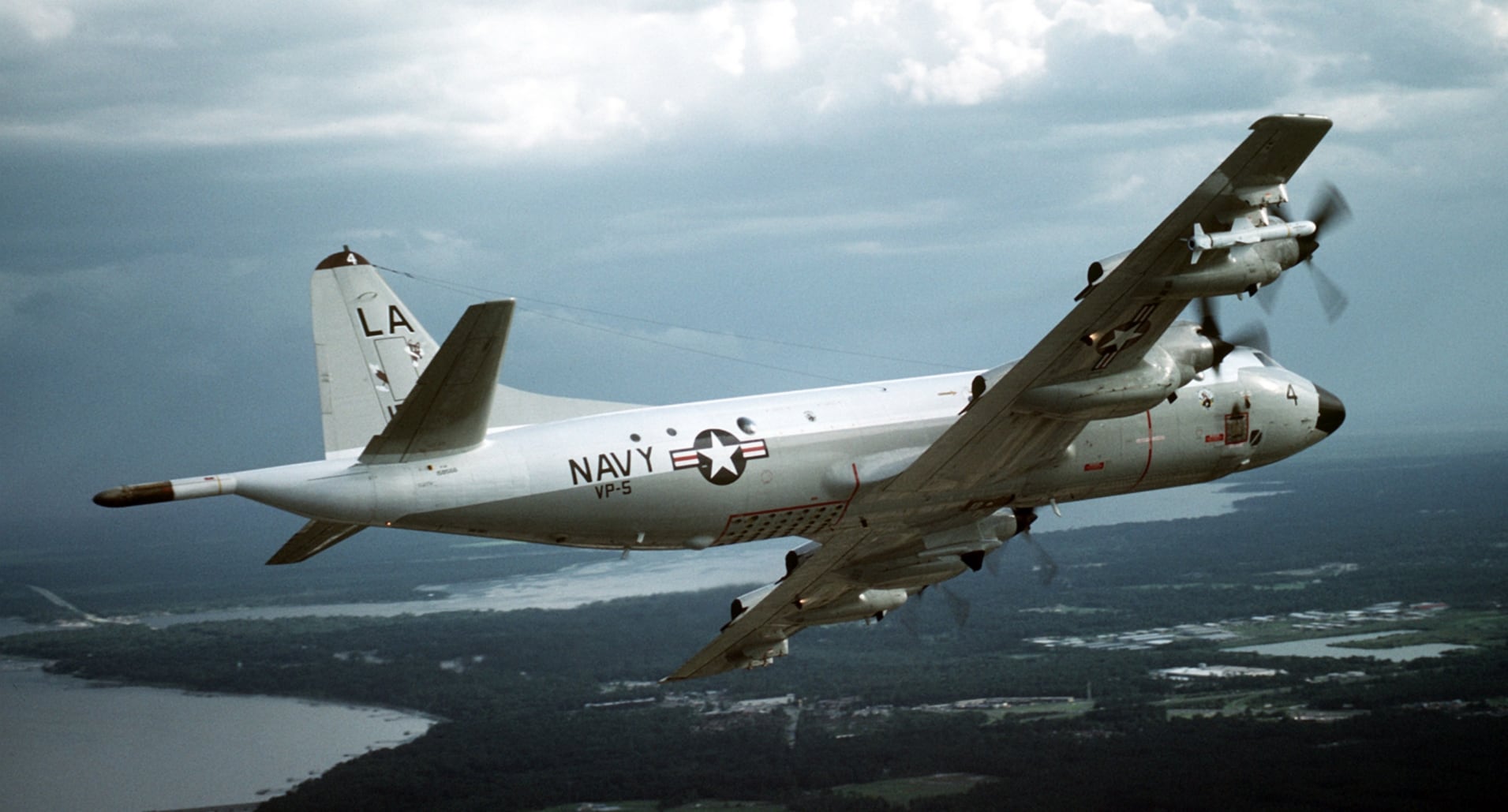
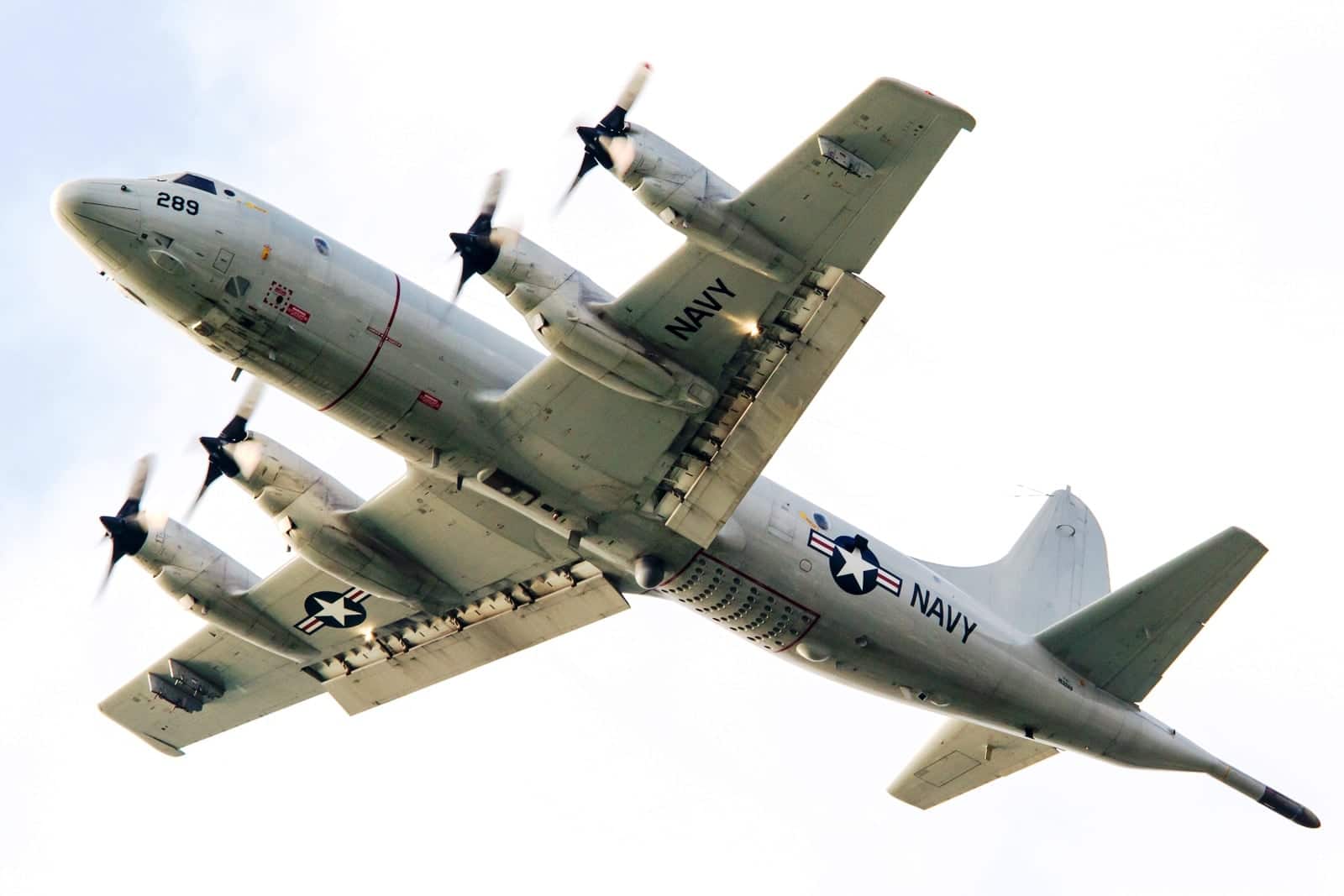
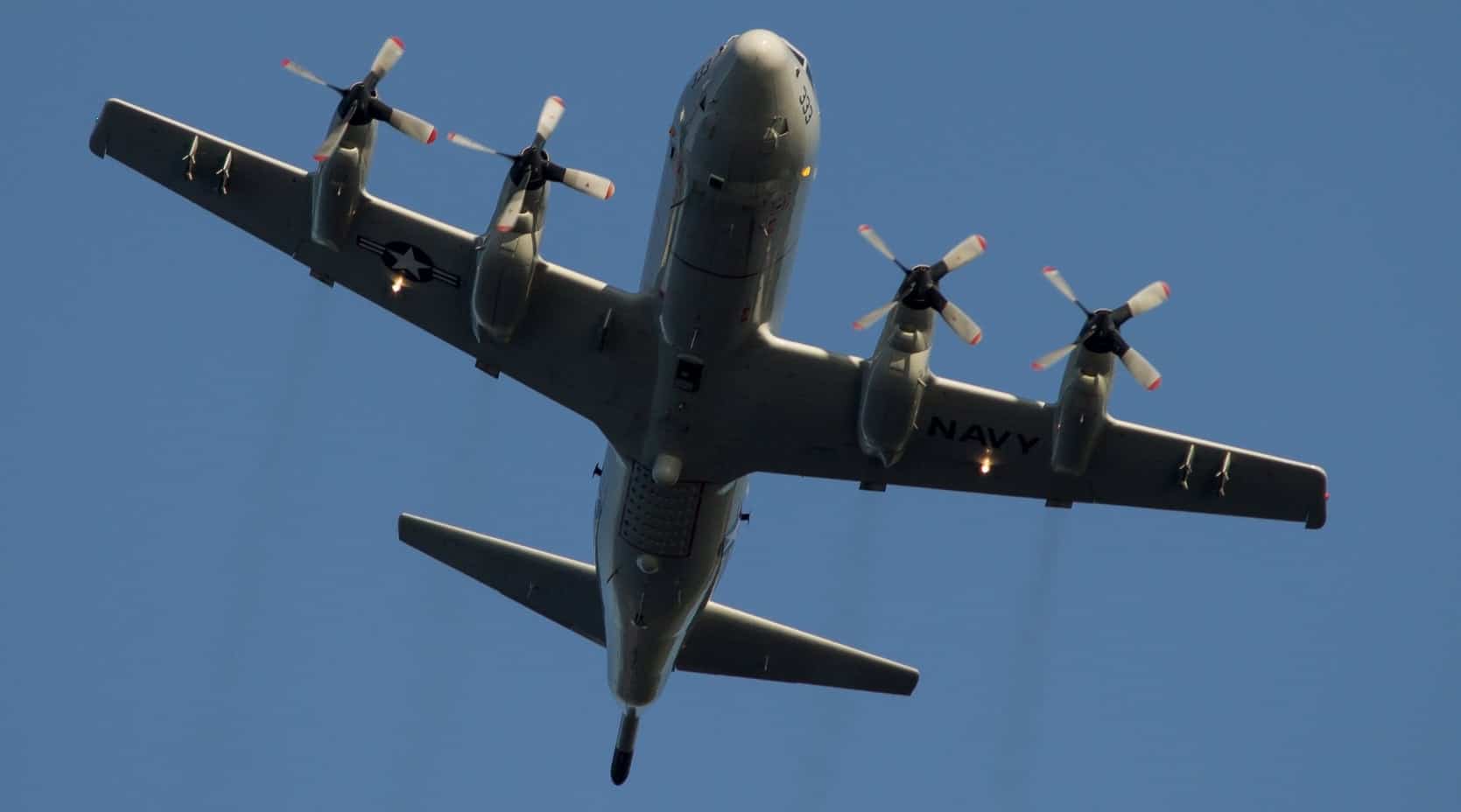
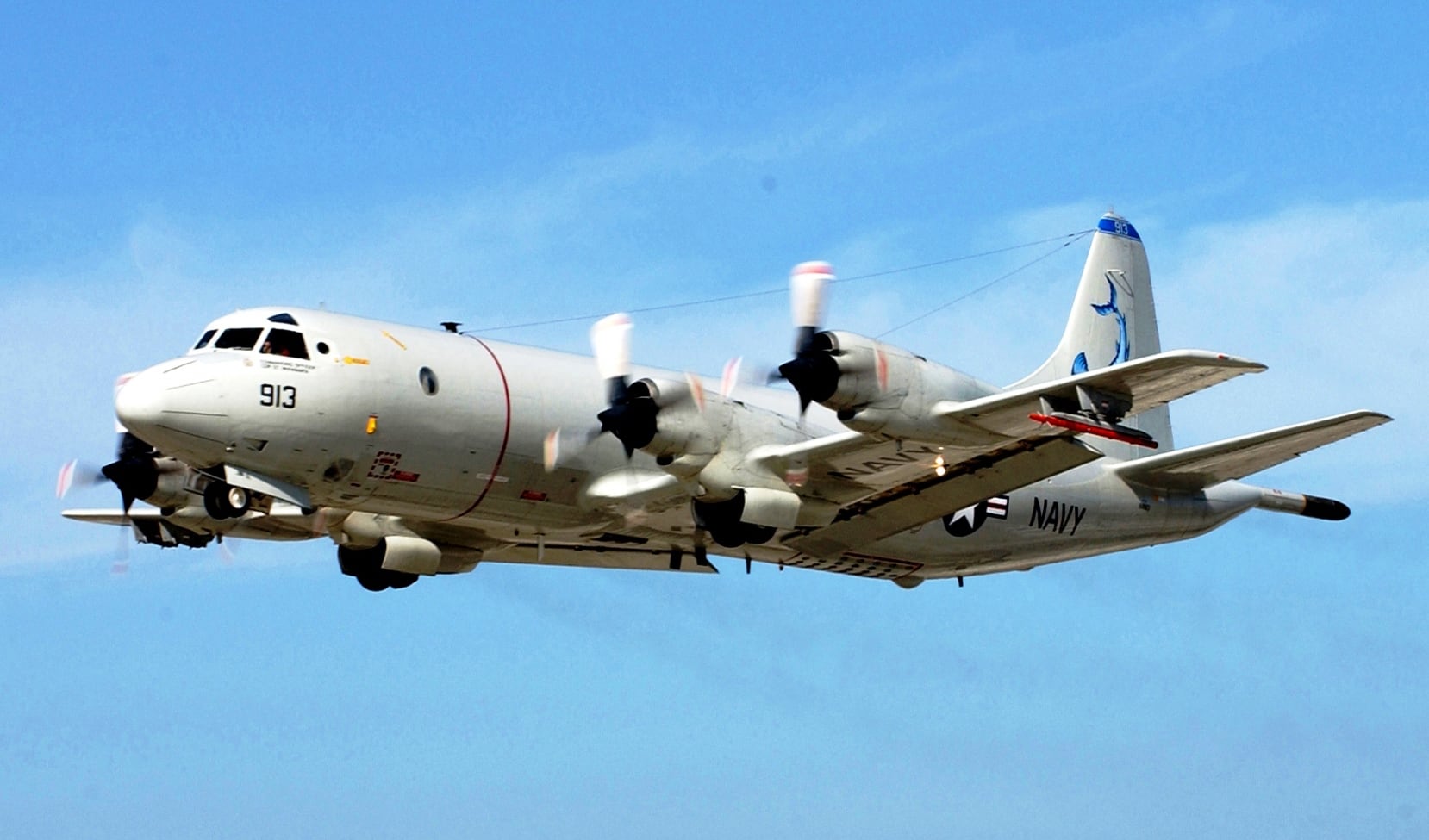
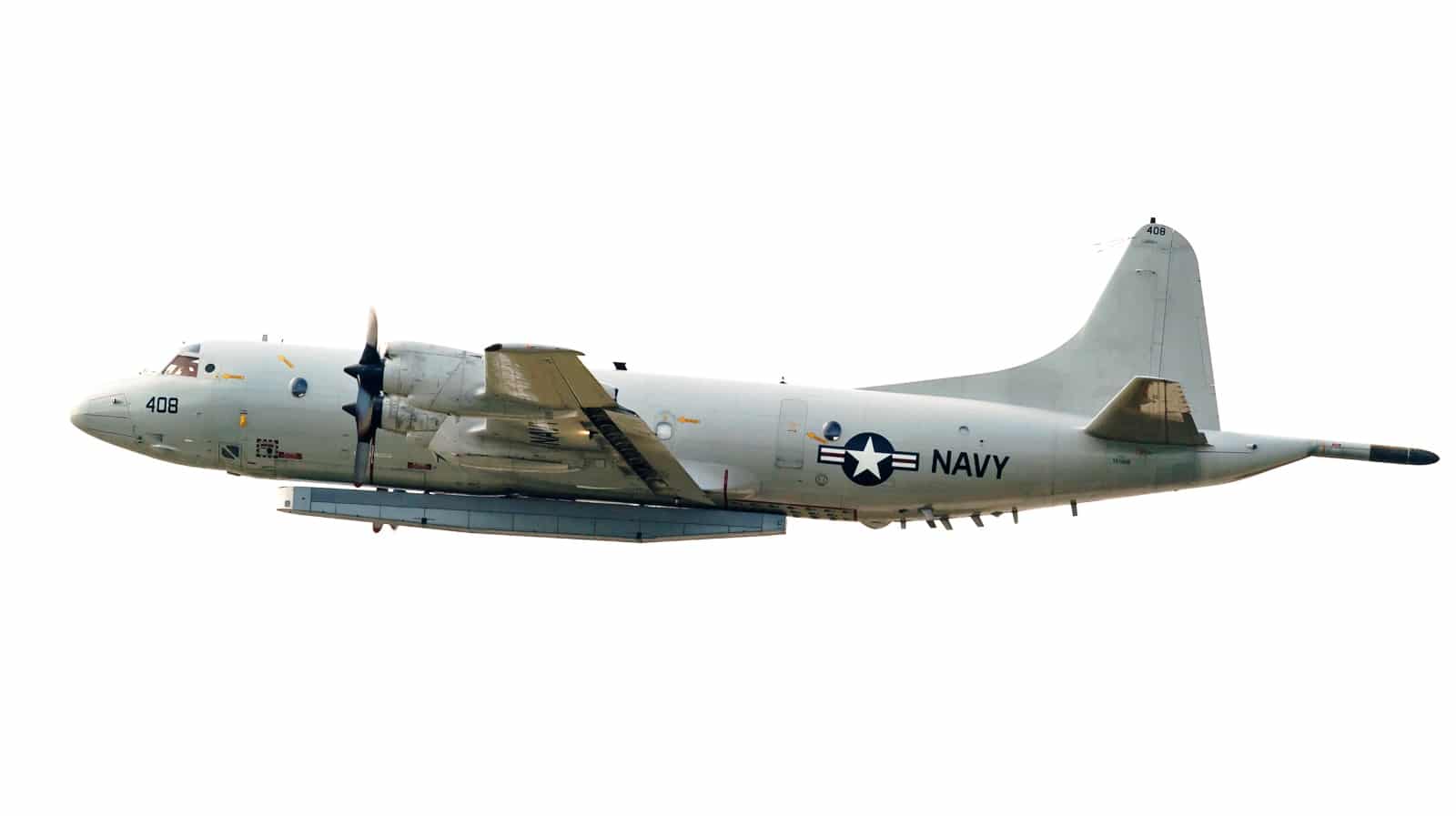
Common design characteristics of the anti-submarine/maritime patrol Orion variants include the dorsal internal bomb bay just forward of the wing leading edge for internal stowage of up to eight conventional or nuclear warhead aerial torpedoes or nuclear depth charges, up to ten underwing pylons for carrying various missiles, rockets, mines, bombs, or other ordnance, and the 52 dorsal sonobuoy chutes located just aft of the wing trailing edge.
As P-3 Orions have been upgraded/reworked/reassigned/retasked over their service lives, they have sprouted all manner of lumps, bumps, and blades associated with their various sensor systems and modifications. But all ASW Orions are equipped with the triad of ASW sensors: Radar, Sonar, and MAD.
VP-5 P-3C. Image via US Navy
Winning at Hide and Seek
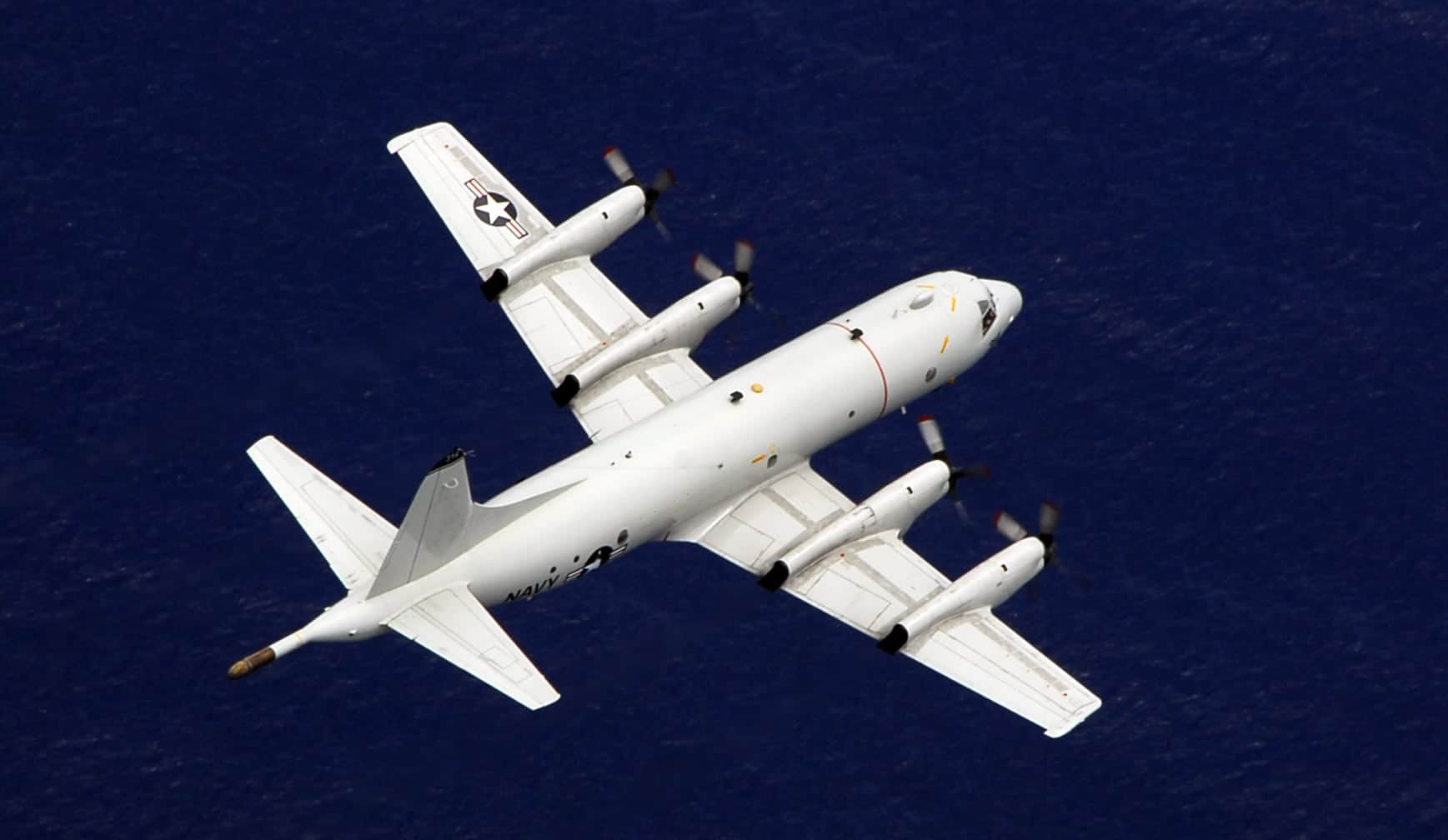
P-3 Orion radar systems are equipped with both forward and aft radar antennae. The aft antenna is located under the rudder at the base of the tail boom; the forward antenna is mounted in the nose radome. The sonar capability is achieved through sonobuoys which are ejected from the chutes on the underside of the aircraft. MAD, or Magnetic Anomaly Detection, is essentially a magnetometer capable of sensing the change in the earth’s magnetic field (due to the presence of a large metal object- like a submerged submarine) in proximity to the aircraft.
Due to its high sensitivity, the MAD sensor is mounted at the end of that fiberglass tail boom, also called a tail stinger or MAD boom.
P-3C AIP. Image via Ken H / @chippyho [CC BY-SA 2.0 (https://creativecommons.org/licenses/by-sa/2.0)], via Wikimedia Commons
It Takes a Crew, An Aircrew, To Fly The P-3 Orion
Today US Navy P-3 Orion crews generally consist of a pilot (usually the Patrol Plane Commander or PPC), two rotating co-pilots (PP2P and PP3P), and an enlisted flight engineer (FE) on the flight deck.
Back in the “tube” are the tactical coordinator (PPTC or TACCO- sometimes the PPC) and navigator/communicator (PPNC or NAVCOM), both of whom are Naval Flight Officers (NFOs). Also riding in the mission compartment are another enlisted flight engineer (FE) or inflight technician, and three enlisted Aviation Antisubmarine Warfare Operators (AWs) or SENSOs- SS-1 and SS-2 who primarily process data from acoustic sensors (sonobuoys) and SS-3 who processes data from radar, MAD, the Forward Looking Infrared (FLIR) mounted in a retractable turret under the nose radome, and other specialized sensors. Depending on mission parameters crews, crew sizes and compositions often vary. Nominally a combat aircrew consists of 11 personnel.
VP-9 P-3C combat aircrew. Image via US Navy
Doing the Job All Over the World
Widely recognized as one of the aircraft that won the Cold War thanks to dogged determination, P-3s tracked Soviet submarines all over the world. One famous quote supposedly uttered by a high-ranking Soviet Naval officer during the days of serious ASW goes something like, “I always know where my submarines are. I look at where the P-3 Orions are flying and that tells me where my submarines are.”
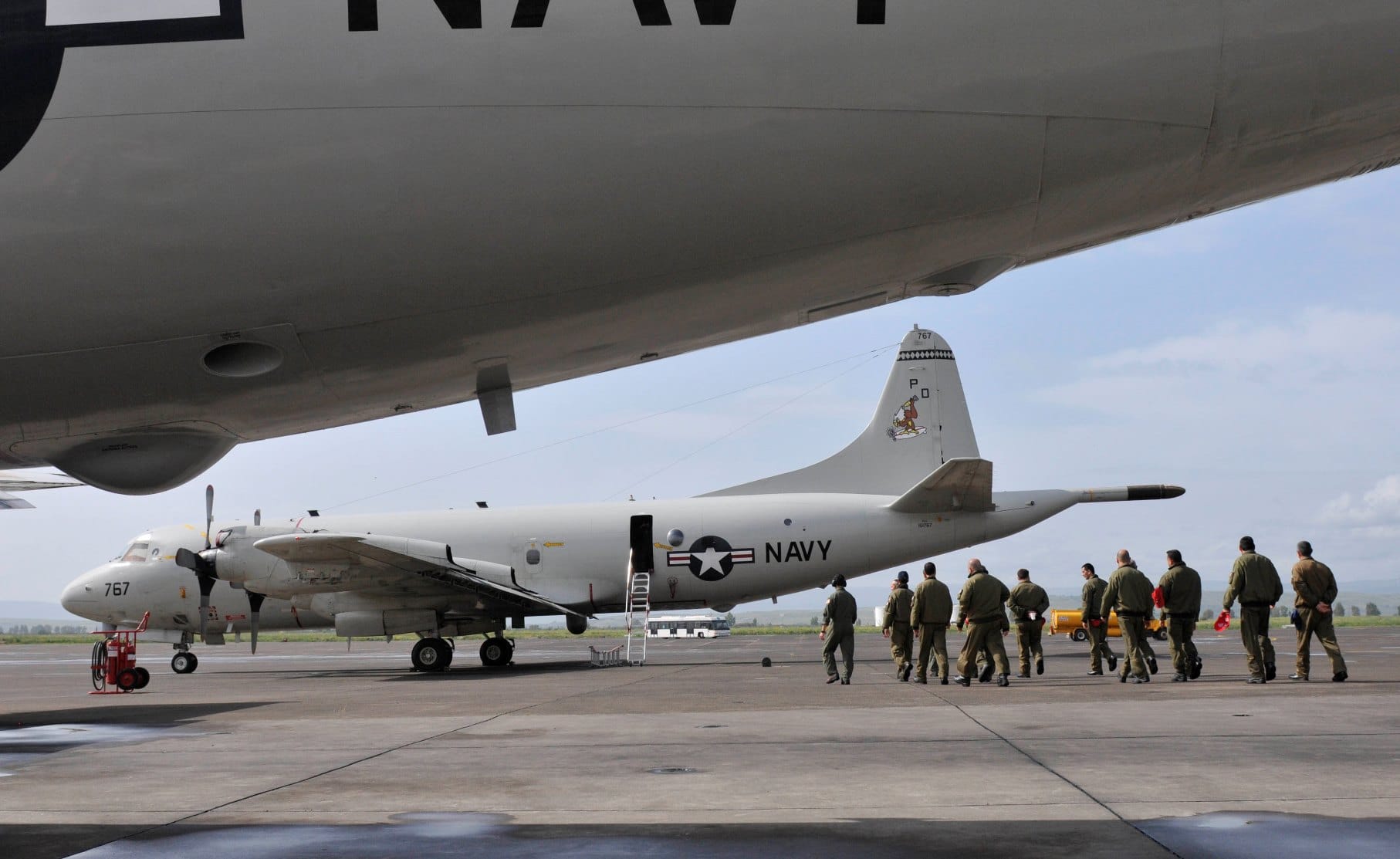
Though usually based at continental US (CONUS) locations such as NAS Jacksonville (Jax) in Florida, NAS Brunswick in Maine, NAS Moffett Field in California, NAS Whidbey Island in Washington state, or even NAS Barbers Point in Hawaii, P-3s also far too often deployed to such garden spots as chilly Keflavik in Iceland (Kef), Sigonella in Sicily (Sig), Diego Garcia (Dodge) in the Indian Ocean, Rota in Spain, Lajes in the Azores, desolate Adak in Alaska, hostile Guantanamo Bay in Cuba (Gitmo), and bases in the Philippines, Japan, Southwest Asia, South America, Africa, and most other places you wouldn’t expect to see them. Their primary tasks: Antisubmarine Warfare (ASW), Anti Surface Warfare (ASuW), and Intelligence, Surveillance, and Reconnaissance (ISR).
P-3C Orion. Image via Wikipedia in public domain
Training Those Many Magic Makers
During those dangerous Cold War years, the Navy could count on as many as 24 VP squadrons and another 13 Naval Reserve squadrons scattered around the country to keep tabs on RedFleet targets (or submarines as others called them). Those Reserve squadrons also deployed to the aforementioned garden spots.
A couple of shadowy special projects squadrons kept people guessing and antisubmarine warfare development units existed on both coasts. At one time (pretty much the 1980s) so many AWs were graduating from schools at NATTC Memphis and NAS Pensacola that the Navy maintained two Fleet Replacement Squadrons (FRSs) or RAGs to get them up to fleet speed- VP-30 Pro’s Nest on the east Coast at Jax and VP-31 Genies on the West coast at Moffett. When asked by their friends and families how they tracked all those RedFleet targets during their 12 hour long missions, their reply was often delivered with a deadpan look or just a wink- FM. Foxtrot Mike. F*cking Magic.
VP-44 P-3C. Image via US Navy
We Never Seem to Learn
When the Cold War ended, seemingly overnight the oceans permanently emptied themselves of submarine threats (or at least that’s what some thought), which resulted in the wholesale gutting of the finest antisubmarine warfare force ever assembled. The patrol squadrons (PatRons) and their parent command patrol wings (PatWings) were reduced by more than 50% within a few years.
The AW rate was eliminated. Not willing to turn backs on the threat entirely, the damage was nonetheless done. But P-3s still found work. Need to find a narco-sub moving tons of coke? Orions are marked on top. How about finding a missing sailor who’s been out of contact for days or months without food or water- the proverbial needle in a haystack? A P-3 can and will locate him. Need to keep an eye on that leaky border to the south? A P-3 makes a great watchdog.
VP-40 P-3C. Image via US Navy
You Don’t Need to Know Where the P-3 Orions Are
P-3s came in three basic flavors- P-3A (1962), P-3B (1965), and P-3C (1969), but there were more than 40 different variants/updates/service life extentions of the 650 Orions built by Lockheed. In fact P-3Cs received so many updates they ran out of Roman numerals for them and went to acronyms. The last P-3 came off the production line at the Lockheed plant in April of 1990. Kawasaki built 107 more of them for the Japanese.
P-3s were modified to carry airborne early warning search radar systems, specialized tracking radars and sensors for missile test tracking, weather reconnaissance equipment for hurricane hunting, and specialized sensor suites for customs border protection. That doesn’t count the various special projects/special missions Orions. They’ve been seen with the Littoral Surveillance Radar System (LSRS) bolted to the undersides of them, been used as over-the-horizon targeting Outlaw Hunter aircraft, as eyes-in-the-sky for troops in contact or about to be on the ground in bad places, and certainly for lots of shadowy black don’t-ask stuff that nobody you know will acknowledge.
P-3C with LSRS. Image via Ken H / @chippyho [CC BY-SA 2.0 (https://creativecommons.org/licenses/by-sa/2.0)], via Wikimedia Commons
Combat Aircrews to the Fore
Combat for the Orion began during the Vietnam War. The first P-3s made it to Vietnam during 1964 and they stayed for the duration, doing their best to stop seaborne supply of VC forces as part of Operation Market Time. VP-26 Tridents lost two aircraft with all crew members to AAA over the Gulf of Thailand. P-3s began their “decade in the desert” during Desert Shield and Desert Storm when they deployed to Southwest Asia within days and flew missions there throughout the campaign.
P-3 Orions directed attacks on both sea and land targets, targeting more than half of the Iraqi vessels destroyed during the conflict. The War in Afghanistan also saw P-3 Orions flying surveillance and reconnaissance missions. When Libya went revolution in 2011 a P-3C took out a Libyan Coast Guard gunboat with an AGM-65 Maverick missile. When the waters around Somalia became a pirate’s paradise, Operation Sea Shield saw Orions from several nations patrolling those troubled waters.
P-3C. Image via US Navy
Bandwagon Jumpers
In addition to the US Navy, additional P-3 Orion users include Argentina (P-3B), Australia (AP-3C), Brazil (P3-AM), Chile (P-3A), Germany (P-3C CUP+), Greece (P-3B), Iran (P-3F), Japan (P-3C/EP-3/OP-3C/UP-3C/UP-3D), the Netherlands (P-3C), New Zealand (P-3B/P-3K2), Norway (P-3C/P-3N), Pakistan (P-3C), Portugal (P-3P/P-3C CUP+), South Korea (P-3C/P-3CK), Spain (P.3/P-3A HW/P-3B/P-3M), Taiwan (P-3A/P-3C/EP-3E and Thailand (P-3T/VP-3T). Canada operates a couple of P-3 derivatives, the CP-140 Aurora and CP-140A Arcturus.
The US National Oceanographic and Atmospheric Administration (NOAA), the National Aeronautics and Space Administration (NASA), and the Department of Homeland Security also operated or operate Orion variants.
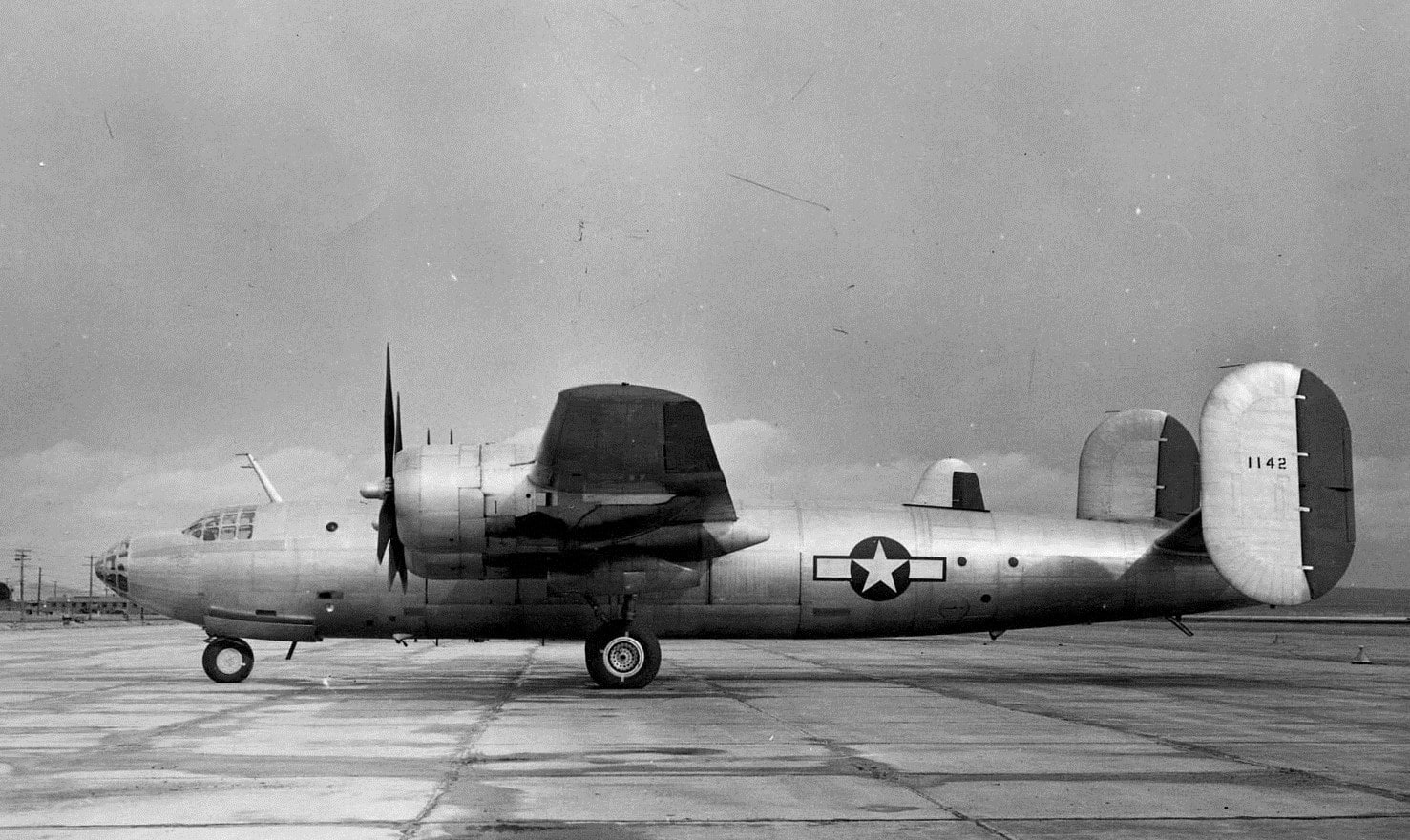
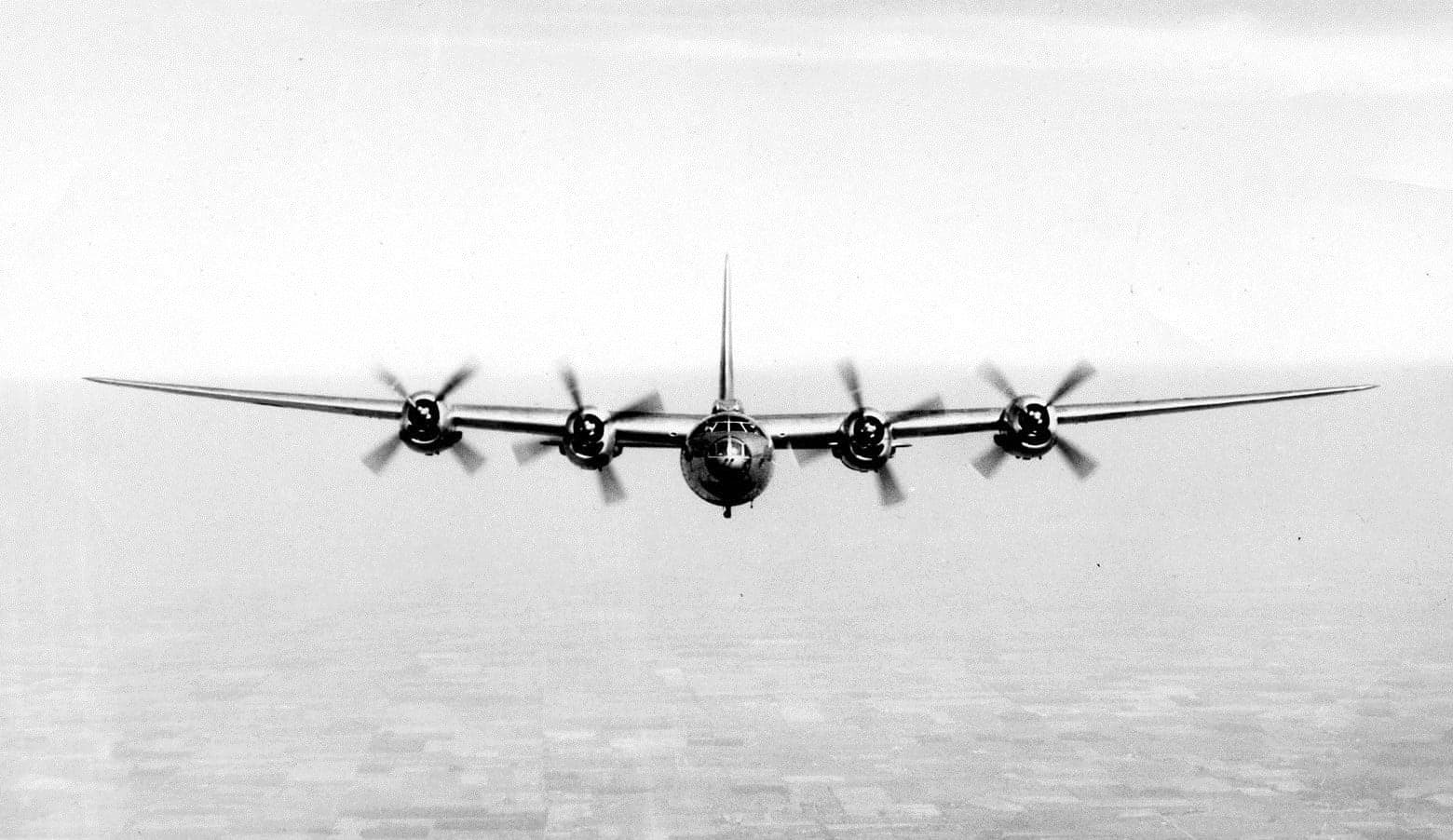
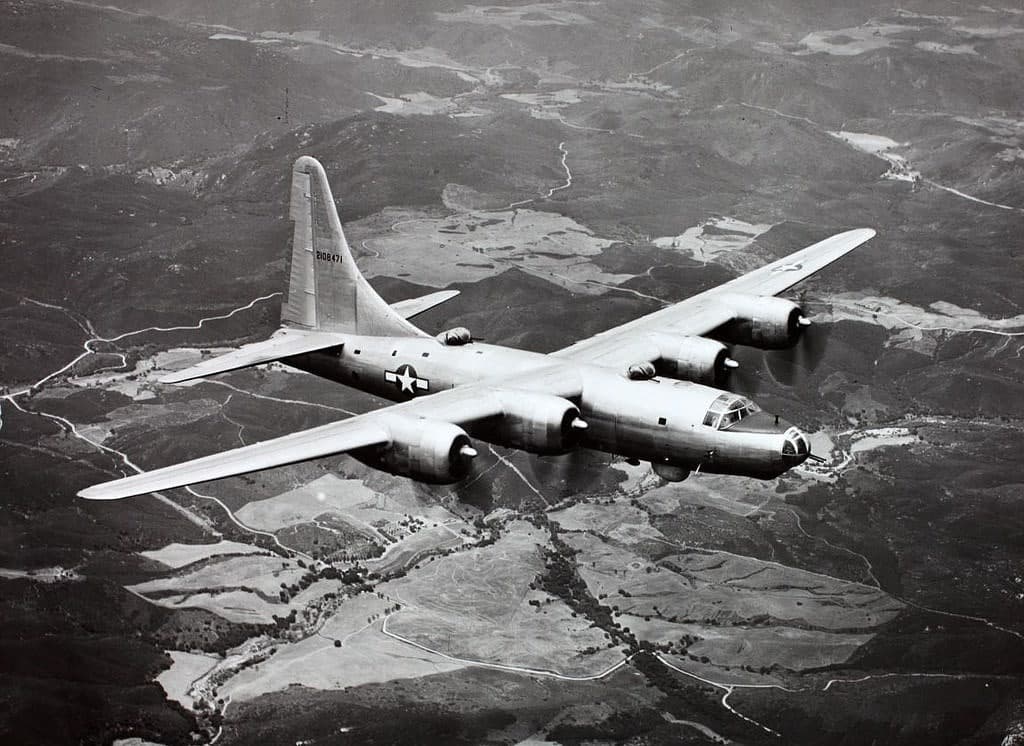
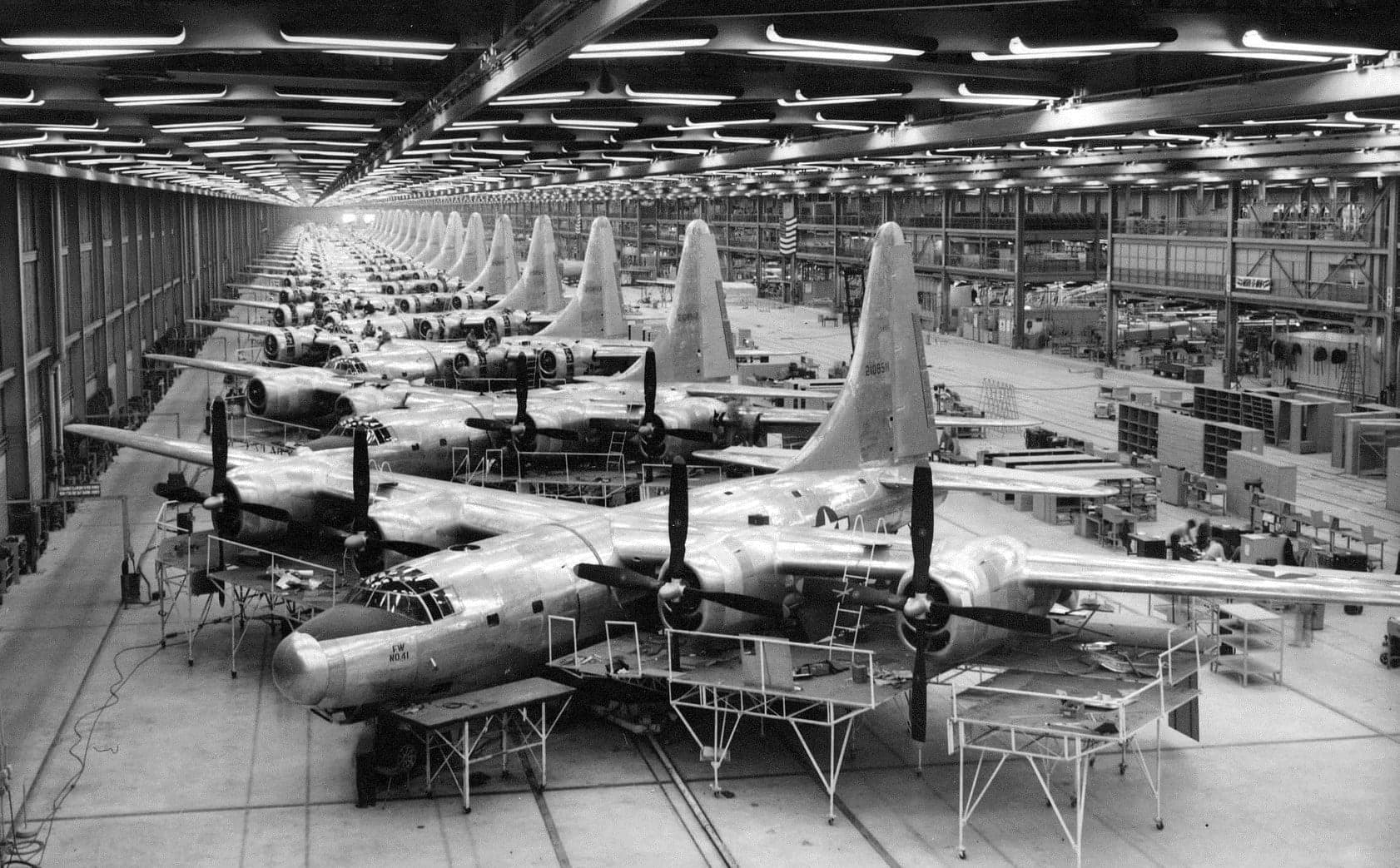
The B-32 was planned to use the same turbo-supercharged Wright R-3350 Duplex Cyclone engines as the B-29 and to be pressurized with remote-controlled gun turrets. In fact, the contracts for both the B-29 and the B-32 prototypes were signed on the same day. The reason for the similarities is simple. The B-32 was developed as a backup to the B-29, a fallback plan should the ambitious B-29 not become the success everyone in the Pentagon needed.
XB-32. Image via USAF
Prototype Teething Troubles
The original XB-32 prototype looked more like a fattened-up B-24 Liberator than anything else when it flew for the first time on 7 September 1942. The same Davis wing design used on the B-24 was used on the B-32, and the XB-32 also had a similar empennage design, with dual vertical stabilizers mounted at the ends of a large horizontal stab.
But like the B-29, the XB-32 prototype experienced engine, pressurization, and gun turret issues. In addition to the fuselage-mounted gun turrets, the XB-32 also mounted a pair of .50 caliber machine guns and a single 20 millimeter cannon in each outboard engine nacelle, mounted to fire behind the bomber. It didn’t help that the prototype crashed on 10 May 1943.
B-32. Image via USAF
Back to the Drawing Board…Again
The next prototype first flew in July of 1943 with a revised cockpit canopy. But the USAAF took one look at the second XB-32 and sent Consolidated back to the drawing board. The aircraft’s role was changed from a high altitude bomber to a low to medium altitude bombing role, thanks to pressurization problems that were never really resolved, so the pressurization system was removed.
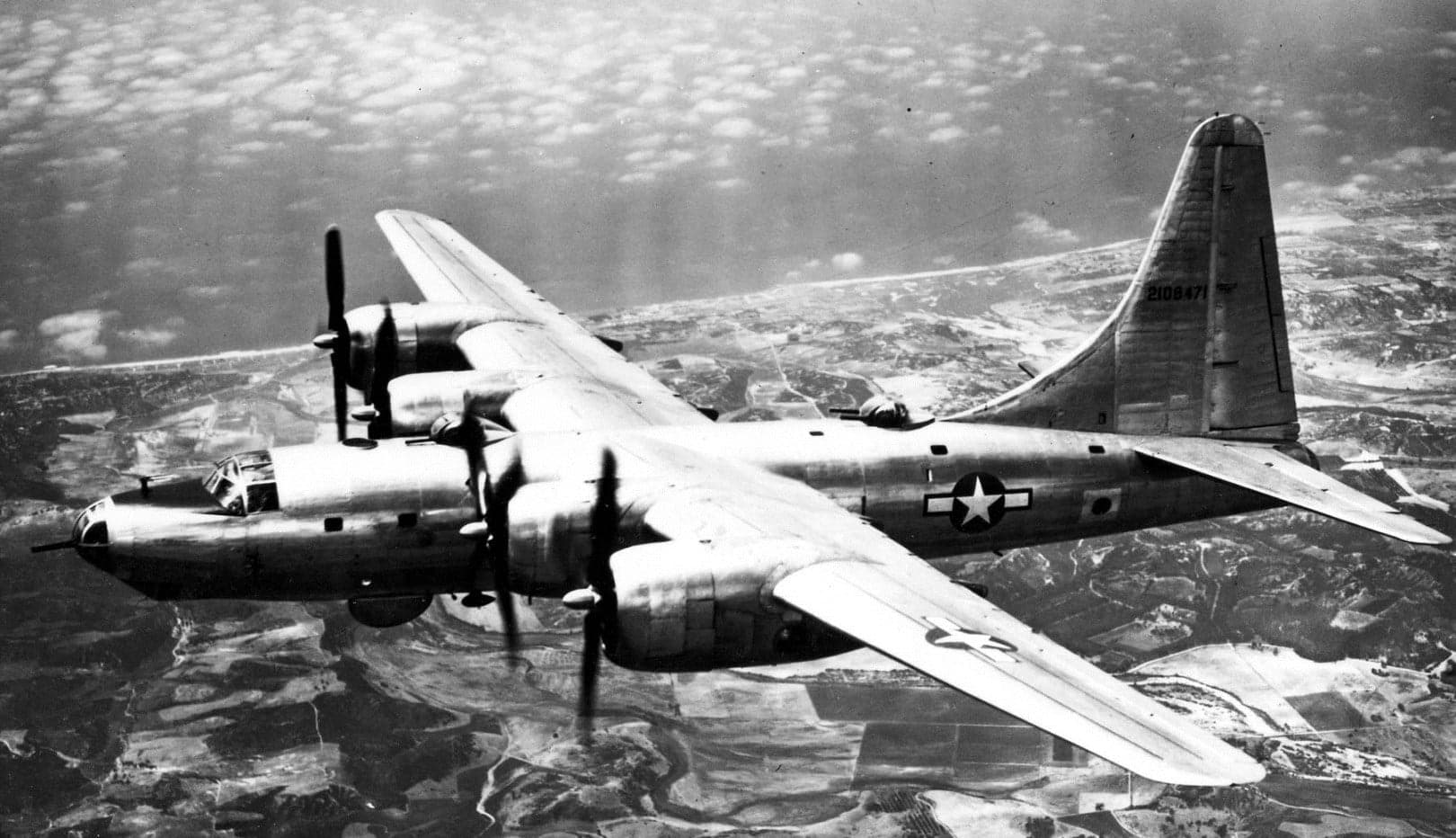
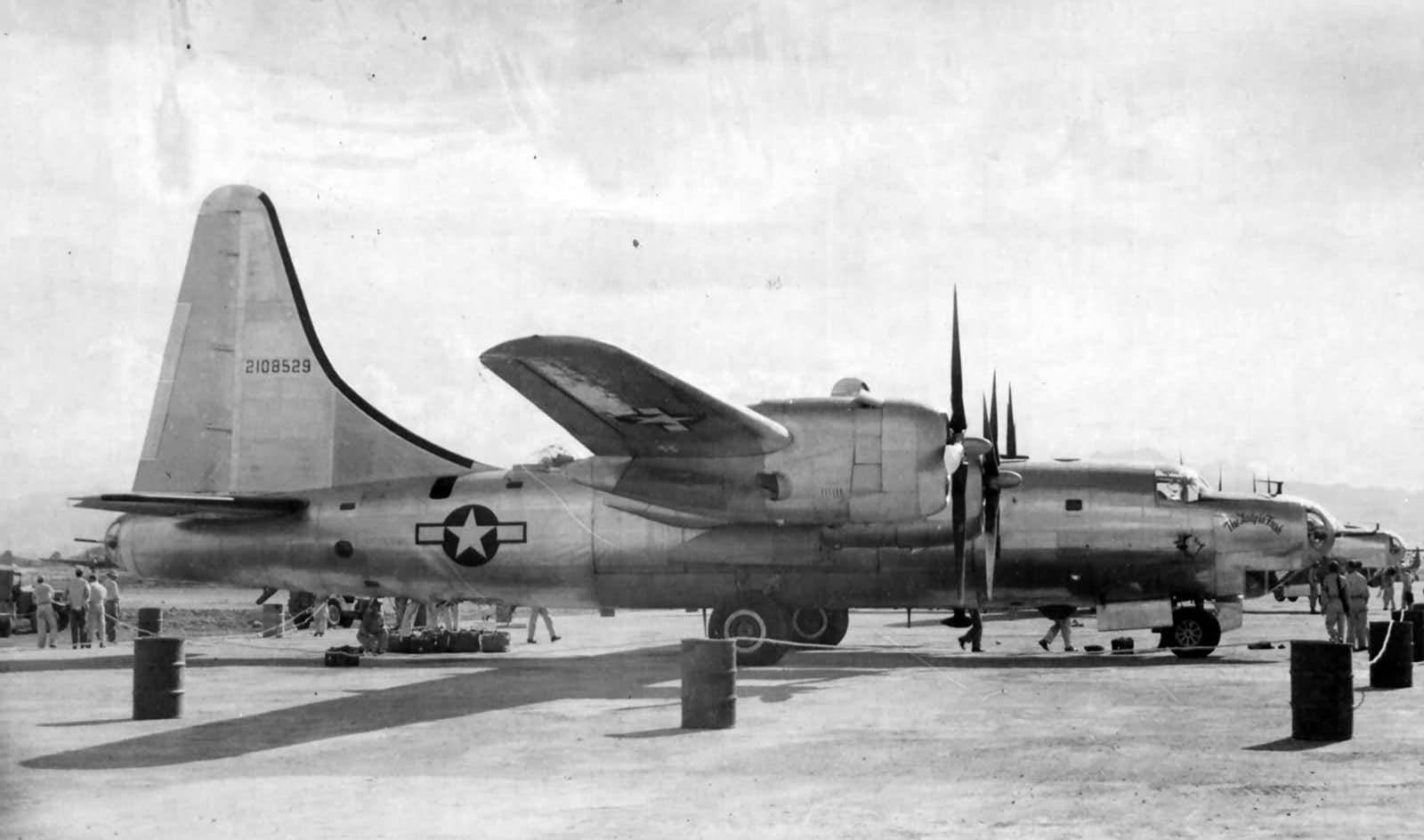
The remote control gun turrets were also wonky, so they were removed, too. All turrets were manually aimed. On the plus side, the B-32’s payload was increased to 20,000 pounds. The final and most obvious change was made to the empennage. A conventional tail plane arrangement was adopted, looking more like that of the PB4Y-2 Privateer than anything else.
B-32. Image via USAF
Not Yet Ready to Fight
Test results gathered during the testing of the three XB-32 prototypes resulted in orders for 1,500 B-32s by 1944. The first production B-32 was delivered on 19 September 1944 and promptly crashed when its nose wheel collapsed. In January 1945, the USAAF began B-32 crew training using converted early production bombers designated TB-32.
By this time, with B-32 development lagging seriously behind schedule, it made no sense to re-equip ETO B-17 and B-24 Bomb Groups with B-32s and send them to bomb Japanese targets. It was a good thing the development of the B-29 was more or less on track by that point. Ironically, the B-32 might not have made it to the Pacific Theater at all if there had been enough B-29s to go around.
B-32. Image via USAF
Kenney Comes to the Rescue
General George Kenney, Fifth Air Force and Allied Air Forces commander in the Southwest Pacific Area, requested B-29s for his bomber crews, most of whom were flying B-24s. He was denied, so he asked for and received B-32s instead.
Things started slowly. A pair of squadrons flying the Douglas A-20 Havoc were pegged for a switch to B-32s. A few missions were flown with three B-32s out of Clark Field on Luzon in the Philippines with good results. The crews appreciated the Davis wings and reversible pitch propellers on the big bombers, but they didn’t like the cockpit layout and noise level. Not surprisingly, the R-3350 engines were prone to fires too. But the deficiencies didn’t stand in the way of the 386th Bomb Squadron (BS) of the 312th Bomb Group (BG) switching to B-32s in July of 1945.
B-32 from the 386th BS. Image via USAF
The Last Bomber Into Service and the Last Man to Die in World War II
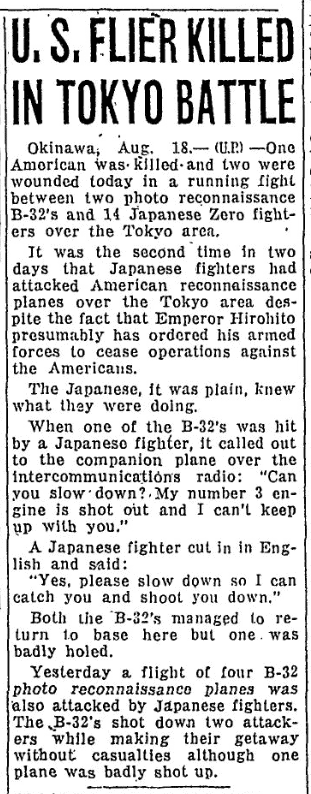
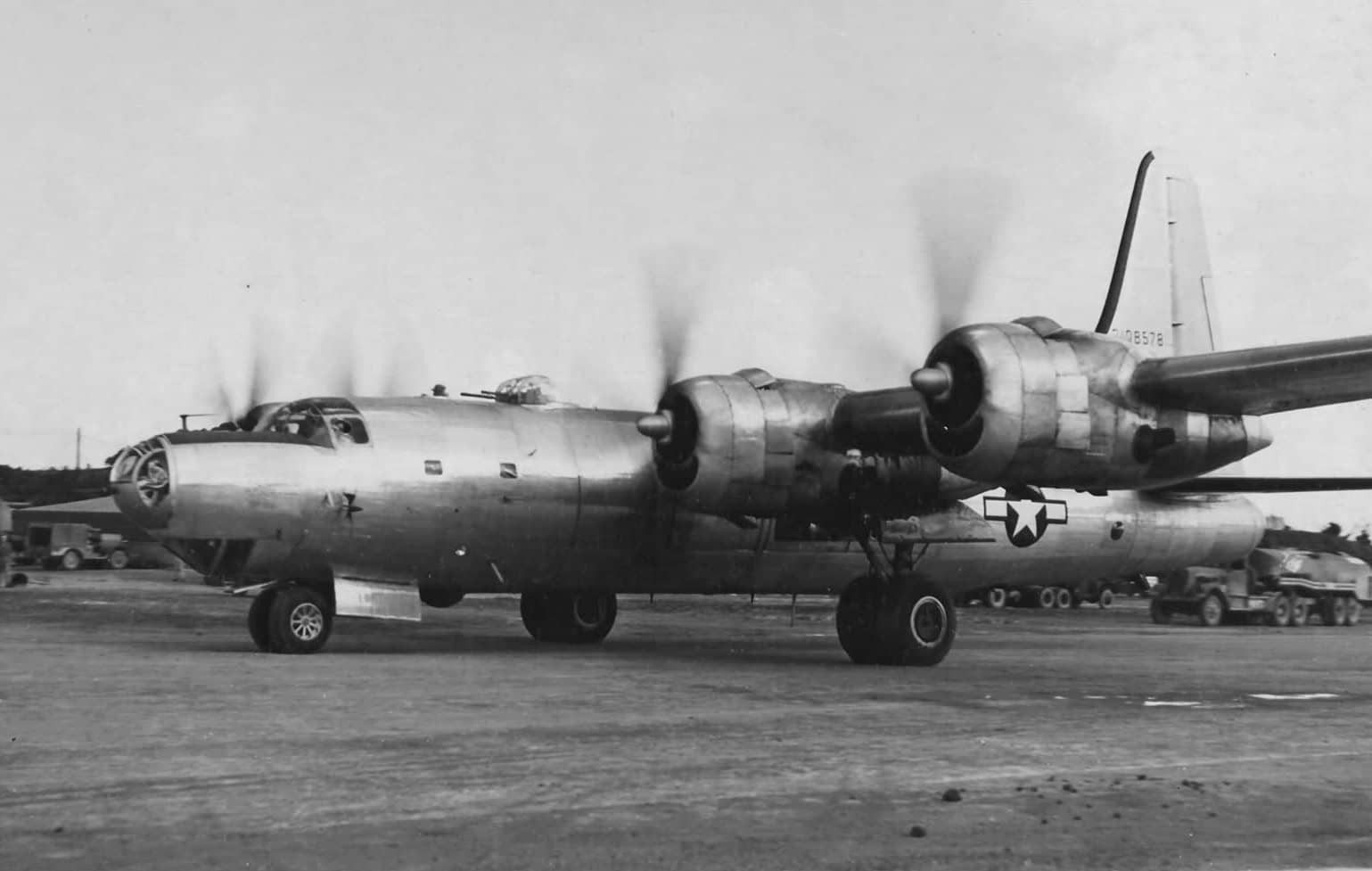
The 386th flew just six missions after the atomic bombs were dropped on Japan but before the war ended. 13 August 1945 saw the 386th move from Clark Field to Yontan on Okinawa. There the squadron flew primarily photographic reconnaissance missions monitoring Japan’s ceasefire conditions compliance.
During one of those monitoring flights, on 18 August 1945, the B-32s were intercepted and attacked by Japanese fighters. The Japanese made repeated attacks for more than two hours but failed to do more than minor damage to the B-32s. The missions continued, though, and on the next day, a pair of B-32s was attacked by 17 Japanese fighters. Aboard one of the B-32s, two crew members were wounded. As he came to the aid of a wounded crew member during the attack, Sergeant Anthony Marchione was killed in action by a Japanese 20 millimeter shell. Marchione was the last of thousands upon thousands of Americans to die in aerial combat during World War II.
B-32 at Yontan. Image via USAF
They Scrapped Them All and Even Changed the Name
Both B-32s were able to return to Okinawa. Propellers were removed from Japanese fighters beginning on 19 August 1945. B-32s continued their photographic reconnaissance missions until two B-32s, with their entire crews, were lost to accidents on 28 August 1945. The 386th BS and their B-32s were stood down on 30 August 1945. Inevitably, perhaps, B-32 Dominator production contracts were all cancelled on 8 September 1945. Production came to a halt on 12 October 1945.
The 118 B-32s built by Consolidated were broken up for scrap, the longest surviving at Davis-Monthan Air Force Base (AFB) until 1949. Not a single example of the B-32 remains today, but a few turrets formerly mounted in Dominators can be viewed at museums. Oh, and this tidbit: In an amazingly prescient case of early over-political correctness, the name Dominator was officially dropped from the B-32 in August of 1945.
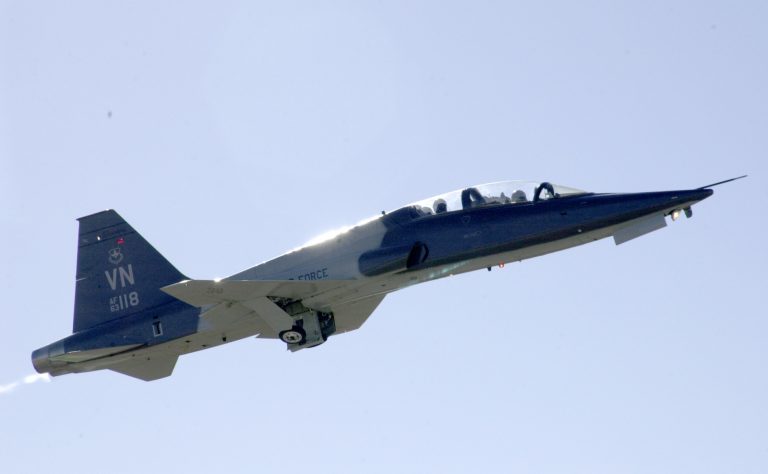
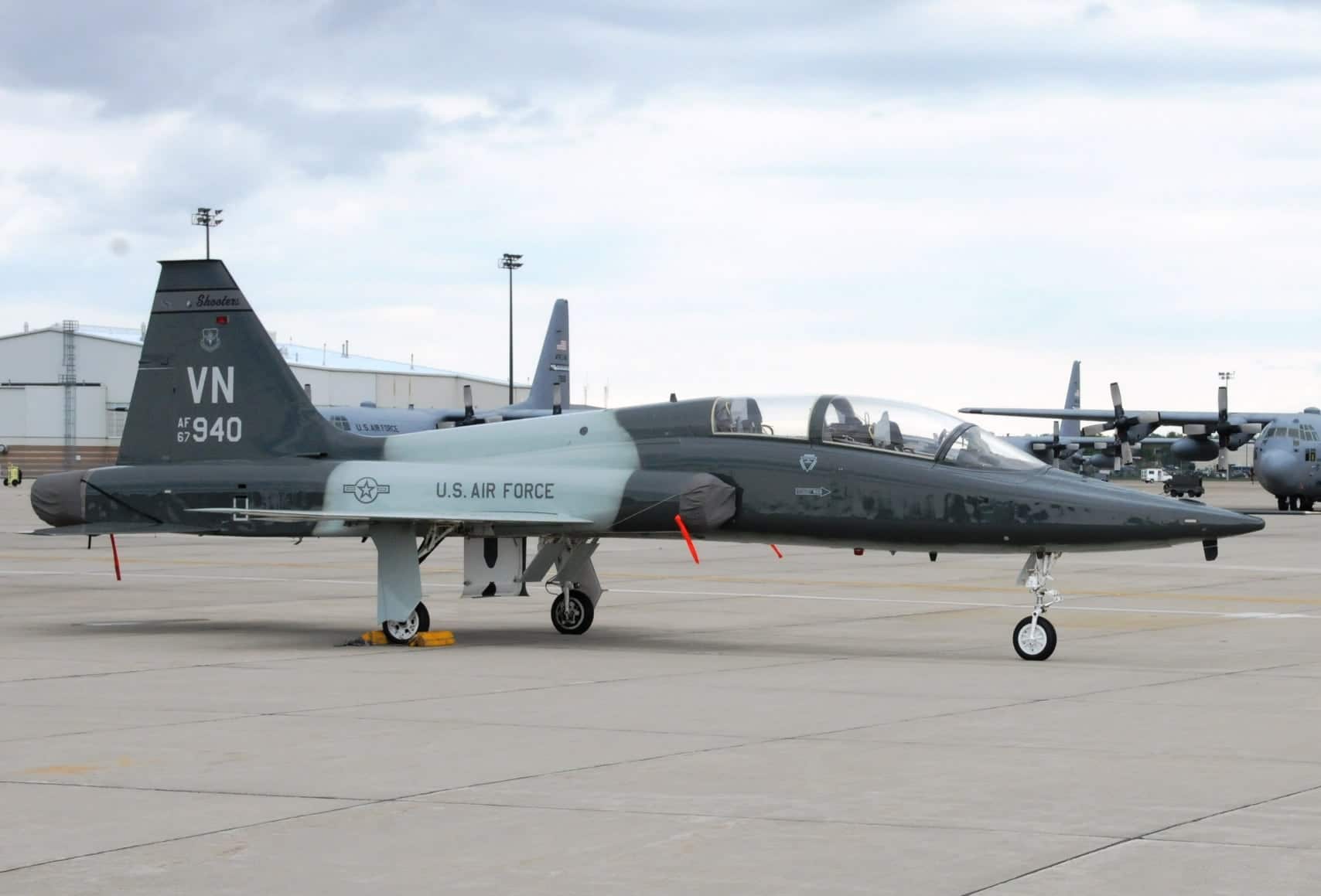
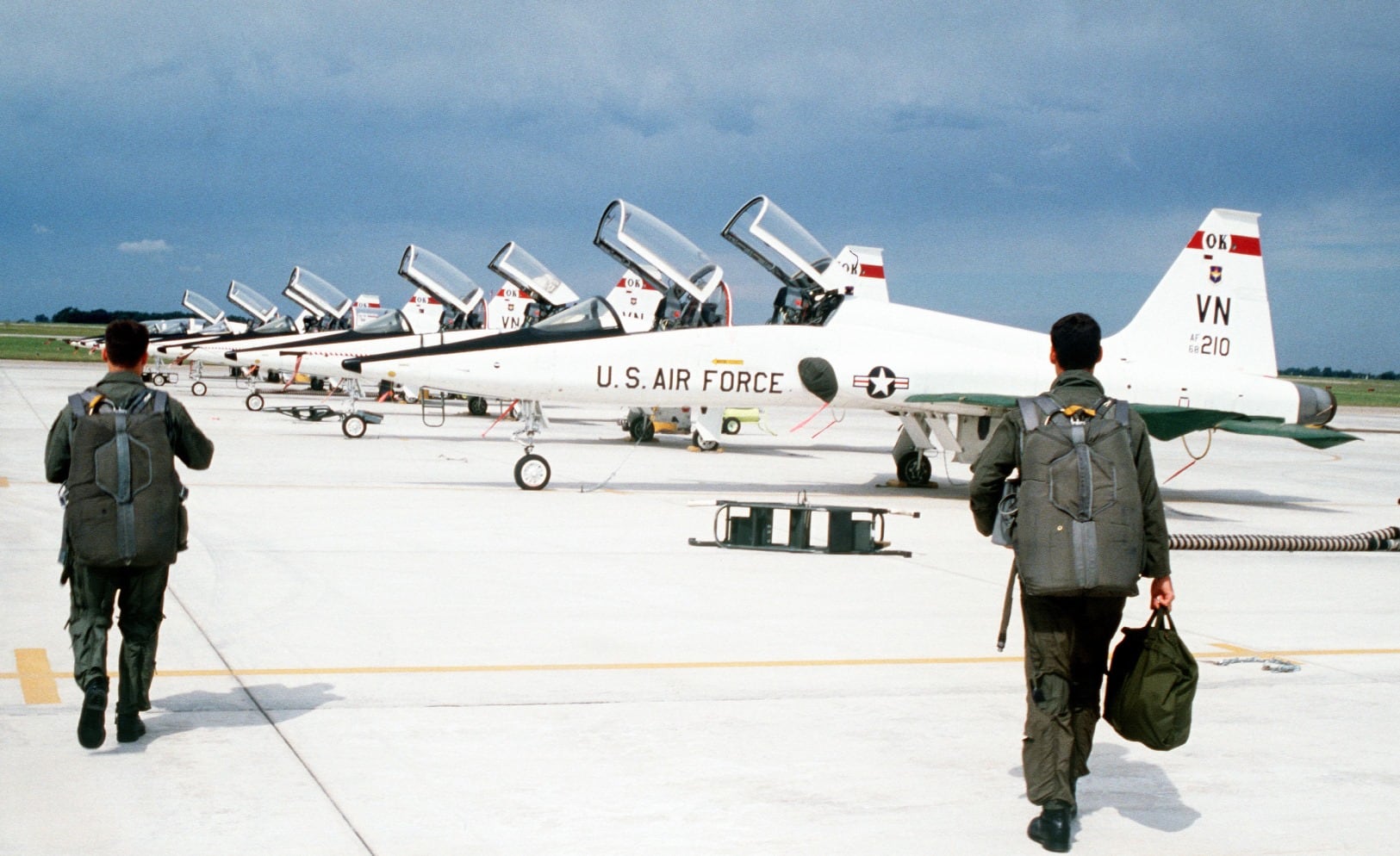
On Friday 17 August 2018 at approximately 1348 local time a US Air Force Northrop Grumman T-38C Talon jet trainer crashed near the town of Mutual, approximately 70 miles west of Vance Air Force Base (AFB) in in Northwestern Oklahoma. The pilot of the jet, who has not yet been identified but is described as an instructor pilot, ejected from the aircraft at approximately 2,000 feet altitude. The pilot, who was conscious and not seriously injured, is being evaluated by Air Force medical personnel.
71st FTW T-38. Image via USAF
The pilot of the jet, assigned to the 71st Flying Training Wing, reported engine trouble and was unable to restart either of the T-38C’s General Electric J85 jet engines. After attempting restart the pilot ejected. The Oklahoma Highway Patrol says the plane went down five to 10 miles northwest of Seiling in Oklahoma. Vance AFB emergency response personnel arrived on site by 1600 local time and have begun an accident investigation. The Oklahoma Highway Patrol brought in a helicopter to assist in the search for the ejection seat.
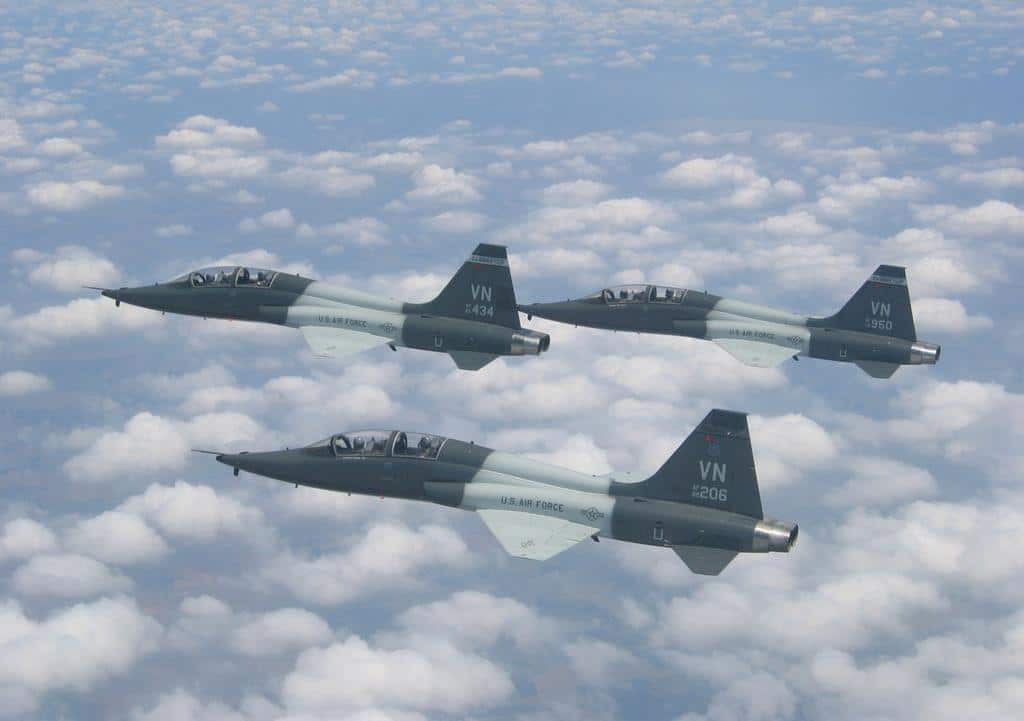
71st FTW T-38s. Image via USAF
The wreckage and the pasture land where it landed burned, and firefighters from Woodward, Sharon, Mutual and Mooreland responded. Until Friday, the tenant units at Vance AFB hadn’t suffered a Class A mishap since Sept. 8, 2000, which is an Air Education and Training Command (AETC) record. A Class A mishap involves loss of life or loss of an aircraft. Student pilots at Vance AFB have flown T-38s for nearly 55 years. Currently the 5th Flying Training Squadron (FTS) Spittin’ Kittens and the 25th FTS Shooters fly T-38Cs and AT-38Cs from Vance AFB. We’ll update this story as events warrant…
Aviation Day, a national day set a side to celebrate aviation in the United States, is fueling the growth of flight each year, propelling individuals into personal flying lessons while increasing the popularity of America’s air show industry.
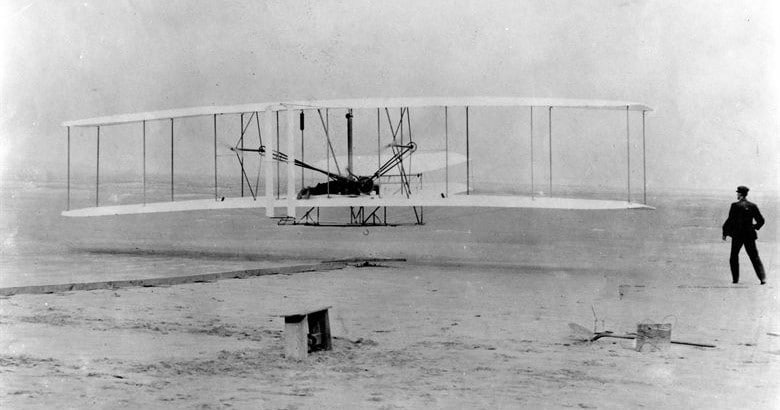
Aviation Day is celebrated each year on August 19 and began with the signing of a proclamation by then President Franklin D. Roosevelt in 1939. The date was chosen to honor the birthday of Orville Wright, the first to pilot a powered aircraft. Since the early days of aviation, the growth of personal flight across the nation has proven to be safer, more affordable, and at an all time high.
1903: The birth of powered flight on the beach at Kitty Hawk as Orville Wright pilots the Wright Flyer as Wilbur watches and records nearby. (USAF)
“Aviation is more than just a mode of transportation,” said Avgeekery.com founder Jeff Gilmore, a pilot himself who has logged over 3,500 hours of flying time. “It’s the realization of a dream that every human has had which, now realized, connects societies and powers economies at a scale we’ve never seen before.”
Attendance at air shows across America continues to grow including the addition of new show sites in host towns each year. Most who attend the weekend events are drawn by the family-friendly atmosphere and the inexpensive value of an air show.
During Aviation Day weekend 2018, seven air shows will take place across the continental 48 states. They will showcase both men and women aerobatic performers, military demonstrations, and display historic maneuvers flown by the pilots of yesteryear.
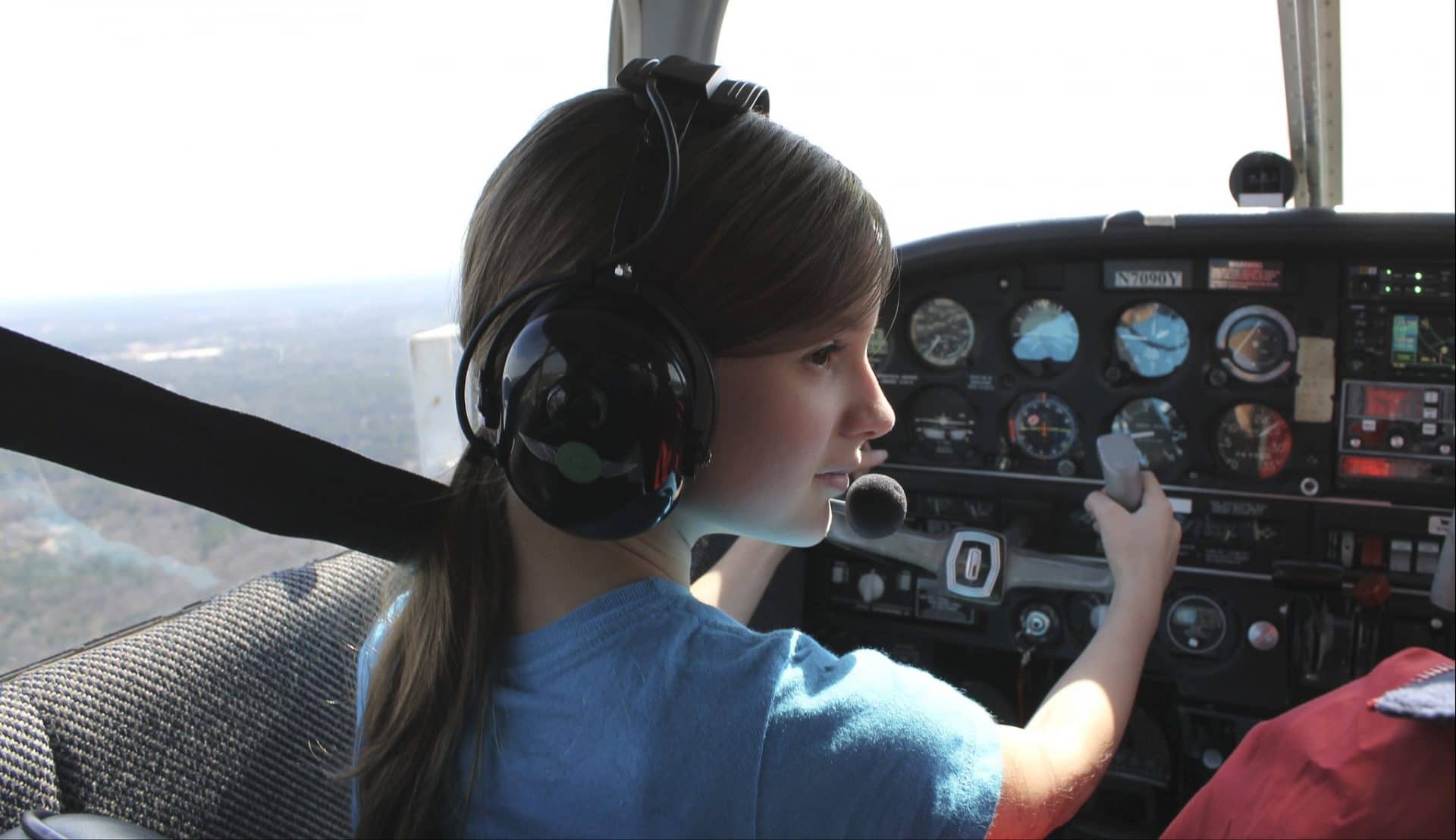
Interest in aviation at an early age can carry up and coming pilots to new heights. (Charles Atkeison)
Former GEICO Skytypers Air show Team pilot Steve Kapur believes Aviation Day is great for America. “It’s a wonderful celebration of the past, and hopefully it will inspire the next generation of pilots,” he noted. “It’s a chance to look back, and it’s a chance to look forward, and start to think about ‘what will aviation become?'”
Military and civilian aerobatic pilots and teams are flying high as social media growth in users who follow their accounts are climbing. Twitter, Facebook, and Instagram users can stay up to date with pilot’s schedules and view real time images from the pilot’s flight day demonstration.
Air shows have witnessed an upswing in popularity with the growth of live streaming apps which now provides a live window for the aviation community to witness the busy flight line from miles away. Aviation enthusiasts and teams are using Periscope, the live-streaming app owned by Twitter, to both promote and give viewers an insiders view during an air show.
Larry Arken, pilot and leader of the world famous GEICO Skytypers, reflects upon the past on Aviation Day each year. “To see how far we have advanced in this short amount of time is amazing,” Arken said. “From wood and fabric aircraft to composite aircraft that fly by wire at supersonic speeds, Aviation Day gives us an opportunity to study these advancements and to realize the future of aviation has endless possibilities.”
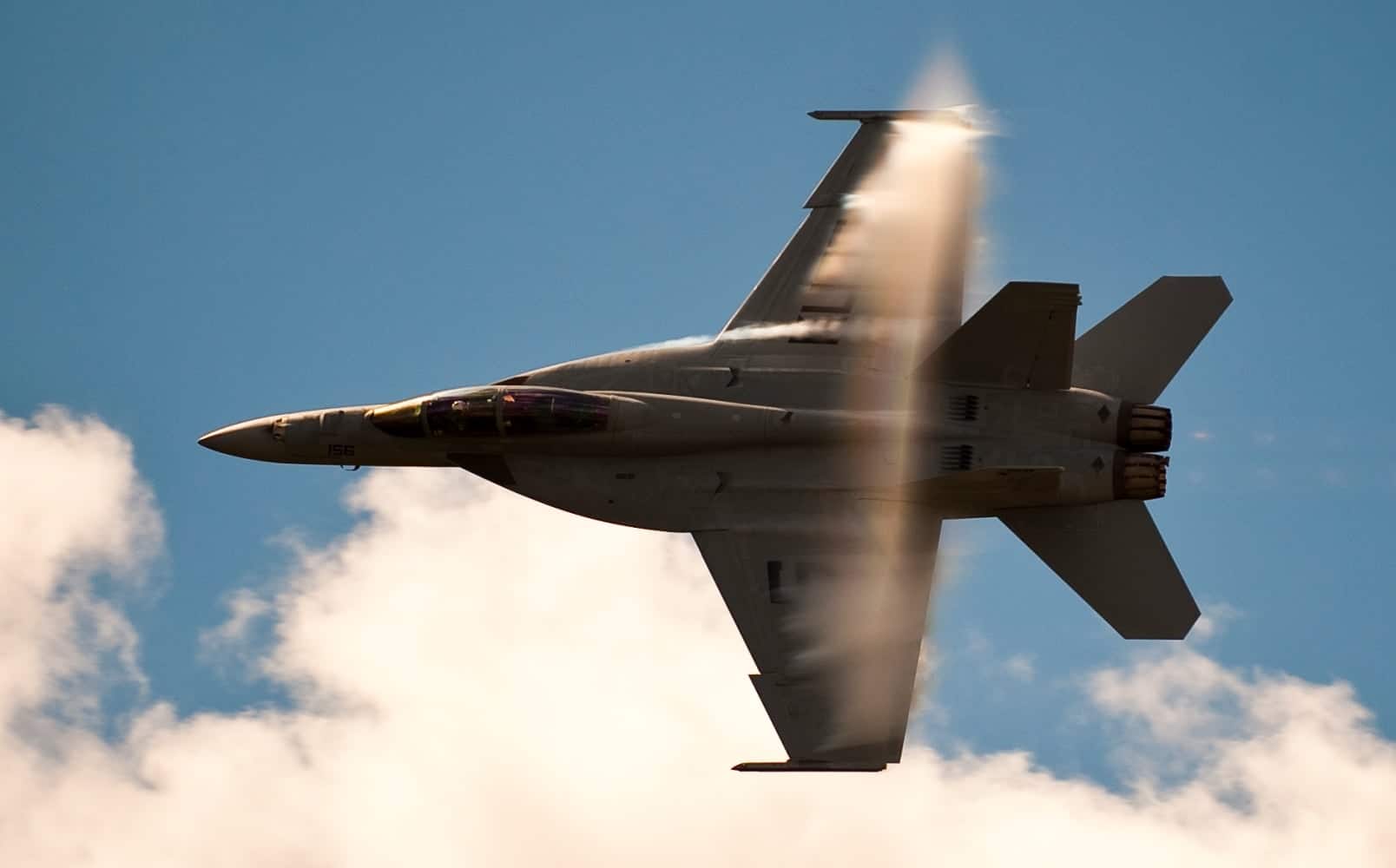
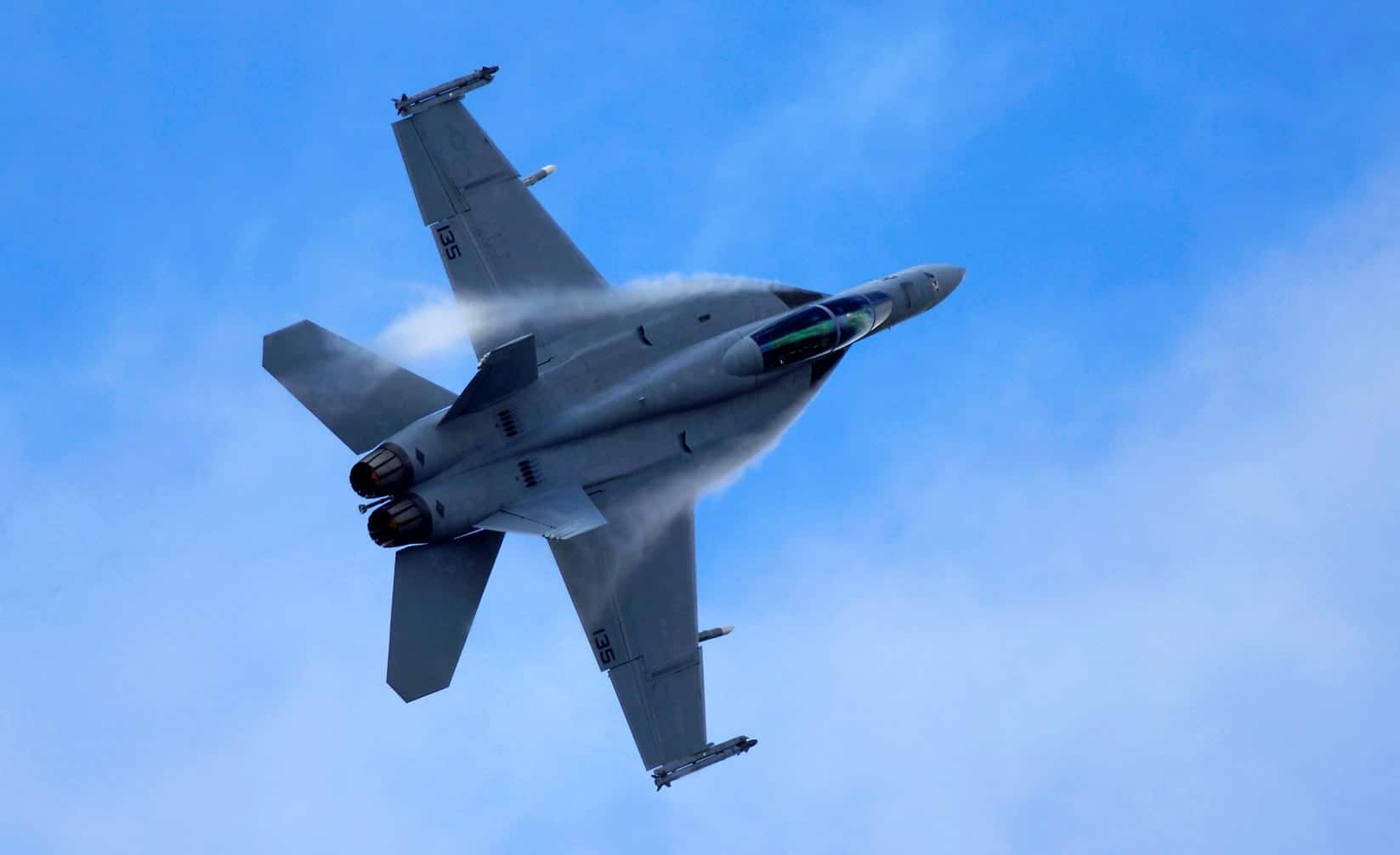
The Navy’s F/A-18 Super Hornet Demo Team performs at air shows each year. (Charles Atkeison)
America’s military can also be found on social media, including the flight demo teams the Blue Angels, Thunderbirds, Navy Tac Demo, and F-22 Raptor. The Navy’s F/A-18 demonstration team’s Facebook account combines updates and images unique to the public eye.
“You think about the legacy of aviation over the last century or so, and the amount of work that goes into producing the kind of aircraft we get to fly and the airlines the general public get to fly on,” explained LCDR Wallace “Gump” Miller, an F/A-18 Super Hornet pilot stationed with VFA-192 World Famous Golden Dragons. “I know it gets me excited every time I get to see those planes fly.”
LCDR Miller, who performed at several air shows between 2014 and 2016 with the Navy’s TAC Demo Team, sees Aviation Day as an awareness for today’s youth. “I hope it will inspire the next generation to be involved in the aviation industry whether that’s engineers, pilots, or maintainers.”
The National Aeronautics and Space Administration (NASA) will use the day to promote aviation around the world with special social media events. NASA is encouraging the public to “spread your wings” and share a photograph via social media taken at an airport or aboard an aircraft to celebrate the day.
In addiaiton to the NASA centers, the aerospace agency will also be present at the Chicago Air & Water Show along with the Thunderbirds. The agency will follow #AviationDay and #SpreadYourWings on various social media outlets.
“Our heritage in aviation research goes back more than 100 years,” NASA aviation spokesperson Karen Rugg explained. “We’ve helped air travel become a safe, reliable form of transportation. But we’re not finished. We’re working to transform aviation into something even better by perfecting new technologies, including those that could lead to shape-shifting wings, electric propulsion and the return of commercial supersonic flight.”
Naval Aviation Museum in Pensacola sits next door to the home of the Blue Angels. (Charles Atkeison)
Since the first untethered hot air balloon flight by two French men in November 1783; the Wright Brothers first powered aircraft flight in December 1903, and the first landing on the Moon by Armstrong and Aldrin in 1969, humankind has looked skyward to travel. Today, private, commercial and military aircraft will take to the skies around the planet while six humans continue living and working in space.
(Charles A. Atkeison reports on aerospace and technology. Follow his updates on social media via @Military_Flight.)
The 97th Bomb Group Didn’t Exactly Clobber Their Target, But They Got Off the Schneid
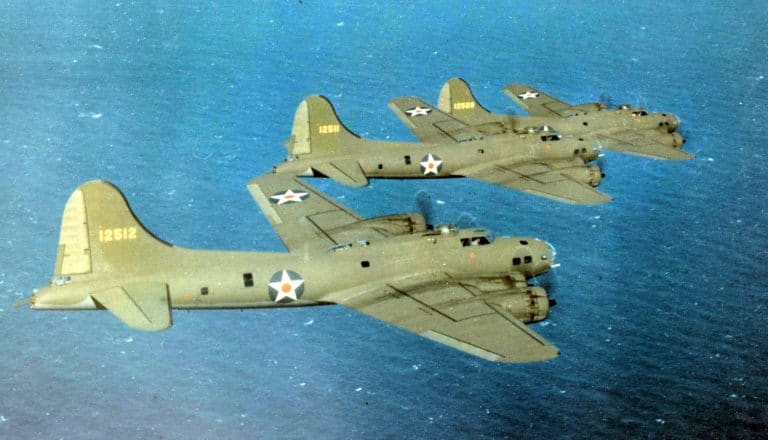
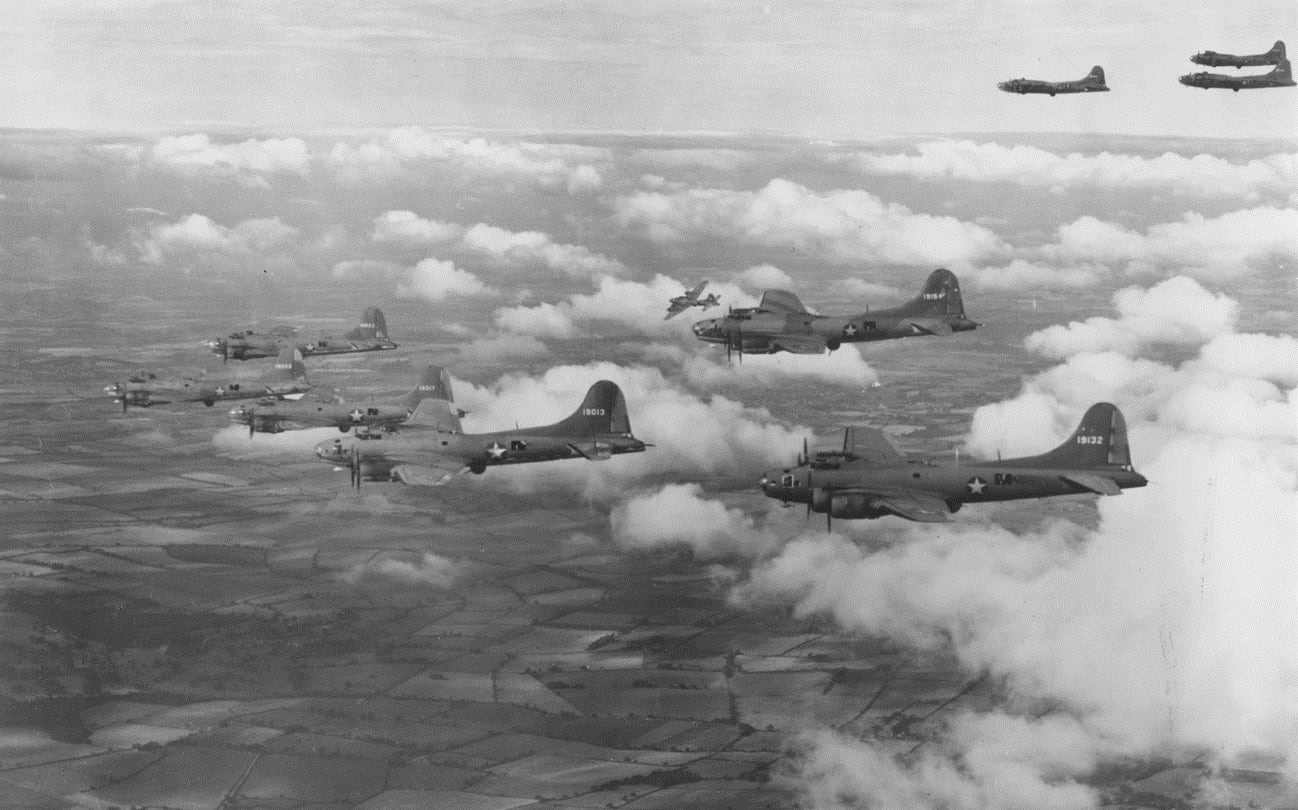
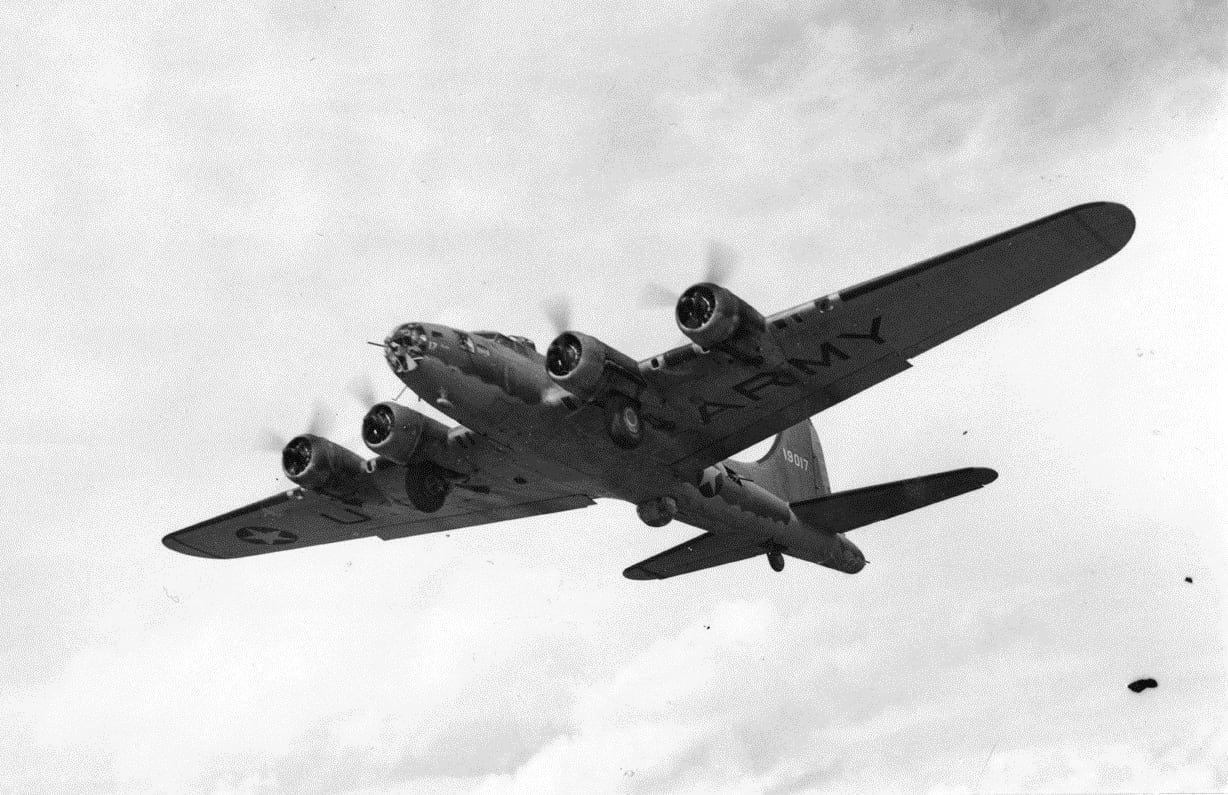
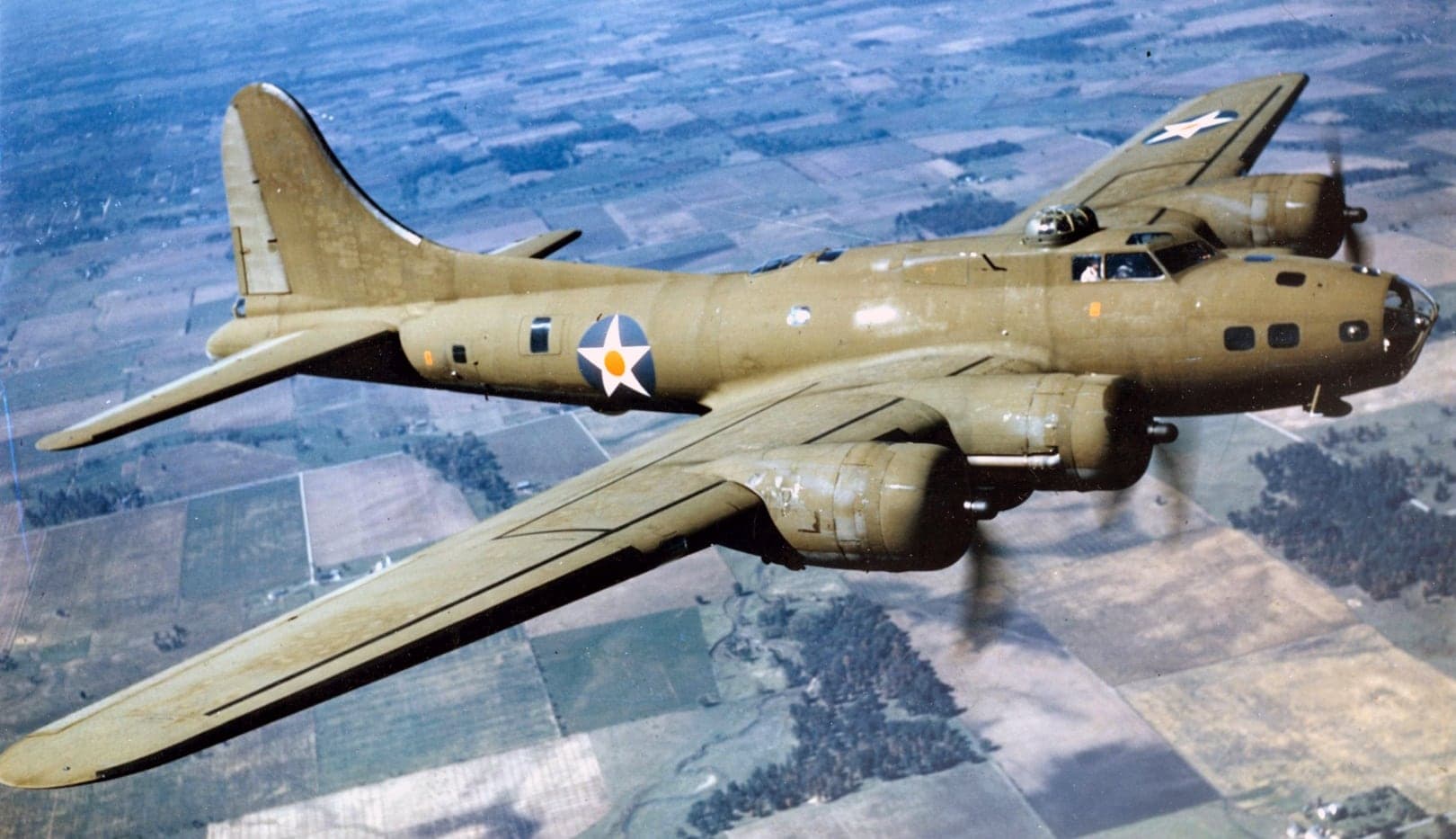
On 17 August 1942, the US Army Air Corps VIII Bomber Command began their assault on Fortress Europe. A dozen B-17E Flying Fortress bombers from the 97th Bomb Group (BG) raided the railroad marshalling yards at Rouen-Sotteville in occupied France. Each of the 97th BG squadrons, the 340th Bomb Squadron (BS), the 341st BS, the 342nd BS, and the 414th BS sent planes on the raid. An additional six 97th BG B-17Es flew a diversionary feint toward a different target. Considering the scale of the raids that would be flown even one year later, the Rouen mission was small but huge in other ways.
B-17Es. Image via USAF
Led By Men Who Would Become Legends
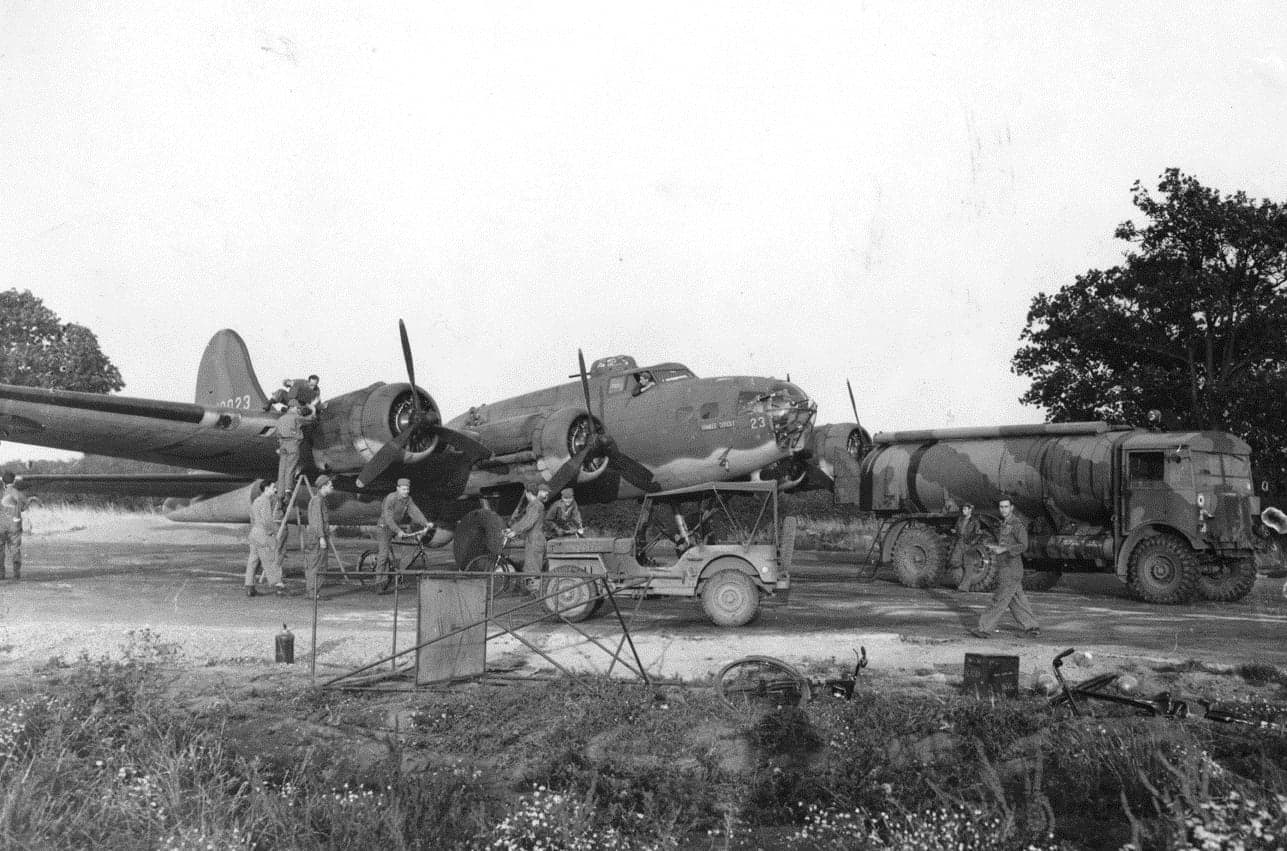
Leading the Rouen mission was none other than Major Paul Tibbetts flying the 342nd BS lead aircraft, B-17E serial 41-2578 named Butcher Shop, along with the 97th BG commanding officer, Colonel Frank Armstrong. Also flying the mission was VIII Bomber Command commanding officer Brigadier General Ira C. Eaker flying the 414th BS lead aircraft, B-17E serial 41-9023 named Yankee Doodle. The two squadrons attacked in two separate formations and dropped a total of 18.45 tons of bombs on the mission. The planned amphibious landings at Dieppe in France were one reason the raid was flown when it was. Of course Major Tibbetts went on to some other notable achievements on the other side of the planet three years later.
Yankee Doodle preparing for a mission. Image via USAF
First Mission; First Kill
The results of that first mission were mixed. The mission got started late in the day. Takeoff commenced at 1627 local time and the bombers didn’t drop their ordnance until 1739 local time. Even given the momentous nature of the mission, the bomb damage assessment (BDA) rated accuracy as poor. Two of the 97th BG B-17Es were damaged. The Royal Air Force Supermarine Spitfire escorts took a beating, losing three Spits on the mission. The long and distinguished list of B-17 and bomber gunners who scored victories over Europe also began on 17 August 1942. Staff Sergeant Kent R. West, the ball turret gunner on B-17E serial 41-9100 named Birmingham Blitzkrieg, shot down a Luftwaffe Focke-Wulf FW-190A-3 Würger (Shrike).
B-17E. Image via USAF
Not In East Anglia For Long
The 97th BG would not continue their missions without losses for long. The 97th flew a total of 14 missions from Polebrook and Grafton Underwood. Over 247 sorties the Group dropped 347 tons of bombs on targets in Western Europe, but lost 14 bombers during those missions. Just a month after the Rouen mission the 97th BG was reassigned to the Twelfth and then the Fifteenth Air Force, flying missions from Algeria and Tunisia and then from Italy. The 97th BG received Distinguished Unit Citations for missions against an aircraft component factory at Steyr in Austria, on 24 February 1944 during Operation Argument or “Big Week”, and a mission against the oil refineries at Ploesti in Romania on 18 August 1944. Today the 97th Operations Group (OG) is part of the US Air Force Air education and Training Command (AETC).
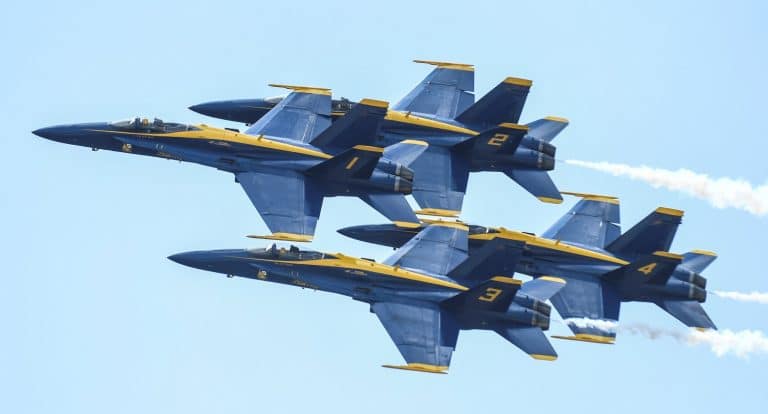
If you’re the sort of inquisitive or just plain nosy Avgeek who regularly checks the US Department of Defense website for contract information, you may have missed a barely-there notification listed on 13 August 2018. The contract to which I refer was right there, in between contracts awarded to Boeing for some CFM56-7B27AE engines and some oxygen system components (both for P-8A Poseidons). The Boeing contract listed between the two for P-8 work provides a shade over $17 million ($17,002,107 to be exact) for what amounts to nine F/A-18E and two F/A-18F Super Hornets for the Blue Angels. The concept of the Blues flying Echoes and Foxtrots is not exactly news, but the contract actually being funded is news. Great news for fans of the Blue Angels.
Image via US Navy
So we finally have a target date for the Blues’ transition to the F/A-18E/F. By the end of 2021 the team is expected to receive their full complement of 11 Super Hornets. That effectively means that the 2022 show season will likely be the first for the team in the new jets. The transition will be the 10th time the team has changed aircraft over their history. Modifications to the Blue Angels’ Super Hornets will be made at Boeing in St. Louis and likely be similar to those made to the current Hornet aircraft, including the removal of the nose-mounted 20 millimeter M61A2 Vulcan rotary cannon, the addition of the show smoke system, a civilian Instrument Landing System (ILS), and the spring-loaded control column that assists the aviators with precise control. Of course somewhere along the way the Blues’ jets will probably receive a glossy new blue and gold paint job too…
Image via US Navy
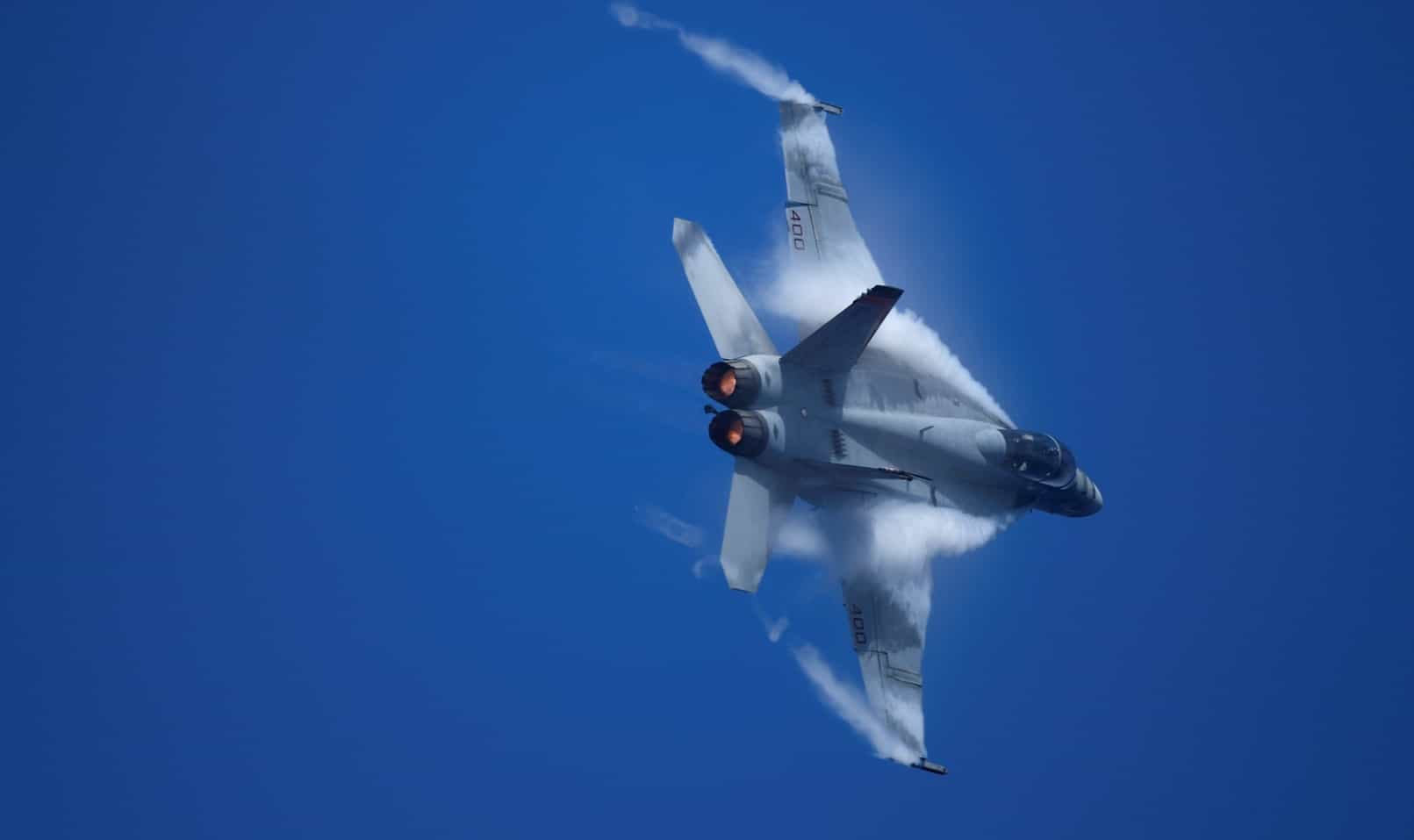
Navy Hornet and Super Hornet mission availability has suffered over recent years, but the Strike Fighter community times are a-changing. The best of the available F/A-18A/B/C/D Hornets are being reassigned to Marine Corps squadrons. The Navy Strike Fighter community now flies the Super Hornet Echo and Foxtrot exclusively with the last legacy Hornet deployment now concluded. Additional airframes are going to be headed for service life extension, which all means that the Blues may just be flying something other/better than the oldest airframes in captivity when they strap into Super Hornets for the first time.
Image via US Navy
Here’s the statement about the contract from the Department of Defense website:
The Boeing Co., St. Louis, Missouri, is being awarded $17,002,107 for firm-fixed-price delivery order N0001918F2654 against a previously issued basic ordering agreement (N00019-16-G-0001). This order is for the retrofit documentation and kits to convert nine F/A-18E and two F/A-18F aircraft into a Blue Angel configuration in accordance with engineering change proposal 6480. Work will be performed in St. Louis, Missouri, and is expected to be completed in December 2021. Fiscal 2018 aircraft procurement (Navy) funds in the amount of $17,002,107 will be obligated at time of award, none of which will expire at the end of the current fiscal year. The Naval Air Systems Command, Patuxent River, Maryland, is the contracting activity.
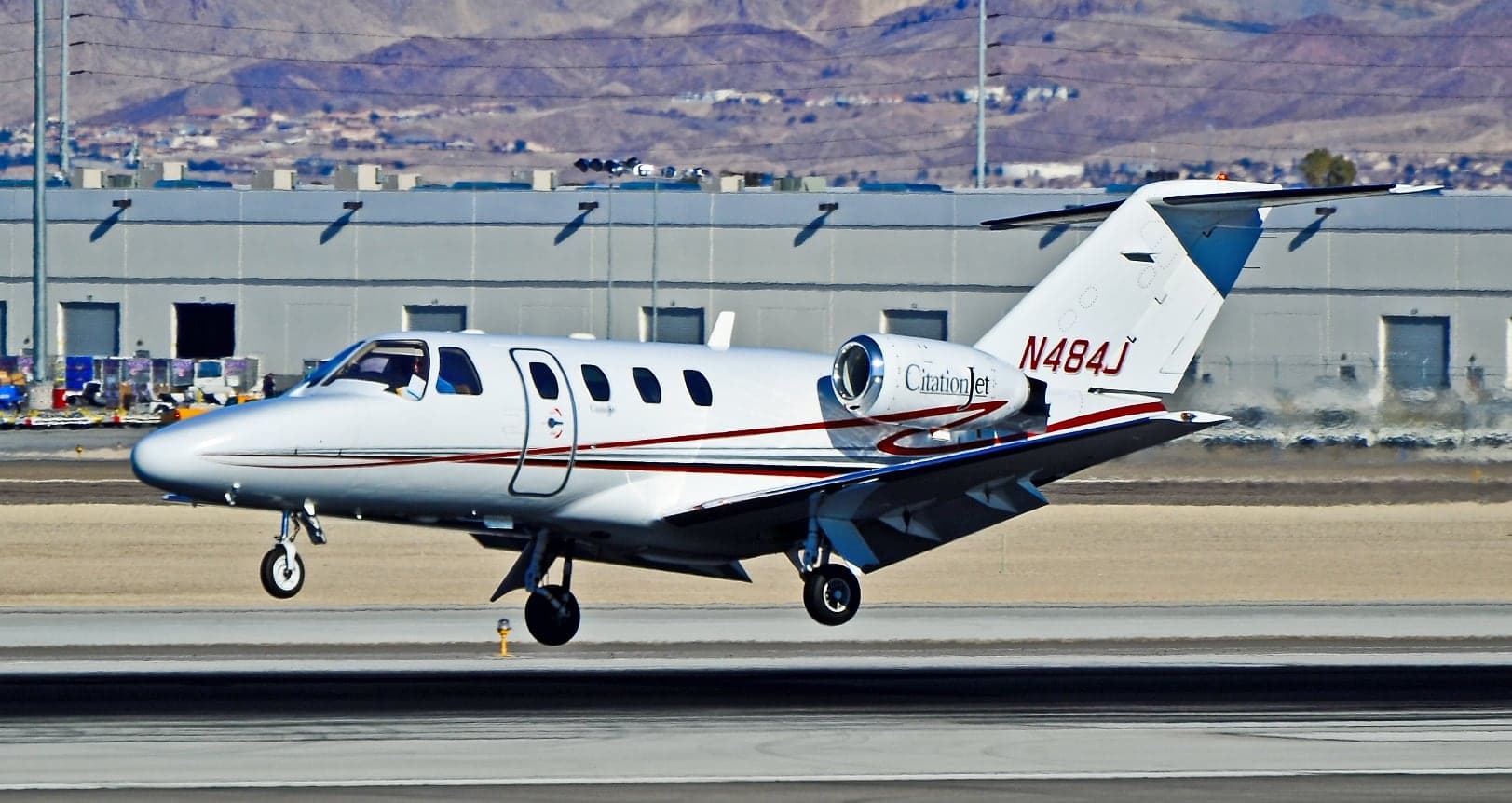
On Monday 13 August 2018 at 0238 local time a Cessna 525 CitationJet, serial number 525-0099 and registered as N526CP, crashed into a residence located at 594 East Canyon Road located just southeast of Payson in Utah. There was only the single pilot on board the jet. Two people were in the house at the moment of impact but both survived the crash and escaped the subsequent fire. The jet belonged to a business by the name of Vancon Holdings out of Springville in Utah and was built by Cessna in 1995. There is much more to this story though.
The pilot of the jet, a man named Duane Rhedd Youd, had earlier that day spent time in the Utah County Jail after allegedly assaulting his wife after both had been drinking- both in front of witnesses. Youd was booked into the jail Sunday evening on a domestic violence charge- not his first. However, Youd made bail and was released. At approximately 0030 Youd called Payson police to request an escort to his home, where Youd grabbed some of his belongings and left without incident in his truck.
Cessna 525 CitationJet sister ship to N526CP. By Tomás Del Coro from Las Vegas, Nevada, USA (N484J 1994 Cessna 525 C/N 525-0048) [CC BY-SA 2.0 (https://creativecommons.org/licenses/by-sa/2.0)], via Wikimedia CommonsYoud, who was employed by Vancon Holdings as a pilot and indicated he had previously worked for Endeavor Air and was currently employed by Guardian Flight Alaska, evidently went straight to Spanish Fork Airport Springville- Woodhouse Field (KSPK) approximately 15 miles from the crash site. Evidence suggests Youd had full-time access to the Cessna 525 CitationJet at KSPK. The timeline of events suggests Youd took off in N526CP at approximately 0220 and 18 minutes later he crashed the jet- into his own house. While his wife and son were inside it!
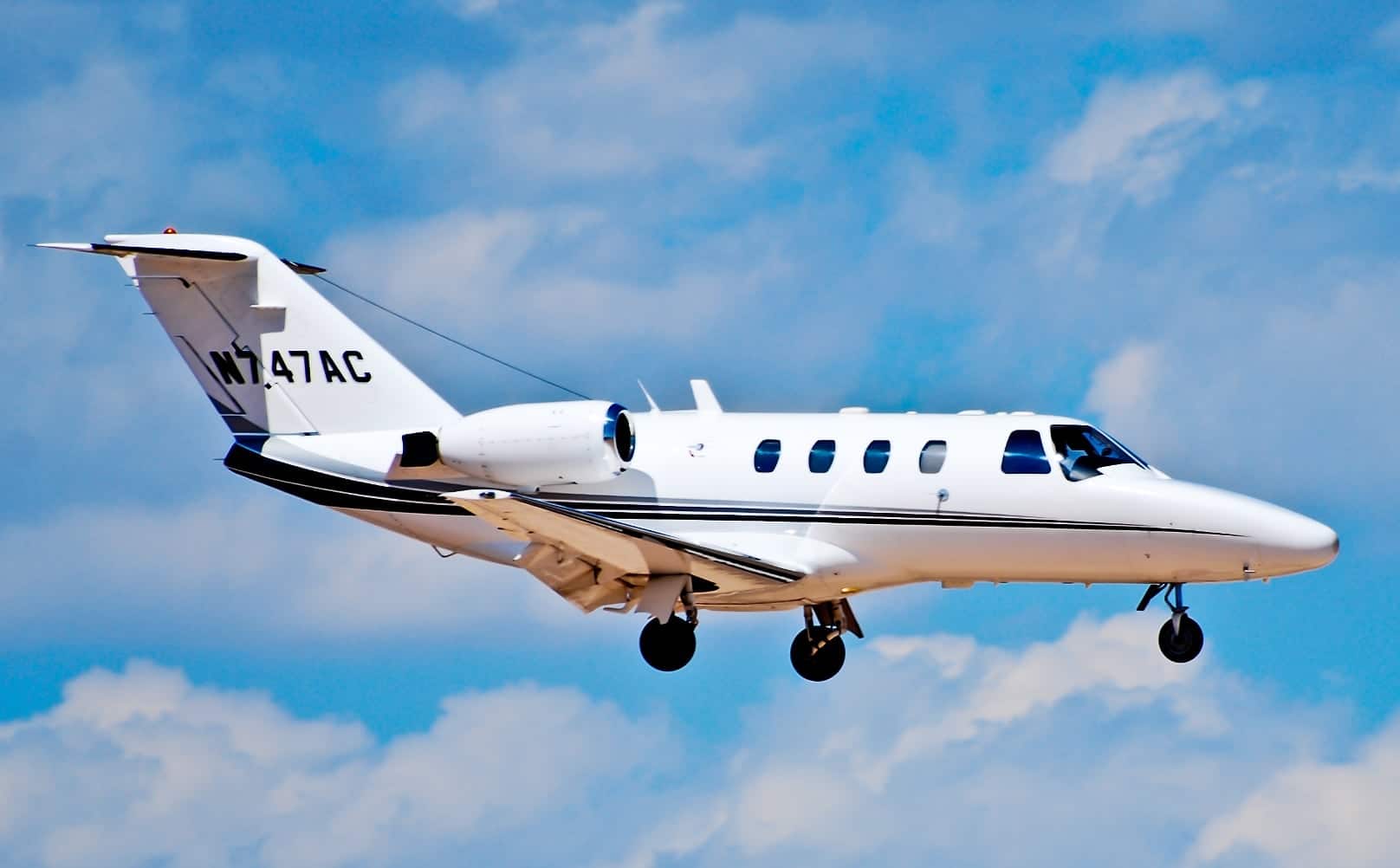
Cessna 525 CitationJet sister ship to N526CP. By Tomás Del Coro from Las Vegas, Nevada, USA (N747AC 1997 Cessna 525 C/N 525-0202) [CC BY-SA 2.0 (https://creativecommons.org/licenses/by-sa/2.0)], via Wikimedia CommonsYoud reportedly made contact with a shed or garage structure just before hitting his house. The crash doused the house with burning jet fuel, setting it ablaze. Authorities are thankful Youd did not cause more widespread damage. Authorities are hesitant to call this another suicide by aircraft similar to the Horizon Q400 incident in Seattle, but if anything this seems like a clearer cut case than that. Stay tuned- we’ll update this story as events warrant.
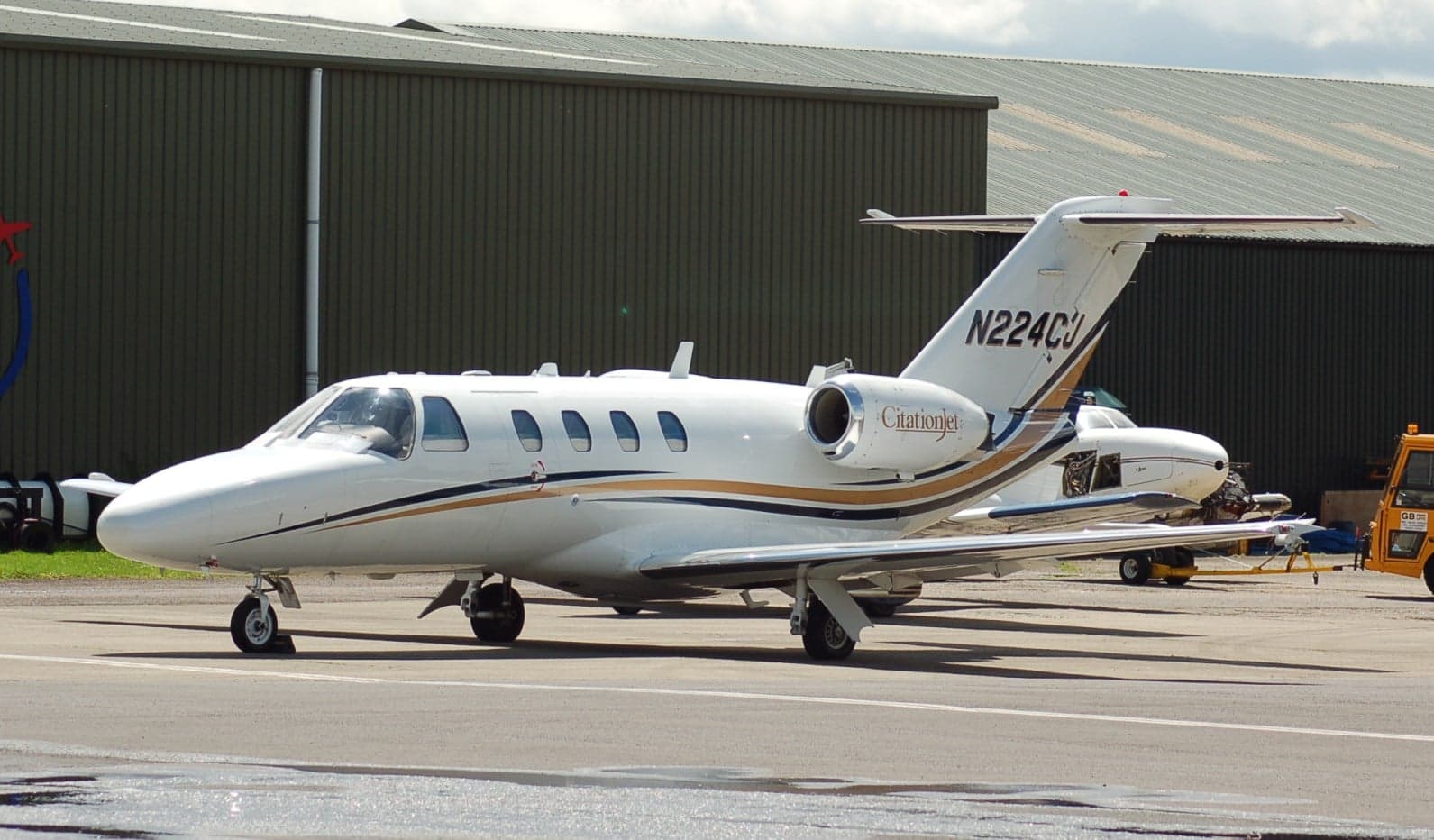
Cessna 525 CitationJet sister ship to N526CP. By Alec Wilson from Khon Kaen, Thailand (N224CJ) [CC BY-SA 2.0 (https://creativecommons.org/licenses/by-sa/2.0)], via Wikimedia Commons
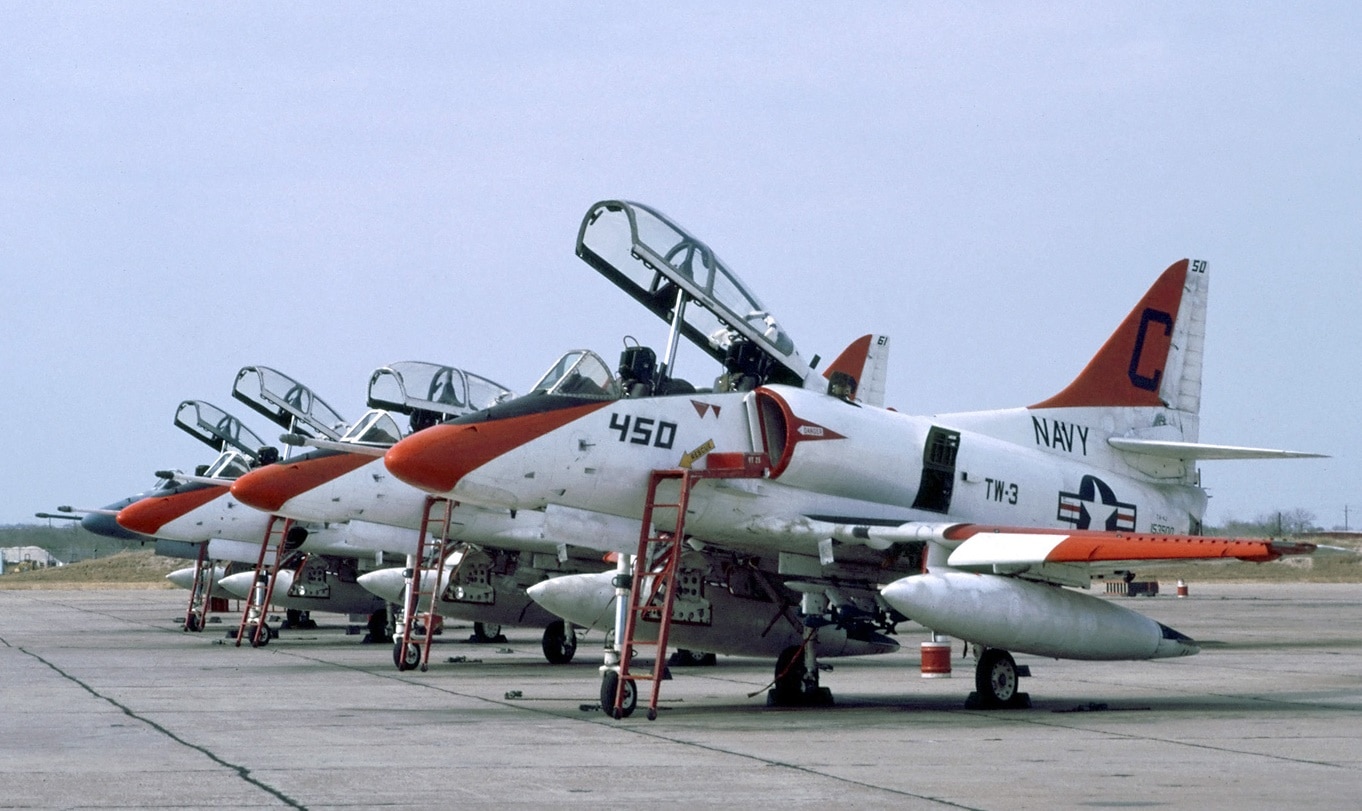
Navy and Marine Corps aircraft featured in the film include the Douglas F4D-1 Skyray interceptor, the Vought F8U Crusader fighter, and interestingly the Douglas A4D-1 Skyhawk attack jet. The Skyhawk was not a supersonic aircraft. Left out of the film was the other supersonic Navy fighter- the Douglas F11F Tiger fighter. The Air Force continued sonic boom research for many more years. Operation Bongo Mark 2 was a series of supersonic flights over Oklahoma City during 1964 to gauge the effects of regular sonic booms on a population and its infrastructure.
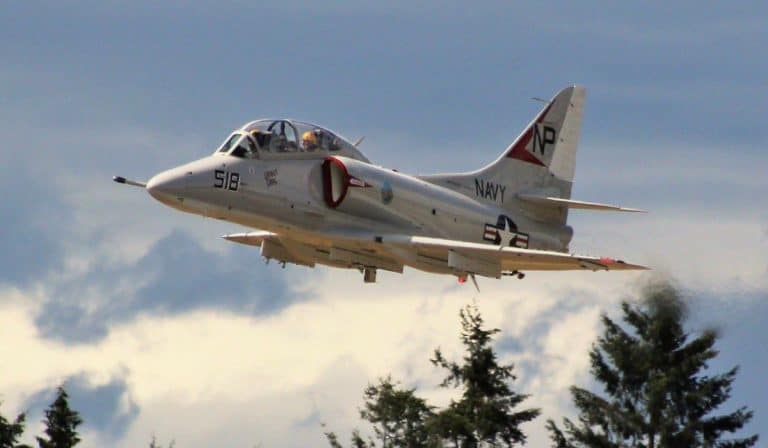
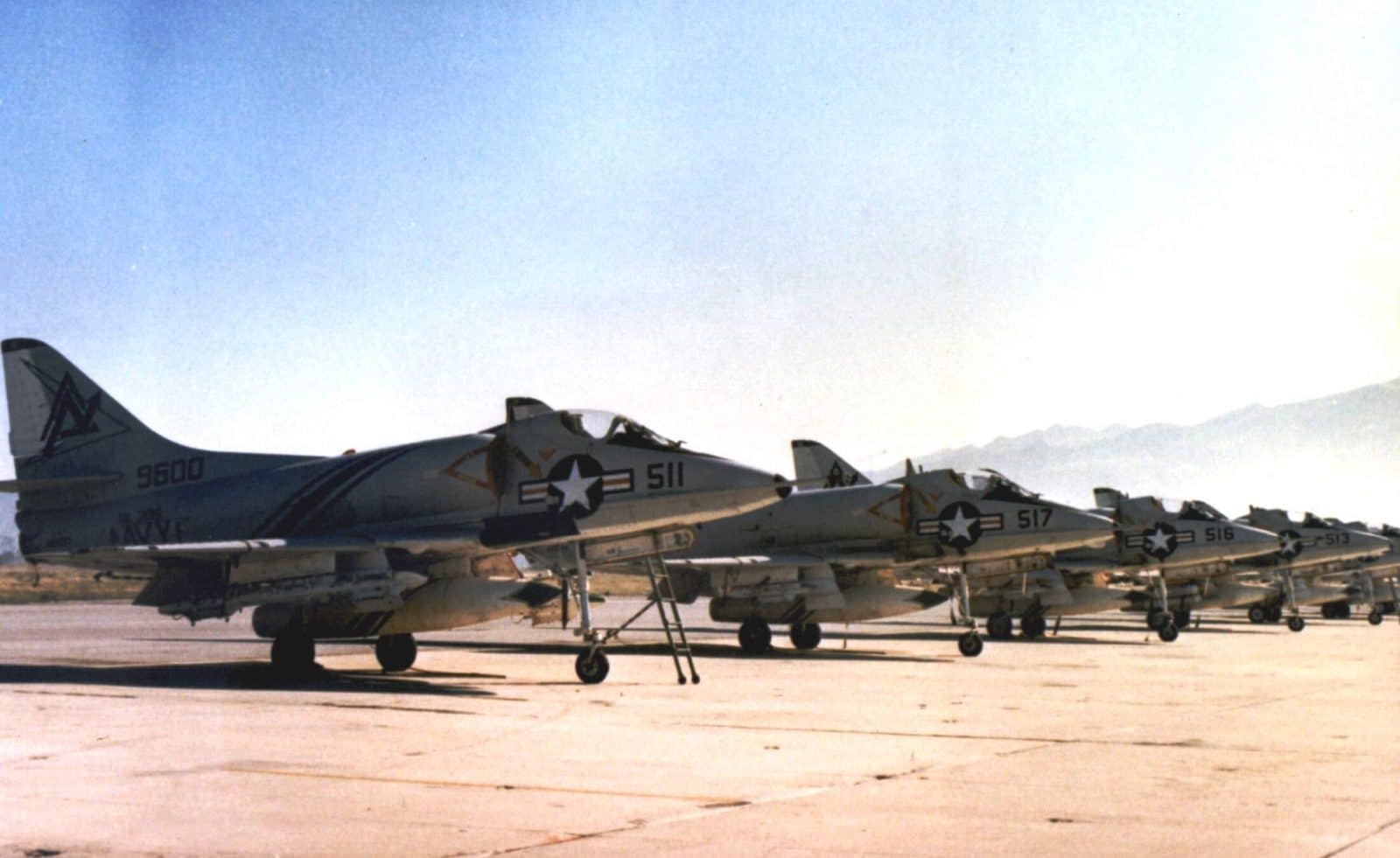
Private A-4 Skyhawk aircraft are becoming more and more common these days. Several companies have stockpiled former boneyard resident jets and they’ve slowly been coming on the open market after meticulous restorations. The jet in these videos, registered as N518TA, is (at least in part) Douglas TA-4J Skyhawk Bureau Number (BuNo) 158486 (CN 14291). Skyhawk 518 is a perfect example of a veteran jet that’s been effectively zero-timed and upgraded/updated with partial electronic flight instrumentation system (EFIS) cockpit displays and modern communications. These two videos were uploaded to YouTube by Skyhawk518
The second video is a backseat fisheye view of a demo flight. Makes you want to throw down the cash for your very own Scooter, no? Below the video are the fascinating facts about the sum of Skyhawk 518’s parts.
Skyhawk 518 actually began life as not one, not even two, but three separate jets. TA-4J BuNo 158486 was accepted by the Navy in 1972 assigned to Navy Training Squadrons VT-24 Bobcats and VT-25 Cougars with Training Air Wing THREE (TW-3) at Naval Air Station (NAS) Chase Field in Texas. The jet went to VT-4 Warbucks with TW-6 at NAS Pensacola in Florida in 1974 and remained there for 9 years. The jet was stricken and stored in 1983 before lending its forward fuselage and data plate to N518TA.
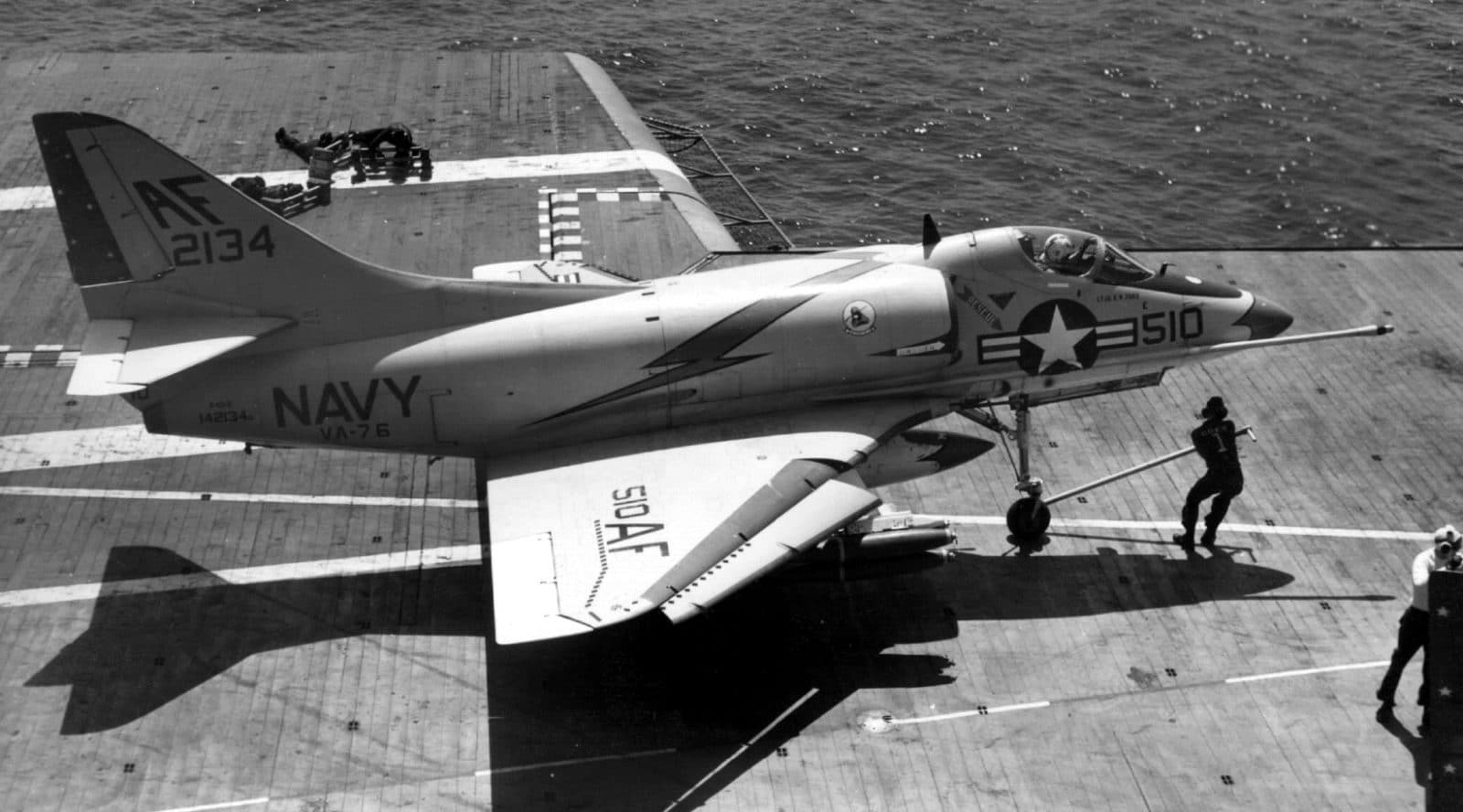
VA-76 A4D-2N. US Navy photograph
A4D-2N Skyhawk BuNo 149540, which contributed its aft fuselage to Skyhawk 518, was accepted by the Navy in 1962. The jet served first with VA-113 Stingers, then with VA-144 Roadrunners, VA-22 Fighting Redcocks, VA-113 again, VA-76 Spirits, VA-36 Road Runners, and VA-304 Firebirds. In 1970 the jet was converted to an A-4L. From there the jet went to VMA-124 Checkerboards and then VC-12 Fighting Omars before going into storage in 1976. The aircraft also spent time with the Malaysian Air Force before coming back to the states in 1986 and gave up its aft fuselage and empennage to a good cause.
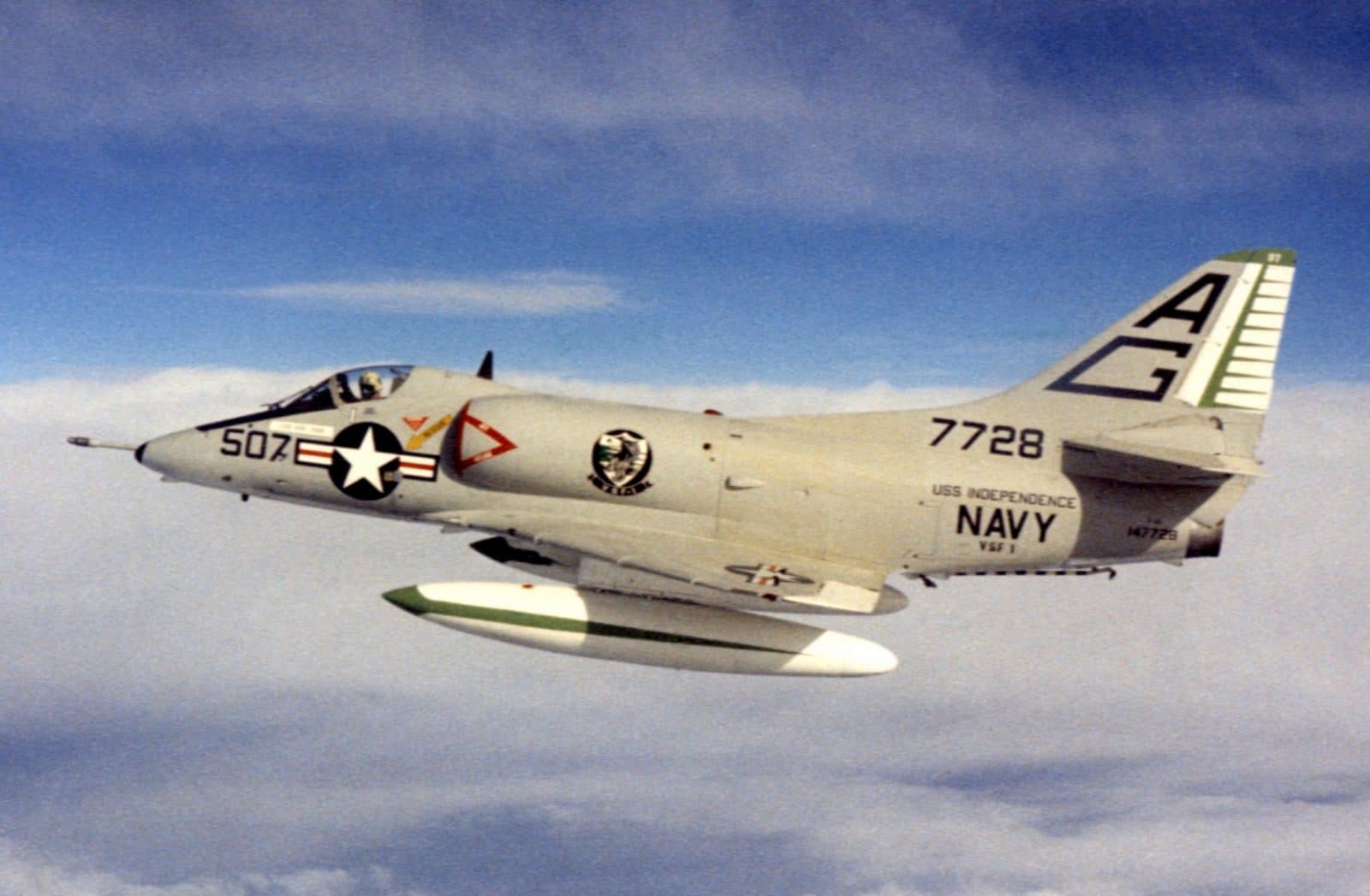
VSF-1 A-4C. US Navy photograph
A4D-2N Skyhawk BuNo 148602, which contributed its wings to Skyhawk 518, was accepted by the Navy in 1961. The jet served with VA-192 Golden Dragons, VA-144 Road Runners, VSF-1 Warhawks, VA-216 Black Diamonds, VA-44 Hornets, VA-36 Road Runners, and VMA-131 Diamondbacks. In 1970 the aircraft was converted to an A-4L. After conversion the jet served with VMA-124 Checkerboards until 1976 when it was put into storage. Sold to the Malaysian Air Force in 1983, the jet boomeranged back to the desert in 1986. From there the jet became the supporting cast for N518TA. The jet was purchased so it’s no longer for sale, but most of the time you can find a Scooter of your very own online.
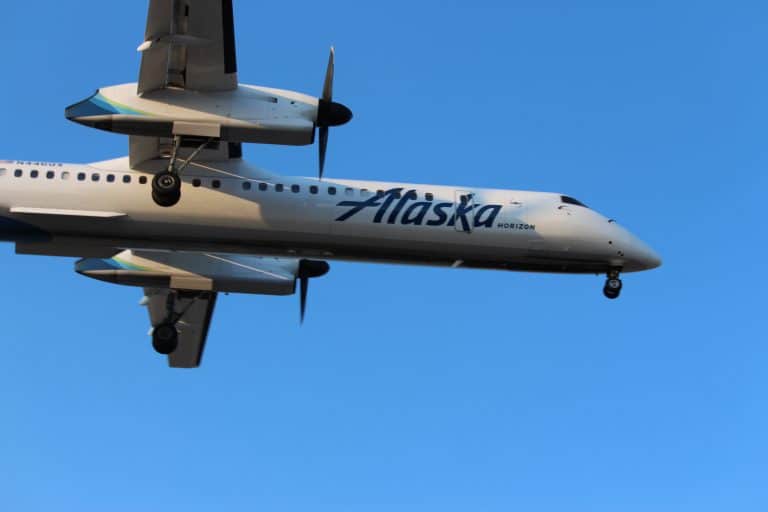
An Alaska Airlines Horizon Q400 (tail number N449QX) was stolen this evening from Seattle’s SEATAC International Airport by a 29 year-old individual named “Rich”. The aircraft departed SEATAC International and was spotted flying erratic maneuvers around the Seattle area.
Two F-15s from the Oregon Air National Guard were directed to intercept the aircraft. In a video shot by an eyewitness, you can see the Q400 flying low and fast with a F-15 tracking the rogue aircraft from above. The Q400 later crashed on Ketron Island in the southern part of Puget Sound. Alaska Airlines confirmed the crash in a tweet (see below).
We’ve confirmed a Horizon Air Q400 that had an unauthorized takeoff from SeaTac around 8pm has gone down near Ketron Island in Pierce County, WA. We’re working to confirm who was on board, we believe there were no guests or crew on board other than the person operating the plane.
At Avgeekery, we’re more than just a news/hobby blog. We also are a community of people who love aviation and want to share that passion with others. Stories like this are tragic and heartbreaking. Earlier today, we posted this on our Facebook page. We think it is also appropriate to share.
Here’s what we know so far…
Update four 12:15am 8/11/2018
The FBI is taking lead on the investigation with the NTSB to support.
The FBI continues to work with our state, local, and federal partners to gather a complete picture of what transpired with tonight’s unauthorized Horizon aircraft takeoff and crash. We don’t anticipate that further details will be available tonight.
Alaska Airlines posted the following information on their blog:
Update: 11:54 p.m. on Aug. 10, 2018 Alaska Airlines believes a ground service agent employed by Horizon Air was the individual responsible for flying the Horizon Q400 without clearance from Sea-Tac International Airport around 8 p.m. tonight.
The plane, which was taken from a maintenance position and was not scheduled for passenger flight, crashed about an hour later in a wooded area on Ketron Island in rural Pierce County. No ground structures were involved at the crash site.
Military jets were scrambled from Portland, but it does not appear that these jets were involved in the crash of the Horizon aircraft.
This individual who took the aircraft, who has not yet been positively identified until remains are examined, is believed to have been the only person on the plane when the plane was taken from a maintenance position at Sea-Tac.
First responders are at the crash site. Appropriate government agencies, including NTSB, FAA and FBI, have been notified.
Update three 11:27pm 8/10/2018
Video was posted by John Waldron on Facebook of the Q400’s flight. In one of the clips you can clearly see the aircraft performing dangerous aerobatics. The turboprop pulled out of a loop just 100 feet above the sound. Click on the link to view the video. https://www.facebook.com/JohnJWaldron/videos/10217237711963918
Update two 11:06pm 8/10/2018
Horizon Air’s Chief Operating Officer Constance von Muehlen posted a video statement on YouTube. In her statement she said that the hijacker was believed to be a Horizon employee. She also said they think he was the only person onboard the aircraft.
Update one 10:52pm 8/10/2018
Here is a compilation with most of the audio from the stolen aircraft.
Original post:
“Ive got alot of people that care about me. It’s going to disappoint them to hear that I did this.”
It is believed that the hijacker was the only person onboard the aircraft. In a series of captured audio by Twitter user @jwsthomson, a man named Rich speaks with the controller multiple times regarding his predicament. He appeared to be very emotional at times while also acknowledging that his behavior was far from acceptable.
I’m listening through the archive of the radio chatter on the #seatac hijacking. Below are some of the clips. pic.twitter.com/ziBAYv7cgn
The person who stole the aircraft asked if Alaska would make him a pilot if he landed it.
Air Traffic Control Audio from the stolen Q400 flight: “Hey, do you think if I land this successfully Alaska will give me a job as a pilot?” pic.twitter.com/17sScC6PFh
Some dude stole a plane from #Seatac (Allegedly), did a loop-the-loop, ALMOST crashed into #ChambersBay, then crossed in front of our party, chased by fighter jets and subsequently crashed. Weird times. pic.twitter.com/Ra4LcIhwfU