
Home Blog Page 94

Lockheed Wants to Put a Base Camp in Orbit Around Mars, Complete With Lander

0

Speaking at the International Astronautical Congress (IAC) in Adelaide, Australia, officials with Lockheed Martin today revealed their plans for what they believe is a sound, safe and compelling mission architecture to help NASA get humans to Mars within a decade, using a concept centered around an orbiting outpost they call the Mars Base Camp.

“Sending humans to Mars has always been a part of science fiction, but today we have the capability to make it a reality,” said Lisa Callahan, vice president and general manager of Commercial Civil Space at Lockheed Martin.

[youtube id=”vLpZUMfIJX0″ width=”800″ height=”454″ position=”left”]

“Partnered with NASA, our vision leverages hardware currently in development and production. We’re proud to have Orion powered-on and completing testing in preparation for its Exploration Mission-1 flight and eventually its journey to Mars.”

Plans for building the outpost align with NASA’s skyscraper-tall Space Launch System (SLS) rocket, Orion spacecraft and the agency’s plans for a Deep Space Gateway orbiting the moon, which will serve as a critical staging point for missions to the lunar surface and deeper into space, such as to asteroids and Mars in the 2030s.

37272639941 d86a86facb k 1
Mars Base Camp and Lander. Credit: Lockheed Martin

The first launch of an SLS and Orion, Exploration Mission 1 (EM-1), which will be a shakedown flight to the moon and back of the integrated SLS/Orion system, won’t launch until 2019, with the first crewed Orion mission to lunar orbit occurring around 2-3 years later.

Lockheed is also the prime contractor for Orion.

Such a lunar outpost will offer a true deep space environment for astronauts to gain experience and have opportunity to build and test the systems needed for the very challenging missions that will follow, but will also offer the ability for crews to return to Earth if needed in days – rather than weeks or months on missions further into space (such as Mars).

MBC Configuration Graphic7 check5hires 2
Credit: Lockheed Martin

Lockheed is actually already developing a prototype habitat for the gateway under a contract with NASA ((which you can read about on AvGeekery HERE), taking the old Donatello Multi-Purpose Logistics Module (MPLM), once used in the payload bay of the space shuttles to transfer cargo to the ISS, and refurbishing it to prototype their deep space habitat in the Space Station Processing Facility at Kennedy Space Center in Florida.

And although some components of the Mars Base Camp’s architecture will be pre-positioned in Mars orbit ahead of time, the Mars Base Camp would ultimately be built up at the Deep Space Gateway, away from Earth’s gravity, before being deployed to the Red Planet.

36603075873 b19299a905 k
Lockheed’s lander for the Mars Base Camp, called the Mars Accent Descent Vehicle (MADV). Credit: Lockheed Martin

An Orion spacecraft would serve as the heart of the outpost, same as the Deep Space Gateway.

In addition to an orbiting base camp, Lockheed also envisions a reusable, single-stage lander for the outpost called a Mars Accent Descent Vehicle (MADV), using Orion avionics and systems as its command deck and powered by engines using liquid-hydrogen/liquid-oxygen propellant, both of which will be generated from water.

[youtube id=”yMnFiGQhWO8″ width=”800″ height=”454″ position=”left”]

Above, watch a video animation of it all in action.

The lander would be capable of conducting surface mission as long as two weeks in length, with up to four astronauts, before returning to the orbiting outpost where it would be refueled and readied for another mission.

Follow Mike Killian on Instagram and Facebook, @MikeKillianPhotography 
.

Watch The “Fighting Omars” Simulate The Enemy With Their Skyhawks

The Navy’s Fighter Squadron Composite TWELVE (VFC-12) Fighting Omars have provided adversary training to East Coast-based carrier air wings since September 1st 1973, when they were established as Fleet Composite Squadron TWELVE (VC-12) at Naval Air Facility (NAF) Detroit. VC-12 then became the Navy’s first Reserve Fleet Composite squadron. The Fighting Omars moved to Naval Air Station (NAS) Oceana in Virginia in 1975. In 1988 they were re-designated VFC-12. This video shows VFC-12 flying their Douglas A-4 and TA-4 Skyhawk aircraft at NAS Oceana, NAS Cecil Field, and NAS Key West during the 1980s and early 1990s. Thanks to YouTuber thezipmartin for uploading it.

[youtube id=”avmja9s65bA” width=”800″ height=”454″ position=”left”]

TA 4F Skyhawk front view in 1990
VFC-12 TA-4F Skyhawk Taxying at NAS Oceana. Official US Navy Photograph

In 1994 VFC-12 transitioned to flying the McDonnell Douglas (Boeing) F/A-18A+ and F/A-18B Hornet. Their distinctively camouflaged jets now mimic paint schemes used on aircraft flown by the former Soviet Union and other potential enemy air forces. The Fighting Omars have been awarded the Chief of Naval Operations Aviation Safety Award and the Noel Davis Trophy for squadron readiness five times each. The squadron has also received a Meritorious Unit Commendation, the Battle “E”, the Noel Davis award for recognition as the best squadron in its category for Reserve Carrier Air Wing Twenty (CVWR-20), and an Aviation Safety Citation from the Commander Naval Air Reserve Force for several years of Class A mishap-free flying.

1280px A 4F Skyhawk of VFC 12 taking off with towed target 1989
VFC-12 A-4F Skyhawk taking off from NAS Oceana toting a towed target. Official US Navy Photograph

WestJet Creates New Airline Within An Airline–Think Spirit or Allegiant for Canada

0

WestJet Airlines, Canada’s largest low-cost carrier announced that it will launch a new ultra-low cost carrier (ULCC) in 2018.  What is a ULCC?  Think Allegiant or Spirit Airlines for Canada. Ouch!  Poor Canadians!

In a statement, WestJet said, “The name Swoop denotes exactly what we plan to do,” said Bob Cummings WestJet Executive Vice-President, Strategy and the executive member responsible for the launch of Swoop. “It’s a powerful verb that demonstrates we plan to swoop in to the Canadian market with a new business model that will provide lower fares and greater opportunity for more Canadians to travel.”

Swoop will provide Canadians with a no-frills, lower-fare travel option backed by an airline with a proven track record of bringing lower fares to Canadians and an investment-grade credit rating.

In addition, Swoop has chosen Calgary as the location of its headquarters. An exact location will be announced at a later date.

“As we looked around for the home for Swoop’s operations, Calgary quickly rose to the top of the list,” said Cummings. “The city offers Swoop the opportunity to save costs through shared services with WestJet’s corporate head office, the availability of existing infrastructure, and talented, experienced WestJetters to draw from. We are confident that these qualities will support our ultra-low-cost operations and our guests well into the future.”

Swoop will fly a fleet of Boeing 737-800 aircraft, presumably refurbished jets from WestJet’s fleet.  Like Allegiant and Spirit Airlines, Swoop will charge for carry-ons, luggage, snacks, in-flight entertainment, and seat assignments. Additionally, the seats onboard Swoop aircraft will have a standard configuration which might mean a standard seat pitch and a pre-reclined option utilized by other ULCCs.

Operation Airdrop Volunteer Pilots and Staff Support Hurricane Victims

Download
OAD Pilots & volunteers of load relief supplies for Hurricane Harvey victims

“Ready to go, have cleared my schedule for WED and beyond. Twin Cessna 414. Bringing 300 lbs of diapers with me.” Operation Airdrop Pilot

Imagine having 4 feet of flood waters receding from your home. Now that the storm is over you have to start assessing the damage and cleaning up, but you can’t go to Target or Wal Mart to get your supplies. They were hit by the floods too, just about every store was. And if you have a baby the Red Cross doesn’t have diapers to give to you. Enter Operation Airdrop Hurricane Harvey!

Operation Airdrop

Operation Airdrop (OAD) https://www.operation-airdrop.com started just in the aftermath of Hurricane Harvey as an effort by two pilots, we’d like to call them fellow Avgeeks, John Clay Wolfe and Doug Jackson. Wolfe is a Dallas metro area iheart radio personality and Jackson are friends who both felt the need to do something to help these people.

Well, you’re a pilot and I’m a pilot, why don’t we fly some stuff down?’ I’ve got this radio network, we ought to use it for some good. What if we organized a bunch of pilots and mimic that Cajun Navy thing, but do it with airplanes?” Credit: Flying Magazine They promoted their efforts on the radio and facebook to the General Aviation community and the response has been overwhelming.  Fans at the Thunder over Michigan Airshow were asked to help fill two C-47s with over 20,000 pounds of relief supplies.

Operation Airdrop pilots are bringing new meaning to the phrase “weekend warrior.” OAD pilots have volunteered their time, flying skills and aircraft to generate a massive relief effort. In the tradition of the cajun navy a group of over 200 civilian pilots have joined together forming a massive coordinated relief effort. To date Operation Airdrop has completed over 400 flights, delivering over 250,000 pounds of supplies in difficult to reach areas of hurricane stricken South Texas.

https://batchgeo.com/map/fd51bdd9e103af3df22cfc0337d19b3b Map by Joe Vaeth

Operation Airdrop Expanding Reach

Operation Airdrop started by using aircraft to bring immediate short-term relief to hardest hit areas after Harvey in Texas by targeting isolated areas with small airports along the Texas Gulf Coast. Since that time OAD has expanded its mission to deliver assistance to Florida and Puerto Rico in the wake of hurricanes Irma & Maria.  To accomplish this critical feat OAD is actively developing strategic relationships with the military, government leaders, and other relief organizations such as the Texas Baptist Men, Salvation Army, Texas Navy & Cajun Air Force. The FAA has also been very cooperative in this effort. OAD pilots even have their own sqawk code.

Operation Airdrop is making a tremendous difference in the lives of families one aircraft load at a time. One of the real strengths of this organization has been the ability to get relief into the hands of people that need it quickly. OAD has established a supply chain and places for donations to dropped, distributed & received. Supplies are reaching folks in need within 30 minutes after landing. Here is a listing some of the items being delivered:
Diapers
Baby Formula
Cleaning Supplies
N95 dust masks
Maxi pads
Frigdes
Fans
Bottled Water
Dog food, Cat Food
Paper Towels & TP
Sleeping Bags
LED Lanterns
Canned Foods
Athletic apparel and shirts from the Dallas Cowboys
Papa Johns Pizza to relief workers and first responders.

Fleet
Fleet of aircraft at KCXO

One account from KCXO, Conroe, TX stated, “ Dozens of pilots landed their planes in the airport and personnel from The Salvation Army helped unload pounds of diapers and baby materials, toiletries and sleeping bags to distribute to storm victims.” OAD also had help from some extra muscle on the ramp at KBMT, Beaumont Municipal Airport from the Army and Air Force troops working there.

Military Muscle 1
Air Force & Army troops support OAD on the ramp at KBMT

Pilots Wanted

This effort is being sustained by volunteer pilots. The organization’s facebook page and website have a link https://www.operation-airdrop.com/pilot-intake for pilots and or aircraft owners to fill out a form and a member of the operations team will make immediate contact. OAD pilots have been flying in supplies from all over the U.S. and Mexico. And they have been flying in a myriad of aircraft including everything from Cessna 152s, Pilatus PC-12’s to Beechjets and the venerable DC-3. The group’s heavy lifter is a WWII era DC-3 cargo aircraft painted with invasion stripes and still serving in a critical role.

The team Operation Airdrop assembled has put a lot of work into building a seamless operation. Pilots fly into coordinated donation centers/depots to load up. There they get a weather briefing and coordinated instructions for flying into the Houston TFR. The aircraft are fueled and sent on their way. Upon landing at the relief field the aircraft is downloaded by the waiting volunteers. Supplies are distributed. Then the aircraft is re-fueled for its next run.

Relief Airfields served by OAD:
KCXO – Conroe, TX – Lone Star Executive
KPKV – Port Lavaca, TX – Calhoun Air Center
KIWS – Houston, TX – West Houston Airport
KI95 – Kenton, TX – Hardin County Airport/Hawthorne Field
KBMT – Beaumont, TX – Beaumont Municipal Airport
KILE – Houston, TX – Ellington Airport
KBYY – Bay City, TX – Bay City Regional Airport
KRKP – Rockport, TX – Aransas County Airport
KCRP – Corpus Christi, TX – Corpus Christi International Airport
KRAS – Port Aransas, TX – Mustang Beach
KILE – Kileen, TX – Skylark Field – Supply Depot
KDTO – Denton, TX – Operations Center

Operations Center

Conducting a relief operation to austere airfields in a storm devastated environment is a complex problem. Supplies need to be coordinated, pilots need to be taksed and briefed and most importantly the aerial armada needs fuel to conduct its runs. The OAD operations center has conducted over 400 flights now. Wolfe describes it as follows:

“OAD has a war-room style operations center located in KDTO (Denton, TX) manned by a software pro, full time controller, airline logistics expert and other pilots as mission control. These vols are scheduling freight, assessing needs, updating FAA clearance codes, managing aircraft weight loading specs, fuel burn, fuel replenishment locations and of course constant weather updates to our air-force of volunteers. An enormous part of the OAD’s sudden success is the streamline logistics, and feedback to our pilots in real time. When pilots land they know where to drop, where to fuel, and no one goes home until every flight is accounted for safe and sound, tracking each plan online much like government controlled operations.”

Impact Beyond Texas

The impact Operation Airdrop has been able to deliver has already been recognized at the highest levels of government as an, “untapped strategic national resource.” It’s hard to believe what this group of volunteer aviators and support personnel have accomplished in a matter of days.

Operation Airdrop has now turned its resources toward Florida and Puerto Rico and is coordinating a continuing volunteer pilot relief effort.  Radio host John Clay & founder of Operation Airdrop shared that Saturday morning OAD hosted an on air relief pitch with Pudge Rodriguez.  Pudge is Puerto Rican and a retired major league baseball catcher who played for the Texas Rangers and the Florida Marlins winning the World Series in 2003.  Clay said, “We had Pudge on the show,” asking for donations, “and man they came in!”  The donated supplies included 16, 600kW generators for Puerto Rico.

You can follow & offer your support to Operation Airdrop on facebook https://www.facebook.com/groups/operationairdrop

or at their website https://www.operation-airdrop.com.

Banner

Additional Sources:

Flying Magazine
http://www.flyingmag.com/harveys-devastation-inspires-pilots-to-create-operation-airdrop#page-2

PR Newswire
http://www.prnewswire.com/news-releases/operation-airdrop-continues-to-deliver-relief-supplies-to-texas-coast-as-irma-threatens-florida-300514342.html

Conroe – Community Impact Page
https://communityimpact.com/houston/conroe-montgomery/city-county/2017/09/01/photo-gallery-pilots-deliver-baby-formula-diapers-operation-airdrop-hurricane-harvey-recovery-efforts/

Click on Detroit
https://www.clickondetroit.com/news/plane-to-deliver-donations-from-thunder-over-michigan-airshow-to-hurricane-harvey-victims

US Flies Bombers Near North Korean Coast; Kim Jong Un Retaliates With Crappy Video

Recently the United States Air Force flew Rockwell B-1B Lancer bombers escorted by Boeing F-15C Eagle fighters and Marine Corps Lockheed-Martin F-35B Lightning II aircraft alongside the North Korean coast. The jets flew further north of the Demilitarized Zone (DMZ) then they have at any other time during this century.  It was a show of force intended to send a message that the US is ready and willing to strike at anytime if US territory or US allies’ territory is attacked.

Watch Kim Jung Un’s reply:

The North Koreans, in partial response to the flights sent a very interesting message.  Being the ever the technologically and intellectually challenged fanatics that they are, produced this decidedly low-tech animation showing just how they would shoot down the aircraft and sink the aircraft carrier USS “Air Force” (their words, not ours) Carl Vinson (CVN-70).  The ominous video shows B-1s and F-35s being destroyed and ends with a burning US flag.  Brilliant footage…it were 1992.  It’s Super Nintendo quality at best. YouTube wasn’t impressed.  A quick glance of the comments section is hilarious. Here’s a sample:

“Still using Windows 95 I see. Nice.”

“You start to really appreciate PlayStation 1 era CGI after seeing this sh*t. North Korea should dissolves itself. It’s officially the most pathetic country in existence.”

“Literally looks like power rangers”

The rhetoric between the two nations has heated up in recent months.  The North Korea story dominates the airwaves.  President Trump and dictator Kim Jung Un continue to trade barbs through social media, the UN and televised speeches.

More about the most recent show of force:

170109 M QU349 226
VMFA-121 Green Knights F-35B in Flight. Official US Marine Corps Photograph

When the most recent show of force sorties were flown the Bones flew out of Andersen Air Force Base (AFB) on Guam. The escorting F-15C Eagle fighters flew from Japan. Previous show of force sorties were also flown by F-35Bs assigned to VMFA-121 Green Knights of Marine Air Group 12 (MAG-12)- the first Marine Corps squadron equipped with F-35Bs to deploy overseas. According to the Pentagon, no foreign aircraft (in particular no Japanese or South Korean aircraft) participated in the most recent sorties.

The 142nd Fighter Wing remembers 9 11 110909 F CH590 260
F-15 Eagle Fighters. Official US Air Force Photograph

A-10 Returning to Full Flight Demos at 14 Air Shows in 2018

The U.S. Air Force A-10 demonstration team finally returned to the air show scene this year, following a 5 year long inactivation period.

They scheduled 10 appearances around the country, but currently can only participate with a static display aircraft, or fly exclusively with the Air Force Heritage Flight program, which brings the past and present of USAF aviation together in symbolic formation.

IMG 8803
The A-10 Heritage Demo in action with the F-16 Viper Demo and two P-51 Mustangs, Sun N’ Fun 2017 (Florida). Photo Credit: Mike Killian

And while that is quite popular to many, there will be a long-awaited added change coming next year, as the USAF and International Council of Air Shows (ICAS) has confirmed the A-10 will return to full flight demos in 2018.

“It’s great to have the A-10 back on the air show circuit as a part of the Heritage Flight,” said Maj. Daniel Levy, 357th Fighter Squadron and A-10 demo pilot. “The Warthog has flown close air support for American and allied forces almost every day for the past 15 years. It’s the perfect mix of old and new.”

The team is currently scheduling appearances at 14 shows to display the capabilities of the Warthog Thunderbolt II next year, but the plans are still in works, so no specific shows are known just yet.

17545339 1878632645741442 9110771974237888128 o
U.S. Air Force Maj. Daniel Levy, A-10 West Heritage Flight Team and 357th Fighter Squadron pilot, ready to fly a Heritage demo. Photo: USAF

Based out of Davis-Monthan Air Force Base, Ariz., the A-10 West Heritage Flight Team, assigned to the 354th Fighter Squadron, is currently made up of two A-10C Thunderbolt IIs, three pilots, two crew chiefs, an avionics technician, engines technician, and an aircraft electrical and environmental specialist.

Captain Cody Wilton will fly the team’s 2018 demos, according to USAF Air Combat Command (ACC).

The current remaining 2017 A-10 Heritage schedule:

29 Sept-1 OctSalinas, California
7-8 OctSan Francisco, California
14-15 OctBoise, Idaho
21-22 Oct Houston, Texas
11-12 NovNellis AFB, Nevada

[youtube id=”LvgaWQgqTW0″ width=”800″ height=”454″ position=”left”]

“The A-10 belongs right there with the war birds, as it is legendary itself,” said Master Sgt. Mark Aube, A-10 demo team maintenance superintendent. “While talking with the air show guests, I found that everyone was eager to see the tank buster in action.”

The A-10 is quite popular with many people, for good reason. The whole aircraft is actually built around the 30mm Gatling-type cannon, which is capable of firing 70 rounds of a lightweight aluminum body projectile per second, cast around a smaller caliber depleted uranium penetrating core, making it absolutely lethal against tanks and all other armored vehicles.

Two A-10Cs assigned to the 57th Wing at Nellis Air Force Base, Nevada, crashed recently on a training mission over the NTTR on Sep 6. Both pilots ejected safely.

.

Follow Mike Killian on Instagram and Facebook, @MikeKillianPhotography 
.

Bent But Not Broken: Mustang Warbirds Collide During Battle of Britain Airshow at Duxford

On September 23rd 2017, two North American P-51D Mustang warbirds made contact while participating in a Battle of Britain Air Show demonstration flight at Duxford in the UK. Both pilots made Mayday calls and were able to safely recover their damaged aircraft. Neither pilot was injured. The cause of the mishap is under investigation by British authorities. Thanks to YouTuber Aviation Videos & Wildlife FULL HD for uploading this video of the incident. The two Mustangs make contact at the 10:51 mark.

[youtube id=”M29tkXQOAq8″ width=”800″ height=”454″ position=”left”]

The two aircraft involved were P-51D-20NA Mustang 44-72216 (G-BIXL Miss Helen) and P-51D-25NA Mustang 44-73877 (G-SHWN The Shark). 44-72216 started its service with the 487th Fighter Squadron (FS) of the 352nd Fighter Group (FG) Blue Nosed Bastards of Blodney of the 8th Air Force in 1945. After the war the aircraft was flown by the Swedish and Israeli Air Forces. It was recovered from Israel in 1976 and subsequently restored to private ownership.

miss helen
Photograph Courtesy Flying Legends / Matt Jones

44-73877 was completed late in the war and served first with the Royal Canadian Air Force post-war. The airplane was sold into private ownership in 1957 and was owned by several entities before restoration was completed by the noted Mustang specialist Darrell Skurich of Vintage Aircraft in Fort Collins Colorado during 1985. First wearing the paint scheme of Old Crow, the airplane was repainted as Cisco and used in the filming of the 1990 Warner Brothers movie Memphis Belle, after which the aircraft was painted to represent Old Crow again and remained in Europe with ownership changing several times. In 2015 the Mustang received its current shark-mouth paint job.

IMG 25131 1
Photograph Courtesy Norwegian Mustang Foundation

The Month In Military Aviation: BUFFs, Bones, Hornets, Raptors, Lightnings, and Hawkeyes, Oh my!

From our friends at AirshowStuff comes this compilation of their best military aviation clips shot during August of 2017. There is something for everyone in this one! Live ordnance drops (read “show of force”) captured in a northern South Korean valley. Ellsworth Air Force Base (AFB)- based B-1B Lancers operating from Andersen AFB on Guam, Raptors, Eagles, Vipers, Hornets, Hawkeyes, Warthogs, BUFFs, and much more. Thanks once again to AirshowStuffVideos for uploading another HD video of some of the finest footage of military aircraft in action around the world.

The video features Carrier Air Wing SEVENTEEN (CVW-17) operating from the deck of the aircraft carrier USS Theodore Roosevelt (CVN-71) as well as Marine Corps Sikorsky CH-53E Super Stallions operating from assault carrier decks and sling-loading Leatherneck vehicles. Aerial refueling of F-15C Eagles, F-15E Strike Eagles, F-22 Raptors, B-52H Stratofortresses, A-10C Warthogs, even Italian Air Force AMX and German Panavia Tornado GR 6 aircraft shot from KC-135R and KC-10A tankers. Listen to the thunder as two B-1Bs take off simultaneously from the parallel runways at Andersen AFB.

FA 18F of VFA 22 landing on USS Carl Vinson CVN 70 2013 1
130212-N-TZ605-172 PACIFIC OCEAN (Feb. 12, 2013) An F/A-18F Super Hornet from Strike Fighter Squadron (VFA) 22 makes the first arrested landing aboard the Nimitz-class aircraft carrier USS Carl Vinson (CVN 70) since the completion of a six-month planned incremental availability (PIA). Carl Vinson is underway conducting Precision Approach Landing System (PALS) and flight deck certifications. (U.S. Navy photo by Mass Communication Specialist 2nd Class Timothy A. Hazel/Released)

Marine Corps F-35B Lightning IIs of VMFA-121 Green Knights are captured as they participate in the live ordnance drops in South Korea. VMFA(AW)-224 Bengals FA-18D Hornets refuel while they are recorded from the tanker. There is even a mass taxi (elephant walk) minimum interval takeoff (MITO) of C-103J Hercules airlifters from Ramstein AFB in Germany. A Boeing E-8C JSTARS surveillance aircraft refuels from a 132nd Air Refueling Squadron (ARS) KC-135R of the Maine Air National Guard (ANG). The Illinois ANG gets screen time for their 182nd Airlift Wing C-130H3 Hercules airlifters as well. C-17 Globemaster IIIs are liberally mixed in with the rest of the cast.

170407 M EZ287 118
Marines with 1st Transportation Support Battalion (TSB) and Combat Logistics Battalion (CLB) 26 provide a Helicopter Support Team (HST) to attach a Humvee to a CH-53E Super Stallion for external lift training in support of Marine Aviation Weapons and Tactics Squadron (MAWTS) 1 during the semiannual Weapons and Tactics Instructor Course (WTI) 2-17, at Auxiliary Airfield II, Yuma, Arizona, April 7. Lasting seven weeks, WTI is a training evolution hosted by MAWTS-1 which provides standardized advanced and tactical training and certification of unit instructor qualifications to support Marine aviation training and readiness. (U.S. Marine Corps photo by Cpl. Harley Robinson/Released)

BREAKING: Italian Air Force Test Pilot Perishes In Mishap At Terracina Air Show

On Sunday September 24th 2017, 36 year-old Aeronautica Militare Italiana (AMI- Italian Air Force) Captain and test pilot Gabriele Orlandi was flying a demonstration routine in a Eurofighter F-2000A Typhoon fighter while participating in the Terracina Airshow located about 30 miles southeast of Rome on the Italian west coast. The pilot was reportedly flying F-2000A serial number MM7278 / AMI code RS-23 and assigned to the AMI’s Reparto Sperimentale Volo (RSV or Test Wing).

italian air force typhoon are equipped with amraam 1075
Photograph From Wikipedia (Public Domain)

Orlandi’s demonstration flight appeared to spectators to be entirely routine until the jet reached the bottom of an elongated loop maneuver and was unable to recover from its dive at the bottom of the maneuver. As a result, the Typhoon crashed into the sea and disintegrated approximately 400 yards offshore at 1700 local time. The pilot was killed on impact, failing to even attempt to eject from the aircraft prior to making catastrophic contact with the water. The pilot’s body was recovered at sea 90 minutes after the mishap.

italian air force eurofighter in air to air refuelling mission 1302
Photograph Courtesy Eurofighter

The show’s next and final scheduled performance, by Italy’s Frecce Tricolore precision flight demonstration team, was canceled. No cause has yet been determined for the crash, which now is under investigation. AMI officials have scores of video clips shot by spectators at the event to review. Out of respect for Orlandi and his family Avgeekery.com did not include links to any of the crash video clips, but they’re easy enough to find.

Paris Air Show 2007 06 24 n17
Photograph From Wikipedia (Public Domain)

Rough Conditions Force Hairy Crosswind Landings, Caught on Tape At Amsterdam

0

Two very hairy landings shot from the famous Spottersplek Polderbaan adjacent to runway 18R / 36L at Schiphol Airport in Amsterdam are featured. In the first video, a China Southern Air Cargo Boeing 777-F1B (reg B-2027) experiences a HAIRY crosswind landing on runway 18R at AMS. China Southern began operating the 777-200ER in 1997. They have operated a total of 18 777-200s, 777-200ERs and 777-300ERs and operate a dozen 777F freighters today. Watch those big wings flexing on approach! Thanks to YouTuber and friend Jerry Taha Productions for uploading these eye-catching clips.

[youtube id=”8PJD24H8-Vk” width=”800″ height=”454″ position=”left”]

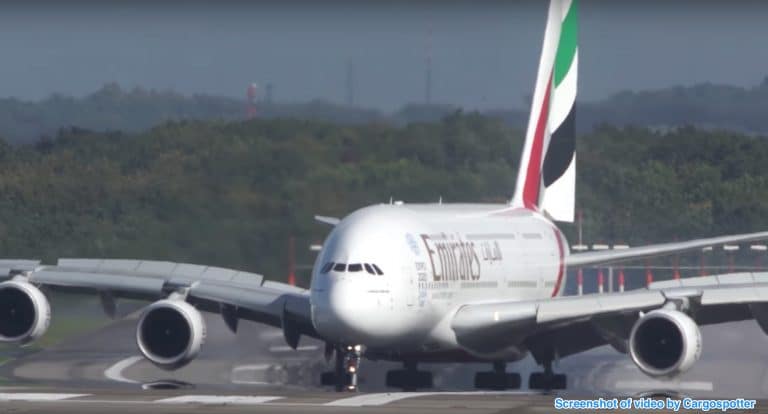
In the second clip a China Airlines Airbus A350-941 (reg B-18905) puts down on 18R at AMS with a heavy crosswind component in the mix. Look at that crosswind offset and crabbing correction the pilot holds to keep the airliner moving parallel to the runway! Those wind turbines in the background don’t seem to be spinning very fast. China Airlines operates eight A350s with another six on order.

[youtube id=”q4DPiuZdxmo” width=”800″ height=”454″ position=”left”]

download 1 1

Turn It Up to 11 Before You Watch This Awesome Swiss F/A-18C Hornet Demonstration Flight!

The Swiss have been operating the McDonnell Douglas (Boeing) F/A-18 Hornet since 1996. Photographs of their pilots spiritedly maneuvering the jets with mountainous terrain for backdrops are striking. When a full demonstration flight is captured in high-definition video with the sound of freedom echoing around the valley between the mountains it is definitely worth a look and a listen- preferably with the volume turned up to 11! This particular video was uploaded by YouTuber Elwyn R and captures the solo display of Swiss Air Force pilot Captain Nicolas Rossier flown during the Breitling Sion Airshow. Nice vapes!

Delivery of 26 single-seat F/A-18Cs and eight dual-seat F/A-18Ds to the Swiss Air Force began in 1996. The deliveries were complete by the end of 1999. Switzerland requested to be included in F/A-18C and F/A-18D Upgrade 25 Program to extend the useful life of their Hornets in 2007. The Upgrade 25 Program consists primarily of significant upgrades to the avionics and the primary mission computer, Raytheon Advanced Targeting Forward Looking Infrared (ATFLIR) targeting and surveillance pods, and AN/ALR-67v3 ECM equipment. The Swiss Hornet fleet reached the 50,000 flight hour milestone in October of 2008.

Fa 18c.hornet.j5003.swissaf
Source: Wikipedia- Public Domain

Destination COS: The Resurgence of a Regional Airport

0

Colorado Springs Airport has a long and colorful history. Originally opened in 1927 with only two gravel runways, the first scheduled airline flight went from El Paso through Pueblo to Denver, and back. COS has been through trials and tribulations throughout the years with bankrupt airlines and countless broken promises. But to the delight of Colorado Springs and the surrounding communities, the regional airport has begun a remarkable recovery.

Remember the Simpsons Jet? The Glory Days of Western Pacific Airlines and COS

5288157397 e883a66965 b
FOX paid Western Pacific $1M a year to display this special themed jet. Photo by AeroIcarus (CC 2.0).

Western Pacific Airlines started operations at COS in the spring of 1995 with eight 737-300s providing service to Las Vegas, Los Angeles, and Oklahoma City. The airline is infamous for its LogoJet program, which made the exterior of the airliner a flying billboard.

Of particular note, FOX Television paid WesPac $1 million a year for a LogoJet featuring the Simpsons animated series during ratings sweeps. The Simpsons jet, as it was called, was a bit of a phenomenon. Encouraged by early success, WesPac expanded its fleet and had eighteen 737-300s in operation with advertisers expanding to resorts, casinos and even the City of Colorado Springs. An updated terminal facility was built in 1994 because of the marked increase in passenger numbers.

In 1996, however, impatient investors hungry for profit got rid of the WesPac management team, including the original founder Ed Beauvais who was replaced by Robert Peiser. Peiser served as Chief Financial Officer of Trans World Airlines from 1994 to 1996, following TWA’s emergence from Chapter 11 bankruptcy. This fact foreshadows what was forthcoming for WesPac and COS, as Peiser moved toward reorganization.

It became clear that WesPac was operating in the red. Peiser attempted to attract more business travelers to augment revenue and scrapped the LogoJet program. He also moved the airline to Denver International, supposedly to attract more passengers even though some would later say the move was to secure more attractive financing terms for the pending bankruptcy. After a proposed merger with Frontier Airlines was tabled, WesPac was liquidated and ceased operations in February 1998, a milestone date in demise of COS.

Airline Consolidation Cripples Non-Hubs Like Colorado Springs Airport, While Denver International Flourishes

After WesPac was dissolved, a wave of consolidation hit the airlines. As of 2015, the nine major U.S. airlines were reduced to only four: American, United, Delta and Southwest. The largest airports, including Denver International, were effectively controlled by one or two airlines creating what some refer to as airline monopolies. Changing industry conditions severely affected non-hub airports like COS. The result of carriers’ consolidation left it a mere shadow of what it once was, while Denver International continued to grow.

The airlines had to reevaluate routes in order to maximize profits and eliminate what was called unprofitable flying. This led to increased passenger load per flight. Load factors now averaged 80% for some of the majors flying out of Denver.

Fuel costs, when calculated on a per-passenger basis, also led to a decline in profitability. There was increased emphasis on fuel-efficient aircraft as airlines changed their fleet mix, decreasing the use of smaller, regional jets in favor of large new aircraft. The cost squeezing and consolidation had detrimental effects on the smaller facility in Colorado Springs, shifting an even larger percentage of traffic to Denver International.

Fast forward to 2012, when Frontier Airlines added nonstop service at COS to several destinations, in addition to the already existing daily flights to their hub in Denver. Service to Los Angeles, San Diego, Seattle-Tacoma, Portland, OR, Phoenix-Sky Harbor and Orlando was discontinued, however, in 2013, after Frontier announced the new service routes were not meeting financial expectations. After the back and forth with Frontier, at this point the future of COS looked bleak. But nobody foresaw what the future held for the beleaguered airport.

COS Begins to Rally Once Again

Frontier Airlines A321
A Frontier A321. Frontier began receiving the larger jets in 2014. Photo by: By Griz13 (Own work) [CC BY-SA 4.0] via Wikipedia Commons.
After more than a decade of negative projections, Colorado Springs Airport has begun a positive trajectory and is capping off a year of positive growth. The off-again, on-again Frontier Airlines has played a major role in fueling the COS recovery.

Beginning in 2016, the airport began to rally once again as Frontier reinstated nonstop service to Las Vegas, Orlando and Phoenix-Sky Harbor. Then, starting in March 2017, Frontier added seven new cities with seasonal service from COS including major hubs such as Chicago O’Hare, San Francisco, Los Angeles, and Washington bringing the total number of cities with nonstop service to 17. Frontier’s continued expansion includes some current additions, including service to Ft. Myers Florida beginning October 5 and service to Tampa slated to start October 6. Rounding out the airlines operating out of the recovering regional airport are American, Delta, Allegiant, and United.

routemapCOS
COS airport non-stop options are expanding. Source: VisitCOS.com

The news is not all rosy, however, as Horizon, the regional carrier for Alaska Airlines, is being forced to discontinue service to Colorado Springs effective November 4 due to a pilot shortage. Horizon is also pulling out of other airports because of the aviator shortfall. In spite of this recently announced setback, the overall growth of the Colorado Springs market as a whole is buoying COS growth.

A 2017 forecast from the University of Colorado Springs Economic Forum predicts the strong economic indicators of the past two years will continue well into next year, fueled by the robust job market. Consumers are expected to continue making major purchases on things like furniture and appliances, and the travel and airline industry are also benefactors in the economic boon, with both leisure and business travel showing an upsurge.

This is great news for a beloved regional airport that has seen its ups and downs over the years. From its fledgling start early in the century as a local airport with two gravel runways, to the roaring ’90s heyday featuring the WesPac FOX TV Simpsons jet, to the present-day recovery based on a strong local economy, COS is poised to rise into the next decade as a major player in the airline industry.

Air Traffic Control Reform: The Battle of the Fat Cats

0

There is a battle royale brewing over the future of Air Traffic Control in the US which could affect much of the nation’s air transportation system. While the usual ideologically pro and anti privatization partisans are playing their roles to perfection, there is an array of very well heeled interests on both sides of this legislative food fight. This has scrambled the rich and powerful vs. the little guy narrative which usually attends these sorts of melees.

Some Background on ATCS

You may or may not have been following the story about efforts to corporatize and privatize the FAA’s Air Traffic Control Services (ATCS), so here’s the story so far:

Organized under the DOT, the FAA is divided into several divisions which have responsibility for the nation’s air transportation system. The major divisions in the FAA are responsible separately for airports, aviation safety, space transportation, and air traffic control services. It is this last division, air traffic control services, that has become a political football in recent years.

The idea of privatizing ATCS dates back to 1985 when an airline industry trade group, the Air Transport Association (ATA), published a paper calling for a federal corporation to take control of air traffic control. Since then, the idea has percolated in think tanks and resulted in various legislative efforts, but has never had enough support to pass into law. Interestingly, there have been efforts on both sides of the political aisle for privatization including a 1994 proposal from Vice President Al Gore’s reinventing government initiative.

Fast forward to today and the idea is once again back within striking distance of becoming a reality due to the Trump administration’s desire to reduce costs for businesses while both branches of Congress also belong to Republicans. President Trump held a meeting for airline executives shortly after taking office where he stated support for the idea of ATCS privatization, which has been somewhat of a holy grail for the airlines.

The idea is to spin off the FAA’s ATC services into a not-for-profit corporation which would be funded by user fees (with some carve outs). This corporation would be controlled by a board consisting of stakeholders from across the industry. Over 50 countries around the world including Canada have adopted a similar structure for their air traffic services to date.

The mechanism by which privatization of ATC would occur is the current FAA spending reauthorization bill. Now working its way through Congress, Senate Bill 1405 does not include provisions for privatization while the competing House Bill 2997, called the 21st Century Aviation Innovation, Reform & Reauthorization Act (or AIRR Act.), does include the privatization of ATC.

Funded through September 30, the FAA will need a short term authorization to continue to function without the passage and reconciliation of these two bills. Whether ATC privatization survives the legislative sausage making process is an open question.

As alluded to above, though, some interesting alliances have been formed for both the pro and anti privatization sides, and they aren’t exactly lining up as how you might expect. For starters, there are some very well connected and deep pocketed players on both sides. Shall we have a look?

The Pro Side

IMG 1375

The airlines are predictably the most pro-privatization players on the field as they have the most to gain through the legislation. Operating about 27,000 flights daily carrying about 2 million passengers, the airlines see delayed technology rollouts and inefficiencies in the current system as a direct threat to their business model.

As Southwest Airlines founder Herb Kelleher once put it, “In no other industry does a government bureaucracy have direct control over the production line of a multi billion dollar industry.” With about $200 billion in revenue for 2016, US airlines have quite a bit on the line and also the means to advance their cause for a more streamlined ATC system.

An unlikely voice on the pro side is that of the air traffic controllers themselves. The controllers, through their union (NATCA), have come out decidedly in favor of privatization. It is rare that a public employee union would come out in favor of the privatization of their own jobs, but reviewing their materials reveals a rare exercise in realpolitik.

The controllers complain that their livelihoods are a constant political football subject to the political whims of the day concerning FAA funding and disruptions such as sequestration. In their opinion, a not-for-profit air traffic corporation funded by user fees would provide needed stability and growth to their career field.

The Anti Side

IMG 0047 e1506046717752

Some of the most ardent opponents of the privatization of ATC services are the owners of small privately owned aircraft. Known as “general aviation” (GA) and represented by the Aircraft Owners and Pilots Association (AOPA) this group is fiercely opposed to the scheme, and probably with good reason.

With the FAA and by extension air traffic control services currently funded by excise taxes on fuel, the fear is that a new user fee regime would end up sticking GA pilots with higher operating costs. This may or may not be true, but if you are happy with the current arrangement, you will be skeptical of any changes. It should be noted, though, that the legislation currently under consideration keeps the GA funding method through excise taxes on fuel the same as it currently exists.

One argument used against GA owners is the allegation that they consume ATC services in excess of what they pay into the system and therefore like this arrangement just as it is. The airlines, who pay excise taxes on the gargantuan amount of fuel they consume, would allegedly like a change to a user fee system which would shift away some of their cost burden. The challenge of any ATC reorganization will be to determine the amount of ATC services each group consumes and to then apportion the costs in relation to that consumption; no easy task when each side mistrusts the other.

The last group on the anti side are the owners of private business aircraft or business jets. These people are perhaps the fattest cats in the sky. They have thrown their lot in with general aviation believing that the airlines would have undue influence in a new air traffic control corporation and restrict their operations into major airports where a bizjet carrying two or three passengers can take up as much airspace as an airliner carrying hundreds.

What’s next?

How this fight eventually ends is really anyone’s guess. You might believe that because the Republicans control both the House and Senate that passage would be a slam dunk, but that is apparently not the case. The partisans on both sides of the debate have their champions in Congress and very deep pockets to keep them in the fight.

I’ll admit to being personally agnostic on this issue. From my perspective as an operator and primary consumer of ATC services, there is little doubt that the system could use a boost in efficiency and a more rapid deployment of promised technology. That said, as currently structured, the system does handle an amazing number of aircraft and is staffed by dedicated and competent professionals.

And it should be noted, that even though the ‘holy’ cause of safety may be invoked by either the pro or anti side, I don’t believe any questions of safety are relevant in this debate. Our current aviation system is about as safe as it can be made short of parking airplanes and it is likely to stay that way in any reorganization.

Pikes Peak Regional Airshow to host USAF Thunderbirds This Weekend

0

COLORADO SPRINGS, Colo. — The tight precision flying of the Air Force Thunderbirds and the aerobatics of the Trojan Phlyers will highlight the Pikes Peak Regional Airshow this weekend in Colorado Springs.

This “Thunderbirds and Warbirds” airshow will mark the 70th anniversary of the U.S. Air Force with popular aircraft demonstrations, great food, and an aviation themed kids zone on Saturday and Sunday. Tickets remain available online, and proceeds from the airshow will go directly to the neighboring air museums, including the Peterson Air and Space Museum.

The Thunderbirds six F-16C jets will perform their 40-minute display each afternoon demonstrating the actual maneuvers used in training or actual combat.

During the airshow as the Diamond Team of four jets soar overhead at nearly 400 m.p.h., each flying three feet apart, behind the crowd, the two solos are lining up for a high speed maneuver in which they make a close pass by one another from either side of the airfield.

“As the jets take to the skies and fly only a few feet from wing tip to wing tip, the crowd gets a glimpse of the awesome skills and capabilities that all fighter pilots must possess,” Thunderbird spokesperson Captain Sara Harper said. “The solo pilots integrate their own loud and proud routine exhibiting some of the maximum capabilities of the F-16 Fighting Falcon.”

The Air Force Air Demonstration Squadron is lead by LT. Col. Jason Heard aboard the Thunderbird 1 jet. The six demonstration pilots also include left wing pilot Major Ryan Bodenheimer aboard Thunderbird 2, Thunderbird 3 right wing Major Nate Hoffman, slot pilot Major Nick Krajicek in jet 4, and Major Alex Turner and Major Whit Collins performing as lead and opposing solos in jets 5 and 6.

Also scheduled to perform are the Wings of Blue parachute team, who will freefall from a vintage World War II B-17 plane and land at the center of the airfield. Later, two T-28B Trojan aircraft will perform both solo and formation aerobatics as the Trojan Phlyers take to the skies each day.

“The Pikes Peak Regional Air Show Heritage Flight for 2017 features two remarkable aircraft, the P-38 Lightning and the A-10 Thunderbolt II, honoring one man whose dedication to his pilots and the nation serves as inspiration for all, Col. Francis “Frank” Royal,” Airshow officials announced on Wednesday.

Static displays from the 21st Space Wing and Air Force Space Command will be on display on the tarmac so guests can receive an upclose look.

The two-day airshow will cater to children with the popular KidZone and Kids Fun Area — both designed to educate, inspire, and have fun as the aircraft soar above.

“A Kid Zone learning area will offer activities for kids of all ages,” said MSgt. Nathan Langford, airfield manager at nearby Peterson AFB. “They can get in a 1930s-era N3N biplane and get a simulated flying lesson, build their own paper airplanes and fly them, or draw and color airplanes. There will also be educational exhibits for the older kids.”

Colorado Springs Airport gates will open at 8:00 a.m. and the opening ceremony will begin at 11:50 a.m. on Saturday and Sunday. Airshow officials urge the public to arrive early, and to follow the airshow Facebook page for updated traffic and parking lot conditions.
thun2

(Charles Atkeison reports on aerospace and technology. Follow his updates via social media @Military_Flight.)

Launch of Classified Satellite to Light Up California Coast Tonight

0

UPDATE 9/21/2017 5:26PM PT: A statement from ULA, “The ULA Atlas V rocket carrying the NROL-42 mission for the National Reconnaissance Office has been delayed. The delay allows the team time to replace a faulty battery on the Atlas V booster. The vehicle and spacecraft remain stable. Launch of the NROL-42 mission is scheduled for no earlier than Saturday, Sept. 23, 2017.”

United Launch Alliance (ULA) is all systems GO for a launch attempt tonight from Vandenberg AFB, CA with a classified surveillance satellite for the National Reconnaissance Office (NRO), after a launch readiness review conducted yesterday cleared the mission to proceed.


Liftoff is scheduled for 10:38 p.m. PDT atop an Atlas-V ‘541’ rocket from Space Launch Complex-3, and should put on quite a show for spectators up and down the California coast since the rocket will employ four solid rocket boosters; in addition to the workhorse Atlas V’s powerful and proven reliable Russian RD-180 liquid engine.

[youtube id=”4UjeoySzxPo” width=”800″ height=”454″ position=”left”]

“This launch is the culmination of many months of work byULA, the NRO and the 30th Space Wing,” said Col. Gregory Wood, 30th Space Wing vice commander, who will be the launch decision authority. “All of Team Vandenberg is dedicated to mission success and proud to play a part in delivering these capabilities to our nation.”

Weather forecasts from USAF meteorologists are 60% favorable for a liftoff tonight, with the main concerns being launch visibility and ground winds.

Tune in to the live broadcast starting at 10:18 p.m. PDT

MSL 290
File photo of a ULA Atlas-V launching from Florida in its “541” configuration, which flew for the first time in 2011 with NASA’s Mars Curiosity Rover. Photo Credit: Mike Killian

“This launch is a prime example of teamwork by multiple organizations that have worked around the clock to assure mission safety and security,” said Lt. Col. Kenneth Decker, 4th Space Launch Squadron commander. “Given the dedication of the men and women have worked to ensure readiness of the launch vehicle and payload, we’re on track for a successful launch.”

The launch will mark ULA’s sixth of 2017 and 121st overall, and the 25th mission ULA will have flown for the NRO.
.
Follow Mike Killian on Instagram and Facebook, @MikeKillianPhotography
.


What Will Augment the A-10? OA-X Competition Intensifies. Here Are The Competitors

0

The U.S. Air Force is testing four light attack aircraft in an effort to create a more nimble, cost-efficient fleet that can support ground troops with strike and support missions in places like Afghanistan. Coined OA-X by Air Force Chief of Staff Lt. General Mike Holmes, the plan is being offered as a solution to quickly train more fighter pilots in less expensive aircraft and reduce the costs of low-intensity operations, where the threat is limited to machine guns and shoulder-fired missiles. Proponents argue such combat situations don’t require expensive long range aircraft carrying heavy weaponry, arguing less expensive light attack aircraft are a sensible replacement

The aerial showdown began July 31. The proving ground: Holloman Air Force Base in New Mexico. The four contenders, the Sierra Nevada/Embraer A-29 Super Tucano, Beechcraft AT-6 Wolverine, Textron AirLand Scorpion and AT-802L Longsword have been flying missions night and day, demonstrating their prowess with and without weapons, conducting surveillance and simulated light attack missions.  Here are the entrants:

A-29 Super Tucano

Afghan Air Force Embraer A 29 Super Tucano YA 1407 1
An A-29 Super Tucano in the Afghan Air Force Scheme. Photo by Nardisoero (Own work) [CC BY-SA 4.0 An Afghan A-29 Super Tucano(http://creativecommons.org/licenses/by-sa/4.0)], via Wikimedia Commons
The A-29 has a two-seat cockpit and is designed by Brazilian manufacturer Embraer, who teamed up with Sierra Nevada Corporation to get the plane to market in the U.S. It can carry bombs, rockets and missiles on its five pylons, one under the centerline of the fuselage and two in each wing. The A-29 would be produced at Embraer’s facility in Jacksonville, Florida, putting it in line with President Trump’s Made in America program.

AT-6 Wolverine

AT 6B Wolverine RIAT 2016 30000820772
AT-6 Wolverine is in the hunt to claim the AO-X title. By Airwolfhound from Hertfordshire, UK (AT-6B Wolverine – RIAT 2016) [CC BY-SA 2.0 (http://creativecommons.org/licenses/by-sa/2.0)], via Wikimedia Commons
The second OA-X candidate, the AT-6 Wolverine, has 50 percent more horsepower than its granddaddy, the Beechcraft T-6A Texan II, which has previously been used to train Air Force and Navy fighter pilots. The AT-6 is also a two-seater and has 7 wing hardpoints for sensors and weaponry. Both the A-29 and AT-6 have an industry-standard single Pratt & Whitney Canada PT6A turboprop engine and reach cruising speeds of about 320 miles an hour.

Textron Scorpion

The Textron Scorpion is a multi-use ‘off the shelf’ jet in search of a mission. Winning the AO-X competition would be a breakout opportunity. Photo by Krasimir Grozev (Own work) [CC BY-SA 4.0 The Textron Scorpion (http://creativecommons.org/licenses/by-sa/4.0)], via Wikimedia Commons
The third competitor is the Scorpion, the only jet in the contest. The Textron AirLand two-seat, high-wing aircraft boasts two Honeywell TFE731 turbofans, thrusting it to a maximum speed of more than 500 miles an hour. The Scorpion has six under-wing stores stations, a retractable mount in its nose for a sensor turret and internal payload bay.

AT-802 Airtractor Longsword

1024px Paris Air Show 2017 Air tractor Longsword left front
A very unusual entrant to the competition, the AirTractor shines in low and very slow operations. Photo by Marc Lacoste (Own work) [CC BY-SA 4.0 (http://creativecommons.org/licenses/by-sa/4.0)], via Wikimedia Commons
The AT-802L Longsword was a late entrant in this military show of might and can carry numerous guided missiles and bombs, rockets, and gun pods thanks to provisions for up to four hard points under each wing and up to three hard points under the fuselage. The AT-802L can carry more fuel than the other three competitors, enough for 10 flight hours which is equivalent to a 400-mile combat radius.

What’s next?

Which plane will be selected? That next phase of the fly-off is likely to be an experimental deployment to a real-life combat zone. Iraq and Syria are examples of locations where the planes could fly missions to showcase their surveillance and combat ability. However, the Air Force has not confirmed a definitive location for the exercises as of yet.

Crazy Video Shows Russian Attack Helicopter Misfire Rocket Directly at Onlookers

1

Some wild video has recently surfaced from Russia (of course), showing a pair of Ka-52 attack helicopters approaching a crowd of onlookers, before one accidentally fires missiles directly at them.

In reports published by Russian media this week, the helos were participating in “Zapad 2017″ war games, and were conducting a training exercise at a firing range near St Petersburg, when the misfire occurred.

[youtube id=”O-3gguzL6xo” width=”800″ height=”454″ position=”left”]

Above, watch video from both the ground and cockpit of the accident as it happened.

It’s an unclear just how many rockets were fired, or who the crowd fired upon was, but the Russian Defense Ministry, in comments to Russian media, confirmed several people were injured and a couple vehicles burned and destroyed, but denied reports claiming any were civilians.

No deaths have been reported.

[youtube id=”UVvdN5FoF3M” width=”800″ height=”454″ position=”left”]

Russian newspaper The Kommersant has reported the helicopter’s weapon control system malfunctioned; its unguided rocket fired without the pilot’s command, and was fired immediately after the pilot turned off the safety switch.

The paper also claims it was the third aviation accident in a week. A supersonic long-range bomber skidded off the runway on Sep 14 (the day the Zapad 2017 drills kicked off), and a training aircraft crashed two days later.

Follow Mike Killian on Instagram and Facebook, @MikeKillianPhotography
.


Rumor Roundup: Southwest’s Hawaii Plans From Likely To Just Plane Crazy

0

Earlier this week we reported that we believe that Southwest Airlines will likely announce that they are entering the Hawaii market.  While it is speculation, there are many good reasons to believe that Southwest will very shortly announce (possibly even announce today) that they will commence service to the Hawaiian Islands in 2018.

Since our story on Monday, Seeking Alpha produced a story with detailed FOIA requests between Hawaiian government officials and the airline, all but confirming that some sort of announcement involving Hawaii was in the works.  The rumor mill has kicked into overdrive on the internet and within avgeek circles.  While most of these rumors will prove false, it’s been fun to entertain the speculation and think through some of the open questions. Let’s preface this post…all of this is speculation based on our analysis of the market and our passion for the airline industry.  Here are some of the rumors we’ve heard, listed from most likely to occur, to fanciful.

RUMOR #1: Southwest will announce service to the Hawaiian Islands with at least 10 flights

Southwest will commence service with 10 flights from their major west coast hubs to Honolulu and Maui with Kona and Lihue to begin later in 2018.  Possible launching points for the flights include Oakland, San Jose, Los Angeles, Seattle,and San Diego.  This strategy would permit Southwest to directly confront Alaska Airlines’ growing size on the West Coast.

Since Alaska’s acquisition of Virgin America, Southwest has become more aggressive in confronting Alaska, launching routes that compete directly to contain Alaska’s growth. Alaska and Virgin have a very strong presence in the Hawaiian market. The launch of the Hawaiian market would be a direct move to contain Alaska’s growth and capture some of Alaska’s market share.

Open questions:  What city pairs will Southwest launch?  Will they serve all 4 major Hawaiian airports?  What would be the timing of this launch, knowing that they still need to formalize their ETOPS program? Will Southwest modify their Rapid Rewards program for the Hawaiian market?When will the service commence?  Southwest is retiring their 737-300s and will not have significant spare capacity until the middle of next year.

RUMOR #2: Southwest will announce a code-share with Hawaiian Airlines

1024px Hawaiian Airlines A330
A Hawaiian Airlines A330 is parked at a Honolulu gate. By Hakilon (Own work) [CC BY 3.0 (http://creativecommons.org/licenses/by/3.0)], via Wikimedia Commons
This rumor, if true, would be wild but not unprecedented.  A partnership with Hawaiian would give Southwest immediate access to the islands and Asia while limiting the risk of directly entering new markets. Hawaiian flies to many of Southwest’s destinations on the West Coast.  Hawaiian is also set to receive a slew of new Airbus A321NEOs, beginning later this year.

Hawaiian would limit its risk of a potentially brutal competition with Southwest on its home turf. It also serves as a way to provide better air travel access to Southwest’s millions of Rapid Rewards frequent fliers. Southwest’s upgraded reservation system can now handle code-share reservations.  While this rumor seems unlikely, Southwest has already had codeshare agreements with ATA last decade and an interline agreement with Icelandair back in the ’90s.

The rumor seems pretty unlikely, but anything is possible.  If some sort of agreement were to happen, it is more likely that Southwest would fly their own metal to the Islands with connection opportunities to smaller Hawaiian markets, along with Australia and Asia onboard Hawaiian jets.

Open questions:  How would Southwest’s pilots/flight attendant union react to this code share?  Southwest’s contract with the pilots places strict limits on codeshares.  How would Southwest handle multiple classes of service?  Hawaiian Airlines has first class on all of their flights.

RUMOR #3:  Southwest will acquire Hawaiian Airlines

The rumor of an acquisition has been floating around industry circles for years. This one is surprisingly persistent. On the plus side, there isn’t significant route overlap between the two airlines. The merger would be largely complementary and give Southwest immediate own-metal access to Asia, Australia and the Hawaiian short-haul market. But the challenges would be many.

First, there is zero fleet commonality between the two carriers. Hawaiian flies a mix of 717s, second-hand 767s, A330s and plans to add A321NEOs and A350s over the next few years. Southwest only flies the Boeing 737. Second, Southwest just completed a complex merger with AirTran. Integrating cultures is difficult, even with an airline like AirTran that had a largely similar business model. The merger between AirTran and Southwest was challenging. A Southwest/Hawaiian linkup would be immensely challenging, costly, and divergent from their simplistic model of flying one type of airplane, with one class of service. Plus, there is no guarantee that a mega-merger between two top 10 carriers would even be approved by the Trump administration. Our guess here is that a merger would be very, very unlikely.  But we can never say never…

Open questions: Would it receive government approval? How would Southwest integrate such a different type of airline to their existing network?  How would they integrate two different cultures?  What would they do with first class on Hawaiian aircraft? Would they keep the largely redundant A321NEO fleet?

So what do you think?  Will Southwest announce entry to the Hawaiian market? Only time will tell…

Photo Essay: Andrews AFB Airshow Wows Crowd

(Photos and story by Curt & Randy Jennings)
SUITLAND, MD – Last weekend’s 2017 Joint Base Andrews Air Show was once again a fantastic glimpse at the aerial capability of the United States military. The weather cooperated all three days of the show, without a drop of rain and mostly sunny skies, so everyone was able to enjoy a great time.

DSC 0215

As usual, the USAF Thunderbirds were the highlight of the show as well as the last to perform. Still all in attendance were thrilled at the performance of: the Army’s Golden Knights, the F-22 Raptor, the B-2 Spirit bomber, the Geico Skytypers, the B-29 Superfortress Doc, Patty Wagstaff’s incredible aerobatic display, and many more fine performers.

It was a very special treat to see, for the first time, the Boeing B-29 Doc take to the skies at Joint Base Andrews. After years of hard work by a team of dedicated volunteers, Doc became the second airworthy B-29 in the world. Previously the only flyable B-29 was Fifi, operated by the Commemorative Air Force.
IMG 6127

Having had the opportunity to photograph both Doc and Fifi, I would say that I strongly prefer to capture images ofDoc.  While Fifi is a sight to behold, she is painted gray, while Doc’s external surface is polished aluminum thus providing a fantastic reflection for the photographer.  This was evident as Doc flew over Joint Base Andrews with the runway clearly reflected on its side. Additionally I witnessed several people taking their self-portraits in Doc’s reflective surface when she was back on static display.
DSC 0580
Fast forward to the most modern aircraft in the Air Force’s inventory, the F-22 and B-2 were very impressive.  The acrobatic flight demonstration of the F-22, with its vectored thrust, continues to thrill the crowd.  The F-22 was later joined by a P-51 Mustang, flying in in formation as a Heritage Flight. As always, the flyover of the B-2 was both a rather eerie sight and sound due not only to its strange look but how quite it is for a plane of its size. 
DSC 0034
Kids of all ages enjoyed the static aircraft that provided hands on experience with what our nation uses to project American military capability.  More importantly, show attendees were able to interact with military personnel who are the core of our nation’s military might.
DSC 0006 e1505880702794
Having attended many of the Andrews shows over the past twenty plus years, I would say this is a good show but not what it once was mostly due to budget cuts.  In the past, the Andrews show occurred on an annual basis, though the last show was two years ago. It used to be a truly joint show with greater participation by the Army and the Marines, both on the ground and in the air.  We will see if the nation’s defense budget will stabilize to make this again an annual event.  Still the 2017 Joint Base Andrews Air Show was a fantastic time for both the aviation enthusiast as well as the first time air show attendee.
IMG 6708
DSC 1009

DSC 0881

DSC 0023 e1505880800815

DSC 0728

Check Out The 4th Fighter Wing’s 75th Anniversary Heritage F-15

0

The 4th Fighter Wing at Seymour Johnson AFB, North Carolina is celebrating their 75th anniversary this month, and recently unveiled a new heritage paint scheme on one of their F-15E Strike Eagles to honor the milestone and achievements throughout their history.