

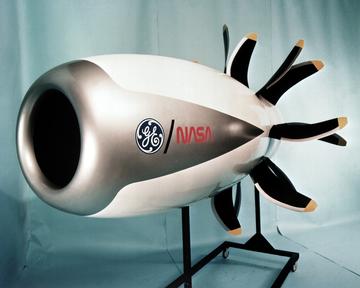
The Unducted Fan (UDF) engine, developed by General Electric, should have been more than a great trivia question.
(Welcome to Avgeekery Jeopardy.)
“Alex, I’ll take Dismissed Aircraft Technology for one hundred.”
Answer: “This fuel-efficient engine type was developed for the proposed Boeing 7J7.”
“What is the Unducted Fan?”
Correct.
In 1985, at the Paris Airshow, Boeing announced a General Electric Unducted Fan prop-fan engine that would power its new 7J7. The 150-seat aircraft, equipped with the two ground-breaking engines, would use half the fuel that the Airbus A320, which was close to coming online.
Three years later, the first plane equipped with a UDF flew, but by then, both the 7J7 and the Unducted Fan were scrapped projects.
After the 1973 Yom Kippur War, an oil embargo was put in place, impacting the United States, Europe, and Japan. Long gas lines for automobiles were one pressing issue, while higher fuel prices were wrecking airlines’ bottom lines (sound familiar?).
NASA’s Lewis Research Center in Cleveland conducted research to find the sweet spot between a propeller-driven engine that would be fuel-efficient but still deliver speeds so that a New York-to-Los Angeles flight wouldn’t take eight hours.
Originally called a “turboprop,” that term had to be changed to “prop-fan.” A survey of potential passengers rejected the first term because apparently it referenced propeller-driven aircraft, but half of those surveyed were OK with the “prop-fan” term. Go figure.
GE began developing the technology in the late 1970s, amid rumors that its CFM56 turbofan was about to be surpassed by a competitor. The UDF engine nacelle was egg-shaped. At the narrow end were two rows of 12-foot-diameter propeller blades made from carbon fiber composite materials. It was larger and more powerful than the engine that NASA had developed.
The GE engine’s twin propellers spun in opposite directions to reduce losses due to “swirl” – energy wasted in imparting spin to the air behind the airplane. The UDF blades were directly and gearlessly powered by a turbine driven by hot gas from the engine. The two rows of propeller blades were each anchored to multiple rows of turbine blades.
For the 7J7, the engines would be mounted near the tail to allow clearance for the propellers and to reduce cabin noise.
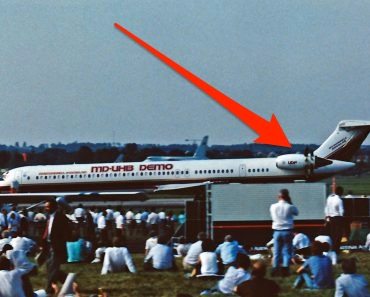
But what sparked the interest in developing a fuel-efficient engine and aircraft became the demise of the UDF and the 7J7. The end of the oil embargo led to cheaper fuel prices. The 737 remained a workhorse for short- to mid-range flights, while the Airbus A320 offered even better performance.
Developing and selling another 150-seat with radically different engines didn’t prove financially feasible in the late 80’s. Plus, the radical engine design – those darn propellers – led to scrapping both the 7J7 and the UDF for commercial use.
People loved jet engines, but the UDF design, along with some noise issues, led to the postponement and eventual cancellation of any follow-on test program or adoption.
6.8.16
