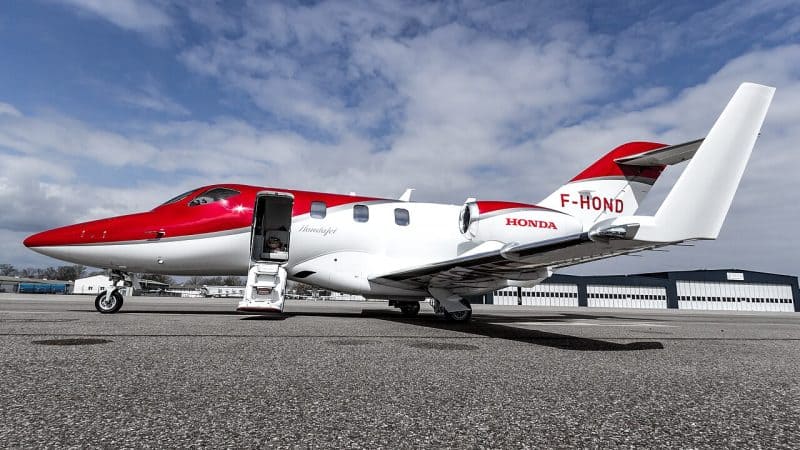
When you think of a private jet, a name like ‘HondaJet’ often doesn’t spring to mind, but rather ‘Gulfstream,’ ‘Cessna,’ and ‘Bombardier.’ Little do some know that while the automaker has had a sizable chunk of the market share, it also has a history in aviation spanning almost 40 years.
How did Honda come about entering the private jet business, and how do their aircraft hold up today? Here’s the story of the HondaJet.
Honda’s Humble (Aero) Beginnings
In 1986, the Fundamental Technology Research Center opened in Saitama, Japan. Honda was among the companies involved with the center and began to study aircraft fundamentals. Honda created the Honda Aircraft Company (HACI) with the goal of building a modern aircraft fit for the 21st century.
HACI President Michimasa Fujino quickly realized how big of an undertaking this was for a company like Honda. To reach closer to this goal, Fujino traveled to America to collaborate with Mississippi State University’s (MSU) Raspet Flight Research Laboratory. While in Mississippi, Fujino interned in assembling propeller planes and learned more in-depth about aircraft development.
In the late 1980s and early 1990s, Honda and MSU completed prototypes for a light jet. The first was called the MH-01, followed by the MH-02. However, the next design turned out to be pivotal in the aviation industry.
The Innovative HondaJet
In 1993, one engineer at HACI suggested mounting the engines over the wings rather than along the aft fuselage. This concept improves aerodynamic drag and limits lift, increasing the plane’s fuel efficiency and decreasing noise production. Many recognized this discovery as an important one in aircraft design.
In 1999, Honda and Boeing collaborated to develop a light jet using this new idea. The HondaJet was created, and its first test flights were in 2003. Both the body and engine were designed in-house.
The HondaJet made its public debut in 2005 at EAA AirVenture Oshkosh, an event that ultimately tested whether there was genuine market interest in the aircraft.
Honda President Takeo Fukui gave the green light for full-scale production the following year. A decade later, in December 2015, the first HA-420 was delivered from Honda Aircraft Company’s Greensboro, North Carolina headquarters. By 2024, 250 HA-420s had been sold.
HondaJet’s Variants and Future
From 2017 to 2021, the HondaJet held the title of best-selling light business jet. Yet, it hasn’t garnered the same spotlight as larger jets like Gulfstreams—mainly because of its smaller size, with seating only for up to seven passengers when modified.
Unlike many private jets that come in basic white, Honda treats its jet buyers more like car buyers, offering a range of exterior paint options. Available accent colors include Red, Deep Sea Blue, Luxe Gold, and Black Sable. A brand-new HondaJet typically costs around $3.5 million.
Since 2018, Honda has released at least three variants of the HA-420:
HondaJet Elite (2018): Featured extended range and noise-dampening engine inlets for a quieter cabin.
HondaJet Elite S (2021): Included avionics upgrades, though it added 200 pounds to the aircraft’s weight.
HondaJet Elite II (2022): Gained roughly 100 additional miles of range and introduced autothrottle and emergency autoland systems for added safety and ease of use.
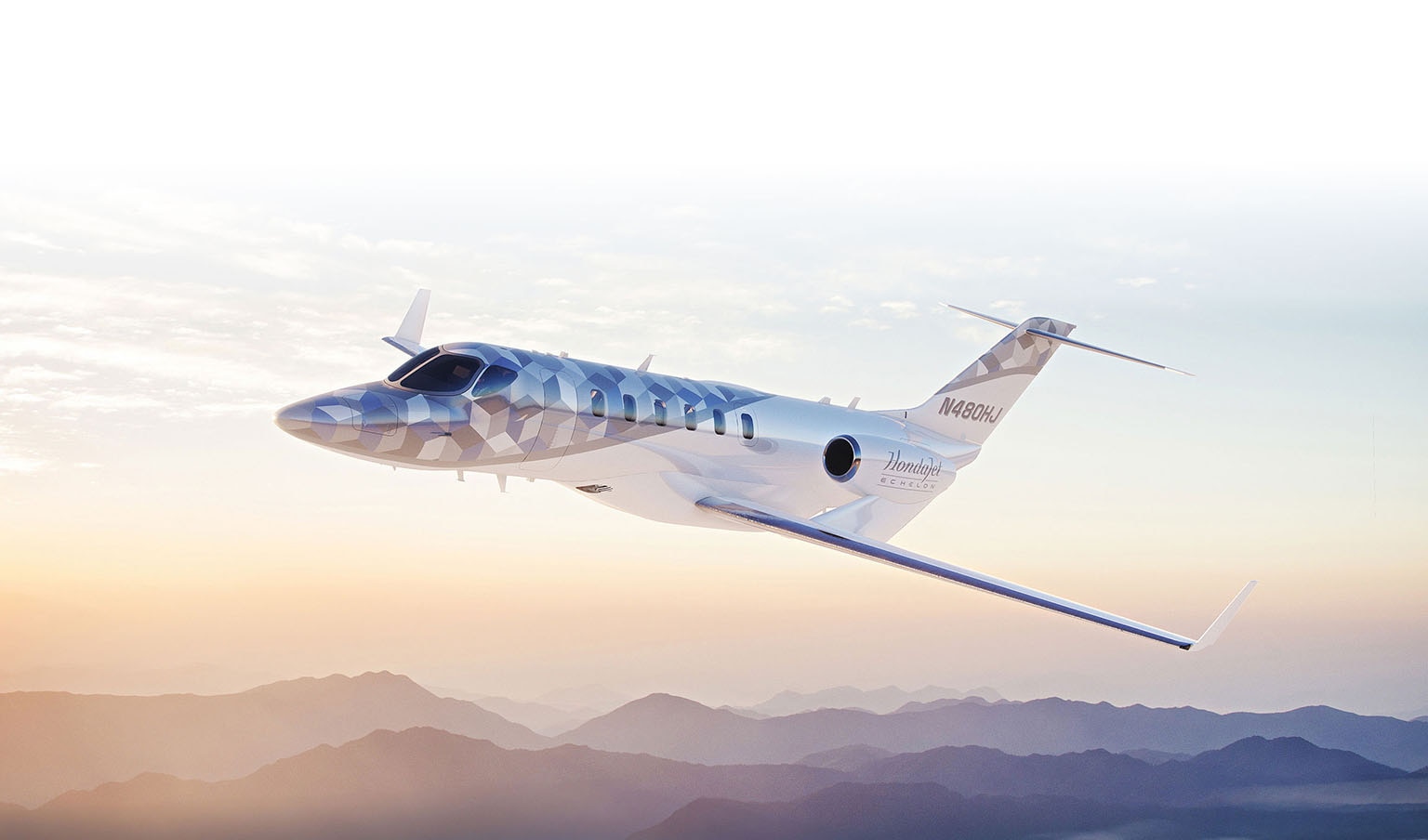
Looking ahead, the HondaJet Echelon is set to debut as the next version of the HondaJet—expected around 2028 or 2029.
The Echelon will feature cutting-edge systems like Runway Overrun Awareness and Alerting System (ROAAS), upgraded flight controls, and a distinctive geometric exterior design. It will also offer expanded seating for up to ten passengers.
Rising tensions between Israel and Iran are causing major disruptions for US airlines and the broader aviation industry.
A week into the conflict, US airlines have temporarily suspended key routes to the Middle East, prioritizing passenger and crew safety in response to heightened regional risks. With travel advisories in place and airspace restrictions tightening, the situation is impacting both US and international carriers.
US Airlines Respond to Regional Instability
A United Boeing 787 departs San Francisco International Airport (SFO). United is one of three US airlines to suspend Middle East service in response to the Iran-Israel conflict. | IMAGE: Photo by Arkin Si on Unsplash
The United States Department of State has issued a Level 4 “Do Not Travel” advisory for Israel, its highest warning level, prompting US airlines to act swiftly.
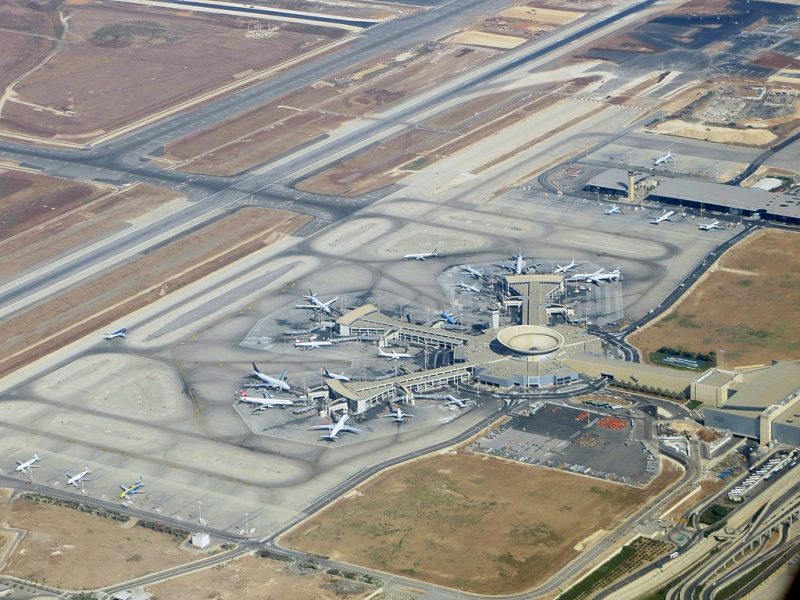
United Airlines has suspended its daily Boeing 777 flight from Newark Liberty (EWR) to Dubai (DXB) from 18 June to 25 June, as stated in a company release. Additionally, United has paused its two daily Boeing 787 flights from EWR to Tel Aviv’s Ben Gurion International Airport (TLV) until at least 1 August. These suspensions began on 12 June, coinciding with the start of Israel’s “Operation Rising Lion.”
American Airlines, which does not operate flights to Tel Aviv or Dubai, has halted its daily Boeing 787 service from Philadelphia (PHL) to Doha’s Hamad International Airport (DOH) from 18 June through at least 22 June, per CBS News. The outbound flight, AAL120, operated as scheduled on 17 June, but the return flight, AAL121, landed safely in Philadelphia on 19 June at 0917 local time, marking the start of the suspension.
This decision follows an urgent warning from the US Embassy in Qatar urging US citizens to “exercise increased vigilance” due to regional hostilities. While no credible threats were cited, the embassy restricted access to Al Udeid Air Base and advised citizens to stay aware, avoid crowds, monitor local media, follow local authorities, and maintain a low profile.
American Airlines emphasized, “We will continue to monitor the situation with safety and security top of mind and will adjust our operation further as needed.”
Delta Air Lines has also suspended its New York (JFK) to Tel Aviv route through 31 August, aligning with United’s suspension from 13 June.
Delta stated, “The safety of our customers and crew remains our top priority. Delta is continuously monitoring the evolving security environment and assessing our operations based on security guidance and intelligence reports.”
The carrier has not confirmed whether it will proceed with plans to add a second daily JFK-TLV flight for the upcoming holiday season.
American Airlines, for its part, has not resumed TLV service since suspending operations there in October 2023.
Iran and Iraq’s main airports, Imam Khomeini International Airport (IKA) in Tehran and Baghdad International Airport (BGW), respectively, are also closed until further notice. No US airlines serve either destination.
International Carriers Adjust Schedules
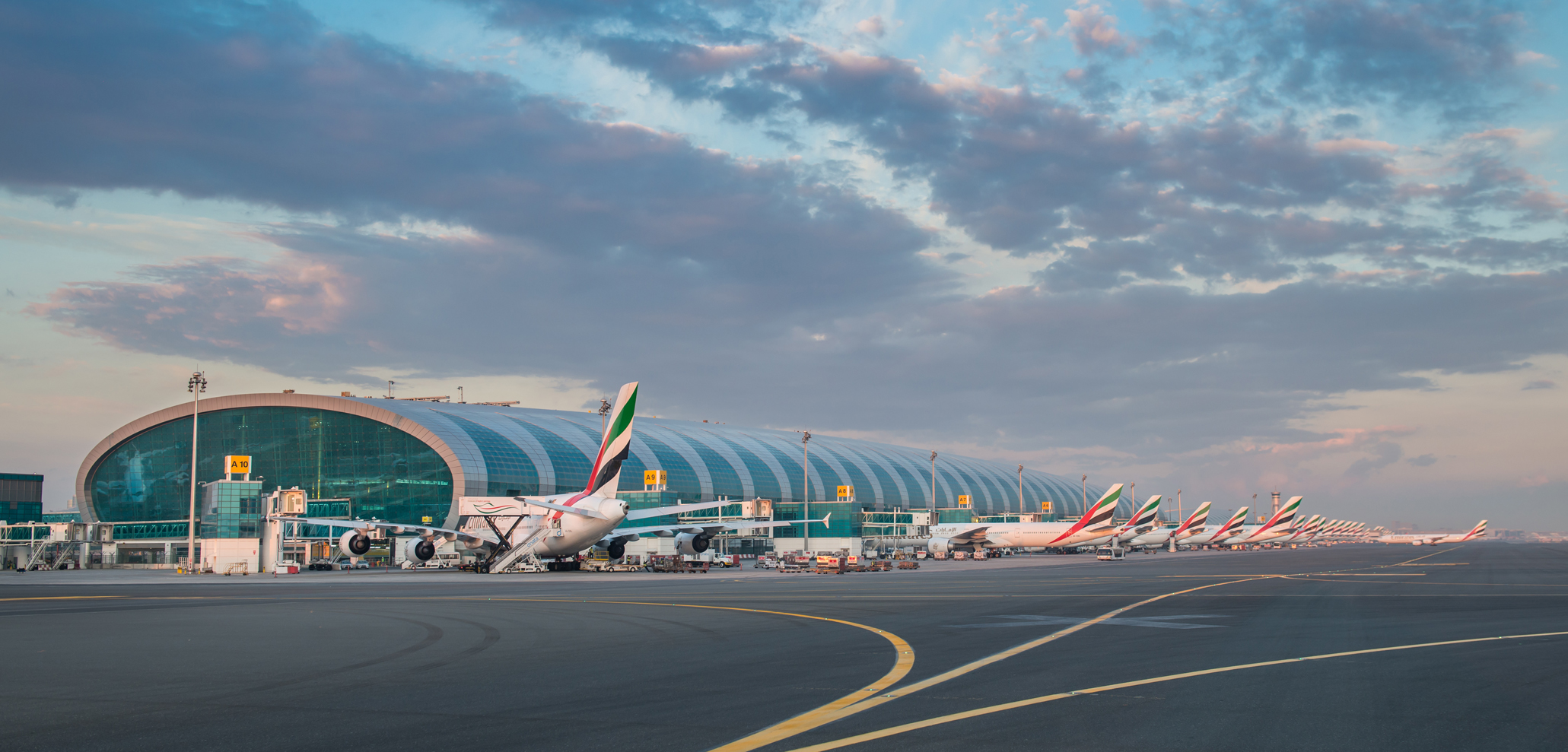
The Emirates fleet at Dubai International Airport (DXB) | IMAGE: Emirates
The impact extends beyond US carriers, with numerous international airlines suspending flights to Middle East hubs. According to The Times of Israel, Air France, KLM, Air Canada, Qatar Airways, British Airways, Emirates, Etihad Airways, Lufthansa, Air India, and others have paused services to cities like Dubai, Tel Aviv, and even Riyadh.
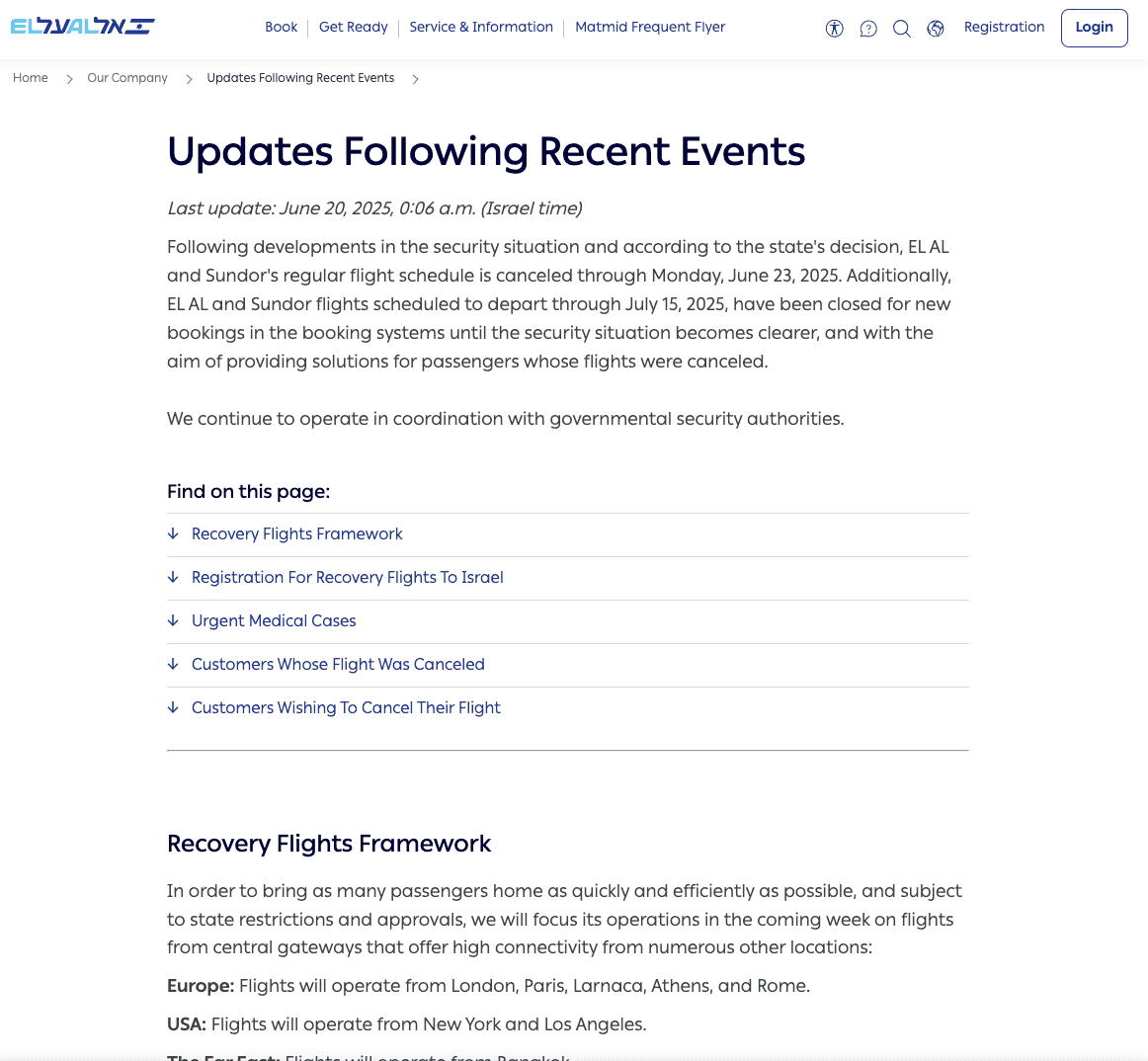
Israel’s flag carrier, El Al, has suspended all flights through at least 23 June, focusing instead on recovery flights to repatriate Israeli citizens stranded abroad. The carrier has stated that it will focus on recovery flights to TLV from:
Europe: London, Paris, Larnaca, Athens, and Rome
USA: New York and Los Angeles
The Far East: Bangkok
Recovery flights also took place on 19 June between Milan, Budapest, and Tel Aviv.
El Al’s website showing recovery flight information for Israeli citizens to return home | IMAGE: elal.com
Airspace Restrictions Complicate Operations
Airborne aircraft avoid three distinct areas around the world in June 2025. US airlines have suspended flights to key Middle East dstinations. | IMAGE: FlightRadar24.com
Airspace closures are adding significant complexity to airline operations. Israel and Iran have closed their airspace, with Israel’s Ministry of Transportation stating that its airspace will remain shut until further notice. Syria, Jordan, and Lebanon have also faced temporary closures of their airspace due to missile trajectories in the region. Iraqi airspace will also remain closed until further notice, as reported by the Iraqi Ministry of Transportation.
These restrictions exacerbate existing challenges, such as the closure of Russian airspace due to Ukraine-related sanctions. Airlines are now rerouting flights, often adding hours to journey times and straining operational flexibility. The combined effect of these closures is severely disrupting air travel across the region, forcing carriers to rethink schedules and fuel planning in an already constrained environment.
FlightRadar24.com imagery showing airspace restrictions in the Middle East amid rising Iran-Israel tensions in June 2025 | IMAGE: flightradar24.com
The aviation industry is navigating a challenging period as US and international carriers adapt to the evolving situation in the Middle East. As the crisis continues to evolve, airlines are closely monitoring developments and adjusting operations accordingly.
As the conflict continues, global aviation faces yet another test of its adaptability, adding yet another crisis to a series of disruptions in recent years.
The aviation industry hopes for the best as the world holds its breath.
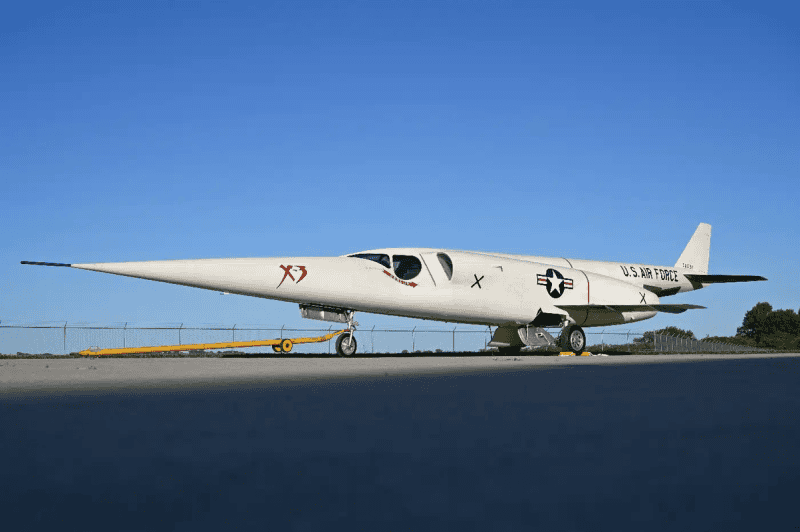
The United States developed the Douglas X-3 to reach Mach 2 and maintain an edge in the race to build the world’s fastest, most advanced fighter jets.
With its sleek shape and short wings, the X-3 featured a cutting-edge design. However, it fell short of expectations due to underpowered engines and control issues. Although it never achieved its original performance goals, the X-3 contributed valuable data that improved the safety and design of future aircraft.
Supersonic Planning Began in 1941
In 1941, the US Army Air Corps began exploring the possibility of supersonic flight and asked the Douglas Aircraft Company to examine whether breaking the sound barrier was achieveable. During the next several years, the service remained committed to the idea as Douglas continued developing a potential design.
Douglas Aircraft Company Produces Innovative X-3 Design
In 1949, Douglas finalized its concept aircraft design, named Model 499-D, with a service title of “X-3.” The company agreed to build two X-3 aircraft. The original specifications called for twin engines, a length of 66 feet 10 inches, a wingspan of 22 feet 8 inches, and a maximum weight of 22,400 pounds.
Douglas planned for the airframe to be mainly aluminum alloy. They also intended to use stainless steel, molybdenum, and magnesium alloy for the surfaces that would face intense heat. However, later that year, the Air Force approved a request from Douglas to substitute titanium on the tail boom, afterburner, and tail cone sections. These changes reduced the aircraft’s weight by 395 pounds.
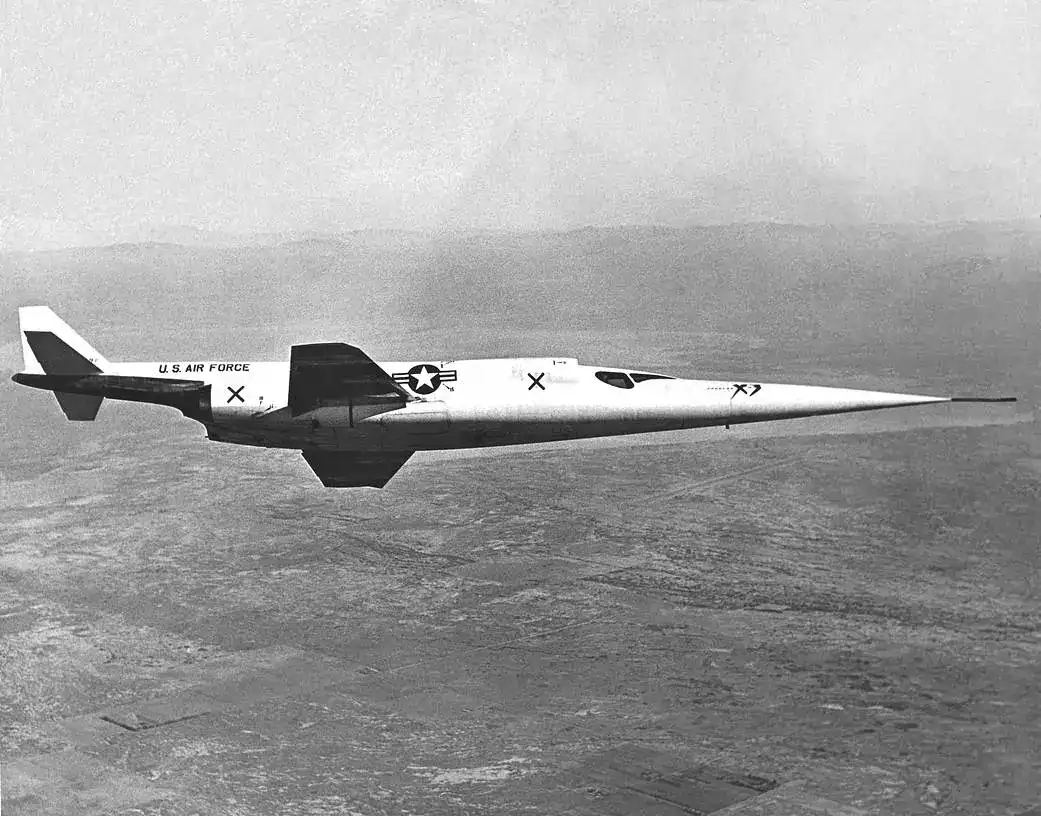
The Douglas X-3 during a test flight; it never reached Mach 2. | Image: NASA
Another distinctive feature of the X-3 was its long, thin nose cone. It housed the nose landing gear, flight test instruments, and other electrical systems.
Inadequate Engines Keep X-3 from Reaching Mach 2
While the X-3’s basic design appeared modern, sleek, and capable of reaching high speeds, its engines became one of its major flaws. Douglas Aircraft’s initial design was for the X-3 to have the newly designed turbojet, the Westinghouse J-46, with an afterburner. This design would produce 6600 pounds of thrust with afterburners.
By 1948, however, Douglas found that the J-46 was still under development and not ready for the X-3. They then decided to replace the J-46 with the J34-WE-17. This engine had similar dimensions to the J-46 but could only produce 4850 pounds of thrust. This flaw left the aircraft “severely underpowered” and unable to reach its Mach 2 performance goal.
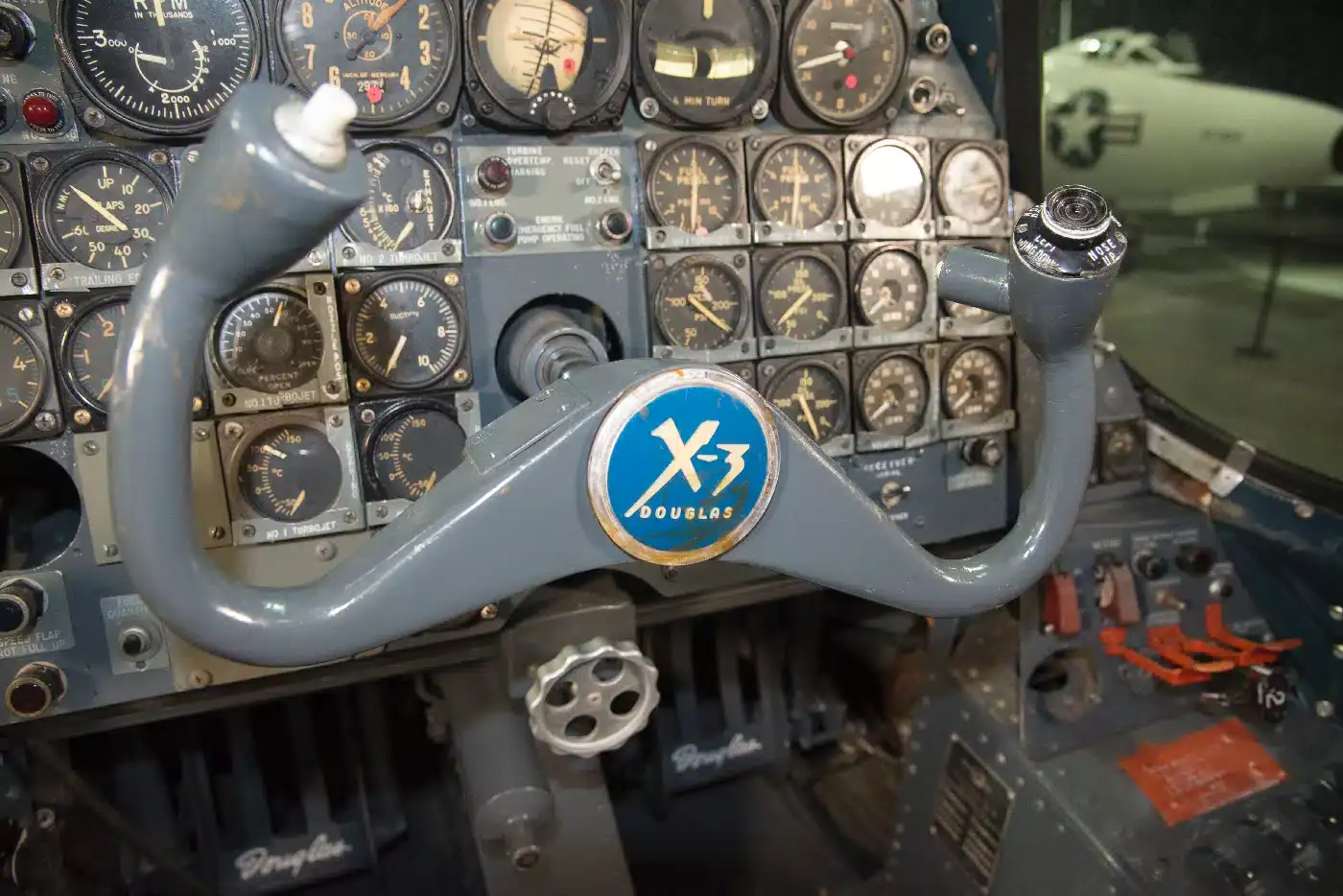
View inside cockpit of the Douglas X-3. | Image: U.S. Air Force
For its first supersonic flight, the pilot had to put the aircraft into a 15-degree dive to reach Mach 1.1. The X-3’s fastest flight was on 28 July 1953, reaching Mach 1.208 in a 30-degree dive. Another problem with its engines was that its takeoff speed was 260 knots.
Control Problems Proved Challenging for Douglas X-3 Pilots
The Douglas X-3 also had significant control problems during flights.
After the first test flight on 20 October 1952, test pilot William Bridgeman stated, “This thing doesn’t want to stay in the air.”
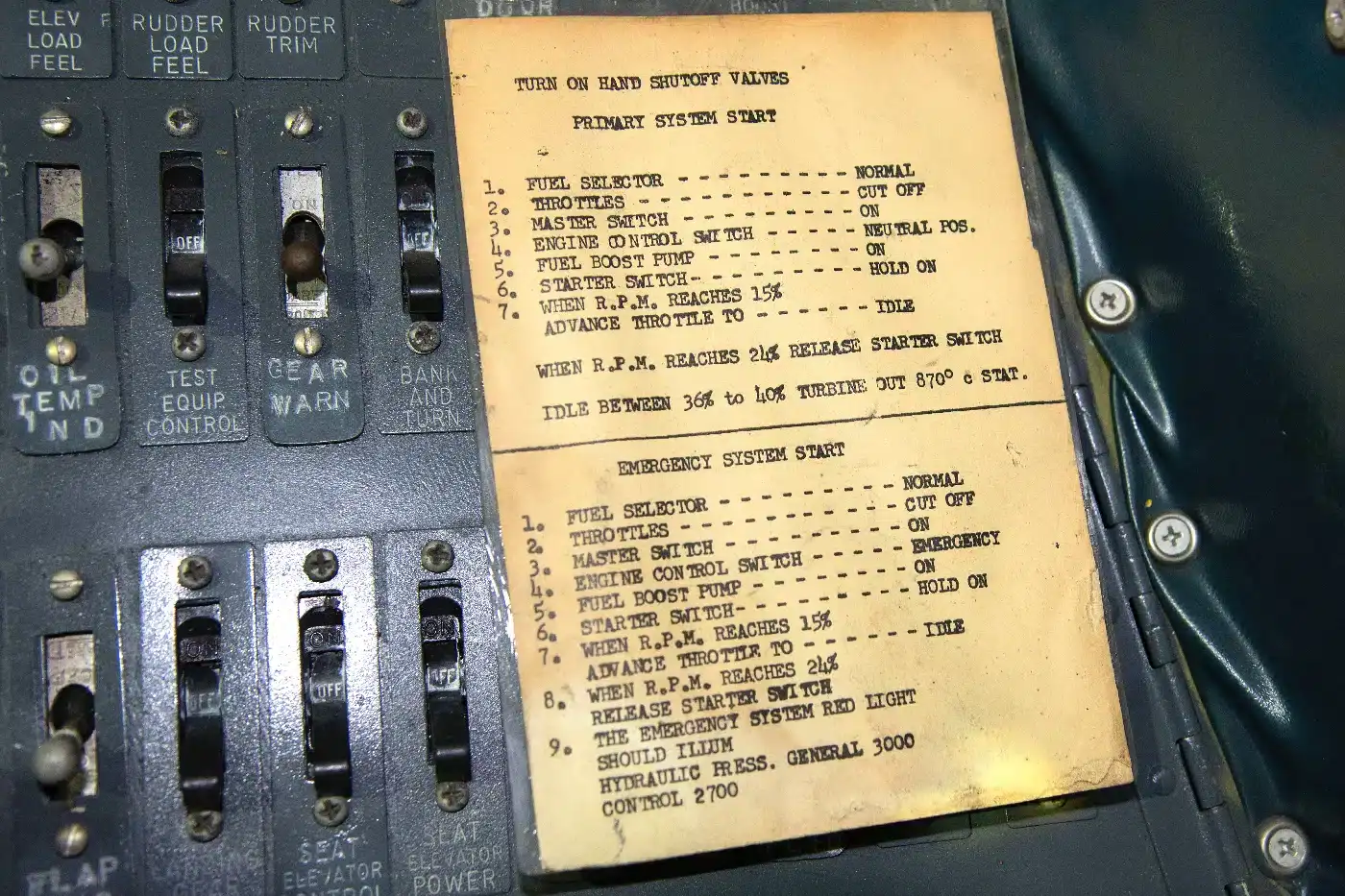
Placard with pilot instructions inside the cockpit of the Douglas X-3. | Image: U.S. Air Force
Bridgeman landed at 240 miles per hour and said he was happy the dry lakebed runway at Edwards AFB gave him plenty of room to slow down.
After the 25th test flight on 2 December, the Air Force received the single Douglas X-3. Pilots Chuck Yeager and Lt. Col. Frank K. Everest each made three additional test flights. After finding the controls “sluggish” at low speeds, Everest called it “one of the most difficult airplanes I have ever flown.”
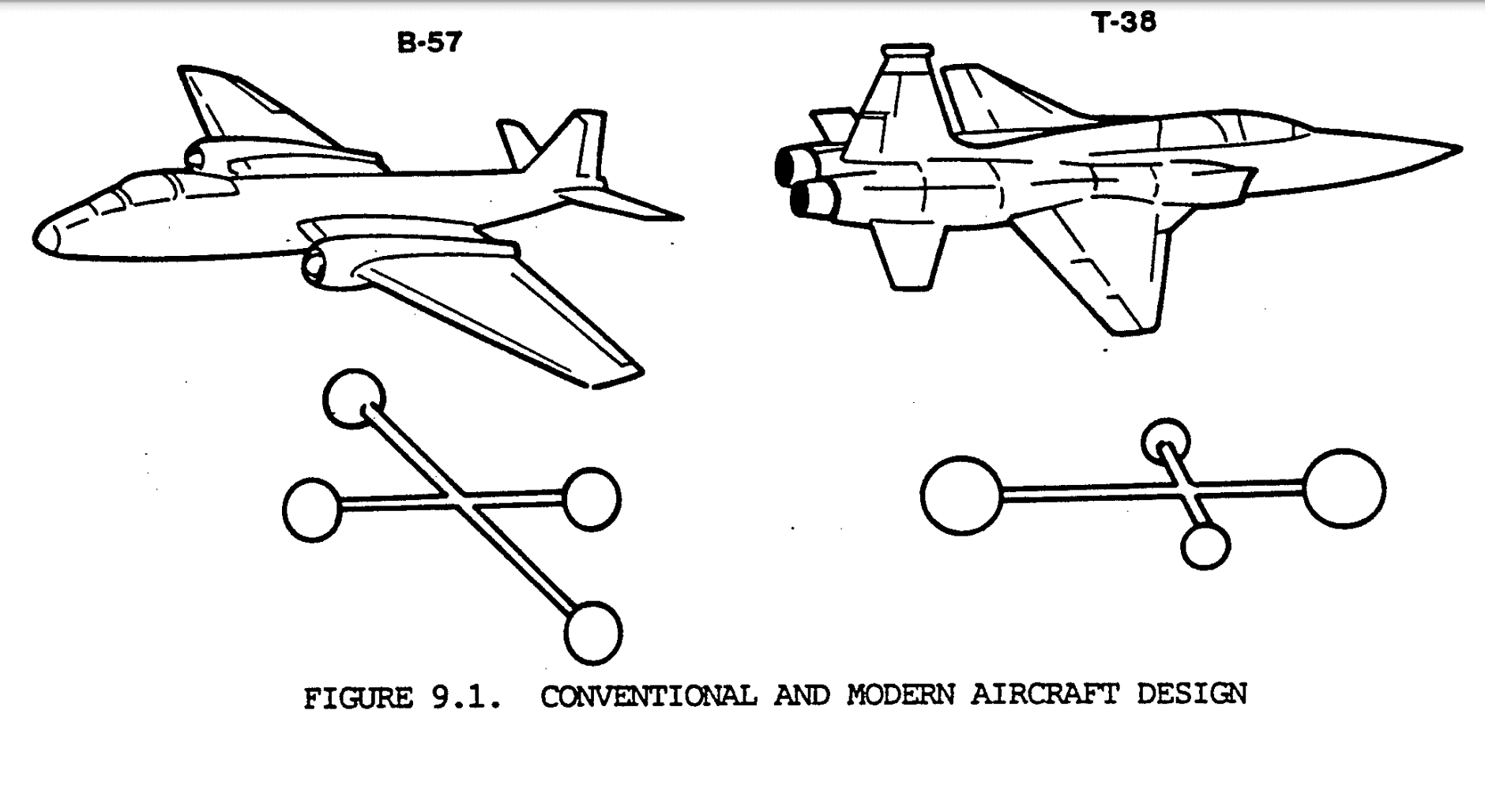
A year later, on 27 October 1954, pilot Joseph A. Walker was flying a test mission in the X-3. The flight was a series of tests of the jet’s lateral and directional stability. With relatively “short and stubby wings,” most of the X-3’s mass was centered along its long fuselage.
Sudden Uncontrolled Movements
During the flight, Walker was flying at Mach 0.92 at 30,000 feet and made a left roll. As the X-3 made the roll, the nose suddenly pitched up 20 degrees and yawed 16 degrees. Walker got it under control and prepared for the next test maneuver.
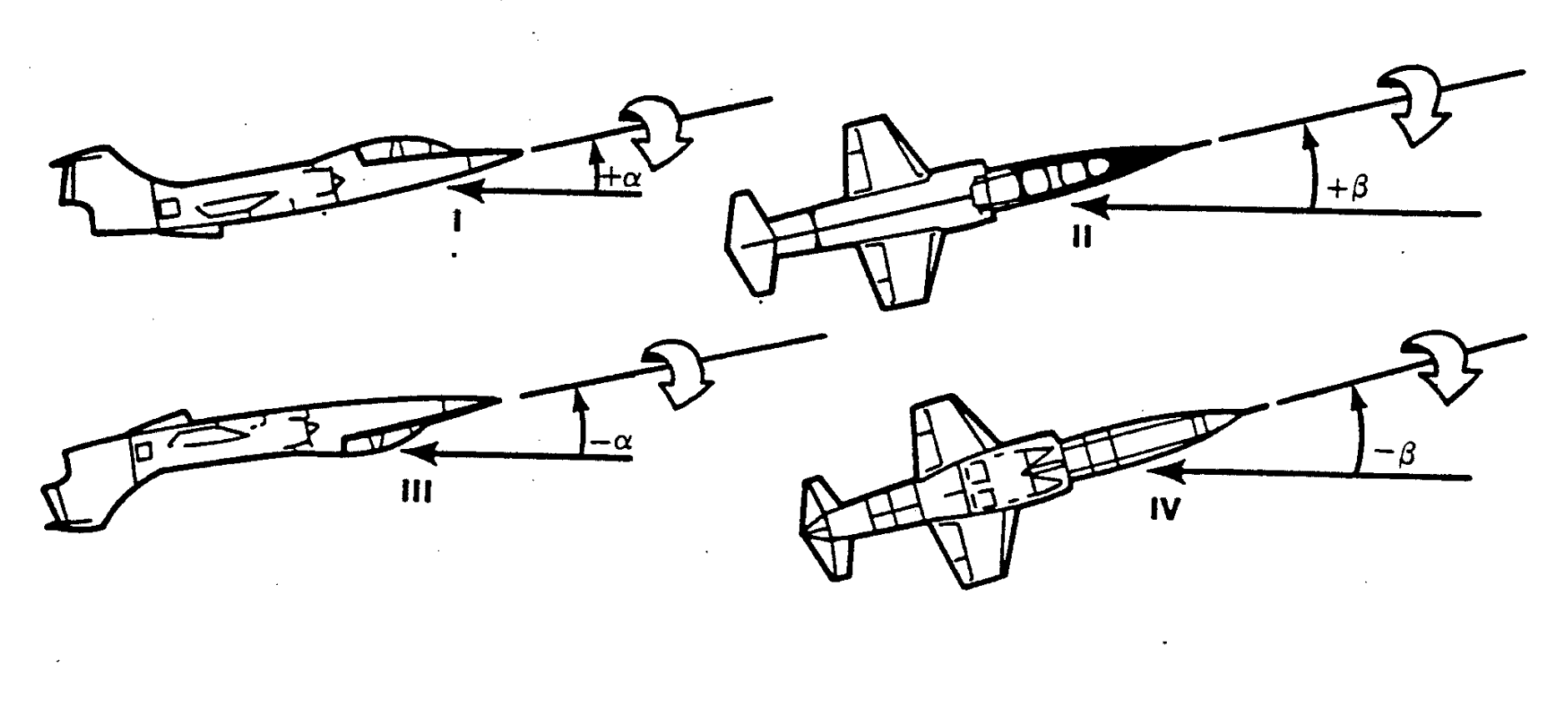
Diagram showing aircraft moving through several axis during roll coupling. | Image: Defense Technical Information Center
He went into a dive and accelerated to Mach 1.154. He then made a left roll, and the nose pitched down and then up while also sideslipping. These sudden movements loaded the fuselage with higher than normal g-forces. Walker managed to control the aircraft and landed safely. The post-flight inspection found that the X-3 had reached its maximum load limit and could have broken up if the g-forces had been higher.
Roll Coupling Results in Grounding of X-3
Engineers determined that the X-3 had undergone “roll coupling” or “roll divergence.” This occurs when an aircraft makes a maneuver around one axis and causes an uncommanded move in one or two others. Following this incident, the Air Force grounded the X-3 for almost a year and never tested its roll stability limitations again.
Image shows difference in design of modern aircraft with long fuselage and short wings. | Image: Defense Technical Information Center
Around the same time, several Air Force F-100As also experienced roll coupling, resulting in three crashes and two fatalities.
Walker completed ten additional flights in the X-3, with his final flight taking place on 23 May 1956. Shortly afterward, the Air Force retired the aircraft and transferred it to the Air Force Museum.
The X-3 Still Had Some Successes
Although the Douglas X-3 never achieved its goal of flying at Mach 2, it was far from a failure. The program yielded valuable insights, particularly about roll-coupling, which led to important design changes to the F-100 and F-104. The X-3 was also one of the first aircraft to use titanium. Additionally, its unusually high takeoff and landing speeds spurred advancements in aircraft tire technology.
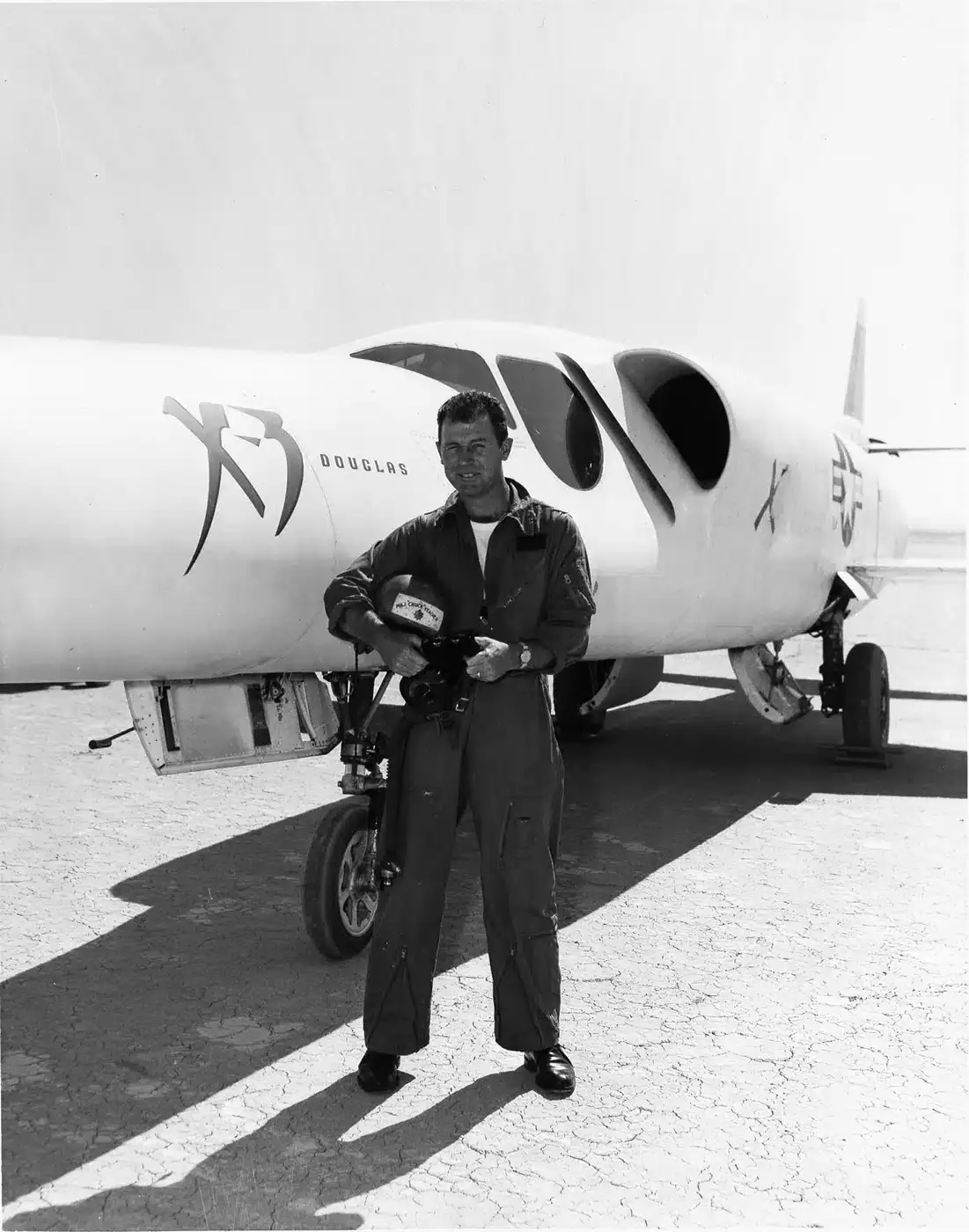
Major Chuck Yeager and the Douglas X-3 Stiletto. The aircraft never reached its promised speed of twice the speed of sound. | Image: U.S. Air Force
President Eisenhower’s Columbine II—America’s first Air Force One—has enjoyed a storied life in the skies and was recently restored by its current owner.
But there was a time when its future looked grim.
After just two years of sitting idle, the Air Force was ready to scrap it—literally. In fact, Columbine II was bundled into a five-plane package deal and auctioned off for a bargain price. Here’s how the historic aircraft fared on the auction block.
Columbine II’s Retirement
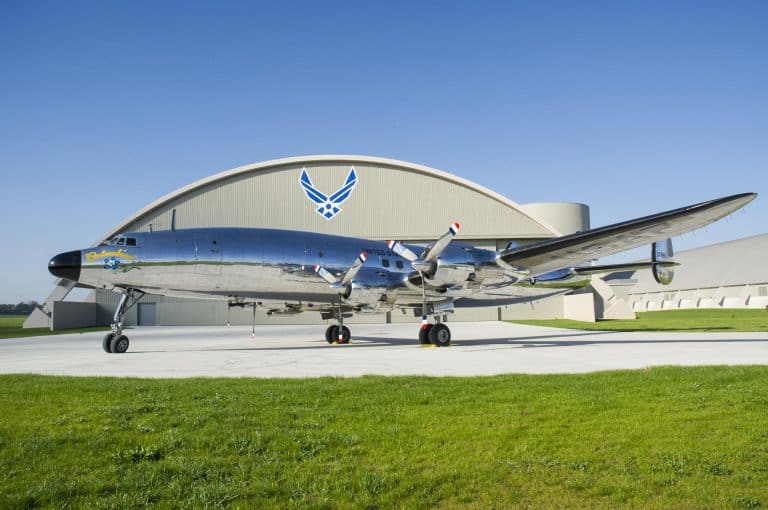
The Columbine II is a 1948 Lockheed Constellation VC-121A, serial number 48-610. It was Eisenhower’s first Air Force One plane, but he only used it for one year before upgrading to the Lockheed Constellation VC-121E, which he renamed ‘Columbine III.’
For the rest of Eisenhower’s presidency, Columbine II would be used by Vice President Richard Nixon and other very important people, such as Queen Elizabeth II. After Eisenhower’s time in office, the plane was still active with the Air Force until 1968.
The Air Force stored the Columbine II at Arizona’s Davis-Monthan Air Force Base. Somebody replaced its starboard main gear at some point while in storage with one from a Lockheed 1049 Super Constellation. Base officials were thinking of using this plane as a crop duster, but because of the incorrect landing gear configuration, they couldn’t use it at all.
During an auction in 1970, the Air Force sold the Columbine II in a bundle with the five Constellation VC-121As. The Air Force did not inform anybody ahead of time that the first Air Force One was part of the lot, which likely explains why the highest bid was only $35,000—that’s $7,000 per plane.
The cost of $35,000 in 1970 equates to around $290,000 today. By comparison, flying cars from Xpeng and Alef are expected to cost around $300,000 apiece.
The winning bidder was Mel Christler, a former World War II pilot, flight instructor, and businessman from Wyoming who intended to turn the planes into crop dusters. Christler managed to turn the four other Constellations into crop dusters, but like before, the Columbine II had the wrong landing gear attached.
The owner used the Columbine II to supply four other Constellation VC-121As with parts throughout the 1970s. Christler then thought about scrapping the plane and selling it for parts.
However, an unexpected phone call in 1980 changed the aircraft’s trajectory.
On the other end of the line was a Smithsonian researcher, who informed Christler that the plane was the original Air Force One. Upon hearing this, Christer changed plans and kept the plane from going to the scrapyard.
‘The first time we saw it, we obviously didn’t realize whose plane it was. But when you find out it was Eisenhower’s, now you’re stuck with it. You have a presidential plane you can’t melt up because people wouldn’t think very highly of you.’
Columbine II Flies Again
Christler, however, did attempt to sell the aircraft but didn’t find any takers due to its condition. A man named Harry Oliver talked him out of melting the aircraft, and the two invested $150,000 in restoring it to its former glory.
By 1990, the plane was in working condition once more and made the flight to a ceremony in Abilene, Kansas, celebrating Eisenhower’s 100th birthday.
Christler and Oliver have since been able to lease the aircraft several times before Karl Stoltzfus, founder of Virginia-based Dynamic Aviation, outright purchased it in 2015.
Today, the first Air Force One is undergoing a complete overhaul, with the promise of being restored to “as new” condition—comparable to, or even better than, when it first left the factory.
The restoration team began by removing obsolete systems that would no longer be used, such as pressurization, autopilot, and deicing. From there, the process moved systematically: the engines are being overhauled, the aircraft is receiving all-new wiring, and hydraulic lines are being completely replumbed. When finished, the aircraft will appear factory-fresh inside and out.
Inside the cabin, however, the team is working to recreate the aircraft’s 1950s-era layout with striking authenticity. Eisenhower’s granddaughter, Mary Jean Eisenhower, is contributing to the project by providing family photos and personal insights from their time aboard. The result will be an immersive experience, allowing visitors to walk through the president’s office, view the cockpit, and gain a deeper appreciation for this aircraft’s role in shaping global history.
It may sound improbable today, but there was a time when Alaska Airlines Russia flights were a regular fixture in the skies. In an era when US–Russia relations are at a deep freeze, the idea of commercial air service across the Bering Strait feels almost unthinkable.
But from 1991 to 1998, Alaska Airlines operated scheduled flights to remote Siberian cities like Magadan and Khabarovsk, offering a rare aerial link between East and West during a brief window of post-Cold War optimism.
This historic chapter of aviation history is packed with bold decisions, operational quirks, and the kind of diplomatic daring only Alaska Airlines could deliver. With its pioneering spirit, the airline made the improbable possible—connecting two worlds at a time when the skies felt just a little more hopeful.
A Thaw in the Ice Curtain: The History of the Alaska Airlines Russia Flights
Alaska Airlines Russia flights began as a charter operation in June 1970
The early 1990s marked a turning point in US-Soviet relations. As Cold War tensions eased under Mikhail Gorbachev’s leadership, economic and cultural ties began to blossom. Seattle, Alaska Airlines’ headquarters, became a focal point for this newfound camaraderie, hosting the 1991 Goodwill Games between the US and Russia.
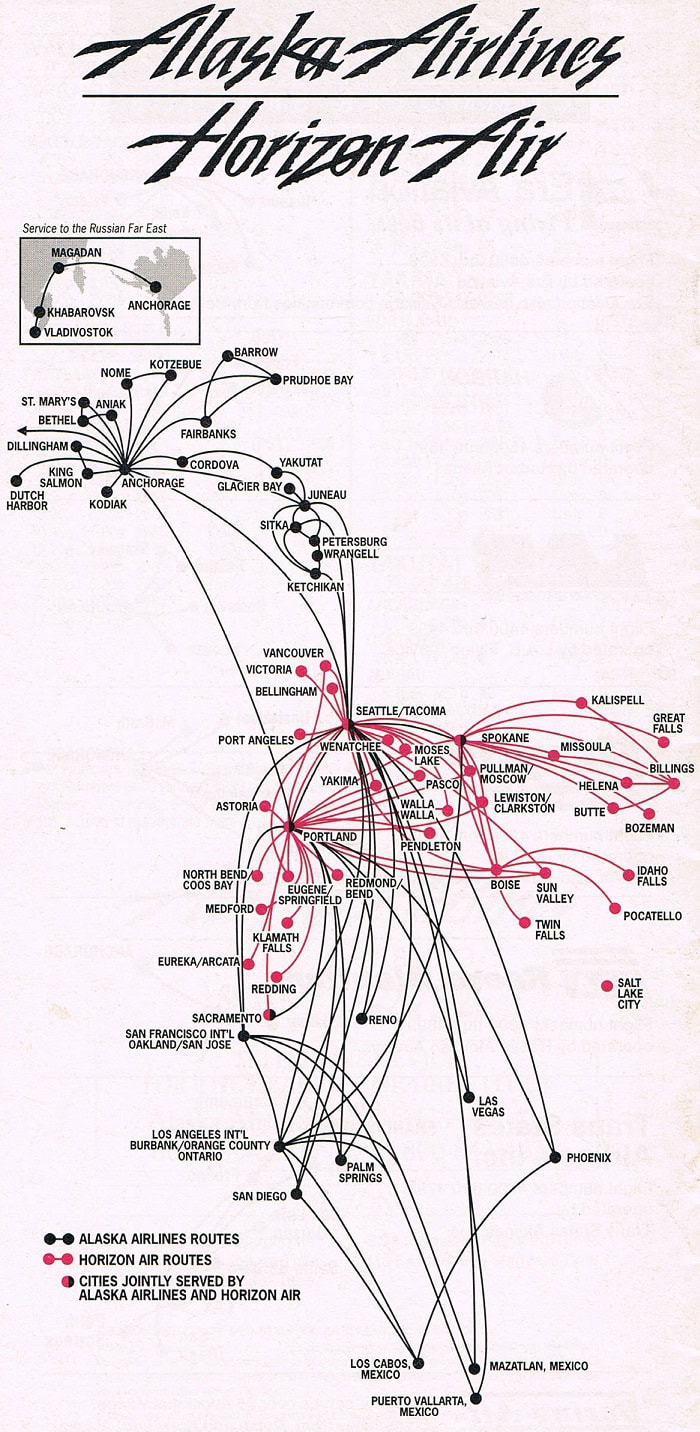
On 17 June 1991, Alaska Airlines launched scheduled service from Ted Stevens Anchorage International Airport (ANC) to two cities in Russia’s Far East. Anchorage, twinned with Magadan as a sister city, became the launchpad for seasonal flights to Magadan’s Sokol Airport (GDX) and Khabarovsk Novy Airport (KHV), the economic heart of Russia’s East.
Flights operated once or twice weekly, occasionally thrice, and went year-round in 1994. By 1993, Vladivostok International Airport (VVO) and Petropavlovsk-Kamchatsky Airport (PKC) joined the network, with Yuzhno-Sakhalinsk Airport (UUS) added in 1997.
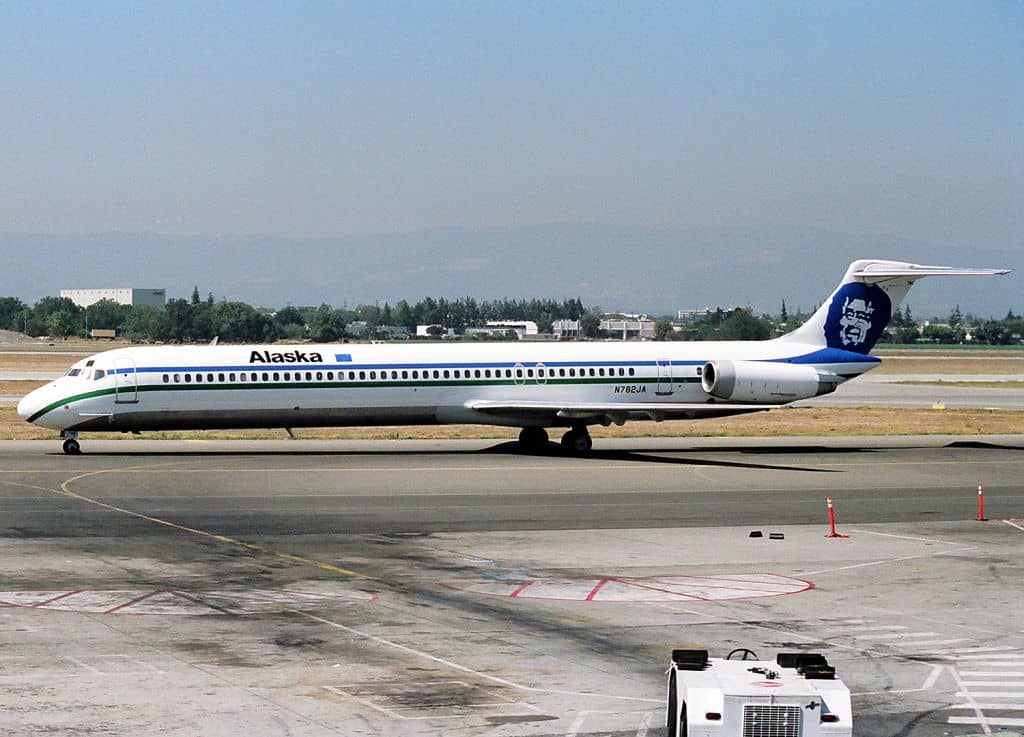
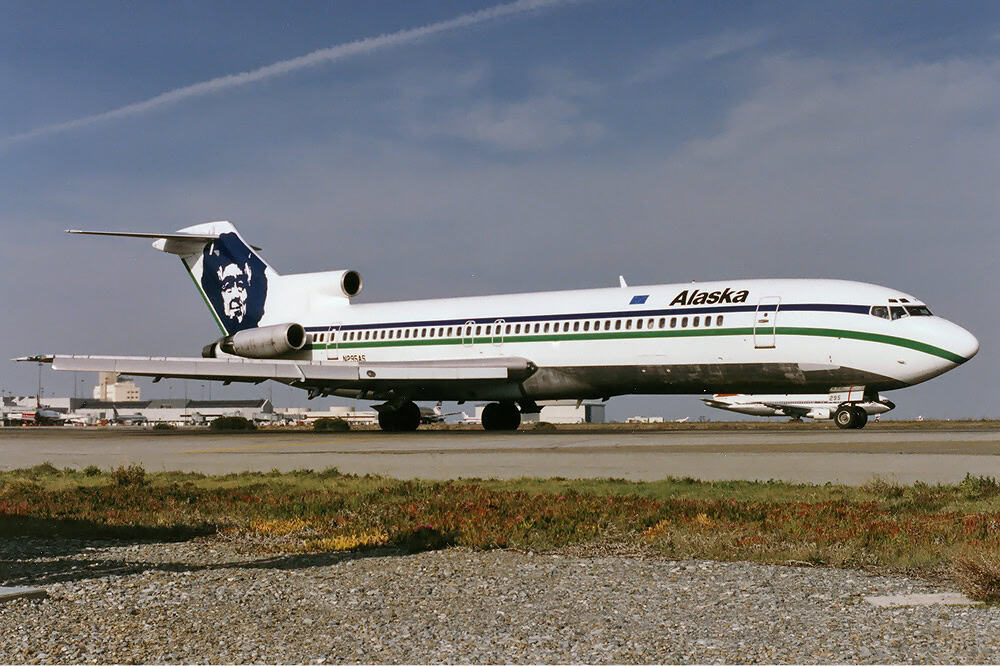
Alaska initially operated the scheduled flights with Boeing 727-200s but eventually replaced them with the more fuel-efficient McDonnell Douglas MD-80s. The Alaskan Mad Dogs were equipped with auxiliary fuel tanks to ensure adequate fuel for the long distances they traversed.
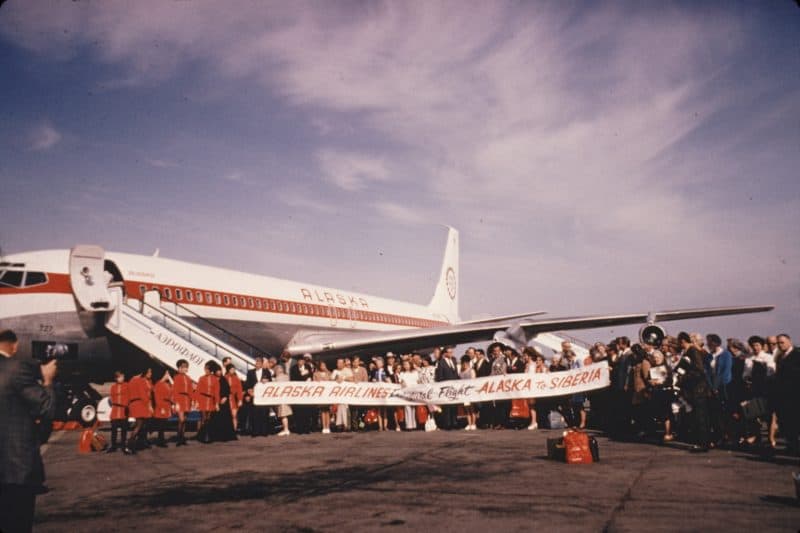
These flights weren’t Alaska’s first foray into Russia. In the early 1970s, “secret negotiations” with Soviet officials led to over two dozen charter flights on Boeing 707s between Anchorage and Russia.
An advertisement for Alaska’s “Golden Samovar Service” in 1970 captures the era’s charm:
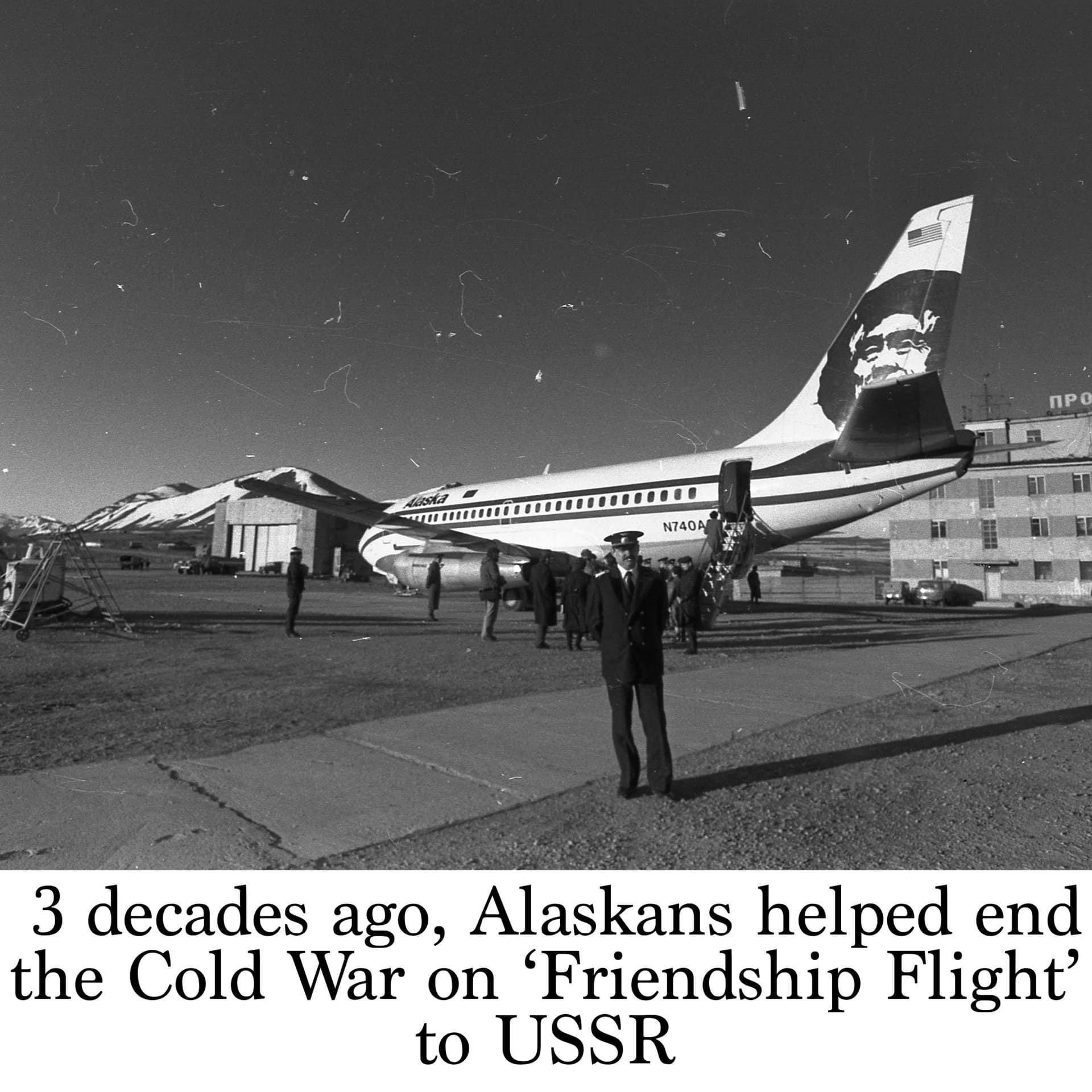
In 1988, Alaska operated a poignant “Friendship Flight” from Nome (OME) to Provideniya (PVS), a 45-minute, 55-mile hop on a Boeing 737-200 carrying 82 passengers to reunite Native families separated by the “Ice Curtain” for 40 years. These efforts echoed World War II, when the U.S. ferried 8,000 aircraft to Russia via Nome to fight the Nazis, and Indigenous families moved freely across the Bering Strait until Stalin’s 1948 crackdown sealed the border.
2018 review of the Alaska Airlines Friendship Flight from the 2018 Anchorage Daily News | IMAGE: ADN
Navigating Siberia’s Challenges: Vodka and Boiled Potatoes
Alaska Airlines Russia flights switched to the McDonnell Douglas MD-80, like the one seen here at San Jose (SJC) in June 1988 | IMAGE: FlightAware
Flying to Russia’s Far East was an operational adventure. The region’s infrastructure was sparse, and reliable weather data from Siberia was nearly nonexistent, making flight planning a gamble. Alternate airports were few and far between, complicating route planning. Airport services like deicing were often unavailable, leading to creative (and controversial) solutions.
In one infamous incident in Magadan, just 400 miles south of the Arctic Circle, a sudden and unexpected temperature drop iced up an MD-80’s wings. With no deicing fluid available, Bill Boser, Alaska’s assistant vice president of flight operations at the time, gathered 25 bottles of vodka from a nearby liquor store. The crew mixed it with glycol and sprayed it on the wings using a garden hose.
The wild story, featured in an in-house Alaska Airlines newsletter in December 1993, sparked regulatory outrage. Investigators warned that vodka’s high alcohol and sugar content could have ignited or gummed up the engines, prompting enforcement action against the airline.
The carrier faced additional challenges while operating its Russia flights. On the inaugural Anchorage to Petropavlovsk flight, a dignitary-loaded plane was forced to return to ANC when PKC authorities denied the captain landing rights. Crews on RONs subsisted on boiled potatoes at local hotels.
Yet, the service had its quirks and charms. Many Russians flew to Anchorage to shop at Costco, stocking up on supplies scarce back home. As Joe Sprague, then Alaska’s senior VP for external relations (now CEO of Hawaiian Airlines as of last year), said in a 2017 Flynn’s Harp interview, “The service to the Russian Far East was really something. It still amazes me to look at the map and think how far away from home base we were flying our old MD-80s for that service.”
A 1994 route map showing Alaska Airlines Russia routes | IMAGE: Departed Flights
A Bridge of Hope: Cultural and Historical Significance
US-bound passengers board an Alaska Airlines Boeing 737-200 in Provideniya, USSR (PVS) | IMAGE: NPS
More than just a business venture, Alaska’s Russian flights symbolized a brief window of optimism. The service harked back to World War II’s open Bering Strait and provided hope that a new and fruitful era of cooperation was underway.
At its peak, Alaska served five Russian destinations: Khabarovsk (KHV), Magadan (GDX), Vladivostok (VVO), Petropavlovsk-Kamchatsky (PKC), and Yuzhno-Sakhalinsk (UUS).
To this day, the image of an Alaska MD-80 landing in Russia’s Far East—a region once a forbidden no-man’s land for Americans—remains surreal. While the service is long gone, a longing for a friendlier era in the years to come provides hope that we could perhaps one day see service return.
The flights carried echoes of history. The 1988 Friendship Flight and the scheduled Alaska flights that operated from 1991 to 1998 aimed to rebuild ties that had been severed since Stalin’s era. They reflected a time when aviation could bridge divides as Cold War suspicions waned.
The Ruble’s Fall and a Fading Dream
Alaska Airlines Russia scheduled flights launched on 17 June 1991 with the Boeing 727
By 1998, Alaska’s Russian venture hit a wall. A devastating economic downturn in Russia, capped by the collapse of the ruble, crushed demand. Alaska canceled all Russian service that autumn, bringing an abrupt end to a bold experiment.
The airline’s exit marked the end of scheduled US-Russia flights from Alaska—a concept now unthinkable. Relations have deteriorated since Vladimir Putin’s rise in 2000, and especially after Russia’s 2022 invasion of Ukraine.
Today, there is no scheduled service between Alaska and Russia.
Alaska’s Russian flights remain a captivating chapter of aviation history—a time when MD-80s crossed the Bering Strait, vodka doubled as deicer, and Costco runs united two nations.
It reminds us of aviation’s extraordinary power to connect friends, enemies, and everybody in between–even when the world feels worlds apart.
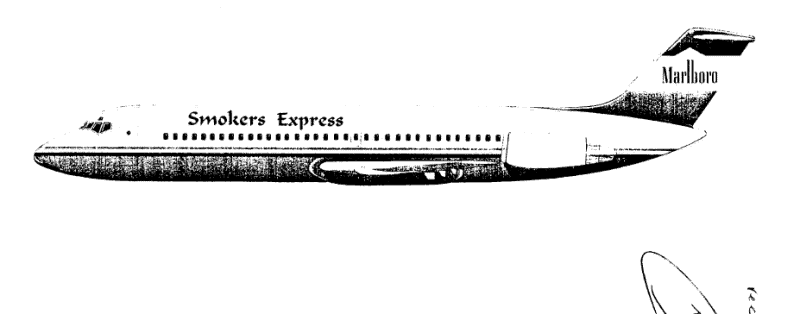
Smokers Express is the strange but true story of two men, three jets, and an airline dream that went up in smoke.
Many gimmick airlines were proposed in the late 20th century, but Smokers Express sought to bypass regulations recently imposed by the Federal Aviation Administration (FAA) in the early 1990s.
Its two founders had many innovative ideas for the airline outside of smoking, and thousands of passengers were reportedly on board. However, the airline fell short of its financial goals and never got past the planning phase.
‘Where There’s Smoke, There’s Fliers’
In 1990, the FAA banned smoking on all U.S. commercial flights, citing safety concerns and the health risks of secondhand smoke. While the move was made to protect passengers and crew, it sparked backlash from some smokers, who felt the ban unfairly targeted them.
Two businessmen from Cocoa Beach, Florida, decided to capitalize on this ruling by proposing an airline that openly encourages smoking. Former Disney executive George ‘Mickey’ Richardson and businessman William Watts came up with Smokers Express in 1993.
The founders planned to bypass the FAA’s restrictions by simply labeling the company a ‘private club’ instead of a public airline. The carrier would be exempt from the FAA’s regulations as a private entity.
A lot of people seem to enjoy having learned about Hooters Air but my that's not even my favorite airline. The very best one is one that never actually got off the ground but got as far as buying a few DC-9s — a concept airline called "Smokers Express" pic.twitter.com/ASPP5j2hpw
— fat motorcycle twins truther. theyre not dead (@fart) April 10, 2023
Smokers Express mailed swaths of flyers to residents of Florida to raise awareness of the airline. These flyers guaranteed up to 25 interesting perks for members, some of which were as follows:
Free cigarettes
Free burgers and subs
Free newspapers
Free lottery tickets
‘No screaming babies’ – All flights were only for people 21 and up
Many discounts on hotel reservations, rental cars, vacation packages, cruises, and tours
According to the flyer, a ‘Smokers Express Vacation’ and an accompanying magazine were also in the works.
Customers had to mail in $25—cash, check, or credit card—to become members. But there was a twist: one could also earn membership by mailing in a gallon-sized bottle of Jack Daniel’s or Dewar’s.
The gimmicks didn’t end there, however. In an interview with Florida Today, Richardson also expressed interest in placing ads on the sides of their planes, similar to those on racing cars.
Smokers Express’s Efforts End Up a Little ‘Blunt’
Smokers Express reportedly sold around 5,000 to 6,000 memberships. According to Richardson, two-thirds of the memberships were for women. Apparently, this wasn’t enough money to start the airline, despite the airline securing three Douglas DC-9 aircraft.
An initial list of flight offerings focused on gamblers and included flights from Orlando, FL (MCO) to Las Vegas (LAS) via Dallas, TX (DFW). Another flight would operate between Orlando, FL (MCO), and Atlantic City, NJ (ACY), via Atlanta (ATL). Additional proposed destinations included Philadelphia, Los Angeles, Seattle, San Francisco, New York, Baltimore, New Orleans, Chicago, Denver, and Detroit.
The airline’s proposed base was Space Coast Regional Airport (TIX), near Titusville, Florida.
Smokers Express scheduled its first flight for 25 September 1993 from Florida to Washington, D.C. The occasion? To protest President Clinton’s proposed tobacco tax hike and join the ‘Smokers’ Rights March at the White House’ event. The flight was rescheduled to 26 January 1994 out of Raleigh-Durham International Airport (RDU).
Tickets for this flight cost $345 round-trip. However, not enough tickets were sold, and the flight was later canceled.
Following the canceled flight, communication from Smokers Express was radio silent. In June 1994, Aero Corp Director of Marketing Dan Givens confirmed to the Orlando Sentinel that his company had a verbal agreement to provide maintenance for Smokers Express’ fleet.
Givens also revealed, however, that the airline was unable to secure enough financial support to continue.
‘I believe they found out it’s not as easy to start an airline as people might think,’ Givens said.
Around the same time, Freedom Air started the ‘Freedom Air Smoker Club,’ offering charter flights for tobacco lovers. This program also fizzled out shortly after due to a lack of interest.
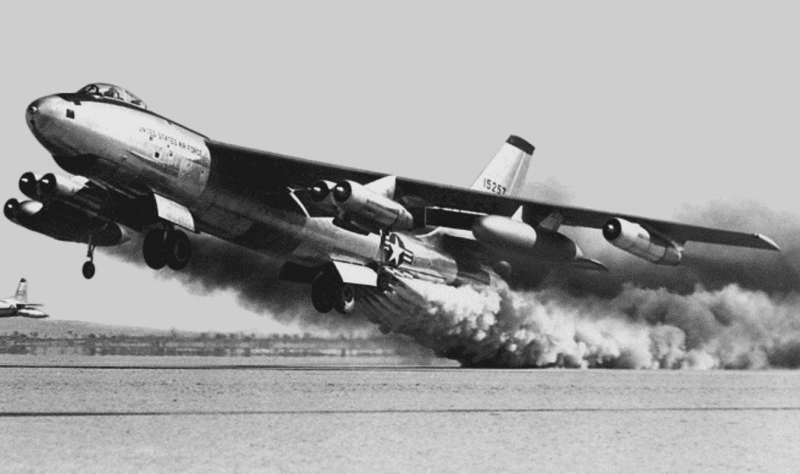
Six General Electric J35 turbojets and Jet-Assisted Take Off (JATO) rockets powered the Boeing B-47 Stratojet.
Boeing designed the B-47 as a long-range strategic bomber capable of flying at high subsonic speeds fast enough to avoid enemy interceptors.
The first Stratojet flew in 1947 as the United States and the Soviet Union began deploying nuclear-capable aircraft in the early days of the Cold War.
A B-47, with JATO system visible behind the engine, with landing parachute deployed. | Image: Avionist.com
Poor Acceleration of Turbojets Led to Need for Jet-Assisted Take Off on B-47
In 1947, early turbojet models lacked the acceleration of piston engines, which required manufacturers to add supplemental propulsion to some aircraft. Recognizing this need for more power, Boeing decided to add 18 solid-propellant rockets to the XB-47 prototype. They installed nine rockets in rows of three inside the fuselage on each side behind the wings.
The initial prototype XB-47s had six General Electric J35 turbojets, each producing 3,750 pounds of thrust, for a total of 22,500. When engineers found the engines did not provide enough trust at low speeds, they added the JATO system. Each rocket produced 1000 pounds of thrust, adding 18,000 to the total from the turbojets.
In the following years, updated versions of the B-47 turbojets gave it considerably more power. On the B-47B, J47-GE-23 engines provided 5,800 pounds of thrust each. These improvements continued to the B-47E model, which had J47-GE-25A engines with 5,970 pounds of thrust.
Turbojet Improvements Reduced Need for Rockets on Takeoffs
Although Boeing continued to install the Jet-Assisted Take Off rockets up through the B-47E model in 1953, the more powerful turbojets reduced the need for the rockets. Also, the J47-GE-25A engines featured a water and methanol injection system, which improved their thrust. Injecting a water and methanol mix into the engines during takeoff increased the mass flowing through, boosting the thrust to 7200 pounds.
Eventually, engineers became concerned that the JATO rockets were too close to the B-47’s fuel tanks. The bomber held all its fuel in the fuselage instead of the wings, which flexed a great deal during flight and were thin, making them unsuitable for carrying fuel.
Engineers then modified the B-47Es by removing the standard JATO system and replacing it with an external setup. This setup was a “horse collar” rack that could be mounted under the rear of the fuselage. It held 33 JATO rockets in three rows of 11. The entire rack was jettisonable and basically throwaway. Crews using it could drop it after takeoff.
“Horse collar” JATO rack with 33 rockets. | Image: B-47 Association
Following this, Boeing still used JATO, but only for emergency alerts when aircraft had to get airborne as fast as possible. Beyond that, units still trained on JATO systems, but only about once per year.
Soviets the First to Test JATO
The first use of JATO on aircraft came in 1931 on the Soviet U-1 training aircraft. A biplane, it had just a 120-horsepower rotary engine and a maximum speed of about 84 miles per hour. Engineers V.I. Dudakov and V.A. Konstantinov experimented with rocket boosters during takeoffs. When the rockets fired, the U-1’s takeoff run was 1.5 seconds. The Soviets tested this system on one hundred takeoffs.
The Soviet U-1 aircraft was the first to carry a rocket propulsion system. | Image: Airwar.ru
U.S. Asks Scientists to Study Effectiveness of Rockets on Aircraft
In 1939, the U.S. considered using JATO on aircraft. A team of scientists received $1000 from the National Academy of Sciences to research rocket-assisted takeoff technologies. On one test, they installed several solid-fuel 28-pound boost rockets on a piston-engine Ercoupe plane. Each rocket produced thrust for about 12 seconds.
A Ercoupe taking off for test flight with rockets providing extra thrust. | Image: IEEE Spectrum
Blue Angels C-130 No Longer Using Jet-Assisted Takeoffs
After the B-47, the United States used JATO systems on various aircraft, including the OV-10 Bronco and C-130 Hercules. The Navy’s Blue Angels demonstration team used to travel with a C-130 nicknamed “Fat Albert.” It had eight Jet Assisted Take Off rocket bottles mounted behind its wings. It used up the last remaining JATO bottles in 2009, and they were not replaced. The Navy has since transitioned to a C-130J Super Hercules. It has enough thrust that is does not require a JATO system.
Blue Angels “Fat Albert” C-130 rotating with JATO assist. | Image: history.navy.mil
Before Donald Trump became President, he was a prominent business mogul who invested in hundreds of different ventures. However, for every ‘Apprentice,’ hotel, and golf course, there were unsuccessful endeavors like the United States Football League (USFL), cologne, and even an airline.
‘Trump Shuttle’ lasted only four years before Trump sold the airline and exited the air travel game. Here’s the story of Trump Shuttle.
Failing Airline Seeks Help from Donald Trump
The Trump Shuttle originated from the Eastern Air Lines Shuttle (EALS), which launched on 30 April 1961. The airline marketed itself as a no-frills travel option for businessmen and government workers, offering quick, hourly flights to New York City, Washington D.C., Boston, and Newark.
EALS’ parent company, Texas Air Corporation (TAC), faced financial hardships in the late 80s and was losing business to Pan Am. Despite EALS being profitable, TAC’s chairman, Frank Lorenzo, wanted to sell the airline to recoup losses. Lorenzo tried to find a new owner multiple times before meeting Trump at a party. He was successful at convincing Trump to buy the airline.
Trump purchased EALS in October 1988, and the deal made national headlines. However, the deal wasn’t finalized, and many events took place during the transition process.
In March 1989, Eastern Air Lines filed for Chapter 11 bankruptcy, prompting Donald Trump to offer the airline a lower price. Eastern included its entire Boeing 727 fleet in the deal, and the two parties finalized the agreement.
The bankruptcy court approved the sale of Eastern Air Lines Shuttle and its fleet to Trump for $365 million. Trump gained full control of the airline on 7 June 1989.
The Airline Fit for a Trump
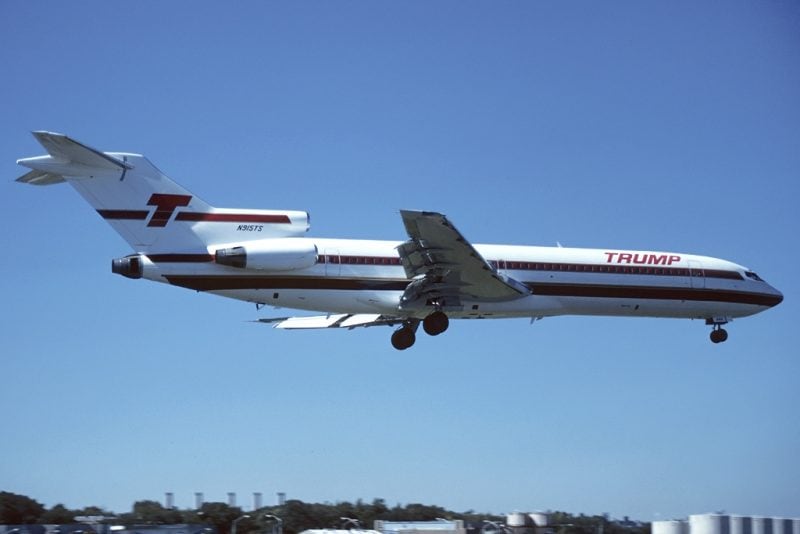
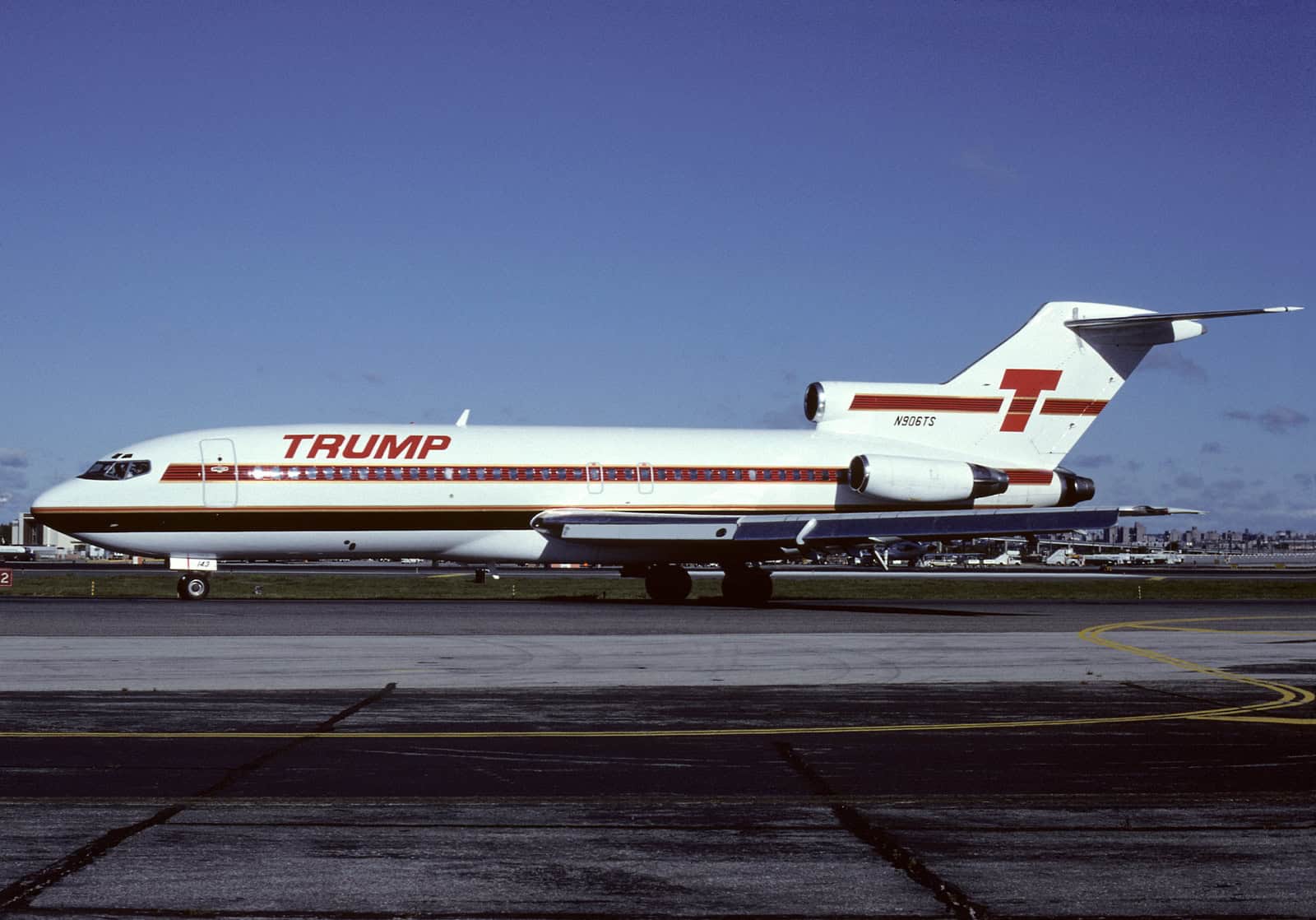
Following the closure of the sale, Trump announced that EALS would be renamed Trump Shuttle. The airline would also no longer be a no-frills airline but a luxury airline with hourly service.
Trump had each Boeing’s cabin overhauled with maple wood decor and gold restroom fixtures. Despite the short distances, the airline also offered complimentary meals and alcohol.
The airline, however, was among those leading the pack when it came to technology. Trump Shuttle was one of the first airlines to offer self-service check-in stations. Customers could also rent laptops on board flights, which was ideal for those who wanted to continue working during travel.
Trump Shuttle also axed Newark as a destination, opting instead to operate routes between New York and Boston and New York and Washington.
In its first few months, Trump Shuttle attracted a lot of travelers and found decent success. However, outside factors caused the airline’s momentum to turn quickly.
Passenger traffic dropped later in 1989 due to the financial crisis that year. To add insult to injury, the Iraqi invasion of Kuwait the following year caused fuel prices to soar, which, in turn, caused fares to skyrocket. During these challenging times, passengers opted to fly with Pan Am’s shuttle thanks to its lower fares.
In September 1990, Trump Shuttle lost over $128 million and defaulted on loans due to rising maintenance costs and a lack of interest. As a response, Trump lightened the airline’s schedule and looked for other ways to profit from it, such as offering charter flights and military flights arranged with the George H.W. Bush Administration.
Trump, however, was looking to sell the airline, and in December 1991, he found his buyer in USAir. Trump, along with Citigroup, put together a deal in which USAir would operate Trump Shuttle for ten years with the option to buy Trump Shuttle outright after five.
On 7 April 1992, USAir officially took over Trump Shuttle. Five days later, USAir rebranded Trump’s airline to USAir Shuttle. USAir would operate this shuttle service and restore its no-frills nature for affordability.
On 17 October 2015, USAir, now rebranded as US Airways, sold this airline to American Airlines (AA), which later became ‘American Airlines Shuttle.’ AA closed the airline down a year into the COVID-19 pandemic.
Today, Delta Air Lines is the only US airline that runs a shuttle service called ‘Delta Shuttle.’ The shuttle flies to and from New York, Boston, Washington, and Chicago.
A Long Career Served Around the World- That Was the Albatross
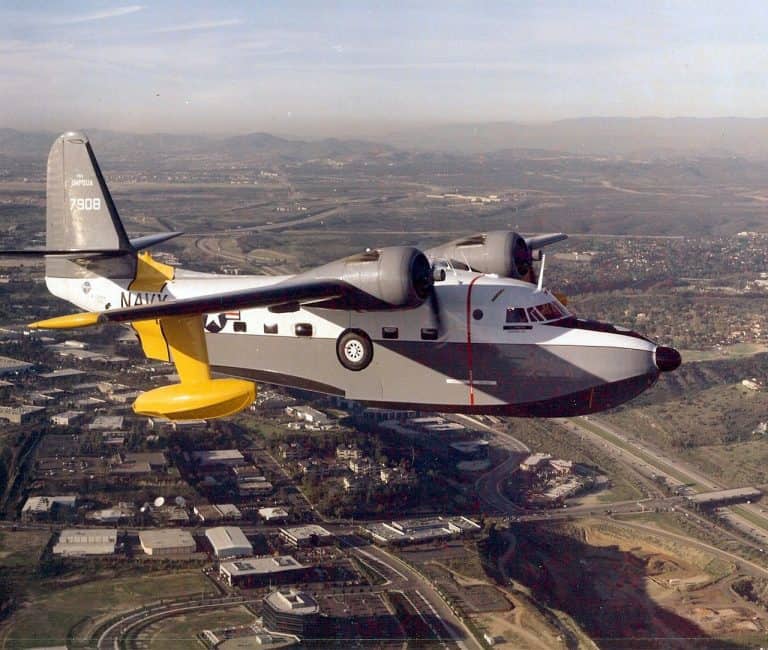
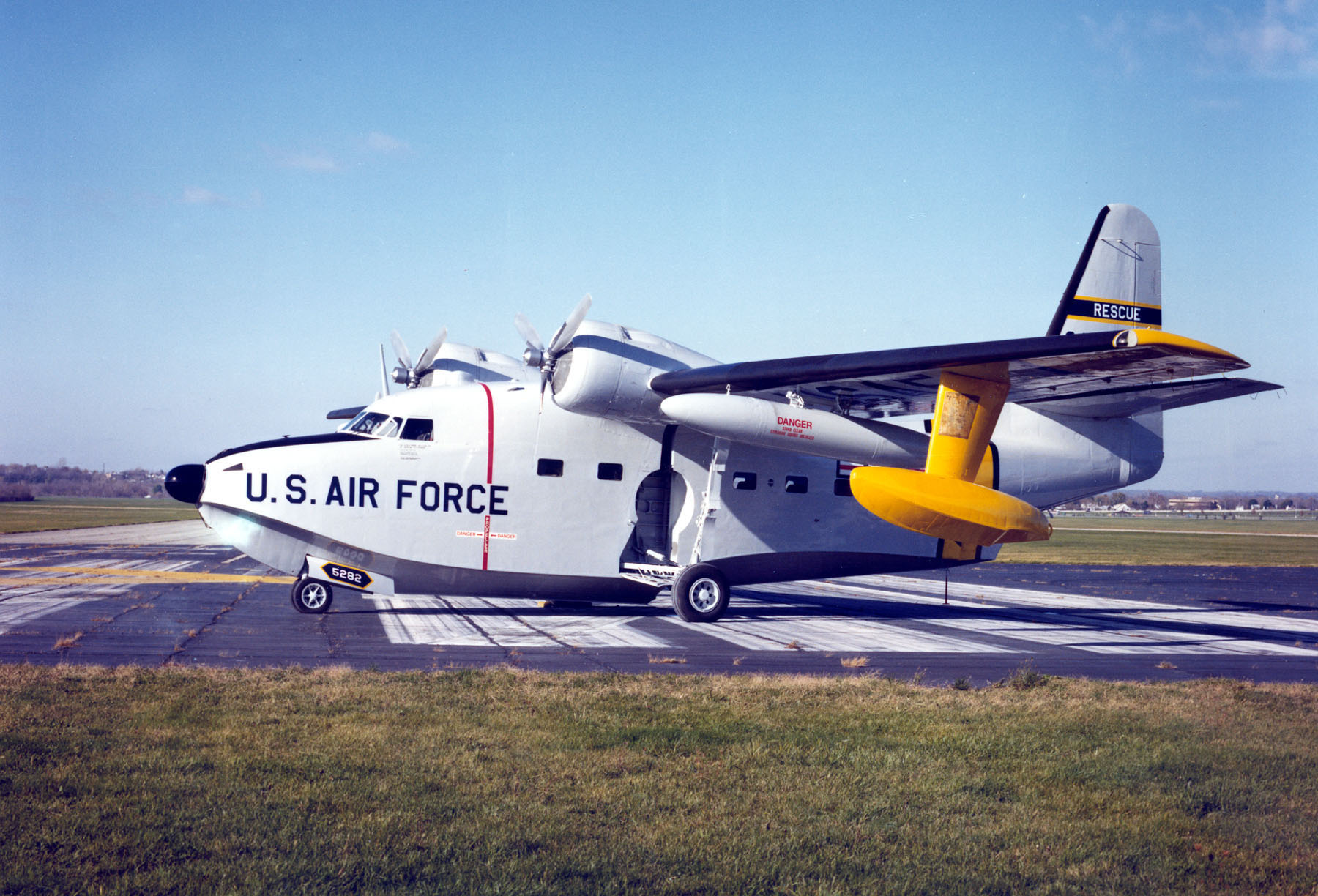
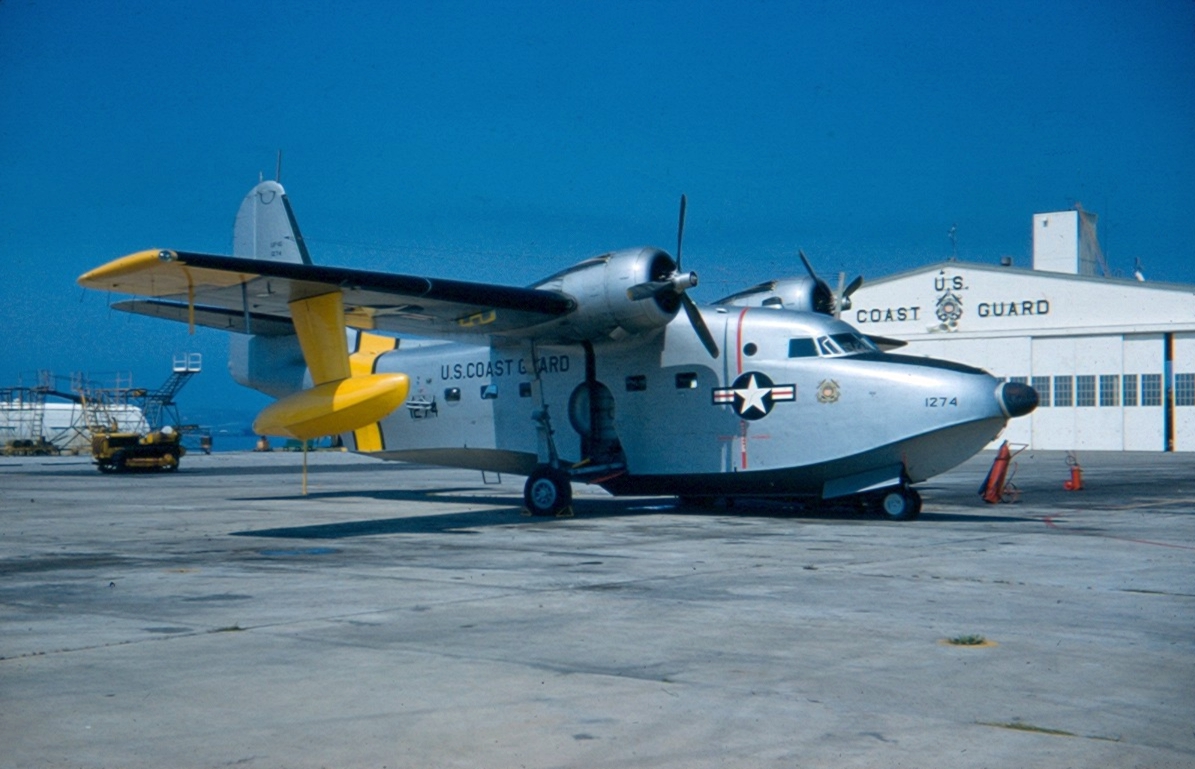
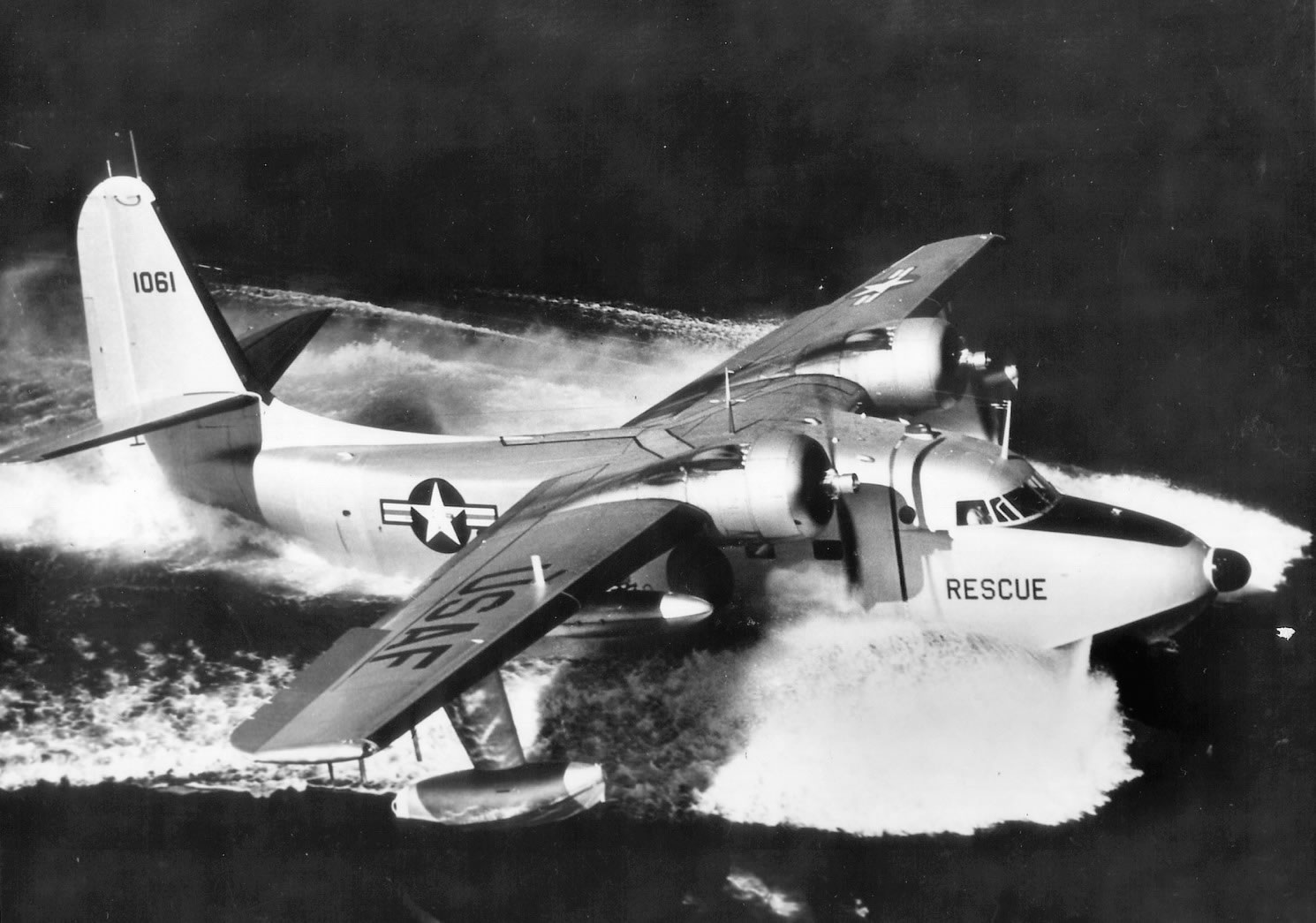
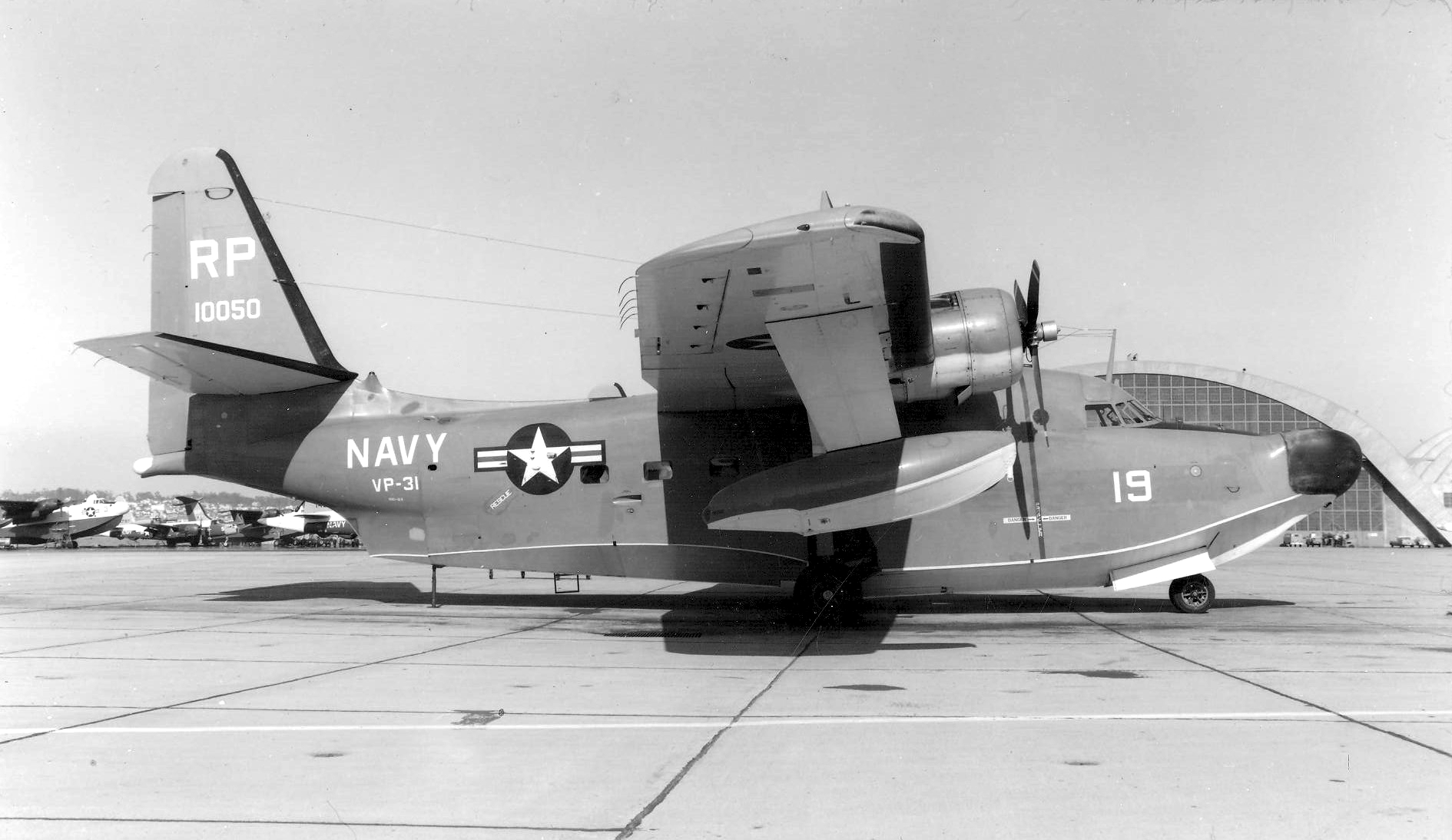
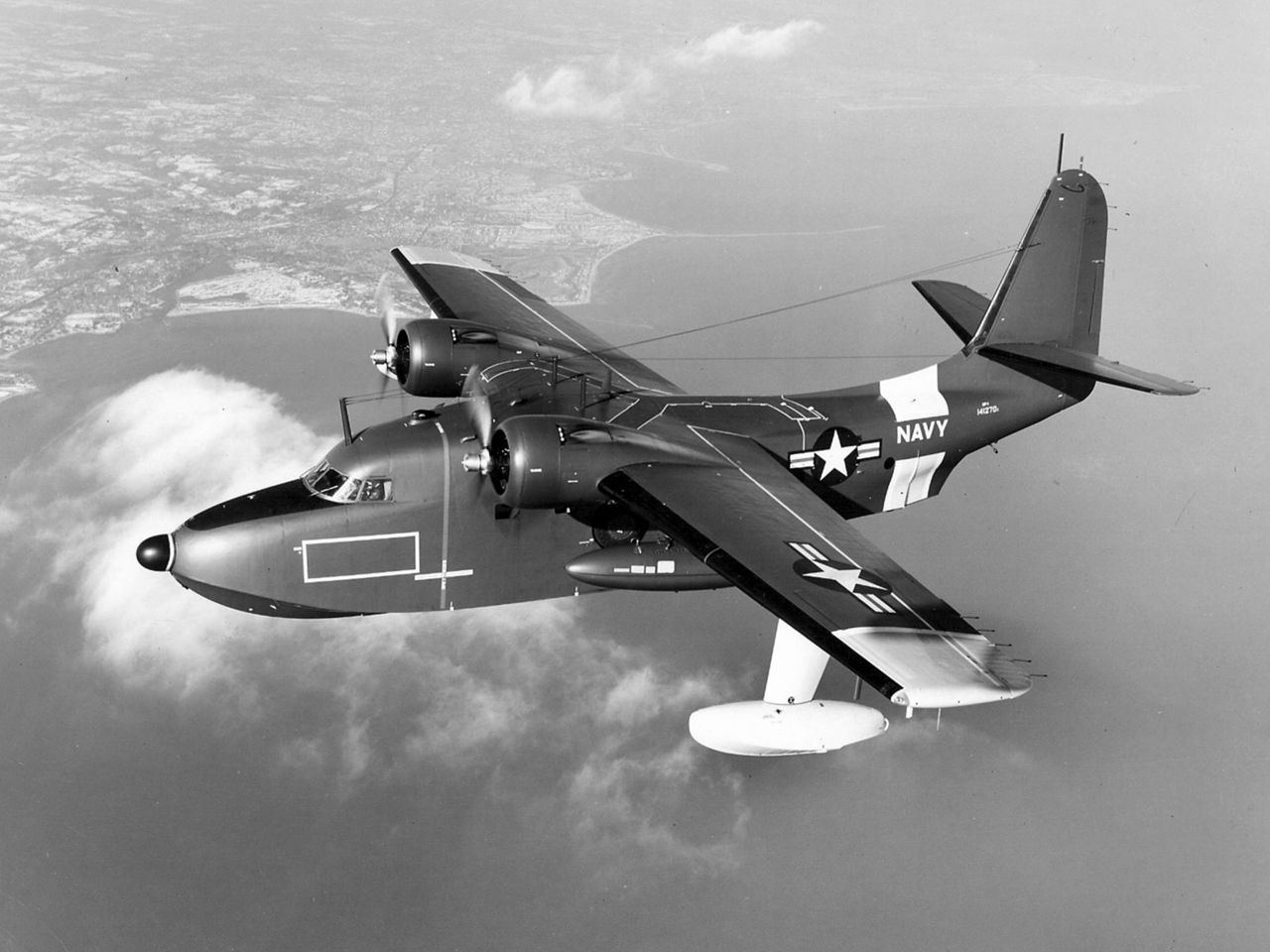
The Grumman HU-16 Albatross served for 46 years. The Albatross was powered by two Wright R-1820-76 Cyclone radial piston engines in military service. The HU-16 was used by the United States Air Force (USAF), Navy (USN), and Coast Guard (USCG) for search and rescue (SAR), anti-submarine warfare (ASW), and other specialized duties.
When first introduced in 1949, the Air Force designation was SA-16, the Navy was JR2F-1, and the Coast Guard called it the UF-1. When the sweeping changes to aircraft designations occurred in September 1962, the designation of the 464 Albatross airframes built by Grumman changed to HU-16.
Descended From a Long Line of Grumman Designs
Grumman’s designator for the Albatross was G-64. It was a development of the G-73 Mallard design, a civil amphibious aircraft developed during a similar timeframe. Another influence was the Grumman G-21 Goose, a successful precursor to the Mallard. The Albatross was capable of open-ocean landings (optimally in seas no higher than 10 feet) due to its deep-V hull cross-section and long keel length, although higher seas could be downright punishing on the aircraft and crew. HU-16s could utilize jet-assisted takeoff (JATO) bottles to shorten takeoff runs in rougher seas.
One Tough Bird
The Albatross built its reputation for toughness during its service in Korea as a SAR aircraft, gaining the nicknames Slobbering Albert, Duckbutt, Clipper Duck, and Goat in addition to the generic Dumbo air-sea rescue call sign. Air Force SAR crews went where others feared to tread in order to bring a total of nearly 1,000 United Nations (UN) personnel out of enemy-held territory.
The same was true during the Vietnam War, although the HU-16s were the longer-winged HU-16B model. USAF, USMC, and USN pilots and aviators knew that if they could make it to “feet wet” (the Tonkin Gulf) after taking damage to their aircraft, a HU-16B with the USAF Aerospace Rescue and Recovery Service (ARRS) would likely be coming for them.
Island Hopping in Navy HU-16s
The Navy also used the HU-16 for SAR, but in smaller numbers over a much wider area. The Navy often operated their HU-16s mainly from US and overseas coastal naval air stations (NASs). During the Vietnam War, the Navy flew most of their rescue and support missions from NAS Agana in Guam.
During the early 1970s, the Navy’s “Goodwill” flights from NAS Agana and other remote air stations to the atolls and archipelagos in the Trust Territory of the Pacific Islands were more common. Navy HU-16s often trained in open-water landings and takeoffs using JATO from the waters near their air stations in the States.
Sub Hunting With a Twist
The Navy’s ASW Albatross, designated SHU-16B, was introduced in 1961. Crewed by six and with a range of 3,200 miles, this version of the Albatross was equipped with a revised radar and radome housing in the nose, a retractable magnetic anomaly detector (MAD) boom in the tail, electronic counter-measures (ECM) lumps and bumps, and a steerable searchlight.
Ordnance payload was light, but usually consisted of depth charges. Rockets could be carried on underwing racks, but often those racks were used for drop tanks to increase range. US Navy service of the SHU-16B was exceedingly short, but Greece, Norway, and Spain also operated the SHU-16B.
Black Birds
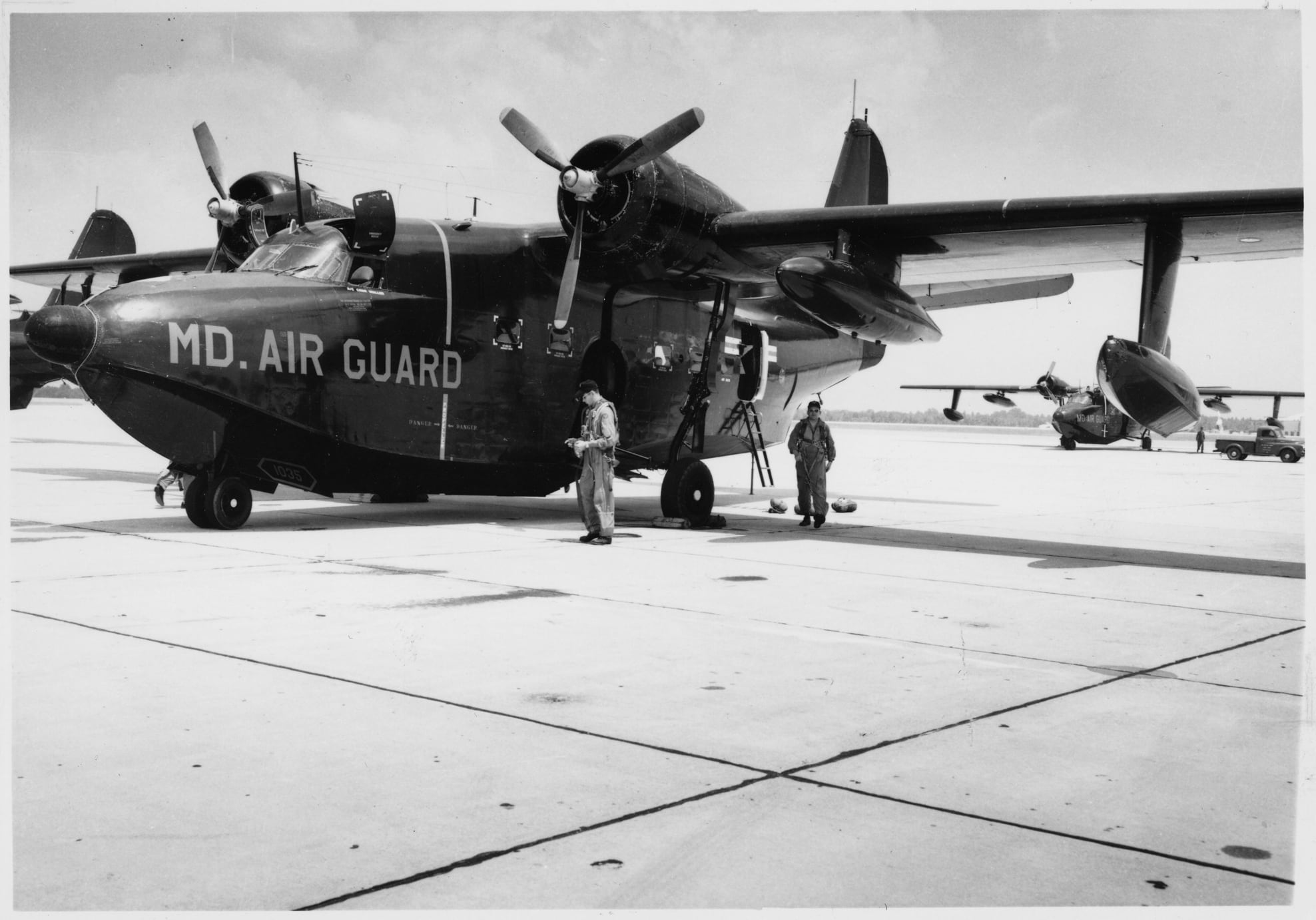
One of the specialized roles the Albatross undertook was black operations. HU-16s, painted all black with subdued markings, were flown by shadowy USAF Air National Guard Air Commando groups between 1956 and 1971- some with reported ties to the Central Intelligence Agency (CIA). Where they went and what they did is still classified, but at least some of these missions were covert infiltration and extraction. Or maybe they weren’t.
But we do know that HU-16s also equipped Air Force Reserve (AFRES) Air Rescue Units during the 1960s and 1970s until the Air Force retired their last HU-16 in 1973—but only after the airplane set a new altitude record for piston-powered seaplanes. Nice finish!
For the Rest of the Albatross Story bang NEXT PAGE below.
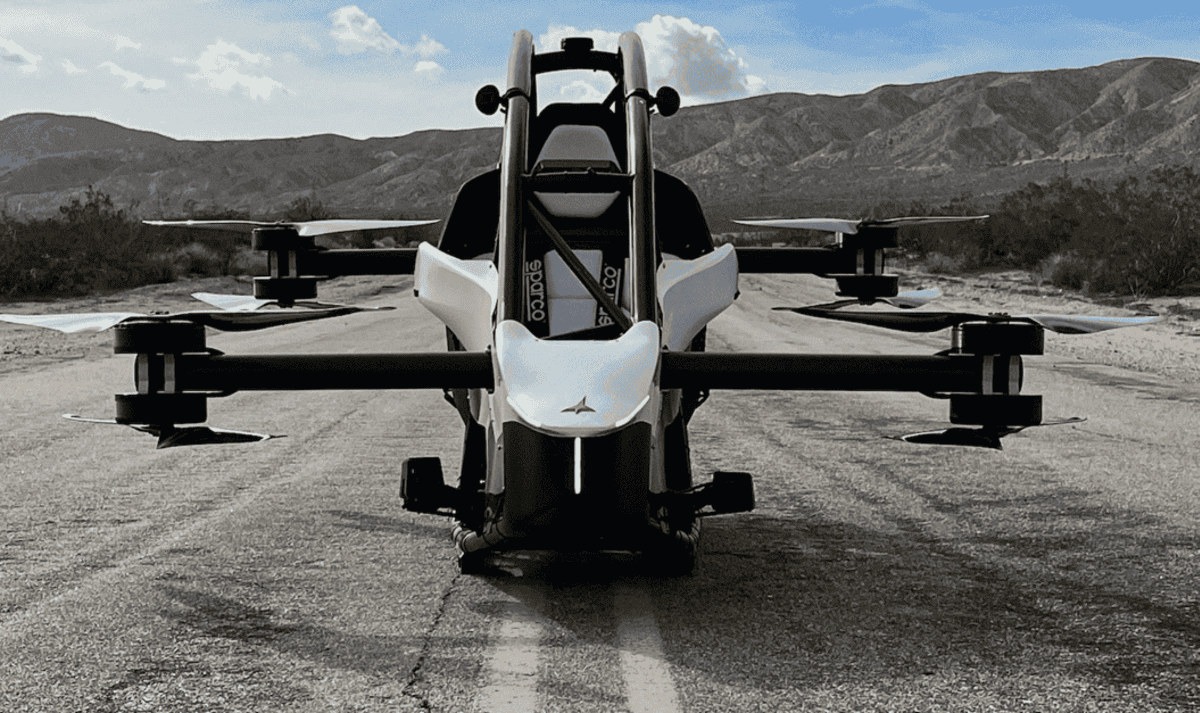
The new Volonaut Airbike promises to be an exciting new option for personal air mobility.
Designed by Polish inventor and entrepreneur Tomasz Patan, the Volonaut looks like something from “Star Wars.” Fans of the movie “Return of the Jedi” might see similarities between the Volonaut and the hoverbikes in the film.
On the Volonaut Airbike Personal Air Mobility Vehicle, the Pilot Sits Up Like on a Motorcycle. | Image: Volonaut
Jet Propulsion Powers Volonaut Personal Air Mobility Vehicle
One of the key things that stands out about the Volonaut Airbike is that it is powered by jet propulsion instead of propellers like other personal air mobility designs. It carries a single pilot without a cage or protective frame. Instead, the pilot sits on a seat like on a motorcycle. Patan said its sleek, “minimalistic design” gives the pilot an unobstructed 360-degree view. The design will also enable it to operate through narrow spaces.
According to Patan, the Volonaut Airbike is seven times lighter than a typical motorcycle, thanks to carbon fiber materials and a 3D printing manufacturing process.
Stabilization System Will Keep Wingless Volonaut Level
According to Volonaut, “The unique riding position…helps the rider to quickly become one with the flying machine and provides the sensation of complete freedom.”
Instead of traditional landing gear with tires, the Volonaut Airbike personal air mobility vehicle rests on a pair of struts, basically tubular components.
Video of Prototype Shows Capabilities of Volonaut Airbike
Volonaut Airbike Personal Air Mobility Vehicle | Image: Volonaut
While Patan has not provided a date when the Volonaut might be available for purchase, in May 2025, the company released a video of a prototype flying and hovering over desert and forest areas. The vehicle looks so striking and different that some wondered if the video, which went viral, was not authentic and if it was made with software. Patan quickly denied this.
Pilot View From The Volonaut Airbike | Image: volonaut
Volonaut Inventor Also Designed The Jetson One EVTOL Aircraft
The Jetson One EVTOL Aircraft | Image: Jetson
The Volonaut Airbike is not the first personal air mobility vehicle Patan has designed. He also invented the Jetson One EVTOL aircraft. Like the Volonaut, it only carries one pilot, but in this case, the single seat is configured to lean back like a Formula One race car. The Jetson One has a cage or “safety cell” that protects the pilot. It also has eight brushless electric motors and eight propellers, and it can maintain flight if it loses one. The aircraft weighs 253 pounds with batteries installed, has a maximum speed of 63 mph, and has a 20-minute flight time.
Front View of the Jetson One, Scheduled For Delivery to Customers in 2026 | Image” Jetson
Jetson advertises the aircraft as “the first affordable EVTOL on the market.” It also claims that anyone can learn to fly it in just five minutes and that no pilot’s license will be required to fly it in the United States.
Jetson Taking Down Payments For 2026 Deliveries
Further along in development than the Volonaut personal air mobility vehicle, the Jetson One will be in production soon, and the first deliveries to customers will be in 2026. They are currently taking down payments of $8000 towards a final payment of $120,000. Customers interested in personal air mobility vehicles might soon be able to decide between a race car-style Jetson One or what Patan calls the “superbike for the skies:” the Volonaut Airbike.
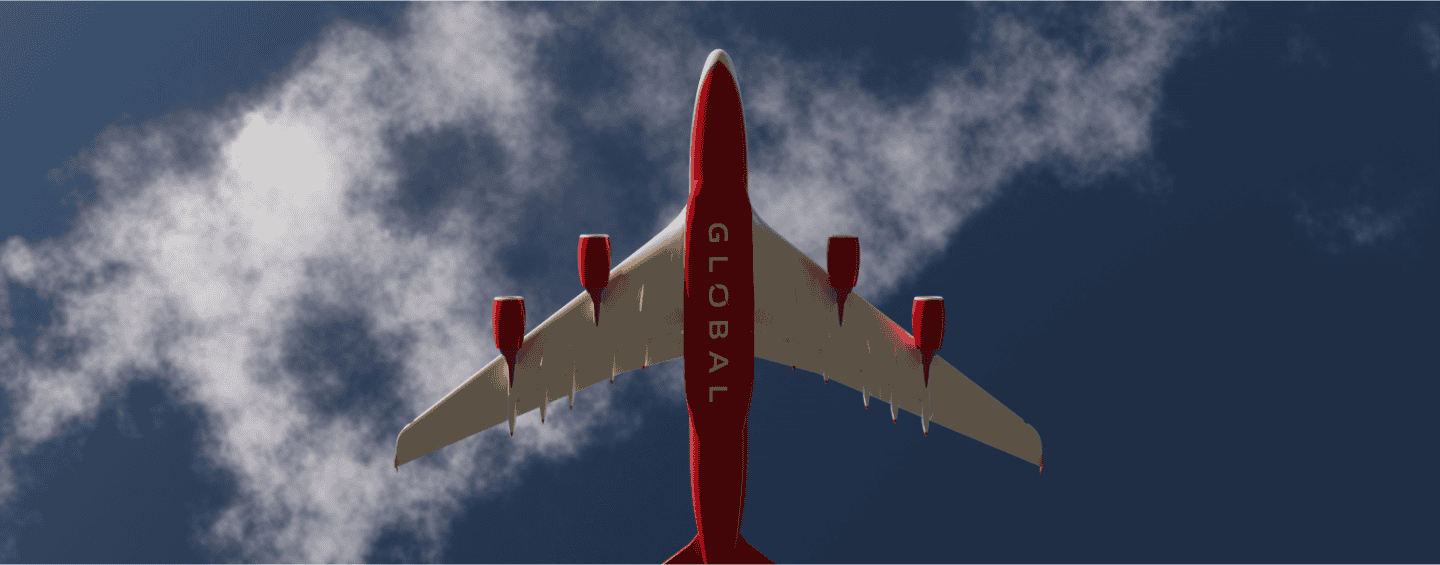
In May 2025, Global Airlines made waves in the aviation world as its Airbus A380, 9H-GLOBL, finally took to the skies on its inaugural transatlantic flight with paying passengers.
The buzz was immediate—planespotters lined up for photos, while aviation YouTubers like Noel Phillips and Josh Cahill weighed in with sharply critical reviews of the inaugural flight. The startup’s debut drew fascination, skepticism, and no shortage of heated discussion.
Many (including us) wondered quietly if this ambitious venture would ever get off the ground. But one month ago, Global proved the doubters wrong—at least for now.
So, what’s really going on behind the scenes at Global Airlines?
To answer that, we looked at a recent statement from Global’s founder and CEO, James Asquith, and reviewed firsthand accounts from passengers on that first flight, including Cahill and Phillips.
First, though, let’s rewind and take a look at how Global Airlines got here.
A Dream Takes Flight
IMAGE: Global Airlines
On 15 May 2025, Global Airlines defied doubters with the launch of its first–and much ballyhooed–passenger flight aboard an Airbus A380-800 from Glasgow Airport (GLA) to New York John F. Kennedy International Airport (JFK).
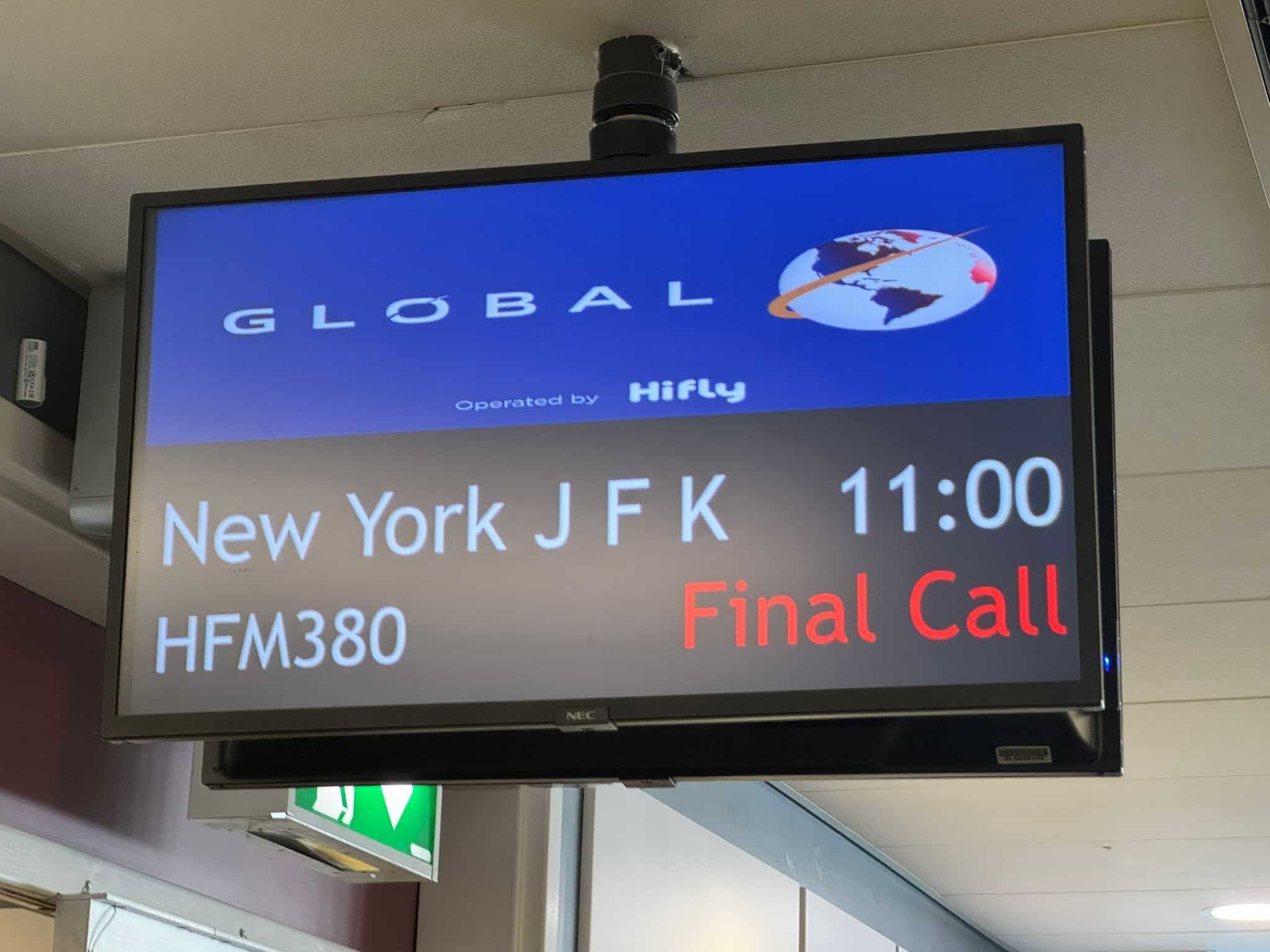
The flight, operating as HFM380 (with “HFM” nodding to Hi Fly Malta–more on that shortly), marked a significant moment for the fledgling carrier.
Bringing a nearly 13-year-old A380 back to life was no small task. Asquith calls it a “monumental achievement,” and he’s right—resurrecting an A380 from desert storage, overhauling its cabin, navigating regulatory mazes, and coordinating crew and catering is a Herculean task for a startup.
Boarding gate screen at Glasgow Airport (GLA) for Global Airlines’ inaugural flight to New York JFK Airport on 15 May 2025 | IMAGE: James Asquith
That inaugural flight carried just 95 passengers, far below the A380’s 500+ seat capacity. Critics were quick to point to the low passenger count as a sign of weak demand. But Asquith pushed back on that narrative.
“We wanted to test our service and products and focus on our premium cabins,” he explained in a social media post addressing the speculation. “If we had more passengers, we would never have got to test all the elements we wanted to try out.”
He also noted the airline didn’t market the flight to the general public.
“We didn’t do any marketing but simply reached out to our community online and in the wider aviation circles,” Asquith added.
In his words, the flight “succeeded on all fronts.”
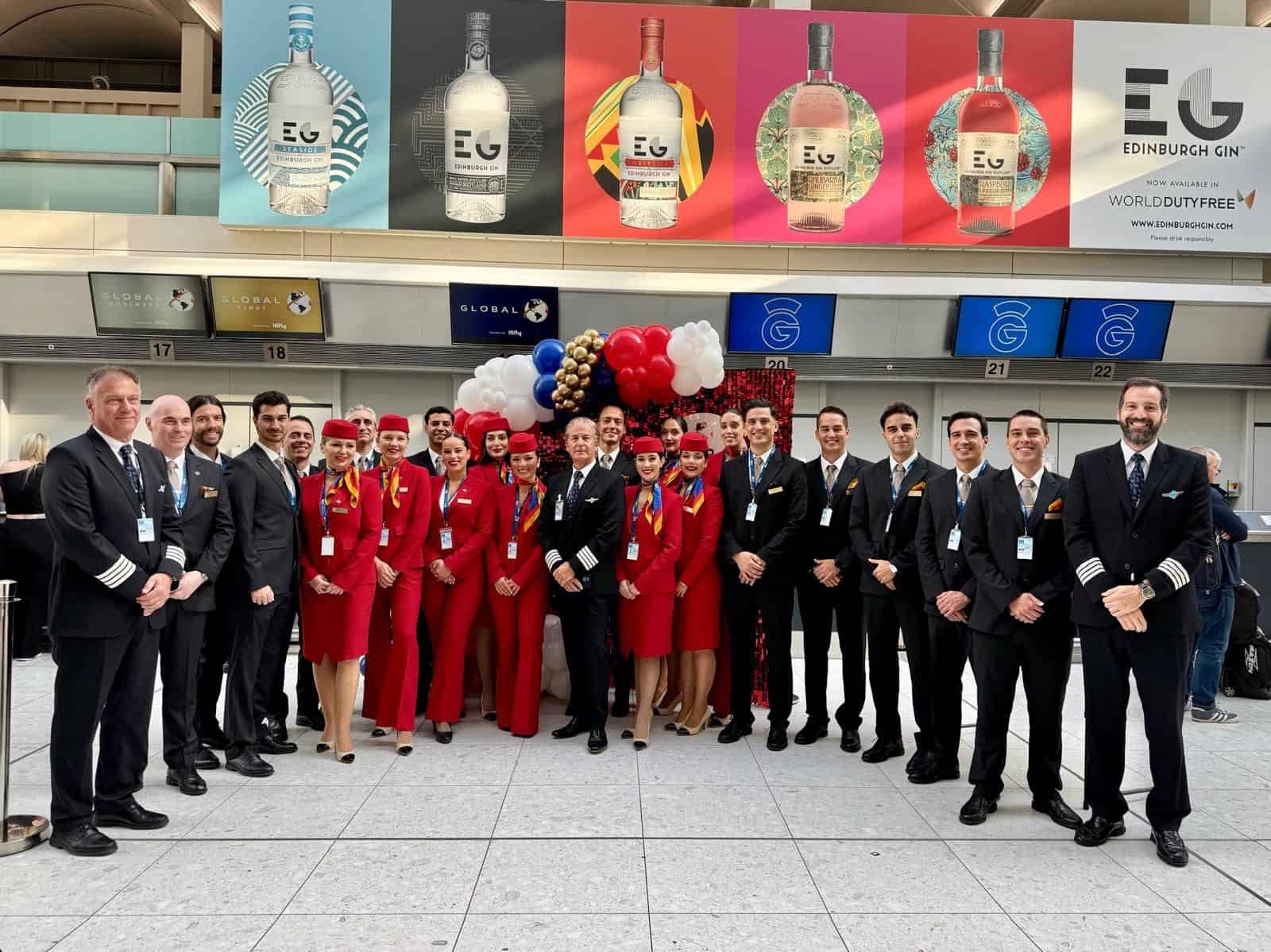
The flight crew of Global Airlines’ inaugural flight pose for a picture at Glasgow Airport (GLA) on 15 May 2025 | IMAGE: James Asquith
Asquith’s Vision: Golden Age Glamour with a Modern Twist
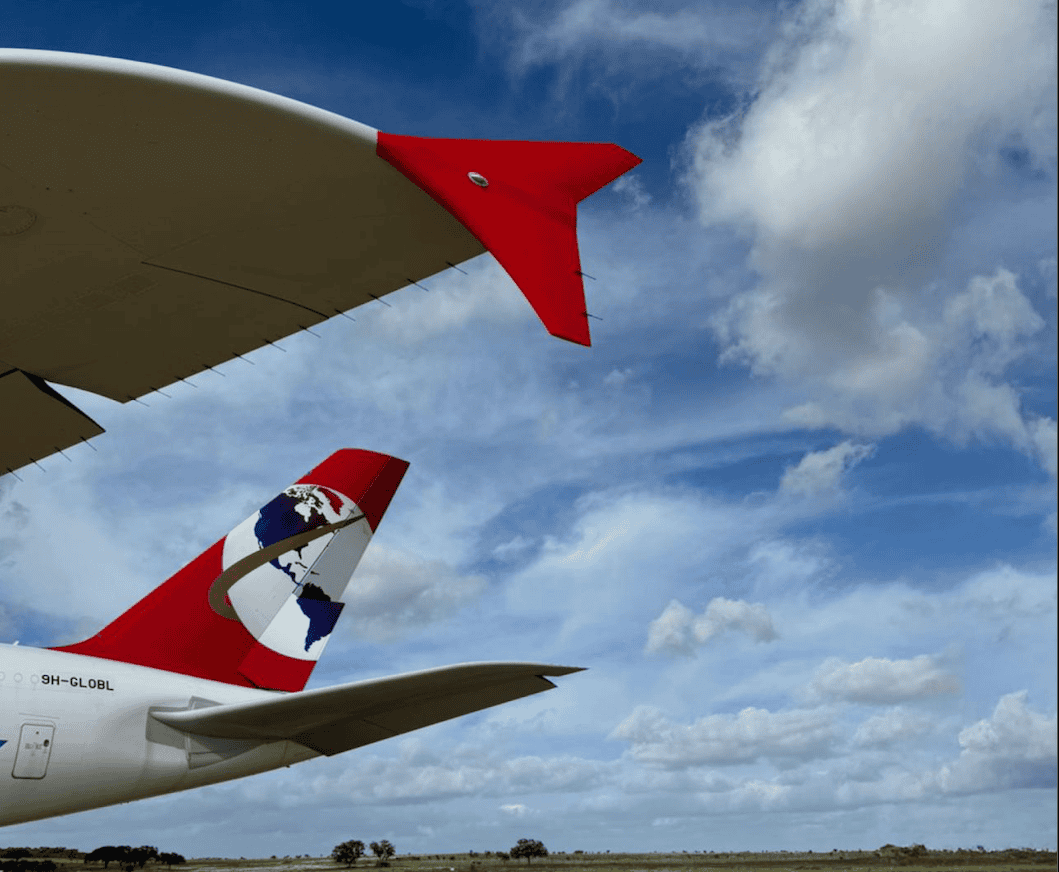
Global Airlines’ 9H-GLOBL on the ramp at Beja | IMAGE: Global Airlines
When James Asquith founded Global Airlines in 2021, his mission was clear: bring back the elegance and excitement of aviation’s Golden Age—this time with a modern edge.
At the heart of that vision is the Airbus A380. Although it is a fuel-thirsty aircraft compared to more modern twinjets, the A380 remains a fan favorite known for its smooth, quiet, and spacious ride. Asquith’s strategy centers on acquiring retired A380s at bargain prices, refurbishing them inside and out, and putting them to work on high-demand routes, starting with transatlantic service between the UK and the US.
Global wholly owns its flagship aircraft, 9H-GLOBL, but partners with Maltese wet-lease operator Hi Fly Malta to handle the operational side. Bookings are managed through Travelopedia, a UK-based travel agency.
While early concepts like a five-class cabin—including a quirky “gamer” class—have been dropped, the airline is still pushing for a premium experience, with a strong focus on First, Business, and the airline’s signature “Global Traveller” cabins.
The ultimate goal? To become a full-fledged scheduled carrier. But as Asquith himself puts it, “There are still a lot of things to tackle on that journey.”
Did Global Airlines overpromise and underdeliver? It depends on who you ask.
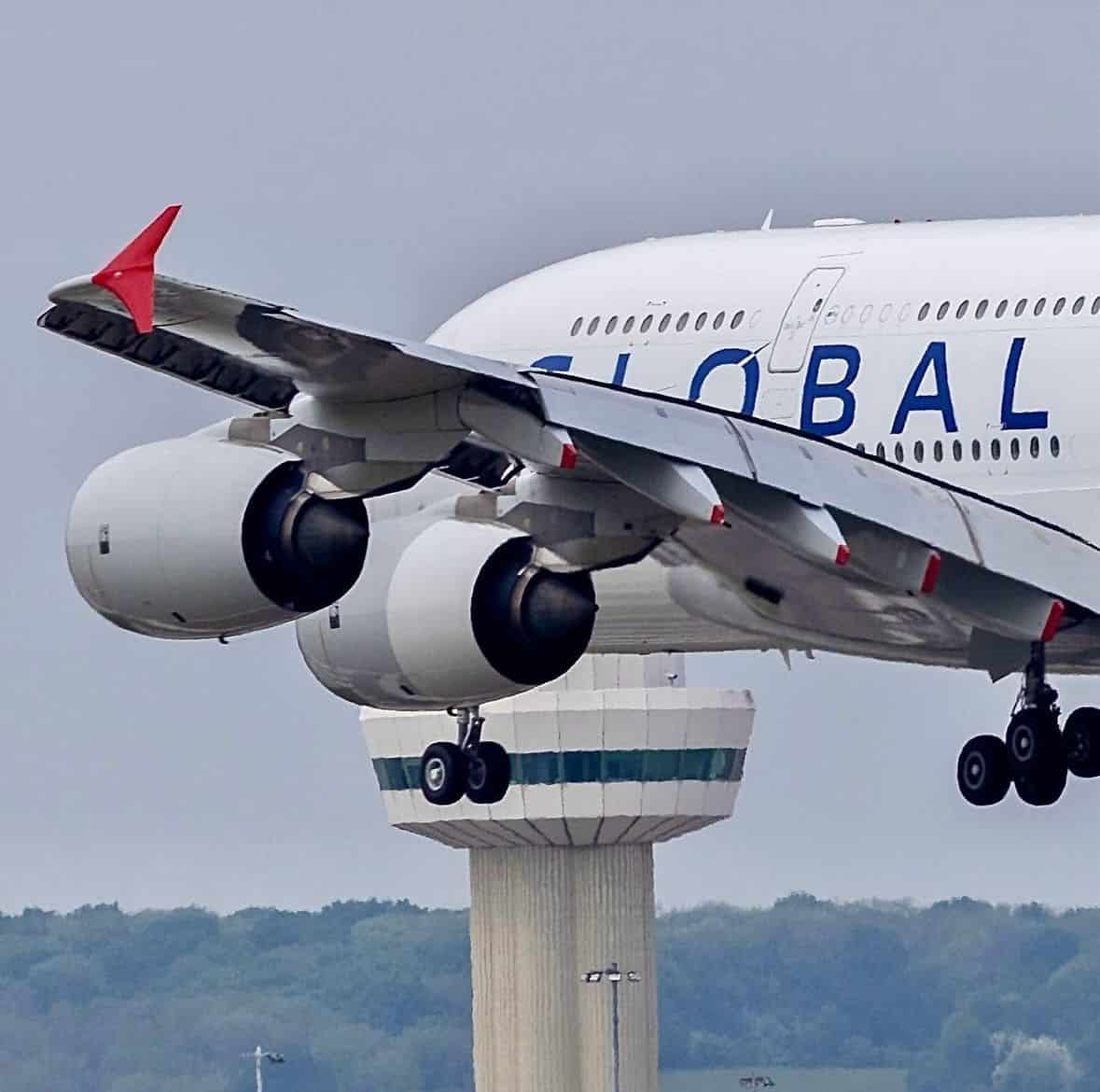
Global Airlines’ Airbus A380 (9H-GLOBL) lands at London Gatwick (LGW) | IMAGE: James Asquith/@gatwick.sptr
While passengers aboard Global’s debut flight, HFM380, appreciated the A380’s signature quietness and roomy cabin, many came away underwhelmed by the overall experience.
Aviation YouTuber Josh Cahill, one of the first to board 9H-GLOBL, didn’t hold back. In a video titled “Global Airlines STRANGE First Flight and it was VERY BAD,” Cahill called it “one of the most chaotic flights I’ve ever been on.” He cited confusion at check-in, uneven service, and a noticeable lack of polish in the premium cabins Global had heavily promoted.
“It’s not too favorable to overpromise and underdeliver,” he said. “You promised us a new world, a new level of traveling—and that didn’t happen. It was really far away from it.”
Cahill criticized everything from the catering—describing it as “subpar” and sloppily presented—to the unprepared crew, who appeared to struggle with the logistics of working such a large aircraft. He also questioned the low passenger load, suggesting it reflected limited demand rather than a strategic soft launch.
His video quickly racked up over half a million views and struck a chord online, with many viewers echoing his disappointment. The narrative emerging was that Global Airlines had ambition but wasn’t ready for prime time.
Similarly, Noel Phillips wished Global Airlines well; however, in his review, he expressed concerns about the carrier.
“I genuinely want them to succeed,” Phillips said as he landed at JFK. “But after today, it’s clear there’s a long runway ahead before they’re truly ready for takeoff.”
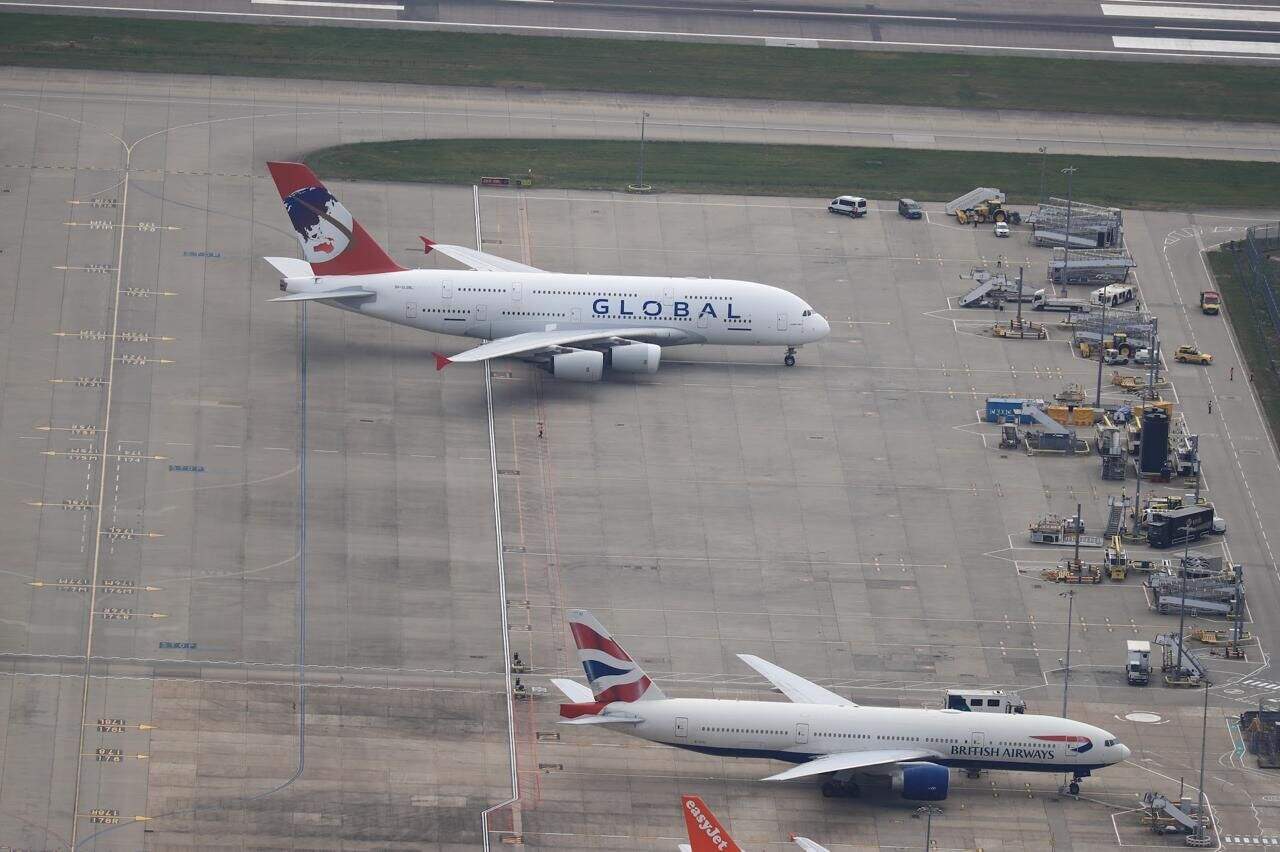
Global Airlines’ Airbus A380 and a British Airways Boeing 777 at the remote stands at London Gatwick (LGW) | IMAGE: Global Airlines
But not all reviews were negative.
Six days later, on a Global flight from Manchester (MAN) to JFK, travel vlogger James Warren-Oliver offered a more hopeful perspective.
“This wasn’t just another flight,” he said. “This was the start of a dream years in the making. James [Asquith] didn’t just launch an airline; he launched an idea—a belief that flying could be more joyful, more meaningful. In a world of airline conformity, he asked, ‘Why can’t it succeed?’”
And Simon Calder, travel correspondent for The Independent, went even further, calling the inaugural flight “easily the most comfortable and fun transatlantic trip I have had.” He wrote, “This wasn’t a return to the ‘golden age of travel’—it was far better than that.”
Still, the online negativity—fair or not—clearly struck a nerve with Asquith. The buzz from influencers with large audiences quickly shaped public perception. Asquith later commented that “negativity drowns out all the good stuff online,” hinting at the frustration of watching his vision get overshadowed by early missteps.
MythBusting the Noise: Global Airlines’ Response
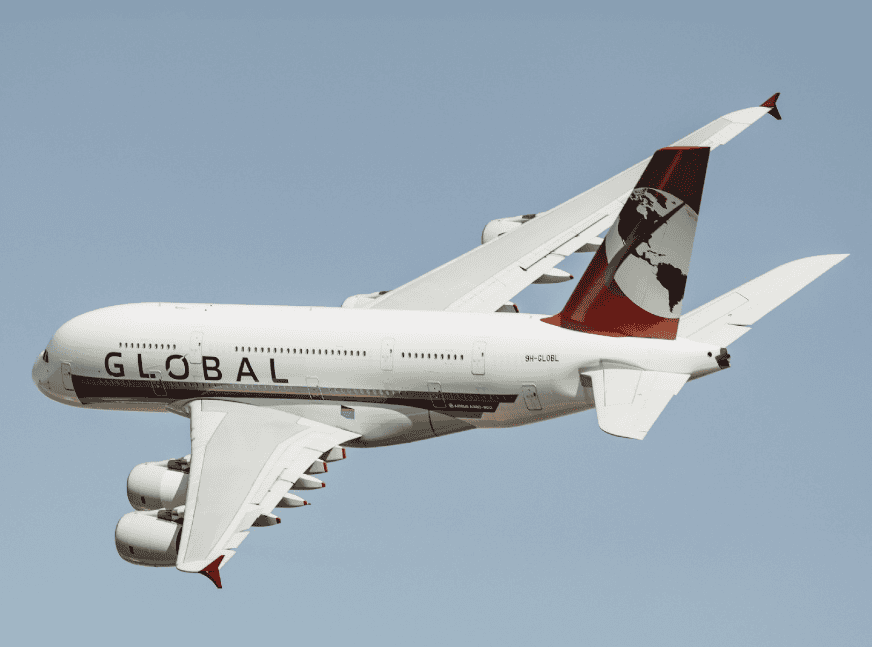
Global Airlines Airbus A380 | IMAGE: Global Airlines
In the wake of criticism and online speculation, James Asquith didn’t stay silent. He took to social media with a post that felt equal parts celebration and clapback.
“There’s been a lot of noise since the first passenger flights,” he wrote, thanking supporters while calling out what he described as “huge speculation repeated as fact.”
Though he acknowledged the buzz Global had stirred up, Asquith urged followers to take a breath before jumping to conclusions.
“Don’t believe everything you see, hear, and read,” he warned. “Check information before amplifying fiction.” He added that while the attention is welcome—“there is only one thing worse than being talked about—not being talked about”—he’d rather the conversation be based on facts, not rumors.
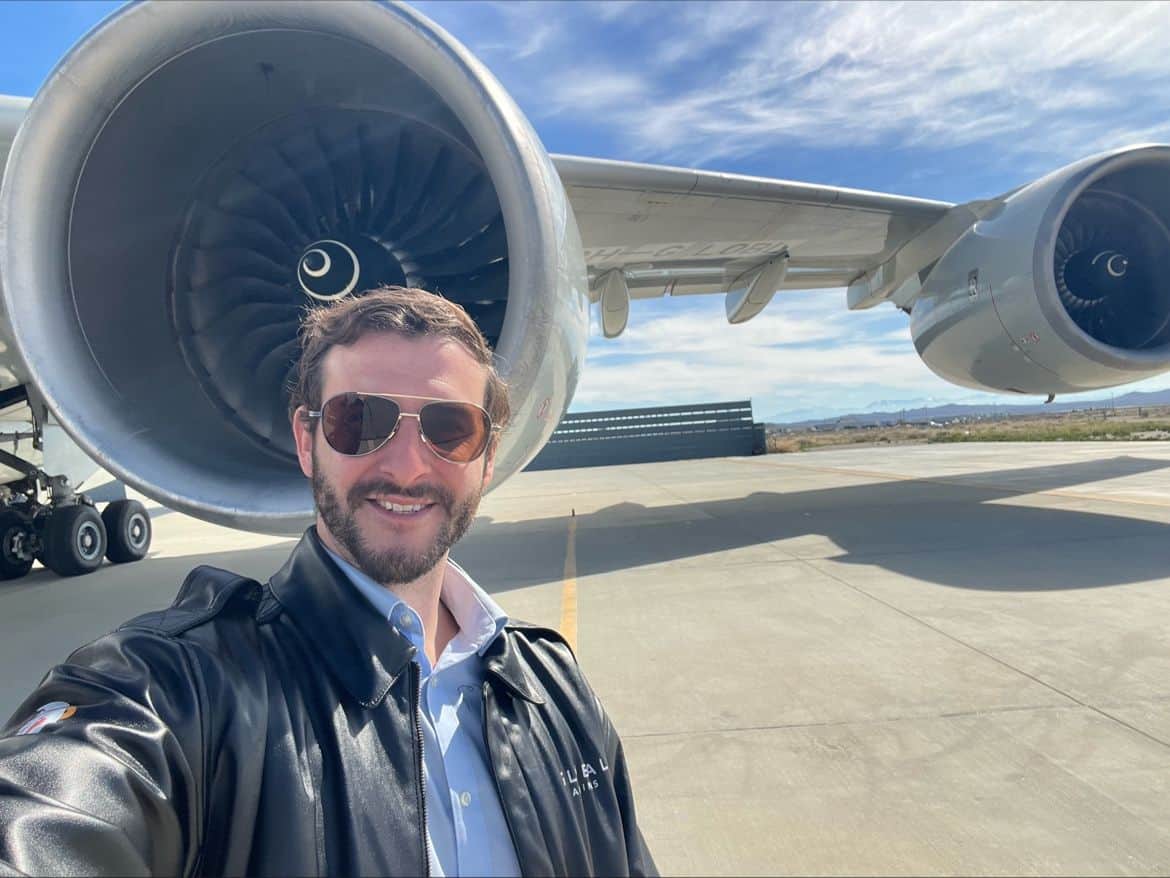
Global Airlines founder and CEO James Asquith in front of 9H-GLOBL | IMAGE: James Asquith
To push back against misinformation, Global announced plans for a “MythBusters” series aimed at offering more transparency.
“We always have a good laugh at Global HQ when the latest missive gets posted,” Asquith joked.
But he made it clear that the focus remains on doing the actual work: “We’d rather channel our energy into delivering on our goals.”
He then addressed some of the biggest rumors head-on:
ACMI rumors: “We’re not planning to change any strategy to become an ACMI operator—ACMI has always been part of our discussions with Hi Fly, but nothing has changed about our direction of travel.”
Funding speculation: “We’re in talks with various organizations… Take anything you read with a pinch of salt, especially if there’s no official quote from Global.”
Passenger numbers: The low load was intentional, allowing Global to “succeed on all fronts” in testing its premium offerings.
In short, Global isn’t backing down from the criticism. But it wants the record set straight.
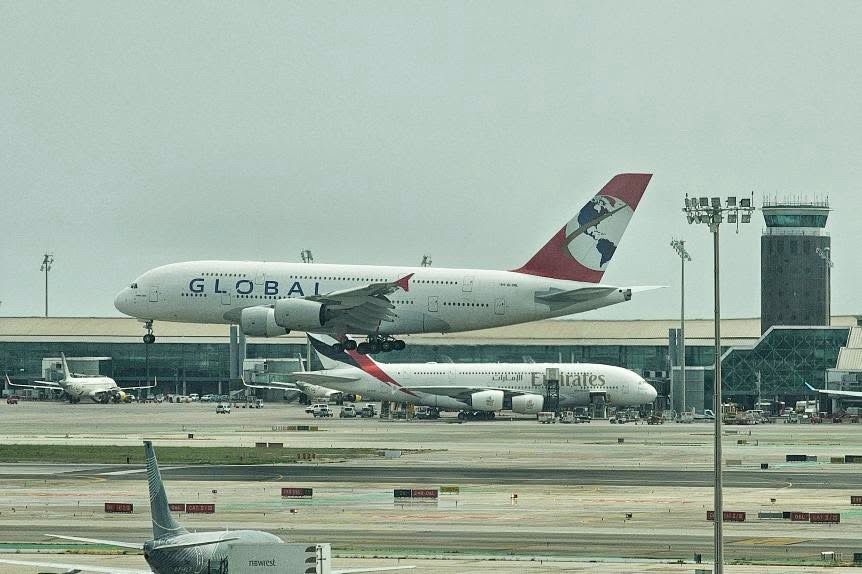
Global Airlines A380 landing at Josep Tarradellas Barcelona-El Prat Airport (BCN) during test flights | IMAGE: James Asquith
The First Flight Fumble: Critics, Context, and Course Correction
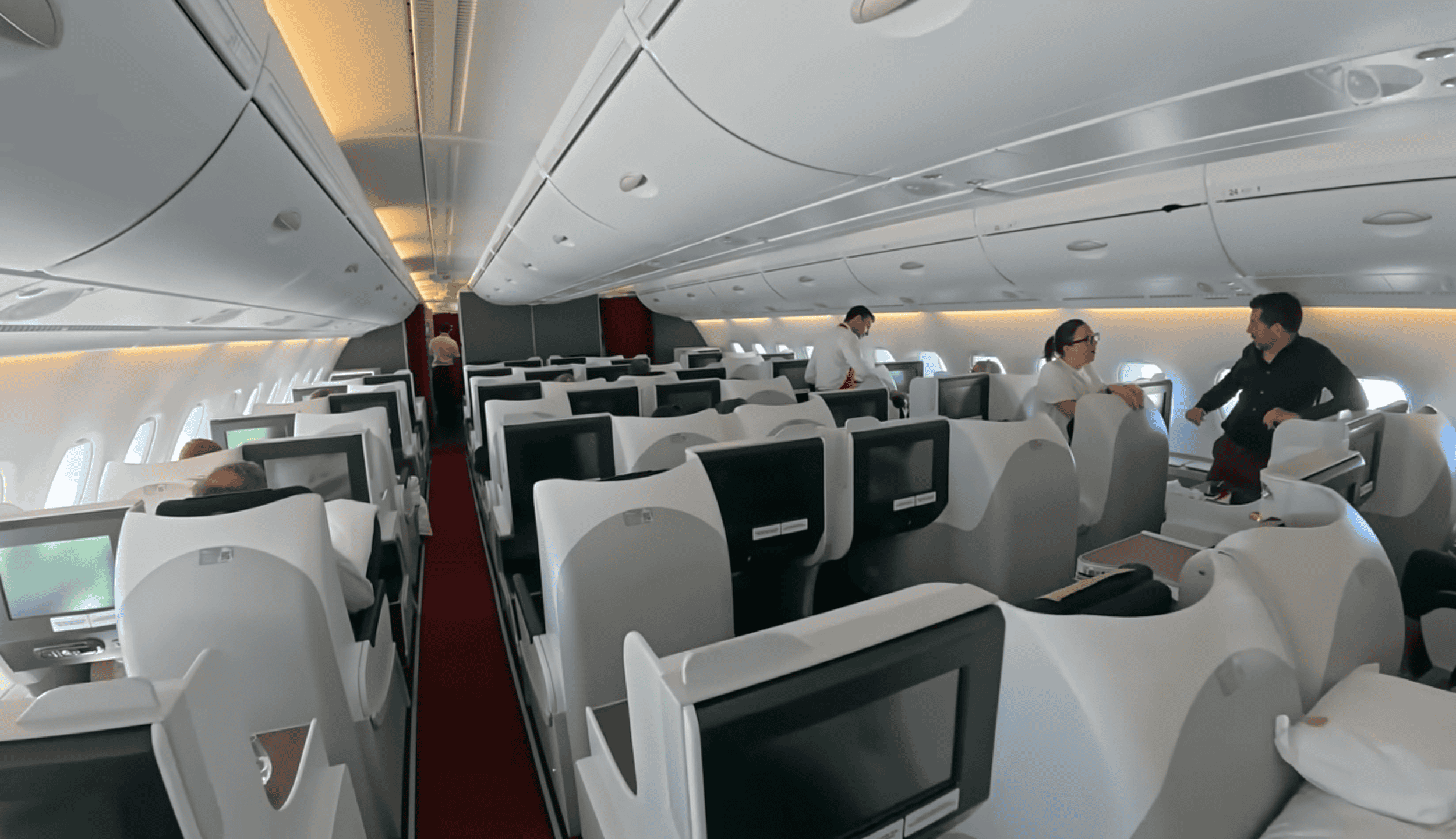
The economy cabin aboard Global Airlines’ inaugural flight | IMAGE: Josh Cahill via YouTube
Asquith owns the rough start: “Our first flight was a bit of a challenge… We were hopeful, but it just didn’t quite happen.”
But he also offers important context. For a startup, launching a transatlantic flight on a reactivated Airbus A380 is no small feat. The aircraft needed extensive maintenance, a major cabin overhaul, regulatory clearance, and a fully coordinated crew—all under the public eye.
“We apologize to any of our passengers who didn’t have the best time,” he says, but notes, “Many did have an amazing time, and the feedback was incredible.”
Thankfully, the missteps didn’t become a trend. Flights two, three, and four showed what Asquith calls a “1,000,000% improvement,” with reviewers praising the upgrades and smoother operations.
“It’s a shame that some of those who shouted loudest on the first flight did not join us on the second,” he adds, thanking those who documented the progress. Global plans to share more positive passenger stories online to “balance things out a little.”
And for the skeptics? Asquith has a simple invitation: “The only way to really get to know us is to buy a ticket… and then decide once and for all.”
While online reviews exposed real issues, Global’s quick response suggests they’re listening, learning, and making changes fast.
Global Airlines’ Road Ahead is Far from Certain
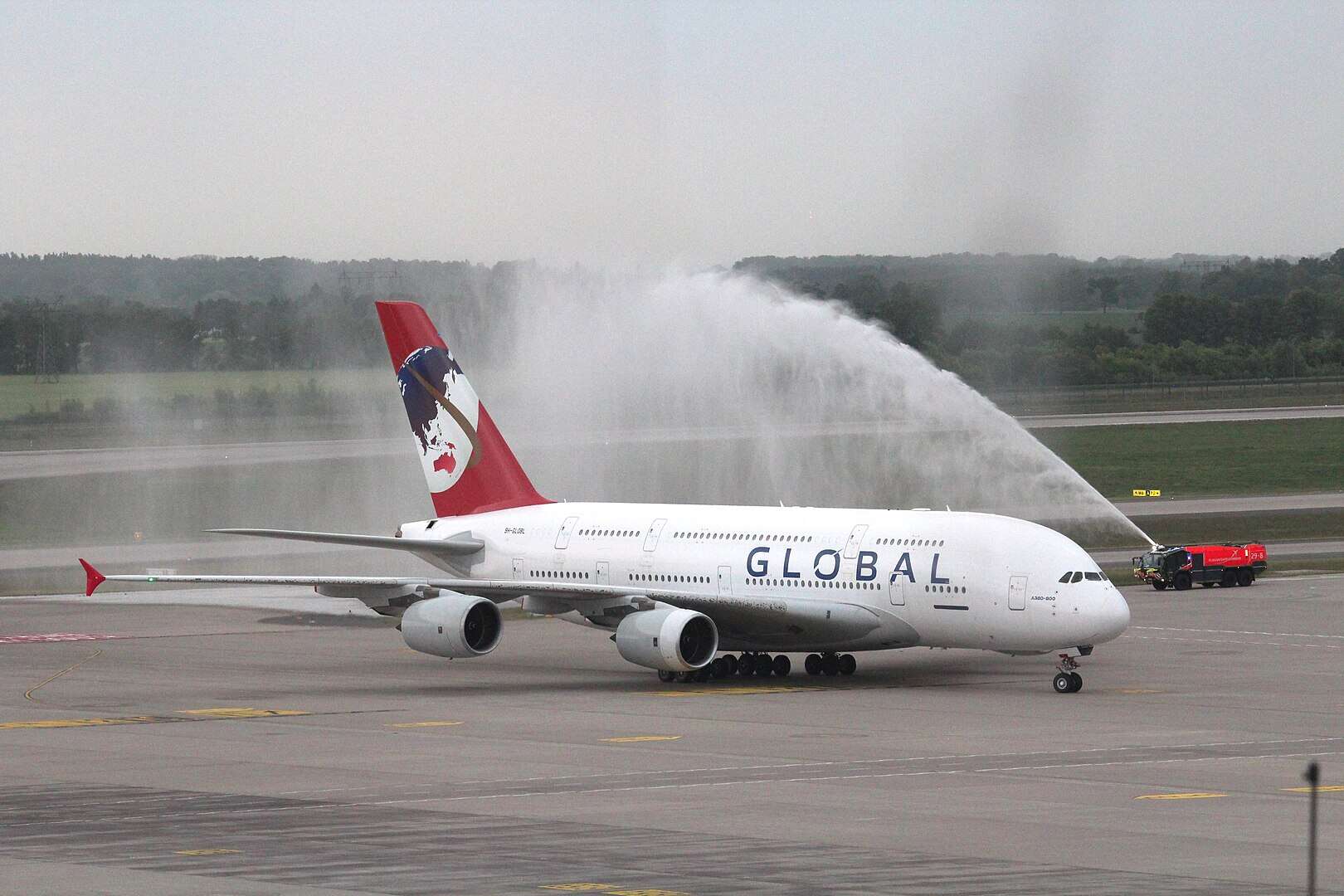
Global Airlines’ first A380 receives a water cannon salute at Berlin Brandenburg Airport (BER) during flight trials | IMAGE: By TheButz – Own work, CC BY-SA 4.0, https://commons.wikimedia.org/w/index.php?curid=164575284
There’s no sugarcoating it—Global Airlines has a steep climb ahead. The transatlantic market is brutally competitive, dominated by lean, fuel-efficient twinjets like the Boeing 787. By contrast, the A380 is a high-stakes bet: big, expensive to operate, and built for volume. With no new commercial flights scheduled beyond Glasgow and Manchester, doubts are growing about whether Global can scale—or sustain—its operations.
Online reviews, especially after the first flight, cast shadows on the airline’s readiness. And without regular service to build momentum, the hype risks fading.
Yet, there’s something familiar about Global’s story. It reminds us of past dreamers like Freddie Laker and Richard Branson—entrepreneurs who went up against the odds with vision, swagger, and a refusal to play by the old rules.
Backed by investors and targeting premium travelers, Global isn’t trying to be everything to everyone. There’s a clear effort to tap into a niche: travelers who value comfort, nostalgia, and the once-unrivaled magic of the A380.
Behind the scenes, discussions with financiers and maintenance partners are ongoing, hinting that something more may be taking shape—even if details remain under wraps.
Suppose Global can continue refining its product by filling more seats and delivering a consistently elevated experience. In that case, the A380’s enduring appeal, with its space, silence, and sense of grandeur, might just win over a loyal audience (so long as fuel prices remain reasonable).
Will Global Airlines’ Superjumbo-Sized Gamble Pay Off?
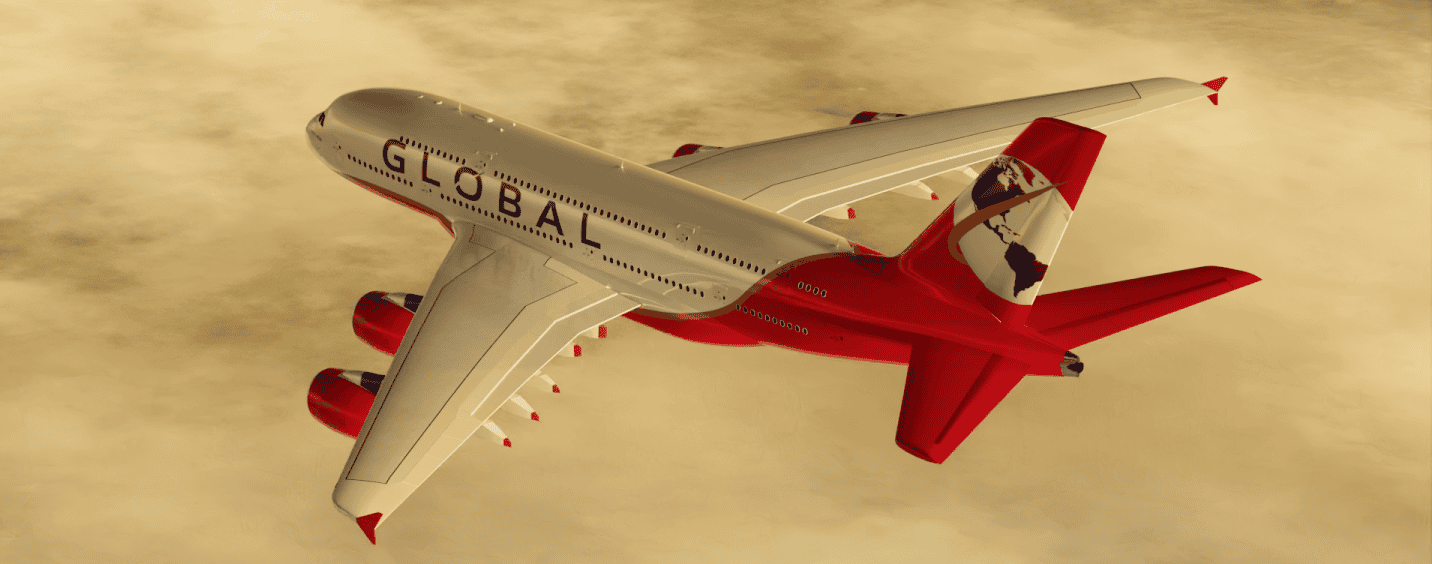
Image: Global Airlines
Global Airlines is a startup with sky-high dreams and real challenges. Their A380 debut was a milestone, but scathing passenger experiences exposed a chaotic first flight that fell short of the hype. It is, after all, a massive undertaking to launch a new airline, especially one flying the world’s largest passenger jet.
Still, improved feedback from later flights and Global’s commitment to making the experience better for its customers show they’re listening and ready to tackle their shortcomings.
Asquith’s open invitation to “come and experience it for yourself” is a challenge for curious travelers to give Global a chance.
But when will that chance be? Will there be another chance? At the time of writing, we simply don’t know yet.
Will Global become a scheduled airline or remain a niche player? Time will tell. For now, they’re writing a story worth watching.
We wish them the best.
For those of us who live and breathe aviation, startups like this are part of what keeps the industry thrilling. However, bold (and, some might argue, crazy) bets like Global’s keep the skies worth watching, even if the takeoff’s a bit bumpy.
While the Simpsons took to the skies in 1995, it was the Powerpuff Girls’ turn five years later. To the delight of many Cartoon Network fans, Delta’s Powerpuff Girls jet came courtesy of Delta Air Lines’ no-frills offshoot, Delta Express.
So what came of this idea? Here’s the story of the Powerpuff Girls Delta Boeing jet.
Service, Miles, and Everyone Smiles
In the early 1990s, Southwest Airlines gained prominence as a no-frills, economical airline that was winning over customers who couldn’t afford fares from typical airlines. Continental Airlines formed Continental Lite in 1993 to slow Southwest’s momentum, and Delta came up with Delta Express three years later.
Delta Express’ network connected many northeast US cities to tropical Florida destinations such as Orlando, Jacksonville, and Fort Lauderdale. Despite Delta’s headquarters being in Atlanta, A-Town was absent from the list of destinations.
In 1998, Cartoon Network’s latest show, The Powerpuff Girls, debuted. Along with the show came waves of merchandise and promotional items. As Cartoon Network was owned by Turner Broadcasting System (TBS), network bigwigs thought they had a hit on their hands and were looking for more ways to promote the show.
Dial ‘A’ for Atlanta
How did Delta and TBS executives come up with this idea? Arguably, the biggest reason was that both are headquartered in Atlanta. The drive between both addresses is less than 30 minutes away, so it made sense for Turner executives to simply take a short trip within downtown Atlanta rather than invest weeks or even months of time into communicating with other airlines from across the country.
Another possible reason was that TBS’s outspoken founder, Ted Turner, was an Atlantan inside and out and often preferred to work with other Atlanta-based businesses — even owning the Atlanta Braves, Hawks, and Thrashers and broadcasting their games nationally.
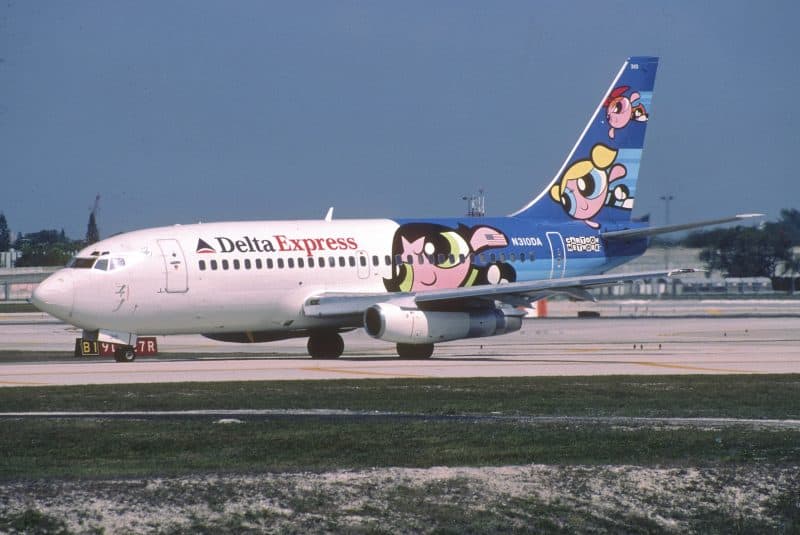
Delta and Turner ended up designing a Powerpuff Girls livery onto a Delta Express Boeing 737-232. The possible reason a Delta Express jet was chosen instead of a main Delta jet was to simply promote the show to everyday families looking to fly to Florida on a budget.
Delta’s Powerpuff Girls Makeover
The Boeing with registration number N310DA was selected for Delta’s Powerpuff Girls jet. The PPG design only took up the aft of the livery, while the front was white, bearing only the Delta Express logo. These features were likely to save on the costs of repainting the livery. Still, it was a very appealing and clean design.
Though Blossom (pink) was considered the PPG leader, she was relegated to the upper tail of Delta’s Powerpuff Girls jet, likely due to her bow needing more space (similar to Marge on the WestPac aircraft).
Buttercup (green) was featured in front, on the fuselage, while Bubbles (blue) occupied space on the lower tail area. While the Powerpuff Girls logo is missing from the design, the Cartoon Network logo is present.
Passengers received promotional gift bags on the jet, which included a button pin. A model of the PPG jet was also available for sale. During service, the jet operated flights to New York City, Boston, Newark, Chicago, Washington D.C., Tampa, and Fort Lauderdale.
A Hollywood Promotion
With The Powerpuff Girls Movie in theaters on 3 July 2002, Delta Express started to promote the film in late June of that year with updated promotional tie-ins on the N310DA. Despite the movie’s release, however, the appearance of Delta’s Powerpuff Girls jet remained the same.
The original show ended in 2004 after six seasons. A revival premiered in 2016 and lasted for three seasons until 2019. A live-action revival on the CW, titled ‘Powerpuff,’ was in the works in 2021 but was canceled.
Delta Express ceased operations in 2003 as Delta pivoted to launch a new low-cost carrier, Song, aimed at competing with JetBlue’s growing success. As part of the transition, Delta retired the aging Boeing 737-200s that made up the Express fleet. Among them was the iconic Powerpuff Girls jet, which later found a new home with Northern Air Cargo.
Unidentified Anomalous Phenomena (UAPs), formerly referred to as UFOs, is a term the Department of Defense (DoD) and other government agencies now use to describe objects and behaviors of objects they can’t immediately identify.
Many try to link UAPs with evidence that extraterrestrial life forms, or aliens, exist. The U.S. Government has made a serious effort to effectively study UAPs. It can also explain and refute most, but not all, UAP sightings.
So far, every organization involved in UAP detection and research has made it clear that they have zero evidence of extraterrestrial life.
Image From All Domain Anomaly Resolution Office (AARO) showing only 1% of Unidentified Anomalous Phenomena Not Clearly Explained. | Image: All Domain Anomaly Resolution Office
Reports, but no definite evidence, of Unidentified Anomalous Phenomena
For decades, military and commercial pilots, astronauts, and civilians have been reporting sightings of airborne objects they can’t identify. On 31 July 1952, USAF Intelligence Chief Major Gen. John A. Samford released a statement on flying saucers from the Pentagon.
Samford stated that since 1947, the Air Force had received “between one and two thousand” reports of UAPs from “various sources.” He added that they had been able to explain the majority of sightings as “hoaxes, as erroneously identified friendly aircraft, as meteorological or electronic phenomena, or as light aberrations.”
Samford also stated that the sightings were not connected with any secret development by any U.S. Government agency, nor did they pose a threat to the nation. However, he did describe how it was not always easy to identify Unidentified Anomalous Phenomena. He described some reports made by “credible observers of relatively incredible things.” He explained further that they had no means of measuring some of these sightings, which made them difficult to explain.
National Archives Records on Unidentified Anomalous Phenomena
The National Archives and Records Administration (NARA) maintains a UAP Records Collection. It contains records from the Nuclear Regulatory Commission, the FAA, the Office of the Director of National Intelligence, and the DoD.
The DoD record contains a Fiscal Year 2024 UAP annual report. This document mentions that from 2021 to 2024, the Government’s All-domain Anomaly Resolution Office (AARO) received 757 UAP reports. According to this document, the AARO has resolved 292 of the reports. It explained that the reports were due to a combination of balloons, birds, unmanned aerial systems, and aircraft. This leaves 465 reports that still need to be resolved.
The annual report contains a statement similar to Gen. Samford’s: “It is important to underscore that, to date, AARO has discovered no evidence of extraterrestrial beings, activity, or technology.”
Photographs, Images, and Sound Recordings of UAPs
1962 image of an Atlas F Missile breaking up in flight, with a smaller object, an Unidentified Anomalous Phenomena (UAP) (object on the upper right), in flight on a parallel path. | Image: National Archives Catalog
NARA also maintains a collection of photographs, moving images, and sound recordings of unidentified anomalous phenomena. One example from this collection was the sighting of a flying object moving in a parallel path to an Atlas F missile that broke up during its flight in 1962. The record contains a fuzzy video of the event, which took place at the Atlantic Missile Range. This record does not contain an explanation for the sighting.
National Archives Catalog Card of unidentified anomalous phenomena Sighting During Breakup of Atlas F. | Image: National Archives Catalog
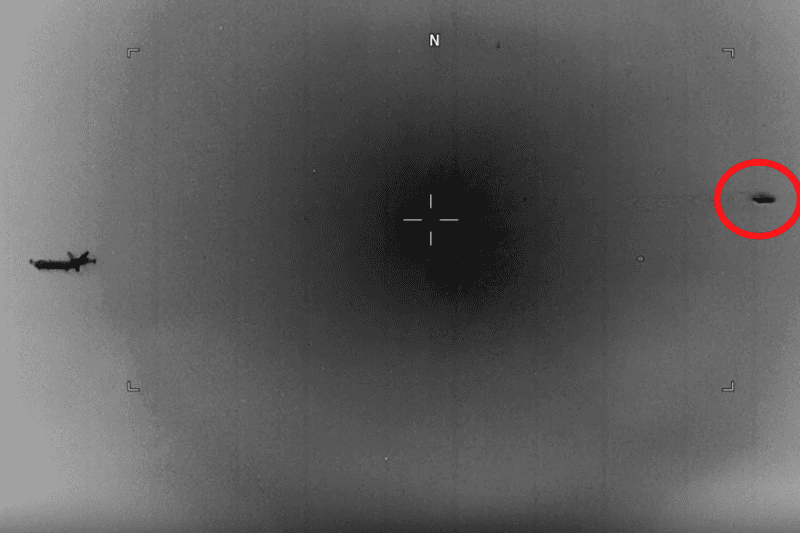
Another example (and this one was resolved) was the sighting of a UAP in December 2018 during an eruption of the Mt. Etna volcano in Sicily. A U.S. military uncrewed aerial system (UAS) took infrared video of the eruption. A round object appears on the video for four and a half minutes. It appears to be moving away from the volcano’s exhaust plume at a high rate of speed.
Detailed Analysis of UAP Finds Balloon as Likely Cause
AARO studied the object using full-motion video (FMV) analysis, 3-D modeling, pixel examination, and wind speed calculations. This detailed analysis determined that the object was likely a balloon and that it was actually 106 miles away from the volcano. It even showed that the object was about one foot in diameter.
Based on these results, AARO concluded with “moderate confidence” that the object was a balloon. It is interesting that they did not express a higher level of confidence.
With all these examples and discussions of Unidentified Anomalous Phenomena, it is undeniable that the U.S. has focused attention on whether there is evidence of extraterrestrial life. It is difficult to say if this is to refute all sightings, to prove that alien intelligence exists, or simply to study UAPs in the most scientific and logical way. This third option seems the most likely.
Scientific Method Key to Refuting Most UAP Sightings
One possibly significant detail regarding UAPs is that pilots may be reluctant to report sightings. In a hearing of the GOP Oversight Committee on UAPs, Representative Robert Garcia stated, “a significant number of pilots of major airlines have witnessed UAPs…but have no real confidential way of reporting them to the government” because of “stigma or fear of retaliation.” The more one looks at this issue, the more obvious it becomes that the majority of UAP sightings are due to birds, UAS, satellites, and aircraft.
A report from AARO makes it clear that careful scientific research is essential and that “in the search for life beyond Earth, extraterrestrial life itself must be the hypothesis of last resort—the answer we turn to only after ruling out all other possibilities.”
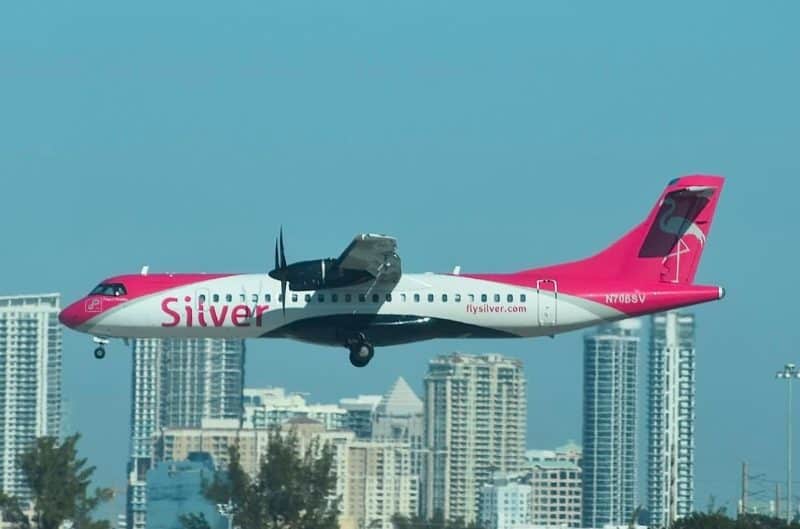
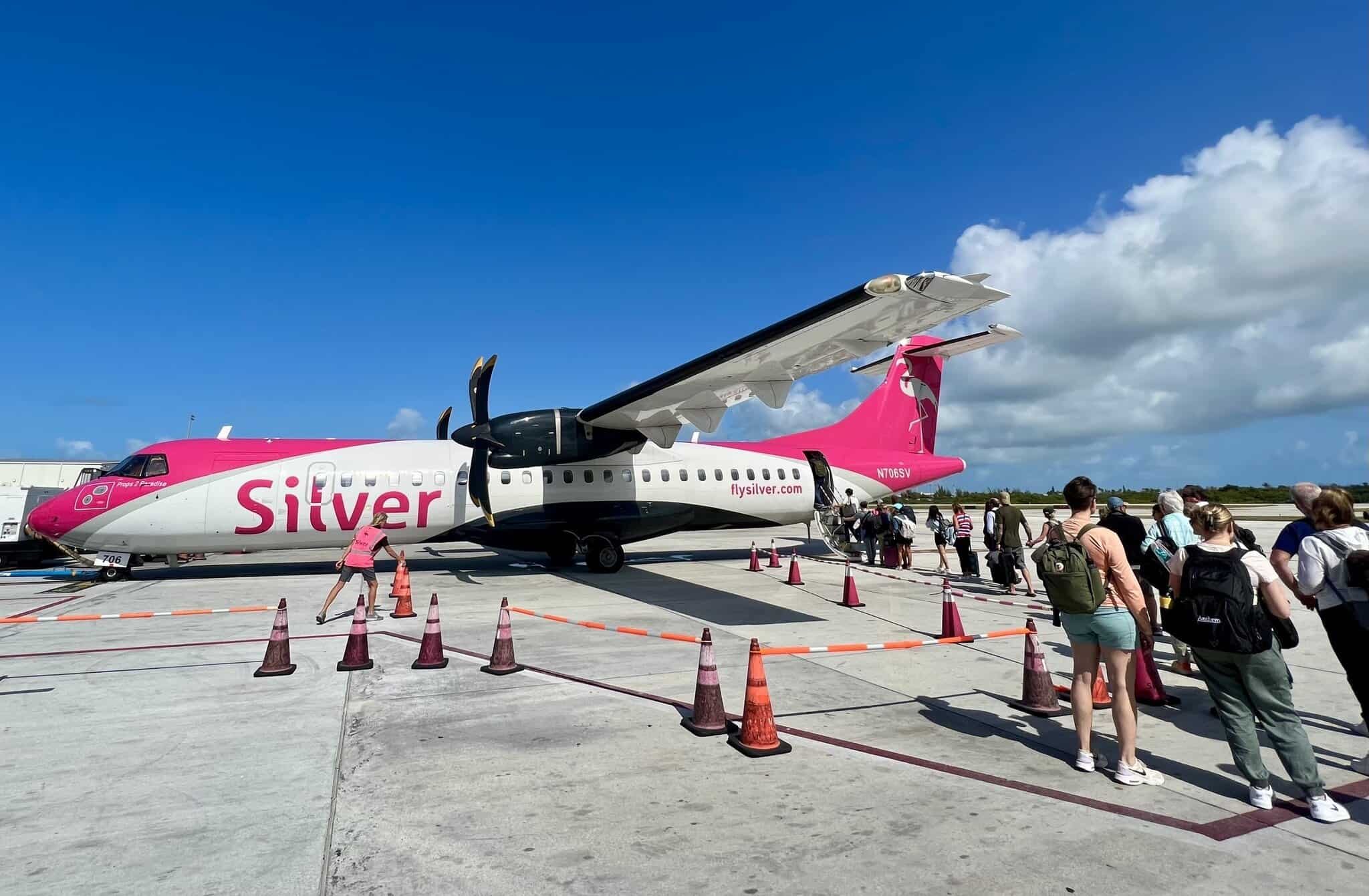
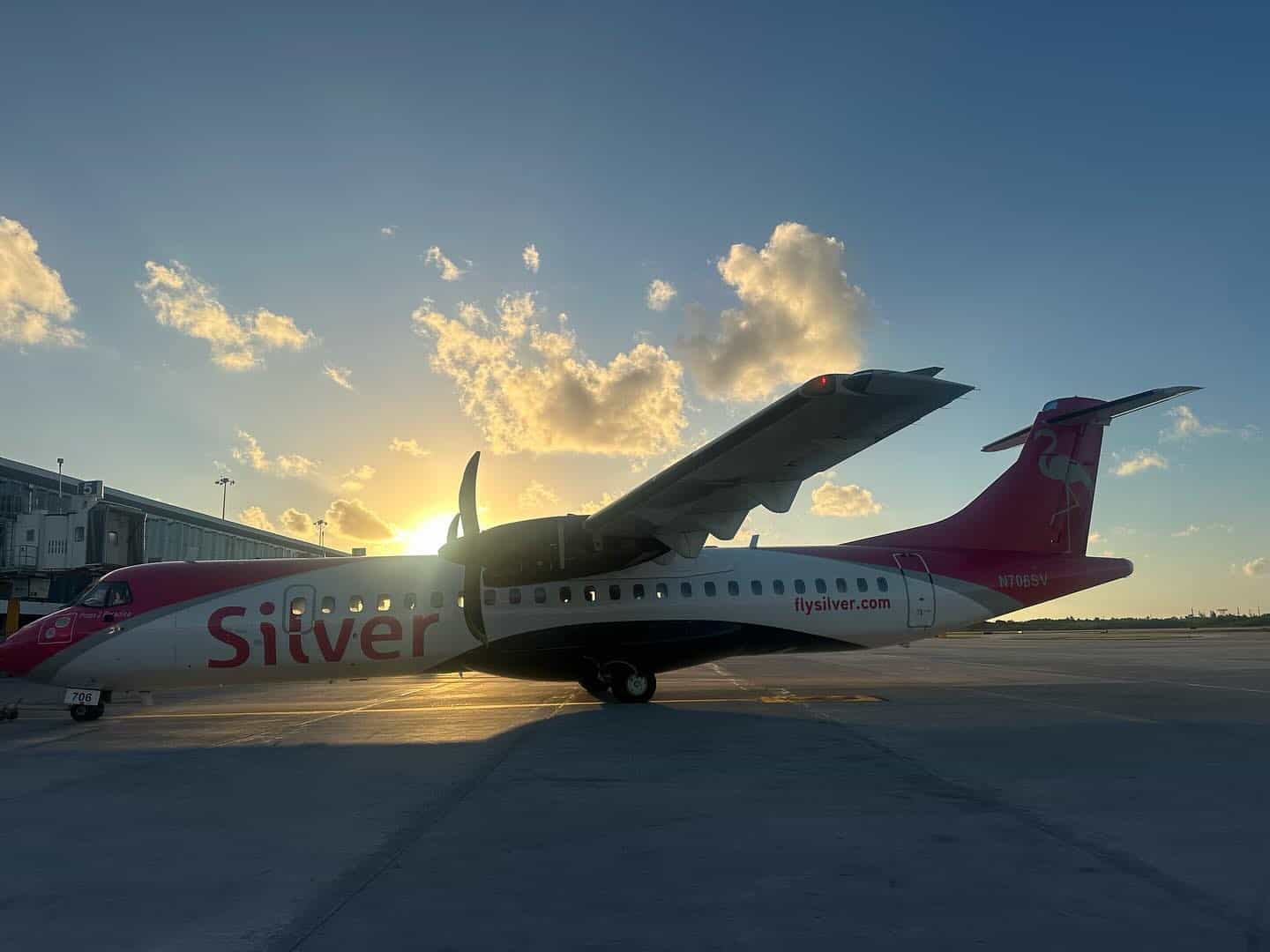
Silver Airways, the quirky, fuchsia-liveried regional carrier known for its intra-Florida and Caribbean routes, ceased operations today, 11 June 2025.
The unfortunate news comes after the carrier’s failed attempt to navigate Chapter 11 bankruptcy. We certainly wish it hadn’t come to this, but the writing’s been on the wall for some time.
The sudden closure leaves passengers stranded, assets headed for liquidation, and a dedicated workforce facing an uncertain future.
For those who’ve poured their hearts into keeping Silver’s turboprops aloft, our hearts go out to you today.
A Niche Carrier’s Rise and Fall
A Silver Airways Saab 340B+ | IMAGE: Silver Airways on Facebook
Silver Airways carved out a unique space in U.S. aviation since its founding in 2011, born from the ashes of Gulfstream International Airlines’ bankruptcy. Rebranded with a flamingo logo and a focus on Florida, the Bahamas, and the Caribbean, Silver operated an all-turboprop fleet—first Beechcraft 1900s, then Saab 340s, and later ATR 42s and 72s. It connected smaller communities through Essential Air Service (EAS) contracts and codeshares with United and JetBlue, while its 2018 acquisition of Seaborne Airlines expanded its Caribbean footprint.
The airline hit milestones, like becoming the first US ATR 72-600s operator in 2019 and briefly serving Cuba. But beneath the tropical charm, cracks were forming. Operational hiccups, frequent delays, and a near-eviction from Fort Lauderdale-Hollywood International Airport (FLL) in 2023 over $1.4 million in unpaid fees hinted at deeper financial woes. By late 2024, Silver’s route network had shrunk dramatically, with cuts to eight destinations, including Gainesville (GNV) and Palm Beach (PBI), leaving just 20 cities served.
Silver filed for Chapter 11 bankruptcy on 30 December 2024, hoping to restructure and secure fresh capital. The plan was to streamline operations and focus on core routes, but mounting debt, rising costs, and competition from jet operators like Breeze Airways and Florida’s Brightline high-speed rail proved too much. A would-be buyer backed out, and at a recent auction, no one outbid the “stalking horse” offer from a Wexford Capital affiliate, which will now take control of Silver’s assets, including its 14 ATR aircraft.
Seaborne Airlines, Silver’s Caribbean subsidiary, will keep flying, but for Silver itself, the journey ends here.
A Heavy Heart for the Silver Airways Team
In a heartfelt statement, Silver Airways CEO Steven Rossum shared the news:
“It is with a heavy heart that I share the difficult news that, after months navigating through Chapter 11 bankruptcy, our journey at Silver Airways is coming to an end for most of us. Wexford Capital—our DIP lender—has informed us they will no longer support operations or, except for a few, retain our employees. As a result, Silver Airways will cease operations on Wednesday, June 11, and begin the wind-down process. A small group will be asked to stay on temporarily to assist with asset management and records. Those individuals will be contacted directly. Seaborne will continue to operate as scheduled.”
Steven Rossum, Silver Airways CEO
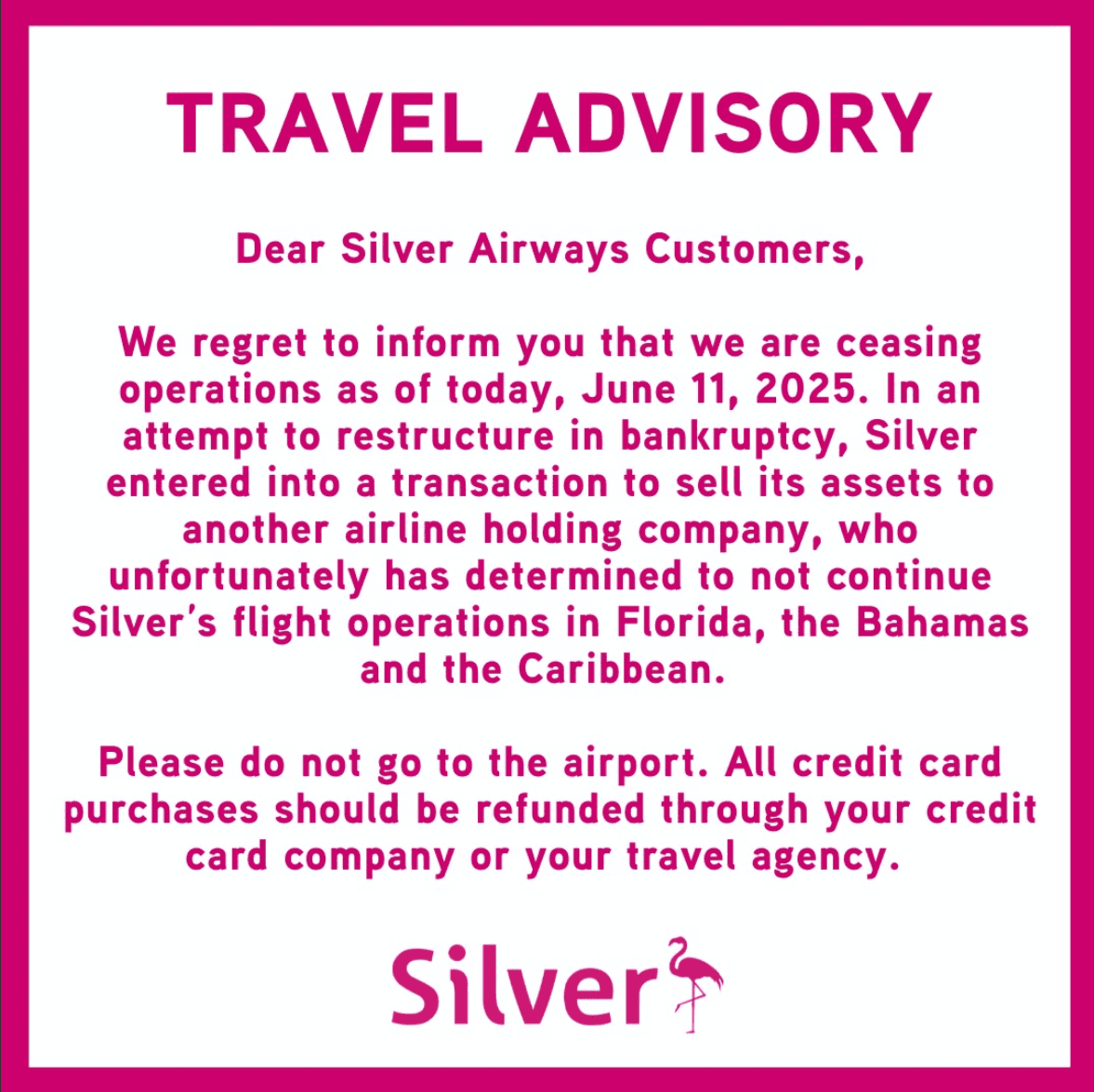
The airline’s Instagram post echoed the sentiment, urging passengers not to head to airports and promising refunds for credit card bookings.
Silver Airways posted news of the immediate closure on Instagram on 11 June 2025
For Silver’s employees—pilots, mechanics, gate agents, and more—this closure is undoubtedly a terrible gut punch. Many saw the signs, with former employees noting the ever-shrinking operation and constant crew reassignments, and opted to jump ship.
To those who stayed and now face joblessness, AvGeekery and the entire aviation community feel your loss and hope you land on your feet soon.
Looking Back, Moving Forward
The sun sets on Silver Airways following its sudden closure on 11 June 2025 | IMAGE: Silver Airways
Although competitors may step in, Silver’s demise leaves a void in Florida and Caribbean connectivity.
Its quirky charm and niche routes will be missed, but the harsh realities of a post-COVID market, turboprop skepticism, and financial strain were insurmountable.
Passengers will be refunded, but for the airline industry, Silver Airways’ immediate demise is a sobering reminder of how brutal the industry can be, even for a carrier with a loyal niche. Here’s hoping its employees land on their feet and that Seaborne keeps the flamingo spirit alive, even if just a little longer.
Play Airlines and the era of low-cost transatlantic flights between the United States and Iceland have hit another rough patch.
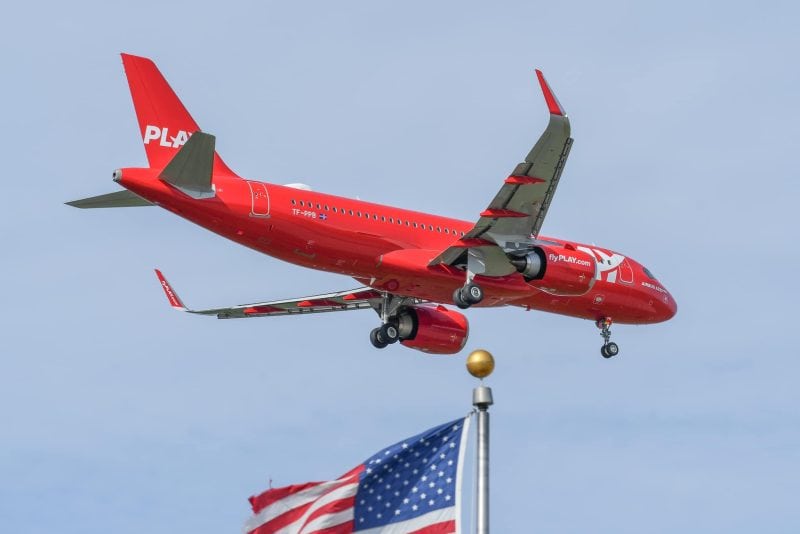
PLAY Airlines, an Icelandic low-cost carrier, announced it would suspend all its remaining US routes by October 2025, significantly retreating from the North American market.
This move echoes the collapse of WOW Air in 2019, another Icelandic low-cost carrier that tried—and failed—to make budget transatlantic travel a sustainable reality. Much like WOW, PLAY’s bold vision of connecting the US and Europe via its Keflavík hub has stumbled, joining a list of carriers like Norwegian Air Shuttle and Norse Atlantic Airways that have struggled with the economics of long-haul, low-cost operations.
It’s an all-too-familiar story seen repeatedly in this industry: a promising upstart, a familiar business model, and a harsh lesson in profitability.
So, what exactly is happening at PLAY Airlines? And where do we expect it to go from here? Read on to find out.
The End of PLAY Airlines’ US Adventure
IMAGE: PLAY Airlines via Facebook
PLAY Airlines was founded in 2019 by former WOW Air executives Arnar Már Magnússon and Sveinn Ingi Steinþórsson. Launched with a singular mission to revive the low-cost transatlantic model that WOW Air once championed, PLAY began flying from Keflavík International Airport (KEF) to destinations throughout Europe in June 2021. The carrier went on to launch North American routes in 2022.
PLAY operates a young fleet of 10 Airbus A320neos (average age 4.7 years, configured for 174 or 180 all-economy seats). It serves three US airports: New York Stewart International Airport (SWF), Boston Logan International Airport (BOS), and Baltimore/Washington International Airport (BWI). PLAY offered daily flights to these cities at its peak, connecting passengers to Iceland and onward to European destinations.
However, on 10 June 2025, Ishrion Aviation broke the news that PLAY would cease all US operations by October 2025. The schedule for the wind-down is as follows:
New York Stewart (SWF): Service ends 1 September 2025.
Boston (BOS): Service ends 15 September 2025.
Baltimore/Washington (BWI): Service ends 24 October 2025.
PLAY Airlines appears to be canceling all U.S. flights:
• Stewart (SWF) ends after September 1 • Boston (BOS) ends after September 15 • Baltimore (BWI) ends after October 24
This decision follows earlier cuts to PLAY’s North American network, including the termination of Washington Dulles (IAD) after summer 2024 and John C. Munro Hamilton International Airport (YHM) in Ontario, Canada, which ended in April 2025. A planned route to Orlando (MCO) never materialized, with carrier officials citing high fuel costs.
For BWI, PLAY’s exit marks the seventh airline to leave the airport in recent years, joining Allegiant, Air Senegal, JetBlue, Condor, Contour, and Air Canada. Ironically, travelers can still get to Iceland with Icelandair, which operates daily flights from BWI to KEF with the Boeing 737 MAX 9.
A Familiar Pattern: Low-Cost, Long-Haul Struggles
A pair of PLAY Airlines Airbus A320neos endure a blizzard at Keflavik International Airport (KEF) | IMAGE: PLAY Airlines via Facebook
PLAY Airlines’ retreat from the US market is a stark reminder of the challenges low-cost carriers face in long-haul operations. Much like WOW Air’s, the airline’s business model relied on offering budget fares with a hub-and-spoke system through Keflavík, enticing passengers with low base prices and optional add-ons for baggage, seats, and snacks.
PLAY’s bright red livery even mirrored WOW’s vibrant purple, signaling a spiritual successor to the defunct carrier. Yet, like WOW, PLAY has struggled to turn a profit, with no profitable year since its first flight on 24 June 2021.
The parallels extend beyond WOW Air. After years of financial strain, Norwegian Air Shuttle, once a darling of low-cost transatlantic travel, abandoned its long-haul operations in 2021. Norse Atlantic Airways, launched in 2021 with ex-Norwegian executives and Boeing 787s, has also faced profitability woes, recently scaling back routes and leaning into aircraft leasing to stay afloat.
It’s plain to see a common thread in all these scenarios: long-haul, low-cost operations are notoriously tough to sustain. High fuel costs, intense competition from legacy carriers like Icelandair, and seasonal demand fluctuations (especially for Iceland’s winter lows) create a brutal environment for budget airlines trying to crack the transatlantic market.
PLAY’s leadership acknowledged that the North American market in 2024 was “incredibly challenging,” with excess capacity driving down yields.
A Chance at Profitability? Malta, Leasing, and Leisure
IMAGE: PLAY Airlines via Facebook
PLAY Airlines’ exit from the US is part of a broader restructuring to achieve profitability. The airline announced a delisting from public markets and a capital restructuring, valuing PLAY at ISK 1 (USD 0.0080) per share, with shareholders offered cash or shares in a new private entity. With over one-third already secured, a minimum capital infusion of USD 20 million will support this transition. The airline will surrender its Icelandic air operator’s certificate (AOC) and operate under a new Maltese AOC through its subsidiary, Play Europe, issued on 27 March 2025.
Operationally, PLAY is shifting gears. Instead of chasing transatlantic connecting traffic, the airline will focus on point-to-point leisure routes from Iceland to sunny southern European destinations, western Africa, and western Asia. The carrier will also reduce service to destinations in northern Europe. This restructuring builds on the profitability of PLAY’s European leisure routes, which have outperformed its transatlantic network.
To optimize its fleet, PLAY will retain four Airbus A320neos for scheduled operations out of KEF while leasing six aircraft under ACMI (aircraft, crew, maintenance, and insurance) agreements to other carriers through 2027. This move reduces exposure to volatile long-haul markets while generating steady revenue from leasing.
What’s Next for PLAY and the Transatlantic Market?
IMAGE: Play Airlines via Facebook
PLAY Airlines’ exit is a bittersweet moment. The airline’s low fares and no-frills model brought fresh energy to the transatlantic market, but the economics didn’t add up. As PLAY turns its focus to leisure destinations and aircraft leasing, it’s betting on a leaner, more focused strategy to finally reach profitability. The shift to a Maltese AOC and a private company structure signals a pragmatic approach. Still, it also means PLAY will become a virtual airline in its home country, a far cry from its original vision of transatlantic dominance.
For travelers, the loss of PLAY’s US routes tightens options for budget travel to Iceland and beyond. With its established hub-and-spoke model and free stopover offers, Icelandair remains the dominant player at Keflavík. At the same time, Norse Atlantic continues to test the low-cost, long-haul waters with mixed results. The dream of affordable transatlantic flights isn’t dead, but it’s clear the Icelandic model—tried by WOW, PLAY, and others—faces steep challenges.
As PLAY redirects its bright red A320neos to sunnier skies, the industry will be watching to see if this pivot can finally break the cycle of Icelandic low-cost carrier woes.
It is no secret that the C-5 and C-17 are getting older.
The C-5 began flying in 1970, and the C-17 joined the Air Force inventory in 1993. With the ages of these vital aircraft, it seems logical that the United States would have replacements ready or at least be developing new transport aircraft.
However, that is not the case. Instead, the United States is spending billions on refurbishments and modifications. Some other ideas do exist, but there are no definite plans.
C-5 and C-17 Have Provided Critical Airlift For Decades
The Lockheed C-5M Super Galaxy is the largest aircraft in the Air Force inventory. With four General Electric CF6-80C2-L1F engines and five sets of landing gear, it can fly approximately 5,524 miles unrefueled. It can also operate from relatively short runways, considering its size. At 247 feet long, a width of 19 feet, and a height of 65 feet, it can carry a maximum cargo of 221,000 pounds.
Lockheed C-5M Super Galaxy | Image: USAF
The Boeing C-17 Globemaster III is perhaps the most flexible transport aircraft in the Air Force. It can perform missions ranging from tactical airlift and airdrop to aeromedical evacuation. It carries four Pratt & Whitney F117-PW-100 turbofan engines and can deploy its thrust reversers upward and forward to create drag during descents and even make the aircraft taxi in reverse.
The C-17 is 174 feet long and 55 feet high, and its cargo compartment is 18 feet wide. It can carry 170,000 pounds of cargo.
Boeing C-17 Globemaster III | Image: USAF
The first operational C-5 arrived at Charleston AFB, South Carolina in 1970. Lockheed built 131 C-5s, and production ran from 1968 to 1973. The first production model of the C-17 also went to Charleston years later, in 1993. Boeing built 279 C-17s between 1991 and 2015.
Now, with both aircraft decades old, the Air Force must decide how to maintain a strong, even improved, air mobility capability. As of 2025, it appears the Air Force is focused on refurbishing and updating the C-5 and C-17.
Billions Spent for Major Upgrades, Not Replacements, for C-5 and C-17
In 2018, the Air Force invested $10 billion in an upgrade for the C-5. This effort was called the Reliability Enhancement and Re-engining Program (RERP) and the Avionics Modernization Program (AMP). It included replacing the GE TF-39 engines with more powerful and reliable GE CF6-80C2 turbofans. The stated goal was to push C-5 mission capable (MC) rates to about 75% and for the aircraft to remain in service into the 2040s.
However, following some positive results, the fleet’s readiness numbers have decreased. From 2022 to 2023, mission capable rates dropped from 52% to 46%. Air Force officials responded by saying the decline was due to a lack of available parts.
C-5 | Image: USAF
The Air Force is also spending money on the C-17. In 2022, the service contracted with Boeing on a $24 billion contract for the Globe 2.0 program. Key parts of this include research and development and trial kit installations to address obsolescence concerns and add new capabilities to the aircraft. Some specifics of this might include installing new Core Integrated Processors, a modernized GPS, and infrared countermeasures.
In 2024, the C-17 mission capable rate was 75.2%, down from 76% in 2023. This may not be a significant drop, but it is clearly a reduction.
Air Force Officials Concerned About Aging C-5 and C-17 Aircraft
While it is unclear how successful these refurbishment and modernization programs may be, Air Force officials are concerned. In 2022, the USAF Air Mobility Command addressed potential mobility issues in a document called “The Mobility Manifesto.”
One section deals with the overall program: “The State of Acquisition is Uncompetitive. Our planning, budget, and execution process is slow, cumbersome, and inadequate. Industry produces exceptional and exquisite mobility platforms at great cost and time, but not en masse.”
The document continues with a stark warning: “Our force posture and acquisition has set us on a collision course to fail.”
Finally, the document addresses the need for modernized support functions for air mobility: “Foremost, technical improvements must come at the aft end of the aircraft—the materials handling equipment, the loading equipment, the refueling technology, and in-transit visibility must be uniform and common across the board. Without these improvements, we cannot improve mass.”
C-17 | Image: USAF
Multiple Ideas, But No Plans For Replacements for C-5 and C-17
While there are no definite plans for aircraft to replace the C-5 and C-17, there has been some discussion of possible alternatives.
NASA and Lockheed Martin addressed this topic in a 2000 document titled “The Future of Very Large Subsonic Transports.” The document describes the desire to develop a Very Large Subsonic Transport, a “multi-use commercial passenger, commercial cargo, and military airlifter roughly 50% larger than the current Lockheed C-5 and Boeing 747.”
It explicitly refers to Air Force needs for “military airlift with adequate capacity to load current weapon systems, with minimal break-down, over global ranges (7,000 to 10,000 miles) required to reach the operational theater without needing overseas bases and midair refueling.”
The Air Force has explored options to address a potential mobility gap. In 2019, then-Secretary of the Air Force Heather Wilson proposed replacing two C-130 squadrons with three C-17 squadrons, requiring an unspecified number of new C-17s. When questioned about the source of these aircraft, Wilson stated, “Those are details that we have not looked at.”
Boeing has even hinted that it could consider restarting its C-17 production line, which closed in 2015. In February 2024, Boeing’s vice president and general manager for global services, Torbjorn Sjogren, said multiple potential customers had been asking about new C-17s.
“The C-17 is a product that does come up quite often. If we still had a lukewarm production line, there are a number of customers who have expressed interest,” said Sjogren.
For over half a century, the skies above America have been stuck in the slow lane. Since 1973, when the FAA banned civilian supersonic flight over U.S. soil, the dream of blazing across the country at Mach speeds has been grounded.
But on June 6, 2025, President Donald Trump signed an executive order that’s set to rip up that outdated rulebook, green lighting supersonic flight once again. For avgeeks and travelers alike, this is a thunderclap moment—here’s why it’s a big deal and what’s coming next.
First a primer on why supersonic flight was banned
By Hans van Dijk / Anefo (Nationaal Archief) [CC BY-SA 3.0 nl (https://creativecommons.org/licenses/by-sa/3.0/nl/deed.en)], via Wikimedia Commons
In the early 1970s, the prospect of supersonic flight was all the rage and seen as the future of air travel. The Concorde was new. Boeing announced their 2707 project to bring an even larger supersonic jet to market.
Other supersonic jets were on the drawing board too. When Boeing revealed the massive Boeing 747, it was seen as mainly a stop gap aircraft to handle the blossoming air travel boom until supersonic jets would replace it. The Queen of the Skies would then be relegated to cargo runs.
Unfortunately, that vision for the future never materialized. Supersonic jets had one fatal flaw–sonic booms. Sonic booms were a necessary byproduct of supersonic flight. The intense pressure changes generated by flying faster than the speed of sound rattled windows and nerves miles below a supersonic jet’s flight path.
At the time, there was no way to prevent them other than flying subsonic. Supersonic flight was relegated to overwater crossings, vastly limiting the economic viability and scalability of air travel that flew faster than the speed of sound.
Technology has evolved but policy has stayed locked in the past
Much has changed since the 1970s in the world of commercial aviation. Yet the promise of supersonic flight has remain stuck in the groovy era of bell bottoms. The dream of the Concorde died in 2003 when it flew its last flights.
Boom Supersonic, formed in 2014, has set about to make supersonic commercial flight common again. Buoyed by investments from airlines and private capital, the emerging jet maker has made strides. Last year, they flew their XB-1 tech demonstrator which is being used to test their avionics, flight characteristics, and quiet sonic boom technology.
The good news is their demonstrator is showing promise. The sonic booms are now reflected upward, making the jet relatively quiet on the ground. Boom still faces significant hurdles to full commercial jet production including engine development and funding to sustain scaled production.
Now Trump brings back supersonic flight via executive order
President Trump’s executive order is intended to both lift the ban and supercharge investment in supersonic flight. Within 180 days, the FAA must scrap the 1973 rule preventing commercial supersonic flight over land.
The FAA is tasked to design and implement rules that enable supersonic flight while still protecting the public below. According to the order, the goal is to “remove additional regulatory barriers that hinder the advancement of supersonic aviation technology in the United States.” This means only permitting supersonic flight that won’t disturb the public or cause damage to people or property.
Trump brings back supersonic flight: Order also pushes to advance supersonic research and development
In addition to removing the speed limit in the skies, the order also seeks to rapidly advance supersonic research. The Director of the Office of Science and Technology Policy will coordinate with the Departments of Defense, Commerce, Transportation, and NASA to coordinate supersonic research and development through the National Science and Technology Council.
The goal is to stay far ahead of a global aerospace industry that is becoming increasingly competitive. China has announced multiple supersonic and hypersonic efforts. Other countries are again expressing interest in the technology.
Mergers in airlines were very common in the late 20th century, but one of the more dramatic mergers occurred between Continental Airlines and the Texas Air Corporation.
Many Continental employees even thought they could simply buy the airline to stop the takeover from happening.
The Battle for Continental
Continental reported losses of $20 million in 1980 and $60 million in 1981. The downward momentum occurred as the 1978 Airline Deregulation Act brought more airlines into the fold to compete with Continental. The financial difficulties made Continental vulnerable to being taken over by the Texas Air Corporation.
As the owners of Texas International Airlines (TIA), Texas Air wanted Continental’s vast network that covered much of the western United States. Owning Continental would allow Texas Air to compete with major carriers.
To legally take over Continental, Texas Air Founder Frank Lorenzo would purchase shares at a low price. Buying enough shares would make Lorenzo the majority owner of Continental.
However, a coalition of Continental employees tried to fight this by enacting the Employee Stock Ownership Plan (ESOP). The goal of this plan was to keep the airline independent from Texas Air and prevent imminent layoffs that would come from a takeover.
The ESOP didn’t require shareholder approval and planned to create as many as 15.4 million new shares, which would give the employees 51% ownership vs. Lorenzo’s 49% ownership. Two Continental pilots, Paul Eckel and Charles Cheeld III, would spearhead the ESOP.
Texas Air founder Frank Lorenzo | Image: Public Domain.
Support for the ESOP was overwhelming, with nine banks offering $185 million in loans to finance the plan. Over 150 Continental employees also held a public event to raise awareness of the possible takeover at Houston’s Tranquility Park in May 1981.
Don’t Mess with Texas Air
However, the plan did come with several caveats. On 6 August 1981, the California Corporations Commission stated that the share insurance required approval from shareholders, which Texas Air could easily refuse. Two days later, the banks withdrew their loan commitments.
On 9 August, Continental CEO Alvin Feldman committed suicide in his office, not being able to handle the company’s troubles and the recent death of his wife. George Warde, who joined Continental as President and COO two weeks prior, became the new CEO.
Warde opposed the idea of the TIA takeover but ultimately didn’t believe the ESOP would hold without the banks’ support.
In a last-ditch effort, Eckel, Cheeld, and hundreds of other Continental employees pledged $200,000 in enlisting support from the California Chamber of Commerce and other labor groups. Their efforts led to a favorable 56-20 Assembly vote on 14 August to pass a bill that would waive the shareholder approval requirement from the ESOP.
The bill also passed the Senate and reached President Reagan’s desk by 13 October. However, Reagan ultimately vetoed it, allowing TIA’s takeover efforts to continue.
‘Through the months of this struggle to maintain our company’s independence, our actions have been guided by the belief, backed by facts, that a merger of the two companies would not be in the best interests of Continental, its shareholders, its employees, and the traveling public,’ said Eckel.
Continental Airlines: Under New Management
With Lorenzo’s hostile takeover looming, Continental’s pilots, officials, and nonunion personnel agreed to a 10% pay cut as part of an economic recovery plan.
On 25 November 1981, Texas Air secured 50.8% of the airline’s stock, making Lorenzo the majority owner. In 1982, Continental merged with TIA, and Lorenzo gave Continental a ‘no-frills’ model.
However, Lorenzo put Continental in bankruptcy protection in 1983 while slashing employee wages by half across the board.
Following the unsuccessful merger with Continental Airlines, Paul Eckel launched Pride Air, which flew for only three and a half months before folding | Image: Public Domain
These moves caused hundreds of Continental workers to resign. In 1983, Eckel formed his own airline, Pride Air. Eckel raised almost $20 million from former Continental employees and investors to start the airline, but it was only in service from 1 August to 15 November 1985 before funds ran out.
The sacrifices for Continental, however, did pay off later on. The airline exited bankruptcy in 1984, and with its low-cost focus, it would jump up to the number-three airline by 1986. Continental would also take over TIA’s hubs, making Continental the sole airline brand under Lorenzo. Lorenzo would manage Continental until 1990, when he was replaced by Hollis Harris.
The Commemorative Air Force c-47 ‘that’s all, brother’ flew in the initial wave of airborne assaults on normandy on d-day, helping pave the way for a hard-fought allied victory over the nazis. 75 years later, she is seen here returning to Omaha Beach with a flyover tribute.
This past June marked the 75th anniversary of the D-Day invasion, where on 6 June 1944, the United States and allies from Canada and Great Britain stormed 50 miles of heavily fortified coastline along Nazi-controlled Normandy, France, to begin the liberation of Europe from Hitler’s power.
Over 150,000 men on the Allied side took part in what remains the largest combined naval, air, and land operation ever staged in the history of warfare. Over 10,000 aircraft and over 7,000 seaborne vessels were used on the Allied side; then Supreme Allied Commander Dwight D. Eisenhower called it the “Great Crusade” to free Europe and the world at large from the grip of Nazism.
American paratroopers checking their kits before setting off for France (U.S. Government photo)
But in the hours of darkness leading up to the main seaborne invasion, an armada of nearly 900 C-47 transports, referred to as ‘Dakotas’ by the commonwealth, flew over 20,000 paratroopers and tons of supplies from England to Normandy and dropped them all behind enemy lines, facing heavy cloud cover and intense enemy gunfire in an effort to capture key sites behind the beaches, cut off German resupply routes and reinforcements, and secure the flanks of the assault areas.
They captured vital roads and bridges, allowing the seaborne troops to advance rapidly. They neutralized German artillery positions and also provided critical reinforcements of manpower, equipment, ammunition, and other supplies as the invasion commenced.
In total, 14,674 sorties were flown on D-Day among the Allies, with 127 aircraft lost. While the invasion’s success changed the course of history in countless ways, it came at a terrible cost. 13,000 American paratroopers jumped into Normandy. Two thousand five hundred were either killed, wounded, or missing by the end of D-Day.
Overall, the Allied side suffered 10,000 casualties, including 2,500 American and nearly 2,000 British and Canadian troop casualties on the first day of the Battle of Normandy, which by the end would see over 50,000 Allied ground troops and air forces killed in action, with figures on the German side similar. It is believed that 15,000 – 20,000 French civilians died in the battle as well, primarily resulting from Allied bombing.
The 2019 D-Day Squadron: A Historic Commemoration
This year, to honor those who gave all on D-Day and pay tribute to the few veterans still alive, America’s D-Day Squadron flew 15 restored Douglas DC-3 and C-47 Skytrains (the military version of the DC-3) from the United States to Europe to honor the 75th anniversary, in a series of symbolic mass flyover commemorations not likely to ever be seen again.
The planes, many of which are storied World War II and D-Day combat veterans, are all privately owned by various organizations. The massive undertaking was coordinated and led by the non-profit charitable Tunison Foundation and its D-Day veteran C-47, ‘Placid Lassie,’ commanded by chief pilot Eric Zipkin.
They planned it for years, coming from across the U.S. and joining together at Oxford-Waterbury Airport in Connecticut on 19 May to begin their journey east across the North Atlantic. They were equipped with life rafts, survival suits, and extras of everything that may be needed as they flew the vintage aircraft on the original Blue Spruce route.
Along the way, they stopped to refuel at Goose Bay Airport (CYYR) in Newfoundland, Canada, Narsarsuaq Airport (BGBW) in southern Greenland, Reykjavik Airport (BIRK) in Iceland, and Prestwick Airport (EPIK) on the Western coast of Scotland before making the final leg to Duxford Airfield (EGSU) north of London.
D-Day squadron C-47s over southern England, 5 June 2019, headed for Normandy to commemorate the 75th anniversary of D-day (photo: Mike Killian)
Such a journey for such old aircraft is already an impressive accomplishment as it is, but for the D-Day Squadron it was just the beginning. Their first official Normandy flyover came on June 5, where they joined Daks Over Normandy and departed the Imperial War Museum Duxford together under overcast skies, as thousands of spectators waved and cheered wishing them good luck.
The formation, led by Placid Lassie, headed south for France, conducting flyovers across England first at Colchester, Southend-On-Sea, Maidstone, and Eastbourne. The unmistakable skyline of London appeared to our west as we crossed the Thames Estuary near Sheerness. We then arrived over southern England’s legendary white cliffs and headed out over the English Channel.
The mood in the sky was palpable. You could feel the emotion, excitement, and honor as the more than 30 planes pushed for the shores of France together, the same as their counterparts did 75 years earlier. I was honored to fly in a Beech 18 with Phil and Allie Dunnington, piloted by Andrew Holman-West, as Harvards and Mustangs flew ‘top cover’ escort for the massive formation.
As the shores of Normandy came into view, the excitement increased; it was almost time for years of planning to pay off as the formation approached their first French flyover at Le Havre. Thousands of spectators lined the streets and the famed Pegasus Bridge as 250 jumpers began pouring out of the Dakotas at Sannerville Drop Zone ‘K,’ as French locals welcomed them all with gifts, hugs, thank yous, and open arms before the planes landed in Caen to stage for several days of events, including the official 75th commemorations scheduled the following day.
D-Day squadron arriving over Sannerville drop zone “K” on 5 June 2019, kicking off their D-Day 75th anniversary commemorations across Normandy and Europe (my plane is actually the Beech 18 at the opening of the video)
It was an incredible sight to see so many combat veteran Dakotas together–something that had not been seen in the skies over Normandy since D-Day and will probably never be seen again.
Honoring Veterans and Recreating History
A few D-Day veterans joined the D-Day Squadron’s flight to Normandy as well, including 97-year-old Tom Rice, a veteran of the 101st Airborne Division who tandem-jumped into Normandy from one of the C-47s, and Lt Col Dave Hamilton, who flew as a Pathfinder pilot on D-Day, flying this time with D-Day Squadron and the Historic Flight Foundation’s DC-3′ Pan-Am Airways’.
Both U.S. President Donald Trump and French President Emmanuel Macron were in attendance for the official 6 June events, along with 60 World War II veterans. The D-Day Squadron flew 12 aircraft in a mass formation from west to east, sharing the sky with the U.S. Air Force and French Air Force, each conducting their own flyover tributes throughout the day.
“One of the primary goals of our efforts was to honor the veterans of the Greatest Generation that sacrificed so much so that we could enjoy the freedoms we have today,” says Moreno Aguiari, Director of Marketing and Public Relations for the D-Day Squadron. “It is our sincere hope that this flight was a fitting tribute to those that fought and died 75 years ago, and that those precious few that are still alive today looked to the skies and felt that everyone who took part in one of the most pivotal moments in our history was properly honored.”
The U.S. Air Force 48th Fighter Wing, based at RAF Lakenheath in England, painted three of their F-15E Strike Eagles in individual World War II heritage tribute colors to honor D-Day, one from each of their fighter squadrons, the 494th, 493rd, and 492nd.
Here’s a clearer and more concise version of that sentence:
Inspired by the P-47 Thunderbolt pilots of World War II—who flew countless missions across Europe, including on D-Day—each jet was painted with the traditional World War II markings of the 492nd and 493rd Fighter Squadrons. Back then, the 48th Fighter-Bomber Group and its four squadrons—the 492nd, 493rd, 494th, and 495th—flew nearly 2,000 sorties, dropped approximately 500 tons of bombs, and fired over 160,000 rounds while striking German gun batteries, engaging Luftwaffe aircraft, and protecting ships, landing craft, and troops during the liberation of Normandy.
A paratrooper hangs in the air as jets fly above during an airborne drop where more than 1,100 parachutes sailed above Sainte-Mere-Eglise, France, to commemorate the 75th Anniversary of D-Day, 6 June 2019. Allied Forces began the liberation of Europe on the beaches and in the skies of Normandy during the Second World War. Nineteen aircraft from multiple nations and paratroopers from Belgium, France, Germany, the Netherlands, Romania, the United Kingdom, and the United States dropped civilians and Soldiers, both free fall and static line, in front of tens of thousands of spectators. Over 1,300 U.S. personnel have been supporting more than 80 ceremonies in the region since 1 June (Photo: USAF)
Each jet was painted with a red and white chequered nose, white and black ‘invasion stripes’ on the wings, and the Statue of Liberty on the tails, but with different tail colors. Unit insignia was also on the fuselage, and the classic national star symbol, also known as an Air Force roundel, was painted under the wings.
For the 75th anniversary, the 48th FW was tasked with two flyover missions of Normandy, a missing man flyover of Omaha Beach, and the American Cemetery on 6 June (with both Presidents of the USA and France in attendance and shown live around the world). Another on 9 June, which was a re-enactment tribute Commemorative Airborne Operation over Sainte-Mere-Eglise, flying top cover for USAF and Allied C-130s and the D-Day Squadron’s C-47s, who together dropped more than 1,100 military and civilian paratroopers.
More than 1,300 U.S. Service Members, along with 950 troops from across Europe and Canada, converged in northwestern France to commemorate the 75th anniversary. Between 1 and 9 June 2019, they participated in around 80 ceremonies in 40 communities in the region.
On 8 June, the D-Day Squadron’s D-Day combat veteran C-47 “That’s All, Brother” participated in a symbolic tribute formation flight with two C-130J Super Hercules aircraft from the U.S. Air Force 37th Airlift Squadron, based at Ramstein Air Base, Germany. ‘That’s All, Brother’ flew as part of the first wave of C-47s dropping men and supplies behind enemy lines on D-Day, and the 37th AS traces their lineage to D-Day as well, where they served as the 37th Troop Carrier Squadron and flew the same C-47 aircraft. Each C-130 was painted in D-Day stripes, too, with a giant ‘W7’ painted on each fuselage in remembrance of the “Whiskey 7” markings they wore on D-Day.
The actual ‘Whiskey 7’ veteran aircraft that flew as the lead ship of the 37th Troop Carrier Squadron, dropping elements of the 82nd Airborne Division near St. Mere Eglise in the early hours of D-Day, still exists today, based at the National Warplane Museum in Geneseo, NY. The plane could not make the trip to Europe for D-Day 75, but did visit for the 70th anniversary.
One of the C-130s served as my ‘photo ship’ to produce the objective imagery of both aircraft together over numerous symbolic landmarks and locations. At the same time, the other C-130 serving in the formation images was painted with the nickname ‘Heyl Yea, Brother’ on its nose in tribute to ‘That’s All, Brother.’
Several servicemen and women who helped organize the 75th anniversary events were honored to fly on ‘That’s All, Brother’ for the mission as well, visibly excited to experience a piece of living history as they now serve actively in the same responsibilities ‘That’s All, Brother’ had in World War II.
After hitting our photo targets over the American Cemetary, Omaha and Utah Beaches, Iron Mike DZ, Pointe Du Hoc, and a few others, ‘That’s All, Brother’ returned to Caen, while our C-130s continued with flyovers across the region for a total of about three hours, providing for an unforgettable and truly special experience on the back ramp, overseeing where so much history occurred 75 years prior (my sincere thanks again to the U.S. Air Force, D-Day Squadron and ‘That’s All, Brother’ crew).
USAF C-130J crews with the 37th Airlift Squadron who flew in formation with “That’s All, Brother” across Normandy for the 75th anniversary of D-Day (photo: Mike Killian)
Beyond Normandy: Continuing the Tribute Across Europe
Here’s a clearer and more cohesive rewrite:
Normandy wasn’t the final stop—more tributes and flying awaited across Europe. After the D-Day commemorations, D-Day Squadron crews continued on to other historic events, including the Paris Air Show and the 70th anniversary of the Berlin Airlift in Germany. There, aircraft recreated a “Candy Drop,” joined by the original “Candy Bomber,” Col. Gail Halvorsen. The tribute honored the postwar effort known as Operation Vittles. In 1948, after the Soviet Union cut off Western access to West Berlin, the U.S. and U.K. launched a year-long airlift to deliver food and supplies to the city’s residents.
But one day, when Halvorsen met local children at Berlin’s Tempelhof Air Field, he realized how excited they were just to receive some gum from him. So he promised to drop candy on them on his next flight, wiggling his wings as a signal to the children that it was him. He called it ‘Operation Little Vittles,’ kept his word, and unknowingly kicked off an international effort to get candy to Berlin’s children, and the rest is history.
Flying onboard ‘Placid Lassie,’ Halvorsen even took the controls for 20 minutes following the candy drop, which was attended by still-surviving kids from the original missions in 1948 (along with 33,000 other spectators). Halvorsen even signed Placid Lassie after the flight. Lassie was also joined by ‘D-Day Doll’ as they flew together over Bastogne, Germany, revisiting where they served in the Battle of the Bulge 75 years prior.
Following Berlin, the D-Day Squadron’s planes continued in different directions, some heading home back across the cold North Atlantic, others pressing forward for Venice, Italy to participate in their last official stop at Aeroporto Nicelli (Venezia Lido airport) to honor the airport’s history as the first base of operations for the DC-3 in Italy. The airport also hosted the first commercial DC-3 flight in Italy. The flight attendant who worked on that flight, Mrs. Ivonne Girardello, was taken to the skies once again with the D-Day Squadron to mark the occasion, now 96 years young, flying a DC-3 type aircraft for the first time in 60 years on the ‘Spirit of Benovia.’
In total, the D-Day Squadron’s numbers for the 75th anniversary are beyond impressive. With the support of private donors, volunteers and 45 partners/sponsors, they traveled over 150,000 miles across 8 countries in seven weeks, which included 45,000 miles of open-water flying over the Atlantic, 1,489 flight hours, 644 sorties dropping 800 paratroopers, 22 airports visited, 100,000 gallons of fuel and 683 gallons of oil used, 2.6 million people reached on social media and millions more reached through various TV news coverage and online and print media.
“‘Mission Accomplished’ may seem like an overused phrase, but I’m not sure what else you can say,” declared Aguiari. “There was no one person responsible for this effort. An incredible number of people came together to fly 75-year-old aircraft to some of the most remote locations on the planet, then attended weeks of celebrations honoring the Greatest Generation and their incredible achievements. Then, they made the journey a second time to return home. But it also goes far beyond the pilots and crews, as that only scratches the surface of the logistical support that each aircraft received during every leg of the journey.”
Photo: Mike Killian
“We could never have accomplished this without the support of our partners and donors,” concurred Lyndse Costabile, Corporate and Donor Relations, for the D-Day Squadron. “Discounted fuel, ground handling, FBO fees, flight gear, event sponsorship, marketing support; the efforts contributed by these organizations were as fitting as the tribute they helped to produce. They came together in a plethora of ways with the same mindset and unified purpose, like so many did 75 years ago.”
Following their return to the United States, several of the aircraft traveled to Oshkosh, Wisconsin, for America’s largest annual air show, the Experimental Aircraft Association’s (EAA) AirVenture, where they flew and continued celebrating this year’s 75th anniversary of D-Day, shared their experiences and hinted at future airshow and education outreach plans. A feature documentary on the D-Day Squadron’s adventure for D-Day 75 is also in the works.
“So ended the Battle of Normandy: an outstanding triumph of air power. It was air power that paved the way into Europe; air power covered the landings and made it impossible for the Germans to concentrate against them; air power maintained interdiction and pressure on the enemy when the ‘master plan’ failed; air power completed the overwhelming victory.” – John Terraine, The Right of the Line: The Role of the RAF in WWII (p. 662)
Liberty Lifter, a program to develop a ground effect aircraft that could carry heavy loads while skimming over waves and up to 10,000 feet, began in 2022.
The Defense Advanced Research Projects Agency (DARPA) wanted to create an affordable and innovative seaplane for logistics, sea-based search and rescue, and disaster response missions. Under the initial plan, DARPA awarded development contracts to General Atomics and Aurora Flight Sciences.
DARPA Selects Aurora Flight Sciences for Liberty Lifter Project
In May 2024, DARPA selected Aurora Flight Sciences to continue development of the new Liberty Lifter aircraft. The initial task was to build an aircraft that could float and fly, transporting materials at the scale of a ship at the speed of an airplane. Aurora, part of Boeing, has produced a design that promises to fly in ground effect, carry heavy loads, and operate without a runway or shipping port.
Artist image of Aurora Flight Sciences Liberty Lifter ground effect aircraft. | Image: Aurora Flight Sciences
The Aurora preliminary design features a 213-foot wingspan and is capable of carrying 50,000 pounds of cargo. The plan is for the aircraft to be similar in size to the C-17 Globemaster III. Aurora’s concept has a single hull, a high wing, and eight turboprops. They expect it to be able to land in sea conditions with waves up to five feet and to fly close to the surface over waves up to eight feet high.
Liberty Lifter’s First Flight Scheduled for 2029
The current timeline is for Aurora to be ready for a DARPA preliminary design review in the first quarter of Fiscal Year (FY) 2026. They are also planning for a first flight in FY2029.
Image of how unloading would proceed from Aurora Liberty Lifter. | Image: Aurora Flight Sciences
Although DARPA ultimately selected Aurora to proceed with the Liberty Lifter in 2023, it initially selected General Atomics to develop a design. The General Atomics version had twin hulls, a mid-wing, and twelve turboshaft engines.
Ground Effect Produces More Lift at Very Low Altitudes
Soviets Designed Ekranoplan to Threaten NATO Forces
The Liberty Lifter is not a new concept in aviation. In 1966, the Soviet Union designed its first ground effect Lun-class Ekranoplan aircraft. They planned to develop 340-foot-long boat-aircraft hybrids that could attack NATO submarines and aircraft carriers. The first Ekranoplan was then the largest aircraft in the world, and they built two of them.
Soviet Lun-class Ekranoplan aircraft parked near dock in Russia’s Daghestan region. | Image: Radio Free Europe
Soviet Ground Effect Aircraft Fails to Meet Project Goals
The massive Ekranoplan had a unique look, like a vehicle from a steampunk or science fiction movie. Some referred to them as “Sea Monsters.” Despite initial success in flying, the Ekranoplans never met the Soviet goals. Bad weather and high waves kept them from operating safely. The last one went down in 1980 and sank to the bottom of the Caspian Sea.
Soviet Ekranoplan test firing missiles in the 1980s. | Image: Radio Free Europe
Although not operational, one of the remaining Ekranoplans has been sitting at a military dock in the Daghestan region on the Caspian Sea coast. Plans are in place to tow it to the nearby city of Derbent to display it in a Russian patriotic park.
Other groups are considering building ground effect aircraft for military and commercial purposes. In 2022, Russia announced it was selling six smaller Ekranoplans to Iran. Also, a company in Singapore, Wigetworks, is developing an aircraft they call the “Airfish.”
The Airfish is a ground effect plane, which Wigetworks also calls a “Wing-In-Ground” aircraft, an International Maritime Organization (IMO) designation. According to IMO guidelines, Wing-in-Ground craft “are supported in their main operational mode solely by aerodynamic forces which enable them to operate at low altitude above the sea surface but out of direct contact with that surface.”
Wigetworks is developing a smaller ground effect aircraft that can carry up to 9 passengers. | Image: Widgetworks
The Airfish has a 49-foot wingspan, is 56 feet long, and is powered by two automotive V8 engines that use standard gasoline. It also has a crew of 1-2 and can carry up to 9 passengers.