By RADM Doniphan Shelton, Ph.D (ret) with John Mollison
It was an incredible moment – an aerial engagement on 18 November, 1952, pitting one F9F-5 Panther against seven superior MiG-15s resulting in four MiGs down. This engagement is unmatched in either the Korean War, the Vietnam War or since then.Yet, the story is just beginning to reach the audience it deserves.
During a private one-on-one meeting with VADM Briscoe, ComNavFor, Far East, Lt. Williams was ordered “…not to tell anyone” about the engagement. He didn’t, not to his squadron C.O. , not to his CAG, not the C.O. of his carrier (USS Oriskany)… not even his wife.
Political concerns in Washington regarding NSA real-time recording of the engagement (and the fact that the MiG-15s were flown by Russian pilots) invoked a Top Secret lid on the engagement for some 50 years. This crucial NSA information was not even available to the drafters of Royce’s Silver Star citation.
At President-elect Eisenhower’s personal request, Lt. Williams was honored and toasted in a meeting in Seoul, Korea in mid-December of that year. Also present were Sec. Def. Wilson, Gen. Mark Clark, Gen. Omar Bradley, Gen. Ridgeway, ADM Radford, VADM Jocko Clark (CTF-77) and John Eisenhower.
Yet, of the 18 November event, freezing temperatures, a 400’ ceiling, snow clouds, 40kt wind and cumbersome immersion suits were the order of the day for the carrier-launched pilots. Lt. Williams was wearing one.
The Aerial Engagement in the F9F-5
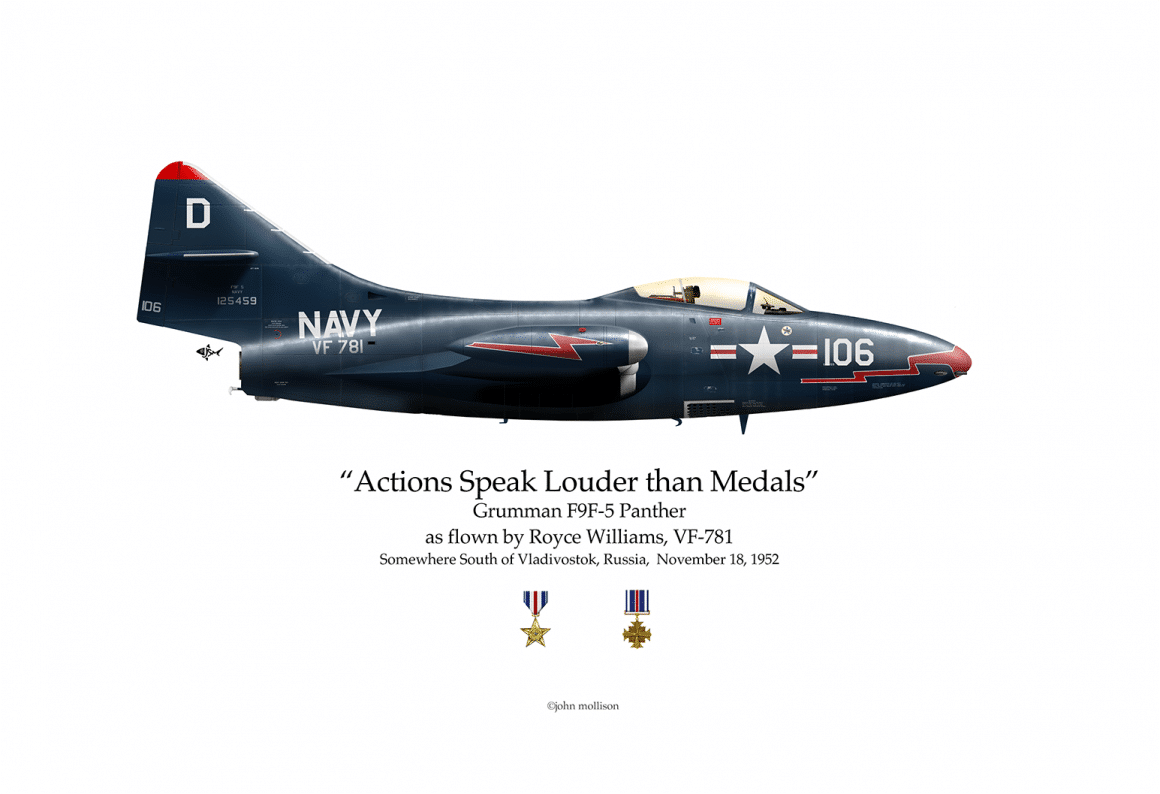
Illustration by John Mollison. See more of his work at: www.johnmollison.com
Expecting reprisal from a CTF-77 major strike on an industrial complex only five miles from the Korea-Russian border (of which Lt. Williams participated), the Oriskany launched a CAP with Lt. Williams as section lead. Immediately after launch into a low overcast, Oriskany CIC (Combat Information Center) directed the CAP (Combat Air Patrol) toward incoming bogeys.
As the CAP broke into the clear at 12,000’, the flight leader reported a fuel pump warning light. He and his wingman were directed to orbit overhead the Oriskany. At the same time, Lt. Williams spotted the contrails of seven MiG-15s.
Leaving the safety of cloud cover, Lt. Williams test-fired his (four 20mm cannon) and climbed his section (two aircraft) toward the advancing MiG-15s. Williams’ wingman was unable to fire his guns, effectively turning the engagement into a F9F-5 vs. seven MiG-15 fight.
Approaching 26,000’, four MiGs made a slashing attack out of the sun. Lt. Williams broke head-on into the attack and with a quick reversal, shot down the “tail end Charlie” of the group.The attack separated Lt. Williams and his wingman (leaving Williams to carry on the fight alone).
Lt Royce Williams engaged in a solo battle against 5 MiGs!
A fierce 35+ minute aerial combat followed. Lt. Williams superb pilot skills and gunnery accounted for three MiGs with a fourth (the Russian flight leader) confirmed some years later. With Lt. Williams having fired all of his ammo and suffering a 37mm hit in his right wing – caused by a closely pursuing MiG-15 – Williams’ aircraft suffered a total loss of rudder and flaps. He dove for cloud cover. With only elevator control and a little aileron control, Lt. Williams skillfully jinked and porpoised until safely in the snow clouds. Preparing for a straight-in approach to Oriskany, Williams received friendly fire. Nevertheless, Lt. Williams dropped his tail hook and let gravity drop the landing gear. Finding the aircraft uncontrollable below 170kts – critically above the normal 105kts – and facing a 40kt cross-deck wind, Lt. Williams demonstrated masterful airmanship in landing safety aboard, catching the #3 wire.
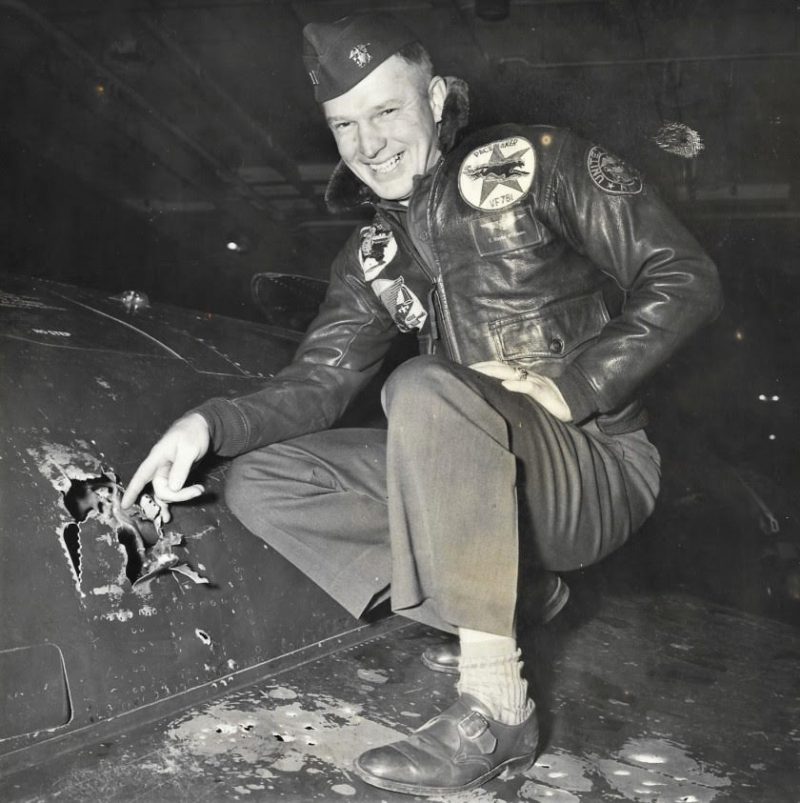
Examination of his aircraft reveals 263 holes. Fought entirely over water, halfway between Oriskany and Vladivostok, Russia, Lt Williams singular courage above-and-beyond the call of duty against overwhelming odds stopped the MiG-15s’ attack in its tracks.
Meet Royce at LIVE Q&A in San Diego
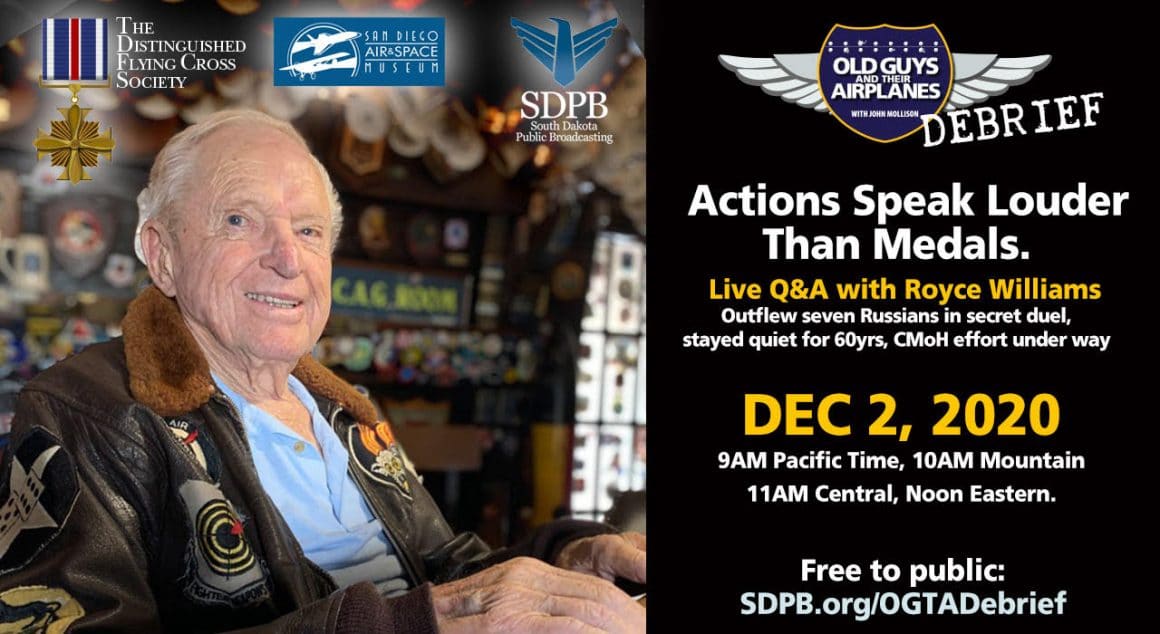
The award-winning history brand, Old Guys and Their Airplanes (OGTA), the Distinguished Flying Cross Society and South Dakota Public Broadcasting are presenting a live Q&A interview with Royce this December 2, 2020.
The interview will be originated from the San Diego Air & Space Museum and made available free of charge via https://www.sdpb.org/OGTADebrief. The event will be held at times convenient for educators, teachers and group leaders: 0900 PT, 1000 MT, 1100 CT and 1200 ET. The link will “go live” approximately 15 minutes before show-time.
The push for a Congressional Medal of Honor
Participants are encouraged to download the TIMELINE document created by RADM Shelton as part of a support package created to aid in awarding Royce Williams the Medal of Honor for his outstanding and heroic act that day. The document is available here. Press release containing more information about the event is accessible here.
The Forgotten Hero of the Forgotten War - Captain E. Royce Williams, USN (Ret) 3
America entered World War One on the 6th April 1917, and surprisingly, she did so without owning a single combat-worthy aircraft. Not only that, but the aircraft production industry in the US was also seriously under-prepared for war, and there were not even any American designs for combat aircraft on the drawing board.
The only answer that would allow for the rapid expansion of the air combat wing was to build aircraft that were already being produced in Europe, under licence. The selected candidates were the French Spad XIII, and the British designed R.A.F. S.E.5a, the Bristol F.2b and the de Havilland (Airco) D.H.4.
Initially the US auto industry repurposed itself to build thousands of new combat aircraft for the war effort, convinced that the might of American industrial strength would be able to rise to the challenge. Unfortunately, the industry soon learned that the manufacture of aircraft was not quite as simple as that of automobiles, and despite the fact that France had asked for 8000 aircraft to be delivered by May 1918, only several hundred were actually shipped to Europe by that date.
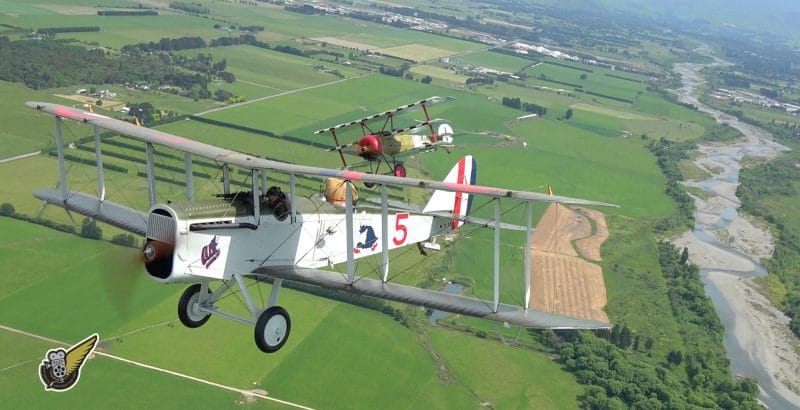
Of the four aircraft designs selected for production, the DH-4 was the only US-built aircraft to reach the front lines before the end of the war in November 1918. A total of 8,500 DH-4s were ordered, but only 4846 were completed before the war’s end, and only around 1200 of these were delivered to the front lines in France. Despite the fact that the original design, the Airco-built DH.4, first entered service with the Royal Flying Corps in 1916 and was ostensibly obsolete by 1918, the DH-4 remained in service in the USA until 1932, which was an incredibly long-service life for an aircraft at the time.
The type was dubbed the “Liberty Plane” and it went on to serve with thirteen Army Air Service squadrons, of which five were full-blown bomber units, while the remainder undertook reconnaissance and observation duties. As a light bomber the aircraft could carry a payload of 908lbs (412kg), and when operating as a photo reconnaissance aircraft it could usually defend itself well with its twin Lewis guns in the rear cockpit, and twin forward firing Marlin or Browning machine guns on the forward fuselage. It was not the greatest bomber of the First World War (that epithet is often reserved for the type’s successor, the Airco DH.9a), and it was by no means a fighter aircraft, but it was nevertheless the first of many solid and reliable American-built combat aircraft produced in large numbers.
With so many newly built examples of the type still in America at the end of the war, the US Government could see no point in returning those DH-4s in France to the US. Most of those aircraft, along with other obsolete types were simply burned in what became known as the Billion Dollar Bonfire.
The Government was reluctant to continue spending money on the Air Service after the war. With the lack of new aircraft designs being made available, the existing fleet of DH-4s were retained and underwent many different conversions. Some of these were functional. Examples included night flying variants and those with automatic camera equipment, while others were purely experimental with different engines, and in one case DH.9 wings.
Many of the war surplus DH-4’s also found their way into civilian use, being converted and used for passenger transport. Most famously for the fledgling post-war transcontinental Air Mail Service. These aircraft had a watertight mail compartment fitted in place of the forward cockpit, and the pilot was moved to the rear cockpit.
The DH-4 Kickstarted Careers of Famous Aviators Doolittle and Lindberg
Many pilots began their civilian careers flying DH-4s, including a number of pilots who were to go on to acquire national fame such as Jimmy Doolitttle who flew the first non-stop flight across the transcontinental USA in 1922 and Charles Lindberg who made the first solo flight across the Atlantic in 1927.
Sources:
Angelucci, E. and Matricardi, P., World Aircraft, Origins – World War 1. Sampson Low, Berkshire UK. 1977, p.200-201
Bowers, Peter M., The American D.H.4. – Profile Publications No 97. Profile Publication Ltd, Surrey, England. 1966
Jane’s Fighting Aircraft Of World War 1. Random House Publishing, London. 2001, p40
The Illustrated Encyclopedia of Aircraft, Vol 1, Issue 9, Orbis Publishing, London. 1981, p.173-174
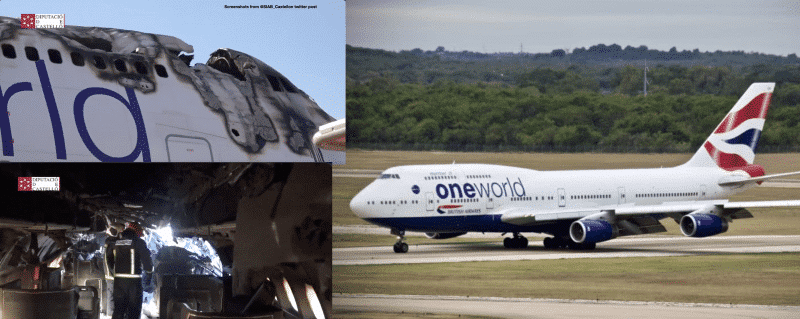
A retired and stored British Airways Boeing 747-400 caught fire today in Castellon, Spain. In video posted online today by the responding fire agency, it appears that the fire started in/near the cockpit of the jet. Footage showed extensive damage to the cockpit of aircraft.
El diputado de #BomberosCPBC@dipcas @Abel_ibma, se ha personado en el PMA establecido en #AeroportCastelló para seguir los trabajos de extinción del incendio de una aeronave en fase de desguace. Destacar la perfecta coordinación con #bomberos @CDTairport y con resto organismos. pic.twitter.com/G7uh6lUZhl
Los bomberos del aeropuerto de Castellón (@CDTairport) y del @SIAB_Castellon trabajan de forma conjunta en la extinción de un incendio en una aeronave. No ha habido que lamentar heridos y el fuego se encuentra ya confinado. pic.twitter.com/KuQtz9BW4O
No cause of fire has been released but it is common for retired aircraft to undergo extensive work to remove valuable avionics, and equipment prior to scrapping. It easily could have been caused by an electrical fault or via a scrapper’s torch.
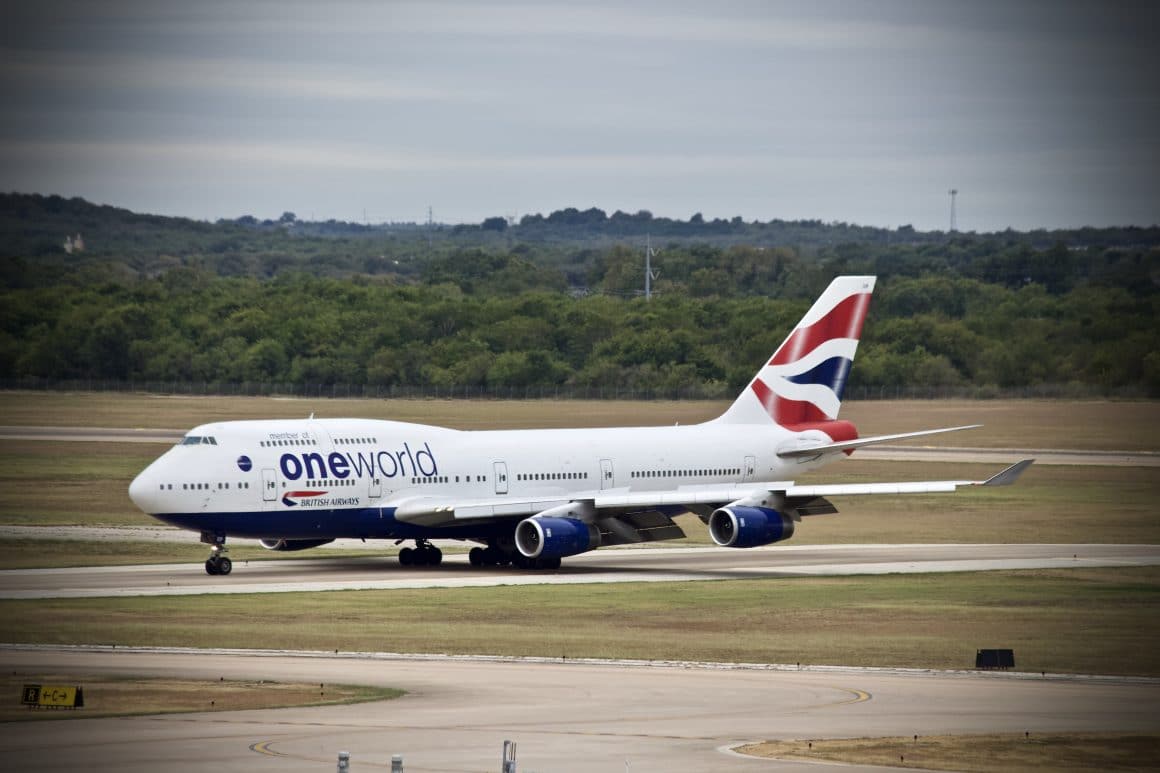
British Airways Boeing 747-400 ‘One World’ jet taxies at Austin’s Bergstrom International Airport. This aircraft was retired by British Airways in August. Photo: Avgeekery.com
The tail G-CIVD was one of the more photographed ‘Queen of the Skies’ jets. It formerly served as the British Airways’ ‘One World’ flagship jet. The Boeing 747-400 first flew on November 23, 1994. The aircraft served faithfully until earlier in 2020 when it was parked as part of a cost-cutting effort by British Airways in the wake of the COVID pandemic. British Airways eventually announced that they retired the fleet with immediate effect in August. British Airways posted video of its last flight which took place on August 18th. It departed from London’s Heathrow to Castellon, Spain.
Almost exactly 26 years to the day after its first flight, G-CIVD suffered the fire that will lead to an accelerated end to its otherwise relatively uneventful career of service.
The beleaguered Boeing 737 MAX family of aircraft will soon return to the skies. Earlier this week, the FAA announced in a press release that the changes made by Boeing have been approved.
“FAA Administrator Steve Dickson today signed an order (PDF) that paves the way for the Boeing 737 MAX to return to commercial service. Administrator Dickson’s action followed a comprehensive and methodical safety review process (PDF) that took 20 months to complete. During that time, FAA employees worked diligently to identify and address the safety issues that played a role in the tragic loss of 346 lives aboard Lion Air Flight 610 and Ethiopian Airlines Flight 302.”
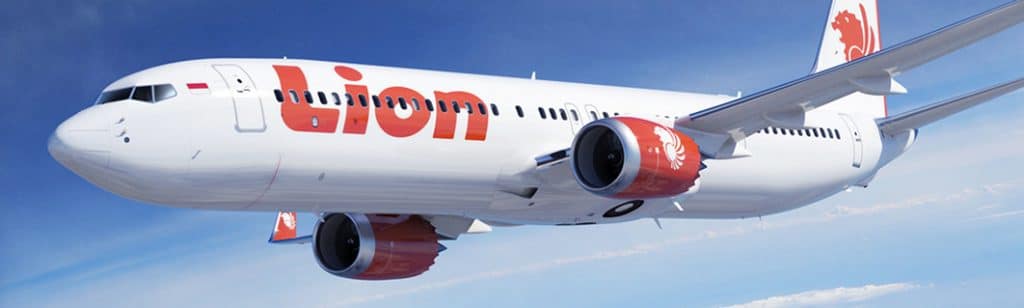
An image of a Lion Air Boeing 737 MAX 8 aircraFt. Image: Lion Air
The Return Isn’t Immediate. Each airline must follow a process
The FAA press release was very clear that approval to fly again will require adherence to the Airworthiness Directive and approval of a training plan. The FAA states, “In addition to rescinding the order that grounded the aircraft, the FAA today published an Airworthiness Directive (PDF) specifying design changes that must be made before the aircraft returns to service, issued a Continued Airworthiness Notification to the International Community (CANIC) (PDF), and published the MAX training requirements. (PDF) These actions do not allow the MAX to return immediately to the skies.”
“The FAA must approve 737 MAX pilot training program revisions for each U.S. airline operating the MAX and will retain its authority to issue airworthiness certificates and export certificates of airworthiness for all new 737 MAX aircraft manufactured since the FAA issued the grounding order. Furthermore, airlines that have parked their MAX aircraft must take required maintenance steps to prepare them to fly again.”
Let’s take a look at each airline’s plan to return to service
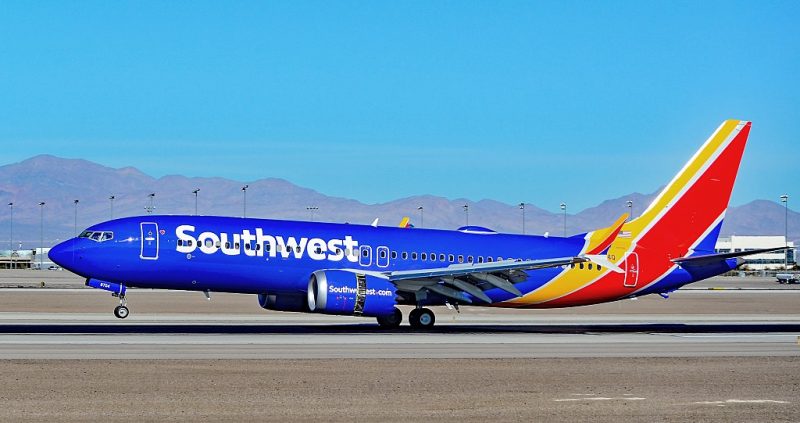
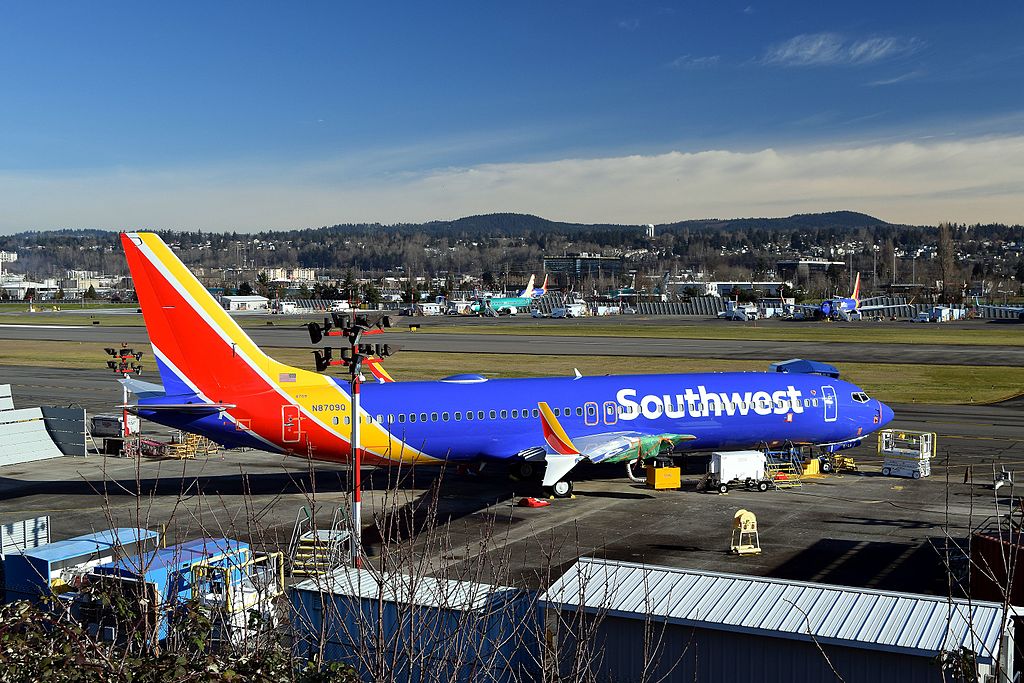
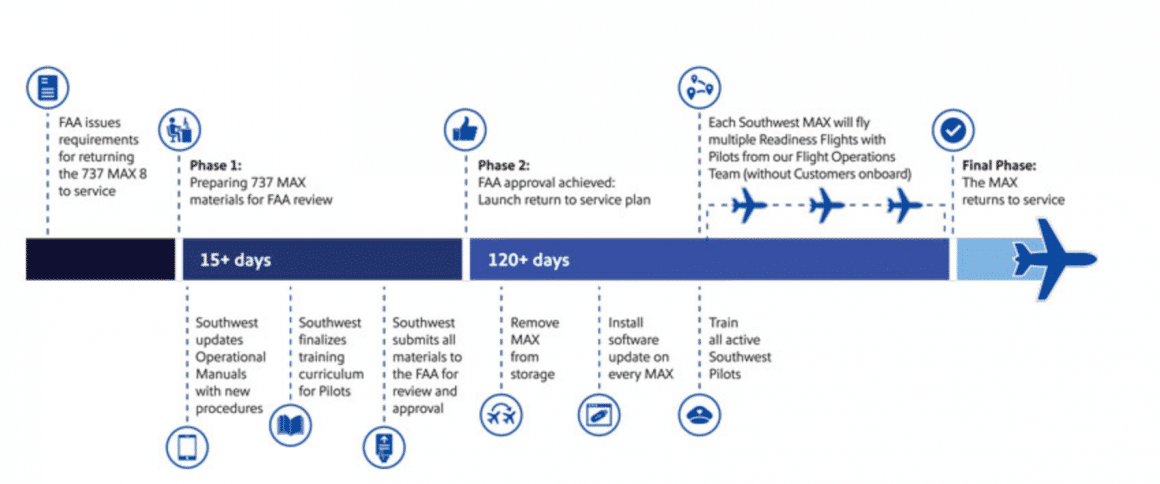
Southwest operates the largest fleet of Boeing 737-MAX8 jets (34 delivered thus far) with a slew of -7s and -8s on order. After the FAA announcement, Southwest released a video and timetable graphic (see below).
According to a Southwest press release, “Before we return the aircraft to customer service, however, every active Southwest Pilot will complete additional FAA-required flight training in one of our nine 737 MAX simulators and will complete additional FAA-required computer-based training covering MAX procedures. Southwest will also require active Pilots to re-take our original 737 MAX 8 computer-based differences training as a refresher to complement the FAA-required training. Additionally, Southwest will conduct multiple readiness flights on each of our 34 MAX aircraft and complete thousands of hours of work, inspections, and the software updates before any of our Customers board a Southwest 737 MAX.”
Bottom line is that they have not announced a return to service date but in the graphic below, they have indicated that the jet likely won’t fly until at least the second quarter of 2021.
The MAX is Back! Here's How US Airlines Plan To Reintroduce The Boeing 737 MAX 13
American Airlines laid out a plan to return their fleet of Boeing 737 MAX 8 jets. In a press release, American COO David Seymour stated that “if our pilots, along with the APA, FAA and our safety teams are confident the aircraft is safe, we are confident in its return to service. We’ve implemented rigorous processes to ensure that every plane in the air is safe and our pilots, flight attendants, team members and customers are confident in the return of the 737 MAX.”
Like Southwest, American plans to update their jets to make them compliant with the Airworthiness Directives (AD). The airline also plans retrain their pilots to include MAX-specific simulator training. “Our approximately 2,600 Boeing 737 pilots will complete the FAA-mandated and approved training, which includes computer-based training, classroom briefings and dedicated return to service training in a 737 MAX simulator.”
American is targeting a return to commercial service by December 29th . According to American, “we will resume scheduled service with two flights a day — or one round trip from MIA to LGA — through Jan. 4. After that, we expect to gradually phase more 737 MAX aircraft into revenue service throughout January, with up to 36 departures from our Miami hub depending on the day of the week.” American will allow any passenger who doesn’t want to fly on the MAX to reschedule at no charge.
The MAX is Back! Here's How US Airlines Plan To Reintroduce The Boeing 737 MAX 14
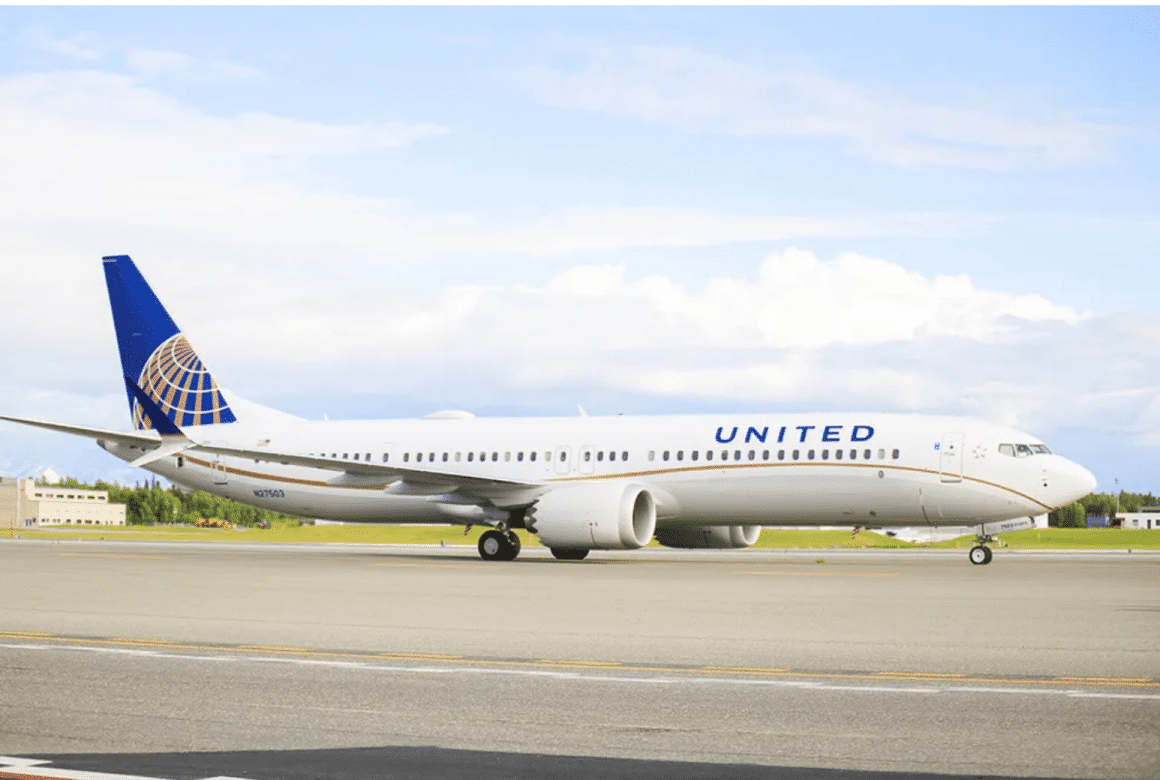
United Airlines has an entire site dedicated to the return on their MAX fleet. According to their page, United “expects to begin flying the 737 MAX in the first quarter next year.” They also posted a video that discusses the return to service.
Much like American Airlines, United will require all pilots to undergo simulator training. The airline also details the required updates that they will make to the jet before it returns to flight.
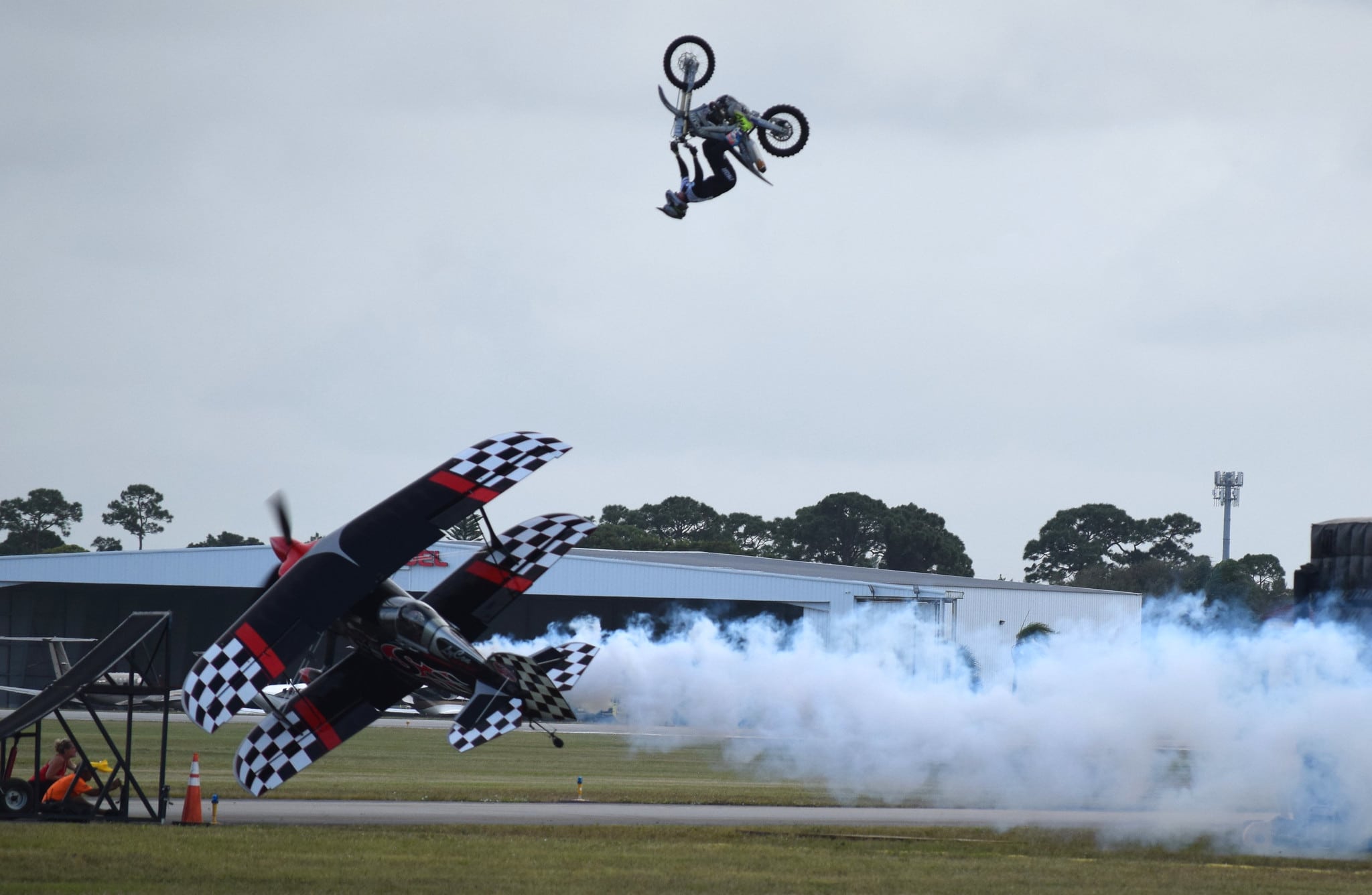
FORT LAUDERDALE, Fla. — A variety of U.S. Air Force jets and popular civilian aerobatic aircraft are poised to perform this weekend during the penultimate American air show of the year.
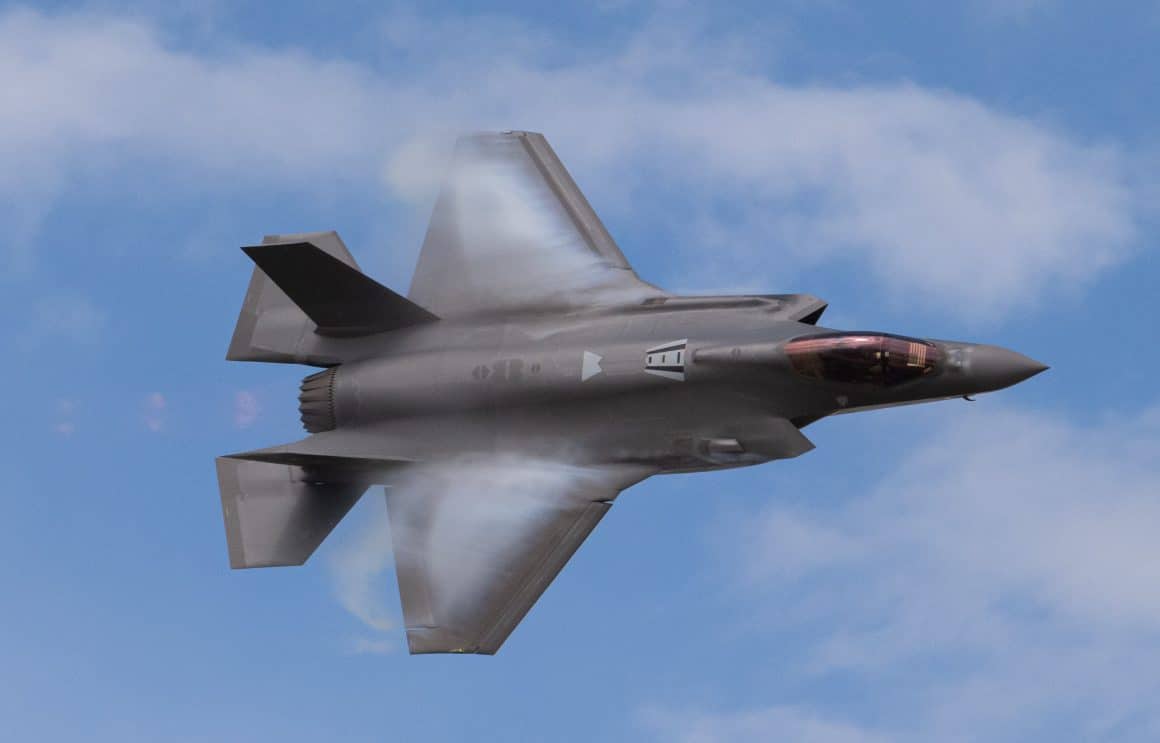
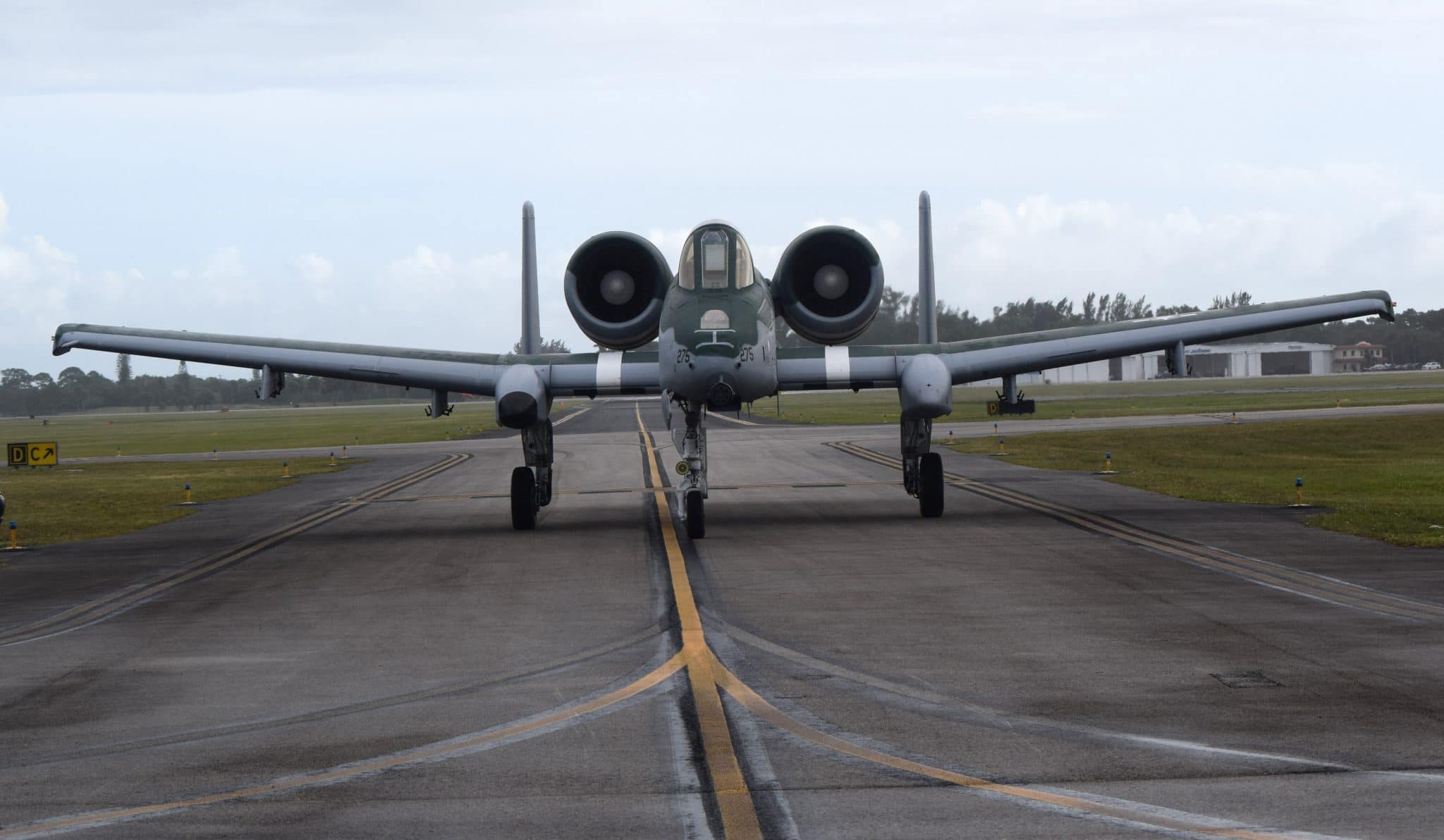
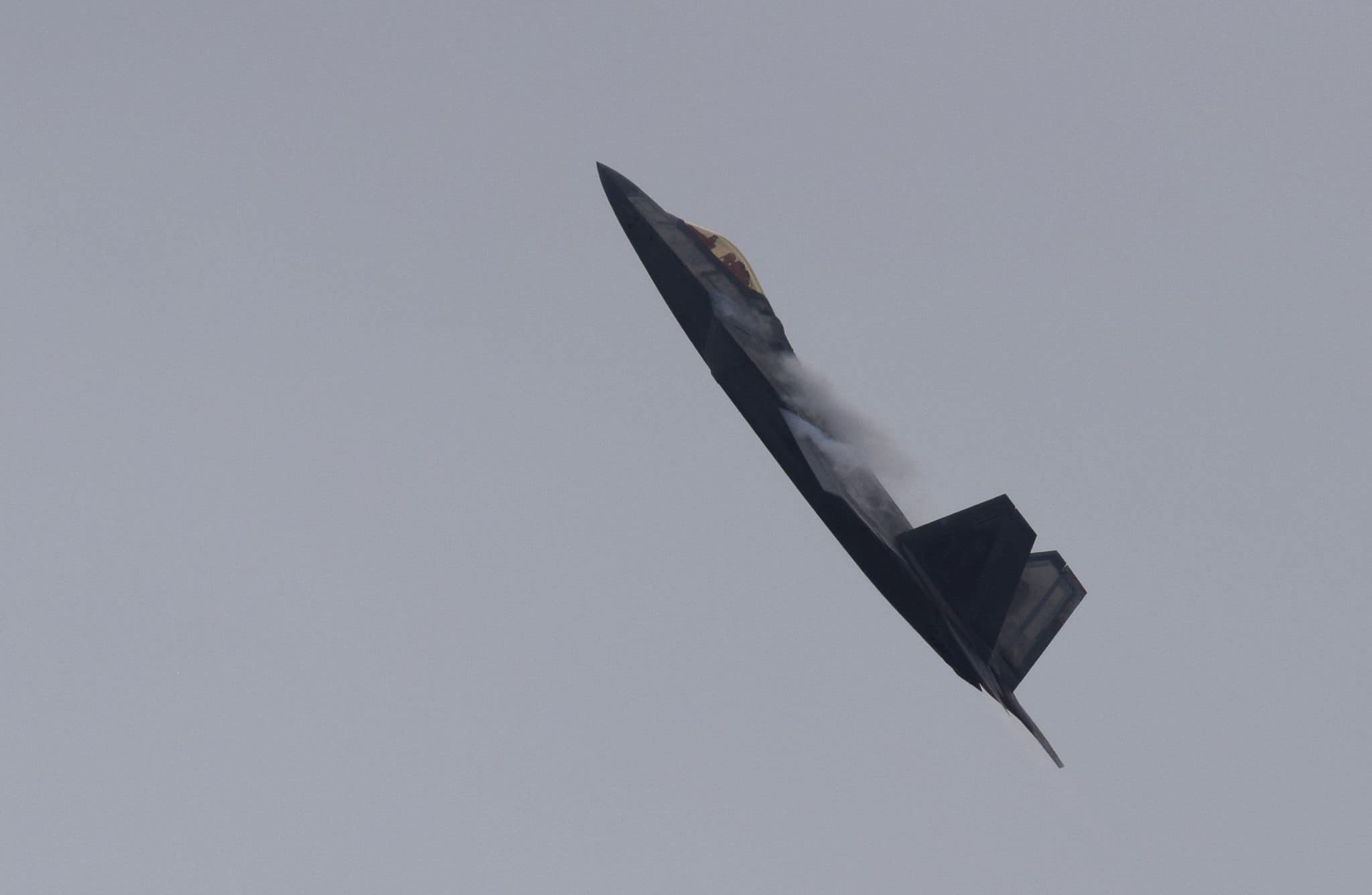
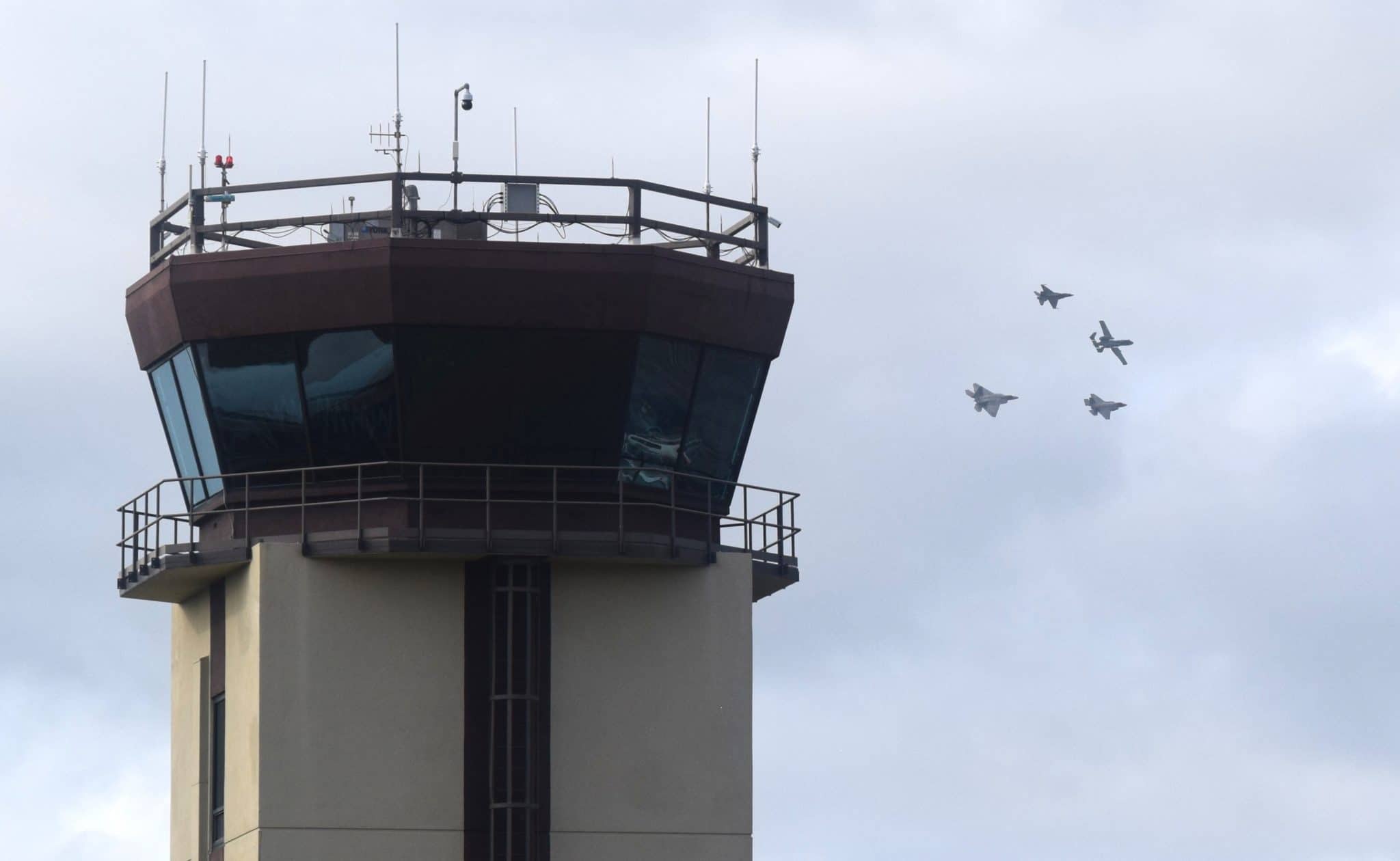
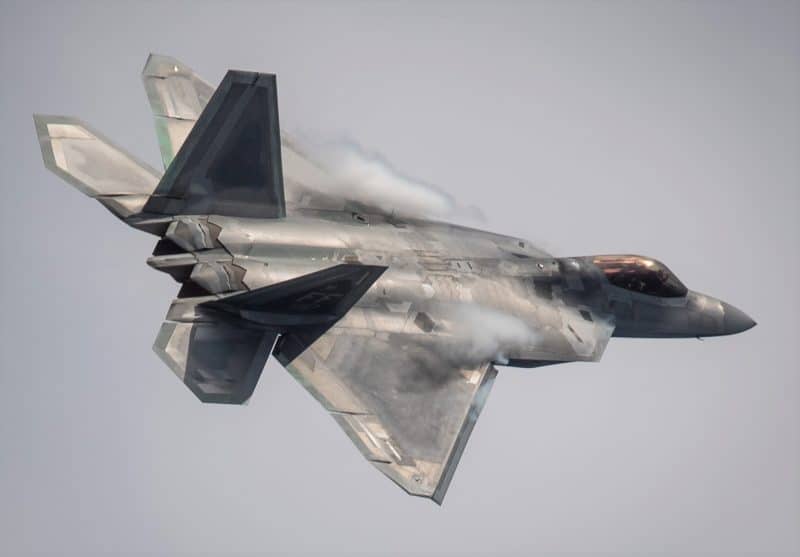
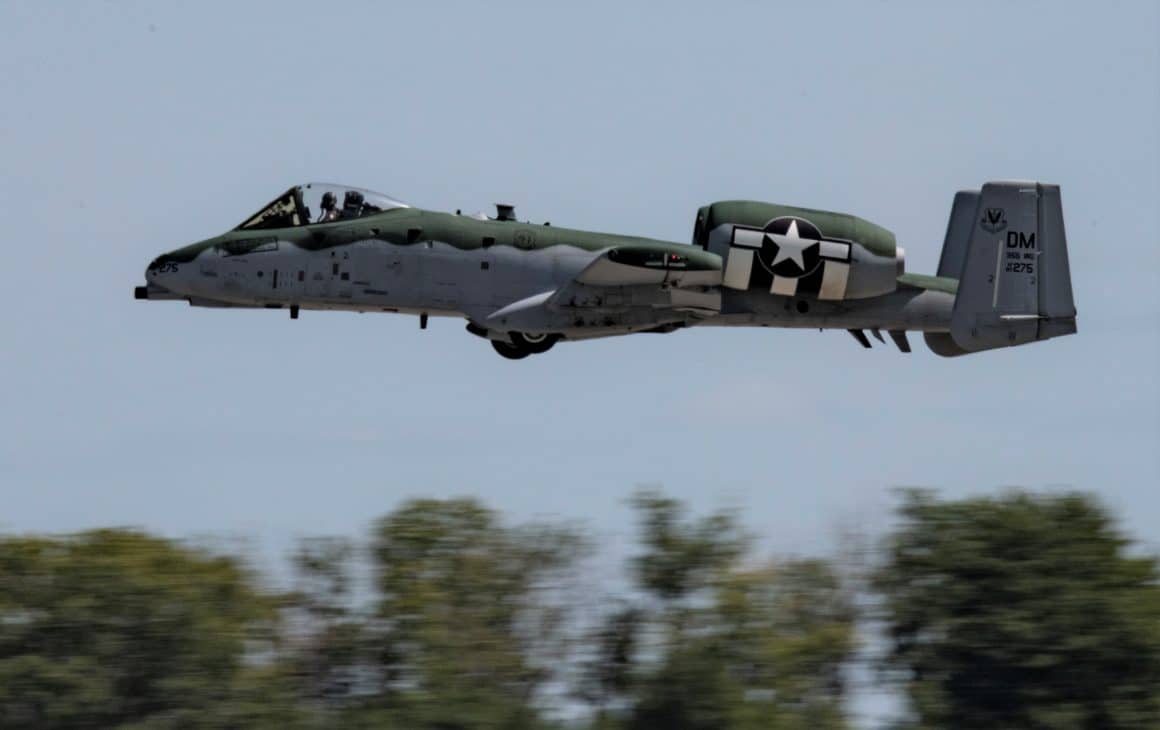
The Fort Lauderdale Air Show will host Air Combat Command’s premiere four aircraft, including the F-22A Raptor and F-35A Lightning II. The A-10C Warthog and F-16C Viper will also perform flight demonstrations on November 21 and 22.
Air show center has been marked at the great pier located at Lauderdale-by-the-Sea Beach. Aircraft will fly off the beachline inside a two-mile-long aerobatic box.
“The Fort Lauderdale Air Show means a lot to the folks of South Florida,” Chris Dirato, Director of Public Relations, said on Tuesday. “It has become an event that everyone looks forward to.”
Airshow officials have worked hard to keep the two-day event safe for guests and beach goers. The show’s Stay Safe Initiatives will follow current CDC guidelines.
“Given the pandemic, I think this year’s show will take on even greater importance in that people are starved for entertainment,” Dirato added. “Of course, we’ll be staging the show in a safe way.”
A few of the safety measures include masks are required when less than six feet from other guests. The addition of more hand-washing and sanitizing stations; and tickets can only be purchased online or by phone. Food and retail concessions will also be cashless, so bring a credit or debit card.
Aerobatic Maneuvers Over the Beachline
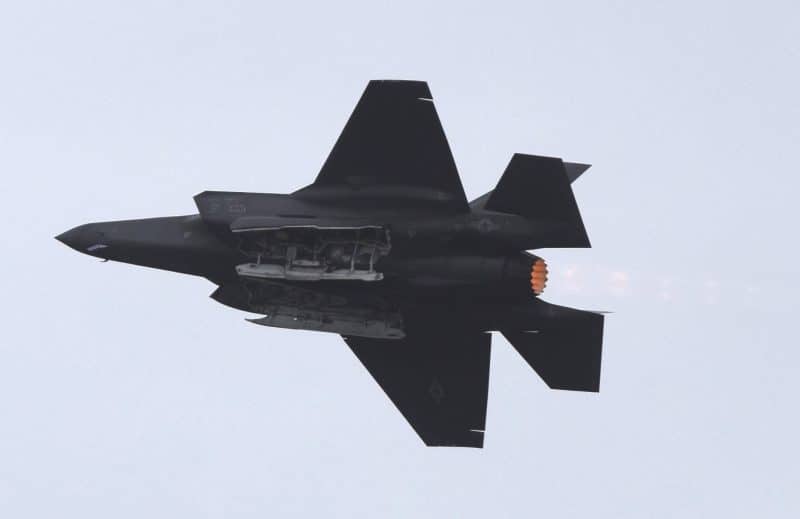
The F-35A demonstration team, lead by pilot Capt. Kristin “BEO” Wolfe, will help provide the thrust and excitement each afternoon. Despite a shortened air show season due to Covid concerns, this show will be the demo team’s eleventh of the year.
U.S. Air Force Capt. Kristin “BEO” Wolfe pilots the F-35A during a recent flight. (USAF Capt. Kip Sumner)
“We’re excited to be able to bring the future of airpower to South Florida and put on a great show,” Capt. Wolfe said on Thursday. “A huge shoutout goes out to the air show coordinators for all the work that went into making these performances as safe as possible for everyone.”
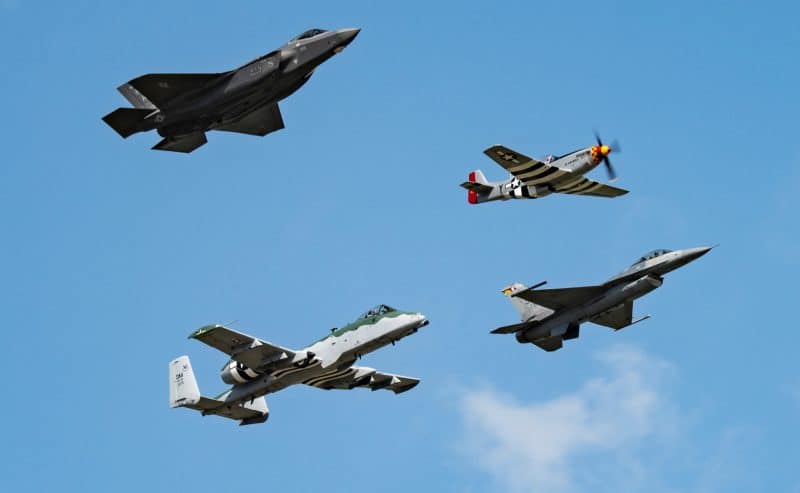
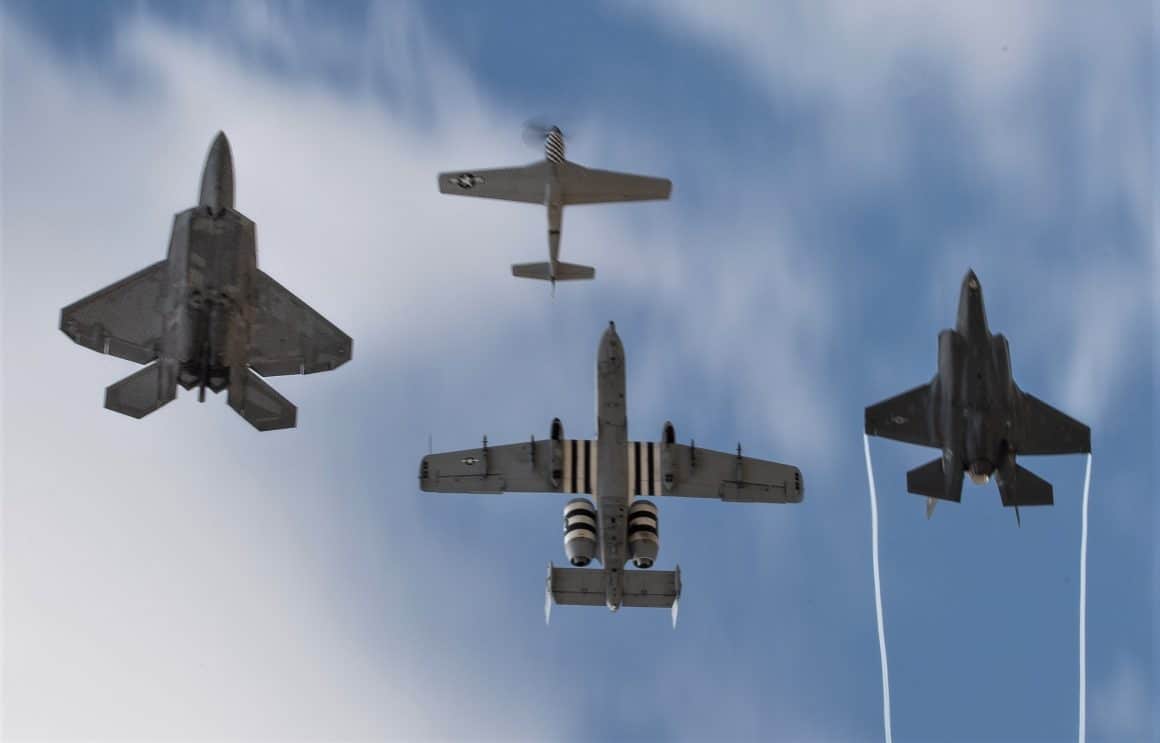
Fort Lauderdale will mark only the fourth air show this year to feature Air Combat Command’s four aircraft. The F-22A, A-10C, F-16C, and F-35A will perform together during the crowd favorite Heritage Flight.
Also, add the hulking C-17 Globemaster III to the Air Force’s performers list. Based in Washington state, the cargo and troop carrier’s crew will demonstrate its flying style and rapid landing ability.
Civilian Aerobatic pilot Mike Wiskus is also scheduled to perform. The air show will stream live both days.
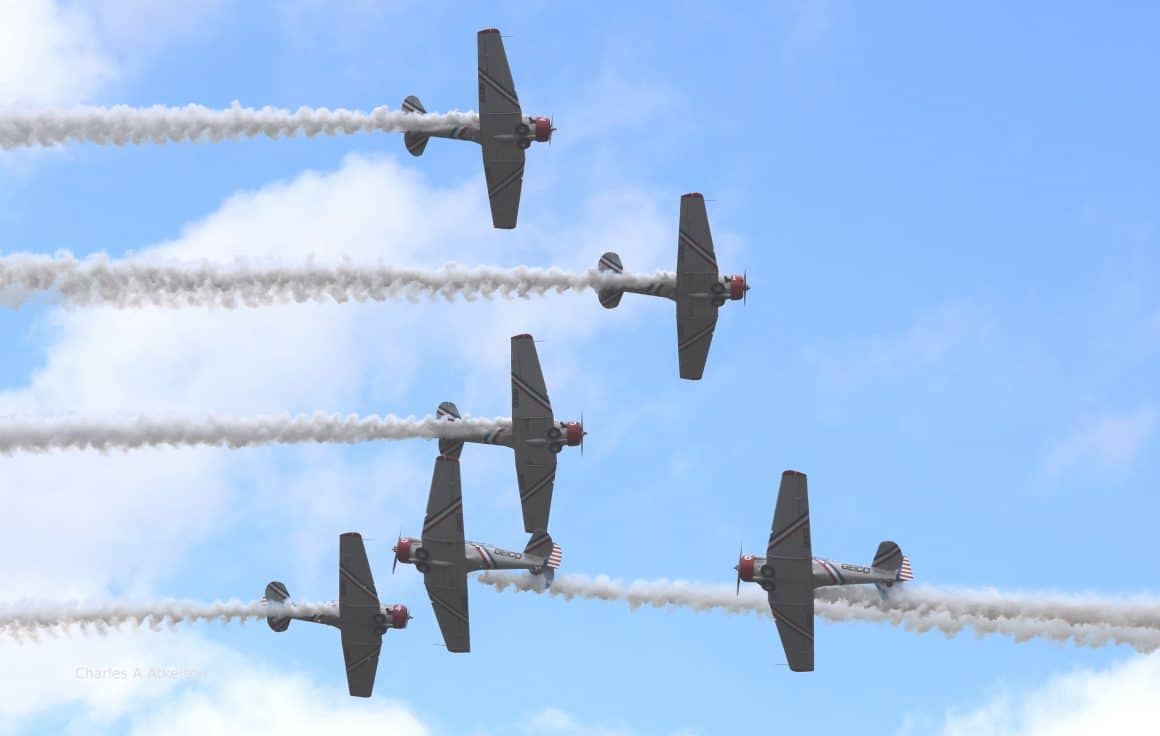
The GEICO Skytypers Airshow Team performs the 4 vs. 2 maneuver an October show. (Charles Atkeison)
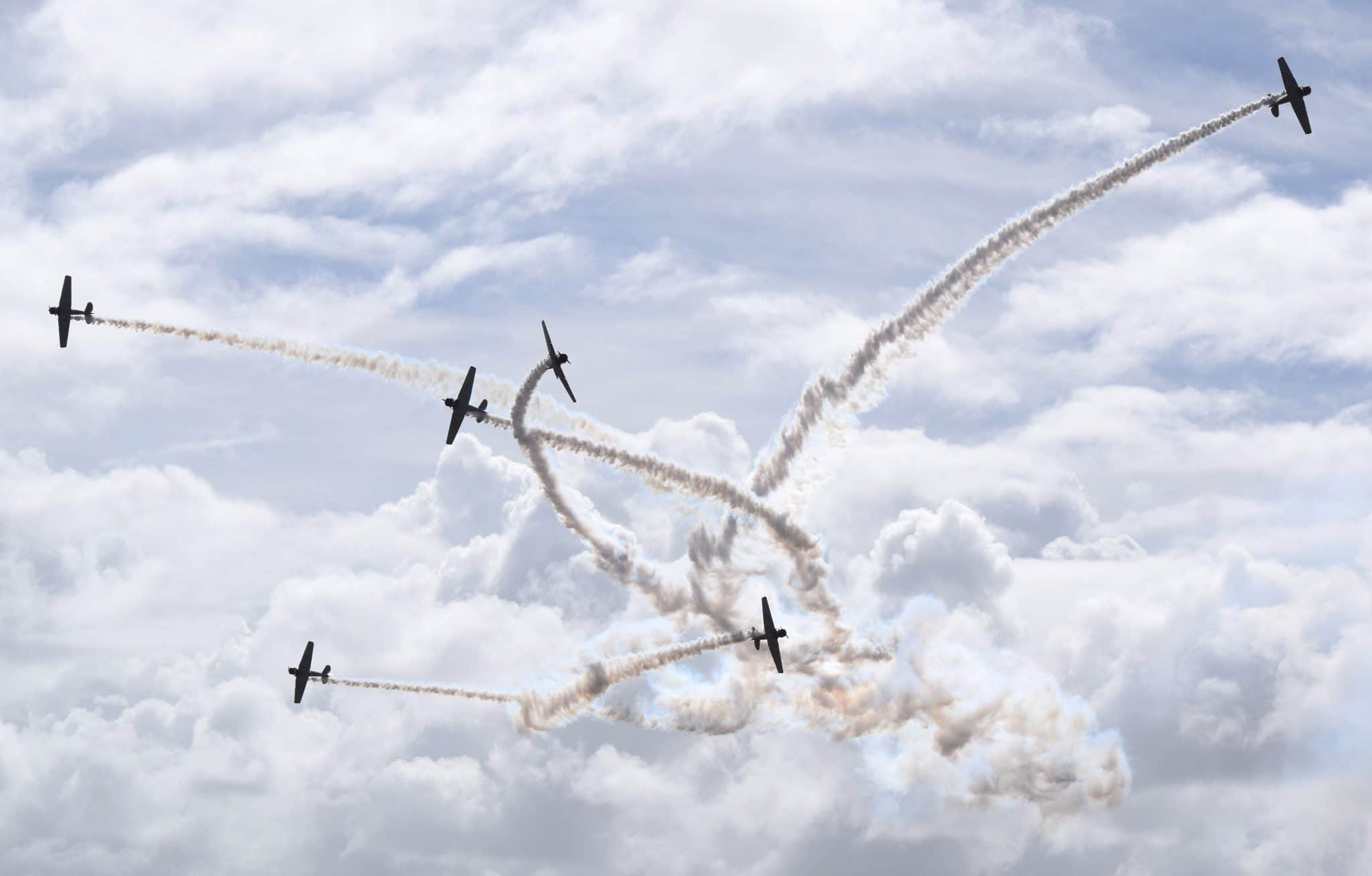
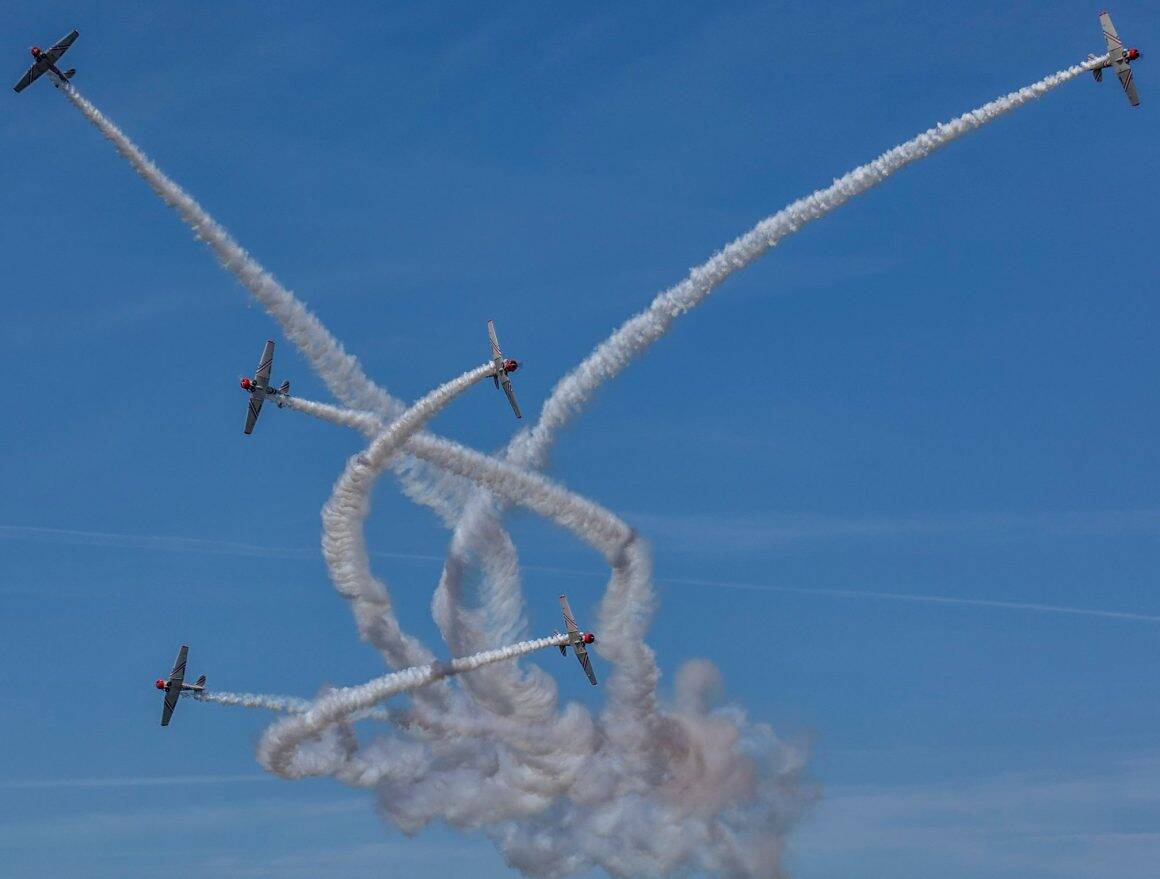
The six historic warbirds of the GEICO Skytypers will also perform over the warm Atlantic waters. Their World War II-era SNJ-2s are scheduled to demonstrate dogfighting maneuvers and close formation flying.
“We always get such a warm welcome from the people in Florida when we begin and end our season there,” GEICO Skytypers lead pilot Larry Arken told AvGeekery on Wednesday. “South Florida remains one of our favorites working along the beaches and seeing all the people that come out to watch us perform it’s quite exhilarating.”
Their pilots and aircraft maintainers love to perform across the Sunshine State. Two of their aircraft are also scheduled to race the Miss GEICO speed boat before the crowds.
(Charles A Atkeison reports on aerospace and technology. Follow his updates via social media @Military_Flight.)
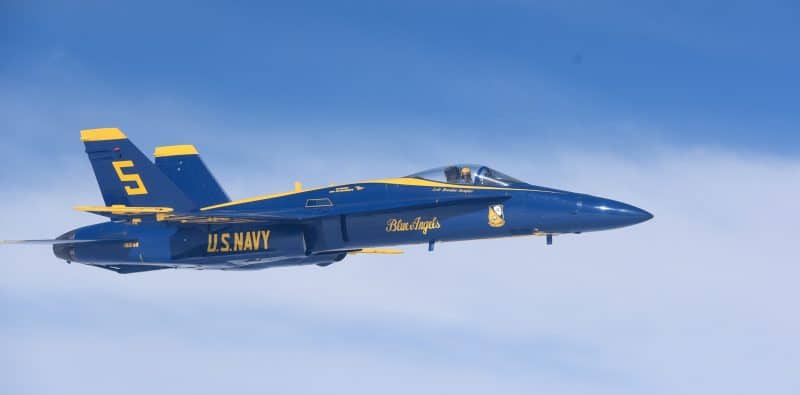
DULLES, Va. — A U.S. Navy Legacy Hornet, recently retired by the Blue Angels, was delivered on Wednesday to the Smithsonian’s Air and Space Museum in Virginia.
The F/A-18C Hornet wore the blue and gold of the Blue Angels for five years beginning in 2015. As the squadron begins flying with the upgraded Super Hornets, the smaller Legacy Hornets have been retired.
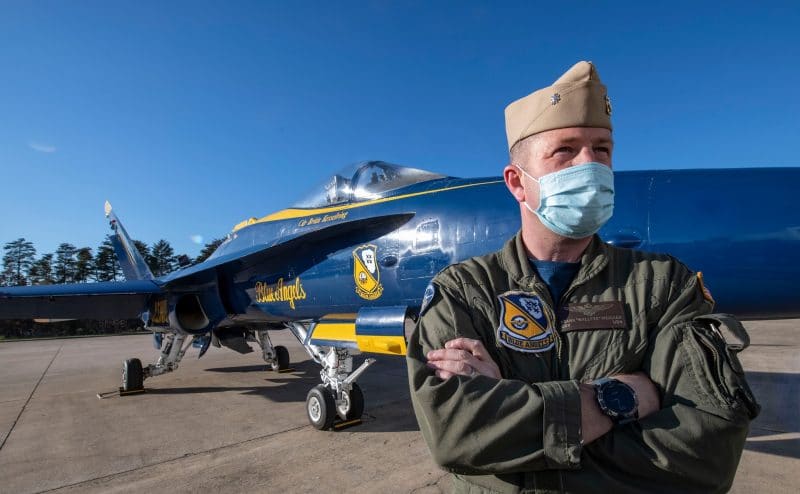
Former Blue Angels solo pilot Cmdr. Frank “Walleye” Weisser flew the aircraft in for a landing at Dulles International Airport. Weisser taxied the aircraft up to a hanger, folded the wings, and shutdown the twin engines for a final time.
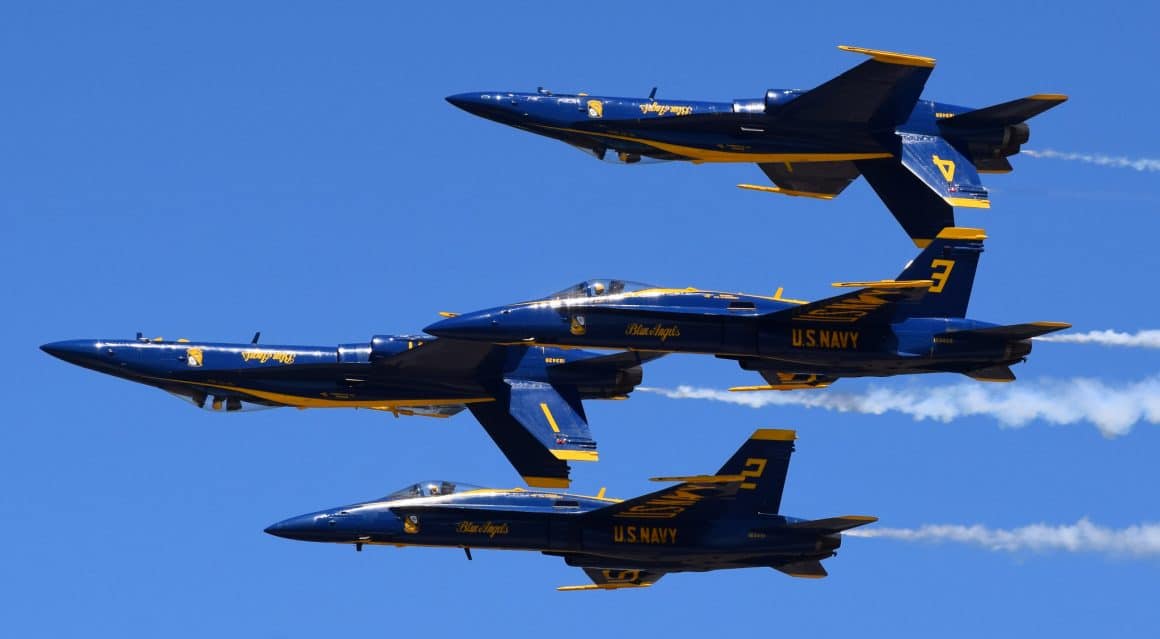
Inverted Blue Angel 1, aircraft no. 163439, leads the Double Farvel maneuver in 2020. (Charles A Atkeison)
The Smithsonian’s first Hornet will be housed in the Steven F. Udvar-Hazy Center’s Modern Military Aviation exhibition. The museum notes she will reside near historic Naval aircraft including the F6F-3K Hellcat and F-14D Tomcat.
“It is incredible this aircraft has the opportunity to live a second life on display at the Smithsonian for generations to come,” Blue Angels maintenance officer Lt. Brian Abe said. “In preparation for display, the Blue Angels maintenance team will continue to work with the museum and other Navy entities to ensure the aircraft is safe for public viewing.”
Naval jet maintainers will travel to Dulles in the coming weeks to safe the aircraft for public display. The removal of jet fuel and engine oil are a few of the tasks planned.
Built in 1987, this F/A-18C Hornet, number 163439, served in the first Gulf War and later patrolled a no-fly zone across southern Iraq. The museum notes the aircraft was stationed around the globe in eight different squadrons.
More recently, the aircraft served as Blue Angel 1 flown by the squadron’s Boss. In 2019 and 2020, Cmdr. Brian C. Kesselring piloted the Hornet during practices, air shows, and Operation America Strong.
“The museum’s collection of this important aircraft will allow us to tell stories of the Navy’s Flight Demonstration Team, as well as its time in combat,” Naval aviation curator Lauarence Burke added. “We look forward to sharing this plane with our visitors at the Udvar-Hazy Center.”
(Charles A Atkeison reports on aerospace and technology. Follow his updates via social media @Military_Flight.)
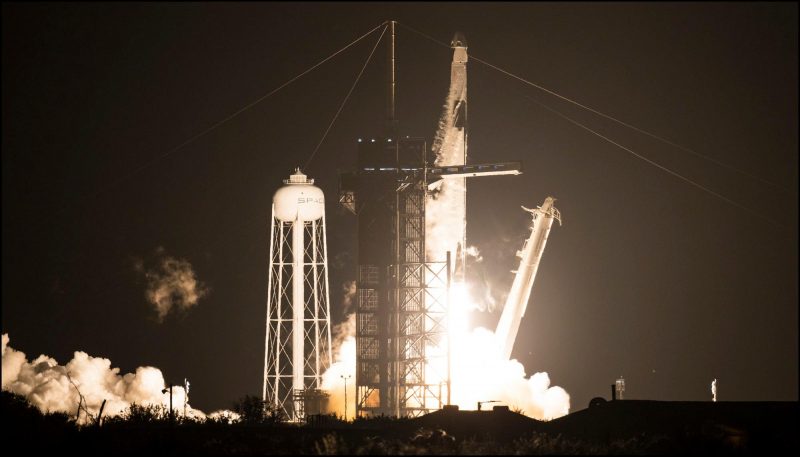
CAPE CANAVERAL, Fla. — A SpaceX Falcon 9 lifted-off from America’s Space Coast on Sunday evening with four astronauts beginning the first flight of an operational Crew Dragon spacecraft.
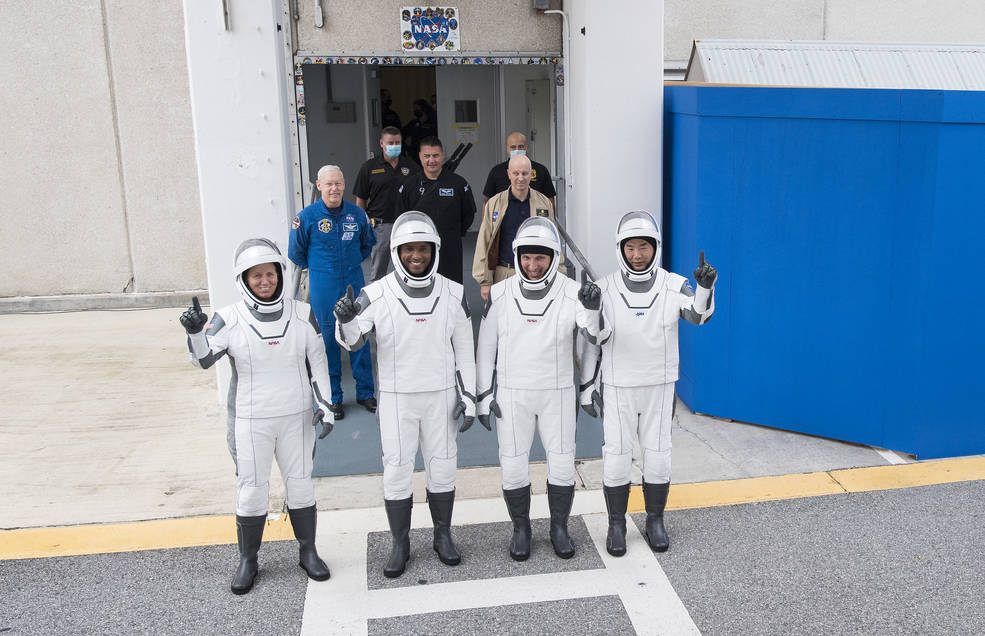
NASA astronauts Michael Hopkins, Victor Glover, Shannon Walker, and Japan’s Soichi Noguchi are on course to dock with the International Space Station on Monday. They are scheduled to live and work aboard the orbital outpost for six months.
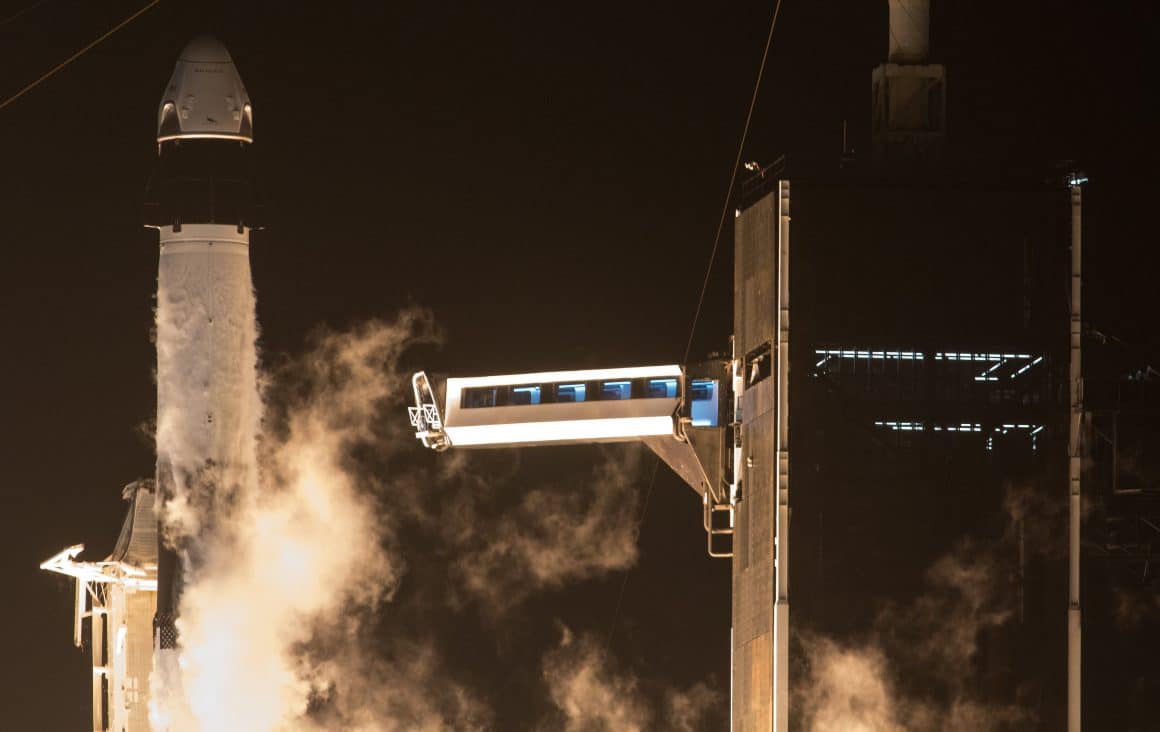
Crew Dragon 1 thundered away from the Kennedy Space Center’s historic pad 39-A at 7:27:17 p.m. EST, riding a top the Falcon 9. The candlestick rocket darted out over the Atlantic waters to begin its chase of the space station.
NASA astronauts Shannon Walker, Victor Glover, Mike Hopkins, and Japan’s Soichi Noguchi pause at the Kennedy Space Center on Sunday as they depart for the launch pad. (NASA)
“To all the people at NASA and SpaceX, by working through these difficult times you’ve inspired the nation, the world, and in no small part the name of this incredible vehicle,” Dragon commander Hopkins radioed minutes before launch. “And now it’s time to do our part — Crew One for all.”
The astronauts named their spacecraft Resilience to highlight the dedication of the teams involved with preparing the mission for flight. The successful launch occurred on the heels of a test flight by two NASA astronauts last May.
“I am extremely proud to say we are returning regular human spaceflight launches to American soil on an American rocket and spacecraft,” NASA Administrator Jim Bridenstine said on Saturday. “This certification milestone is an incredible achievement from NASA and SpaceX that highlights the progress we can make working together with commercial industry.”
Ascent towards Orbit
Watch the replay of NASA-TV’s coverage of the SpaceX Crew Dragon One launch on November 15, 2020.
Nearly three minutes into Resilience‘s launch, Falcon’s first stage engines shutdown. The first stage then separated and the second stage engines ignited to continue the journey to orbit.
As the four astronauts raced toward space, the Falcon’s separated first stage aimed for a pinpoint landing. The stage successfully landed at 7:36 p.m. aboard a Space X drone ship floating off shore of Jacksonville.
This booster will be cleaned up and reused for the Dragon Crew 2 launch in May.
Nine minutes into the flight, the Crew Dragon reached orbital insertion. The Resilience later separated from the second stage on time at 7:39 p.m.
Crew Dragon One lifts-off froM America’s Space Coast on Sunday, en route to the space station. (NASA)
“The Crew-1 mission is a major step for NASA’s Commercial Crew Program,” NASA spokesperson Marie Lewis said. “Operational, long duration commercial crew rotation missions will enable NASA to continue the important research and technology investigations taking place onboard the station.”
Just over 27 hours following launch, Crew Dragon is scheduled to align for a docking to the orbiting outpost. One American and two Russians currently occupy the space station.
“This is a great day for the United States of America and a great day for Japan,” Bridenstine said following the launch. “We look forward to many more years of a great partnership — not just in low-Earth orbit but all the way to the Moon.”
(Charles A Atkeison reports on aerospace and technology. Follow his updates via social media @Military_Flight.)
HICKORY, N.C. — A newly retired U.S. Navy Blue Angels jet was delivered on Friday to the low mountains of North Carolina for display at the Hickory Aviation Museum.
Former Blue Angels solo pilot CDR Frank Weisser flew the thirty-year-old F/A-18C Hornet across the blue skies of Hickory. Greeted by hundreds of onlookers, Weisser performed three passes prior to touching down at 12:37 p.m. EST.
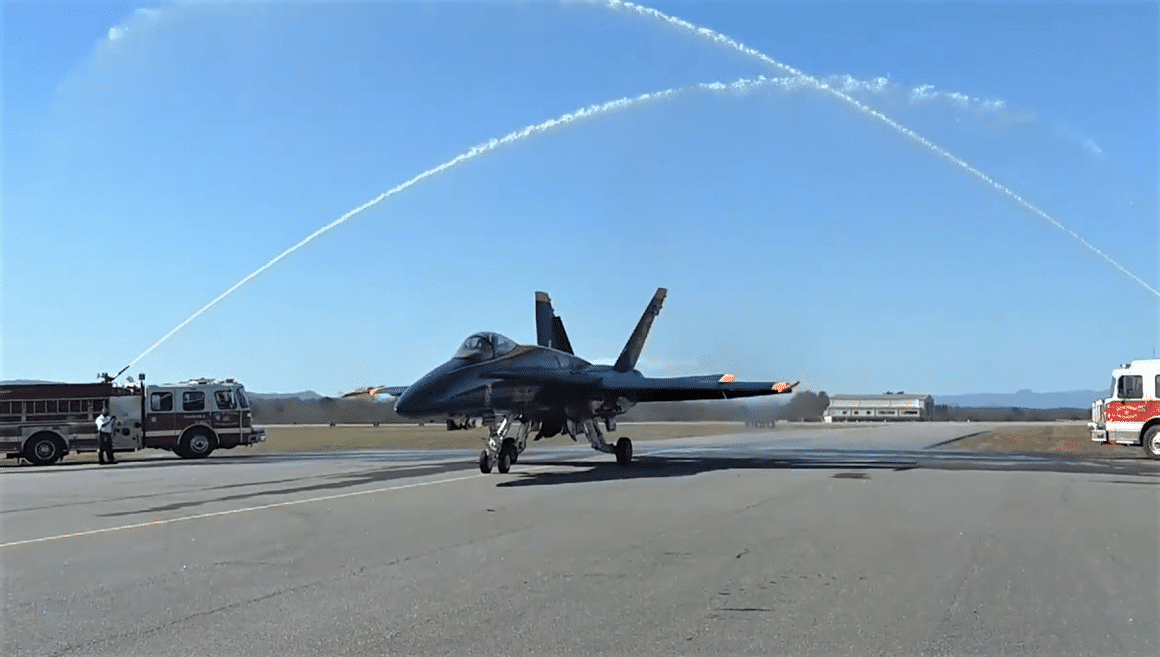
A retired F/A-18C Hornet arrives under a water cannon salute in Hickory, NC. (Hickory Aviation Museum)
As the aircraft taxied toward museum officials, two Hickory fire trucks provided a water cannon salute. Weisser guided the retiring jet underneath as applause broke out.
“We are thrilled to have the Hickory Aviation Museum and its incredible collection on display at the Hickory Regional Airport,” Hickory Airport Manager Terry Clark said. “The addition of Blue Angel 5 will certainly attract more people to come and appreciate all the aviation museum has to offer.”
Fueled by Blue Angels History
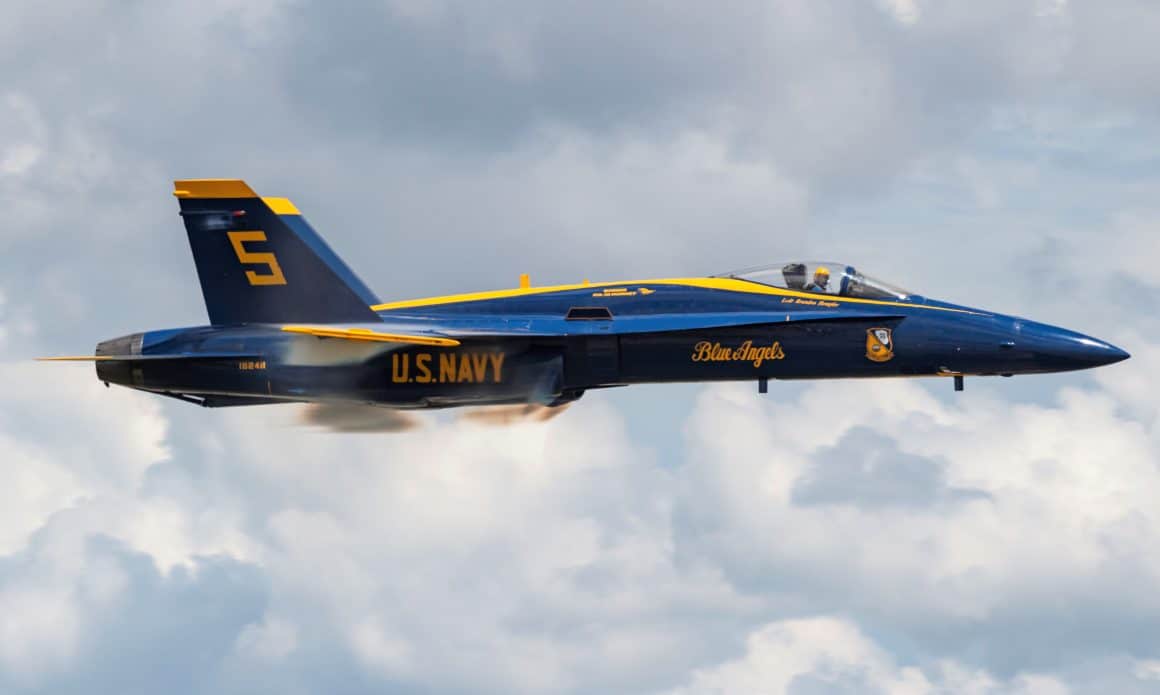
Known as Blue Angel 5, the twin-engine supersonic aircraft will be placed on the flight line outside the museum. This F/A-18Cs last operational flight was in October by the Blue Angels.
The blue and gold aircraft is no. 162411, and carries a storied past. This F/A-18C flew combat missions during Operations Desert Shield and Desert Storm in 1990 and 1991. The museum states the aircraft also spent the 1990s at NAS Miramar in California.
Blue Angels lead solo LCDR. Brandon Hempler performs over Naval Air Station Pensacola in 2020. (USN)
The Hornet was delivered to the Blue Angels in 2009, and served in the squadron’s delta formation.
The jet’s final public flights in 2020 included extended flyovers of major U.S. cities to honor first responders. On May 12, LCDR Brandon Hempler piloted this aircraft with the Blue Angels in flyovers of Chicago, Indianapolis, and Detroit.
This Blue Angels jet arrived honoring a fallen Blue Angels pilot. The name of LCDR Stuart Powrie has been placed under the jet’s canopy.
Stu served as the squadron’s opposing solo pilot in 1980-81, and later rose to lead solo. In February 1982, while training at NAF El Centro, Stu’s A-4F Skyhawk stalled and crashed. Powrie will again be remembered as guests visit the aircraft.
November marks a transition time for the Navy squadron as they upgrade to the larger F/A-18 E/F Super Hornets. The Blue Angels will celebrate the squadron’s 75th anniversary season beginning this spring.
(Charles A Atkeison reports on aerospace and technology. Follow his updates via social media @Military_Flight.)
STUART, Fla. — The nation’s top aerobatic aircraft and latest fighter jets highlighted a weather shortened air show in southern Florida over the weekend caused by the approach of Tropical Storm Eta.
Guests attending the Stuart Air Show on Saturday watched a dizzying array of civilian aerobatics. The Air Force also performed with four different types of aircraft demonstrating high speed maneuvers and low close-up passes.
The Stuart Air Show was one of the few shows to host the F-22A Raptor, F-35A Lightning II, A-10C Warthog, and the F-16C Viper. The jets also performed the crowd-favorite Air Force Heritage Flight together to honor Airman past and present.
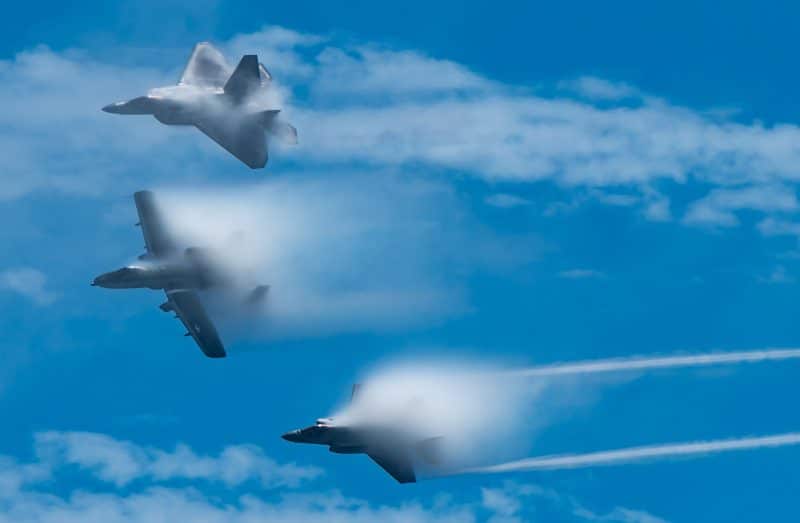
The humidity across Witham Field provided flashes of vapor across each military jet as it reached speeds of 500 m.p.h. The low cloud ceiling also kept many of the aircraft closer to the crowd line.
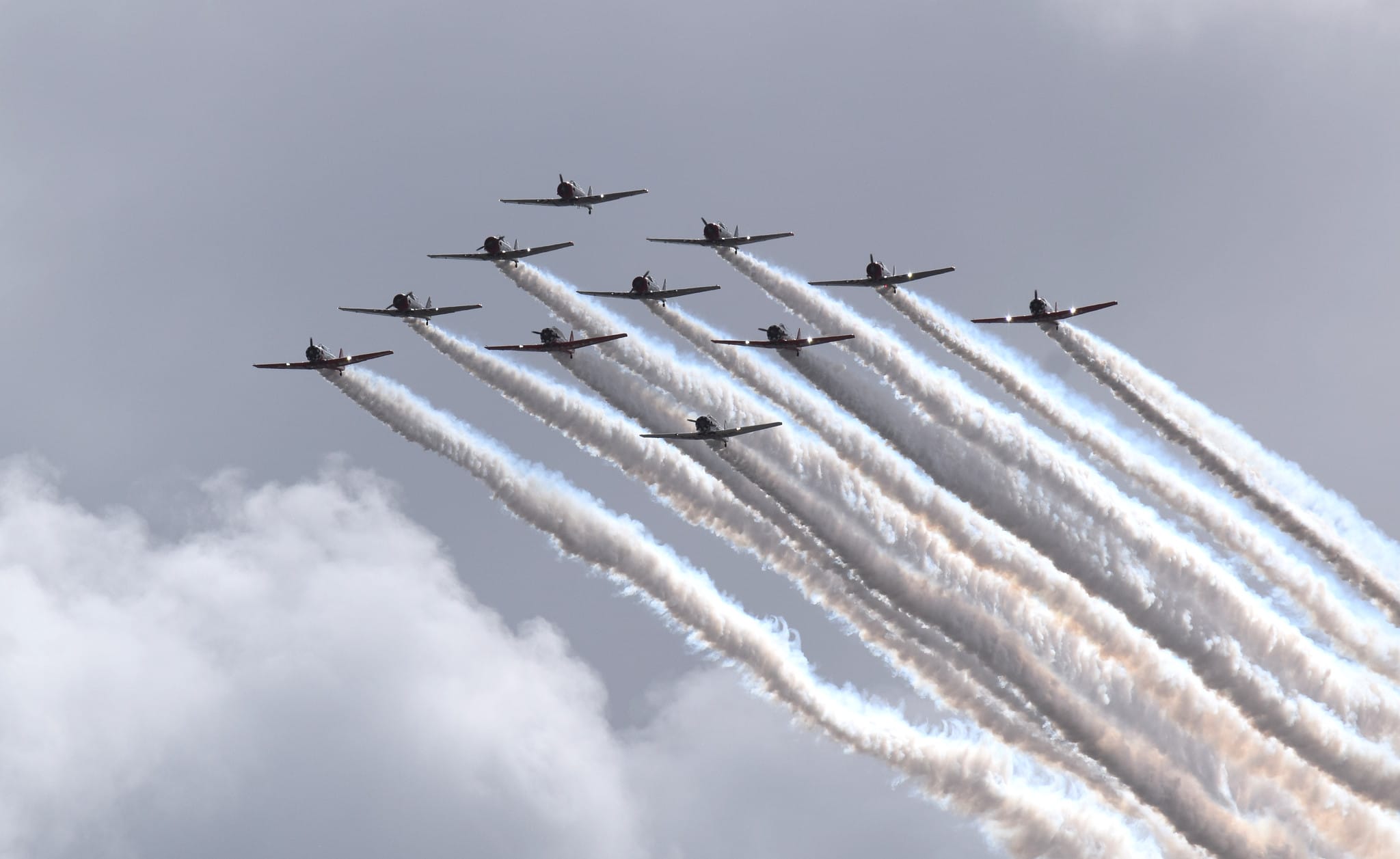
One special moment saw the joint flight of the GEICO Skytypers and AeroShell Aerobatic Team. Their 11 aircraft performed the symbolic missing man formation in honor of Veteran’s Day on Wednesday.
brrrt! tHE a-10c wARTHOG PERFORMS DURING THE 2020 sTUART aIRSHOW. (vIDEO BY cHARLES aTKEISON)
The resurgence of Eta near the Florida Keys dampened Sunday’s schedule at Stuart. Officials worked closely with the pilots to safely schedule the aircraft in between the system’s outer rain bands.
However, with the Stuart community under a tropical storm warning, and rain falling continuously, two of the military jet teams cancelled their planned demonstrations at 11:00 a.m. The A-10C Warthog took off at 11:30 a.m. to begin an abbreviated demonstration flight.
By noon time, air show officials decided the weather was too much to continue. The A-10 was the only aircraft to fly on Sunday.
(Charles A Atkeison reports on aerospace and technology. Follow his updates via social media @Military_Flight.)
STUART, Fla. — The air power and thrust of the U.S. Air Force will headline this weekend’s massive air show over southeastern Florida.
The Stuart Air Show will host the largest array of both military and civilian aircraft this year. This show is the first to feature static aircraft, an air show staple missing during 2020 due to Covid safety.
The F-16C Viper, F-22A Raptor, F-35A Lightning II, and A-10C Warthog are on the performers list during Veteran’s Day weekend. Civilian performers scheduled include the GEICO Skytypers, AeroShell Aerobatics, Dash Aerosports, and more across Witham Field.
“This will be a Veterans Day weekend that aviation enthusiasts and anyone eager to experience a safe and exciting patriotic event outdoors, will not soon forget,” Stuart Air Show president Amy Bottegal said on Monday.
Unlike recent air shows headlined by the Air Force, Stuart will not have a drive-in format. Bottegal said air show officials have organized a safe-plan on par with the “Disney standard” for the massive 27-acre outdoor event.
The GEICO Skytypers will perform a dizzying array of maneuvers this weekend over Witham Field. (GSAST)
“Our attendees always show up feeling confident that they’ll see amazing aerial and static aviation displays,” says Bottegal. “But we wanted to take the steps for them to feel even greater confidence in their ability to stay safe and healthy during the event.”
Static aircraft will include the Hurricane Hunters’ C-130 Hercules, a Douglas C-47 Skytrain “Tico Belle”, and popular warbirds. The popular DASH Aerosports STEM Trailer will also attend.
Viper Demo Team Excited to Perform
The Air Force’s Air Combat Command will have four of today’s fighter jets performing each day. The F-16C Viper demonstration team is excited for its third air show in as many weeks.
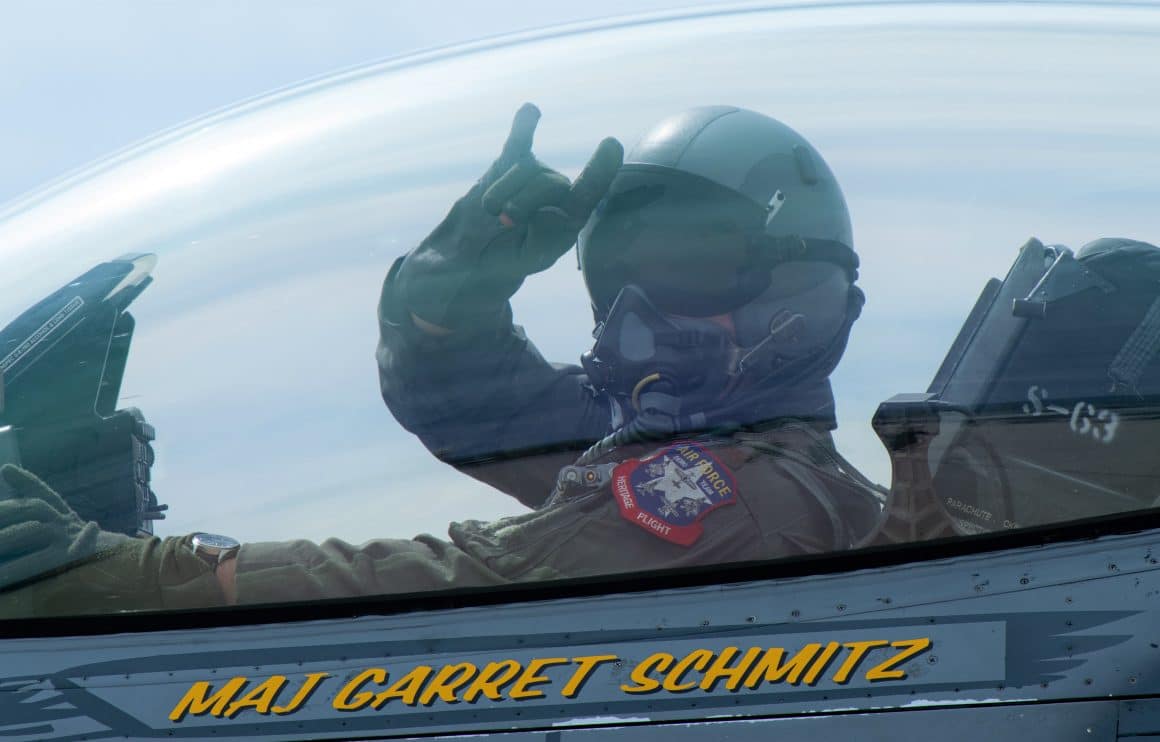
“We demonstrate the combat capabilities of the F-16,” Viper Demo Team pilot Maj. Garret “Toro” Schmitz explained to AvGeekery.com on Monday. “We are able to fly very low, very fast, a lot of G’s — it’s very maneuverable and it demonstrates the power.”
Air Force Maj. Garret “Toro” Schmitz signals for a recent Viper practice flight. (USAF/ Capt. K. Sumner)
The team’s viper jet is affectionately known as Venom, and supports a paint scheme to resemble a viper. Maj. Schmitz will put the aircraft through 16 minutes of non-stop thrust and high speed maneuvers.
“We pull nine G’s for a 180-degrees to 360-degrees of turn, and then I’ll point (the F-16) straight up, put it on it’s tail and accelerate straight into the air,” Toro added. “It’s a beast.”
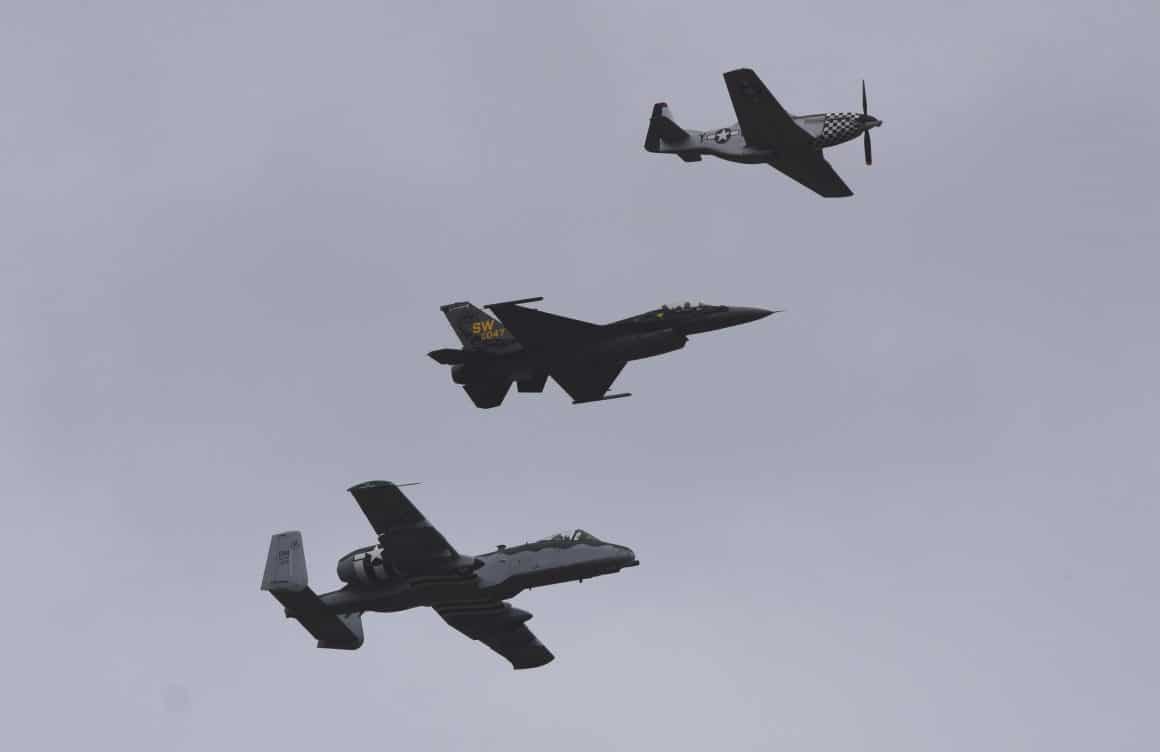
Toro also is scheduled to take part in a four-ship close formation flight. Known as the Heritage Flight, a P-51D Mustang and three modern Air Force jets fly a diamond formation to honor Airmen of yesteryear and today.
Tickets remain available for both days, including a front row section for photographers. Guests can also book flights aboard two Bell helicopters. Air show officials encourage purchasing tickets online.
(Charles A Atkeison reports on aerospace and technology. Follow his updates via social media @Military_Flight.)
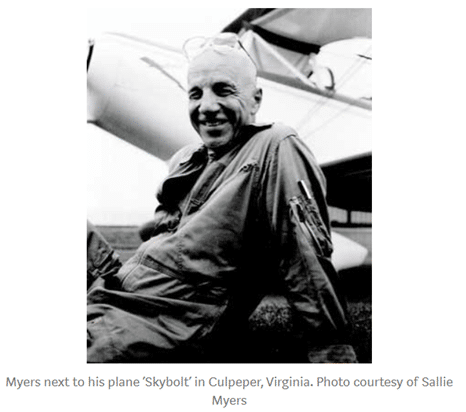
Articles dedicated to Fighter Mafia members Colonel John Boyd, Thomas P. Christie, Pierre M. Sprey, Chuck Myers, Colonel Everest Riccioni, and Bob Dilger with the Military Reformers and Boyd acolytes Harry Hillaker, Dr. Raymond Leopold, James Burton, Colonel Mike Wyly, and Franklin “Chuck” Spinney – the Fighter Mafia and Acolyte core; an independent, free-thinking group of pentagon analysts, pilots, and engineers that demonstrably changed the culture, theory, and production of air combat assets.
As the third installment in the Fighter Mafia series, (please read the first and second articles in series: Part 1 – John Boyd and Part 2 – Pierre Sprey), we learn about Thomas P. Christie, the mathematician behind Boyd, the secret weapon in the F-16 / A-10 procurement, and the wizard behind the pentagon curtain. Without Tom Christie, Boyd’s Energy Maneuverability calculations and development of F-16 /A-10 most likely would never have happened. Tom’s abilities, influence, and leadership directly impacted the future of our National Defense.
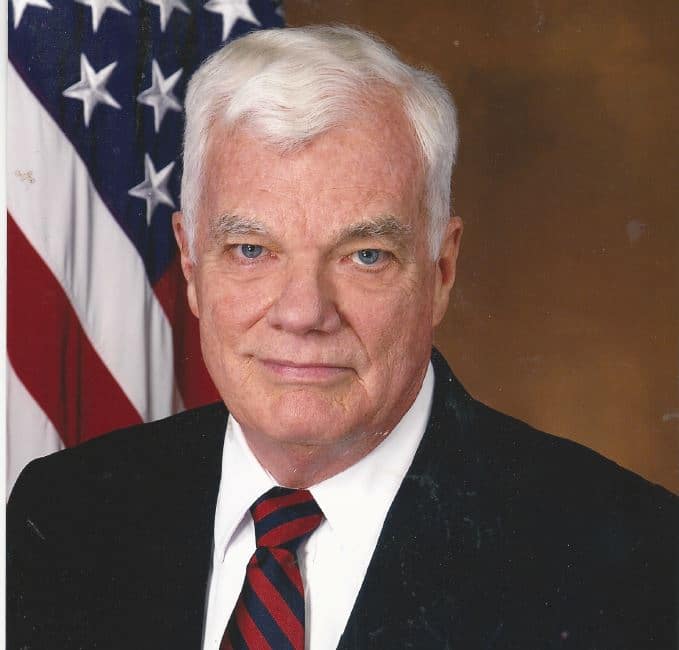
Tom christie: as director, operational test and evaluation (courtesy Tom christie)
Background
Reared with little money in Pensacola, Florida and the oldest of five siblings, Tom lacked a positive fatherly role model. His mother, a trained nurse from New York, and his father disputed often with Tom intervening for his mother. Attending a Catholic High School under a scholarship program – Tom possessed no desire to continue schooling, and after graduating in 1951, began working manual labor. However, during that summer after graduation, the Principal and Tom’s math teacher knew Tom possessed a capability for mathematics and arranged a scholarship to Spring Hill Jesuit College in Mobile, AL, then cajoled Tom into enrolling. Tom found his niche, performed exceptionally well during College, and graduated with a B.S. in Mathematics in 1955.
Without an immediate job prospect, Tom moved back home to his family home in Pensacola. An older friend of Tom’s arranged an interview for Tom with a contractor in charge of computers at Eglin AFB. Without means of transportation, Tom hitchhiked the 50 miles to his first job interview. Though qualified, the contractor viewed Tom as “draft bait” and declined to hire Tom. Tom’s friend then mentioned visiting the Eglin personnel hiring office upon which they subsequently hired Tom on the spot. With job in hand, Tom hitchhiked back home (how many of us could say that?).
Wizard at the Emerald Coast: Eglin
Tom began working with the computer group that had developed the bombing tables and weapons delivery manuals during WWII. In the Ballistics Division, Tom researched nuclear device delivery for Tactical Air Force airplanes like the F-100, F-105, and F-86 aircraft. The group prepared tables for pilots to plan missions for weapon delivery. These tables included settings for fire control systems to launch and escape. Tom specialized in developing the most effective maneuvers to escape the blast. The computer systems used took up an entire floor, required programming using octal machine language, converted into binary, put on paper tapes and fed into computer. Tom became extremely familiar with this process and excelled at the craft.
After six years working in the shop, management selected Tom for a Master’s Degree program of his choice. Looking to specialize in Applied Mathematics, two programs existed – University of Maryland and New York University. Tom chose NYU and received his degree in 9 months. Returning to Eglin early, management stated that they paid for a year of college and he was to go back for the rest of year. Tom spent another three months in New York enjoying the sites.
John Boyd Meets the Wizard
Once Tom completed the year in New York, within a week of reporting back to Eglin, Tom met John Boyd in September of 1962. Still living at his childhood home in Pensacola, Tom routinely participated in a carpool for the 50 mile daily trip, but decided to drive to work one Friday to attend the afternoon officer’s club Happy Hour. Upon walking into the club, Tom saw John Boyd with young officers around him, telling stories and captivating the crowd. Familiar with Boyd’s Aerial Attack Study, Tom introduced himself and later Boyd stopped at Tom’s table to talk.
Boyd listened to Tom speak of calculating aircraft escape maneuvers after a nuclear delivery, then began speaking about his ideas. Knowing that Tom had access to computers, Boyd stated he would be by Tom’s office “first thing” Monday morning. Though Tom laughed that off at the time, sure enough, Boyd was there waiting for Tom “first thing” Monday morning. They spent several hours discussing ideas of quantifying aircraft maneuvering capability, not only for the US inventory, but as a comparison tool between adversary and ally airframes. The Energy Maneuverability (EM) study began and continued for several years, but not without some hiccups.
IBm 704: computer similarly used at eglin office
Steeler’s Wheel
Usage of computer time for the EM required assigning a project number against the work. Though Boyd tried several methods of getting his EM work approved officially, the Air Force declined to assign a project to him for this endeavor. Tom, the Wizard, provided the relief from this setback by using fake project numbers to get programmers, computer time, and graphics for their collaboration. Within a year, Boyd began using products generated from their work to brief those that would listen regarding this important and breakthrough concept.
In late 1963, early 1964, John and Tom found out about an Inspector General complaint regarding the unauthorized use of computers. Tactical Air Command learned that Boyd had been briefing this EM theory and sent the IG to investigate how Boyd developed this using resources he did not have access to with approval. Departing on a Friday afternoon, John and Tom decided on a short-notice trip to the west coast to visit airplane manufacturers such as Lockheed, Northrup, and North American to avoid the IG (Inspector General) process and show the Energy Maneuverability cards. During this trip, they met future Fighter Mafia member Chuck Myers, a Lockheed test pilot at the time.
Fighter Mafia Part 3: Thomas P. “Tom” Christie, Wizard behind the Curtain 35
Once back at Eglin, Boyd spoke with the IG. Essentially, the IG stated they knew computer time was being stolen, but could not track how. Boyd, unafraid of consequences, explained in detail how they assigned fake project numbers or assigned computer time to real projects. The IG asked why and Boyd explained he was tired of boys getting shot down in Vietnam. The IG, while understanding this aspect, validated in their report that computer time had been used without authorization, but the blame went to Tactical Air Command in that the work was not only beneficial, but extremely needed and should continue.
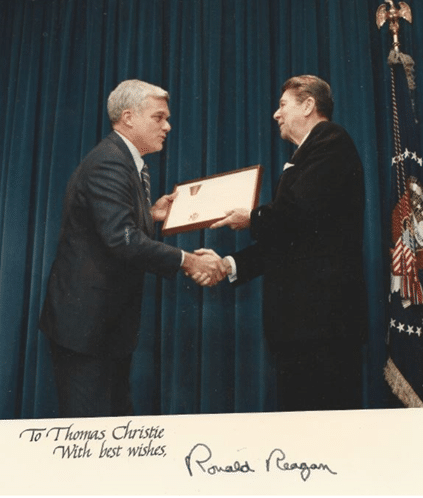
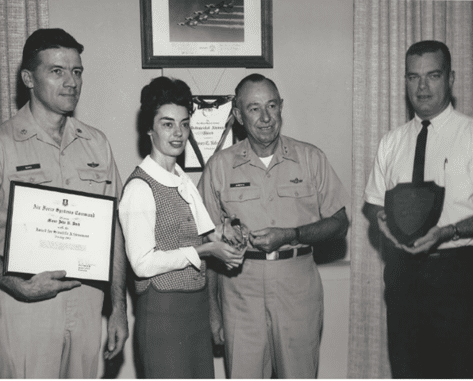
john boyd (left) and tom christie (right) receiving awards for energy manueuverability: courtesy tom christie
Emerald City Develops – Eglin Empire
During the time Tom and John developed EM, Tom also worked on other breakthrough projects. Namely, Tom’s group examined a tri-service project to quantify damage assessment and weapons effects. These results became published as the Joint Munitions Effectiveness Manuals, of which Pierre Sprey later visited Tom to review. As a civilian, Tom began to get young Air Force officers assigned to him producing these manuals as a result of the Vietnam spinup.
Second Lieutenant Robert “Bob” Speir happened to be one of those young officers. With loosely framed orders to report to Eglin, Bob arrived and as happenstance occurs, met a friend that asked Bob’s new assignment. Without specific guidance, Bob’s friend said to try and get asssigned to Tom Christie’s group. At the personnel office, they asked Bob if he knew his assignment and after mentioning Tom’s office, a First Lieutenant showed to take Bob to meet Tom.
As they arrived to the section, Bob noticed a cigar-filled office featuring a loud, profanity-laced discussion ending with a typical-disheveled Boyd exiting. Bob met with Tom and the interview consisted of what is your degree and what sports do you play. Symbolic of Tom’s leadership style, he let Bob into the group, assigned Bob a project and weeks later, when the actual worksite searched for Bob, Tom already “owned” Bob and kept him working. Tom instilled a simple management philosophy into the troops, go find something useful to study and he would cover their work.
Bob did exactly that by aiding the development of the A-X program. As the technical contact for JMEM weapons effectiveness, AAA survivability, and EM charts for Analytical Services Corporation (ANSER), Bob got to know Sprey and Avery Kay and ran computer simulations comparing various competitive aircraft. True to form, Tom kept everyone away to allow Bob time and resources to fix and perfect the AAA simulations. As these results occurred and passed to ANSER, the work done from Tom’s office helped the A-X project immeasurably. Knowing Tom since August of 1965, Bob worked with Tom many years, remains close friends today, and attributes his successes largely with getting assigned to Tom’s group.
Boyd left Eglin for the Pentagon in 1966, but still needed computer access and work completed. Tom ensured Boyd remained active by always assigning a young officer to liaise with Boyd, whenever Boyd called. One of these officers happened to be Robert Drabant.
In 1967, management asked Tom to get his PhD, from his school of choice again. While Tom was building this organization, he did not see the point in pursuing and turned down the offer. Roughly the same time, Tom was approached to go to Vietnam in an office set up as Scientific Advisor to General Westmoreland and he accepted. The ten-person office provided technical advice to the military command in Saigon. Most of the personnel came from military laboratories with experience and knowledge in weapon systems while Tom provided analysis functions.
Fighter Mafia Part 3: Thomas P. “Tom” Christie, Wizard behind the Curtain 36
After returning from Vietnam, in 1968, Tom secured the contract to complete the Joint Munitions Effectiveness Manuals. They were able to use computer time allocated toward projects without worry regarding budgets. Additionally, Research and Development money could be amassed over many fiscal years and Tom’s office had a surplus that allowed flexibility to travel to field locations, quickly developing a positive reputation among end-users.
In early 1969, Pentagon officials approached Tom to take over the Tactical Air Forces Office in the Systems Analysis Office. Tom interviewed and accepted this position. Unbeknownst to Tom however, the shop had been identified to be abolished and upon receiving a call from a high level official in the shop, Tom backed out.
Having been asked to participate in an exercise looking at Close Air Support capabilities in 1971, Tom spent a considerable amount of time assessing the A-X platforms. At Aberdeen Maryland, Tom studied Army helicopters and fixed wing airplanes for Close Air Support.
During 1972, Tom participated in the drill to get savings on the new F-15 on temporary duty to Andrews AFB. Boyd also had been assigned to Andrews and both Tom and Boyd spent time developing ways to make the F-15 capable and lighter. Through the time of F-15 development, Tom reflected that a dictum existed stating “Not a pound for Air to Ground,” to signify the desire to keep the F-15 as an Air to Air combat vehicle and avoid Close Air Support missions. However, this dictum, in hindsight, proved costly to the future Lightweight Fighter program.
Over the years, Tom continued to visit Washington about once a month. Tom would meet with Pierre Sprey, Boyd, and also became acquainted with Avery Kay. Eglin management promoted Tom, in his early 30’s, to a supergrade civilian position as Director of Weapon System Analysis and Tom’s office grew to over 100 personnel in an effort to keep Tom there.
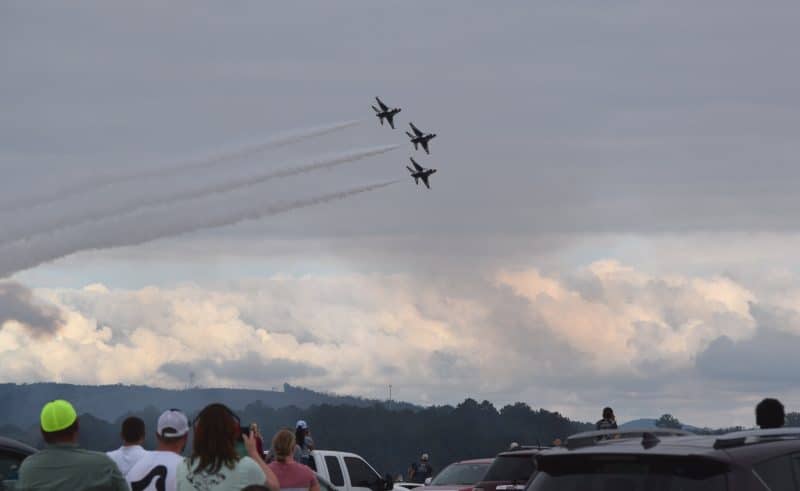
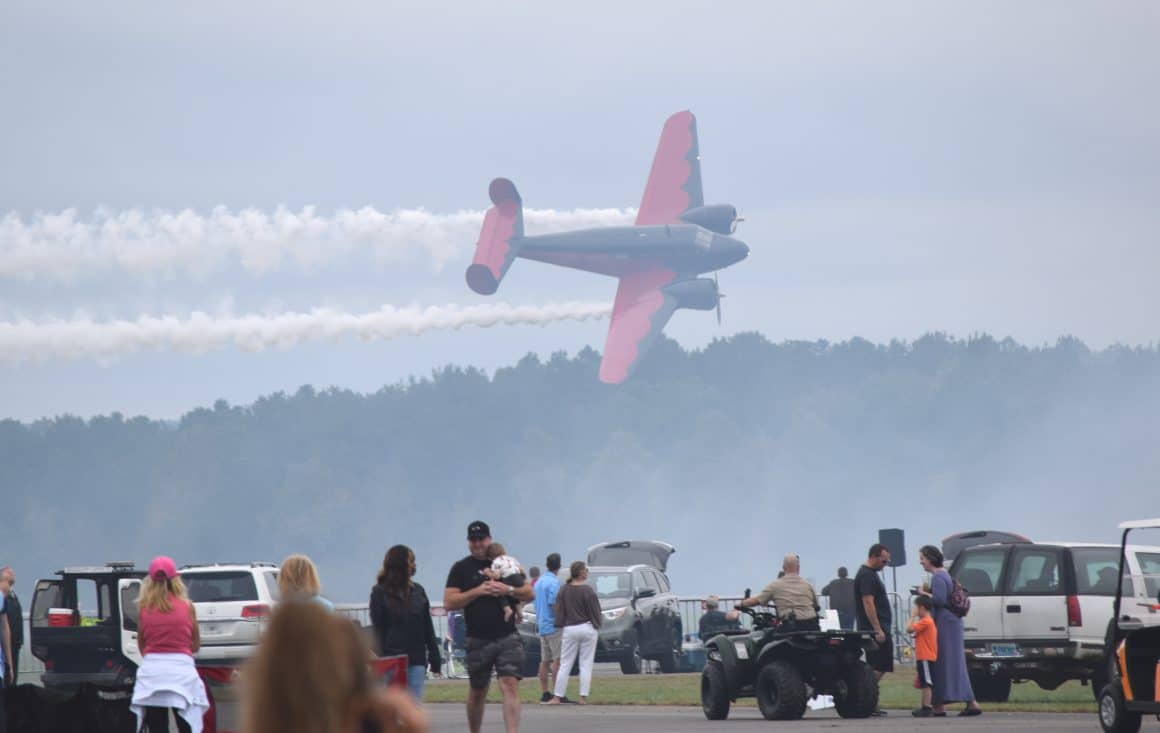
ROME, Ga. — The sound of freedom echoed across the mountains of north Georgia over the weekend as the U.S. Air Force’s top aircraft and historic warbirds performed an array of aerobatics.
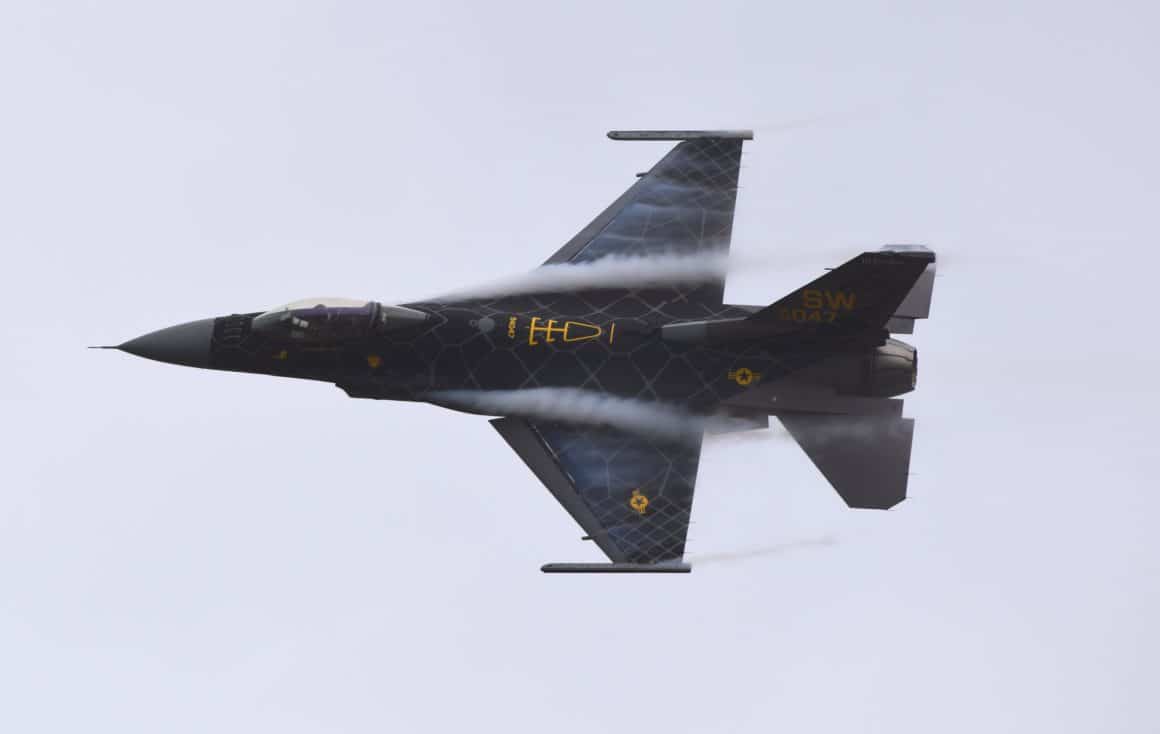
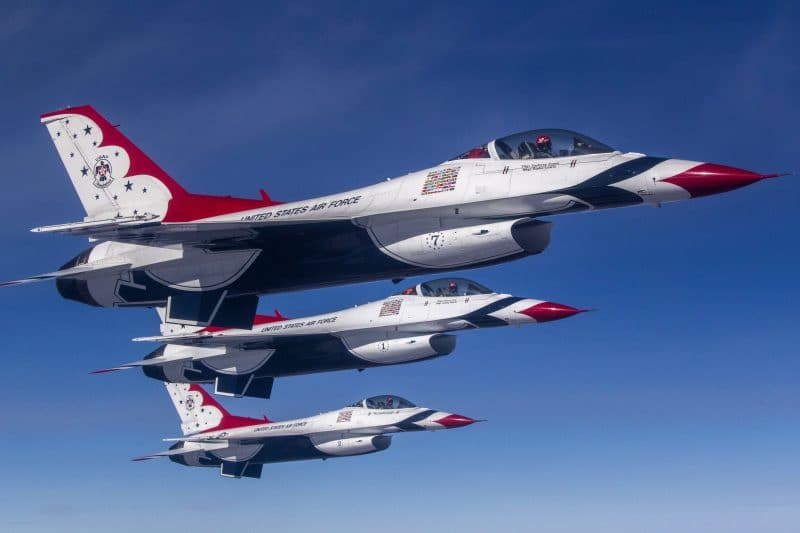
The Thunderbirds’ F-16C Fighting Falcons headlined the Wings Over North Georgia air show to near capacity crowds. Despite rain and low clouds, the two-day event pulled off a successful family-fun event.
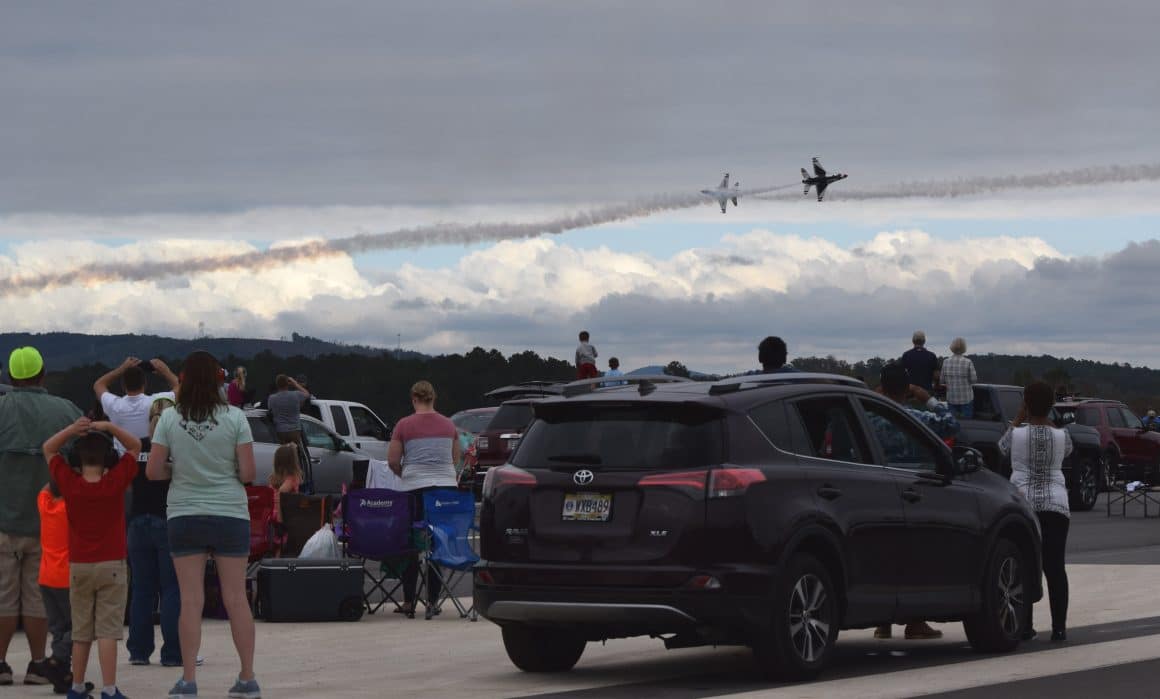
Guests drove their vehicles to an area facing the runway at Russell Regional Airport to capture a close-up view of the demonstrations. The new drive-in air show format allowed for guest to bring coolers and lawn chairs for a special section next to their vehicle.
“I thoroughly enjoyed how this air show went,” George Parker, who brought his small family, said at the conclusion on Sunday’s show. “The weather was poor, but the aircraft flew low and it was exciting to watch.”
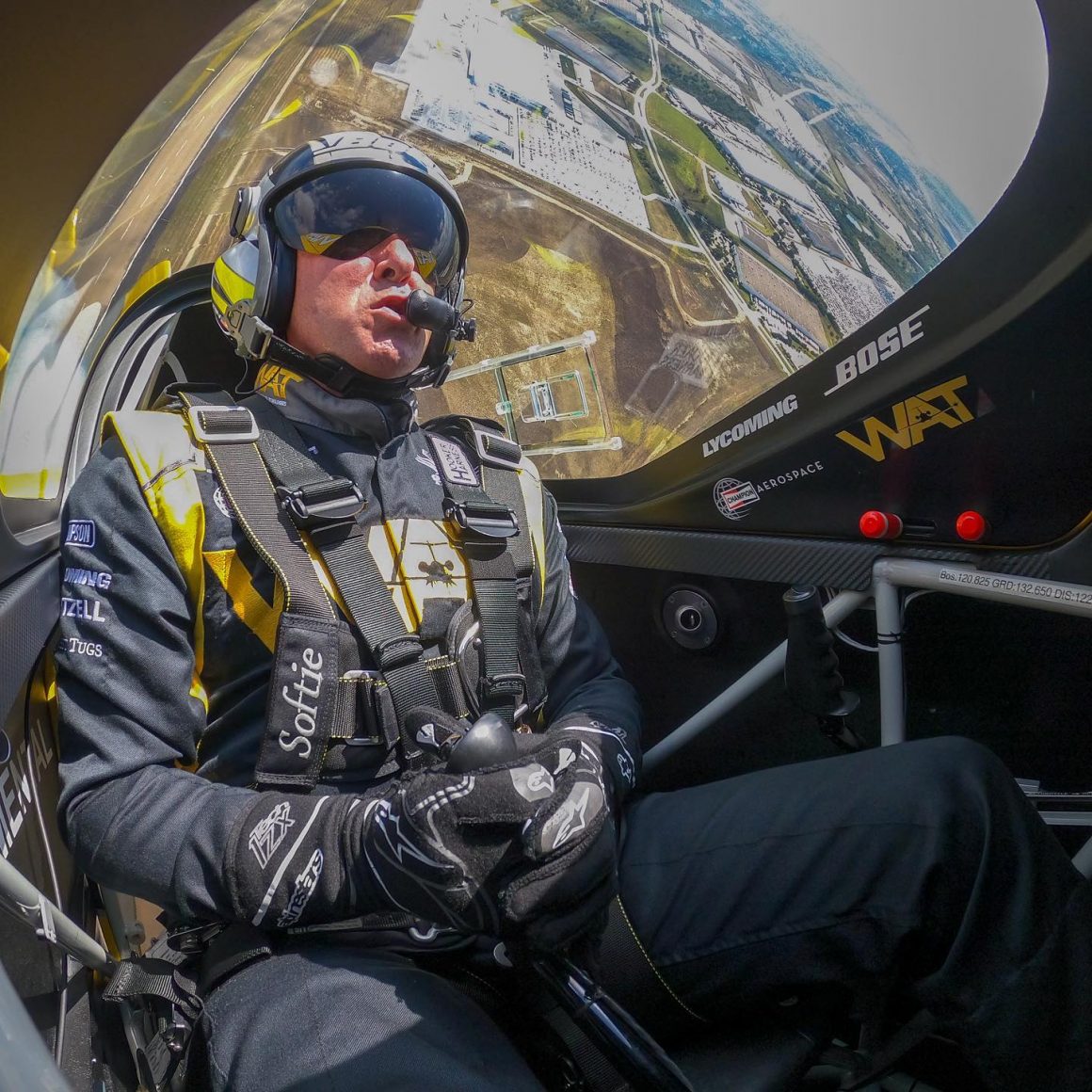
Civilian aerobatic pilots, including Michael Goulian and Michael Wiskus, flew a low show due to clouds on Sunday. They performed high speed passes and corkscrew turns while flying straight up.
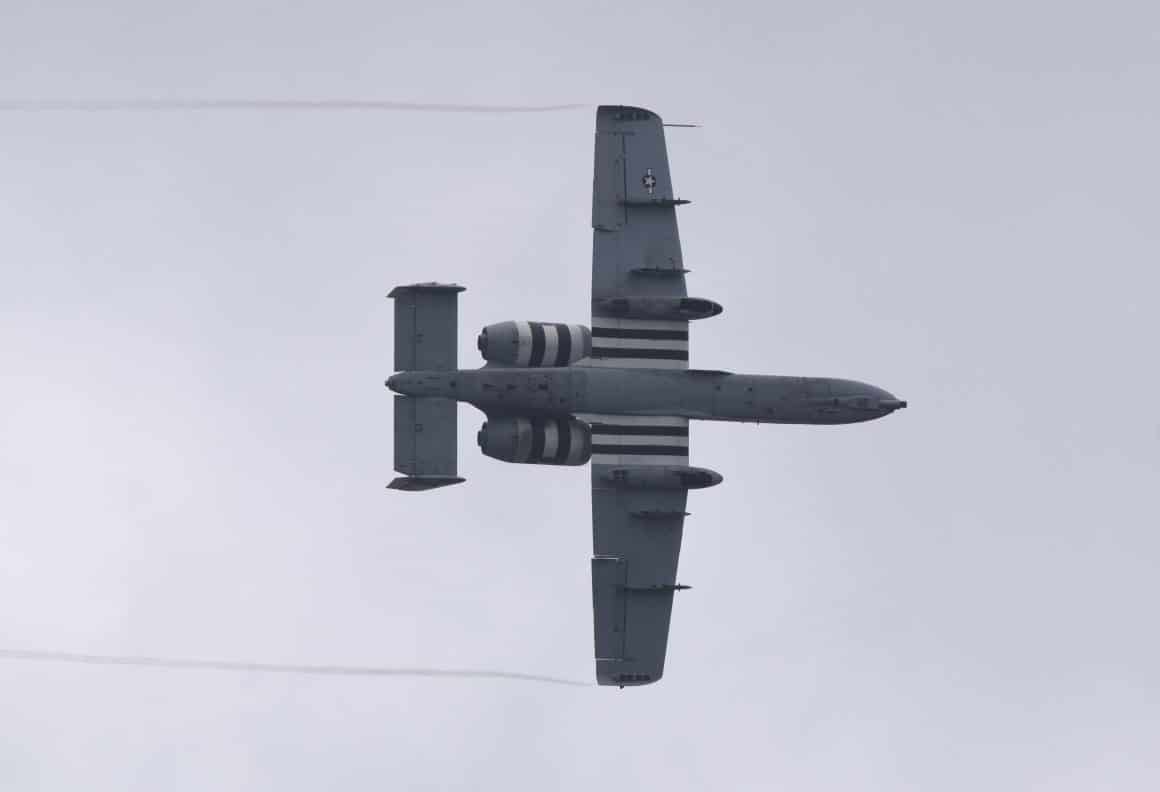
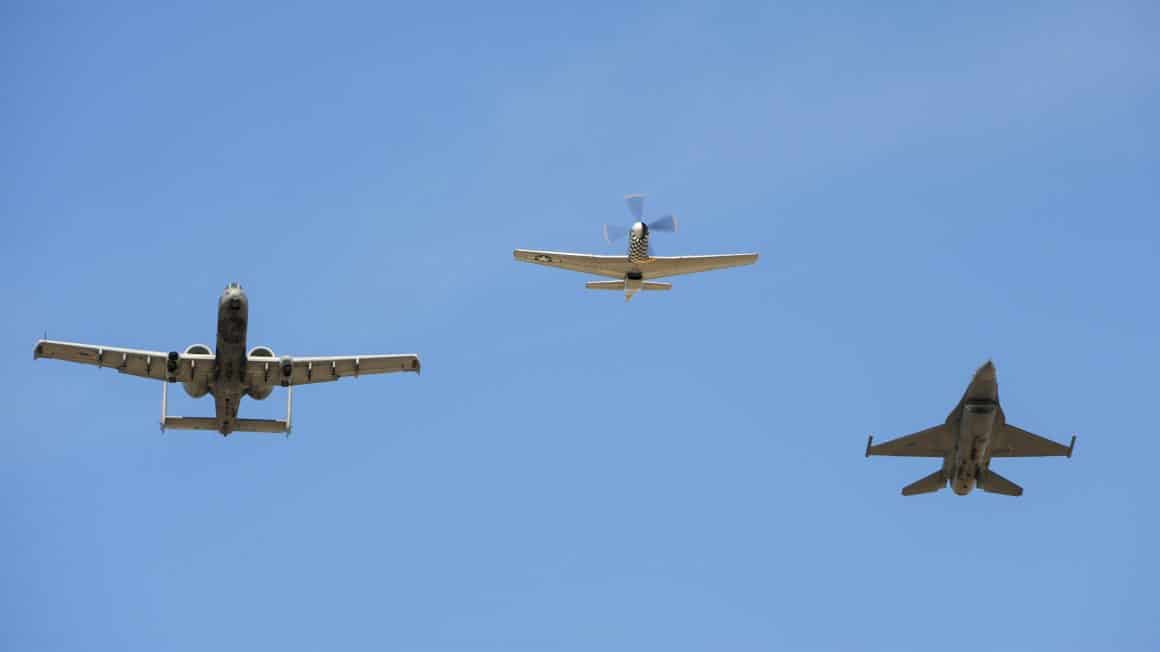
The Air Force A-10C Thunderbolt II and F-16C Viper performed separate flight demonstrations. The two aircraft later joined with P-51 Mustang pilot Charlie Hainline to perform the Air Force Heritage Flight.
“We work diligently every year to include a line-up of world-class aviators,” John Cowman, JLC AirShow Management President, said on Saturday. “For the 2020 show, we have the strongest military line-up ever hosted in our eight-year history.”
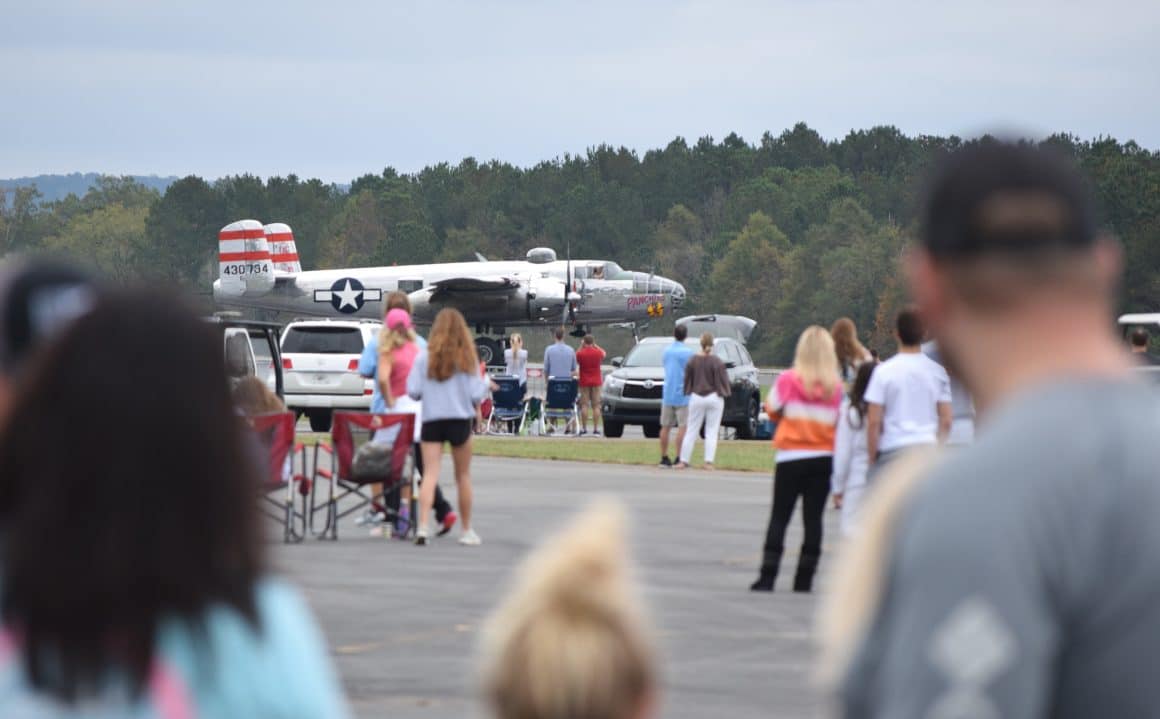
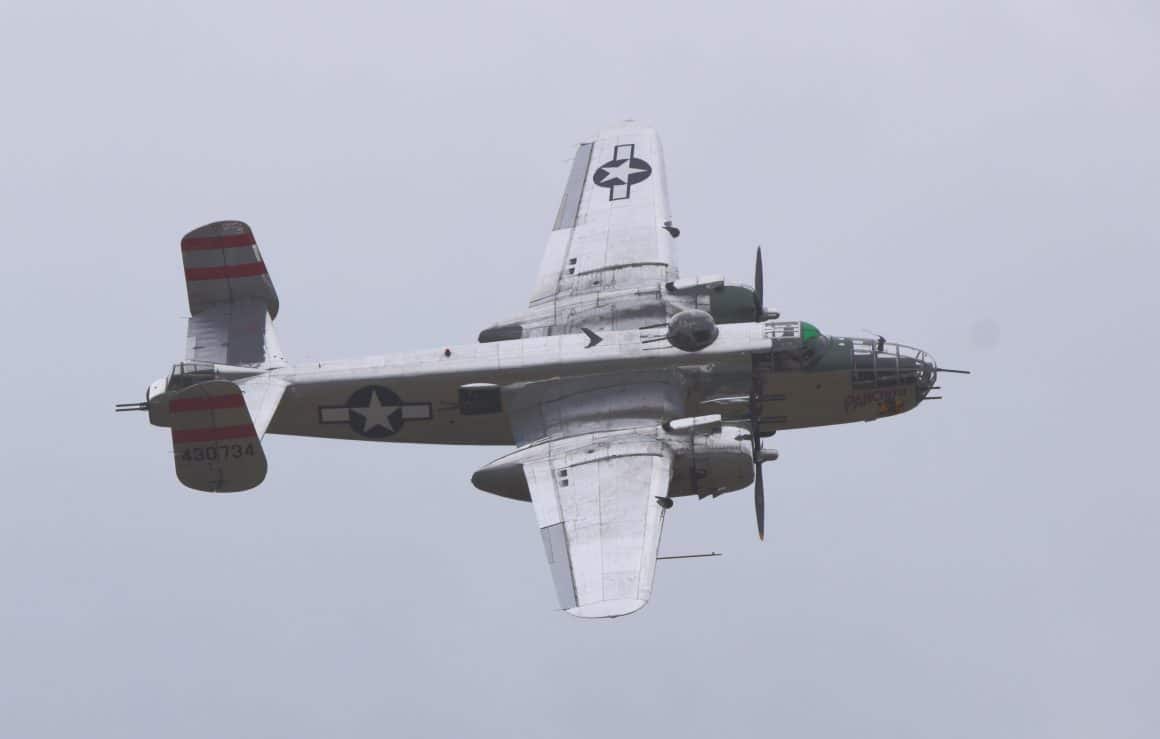
Wings Over North Georgia hosted the World War II-era B-25J Mitchell bomber Panchito. The silver aircraft’s slow low-level passes over the runway was a treat for the crowds below.
(Charles A Atkeison reports on aerospace and technology. Follow his updates via social media @Military_Flight.)
ROME, Ga. — The precision flying of the Air Force Thunderbirds plus the nation’s top aerobatic pilots are just a few scheduled to perform this weekend during the Wings Over North Georgia Airshow.
The Air Force’s F-16C Viper and A-10C Thunderbolt II Demonstration Teams will provide the extra excitement. Rome’s Richard B. Russell Airfield is center stage for an incredible line-up on Saturday and Sunday.
In this era of Covid concerns, the two-day event will be formatted as a drive-in air show. It is the only accepted air show format by the Air Force.
Air Force A-10 Warthog, F-16 Viper, and P-51 Mustang will perform the Heritage Flight over Rome. (USAF)
“Our 2020 air show will feature more military demonstration teams than we’ve ever hosted during a single event,” JLC AirShow Management President John Cowman said. “To address current safety concerns and the need for social distancing, we’re using a drive-in format for this year’s air show.”
Thunderbirds Return to North Georgia
Rome marks the fifth of six planned air shows by the Thunderbirds this year. In May, they performed a flyover of metro Atlanta to honor healthcare workers on the frontlines of Covid 19.
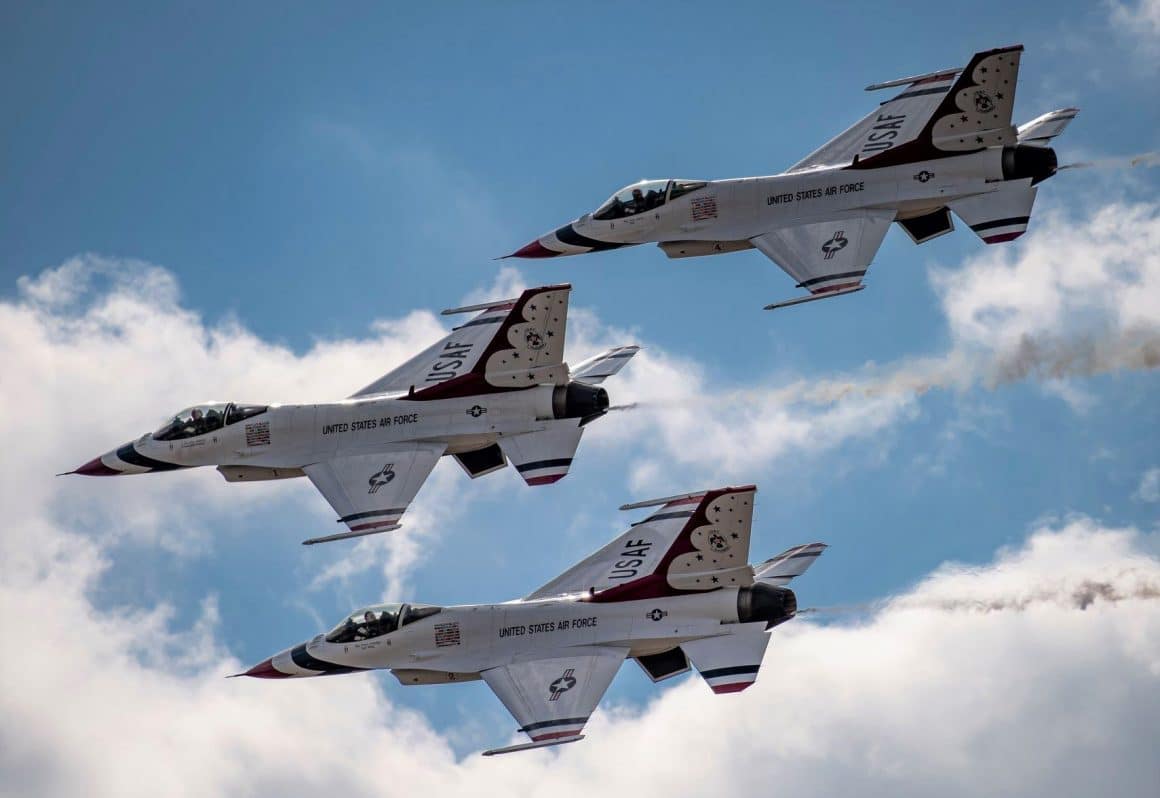
Their six F-16C Fighting Falcons will perform a nearly 45-minute flight demonstration each day. Four diamond jets flying a tight formation, while two solo jets perform high speed passes.
The Rome air show will be a homecoming for Thunderbird 12 officer Capt. Remoshay Nelson. The first year public affairs officer is looking forward to visiting with family from her hometown of Douglasville.
“I am excited for Wings over North Georgia and look forward to returning home to perform for my friends, family, and the Rome community,” Capt. Nelson told AvGeekery.com on Monday. “It is my hope our aerial demonstration can bring some pride and inspiration for air show attendees.”
Capt. Nelson, call sign “Flare”, has flown in the backseat of the F-16D jet from time to time. So we asked her, “what is your favorite maneuver?”
“When I’m flying I enjoy the vertical rolls and when I’m on the ground I like the High Alpha,” Capt. Nelson explained. “Both of these maneuvers show the capabilities and diversity in maneuverability of the aircraft.”
The Military & Civilian Performers and Airshow Insight
A Dobbins ARB C-130J Hercules will also take to the skies over the autumn colors of north Georgia. A C-17 Globemaster III aircraft from Tacoma, Wash. is also scheduled to perform.
Champion aerobatic pilot Michael Goulian returns to Wings Over North Georgia this weekend. (Goulian)
Civilian performers include Michael Goulian, Michael Wiskus, Matt Younkin, and Buck Roetman performing aerobatic maneuvers. A few warbirds, including Scott Yoak’s P-51D Mustang and the B-25J Mitchell bomber Panchito, are also scheduled to perform.
Cowman confirms tickets are sold online only for both days. A food court area and restrooms will be available each day.
“We ask that when you frequent either the restrooms or any of the vendors that you wear your mask and respect the six-foot rule of distance between fellow airshow attendees,” Cowman added.
(Charles A Atkeison reports on aerospace and technology. Follow his updates via social media @Military_Flight.)
FORT WORTH, Texas — North Texas’ first drive-in air show completed a successful two-day event on Sunday as the Air Force latest aircraft and popular aerobatic planes provided the weekend thrills.
The 30th Anniversary of the Bell Fort Worth Alliance Air Show featured the Air Force Thunderbirds. The nation’s newest fighter jets, including the F-22A Raptor and F-35A Lightning II, also performed each day.
AIR FORCE THUNDERBIRDS PERFORMED WITH ONLY FIVE F-16 JETS DURING THE TWO-DAY ALLIANCE AIRSHOW. (USAF)
The drive-in air show experience did not include deep rows of spectators standing along the flight line as the aircraft flew close. Nor did it have the usual aircraft static displays or a kids’ inflatables bounce area.
Much like a drive-in theater, visitors watched from their parked vehicle due to Covid concerns. This has been the approved model the Air Force has selected since July.
The Alliance Airshow was a sellout, having sold over 3,007 parking spots each day. Each spot was large enough for guests to get out and sit in lawn chairs, provided they wore a mask.
The Aircraft Performances
The Thunderbirds six-jet formation highlighted the skies above Alliance Airport. Cloudy skies on Saturday gave way to sunny conditions on Sunday, providing a beautiful performance.
One highlight each day was the Air Force Heritage Flight. A historic P-51 Mustang was joined in the skies by a F-22A, F-35A, and an A-10C Thunderbolt II to form a diamond shape formation.
The Heritage Flight has been a staple at air shows for over 20 years, honoring Airmen from yesteryear through today. The four aircraft performed several slow passes before the crowds on Saturday and Sunday.
An Air Force F-22A, A-10C, and F-35A join a P-51 Mustang during the Heritage Flight on Saturday. (USAF)
Aerobatic pilots Michael Goulian and David Martin performed a dizzying array of spins, high climbs, and low passes. Goulian’s Extra 330SC aircraft can perform a roll rate up to 420 degrees per second and a top speed of 260 m.p.h.
“Preparation and focus,” Goulian said Saturday at the conclusion of his first flight. “So great to be back to flying airshows in 2020. The team at Fort Worth Alliance Air Show has done a magnificent job to make a great family event!”
(Charles A Atkeison reports on aerospace and technology. Follow his updates via social media @Military_Flight.)
VIRGINIA BEACH — A virtual air show featuring live performances by U.S. Navy and Air Force aircraft will be broadcast across social media on Saturday from Naval Air Station Oceana.
The once cancelled 2020 Oceana Airshow will now take place from the coastal airbase without guests in attendance. Base organizers elected to fly with the new virtual format to provide local residents with a show “in a safe environment”.
This will be the only air show hosted by a U.S. naval base this season due to Covid concerns.
Air Force A-10C Demo Team commander Maj. Cody “ShIV” Wilton pilots the Warthog last week. (USAF)
“Moving the air show to a live-streamed event allows us to keep everyone healthy,” NAS Oceana commander Capt. John W. Hewitt said on Wednesday. “Showcasing what the Navy and Marine Corps team is capable of doing when we deploy around the world to defend America’s interests.”
The four-hour air show will begin at 12 p.m. EDT, and last four hours. The live performances will be shown via social media, including on YouTube, from Live Airshow TV.
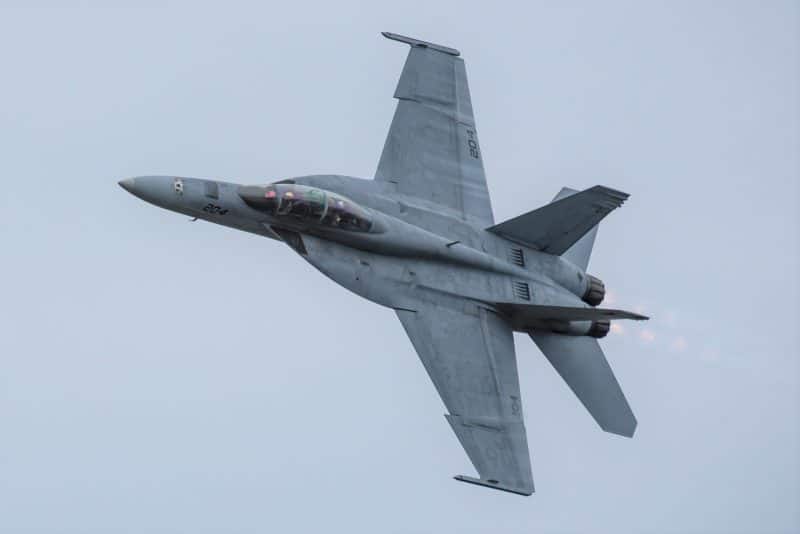
The Navy’s F/A-18F Super Hornet, affectionately known as a Rhino, will perform a nearly 18-minute flight on Saturday. The Rhino Demonstration Team is excited to perform over their home base.
“We’re honored that even in a COVID environment, we are able to safely perform and showcase the incredible dedication by the men and women who maintain and operate aircraft from NAS Oceana every day,” Rhino Demo Team member LT. Matt “Syndrome” Lindeman said.
Oceana will be the Rhino’s first air show performance of the season due to Covid concerns. The pilots and maintainers have continued to practice each week to maintain their readiness.
“The demo profile is designed to highlight the mobility, versatility, and power of the F/A-18 Super Hornet, and enhance U.S. Navy recruiting in the area of Naval Aviation,” LT. Linderman added.
The Air Force F-22A Raptor and A-10C Thunderbolt II demonstration teams are also scheduled to perform. A Marine Corps. MV-22 Osprey is also poised to fly, performing vertical take-offs and hovering techniques over the air field.
Aerobatic pilots Michael Goulian, aboard his Extra 330SC, and Scott Francis, in the MXS aircraft, will provide a dizzying array of maneuvers.
Oceana base officials caution local residents from parking near the base to catch the event in person.
“The best way to view the air show is on your phone, tablet or computer,” Capt. Hewitt said. “We need to make sure emergency services personnel can get wherever they may need to go and that nobody is spreading the virus outside of our gates trying to get a better view of the show.”
(Charles A Atkeison reports on aerospace and technology. Follow his updates via social media @Military_Flight.)
WASHINGTON — Historic warbirds and massive bombers will fill the skies over the nation’s capitol next week to commemorate the 75th anniversary of the end of World War II.
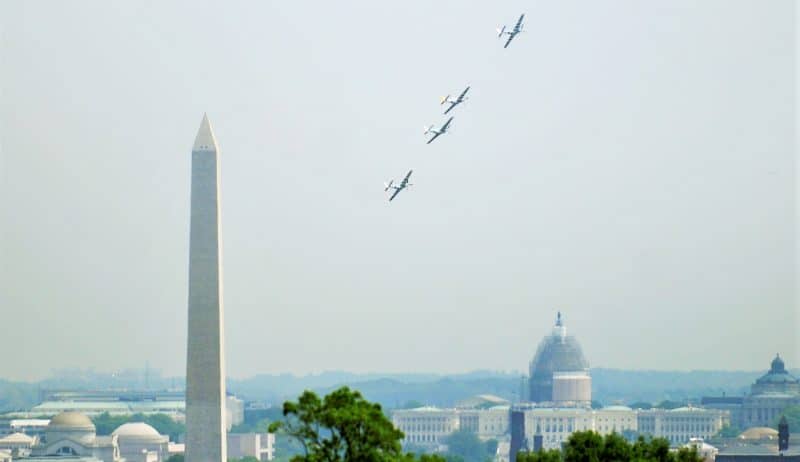
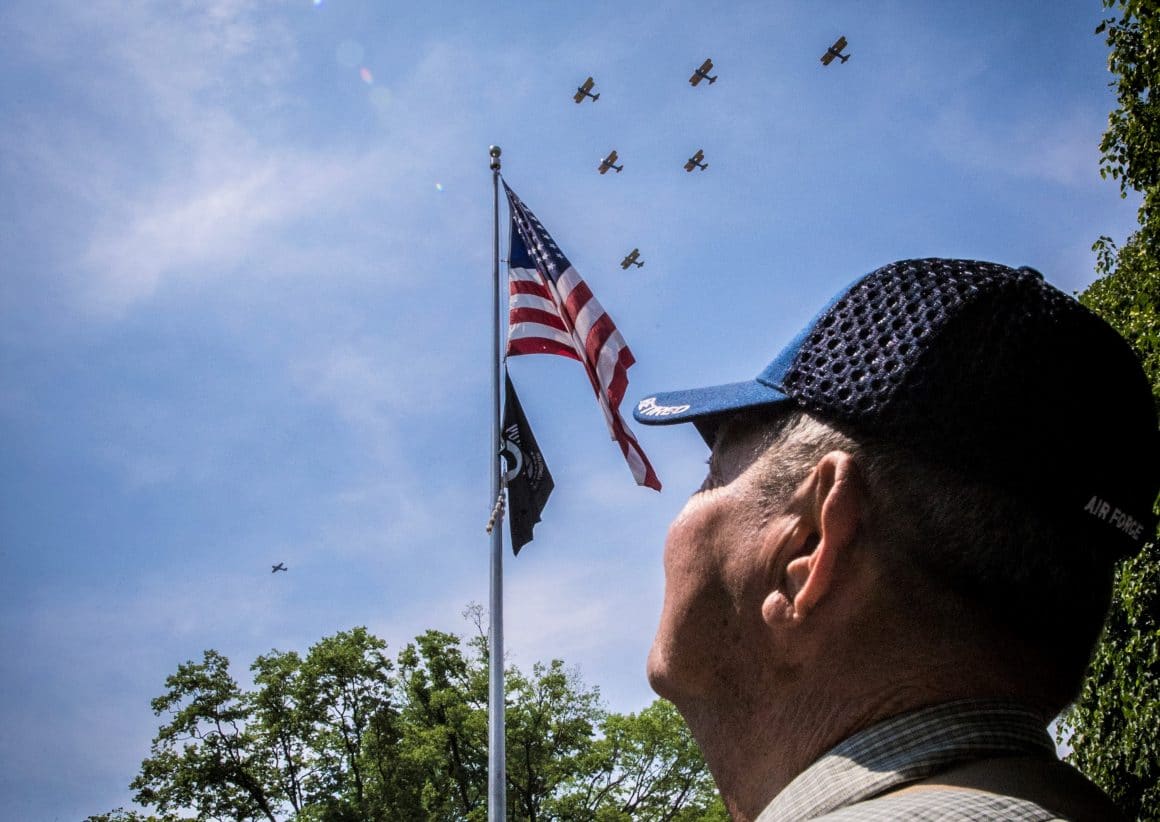
The Arsenal of Democracy flyover will see waves of aircraft formations fly across Washington, D.C. on September 25. Separated by two minutes, each wave of aircraft will honor historic battles of the European and Pacific theaters of war.
The 75-minute flyover will then conclude with a missing man formation.
The Arsenal of Democracy Flyover will commemorate the 75th anniversary of the end of WWII. (U.S. Army)
“Approximately 70 World War II aircraft will take to the sky in historically sequenced warbird formations,” Tony Vericella, Executive Director of the 75th WWII Commemoration Committee, said on Tuesday. “These formations will fly over the Washington Mall in two minute intervals.”
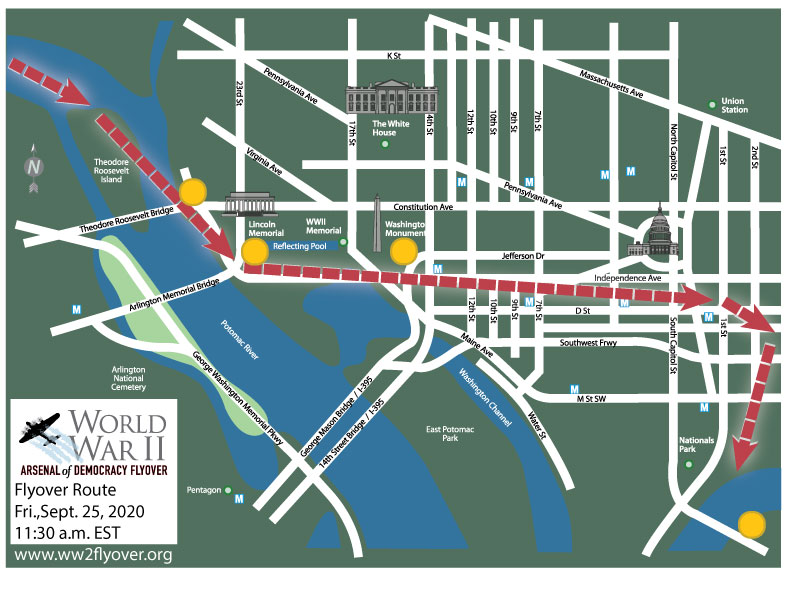
The aerial parade will fly south along the Potomac River before moving east over Independence Avenue and the National Mall. The first waves of airplanes will flyover the Lincoln Memorial beginning at 11:30 a.m. EDT.
Arsenal of Democracy Flyover to Honor the end of World War II 52
“The formations will represent the War’s major battles concluding with a missing man formation,” Vericella added.
During a radio broadcast in December 1940, President Franklin D. Roosevelt called on America to become ‘the great arsenal of democracy’. Roosevelt asked the nation to furnish Great Britain with aircraft and supplies as war spread across Europe.
The Commemorative Air Force, museums, and private individuals have donated the warbirds for the aerial parade. Aircraft will represent major scenes of the War from the Civil Air Patrol to D-Day, and Iwo Jima.
“We’re proud to serve as a principle organizer of the Arsenal of Democracy Flyover to help ensure we recognize and remember the enormous sacrifices of our nation’s heroes,” CAF president Hank Coates said.
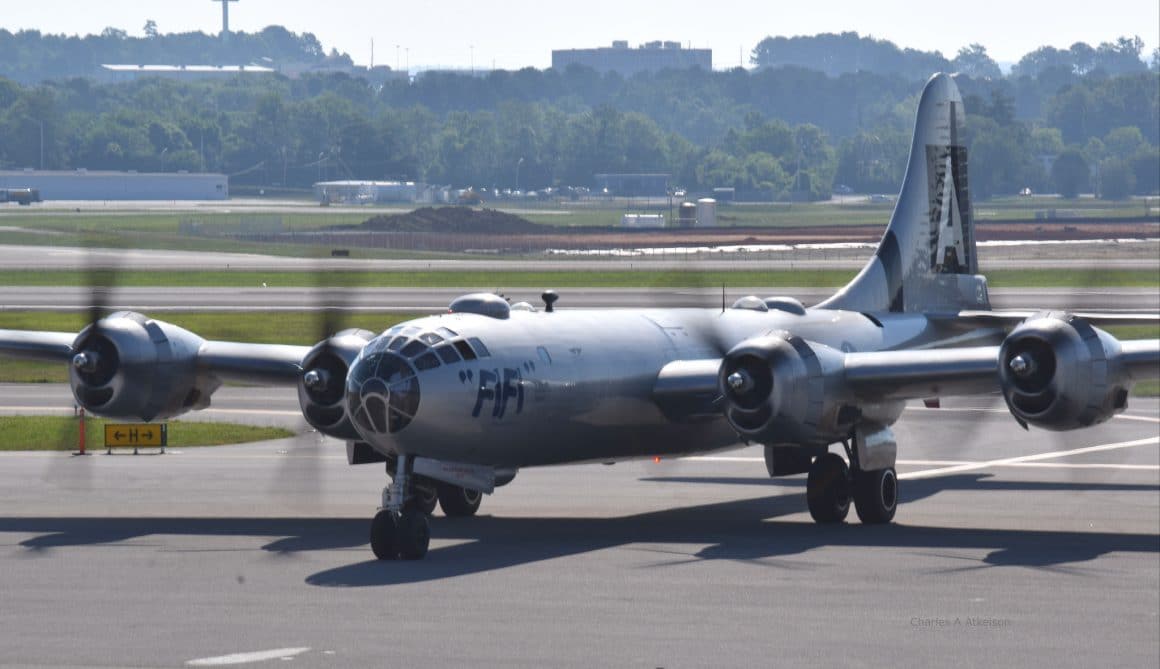
The B-29 Superfortress “FIFI” is scheduled to flyover Washington, D.C. on September 25. (Charles Atkeison)
Of the nearly 70 planes, these are just a few of those scheduled to fly:
Six B-25 Mitchell bombers, including “Panchito”, will fly in formation. Two B-29 Superfortress’s, *FIFI* and DOC, are also scheduled to fly.
Six C-47 Skytrain’s, the leaders of the Allies D-Day invasion to liberate France, are also due to fly. The C-47 That’s All Brother, who led the first wave of D-Day aircraft in 1944, is also schedule to fly.
Five Curtis P-40 Warhawks are scheduled to fly. The Army Air Force’s front line fighter was in the air during the attacks on Pearl Harbor in 1941.
Four B-17 Flying Fortresses, including Aluminum Overcast, and nine P-51 Mustangs will also take part. The Army’s T-6 Texans, Navy’s SNJ-2s, and the British Harvard aircraft will be included in the warbird formations.
(Charles A Atkeison reports on aerospace and technology. Follow his updates via social media @Military_Flight.)
To commemorate the 75th anniversary of Victory in Europe (V-E) Day, the Arsenal of Democracy, in conjunction with the WWII 75th Commemoration Committee, produced a video tribute.
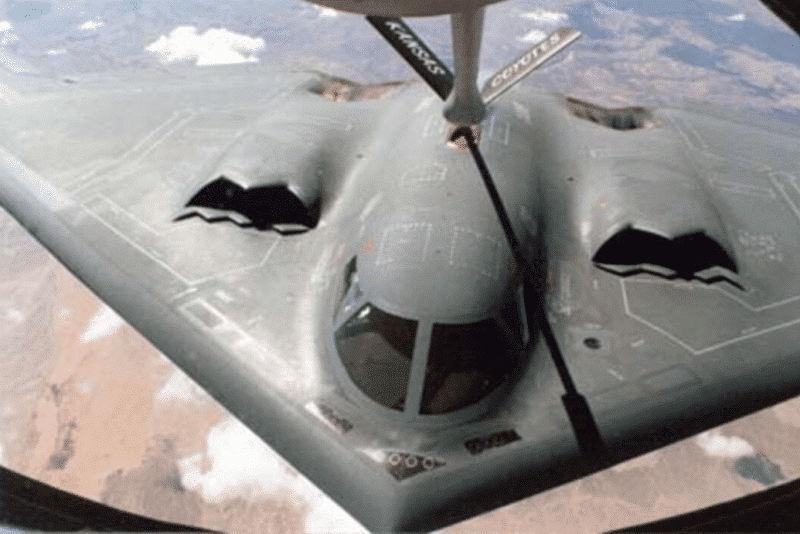
Ever since flying began, the need for enhanced range of aircraft existed. In 1923, the first air refueling took place. The video above depicts a KC-135R refueling a NATO E-3 AWACs for training. The dangers of two aircraft flying in close proximity can not be understated. At 38 seconds into the video – within the next 2 – the aircraft were within inches of each other.
While nearly every air refueling occurs without incident, the danger exists nonetheless each time two aircraft fly so closely to each other.
Here is a short video with the history of Air Refueling.
My Experience With Air Refueling as a KC-135 Pilot
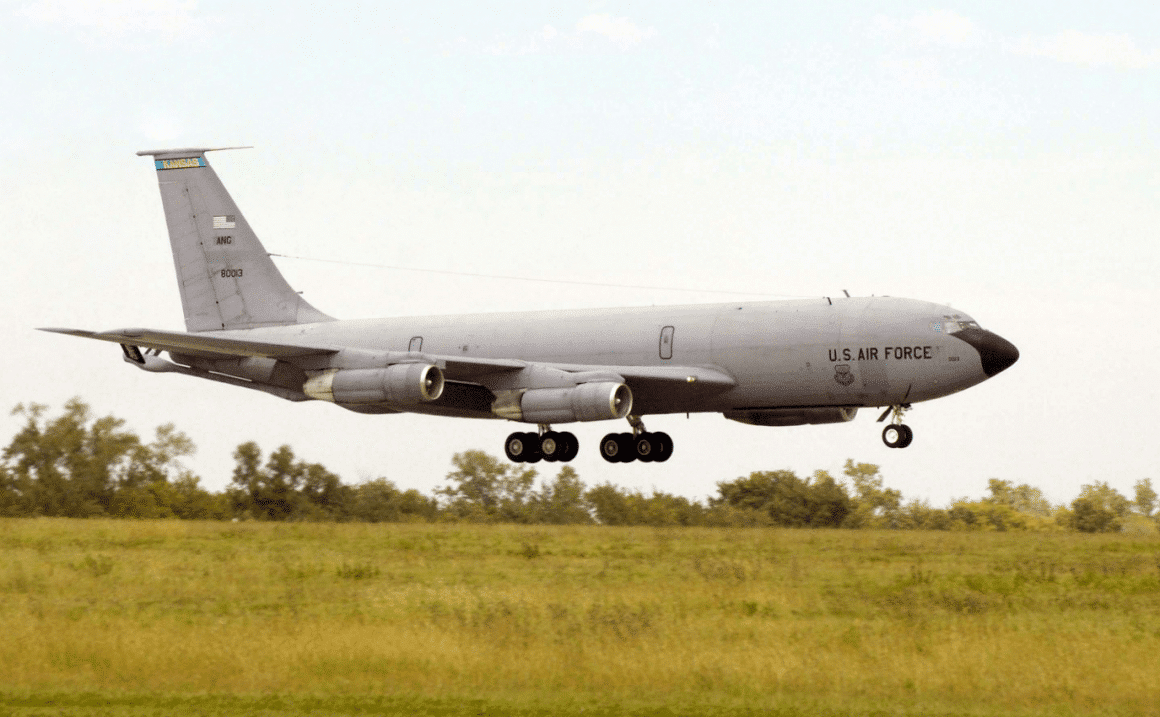
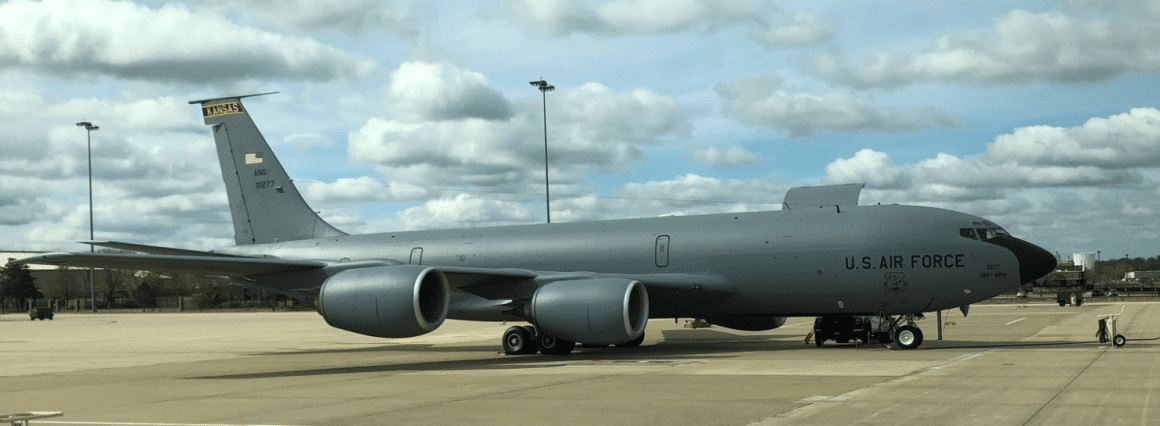
kc135e: The 2nd model with improved tf-33 engines producing 18,000 lbs thrust per engine and thrust reversers. (source: 190arw)KC135R: The third engine refit with cfm-56 engines capable of 22,000 lbs of thrust per engine. (source: 190ARW)
With over 20 years flying the KC-135 D/E/R, many questions arose whenever I gave orientation rides for civilians. These were my most frequent questions I was asked:
Q: How much fuel do y’all carry? A: About 32,000 gallons or about 1 gallon of milk per day for 87 years!
Q: How much does this big airplane weigh and how does it take off? A: About 320,000 lbs at full gross weight and honestly, we really have no clue how it takes off! (kidding)
Q: How far do y’all fly on a tank of gas? A: About half way around the world, if we fly farther than that, we went the wrong way!
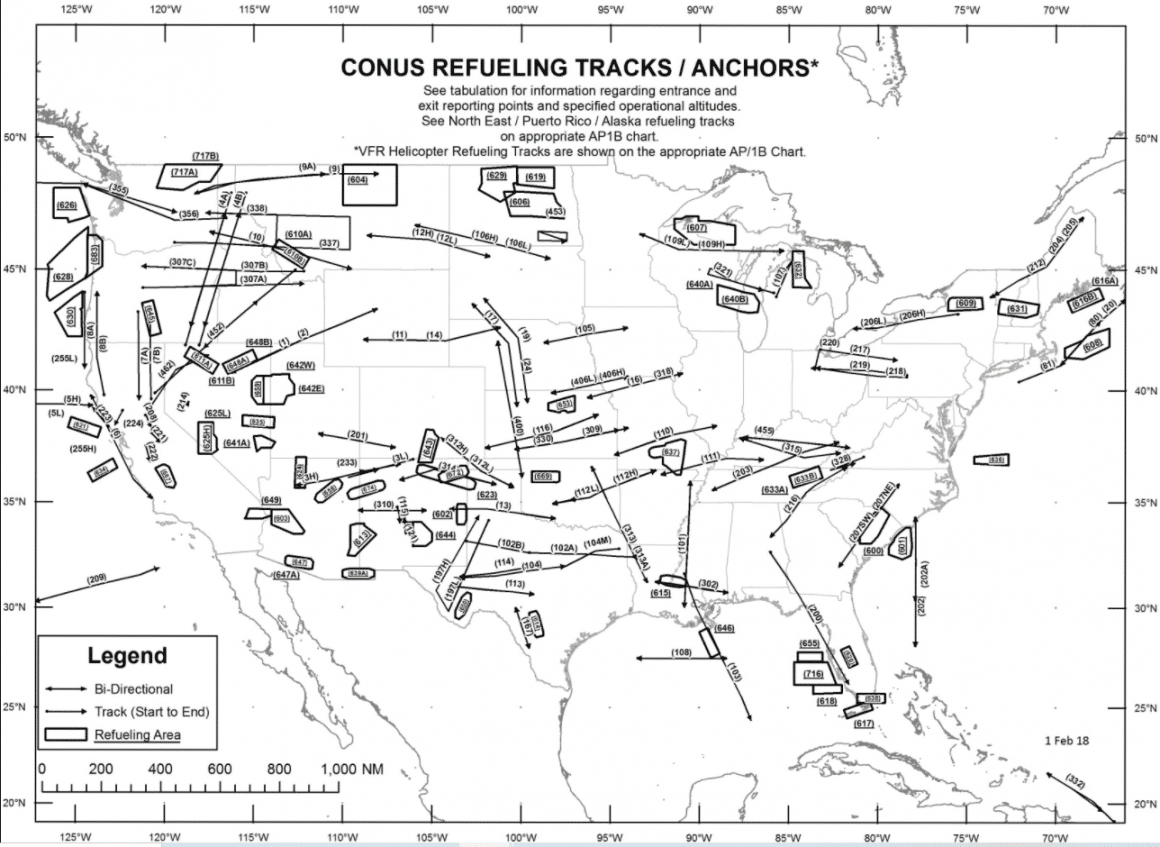
Q: How do you find each other (receiver and tanker)? A: We plan to meet each other at a specific time, altitude, and location, based on an established and approved Air Refueling Track (line) or Military Operations Area (anchor area). The pix below shows the US air refueling tracks and anchors. Each one has properties that identify altitudes and coordinates for entry and exit.
From dod publication AP/1b military training routes
The U.S. Air Force, the Air National Guard, and the Air Force reserve have flown many models of air refueling tankers with the latest being the KC-46 Pegasus. Each aircraft has had a role in keeping the mission moving.
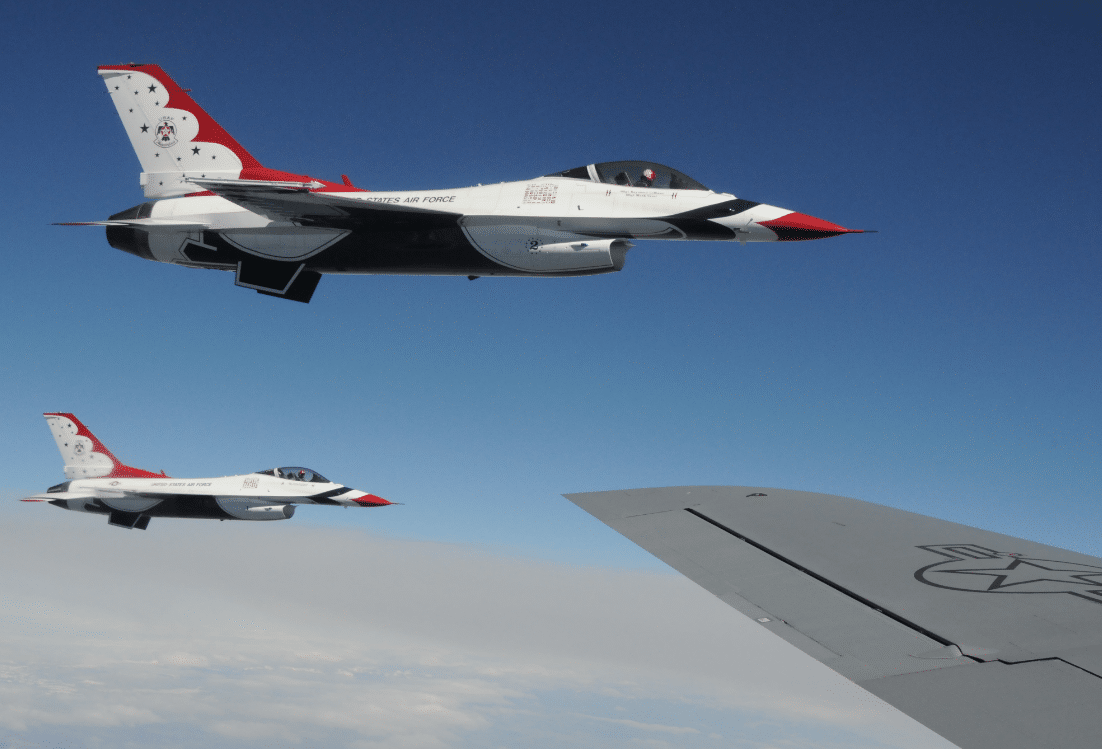
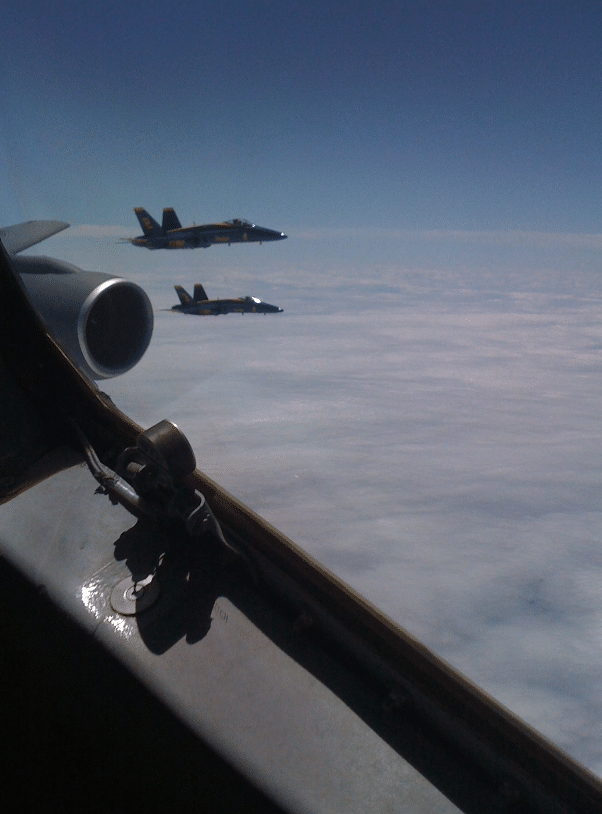
Air refueling takes training, practice, and proficiency to execute safely. The challenge is worth it though. We kept important missions moving. With thousands of hours in the air refueling business – the office views were amazing too! Here are a couple of my favorite pics that I took while flying the mighty KC-135…
just a standard day over kansas refueling the thunderbirds: source chris turnerbetter not leave out the blue angels! source chris turner
Call it one of the more unique aspects of the COVID-19 pandemic. Just as drive in movies are growing in popularity, drive in airshows are actually starting to become a thing.
The Alliance Air Show in particular will be different but will still feature some of your favorite flying acts . “The circumstances of the COVID-19 pandemic provided the unique opportunity to be innovative in how to move forward with hosting the air show for the North Texas community,” said Christina Carey, director of special projects for Alliance Air Productions, producer of the event and a nonprofit organization created by Hillwood. “Our newly reformatted event will be a memorable, fun and socially distanced drive-in experience as we celebrate 30 years of soaring excellence.”
Drive In Air Shows Are Starting To Take Off In COVID era 59
Much like a drive in movie, drive in airshows are exactly what you would think they would be. Instead of congregating around a flight line, guests remain in their car (or nearby their car) and watch the show. In order to comply with social distancing, these new drive in shows will lack the static displays, bouncy castles, and assortment of food. What they lack in terms of flight line entertainment, they will make up with thrills in the skies. The performances will remain the same. And in a season where so many airshows have been cancelled, that is a good thing.
Is this the new normal? Hopefully not. But until COVID-19 is in our rear view mirror, it is better than nothing.
Alliance Air Show in Fort Worth, Texas
Held October 17-18, 2020. The current plan is to offer a limited number of parking tickets available for purchase on a first-come, first-served basis in mid-September at AllianceAirShow.com. There will be no parking tickets sold onsite.
Wings Over North Georgia Air Show
Held October 24-25, 2020. Wings Over North Georgia officials explain there will be portable restroom accommodations and food vending sites. Cowman encourages guests to also bring their own food and drinks to Georgia’s largest tailgate party. Tickets are $130 per car. You can learn more at Wings Over Georgia’s website.
Airlines love efficiency to save both time and money. Back in the ’80s American Airlines famously removed one olive per salad to save $40,000 of dollars a year. American and all other airlines then removed coach meals all together to save even more money. The holy grail of savings though isn’t just saving money with less foods and lighter planes. The ultimate efficiency is squeezing one more profitable flight into the schedule than your competitors. Multiple Jet Bridges were seen as one potential solution.
That’s why for years airlines have thought of creative ways to board planes and deplane planes faster. When jets like the 707 and DC-8 first came out, a few airlines experimented with dual jet bridges by parking the jet parallel to the terminal. It worked in that boarding times were faster. The challenge was that each aircraft that parallel parked to the terminal took up so much real estate. The idea quickly faded as additional traffic required more efficient use of aircraft parking around terminals. Pulling into a gate became the common way to park a jet at a gate.
More Modern attempts at expediting boarding
The concept of rapid loading and unloading never truly went away. Over the years airlines have experimented with boarding via groups that would lead to faster boarding times. They tried from back to front, then window to aisle. Southwest Airlines famously doesn’t assign seats. Some boarding ideas work better than others but there is always one choke point. That is from the door to the aisle to your seat. The narrow passageway is a blocker.
TWA Tried the Triple Jet Bridge for their 747 at LAX
In the early days of the Boeing 747, LAX introduced a set of boarding bridges for the 747. It included a bridge for the first class section another one for coach and a third telescoping bridge that went over the left wing. The TWA Museum recently posted a photo of this wild setup along with a story about the design. Although boarding was more efficient, the aft boarding door that went over the wing was mechanically complex and risky. We posted the link to their story below for you to check it out in more detail.
Challenge: Quickly moving 350 passengers onto and off from a 747. A solution: The “Skydock” at TWA’s Los Angeles…
Southwest Airlines, the airline that once made famous their 10 minute turns, has also dabbled in dual jet bridges (officially known as Mobile Telescoping Dual Bridges) at Dallas Love Field, Austin, and most recently Albany, New York. Each time one was installed, the local news posted a story about the ‘innovation’ to great fanfare.
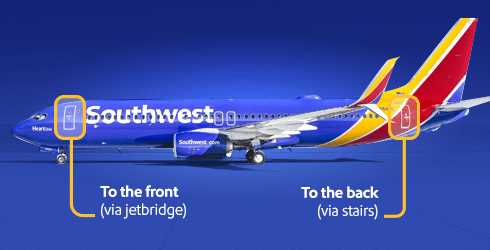
After a testing period, the bridges were quietly removed with little to no information about why. For a while dual jet bridges were locate at Albany and used on a fairly regular basis. A 2019 news story in the Times Union described the bridges as being retired. According to the article, the bridges outlived their designed lifespan. The article does acknowledge that they have had mechanical challenges for years and were often out of service. Southwest hasn’t given up on dual boarding though. They have a number of airports (mainly in California) where they continue to allow passengers to descend a flight of stairs to the tarmac to then board their flight from air stairs placed at the back of the jet.
Dual boarding via stairs is in use at 4 California airports. ImageL Southwest Airlines
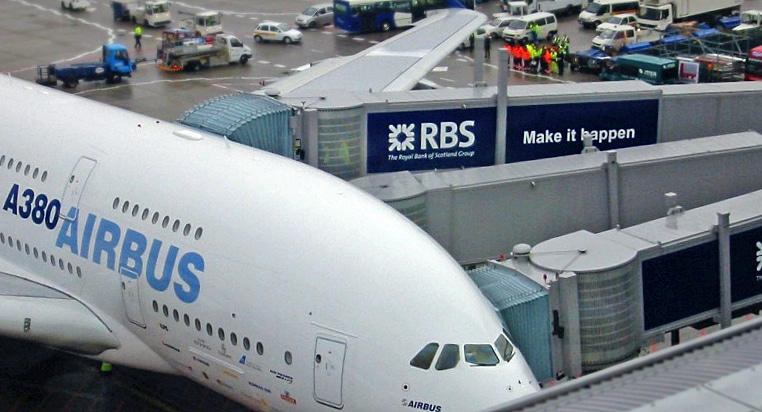
The A380 Made Dual Jet Bridges Cool Again
The massive size of the A380 made boarding a real challenge. To account for the high volume of passengers boarding and deplaning, many airports have constructed gates that are specifically built for the A380. These gates have two (and sometimes three) jet bridges that allow for the downstairs and upstairs of the jet to be loaded simultaneously. Brussels airport even shared a campaign about the new gates in a YouTube clip that can be seen below.
What makes this approach unique is that due to the layout of the A380, all bridges can link to the jet without the need to telescope over the wing. The idea works. However with the A380 rapidly leaving the fleets of many airlines, the need for such a unique gate setup may be short lived.
Other airports have successfully installed dual jet bridges but very few telescoping bridges over the wings. The most notable was KLM’s telescoping bridge for their 747 fleet in Amsterdam. With the 747 now retired, it is unknown if the bridges will still stay in service for their other wide bodies in the fleet.
United also tried telescoping jet bridges over the wing at Denver on a few gates. However, one telescoping bridge damaged a 757 wing. The attempt at efficiency was discontinued and the dual jet bridges were removed from service.
Multiple Jet Bridges are utilized in a limited way for widebodies but telescoping bridges just don’t seem to work
At major airports, some gates have multiple jet bridges for wide bodies that connect to the jet ahead of the wings today. It’s fair to say that dual telescoping jet bridges never really took off though. The reasons are pretty obvious. They are complex to operate and maintain a jet bridge that telescopes over a wing then descends back down to be level with a rear boarding door.
Even though its technically feasible, such a set up is always complex, risky, and expensive. And there is a real risk of damaging the wing. A jet out of service is much less efficient than saving a few minutes in a turn. File this idea in one of those good efficiency ideas that’s never really been efficiently executed.
It’s been a pretty sad time for commercial aviation lately. Planes have been retired left and right. Almost all the Mad Dogs have disappeared along with a host of A340s, 747s, 757s and 767s. So when we see an airline operating a new type of jet we get just a wee bit excited.
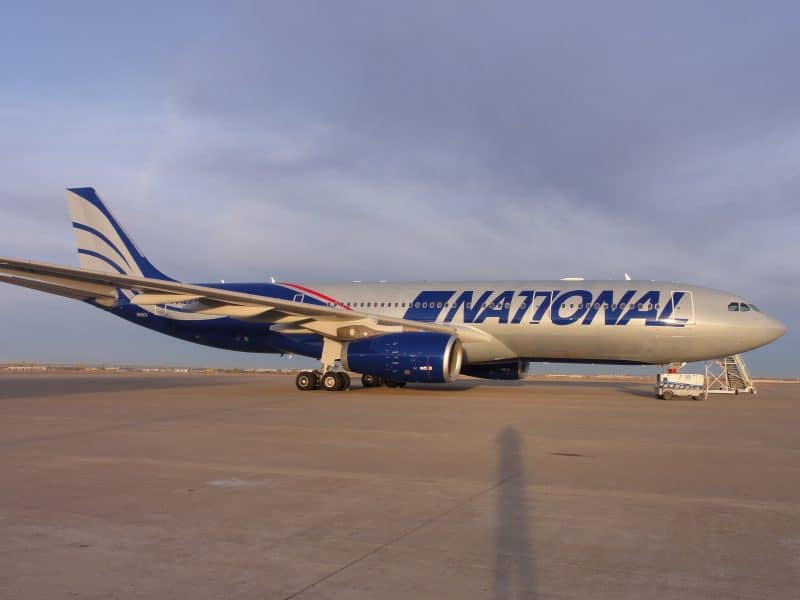
National Airlines is a small Florida-based airline that provides cargo and military charter services. They also have occasionally operated odd route combinations for scheduled service. In the past, they’ve flown from Long Island Islip airport to Puerto Rico. Their most recently scheduled service was supposed to be centered around infrequent service between Puerto Rico, Orlando, and Windsor International Airport. However these routes were delayed, presumably due to the combination of COVID-19 and charter demand for their aircraft.
MSP Aviation 4K recently filmed the airline’s first A330 departure from Minneapolis International Airport. His gorgeous 4k footage captures the silver and blue A330 in all its glory.