
From the Hempstead Plains to the Moon, explore the story of flight at the Cradle of Aviation Museum.
The Cradle of Aviation Museum, located on Museum Row in Garden City near the Coliseum, Nassau Community College, and Hofstra University, tells most of Long Island’s aerospace story.
Tracing its origin to 1979, when then-County Executive Francis T. Purcell designated funds to restore two aircraft hangars at former Mitchel Field, it displayed several dozen aircraft until it closed for renovation in 1995.
The 130,000-square-foot, $40 million facility, opening on the 75th anniversary of Lindbergh’s transatlantic flight in 2002, showcases more than 70 air- and spacecraft, 11 of which are one-of-a-kind designs, associated with or constructed on Long Island and uncovered during a 20-year search that stretched from the bottom of Lake Michigan to Guadalcanal.
They were then restored and preserved by volunteers from the retired airline and defense aircraft manufacturing industry, who collectively contributed some 650,000 man-hours to the project. The result was Long Island’s largest, year-round, educational, recreational, and cultural institution.
According to New York State Governor George E. Pataki, museum visitors “can see the brief span of years that brought Long Island from hosting the fragile biplanes of 1911 to building the Lunar Module that took mankind to the moon in the sixties. Through these displays, the Cradle becomes a powerful mirror that reflects our own skills, intellect, and ability to conquer time and space and pays tribute to American innovation and pioneering spirit.”
Notable Aircraft and Exhibits
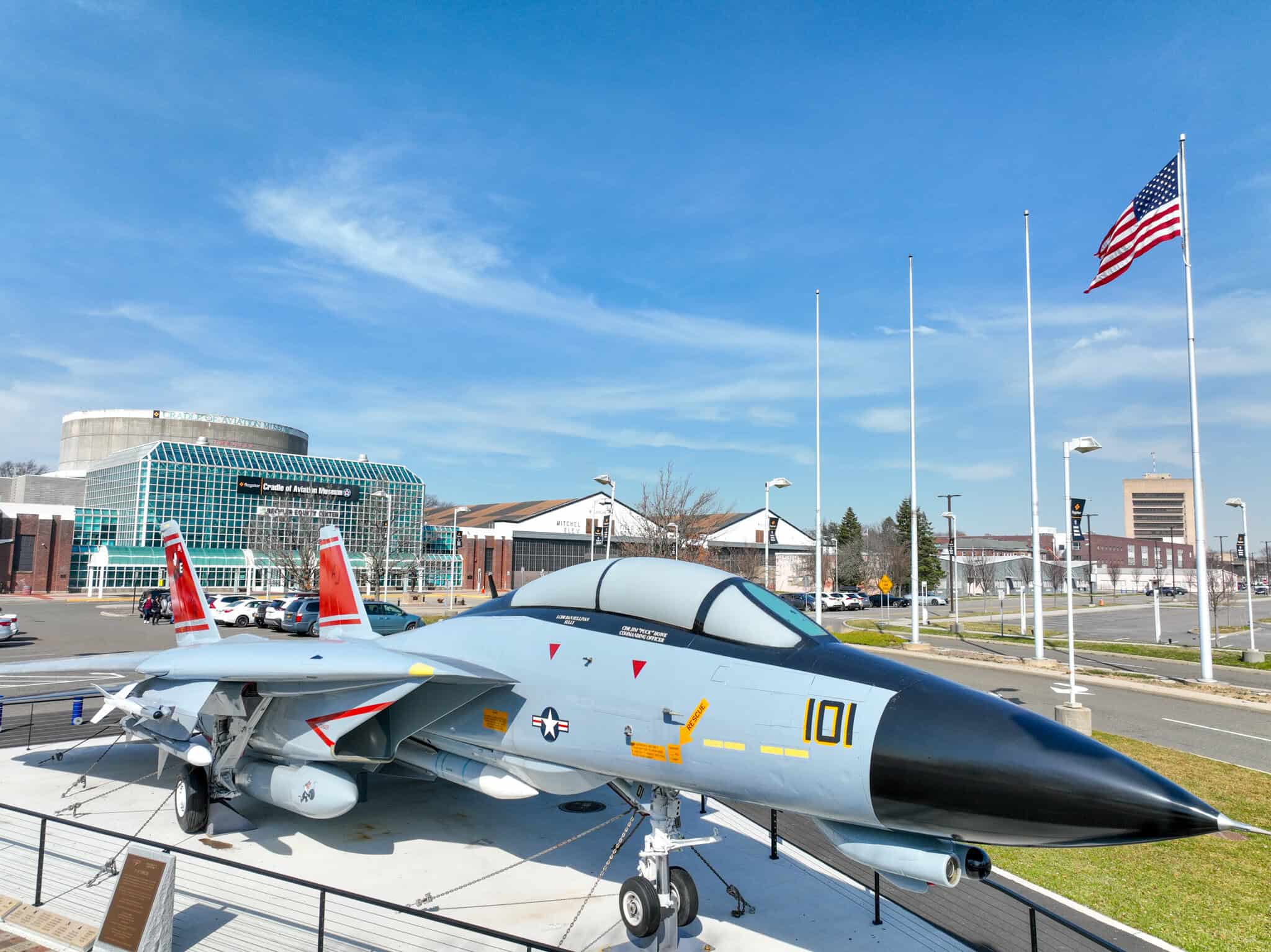
Its outdoor exhibits include three significant Grumman designs: an OV-1B Mohawk, an E-2C Hawkeye, and an F-14 Tomcat, one of its latest additions.
“F-14D Tomcat BuNo 164603 is number 711 of the 712 Tomcats built, and the last Navy Tomcat to ever fly,” according to Moreno Aguiari in his article, “Last F-14 Tomcat in US Navy Service Now on Display at The Cradle of Aviation Museum” (Vintage Aviation News, September 20, 2023). “Delivered to the Navy on May 29, 1992, it completed its 14 years of service with VF-31, the last F-14 squadron. This proud aircraft was returned ‘home’ to Long Island on October 4, 2006, to become an enduring symbol of the spirit of innovation and teamwork, and to serve as a lasting reminder of the importance of what Northrop Grumman employees do every day to provide for our men and women in uniform. Felix 101 has been parked at 600 Grumman Rd. West since 2008, when Grumman’s successor, Northrop Grumman Corp., and the Grumman Retiree Club, a former employee’s group, created a monument.”
It was relocated to the museum in 2023.
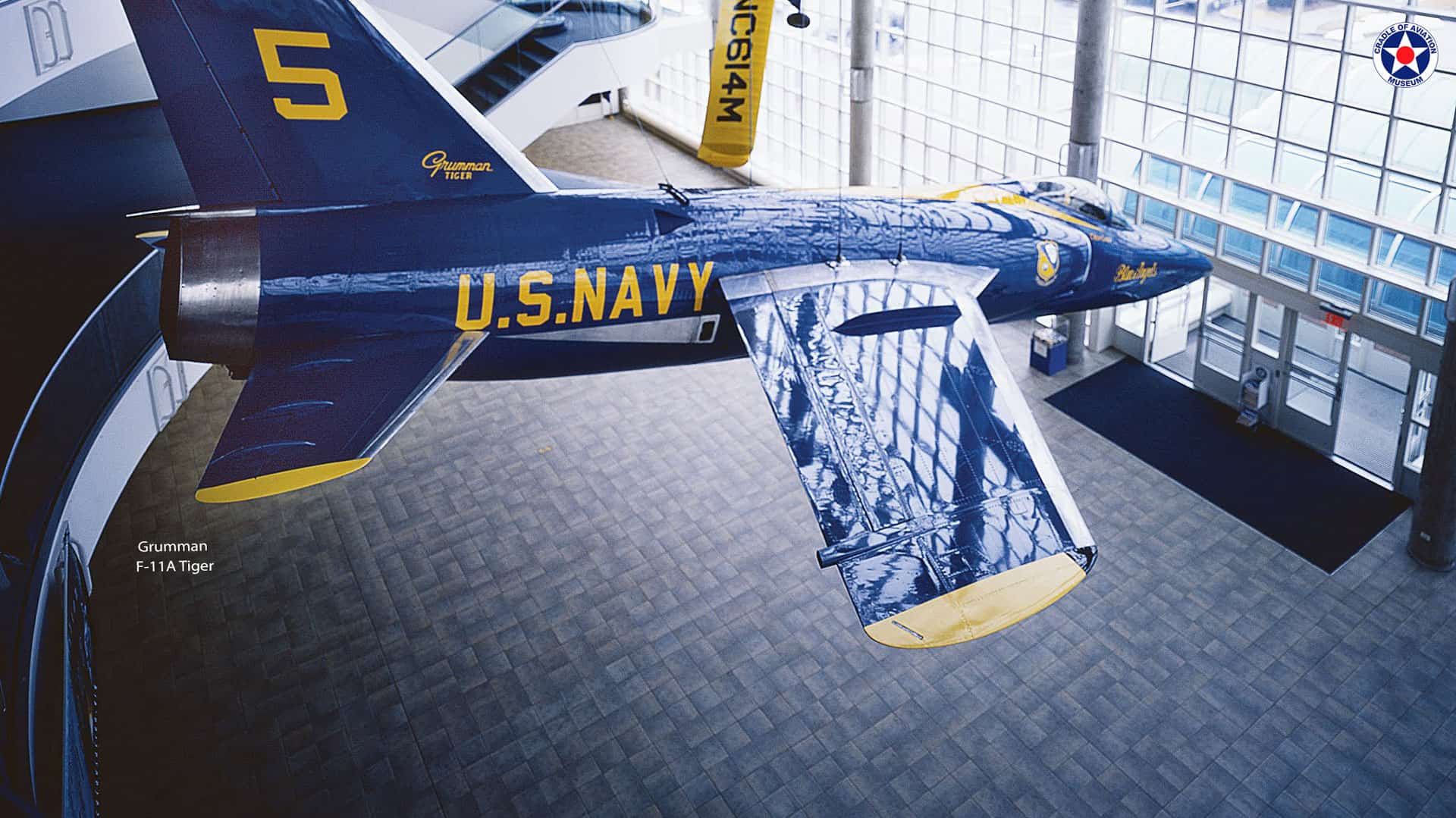
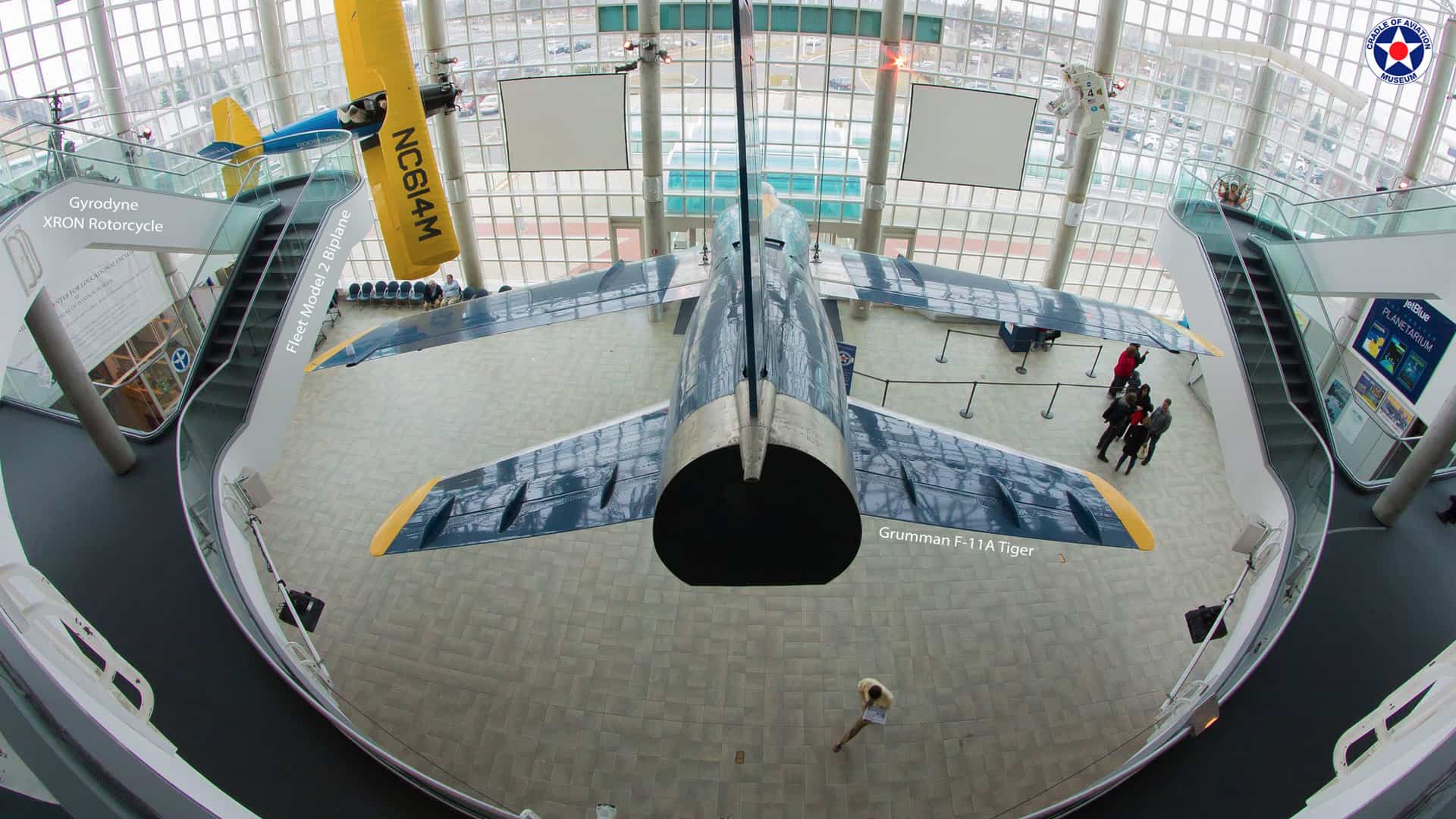
The Cradle of Aviation Museum itself, dominated by its impressive, four-story, glass atrium Reckson Center, greets visitors with a ceiling-suspended Grumman F-11A Tiger supersonic fighter in Blue Angels livery and a 1929 Fleet 2 biplane trainer, symbolically representing the soaring ascent of Long Island’s aviation heritage.
Its second-level mezzanine features a Sperry Messenger on one side and a Bellanca Monoplane on the other. The latter, a high-wing, fabric-covered design powered by a single, three-cylinder, 30-hp Anzani engine, was built by Italian emigre Giuseppe Bellanca in the back of a Brooklyn bakery, and then trucked to the Mineola Flying Field, where it served its first purpose–namely, to teach Bellanca himself how to fly.
It became one of five to encompass the school’s training fleet on the Hempstead Plains between 1912 and 1916, which introduced many budding pilots to flight, including Fiorello La Guardia, New York City’s future mayor.
During the 1920s, Bellanca built many record-setting airplanes. The Bellanca CF, for instance, which Charles Lindbergh initially eyed for his transatlantic crossing to Paris, was a high-wing, four-passenger, enclosed-cabin monoplane with the pilot positioned in an open cockpit behind.
Another floor higher, on the third-level mezzanine, airliner development is featured, including displays such as “The Boeing 314: An Extraordinary Story,” “The Boeing 377: A Luxury Story,” and “The Boeing 707: A Fast Story.”
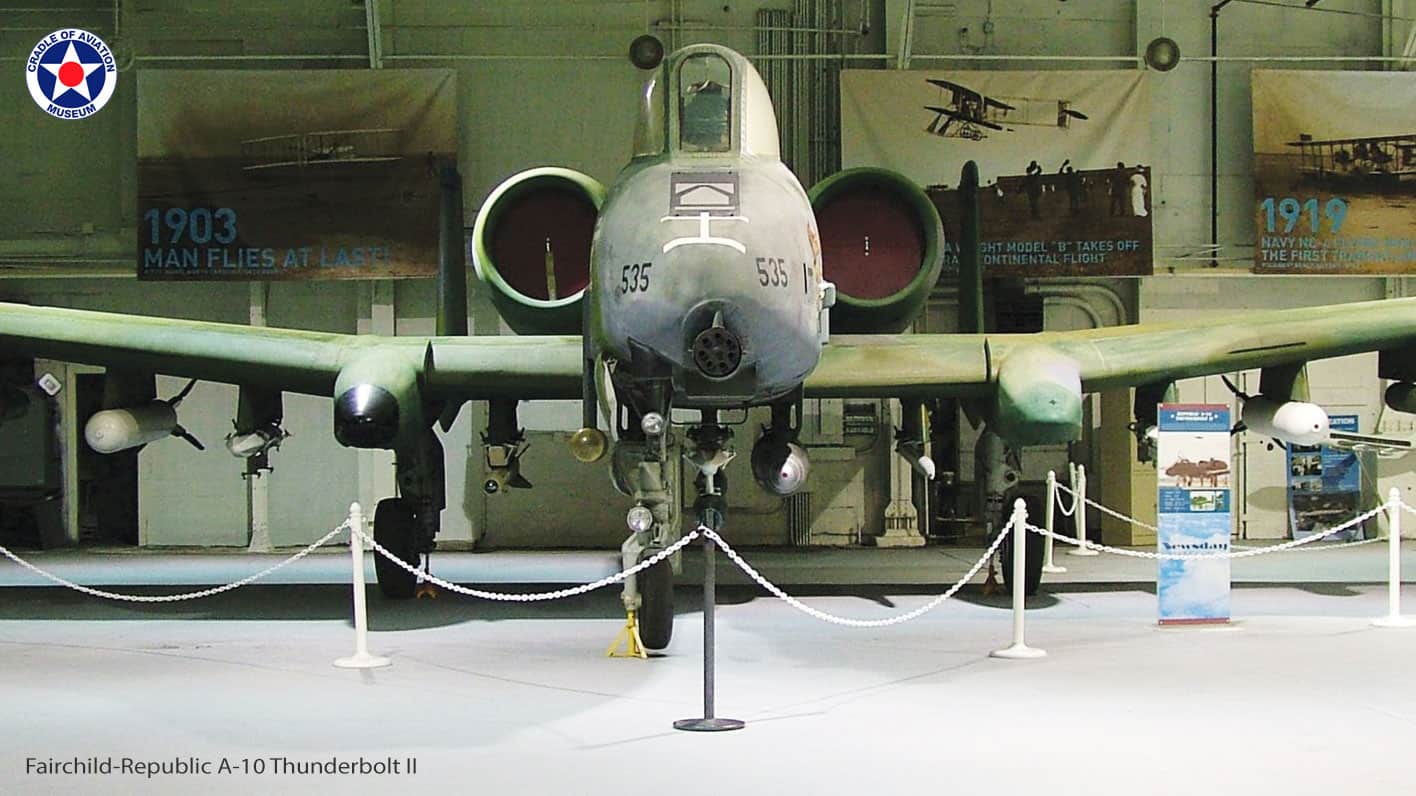
The ground floor Jet Gallery emphasizes speed with exhibits such as a Grumman A-6 Intruder, a second Grumman F-14 Tomcat, a Grumman F-14A forward fuselage section, a Northrop-Grumman E-2D Hawkeye Simulator, a Republic A-10 Thunderbolt II Ordnance Class Air Support Aircraft, a Grumman Gulfstream G-II business jet cabin, and the nose section of a Boeing 707, the US’s first commercial jetliner. Separated from El Al’s first 707 and registered 4X-ATA, it flew for 23 years as a complete airplane, establishing two records between New York and Tel Aviv—a distance of 5,760 miles and a speed of 9.33 hours—in the process.
Historical Galleries and Aviation Evolution
The museum’s main exhibits, located in eight galleries in the two restored Army Air Corps Hangars 3 and 4, which still bear the words “Mitchel Field. Elev 90 Feet” on their facades, and now designated the Donald Everett Axinn Air and Space Hall, are accessed by a second-floor skywalk.
According to the skywalk’s plaque, “Long Island has been at the forefront of America’s aviation and space adventure for the past one hundred years…It all started here on Long Island’s Hempstead Plains.”
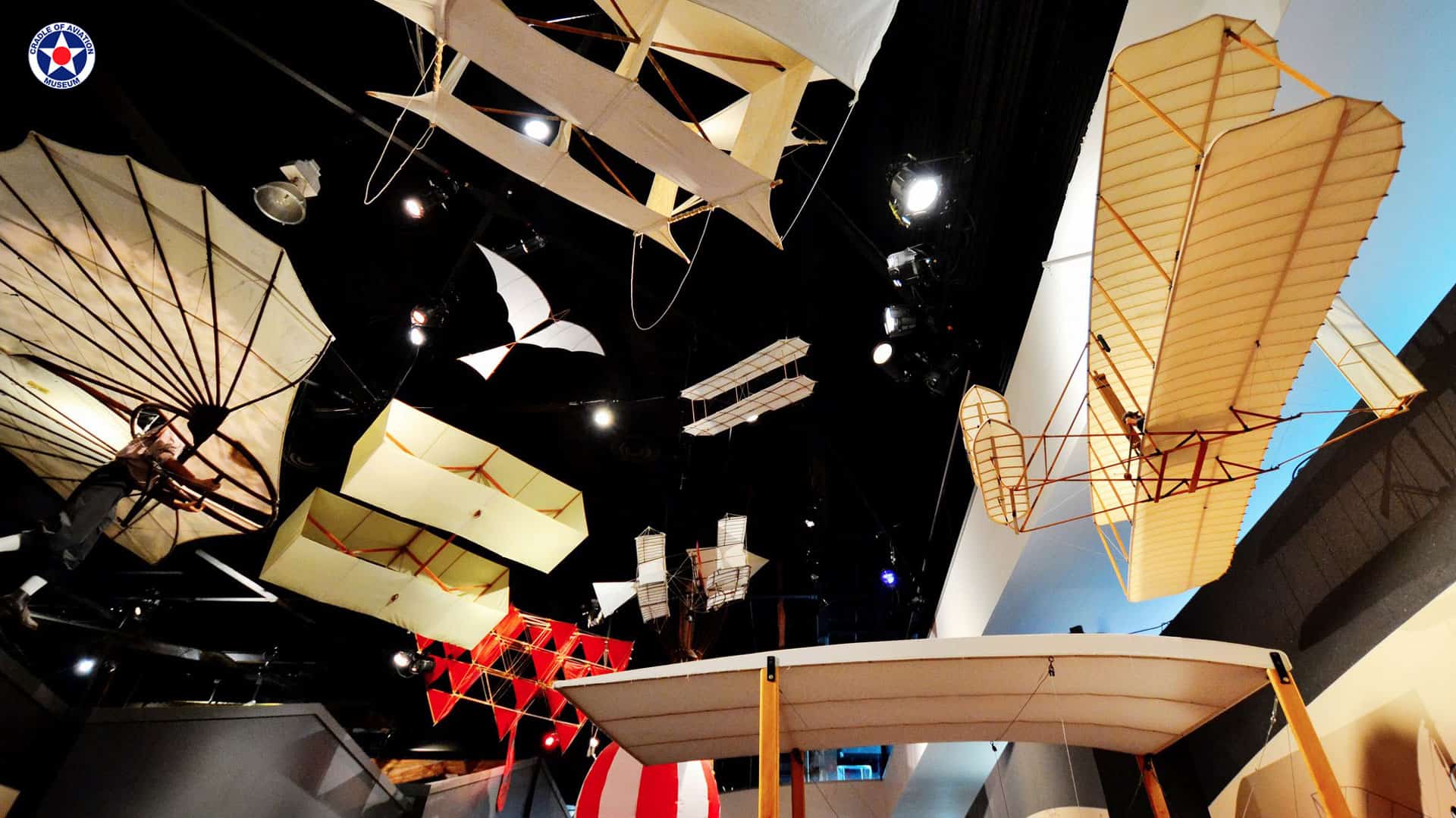
A one-flight descent leads to the first of the museum’s galleries, “Dream of Wings.” Depicting the triumph of flight with lighter-than-air craft, it demonstrates how balloon, kite, glider, and airship experimentations turned the dream of flight into reality and led to its heavier-than-air successors, displaying aerostatic lift generation, Alexander Graham Bell’s tetrahedral kite, an Otto Lilienthal glider, and a 1906 Timmons kite built in Queens, the museum’s oldest flying exhibit. A 20-hp Glenn Curtiss airship engine, designed two years later, and a Mineola Bike Shop, demonstrating, in the Wright Brothers’ vein, the technology transfer from the bicycle to the aircraft with propellers and wings, round out the exhibits.
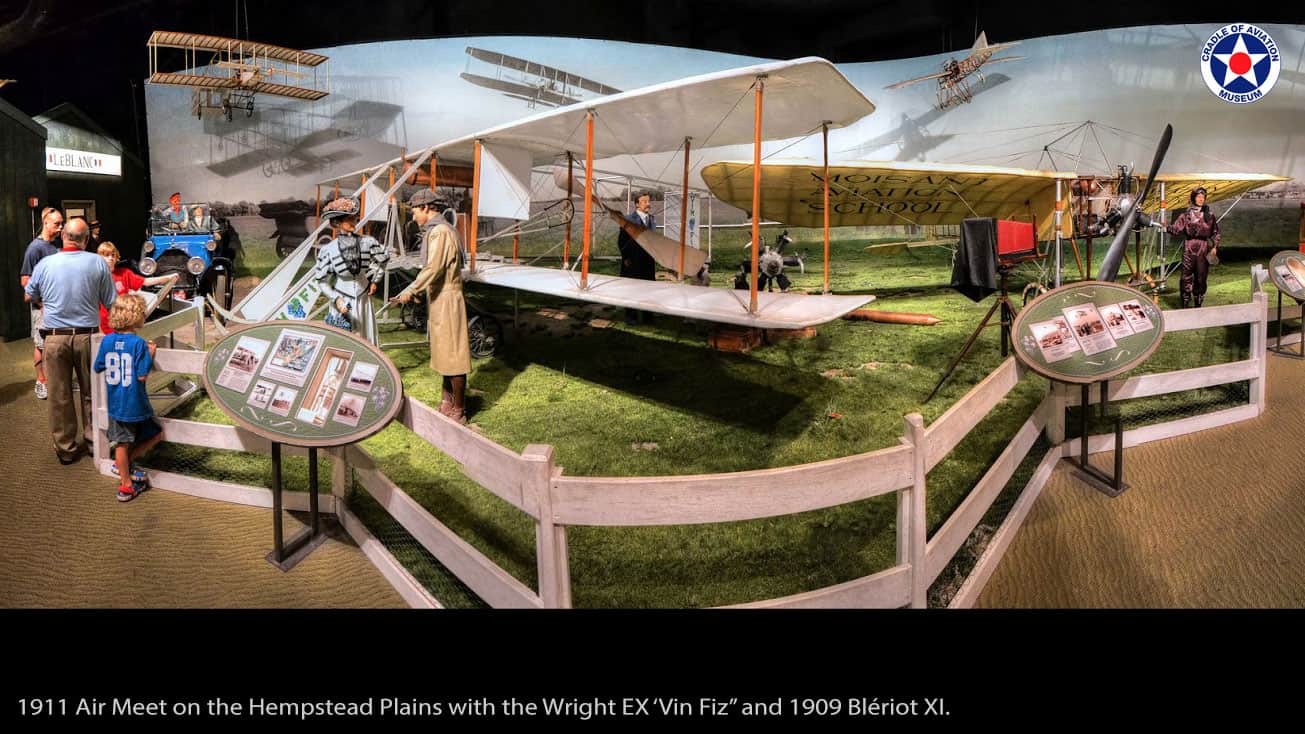
The “Hempstead Plains” gallery, the next encountered, represents a 1910 air meet. Amid recordings of turning propellers and accelerating aircraft, a collection of early designs graces the grass-carpeted field and includes a spruce-and-bamboo replica of Glenn Curtiss’s Golden Flyer, the first heavier-than-air airplane to fly over Long Island; a replica of a Wright Brothers’ Model B EX Vin Fiz; a Hanriot monoplane; a Farman biplane, a Herring-Curtiss No 1 Golden Flyer; a 1911 Anzani engine; and a 1913 Studebaker “motor car.”
An original Bleriot XI of 1909, the world’s fourth-oldest, still-operational airframe, completes the visitor’s “return to the early days.” As the first type imported to the United States and the first manufactured on Long Island, it is one of the world’s oldest, having flown over the Hempstead Plains in 1911. It was used to train pilots at Mineola’s Moisant Aviation School.
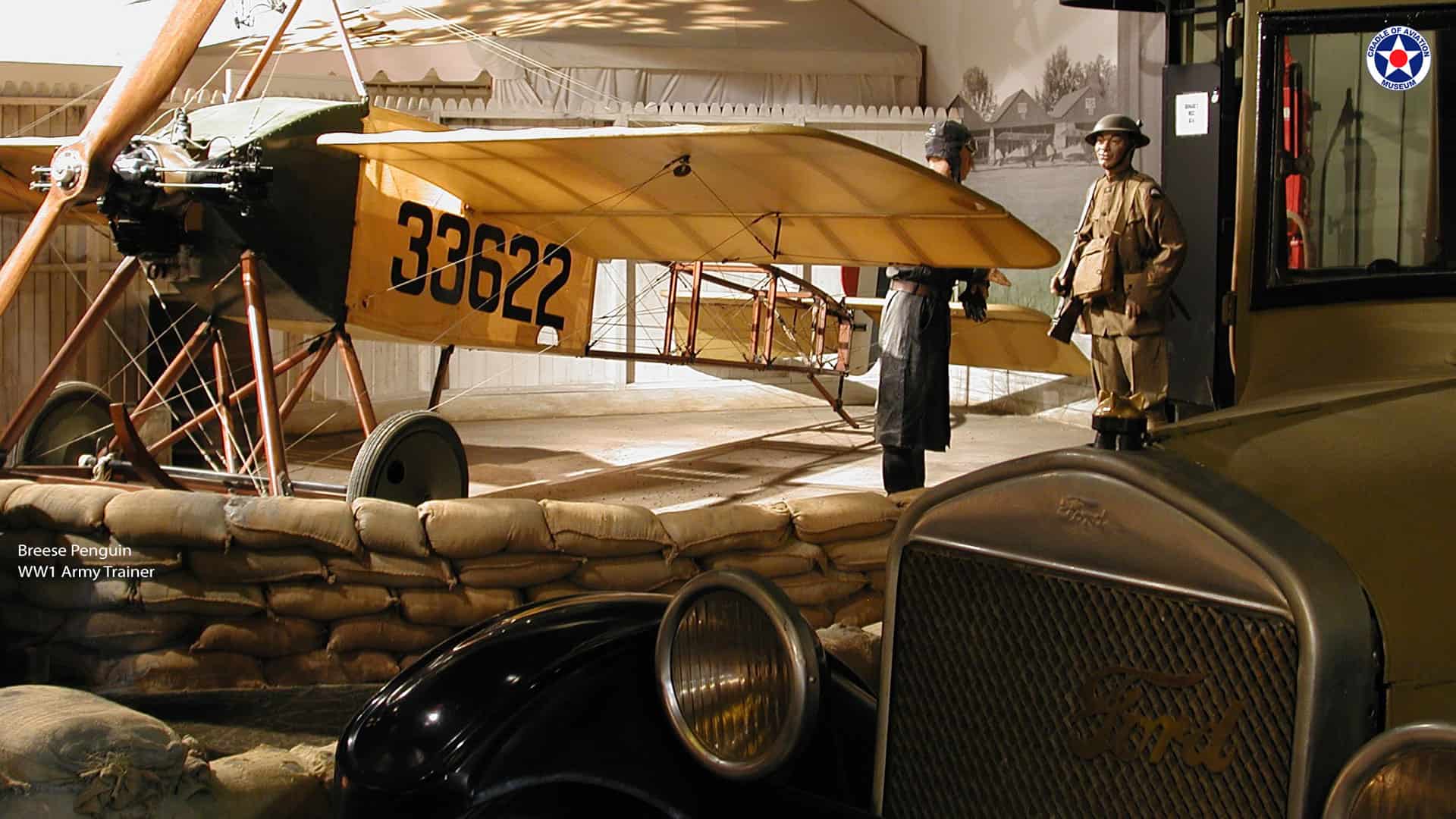
During World War I, as evidenced by the succeeding gallery, the triumph of flight was turned to destruction, as the airplane assumed the reciprocal role of a weapon, and Long Island became the center of military aircraft design, testing, and production. On display is the first airplane acquired by Charles Lindbergh, a Curtiss JN-4 Jenny purchased in 1923 for $500; along with a 1918 Breese Penguin trainer, the only one of the 250 originally produced remaining; an airworthy Thomas-Morse S4C Scout biplane with its original Marlin machine gun; and the F. Trubee Davison World War One wooden hangar. It houses the ribbed, uncovered airframe of a Curtiss Jenny with its engine, propeller, and fuel tank, and a 160-hp 1916 Gnome Monosoupape engine from France.
The Golden Age of Aviation
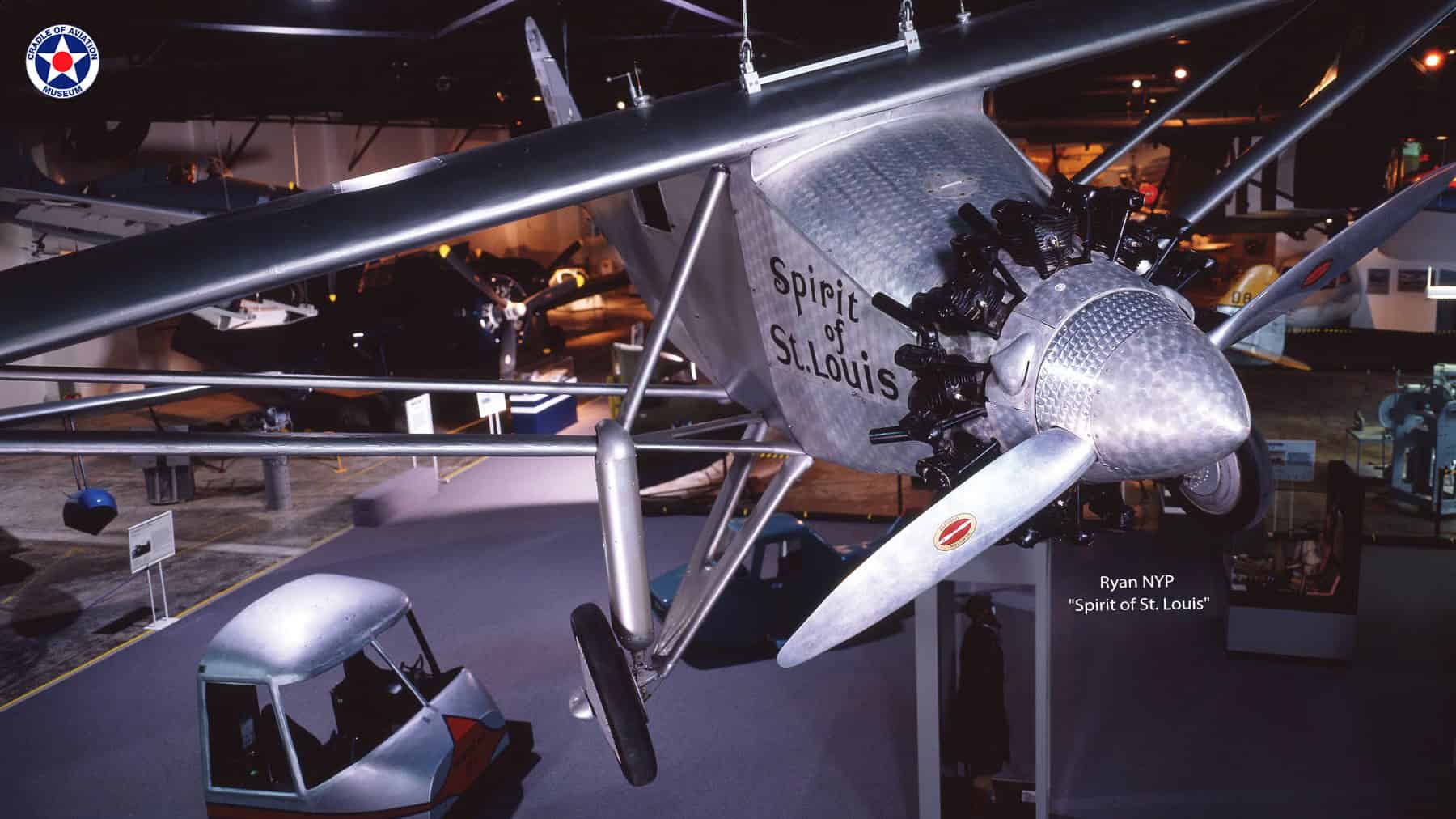
During the Golden Age of Aviation, spanning 1919 to 1938, aviation matured, evolving from a dangerous sport into a viable commercial industry. The motley collection of aircraft in this gallery includes the sister ship to the original Ryan NYP “Spirit of St. Louis” and used during the filming of the epic tale; an Aircraft Engineering Corporation “Ace,” which became America’s first sport plane; a replica of a Curtiss/Sperry Aerial Torpedo; a 1932 Grumman F3F-2 Navy Scout fighter; a Brunner Winkle Model A Byrd biplane built in Glendale, Queens; an American Aeronautical Corporation/Savoia Marchetti S-56 amphibian made in Port Washington; and a Grumman G-21 Goose in blue, Pan American Airways System livery.
The museum’s 1929 New Standard D-27, also located in this gallery and a slightly updated version of the D-25 flown at Old Rhinebeck Aerodrome, was a large, five-seat biplane for its day.
The type, built between 1928 and 1930 and powered by a 200-hp Wright Whirlwind engine, had numerous applications—from carrying four passengers in two forward cockpits to transporting mail in enclosed compartments that replaced the passenger seats, a configuration the museum’s example represents. The pilot, in either case, sat in an open cockpit behind.
The D-27 on display flew the Cleveland-Pittsburgh airmail route in 1931.
From War to the Jet Age
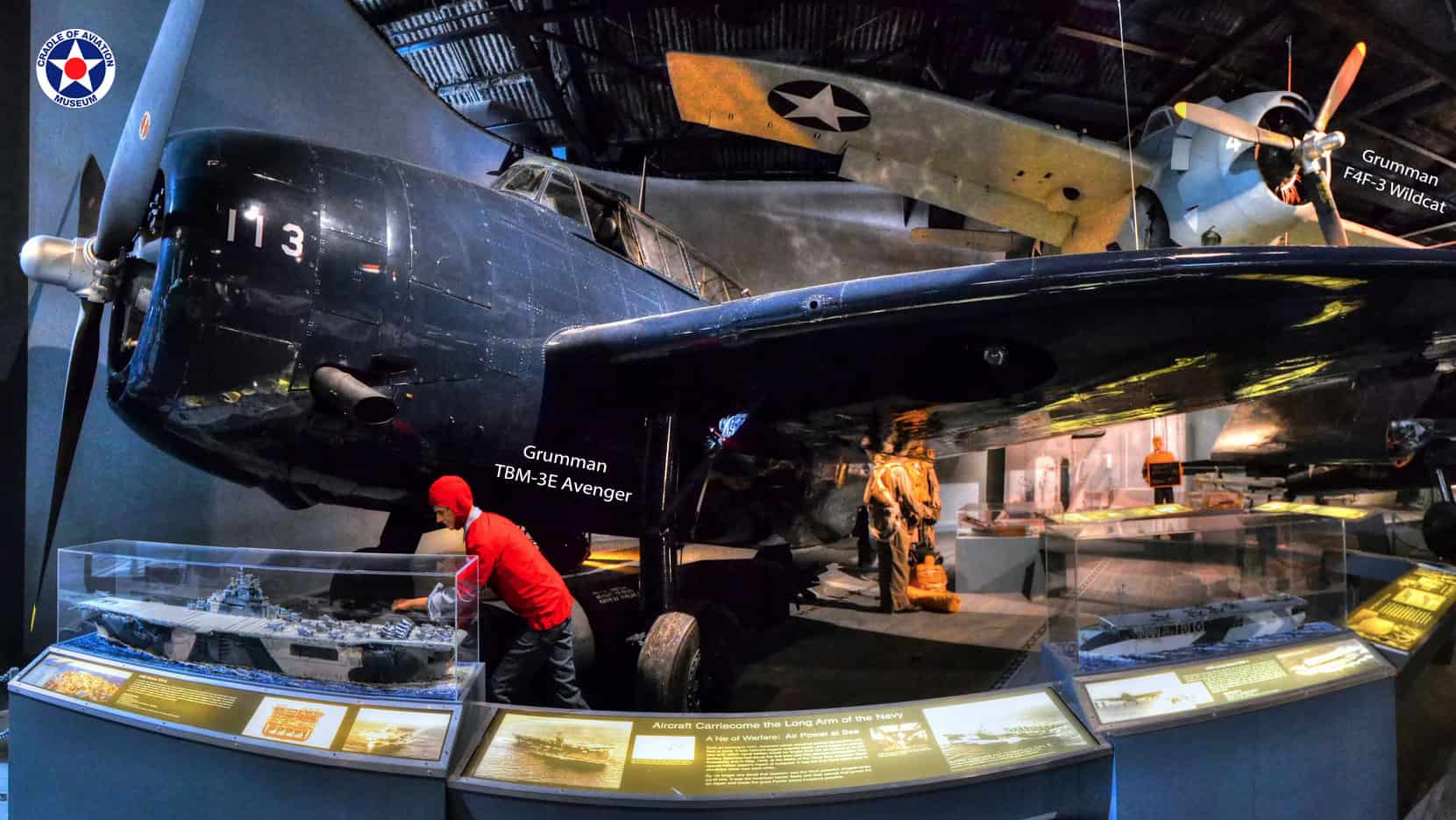
During World War II, as reflected in its gallery, the aircraft produced by Republic and Grumman were crucial to the US victory, and within the six-year period from 1939 to 1945 depicted, some 45,000 airframes rolled off the production line. On display are a Grumman F6F Hellcat, an earlier Grumman F4F-3 Wildcat, a Brewster F2A-2 Buffalo, a Douglas C-47 cockpit and nose section, and the Sperry Type A-2 lower gun turret, which had protected the undersides of B-17 and B-24 long-range bombers.
One of its most interesting representations is as a powerless CG-4 Glider. Usually towed by the Douglas DC-3 in large formations, it was used to transport soldiers, vehicles, and cargo behind enemy lines during World War II. Of the 20 firms that built the type, two were selected from Long Island: the Dade Brothers of Mineola, which constructed the wings and the tail, and General Aircraft of Queens, which built the fuselage.
After final assembly, the engineless aircraft were shipped from Roosevelt Field.
The Grumman TBM-3E Avenger, powered by a 1,700-hp Wright R-2600 engine, is also on display. Principally a carrier-borne aircraft, it was the standard Navy torpedo bomber throughout the Second World War.
Featuring a Grumman-designed gun turret, it struck decisive blows against land and naval targets with a variety of weaponry that included bombs, depth charges, and rockets over and above the torpedoes themselves.
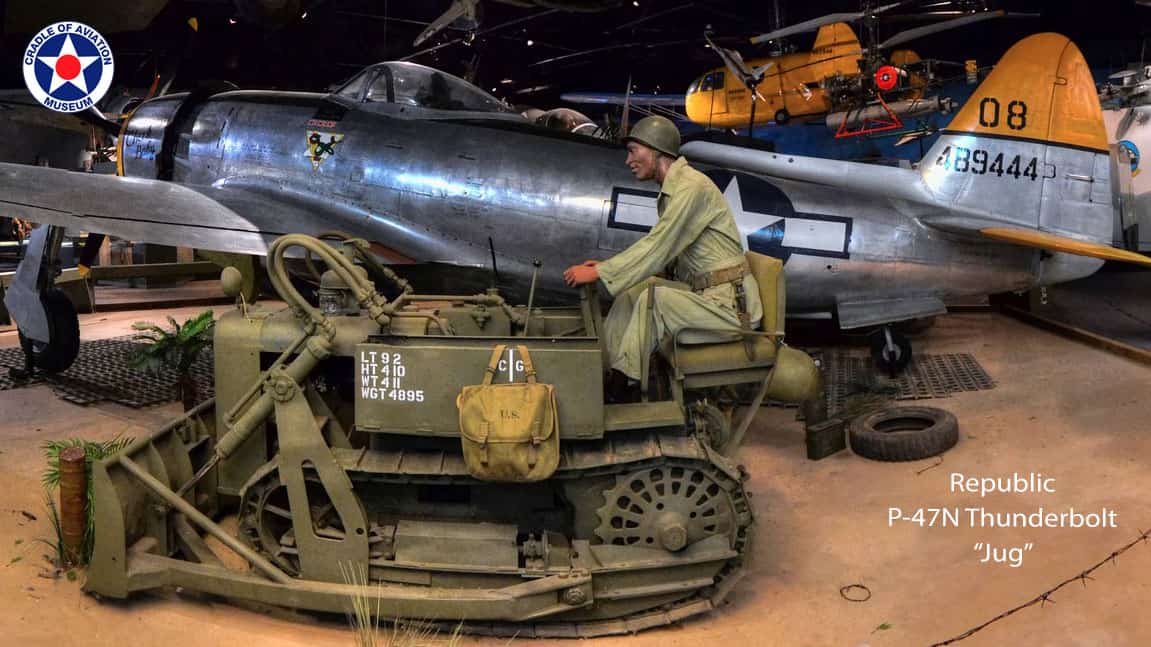
The Republic P-47N Thunderbolt, the last in the series built for long-range Pacific missions during World War II, and also available for inspection, was designed around the 2,300-hp R-2600 engine, whose turbo-supercharger improved its high-altitude performance. The 10,700-pound aircraft carried more firepower than any other of the era.
The pure-jet engine, as evidenced by the Jet Age Gallery, revolutionized military aviation by endowing aircraft with unprecedented speed, range, maneuverability, and attack capability, and Grumman Aircraft Corporation was instrumental in this development, having designed more than 40 civilian and military types which totaled some 33,000 airframes and provided employment for 200,000 Long Island residents. Its military aircraft, particularly, played crucial roles in numerous conflicts, including those in Korea, Vietnam, the Gulf War, the Balkans, Afghanistan, and Iraq.
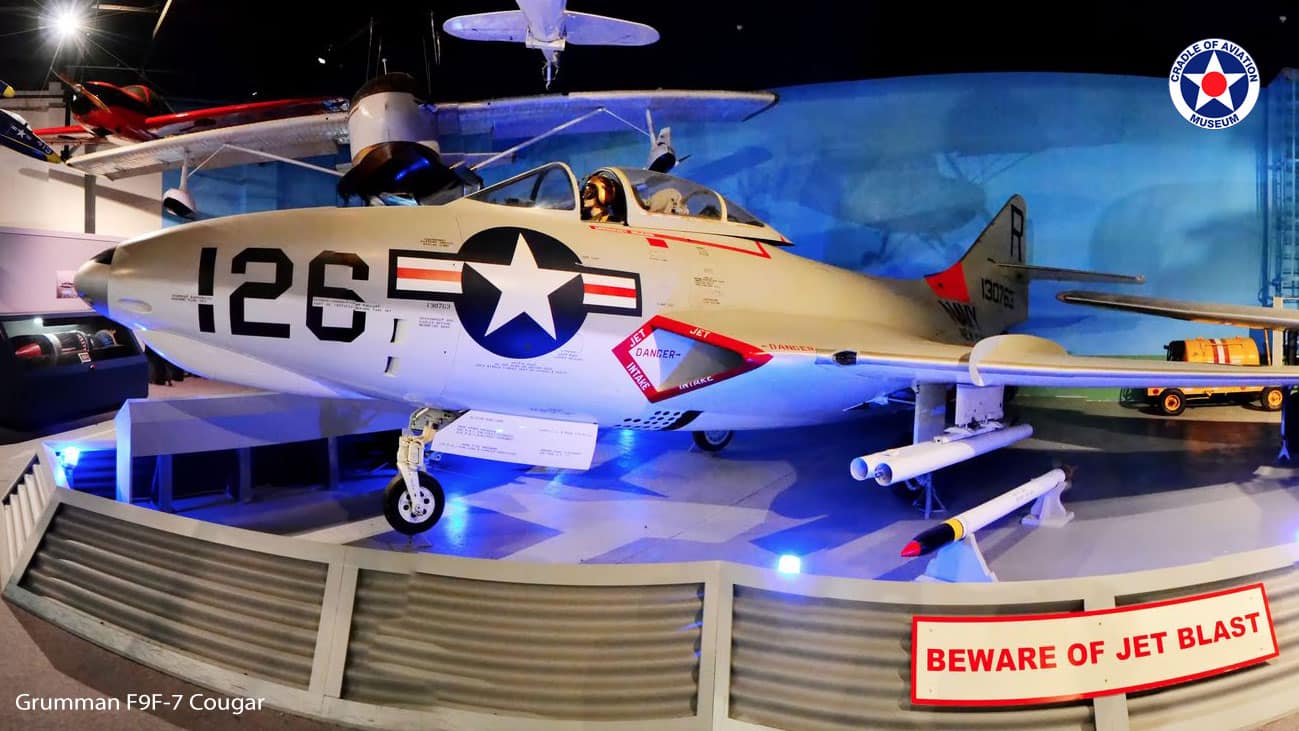
On display are several Grumman designs, including an E-2 Hawkeye airborne early warning/command-and-control aircraft, an F9F-7 Cougar, the forward fuselage of yet another F-14 Tomcat, and an A-6 Intruder cockpit simulator. Republic Aviation is represented by an F-84B Thunderjet, an F-105B supersonic fighter, and an A-10A Thunderbolt cockpit section. A Boeing 727 nose and cockpit section and a Westinghouse J-34 turbine engine round out the exhibits.
The straight-wing Republic P-84B Thunderjet, the first American fighter to fly after World War II, was designed to counter jets over Europe. Powered by a 1,400-thrust-pound Allison J-35 turbojet, it immediately set speed records when it first flew as the XP-84 prototype in 1946.
The F-84G, with 3,025 built, was the most-produced variant and was extensively employed as a fighter-bomber during the Korean conflict. The museum’s example, the eighth to roll off the production line, is one of the oldest surviving Long Island jets.
The almost 4,500 built served with the US and 12 foreign air forces.
Contemporary Aviation and Space Exploration
The “Contemporary Aviation” gallery features air traffic control radar screens which emphasize the congested JFK, La Guardia, and Newark airport triplex, along with their secondary airports of Long Island MacArthur and White Plains’ Westchester County, and Farmingdale’s Republic Airport, the state’s busiest general aviation/reliever field.
The “Exploring Space” gallery, the last of the eight, depicts the dramatic transition from atmospheric flight to vacuum-less space and emphasizes Long Island’s rich contribution to this aerospace sector. Its exhibits include a Goddard A-series rocket; a Grumman orbiting astronomical observatory; a Grumman echo adapter; a life-size model of the Sputnik satellite which was presented by the Soviet Union and whose original hardware launched the Space Race; a Grumman Rigel ramjet missile from 1953; a Grumman Lunar Module simulator; and a Rockwell Command Module which was used during a 25,000-mph earth reentry test in 1966 prior to the manned Apollo flights.
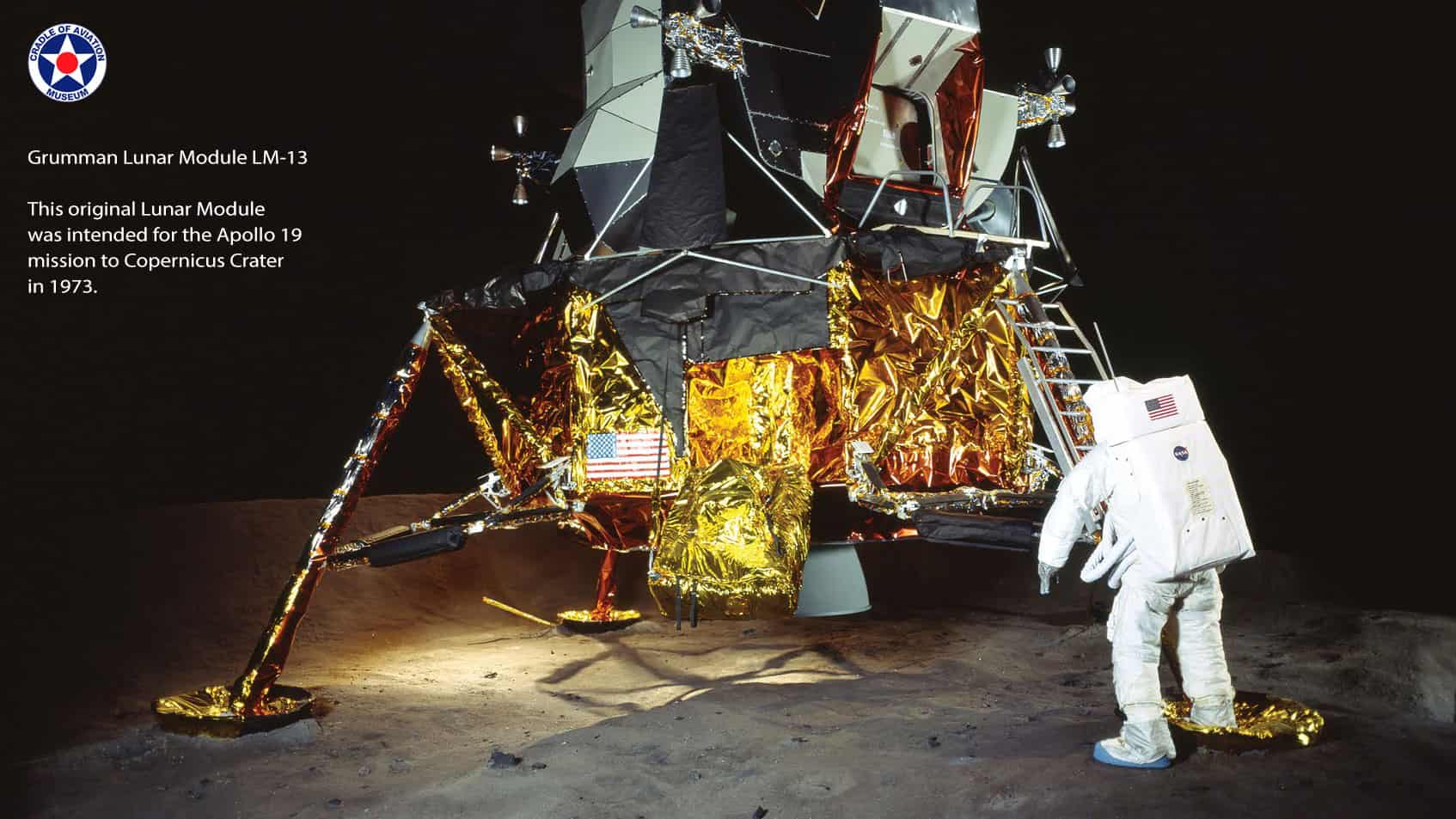
A “Clean Room,” representing the environment in which all Lunar Modules were hand-made, leads to the gallery’s—and the museum’s—most precious exhibit, an actual, 22.9-foot-high, gold foil-covered LM-13, the thirteenth and last Lunar Module built, dramatically lit with its legs nestled on a simulated moonscape. Designated an historic mechanical landmark, the Lunar Module was the first—and, to date, only—spacecraft to have ever transported human beings from Earth to another planet or its moons.
Numerous films bring the depicted eras to life and include, just to name a few, “Modern Aero-Planes of Today,” “Flying the Airmail to Mineola,” “Daring Aviators and their Machines,” “Louis Bleriot Flies the English Channel,” “A Thrilling Day at the Air Meet,” “American Aviation in the Great War,” “The Golden Age of Flight,” “Mitchel Field, New York,” “Lindbergh: The Epic American Trans-Atlantic Flight,” “The Flying Boats: The Pan American Clippers,” “Grumman Aircraft in Action,” “Airliner Operations,” “The Republic A-10 Thunderbolt II,” and “From Long Island to the Moon.”
An IMAX theater with planetarium shows, the Red Planet Café, and an extensive gift shop round out the experience in The Cradle of Aviation Museum, a world-class facility that preserves, showcases, and interprets Long Island’s rich aerospace heritage.
IF YOU GO:
LOCATION: Cradle of Aviation Museum | Charles Lindbergh Blvd. | Garden City, NY 11530
HOURS: 10:00 am to 5:00 pm (Closed on Mondays)
TICKETS:
Museum & Planetarium Combo:
$25.00 Adults
$23.00 Child (2-12), Seniors (62+)
Museum Admission:
$18.00 Adults
$16.00 Child (2-12), Seniors (62+)
Planetarium:
$12.00 Adults
$11.00 Child (2-12), Seniors (62+)
CONTACT: 516.572.4111
WEBSITE: cradleofaviation.org