

A new aviation safety report from Embry-Riddle shows why fear of flying often outpaces the data, especially in the age of social media.
If recent aviation headlines have made you more anxious about flying, you are not alone.
In this day and age, aviation incidents do not stay local for long. A mechanical issue, an engine failure, a rejected takeoff, a runway go-around, or a close call can be clipped, posted, reshared, and stripped of context before the aircraft has even taxied back to the gate. Social media has made the average traveler more aware of every little aviation mishap than ever before.
Being more aware can help, but it can also make normal flying procedures seem scary, especially for people who don’t know much about the rules and science behind commercial aviation.
For example, a go-around is a safe and routine maneuver. Pilots practice it, air traffic controllers expect it, and airlines plan for it. But if someone sees a shaky phone video with dramatic captions and music, it can look like a near-disaster. And once that video is on social media, the details often get lost.
That is the problem with aviation in the algorithm age. Drama creates clicks. Fear spreads faster than context. And because aviation accidents and incidents are so visible, it can create the impression that flying is suddenly getting more dangerous.
A new report from Embry-Riddle Aeronautical University’s Boeing Center for Aviation and Aerospace Safety offers a much-needed reality check.
The report, titled Comparative Risk Metrics for U.S. Commercial Aviation, looks at U.S. commercial airline safety under Part 121 operations and compares it with other forms of transportation, recreational activities, household risks, and common occupations. The main takeaway is clear: by any measure, U.S. commercial aviation is still one of the safest activities in modern life.
“Across all metrics considered, airline travel consistently emerges as the safest mode of transportation,” said Robert L. Sumwalt, executive director of the Boeing Center for Aviation and Aerospace Safety and former chairman of the National Transportation Safety Board.
Looking at Risk More Than One Way
One of the most important ideas in the report is that risk can’t be summed up by just one number.
Someone who is nervous about flying probably doesn’t think about passenger miles. Instead, they might wonder, “What are the chances something will happen on my flight?” Regulators or safety experts might look at risk per hour, per mile, per trip, or over a lifetime. All of these are valid, but each needs a different way to measure risk.
That’s why the Embry-Riddle report uses several risk metrics, including risk per passenger mile, risk per trip or event, risk per hour of exposure, annual risk, and lifetime odds of death.
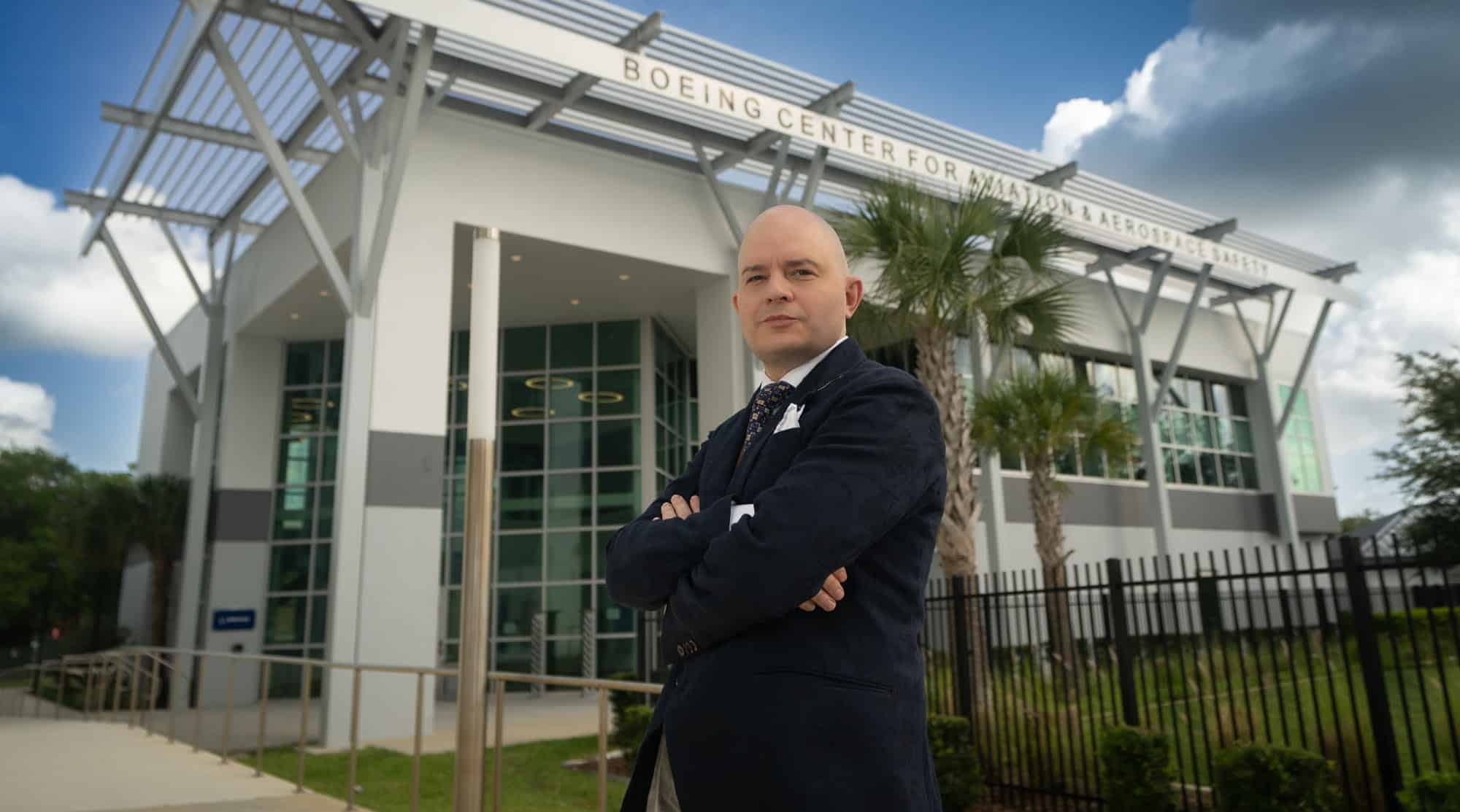
Dr. Mihhail Berezovski, an associate professor and director of Undergraduate Research at Embry-Riddle, led the report. He said the goal was to help people understand aviation safety in a clearer and more logical way.
“We want to give people correct, thorough, and broad information so that they can assess risk rationally,” Berezovski said. “By looking at multiple complementary measures, we can conclude that aviation’s safety performance is not an outcome of one assessment methodology. Rather, it is a consistent result across distance, time, and event-based perspectives.”
Aviation’s safety performance is not an outcome of one assessment methodology. Rather, it is a consistent result across distance, time, and event-based perspectives.
Comparative Risk Metrics for U.S. Commercial Aviation
This is important because aviation accidents are incredibly rare…but they get a lot of attention. The report points out that people’s views are often shaped by the emotional impact of big events, not by the actual risk. In other words, flying can feel dangerous because the rare accidents are so memorable.
But the data shows something different.
Commercial Aviation Stands Apart
Using multi-year data, the report found that U.S. commercial aviation produced roughly one fatality per 90.9 billion passenger miles over the analysis period. That places it well ahead of other transportation modes in terms of distance traveled.
That is an enormous number, and it helps explain why aviation remains such a powerful outlier in transportation safety. For comparison, traveling by highway bus has about 9 times the fatality risk per passenger-mile. Cars, SUVs, pickup trucks, minivans, and vans have more than 600 times the risk of flying the same distance. Motorcycle travel is even riskier, with a risk over 22,000 times higher per passenger mile.
This doesn’t mean airline travel has no risk. No form of transportation can promise that. But it does show how advanced, regulated, and data-driven the U.S. airline system is today.
The report also looks at the risk of a single airline boarding, which may be the more intuitive way many passengers think about flying. On that basis, commercial aviation again performs exceptionally well. The report estimates one fatality per more than 97 million airline boardings.
When you compare flying to other single-event activities, the difference is clear. A day of skiing or snowboarding is about 73 times riskier than boarding a commercial flight. Scuba diving is about 180 times riskier, running a marathon is about 200 times riskier, and skydiving is more than 400 times riskier.
If you’ve ever worried about your flight while driving to the airport, these numbers are a good reminder: the flight is usually the safest part of your trip, even though it often feels the scariest.
Everyday Risks Are Often Much Higher
The report also compares aviation risk to everyday dangers, even those that don’t usually cause as much public worry.
Each year, the chance of dying in a U.S. commercial aviation accident is described as “vanishingly small.” The report compares this risk to things like falls, car accidents, drowning, heat, household injuries, and more.
For example, the yearly risk of dying in a car accident is over 5,800 times higher than in a U.S. commercial aviation accident. The risk from falls is more than 5,600 times higher, and preventable deaths at home are over 14,000 times higher.
Even risks that seem freakishly rare, like being struck by lightning or bitten by a dog, are higher each year than dying in a commercial aviation accident.
This isn’t meant to make light of aviation accidents. Every accident is serious, and every loss matters. But the report shows that the emotional impact of a tragedy can make us misjudge the actual risk.
“This report helps people place aviation risk in the broader context of everyday activities and occupations,” Berezovski said. “It’s natural to feel fearful or worried after an accident, but decisions, both personal and policy-related, should be based on reliable data, not just fear based on a single event.”
Rare Events Need Careful Measurement
One reason aviation safety can be so difficult to discuss publicly is that fatal commercial airline accidents are now extremely rare in the United States.
That is good news, obviously. But statistically, it also creates a challenge. In many years, there may be no fatalities at all. In another year, a single accident can distort the way people perceive the trend. A zero-fatality year does not mean the underlying risk is literally zero. And a year with a rare fatal accident does not necessarily mean the entire system is suddenly unsafe.
To deal with that, the Embry-Riddle report uses multi-year aggregated data. That approach helps mitigate the instability inherent in rare events and creates a clearer picture of long-term safety performance.
That is especially important in the current media environment. A single frightening video can make it feel like a pattern exists, even when the underlying data says otherwise. The full report is a reminder that aviation safety should be judged by disciplined analysis, not by whichever clip happens to be circulating online that day.
That does not make viral videos meaningless. Sometimes they capture serious events. Sometimes they raise valid questions. Sometimes they lead people to pay closer attention. But they are not a substitute for data.
Safe Does Not Mean Finished
One of the most important things about the report is its careful approach.
This report isn’t meant to celebrate or suggest that the work is finished. In fact, the experts behind it say the opposite.
Sumwalt pointed out that today’s aviation safety comes from decades of worldwide standards, careful oversight, better technology, training, rules, and lessons learned from past accidents. These improvements took time and often came from difficult experiences.
And these improvements need to be protected.
ALSO ON AVGEEKERY:
5 Helpful Tips for Fliers to Fly More Confidently
“Low risk does not mean no risk,” Sumwalt said. “The aviation community must continue to learn from every accident, incident, and near miss. This analysis gives us a clearer baseline from which to measure progress.”
That’s the right way to look at a report like this. The data should reassure passengers, but it shouldn’t make the industry complacent. Aviation’s strong safety record exists because people kept asking tough questions, investigating problems, improving systems, and never settling for “safe enough.”
Embry-Riddle President P. Barry Butler said the university’s role is to help advance that conversation in the public sphere.
“For over a century, Embry-Riddle has acted as a leader in aviation and aerospace safety,” Butler said. “By integrating academic analysis and industry partnerships with public outreach, we’re committed to advancing the national conversation on risk and to providing the data and tools that regulators, airlines, and the traveling public need to keep improving safety.”
For travelers, the main point is simple but important. Fear of flying is understandable. Aviation accidents are rare, but they have a big impact when they happen. And in the age of social media, even routine or safely handled events can be made to look dramatic.
But the actual numbers tell a much calmer story.
Measured by mile, by trip, by hour, by year, and across a lifetime, U.S. commercial aviation remains extraordinarily safe. It is not risk-free. Nothing is.
But compared to the risks people face every day, flying is about as safe as any way humans have ever traveled.
And that’s a fact.