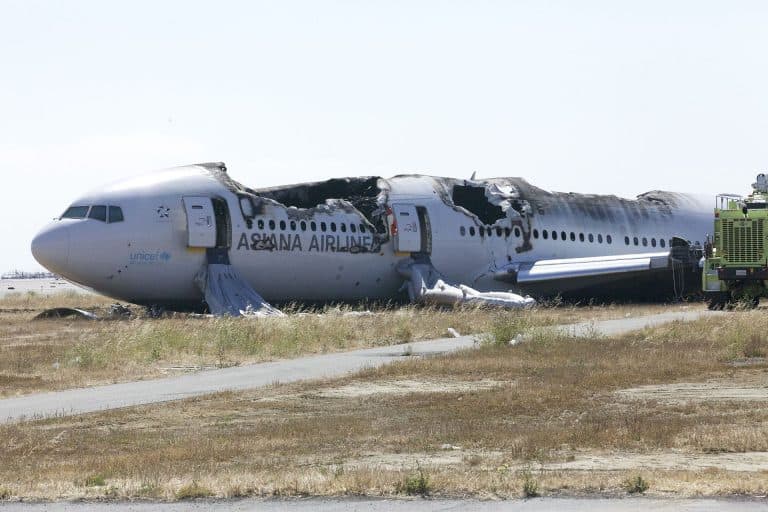
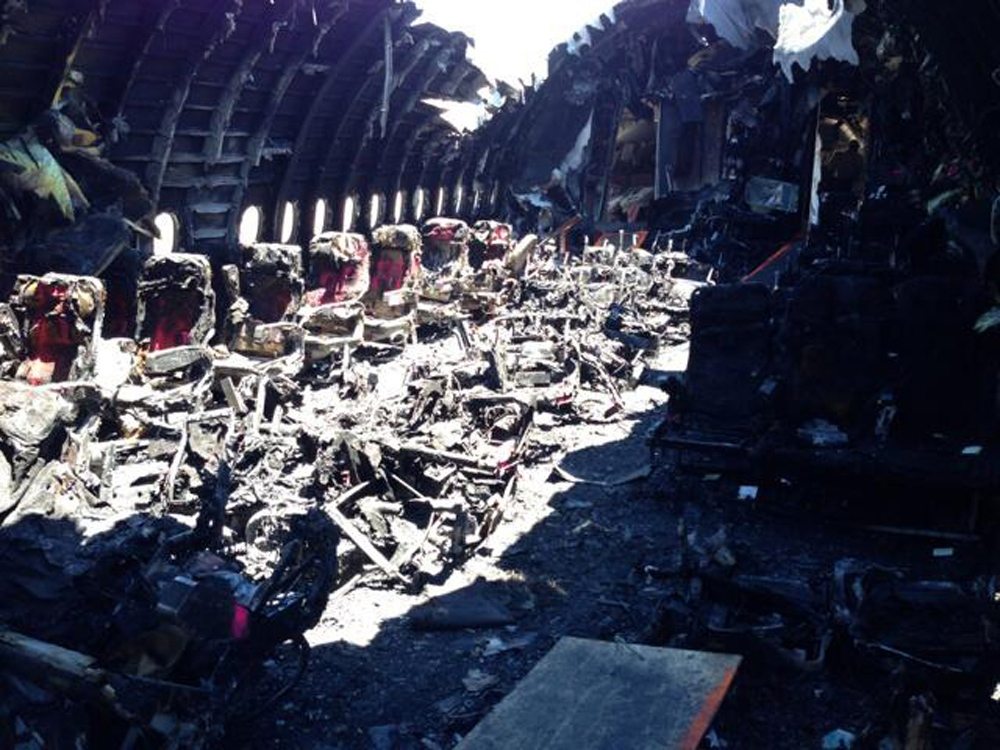
The crash of Asiana Flight 214, a Boeing 777-28EER (HL7742) at San Francisco International Airport (SFO) took place on July 6th 2013. The flight originated at Incheon International Airport near Seoul, South Korea. On final approach to runway 28L the aircraft made contact with the water short of the runway. After that the aircraft made contact with the seawall at the end of the runway and shed its tail and landing gear. One engine and the landing gear were distributed along the path the plane took toward its final resting place. In the video the fuselage can be seen to spin 330 degrees counter-clockwise before coming to rest pointing toward the northwest. The footage was shared by the YouTube account What You Haven’t Seen.
When the crash took place the flight crew was criticized for their slow reaction time in getting the passengers out of the jet. Survivors can be seen exiting from the ruptured fuselage near the tail before the escape slides are deployed on the port side of the fuselage. Once the slides are deployed passengers use them to exit the fuselage. A fire had broken out on the starboard side near the right engine, which prevented the use of the starboard side slides. Response from the emergency vehicles at SFO seems to take forever but the first responders reach the wreck about 2:25 after the crash first takes place. The fires seem to be out but roughly 15 minutes after the crash the airliner begins to burn fiercely.
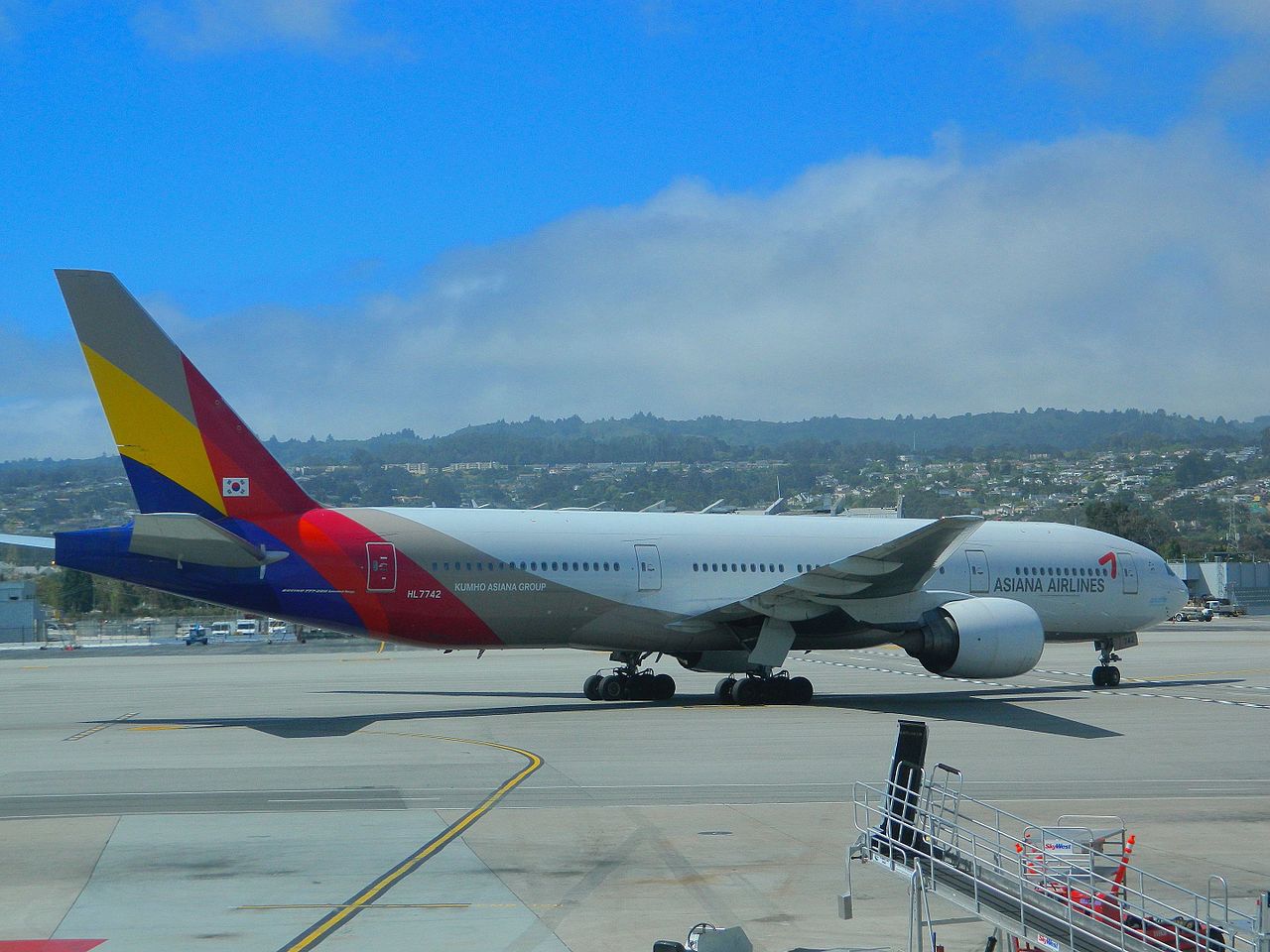
Boeing 777-28EER reg HL7742 photographed at SFO. Photo Credit: Lshlarson
Miraculously there were only three deaths from this crash. Two passengers died at the crash scene, and a third died in the hospital several days later. An additional 49 people were seriously injured out of 187 injured. One group of three flight attendants who were strapped in their takeoff and landing seats in the rear fuselage were injured when they were thrown onto runway 28L, still strapped in their seats, when the tail section broke off of the airliner near the end of the runway. This was the first crash involving fatalities of a Boeing 777 aircraft since entering service in 1995.
The burned-out fuselage of HL7742 after the mishap at SFO. Photo Credit: Reuters.
SFO was closed for five hours after the crash. Flights destined for San Francisco were diverted to Oakland, San Jose, Sacramento, Los Angeles, Portland, and Seattle–Tacoma. Runways 1L/19R and 1R/19L (perpendicular runways to the axis of the crash) were reopened at 1530 PDT. The runway next to 28L, Runway 10L/28R, remained closed for more than 24 hours so it could be cleared of debris from the crash. Runway 28L was reopened a week later after repairs were completed. Asiana ended up changing the route’s flight number to 212 after the incident. Asiana still flies the route today.
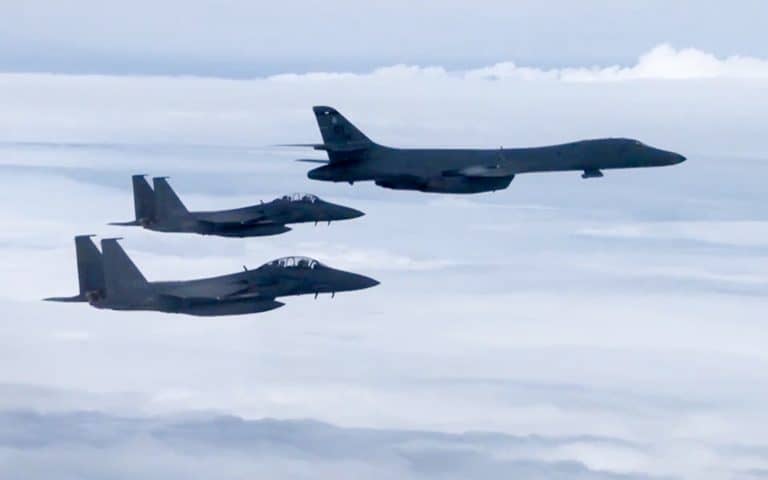
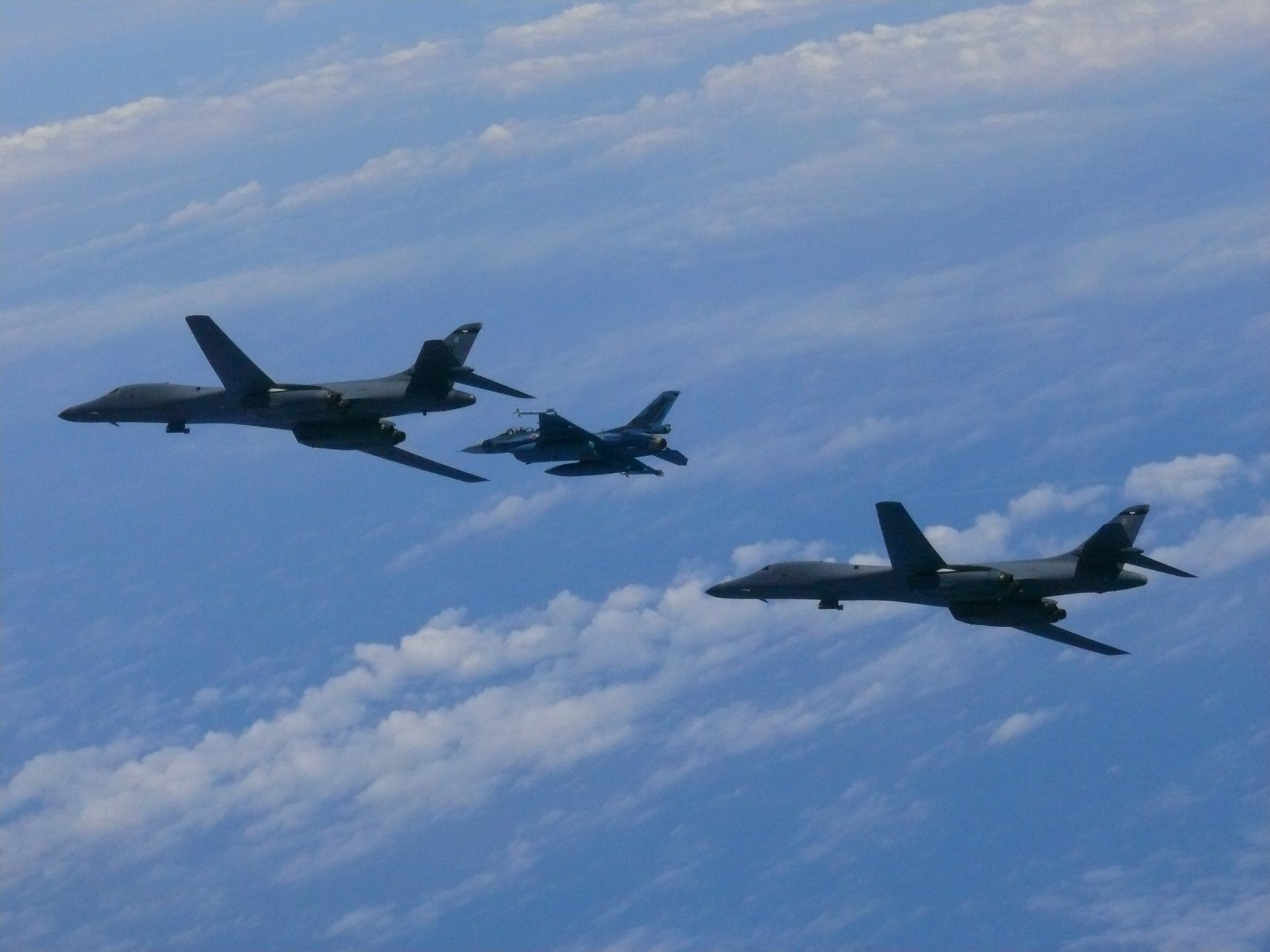
A pair of U.S. Air Force B-1 Lancer bombers participated in a bilateral mission with South Korean F-15 and Japanese F-2 fighter jets on July 7, near the Korean Demilitarized Zone, in response to “increasingly escalatory actions” by North Korea, most recently on July 3 when they launched an an intercontinental ballistic missile (ICBM) test.
In a statement, the USAF says the mission was, “part of the continuing demonstration of the ironclad U.S. commitment to our allies against the growing threat from North Korea’s ballistic missile and nuclear programs.”
The bombers are assigned to the 9th Expeditionary Bomb Squadron, deployed from Dyess Air Force Base, Texas, and took off from Andersen Air Force Base, Guam, for the 10 hour mission to practice attack capabilities and drop inert weapons in a precision strike training exercise at the Pilsung Range.
“North Korea’s actions are a threat to our allies, partners and homeland,” Gen. Terrence O’ Shaughnessy, the Pacific Air Forces commander, said.
Two U.S. Air Force B-1B Lancers assigned to the 9th Expeditionary Bomb Squadron, deployed from Dyess Air Force Base, Texas, fly with a Koku Jieitai (Japan Air Self-Defense Force) F-2 fighter jet over the East China Sea, July 7. Photo: Japan Air Self-Defense Force
“Let me be clear, if called upon we are trained, equipped and ready to unleash the full lethal capability of our allied air forces.”
It’s the second show of force from the U.S. against North Korea in the last few days. The night following the launch July 4, U.S. and South Korean airmen joined for a missile test exercise off the Korean Peninsula.
.
– Follow Mike Killian on Instagram and Facebook, @MikeKillianPhotography
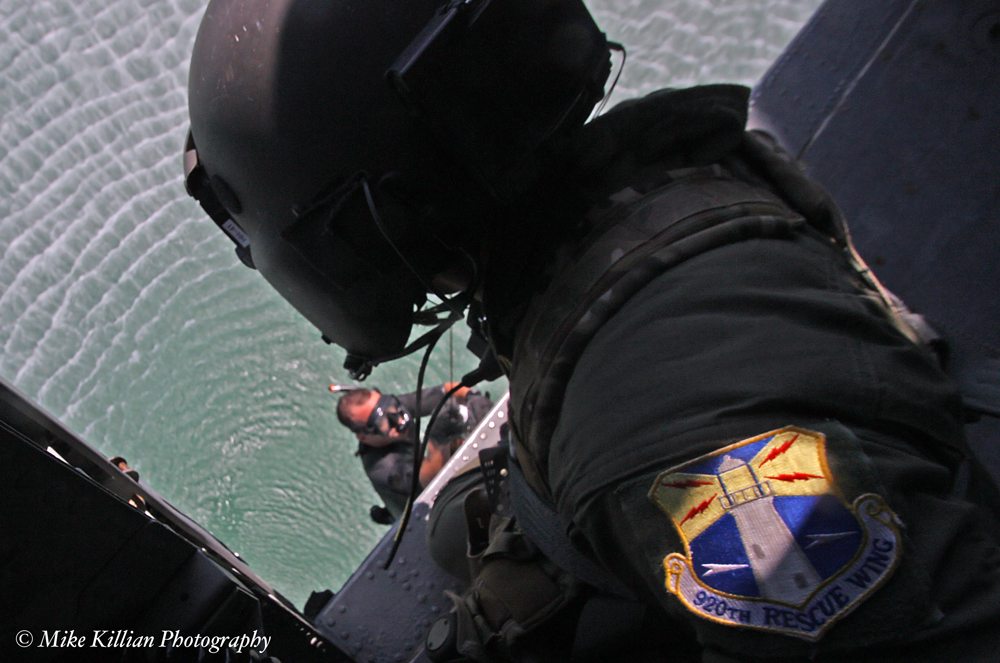
Combat search-and-rescue airmen with the U.S. Air Force Reserve 920th Rescue Wing live by the motto, “These Things We Do, That Others May Live“, and that proved true yet again in the last 24 hours, some 500 miles off the east coast of southern Florida.
On July 7, at the request of the U.S. Coast Guard’s Seventh District in Miami, the 920th was alerted by the Air Force Rescue Coordination Center (located at Tyndall AFB) to assist in a long-range large-scale search and rescue of two German men (father and son) at sea, after their vessel reportedly caught fire.
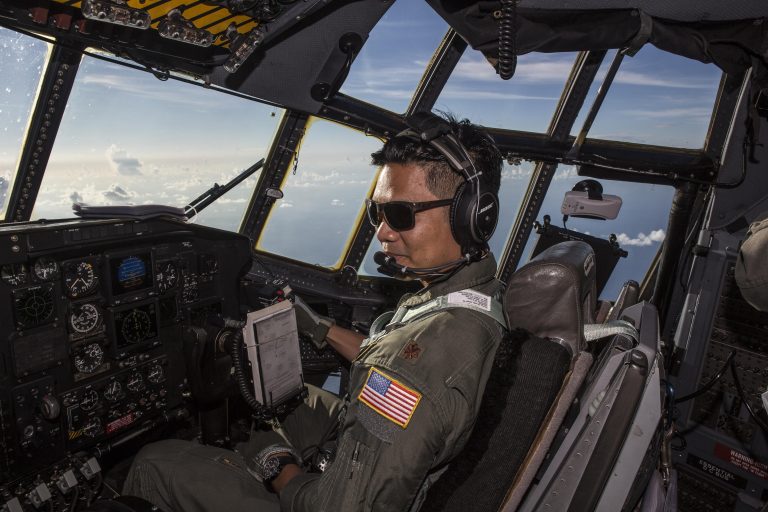
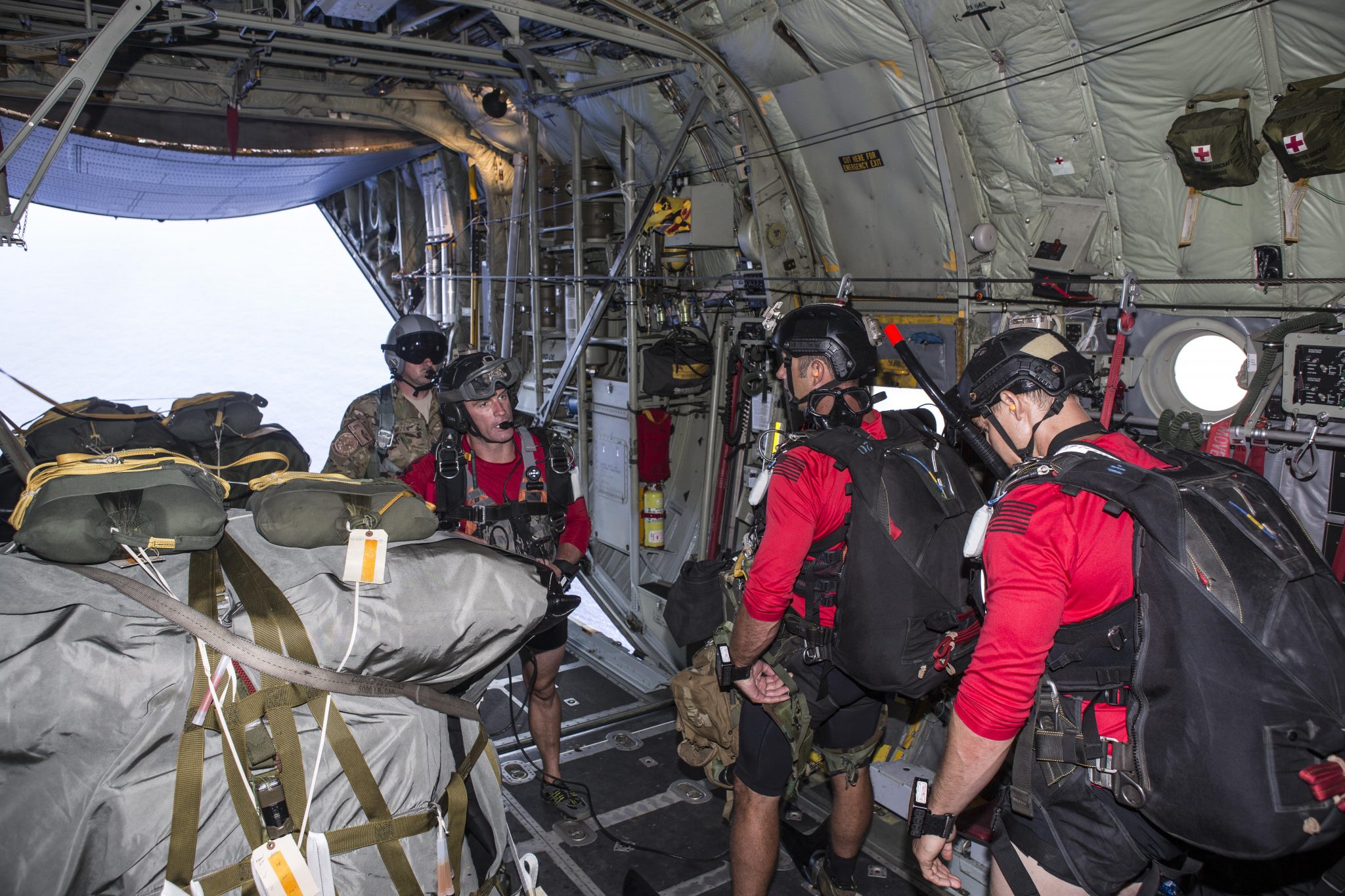
A crew of 8 Airmen then launched from Patrick AFB, Florida in an HC-130P/N aircraft (affectionately referred to as “King” by the 920th) at approximately 2:30 p.m. EDT, transporting six “Guardian Angel” Airmen who specialize in all types of rescue.
Responsible for a variety of demanding missions and ready to deploy at a moment’s notice, they are trained to perform some of the most highly-specialized operations in the Air Force. Elite Pararescuemen, better known as PJ’s, they are among the most highly trained emergency trauma specialists in the U.S. military.
Well trained for the mission
Graduates of the so-called “Superman School”, they are capable of performing life-saving missions anywhere in the world, at any time, whether for civilians at sea who are in distress, or in providing world-wide humanitarian and disaster-relief operations supporting rescue efforts in the aftermath of disasters such as earthquakes, floods, and hurricanes.
Citizen “Guardian Angel” Airmen from the 920th Rescue Wing prepare to jump from a C-130 to rescue 2 German men 500 miles off the coast of South Florida July 7-8, 2017. Photo: Master Sgt. Mark Borosch
“The specific capability with our Guardian Angel Airmen, combined with our air refueling and extended-range airlift makes us uniquely able to accomplish this mission where few others in the world can,” said Col. Kurt Matthews, 920th RQW Commander. “I’m very humbled and glad to be a part of this noble mission.”
A 920th RQW noncommissioned officer fluent in speaking German joined the team too.
The team arrived on scene two hours later and orbited overhead, while Ops (39th Rescue Squadron) back at Patrick AFB communicated with the ship “Nord Nightingale“.
“We had the life boat in the water and the freighter was about 2 miles away,” said Captain Dan Morgese, aircraft commander. Finally, five pararescuem plunged into the Ocean.
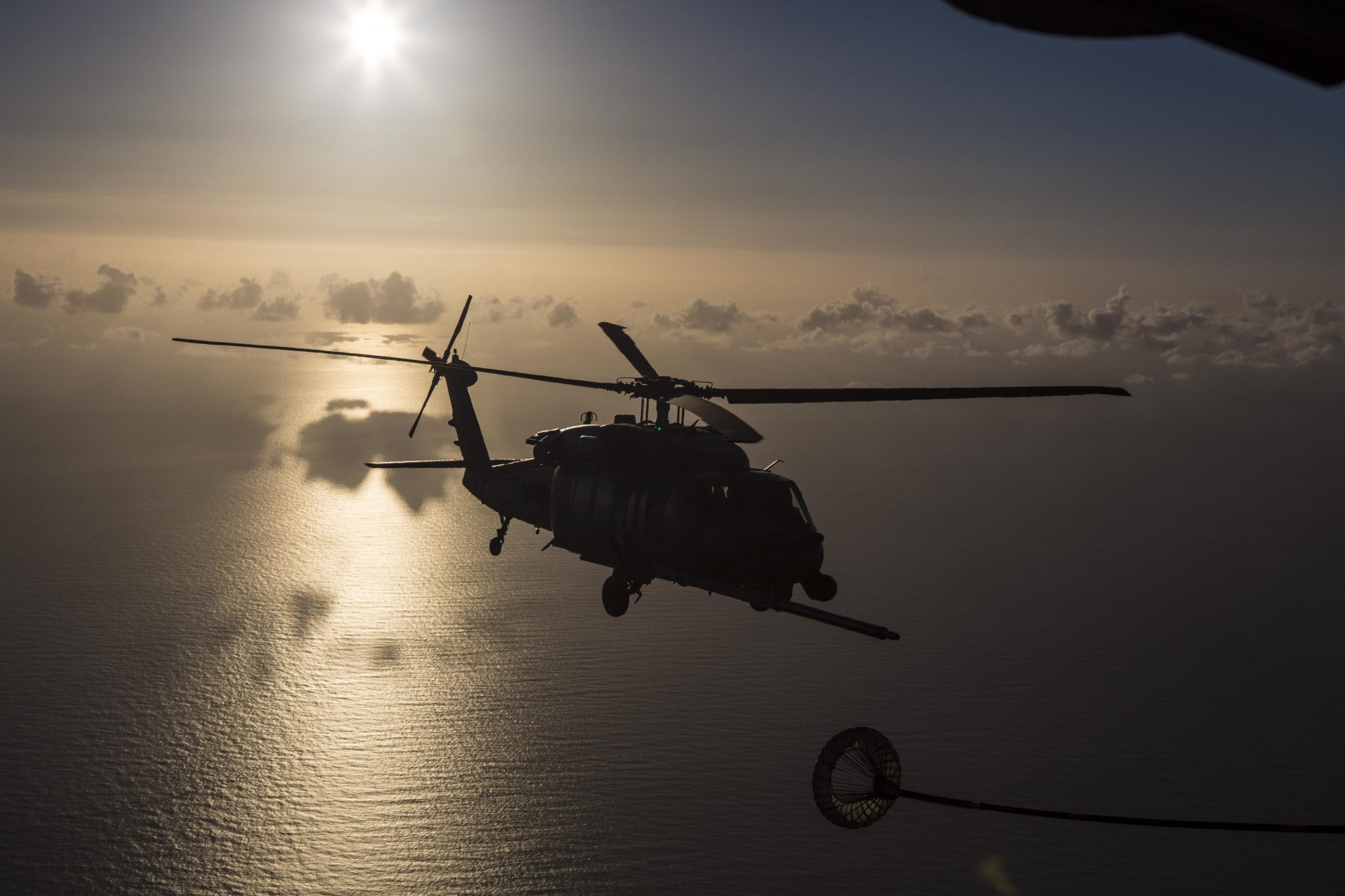
An HH-60G Pave Hawk refuels from an HC-130P/N King enroute to rescue two German citizens in distress at sea July 7, 2017 and into July 8. Photo: USAF/Master Sgt. Mark Borosch
“Anytime you are putting someone out over the Atlantic, it’s concerning,” said Morgese. “We train for this, it all worked out just fine. If there was day to do it, it was today; the weather was perfect.”
A HH-60 Launched a small boat for the rescue
The Nightingale motored a small boat toward the victims, which allowed the PJs to hoist the 48-year-old and 66-year-old father-son duo onboard while several of the other Rescue Airmen zoomed over to pick up the parabundles of medical equipment that splashed down just after them.
A pair of HH-60G Pave Hawk helicopters from Patrick AFB retrieved the PJs and transported the victims to Orlando, which required launch of an additional HC-130 from Patrick AFB to serve as fuel reserve for the helicopter’s return trip.
“Kudos to maintenance for getting us airborne,” said Morgese. “They are 93 models; our maintainers work hard.”
The 920th doing what they do best, rescue. Photo: Mike Killian
The pararescuemen treated and stabilized the patients, then transloaded them to the Nightingale to be picked up by the inbound helicopter.
All in a days work…
At approximately 8:20 p.m., the two Pave Hawk crews hoisted and recovered all seven from the ship and journeyed back to Central Florida where they landed on an Orlando High School football field at 1:30 a.m. and handed off the patients to the Orlando Fire Department to get the patients to their final destination, the Orlando regional medical center.
“When you actually get to do something you train for; it’s really satisfying,” said Morgese. “Excellent communication and planning among all involved, made the mission successful.”
Considering all this, it should come as no surprise to anyone that these airmen also serve as NASA’s astronaut guardian angels too, standing by for shuttle launches in case they were needed. And they will do so again on Florida’s “Space Coast” as soon as NASA, Boeing and SpaceX are ready to begin launching astronauts again. . – Follow Mike Killian on Instagram and Facebook, @MikeKillianPhotography .
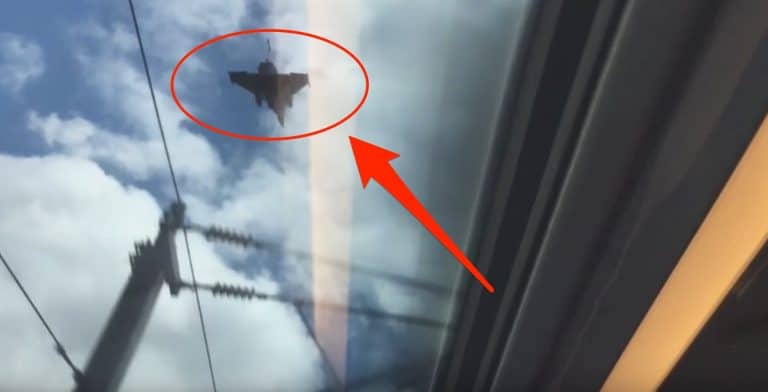
Recently the French Train à Grande Vitesse (TGV) – high speed train) inaugurated a new scheduled route running between Brittany and Pays de la Loire in western France, the train was “escorted” by French Air Force aircraft. One Dassault / Dornier Alpha Jet and one Dassault Rafale C flew over the train while it was running at 320 kilometers per hour (199 mile per hour or 173 knots). The TGV is France’s intercity high-speed rail service and has been in operation since 1981. The trains were originally designed to be powered by gas turbine engines but the 1973 oil crisis drove a change to electric power. Note that the Rafale is capable of flying at Mach 1.1 (1,390 kilometers per hour or 864 miles per hour / 750 knots) at the altitude at which it’s flying in the video. The train is seriously hauling for a train, but that jet is crawling along with their flaps deployed!
The Dassault / Dornier Alpha Jet has been in service with the French Air Force since 1978. Used primarily as a trainer, Alpha Jets have also been adapted for light attack and reconnaissance work. The jet has been used by 14 nations and is still operational with 12 of them. Because of the different avionics and radars in use by the different countries operating them, Alpha Jets have distinctive nose configurations. The German versions are equipped with an elongated pointed nose, whereas the other Alpha Jets employ a shorter rounded off nose. The Patrouille de France, the French precision aerobatics demonstration team, flies Alpha Jets. Due to the Alpha Jet’s advancing age potential replacement aircraft such as the Alenia Aermacchi M-346 Master, Aero L-39 Albatros, Beechcraft T-6 Texan II and the Pilatus PC-21 are being evaluated.
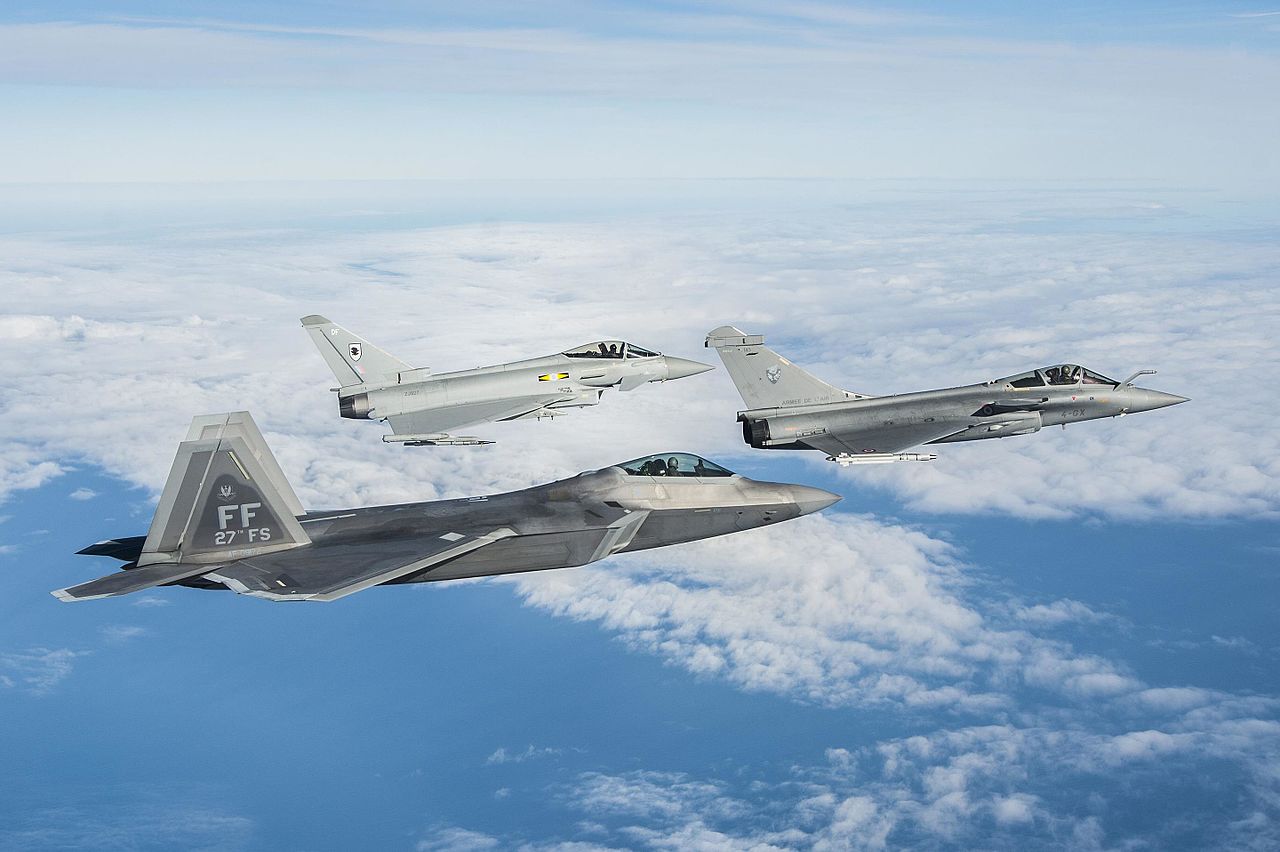
A Dassault Rafale leads a Eurofighter Typhoon and a Lockheed Martin F-22 Raptor in flight. Official US Air Force Photograph
The Dassault Rafale began service with the French Air Force several years after the naval variant. The Rafale has been used since 2007 in combat by the French Air Force in Afghanistan, Tajikistan, Mali, and Libya. More recently Armée de l’aire Rafales have been employed against Islamic State militants. Based at Al Dhafra Air Base in the United Arab Emirates, the French Rafales at first used their avionics suites to identify targets for US airstrikes. Later the Rafales began flying strike missions of their own with successful results.
Rafales are operated exclusively by France today, but Eqypt, India, and Qatar have ordered them and Canada, Finland, Malaysia, and the United Arab Emirates are taking a look. Previous unsuccessful sales to Brazil, Singapore, Switzerland, Kuwait, South Korea, The United Kingdom (Royal Navy), Morocco, and Oman have been filled with Eurofighter Typhoons or Saab JAS 39 Gripens for the most part.
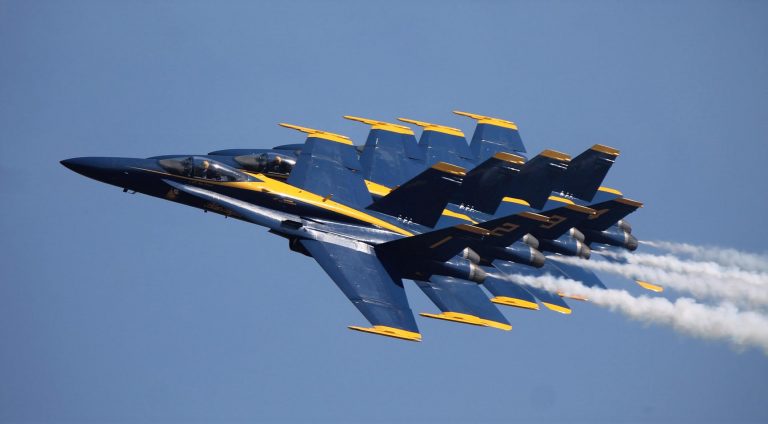
PENSACOLA, Fla. — The U.S. Navy Blue Angels on Saturday announced the selection of new pilots and support personnel who will join the aerobatic flight squadron in time for the 2018 air show season.
The selection of new Blue Angels officers were made on Thursday, and on Friday, Boss Cmdr. Ryan Bernacchi made phone calls welcoming excited — yet calm — officers to America’s Pride, the Blue Angels.
“I am incredibly impressed by the quality, professionalism, and talent of the Sailors and Marines who apply for this team,” Cmdr. Bernacchi, commanding officer and flight leader of the Blue Angels, said on Saturday. “We’re going to field a superb team next year, and I am excited to see them continue the legacy of representing the pride and professionalism of the Navy and Marine Corps.”
The joint Navy and Marines flight demonstration squadron first welcomed Navy Cmdr. Eric Doyle to succeed outgoing Cmdr. Bernacchi on April 4 as the Blues new Boss and Angel 1 for the 2018 and 2019 seasons.
A native of League City, Texas, Doyle’s addition to the team was announced following a panel comprised of 10 admirals and former commanding officers. The two will work closely together beginning in September, and he will take the helm in November.
“This was a childhood dream come true,” said Cmdr. Doyle. “My motivation to become a pilot came from watching the Blue Angels.”
The Blues selected two new pilots this week to fly the sleek blue and yellow FA-18 Hornets, Marine Maj. Jeffrey Mullins of Memphis, Tennessee and Navy LT Andre Webb of Lawton, Oklahoma. Current pilots LT Lance Benson, who has served as Angel 4 for two seasons, and CDR Frank Weisser, who replaced fallen Blue Angel, Capt. Jeff Kuss, in August 2016, will return to the fleet in November.
Maj Jeffrey Mullins
Current pilots LT Damon Kroes, LT Nate Scott, LT Tyler Davies, and LT Brandon Hempler are poised to return with the team for 2018. LT. Davies will move up to lead solo pilot in Angel 5, while LT. Hempler will move from this year’s narrator to the role of opposing solo.
Marine Capt. Beau Mabery of Lompoc, California will soar next season in the cockpit of air show crowd favorite Fat Albert — the team’s C-130 transport aircraft. Capt. Mabery will conclude his assignment in September at Marine Aerial Refueler Transport Squadron 152 in Japan where he has worked with aerial refueling aboard a KC-130J.
Current Fat Albert pilot Maj. Mark Montgomery will move up as lead pilot in 2018, as he, Marine Maj. Kyle Maschner, and Capt. Mabery round out the three officer flight crew. Current lead pilot Maj. Mark Hamilton will depart this November following three seasons behind the yolk. The C-130T soars with a crew of eight including three pilots and five support personnel.
The Blue Angels have performed for over 504 million fans since their first public air show in May 1946. The 2018 season schedule will begin at El Centro NAS, California on March 10 and conclude 32 show sites later at their home base in Pensacola.
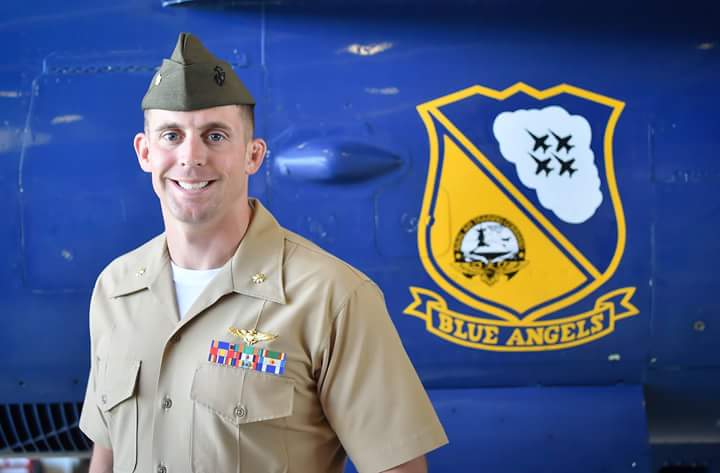
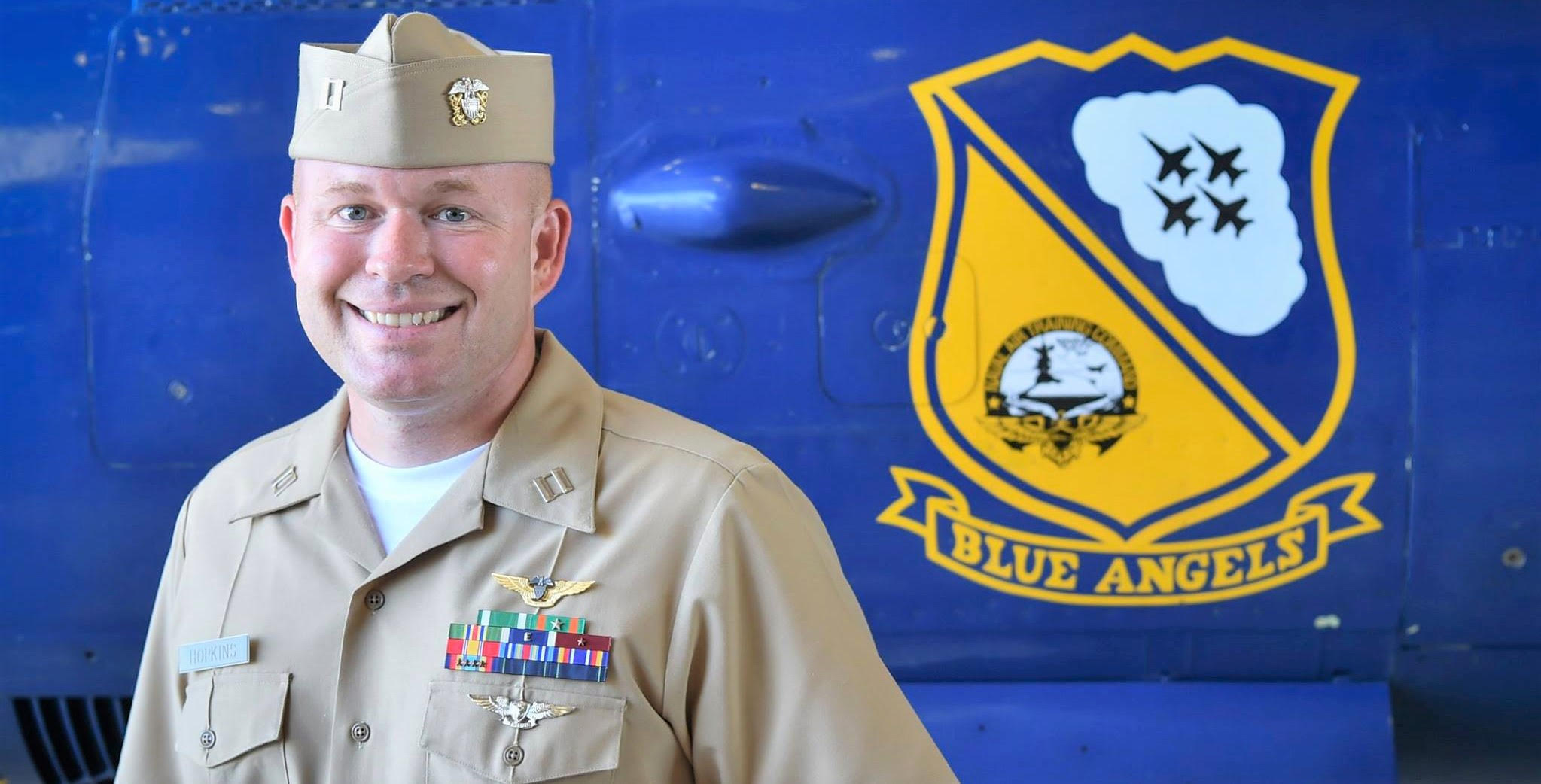
Several key support personal were also selected including Navy LT Garrett Hopkins and Navy LT David Gardner as maintenance officer and public affairs officer, respectively.
The current rotation of Angels pilots and team members are two or three years.
The newly selected pilots and team members will report in mid-September to the squadrons home at Pensacola Naval Air Station to begin training. In early January, the Blue Angels will depart Florida for their winter training home in southern California for six weeks of intense flight and tactical training prior to their first air show.
(Charles A. Atkeison reports on aerospace and technology. Follow his updates on social media via @Military_Flight.)
The first reusable rocket engine in history, the RS-25, proved its worth during NASA’s 30-year space shuttle era, helping power the orbiters uphill from 0 – Mach 25 in just 8 minutes, with a 100% success rate over the course of the program (the losses of Challenger and Columbia were not related to the main engines).
Often referred to as the Ferrari of rocket engines, the liquid hydrogen/liquid oxygen fueled RS-25 is one of the most tested large rocket engines ever made, with more than 3,000 starts and over one million seconds (nearly 280 hours) of total ground test and flight firing time over the course of 135 shuttle missions.
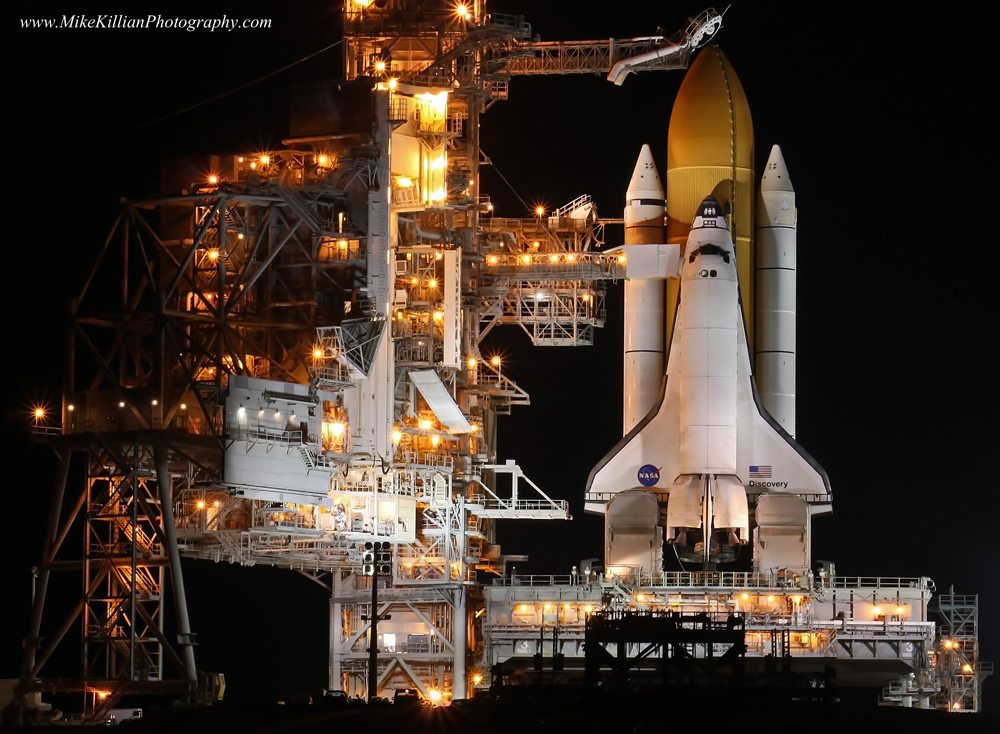
Shuttle Discovery on pad 39A awaiting launch. Photo: Mike Killian
Now, with the shuttle fleet retired several years ago, and a new heavy-lift rocket to launch deep-space crews in development, the engines that proved their worth time and time again are being called upon to serve the United States one more time for NASA’s colossal Space Launch System (or SLS).
Just like shuttle, two tall solid rocket boosters will provide most of the thrust during launch and ascent to reach space (we will have a story on those later). But the main engines are just as critical, and Aerojet Rocketdyne (the manufacturer) currently has 16 flight engines in inventory; 14 are veterans of numerous shuttle missions and 2 are brand new, plus there are 2 development test engines as well.
But differences between the SLS and space shuttle require that the RS-25s now undergo several modifications to adapt to the new environment they will encounter with SLS, to meet the giant 320-foot-tall rocket’s enormous thrust requirements.
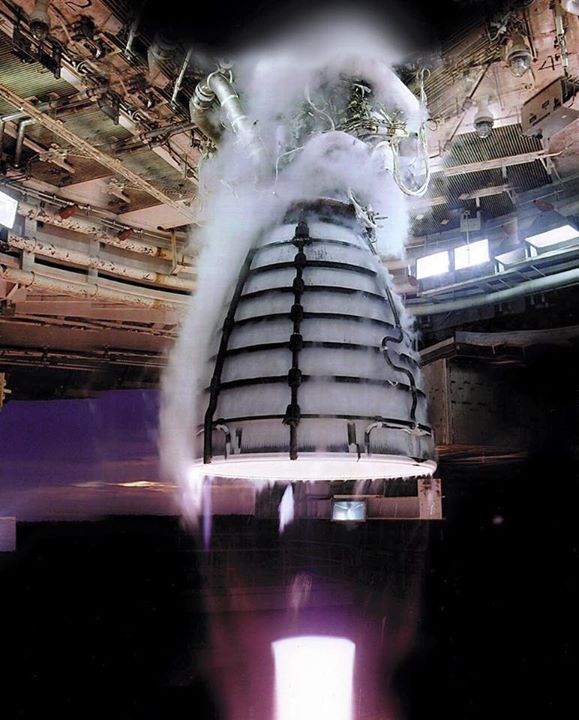
Locked down on the A1 test stand at the agency’s Stennis Space Center near Bay St. Louis, Miss., the RS-25s have been undergoing hot fire tests now since early 2015, providing engineers with critical data on the engine’s new state-of-the-art controller unit, or the “brain” of the engine, which allows communication between the vehicle and the engine itself, relaying commands to the engine and transmitting data back to the vehicle.
The new controller also provides closed-loop management of the engine by regulating the thrust and fuel mixture ratio while monitoring the engine’s health and status, thanks to updated hardware and software configured to operate with the new SLS avionics architecture.
Higher inlet pressure conditions, thanks to the engines upgrades, are also evaluated.
“We’ve made modifications to the RS-25 to meet SLS specifications and will analyze and test a variety of conditions during the hot fire series,” said Steve Wofford, engines manager at NASA’s Marshall Space Flight Center in Huntsville, Alabama, where the SLS Program is managed for the agency.
“The engines for SLS will encounter colder liquid oxygen temperatures than shuttle; greater inlet pressure due to the taller core stage liquid oxygen tank and higher vehicle acceleration; and more nozzle heating due to the four-engine configuration and their position in-plane with the SLS booster exhaust nozzles.”
For shuttle flights the engines pushed 491,000 pounds of thrust during launch—each—and shuttle required three to fly, but for SLS the power level must increase to 512,000 pounds of thrust per engine (more than 12 million horsepower). The SLS will require four to help launch the massive rocket and its payloads with a 70-metric-ton (77-ton) lift capacity that the initial SLS configuration promises (later variants will be even bigger and more powerful).
The RS-25 can handle temperatures as low as minus 400 degrees (where the propellants enter the engine) and as high as 6,000 degrees as the exhaust exits the combustion chamber where the propellants are burned.
Some cool facts from Aerojet Rocketdyne on their RS-25s:
The fuel turbine on the RS-25’s high-pressure fuel turbopump is so powerful that if it were spinning an electrical generator instead of a pump, it could power 11 locomotives; 1,315 Toyota Prius cars; 1,231,519 iPads; lighting for 430 Major League baseball stadiums; or 9,844 miles of residential street lights—all the street lights in Chicago, Los Angeles, or New York City.
Pressure within the RS-25 is equivalent to the pressure a submarine experiences three miles beneath the ocean.
The four RS-25 engines on the SLS launch vehicle gobble propellant at the rate of 1,500 gallons per second. That’s enough to drain an average family-sized swimming pool in 60 seconds.
If the RS-25 were generating electricity instead of propelling rockets, it could provide twice the power needed to move all 10 existing Nimitz-class aircraft carriers at 30 knots.
“There is nothing in the world that compares to this engine,” said Jim Paulsen, vice president, Program Execution, Advanced Space & Launch Programs at Aerojet Rocketdyne. “It is great that we are able to adapt this advanced engine for what will be the world’s most powerful rocket to usher in a new space age.”
The engines currently in stock are already assigned their spots to fly the first four SLS missions, but unlike their former lives as reusable engines, these will be their final launches. The SLS is being made as an expendable launcher designed from heritage hardware and ideas; the RS-25 is now one-time use.
NASA awarded Aerojet Rocketdyne a $1.16 billion, nine-year contract to restart production of an expendable version of the RS-25 for SLS in late 2015.
RS-25 test fire for SLS. Photo Credit: Mike Killian
Meanwhile, development of the rocket itself is well underway across the country. NASA is hoping to launch the first mission with an un-crewed Orion capsule to the moon and back on a shakedown flight in 2019, before launching the first crewed Orion mission sometime between 2021 and 2023.
Once the engines are finished testing individually, they will be integrated with an SLS first stage and mounted atop another test stand, to test fire the engines for a full-duration launch. Engineers need to make the engines THINK the rocket is really flying a launch ascent profile, in order to verify everything will operate as expected on launch day.
That test is expected to occur in 2018.
For now, here’s a little preview; some incredible video from NASA test firing the Saturn V first stage, whose five F-1 engines launched men to the moon on the Apollo missions:
And just think, when the SLS stage test fires, it will do so for 500 seconds…
As the rocket evolves over the 2020s and 2030s, it will become the largest and most powerful rocket ever made, but the initial SLS missions will only have half the lifting power of the Apollo Saturn V moon rockets.
The elephant in the room is whether the SLS program will keep getting the funding and political support it needs to put people on Mars in the next 20 years.
Meanwhile, SpaceX is developing the Falcon Heavy rocket, and plans to launch two paying customers to circle the moon and back before 2020, with hopes of Mars missions by 2030.
.
– Follow Mike Killian on Instagram and Facebook, @MikeKillianPhotography
.
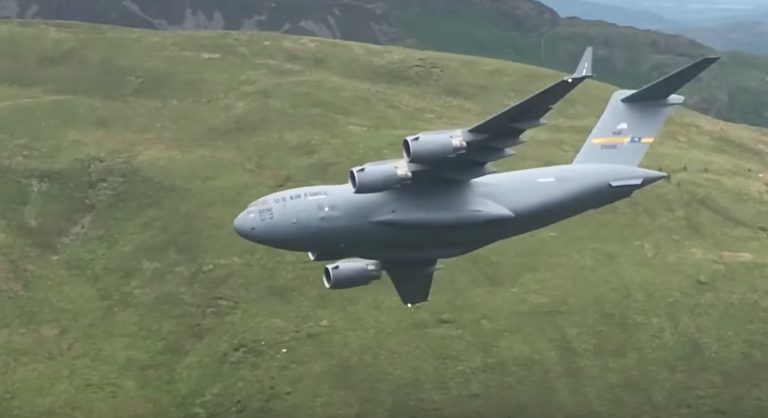
450,000 lbs of jet flying just a few hundred feet above the ground. It’s amazing!
There are times when we need to write a long article that provides color commentary and other times that you just need to watch a kick ass video. This is one of those times that you should just watch the video and enjoy it first. We’ll fill you in on the Mach Loop below.
What’s the Mach Loop?
The Mach Loop is probably the best place in the world to watch tactical flying by fighters and the occasional bomber and transport aircraft. This video of a C-17 is the first that we’ve seen. It is amazing. A heavy flying below the mountain peaks is amazing. Most C-17s fly low levels above 300 knots. This flight appears to be slower but no less impressive.
Over the years we’ve seen hundreds of videos and photos of aircraft flying through the Mach Loop. It is a unique vantage point for avgeeks and spotters because they are able to view the aircraft traveling through the valley from above. Combined with the lush, green scenery, it makes for some impressive photography and videos. Heavy aircraft in the Mach Loop are rare though.
The video was filmed by Paul Williams who has a number of Mach Loop videos. Enjoy.
Bonus: Here is the same C-17 from a different perspective.
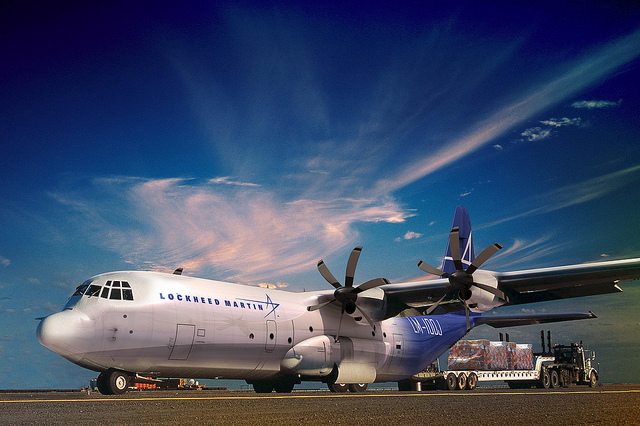
The unmistakable Lockheed Martin C-130 Hercules has been a staple of western military forces as a cargo aircraft. A modern civilian version of the “J” model was first shown last spring, which caused some avgeeks and analysis to scratch their heads wondering “why?”. It appears that Lockheed Martin thinks that there is actually a market for the new LM-100J.
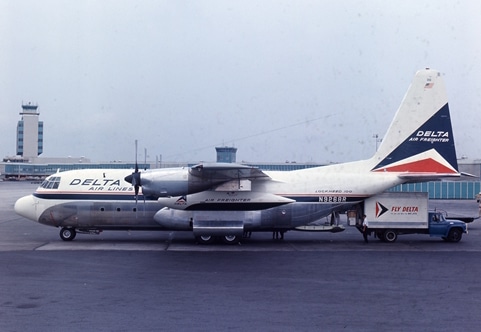
This isn’t the first time that the C-130 has seen civilian action. There was an earlier version, the L-100, that was produced until 1992, and these aircraft were used for things like crucial deliveries and disaster relief. Even Delta Air Lines operated a few for a period of time. The original L-100s are aging though and in need of replacement. Outside of the LM-100J, there are very few options for outsize cargo airlift. Many have been retired for structural issues and high operating expenses.
Source: Delta Museum
The new version, the LM-100J, can haul 35,000 pounds of cargo approximately 2,800 nautical miles, and features significant improvements over the original L-100. The very first delivery of the latest version is scheduled for early 2018.
So, is there a market?
Lockheed Martin certainly seems to think so (or at least enough of a market to sell about 100 of the aircraft) with general manager for Air Mobility & Maritime Missions George Shultz saying, “Our existing L-100 operators have repeatedly shared with us that the only replacement for a Herc is a Super Herc, and we are proud to meet this demand with the LM-100J. There is a significant global requirement for commercial freight operations to support operations in more austere areas. The LM-100J will not only meet these demands, but exceed them by delivering new and unmatched capabilities to the commercial marketplace by transporting cargo on any runway, anywhere, all the time.”
They anticipate the civilian version of the aircraft can be used for heavy cargo, firefighting, airdrops, disaster relief, search and rescue, mining support and more — even tourism, as it becomes more fashionable for those with enough cash to travel to the most remote places of the world (say, the South Pole?). It does bode well for Lockheed that they’re expanding the overall goal of the aircraft beyond cargo and humanitarian aid. We’re just skeptical that airlines and/or private operators will ever invest in the type. The LM-100 is unique but it is not cheap to operate, nor common to any other aircraft in the fleet.
Lockheed does have a few letters of intent in for the aircraft so far, including seven intended for ASL, the original launch customer.
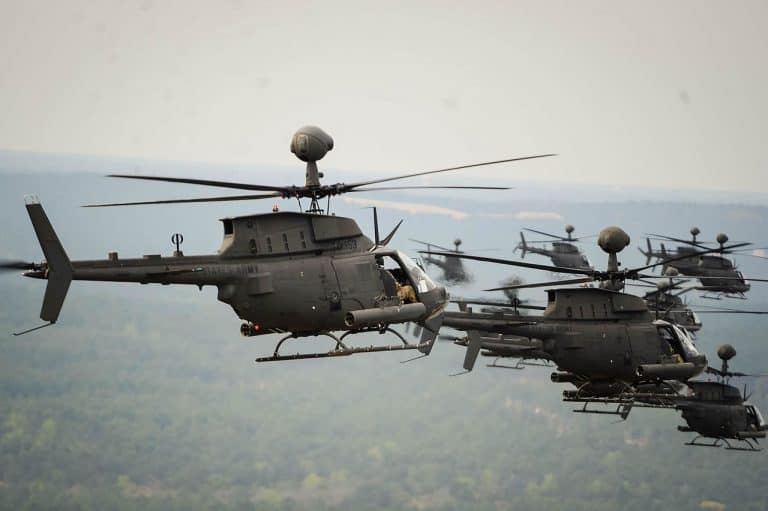
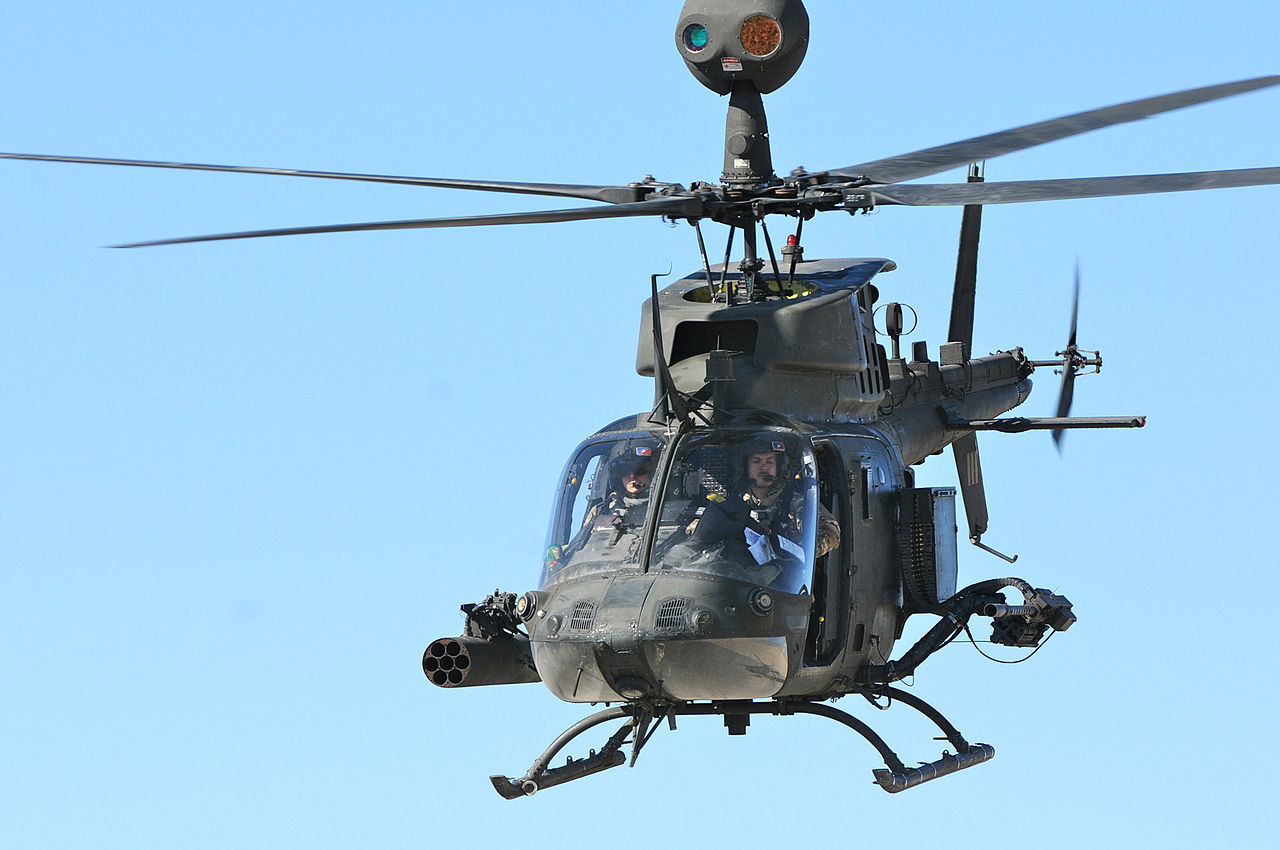
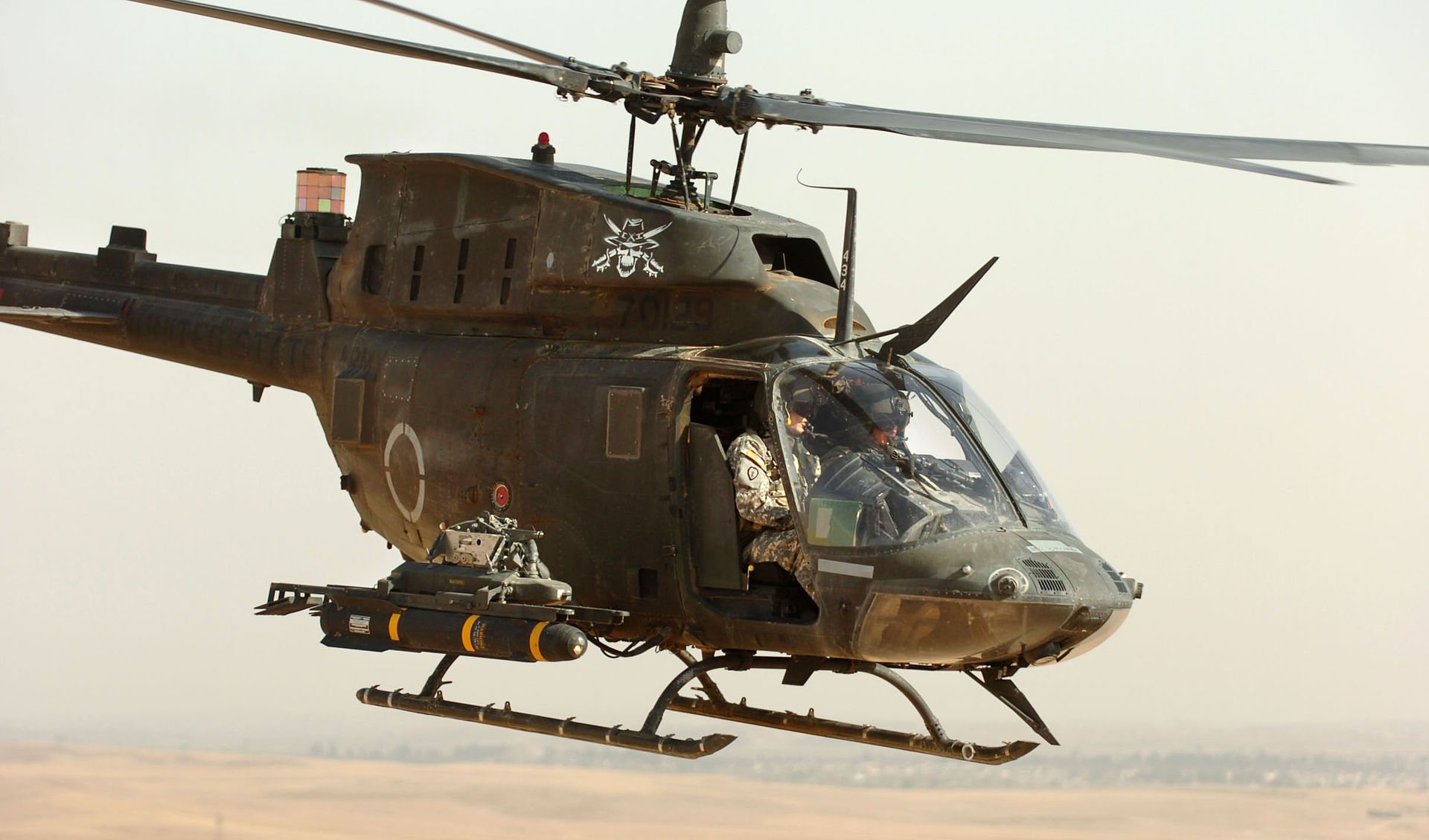
The Bell OH-58D Kiowa was operated by the United States Army up until the 1st Saber Squadron, 17th Cavalry Regiment, 82nd Combat Aviation Brigade, 82nd Airborne Division retired their last operational Kiowa Warriors in January of 2017. This brought to a close nearly 47 years of military use of Bell’s 206 Jet Ranger series helicopters by the Army. The OH-58D has been replaced by the more expensive and more difficult to replace Boeing AH-64 Apache attack helicopter in the armed reconnaissance and ground support roles and the Eurocopter UH-72 Lakota in the light utility helicopter role. The retirement party for the OH-58D was as impressive as it was poignant.
Bell built 2,200 OH-58 helicopters between 1966 and 1989. Foreign operators of the various OH-58 variants include Australia, Austria, Canada, Croatia, Dominican Republic, Saudi Arabia, Iraq, Taiwan, Greece, Tunisia, and Turkey. Supplemented but never replaced by the Hughes OH-6 Cayuse in many roles, the early OH-58 variants were used primarily for the light utility and training roles. It wasn’t until the OH-58D was developed during the early 1980s that the name and the mission became Kiowa Warrior.
Official US Army Photograph
Equipped with universal weapons pylons that can carry various combinations of AGM-114 Hellfire missiles, air-to-air Stinger (ATAS) missiles, 7-shot Hydra-70 rocket pods, or an M296 .50 caliber machine gun, the Kiowa Warrior also received an upgraded engine, improved navigation and communication avionics, even airbags in the cockpit to enhance survivability. The diminutive Kiowa Warrior with its mast-mounted sight combining television, thermal imaging, and laser designation systems always led the way from the front- just like a scout should.
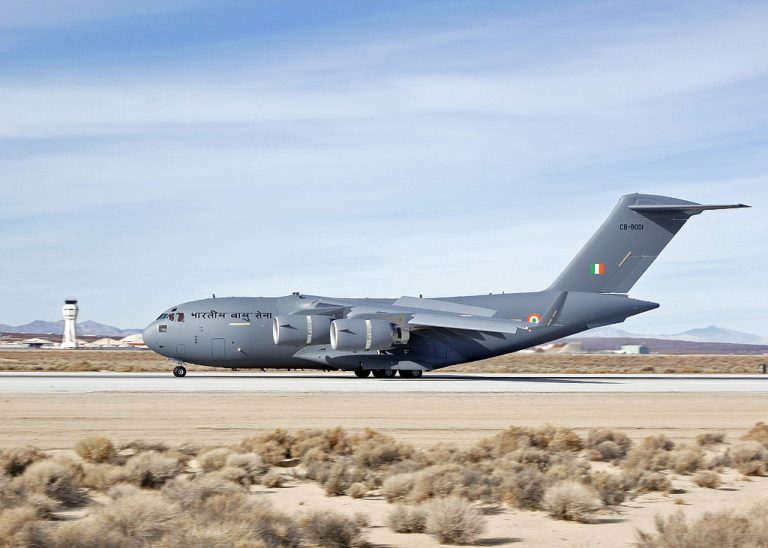
India showed interest in purchasing additional C-17 aircraft to compliment their 10 strong fleet of Globemaster IIIs. Unfortunately, Boeing stopped producing the aircraft in 2015 so they had to settle for just one additional aircraft. The Indian Prime Minister met with President Trump in D.C. just recently to work toward the purchase, which the State Department has approved, at a cost of $366.2 million (which also includes 4 Turbofan F-117-PW-100 engines, a missile warning system, a countermeasures dispensing system and an identification friend or foe transponder).
So, why did Boeing shut down the line?
The Pentagon purchased the majority of the C-17 production from its first flight until US procurement ended in 2010. A total of 223 aircraft were delivered to the US Air Force. Foreign orders for the aircraft had sustained the line over the last few years, but those dwindled as well in recent years forcing Boeing to pull the plug on the program in 2015. Boeing produced the last few aircraft as ‘white tails’ meaning that they did not have a buyer when built. They eventually sold the remaining aircraft to foreign operators with India taking the last tail ever produced. A total of 279 aircraft were produced by McDonnell Douglas then Boeing over the lifetime of the program.
The Defense Security Cooperation Agency issued a statement on the pending sale, saying, “The proposed sale will improve India’s capability to meet current and future strategic airlift requirements. India lies in a region prone to natural disasters and will use the additional capability for humanitarian assistance and disaster relief. In addition, through this purchase, India will be able to provide more rapid strategic combat airlift capabilities for its armed forces.”
Trump and Prime Minister Narendra Modi held a joint press conference in June, with Trump noting “there’s nobody that makes military equipment like we make military equipment.” He also expressed appreciation for India’s interest and alluded to further trade with the country. In addition to the sale of the lone C-17, the US also approved is a sale of 22 General Atomics MQ-9 Reaper drones to the country, for $22 billion. Other aircraft potentially up for purchase by India include the Boeing P-8 and the Lockheed Martin C-130J.
Editors note: The article title previously indicated that this was the last built C-17. That aircraft was already delivered to Qatar. The aircraft India bought was the last unsold C-17.
Howard’s Name Might Not Ring a Bell, But James Howard Was Unique Among ETO Aces
You’ve no doubt heard of many heroic American fighter pilots who flew Mustangs over Europe during World War II; men who flew Thunderbolts and Lightnings and even Spitfires too. Gabreski. Blakeslee. Godfrey. Eagleston. Schilling. Johnson. Mahurin. Olds. Anderson. Yeager…and scores of other well-known American fighter jocks who cut the Luftwaffe back to size and eventually marginalized and defeated it.
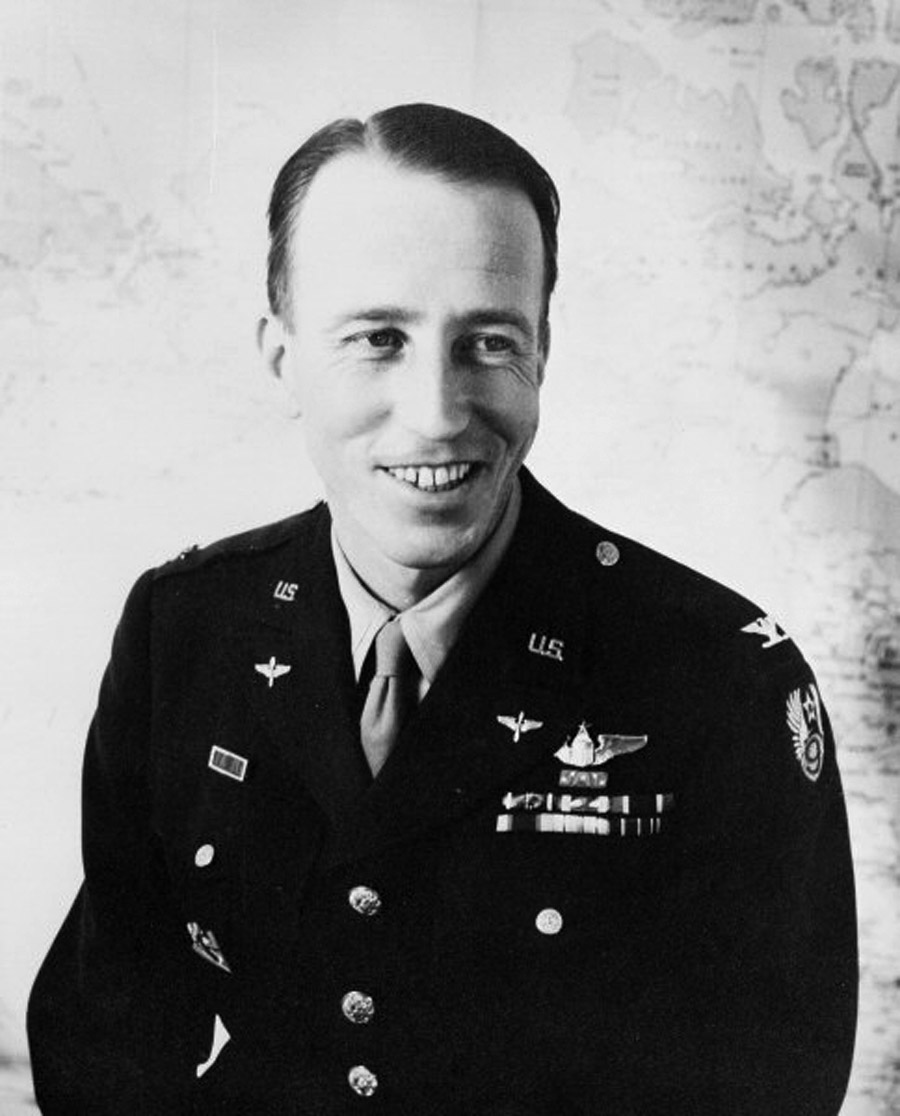
You may not recognize the name of the one and only American P-51 fighter pilot in the European Theater to be awarded the Medal of Honor. His name was James Howard. And he started out as a Naval Aviator!
Colonel James Howell Howard United States Army Air Force pictured in 1945. Official US Air Force Photo
Howard Wore Wings of Gold First
James Howell Howard was born on April 13th 1913, in Canton, China. His father, an American ophthalmologist, was there to teach eye surgery to Chinese doctors. In 1927 Howard’s family returned to St. Louis, Missouri, where James attended and graduated from John Burroughs School. Howard then attended Pomona College in California, graduating with a BS degree in 1937.
Believing at first that he would become a doctor like his father, James became enamored with the idea of becoming a Naval Aviator. He entered the United States Navy as a naval aviation cadet in early 1938 and graduated from flight training at Naval Air Station (NAS) Pensacola in 1939.
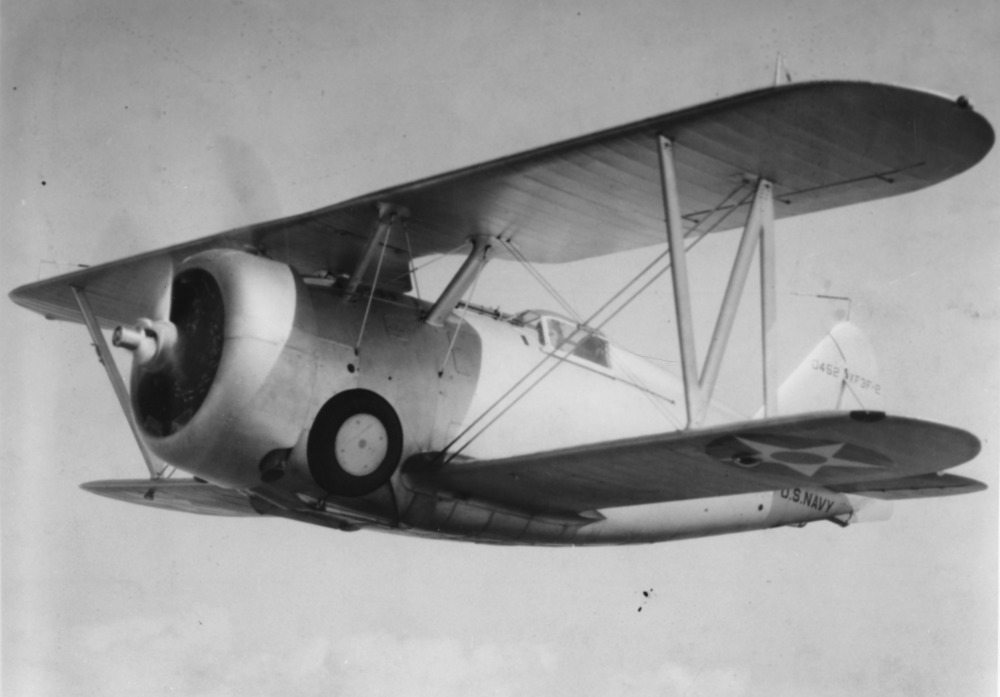
Grumman F3F-2 of the type flown by Ensign Howard from the carrier USS Enterprise during his Navy days.
Shifting Services and Flying with the Flying Tigers
Young Ensign James Howard’s first squadron assignment was with Fighting Three (VF-3) Flying Chiefs flying Grumman F3F-2 biplane fighters from the aircraft carrier USS Enterprise (CV-6) based at Pearl Harbor in Hawaii beginning in late 1939. With perhaps a hint of foresight, Howard resigned his commission in the Navy to join General Claire Chenault’s American Volunteer Group (the Flying Tigers) in June of 1941.
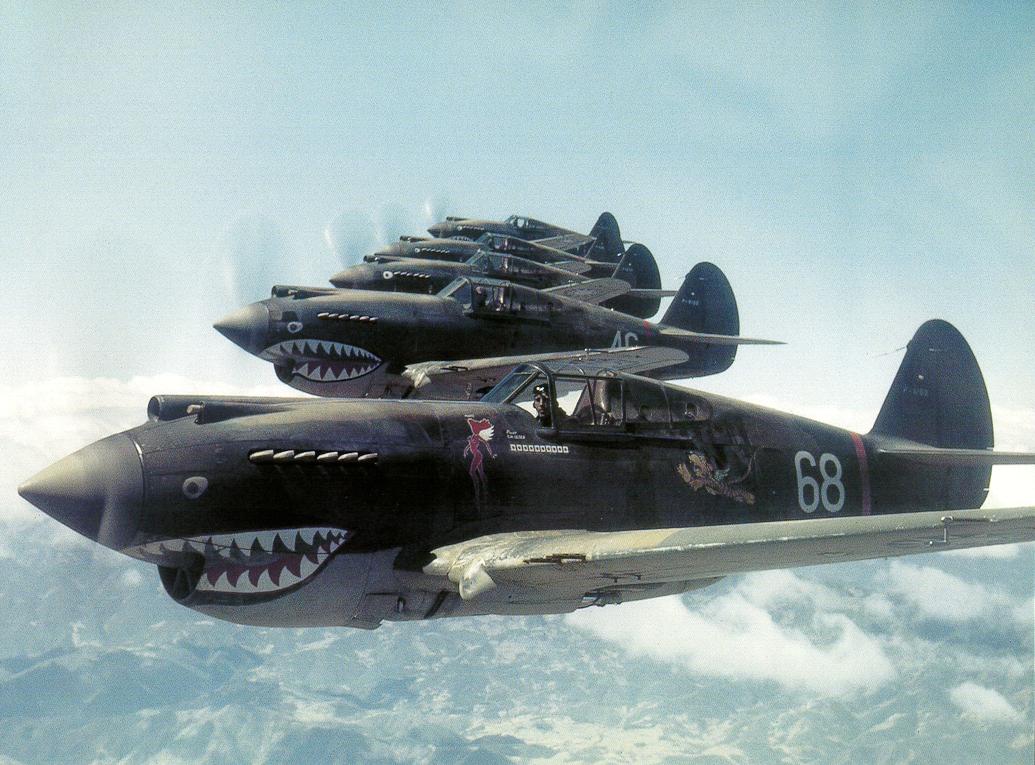
James Howard flew 56 missions over Burma in Curtiss P-40 Warhawk fighters, scoring a total of six confirmed kills, two of which were achieved during air-to-air combat. When the Flying Tigers were officially disbanded in July of 1942, the tall, quiet, and quietly aggressive Howard made his way back to the States and requested and received a commission as a captain in the United States Army Air Forces (USAAF).
Flying Tigers P-40 Warhawks
Flying Lightnings and Jugs Before Heading to the ETO
Within just a few weeks James Howard was flying Lockheed P-38 Lightnings at Muroc Army Airfield in California. Far from impressed with the complicated P-38, Howard was later assigned to fly Republic P-47 Thunderbolts in defense of the West Coast with the Fourth Air Force.
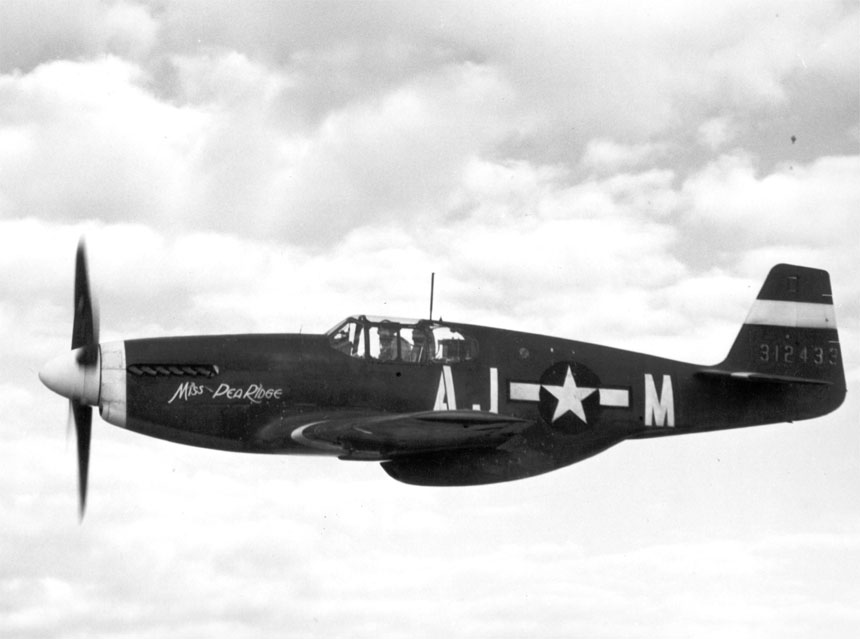
His first squadron command was of one of the Fourth Air Force Air Defense Command squadrons. But Europe was beckoning. Howard was next promoted to Major and given command of the 356th “Red Ass” Fighter Squadron (code AJ) of the 354th Fighter Group, which was eventually based at Boxted near Colchester in Essex, East Anglia, England.
A 356th Fighter Squadron P-51B Mustang in flight
Luftwaffe Fighters Were Lining Up to Punish the Bombers
On January 11th 1944, Major James Howard was flying escort for a formation of American Boeing B-17 Flying Fortress bombers of the 401st Bombardment Group (Heavy) flying from Deenethorpe in Northamptonshire on a bombing mission to attack the AGO Flugzeugwerke in Oschersleben, Germany, which at the time was building as many Focke-Wulf Fw 190 Würger (Shrike) fighters as they could for the Luftwaffe.
Separated from the rest of his squadron after shooting down a Messerchmitt Bf 110 Zerstörer (Destroyer), Howard’s head was on a swivel as the B-17s turned back to base, but there were some 500 Luftwaffe fighters in the air that day and they favored attacking the bombers just after delivery of their bomb loads. It was then that he sighted a swarm of some 30 German fighters attacking a formation of B-17s across the bomber stream.
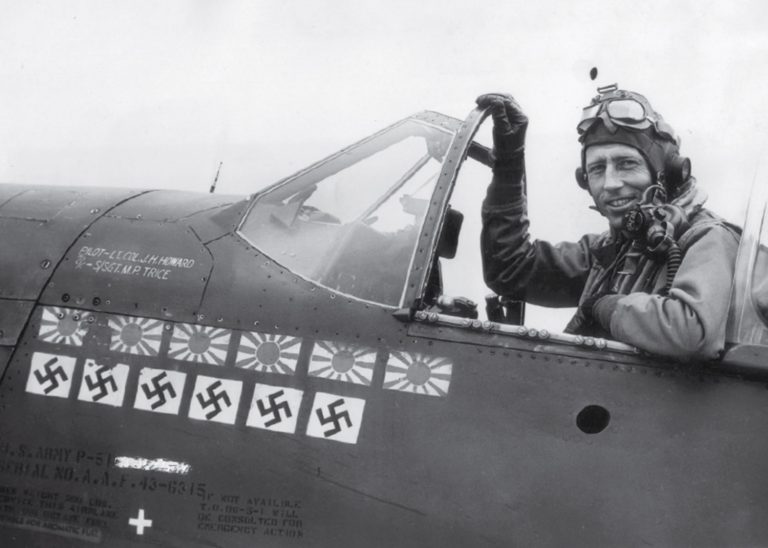
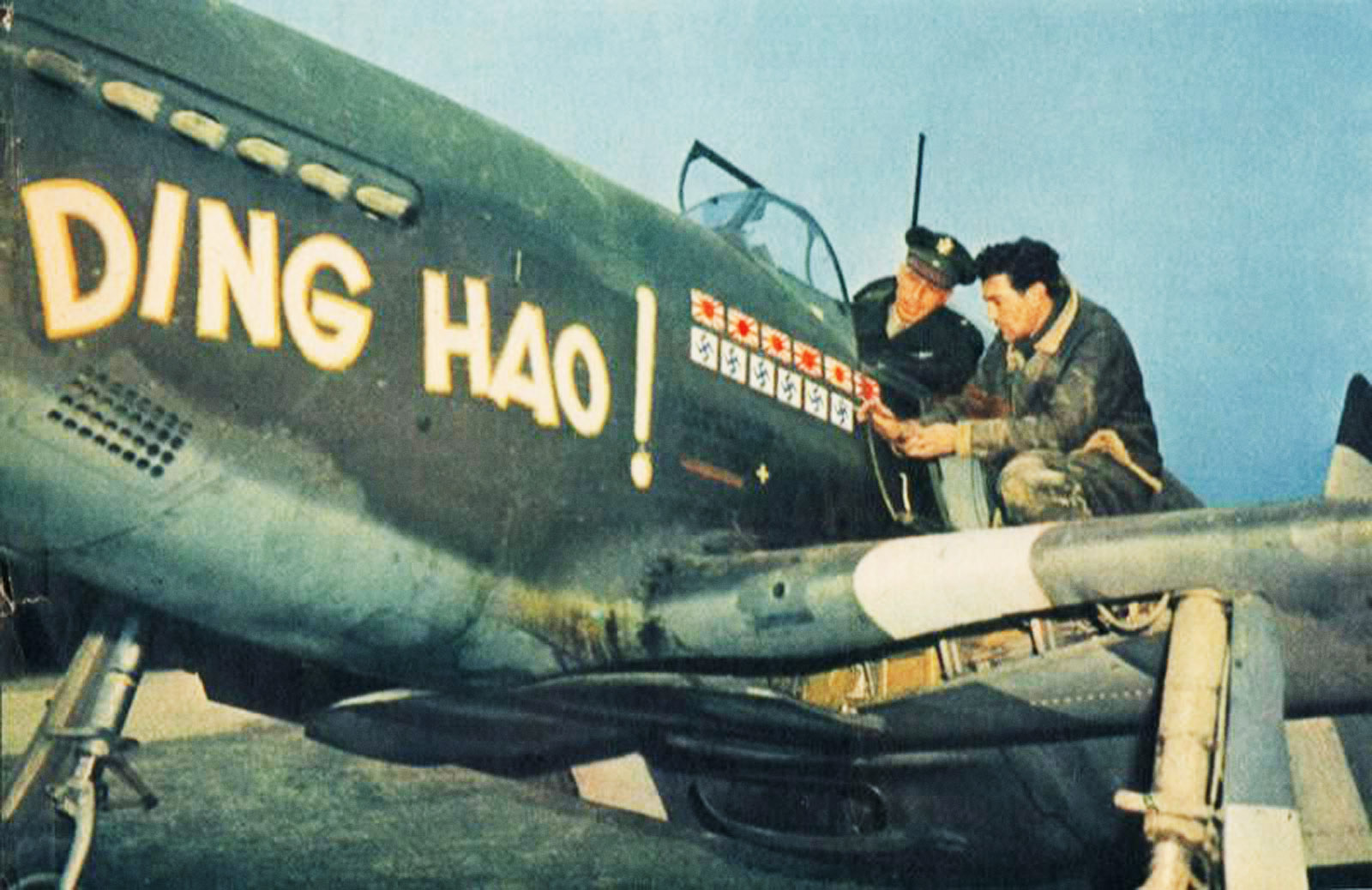
Major Howard’s P-51B “Ding Hao!” Ironically the Army Air Force and not Howard insisted on displaying six Japanese victory markings for these publicity shots and not the two Howard earned during his combat in Burma.
For the Rest of the James Howard Story Bang NEXT PAGE Below
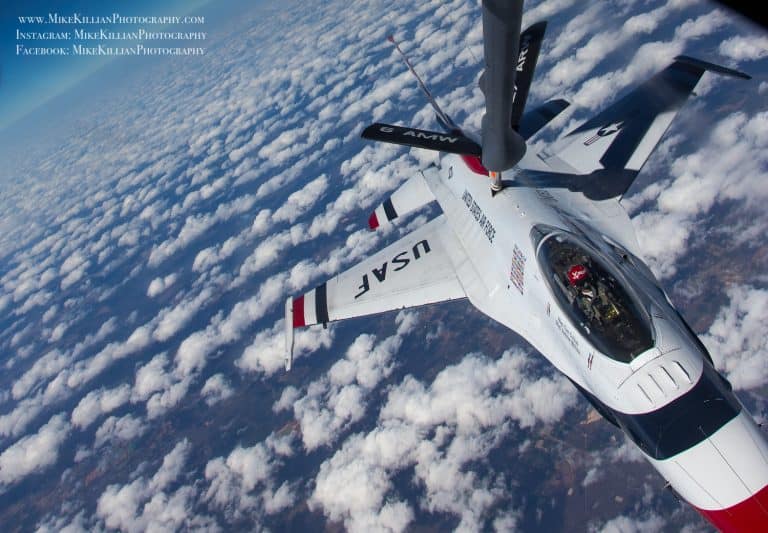
The U.S. Air Force Thunderbirds travel the states throughout most of the year, conducting flybys of big events (such as Super Bowls and the Daytona 500) and performing at air shows nearly every week from spring – fall, showcasing the pride, precision and professionalism of airmen across the Air Force and demonstrating many of the capabilities of the F-16 for the general public.
But it takes a lot of work to get the team to each show site, week after week. Sometimes they can reach point B in one flight. However, there are times when the team needs to call on the help of refueling tanker crews for the longer routes, because landing the team, fueling all the jets, taking off again, 3 or 4 times in a day is not very efficient.
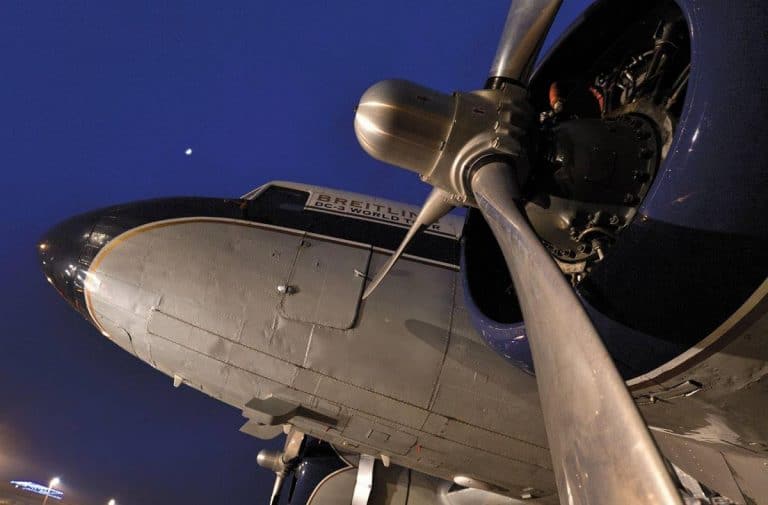
Breitling once again is demonstrating the watch company’s passion for aviation this summer as its historic DC-3 aircraft circumnavigates the globe inspiring today’s youth while becoming the oldest aircraft to fly around the world.
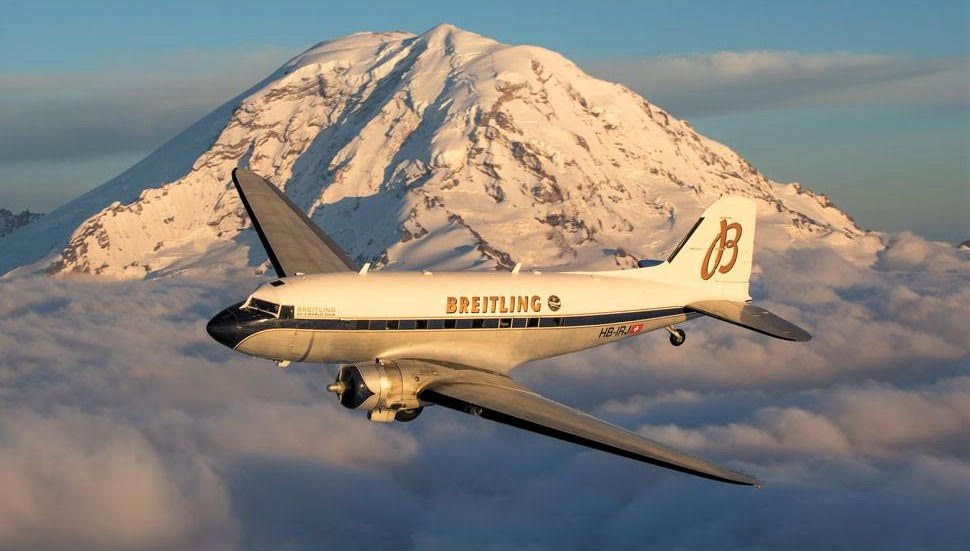
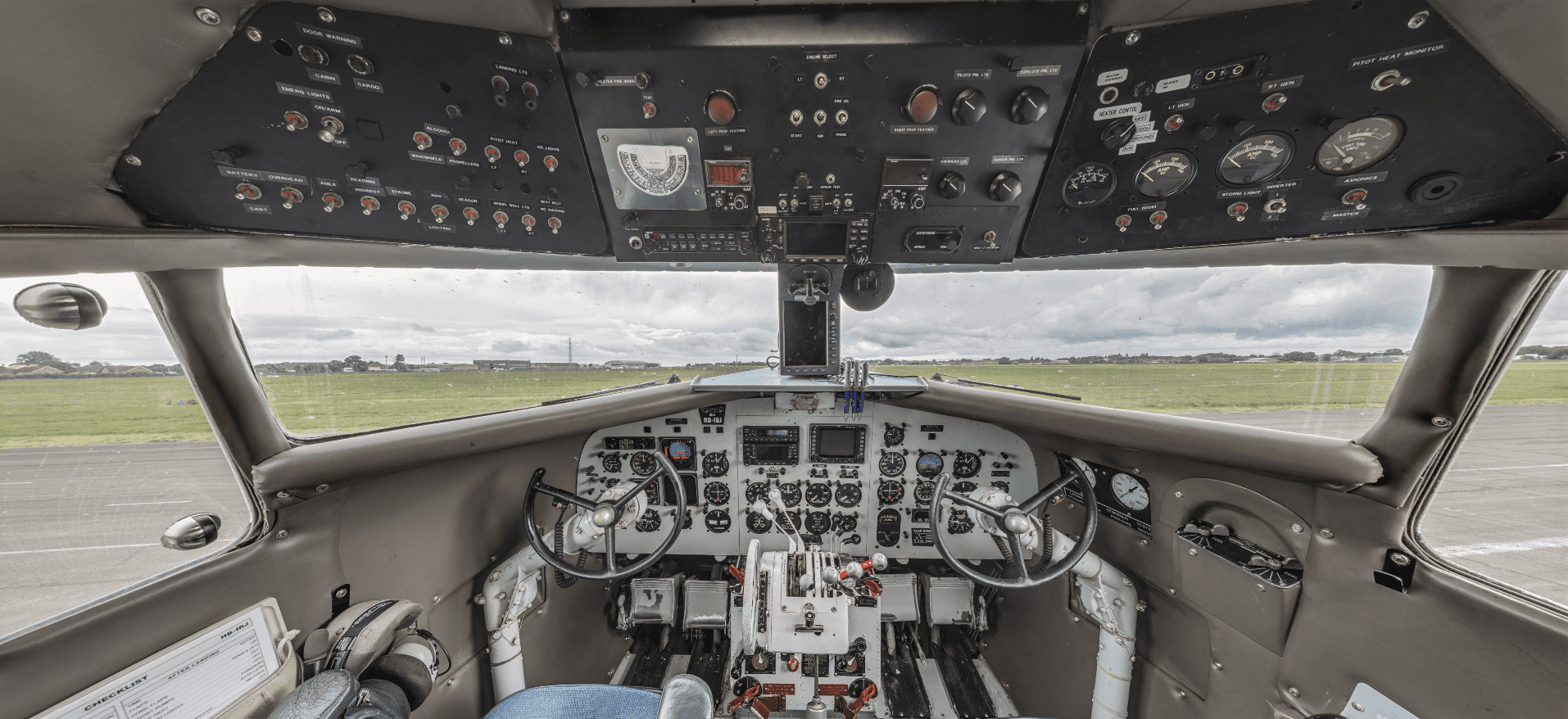
Built in 1939, this Douglas Commercial 3 HB-IRJ was delivered to American Airlines the following year. The twin prop aircraft was later introduced to military service during World War II before returning to commercial airline service. And, like a good timepiece, the precision flight and timeless beauty of this DC-3 has made the iconic aircraft a popular attraction during its historic flight.
The Breitling DC-3 is scheduled to make 13 promotional stops across the United States as the aircraft’s crew support both the thrill of flight and the education associated with aviation. The monoplane will also make stops in Canada’s Toronto and Goose Bay in August.
“This aircraft played such an important role in American history and it is a privilege to share it with American aviation fans,” Breitling DC-3 Captain Francisco Agullo said on Tuesday. “We look forward to seeing this country’s rich culture and passion for aviation and look forward to wrapping up our time in the U.S. at Breitling’s flagship boutique in New York.”
Today, the white and silver aircraft, blazoned with Breitling’s signature B script logo on its vertical stabilizer, is poised to complete the final leg of its journey. As of July 4, the precision aircraft had traveled 32,381 km after having flown across nearly two-thirds of the globe.
The nearly 20-meter long plane is powered by two upgraded Pratt and Whitney R-1830 engines which can keep the DC-3 aloft for eight hours or nearly 1,500 miles.
Headquartered in Dijon, France, the aircraft is sponsored by the Swiss watch manufacturer due in part by the company’s rich history in aviation. Breitling watches were strapped to the wrists of many aviation pioneers including NASA astronauts en route to the Moon’s surface.
Flying along with the crew is a special cargo containing 500 Navitimer aviation chronographs. The steel Navitimer 01 (46 mm) is distinguished with an engraving on its case back with the logo of Breitling’s DC-3 World Tour. The watches will be available to the public around October.
“We are thrilled to present these limited-edition Navitimer watches to give our customers the opportunity to take a piece of this historic event with them,” Breitling USA President Thierry Prissert told AVGeekery.com on Wednesday. “Having these watches circle the globe on one of the most iconic planes in history allows us to share our passion for aviation with people in the United States.”
On March 9, Breitling’s historic Douglas DC-3 HB-IRJ launched on it’s round-the-world flight from its home in Geneva, Switzerland — 77 years to the day of it’s inaugural flight. Later, the monoplane traveled the length of the Adriatic Sea to Athens, Greece, followed by stops in Israel and Jordan. The pilots of the DC-3 then flew the aircraft across Saudi Arabia, India, and around southeast Asia — stopping at select locations — before making six stops through out May in Japan.
June opened with the aircraft’s departure from the island country on June 6 to begin it’s long trek across the Pacific Ocean and northeast to Alaska and stop number 37 — Anchorage.
The DC-3 will soar across California making two-day stops in San Francisco and Los Angeles on July 11 and 13, respectively. Visits to Phoenix, Houston, Dallas, and St. Louis will keep the aircraft busy the third week of July before Breitling arrives at the country’s largest airshow.
The DC-3 is expected to become a popular attraction at the Oshkosh AirVenture Airshow the entire last week of July. Chicago, Washington, D.C., Boston, and New York will round out the American Tour in August.
Breitling’s DC-3 will skirt around the northern Atlantic to begin it’s European tour during the closing days of August.
As the DC-3 soars over Europe, the Breitling Jet Team’s European Tour continues through the summer as well as the watch manufacture incorporates their love of flying and their skill and quality of a good time piece.
(Charles A. Atkeison reports on aerospace and technology. Follow his updates on social media via @Military_Flight.)
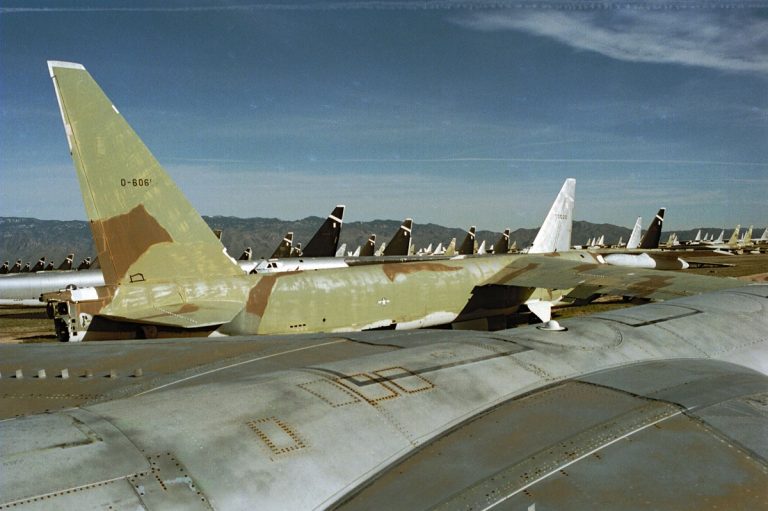
The 1966 Air Force-produced color Film “Desert Bonanza” explains the activities of the 3040th Aircraft Storage Depot. The depot was renamed the Military Aircraft Storage and Disposition Center (MASDC) in 1965. Today you know it by its current moniker- the Aerospace Maintenance and Regeneration Group (AMARG). It may come as a surprise that up until 1965, the United States Navy maintained its own “boneyard” at Naval Air Station (NAS) Litchfield Park (now Phoenix-Goodyear Airport). Before the transfer of NAS Litchfield Park to civil operation in 1968, more than 500 Navy, Marine, and Coast Guard aircraft were ferried to Davis-Monthan for storage as MASDC. Phoenix-Goodyear is still a boneyard, but they park mostly airliners there now.
Official US Air Force Photograph
If you’re an Avgeek you’re probably familiar with what AMARG looks like today. But in the mid-1960s, the place was populated by Douglas A-26 Invaders, A-4 Skyhawks, A-1 Skyraiders, B-66 Destroyers, C-54 and R5D Skymasters, C-47 Skytrains, Boeing C-97 Stratofreighters and KC-97 Stratotankers, B-29 and B-50 Superfortresses, B-47 Stratojets, and B-52 Stratofortresses, Lockheed P-2 Neptunes and EC-121 Warning Stars, Grumman HU-16 Albatrosses, S-2 Trackers, and F9F-8 Cougars, North American T-28 Trojans, F-86 Sabres, and FJ Furies, Convair F-89 Scorpions, Sikorsky H-19 Chickasaws and H-37 Mojaves, McDonnell F-101 Voodoos, Pregnant Guppies…and that’s just what they showed us in the film!
The place was, and in many ways still is, an Avgeek’s paradise. Well, except that so many of them never left MASDC or leave AMARG except as parts for other aircraft…or as ingots.
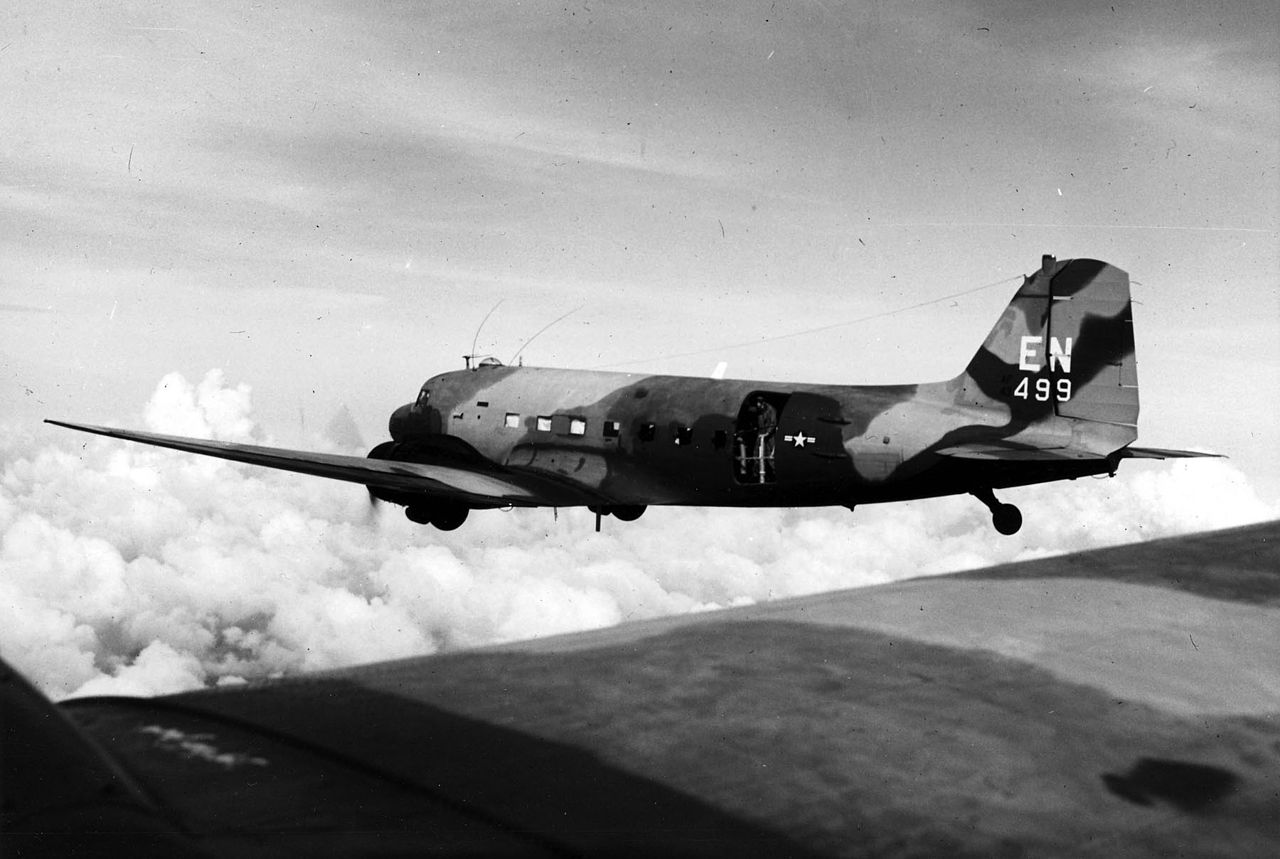
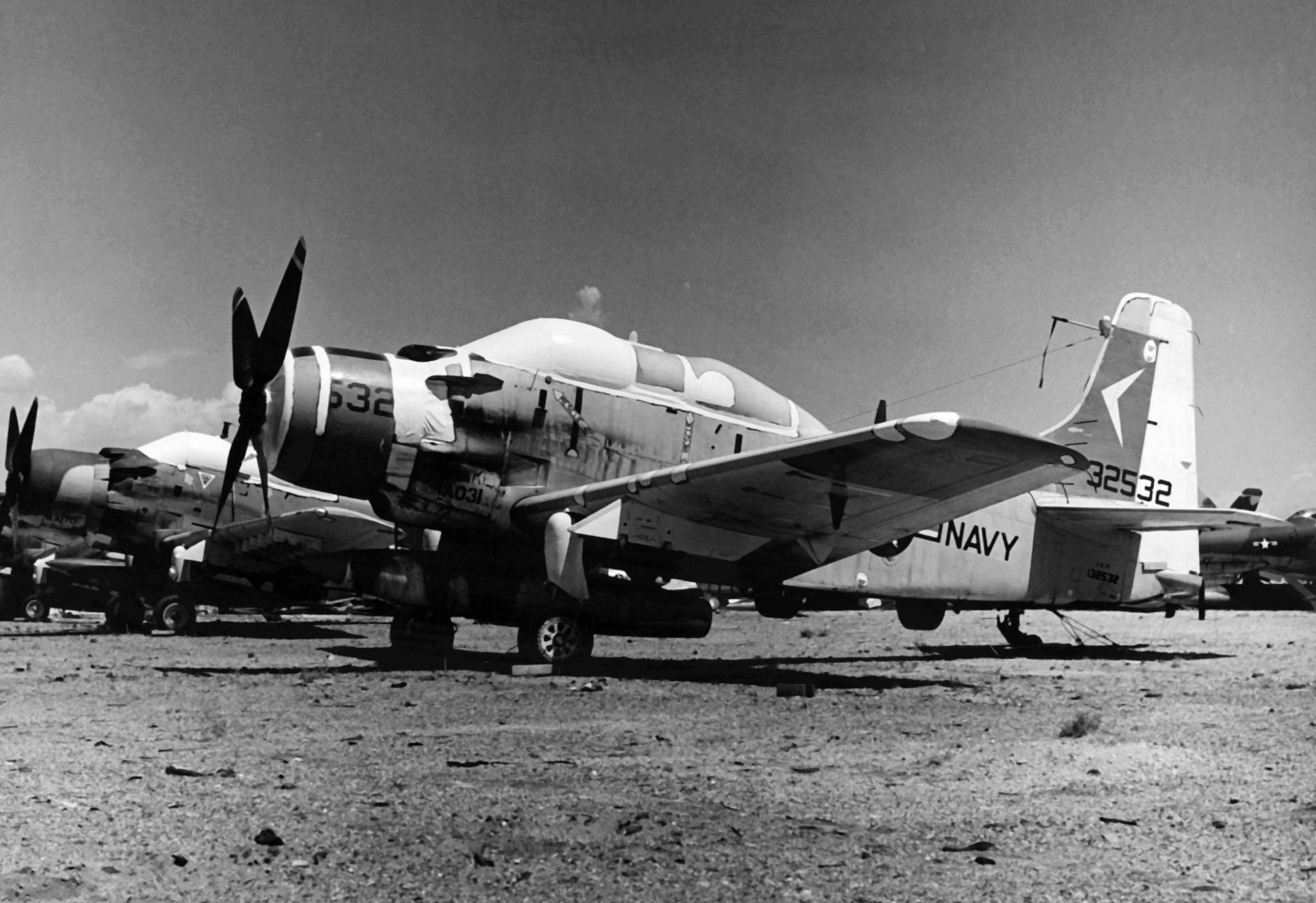
At the time the film was shot there really was quite a bit of ‘regeneration” going on. C-47s were being reborn as AC-47D Spooky gunships. Retired Navy Skyraiders were being fixed up and used by Air Force Special Operations Groups as combat search and rescue (CSAR) escort and close air support (CAS) Spads. Korean War-vintage B-26 Invaders were being rebuilt by On Mark Engineering as A-26A Counter Invader counter insurgency (COIN) attack bombers as well as civilian transports like the Marksman.
Navy A-4As and A-4Bs were being rebuilt to later model configurations or utilized as training aircraft. In fact, the two A-4A Skyhawks in the film (BuNos 139939 and 142145) were both used by Naval Air Reserve Training Units (NARTUs) after they were reclaimed from the boneyard.
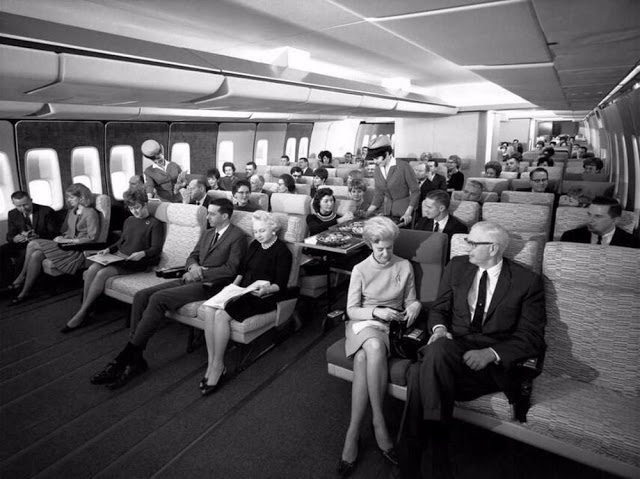
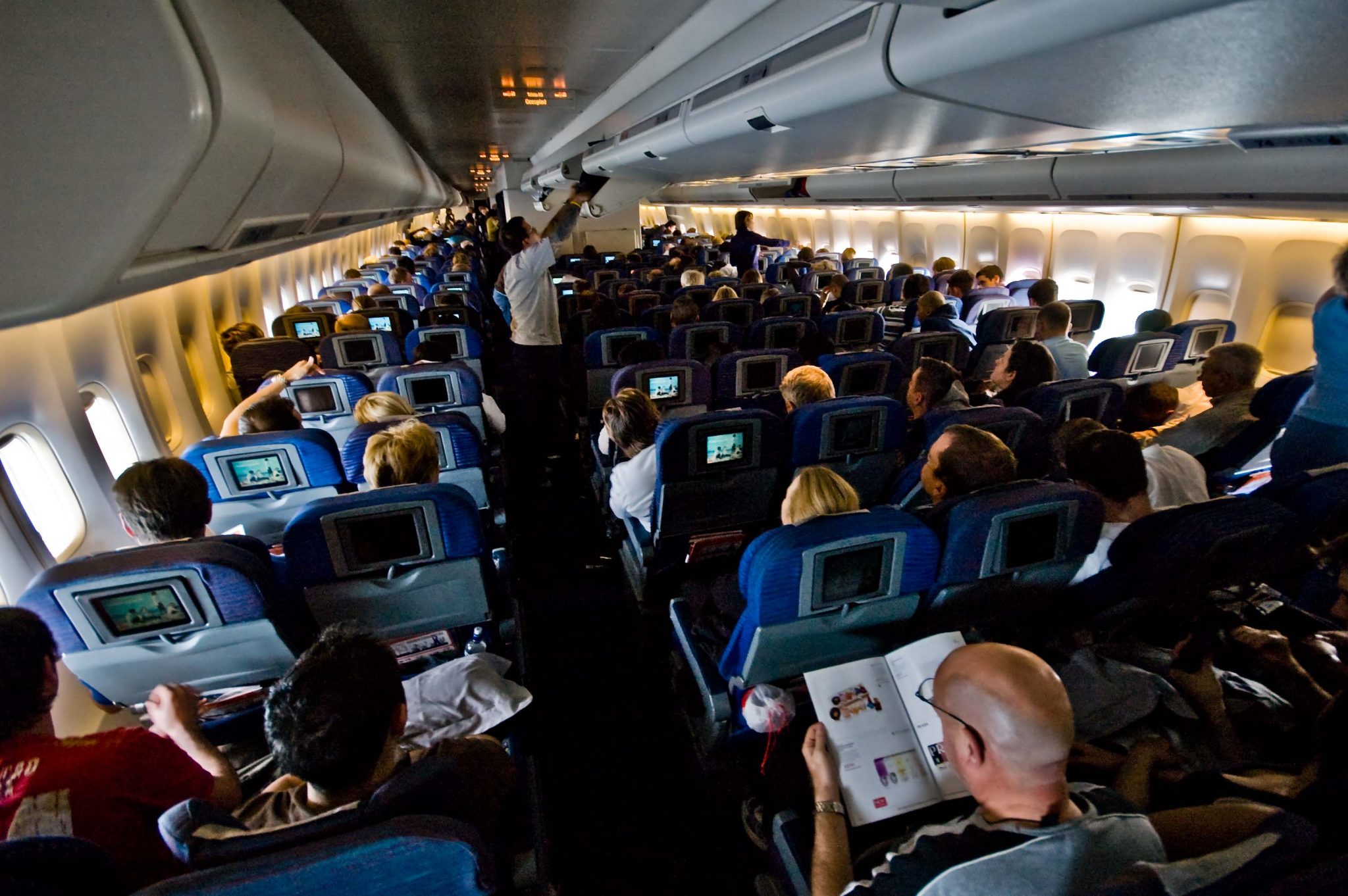
In the genre of travel writing, bashing the airlines has always been a no lose proposition. Mirroring critiques on the decline of civility and a decaying culture in general, the sorry state of air travel makes for an eye catching lede in the Sunday travel section. A vintage photo of cosmopolitan passengers in a spacious cabin being served confit on fine china used in comparison to today’s experience of TSA body cavity searches and knee-chewing seat pitch is de rigeur for this type of exposé.
And they’re not wrong. There is little doubt that flying today has become nasty and brutish, especially when compared to the experience of decades gone by. But the part that these articles invariably leave out is that flying is the way it is today because that’s exactly the way we want it.
You heard me correctly. We, meaning you and I and the rest of the traveling public, are getting exactly what we want and, more importantly, at the price we want it. Let me explain.
In those pictures of yore, it appears as if the entire cabin was traveling in first class luxury. Given the prices that an airline ticket cost in those days, they in effect were traveling first class. Before deregulation, flying on an airliner was something that only society’s elite could engage in with any regularity. No one other than the wealthy would have even considered flying to Chicago for a weekend to see a Bears game and then back to Omaha.
Now, of course, that option is open to nearly anyone. I know this because I regularly sit next to sports fans returning from a game somewhere. I always root for the away team because the only thing worse than sitting next to a drunk fan is sitting next to one whose team has just lost.
In order to understand where the industry is today, a brief history of the airline business since airline deregulation may be helpful.
Source: Wikipedia
Flying Used To Be So Dang Expensive
Air travel in the US was deregulated back in 1978 with Jimmy Carter’s signing of the Airline Deregulation Act. Since that time there has been a precipitous drop in air fares accompanied by an explosion in the number of passengers carried. The industry was democratized.
There have also been dozens of airline startups, bankruptcies, mergers, reorganizations, and failures. For a time, economists doubted whether it was possible for the airline industry to ever stabilize. This is because the economics of an airline seat resemble that of over ripe bananas or stale bread at the supermarket.
An airline seat, like day old bread, is what economists call a perishable commodity. That is, its value diminishes as it sits unsold. This is why supermarkets heavily discount their old bread. It is better to get some revenue from the bread than to have to throw it out. They might even sell it below cost as that revenue is better than zero revenue from thrown away bread.
An airline seat is the ultimate perishable commodity as its revenue value drops to zero the second the airplane leaves the gate. The marginal cost of producing these seats is next to zero, so airlines have every incentive to discount their unsold seats. This had the effect of creating price wars between airlines to clear their extra inventory. It also left the industry billions of dollars in debt.
Enter the Low Cost Carrier
In the wake of deregulation, the market was flooded with low cost carriers who could cherry pick the most price sensitive customers from the traditional legacy airlines. With their low costs, they could remain profitable while undercutting the legacies. Airlines like Southwest, People’s Express, PSA, and America West made up the new vanguard of the low cost carriers (LCCs).
The legacy airlines found that they were unable to compete on price even though they continued to offer full service such as meals and assigned seats to their customers. They then attempted a competitive response by starting their own low cost subsidiaries such as United’s Ted, Delta’s Song, and Continental Lite though these efforts bore little fruit and were eventually abandoned.
Part of the problem was that the legacy airlines were hamstrung by their relatively generous union contracts. They could never get their costs down to the level of the LCCs. Their answer to this puzzle was to exploit a hole in their union contracts allowing the outsourcing of airplanes with less than 100 seats.
Photo by: Curimedia
The Regional Response
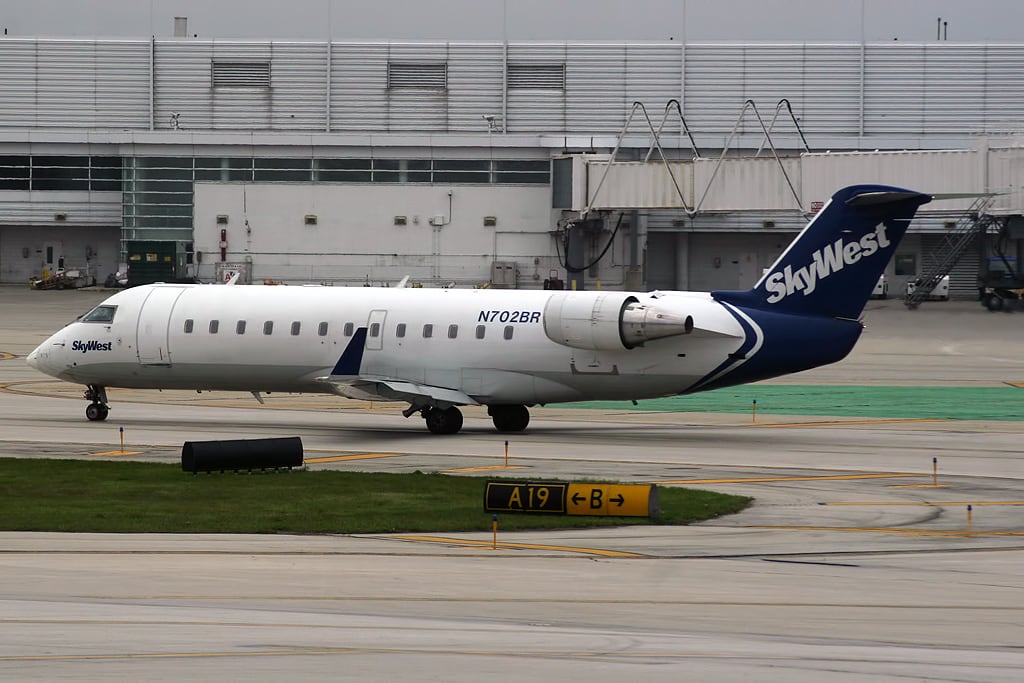
The establishment of regional airlines predated deregulation, but as the legacy airlines looked for a way to compete with the LCCs, this model was expanded dramatically. Regional airlines, flying under the brand and colors of their mainline partners, utilized new fast and long range jets to offer service to many smaller and midsize cities that their mainline partners then abandoned.
As they were separate corporate entities, regionals were not restricted by the union work rules and pay rates that covered the legacy airlines. Annual pay for regional jet pilots for example was routinely under $20k, but in the wake of 9/11, the choice was to take that pay or leave the industry. Regional airline flying eventually came to dominate domestic airline flying eventually accounting for well over half of all US departures.
Industry Consolidation and the Big Four
As the 2000s came to a close, a wave of long sought after mergers among the legacy airlines left only three: United, Delta, and American. All three had declared bankruptcy in the wake of 9/11 and had drastically reduced their costs. Joined by Southwest, whose costs slowly crept up to match the slimmed down legacy airlines, the new “Big Four” now controlled over 80% of US domestic airline flying.
With only four large airlines left standing, there has been some measure of stability introduced. By engaging in “capacity discipline”, the big four have voluntarily restricted their growth thereby allowing fares to rise and, for the first time since deregulation, to become consistently profitable. Low fuel prices have also helped the big four to return sizable results to shareholders.
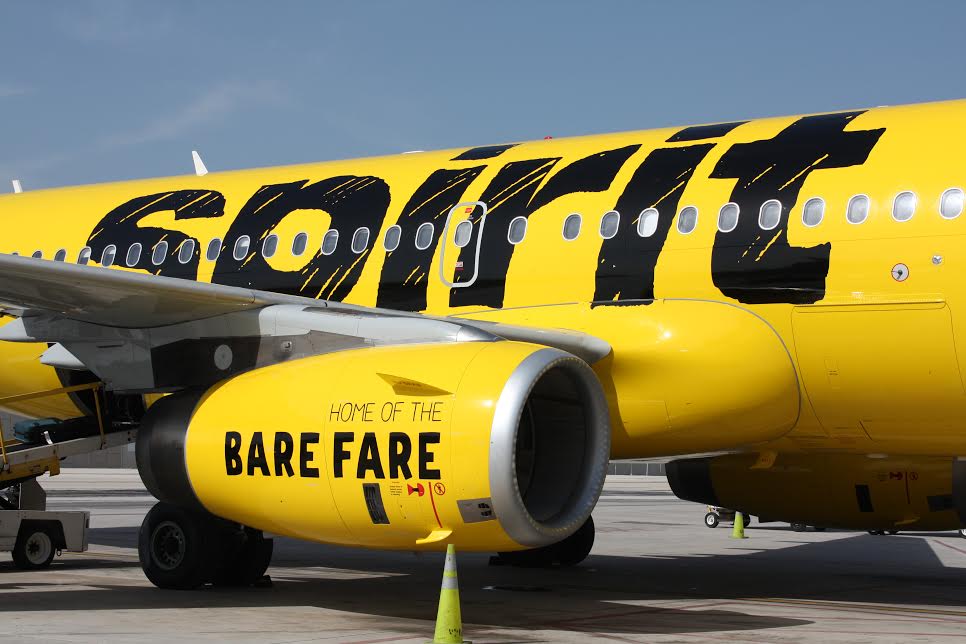
Spirit Airlines
Internet Pricing and the Ultra Low Cost Carriers
This would end our story except for the introduction of new ultra low cost carriers (ULCCs) and the quest to get to the top of the search engine price stack. As it turns out, the one thing that airline marketers have learned over the years is that the only reliable way to sell airline tickets is through pricing. This was the reason for the creation of the original band of LCCs, the regional airline response, and now the ultra low cost carriers.
This new model for air transportation embodied in carriers like Frontier, Allegiant, and Spirit, is to take the no frills LCC model to an extreme. These airlines have “unbundled” and added a price tag, to every possible service item to include assigned seats, overhead bin space, and even speaking with an agent. Their basic stripped down fare, which almost no one pays, then gets listed at the top of an internet fare search.
Spirit is universally reviled as having one of the least pleasant airline experiences possible. Their seat pitch is a knee capping 28 inches while their 73% on time arrival rate and second highest number of complaints for 2016 (beating out Frontier) puts them at or near the bottom of airline rankings.
But there is one thing about Spirit that you may not know. They are growing. Fast. For the past several years Spirit has returned margins of at least 15% while increasing capacity 15% to 20% annually. Their low rankings and poor customer treatment don’t seem to affect the popularity of this airline with the flying public.
Giving the Customer What they Want
These ULCCs are growing so fast that they now have the attention of the big four. This time, though, the legacies aren’t waiting to see how the story ends. Knowing that the airline at the top of the internet search is the airline that gets the sale, three of the big four airlines have introduced a new product to compete with the low price competition. Enter “basic economy” class or what some might call “economy minus”.
All three airlines are calling their product Basic Economy, and they have features such as non-changeable and non-refundable fares along with other restrictions. American airlines recently came under fire in the travel press for announcing that they will reduce the pitch on their new 737s from 31 to 29 inches, but only for some rows, not the whole airplane.
It is easy to see what is happening here. These airlines are carving out sections of their existing airplanes for the basic economy product, but the real contest is on the internet in the fight to get to the top of the price rankings where sales are made. Southwest, one of the original LCCs, is sticking to its guns believing that free bag checking and customer service will carry the day. Time will tell, but if it works for them, they’ll be the unicorn in an industry where pricing has always been king.
In Conclusion
Airlines have learned the hard way, taught by their customers, that while everyone says they love roomy cabins and inflight meals, no one wants to pay for them. Those few who do can still get those things by flying first or business class.
This “revealed preference” for the lowest fares has driven the industry to provide their customers exactly what, through their purchasing behavior, they say they want. We have indeed met the enemy–and he is us.
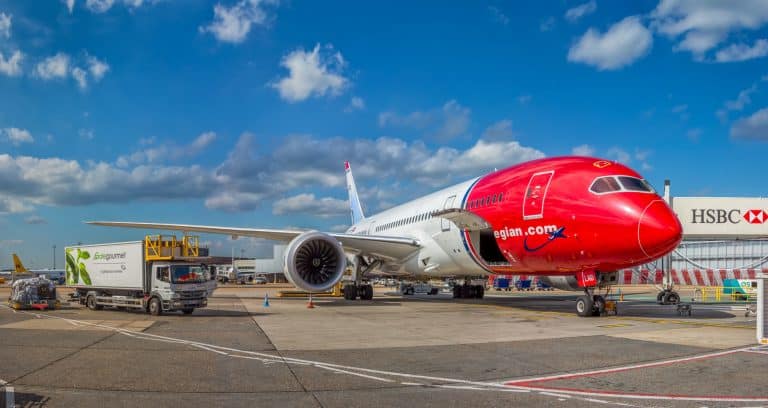
The Skytrax World’s Best Low-Cost Long-Haul Airline, Norwegian is celebrating its third year of long-haul flights from London Gatwick, at the same time that it takes its spot as the second-largest long-haul airline at the airport, with 13 direct such routes.
So, starting in 2018, travelers from the United Kingdom and United States will have a new option for international travel, as flights take off for O’Hare and Austin. Fares for both routes are on sale now. The London to Chicago route will offer four flights per week, starting at just over $230 one-way. The London to Austin route will offer three flights per week, and are a little more expensive, at just over $300 one-way.
Norwegian is just one of the low-cost European carriers showing high profitability catering to travelers in the United States. Gatwick’s CEO, Stewart Wingate, noted “These new flights are yet more proof that the low-cost long-haul revolution is here to stay, as Norwegian and Gatwick’s long-haul networks reach into all four corners of the globe.”
For Gatwick, there are now 62 long-haul routes at the airport, giving it more than any other single-runway airport in the entire world, and ranking its network fifth out of all the airports in Europe.
Norwegian also announced new routes between Paris and Boston and Paris and Oakland, and also increased service on their Paris routes to New York and Los Angeles.
As far as low-cost, European airlines go, Norwegian has been rising above some of its ultra-low cost competitors. It operates many new 787-8 Dreamliners on long-haul flights (including on these new routes), and in-flight entertainment is free. Food isn’t included and seat pitch is relatively meager though. They do offer a more premium ride if you are willing to pay. The Premium fare isn’t even that much more expensive, if you’re willing to pay, and comes with complimentary meal services and other little odds and ends that you’re forced to pay for, in the cheap seats.
Military aircraft utilize low-level training areas around the world. However, if you’re looking at a picture or watching a video of a United States Navy, Marine Corps, or Air Force aircraft flying not over but between terrain, such as a canyon, valley, hill, or mountain, chances are the image was captured in one of two well-documented and publically accessible places.
The first, located in Wales in the UK and known as the Machynlleth Loop or Mach Loop, is a low-level training area used by Royal Air Force (RAF) and NATO partners, including the United States, to practice nap-of-the-earth flight or terrain masking in everything from fighters and attack aircraft to airlifters and helicopters. The Welsh countryside captured in the background of these images starkly contrasts with the other well-documented low-level training area.
Seemingly light years away but really only half a world apart from the Mach Loop is Rainbow Canyon. Situated close to the western boundary of Death Valley National Park in California, the area is better known as Star Wars Canyon. Cut from the Santa Rosa Hills by lava from volcanic activity millions of years ago, the geology of the area strongly resembles that of the home planet of Star Wars characters Luke and Anakin Skywalker- Tatooine.
The particular terrain feature, the canyon connecting the Owens and Panamint Valleys, at the end of the Sidewinder low level route is also referred to as the “Jedi Transition”. In use as a low-level training area since World War II and part of the R-2508 Training Complex, the area is restricted for use by military aircraft only and is administered today by Edwards Air Force Base (AFB).
What makes Star Wars Canyon a stellar (or inter-stellar?) place to observe, photograph, and shoot video of tactical jets is proximity. Frequently the jets are traveling through the canyon well below Father Crowley Overlook, the favorite publically accessible observation point. Aircrews utilizing the valley to sharpen their terrain masking skills often come from the bases in the area, such as Nellis and Edwards AFBs, Naval Air Stations (NASs) Lemoore and North Island, Naval Air Weapons Station (NAWS) China Lake, Marine Corps Air Stations (MCASs) Miramar and Yuma, and Fresno Air National Guard Base (ANGB). Squadrons based elsewhere and passing through the Naval Strike and Air Warfare Center (NSAWC) at NAS Fallon also frequent Star Wars Canyon as do allied air forces training alongside the USAF at Nellis.
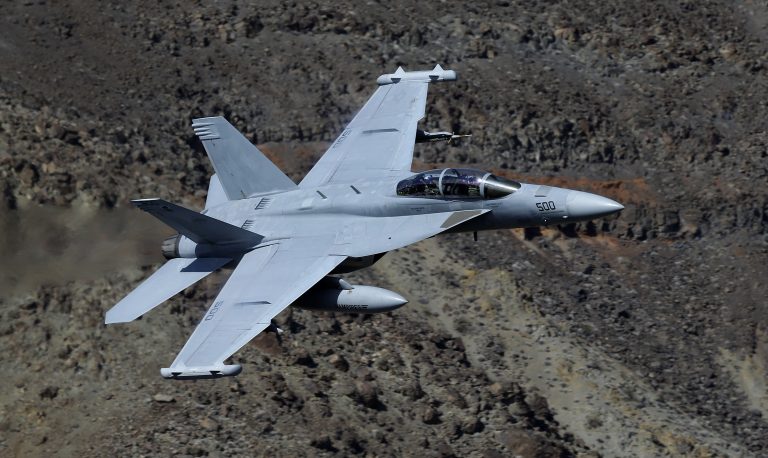
Featured in these HD videos are such tactical jets as Boeing E/A-18G Growlers from VX-9 Vampires, Boeing F/A-18E and F/A-18F Super Hornets from VFA-25 Fist of the Fleet, VFA-14 Tophatters, VFA-86 Sidewinders, VFA-97 Warhawks, VFA-22 Fighting Redcocks, VFA-136 Knighthawks, VFA-151 Vigilantes, VFA-2 Bounty Hunters, VFA-143 Pukin’ Dogs, VFA-154 Black Knights, VFA-122 Flying Eagles, VFA-146 Blue Diamonds, and VX-9 Vampires. DRAKEN International McDonnell Douglas A-4K Skyhawks, USAF F-15C Eagles from 114th FW California ANG, T-38C Talons from Edwards AFB, and F-16Cs from Hill AFB and the South Carolina ANG are also captured flying low and fast. French Air Force Fouga CM.170 Magister trainers are an unexpected bonus. There is even footage of a Boeing C-17 Globemaster III from McChord AFB transiting the canyon, although not as low or fast as the others. Turn those speakers UP. Thanks to ManteganiPhotos for posting these awesome videos complete with radio calls!
General Dynamics Was Hawking the Fighting Falcon All Over The World in 1977.
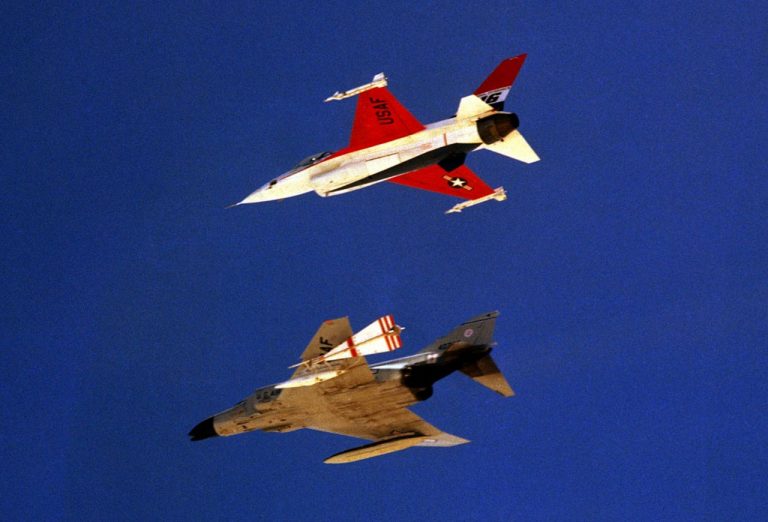
The 1977 General Dynamics Marketing Film “The Dynamic Sixteen – The Multinational Fighter” is a great look at the GD’s F-16 Fighting Falcon and how it compared to the primary Air Force fighter of the day, the McDonnell Douglas F-4 Phantom II. The film was obviously created to be used as a backdrop for sales displays and discussions about the F-16 and its attributes. F-16 sales to foreign nations have accounted for just under half of the nearly 4,600 F-16s produced to date. Belgium, Denmark, the Netherlands, and Norway were the countries who partnered with GD to develop the F-16 and hundreds of them have been flown by their air forces since the F-16 went into operation in 1978.
YF-16 image via national museum of the us air force
In addition to Belgium, Denmark, the Netherlands, and Norway, other foreign air forces to operate the F-16 include Bahrain, Chile, Denmark, Egypt, Greece, Israel, Indonesia, Iraq, Italy, Jordan, Morocco, Oman, Pakistan, Poland, Portugal, Taiwan, South Korea, Romania, Singapore, Thailand, Turkey, United Arab Emirates, and Venezuela.
Update: Since we published this piece the film ‘Dynamic Sixteen” disappeared from the interweb. We hope you enjoy this stand-in titled “The Hot Performer.”
When compared to the fighter/interceptor aircraft most commonly used by many of the export customers for the F-16 at the time such as the Lockheed F-104 Starfighter, the North American F-100 Super Sabre, the F-4 Phantom II, and various Mikoyan-Gurevich MiGs, the Fighting Falcon was judged by many to be a superior aircraft in any number of ways. The majority of countries who became F-16 operators still fly the diminutive jets to this day.
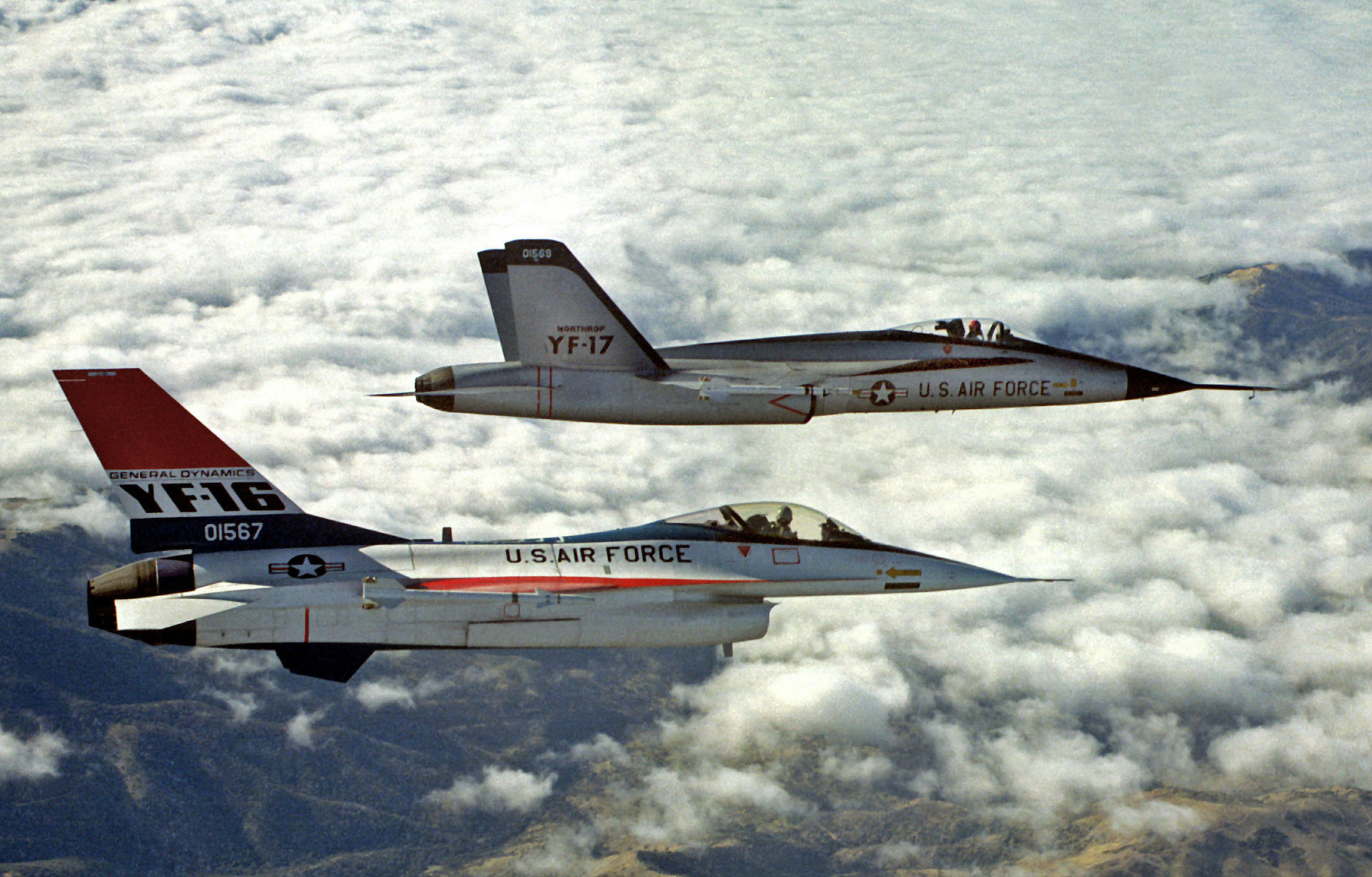
The YF-16 and YF-17 together in flight. Official US Air Force Photograph
With Boeing completing its first 737 MAX delivery in May, and major airlines like Southwest and Norwegian (no comment) are receiving their aircraft soon, the hype is building for the new MAX series. Boeing recently flew a very sporty Paris Air Show profile in the jet too. A few avgeeks have recently asked us, “how can you spot the differences between this new aircraft and its predecessor?” Here are 5 ways to recognize so that you will sound like a pro the next time (or the first time) you see a new Boeing 737 MAX airplane at your local airport:
1. Larger Engines
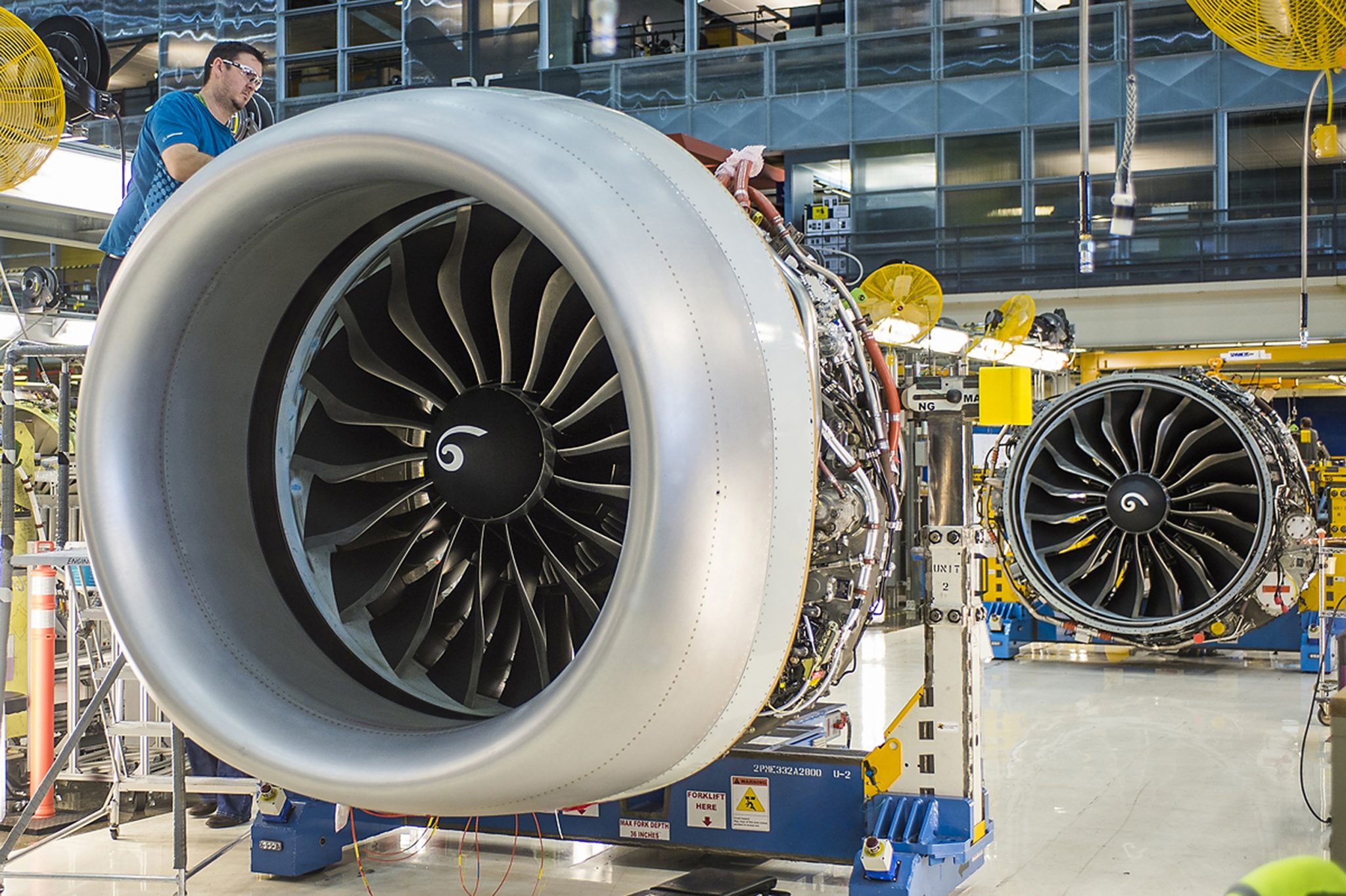
737 MAX LEAP-1B Engine Build Up Renton Factory. Photo: Safran
737-900. As an avgeek, you should notice that the engine is much larger than even the 737 engines on the Next-Gen jets. The titanium and composite blades themselves are also curved to optimize the efficiency.
2. AT Winglets
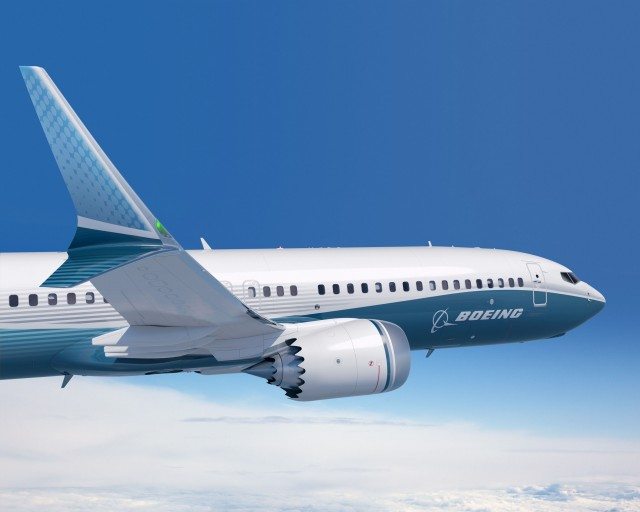
Photo: Boeing
These winglets are a brand-new design, specifically created for the 737 MAX and “the most efficient ever designed for a production airplane.” Boeing says this feature reduces fuel consumption by nearly 2 percent, cutting down on drag while also providing more lift. It’s funny how MD-11 style technology has made its way onto Boeing products.
3. Serrated Engine Cowlings
Photo: Boeing
While most of the 737 MAX differences when compared to the 737 are all about efficiency, this little change is not. The serrated engine cowlings are intended to reduce noise, which is great for passengers, many of whom can attest to the high volume levels on the 737. In fact, the MAX should have a 40-percent smaller noise footprint during takeoff and landing at airports.
4. New APU Placement
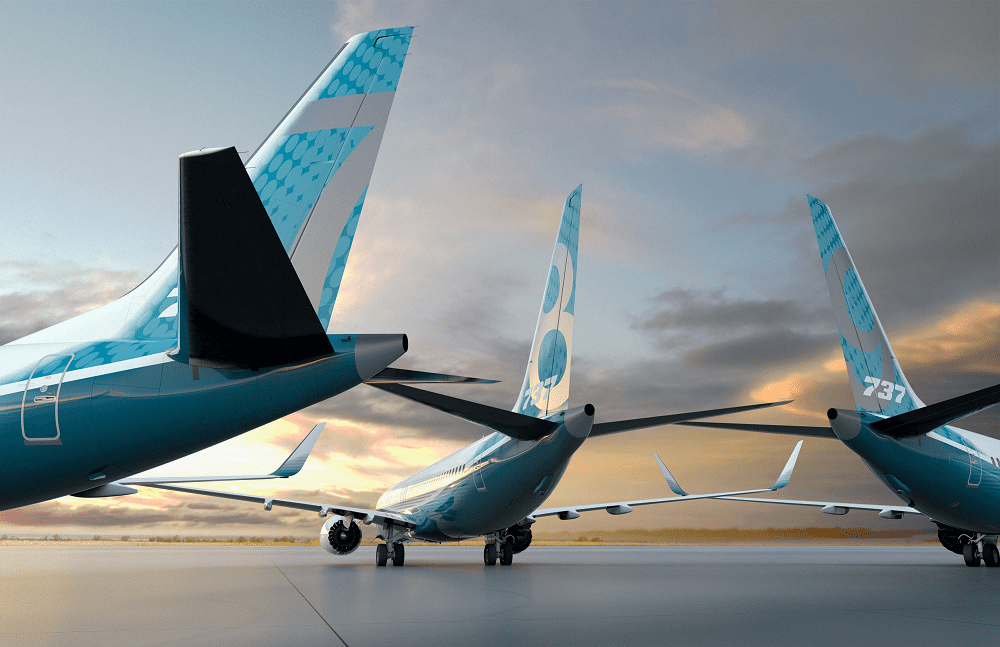
Photo: Boeing
New APU placement includes a revised APU inlet and exhaust, which adds to the aircraft’s aerodynamic improvements. This is just one of the many small, perhaps less noticeable changes Boeing’s been making to reduce fuel costs overall. The new APU makes the baby Boeing’s tail look more similar to an A320 tail. Additionally, in the cockpit, pilots will no longer fine the EGT gauge or the blue MAINT light on the APU overhead panel.
5. Taller Landing Gear
With the most recent variants of the 737 MAX boasting a longer body overall, taller main landing gear and a modified design are needed to provide clearance for the back end of the plane during both takeoff and landing. In other words, without bigger, better landing gear, your plane’s going to be scraping the runway.
Airlines love to unveil special liveries to promote everything from tourism to cartoon characters. Unfortunately, some of these um…unique designs are a little hard on the eyes. Check out these 10, that may just be more cringe-worthy than the rest.
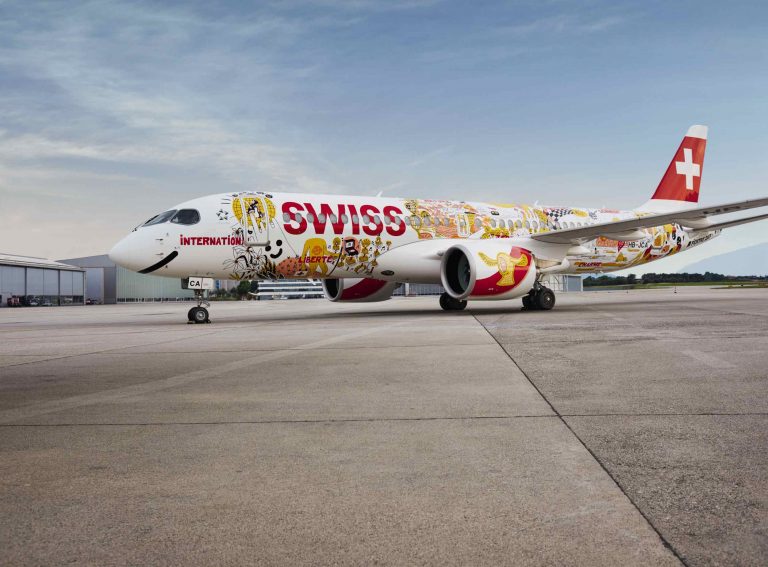
Swiss outfitted its brand-new Bombardier Series CS300 in a special livery intended to celebrate Swiss Romandy (aka, western Switzerland). But really it just leaves us scratching our heads and asking why would you ruin a beautiful brand new CS300 with such a horrible paint scheme? The livery will stick around for a year, but some are already wishing it would go away sooner.
9. ANA Pokemon
Photo: Ken Fielding/http://www.flickr.com/photos/kenfielding
Asian airlines offer some great luxury services, but they do come up with some particularly bad liveries. Take, for example, the All Nippon Airways Pokemon planes. This is one trend they’ve really worn out, with nine different Pokemon jets since 1998. The livery belongs in a day care, not an international airport.
8. Southwest Shamu Livery
Photo: Southwest Airlines
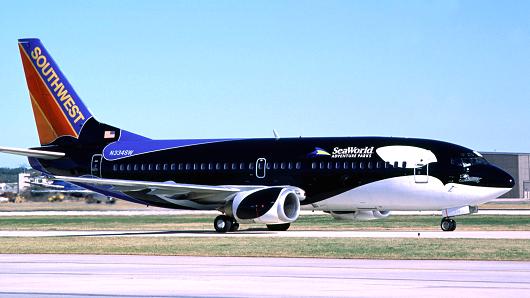
Southwest’s very first non-tactful livery debuted in 1988, as a giant killer whale, thanks to a partnership with Sea World of Texas. The airline would go on to introduce the Shamu Two and Shamu Three, with eventually five Shamu aircraft. After watching the movie Blackfish, it’s always a little awkward to see this livery. Fortunately, for the animal lovers on the site, the airline severed ties with Sea World and ditched the livery in 2014.
7. Singapore Megatop 747
Photo: Wikimedia Commons
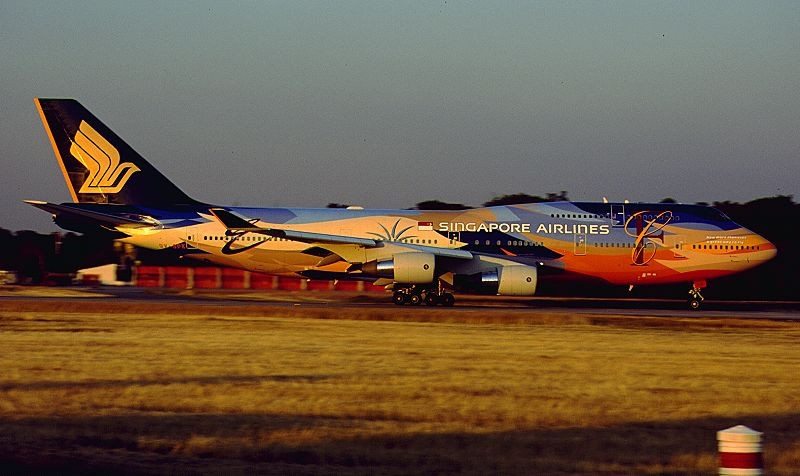
This Singapore Airlines Megatop 747 was involved in the first fatal crash for the airline, with 83 deaths after the crew took off on a closed runway during a typhoon. The paint scheme wasn’t very attractive. Singapore Airlines hasn’t painted an aircraft in a special scheme since.
6. Peter Max Continental 777
Photo: Wikimedia Commons
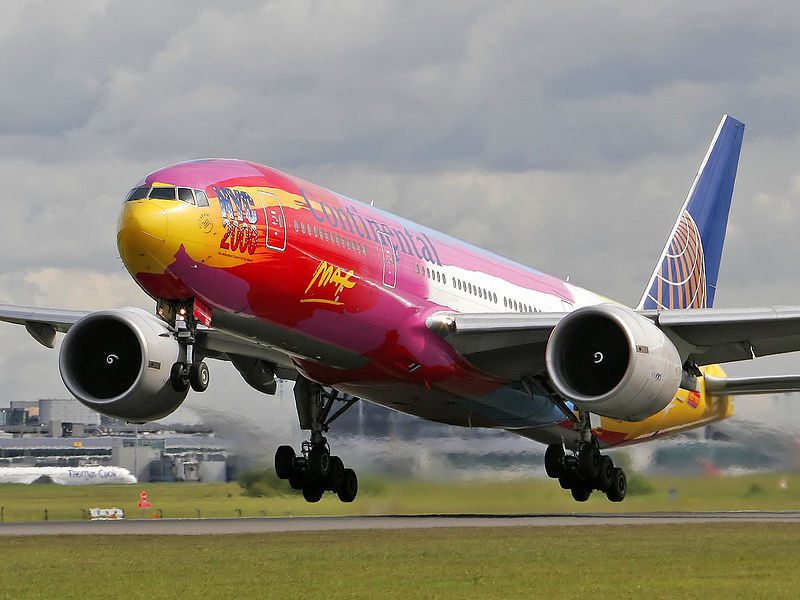
Continental Airlines commissioned artist Peter Max to decorate the “$160 million living canvas.” The result? A bright red, pink and yellow super jet declared the NYC Millennium plane, and a downright crime in color. The plane proved pretty popular though. So popular in fact that avgeeks created threads on forums to track where Peter Max was headed and posted photos.
Just like All Nippon Airways, EVA Air has a thing for cartoons. Instead of Pokemon gracing the fuselage, they have Hello Kitty, not only adorning the entire livery, but also the interior as well. There are currently six different Sanrio-themed aircraft in the airline’s fleet. The intro video is torture too. Gag me!
4. Hainan Airlines Kung-Fu Panda Boeing 787-9 Dreamliner
Photo: Hainan Airlines
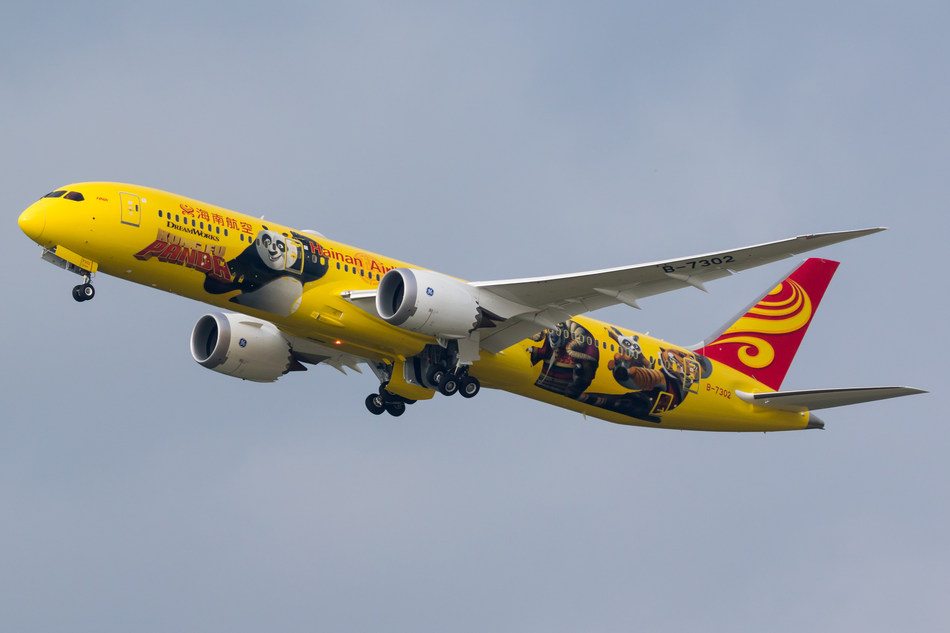
Hainan Airlines isn’t missing out on the cartoon livery party. They just unveiled their third Kung-Fu Panda-themed plane in May. The Boeing 787-9 Dreamliners are difficult to miss, with bright colors and a chubby bear on each one.
3. Air New Zealand Boeing 777
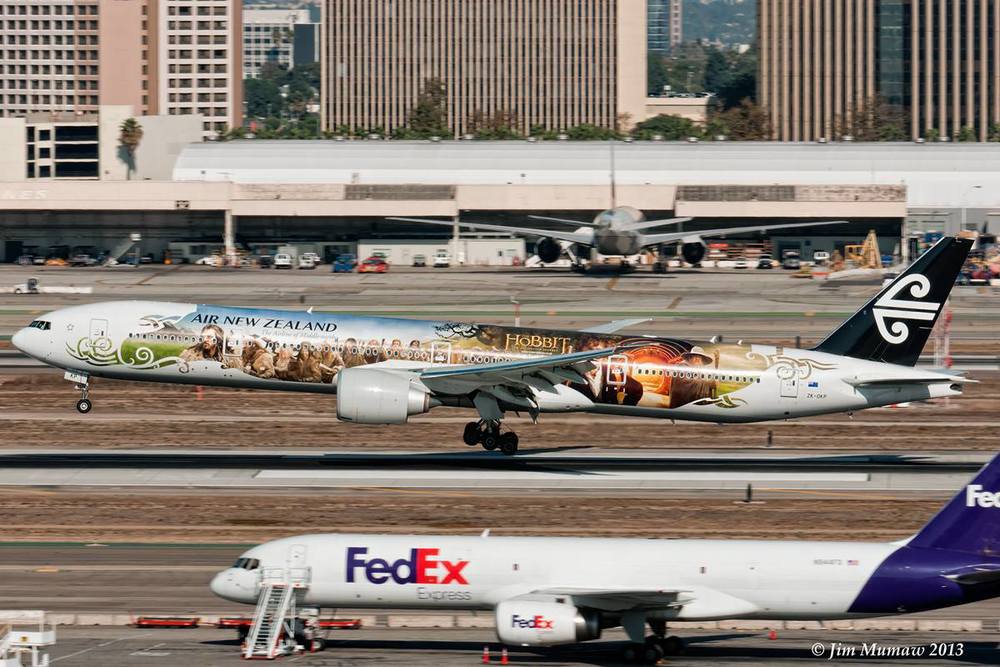
We all know New Zealand is home to Lord of the Rings and The Hobbit, but that doesn’t mean the country’s airline needs to take the faces of what looks like the entire main cast around the world with them.
2. Austrian Airlines
Photo: Austrian Airlines
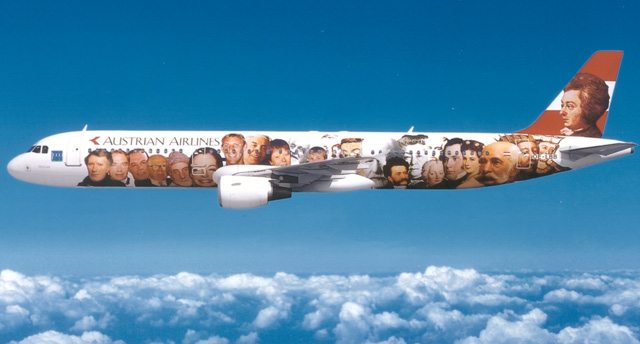
Another airline that dabbled in painting portraits of people on their fuselage liveries was Austrian Airlines, but they didn’t stick to a movie cast. Instead, they went for many of the country’s “famous” past and present residents, with a huge Mozart head on the tail. It’s not the worst paint scheme ever…maybe just the second worst!
1. Southwest Sports Illustrated Livery
Photo: Southwest Airlines
Southwest took some heat for this livery, featuring a scantily-clad Sports Illustrated model on the fuselage of a Boeing 737, as part of a promo deal with the magazine. Passengers complained women wouldn’t appreciate their husbands seeing the imagery, saying the move was “trashy.” The livery didn’t last long. Don Draper, Southwest’s advertising executive at the time, was removed from the account.
Do you have other terrible liveries that you love to hate? Post them in the comments below or on our Facebook page.