Skilled pilots struggle to land at notoriously challenging airport.
It’s not uncommon to watch sketchy landings at Madeira airport by large airliners. We at Avgeekery have shared video of previous landings that looked more like controlled crashes than established final approaches.
The challenging runway isn’t because of its length. The runway is actually 9,100 feet long–a fairly respectable length for modern airport. The real challenge is the location of the runway. Nestled against rising terrain, swirling winds near the field are common. When you add a storm system like what occurred on December 17th and you get incredibly challenging conditions. So challenging in fact that airline pilots with thousands of hours are forced to go around, not once, not twice, but thrice. They eventually landed safely after the fourth attempt. No one was injured and no damage occurred. It is rumored though that they had to replace the copilot’s seat cushion. 🙂
The MiG-17 conducts flyover just 30 feet above the ground.
The MiG-17 was engineered and produced by Mikoyan-Gurevich to replace the MiG-15. The first MiG-17 prototype took flight in January of 1950 and later entered production in 1951. During the MiG-17 service, there were five iterations of the aircraft produced, including the MiG-17PF #620 flown in the video. Throughout the MiG-17’s 64-year history, the aircraft has seen service in over 20 different countries and remains in active service in three countries. MiG-17 was designed to withstand up to 8 G-Forces and can reach a max speed of 715 MPH. The aircraft is powered by a single jet engine (with afterburner) providing over 7,000 lbs. of thrust.
The MiG-17PF on display during Thunder Over Michigan 2016 is owned and operated by Fighter Jets Inc. and was piloted by Randy Ball. “Randy Ball’s MiG-17F spent almost four years in restoration, and is one of only a handful of vintage jets flying the North American air show circuit.” (Fighterjets.com)
Friendly competition heating up between pilot training bases over “drop-night” videos. The real winner in this competition is our nation with well-trained men and women.
Last week, we posted a video of Vance’s Class 17-03 Drop night video. The response was super positive and rightfully so. Even our commentary about the need for more of these videos was well received. The bottom line is that people love impressive videos on selfless pilots-in-training who are learning amazing things. On that note, we were recently contacted by Columbus AFB’s Class 17-03. They wanted to share their video too. The video itself is pretty amazing. Even more awesome is their story of building lifelong bonds of friendship through the training. Bonds that will be tested in combat situations.
Specialized Undergraduate Pilot Training (SUPT) is one of the most difficult technical education programs in the military. It is an incredible endeavor to take a group of pedestrians and turn them into professional military aviators, one that is undertaken not only by Instructor Pilots and students, but also by maintainers, force support staff, police, family, and friends. In short, it takes a village.
During training, students participate in hundreds of hours of academics, simulator rides, and standup sessions, not to mention the flying. They must master aerobatic, instrument, and formation flight as they form the foundational skills on which they will build their careers. This, of course, is an incredible challenge and students must also navigate the ups and downs of successes and failures along the way.
Cooperate to graduate
This 54-week undertaking would be nearly impossible to face alone. It is the class structure that makes success possible. Students rely on classmates for studying, working out, mission preparation, and morale. Boosted Morale is the most beneficial aspect of the class structure because it is motivating and improves performance. To this end, Class 17-03 at Columbus AFB used this philosophy to their advantage.
SUPT culminates in a “Drop Night”, a celebration during which the students learn what aircraft they have been assigned to fly for their careers. Class 17-03 had one of the greatest “Drop Nights” in recent memory when almost every student received one of their top choices of aircraft including a CV-22, C-17, AC-130 Gunship, 2 U-28’s, 3 F-16s, 2 A-10’s, a F-15E and a F-35.
This all-American class (a rarity at SUPT as America strives to train partner-nation pilots as well) worked together both during and outside of training and became not just a team but also a group of lifelong friends. It was because of this cohesion that they were able to achieve what they did. Class 17-03 created a video to capture the essence of Pilot Training and the class unity they utilized to succeed.
The video was debuted during their “Drop Night” festivities and now its on the internet for everyone to enjoy.
Keep ’em coming…
At Avgeekery, we are proud to highlight these class-made videos. We’d be happy to share more as they are produced (send them our way via Facebook or avgeekeryblog@gmail.com). More importantly, we hope that those who produce these videos see the power of them. They do more than just excite avgeeks. They showcase the power of our nation and our collective hope for the future.
As the airshow season comes to an end, one of our Avgeekery fans has shared his photos from the traditional final airshow of the season.
Nellis AFB knows how to do a finale. This year’s airshow schedule was pretty impressive with great shows across the US and Europe. Nellis saved the best for last by hosting an outstanding static display, and an excellent demonstration schedule. The schedule consisted of the West Coast Ravens flying their RV aircraft (RV-4, RV-6A, RV-7, and RV-8), C-17 PACAF Demonstration team, Nellis Heritage Parade consisting of a T-6, P-40,P-51, P-63, B-25, PB4Y-2, Mig-15, F-86, T-33, and the QF-4E.
These photos were submitted by our loyal Avgeekery reader, Joseph Fischer. If you have a story or photos that you’d like to share, e-mail us at Avgeekeryblog@gmail.com
The A330-200, A350, A320NEO, and A380 take to the skies in impressive form.
Airbus is one of the largest producers of commercial aircraft to have ever existed. The French company has several aircraft in operation, billions of dollars in revenue, and many different technological advancements to its name in the aviation world. It is no surprise that the four aircraft in this video represent Airbus’s greatest hope for the next 20 years. The A320neo, A350-900, A380, and the A330-200 are a sight to be seen flying in formation so perfectly.
All four aircraft featured have impressive fuel efficiency and advanced technology. Airbus has bet its future on the A350 and the A320NEO. The A380 is impressive but has had a bumpy road. The A330NEO is coming soon. This video represents potentially one of the last formation flights of the A330 “classic”.
A formation flight of any aircraft is never simple. Four large airliners in tight formation is an impressive challenge. This video shows the behind the scenes coordination necessary to launch the impressive show.
A cadet wanted to know what it was like to go faster than the speed of sound. I took him up for a ride.
It was 2002 and I was stationed in Aviano AB, Italy with the 510th Fighter Squadron Buzzards. We flew Block 40 F-16s and occasionally flew young troops, maintenance airmen, or local base award winners on what was called an incentive flight. An incentive flight is a big deal for a non-flyer, as they get to ride in the back seat of the F-16 and experience all of its power and might.
The typical incentive flight is a single ship sortie, in the two-seat “D model, or Family Model” out to the airspace and once there, really anything goes (within the limits and rules of the USAF, airspace, and of course the aircraft). A typical incentive flight allows the back seat first-timer a chance to fly a little, do some loops or rolls, pull some Gs and if possible…to break the sound barrier!
I remember being assigned as incentive pilot one day and I met beforehand with my “rider.” This particular troop was one of our maintenance guys, just 19 or 20 years old and pretty fresh to the scene, as well as the USAF. He had won some big accolade and was rightfully awarded with an incentive flight for his terrific actions.
This kid and I talked beforehand. He was very excited, but a little nervous (as they all are). His one big request, no matter what happened and what we did, was that he wanted to break the sound barrier. He wanted to go over Mach 1.
“No problem” I told him. We had the airspace that was approved for those speeds and the jet configuration for the day would also permit us a “Mach run.”
U.S. Air Force in Europe
The Flight
I don’t recall much about the subsequent flight with this kid in “the trunk” of the F-16, however one part stands out. After we did some rolls and maneuvers, pulled a few Gs and so forth it was time for the Mach run. I told the kid we were setting up for the run and I could tell he was excited. He even asked if he should hold on tight or brace himself for the speed changes…I’ll never forget it.
I turned the jet to the north, somewhere around 15,000 feet and plugged in the “burner.” In the F-16 when you apply afterburner, it wakes you up. It literally feels as if someone has kicked you in the butt and the jet unleashes with a violent thrust that pushes you back in the seat. I called out the speeds as we accelerated. Heads, helmets, and guts getting pushed back in the seat with incredible force. “Point seven, point seven five…get ready.”
At this time the forces began to relax a little. We were still accelerating at a serious rate, but that rate begins to subside a little as you get faster and faster. It starts to feel like the acceleration of your average car getting on the highway. Nothing too incredible.
“Zero point eight… point eight five…” I called out so in case the kid in the back wasn’t sure where to read the speed on the displays, he could still know what our speed was.
“Point nine, point nine five…here we go, get ready!”
The F-16 slipped past the Mach effortlessly. There is no change in tone or pitch, no violent shockwave or concussion. Nothing really noteworthy actually. It’s quite anticlimactic, and the speeds become just numbers on the displays.
“There it is, Mach 1!” I said as I continued my count upward as we accelerated further. “One point one…one point two. What do you think back there” I asked?
What he said next I’ll never forget.
“That’s it?”
Yes my friend… that is it.
It’s pretty special to go over the Mach, not many folks on this earth can say they’ve done it. But in all reality, in a plane like the F-16 (or any fighter for that matter) where they are built for speed and performance, going the speed of sound is really nothing too noteworthy. It’s so easy.
In fact, sometimes during the course of aggressive training maneuvers and such, during typical operations we sometimes exceed the speed of sound unintentionally. It’s just so effortless.
But looking around outside, at typical altitudes, there really isn’t much sensation of speed. Sadly, Mach one is just a number on the dial.
Slowing Down
What is also quite impressive to me is slowing down the F-16 from above the Mach. The F-16 normally (depending on configuration, weight, and altitude) likes to fly around 400-500 knots at full “military” power. Going supersonic typically requires the afterburner and speeds are well over 700 knots. When you decide to terminate the run and reduce power from afterburner to military, and interesting phenomenon occurs. Well obviously…you slow down.
But at those speeds it hits you like a brick wall. When you terminate the afterburner you are thrown forward against your straps, and held there for quite some time. It’s not like slowing your car from 60 mph to zero. It’s much harder, more aggressive, and you are held forward in the straps for over 20-30 seconds. It’s a very weird sensation to be decelerating for such a long time. You almost begin to think something is wrong with the aircraft as you decelerate over such a long time, and with such continuous force.
Post Flight
After the flight, I could see that the maintenance kid was pretty excited about the flight. He was jubilant and had a big smile on his face, and he didn’t even throw up either! I think he was a little let down by the Mach run, but in the end he enjoyed the experience.
As we climbed out of the jet he was greeted by some of his buddies from the squadron.
“We pulled 9 Gs and even broke the sound barrier” he said to them.
“How fast?” they asked.
“I think we got up to Mach 1.3” he reported, clearly with a glint in his eye, knowing that despite the ease at which we slipped past the sound barrier in our trusty steed, he just became part of an elite club of folks who can say they have gone the speed of sound.
I think, in the end, he was pretty excited after all.
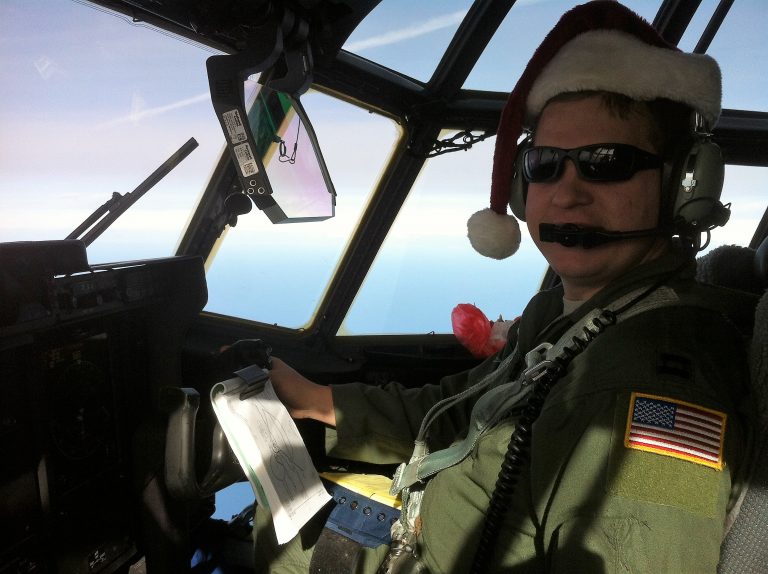
We launched as a two-ship formation of C-130Js, taking off into the night well after the darkness had fallen. Maintaining an altitude of 500 feet above the desert terrain, we continuously updated our position to remain clear of Egyptian airspace and the Jordanian buffer region.
Our aircraft dusted off the sand dunes in the lower Sinai region as we slowed down, descended, and airdropped supplies to our Israeli partners on the ground. Then came our approach to the Dead Sea.
In 2013 we were invited to fly the mighty C-130J Hercules in Israel for an allied training mission with the Israeli Air Force. I was part of the 37th Airlift Squadron, Blue Tail Flies.
Our mission was to fly side-by-side with the Israelis to build our partnership capacity. Daily, we launched two C-130J formations flying low altitude tactical airdrop & airland missions during the day and at night using night vision goggles.
Landing below sea level
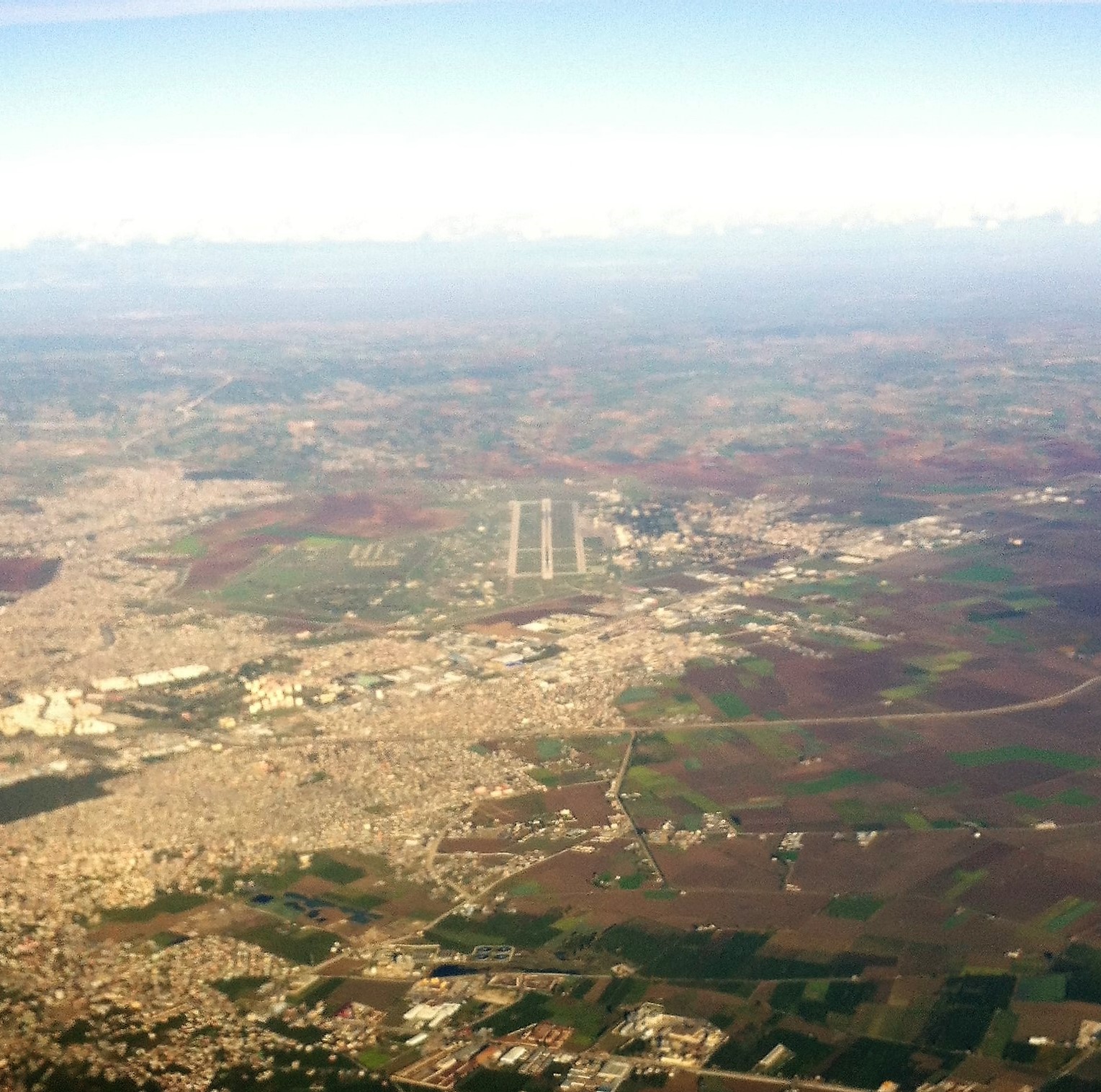
Located on the Western shores of the Dead Sea in Israel. Field elevation is -1,240 feet below sea level making it the lowest elevation airport on earth. The field name is Bar Yehuda (ICAO: LLMZ), the field plays host to charter/sightseeing flights & military operations.
The strip is paved asphalt on a direction of 01/19 and it is 3,937 feet long and just over 60 feet wide. To put this in perspective most large aircraft use runways 7,000 to 10,000 feet long at airports. The C-130J can land and stop in less than 3,000 feet using full reverse and max effort braking as required.
Getting there can be more than half the fun
My first sortie to the Dead Sea was at night. We flew our predetermined course from the West climbing with the rising terrain to the descent point 3,000 MSL approximately 4,200 feet above field elevation. Cresting the cliffs that surrounded the Sea we descended to 0000 MSL on the altimeter, slowed and configured the aircraft for landing.
We intercepted the final approach course of 190 and continued our descent making visual contact with the field approximately 3 miles out at an altitude of -300 on the clock and still 900 feet AGL. We continued to descent along the 3 degree glide path we computed during mission planning from -300, -700, -1000, about 20 seconds later we touched down within the zone at the first 500 feet of the runway, and the Captain brought the aircraft to a stop. We had operated the aircraft as planned but now that we were on the ground the aircraft systems presented a myriad of navigation errors.
Where’s the Nav???
The aircraft navigation computer was unresponsive to our inputs and would not allow us to see the pre-programmed route we loaded for our return to base. The computer acted like we had run the aircraft into the ground. We immediately got the checklist out and began troubleshooting.
The aircraft was unable to locate any GPS satellites, accept any updates to its navigation solution, and there were no NAVAIDs to tune. We realized we were going to have to make it back to base in the old school way. We pulled out the chart and made a plan to takeoff and fly following the road to the West back to base. We completed running our takeoff data performance numbers, configured the aircraft and commenced a maximum effort takeoff roll.
The aircraft climbed out and as we reached -300 MSL everything came back. The nav computer came back online and our GPS position confirmed the base was 20 miles to West. We pointed the aircraft toward the base and landed uneventfully. In the debrief we shared our actions with our leadership so crews flying in and out of Dead Sea below MSL could be prepared for what may happen to them. The 37th operated C-130s in out of the field for the following two-weeks.
We got our own ‘Warning’ in the manual
Most warnings in flight manuals are due to someone doing something wrong. We contributed to one for doing something right! After the aircraft manufacturer reviewed the reports coming out of the Dead Sea airland operations they realized the navigation computer was not fit for operating below 400 feet MSL.
The company immediately issued a change to the manual with a WARNING that the aircraft not be operated below an altitude of -400 MSL. I’m sure when they release the next version it will include updated navigation for flying to the Dead Sea and earth’s other extreme low elevation locations http://www.worldatlas.com/articles/ten-lowest-places-on-earth.html.
Poor judgement and fuel planning are leading theories for crash that killed soccer team experiencing a dream season.
While the investigation into the crash of the LaMia RJ-85 airliner in Columbia is still ongoing, it is becoming apparent that the aircraft ran out of fuel. Investigators at the crash site noted that there was no post-crash fire or fuel spillage. Other evidence suggesting fuel starvation is that photos of the fan blades on the engines appear to show them to be mostly intact. A spinning engine often throws its blades upon impact suggesting that the engines were not operating.
Other significant factors affecting this flight were the length of the leg, an arrival delay imposed due to another emergency aircraft, and the status of the pilot as a part owner of the charter airline. Also of note is that the first officer was on her first flight as a commercial pilot.
How Much Fuel Did They Need?
Any airline will be subject to the regulations of the country in which they are based, but most countries’ rules conform to guidelines published by the International Civil Aviation Organization (ICAO). ICAO rules state that any aircraft must have enough fuel to travel to its destination and any alternate airport plus an additional 45 minutes for reserve. The investigation will determine if the LaMia aircraft departed with sufficient fuel.
Remember, though, that winds aloft, weather, payload, and even temperature can affect the fuel range of any airplane. There is no hard and fast mileage number to apply. The investigation will need to reconstruct all the planning data that the LaMia pilots had.
The first and perhaps most common way to run out of gas is due to simple human error. This can result in an aircraft being mis-fueled or having an erroneous fuel reading due to a bad gauge. Call it inadvertent…when it gets quiet while still airborne, the pilots may be surprised the most. This can take multiple errors by fuelers, mechanics, or pilots who can be extremely inventive in finding ways to circumvent procedures designed to catch fuel errors, but it has been known to happen.
The second way to run out of fuel is to have a lapse of judgement, or what we in aviation call airmanship.
This Has Happened Before
Part of the essence of being a pilot in command of a commercial aircraft means internalizing the fact that 1) you’re on your own and 2) that everyone aboard is depending on you. Of course you aren’t literally on your own as you have resources such as your first officer, air traffic control, and dispatch, but no one will be there to hold your hand or pull your chestnuts out of the fire if things go wrong. The nature of the job means that you will be made, in some way or another, to own the decisions you make.
Keeping your eye on your fuel state is one of those “Aviation 101” things that every pilot gets pounded into them from day one. Running out of gas is something you just don’t do if you’re aware of the two precepts above. It is rare but it happens.
In 1978, a United Airlines DC-8 crashed outside of Portland, Oregon after running out of fuel. The pilots had become preoccupied with a bad gear indication and flew around until the fuel ran out. The engineer was not assertive enough to communicate the plane’s dire fuel state to a distracted captain. As the engines quit, the captain implored the engineer to “keep them running”. He forgot that it was his job to land before the fuel ran out.
Again in 1990, an Avianca Boeing 707 crashed after running out of fuel on approach to New York’s JFK airport killing 74 passengers and crew. The cause was determined to be a language barrier and misunderstanding by the crew in communicating their fuel state to air traffic control. Specifically, air traffic controllers will not give priority handling to any aircraft unless the word “emergency” is used. The Avianca crew did not use that term and ran out of fuel after extensive traffic delays.
In both of these cases, the pilot in command failed to take appropriate actions to land before the fuel ran out. It really doesn’t matter what air traffic control says or what state the landing gear are in. It would’ve been better to belly in or to disregard controller instructions than to crash. Making uncomfortable choices between two potentially unpleasant options is a big part of being a pilot.
Was This Careless Flying?
While the investigation is far from complete, a picture is beginning to emerge. LaMia, which only owned this one aircraft, was known to be one of the cheapest charter operators available for hire in the region. A takeoff delay also meant that a potential refueling stop was not available due to the closure of that field. It also turns out that the pilot in command was a part owner of the company who may have let financial concerns cloud his judgement.
Lastly, his copilot, Sisy Arias, was on her first ever commercial flight as a pilot. This is important because in her very inexperienced state, she may not have been aware of the fuel situation nor was she likely to intervene even if she was.
There’s an old aviation aphorism floating around which states that the definition of a superior pilot is one who uses their superior judgement (proper fuel planning) to avoid situations requiring their superior skill (doing a night dead-stick landing into mountainous terrain).
Aviation is a profession that calls for strict adherence to unmalleable rules. Behaving recklessly is bad enough, if that is indeed what happened here, but the real tragedy is in betraying the trust of your passengers and crew.
Put this on your list of things you’ll never see in the United States…A Crazy Low DC-10 Flyby
There are flyovers. There are low fly-bys. And there are crazy-stupid low flybys. With a fully configured DC-10 hovering above the runway at about 50 feet (gear up none the less), we’ll put this one in the crazy stupid category!
The McDonnell Douglas DC-10 was introduced in the early 70s as a mid-range aircraft with the ability to hold roughly 380 passengers. Equipped with three engines and the capability to travel up to 6,000 miles depending on the series, the DC-10 was well equipped and highly competitive with both the Boeing 747 and the Lockheed Tristar in terms of range and passenger capacity.
The DC-10 was widely bought and used by various airlines and is even used within the United States Air Force as a refueling aircraft. With all of its features and constant upgrades, it was a longtime favorite of Fedex and American Airlines.
The DC-10 was commercially flown until 2014. 446 were produced over 20 years. Although the aircraft is no longer used for passengers, there are still several being flown for cargo, mostly as modified MD-10s by FedEx.
DC-10 Flyby Like This One Would Never Be Approved Today
In this vintage video posted on Youtube, we see a low flying pass completed by a DC-10 that happened in the 1980s. It is quite the treat seeing such a great aircraft as up close as this, albeit maybe just a little scary at the same time!
This jet is for the elites, way above you and me…The 1% of the 1%.
Bombardier is best known for their very uncomfortable CRJ series and the new more palatable C-series regional airliners. While most of us will never set foot in a private jet, their line of aircraft are impressive.
On November 4th of this year, the highly anticipated Bombardier Global 7000 business jet completed its first flight. With the ability to hold a total of 17 passengers and crew, travel at Mach .925, and travel a distance of 7,400 nautical miles, it is sure to take the business jet world by storm. With its luxurious setup it is certainly a home in the sky with room for business and entertaining, as well as wonderfully designed dedicated crew space.
At 111 feet long, and with a wingspan of 104 feet, Bombardier was sure to pack as much luxury and power as possible into this aircraft. Right down to the turbofan General Electric Passport engines, aerodynamic wing design, amazing fuel efficiency and perfect use of every inch of the aircraft, Bombardier has created not only the perfect jet for passengers, but for the pilots keeping it flying as well.
This video shows the success of the first flight of the aircraft that has been in the works for several years. As soon as the Bombardier Global 7000 is readily and widely available, it is sure to be a hit for those traveling in it and for those in charge of flying it! We certainly look forward to seeing just how great this aircraft will truly be as we start seeing them in the sky in the near future!
The Rockwell B-1B Lancer, or “Bone” (B-One, get it?) is a multiengine, variable-sweep wing aircraft primarily flown by the United States Aircraft. First developed in the early 70’s and finally produced in the early 80’s, closest to the B-1 in service now, this four engine aircraft has been known for withstanding the test of time, most notably serving both in Iraq and Afghanistan. As of right now, Boeing, who took over Rockwell International, has great plans for the B-1B Lancer to stick around into the foreseeable future. With the ability to reach Mach 1.2 and carry 75,000 pounds, as well as hold 24 cruise missiles, why wouldn’t they want to keep it around for a while?
image via uSAF
Now, with all that engine power, it is bound to be loud and here, we see just how loud. While departing RAF Fairford in the UK, there were a few issues with car alarms thanks to the insane sound produced by those four afterburning turbofan engines. What a great reminder that even with the best thought out plans, even these big, well-loved aircraft still create a few issues!
This awesome video was taken by bobsurgranny and originally posted to YouTube.
These cadets are the star of the show and they are barely old enough to buy a beer.
The Wings of Blue is the Air Force Academy’s premiere demonstration team. They aren’t afraid of anything and they prove it in this video. The cadets have made a name for themselves by jumping out of C-17s, C-130s, and routinely performing before every Air Force Academy home football game. On average, once or twice a year they get to jump into an NFL stadium before a game.
Precision jumping requires immense preparation and study. Everything from the winds aloft to the route being flown must be practiced and ‘chair flown’. Without an engine, jumpers are reliant on their skills to avoid a host of dangerous objects as they descend towards a stadium packed with 70,000+ screaming fans.
On Sunday, November 13th, the cadet delivered the ceremonial game ball to a waiting veteran as part of the #SalutetoService activities put on by the NFL. The Cowboys beat the Steelers in a thrilling 35-30 victory. This video below is rare first person footage of Sunday’s pregame jump.
In Fairbanks, Alaska you will find a most peculiar sight. There is a statue of two WWII aviators an American and a Russian standing side-by-side. Mounted behind them is the one thing that brought them together at the top-of-the world, an aircraft propeller.
6,500 Miles Across the Wilderness
The Alaska Siberia Lend Lease Airway was a top-secret project that involved an unprecedented level of cooperation between the United States and the Soviet Union. Stretching 6,500 miles long, the ALSIB Airway was and operated across 12 time zones above the wilderness of North America & Siberia. The 7th Ferrying Squadron was tasked with the top-secret ferry mission. The movement of warplanes was done in stages. First the ferry pilots would accept aircraft from factories across the U.S. (Seattle, Los Angeles, Oklahoma City, St. Louis, Kansas City & Buffalo) and then deliver them to the staging point in Great Falls, Montana. The second stage was flying each delivery North on the ALSIB across Canada to Fairbanks.
Fairbanks, Alaska was the exchange location. The exchange was conducted at Ladd Field – now Fort Wainright. In Fairbanks the U.S.S.R. pilots would inspect the aircraft and continue the third stage of the journey across Siberia to Krasyonarsk. From there the aircraft were handed over to combat units and employed on the Eastern front against Hitler’s army.
Successful War Materiel Deliveries
Photo by Joe Vaeth
The ALSIB operation was very successful. ALSIB Airway pilots were responsible for delivering over 8,000 warplanes including the Bell P-39 Aircobra, Bell P-63 Kingcobra, North American B-25 Mitchell, North American AT-6 Texan, Douglas C-47 Skytrain, Douglas A-20 Havoc & Curtiss P-40 Warhawk. Due to extreme weather conditions and mechanical failures 133 aircraft were lost over North America and 44 over Siberia During the campaign.
This monument is dedicated to the aviators from both the U.S. Army Air Force and the U.S.S.R. that operated the Alaska Siberia Lend Lease Airway from 1942-1945. The operation was commissioned by President Roosevelt as authorized by Congress in the Lend-Lease Act of 1941, “To promote the defense of the United States.” The ALSIB was sustained through the cooperative efforts of American and Russian aviators from the following units:
U.S. Army Air Force Air Transport Command
U.S. Army Air Force 7th Ferrying Squadron
Women Air Force Service Pilots – WASP
U.S.S.R. Air Force
Even a light coating of dry snow can be dangerous.
Deicing is costly, time-consuming and 100% necessary. Wings are amazing pieces of engineering. A wing is built to precise specifications. The exact curvature of the wing produces a set amount of lift that is then used to calculate takeoff distances, max takeoff weight, and climb performance. Any dent or debris on the wing can cause the wing to be way less efficient.
Snow and ice on the wings disrupts the flow of the air. In many cases significantly. A wing with any snow or ice or debris is called a contaminated wing. Air Florida flight 90 crashed into the Potomac River due to a contaminated wing similar to the aircraft in this video.
Why was this takeoff so dangerous?
Snow and ice on the wings disrupts the flow of the air. A wing with any snow or ice or debris is called a contaminated wing. Even a thin coating of ice can be deadly. Air Florida flight 90 crashed into the Potomac River due to a contaminated wing similar to the aircraft in this video. 78 people died because of that mistake.
In the video, you’ll see the snow rapidly blow off the wing as it accelerates. However, it appears that ice and snow remains on the wing even as the aircraft becomes airborne. At this point, the pilots and passenger are now part of a test flight. The Airbus A320 is a different jet than spec. It has a new untested stall speed, untested climb characteristics. Even the mechanical flaps and slats have never been retracted with that exact set of ice and snow characteristics. What those pilots did was extremely dumb. Even though most of the snow blew off, you can still see significant spots of ice that remain on the wing. Airliners do have systems that allow them to fly through icing conditions (up to moderate) but they are primarily designed to prevent ice buildup, not remove the existing ice and snow seen in the video. If I was a passenger onboard, I would’ve created such a disruption that they would’ve been force to go back to the gate. Even if I ended up in jail, it is better than being dead.
Bottom line? Deice your jet before you go fly. Full stop.
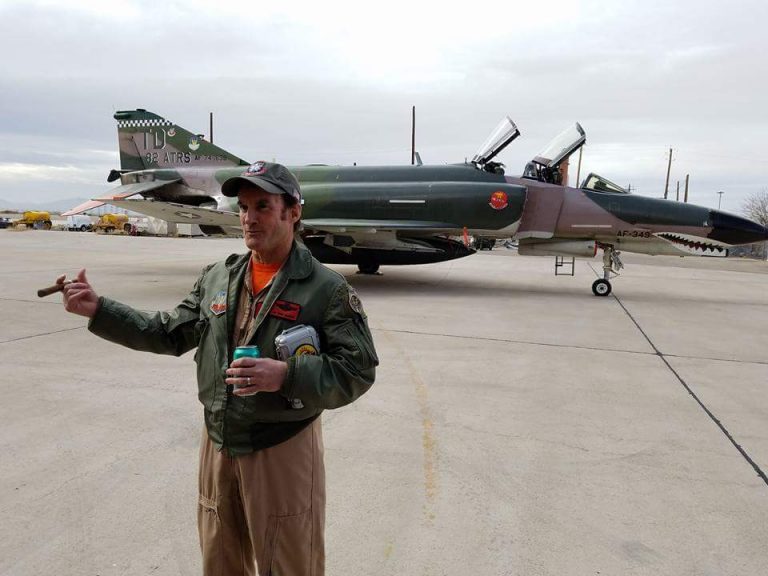
The QF-4 Aerial Target is a McDonnell Douglas F-4 Phantom II fighter modified into a remotely piloted aerial target. The QF-4 provides a realistic target for live-fire air-to-air missile testing, as well other anti-aircraft weapons systems.
The last operational flight of F-4 Phantoms occurred in 1996. The following year, the QF-4 program was established. Retired F-4 Phantoms were “recalled to duty” in 1997 to serve as remotely piloted aerial target drones for live-fire missile tests.
An Example of a Heritage Flight including the P-51 Mustang, P-47 Thunderbolt, the QF-4 Phatom and the F-22 Raptor (Photo: Landmark9254)
In what sounds like an oxymoron, the QF-4 can be a reusable target. While the QF-4 can be flown remotely—takeoff to landing—it can also be operated by a pilot for non-destructive testing, such as testing radar detection systems.
Unfortunately, this American classic, even as an aerial target, is rapidly approaching its final days, at least in the US (several other countries still have active F-4 squadrons).
QF-4s are operated by Detachment 1, 82nd Aerial Target Squadron (ATRS) at Holloman AFB,New Mexico. Typically, QF-4s are simply grey with international orange on the tail and wingtips.
Over the last several years, several aircraft have been repainted using the Southeast Asia paint scheme. These aircraft have become part of the popular Heritage Flight program, that are formations of World War II aircraft (P-51 Mustang and P-47 Thunderbolts) with modern F-16s, F-22s, or F-35s). The QF-4 fills the historical gap of the Vietnam Conflict aircraft.
Unfortunately, QF-4s will be phased out of the aerial target program by the end of 2016, with the last flights anticipated in November—also ending the QF-4s role in the Heritage Flights. The aircraft will be flown in their target roles as needed before the end of the year. Any aircraft not destroyed as aerial targets will be de-weaponized and towed to the Holloman AFB target range to be used as ground targets. An ignominious operational end to one of the most iconic aircraft of its era.
The F-4s will continue to operate in the air forces of several other countries, and there are many examples of F-4s around the country in museums and on display. Also, the Collings Foundation in Texas owns and operates an airworthy F-4 Phantom in the US.
F-22 blasts off with powerful performance demonstrating agility and skill.
The F-22 Raptor is a fifth generation Stealth Fighter Jet designed and manufactured by Lockheed Martin. Development of the YF-22 began in 1986 with the aircraft entering service in 2005 and was later renamed the F-22A. The following year, the F-22 later received the prestigious Collier Trophy administered by the U.S. National Aeronautic Association (NAA).
The U.S. Air Force F-22 Raptor Demo Team climbs in altitude during the Heritage Flight Course at Davis-Monthan Air Force Base, Ariz., March 2, 2019. The five-day course allows demo teams the opportunity to perfect their performance both on the ground and in the air. (U.S. Air Force photo by Staff Sgt. Jensen Stidham)
Powering the Raptor are two turbofan engines in conjunction with thrust vectoring. Thrust vectoring nozzles redirect the engine’s thrust by 20 degrees, which improves the pilot control over the pitch of the aircraft’s nose. According to several sources, Thrust Vectoring also increases the aircraft’s roll rate by 50%. The Raptor is the first USAF fighter with the ability to cruise at super sonic speeds without the need to use the afterburner. This quality is commonly referred to as Supercruise.
The F-22 possesses a sophisticated sensor suite allowing the pilot to track, identify, shoot and kill air-to-air threats before being detected. [Source: af.mil] To maintain a Stealth profile, the F-22 conceals all armaments inside the aircraft. At 4:37, the pilot opens the weapon bay doors as the aircraft passes show center. Thunder Over Michigan 2016 marks the First F-22 Raptor Demo display in the event’s history. This rare performance is one of only 23 appearances for the F-22 Team’s 2016 North America Tour. At the end of the video, you will witness the heritage flight featuring the F-22 Raptor and P-51 Mustang.
In Seattle on October 26th the day was filled with star-spangled fanfare and a patriotic salute. Alaska Airlines unveiled a brand new 737-900ER aircraft designed in a new livery dedicated to “Honoring Those Who Serve.” Military customs & courtesies were rendered and the national anthem was sung at the event hosted by the airline again demonstrating its timeless commitment to America’s service-members and veterans.
“All of us at Alaska greatly value the bravery and sacrifices of our servicemen and women and their families. “We are extraordinarily proud to have this symbol of appreciation that our customers will see and fly on every day.” CEO Brad Tilden
5 Star Ruffles & Flourishes
The aircraft tail #N265AK design features include, an “Alaska Airlines Salutes” medallion with five stars representing the five branches of the U.S. Armed Forces: Air Force, Army, Navy, Marine Corps and Coast Guard. In the rear a fallen soldier crest, with the Battlefield Cross honors those who have made the ultimate sacrifice. The aircraft engine inlets are surrounded by five rings in honor of the five branches of the United States military, and the plane is adorned with American flag winglets.
A quote from President Calivin Coolidge is prominently displayed near the boarding door and at the rear cargo door: “No person was ever honored for what they received. Honor has been the reward for what they gave.”
Flying to a station near you
As Veteran’s Day approaches watch the skies over Anchorage, Fairbanks, San Diego and Washington D.C. The “Honoring Those Who Serve” plane will be landing at cities near military bases on her maiden voyages.
How a design flaw and sketchy winter-time conditions put the MD-80 pilots in a bad spot.
Back in March of last year, a Delta MD-80 slid off the runway in a snow storm at LaGuardia. The aircraft was heavily damaged but there were no injuries. I wrote about that incident here.
To recap, the MD-80 landed in really lousy visibility during a snowstorm and slid off the side of the runway and almost into Flushing Bay. While the approach and landing were normal, the aircraft drifted off the left side of the runway after landing, eventually hitting the airport perimeter fence and coming to a rest on the berm that borders the airport and the water.
Since the winds were not particularly strong, my first guess was that the problem might have been a braking problem, but that was not the case. The NTSB recently concluded their investigation of the incident and have blamed the accident on an obscure directional control characteristic of aircraft with tail mounted engines known as “rudder blanking” along with the pilot’s reaction to that effect. The full accident report can be found here.
Design Flaw
Inherent in the design of turbine powered MD-80 with tail mounted engines and thrust reversers is an effect known as rudder blanking. Shortly after touchdown, pilots command the thrust reversers open using levers located on the throttles. On the MD-80, the aircraft involved, baffles actually close over the exhaust of the engines and redirect the thrust to the sides and forward of the engine. This redirected thrust helps to slow the aircraft.
The problem with this configuration is the location of the engines on the rear fuselage near the tail of the MD-80. The redirected thrust also has the effect of reducing the relative wind over the vertical stabilizer and rudder. Reducing the air over the rudder reduces its effectiveness. The reduced rudder effectiveness combined with the crosswind allowed the aircraft to depart the left side of the runway and to hit the boundary fence.
Boeing (which purchased McDonnell Douglas, the manufacturer of the MD-80) was aware of the flaw and recommended that reverse thrust was not to be used at full power during landing. Boeing recommended a further restricted use of reverse thrust when landing on a runway “contaminated by clutter” which is aviation-speak to mean a buildup of snow or slush.
Here’s an excerpt from the Flight Operations Bulletin published by Boeing:
Due to the geometry of the MD-80 thrust reversers, the exhaust gas efflux pattern will, at certain rollout speeds and EPR settings, interfere with the free-stream airflow across the rudder surfaces. This will result in partial “rudder blanking”; with a resultant reduction in directional control authority. As rudder effectiveness is more critical on wet or slippery surfaces, “rudder blanking” becomes a concern above a reverse thrust level of 1.3 EPR. Normal dry runway maximum reverse thrust power is 1.6 EPR [emphasis in original].
Will the Brakes Stop the Airplane on the Runway?
Another concern of the crew was the “braking action” on the runway. This is also aviation-speak to mean the slipperiness of the pavement. The crew had heard reports that the braking had been reported as “fair” which meant that they would not have been able to stop the aircraft on the runway and would have needed to divert. Later on in the flight, the braking action had been reported as “good” by another airliner and the crew made the decision to continue.
The problem with braking action reports by other aircraft is that they are highly subjective. Some pilots make the determination by how many times their anti-skid cycles during a landing. Others use different criteria and each aircraft can respond differently to the same conditions. One pilot’s “fair” report can easily be another’s “good”.
Weather and runway reports from the airport itself indicated that the runway was covered with 1/4 inch of wet snow. The runway had recently been swept, but by the time Delta 1086 landed, it was already white in appearance from new snowfall.
So you can see that as a minimum, this crew was concerned that they didn’t have much room for error on this landing.
The Friction Measuring Trucks Were Parked
As far as the actual condition of the pavement, airport authorities have been using friction measuring equipment for decades. So what was the actual friction measurement at the time Delta 1086 landed? No one knows. Due to bureaucratic ambiguity and confusion between FAA directives and the New York Port Authority, the Port Authority elected to not use either of the two trucks it had available to measure runway surface friction.
From a bureaucratic point of view this makes perfect sense as you can be held liable for inaccurate or missing reports if your policy was to collect them. Change your policy to keep the trucks parked and you’re off the hook. This works best for bureaucrats sitting in heated offices, but not so well for passengers landing in a snowstorm. But it’s completely legal.
On the Edge of Safe
So in essence, the story so far is that the MD-80 landed in 1/4 mile of visibility in a snowstorm on an extremely short runway bounded on three sides by water with an essentially unknown slickness of the pavement.
As a reminder, a quarter mile of visibility is 1320 feet and a touchdown speed of 140 kts is about 236 feet per second. This gave the pilot about five and a half seconds of time between seeing the runway and landing on it. And according to the flight recorder, the touchdown was well within the landing zone and on speed.
What happened next was measured in seconds. Here’s the synopsis from the NTSB report:
During a postaccident interview, the captain stated that, as he was lowering the airplane’s
nose to the ground after main gear touchdown, he moved the thrust reversers to idle and then “one knob width on the reverser handle” to obtain Delta’s target setting of 1.3 engine pressure ratio (EPR).16 FDR data showed that engine reverse thrust exceeded 1.3 EPR between 3 and 4 seconds after main gear touchdown (with the left engine exceeding 1.3 EPR before the right engine) and was advancing through 1.6 EPR immediately after the nose gear touched down. FDR data showed that the EPR value exceeded 1.6 for 5 seconds, reaching maximum EPR values of 2.07 on the left engine and 1.91 on the right engine between 6 and 7 seconds after main gear touchdown. Engine power decreased after this point, and the thrust reversers were stowed at 1102:25 (7.5 seconds after deployment, 9 seconds after main gear touchdown, and 2,500 feet from the runway threshold) at an EPR value of 1.8 on the left engine and 1.6 on the right engine. At that time, the airplane’s groundspeed was 93 knots.
In plain-speak, the pilot used reverse thrust in excess of the recommended amount for a total of five seconds and then stowed the reversers. The aircraft started to drift left at six seconds after touchdown, or three seconds before the reversers were stowed. This meant that it was in the three seconds between the time the aircraft started to drift and the time the reversers were stowed that the problem occurred.
To further complicate the landing, the aircraft by this time had slowed to 93 knots. At this speed the rudder itself loses effectiveness as there is not enough air moving over the surface to keep the aircraft on the runway. Other than the rudder, directional control of an aircraft on the ground is obtained through the use of nosewheel steering and differential braking. Both of these were used but were not effective enough to get the aircraft under control.
(Photo by NYPD)
No Win Situation
Pilots are goal oriented people. We like to get the job done. But we are also called upon to get the job done correctly and are tasked with being the final arbiters of safety. To this end, we are given the tools and the criteria to use those tools correctly. But when some of the supposedly objective information we have turns out to be highly subjective and incomplete, the process becomes a crapshoot.
In my view, these guys were set up. They were told that if the braking was “good” they could land, but if it was “fair” they’d go for a swim. So for a few seconds the pilot overcompensates with too much reverse thrust and they nearly go swimming anyway. Another MD-80 had landed minutes before and had no problem while also exceeding reverse thrust limits. These guys just got hit with an unlucky gust of wind.
The whole idea of risk management is to make sure that the operation does not become a crapshoot. Had these pilots diverted when the “system” said they could make it safely and other airplanes were landing, they’d be questioned by their chief pilot and ridiculed by their passengers. Now they’re probably wishing they had diverted. A three second and immediately corrected deviation from SOP during extreme conditions should not result in a major accident.
In the appendix to the accident report, board member Robert Sumwalt, himself a retired airline pilot, had this to say about the situation facing the captain:
As a former airline pilot for over 20 years, I’m confident saying that having to limit reverse thrust on a relatively short, slippery runway is counter-intuitive: When you need it the most, you have to use it the least.
So the next time your pilot diverts or goes around when others are landing, you will be frustrated or angry that you don’t get to your meeting or home on time. Don’t be. The guy or gal up front is trying to get you where you’re going, but also trying to keep you alive.
Addendum: A Few Words about the The NTSB
I’m going to take a moment to say a few words about the NTSB. Good words. The NTSB in my view is a national treasure. They are staffed with a group of smart and thoughtful professionals who take the time to get to the bottom of the accidents they investigate. And while they don’t have any real regulatory power to force changes, nor do they make economic cost-benefit assessments of their various proposals, their recommendations often serve as signposts to be disregarded by industry and regulators at their peril.
Editors Note: The top photo of this article was taken by Leonard J. DeFrancisci. It is used with permission according to the CC 4.0 license.
Beginning in 2003, the US Air Force’s Air Education and Training Command (AETC) set its sights on replacing the T-38 Advanced Jet Trainer. The T-38 first flew in 1959, and became operational in 1961. More than 1100 aircraft were built. The T-38 is still the Air Force’s advanced jet trainer for Joint Specialized Undergraduate Pilot Training (JSUPT). The aircraft will probably remain in service through the early 2020s, giving it an operational life span of more than 60 years.
The T-38: The Air Force’s Advanced Jet Trainer since 1961. (USAF Photo)
The combination of aging airframes, budget restrictions, and increasing demands of the JSUPT to train for 5th Generation fighters, has created delays and changing requirements for the next generation of advanced jet trainers.
The feeling within the industry is that the Air Force cannot put off developing a new trainer for much longer. Current projections suggest that the new trainer should be selected by 2019 or 2020, and operational by 2023 or 2024. The Air Force has indicated that the initial order will be for 350 aircraft, but multiple sources suggest production could reach 1,000 aircraft or more. There is also some suggestion of a fighter-attack or other variants.
In spite of the schedule uncertainty, five manufacturing teams are positioning to offer a solution to the Air Force’s requirements for its next generation advanced trainer—the T-X.
Clean-Sheet Proposals
Boeing-Saab Entry
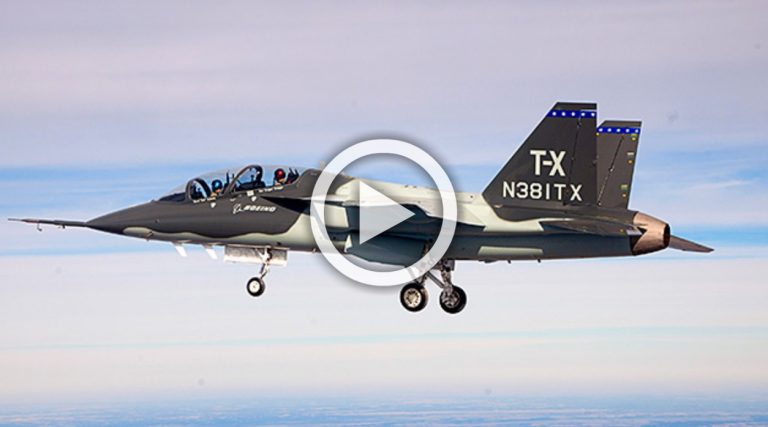
Boeing, partnering with the Swedish manufacturer, Saab, as recently as September of this year, rolled out its candidate for the T-X. Quoted in a Defense News article (Sep 13, 2016), Darryl Davis, president of Boeing Phantom Works, “Our T-X design features: twin tails, a modern design that allows better maneuverability than a single tailed aircraft, stadium seating that provides rear visibility to the instructor … and a maintenance friendly design. What you can’t see is the advanced design and manufacturing that went into this.”
Boeing also pointed out that this aircraft was “purpose-built” to meet the demanding requirements of the T-X program. While the Air Force requirements to not mention stealth or low-observability, many observers suggested that it’s appearance mimics design features of the F-22 and F-35.
Northrup Grumman Entry
Northrop Grumman is also working on a “clean-sheet design for its T-X trainer candidate. Observers have pointed out that their next-generation trainer somewhat resembles the T-38, which Northrop built in the 1960s. While few details have been release on its design, a flight test prototype has been built by Scaled Composites and has been undergoing high-speed taxi tests at that company’s facilities in Mojave, California. Flight test are expected later this year.
Northrop Grumman’s T-X prototype seen undergoing taxi test in Mojave, California. (Northrop Grumman)
Initially, Northrop Grumman had planned to partner with BAE Systems to propose an advanced version of the Hawk Advanced Jet Training System, but this was abandoned citing performance limitations.
Textron AirLand: Scorpion
Textron AirLand secretly built a prototype Scorpion at the Cessna plant in Wichita, Kansas facility in 2012, and it was first flown in 2013. The shoulder-wing aircraft is of all composite design, powered by two Honeywell TFE731 turbofan engines. It is suggested that Textron AirLand will offer some form of this aircraft design for the T-X. While this is a newly designed aircraft, its initial performance numbers do not seem to approach those anticipated for the T-X. For example, its maximum speed is 518 mph or .68 Mach, which is well below that required for the T-X.
The Textron Scorpion could become a T-X entry. (Photo by Tim Felce)
T-X Trainers Based on Existing Aircraft
Lockheed Martin and Korea Airspace Industries: T-50
Lockheed Martin and Korea Airspace Industries (KAI) are teaming to offer a significantly advanced modified and upgraded and version of the KAI’s T-50. Lockheed Martin has already opened a training center in South Carolina for both final assembly of the T-50A and the ground based training system.
Although based on the T-50 airframe, the T-50A features a blended wing-fuselage with horizontal and vertical stabilizers. It is purpose-built to meet the training requirements of fifth-generation fighters such as F-22 Raptor and F-35 Lightning II.
The T-50A is designed to offer fighter-like performance and characteristics to expedite pilot transition to 4th and 5th generation.
The KIA T-50 that will serve as the basic design concept for the T-50 T-X offered by Lockheed Martin and KAI. (Photo Kentaro Lemoto)
The T-50A is powered by a single General Electric F404 turbofan engine equipped with full-authority digital engine control (FADEC) system.
Raytheon/Leonardo/Honeywell Aerospace: T-100
Raytheon/Leonardo/Honeywell Aerospace will propose the T-100 which they claim the twin Honeywell Aerospace F124 engines will deliver best-in-class, thrust-to-weight ratio representative of today’s 4th and 5th generation fighters. The T-100 will feature a modern heads-up display and a fully integrated helmet mounted-display designed to prepare pilots for the advanced avionics used advanced tactical fighters.
The T-100 is based on Leonardo’s (formerly Alenia Aermacchi) MB-346, an advanced trainer and light attack aircraft first flown in 2004 and introduced into service in Italy in 2015.
The Alenia Aermacchi T-346A will be the starting point for the Raytheon/Leonardo/Honeywell Aerospace proposed T-X aircraft. (Alenia Aermacchi photo G.M. Azzellotti)
Summary
The finally competition may come down to a dogfight between brand new designs and adaptations of existing aircraft. New designs can focus entirely on the requirements for the new aircraft, but new designs are also subject to more growing pains. While existing designs start out with a proven aircraft design, the adaptations that are required to meet the new advanced performance goals can be challenging to back-fit into the existing airframe.
All of these competitors will propose complete training systems with ground trainers or simulators, training programs, and support facilities, providing the Air Force with a turn-key training system.
Assuming each of these aircraft can demonstrate Air Force performance goals, the selection will likely be determined by the lowest realistic lifetime cost of ownership.
Currently the T-X trainer does not appear in the DoD budget, but funding is expected to be requested in the next year or two, to get the competition and selection underway. It is unclear what affect the results of the 2016 Presidential elections will have on military budgets. Regardless of candidate claims, budget realities will certainly affect budgets and schedules.
T-X trainer selection could turn into a real dogfight.
Author’s Note
I trained in the T-38 in 1970. It was a good airplane, and although advanced for a trainer at the time, it was still a mechanical, analog aircraft—round gauges and all. And even with upgrades to new electronic cockpits, it is still a T-38 chassis. The transition from the T-38 to an F-35 Lighting II is roughly equivalent to moving from a 1960s stock car to a modern Formula 1 racer. The T-X will provide sufficiently advanced piloting training and experience to allow pilots to transition to the F-22 or F-35 with far lower training costs.
Logo jets are unique but they aren’t new. Most of the majors have had logojets for promotions. Airlines like Southwest led the trend with Shamu. They have had additional tie-ins with the NBA and Sports Illustrated. Other airlines like WestJet, Delta, and Alaska Airlines have had tie-ins with Disney. Now Disney has added a new airline to their advertising fold.
On Saturday, Hawaiian Airlines unveiled a Disney-themed logo jet for their new movie “Moana” which will hit theaters in November. The Airbus A330 jet features the characters from the new movie. This is the first of three specially-themed logo jets.
Photos are posted on Hawaiian Airlines Facebook page.