Logo jets are unique but they aren’t new. Most of the majors have had logojets for promotions. Airlines like Southwest led the trend with Shamu. They have had additional tie-ins with the NBA and Sports Illustrated. Other airlines like WestJet, Delta, and Alaska Airlines have had tie-ins with Disney. Now Disney has added a new airline to their advertising fold.
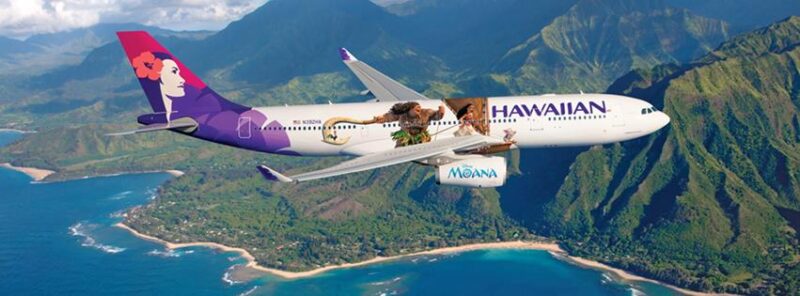
On Saturday, Hawaiian Airlines unveiled a Disney-themed logo jet for their new movie “Moana” which will hit theaters in November. The Airbus A330 jet features the characters from the new movie. This is the first of three specially-themed logo jets.
Photos are posted on Hawaiian Airlines Facebook page.
The De Havilland Comet 4’s “First Flight” Ended Up Being Its Swan Song Too!
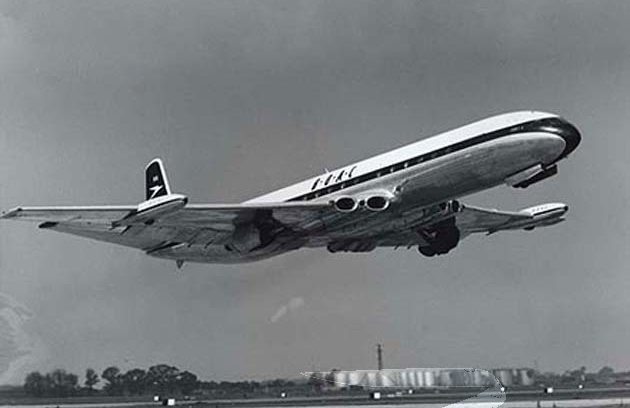
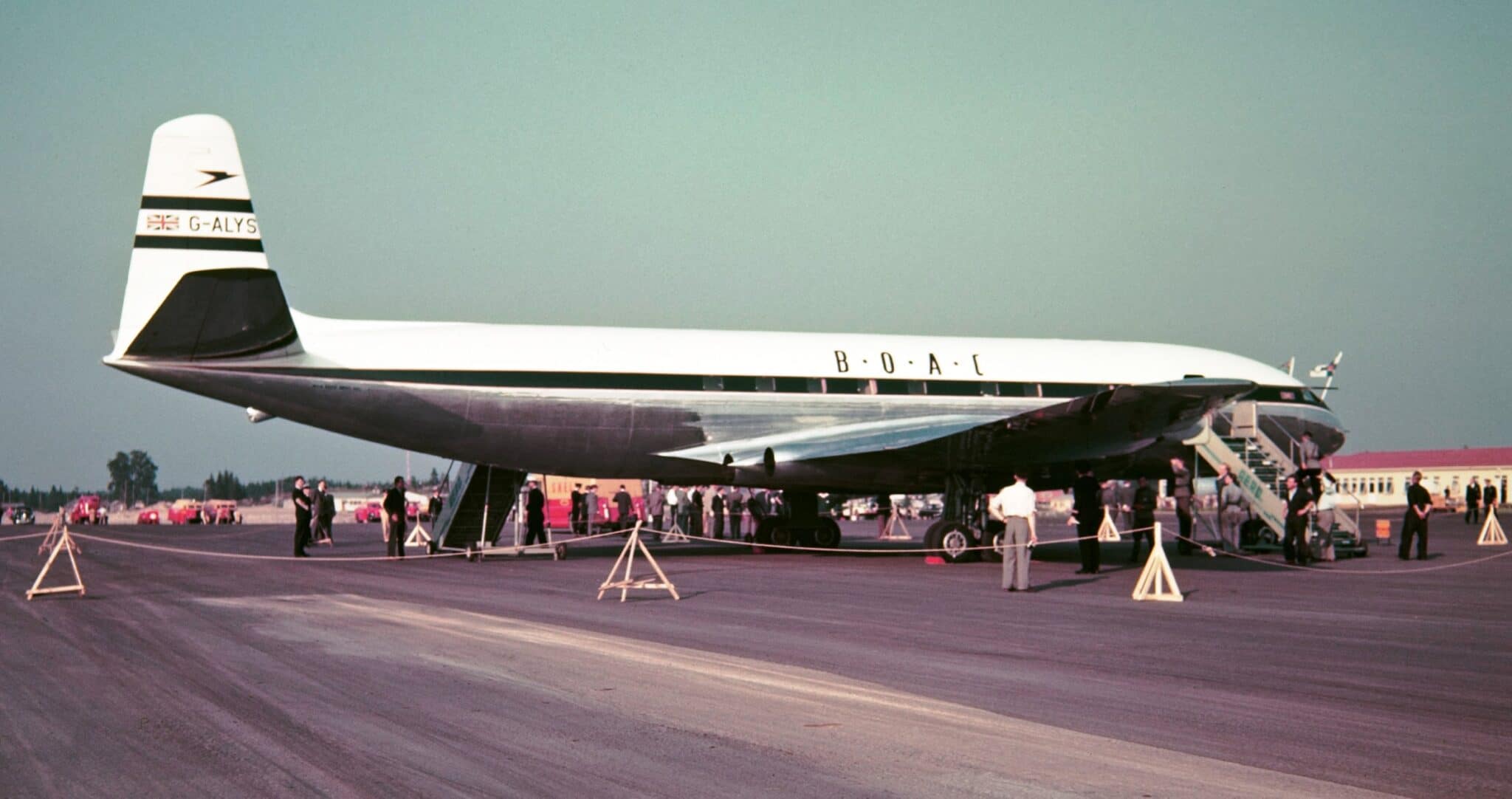
On 4 October 1958 British Overseas Airways Corporation (BOAC) operated the first transatlantic jet service with the de Havilland Comet 4. BOAC was also the first airline to offer jet passenger service across Europe and into Africa operating the de Havilland Comet 1. Within two years, all Comet aircraft were grounded due to a series of four crashes, later determined to be from metal fatigue caused by pressurization/depressurization cycles. The Comet had square windows, and the corners of the window openings created an area of weakness that resulted in structural failure of the aircraft in flight.
De Havilland worked through several versions of the Comet, and by the time of the first transatlantic flight to the North America, BOAC was flying the Comet 4, that had been designed to be fail-safe. The fuselage structure was designed so that a crack in the skin was limited to a very small area, and therefore would not be a catastrophic failure.
BOAC comet 4. image via Olympis-kuva oyaa
The Fate of the Comet 4 as a Passenger Airliner was Already Determined Even Before That First Transatlantic Flight
While BOAC could claim initiating transatlantic passenger jet service, before the end of the same month, Pan American Airways (Pan Am) was flying the same route with the new Boeing 707 and later with the Douglas DC-8. The American-built planes were larger, faster, had greater range, and carried more passengers. Even before their first transatlantic flight, BOAC had made the decision to purchase the Boeing 707. With that, the fate of the Comet 4 as a transatlantic aircraft was sealed.
Launch the fleet! Procedure expedited takeoffs to get more B-52 jets in the air faster.
This clip shows a group of Boeing B-52G Stratofortresses executing a MITO (Minimal Interval Take Off). The objective: get off the ground! Faster! The planes roar skyward a mere 15 seconds apart, as two narrators have to hold onto their hats! It’s a smokey mess of bad ass airpower. SAC bases would practice these launches so that if the flag of war was ever raised, our nation’s Air Force would answer the call. Each B-52G carried cruise missiles and bombs, ready to strike the enemy with overwhelming force if directed.
This clip is actually from the movie, “A Gathering of Eagles” that starred Rock Hudson. It showcased the challenges of turning around a struggling unit. Col Caldwell, played by Hudson, will do whatever it takes (including being a hard-ass) to get his unit in tip-top shape.
The movie appears to be filmed at Beale Air Force Base. Today, Beale is home to KC-135R, U-2s, and Global Hawk UAVs.
The B-52G was a modification to extend the service life of the B-52 (affectionately known as BUFF: Big Ugly Fat Fucker), during delays in the B-58 Hustler program. Designers envisioned a radical new concept, with all new wings and Pratt & Whitney engines. The new plane had an increased fuel capacity and water injection, which added about a 17 percent power increase to assist with taking off. In addition, a pair of 700 gallon fuel tanks were slung under the wings. BUFF threw out the design book, scrapping traditional ailerons and using spoilers to control aircraft roll.
Roughly 744 B-52 aircraft (and their variants) were manufactured between 1952 and 1962. The B-52 is still (kicking ass!) in service today. However, almost every B-52G was destroyed in accordance with the Strategic Arms Reduction Treaty of 1992. As of 2012, only about 85 remain in active service. The others are in the boneyard, museum, or still flying in our dreams.
The world’s first drone was a crude cruise missile that could hit a target up to 75 miles away.
Germany’s V-1 “Buzz Bomb” was an early version of a cruise missile, but not the first! In 1918 during World War I, the US Army contracted Charles Kettering of Dayton, Ohio to design and build an “aerial torpedo” with the capability to strike targets up to 75 miles away, flying at a speed of 50 mph. Kettering hired Orville Wright as his aeronautical consultant for the development of what would be called the “Kettering Bug.”
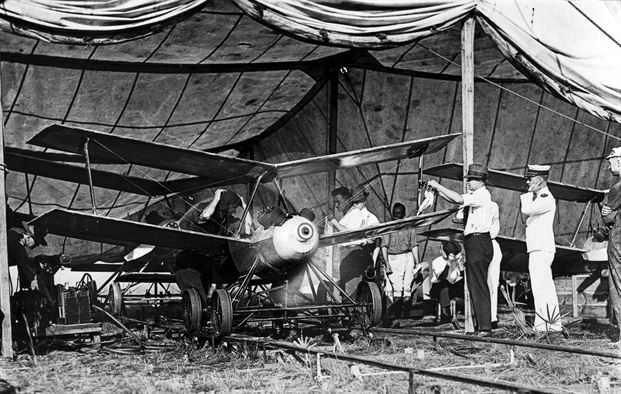
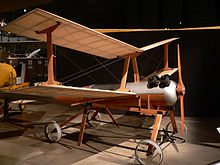
The biplane design looked like a big model airplane, 12.5 feet long with a wing span of 15 feet. It was powered by a 40-horsepower, four-cylinder De Palma engine manufactured by Ford Motor Company. The airframe was made of wood laminates and paper papier-mâché. The wings were covered with cardboard.
Full-scale model of the Kettering Aerial Torpedo on display at the National Museum of the United States Air Force.
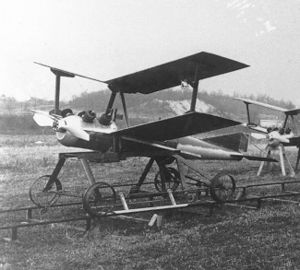
The aircraft was launched from a four-wheeled dolly-and-track system similar to that used by the Wright brothers for their first successful flights at Kitty Hawk.
The challenge was to be able to launch the aircraft and have it travel to, and strike, a specific target carrying 180 pounds of explosive. The challenge was to be able to control the aircraft’s track to the target. The solution was ingenious.
Prior to launch, technicians would plot the precise distance to the intended target and also determine the aircraft’s heading based on wind direction and airspeed. This information was used to determine the number of engine revolutions required to travel to the target.
The Kettering Bug was launched from a four-wheeled dolly on movable tracks.
Once launched, a small onboard gyroscope guided the aircraft toward its destination. To maintain altitude and direction, the system used a pneumatic/vacuum system, an electric control system, and an aneroid barometer/altimeter.
When the revolution counter reached the programmed value, a cam shut off electrical power to the engine. Another control retracted the wing-attachment bolts, releasing the wings. At this point the craft became a ballistic missile falling towards its target. The 180-pound explosive payload detonated upon impact.
The Kettering Bug during early testing
On its first test flight in Dayton, Ohio, the aircraft took off and climbed too steeply, stalled, and crashed. Adjustments were made and subsequent flights were successful.
Toward the end of World War I, the Army conducted a total of 24 test flights, seven of which were successful.
Although the Army spent some $275,000 developing the early drone, the Kettering Bug was never used in combat. Approximately 45 “Bugs” were produced. The existence of the Kettering Bug was kept secret until the beginning of World War II.
A full-scale replica of the Kettering Bug is on display in the “Early Years” Gallery of the National Museum of the United States Airforce.
And we thought drones and cruise missiles were a modern invention!
An uncanny resemblance to the United States Air Force’s B-1 Bone.
In 1972, in response to the United States Air Force’s B-1 Bomber project, the Soviet Union launched a competition to see which company could design the best multi-mission bomber. The idea was to create a new supersonic heavy bomber with variable geometry (in other words, “swing wing” capability), and a max speed of Mach 2.3. Get there fast, kick ass, come home. Fast. The Tupolev design won the competition, with its lengthened, blended wing layout and incorporation of elements from the Tu-144. Recently, the Tu-160 has been on the radar because the Russians are using it to bomb targets in Syria, on combat missions nearly 8,000 miles long!
This video footage, uploaded on April 16th of 2016, shows a Tu-160 Blackjack (NATO designation) in flight. The Tu-160 Blackjack, also known as the ‘White Swan,’ (Russian nickname) was the last strategic bomber produced for the Soviet Union. The Tu-160 was manufactured by the Tupolev Design Bureau. Not sure if they based the design on the Angel of death, or maybe that just happened on its own.
Watch the sleek, silver, majestic White Swan perform an aerial refueling mission. In the video, you’ll also see the air refueling probe that is stored in the nose rise in order to receive the gas. You can feel the tension as you get a great shot the pilot intently focused in the cockpit, then see several of these streamlined beauties flying in formation.
September 30 marks the 75th anniversary of the end of the Berlin Airlift, historically the first major showdown of the Cold War between the Soviet Union and the West.
World War II hand ended in 1945, and the Allies—the United States, the United Kingdom, France and the Soviet Union divided Germany into four occupation zones. The Soviets controlled the eastern portion of Germany, including the city of Berlin. Although isolated in the Soviet sector, the city was also subdivided into occupation zones. Initially, the Soviets Permitted highway and railroad access to the city. Stalin fully intended that Germany would become a part of the Soviet Union and blockaded rail and road access to Berlin, cutting off critical supply lines of food and fuel.
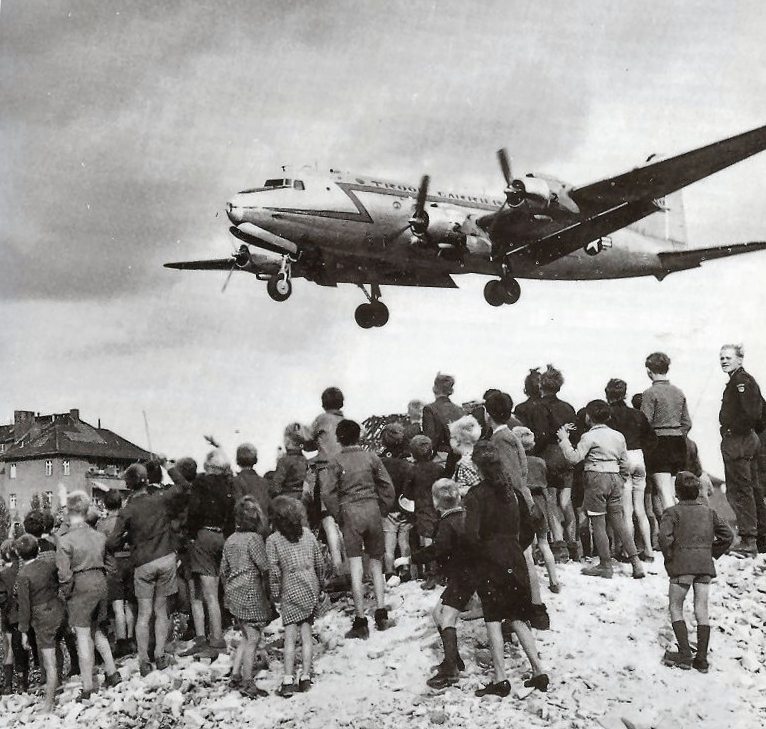
Berliners watch as a C-54 arrives in Berlin in 1948.
Three air corridors remained open, and in June of 1948, the west initiated “Operation Vittles” (the United States) and “Operation Plainfare” (United Kingdom), delivering food, fuel (coal and gasoline), and other essentials. Russia did not believe the airlift could adequately supply the city of Berlin expecting the city would submit to Soviet rule. The Soviet Union was more focused on its post war recovery, and did not challenge the airlift. Additionally, the western allies were still strong, and had demonstrated the use of nuclear weapons, and the Soviets were not prepared for direct conflict.
The American government, using 1,990 calories as a daily minimum per person and 2 million people in Berlin to feed, set a daily minimum of 1,534 tons of food stuffs including flour, wheat, meat and fish, dehydrated potatoes and vegetables, sugar, salt, coffee and powdered milk. Additionally, for heat and power, 3,475 tons of coal and gasoline were required daily.
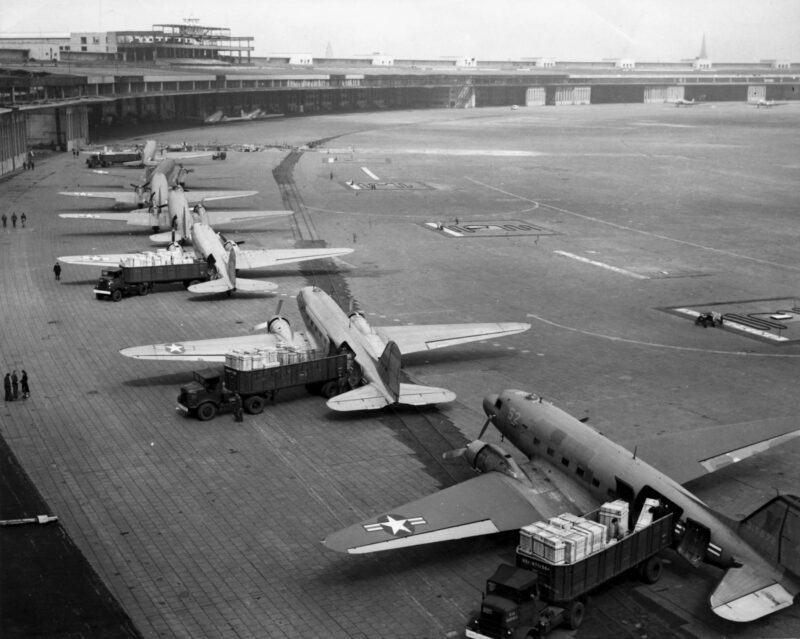
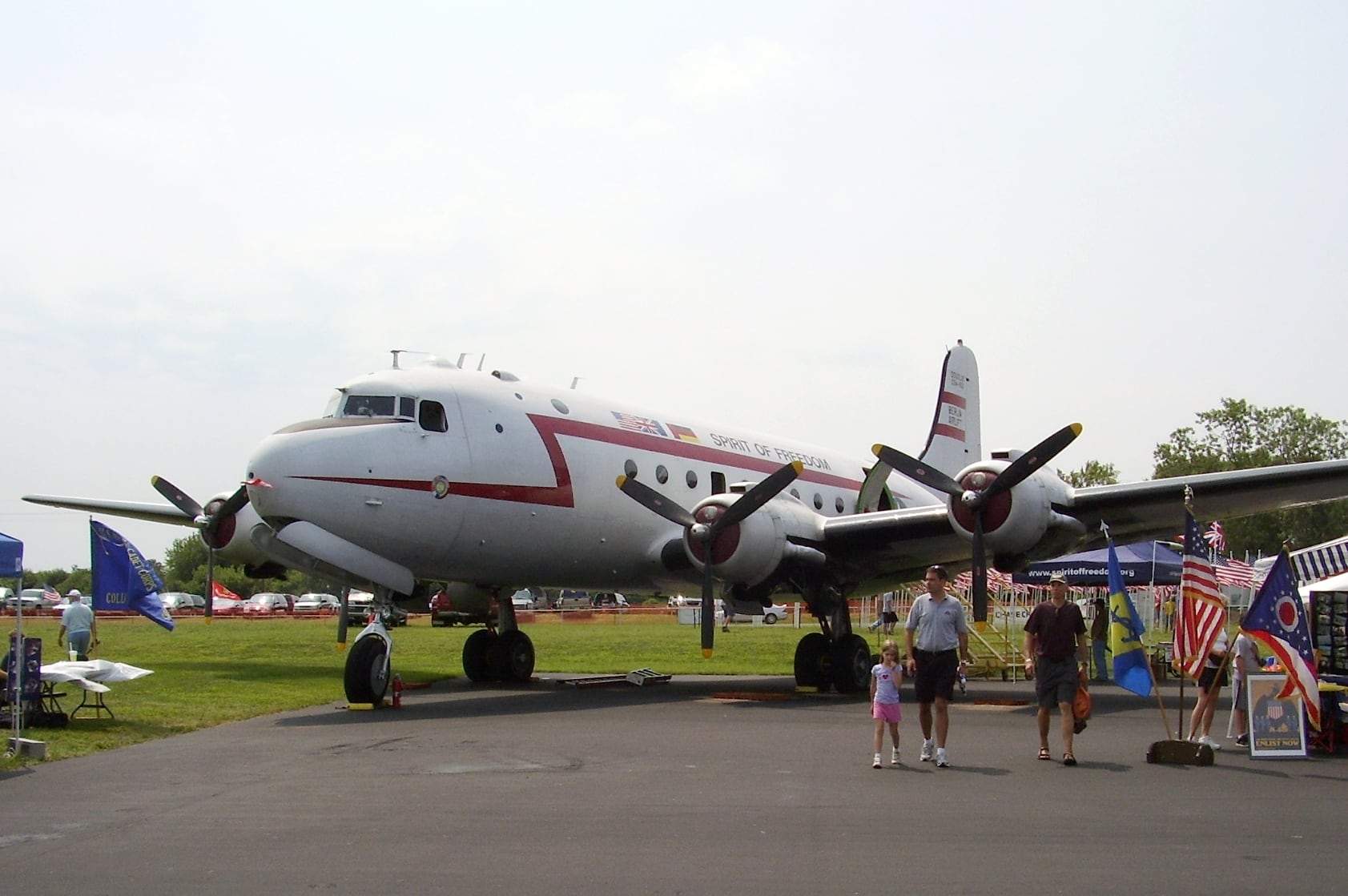
The U.S. began the airlift with C-47 (DC-3) aircraft and then added C-54 (Douglas DC-4s). Because of the steeply angled floor of the tail-wheeled C-47, however, it took up to 30 minutes to unload a C-47, while a C-54 could be unloaded in as little as ten minutes. Several airports were limited to C-54 aircraft, which further accelerated the flow of supplies. Many other aircraft were also used, including Sunderland flying boats landing
The Spirit of Freedom, A C-54 operated by the Berlin Airlift Museum
The high volume of aircraft arriving in Berlin created significant traffic flow challenges, but by the end of the first year, aircraft were landing somewhere at Berlin airports every thirty seconds.
The high volume of aircraft operations and limited air traffic control created a hazardous operating environment. There were accidents, especially when poor weather caused landing accidents and the danger of midair collisions.
The Soviet blockade of Berlin ended in May of 1949, but airlift flights continued to allow the city to build up a reserve of supplies. Finally, the Berlin Airlift was officially ended on September 30, 1949.
The last Berlin Airlift flight showing the total tonnage delivered to Berlin during the airlift.
The Berlin Airlift officially ended on 30 September 1949, after fifteen months. In total the USA and United Kingdom delivered 17,835,727 tons, nearly two-thirds of which was coal, on 278,228 flights to Berlin. The Berlin Airlift aircraft flew more than 92 million miles in the process, almost the distance to the sun. At the height of the Airlift, one plane reached West Berlin every thirty seconds.
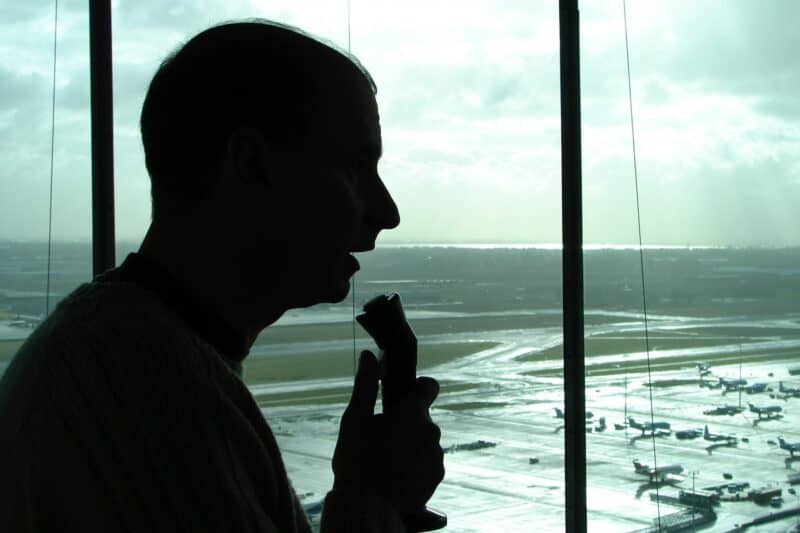
This video clip catches a rare behind-the-scene look at the dark side of aviation…attitude! Sure, most everyone keeps a running dialogue in the quiet of their own head of what they’d LIKE to say, but they don’t actually say it. Usually. Unfortunately, sometimes an open mic is left on, and that’s when the fun really begins! You just don’t hear pilots and air traffic controllers calling each other dreaded 4-letter words very often these days. Here are the 3 crazy situations you’ll see in this video.
The job of a pilot and the job of an air traffic controller are both very stressful. Combined with fatigue, parks occasionally fly. In Atlanta, we hear a ground controller attempting to help out a Delta flight that is about to join the wrong taxiway. Delta responds calmly, with a voice reserved for warding off grizzlies.
One pilot complained that he happened to have a lady with him at the moment, and that he found the words of the air traffic controller offensive. The controller replied by announcing that the comments had not been about the lady, but about someone else. Of course the comments were about someone else! Nobody knew the lady was there until the pilot mentioned it. It didn’t make the already bad situation any better.
Every once in a while you get a wiseguy… and I can’t tell if the Saudi pilot ‘just not getting it’ was baiting the controller. I mean, when there are only 9 possibilities and you guess 11 times—INCORRECTLY—that has to be on purpose, right?
Bottom line is that controllers do a hell of a job to keep people safe. Mistakes and bad days happen. We’re just glad that these pop-offs are relatively rare.
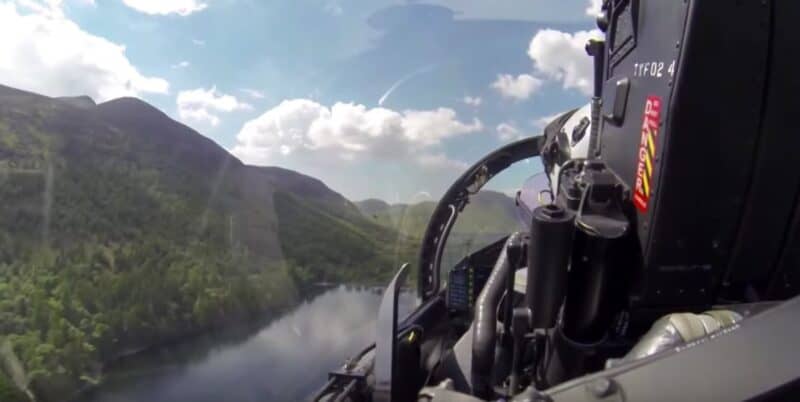
Cockpit view lets you feel the raw excitement of low level flight.
Experience the emerald green of British landscapes in this high-octane clip! This video footage, uploaded on May 13th of 2014, was filmed from the back seat of an RAF Eurofighter Typhoon, being flown by display pilot Jamie Norris. You get to hangout on board Europe’s premiere tactical combat platform, as they soar, swoop and just plain sizzle.
Jamie calmly walks us through his pre-flight checks, and gently guides his agile craft into the air. He rejoins on “lead,” (the other Typhoon) as they transition from high altitude to the low level environment. We hear him announcing that the weather is good, and the valley is clear. And then we are off for the races! Flying at less than 250 feet above the ground, both jets have to pull impressive amounts of G forces in order to remain within the safe confines of the valley. They are about as low as you’d dare to go, at speeds in excess of 450 knots! So low to the ground that you can plainly see the cars in people’s driveways and the fences that surround their yards. And maybe people waving…at the sound of freedom coming from those twin exhausts.
But why, you ask, would fighters be down in the weeds?
Great question—it’s about infiltration and avoidance. Up high, radar has a clear return. Low level, especially in mountains, there’s too much clutter in the way (thank you terra firma!). Plus, getting a straight shot at a twisting, bucking Typhoon? Fuhgeddabouttit!
The Eurofighter Typhoon is an aircraft with strike force capability. It is in service with six nations – the UK, Germany, Italy, Spain, Austria, and Saudi Arabia.
We’ve seen and posted some pretty amazing feats of airlifters. As amazing as the C-17 or C-5 jets are, there is something really special about the Herc. With its four fans of freedom that allow it to takeoff and land in very short distances (even an aircraft carrier!), and its landing gear that means its displacement is uniquely light on landing surfaces.
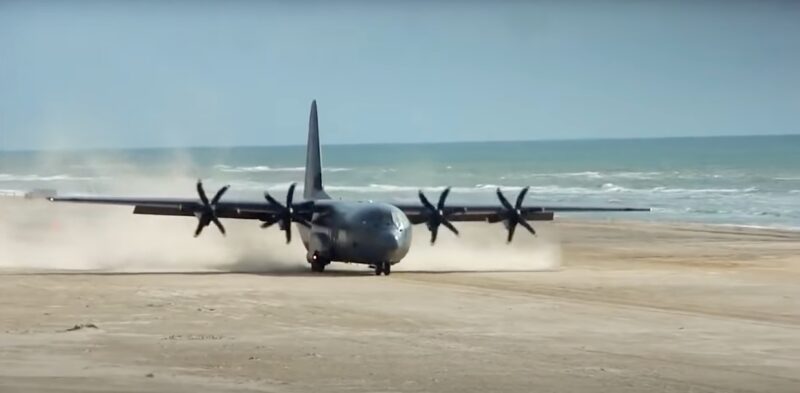
This video footage features a pilot being trained to land a C-130J Hercules on an unusual surface…a beach. We think the footage is shot along various beaches on the shores of western Denmark, known as Vejers Strand.
The C-130 is able to land on such austere surfaces for a couple of reasons. The first is that the high wing, high lift aircraft is well suited for slow-speed landings and short takeoffs. Additionally, the gear is designed such that the weight displacement on the C-130 on a per-tire basis is actually relatively low. This means that the C-130 is less likely to create deep ruts or destroy austere runways surfaces like compacted sand or dirt.
The C-130 Hercules is a four engined turboprop military transport plane, designed and built by Lockheed. The aircraft is known for being able to use unprepared runways for takeoffs and landings. It was originally designed to transport troops, cargo, and medevac equipment. It has also been used as an AC-130 gunship, for airborne assault, for search and rescue efforts, for scientific research and support, for weather reconnaissance, for aerial refueling, aerial firefighting, and maritime patrol.
History of the Herc
The C-130 took its maiden voyage on August 23rd of 1954, and was introduced into service that same year. As of 2015, more than 2,500 of this type of aircraft have been built, and the aircraft is still in production today.
The Lockheed C-130 Hercules is the main aircraft of Air Forces around the world. Primary users of the C-130 are the United States Air Force (USAF), the United States Marine Corps, the Royal Air Force (RAF) and the Royal Canadian Air Force.
The most recent variant of this aircraft is the Lockheed Martin C-130J Super Hercules.
In 2007, the Lockheed C-130 Hercules became the fifth aircraft to celebrate 50 years of continuous service with its original buyer, which was, in the case, the United States Air Force.
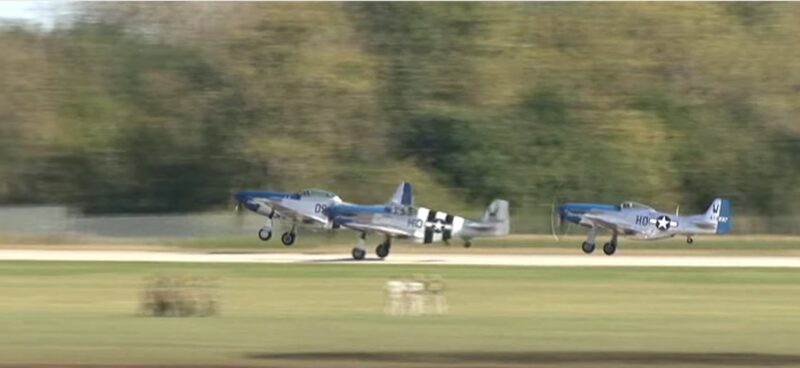
It’s hard to believe that 2007 was more than a decade ago already. Back then it wasn’t as rare to see men and women from the Greatest Generation join events to share their stories. This video harkens back to a time not THAT long ago where WASPs, Tuskegee Airmen, and WWII vets saw over 20 P-51s take to the skies with the distinctive drone of their powerful engines. You’ll see no less than 20 P-51 Mustangs take off, two or three at a time, to fly in formation over the Gathering of Legends and Mustangs at Rickenbacker airport in Columbus, Ohio. The event took place between September 27th and September 30th of 2007.
This made-in-USA video footage was captured from the top of a twelve-foot high photography platform, with a prime seat to catch all the Mustang action. The awesome video clip, uploaded on January 5th of 2011, was produced by Steve Kauzlarich.
About the P-51 Mustang
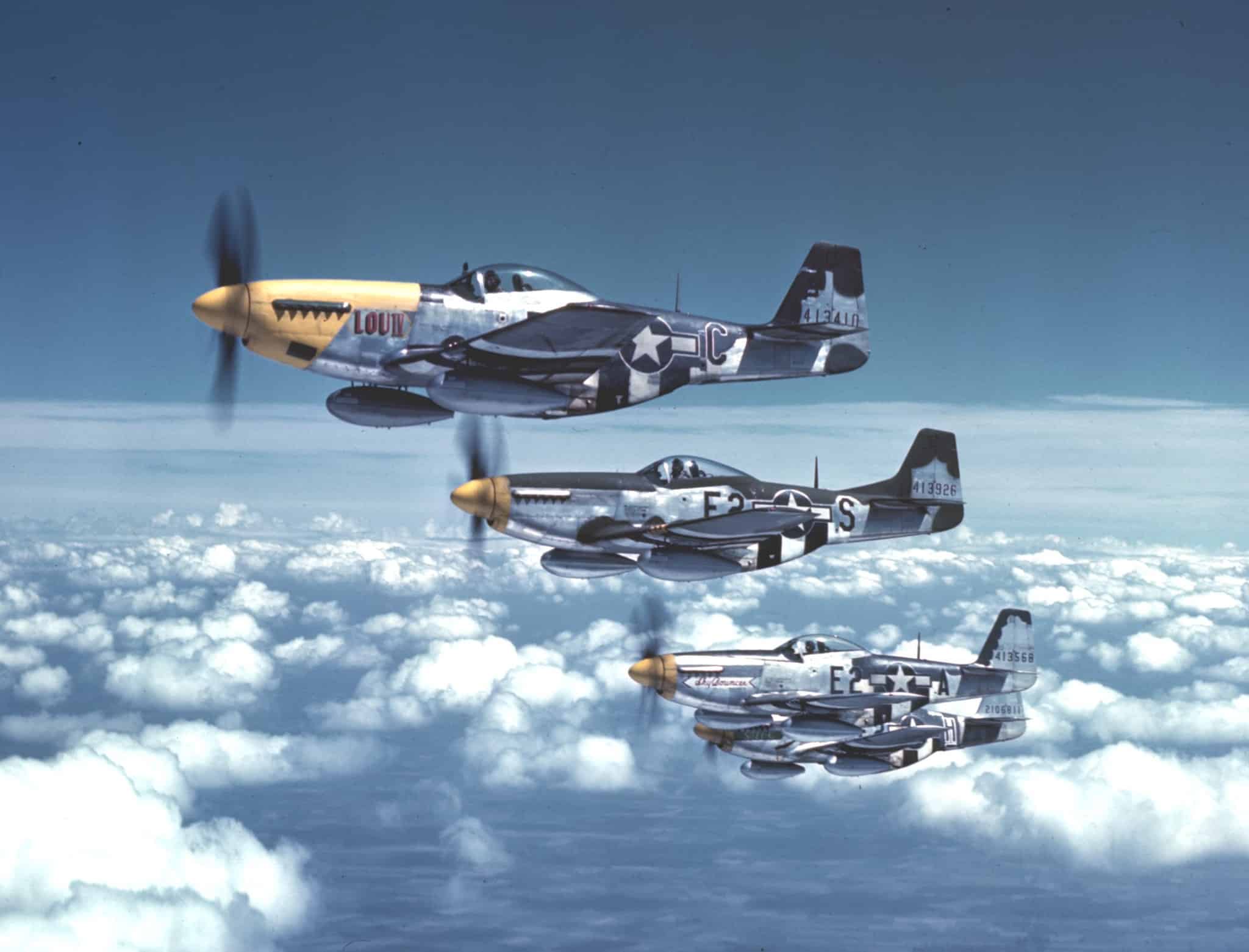
The P-51 Mustang is an American long range, single seat, fighter bomber plane. Designed in 1940 by North American Aviation, it took ts maiden voyage on October 26th of 1940, and was introduced to the Royal Air Force (RAF) in 1942. The P-51 Mustang has been used in World War Two, the Korean War, and other conflicts. Its primary users have been the United States Army Air Force (USAAF), the Royal Air Force (RAF), the Chinese Nationalist Air Force, and others. Since its introduction, more than fifteen thousand P-51 Mustang aircraft have been built. The per unit cost of a P-51 was about $51,000, way back in 1945.
image via national archives
The Mustang was originally designed to use an Allison V-1710 engine, but they were later outfitted with Rolls Royce Merlin engines, which improved performance at altitudes above 15,000 feet. The ultimate version of the aircraft, called the P-51D, was powered by the Packard V-1650-7 engine, and armed with a set of six .50 caliber Browning machine guns.
Attention Avgeeks! There are only a few more months to see active US Air Force F-4 Phantoms flying at airshows. That’s right. In less than three months, the QF-4 program will be gone forever. With the expiration of the QF-4 program, that means that all associated heritage flights at airshows will also end. According to AirshowStuff, the final flying performance of the QF-4 will be on December 20th at Holloman Air Force Base with 4 other appearances between now and then.
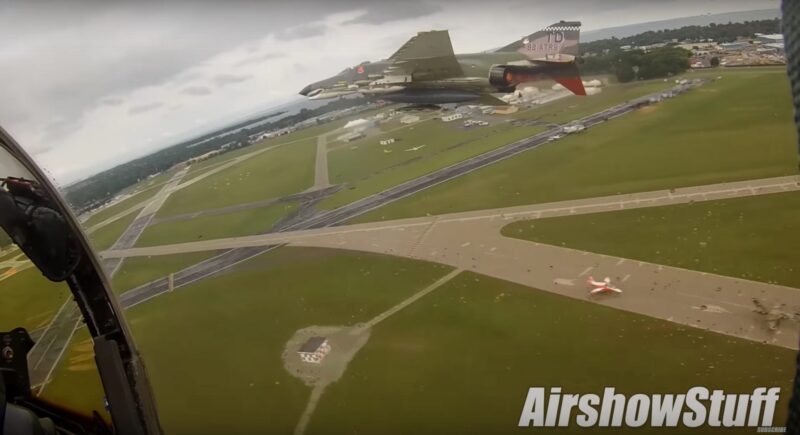
Even if you can’t make it to see them in person, you can still be awed by watching them online. Our friends at AirshowStuff also shared some exclusive F-4 Helmet Cam footage with us. In an era of glass cockpits and multi-function displays, it’s so retro to see some old steam gauges in the Vietnam era cockpit. It’s also refreshing to see some precise stick and rudder flying powered by two afterburning General Electric J79s.
The rare footage came features an F-4 formation departure from the AirVenture Airshow at Oshkosh. On departure, you’ll see a high speed pass, photo pass, and dirty pass. That’s the old ‘mini demo’ routine they used to do when they were part of the Heritage Flight program. After departure, they climbed straight out after the dirty pass and transitioned to cruise.
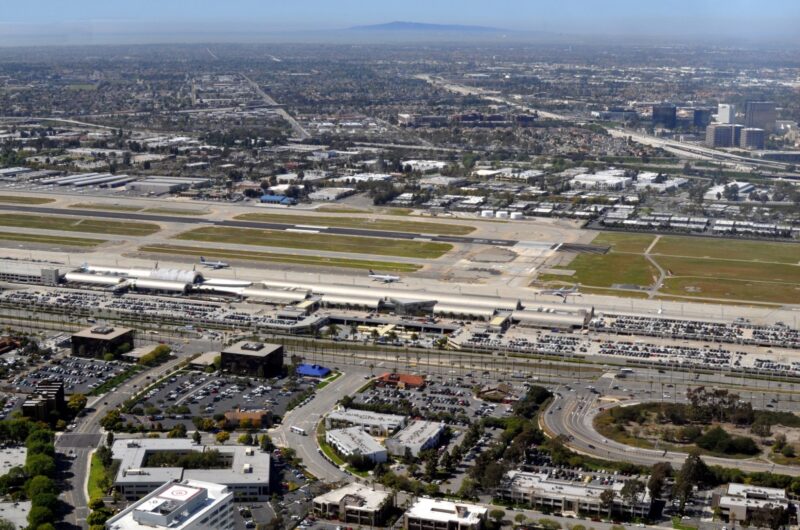
If you’ve ever had the pleasure (or perhaps the terror) of taking off in a commercial plane from Orange County at John Wayne airport, you’ll know that it is a takeoff unlike any other. Just seconds after liftoff, you will feel your stomach drop as the airplane does a very abrupt pushover. This pushover, similar to what you might feel on a rollercoaster or perhaps a hilly backcountry road, will make you light in your seat. You might even feel yourself being restrained by your seatbelt.
The next thing that you will notice is that the sounds in the cabin will change. Specifically, they will get much quieter. The roar of the engines that accompanies all takeoffs will diminish dramatically. You will sense that the nose of the aircraft has dropped significantly. The incline, or what pilots call the “deck angle” will have gone from the usually steep angle used for most takeoffs, to one that is barely distinguishable from level flight. And all this will seem to be happening much too close to the ground.
Finally, you may become aware of an annoying thumping that you feel in your chest. Don’t worry, that’s only your heart pounding.
You may think that this is it…game over…and wonder if there’s enough time to squeeze a goodbye text to your loved ones before plunging into the Pacific Ocean. But you should rest easy. You are not going to die (at least not today). What you have just experienced is known as a noise abatement takeoff. They occur hundreds of times weekly at John Wayne and are an FAA approved and in fact government mandated maneuver. That’s right; pilots and airlines will be fined if they don’t perform this type of takeoff.
So why, you may ask, are you being subjected to an experience that should probably be featured at the nearby Disney theme park? Well, as I mentioned above, noise. Noise and of course politics. For John Wayne airport is the only airport which mandates such a drastic noise reduction profile. And as legend has it, the Duke himself, the airport’s namesake, had a hand in getting those restrictions put in place.
The departure path from John Wayne airport flies almost directly over Newport Beach. As you may know, Newport Beach is a very well-heeled community. And while I’m not going to make judgements on wealth accumulation, one thing wealthy people are good at is getting things done. Starting with the arrival of the first turboprops and jets in the 1970s, community activism followed soon thereafter. Eventually, lawsuits were filed, and the restrictions were put in place.
A little history about John Wayne Airport
John Wayne Airport dates back to 1923 when a landing strip was first opened by a man named Eddie Martin to host a flying school. Then known as Martin Field, Orange County assumed ownership in 1939 with the airport becoming to be known as Orange County Airport. The name was changed to John Wayne Airport in 1979 in honor of actor John Wayne, a nearby resident, upon his death.
Noise restrictions at the airport date back to 1985 when a local group representing residents who lived under the departure path sued the county. The resulting settlement implemented noise regulations and curfew requirements, which remain in force today. Noise meters are deployed along the departure path to measure the sound footprint of each departing aircraft. Those restrictions are unique in being some of the first of their kind, and also just about the only of their kind.
In 1990, Congress, fearing that many localities could eventually hamstring the growth of aviation by implementing their own patchwork of noise restrictions, passed the Airport Noise and Capacity Act which outlawed curfews at airports. John Wayne was grandfathered in, however, due to the original lawsuit being filed in 1985.
Why the Rollercoaster?
So knowing why airplanes have to fly quietly, you may be wondering about the “how”. And specifically, you might be wondering why airliners don’t just use less thrust from the get-go instead of the roar followed by the pushover and silence. Without getting too technical about takeoff performance, much of it comes down to the runway length at John Wayne airport, or to be more specific, the lack of runway length.
The longest runway at John Wayne is less than 6000 feet long. At a scant, 5701 feet to be precise, it is one of the shortest runways if not the shortest runway in the nation from which large commercial aircraft fly.
It is the nature of gaining flying airspeed in a very short distance which necessitates the full power takeoff. Once airborne, but before the flaps are retracted, the aircraft reaches a “cutback” altitude of about 800 ft. It is here where the engines are throttled back either manually or by the auto-throttles to a thrust which meets the minimum required climb gradient of about 2.5%. Less thrust also means a shallower climb angle, hence the pushover.
Once beyond the noise sensitive area, or about six miles after takeoff, the aircraft resumes its normal climb profile using full climb thrust.
Are noise abatement departures more dangerous?
I suppose that depends on your definition of the word dangerous. Any time you monkey around with large power changes on a turbine engine, you increase the odds of something going wrong. In fact, many engine failures occur not on initial thrust application such as takeoff, but rather on a large thrust reduction. That said, the odds of that ever happening are infinitesimal. Still, it isn’t unknown for engines to fail as was dramatically illustrated by the uncontained engine failure on a Southwest Airlines 737 several weeks ago. Infinitesimal odds, but not zero.
So no, it isn’t dangerous in the conventional sense of the word. Avoiding flights out of Orange County to avoid takeoffs using this procedure would be silly. And likely more dangerous, as a longer commute up the freeway to LAX would definitely expose you to more absolute danger in your car. Of course, the safest course of action is to hide under the bed, which still won’t protect you from meteorites…or dust bunnies.
So when you do get on that airplane leaving the Orange County, be sure to get a window seat on the left side of the airplane which gives the best views of Catalina, relax and enjoy the ride. But don’t put your arms in the air and scream as if on a real rollercoaster. People will stare.
A highly organized set of rules and procedures allow efficient traffic flow between North America and Europe.
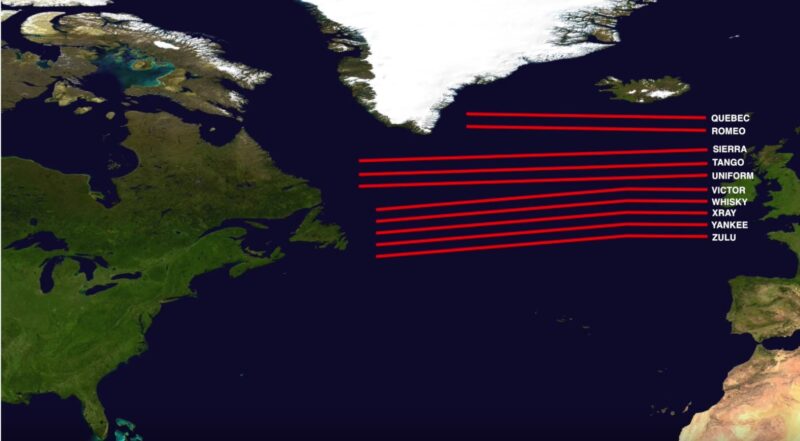
More than two thousand flights a day cross the North Atlantic. However, there is no radar coverage over the North Atlantic, so planes must fly according to a unique set of procedures. They follow a set of daily tracks that behave like highways in the sky.
These are called North Atlantic Tracks, or NATs. The tracks are used by planes that fly at altitudes between 29,000 and 41,000 feet. In this way, the planes can steer clear of each other, as there are potentially hundreds of planes all traveling the same route at the same time, with no direct radar coverage. Airliners use satellite-based tools and HF radio to report position and communicate with controllers in Canada, Scotland, New York or Santa Maria depending on their location.
The North Atlantic tracks are flexible. They are changed daily to take maximum advantage of jet stream winds. The jet stream winds have an average wind speed of about 110 miles an hour, sometimes much higher. Planes that fly in and with these winds can cut an hour or more off their arrival times. For instance, an eastbound flight from New York to London normally takes about six hours and 15 minutes but over time a flight can shave almost an entire hour by taking advantage of the winds. The return flight back to the US is against the winds though. A flight from London to New York could take almost seven hours.
NATs are an amazing example of international cooperation to ensure safe and effective travel across the Atlantic.
STS-9 was the ninth NASA Space Shuttle mission, and the sixth flight of Space Shuttle Columbia. It was launched in November 1983 on a nine-day mission carrying the first Spacelab laboratory module into orbit.
STS-9 was notable for its “firsts.” While this was not Commander John Young’s first Shuttle flight, he was the commander of STS-1, the first Shuttle flight.
STS-9 was a mission of many firsts
This was the first time the Shuttle orbiter flew with six crew members.
It was the first flight for a member of the European Space Agency.
It was the first Spacelab laboratory module mission.
The mission went so well, the mission was extended to 10 days, making STS-9 the longest duration Shuttle flight at that time.
The flight events progressed smoothly. The six astronauts, working in teams of three, worked 12-hour shifts in the Spacelab. Work in the Spacelab went so well that the mission was extended to 10 days, making it the longest-duration shuttle flight at that time.
The Spacelab 1 mission was highly successful, proving the feasibility of the concept of carrying out complex experiments in space using non-NASA persons trained as payload specialists in collaboration with a Payload Operations Control Center (POCC).
Some firsts were not positive
Four hours before scheduled re-entry, one of the flight control computers crashed when the Reaction Control System (RCS) maneuvering thrusters were fired. A few minutes later, a second computer crashed in a similar fashion, but it was successfully rebooted. Young delayed re-entry and allowed the Shuttle to drift in orbit for several hours, double checking their systems.
Re-entry went smoothly and all systems appeared normal throughout the descent and landing.
Then a fire…
What no one knew was that about two minutes before touchdown, two of the three APUs caught fire in the APU compartment in the rear of the Shuttle. The APUs provide hydraulic pressure to operate the orbiter’s flight controls and landing gear.
Unaware of the fire, the crew landed the orbiter without difficulty. The fire continued after the wheels stopped, eventually burning itself out, causing major damage to the compartment. The fact that there had been a fire was not discovered, however, until the APU compartment was opened during post-flight inspections.
Post-flight analysis revealed the first computer failed when the RCS thruster motion knocked a piece of solder loose and shorted the CPU board.
The fire in the APU compartment was caused by a hydrazine fuel leak. Hydrazine is used as a fuel for the RCS thrusters.
During a post-flight press conference, Young remarked that when the first computer failed “…my knees started shaking. When the next computer failed I turned to jelly.” (John Young – Mission Report STS-9)
Ukraine: Where Regulations Must Just Be An Opinion
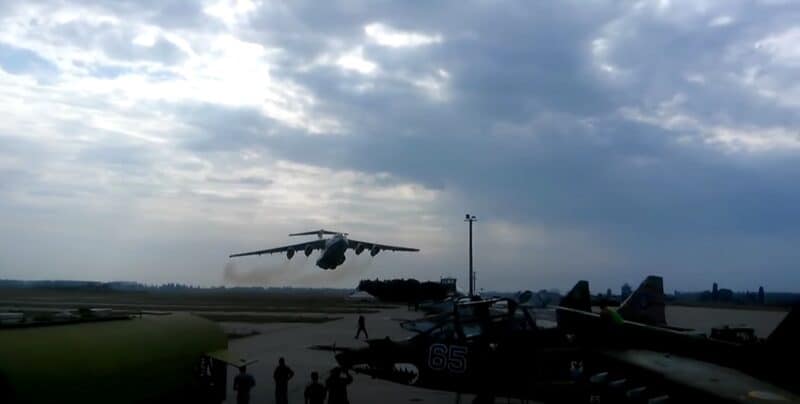
Eastern European air forces seem to have some different flyover rules than the rest of the world. If a US Air Force pilot attempted this, he or she would lose their wings and probably go to jail! This isn’t the first time we’ve seen some ‘unique’ flying by Eastern Bloc nations. We’ve seen some impressive low passes from the Slovokian Government A319 and Russian SU-24s buzzing the tower.
We don’t have many details on this flyover other than it’s a Ukrainian IL-76 and the flyover is both impressive and downright nuts. Just watch:
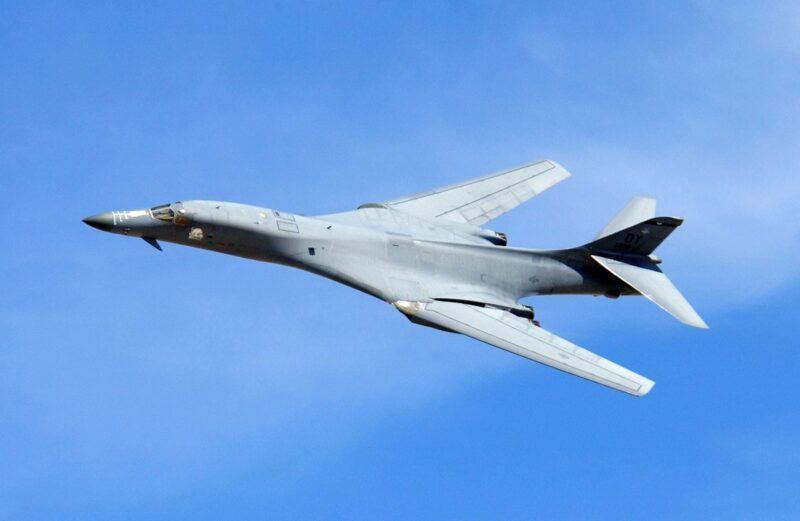
On October 4th of 1989, a Rockwell B-1B Lancer from Dyess Air Force Base in Texas, crash landed in Rogers Dry Lake at Edwards Air Force Base in California. The nose landing gear would not extend, so the crew consulted with engineers and maintenance personnel. The crew decided that the plane would attempt a landing on the dry lakebed, where a softer, dryer surface promised less damage to the bomber.
The B-1B landed, spewing smoke and dust while its nose gently dug into the ground. While the incident caused some damage to the bomber, it appeared to be light. The jet was later returned to service.
You can read more about the incident in an original article from 1989 here.
The Rockwell B1-B Lancer is a jet powered, heavy strategic bomber, primarily used by the United States Air Force (USAF). It is a four engine, long range, supersonic aircraft.with mach speed capability. The Rockwell B1-B Lancer served in combat during Operation Desert Fox, and in Kosovo the following year. The B1-B has also supported American forces in Afghanistan and in Iraq.
The The Rockwell B1-B Lancer was manufactured by Rockwell International, which is now a part of Boeing. The B-1B entered service on October 1st of 1986 with the United States Air Force (USAF) Strategic Air Command as a nuclear bomber. The B1-B had a unit cost of about $283 million back in 1998. Roughly 100 Rockwell B1-B aircraft were built.
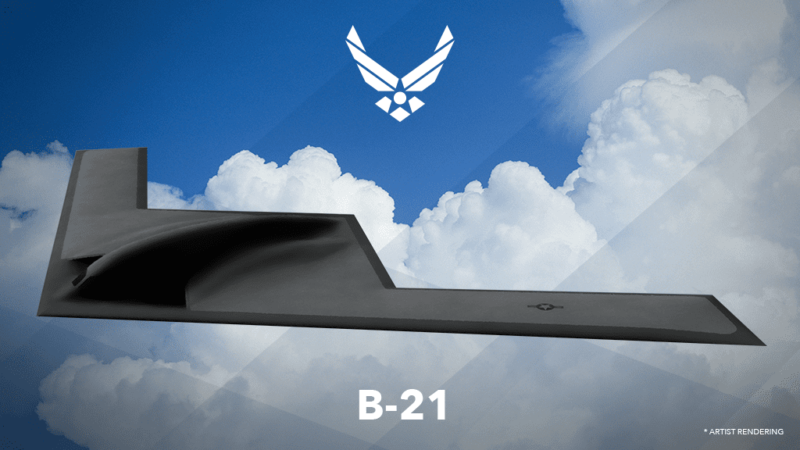
The Air Force announced that the nickname of the new Long Range Strategic Bomber known as the B-21. In a speech by Secretary of the Air Force, Deborah James announced the new name. It will be known as the B-21 Raider.
The contract to build up to 100 aircraft was awarded to Northrup Grumman last year. Northrup also built the B-2. Analysts say the program will be worth around $80 billion in total, providing a boon to Northrop and its key suppliers, but the Air Force has said only that it expects to pay $511 million per plane in 2010 dollars.
The announcement of the B-21’s nickname follows the Air Force’s attempt at a naming contest earlier this year. Last spring, the Air Force announced that anyone could submit a name for the new bomber. A formal vote was never announced, presumably to avoid naming the aircraft something lame or offensive. The B-21 Raider shares the same nickname as the proposed Sikorsky S-97 Raider Helicopter. No word yet on whether that craft will change its name.
Airplanes have revolutionized our nation and changed the way candidates campaign.
The airplane has been an important campaign tool for presidential candidates from the early 1950s. Not all candidates, however have had a dedicated campaign plane. Many simply used on-demand charters of business aircraft. And very few actually had access to aircraft owned by them or their families. Most dedicated campaign aircraft were leased for the campaign, paid for out of campaign funds.
Initially, the lines between campaign airplanes and official presidential airplanes, i.e., “Air Force One,” were somewhat blurred. Franklin D. Roosevelt was the first president to fly while in office and to have an aircraft, a Douglas DC-4 for official travel.
After 1950, any national campaign for office required the ability to travel efficiently around the country. Below are our picks for the top eight aircraft used by presidential candidates beginning with Harry Truman in 1948.
Number 8 – Douglas DC-6
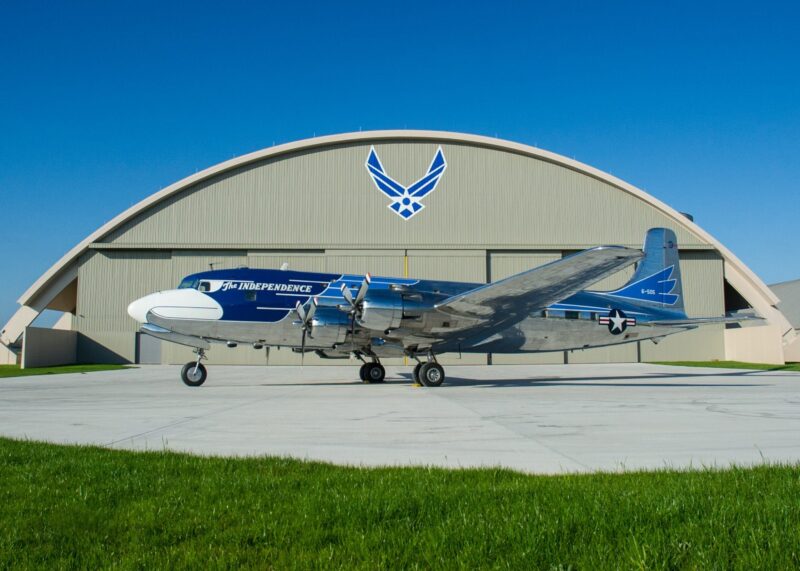
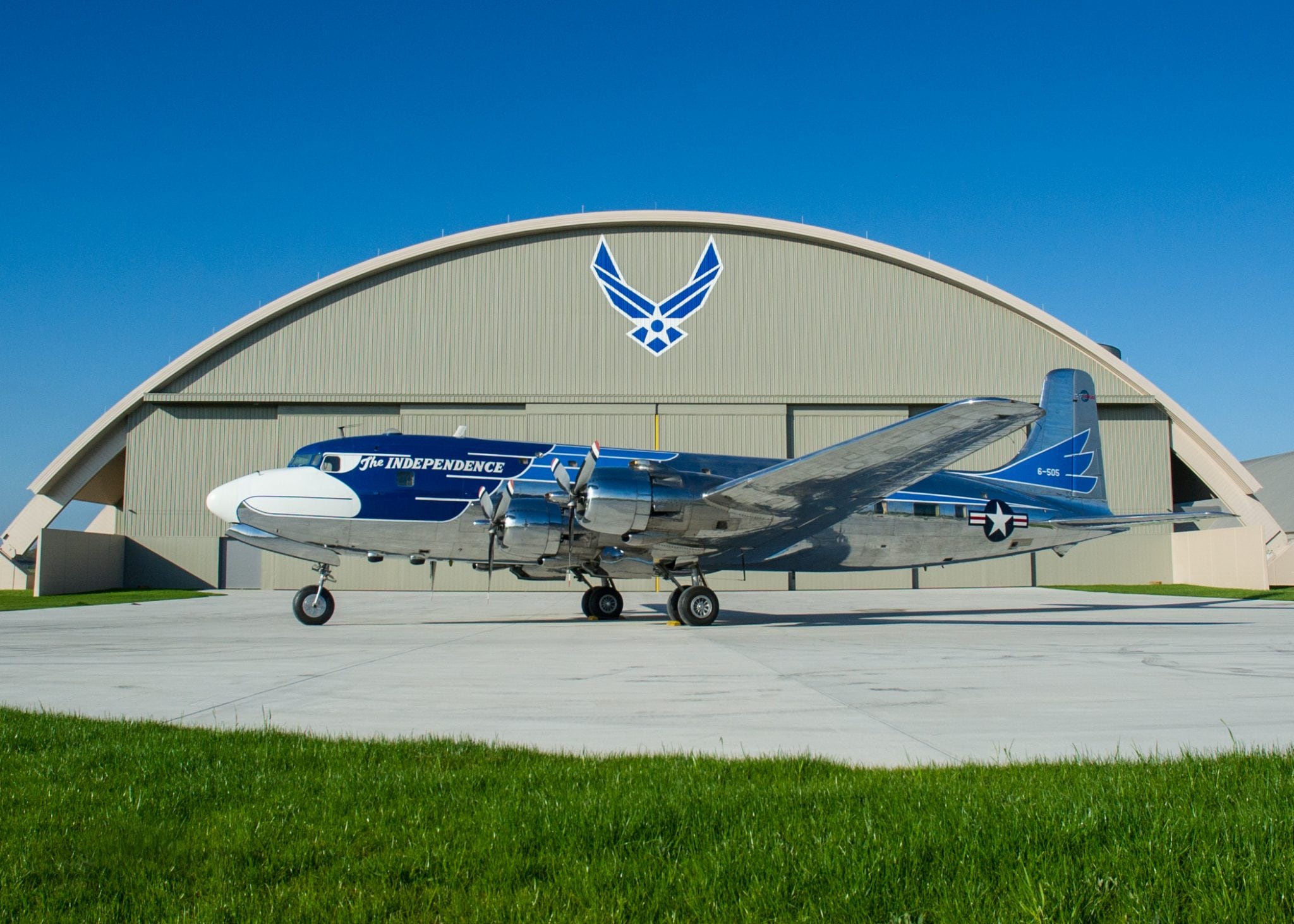
President Harry Truman had use of a Douglas VC-118 (VIP version of the DC-6) as a Presidential aircraft. The aircraft, dubbed “Independence,” was equipped with a galley for meals, plush seating in a forward cabin, a communications center, bunks, and standard airline seating in the back. This aircraft served as Truman’s official presidential aircraft, the equivalent of “Air Force One,” even thought that call sign had not yet been adopted. This plane is part of the Presidential Collection at the National Museum of the United States Air Force (NMUSAF), and is open for public inspection.
In 1952, Democratic candidate Adlai Stevenson typically flew on a DC-6 chartered from American Airlines with the words “Stevenson Special” on the side of the aircraft. The press corps flew on a separate aircraft that took off after Stevenson’s plane and landed before it did “so that if he {Stevenson} crashed they would be on the ground to report the accident.” (A Voice for the Underdog,” Ray Boomhower, 2015)
President Truman’s VC-118 (DC-6) named “Independence) (NMUSAF Photo)
Number 7 – Lockheed Constellation VC-121
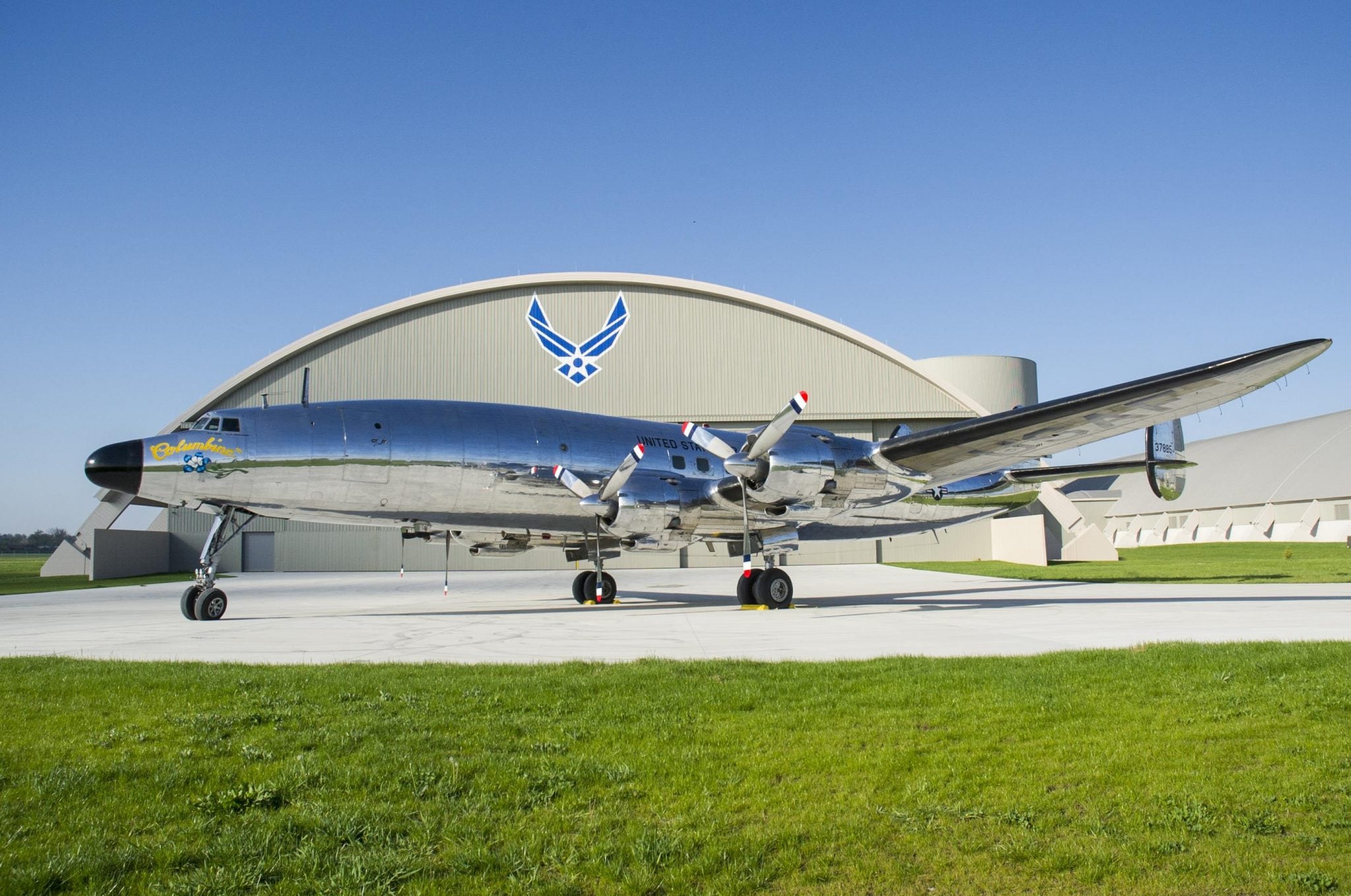
The Constellation, military designation VC-121, was President Dwight D. Eisenhower’ preferred aircraft. As Supreme Commander of the Allied forces in Europe, he had flown on an earlier model of the Constellation. He had named it the Columbine for the state flower of Colorado, his wife Mamie’s home state. While running for President, he flew on the Columbine II, a VC-121. Until recently, Columbine II had been sitting in a desert in Arizona. A team from Bridgewater, Virginia took a year to return it a flyable condition. It was flown to Virginia where the interior will be restored to just the way it was when Eisenhower last used it in 1954. Columbine III is part of the NMUSAF Presidential Collection in Dayton, Ohio.
President Eisenhower’s Columbine III Lockheed Constellation (NMUSAF Photo)
Air Traffic Control (ATC) uses either the airlines flight number or an aircraft’s tail number for radio identification. During a flight into washing late in Eisenhower’s presidency, the tail number of the Constellation and an airline flight number were identical, causing confusion that resulted in the two aircraft coming dangerously close to each other. Shortly after that, it was decided that any aircraft with the President aboard would have the call sign “Air Force One.”
President Eisenhower’s Columbine III Lockheed Constellation (NMUSAF Photo)
Number 6 – Convair 240
In 1956, during the campaign for Eisenhower’s re-election, Richard Nixon, then vice-president, used a Convair 240 chartered from United Air Line. It was named “Vice President Nixon’s G.O.P. Congressional Special.”
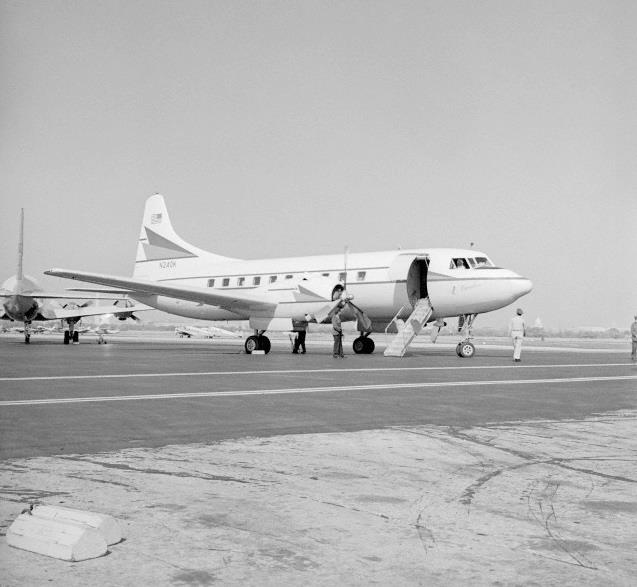
Four years later, John F. Kennedy’s father purchased a Convair 240 from American Airlines for $270,000 for young Kennedy’s presidential campaign. Kennedy named the aircraft “Caroline” in honor of his daughter. The interior of the aircraft had been modified into a flying office with a full galley, bathrooms, a bedroom and work desk. There were sixteen seats for Kennedy and his staff. Once elected, he would move up to the first purpose-built “Air Force One,” a Boeing 707.
Kennedy’s Convair 240, one of the few aircraft actually owned by the candidate’s campaign.
Number 5 – Boeing 727
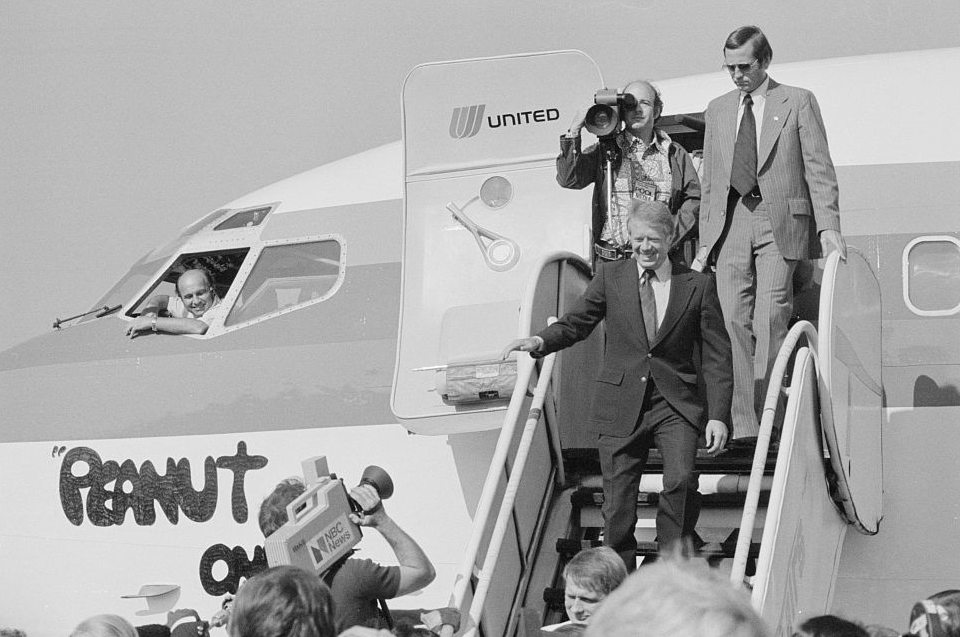
Jimmy Carter became one of the first candidates to have a jet for a dedicated campaign aircraft. His campaign leased a Boeing 727 from United Airlines in 1977. Appropriate for the peanut farmer from Georgia, the aircraft was named “Peanut One.”
Coincidentally, Peanut One’s primary pilot was James Kenneth Carter—no relation to the candidate. They became friends during the nearly year-long campaign.
The 727 was a popular airplane for campaigning. It had been designed for operations into and out of short runways, making it useful for visiting smaller towns and airports. Barry Goldwater, during his bid for the Presidency in 1964 used a chartered 727 named “Yia-bi-ken,” a Navajo phrase meaning “House in the Sky.” The aircraft interior was divided into three sections: a front cabin for the senator, including bunks. This was followed by 20 first class seats for staff, and Mrs. Goldwater’s hairdresser. The aft cabin had 54 for press and additional staff.
During the period from the 1960s through the 1990s, very little press notice was taken of candidates’ aircraft. Campaign aircraft were just another tool used by candidates, and deep online research often turns up nothing but brief anecdotal references of a candidate’s aircraft. There are several references to Hubert Humphrey’s aircraft, probably a 727.
Walter Mondale also apparently used a 727, called “Minnesota Fritz,” in recognition of his father. The only photo online shows him in a set of airstairs at the very front of the airplane, with the Minnesota Fritz insignia. Obviously, the airstairs were placed in a position to show off the Minnesota Fritz insignia, but it looks like Mondale may have exited through the copilot’s window.
Identifying the type of aircraft was a challenge too. Boeing used the two “eyebrow” windows above the main cockpit windows on early 707s, 727s, and 737. Eventually, a news article mentioned “727” in reference to his aircraft.
George McGovern also used a 727, christened Dakota Queen II after the WWII B-24 bomber, the Dakota Queen, that was name in honor of his wife Eleanor.
Jimmy Carter greets press as he steps off of Peanut One, a Boeing 727 during the 1977 campaign.
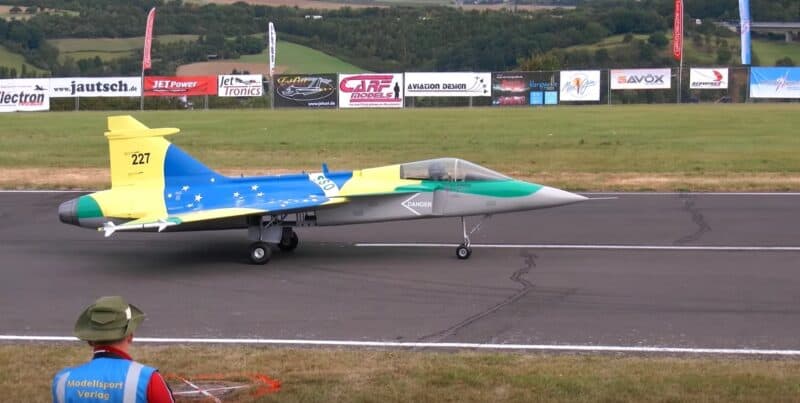
RC airplanes seem to be getting bigger and bigger. This 1:2 scale (yes…half the size of an actual aircraft) Saab Grippen jet is probably the largest jet we’ve ever seen! It’s so big that it either required a trailer to bring it to the field or it must be assembled before flight.
In any case, the flight didn’t turn out as intended. After only a few minutes of flying, the model was completing a flight line pass when the model’s vertical stabilizer ripped off. In an instant, the rest of the jet broke apart and fell to the ground in a blaze of glory leaving the poor operating crew to run after their prized flyer. Fortunately, it doesn’t appear that anyone was hurt. Back to the drawing board!
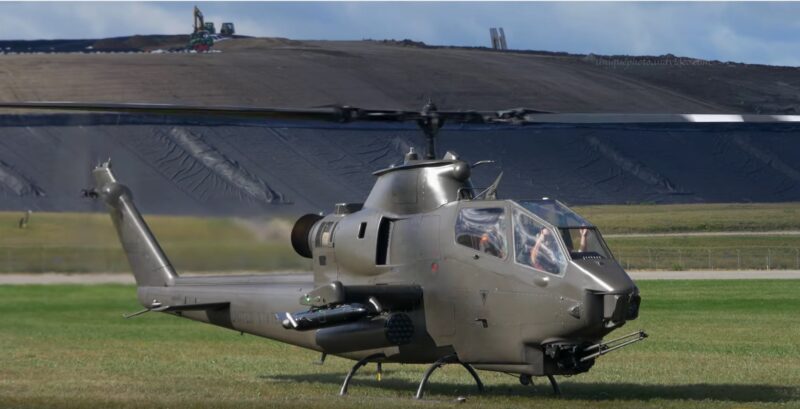
The Bell AH-1 Cobra is a two pilot aircraft designed to meet the requirements of the United States Marine Corps. The original Cobra was designed in the 1960s and received upgrades and modernizations until the 1980s. According to the Official Bell Helicopter Website, “The Zulu is the only attack helicopter in the world with a fully-integrated air-to-air missile capability.” Each General Electric T700-GE-401 turbo shaft engine on the Cobra AH-1Z produces 1,800 shp and impressive climb rate of 8.2m per second.
This is a short video of the Bell AH-1 Cobra Taking off and Landing at Willow Run Airport’s Thunder Over Michigan. I mixed the audio into 5.1 Surround Sound for your listening enjoyment! Prepare to hear the rumble of the Cobra’s engines as the helicopter begins its descent and landing. For best results with 5.1 audio, use Surround Headphones or playback on a home theater system!