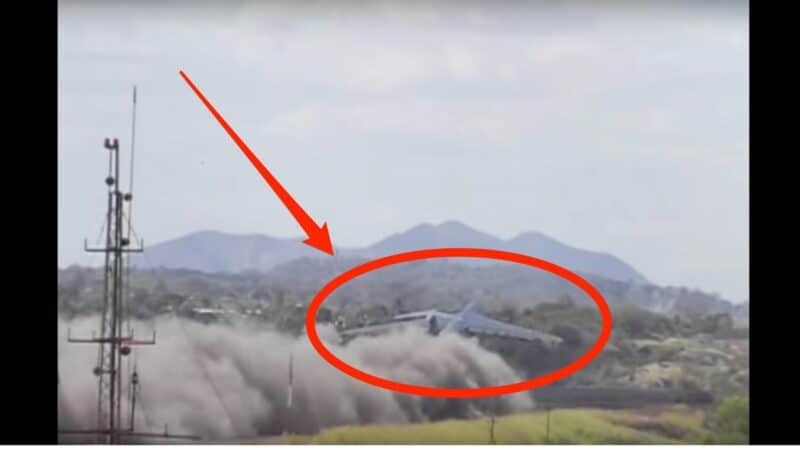
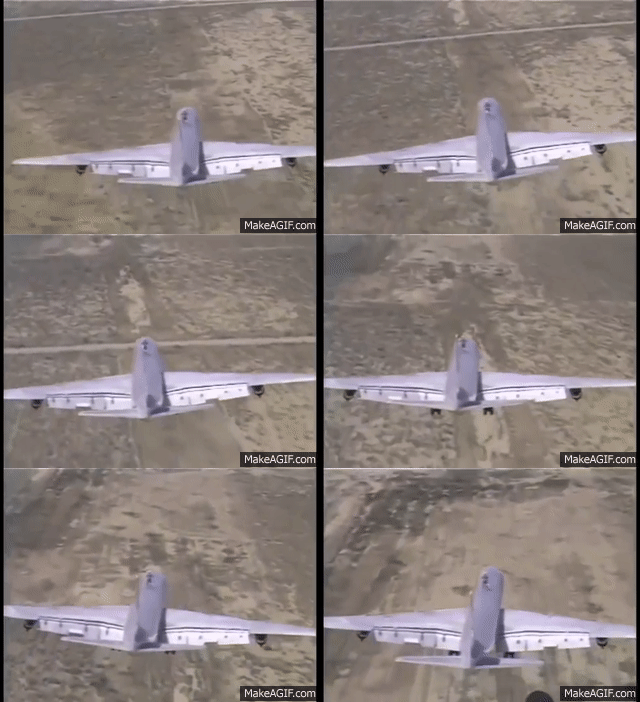
In the C-5, no takeoff is uneventful. Those jurassic TF-39 turbofans suck every ounce of air into their engines to power the massive 700,000 beast forward. No where is this miracle of late ’60s technology more evident than this takeoff from an austere field at Ilopango International Airport in El Salvador. The C-5 crew gnat’s assed their TOLD (Takeoff and landing data), set the power to max and made one spectacular takeoff from the dusty, third-world strip.
The C5 Galaxy is a large, four engine, military transport aircraft, manufactured by Lockheed. The landing gear of the C5 has sixteen wheels at the back and four at the front. With its heavy strategic lift capability, it proudly serves the United States Air Force (USAF), carrying oversized loads. The C-5 Galaxy is among the largest military aircraft in the world.
The C5 Galaxy embarked on its maiden voyage on June 30th of 1968. The USAF has been operating the C-5 Galaxy since 1969. The C-5 Galaxy has supported military operations in major conflicts in Viet Nam, Yugoslavia, Iraq, and Afghanistan, as well as in the Gulf War. The C-5 Galaxy has also been used for bringing relief aid to devastated communities.
Lockheed suffered significant financial problems in developing the C-5 Galaxy. Soon after entering service, cracks in the wing were noticed on several units, so the whole C-5 Galaxy fleet was restricted until the problem could be solved.
In total, 131of this type of aircraft have been built. As of 2016, the per unit cost of a C-5 Galaxy is between 100 million and 262 million USD, depending on the model. The C-5 Galaxy is still in service today but the fleet is slowly being ‘right sized’ to less than 60. The remaining C-5s in service are undergoing conversion to the C-5M. The C-5M Super Galaxy is an upgraded version of the C-5 Galaxy, with all new engines and modernized avionic systems, which are designed to extend the service life of the C-5 beyond 2040.
It always amazes me when ground vehicles somehow manage to hit aircraft.
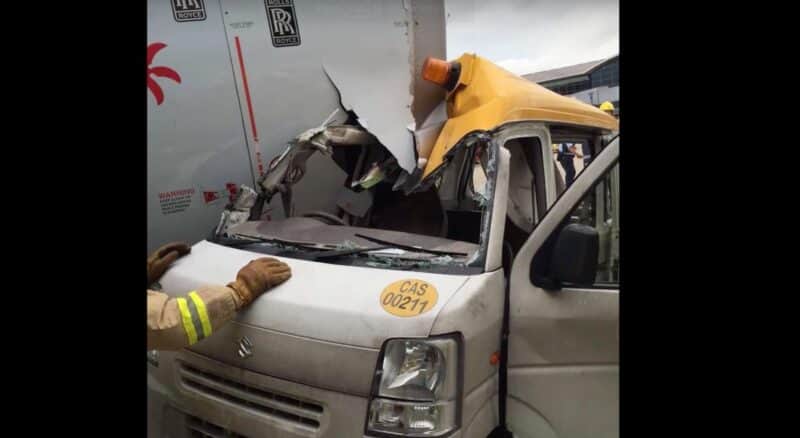
Flight KA691 started out like any other flight. The pilot called for pushback and then called ground to taxi to the runway for departure. This flight wouldn’t make it any further than the tarmac though. Just as the Airbus A340 started to taxi forward, an airport service truck driver plowed right into the number 2 engine. The Dragonair flight wasn’t going anywhere.
In the video, you’ll see that another ground worker signaled to the crew to stop the aircraft that was taxiing forward at a crawl. The pilot requested to ‘hold position’. Within a few minutes, emergency personnel arrived to rescue the injured driver and the aircraft shutdown. The passengers were eventually offloaded and boarded another aircraft for a very delayed departure to their destination.
No word on how this incident happened. It could have been a medical emergency or the driver could have been distracted.
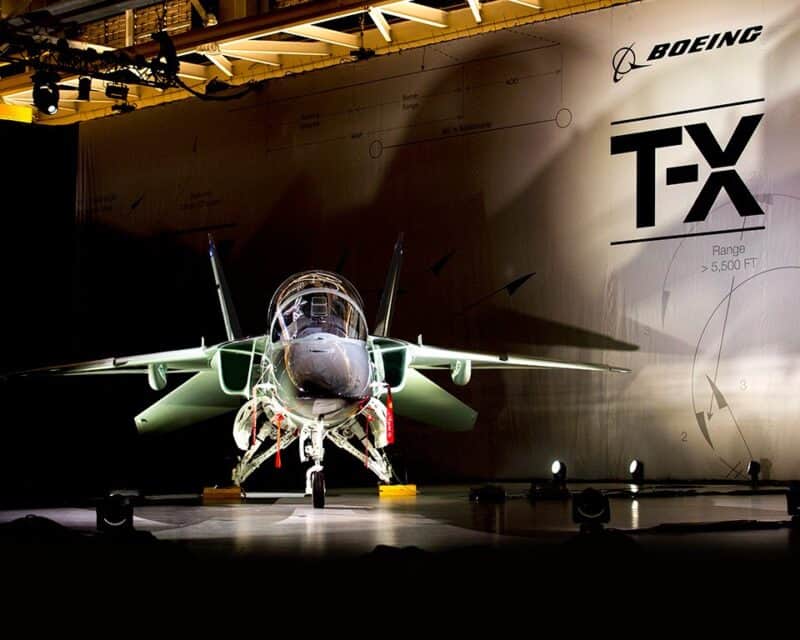
Boeing takes the wraps off their entrant into the Air Force’s T-X competition to replace the T-38 Talon.
Under the cover of night, Boeing moved its T-X aircraft to a hangar in St. Louis for the unveiling ceremony. Boeing’s entrant into the T-X competition is a clean-sheet design that features a single engine jet with twin tails, a “stadium-seating” cockpit and advanced avionics and senors that will permit a more complete pilot training program for fighters and bombers.
Boeing’s design is riskier than some of the other potential T-X competitors. As a clean-sheet design, the trainer jet could be seen as a more risky option for the Air Force if selected. Boeing has made efforts to lesson the risk by applying its commercial manufacturing experience in tooling and manufacturing. They also claim that the first two aircraft built are production examples, not prototypes.
The T-X program is 20+ year project
The T-X program started as a study in 2003 with a stated goal to replace the T-38 Talon. Design requirements emerged in 2011. With 4th and 5th generation aircraft as the primary fighter weapons systems, follow on training programs have had to shoulder much of the training that the T-38 aircraft cannot do. According to Brig. Gen. Donlop, “Currently, 12 of 18 advanced pilot training tasks can’t be completed with the T-38, relying on fighter and bomber formal training units to complete the training at a much greater cost.” The T-X program is designed to close the gap in training that currently exists.
Additionally, the T-X program will attempt to field a jet that is much easier to maintain with the ability to rapidly integrate emerging sensors and technology. The T-X program selected must be able to comprehensibly integrate with training devices such as ground based trainers and simulators to reduce actual flying requirements.
The T-X contract is expected to be awarded in 2017. Over 350 T-Xs are expected to be purchased. If the contract and program stays on track, operations of the T-X should begin by 2024.
Is your Instagram account filled with posts of food, beach scenes, and selfies? If you call yourself a true #avgeek, you need to change that. Instagram is one of the best places to see unique photos and videos of your favorite jets and airports. There are tons of great accounts out there (including our own at @avgeekery). Here are some of the best accounts that we’ve really grown to love.
We love accounts that show aviation for what it is. It is a fascinating career but the day to day life isn’t always a walk in the park. American Airlines MD-80 turned 737 pilot documents the quirkiness of flying the line. His MD-80 photos irreverently documented the life of a MadDog pilot. He had no qualms joking about the steam gauges and ancient technology. Even his Instagram handle is a nod to the annoying “Stabilizer Motion” call by bitchin’ betty. Now on the 737-800, we’ll have to see how he handles the more ‘luxurious’ flying life.
How does this guy not have 100k followers already? Centered around SFO, Anthony’s account is filled with beautiful shots of unique aircraft that fly into the major West Coast hub. If there is a unique jet flying into the Bay area, he is bound to post a photo. We love his passion for spotting and his detailed knowledge of almost any aircraft.
With over 62,000 followers, Instaaviation posts and reposts some really unique photos and videos. We appreciate the fact that its not just US centric but makes a point of posting interesting aviation photos from all over Europe too. Plus, the #instaaviation hashtag is a staple in the Instagram avgeek world.
If there was any account that could be ported into a college aeronautical sciences textbook, this would be it. Sentinel Chicken mixes beautiful original photography and #avgeekschoolofknowledge comments. His descriptions read more like an aeronautics or history lesson, but that is why we love it! This might be the one account on Instagram that you’ll get smarter just by following.
We’re pretty sure that this guy has it all. He’s a 787 Dreamliner pilot who also flies a jet on the side for fun. He travels the world and documents his journey. He also loves to take pictures, including scenes of beautiful girls and planes. I’m not sure there is anything better in life.
Honolulu is one of the busiest airports in the Pacific. It is also in a relatively isolated part of the world. In fact, the route from HNL to the US West Coast is one of the longest routes in the world without a viable alternate. HNLramper takes advantage of his unique location by photographing not just the daily assortment of jumbos but also the rare birds that stop on their long journey to Asia.
Christian’s account might be one of the most underrated accounts on Instagram. As a Boeing 747 pilot, he travels around the world and takes some of the most stunning photographs on Instagram. If you are an Avgeek, you need to follow his account.
https://www.instagram.com/p/BKQ0q4Ngzfn
Do you have other Instagram accounts that we should be following? Let us know!
“We have to have fun sometimes,” says the pilot to Air Traffic Control.
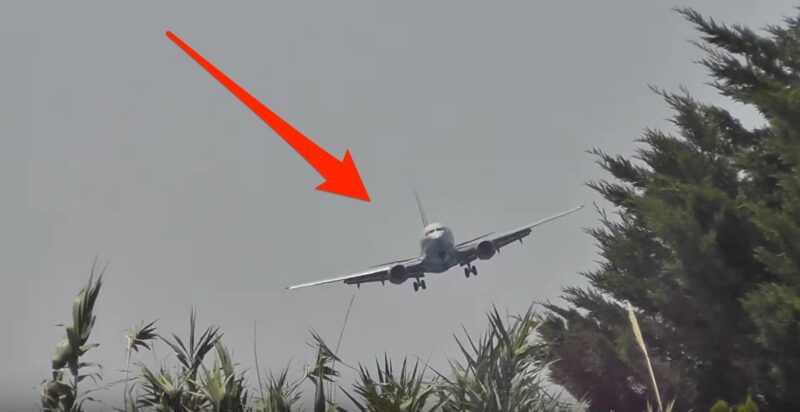
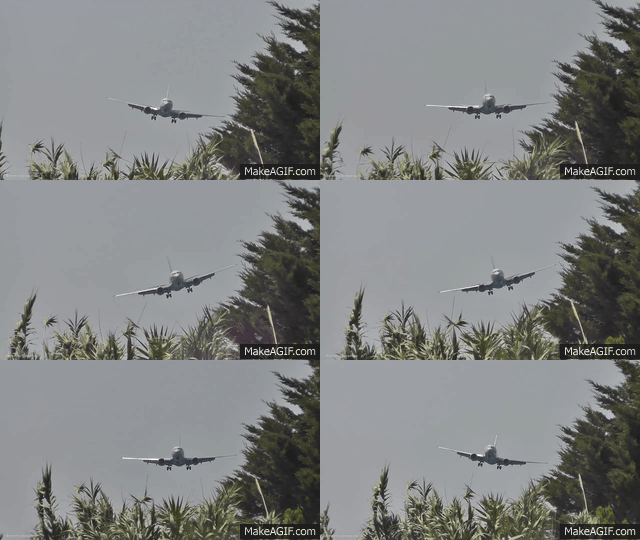
This video footage, taken with a Panasonic HDC-SD90 camera, and published on January 3rd of 2014, shows a pilot doing things pilots don’t normally do with passengers onboard. In the video, you’ll see the pilots land their shiny white Scandinavian Airline System (SAS) 737-700 jet aircraft at Skiathos airport in Greece (aka the St. Maarten of the Med). As the plane approaches short final, the pilots flying the Boeing NextGen decides to do a wing wave to the crowd below as it glides past the tropical trees.
Flight discipline is an important component of being a professional aviator. As a professional pilot, you are entrusted with a multi-million dollar machine. One small mistake and lives are in danger. It’s a fact that mistakes happen but procedures like stabilized approaches and crew resource management are proven to prevent accidents. There appears to be a break down in flight discipline in the cockpit in this video.
While we’ll admit that this particular wing wave wasn’t egregious (less than the 747-8 delivery flight in 2015), it was a poor decision. It might have looked cool on video but showboating is dangerous and unprofessional. We expect professional airline pilots to be pros at all times…even if there are no passengers onboard. Save the fun for those days off.
The Boeing 737-700, otherwise known as the 737NG (Next Generation) is a short to medium range, narrow body jet airliner. It has been in production since 1996, and is still in production today. The Boeing 737-700 is more than 110 feet in length, with a wing span of more than 117 feet. The distance from the plane’s double wheeled tricycle landing gear to the top of its towering tail is more than 41 feet. The Boeing 737-700 took its maiden voyage on February 9th of 1997. The 737-700 is still in service. Its primary users are Southwest Airlines, United Airlines, Ryanair, WestJet, and Lion Air.
Swanky music, bell bottoms, and crazy human tricks defined the 70’s.
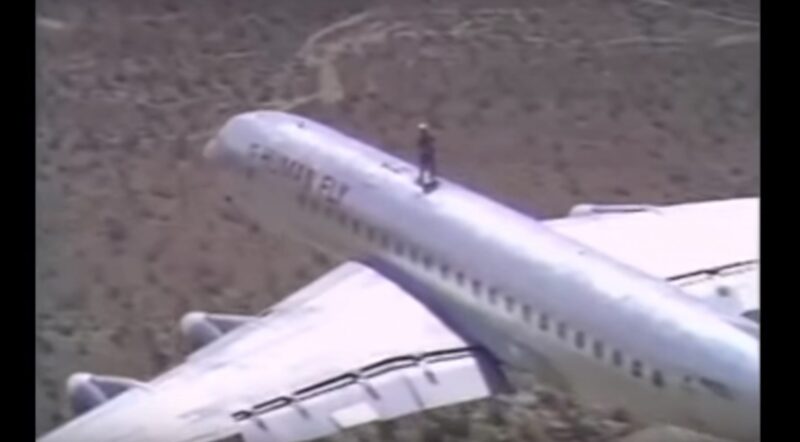
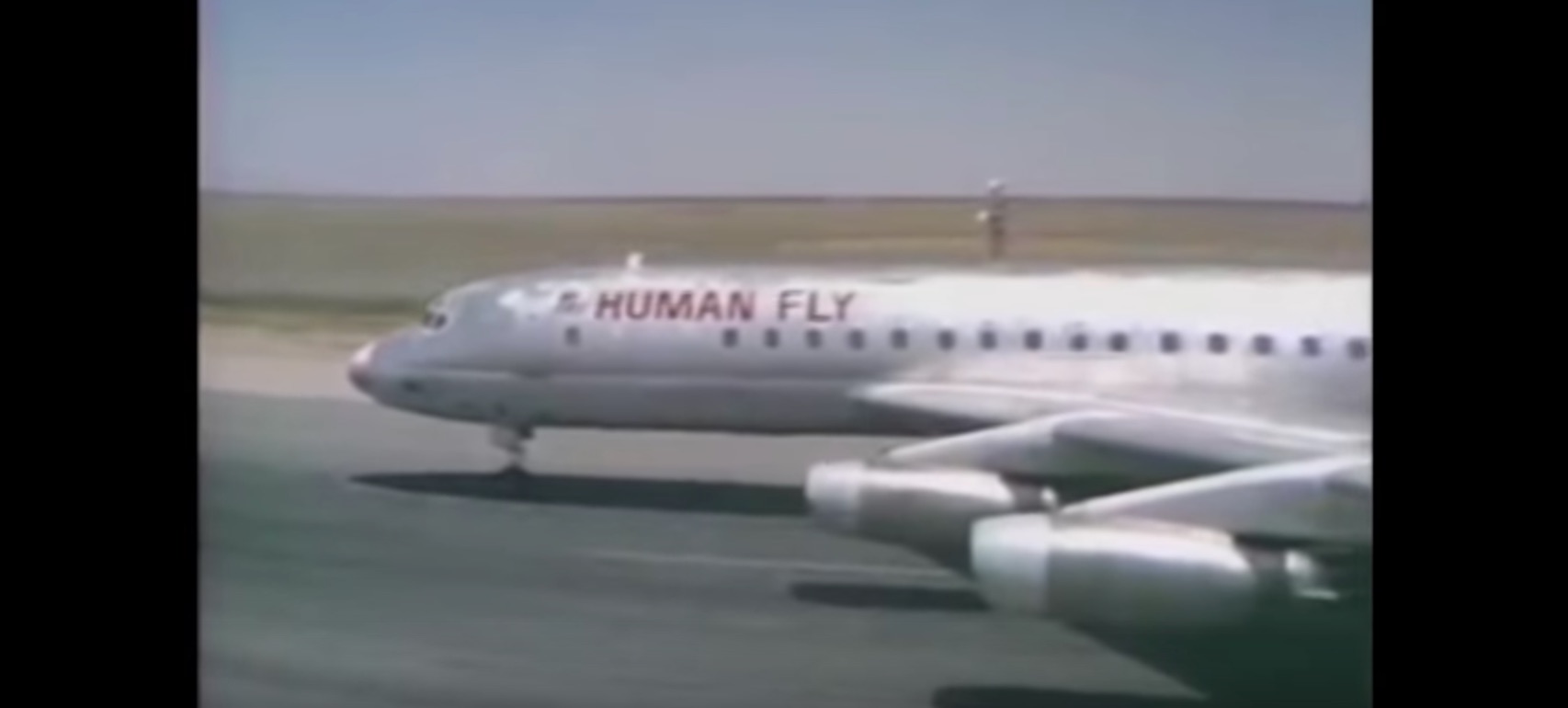
In 1976, Clay Lacy, a famous businessman and movie pilot, was requested to pilot a DC-8 in one of the weirdest stunts in the history of aviation. It was called The Human Fly.
Rick Rojatt, a costumed Canadian stunt actor, made the request. For promotional reasons, Rick wanted to stand on top of a DC-8 wearing a fly costume, with the words “The Human Fly” painted along the side of the jet. He wanted the plane flown over the Mojave Desert and over Texas.
Rick Rojatt was dressed in a fly costume when he spoke to reporters about being ready to stand on the wing of a flying lear jet aircraft.
That’s easy for Clay Lacy to say. Clay Lacy piloted the plane. Rick Rojatt was the one who performed the stunt, and nearly got himself killed when it suddenly started raining. Rain hits pretty hard when you are traveling at great speeds. Fortunately, the pilot was able to see Rojatt on the screen via camera. When Rojatt passed out and his arms fell to his sides, Clay Lacy landed the plane. Rojatt was helped down with a cherry picker and stuffed into an ambulance, from where he emerged a short while later, limping from where the rain had hit him in the legs. At over 250mph, the rain became like rocks. Said Rojatt, “The rain was like bullets.” After months of recovery, Rojatt would heal but there hasn’t been an externally attached DC-8 passenger since (or on any airliner for that matter).
Any avgeek is a fan of a little post-cold war fighter rivalry…even if it’s just at an airshow.
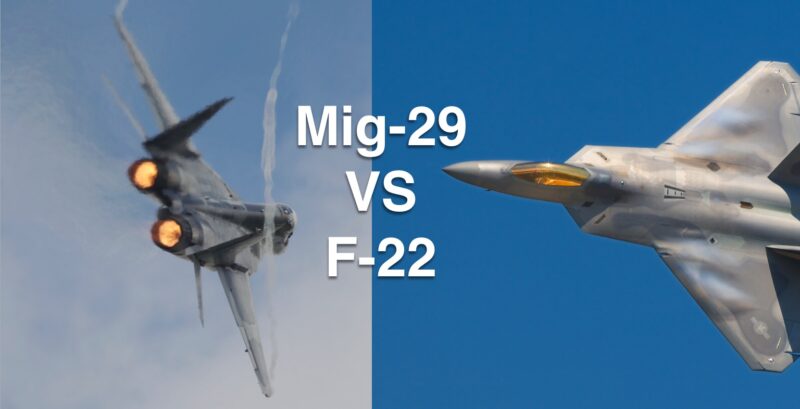
This video footage, uploaded on August 10th of 2016, features the vertical takeoffs of a Polish MIG-29 and a VS F-22 Raptor, against the backdrop of a cloudy grey sky at the 2016 Royal International Air Tattoo.
The MIG-29 blows black smoke as it prepares to take off in the early evening light. You can see the heat rising around the aircraft as fire shoots out the two Kilmov RD-33 afterburning engines. At just a few feet off the ground, the MIG-29 shoots skyward in a near vertical direction. Next, an F-22 Raptor does the same trick, only the F-22 appears to be more graceful as it commences its near vertical departure. In our humble opinion, the F-22 takes the prize. But wow…Spectacular show of force by both jets.
About the Mig-29
The MIG-29 is a twin engine jet fighter aircraft, designed in the Soviet Union. Introduced in 1982, the MIG-29 is still in service. Its primary users are the Russian Air Force, the Indian Air Force, the Ukrainian Air Force, the Islamic Republic of Iran Air Force, and others. More than 1,600 MIG-29 aircraft have been built between 1981 and today.
About the F-22 Raptor
The Lockheed Martin F-22 Raptor is a single seat, twin engine, all weather stealth aircraft. It took its maiden voyage on September 18th of 1997. After much testing and tweaking, the F-22 Raptor was introduced to the United States Air Force in 2005. Between 1996 and 2011, 195 Raptors were manufactured.
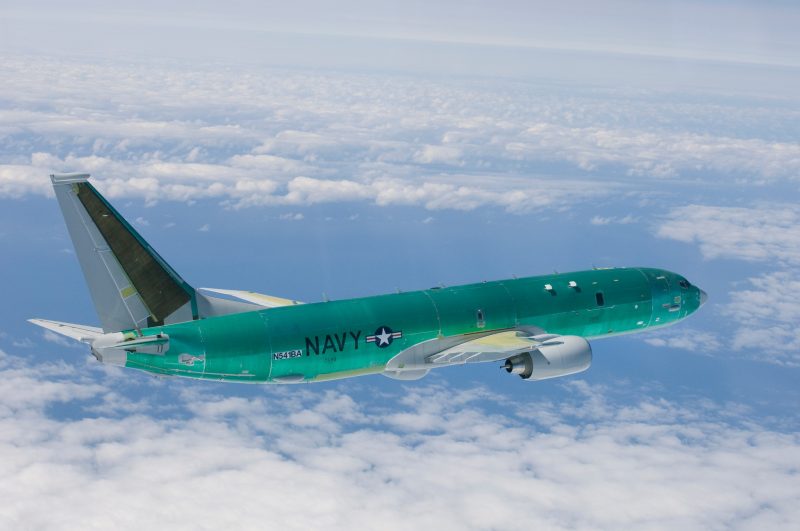
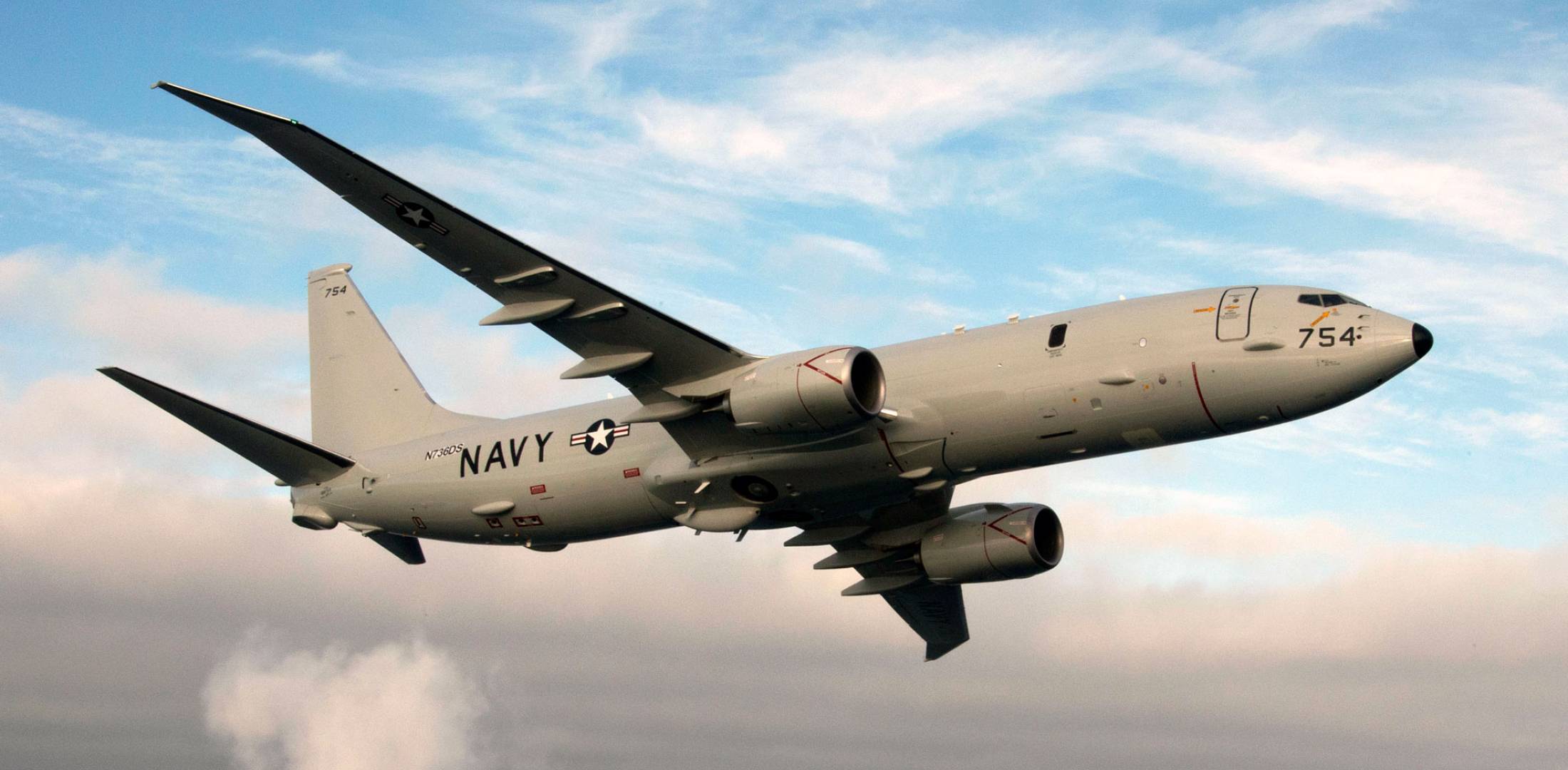
The Boeing P-8A Poseidon is a 737 that was modified to be used by the United States Navy. It is characterized by a long, sleek, strengthened fuselage and the characteristic Boeing tail. It is more than 129 feet long, with a wing span of more than 123 feet including a very unique set of raked wingtips instead of winglets. From the ground to the top of the tail, the plane is more than 42 feet tall. The Boeing P-8A has an average cruise speed of 440 knots, and a maximum speed of 470 knots. The P-8A is designed to carry torpedoes, harpoon missiles, and other weapons.
This video clip, published on September 5th of 2016, shows a Boeing P-8A Poseidon making a very sporty (AKA Navy-style) tactical approach and landing on a rainy, slippery runway, at the Farnborough 2016 airshow.
NextGen Sub Hunting Navy Jet Makes Sporty Approach to Wet Runway 5
The Boeing P-8A took its maiden voyage on April 25th of 2009, but needed further testing. It was finally introduced to the U.S. Navy in November of 2013. As of January 2015, there have been 29 Boeing P-8A aircraft manufactured. The P-8A’s first international customer was India, whose ministers of defense signed a 2.1 billion dollar agreement on January 4th of 2009. Primary users of the Boeing P-8A are the United States Navy and the Indian Navy.
In November of 2015, the UK announced its intention to purchase up to nine Boeing P-8A aircraft, at a cost of 3.2 billion dollars. The most recent international entities showing interest in the Boeing P-8A are Italy, Turkey, Norway, and the Royal New Zealand Air Force.
Video was originally posted by TopFelya on Youtube. You can follow his Facebook page here.
Automation is best deployed as an enhanced decision making tool, not something which a bored human being should be tasked to sit and watch.
“When we design our systems, we need to assign appropriate roles to the human and technological components. It is best for humans to be the doers and technology to be the monitors, providing decision aids and safeguards.” – Captain Sully Sullenberger
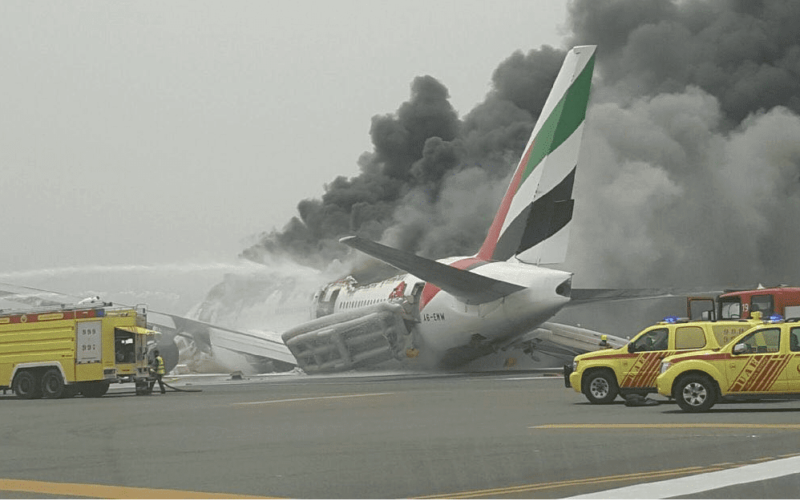
The past week has seen several high profile aviation incidents come to light. The first one was a preliminary accident report on the crash and fire which destroyed an Emirates Boeing 777 in Dubai last August. The second was the release of the final report by the Australian Transport Safety Bureau (ATSB) regarding an AirAsia Airbus A330-300 enroute from Sydney to Malaysia last year which suffered navigation and other system failures as the result of erroneous input by the pilots during preflight.
The Emirates crash tragically took the life of a responding fireman, while the AirAsia incident caused no injuries but did result in a diversion. Each incident had the potential for great loss of life, though. The improper use of automation can be implicated in both the Emirates and AirAsia events. Let’s take a look at each of these and see if we can draw some parallels.
Emirates 521
The crash report on the Emirates flight, released by the General Civil Aviation Authority (GCAA) of the UAE details that the approach was flown by the captain. The autopilot was disconnected for the landing while the autothrottles remained engaged. The aircraft experienced a longitudinal wind component which changed from a headwind of 8 kts to a tailwind of 16 kts during the approach. As a result of the decreasing performance wind shift, the aircraft made a long touchdown.
An automatic system on the Boeing warned the crew about the long touchdown, and a decision was made to go around. So far so good. Going around rather than accepting a long landing due to shifting winds is the correct decision.
What happened next wasn’t so good. The nose was raised, the flaps were reset and the gear were retracted, but go-around power was not added until three seconds before the aircraft impacted the runway with the gear partially retracted. The post crash fire destroyed the aircraft entirely.
Adding power during a go-around is…or should be, instinctual. It’s considered aviation 101, or rather it used to be. Today’s highly automated aircraft, however, all employ autothrottles which automatically advance themselves when the “Takeoff-go-around” or TOGA button is pushed. This is how go-arounds are performed on automated aircraft.
The 777, however, has a feature which disables the TOGA button after touchdown. This makes sense as you don’t want the throttles to advance after landing in case of accidentally touching the TOGA button. After a normal landing, that is. There are times when a rejected landing, or go-around, occurs after touchdown. The reasons vary, but a landing can be rejected any time until the thrust reversers are deployed, even after the gear touch down.
This is what happened to the Emirates 777. It touched down, and then attempted a go-around without adding power. Questions remain as to whether or not the captain actually engaged the TOGA button but in any case, the captain should have manually pushed up the throttles for the go-around or ensured that the autothrottles automatically advanced.
Why would he not do that? Easy. It’s called negative conditioning or negative training. Go-arounds are routinely practiced in all airline simulator training programs, but go-arounds after touchdown are practiced much less frequently. Over time, muscle memory will expect the autothrottles to advance themselves during a normal go-around as they always do.
Put a pilot in a highly dynamic situation such as a windshear landing, and then perhaps throw in a non-routine distraction such as the automatic runway length warning, and voila, muscle memory takes over and the throttles don’t get pushed up. Automation, which is supposed to make flying easier and safer, might have helped make a crash such as this inevitable.
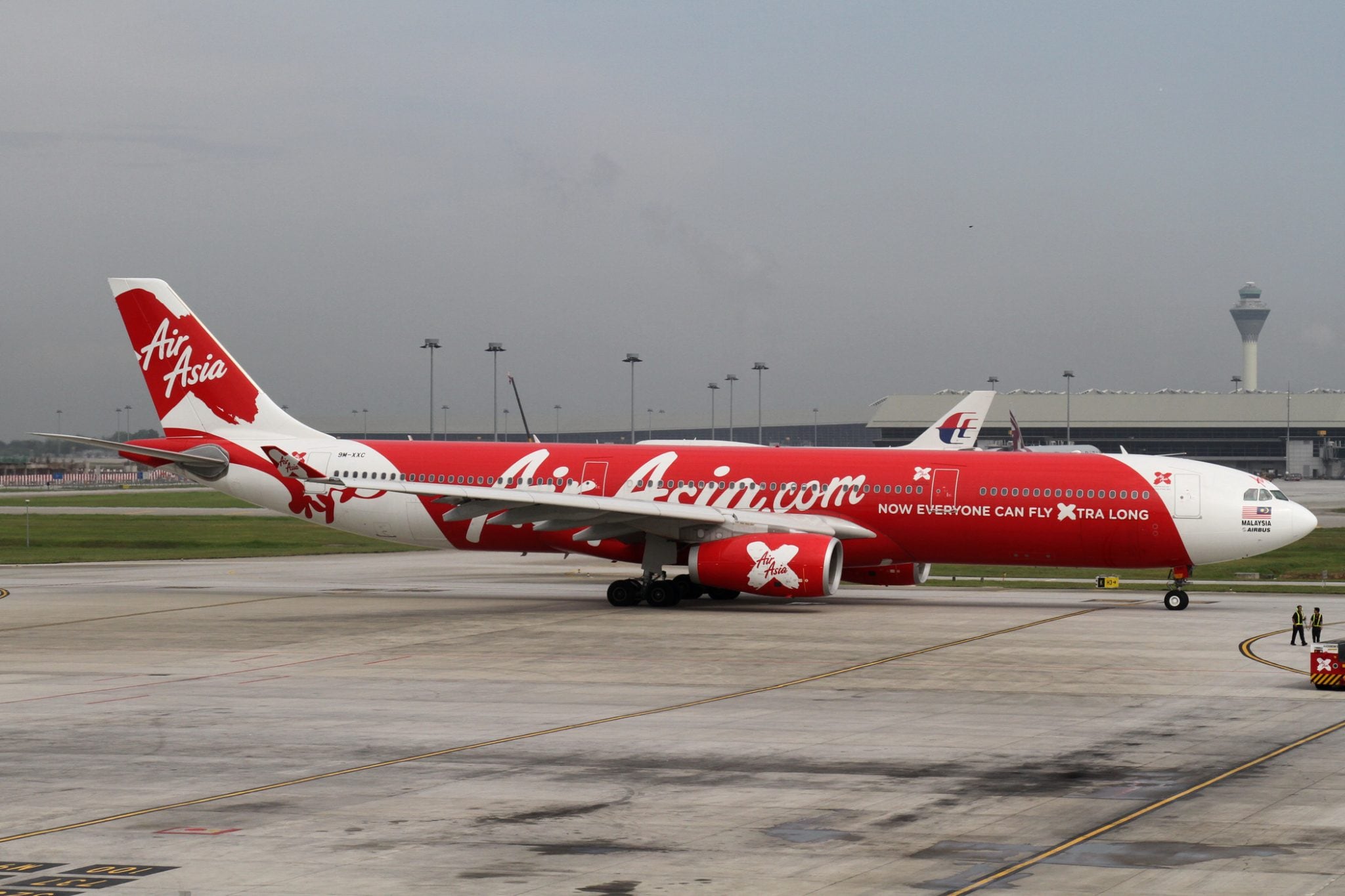
Air Asia X Airbus A330. (Photo by Kentaro Iemoto)
AirAsia X 223
On March 15 last year, an AirAsia A330 suffered multiple inflight malfunctions of its navigational display systems rendering the aircraft incapable of either continuing to its destination in Malaysia, nor of returning to its origination point of Sydney due to low ceilings. The aircraft eventually landed uneventfully in Melbourne, which had clear weather.
Subsequent investigation revealed that the pilots made a data entry error during their pre-flight checks consisting of a single digit error in programming the aircraft’s location.
Modern navigation systems on today’s commercial aircraft are capable of guiding an airplane to a spot on the other side of the globe with accuracy down to several feet. But in order to know where to go, the computers on the airplane first have to know where they are.
Part of the preflight process is to enter in the aircraft’s current location in the form of a latitude and longitude. The pilot entering this data made some sort of fat finger error which resulted in the actually entered position being thousands of miles away from the Sydney airport. So after the aircraft departed, discrepancies between where it actually was and where it believed it was caused the computers to crash resulting in a nearly complete failure of the navigational system.
After identifying and while attempting to fix the problems with the navigation systems, the crew compounded their problem by cycling two of their three flight computers to off and back on. This incorrect procedure resulted in the loss of other primary flight displays and rendered the aircraft incapable of flying even a simple approach back to Sydney necessitating the diversion to Melbourne.
Even after arrival at Melbourne, the aircraft had to make several attempts at a completely manual landing without the benefit of either the autopilot nor autothrottles. There is little doubt that flying a highly automated aircraft left the pilot’s manual flying skills in a somewhat rusty state, which is completely expected.
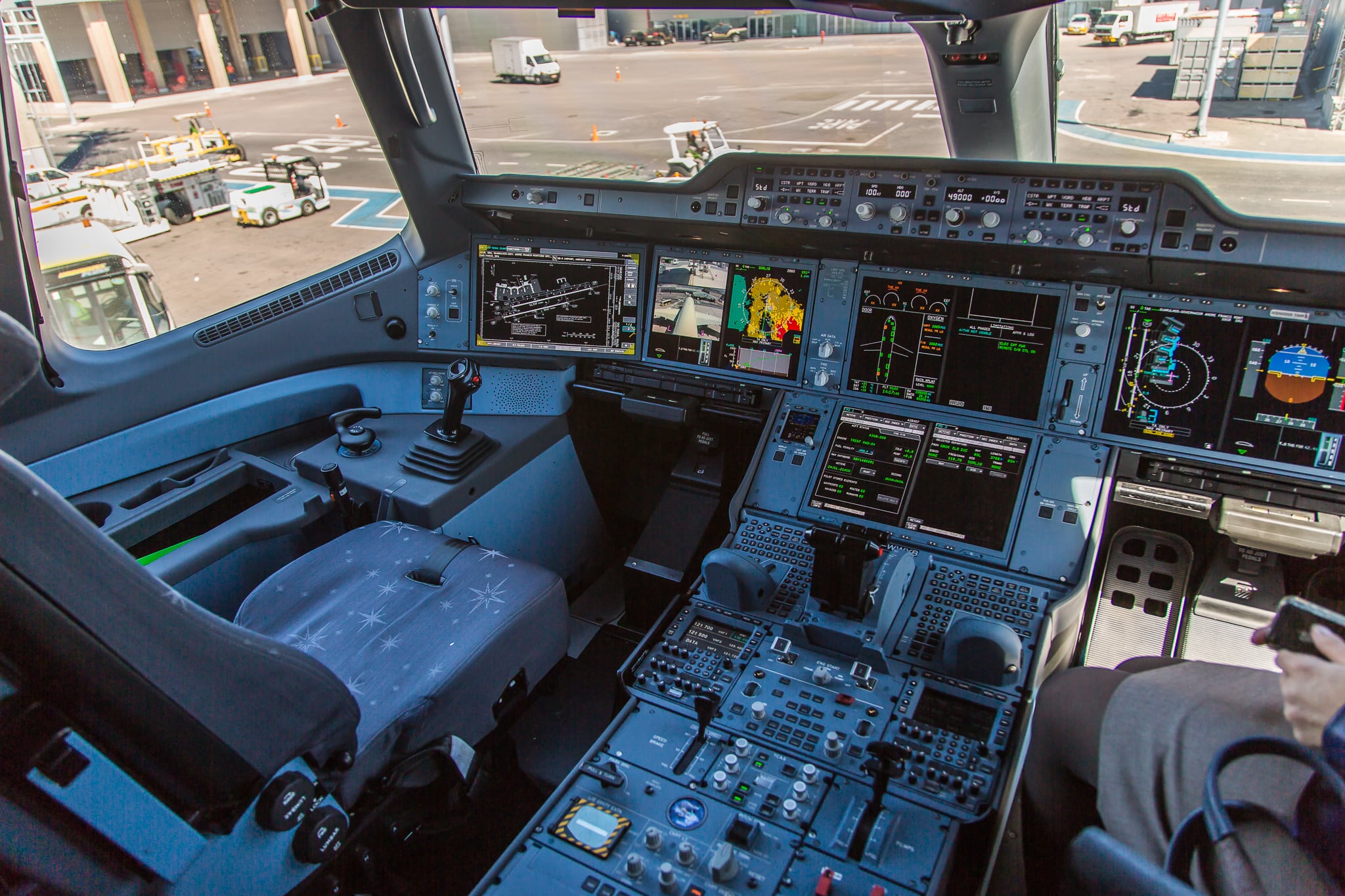
Airbus A350 cockpit (Photo by Joao Carlos Medau).
Automation: Friend or Foe?
Automation of commercial airliners is with us to stay. It provides many benefits and economies but there are problems with its deployment which contributes to accidents and incidents such as these. The old aphorism which states that computers just allow humans to make mistakes faster and with more efficiency certainly applies here.
Over reliance on automation is also well known to cause a deterioration in manual stick and rudder piloting skills, which go unmissed until they are needed. The crash of Asiana 214 in San Francisco several years ago was a perfect example of this.
But as Captain Sully warned in the quote above, automation is best deployed as an enhanced decision making tool, not something which a bored human being should be tasked to sit and watch, as it is today.
A long time ago, you could go to the movie theater and not have to deal with 40 minutes of crappy movie previews. Instead, you saw a newsreel that was focused on the war and an ad to sign up and go kick some Hitler and Tojo ass.
This black and white video from the 1940s is a recruiting commercial for the Unites States Army Air Corps during World War II. It starts with the caption, “Attention Young Men.” It then shows cadets standing attention, while a voiced over narration explains that just a short while ago, they too were “average American boys from average American families.” Soon, they will learn how to pilot a plane, how to navigate, and eventually ship off to defend freedom.
Young men are told that if they are 17, they can sign up for the army reserve, and will be called soon after their 18th birthdays. Men between the ages of 18 and 26 are cordially invited to join the army to crush the axis powers. A row of muscle toned, shirtless cadets graces the screen, making young men everywhere want to be just like them.
“There are things to do and places to go,” chimes the narrator, “and the Army Air Forces will supply both, to whoever has the will to smack the enemy where it hurts the most.”
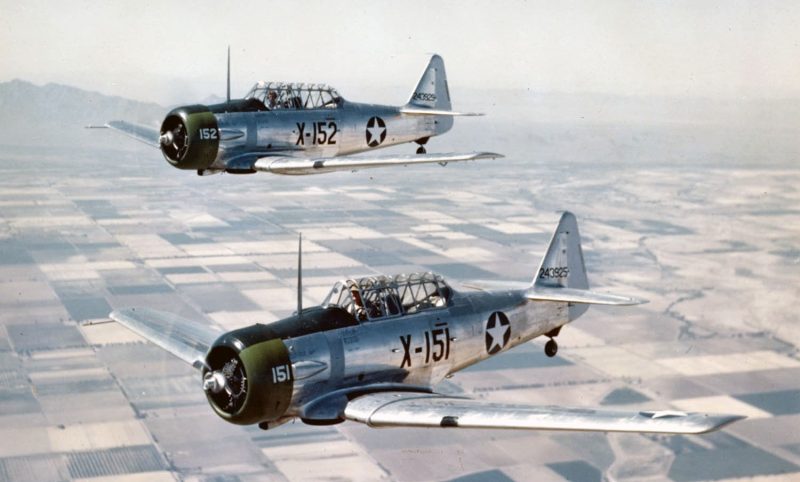
Most interesting are the planes of WWII, shown flying throughout the commercial. The marvelous AT-6 stands ready to challenge cadets to become real pilots.
If you are up for the challenge, you are encouraged to stop in the lobby on your way out of the theater, or to inquire at 607 Custom House, Philadelphia, Pennsylvania. No phone number is given.
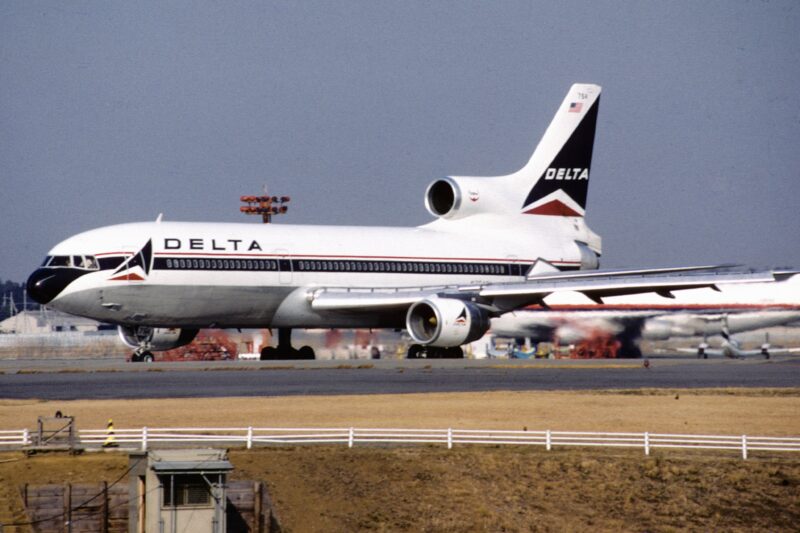
Call us a sucker for a good Avgeek video, no matter how old or VHS looking it may be. We’ll admit it. We have a bad habit of binge watching L1011 videos. It’s almost as bad as twenty-somethings who just found out that a new season of “House of Cards” is released on Netflix.
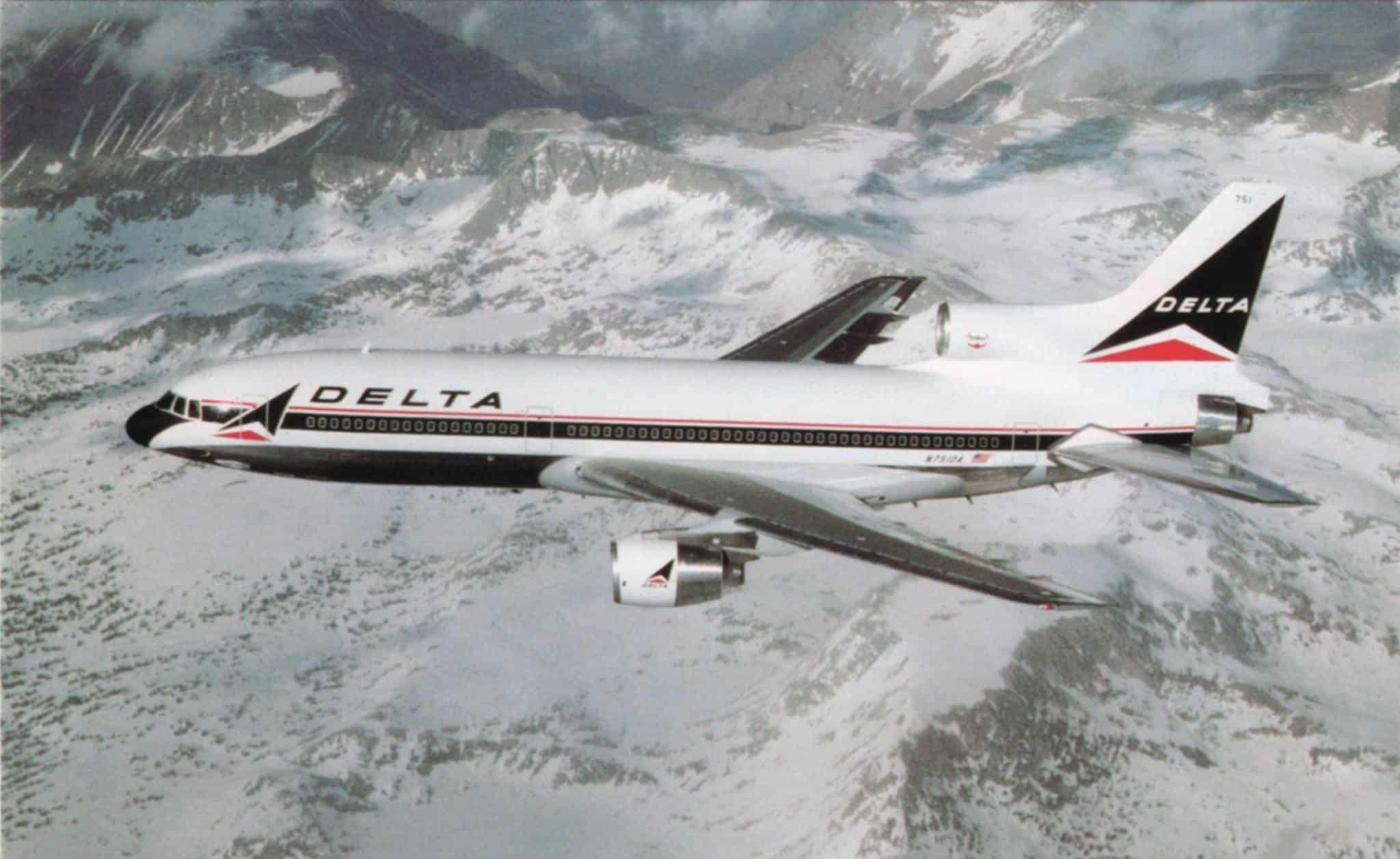
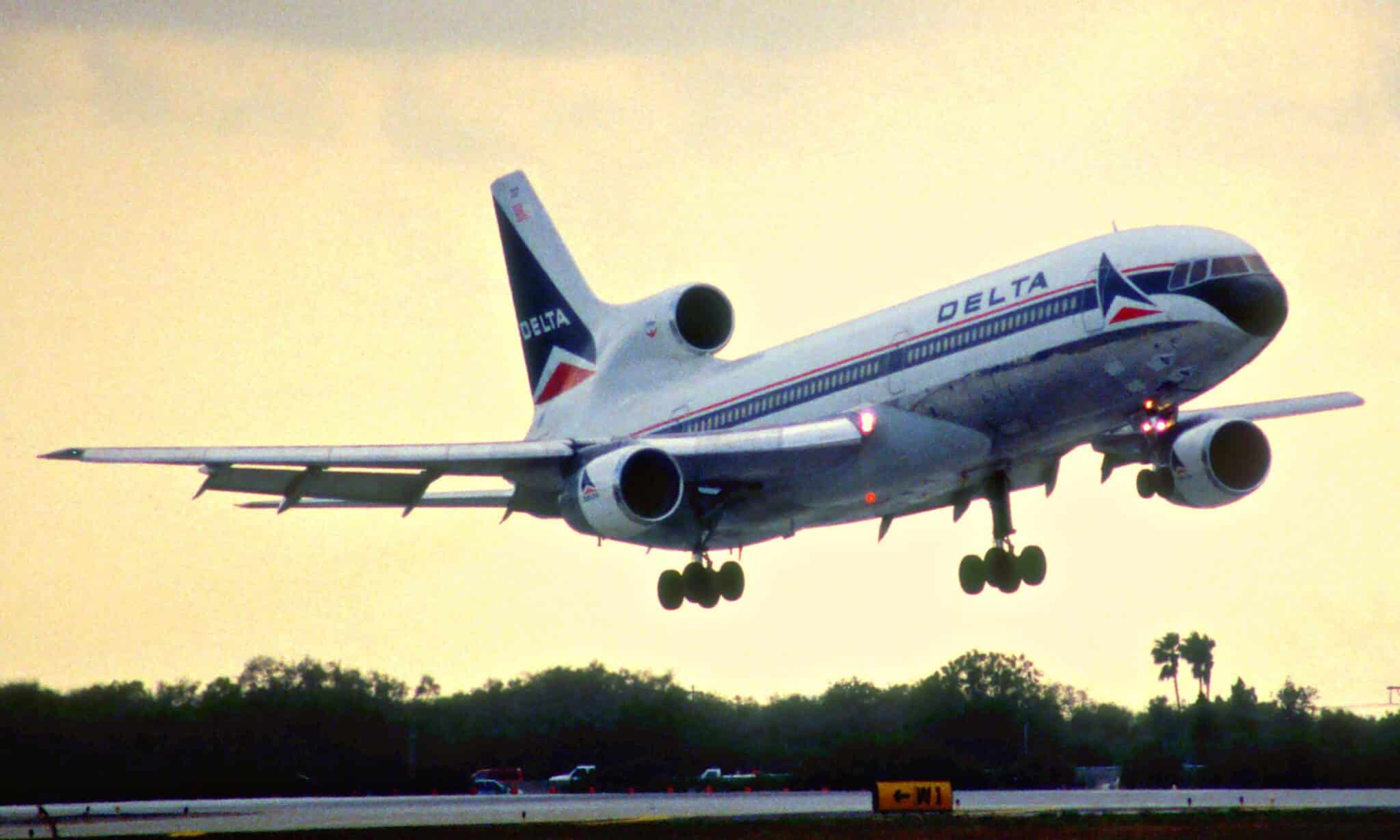
The Delta L1011 Tristar aircraft, manufactured by Lockheed, was magnificently designed but definitely had its faults too. It was a wide body, trijet airliner, with a seating capacity of up to 400 passengers. In many ways it was an aircraft ahead of its time. It was on of the first airliners to be able to fly a CATIIIa ILS that allowed the jet to land in extremely poor weather conditions. It also had many amenities that were previously only found on the larger 747. Some aircraft had a lower deck galley with lounge facilities. Unfortunately, it was also a commercial disaster. The program was delayed which meant that the jet hit the market later than planned. Promised performance never materialized and the complexity of its systems made maintenance a challenge. Lockheed never turned a profit on the trijet. Its failure led Lockheed to exit the commercial aircraft market.
Image via Delta
Delta’s first L1011 arrived on October 3rd of 1973. It’s first revenue flight was on November 15th of that year, with 39 passengers onboard. Join in the retirement of the last Delta L1011 Tristar. The historic flight to Victorville, California happened the following day. A specially selected group of Delta employees accompanied the aircraft to its final resting place.
This plane was (and still is) loved by scores of avgeeks everywhere. Despite the adoration, Delta’s L1011 Tristar (ship number 728) was retired as the last L1011 passenger plane on July 31st of 2001, after serving for 28 years across 40 U.S. cities and 39 International cities.
Image via aero icarus
Traditionally, every airline service bids a final farewell to its retired planes, then flies them to the desert southwest for final storage and breakup. The L1011 fleet met the same unfortunate end.
Sighting of an active L1011 is extremely rare today. Of the 250 of this type of aircraft built between 1968 and 1984, the only active aircraft is flown by Orbital ATK.
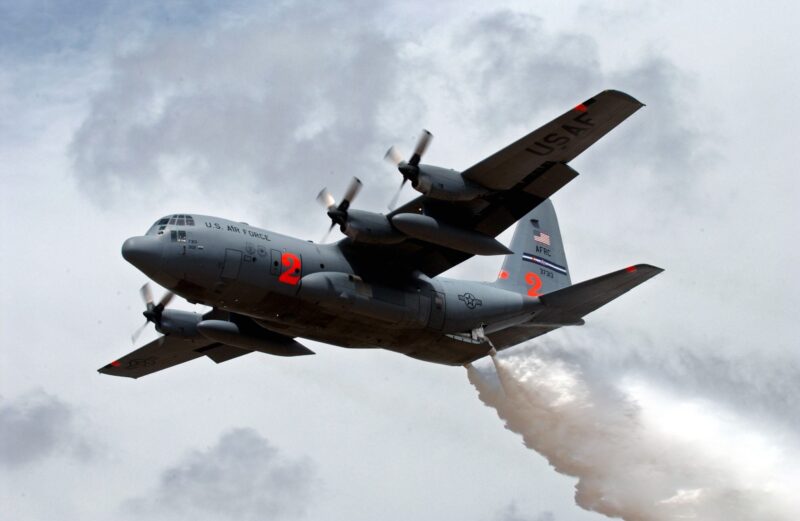
It’s a well known fact that C-130s are one of the tools that firefighters use in their arsenal to fight wildfires. But how do they convert a standard Hercules aircraft into a MAFFS airplane?
This footage, which was published on September 11th of 2015, shows the MAFFS being added to a pair of C-130 Hercules aircraft. MAFFS is an acronym for the Modular Airborne Fire Fighting System. To put it simply, MAFFS is a giant water/chemical tank loaded into the cargo hold. It holds about 2,700 gallons of water. This is the best weapon the military has to combat fire. MAFFS is used in the C-130 aircraft of the Colombian Air Force, the Brazilian Air Force, the Royal Moroccan Air Force, and the Royal Thai Air Force. While the C-130 is not the only aircraft that can drop chemicals or water on a fire, it has an advantage in that there are many C-130s where as larger tankers like the DC-10 or 747 are more limited resources.
Members of the 153rd Airlift Wing of the Wyoming Air National Guard are preparing two C-130 aircraft in Cheyenne, Wyoming, for MAFFS missions in the Rocky Mountain region.
The MAFFS program was established by Congress after the Laguna fire of 1970 overwhelmed available aviation firefighting resources. The idea of stuffing cargo planes with water tanks was meant to integrate military air tankers into the national response system. Today, MAFFS equipment is stationed at eight locations throughout the United States.
The MAFFS consists of five pressurized, fire retardant water tanks. The system can disperse all 2,700 gallons of water in five seconds over a fire. This produces a fire line that is 60 feet wide and a quarter mile long. Not only that, but all that water can be reloaded in only eight minutes.
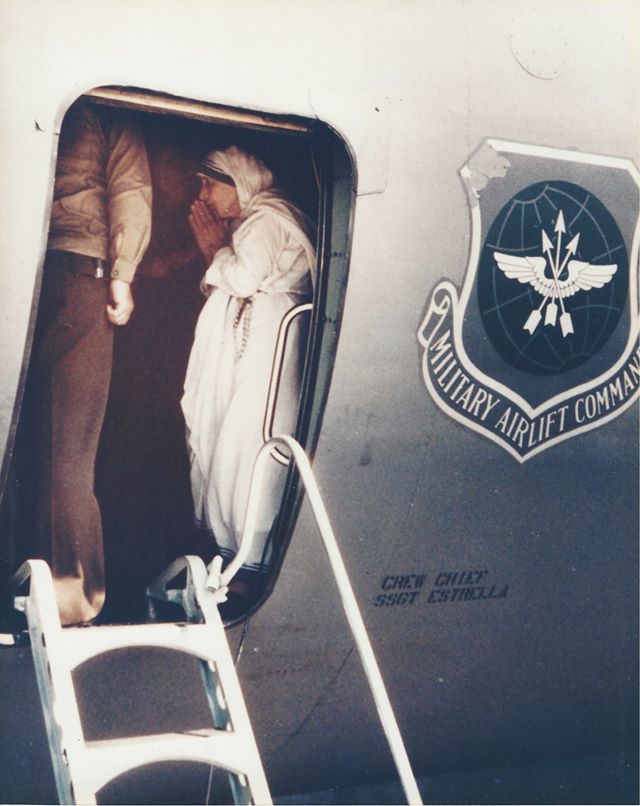
The following story was written by Joe Blewitt, a retired C-141 Starlifter pilot about his experience meeting Mother, now St. Teresa of Calcutta. It was originally posted on Facebook. Joe has graciously allowed Avgeekery to share his special memory.
The weekend of the canonization of Mother Teresa seems like the appropriate time to post this image, along with the story behind it. This picture of Mother Teresa was taken in July of 1991 in Tirana, Albania. I was blessed (literally) to be standing just to the right of Mother Teresa when this photo was taken. I was on my first overseas mission flying the C-141. Every mission afterwards had the misfortune of being compared to this one. I’d be hard-pressed to pick one that topped it – although there were many more incredibly memorable, in their own way.
In July of 1991, we were withdrawing troops and materiel from the Gulf War region. It was also a time when many former communist countries were moving towards democracy. The first open elections in Albania in 60 years took place on March 31, 1991. Prior to then, the country was basically cut off from all western influences. This new political climate created an opening for diplomatic ties between the U.S. and Albania, an extremely poor country – to the point of starvation in some cases.
There was a request from the new Albanian government for food. This connects back to the first part of the story – the end of the Gulf War and bringing home troops and materiel – which included massive amounts of unused MREs, since the ground war was much shorter than expected. The request for assistance was granted and we set up an “air bridge” from Sigonella Naval Air Station in Italy and shuttled MREs into Albania several times a day for a week.
What does this have to do with Mother Teresa? Albania is her birthplace. It was one of her lifelong goals to return and establish a mission in her home country. She happened to be there opening an orphanage and learned we were bringing in these supplies. She requested some MREs for her orphanage and the request was granted. Mother Teresa came out to the plane and helped unload the boxes. She didn’t hesitate at all and began picking up boxes and carrying them to her vehicle. She was one month shy of 81 years old, stood about 4′ 6″ – although she was technically 5′ tall. It was amazing to witness her in action.
I had the honor of giving Mother Teresa a personal tour of the airplane, walking her around the entire perimeter of the plane and then inviting her to come in and take a look around. As soon as we stepped inside the airplane, she blessed herself and began to pray. Everyone standing there joined her – as best they could – no matter their religion. She said the Our Father, The Hail Mary and The Glory Be, blessed the airplane, blessed our crew and thanked us for bringing the supplies. Then she signed our log book (AFTO 781 for all you Air Force types). It was a surreal experience to say the least. It’s hard to describe, but I knew then I was standing with a saint – amazing to see it as a reality today.
Mother Teresa was proclaimed a saint by Pope Francis in Rome on September 4th, 2016.
The Douglas AC-47 Spooky (also known as Puff the Magic Dragon) is one rough and tumble aircraft. Manufactured by the Douglas Aircraft Company, and introduced in 1965. It was developed from the C-47 Skytrain. There were 53 AC-47 Spooky aircraft produced. It is more than 64 feet long, with a wing span of more than 95 feet. It holds a crew of seven: pilot, copilot, navigator, flight engineer, loadmaster, and two gunners. The AC-47 has a cruise speed of 175 miles an hour, and a maximum speed of 235 miles an hour. It wasn’t fast but it sure was deadly.
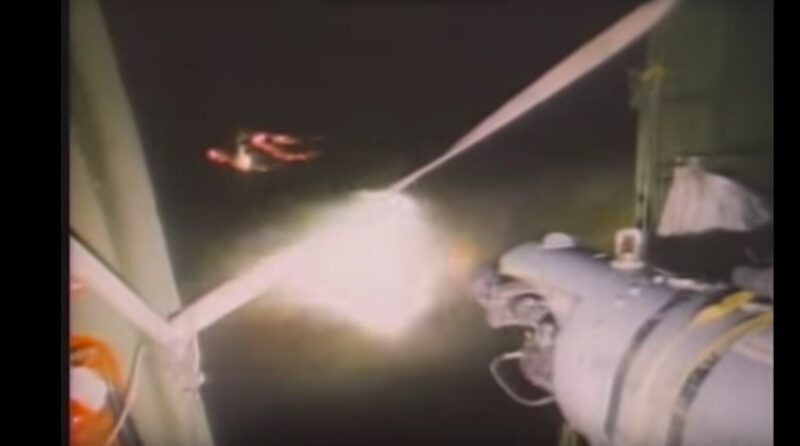
This footage shows fighter planes in action, including the Douglas AC-47 Spooky. Some other war planes used were the Phantom, the Corsair, the Intruder the F-111, the Thunder Chief, the B-52, and Skyhawk. But take a look at the footage around :40 into the short clip. You’ll see what those 6,000 rounds per minute look like as the tracers turn night into day and rain death upon the enemy below.
Primary users of the AC-47 included the United States Air Force (USAF), the Vietnam Air Force, the Royal Lao Air Force and the Colombian Air Force.
About the AC-47 Spooky
The Douglas AC-47 Spooky is a modified C-47 transport plane equipped with three gatling guns, each one capable of firing six thousand rounds of ammunition a minute. It was developed for the Viet Nam war, and designed for heavy ground attack and close air support. The Spooky flew only at night, but carried flares to light up enemy positions. It was especially valuable in defending bases against night time attack.
There are two air bases in Florida where the AC-47 Spooky is on display. They are the Air Commando Park at Hurlburt Field, and the Air Force Armament Museum at Eglin Air Force base near Valparaiso.
Nicosia Airport in Cyprus has been abandoned since 1974. Ever since the Turkish invasion on July 20th, all commercial activity had ceased. The airport, which was constructed in the 1930s, had been the scene of some heavy fighting between Turkey and Cyprus. After that, the United Nations Security Council declared the Nicosia airport a United Nations Protected Area during the battle. Both sides had to retreat more than 500 meters beyond the airport’s perimeter.
On August 16th of 1974, a ceasefire agreement was signed. At that point, the airport became part of the UN’s controlled Buffer Zone, separating the two warring communities on the island.
Nicosia airport has not been a fully functional airport since then. Still, the site supports active United Nations helicopters, and headquarters the UN peacekeeping mission in Cyprus. The airport is also used for international peace talks. The airport was, and is, owned by the British Ministry of Defense.
In 1975, both the Greek and the Turkish communities agreed to jointly reopen the Nicosia airport. However, talks regarding this matter did not progress smoothly. In fact, this video footage seems to show that they never did any remodeling after the war. The entire property is in ruins. See the derelict buildings. View the broke down planes. Listen to the jaw harp music twanging in the background. It is a spooky, lonely, trashy looking place.
This video also shows a few nice vintage photos from when Nicosia airport was open for business. It would bring a tear to the eye of any avgeek. It’s a snapshot back to the airport scenes of the 1970s.
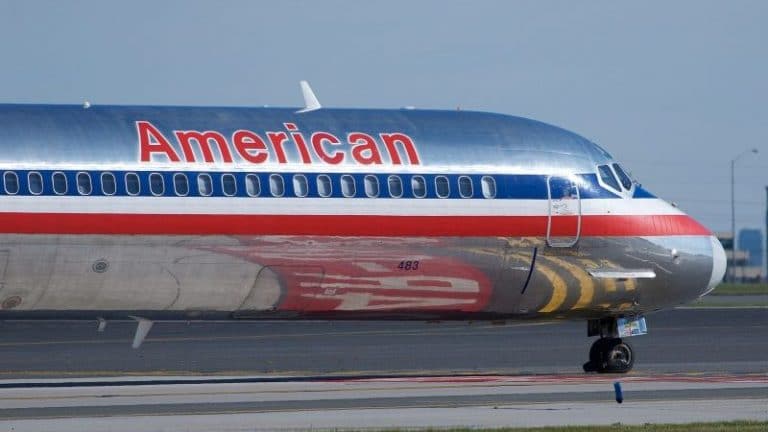
Back in the early 1980s, American Airlines took a bet on the MD-80. McDonnell Douglas was desperate for business. American’s CEO at the time (Bob Crandall) negotiated a sweetheart deal that allowed American to establish hubs (and eventually a fortress hub like DFW) across the United States. After the acquisition of TWA, the fleet grew to approximately 370 in service at its peak. It was the go to jet for short and medium routes until the 737-800 and eventually A320 series began to take over its duties in the mid-2000s.
By the end of 2019, American will have removed all of its MD-80s from service.
This video features a sleek, shiny, red, white, blue and silver Mad Dog 80 screaming down the runway on a hazy afternoon at San Jose International airport. View the surrounding office buildings and the beautiful mountains beyond. Notice how the plane’s wings are located near the tail, toward the end of a very long fuselage.
The MD-80 featured in this video, with tail number N557AN, was retired in 2015.
About the MD-80
The MD-80 is twin engine, single aisle, narrow body commercial jet airliner, manufactured by McDonnell Douglas, and later by Boeing. It is a mid size, medium range airliner. This slender aircraft has a number of variants, including the MD-81, the MD-82, the MD-83, the MD-87, and MD-88. The MD-80 can seat anywhere from 130 to 172 passengers, depending on the variant. Each variant also features upgrades in the cockpit and avionics.
The aircraft took its maiden voyage on October 18th of 1979. However, two MD-80 aircraft were severely damaged during the test flights. Despite the early design issues, the MD-80 underwent improvements. The first variant of the MD-80 was introduced with Swissair in October of 1980. The MD-80 series was eventually modified into the MD-90 series.
Almost 1,200 MD-80 aircraft were built between 1979 and 1999, at a unit cost in the 40 million dollar range.
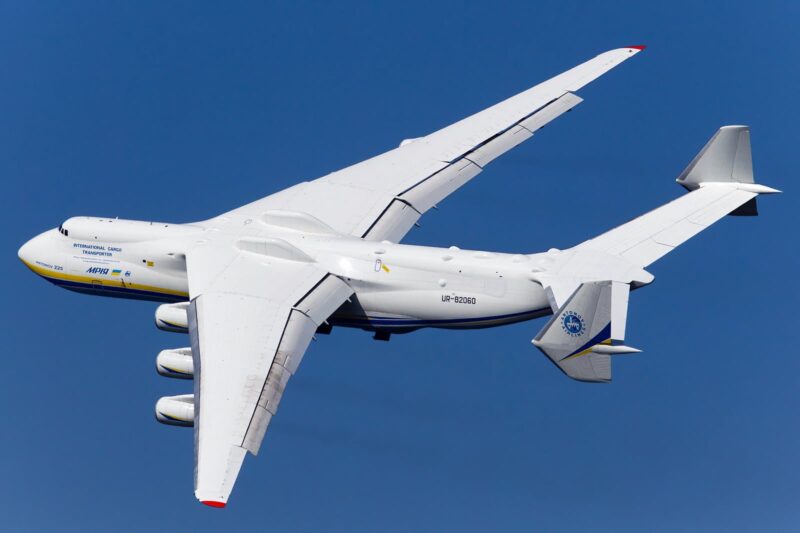
Was bigger better? In the case of the Antonov 225 heavy cargo jet, I think it was! After all, 6 soul-shaking jet engines screaming at full power is always a rush. The video is the taxi (back-taxi on Rwy 16 at ZRH) and takeoff of a flight from Zurich, Switzerland. The plane is an An-225 Mriya (In Ukrainian, mriya means dream, or inspiration). The An-225 Mriya (Cossack) was the only one of its kind ever built. A second airframe was partially constructed, but production was halted due to lack of funding. An agreement between China and Ukraine was signed at one point to explore China producing additional copies in the future.
About the An-225
The An-225 was a strategic airlift cargo plane, designed in the Soviet Union in the 1980s. It was originally intended for transporting the Buran space shuttle for the Soviet Space Program, which is why the plane loaded cargo through its nose. The pressurized cargo hold was 46,000 cubic feet in volume. After its military missions were completed, the An-225 was put on hold for about eight years, then it was reintroduced as a plane that could carry oversized cargo loads.
The An-225 was the longest and heaviest plane ever built, and powered by six turbofan engines. Its landing gear system had 32 wheels, and the plane was equipped with a twin tail design. It also had the largest wing span of any plane in operational service. The An-225 was destroyed on 24 February 2022 by invading Russian forces at Hostomel airport in Ukraine.
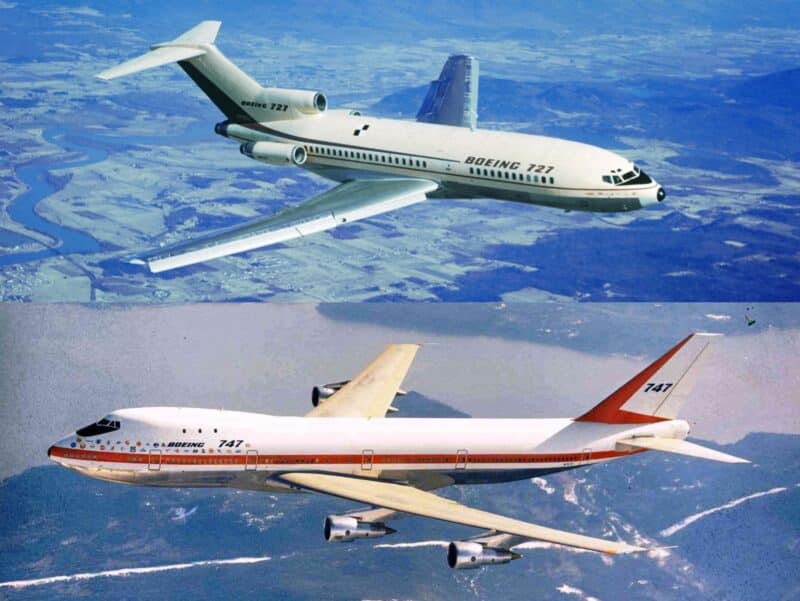
Classic Video Looks at the Certification Process for the 727 and 747
When Boeing built the revolutionary 727 and 747, it had to develop equally revolutionary ways to test and certify the advanced aircraft. Boeing faced a number of challenges along the way. Spray patterns of the 727’s tires could have quenched the outboard engines. A redesign was necessary to prevent potential flameouts. The 747 also faced a number of challenges. One was a surprising difficulty when starting engines in windy conditions. The turbofan engines would overheat if there was a tailwind during starting. The engineers had to devise a way to overcome these challenges…and they did.
This video is a Boeing documentary was released way back in 1990. It documents the test programs of the legendary 727 and 747 aircraft. If you can get past the cheesy music, it’s a treasure trove of rare airplane facts for Avgeeks.
The loud, smokey Boeing 727 is a mid size, narrow body, three engine jet aircraft. It can carry up to 189 passengers. Between 1962 and 1984, 1,832 Boeing 727 jets were manufactured. All of them had three Pratt & Whitney JT8D engines, located below the T-shaped tail. The 727 was not exactly the perfect jet. In fact, airport noise regulations have led to all remaining 727s being fitted with “hush kits”, much to the disappointment of plane watchers who love loud noises. The Boeing 727 was built with three engines. Also included in its design was an emergency exit door at the back of the plane that also served a dual purpose as a tailstand to prevent tipping during loading. The 727 is now in limited service for cargo and private transport.
About the 747
The Boeing 747 is a wide body commercial jet aircraft, often referred to as a Jumbo Jet, or Queen of the Skies. It has four engines, and can accommodate as many as 400 passengers. The Boeing 747 was introduced in 1970 to Pan Am Airways. Its primary users today are British Airways, Korean Air, Lufthansa, China Airlines and various cargo operators. As of July 31st of 2016, there have been 1,523 Boeing 747 jets manufactured.
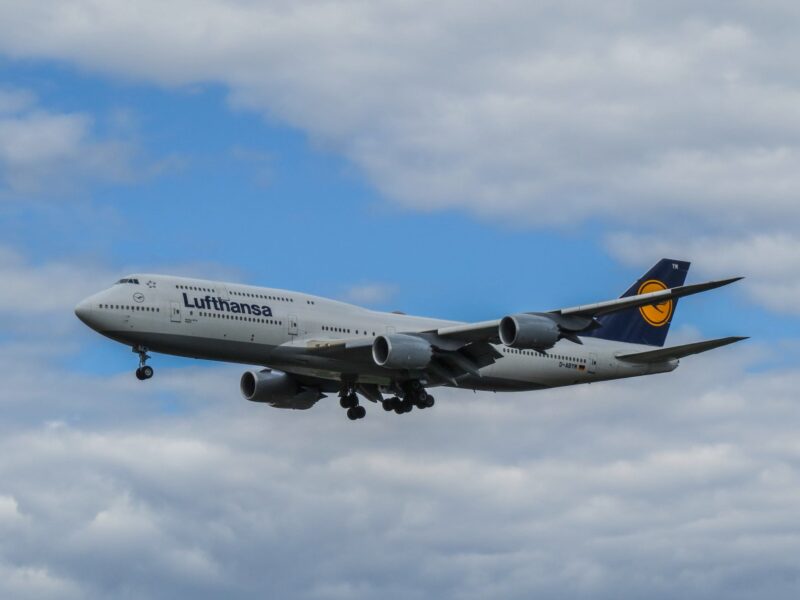
This video footage takes us “backstage” at Lufthansa, where a Boeing 747-8 sits idle in a giant hangar. Then the action takes us onto the plane, giving a glimpse into the latest and most likely last generation 747 Jumbo Jet. Although the video is short in length, it’s amazing to get a glimpse into how far the Queen of the Skies has advanced since it’s debut in the late 1960s. Her lines remain nearly as graceful. Her engines and wings have evolved but the essence that evokes luxury travel remains.
Lufthansa is a German airline that visits 220 destinations. In 2014 alone, Lufthansa carried more than 106 million passengers. With more than 120,000 employees, Lufthansa is the largest German airline. Their fleet consists of 270 aircraft, not even including all of their subsidiaries. Many of these aircraft are Boeing 747-8 models.
About the Boeing 747-8
The Boeing 747-8 is a wide body jet airliner, with two main variants – a passenger version and a cargo version. The 747-8 was introduced to Lufthansa on June 1st of 2012. Its primary users are Lufthansa, Korean Air, Cathay Pacific Cargo, and Cargolux. The plane has been in production since 2008. The unit cost of a Boeing 747-8 is nearly 380 million dollars. As of June 2016, there are 125 confirmed orders – 74 of the freighter version and 51 of the passenger version. The next Air Force One fleet will also be a derivative of the 747-8i aircraft.
For the working class it’s inevitable. Whether you’re a white collar executive or a blue collar plumber, there will come a time when you take your last day’s walk into work.The same goes for hard working aircraft. All aircraft, whether they are a single engine Cessna 172 or a twin engine Boeing 737, will eventually take their final flight.
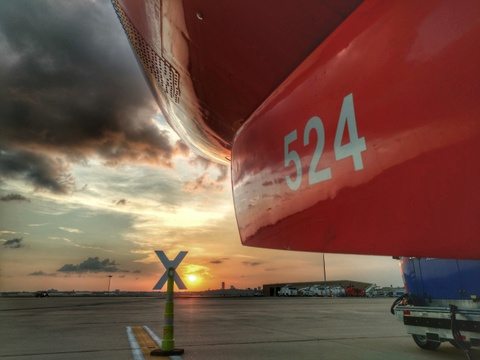
This is a story about the latter. A working class aircraft in itself. The classic Boeing 737-500. Southwest Airlines was the launch customer for the 737-500, taking delivery of the very first one on February 28, 1990. Designated the 737-5H4 (H4 being Boeing’s order code for Southwest) and built to directly replace the aging 737-200 fleet, the self-appointed “LUV airline” would eventually order only twenty-five of these smaller 737s due to an ever increasing demand for longer haul flights and more passenger space. Two of these 737-500s, N507SW and N501SW, would even take on the very prestigious role as Southwest’s “Shamu Two” and “Shamu Three” respectively. Along with “Shamu One”, a 737-3H4 (N334SW), these three aircraft were painted in the now iconic “Killer Whale” livery that became famous with passengers.