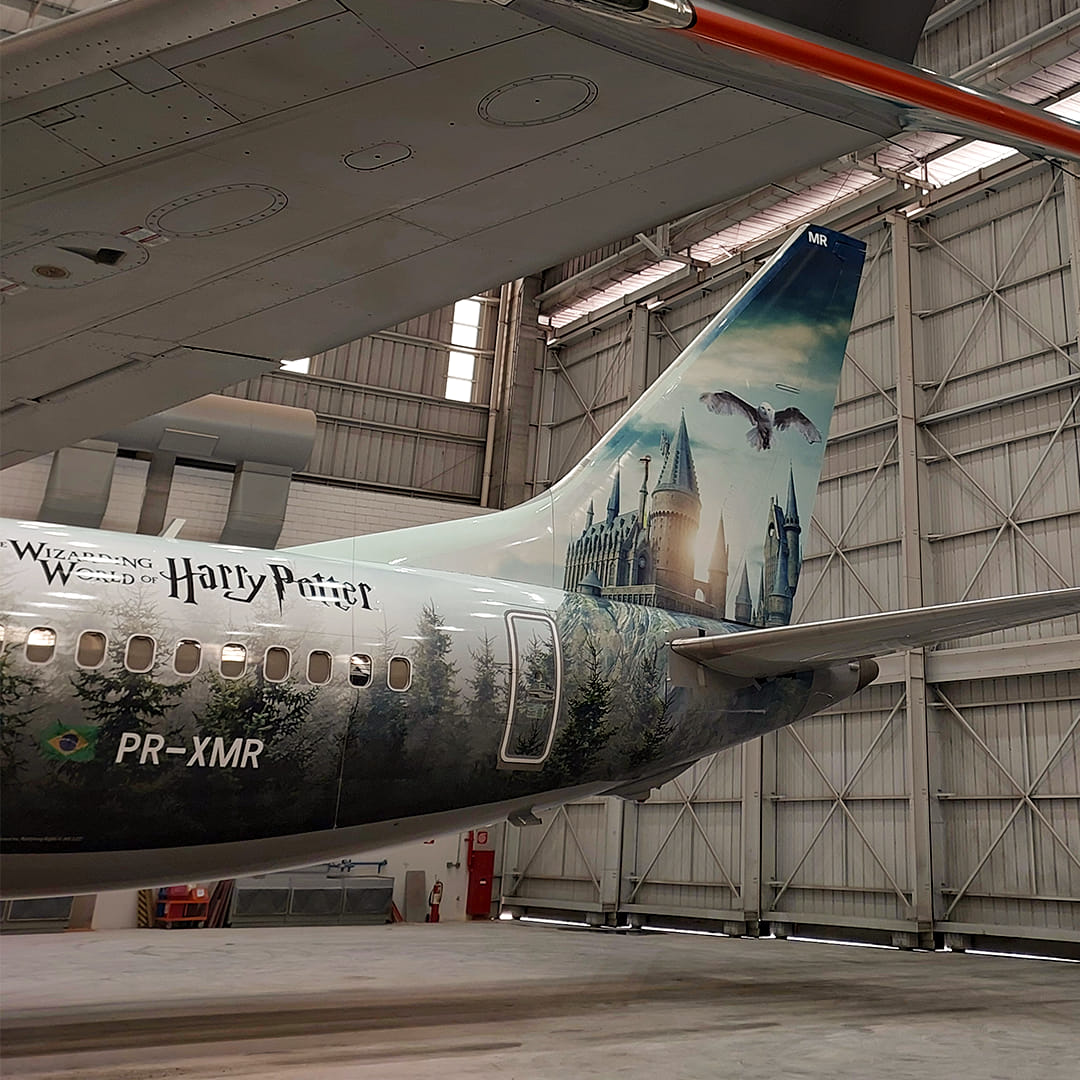
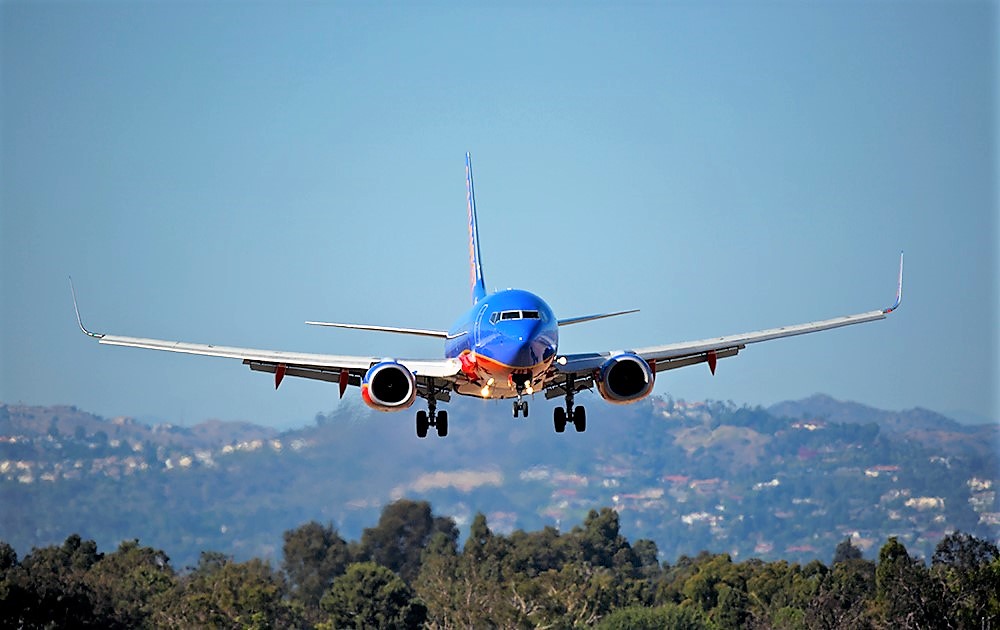
A Brazilian low-cost airline has painted one of its Boeing 737 MAX 8 aircraft in the special livery as part of a marketing partnership with Universal Studios Resort in Orlando, Florida.
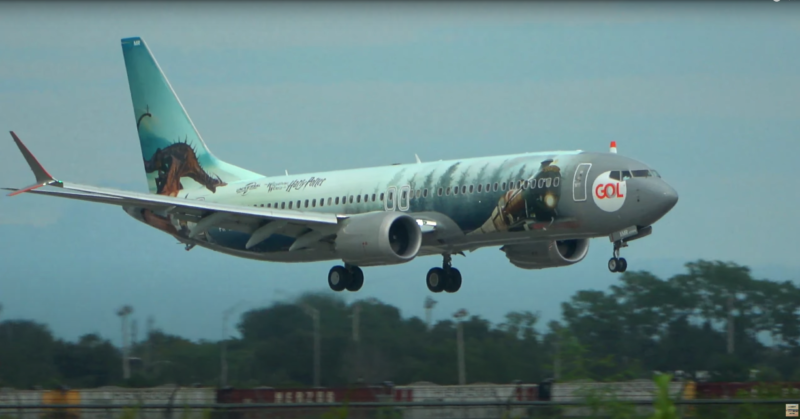
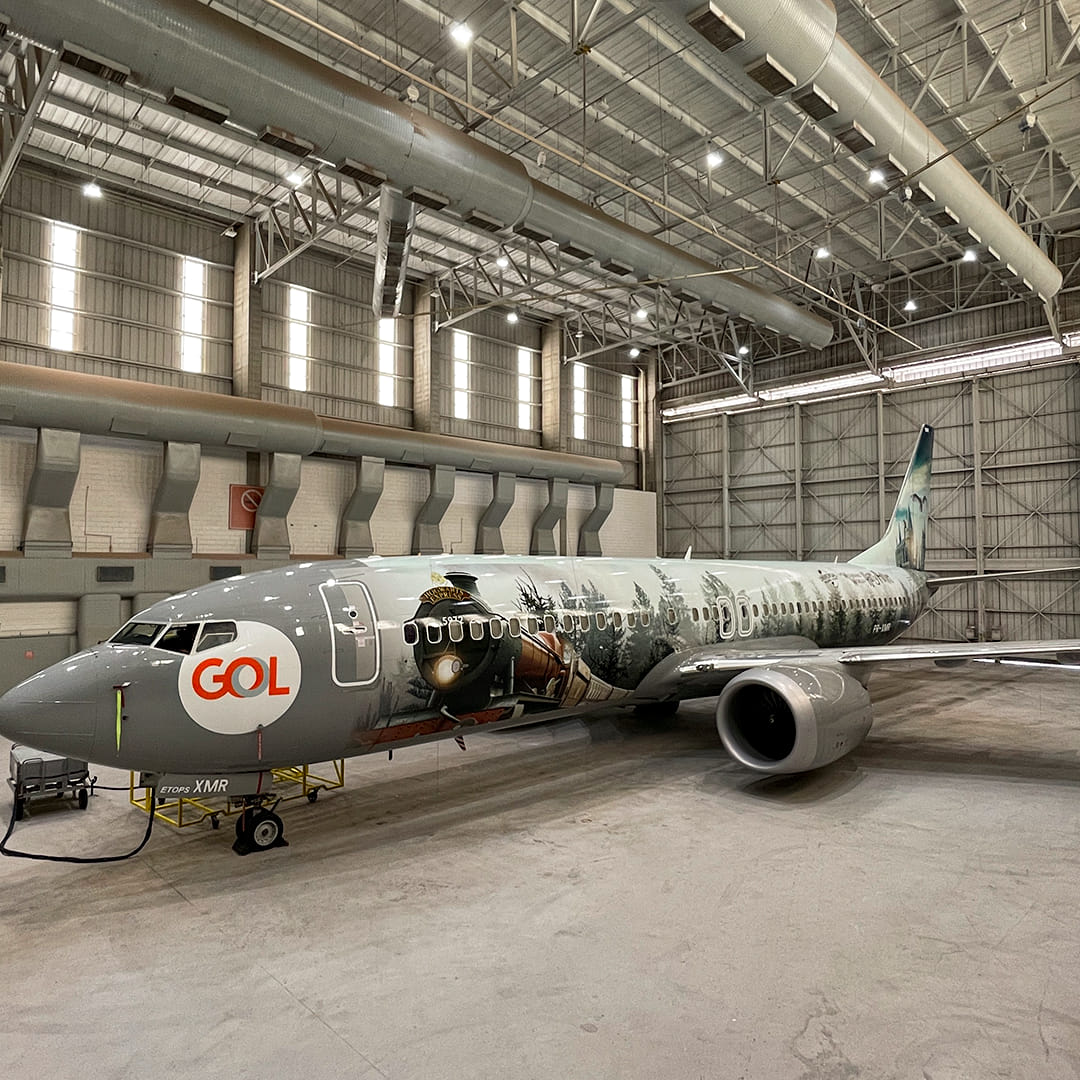
Rio de Janeiro-based GOL Linhas Aéreas (or GOL Intelligent Airlines) debuted the magical livery on one of its 737 MAX 8 aircraft (reg: PR-XMR) on Monday.
The livery, named “The Wizarding World of Harry Potter,” features several images of iconic landscapes depicted in the Harry Potter movies and at Universal Studios Orlando. Scenes featured on the fuselage include the Hogwarts Express, Hogwarts Castle, the Forbidden Forest, and the dragon from Gringotts Wizarding Bank on Diagon Alley.
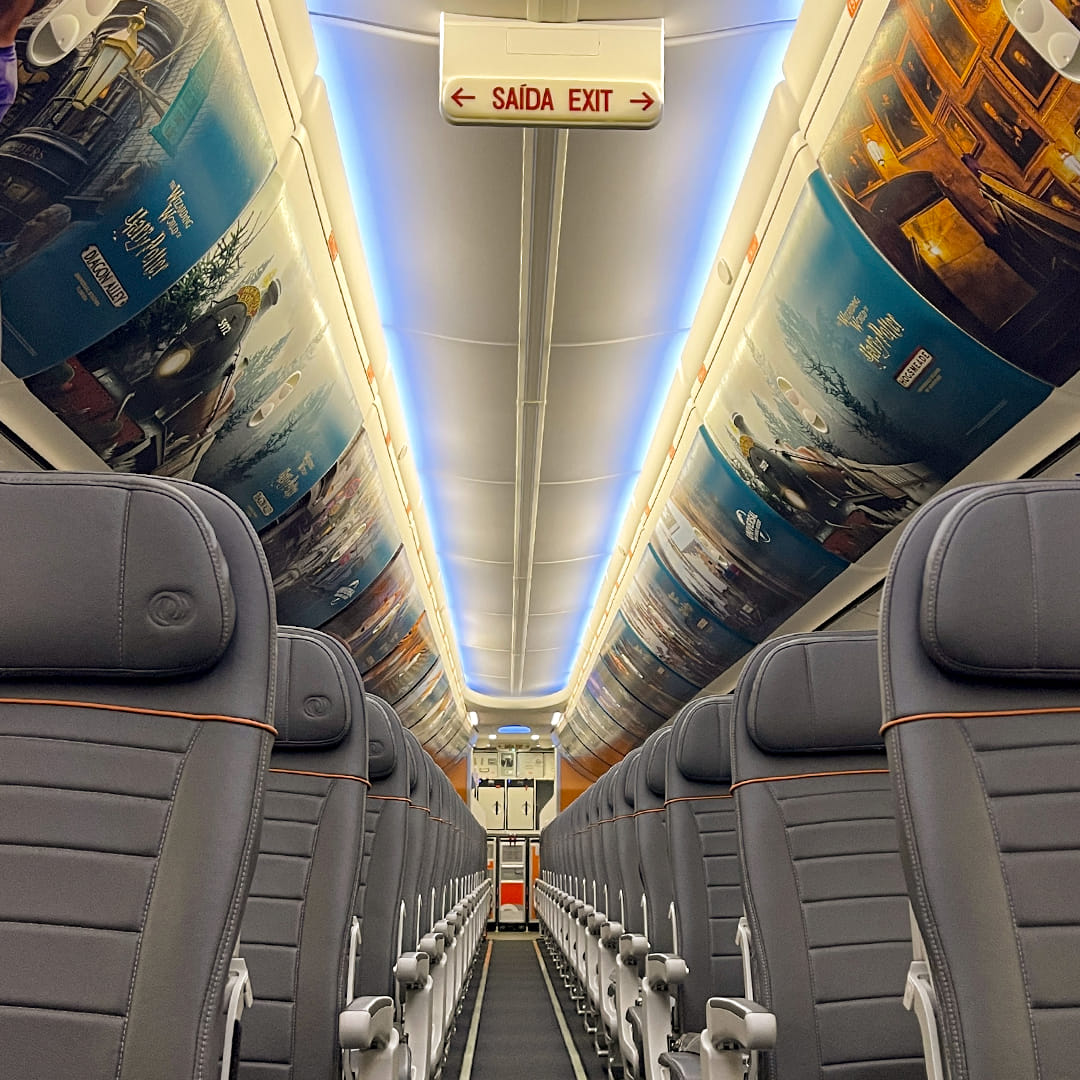
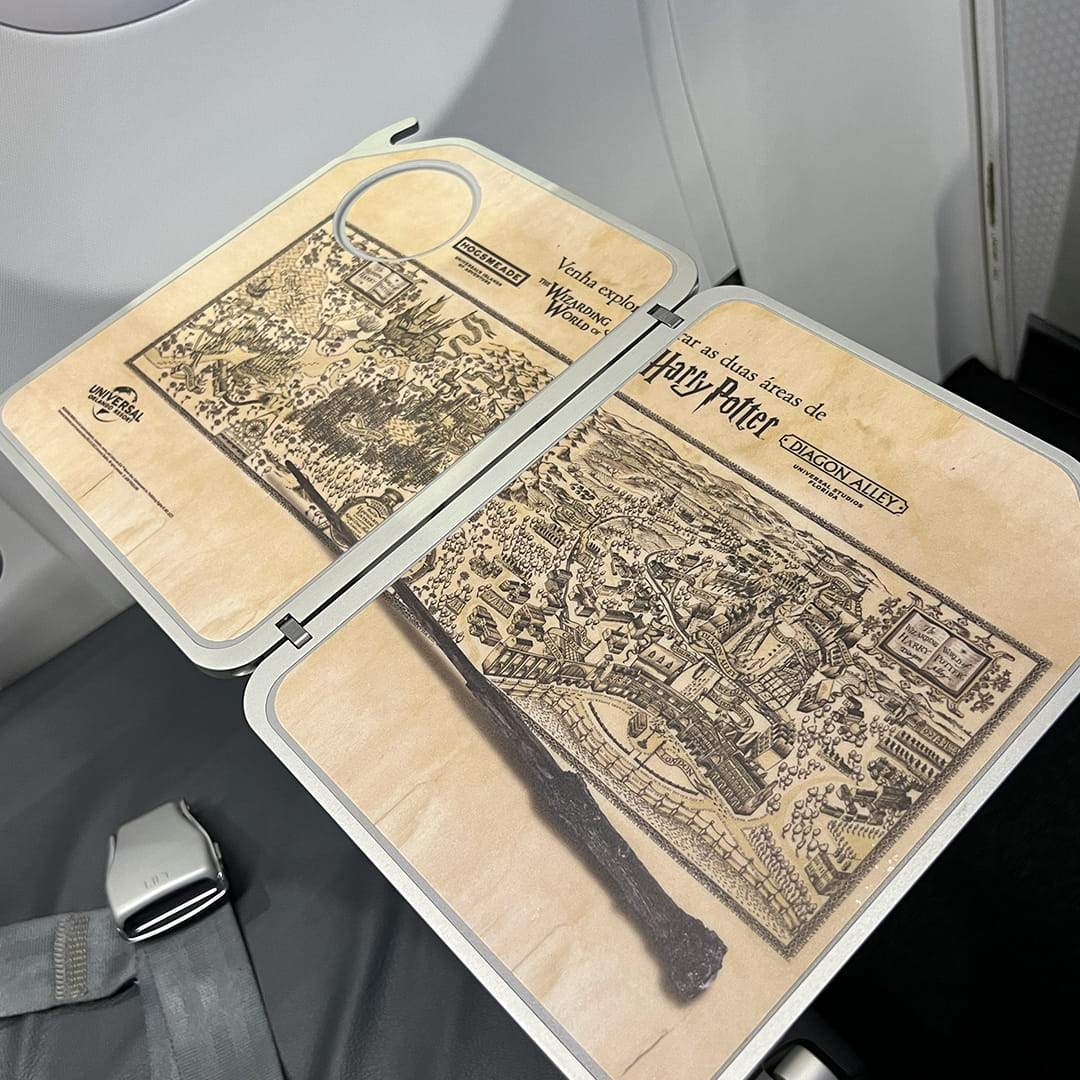
The special livery is not limited to just the outside, however. On board the aircraft, passengers will experience a markedly unique atmosphere. Decorative maps of Hogsmeade and Diagon Alley, as well as images of characters such as Hagrid and Dumbledore, are featured on overhead baggage compartments and tray tables.
Interior view of the Harry Potter-themed GOL Linhas Aéreas Boeing 737 MAX 8 | IMAGE: GOL Linhas Aéreas on FacebookInterior view of the Harry Potter-themed GOL Linhas Aéreas Boeing 737 MAX 8 | IMAGE: GOL Linhas Aéreas via Facebook
Where Muggles Can View the Stunning Livery
The Harry Potter-themed GOL Linhas Aéreas Boeing 737 MAX 8 | IMAGE: GOL Linhas Aéreas on Facebook
The livery debuted on 29 August on a flight from Belo Horizonte (CNF) to Brazil’s capital city of Brasilia (BSB). It then continued on to Orlando (MCO) as flight G37602, arriving at 1710 local time.
GOL Linhas Aéreas FLIGHT G3 7602 arrives at orlando international airport (MCO) from Brasilia, Brazil (BSB) on 29 August 2022 | Courtesy: A S Barrett Aviation on Youtube
The Harry Potter-themed aircraft will operate primarily between Brasilia and Orlando. At seven hours and 50 minutes, the flight is the longest scheduled 737 MAX 8 flight in the world. It operates with 186 seats, including 12 GOL+ Comfort seats, 20 Premium Economy seats, and 154 in economy.
“We will offer a unique experience to customers boarding this aircraft,” said Luiz Teixeira, Commercial Director of International Markets for GOL. “We want this journey to be a moment of entertainment not only for the children but also for the adults. We want everyone to be delighted and happy during the flight and to arrive even more excited for the visits to Universal Parks and the Wizarding World of Harry Potter.”
Muggles rejoice! The special livery will remain on the sole 737 MAX 8 for up to 18 months.
GOL is a Low-Cost Carrier and Brazil’s Largest Domestic Airline
The Harry Potter-themed GOL Linhas Aéreas Boeing 737 MAX 8 | IMAGE: GOL Linhas Aéreas on Facebook
GOL, Portuguese for “goal,” is Brazil’s largest domestic and third-largest international airline. The airline’s first flight took place on 15 January 2001.
The airline operates three main hubs throughout Brazil.
The airline operates more than 900 flights per day to 76 destinations, mainly in South America. Additionally, GOL serves Orlando (MCO) and Miami (MIA), as well as Punta Cana, Dominican Republic (PUJ), and Cancun, Mexico (CUN). GOL’s fleet consists of 123 aircraft, including 10 Boeing 737 MAX 8s, 90 737-800s, and 23 737-700s.
If you’re lucky enough to spot the Harry Potter plane somewhere in your travels over the next year or so, send us a picture!
A detailed look at the interior and exterior of GOL Linhas Aéreas’ harry potter-themed Boeing 737 MAX 8 | AEROIN_br on Youtube
Turboprop airliners are not an uncommon sight at America’s airports. But the first turboprop transport to operate in the United States was a modern marvel, the Vickers Viscount. It bridged the gap between traditional propeller-driven piston engine types and the coming jet age.
The four-engine, 48-passenger Vickers Viscount was the world’s first successful turboprop airliner, and it was not an American product; it was British. Its engine design incorporated fewer parts than standard reciprocating engines and the absence of pistons pumping up and down eliminated vibration. In addition to benefiting passengers inside the aircraft, the lack of vibration created a lot less wear and tear on the airframe and instruments.
Although the engines were known for their distinctive high-pitched whine, the cabin of the Viscount was much quieter than its piston-engine counterparts due to the amount of fiberglass soundproofing installed in the sidewalls. Large oval windows – larger than the windows on any other airliner – gave Viscount passengers an excellent view of the world outside.
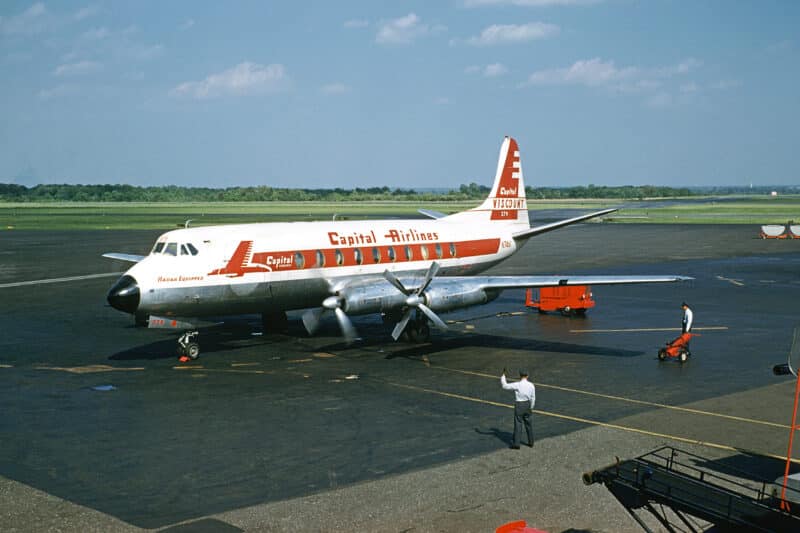
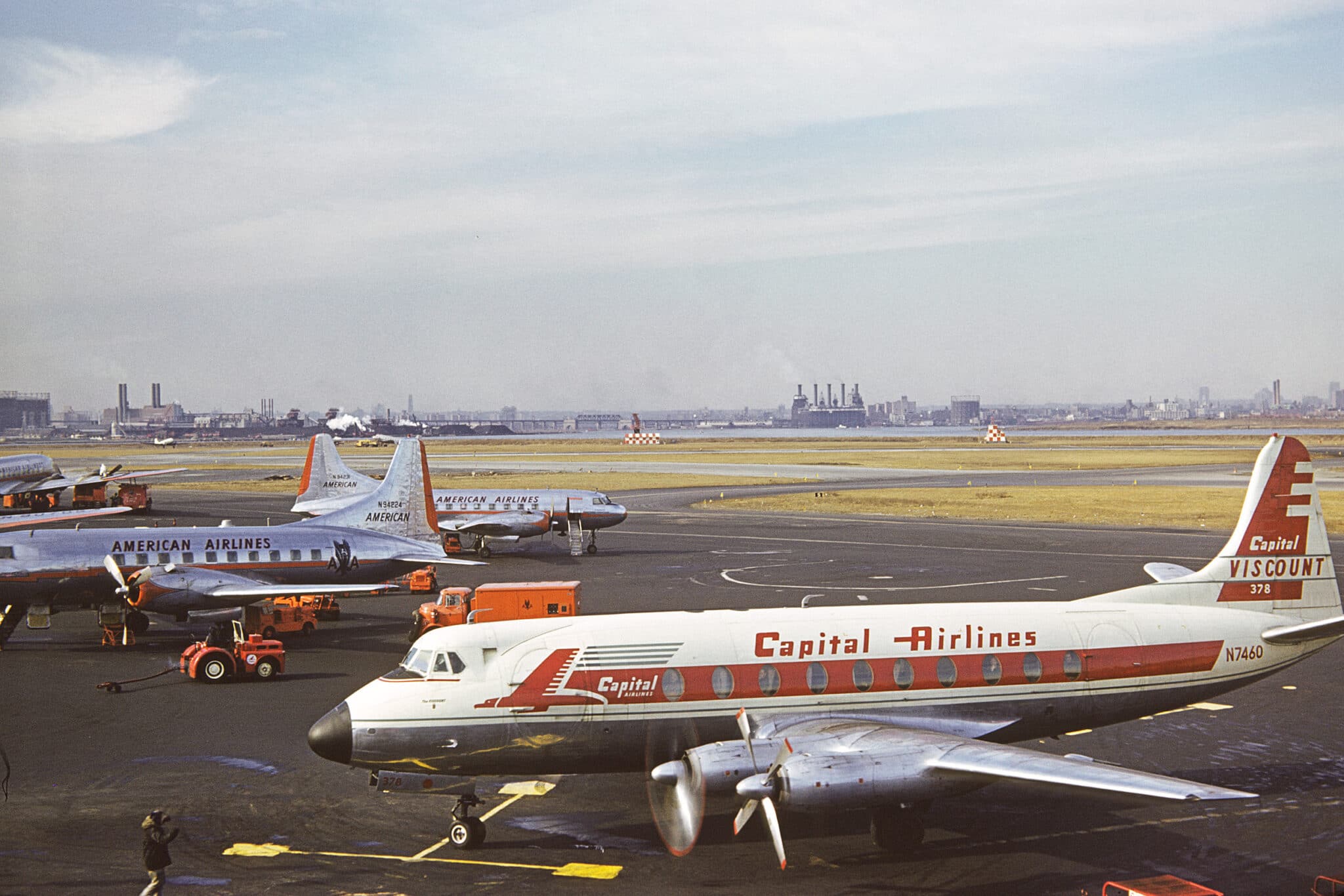
CAPITAL VISCOUNTS AT CHICAGO (MIDWAY). MEL LAWRENCE PHOTO VIA GEORGE HAMLIN
Tradition Is Broken – The Viscount Is Chosen
In 1953, Capital Airlines sent a 9-member team led by its president, aviation pioneer James H. “Slim” Carmichael, to England to study the Vickers Viscount. Within a few years, Capital was deploying 60 of the type throughout the eastern United States.
No U.S.-based airline had purchased a foreign-built aircraft before. Fokker types had been used by some carriers in the late 1920s and early ‘30s, but these had been designed and built by the Dutch firm’s American Division.
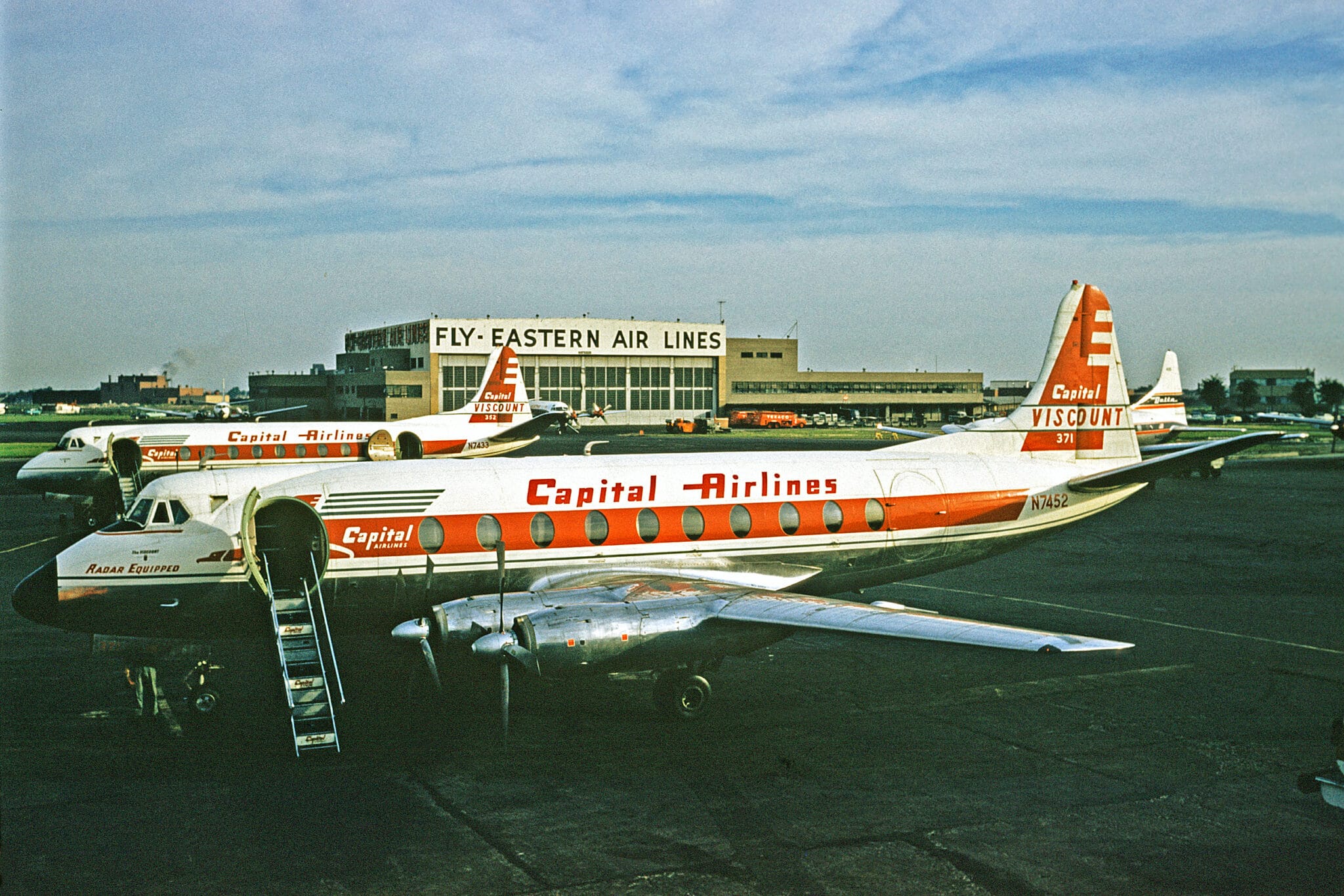
AN UNPRECEDENTED MEDIA CAMPAIGN INTRODUCED CAPITAL’S VISCOUNTS, WITH THEIR ROLLS-ROYCE TURBOPROP ENGINES, TO THE AMERICAN PUBLIC. DAVID H. STRINGER COLLECTION
Capital introduced its first Viscounts to passengers in July 1955.
With its fleet of brand-new Viscounts, Capital became the first airline in the U.S. to operate foreign-built aircraft and, thus, the first to operate turboprop airliners. As the result of a lavish advertising campaign introducing Capital’s new aircraft to the American public, the whistling jet-prop from England was firmly associated with Carmichael’s airline, and vice-versa.
Two other American carriers – Continental Airlines and Northeast Airlines – would eventually follow Capital’s lead and purchase Viscounts in 1958.
CAPITAL AIRLINES TIMETABLE ANNOUNCING THE IMMINENT INTRODUCTION OF THE VICKERS VISCOUNT. DAVID H. STRINGER COLLECTION
Jet Props: Precursor To The Jet Age
Referred to in advertising as a ‘jet-prop’, a turboprop airliner, in simplest terms, is an aircraft with propellers that are driven by jet engines.
In the summer of 1955, the true jet age for commercial airlines was still three years in the future when Pan American and BOAC would launch Boeing 707 and DeHavilland Comet 4 services, respectively, in October 1958.
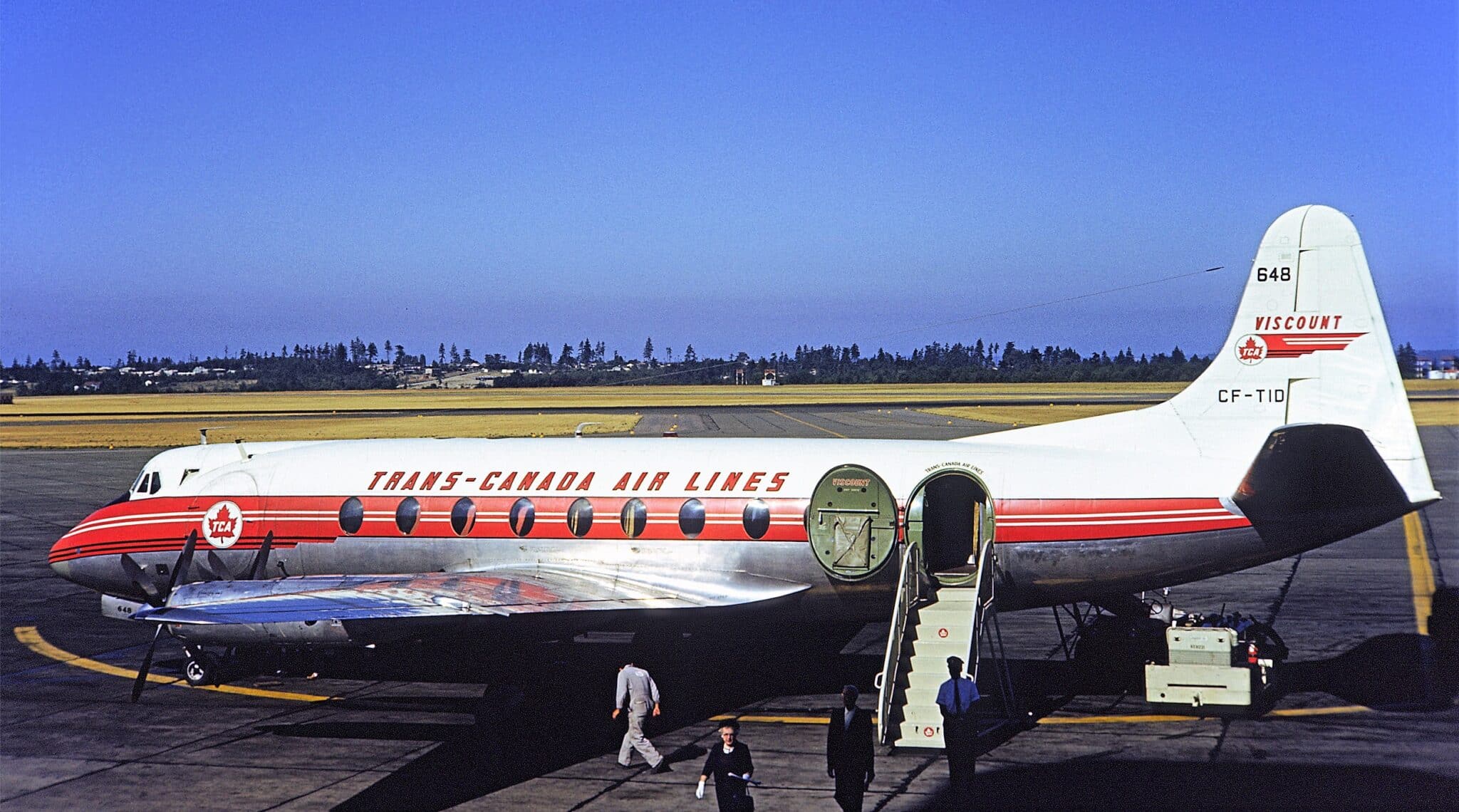
TRANS-CANADA AIR LINES WAS THE FIRST CARRIER TO INAUGURATE VISCOUNT SERVICE IN NORTH AMERICA, THREE MONTHS BEFORE CAPITAL AIRLINES INTRODUCED THE TYPE ON U.S. DOMESTIC ROUTES. MEL LAWRENCE PHOTO VIA GEORGE HAMLIN.
The initial foray into commercial jet service with the Comet 1 had been suspended in 1954 after several accidents revealed the need to develop and incorporate design changes. With no jetliners in service between 1954 and 1958, and only piston-engine types serving the nation’s air carriers, the new-technology turboprop Viscount became the most advanced airliner in service. Consequently, for several years, Carmichael’s Capital was a step ahead of every other airline in the United States in its choice of flight equipment.
It should be noted that Trans-Canada Air Lines (TCA) held the distinction of operating the first Viscounts in North America, putting the type into service three months before Capital did. And a few other foreign carriers (Cubana, BWIA, TACA) brought their Viscounts to the shores of the U.S. between 1955 and 1957. In December of ’57, BOAC introduced the jet-prop Bristol Britannia on its London – New York route. But until 1958, Capital was the only carrier operating turboprop aircraft domestically within the U.S.
Capital’s Fleet Before The Viscount
Capital’s fleet in 1954 consisted of 12 older, first-generation Lockheed Constellations, 25 DC-3s and 25 DC-4s. The DC-3s and DC-4s were unpressurized. This was a bit of an embarrassment for the company that was now the fifth largest domestic airline in the United States in terms of passengers carried, surpassed only by the ‘Big Four’: American, Eastern, United, and TWA. Capital’s fleet needed a total makeover.
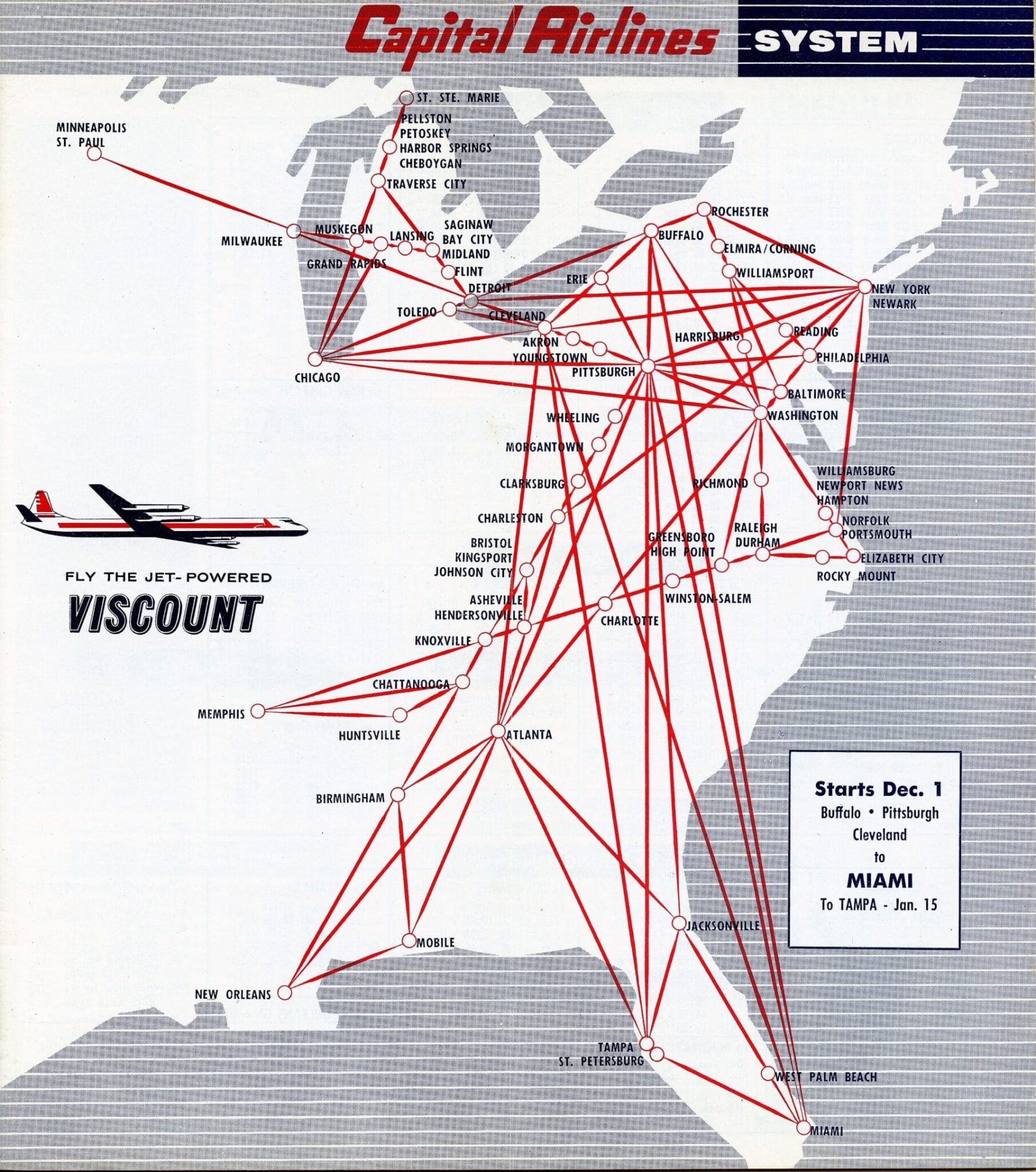
CAPITAL AIRLINES ROUTE MAP AS OF OCTOBER 1958. DAVID H. STRINGER COLLECTION
Well-Patronized Routes And Puddle-Jumper Flights
Capital’s needs were rather unique. Although it was the nation’s fifth largest airline, its network was concentrated east of the Mississippi River, so there were no transcontinental long-haul routes. The company’s average stage length was less than 300 miles. Capital’s busiest route at the time was its non-stop between Washington (National) and Chicago (Midway), a distance of 600 miles, but much of its revenue came from shorter hops in the industrial northeast (later known as the Rust Belt) between big city pairs like New York – Cleveland, Chicago – Detroit, and Washington – Pittsburgh. Added to that was a network of ‘puddle-jumper’ routes.
CAPITAL VISCOUNT AT NEW YORK (LA GUARDIA). JIM SHAUGHNESSY PHOTO VIA GEORGE HAMLIN
Capital was required to provide service to more than a dozen places, such as Clarksburg, West Virginia; Rocky Mount, North Carolina; and Williamsport, Pennsylvania, that would have been better suited for a local service carrier.
U.S. aircraft manufacturers Lockheed, Douglas, and Boeing were designing and building long-haul aircraft that were not suitable for Capital’s average stage length. That left the airline studying twin-engine, piston-powered products of Convair and Martin, which would not be competitive in Capital’s main markets where customers would expect to fly on a 4-engined airliner. So, the company looked overseas.
NASA is all systems GO at Kennedy Space Center in Florida tonight, as the countdown clock ticks towards a launch attempt at 8:33 a.m. EDT Monday morning with the maiden voyage of the Artemis-1 moon mission.
Artemis-1 will debut the most powerful rocket in the world, the Space Launch System (SLS), to send a new Orion Spacecraft on a 42-day uncrewed flight test to the moon and back.
Watch Artemis-1 Launch here:
live coverage of the launch
It’s a full mission of the entire integrated system, from the ground support, to launch, to checkouts of Orion, flight to lunar orbit, and return to Earth. NASA wants to validate that everything works as designed, and stress Orion beyond what it was designed for, before launching the first astronauts on Artemis-II.
The countdown started at 10:23 a.m. EDT on Aug. 27, when the launch team arrived at their stations in the control room, located 3 miles from the launch pad.
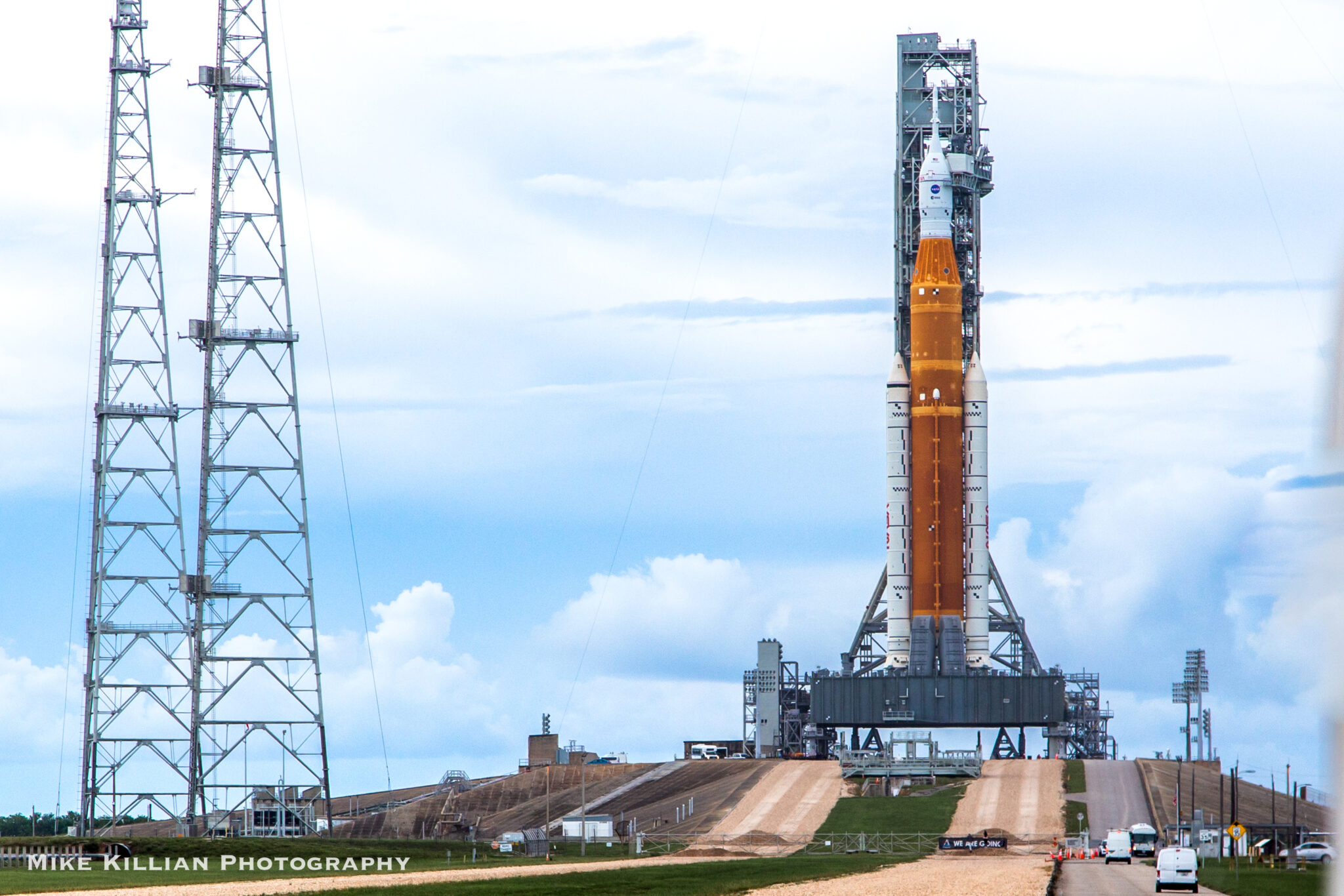
the moon rising behind artemis-1 As It Undergoes Final Checks Before Launch On Monday. (mike killian photo)
Unlike Apollo, Artemis aims to establish a permanent human lunar presence learning to live and work at the moon, much the same as we have done now for decades with the International Space Station. NASA wants to establish a base at the South Pole, and put a small space station called Gateway into lunar orbit that will allow docking of cargo, crew, landers and other spacecraft, as well as additional segments to grow the outpost from commercial and international partners.
Weather Looks Positive But Not Guaranteed
But first, NASA needs to fly Artemis-1. Thunderstorms have been prolific across Central Florida the last several days, with lightning even striking the launch complex (no damage), but the U.S. Space Force Space predicts an 80% change of good weather for launch at 8:33 a.m. Skies will, however, begin to deteriorate to 60% by the end of the launch window (10:33 a.m.).
We reported previously on the new SLS rocket and Orion Spacecraft, which you can read here. At liftoff, SLS will produce nearly 9 million lbs of thrust, 15% more than the Apollo Saturn V and more than 31 times the thrust of a 747 jumbo jet.
Once launched, Orion will fly some 280,000 miles from Earth and thousands of miles beyond the Moon, using a different orbit than Apollo. It will fly 62 miles above the surface, and then use the Moon’s gravity to propel it into a deep retrograde orbit 40,000 miles above the surface, where it will fly and test for 6 days. Orion will then descend back into a low orbit and brush past the surface again at 60 miles to perform its engine firing to break away from the moon’s gravity, and then head back to Earth.
Orion will stay in space longer than any ship for astronauts has ever done without docking to a space station, and will return home faster and hotter than any before it.
For now, all systems GO for launch at 8:33am EDT Aug 29.
Every once in a while, friends of Avgeekery send us a treat. Earlier today, we were sent a video by our friend Jim Mumaw. Jim is a long-time aviation photographer and certified avgeek. Jim lives near Edwards AFB. For many years, he’s graced us with amazing images. Over the years, Jim has built up relationships with the local community. He’s leveraged those relationships to get thousands of unique photos and videos. This latest video is essentially one from Jim’s vault. It’s a long-lost VHS tape of SR-71 operations at Edwards AFB.
SR-71 Taxiing
When Jim first shared the video, he said, “It was on VHS, shot by myself and sat on a shelf for 27 years. Didn’t hold up too well but hopefully you’ll get an idea about the Blackbird from this never before seen in public video.” Jim’s too humble. This video is amazing!
Details of the Video: SR-71s At Edward AFB
Jim shared the background of these series of videos that he uploaded to YouTube. He said it was a combination of videos filmed between 1990 and 1995. He said,” [the video] was many years ago at the Edwards Open House. They towed the plane over from the museum. By my not narrating it the sounds of the operations come through. The monitor I zoomed in on was at NASA Dryden. The pools of JP-7 can be seen under the jet as well as the green TEB flame igniting the fuel. As it passes while I was beside the runway at Plant 42, you can pick up a glitch in the recording heads as the camcorder vibrates with the resonance put out by the twin J-58 engines. This was truly power that was felt throughout a person’s body! “
The video features multiple takeoffs and landings of the SR-71 at Edwards AFB. It even features a closeup of the drogue chute deployment. That’s something we’ve never seen before close up!
Other Awesome NASA Planes In The Video
The NASA F-16XL Cranked Arrow Jet is in this video too! Jim said, “We were racing it back after landing with me hanging onto the back of the cart with one hand while filming with the other. Last thing of note just near the end is the crew taking off their spurs.”
SR-71 Was An Amazing Aircraft
The SR-71 was the world’s first and only production Mach 3+ jet. The Lockeed team designed the jet on a slide rule. Jim Kelly and team designed this jet with limited technology but maximum ingenuity. The jet was well ahead of its time. The SR-71 was able to outrun SAMs (surface to air missiles) and conduct reconnaissance over hostile territory.
The jet set a number of speed records included the fastest coast to coast flight. That flight occurred on the SR-71’s final flight. In that flight, Col Yieldling flew serial number 61-17972 from Los Angeles to Washington DC. He and a crew member landed just one hour, four minutes, and 20 seconds later at Dulles International Airport outside Washington DC. The last operational flight of the SR-71 set a new Los Angeles to Washington speed record averaging a scorching 2,124 miles per hour! The jet was donated to the Smithsonian at Dulles International Airport. You can view it today at the museum at the Steven F Udvar-Hazy Center at Dulles.
17-year-old British-Belgian pilot Mack Rutherford has become the youngest person ever to fly solo around the world.
Mack Rutherford’s Five-Month Journey Around the World
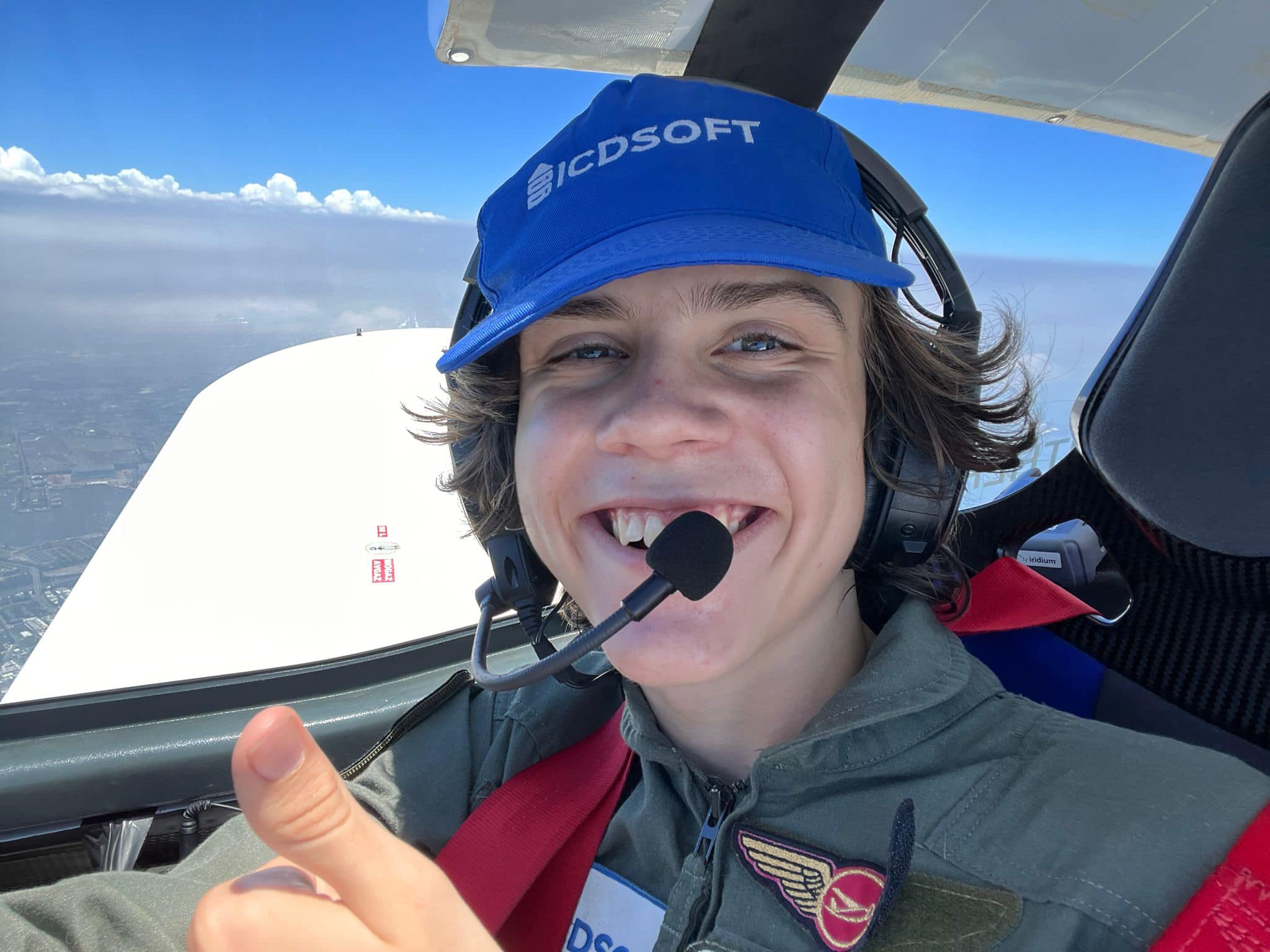
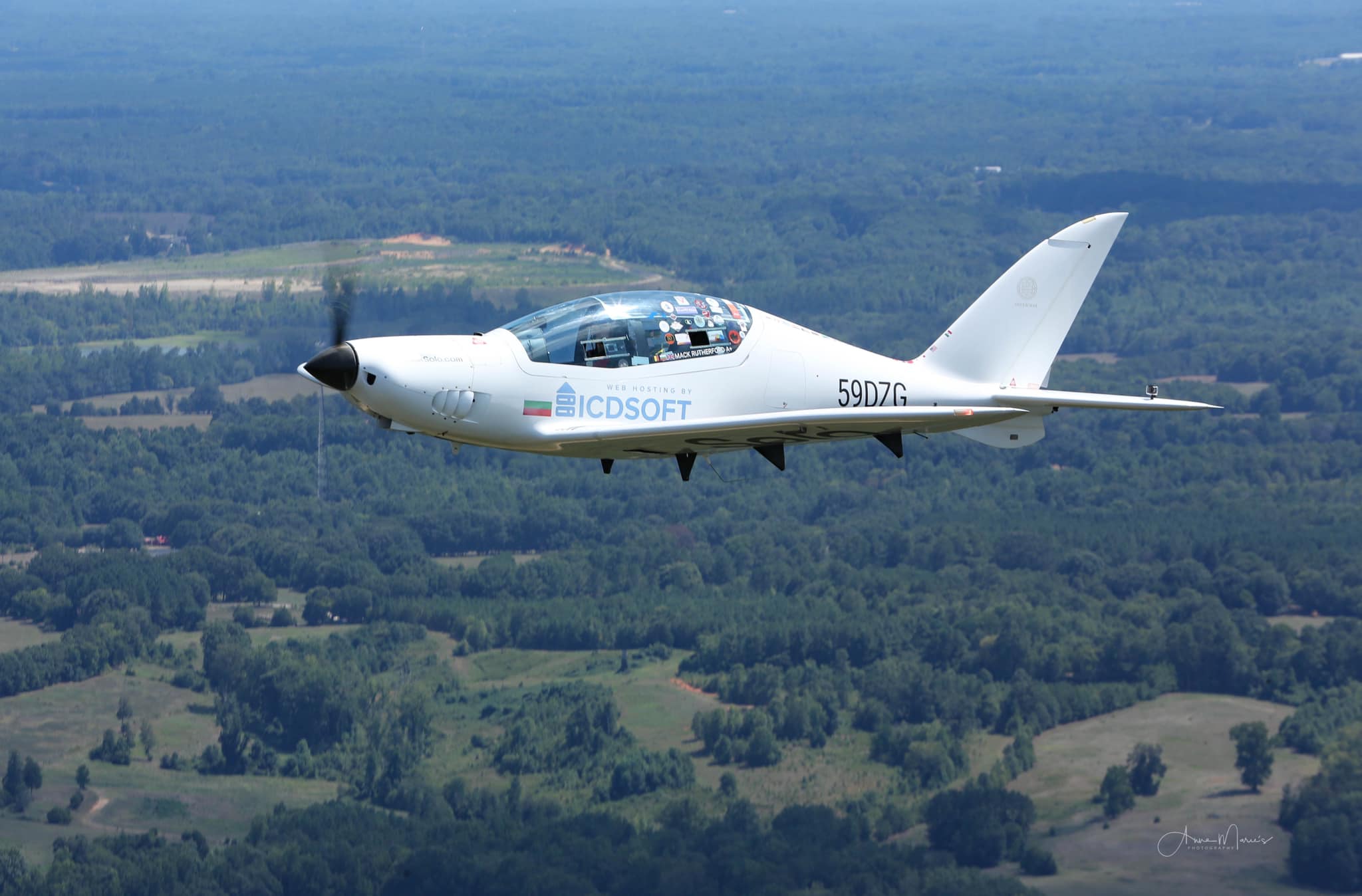
Mack Rutherford gives the camera a thumbs-up somewhere over southeast Asia on 24 July 2022 | IMAGE: MackSolo2022 / Facebook
On Wednesday, Mack’s Shark Ultralight (UL) touched down in Sofia, Bulgaria, after a five-month journey that spanned 30 countries, four continents, and nearly 30,000 miles.
He broke the record set just last year, when Travis Ludlow of Britain, 18, completed his solo journey around the world.
Mack now holds four Guinness World Records, including:
Youngest person to circumnavigate the world by aircraft solo
Youngest person to circumnavigate the world by aircraft solo (male)
Youngest person to circumnavigate the world by microlight solo (male)
Youngest person to circumnavigate the world by microlight solo
Circumnavigating the Earth in a Shark
Courtesy: MACKSOLO / YouTube
Mack, whose nickname is Mack Solo, was just 16 years old when he lifted off from Sofia West Airport (LBSW) on 23 March 2022. After stops in Italy and Greece, Mack’s route took him across northern and eastern Africa, southern Asia, Japan, across the Pacific via Alaska, down the West Coast of the U.S., Mexico, the eastern U.S., Canada, across the North Atlantic, the U.K., and Belgium.
After 142 days, Mack’s journey ended on Wednesday, 24 August, when he successfully landed his Shark back at Sofia West Airport at 1700 local time.
Mack flew in a specially modified Shark UL, a European high-performance ultralight aircraft. The Shark features retractable gear, a smaller wing, a variable-pitch propeller, and a maximum speed of 186mph.
Every Day was an Adventure
Pilot Mack Rutherford was forced to land his Shark in bad weather at Attu, an uninhabited island in Alaska | IMAGE: macksolo2022 / Facebook
Mack only flew during daylight hours. He encountered a few issues, such as sandstorms in Sudan, visa issues in Dubai, and a fuel bladder switch problem (that ended up correcting itself) after a stop in Egypt. The Russian invasion of Ukraine also led to navigational difficulties, as most around-the-world flights include overflying Russian airspace. Eventually, Japan agreed to grant Mack the use of their airspace, which allowed him to continue his journey.
The most hair-raising moment of his adventure came during a 10-hour leg between Japan and Alaska. While over the Aleutian Islands, Mack encountered a weather system that produced low clouds, rain, and unexpectedly strong headwinds. He was forced to land at a former Coast Guard airstrip on Attu, an uninhabited Alaskan island that was the site of the only World War II land battle fought in the United States.
“I stayed the night on a completely uninhabited island, which was pretty special,” Mack told the New York Times. “I found a shed on the side of the runway and stayed there for the night on a broken-down sofa.”
As for some of his favorite moments, Mack says seeing Kenya’s wildlife and New York City’s skyline were particularly exhilarating. He was surprised when New York air traffic controllers allowed him to make several passes around the Statue of Liberty.
Mack Rutherford’s Shark UL in flight | IMAGE: MackSolo / Facebook
Age when record was broken: 17 years, 2 months, and 2 days (breaking the record set by Travis Ludlow by 150 days)
Total Distance Flown: 33,632 miles
Total Time in the Air: 221 hours
Total Time of Circumnavigation: 142 days
Takeoffs/Landings: 68
Longest Flight: 10 hours (Japan to Alaska)
Highest Altitude: 12,500 ft. over Mexico
Highest Temperature: 118.4°F (48°C)
Lowest Temperature: 10.4°F (-12°C)
A Love of Aviation Runs in the Family
Mack Rutherford and his father Sam Rutherford | IMAGE: MacSolo2022 / Facebook
Mack is far from the first aviator in the family. His dad is a former British Army helicopter pilot and is now a ferry pilot. His mom is a recreational pilot. Even his great-great-grandmother was a pilot and one of the first South African women to learn how to fly.
Mack isn’t even the only one in his family to hold a world record. In January 2022, his sister Zara, 19, became the youngest woman to fly solo around the world.
Will Mack continue to build upon his family’s remarkable legacy in aviation? He is considering going into the air force, but right now, he is focused on his studies. As he enters his final year of high school, he says his focus is on catching up on the work he missed last year.
The world lost an engineering marvel in February 2022 when Russian forces attacked and destroyed the sole Antonov An-225 “Mriya” at Hostomel Airport (GML) near Kyiv, Ukraine. The company that chartered that jet for her last flight has released a moving short film dedicated to commemorating the final series of flights.
A Product of the Space Race
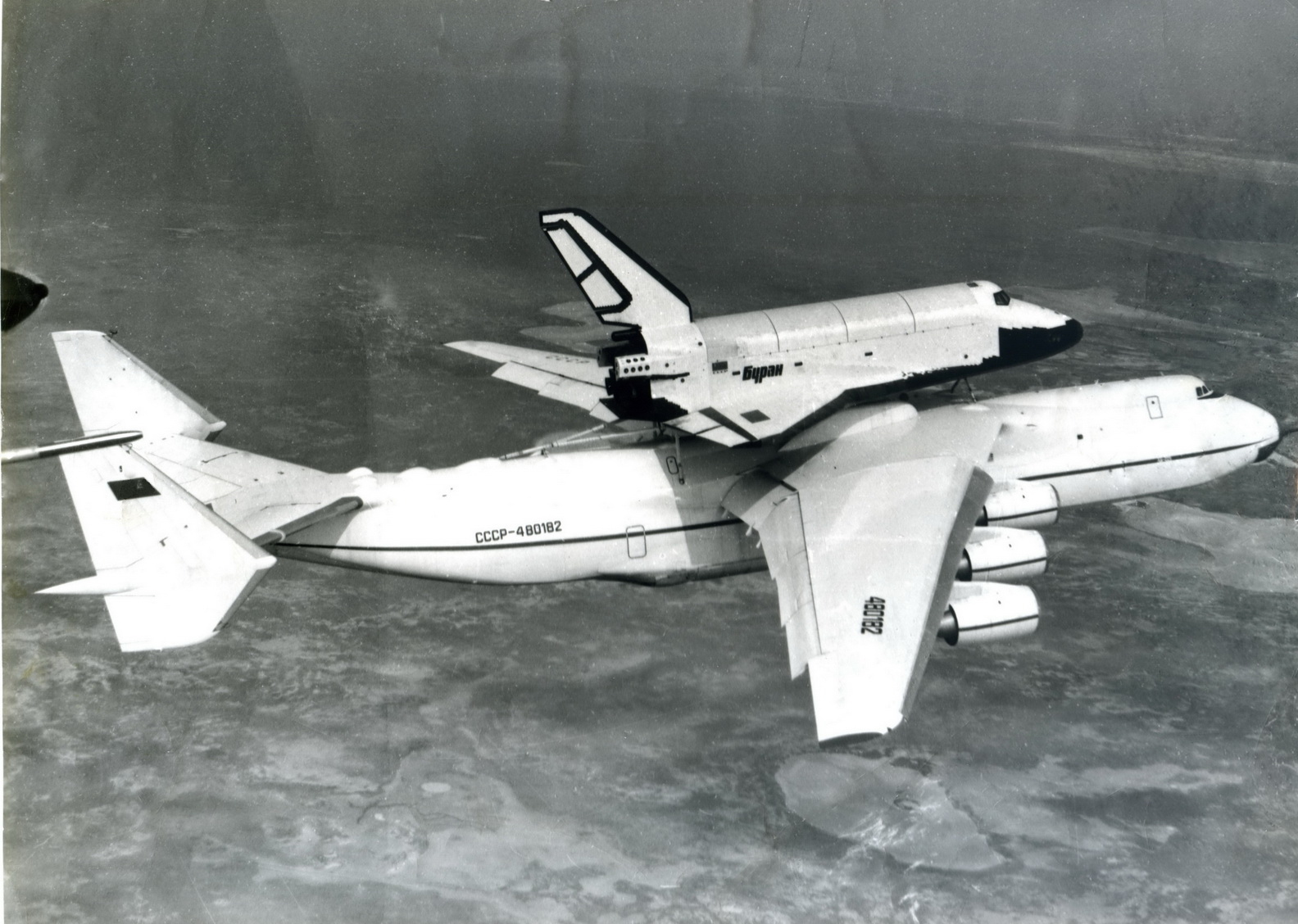
Antonov An-225 with Soviet space shuttle Buran on top | IMAGE: By Vasiliy Koba – http://spotters.net.ua/file/?id=11327&size=large, CC BY-SA 4.0, https://commons.wikimedia.org/w/index.php?curid=36873169
The massive aircraft was initially designed in the late 1980s by the Soviet Union for use in its space program. The aircraft was primarily used as a transport for the Buran space shuttle, the Soviet equivalent of the American space shuttle. The An-225 first flew on 21 December 1988.
At 275 feet long and a wingspan of 290 feet, the An-225 was the largest aircraft ever built. It had six engines — each capable of producing 51,6000 pounds of thrust at takeoff — and a landing gear system with 32 wheels. It was also the heaviest plane ever built, with a maximum takeoff weight of 710 tons.
The An-225 in a Post-Soviet World
The Antonov An-225 Mriya preparing to unload cargo at Billund, Denmark | IMAGE: 26AVIATION
When the Cold War ended in 1991 and the Soviet Union collapsed, the Soviet space program also collapsed. Thus, the An-225’s intended purpose was no longer relevant. A second An-225 was in production at the time but was never completed. To this day, the second An-225 remains unfinished in the hangar of a Ukrainian airfield.
From 1994 until 2001, Mriya sat in storage. After refurbishment, the aircraft was reintroduced as a cargo transport designed to carry oversized loads. In 2002, it returned to the skies under the banner of Antonov Airlines, which operated its base at Hostomel Airport near Kyiv.
Mriya completed many missions throughout her life, including supplying military aid to American, Canadian, and coalition forces in the Middle East, humanitarian relief missions around the world, and – most recently – providing medical supplies to countries throughout the COVID-19 pandemic.
Mriya’s Final Mission
The Antonov An-225 Mriya is preparing to unload cargo at Billund, Denmark | IMAGE: 26AVIATION
Prior to her destruction by Russian forces in February 2022, Mriya’s last mission involved the transport of nearly 320 tons of COVID-19 test kits from Tianjin, China (TSN) to Billund, Denmark (BLL) via Bishkek, Kyrgyzstan (FRU).
UK-based air charter company 26AVIATION was responsible for organizing Mriya’s final mission. Founded in 2021, 26AVIATION provided the logistics for what would become Mriya’s last mission before her demise.
The following tribute video, produced by 26AVIATION, is the final video ever captured of the mighty An-225 Mriya. It shows her arrival into Billund on the evening of 4 February 2022, the unloading of the cargo the next day, and her final ferry flight back to Hostomel.
She would be destroyed just three weeks later during the Battle of Antonov Airport on 24-25 February 2022.
On 27 February 2022, Mriya was destroyed by Russian forces at Hostomel Airport. Cargo inside of her at the time included windmill blades and COVID-19 test kits.
Ukraine Vows to Rebuild the An-225
The destroyed Antonov An-225 Mriya at Hostomel Airport, Ukraine | IMAGE: By Kyivcity.gov.ua, CC BY 4.0, https://commons.wikimedia.org/w/index.php?curid=116973885
Shortly after Mriya’s destruction, Ukrainian President Volodymyr Zelensky vowed that the An-225 would take to the skies again when the war ends. Zelensky, along with the Ukrainian people, views the aircraft as a symbol of national pride.
The task may be easier said than done, however, as returning the An-225 to the air would be an expensive undertaking – on the order of $3 billion USD or more.
Over its 34 years of service, the An-225 was a symbol of aviation ingenuity. The entire aviation community mourns the loss of one of the most iconic airplanes ever built.
A once mighty brand in the regional aviation world has filed for bankruptcy and ceased operations.
On Tuesday, College Park, Georgia-based ExpressJet Airlines announced it had filed for protection under Chapter 11 of the US bankruptcy code due to “a combination of market and economic conditions,” according to a message posted on its website.
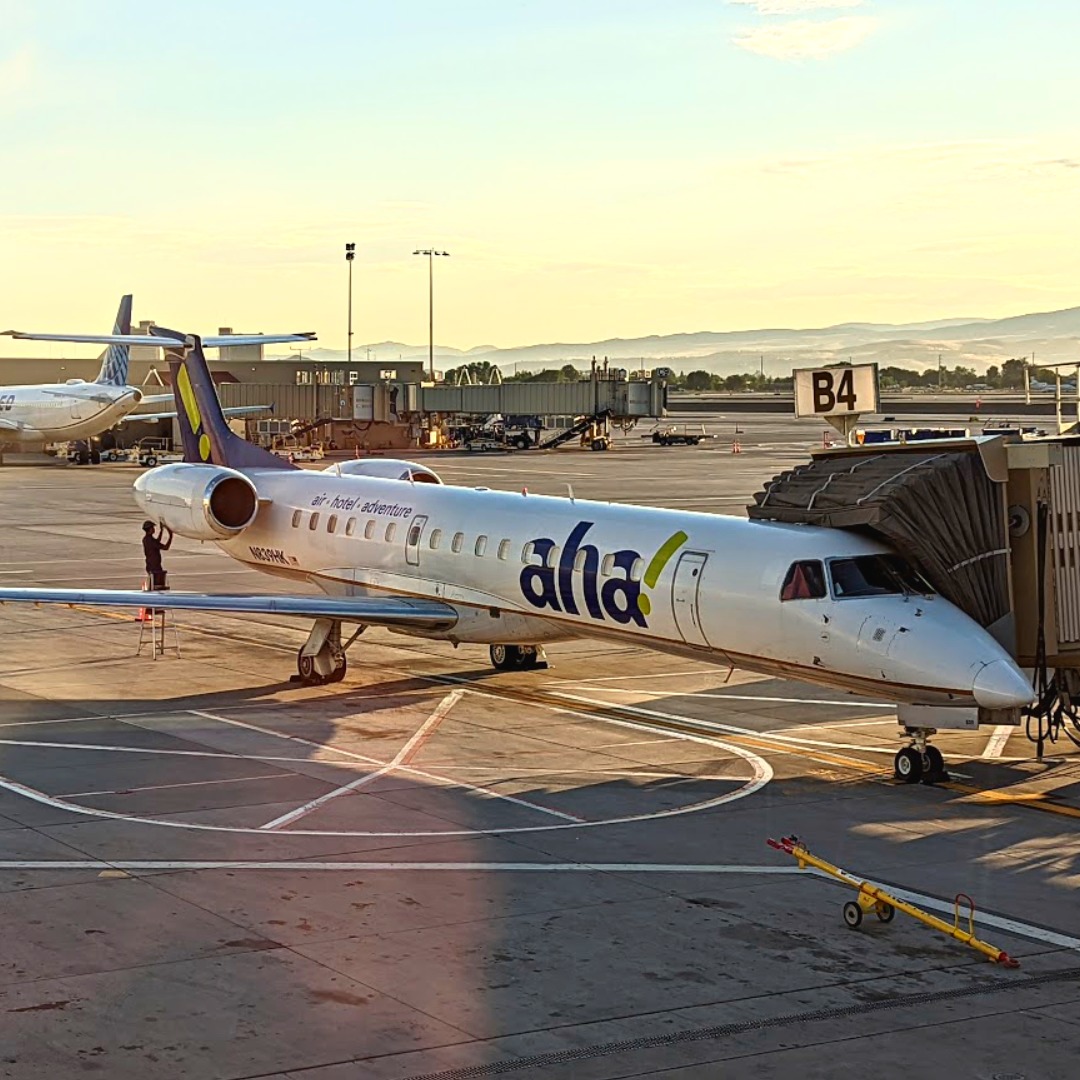
The filing has also brought an abrupt end to Reno, Nevada-based aha! Airlines, the brand used by ExpressJet for flights in the western United States.
aha! Was Less than a Year Old
aha! Airlines Route Map | IMAGE: aha! Airlines via Facebook
Using ExpressJet’s fleet of three 50-passenger Embraer ERJ-145 aircraft, aha! provided service to 12 cities throughout California, Idaho, Oregon, Nevada, and Washington. All flights were operated out of the carrier’s base at Reno-Tahoe International Airport (RNO).
Aha!’s inaugural flight took place on 24 October 2021 from Reno to Tri-Cities Airport (PSC) in Pasco, Washington. aha!, an acronym for “air, hotel, adventure,” had plans to serve more than 20 cities from Reno.
ExpressJet Airlines’ Convoluted Journey from Boom to Bust
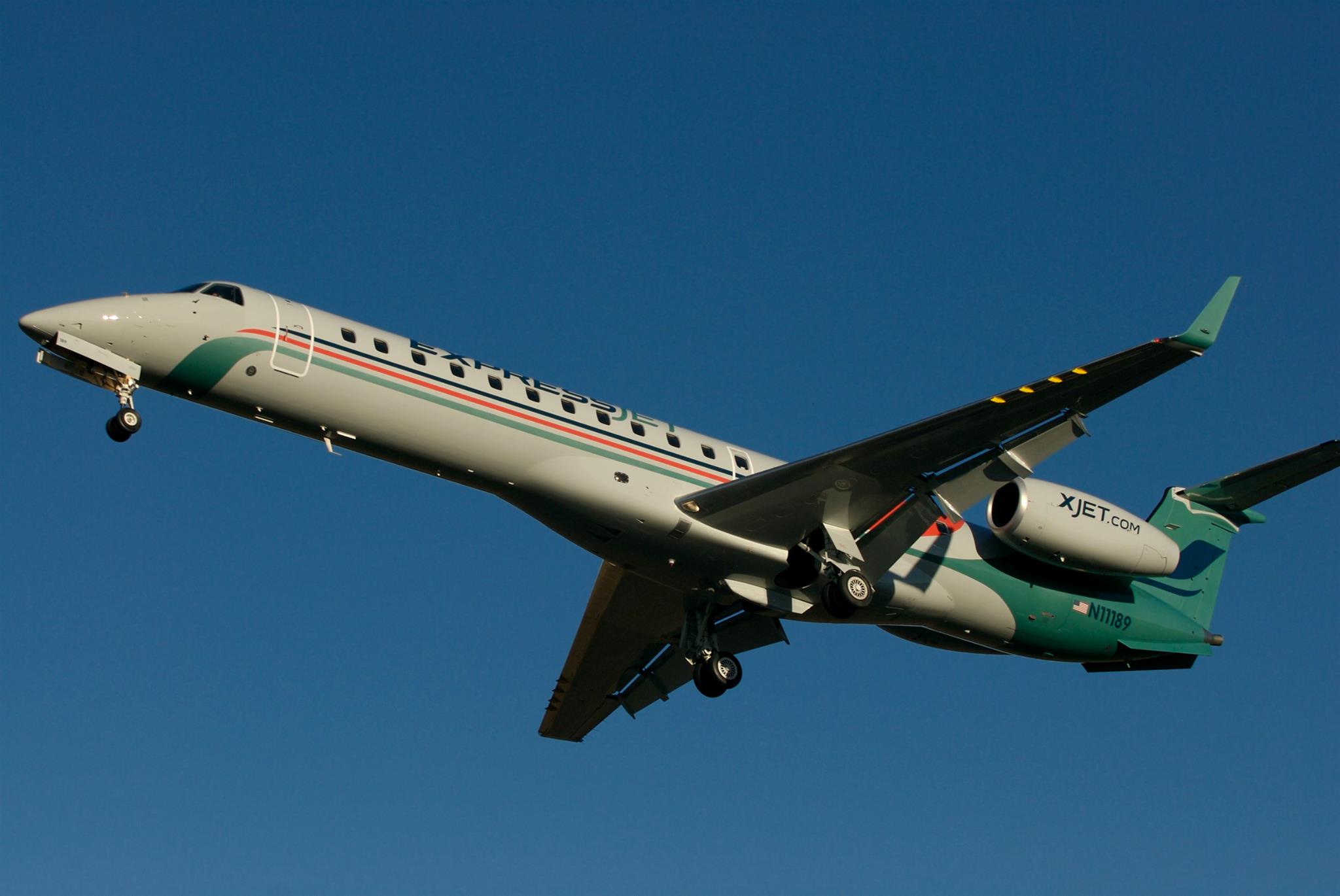
An ExpressJet Embraer ERJ-145 | IMAGE: ExpressJet Airlines
ExpressJet Airlines began operations in 1987 as a Continental Express carrier. It was acquired by Continental Airlines in 1996 and flew under the Continental Express banner through 2006. ExpressJet launched its own charter operation in 2006 and scheduled operations in 2007. High oil prices amid the financial crisis in 2008 led to the shutdown of the carrier in September of that year.
Meanwhile, ExpressJet also provided regional service for Delta Connection from June 2007 through September 2008. It also operated several short stints as a feeder for Frontier Airlines out of Denver (DEN), United Express out of Chicago O’Hare (ORD) and Washington Dulles (IAD), and Branson Air Express out of Branson, Missouri (BBG).
In 2010, ExpressJet was acquired by SkyWest Airlines and merged with Atlantic Southeast Airlines. At one point, the carrier operated more than 450 aircraft for United Express, American Eagle, and Delta Connection.
ExpressJet’s Last Breath
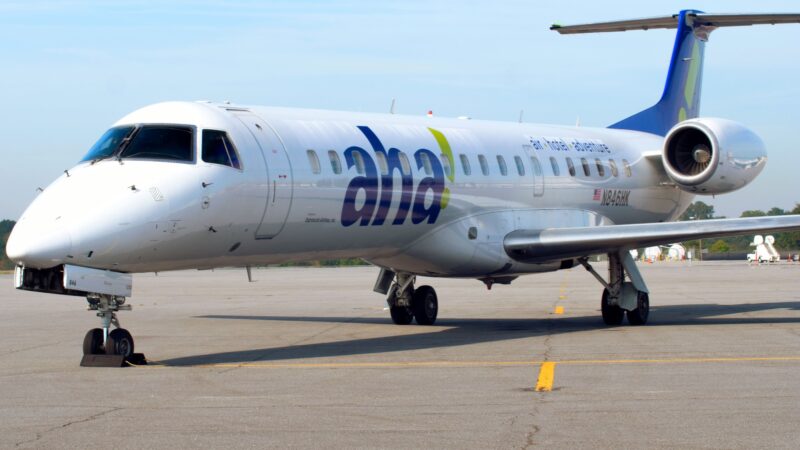
aha! Airlines ERJ-145 | IMAGE: aha! Airlines via Facebook
Amid the pandemic, United terminated its agreement with ExpressJet, effectively ending flying for the carrier. However, yet another brand resurrection occurred in 2021 when aha! began operations.
Today, the once mighty ExpressJet brand is officially no more. With the Chapter 11 filing and plans to liquidate assets, ExpressJet, along with aha!, appear to be on their way to becoming footnotes in the annals of aviation history.
There are faster ways to get to Hawaii, but it must have been an incredible adventure in a Cessna.
Imagine, if you will, the following scenario.
You’re on an 18-hour flight.
Your seat doesn’t recline.
There is no in-flight entertainment.
There is no in-flight service.
The cabin is not pressurized.
You can’t go to the bathroom – because there isn’t one.
And you’re the only passenger.
Oh…and you’re the pilot, too.
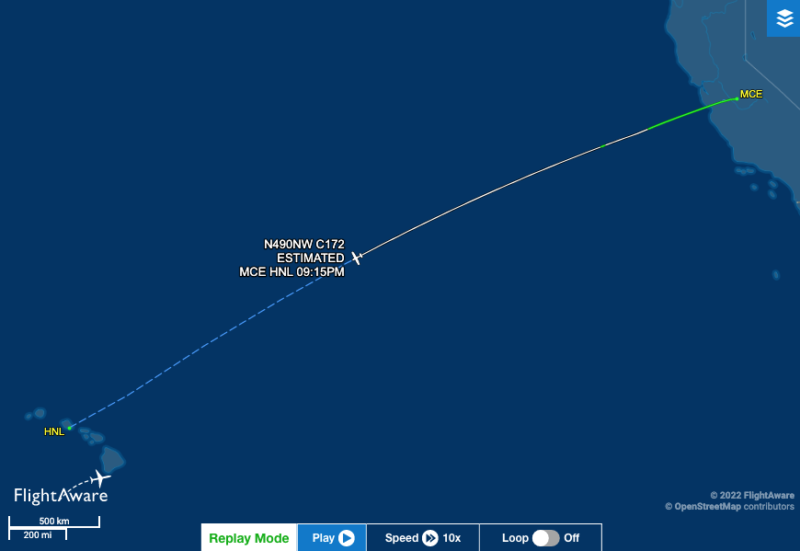
For Tom Lopes, this scenario played out in a very real way on Saturday. Lopes completed the 2,521-mile journey when he ferried a brand-new Cessna 172 G1000 NXi Skyhawk (reg. N490NW) from Merced Regional Airport (MCE) in Merced, California, to Daniel K. Inouye International Airport in Honolulu (HNL).
At a filed altitude of 6,000 feet and an average speed of 139mph, the flight was completed in 18 hours and five minutes. Lopes departed MCE at 0610 and arrived in HNL at 2115, both times local.
The Plane Was Delivered to a Flight School in Honolulu
IMAGE: FlightAware.com
The Cessna was delivered to George’s Aviation, a flight school located at HNL. In fact, less than 24 hours after the aircraft landed in Hawaii, it was already in the air providing flight training to students. According to George’s Aviation CEO George Hanzawa, it took just two hours to remove the modified fuel tanks and install the seats for use.
Hanzawa says the Cessna departed MCE with just over 200 gallons of fuel. Upon arrival in Honolulu, it had approximately 25 gallons left.
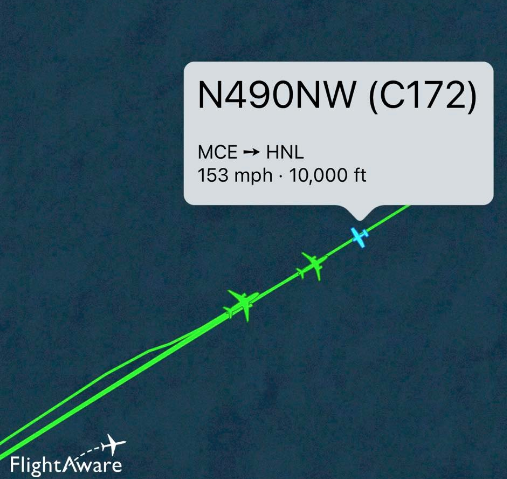
Lopes communicated with a temporary High-Frequency (HF) system installed on the aircraft. Additionally, FlightAware showed the Cessna flying at an altitude of 10,000 feet at times throughout the journey.
In a Facebook post created by Hanzawa, he said that he has arranged ferry flights from the mainland before. However, for some reason, this particular flight garnered an unusual amount of attention.
Upon arrival in Honolulu, Lopes was given a traditional Hawaiian welcome, with the adorning of a lei around the Cessna’s propeller hub and another around Tom’s neck.
“Yes, I ‘ve gotta go to the restroom.”
Pilot Tom Lopes emerges from a Cessna 172 at HNL | IMAGE: George’s Aviation via Facebook
The first words spoken by Lopes as he exited the aircraft?
“Yes, I’ve gotta go to the restroom.”
I would like to think he had an empty bottle or two, just in case — ya know — nature called. But maybe that’s just me.
In any case, flying solo halfway across the Pacific Ocean in a Cessna 172 is a remarkable accomplishment.
Hopefully, Tom was able to say “aloha” to a nice comfortable bed and get some well-deserved rest on Saturday night.
Watch the video below to see Lopes’ arrival at George’s Aviation.
Want to learn more about how Hawaiian Airlines 717 fly to the mainland for maintenance? Check this story out:
American Airlines just can’t quit the CRJ-200. The carrier on Monday announced that it intends to partner with regional airline Air Wisconsin beginning next March, effectively bringing back a jet banished by the airline – much to the delight of frequent American fliers – amid the pandemic.
Air Wisconsin Will Base up to 60 CRJ-200s at ORD
IMAGE: Air Wisconsin via Facebook
According to a Securities and Exchange Commission report, Air Wisconsin will initially base up to 40 Bombardier CRJ-200 aircraft at American’s megahub at Chicago O’Hare International Airport (ORD). The five-year contract, known as a capacity purchase agreement, states that Air Wisconsin will provide up to 60 CRJ-200 aircraft. American will add these aircraft to its network through October 2023.
The carrier says that although it will initially focus on O’Hare, future expansion is possible at other key hubs in the American network. Additionally, the agreement leaves open the possibility of adding 70-seat CRJ-700s to the Air Wisconsin fleet in the future.
Monday’s announcement was the latest development in a series of steps United is taking to distance itself from all-economy, 50-seat regional jets. Air Wisconsin’s partnership with American will leave SkyWest Airlines as the sole United Express CRJ-200 operator.
Air Wisconsin’s Storied History
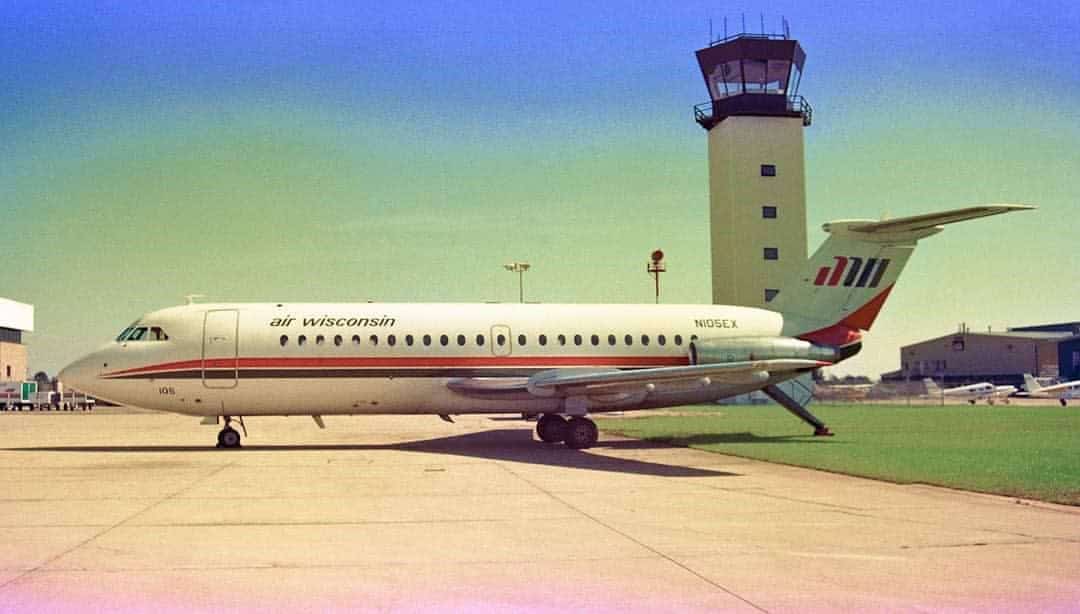
An Air Wisconsin Bac One-Eleven parked at ATW in August 1985 | IMAGE: Air Wisconsin via Facebook
Headquartered at Wisconsin’s Appleton International Airport (ATW), Air Wisconsin currently operates United Express flights out of its hubs at O’Hare and Washington Dulles (IAD).
The carrier began operations in 1965 between Appleton and O’Hare using two 9-seat de Havilland Doves. Air Wisconsin has operated many different aircraft types over the nearly six decades since, such as the BAe 146, the de Havilland Canada Dash 8, Short 330s and 360s, and Fairchild Swearingen Metros.
Although Air Wisconsin has been an exclusive United Express carrier since 2018, it hasn’t always been that way. It became a pioneer in the regional airline industry in the 1980s when Air Wisconsin began operating feeder flights for United Airlines. It has also operated flights for US Airways Express, American Eagle, and even AirTran Airways for a short period from late 2003 through mid-2004.
Could the Agreement Lead to Reinstatement of Air Service to Smaller Communities?
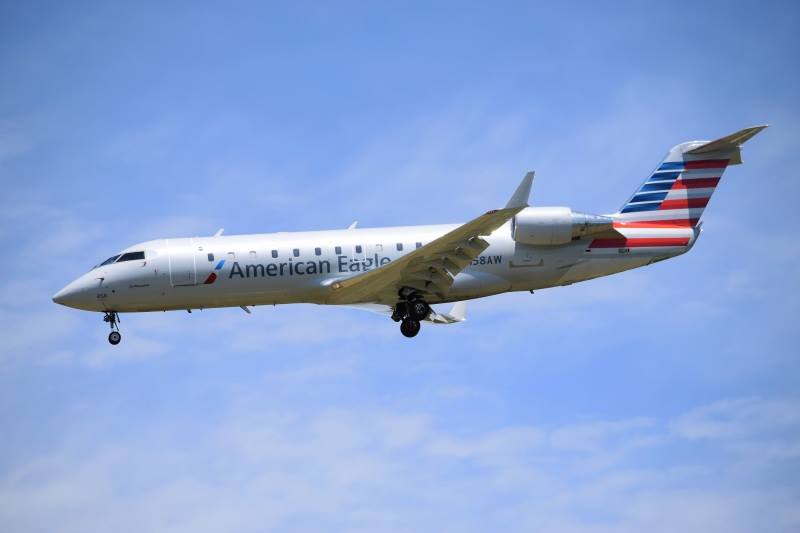
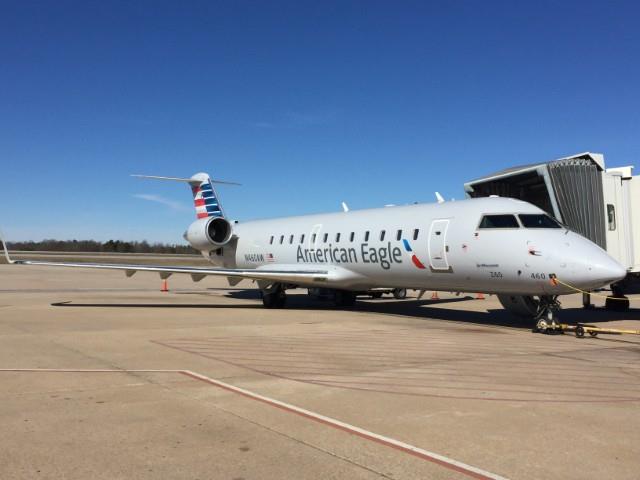
An American Eagle CRJ-200, operated by Air Wisconsin | IMAGE: Air Wisconsin via Facebook
While frequent fliers of American Airlines may not be thrilled about the return of an aircraft once deemed “the Nickelback of the Skies,” it no doubt provides some hope to smaller communities that have recently lost service amid the pilot shortage currently impacting the industry.
While nothing is certain, it is entirely possible that cities such as Toledo, Ohio (TOL) and Dubuque, Iowa (DBQ), along with Ithaca (ITH) and Islip, New York (ISP), could see a return of American Airlines service as a result of the Air Wisconsin agreement.
With a Chicago hub, could Air Wisconsin once again connect Essential Air Service (EAS) communities that have lost service since 2020 to America’s airline network? It’s something worth watching in the months and years to come.
And we can all agree that air service with the Nickelback of the Skies is much better than no air service at all.
For better or for worse, Monday’s announcement ensures that the much-maligned CRJ-200 will remain a stalwart of regional aviation in the United States – at least for now.
Nearly one year ago, Pittsburgh International Airport (PIT) launched its massive $1.4 billion terminal modernization project.
Government and airport officials broke ground for the new 700,000 square-foot facility on 14 October 2021. When it opens in early 2025, it promises to transform the passenger experience for those traveling from, to, or through PIT.
The Current Airport is Showing its Age
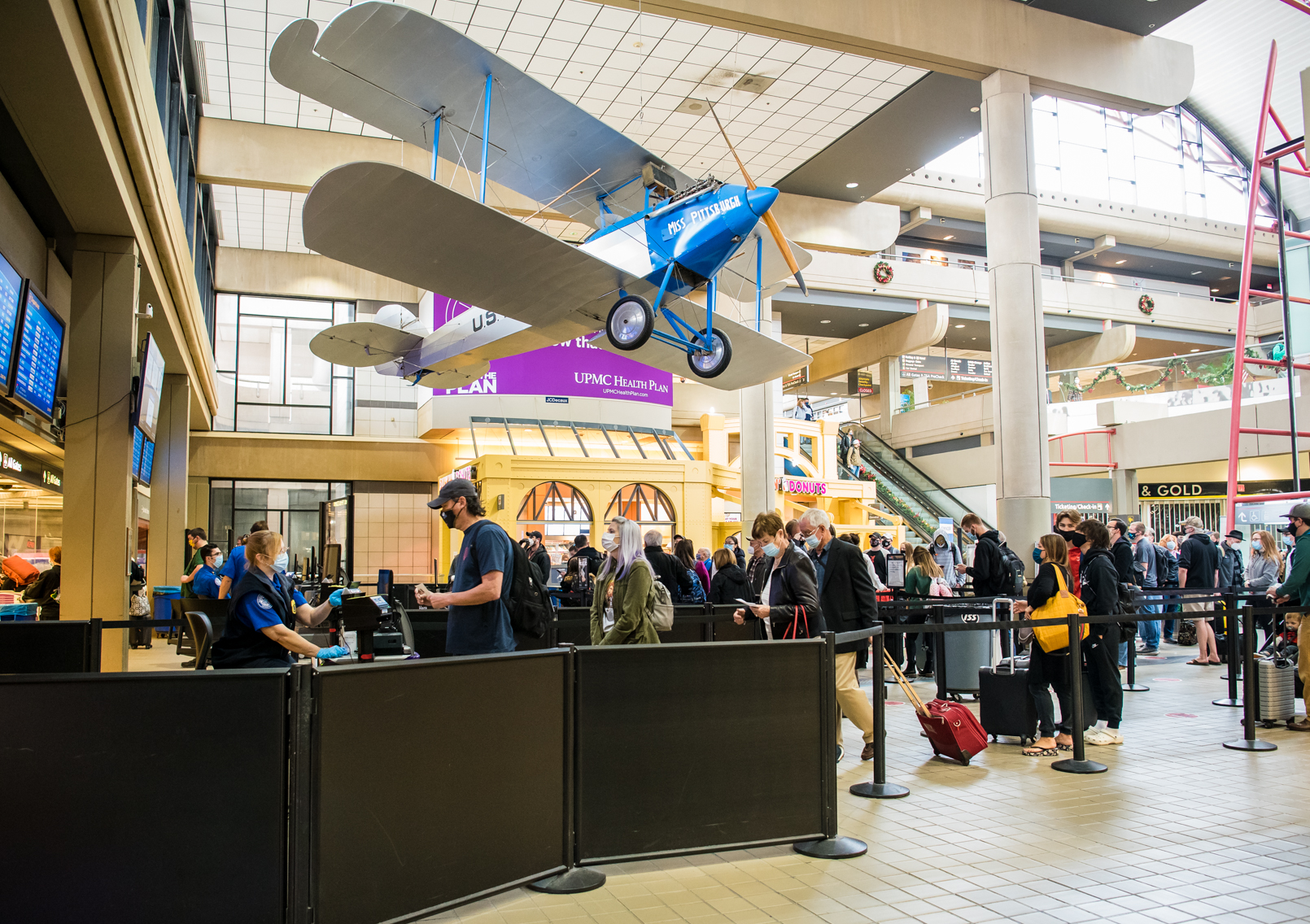
One of the TSA security checkpoints at PIT’s Landside Terminal in December 2021 | IMAGE: pitairport on Flickr
The new facility will replace the current two-terminal system. At nearly thirty years old, the existing airport has outlived its useful life.
The current layout consists of the “landside terminal,” which houses airline ticket counters, shops, restaurants, car rentals, and TSA checkpoints. Once through TSA, the “airside terminal,” or the A, B, C, and D concourses, is accessible via a half-mile-long underground people mover train. The airside terminal features the “AirMall.” Now run by Fraport USA, it was once the largest airport shopping center in the United States. A commuter terminal, also known as the “E Gates,” was accessible by escalators from the landside terminal. However, the 22-gate “E” concourse was closed in 2003 after US Airways began to scale back – and eventually eliminate – its PIT hub.
The US Airways Effect
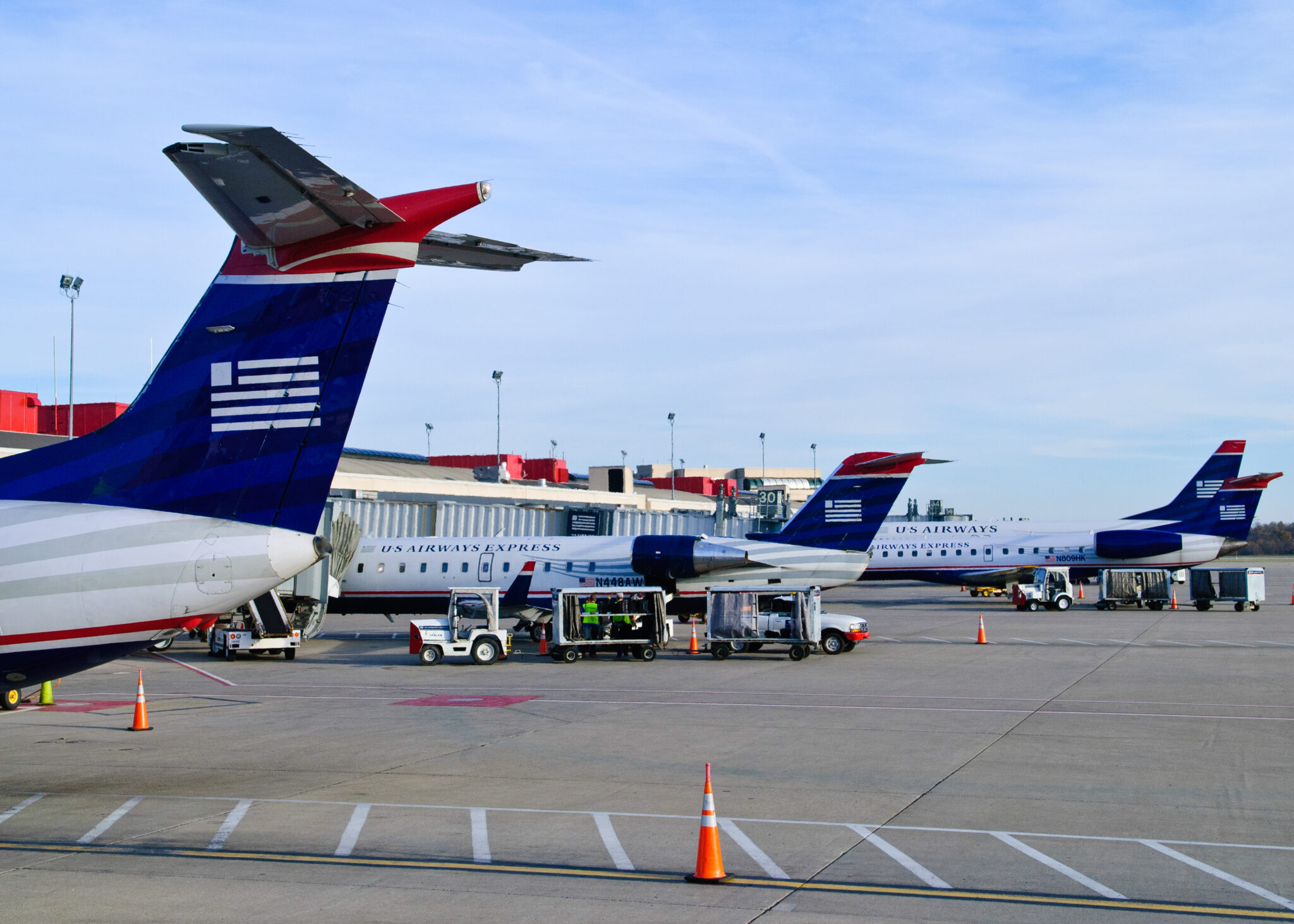
US Airways regional aircraft at PIT in November 2011 | IMAGE: pitairport on Flickr
The existing airport replaced the former Greater Pittsburgh International Airport, which opened in 1952. USAir ran a burgeoning hub operation that had outgrown the space, even after several expansions through the years. When the new airport opened in 1992, it opened with 75 gates with the ability to expand to 100. Unfortunately, the terrorist attacks of 11 September 2001 led to serious financial difficulties at what was now US Airways.
US Airways began to scale back operations amid the downturn in air travel following the 9/11 attacks. Ultimately, the carrier de-hubbed PIT. As a result, passenger traffic plummeted, and the expansive airport became a shell of its former self.
Since the early 2000s, PIT has reinvented itself by attracting new carriers and routes. However, passenger counts exceeding 20 million at the turn of the century during the height of US Airways’ PIT hub operation are but a distant memory. Passenger traffic continued to decrease following 9/11 until stabilizing in the late 2000s. After relative stability in the early to mid-2010s, and prior to the pandemic, passenger counts were slowly approaching 10 million. Impressive, but still less than half the number of passengers before 9/11. It was clear that Pittsburgh needed to right-size its airport.
Along with right-sizing PIT, the new terminal will transform it into a sustainable, efficient, and modern example of a 21st-century airport.
Streamlining the Passenger Experience
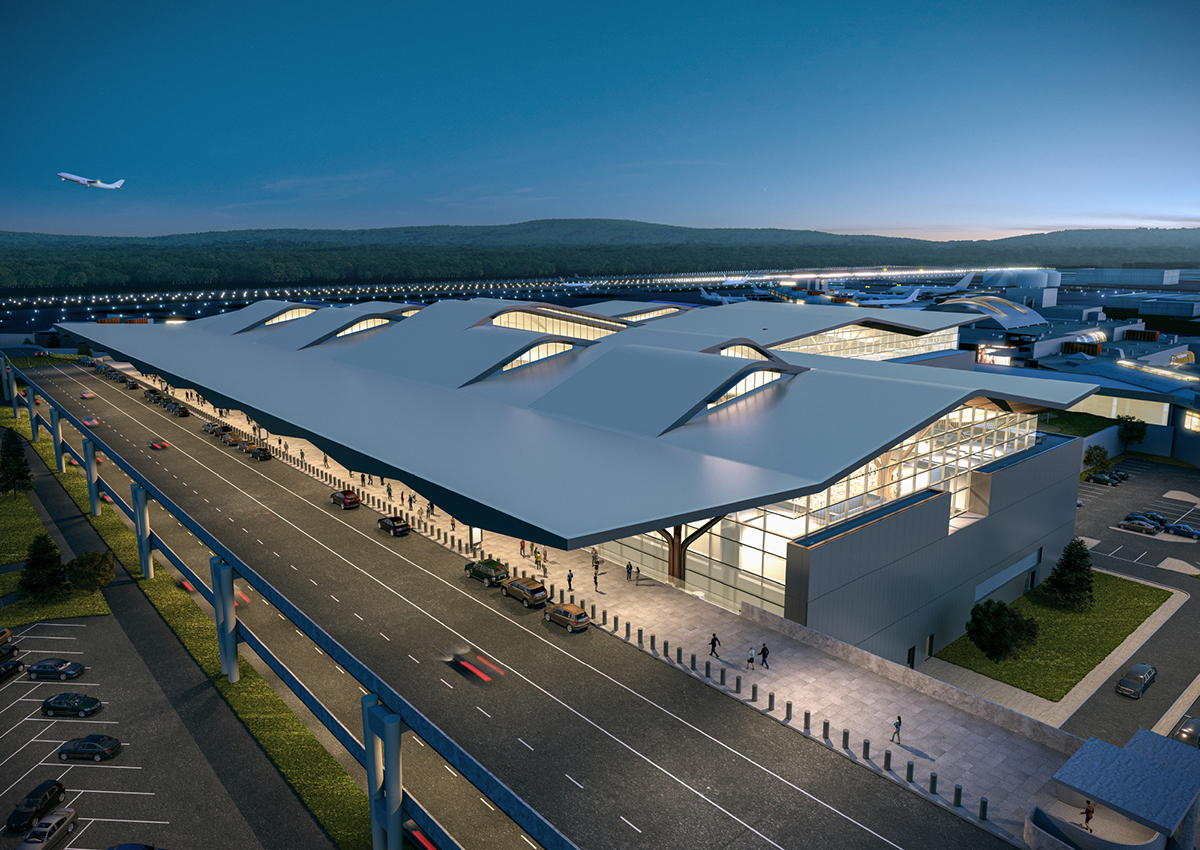
A conceptual image of the approach roadway to the new terminal at PIT | IMAGE: pittransformed.com
From the moment a passenger arrives by car, they will experience a streamlined process, including a new roadway system, a multi-level smart parking garage, and the consolidation of ticketing, security, and baggage claim in one area.
The new process will reduce the time it takes to get from curb to gate by 50 percent. Currently, passengers must navigate through a three-level maze to the airline ticket counters and two TSA checkpoints via a confusing and inefficient series of elevators and escalators.
Once inside security, a more efficient 51-gate layout will allow passengers to navigate to their gate effortlessly.
A Focus on Clean Air and Nature
Conceptual rendering of outdoor terrace at PIT | IMAGE: pittransformed.com
Pittsburgh’s new terminal will have the distinction of becoming America’s first terminal built from the ground up in the post-pandemic world. The design will feature multiple elements that enhance public health.
The elevated, three-tier structure will utilize clean air technology, enhanced ventilation systems, and large open areas enabling travelers to spread out. The terminal will feature a natural wood ceiling and floor-to-ceiling windows designed to let in as much natural light as possible.
Perhaps most impressive, however, is the 90,000 square foot outdoor terrace space. Accessible to travelers both pre- and post-security, this outdoor space will allow travelers to get some fresh air, enjoy nature, and maybe even have a picnic on the lawn while waiting for a flight.
A Commitment to Sustainability
Conceptual rendering of future ticketing concourse at PIT | IMAGE: pittransformed.com
The new airport will be the first to generate its own power by a microgrid. Powered by five natural gas generators that source their fuel onsite, the 23-megawatt grid went online in July 2021. More than 9,000 solar panels installed on a former landfill also contribute to power generation.
At least 75 percent of waste generated by the construction of the new terminal will be recycled or reused. The new roadway system to the terminal will feature recycled concrete from existing airfield infrastructure. The airport will also harvest rainwater.
All construction will be LEED-certified, meaning that the facility will be among the most sustainable buildings in the world.
A True World-Class Airport
Conceptual rendering of departure level at PIT | IMAGE: pittransformed.com
When the Terminal Modernization Program is complete in 2025, PIT will cement its spot as a world-class airport.
Although nowhere near the number of flights it saw during US Airways’ heyday, PIT currently offers 125 daily flights to more than 70 destinations. PIT is served by 15 airlines, including British Airways 787 service to London-Heathrow (LHR).
As demand for air travel increases post-pandemic, the updated Pittsburgh International Airport will be well-positioned to take advantage of the growth and will serve the needs of southwestern Pennsylvania for decades to come.
Years of research led to a successful SpaceX-like model rocket landing that went viral on YouTube.
Joe Barnard is a rocket enthusiast who had a dream. He wanted to work for SpaceX. With no relevant experience though, he realized he had to do something unique to stand out as a candidate. He figured he would build a model rocket and land it after launch just like SpaceX’s ground-breaking Falcon 9 rocket does. That would impress them! The only challenge was that he didn’t have a degree in aeronautics, astronautics, coding, or EE. He was a music major in college with a focus on audio engineering. So while he didn’t have the formal requirements for the role, he was clearly a smart and ambitious individual.
Joe Barnard engineered a complex system to successfully and reliably land model rockets, just like the real SpaceX Falcon 9. (Photo: BPS.Space YT Channel)
Project Moved Beyond Goal For A Job
For seven years, Joe labored to achieve his goal of a vertical takeoff, vertical landing model rocket. He chronicled his story of development with some spectacular failures and engineering challenges. His success video showed the masterful landing and was a ‘breakout’ hit. The video of his endeavor that finally nailed the landing went viral on YouTube, with well over 3 million views.
His Perseverance is Even More Impressive
It’s a pretty impressive video to see a model rocket land just like the SpaceX rocket. The story of his perseverance is even more inspiring though. The obstacles he faced were numerous throughout his journey. If you dig into his channel, BPS.space, you’ll see the many videos showing the incremental and sometimes painful steps towards project success.
Now that he’s achieved his goal, Joe is continuing the development of model rocketry with more advanced rockets. He pays for his project through a Patreon site, sales of his VTVL system for model rockets, and YouTube video ad revenue.
Joe’s goal is now to revolutionize the model rocket industry. He ended up not working at Space X, but it’s pretty clear that he’s ok with that and enjoying his own unique career path.
Norwegian budget carrier Norse Atlantic Airways made a splash Thursday by announcing new service between Germany and south Florida.
Slated to begin on 7 December, the thrice-weekly service will link Berlin’s new Brandenburg Airport (BER) and Fort Lauderdale-Hollywood International Airport (FLL). Norse Atlantic will operate the flight with a Boeing 787-9 Dreamliner.
From Germany to South Florida
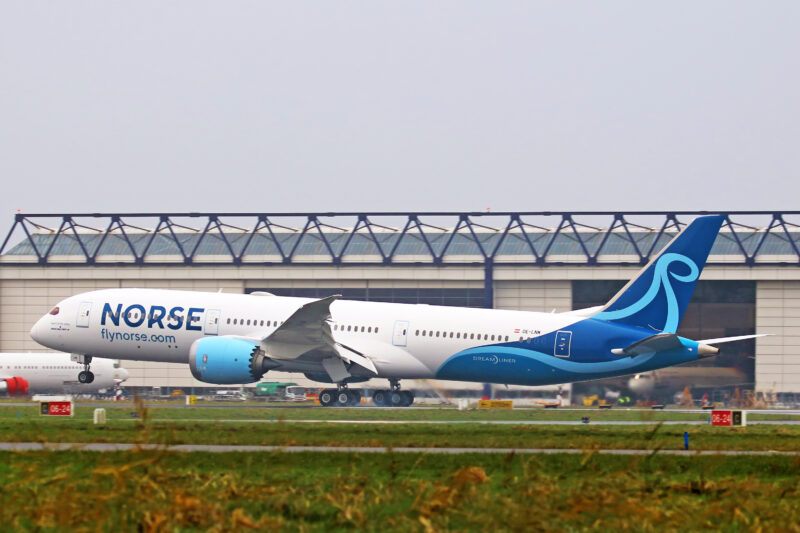
A Norse Atlantic Airways Boeing 787-9 Dreamliner | IMAGE: Norse Atlantic Airways
Fort Lauderdale will be the carrier’s third destination out of Berlin, which also offers nonstop flights to Los Angeles (LAX) and New York’s John F. Kennedy International Airport (JFK). BER-JFK service began yesterday, while BER-LAX service launches today.
Norse also flies nonstop between FLL and its home base of Oslo’s Gardermoen Airport in Norway (OSL).
One-way fares for the Berlin-Fort Lauderdale flights start at €228 ($230). The flight, which will operate on Wednesdays, Fridays, and Sundays, will depart Berlin at 1625 and arrive in Fort Lauderdale at 2100 (all times local). For the return trip, the flight departs Fort Lauderdale at 2300 and arrives in Berlin at 1440 the next day.
“We are very pleased to now be able to welcome customers from across Germany on board our state-of-the-art Boeing 787 Dreamliners to New York and Los Angeles,” said Norse Atlantic CEO Bjørn Tore Larsen. “With the addition of our Fort Lauderdale route commencing in December, we will be the largest long haul carrier operating out of Berlin. Our affordable fares will boost transatlantic travel between Europe and the US, benefitting local economies on both sides of the Atlantic.”
Norse Partners with Other Carriers
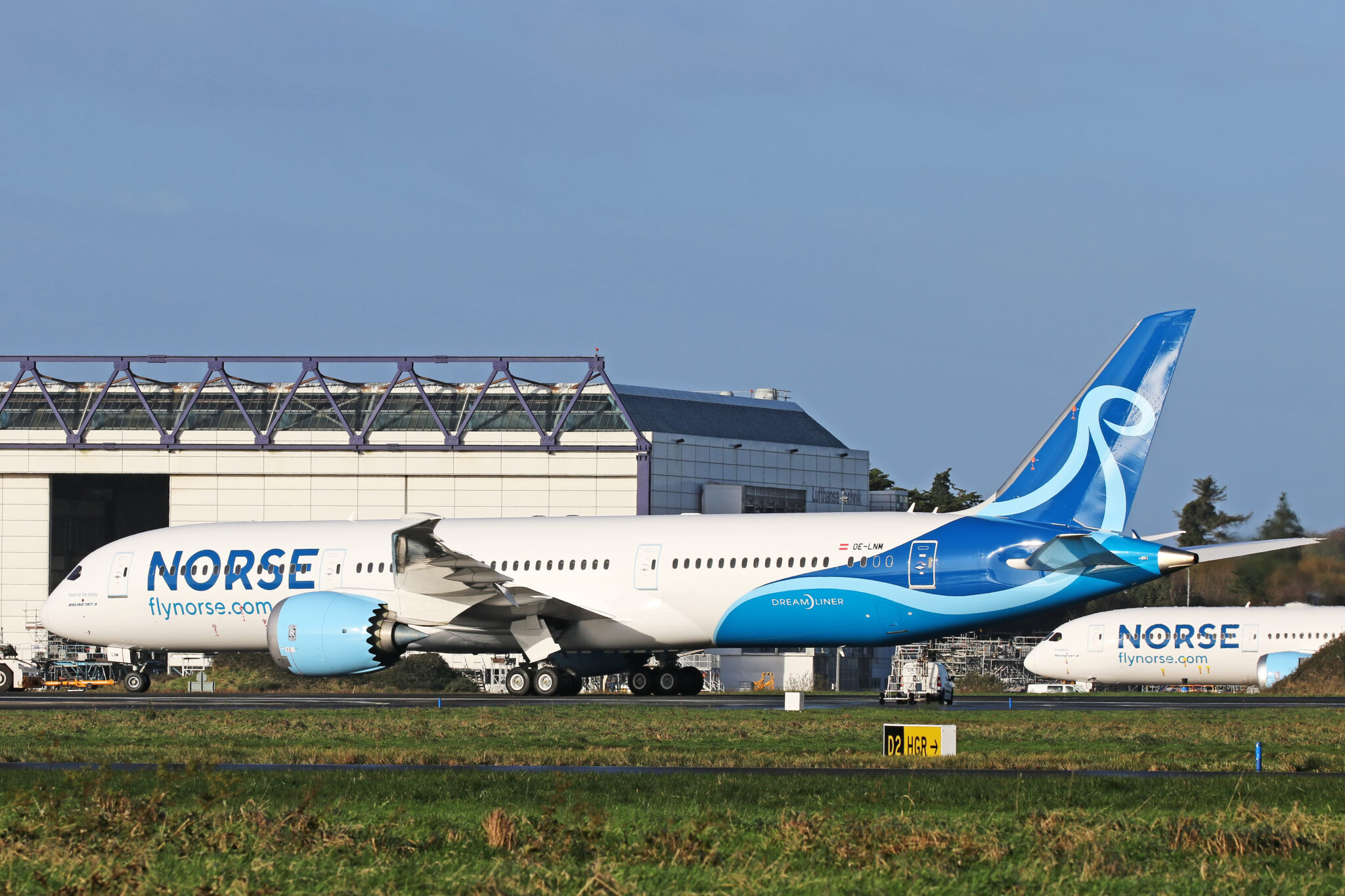
A parked Norse Atlantic Airways Boeing 787-9 | IMAGE: Norse Atlantic Airways
Norse is also making it easier for passengers to continue on to other cities. In July, the carrier announced an interline agreement for connecting traffic with easyJet, Norwegian Air Shuttle, and Spirit Airlines.
According to the airline, the agreement will provide more than 600 weekly connections to Norse’s hubs in Oslo, London, Berlin, New York, Fort Lauderdale, Orlando, and Los Angeles.
Norse Atlantic Airways route map as of August 2022 | IMAGE: Norse Atlantic Airways
An All-Dreamliner Fleet
A Norse Atlantic Airways 787-9 Dreamliner in flight | IMAGE: Norse Atlantic Airways
Founded in February 2021, Norse Atlantic began scheduled service on 14 June 2022. Although its Dreamliners were inherited from Norweigian Air Shuttle, Norse Atlantic is not an iteration of that carrier. Norwegian Air Shuttle ended its long-haul operations in January 2021 and currently focuses on Europe.
As of 16 August, Norse Atlantic operates a fleet of eight Boeing 787-9 Dreamliners (one of which is currently in storage). Four additional Dreamliners are due to join the fleet soon. Norse Atlantic calls their Dreamliners “Longships” in a nod to Norse explorers who traveled the world in vessels of the same name.
Norse Atlantic’s On-Board Experience
A Norse Atlantic Airways Boeing 787-9 Dreamliner lands | IMAGE: Norse Atlantic Airways
On board Norse’s Dreamliners, passengers can choose between economy or premium cabins. The economy cabin features a 3-3-3 configuration, while the premium cabin features a 2-3-2 design.
Both cabin choices offer three types of fare, which gives passengers the choice of what level of service they want. All seats feature a personal entertainment system, and Wi-Fi is reportedly in the works.
Although Norse Atlantic is only two months into its new operation, it seems to be doing well so far. The carrier reported a load factor of 86 percent during July, up from 82 percent in June. Norse also completed 100 percent of its scheduled daily flights in July.
We look forward to seeing if the newest trans-Atlantic budget carrier succeeds where others haven’t.
Record high fuel prices and an increasing emphasis on sustainability continue to reshape the aviation industry. Is it time to shake things up with a brand new turboprop regional airliner?
Embraer seems to think so.
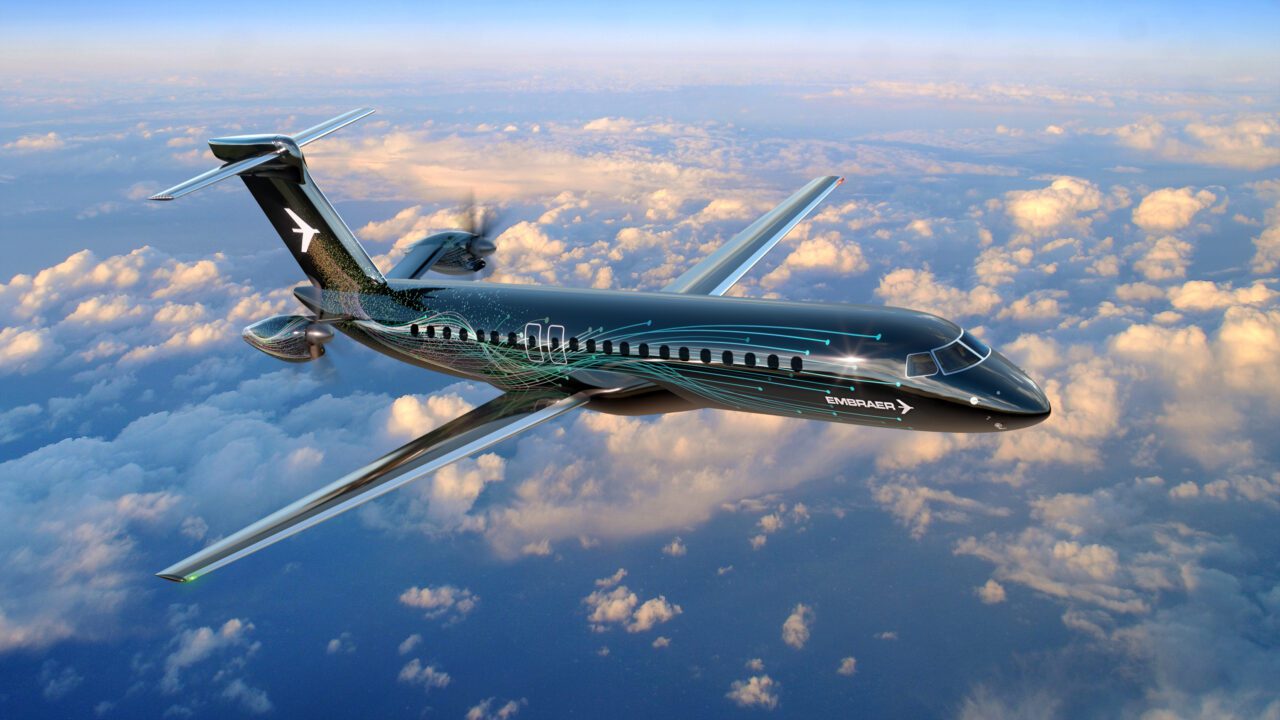
First proposed as early as 2017, the Brazilian aerospace manufacturer recently showcased its next-gen turboprop (TPNG) in a video titled “The Shape of Things to Come.”
Embraer’s Next-Gen Turboprop Timeline and Features
Embraer Commercial Aviation CEO Arjen Meijer says the TPNG is on track to launch in early to mid-2023. Embraer says it will initially develop 50 and 90-seat variants of the aircraft. The company says it hopes to launch one type in 2028. The other will follow in 2029, although Embraer has not determined which variant will launch first.
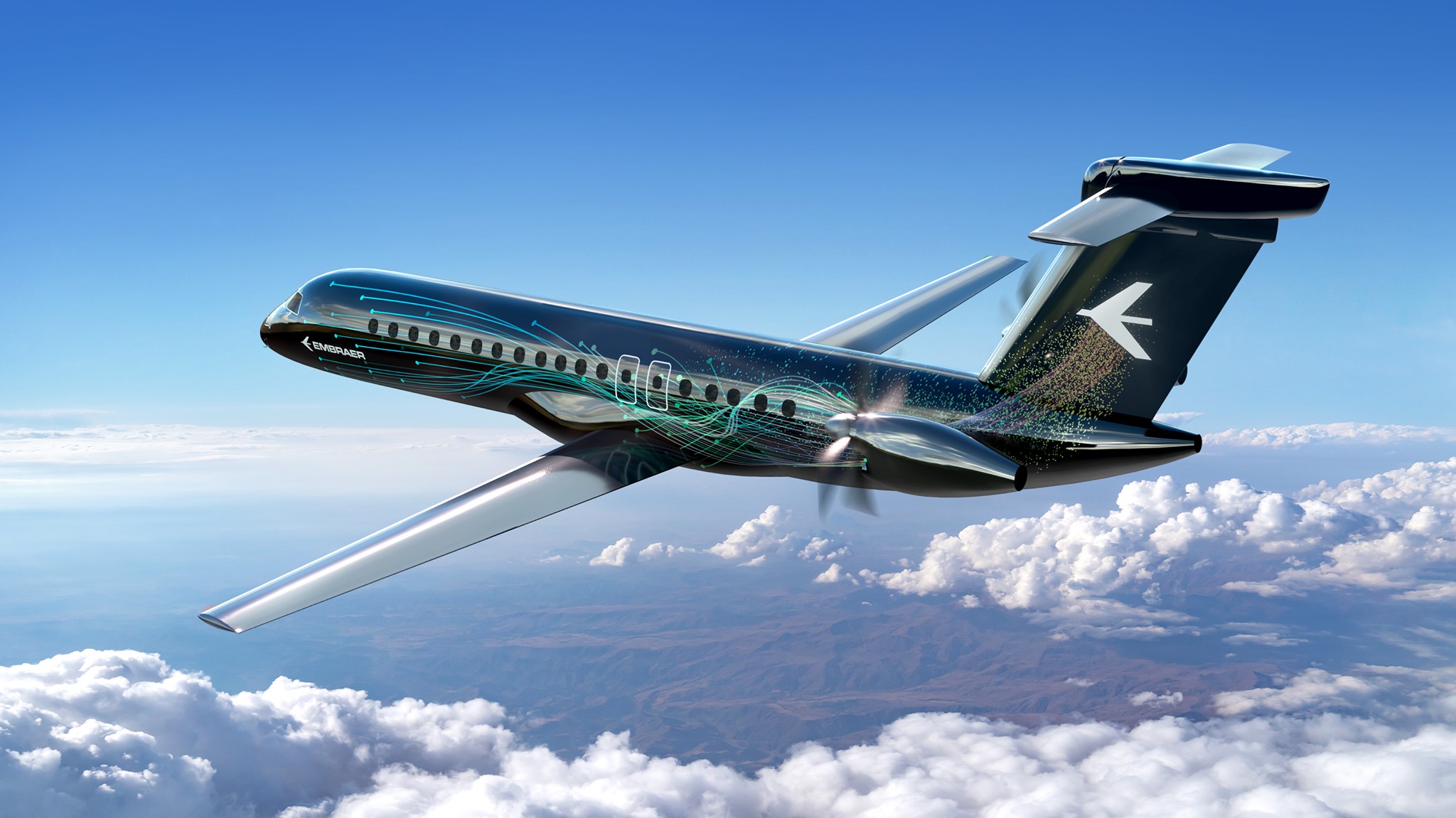
Conceptual designs depict a low-wing aircraft with a cross-section much like its E-Jet E2 counterparts (the E175, E190, and E195). The design also features two aft-mounted turboprops and a T-tail.
IMAGE: Embraer
According to Embraer, the aircraft will feature 10 percent more personal space than the E-Jet E2s. It will travel 20 percent faster, but cost 15 percent less to operate per seat than any turboprop on the market today. Additionally, the aft-mounted engines will provide an overall quieter experience.
Embraer expects to make a powerplant decision by the end of 2022. Meijer says the company is currently in discussions with Pratt & Whitney Canada and Rolls-Royce. General Electric does not plan to offer an engine for the type.
But Is There a Market for Turboprops?
IMAGE: EMBRAER
Meijer announced during the 2022 Farnborough Air Show that Embraer has signed letters of intent (LOI) for more than 250 TPNGs, including North American operators. The demand is in line with Embraer’s recent analysis indicating a global need for nearly 11,000 new aircraft with fewer than 150 seats over the next two decades. More than 2,300 – or 21 percent – will be turboprops.
It may seem difficult to imagine a future where carriers – particularly in the United States – once again rely on turboprops to connect smaller communities in their systems. With the advent of the regional jet age in the late 1980s and early 1990s, many believed the turboprop would soon become relegated to the annals of aviation history. Sleek new regional jets that were fast and quiet began to dominate the skies. It seemed the future of aviation had arrived.
In recent years, however, we have seen that regional jets are inefficient and not necessarily well-loved by fliers (or crew). That led to airlines shedding regional jets from their fleet. This process sped up exponentially during the COVID-19 pandemic as air travel demand plummeted. Amid the pandemic, airlines tried everything they could to stay solvent. When air travel finally began to recover as the pandemic waned, major airlines that had offered early retirement to pilots now faced a glut of openings. The obvious choice to fill those positions was to hire pilots from regional carriers. But as those pilots moved to mainline carriers, staffing woes began to affect the regionals. As regional jet fleets dwindled, small communities began to face service reductions – or even lost airline service altogether.
No real replacement for aircraft in the 50 to 70-seat range is in development. Smaller communities unable to sustain anything larger are already losing air service and more are sure to follow. Cities like Dubuque, Iowa (DBQ) or Williamsport, Pennsylvania (IPT) just can’t support mainline service. So what will fill the void? Will we see a renaissance of sorts for the turboprop market? Embraer is betting on it.
Embraer Plans to Shake Up a Stagnant Market
IMAGE: Embraer
If Embraer’s TPNG program succeeds, it will disrupt a sector of the aviation industry that hasn’t changed much in recent decades. Despite some minor cosmetic and technological advances, the two dominant players in today’s turboprop market – the de Havilland Canada Dash 8 Q400 and the ATR-72 – are essentially the same as when their original variants launched in 1983 and 1985, respectively.
High fuel prices, new technology, and an increased push for decarbonization are creating opportunities for a transformational moment in the industry. Yes, other manufacturers have taken steps toward innovation, but Embraer is truly embracing the moment. By doing so, it will not only radically shake up the stagnant turboprop industry, it will lead it into an innovative, greener, and more sustainable future.
NASA is all systems GO to roll-out the world’s most powerful rocket on Tues night (Aug 16) at Kennedy Space Center in Florida, where it is set to launch Aug 29 with the maiden voyage in a new era of human spaceflight to return astronauts to the moon this decade.
Artemis’ Maiden Voyage To The Moon’s Orbit
The new program is called Artemis, after Apollo’s twin sister and Goddess of the Moon in Greek mythology. This first mission is called Artemis-1, and will launch on a giant new rocket called the Space Launch System (SLS) to send a new spacecraft, called the Orion crew capsule, farther than any spacecraft for humans has ever gone before.
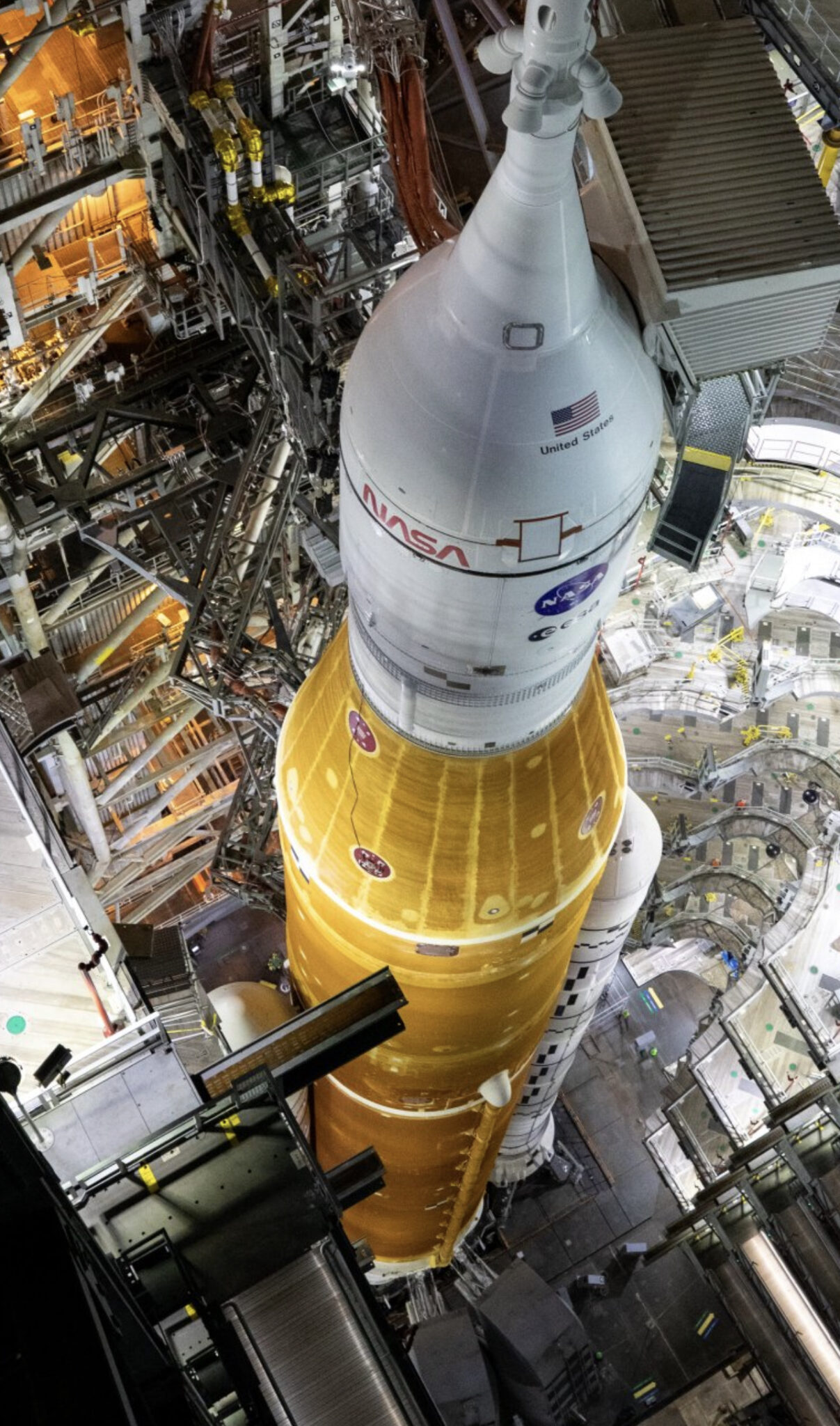
The giant SLS is currently tucked inside a high bay in Kennedy’s iconic Vehicle Assembly Building (VAB), previously used to process Apollo Saturn-V moon rockets and space shuttles for flight.
Rollout Happening Tonight
First motion out of the VAB is scheduled for 9pm EDT. NASA will air it live online starting at 3 p.m. EDT Aug. 16 on the NASA Kennedy You Tube channel.
Looking dOwn on The 322-ft tall Artemis-1, with orion stacked on toP of the sls rocket inSide the vab at kennedy space center (nasa photo)
It’s only about 4 miles from the VAB to launch pad 39B, but the trip will take somewhere between 8-12 hours due to the sheer size of the mammoth 322-ft tall vehicle.
Even the behemoth transporter itself is a marvel of engineering, larger than a Major League Baseball infield and made to carry over 20 million pounds on its back.
Artemis-1 atop nasa’s crawler transporter (photo: mike killian / americaspace.com)
The upcoming uncrewed flight will put SLS, Orion, and all the ground support personnel and infrastructure to the test to validate and prove that everything works, before NASA sends astronauts on Artemis-2.
Once launched, Artemis-1 will send Orion 280,000 miles from Earth and thousands of miles beyond the Moon on a mission lasting 4-6 weeks. Upon arriving at the moon, it will fly 62 miles above the surface, and then use the Moon’s gravity to propel it into a deep retrograde orbit 40,000 miles above the surface, where it will fly and test for 6 days.
Orion will then descend back into a low orbit and brush past the surface again at 60 miles to perform its engine firing to break away from the moon’s gravity, and then head back to Earth.
Orion will stay in space longer than any ship for astronauts has ever done without docking to a space station, and will return home faster and hotter than any before it.
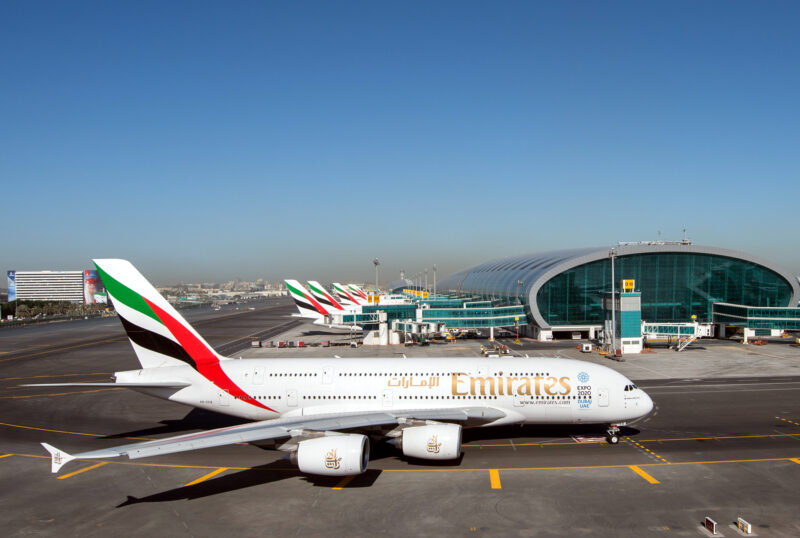
Emirates, the world’s largest operator of the Airbus A380, is asking Airbus to redesign its iconic super jumbo.
That may seem strange, considering the A380 was essentially written off for dead amid the COVID pandemic. But in an interview this week with CNN Travel, Emirates president Tim Clark said he always suspected it wasn’t time for it to go to the desert.
“The notion that the A380 was a spent force was always a little bit of a difficult one for us to swallow,” Clark told CNN.
Indeed, as air travel has roared back to life post-pandemic, so has the demand for the A380. Out of 118 A380s in the Emirates fleet, 80 are back in service.
But 17 years after the A380’s first flight, the type is out of production, and neither Airbus nor Boeing have anything meant to replace it. Clark believes the options in the foreseeable future – either the Airbus A350-1000 or what will be the Boeing 777-9 – are not going to be enough.
“The math tells you that you need a big unit, much bigger than we’re getting at the moment,” he told CNN.
He worries that consumers will face higher fares as supply shrinks and demand grows.
Open Fan Engine Technology Opens Up Possibilities
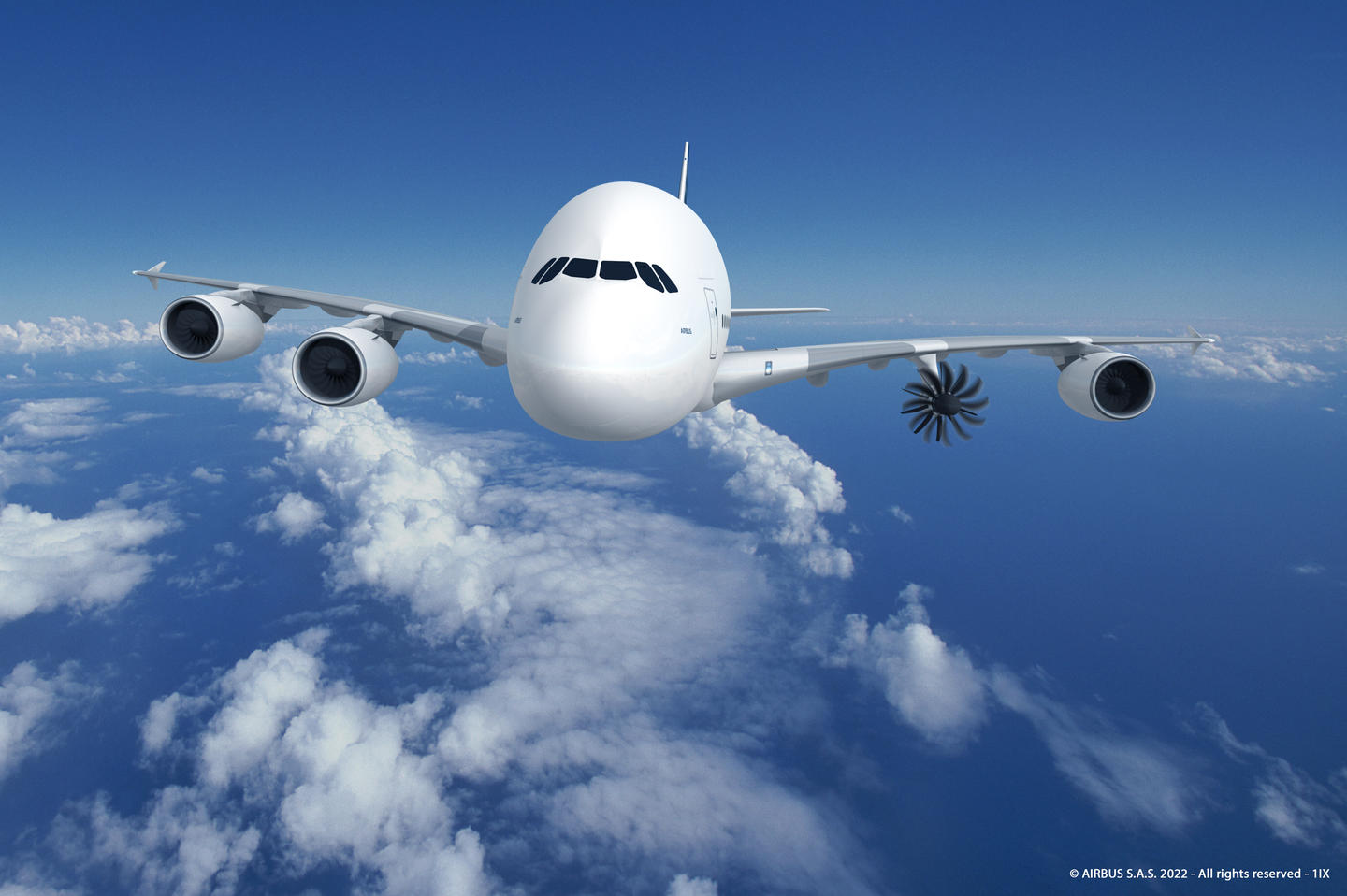
An Airbus A380 will be used to research open fan engine technology | IMAGE: Airbus
A new plane similar to (or even larger than) the A380 was inconceivable just a few short years ago. But with the advance in airframe technology since the A380 launched in the mid-2000s, a new super jumbo would be manufactured with composite materials making it significantly lighter and far more efficient.
A new engine technology called “open fan” is also being studied. With a reduction in fuel consumption and CO2 emissions of up to 20 percent, an open fan engine concept would do wonders for an aircraft designed to fly with four engines.
Open fan technology involves a nacelle-less engine with counter-rotating fans and an increased flow of cooler air produced by thrust. Without a nacelle, the core of the engine is exposed to the cooler air, which in turn reduces the amount of thrust the engine produces. Aircraft that use open fan engines can reach the same speed as those that use conventional engines while using significantly less fuel.
Because an open fan engine does not require a nacelle, the aircraft’s overall weight is reduced, thus decreasing fuel consumption.
So far, open fan engine studies have been focused on smaller single-aisle aircraft like the 737 or A320 (although an open fan engine will be tested on an A380 soon). Theoretically, however, the architecture of an open fan engine would lend itself to being beneficial on larger aircraft like an A380 by allowing for the development of more powerful engines and increased cool airflow – without increasing the overall weight of the aircraft.
“If you can get them to do what I think they could do in terms of fuel efficiency and power, then you have the makings of an airplane that would match or beat the economics of the [twin-engine] aircraft that we see today, by quite a long way,” Clark told CNN.
Wishful thinking?
Airbus will test open fan engine technology on an A380 research aircraft | IMAGE: Airbus
Interest in the A380 was waning long before the pandemic hit. So it’s understandable that aviation experts hesitate to say that an A380 replacement is feasible.
Analysts believe the market could support a Boeing 747 replacement, but not for something as large as the A380.
For now, the two mega aircraft manufacturers will continue to put their long-haul efforts into twinjets that seat anywhere from 350-430 passengers. It’s also possible that Boeing and Airbus could produce even larger variants of those types in the future.
Until then, airlines like Emirates will be watching closely to see if a replacement for the A380 will eventually make sense.
A new American regional airline hopes to avoid challenges posed by the ongoing pilot shortage by enticing new talent with an industry-leading salary of $250,000.
Connect Airlines, a division of Bedford, Massachusetts-based charter company Waltzing Matilda Aviation, intends to launch scheduled passenger service between the United States and Toronto Billy Bishop Airport (YTZ) in Canada.
A Familiar Business Model
Toronto Billy Bishop Airport (YTZ) | IMAGE: Billy Bishop Toronto City Airport via Facebook
Connect plans to focus on day-tripping business travelers using Dash 8 Q400 turboprop aircraft leased from the recently-resurrected UK regional airline Flybe. Toronto’s downtown island airport is, of course, home turf for Porter Airlines.
Like Connect’s proposed service, Porter uses the Q400 between Billy Bishop and business centers in the northeastern and midwestern United States. Along with YTZ, the airline will initially fly three daily flights to both Chicago O’Hare (ORD) and Philadelphia (PHL).
Connect has two ex-Flybe Q400s ready to go with hopes to have five in the fleet shortly.
While no official launch date has been set, the US Department of Transportation (DOT) on 5 July officially certified Connect for scheduled passenger service. The airline is actively working with Canadian regulators to complete their certification process by the beginning of September. Federal Aviation Administration (FAA) mandated proving runs began in mid-July.
Connect Seeks 30 Qualified Captains
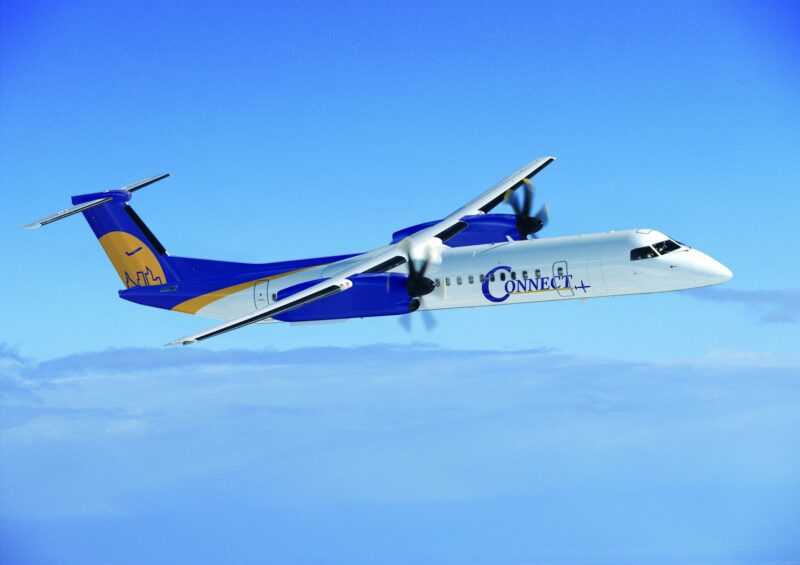
A COnnect Airlines Dash 8 Q400 in flight | IMAGE: Connect Airlines
Last month, Connect launched a pilot recruitment program called “Smart Start Captain.” The airline hopes to recruit up to 30 “highly qualified direct entry US captains” by offering an industry-leading, pay-protected salary of at least $250K per year.
Additionally, the carrier will offer its pilots attractive work-life balance benefits, such as returning to their home base every day. Most crew schedules will be based upon a four-on, three-off schedule. Connect says its pilots will have the opportunity to “set smarter schedules to optimize their duty time and home life.”
Pilot bases will be located in both Philadelphia and Chicago. In addition, Connect will provide a $1,500 tax-free bonus each month to offset commuting expenses.
Qualified captains must have a minimum of 2,500 hours total flight time, including 1,000 hours of FAA Part 121 or Part 135 time. Prior captain experience is not necessary.
“We are looking for Captains that see the opportunity in building a new airline and in participating directly in how that airline works and grows,” said David Marcontell, Chief Operating Officer, Connect Airlines. “There is a huge benefit in collaborating with our pilots to build a smarter airline and we are backing that up with a compensation package that is considerably higher than any other Regional in the USA and highly competitive with Low Cost Carriers (LCC) as well.”
America’s First Zero-Emission Passenger Airline
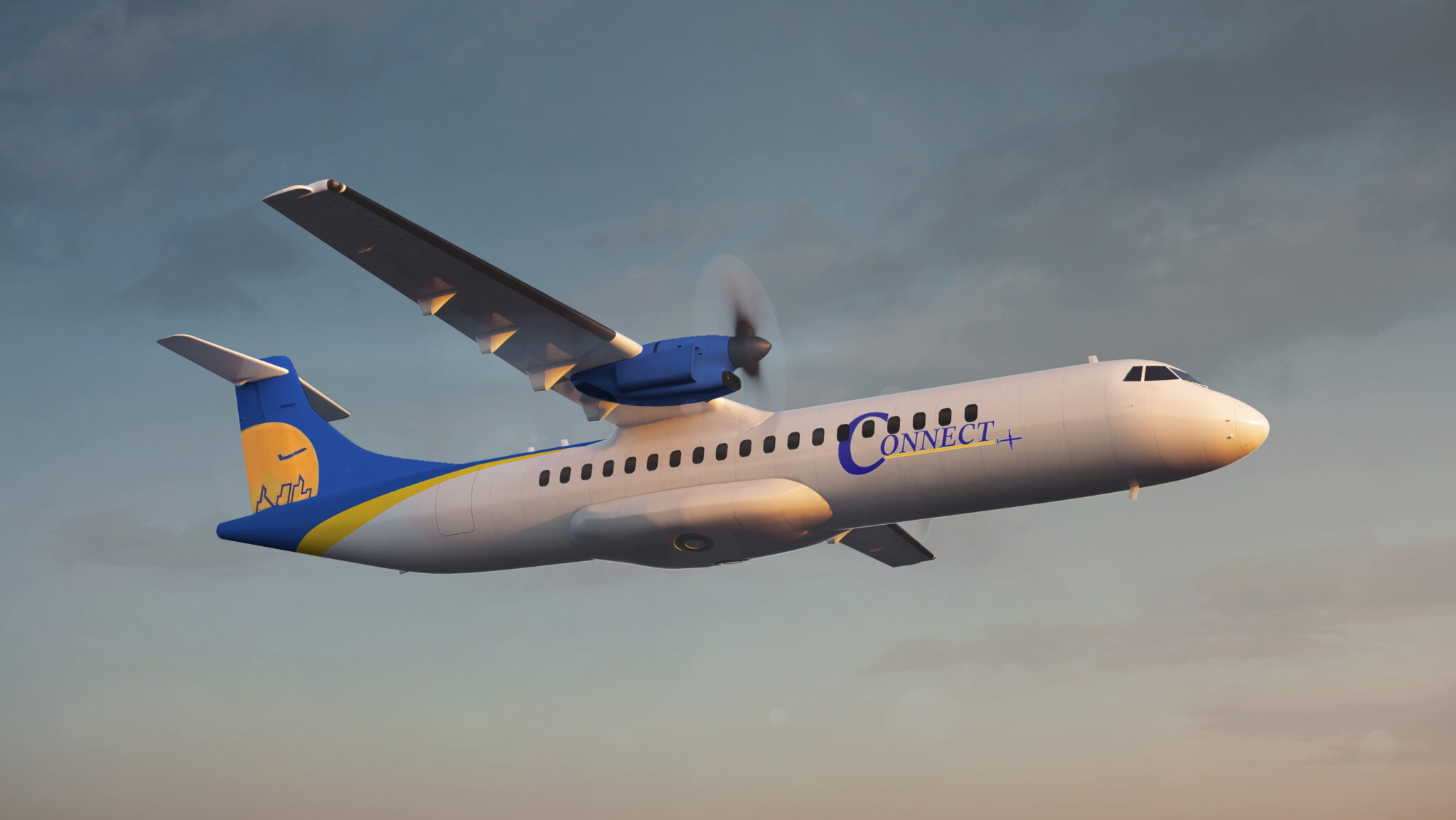
COnnect Airlines has ordered 75 ATR 72-600s powered by green hydrogen with options for 25 more | IMAGE: Connect Airlines
Sustainability is also a big focus for Connect. In addition to the Q400, which generates up to 40 percent less carbon emissions than regional jets, the carrier has placed an order for 75 ATR 72-600 turboprops powered by hydrogen fuel cells and an electric powertrain.
The airline is partnering with Hawthorne, California-based aerospace company Universal Hydrogen to convert the ATR turboprops. The order also includes purchase rights for 25 additional aircraft conversions.
By reducing CO2 emissions today and eliminating them by 2026, Connect says it is well on its way to becoming America’s first zero-emission passenger airline.
But Will it Work?
Recently graduated Connect Airlines flight attendants receive their wings in front of a Connect Airlines Dash 8 Q400 in May 2022 | IMAGE: Connect Airlines
Amid the unprecedented slowdown of global air travel during the COVID-19 pandemic, airlines went into survival mode by offering early retirement to senior crew members. Since then, the industry has recovered – perhaps faster than most analysts predicted. The resulting rapid increase in demand has led to chaos at airlines and airports around the globe because not enough pilots are available to fly airplanes – especially at the regional level.
As a result, airlines have turned their attention to improving pay and benefits in an effort to hire and retain pilots in the post-pandemic landscape. Many carriers have sweetened hiring incentives by offering employee benefits that would have been unthinkable just a few years ago. However, a starting salary of a quarter million dollars is unheard of at a regional airline – let alone a startup carrier.
Connect CEO and former Virgin Atlantic executive John Thomas recently acknowledged the carrier’s unorthodox approach.
“Creating a new airline in a challenging market means we have to do things differently and smarter than others,” Thomas said at the launch of the Smart Start Captain program last month.
With such a generous salary and benefits package, and Connect’s commitment to a green future (which isn’t cheap), it will be interesting to see if its “smart and different” business model succeeds.
Connect Airlines Bombardier Dash 8 Q400 departure from Portsmouth International Airport (PSM)
In 1968, the U. S. Air Force issued a Request for Proposals for an Advanced Medium Short Takeoff and Landing Transport (AMST) “with an eye toward replacing” the Lockheed C-130. Both Boeing and McDonnell Douglas won development contracts to produce prototype aircraft. Boeing’s aircraft was the YC-14 and McDonnell Douglas developed the YC-15.
The YC-15 Was Officially a No-Go
Following the first flights and 600 hours of flight-testing the prototypes, the Air Force selected neither the YC-14 nor the YC-15, and the Air Force/DoD canceled the AMST program.
After cancellation of the program, one of the YC-14 and the two YC-15 aircraft were sent to the Aerospace Maintenance and Regeneration Center (AMARC), now the Aerospace Maintenance and Regeneration Group (AMARG)—often called The Boneyard—at Davis–Monthan Air Force Base.
This is where aircraft go to be cannibalized for parts and/or eventually broken down and their structural material recycled. The second YC-14 is on display at the Pima Air Museum.
A YC-15 in flight testing over Edwards AFB with an F-4 in trail. Photo: USAF
YC-15 Whet The Appetite For A Strategic Airlifter With C-130-like Qualities
Following the cancellation of the initial AMST program, the Air Force/DoD determined that what they really needed was a heavy lift aircraft capable of transporting a main battle tank or 100 fully equipped soldiers over long distances to unimproved airstrips.
The DoD changed the program requirements, but the Air Force had been impressed with many aspects of the YC-15’s capabilities and technologies, and it became the model from which the future heavy-lift aircraft would eventually evolve.
Two YC-15s were built. One (#72-1876) had a wingspan of 110 fee, while the other (#72-1875) had a wingspan of 132 feet. Both were 124 feet long and were powered by four Pratt & Whitney JT8D-17 engines.
Specifically, the YC-15 demonstrated several new approaches to improved performance, including externally blown flaps that used double-slotted flaps to direct a portion of the jet exhaust downwards. The rest of the airflow/exhaust passed through and downward over the flaps producing the Coanda effect. It was also the first military aircraft with a supercritical airfoil.
460 miles STOL with 27,000-pound payload; 2,292 miles conventional with 38,000-pound payload
Power plant
Four 15,500-pound-thrust Pratt & Whitney JT8D-209 Turbofan engines
Accommodation
Three crew, 150 troops or 27,000 pounds of cargo (STOL) or 69,000 pounds of cargo (conventional)
A New Re-Focused Program Based On Previous Work
The new AMST program required the ability to operate from short, semi-prepared airstrips; lift a 27,000-pound payload; and have a 460-mile tactical operating radius.
Although not selected as part of the original AMST program, the YC-15’s basic design would be used to guide the development of the successful McDonnell Douglas (later Boeing) C-17 Globemaster III.
In 1968, the AMST program appeared in another RFP bundled with a solicitation for a Lightweight Fighter. The transport part of this two-part program became the C-X program for an enlarged YC-15-type aircraft with the ability to operate from semi-prepared airstrips no longer than 2000 feet, lift a 27,000-pound payload, and have a 460 mile operating radius.
Image: Jim Mumaw
McD’s Proposal Was an Upscaled and Improved YC-15
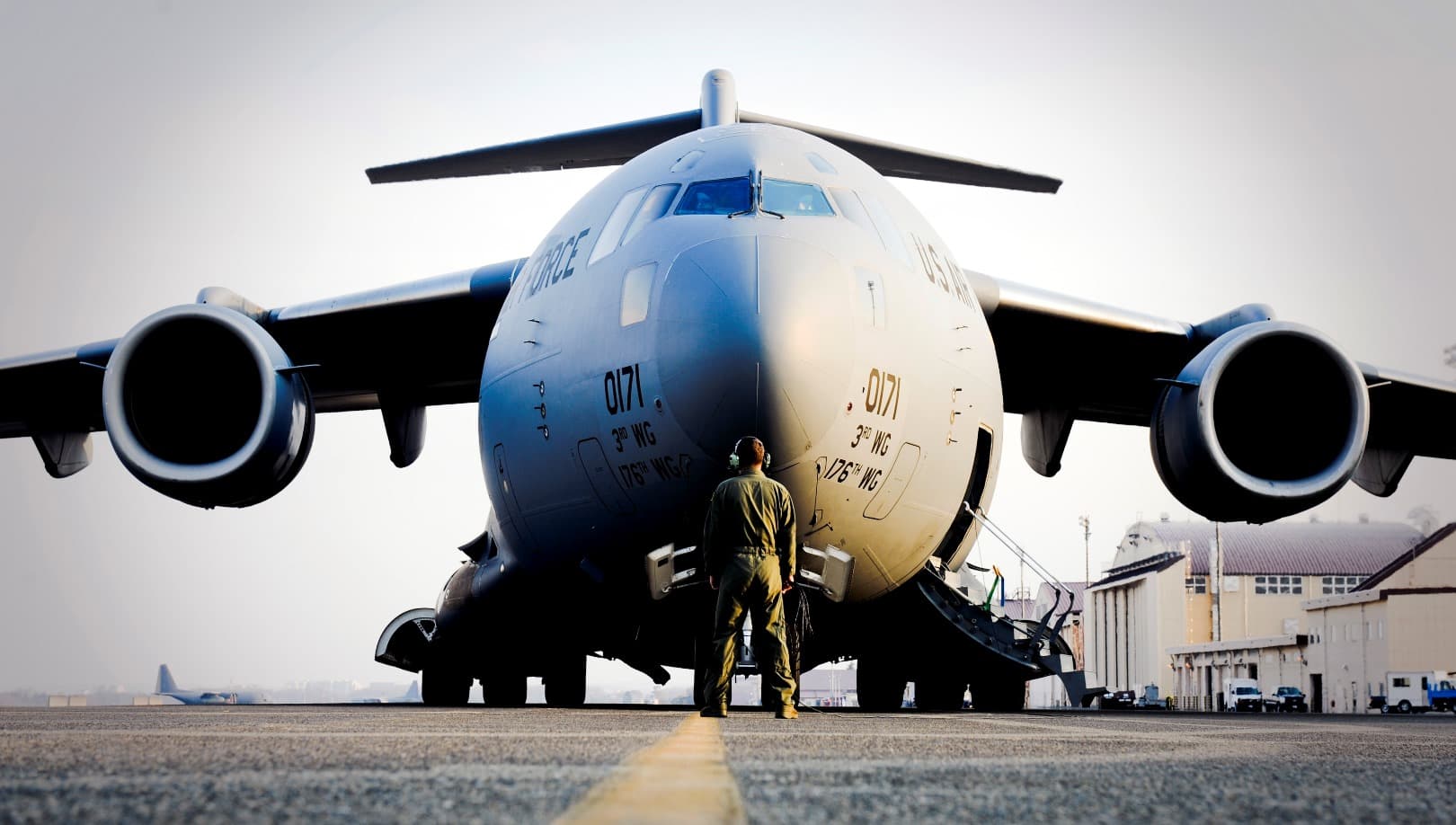
This aircraft would become the C-17 Globemaster III that could haul a main battle tank or equivalent mass of military hardware and supplies or 100-plus fully equipped soldiers and deliver them to minimally prepared airstrips.
In 1980, the USAF issued the new mission requirements and a new Request for Proposals for a an aircraft to meet the revised strategic mission requirements. Based on the earlier AMST program, the Air Force Systems Command wanted to use a single model aircraft for both tactical and strategic airlift.
That means the aircraft had to be able to a carry a main battle tank or equivalent mass of military hardware, or more than 100 fully equipped soldiers and deliver them to unpaved forward airstrips—from home base to the battle front.
Proposals Were Made By Many But McDonnell Douglas’ Won
304th EAS C-17. Official US Air Force photograph
Proposers included Boeing offering a three-engine version of the YC-14 submitted for the former AMST program, and Lockheed submitting two proposals, one based the C-5 Galaxy, and another developed from the C-141. McDonnell Douglas elected to build a new aircraft, but with many of the positive capabilities and lessons-learned from of the earlier YC-15 AMST offering.
In 1981, the contract was awarded to McDonnell Douglas to build its aircraft, designated C-17.
1997 was a landmark year for the C-17: its parent company, McDonnell Douglas was merged into Boeing Aircraft. Production of the C-17 continued until 2015.
The C-17A Globemaster III
C-17A. Image via USAF
McDonnell Douglas experienced a number of growing pains developing the C-17, but by 1995, the Globemaster was declared operational, and the Air Force ended up buying over 200 of them. As of 2015, a total of 279 aircraft had been produced.
General characteristics of the C-17
C-17A First flight
September 15, 1991, from the Long Beach, California airport.
Model number
C-17 Globemaster III
Minimum Crew
3: two pilots and the loadmaster
Wingspan
169 feet, 9.6 in.
Wing Area
3,800 sq. ft.
Wing Sweep Angle
25 degrees
Length
174 feet
Height (Tail)
55 feet 1 inch
Fuselage Diameter
22.5 ft
Flight Control System
Quadruple-redundant electronic flight controls with mechanical backup system
Empty weight
252,800 lb. (128,140 kg)
Mission
Tactical airlift, troops and/or military equipment, airdrop missions, medical transport of litter and ambulatory patients
Max Takeoff Weight
585,000 lb.
Cruising speed
550 mph (max cruising speed: 590 mph)
Service Ceiling
Service ceiling: 30,000 ft (9,100 m)
Range
460 miles STOL with 27,000-pound payload. 2,292 miles Conventional with 38,000-pound payload
102 troops or 27,000 pounds of cargo (STOL) or 69,000 pounds of cargo (conventional)
Landing
Runways as short as 3500 feet
Maneuverability
Three-point turn using reverse thrusters on runways 90 feet wide.
Additional Facts and Capabilities of the C-17
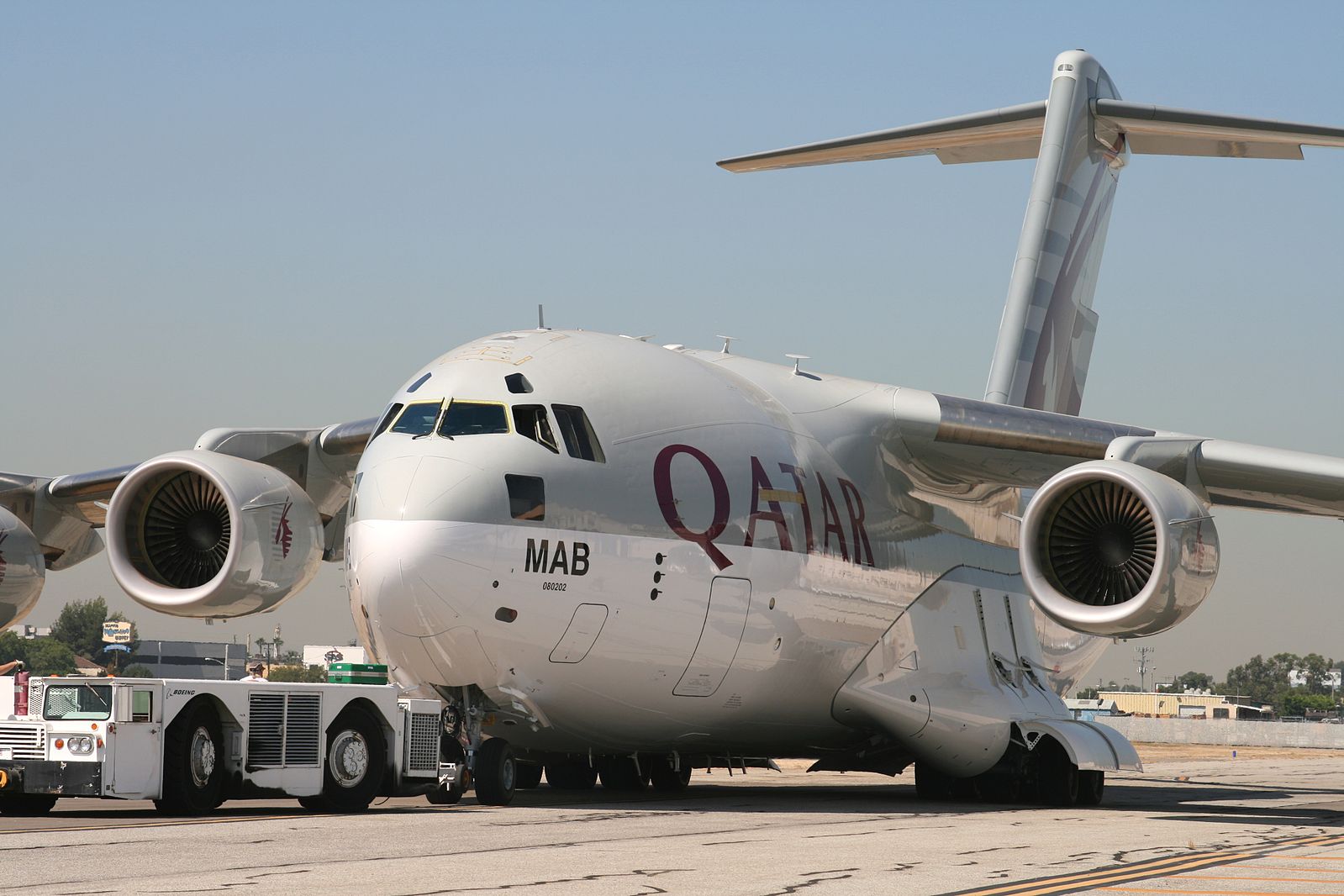
The C-17 has developed an international following and is currently serving in at least nine countries including Australia, Canada, India, Kuwait, European Union, Qatar, United Arab Emirates, the United Kingdom, in addition the USAF.
Each engine is rated at 40,440 pounds of thrust and includes thrust reversers that direct the flow of air upward and forward. A fully-loaded aircraft on the ground can use its thrust reversers to back up. For an aircraft as massive as the C-17, that’s impressive.
A Qatari C-17 in Qatar Airways colors. Photo: John Murphy (CC 2.0)
Not only can the C-17 back up using reverse thrust, but it can also make a pivot-turn in the middle of a runway by using reverse thrust on one side and positive thrust on the other.
The 35-degree swept back wings have a supercritical airfoil that enhances aerodynamic efficiency and reduce drag.
More C-17 Facts:
The C-17 has been involved in every major worldwide operation since the 1990s, dropping cargo or assisting other branches of the military. The Globemaster III’s resume includes a history of both combat performance and humanitarian aid. The C-17 flew critical supply missions in response to massive flooding in Puerto Rico; delivering food and critical relief supplies to Haiti; and delivering a fire truck for emergency responders in Guatemala, to name only a few such missions.
The C-17 has broken more than 20 records for oversized payloads and was awarded the prestigious Collier Trophy.
The first operational mission transporting paratroopers occurred in 2003 when C-17s deployed 1000 paratroopers into Northern Iraq.
A C-17 accompanies Air Force One to transport the President’s car and vehicles for security personnel.
The C-17 is operated by Australia, Canada, India, NATO, Kuwait, Qatar, United Arab Emirates, United Kingdom, and the United States
The C-17 Globemaster III has become something of a cinema star appearing in a number of films and television series including Iron Man, Godzilla, and American Sniper, as well as on TV including in Seal Team, Hawaii Five-O, and Marvel: Agents of S.H.I.E.L.D.
Retro depictions of a future with flying cars weaving through gleaming skyscrapers in futuristic cities are one step closer to reality.
On Wednesday, Santa Clara, California-based Archer Aviation Inc. announced that United Airlines has invested in the company’s line of electric flying taxis.
United has made a $10 million pre-delivery payment to Archer Aviation for 100 electric vertical takeoff and landing (eVTOL) Maker aircraft, according to a press release from Archer. The down payment by United bolsters its support for the urban air mobility (UAM) concept.
United-Archer Partnership Dates Back to 2021
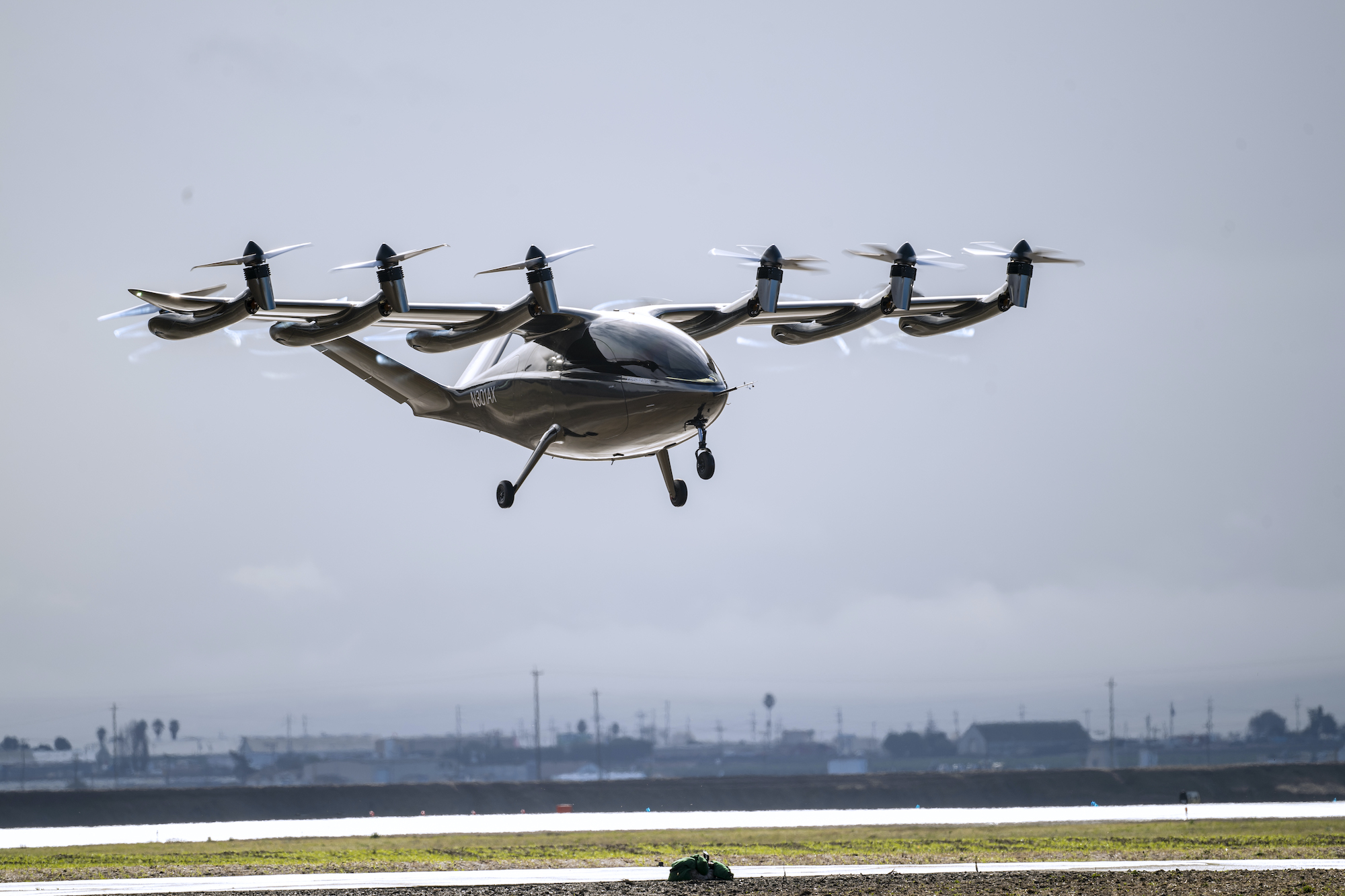
The Archer Maker completes its first flight in 2021 | IMAGE: Archer Aviation
In 2021, the Chicago-based airline agreed to invest in Archer by placing a conditional $1 billion order for the Archer Maker, with an additional option worth $500 million. United intends to partner with Mesa Airlines to provide customers in its major hub cities with an efficient, economical, and environmentally responsible method to get to and from the airport.
United’s partnership with Archer is part of its ongoing commitment to decarbonize by 2050. Estimates show a 50 percent reduction in CO2 emissions per passenger with Maker.
United CEO Scott Kirby said in 2021, “Archer’s eVTOL design, manufacturing model, and engineering expertise has the clear potential to change how people commute within major metropolitan cities all over the world.”
Clean and Virtually Silent Air Travel
An Archer Maker | IMAGE: Archer Aviation
eVTOL aircraft take off vertically like a helicopter, fly like an airplane, and are 100 percent powered by electricity.
Powered by 12 small rotors that spin slower than helicopter blades, Maker will feature independent power and propulsion to ensure high levels of safety.
With a range of 60 miles on a single charge, Archer says Maker will fly at speeds of up to 150 mph while creating minimal noise. At 2,000 feet, Maker will emit a noise level no higher than 45 dba – 1000 times quieter than a helicopter flying at the same altitude. Archer eVTOL aircraft are designed to fly at a maximum altitude of 3,000 feet.
The concept recently passed its preliminary design review (PDR) and will continue to the next development phase.
Maker’s first hover test flight was completed in December 2021.
“I am incredibly proud of the entire Archer team as we reach this milestone in our partnership with United Airlines. To receive a cash deposit is validation of Archer’s achievements to date, not only with flight testing and product development, but also a great signal of confidence in our roadmap to commercialization” said Adam Goldstein, Archer’s CEO. “We’re thankful to United for their continued partnership as we usher in this new era in air travel.”
Archer Aviation’s mission is to “unlock the skies, freeing everyone to reimagine how they move and spend time.”
Archer Aviation unveils the Maker eVTOL aircraft.
Other Carriers Invest in eVTOL Technology
Artist rendering of a Virgin Atlantic VA-X4 | IMAGE: Virgin Atlantic Airways
United is not the first airline to invest in eVTOL technology. In 2021, American Airlines placed a conditional order worth $1 billion for up to 250 aircraft, with an option for 100 more, through UK-based Vertical Aerospace. Vertical is developing the VA-X4, a nearly-silent, zero-carbon aircraft designed to carry four passengers and a pilot at speeds up to 200 mph. The VA-X4 will have a range of over 100 miles.
England’s Virgin Atlantic Airways has also made an initial investment for the VA-X4.
Archer and Vertical hope to have their eVTOL models certified for commercial use sometime in 2024.
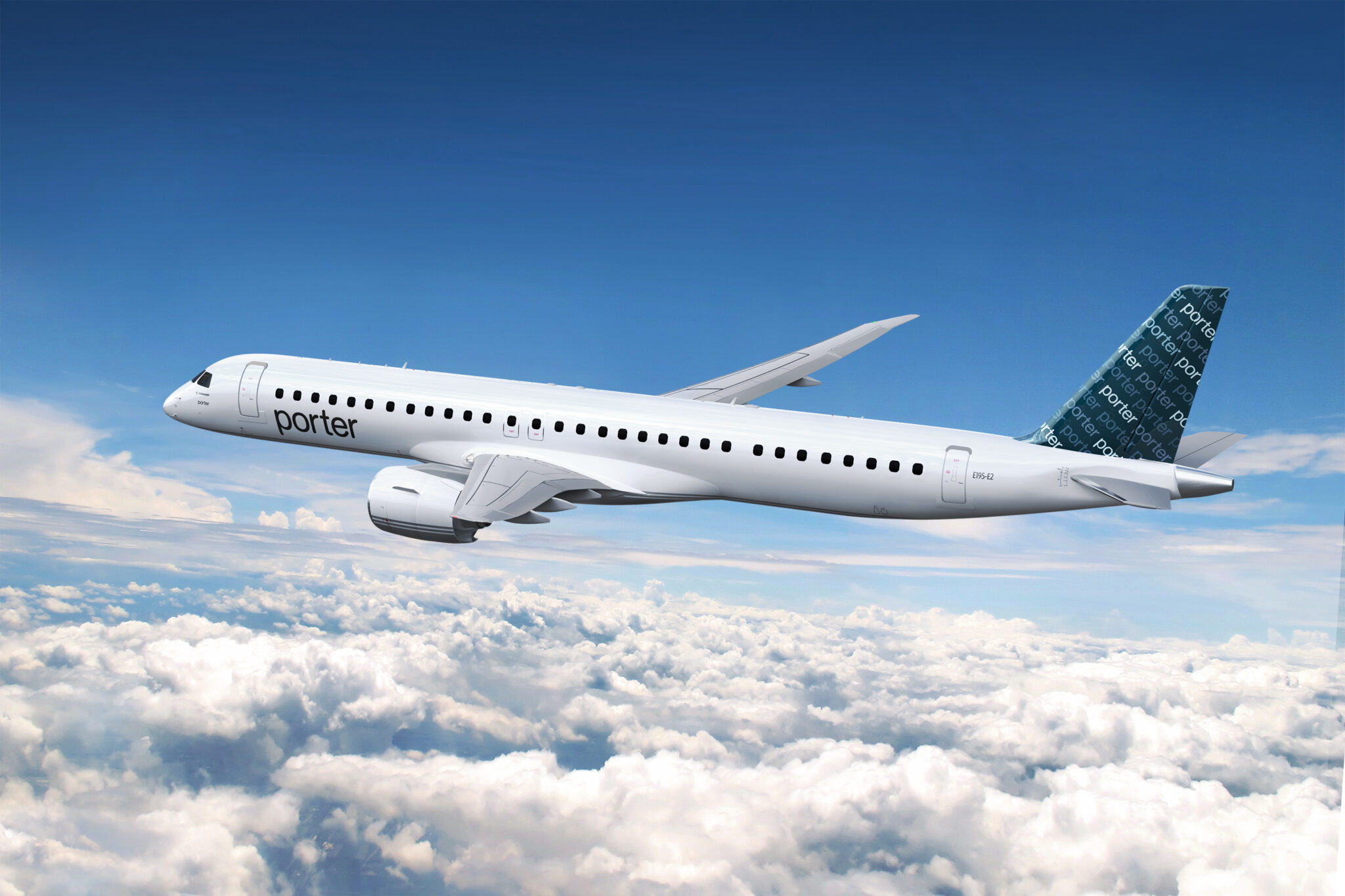
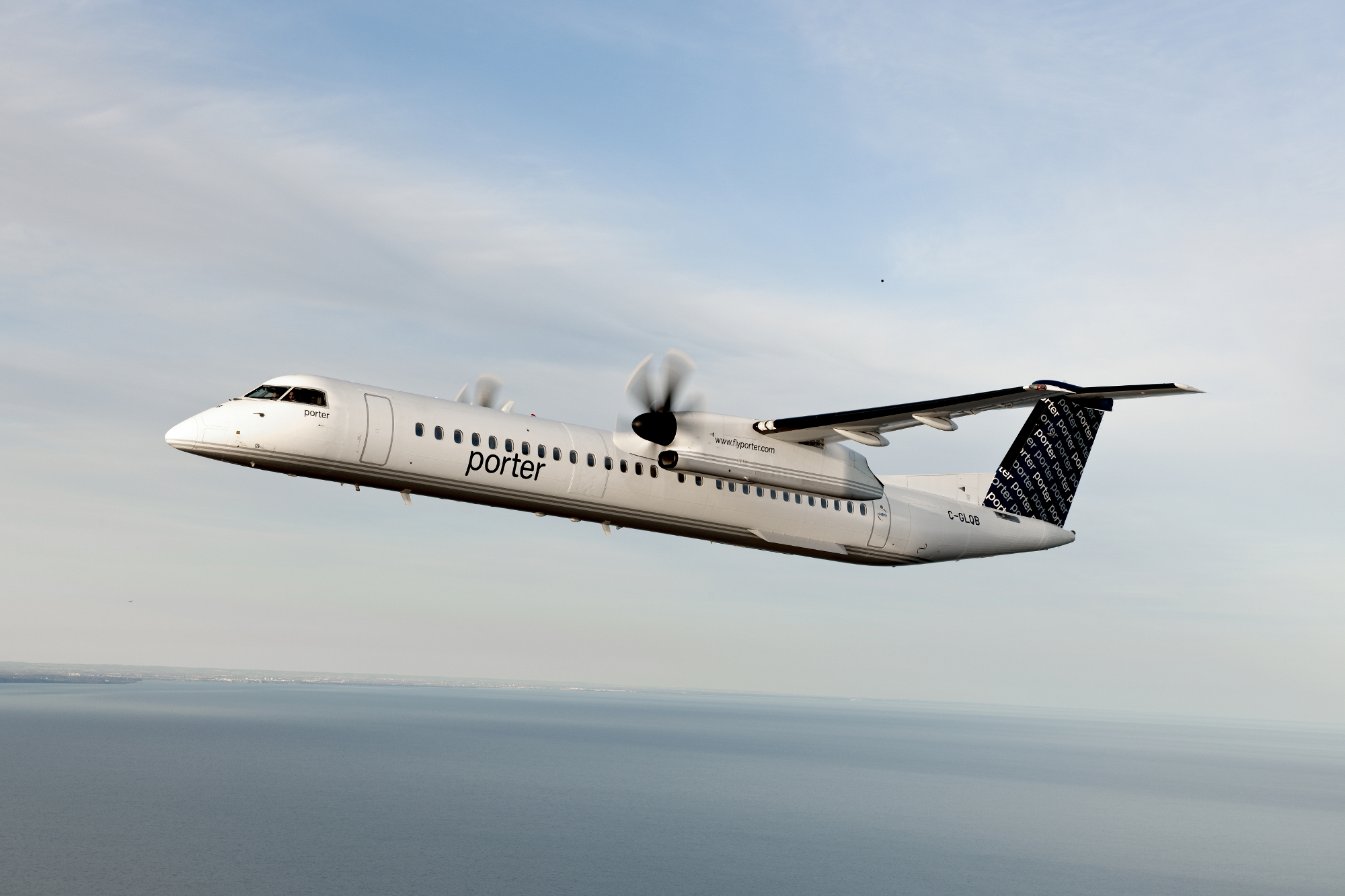
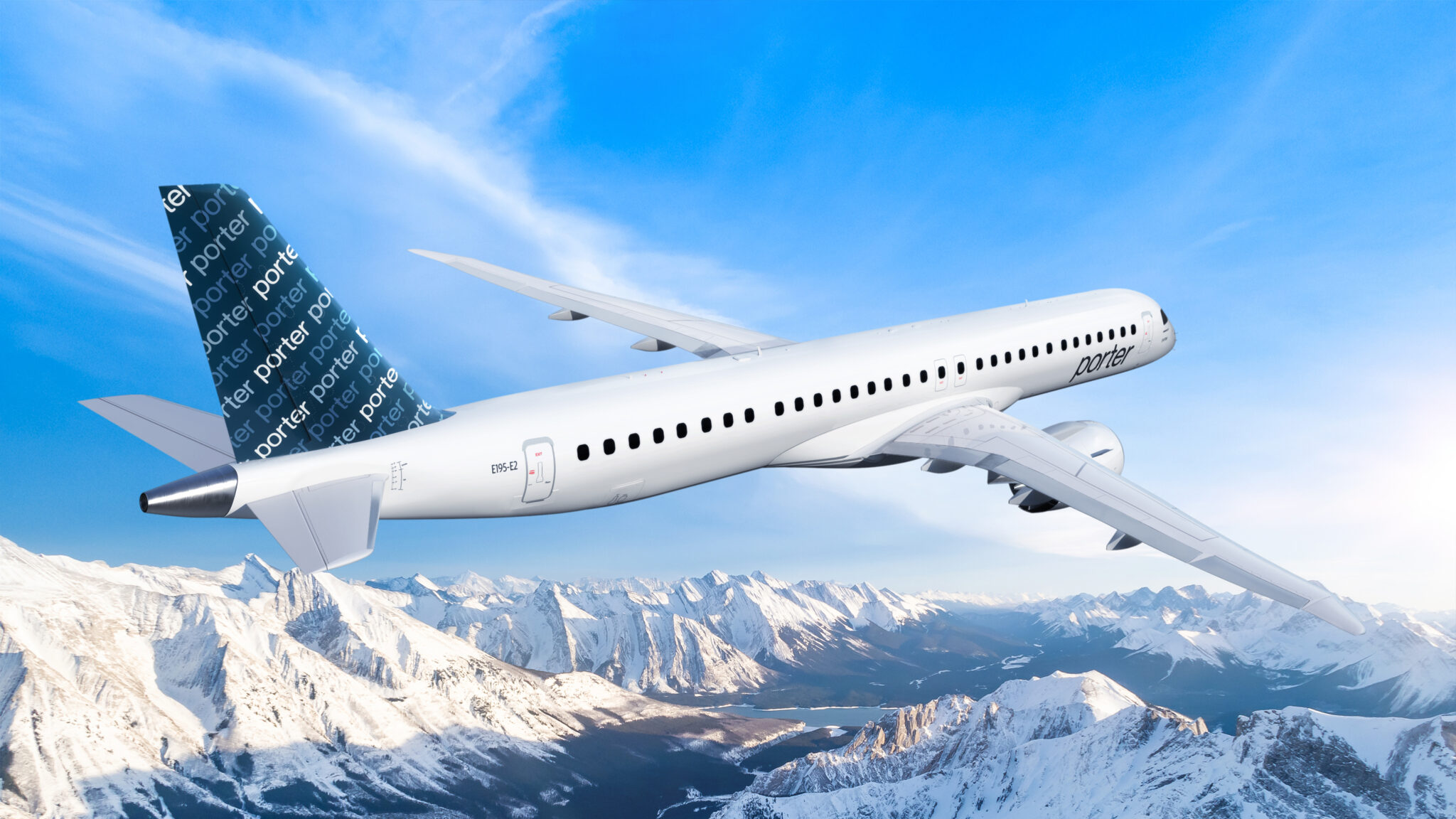
Nearly 16 years ago, a Canadian regional airline called Porter Airlines took to the skies for the first time. Though it has endured its fair share of ups and downs through the years, the carrier is poised for a massive North American expansion in the years to come.
It was 23 October 2006 when Porter Airlines’ inaugural flight lifted off from runway 08/26 at what was then known as Toronto City Centre Airport (CYTZ/YTZ) in Toronto, Ontario, Canada. The flight, bound for Ottawa Macdonald–Cartier International Airport (CYOW/YOW), marked the humble beginnings of a brand new, all-economy class airline that featured typically higher-end onboard service, such as complimentary snacks and glassware.
Throughout its 16-year history, Porter has been an exclusively De Havilland Canada Dash 8 Q400 operator. The airline launched with a fleet of ten Dash 8s. By the end of 2009, the fleet had grown to 20.
Growing Pains at YTZ
Billy Bishop Toronto City Airport | IMAGE: BILLY BISHOP AIRPORT VIA FACEBOOK
Toronto City Centre Airport, which became Billy Bishop Toronto City Airport in 2009, is situated on an island in Lake Ontario immediately off the coast of downtown Toronto.
At a mere 3,988 feet, the Dash 8 is a logical choice for an airline that chose to build a hub at the small airport. However, because the runway at YTZ is 600 feet shorter than what Bombardier required for a fully loaded 78-seat Q400, Porter had to fit its Q400 fleet with 70 seats. This satisfied safety issues related to the short runway length while simultaneously creating a relatively spacious cabin with generous leg room on board.
Porter quickly outgrew its existing facilities at YTZ. A new passenger terminal was constructed and partially opened to the public in 2010. Once fully completed in March 2011, the new terminal featured ten gates, a Canadian Customs facility, car rentals, two lounges, and restaurants.
The airport is accessible via ferry service or a pedestrian tunnel 100 feet under Toronto’s Inner Harbor. It is not accessible by car. A bridge to the airport was proposed as recently as 2002, but the project was scrapped the following year.
Runway Expansion
A Porter Airlines Dash 8 Q400 prepares to land at Billy Bishop Toronto City Airport | IMAGE: Billy Bishop Airport via Facebook
Due to its proximity to densely populated downtown Toronto, noise issues have long been a concern at YTZ. Jet aircraft (with the exception of medevac flights) have been banned at YTZ since the early 1980s.
An attempt to lift the ban on jet operations began in 2013 when Porter Airlines announced its intention to become the Canadian launch customer of the Bombardier CSeries line of aircraft. Porter signed a conditional agreement for 12 CS100s with a max capacity of 135 passengers – with options for an additional 18. The deal depended entirely on the approval of jet traffic into YTZ and subsequent runway expansion.
The plan, however, was met with opposition. Groups opposed to the runway expansion said that noise would become a constant issue should jets be allowed at Billy Bishop, even though CSeries jets would have been no louder than a Dash 8. In late 2015, the Canadian government essentially killed the project when it ruled out lifting the jet ban at YTZ, which remains in place until at least 2033.
Meanwhile, Bombardier CSeries was purchased by Airbus and became the A220 program. The proposed CS100 became the A220-100, while the larger CS300 became the A220-300. Despite the decision to keep the jet ban at YTZ, Porter initially elected to keep its conditional agreement in place for the A220. However, the order was finally canceled in late 2018.
Without Expansion at YTZ, Now What?
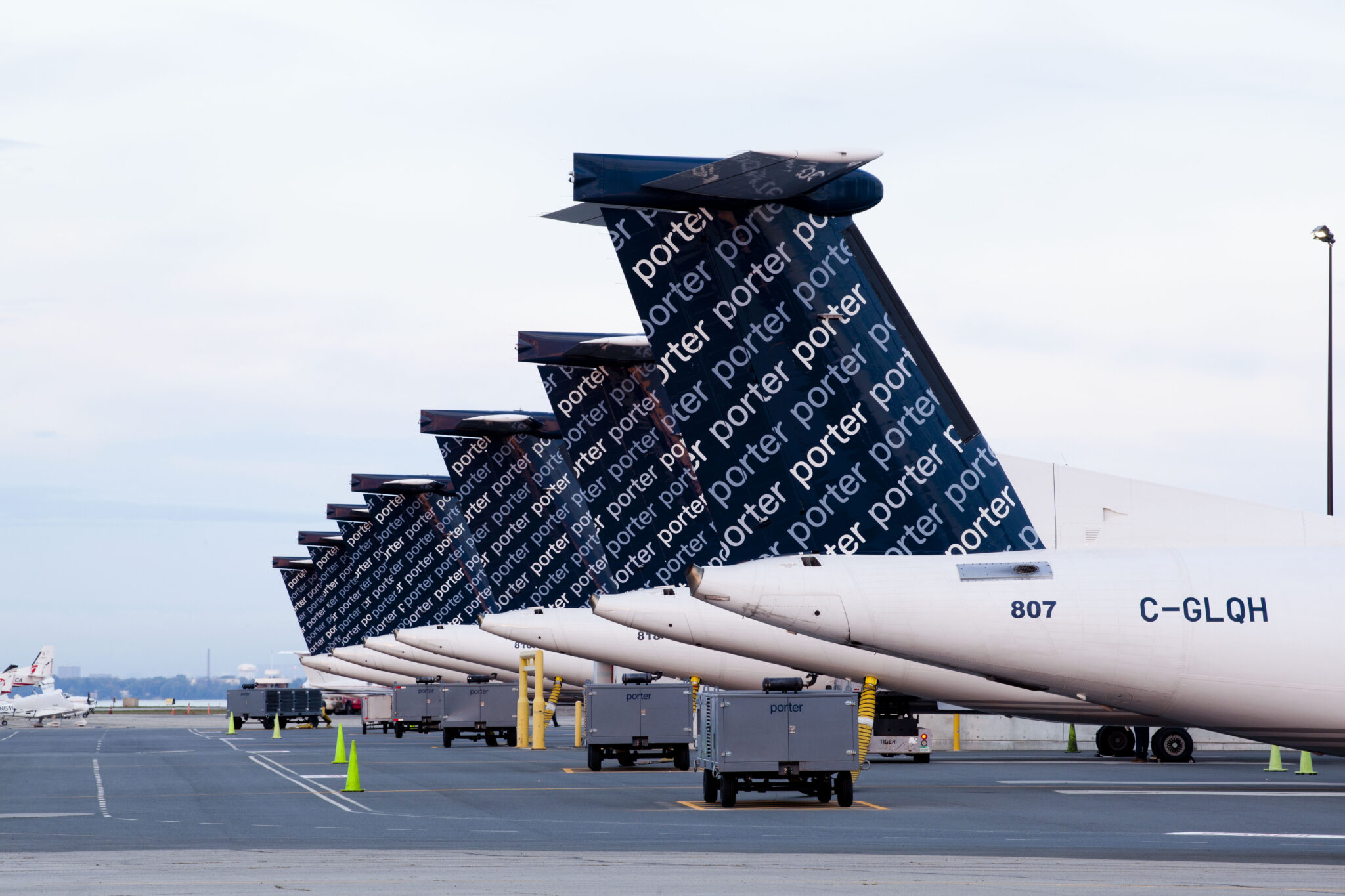
Porter Airlines Dash 8 Q400s at Toronto Billy Bishop Airport (YTZ) | IMAGE: Porter Airlines
With passenger counts approaching nearly 3 million at YTZ in 2018 and 2019, Porter Airlines needed to make some decisions.
And then, 2020 happened.
Porter suspended operations due to the coronavirus pandemic on 18 March 2020 and would not operate a single revenue flight again until 8 September 2021 – 18 months later.
Recovery was slow and Porter was stuck. Growth was next to impossible without a massive overhaul of its business model.
A New Era of Growth
An artist rendering of a Porter Airlines Embraer E195-E2 | IMAGE: Porter Airlines
So, on 12 July 2021, Porter announced a $5.2 billion deal to purchase 30 Embraer E195-E2 aircraft, with purchase rights for an additional 50. At the 2022 Farnborough Air Show approximately one year later, Porter announced a firm order worth $1.56 billion for 20 additional E195-E2s, bringing the total deal to 50 firm orders and 50 options. The deal also leaves open the possibility of converting some of the E195-E2s to smaller E190-E2s.
Porter Goes Brazilian
Set to become the North American launch customer of the Brazilian-made aircraft, Porter will operate the jets out of Toronto’s Pearson International Airport (CYYZ/YYZ). Just under half an hour from downtown Toronto, Porter’s Pearson operation will allow the carrier to deploy its new jets to destinations in western North America, such as Vancouver, Los Angeles, and San Francisco, as well as Mexico and the Caribbean.
Additional E195-E2s will be based in Ottawa (YOW), Halifax, Nova Scotia (YHZ), and Montreal, Quebec (YUL). The airline has not released any additional schedule information for the new aircraft. Porter will maintain its fleet of 29 Dash 8s at YTZ.
“Embraer has a proven aircraft, representing the best of environmental efficiency, operating performance, and passenger comfort,” said Michael Deluce, President and CEO of Porter Airlines. “We are in final preparations to introduce the E195-E2 to North America, joining other global airlines already benefiting from its use. The aircraft will become core to our fleet as Porter reshapes passenger expectations for air travel in the same way we did over 15 years ago. Announcements are forthcoming that will detail our initial routes, in-flight product, and other details.”
With the ability to seat between 120 and 146 passengers, the E195-E2s will feature all leather seats, adjustable headrests, and inflight power. It will be interesting to see if the airline continues or expands its generous in-flight offerings.
Will Competitors Stunt Porter’s Plans?
A Porter Airlines Dash 8 Q400 | IMAGE: Porter Airliens
As Porter embarks on its massive North American expansion, the airline may begin to face some additional competition.
Boston-based Waltzing Matilda Aviation plans to launch scheduled service from Billy Bishop Airport in the coming months under the name Connect Airlines. Initial destinations include Chicago O’Hare (ORD) and Philadelphia (PHL). With an emphasis on business travelers, the new airline will utilize leased Dash 8s from British carrier Flybe. The startup carrier – which is in the process of hiring 30 direct entry US captains at an industry-leading $250K/year – has also placed an order for 75 converted ATR 72-600s.
Canada Jetlines, another startup carrier, plans to launch scheduled service on 29 August from Toronto Pearson. According to its website, the airline will utilize a fleet of up to 25 Airbus A320s. Initial destinations include Winnipeg, Manitoba (YWG), Moncton, New Brunswick (YQM), and Niagara Falls, Ontario (IAH).
With the exception of Moncton, neither carrier plans to go head-to-head on routes Porter flies – at least for now.
A New Era at Porter
Aerial view of the Canadian rockies mountains in the Banff national park, Canada | IMAGE: Porter Airlines
Even with startup carriers threatening to eat away at some of its market share, Porter Airlines is poised for a period of massive growth.
With 17 destinations in Canada and five American destinations – Boston (BOS), Chicago Midway (MDW), Myrtle Beach (MYR – seasonal), Newark (EWR), and Washington Dulles (IAD) – Porter is well positioned to take advantage of the airline industry’s post-pandemic recovery.
With the advent of the jet age at Porter, the carrier is on the precipice of becoming a truly North American airline.
A Southwest Airlines flight attendant suffered a serious spinal injury after a hard landing last month in California, the National Transportation Safety Board (NTSB) announced Monday.
The NTSB has released its final report regarding Southwest Flight 2029, a Boeing 737-700 (registration N480WN), which operated from Oakland (OAK) to Santa Ana (SNA) on 1 July 2022.
Up until touchdown at 1721 local time, the flight had been uneventful. According to the NTSB report, the flight crew performed a standard visual approach to runway 20R at SNA. As is usually the case at SNA, the crew aimed to land the aircraft as close to the touchdown zone – with minimal float – as possible.
Hard Landings are Common at SNA Due to its Short Runway
A Southwest AIrlines Boeing 737 on final approach at John Wayne Airport (SNA) | IMAGINE: John Wayne Orange County Airport via Facebook
The NTSB report states that the flight attendant conducted normal pre-landing activities such as securing the cabin and galley. Once in her jumpseat, she secured her harness and got into the brace position. When the plane touched down, it “hit the ground with such force that she thought the plane had crashed,” according to the NTSB report. She also reported immediate, severe back and neck pain and was unable to move.
The Injury To The Flight Attendant Was Serious
As the aircraft exited the runway and began the taxi to the terminal, the NTSB report indicates the pilots were notified that “the ‘B’ position flight attendant seated in the aft jumpseat had injured her back on landing and required medical assistance.”
Once parked, paramedics boarded the flight to evaluate the injured crew member. She was taken to a nearby hospital and was diagnosed with a compression fracture to her T3 vertebra.
None of the other four crewmembers, nor any of the 137 passengers on board, were injured. The aircraft involved in the incident was not damaged, and the NTSB did not assign fault for the incident.