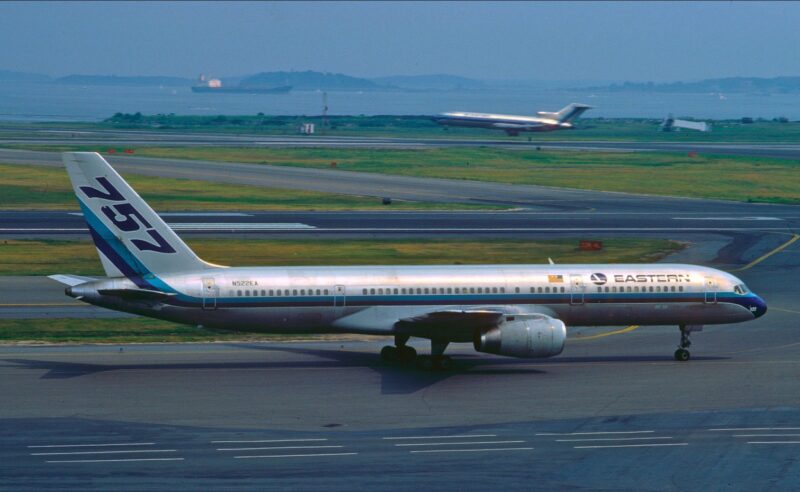
In 1984, Eastern Airlines released a TV commercial touting that it saw the future and it looked bleak showing images of an airline boneyard and stating that “an airline that doesn’t plan for the future, may not have one.” The ad then went on to tout their new Boeing 757 airliner that was more fuel efficient and had greater passenger comfort than their 727 ‘whisperjet’. It was as if their new 757 alone would power them high above the threats of the industry.
Eastern Airlines Commercial predicted the future.
The irony of the ad is that just 7 years later, Eastern Airlines went belly up. While their 757s were pretty amazing for the time, the combination of a softening economy brought on by a recession, high oil prices caused by Iraq’s invasion of Kuwait, and tumultuous labor relations at Eastern (we’ve profiled some of the reasons that Eastern failed in an article that highlighted the very challenging labor and leadership situation) all combined to doom the once high flying airline. A shiny jet wasn’t enough to save an airline that helped define air travel in the US for over a half century.
Not the first ironic airline commercial
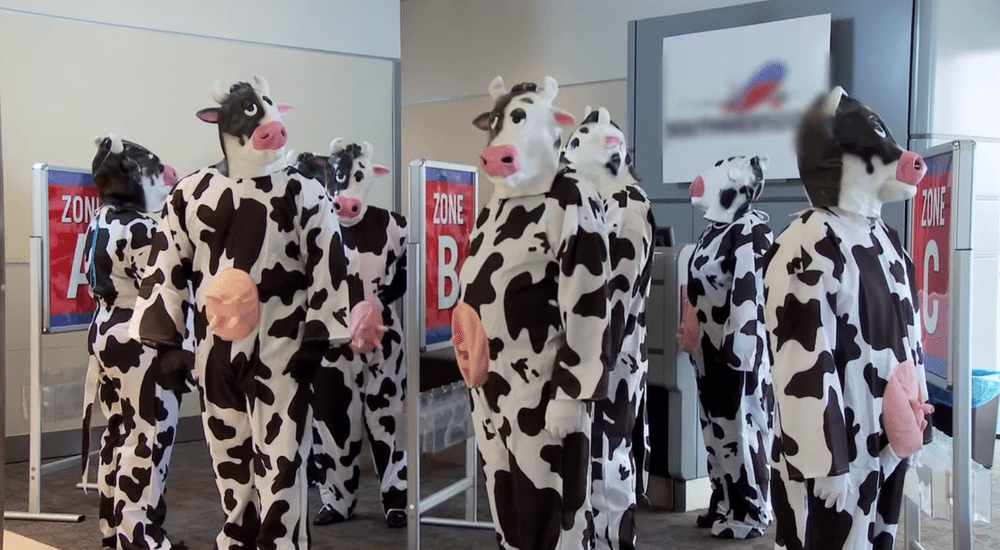
Maybe the greater irony is that this is far from the first ironic airline commercial. AirTran criticized Southwest’s boarding policy, only to be gobbled up by Southwest Airlines a few years later. American once touted their greater legroom. Today they have some of the tightest seats in the industry. You can see our original article below. Just click on the link next to the “AirTran cows” below:
Eastern might have disappeared but the 757 still soldiers on
The Boeing 757 really was amazing for the time and a jewel in Eastern’s fleet. Even though the design is now over 40 years old, it still is a unique aircraft and used by a number of airlines. It’s overpowered, has beefy landing gear, and range that makes short hops, cross-country, and cross-Atlantic travel possible.
It’s why airlines like Delta and United still fly their 757 fleet even though the youngest jet is now approaching 20 years old. The design was so successful that there is even a new airline that will utilize the 757 for their startup when they commence service later this year.
Call This the Armchair Fighter Jock’s Review of Tom Cruise’s Blockbuster Film
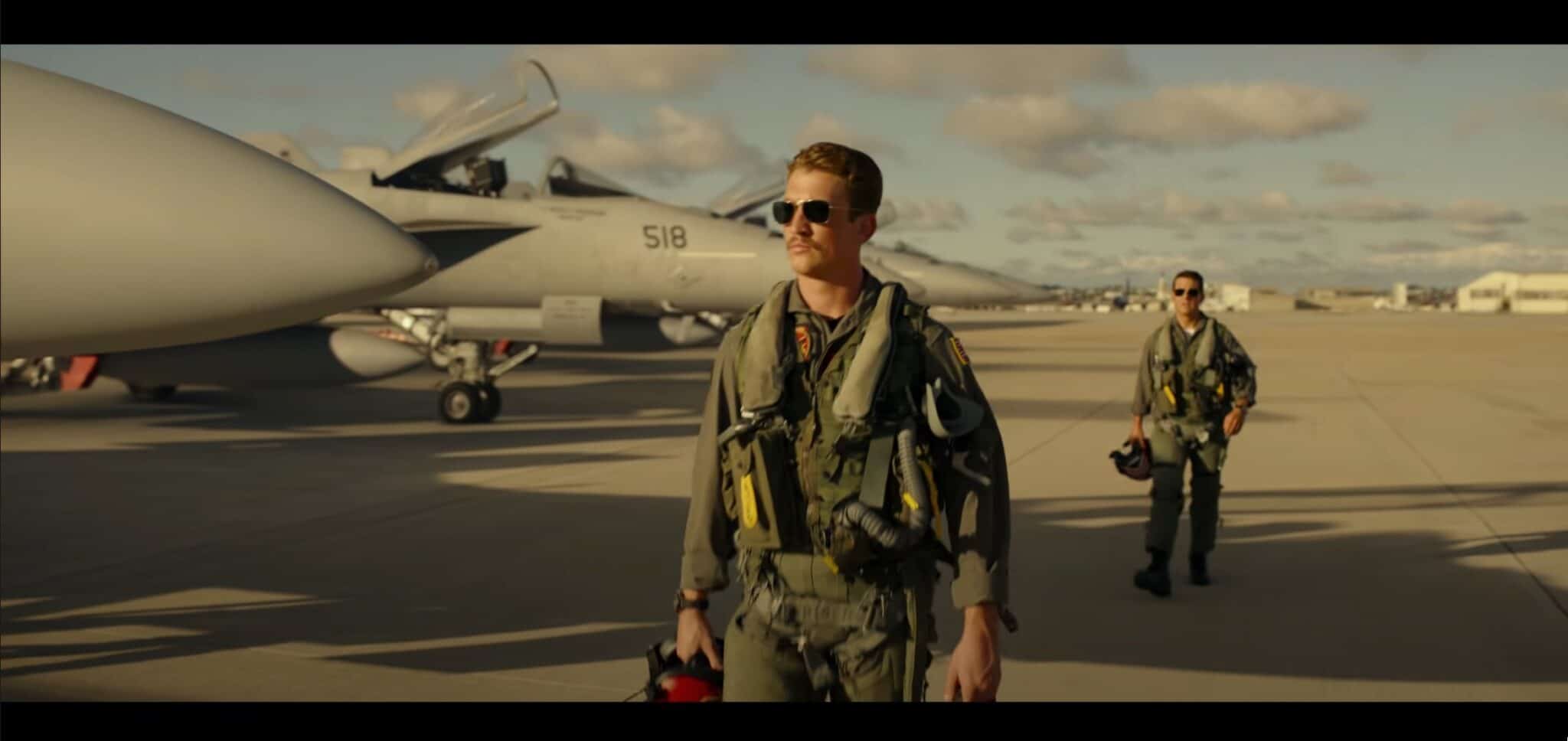
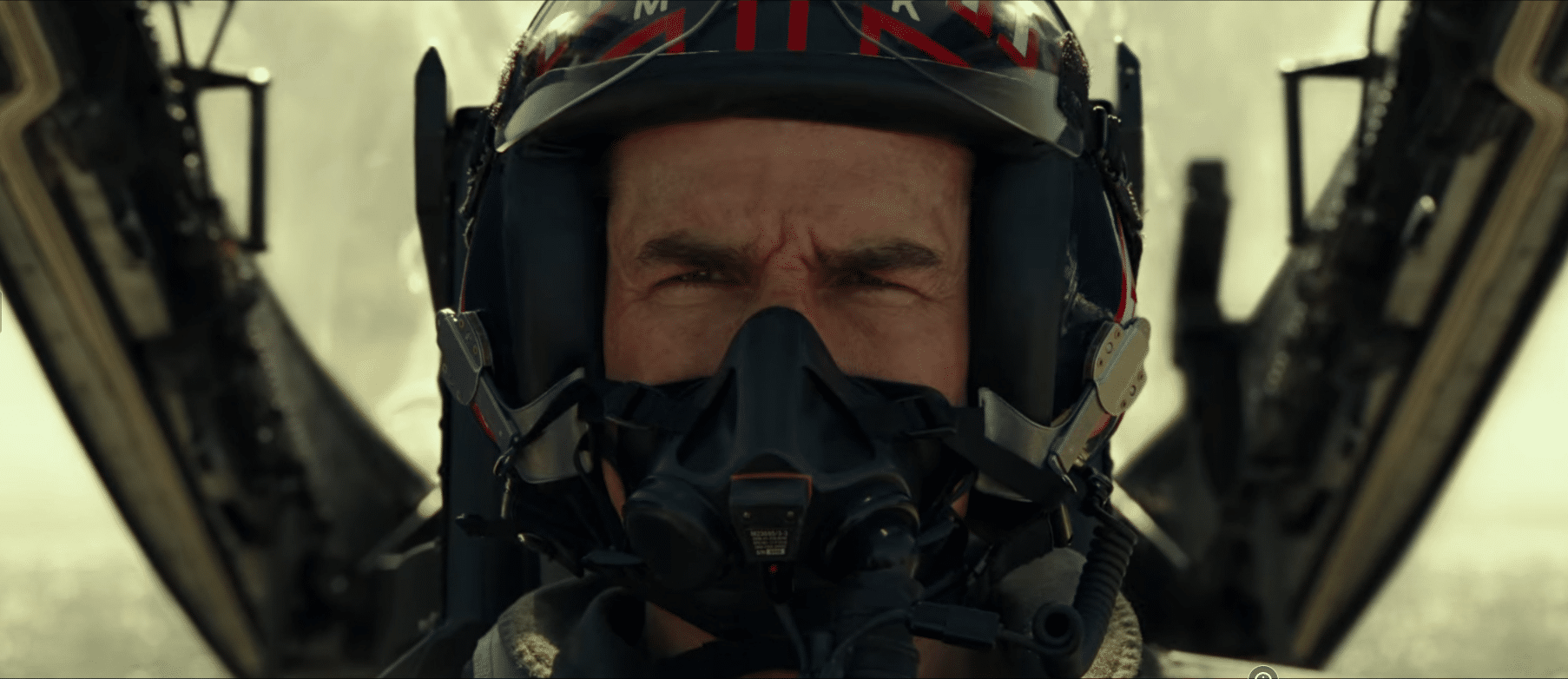
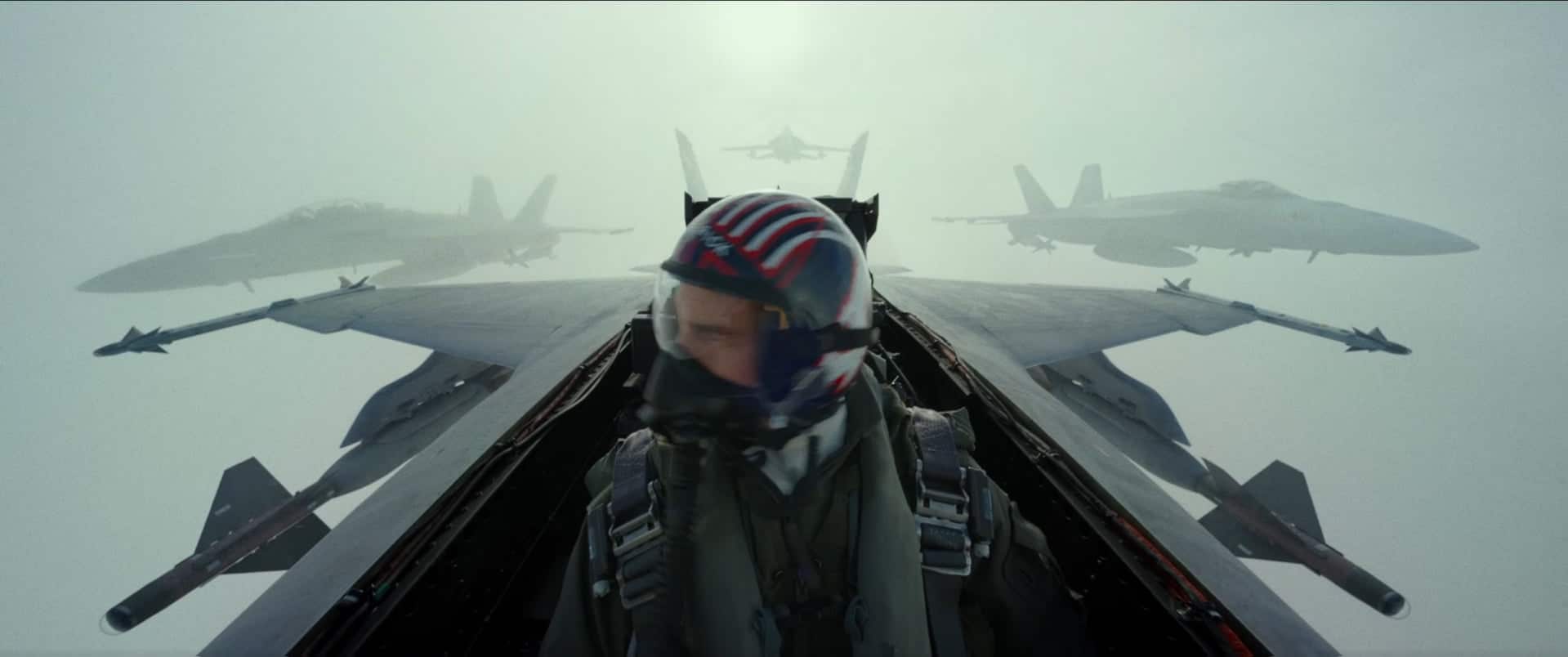
The record-setting debut of Top Gun: Maverick over Memorial Day weekend 2022 comes as no surprise to this Avgeek. Neither do the reviews, which are (almost) universally excellent. Let’s get this out of the way at the outset. Go see the movie. In a theater. With the biggest screen possible and the best sound system to go with it. I saw the movie with my son in a theater with “enhanced audio experience”, which included Dolby Atmos surround sound, about 100 speakers, and probably about that many subwoofers. The overall visual and aural experience was absolutely awesome. The two medium popcorns and two bottles of water we consumed cost considerably more than our tickets did.
image via paramount
It’ll Make You Stand Up and Cheer
But the theater experience really was outstanding. The audience ranged from pre-teen kids to seniors- lots of families too. They cheered several times and gave the movie a standing O at the end. We both muttered “wow” dozens of times both during and after the film. Oh sure- I’ll buy the 4K Blu-Ray when it comes out (along with a 4K Blu Ray player and a 4K TV to watch it on- it’s good to have goals), and it’ll be one of those films I’ll watch (and enjoy) many more times at home with my somewhat anemic home theater sound setup. And just like the original, it’ll be programming I seldom surf past when it appears in the channel guide. So without spoilers, here are some Top Gun: Maverick takeaways.
The opening sequence. Similar but better than the original. When you see (and hear) it you’ll know what I mean. One word: Goosebumps!
The closing sequence. Also similar but better than the original. And when you see (and hear) it you’ll know what I mean. The same one word: Goosebumps!
image via paramount
The soundtrack. IMHO better than the original Top Gun. Not much more I can say without spoilers here. Only a couple of new songs made for the film. The film is about flying, and the soundtrack supported that, never really becoming the focus of the experience. Except for a couple of times that is. Just go see (and hear) it!
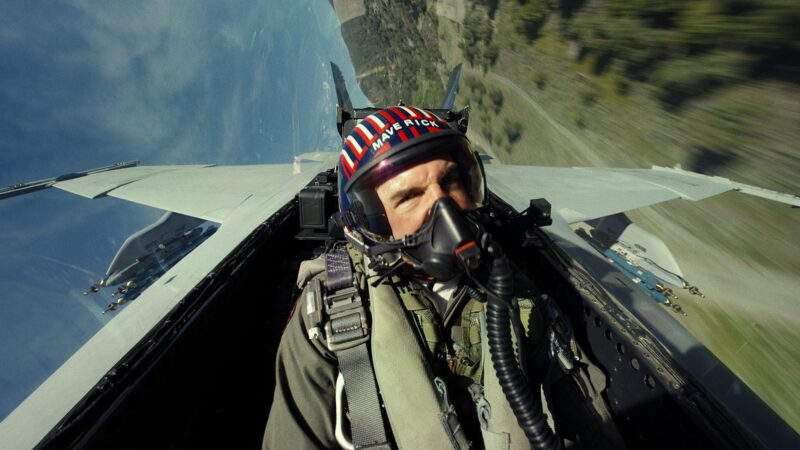
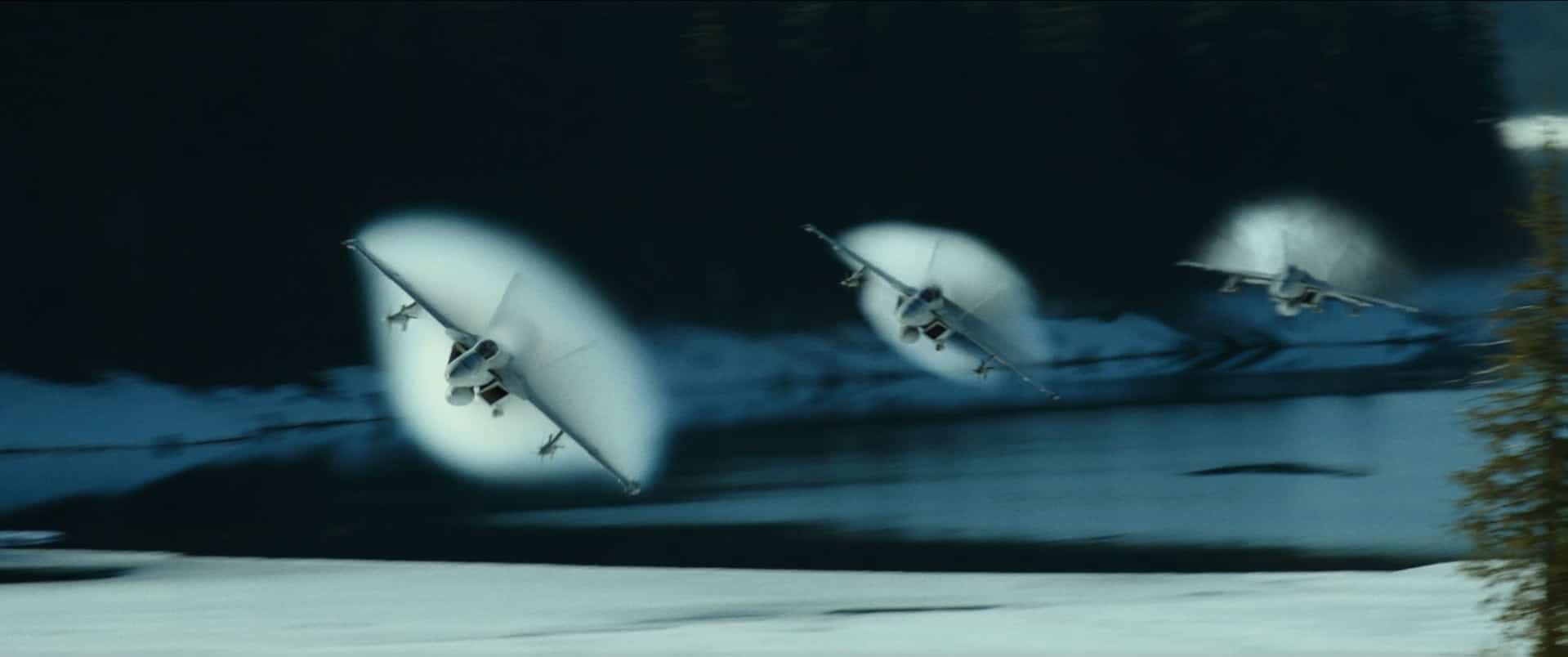
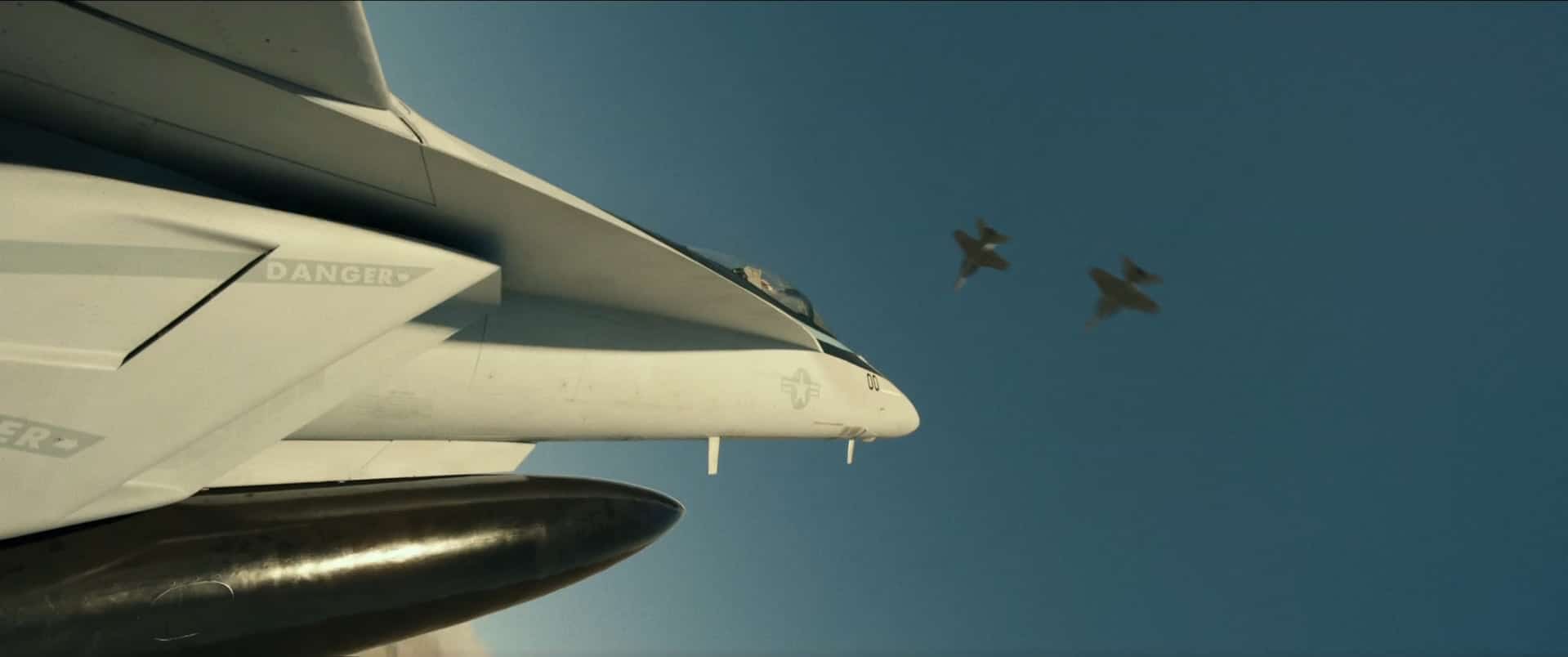
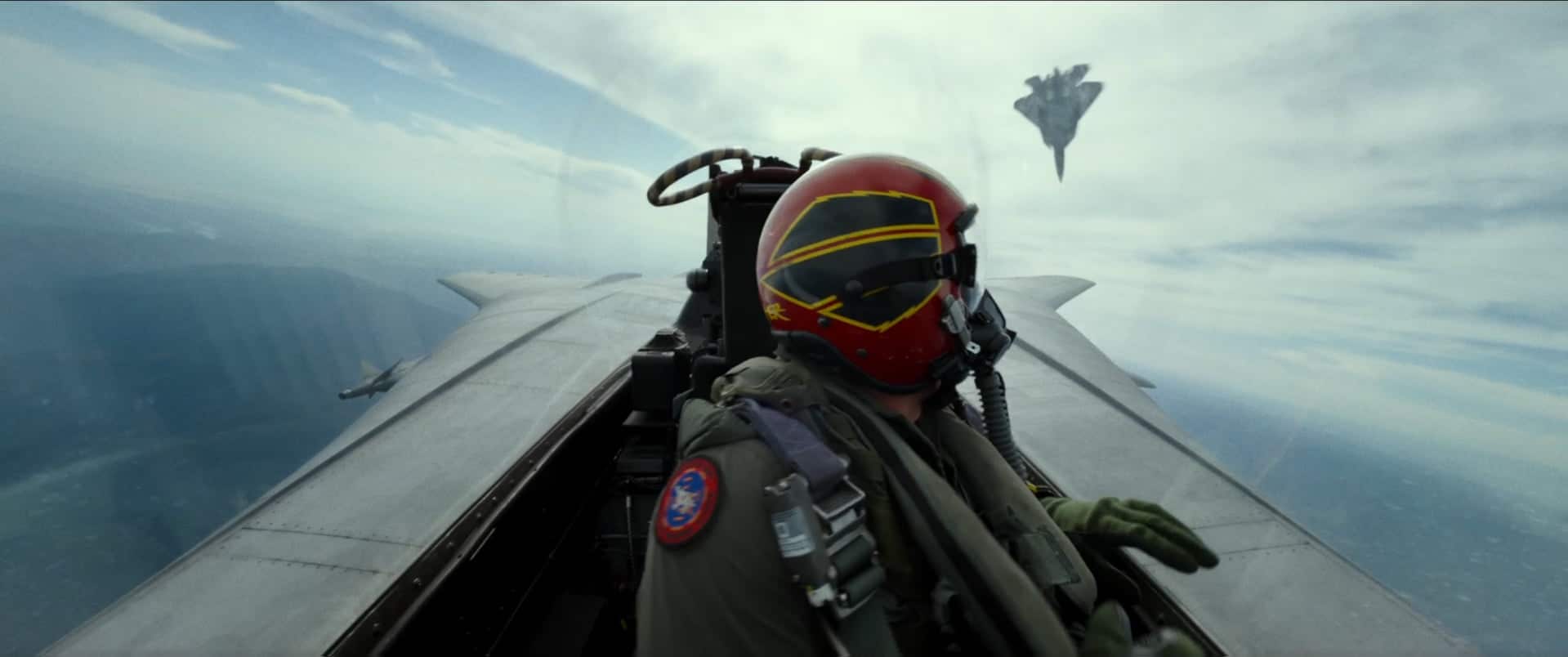
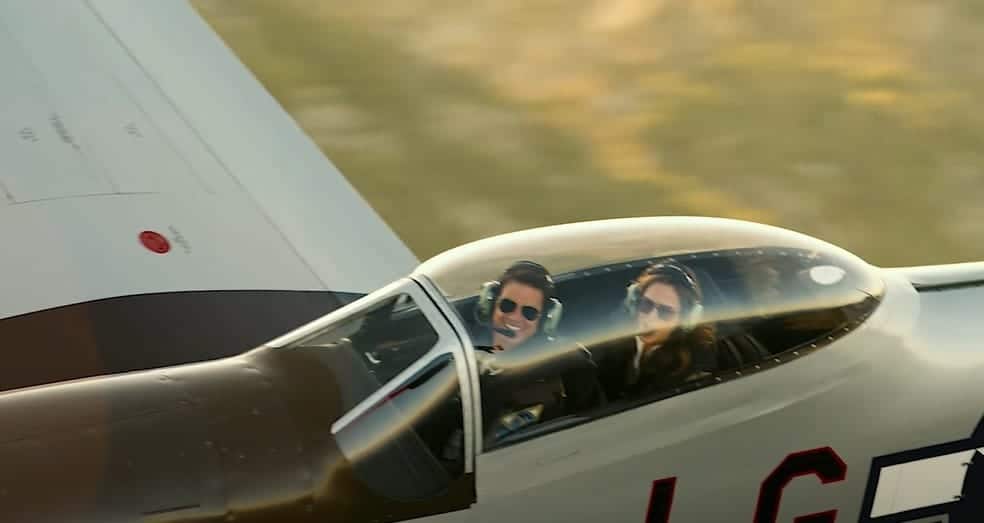
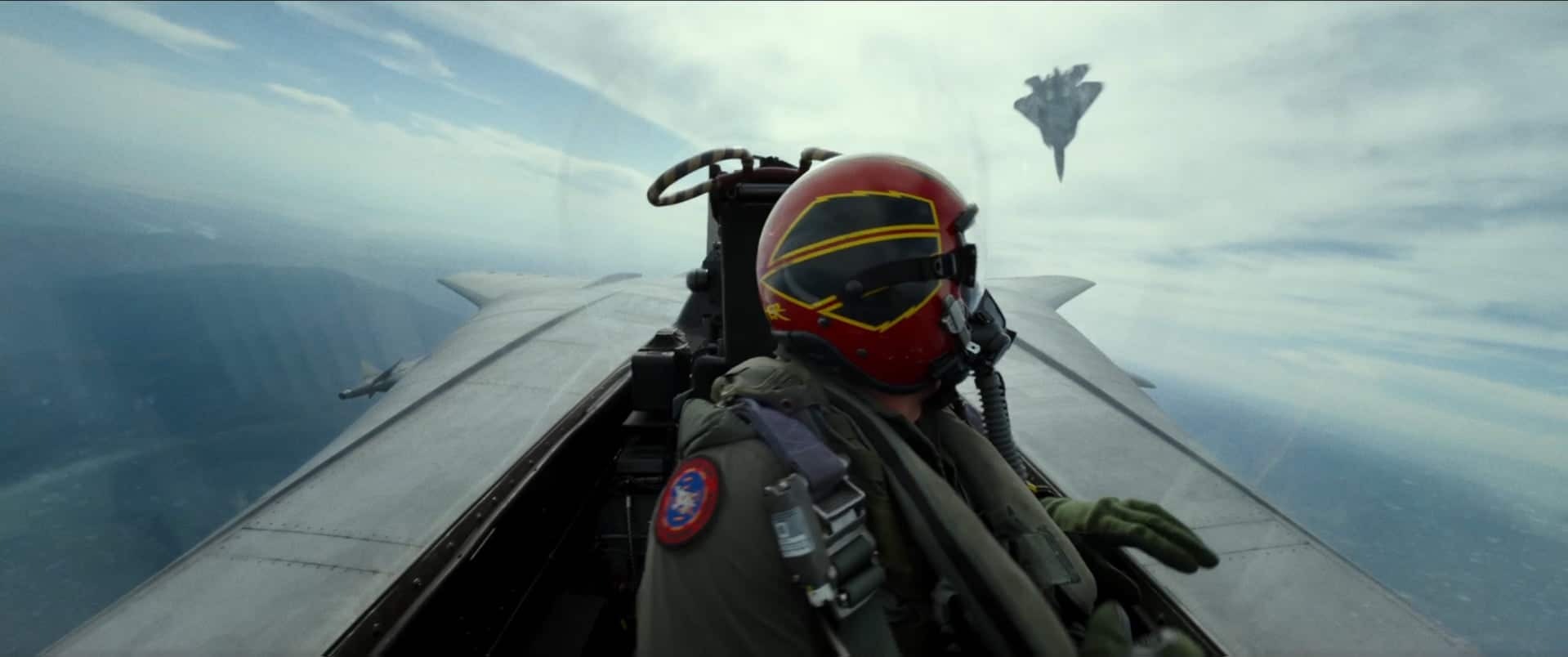
Suspension of disbelief. Not really necessary (very often). Sure- some of the maneuvers and a lot of the plot is, in varying degrees, a bit out there, but in the end this movie is, for me at least, more believable than the original Top Gun. Actually putting the actors in the back seat of an F/A-18F Super Hornet and filming them reacting to actual Gs on the jet has a lot to do with this.
image via paramount
Simply the Best
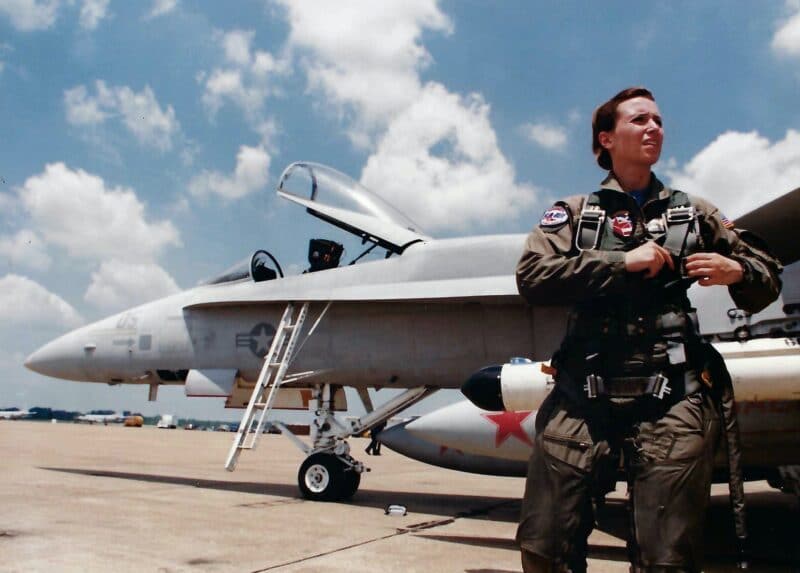
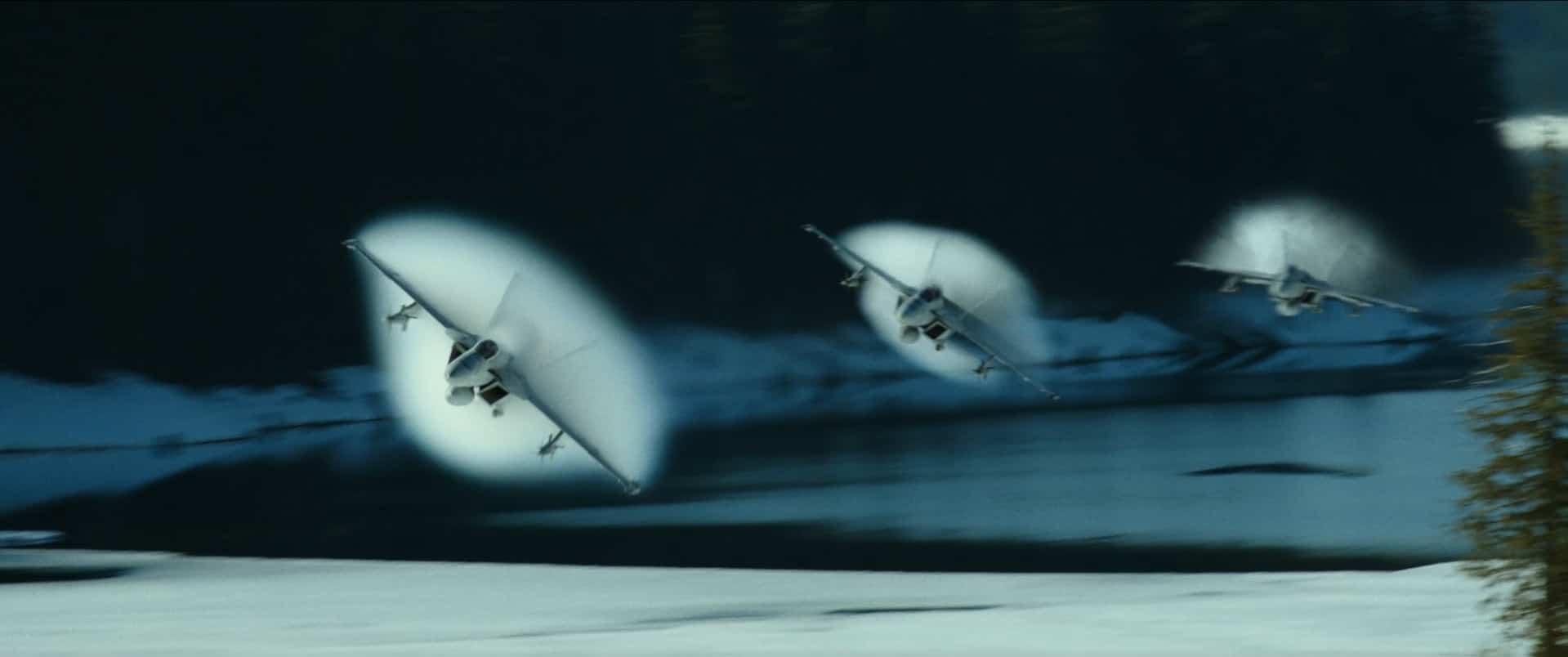
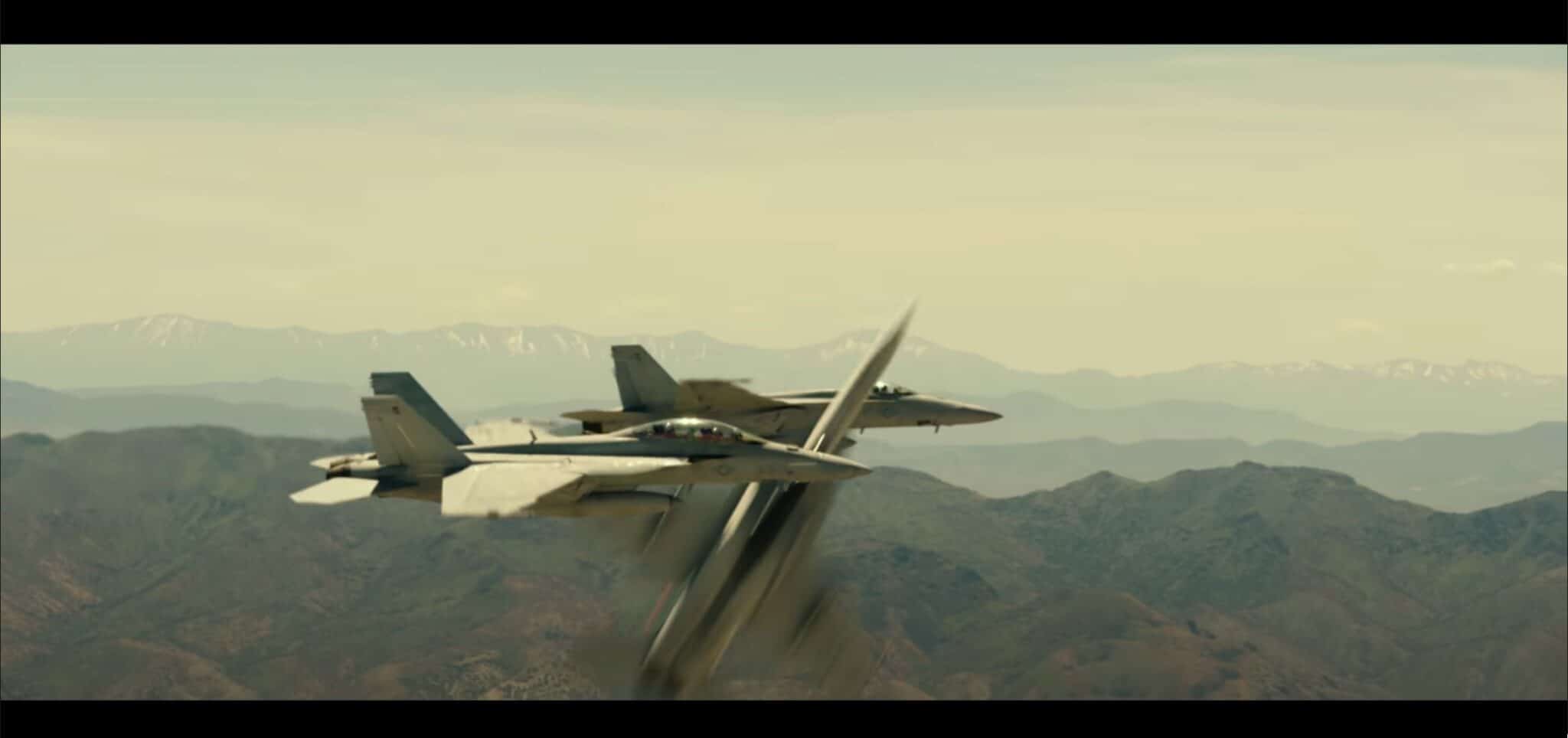
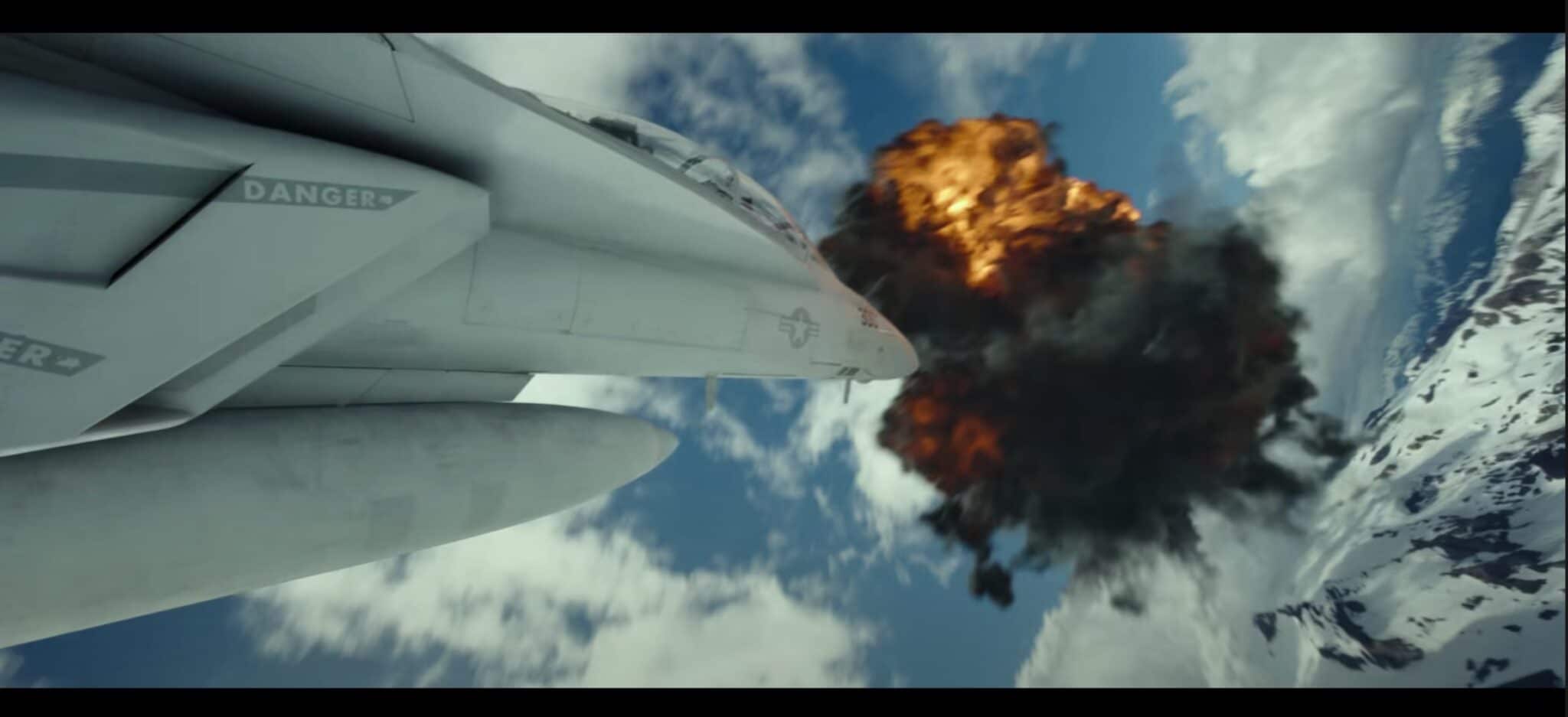
Flying scenes. The best ever filmed. Period. Full stop. The filmmakers clearly strived to make this the hallmark of the film, and they succeeded. There’s more flying in this film than the original too. Even when liberal use of CGI was employed, the movie’s flying scenes were absolutely captivating. And for the most part, completely believable, if not well outside NAVAIR safety parameters. But don’t just take my word for it. Former Naval Aviator Loree ‘Rowdy’ Draude thought so too!
Maverick’s career. Some clarity about how Mav has remained a Captain over all the years since his first three victories over MiG-28s with Merlin in the back seat is provided. But just enough to allow the audience to buy into the idea that Captain is the rank Mav should hold.
Technical accuracy. Observers and critics (people who know) have been calling out technical errors in the film since the first trailer came out years ago. Sure, the ‘salad bars’ on the characters’ chests might not be quite completely cricket. Yes, the radio comms might not be completely accurately portrayed. Switchology and displays in the cockpits are off a bit (there’s an Easter Egg in there). While the movie is certainly not completely accurate from a technical standpoint, the movie is definitely believable. Much of this due to excellent editing. There are very few continuity errors in TG: M. At least Mav doesn’t throttle back to idle and initiate a climb (instead of throttling up) when he goes to help Cougar. Let’s put it this way: This movie didn’t tax the basic tenets of Naval Aviation reality anywhere near as hard as the original Top Gun did.
image via paramount
Yanking and Banking, Twisting and Turning
Twists. Can’t get into too many of them here (without spoilers) but suffice it to say I was surprised by exactly how the aftermath of the strike mission played out. I was expecting the opposite.
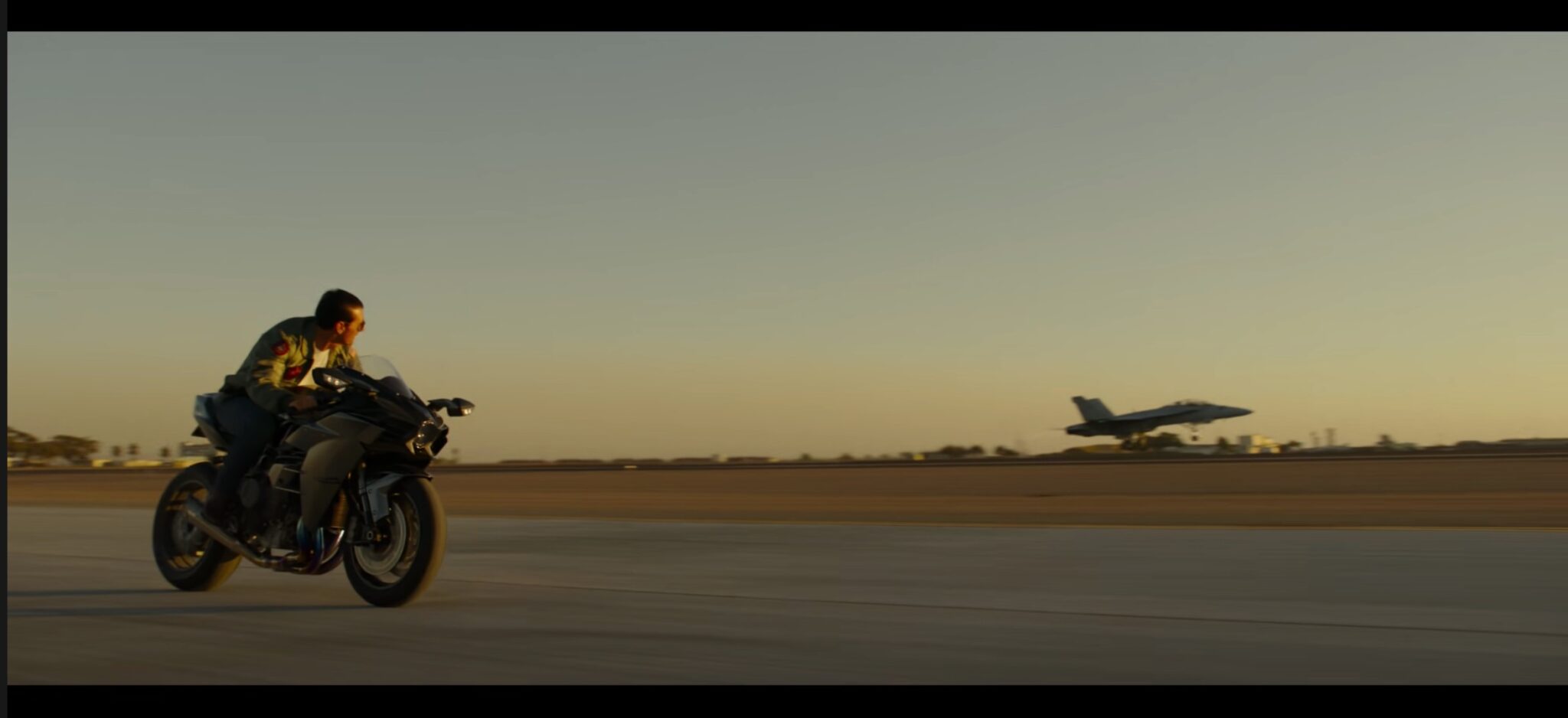
Nods to the original film. Obviously the opening and closing sequences, but there are also others. Such terms as hard deck, flyby, discussions with stern (and bald) superior officers, Penny Benjamin, Maverick’s hangar, motorcycles in places they shouldn’t/couldn’t be, and Great Balls of Fire come to mind. The entire film is, in many ways, a nod to the original- but it stands on its own merit.
Wishlist for the Blu-Ray release. Deleted/extended scenes. Interviews with the Navy pilots who flew the actors in the F/A-18Fs. Interviews with the Navy technical consultants to the film. Technical review of how the camera systems in the jets were developed/employed. Shooting site review. And, of course, outtakes and/or gag reel.
image via paramount
Laughs. The film has some genuinely funny moments, and some of them are completely unexpected- IMHO the best kind. The audience laughed out loud several times. Subtle humor also contributes to the enjoyment of the film.
Spoilers? Sorry Charlie. We’ll have to wait a while to do a piece that includes spoilers. We’re not going to pick apart the technical inaccuracies here. Yet anyway. In the final summation, Top Gun: Maverick is a great film. While it helps to have seen the original film to understand all the references to Maverick’s previous experiences, it’s absolutely not required. This film stands on its own as a great film- not just a great sequel. You’ll laugh. You’ll cry. You’ll cheer for the good guys. We give it 5 stars, a must-see grade, and highly recommend seeing it in a well-equipped theater. You’ll know why the first time an afterburner kicks in!
When you think of airplanes and aviation, accessories like a headset, a classy flight bag, and flashlight are a must. Even though every pilot wants to look sharp in the cockpit, a comb isn’t usually the first accessory in a pilot’s bag. But maybe it should be.
Image: MetalCombworks.com
We recently had the opportunity to sit down with Jeff Grant from Metal Comb Works. His factory primarily coats parts for large aerospace companies for major companies like SpaceX. The nature of the business is that they execute large orders but then experience times where they have some spare capacity to do other work. So they decided to kick off a side project making aviation-inspired, high-quality metal combs that last forever.
How This Side Project Got Started
In 2013, Jeff was looking for a birthday gift for his son. His son’s hair was pretty long and the combs he used would frequently break. When he did a search on the internet, Jeff said “there were guys making combs out of vintage vinyl records, all types of wood, metal combs as well some carbon fiber combs. When he bought one on the internet, he looked at it and thought, “well, I can do better. So I decided to make my own for him. I made a comb for him as a birthday gift.” He liked it so much that his buddies started asking for his dad to make them one too. A kickstarter campaign led to raising over $15,000. The goal was to make a comb that would last forever, maybe even one that his son could pass on to his kids one day.
A New Idea: Aviation Inspired Combs
All 4 aviation themed designs. Image: Metal CoMB Works.
For the next few years, Jeff and his team continued to sell the combs they designed. They started with Art Deco styling and then branched out to camping themes that had a built in bottle opener on it. That sold really well. Next, he had the idea of incorporating an aviation theme.
His dad was a Delta Air Lines pilot and flew F-8s in the Navy. Growing up around jets in the San Diego area with Mirimar just down the road, he’s always had a passion for aviation and enjoys watching the many fighters and helos roar past. In college, he studied aerospace engineering too. So he decided to make a comb out of aviation grade titanium with 4 styles that reflect the classic age of jet aviation.
An Aviation-Themed Kickstarter That Took Off
These Aviation-Inspired Combs Were a Kickstarter Success and Perfect Avgeek Gift 17
In late 2021, Jeff and his team released a second Kickstarter campaign featuring 4 styles of combs. The campaign took-off! Jeff said that the enthusiasm was tremendous. They originally set a goal of $500 but the campaign finished with over $6,900 in commitments.
These Aviation-Inspired Combs Were a Kickstarter Success and Perfect Avgeek Gift 18
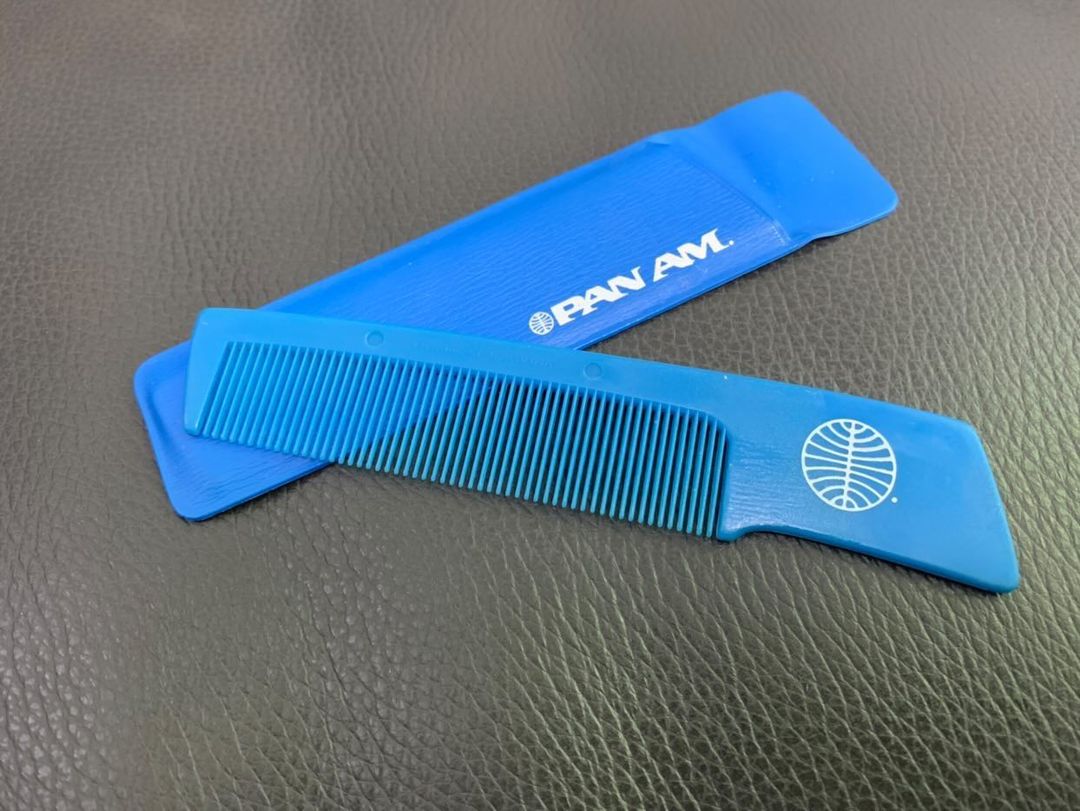
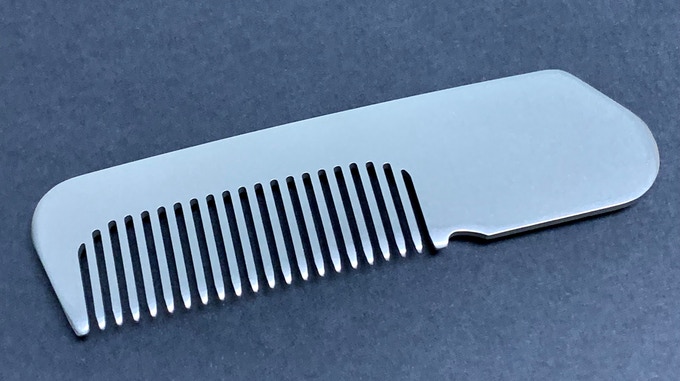
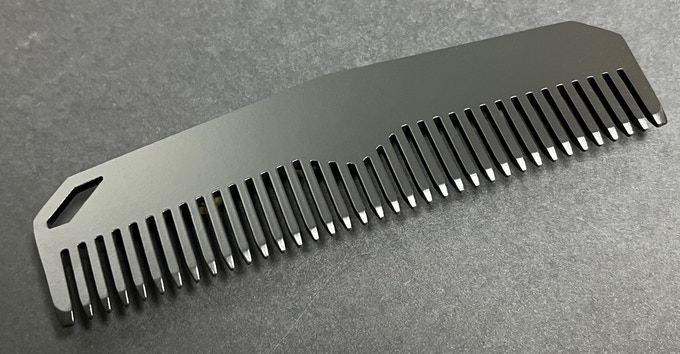
The combs are pretty unique. The most popular is a play on the classic Pan Am comb that the airline used to give away in their first class amenity kits. The style is ‘inspired’ by the classic. Instead of plastic though, the Metal Comb Works comb is aviation-grade titanium.
The Airliner by MetalCombWorks.com
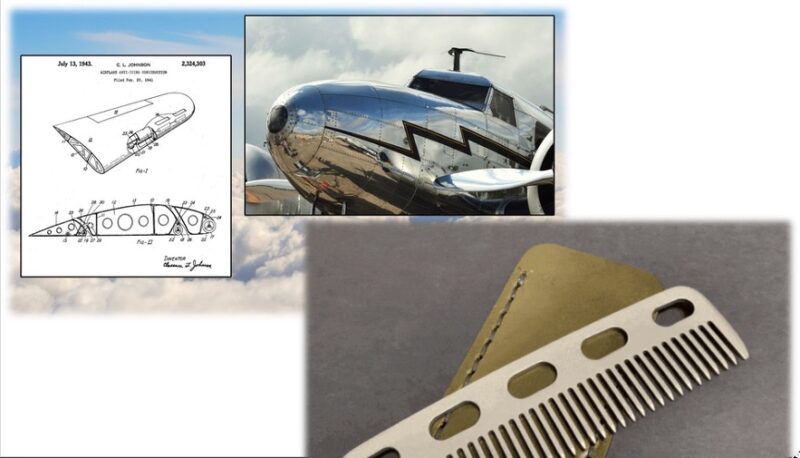
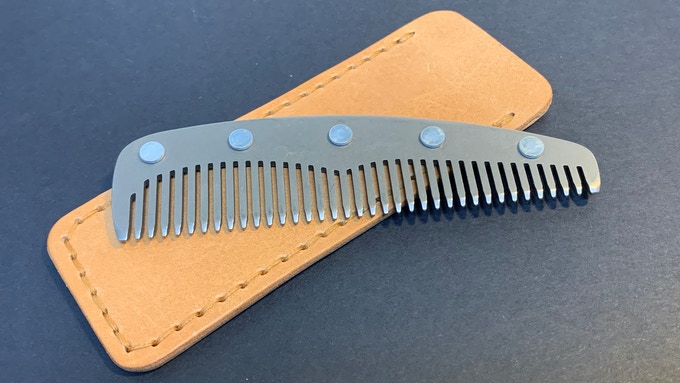
Another style they offer is called the “Clark-y”. The comb has an airfoil profile like the famous design developed by Colonel Virginius E. Clark. The Clark-Y Aero~Comb is a similar shape to a rib of an airplane wing with a rounded leading edge that tapers to a smaller profile at the trailing edge. Along the spine of the comb solid rivets have been installed as a decorative and functional feature.
The Clark-y By Metal Comb Works featuring Decorative Rivets.
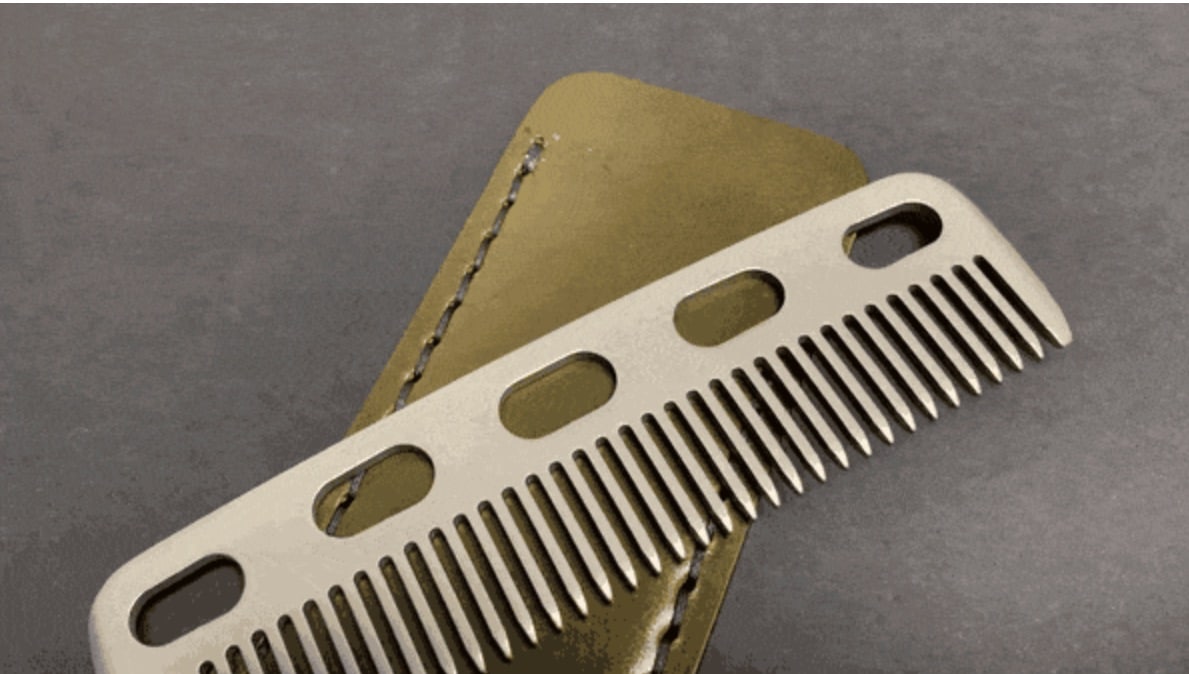
Their third design is called ‘lightening’. It refers to the fact that aircraft often have hollowed out sections within their wings (like spars) to save weight. The comb has hollowed out spaces as a nod to the technique first utilized in the early days of aviation and perfected in the early jet age for modern airliners.
These Aviation-Inspired Combs Were a Kickstarter Success and Perfect Avgeek Gift 19
My favorite of their bunch is called the “Delta”. It’s inspired by the B-2 bomber with sharp, stealth-like edges as a nod to the flying Delta wings that proceeded it. This one is available in both the stainless-steel look and the blacked out ‘stealthy’ version with a dark B-2-like finish.
The DelTA in Stealthy Black Finish.
Great Gift For Father’s Day or for any other reason
Image: MetalCombworkS.com
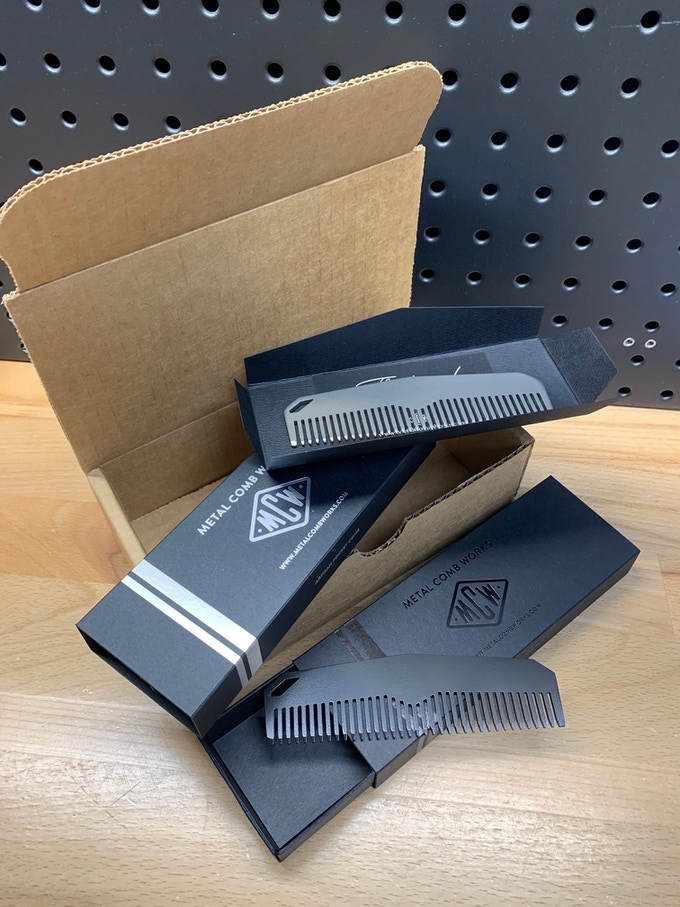
The combs are all made in the USA by American craftsmen and designed by American engineers. Each aviation-inspired comb comes with sharp packaging and a leather case. You can purchase them on Metal Comb Works website at MetalCombWorks.com.
Bombardier’s Global 8000 Breaks the Sound Barrier in Testing- With a YouTube Video to Prove It!
Bombardier’s Global 8000 program went supersonic during a recent test flight. It’s not the first time a transport subsonic jet has accomplished the feat. It is though the first time that a manufacturer posted a YouTube video of it happening.
The Latest and Greatest
The Global 8000 program is Bombardier’s new flagship private jet program built on the success of the 7500 which itself was an outgrowth of the highly successful Global 6000. The 8000 is intended to be faster and have longer range than the 7500. It features upgraded and more efficient GE Passport engines and a host of internal upgrades to make the already luxurious cabin even better. Most notably, the jet is designed to be the fastest business jet out there with a cruise speed of Mach .94, just under the speed of sound.
Long Legs
At a slightly slower speed, the jet has an 8,000 NM range, allowing non-stop service to almost any major destination on Earth. Only the fabled London to Sydney non-stop flight (which Qantas is tackling with Project Sunrise) is out of range of this new jet. The Global 8000 is expected to enter service in 2025. It will hold the title as the fastest passenger jet since the Concorde retired back in 2003.
If Normal Cruise is M.94, You Better Know What Mach 1.015 Feels Like!
The Global 8000 is designed for a top cruise speed of Mach .94 at 41,000 feet with up to 19 passengers. That’s just six-one hundredths below Mach one. While it would be unusual to exceed that speed, it is possible in an emergency descent to accidentally approach or exceed the speed of sound. The full flight test program accounts for this possibility.
Hitting Mach 1 by Accident…Sort of
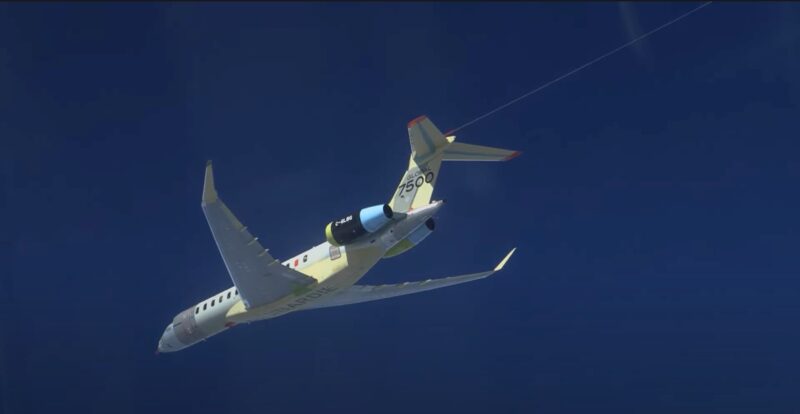
On a recent flight test in a 7500 (serving as a test vehicle for the 8000 program), the crew intentionally put the test aircraft into a shallow dive. This provides insights into the aircraft’s behavior in the event that the placarded never exceed speed is surpassed. In the video below, you can see the test pilots gently push the nose forward. A small ‘burble’ of the wings are visible in the video as the jet slips into a full supersonic flight regime with a chase aircraft in the background. The jet accelerated to Mach 1.015 before the test pilots then recovered to a subsonic speed with seemingly little affair.
Other Larger Passenger Jets Went Faster Than Mach 1.0
While the Concorde’s Mach 2+ speed is well known, other airliners like the Boeing 747 and the DC-8 have also passed the once forbidden sound barrier with the pilots living to tell about it. Two commonly known stories of larger airliners are known to have accomplished the both prestigious and somewhat dubious feat.
Hitting Mach 1 by Accident…For Real!
An Evergreen International 747 did it by accident during an unusual attitude caused by faulty equipment back in 1991. That Boeing was thought to have gone well over Mach 1 in the dive and subsequent recovery. A DC-8 also flew faster than the speed of sound during testing over Edwards AFB back in 1961. Smithsonian did a great interview with one of the engineers from that flight.
Loree “Rowdy” Draude, Who Was One of the First Women to Fly Combat Jets for the US Navy, Got an Early Look at the Epic Sequel
As a former naval aviator who flew the F/A-18 Hornet in an aggressor squadron, I have a love/hate relationship with the original Top Gun movie. It’s technically horrific for many aviation-related reasons, primarily because actual aerial combat and missile shots are not cinematically compelling. The flying sequences in the movie were cringe-worthy for naval aviators to watch, but dang it, they were exciting for a movie audience. The dialogue is cheesy and quote-worthy and it’s backed up by a spectacular soundtrack. What Gen X-er doesn’t recognize the first five notes of Kenny Loggin’s “Danger Zone?”
Maverick is back in Top Gun: Maverick. Image: Paramount Pictures
Expectations Abound
Going in to see Top Gun: Maverick, I expected the same formula that made the original Top Gun a success: young, hot, male aviators who all look similar trying to out-stud one another, a plot full of holes that we’re willing to overlook in the name of entertainment, a great soundtrack, and exciting (but forbidden IRL) aerial sequences.
Top Gun: Maverick is in theaters May 27, 2022. Image: Paramount Pictures
Expectations Are Meant to Be Exceeded
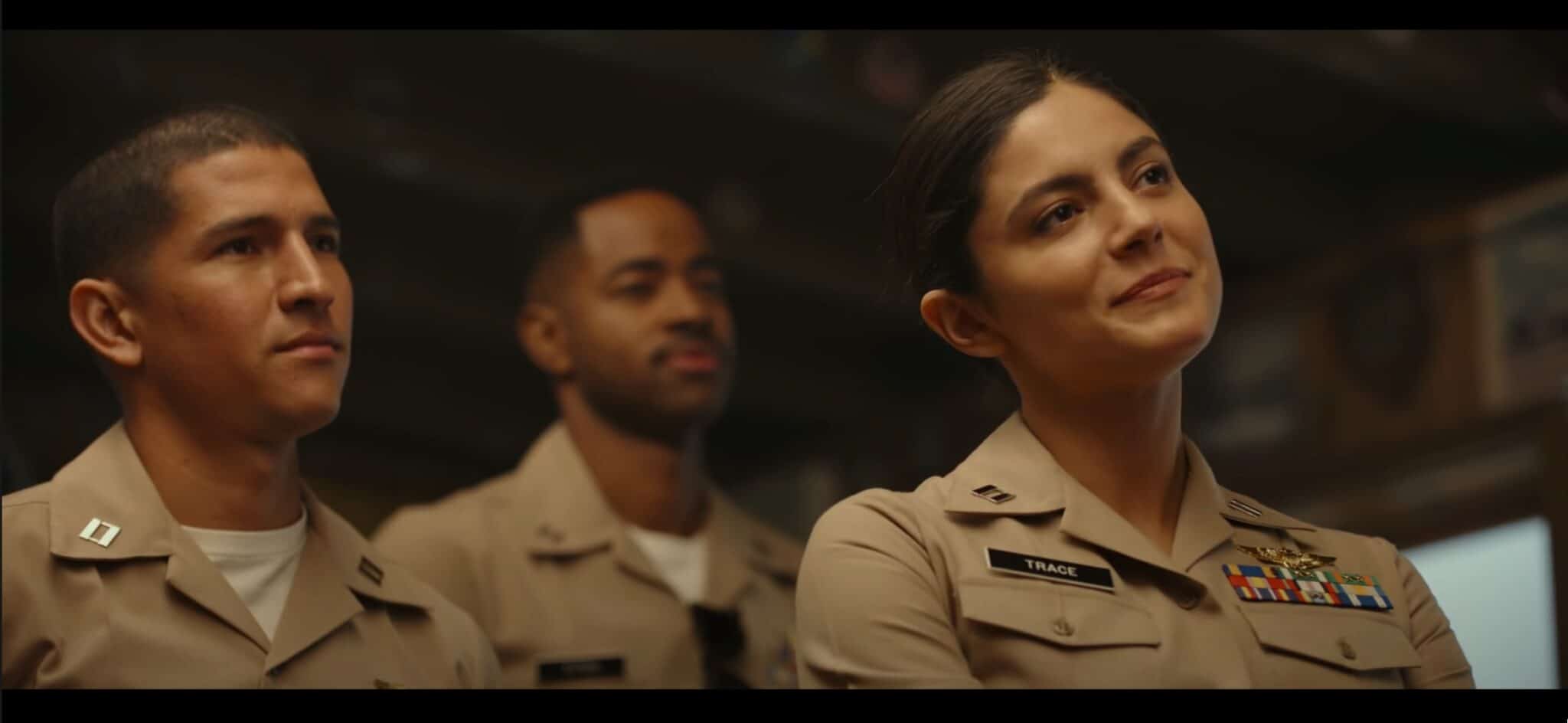
I was pleasantly surprised by Top Gun: Maverick’s ability to evolve the formula to better represent 2020 (when the movie was supposed to be released). I was happy to see not just one, but three female aviators: two Top Gun graduates, and one E-2C NFO. Of the six Top Gun graduates who have speaking parts in the movie, half are white men and the other three are a woman, a Black pilot and a Hispanic WSO (Weapons Systems Operator).
Top Gun: Maverick Review From A Naval Aviator's Perspective 32
Times Are Changing
I’m grateful Top Gun Maverick got the Bridgerton treatment and shows a more diverse representation of a world that is still underrepresented by women and people of color. As a midshipmen in NROTC, 30+ years ago, I had no female aviators to admire in the original Top Gun movie. I hope this more diverse representation will inspire underrepresented minorities to consider naval aviation as a viable career.
All That You Like About The Original- and Then Some
We still have the posturing and verbal swordfights among the younger aviators, like in the first movie, but I love how the relationship between Maverick and his nemesis, Iceman, evolves in Top Gun: Maverick. He even refers to him with the diminutive “Ice” in text exchanges. Overall, I appreciated Maverick’s emotional maturity throughout the film and the greater depth that Tom Cruise brings to the character, who is pushing 60 years old. The requisite shirtless sports event scene takes place playing football on a beach, rather than a sand volleyball court, and Cruise has no problem keeping up with the younger generation. In this movie, Maverick’s romantic interest is Penny Benjamin, played by Jennifer Connelly, a 51-year-old actress, who is age-appropriate except for her neck. As a 54-year-old woman, I can tell you, hers is the neck of a 30 year old, not someone in her 50s.
Top Gun: Maverick Review From A Naval Aviator's Perspective 33
The Plot Thickens
The plot is slightly different, in that instead of competing for who is the best of the best at Navy Fighter Weapons School (aka Top Gun), the aviators are competing to see who is the best of the best of the best, meaning, which of these Top Gun graduates will be chosen to fly the impossible mission? And speaking of the mission, I wondered why the target couldn’t be taken out by the same missiles that were sent to destroy the enemy airfield, but then I realized this would be a 2-minute, boring movie instead of a 2+ hour thrill ride. I had to remind myself that this is not a documentary, and no one cares. We came to see Tom Cruise doing his pilot sh*t, so relax your expectations of a realistic plot and enjoy the ride.
Top Gun: Maverick. Image: Paramount Pictures
A Winning Soundtrack
I loved the soundtrack to the original Top Gun movie and was disappointed that this movie only has two original songs, by Lady Gaga and One Republic. The rest are classics, including “Let’s Dance” by David Bowie, “Won’t Get Fooled Again” by the Who and “Danger Zone” from the original movie. I imagine Kenny Loggins swimming in royalty checks and lighting cigars with burning Benjamins (Franklin, not Penny).
Top Gun: Maverick Review From A Naval Aviator's Perspective 34
The F-14 Tomcat Makes a Cameo
The venerable F-14 Tomcat makes a guest appearance and I felt my heart sigh. I never got to fly in a Tomcat, but they were my favorite jet to watch around the aircraft carrier. Seeing this beast of a jet fly again–even in 2-D on a movie screen–felt like magic.
Actual Top Gun pilots would only get the opportunity to do this once. They would get fired for such flying theatrics. Image: Paramount Pictures
Spectacular Flying Scenes
Speaking of magic, the flying sequences are spectacular. Once again, they are unrealistic and overly dramatic. For example, no naval aviator would ever fly through a section of jets like Maverick does, and if they did, it would be their last flight in the Navy. But in a movie, it looks super freaking cool!
Top Gun: Maverick Review From A Naval Aviator's Perspective 35
Better Cameras = Better Visuals
The original movie used long external shots of the jets flying against each other, along with shots of the actors in a cockpit set with bland blue backgrounds. Not this time. Camera technology has improved (and downsized) to a point where the actors were able to film themselves as they flew in the back seat of two-seat F/A-18F Super Hornets.
Top Gun: Maverick Review From A Naval Aviator's Perspective 36
An Immersive Experience
The result is a more visceral experience of flying high-performance aircraft, especially if you see this in a theater with a high-quality sound system. The seats in our theater must have had subwoofers because I didn’t merely hear the jet engines, I felt them, as I had when I was flying.
Image: Paramount Pictures
Flashback Inducing Film
As a naval aviator watching this movie, I was frequently transported to my past. There were several times during the adrenaline-fueled flying sequences where I caught myself gripping my stomach and thigh muscles in a sympathetic anti-G-LOC (G-induced loss of consciousness) maneuver.
Top Gun: Maverick Review From A Naval Aviator's Perspective 37
Call the Ball!
There is a shot behind the aircraft carrier, setting up for a landing, that was so clear that I felt I was back at ¾ of a mile, ready to call the ball. I literally sat up in my seat and leaned forward because the visual was so striking and real to me. This movie might be the closest that non-aviators come to flying in a fighter jet.
Top Gun: Maverick Review From A Naval Aviator's Perspective 38
My Verdict: Top Gun is Worth the 36 Year Wait!
Top Gun: Maverick is a joy ride that honors the original juggernaut and surpasses it in quality, both visually and emotionally. The producers made the right call to wait two more years for theaters to be open again before releasing it- it really needs to be seen on a big screen. After seeing Top Gun Maverick, I can confirm it’s worth the 36-year wait.
A spur-of-the-moment day trip for some JFK planespotting may seem like a crazy thing to do. But, with some planning, it can become a perfect day of avgeek fun!
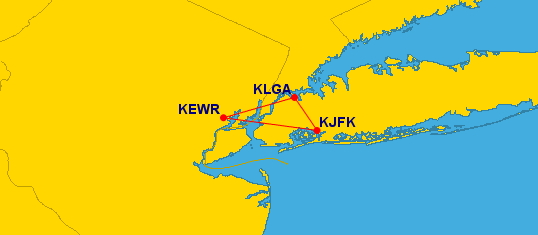
Planespotting in the New York area provides enthusiasts a unique opportunity to see planes from almost all corners of the earth. Within approximately a 20-mile radius, there are three major airports (New York [JFK], New York LaGuardia [LGA], and Newark Liberty [EWR]) that can provide endless hours of spotting.
major airports in the NEW York Area
The iconic John F. Kennedy International Airport (JFK) is one of the most well-known and diverse airports on earth, serving over 90 different airlines from around the globe. So, I decided to pack up my gear and go spotting for the day. I flew JetBlue (nonstop) from Austin-Bergstrom (AUS) to JFK (1,500 miles—3½ hours) and arrived just before lunchtime.
Upon arriving at Terminal 5, I spent a little time in the terminal before moving on to my main event for the day. Terminal 5, though mainly dedicated to JetBlue, also serves regional carrier Cape Air. One nice (free) T5 attraction is the Wooftop (located across from gate 28) outdoor dog park. This area has a place for dogs to run around and tables for you to enjoy food or a beverage. This location has limited spotting views, but you can still see some action while enjoying some fresh air.
The T5 Rooftop & Wooftop Lounge is a great place for JFK planespotting | IMAGE: JetBlue
TWA Hotel is a Can’t-Miss Part of Your Visit to JFK
After checking out the T5 “Wooftop,” I left the terminal and headed to my main attraction, the TWA Hotel and, more notably, the TWA Rooftop Pool area. I had seen photos from this location and knew I wanted to spend my day here. Before I departed Austin, I checked to see if they were offering day passes to the rooftop, and to my excitement, they were!
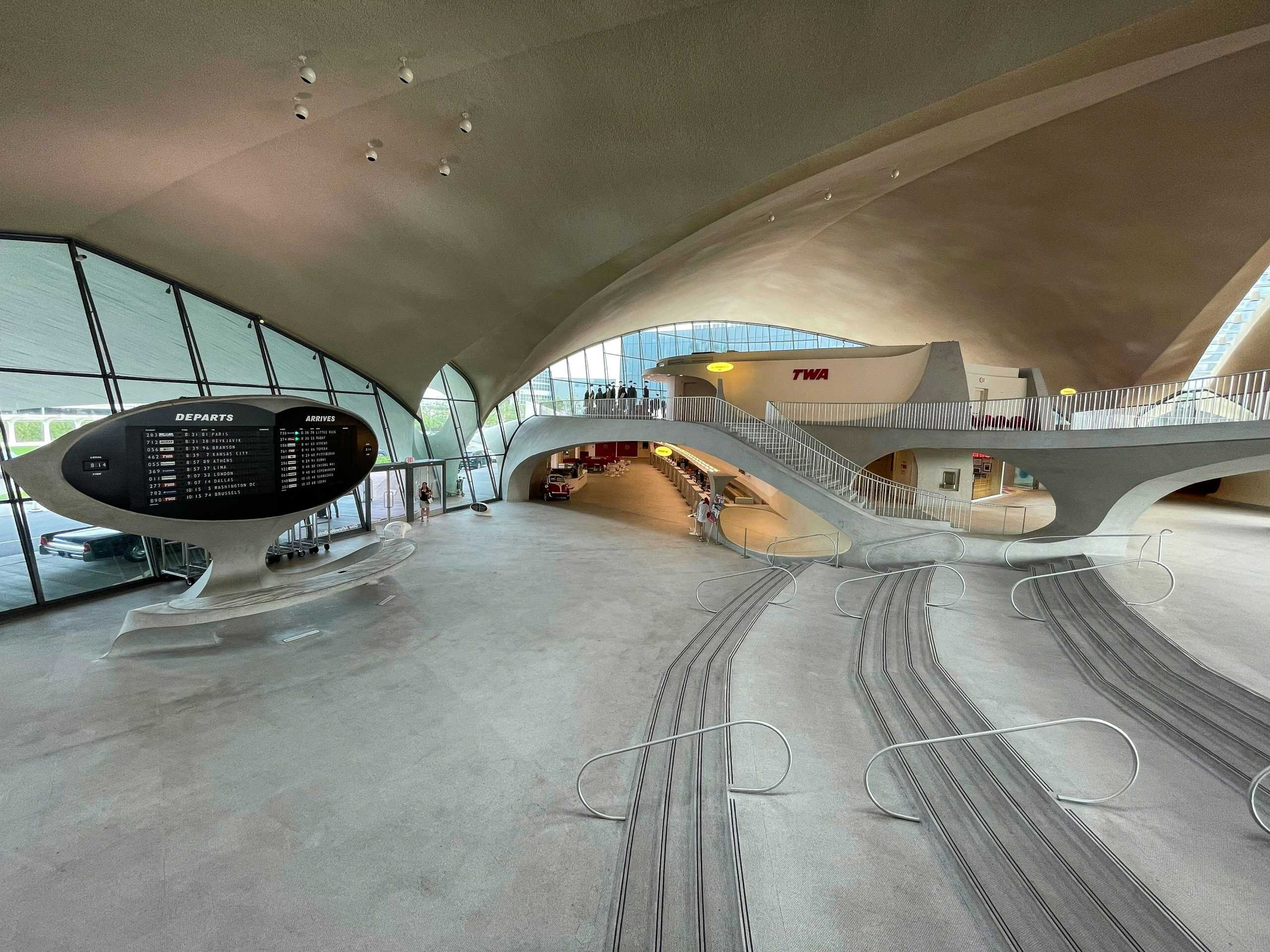
Another convenient aspect is that the TWA Hotel is located just outside T5, so I took a quick 10-minute walk and I was there. Upon arriving at the TWA Hotel, I walked around the lobby, taking in the sights while being transformed back to the 1960s.
Replica of Howard Hughes’ desk
Other Great JFK Planespotting Locations
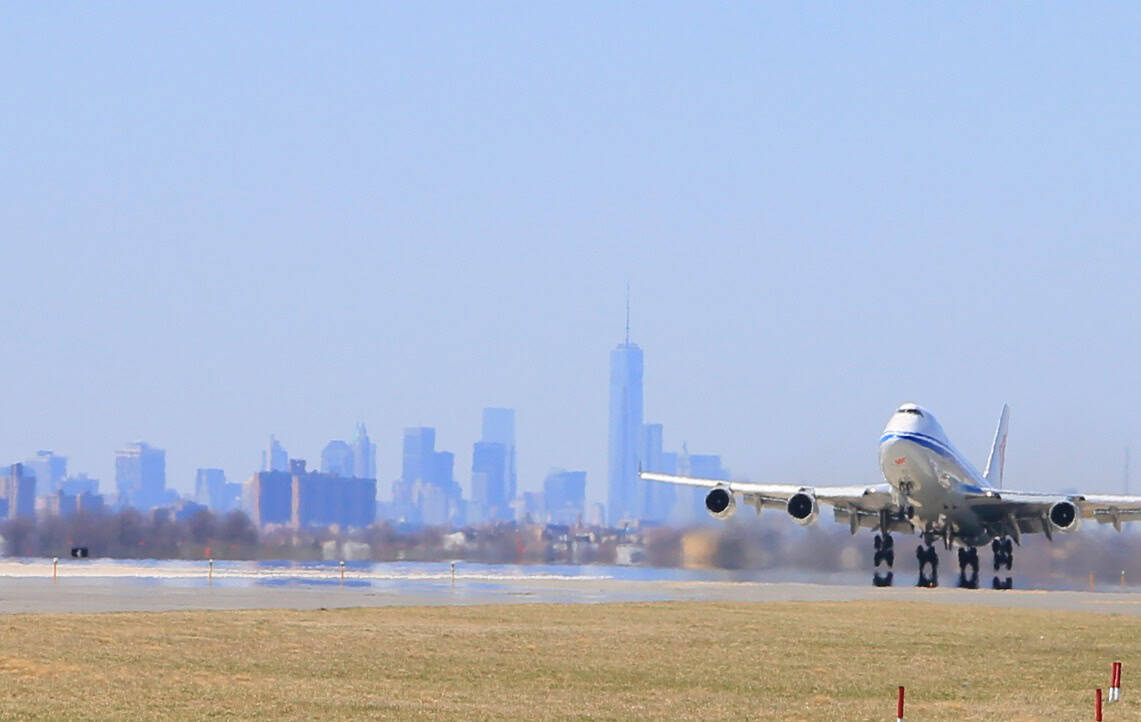
A Boeing 747 departs from John F. Kennedy International Airport (JFK) | IMAGE: JFK Airport via Facebook
After walking around the lobby and hotel area, I headed to the TWA Hotel Gift Shop and purchased a few small items (TWA socks and pencils) to remind me of the trip.
I then proceeded to the elevator that took me up to the pool area, where a friendly employee was there to escort me to the bar area and charge me the $12.95 entrance fee. However, be advised that everything I read mentioned that the pool entrance charge varies by time and season, so be sure to check before heading there. Even hotel guests can be required to pay a fee for a reservation to the pool, but for me, it was worth every penny to have 3+ hours of access to the roof before I needed to start thinking about my return trip home.
The rooftop infinity pool is heated (95ºF) for those who want to go swimming, but I just wanted to enjoy The Pool Bar and airplanes.
There are many recommended spotting locations around JFK, but I chose to spend my entire time on the rooftop and am glad I did. From the rooftop, you will have great views of taxiing, landing, and departing aircraft.
Since JFK has four runways, there is a chance that traffic is flowing in a non-optimal direction, but on the day I was there, I was fortunate and able to see both active runways (31R/31L). During my short time there, I saw 115 planes from 18 different countries. Between my time spotting, I had time to enjoy the selection of snacks and drinks from the rooftop bar (see menu). The Pool Bar offers aviation-themed cocktails with names like Jet Fuel, 4 Left, 22 Right, and Terminal 5, and food choices such as hummus, flatbread pizzas, sandwiches, salads, and more. While I was there, no one was swimming, but others were spotting, eating lunch, and chatting.
JFP planespotting view from the TWA Hotel POOL DECK
You can see planes parked or moving around the airport from the rooftop deck.
Kuwait Airlines 777-369ER (9K-AOL) – JFK planespotting from TWA Hotel Pool Deck
AirTrain Gets You There Quickly…Just Be Sure to Take the Right One!
A welcome sign at the entrance to John F. Kennedy International Airport (JFK) | IMAGE: JFK Airport via Facebook
After my time at the TWA Hotel, I had to hustle to Terminal 8 for my American Airlines flight back to Austin. The terminals at JFK are mostly separate, except for some bus connectors for specific airline arrangements, such as American Airlines and JetBlue. So, I got a chance to take the AirTrain.
The AirTrain is free for travel between terminals at JFK. But be careful not to get on a train to Jamaica or Howard Beach, since there is a charge for this, which takes you away from the airport. The train got me to Terminal 8 quickly, where I was able to breeze through security, grab dinner, and catch my flight back home.
Overall, this was the perfect avgeek day trip, and I recommend JFK planespotting to anyone who likes spotting or photographing airplanes.
The composition of America’s flight attendant corps began to change after World War II. While many airlines (most notably Eastern and Pan American) had relied on men to serve in the cabins of aircraft, the majority of carriers instead began to hire young women to work aboard their airliners.
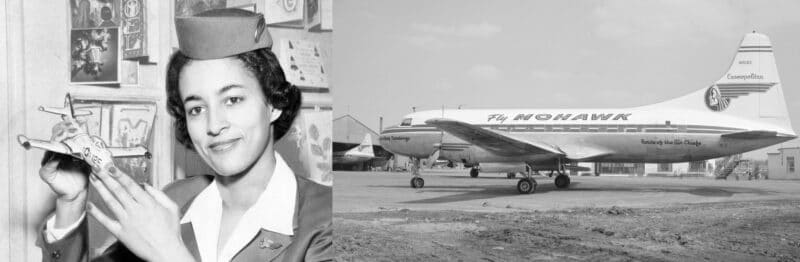
Ruth Carol Taylor, posing for a magazine photo with a model of an Air Force jet.
Psychologically, it was a stroke of brilliance. In the 1950s, most people had yet to fly, and many were still afraid to. The airline industry’s largest customer base was men traveling for business. By hiring women to work aboard their aircraft, airlines were indirectly challenging the masculinity of the businessmen who still refused to fly. Airline companies were subliminally suggesting that these guys were afraid to travel by air while petite young ladies took to the skies every day of the week.
The women who worked aboard America’s airliners had to be single and young (they were forced to quit when they reached age 32) – and, for lack of a better term, Caucasian. It was a racist, sexist, and ageist employment system that would be challenged and finally dismantled, piece by piece.
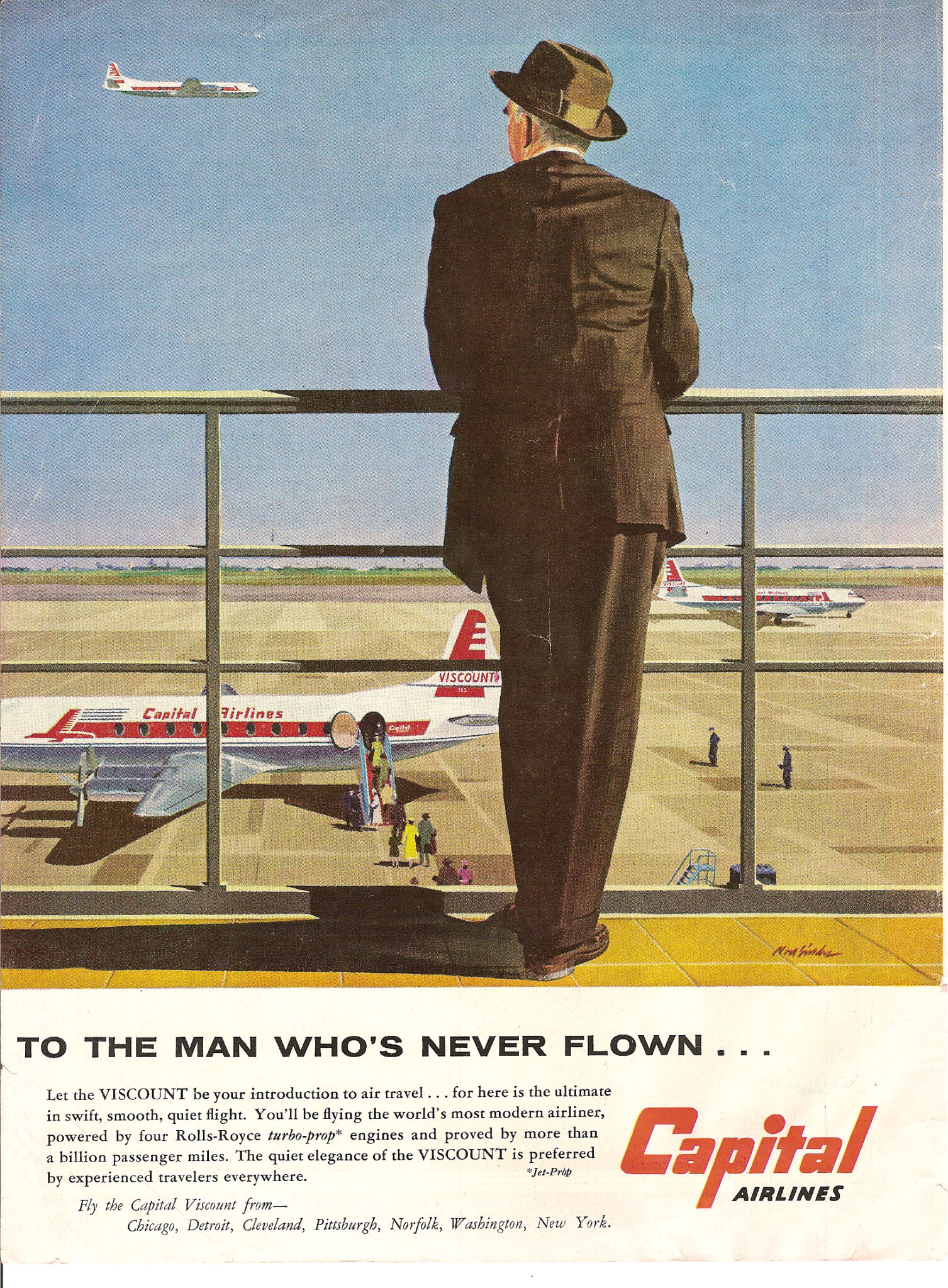
Capital Airlines, one of the trunk air carriers, used this ad to appeal “to the man who’s never flown”.
Bob Peach and Mohawk Airlines
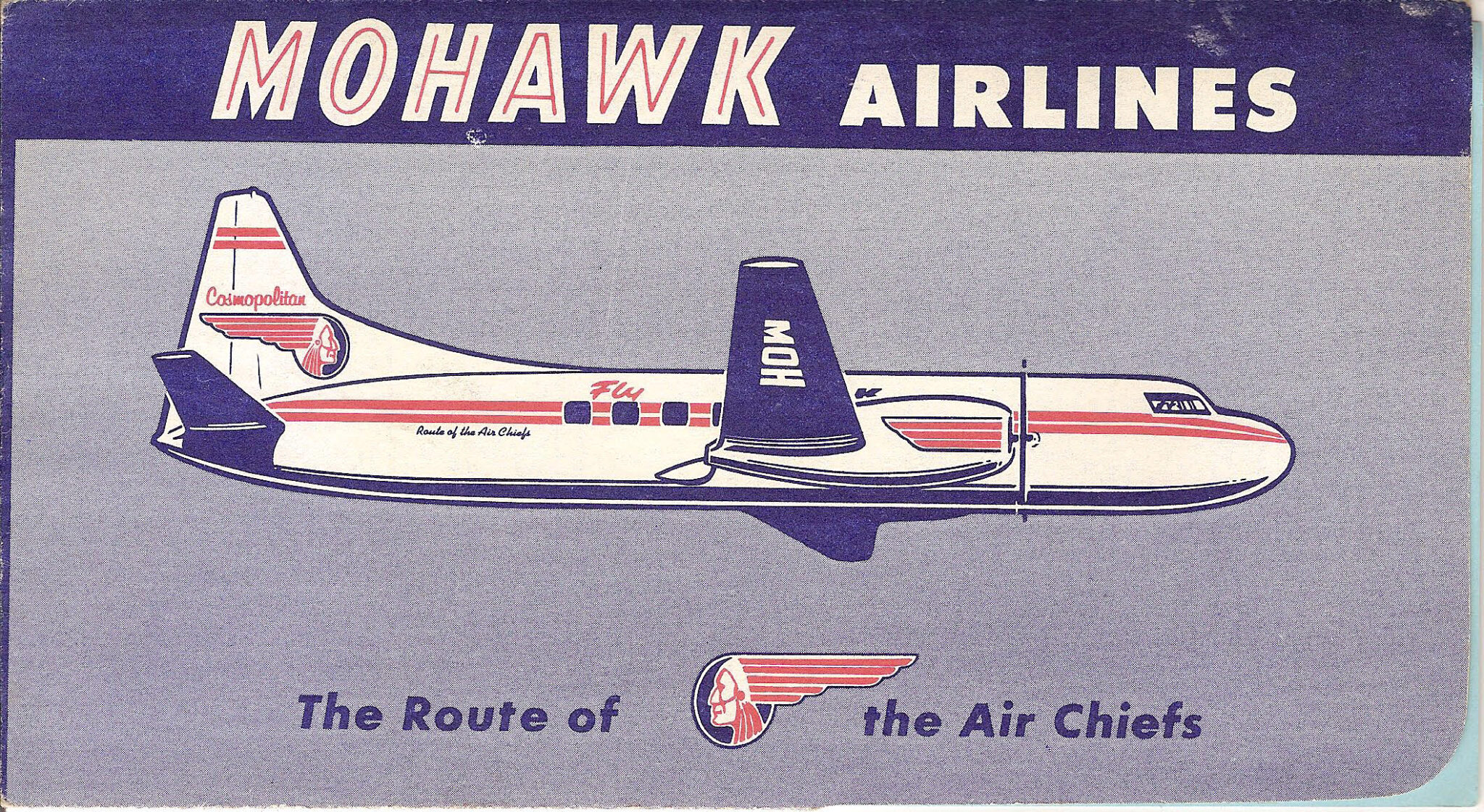
The two major classifications of domestic air carriers certificated by America’s Civil Aeronautics Board (CAB) in the postwar era were trunks and locals. The trunks were the big airlines that connected major cities (American, Continental, Delta, United, etc.), while the locals connected big city airports with smaller cities. Mohawk Airlines, headquartered in Utica, New York, was one of those local service carriers.
Robert (Bob) Peach was Mohawk’s president, and he had a flair for generating positive press coverage for his airline. Mohawk had chalked up several ‘firsts’: it was the first local airline to dispatch pressurized equipment (Convair 240s); the first local to be awarded a route in direct competition with a trunk carrier (Syracuse – New York City); and the first to start retiring its unpressurized Douglas DC-3s, the standard aircraft used by the local service carriers. In 1954, Mohawk had inaugurated an innovative non-stop scheduled helicopter service between Newark Airport and the Jennie Grossinger Resort in New York State’s Catskill Mountain tourist area. The helicopter service was not profitable and lasted only one summer, but it gave Mohawk good publicity.
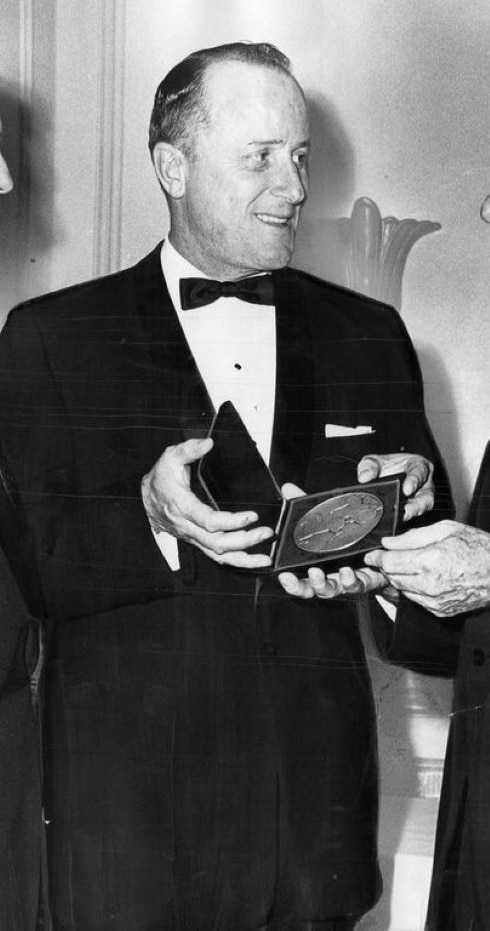
ROBERT (BOB) Peach, President of Mohawk Airlines
Breaking the Color Barrier
Bob Peach obviously took pleasure in running an innovative airline. But perhaps his biggest news-making coup was one with very human repercussions: he broke the color barrier in hiring practices when Mohawk became the first airline in the United States to employ an African-American flight attendant.
Ruth Carol Taylor was a registered nurse who lived in Manhattan and worked for the New York Transit Authority. She wanted to be a stewardess and open the profession up to women of color, challenging the discriminatory hiring practices that were in existence at the time. In 1957, Ms. Taylor was refused employment by TWA – one of the big trunk carriers – and she filed a complaint with the New York State Commission on Discrimination.
A Mohawk Airlines Convair 240 at Newark Airport. Mel Lawrence photo via George Hamlin.
Making the Most of an Opportunity
Bob Peach saw an opportunity and actively pursued a course of action. He announced that Mohawk was seeking minority applicants for flight attendant positions. Several hundred women applied, and Ruth Carol Taylor was hired by Mohawk in December 1957.
After successfully completing training, she became the first African-American cabin attendant to crew a flight in the United States. On February 11, 1958, Ms. Taylor worked her first segment between Ithaca and Newark. Mohawk received publicity for ‘opening the door’ and the trunk carriers soon followed suit. TWA hired Margaret Grant to become that company’s first African-American flight attendant in 1958.
Ruth Carol Taylor’s tenure with Mohawk was short-lived, as many flight attendant careers were back then. It ended when she married later in the year and, thus, was forced to resign. The requirement that flight attendants remain single during the duration of their employment was yet another discriminatory policy that would be eradicated years later.
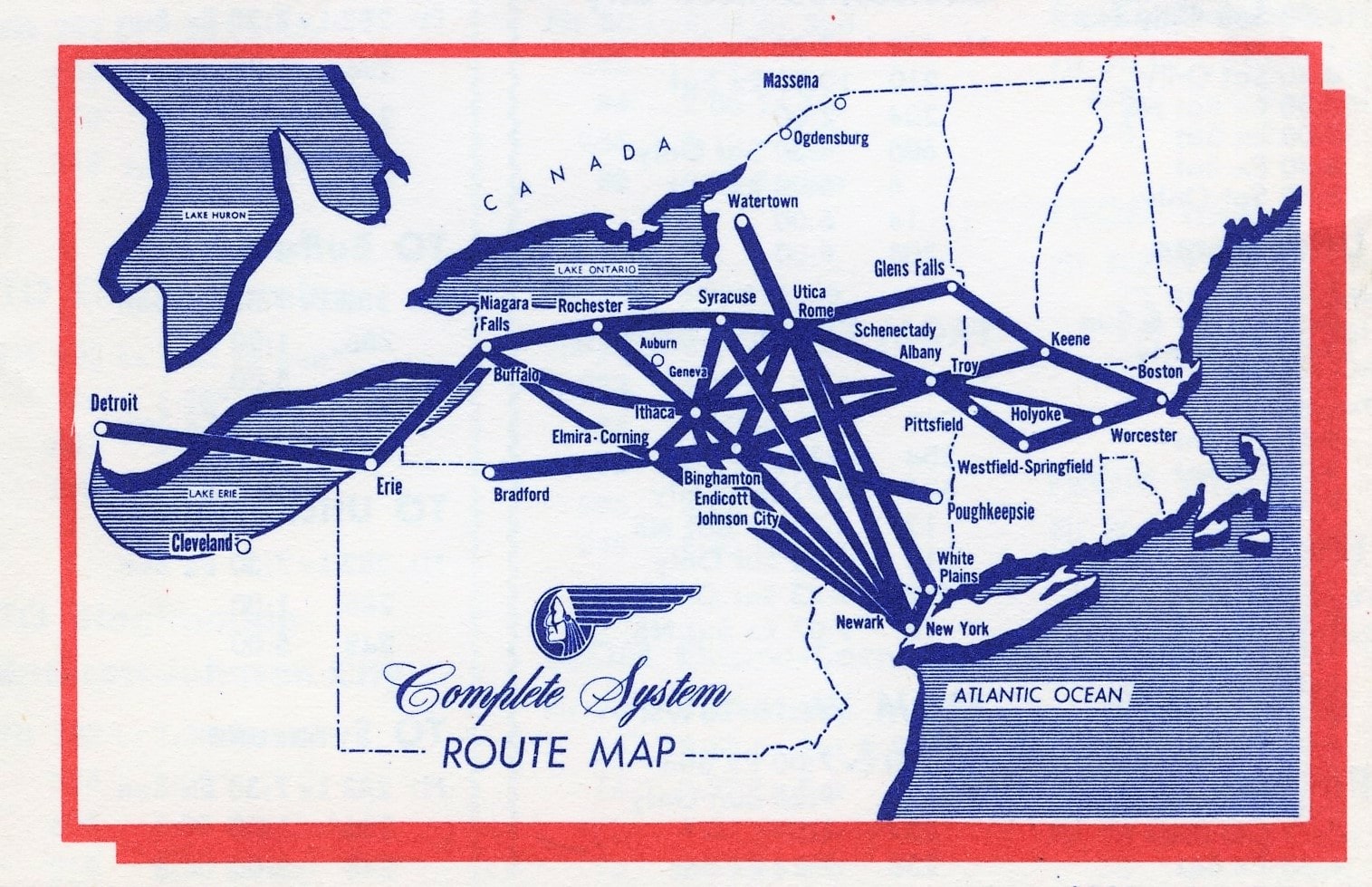
Mohawk’s route system at the time that Ruth Carol Taylor worked for the airline.
The Times They Kept on Changing
In the 1960s, the U.S. government’s Equal Employment Opportunity Commission (EEOC) overturned airline flight attendant hiring practices by ruling that women could not be terminated when they turned 32, simply because of their age. The EEOC also decided that women could not be fired for getting married or for having a child. And, if a man could perform the same cabin duties as his female counterparts, he could not be discriminated against on the basis of gender.
The airlines could point the finger of blame at the EEOC when sexist customers complained of the new practices that put men and older women in aircraft cabins as flight attendants – a term that was coming into greater use in order to encompass both stewards and stewardesses. But, in actuality, airline management teams breathed a sigh of relief. Wide-body aircraft were being purchased by trunk carriers and the locals were acquiring jets. Many more flight attendants would be required to staff these larger aircraft types, and now the airlines had an excuse for keeping women in their careers longer and for hiring men: the EEOC made them do it.
She Broke the Color Barrier When She Became the First African-American Flight Attendant 54
Today’s Flight Attendants
Today, the career of flight attendant is open to applicants without regard to race, gender, marital status, sexual orientation, or age. Those fortunate enough to be hired and to complete training will find themselves traveling to places around the country and around the globe, meeting people from all walks of life and from all parts of the world. It is the greatest educational experience and, because of rulings made by a government agency years ago, men and women in their forties and fifties can now begin a late-in-life career working in the sky.
But long before the EEOC forced airlines to change their rules regarding age and gender, one airline president – Bob Peach – had opened the door for one woman – Ruth Carol Taylor – and thanks to that interaction the color barrier was demolished, never to be put in place again.
Just two weeks after Spirit Airlines board rejected JetBlue’s inital buy out offer, the airline is back with a new offer and a website to explain the airline’s shareholders should reject Frontier’s ‘inferrior’ offer.
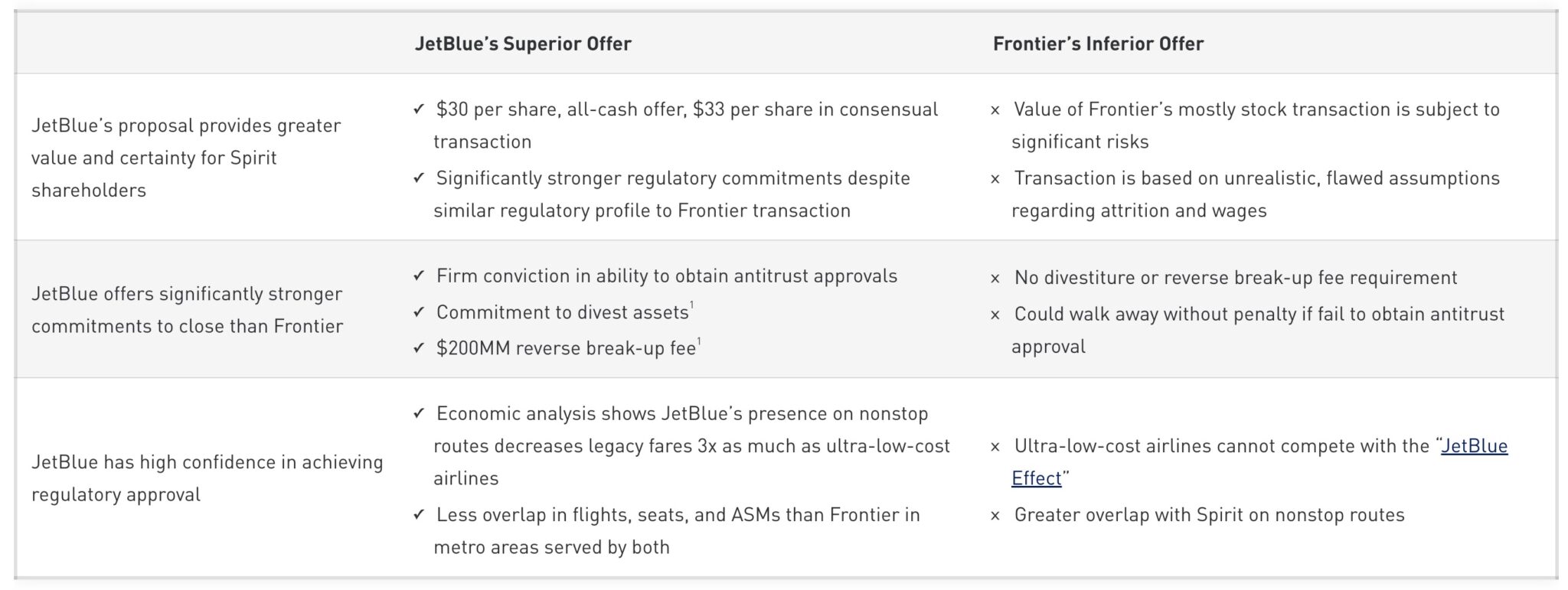
On Monday, JetBlue rolled out a revised offer that includes a $30 per share offer (with room for up to $33 a share) in an all cash transaction. Their website listed a number of reasons why the offer is superior to Frontier’s previous offer.
In a statement to Spirit’s shareholders, JetBlue’s CEO says, “JetBlue offers more value – a significant premium in cash – more certainty, and more benefits for all stakeholders. Frontier offers less value, more risk, no divestiture commitments, and no reverse break-up fee, despite more overlap on non-stop routes and their own regulatory challenges.”
“Yet the Spirit Board failed to provide us the necessary diligence information it had provided Frontier and then summarily rejected our proposal, which addressed its regulatory concerns, without asking us even a single question about it. The Spirit Board based its rejection on unsupportable claims that are easily refuted.”
“Ask yourself a simple question: why won’t the Spirit Board engage with us constructively? The interests of Bill Franke’s Indigo Partners and the long-standing relationships between the two companies is the obvious answer.”
Image: JetBLueOffersMore.com
With this offer, JetBlue is asking shareholders to vote no on the Frontier Merger offer. The full website is available here for our readers to view.
Why the merger opportunity is so important to JetBlue
JetBlue sees Spirit as one of the last major opportunities to quickly create a larger carrier. Back in 2016, the airline lost a competition to merge with Virgin America. The missed opportunity meant that other competitors like Southwest, Alaska, American and Delta all grew larger through mergers. Now with a potential tie up between Frontier and Spirit, they would be forced to compete against an ultra-low cost carrier that rivals the size of a major airline.
We’ll update this story if Spirit or Frontier Airlines post a response.
This Pilot Was as Cool as a Cucumber After His Cessna 205’s Engine Seized While Flying Cross Country
The loss of any engine in flight is a big deal. When you are flying in a small, single-engine aircraft, the loss of an engine is a nerve-wracking and critical event. Instructors teach you to keep calm, continue to fly the airplane, take critical action, set pitch for maximum glide, then analyze the situation, determine next steps then communicate the plan.
You Can’t Pick Your Time for an Inflight Emergency!
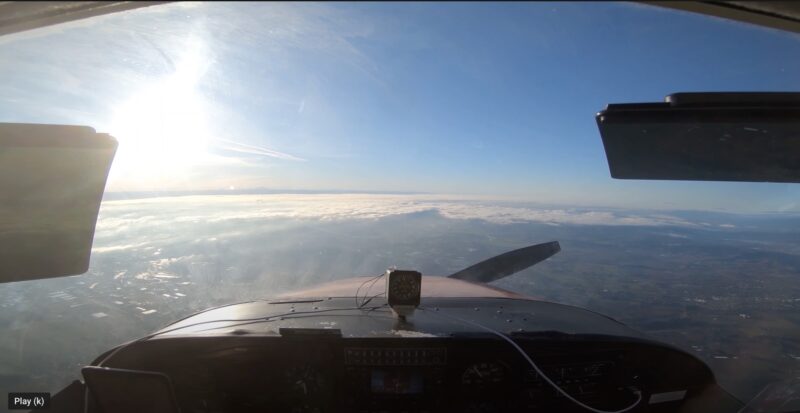
Kevin Mayes was flying from Seattle to Sacramento earlier this year when he suffered a catastrophic engine loss at 9,000 feet while enroute. In the video below, you’ll see how the combination of skill, calmness, and preparedness brought what could have been a really dangerous situation to a safe conclusion. With a bit of luck, he was flying near a nice sized airfield near Hillsboro, Oregon. Kevin guided his stricken plane to a hi-key position over an airfield, then spiraled down to a textbook power-off landing. When he landed, he saw that the engine was toast with significant internal damage below the cowling.
An even more amazing fact is that he later found out his insurance company would not pay for the damage. According to a Gofundme set up for his situation, Kevin said, “Upon calling my insurance, I learned that mechanical failures, including engine failures, are not a covered event. Had I crashed the airplane, hit something on the way down, or had any other following event, then insurance would have stepped in.”
Photo showing Damage to the stricken engine. Source: Kevin Mayes GoFundMe
An Excellent Lesson, Safely Learned and Shared
“Because of the successful outcome, I am left with a large bill to repair the aircraft and return to flying. I am sharing my story and video in hopes that other pilots can learn from the experience and see that airplanes really do glide without an engine. Unfortunately, the extensive damage caused during engine failure has left most components unusable. I am searching for a replacement/new engine that will come at substantial costs. Any help will go towards the cost lost on the core value of the engine due to the extensive damage and any support from you is greatly appreciated. “
You Can Help Kevin
You can donate to his cause by clicking on the link here. Either way, this video is a great instructional video for any pilot of how to react in an emergency.
Southwest Airlines has long been known for dependable service, low fares, and friendly service. They’ve long lacked in one passenger amenity though that has long put them at a disadvantage for business travelers. No, they aren’t adding business class service or assigned seating. They are adding one thing though that will make modern travelers rejoice. Drum roll please…
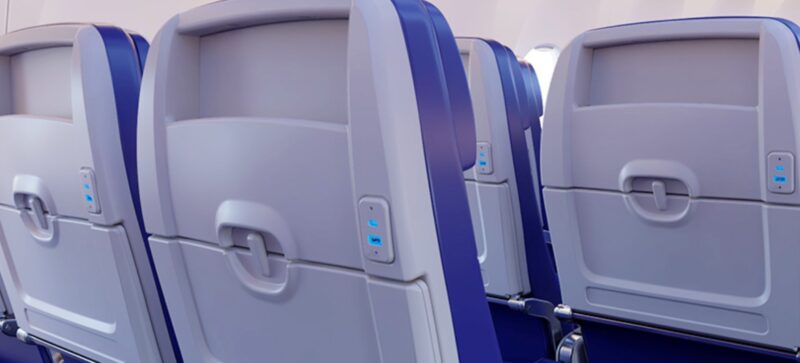
Southwest is adding in-seat power outlets to their fleet. In an announcement on Wednesday, Southwest announced that they will retrofit their fleet with in-seat power. The airline is taking a different approach than other airlines. Instead of a typical power plug, Southwest is adding both a USB power port and a USB-C power plug.
This addition will allow every passenger to have power available to them without having to compromise legroom with bulky power equipment underneath the seat. The airline will begin rolling out this enhancement in 2023. In a statement, the airline said the change will take time as they retrofit the fleet.
This change makes a lot of sense. Southwest used to be known for short point to point flights. Over the past 20 years though, Southwest has added coast-to-coast service with flights that rival the other major carriers. The airline already offered movies, live TV, and shows as long as you bring your own device. With longer stage lengths like Las Vegas to Hawaii, that means that all but the most capable phone and laptop would likely die inflight. This addresses a major shortcoming in their service offering.
Image by Tomás Del Coro via Wikipedia
Southwest Airlines also announced a number of other service enhancements to include retrofitting overhead bins to accommodate additional carry-on luggage, faster wifi service, more movies and TV shows on their entertainment page, an upgraded inflight tracker, and additional beverage options (Rose, anyone?). The movies, TV and beverage options will rollout this summer. Other upgrades will rollout over time.
Two other minor but appreciated updates include the ability to upgrade your boarding number via the app and website and the ability to add a lap child via the website. The full announcement is here. We also posted a video from their Vice President of Marketing explaining the changes.
This past week the skies around Savannah, GA have roared to the sound of freedom, as the Air National Guard’s premier counter aerial combat training exercise ‘Sentry Savannah’ got underway. For 2 weeks Air Force fighter pilots and their crews are putting their skills & knowledge into action, integrating tactics and training together in air to air combat, offensive / defensive counter air missions, cruise missile defense and dropping weapons on the range.
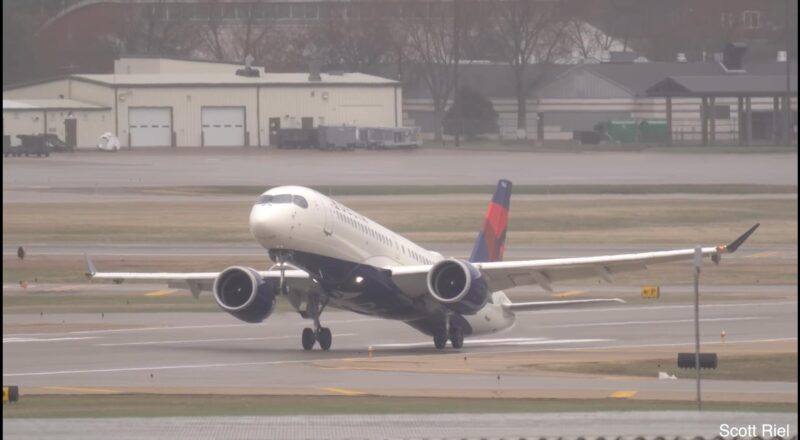
Being a pilot is probably the best job in the world. That is until you have a direct crosswind at max limits in dog poop weather. This crew looks like they faced one of those days. This Airbus A220 balked landing looked like it was a rough one.
We’ve posted a few rough landings before by pilots who faced some rough conditions of their own. Who could forget the Silkways 747 landing in a European storm or the Emirates A380 that made a very sharp correction back to centerline after a landing in very gusty conditions a few years back?
This latest video was posted by KMSPVideos on Youtube. He filmed it on April 24, 2022. His site has a great collection of videos, primarily from Minneapolis/St. Paul International Airport (MSP). MSP has some great spotting locations. The airport is both a Delta and Sun Country Airlines hub and has significant international traffic. Back in the day, it was also a Northwest Airlines hub too (Be sure to check out KMSPVideos other work too including some great classic Northwest DC-9 footage).
You can always go around
In the video below, you can see the A220 make a fairly normal approach in gusty conditions. At about 20 feet, the jet suddenly nosed forward pretty aggressively potentially a reaction to a sudden shear. At this point it appears that the crew initiated a go-around but the jet touched down firmly with spoilers now deployed and in a low energy state.
While traveling on the ground before lifting back off, it appears that the A220 almost had a tail strike as the crew attempted to rotate. Simultaneously the jet veered pretty close to the left side of the runway (it might be a visual illusion, we’ll let you be the judge how close it was the edge).
The second landing was much less eventful fortunately. Two nuggets of knowledge here: 1.) Any pilot can have a bad day. Conditions were challenging to be sure. It’s about learning lessons from others to help make your next flight safer. 2.) As a pilot you always have to be ready for a go around. Even a stable approach can become unstable in the blink of an eye, particularly in gusty crosswind conditions. They did the right thing by going around. It reminded us of this famous pilot song…
Do you fly the A220? Any thoughts to add? We’d love to hear your perspective. Share it in the comments below.
The Airline is Pulling Out All the Inflight Broadband Stops
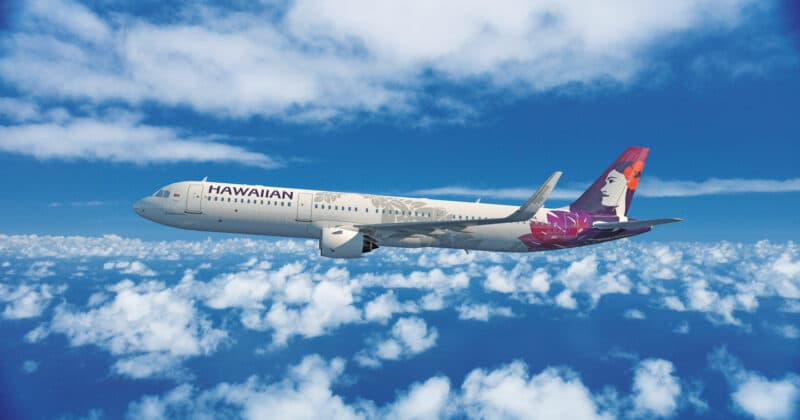
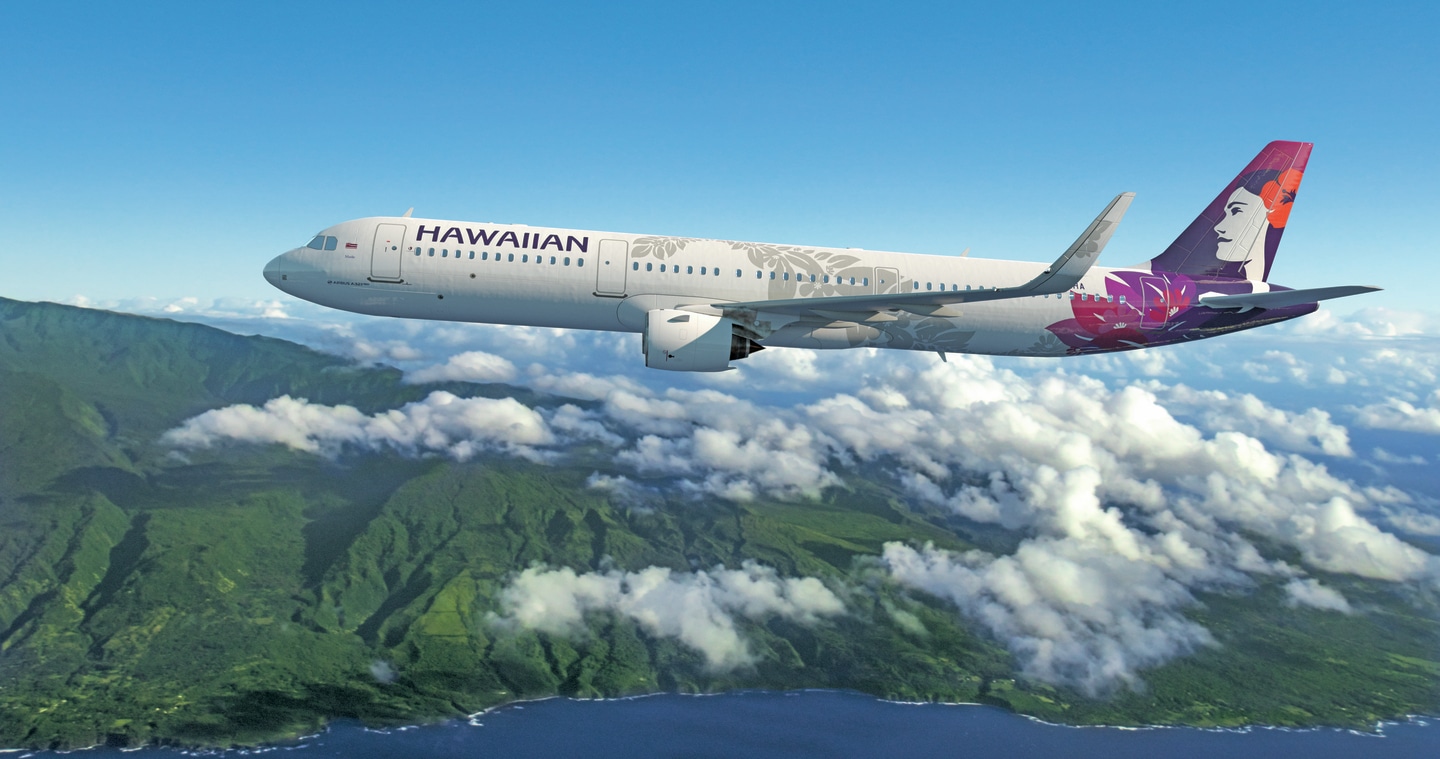
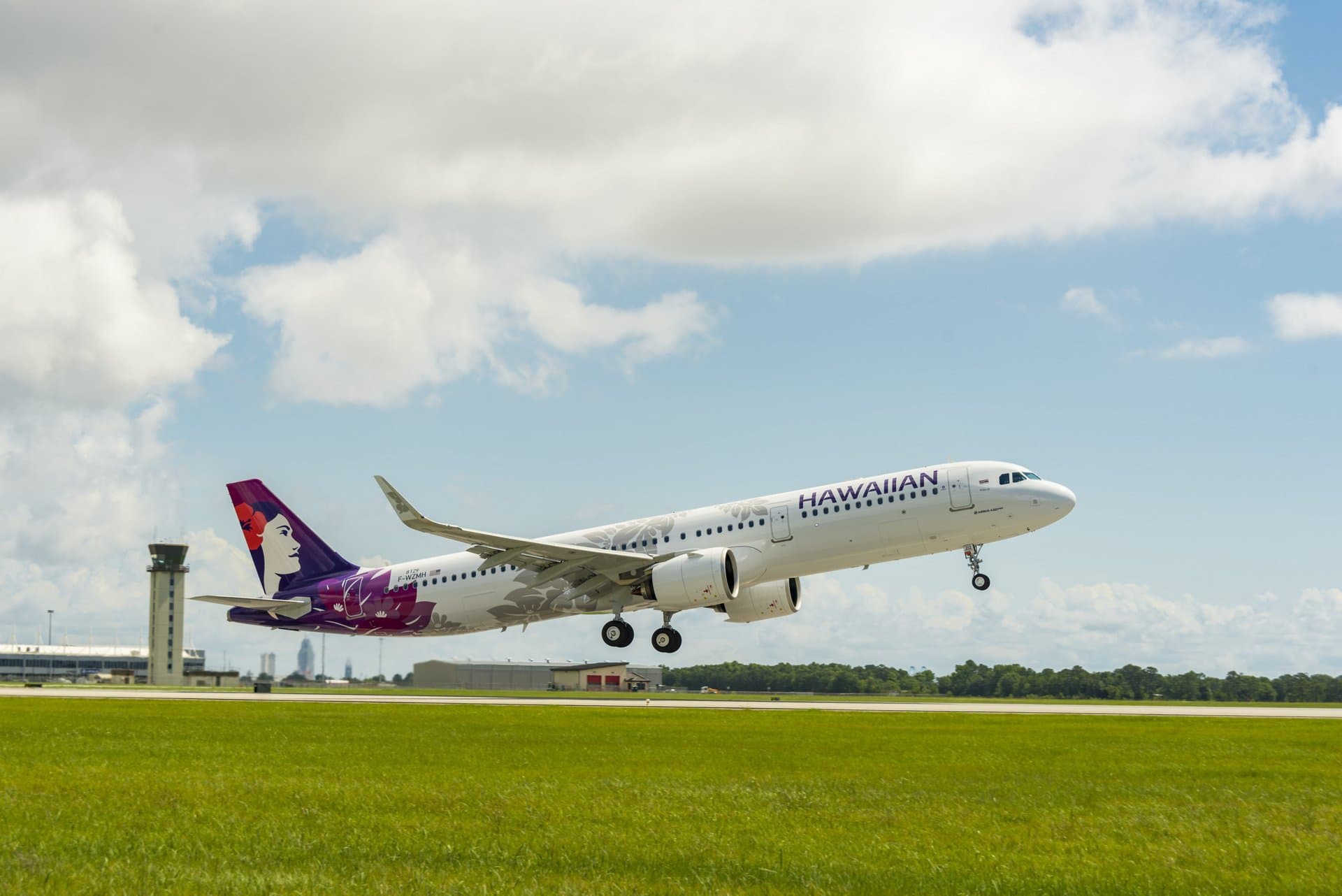
Hawaiian Airlines is set to become the first major airline to provide free high-speed SpaceX Starlink internet service to passengers on their fleet of Airbus A330, A321neo, and incoming Boeing 787-9s. The jets fly routes between the Islands and the continental United States, Asia, and Oceania. The service won’t be available on their Boeing 717s, which operate short flights between the Islands.
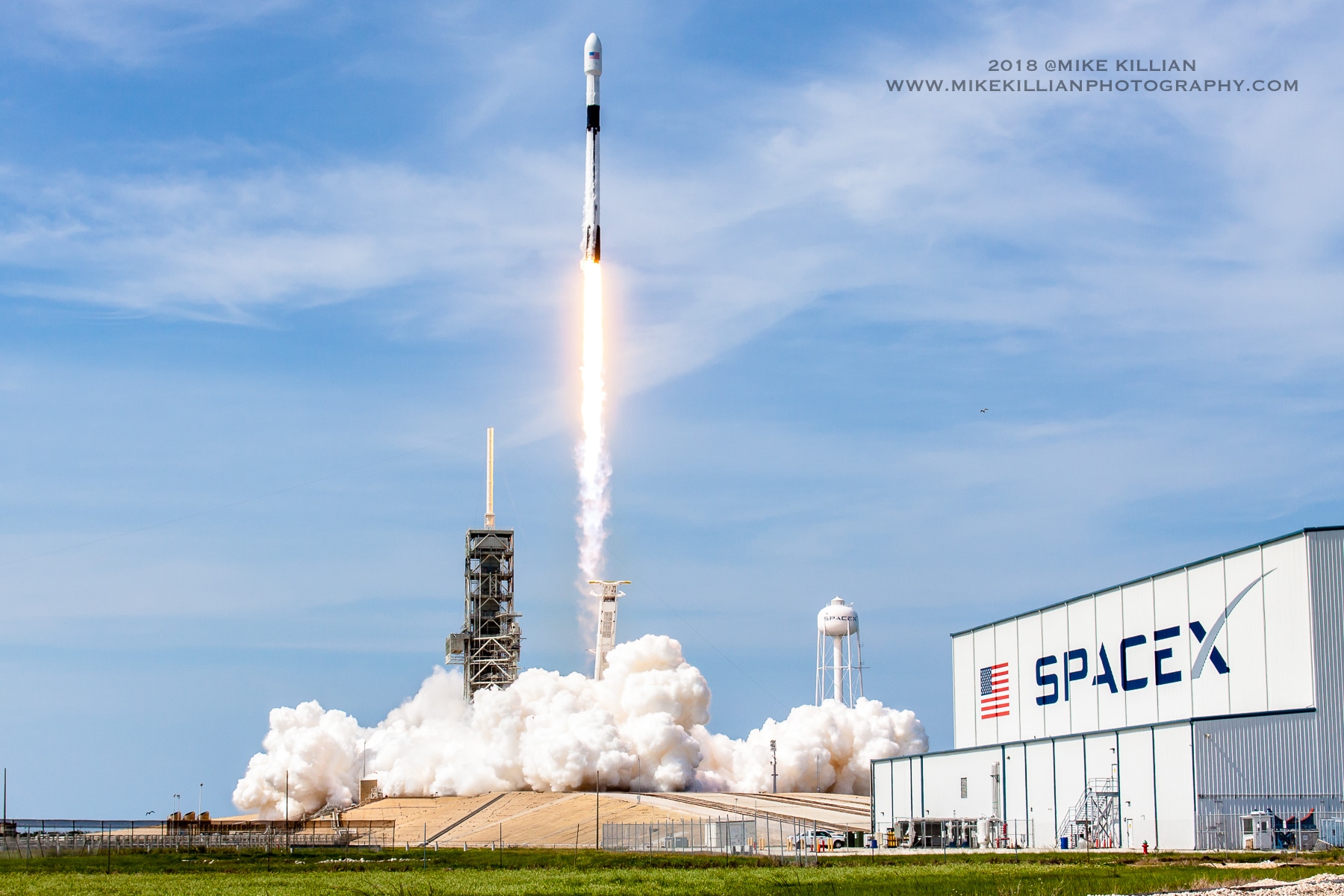
Spacex launching satellites on their re-usable falcon 9 rocket (credit: mike killian)
“When we launch with Starlink we will have the best connectivity experience available in the air,” said Hawaiian Airlines President and CEO Peter Ingram. “We waited until technology caught up with our high standards for guest experience, but it will be worth the wait. Our guests can look forward to fast, seamless and free Wi-Fi to complement our award-winning onboard Hawaiian hospitality.”
SpaceX began launching their Starlink satellites into low-Earth orbit back in 2019 to provide global high-speed, low-latency broadband internet, especially to rural and remote areas where connectivity is unreliable or completely non-existent.
image via hawaiian airlines
Thus far, SpaceX has launched over 2,000 of the satellites, out of a planned constellation of up to 12,000, and they are currently awaiting approval from an international regulator to launch up to 30,000 more.
Starlink made headlines recently when Elon Musk and SpaceX sent Starlink terminals to Ukraine following Russia’s invasion, responding to a public cry for help from Mykhailo Fedorov, Ukraine’s vice prime minister and the country’s minister of digital transformation, as military operations caused significant disruptions across the country.
@elonmusk, while you try to colonize Mars — Russia try to occupy Ukraine! While your rockets successfully land from space — Russian rockets attack Ukrainian civil people! We ask you to provide Ukraine with Starlink stations and to address sane Russians to stand.
And it didn’t take long for the service to be up and running, providing internet independent of local infrastructure across the war-torn nation. By April 6, SpaceX had sent over 5,000 ground terminals to Ukraine, preventing Russia from cutting off the country’s communications. Starlink even resisted all hacking and jamming attempts by Russia, thereby earning high praise from the Pentagon for how well the service has performed in the electronic warfare domain.
“The way that Starlink was able to upgrade when a threat showed up, we need to be able to have that ability,” said Dave Tremper, Director of Electronic Warfare at the Office of the Secretary of Defense. “We have to be able to change our electromagnetic posture, to be able to change very dynamically what we’re trying to do without losing capability along the way.”
“Hawaiian Airlines is ensuring its passengers will experience high-speed internet the way we expect it in the 21st century, making hassles like downloading movies before takeoff a relic of the past,” said SpaceX Vice President of Starlink Commercial Sales Jonathan Hofeller.
image via airbus
“With Starlink, the inflight experience is greatly simplified so that once passengers step onboard the plane the internet works seamlessly throughout their flight. Soon, passengers will enjoy all the benefits of having the world’s best in-flight internet connectivity from the comfort of their seats.”
credit: Hawaiian Airlines
The airline claims, “Guests will be able to stream content, play games live with friends on the ground, work and collaborate in real-time, plan their Hawai‘i vacation, or share their special island moments on social media. Connecting to the internet will be seamless when guests walk on board, without registration pages or payment portals.”
Hawaiian will begin installing Starlinks on select aircraft next year.
Alaska Airlines posted a very interesting post on their blog yesterday. They announced that on May 4th (the ‘official’ May the 4th be with you day) any travelers wearing Star Wars gear can board their flight early. According to the post, “When a guest wears any clothing item Star Wars-related, they’ll be able to board their flight just after Group B (which could stand for, say, Boba Fett).”
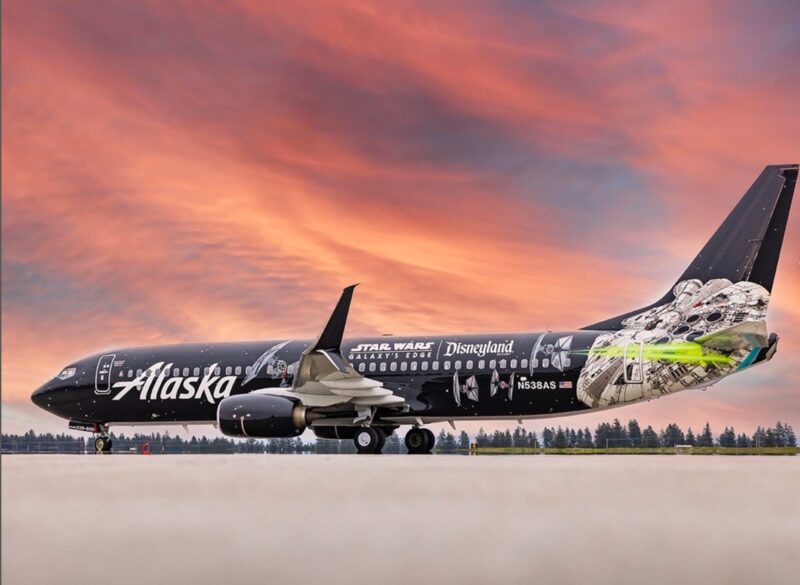
Alaska unveiled a special themed Star Wars jet today. The jet, tail number N538AS, will have a special Star Wars themed livery. It is expected to fly its first flight from San Francisco to Santa Ana.
The aircraft is part of Alaska Airlines tie up with Disneyland. Alaska Airlines said, “For this latest collaboration – Alaska’s seventh painted plane for the Disneyland Resort – no Jedi mind tricks were needed: the force was strong for a Star Wars livery to finally enter Alaska’s fleet. The aircraft’s official name is “Star Wars Transport to the Disneyland Resort” with a tail number of N538AS. After the big reveal and celebration at the gate in the Seattle-Tacoma International Airport, the plane made its inaugural flight today and ultimate arrival at John Wayne Airport in Orange County.”
Not the First Star Wars Themed Aircraft
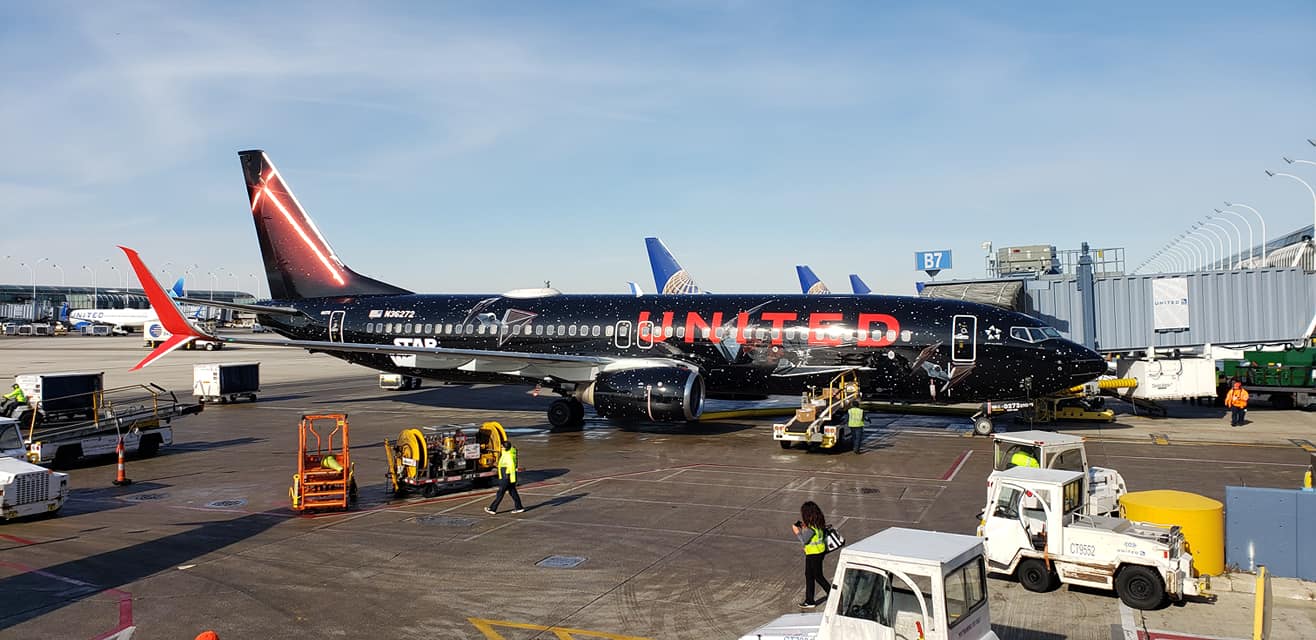
United’s Star Wars Plane, a Boeing 737-800. Photo:José Wolfman Guillén
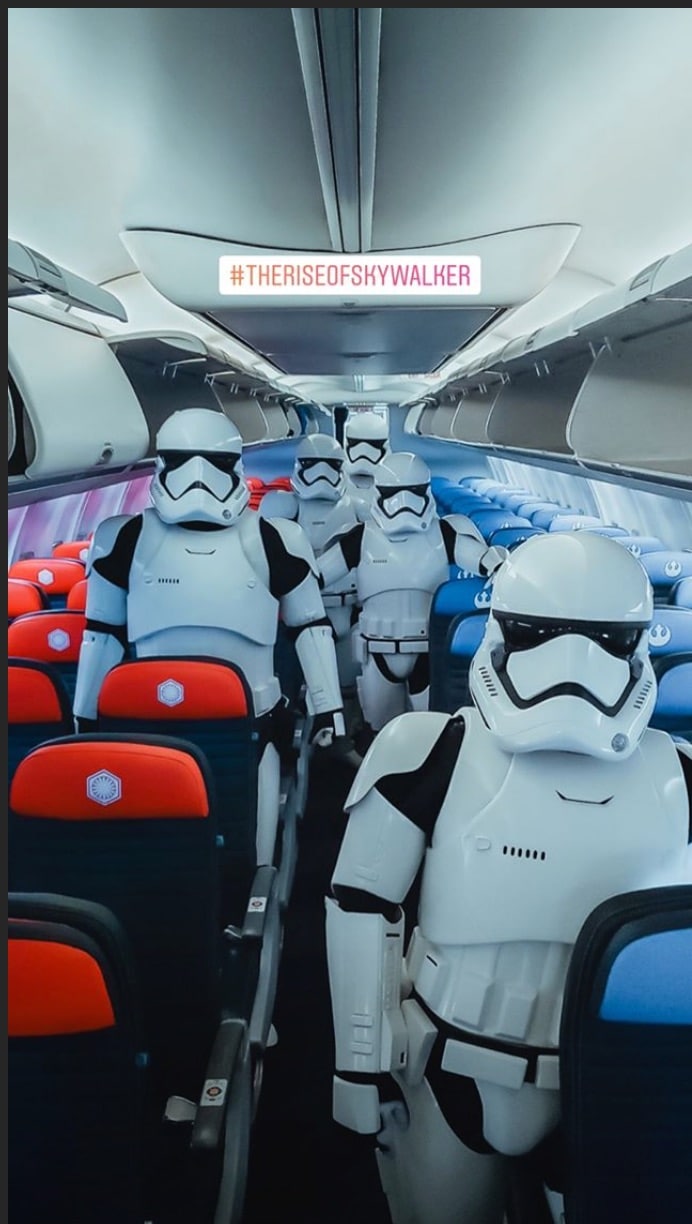
This is actually the 4th (hehe) Star Wars themed aircraft livery. ANA had two back in 2017. Then in 2019, United Airlines unveiled a special 737-800 adorned in black. That jet even included a special theme inside for passengers to enjoy. The United jet was recently repainted to the regular United colors, presumably paving the way for the latest Alaska Airlines special livery.
The interior of United’s Star Wars Plane. Source: United’s Instagram story
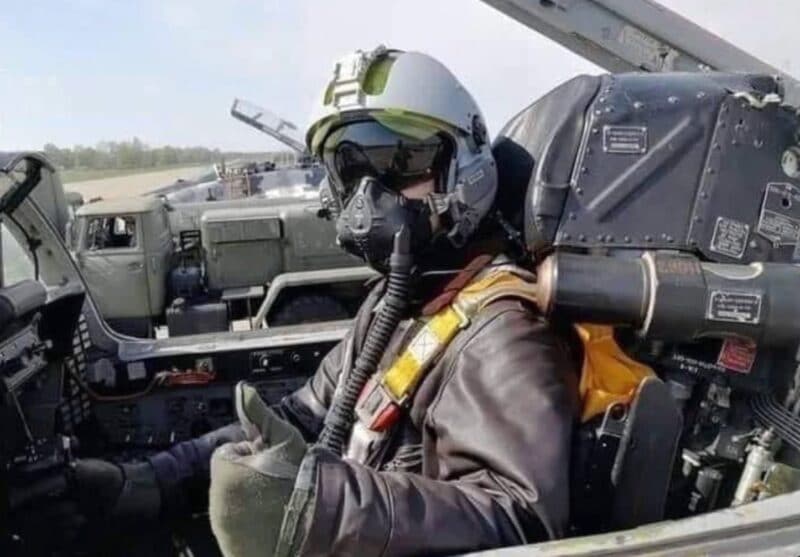
At the beginning of Ukraine’s conflict with Russia, a pretty amazing story emerged that was picked up by multiple news outlets. The story goes that a lone heroic Ukrainian fighter pilot shot down six Russian Air Force jets by himself on the first day of the conflict. Outnumbered and outgunned, he boosted the morale of Ukrainian forces and became a media sensation.
The story was amplified by social media as the lore of a heroic and rogue pilot grew. Some even posted that the pilot shot down a total of 40 aircraft before finally being shot down himself. Now in a Facebook post on Ukraine’s official Facebook page, they admit that the ‘Ghost of Kyiv’ was never real.
The news comes after major news outlets questioned whether the story was true. Some outlets suggested that Major Stepan Tarabalka was the real ‘Ghost of Kyiv’ and recently killed in battle. In the post below though, Ukraine’s Air Force attempts to set the record straight both the story is a legend and that no single pilot shot down 40 aircraft, let alone the original story that a pilot shot down 6 in one day.
A translation of the post on Facebook states, the “Ghost of Kiev is a superhero-legend whose character was created by Ukrainians! This is a faster collected image of pilots of the 40th Air Force tactical aviation brigade, who protect the sky of the capital. What suddenly appear where they are not expected!”
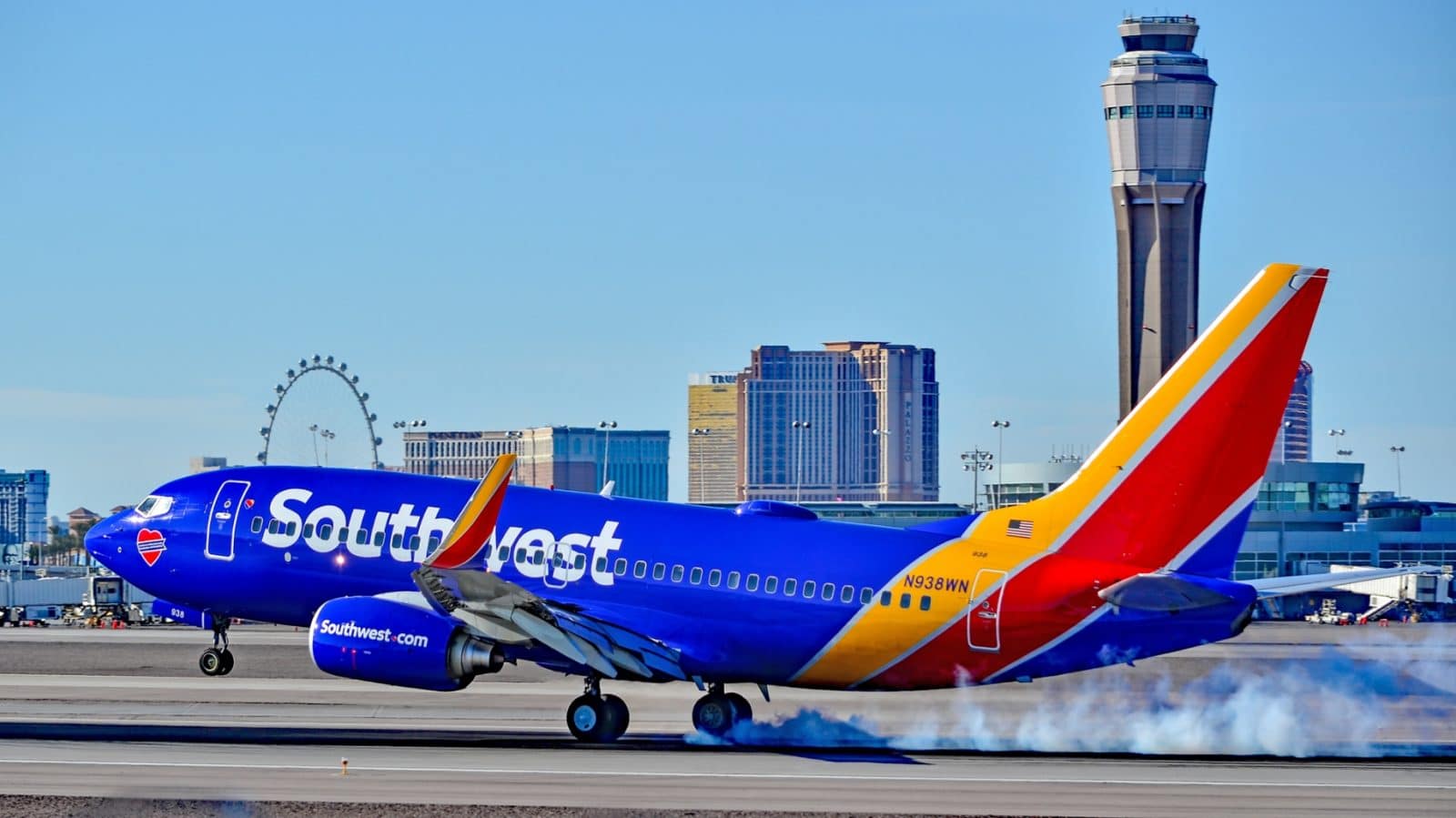
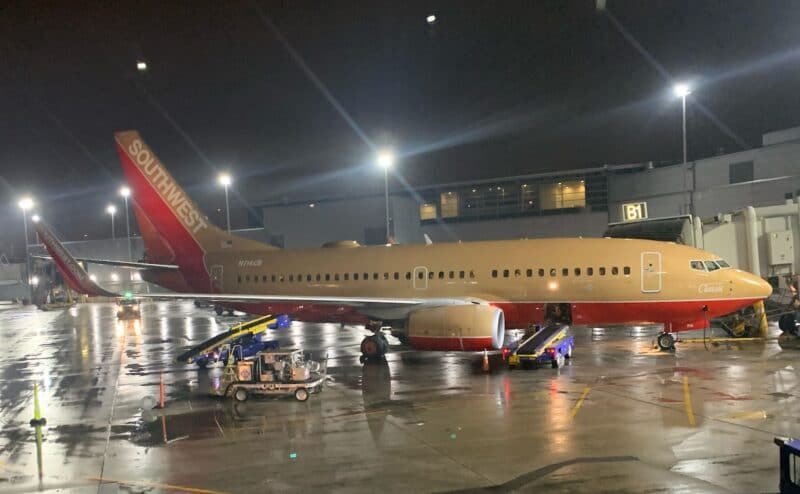
These are the final days to see the ‘classic’ Southwest Airlines colors on a Boeing 737-700. Southwest plans to retire the final Boeing 737-700 in the ‘classic’ paint scheme later this month. When Southwest first started, they were known for their mustard yellow paint scheme. These jets plied the skies offering a unique paint scheme, quick turns, and low fares. At one time, founder Herb Kelleher once even referred to them as his “red bellied warriors.”
In 2001, Southwest introduced a new paint scheme known as Canyon Blue. The purple-ish colored jets still had a red belly. At the time, Southwest said they would maintain three jets in classic colors to honor founding members of the airline. The jets maintained the classic scheme albeit with a gold finish instead of the typical mustard yellow.
Over time, Southwest painted N792SW (as seen above) in their latest “heart” paint scheme that was introduced in 2016. Southwest then retired the plane dedicated to Herb Kelleher (N711HK) earlier this year. Now, the classic jet dedicated to Southwest co-founder and former CEO Colleen Barrett (N714CB) will be retired soon as well. Soon there will be no 737-700s in the ‘classic’ scheme.
Don’t worry, the ‘classic’ livery will soon be back
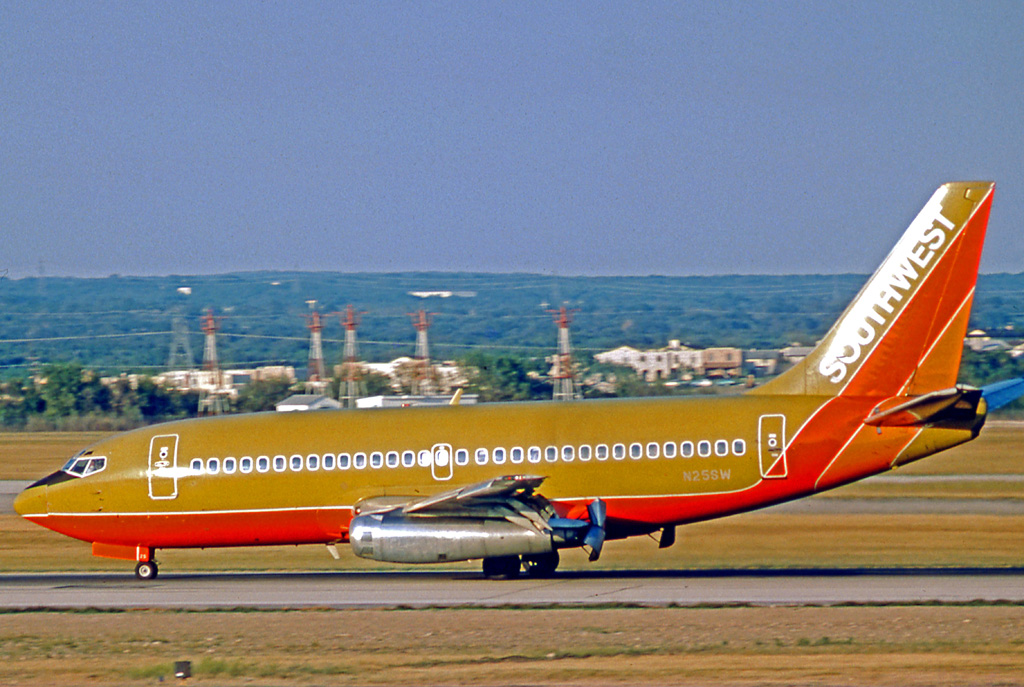
For any avgeeks who were about to cry from the news, take heart. Southwest plans to reintroduce the ‘classic’ livery later this year on a brand new Boeing 737-MAX8. The new jet will be the first special livery on a MAX jet. It will be dedicated to Southwest’s founder and former CEO Herb Kelleher. Some avgeek chatter has mentioned that the last ‘classic’ scheme lacked the white outlines on each window. Hopefully Southwest’s paint team will add back the white outline on the passenger windows to be true to the original.
A Southwest 737-200 in the mustard ‘classic’ livery with passenger windows outlined in white.(Wikipedia Photo by: RuthAS)
Colleen Barrett will also receive a new dedicated jet. Her jet will remain the only aircraft in the 2001 Canyon Blue scheme. Be sure to follow us on Facebook and Twitter. We’ll post them as soon as they are spotted.
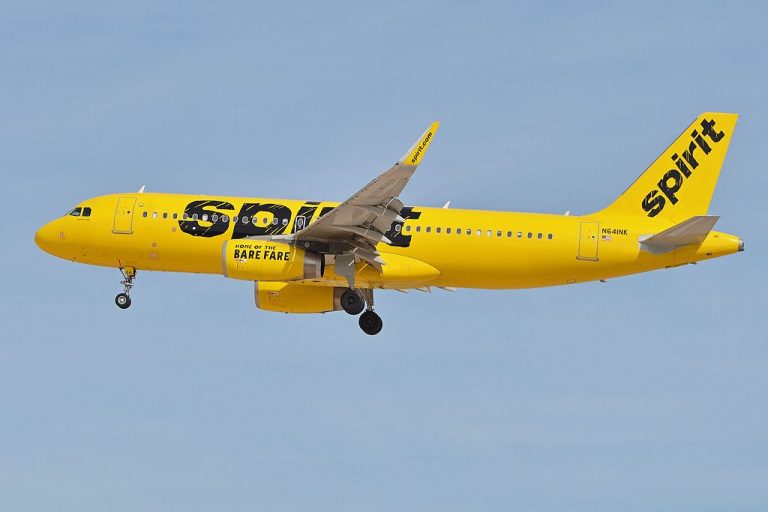
Today Spirit reiterated that they do not intend to pursue a merger with JetBlue. In a press release, the Board of Directors for Spirit announced that they still support the merger between Frontier and Spirit Airlines.
Spirit’s board said the merger with JetBlue “does not constitute a ‘Superior Proposal’ as defined in Spirit’s merger agreement with Frontier Group Holdings, Inc., parent company of Frontier Airlines, Inc., because it has determined that the proposed transaction is not reasonably capable of being consummated.
The press release added that “the Board continues to believe that the pending transaction with Frontier represents the best opportunity to maximize value and recommends that Spirit shareholders adopt the merger agreement with Frontier. Spirit’s Board of Directors also issued the following letter to JetBlue.”
How to Achieve Your Dreams of Flight Without Going Broke!
Have you ever heard this said about people pursuing a Private Pilot’s License?
“Oh, that guy? He has about 80 hours in his logbook, but no license. He only flies a few times a month, so he gets stuck learning and relearning the same maneuvers.”
“Yeah, I started flying lessons one summer. Soloed, logged a bunch of hours, but never actually got my license.”
“I’d love to learn to fly, but it seems so expensive. I have no idea where to start.”
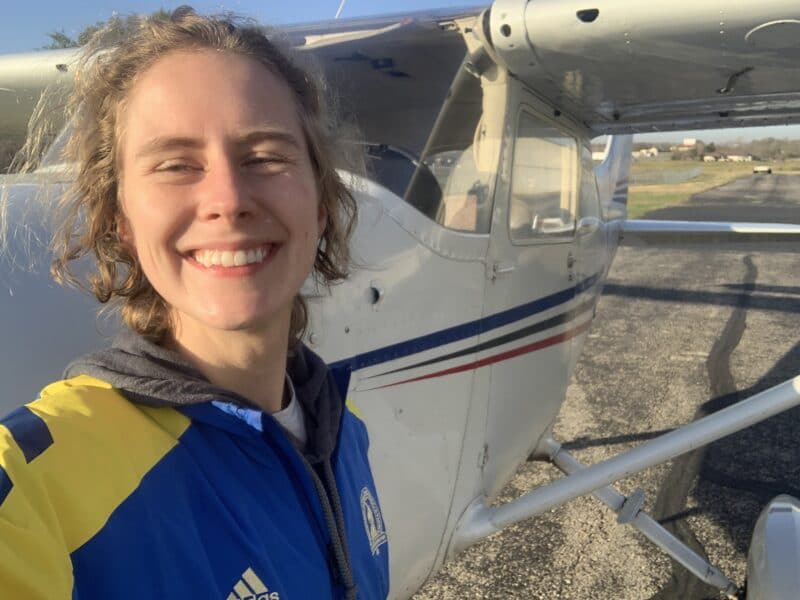
You’ve probably heard versions of these stories before. Aspiring private pilots face all kinds of headwinds en route to getting the FAA license. The time, effort, and energy required to follow through on the hours of training, studying, and preparing for the check ride are demanding. Many student pilots fizzle out in the first few weeks of training once the motivation, or the money, runs out. But if you can do it right from the start, few goals are more rewarding than taking your flying ambitions all the way to the Private Pilot’s License. Below are six “hacks” that I learned from getting my Private Pilot’s License that will help you get there.
Six Great Hacks for Crushing Your Private Pilot’s License 71
1. Block Out the Time
Learning how to fly is like learning a new language: The best way to advance quickly is by immersing yourself in it. I started flight training at the beginning of May 2020 and got my private pilot’s license by mid-August. For those three-and-a-half months, I flew 3-4 (and sometimes 4-5) days a week. The days I wasn’t flying, I’d throw myself into ground school. Often, I’d fly in the mornings and do 2-3 hours of ground school in the afternoon.
The key is blocking out a solid chunk of time where you can focus intensively on flying. If you’re only able to fly once every two weeks, you’ll spend most of each lesson refreshing and re-learning what you went over before. Flying consistently, especially at the beginning of your aviation education, is the best way to build on the skills you’re acquiring without spending time revising those skills before you move to the next one. Better efficiency in your training means better efficiency in your budget.
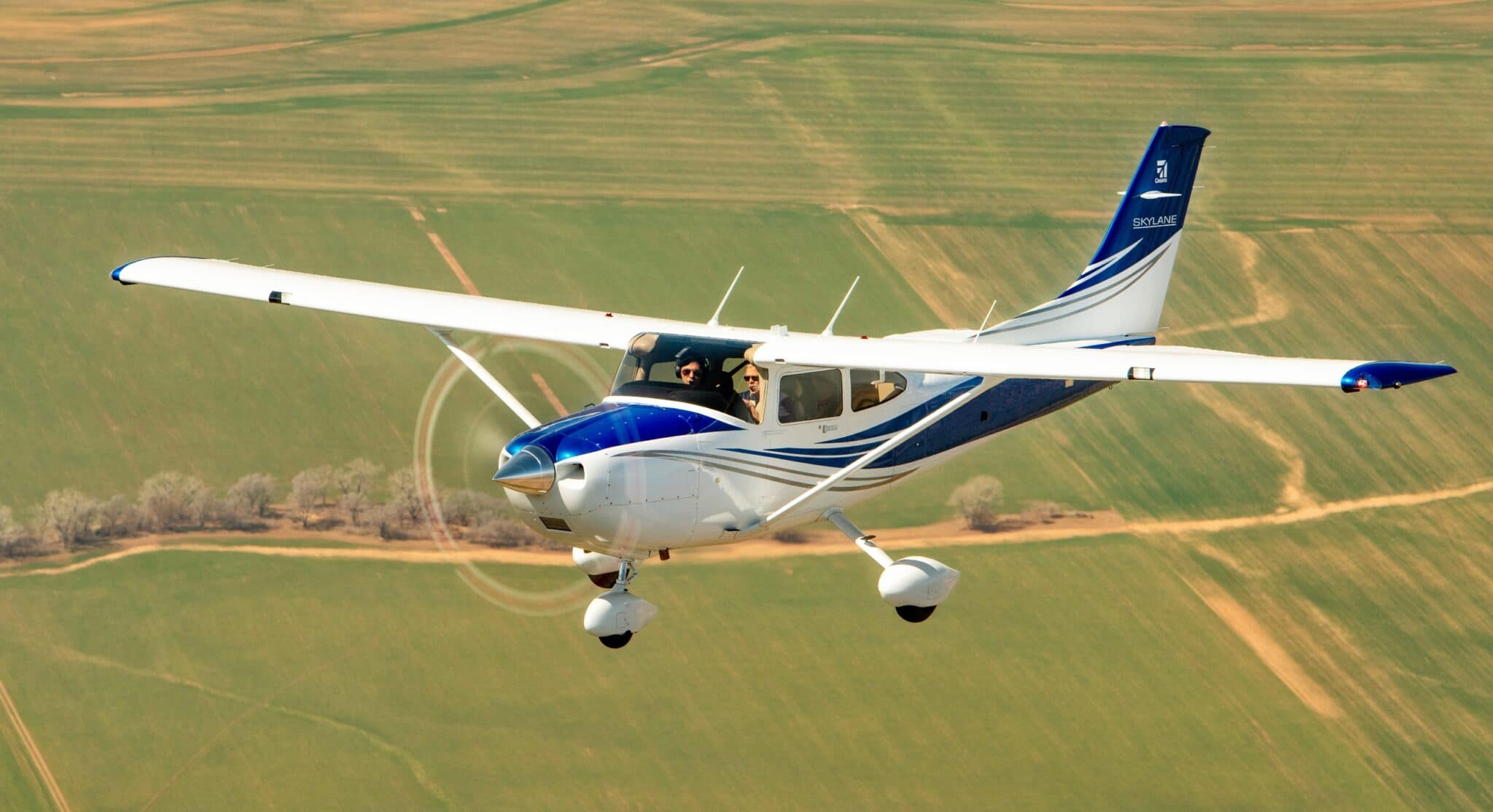
image via cessna / textron
Many pilots who fail to get this point get stuck in limbo. Similar to the first story above, they fly once a month and learn and relearn the same skills, logging time and spending money but never flying with the consistency it takes to progress through the check ride. Don’t get stuck in that trap!
Finding the chunk of time to devote to intensive training can be difficult. Here are a few practical tips:
Block out time when the weather in your local area allows for consistent flying. (Late spring to early summer, for example, was a great time to learn in Texas.)
Set a demanding but realistic deadline that will motivate you to finish.
Visualize your goal in concrete terms. For example, “I’m going to fly my wife and kids to our family beach vacation in August.” “I’m going to fly my mom to the historic airfield she’s always wanted to visit before I leave the country for grad school in four months.” You get the picture.
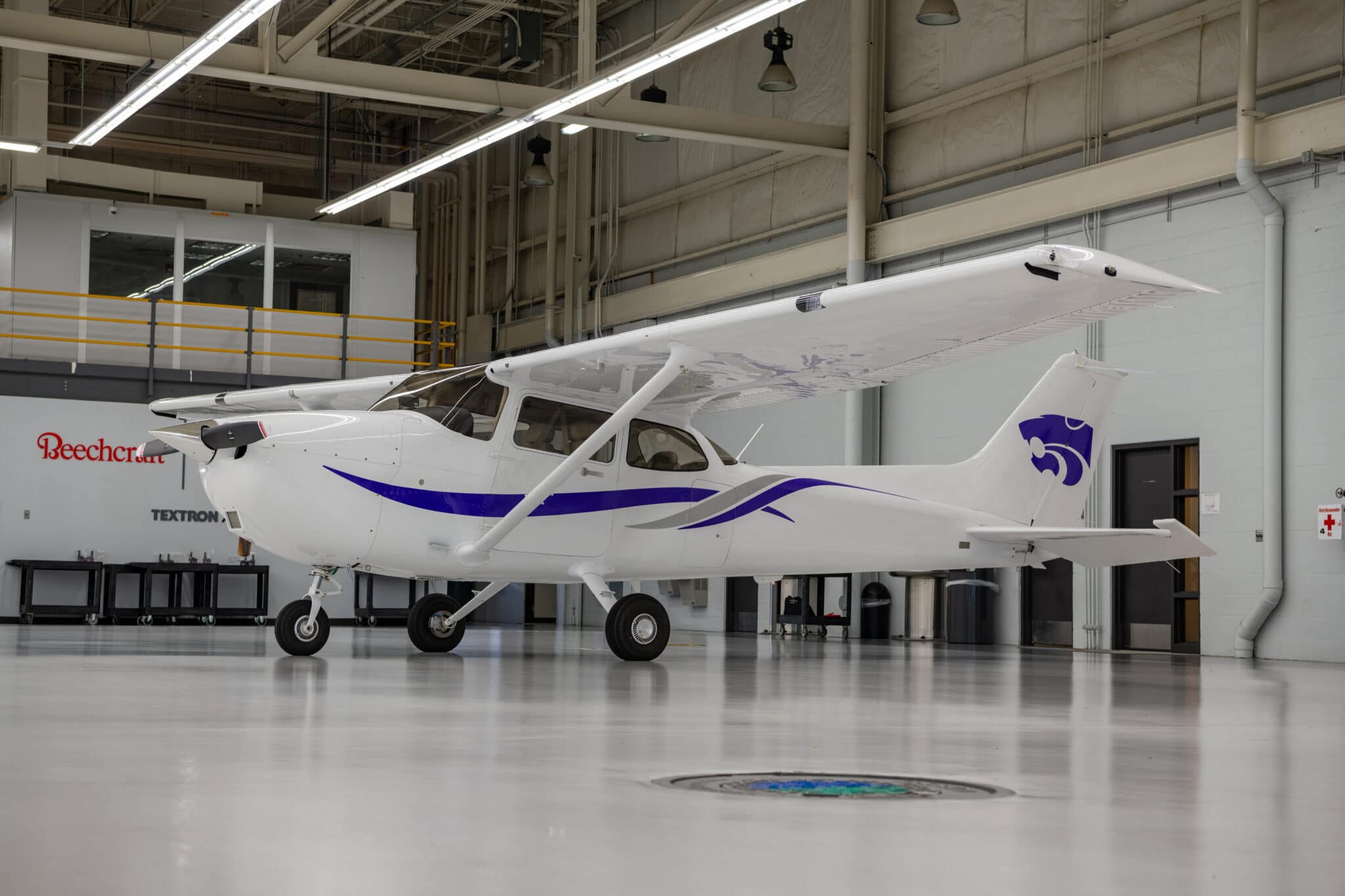
image via cessna / textron
2. Find the Right Instructorfor your Private
You’re going to spend a LOT of hours with the person who’s teaching you to fly. Make sure that you get along. At minimum, make sure you feel comfortable asking that person questions and admitting when you don’t know something. Make sure they understand your aviation goals and have the incentive to help you reach those goals as efficiently as possible. Sometimes, younger instructors who are building hours for the airlines are more likely to help you progress quickly than more experienced instructors who have less incentive to expedite your training.
While there are advantages to hiring multiple instructors—it’s always helpful to get different perspectives and may help you schedule a lot of hours in a short amount of time—you’re more likely to progress faster if you work with the same instructor, since they’ll be able to learn your habits and track your development more closely.
image via cessna / textron
My flight instructor was the highlight of my private pilot training, but it took trial-and-error to find the right match. I took my first discovery flight with a 70-year-old CFI who gave me the creeps. I switched to a retired Marine-turned-corporate-pilot, and it took my training to a different level. He had an inexhaustible bank of stories, and I still hear his voice in my head on key flight maneuvers.
More than once, that voice has been the difference between a safe flight and a bad outcome. (Landing NORDO after an electrical failure in a Class Charlie international airport, for example, I heard him say the whole time, “Pitch for airspeed, throttle for power.” It helped me keep calm and manage the situation successfully.)
image via cessna / textron
3. Make Every Lesson Count
You can’t control the weather or the ATC red tape, but you can control the quality of the time you spend in the plane and face-to-face with your instructor. Maximize that quality by showing up well prepared.
On a practical level, get the sleep, nutrition, and caffeine (“nectar of the gods,” my instructor says) that you need to be mentally sharp. On an aviation level, study on the ground what you’re covering in the air ahead of time. For example, if you’re working on steep turns, read about steep turn procedures in the FAA textbook and “chair-fly” (i.e. simulate) the maneuver the night before. By the time you get in the plane, the actual steep turn will be review, and you’ll master the skill much faster.
Another key is to keep an ongoing aviation journal. Take the time after the lesson to debrief your mistakes. Take notes and draw diagrams. Set specific goals for fixing those mistakes next time you practice the procedure. On this point, I think often of what a friend and F-35 pilot told me his squadron would do before flying sorties over the South China Sea: “Always chair-fly the mission.”
Qantas unveiled their long awaited ‘project sunrise’ solution today. Long considered the holy grail of aviation, a non-stop connection between London and Sydney seemed impossible, then economically unfeasible, then with COVID, undesirable. Qantas’ announcement today finally will make the route a reality beginning in 2025. It will save passengers hours in travel time but result in over 19 hours in the air, enabling a flight so long that passengers will see two sunrises between takeoff and landing on flights between London and Sydney.
Finding the Right Aircraft
Image: Qantas
Qantas and other airlines have sought to connect London and Sydney on a non-stop route for decades. There have been the occasional nonstop charter and demonstration flights between London and Sydney utilizing the Boeing 777 and 787. The problem though is that the distance is so great that flights were severely weight restricted, making daily travel uneconomical.
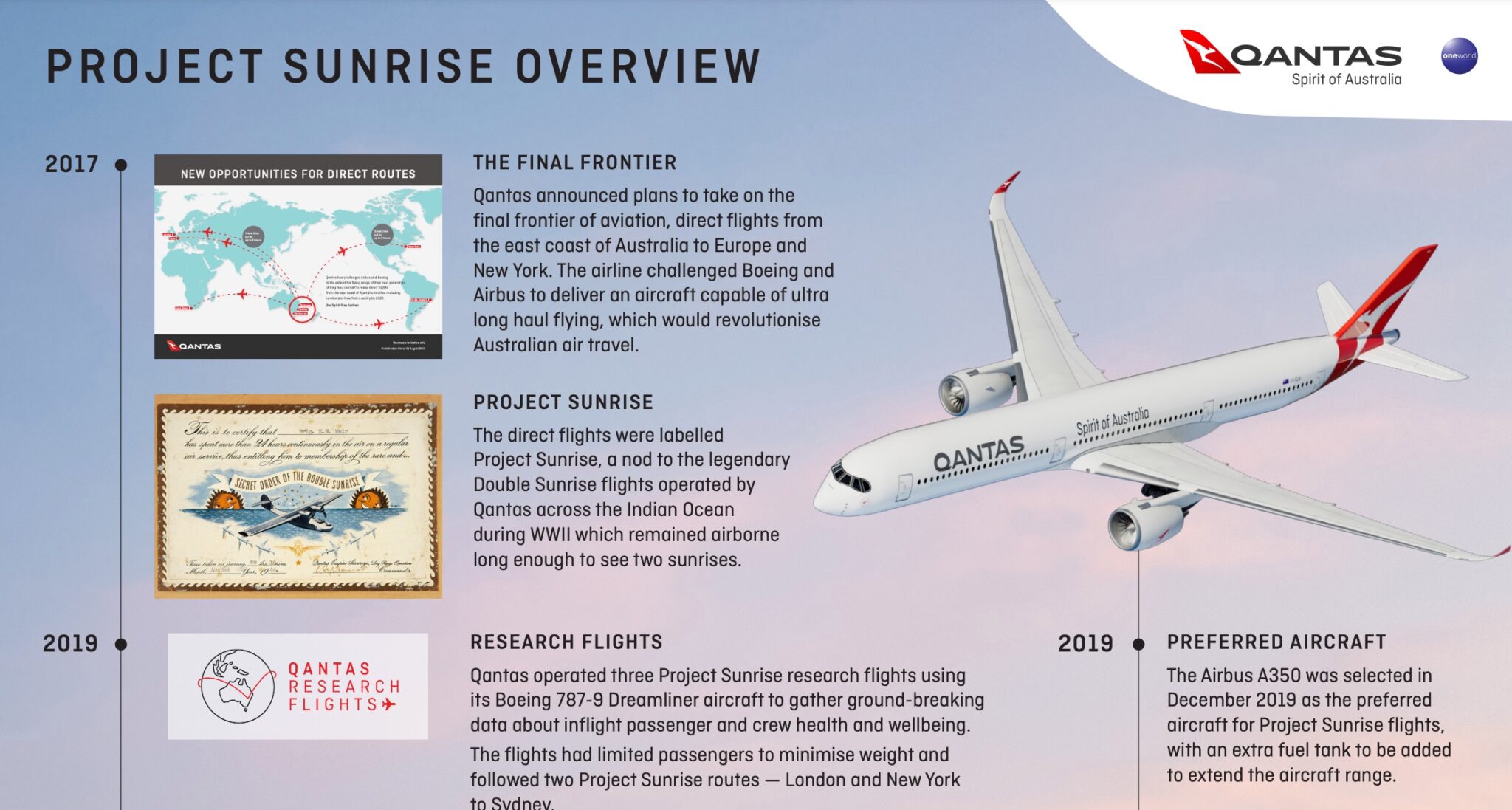
The sheer distance between cities means that passengers who want to fly today between two distant cities have lengthy layovers in places like Singapore, Hong Kong, or Perth. This means that travel typically results in well over a day of travel in each direction. Qantas initially had to identify an aircraft that could make the record setting route economical. They originally tested the route using a Boeing 787. In 2019, they announced that the A350 would be their jet of choice for the route. Today, Qantas announced an order for 12 A350-1000 jets along with an order for A321XLRs and A220-300 to grow and refresh their fleet.
Image: Qantas
Research to make the flight tolerable
At 19 hours, it would be the world’s longest scheduled route. A flight that long is nothing to sneeze at. It presents real challenges that could affect physical and mental health if they were not proactively addressed. Qantas began a series of research flights using a Boeing 787-9 to identify how to make the future route more pleasant and safe for passengers. During the flights, they flew only 40 employees on each route, utilizing surveys and post flight evaluations to find the optimal solution for dining, personal space, entertainment, and health.
How They Will Make The Flights More Pleasant
Qantas Group CEO Alan Joyce said: “New types of aircraft make new things possible. That’s what makes today’s announcement so significant for the national carrier and for a country like Australia where air travel is crucial.
“Throughout our history, the aircraft we’ve flown have defined the era we’re in. The 707 introduced the jet age, the 747 democratized travel and the A380 brought a completely new level of comfort. The A350 and Project Sunrise will make any city just one flight away from Australia. It’s the last frontier and the final fix for the tyranny of distance. As you’d expect, the cabin is being specially designed for maximum comfort in all classes for long-haul flying.”
Qantas’ A350 aircraft will be configured with just 238 passengers. That’s about 30% less than what other airlines fly on comparable jets. The jets will provide more space for passengers in all cabins of service. Premium cabins will comprise 40% of the overall cabin space. First class will introduce a new seat which is actually a private suite offering a seat that transforms into a bed, a 32″ entertainment screen, plenty of storage and a seat for visiting passengers.
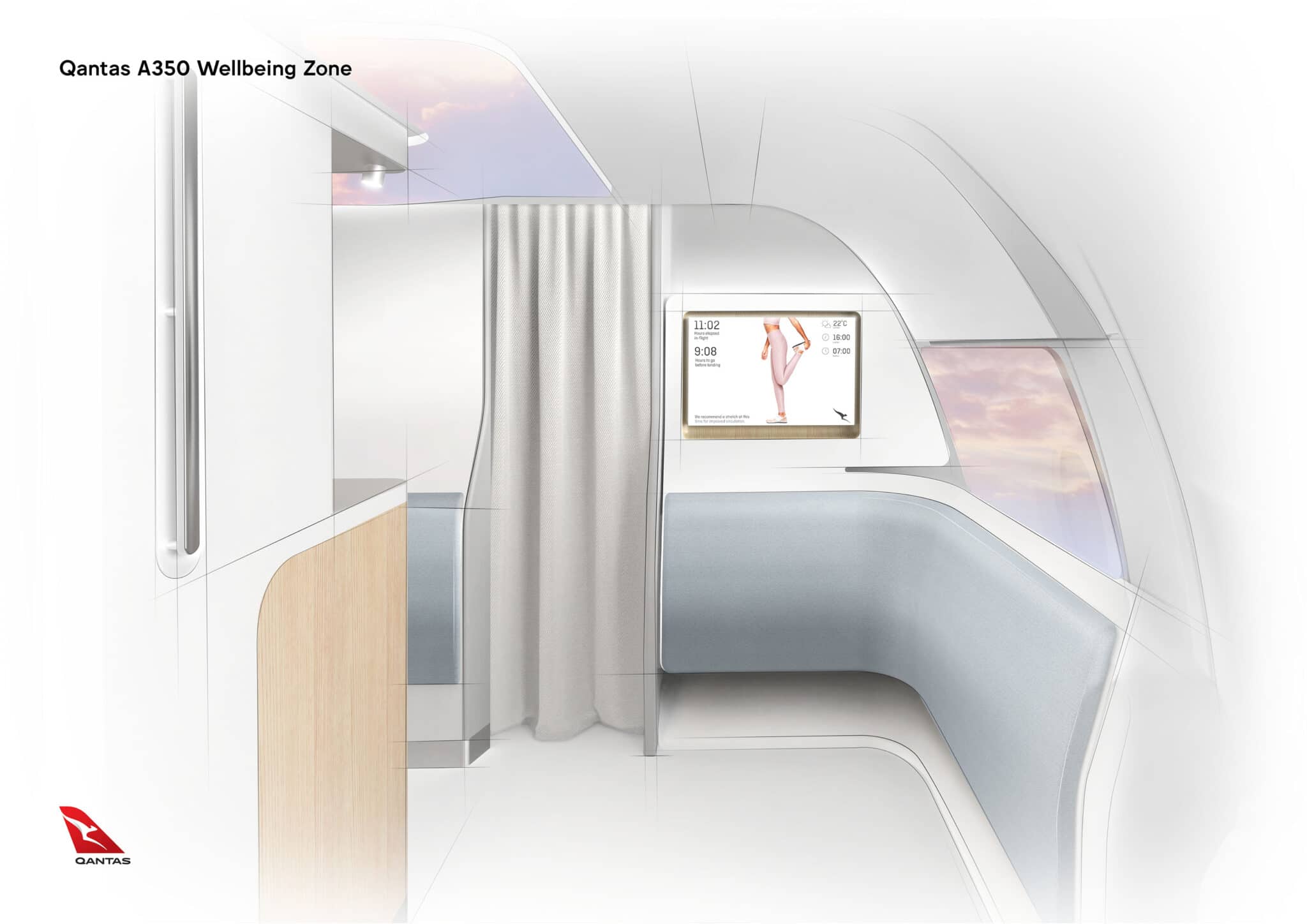
Qantas will introduce a well-being zone for all passengers to offset the lengthy flight. Image: Qantas
Economy passengers will also benefit as they will have 33″ of legroom. That’s more akin to economy-plus space on most domestic carriers. One major announcement is that the long haul A350 cabins will offer a ‘well being’ space for all passengers. This is a dedicated space for passengers to stretch their legs. The airline will offer screens offering relaxing videos that guide passengers for proper stretches. It will also offer snacks and self-serve hydration stations in areas that won’t get in the way of flight attendants’ service galleys.
Service is expected to begin in 2025. Other long distance routes like Sydney to the east coast of the United States and Australia to other destinations in Europe are possible with the new fleet.
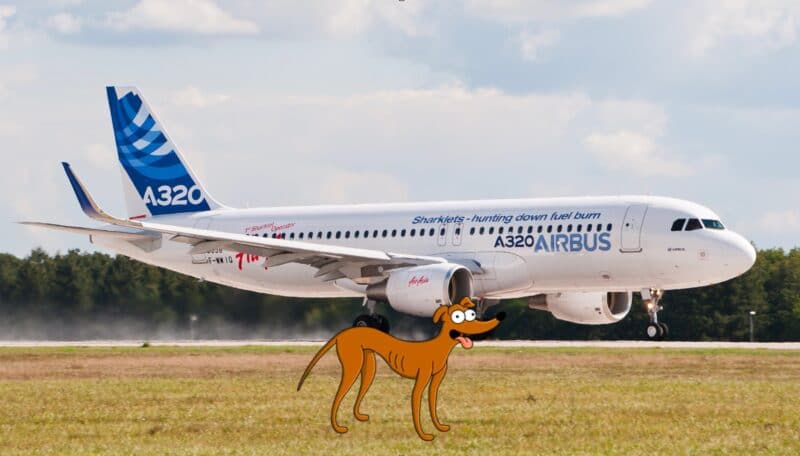
The Airbus A320 is one of the most popular narrowbody jets ever to fly. With more than 12,480 built and another 7,000+ orders (as of early 2026), there is a high likelihood that you’ve either flown on one before or will fly on one soon. It’s a nice ride.
The jet is wider than the Boeing 737. For pilots, the plane is also fly-by-wire, has a side stick instead of a yoke, and even a fold-out tray table at each crew position. There is one very peculiar thing about the jet. Before takeoff, when the engines are starting, and after landing (typically at the gate), the jet makes an odd barking noise. Why is that?
Yep, the Airbus A320 sounds like a barking dog after its lands
For the first-time traveler, they might think that their jet is carrying a pack of race dogs in the cargo compartment below. The video above from DAR 4K does a nice job of capturing the noise. We can assure you. It’s not a dog (or pack of them). It’s actually a noise from the PTU, or power transfer unit.
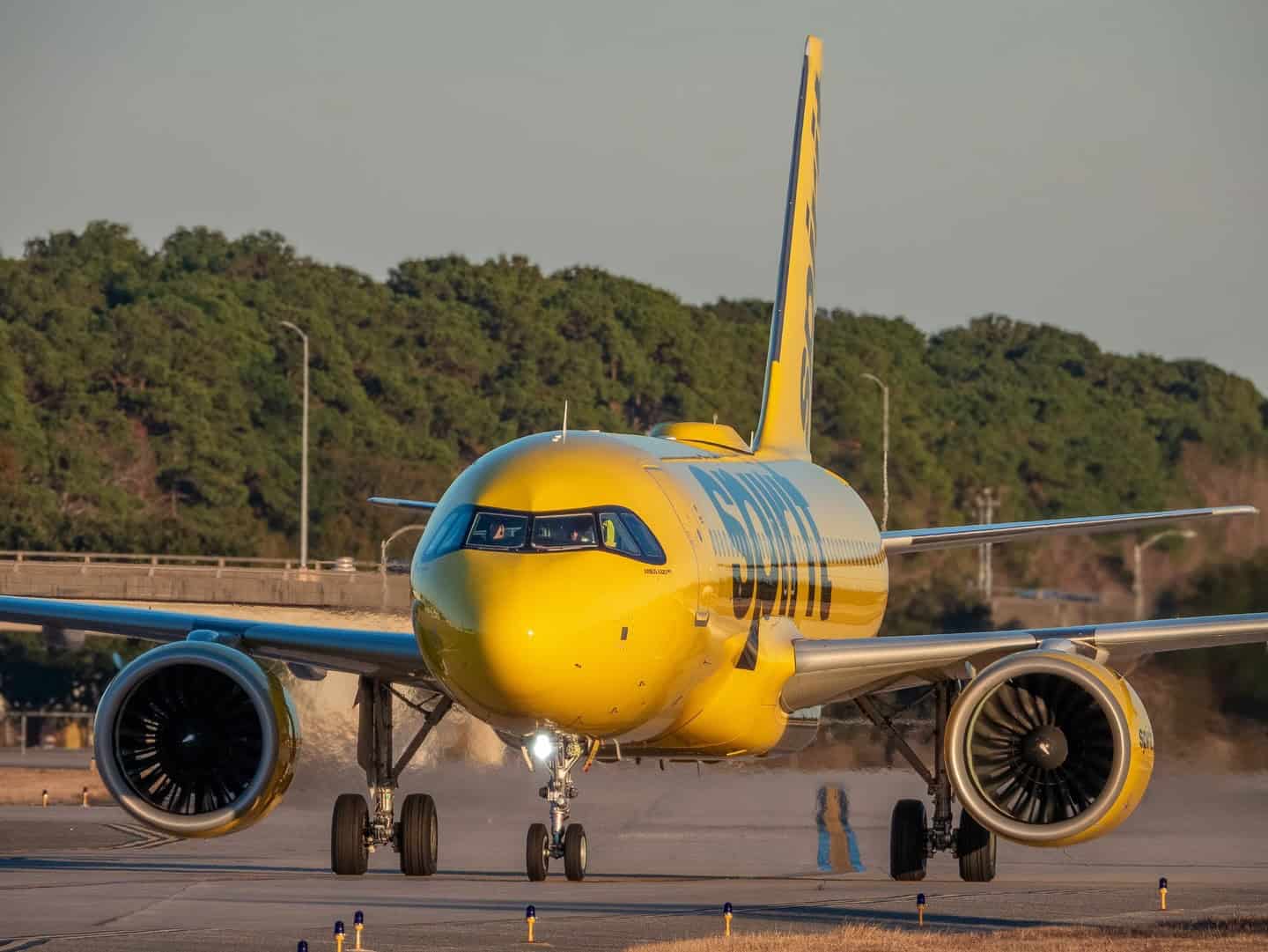
A Spirit Airlines Airbus A320 taxies | IMAGE: Spirit Airlines via Facebook
Here’s your answer: The Power Transfer Unit is Why The Airbus A320 Sounds Like A Barking Dog
The PTU transfers power between hydraulic units. In the A320, there are actually three hydraulic systems. Each engine powers two hydraulic systems, with a third system powered by an electric backup pump.
The PTU provides hydraulic power across the systems. Hydraulics are used in flight to power the control surfaces, landing gear deployment and retraction, nose wheel steering, the ground braking system, and the movement of the flaps and slats. The system’s power is shared, but fluid is not. This setup ensures that even with one engine off, you still have full hydraulics available.
The reason that the Airbus A320 sounds like a barking dog when departing the gate is that typically, only one system is running. Upon arrival, one engine is typically shut down. That means the system is using the PTU to keep the entire hydraulic system pressurized.
It’s a great system that works and ensures that pilots have access to all controls at all times. But it can be a bit annoying, particularly if you’re sitting in rows 15-20.
EDITOR’S NOTE: This article was originally published on 1 May 2022, but was updated in February 2026 with the latest information regarding A320 deliveries and orders.