Home Blog Page 93

Atlanta Warbird Weekend to feature historic aircraft and honor the Tuskegee Airmen

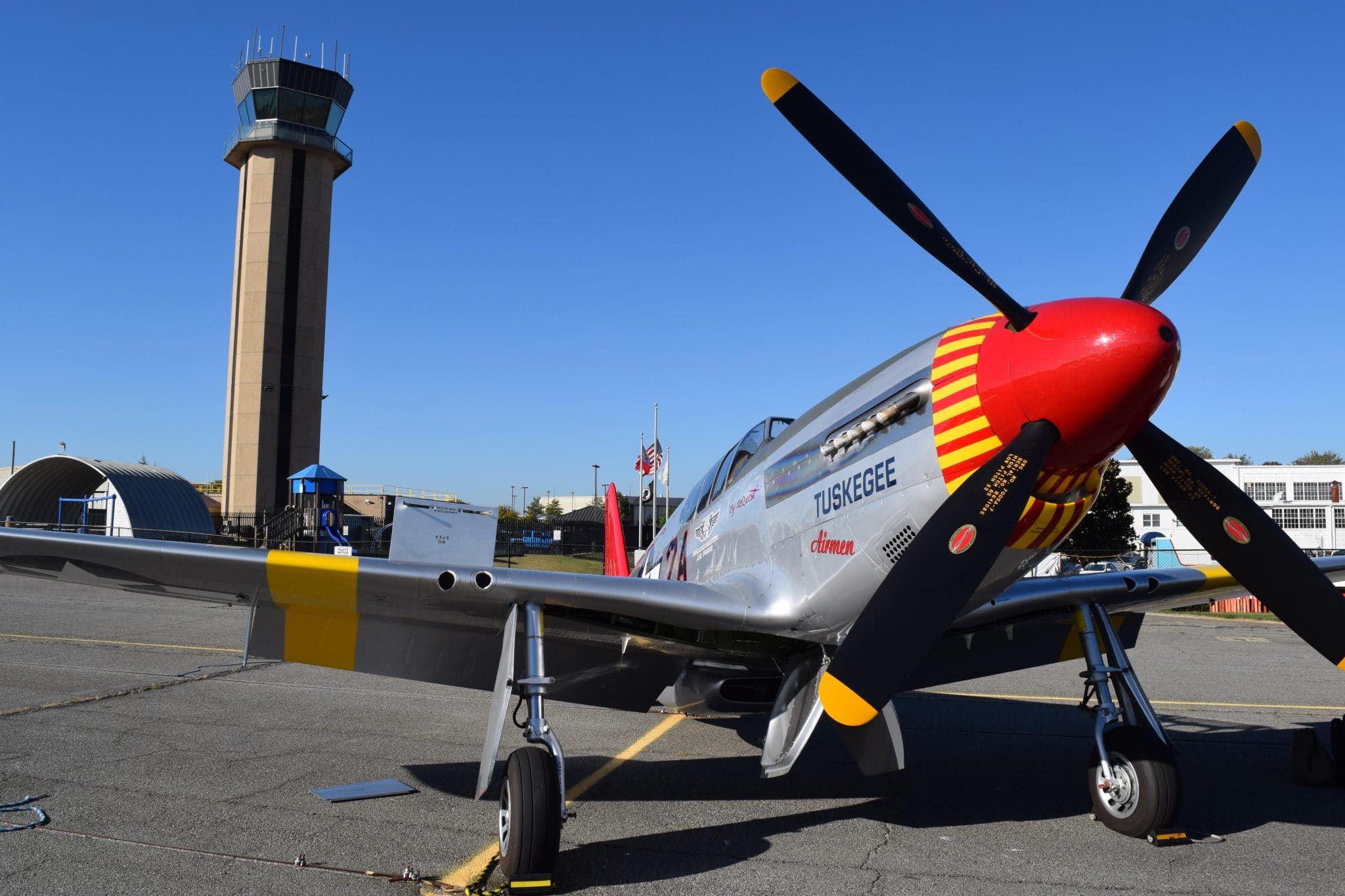
ATLANTA — Popular aircraft flown during World War II and Korea will take center stage on Saturday and Sunday as the local Commemorative Air Force hosts an Atlanta Warbird Weekend at DeKalb-Peachtree Airport.

The non-airshow two-day event will also celebrate the story of the Tuskegee Airmen. This year marks the 75th anniversary of the graduation of the first African-American aviators from Tuskegee, Alabama, who blazed a trail in the Army Air Corps program training to fly and maintain combat aircraft.

A traveling multimedia exhibit known as Rise Above: Red Tail will be on hand to present the story of the Red Tails and the Tuskegee pilots who flew them. Guests can view an informative movie and browse images in the exhibit.

“We are bringing at least 20 original Tuskegee Airmen veterans to share in the acknowledgment of the outstanding history of the black aviators who overcame prejudice and adversity to serve their country so well,” said Moreno Aguiari, Atlanta Warbird Weekend Chairman, on Thursday. “We also plan to exhibit aircraft flown by the Tuskegee Airmen, including… an original Tuskegee Airmen T-6 will appear courtesy of the Tuskegee Airmen National Museum out of Detroit. It was delivered to Tuskegee Army Airfield in Alabama in 1943.”

tus2
Photo: Charles A Atkeison

The T-6 Texan, FG-1D Corsair, and many more planes built and flown in the years preceding the jet age will sit poised on the flight line at the north Atlanta airport. The addition of two historic aircraft will include the rare visit of the B-17 Flying Fortress and a B-25J Mitchell bomber. The two will sit on static display where guests can receive a ground tour of each aircraft, or for a fee, they can fly aboard the aircraft of choice.

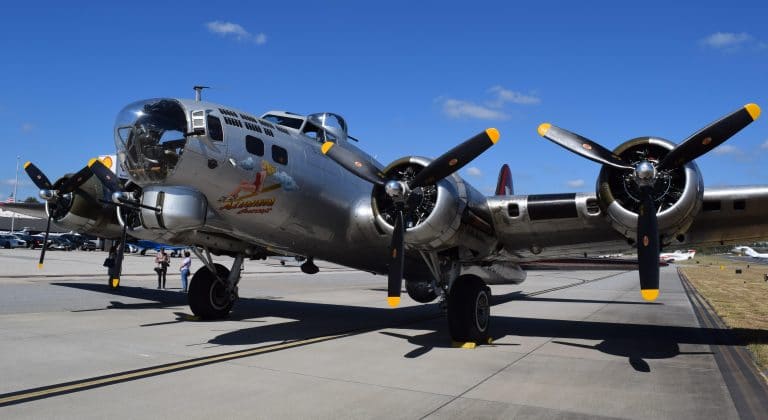
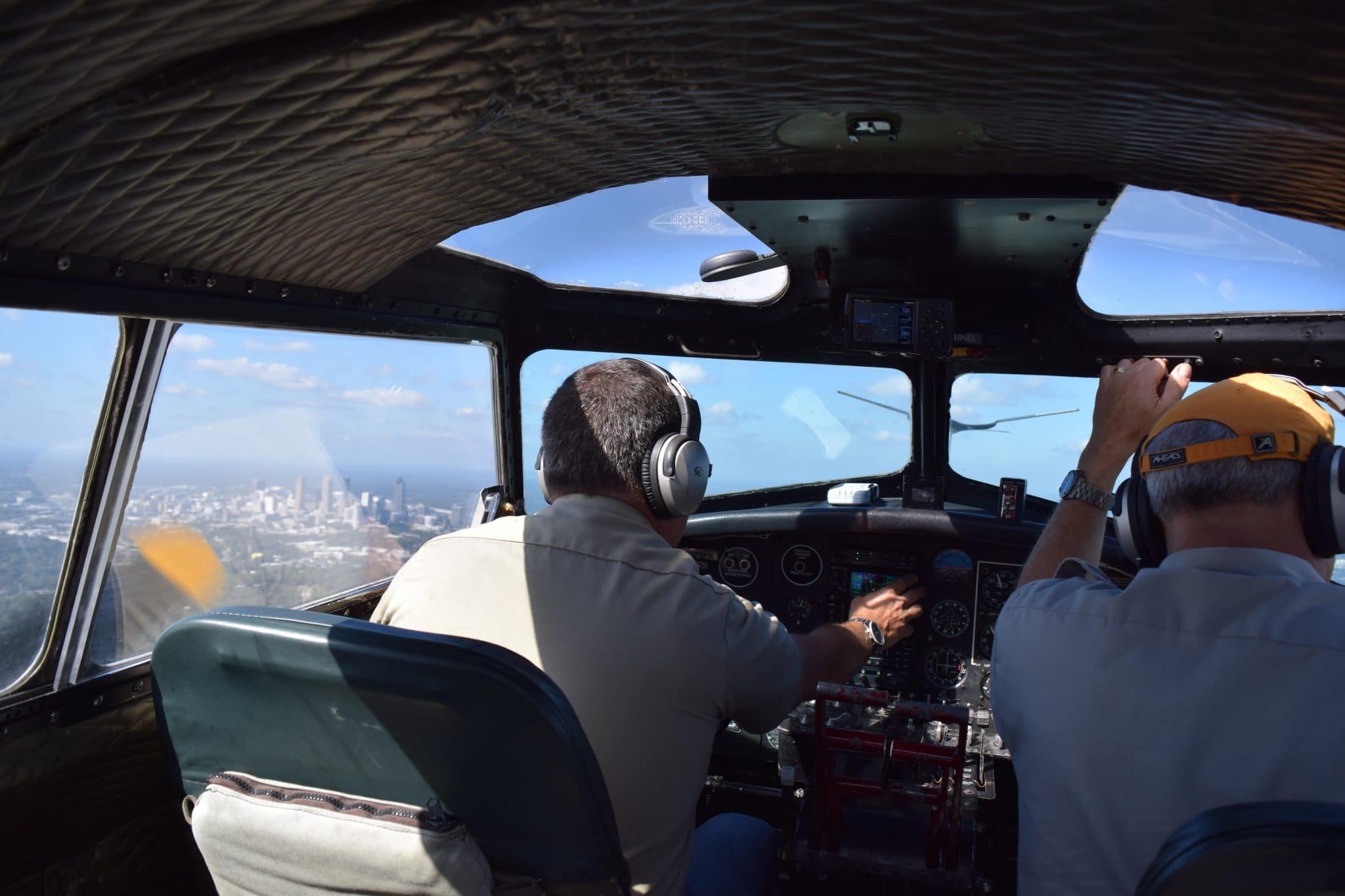
Known as “Aluminum Overcast”, the B-17 was a heavy bomber during World War II, including flying day time bombing runs against Germany. Sporting four prop engines, the silver aircraft measuring 74-feet long and a wing span of 104-feet, the “Aluminum Overcast” will become a crowd favorite this weekend.

The aircraft’s ball-turet, or gun turret, is one the more popular sections of the B-17. A World War II veteran and special guest attending the Atlanta Warbird Weekend knows first hand what it is like inside the spherical-shaped housing.

“It was a comfortable position, it was the only place you could lay on your back and fight the war at the same time,” said SSgt Henry Hughey (Ret.) who flew 31 missions as a B-17 ball turret gunner during World War II. “The B-17 was a wonderful piece of machinery. It would take a pounding and still keep flying.”

tus3
Photo: Charles A Atkeison

Guests attending warbird weekend can take a special flight into history and travel aboard the B-17 Flying Fortress this weekend. Advanced reservations are recommeded including full details and availability, however walk-ups will be available based on limited seating.

Nearly two thousand visitors are expected to attend each day to receive an up close look at the 1940-era planes as live music and rare radio news reports from the front lines of the second world war play across the loud speakers.

The Commemorative Air Force, a non-profit organization designed to “restore and fly World War II aircraft in tribute to America’s veterans”, will bring together former pilots and veterans of World War II and Korea.

(Charles Atkeison reports on aerospace and technology. Follow his updates via social media @Military_Flight.)

Horrific KC-135A Mid-Air Explosion Led To Fix For Fatal Flaw

LenThe Investigation Into the Loss of KC-135A 56-3592 Over Canada in 1989 Finally Provided Answers For Other Previous Losses

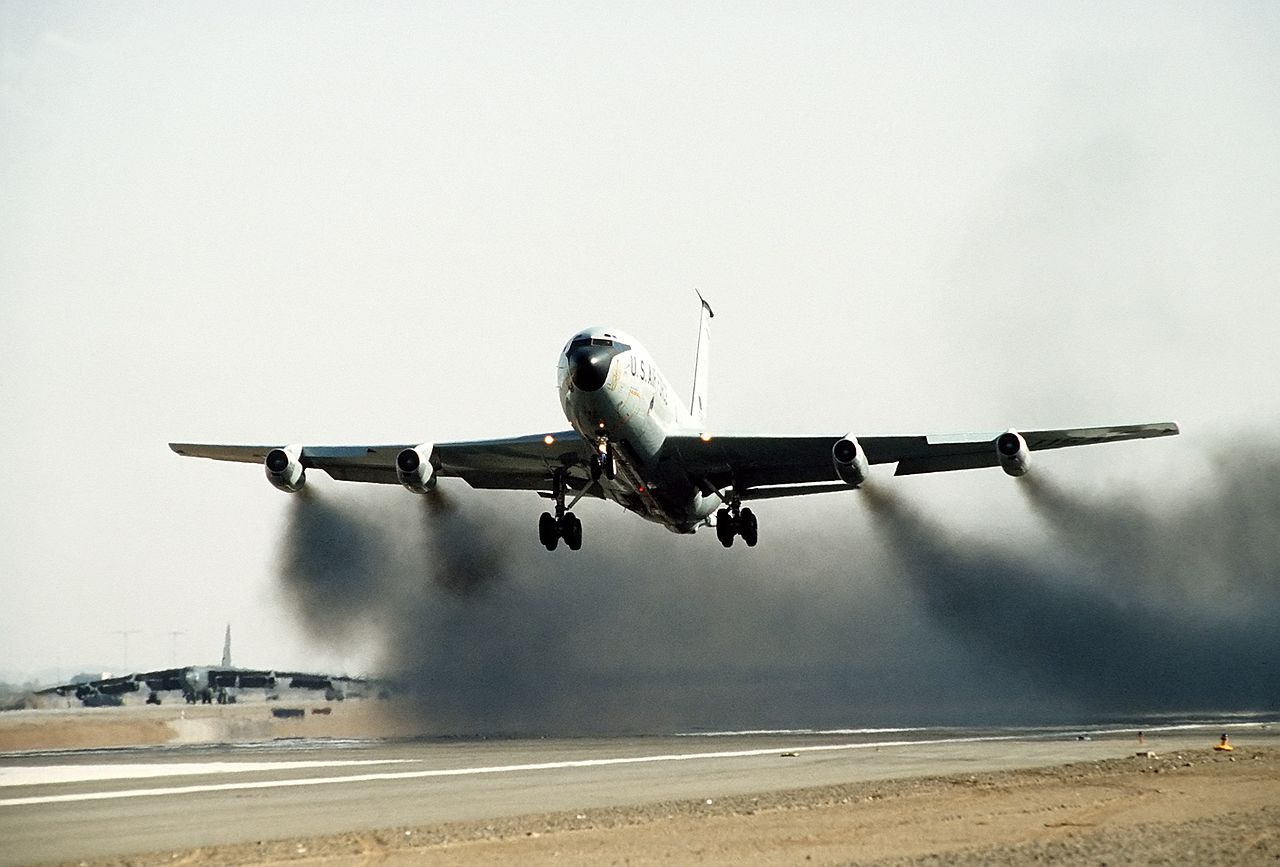
On Wednesday October 4th 1989, the crew of KC-135A-BN Stratotanker 56-3592 (CN 17341 MSN 31) was returning to their base at Loring Air Force Base (AFB) in far northeastern Maine after an overnight tanker mission. At about 0600 local time the aircraft exploded in midair over Perth-Andover near Carlingford, New Brunswick, Canada killing all four crew members aboard the aircraft. The wreckage was strewn over a wide area but large pieces came down on a hill along the west side of the Trans-Canada Highway north of Perth-Andover. This particular KC-135A had been delivered to the Air Force in November of 1957 and was nearly 32 years old, one of the few A models still in service at the time, and the last A model to be lost.

Boeing KC 135 J57 takeoff.JPEG
Official US Air Force Photograph

Detailed Investigation into KC-135 Accident Took Time

The investigation into the crash took several months as the wreckage took time to locate and process. When the investigation concluded the cause of the explosion was determined to be overheating of an aft body fuel tank pump operating in an empty fuel tank. When the overheated pump sparked it ignited the explosive fumes in the tank. But that wasn’t the end of the investigation. Those pumps were originally designed to work safely in fuel tanks that had been depleted or even emptied.

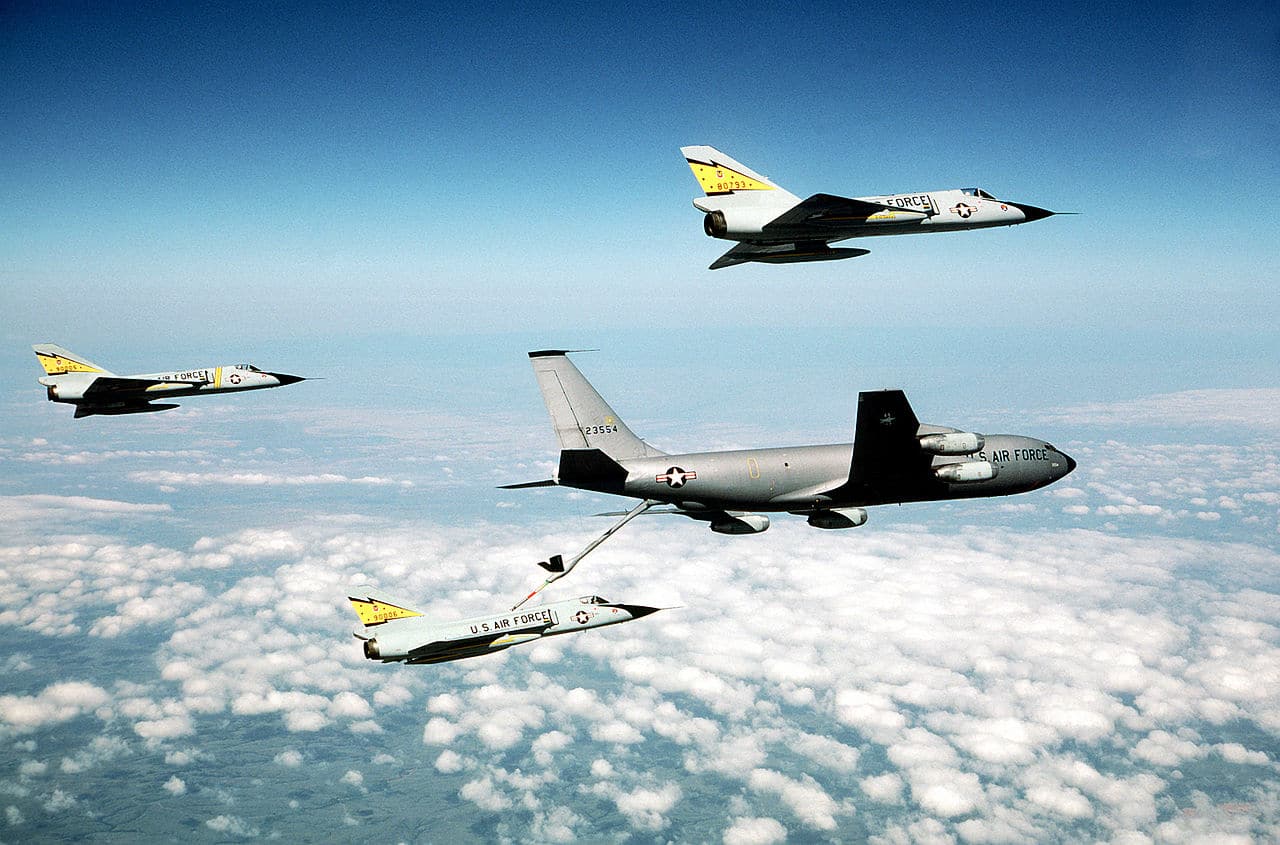
1280px F 106s 5th FIS refueling from KC 135 1981
Official US Air Force Photograph

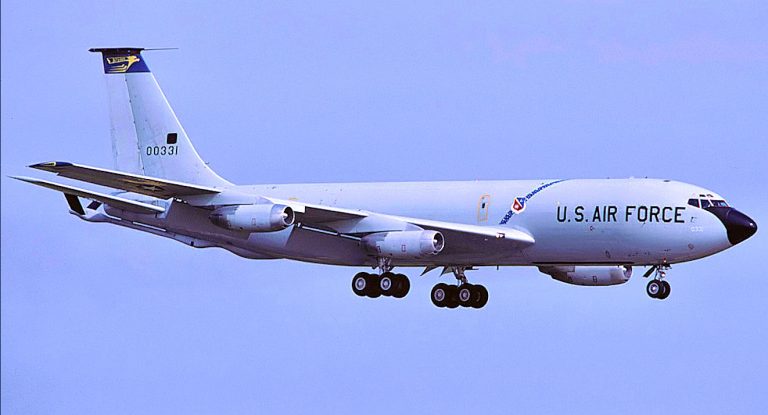
There were quite a few KC-135s lost under similar circumstances or with similar results. KC-135Q 58-0039 exploded in flight near Torrejon Spain in 1971. KC-135B 61-0331 was lost over the Pacific in 1971. KC-135A 60-0368 crashed on approach at Torrejon Spain in 1976, KC-135A 61-0296 crashed near K.I. Sawyer AFB in 1976. KC-135Q 60-0338 burned on the ramp at Plattsburg AFB. KC-135A 58-0031 exploded in flight near O’Hare airport in Chicago. Some of these losses were deemed to be directly related to the loss of 56-3592.

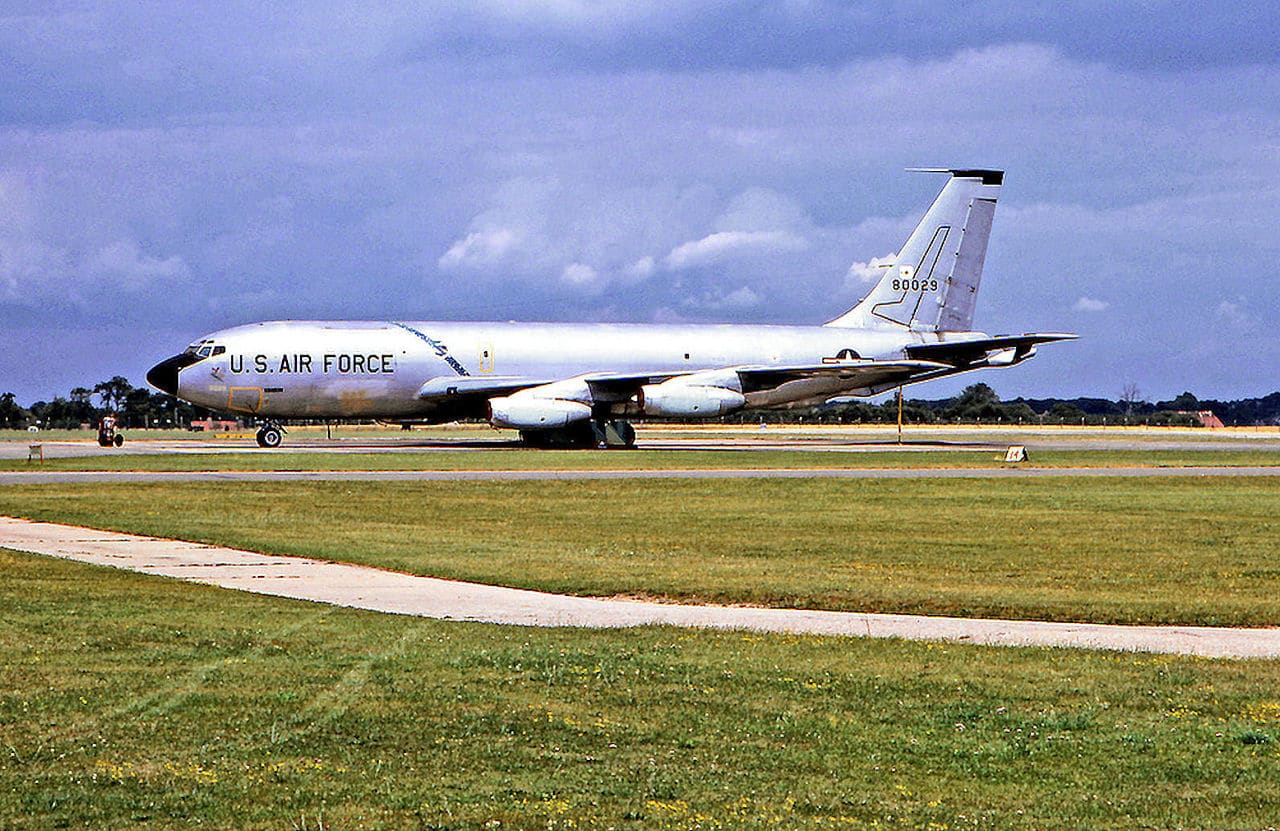
911 Air Refueling Squadron Boeing KC 135A BN Stratotanker 58 0029
Official US Air Force Photograph

Root Cause Was Finally Found

The root cause of the explosions, specifically the one of 56-3592 over Perth-Andover, was finally determined to be incorrectly repaired fuel pumps. The pumps were being inspected and repaired as needed (IRAN) and placed back into the supply pipeline at the Oklahoma City Air Logistics Complex (OKC-ALC) but the repairs were causing the pumps to overheat. KC-135 crews (all models) were instructed to keep 3000 pounds (about 450 gallons) of fuel in each body tank to prevent pump overheating.

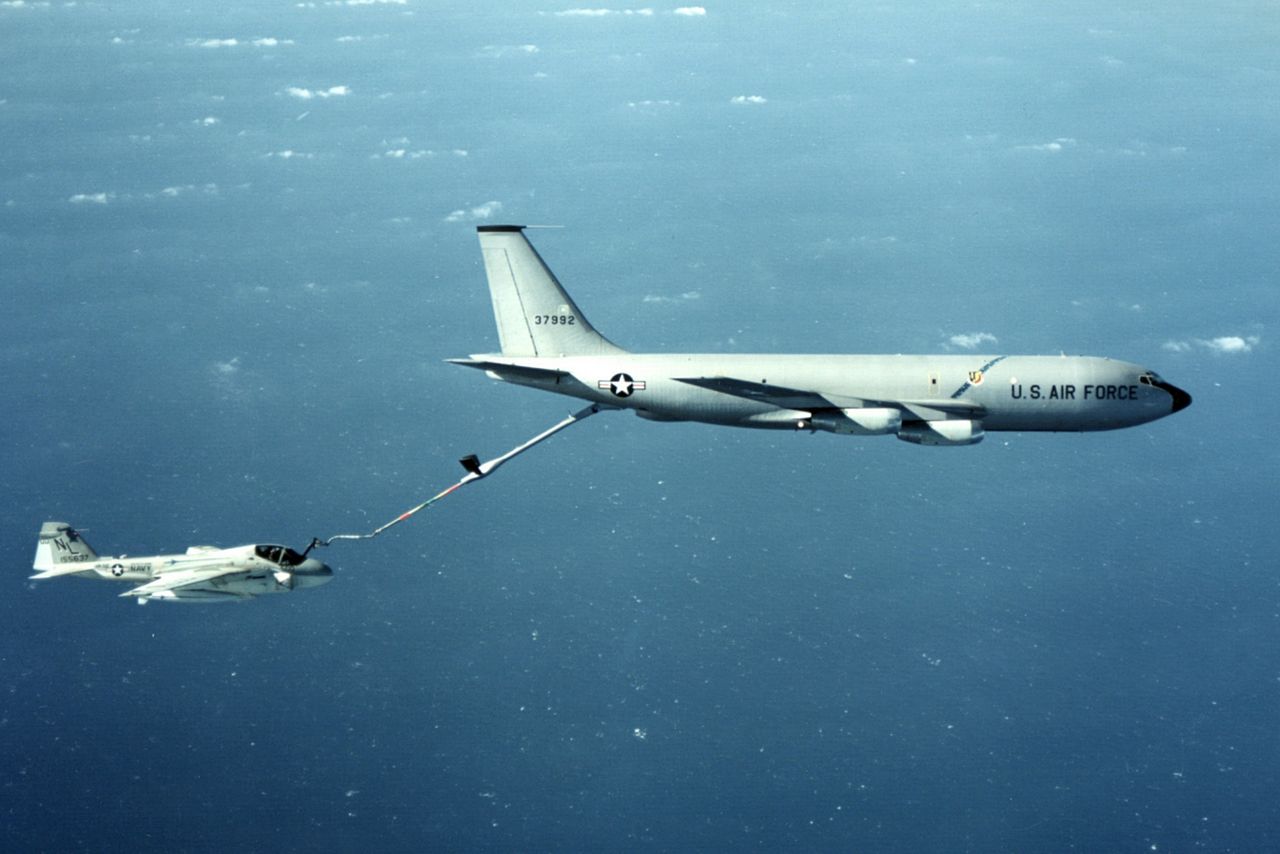
1280px KC 135A refuels VA 52 A 6E c1978
Official US Air Force Photograph

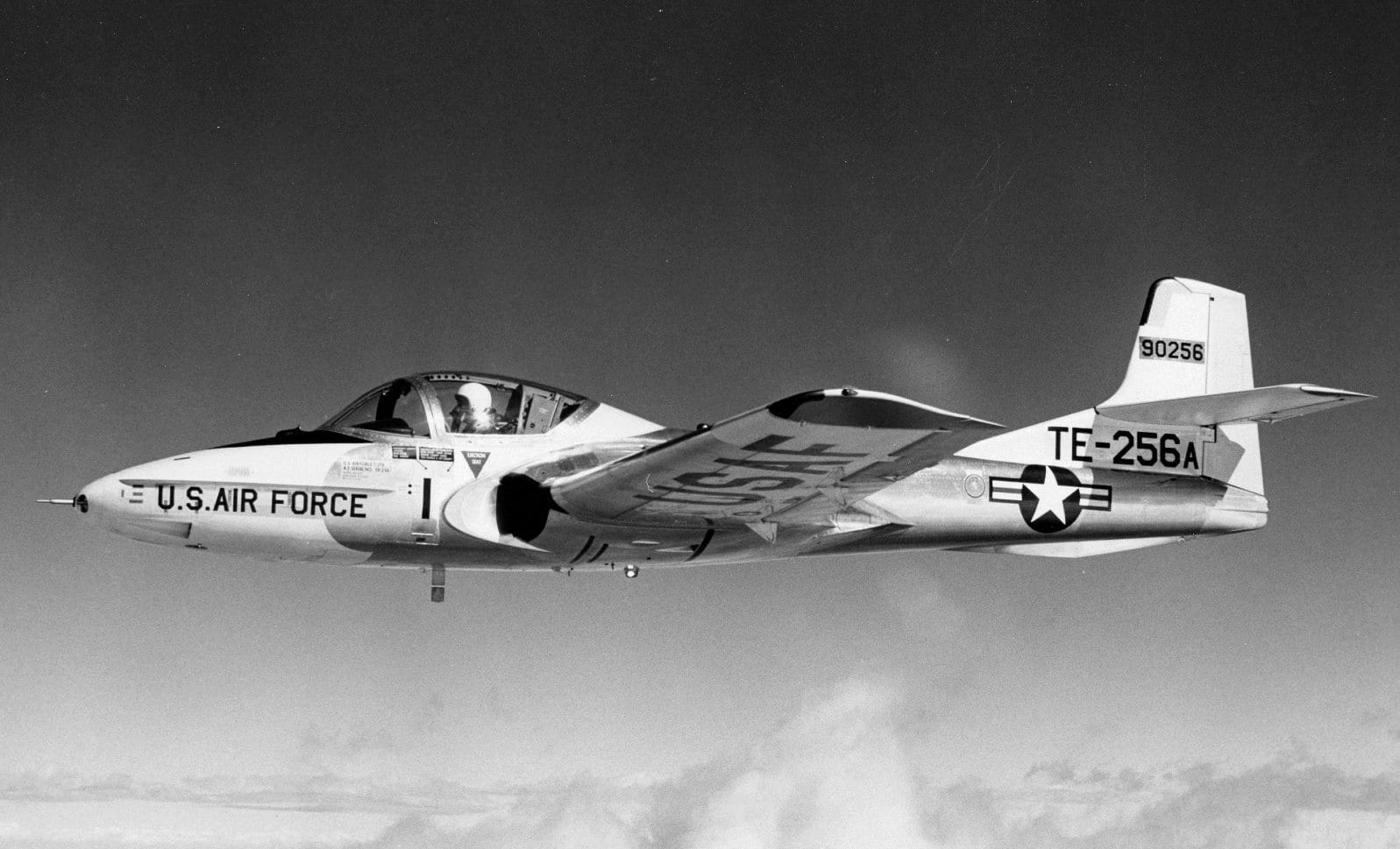
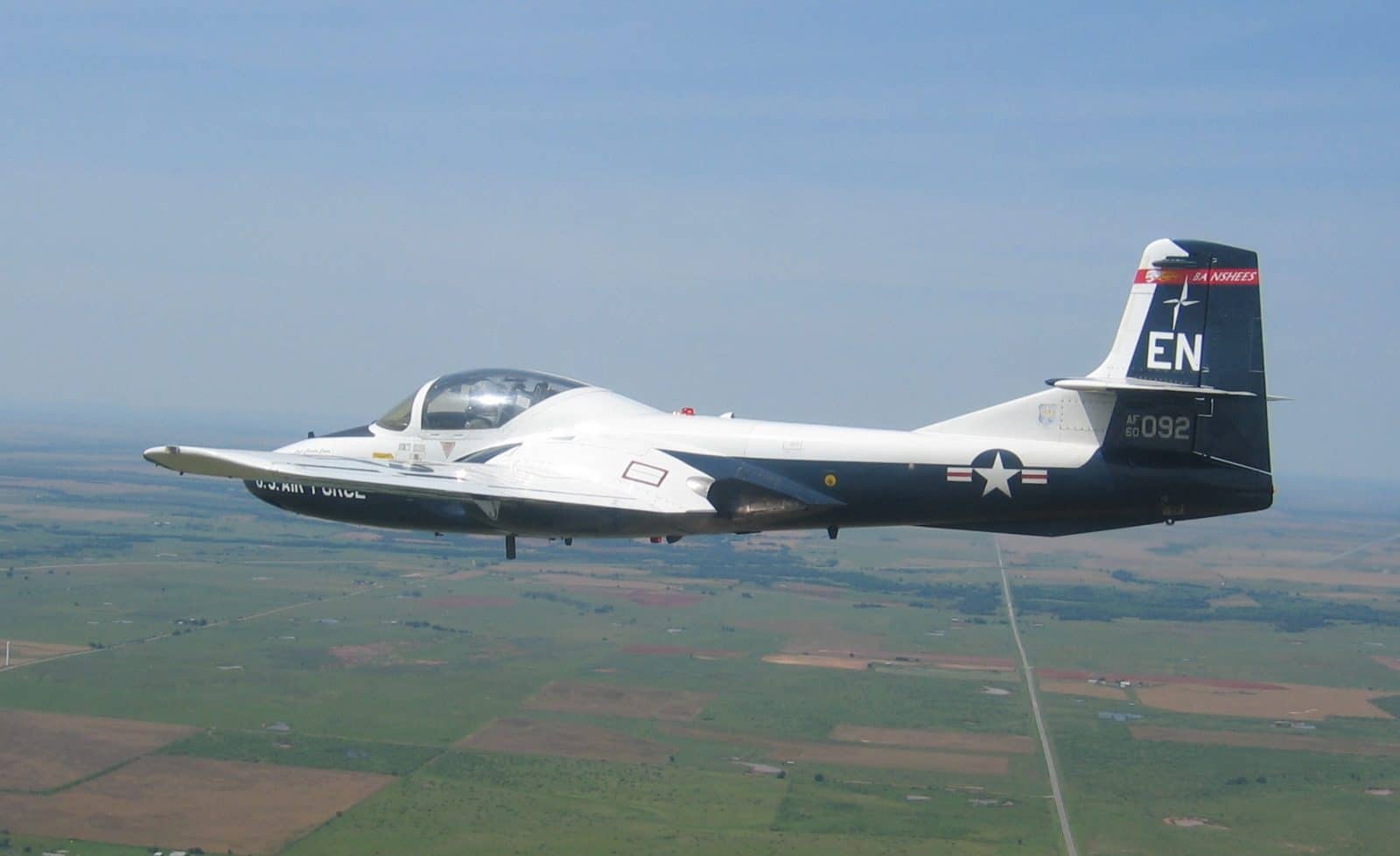
The incredible tweety bird: Cessna’s T-37 Tweet primary jet trainer

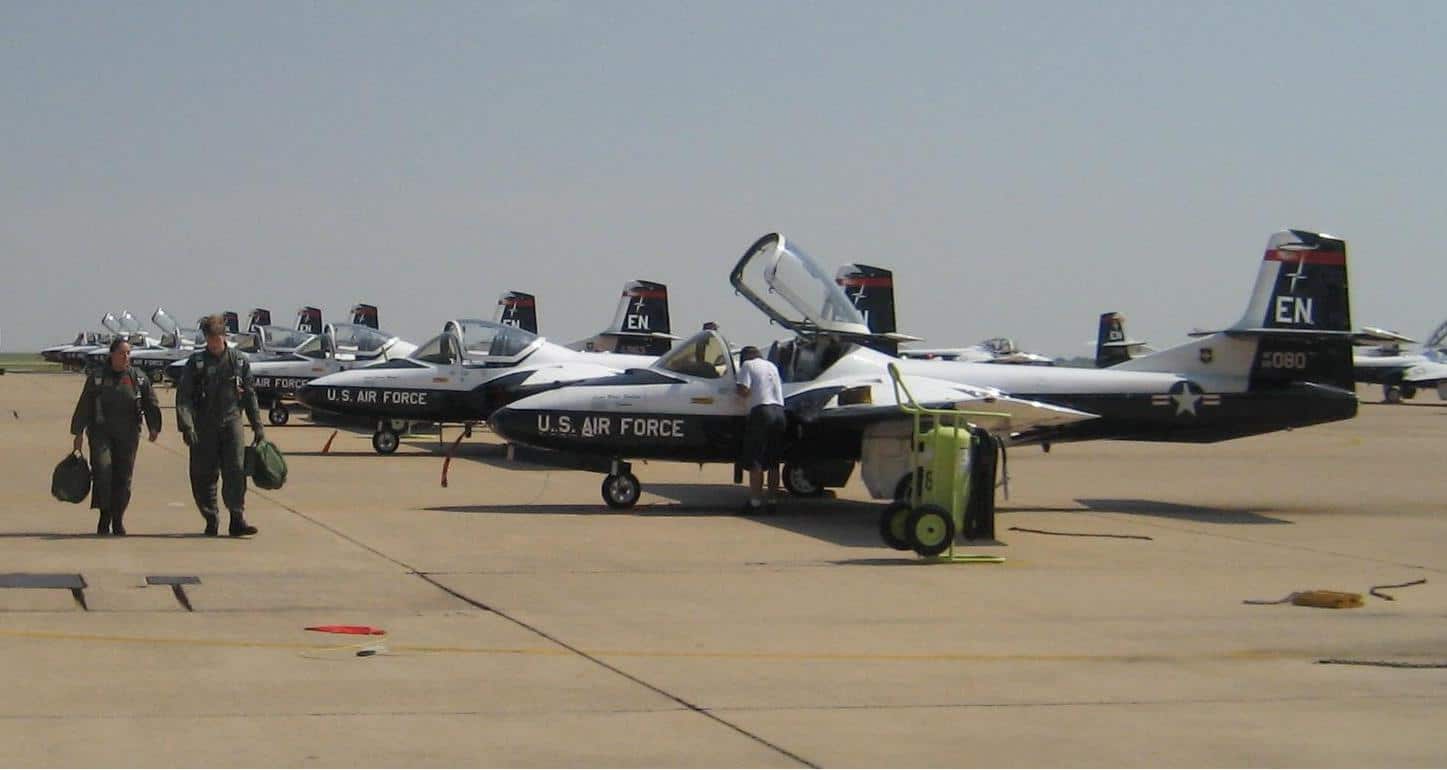
Liquid heat rises in waves, twisting and turning morphing the parked T-37 Tweety Birds into caricatures more like reflections in a fun house than the small jet trainers that introduced countless thousands of potential pilots to jet-powered flight.

I could almost feel the rubber soles on my boots beginning to melt. Okay, that’s a bit of an exaggeration, but the temperature is uncomfortable. As my student and I step up to the little jet, we are assaulted by the familiar T-37 Tweet smell: hot rubber, avgas, and the underlying sour odor of vomit—NASA’s “Vomit Comet” has nothing over the T-37’s propensity to induce airsickness in the toughest of students.

T-37 Tweet

A friend once observed that the combination of heat, nervousness, confinement in an ejection seat, helmet, oxygen mask, and the loping flight characteristic of the T-37—much like a twin-engine propeller aircraft flying with the engines out of sync—did wonders to convince the internal “pukester” to go to work.


Check out these other great stories from Avgeekery:


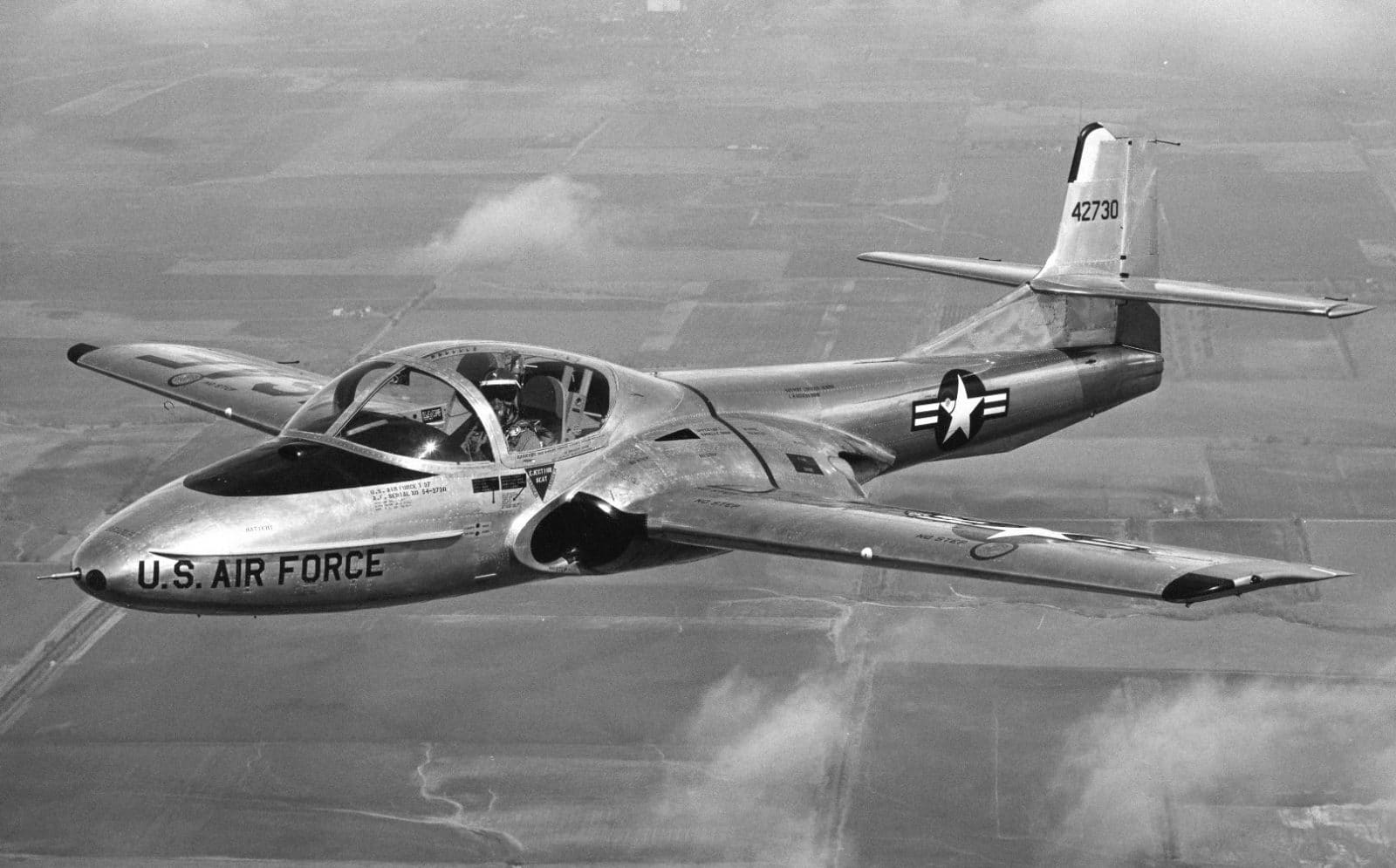
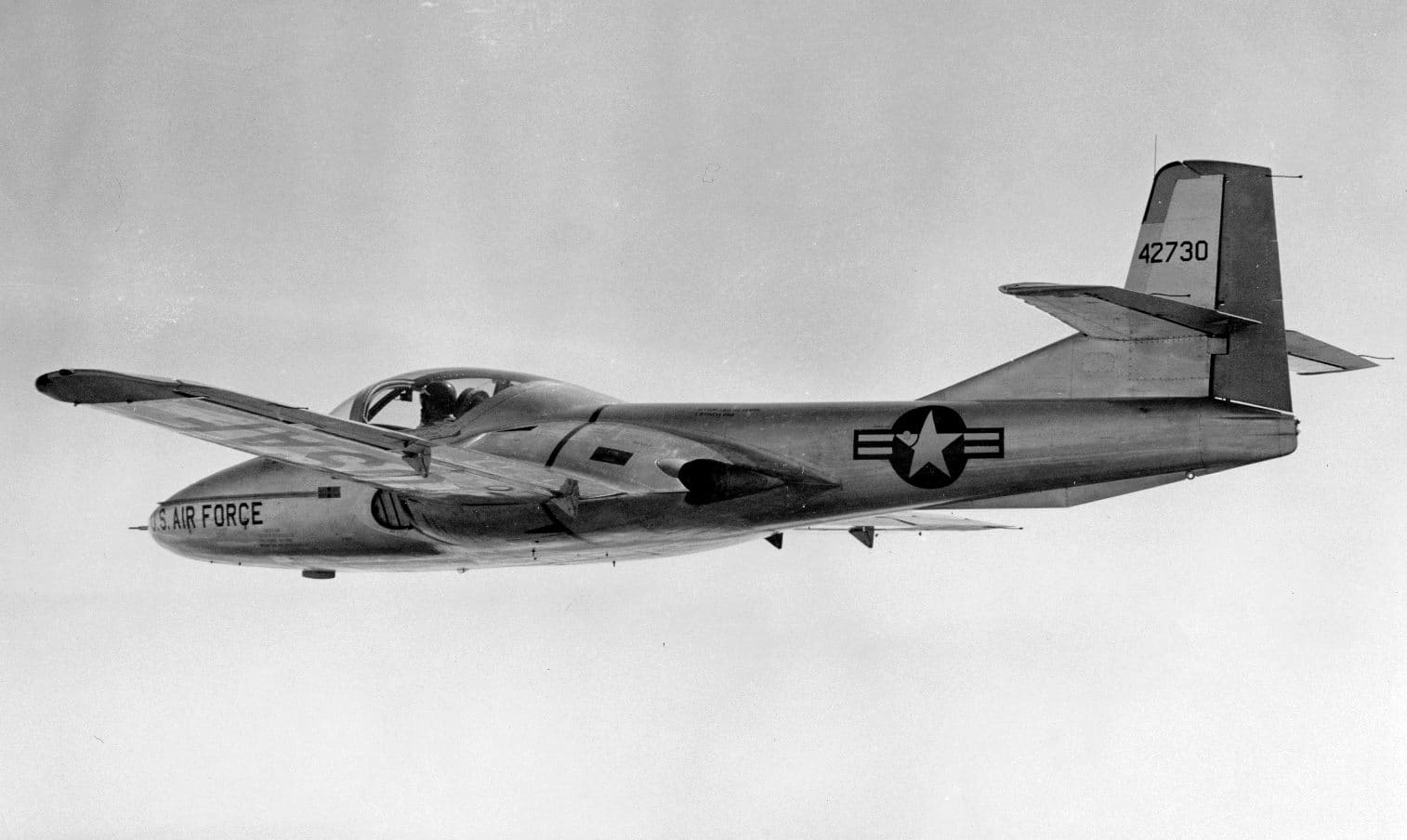
Regardless, the versatile little Cessna was the Air Force pilot training work horse from 1956, when the Air Force took delivery of the first of 444 T-37s, until the last was retired in 2009. But the T-37 had more uses than a primary jet trainer.

A Bit of Background on the T-37 Tweet

at 37
DAYTON, Ohio — Cessna YA-37A Dragonfly at the National Museum of the United States Air Force. (U.S. Air Force photo)

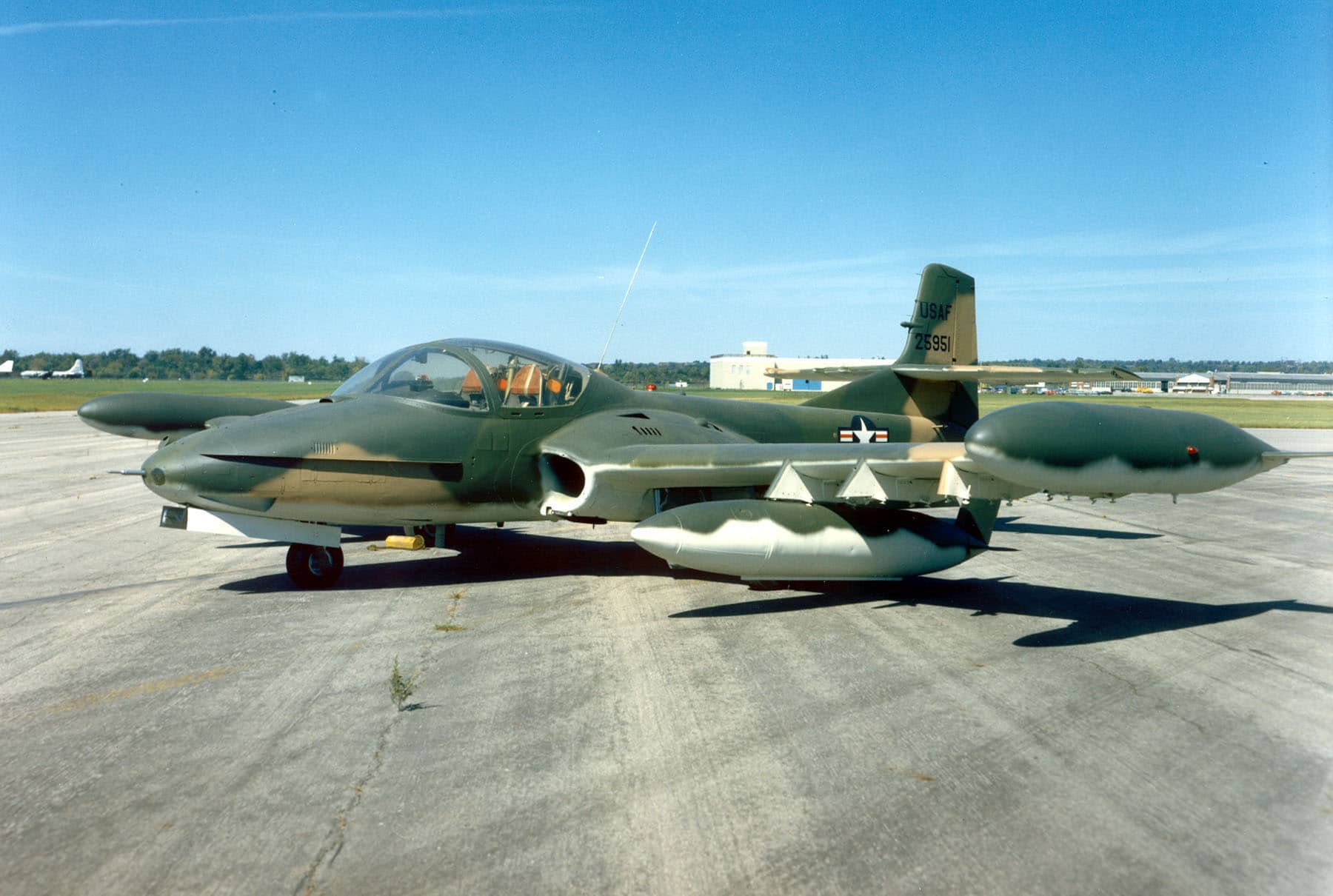
During the Vietnam War, a modified T-37 with more powerful engines, a weight increase from around 6,000 pounds to 12,000 pounds, an ordinance carrying capacity of approximately 2,000 pounds, and a new designation, the A-37 Dragonfly, replaced the A-1 Sandy as the Air Force search and rescue aircraft.

In this capacity, the Dragonfly worked with the Jolly Greens to rescue downed pilots by keeping the enemy at bay until the rescue helicopters could retrieve the downed pilot.

4404810042 4ec8e6e50f o

In 1962, Cessna suggested the T-37 Tweet replace the F-100 as the platform for the Thunderbirds, the Air Force aerobatic demonstration team[2]. The Air Force could not imagine the 6000-pound dog whistle living up to the name, Thunderbird.

They elected to keep the F-100 and its thunderous roar as the team aircraft, and in the process, probably saved themselves from smirks and eye rolling when the whistling little “Thunderbird” passed over the spectators. Of course, the Air Force had itself to blame for the T-37’s whistling.

4403965515 9a1f0440c0 o

The Air Force’s made the decision to use the noisier of two government supplied engines to power the jet. Harry Clements, an engineer that worked on the T-37 design, says Cessna put vanes and sound proofing on the inlets that damped the noise to a tolerable level, but the Air Force felt the whistling was more acceptable than the loss of performance, so the noise limiting materials were discarded much to the discomfort and hearing loss of a long line of Tweet pilots.

Dollar Ride in the T-37 Tweet

T 37 cockpit
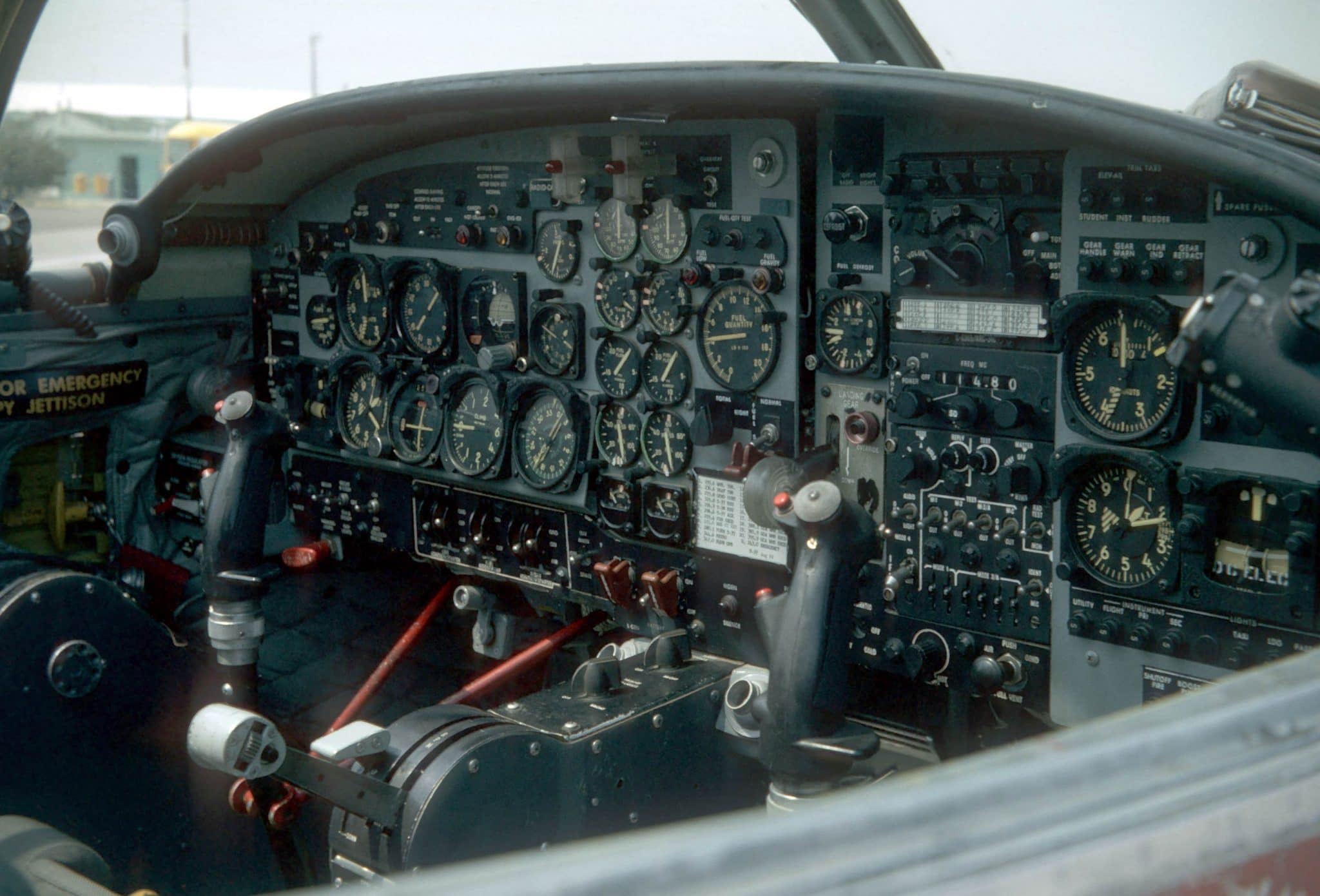
The T-37 cockpit was intimidating for new students. By Seattleretro – Own work, CC BY-SA 3.0, https://commons.wikimedia.org/w/index.php?curid=11971271

Of course, my student doesn’t care about any of these T-37 Tweet facts. His only concern is getting through his “dollar ride” (his first T-37 student flight) without embarrassing himself. As I demonstrate the walk-around preflight inspection, my student demonstrates a mixture of “dollar-ride” excitement and first-flight apprehension.

I switch on my best calming voice to help relieve the stress. I remember my instructor, in a fit of frustration, jerking my oxygen hose yelling, “Why don’t you SIE?” In other words, why don’t you self-initiate your elimination from the program.

Cessna t 37

A visual testament to instructor frustration is etched into the instrument panel glare shields of the little trainers. The glare shields in the T-37 were awash in repairs from damage done by instructors pounding on and breaking the material. I never saw the point myself.

We are strapped in, I demonstrate the interior preflight, start engines, show the ground crew the seat pins, and begin to taxi. Student’s react to this moment in differing ways. Some are struck with a bout of oral diarrhea; some become mute. My guy is mute. I get takeoff clearance, close the clamshell canopy and transition from a convertible to a greenhouse, roll onto the runway, and apply power. My goal is to get into the reasonably cool air above 10,000 feet as soon as possible.

T-37 Tweet

As I raise the landing gear, I glance at my student. He is encapsulated behind mask and sunshade. I see him swallowing; I fear things are going to blow. I intercede and give him the stick. It starts to cool off, and the distraction of flying has cooled off my student.

“Wow, this is something,” he says.

“It sure is,” I say. “And it only gets better.”

ENJJPT T 37s on the ramp

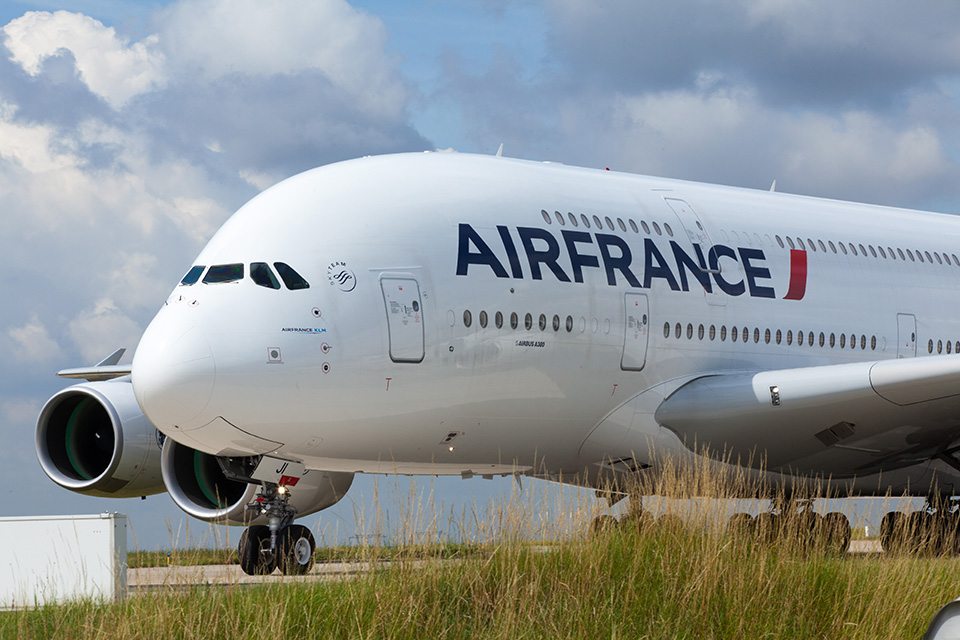
My Story Aboard Air France Flight 66–The A380 That Lost An Engine Over The Atlantic

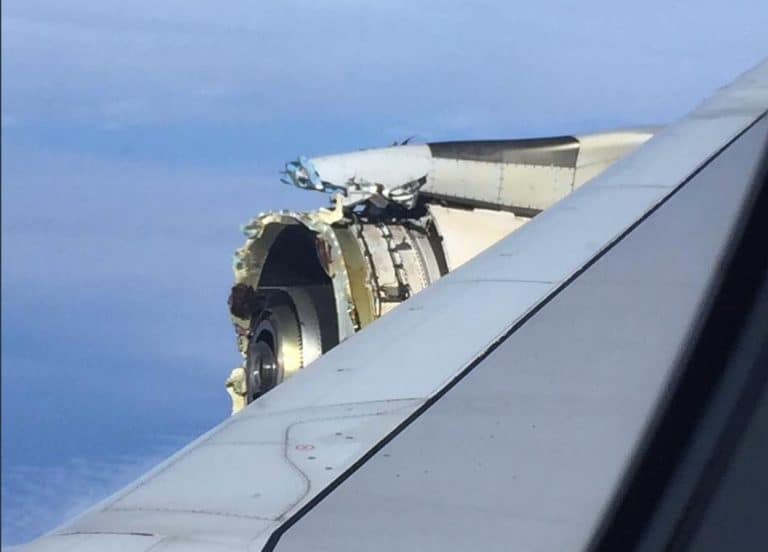
On Sept 30th, Air France Flight 66 suffered a massive uncontained engine failure over the Atlantic Ocean.  The #4 engine on the double-decker Airbus A380 was shredded and the aircraft was at least an hour away from a suitable divert field.  Due to the professional pilots at the helm and the coordinated crew actions, the aircraft made a safe emergency landing at Goose Bay.  All 497 souls onboard were safe.

Rana Landreth was returning home after her father’s funeral. Waking up to a violently shaking jet must have been a scary experience. She details her entire account on her website. We encourage you to check out her full story here.  We had the opportunity to ask her a few additional questions about her experience, especially once the jet landed.

1.) What was the mood like on the jet while you were waiting for the replacement aircraft?

Considering the fact that the plane almost crashed in the Atlantic and for passengers sitting on the side where they were able to see with their own eyes the engine failing and pieces hanging off of it, we were super quiet and calm waiting inside the jet. There were some older people and from what I was able to count 3 babies and their parents trapped among others (I didn’t know exactly what was happening on the upper level since I was in the lower one), but all in all we kept it together. Some bathrooms ran out of water in their faucets, we almost ran out of food until Canadian border came to the rescue with boxes full of sandwiches and some gallons of water. Maybe the fact that they kept promising us rescue is on its way we were hopeful. It was not until a couple hours to the end of the ordeal when an old lady had a meltdown, and then 2 other ladies who were begging for straight answers and how it wasn’t acceptable all this mistreatment and entrapment and how come they didn’t provide us with rooms or the ability to step outside the craft.  Bottom line, we kept our cool but I feel like they somehow took advantage of it.

2.) Tell us about the journey home after Goose Bay.  Was Air France helpful?

It took almost an hour for the crew to board between 395 to 400 passengers, then another hour for the plane to take off, at that point I think I was numb and waiting was something I got used to! I really wanted to grab my camera to capture dawn breaking and that beautiful pink shade in the sky but I couldn’t, I was just looking forward to leave. Also it wasn’t until we were ready to take off until they announced we were headed to Atlanta not LAX, that’s when a few passengers whom last destination was LAX started breaking down in tears, it was just too much to bear. The new Air France crew was somewhat helpful.

3.) What advice would you give for people who face an incident in the air like the one you dealt with this weekend?

My personal advice is to hold on to your seat, be positive and focus on one thing “ the plane is going to touch down safely”.  Although it was traumatizing, I mean hearing the lead crew saying in French “preparez toboggans” that alone is something I will never forget, then we knew how bad the situation was and what the pilots are trying to do to land us safely and when they assured us they were able to stabilize the plane for now, I sat put in my seat, listening to music watching us moving on the map over the Atlantic thinking I won’t be safe until those wheels touch the ground. And when they finally did, people were clapping crying from joy (little did we know we had to wait eternally for a rescue plane).

Quite an experience! Thanks, Rena for sharing.

Audio of Air France flight 66’s final approach is below. Thanks to VASAaviation for the audio clip.

CAA Issues Warning to Ryanair–Company Failing To Inform Customers Properly

0

Over 750,000 airline passengers are scrambling to make alternative travel plans since Ryanair has canceled yet another 18,000 flights that had been scheduled for between November and March. This most recent round of cancellations is on top of another 2,100 flights that were abruptly canceled a few weeks ago.

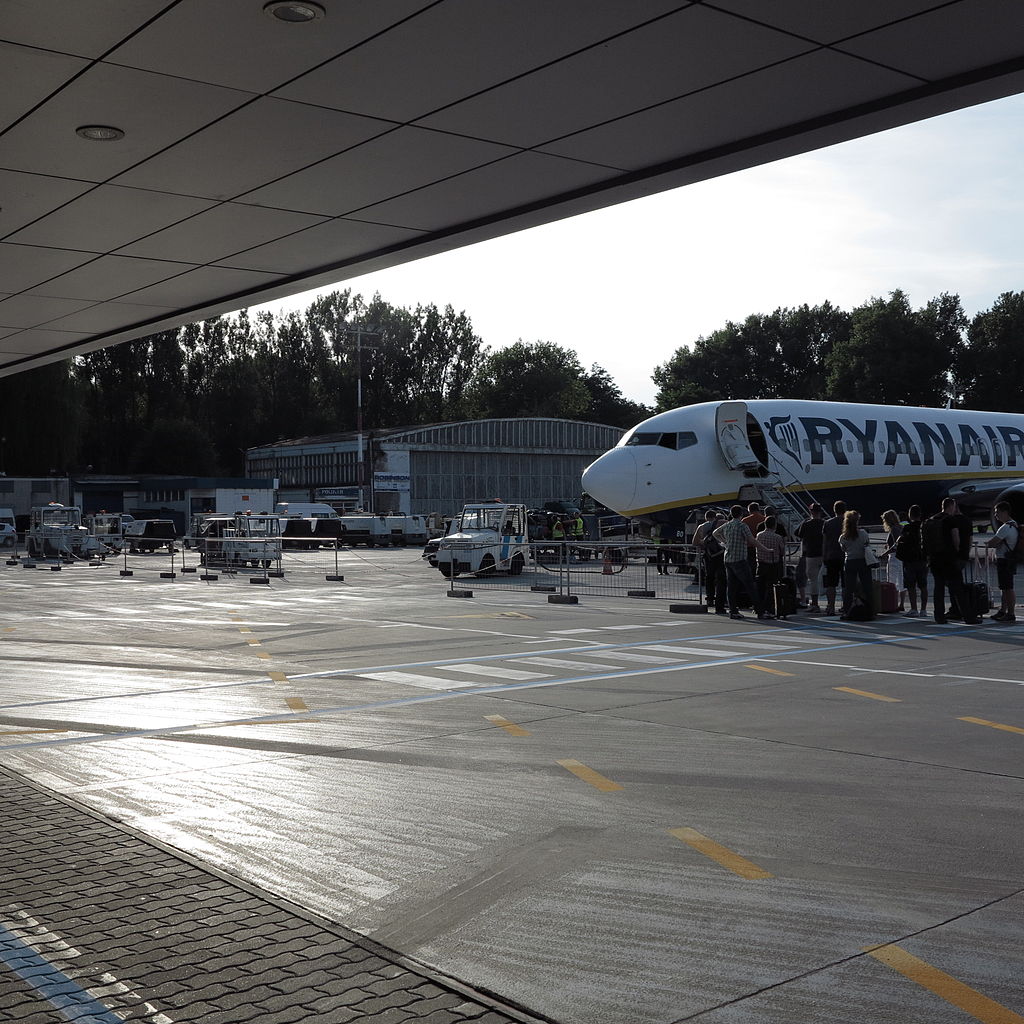
Boarding a Ryanair passenger jet at Krakow airport
Passengers wait to board a Ryanair flight. By Alexandar Vujadinovic (Own work) [CC BY-SA 4.0 (https://creativecommons.org/licenses/by-sa/4.0)], via Wikimedia Commons

The Ryanair cancellations have left many travelers in the lurch since the carrier, based in Ireland, flies more international passengers than any other European airline. Its route network provides service to 34 countries in Europe, as well as Israel and Morocco.

CEO Michael O’Leary has come under fire for his reportedly brash demeanor and seemingly uncaring attitude toward customers and employees. The Economist wrote that Ryanair “has become a byword for appalling customer service.” One of the most notable shortfalls of the customer service department includes poor treatment of disabled passengers that led to a backlash from consumers that the airline just can’t seem to shake.

O’Leary says a change in the protocol that governs employees’ holiday leave is what led to the cancellation announcements. The number of pilots taking leave was not fully anticipated and resulted in the airline not having enough pilots to cover all of the scheduled flights. O’Leary attempted damage control by announcing Ryanair’s recent cancellations will allow the airline to totally overcome staffing shortages before fully resuming regular service on all of the routes in the future. But that statement is falling on deaf ears for some regulators.

The Civil Aviation Authority in Great Britain is accusing the airline of not properly informing passengers. The CAA asserts that those passengers are entitled to vouchers for future travel as well as compensation for additional costs incurred, such as newly necessitated transfers due to all of the re-routing. The only problem is Ryanair neglected to mention compensation and vouchers in its cancellation announcements. This omission led the CAA to issue a formal letter to Ryanair executives, warning of possible legal action. Following receipt of the CAA letter, the airline promised to comply with regulations.

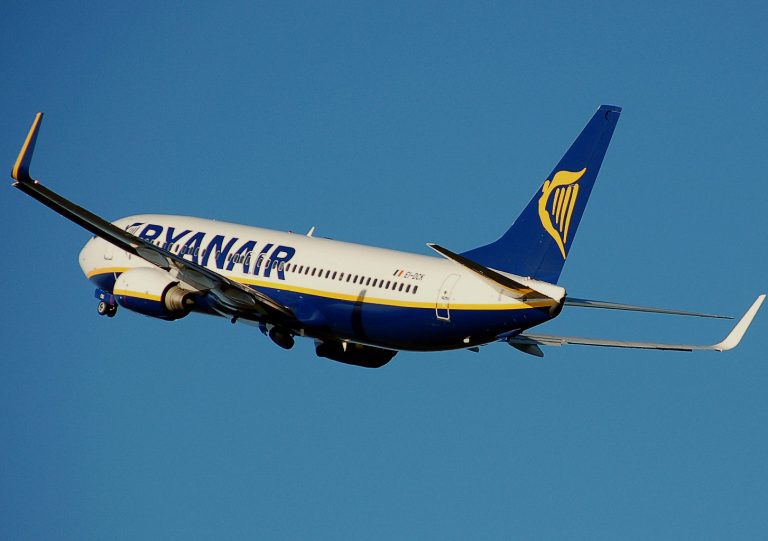
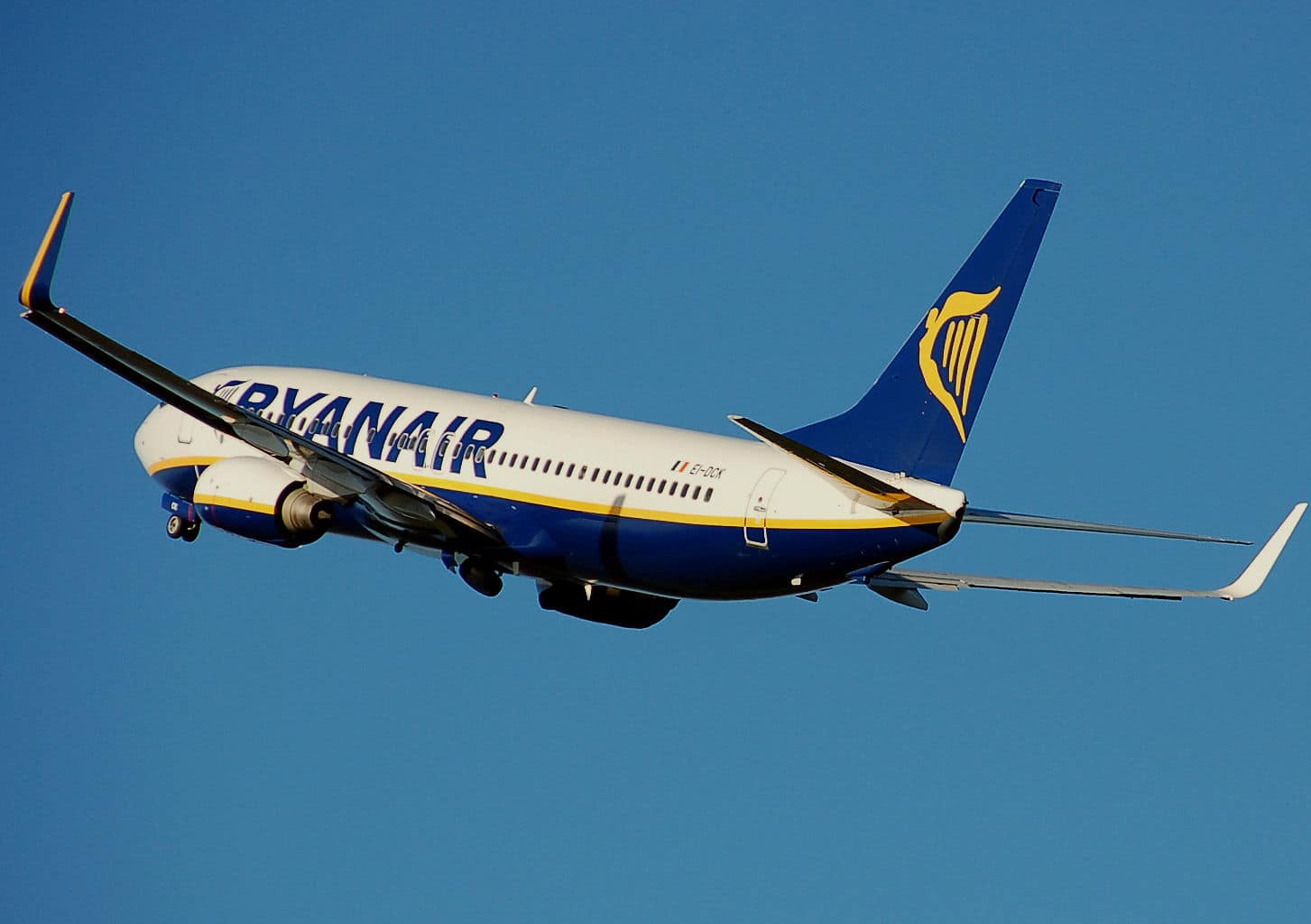
Ryanair.b737 800.aftertakeoff.arp
Photo by Adrian Pingstone.

Unlike many passengers, CEO Michael O’Leary remains upbeat. Ryanair says the cost of both rounds of cancellations will cost the airline less than €50m, a drop in the bucket for an international airline that regularly posts yearly profits in excess of €1.5bn. Passengers that fell victim to cancellations affecting travel from October and March will receive a €40 voucher. That voucher amount will be doubled to €80 for those that were planning a round trip.

He Flew One Of The Last Southwest 737-300 Classics To The Boneyard And The New 737-8MAX In The Same Weekend

0

In aviation and in life, we love to commemorate firsts and lasts. This past weekend, Southwest Airlines retired their fleet of Boeing 737-300s and two days later inaugurated service with the new Boeing 737-8MAX jet.  Our friend and Southwest Pilot Herb Jackson had the opportunity to fly both.  We chatted with him about his amazing experience.

herb
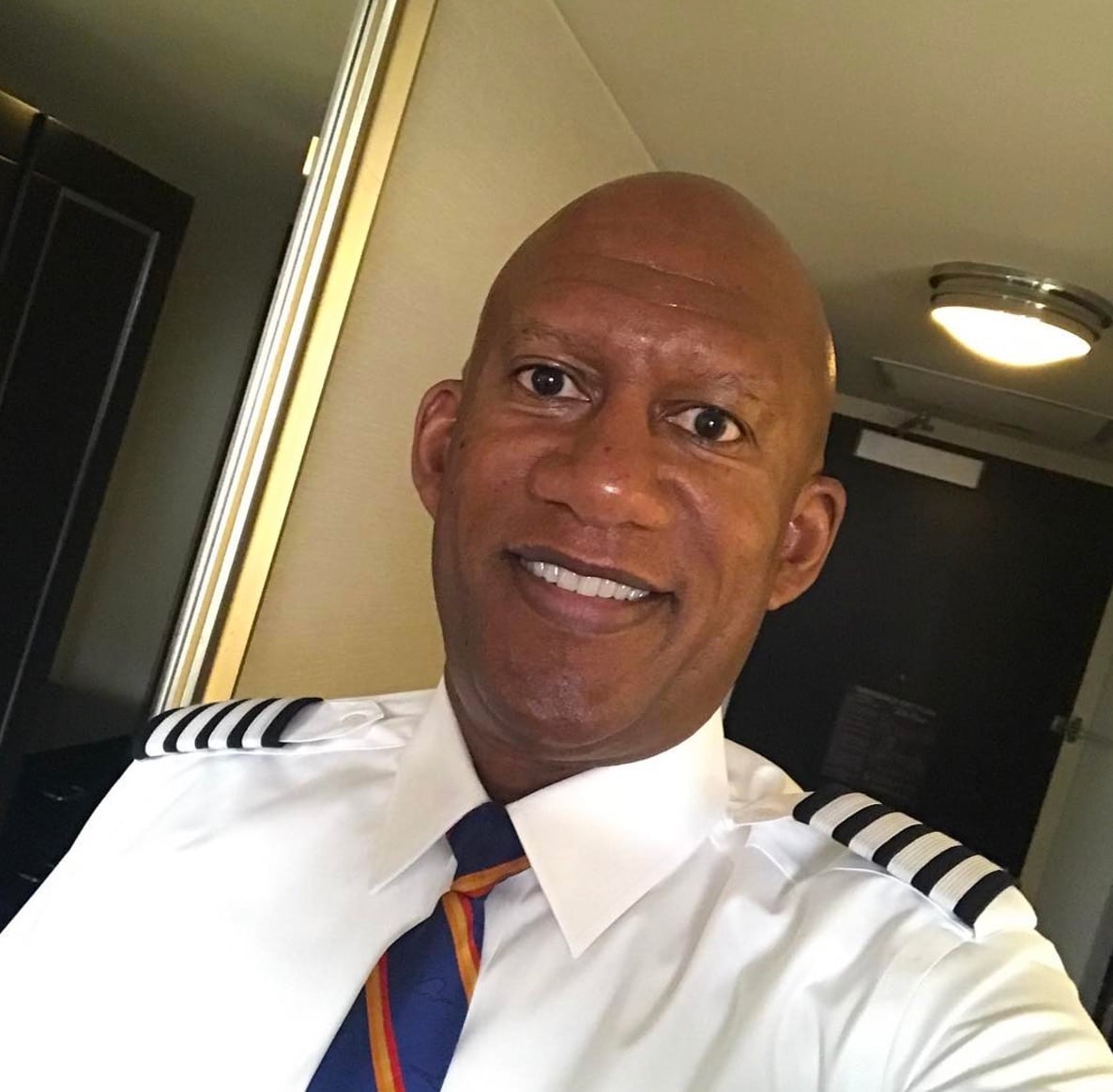
Herb Jackson Jr. is a captain at Southwest Airlines. This past weekend he flew one of the last 737-300 flights to the Boneyard and also flew one of the airlines first revenue 737-8MAX flights.

Herb, you flew one of the last Southwest 737-300 flights ever. How do you feel about that?

When the opportunity presented itself to fly a Classic to Victorville I put my name in the hat and was selected to fly one from Houston. It’s one of those things that doesn’t occur very often so for me I wanted to participate in a bit of aviation history. I began my career back in April of 1986. The the company I was working for at the time had just begun accepting 737-300 deliveries so I remember when this plane was first placed into service. At that time there was no way I could imagine me flying one of the last ones to the desert.

2.) Tell us about the flight. How is a flight to the boneyard different than a normal flight?

Well logistically there is the aspect of ground handling and transportation, but in terms of the flight, nothing too different. It’s operated under Part 91 and it’s a ferry flight with only the assigned crew allowed onboard. Our Operations control center does a great job in providing us with anything we need and the group at Victorville was top notch. They are well versed in all aspects of aircraft storage.

swa300 1
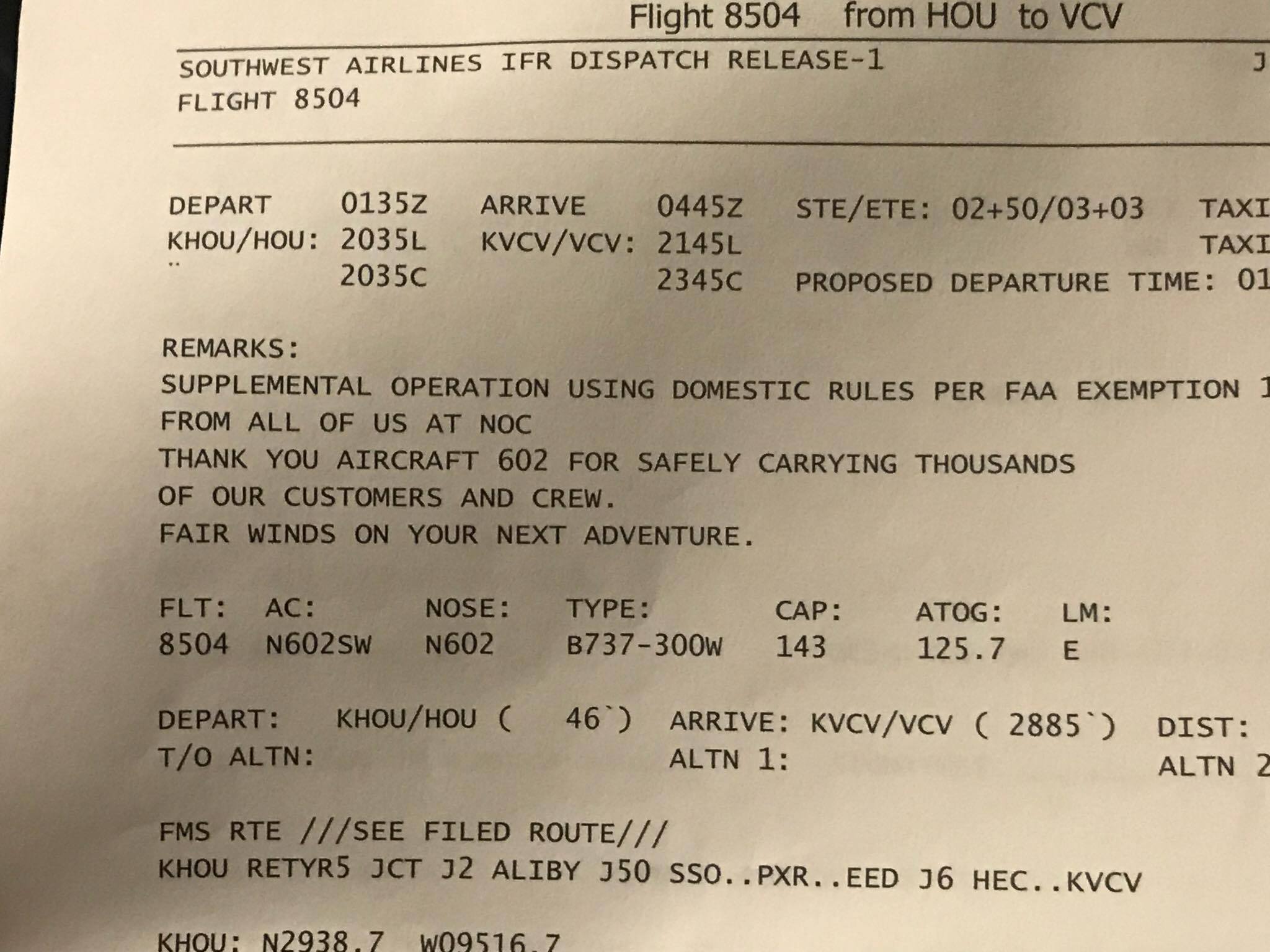
Southwest’s ferry flight paperwork commemorated the occasion. They wished tail 602 fair winds on its next adventure (most likely the scrapper).

3.) Will you miss flying the 737-300?

Hmm I’ll have to let you know that in a few years. The -300 was a great airplane to “hand fly” felt nice. But like your old flip phone, technology has made them less desirable and efficient.

4.) What’s your favorite memory of flying the 737-300?

Well considering my first landing ever at Southwest was in a -300, at SAN, my first landing as a Captain on UOE was in a -300, in SEA, and my first landing on my own as a Captain was also in a -300, also at SAN, I’d say the airplane has left me with some of the best memories of my aviation career.

swa300 3
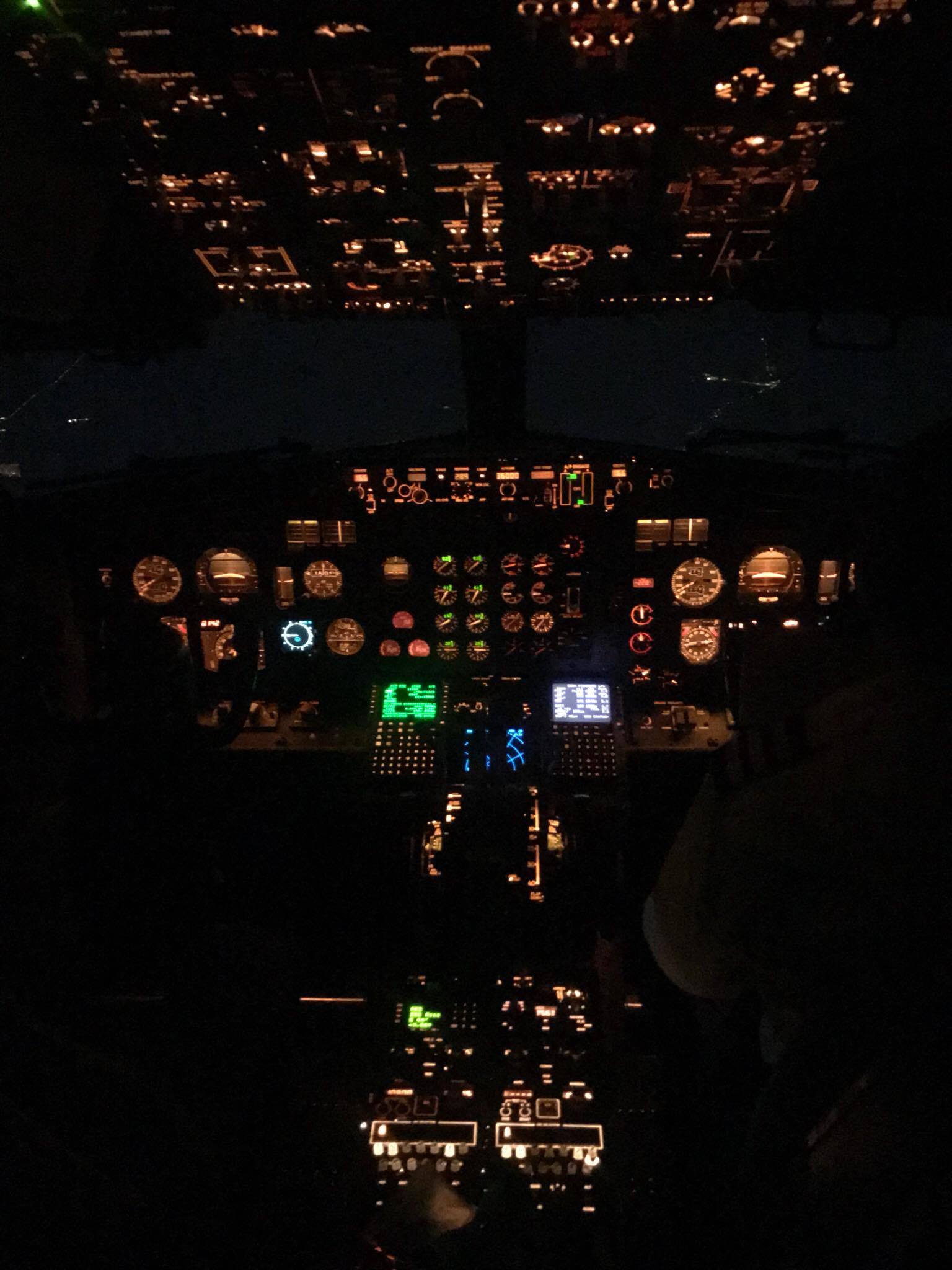
The steam gauge cockpit of the Boeing 737-300 series. With the retirement of the type, all Southwest cockpits will be glass with LCD screens displaying flight instruments.

5.) Is there anything you won’t miss about the 737-300 ‘Classic’?

As I mentioned earlier technology has improved so much that the “80’s” style technology in the -300 made it less desirable to fly as time went by. No auto throttles,  the air conditioning system was taxed on very hot days, no WiFi for the customers, and you had to work harder to maintain your situational awareness.

6.) After dropping off the -300, you then flew the MAX just a couple of days later. How did the two compare?

Talk about a rare occurrence!! I’m one of a few who were afforded that opportunity and I must say it’s been an emotional last few days. The bittersweet retirement of the 300’s followed by operating the MAX on day one. What really amazed me was the excitement that surrounded both events. I can’t tell you how many “avgeeks” and plane spotters I ran into over the last few days. Their enthusiasm is contagious and it’s enlightening to see the passion they have for aviation. These folks go out of their way to attend these events. Meeting them and seeing the excitement in their faces and hearing how they flew all over, on their own time, to be apart of it all. That’s what makes occasions like these special.  I’m very fortunate to “fly” the plane but don’t think for a second I don’t appreciate those who make flying “cool”!

New toy!! The 737 MAX8 ????????‍✈️????

A post shared by Herb Jackson ???? (@herbjacksonjr) on

UPDATED: Navy Identifies Two Pilots Lost in East Tennessee T-45 Crash

UPDATED 10/3/2017: This is the latest information provided by the Navy:

The Navy has released the identity of the pilots killed when their T-45C aircraft crashed in Tellico Plains, Tennessee, Oct. 1.

Lt. Patrick L. Ruth, 31, of Metairie, Louisiana, and Lt. j.g. Wallace E. Burch, 25, of Horn Lake, Mississippi, died when their aircraft went down in the Cherokee National Forest in eastern Tennessee. Both pilots were assigned to the “Eagles” of Training Squadron (VT) 7 based at Naval Air Station Meridian, Mississippi.

Ruth had been in the Navy for nine years and was a member of VT-7 since 2015. Burch had been in the Navy for nearly three years and was a member of VT-7 since 2016.

An investigation is underway to determine the cause of the mishap.

Additional information about Ruth and Burch:

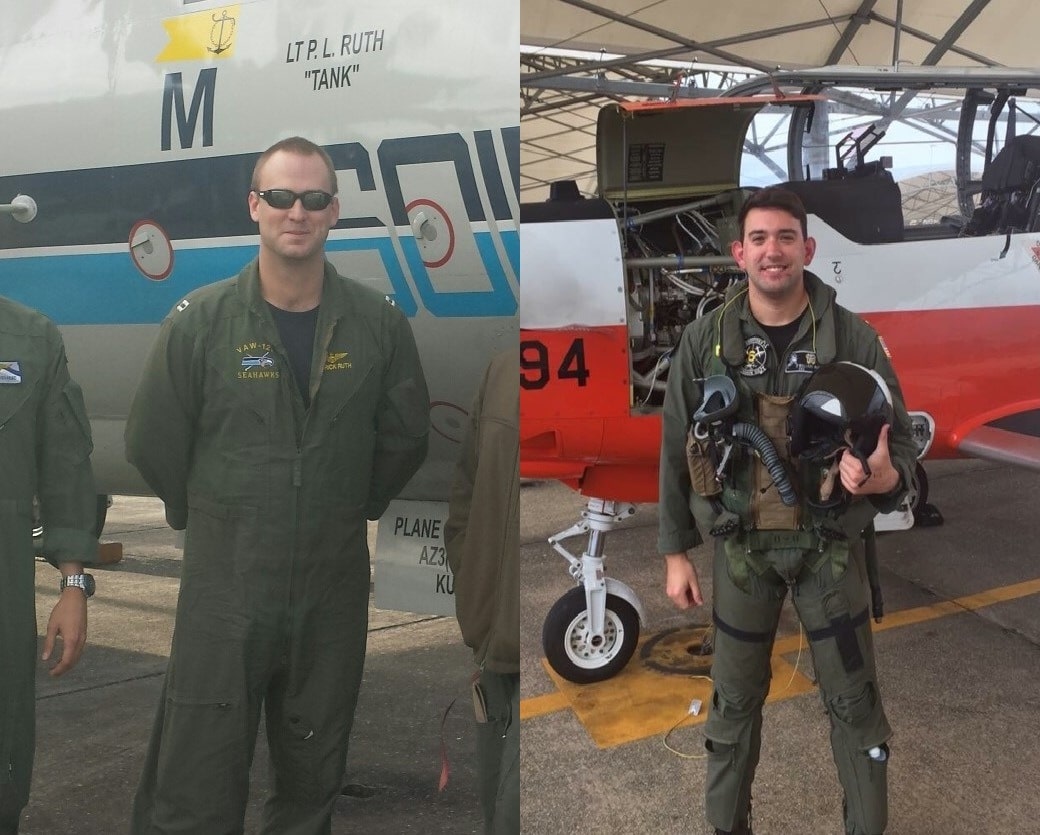
Lieutenant Patrick L Ruth, who was 31 years old and a nine year veteran, was from Metairie in Louisiana. He began his Navy career in the Navy Reserve Officer Training Corps at Tulane University. He was commissioned in May 2008 and went through extensive flight training before joining Carrier Airborne Early Warning Squadron ONE TWO SIX (VAW-126) Seahawks out of Norfolk in Virginia during 2012. Ruth spent three years with VAW-126 before being assigned as an instructor with VT-7 in April of 2015. Ruth earned two Navy/Marine Corps Achievement Medals during his career.

Ruth and Burch
Lieutenant Ruth (left) and Lieutenant Junior Grade Burch (right). Official US Navy Photorgraph

Lieutenant Junior Grade Wallace E Burch, who was 25 years old and a three year veteran, was from Horn Lake in Mississippi. He attended Officer Candidate School at Newport in Rhode Island during 2014. He was commissioned in January of 2015. Burch reported to VT-7 as a student in the advanced jet training syllabus in 2016.

Previous Information Below-

MERIDIAN, Miss. (NNS) — At approximately 9:40 a.m. Oct. 2, Training Air Wing ONE, based at Naval air Station (NAS) Meridian, Miss., confirmed the T-45 belonging to Training Squadron SEVEN (VT-7) that went missing yesterday afternoon has crashed in East Tennessee.

Two pilots were aboard the aircraft, an instructor and a student. The pilots did not survive the incident. Names of the pilots are being withheld until 24 hours after next of kin notification.

An investigation will commence to determine the cause of the mishap.

Here is a link to Knoxville news coverage of the crash:  http://www.knoxnews.com/story/news/local/2017/10/01/monroe-sheriff-plane-crash-reported-tellico-plains/721602001/

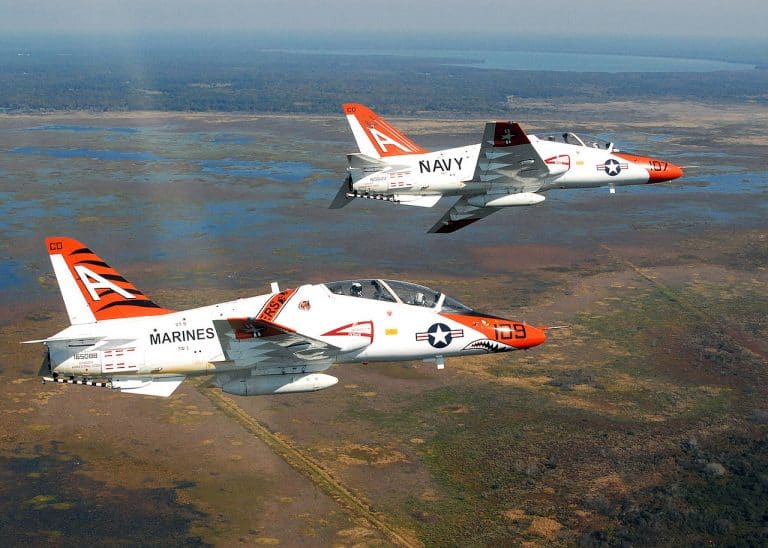
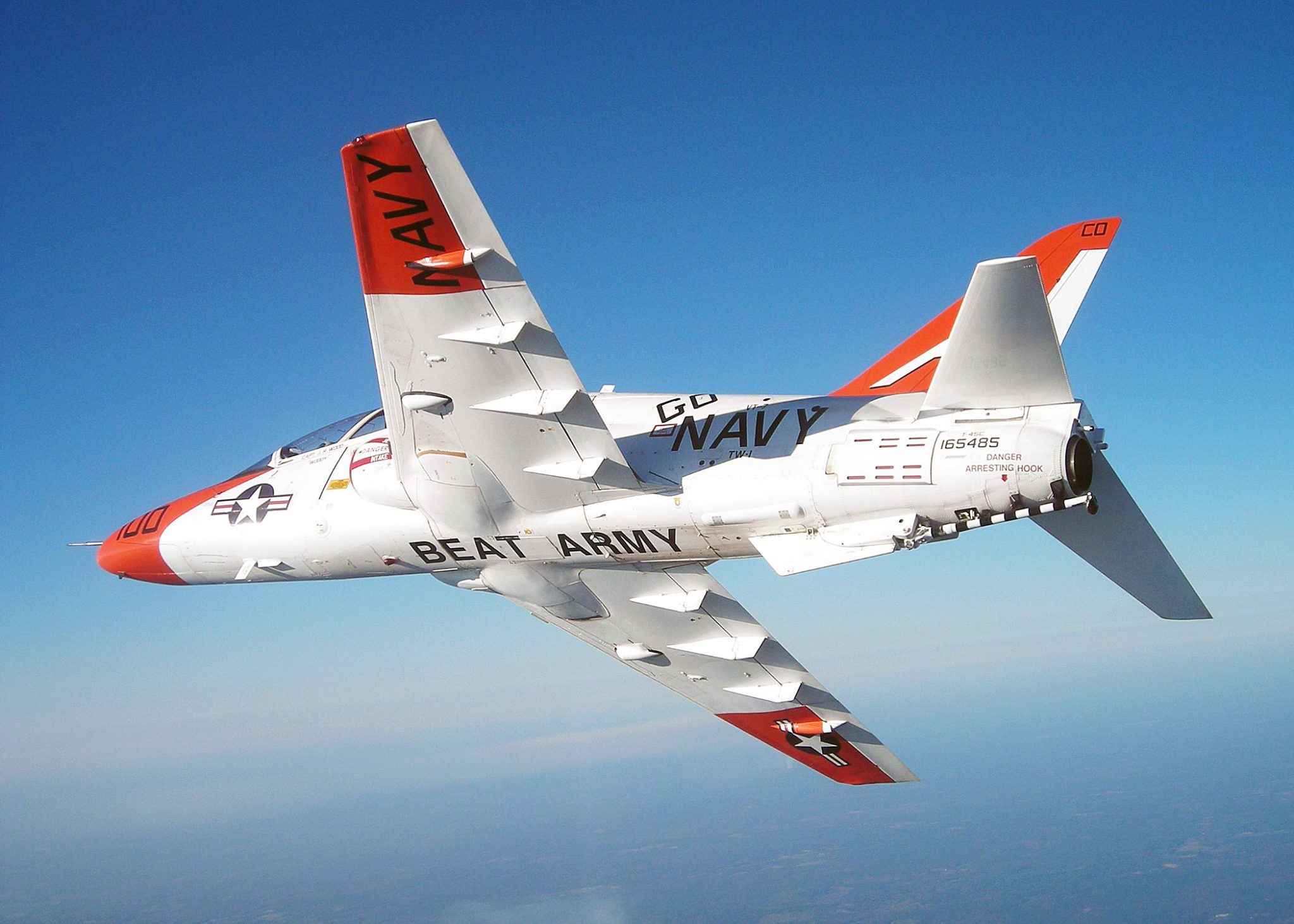
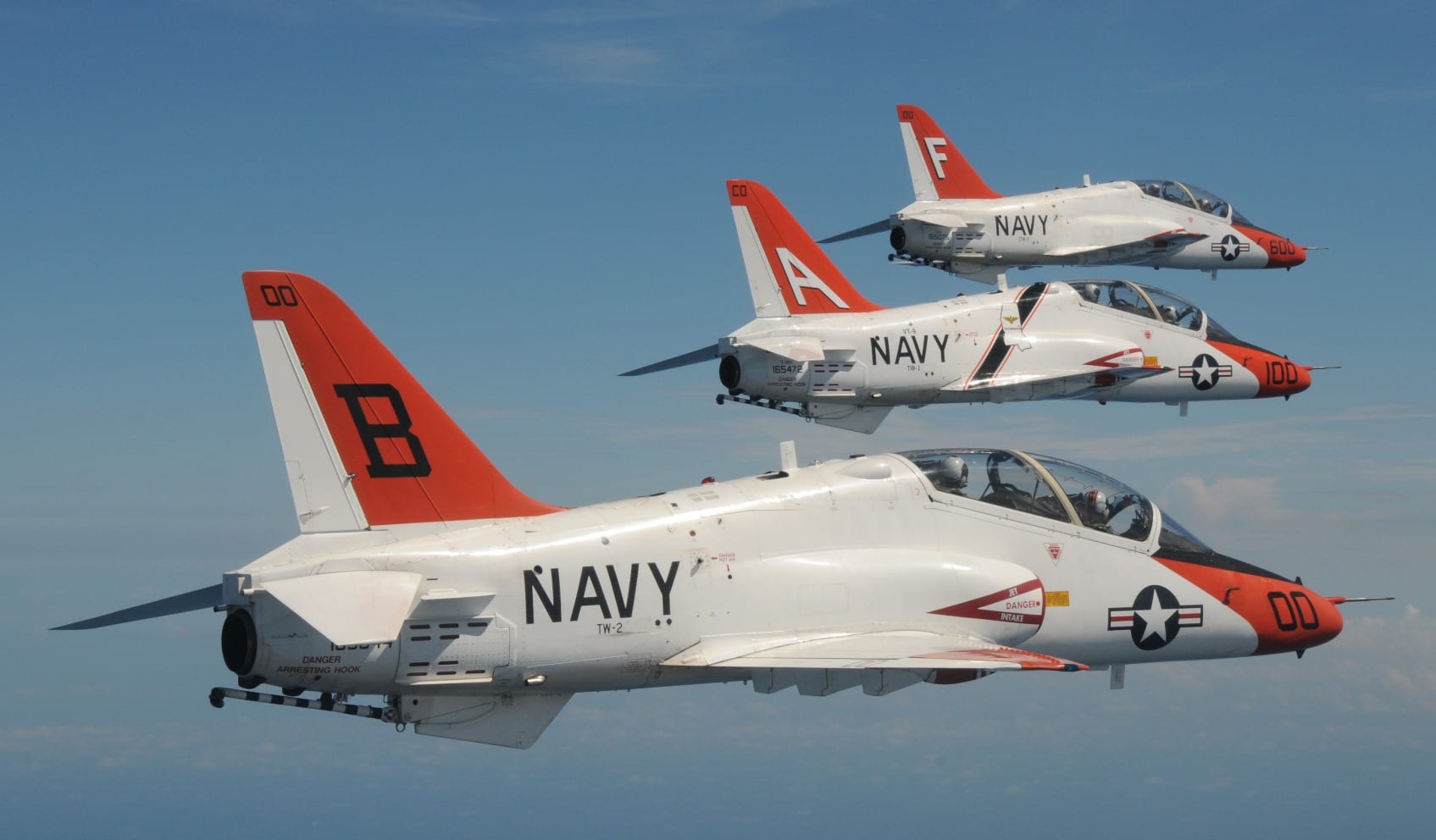
On Sunday October 1st 2017, Naval Air Station (NAS) Meridian public affairs personnel reported a McDonnell Douglas (Boeing) T-45C Goshawk jet trainer assigned to0 Training Squadron SEVEN (VT-7) Eagles was missing. The jet, carrying a student pilot and an instructor pilot, was attached to Training Air Wing ONE (TW-1) and based at NAS Meridian in Mississippi. Later on the same day at 1800 local time TW-1 was made aware of a plane crash reported in Tennessee’s Cherokee National Forest located in the far northeastern corner of the state.

4
Official US Navy Photograph

TW-1 and the Chief of Naval Air Training (CNATRA) have now confirmed the loss of the aircraft and the deaths of both the student pilot and instructor aboard the jet. TW-1 is the parent command for two Naval Training Squadrons, Training Squadron SEVEN (VT-7) Eagles and Training Squadron NINE (VT-9) Tigers. Both squadrons instruct Navy and Marine Corps students in the Advanced training syllabus.

100826 N 8629D 048 4945833838
Official US Navy Photograph

UPDATED: Air France A380 Lands Safely After Uncontained Engine Failure Over Atlantic

UPDATE #3 Sept 30 8:10PM PT:  Passengers remained on the jet after landing at Goose Bay.  Air France is sending a Boeing 777 and a 3rd party Boeing 737 to pick up the passengers.  As of 8:10PM PT tonight, the aircraft have not arrived. Below is an additional photo taken by a passenger on the flight.

Additionally, Jacon Soboroff from MSNBC posted this passenger-filmed video of the A380 landing at Goose Bay.

UPDATE #2 Sept 30 5:52PM PT:  ATC audio of the arrival into Goose Bay has appeared on YouTube. Other than the “Mayday” at the end of every call, the approach by Air France 66 seemed very nominal.  One interesting thing to note though is that the jet taxied clear.  This isn’t uncommon after an engine failure.  However, an engine failure as severe as the one AF66 experienced could lead to additional fuel or hydraulic leaks.  Typically rescue vehicles will follow the jet to parking.  It is unclear from the audio if rescue equipment followed the jet to parking.

UPDATE #1 Sept 30 3:26PM PT: Video has emerged of the arrival into Goose Bay, Canada. In the video, you can see the #4 engine is clearly inoperative after the fan and cowling blew off.

p072185
An Air France A380 safely made an emergency landing in Canada today, after one of its engines failed and came to pieces in flight from Paris to Los Angeles. File Photo: Air France

ORIGINAL REPORT: An Air France A380, flight AF66, landed safely this afternoon at Goose Bay International Airport in Newfoundland, Canada, after suffering an in-flight engine failure where the engine appeared to “blow apart”, according to tweets from passengers onboard.

The incident occurred over the Atlantic, en route from Paris to Los Angeles, and initial images on twitter show parts of the engine ripped off. The flight landed safely an hour later.

Others passengers tweeted hearing a “loud thud and a lot of vibration” before looking out at the mangled engine.

Air France confirmed the incident but offered few details, saying passengers were in the process of being transitioned to new flights to LA.

Another major disintegration issue with an A380 engine occurred in Nov 2010, and a QANTAS Airbus A380 flight with 480 passengers and crew was forced to return to LAX earlier this year after takeoff when it suffered an engine failure on climb to cruising altitude. It is important to note though that the Qantas aircraft flew with Rolls Royce engines.  The Air France aircraft involved in today’s incident flew with Engine Alliance GP7000 engines produced in a joint venture between GE and Pratt and Whitney.

We will update more as details emerge.
.

Follow Mike Killian on Instagram and Facebook, @MikeKillianPhotography 

.

How Do Pilots Check the Weather Before Flying?

0

An old aviation aphorism states that there are old pilots and bold pilots, but no old, bold pilots. Going flying without first checking the weather would be sort of like gambling in a casino but with no way to win and many ways to lose. So it is universally recognized by all pilots that one of the keys to a long and prosperous aviation career involves thoroughly checking the weather before committing aviation.

The methods that pilots have used over the years to investigate the weather along their route and at their destination have been continuously updated over the years through advances in technology. The Weather Bureau, a predecessor to the National Weather Service, first established an aerological department in 1914 to meet the growing needs of aviation.

Since that time, government-provided weather services have been the backbone of aviation weather, but that is changing. With the reality of the internet, aviation weather became more democratized and the advent of wireless connectivity means it has never been easier to have access to high quality weather information and graphics wherever a signal is available.

There are many products currently available for pilots to use as a source for weather information, but one I’ve been using has been a standout. Honeywell’s GoDirect Weather Information Service (WIS) is a fully functioned product for presenting a range of weather observations and forecasts to include high quality graphics for pilots. The app is available for both Windows and iOS, but I’ve been using it on an iPad. It is available from the Apple app store and installed easily.

airplane clouds

It’s Fast!

The first thing I noticed about this app is that it’s fast. I mean really fast. I have used many other weather apps and it seems that waiting for a radar picture to load can take forever. That is not the case with WIS. Hit the weather uplink button and your weather data is displayed within less than a second. I realize that this time will vary depending on the speed of your underlying data connection, but the uplink was fast in comparison to other products I’ve used with the same connection.

The data that you get is everything you need to safely plan and fly your trip. Multiple overlays are available on the map display to show as much or as little data as you care to see. Again, toggling overlays on or off is nearly instantaneous with no discernible lag to render graphics. Did I mention that the software is fast?

The available map overlays include terrain, airports, navaids, waypoints, and political boundaries. Most of these are user selectable to provide information when needed or to de-clutter the display when not needed. Another feature of the app that I have really come to appreciate is an automatic map de-clutter feature that displays information based on zoom level.

You would think that such a feature would be standard on most software to be used while performing an intensive task such as flying, but that is sadly not the case. Fumbling through menus to de-clutter a map when you might be trying to avoid a storm is not an optimal use of cognitive resources. The engineers at Honeywell have figured this out, and data such as waypoints, navaids, and airports will automatically change presentation based upon the zoom level. Again, this was quite fast with no lag time for rendering. I found this feature quite useful and it made the software a pleasure to use.

You’re In Control

When flying in challenging weather, knowing what has happened in the past can be just as important as knowing what the current conditions and forecasts are. Honeywell has included an intuitive time slider on the map display which allows pilots to easily see conditions up to three hours old. Historical data can be displayed as an animation or statically.

And just as the observations time slider allows a look at past conditions, the app also includes a future time slider to display forecasts up to 24 hours ahead of the current time.

The program presents radar, satellite, and lightning data along with available PIREPS in an easily readable and selectable map format. Clicking on any observation or forecast feature will display a window showing the details of that particular area. All of these features worked together to make the product easy to use while flying.

In addition to knowing the “when” of the current and forecast weather, a Flight Level selector lets you control the “where.” Moving this selector will present the clear air turbulence (CAT), winds and icing forecasts for your chosen flight level. Satellite observation is also selectable using this slider. This again reinforces the philosophy of only seeing that information which is of use while not cluttering up the display with extraneous data.

Another powerful tool which I found to be very useful is the Vertical Situation Display (VSD). Showing a vertical slice or profile view of weather along the loaded flight plan, it is easy to determine where icing, turbulence and CB tops lie along your route. These things can be determined without the display, but seeing a graphical display is immensely helpful when planning a route. Again, the Honeywell engineers seem to have really put some thought into how this product will be used.

Flight Plans Made Easy

And speaking of flight plans, WIS makes loading and editing flight plans a snap. Flight plans can be loaded from Honeywell’s GoDirect Services, pasted from the clipboard or entered directly. Once loaded, plans are easily edited. It is important to note that the program accepts routing in standard ICAO terms, so don’t forget to add “DCT” when proceeding directly between fixes. Plans are then rendered as an overlay on the map display.

The program even has an “own ship” centering feature which can access the GPS signal from the device on which it is installed. Tracking your own progress has never been easier.

A related airports list adds easily accessible weather information from selected airports to a side panel. The best part of this feature is that when refreshed, only data for selected airports will be uplinked, thereby saving data costs.

If you are interested in seeing the weather at any one particular airport, just clicking on the airport symbol on the map brings up a window in which the current METAR, ATIS, and TAF can be instantly displayed. This was probably my favorite feature saving me multiple steps in obtaining this information from several separate sources. It’s all conveniently aggregated into one place.

In Conclusion

We are living in a golden age of weather information which is available for pilots to plan and fly. But as with any data stream, the presentation and analysis of that information can be just as important as the data itself. A smart and intuitive interface is essential for proper flight planning and conduct, and Honeywell’s GoDirect Weather Information Service provides that in spades. Equally useful for both pros and recreational pilots, it’s an easy recommendation for me to make.

Lockheed Wants to Put a Base Camp in Orbit Around Mars, Complete With Lander

0

Speaking at the International Astronautical Congress (IAC) in Adelaide, Australia, officials with Lockheed Martin today revealed their plans for what they believe is a sound, safe and compelling mission architecture to help NASA get humans to Mars within a decade, using a concept centered around an orbiting outpost they call the Mars Base Camp.

“Sending humans to Mars has always been a part of science fiction, but today we have the capability to make it a reality,” said Lisa Callahan, vice president and general manager of Commercial Civil Space at Lockheed Martin.

[youtube id=”vLpZUMfIJX0″ width=”800″ height=”454″ position=”left”]

“Partnered with NASA, our vision leverages hardware currently in development and production. We’re proud to have Orion powered-on and completing testing in preparation for its Exploration Mission-1 flight and eventually its journey to Mars.”

Plans for building the outpost align with NASA’s skyscraper-tall Space Launch System (SLS) rocket, Orion spacecraft and the agency’s plans for a Deep Space Gateway orbiting the moon, which will serve as a critical staging point for missions to the lunar surface and deeper into space, such as to asteroids and Mars in the 2030s.

37272639941 d86a86facb k 1
Mars Base Camp and Lander. Credit: Lockheed Martin

The first launch of an SLS and Orion, Exploration Mission 1 (EM-1), which will be a shakedown flight to the moon and back of the integrated SLS/Orion system, won’t launch until 2019, with the first crewed Orion mission to lunar orbit occurring around 2-3 years later.

Lockheed is also the prime contractor for Orion.

Such a lunar outpost will offer a true deep space environment for astronauts to gain experience and have opportunity to build and test the systems needed for the very challenging missions that will follow, but will also offer the ability for crews to return to Earth if needed in days – rather than weeks or months on missions further into space (such as Mars).

MBC Configuration Graphic7 check5hires 2
Credit: Lockheed Martin

Lockheed is actually already developing a prototype habitat for the gateway under a contract with NASA ((which you can read about on AvGeekery HERE), taking the old Donatello Multi-Purpose Logistics Module (MPLM), once used in the payload bay of the space shuttles to transfer cargo to the ISS, and refurbishing it to prototype their deep space habitat in the Space Station Processing Facility at Kennedy Space Center in Florida.

And although some components of the Mars Base Camp’s architecture will be pre-positioned in Mars orbit ahead of time, the Mars Base Camp would ultimately be built up at the Deep Space Gateway, away from Earth’s gravity, before being deployed to the Red Planet.

36603075873 b19299a905 k
Lockheed’s lander for the Mars Base Camp, called the Mars Accent Descent Vehicle (MADV). Credit: Lockheed Martin

An Orion spacecraft would serve as the heart of the outpost, same as the Deep Space Gateway.

In addition to an orbiting base camp, Lockheed also envisions a reusable, single-stage lander for the outpost called a Mars Accent Descent Vehicle (MADV), using Orion avionics and systems as its command deck and powered by engines using liquid-hydrogen/liquid-oxygen propellant, both of which will be generated from water.

[youtube id=”yMnFiGQhWO8″ width=”800″ height=”454″ position=”left”]

Above, watch a video animation of it all in action.

The lander would be capable of conducting surface mission as long as two weeks in length, with up to four astronauts, before returning to the orbiting outpost where it would be refueled and readied for another mission.

Follow Mike Killian on Instagram and Facebook, @MikeKillianPhotography 

.

Watch The “Fighting Omars” Simulate The Enemy With Their Skyhawks

The Navy’s Fighter Squadron Composite TWELVE (VFC-12) Fighting Omars have provided adversary training to East Coast-based carrier air wings since September 1st 1973, when they were established as Fleet Composite Squadron TWELVE (VC-12) at Naval Air Facility (NAF) Detroit. VC-12 then became the Navy’s first Reserve Fleet Composite squadron. The Fighting Omars moved to Naval Air Station (NAS) Oceana in Virginia in 1975. In 1988 they were re-designated VFC-12. This video shows VFC-12 flying their Douglas A-4 and TA-4 Skyhawk aircraft at NAS Oceana, NAS Cecil Field, and NAS Key West during the 1980s and early 1990s. Thanks to YouTuber thezipmartin for uploading it.

[youtube id=”avmja9s65bA” width=”800″ height=”454″ position=”left”]

TA 4F Skyhawk front view in 1990
VFC-12 TA-4F Skyhawk Taxying at NAS Oceana. Official US Navy Photograph

In 1994 VFC-12 transitioned to flying the McDonnell Douglas (Boeing) F/A-18A+ and F/A-18B Hornet. Their distinctively camouflaged jets now mimic paint schemes used on aircraft flown by the former Soviet Union and other potential enemy air forces. The Fighting Omars have been awarded the Chief of Naval Operations Aviation Safety Award and the Noel Davis Trophy for squadron readiness five times each. The squadron has also received a Meritorious Unit Commendation, the Battle “E”, the Noel Davis award for recognition as the best squadron in its category for Reserve Carrier Air Wing Twenty (CVWR-20), and an Aviation Safety Citation from the Commander Naval Air Reserve Force for several years of Class A mishap-free flying.

1280px A 4F Skyhawk of VFC 12 taking off with towed target 1989
VFC-12 A-4F Skyhawk taking off from NAS Oceana toting a towed target. Official US Navy Photograph

WestJet Creates New Airline Within An Airline–Think Spirit or Allegiant for Canada

0

WestJet Airlines, Canada’s largest low-cost carrier announced that it will launch a new ultra-low cost carrier (ULCC) in 2018.  What is a ULCC?  Think Allegiant or Spirit Airlines for Canada. Ouch!  Poor Canadians!

In a statement, WestJet said, “The name Swoop denotes exactly what we plan to do,” said Bob Cummings WestJet Executive Vice-President, Strategy and the executive member responsible for the launch of Swoop. “It’s a powerful verb that demonstrates we plan to swoop in to the Canadian market with a new business model that will provide lower fares and greater opportunity for more Canadians to travel.”

Swoop will provide Canadians with a no-frills, lower-fare travel option backed by an airline with a proven track record of bringing lower fares to Canadians and an investment-grade credit rating.

In addition, Swoop has chosen Calgary as the location of its headquarters. An exact location will be announced at a later date.
“As we looked around for the home for Swoop’s operations, Calgary quickly rose to the top of the list,” said Cummings. “The city offers Swoop the opportunity to save costs through shared services with WestJet’s corporate head office, the availability of existing infrastructure, and talented, experienced WestJetters to draw from. We are confident that these qualities will support our ultra-low-cost operations and our guests well into the future.”
Swoop will fly a fleet of Boeing 737-800 aircraft, presumably refurbished jets from WestJet’s fleet.  Like Allegiant and Spirit Airlines, Swoop will charge for carry-ons, luggage, snacks, in-flight entertainment, and seat assignments. Additionally, the seats onboard Swoop aircraft will have a standard configuration which might mean a standard seat pitch and a pre-reclined option utilized by other ULCCs.

Operation Airdrop Volunteer Pilots and Staff Support Hurricane Victims

Download
OAD Pilots & volunteers of load relief supplies for Hurricane Harvey victims

“Ready to go, have cleared my schedule for WED and beyond. Twin Cessna 414. Bringing 300 lbs of diapers with me.” Operation Airdrop Pilot

Imagine having 4 feet of flood waters receding from your home. Now that the storm is over you have to start assessing the damage and cleaning up, but you can’t go to Target or Wal Mart to get your supplies. They were hit by the floods too, just about every store was. And if you have a baby the Red Cross doesn’t have diapers to give to you. Enter Operation Airdrop Hurricane Harvey!

Operation Airdrop

Operation Airdrop (OAD) https://www.operation-airdrop.com started just in the aftermath of Hurricane Harvey as an effort by two pilots, we’d like to call them fellow Avgeeks, John Clay Wolfe and Doug Jackson. Wolfe is a Dallas metro area iheart radio personality and Jackson are friends who both felt the need to do something to help these people.

Well, you’re a pilot and I’m a pilot, why don’t we fly some stuff down?’ I’ve got this radio network, we ought to use it for some good. What if we organized a bunch of pilots and mimic that Cajun Navy thing, but do it with airplanes?” Credit: Flying Magazine They promoted their efforts on the radio and facebook to the General Aviation community and the response has been overwhelming.  Fans at the Thunder over Michigan Airshow were asked to help fill two C-47s with over 20,000 pounds of relief supplies.

Operation Airdrop pilots are bringing new meaning to the phrase “weekend warrior.” OAD pilots have volunteered their time, flying skills and aircraft to generate a massive relief effort. In the tradition of the cajun navy a group of over 200 civilian pilots have joined together forming a massive coordinated relief effort. To date Operation Airdrop has completed over 400 flights, delivering over 250,000 pounds of supplies in difficult to reach areas of hurricane stricken South Texas.

https://batchgeo.com/map/fd51bdd9e103af3df22cfc0337d19b3b Map by Joe Vaeth

Operation Airdrop Expanding Reach

Operation Airdrop started by using aircraft to bring immediate short-term relief to hardest hit areas after Harvey in Texas by targeting isolated areas with small airports along the Texas Gulf Coast. Since that time OAD has expanded its mission to deliver assistance to Florida and Puerto Rico in the wake of hurricanes Irma & Maria.  To accomplish this critical feat OAD is actively developing strategic relationships with the military, government leaders, and other relief organizations such as the Texas Baptist Men, Salvation Army, Texas Navy & Cajun Air Force. The FAA has also been very cooperative in this effort. OAD pilots even have their own sqawk code.

Operation Airdrop is making a tremendous difference in the lives of families one aircraft load at a time. One of the real strengths of this organization has been the ability to get relief into the hands of people that need it quickly. OAD has established a supply chain and places for donations to dropped, distributed & received. Supplies are reaching folks in need within 30 minutes after landing. Here is a listing some of the items being delivered:
Diapers
Baby Formula
Cleaning Supplies
N95 dust masks
Maxi pads
Frigdes
Fans
Bottled Water
Dog food, Cat Food
Paper Towels & TP
Sleeping Bags
LED Lanterns
Canned Foods
Athletic apparel and shirts from the Dallas Cowboys
Papa Johns Pizza to relief workers and first responders.

Fleet
Fleet of aircraft at KCXO

One account from KCXO, Conroe, TX stated, “ Dozens of pilots landed their planes in the airport and personnel from The Salvation Army helped unload pounds of diapers and baby materials, toiletries and sleeping bags to distribute to storm victims.” OAD also had help from some extra muscle on the ramp at KBMT, Beaumont Municipal Airport from the Army and Air Force troops working there.

Military Muscle 1
Air Force & Army troops support OAD on the ramp at KBMT

Pilots Wanted

This effort is being sustained by volunteer pilots. The organization’s facebook page and website have a link https://www.operation-airdrop.com/pilot-intake for pilots and or aircraft owners to fill out a form and a member of the operations team will make immediate contact. OAD pilots have been flying in supplies from all over the U.S. and Mexico. And they have been flying in a myriad of aircraft including everything from Cessna 152s, Pilatus PC-12’s to Beechjets and the venerable DC-3. The group’s heavy lifter is a WWII era DC-3 cargo aircraft painted with invasion stripes and still serving in a critical role.

The team Operation Airdrop assembled has put a lot of work into building a seamless operation. Pilots fly into coordinated donation centers/depots to load up. There they get a weather briefing and coordinated instructions for flying into the Houston TFR. The aircraft are fueled and sent on their way. Upon landing at the relief field the aircraft is downloaded by the waiting volunteers. Supplies are distributed. Then the aircraft is re-fueled for its next run.

Relief Airfields served by OAD:
KCXO – Conroe, TX – Lone Star Executive
KPKV – Port Lavaca, TX – Calhoun Air Center
KIWS – Houston, TX – West Houston Airport
KI95 – Kenton, TX – Hardin County Airport/Hawthorne Field
KBMT – Beaumont, TX – Beaumont Municipal Airport
KILE – Houston, TX – Ellington Airport
KBYY – Bay City, TX – Bay City Regional Airport
KRKP – Rockport, TX – Aransas County Airport
KCRP – Corpus Christi, TX – Corpus Christi International Airport
KRAS – Port Aransas, TX – Mustang Beach
KILE – Kileen, TX – Skylark Field – Supply Depot
KDTO – Denton, TX – Operations Center

Operations Center

Conducting a relief operation to austere airfields in a storm devastated environment is a complex problem. Supplies need to be coordinated, pilots need to be taksed and briefed and most importantly the aerial armada needs fuel to conduct its runs. The OAD operations center has conducted over 400 flights now. Wolfe describes it as follows:

“OAD has a war-room style operations center located in KDTO (Denton, TX) manned by a software pro, full time controller, airline logistics expert and other pilots as mission control. These vols are scheduling freight, assessing needs, updating FAA clearance codes, managing aircraft weight loading specs, fuel burn, fuel replenishment locations and of course constant weather updates to our air-force of volunteers. An enormous part of the OAD’s sudden success is the streamline logistics, and feedback to our pilots in real time. When pilots land they know where to drop, where to fuel, and no one goes home until every flight is accounted for safe and sound, tracking each plan online much like government controlled operations.”

Impact Beyond Texas

The impact Operation Airdrop has been able to deliver has already been recognized at the highest levels of government as an, “untapped strategic national resource.” It’s hard to believe what this group of volunteer aviators and support personnel have accomplished in a matter of days.

Operation Airdrop has now turned its resources toward Florida and Puerto Rico and is coordinating a continuing volunteer pilot relief effort.  Radio host John Clay & founder of Operation Airdrop shared that Saturday morning OAD hosted an on air relief pitch with Pudge Rodriguez.  Pudge is Puerto Rican and a retired major league baseball catcher who played for the Texas Rangers and the Florida Marlins winning the World Series in 2003.  Clay said, “We had Pudge on the show,” asking for donations, “and man they came in!”  The donated supplies included 16, 600kW generators for Puerto Rico.

You can follow & offer your support to Operation Airdrop on facebook https://www.facebook.com/groups/operationairdrop

or at their website https://www.operation-airdrop.com.

Banner

Additional Sources:

Flying Magazine
http://www.flyingmag.com/harveys-devastation-inspires-pilots-to-create-operation-airdrop#page-2

PR Newswire
http://www.prnewswire.com/news-releases/operation-airdrop-continues-to-deliver-relief-supplies-to-texas-coast-as-irma-threatens-florida-300514342.html

Conroe – Community Impact Page
https://communityimpact.com/houston/conroe-montgomery/city-county/2017/09/01/photo-gallery-pilots-deliver-baby-formula-diapers-operation-airdrop-hurricane-harvey-recovery-efforts/

Click on Detroit
https://www.clickondetroit.com/news/plane-to-deliver-donations-from-thunder-over-michigan-airshow-to-hurricane-harvey-victims

US Flies Bombers Near North Korean Coast; Kim Jong Un Retaliates With Crappy Video

Recently the United States Air Force flew Rockwell B-1B Lancer bombers escorted by Boeing F-15C Eagle fighters and Marine Corps Lockheed-Martin F-35B Lightning II aircraft alongside the North Korean coast. The jets flew further north of the Demilitarized Zone (DMZ) then they have at any other time during this century.  It was a show of force intended to send a message that the US is ready and willing to strike at anytime if US territory or US allies’ territory is attacked.

Watch Kim Jung Un’s reply:

The North Koreans, in partial response to the flights sent a very interesting message.  Being the ever the technologically and intellectually challenged fanatics that they are, produced this decidedly low-tech animation showing just how they would shoot down the aircraft and sink the aircraft carrier USS “Air Force” (their words, not ours) Carl Vinson (CVN-70).  The ominous video shows B-1s and F-35s being destroyed and ends with a burning US flag.  Brilliant footage…it were 1992.  It’s Super Nintendo quality at best. YouTube wasn’t impressed.  A quick glance of the comments section is hilarious. Here’s a sample:

“Still using Windows 95 I see. Nice.”

“You start to really appreciate PlayStation 1 era CGI after seeing this sh*t. North Korea should dissolves itself. It’s officially the most pathetic country in existence.”

“Literally looks like power rangers”

The rhetoric between the two nations has heated up in recent months.  The North Korea story dominates the airwaves.  President Trump and dictator Kim Jung Un continue to trade barbs through social media, the UN and televised speeches.

More about the most recent show of force:

170109 M QU349 226
VMFA-121 Green Knights F-35B in Flight. Official US Marine Corps Photograph

When the most recent show of force sorties were flown the Bones flew out of Andersen Air Force Base (AFB) on Guam. The escorting F-15C Eagle fighters flew from Japan. Previous show of force sorties were also flown by F-35Bs assigned to VMFA-121 Green Knights of Marine Air Group 12 (MAG-12)- the first Marine Corps squadron equipped with F-35Bs to deploy overseas. According to the Pentagon, no foreign aircraft (in particular no Japanese or South Korean aircraft) participated in the most recent sorties.

The 142nd Fighter Wing remembers 9 11 110909 F CH590 260
F-15 Eagle Fighters. Official US Air Force Photograph

A-10 Returning to Full Flight Demos at 14 Air Shows in 2018

The U.S. Air Force A-10 demonstration team finally returned to the air show scene this year, following a 5 year long inactivation period.

They scheduled 10 appearances around the country, but currently can only participate with a static display aircraft, or fly exclusively with the Air Force Heritage Flight program, which brings the past and present of USAF aviation together in symbolic formation.

IMG 8803
The A-10 Heritage Demo in action with the F-16 Viper Demo and two P-51 Mustangs, Sun N’ Fun 2017 (Florida). Photo Credit: Mike Killian

And while that is quite popular to many, there will be a long-awaited added change coming next year, as the USAF and International Council of Air Shows (ICAS) has confirmed the A-10 will return to full flight demos in 2018.

“It’s great to have the A-10 back on the air show circuit as a part of the Heritage Flight,” said Maj. Daniel Levy, 357th Fighter Squadron and A-10 demo pilot. “The Warthog has flown close air support for American and allied forces almost every day for the past 15 years. It’s the perfect mix of old and new.”

The team is currently scheduling appearances at 14 shows to display the capabilities of the Warthog Thunderbolt II next year, but the plans are still in works, so no specific shows are known just yet.

17545339 1878632645741442 9110771974237888128 o
U.S. Air Force Maj. Daniel Levy, A-10 West Heritage Flight Team and 357th Fighter Squadron pilot, ready to fly a Heritage demo. Photo: USAF

Based out of Davis-Monthan Air Force Base, Ariz., the A-10 West Heritage Flight Team, assigned to the 354th Fighter Squadron, is currently made up of two A-10C Thunderbolt IIs, three pilots, two crew chiefs, an avionics technician, engines technician, and an aircraft electrical and environmental specialist.

Captain Cody Wilton will fly the team’s 2018 demos, according to USAF Air Combat Command (ACC).

The current remaining 2017 A-10 Heritage schedule:

29 Sept-1 OctSalinas, California
7-8 OctSan Francisco, California
14-15 OctBoise, Idaho
21-22 Oct Houston, Texas
11-12 NovNellis AFB, Nevada

[youtube id=”LvgaWQgqTW0″ width=”800″ height=”454″ position=”left”]

“The A-10 belongs right there with the war birds, as it is legendary itself,” said Master Sgt. Mark Aube, A-10 demo team maintenance superintendent. “While talking with the air show guests, I found that everyone was eager to see the tank buster in action.”

The A-10 is quite popular with many people, for good reason. The whole aircraft is actually built around the 30mm Gatling-type cannon, which is capable of firing 70 rounds of a lightweight aluminum body projectile per second, cast around a smaller caliber depleted uranium penetrating core, making it absolutely lethal against tanks and all other armored vehicles.

Two A-10Cs assigned to the 57th Wing at Nellis Air Force Base, Nevada, crashed recently on a training mission over the NTTR on Sep 6. Both pilots ejected safely.

.

Follow Mike Killian on Instagram and Facebook, @MikeKillianPhotography 

.

Bent But Not Broken: Mustang Warbirds Collide During Battle of Britain Airshow at Duxford

On September 23rd 2017, two North American P-51D Mustang warbirds made contact while participating in a Battle of Britain Air Show demonstration flight at Duxford in the UK. Both pilots made Mayday calls and were able to safely recover their damaged aircraft. Neither pilot was injured. The cause of the mishap is under investigation by British authorities. Thanks to YouTuber Aviation Videos & Wildlife FULL HD for uploading this video of the incident. The two Mustangs make contact at the 10:51 mark.

[youtube id=”M29tkXQOAq8″ width=”800″ height=”454″ position=”left”]

The two aircraft involved were P-51D-20NA Mustang 44-72216 (G-BIXL Miss Helen) and P-51D-25NA Mustang 44-73877 (G-SHWN The Shark). 44-72216 started its service with the 487th Fighter Squadron (FS) of the 352nd Fighter Group (FG) Blue Nosed Bastards of Blodney of the 8th Air Force in 1945. After the war the aircraft was flown by the Swedish and Israeli Air Forces. It was recovered from Israel in 1976 and subsequently restored to private ownership.

miss helen
Photograph Courtesy Flying Legends / Matt Jones

44-73877 was completed late in the war and served first with the Royal Canadian Air Force post-war. The airplane was sold into private ownership in 1957 and was owned by several entities before restoration was completed by the noted Mustang specialist Darrell Skurich of Vintage Aircraft in Fort Collins Colorado during 1985. First wearing the paint scheme of Old Crow, the airplane was repainted as Cisco and used in the filming of the 1990 Warner Brothers movie Memphis Belle, after which the aircraft was painted to represent Old Crow again and remained in Europe with ownership changing several times. In 2015 the Mustang received its current shark-mouth paint job.

IMG 25131 1
Photograph Courtesy Norwegian Mustang Foundation

The Month In Military Aviation: BUFFs, Bones, Hornets, Raptors, Lightnings, and Hawkeyes, Oh my!

From our friends at AirshowStuff comes this compilation of their best military aviation clips shot during August of 2017. There is something for everyone in this one! Live ordnance drops (read “show of force”) captured in a northern South Korean valley. Ellsworth Air Force Base (AFB)- based B-1B Lancers operating from Andersen AFB on Guam, Raptors, Eagles, Vipers, Hornets, Hawkeyes, Warthogs, BUFFs, and much more. Thanks once again to AirshowStuffVideos for uploading another HD video of some of the finest footage of military aircraft in action around the world.

The video features Carrier Air Wing SEVENTEEN (CVW-17) operating from the deck of the aircraft carrier USS Theodore Roosevelt (CVN-71) as well as Marine Corps Sikorsky CH-53E Super Stallions operating from assault carrier decks and sling-loading Leatherneck vehicles. Aerial refueling of F-15C Eagles, F-15E Strike Eagles, F-22 Raptors, B-52H Stratofortresses, A-10C Warthogs, even Italian Air Force AMX and German Panavia Tornado GR 6 aircraft shot from KC-135R and KC-10A tankers. Listen to the thunder as two B-1Bs take off simultaneously from the parallel runways at Andersen AFB.

FA 18F of VFA 22 landing on USS Carl Vinson CVN 70 2013 1
130212-N-TZ605-172 PACIFIC OCEAN (Feb. 12, 2013) An F/A-18F Super Hornet from Strike Fighter Squadron (VFA) 22 makes the first arrested landing aboard the Nimitz-class aircraft carrier USS Carl Vinson (CVN 70) since the completion of a six-month planned incremental availability (PIA). Carl Vinson is underway conducting Precision Approach Landing System (PALS) and flight deck certifications. (U.S. Navy photo by Mass Communication Specialist 2nd Class Timothy A. Hazel/Released)

Marine Corps F-35B Lightning IIs of VMFA-121 Green Knights are captured as they participate in the live ordnance drops in South Korea. VMFA(AW)-224 Bengals FA-18D Hornets refuel while they are recorded from the tanker. There is even a mass taxi (elephant walk) minimum interval takeoff (MITO) of C-103J Hercules airlifters from Ramstein AFB in Germany. A Boeing E-8C JSTARS surveillance aircraft refuels from a 132nd Air Refueling Squadron (ARS) KC-135R of the Maine Air National Guard (ANG). The Illinois ANG gets screen time for their 182nd Airlift Wing C-130H3 Hercules airlifters as well. C-17 Globemaster IIIs are liberally mixed in with the rest of the cast.

170407 M EZ287 118
Marines with 1st Transportation Support Battalion (TSB) and Combat Logistics Battalion (CLB) 26 provide a Helicopter Support Team (HST) to attach a Humvee to a CH-53E Super Stallion for external lift training in support of Marine Aviation Weapons and Tactics Squadron (MAWTS) 1 during the semiannual Weapons and Tactics Instructor Course (WTI) 2-17, at Auxiliary Airfield II, Yuma, Arizona, April 7. Lasting seven weeks, WTI is a training evolution hosted by MAWTS-1 which provides standardized advanced and tactical training and certification of unit instructor qualifications to support Marine aviation training and readiness. (U.S. Marine Corps photo by Cpl. Harley Robinson/Released)

BREAKING: Italian Air Force Test Pilot Perishes In Mishap At Terracina Air Show

On Sunday September 24th 2017, 36 year-old Aeronautica Militare Italiana (AMI- Italian Air Force) Captain and test pilot Gabriele Orlandi was flying a demonstration routine in a Eurofighter F-2000A Typhoon fighter while participating in the Terracina Airshow located about 30 miles southeast of Rome on the Italian west coast. The pilot was reportedly flying F-2000A serial number MM7278 / AMI code RS-23 and assigned to the AMI’s Reparto Sperimentale Volo (RSV or Test Wing).

italian air force typhoon are equipped with amraam 1075
Photograph From Wikipedia (Public Domain)

Orlandi’s demonstration flight appeared to spectators to be entirely routine until the jet reached the bottom of an elongated loop maneuver and was unable to recover from its dive at the bottom of the maneuver. As a result, the Typhoon crashed into the sea and disintegrated approximately 400 yards offshore at 1700 local time. The pilot was killed on impact, failing to even attempt to eject from the aircraft prior to making catastrophic contact with the water. The pilot’s body was recovered at sea 90 minutes after the mishap.

italian air force eurofighter in air to air refuelling mission 1302
Photograph Courtesy Eurofighter

The show’s next and final scheduled performance, by Italy’s Frecce Tricolore precision flight demonstration team, was canceled. No cause has yet been determined for the crash, which now is under investigation. AMI officials have scores of video clips shot by spectators at the event to review. Out of respect for Orlandi and his family Avgeekery.com did not include links to any of the crash video clips, but they’re easy enough to find.

Paris Air Show 2007 06 24 n17
Photograph From Wikipedia (Public Domain)

Rough Conditions Force Hairy Crosswind Landings, Caught on Tape At Amsterdam

0

Two very hairy landings shot from the famous Spottersplek Polderbaan adjacent to runway 18R / 36L at Schiphol Airport in Amsterdam are featured. In the first video, a China Southern Air Cargo Boeing 777-F1B (reg B-2027) experiences a HAIRY crosswind landing on runway 18R at AMS. China Southern began operating the 777-200ER in 1997. They have operated a total of 18 777-200s, 777-200ERs and 777-300ERs and operate a dozen 777F freighters today. Watch those big wings flexing on approach! Thanks to YouTuber and friend Jerry Taha Productions for uploading these eye-catching clips.

[youtube id=”8PJD24H8-Vk” width=”800″ height=”454″ position=”left”]

In the second clip a China Airlines Airbus A350-941 (reg B-18905) puts down on 18R at AMS with a heavy crosswind component in the mix. Look at that crosswind offset and crabbing correction the pilot holds to keep the airliner moving parallel to the runway! Those wind turbines in the background don’t seem to be spinning very fast. China Airlines operates eight A350s with another six on order.

[youtube id=”q4DPiuZdxmo” width=”800″ height=”454″ position=”left”]

download 1 1

Turn It Up to 11 Before You Watch This Awesome Swiss F/A-18C Hornet Demonstration Flight!

The Swiss have been operating the McDonnell Douglas (Boeing) F/A-18 Hornet since 1996. Photographs of their pilots spiritedly maneuvering the jets with mountainous terrain for backdrops are striking. When a full demonstration flight is captured in high-definition video with the sound of freedom echoing around the valley between the mountains it is definitely worth a look and a listen- preferably with the volume turned up to 11! This particular video was uploaded by YouTuber Elwyn R and captures the solo display of Swiss Air Force pilot Captain Nicolas Rossier flown during the Breitling Sion Airshow. Nice vapes!

Delivery of 26 single-seat F/A-18Cs and eight dual-seat F/A-18Ds to the Swiss Air Force began in 1996. The deliveries were complete by the end of 1999. Switzerland requested to be included in F/A-18C and F/A-18D Upgrade 25 Program to extend the useful life of their Hornets in 2007. The Upgrade 25 Program consists primarily of significant upgrades to the avionics and the primary mission computer, Raytheon Advanced Targeting Forward Looking Infrared (ATFLIR) targeting and surveillance pods, and AN/ALR-67v3 ECM equipment. The Swiss Hornet fleet reached the 50,000 flight hour milestone in October of 2008.

Fa 18c.hornet.j5003.swissaf
Source: Wikipedia- Public Domain