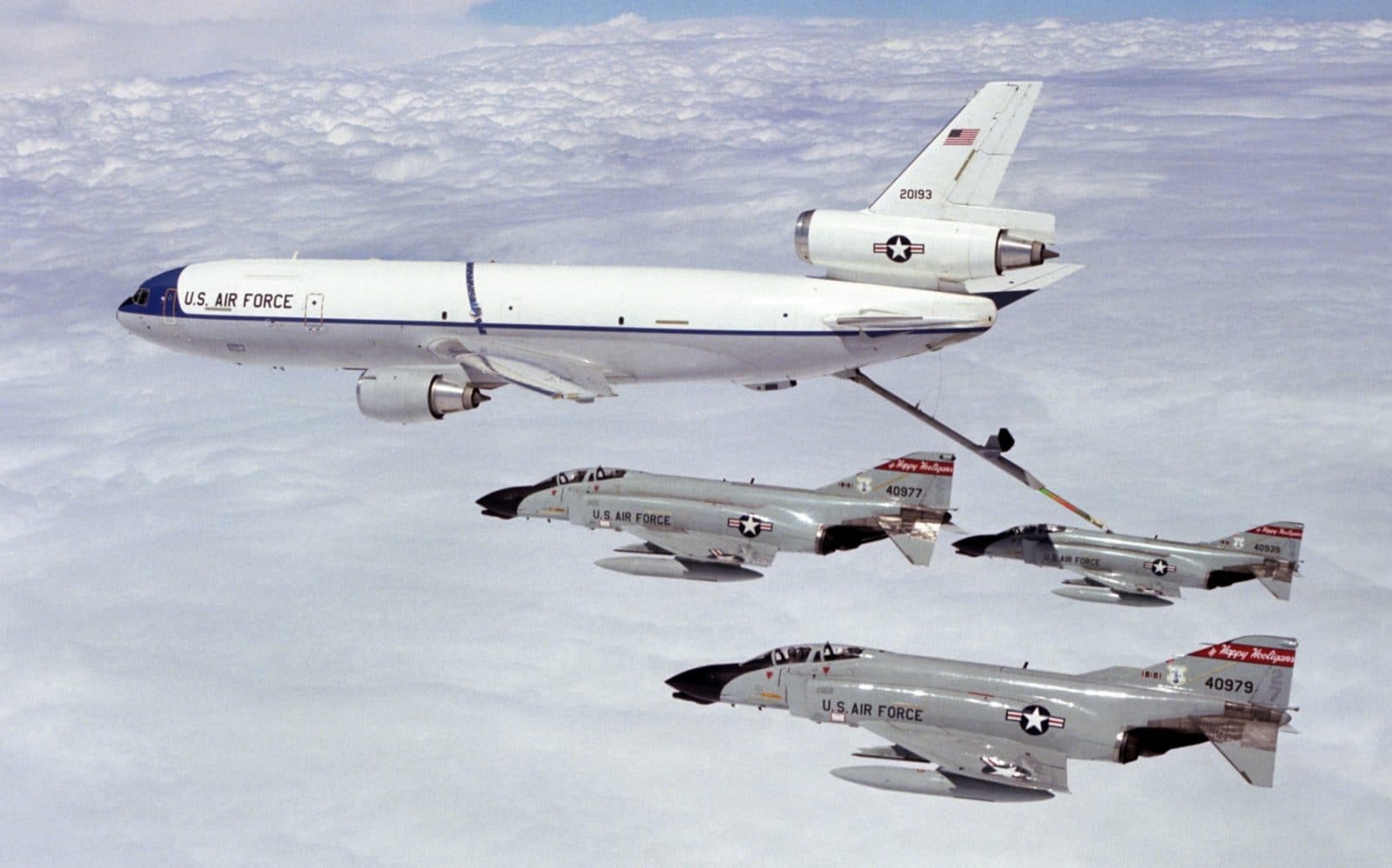
After more than 40 tremendous years of service, the Air Force today flew its last KC-10 Extender.
The 60th Air Mobility Wing at Travis AFB, CA is the last active-duty wing to operate the KC-10, and held a ceremony Sep 26 to thank its history and bid farewell to the aircraft.
kc-10 farewell ceremony
Most KC-10s are already retired and stored at the Davis-Monthan AFB “Boneyard” in Arizona. The aircraft that flew today’s last mission, named Excalibur, will soon end up in the boneyard too.
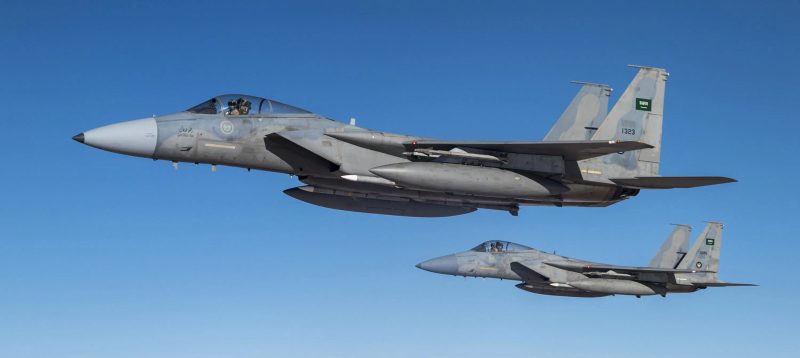
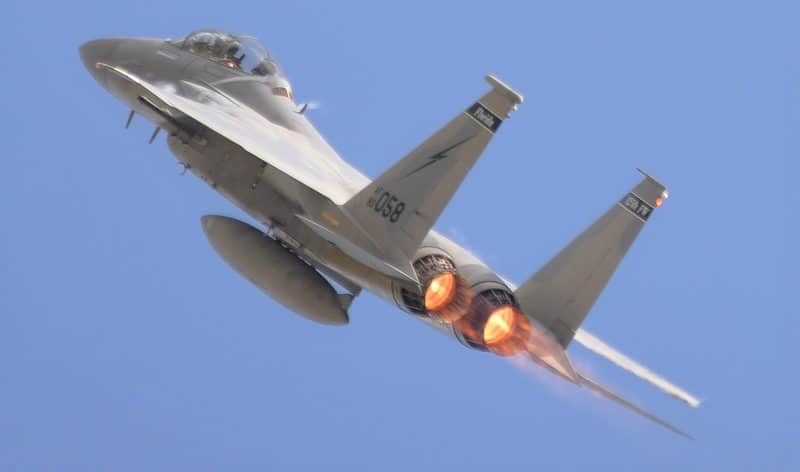
F-15 fighters from the local CA Air National Guard flew alongside Excalibur as it made its final flight over the base.
Crowds wait for 1 final walk through tour of the plane at travis afb sep 25, 2024 (usaf photo)
Retirement of the aircraft comes as the USAF transitions to the KC-46 Pegasus. It’s part of the Air Force’s recapitalization of its tanker fleet.
KC-10s were workhorses of the USAF for decades
The plane was a workhorse of the USAF for decades. It was vital in the U.S. military’s global reach and power projection capabilities. They had a long range and carried a large fuel load. It was common for crews to spend 12 hours or more on a single sortie.
Official US Air Force photograph
The massive aircraft is best know for its primary role as an aerial refueler, but it’s also great for moving large loads of cargo and passengers. Its cargo capacity nearly matches the C-17.
The aircraft was critical in supporting combat missions, but it also served well in humanitarian support. It could move tons of food, water, meds, clothing, blankets, construction equipment, roof trusses… virtually anything needed for a humanitarian mission, anywhere.
Usaf KC-10 Extender over Southwest Asia (U.S. Air Force photo by Staff Sgt. Cherie A. Thurlby)
Needless to say, the KC-10 fleet was not retired for poor performance, but budget pressures. The fleet was relatively small compared to the KC-135. The KC-46 replacing the KC-10 reduces the total types of tankers in the Air Force fleet from three to two.
The KC-10 might live on flying commercially
They may be done as USAF planes, but the KC-10 might make a comeback commercially. Air Mobility Command has been exploring the idea of commercial aerial refueling.
KC-10 REFUELING a b-52 (usaf photo)
The USAF says there is enormous value in aircraft that have the potential to provide readiness in the commercial sector. Initial work on the idea for the KC-10 has already begun.
Also, KC-10s going into commercial operations would not require any modifications to be able to conduct air refueling or cargo missions.
A COMMERCIAL KDC‐10 TANKER AIRCRAFT REFUELS A U.S. AIR FORCE F‐16 FIGHTING FALCON FROM THE 51ST FIGHTER WING, ENROUTE COMMANDO SLING 23 AT PAYA LEBAR AIR BASE, SINGAPORE, NOV. 6, 2023. THIS WAS THE FIRST EVER CONTRACTED AERIAL REFUELING OF USAF FIGHTERS (COURTESY PHOTO)
The DOD already uses two commercial companies for aerial refueling
Currently, Omega Air and Metrea are already serving commercial aerial refueling needs for the DOD, with tankers acquired from other nations. In service to the U.S. they cannot refuel planes supporting combat; they can only refuel for training or exercises.
The Navy and Marine Corps have been using commercial refuelers for nearly 20 years.
“Leveraging the capability of commercial air-to-air refueling allows the USAF to increase warfighter readiness in the priority theater and around the globe,” says the USAF.
The 1978 Midair Collision Over San Diego Was Entirely Avoidable
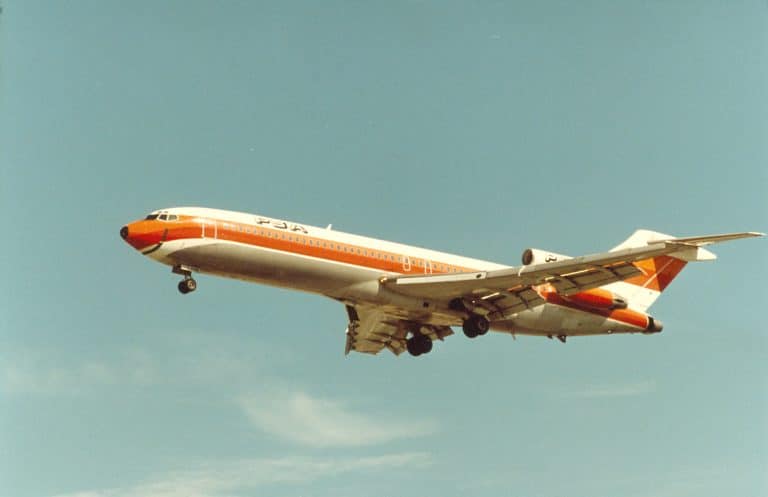
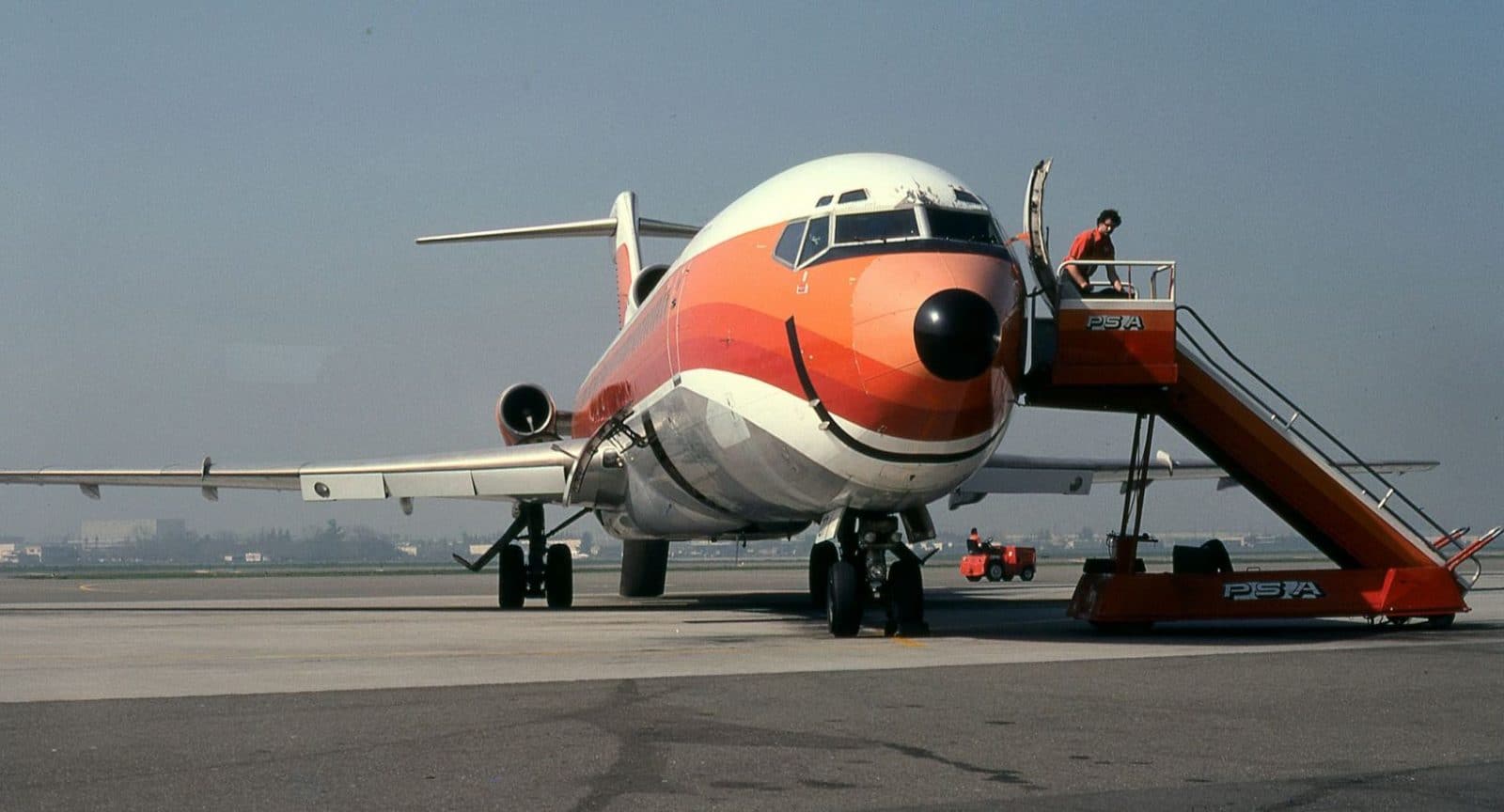
At 0834 local time on 25 September 1978, Pacific Southwest Airlines (PSA) Flight 182 departed Los Angeles International Airport (KLAX) bound for Lindbergh Field (now San Diego International Airport- KSAN). The flight originated in Sacramento (KSMF) and stopped at KLAX before heading south to San Diego. The flight was a Boeing 727-214 serial number 19688/589 registered as N533PS. The jet had 24,088 hours on the clock over 36,557 cycles and had flown for the first time on 4 June 1968.
PSA 727-200 by Piergiuliano Chesi [CC BY 3.0 (https://creativecommons.org/licenses/by/3.0)], from Wikimedia Commons
Experienced Pilots in the Cessna 172
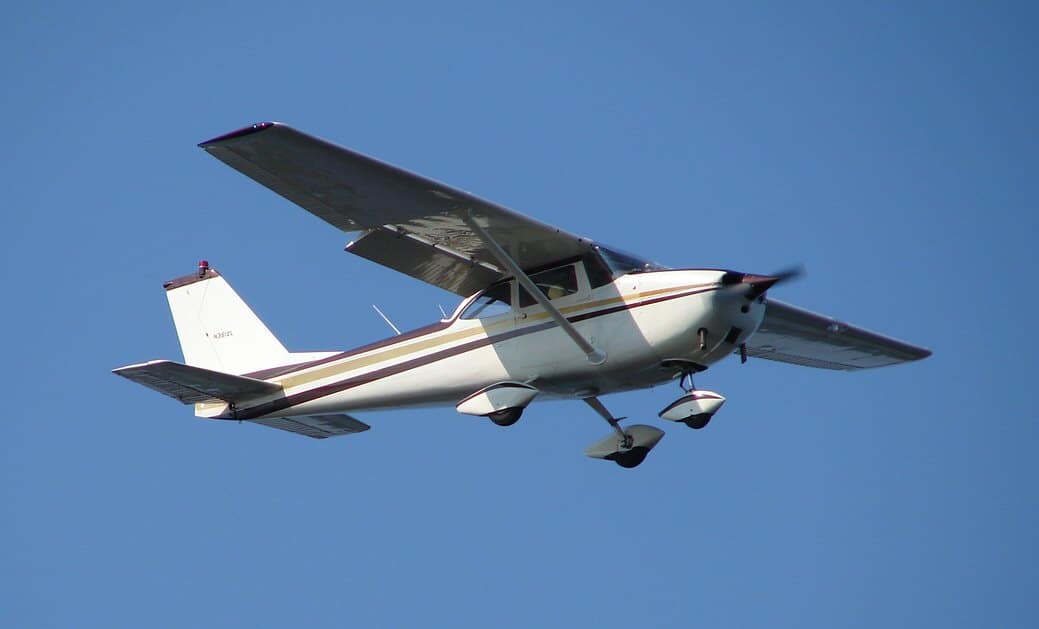
At 0816 local time, Cessna 172 N7711G took off from Montgomery Field about 6 miles north of San Diego. The aircraft, owned by Gibbs Flite Center and flown by a pair of experienced licensed pilots with more than 5,500 hours of flight time between them, shot a couple of practice ILS approaches on Runway 9 at Lindbergh Field- the only airport equipped with an ILS system in the area that fateful morning. N7711G was instructed to maintain visual flight rules (VFR) at or below 3,500 feet and to fly a course of 070.
Cessna 172 By Cory W. Watts from Madison, Wisconsin, United States of America (A 172 on final) [CC BY-SA 2.0 (https://creativecommons.org/licenses/by-sa/2.0)], via Wikimedia Commons
Even More Experienced Pilots in the 727
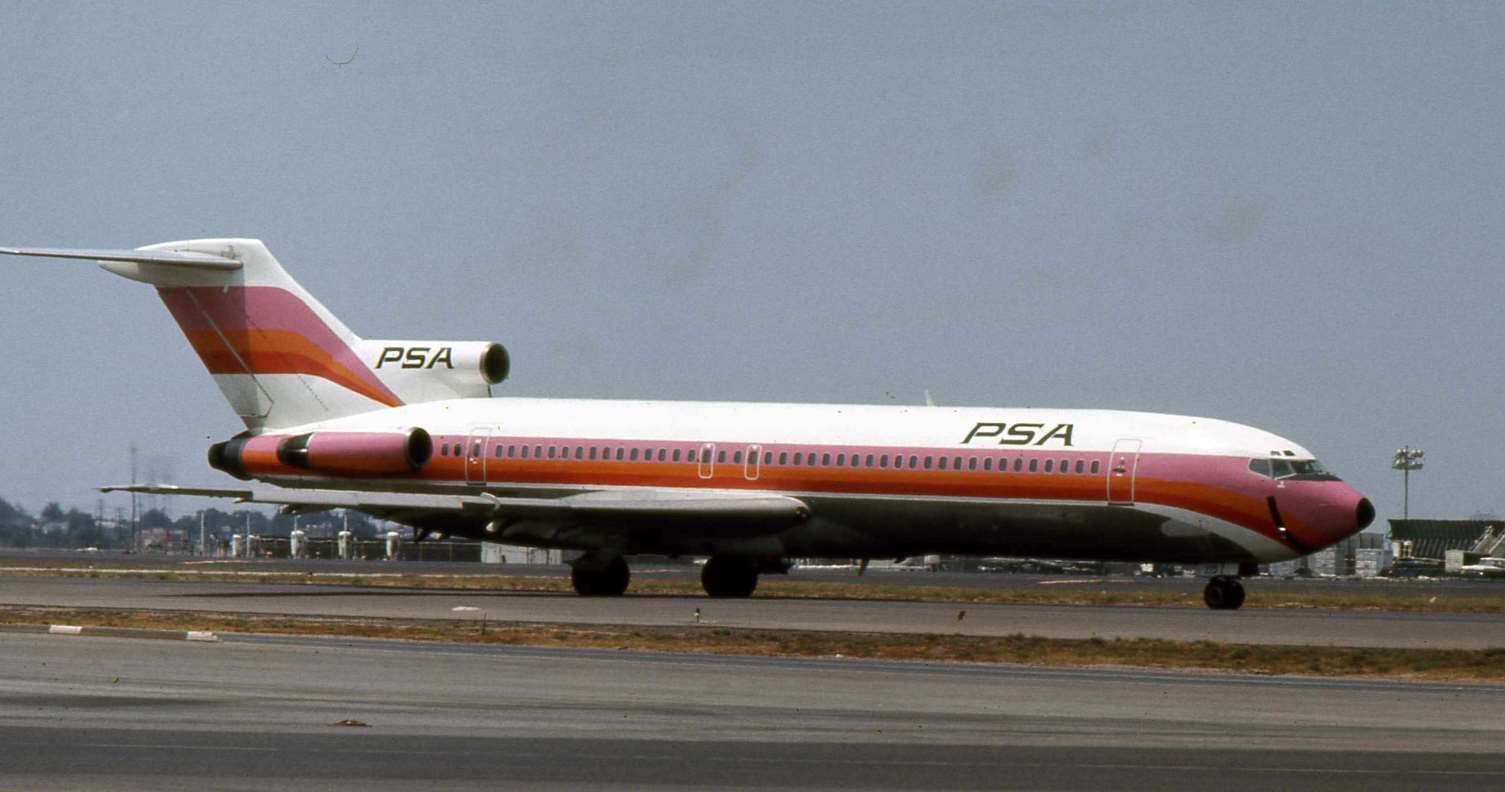
PSA Flight 182, a Boeing 727-200, was operated that morning by a San Diego–based crew: Captain James McFeron, 42; First Officer Robert Fox, 38, who was at the controls; and Flight Engineer Martin Wahne, 44. Off-duty Captain Spencer Nelson occupied the cockpit jump seat. On board were 127 passengers, including 29 PSA employees.
Like most mornings in the San Diego area, the weather that morning was clear and sunny with a visibility of 10 miles. Near CAVU. The 727 was cleared for approach on runway 27 and informed of the traffic in front of them on a reciprocal course, as was the Cessna. The two aircraft should have been able to maintain separation visually. But sadly, they did not.
PSA Boeing 727-200. Image via Wikipedia in public domain.
The Impact
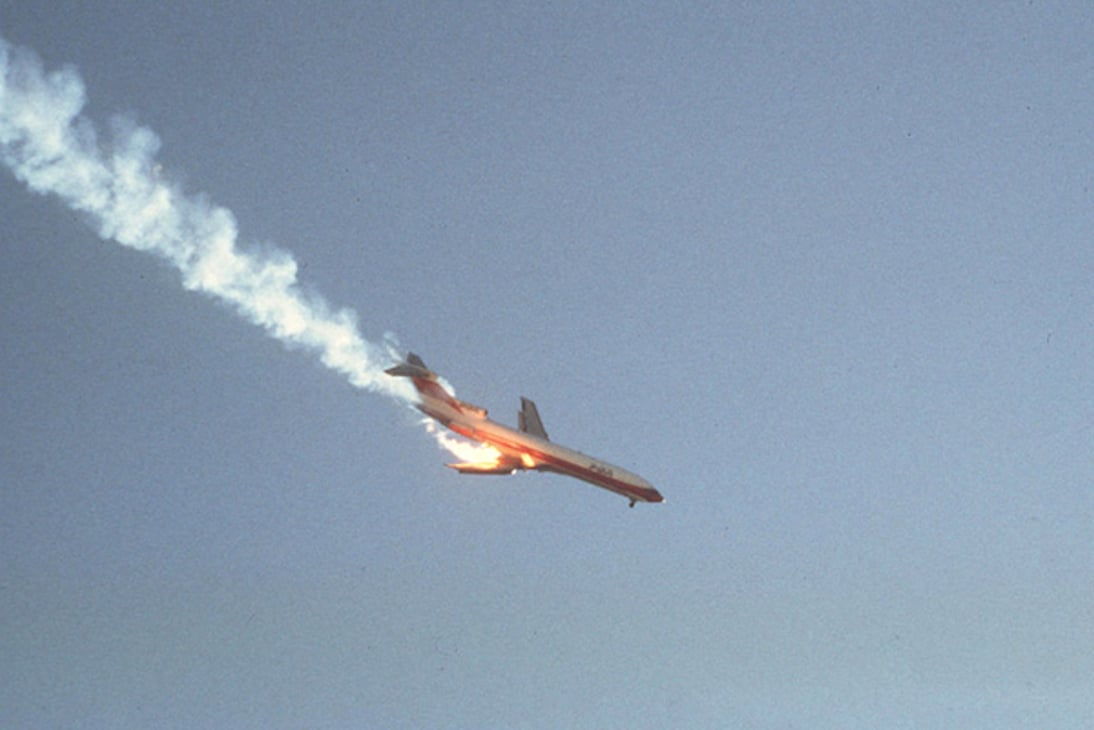
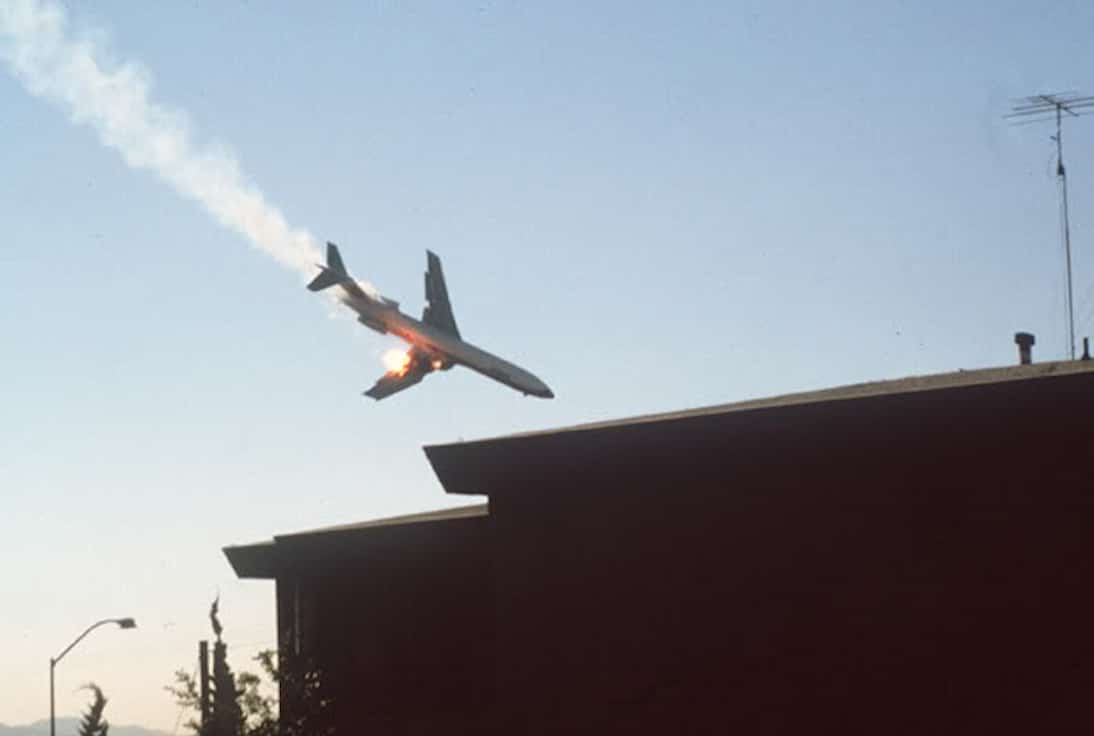
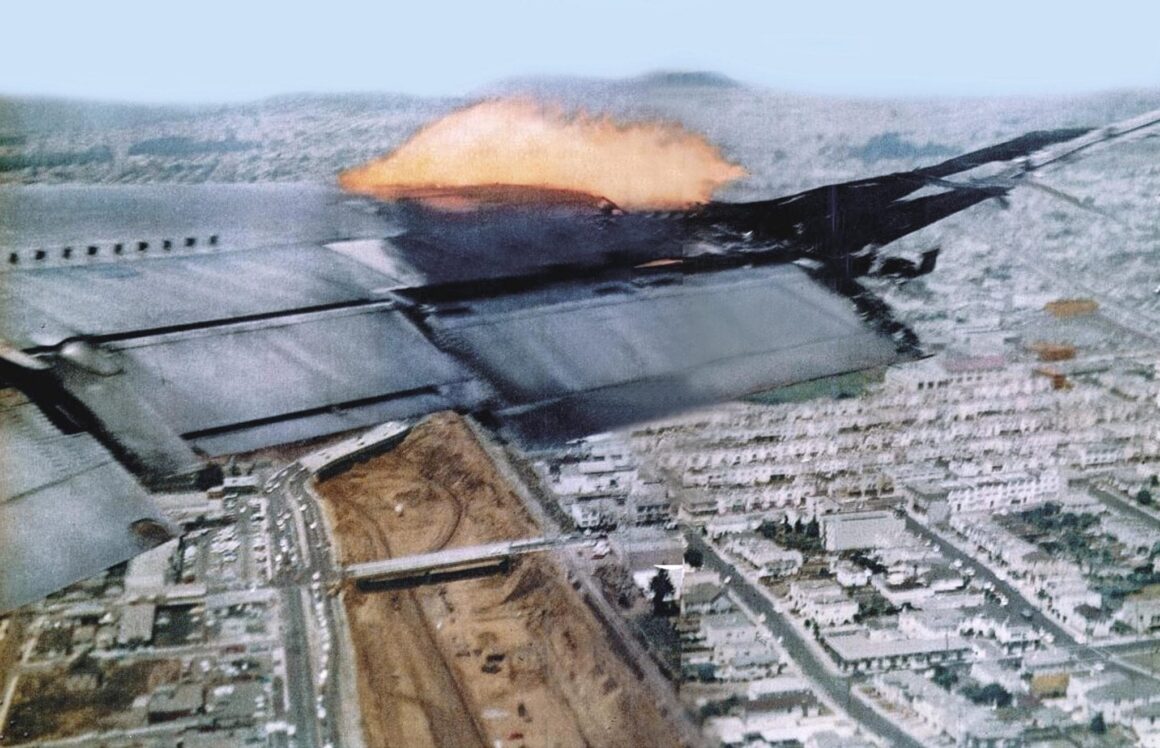
At 0901 local time, the aircraft collided at an altitude of approximately 2,600 feet. Flight 182 was descending on their approach to Lindbergh and overtook the Cessna, which was climbing wings level. N7711G broke up immediately after impact. The 727’s inner right wing was heavily damaged, causing the wing fuel tank to leak and burn. The 727 entered a shallow right-banked turn and descended until it crashed into North Park in San Diego, approximately three miles from Lindbergh Field.
The Cessna came down approximately ¾ of a mile from the 727. All souls on board both aircraft perished in the crash, along with seven people on the ground. There were nine injured on the ground, and at least 22 homes were affected by the impacts.
PSA Flight 182 descending out of control on 25 September 1978. Image via Hans Wendt.
The Blame
So how did this happen? According to the National Transportation Safety Board (NTSB), “The failure of the flightcrew of Flight 182 to comply with the provisions of a maintain-visual-separation clearance, including the requirement to inform the controller when visual contact was lost; and the air traffic control procedures in effect which authorized the controllers to use visual separation procedures in a terminal area environment when the capability was available to provide either lateral or vertical separation to either aircraft.
Contributing to the accident were (1) the failure of the controller to advise Flight 182 of the direction of movement of the Cessna; (2) the failure of the pilot of the Cessna to maintain his assigned heading; and (3) the improper resolution by the controller of the conflict alert.”
PSA Flight 182 descending out of control on 25 September 1978. Image via Hans Wendt.
The Unfortunate Record That Was Broken All Too Soon
At that time, the PSA Flight 182 crash was the deadliest commercial air disaster to occur in the United States. Sadly, it did not remain so for long. Just eight months later, on 25 May 1979, a McDonnell Douglas DC-10-10 operating as American Airlines Flight 191 crashed after takeoff from Chicago’s O’Hare International Airport (KORD). The tragedy in San Diego remains the deadliest in California history. Here is a link to the NTSB Accident report.
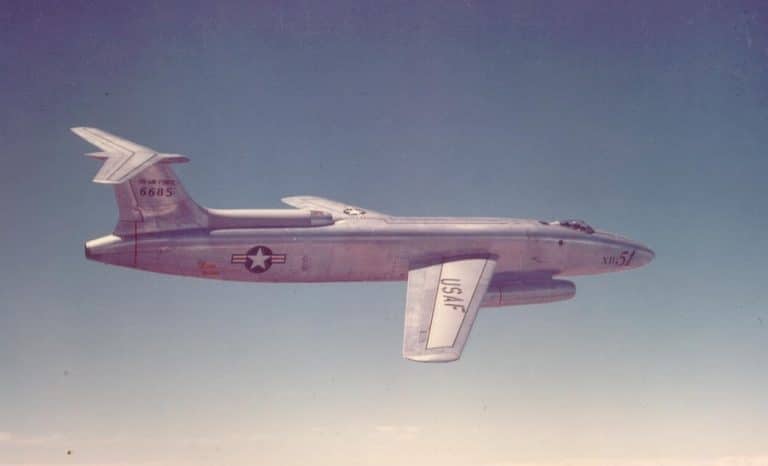
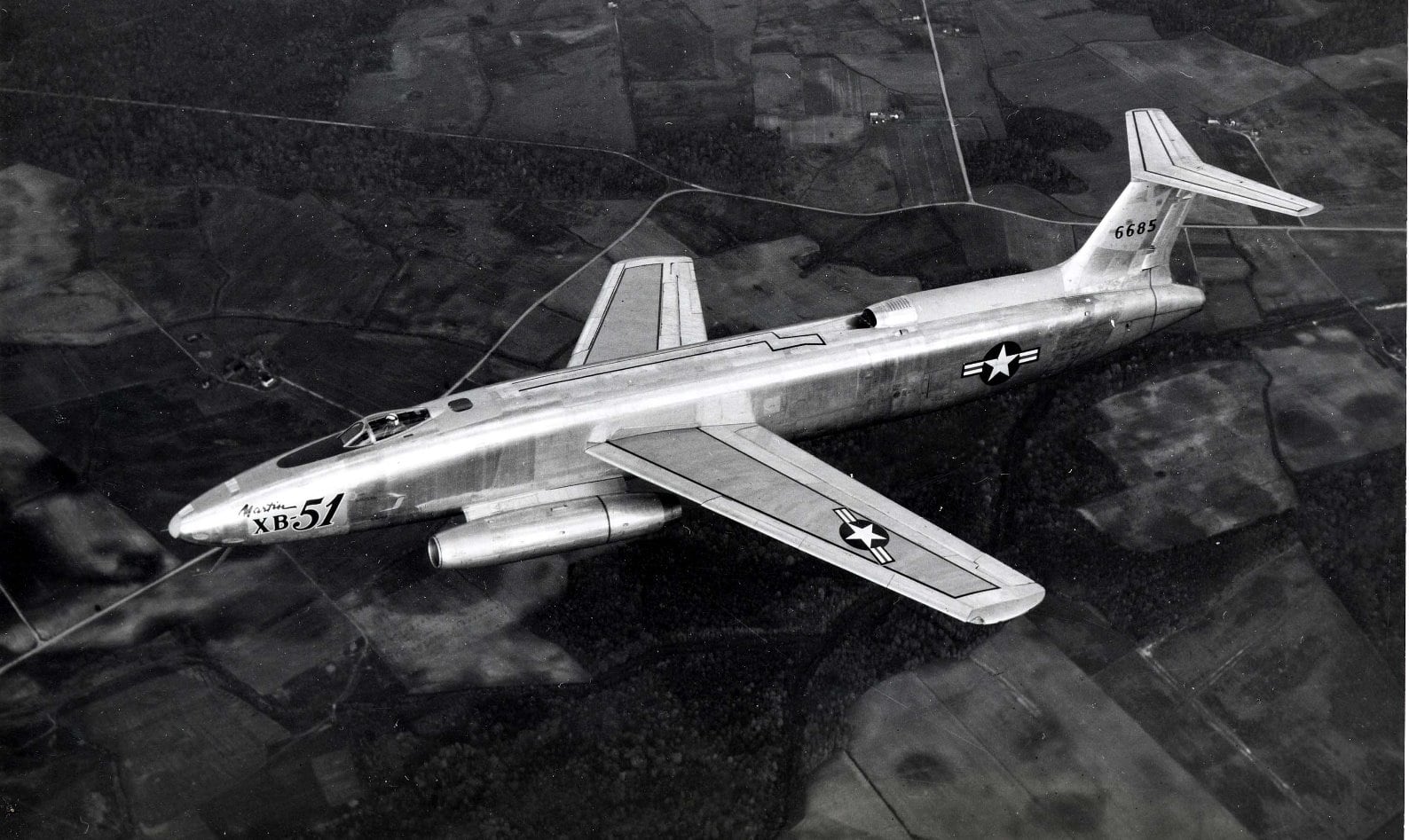
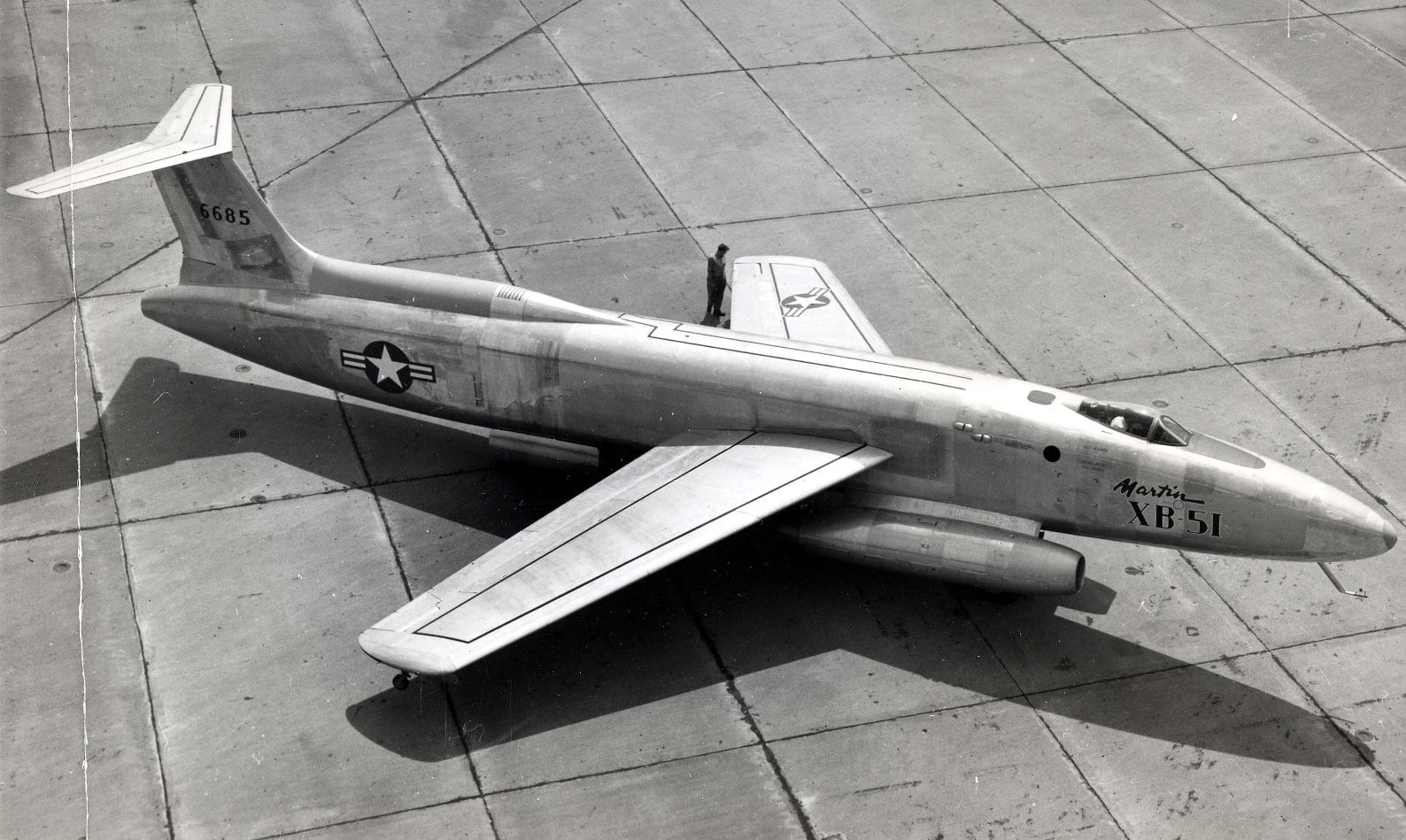
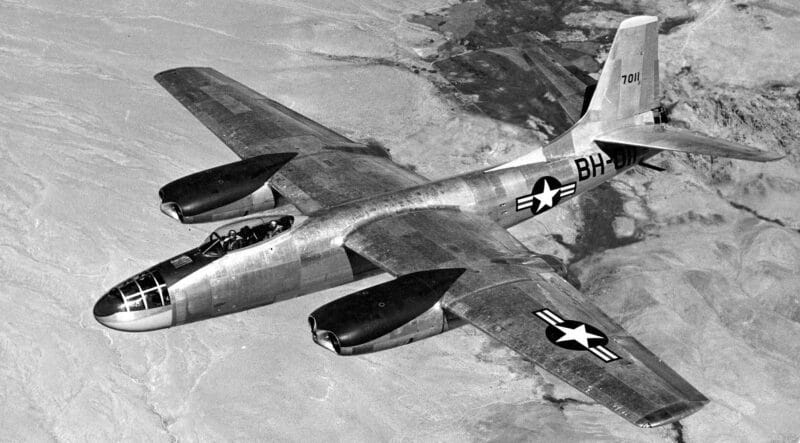
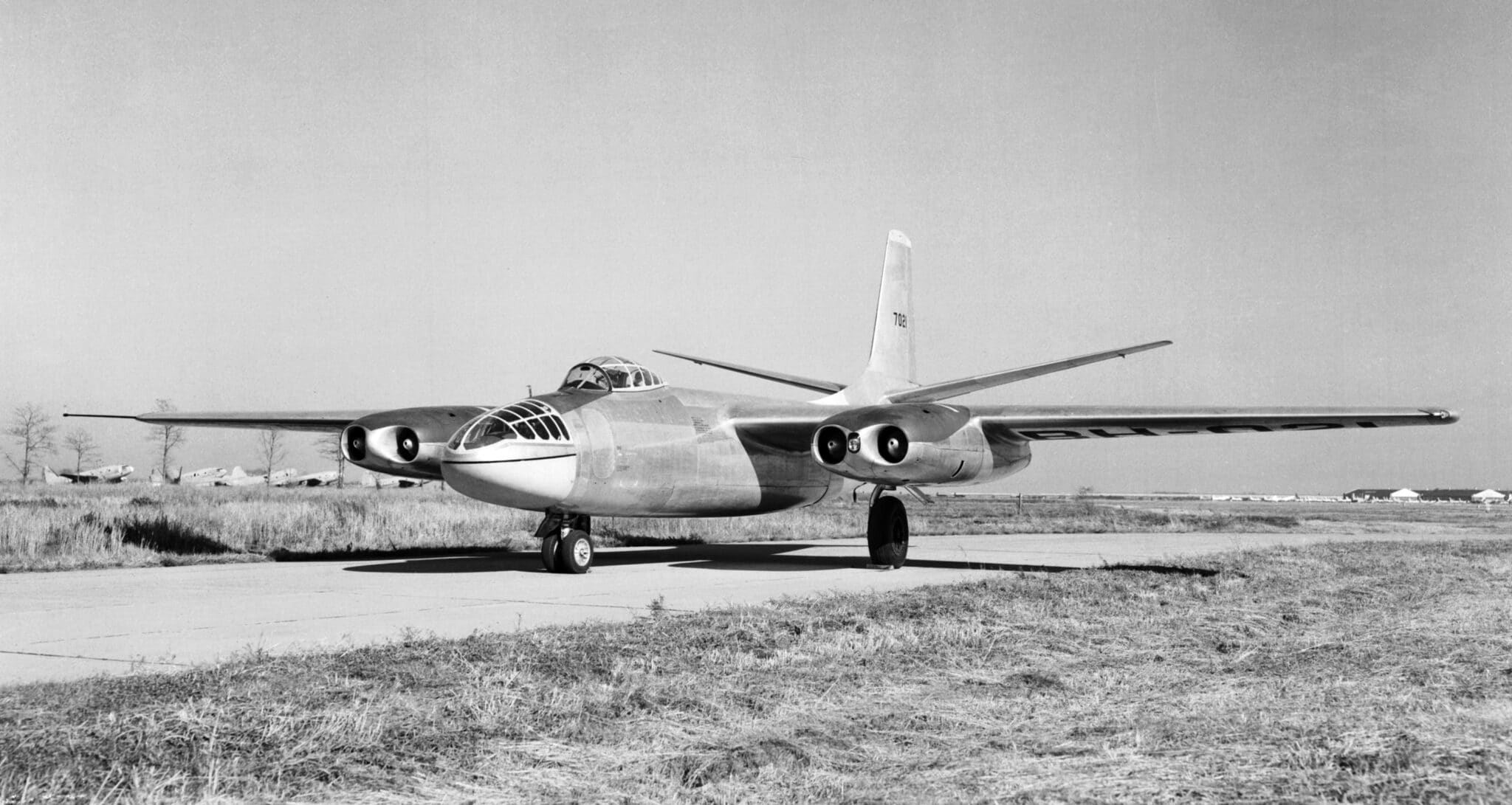
With their innovative XA-45 attack aircraft, Martin was building on the success of their B-26 Marauder medium bomber. Conceived in 1945 as Martin’s answer to a US Army Air Force (USAAF) requirement for a low-level bomber, the aircraft featured a number of ground-breaking design characteristics.
When the war ended and the USAAF did away with the A prefix for attack aircraft, the jet became the XB-51. Due to its unique design, the aircraft graced many a magazine cover during the 1950s and even starred in a movie. Nice work if you can get it. But when the chips went down, things cooled in a hurry.
Martin XB-51. Image via USAF
Changing Missions = Changing Design
But I digress. At first, the XA-45 was designed with straight wings and was to be powered by a hybrid twin turboprop/twin turbojet installation. When the USAAF radically revised the requirements for the XA-45 in the spring of 1946, the aircraft’s mission changed to all-weather close-support bombing.
A higher-performance aircraft was needed.
At this point, the aircraft was redesignated as XB-51. The Air Force issued a contract for two XB-51s on 23 May 1946. As might be expected, their minds changed again in 1947- this time seeing the XB-51 as a low-altitude attack aircraft with a reduced combat radius. Once Martin assigned the project a model number (Model 234 in the case of the XB-51), things (finally) began to move forward.
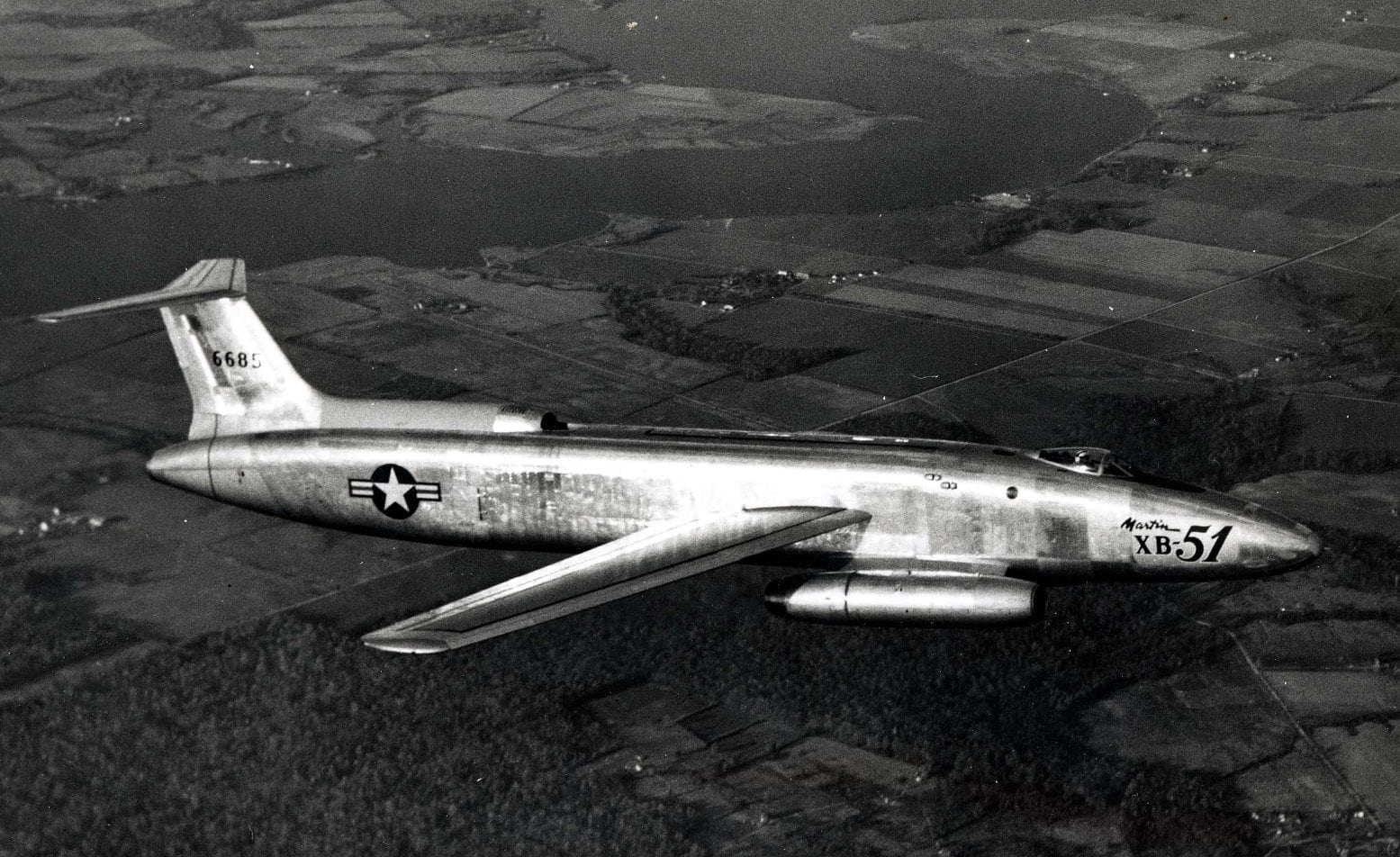
Martin XB-51. Image via USAF
Precursor to Modern Three-Engine Designs
The Model 234 design featured variable-incidence wings swept at 35 degrees and a pronounced 6-degree anhedral. Full-span leading edge slats and trailing edge slotted flaps increased lift, resulting in shorter takeoffs. Spoilers and small ailerons were used for roll control. The empennage was configured as a swept T-tail.
The most unique feature of the design had to be the choice of three General Electric J47-GE-13 axial-flow turbojet engines- two housed in low-mounted pods on either side of the forward fuselage and the third in the tail of the aircraft breathing via an intake located at the base of the vertical stabilizer.
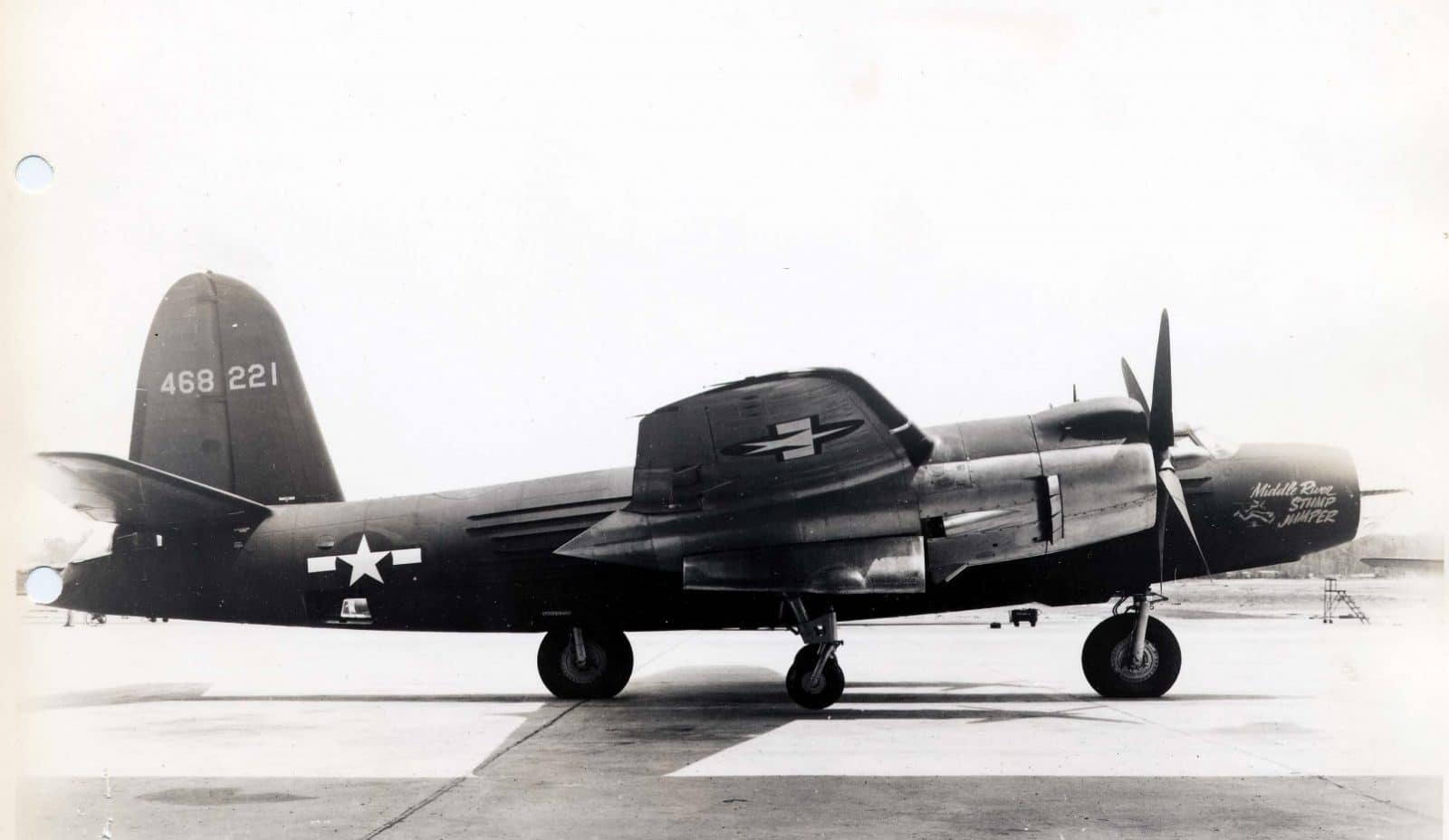
B-26 Middle River Stump Jumper. Image via USAF
Ahead of Its Time In Many Ways
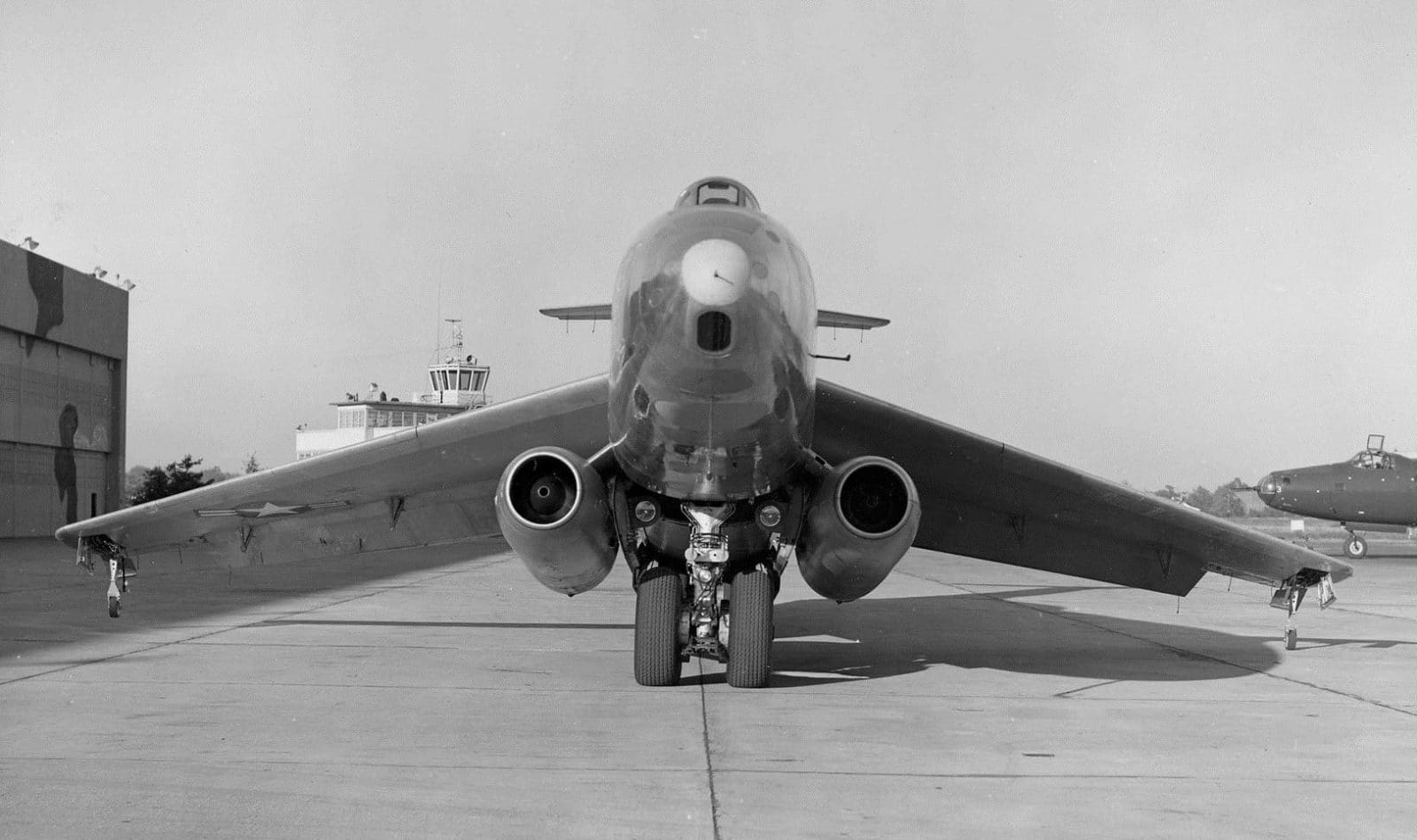
Four rocket-assisted takeoff (RATO) bottles supplied additional thrust for takeoff. The main landing gear wheels of the XB-51 were configured in tandem under the forward and mid fuselage with outrigger wheels mounted at the wingtips- similar to the Boeing B-47 and B-52. Martin tested this configuration on a modified B-26 nicknamed Middle RiverStump Jumper.
Other design characteristics of the jet were the near-nose bubble canopy under which the pilot sat. The second crew member, a bombardier, was seated inside the pressurized and climate-controlled fuselage below and behind the pilot.
Martin XB-51. Image via USAF
Exceeding Expectations
Both crew members were provided upward-firing Martin-designed ejection seats- a first for Martin aircraft. Other innovative features of the XB-51 were its rotary bomb bay (trademarked by Martin) and an external load capacity of 10,400 pounds. Also designed into the airframe were provisions for eight nose-mounted 20 millimeter cannons.
Performance of the jet was impressive, with a cruise speed of 532 miles per hour at altitude and a maximum speed of 645 miles per hour at sea level. The service ceiling was 40,500 feet and range was 1,075 miles- all exceeding the design requirements (which, remember, changed several times during development) by a fair margin.
Martin XB-51. Image via USAF
For the Rest of the XB-51 Story Bang NEXT PAGE Below.
Martin’s P4M Adapted to the Job That Was Available and Did That Risky Job Well
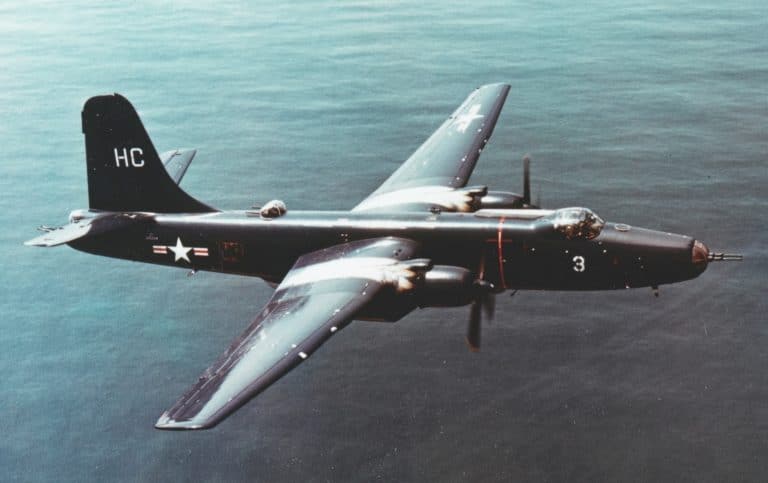
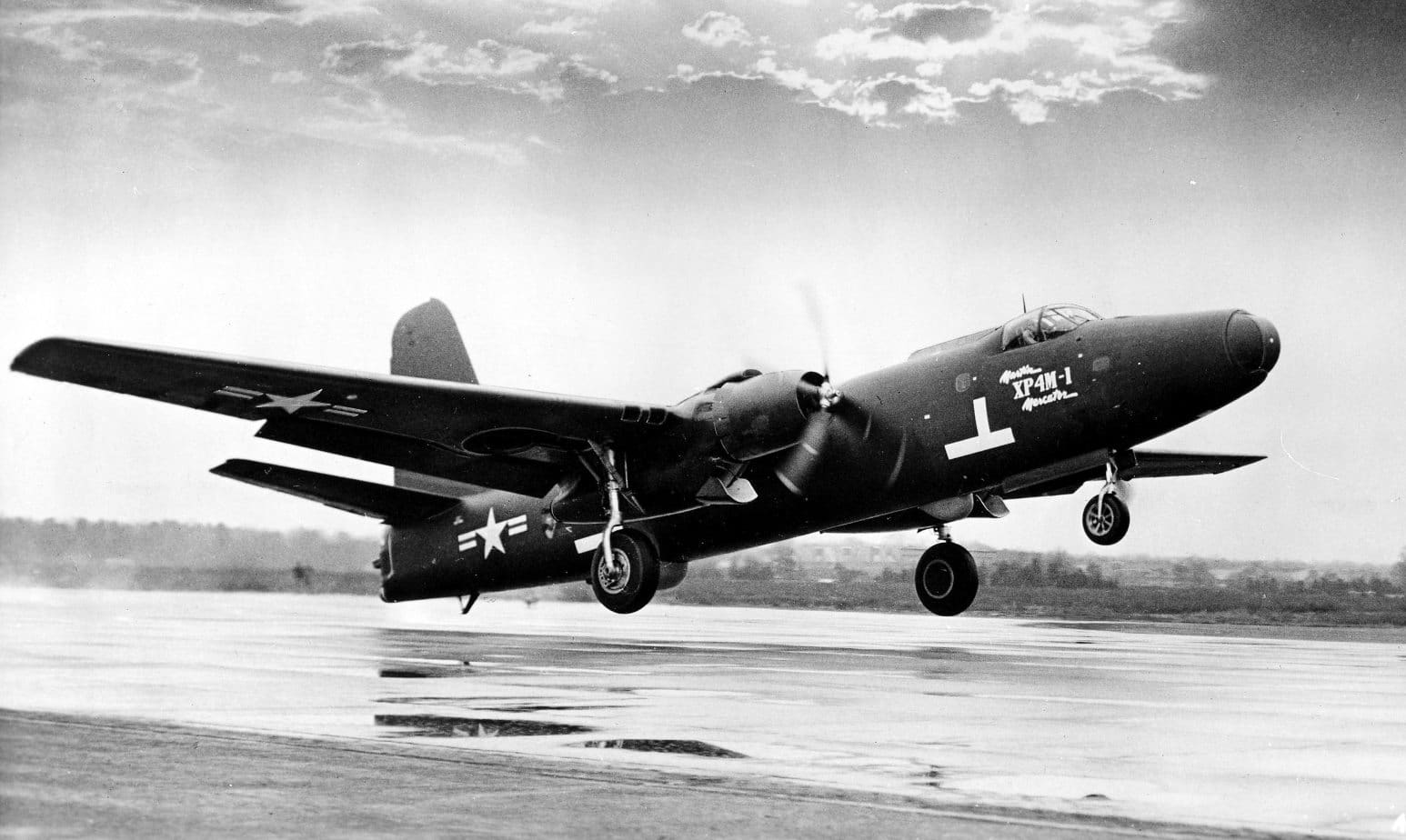
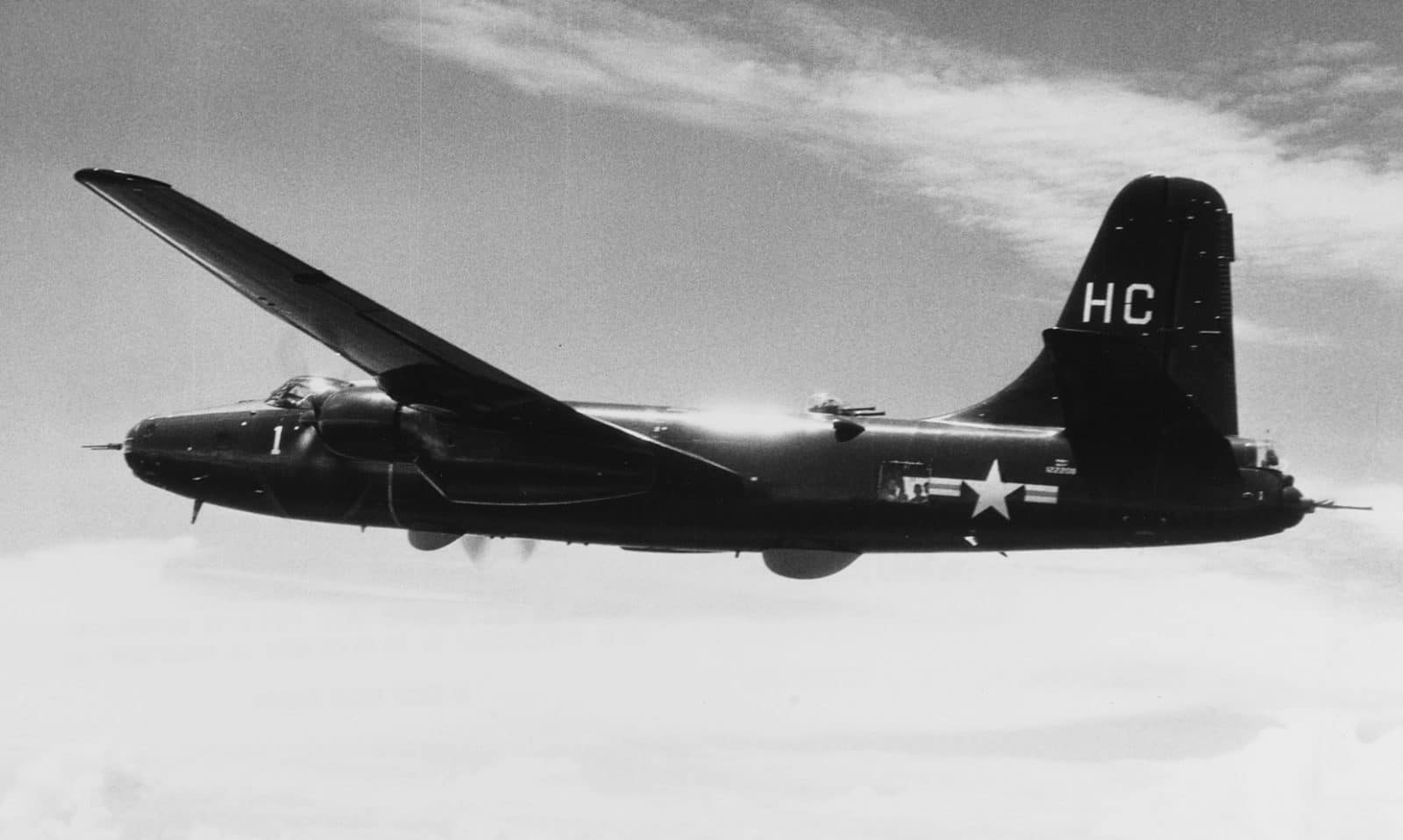
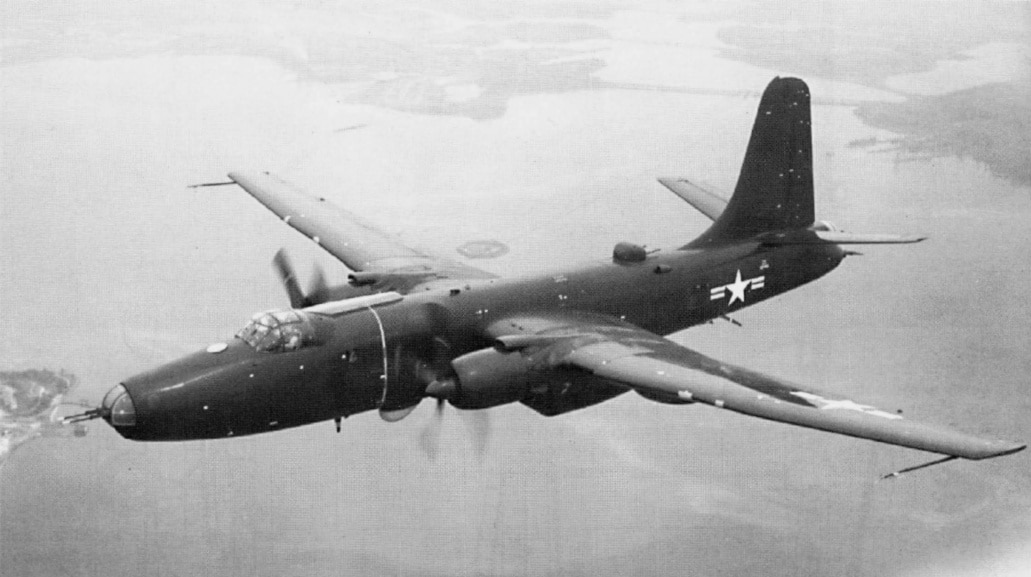
Martin’s P4M Mercator maritime reconnaissance aircraft was built as a potential replacement for the Consolidated PB4Y-2 Privateer but lost out to the Lockheed P2V Neptune for the role. Development of the aircraft, initially designated Project 219 by Martin, began all the way back in 1944. The resemblance between the Mercator and the Neptune was remarkable, especially to the early variants of the P2V. This would eventually play into the hands of the Mercators.
XP4M-1 Mercator. Image via US Navy
The Hybrid Design That Stuck Around
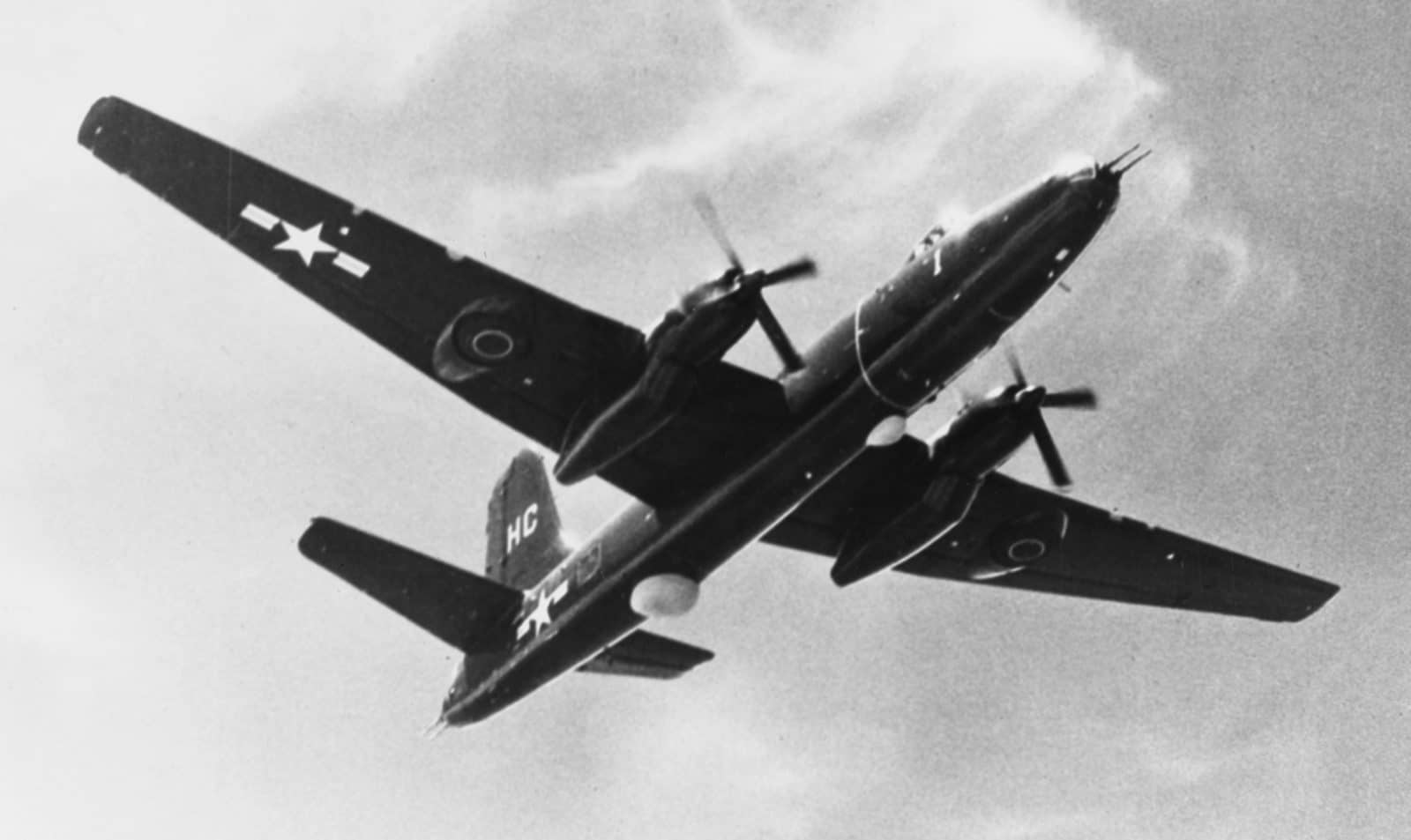
But wait- didn’t Mercator development end when the P2V was chosen as the Navy’s new long-range maritime patrol and reconnaissance aircraft? Not really. In fact, the Navy, somewhat quietly and with little fanfare, ordered 19 P4Ms. These aircraft were larger, heavier, considerably faster, and longer-legged than the Neptune. The P4M was powered by a pair of Pratt & Whitney R4360 Wasp Major 28 cylinder radial piston engines turning four-bladed AeroProducts propellers. But mounted in the aft portion of those engine nacelles lurked a pair of Allison J33-A-23 turbojet engines. That’s right! The Mercator was a hybrid.
VP-21 P4M-1. Image via US Navy
Characteristics of a Cold War Warrior
The other design characteristics of the Mercator were similar in many ways to those of the Neptune. First flown on 20 October 1946, the XP4M-1’s performance did not disappoint. Distinguishing P4M features included different wing cross-sections inboard and outboard of the nacelles, a vertical stabilizer that was slightly offset from the fuselage centerline to counteract torque from the powerful piston engines, and a long internal bomb bay enabling the aircraft to carry a wider variety of ordnance and auxiliary fuel tanks internally.
The jet engines, whose intakes were located behind and below the radial engines, burned the same fuel as the piston engines, obviating the need for separate fuel systems. Production P4M-1s were to be armed with nose, dorsal, and tail gun turrets.
VP-21 P4M-1. Image via US Navy
Keeping It On the Down Low
The Navy, mindful of the fact that the Mercator’s bomb bay configuration and long range made it a capable high-speed aerial minelaying platform, quietly ordered 19 P4M-1s in 1947- the first of which rolled out in 1949.
These aircraft entered service with Patrol Squadron TWO ONE (VP-21) Black Jacks (call sign Airmail) on 28 June 1950. On 1 July 1951, the Black Jacks flew their Mercators from Naval Air Station (NAS) Pensacola in Florida to San Diego, then to NAS Alameda in California, and on to Seattle, Washington. That’s about 6,500 miles worth of flying, and VP-21 did it with every aircraft operational for every leg and nothing more than routine maintenance required.
P4M-1s were equipped with the same AN/APS-33 X-band airborne search radar as the Grumman S2F Tracker, the Neptune, and the Navy’s ZPG-1W and ZPK antisubmarine blimps.
P4M-1. Image via US Navy
Bumpy Lumpy Ferrets
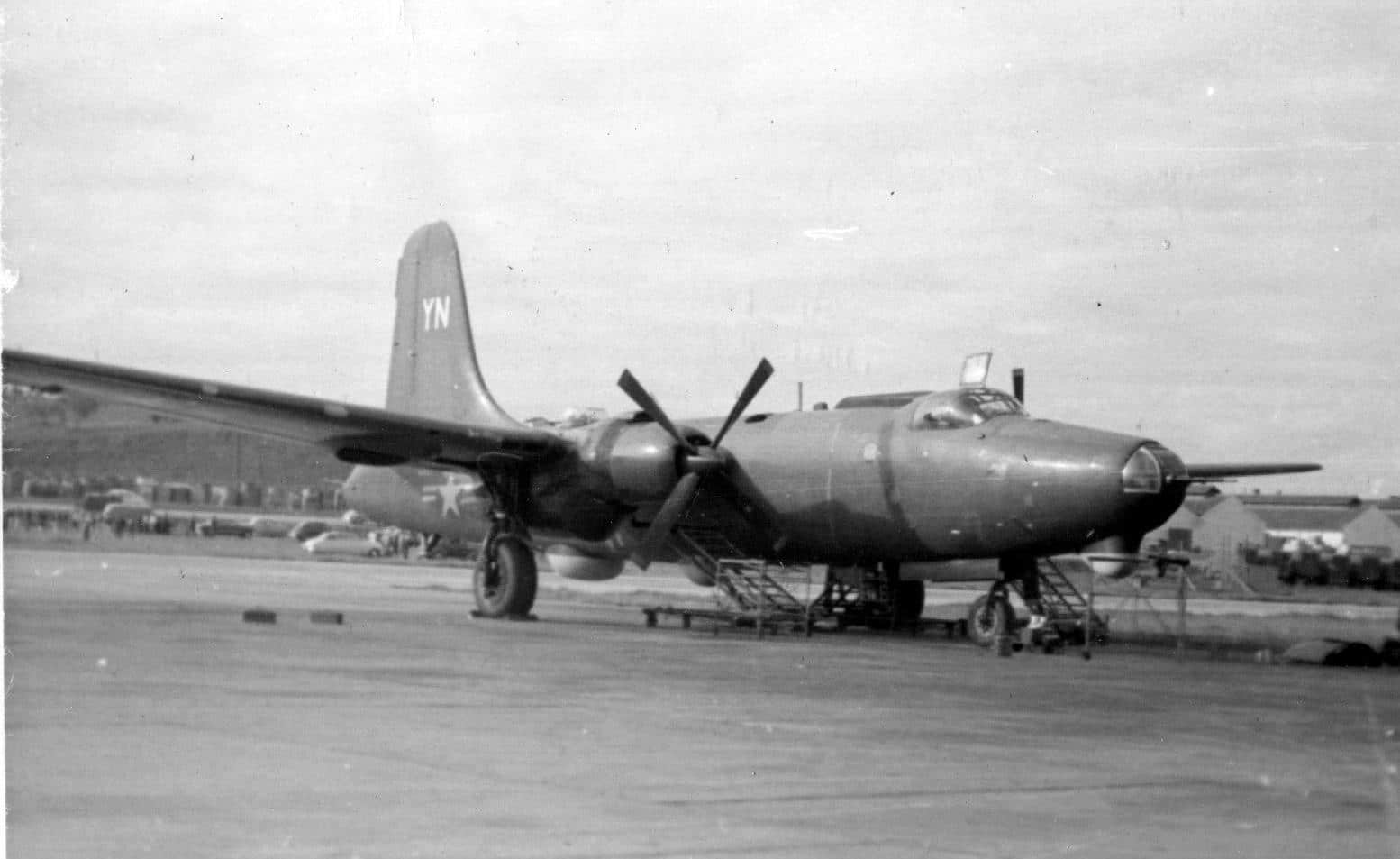
Somehow, the Black Jacks also found time to deploy to NAS Port Lyautey in French Morocco. However, VP-21 transitioned to the Lockheed P2V-6 Neptunein February of 1953. The Mercator did replace the Privateer, but not as a maritime patrol and reconnaissance platform. The Mercators were modified to perform electronic reconnaissance/signals intelligence (SIGINT) work instead. Designated P4M-1Q, these “ferret” aircraft were equipped with all manner of electronic surveillance equipment along with crews expanded from nine to 14 or more to operate it. They also sprouted an assorted collection of lumps, bumps, and blades housing antennae and sensors.
VQ-2 P4M-1Q. Image via US Navy
Tickling Dragons and Bears
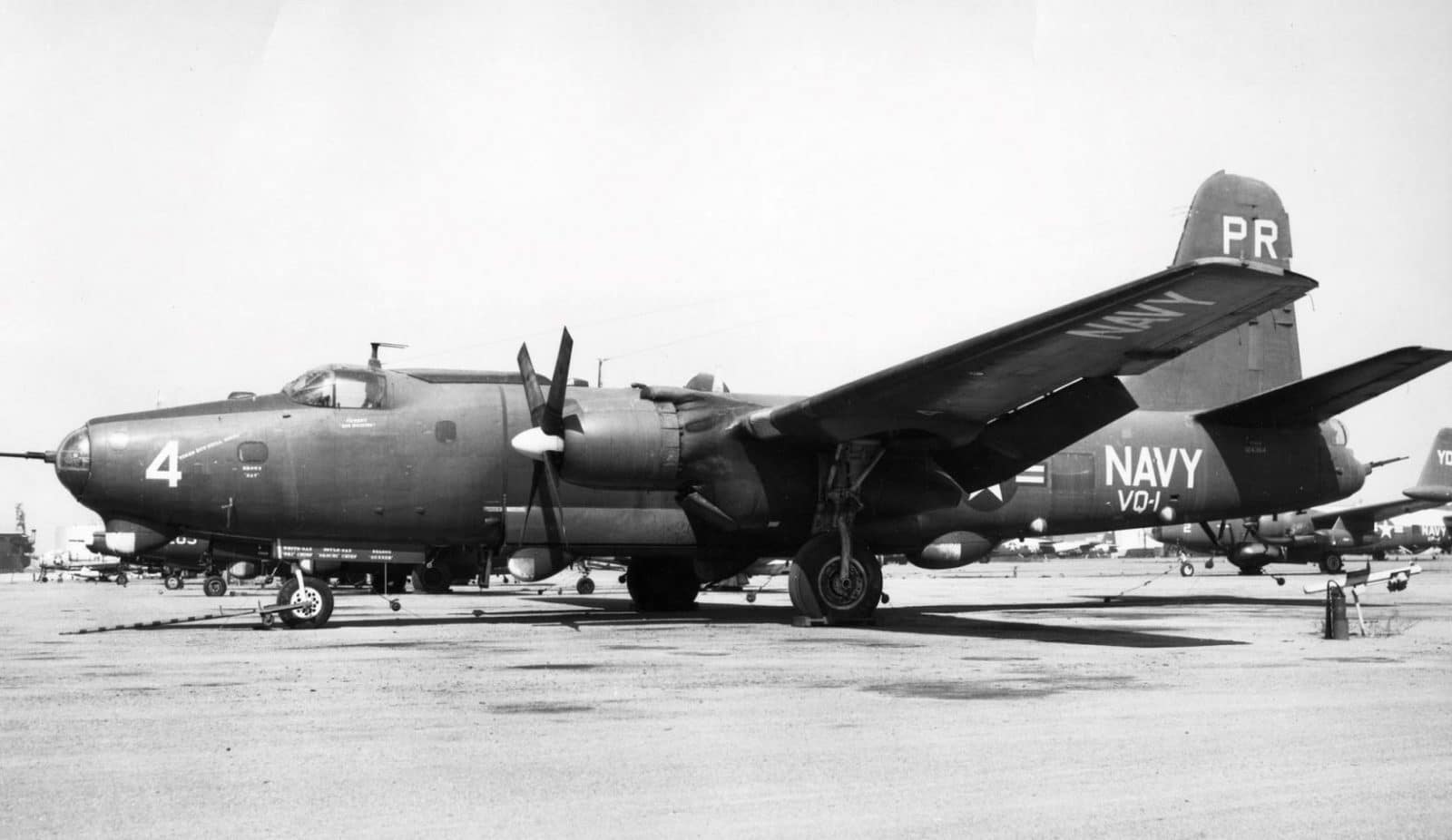
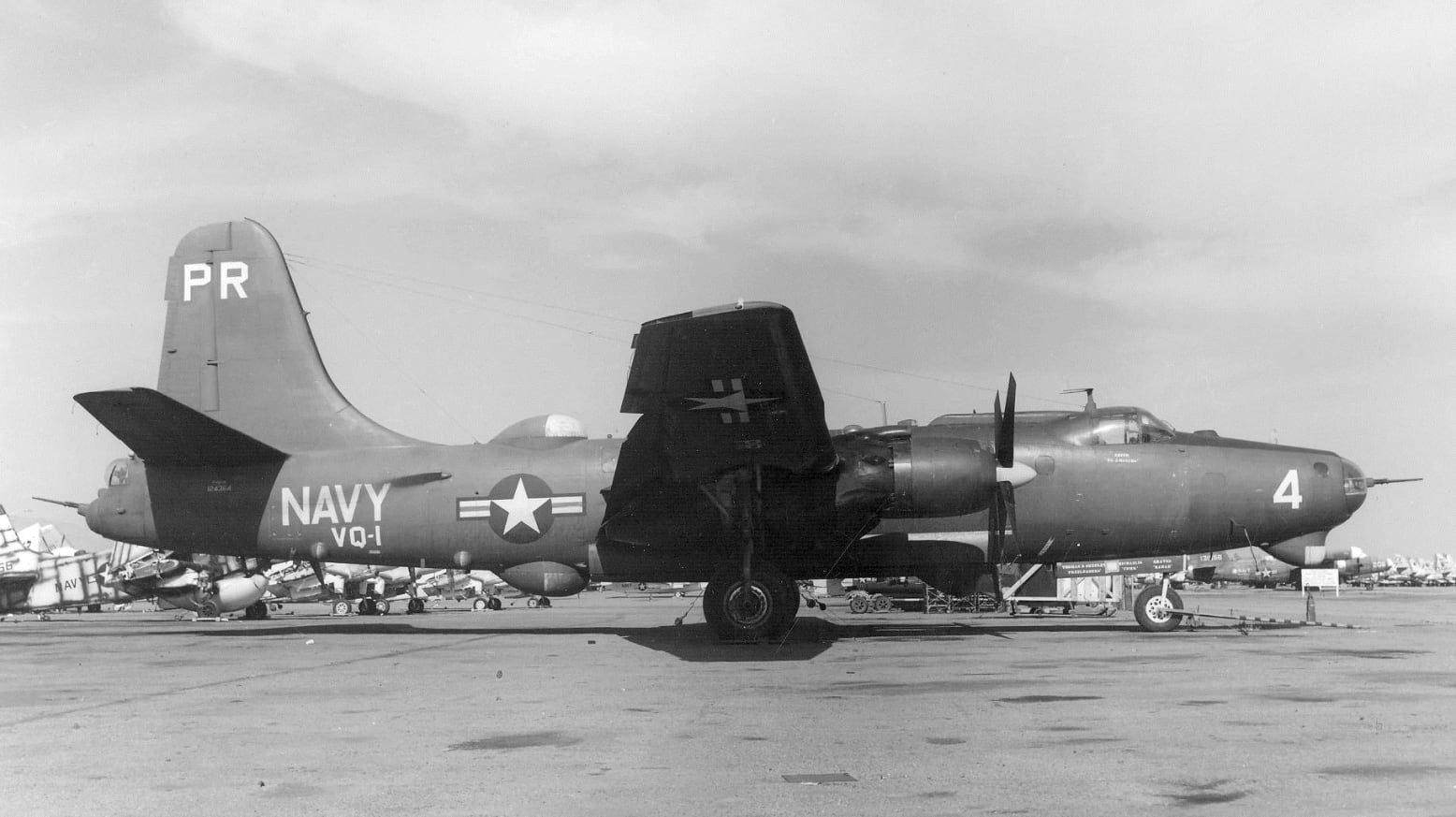
The crews assigned to fly P4M-1Qs trained with VC-11 Early Elevens at NAS Miramar in California before moving to their operational squadrons. The shadowy outfit eventually designated VQ-1 World Watchers operated P4M-1Qs out of NAS Sangley Point in the Philippines and later from NAS Iwakuni and NAS Atsugi in Japan.
They flew long-range missions off the coasts of China, Russia, North Korea, and Vietnam, among other places. Here, the resemblance to the P2V paid off. Mercators often impersonated Neptunes during their 14-hour missions- even going so far as to use Neptune-equipped Patrol Squadron call signs and wearing spurious Neptune squadron markings and Bureau Numbers (BuNos). It also helped that most of these missions meant to “tickle” enemy defenses were flown in the dead of moonless nights with navigation lights extinguished.
VQ-1 P4M-1Q. Image via US Navy
Costly Losses During Cold War Missions
Mercator missions were high-risk and not without loss. The 16-man crew of a VQ-1 Mercator was killed when it was attacked by Chinese fighters near Shanghai on 22 August 1956. Another VQ-1 P4M-1Q was heavily damaged by North Korean MiG-17 Frescoes on 16 June 1959. Another shadowy outfit, this one eventually designated VQ-2 Batmen, operated Mercators in the Atlantic and Mediterranean out of NAS Port Lyautey. VQ-2 lost a P4M-1Q with its entire crew when it crashed in the Mediterranean after being attacked by Soviet MiGs. VQ-2 lost a second aircraft and its pilot when it was forced to ditch in the Med on 6 February 1952.
P4M-1Q Mercator. Image via US Navy
Sterling, But Largely Unknown Service
Mercators did a risky but critically important mission during a time when the Cold War could suddenly go hot at the push of a button. Their crews were heroes who, for the most part, were and still are anonymous. However, their exploits are appreciated and respected by Cold Warriors.
By the time the 1950s drew to a close, the Mercators were being replaced by Lockheed WV-2Q (later EC-121M) Warning Stars, Douglas A3D-2Q (later EA-3B) Skywarriors, and a few still-shadowy World War II-vintage bombers used for the kind of very specialized electronic warfare for which the Mercators might not have been built, but to which they adapted quite well.
VQ-1 retired its last P4M-1Qs at NAS Atsugi on 2 July 1960. Not a single intact Mercator airframe remains- a sad epitaph for a special specialist aircraft.
North American’s B-45 Was the First of the “Class of 45” Jet Bombers, But It Didn’t Last
The North American B-45 Tornado racked up an impressive number for firsts. It was the United States Air Force’s (USAF) first 4 jet engine bomber and their first operational jet bomber. The B-45 was also the first jet powered bomber in the world to be refueled in midair. A B-45 became the first jet bomber to drop a nuclear weapon. But it was a time of firsts for jet-powered bombers. The B-45 was, for at least the first few years of its service existence, the only jet bomber game in town.
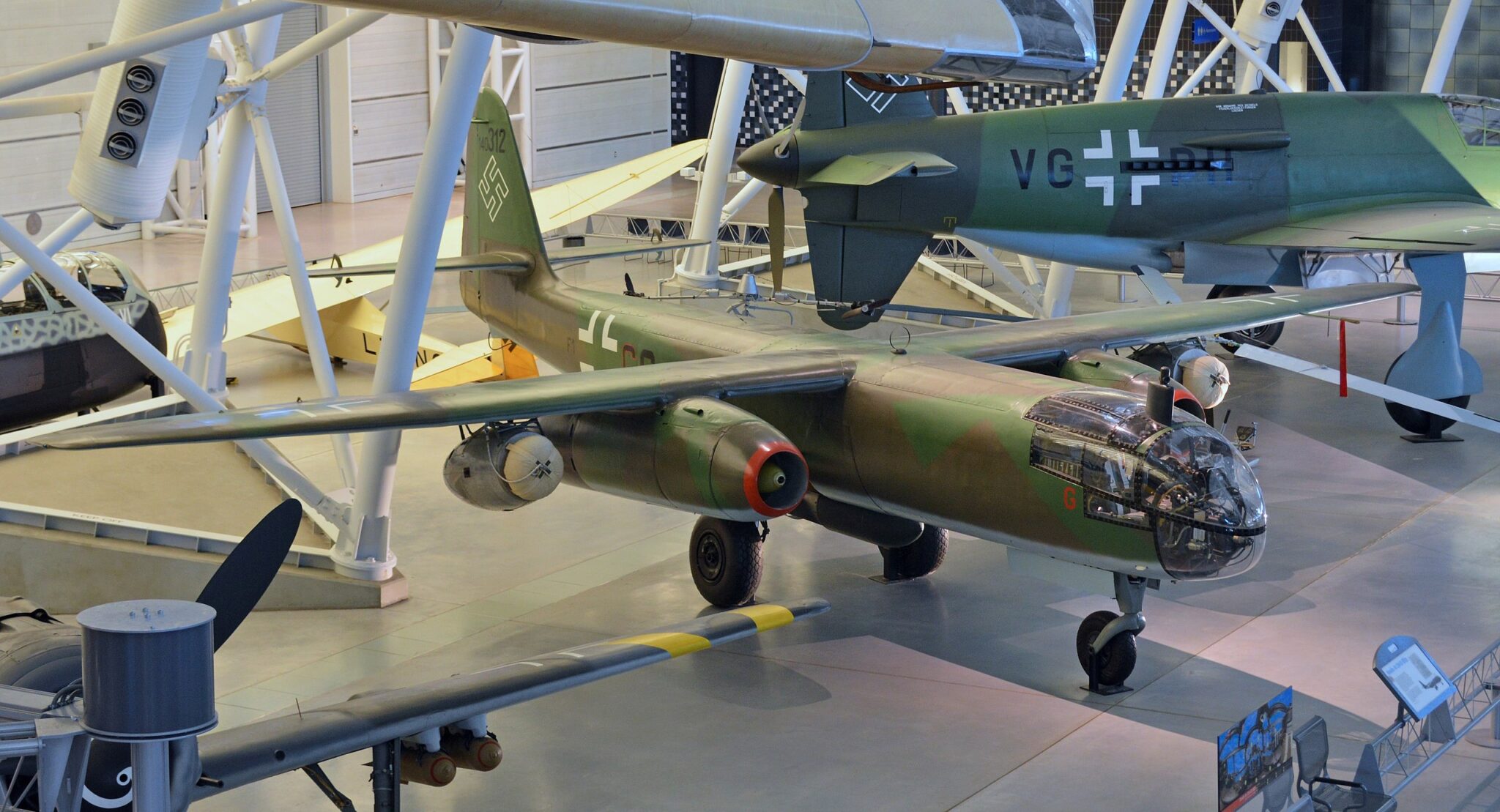
Arado ar 234 blitz image via smithsonian
Based on a Blitz
The impetus for the B-45 can be traced to the world’s first jet-powered bomber- Luftwaffe’s Arado Ar 234 Blitz. When the Blitz was evaluated it was decided the US Air Army Air Force needed a similar bomber. The B-45 turned out to be much more like the Blitz than any of the other “Class of 45” bombers in development at the time- the Consolidated XB-46, the Boeing B-47, and the Martin XB-48. On 8 September 1944 North American Aviation began construction of three NA-130-based prototypes at their plant in Inglewood CA.
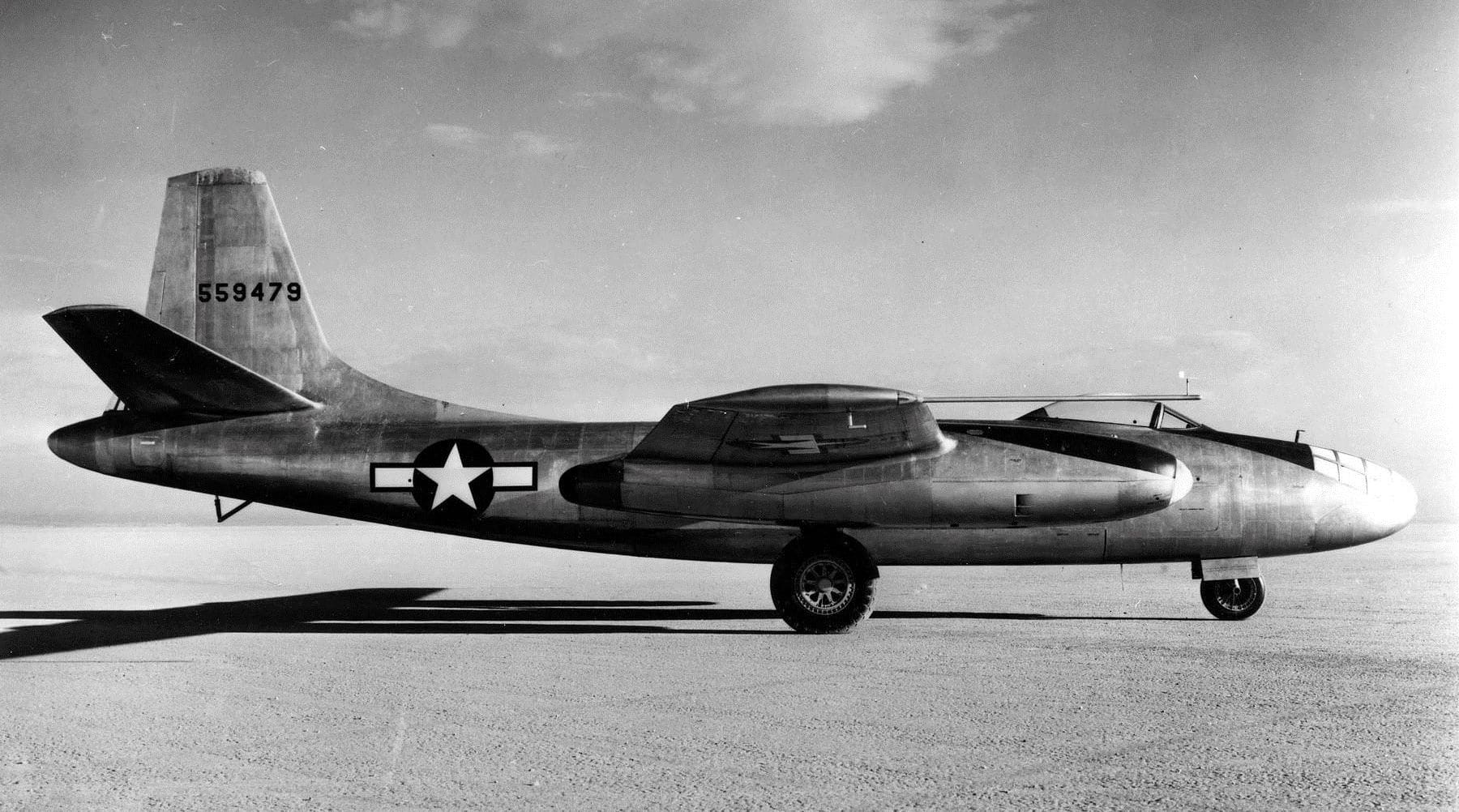
XB-45 image via NMUSAF
Somebody Had to Be First
When World War II ended in 1945 aircraft development programs were cut back or canceled outright in droves. The XB-45 and XB-46 were both going to be nearly ready to fly by mid-1946. The XB-47 and the XB-48 were both still many months away from seeing their first flights. After a relatively short battle between the XB-45 and the XB-46, the XB-45 came out on top. So a contract for accelerated production of B-45As was signed on 2 January 1947- even before the XB-45 flew for the first time.
image via NMUSAF
Teething Troubles
Even though the XB-45 flew for the first time on 24 February 1947, and production B-45As entered service with the 47th Bombardment Group based at Barksdale Air Force Base (AFB) in Louisiana in April of 1948, the Tornado was never going to be the jet bomber Boeing’s B-47 eventually became. The second batch of B-45As were powered by uprated and more reliable General Electric J47 axial flow turbojet engines, solving one problem, but the jet’s other shortcomings were too much to overcome. Only 143 B-45s were built- 71 fewer than its nearest analogue- the Arado Ar 234. 38 of those 143 airframes were dedicated aerial reconnaissance platforms.
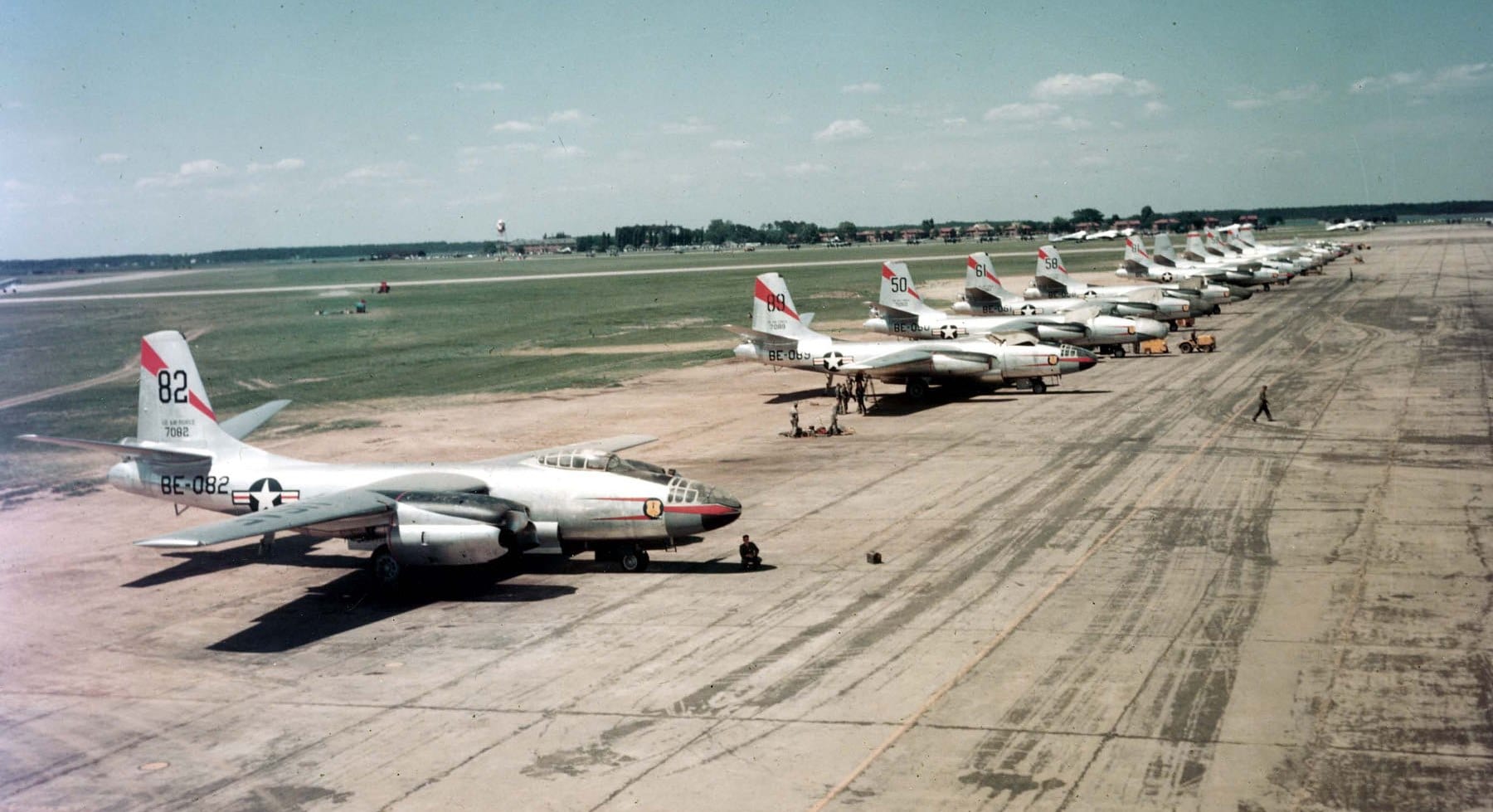
Flightline photo of B-45As of the 47th Light Bomb Wing, Langley Air Force Base, Va., before trans-atlantic flight to Sculthorpe, England, in July 1952. Identifiable aircraft are (nearest to farthest) 47-082, 47-089, 47-050, 47-061, 47-058, 47-011, unknown, unknown, 47-059, 47-064, unknown. (U.S. Air Force photo)
North American Designed
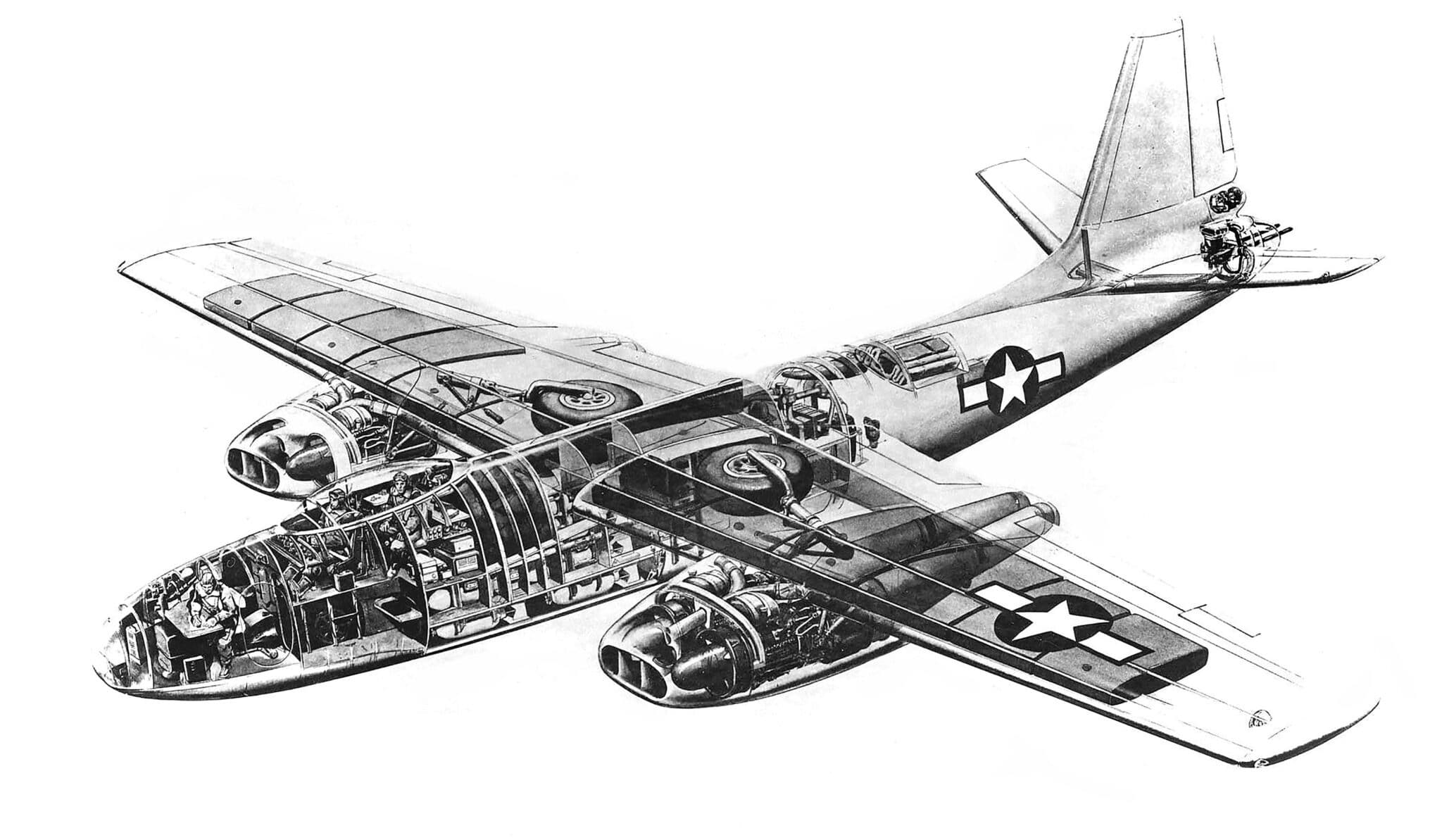
Design highlights of the B-45 included shoulder-mounted straight wings with the four engines mounted in pairs in nacelles under the wings, a conventional empennage with pronounced dihedral for the horizontal stabilizers to clear the engine exhaust turbulence, a tandem cockpit with ejection seats for the pilots, and tricycle landing gear. The crew consisted of the two pilots, a bombardier seated in a transparent nose, and a tail gunner sitting in the extreme tail of the aircraft.
American flew the jet with just 56 first-class seats to destroy Legend Airlines
It might not seem that long ago, but back in the late 1990s, the airline industry was a much different competitive environment. A whole host of startup and emerging airlines focused on becoming successful low-cost carriers, including those operating Fokker F-100s.
They were competing against no less than eight major national airlines as well as established LLCs like Southwest Airlines, ATA, and America West. Airlines like Valujet (later AirTran), Vanguard, AirSouth, Frontier, and Midway Airlines offered a host of low-cost flight options to the traveling public. Many aimed to emulate the success of Southwest Airlines with low fares and frequent service. Most of these airlines competed on price and schedule.
Airfares were cheap, the economy was strong, and optimism reigned the day.
Enter Legend Airlines, a threat to American Airlines
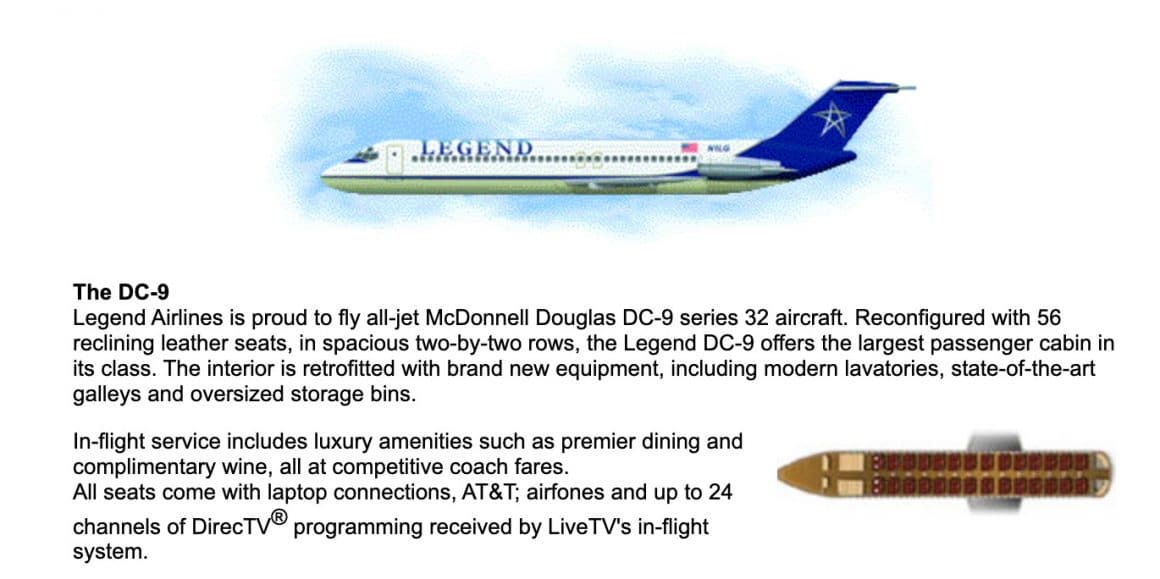
In 1996, Dalfort Aviation and a group of partners announced that they would operate 56-seat aircraft from Dallas Love Field (DAL) to several business destinations. Utilizing the DC-9, they would ‘elevate’ the passenger experience with all first-class seats, fancy meals served on china, and live satellite TV in each seat—all from their brand new terminal built on the same land at Love Field where they had provided aircraft maintenance services for years. Flights would be priced near the same as a coach fare from DFW.
Screen shot of Legend Airlines DC-9 Informational website from 2000 with details on what made their service unique back when they introduced it in early 2000.
According to the Legend Airlines website back in 2000, “the idea for Legend Airlines was born in 1996, when a group of individuals who were fed up with the hassles of air travel felt it was time for an airline that offered business travelers a stress-free and productive travel experience.
They envisioned this airline would offer non-stop, long-haul service to major business destinations in the US, wider seats and better meals at competitive coach fares—all with the convenience of Dallas Love Field’s proximity to downtown Dallas and in compliance with the existing federal laws governing Love Field.”
The plan to fly such luxurious jets wasn’t altruistic. For years, Dallas Love Field was bound by the Wright Amendment. This Federal Law was a compromise between the cities of Dallas and Fort Worth, brokered by Congressman Jim Wright. When DFW was built, the original agreement was to end commercial service at Dallas Love Field once the new international airport opened. Every airline except upstart Southwest Airlines agreed to move to DFW.
After a lengthy legal battle, the compromise was that no airline could fly between the adjoining states of Texas unless it had 56 seats or fewer. For years, a detente existed between Southwest Airlines and DFW Airport. Southwest only flew to the adjoining states from Love Field and thrived.
Few other airlines bothered to compete against them. However, the wild and raucous 1990s gave rise to a couple of disruptive forces. First, the dot-com economy gave rise to the notion that wealth had become the new standard for many, and that budget-conscious travel was a thing of the past for the well-to-do professional. Also, American’s high-priced fortress hub at DFW meant that markets like Los Angeles and New York were ripe for disruption. Fares were too high, and the general perception was that airlines like American were taking their customers for granted.
What followed was a three-year-plus battle between American Airlines and Fort Worth, versus the City of Dallas and Legend Airlines. When the dust finally settled, Legend Airlines was able to begin service to Washington Dulles and Las Vegas on 5 April 2000, with plans to add service to Los Angeles and Chicago soon afterwards.
American Sends In Their F-100 Soldiers to defend their fortress hub
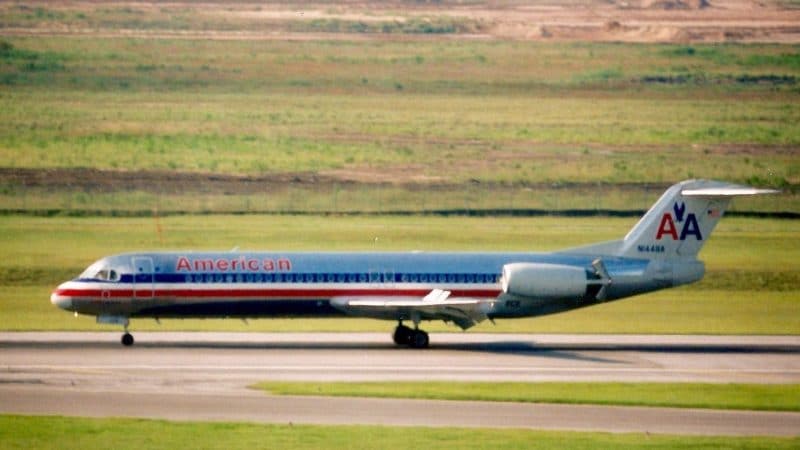
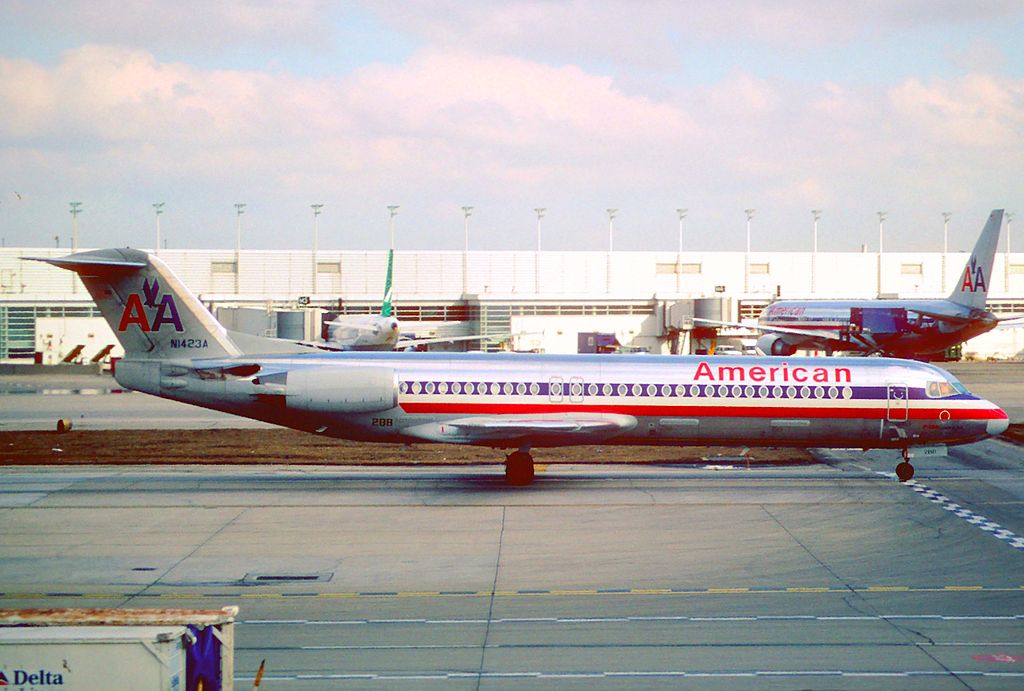
At the time, American Airlines had a fleet of 75 Fokker F-100 “Luxury Jets”. Back in the day, there were fewer regional jets in the market. CRJs and ERJs were actually a treat versus the prop planes that many passengers had to endure. They weren’t seen as the torture that they are today. American’s F-100, ‘jump jets’ or ‘Barbie jets’ as they were commonly referred, provided jet service to markets where aircraft any larger than 100 seats would prove to be unprofitable. It was almost a treat for a market that would otherwise be served by an ATR-72 or Saab prop plane.
American deployed these jets on routes like O’Hare to Dayton and DFW to Tulsa. But after Legend won the legal battle, American decided to go to war against Legend, an airline that they saw as a genuine threat to their business. American Airlines retrofitted a sub-fleet of Fokker F-100 jets with just 56 seats to Dallas Love (photo in the link) with the express purpose of competing with Legend Airlines.
Legend launched service on 5 April 2000. Less than a month later, American launched their service on the F-100s on 1 May 2000 to their prime business market of Chicago O’Hare, Los Angeles, and New York LaGuardia. American leveraged their frequent flyer program, brand recognition, and fleet to mount a massive challenge against the upstart. American offered all first-class service, including meals, wide seats, and frequent flyer miles, from Dallas Love Field.
Fokker F-100s defended their territory
Less than 7 months later, Legend Airlines folded. Fancy meals, a beautiful mahogany terminal, free papers, satellite TV, and first-class seats weren’t enough. Along with the downturn of the economy because of the dot com bust, American’s Fokker fleet of first-class jets was just too much for the upstart airline to handle. Legend Airlines officially suspended service on 3 December 2000.
American continued their service even after Legend folded to avoid any anti-trust acquisitions. American suspended their F-100 first-class service to O’Hare and Los Angeles just a year later. The official reason for the suspension was the events of 9/11, but it’s hard to argue that American would’ve continued to serve the Dallas market with such service if it weren’t for the threat that it faced from Legend.
An american Airlines F-100, Photo: Aero Icarus-Wikipedia
At the end of the day, American leveraged the Fokker F-100 fleet to defend their turf. Over the next decade, American employed similar tactics to defend against other threats. Eventually, DFW Airport became known as a fortress hub.
Airlines like Spirit, Delta, and Vanguard all faced American Airlines’ wrath as American successfully defended its hub even as the downturn of 9/11 and a recession hit. American’s Fokker fleet didn’t fare much better. By the end of 2004, the fleet had disappeared from the company’s roster. A combination of the economy and the cost of parts for the airliner, due to Fokker’s demise, led to the end of the Fokker F-100 fleet at American.
The Fokker did its job. It protected American Airlines against an outsider threat.
Several Videos Tell the Tale of Endeavour’s Epic Farewell Tour
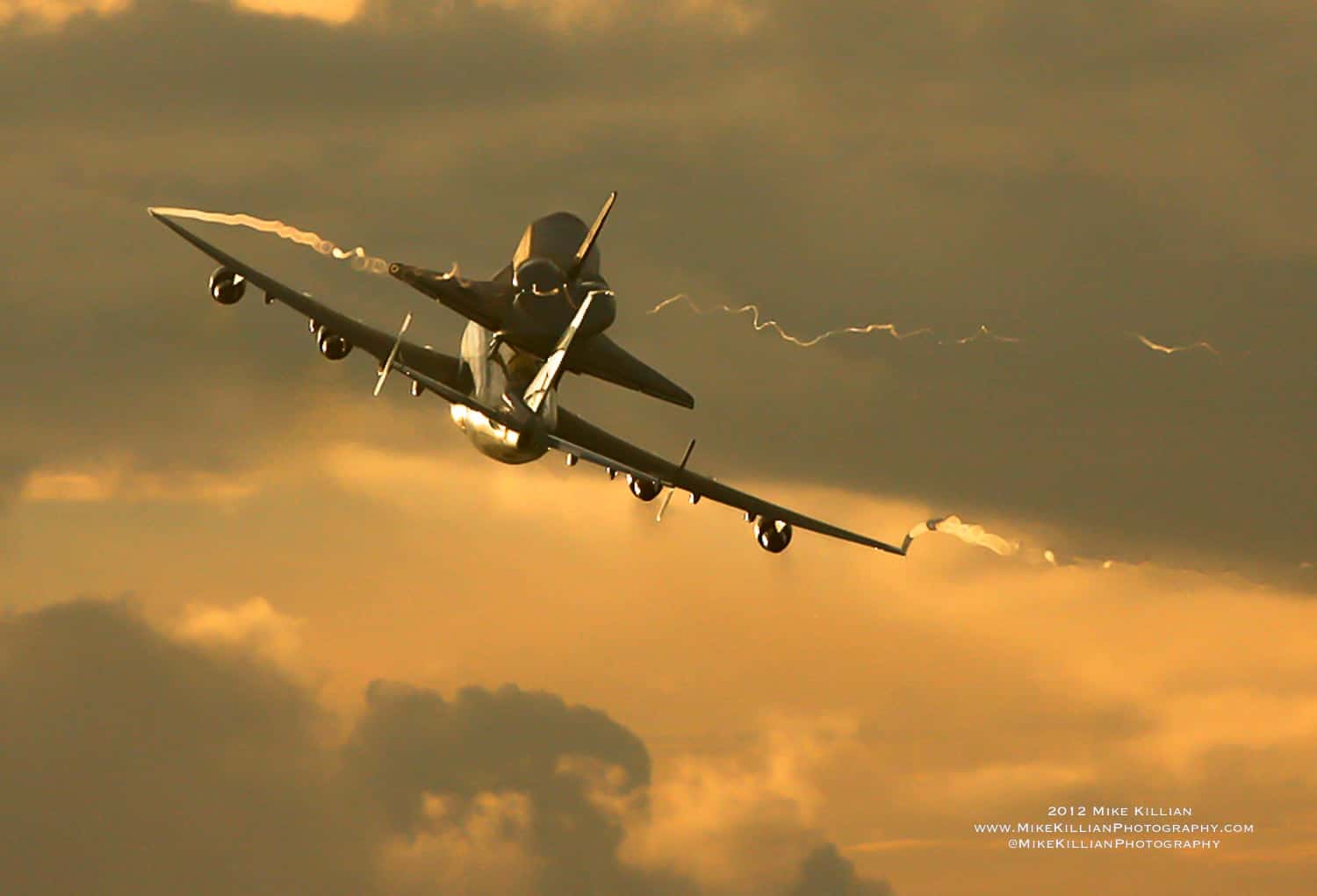
On 21 September 2012, the space shuttle Endeavour made her final flight, a ferry flight, and tour of southern CA on the back of NASA’s modified 747 shuttle carrier aircraft (SCA) before landing one last time, destined as a museum piece for the California Science Center (CSC).
The four-hour, 34-minute flight began at NASA’s Dryden Flight Research Center at Edwards Air Force Base, then headed north to Sacramento, the state capital, then west to San Francisco, the Golden Gate Bridge, and Moffett Field (home of NASA AMES), before heading back south and arriving at LAX that afternoon.
Once over the LA area, pilots Jeff Moultrie and Bill Rieke, both from NASA’s Johnson Space Center in Houston, TX, took Endeavour over such landmarks as Griffith Observatory, the Hollywood sign, Dodger Stadium, NASA’s Jet Propulsion Laboratory, Malibu and Santa Monica, Disneyland and Universal Studios, SpaceX HQ, the Queen Mary and USS Iowa in Long Beach harbor, before conducting several low-level flyovers over LAX before touching down on Runway 25L at 12:51 p.m PDT.
The CSC was awarded Endeavour in April of 2011 after NASA held a nationwide competition to display their three retired orbiters. Shuttle Discovery was awarded to the Smithsonian National Air and Space Museum, and Atlantis was awarded to the Kennedy Space Center Visitor Complex in Florida.
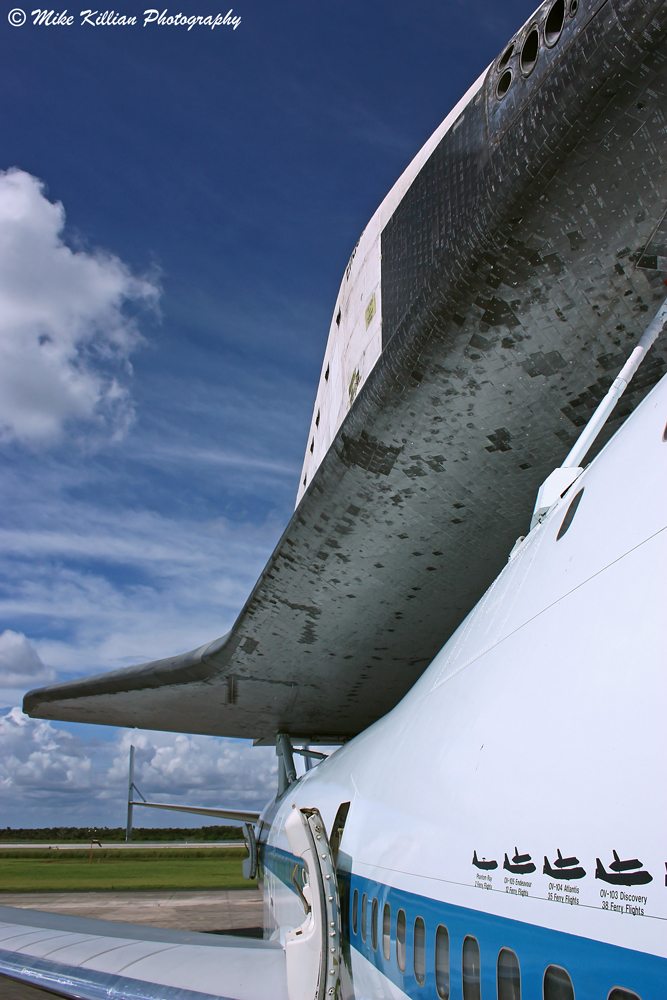
Maybe a little-known fact to some, but the SCA displays the number of missions it has flown for the space shuttles. Photo Credit: Mike Killian
NASA’s orbiter test vehicle Enterprise, which was replaced by Discovery at the Smithsonian, was moved to the Intrepid Sea, Air and Space Museum in New York City.
Houston got the SCA and an old mock space shuttle display from KSC, to the surprise of many. Wayne Hale published some interesting views and his thoughts as to why HERE, for anyone interested…
Endeavour’s last flight over CA culminated several days of cross-country flying. NASA wanted to give the public a chance to see the shuttle’s final days in the air, so it conducted low flybys of cities and landmarks with direct ties to the space shuttle program over its several decades of service to the nation and our allies.
Endeavour departs KSC for the final time. Photo: Mike Killian
Millions of residents came out to watch, and over a million more came out several weeks later to watch as the orbiter navigated through the streets of LA to reach the CCS from LAX.
Born from the ashes of Challenger, Endeavour OV-105 (NASA’s official identification for Endeavour) flew her last mission, STS-134, in May of 2011, closing out a 25-year career with NASA.
Between 1992 and 2011, she flew nearly 123 million miles in space, covering 25 missions and 4,600 orbits of the Earth.
In the early 1970s Saudi Arabia was looking to modernize its air force. they approached the USA and were presented with multiple options, including the McDonnell Douglas F-15 and F/A-18. The F-15 was chosen both for its overall greater capabilities and because the F/A-18 was not yet in production.
Despite opposition from some within the U.S. Congress, export of a slightly downgraded F-15 to Saudi Arabia was approved. In 1978, the Saudis placed an order for 60 aircraft, with an additional pair of jets added as attrition replacements. Under the first phase of a Foreign Military Sales (FMS) program dubbed ‘Peace Sun’, deliveries of the first Saudi F-15s began in 1982.
An F-15C on a delivery flight to Saudi Arabia, 1983 – USAF Photo
No Additional Saudi F-15s – For The Moment
A further 48 F-15s were requested by the Saudis in 1983, but this was denied. Amid concerns regarding the situation in the Middle East, the original sale of Saudi F-15s was limited to 60 aircraft. In the five years that had passed, those concerns had only heightened, and this second deal was shot down by Congress.
This rejection led the Saudis to look elsewhere for aircraft in a continued effort to modernize its air force. After considering several options they turned to the UK, who’d supplied them with the English Electric Lightning in the mid 1960s.
Saudi Lightning and F-15 – Royal Saudi Air Force photo
In 1985 a deal was struck that included 72 British-built Panavia Tornados. There were 48 Interdictor/Strike (IDS) and 24 Air Defense Variant (ADV) aircraft. The IDS jets would provide the Saudis with a much improved ground attack capability over their aging Northrop F-5s. And the ADVs would partially satisfy the Saudis’ need for more interceptors.
Saudi Tornado ADV during Desert Shield – US Air Force photo by TSGt. Hans H. Deffner
Saudis Extend Their Talons
An interesting chapter of the Saudi F-15 story took place on 5 June 1984. Two Royal Saudi Air Force (RSAF) Eagles, an F-15C and F-15D, engaged two Iranian F-4Es over the Persian Gulf.
The war between Iran and Iraq was in full swing, and the Iranians were going after Iraqi-bound shipping in the gulf. The Iranian F-4s crossed into Saudi airspace, presumably to attack merchant ships in Saudi waters.
An Iranian F-4E Phantom II – Islamic Republic of Iran Air Force photo
Two RSAF F-15s were on a training flight with United States Air Force (USAF) KC-10 Extenders, practicing air refueling. They were vectored onto the F-4s by a USAF E-3 Sentry that was operating in the area.
US Air Force photo by MSGT. Val Gempis
Each F-15 fired an AIM-7 Sparrow, destroying one F-4 and damaging the other. The damaged jet was able to make it home but was apparently a total write off.
Two F-15s launch AIM-7 Sparrow radar-guided missiles – US Air Force photo (Altered)
Within half an hour, the Iranians sent 11 more F-4s up as a show of force and maybe with ideas of vengeance. But when the Saudis scrambled a like number of F-15s in response, cooler heads prevailed and the Iranians backed down.
Two things make this incident interesting beyond the norm. One: it was the first tme that two aircraft built by McDonnell Douglas opposed each other in an air fight. And two: a USAF pilot was riding backseat in the F-15D.
You may be wondering what that guy was doing there, and your author is willing to expound a bit. But… in another article, perhaps.
USAF photo by SSgt. Keifer Bowes
Peace Sun VI – More Saudi F-15s
Though that second deal for F-15s was denied, the USA continued to supply Saudi Arabia with other aircraft and arms under Peace Sun. Notable among these was the sale of five Boeing E-3 Sentry Airborne Warning and Control System (AWACS) aircraft.
That deal was as equally contested by Congress, but ultimately went through, as finally did an order in 1987 for 12 more Saudi F-15s. This was followed in September of 1990 by a transfer of 24 additional aircraft from United States Air Force (USAF) inventory.
An F-15C of the 32nd Tactical Fighter Squadron is Repainted at Soesterburg Air base, Netherlands prior to its transfer to the Royal Saudi Air Force, 1990 – US Air Force photo by SSGT. Mark Bucher
The transfer of USAF jets was largely in response to the Iraqi invasion of Kuwait in August 1990. Both deals were effected under Peace Sun VI.
Desert Storm – F-15s on the Defensive
A multi-national coalition was formed in response to the invasion of Kuwait. And over the final few months of 1990 a gradual buildup of coalition forces took place in the Persian Gulf region. Saudi Arabia was a key member of this coalition, and played host to the bulk of forces involved.
A Saudi F-15C Approaches a USAF KC-15 Stratotanker for Aerial refueling during Desert Shield, 1990 US Air Force photo by TSGt. Hans H. Deffner
When the Desert Storm air campaign began in January of 1991, most of the coalition air sorties were flown from Saudi bases. The Royal Saudi Air Force (RSAF) played its part, both in the air and against ground targets.
Though RSAF Tornado IDS jets were in the thick of it, flying several thousand strike sorties, the Saudi F-15s played a strictly defensive role. They flew Combat Air Patrol (CAP) in defense of the Kingdom, usually far behind the battle lines, referred to as ‘goalie CAP’.
A Saudi F-15C during Desert Shield – US Air Force photo by TSGt. Hans H. Deffner
Bird of Prey: Saudi F-15s Get Into the Mix
On 24 January 1991, Captain (Capt.) Ayehid Salah al-Shamrani, an F-15C driver with 13 Squadron, RSAF had his moment in the limelight.
Flying out of King Abdulaziz Air Base, Capt. al-Shamrani was leading a four-jet CAP along the eastern Saudi coast that morning. A controller aboard a USAF E-3 Sentry vectored the Saudis toward unknown aircraft flying very low just off the coast.
An Undelivered Iraqi Mirage F.1EQ embargoed in France – Project 914 Archives
The controller guided the Eagles to an intercept, and the intruders were identified as a pair of Iraqi Mirage F.1EQs. Maneuvering in behind the Mirages, Capt. al-Shamrani closed to about 1000 yards before the Iraqis broke, one to the left, and the other right.
Captain Ayehid Salah al-Shamrani – Project 914 Archives
Capt. al-Shamrani engaged one Mirage with an AIM-9 Sidewinder, destroying it, Then, a few seconds later, he loosed another AIM-9 and splashed the second Mirage. These would be the only Saudi air kills of the war, and the only victories not scored by American pilots.
The F-15C Captain al-Shamrani flew that day – Project 914 Archives (S.Donacik collection)
Strike Eagles for the Saudis? Not Quite
The Saudis had expressed interest in acquiring the F-15E Strike Eagle, but the USA refused because of its advanced radar and other systems. Saudi inquiries into the possibility of an advanced single-seat variant designated F-15F were also nixed.
A Saudi F-15S during Exercise Friendship Two, 2011 – US Army photo
After a bit of finagling, approval was given in 1993 to supply the Saudis with a significantly downgraded version of the F-15E. Shades of the original Saudi F-15 deal.
Initially designated the F-15XP, this was soon changed to F-15S. The first of 72 of these flew in 1995, and the last jet was delivered under Peace Sun IX in 1999.
Royal Saudi Air Force photo
The Greatest of all Saudi F-15s
In 2011 the Saudis ordered 84 more Eagles under the designation F-15SA. Contrary to past deals, these aircraft would incorporate significant avionics upgrades. Among these are targeting, tracking, and navigational systems of greater capability than those of the F-15S. Structural improvements, too, allow for greater load-carrying capability.
A trio of Saudi F-15SA Eagles – US Air Force photo by SSgt. Justin Parsons
The first F-15SA flew in 2013 and the last jet was delivered to the Saudis in 2020. In addition to acquiring newly-built F-15SA airframes, the Saudis engaged Boeing to upgrade its F-15S fleet to F-15SA standard.
Since 2009, the RSAF has used the F-15 numerous times during its intervention into the Yemeni Civil War. At least two Saudi F-15s have been hit by surface to air missiles fired by Houthi rebels. Some reports indicate that at least one may have been shot down, but these seem to be erroneous.
US Air Force photo
The Saudi F-15 story has largely mirrored the evolution of the USA’s overall relationship with Saudi Arabia since the 1970s. Back then, the US was willing to give the Saudis only a limited number of downgraded jets. Recent deliveries, however, have seen the RSAF operating one of the most advanced variants of the Eagle ever built.
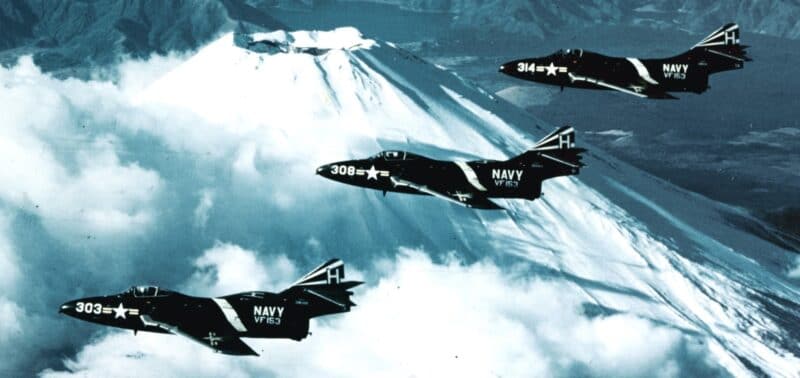
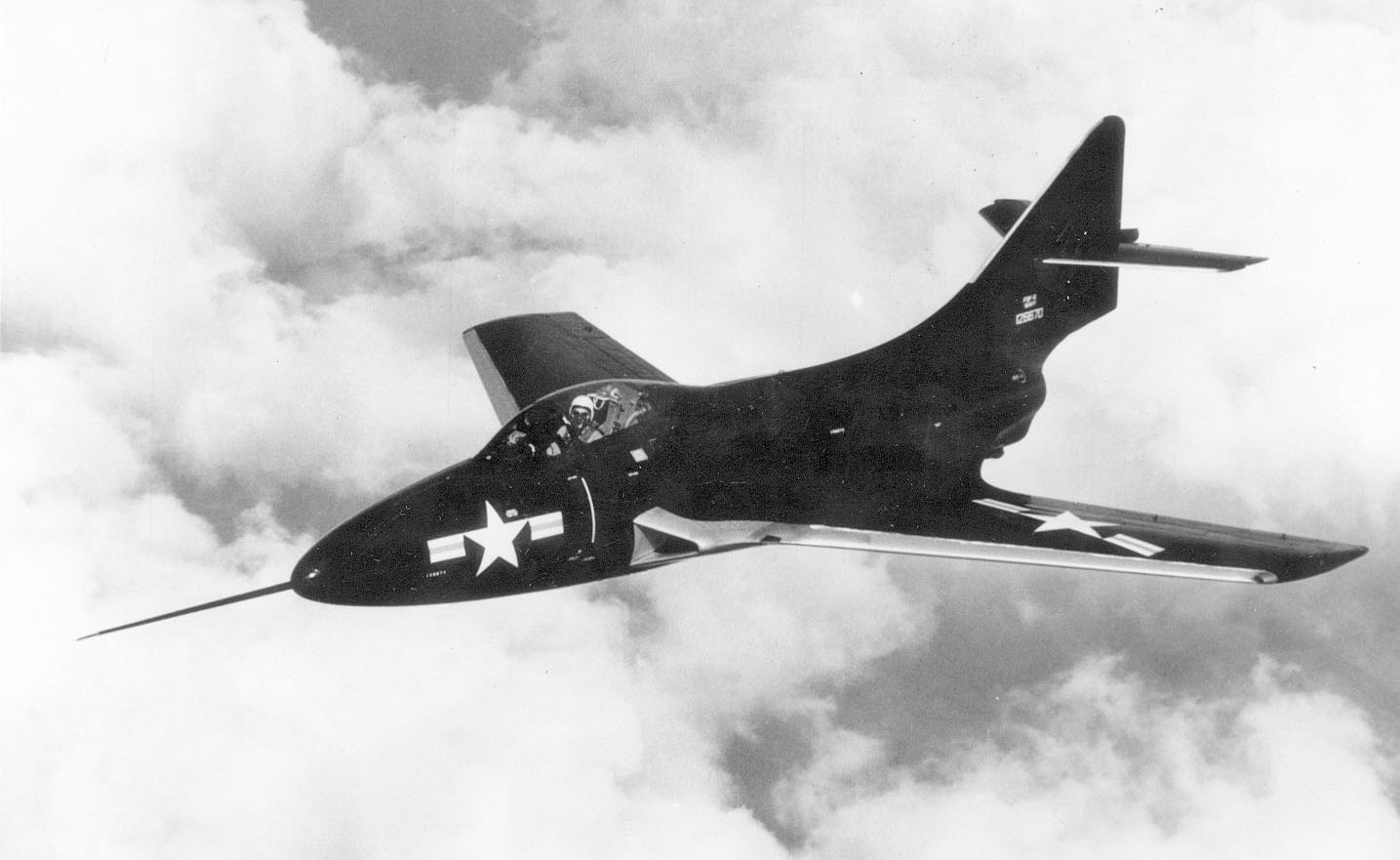
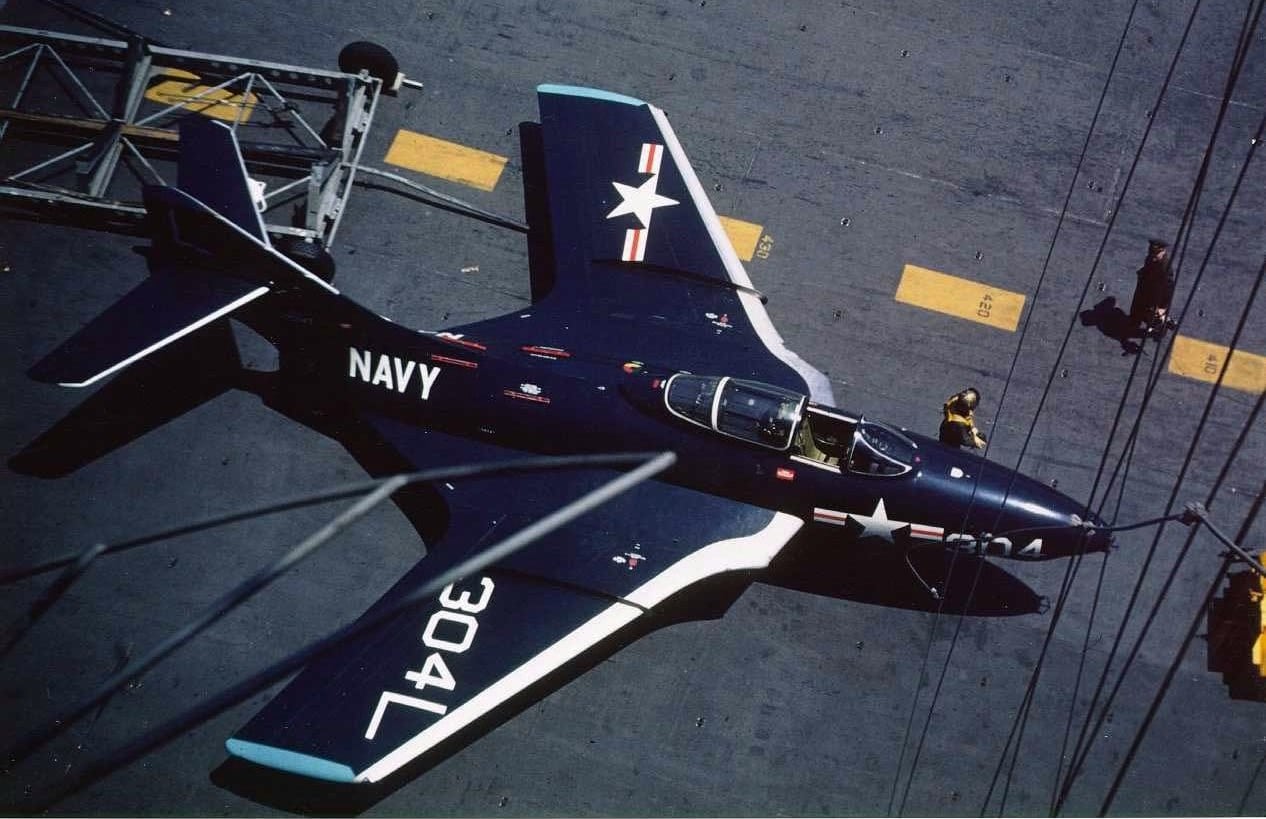
This Grumman Cat – the F-9 Cougar – was Built on A Winner But Its Career as a Fighter Was Short Indeed
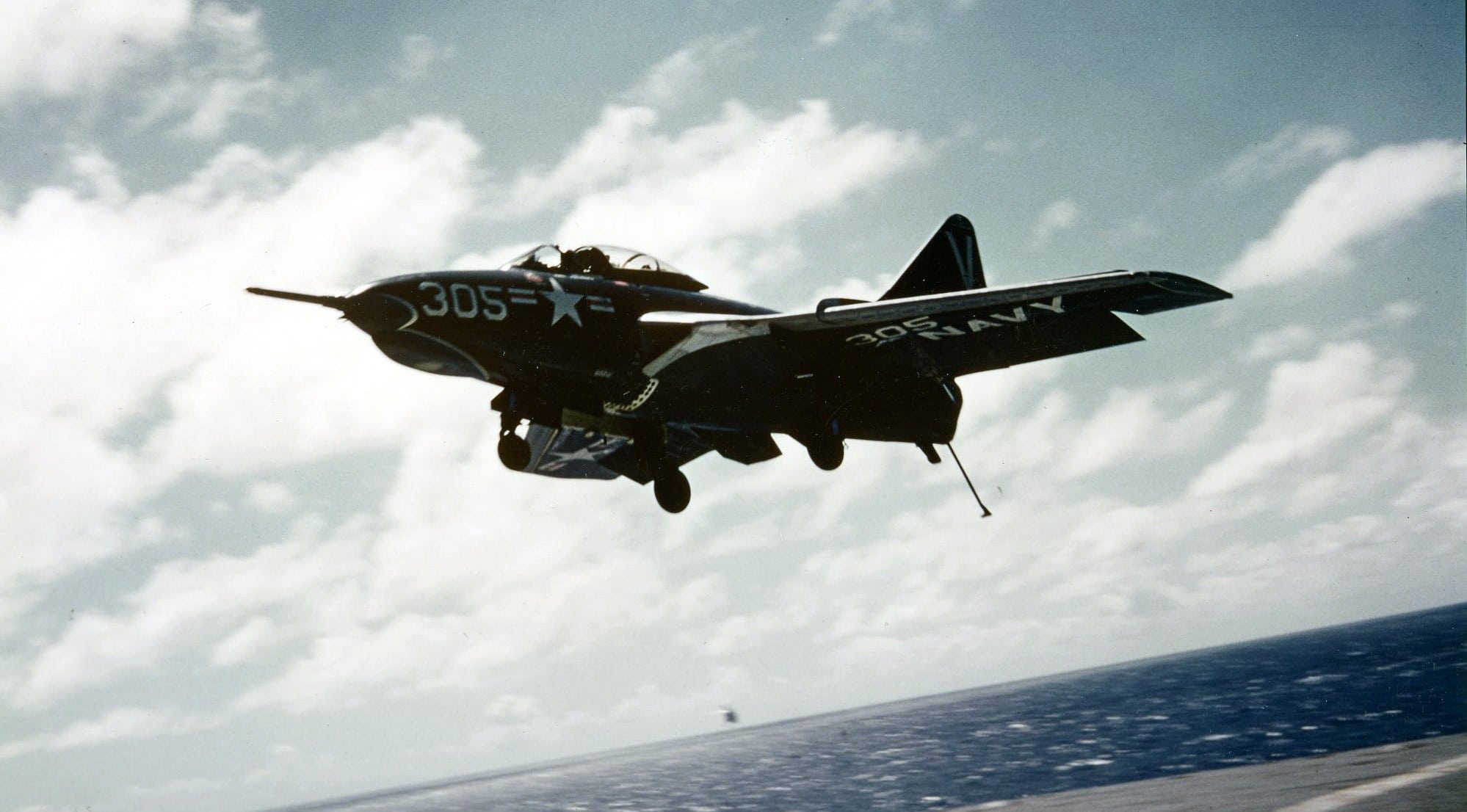
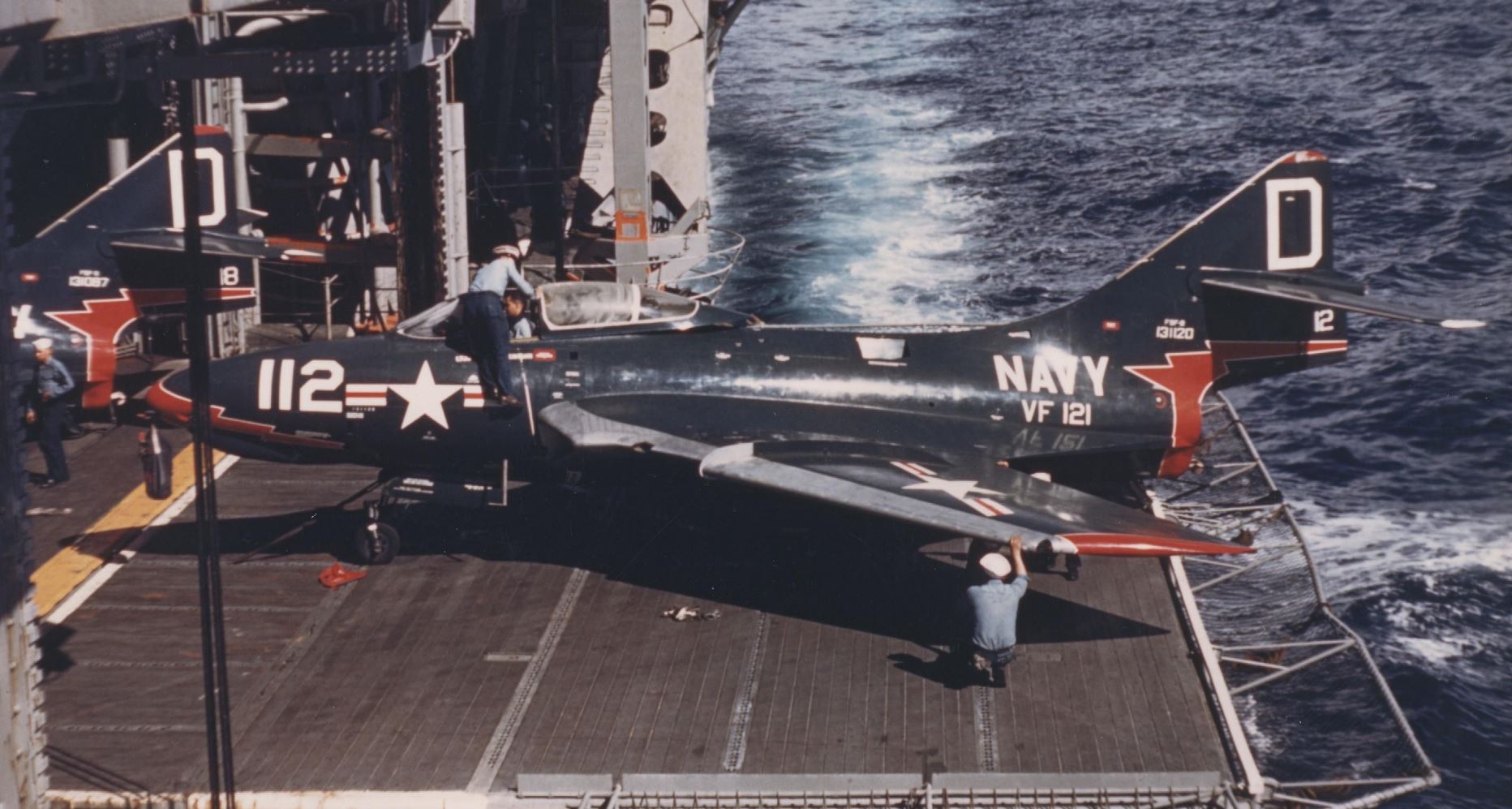
The straight-winged Grumman F9F Panther was a workhorse for the US Navy and Marine Corps during the Korean War. But when the Mikoyan-Gurevich MiG-15 showed up in the skies over Korea, it became obvious that a swept-winged fighter was needed for the Sea Services, and needed quickly. Grumman, who had a long history of designing and building fighter aircraft for the Navy, reasoned they had a good foundation for a swept-winged fighter in the Panther- and they took advantage of it.
image via NNAM
Building a Better Panther
Grumman essentially took the Panther design and added a 35-degree swept wing with leading and trailing edge flaps of wider chord, spoilers for yaw control on the upper wing, full-chord wing fences, an all-flying swept empennage, larger airbrakes, and a larger rudder. Other modifications to the basic Panther included moving the engine intakes forward and stretching the fuselage two feet in order to add internal fuel needed because the tip tanks could not be mounted on the wingtips. The swept wings also were hinged for folding up near the wing roots adjacent to the air intakes.
image via nnam
Better Around the Boat
Test pilot Fred C. Rowley flew the initial prototype of Grumman’s Design 93, the XF9F-6, for the first time on 20 September 1951- only six months after the contract was signed. Some engineering tweaks to the control surface configuration produced a swept-winged jet that had better handling around the boat than the straight-winged F9F-5. The jet’s critical Mach number was increased from 0.79 to 0.86 at sea level and to 0.895 at 35,000 feet. Power for most Cougars was provided by a Pratt &Whitney J48-P-8A turbojet engine (a license-built Rolls-Royce Tay).
image via nnam
Into Service
Fighter Squadron THREE TWO (VF-32) Swordsmen became the first fleet squadron to equip with the F9F-6 Cougar in November of 1952. VF-24 Checkertails was the first fighter squadron to deploy with the Cougar, doing so aboard the USS Yorktown (CV-10) in August of 1953, but they arrived too late to participate in the Korean War.
Cougars were armed with four nose-mounted 20 millimeter cannon aimed using the Aero 5D-1 weapons sight paired with the APG-30A gun-ranging radar. Hardpoints under the wings enabled the F9F-6 to carry a pair of 1,000-pound bombs or 150 gallon drop tanks. Many Cougars were modified with a UHF homing antenna under the nose. Cougars equipped for inflight refueling had their probes mounted right up front on the nose radome. The last of the 646 F9F-6 Cougars was delivered on 2 July 1954.
image via nnam
First Pass at a Photo Cougar
Grumman fitted sixty F9F-6 Cougar airframes with nose-mounted cameras in place of the 20 millimeter cannons. These first photo-Cougars were designated F9F-6P and delivered between June of 1954 and March of 1955. F9F-6Ps were nine inches longer than standard F9F-6s to accommodate the photo reconnaissance equipment in the elongated nose. Many of the F9F-6Ps were also equipped with inflight refueling probes mounted to the front of the photo nose.
F9F-6P image via nnam
Improving the Breed
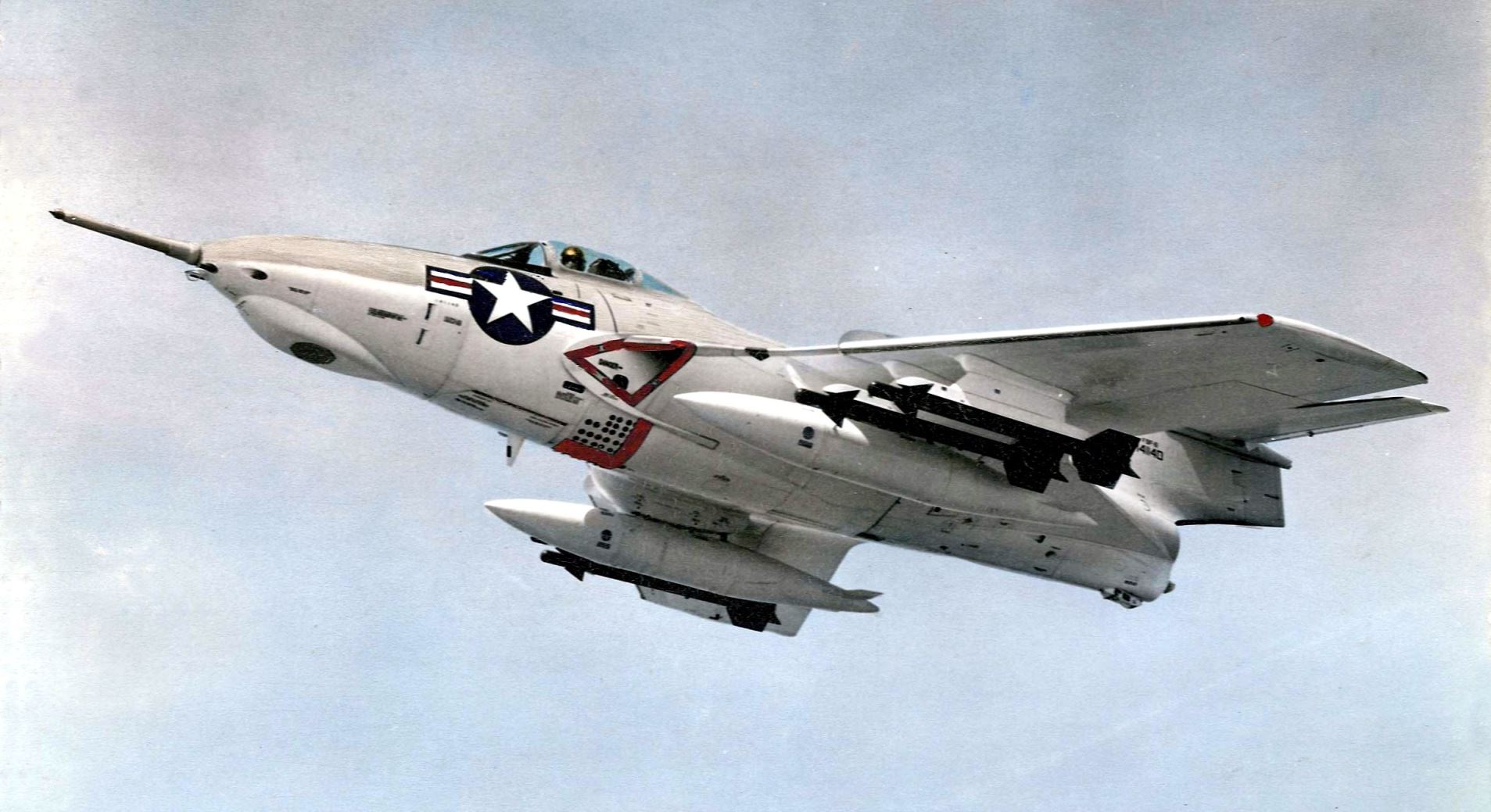
In April of 1953 work began on the next Cougar variant (the F9F-8) with three primary improvements in mind- lower stall speed, increased range, and improved control of the aircraft at high angles of attack. The wing grew by 37 square feet, a dogtooth was added, and chord was increased.
The fuselage was stretched by 8 inches as well. These changes resulted in the desired improvements. Top speed increased to 704 miles per hour while minimum catapult speed was lowered to 146 miles per hour. First flown on 18 January 1954, the F9F-8 was capable of supersonic flight in a steep dive. 601 F9F-8s were delivered between April of 1954 and March of 1957.
When Navy fighter aircraft began deploying with the ability to fire AIM-9 Sidewinder missiles for the first time in 1956, VA-48 F9F-8 Cougars were carrying them.
The Boeing 747 had a real chance to become the a fleet of KC-25s in the US Air Force
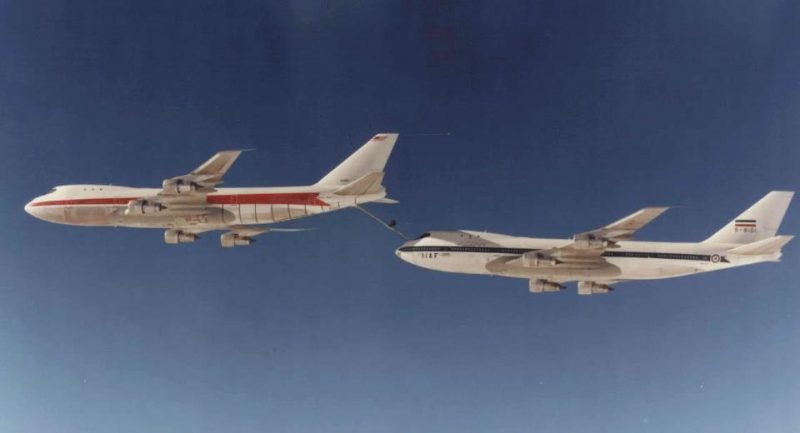
Unbeknownst to many in the general population, the KC-747 (what would have become the KC-25) was the potential powerhouse that fizzled out before it could make an impact on military aviation. Aviation enthusiasts acknowledge the shortcomings of this monstrous machine and recognize the reasoning behind the United States Air Force’s decision to decline the world’s largest tanker. However, at first glance, this giant tanker-cargo aircraft appeared to be the perfect solution to a growing need.
Throughout the course of history, dating back to World War II, the need for capable and innovative aircraft has constantly risen. With each triggering event that builds global tensions, world militaries have paralleled their growth with the exponentially increasing need, as best they can. A large portion of the aerial movement includes tanker aircraft. Aerial refueling provides the ability for aircraft to stay on station for longer periods of time, creating benefits such as extending periods of survey and intelligence gathering, as well as enabling trips across long distances much faster.
The United States Air Force (USAF) employs the largest number of tanker aircraft in the world, with a significant amount operated by the National Guard. The most common tanker in the inventory is the venerable KC-135. However, it has taken many competitive designs spanning the last few decades to reach this point of preference.
The hunt for a new tanker
In the 1960s, an initiative was created that paved the way for present-day tanker-cargo aircraft. It was dubbed the Advanced Tanker-Cargo Aircraft (ATCA) program. The goal was to create a heavy tanker-transport machine that would accommodate the growing need for aerial refueling and transportation of supplies to deployed troops.
According to a Jalopnik article from 2014 by Tyler Rogoway, the program’s initial top competitors included versions of the DC-10, L-1011, C-5, and B747. Each variant brought unique aspects to the drawing board; however, they also brought their fair share of detrimental characteristics. The C-5 is a colossal aircraft, and its sheer size is what nixed it. The L-1011 wasn’t configured for cargo operations at the time, which caused it to be too high a risk moving forward.
A decade after this initiative began, the DC-10 (KC-10) and B747 (KC-25) were paired against each other as finalists to support USAF personnel moving forward. Ultimately, the KC-10 was selected, regardless of the valiant effort KC-25 proponents put forth.
The KC-25 theoretically could have been selected to fit a need for a larger tanker with additional cargo capacity. The concept behind its creation was one of ingenuity. On paper, it seemed like a winner. However, only two were ever purchased. The buyer? The Iranian Air Force.
So why was the KC-25, a potential powerhouse aircraft, declined by the buyer it was designed for amid a time of great need?
KC-25 Specifications and Performance
During the height of the competition, the KC-25 was marketed as the ultimate tanker-cargo carrier. It far surpassed others in terms of fuel capacity, payload capability, and sheer speed. This behemoth can haul payloads of around 200,000 pounds, paired with more than 455,000 pounds of fuel. That means it carries 100,000 more pounds of fuel than the KC-10 while effortlessly flying longer distances. Unfortunately, its large size meant it could not operate on shorter runways.
The KC-25 was tested relentlessly with a multitude of receiver aircraft and passed with flying colors each and every time. Reports state that during refueling tests, the aircraft remained incredibly stable.
The KC-25 was equipped with a boom. The final configurations of the KC-747 planted an aerial refueling receptacle on the front end, with a nose cargo door that increased ease of on—and off–loading. It could offload twice as much fuel as an aircraft as the KC-135.
This massive aircraft turned tanker was meant to be an epic show of American might mixed with innovation. It was unmatched during its time; however, bigger does not always mean better in the eyes of the military.
The KC-25 Falls Short
When all was said and done, the KC-25 was still thrown to the wayside. Major points of reason include the astronomical operational expenses, its immense size preventing access to numerous runways, and the non-existent need for an aircraft that carries such high volumes of fuel and payloads. In layman’s terms, this aircraft was overkill. At the time of the final decision, the USAF had a budget that they felt would be put to better use across the acquisition of more aircraft that still performed exceptionally well across all testing platforms.
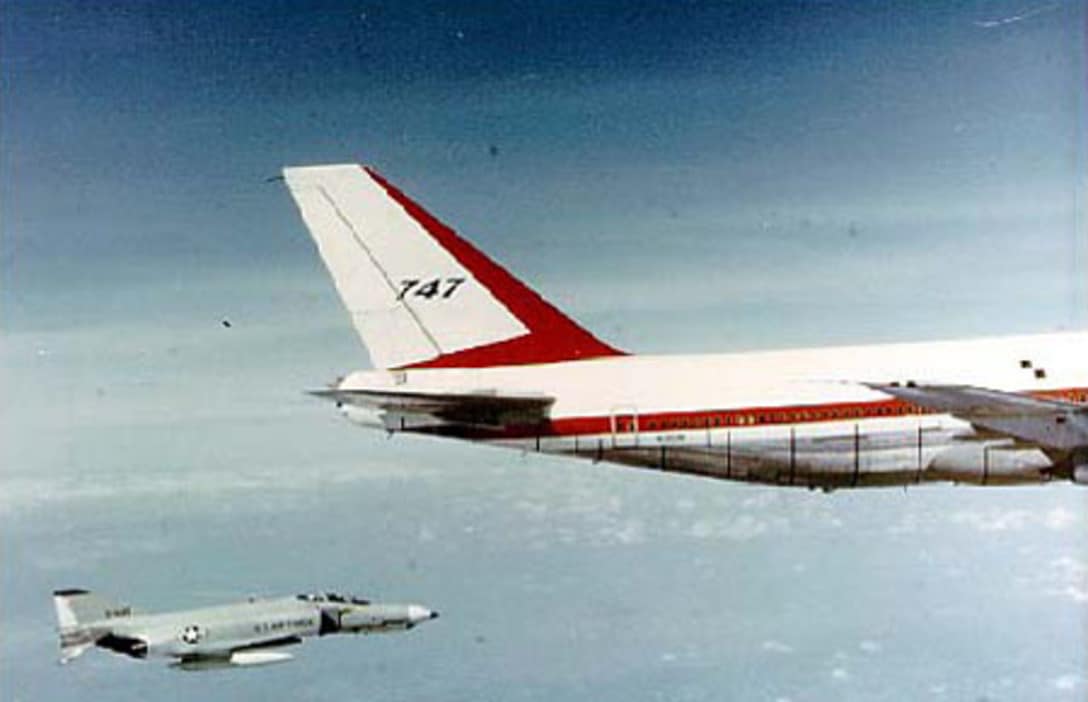
McDonnell Douglas RF-4C-18-MC (S/N 63-7445) was probably testing for wake turbulence in a KC-747 design study. Note the open IFR door on the RF-4C. (U.S. Air Force photo)
The KC-10 was a winner in the eyes of the USAF at the end of the competition due to the cheaper cost of operations as well as the key and unique features it brought to the table. This tanker-cargo aircraft could operate on shorter runways, opening up a plethora of strategic locations.
It offered automated break-away capabilities rarely found during this time and a fly-by-wire boom with a larger envelope for refueling. Comparing the KC-25 tanker-cargo aircraft to current-day applications, the competition operates more efficiently at a lower price point, with a smaller footprint, while still surpassing mission needs. Tankers such as the KC-135 and KC-10 fit better into mission platforms for squadrons throughout the USAF. The KC-767 and later the KC-46 program demonstrated that the sweet spot for a tanker was in the medium-sized category.
Yet the concept of the KC-25 lived on all the way until 2000. An Air Power Australia analysis deck (an independent think tank not affiliated with the RAAF or Australia’s Department of Defence) available on the internet highlighted that Boeing continued to look at modifying the 747-400 platform but ultimately abandoned it in favor of the 767-based aircraft. There is no other source to confirm whether or not it was seriously looked at as an option in more recent times by any nation.
Editor’s Note: The original article incorrectly stated that the RAAF produced the study mentioned on the 747 tanker. The article has since been corrected.
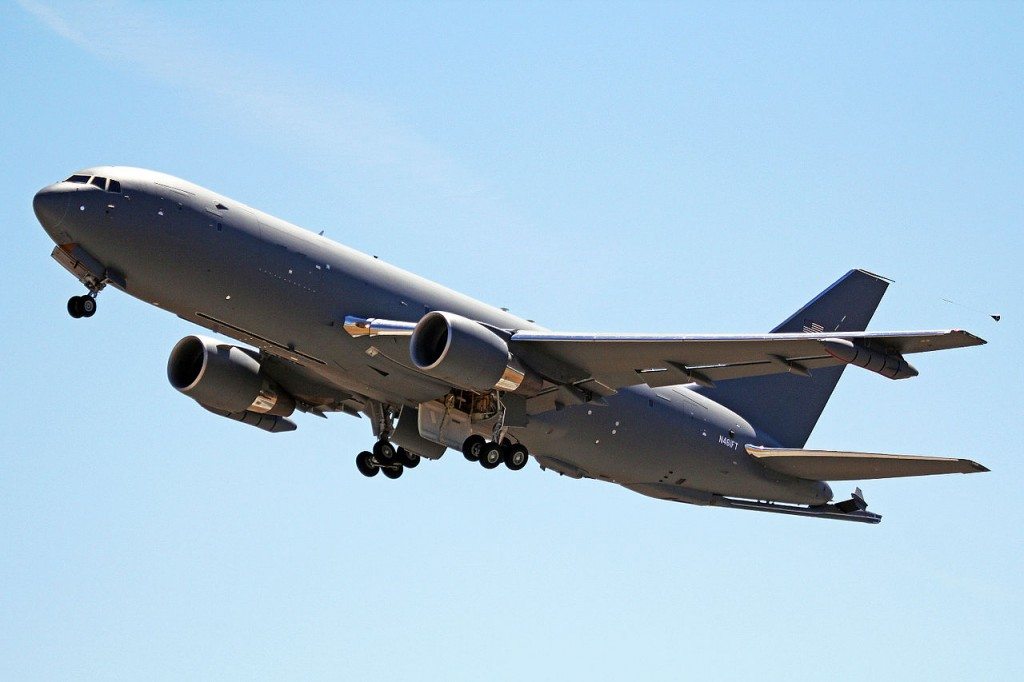
Boeing’s KC-46 tanker. Credit: Ken Fielding, Flickr.com photos.
‘Tis the season! It is time once again for J.D. Power’s airport rankings, and the 2024 results highlight a clear trend: rising costs and record crowds are beginning to impact traveler spending. Despite this, overall satisfaction remains remarkably high.
The J.D. Power 2024 North America Airport Satisfaction Study is out, and it reveals some shakeups on the leaderboard (we see you, MSP!). Perhaps confoundingly, traveler satisfaction remains strong despite record passenger volumes, including a single-day record of three million travelers on 07 July, and soaring prices for goods and services.
“Most travelers are still enjoying the experience,” says Michael Taylor, managing director of travel, hospitality, and retail at J.D. Power. “However, we are starting to see a breaking point in consumer spending, with average spend per person in the terminal declining significantly from a year ago.”
The J.D. Power 2024 Airport Satisfaction Study: Four Key Takeaways
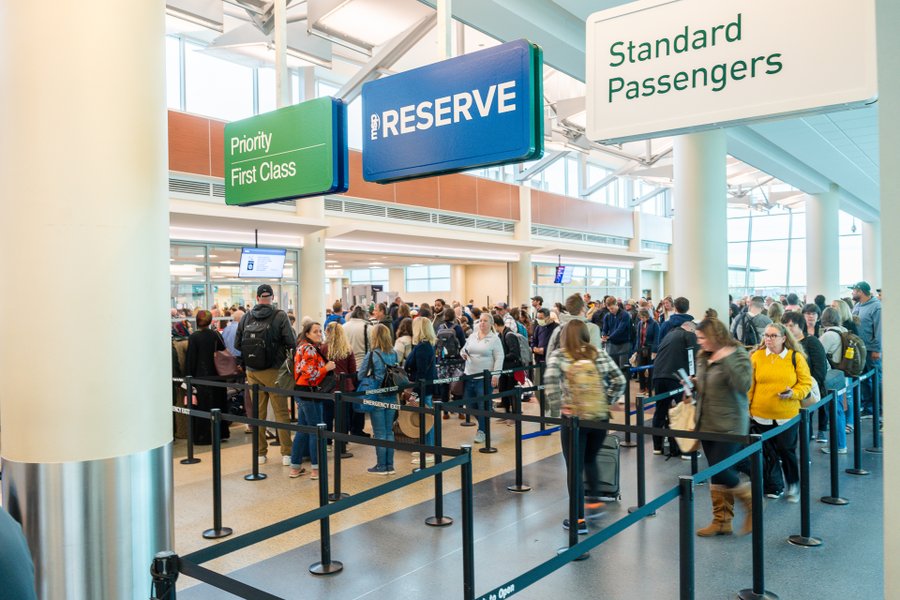
A security checkpoint queue at MSP | MSP Airport on Facebook
J.D. Power highlights four major insights that shape this year’s rankings:
Passengers still enjoy the airport experience: Despite crowded terminals, flight delays, and cancellations, most travelers continue to enjoy their time at airports.
Skyrocketing prices cut into spending: Passengers are spending less at airports than in previous years, with average spending down by $3.53 per person compared to 2023. That number jumps to $6.31 for large airports.
Sense of place matters: Seventy percent of travelers feel their airport reflects the local culture or region, a factor that strongly influences the high scores of top-ranked airports.
Crowded conditions hurt rankings: Only five percent of respondents reported experiencing “severely crowded” airports in 2024, but those airports saw a significant decline in their rankings.
Passengers Rate Their Experience Based on Seven Factors
The McNamara Terminal at Detroit Metropolitan Wayne County Airport (DTW) | IMAGE: Detroit Metro Airport (DTW) on Facebook
The 19th annual study draws from 26,290 surveys completed by U.S. or Canadian travelers between August 2023 and July 2024. Participants must have used at least one U.S. or Canadian airport during a roundtrip (one-way flights excluded) to be eligible.
J.D. Power evaluates satisfaction levels at North America’s busiest airports, categorized into three groups: mega airports (over 33 million passengers per year), large airports (10 to 32.9 million passengers), and medium airports (4.5 to 9.9 million passengers).
For 2024, the study’s criteria have been updated and now focus on these seven factors:
Ease of travel through airport
Level of trust with airport
Terminal facilities
Airport staff
Departure/to airport experience
Food, beverage, and retail
Arrival/from airport experience
Airports utilize this study’s insights to enhance their operations and the overall passenger experience.
Let’s take a look at the list of the top five best and worst airports in the mega, large, and medium categories, along with their survey scores (out of 1,000 points). Changes from the 2023 rankings are noted in parentheses after this year’s scores.
Mega Airports (>33 million pax annually)
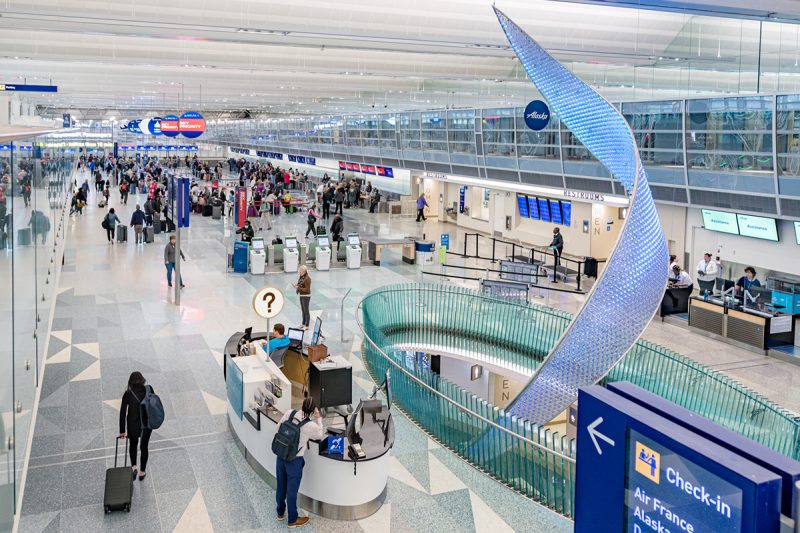
Minneapolis-St.Paul International Airport terminal | IMAGE: MSP Airport on Facebook
Top 5
MSP – Minneapolis-Saint Paul International Airport: 671 (+1)
DTW – Detroit Metropolitan Wayne County Airport: 643 (-1)
PHX – Phoenix Sky Harbor International Airport: 633 (+10)
JFK – John F. Kennedy International Airport: 628 (+7)
DFW – Dallas/Fort Worth International Airport: 623 (-1)
Bottom 5
EWR – Newark Liberty International Airport: 552 (+/- 0)
YYZ – Toronto Pearson International Airport: 559 (+/- 0)
ORD – Chicago O’Hare International Airport: 569 (+3)
ATL – Hartsfield-Jackson Atlanta International Airport: 574 (-9)
SEA – Seattle/Tacoma International Airport: 575 (+2)
Large Airports (10-32.9M pax annually)
IMAGE: John Wayne Airport, Orange County (SNA) on Facebook
Top 5
SNA – John Wayne Airport, Orange County: 687 (+1)
TPA – Tampa International Airport: 685 (-1)
MCI – Kansas City International Airport: 683 (+10)
DAL – Dallas Love Field: 675 (+/- 0)
BNA – Nashville International Airport: 668 (+6)
Bottom 5
PHL – Philadelphia International Airport: 541 (+/- 0)
YUL – Montreal-Pierre Elliott Trudeau International Airport: 576 (-1)
STL – St. Louis Lambert International Airport: 583 (-3)
HNL – Honolulu International Airport: 593 (+2)
MDW – Chicago Midway International Airport: 598 (-4)
Medium Airports (4.5-9.9M pax annually)
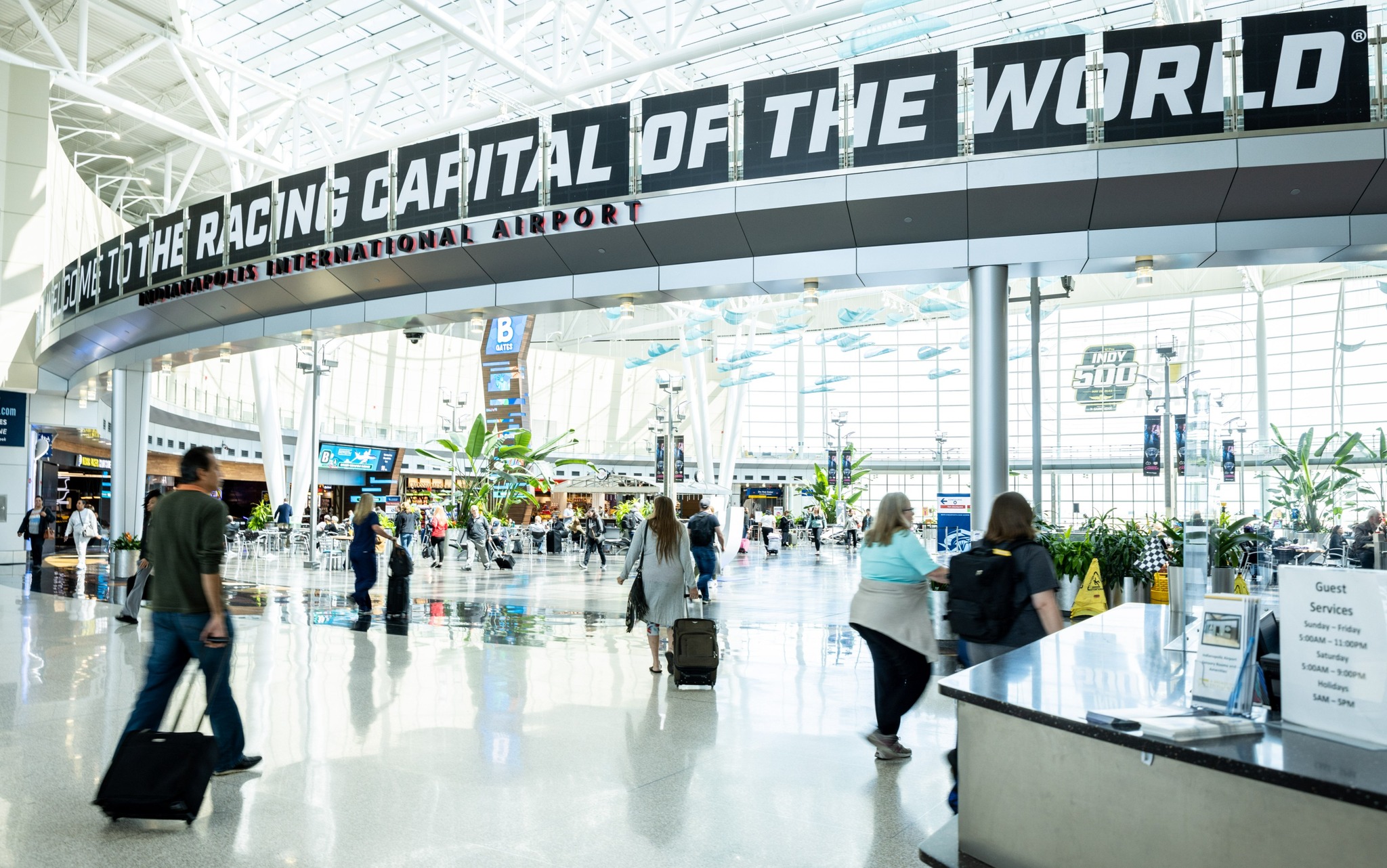
Indianapolis International Airport (IND) ranks first in medium-size airports in the 2024 J.D. Power North American Airport Satisfaction Study | IMAGE: Indianapolis International Airport on Facebook
Top 5
IND – Indianapolis International Airport: 687 (+/- 0)
JAX – Jacksonville International Airport: 686 (+4)
RSW – Southwest Florida International Airport: 675 (-1)
ONT – Ontario International Airport: 672 (-1)
BUF – Buffalo Niagara International Airport: 670 (+3)
Bottom 5
CLE – Cleveland Hopkins International Airport: 580 (-3)
PIT – Pittsburgh International Airport: 625 (-5)
BUR – Hollywood Burbank Airport: 626 (+1)
ABQ – Albuquerque International Sunport: 646 (-8)
OMA – Eppley Airfield: 653 (+/- 0)
Finding Enjoyment in the Journey
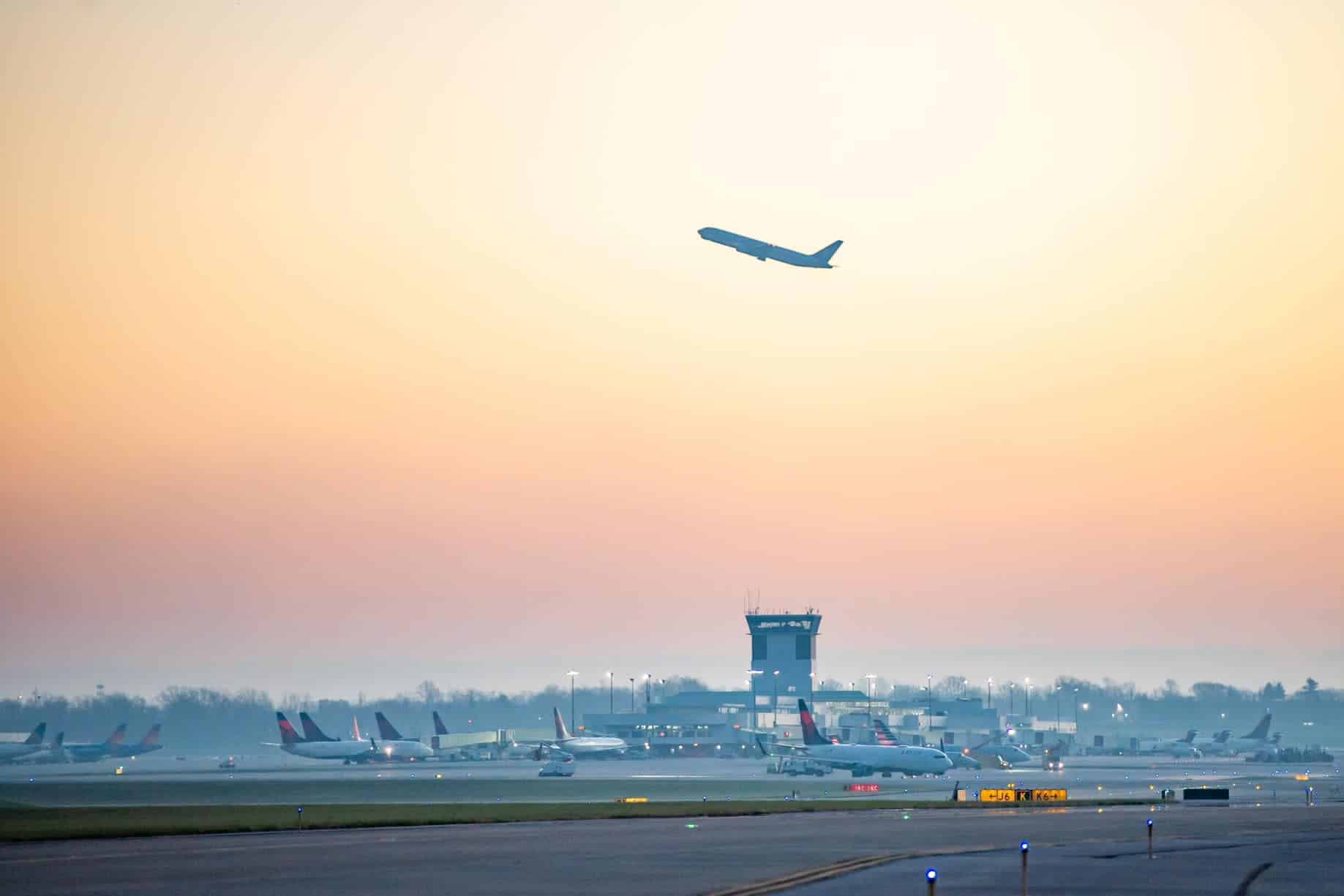
A plane silhouetted against the rising sun at Cincinnati/Northern Kentucky International Airport (CVG) | IMAGE: Cincinnati/Northern Kentucky International Airport on Facebook
Amid rising costs and record-breaking crowds, travelers continue to find moments of enjoyment in their airport experiences. Stepping into an airport brings a familiar buzz–baggage wheels clicking, the aroma of fresh coffee, and the joy of watching planes take off all contribute to the experience.
So, while rising costs may trim a few dollars off the airport shopping spree, one thing is clear: the airport experience itself is holding steady.
Moving forward, airports will need to strike a balance between managing growing passenger numbers and maintaining the high standards that keep travelers satisfied.
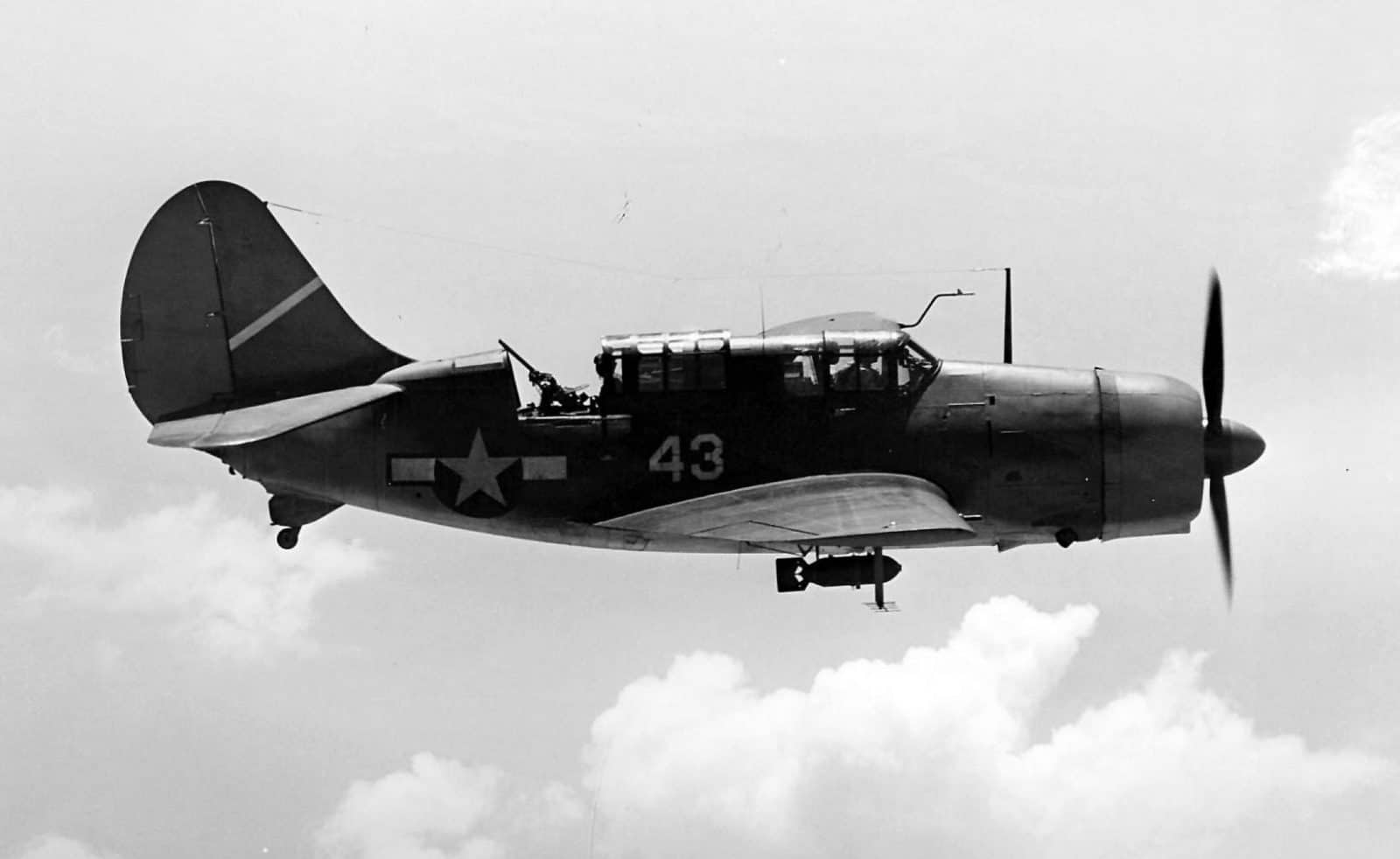
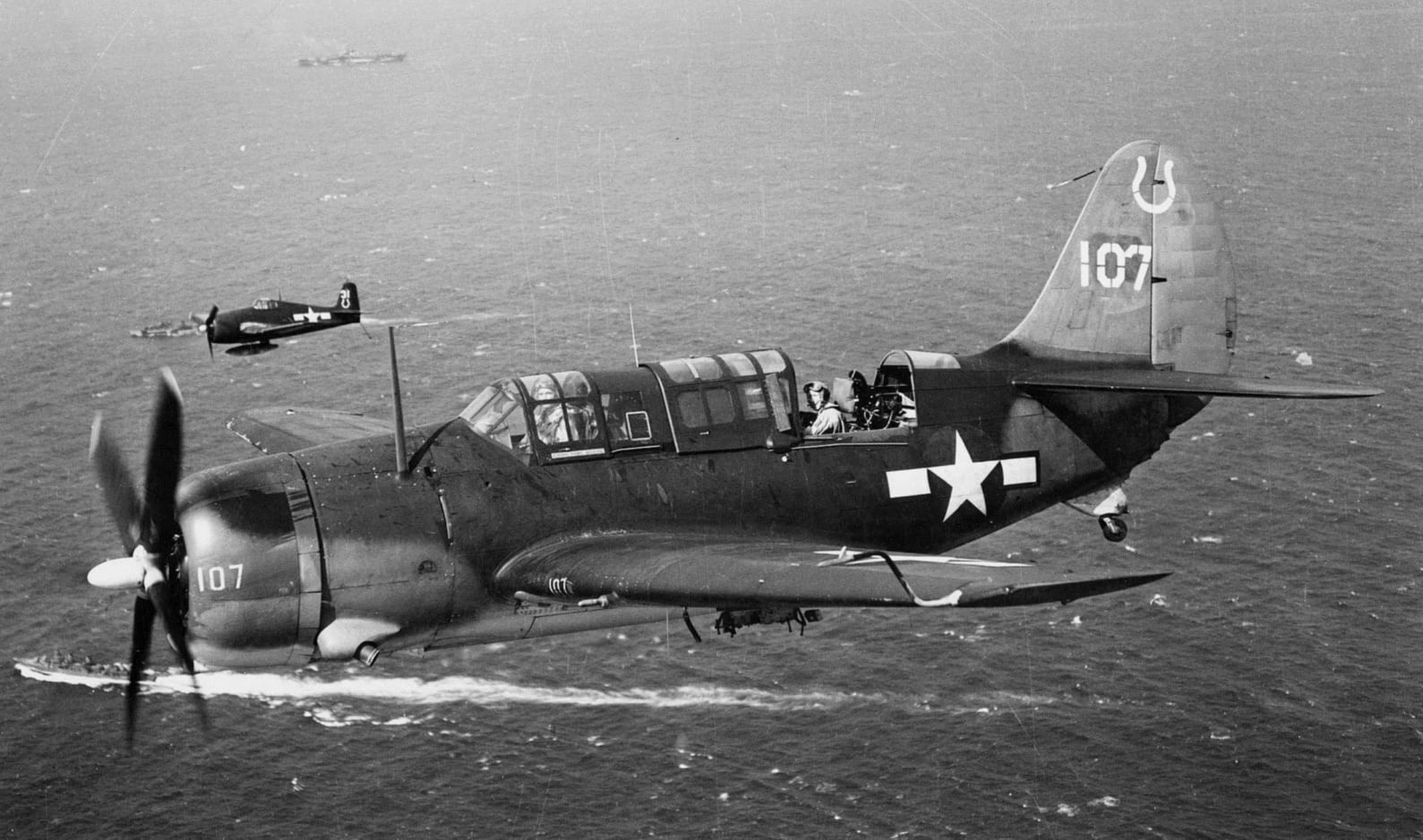
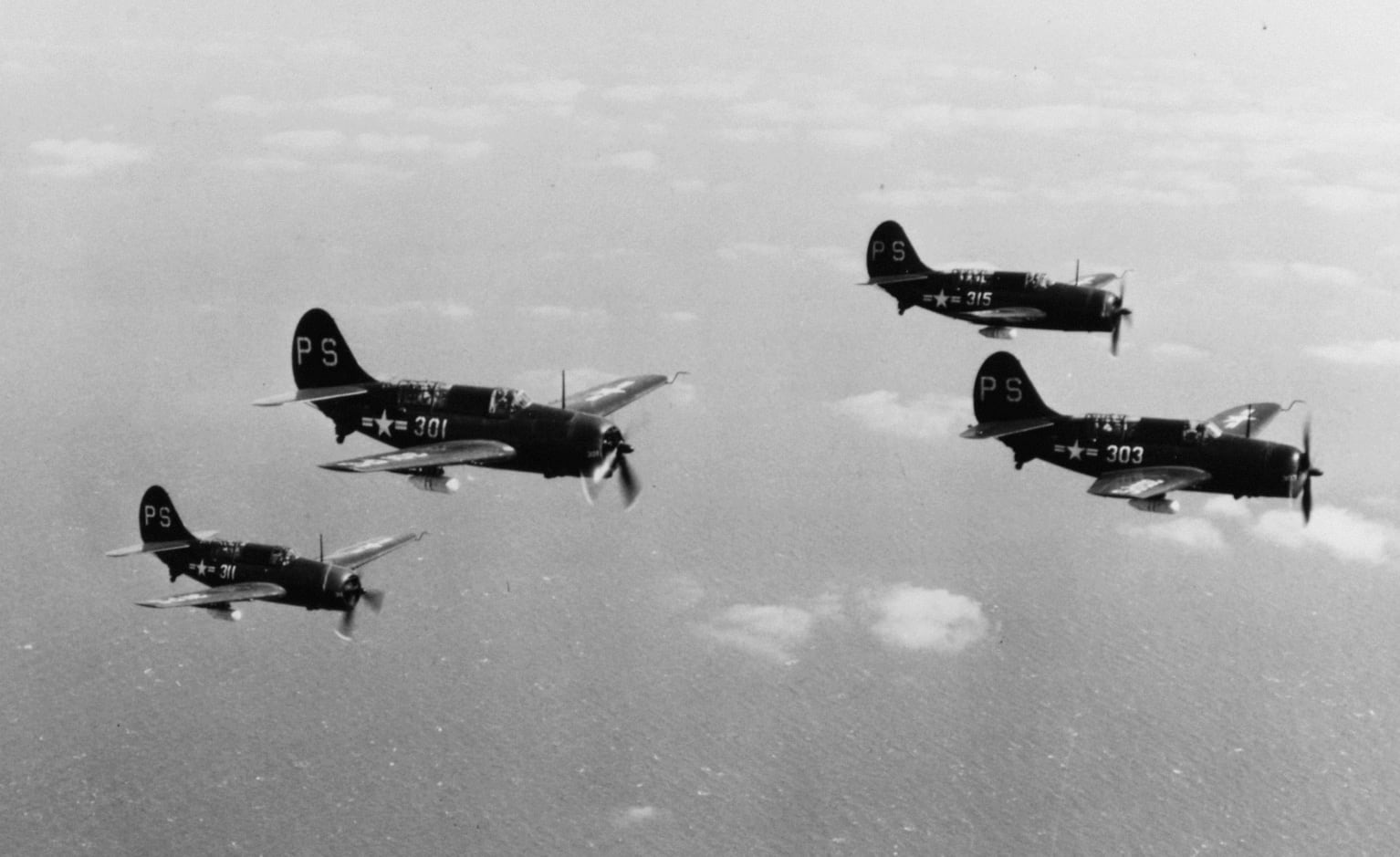
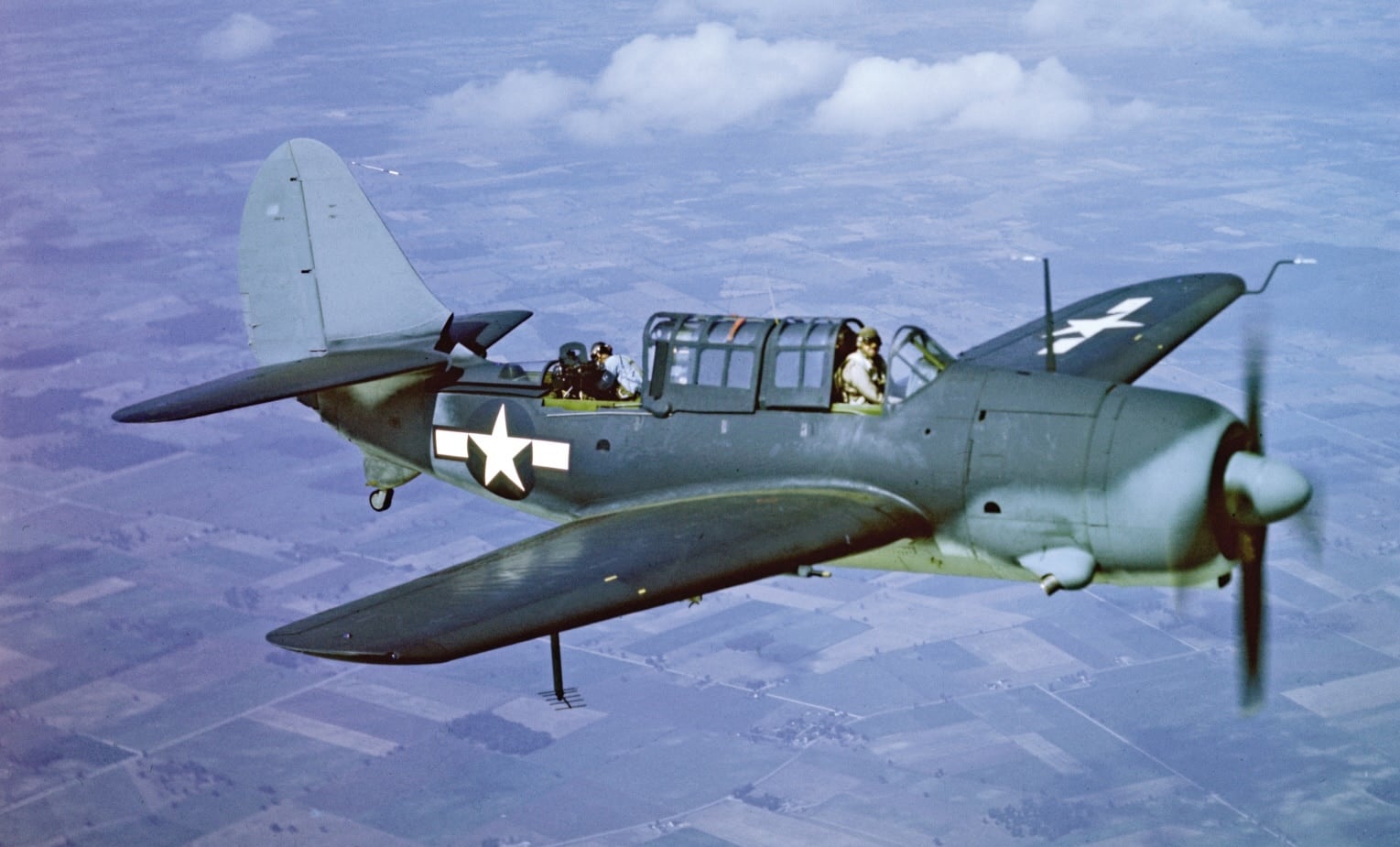
The SB2C Was the Third or Fourth Best Dive Bomber on American Carriers
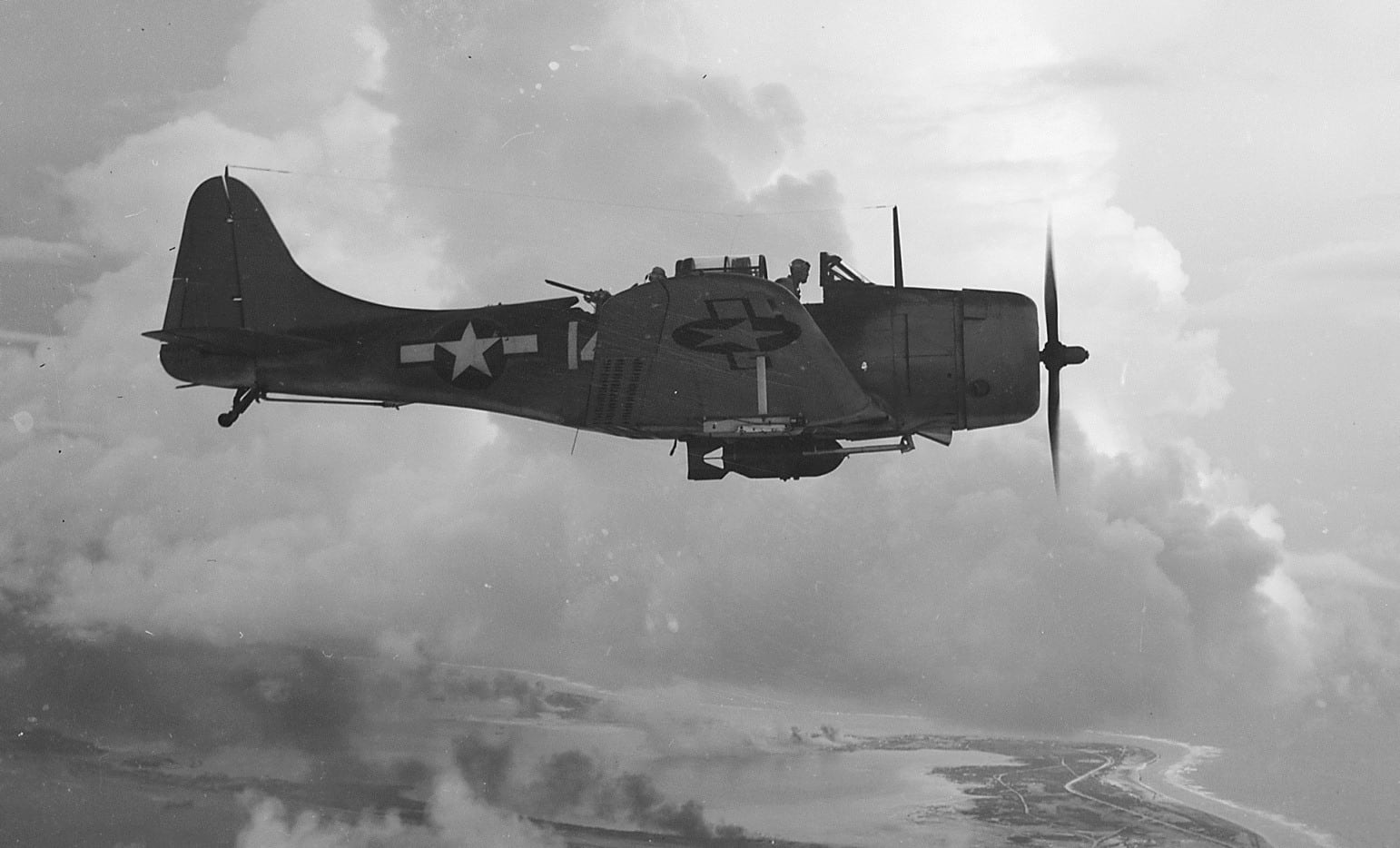
The Douglas SBD Dauntless dive bomber was one of the aircraft that won World War II. However, like every aircraft in service during the late 1930s, improved replacements were already on the drawing boards at several contractors even before the United States entered the war.
Of course, the SBD would turn out to be one of the greats. But the development of one of its intended replacements, the Curtiss SB2C Helldiver, was so rocky that the SB2C was nearly cancelled. Several times.
SBD Dauntless. Image via US Navy
First Impressions of the Helldiver
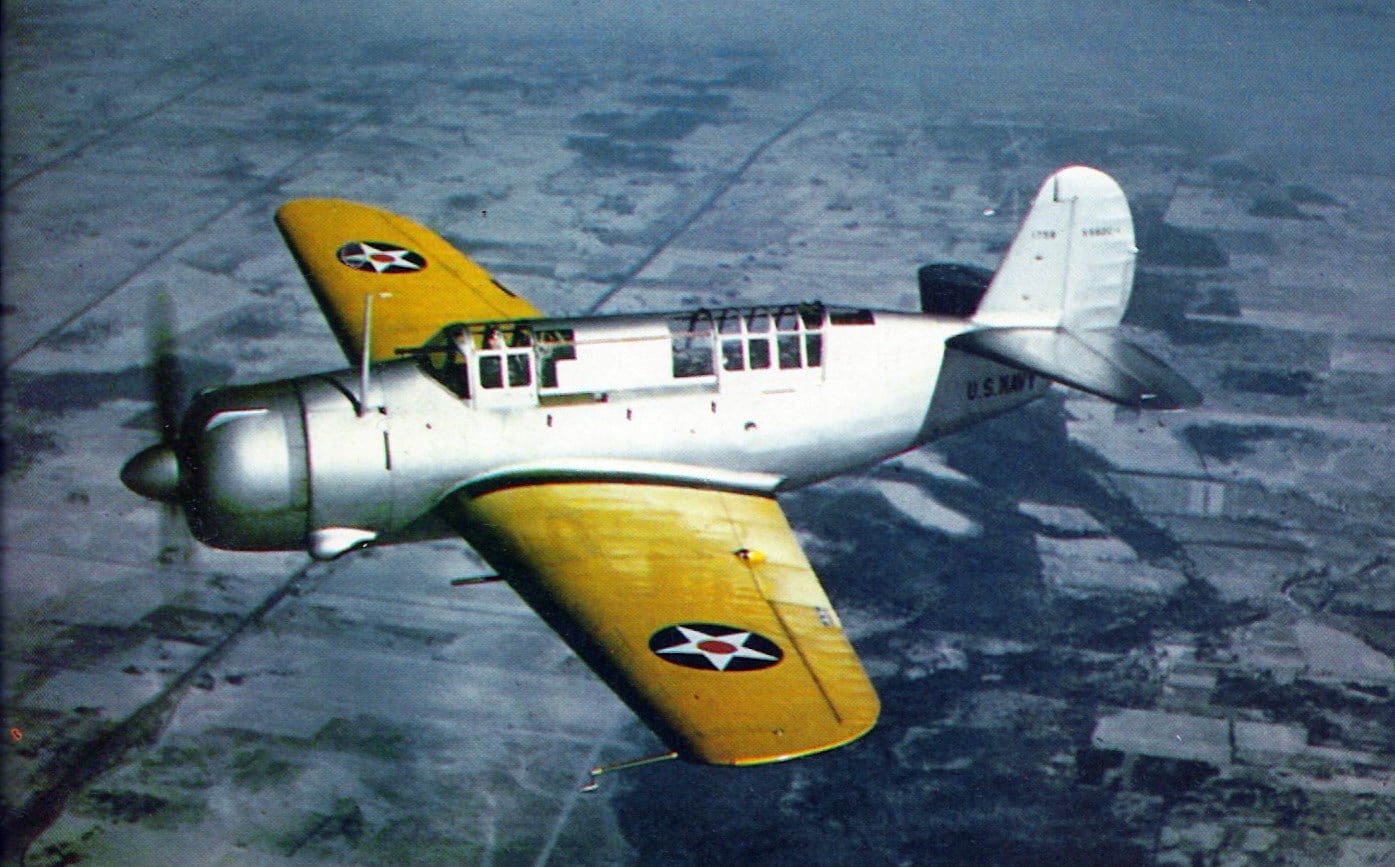
Larger, faster, and able to carry more ordnance than the SBD, it seemed the Helldiver was the answer to the Navy’s needs for an improved dive bomber. However, the prototype XSB2C-1, powered by a Wright R-2600 Twin Cyclone radial piston engine driving a three-bladed propeller, did not impress when it was flown for the first time on 18 December 1940. The litany of problems with the aircraft started with the engine itself and included poor stall characteristics, structural weaknesses, directional instability, and control issues in general.
XSB2C-1. Image via US Navy
A Very Visible Bomber
The US Army Air Corps (USAAC) and the US Marine Corps were also looking at the Helldiver. In USAAC (later USAAF) service, the aircraft was known as the A-25A Shrike. Shrikes were equipped with modified landing gear and Army-specific radio equipment, along with a few other minor differences.
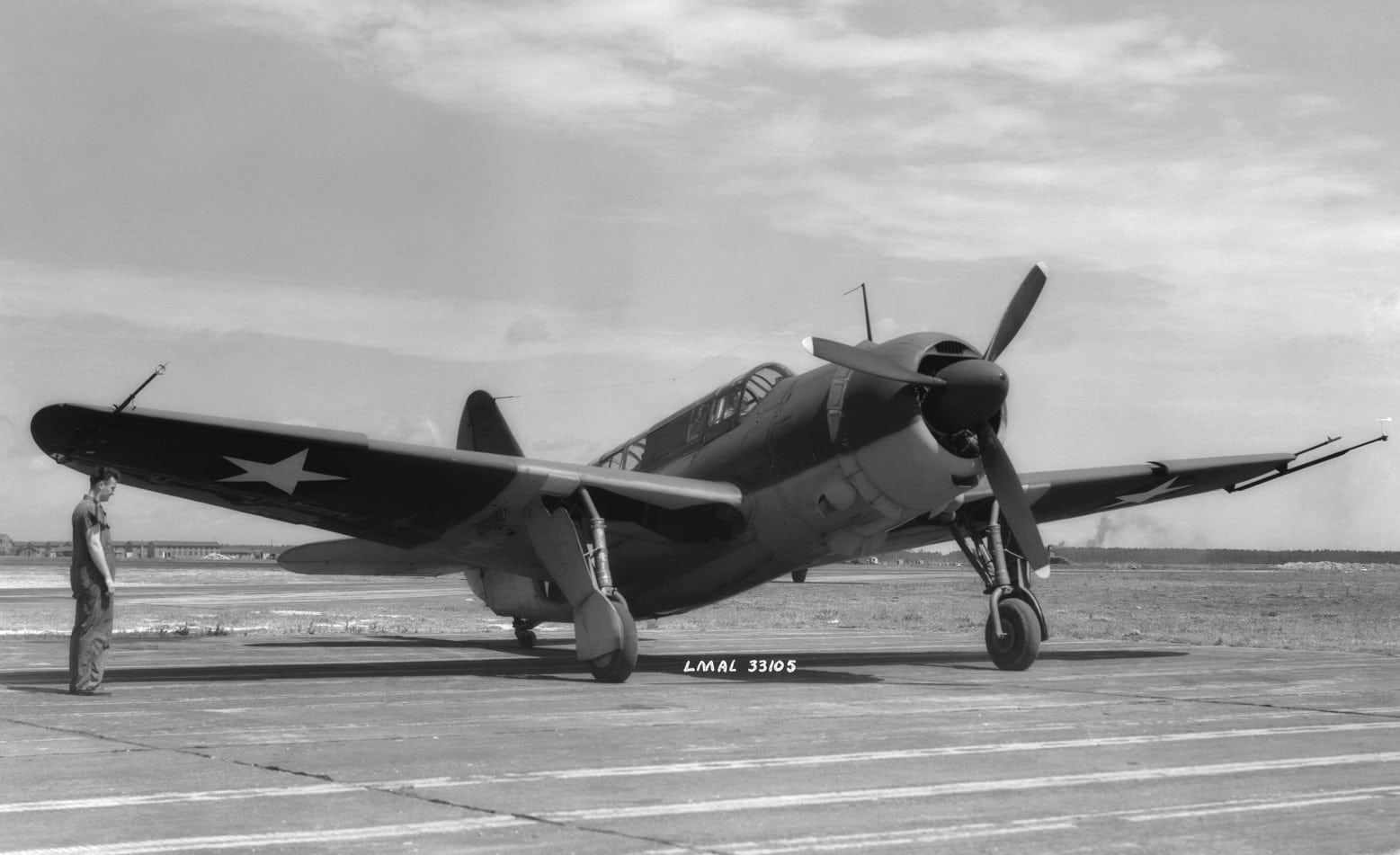
When the XSB2C-1 crashed on 8 February 1941, Curtiss rebuilt it, but fitted an enlarged vertical stabilizer and an autopilot. Then the rebuilt XSB2C-1 crashed on 21 December 1941. A nation now at total war and needing the SB2C justified the decision to order the SB2C-1 into production in November of 1941. The first production SB2C-1 was rolled out in June of 1942.
SB2C-1. Image via NACA/NASA
The Beast
Production was one thing. Taming the beast was another. While the SBD was helping to win battles all over the Pacific and the Grumman TBF/TBM Avenger torpedo bomber was already entering service aboard the few Navy carriers during the second half of 1942, Curtiss was working through a voluminous “punch list” for the SB2C.
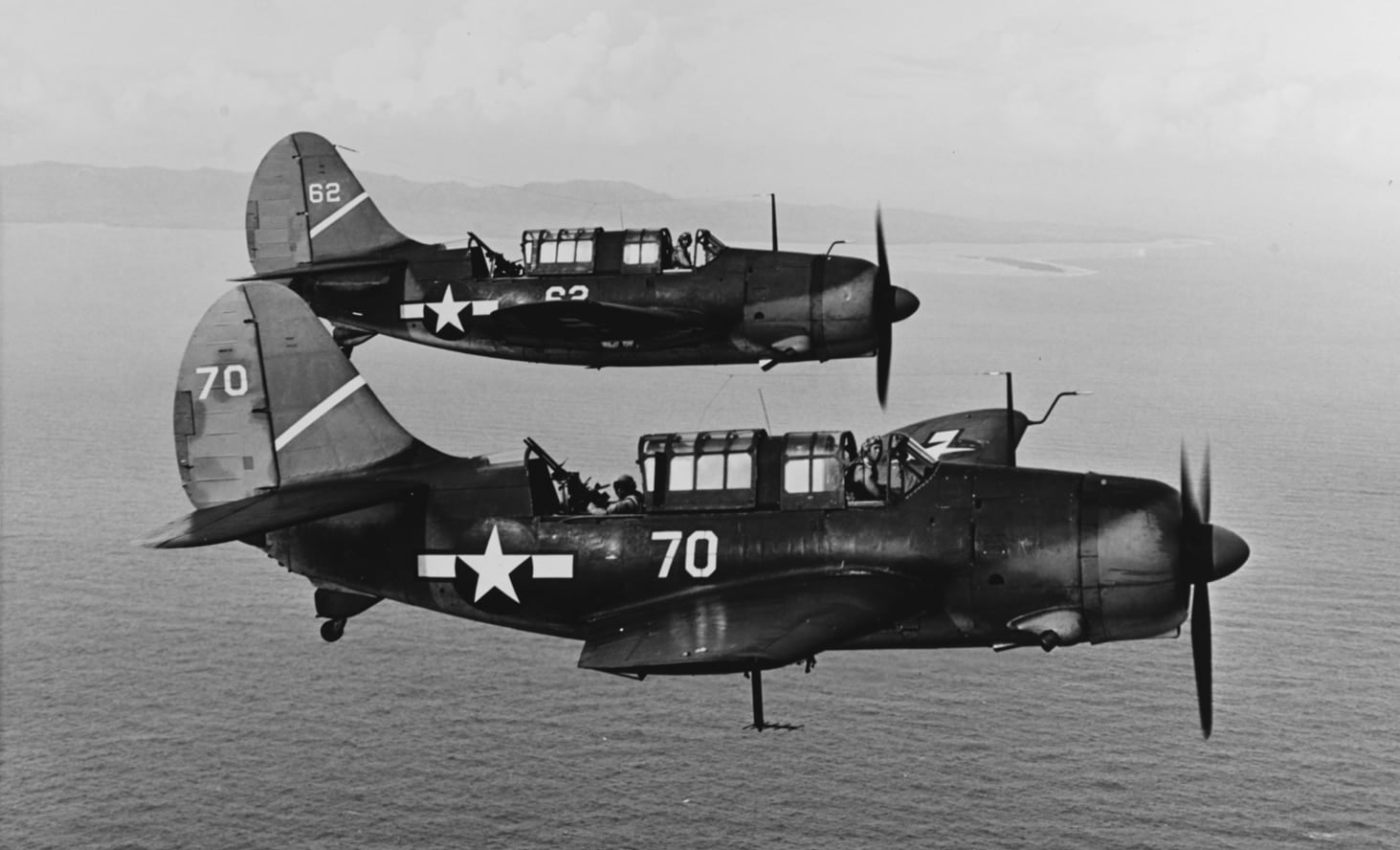
The initial production aircraft featured an enlarged vertical stabilizer, self-sealing fuel tanks, and additional wing-mounted .50-caliber machine guns, as well as later a pair of 20-millimeter cannons. However, 880 modifications to the early models had to be completed before the Navy would accept the SB2C-1 for service.
SB2Cs. Image via US Navy
Taking What’s Available to Sea
When VB-17 finally took the SB2C-1C Helldiver to war aboard the Essex-class aircraft carrier USS Bunker Hill (CV-17) in November of 1943, the aircraft still had plenty of challenges. Crews, used to the slower but reliable and proven SBD, took to calling the Helldiver the Big-Tailed Beast (or just Beast) and Son of a Bitch Second Class.
Handling problems persisted, and the SB2C was significantly more complicated than the Dauntless, which led to neither the crews nor the maintainers liking them much. However, with aircraft carriers under construction and requiring airplanes for their air wings to operate from them, the Helldiver had to adapt and overcome. So it (eventually) did—to a degree.
SB2C-1C. Image via US Navy
Design Compromises Doomed the Beast
Problem one was that the SB2C was underpowered from the beginning. Resolution arrived in the form of the SB2C-3, powered by the R-2600-20 Twin Cyclone engine producing another 200 horsepower and turning a Curtiss-Electric four-bladed propeller. Coupled with a 40% weight reduction in later models, performance was improved.
But the Beast was still a design compromise.
The fuselage was truncated to allow the airplane to fit on carrier elevators. Approach speeds were too high, and control at those speeds was imprecise. But consider that the SB2C’s range was actually less than the SBD’s, and the problem comes into sharp relief. Rather than replace the SBD, the SB2C augmented the Dauntless. Few, if any, crews believed the SB2C was better than or an improvement over the SBD.
SB2C-3. Image via US Navy
In the End They Did Their Part
SB2Cs did battle in the Pacific Theater during the last couple of years of the war. Thanks to their existence, the Navy was able to deploy dive bombers on the numerous large-deck Essex-class carriers constructed during the war. They participated in every major engagement through the end of hostilities.
Helldiver oddities
SB2Cs did not operate from light carriers or escort carriers thanks to the aircraft’s combination of high approach speed, poor approach handling, and sheer size and weight.
Don’t Mess With the Yorktown
The SB2C also didn’t operate from every Essex-class carrier, either. Captain Joseph J. “Jocko” Clark got so tired of them making a mess of his carrier, the USS Yorktown (CV-10), that he put them on the beach while on the way to the Pacific and replaced them with SBDs. Clark also recommended cancelling the SB2C entirely.
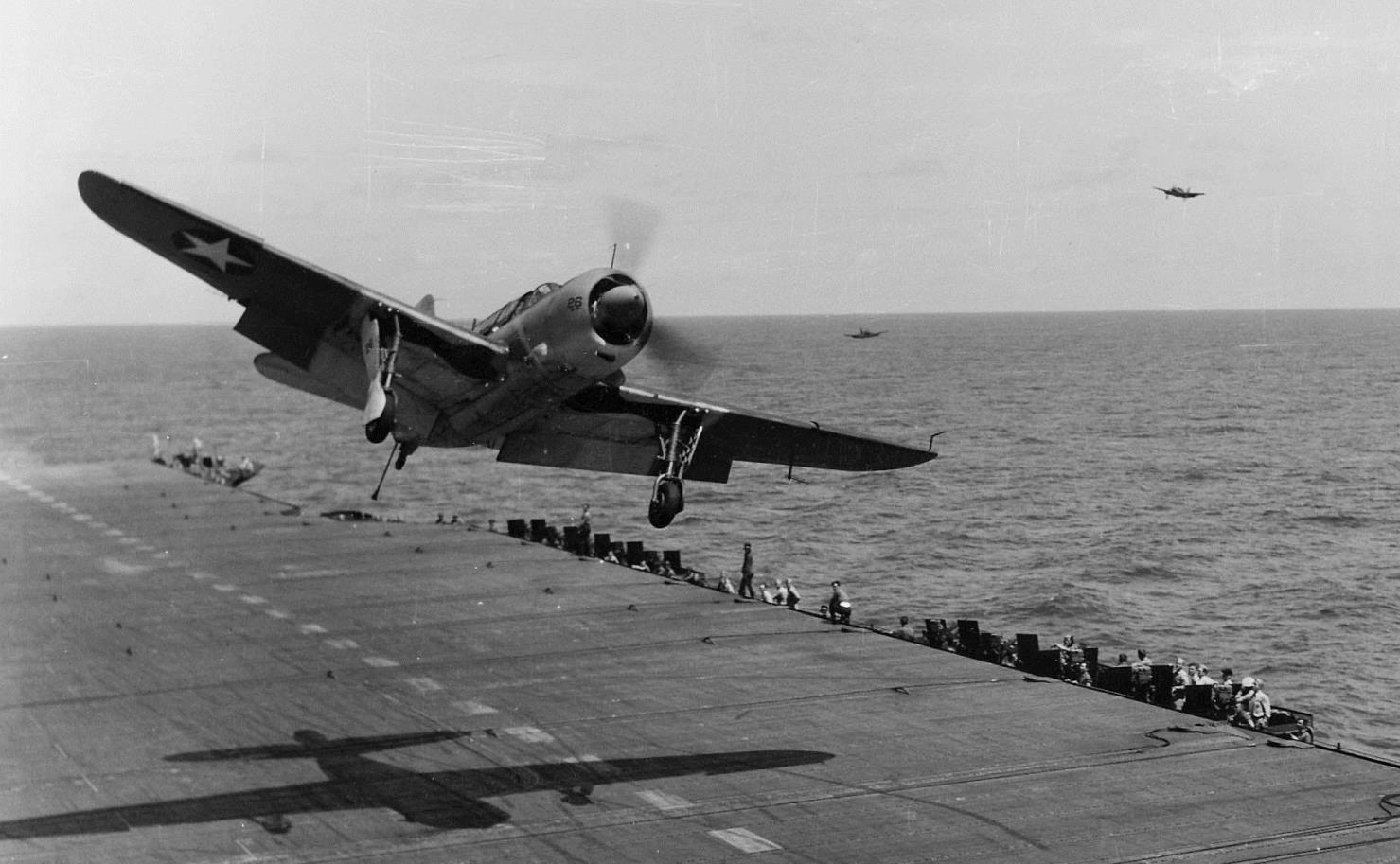
Wave off! Image via US Navy
The Last Dive Bomber
Though the SB2C was capable of delivering bombs with more precision over a greater range, both the Grumman F6F Hellcat and Vought F4U Corsair were capable of delivering nearly the same payload as the Helldiver. That, coupled with the advent of aerial rockets, spelled the end of the dive bomber in US Navy service.
Called The Helldiver “Appalling”
After the war ended, the Navy flew Helldivers for a few years. The Naval Reserves retired their last examples in 1950. F4U Corsairs and Douglas AD Skyraiders did the Beast’s job. Foreign operators of the SB2C were France, Italy, Greece, Portugal, and Thailand. Both the Fleet Air Arm of the Royal Navy and the Royal Australian Navy were in line to fly the SB2C, but canceled orders for their carriers- the British after reporting “appalling” handling.
Naval Reserve SB2C-5s. Image via US Navy
Contract Builders
Canadian Car and Foundry built a total of 894 SB2Cs, designated as SBW-l, SBW-3, SBW-4, SBW-4E, and SBW-5. Fairchild in Canada built another 300 of them, designated as XSBF-l, SBF-l, SBF-3, and SBF-4E. An amazing 7,140 Helldivers were built in total.
A Respectable Tally
Officially, Helldivers flew 18,808 combat sorties in the Pacific War and were involved in or directly credited with sinking 301 Japanese ships of all types. SB2C radiomen-gunners shot down a total of 41 Japanese aircraft.
SB2C-3. Image via US Navy
The Army and the Aussies
Remember those Army Shrikes? Well, they were delayed the same as the rest. By the time the Army did get them into service, they were discovering they already had a highly capable bomber in the Republic P-47 Thunderbolt. Some of the Shrikes were offered to Australia, which said thanks but no thanks. The US Marines ended up with more than 400 of them (designated SB2C-1A) but never flew them in combat. They ended their careers as trainers and target tugs.
A Rare Warbird Indeed
The single airworthy SB2C is Bureau Number (BuNo) 83589 and operated by the Commemorative Air Force (West Texas Wing) in Graham, Texas. Built in 1945, the aircraft was extensively damaged in 1982 and rebuilt, returning to flight in 1988. Enjoy this video of 83589 flying with some other warbirds uploaded by AirshowStuffVideos.
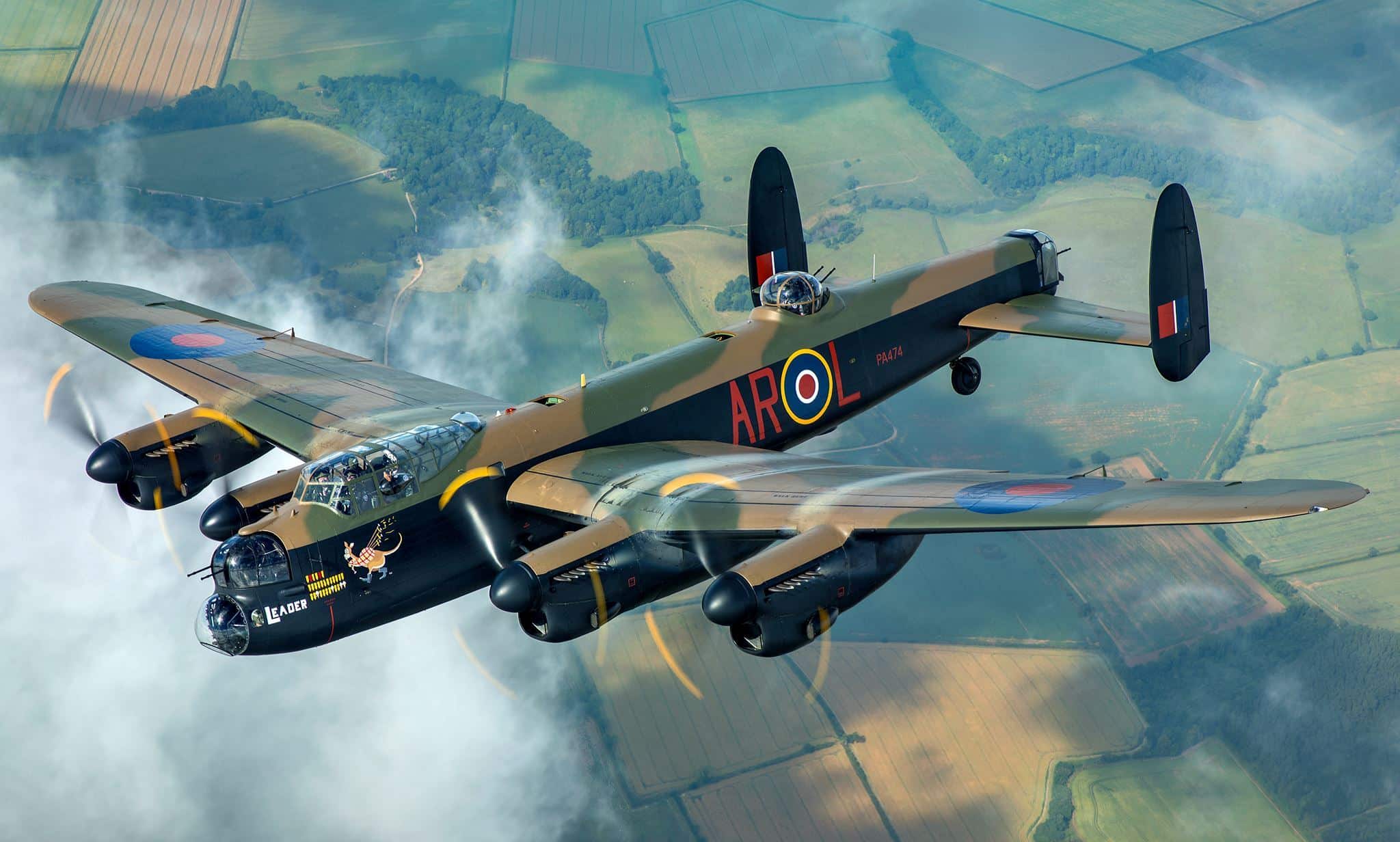
“The biggest threat wasn’t the Germans. It was the cold.” Inside the Avro Lancaster’s brutally spartan WWII missions and the crews who endured them.
Aviation was pretty spartan back in the 40s by today’s standards. Planes weren’t pressurized, heat was nearly non-existent, and the quarters were cramped. There were operational hazards at every turn. If every bit of exposed skin wasn’t covered, you could get frostbite in seconds.
Yet the heroes of World War II battled the elements to defend freedom in Europe. They were brave men.
Take a tour of the interior of this Avro Lancaster, affectionately known to avgeeks as “the Lanc.” You’ll learn some fascinating facts about a bomber that helped turn the tide of war against the Nazis in Europe. Liz Dodds and Andrew Panton are your hosts. They’ll provide some fascinating facts mixed with a little dry British humor. The 25-minute video, uploaded by Rob Hayton, provides a comprehensive look at the exterior, interior, and even the cockpit of this pivotal aircraft.
image via IWM
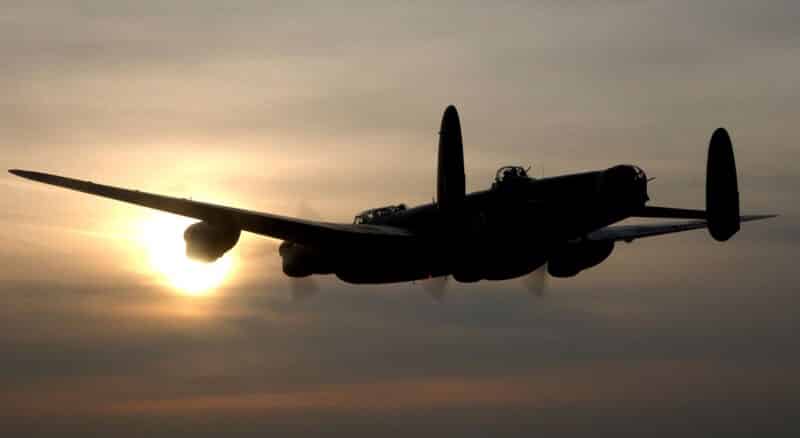
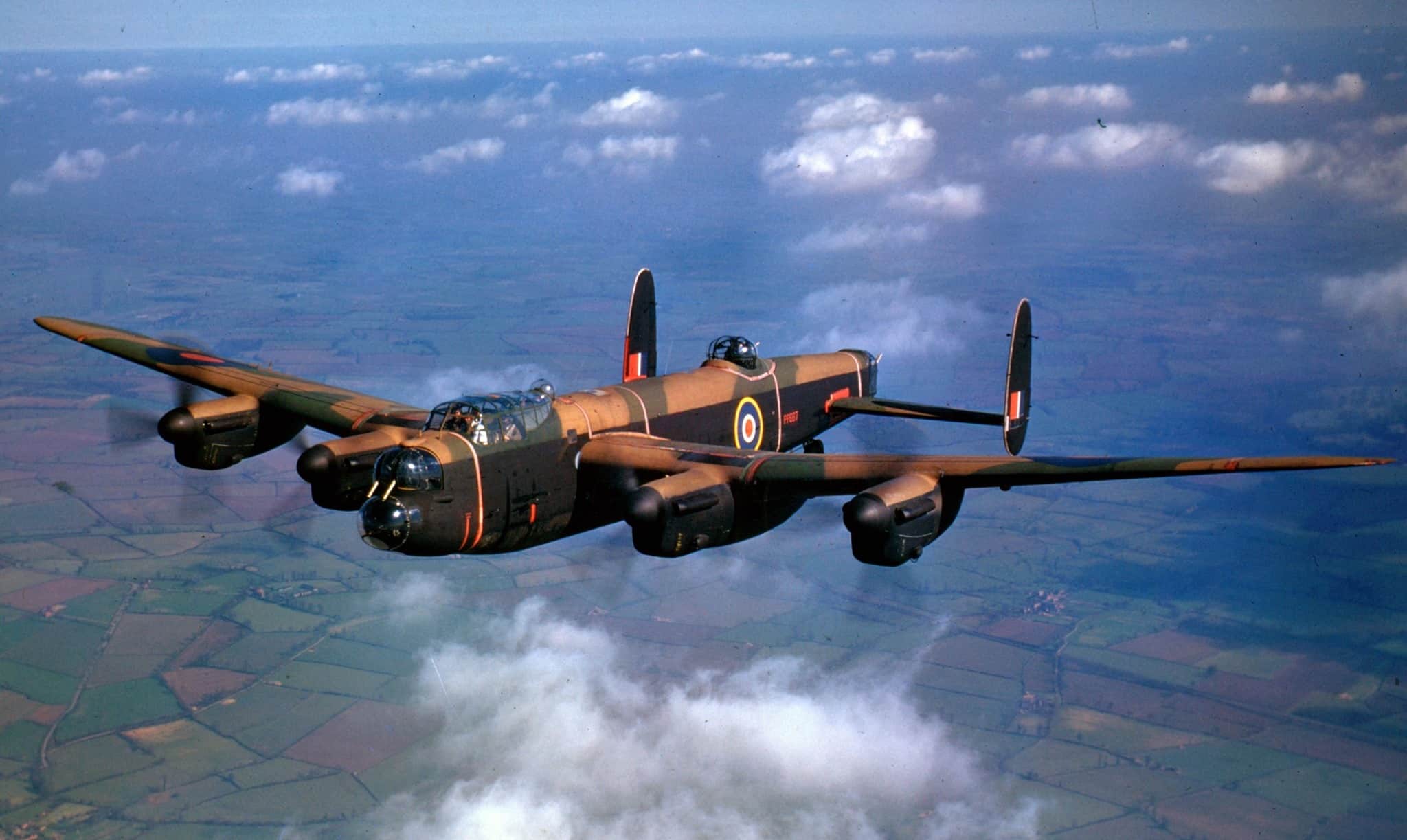
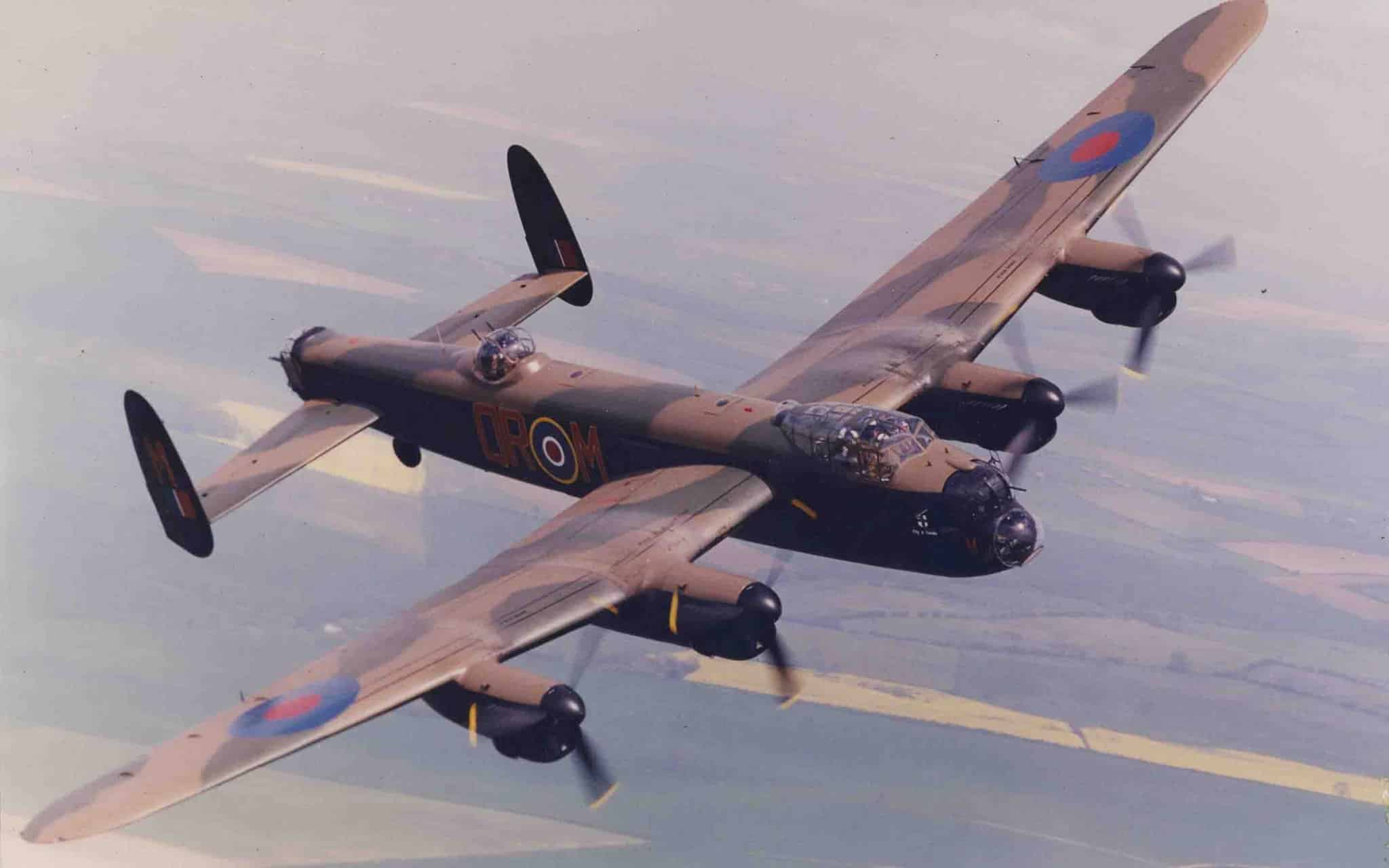
The Avro Lancaster was a mid-wing, cantilever heavy bomber powered by four wing-mounted Rolls-Royce Merlin piston engines. It earned its reputation during the Second World War, becoming one of Britain’s most famous bombers through its extensive combat service.
The Lanc featured an oval-shaped, all-metal fuselage divided into five main sections, along with similarly sectioned wings. Its aft was distinguished by its twin elliptical fins and rudders, a hallmark of its design.
image via iwm
One notable feature of the Avro Lancaster was its unobstructed bomb compartment, which was more than 33 feet long. The Avro Lancaster was capable of holding the largest bombs in the RAF. Then bulged doors were added so the aircraft could carry even bigger bombs. The Avro Lancaster could eventually hold a bomb that weighed 12,000 pounds.
image via battle of britain memorial flight
The Avro Lancaster was designed and built by Avro for the Royal Air Force (RAF). Its maiden voyage was on 9 January 1941. The aircraft was introduced into service in 1942. Primary users of the Avro Lancaster were the Royal Air Force, the Royal Canadian Air Force, and the Royal Australian Air Force.
Between 1941, when the first one was built, and 1963, when the model was retired, 7,377 Avro Lancaster aircraft were manufactured.
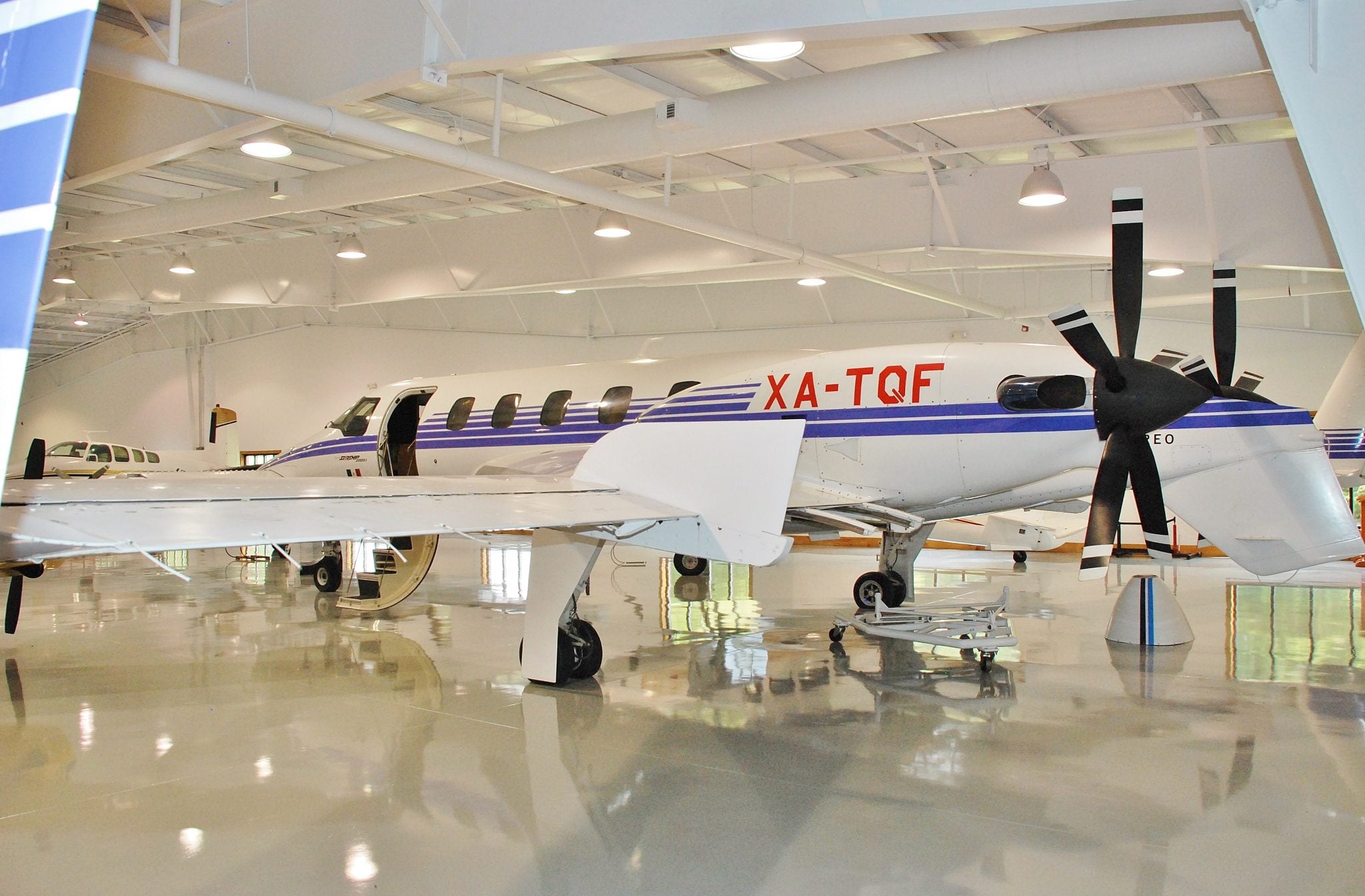
Captains Kirk and Picard had starships to explore the universe. Earthly mortals could have had a futuristic Beechcraft Starship to crisscross the world, but circumstances, both in development and marketing, limited the success of what was otherwise a stunning aircraft.
In the early 1980s, Beechcraft began looking for a successor to its popular King Air. The objective was for this successor to be faster, quieter, and safer, with an equal or greater payload, and, of course, to achieve the sales success of the King Air.
Developmental History of the Beechcraft Starship
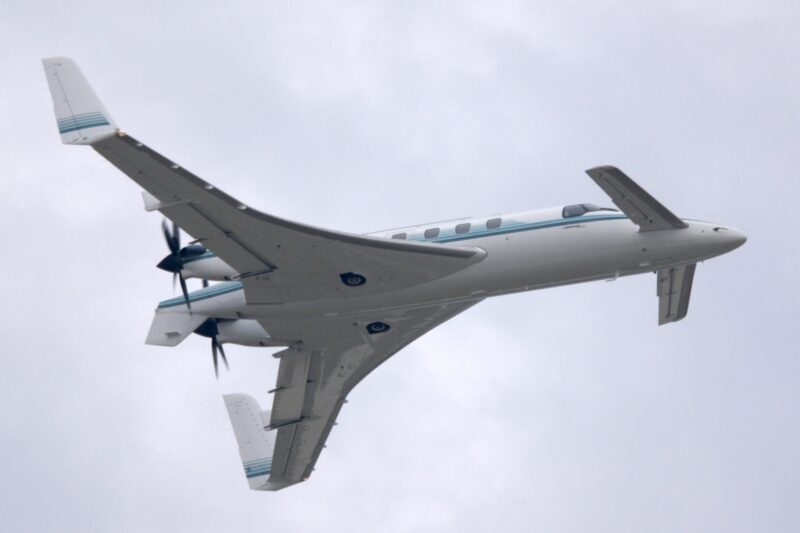
The design result was a sleek, twin-turboprop pusher, canard design. Another goal was to utilize composite materials to the maximum extent possible, thereby reducing weight and increasing structural integrity compared to the metal structures of their previous aircraft.
An added safety feature of the canard design is that it would be essentially stall-proof. Canards are a front wing that actually produces lift. As the aircraft approaches a stall, the canards stall first, causing the nose to drop slightly, ensuring that the main wing continues to fly, enabling a prompt stall recovery.
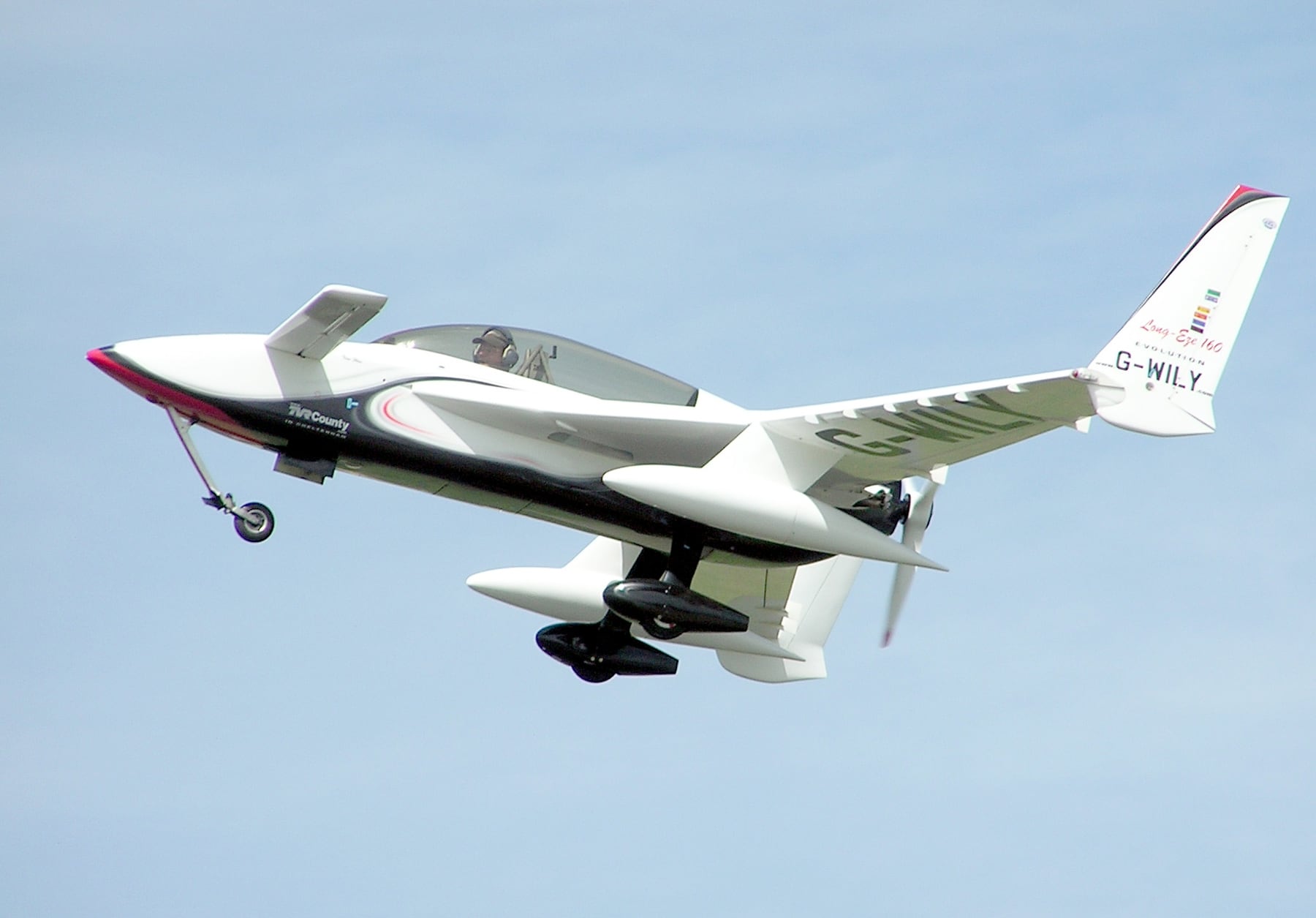
Although there are several very successful canard experimental aircraft, such as the Rutan Long-EZ and the Velocity, a six-to-eight passenger composite canard was a new concept, and Beechcraft would experience unexpected developmental challenges.
The Starship is a two-surface aircraft, i.e., it has a main wing and a canard. In contrast, the canard Piaggio P.180, introduced in 1990, is a three-surface design that includes a conventional horizontal stabilizer and elevators.
The Canard, Pusher-prop Long EZ is a popular homebuilt experimental aircraft.
Development of the Beechcraft Starship
Early in the development phase, Beechcraft commissioned Burt Rutan’s Scaled Composites to build and test fly an 85% scale version of the Starship design. This proof-of-concept aircraft flew successfully (1983) and was also shown at business aircraft conventions as the next Beech business aircraft of the not-too-distant future.
Beech initially built three full-scale flying prototypes for testing and certification. Each aircraft had a specific test program, including aerodynamic testing, avionics and systems testing, and integration and testing of the flight management system, as well as engine testing. The first test aircraft flew in February 1986.
The Starship on display at the Beechcraft Heritage Museum, Tullahoma, Tennessee.
Although testing proceeded relatively smoothly, the company’s investment in composite construction exceeded expectations, both in terms of production facilities and the extended learning curve required for a production team transitioning from conventional metal construction to composite construction.
The composite aircraft was also new to the FAA, and they, in effect, required twice the flight test time as for a more conventionally constructed aircraft. Consequently, the first production aircraft did not fly until April 1989.
Marketing of the Beechcraft Starship
Following the successful flights of the 85% scale aircraft, the business community assumed that the certified Starship was just a year or two away. The business aircraft market, typically slow to accept radically new concepts, was cautiously optimistic.
But at least two negative forces were in play when the Starship was finally certified and the first production aircraft flew in 1989. First, an economic recession had significantly weakened demand for new aircraft. More importantly, the Starship may have been just “too new” with too many “firsts” for the traditionally conservative business aircraft market.
For example, the Starship was the first certified business aircraft to use:
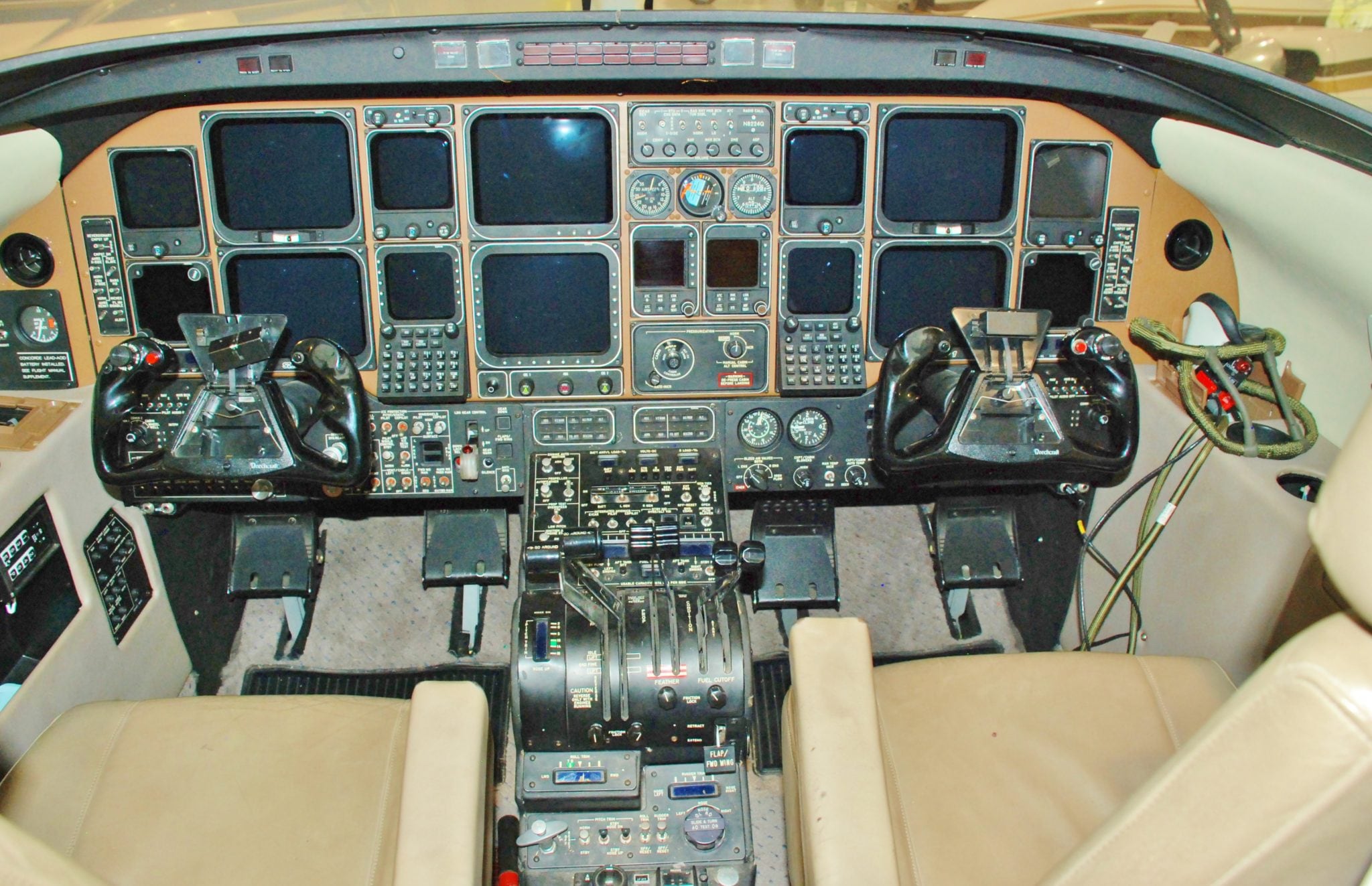
An all-glass cockpit, using 14 different displays for all aircraft systems, navigation, and performance data.
All composite construction.
A canard with no horizontal stabilizer or rudder.
Twin turboprop pusher engines.
The Starship, in keeping with its futuristic image featured an “all glass” panel.
Price and performance were also problematic. The 1989 list price was close $5.0 million, which was more than comparable Cessna Citation V and Lear 31 jets, both of which were more than 80 knots faster than the Starship.
Production and Status of Beechcraft Starship
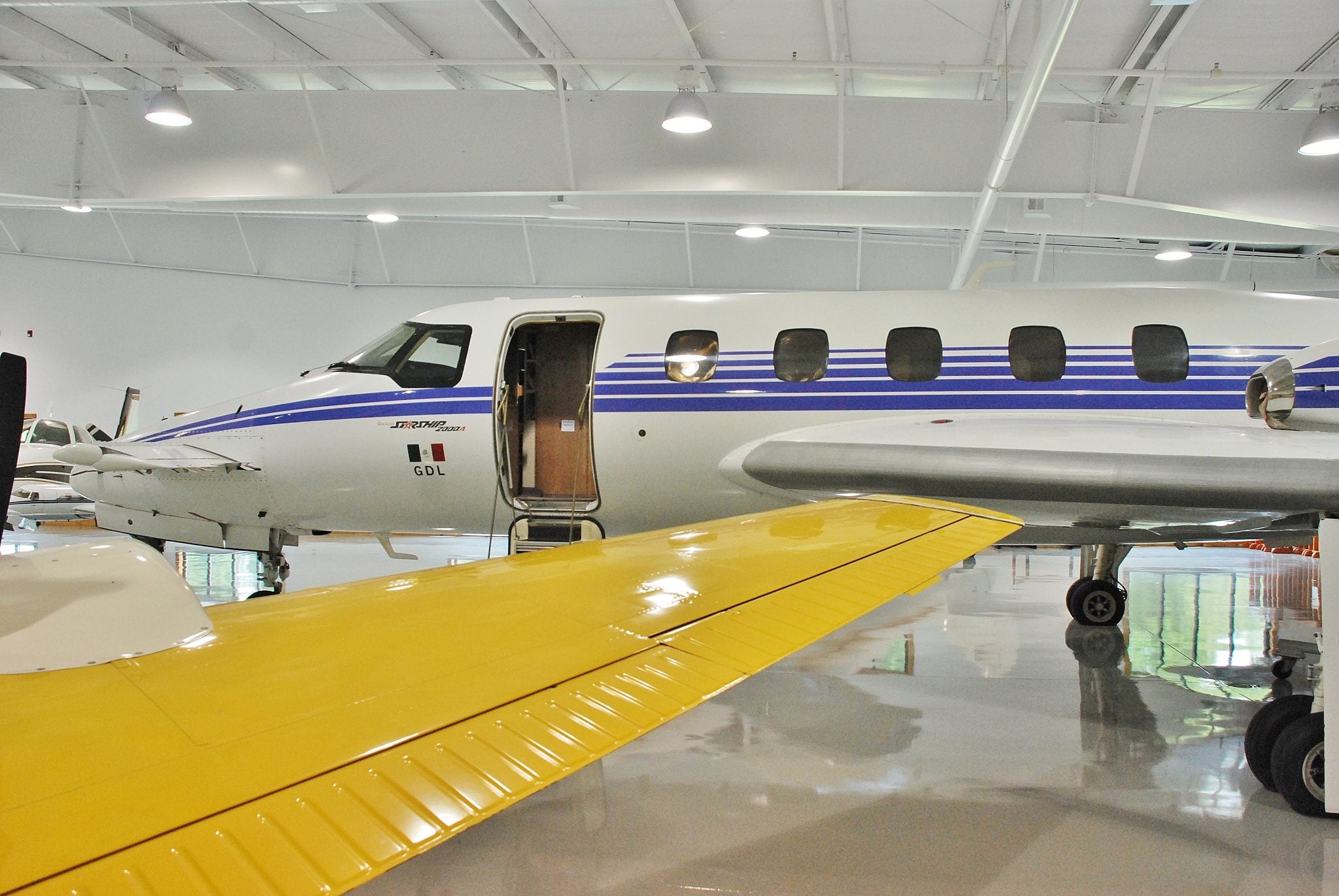
A total of 53 Starships—the three prototypes and 50 production aircraft—were built. The initial aircraft was the Model 2000. Halfway through production, Beech redesigned the interior and made some improvements in performance (Model 2000A), but it was too little, too late.
At last report, four or five are still flying. Raytheon, the parent company of Beechcraft, has essentially decommissioned all aircraft it had in its possession or could obtain. Several aircraft have been donated to museums, including the Beechcraft Heritage Museum in Tullahoma, Tennessee.
Just Theorizing – What Could Have Made the Starship More Marketable
Robert Scherer, a Starship pilot, suggests that several relatively minor fixes could have improved Starship performance and reduced production costs, including:
Use a filament winding process for the composite fuselage, much like that used on the Boeing 787 Dreamliner. This would have reduced production costs and complexity.
Replace the turboprops with fan jets for more speed and less turbulence from the aft-mounted propellers.
Remove all but the two inboard vortex generators on the canards to significantly reduce drag with no loss in performance.
Eliminate the landing flaps. The flaps lower the landing speed by about five knots. The landing flap system adds about 800 pounds to the aircraft’s weight. Without that weight, the landing speed would probably be no more than three knots faster than with the flaps. This would have reduced the weight, complexity, and cost of the aircraft.
Beechcraft Starship Never Became The Hoped for Success
Unfortunately, the fate of an aircraft design depends on much more than just being airworthy and practical. Market timing, perception, and misperception; with just a few tweaks to the design, it could have been the replacement for the King Air that Beechcraft originally envisioned.
Lead photo by Ken Mist (used under CC2.0).
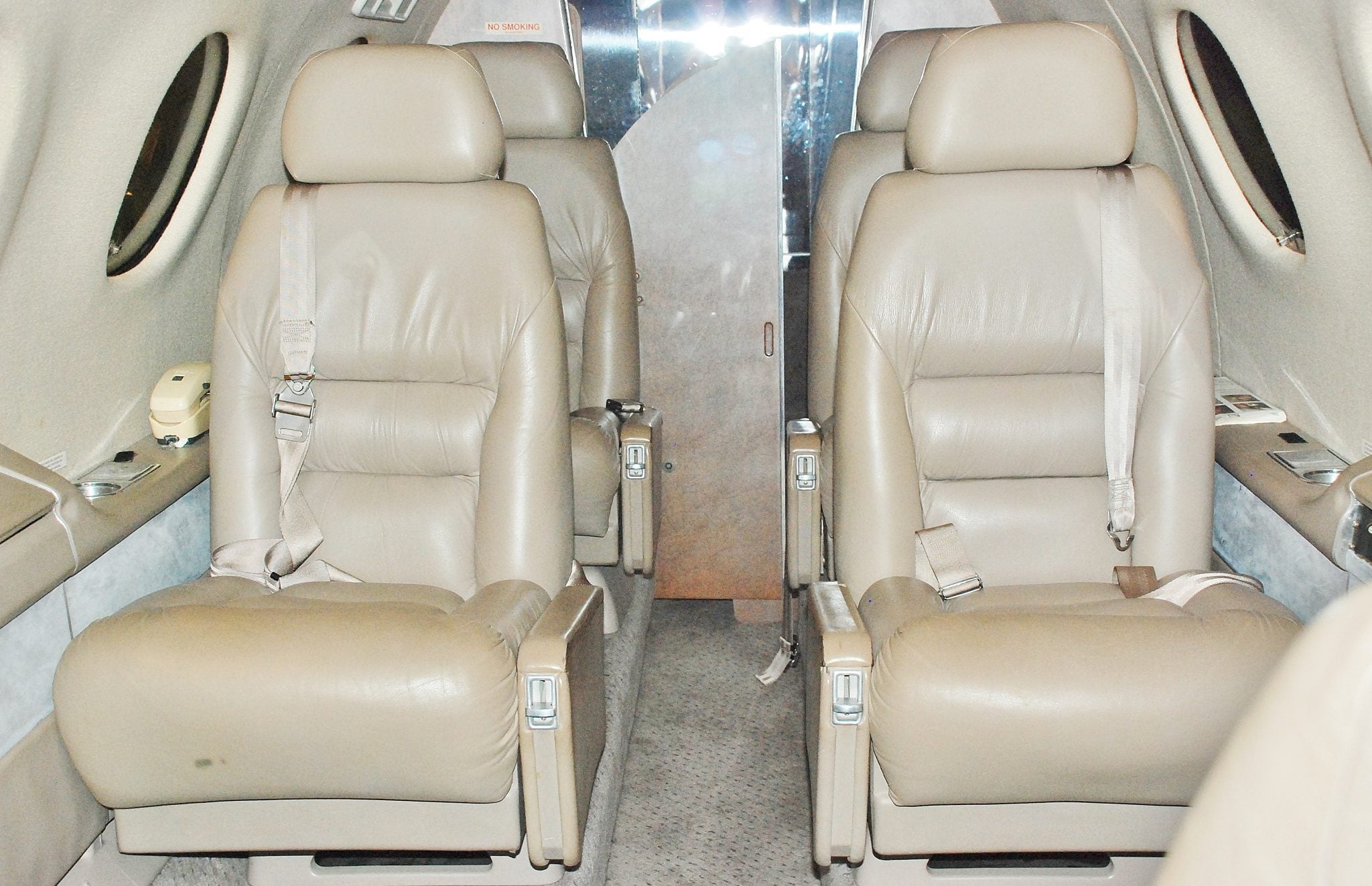
The cabin has six seats; the front two seats face aft. The Princess phone clearly dates the design.
Lockheed’s L-133 Starjet Could Have Been a Contender!
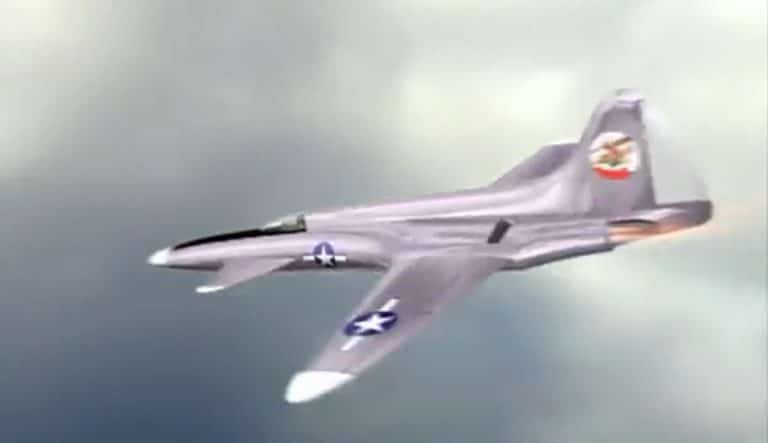
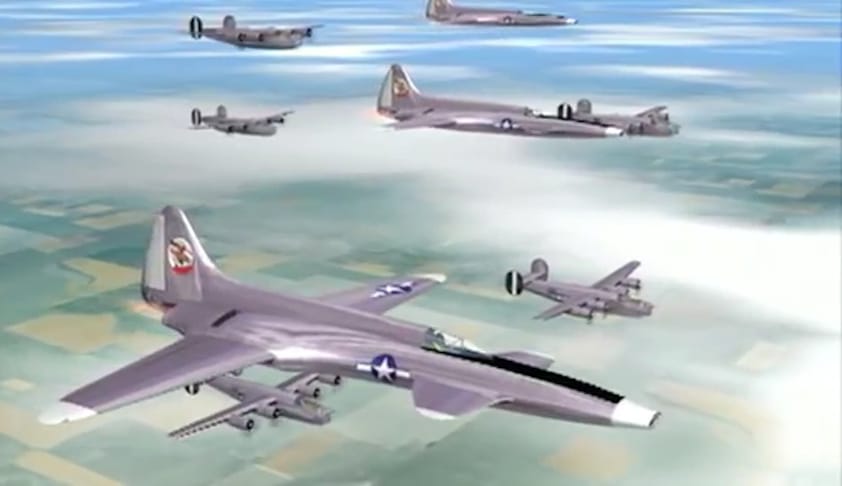
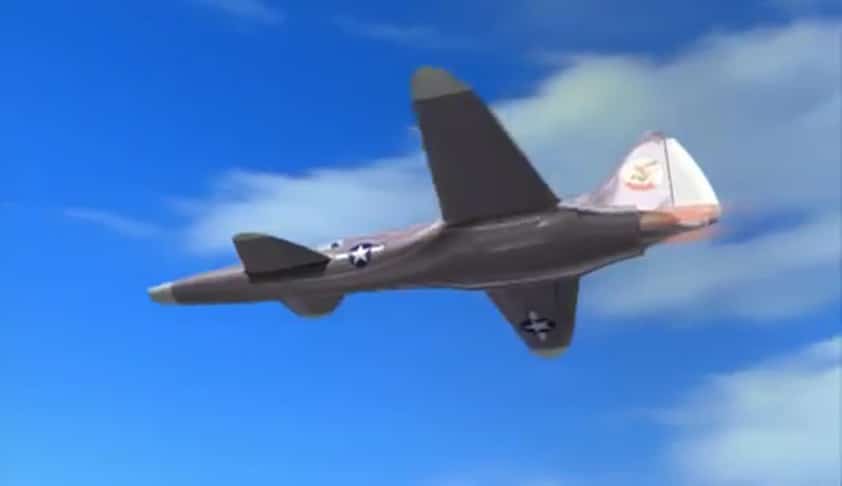
A blended body with aft-mounted laminar flow wings and forward mounted canards. Slotted flaps to enhance lift. Tricycle landing gear. Twin axial flow turbojet engines with afterburners fed by advanced aft-mounted NACA-type intakes reducing frontal area and therefore drag. Four nose-mounted 20 millimeter cannons for armament.
Does this remind you of any 1950s or 1960s jet fighters? How about something even more modern? Would you be surprised to know that the jet I just described never flew at all? Would you be surprised to find out the Starjet was in development…in 1939?
Lockheed L-133 Starjets. Image via YouTube screen capture
Lockheed began working on their Model L-133-02-01 in 1939. By 1940 the company-financed jet was on the drawing board. The brainchild of none other than renowned Lockheed “Skunk Works” engineers Clarence L. “Kelly” Johnson, Willis M. Hawkins and Hall L. Hibbard, the L-133 might have been, could have been, maybe even should have been, this country’s first jet-powered fighter aircraft.
The design was proposed to the US Army Air Corps in 1942. So what happened? Remember-this was 1942. The USAAC (after March 1943 the US Army Air Forces) simply wasn’t prioritizing jet fighters over bombers and propeller-driven fighters. Not yet anyway.
Lockheed L-133 Starjet. Image via YouTube screen capture
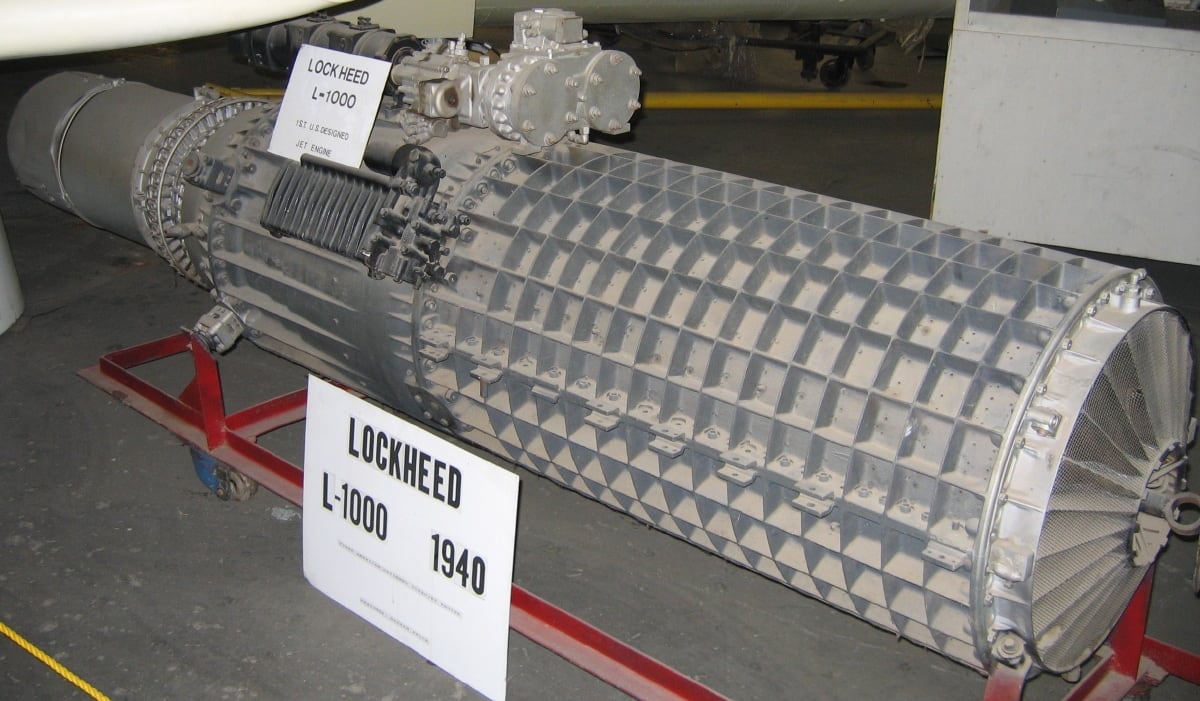
Of course Germany and the Brits were designing and building jets by then. Lockheed’s L-1000 axial flow turbojet engine (designated J37) would have been a robust powerplant for the L-133 Starjet, but developmental priorities placed the J37 on the back burner for many years. It wasn’t until 1953 that the plug was pulled on the J37 after three of them had been built.
L-1000 engine by Sturmvogel 66 [CC BY-SA 3.0 (https://creativecommons.org/licenses/by-sa/3.0) or GFDL (http://www.gnu.org/copyleft/fdl.html)], from Wikimedia Commons
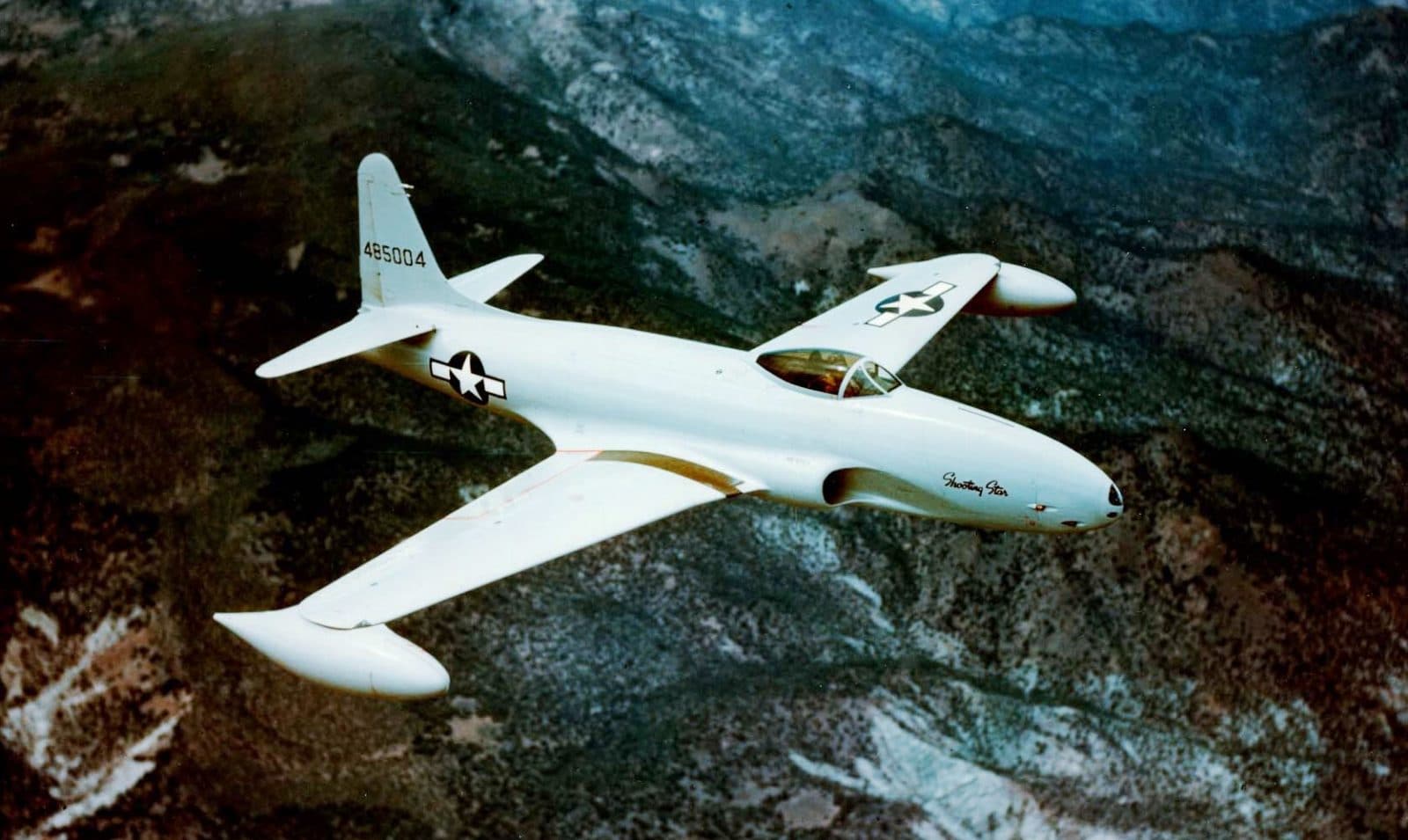
Meanwhile, Lockheed focused on another much simpler design for their first production jet fighter. Still using the laminar flow wing (stolen from the P-38 Lightning) but powered by the centrifugal flow Allison J33 engine, the P-80 Shooting Star was said to have benefited from the exercise of working through the kinks Johnson and his team experienced while developing the design of the Starjet.
Lockheed P-80A Shooting Star. Image via USAF
The L-133 would have come in at about 48 feet in length with a wingspan of nearly 47 feet. With a wing area of 325 square feet and a total of more than 10,000 pounds of thrust from those twin L-1000 engines, the Starjet was expected to be capable of a maximum speed of 625 miles per hour!
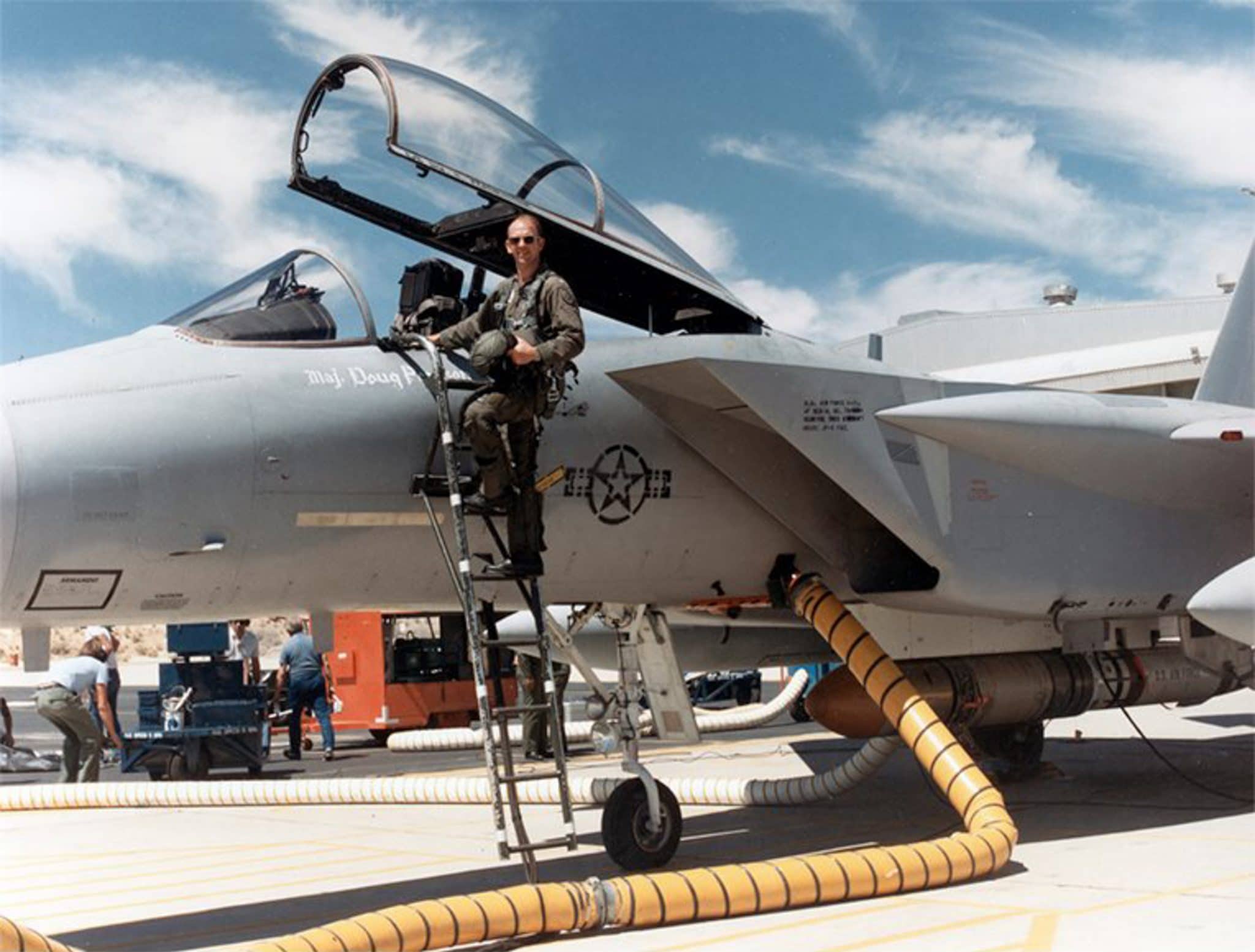
On 13 September 1985, F-15 test pilot Maj. Wilbert D. “Doug” Pearson (now retired Maj. Gen.) took off from Edwards Air Force Base, Calif., on a mission that would see him become history’s first space ace.
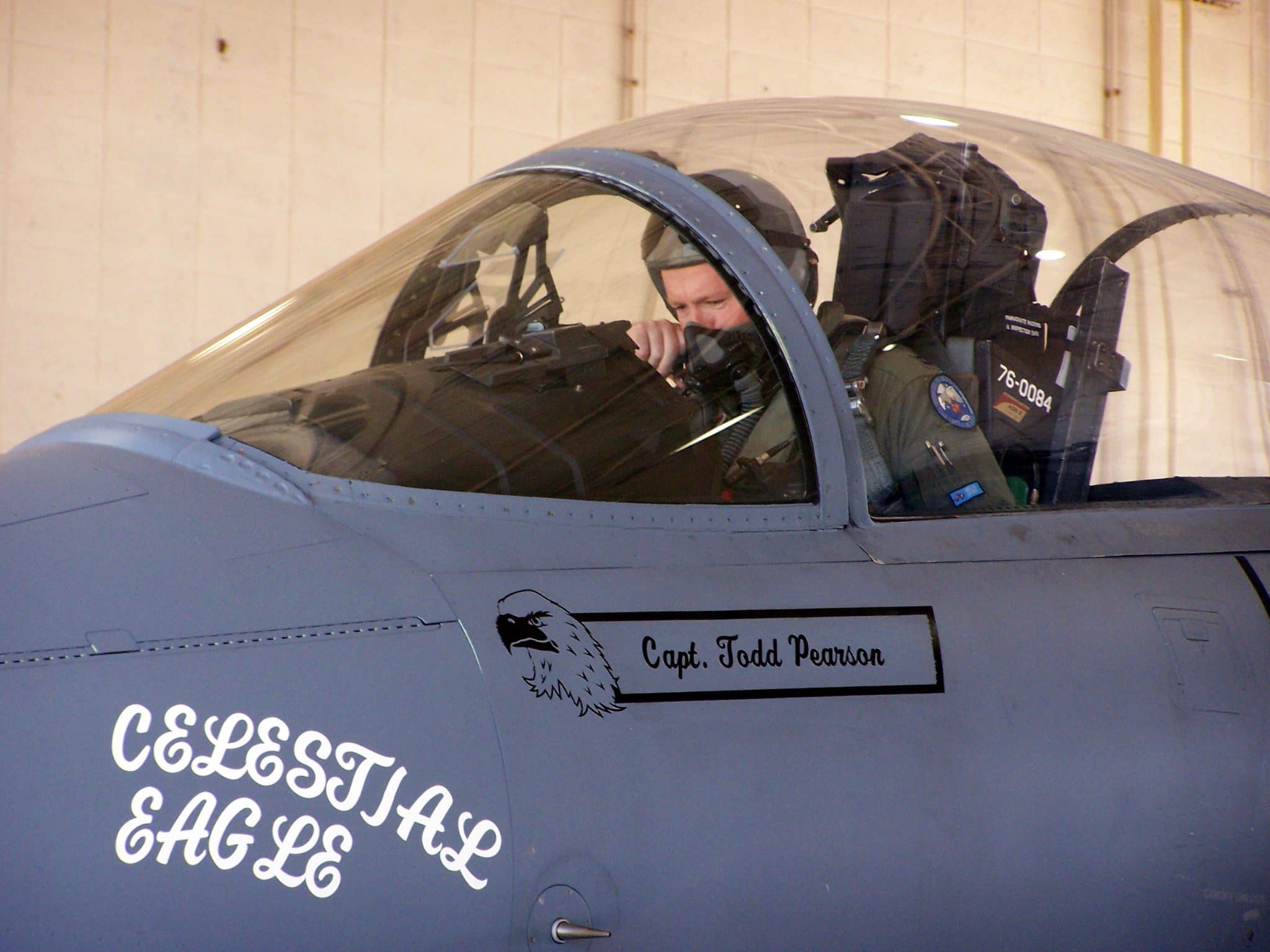
Dubbed the “Celestial Eagle Flight,” the assignment called for Pearson to make a near vertical ascent in a specially-configured F-15A to over 35,000 feet, to fire a 2,700 pound, 18-foot long missile into space and kill an obsolete satellite over 2000 miles away, at an altitude of 340 miles (about as high as the space shuttle could fly).
Maj. Wilbert ‘Doug’ Pearson stand with his modified F-15A, prior to firing an ASAT missile to destroy an obsolete satellite over the Pacific Ocean on 13 Sept 1985. Photo: USAF
It was the culmination of a six-year development and test program for the anti-satellite (or ASAT) missile; Maj. Pearson commanded the F-15 Anti-Satellite Combined Test Force. The flight required Pearson to arrive at a precise point and time over the Pacific Missile Test Range, and fire a Vought ASM-135A ASAT missile automatically from the belly of his jet, taking aim at the 2,000-pound Solwind P78-1 solar laboratory, which launched in 1979.
Weapons in space was already controversial, and still is to this day, but so was the shoot down of the satellite, especially in the science community, because even though it was not operating at 100%, it was still returning valuable data. But that’s a whole other story.
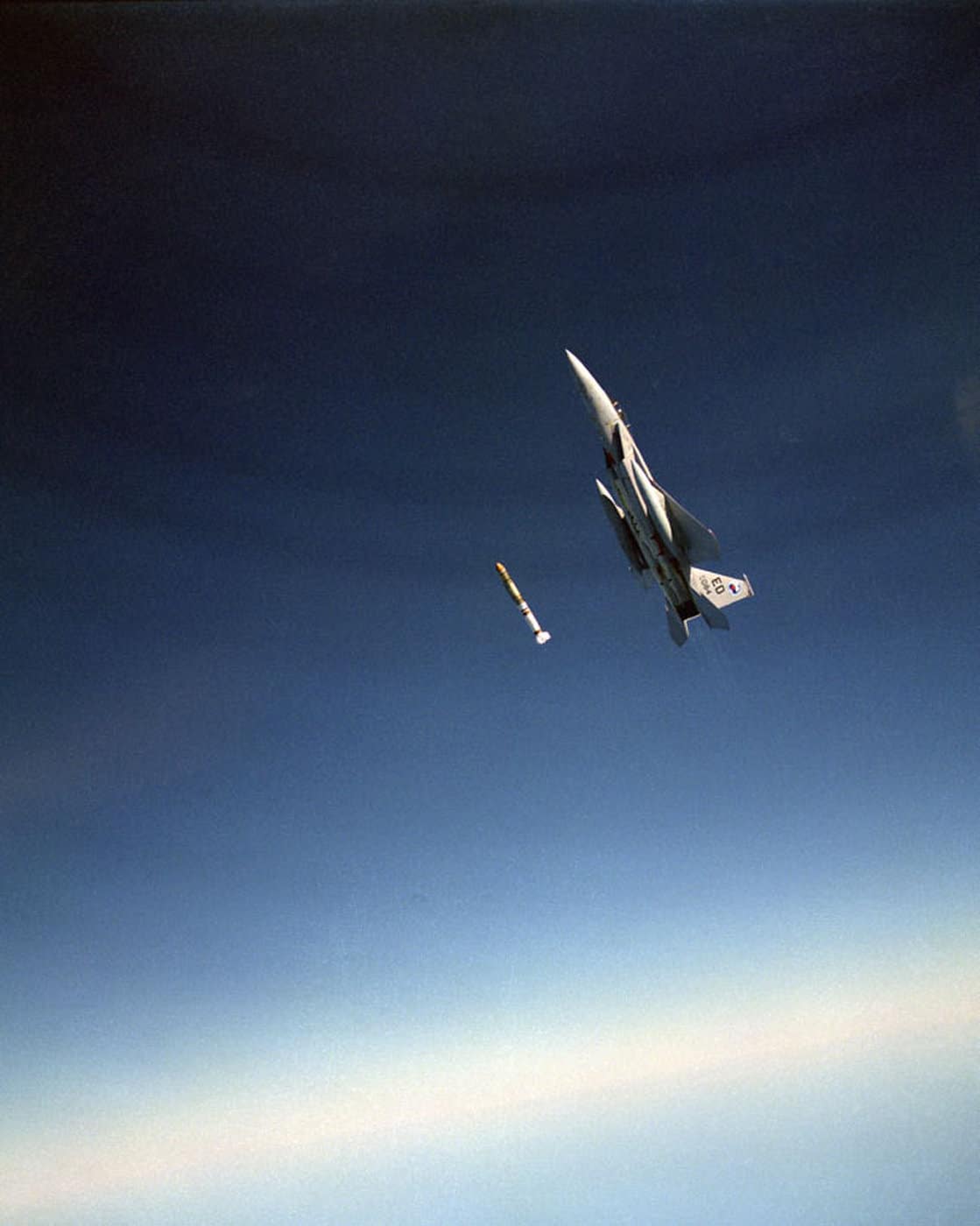
Going supersonic at Mach 1.2, Maj. Pearson pulled into a 3.8g, 65-degree climb, slowing down to just below Mach 1, before firing the missile at 38,100 feet, about 200 miles west of Vandenberg AFB.
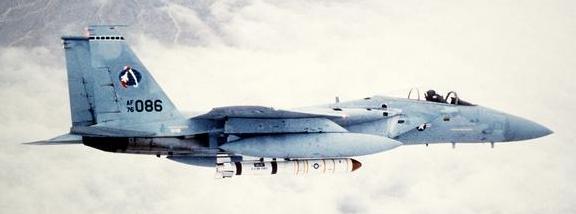
The ASM-135 loaded onto a F-15 in flight. Photo: USAF
The rocket separated from the missile after the first stage, and propelled a miniature homing vehicle with an infrared sensor into space on a bullseye intercept with the satellite, nailing its target with a closing velocity of 15,000 mph and marking the first successful satellite kill by an aircraft launched missile in history.
The Air Force originally wanted to modify 20 F-15s to do the same, an operational force of 112 ASM-135s, but huge cost overruns and technical issues killed the program in 1988 (after the F-15s had already been modified of course).
Maj. Wilbert ‘Doug’ Pearson fires an anti-satellite missile launched from a highly modified F-15A over the Pacific Missile Test Range off the coast of California, September 13, 1985. Photo: USAF
According to the USAF, “The jet, F-15A 76-0084, was the 275th F-15 fighter jet to roll off the McDonnell Douglas assembly line in St. Louis, and it flew its maiden flight on Veteran’s Day, 1977. Its assignments have included two stints with the 49th Test Fighter Wing at Holloman AFB, the 1st TFW at Langley AFB, the 6512th Test Squadron of the Air Force Flight Test Center at Edwards AFB, the 131st Fighter Wing of the Missouri Air National Guard in St. Louis, and the 125th Fighter Wing of the Florida Air National Guard.”
In 2007, 22 years after the mission, Staff Sgt. Aaron Hartley with the Florida Air National Guard 125th Fighter Wing, Detachment 1, was tasked with putting together a lithograph for the North American Aerospace Defense Command (NORAD) F-15 Alert Detachment at Homestead Air Reserve Base.
Major General Wilbert D. “Doug” Pearson Jr. Photo: USAF
“I was researching the history of the jets to see which one was the ‘coolest’ and had the most history, so I contacted historians from the Boeing Company, Edwards AFB and the Air Force Historical Research Society at Maxwell AFB, Ala.,” he said.
That’s when he learned that the 125th FW had the historic jet, and so he reached out to the retired Maj. Gen. Pearson about it, who by that time had moved on to vice president of the Lockheed Martin F-35 Integrated Test Force.
Retired Major General Doug Pearson (left) and Capt. Todd Pearson (right) joke around before Captain Pearson took off on the Celestial Eagle remembrance flight Sept. 13, 2007. Photo: USAF
His son, then Capt. Todd Pearson, was an active-duty F-15 pilot at Mountain Home AFB, Idaho.
So naturally, the idea of a Celestial Eagle remembrance flight piloted by Captain Pearson was born.
“Celestial Eagle” was painted on the nose of 76-0084, and the captain’s name was painted on the side of the cockpit. He even wore the same circular patch on his left shoulder that his father wore on that same day 22 years earlier, and they performed the pre-flight walk around the aircraft together.
Capt. Todd Pearson performs pre-flight checks on an F-15A at the Florida Air National Guard 125th Fighter Wing located at Homestead Air Reserve Base, Fla., during the Celestial Eagle Remembrance Flight on Sept. 13, 2007. Captain Pearsons father, retired Maj. Gen. Doug Pearson, flew the exact same F-15 22 years prior while accomplishing the first successful satellite kill by an aircraft launched missile in history. Credit: USAF
“I thought it was a great idea,” Captain Pearson said regarding the remembrance flight. “I’ve always been an aviation ‘buff,’ and I’ve wanted to fly eagles since I was three because my dad flew them. The flight was a significant event in military aviation history, and I’m glad that I’ve been able to be a part of this 22 years later.”
The historic jet retired to the Aerospace Maintenance and Regeneration Center “Boneyard” at Davis Monthan AFB in 2009, when the 125th FW transitioned to the F-15C/D.
– Follow Mike Killian on Instagram and Facebook, @MikeKillianPhotography .
Alvin “Tex” Johnston was born in Admire, Kansas in August of 1914. He took his first flight in 1925, at the age of eleven, when a barnstormer landed near his home. On that day, he decided that he would become a pilot. After flight training, he soloed his first flight at the age of 15.
In his adult years, he dropped out of college before completing his engineering courses. Then Tex Johnston worked for Bell Aircraft and Boeing as a test pilot. He is famous for his Boeing 707 and B-52 test flights. He was also a flight instructor in the Civilian Pilot Training Program, and the U.S. Army Air Corps Ferry Command.
Johnston was known for his larger than life personality. He received the nickname “Tex” because of the stetson hat and cowboy boots he liked to wear. But Johnston is even better known for executing a barrel roll maneuver with a Boeing 367-80–the Boeing 707 prototype…a giant airliner!
Check out these other great stories about the Boeing 707 on our site:
The Footage of Tex Johnston Rolling The Jet Is A Sight To Behold
This video footage shows scenes from the 1955 Seafair and Gold Cup in Seattle. Bill Allen had invited representatives of the Aircraft Industries Association to the event and Tex delivered with that famous barrel roll.
As this video shows, the whole stunt was filmed, and Tex was called into the office of his supervisor. When his boss asked him what he thought he was doing rolling his plane in the air, Tex replied, “I’m selling airplanes.” With a witty reply, his job was saved.
The Boeing 707 went on to be a very successful airliner and derivatives were selected to be air refueling tankers for US and allied forces.
The quirky and eccentric Silver Airways faces real questions about its strategy after its latest round of route cuts.
The Hollywood, Fla.-based airline, known for its distinctive fuchsia livery, white flamingo logo, and unique routes, is an eccentric player in the U.S. airline industry. As an all-turboprop regional carrier, Silver Airways focuses on intra-Florida service and service between Florida, the Bahamas, and the Caribbean.
However, beneath its flashy and tropical exterior, there are growing signs that the airline might be facing significant financial challenges. From operational inconsistencies to highly publicized legal spats, the question arises: is Silver Airways in trouble?
One Airline’s Bankruptcy Leads to the Birth of Another
A Gulfstream International Airways Embraer 120 lands at KMIA on 31 August 2005 | IMAGE: Aero Icarus from Zürich, Switzerland, CC BY-SA 2.0 , via Wikimedia Commons
Founded in 2011, Silver Airways emerged from the remnants of Gulfstream International Airlines, which filed for bankruptcy in 2010. At the time of bankruptcy, the Dania Beach, Fla.-based carrier operated as a Continental Connection carrier with a fleet of 21 Beechcraft 1900D turboprops.
Following the bankruptcy, Chicago-based investment company Victory Park Capital bought Gulfstream’s assets and relaunched the airline as Silver Airways.
The newly rebranded carrier began operations as a Continental Connection codeshare partner on 15 December 2011 with a single 34-seat Saab 340 aircraft–one of six it had on order at the time. Throughout the rest of 2011 and 2012, Silver bolstered its footprint in Florida and the Bahamas and operated Essential Air Service (EAS) routes in Montana and the Mid-Atlantic.
Silver Airways’ EAS Operations and the Continental/United Merger
A Silver Airways Beechcraft 1900D in United Express Colors at Fort Lauderdale-Hollywood International Airport (FLL) on 22 May 2012 | IMAGE: André Du-pont (Mexico Air Spotters) (GFDL 1.2 or GFDL 1.2 ), via Wikimedia Commons
Picking up where Gulfstream left off, Silver took over EAS operations at Billings-Logan International Airport (BIL) in Montana using Beechcraft 1900s. Back east, Silver also operated B1900 EAS flights out of Cleveland Hopkins International Airport (CLE).
Following Continental’s merger with United Airlines on 01 April 2012, Silver became a United Express carrier.
During the second half of 2012, Silver Airways commenced EAS operations out of Washington Dulles International Airport (IAD) using Saab 340s. This service connected smaller communities in Pennsylvania, West Virginia, and Virginia to the United Airlines network. Silver also launched flights from Hartsfield-Jackson Atlanta International Airport (ATL) to destinations in Mississippi and Alabama.
Silver’s Montana operation wound down by late 2013 following the expiration of the EAS federal contract. Those B1900s would reposition to CLE, where they continued EAS operations with United Express to smaller communities in the Mid-Atlantic and Midwest. However, Silver’s CLE operation would also end in early 2014 following United’s announcement that it would dehub CLE.
Meanwhile, Silver Airways was also expanding its footprint in Florida and the Bahamas. Its growing fleet of 12 Saab 340s provided service to destinations such as Gainesville Regional Airport (GNV), Orlando International Airport (MCO), Jacksonville International Airport (JAX), and Tampa International Airport (TPA). The carrier also moved its maintenance facilities from Fort Lauderdale-Hollywood International Airport (FLL) to Gainesville.
Silver reached a major milestone in 2014 when it became an independent airline.
An Independent Silver Airways
A Silver Airways Saab 340B+ | IMAGE: Silver Airways on Facebook
With Silver’s newfound independence, the carrier continued its growth strategy throughout the mid-2010s. The airline bolstered its route system throughout Florida and the Bahamas, creating a robust intra-Florida network.
Airline officials announced the establishment of a new maintenance headquarters at MCO in 2015.
In 2016, the federal government approved Silver to provide service between five Florida cities and nine Cuban cities. However, service to Cuba ended in April 2017 after just eight months.
In 2017, the carrier announced the purchase of 20 ATR -600 series turboprops, with options for up to 30 more. The order included 16 smaller 46-seat ATR 42-600s and four larger 70-seat ATR 72-600s. These additions would significantly increase Silver’s capacity as it continued adding routes.
Silver Brings ATR Aircraft Back to U.S. Skies
A Silver Airways ATR 42-600 lifts off | IMAGE: Silver Airways on Facebook
Silver’s ATR order marked the first time in 25 years that a new ATR aircraft would operate in the United States. It also made Silver the first U.S. ATR 72-600 operator.
Growth continued in 2018 when Silver Airways acquired Seaborne Airlines, based in San Juan, Puerto Rico. Seaborne provided intra-Caribbean service from its hub at San Juan’s Luis Muñoz Marín International Airport (SJU) with a fleet of 15-seat de Havilland Canada DHC-6 Twin Otter seaplanes and eight Saab 340s.
A Seaborne Airlines de Havilland Canada DHC-6 Twin Otter seaplane | IMAGE: Seaborne Airlines (Silver Airways) on Facebook
In July 2018, Silver again became an EAS contractor, this time out of Boston Logan International Airport (BOS). The carrier provided seasonal service to the summertime tourist mecca of Hancock County-Bar Harbor Airport (BHB) in Maine. This route, operated for two summers with a Saab 340, ended upon the expiration of the EAS federal contract in 2020.
As the 2010s faded into the sunset, it was a time of renewal and optimism at Silver, which–at the time–billed itself as “America’s leading independent regional airline.”
Silver Airways’ first ATR 42-600 joined the fleet in early 2019. Its first revenue flight occurred on 22 April between FLL and Key West (EYW). The carrier took delivery of its first ATR 72-600 in late 2019, with its first revenue flight operating between TPA and Pensacola (PNS) on 23 November.
A Silver Airways ATR 42-600 | IMAGE: Silver Airways on Facebook
A New Decade: Covid Thwarts Expansion Plans
A trio of Silver Airways ATR aircraft await passengers at San Juan (SJU) | IMAGE: Silver Airways on Facebook
At the dawn of the new decade, Silver Airways was experiencing robust expansion. The arrival of additional aircraft enabled the expansion of Silver’s Caribbean operations out of SJU. However, all expansion plans were put on hold as COVID-19 decimated the airline industry. Additional expansion plans, including new service from Charleston International Airport (CHS) in South Carolina to MCO, TPA, and FLL, were delayed until late 2020.
In 2021, Silver once again dipped its toes into something new. This time, it was a partnership with cargo carrier Amazon Prime Air. Using five Silver-operated ATR 72-500F freighters, Amazon based the aircraft out of Perot Field Fort Worth Alliance Airport (AFW) in Texas. From its AFW base, Silver Airways operated flights to cities such as Albuquerque, N.M. (ABQ), Des Moines, Iowa (DSM), Wichita, Kan. (ICT)., and Omaha, Neb. (OMA) on behalf of Amazon Prime Air. However, Silver and Amazon abruptly parted ways in July 2023, less than two years after the partnership began.
In September 2022, Silver operated its final Saab 340 flight, thus making it an exclusively ATR -600 series operator.
The final Silver Airways Saab 340B+ revenue flight at Saint Croix, USVI (STX) on 04 September 2022 | IMAGE: Silver Airways on Facebook
Silver Airways Today
A Silver Airways ATR 72-600 | IMAGE: Silver Airways on Facebook
As of September 2024, Silver Airways operates a fleet of 14 ATR -600 series aircraft, including eight 46-seat 42s and six 70-seat 72s. However, according to FlightAware data, two aircraft–one 42 and one 72–are currently parked at MCO. The 42, N705SV, last operated more than three months ago. The 72, N401SV, was ferried to MCO on 30 August. It is unclear if that aircraft has been parked or is simply undergoing maintenance.
It’s worth noting, however, that the carrier is in the beginning stages of a relatively significant route shakeup. As first reported by AeroRoutes last week, Silver plans to eliminate eight routes between now and early 2025. Two of the route cuts have already taken place. These cuts will also lead to the closure of four stations, including:
Governors Harbour Airport, Bahamas
GHB
Service ended 17 Aug 2024
Gainesville Regional Airport, Florida
GNV
Service ends 06 Oct 2024
Palm Beach International Airport, Florida
PBI
Service ends 06 Oct 2024
Cibao International Airport | Santiago de los Caballeros, Dominican Republic
STI
Service ends 27 Oct 2024
By the end of October, Silver will have just 20 destinations
The Silver Airways route map, not reflecting its most recent cuts | IMAGE: flysilver.com
Once these cuts take effect, Silver will be left with just 20 destinations across Florida, the Bahamas, and the Caribbean, including:
Florida
Pensacola (PNS)
Tallahassee (TLH)
Orlando (MCO)
Tampa (TPA)
Fort Lauderdale (FLL)
Key West (EYW)
The Bahamas
Freeport | Grand Bahama International Airport (FPO)
Bimini | South Bimini Airport (BIM)
Nassau | Lynden Pindling International Airport (NAS)
Georgetown | Exuma International Airport (GGT)
North Eleuthera | North Eleuthera Airport (ELH)
Marsh Harbour | Leonard M. Thompson International Airport (MHH)
The Caribbean
San Juan, Puerto Rico (SJU) | Luis Muñoz Marin International Airport
Tortola, British Virgin Islands (EIS) | Terrance B. Lettsome Airport
St. Thomas, U.S. Virgin Islands (STT) | Cyril E. King Airport*
St. Croix, U.S. Virgin Islands (STX) | Henry E. Rohlsen Airport*
Anguilla (AXA) | Anguilla-Clayton J. Lloyd Airport
St. Maarten (SXM) | Princess Juliana International Airport
St. Kitts, St. Kitts and Nevis | Robert L. Bradshaw International Airport
Dominica (DOM) | Douglas-Charles Airport
*In addition to Silver Airlines service to SJU, subsidiary Seaborne Airlines operates Twin Otter seaplane service between STT and STX
There have been significant route cuts over the last year, too
A Silver Airways ATR 72-600 waits for departure as an A-10 Warthog lands at Fort Lauderdale-Hollywood International Airport (FLL) | IMAGE: Silver Airways on Facebook
These cuts follow significant cuts over the last year, including Huntsville, Ala. (HSV), Jacksonville, Fla. (JAX), New Orleans (MSY), and Savannah (SAV). Additional cuts over the last year include Providenciales, Turks and Caicos (PLS), Antigua, Antigua and Barbuda (ANU), La Romana, Dominican Republic (LRM), and Puerto Plata, Dominican Republic (POP).
Silver Airways also axed service to Greensboro, NC (GSO), Greenville-Spartansburg, SC (GSP), and Nashville (BNA) in 2023 after only four months. Announced service to Fort Myers (RSW) ended before it even began.
However, not all the news is bad, as Silver announced on 04 September that it intends to increase the frequency of flights out of TPA. The changes include daily flights to NAS, twice-daily flights to TLH, and thrice-daily flights to EYW. The additional TPA flights begin on 07 October, one day after the GNV and PBI station closures.
Silver Airways has a codeshare agreement with United Airlines and JetBlue.
Is Silver Airways in Financial Trouble?
A Silver Airways ATR 42-600 | IMAGE: Silver Airways on Facebook
Silver Airways’ quirks and flightiness have long been part of its eccentricity. They have carved out a niche capitalizing on their uniqueness. However, recent developments like the abrupt route cuts and station closures announced last month suggest that the airline may be in deeper trouble than it lets on.
The airline is notorious for operational inconsistencies. Passengers complain of frequent delays and cancellations. Additionally, the carrier endured an embarrassing public saga in April 2023 when it was on the cusp of eviction from FLL due to non-payment of rent and other airport services totaling over $1.4 million. However, both sides struck an eleventh-hour deal, allowing the carrier to remain at FLL.
The airline’s shrinking route network is one of the most telling signs of financial distress. Over the past few years, Silver Airways has retreated from many routes, focusing instead on core routes within Florida, the Bahamas, and the Caribbean. This reduction could be a strategic move to streamline operations, but it could also indicate that the airline is struggling to maintain its previous level of service.
The Competition Heats Up
IMAGE: Silver Airways on Facebook
Other factors going against Silver Airways include its fleet of turboprop aircraft. Competitors like Breeze Airways operate brand-new Airbus A220 jets, including an intra-Florida route between PNS and TPA. At the same time, Silver is an exclusively turboprop carrier–something passengers no longer care for. Additionally, Brightline–Florida’s new state-of-the-art high-speed rail system–can whisk passengers between Orlando and Fort Lauderdale in less than three hours.
The uncertainty surrounding Silver Airways’ financial stability raises concerns about its long-term viability. The carrier is presumably well-funded by Philadelphia-based Versa Capital Management, which has a majority stake in Silver Airways. Still, for passengers booking flights months in advance, the possibility that Silver Airways could face further service reductions is a genuine and valid concern. Regardless of how well-funded they are, no influx of money can save a carrier with no passengers.
While the airline has not made any public statements about its financial situation, the signs of distress–along with some high-profile financial snafus–are enough to give potential customers pause.
Silver Airways Must Adapt to its Challenges
A Silver Airways ATR 72-600 at FLL | IMAGE: Silver Airways on Facebook
The future of Silver Airways remains uncertain. While the airline has survived in a highly competitive industry for over a decade, the growing signs of financial distress suggest it may be facing the most challenging moment of its short history. If the carrier is struggling financially, it must make significant changes to ensure its survival.
One possibility is that Silver could seek a merger or partnership with a larger airline. A partnership would provide the financial backing needed to stabilize operations, potentially leading to the expansion of its route network. However, merging with a larger carrier could also mean losing some of the quirky charm that has defined Silver Airways since the beginning. And let’s not even think about navigating the gauntlet of pilot unions and contracts.
Downsizing further is an option and would allow the carrier to focus on a smaller number of profitable routes and reduce overhead costs. This strategy could help Silver Airways stay afloat in the short term. However, it would also limit its growth potential and reduce its presence in the market.
A recent comment by a user on an airliners.net forum laid bare some sobering information about the carrier, saying:
“The 3M [Silver Airways IATA code] operation at SJU is so low at this point that crews are getting sent to do Florida flying to cover MCO and TPA because there’s no use for them down here. If 3M doesn’t get it together, they’re bound to lose this turf war (if it can be called that). And as for Florida, it’s sad when you have to draw down your own main base. Unfortunately, the current state of the company is something that I felt coming while I was with them; I jumped as soon as I had the opportunity, and now I see first-hand what I avoided and what my ex-colleagues are now going through.”
Oof.
Ultimately, Silver Airways’s fate will depend on its ability to adapt to its challenges. Let’s hope it turns things around quickly before the trust of its customers erodes even further.
Most all large airports have 3 dimensional routes that aircraft follow to get into position to land. The first part is the Standard Terminal Arrival (STAR) and the final leg is the Instrument Approach. STARS can be hundreds of miles long and allow a predictable sequencing process for both ATC and aircraft.
Approaches have many variations, using radios or Global Positioning Systems to align the aircraft into position to land in all weather conditions. On both STARS and Instrument Approaches, there are waypoints that require a 5-letter designation. Given so many airports, so many waypoints, and the humor or passion of the person naming the waypoints, there are some funny and interesting name sequences.
Here are 3 STARS and 2 Approaches that I have flown multiple times.
#5 – NIIXX 1 Arrival into Denver
As a lover of music – who can resist this sequencing?
Note: NOT FOR NAVIGATION. FOR ILLUSTRATIVE PURPOSES ONLY.
#4 – SCBBY 2 Arrival into Ontario, CA
Paying homage to Saturday morning cartoons (completely dating my childhood), the Scooby 2 Arrival into Ontario is always fun!
Note: NOT FOR NAVIGATION. FOR ILLUSTRATIVE PURPOSES ONLY.
#3 – JJEDI 2 Arrival into Atlanta
Not the only Star Wars fanatics around – thanks to the namer of these waypoints!
Millenium Falcon, Skywalker, Ewoks, Planet Hoth, Leiea, Lando, Xwing, Tie Fighter, New Hope, Death star, Wookie, Boba Fett, Chewie, and Jedi! Note: NOT FOR NAVIGATION. FOR ILLUSTRATIVE PURPOSES ONLY.
#2 – RNAV to Runway 16 at Portsmouth, NH
More Saturday cartoons! Apparently those cartoons influenced a bunch of us!!!
I tawt I saw a puddy tat, i did, i did! Note: NOT FOR NAVIGATION. FOR ILLUSTRATIVE PURPOSES ONLY.
#1 – RNAV to Runway 1 Right in Kansas City
Had to give props to an extremely familiar city and near home! Well, and who doesn’t love Barbeque?
Not for navigation. For illustrative purposes only.
That just scratches the surface of awesome naming for those of us slipping the surly bonds of earth for a living!!!
Do you have any favorite arrivals or instrument approaches?
Note: Do not utilize any of these approach plates for navigation. They are shared for illustrative purposes only.
Earlier this morning, a Delta A350’s wing collided with the tail of a CRJ-900 on a taxiway at Hartsfield-Jackson Airport in Atlanta Georgia.
At approximately 10:00 am local time, Delta Flight 295 was taxing out for it’s scheduled flight to Tokyo, Japan. During the taxi, its wing tip stuck another Delta aircraft. Delta Flight 5526, an Endeavor operated jet, sustained damage as the horizontal and vertical stabilizer were sheered off.
Runway Collision At Hartsfield-Jackson Airport in Atlanta Involved Two Different Delta Aircraft
Flight 5526 was reported to have had 56 passengers plus the crew on board at the time of the collision.
Delta Airbus A350 Snaps Off Tail Of CRJ-900 at Atlanta Airport 116
Delta Flight 295 was an Airbus 350, the largest aircraft that Delta Air Lines currently operates. Flight 295 was carrying 221 passengers plus the crew. Fortunately no injuries are reported at this time.
PHOTO TAKEN BY CBS NEWS HELICOPTER AND POSTED ON YOUTUBE
Delta flight 295 was able to return to the gate area under its own power. However Delta Flight 5526 was unable to do so due to the severity of the damage it obtained during the Collison. All 56 passengers aboard the regional jet were bussed back to the terminal from the taxiway.
At 10:07AM, two aircraft made contact at the intersection of taxiways E and H on the north airfield. No injuries are reported. Passengers from one aircraft are being bussed to concourse B; the other aircraft taxied on its own power to its gate. There is minimal impact to ops.