Home Blog Page 51

China Rising: Is COMAC a Threat to Boeing and Airbus?

With the world’s two dominant OEMs booked up through the end of the decade, is there room for a new competitor? 

As the demand for commercial jetliners continues to jam up assembly lines at Boeing and Airbus, a new competitor threatens to break up the duopoly. 

The Commercial Aircraft Corporation of China, or COMAC, represents a bold initiative by the Chinese government to establish a competitive presence in the global aerospace market. Founded in 2008, the Shanghai-based manufacturer aims to reduce China’s reliance on Western aircraft manufacturers. 

Although still in its infancy, COMAC has made significant strides through its ambitious aircraft programs, including the ARJ21, C919, and the upcoming C929 and C939. Each of these projects underscores China’s determination to become a leading player in the global aerospace industry. 

But just how much of a threat is COMAC? 

The short answer is not much—at least for now. At present, COMAC has a relatively modest presence in the skies of China with minimal exposure elsewhere. Two of its products, the ARJ21 regional jet and the C919 short- to medium-range airliner, are currently being produced at a snail’s pace. Two widebody products – the C929 and C939 – are in the design phase. 

The ARJ21: The Chinese Regional Jet

COMAC ARJ21
A trio of COMAC ARJ21-700s | IMAGE: COMAC

The ARJ21 marks COMAC’s initial foray into the commercial aircraft market. The ARJ21 (ARJ stands for “Advanced Regional Jet”) serves short-range routes, seating between 70 to 105 passengers in a 2-3 configuration. The development of this twin-engine, single-aisle jet began in 2002, aiming to compete directly with established regional jets like the Bombardier CRJ and Embraer E-Jets. 

The type’s journey from concept to commercial service was fraught with challenges. Originally, COMAC planned for the maiden flight in 2005 and commercial service by mid-2006. However, the program experienced significant delays, with the prototype unveiled only in 2007 and the maiden flight occurring on 28 November 2008. These setbacks, primarily due to design and certification issues, postponed the aircraft’s entry into service until 28 June 2016, when Chengdu Airlines operated the first revenue flight. 

Questioning the Originality of the ARJ21

Jiangxi Airlines ARJ21
Jiangxi Airlines receives the first ARJ21 aircraft | IMAGE: COMAC

The ARJ21 features wings designed by Antonov and is powered by two General Electric CF34 engines mounted at the rear. The aircraft’s design, which some critics liken to the CRJ or the Boeing 717, is claimed by COMAC to be entirely original. The ARJ21-700 is the standard model, with a seating capacity of 70-95 passengers, while the ARJ21-900, a stretched variant similar to the Bombardier CRJ900 or Embraer 175-E2, will accommodate 95-105 passengers. Additional variants include freighter and executive versions, dubbed the ARJ21F and ARJ21B, respectively. 

Certified in January 2023, the ARJ21CCF (Comac Converted Freighter) boasts a maximum payload capacity of 22,377 pounds and a range of 1,726 miles. Chengdu Airlines took delivery of the first two converted freighters in October 2023. 

The ARJ21B is expected to seat 20 passengers in a one-class configuration.

International Reach and Future Prospects 

Chengdu Airlines ARJ21
Chengdu Airlines’ ARJ21 at Shanghai Hongqiao International Airport in 2019 | IMAGE: N509FZ, CC BY-SA 4.0 , via Wikimedia Commons

While the ARJ21 predominantly serves domestic routes within mainland China, Indonesian airline TransNusa became the first international customer of the type in 2022. The carrier currently operates two ARJ21-700s with an additional 28 on order. 

Brunei’s Gallop Air placed an order for 15 ARJ21s in September 2023. There are also reports that the Republic of Congo’s national carrier, ECAir, is considering acquiring three ARJ21s. 

Today, 146 ARJ21 airframes are operating, with more coming online slowly but steadily. The type also recently carried its ten millionth passenger. 

The C919: China’s Challenger to the A320 and 737 MAX 

COMAC C919
A COMAC C919 lifts off | IMAGE: COMAC

The C919 represents COMAC’s most significant effort to date in challenging the Airbus-Boeing duopoly in the single-aisle jet market. Designed to accommodate 150-190 passengers, it targets short- to medium-range routes, directly competing with the more efficient Airbus A320neo and Boeing 737 MAX families. 

The development of the C919 began in 2008, with the first flight taking place on 5 May 2017. After extensive testing and certification processes, launch customer China Eastern Airlines took delivery of the first C919 on 28 May 2023. 

COMAC Will Produce Shortened and Stretched Variants of the C919

COMAC C919
Dongfang 7801 from Shanghai-Hongqiao, landing at 36R as part of its 100-hour validation | IMAGE: N509FZ, CC BY-SA 4.0 , via Wikimedia Commons

Powered by two CFM International LEAP (Leading Edge Aviation Propulsion) engines, the C919 shares many design characteristics with the Airbus A320, including similar wingspan and fuselage dimensions. COMAC is developing shortened and stretched variants of the C919 to enhance its market appeal, with capacities ranging from 130 to 240 passengers and a maximum range of 3,500 miles.  

The shortened variant will focus on high-altitude destinations within 2,500 miles, while the extended variant will have a range of up to 3,500 miles. 

C919 Production and Market Reception

COMAC C919 Commercial Aircraft Corporation Of China AN4748979
The second C919 prototype lifts off for its maiden flight on 17 December 2017 | IMAGE: Ken Chen, CC BY-SA 4.0 , via Wikimedia Commons

With over 1,500 orders for the C919 on the books, reception to the type has been far more robust than that of the ARJ21. Production is progressing slowly, however, with COMAC aiming to achieve an annual output of 150 aircraft by 2028. Notable international orders include US-based aircraft lessor GE Capital Aviation Services and AerCap, an Irish aviation leasing company. Tibet Airlines has ordered 40 shortened-variant C919s to operate in the Himalayan Plateau region. Air China and China Southern have also ordered 100 C919s each. 

China Eastern is currently the sole operator of the type, with six C919-100s in service and an additional 100 on order. The airline anticipates having ten C919s in its fleet by the end of 2024. 

Despite the slow start, the future of the C919 looks promising – at least domestically – as COMAC works to ramp up production. 

Chinese officials hope to receive European approval sometime in 2025, which would allow for expanded international operations. However, industry experts say that is unlikely

The C929: A Long-Range Vision 

Mockup of the C929
A mockup of the COMAC C929 at the 2017 Paris Air Show | IMAGE: Marc Lacoste, CC BY-SA 4.0 , via Wikimedia Commons

The C929 is COMAC’s ambitious project to penetrate the long-range widebody market, competing with the Airbus A330 and Boeing 787.

At its onset, the project was a joint Chinese-Russian venture to replace the Ilyushin Il-96 under the banner of the China-Russia Commercial Aircraft International Corporation (CRAIC). Dubbed the CRAIC CR (China-Russia) 929, its maiden flight was slated to occur between 2025 and 2028. However, the project faced setbacks due to geopolitical tensions and sanctions following Russia’s invasion of Ukraine in 2022. 

In 2023, COMAC announced it would continue the venture independently, thus renaming the project C929. 

Design, Development, and Future Prospects for the C929

Rendering of C929 Interior
A rendering of the COMAC C929 Interior | IMAGE: By Marc Lacoste – Own work, CC BY-SA 4.0, https://commons.wikimedia.org/w/index.php?curid=60410188

Currently in the detailed design phase, the C929 is planned to offer three variants with varying capacities and ranges. The -500 variant will seat 250 passengers and feature a range of 8,700 miles, while the -600 and -700 variants will accommodate 280 and 320 passengers and feature a range of 7,500 and 6,200 miles, respectively. An all-economy configuration could potentially seat up to 440 passengers. 

By comparison, the Airbus A350 has a range of 9,600 miles, while the Boeing 787-8 has a range of 8,500 miles. 

Any final specifications are subject to the final design and materials. 

The final choice for the C929 powerplants is yet to be determined, but initial production will likely have to rely on engines from Western manufacturers like Rolls-Royce or General Electric. Despite the breakdown of the China-Russia venture, COMAC aims to deliver the first fuselage by September 2027, though test flights are unlikely before 2030. 

The C939: Just Announced

Exterior of Shanghai Hongqiao International Airport
Exterior of Shanghai Hongqiao International Airport | IMAGE: shimin (GFDL 1.2 or GFDL 1.2 ), via Wikimedia Commons

The C929 evidently won’t be the only widebody jetliner produced by COMAC. 

Earlier this month, Chinese media reported that COMAC had begun preliminary design work on the C939, another twin-aisle widebody jet. 

The type, which will compete with the Boeing 777 (including the 777X) and Airbus A350, will reportedly feature a capacity of up to 400 passengers.

While not much else is public knowledge at the moment, the C939 signifies COMAC’s intent to challenge the dominance of the world’s leading OEMs in the long-haul segment. 

The Road Ahead: Challenges and Opportunities

COMAC ARJ21F
B-3388, one of the first two aircraft converted to ARJ21P2F, in Air Central livery at the 2024 Singapore Airshow | IMAGE: By S5A-0043 – Own work, CC BY-SA 4.0, https://commons.wikimedia.org/w/index.php?curid=145796643

However, this is still years – perhaps more than a decade – down the road. And much can happen between now and then. So, for now, the Airbus-Boeing duopoly is safe. But it’s hard to imagine what the world could look like a decade from now. If the last decade has taught us anything, so much can change so quickly.

COMAC’s journey from the ARJ21 to the C939 illustrates China’s growing capabilities and ambitions in aerospace manufacturing. However, becoming a global aerospace player is a long road. COMAC’s production capacity remains severely limited, and significant efforts are needed to scale up to meet demand.

The company aims to produce 150 aircraft annually by 2028, but reaching Airbus and Boeing’s production efficiency and technical support levels by 2035 will require substantial advancements. 

The global aerospace industry is rapidly evolving, with China poised to surpass the United States as the world’s largest aviation market in the next few years. This shift presents both opportunities and challenges for COMAC. While the company benefits from robust domestic demand, gaining a foothold internationally will require overcoming technical, regulatory, and geopolitical hurdles.

Trans-Texas Airways: Route of the Starliners

0

Everyone knows that Texas is big – 268,596 square miles according to the Texas Almanac – bigger than all of the New England and the Mid-Atlantic states put together. So, it is little wonder that, when the Civil Aeronautics Board (CAB) was issuing certificates for the newly-conceived feeder airlines in the late 1940s, Texas got an airline all its own. The company, called Aviation Enterprises, was certified to serve 28 airports over a 1,906-mile route system, all within the Lone Star State.

Trans-Texas Airways route map
TTA’s original system covered 28 airports serving 34 Texas cities. David H. Stringer Collection

Founded in 1940 by R. Earl McKaughan, Aviation Enterprises was a fixed base operator (FBO) at Houston’s Municipal Airport (later renamed William P. Hobby Airport) offering maintenance services, flight instruction, and aircraft charters. During World War II, the company performed exceptional work for the government by training hundreds of ferry pilots for the Women Air Force Service Pilots (WASP) program at Avenger Field in Sweetwater, Texas.

A more suitable name was needed now, one that would catch the public’s attention. The perfect moniker was chosen in June 1947, several months before the first flight took off, when the bland-sounding Aviation Enterprises, Inc. officially became Trans-Texas Airways (TTA).

Trans-Texas Airways DC-3
A Trans-Texas Airways DC-3 photographed at Dallas Love Field in 1950 by Bill Proctor. Jon Proctor Collection

THE ORIGINAL TRANS-TEXAS AIRWAYS NETWORK

Five routes had been awarded to the company. They stretched from Houston to Dallas, Houston to San Antonio, from San Antonio to El Paso, and from Dallas to Ft Stockton. A branch also extended south along the Rio Grande from Eagle Pass to Brownsville. Each route served several intermediate cities, which was the purpose of the new feeder carriers: to bring air service to smaller cities and isolated communities.

Back in 1942, a song entitled “Deep in the Heart of Texas” had risen to the top of the chart on America’s favorite radio music program, “Your Hit Parade”. The lyrics stated that “The stars at night are big and bright deep in the heart of Texas”. Whether or not the song influenced TTA’s managers is unknown, but the new airline of the Lone Star State dubbed its DC-3s “Starliners” when they took to the air and they would be referred to as such for years to come.

7 TTAs first stewardess class 1947 1 Copy
TTA’s first stewardess class, 1947. David H. Stringer Collection

TRANS-TEXAS AIRWAYS SERVICE BEGINS

Two DC-3s began serving eight Texas cities on 11 October 1947, and the entire statewide network was in operation by June 1948.

Trans-Texas Airways’ first flights were attended by stewards, but the company quickly transitioned to an all-female cabin staff, a corps that would become the talk of the industry because of their uniforms. Decked out in western boots, vest, neck scarf, traditional hat, blouse, and skirt, TTA’s ‘cowgirls’ sported the most unique uniform in the ‘Lower 48’ continental United States. The airline’s female flight attendants would continue to wear updated versions of the cowgirl uniform well into the 1960s.

1950 03 01 A 1
A Trans-Texas Airways ‘Cowgirl’ hostess (stewardess) greets you from the cover of this March 1950 system timetable. David H. Stringer Collection

TRANS-TEXAS AIRWAYS NEARLY DIES

From January through November 1948, TTA’s average revenue passenger load per flight was a dismal 2.81. Like the other local service carriers, Trans-Texas relied heavily on government subsidies to cover losses incurred from providing service to small cities. However, for TTA, the average passenger journey represented an operating cost of $38.61, of which the passenger paid only $10.86. The government made up the difference.

Because of such disappointing statistics, on 4 April 1949, the CAB issued an order directing Trans-Texas Airways to show cause why its operating certificate should not be allowed to expire.

8 Trans Texas DC 3 early livery DHS Collection 1
Trans-Texas Airways existed for the purpose of transporting passengers from small cities and towns to big city airports, and vice versa. Here is a typical scene from a day in the life of a TTA DC-3 in the early years. David H. Stringer Collection

Fortunately, the airline had hired former Texas Governor Charles V. Allred to serve as TTA’s Vice-President and General Counsel. Allred got to work reaching out to friends statewide. No fewer than 69 members of the chambers of commerce and the local governments of cities served by Trans-Texas, as well as representatives of companies reliant upon TTA service, appeared before the CAB, along with six state Congressmen. The evidence presented and the testimonials given at the hearings to determine the company’s fate were successful. With minor adjustments to its route system, including the elimination of some cities and the addition of a couple of new destinations, TTA’s certificate was renewed by the Board on 5 February 1951 for an additional three years.

16 Trans Texas Airways baggage label C 1
TTA was saved partly through the efforts of its vice-president and general counsel, former Texas governor Charles V. Allred. The company adopted a more modern image in the early 1950s, as reflected in this baggage label. David H. Stringer Collection

ONE GOVERNOR IS REPLACED BY ANOTHER

Former Governor James V. Allred left TTA’s employ in 1949 when he was appointed to a federal judgeship by President Harry S. Truman. He was replaced in his position as General Counsel for TTA by a future Governor of Texas, John B. Connally, the man who would achieve notoriety as being the other person shot while riding in President Kennedy’s limousine in Dallas in 1963.

1953 08 02 B Route Map Expansion outside of Texas 1
TTA’s first major route expansion took place in 1953, when the airline’s network finally stretched beyond the borders of Texas. David H. Stringer Collection

ROUTE EXPANSION

TTA finally received authority to expand beyond the borders of Texas in 1953. Service was inaugurated to nine airports in Arkansas, Shreveport, Louisiana, and Memphis, Tennessee. Six new stations in Texas, including Austin, the state capital, were also added to TTA’s route map, while the airline was allowed to suspend operations at the underperforming cities of Alice, Nacogdoches, and McCamey.

1953 08 02 C Expansion outside of Texas 1
‘Cowgirl’ hostesses still welcomed you aboard Trans-Texas Airways. David H. Stringer Collection

On 1 January 1956, TTA expanded further by linking Laredo with San Antonio, Austin, Fort Worth, and Dallas, a major route across Texas touching five of the state’s important cities. On 22 January, the airline also inaugurated service to Lake Charles and Lafayette, Louisiana.

19 Brochure introducing Super Starliner modified DC 3 circa 1958 1
A modification program undertaken in 1957 improved the performance of TTA’s time-tested Douglas DC-3’s. The retrofitted aircraft were now referred to as Super Starliners. David H. Stringer Collection

STARLINERS BECOME SUPER STARLINERS

In 1957, the company announced an upgrade program to enhance the performance of each of its DC-3s. The retrofit program included the installation of wheel-well doors, a redesigned engine cowling and oil cooler package, a tail wheel-well enclosure, and what was referred to as a Siamese exhaust system. Cruising speed, range, and payload were all increased because of the improvements. The DC-3 upgrade program was announced at the company’s Houston headquarters by Earl McKaughan’s son, R.E. “Dick” McKaughan, Jr., the company’s Director of Flight Operations.  The airline’s 20 revamped DC-3s would henceforth be known as TTA ‘Super Starliners’.

TTA DC 3 N18105 from Zoggavia
Super Starliner modifications included the addition of wheel well doors. Paul Zogg Collection (Zoggavia)

MORE GROWTH

In 1959, the CAB gave TTA another boost: 1,200 new miles and seven new cities were added to the airline’s map: Alexandria, De Ridder, Monroe, Morgan City, New Orleans, Louisiana, and Natchez and Jackson in Mississippi.

More route development took place in 1959 as Trans-Texas began offering non-stop flights from both Houston and San Antonio to the Rio Grande Valley (Harlingen, Texas). At the other end of the state, Midland / Odessa received TTA service for the first time.

1960 03 01 B Route map at the beginning of The Sixties 1
By 1960, TTA’s route system reached eastward to Memphis, Jackson, and New Orleans. David H. Stringer Collection

CONVAIRS

Even though its DC-3s had been reconditioned, TTA now required larger and more modern aircraft to serve its expanding route system. The company signed a deal with American Airlines to acquire 25 of that airline’s Convair 240s as they were retired from the larger carrier over the course of the next seven years.

Hamlin coll n94236 dal 1 62 mel lawrence photo
TTA Convair 240 photographed at Dallas Love Field by Mel Lawrence.

The 40-passenger Convairs could hardly be called ‘new’ airliners, although they were of postwar design, not pre-war like the DC-3s. Having initially entered service with American Airlines in 1948, the Convair 240 brought several advancements to TTA passengers. Most importantly, it was both pressurized and air-conditioned. Its tricycle landing gear meant that passengers didn’t have to climb uphill as they did when boarding a DC-3. The aircraft also offered carry-on luggage racks for customers.

Celebrities fly TTA Lady Bird Johnson DHS Collection
Airline P.r. departments always had photographers on the scene when a famous person boarded one of the company’s flights. TTA was no exception. First Lady Ladybird Johnson is pictured on the front page of the company newspaper, appropriately called ‘The Starliner’. David H. Stringer Collection

The first of TTA’s Convairs entered service on 1 April 1961.

THE COWGIRL UNIFORM GETS AN UPGRADE

Along with the new aircraft came new flight attendant uniforms. In keeping with the tradition of dressing hostesses (as TTA referred to its cabin staff) in a Texas-themed wardrobe, new outfits from Dallas-based Neiman-Marcus were introduced. The uniform included ‘Convair red’ coats and western-style ties. A modern version of the cowgirl hat and vest was still part of the ensemble.

CV 240 N94239 DAL JP Col
A TTA Convair 240 awaits its next assignment at Dallas Love Field. Proctor-Livesey-Thomas Collection

MORE ROUTE EXPANSION

In 1963, TTA gained access to 13 new stations in Texas and New Mexico, primarily by replacing Continental Airlines’ service previously offered to these communities. The cities that became new destinations for Trans-Texas included Abilene and Big Spring in Texas and Hobbs and Carlsbad in New Mexico. In this same CAB case, the Board also allowed more liberalized operating authority over TTA’s existing system, permitting non-stop service over several important routes, most notably Dallas—Houston.

Hamlin coll n94231 dal 4 68 mel lawrence photophoto
TTA re-engined its fleet of piston-engine Convair 240s with Rolls-Royce Dart turboprop power plants. This converted them into Convair 600’s, which the company referred to as Silver Cloud 600’s. Mel Lawrence Photo

TURBOPROPS

TTA management decided to convert the entire fleet of Convairs to prop-jets. The Convair twins were well-suited for turboprop conversion.

The Convair Division of General Dynamics developed a conversion for the 240 using Rolls-Royce Dart engines. The resulting airliner was dubbed the Convair 600. Trans-Texas chose to perform all of its conversions ‘in-house’ using kits supplied by Convair. Introduced into service on 1 March 1966, TTA referred to its jet-prop Convairs as ‘Silver Cloud 600s’.

DC 9 14 N1301T SAT 51167 JP Col
TTA Douglas DC-9 N1301T awaits passengers at San Antonio. Note the Pamper Jet branding on the engine. Also note that only the initials TTA appear on the aircraft. The full company name, Trans-Texas Airways, is no longer displayed. Proctor-Livesey-Thomas Collection

PAMPER JETS

Trans-Texas ordered seven Douglas DC-9s (DC-9-14s and DC-9-15MCs – ‘Minimum Change’ for conversion to cargo aircraft) and called them ‘Pamper Jets’. The airline’s first DC-9s entered service on 30 October 1966.

TTA’s next step forward was formalized on 18 July 1966, when President Lyndon Johnson approved the airline’s becoming an international US flag carrier. Permission was granted for Trans-Texas Airways to operate between Mission / McAllen / Edinburg, Texas, and Monterrey, Mexico, and to serve Tampico and Veracruz from Harlingen.

CV 600 N94261 12 1971 TL Col JP
The 1969 name change to Texas International Airlines was accompanied by new corporate colors of purple, white, and gray. Proctor-Livesey-Thomas Collection

TEXAS INTERNATIONAL – TI

Earl McKaughan had founded Trans-Texas Airways in the 1940s and nurtured the company through two decades before turning command over to his son. Now, after more than twenty years at the helm, the McKaughans accepted an offer made by Carl Pohlad and Minnesota Enterprises, Inc. to purchase TTA. The deal was finalized in 1968.

Trans-Texas had been an excellent name for a local service airline serving routes primarily within Texas and its neighboring states. But TTA was now flying jets, and it was the US-designated flag carrier to 3 destinations in Mexico. Because management had marketed the airline by its initials, TTA, some wisecracking members of the public had begun referring to the company as ‘Tree Top Airways’ or ‘Tinker Toy Airlines’.  

Hamlin coll n1309t mem 8 69 mel lawrence photo
A DC-9 wearing the purple, white, and gray livery was photographed at Memphis by Mel Lawrence.

In a move to keep identification with the State of Texas alive while embracing the broader market being served, TTA shareholders agreed to change the company’s name to Texas International Airlines, to be referred to by its initials, TI. The name change took place on 1 April 1969, and with it came new corporate colors of purple, white, and gray, which were applied to the aircraft fleet.

CV 600 N94235 TUL 476 JP Col
When Frank Lorenzo took over the company, another new livery was introduced. The Texas state Lone Star once again graced aircraft tails. Proctor-Livesey-Thomas Collection

THE FRANK LORENZO ERA

Despite new routes intended to boost revenue, the company was in desperate financial trouble. A new name and new branding were of little help in stopping the airline’s rapid descent towards bankruptcy. With a $6 million per year loss recorded since 1968, and past debts due of $20 million, a new savior had to be found.

Jet Capital Corporation, owned by Francisco “Frank” Lorenzo and Robert J. Carney, purchased Texas International Airlines in 1972 and began the process of reviving it.

Texas International DC 9 Bill Rys Collection 1 Copy
A DC-9 wears the company’s final livery. Bill Rys Collection

Another new paint scheme was applied to the company’s fleet. This one once again honored the airline’s Texas heritage with a red, white, and blue livery and the state’s ‘lone star’ painted on aircraft tails.  

Frank Lorenzo implemented changes that focused the airline’s routes on its hubs in Houston and Dallas / Fort Worth. He was helped immensely by the sudden ‘sunbelt’ growth boom, with Houston at its center, after the Arab oil embargo of 1973.  In 1976, the company posted a profit of $3.2 million, quite a turnaround from the dark days of 1972.

DC 9 31 N3509T MDC4A Copy
Douglas DC-9-32 N3509T is shown in this Douglas Aircraft Company photo. Proctor-Livesey-Thomas Collection

PEANUTS FARES

Texas International Airlines was competing head-to-head with the new, low-cost carrier Southwest Airlines. Lorenzo successfully petitioned the CAB to allow TI the flexibility of offering reduced fares on major routes. Dubbed ‘Peanuts Fares’, Texas International made itself known in the U.S. domestic airline market with the introduction of these lower rates in 1977. By August of that year, TI’s load factor reached 63.1%, the highest among any of the airlines that were still labeled as local service carriers.

1981 04 01 B red DFW hub blue IAH hub 1 1
Under deregulation, which came into effect in 1978, Lorenzo was able to realign TI’s system with two hub-and-spoke terminals: DFW (red lines), and Houston (blue lines). David H. Stringer Collection

TEXAS AIR CORPORATION

1982 06 01 Texas International Continental merger timetable 1 1 scaled

President Jimmy Carter signed the bill, deregulating the US airline industry law, on 24 October 1978.

Frank Lorenzo became the poster boy for airline leaders making the most of the new business environment. In 1980, he created Texas Air Corporation as a holding company under the umbrella of Texas International Airlines.

CONTINENTAL AIRLINES

In 1982, Texas Air Corporation purchased Continental Airlines, one of several carriers that had not fared well in the deregulated environment. Lorenzo then merged Texas International with Continental, and although TI was technically the surviving carrier, Continental’s name was retained. On 1 June 1982, the Texas International name was retired, bringing an end to the 35-year history of the Lone Star state’s own airline.

Delta, Southwest Shine in 2024 J.D. Power Satisfaction Survey

Efforts by airlines to invest in their employees are paying off, but there is still much room to improve.

Crowded airports, long lines, and full planes—at this point, it’s safe to say that air travel is fully back from the slump of the last few years. With a 9.4% increase in passenger volume year-to-year, airlines are reaping the benefits of a public eager to fly once again. 

But with the headaches that come with busy airports, expensive fares, and crowded airplanes, are customers choosing to hold that against the airlines? Surprisingly not, according to the J.D. Power 2024 North American Airline Satisfaction Study

The recently released study provides a comprehensive snapshot of the dynamics in play regarding air travel in 2024. Shifting passenger priorities, evolving service standards, and the airlines’ relentless pursuit of customer satisfaction paint a picture of an industry that, while imperfect, has come a long way in recent years. 

This year’s survey includes 9,582 responses from travelers who flew on a major North American airline between March 2023 and March 2024. Respondents had to have flown in the prior 30 days to the survey.

The Power of People

An Endeavor Airlines flight attendant
Flight attendant Floyd Dean-Shannon helps calm a passenger during a turbulent flight on board an Endeavor Air flight to JFK in 2023 | IMAGE: Delta Air Lines Facebook

Central to the study’s findings is the transformative impact of airline staff on passenger satisfaction. Michael Taylor, senior managing director of travel, hospitality, retail, and customer service at J.D. Power, says the study shows a focus on customer satisfaction has led to markedly improved customer attitudes. 

“The big takeaway from this year’s study is the power of people to positively influence the overall flight experience,” said Taylor. “Airlines that are investing in staff training and recruitment are finding ways to overcome the negative effects of crowded gates and planes simply by being nice to their customers.” 

Who knew that being nice to customers could be a good thing? 

Airlines substantially investing in staff training and recruitment have enhanced the flight experience and customer service, thereby overcoming challenges such as crowded gates and planes. The ability of airline personnel to foster a positive and welcoming environment has emerged as a critical factor driving passenger satisfaction.

Three Key Insights

Ramp personnel direct a Southwest Boeing 737-700
A ramp agent directs a Southwest Boeing 737-700 into the gate | IMAGE: Southwest Airlines on Facebook

The study’s key findings shed light on several crucial aspects of passenger preferences and industry trends:

  1. An easy and safe travel experience is worth paying for. Contrary to conventional wisdom, fares are no longer the primary determinant of customer satisfaction. Passengers prioritize ease of travel and a sense of safety, valuing problem-free experiences over high airfares.
  2. Negative media coverage is detrimental to airline customer satisfaction. The study underscores the impact of negative media coverage on airline trust scores. Airlines that have faced adverse publicity experience a significant decline in trust scores, highlighting the importance of reputation management in the digital age. In fact, the satisfaction score for an airline was – on average – 400 points lower (out of 1,000) than competing airlines without negative media coverage. 
  3. Investing in employees is the right thing to do. And it works. Top-performing carriers such as Southwest Airlines and Delta Air Lines have reaped the rewards of investing in employee training and development. These investments have translated into significant improvements across all areas where person-to-person interactions play a crucial role.

Southwest and Delta Lead the Way in Customer Satisfaction

Delta Boeing 717 and Southwest Boeing 737-800 on the ramp at KDAL
A Delta Boeing 717 and a Southwest Boeing 737-800 on the ramp at Dallas Love Field (DAL) | IMAGE: Dallas Love Field on Facebook

Unlike in previous years, the 2024 study categorizes airlines into three segments based on service class: Economy/Basic Economy, Premium Economy, and First/Business Class. Notable insights from each segment include:

Economy/Basic Economy: Southwest Airlines continues its reign as the top performer in this segment for the third consecutive year with a score of 685 (out of 1000). Delta Air Lines and budget carrier Allegiant Air follow Southwest with 651 and 633, respectively. 

Airline2024 Ranking (Based on a 1,000-Point Scale)
Southwest Airlines1 (685)
Delta Air Lines2 (651)
Allegiant Air3 (633)
Alaska Airlines4 (630)
JetBlue Airways5 (630)
American Airlines6 (611)
WestJet7 (591)
United Airlines8 (585)
Air Canada9 (542)
Spirit Airlines10 (507)
Frontier Airlines11 (472)

Premium Economy: Delta Air Lines maintains its lead in customer satisfaction for the second consecutive year with a score of 716. Alaska Airlines and American Airlines followed closely behind, with scores of 687 and 684, respectively.

Airline2024 Ranking (Based on a 1,000-Point Scale)
Delta1 (716)
Alaska2 (687)
American3 (684)
JetBlue4 (667)
WestJet5 (664)
United6 (641)
Air Canada7 (628)

First/Business Class: Delta Air Lines secures the top position in this segment with a score of 743, underscoring its consistent excellence in providing a premium product – particularly as the post-pandemic resurgence of business travel continues. JetBlue followed closely with a score of 736.

Airline2024 Ranking (Based on a 1,000-Point Scale)
Delta1 (743)
JetBlue2 (736)
United3 (698)
Alaska4 (695)
American5 (676)
Air Canada6 (629)

Airlines Still Face Challenges – and Opportunities 

A plane silhouetted against the rising sun at Cincinnati/Northern Kentucky International Airport
A plane silhouetted against the rising sun at Cincinnati/Northern Kentucky International Airport (CVG) | IMAGE: Cincinnati/Northern Kentucky International Airport on Facebook

Despite the industry’s overall positive trajectory, challenges and opportunities abound. The study notes a decline in overall satisfaction scores compared to the previous year. For instance, Southwest Airlines saw a decline in its score for the Economy/Basic Economy segment, attributed in part to changes in survey methodology.

Looking ahead, industry observers are keen to monitor how airlines adapt to emerging trends and challenges. For example, Southwest Airlines’ recent announcement regarding a potential change in cabin configuration and its love-it or hate-it boarding process are of particular interest, as they may impact future satisfaction scores and passenger experiences.

As the aviation landscape continues to evolve, airlines must prioritize customer-centric strategies, invest in employee training, and leverage technology to deliver safe, efficient, and memorable travel experiences.

By embracing the power of people and staying attuned to shifting passenger preferences, airlines can navigate challenges, seize opportunities, and enhance the overall quality of air travel for passengers across North America.

Could the elusive “golden days” of air travel yet be ahead of us? Stay tuned. 

The Peashooter: This Stubby Little Fighter Was the First of Its Kind

Boeing’s P-26 Was the First Production Monoplane Fighter in US Service

On 20 March 1932, the first Boeing P-26 Peashooter took to the skies for the first time. A rare sight nowadays, the P-26 was a significant step forward from biplane pursuit ships toward the future of fighter aircraft designs. The stubby little fighter was significant in many ways, but none more so than being the first production monoplane in squadron service with the United States Army Air Corps (USAAC).

Boeing P-26 Peashooter
image via national archives

Obsolete Too Soon

The USAAC ordered 111 P-26As from Boeing on 11 January 1933. The order was later increased to 136 aircraft. During the 1930s, aircraft development progressed rapidly, and the P-26 was soon overtaken by more advanced, closed-cockpit, retractable landing gear, cantilever-winged fighters, such as the British Hawker Hurricane and the German Messerschmitt Bf-109. When introduced, the P-26 was capable of impressive 234 miles per hour speeds, which would be far too slow to be effective in aerial combat…and way too soon.

Boeing P 26 Peashooter Planes Of Fame Museum Chino California Greg Goebel
Photo Credit: Greg Goebel

Unique Antiques in Color

In actuality, the P-26 was practically an antique by the time it had been in service for only a couple of years. It was indeed the fastest pursuit ship in use by the USAAC when it was introduced. Another fact of life during the 1930s was lean times. The USAAC directed P-26 outfits to paint their aircraft in colorful schemes that would promote goodwill with the public. As a result, many P-26s were painted in outlandishly bright colors and Art Deco-inspired schemes.

The Boeing P 26A 15752560794
image via NACA/NASA

Powered by a Famous Mill

Powered by the Wright R-1340 single-row radial engine, the same engine that powered aircraft like the North American T-6 / SNJ Texan trainers and later the Kaman HH-43 Husky helicopter, pilots reported that the P-26 was easy to fly but tricky in the pattern. A rash of landing accidents, caused by the high approach speeds required to land the P-26, resulted in another first for the stubby little Boeing fighter- landing flaps.

Peashooter Pic 1 Flying Legends
Photo Credit: Flying Legends

First Fights Between Modern Fighters

22 USAAC Pursuit Squadrons flew the P-26 at one time or another, but when the new Seversky P-35s and Curtiss P-36 Hawks came into service, the Peashooter was replaced by these newer fighters featuring all-metal construction, enclosed cockpits, and retractable landing gear. P-36s first saw combat when used by the Chinese Nationalist Air Force against the invading Japanese beginning in 1937. In fact, the first dogfights between all-metal monoplane fighters occurred when the Chinese P-26s took on the Japanese A5M Claude fighters.

4698h National Air and Space Museum
Photo Credit: National Air and Space Museum

Fierce Fighters in the Hands of Filipino Pilots

A few P-26s were being operated by the Philippine Army Air Corps when the Japanese turned their attention in that direction. Filipino-American Captain Jesus A. Villamor shot down a Japanese Mitsubishi G3M2 Nell bomber, and one of his wingmen shot down one of the vaunted Mitsubishi A6M2 Zeros. Courage was a common virtue among the outgunned P-26 pilots, but in the end, the last surviving Filipino Peashooters were burned to prevent their falling into Japanese hands on Christmas Eve 1941. Villamor was awarded not one, but two, Distinguished Service Crosses for his actions in defense of the Philippines during mid-December 1941.

96511548 3062888867102476 5496286639581822976 o Larry Titchenal
image via larry titchenal

Service into the 1950s?

Long since retired by the USAAC, Guatemala actually used P-26s until 1956, when P-51D Mustangs replaced them. Another P-26 distinction is that the Peashooter was the last Boeing-built production fighter aircraft until the company merged with McDonnell Douglas and adopted the F/A-18 Hornet as its own in 1997.

1165122264 4eb12249a1 b
Photo by Kevin Trotman

In addition to the USAAC, P-26s were operated by Nationalist China, Guatemala, the Philippine Army Air Corps, and the Spanish Republican Air Force (for demonstration purposes only). Seeing a flying example of a Peashooter in this day and age is a rare treat. The video was uploaded to YouTube by Donald Von Raesfeld. Enjoy!

[youtube id=”gsbUPxT3JO8″ width=”800″ height=”454″ position=”left”]

Get High With This Jaw-Dropping Cockpit View From a U-2 Flight At 70,000 Feet

GaryPowers

Lockheed’s U-2 “Dragon Lady” has spent half a century as an ultra-high altitude reconnaissance aircraft.

OK, for the younger set, this story about the U-2 is not about Bono and The Edge … and U2 is missing a hyphen anyway. This is about the Lockheed U-2, an ultra-high altitude reconnaissance aircraft. Commonly referred to as a “spy plane” it had its share of Cold War drama.

Nicknamed the “Dragon Lady,” the U-2 is a single-pilot, single-engine aircraft. It is one of the few planes that has served the U.S. Air Force for at least half a century.

A U-2 "Dragon Lady"
Get High With This Jaw-Dropping Cockpit View From a U-2 Flight At 70,000 Feet 51

No Roof Behind the Iron Curtain

After World War II, as the Soviet Union and the U.S. faced off in the opening stages of the Cold War, American military leaders were desperate to keep tabs on what types of offensive and defensive weapons the Russians were developing.

Aerial surveillance—undetected, preferably—became a priority. The goal was to build an aircraft that could conduct photographic overflights at an altitude that would not be detected by Soviet radar or reached by MiG fighters.

Lockheed U 2A USAF
DAYTON, Ohio — Lockheed U-2A at the National Museum of the United States Air Force. (U.S. Air Force photo)

Technology Changes

The U-2 could reach 70,000 feet and its powerful cameras were capable of photo resolution of two-and-a-half feet from 70,000 feet.

When the U.S. started overflights in the 1950s, the Soviets had developed radar that could detect planes at a greater height than was anticipated. However, it wasn’t until Russia developed surface-to-air missiles that U-2 flights became vulnerable.

With the launch of Sputnik and the Soviet Union’s edge apparent in its missile programs, nerves grew short in the White House and the Pentagon. An apparent “missile gap” led President Eisenhower to authorize more U-2 flights.

151005 F DW547 001
Get High With This Jaw-Dropping Cockpit View From a U-2 Flight At 70,000 Feet 52

One Day in May

On 1 May 1960 – a poor choice for a mission date, considering it was May Day in Russia – Capt. Francis Gary Powers (pictured above) piloted a U-2 that was shot down by an S-75 Dvina. He was captured and held for over 21 months until released in a prisoner swap that was the central theme of the Tom Hanks movie “Bridge of Spies.”

Two years later, a U-2 overflight of Cuba detected an increase in MiG fighters, the presence of surface-to-air missiles, and the construction of launch pads for ICBMs that put the United States under grave threat.

U 2A Dragon Lady Article 389 at USAF Museum
Lockheed U-2A

Senior Service Member

As the Cuban Missile Crisis raised tensions, Major Rudolf Anderson was killed when the U-2 he was flying was shot down by an SA-2 missile during a recon mission over Cuba. This incident was referenced in the Kevin Costner movie “Thirteen Days.”

Similar to the B-52 and the A-10, the U-2 has remained a valuable reconnaissance aircraft. While satellites are more technically advanced, positioning them over important sites takes time. The U-2 can take off and “spy” on short notice.

U 2C in Sabre livery 2184203314
A U-2C painted in a gray camouflage pattern called the “Sabre” scheme in 1975. The camouflage replaced the usual black finish to ease British concerns about “spy planes” operating from the UK. In Europe, this U-2 tested equipment to locate and suppress enemy surface-to-air missiles. (U.S. Air Force photo)

Keeping Up With the Times

The SR-71 Blackbird, capable of Mach 3, was thought to be the next generation in aerial recon missions, but it was retired in 1998. Development of the RQ-4 Global Hawk has run into the types of production issues and cost overruns that have plagued several modern military aircraft.

The latest version – the U-2S – has undergone a complete modernization. It remains one of the most capable and dependable ISR (intelligence, surveillance, and reconnaissance) high-altitude aircraft in the world.

National Championship Air Races Moves to Roswell, NM

The National Championship Air Races is moving to Roswell, NM. For decades, the annual adrenaline-pumping air races was held in Reno, NV.

The days of the Reno Air Races have since vanished into history, but the races will live on. The last Reno Air Races was held in 2023, and ended with a mid-air collision and the tragic deaths of two pilots.

IMG 0104
Photo: national championship air races

The world’s fastest motorsport will takeoff again in September, 2025.

Why Roswell?

“We’re thrilled to bring our honored tradition of racing to Roswell and are confident that they have both the enthusiasm and resources to expand the future of our races for many generations to come,” said Fred Telling, CEO and chairman of the board for the Reno Air Racing Association.

Roswell beat out several other cities who were under serious consideration.

Many communities showed interest, but only 6 submitted complete proposals. The 3 chosen as finalists were Casper, WY., Pueblo, CO. and Roswell, NM.

IMG 0103
SITE VISIT IN ROSWELL, NM (RARA / NCAR PHOTO)

Roswell Air Center (ROW), a former military base for the Army and Air Force, can support everything RARA needs. Among many factors considered was a site’s ability to host large crowds, handle hundreds of aircraft and support a large race course.

Time will tell if Roswell / ROW and the area can actually support the crowds expected for the races. Reno-Stead airport (former home of the races) is a much larger city, with far more amenities and hotels nearby. Not to mention casinos and Lake Tahoe. Roswell, in comparison, is tiny.

Inaugural Roswell Air Races

IMG 0102
SPECTATORS ENJOYING THE RACES (PHOTO RARA / NCAR)

The first Roswell National Championship Air Races will take place in Sep 2025 at Roswell Air Center.

The new races will again feature 7 classes of racing, static displays, military demonstrations and more. Over the years, Reno became basically an air racing / air show hybrid, trying to pull in younger crowds with jets and demo teams and anything cool they could get their hands on.

For more information, visit www.airrace.org

WWII Triple-Ace Col Bud Anderson Has Passed Away

WWII triple-ace fighter pilot legend Col Bud Anderson (ret.) has passed away. He was 102 years young.

“On 17 May 2024 at 5:29pm, Anderson passed away in his home peacefully in his sleep surround by his family,” said his family in a statement. “We were blessed to have him as our father. Dad lived an amazing life and was loved by many.”

Anderson shot down 16 Nazi Luftwaffe

IMG 0016
Col bud anderson with his mustang “old crow” in wwii (photo courtesy, bud anderson family)

He and his “Yoxford Boys” with the 357th Fighter Group, 363rd Fighter Squadron (8th Air Force) based at Leiston Field, UK made quick work of German Luftwaffe. They shot down 600 between 1943 and 1945, producing more than 40 flying aces.

With his Mustang “Old Crow”, Anderson served in 2 major combat tours. He flew 116 combat missions in Europe, shooting down 16 adversaries. Chuck Yeager even flew with Anderson.

“It was a wonderful airplane,” Anderson said of the iconic P-51. “It probably saved the air war in Europe and affected the European war in a major respect.”

Jimmy Doolittle was Anderson’s hero

Anderson said legendary Gen. James “Jimmy” Doolittle was his hero, for letting American fighter pilots pursue attacking Luftwaffe.

“He was my hero,” Anderson said. “Doolittle came in and turned things around and let the fighter pilots fight and, as a matter of fact, that allowed us to defeat the Luftwaffe. He said go for ’em, leave the bombers and destroy them anyway you can. We gained air superiority by killing their fighter pilots.”

Bud was in D-Day

IMG 0020
The beach assault begins on D-day (dod photo)

“I wish they would have given us GPS’s during World War II,” said Anderson. “Flying with 32 other planes at the same time, in the dark on D-Day was terrifying.”

“It was the longest mission that I had ever flown,” recalled Anderson. “We took off on an early, dark morning. I remember logging over 6 hours that day. We were on patrol behind the lines to be there at daylight. It was intense, to say the least; however, I was not scared.”

“D-Day was such a turning point and significant event in American history,” Anderson said. “The fact that I participated in defeating the opposition so that the invasion could happen is very important to American history. However, I believe that it was also a double-edged sword. Although we defeated a large number of the enemy, we suffered tremendous loss. We must continue making it a priority to honor those who did not make it back to their country.”

Anderson earned many awards and decorations

Col Anderson earned numerous decorations in his 30-year career. They include 2 Legion of Merits, 5 Distinguished Flying Crosses, the Bronze Star, 16 Air Medals, the French Legion of Honor & the French Croix de Guerre. In 2015, he was awarded the Congressional Gold Medal, with all the American Fighter Aces.

In 2017, Bud was inducted into the EAA Warbirds of America Hall of Fame and awarded the Air Force Association’s Lifetime Achievement Award.

IMG 0015
Retired U.S. Air Force Col. Clarence E. “Bud” Anderson, WWII Triple Ace, 357th Fighter Group pilot on May 15, 2022. (Usaf photo by Senior Airman Alexander Merchak)

Other highlights of his career include duty as commander of an F-86 fighter squadron in post-war Korea, and commander of an F-105 tactical fighter wing on Okinawa. He also served on 2 Pentagon assignments.

After retiring from active duty, he worked at the F-15 test facility at Edwards AFB. Anderson joined McDonnell Aircraft, where he worked for 12 years as an assistant manager and then manager of the company’s flight test facility.

IMG 0022
WWII Pilot Clarence “Bud” Anderson photographed at his Auburn, CA home on Tuesday September 28th, 2021; inset: Anderson sitting on the wing of his P-51D Mustang “Old Crow” (photos courtesy of bud anderson family)

Anderson was inducted into the National Aviation Hall of Fame in 2008. Anderson was promoted to the honorary rank of brigadier general in 2022 by USAF Chief of Staff.

He was inducted into the San Diego Air and Space Museum’s International Air and Space Hall of Fame in 2013.

You can see the P-51 that flies as a tribute to Anderson

IMG 0019
Photo credit: roush aviation

Mr. Jack Roush restored a P-51 Mustang to look exactly as the one Bud flew during WWII, “Old Crow”.

“To all the young people that have the ambition to join the Air Force,” Anderson said, “have at it! You can be what you want to be and you should know that when you like what you do, you can excel, be a better person at your job to do it better.”

IMG 0021
Bud and Eleanor at their mountain home “Sierra Hotel” at Lake Tahoe, CA (courtesy photo bud anderson family)

Over his life, Anderson logged over 7,500 flight hours, in more than 130 types of aircraft.

Perhaps, Anderson and his late friend, Chuck Yeager, are now flying formation together again.

There Can Be Only One: The Saga of the Only SR-71C Ever Built

The C-model Blackbird Was Actually Two Blackbirds Flying in Very Close Formation.

The Lockheed SR-71 is as iconic an aircraft as any that has ever flown. There have been numerous stories, legends, and myths about the Blackbird. This is the story of what may be the most unique SR-71 of them all. The two-seated SR-71C, SN 61-7981- the only SR-71C ever built. Few individual Blackbirds received nicknames of their very own. Collectively they were referred to as “Habu”, after a venomous snake indigenous to Okinawa in Japan where many of them were based during the Vietnam War and for a while thereafter. But 981 was dubbed “The Bastard.” Not because she was a particularly cantankerous bird. It was because 981 was actually two aircraft flying in very close formation.

Lockheed SR-71C

Building the Bastard

She was actually two airframes pieced together. The forward half of 981 was actually never meant to fly at all. The structure was intended for use as an engineering mockup built for static (ground) testing only. But when one of the only two SR-71B two-seated trainers crashed on 11 January 1968, the decision was made to piece together a replacement trainer from available parts. The first YF-12A prototype, SN 60-6934, was mated to the mockup by Lockheed engineers at their Palmdale facility in California. This is where things got “interesting.”

SR 095 13
Photo Credit Habu.org / Lockheed Martin

Not on the Straight and Level

When 981 began flying on 14 March 1969, it became obvious that the geometry of the airframe was not entirely sorted out. Lockheed test pilots Robert J. Gilliland (pilot) and Steve Belgeau (RSO) reported some trim and control issues. When the jet was delivered to Edwards Air Force Base (AFB) for Air Force acceptance testing, the issues came into clearer focus. A team of Air Force test pilots took 16 flights over several weeks to determine the issues.

4 1

When Yaw Isn’t Really Yaw at All

The Air Force had Lockheed install a beta (yaw) indicator because the dynamically variable inlets and the associated bypass doors were not staying in sync with each other. The rudders also needed to be trimmed, which meant that they were out of their normal streamlined positions which increased drag on the airplane. The inlets remained a problem as well. After installing a Nomex yaw string, it was observed that 981 was indicating four degrees of yaw on the beta indicator but the high-tech yaw string was centered- indicating no yaw at all.

87022541 10222223518517479 5560483661784023040 o 1
There Can Be Only One: The Saga of the Only SR-71C Ever Built 68

Hit it With a Hammer and Presto!

Some head-scratching and brainstorming ensued, and when it was finally determined that the pitot boom was out of alignment, by the same four degrees as indicated on the beta, things got finally got sorted out. With the flight computers receiving valid inputs from the pitot system, 981 flew just like the B model and as normally as any SR-71 Blackbird could be said to fly “normally.”  She was delivered to the 9th Strategic Reconnaissance Wing at Beale AFB in California for operational use on 3 September 1970.

sr71bast
981 at the Hill AFB museum. Photo courtesy of Jeff Jackson.

A Low-Time Airframe

981 helped train many of the pilots who flew SR-71s on their famous missions. The only operational difference between the B model and the C was that the C model had one fewer internal fuel tank, so refueling procedures were slightly different. 981 was a natural for taking VIPs on familiarization flights.  But an SR-71 can’t pay the bills doing FAM flights. She flew operationally for the last time on 11 April 1976. “The Bastard” had only 737.3 hours on the clock when removed from flying status on 24 June 1976. 180.9 of those hours were actually only on the YF-12A portion of the airframe- flown before the creation of the jet. But because she was one of only two of her kind she was kept at Beale as a standby for the B.

sr71c

A Fitting Resting Place for a Famous Jet

After the decision was made to enshrine 981 at the Hill AFB Aerospace Museum in April of 1990, all that was left to do was get her there. That proved to be a bit of an undertaking, but nothing the 67th Aerial Port Squadron (APS) and the 405th Combat Logistics Support Squadron (CLSS) couldn’t handle. The Blackbird was disassembled and carried to Hill in a C-5A Galaxy airlifter for reassembly and display. Air Force Reservists, active-duty USAF personnel, and volunteers got the job done in about two months. The only SR-71C ever built was towed to the museum and placed on display on 16 October 1991.

[youtube id=”xjDBzHMpCTw” width=”800″ height=”454″ position=”left”]

Check Out the F-16 Demo Team’s FALCON 50 Heritage Jet

2024 marks the 50th anniversary of the legendary and lethal F-16 Fighting Falcon. Pilots call it the Viper, and the USAF F-16 Viper Demo Team just unveiled the coolest plane of the year. Check out their new FALCON 50 heritage jet!

It’s painted in the original livery worn by the YF-16 prototype that first flew in 1974 under the control of test pilot Phil Oestricher. The jet wasn’t actually supposed to fly that day, but Oestricher was faced with either taking off or crashing when nearly losing control on the high-speed taxi run.

He decided to takeoff, and was able to gain control of the jet and land safely. You can read all about that day in our previous story on the first F-16.

A lot of work to paint the demo jet

“When I was hired to be the commander and pilot last year, I made it known that I hoped to get our airplane painted in the prototype scheme,” said Capt. Taylor “FEMA” Hiester, commander and pilot of the F-16 Viper Demo Team.

EF8931DC FA02 43E8 B85A E348298CD25E
F-16 Viper demo team pilot and commander, Captain Taylor “FEMA” Hiester. (USAF photo)

“I want to take America back to the beginning of the story that started 50 years ago.”

Just getting a “yes” approval on the idea from leadership can be a huge challenge, and this was no different. However, with the support of the team’s home base 20th Fighter Wing, Hiester eventually got the yes.

A secret job

He contacted a friend at Edwards AFB, who recently directed a 50th anniversary event there for the F-16.

The idea was kept hush. More calls were made, and soon the personnel needed were onboard.

93649E11 D723 4476 9925 755A4ADA3656
50th anniversary heritage viper over edwards afb, ca, fliwn by usaf captain Taylor “FEMA” Hiester (usaf photo)

In an interview with The Warzone, Hiester recalled flying the jet to Edwards in secret. He even changed the flight’s call sign, to throw off any tracking avgeeks.

The 412th Corrosion Shop took on the paint job, with extreme care. A few slight changes were made to the design, to differentiate the demo jet from the original. They put “20th Fighter Wing” on the airframe instead of “General Dynamics,” and added “Viper Demo” to the vertical stabilizer.

DC4BB032 09CC 42F7 81E7 7825030F279A
2024 F-16 viper demo team with their 50th anniversary F-16 demo jet (usaf photo)

Even now, new F-16s are being produced, modernized for the years ahead.

Coming to an air show near you, hopefully

The team has a busy year ahead, showing off the heritage Viper to millions of spectators across the U.S. and Canada.

8F6B3EF2 93DF 4D57 B919 247965046BE5
Check Out the F-16 Demo Team’s FALCON 50 Heritage Jet 73

Call sign, “FALCON 50”.

“The honor of a lifetime,” says Hiester.

This Solar Flare is Why You May Have Lost Signal Flying Today

A massive solar flare that erupted from the sun is why some of you experienced a sudden lost signal while flying today. The flare affected aviators, ham radio operators and others using frequencies below 30 MHz.

Today’s flare is the strongest of the sun’s current solar cycle so far

The sun is incredibly active right now. That’s why we just experienced the strongest geomagnetic storm in 20 years. Multiple coronal mass ejections (CMEs) from the sun slammed Earth this past weekend, showering all of the United States in Northern Lights. Even Mexico and the Caribbean got a show.

6AF096CD 5E7A 4FBF AAB9 E7B7AA3D8087
A powerful geomagnetic storm over minnesota on may 10, 2024, caused by the same sunspot which caused today’s solar flare (mike killian photo)

That spectacular event did not cause any widespread or significant impacts to our communications, but such storms can. Another major solar flare just occurred today, and it’s being blamed for a deep shortwave blackout across half the planet.

Today’s flare is the strongest of the sun’s current solar cycle so far. The flare shot out extreme ultraviolet radiation which ionized Earth’s upper atmosphere.

434BC7C0 0DDC 4C28 A03F D03AF5EE3A3C
Red zones in the map show where shortwave radio signals are being absorbed. Inside the Arctic Circle, frequencies below 30 MHz are almost completely blacked out (caption and image credit – spaceweather.com)

Could last for days, with more flares and CMEs possible

It’s probably not over, either. The sunspot that unleashed the flare was behind the edge of the sun’s disk when it erupted. Any CME would have been shot away from Earth, so we won’t get another big Aurora storm this time.

However, the sunspot’s location actually makes it more dangerous, according to SpaceWeather.com, because it’s passing over a region that is magnetically connected to Earth.

CCA5C4B3 173F 4BA2 86BE E97659787E80
Today’s X8.7-class solar flare photographed by NASA’s Solar Dynamics Observatory

More flares could be coming, as well as CMEs. The event may last several days. You can monitor it here via NOAA’s Space Weather Prediction Center.

That side of the sun will rotate back towards Earth in 2 weeks.
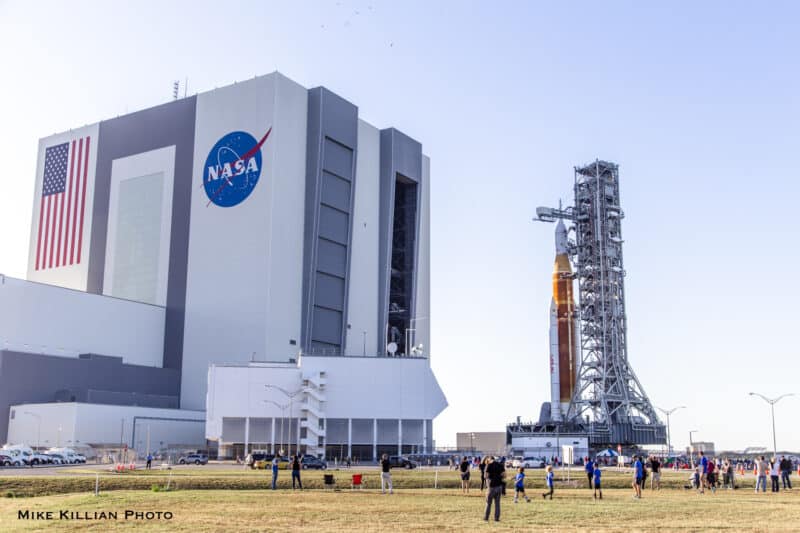
FAA Order May Delay First Artemis, Starship Moon Landings

A new FAA order for an environmental review of SpaceX’s Starship ops at Kennedy Space Center in Florida may delay the first Artemis, SpaceX moon landings.
Right now, NASA has a $4.2 billion contract with SpaceX to develop a Starship variant to land NASA’s first Artemis astronauts at the moon’s South Pole on Artemis-3 by the end of 2026. SpaceX hopes to fly an un-crewed Starship lunar landing test in 2025, to give NASA confidence for a crewed landing.

Starship is not far enough developed to support landing by 2026

2FEB87CE 8A1C 43E2 A0EF A67B149B83CE
FAA Order May Delay First Artemis, Starship Moon Landings 83

That schedule however will likely change. Word through the aerospace grapevine is Artemis-3 will be a lunar mission, no matter where Starship development is. There is already work on changing Artemis-3’s mission parameters to a lunar orbit mission, rather than a crewed landing.

Artemis-4 is slated to be a mission to put a space station in lunar orbit, called Gateway.

36538FDC 53DF 4267 89E5 0DC752ECAF0D
Starship on the moon for a nasa artemis mission (nasa image)

Starship has only flown 3 flight tests to date. They gained tons of data and accomplished numerous milestones, but have yet to achieve a full successful test profile. They’ll need to accomplish several, and many successful operational missions, before NASA even thinks of putting their astronauts on a Starship to land on the moon.

That alone makes an Artemis-3 moon landing in 2026 unlikely, being only 1.5 years away. SpaceX leader Elon Musk said himself that Starship won’t be ready for several years. Not to mention other complications such as SpaceX needing 2 Starships for on-orbit refueling to support 1 Artemis landing.

elon discusses starship for ARTEMIS

The dry lander will be launched to Earth orbit, followed by a fully-fueled tanker Starship which will dock with and fuel the lander. The lander would then fly to lunar orbit to await Artemis and NASA’s Orion spacecraft.

NASA says Starship won’t significantly impact the ecosystem around KSC. FAA says not so fast

Now, the FAA has thrown a wrench in the timeline. SpaceX is currently building the launch pad, tower, and infrastructure to support over 40 Starship launches and landings annually from Kennedy’s historic launch complex 39A. SpaceX already launches crews and Falcon-9 and Falcon Heavy rockets from 39A.

A9D90EE0 8E82 4E91 A33E E6F8AF625A88
Falcon heavy conducts a wet dress reh and static test fire at kennedy lc-39a as residents of the refuge fly past (mike killian photo)

KSC has co-existed beautifully over the decades with the protected national wildlife refuge and seashore it shares. They know how to launch the most powerful vehicles ever made from a vibrant ecosystem, home to 1500 different plants and wildlife. They are responsible for more protected species than any other federal property in the continental United States.

Needless to say, NASA and KSC know how to do spaceflight without harming an ecosystem. NASA led an environmental assessment (EA) for Starship ops in 2019, concluding that Starship wouldn’t cause any significant impact.

FAA orders an environmental impact statement to be done for Starship ops at KSC

SpaceX’s plans, however, have changed since then. So, the FAA now wants a more in-depth environmental impact statement (EIS) conducted.

358DD60C 5775 44F3 BBD0 D41550DD21E0
A spacex falcon-9 and dragon launching off lc-39a, with the new starship pad and tower being constructed next to it (nasa photo: chris swanson)

“While the 2019 EA prepared by NASA provides an analytical baseline, the environmental impacts of these proposed changes to Starship-Super Heavy LC-39A development and operations will be specifically analyzed in this EIS,” said the FAA.

“SpaceX now proposes to construct additional launch infrastructure not previously contemplated in the 2019 EA. Launch an advanced design of the Starship and Super Heavy vehicle; operate at a projected higher launch tempo; and land the Super Heavy booster at LC-39A in support of the reusability concept,” added the FAA.

It’s a big deal. An EIS on average takes 2 years to complete. Even once done, it won’t give Starship the key to space either. The FAA will still need to issue a vehicle operator’s license.

FAA is being sued for not making SpaceX do a EIA/S for Starbase before allowing Starship flight tests

4E3FE348 4403 4BA9 AAA2 164DAA4B0765
The first starship flight test from starbase caused significant impact to the local environment, as well as residents of towns in the region (mike killian photos)

SpaceX conducts Starship flight tests from their “Starbase” in south Texas. The FAA, however, is being sued for allegedly not following their own regulations, requiring (allegedly) that SpaceX do a new EIA/S for testing and launching Starships from Starbase. The place also shares protected ecosystems with the state of Texas.

Seems quite a coincidence. Now the FAA wants to conduct an EIS on Starship, from a property NASA has already said is ok.

FAA invites public input

AFC44CAC FE4D 452E 90EB 6CF0105921E1
Starship’s 2nd launch flight test (mike killian photo)

SpaceX is responsible for preparing the EIS, under FAA supervision. The public is invited to give their 2-cents via 2 in-person public meetings. They’ll take place in Brevard County, FL on June 12-13. A virtual meeting will be held on June 17. Public comments can be submitted until June 24.

Click here to learn more.

The Skydiving DC-9 Hot Rod Flies Again

It’s been over a decade since a former SAS Scandinavian Airlines DC-9 took to the skies over southern California for a skydiving mission. 

But this past weekend, N127NK, a 55-year-old DC-9-21 “Hot Rod,” did just that. Multiple loads of jumpers had a chance to experience history aboard the 488th Long Beach-built Douglas DC-9. Skydive Perris, a skydiving facility just 50 minutes from downtown Los Angeles, hosted three “Jump the Jet” events. 

An Event Four Years in the Making

jet2
Skydive Perris DC-9-20 will soon return to the skies. Photo: Skydive Perris

The “Jump the Jet” events have been in the works since 2020. Skydive Perris, a skydiving facility at Perris Valley Airport (L65) in Perris, Calif., made waves in late November 2020 by announcing the jet would soon return to service for the first time since 2013. According to its Facebook page, the facility, located just 50 minutes from downtown Los Angeles, hosted at least three jump runs this past weekend. The events followed a successful test flight on 7 May. 

Event organizers said the events were only open to licensed jumpers, who paid $150 each for the opportunity. Observer seats and tandem jumpers were not permitted.

The Onboard Experience (Spoiler: There’s no Wi-Fi)

On board N127NK, the skydiving DC-9
On board N127NK before the jump | IMAGE: Screenshot captured from Ben Mertz on YouTube

Although this aircraft is a privately owned skydiving jet, it still bears an FAA registration. Thus, once jumpers boarded the aircraft, they were subject to a standard FAA safety briefing by a specially trained Florida-based flight crew. Like passengers aboard a regular commercial flight, all passengers must be seated with seat belts fastened and tray tables and seats in full, upright, and locked positions. 

Once airborne, this workhorse of a machine only takes four minutes to reach a jumping altitude of 13,500′ AGL. At altitude, the tail exit opens, and the jumpers begin their exhilarating dives back to earth. 

One has to imagine that this particular skydiving aircraft isn’t the most efficient choice. Even with a light load, the slowest a DC-9 can fly is roughly 125 knots. This limitation, combined with a narrow single aisle and the small exit, makes it difficult for the process to be as efficient as more suitable skydiving aircraft options – particularly for formation jumpers. Nonetheless, the experience must have been pretty amazing – especially for avgeeks who love this historic workhorse of a bygone era. 

After Decades at SAS, N127NK Became a Workhorse for the Burgeoning US Low-Cost Carrier Industry

SAS DC-9-21
SAS Scandanavian Airlines DC-9-21 (SE-DBO) at Dusseldorf Rhein-Ruhu (DUS) on 28 January 1984 | IMAGE: Planespotters.net

The history of N127NK stretches back over half a century. Initially registered as SE-DBO, she was delivered new to SAS Scandinavian Airlines on 1 May 1969. She would serve with SAS for over two decades, briefly changing hands with Swedish carrier Nordic East Airways from 1991 to 1992. She was one of just ten DC-9-20s ever built (all for SAS).

Her post-SAS career saw her serve with various airlines throughout the 1990s and into the new millennium. Under a new US registry, N127NK, she flew for low-cost US carriers Spirit, ValuJet, and Allegiant Air. 

Allegiant Air DC-9-21
N127NK in Allegiant Air colors at Reno-Tahoe International Airport (RNO) | IMAGE: FlightAware

Allegiant parked the jet in 2002 at Victorville (VCV). However, her time at VCV was short, as she was purchased by Skydive Perris in 2003. Finally entering service again on 24 December 2006, her primary use besides skydiving was for film production for studios out of Hollywood. 

She was out of commission from 2013 to 2024 while stored at Perris Valley Airport ahead of this past weekend’s triumphant return to the skies. 

Living Aviation History

Skydive Perris DC-9-21
N127NK in storage at Perris Valley Airport in California | IMAGE: Skydive Perris on Facebook

Seeing new life breathed into such a beautiful piece of aviation history is exciting. While officials at Skydive Perris indicate on Facebook that they don’t know when the next jump flights will be, one has to believe that the novelty won’t last long—especially considering the inefficiency of a DC-9 jump aircraft.

However, for those who would jump (pun intended) at the opportunity to be a part of the next “Jump the Jet” event, keep an eye on their Facebook page.

By the way, AvGeekery reached out to D.B. Cooper for comment, but at the time of writing, we have not yet heard back.